Back to Don's Maps
Back to Maps Page
Back to the Cave paintings, engravings and sculptures index page
Chauvet Cave
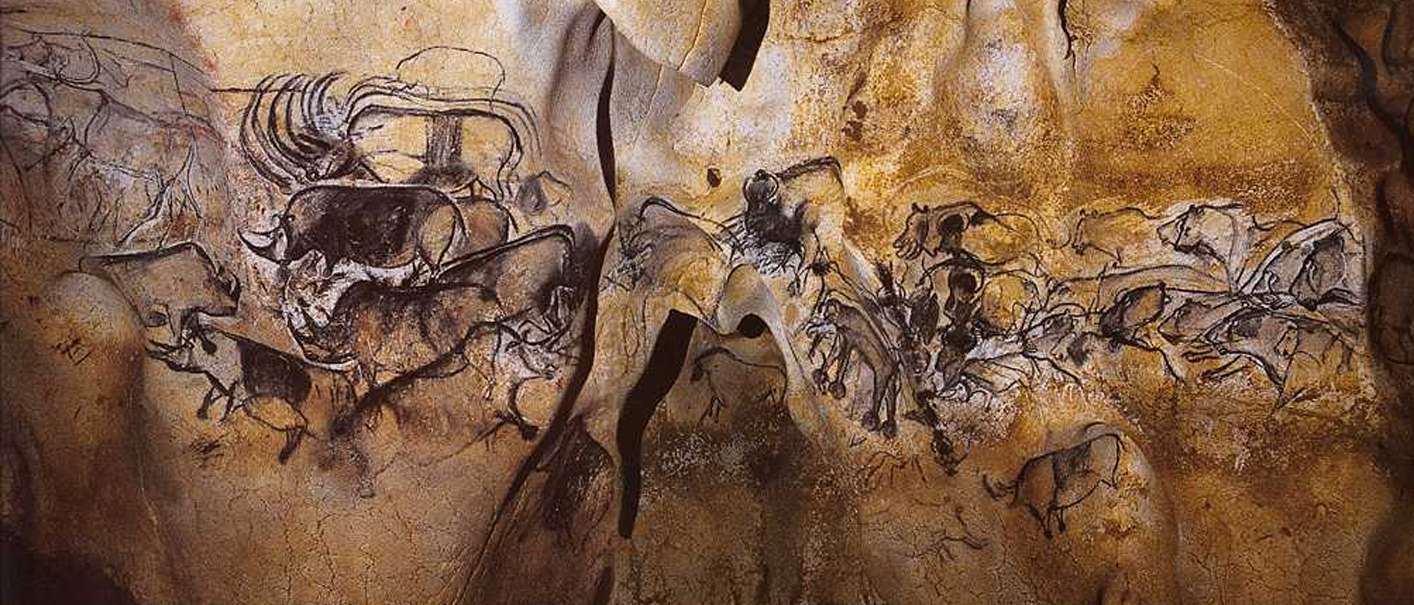
Chauvet Cave in the valley of the Ardèche River in France is filled with paintings, engravings and drawings created more than 30 000 years ago, of cave lions, mammoths, rhinos, bison, cave bears and horses. It contains the earliest known cave paintings, as well as other evidence of Upper Paleolithic life. It is situated on a limestone cliff above the former bed of the Ardèche River. The cave was first explored on December 18, 1994. As well as the paintings they discovered fossilised remains, prints, and markings from a variety of animals, some of which are now extinct.
The cave is situated above the previous course of the Ardèche River before the Pont d'Arc opened up. The Chauvet Cave, however, is uncharacteristically large and the quality, quantity, and condition of the artwork found on its walls is stunning. Most of the artwork dates to the earlier, Aurignacian, era (30 000 to 32 000 years ago). The later Gravettian occupation, which occurred 25 000 to 27 000 years ago, left little but a child's footprints, the charred remains of ancient hearths and carbon smoke stains from torches that lit the caves. After the child's visit to the cave, evidence suggests that the cave had been untouched until discovered in 1994. The footprints may be the oldest human footprints that can be dated accurately. Near-toxic levels of carbon dioxide and radon mean that visitors can enter the cave for only a few hours each day.
Text above adapted from Wikipedia.
Photo above: http://www.ancient-wisdom.co.uk/francechauvet.htm
With the new IntCal20 curve, our best estimate for the creation of the oldest radiocarbon-dated painting in the cave is now 36 500 years ago. This is almost 450 years older than previously thought.
See: https://phys.org/news/2020-08-cave-art-climate-chaos-carbon.html, http://www.australasianscience.com.au/article/science-and-technology/cave-art-climate-chaos-how-new-carbon-dating-timeline-changing-our-vi, https://www.biographic.com/swamp-sentinels/ and https://arxiv.org/pdf/2109.15024.pdf.
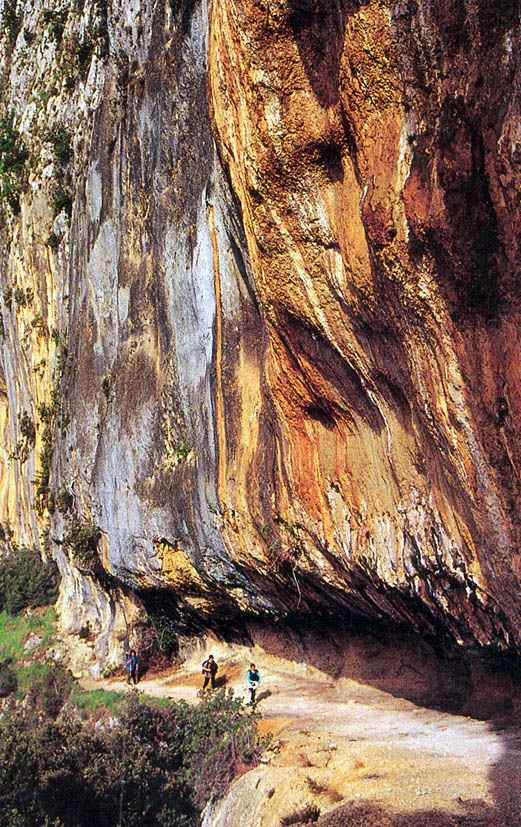
From: National Geographic, August 2001
These mineral stained limestone cliffs along the deep gorge of the Ardèche River in southern France have long attracted cavers eager to explore any uncharted crevice. Here in 1994 three spelunkers found deep chambers filled with paintings, engravings and drawings created some 35 000 years ago. This path leads diagonally up the cliff to the present entrance of Chauvet Cave. The entrance itself is screened by vegetation from below.

Chauvet Cave is located on an abandoned or cutoff meander of the Ardeche River. The position of the modern entrance is circled in this photograph, the original entrance just below it was closed by a rockfall thousands of years ago. The cave is not open to the public.
The entrance is accessed by going up the road in the left foreground, climbing to the prominent fault line leading diagonally up the cliff face, and following it to the entrance. A suspended wooden walkway has been installed to make access easier at the end of this convenient path which almost reaches the cave entrance. The modern entry to the cave is, as near as I can judge, at 44°23.282' N 4°24.960' E.
Photo: adapted from Clottes (2003)
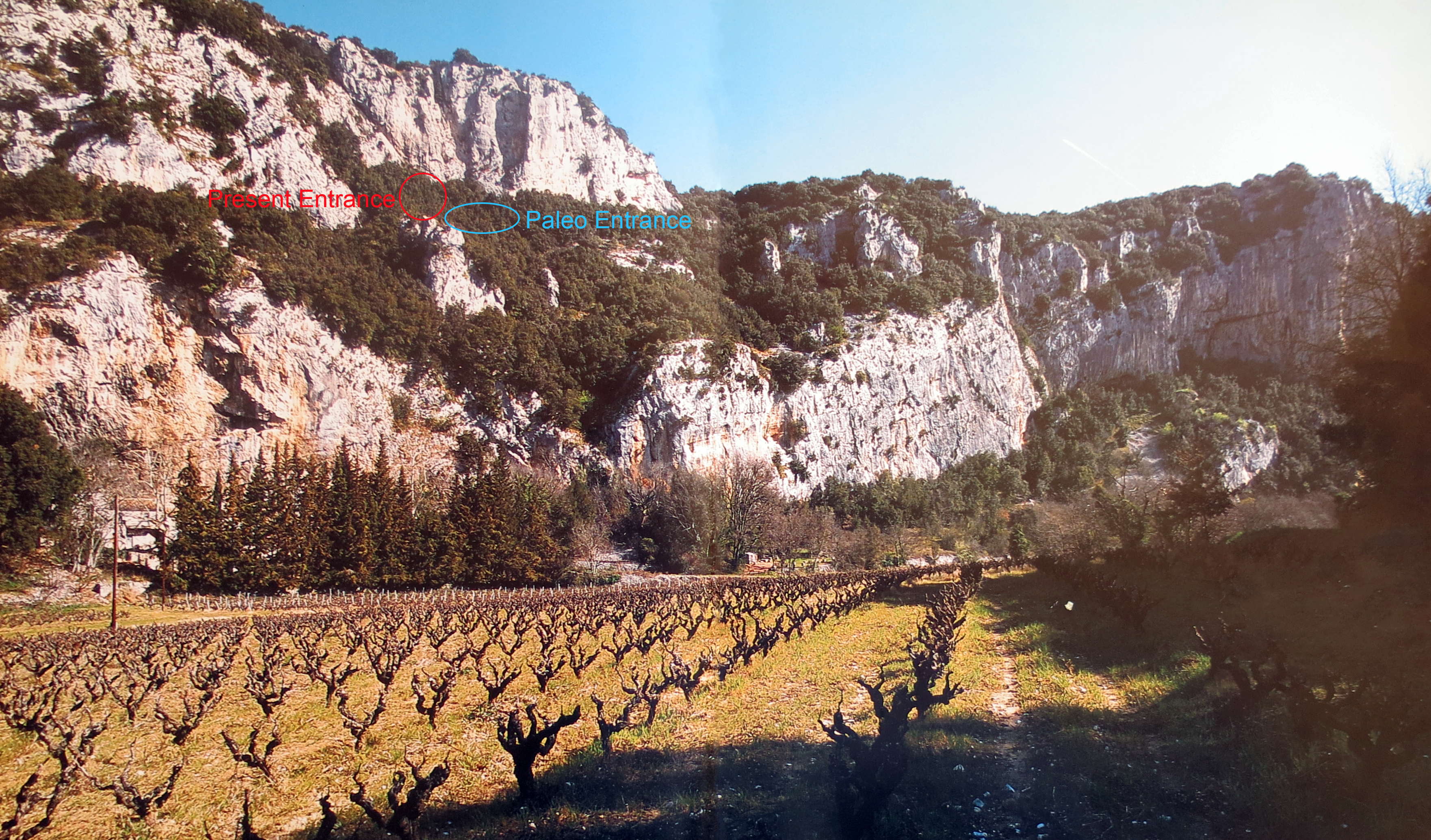
Another view of the cliff behind which lies Chauvet Cave. The present entrance and the original or Paleo entrance are shown in red and blue respectively. The original entrance was closed, covered in scree which fell from the cliff above, more than 20 000 years ago.
Photo: adapted from Chauvet, Deschamps et Hillaire (1996)

View from the valley floor of the cliff line.
Photo: Courtesy Hartwig Varbelow

The unmade track climbs steeply from the valley floor below.
Photo: Courtesy Hartwig Varbelow

A broad shelf has been carved into the cliff, perhaps to facilitate moving the equipment needed to explore the cave and install walkways and lighting.
Photo: Courtesy Hartwig Varbelow

View of the overhanging cliff not far from the entrance.
Photo: Courtesy Hartwig Varbelow
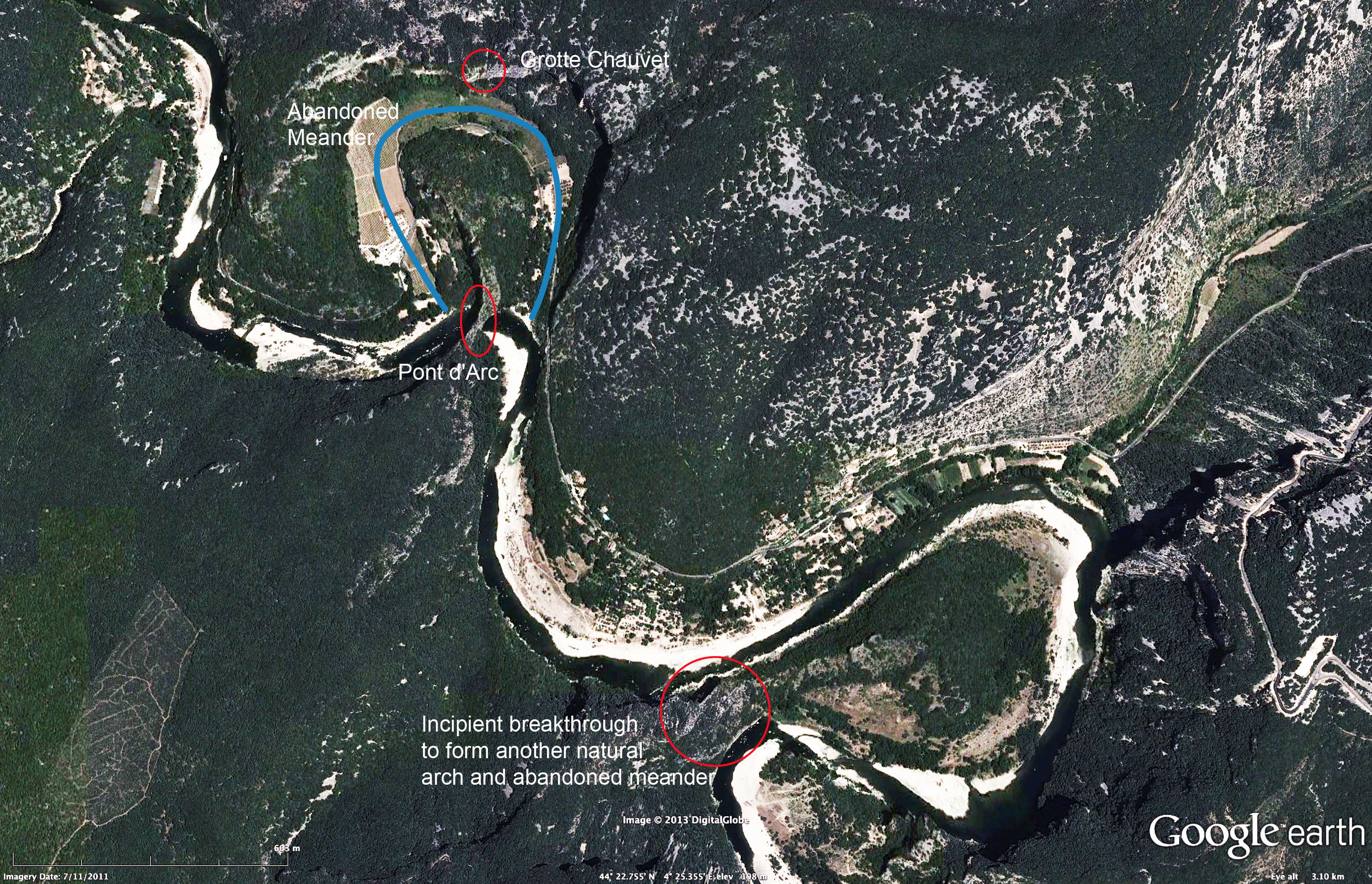
This aerial shot allows us to see the general layout of the site in its setting. Chauvet Cave is in the cliff on the outside of an ancient incised meander, cut off some hundreds of thousands of years ago when the river took a short cut at its neck, through the natural stone arch of Pont d'Arc formed at the time of the breakthrough. The area of the abandoned or cutoff meander has since silted up to form farmlands. A very narrow necked incised meander further downstream will suffer the same fate, some hundreds of thousands of years from now.
Photo: adapted from Google Earth, utilising the information in a similar photo in Clottes (2003)
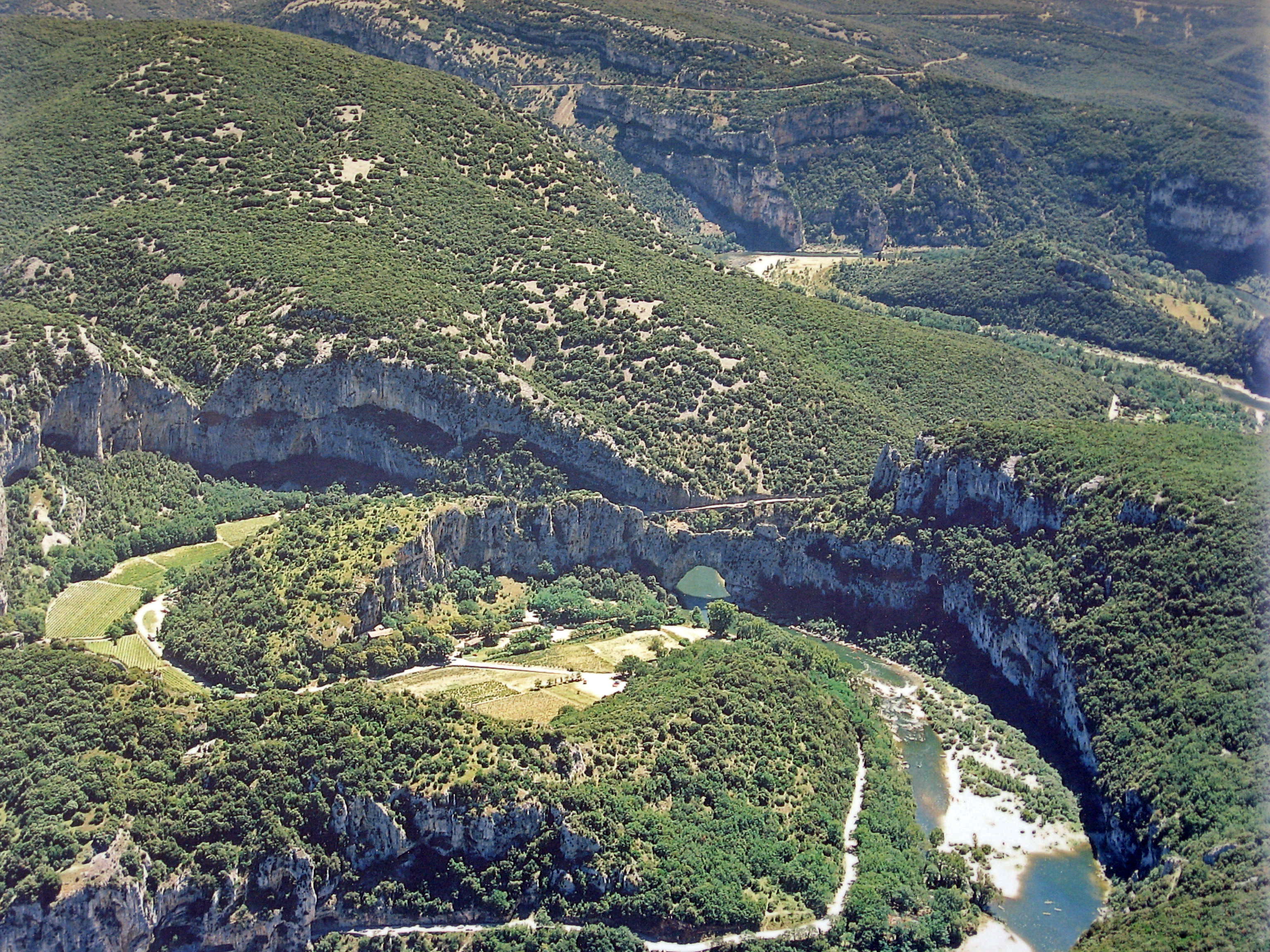
An aerial shot of Pont d'Arc and the cliff (on the left, out of frame) within which lies Chauvet Cave.
Photo: © JitkaSpacek, Panoramio via Google Earth
The cutoff (or abandoned) meander is now under cultivation, and grapes are grown there. At times of very high rainfall, floodwaters can enter the meander, when there is too much water for it all to pass through the Pont d'Arc. This last happened in the great floods of 1827 and 1890.
The soil/alluvium of the cutoff meander is 15 metres above the bed of the Ardèche, and was deposited there during the last great ice age, the Würm glaciation, when this flooding of the meander seems to have been a relatively common occurrence. I suspect this occurred during the spring melt, when big chunks of ice came down the river, blocking the Pont d'Arc aperture and forcing the water into the abandoned channel, where it dropped its load of sediment.

The Pont d'Arc has spanned the Ardeche River for about 500 000 years. Close by is the Chauvet cave.
Photo: Wikipedia, by "paste", this work is licensed under the Creative Commons Attribution-ShareAlike 3.0 License.
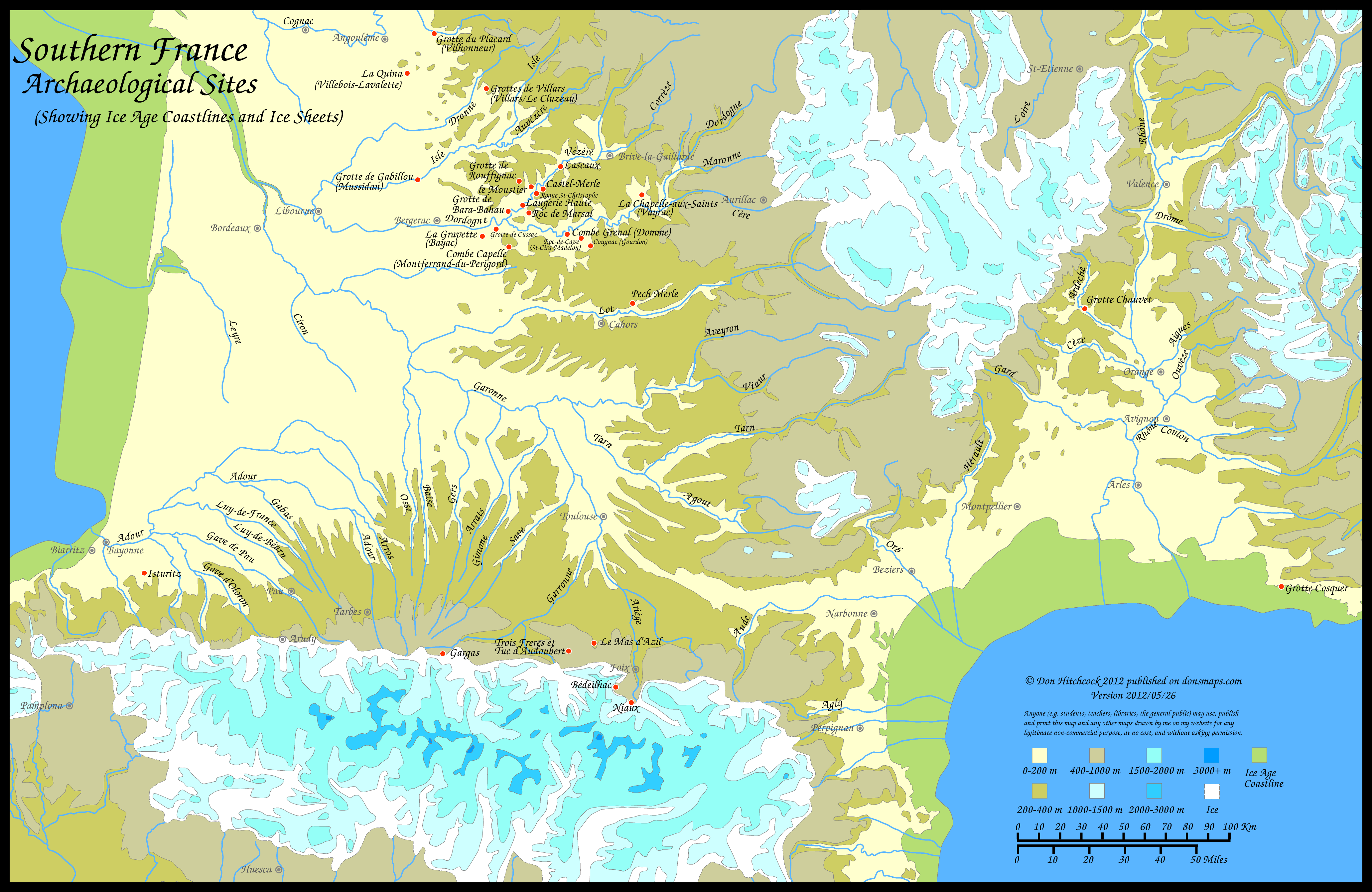
Note - Use this pdf file if you wish to print this map on a single sheet of paper.
Photo: Don Hitchcock version 2012/05/26
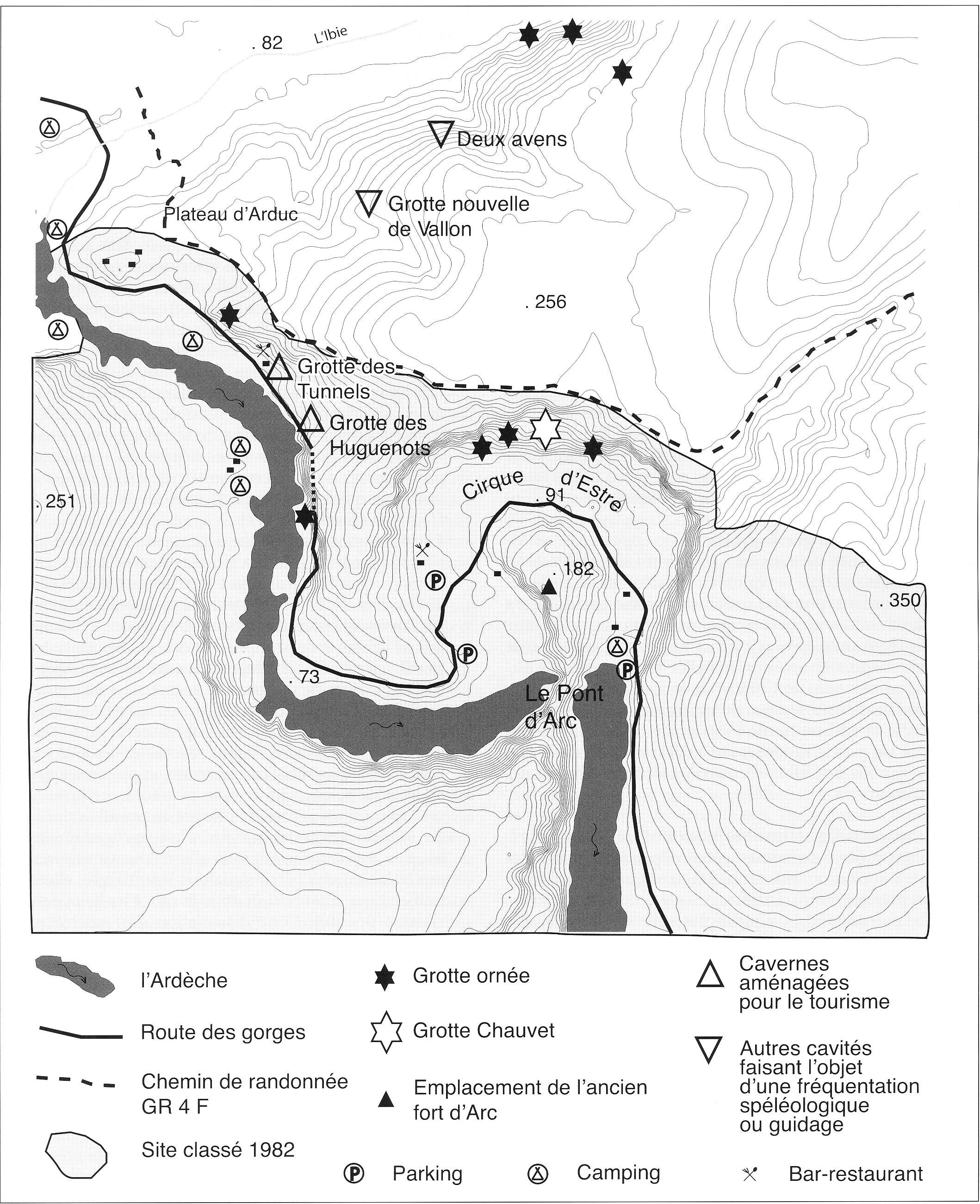
Topographic map of the Chauvet region.
It is important to realise that there are three decorated caves (smaller dark stars) right beside Chauvet Cave (large white star).
It would be good to get more information on these caves.
Note that this topographic map is not particularly accurate with regard to the line of the road around the Cirque d'Estre, nor with regard to the position of the restaurant and parking area to the north-west of Pont d'Arc. Compare with the Google Earth image below.
Photo: Christophe Gauchon
Source: http://teoros.revues.org/413
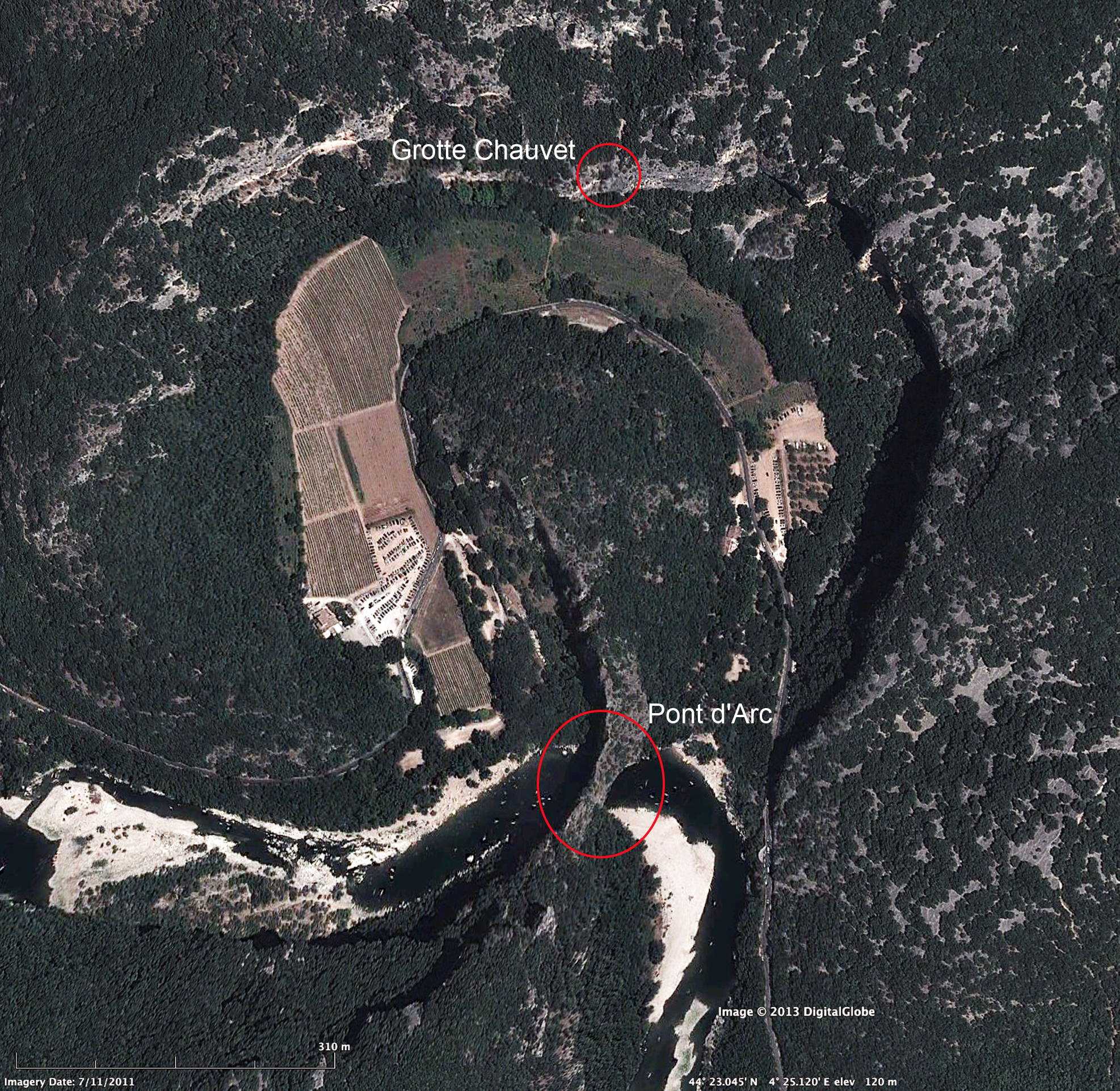
Pont d'Arc and Grotte Chauvet, as seen from above.
Photo: Google Earth
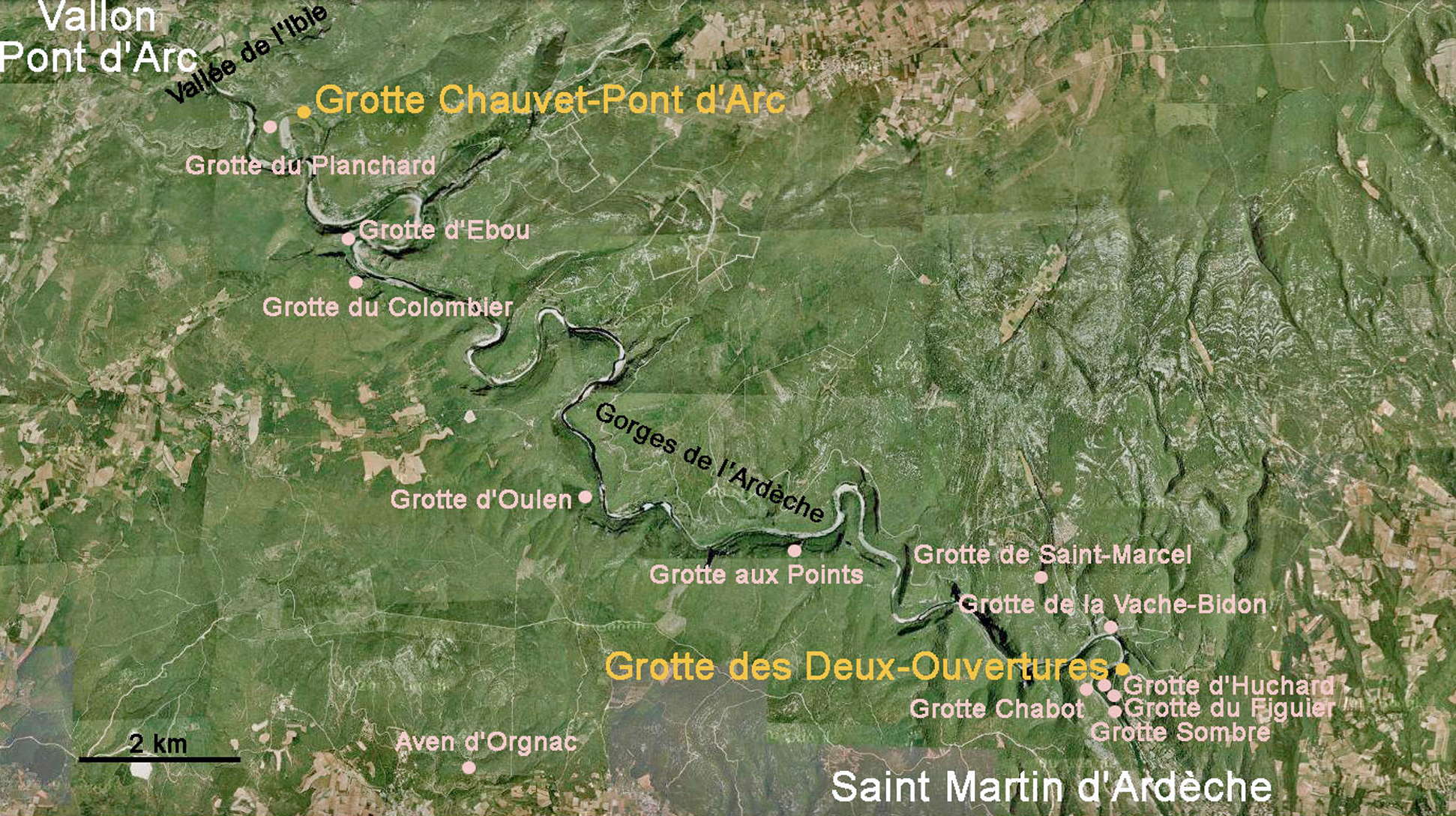
Map of caves in the Ardeche Gorge region.
Photo: Bon (2011b)
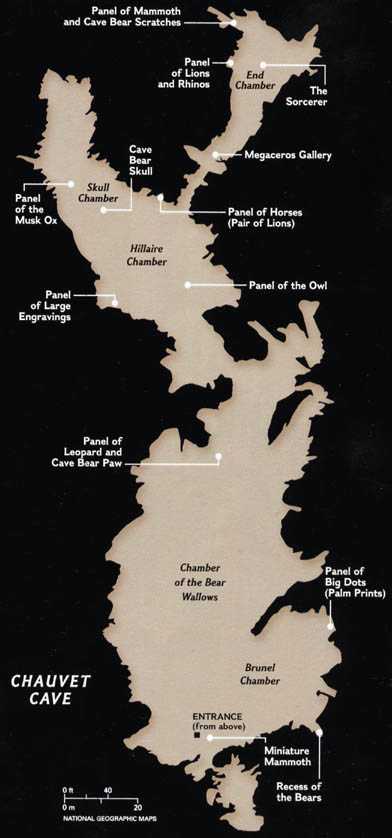
From: National Geographic, August 2001
Floor plan of the Chauvet Cave, by National Geographic Maps

At A we can see a map of the Chauvet area, showing Chauvet Cave in red, and other caves in yellow.
The black arc next to the cave in red is not the present river, but the dry abandoned or cutoff meander.
At B is a cross section of the hillside, showing the marly (clayey limestone) layer which, by acting as a waterproof layer, helped to create the cave system from waters seeping down from above.
At C is a map of Chauvet Cave, with the original entrance indicated.
Photo: Sadier et al. (2012)
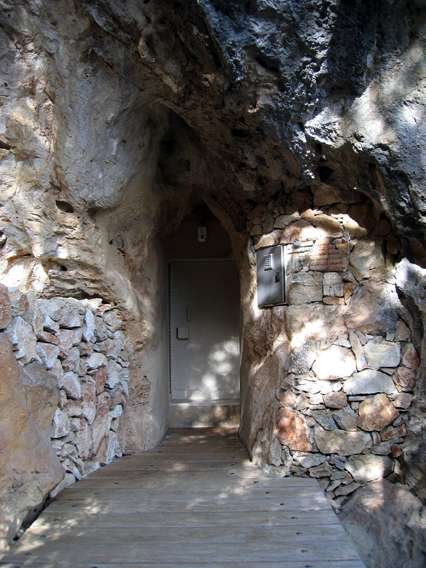
View of the entrance to the Grotte Chauvet near Vallon-Pont-d'Arc, Rhône-Alpes (France).
After initial proceedings begun in the very first days, the cave was officially designated as an Historic Monument on October 13, 1995. Also in 1995, the state began taking measures to expropriate the cave from its three recognised owners. The state became owner of the cave on February 14, 1997.
The first measure of protection consisted of 24-hour surveillance of the entry by local police. Soon after, a solid door and simple alarm system were installed while awaiting the intervention of Commander Cadias, who is responsible for the security of Historic Monuments with the Ministry of Culture. A large-scale operation was subsequently undertaken to equip the cave with a reliable protection system. Today the cave is under permanent audio and video surveillance, and a complex protocol is followed before each entry. The authorised persons are obliged to follow a strict set of procedures requiring them to wear a special suit and shoes that have not been in contact with the exterior. In this way, all biological exchanges with the cavity are avoided as much as possible.
Inside the cave, a system of climatological and biochemical surveillance has been installed by the Laboratoire Souterrain du CNRS de Moulis and the Laboratoire de Recherche des Monuments Historiques. This system continually regulates the hygrometry and temperature within the cave, as well as the bacteriology and growth of concretions.
Finally, a program of adapting the area around the cave, and the paths of access inside, is currently in progress.
Text: http://www.culture.gouv.fr/culture/arcnat/chauvet/en/index.html
Photo: "dmb01" via http://www.panoramio.com/

The path leads up the cliff at a convenient angle, and where it ends a suspended wooden walkway has been constructed to give access to the present entrance.
The grille shown here, screened by vegetation from below, does not protect the entrance to Chauvet, but a convenient sterile cave nearby, which is used to store equipment, and to get ready to enter the cave via a heavy metal locked door, further back down the walkway, the way you came. Public access is not available.
Photo: http://www.bradshawfoundation.com/chauvet/chauvet_cave_visit.php

Floor plan of the Chauvet Cave, redrawn by Don Hitchcock from Philippe et Fosse (2003), with additional text adapted from
'Chauvet Cave - The Art of Earliest Times' Directed by Jean Clottes, translated by Paul G. Bahn
This book is essential reading for those interested in the Chauvet Cave, Clottes (2003)
For a printable version, see below.
There are several ways to print this image.
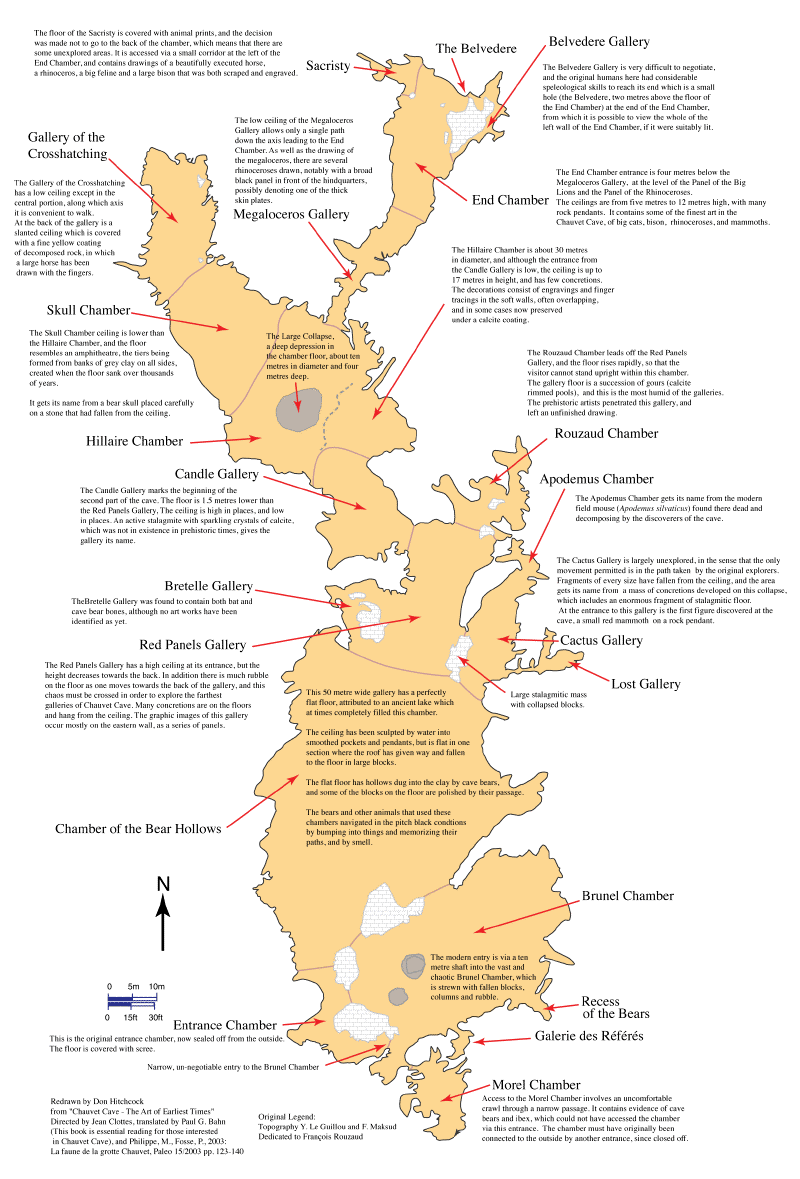
Here is the image as a pdf file which will print on one page.
After opening with Adobe Reader, set your print preferences to "autorotate and center", and page scaling to "shrink to printable area".
This .pdf file will allow the user to print the map as a single page on all computers and printers using the free Adobe Reader program.
Other programs and browsers may open the file, but it is best to use Adobe Reader to print it, since other programs tend to chop bits off, however you might like to try the latest Chrome Browser which seems to work fine.
Because the image contains text, the above printout may be hard to read if you are printing to US letter or A4 paper.
Here is the image again, as two halves, top and bottom, overlapped by a small amount. This will enable you to print it out as two pages, then glue one half to the other using the small overlap.
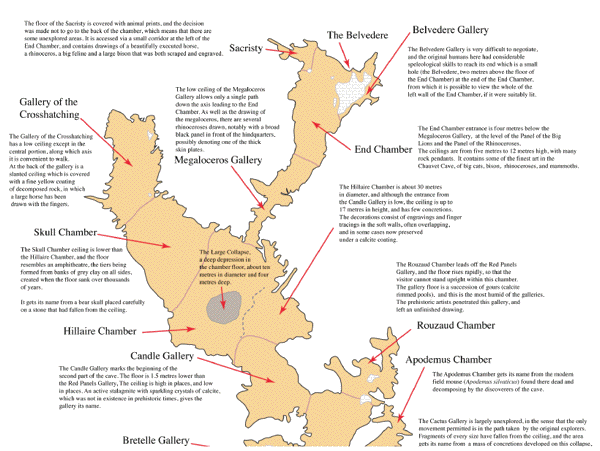
Here is the top half of the image as a pdf file.
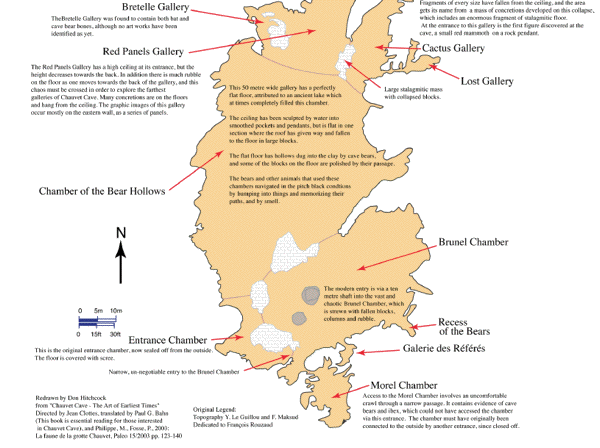
Here is the bottom half of the image as a pdf file.
Print them both out, then cut off the white margin or border on the bottom of the top half only, align them carefully top over bottom, and glue down.
You could if you wish then glue another piece of paper to the back to strengthen the joint.
Other programs and browsers may open the file, and the Chrome Browser should print it out well, but you may have to download it and then use Adobe Reader to print it, if you are using another browser or program which tends to chop bits off. If you do not have the free Adobe Reader program you can get it at: http://www.adobe.com/products/reader/
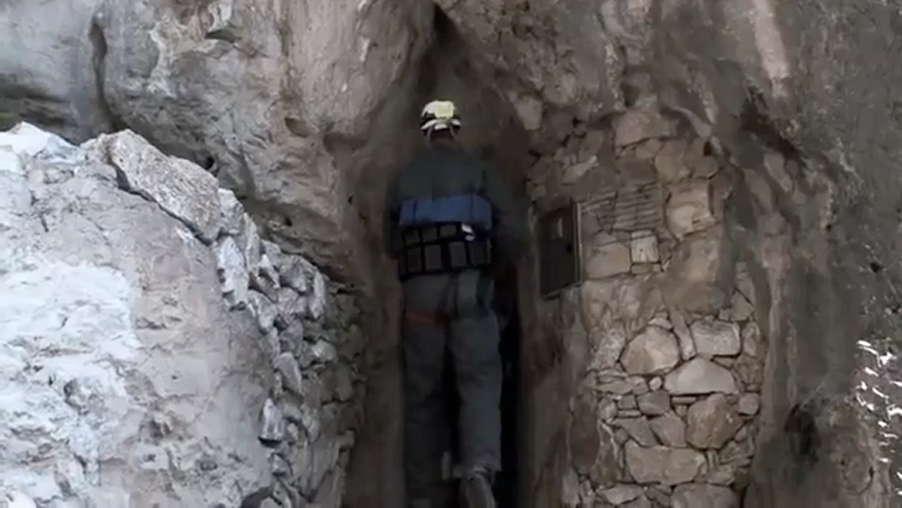
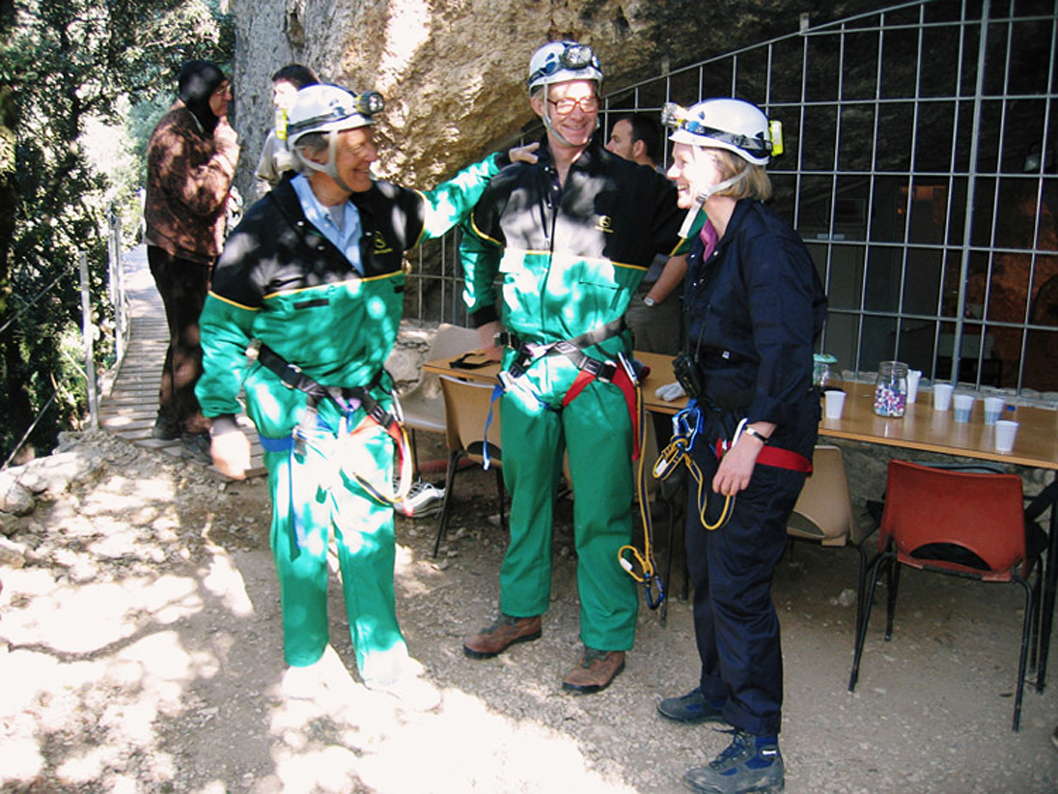
When entering Chauvet Cave, it is necessary to be well prepared with appropriate clothing and equipment. The entry is via a steel door which gives access to a sterile side chamber of Chauvet which was exposed by cliff retreat, and was never used by the palaeolithic artists. The original entrance which they used was sealed many thousands of years ago by a rock fall.
Photo: Herzog (2011)
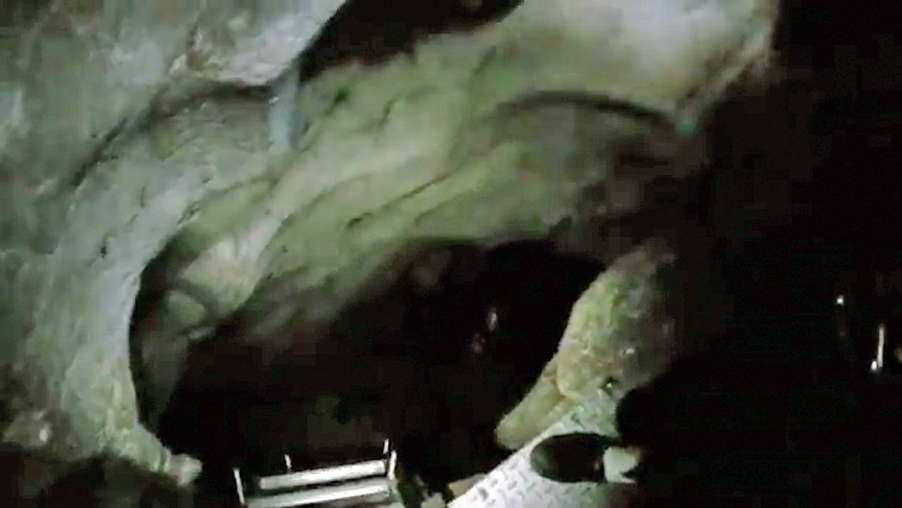
The ancient cave is then accessed via an alloy ladder down a ten metre shaft through a hole in the roof of the huge Brunel Chamber, the floor of which is strewn with fallen blocks, columns and rubble.
Photo: Herzog (2011)
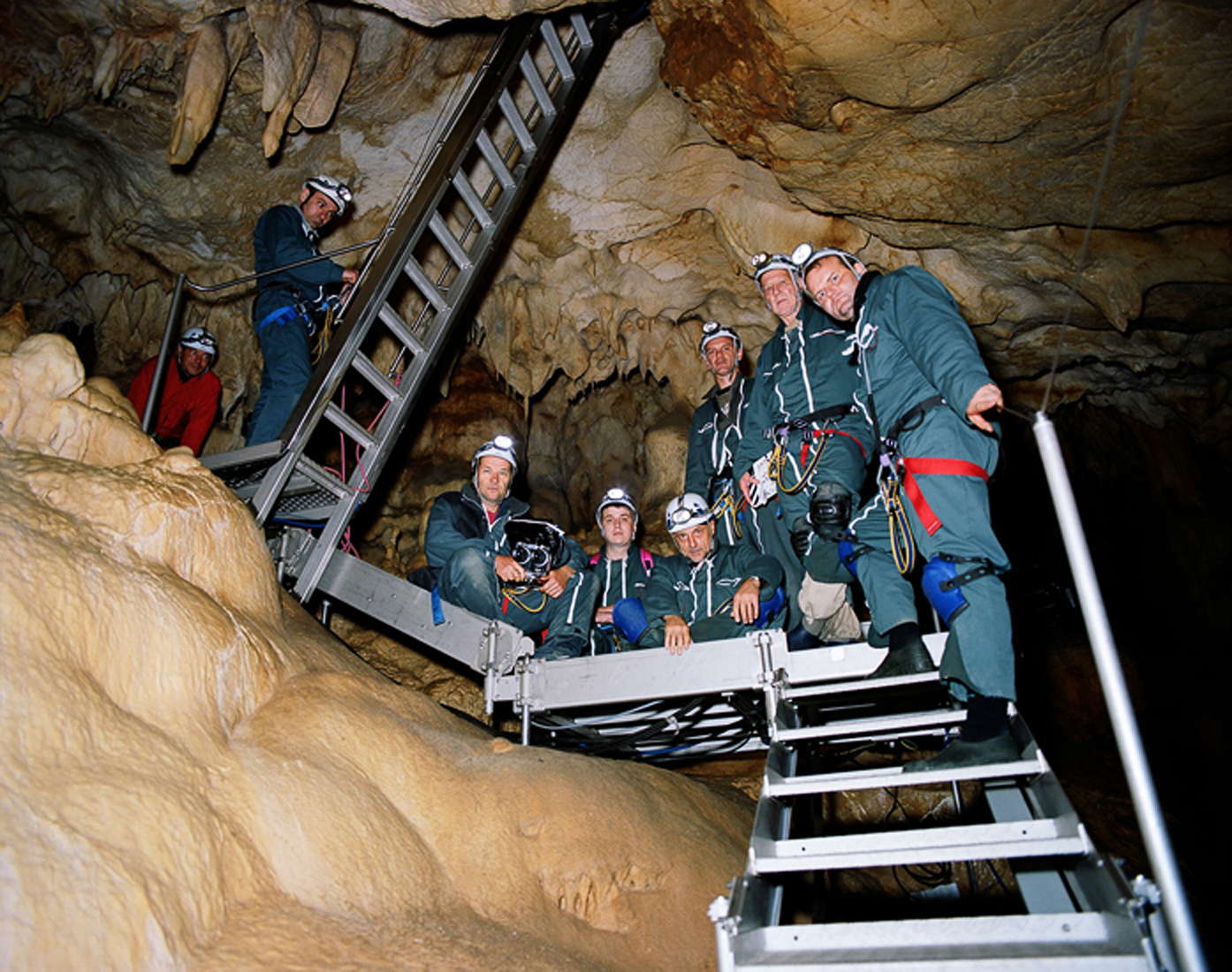
The alloy ladder is arranged more like a staircase than anything else. Here we see the crew for the Herzog film, 'Cave of Forgotten Dreams'.
Photo: http://uk.phaidon.com/agenda/art/picture-galleries/2011/march/10/inside-the-cave-of-forgotten-dreams/
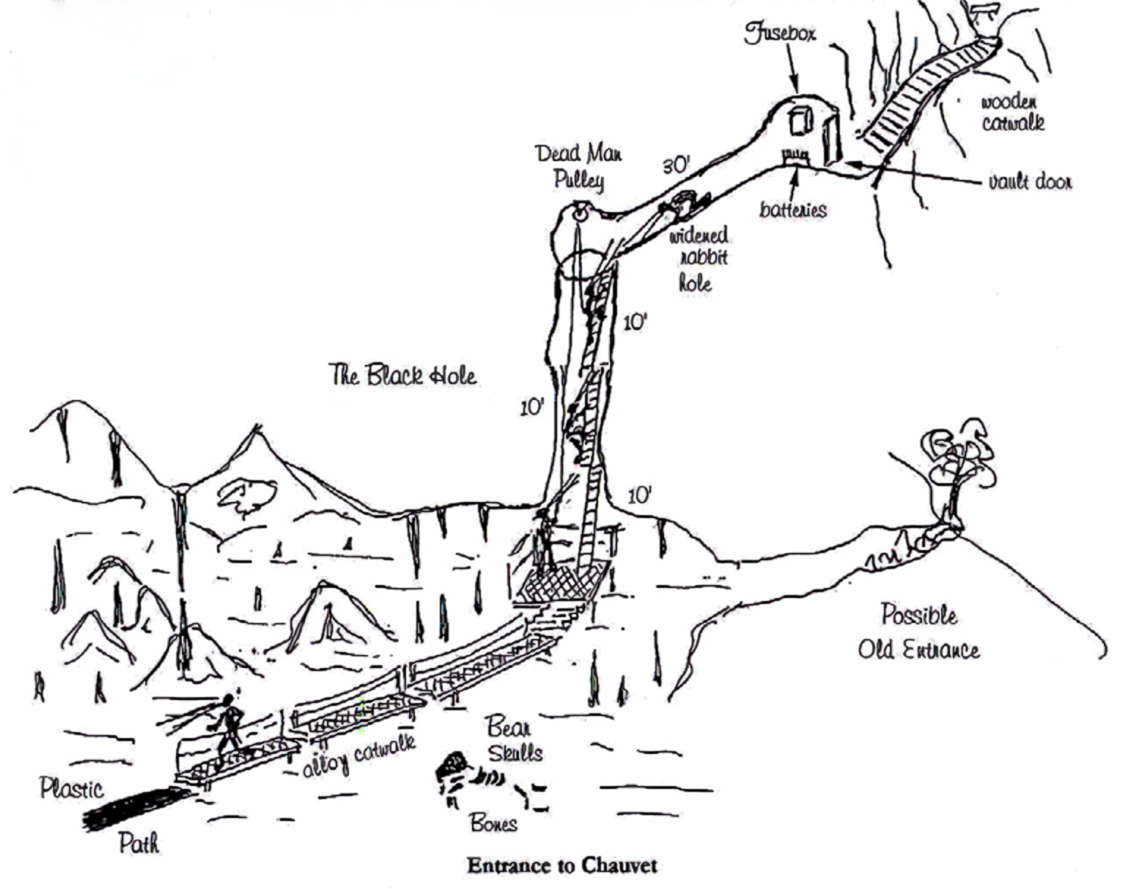
This is a very valuable sketch of the ladder used to access the cave by John Robinson, who accompanied Jean Clottes after the original 'rabbit hole' was widened to allow easier access, and a metal staircase was added to ease access.
Photo: ©John Robinson, Chauvet through the eyes of a sculptor,
http://www.bradshawfoundation.com/jr/pdf_vol2/845-879%201CHAUVET%20%20EYES2.pdf
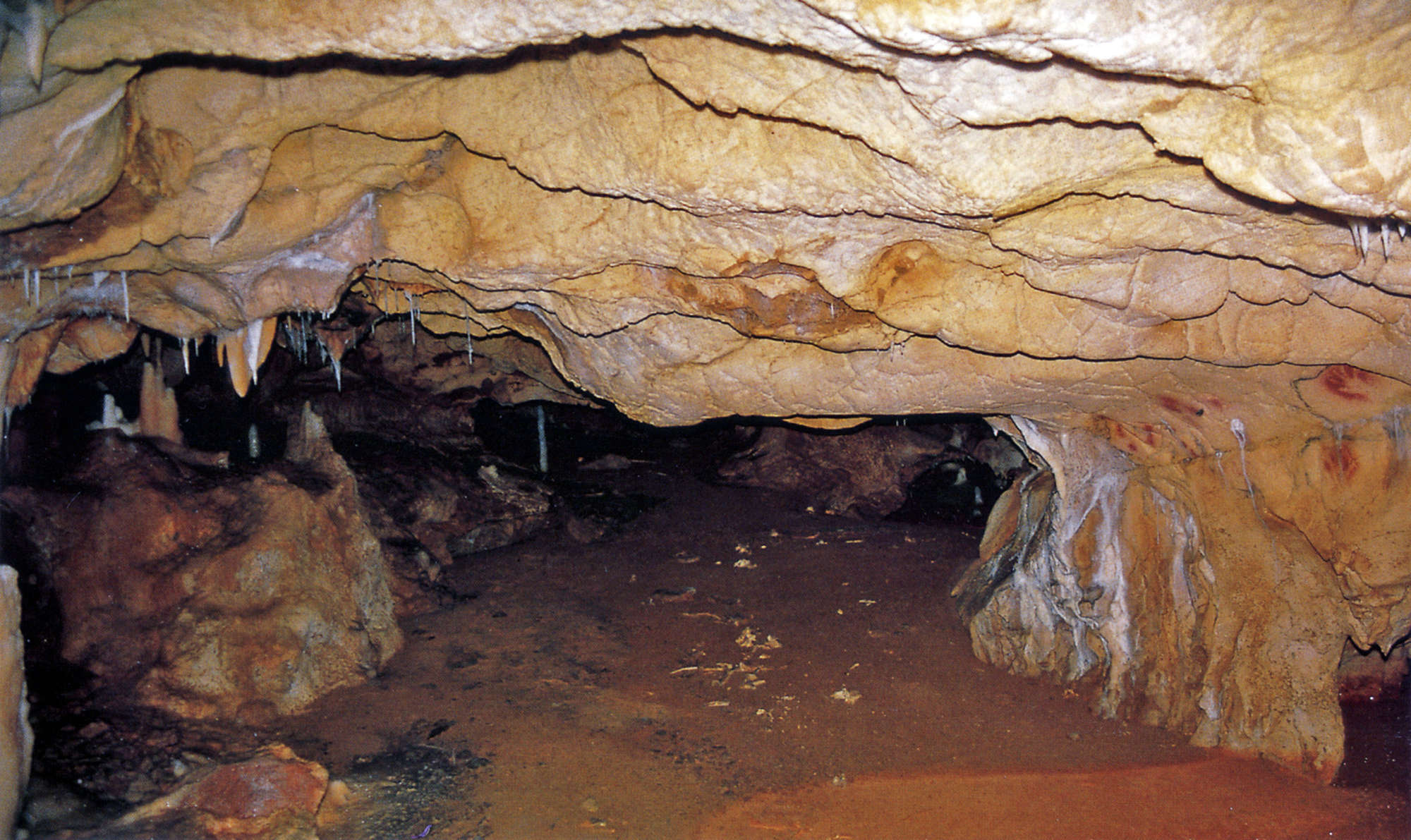
The Brunel Chamber - Salle Brunel
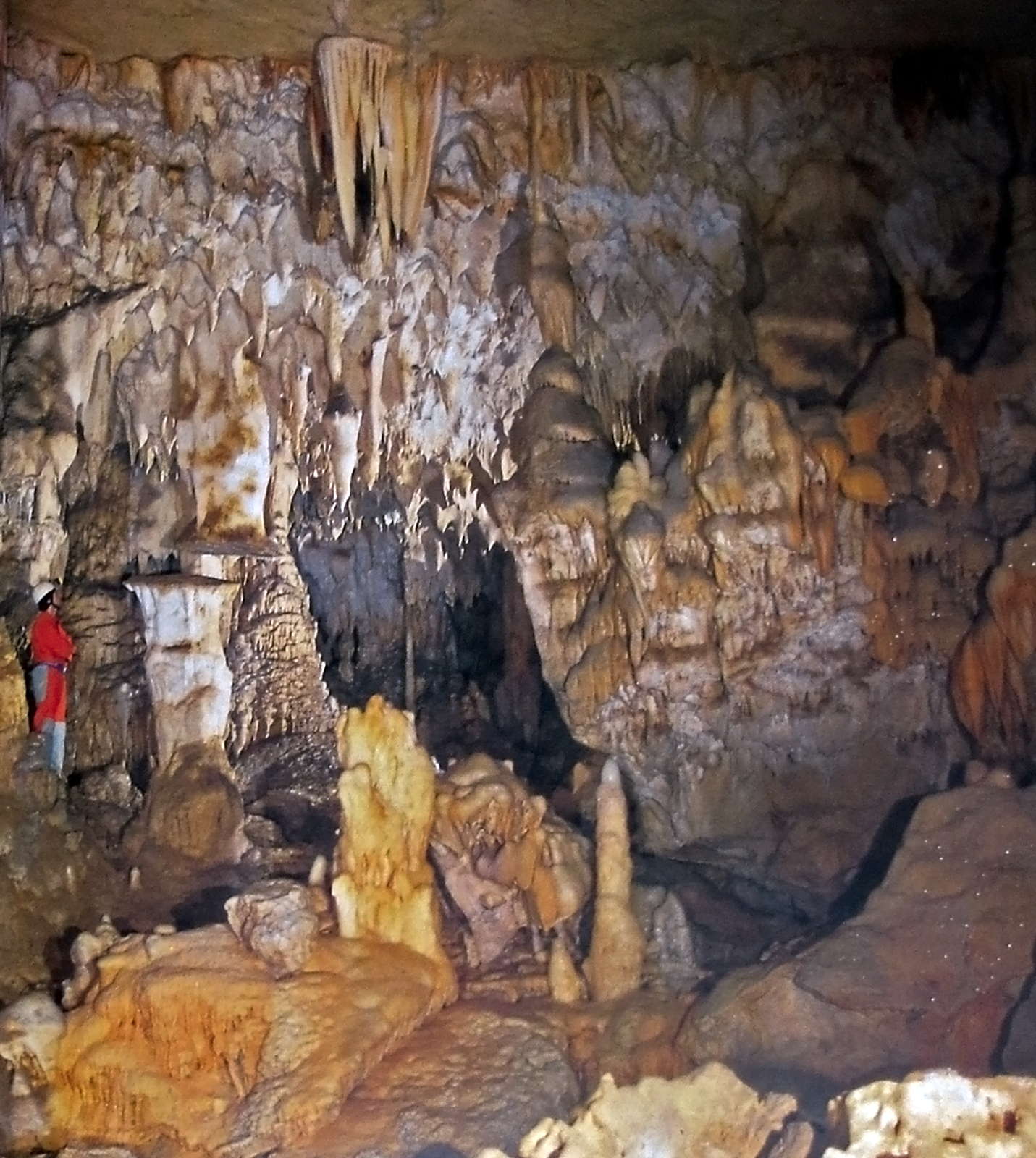
When the cave was first discovered, it seemed to be just another large cave, with stalactites, stalagmites, draperies and flowstone.
Here we see the Brunel Chamber, with fallen blocks and beautiful concretions of calcite sparkling in the light, and with blocks from the roof fallen on the floor.
Photo: Clottes (2003)
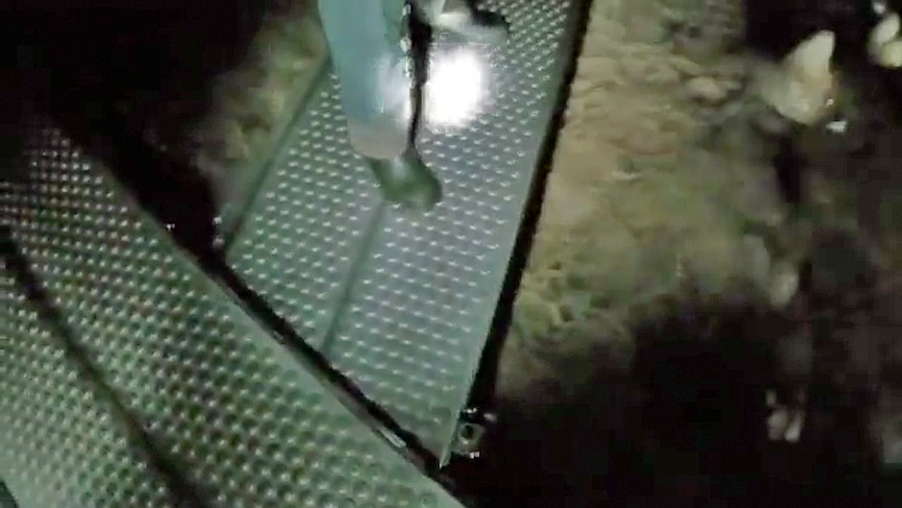
All visitors to the cave are now required to keep strictly to these alloy walkways which have been installed to protect the very fragile floor and its contents from damage. Much remains to be discovered in the cave. This is the first cave (and, fortuitously, the best of all known painted caves) which has had the benefit of excellent techniques for preservation for future scientific research.
Photo: Herzog (2011)
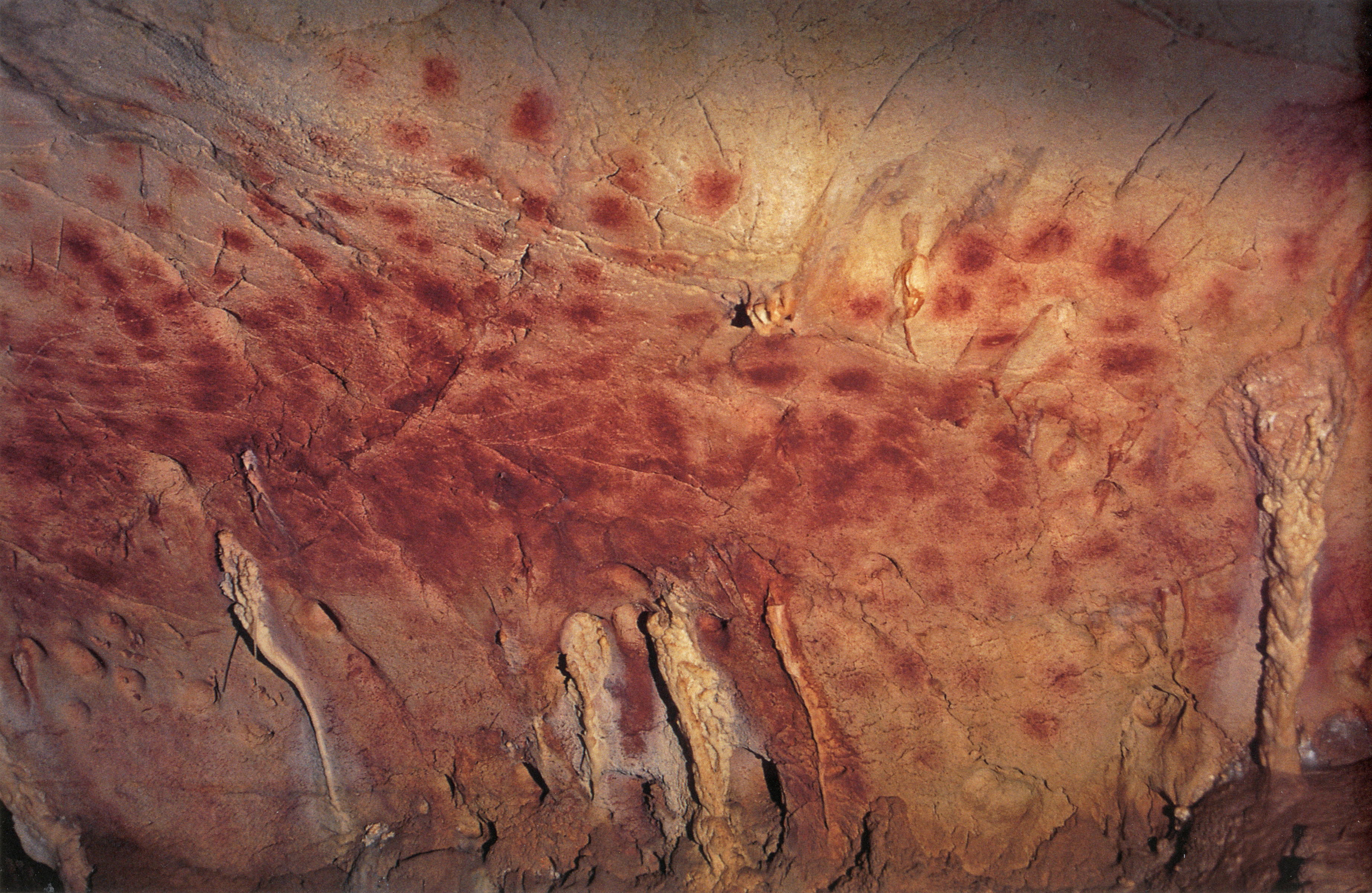
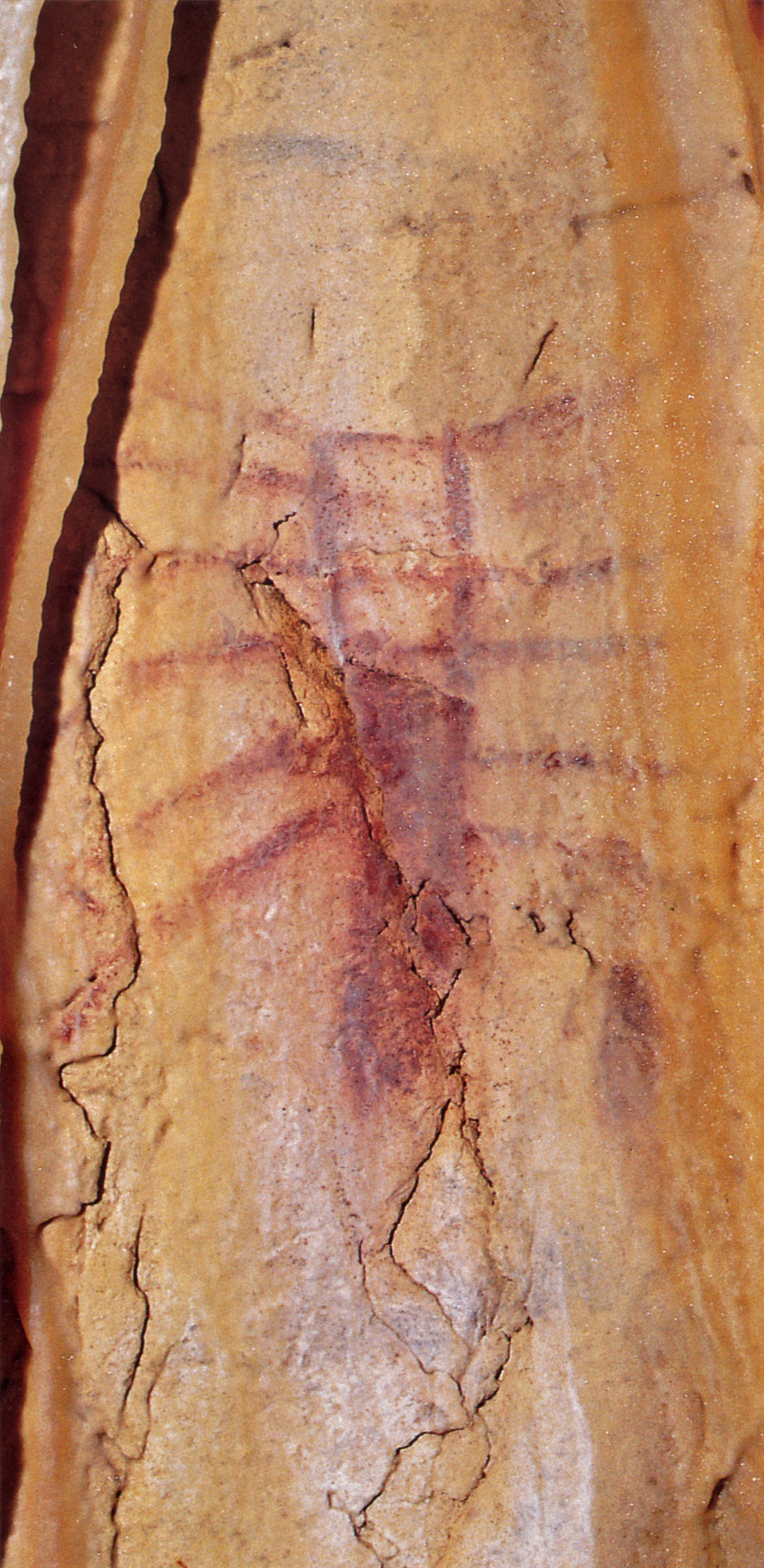
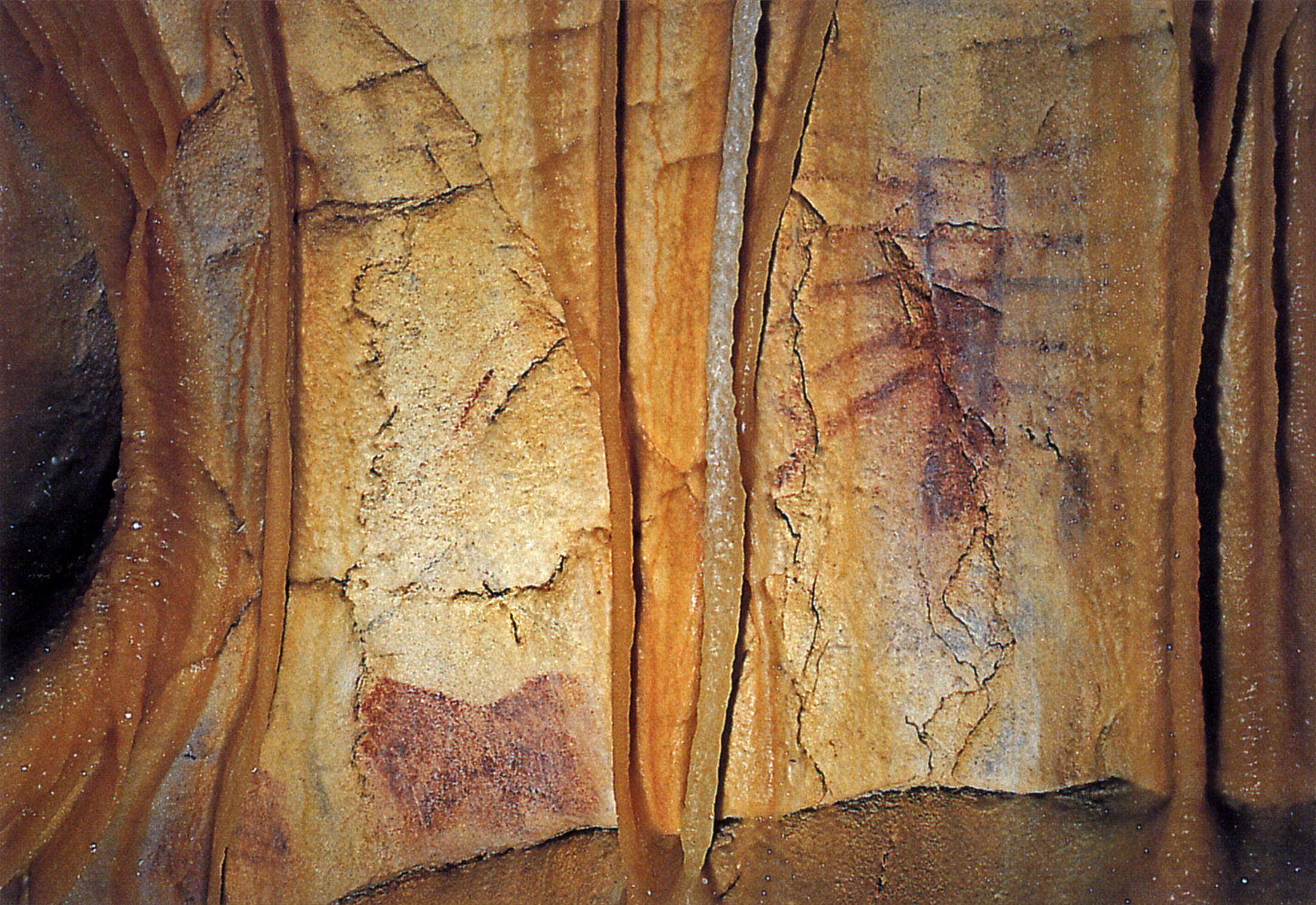
This is part of the large panel known as the Sacred Heart Panel, not far from the original entrance, in the Brunel Chamber. Alloy walkways have been placed nearby to allow close inspection of this object.
Photo: Clottes (2003)
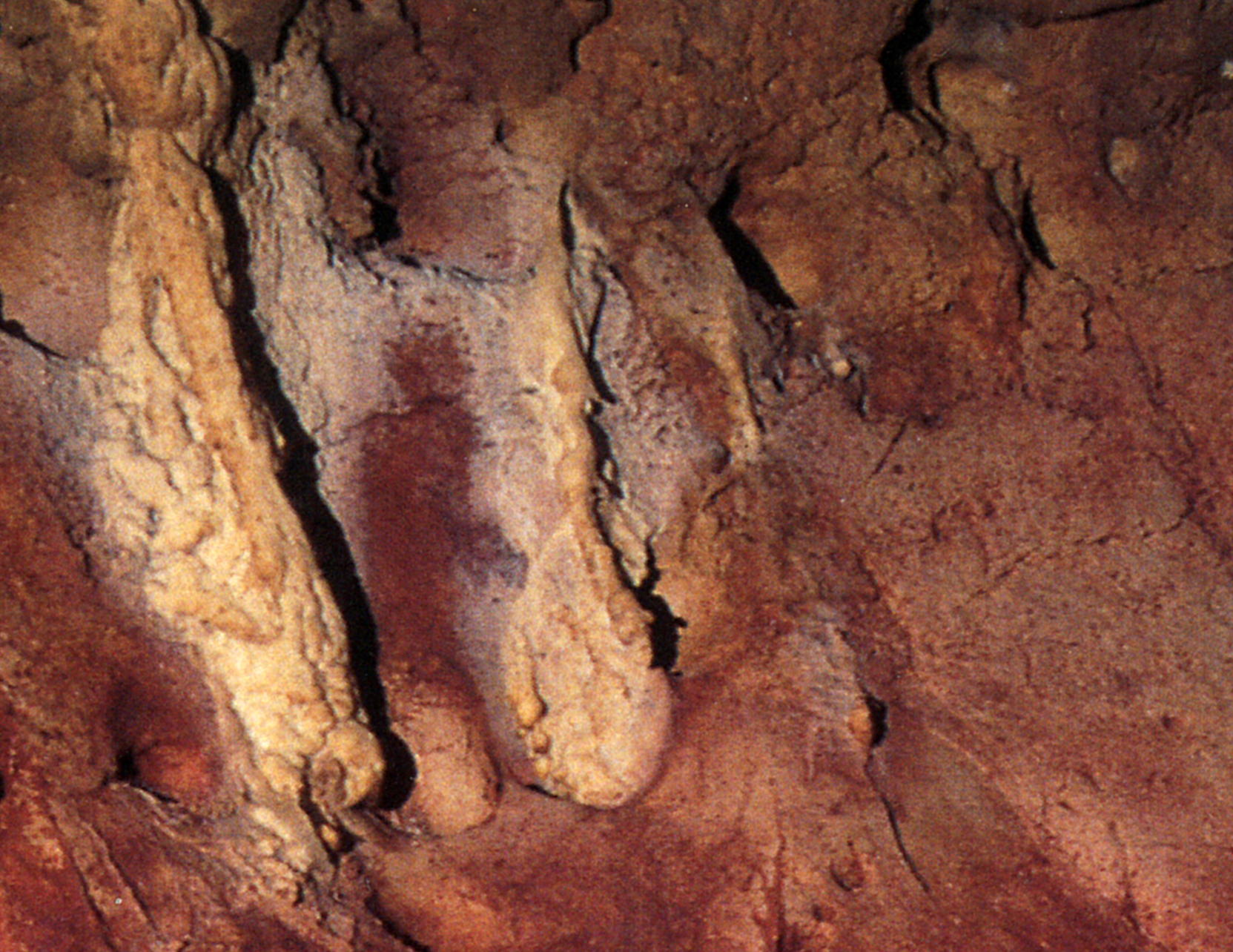
Pareidolia is the psychological phenomenon involving a vague and random stimulus (often an image or sound) being perceived as significant. Common examples include seeing images of animals or faces in clouds, the man in the moon or the Moon rabbit, and hearing hidden messages on records when played in reverse. (Wikipedia)
While we must always be on our guard against seeing castles in the clouds, it is very tempting to see the image of the shadow of a human in this figure which is part of the Sacred Heart Panel. With the eye of faith, one can even see another human figure facing it!
However, I only discovered this interpretation when I looked at the image upside down, as shown here. Thus it is only a mental construct, an accident of the placement of the red ochre.
A problem for my readers: find this upside down figure in the image above!
Photo: Clottes (2003)
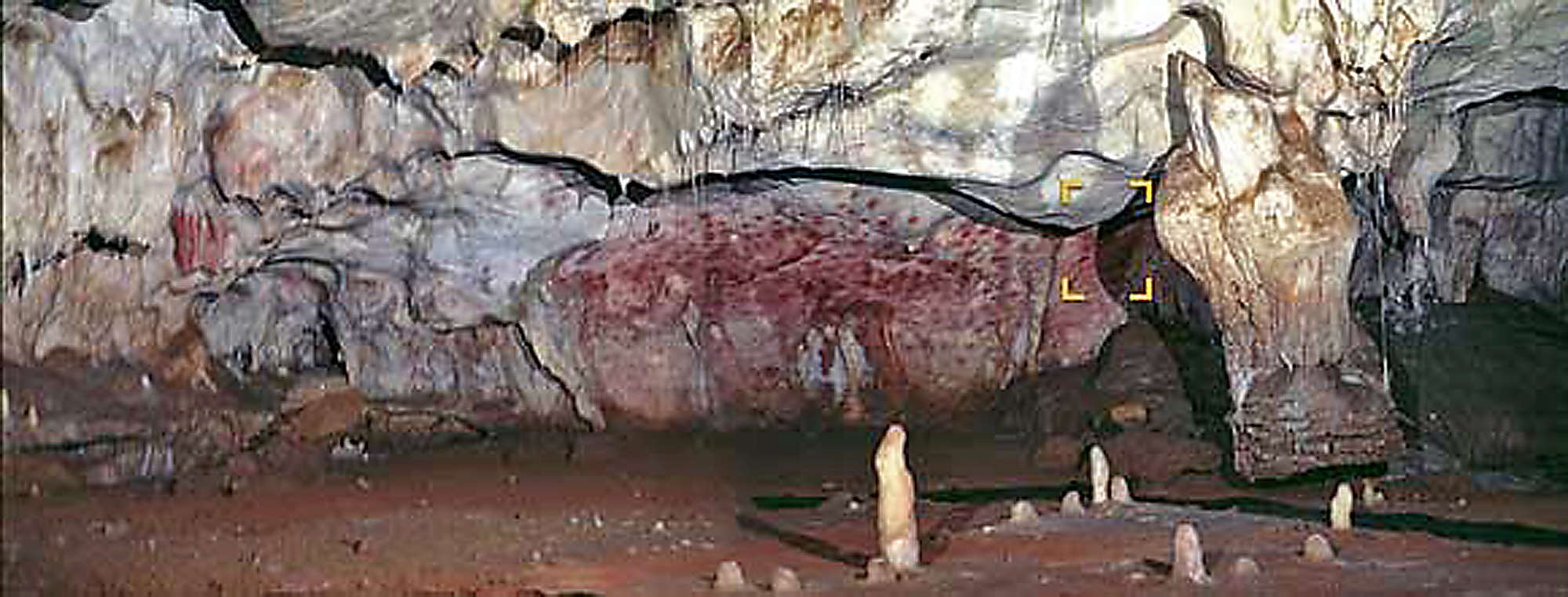
This shows the whole panel, with the yellow corners framing the actual image known as the Sacred Heart.
Photo: http://www.culture.gouv.fr/culture/arcnat/chauvet/en/owpt01.htm
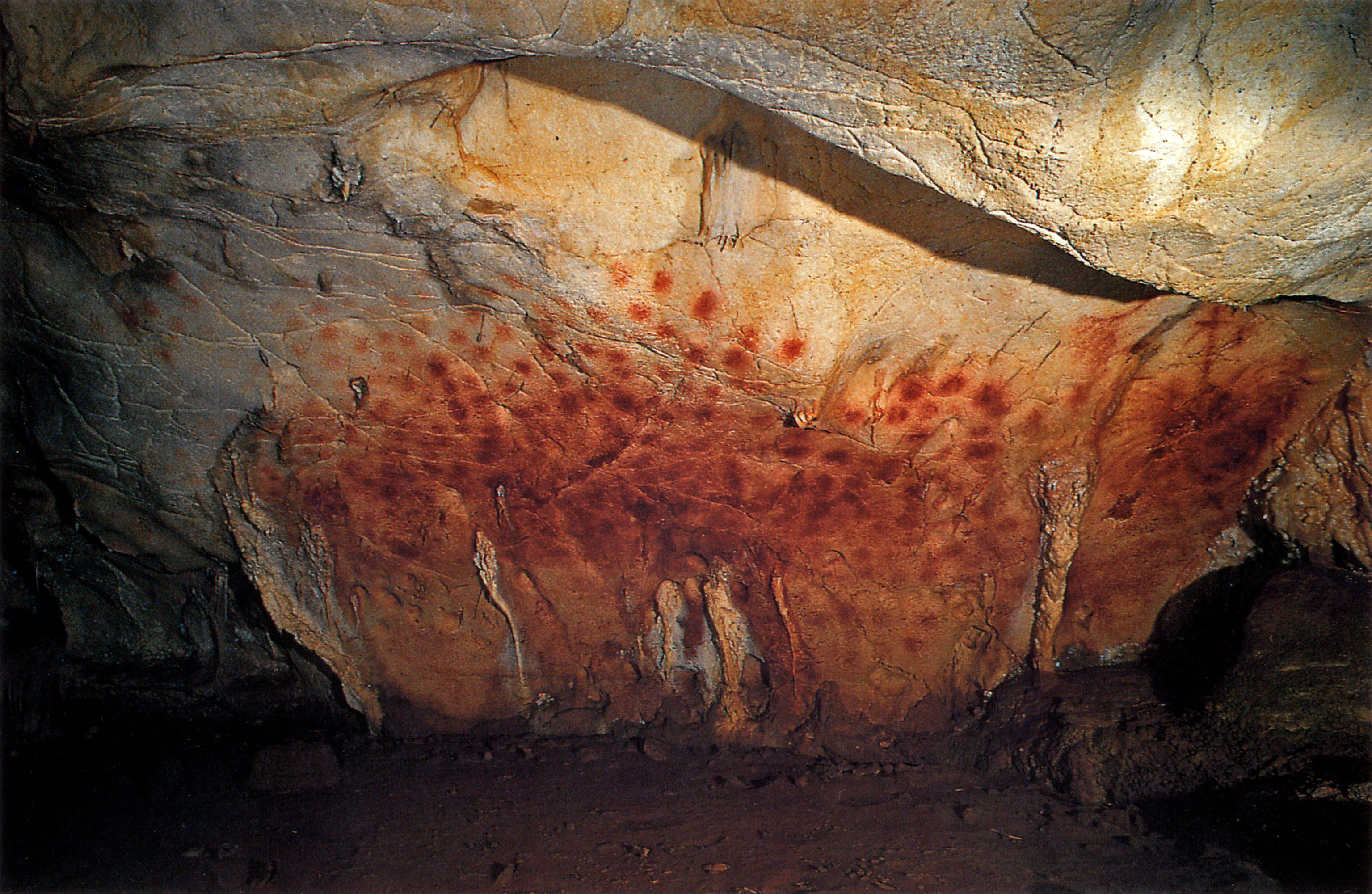
Another version of the whole panel, with the Sacred Heart shown more clearly on the right.
Photo: Chauvet, Deschamps et Hillaire (1996)

The Sacred Heart Panel is an area 6 metres by 3 metres covered with red spots formed by pressing the paint-covered palm of the hand onto the wall, with groups of lines surmounted by a cross shaped sign. The paint has diffused and is covered by finely engraved lines. Beyond the panel, part of a cascade of stalagmite has been enhanced with a few lines creating the outline of a mammoth.
(It should be noted that there is an insect-like image concealed in the photo to the left here - Don )
Photo: Clottes (2003)
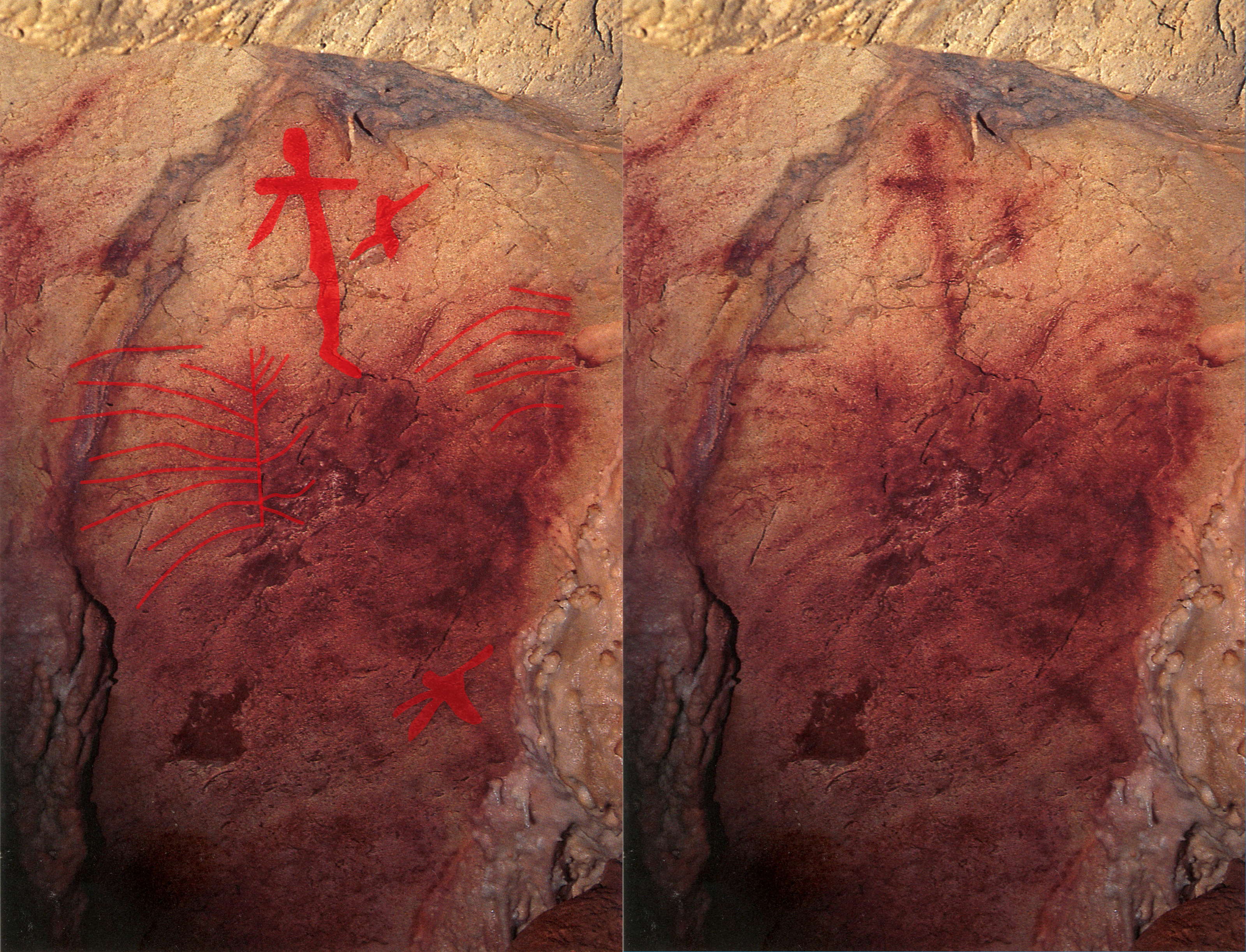
There are a number of elements to this image:
• the christian-like cross at the top of the image, from which the panel gets its name
• an enigmatic shape near the cross on the right
• an insect-like or plant-like shape on the left
• lines similar in thickness and apparent intent on the right
• a dragonfly-like figure lower down on the right
Note that the bulk of the image is smudged, making it difficult to determine the original intent of the artist. I feel that this image would be further elucidated by photographing it in ultraviolet or infrared light, as has been done to great advantage in other caves for paintings with a similarly obscure meaning, such as the tectiform sign at Grotte de Bernifal
Photo: Clottes (2003)
Tracing and text: Don Hitchcock
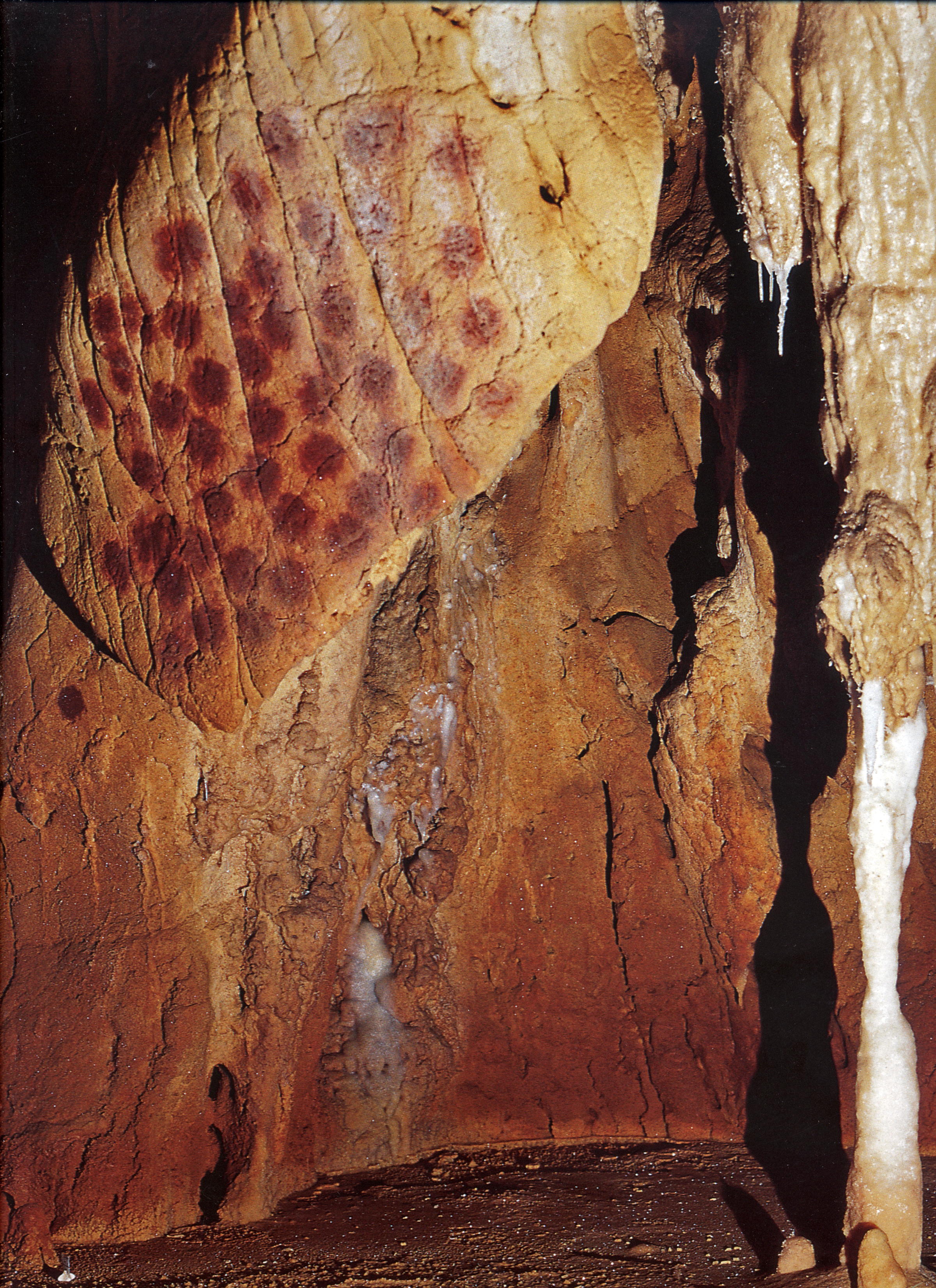
Large Panel of Red Dots made with the palm of the hand at the entrance to the Alcove of Yellow Horses.
Photo: Clottes (2003)
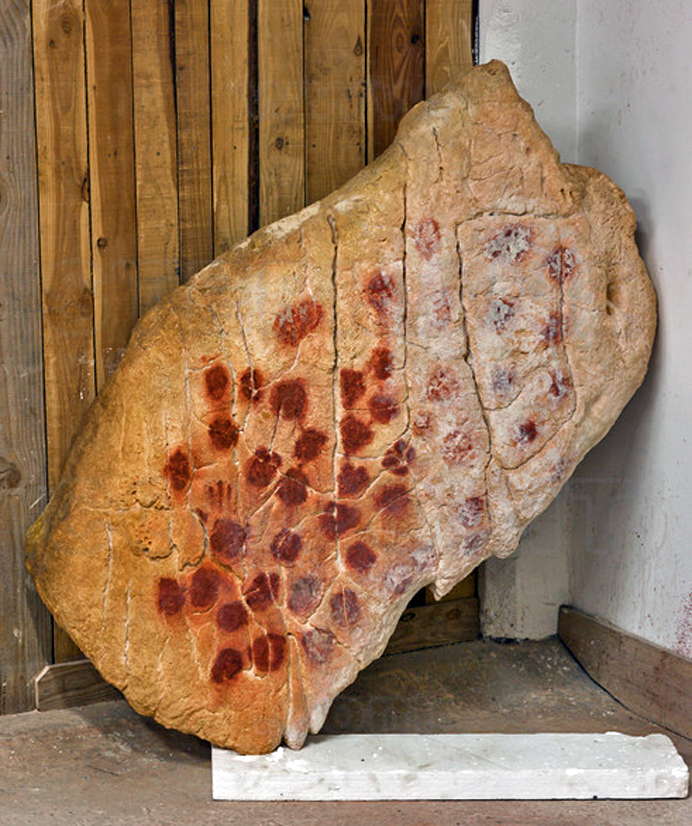

This is the same panel, a facsimile done in fibreglass and resin, to be used in the recreation of Chauvet, Chauvet II. It shows much more clearly the imprint of the fingers of one of the handprints.
Photo: © Stéphane Compoint, http://stephanecompoint.com/
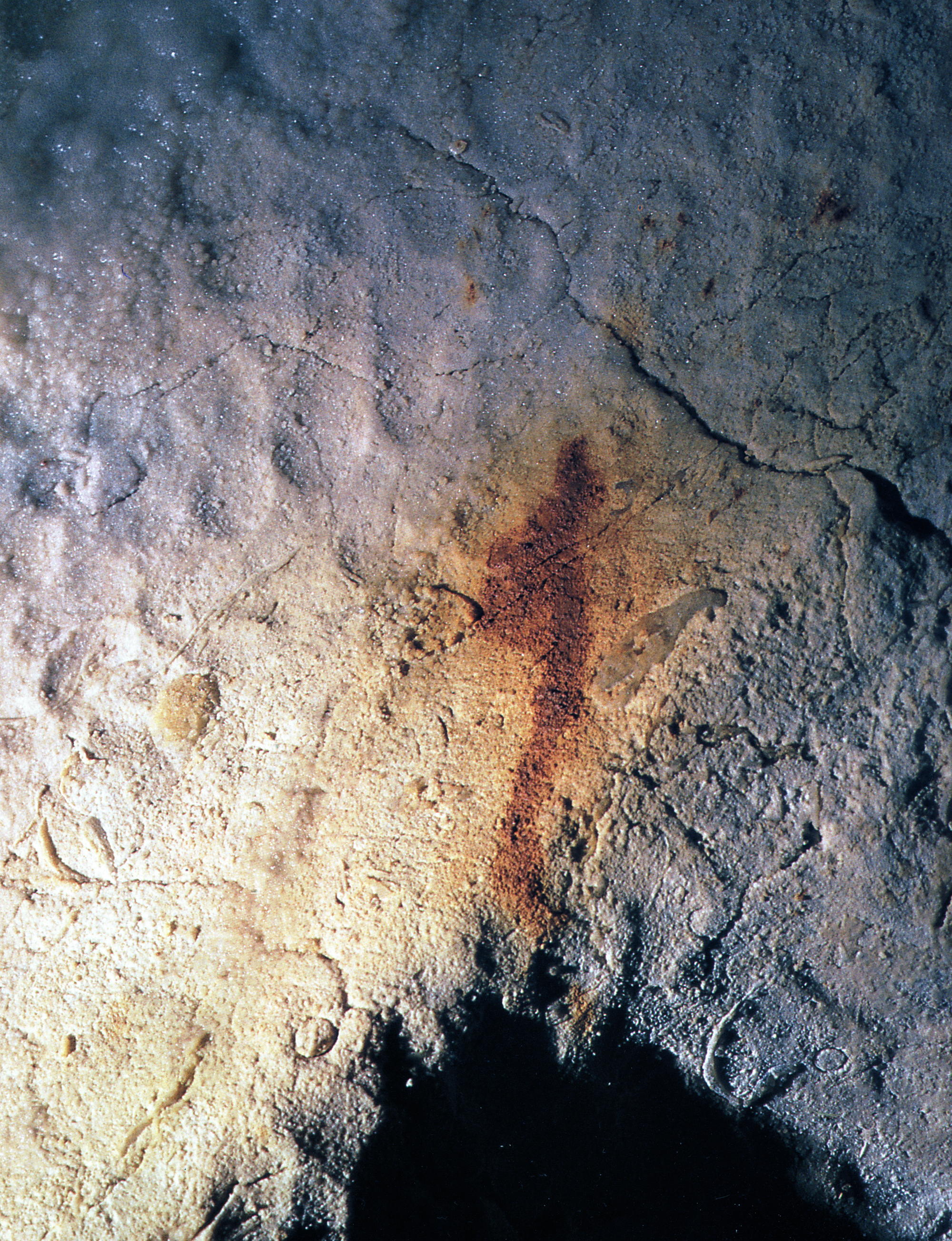
Claviform or P-sign in the Brunel Chamber. These shapes have been interpreted as chronological markers.
This sign has been dated to between 22 800 ± 400 BP (Ly-6879) and 32 900 ± 490 BP (Gifa 99776).
The discovery of the P-sign in the Chauvet cave clearly proves that the P-Sign belong to a very old tradition.
Photo: Clottes (2003)
Text: Adapted from http://www.sati.archaeology.nsc.ru/
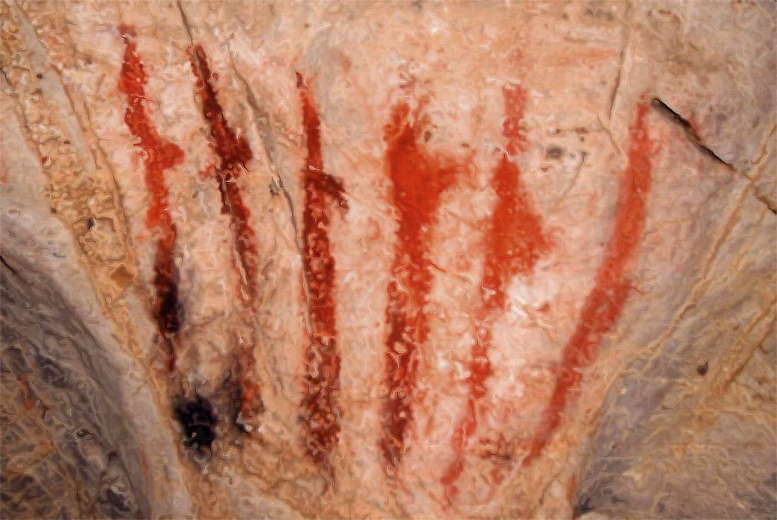
Claviform (club or key shaped) signs in Cueva del Pindal.
Cueva del Pindal is situated near the town of Pimiango near the border of Cantabria.
These signs occur in many painted caves in France and Spain, and their meaning is unknown.
Photo: http://www.asturnatura.com/turismo/cueva-del-pindal/1156.html
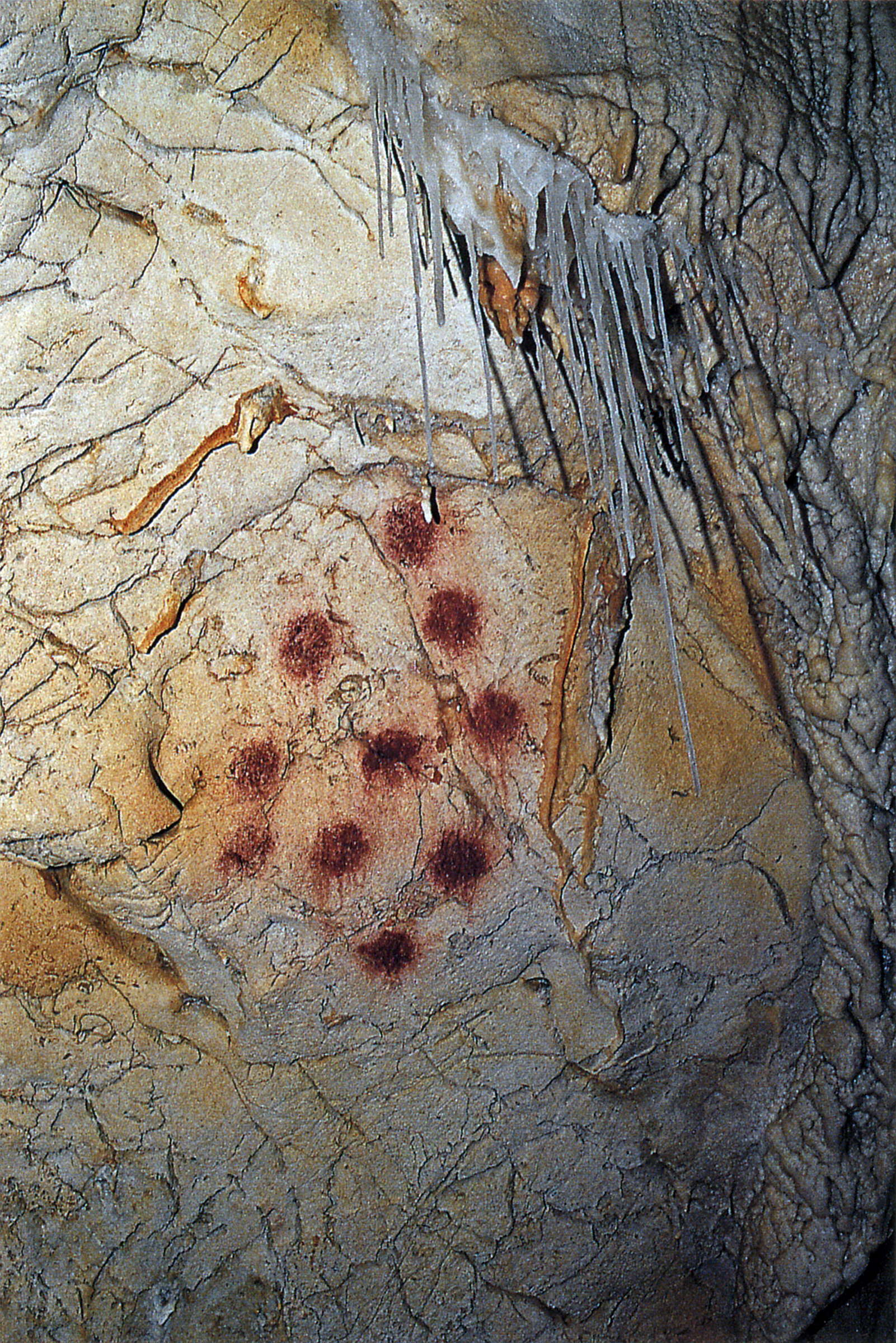
Near the top of a wall with fragile calcite straws, a group of ten big red dots.
Photo: Chauvet, Deschamps et Hillaire (1996)
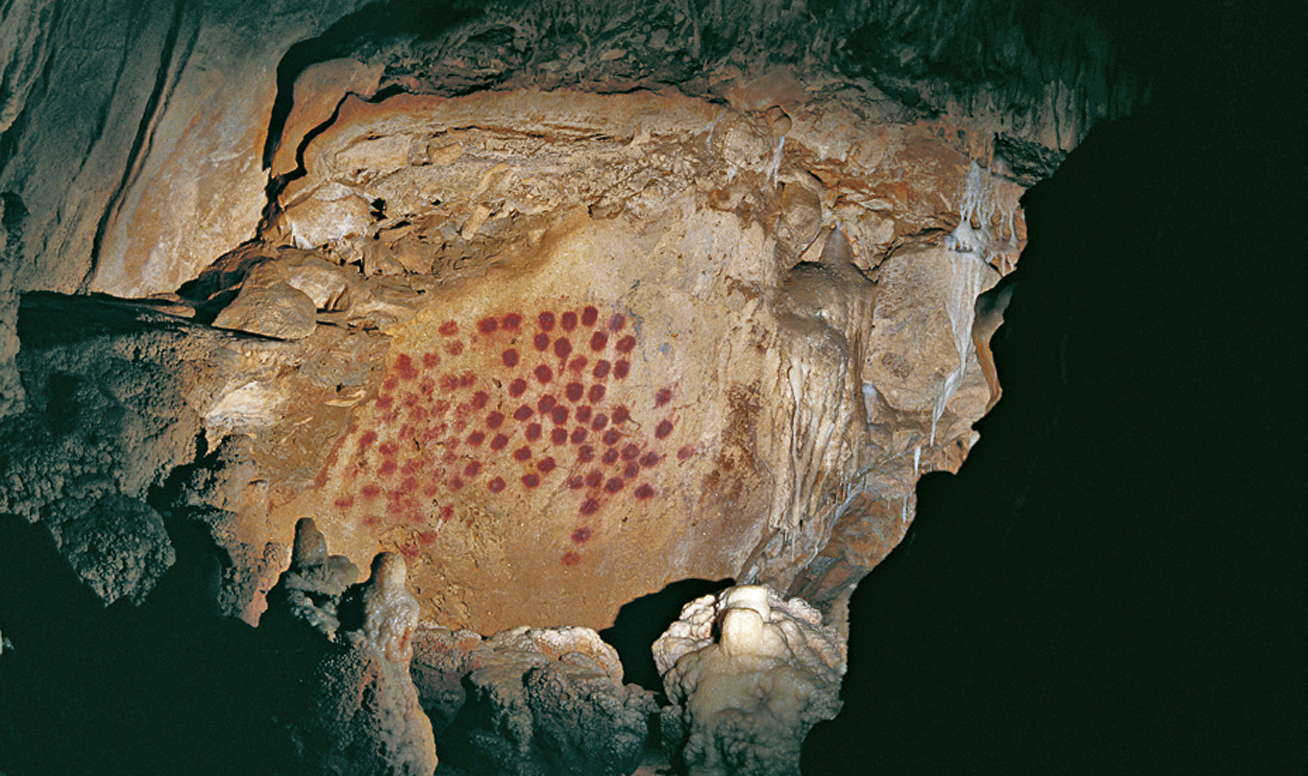
Pattern of palm prints apparently defining the body of an indeterminate animal in the Brunel Chamber. The left side of this painting has been partially erased, probably by running water.
This is known as the Panel of the Dotted Animal. The head of a bear and the front of a mammoth are also indistinctly drawn. In a separate area, the Loggia of the Red Deer, above this panel and before reaching the next recess, the forequarters of a large deer, possibly a megaloceros, are painted in red.
Photo: http://uk.phaidon.com/agenda/art/picture-galleries/2011/march/10/inside-the-cave-of-forgotten-dreams/
Text: Lawson (2012)
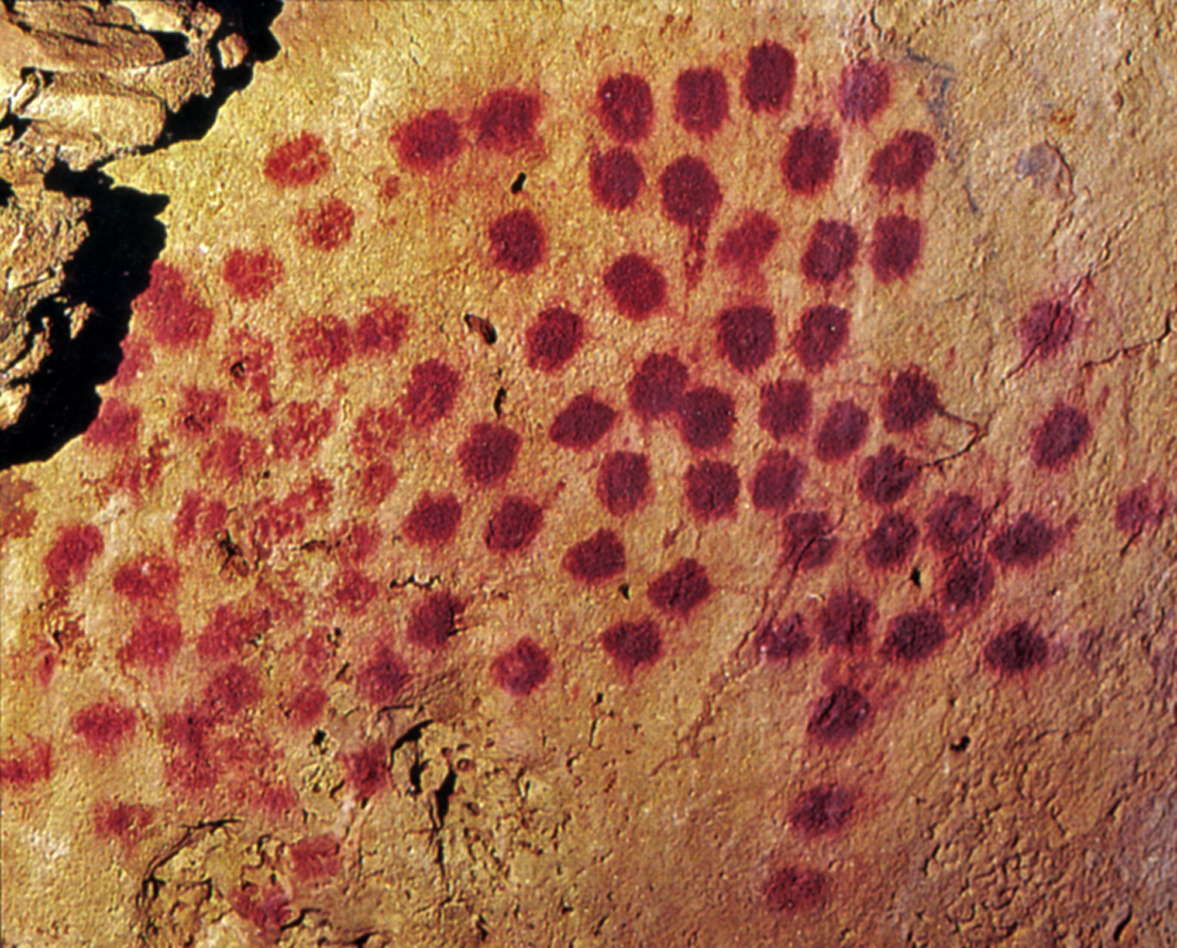
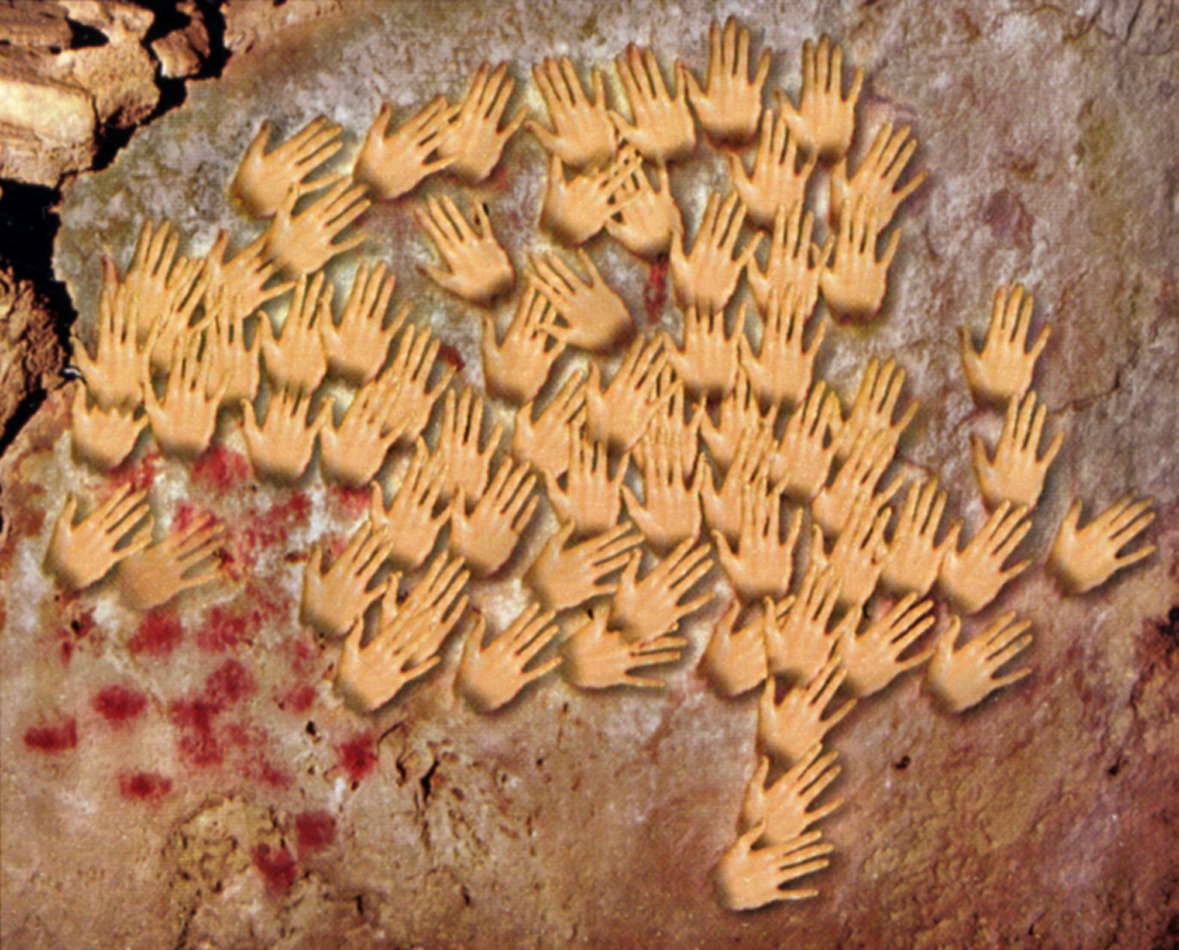
The hand prints suggest the shape of a bison or rhino.
Team members Dominique Baffier and Valérie Ferrugio determined that one person, standing about five feet ten inches tall and using just the right hand to apply pigment, painted the entire panel. A computer reconstruction confirms their hypothesis.
The individual had a slightly crooked little finger, and by this it has been determined that this person was the creator of other hand prints, deeper in the cave (this last detail from Herzog (2011)).
From: National Geographic, August 2001
Photo: Dominique Baffier and Valérie Ferrugio
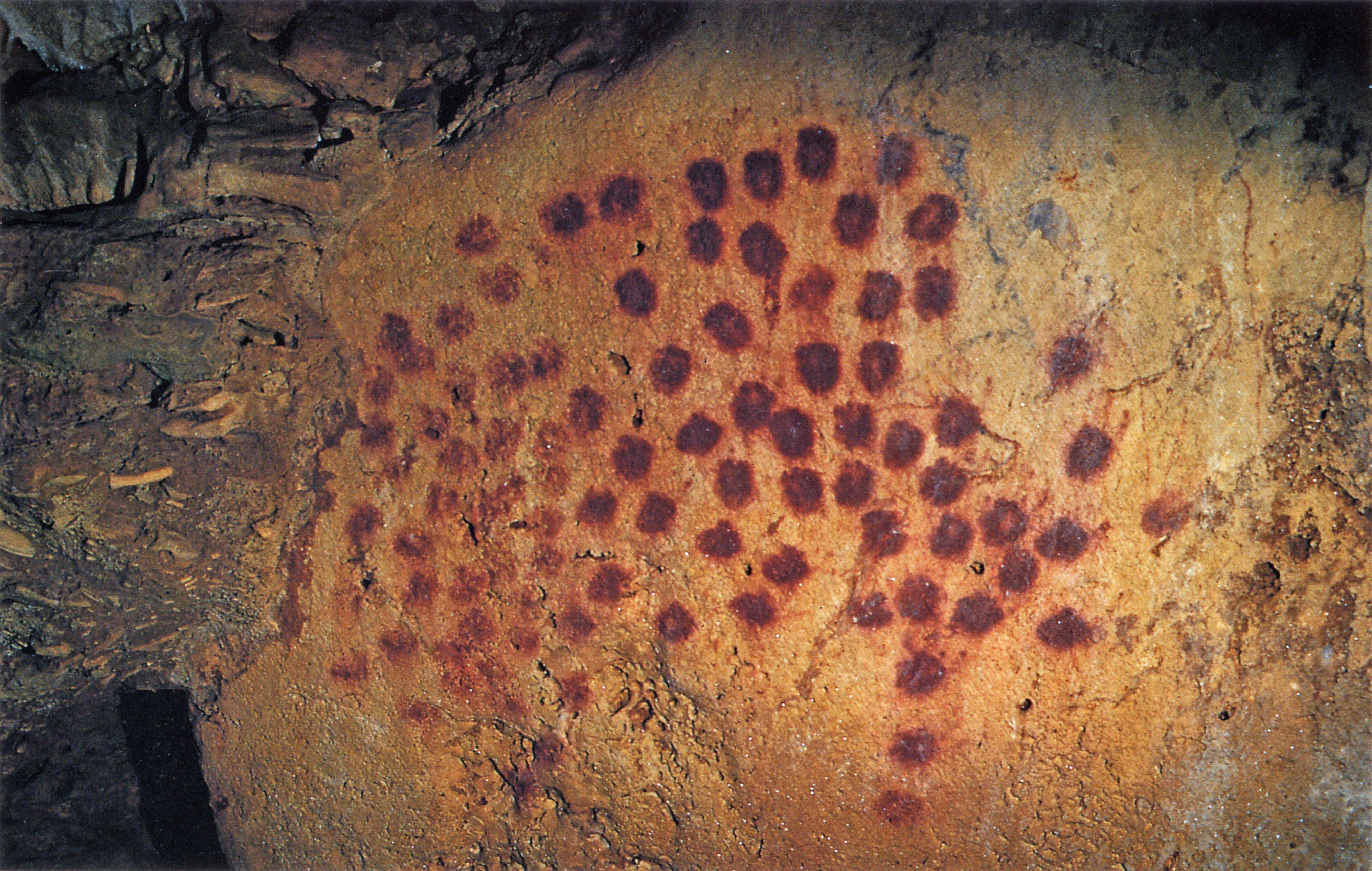
Another version of the animal made from palm prints.
There is a small red bear-like head hidden in the right hand side of this group of dots, but it is just an accident of jointing in the rock, given colour by the smearing of ochre from the dots above it.
Photo: Chauvet, Deschamps et Hillaire (1996)
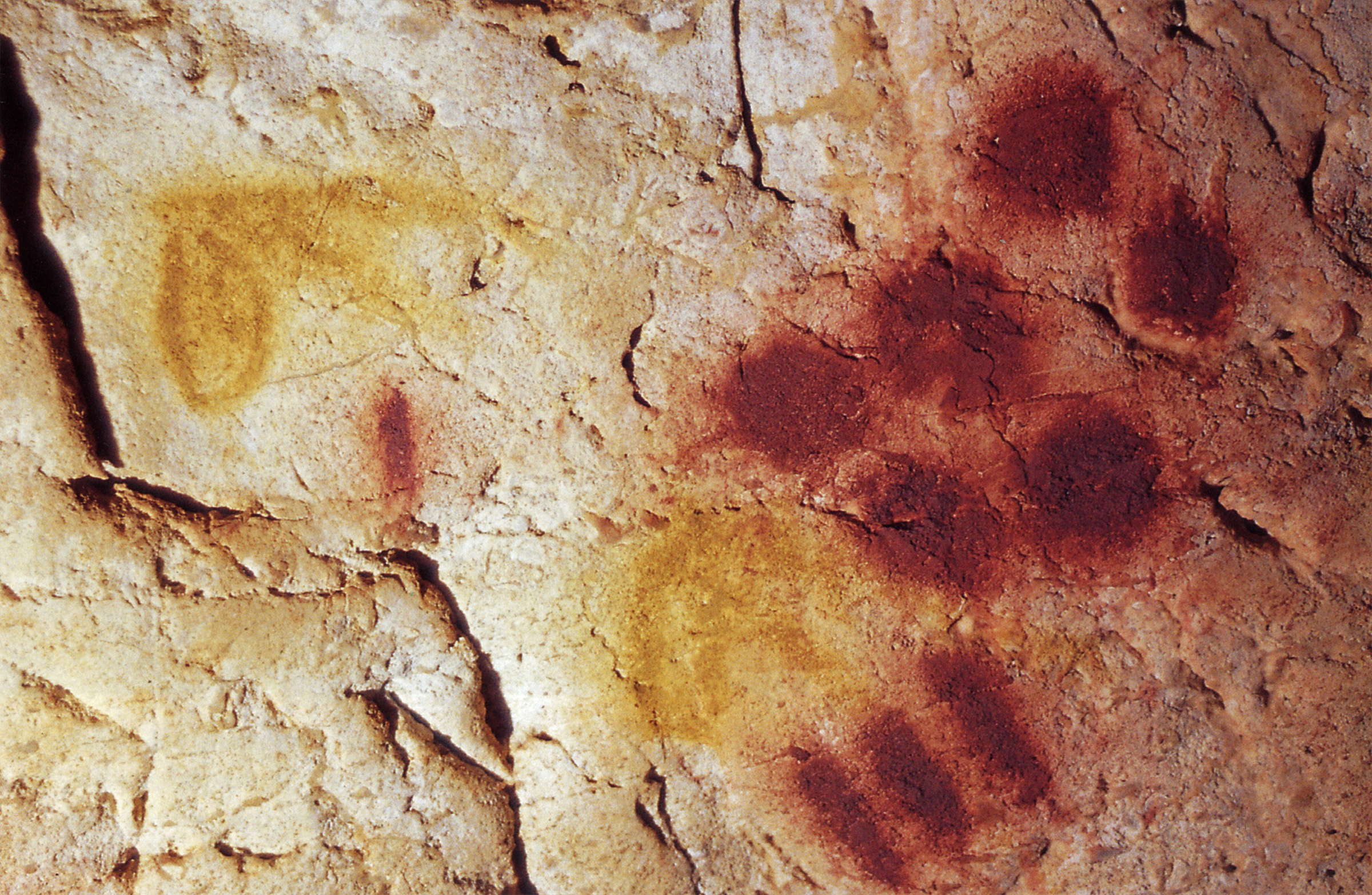
Two small yellow horse heads, beside six red palm prints and three stroked signs.
Photo: Clottes (2003)
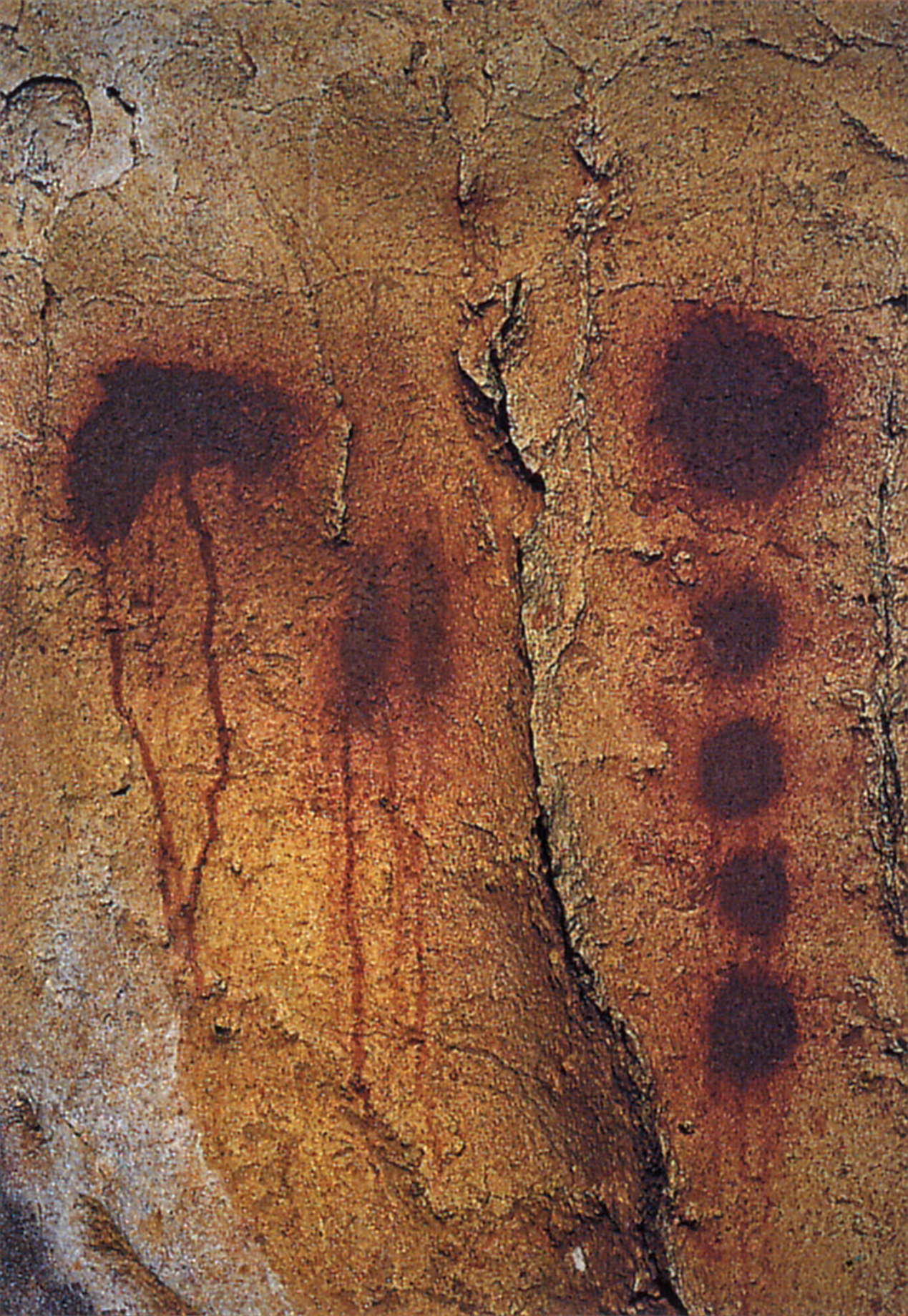
Red horse head, below and to the left of the yellow horse heads.
These horse heads and signs are in a small alcove, above a flat floor.
Photo: Chauvet, Deschamps et Hillaire (1996)
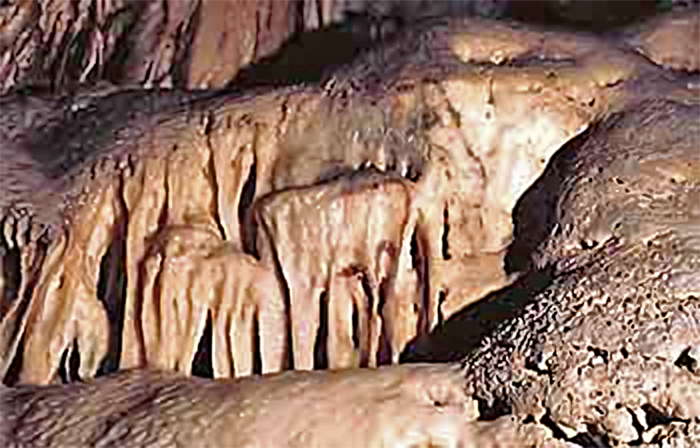

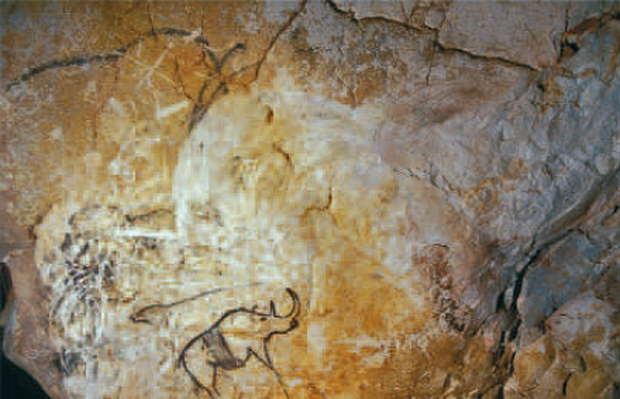
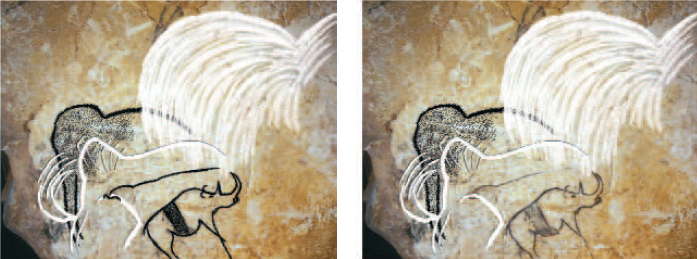
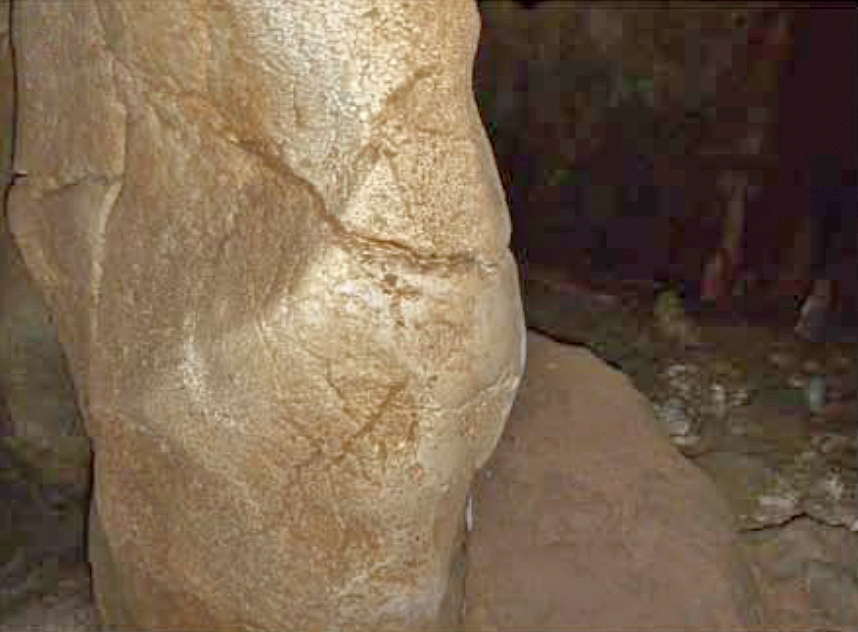
Just a few lines have been used to outline more clearly the shape of a small mammoth, about 20 cm wide, taken up by the flowstone or stalagmite cascade at the entrance to the Brunel Chamber.
I have highlighted the shape in the right hand photograph.
Photo: © Dominique Baffier - Valérie Feruglio
Source: http://www.culture.gouv.fr/culture/arcnat/chauvet/en/zmpt02.htm
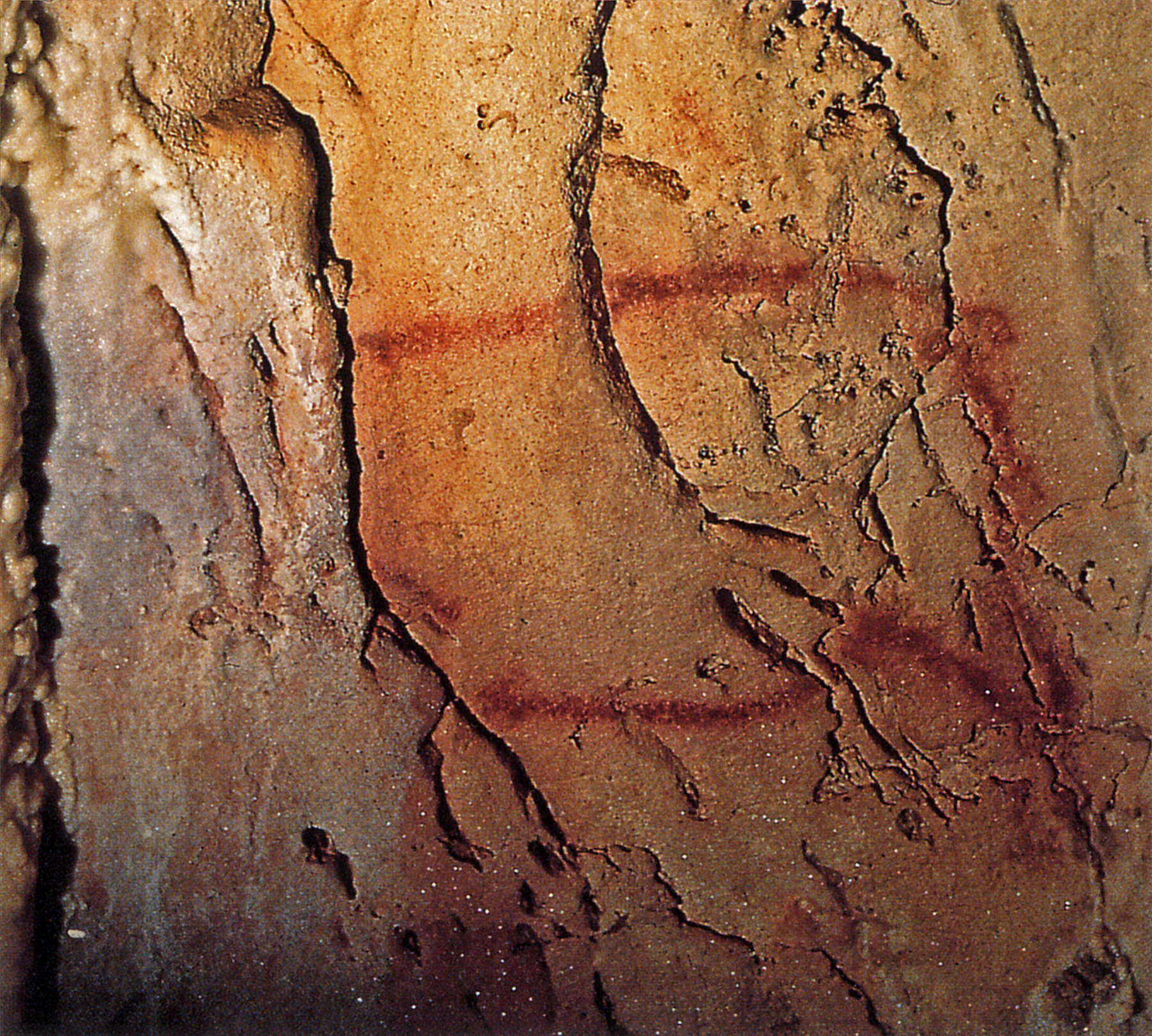
This headless ibex is on the Wall of Dominoes in the Brunel Chamber. The zone is heavily covered with calcite. It is not possible to determine whether the front of this animal existed at one time.
Length ca 40 cm.
(To me it looks as though it could possibly be that the front never existed, but that the artist wanted the impression of the ibex disappearing into the rock wall - Don )
Photo: Chauvet, Deschamps et Hillaire (1996)
Text: http://www.culture.gouv.fr/culture/arcnat/chauvet/en/zmpt03-03.htm
Donna Cannon writes, concerning the image above:
It is my belief that, unlike the reasons you gave - that there never was a front part, or it has been partially covered/erased/fallen off, or that the animal is disappearing into the crevice, instead the ibex’s head is right there! I had noticed in several images that the artist(s) used natural irregularities in the surfaces to emphasize a three-dimensional appearance. I wonder if some of the odd placements of the figures is because the artist saw something to add to the realism of his picture.
For instance, the neck of the 'Large Red Stag' is a tapered column bulging from the flatter surface of the wall, and several animal’s parts such as nostrils, teeth, shoulders, etc. are intimated by anomalies in the rock. So when I saw the 'headless' ibex, I immediately thought that the other side of the crevice suggested the head. Then I saw that the crevice itself forms the line of the shoulder (completed by a short line of red) and the front legs where it splits into an inverted Y. One leg is fairly straight and is paralleled by the drawn hind leg. The other front leg is raised and curled in a prancing mid-step, complete with cloven hoof (small inverted V).
Just below the raised leg I think I see faint red ochre smudging that has washed down and away. The head itself is suggested by the folds of stone at the left side of the crevice. It is elongated, facing backward to the body in much the same manner as a real deer or antelope turns its head to bite at or lick its own neck. I see the top of the head where there is a chunk missing from the fold, the nearly-closed eye (it has a pupil) with the small eye-ridge dent (to the right) above it, the longer dent below the eye is the line indicating the ridge of the cheekbone, the top of the muzzle is the high ridge along the crevice (highlighted in white).
The area of the ear and possibly a horn has been attacked by bubbly calcite formations. The nostril is located by a small red dot on a small calcite oval (horseshoe-shaped, actually), and the upper lip is stretched out from an open mouth, but the mandible is ill-defined. The bottom jaw line is the next long crack to the left, and seems to have the lower muzzle of a horse with opened mouth snugged up against it. I can see a small hole that could be the horse’s eye.
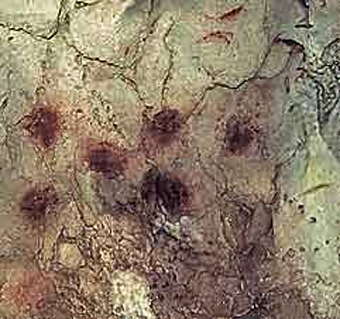
Also on the Wall of Dominoes, these six red dots are part of a series of 13 dots in a 6 - 2 - 5 pattern.
They were made with the palm of the hand, coated with red ochre.
Photo: © Dominique Baffier - Valérie Feruglio
Text and source: http://www.culture.gouv.fr/culture/arcnat/chauvet/en/zmpt03-02.htm
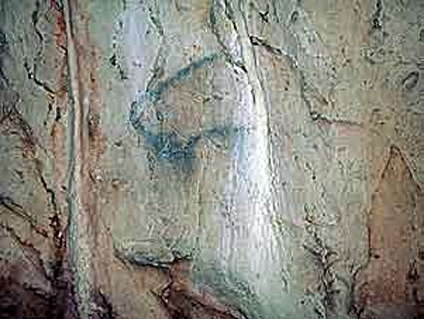
This head of a feline, about 30 cm long, is also on the Wall of Dominoes, and is covered by calcite. It appears that only the head was ever represented.
Photo: © Yanik Le Guillou
Text and source: http://www.culture.gouv.fr/culture/arcnat/chauvet/en/zmpt03-01.htm
The Brunel Chamber - Recess of the Bears
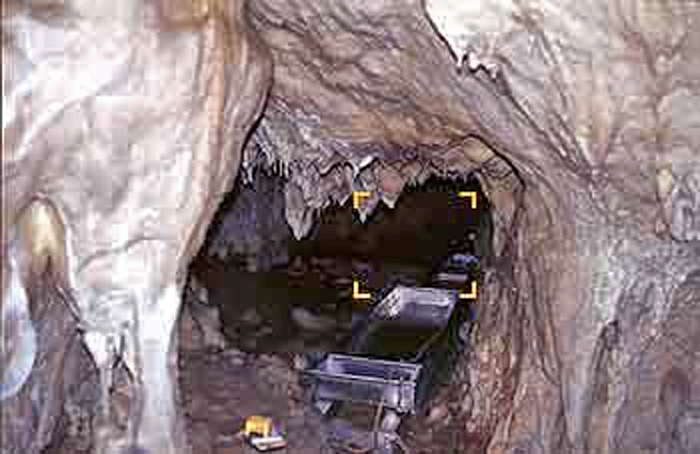
Entrance to the Vestibule or Recess of the Red Bears
The entrance to this chamber is very narrow (and approx. 70 cm high). The space then widens out and one can almost stand up at the back. Two tracks, which continue to the back of the Vestibule, and a small wagon, were installed to facilitate its study.
Photo and text: http://www.culture.gouv.fr/fr/arcnat/chauvet/fr/owpt06.htm
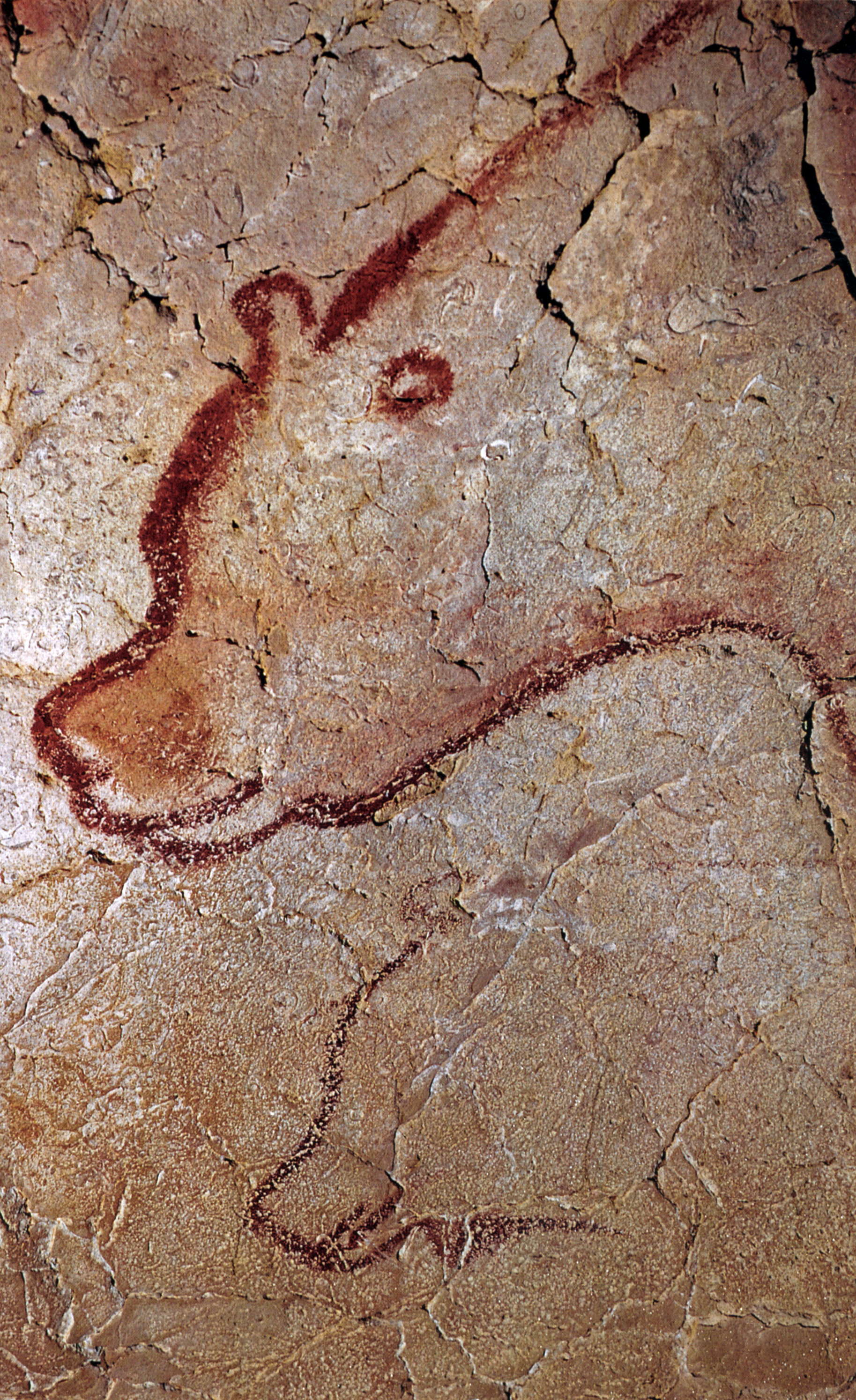
Shaded image of a cavebear, with an incomplete outline of a second cavebear below.
From: National Geographic, August 2001.
Photo: Jean Clottes
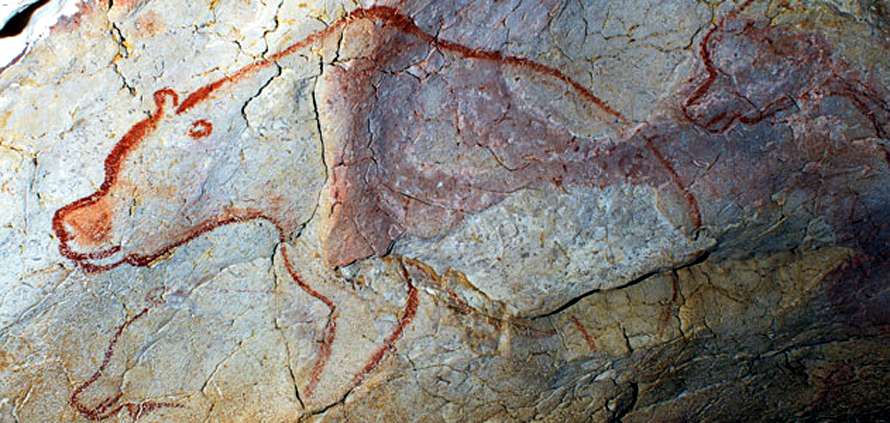
The complete image includes a third cave bear following close behind.
From: http://www.ancient-wisdom.co.uk/francechauvet.htm

The three bears in the Recess of the Bears. Because of the angled substrate, it is difficult to get an undistorted photo of this artwork.
The first bear is 120 cm long.
Photo: http://uk.phaidon.com/agenda/art/picture-galleries/2011/march/10/inside-the-cave-of-forgotten-dreams/
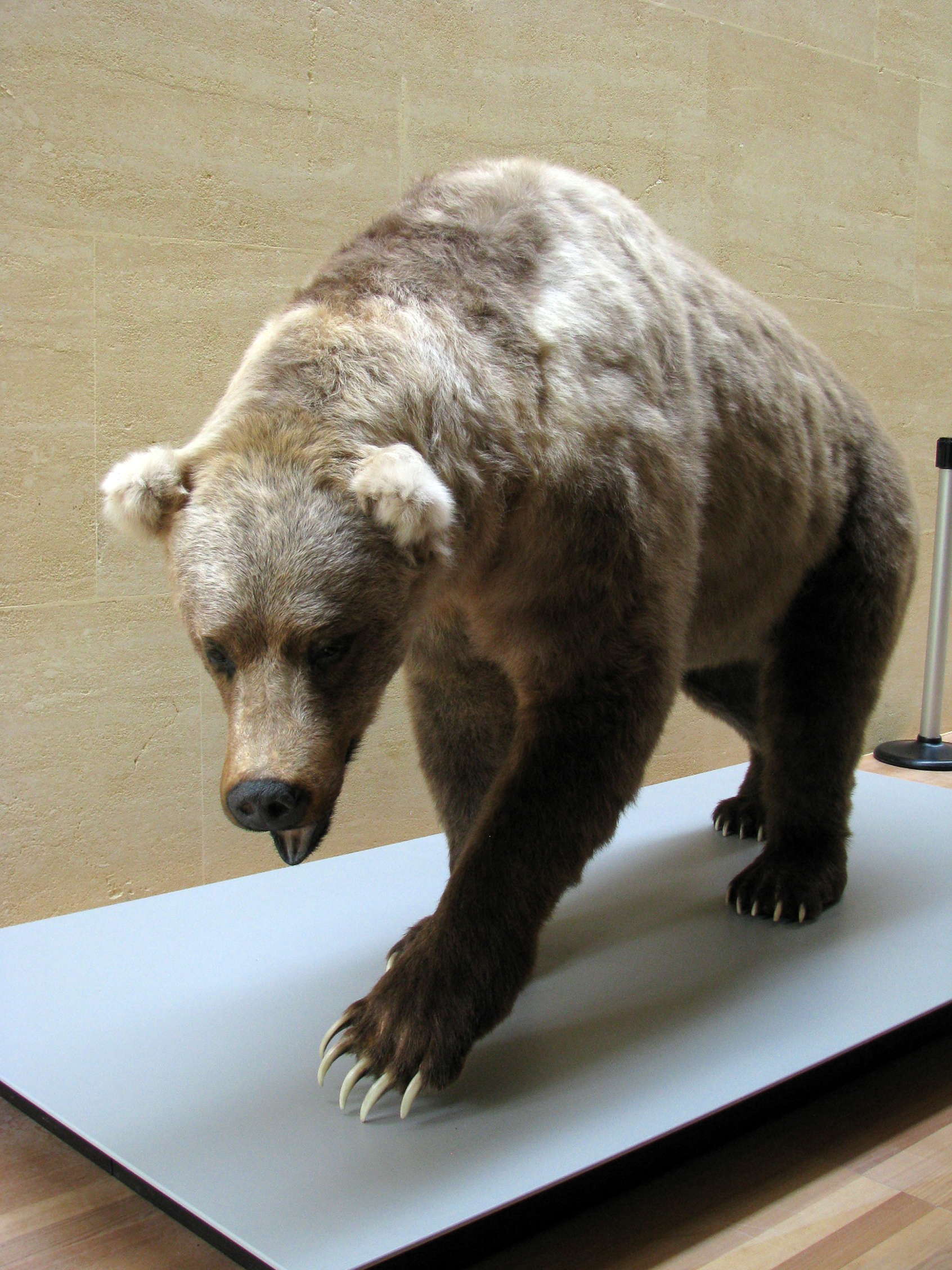
Cave bear teeth show greater wear than most modern bear species, suggesting a diet of tough materials. However, tubers and other gritty food, which cause distinctive tooth wear in modern brown bears, do not appear to have constituted a major part of cave bears' diet on the basis of dental microwear analysis. A solely vegetarian diet has been inferred on the basis of tooth morphology. Results obtained on the stable isotopes of cave bear bones also point to a largely vegetarian diet in having low levels of 15Nitrogen and 13Carbon which are accumulated at a faster rate by meat eaters as opposed to herbivores.
However, some evidence points toward inclusion of at least occasional animal protein in the cave bear diet. For example, toothmarks on cave bear remains in areas where cave bears are the only recorded potential carnivores suggests occasional cannibalistic scavenging, possibly on individuals that died during hibernation, and dental microwear analysis indicates that the cave bear may have fed on a greater quantity of bone than its contemporary, the smaller Eurasian brown bear. Additionally, cave bear remains from Peştera cu Oase in the southwestern tip of the Carpathian mountains had elevated levels of 15 Nitrogen in their bones, indicative of an omnivorous diet, although the values are within the range of those found for the strictly herbivorous mammoth.
Photo: Don Hitchcock 2008
Source: Display at Le Musée National de Préhistoire, Les Eyzies-de-Tayac
Text: Adapted from Wikipedia.
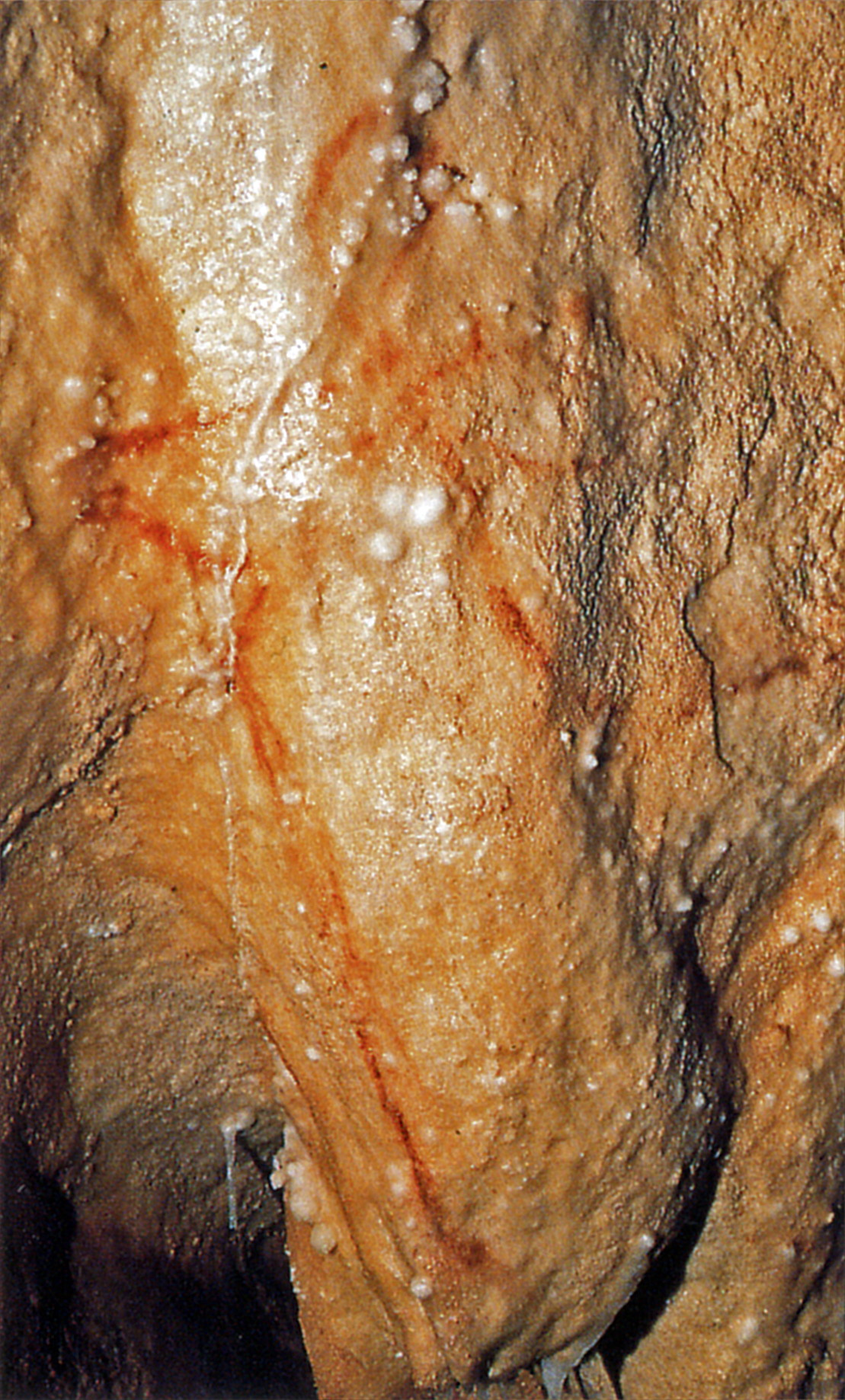
Large red stag.
Photo: Chauvet, Deschamps et Hillaire (1996)
The Entrance Chamber and Chamber of the Bear Wallows - Salle d'entrée et Salle des Bauges
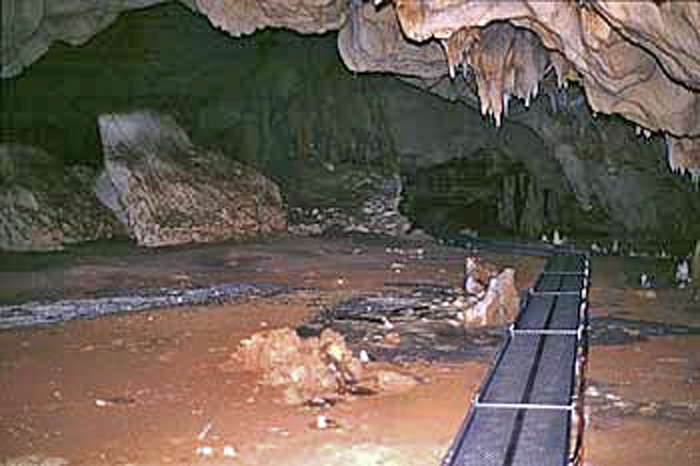
Chamber of the Bear Wallows
The floor of the Chamber of the Bear Wallows is scattered with numerous bones of cave bears, and bears traces of their occupation such as the bear wallows they scraped out of the clay of the floor, and long trails of young and adult paw prints.
Photo: © Valérie Feruglio
Text and source: http://www.culture.gouv.fr/culture/arcnat/chauvet/en/owpt06bis.htm
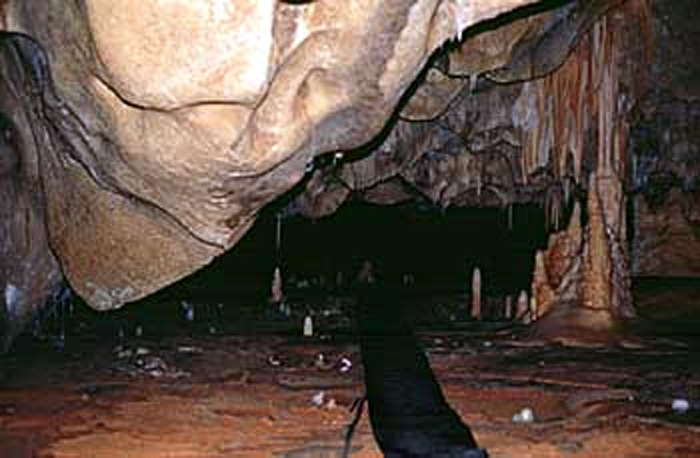
This section would have been mostly in semi-darkness at the time the art was created. It seems to have been purposely left without significant art, even though there are many suitable surfaces. These two chambers taken as a whole act as an antechamber to the art galleries further into the cave.
The Entrance Chamber is now sealed off from the outside by a rock fall, and the floor is covered with scree. It contains no art.
The 50 metre wide Chamber of the Bear Wallows which adjoins the Entrance Chamber has, by contrast, a perfectly flat floor, attributed to an ancient lake which at times completely filled this chamber.
The ceiling has been sculpted by water into smoothed pockets and pendants, but it is flat in one section where the roof has given way and fallen to the floor in large blocks.
The flat floor has hollows, or wallows, dug into the clay by cave bears, and some of the blocks on the floor are polished by their passage, as they used smell and touch to negotiate in the very dimly lit space. Text above: Clottes (2003)

Bear Wallow, or Bauge, in the Chamber of Bear Wallows (or Bear Hollows in some translations).
Photo: © MCC, CNP Périgueux
Source: Bon (2011b)

Blocks on the floor in front of the Panel of Positive Hands at the end of the Salle des Bauges, the Chamber of the Bear Wallows.
Photo and text: Geneste (2005)

Recreation of a cave bear.
Photo: Don Hitchcock, 2008
Source: Display at Le Musée National de Préhistoire, Les Eyzies-de-Tayac
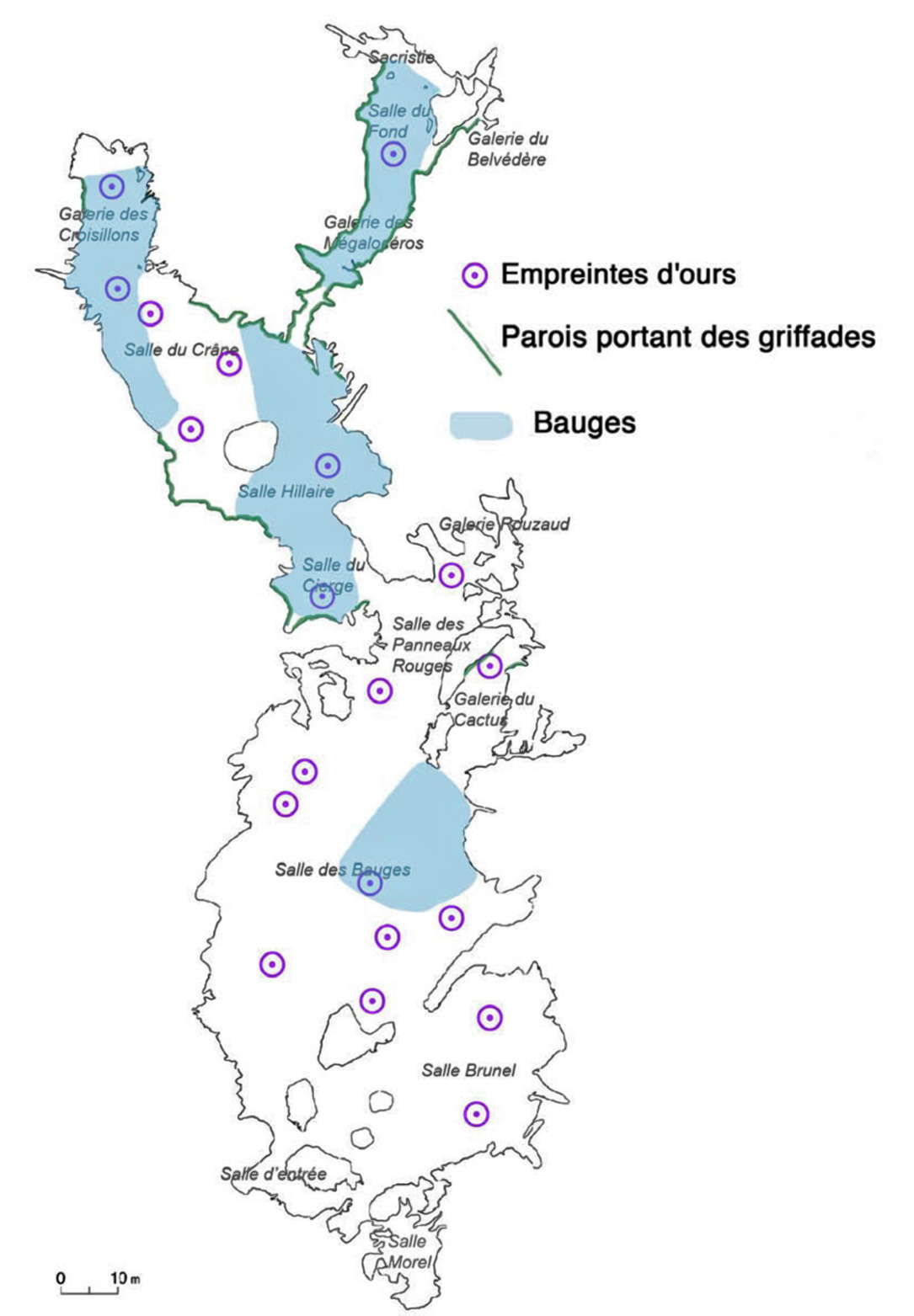
The location of bear wallows, scratches and marks left by cave bears in Chauvet.
Photo: Bon (2011b)
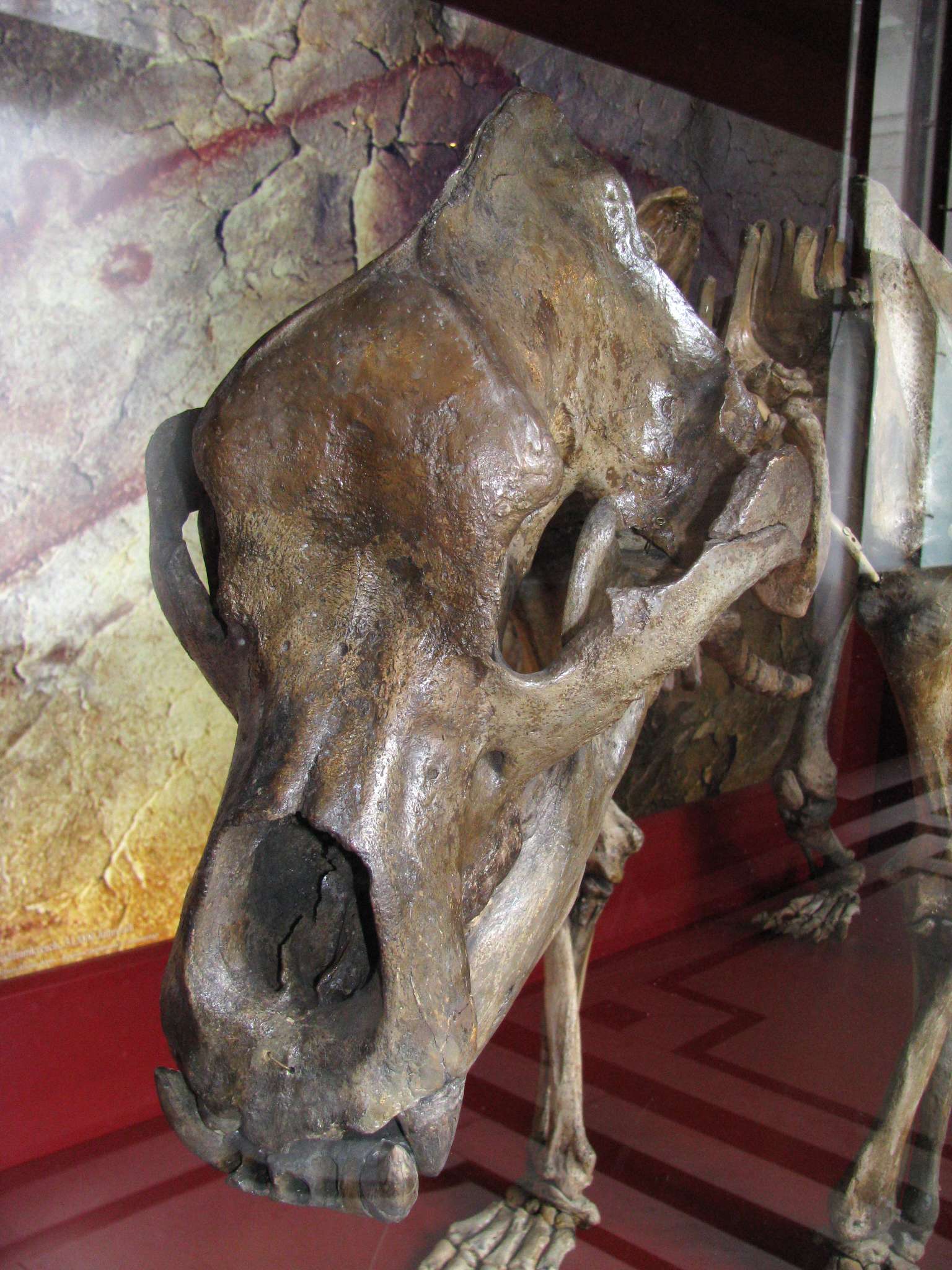
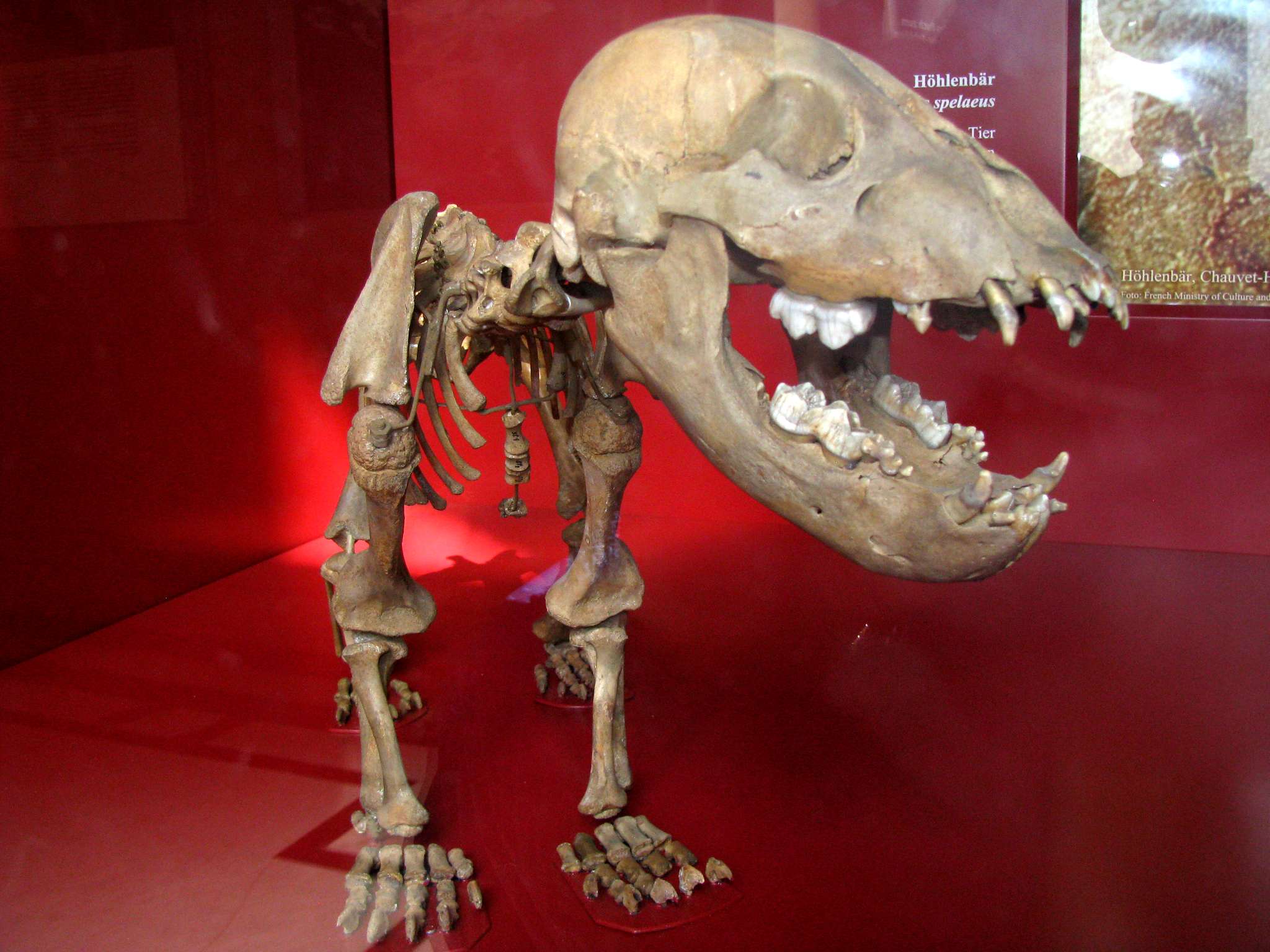
Cave Bear skeleton in the Vienna Natural History Museum.
Note the ridge down the top centre of the skull which is there to attach the large muscles of the jaws and the neck. It was a powerful animal, and could eat both animal and vegetable materials, though it was apparently mostly vegetarian.
Photo: Don Hitchock 2008
Text: Adapted from Wikipedia
Source: apparently original, Vienna Natural History Museum
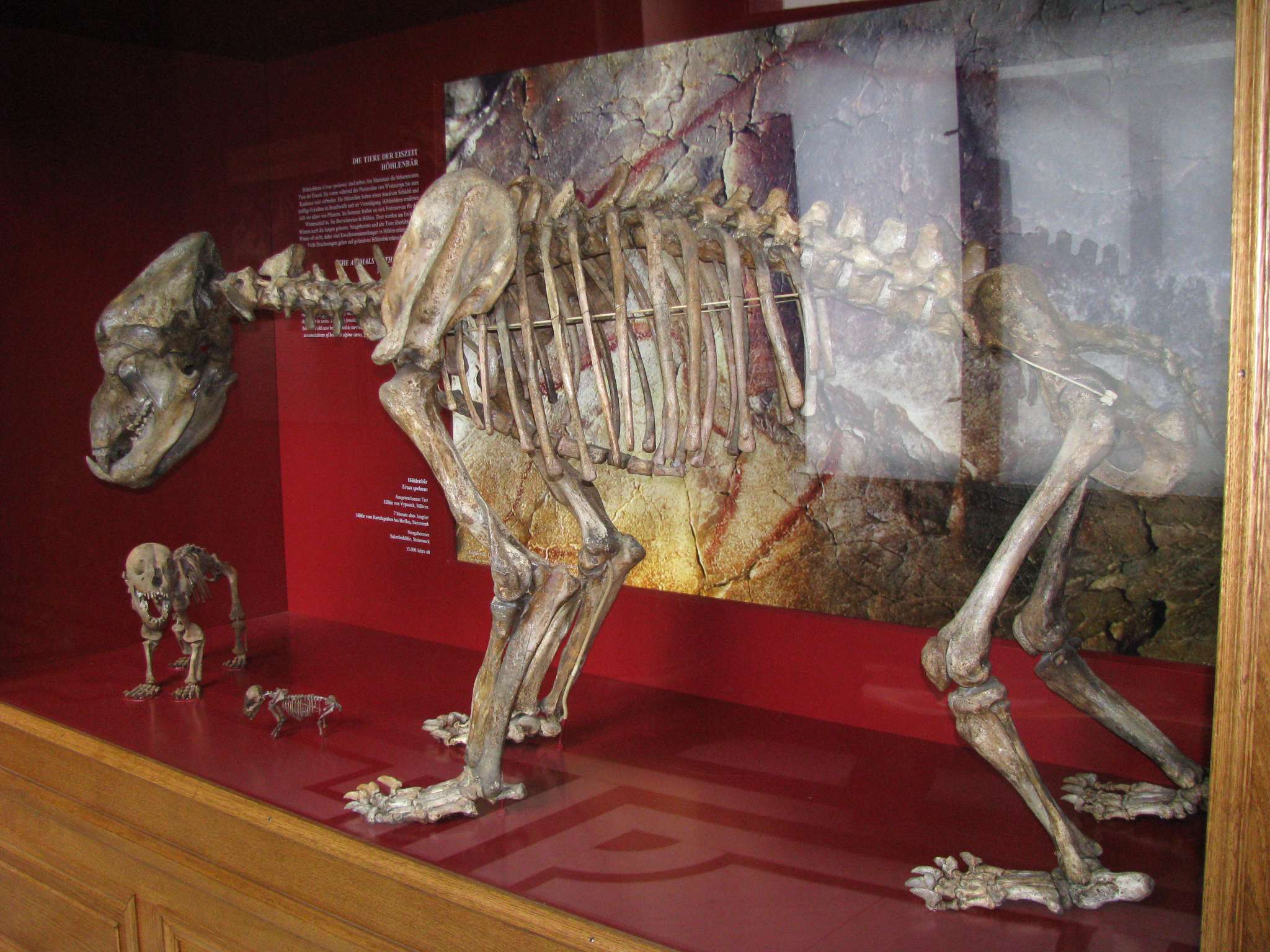
The skeleton on display at the Vienna Natural History museum included a baby cavebear as well as a juvenile.
The cave bear had a very broad, domed skull with a steep forehead. Its stout body had long thighs, massive shins and in-turning feet, making it similar in skeletal structure to the brown bear. Cave bears were comparable in size to the largest modern day bears. The average weight for males was 400-500 kilograms (880-1102 pounds), while females weighed 225–250 kg (496-551 lbs).[4] Of cave bear skeletons in museums, 90% are male due to a misconception that the female skeletons were merely "dwarfs". Cave bears grew larger during glaciations and smaller during interglacials, probably to adjust heat loss rate.
Photo: Don Hitchock 2008
Text: Adapted from Wikipedia
Source: apparently original, Vienna Natural History Museum
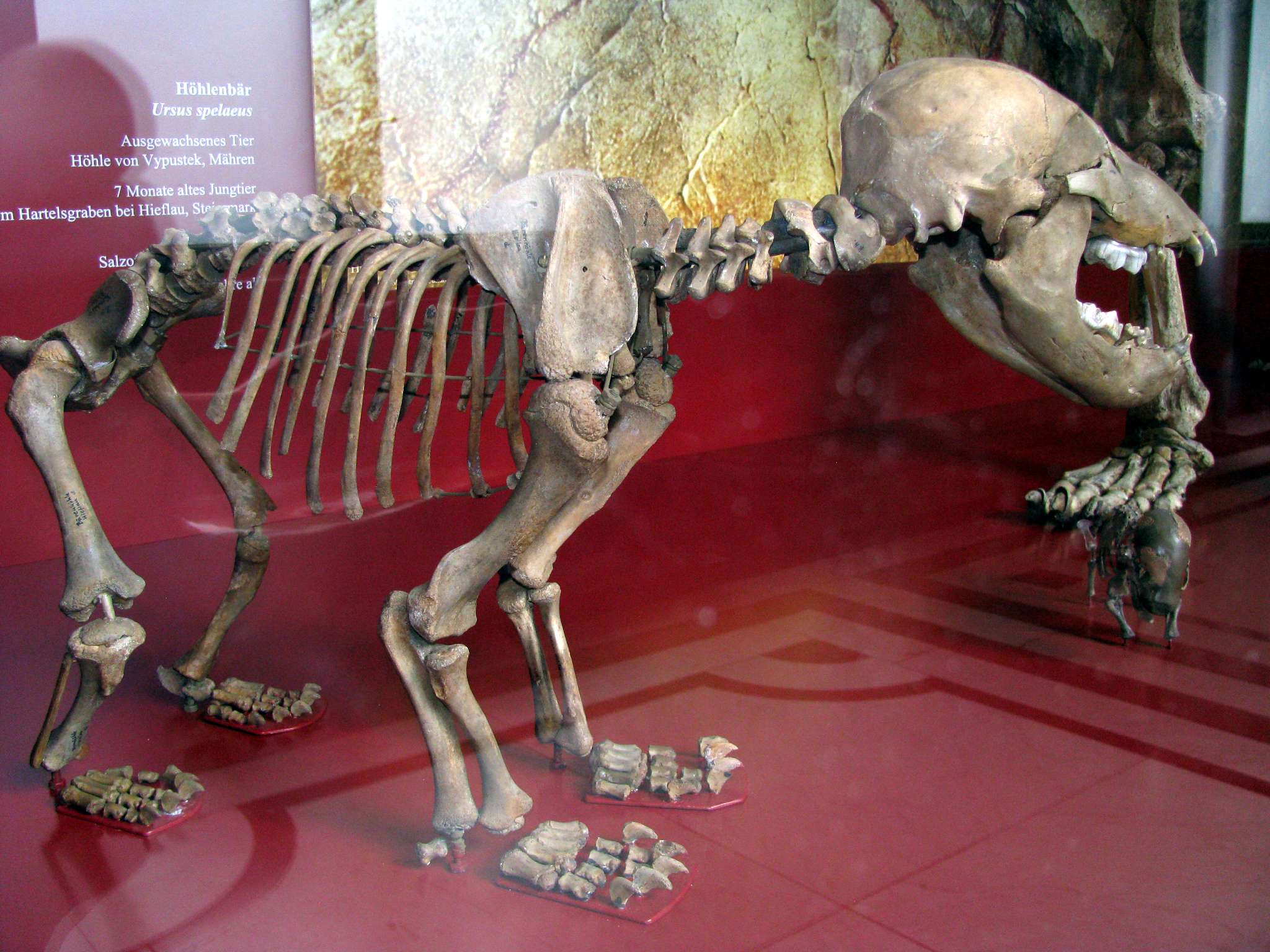
Cave bear juvenile.
Cave bears of the last ice age lacked the usual 2-3 premolars present in other bears; to compensate, the last molar is very elongated, with supplementary cusps. The humerus of the cave bear was similar in size to that of the polar bear, as were the femora of females. The femora of male cave bears, however, bore more similarities in size to those of kodiak bears.
Photo: Don Hitchock 2008
Text: Adapted from Wikipedia
Source: apparently original, Vienna Natural History Museum
Cave bear juvenile.
There is some evidence that the cave bear only used caves for hibernation and was not inclined to use other locations, such as thickets, for this purpose, in contrast to the more versatile Brown Bear. This specialised hibernation behavior would have caused a high winter mortality rate for Cave Bears that failed to find available caves.
Therefore, as human populations slowly increased, the Cave Bear faced a shrinking pool of suitable caves, and slowly faded away to extinction, as both Neanderthals and anatomically modern humans sought out caves as living quarters, depriving the cave bear of vital habitat. This hypothesis is being researched at this time.
Photo: Don Hitchock 2008
Text: Adapted from Wikipedia
Source: apparently original, Vienna Natural History Museum
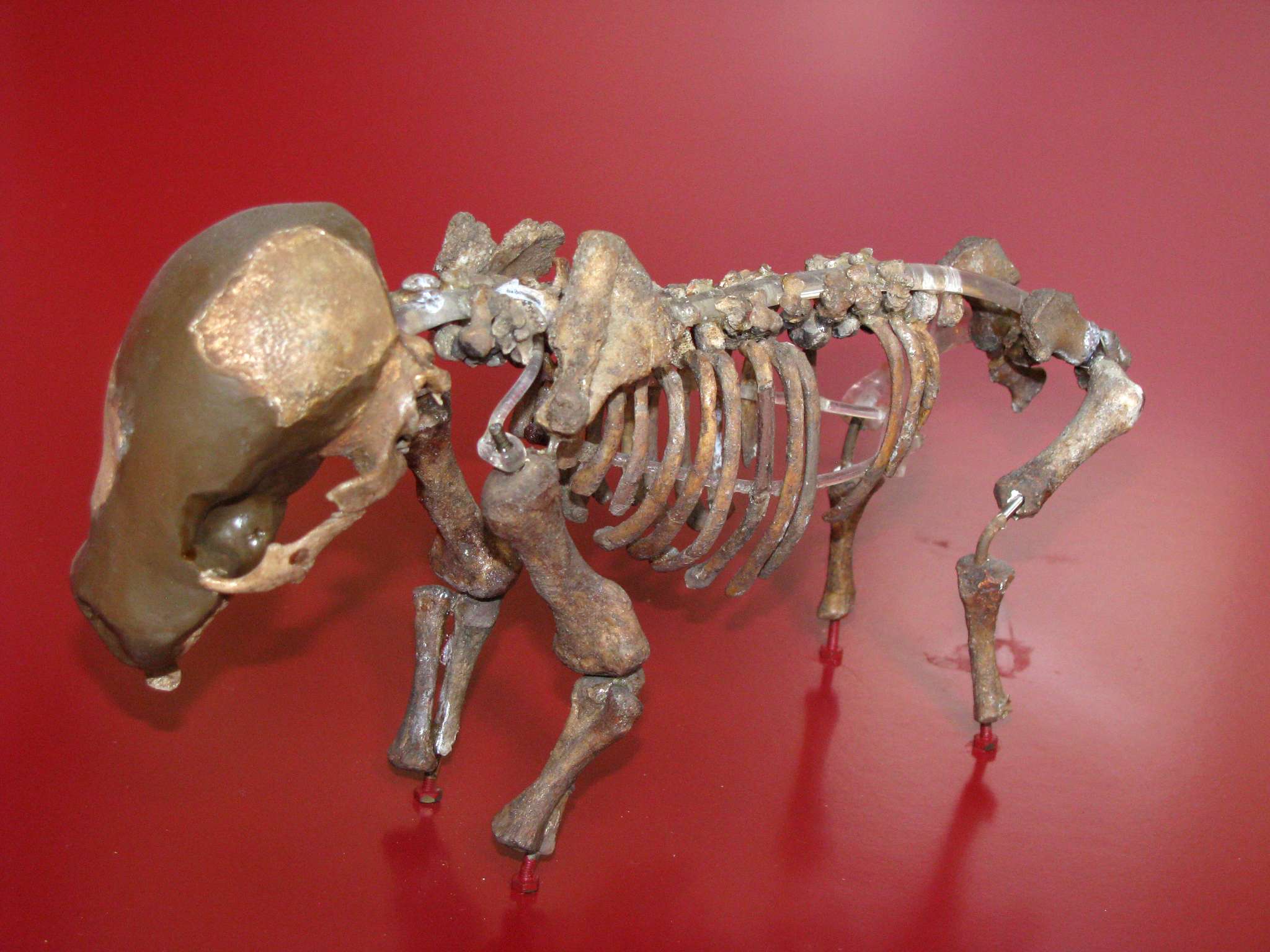
A cave bear baby.
Cave bears (Ursus spelaeus) probably gave birth to cubs during hibernation, in winter, in caves. Bear cubs lactated their mothers during their first and second winters, but were fed solid food together with lactation during their first summer.
Photo: Don Hitchock 2008
Text: Adapted from Liden et al. (1985)
Source: apparently original, Vienna Natural History Museum
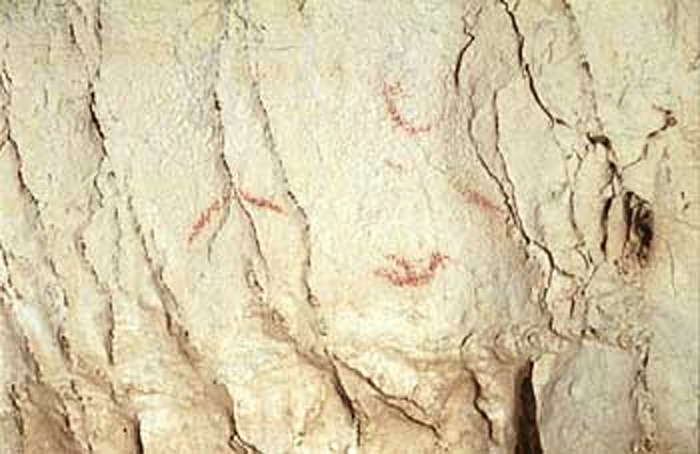
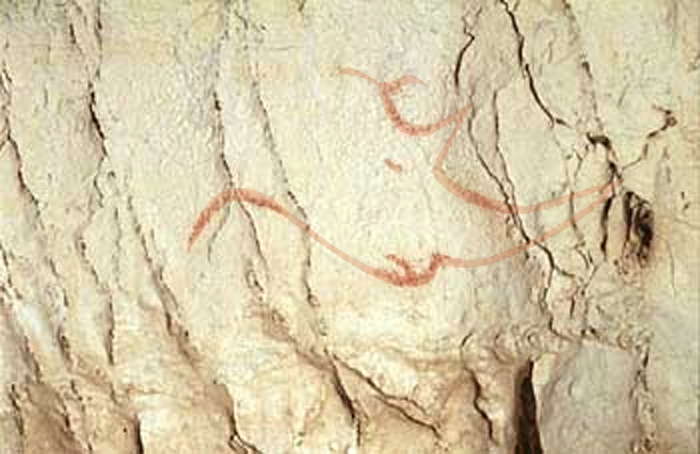
At the very end of the Chamber of the Bear Hollows, or Chamber of the Bear Wallows, we can see this Rhinoceros head turned toward the right. It seems that the outline was intentionally left unfinished, as in the photo on the left.
The photo on the right has had a possible completion graphic added.
Length 70 cm.
Photo: © Jean Clottes
Text and source: http://www.culture.gouv.fr/culture/arcnat/chauvet/en/owpt06ter.htm
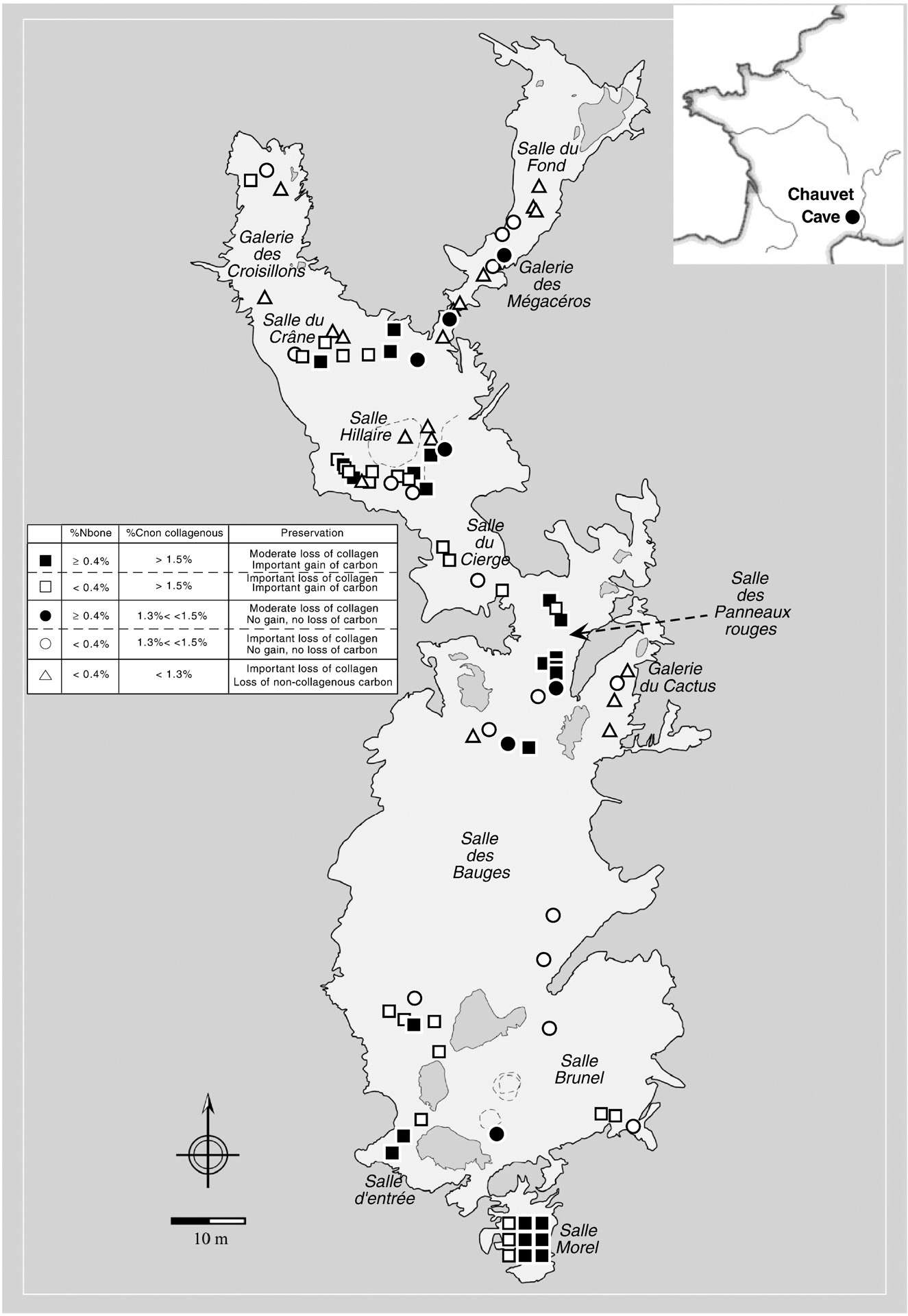

This map and table provides an excellent summary of a small sample of the bones to be found on the floors of Chauvet Cave. They were examined for diagenesis, which is any chemical, physical, or biological change undergone by a sediment (or bone in this case) after its initial deposition and during and after its lithification. However it is an important resource since it gives a list of the relative abundance of various species within the cave, either carried there by humans, or from the remains of animals who chose to enter the cave.
From the abstract:
This paper assesses the preservation of bones exposed on the floor of Chauvet Cave. These bones are mainly from cave bears. They exhibit very variable macroscopic preservation, from apparently pristine specimens to those that are decomposing or coated with calcite. This site offers a unique opportunity to investigate, on a large scale, bone diagenesis in a karstic context. Despite the highest priority put on the preservation of the cave features, about one hundred bone fragments from most sectors of the cave could be collected for biogeochemical investigation. Carbon and nitrogen elemental content were measured, and X-ray diffraction spectra were established. Only about one quarter of the specimens yielded collagen that retained its biogenic isotopic signatures. Bones exhibiting different stages of preservation were not randomly scattered in the cave. Local environmental conditions seem to have led to different diagenetic pathways. Widely differing states of preservation were seen in bones of similar age. This site provides a good case study of diagenetic process occurring in karstic sites and may be used to better understand diagenesis in less well studied caves.
Photo: Bocherens et al. (2008)
The Cactus Gallery - Galerie du Cactus
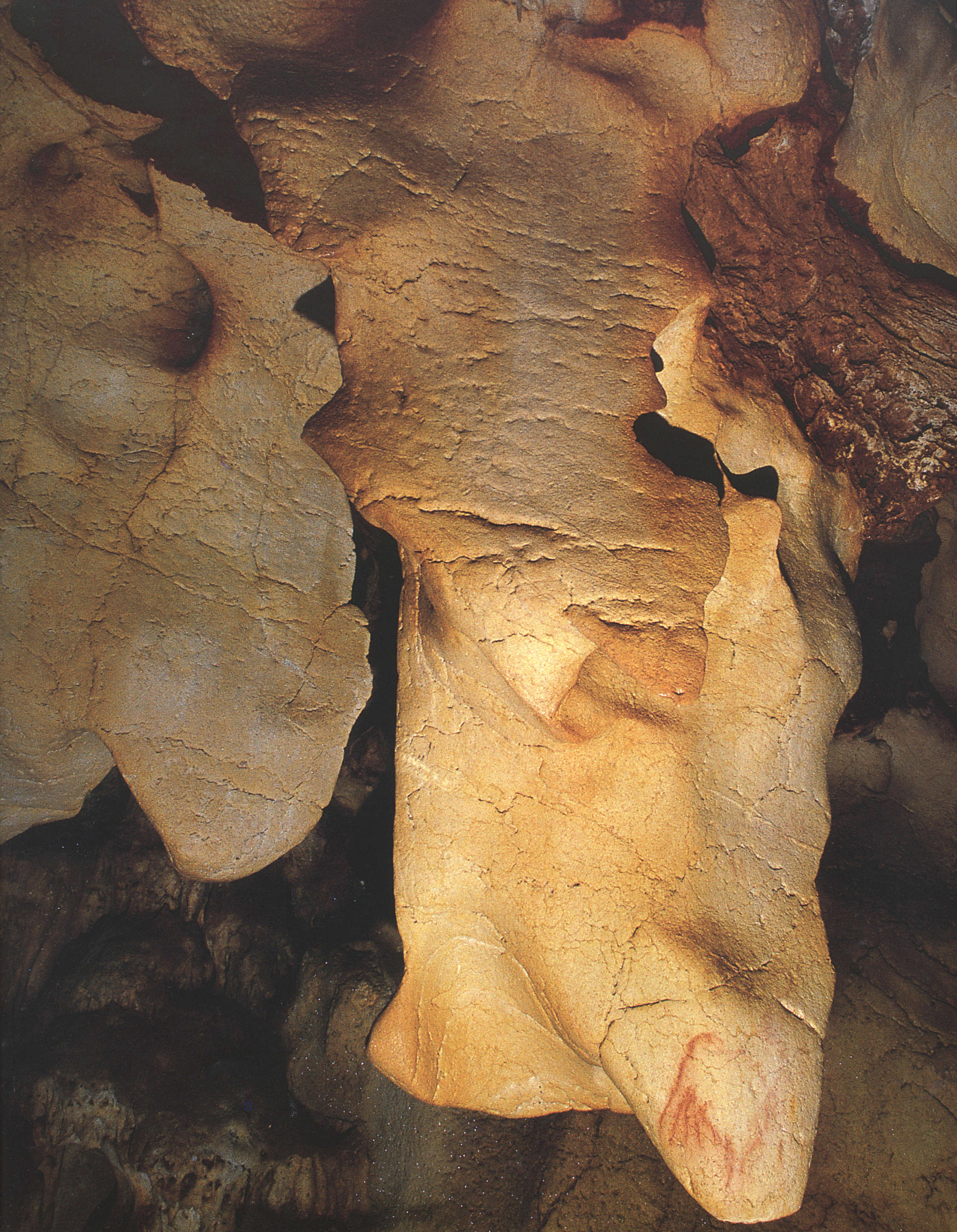

Red Mammoth on a pendant rock at the entrance to the Cactus Gallery.
This was the first animal painting seen when the discoverers began exploring the cave.
Photo: (left) Clottes (2003)
Photo: (right) Chauvet, Deschamps et Hillaire (1996)
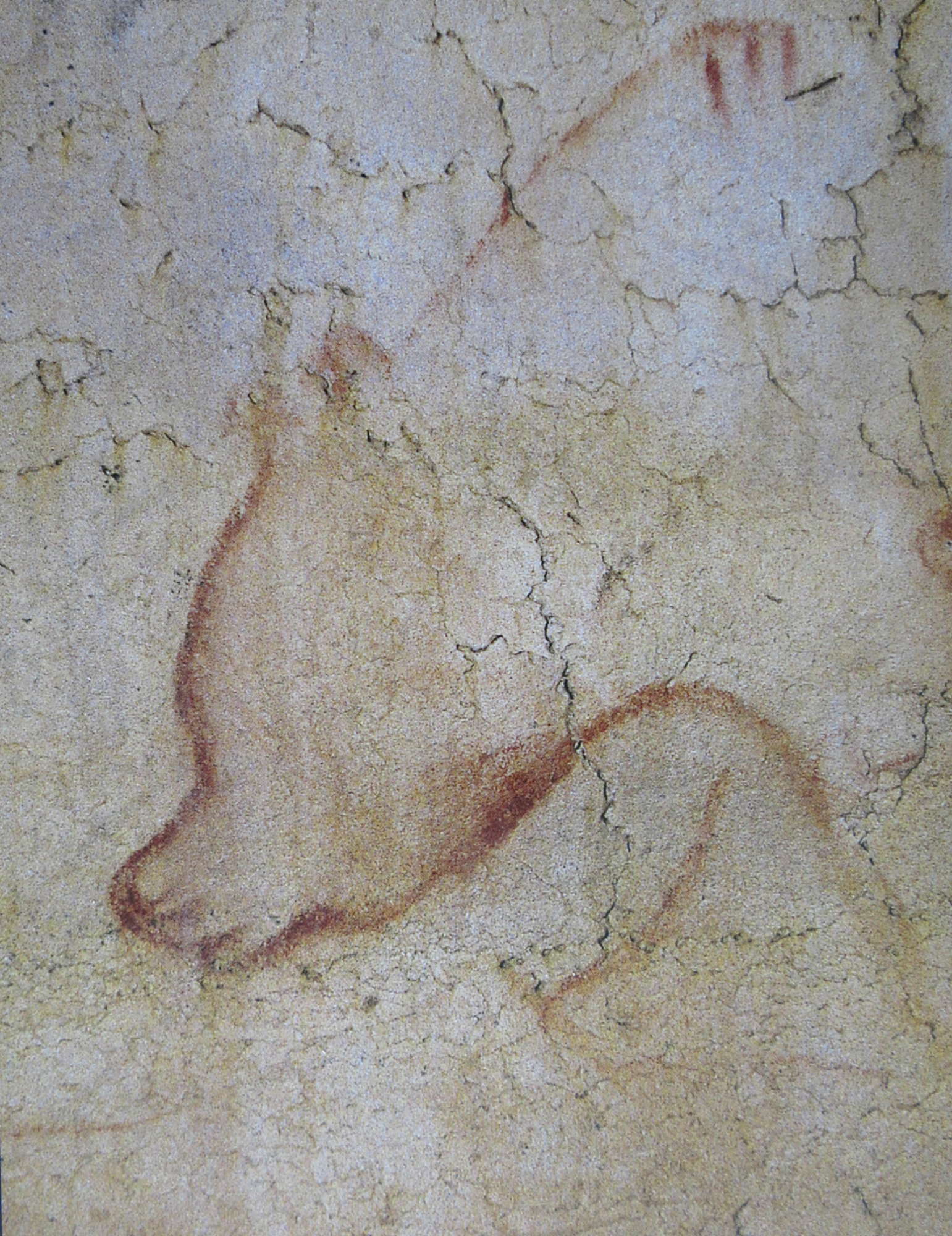
Red bear, 80 cm wide, on the wall in the Cactus Gallery.
Photo: Clottes (2003)
The Red Panels Gallery - Salle des Panneaux rouges
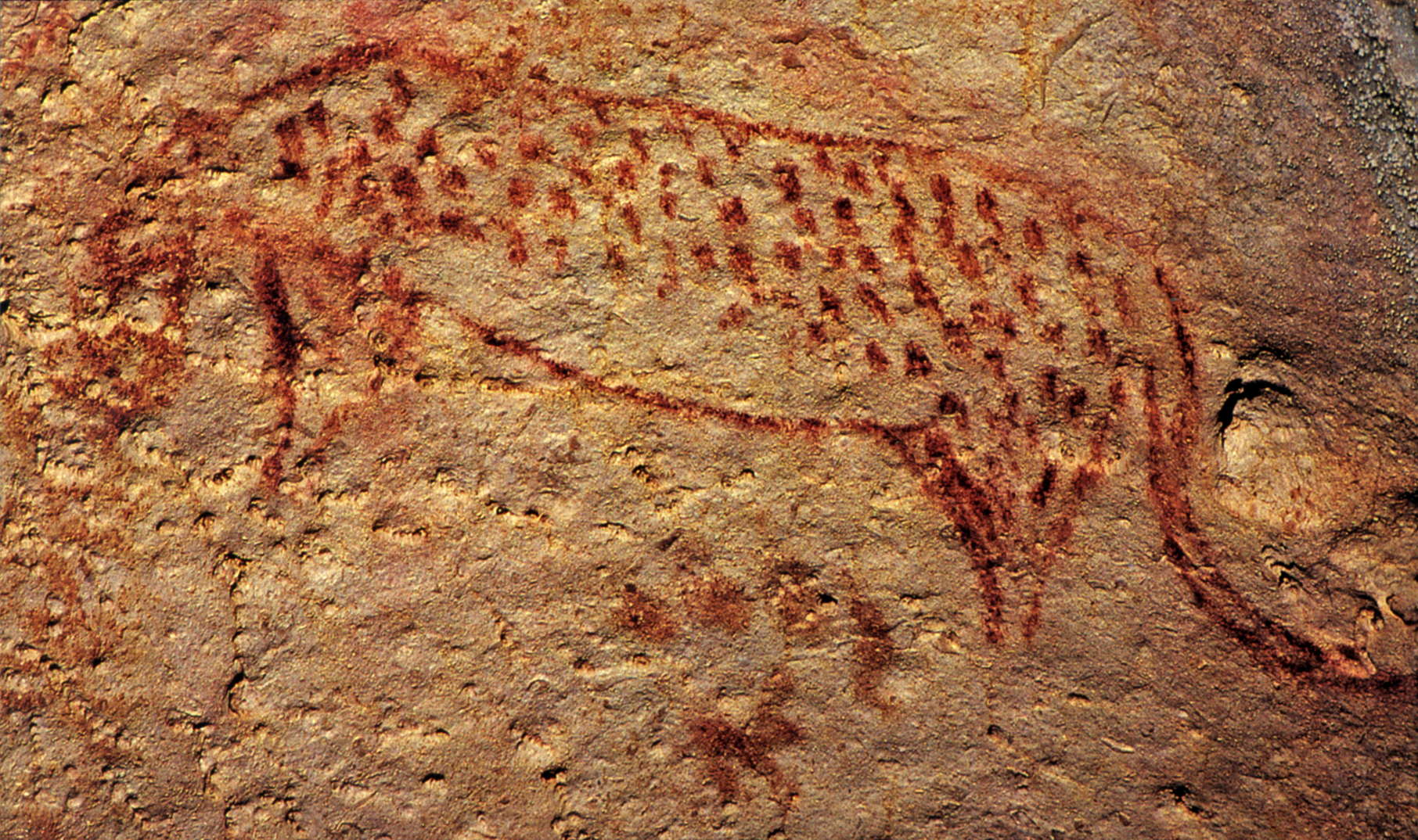
A cavebear slapped a muddy forepaw onto this image of a panther, the first such image of a panther known.
Photo: National Geographic, August 2001
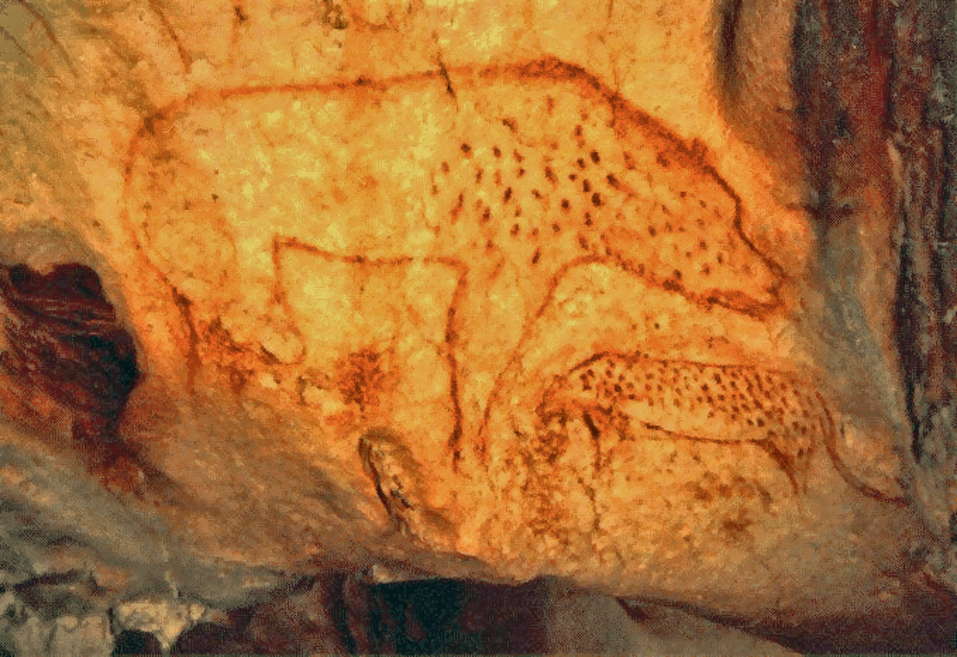
The complete panel shows a cave hyena, Crocuta crocuta spelaea and the animal variously called a leopard or a panther.
The painting has been dated to 32 000 BP.
Photo: Carla Hufstedler
Permission: licensed under the Creative Commons Attribution-Share Alike 2.0 Generic license

Stepping even further back, there appears to be the outline of yet another animal, possibly a bear, above the hyena and panther.
Photo: Chauvet, Deschamps et Hillaire (1996)
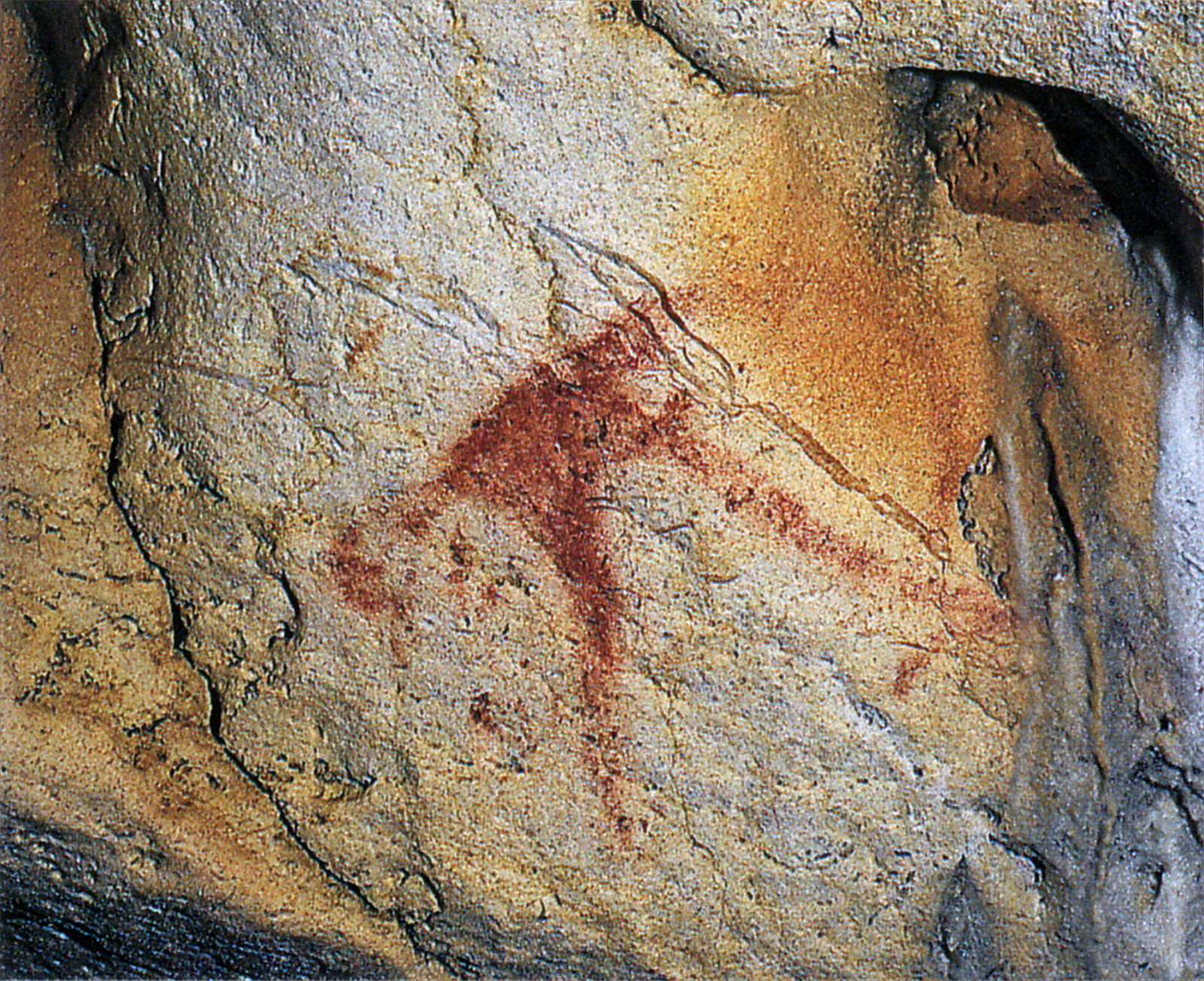
Male ibex, recognisable by the long curved horn, on the panther panel, well to the left of the hyena and panther.
Photo and text: Chauvet, Deschamps et Hillaire (1996)

A bear placed vertically on the wall, near the panther panel.
Photo: Chauvet, Deschamps et Hillaire (1996)
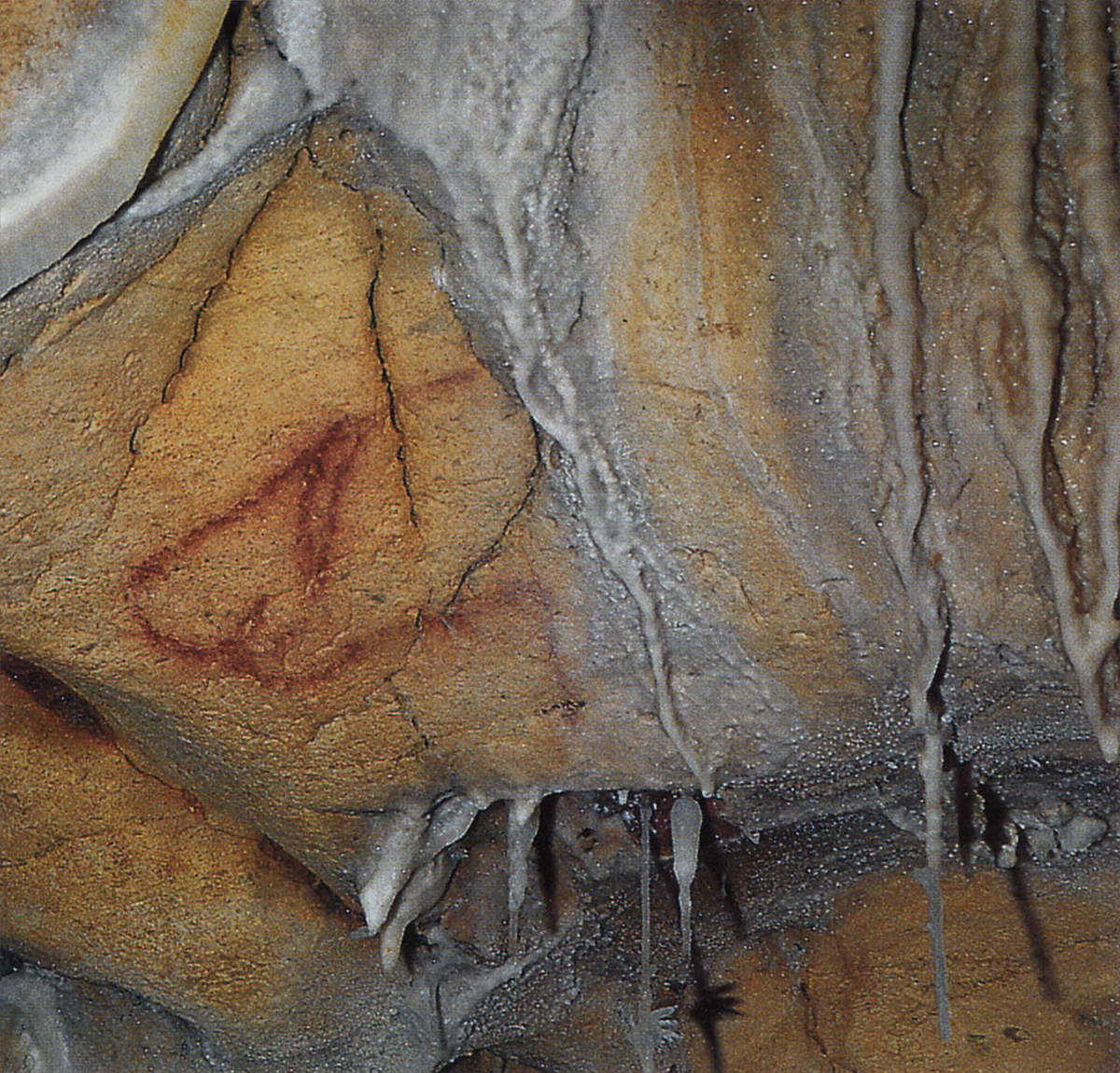
This bear or lion head, done in red oxide, has been partially covered by calcite.
(I think this is near the panther panel - Don )
Photo: Chauvet, Deschamps et Hillaire (1996)

Positive hand prints, formed by coating the hand with pigment and pressing the hand on the wall. The second hand print may have been done at the same time, without recoating of the hand, as it is fainter.
In the frame also are a semicircle of dots, and felines, on the "Panel of Hand Prints", in the Red Panels Gallery.
The individual with the crooked little finger (see the section on the Brunel Chamber) did the hand print near the arc of red dots.
Photo: Clottes (2003)
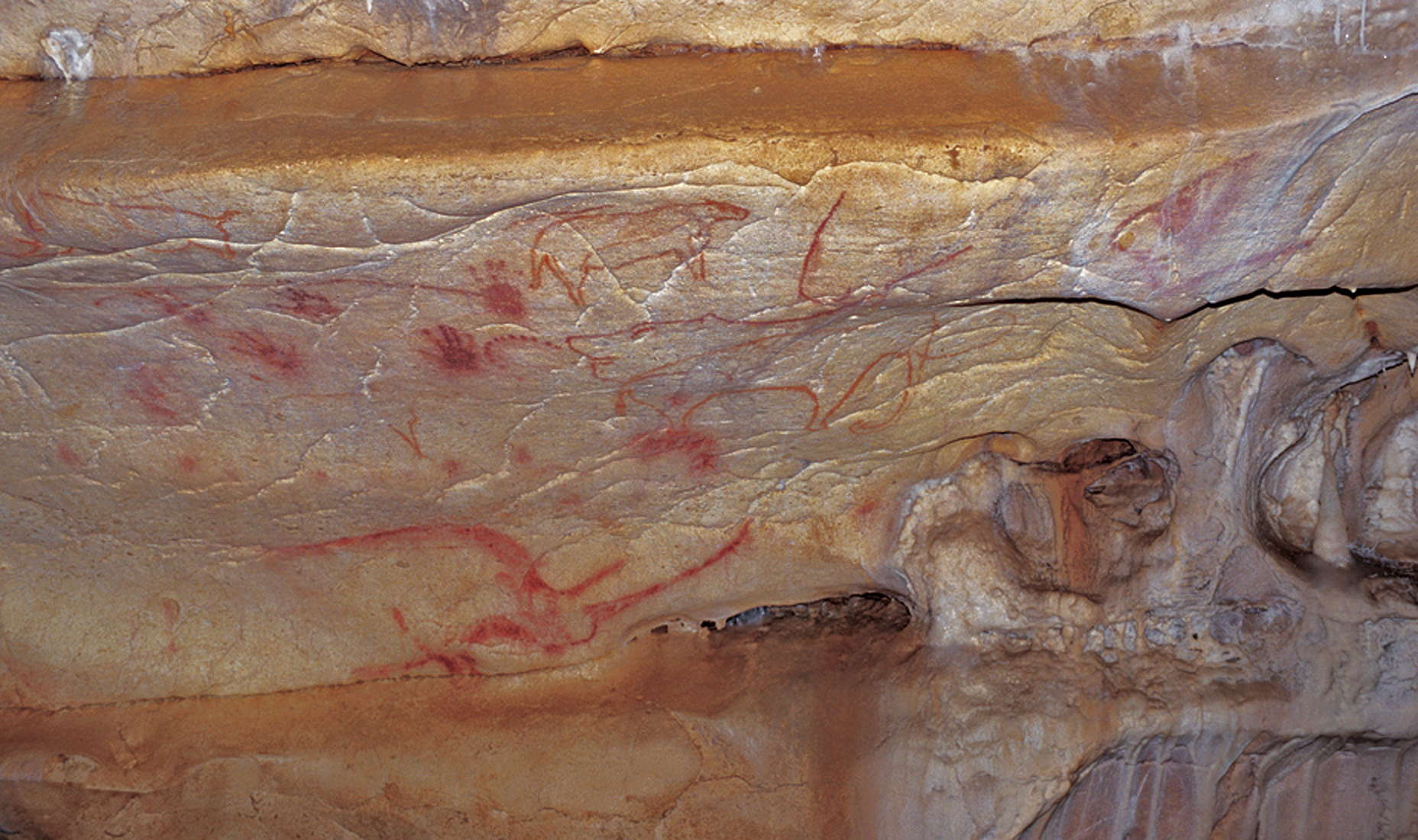
This is known as the Panel of Handprints. As well as handprints, it includes an arc of dots, two rhinos, a mammoth, a bear, and what may be the head of a cavelion.
It also includes, towards the top of this image, the complete outline of an enigmatic animal with a solid tail, a body with an almost horizontal ventral contour, and a feline or dog-like head.
Photo: http://uk.phaidon.com/agenda/art/picture-galleries/2011/march/10/inside-the-cave-of-forgotten-dreams/
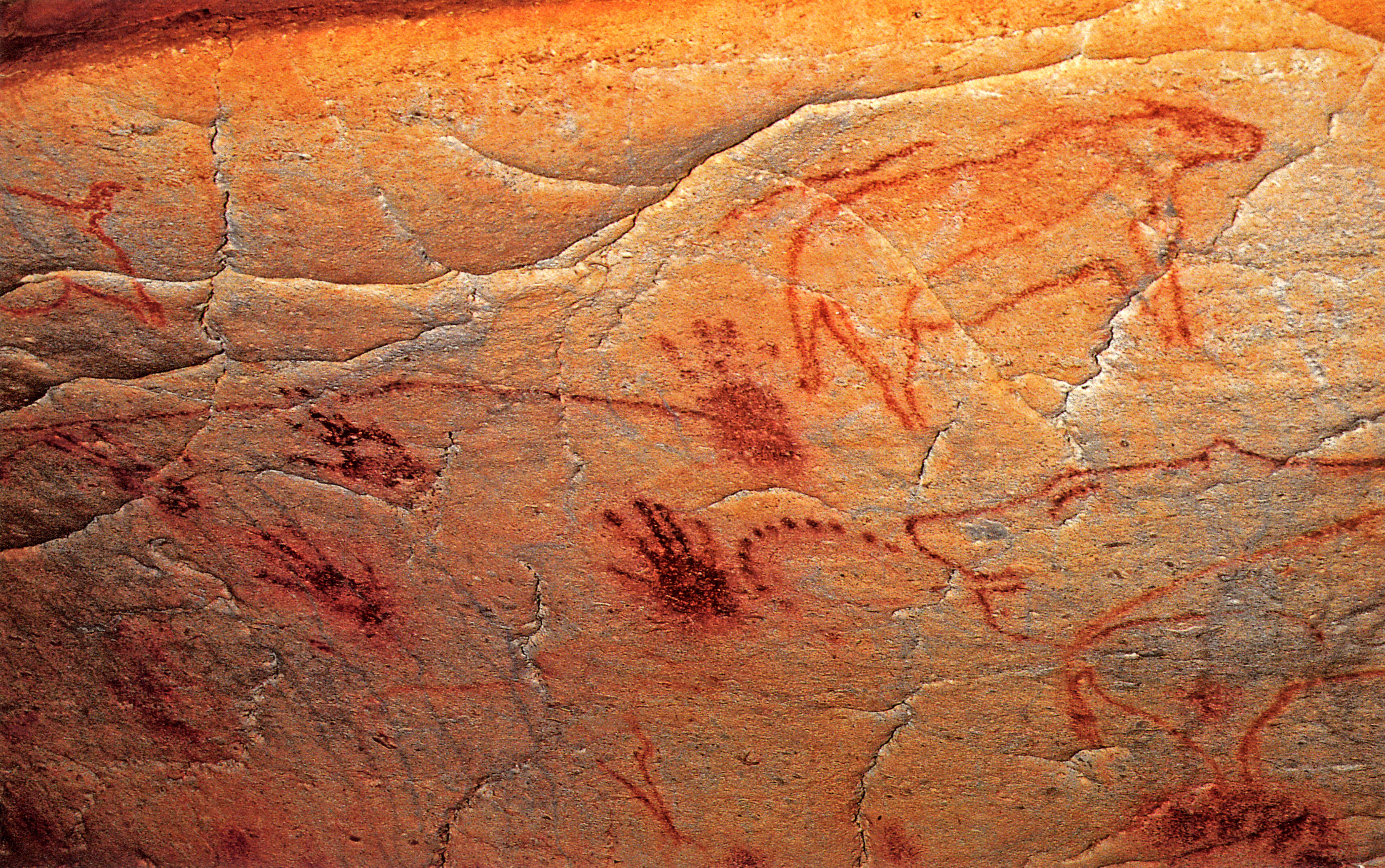
Close up of the section with handprints, arc of dots, and the enigmatic animal with well muscled tail base.
Photo: Chauvet, Deschamps et Hillaire (1996)
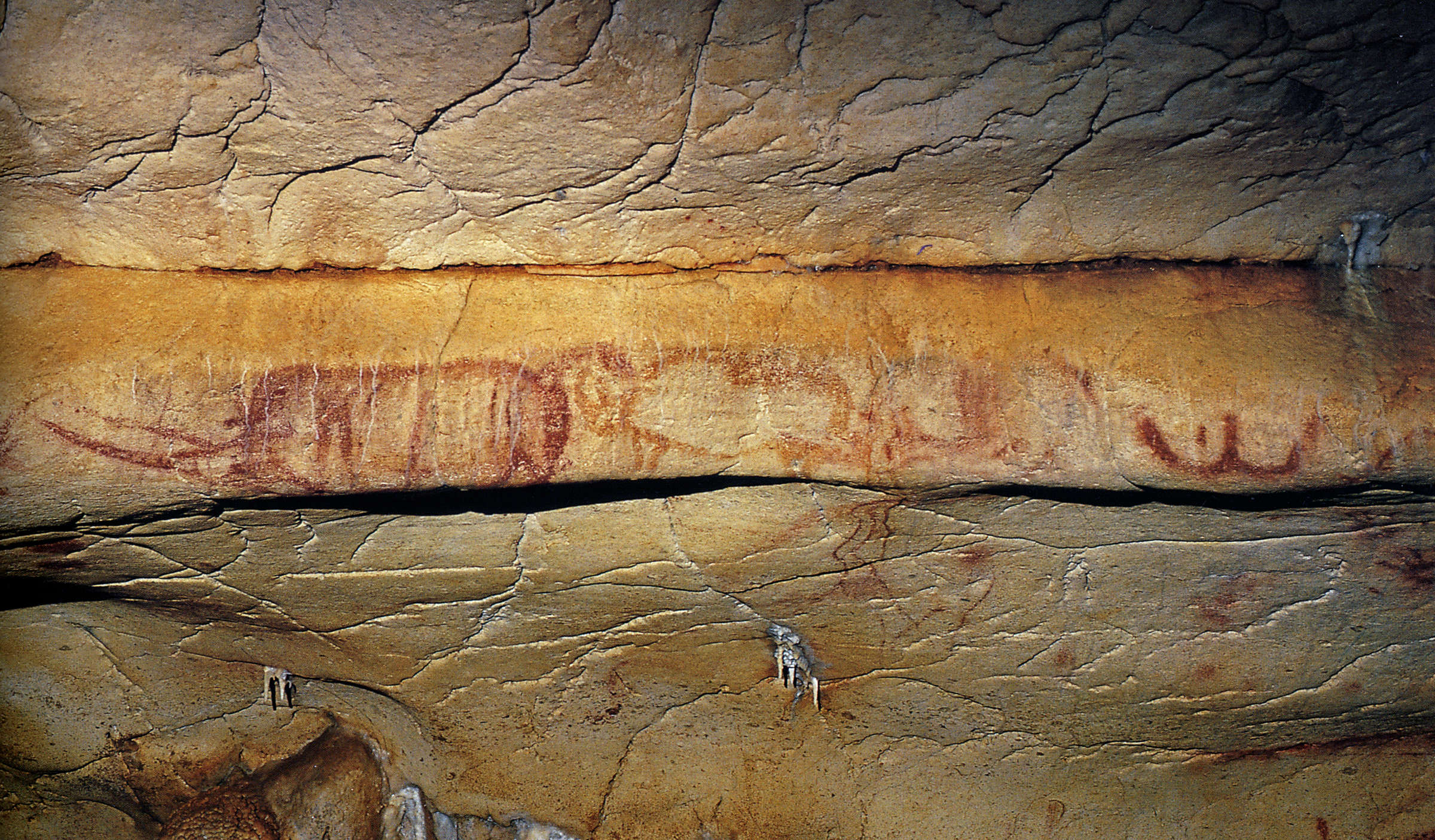
Frieze of the red rhinoceroses and a 'W' sign at the top of the Panel of Hand Prints.
Photo: Clottes (2003)
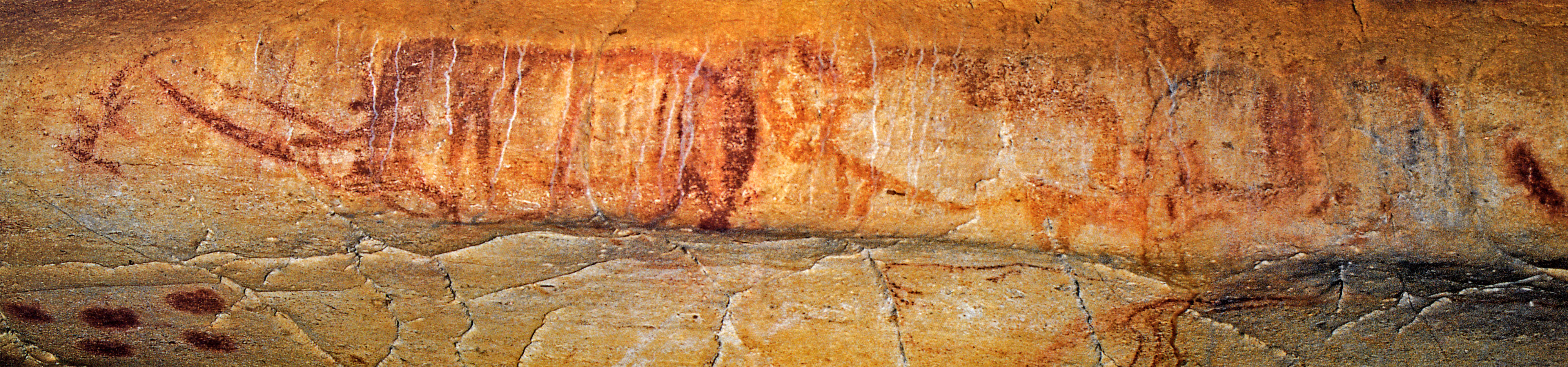
Close up of the frieze of the red rhinoceroses at the top of the Panel of Hand Prints.
Photo: Chauvet, Deschamps et Hillaire (1996)
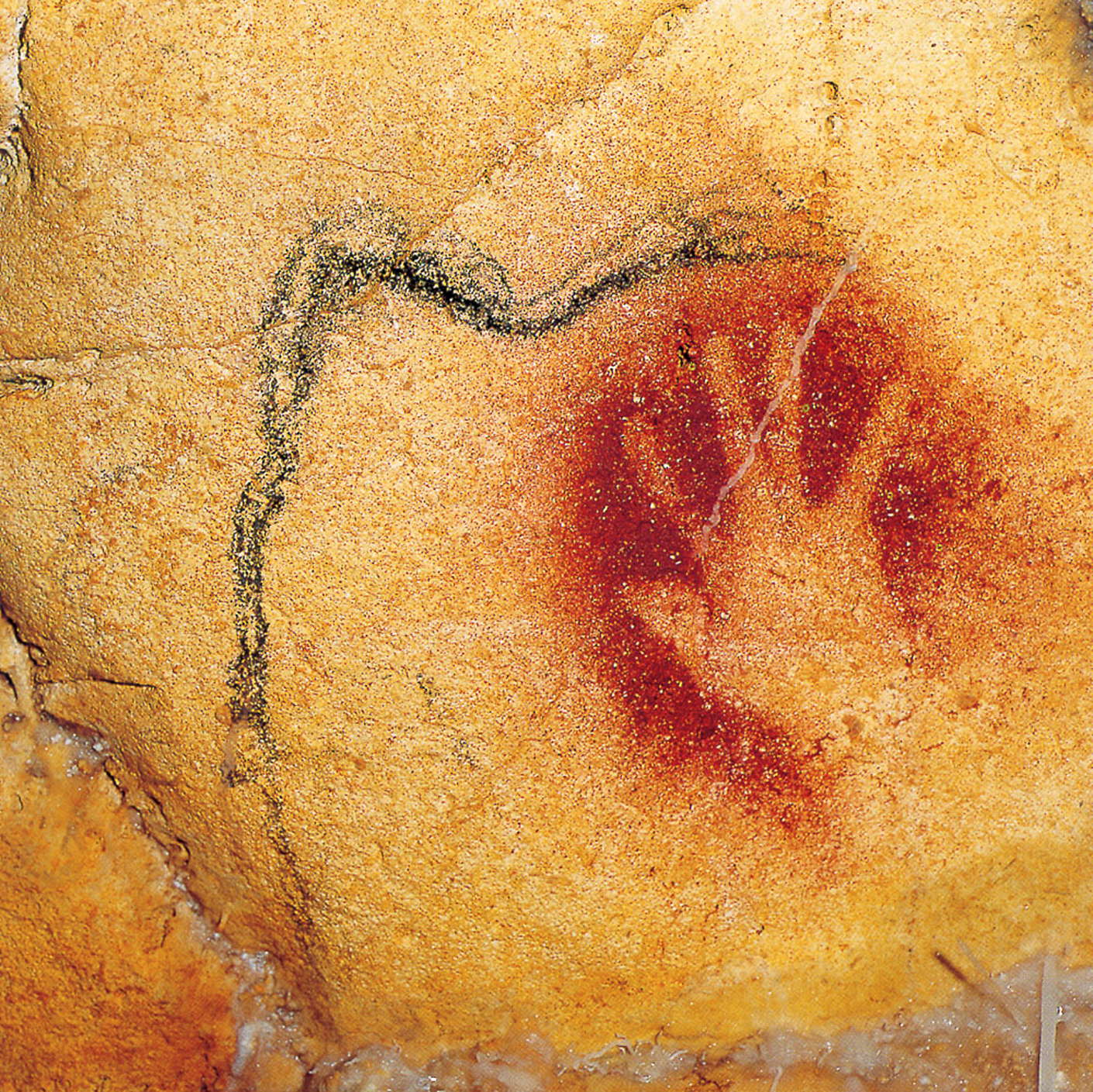
Negative hand print, formed by blowing pigment from the mouth over the hand.
Photo: Jaubert (2008)
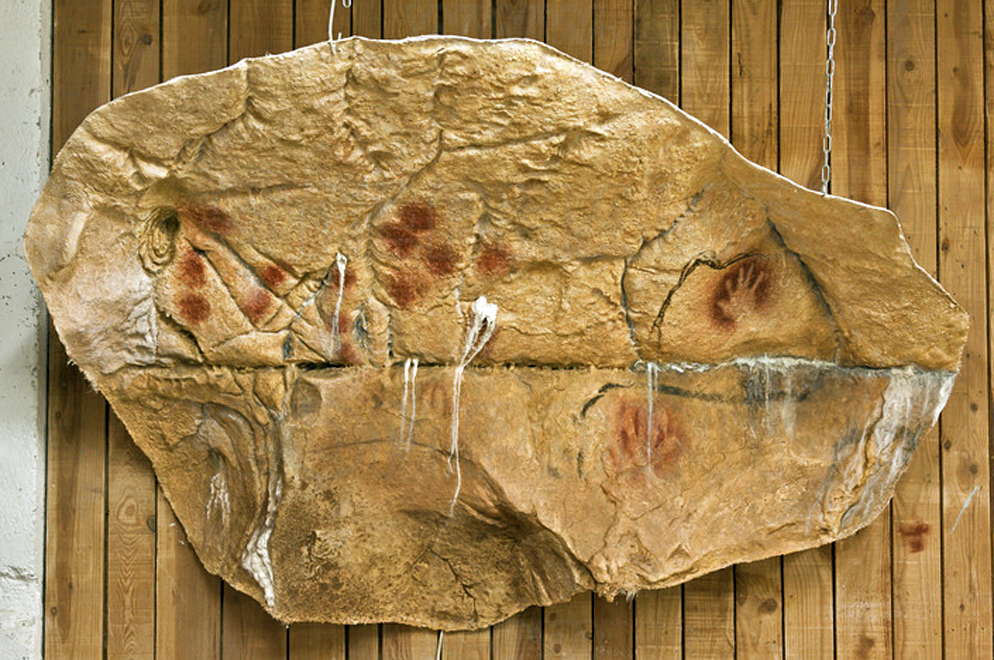
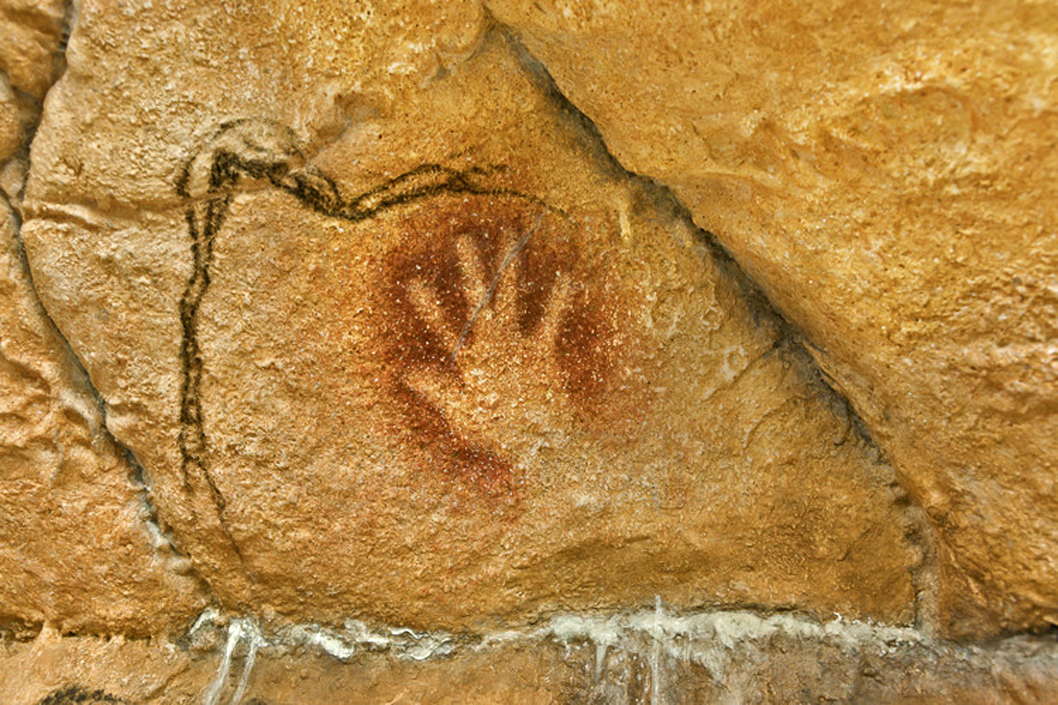
This is the same panel, a facsimile done in fibreglass and resin, to be used in the recreation of Chauvet, Chauvet II.
Photo: © Stéphane Compoint, http://stephanecompoint.com/
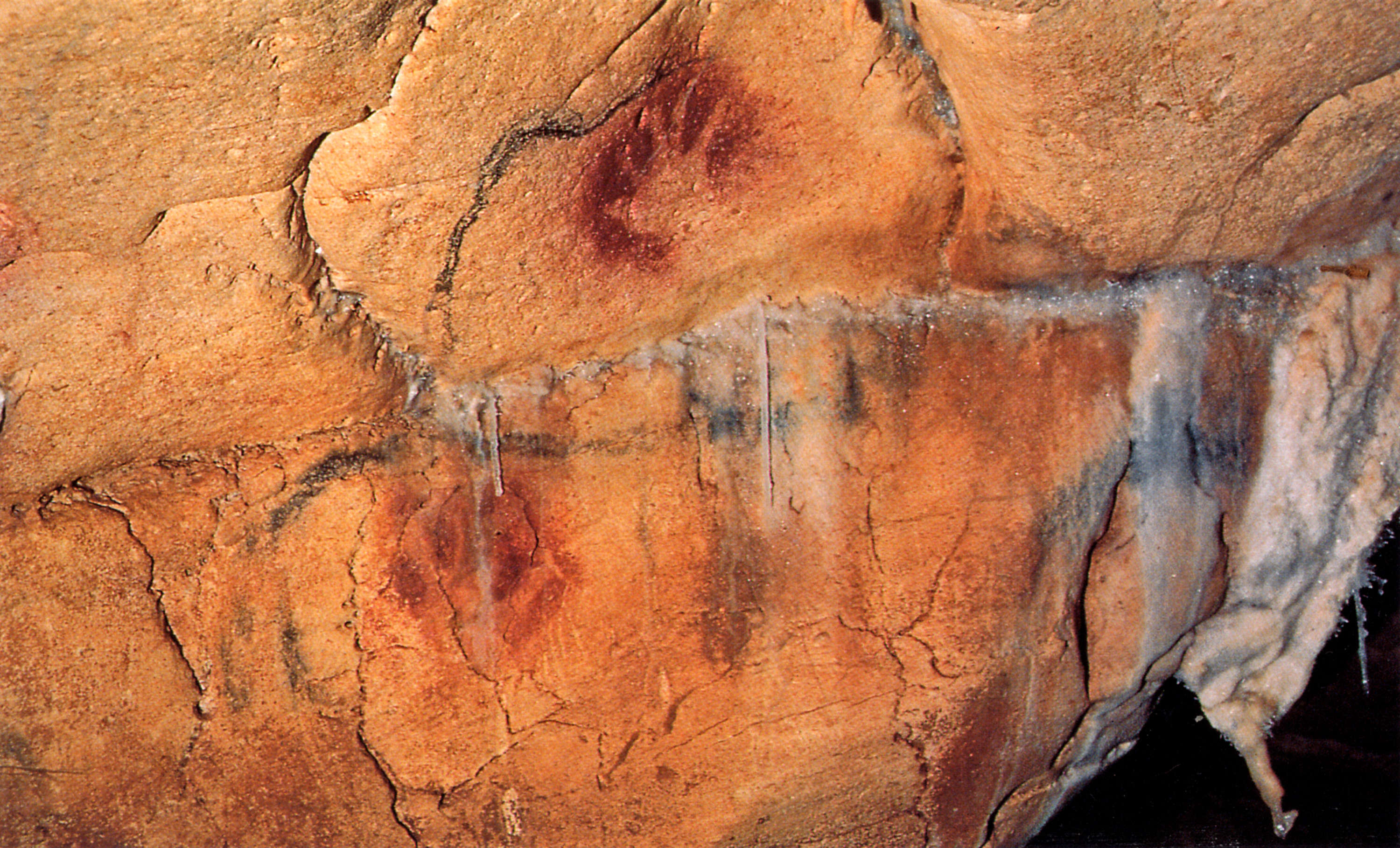
Negative hand prints at Chauvet.
Photo: Chauvet, Deschamps et Hillaire (1996)
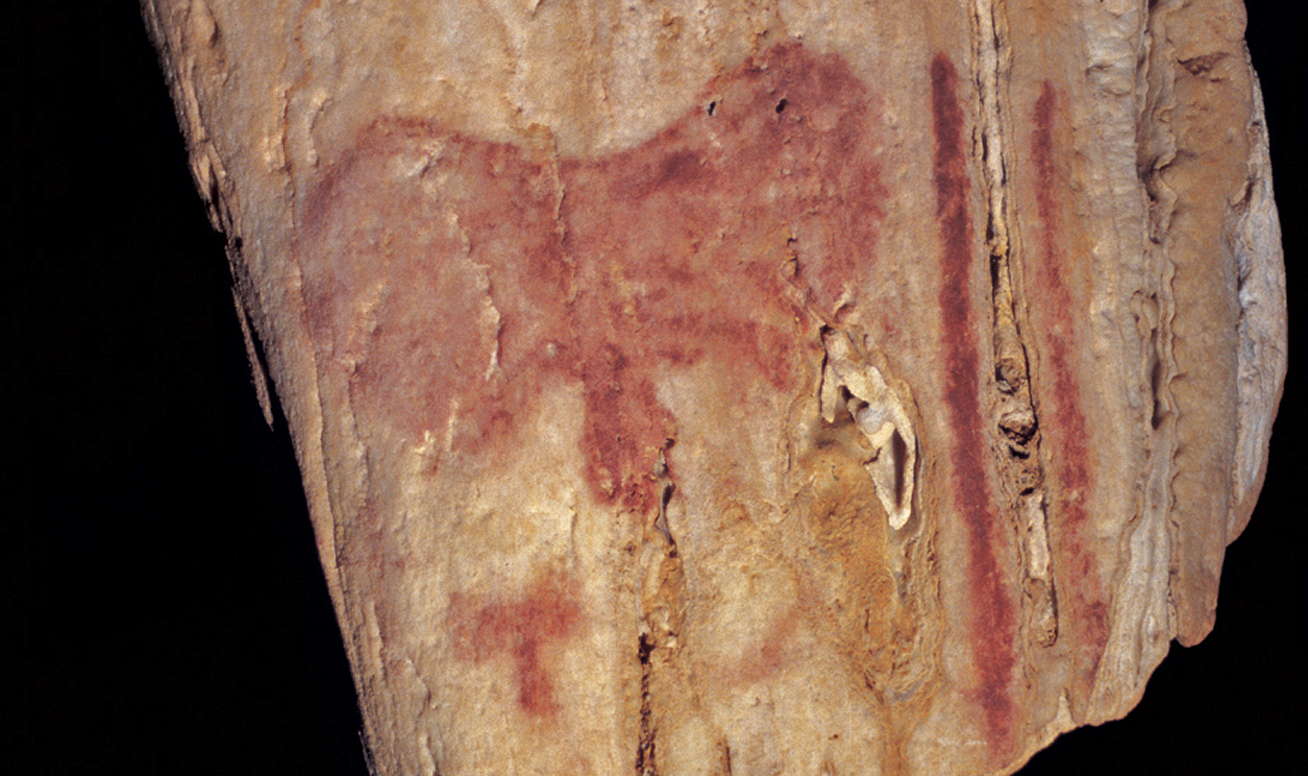
These enigmatic signs in the Red Panels Gallery remind me of insects. The prominent symmetrical one could well be a butterfly (or possibly a bird such as an eagle) except for the lack of a head.
Photo: http://uk.phaidon.com/agenda/art/picture-galleries/2011/march/10/inside-the-cave-of-forgotten-dreams/

Another version of the 'butterfly' above. Note the two cross shapes below it and to the left. The images are on a massive pendant, suspended above the floor from the roof of the cave, without any other pendants nearby.
Donna Cannon writes:
I think your 'butterfly' is a kite (a carrion bird) as seen from directly below it as it hovers, with another bird floating much 'higher' to its left.
Photo: Chauvet, Deschamps et Hillaire (1996)
This image from the Red Panels Gallery is very insect like, but with six 'legs' on each side. It is analagous to the insect-like form in the Sacred Heart Panel.
Photo: Clottes (2003)
Here is the 'insect' sign in context. Note the recurrence of the butterfly or bird shape to its left. Both images are framed by calcite rods.
Sarah Holloway writes:
I was reading and thinking about the cave painting photos on your website. Two in particular, the 'insect' and the 'eagle' or butterfly, gave me a different impression. I had a thought that it was a primitive attempt at drawing the skeleton. I think they might be trying on some level to represent some of the animal remains either in the cave or seen after a hunt. The eagle could be the hip bones, the insect the back bone and ribs.
Photo: Chauvet, Deschamps et Hillaire (1996)
The Candle Gallery - Galerie du Cierge
Entrance to the Candle Gallery.
The floor of this gallery is more than 150 cm lower than that of the previous chamber.
Photo and text: Clottes (2003)
Path of the discoverers
The Candle Gallery is a low passage with no engravings or paintings, but traces of charcoal and torch marks have been found there. This physical change in the cavity marks the separation between two areas. The first is an ensemble of chambers dominated by red paintings and a simple parietal organisation. In the second part, which has more black representations, the art becomes more monumental.
Photo: © Valérie Feruglio
Text: http://www.culture.gouv.fr/culture/arcnat/chauvet/en/owpt13.htm
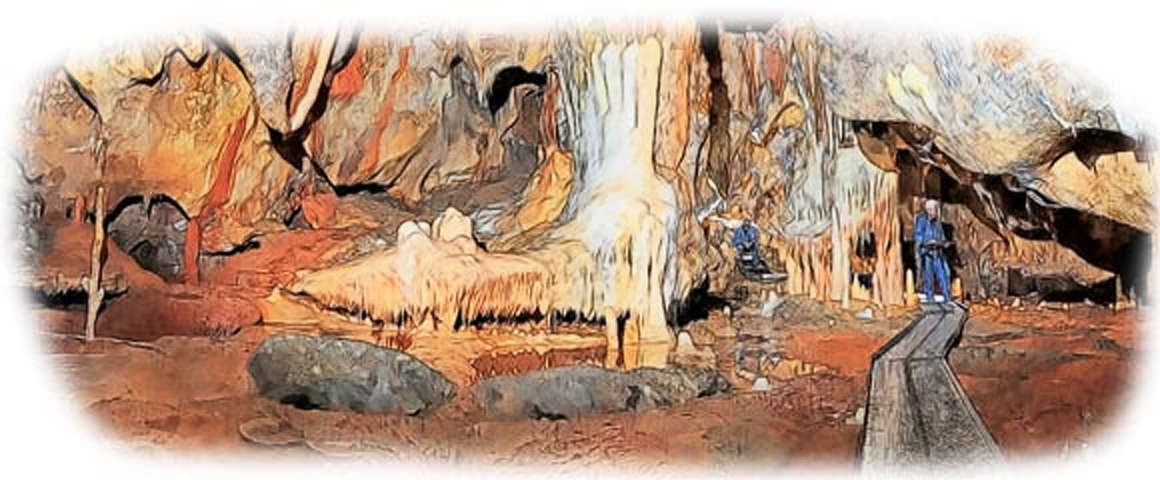
Panorama of the Candle Gallery
Photo: http://edytem.univ-savoie.fr/20-au-23-septembre-2012Journees
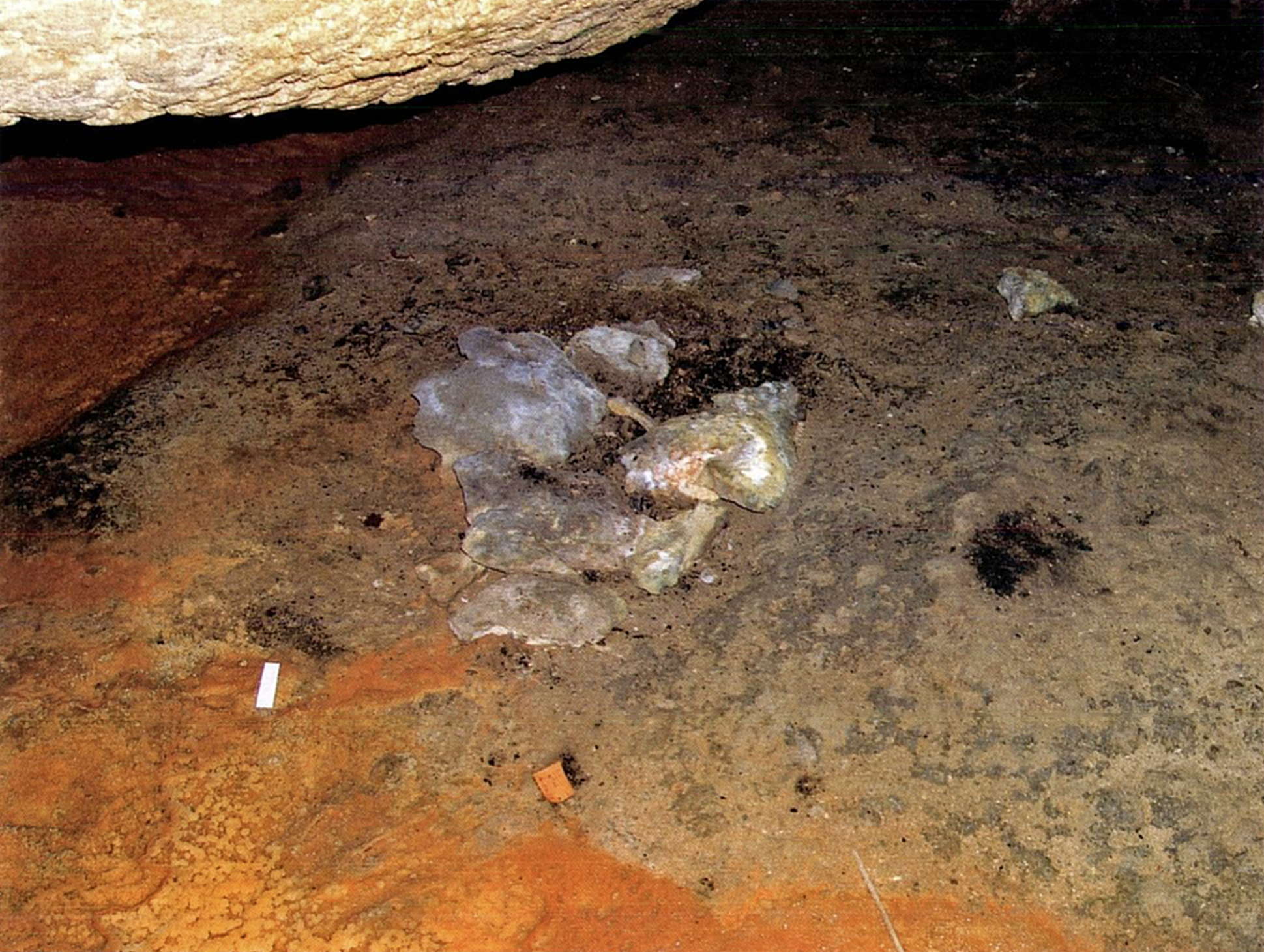
Fireplace under a pendant rock in the Candle Gallery in which the purposely poor combustion of the wood has resulted in a lot of charcoal, presumably for use as a pigment in painting.
This small fireplace, 50 cm in diameter, includes several pieces of flat limestone rocks. It is located in a low vaulted ceiling that is abnormally clear of traces of fire, and the low ceiling has undoubtedly contributed to its preservation, at least in preventing the passage of cave bears. A fragment of pine charcoal gave the date of 26230 ± 280 years. This hearth is contemporaneous with the second phase of human use of the cave between 27 000 and 24 500 BP.
Photo and text: Geneste (2005)
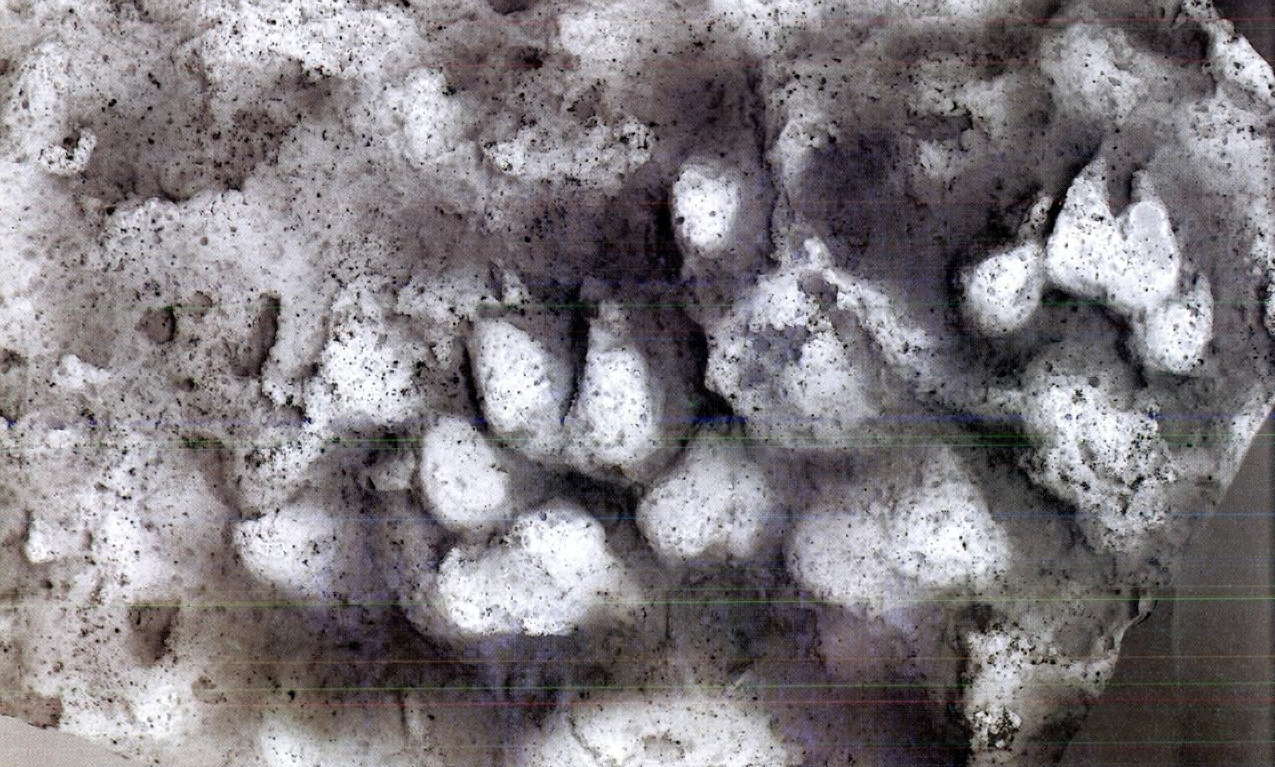
Cast of the paw prints of a dog, in the Candle gallery.
Photo and text: Garcia (2005)
The Hillaire Chamber - Salle Hillaire
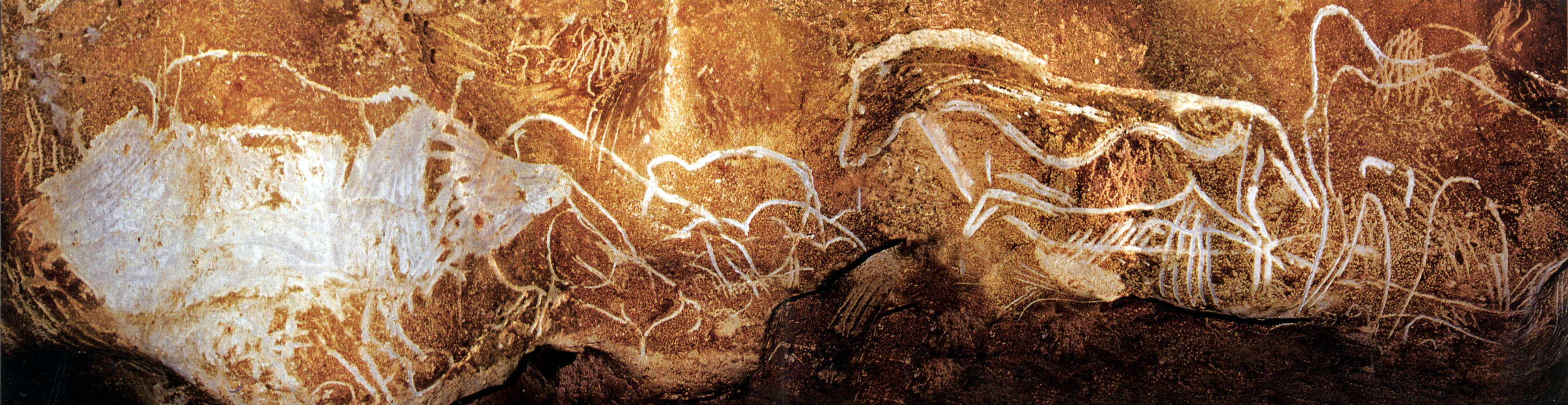
Panel of the Engraved Horse.
This panel is superimposed on older bear claw marks. It is six metres long, and includes thirteen animals. The animals mostly face left, with the large horse framed by two mammoths on the right, with a couple of bison made incomplete by a large scraped area on the left. All that remains below the scraped area are a couple of ball shaped feet which may have belonged to a mammoth, with the dorsal line of another animal remaining above the scraped area.
Photo: National Geographic August 2001
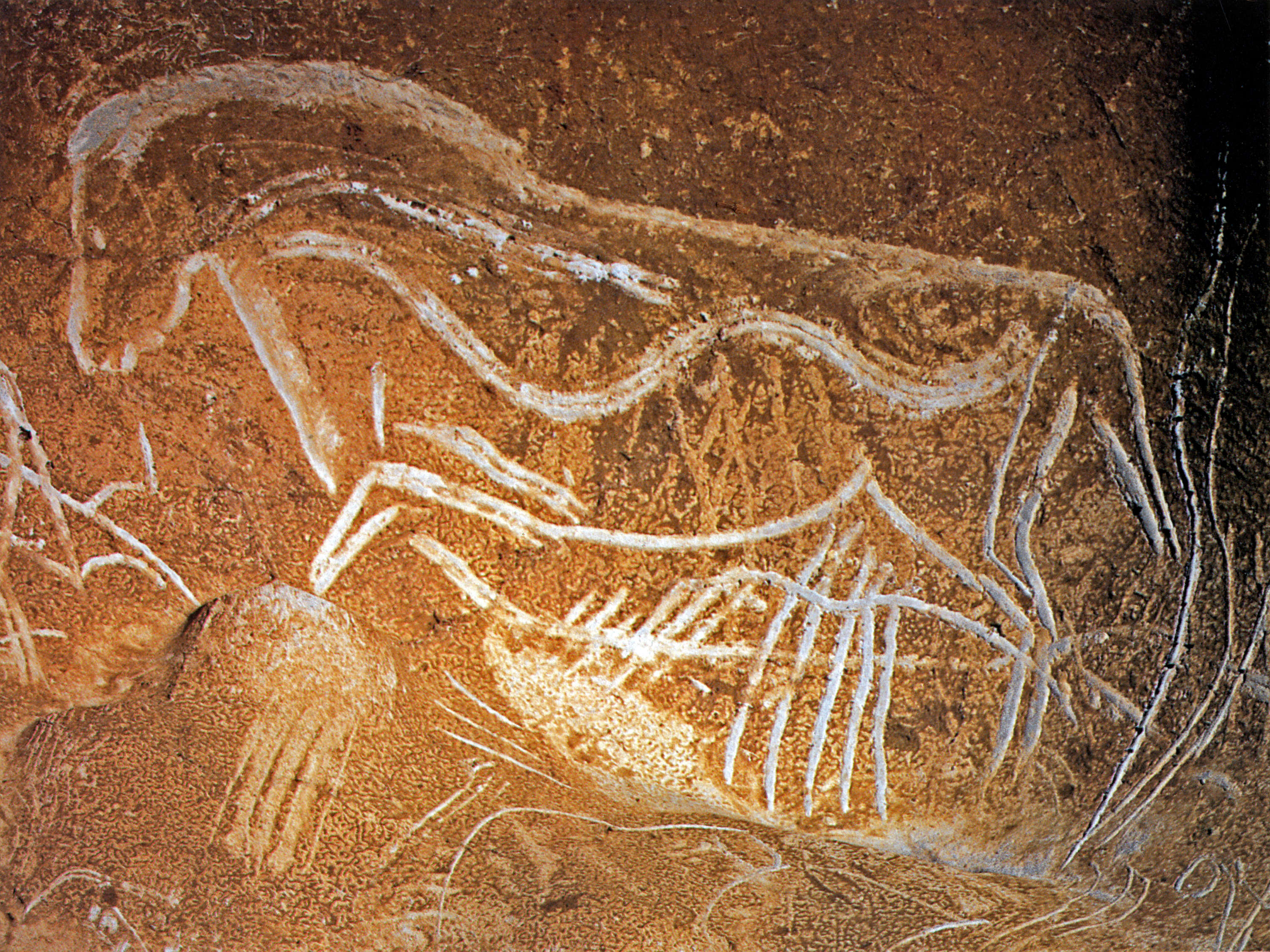
The horse has been engraved with the fingers on soft clay, revealing the lighter layer underneath. The horse was engraved on top of ancient claw marks. The horse has been shaped by scraping the clay covering a wall in the Hillaire Chamber, near the great collapse.
Photo: Chauvet, Deschamps et Hillaire (1996)
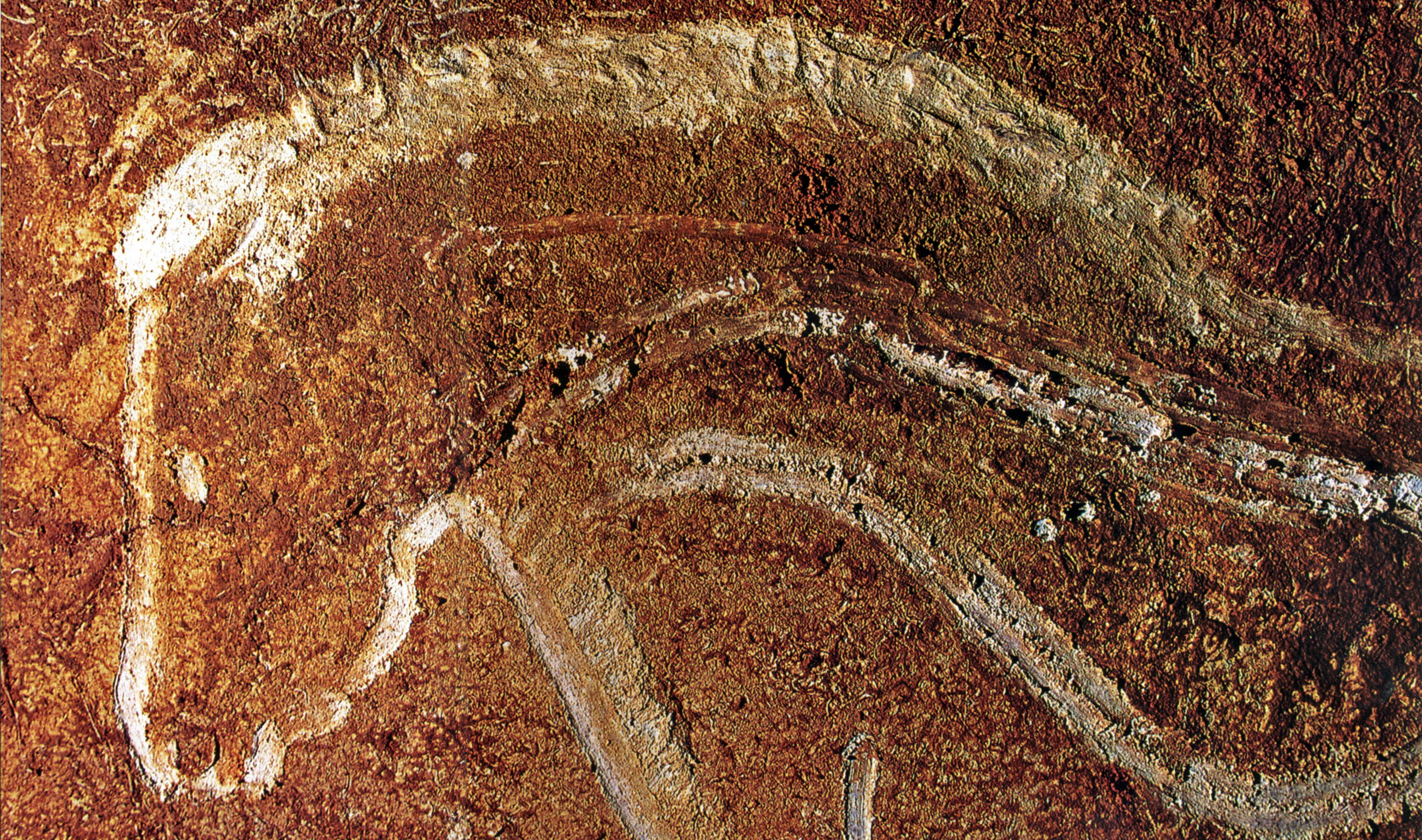
The mane of the horse retains the fingerprints of the artist, who demonstrates superb control of the medium.
Photo: National Geographic August 2001
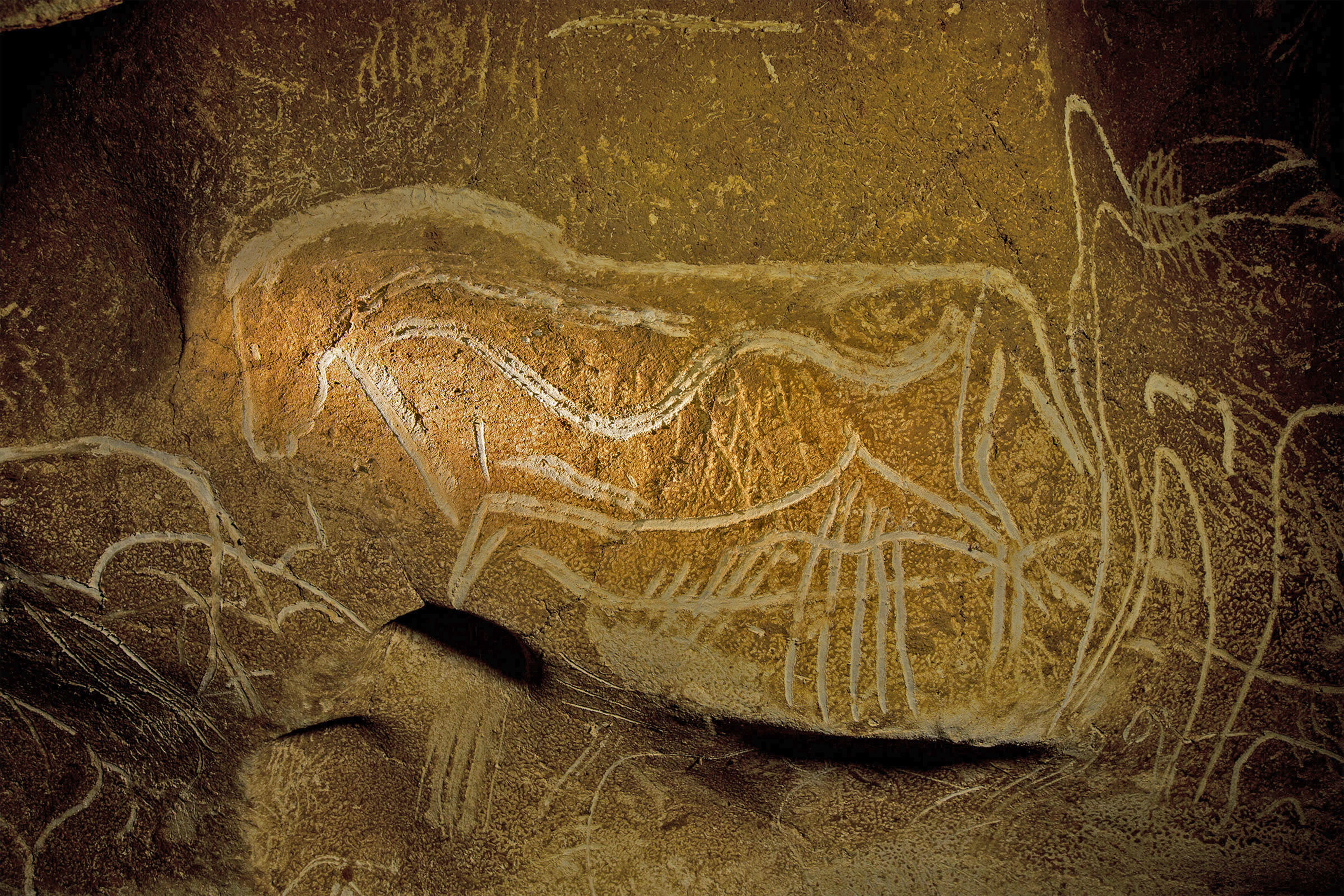
The panel has been traced on clay deposited on a limestone wall, as the rock was dissolved by acidic groundwater, leaving a coating of the small amounts of clay in the original limestone concentrated into a thin layer.
Photo: Stephen Alvarez © National Geographic
Source: http://proof.nationalgeographic.com/2015/01/05/shooting-chauvet-photographing-the-worlds-oldest-cave-art/
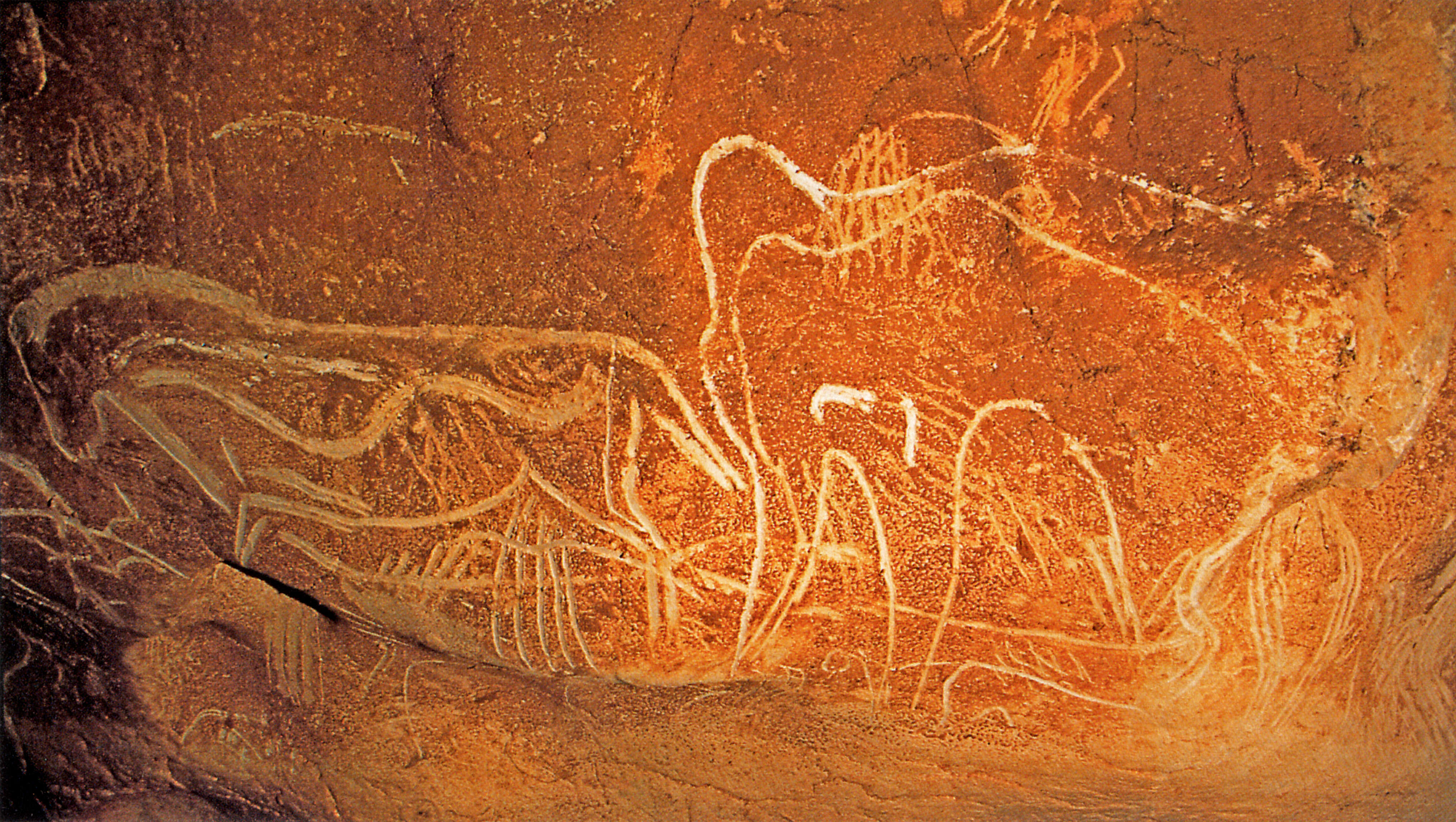
The panel includes two mammoths superimposed on each other behind the horse.
Photo: Chauvet, Deschamps et Hillaire (1996)
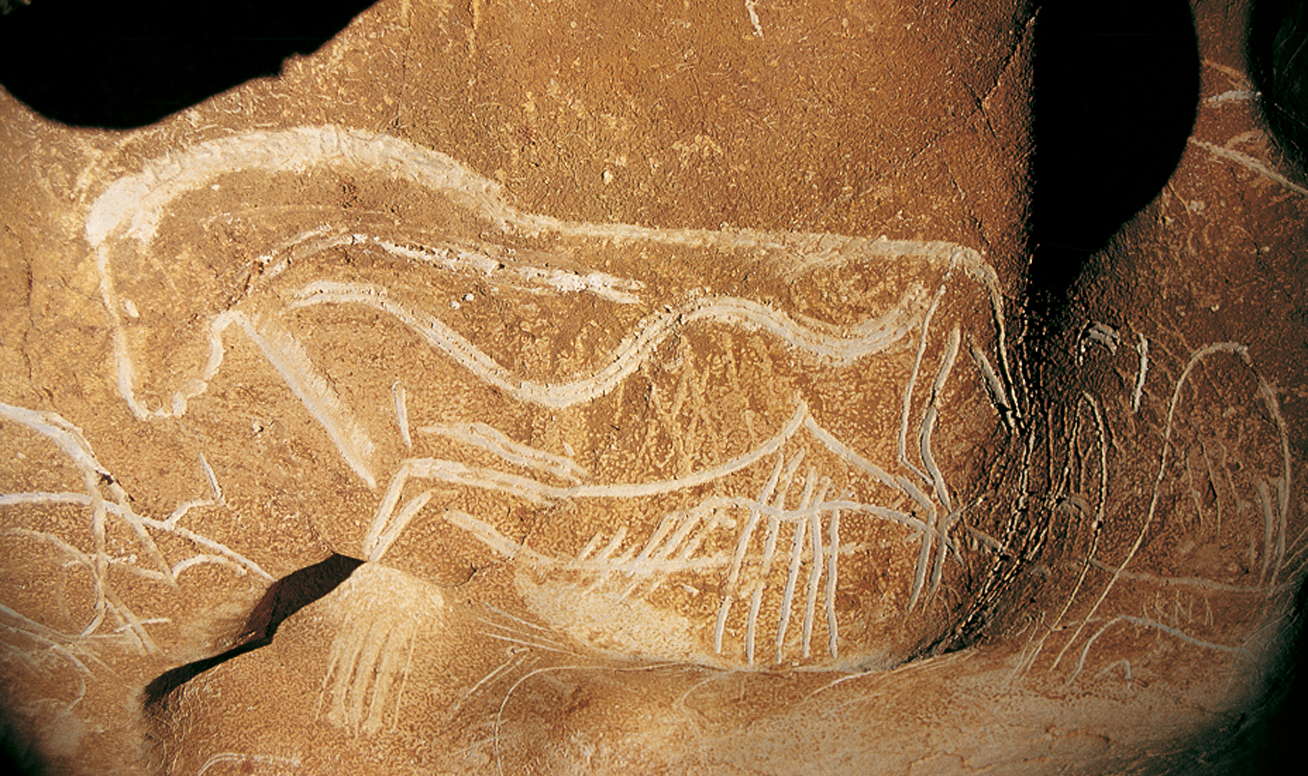
Another version of the engraved horse above. It is 120 cm long.
Photo: http://uk.phaidon.com/agenda/art/picture-galleries/2011/march/10/inside-the-cave-of-forgotten-dreams/

Yet another version of the engraved horse, taken from a perspective which flattens the substrate, and allows us to see the engraved mammoths following it.
Photo: Fritz et Tosello (2007)
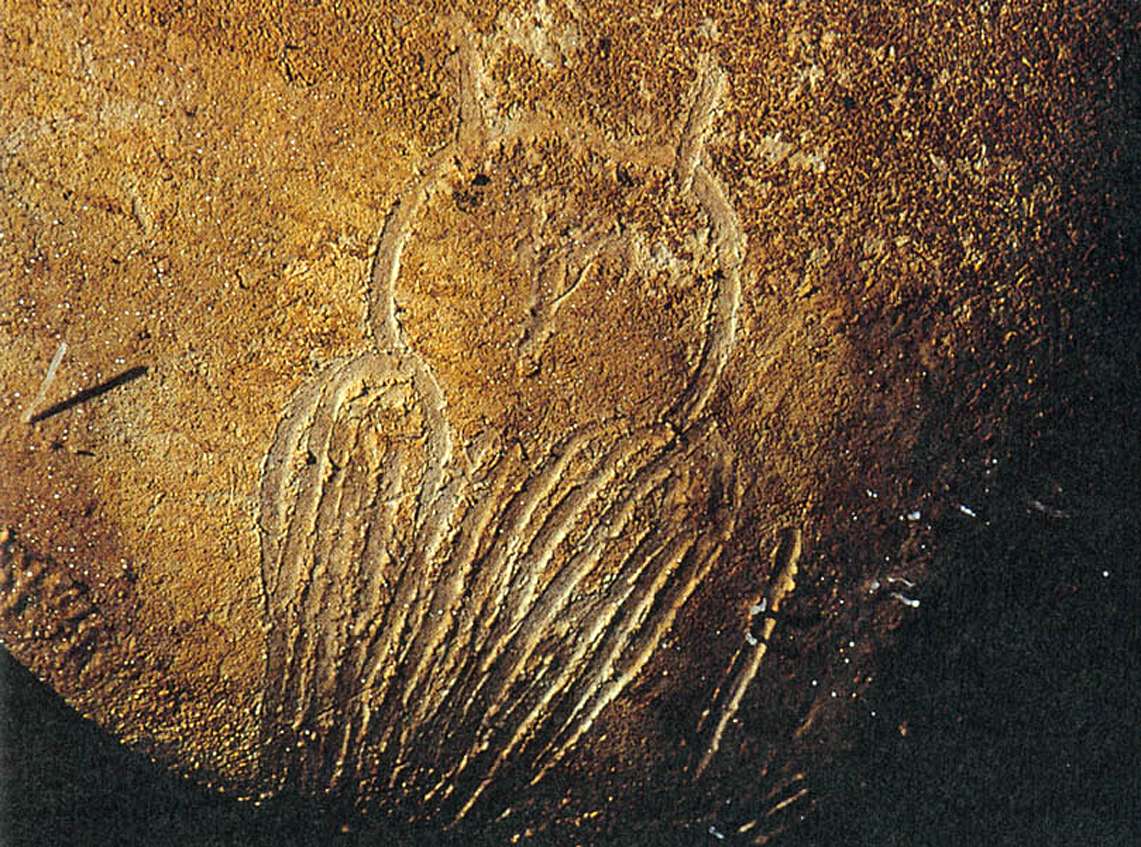
Grotte Chauvet (Ardèche), salle Hillaire. Tracé digital figurant un hibou : les caractéristiques anatorniques de cet animal, dont la tête est retournée à 180° sur la face antérieure identifiable grâce an figuré des ailes, permettent de l'identifier an Moyen Duc.
Chauvet Cave (Ardèche), Hillaire Chamber. An owl traced by finger on the wall of the cave. Owls are able to turn their head through 180° so that they can look backwards over their wings, as shown here.
Photo from: Agenda de la Préhistoire 2002 - 2003, a superb diary with excellent illustrations sent to me by Anya. My thanks as always.
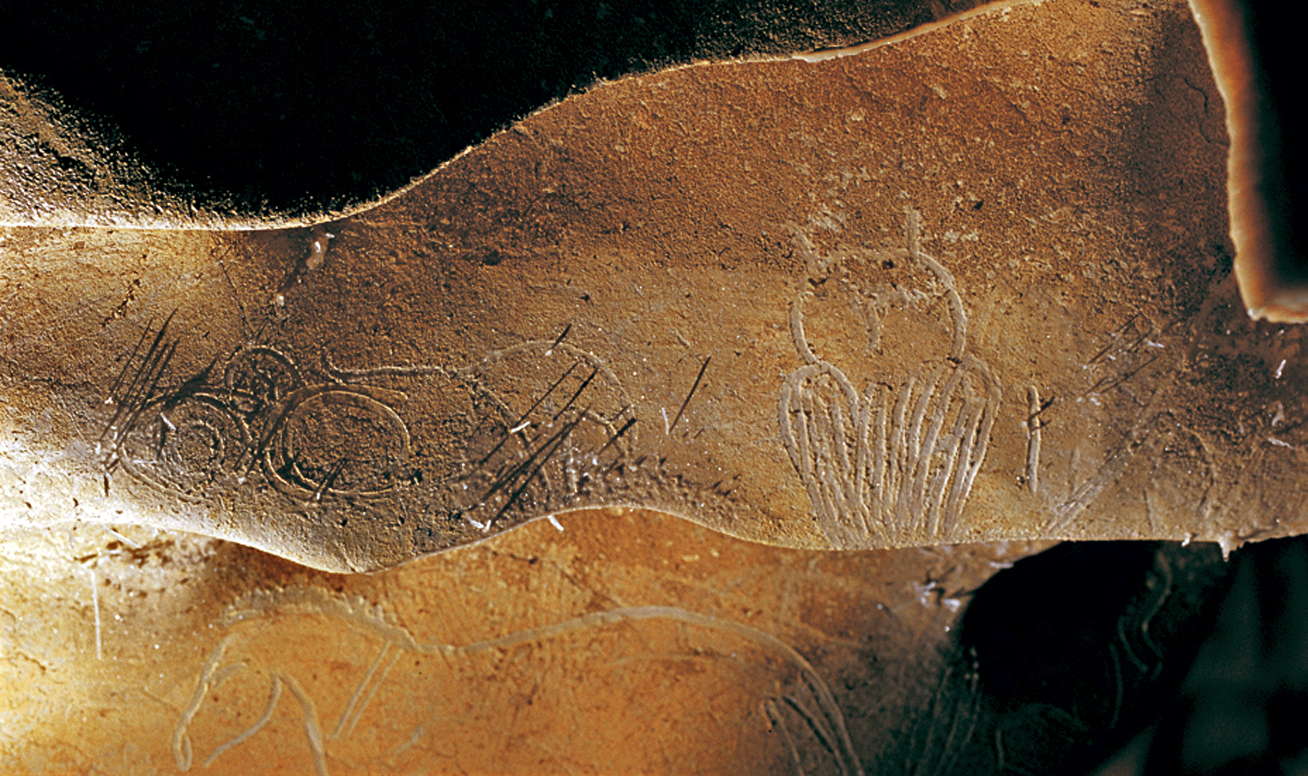
This shows the owl in its context within the cave, on a flat pendant, accompanied by enigmatic circle signs, with the engraved horse on a pendant behind it.
Photo: http://uk.phaidon.com/agenda/art/picture-galleries/2011/march/10/inside-the-cave-of-forgotten-dreams/
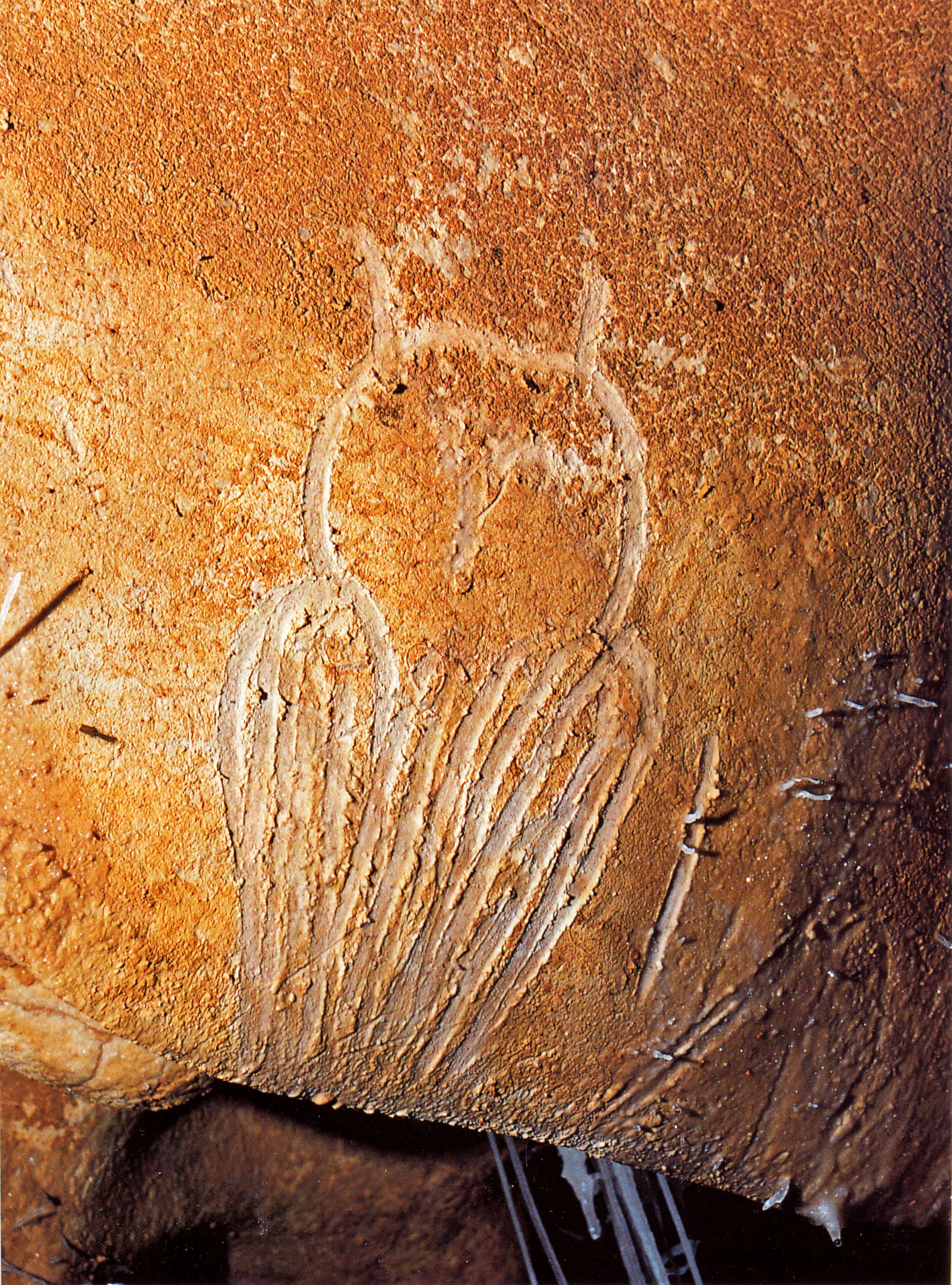
Another version of the owl.
Photo: Chauvet, Deschamps et Hillaire (1996)
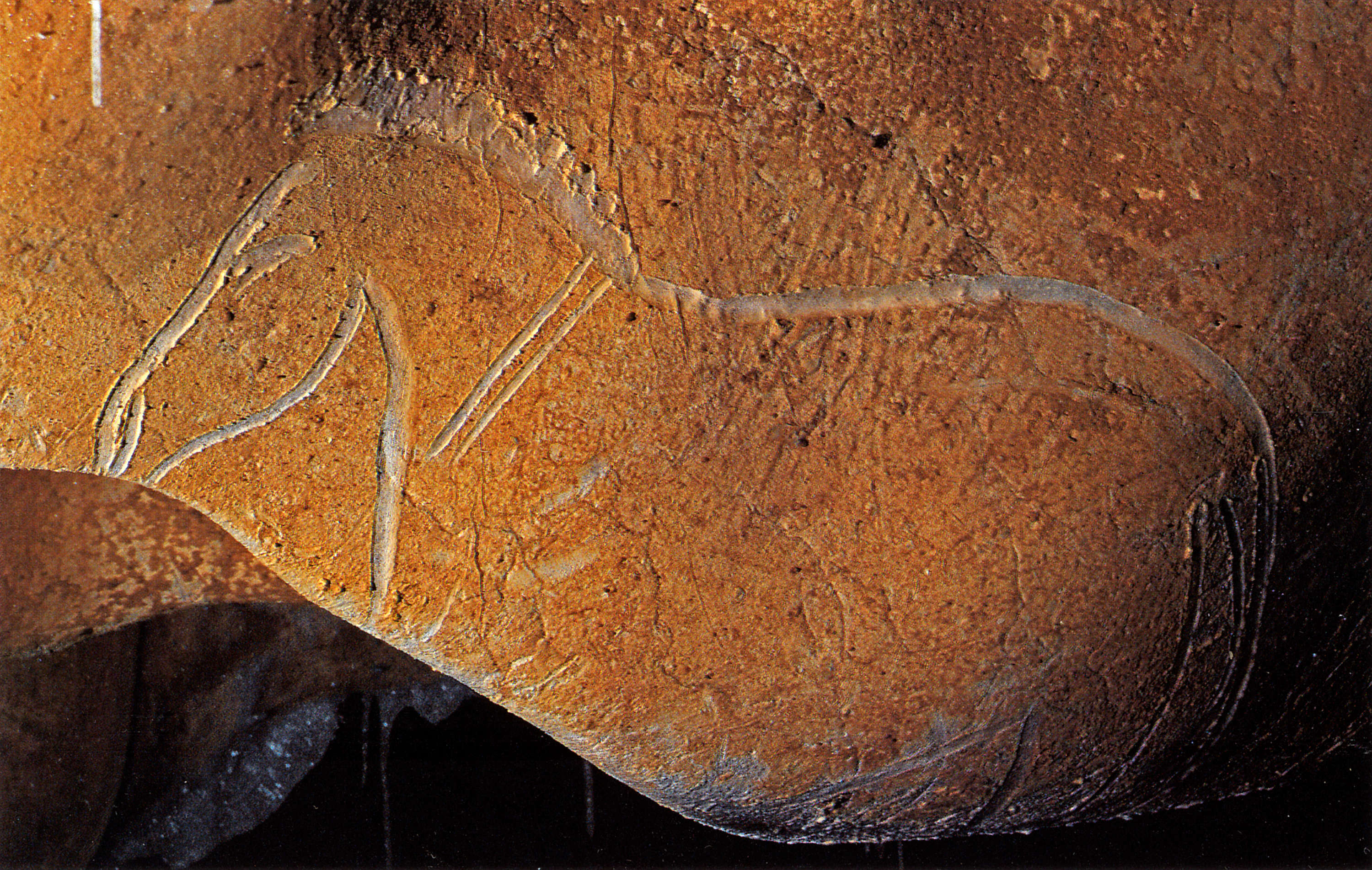
Engraved horse, left profile. It is on an overhang close to the owl. Note the two lines at the shoulder and the duckbill muzzle.
This horse has been engraved in clay which sometimes forms a thin layer on the walls of caves. In this case, there is a thin panel attached to the roof which the artist has used to advantage, using the curve at the bottom of the panel as the abdomen of the horse. The horse has been drawn with swift, sure strokes, with no hesitation or false starts, the mark of a talented artist.
Careful inspection reveals much older 'macaroni' marks on the panel, over which the horse has been drawn. Macaroni marks of this nature have sometimes been attributed to children.
Photo and text: Chauvet, Deschamps et Hillaire (1996)
Extra text: http://www.istmira.com/foto-i-video-pervobytnoe-obschestvo/3924-iskusstvo-predystorii-pervobytnost-2.html
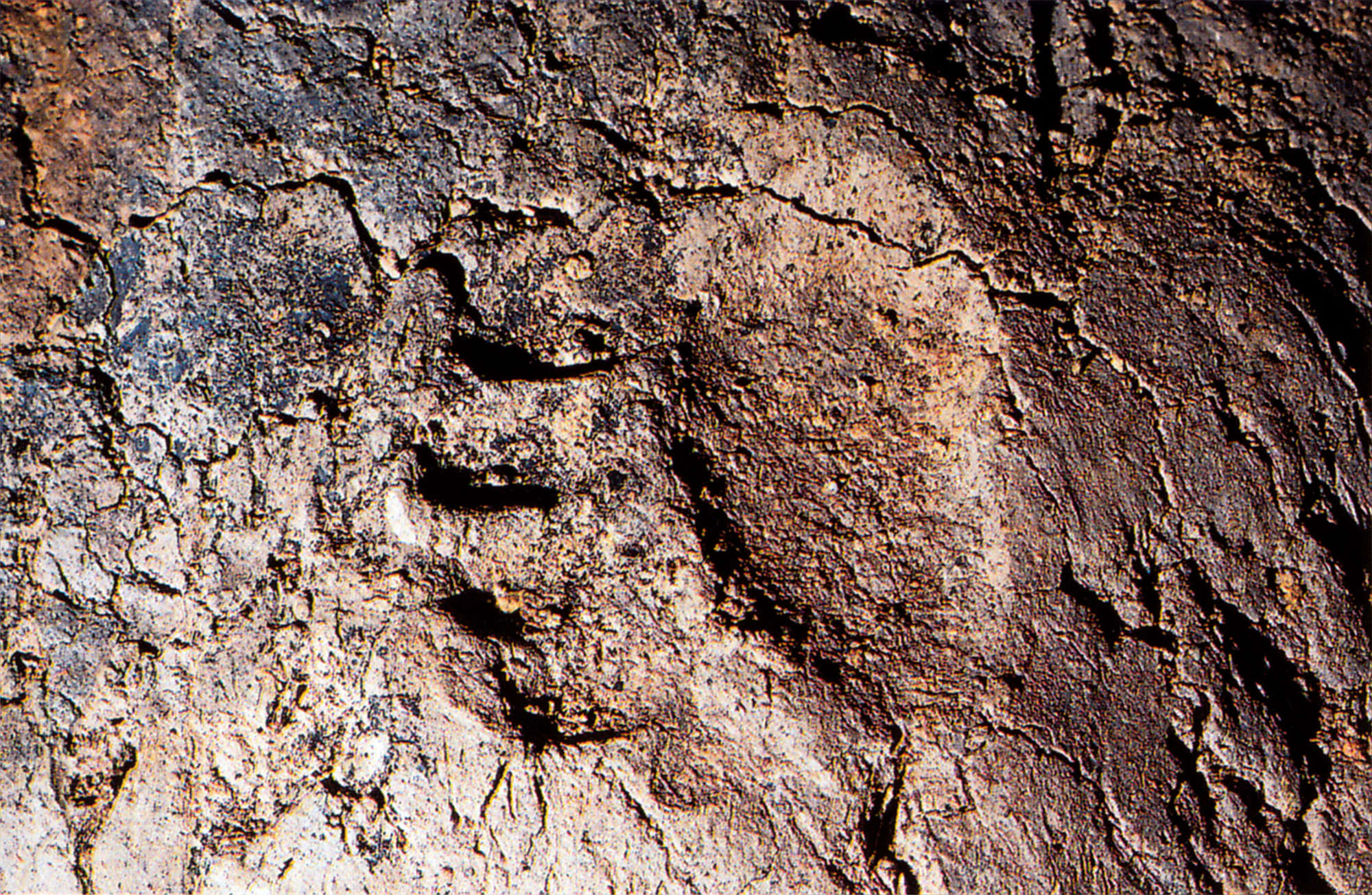
Cave bear paw print on the floor of the cave.
Photo: Chauvet, Deschamps et Hillaire (1996)
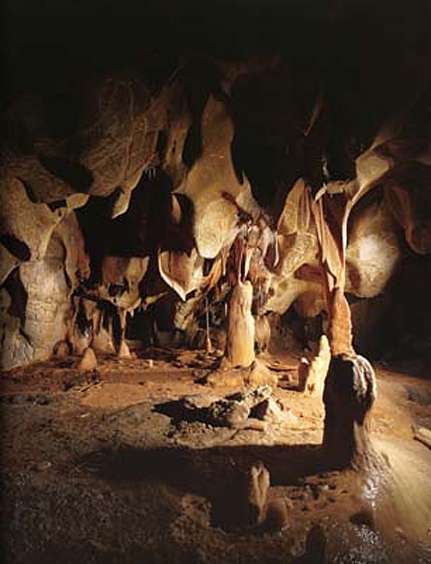
The left wall of the Hillaire Chamber, just before the large collapse, has many rock pendants covered with engravings.
Photo: http://www.ancient-wisdom.co.uk/francechauvet.htm
Text: Adapted from Clottes (2003)
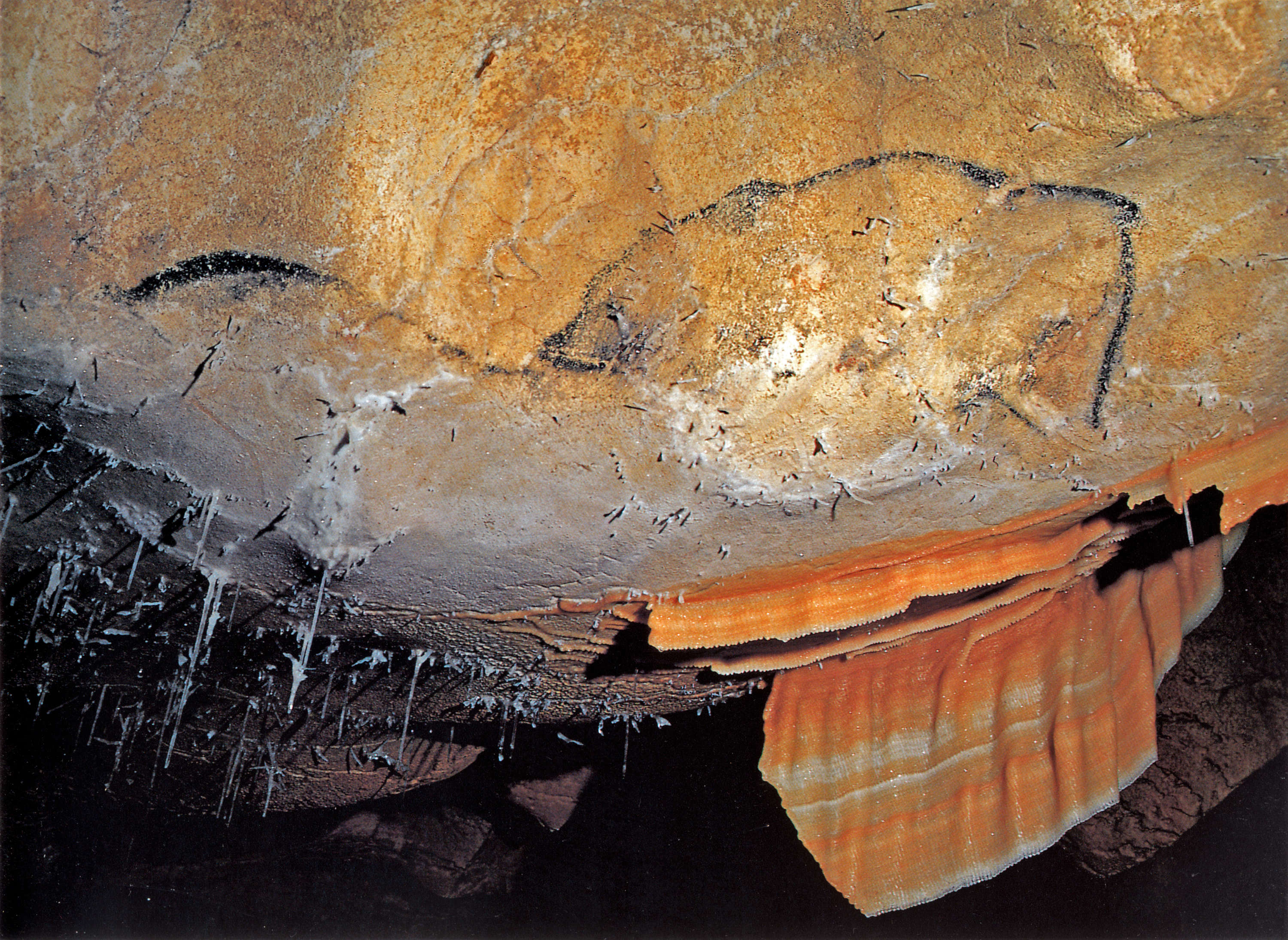
This beautiful calcite curtain has a bear facing left above it, which appears to be following another animal, of which only the dorsal line is visible.
Photo and text: Chauvet, Deschamps et Hillaire (1996)
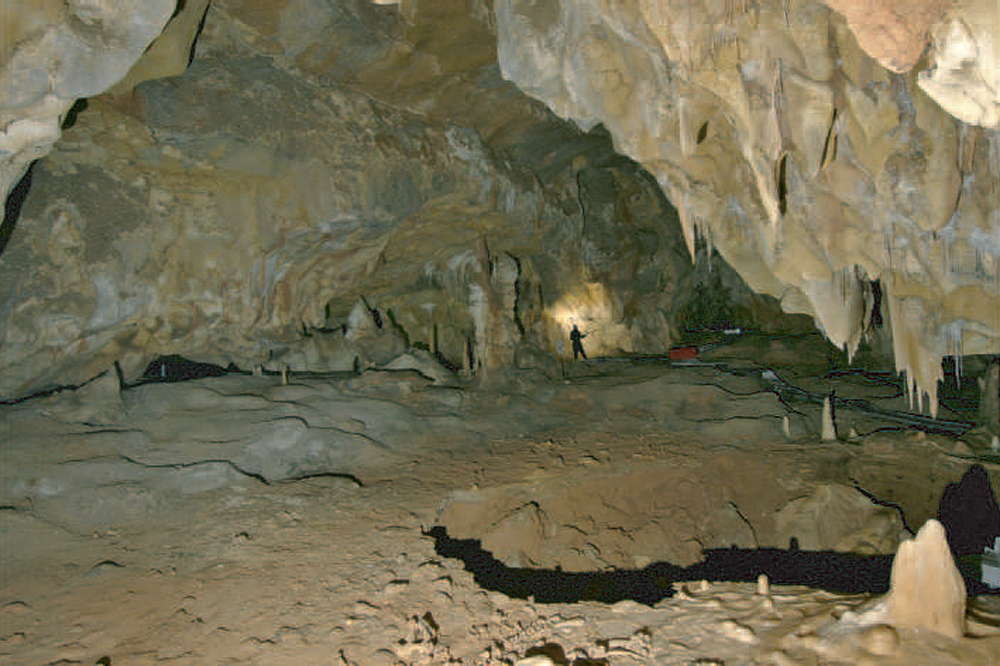
About twenty metres from the Candle Gallery, we arrive at the edge of a large natural well which occupies the centre of the Hillaire Chamber. This vast space contains major concentrations of rock art.
The hanging rocks and the walls around the great collapse contain at least a hundred figures. The exact number is difficult to know precisely, because access is restricted to preserve the clay soils which contain many prints of wolves and cave bears.
Photo: Fritz et Tosello (2007)
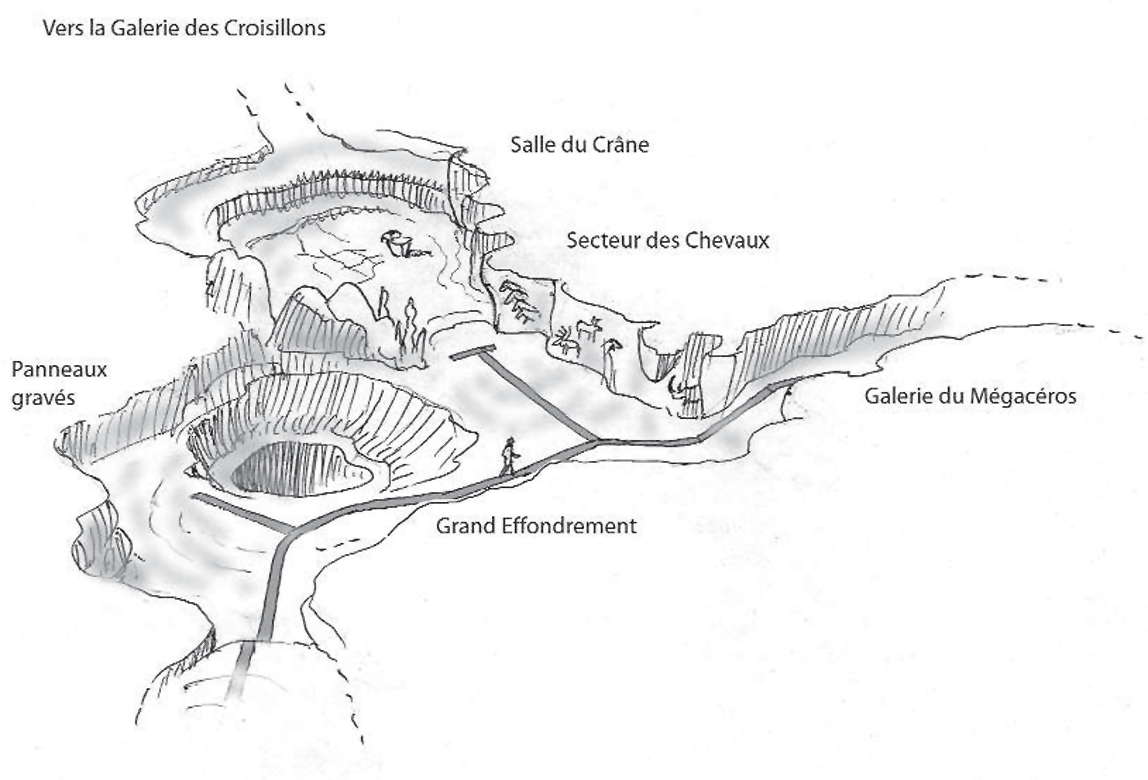
Sketch of the Hillaire Chamber, showing the positions of the main decorated panels.
Photo: © Fritz et Tosello (2007)

Engraving of an aurochs in right profile in the Hillaire Chamber.
Photo and text: Fritz et Tosello (2007)
The Hillaire Chamber - Panel of Horses - Salle Hillaire - Panneau des Chevaux
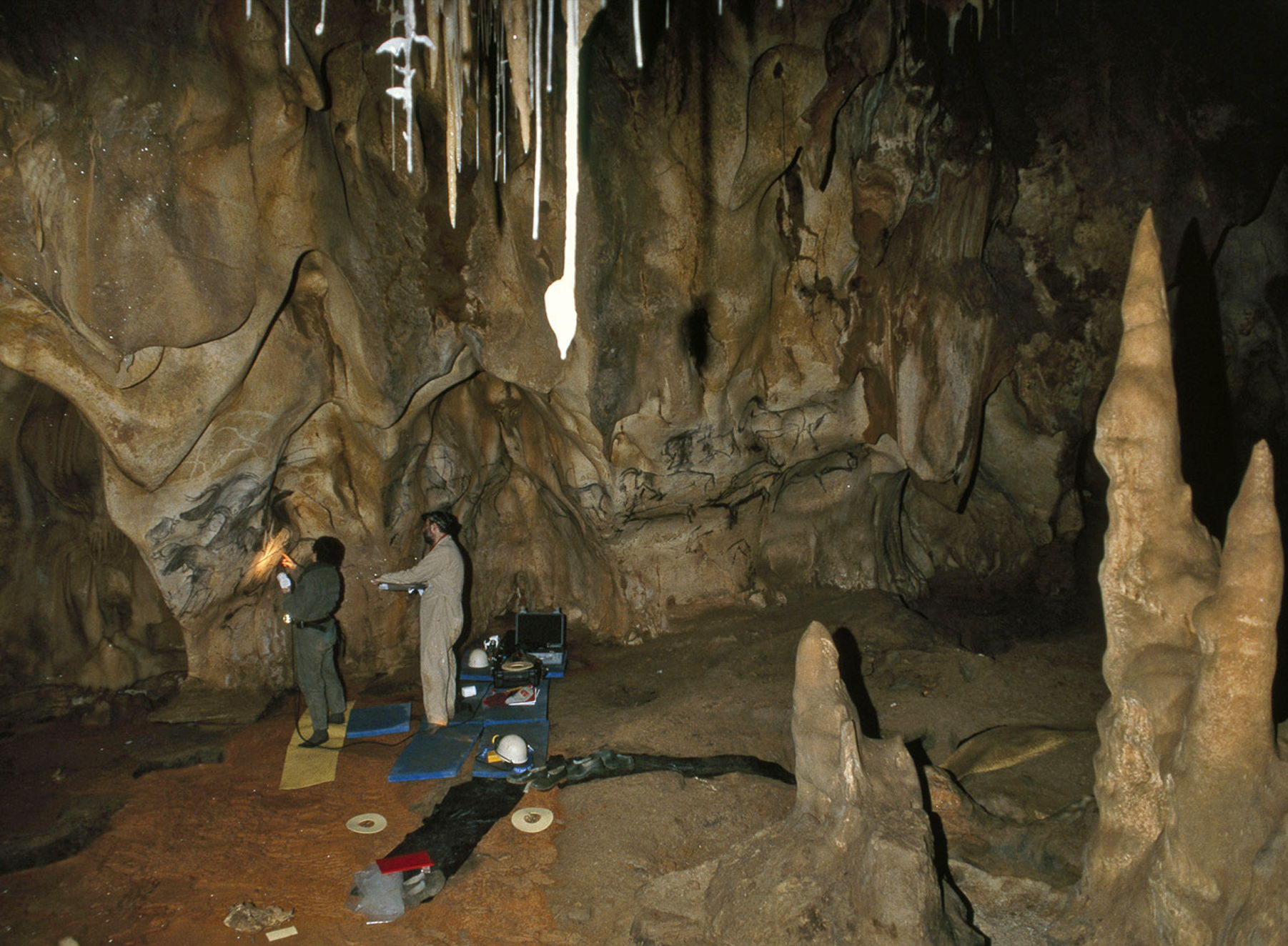
The large, complex Sector of Horses in the Hillaire Chamber receives attention from researchers.
The Sector of Horses consists of the Panel of Horses (with aurochs and horses) on the left, the Alcove of Lions in the middle, and the Reindeer Panel on the right.
Careful preservation makes analysis possible. Cool and damp, Chauvet Cave's steady interior climate - 56 degrees Fahrenheit (13.3 degrees Celsius), with 99 percent humidity year-round - contributes to the cave's remarkable state of preservation.
Alloy walkways have now been placed so that the Panel of horses and the Alcove of Lions can be closely studied without danger of damaging the cave floor.
The arch on the left is the entrance to the Skull Chamber.
Photo: Jean-Michel Geneste © National Geographic, August 2007
Text: © National Geographic, August 2007
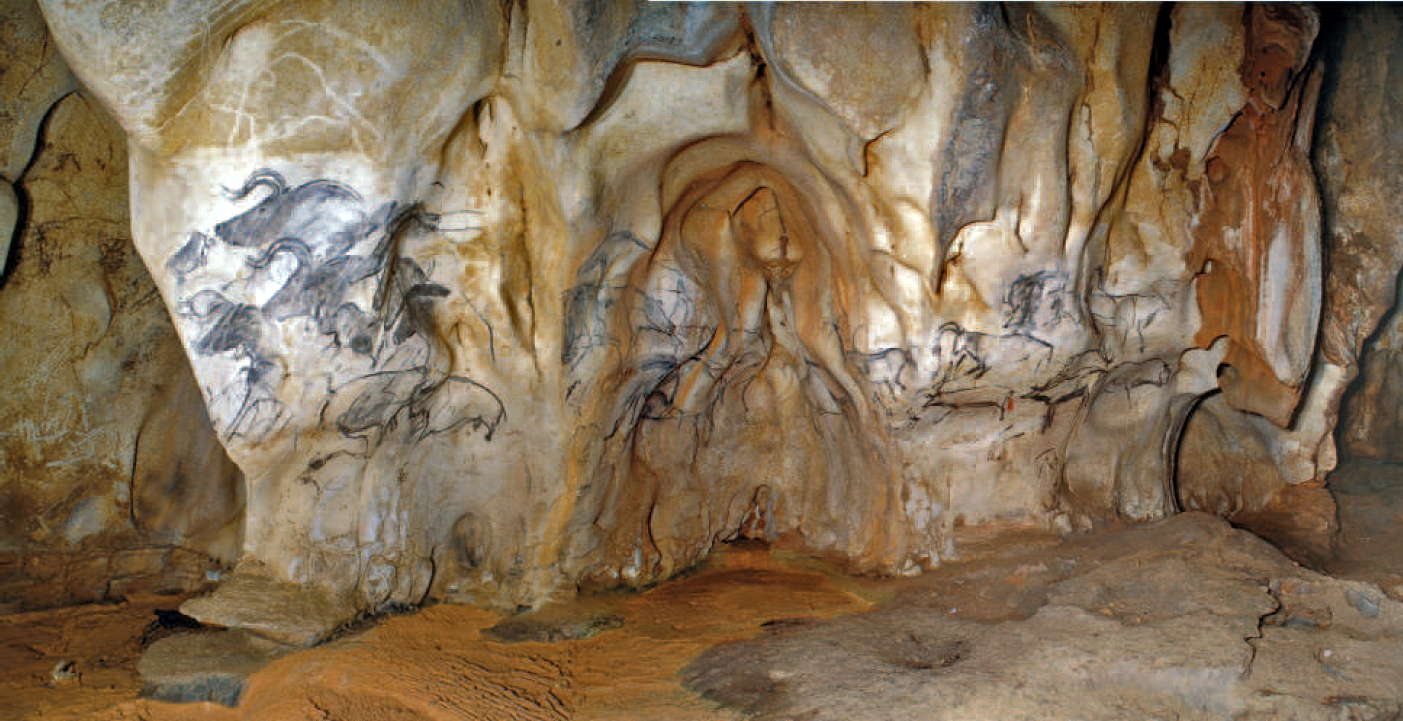
View of the entire Sector of Horses.
Note that in this image the area beneath the images is relatively dry. At some times, depending on rainfall in the area, the floor is at this point is very wet, with the Skull Chamber (of which the panel containing the Aurochs, on the left of this image, forms the right hand doorway arch) floor being awash.
Photo: Fritz et Tosello (2007)
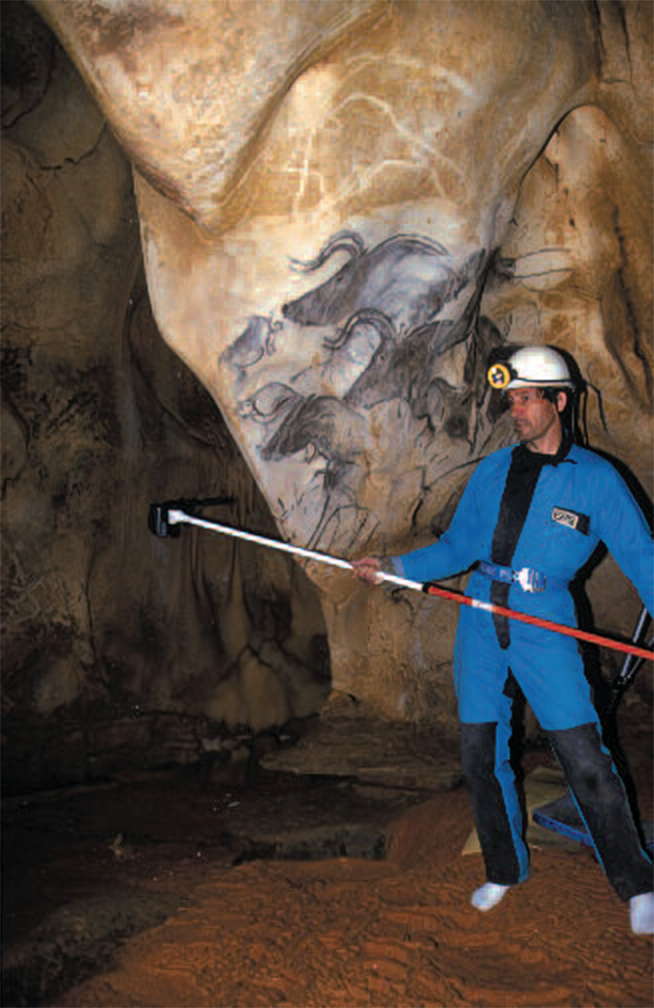
Y. Le Guillou and his system of a camera on the end of a pole, used to obtain high quality images of artworks in the cave which are otherwise inaccessible. The method works extremely well.
The invention was made necessary because of the commitment by the scientists studying the cave to cause as little damage as possible to the floor of the cave, which contains vast amounts of important data which would be lost by indiscriminate trampling by researchers. Most of the cave is now served by alloy walkways and stairs with associated handrails as necessary, which keep damage to an absolute minimum.
Photo: Équipe Chauvet
Source: Le Guillou (2008)
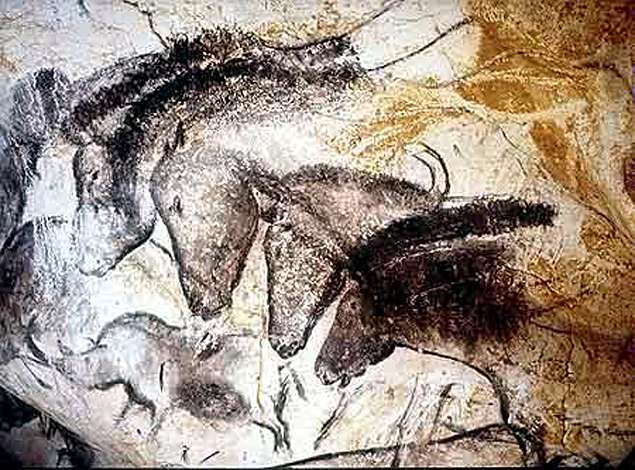
This superb "Panel of Horses" shows the use of perspective with several different animals on the same plane
John Robinson, a British sculptor and coordinator of the Bradshaw Foundation, said about the panel of horses that "The panel is without doubt one of the great masterpieces of Homo sapiens Art, besides being the oldest.
I studied the lines of black edges, and the use of smudging to produce shadow. Then I saw that the artist had highlighted the outer edge of the drawing by chiseling into the white rock surface."
The horses are believed to be all the work of one artist.
Photo: http://www.pma.edmonton.ab.ca/events/timetrav/iii/cave.htm
Text: Adapted from http://www.experienceardeche.com/page/the-chauvet-cave/56

Replica of the main Panel of Horses
Photo: © Thomas T.
Permission: Creative Commons Attribution-Share Alike 2.0 Generic license
Source: Brno museum Anthropos.
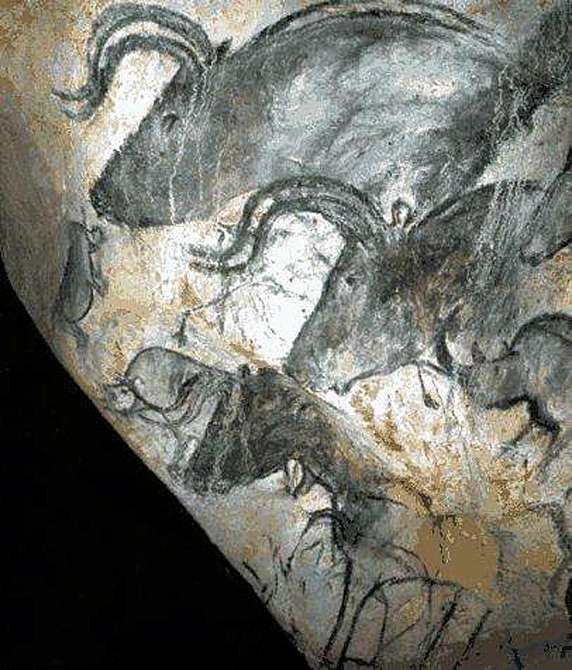
The aurochs Bos primigenius, the ancestor of domestic cattle, was a type of huge wild cattle which inhabited Europe, Asia and North Africa, but is now extinct; it survived in Europe until 1627.
The aurochs were far larger than most modern domestic cattle with a shoulder height of 2 metres (6.6 ft) and weight of 1 000 kilograms (2 200 lb). The aurochs was regarded as a challenging hunting quarry animal, contributing to its extinction. The last recorded aurochs, a female, died in 1627 in the Jaktorów Forest, Poland, and her skull is now the property of the Livrustkammaren ("Royal Armory") museum in Stockholm, Sweden.
The extinct aurochs is a completely separate species from the still-extant wisent or European bison.
Photo:http://ez2www.com/
Text: Adapted from Wikipedia
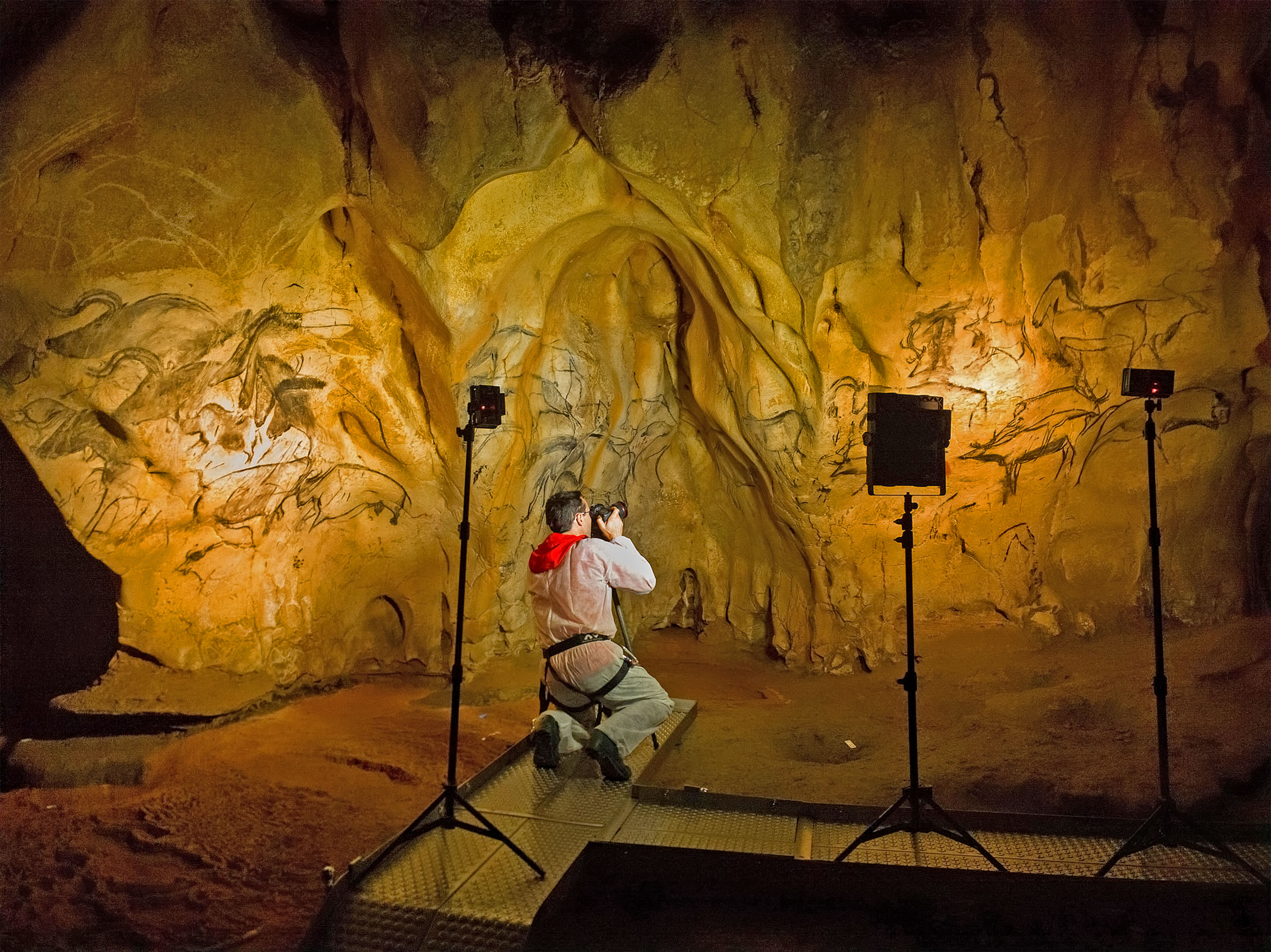
This is the setup for one photographic session. Note the steel walkways which have been put in to minimise any damage to the floor of the cave, and the over-all garment that the photographer is wearing which helps to minimise the pollution of the cave by errant fibres from the photographer's clothing.
Chauvet is by far the best conserved art cave in the world. The photographer, Stephen Alvarez, was only allowed to be inside the cave for a maximum of six hours.
Photo: Stephen Alvarez © National Geographic
Source: http://proof.nationalgeographic.com/2015/01/05/shooting-chauvet-photographing-the-worlds-oldest-cave-art/
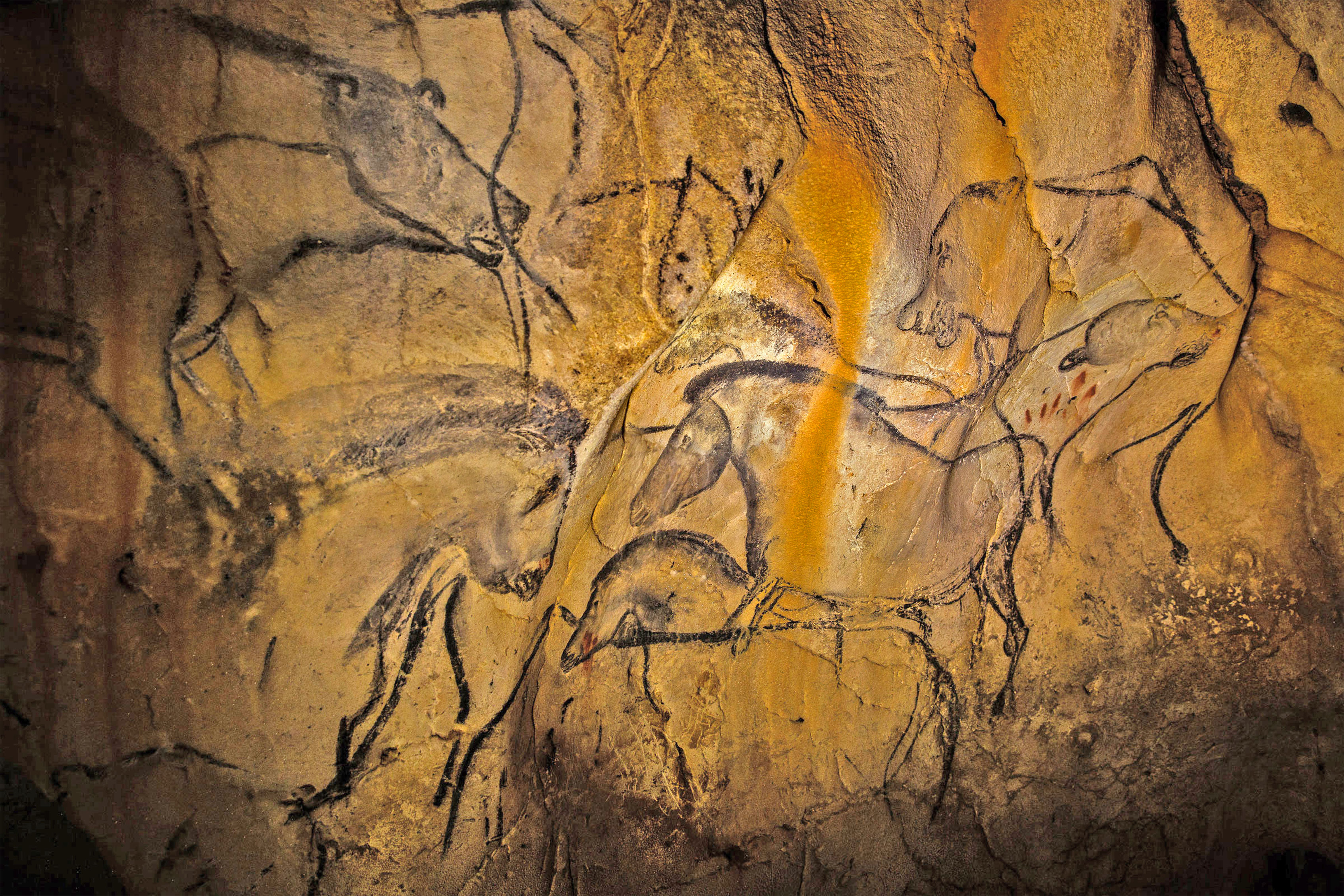
This panel depicts horses, a bear, and cave lions. Note the iron staining on the wall, postdating the creation of the artwork.
Photo: Stephen Alvarez © National Geographic
Source: http://proof.nationalgeographic.com/2015/01/05/shooting-chauvet-photographing-the-worlds-oldest-cave-art/
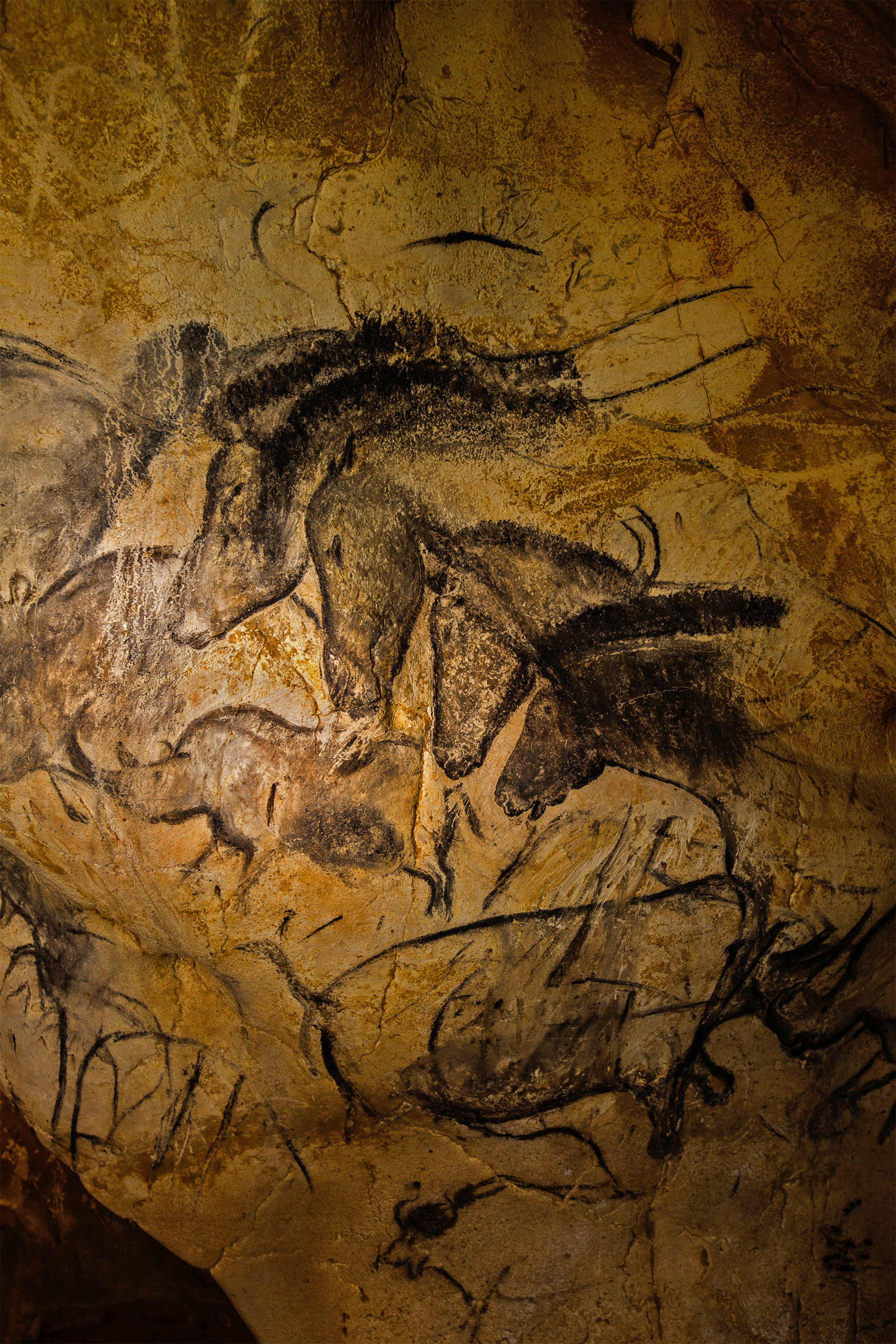
This panel depicts rhinoceros and horses.
Photo: Stephen Alvarez © National Geographic
Source: http://proof.nationalgeographic.com/2015/01/05/shooting-chauvet-photographing-the-worlds-oldest-cave-art/
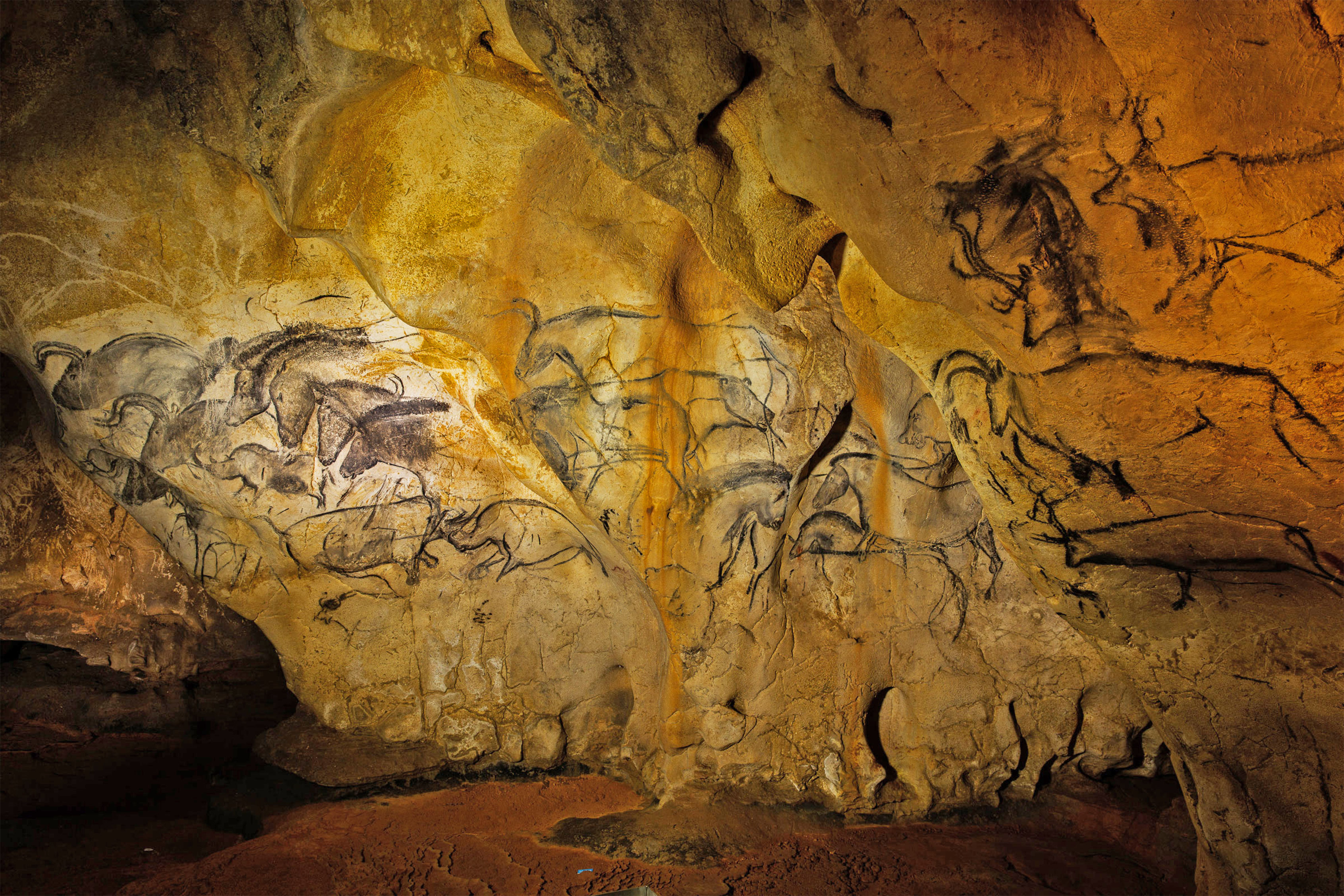
This panel depicts aurochs, rhinoceros, bears, and horses.
Photo: Stephen Alvarez © National Geographic
Source: http://proof.nationalgeographic.com/2015/01/05/shooting-chauvet-photographing-the-worlds-oldest-cave-art/
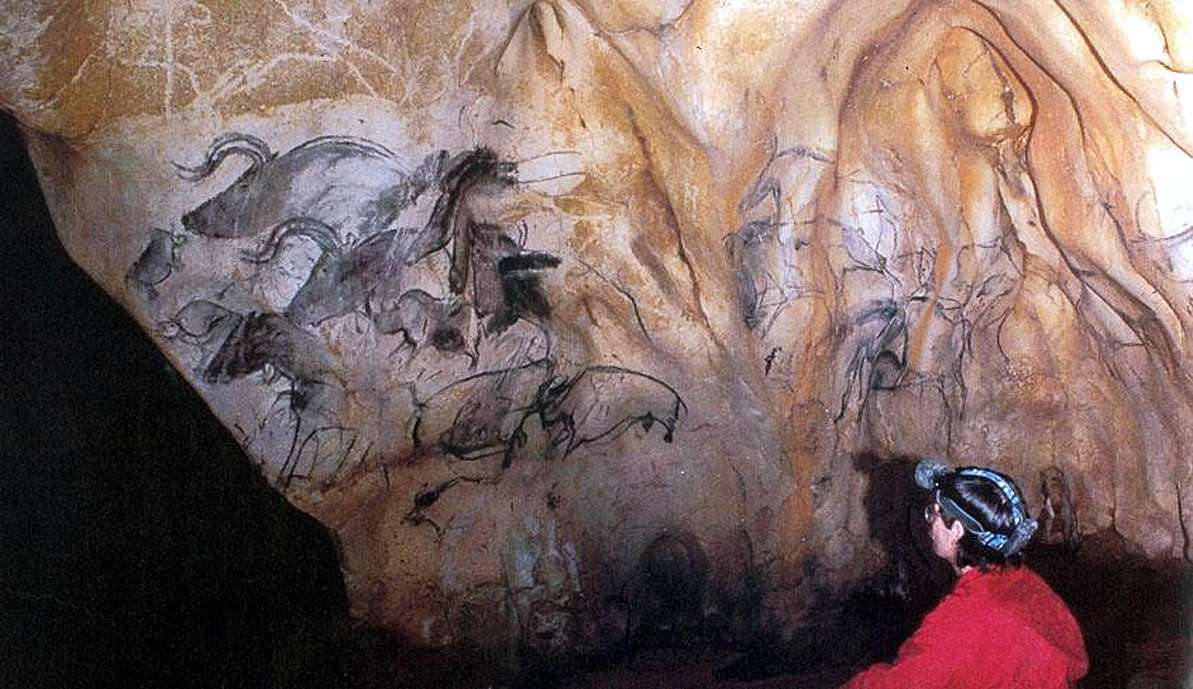
This image shows the Aurochs paintings above in their context on the wall, next to the exquisite "Panel of horses", which in this view is foreshortened because of the shape of the wall.
Photo: Time Magazine 13th Feb 1995
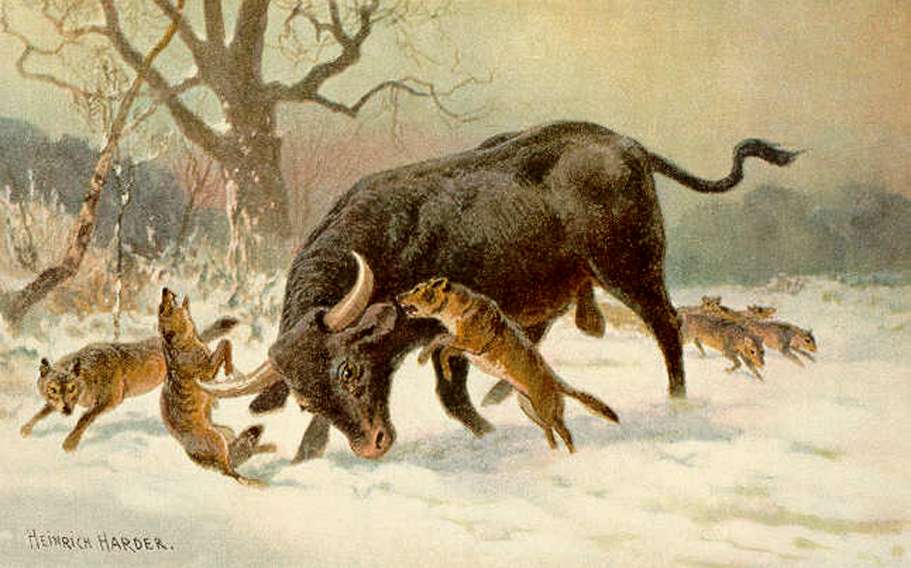
Painting of an aurochs attacked by wolves.
Date: ~1920
Painter: Heinrich Harder (1858-1935)
Source: Wikimedia
Permission:This image is in the public domain because its copyright has expired.
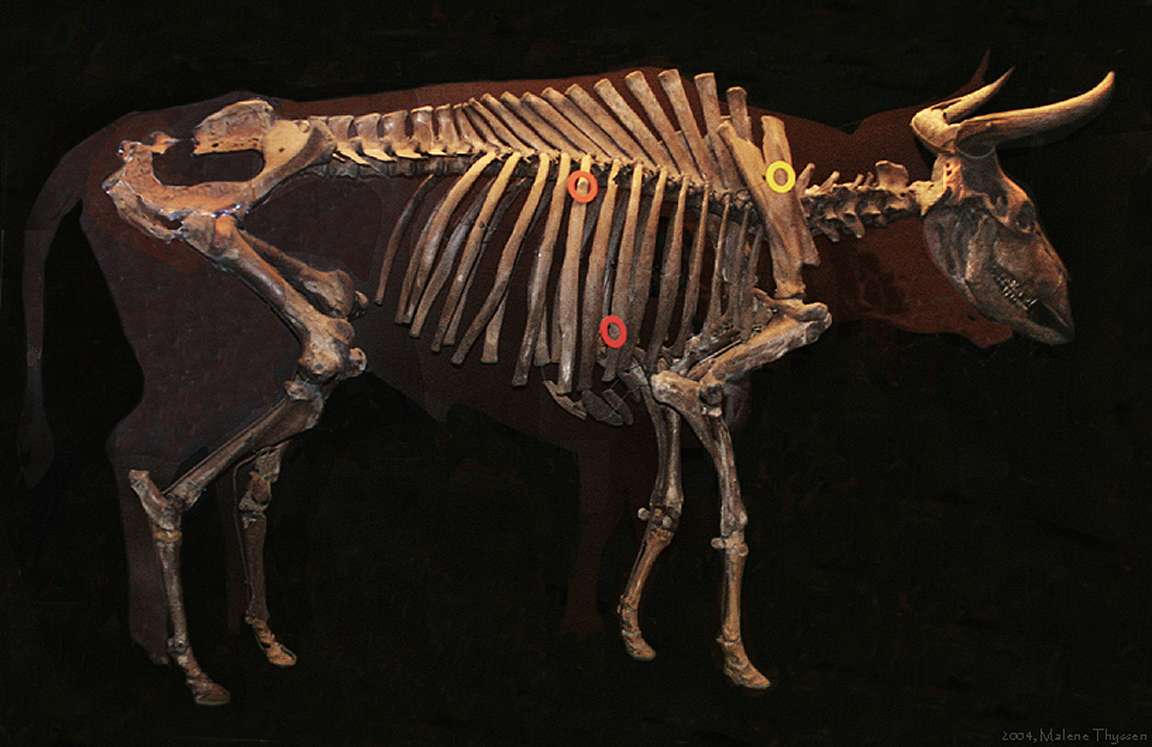
This aurochs is from around 9 500 BP and is one of two very well preserved aurochs skeletons found in Denmark. The Vig-aurochs can be seen at The National Museum of Denmark.
The circles indicate where the animal was wounded by arrows.
Credit: Malene Thyssen, http://commons.wikimedia.org/wiki/User:Malene
Permission: GNU Free Documentation License, Version 1.2
Source: Wikimedia
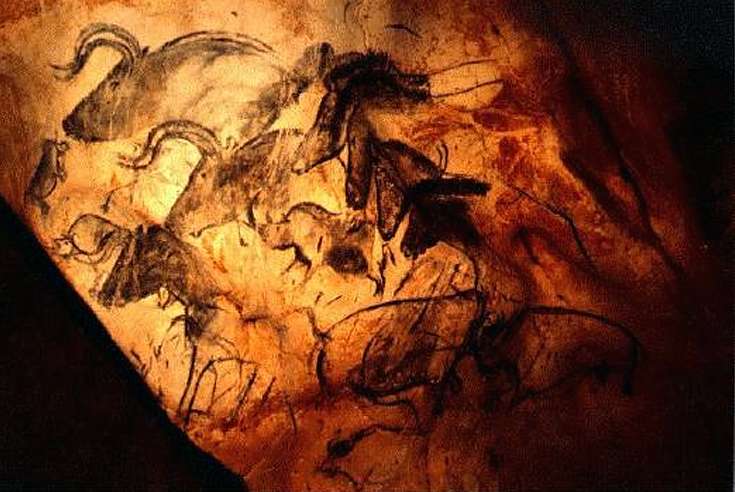
On the 30-foot-long 'panel of the horses,' (now generally called the 'Sector of Horses', divided into the Panel of the Horses, the Alcove of the Lions, and the Reindeer Panel - Don ) the charcoal marks of torches being knocked against the wall were made after the paintings, says Conkey: the marks are superimposed on the mineral sheen that covers the figures. If painting was the first step in a spiritual quest, perhaps, then paying homage to the works was the second.
Charcoal dropped from the torches has been dated at 28 000 years BP.
Photo and text: National Geographic, August 2001
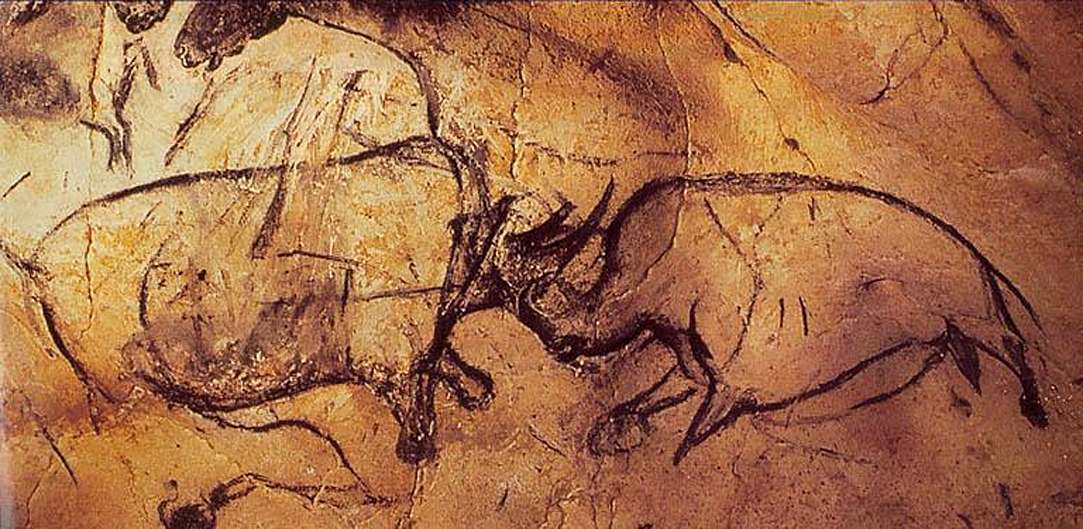
'Fighting' Rhinos
Charcoal taken from the two 'fighting' rhinos produced radiocarbon dates of around 31 000 - 32 000 BP
Jerry Haigh, a wildlife veterinarian from Kenya, with experience in treating the African White Rhinoceros,
(http://jerryhaigh.blogspot.com.au/2012/01/link-httpwww.html)
suggests that it may be a male and female in sexual foreplay. The whole process can last up to an hour before any kind of mounting.
He has seen this a number of times, and sometimes the female is badly wounded by the sexual foreplay.
Photo: Time Magazine 13th Feb 1995
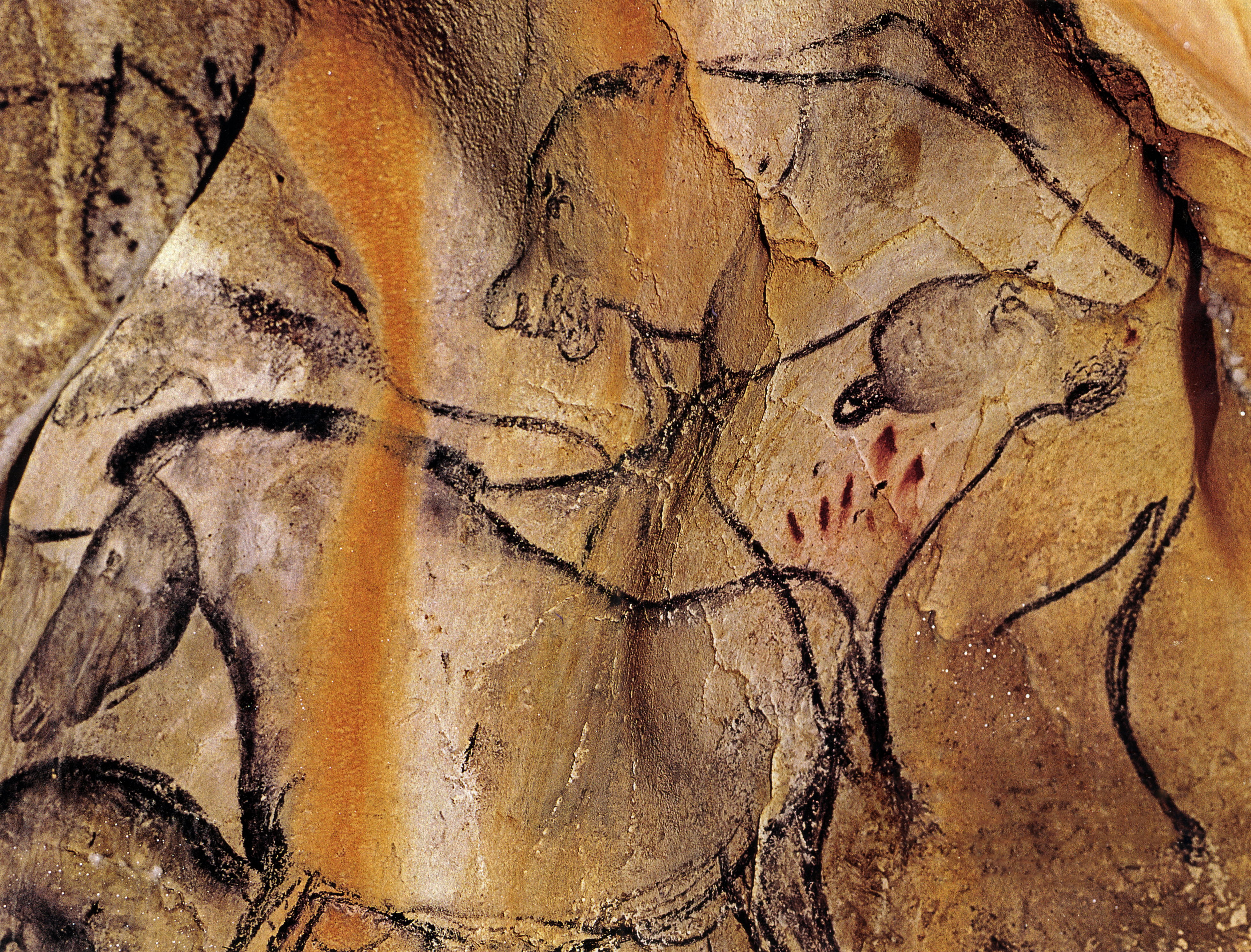
The lions in this image are the ones which give the Alcove of Lions its name.
A cave lion - an extinct maneless species - seems to sniff the hindquarters of a crouched and snarling companion. The two may represent a mating pair.
Seventy-two felines appear on Chauvet's walls, along with portraits of more than a dozen other species - 420 animal figures in all - that shared the Palaeolithic landscape with Homo sapiens.
Photo and text: Jean Clottes © National Geographic, August 2001

This is the head of the large (male?) lion located at the furthest point of this narrow space.
The relevé (bottom) highlights the very light stump work, done with the artist’s fingers. This stump work is barely visible on a photograph of the lion (top). (CF-GT).
Photo: Fritz et Tosello (2007b)
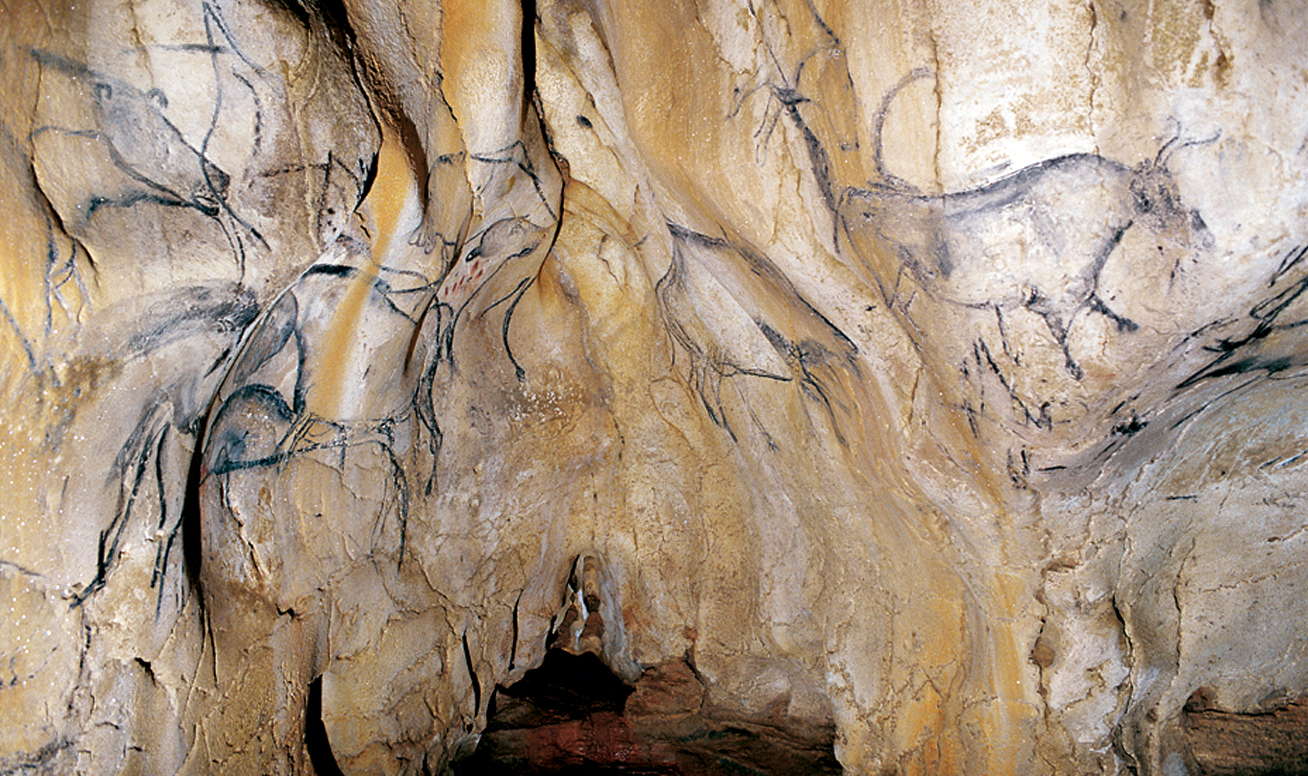
Alcove of the Lions, in the middle of the three sections into which the Sector of Horses may be divided, consisting of the Horse Panel, the Alcove of the lions, and the Reindeer Panel.
(Note the water on the floor beneath the alcove - Don )
Photo: http://uk.phaidon.com/agenda/art/picture-galleries/2011/march/10/inside-the-cave-of-forgotten-dreams/
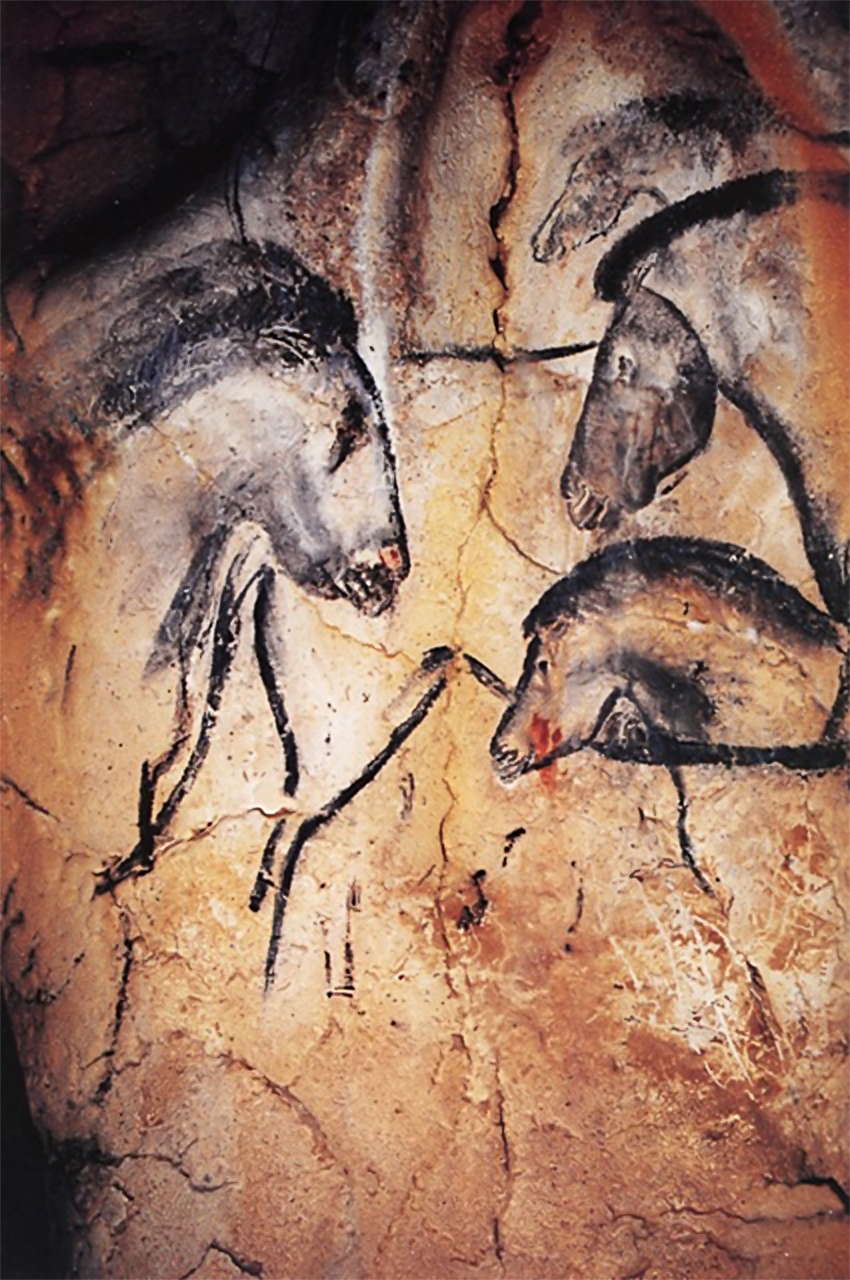
This panel is part of the Alcove of the Lions, with horses painted facing each other, overlying an earlier outline of a horse.
Photo: http://www.istmira.com/foto-i-video-pervobytnoe-obschestvo/3924-iskusstvo-predystorii-pervobytnost-2.html
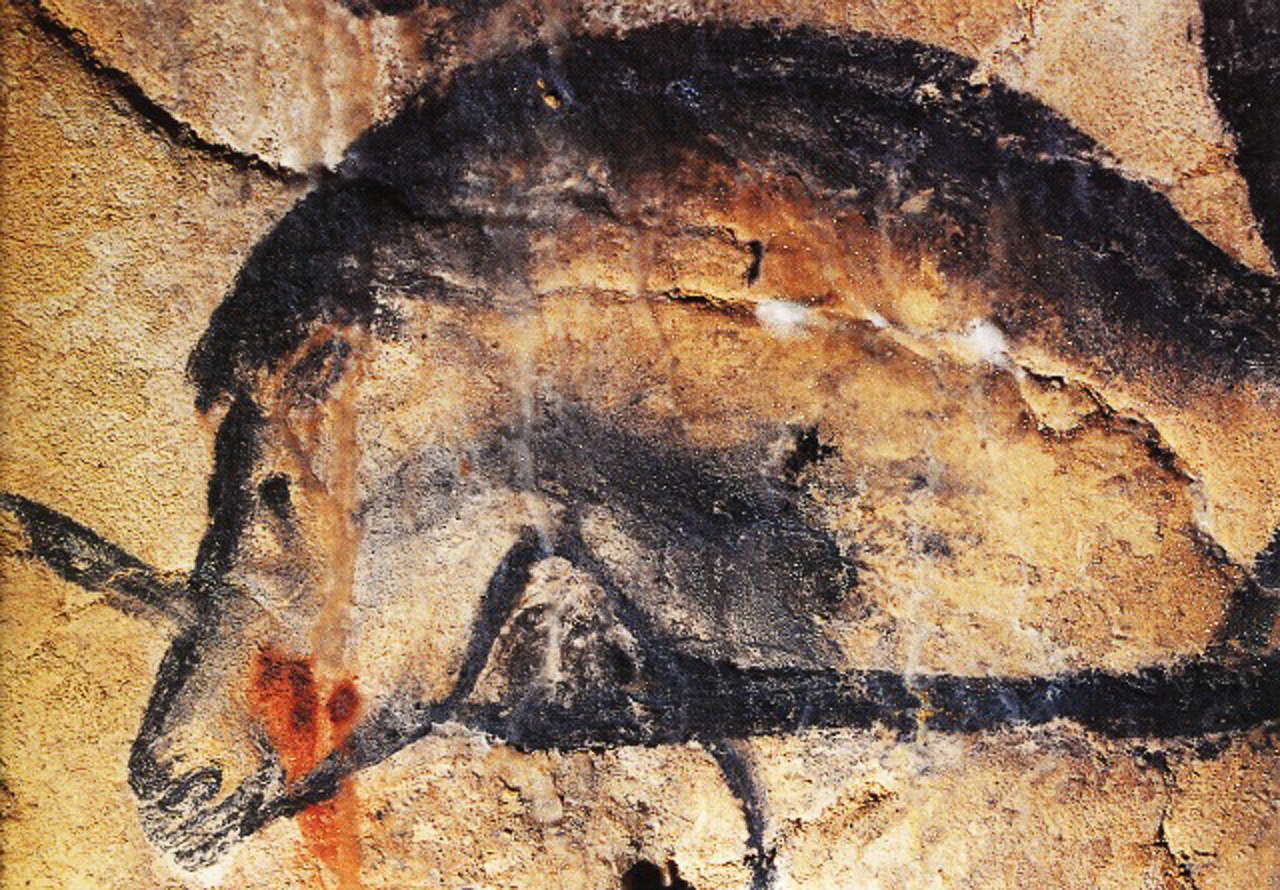
Close up of one of the horses from the Alcove of the Lions, with a red stain on the jaw, made up of four dots in red ochre.
Photo: http://www.istmira.com/foto-i-video-pervobytnoe-obschestvo/3924-iskusstvo-predystorii-pervobytnost-2.html
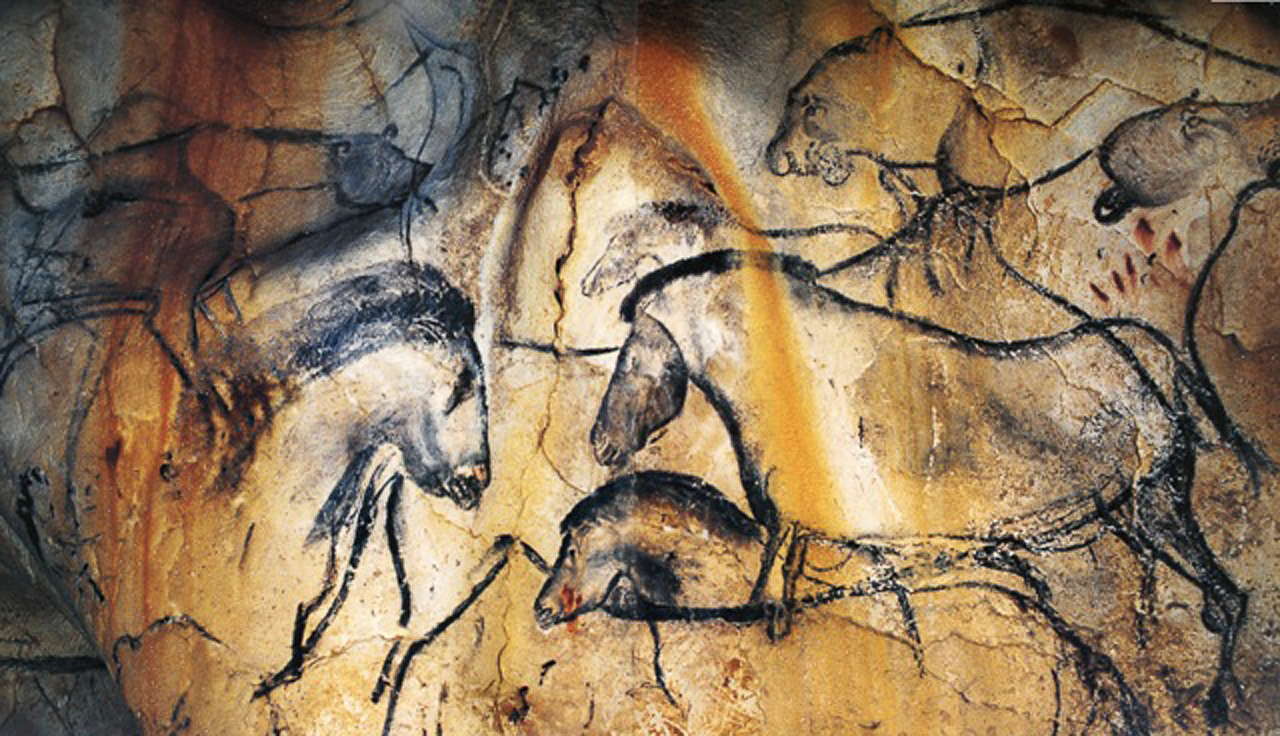
One of the most important panels at Chauvet. Horses in the Alcove of the Lions, Sector of Horses
31 000 years old art, probably Aurignacien.
Photo: http://www.istmira.com/foto-i-video-pervobytnoe-obschestvo/3924-iskusstvo-predystorii-pervobytnost-2.html
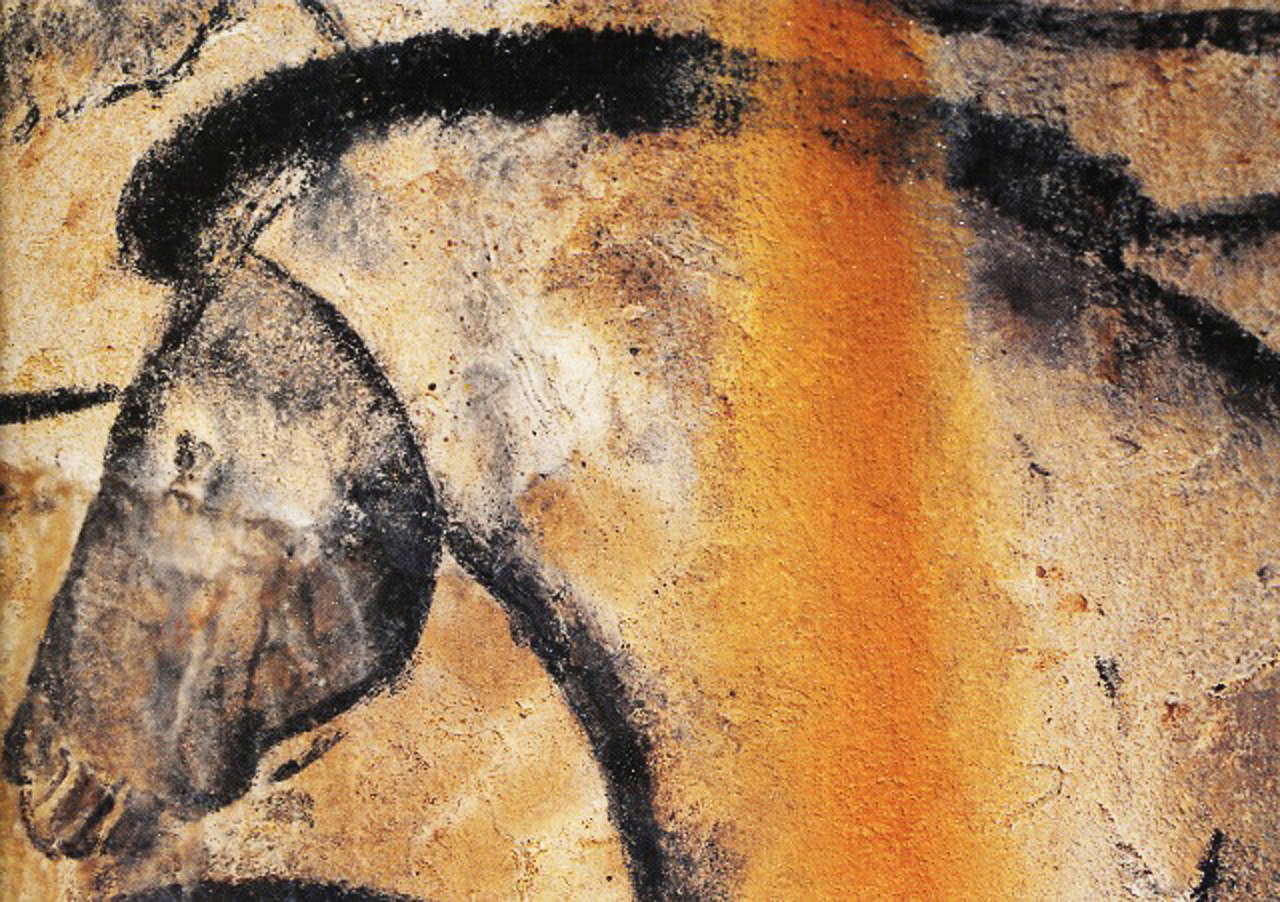
A close up of one of the horses in the above panel, with a red stain from leakage of iron oxide from the wall.
Photo: http://www.istmira.com/foto-i-video-pervobytnoe-obschestvo/3924-iskusstvo-predystorii-pervobytnost-2.html
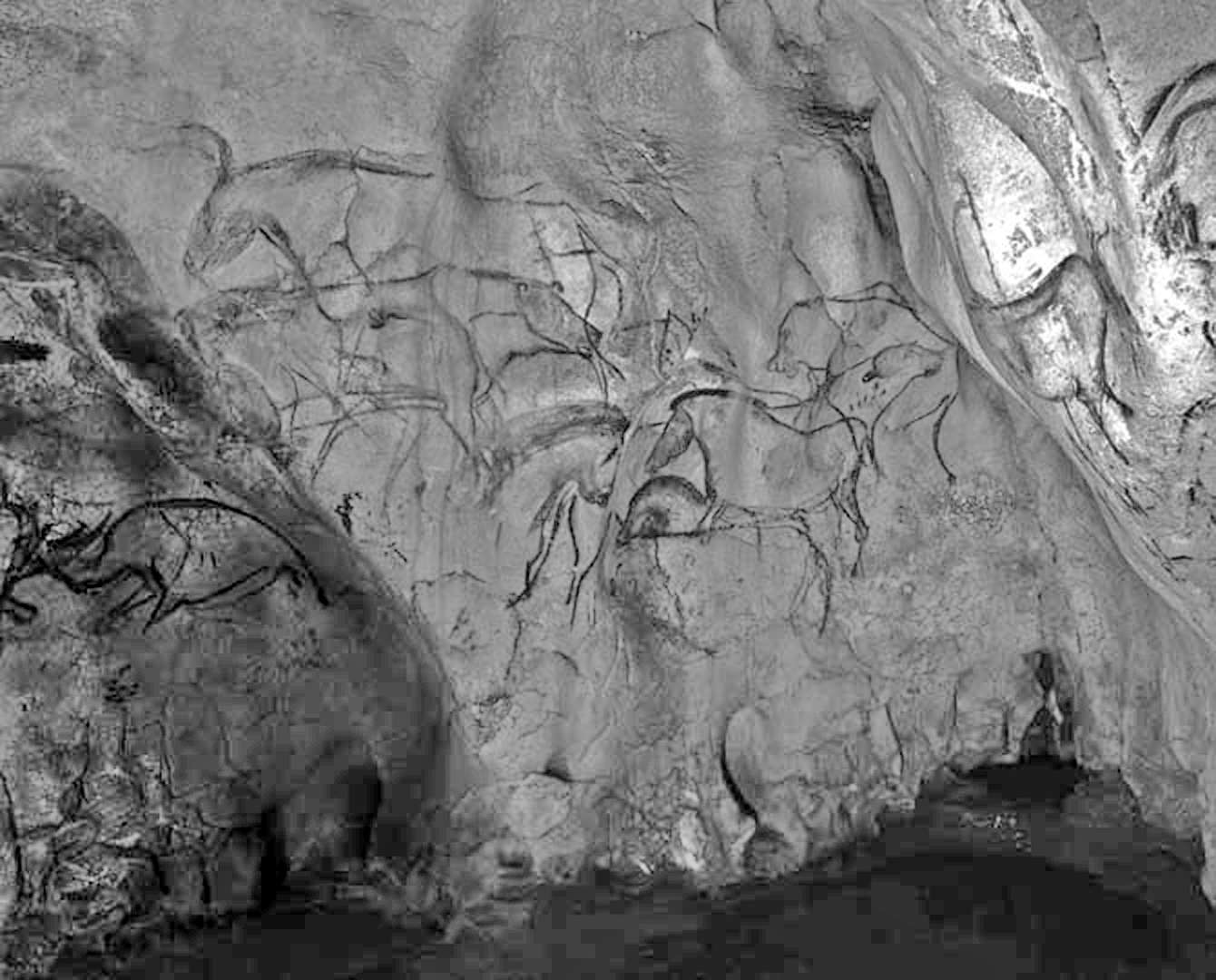
Alcove of the Lions. Overall picture of the panel of the left wall (length approximately 250 cm) (CF-GT).
Well defined in a recess of the wall, the left panel of the 'Alcove of the Lions' extends 250 cm along the wall and 200 cm high with 13 animals drawn in black, enhanced with engravings and stump work (smudging or blending marks made with charcoal). The panel is easily divided into two subsets, one dominated by an aurochs and the other by two lions that are facing each other.
Photo: Fritz et Tosello (2007b)
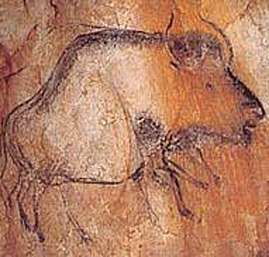
Running Bison located at the Sector of the Horses in the Hillaire Chamber, on the right wall of the Alcove of the Lions.
The artist has shown movement by drawing extra legs.
Photo: Time Magazine 13th Feb 1995
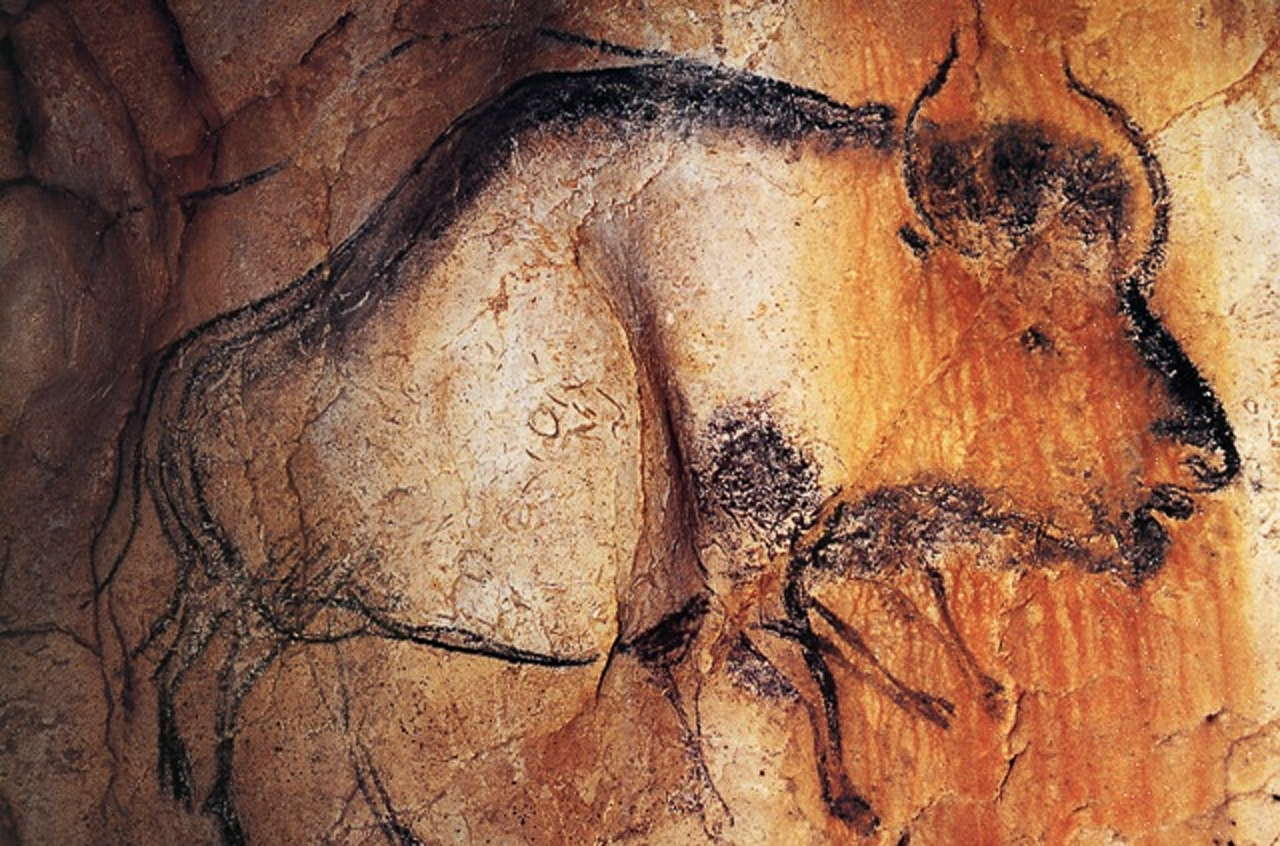
Another version of the Running Bison.
Photo: http://www.istmira.com/foto-i-video-pervobytnoe-obschestvo/3924-iskusstvo-predystorii-pervobytnost-2.html
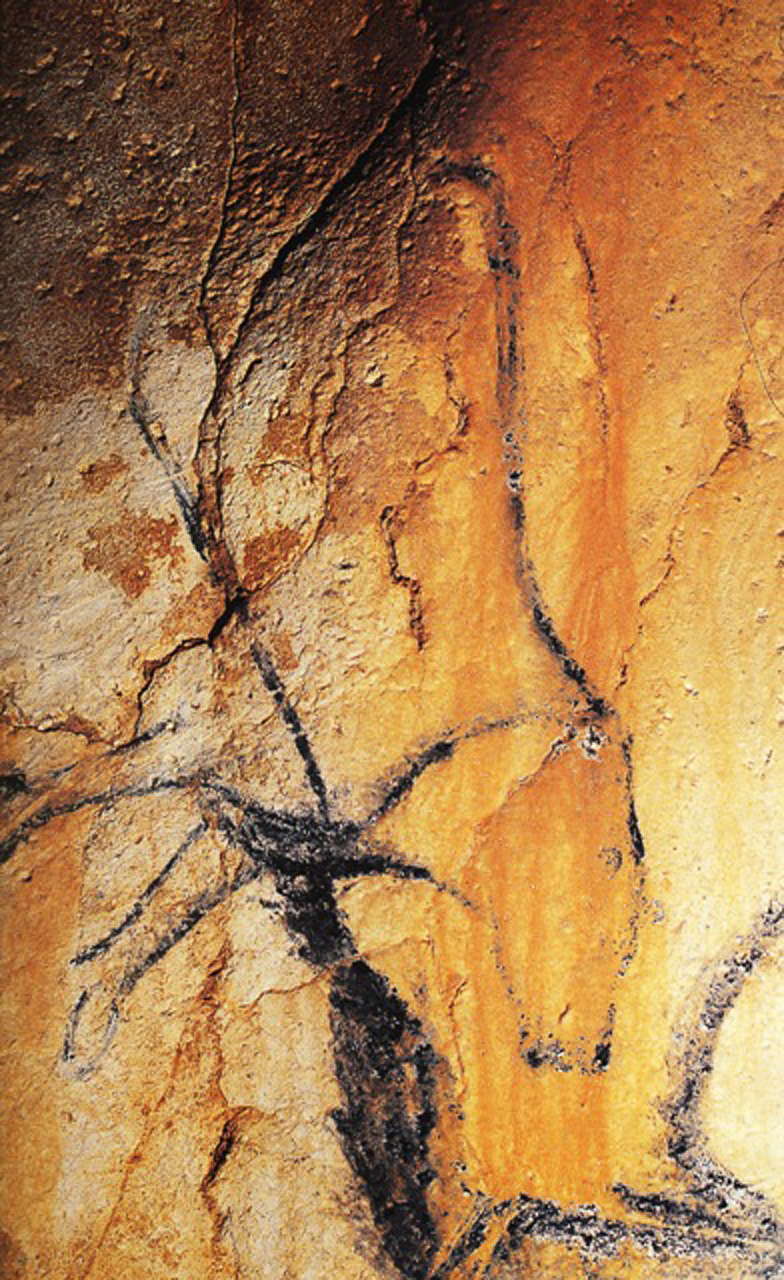
A bear portrayed vertically, either to fill the available space, or to depict it falling, or for some other reason.
It is positioned just above the rump of the aurochs on the right wall of the Alcove of the Lions shown below.
Photo: http://www.istmira.com/foto-i-video-pervobytnoe-obschestvo/3924-iskusstvo-predystorii-pervobytnost-2.html
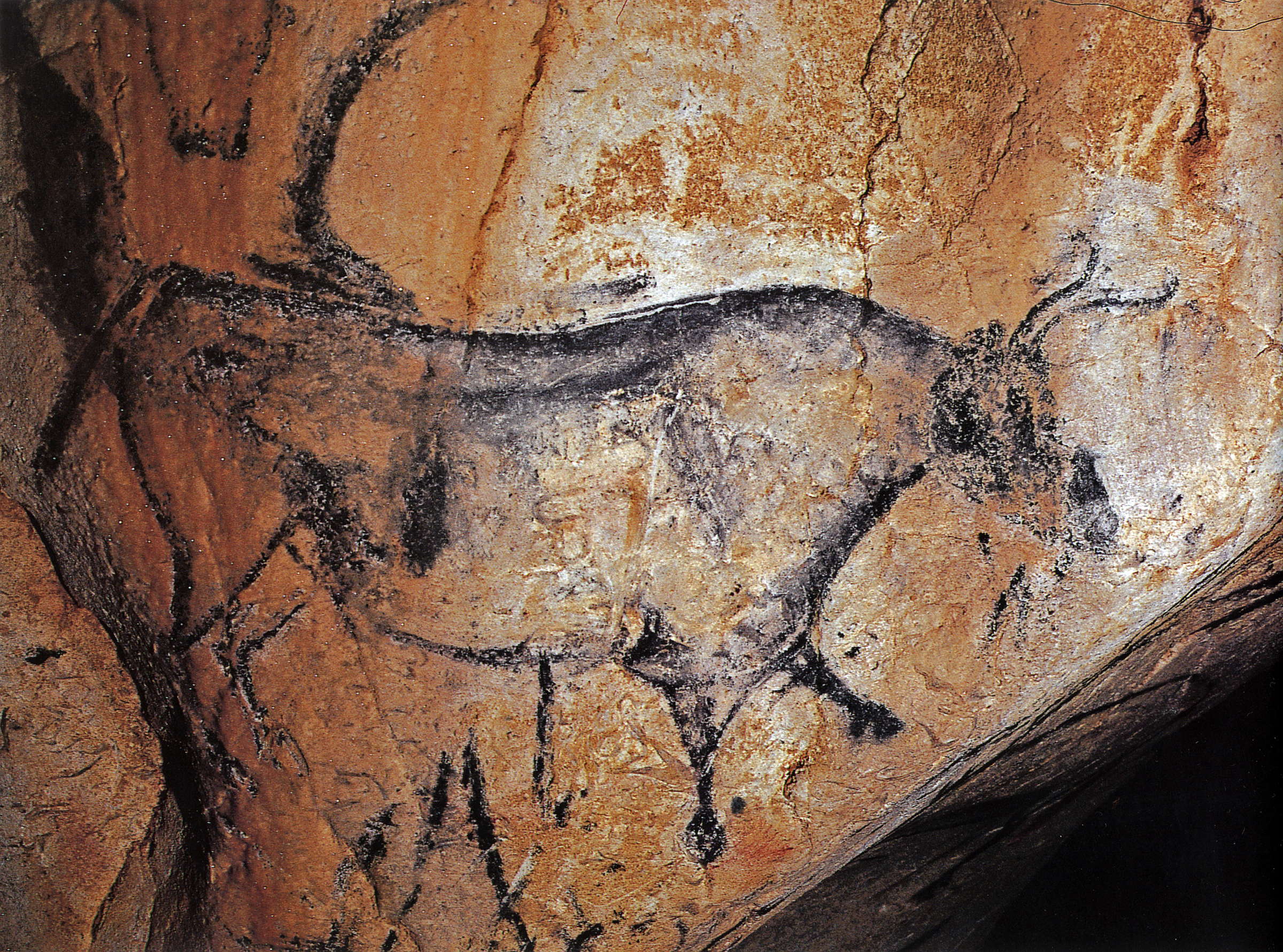
Aurochs on the right wall of the Alcove of the Lions, 67 cm long. This image would not be out of place at Lascaux.
Photo: Chauvet, Deschamps et Hillaire (1996)
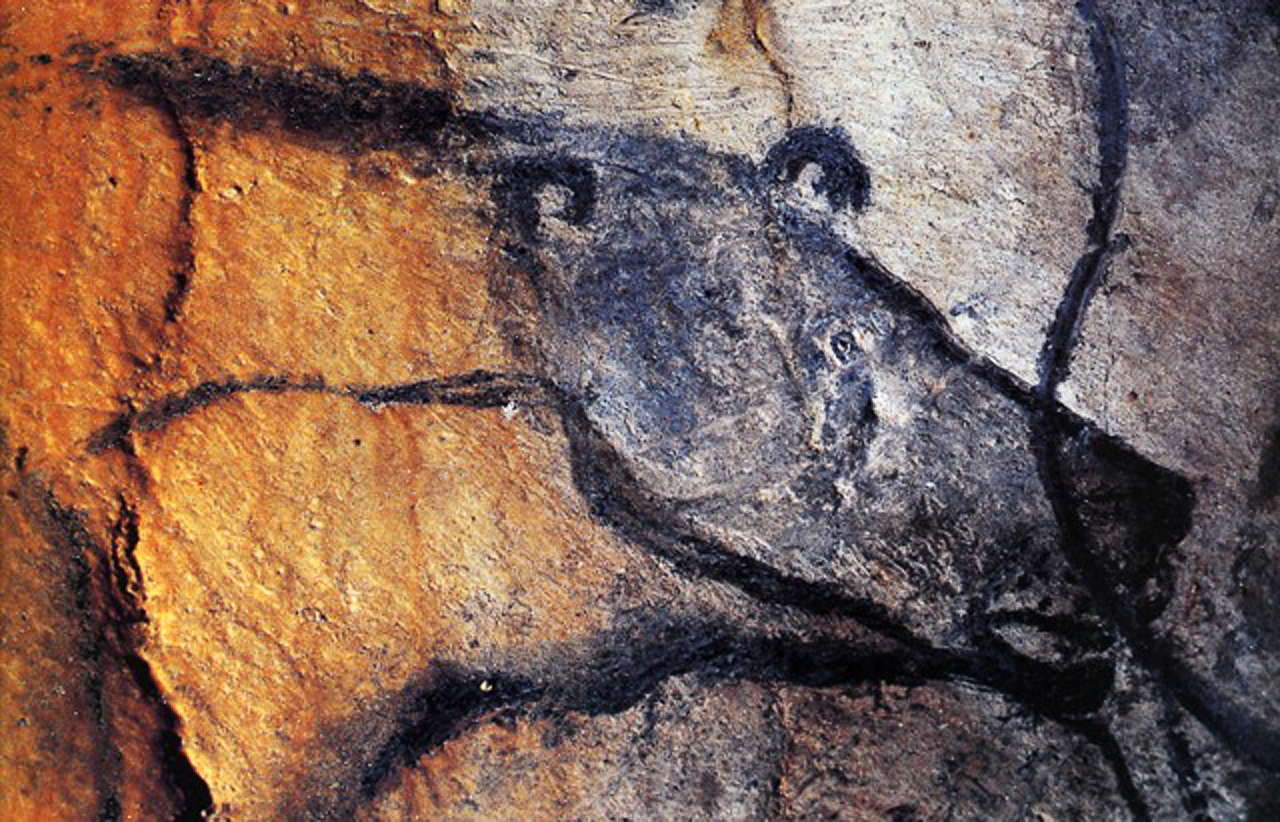
Detail of a cave bear head, on the left wall of the Alcove of the Lions.
Note the way the fluffy small ears are curled over towards the front of the head.
It seems obvious that the artist had seen cave bears up close and personal.
Photo: http://www.istmira.com/foto-i-video-pervobytnoe-obschestvo/3924-iskusstvo-predystorii-pervobytnost-2.html

Panel of Reindeer.
Photo: http://www.istmira.com/foto-i-video-pervobytnoe-obschestvo/3924-iskusstvo-predystorii-pervobytnost-2.html

Relevé of the Panel of Reindeer.
(A Relevé is a drawing or painting of art which is meant to show the figures more clearly, or to point out some aspect of the creation of the work of art, such as the order of completion of the figures - Don )
(doc. Carole Fritz & Gilles Tosello)
Photo: Fritz et Tosello (2007)
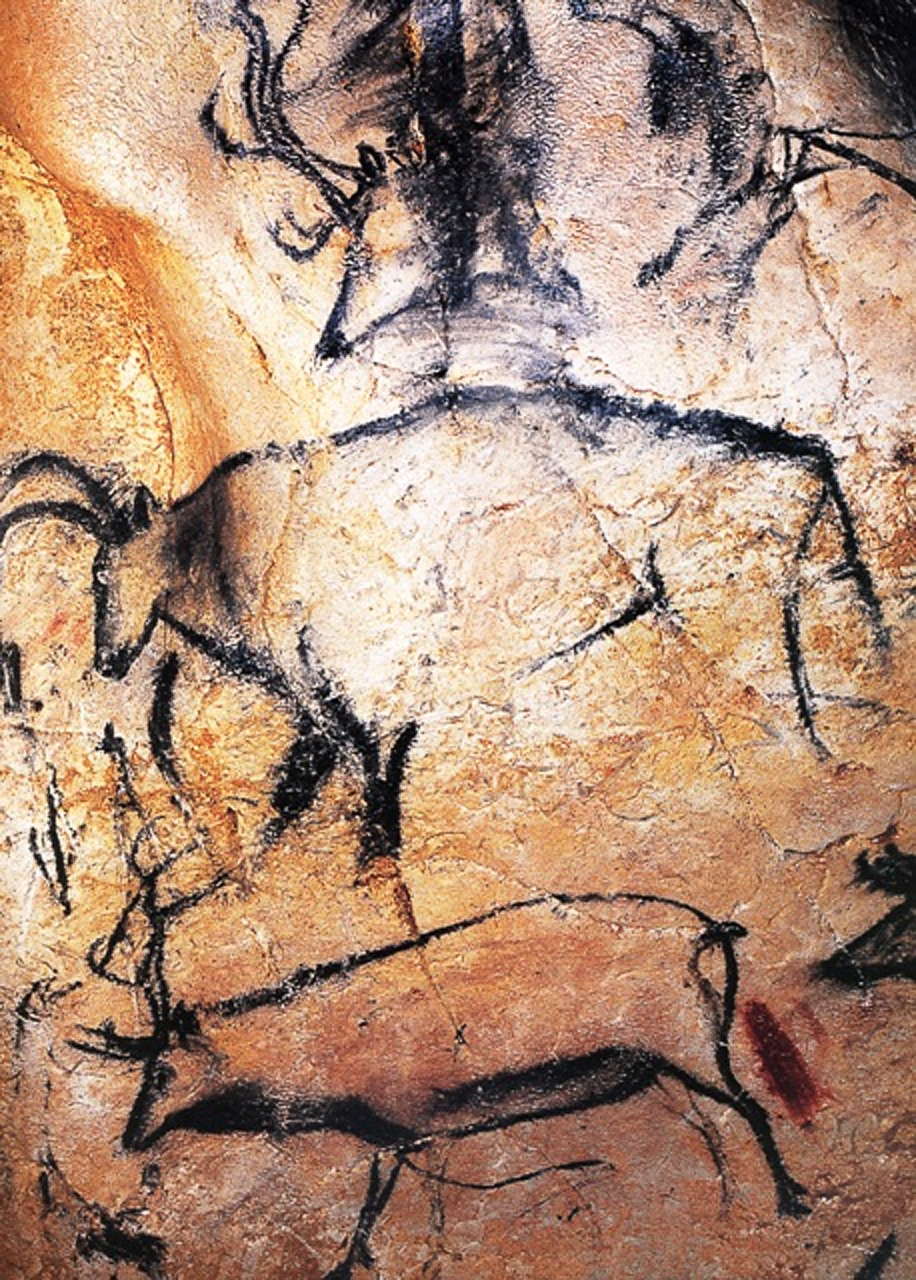
Aurochs between Reindeer. This is part of the Reindeer Panel, in the Horse Sector, to the right of the Alcove of Lions.
Photo: http://www.istmira.com/foto-i-video-pervobytnoe-obschestvo/3924-iskusstvo-predystorii-pervobytnost-2.html

This is a female wooly rhinoceros. They have longer and thinner horns than the males.
The painting is on a wall between the Sector of Horses and the entrance to the Megaloceros Gallery.
Photo: Inocybe
Permission: Public Domain

Two mammoths have been painted face to face on a pendant rock at the entrance to the Skull Chamber. This is the mammoth on the right.
Photo: Chauvet, Deschamps et Hillaire (1996)

The complete confrontation of the two mammoths.
Photo: Chauvet, Deschamps et Hillaire (1996)
The Skull Chamber - Salle du Crâne
Gours and Gour Pools

Here we can see that at times the floor in this part of the cave, where the Skull Chamber and the Hillaire Chamber meet, is flooded.
The niche of the Ibex and Aurochs in the Skull Chamber, and the niche of the Panel of Horses in the Hillaire Chamber (on the right, on the other side of the wall, 'around the corner' to the ibex engravings), is the place where water starts to enter the floor of the Skull Chamber, creating a series of gour (or "rimstone") pools. Gours occupy the largest part of the floor of the Skull Chamber, forming islets of clay which preserve animal and human prints.
When water containing dissolved calcium bicarbonate (Ca (HCO3)2, almost universal in the water percolating through a limestone cavern) accumulates in a small depression, but the supply of water is only sufficient to just maintain the size of the pool after evaporation, then at the edge, where the effect of evaporation is greatest because of the thinness of the water, the concentration of calcium bicarbonate dissolved in the water may be sufficient to deposit a thin film of calcite at this point, as carbon dioxide is released, and solid calcium carbonate continues to precipitate out over time, preferentially at the existing crystalline surface in the normal manner.
The chemical reaction may be summarised as:
Ca (HCO3)2 → CaCO3↓ + H2O + CO2↑
This creates a tiny wall of calcite at the edge, which over time accumulates as more calcite precipitates out from the water. Thus the depth of the pool gradually increases. Any excess water will then overflow from this minuscule dam, creating scallops on the side of the gour pool, and often there will be a chain of such pools, creating a beautiful effect, but one which is only possible over a long period of time in stable conditions.
Photo: Clottes (2003)
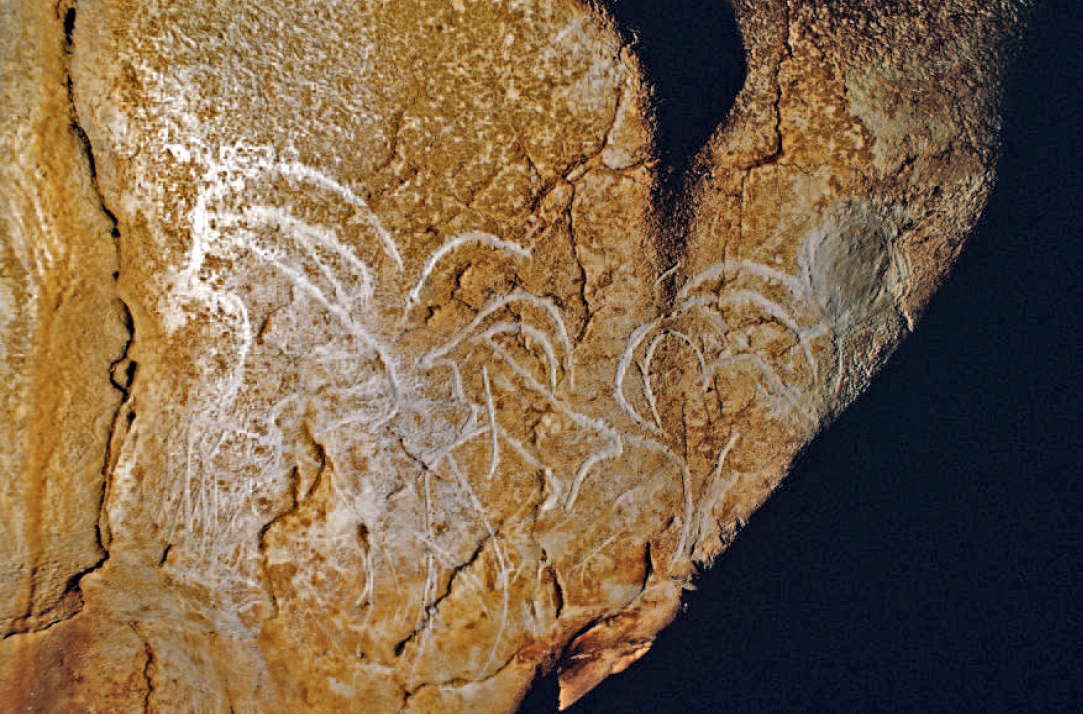
Ibexes engraved on the back of the Panel of Horses (which is in the Hillaire Chamber), facing the interior of the Skull Chamber.
(doc.
Carole Fritz & Gilles Tosello)
Photo: Fritz et Tosello (2007)
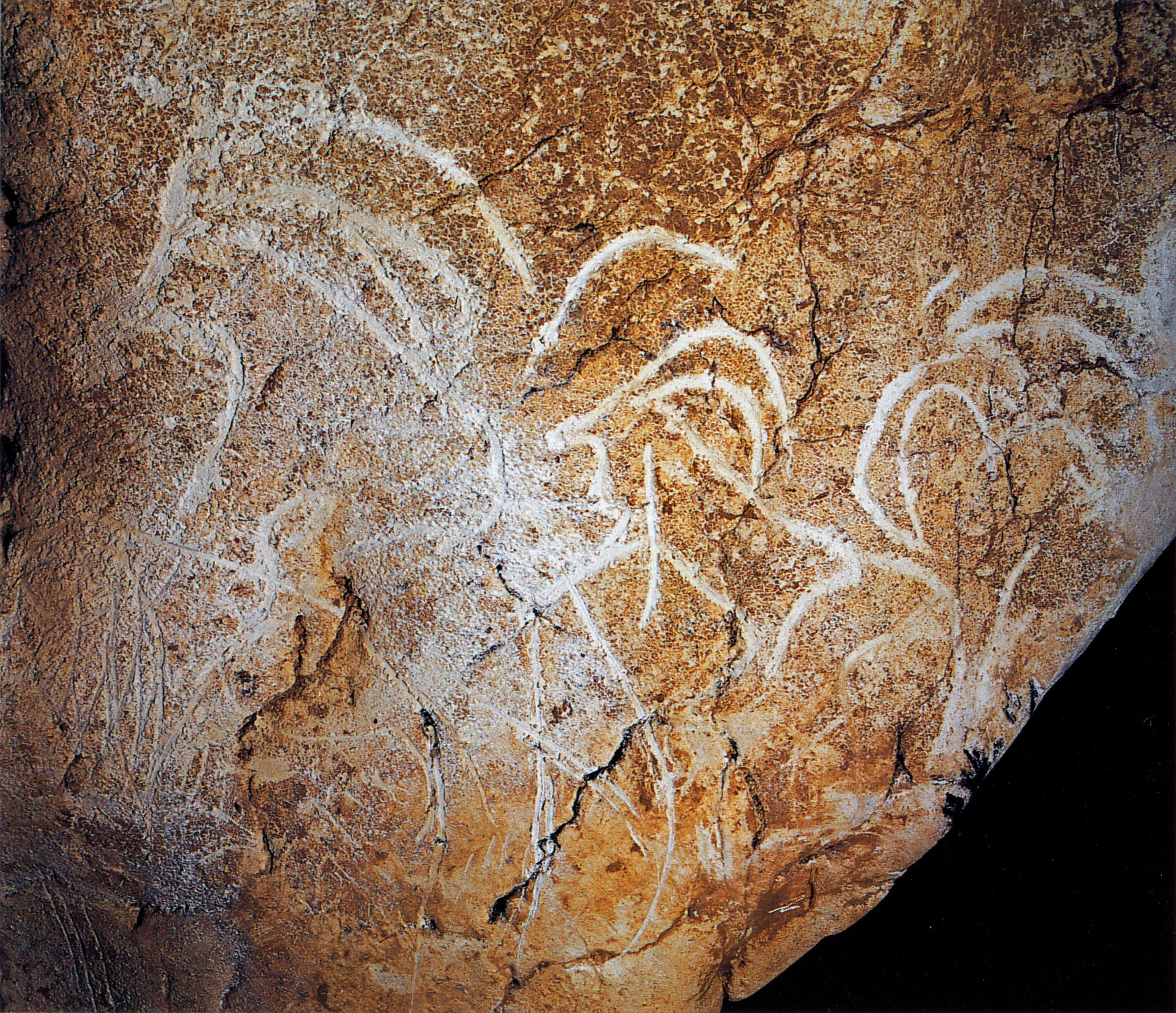
Another version of the engraved ibexes above.
Photo: Chauvet, Deschamps et Hillaire (1996)
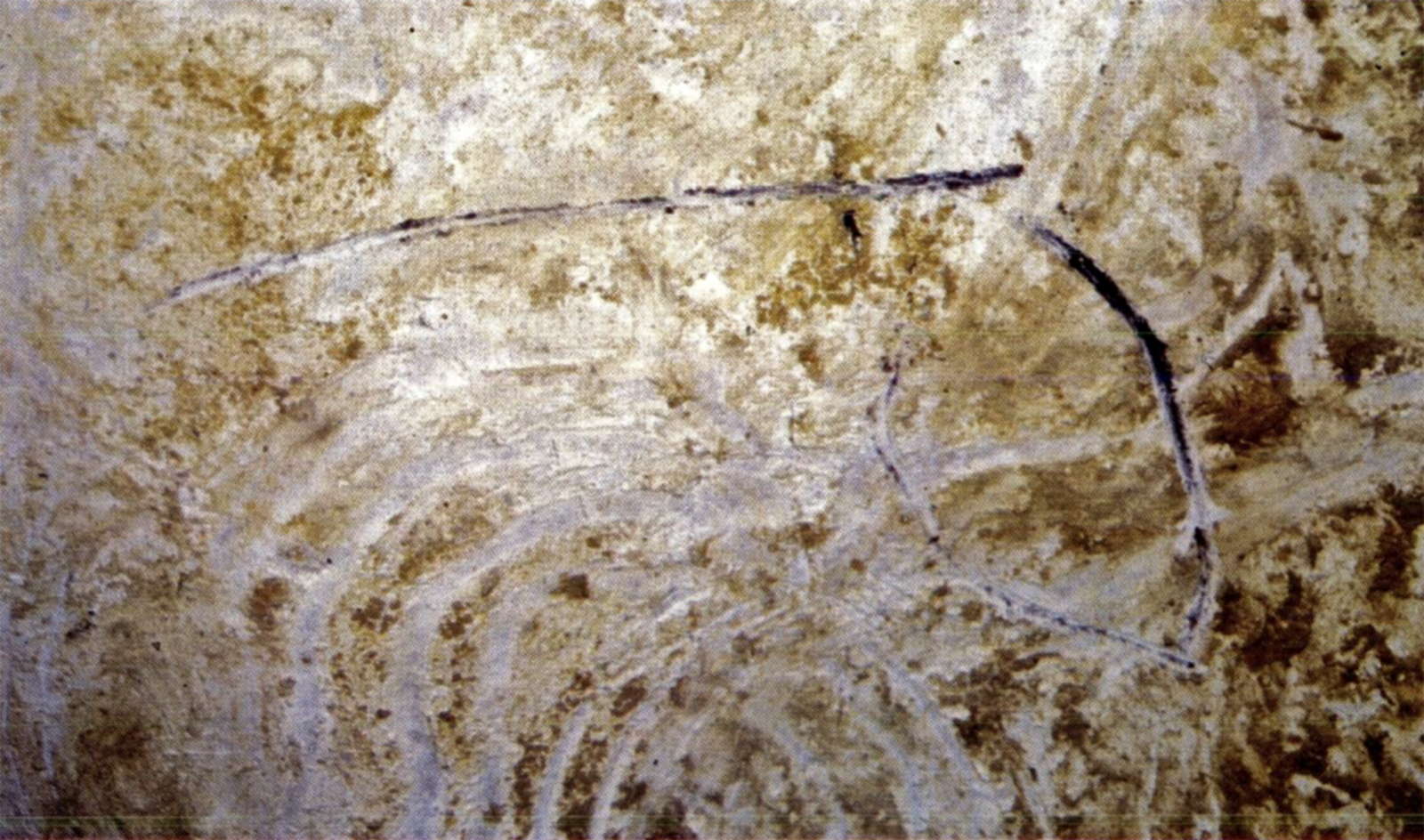
In the niche immediately after the Panel of Horses, in the Skull Chamber, this horse head was drawn with a torch on an engraved aurochs facing left.
Photo: J. Clottes in Gély (2005)
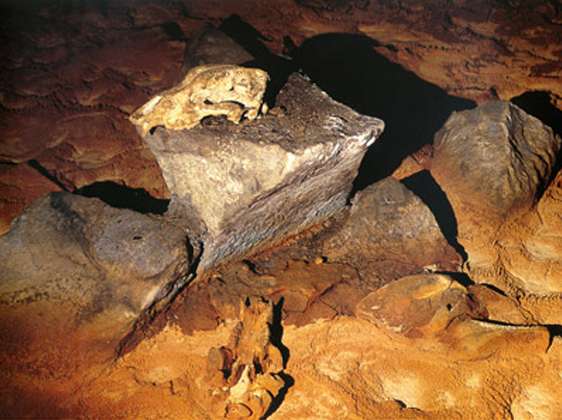
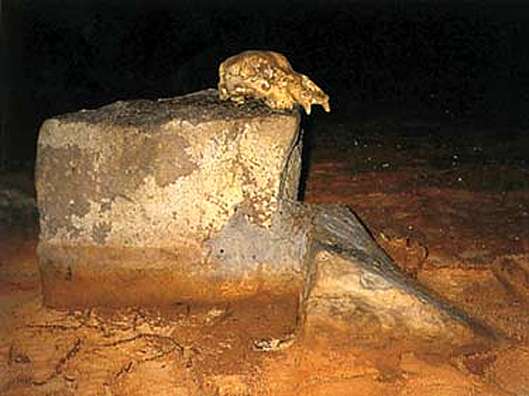
This bear skull was placed with evident care atop a slab of rock, with fragments of many more skulls on the floor nearby.
From:
(left) http://www.ancient-wisdom.co.uk/francechauvet.htm
(right) http://paulsuckow.tripod.com/magatamartsalbum/id3.html
Other hints of the cave's spiritual role include engravings of two large pubic triangles-symbols of fertility? -and a creature with human legs but the head and torso of a bison, suggesting that people hoped to incorporate within themselves some of the animals' power. The cave bear in particular may have had special meaning. The presence of 55 ancient bear skulls, including one carefully placed on a fallen rock as if on an altar, suggests a cult of the cave bear. And that may explain why the cave artists chose Chauvet: dozens of hollows or wallows in the floor indicate that the enormous bears hibernated there. People returned time and again to view the works.
Text: National Geographic, August 2001
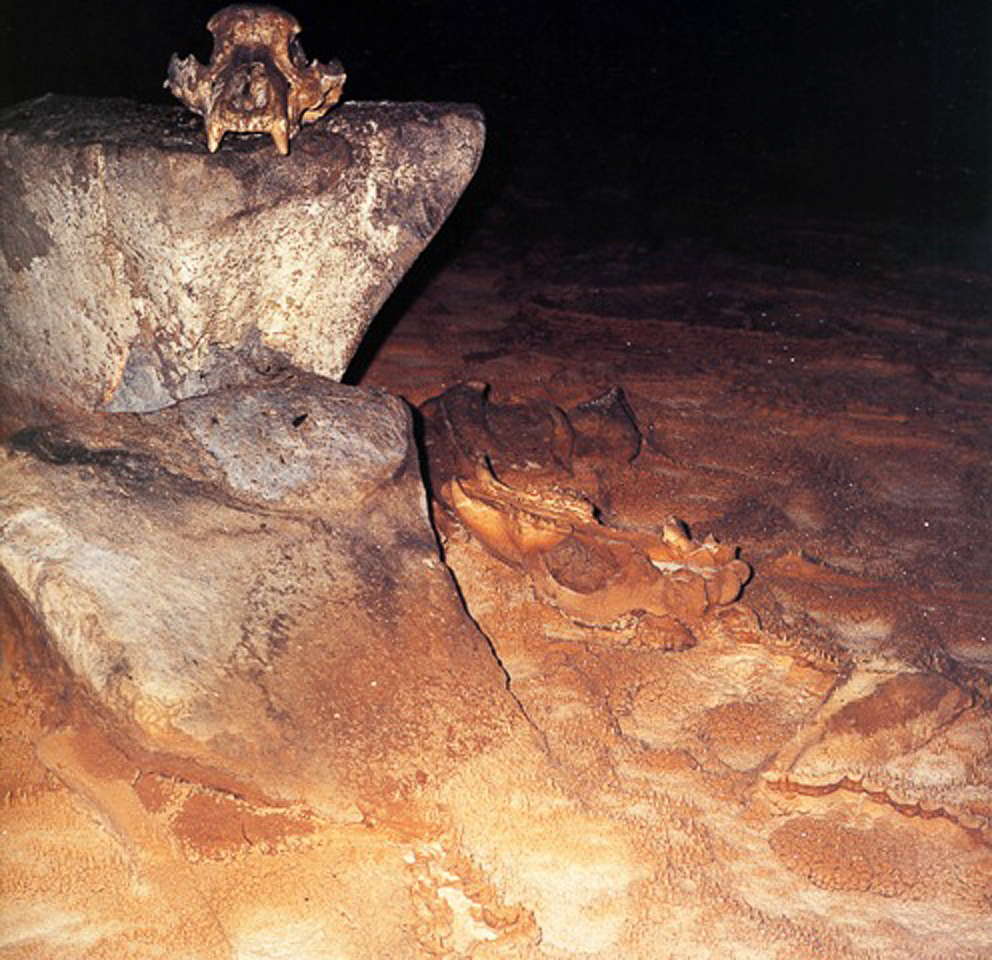
The cave bear skull placed on the rock which has fallen from the roof of the cave is accompanied on the floor of the cave by a cave bear lower jaw, as well as other fragments of cave bear bones.
Photo: http://www.istmira.com/foto-i-video-pervobytnoe-obschestvo/3924-iskusstvo-predystorii-pervobytnost-2.html
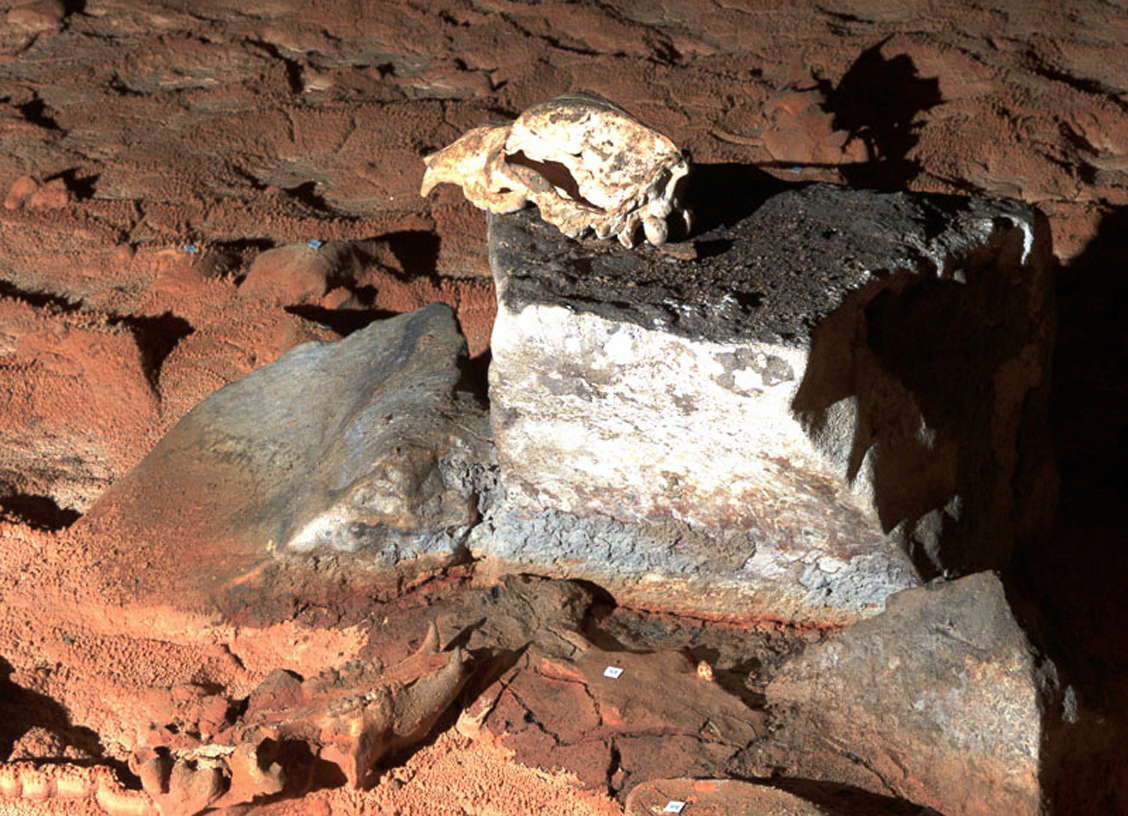
More than 190 cave bear skulls have been found in Chauvet Cave. This one was placed very carefully on the edge of a block of stone, for an unknown purpose.
Photo: © Jean Clottes
Source: http://archive.archaeology.org/1103/features/werner_herzog_chauvet_cave_primer.html
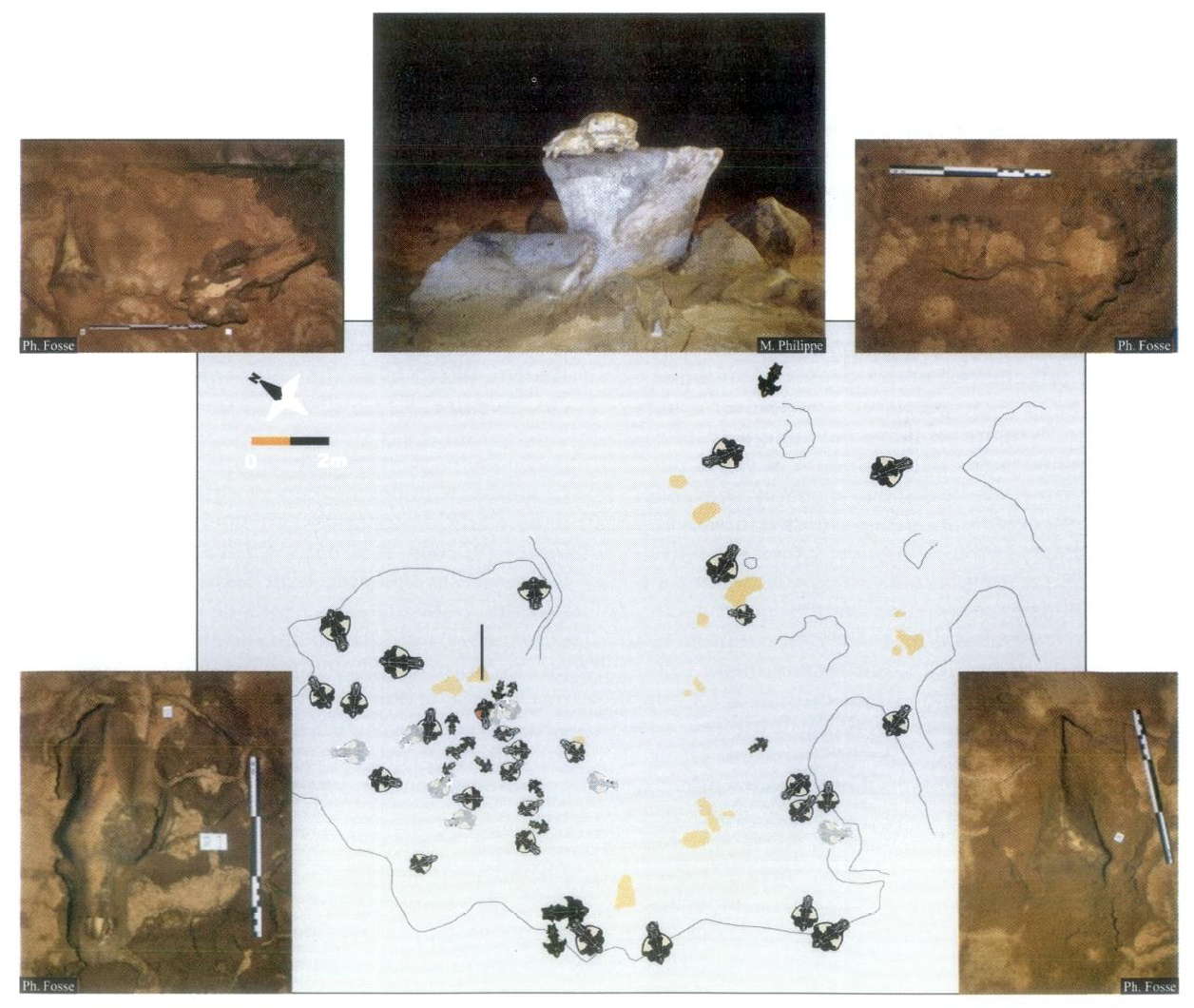
Spatial distribution of Cave Bear skulls in the Skull Chamber.
Photo: Fosse et Philippe (2005)
Topography: F. Maksud et Y. Le Guillou, in tribute to F. Rouzaud.
Topography of skulls: F. Maksud.

Reindeer and mammoth drawings on a pendant rock in the Skull Chamber.
Photo and text: Chauvet, Deschamps et Hillaire (1996)

With seventy-six mammoths, the Chauvet cave site is second in the number of pachyderms depicted in Palaeolithic decorated caves , after Rouffignac near the Vézère River valley, which boasts 158 depictions of mammoths. Often, the graphics of the mammoths in Chauvet are reduced to just the essential lines.
This image shows the panel of the three big scraped mammoths in the Skull Chamber.
This panel is more than 4 metres in length and 2 metres in height. It is scraped on the soft rock with sweeping gestures, three mammoths facing each other, with natural pillars evoking the limbs.
Photo: Gély et Azéma (2005a)
Text: adapted from Clottes (2003) and Gély et Azéma (2005a)
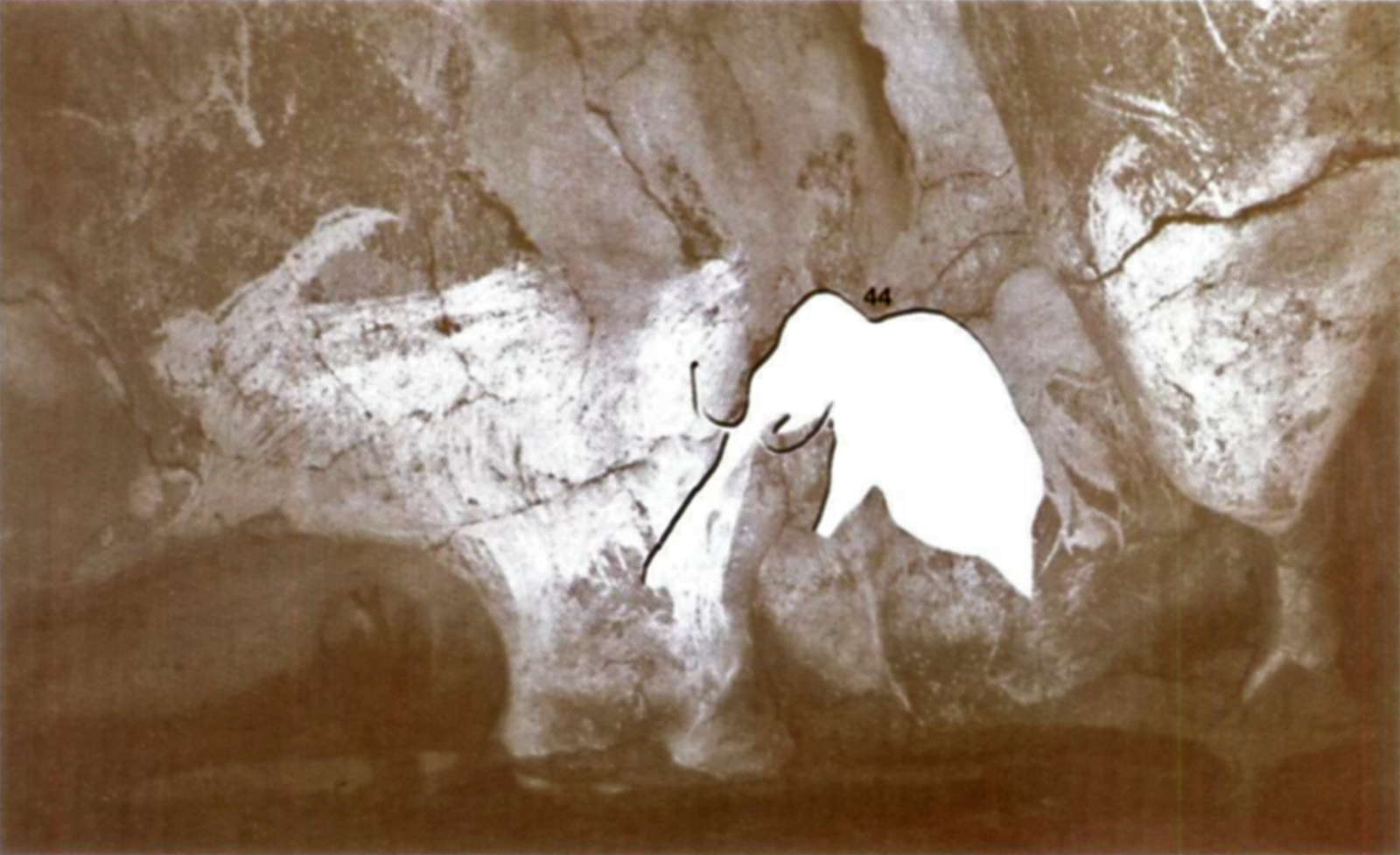
The panel of the three big scraped mammoths.
20% of the bestiary consists of mammoths. When combined with the large cats and rhinoceros, they account for half of the drawn wildlife.
The mammoths were created in the order shown, from number 44 as shown here, to number 46.
Photo and text: Gély et Azéma (2005a)
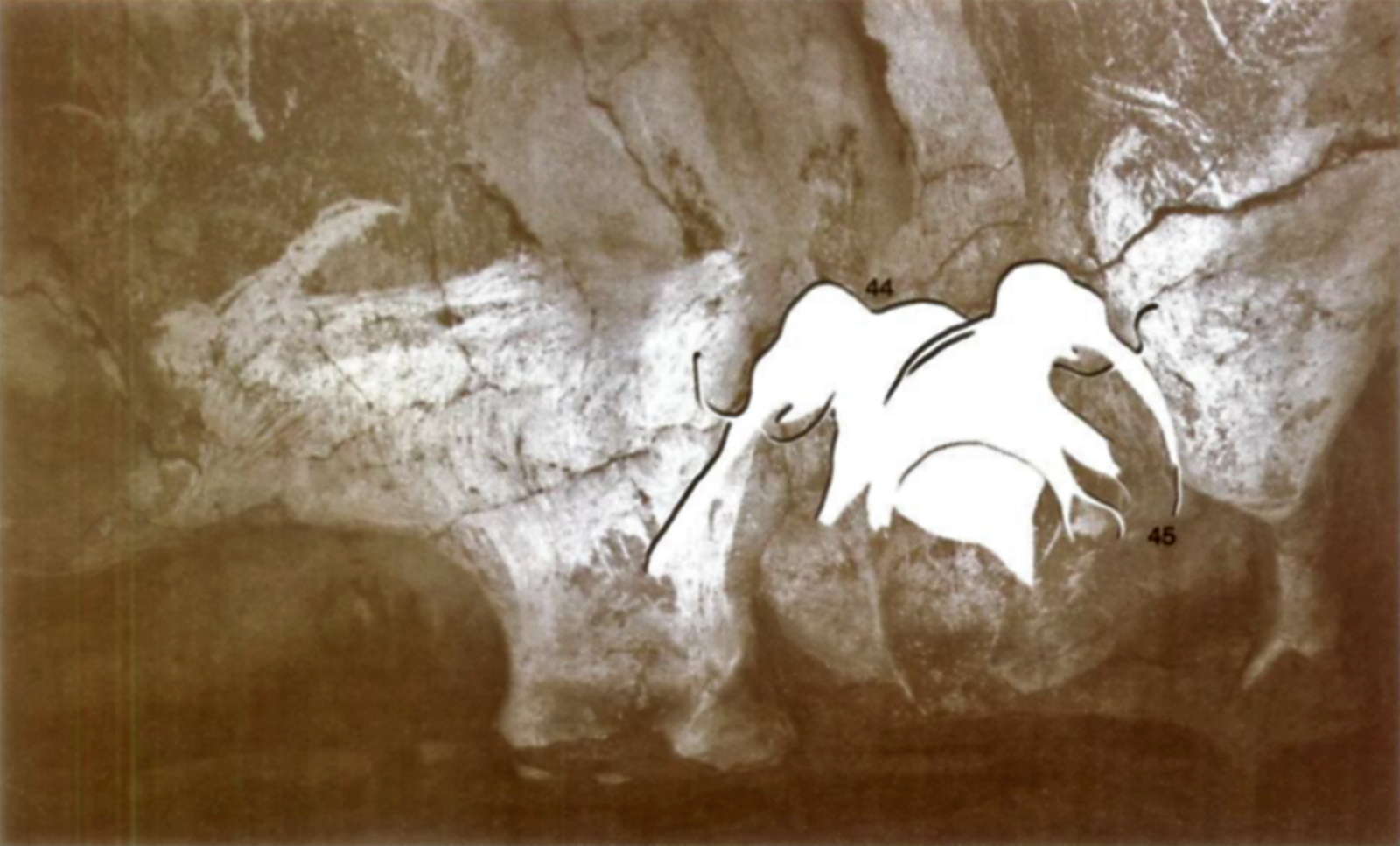
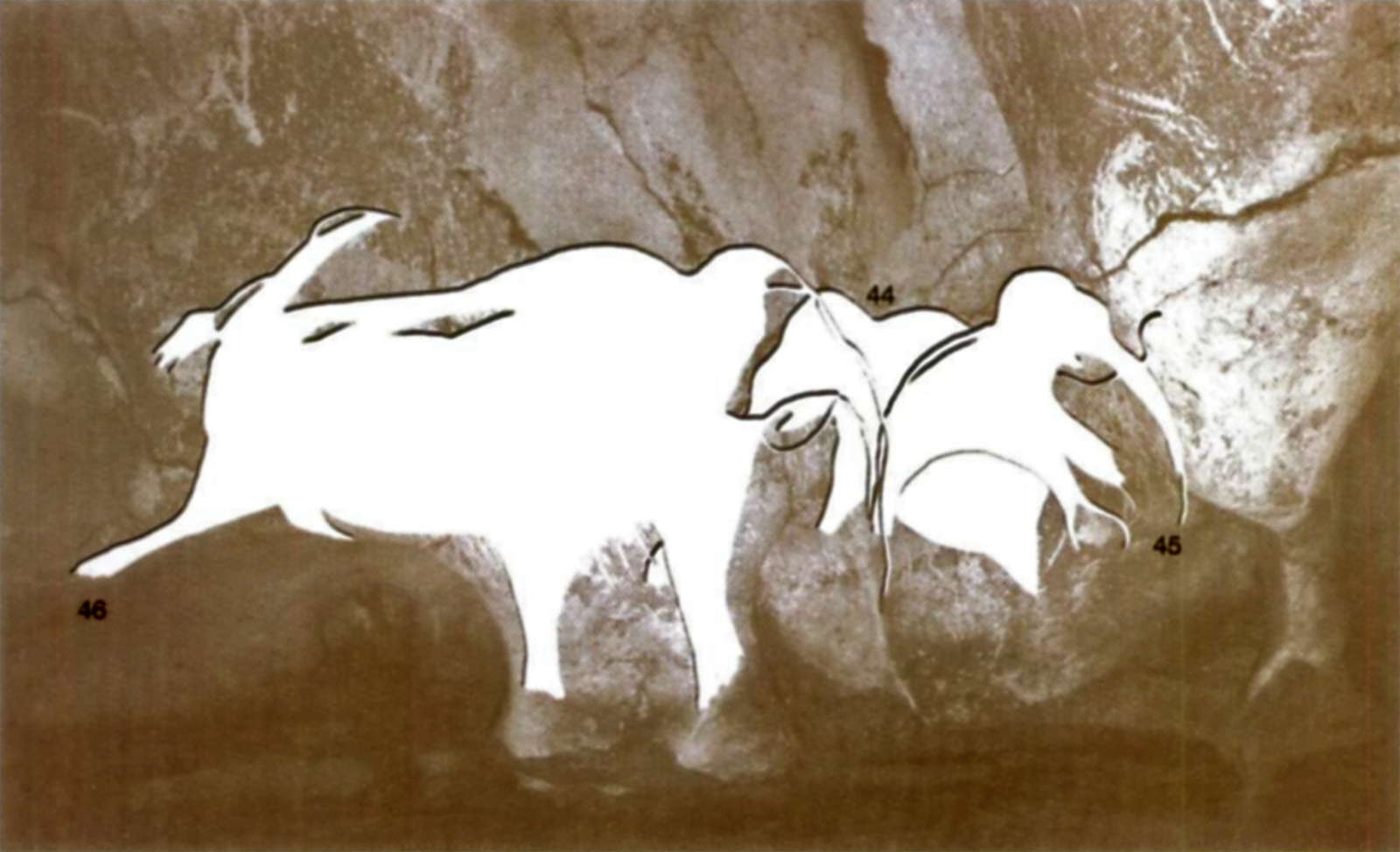
The panel of the three big scraped mammoths.
This monumental engraving or scraping is the only example of the cavity where the mammoth is the predominant animal, although it is the most abundant species shown in the cave. The three nested mammoths are shown in white by scraping the weathered yellow-brown limestone back to its whitish base.
The rapid implementation of these figures contributes to the dynamism of the composition. One of them (No. 46) is the largest mammoth in the cave. The tail is shown raised.
Photo and text: Gély et Azéma (2005a)
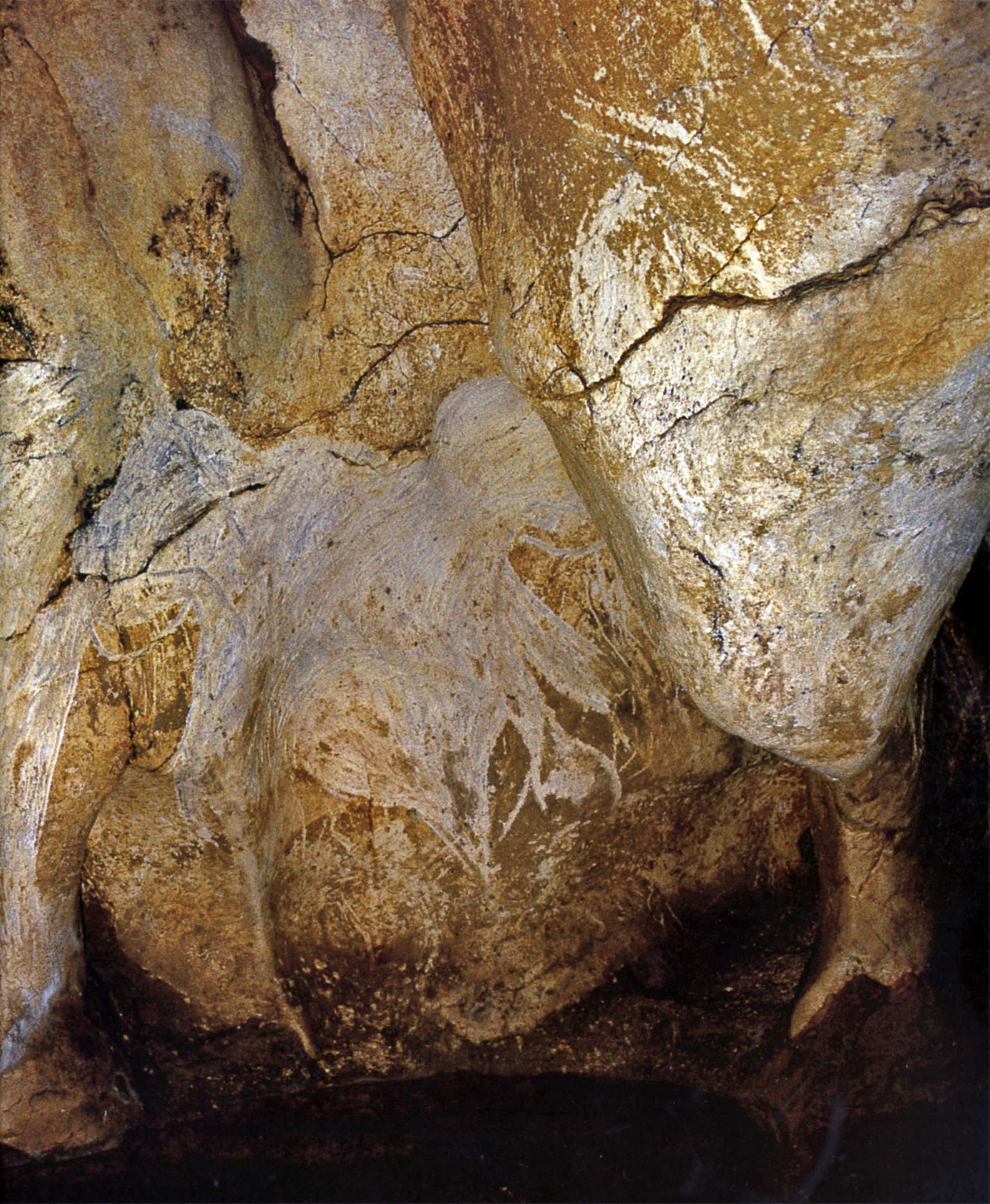
The panel of the three big scraped mammoths.
This image shows some of the detail of the two smaller mammoths on the right.
Photo: Clottes (2003)

The panel of the three big scraped mammoths.
This image shows some of the detail of the mammoth on the left.
Photo: Chauvet, Deschamps et Hillaire (1996)

Ibex skull on the floor of Chauvet cave, covered over thousands of years with a thin veil of calcite. It may have been brought here for a ritualistic purpose.
Photo: Chauvet, Deschamps et Hillaire (1996)
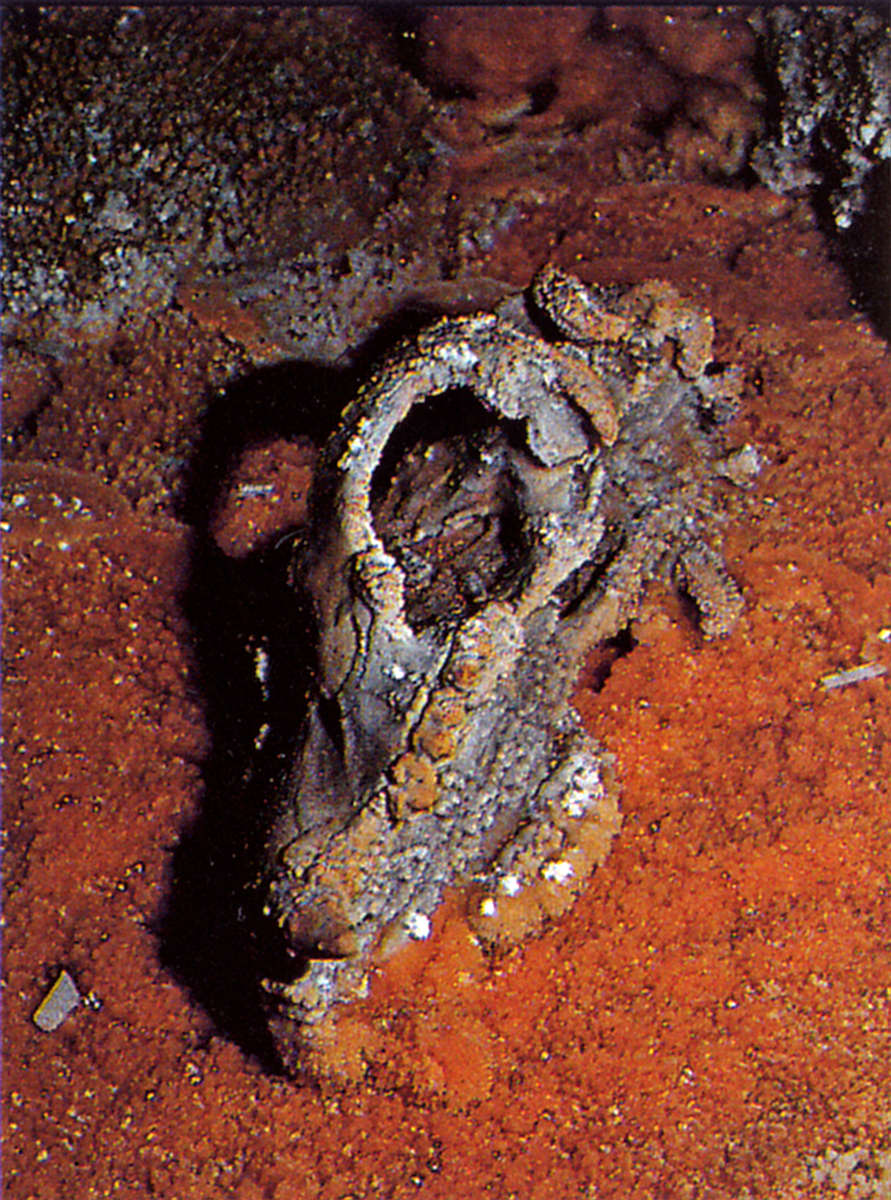
This cave bear skull may well have been from an inhabitant of the cave before humans first entered the cave.
Photo: Chauvet, Deschamps et Hillaire (1996)
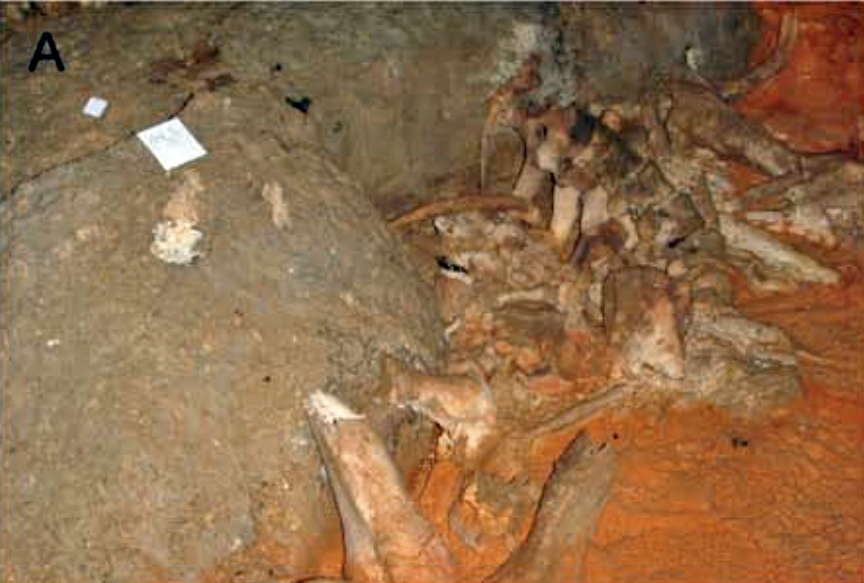
Piles of bones in the Skull Chamber.
Photo: © MCC, CNP Périgueux
Source: Bon (2011b)
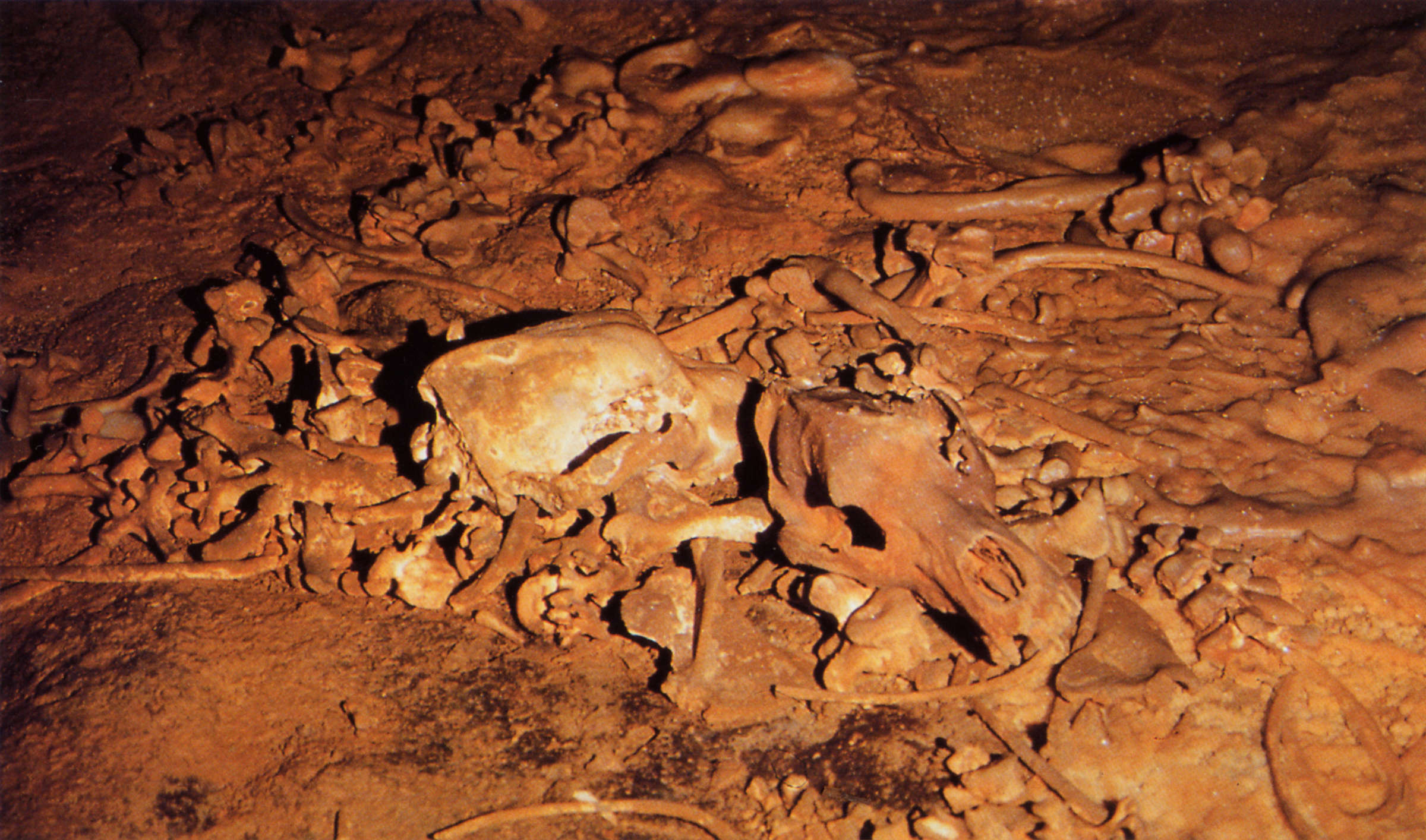
The floors are strewn with cave bear bones. In the centre two skulls surrounded by various bones can be seen.
Photo and text: Chauvet, Deschamps et Hillaire (1996)

Image of a musk ox, in the Skull Chamber.
From: National Geographic, August 2001.
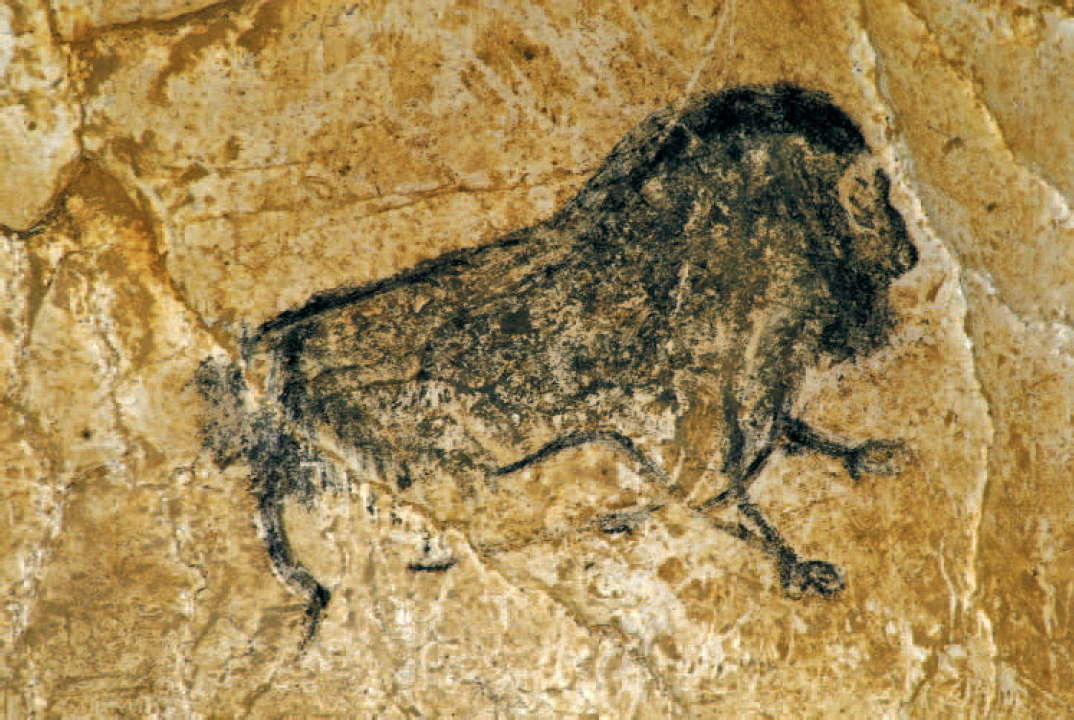
Another version of the musk ox.
Photo: Fritz et Tosello (2007)

Skull Chamber - blocks on the floor beneath the pendant with the black drawings.
Photo and text: Geneste (2005)
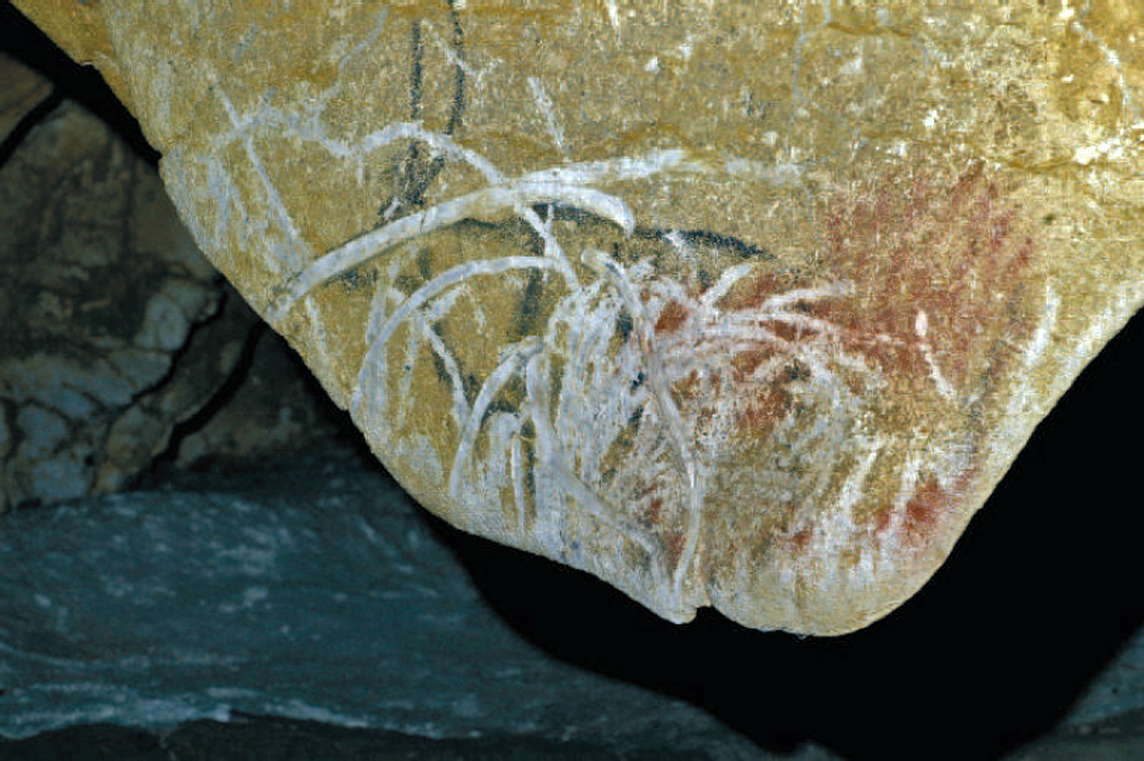
The young reindeer (Daguet) panel in the Skull Chamber. The word Daguet comes from the 'daggers' of the horns which are not yet branched in the young reindeer.
Photo: Fritz et Tosello (2007)
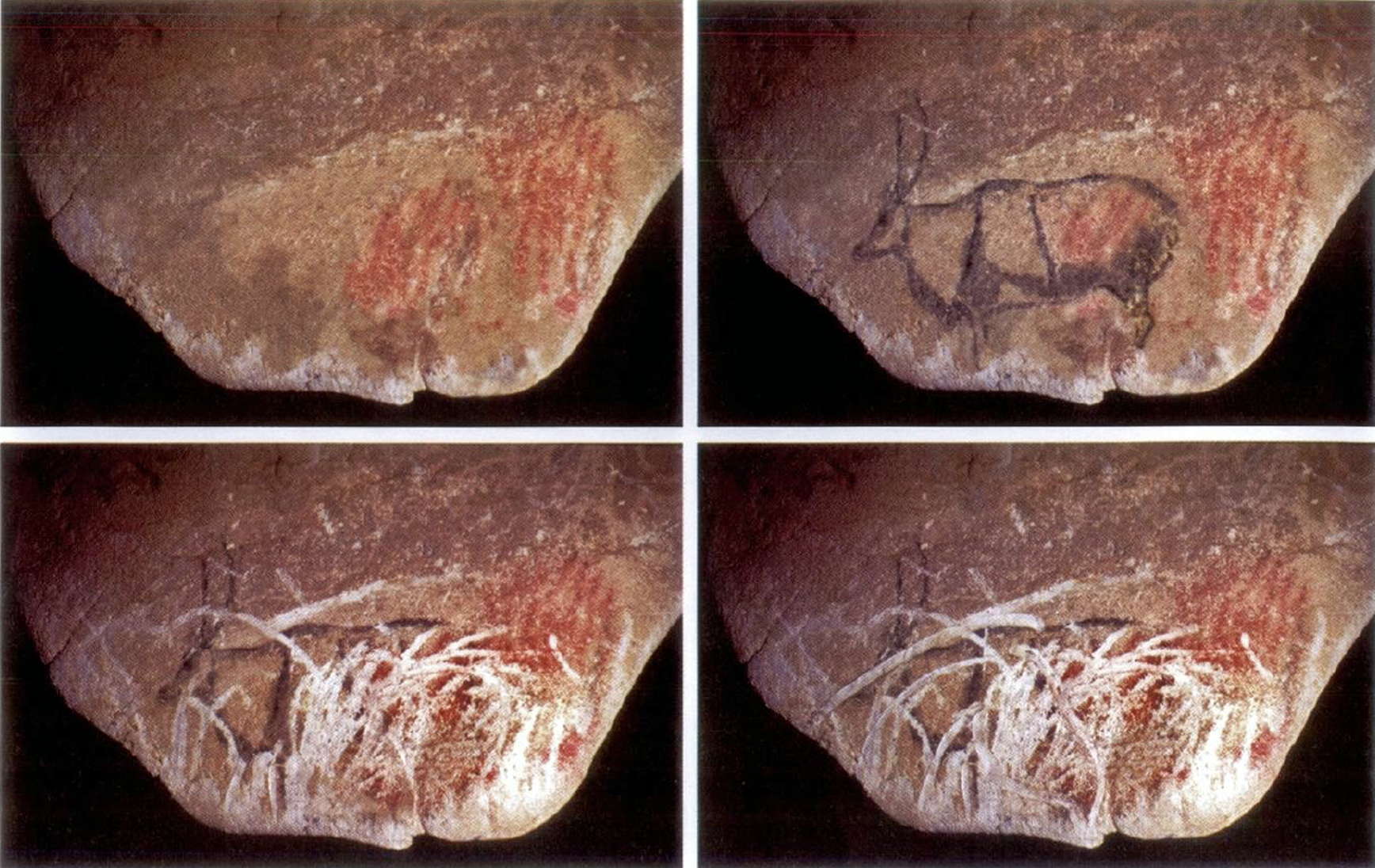
Relative chronology of the creation of the young reindeer (Daguet) panel in the Skull Chamber.
Photo: Ferruglio et Baffier (2005)
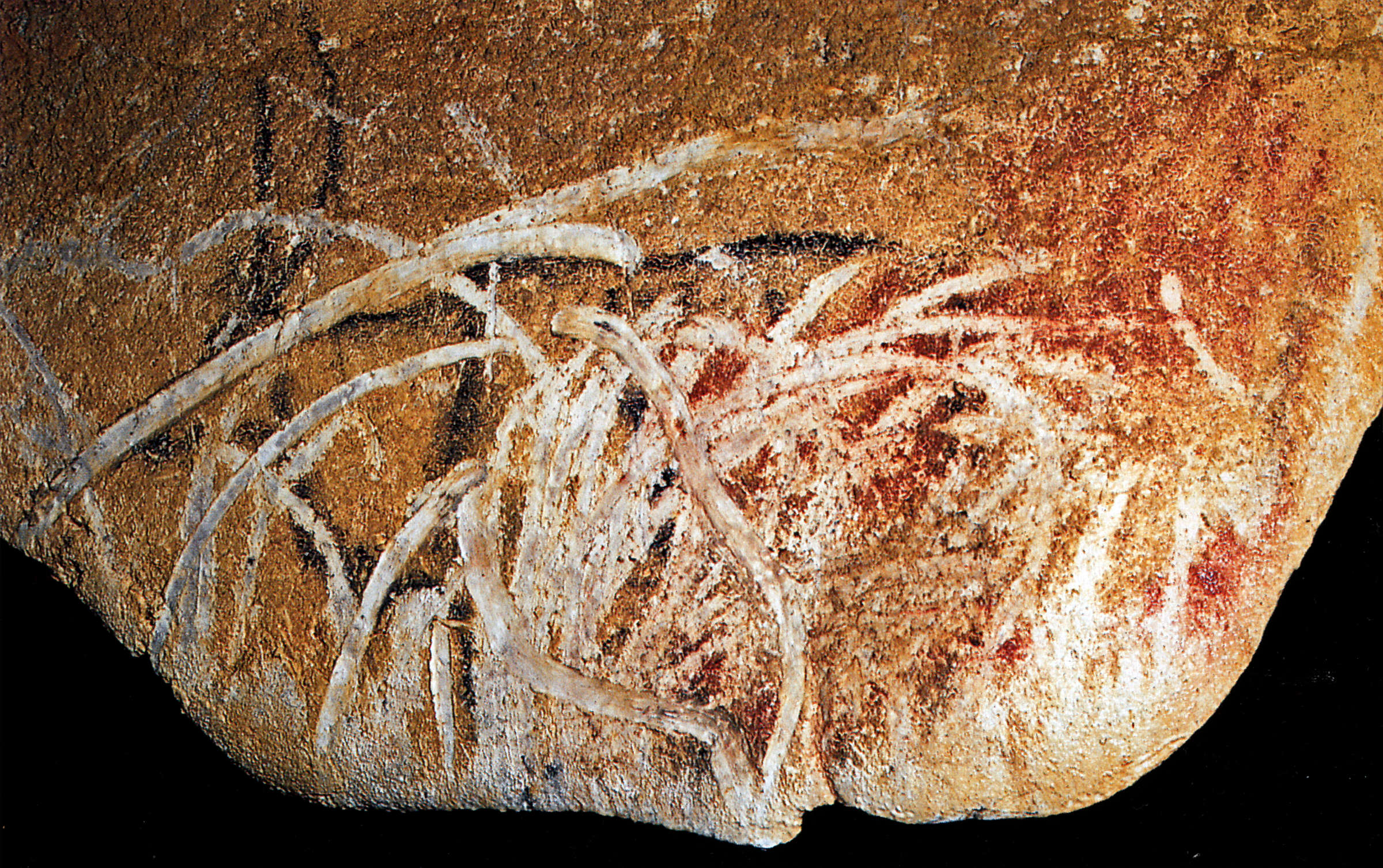
Another version of the young reindeer (Daguet) panel in the Skull Chamber.
Chauvet, Deschamps et Hillaire (1996)
The Gallery of Crosshatching - Galerie des Croisillons
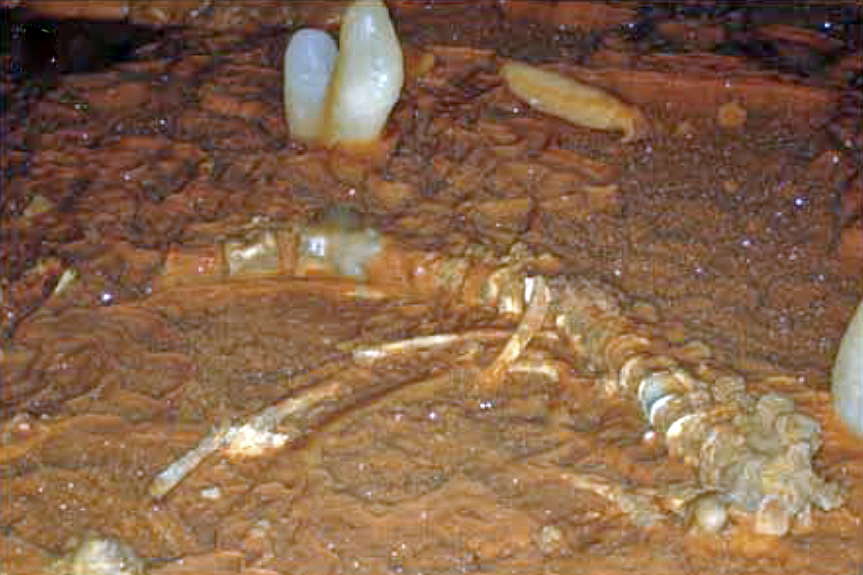
A vertebral column still in connection, untouched by scavengers in the Gallery of Crosshatching, Galerie des Croisillons.
Photo: © MCC, CNP Périgueux
Source: Bon (2011b)
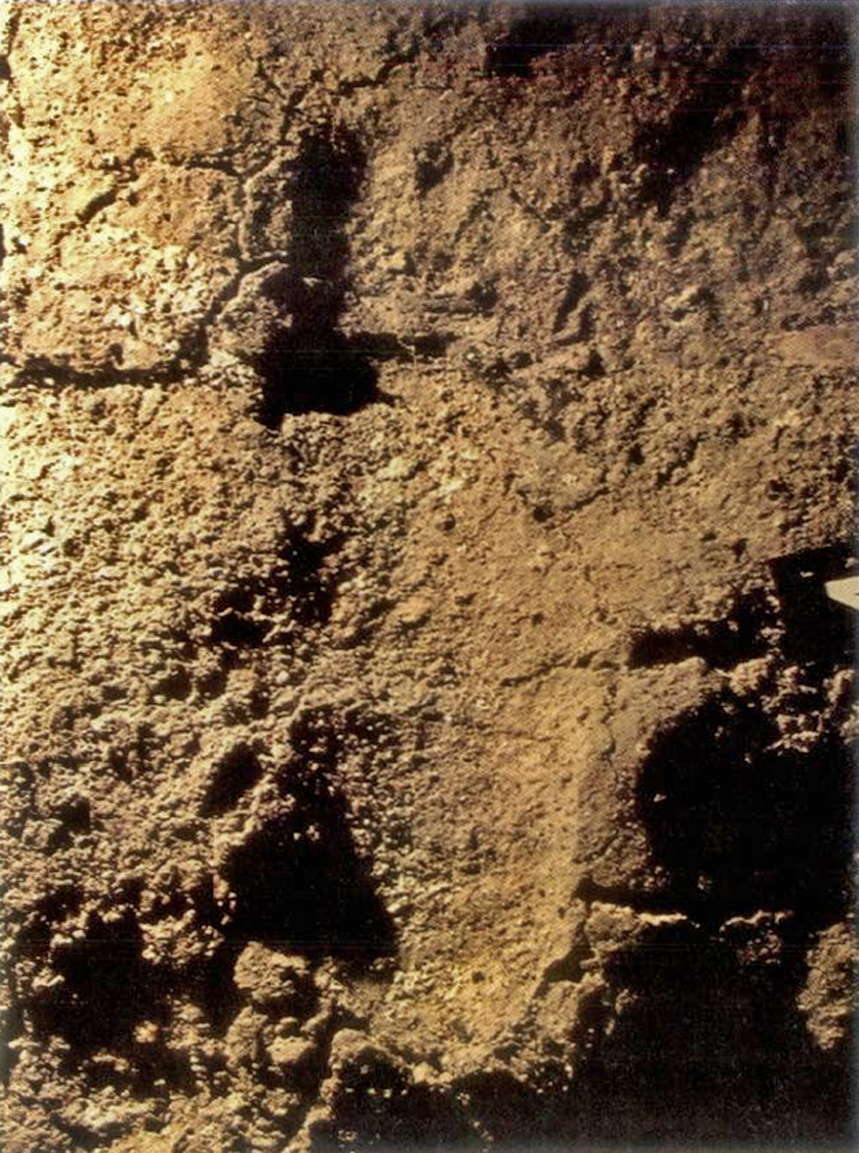
Human footprint No. 3, right foot, Gallery of Crosshatching, la galerie des Croisillons.
Photo: Garcia (2005)
In the Crosshatching gallery, two small bear wallows seem to have served as hearths, if we judge by the accumulation of carbonaceous residues associated with slabs of concretions at their base. Intense and localised reddening of the ceiling above the location of one of them is remarkable.
A flint flake is present in another depression, with the tracks of human footprints studied by M. Garcia (Garcia 1999a, 1999b). A piece of charcoal delivered the date of 31 060 ± 400 BP.
Text above: Geneste (2005)
The Megaloceros Gallery - Galerie des Mégacéros
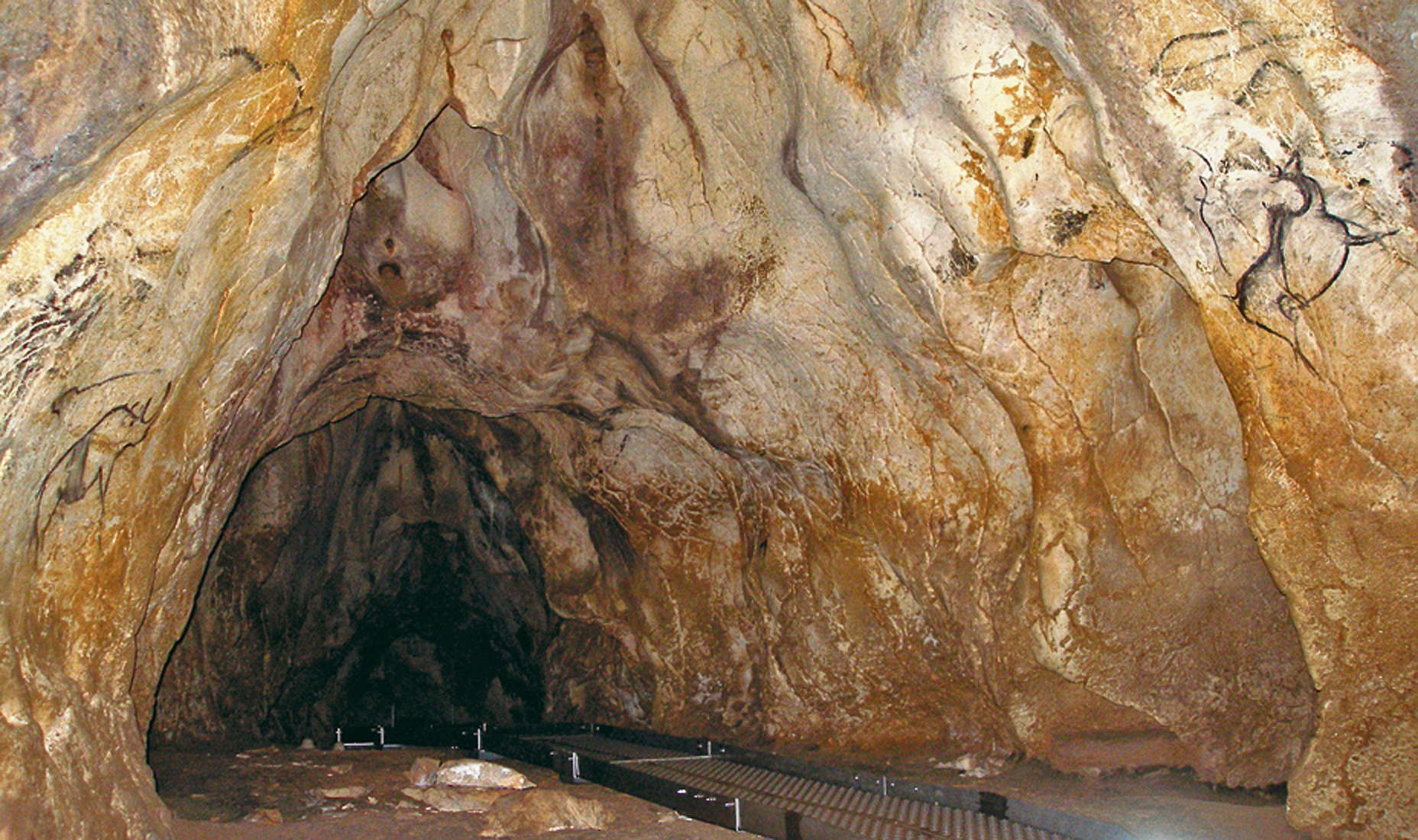
Entrance to the Megaloceros Gallery
Photo: http://uk.phaidon.com/agenda/art/picture-galleries/2011/march/10/inside-the-cave-of-forgotten-dreams/
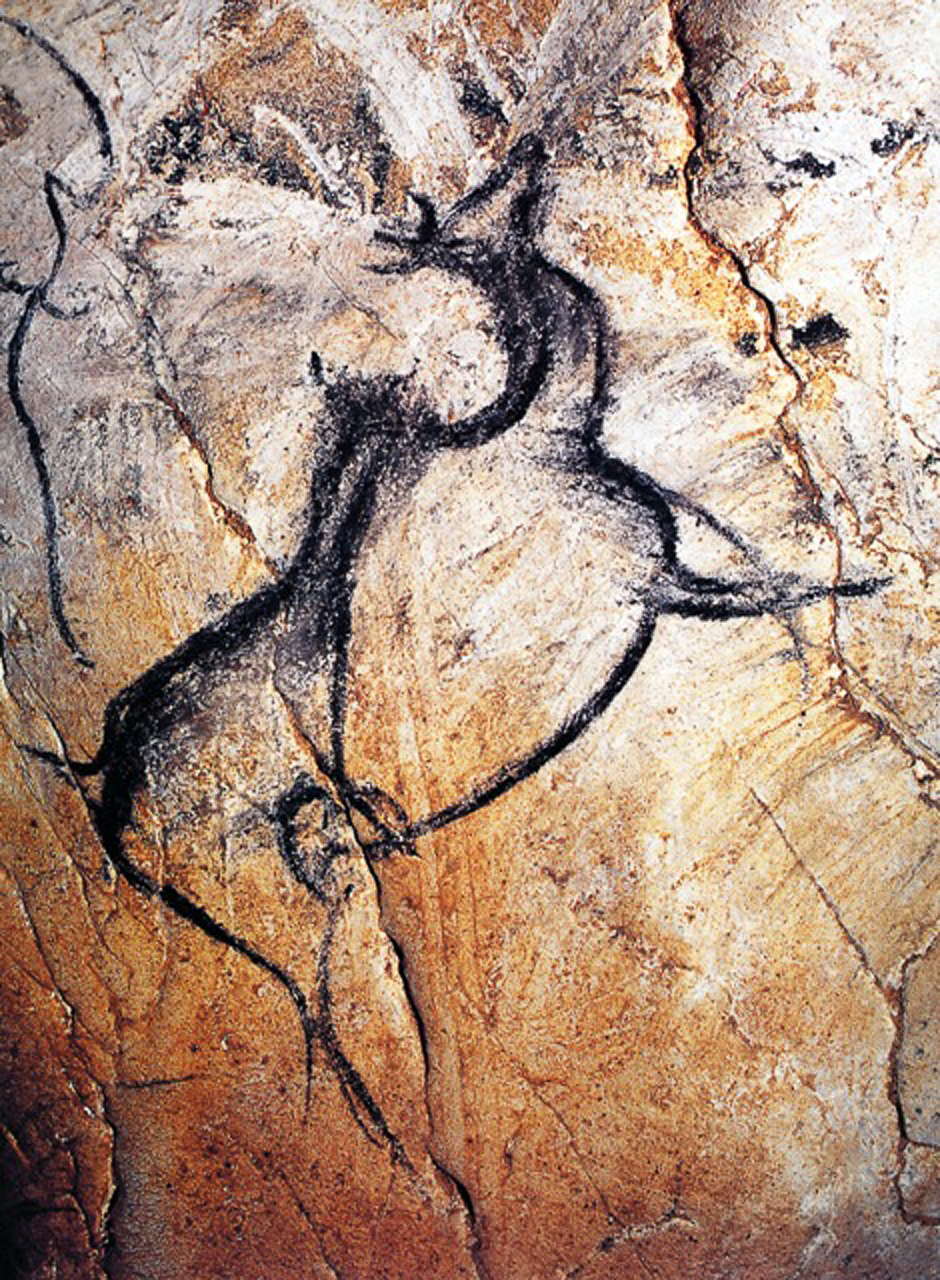
Megaloceros with the characteristic black hump on the shoulders, which contains muscles to hold the weight of the neck, head, and horns of the Megaloceros. This image is of a Megaloceros with small horns, early in the growing season.
Photo: http://www.istmira.com/foto-i-video-pervobytnoe-obschestvo/3924-iskusstvo-predystorii-pervobytnost-2.html
The Rhinoceros panel at the entry to the Megaloceros Gallery on the left wall.
Photo: Fritz et Tosello (2007)

Relative chronology of the Rhinoceros panel at the entry to the Megaloceros Gallery on the left wall.
Photo: Fritz et Tosello (2007)
Polishing of a stalagmite by the passage of bears in the Megaloceros Gallery over a long period of time. They used smell and touch to navigate in the pitch black of the cave.
Photo: © MCC, CNP Périgueux
Source: Bon (2011b)
Ivory spear tip
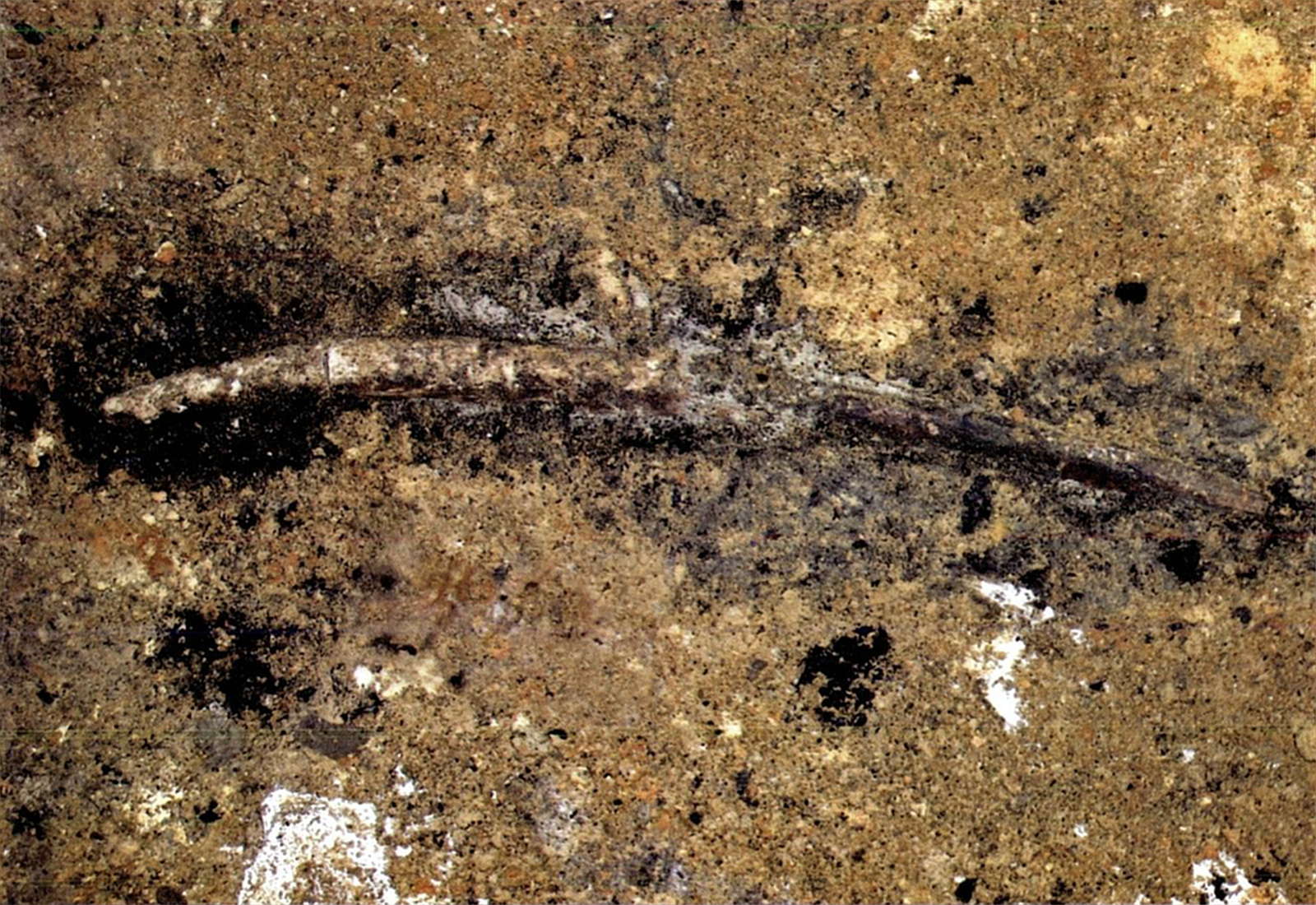
Megaloceros Gallery, lower level. Ivory spear tip emerging from the floor near areas of combustion along the left wall.
In the lower level of the Megaloceros gallery, near hearths under a thin layer of sediment accumulated since prehistoric occupancy, was found a spear point in ivory. Its description is based on visual observation at the time of discovery in 1998 by P. Morel and myself, as well as the results of the review and biogeochemical analysis of a very small fragment of material collected in the sediment immediately against the piece by H. Bocherens.
Biconical, very elongated, it is damaged at the end and should measure about 30 cm long, and the visible cross-section, oval or circular, is about 20 mm. The exposed surface appears very smooth, without ridges or decorative ornamentation, as well as its base, which has an old fracture, certainly due to use. Objects of this type of hunting weapon are known from the Upper Paleolithic.
Points as large as this but more massive, and of lozenge-shaped bone, ivory and antler have been grouped under the term 'Mladec points' based on their discovery in the Mladec Cave of Moravia.
They are therefore encountered in the Aurignacian in Central Europe, but have also been found in Germany and France. Similar items in the materials, technology and general shape, but less massive than the Chauvet point seems to be, are occasionally known in other cultural contexts such as Upper Paleolithic Solutrean and Magdalenian sites.
This spear tip has now been dated from several carbonaceous elements adjacent or against the point. The dates of ten pieces of charcoal analysed in this small area of the lower level of the Megaloceros Gallery indicate ages between 30 710 BP and 32 900 BP, and charcoal collected against spear itself delivered the date of 32850 ± 540 BP.
If this tip discovered at Chauvet cannot be used alone to characterise a particular phase of the Aurignacian, it is nevertheless related to Aurignacian points in bone material known in Europe. This element of material culture is, therefore, consistent with many Aurignacian age datings obtained both in hearths (charcoal and burnt bones) and from carbon from paintings.
Photo and text: Geneste (2005)

Photograph of the cave floor in the Megaloceros gallery showing two of the sampled charcoal pieces, GC41 and GC42, from a hearth on the left side of the Megaloceros Gallery.
The charcoal has been identified as coming from Pinus sylvestris, Scots Pine, which now grows well inside the Arctic Circle in Scandinavia, from 0m to 1000m in altitude.
The 3 charcoal fragments labeled GC40, GC41, and GC42 were compact and very well preserved; they were collected from the hearth structure of sector 10.23 (lower floor), located on the ground surface at the left side of the Megaloceros gallery, where black drawings abound, and below the representation of a double-maned horse. Each fragment was big enough (3–5 g) to be divided into several fractions weighing between 300 and 500 mg, which were sent and dated independently by each laboratory using their own pretreatment methods.
Photo and text: Cuzange et al. (2007)
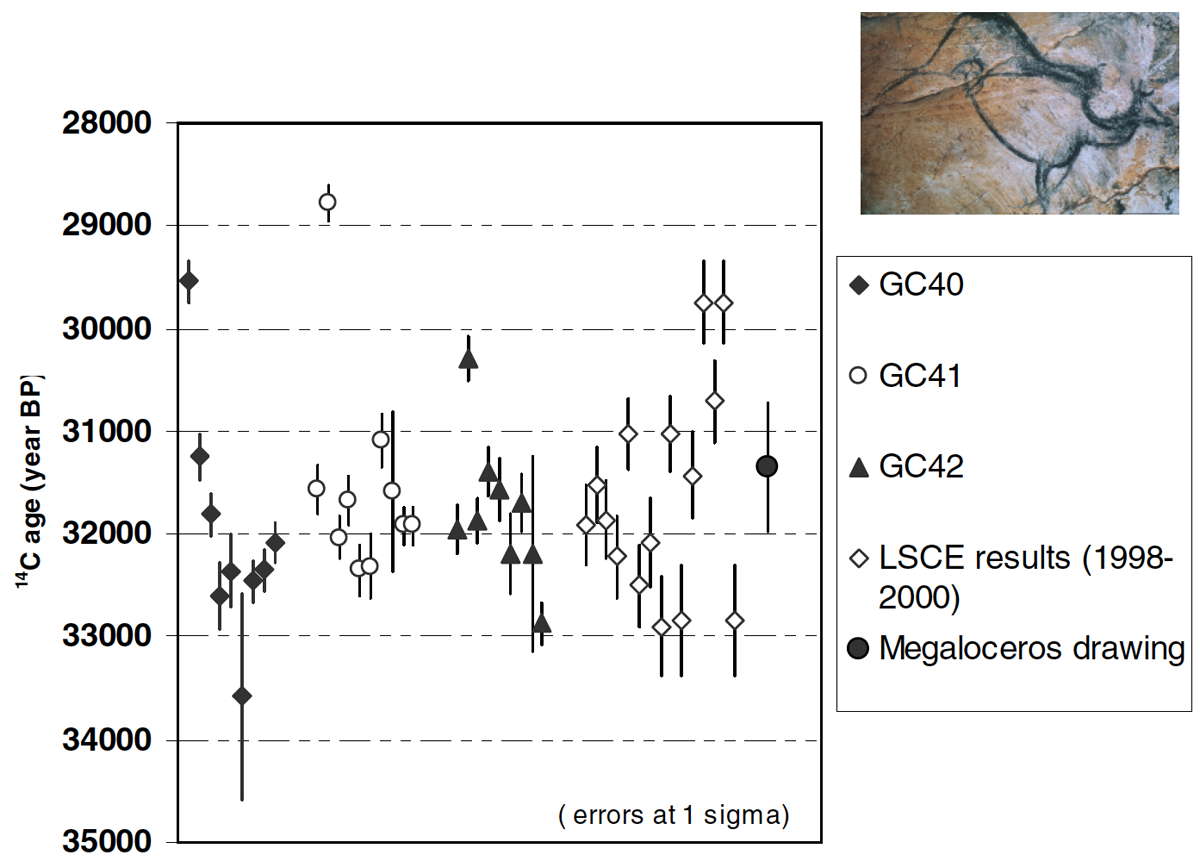
14C ages for the charcoal samples. The results obtained for GC40, GC41, and GC42 are indicated by black diamonds, empty circles, and black triangles, respectively. The 15 dates (empty diamonds) previously obtained at the LSCE for several other hearths of the Megaloceros gallery are given on the right alongside the age (large black dot) obtained on the megaloceros drawing (picture at top, courtesy of Ministère de la Culture, France).
(Thus we can see that the measured ages for the drawing in charcoal and charcoal from the hearth in the Megaloceros Gallery cluster around 32 000 BP - Don )
Photo and text: Cuzange et al. (2007)

The location of this photograph of the Megaloceros Gallery walls and floor seems to be very close to the sampling site for the charcoal in the study above.
Photo: Jean Michel Geneste
Source: National Geographic Magazine, August 2001
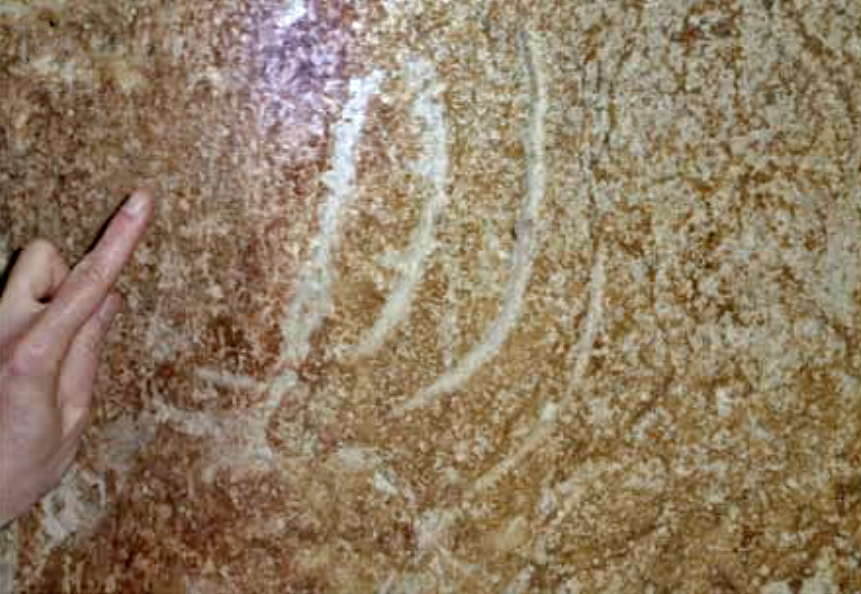
Bear scratches on the wall of the Megaloceros Gallery.
Photo: © MCC, CNP Périgueux
Source: Bon (2011b)
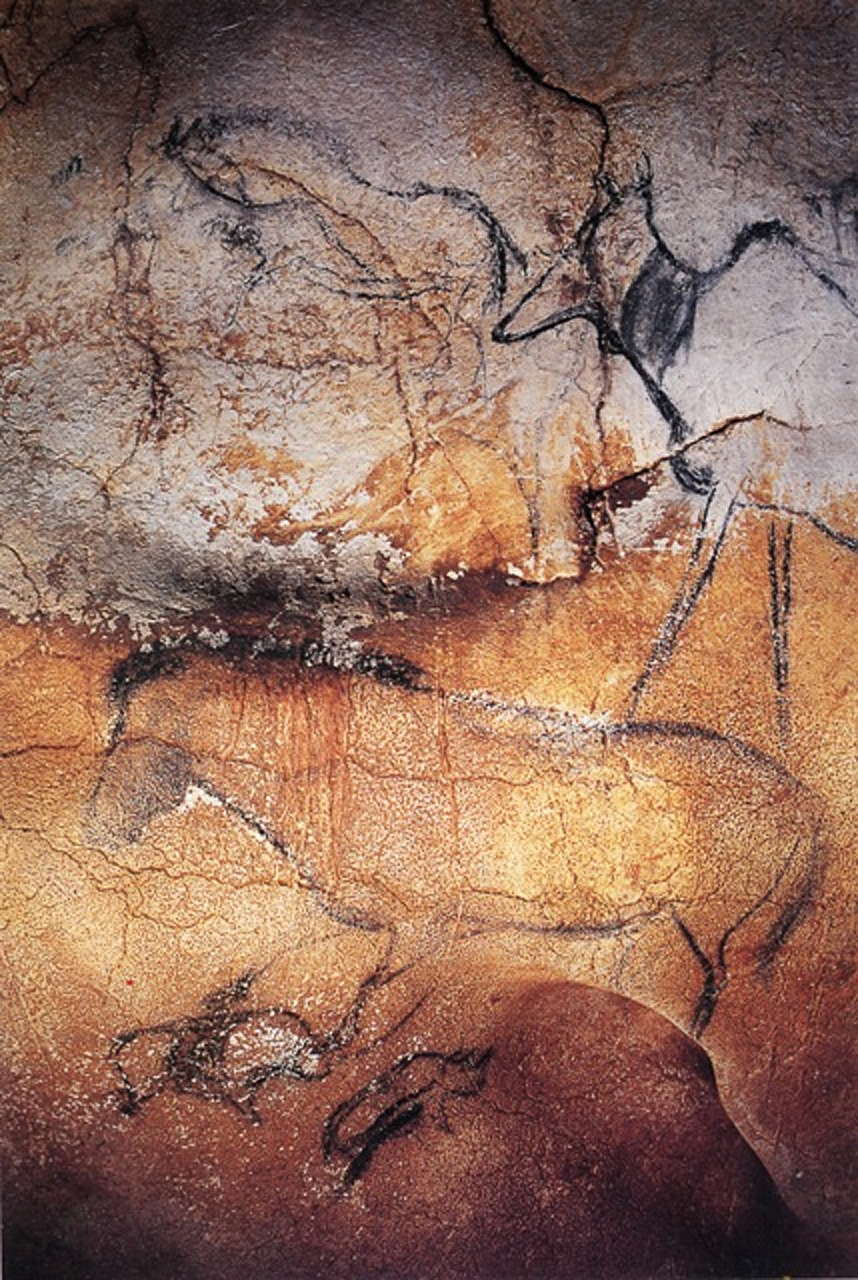
Two small rhinos, a horse and a megaloceros (also known as the Irish Elk, which died out around 7 700 years ago) with the characteristic hump, but no antlers, which have been shed. The hump contains muscles and ligaments to support the head and large antlers.
Note the black shading on the neck between the head and the hump of the megaloceros.
Photo: http://www.istmira.com/foto-i-video-pervobytnoe-obschestvo/3924-iskusstvo-predystorii-pervobytnost-2.html

The Megaloceros is shown here with quite thin legs, a black band at the neck, and with a horse painted over or under it. The beginnings of the next season's antlers appear to have been shown just appearing in this image.
There appear to be cave bear scratches on the wall to the right of this image.
Photo: http://www.istmira.com/foto-i-video-pervobytnoe-obschestvo/3924-iskusstvo-predystorii-pervobytnost-2.html
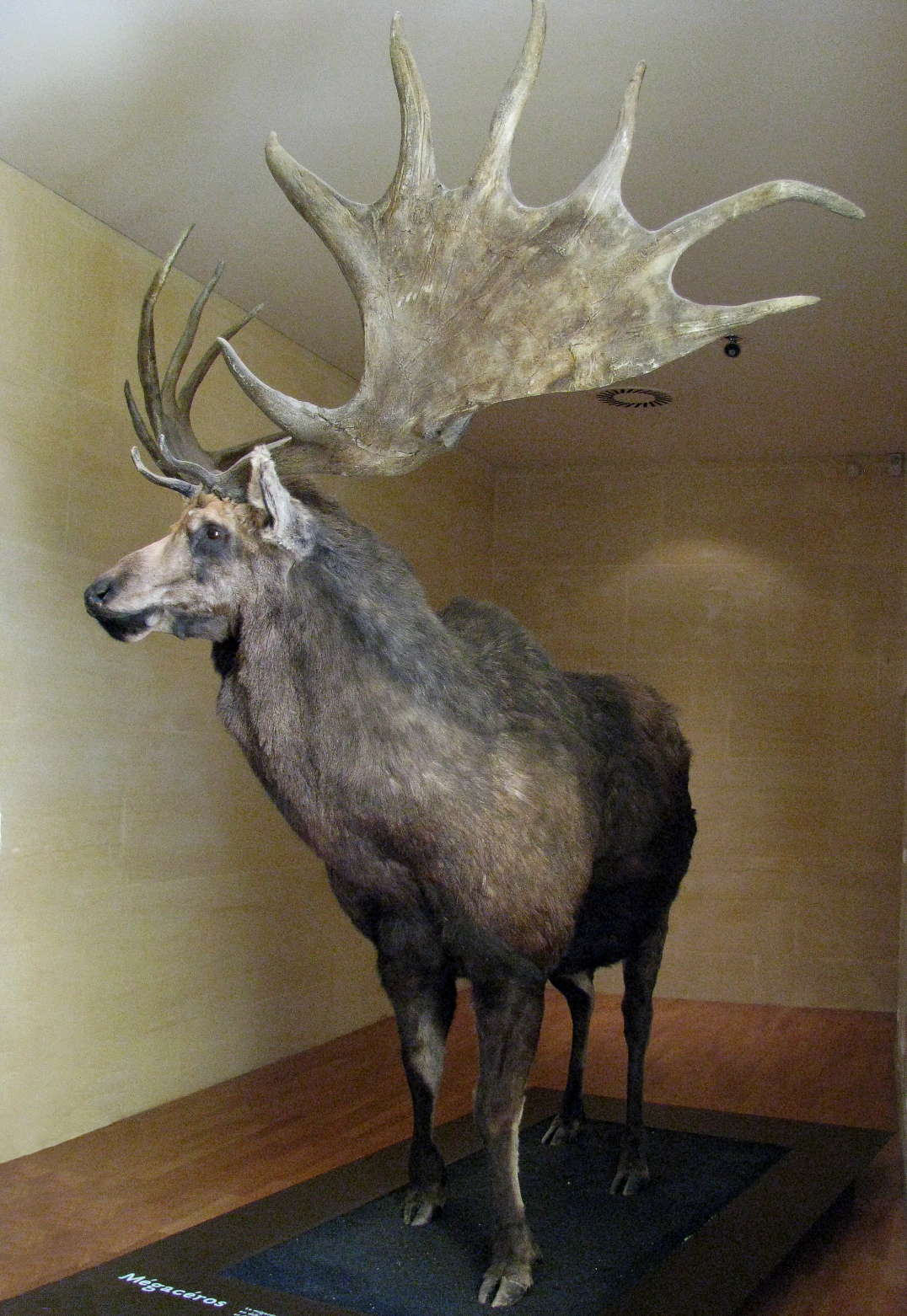
Megaloceros (Mégacéros en Français )
Note the hump on the withers of this recreation, essential for the support of the large head, neck, and antlers.
From Wikipedia:
The Irish Elk stood about 2.1 metres (6.9 ft) tall at the shoulders, and it had the largest antlers of any known cervid (a maximum of 3.65 m (12.0 ft) from tip to tip and weighing up to 40 kilograms (88 lb)). In body size, the Irish Elk matched the extant moose subspecies of Alaska (Alces alces gigas) as the largest known deer.
Photo: Don Hitchcock, 2008
Source: Display at Le Musée National de Préhistoire, Les Eyzies-de-Tayac

Megaloceros Skeleton. Note the processes on the vertebrae near the neck to provide support for the muscles and tendons which hold up the neck and head.
Photo: http://xn--c1ackcnvhn3h0a.xn--p1ai/5874#
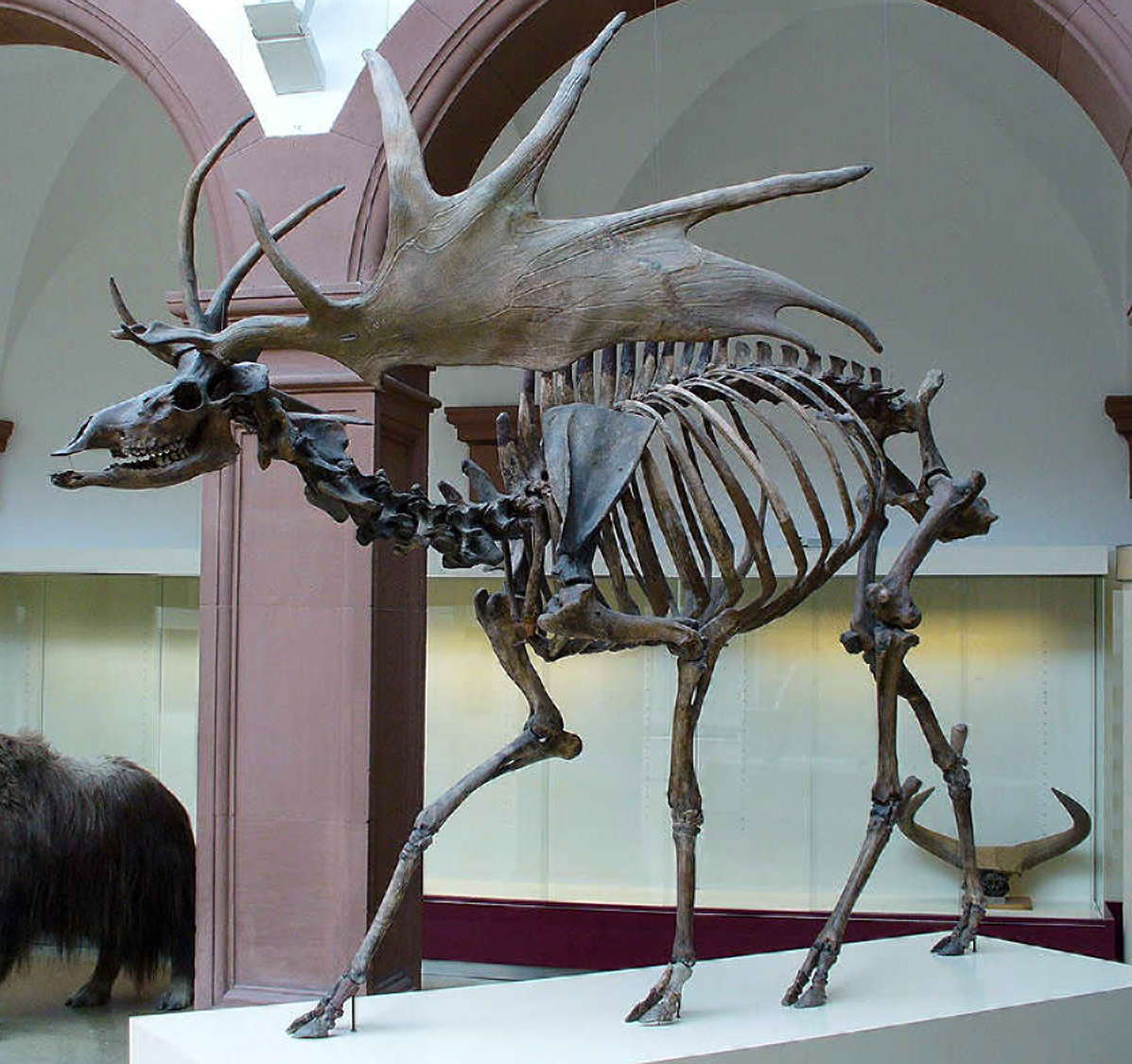
Megaloceros skeleton.
Photo: http://laignoranciadelconocimiento.blogspot.com.au/2011/12/megaloceros.html
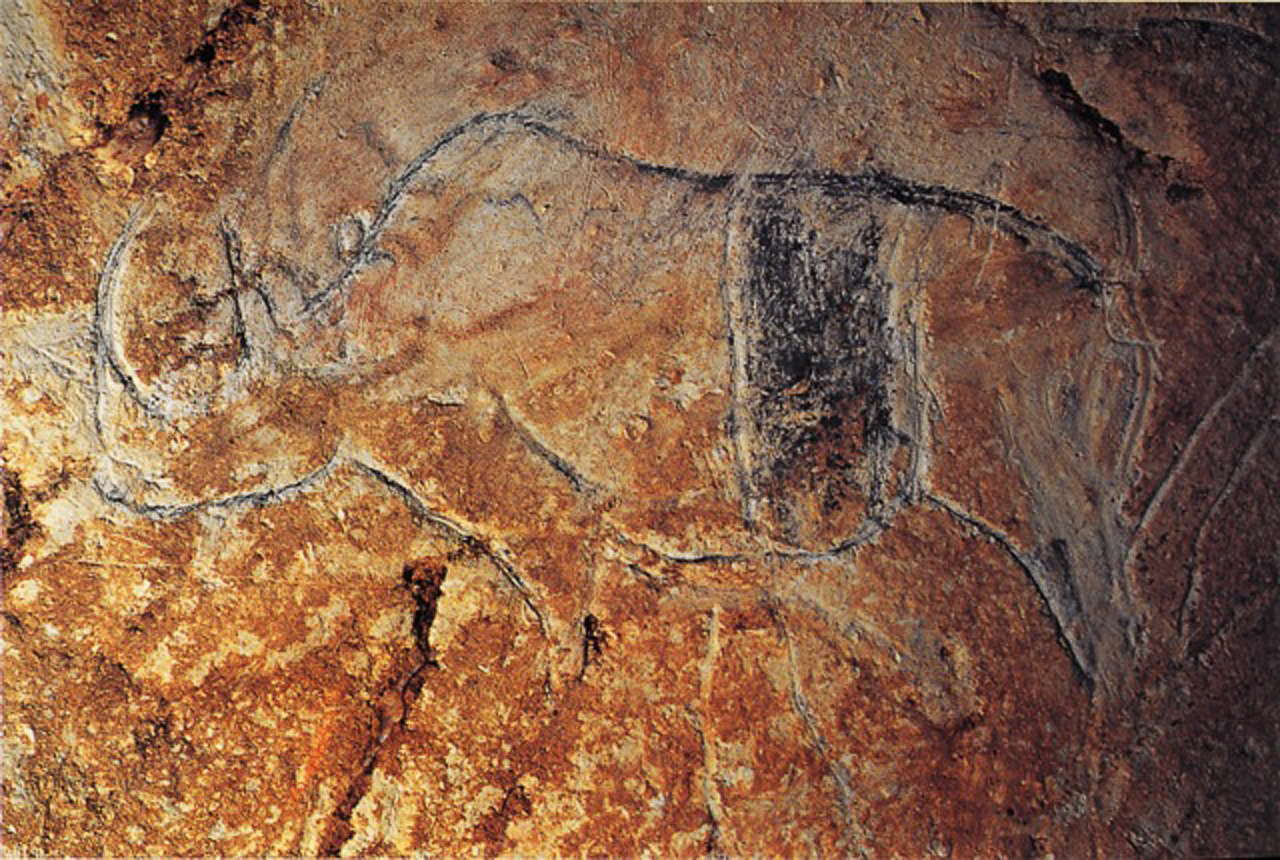
This rhinoceros is depicted with a black band around its body at the abdomen. It was drawn after obliterating another one whose horn and ears can still be discerned.
Some breeds of cattle are banded, in particular the Lakenvelder belted cattle of the Netherlands, with a white band on a generally dark body.
Photo: http://www.istmira.com/foto-i-video-pervobytnoe-obschestvo/3924-iskusstvo-predystorii-pervobytnost-2.html

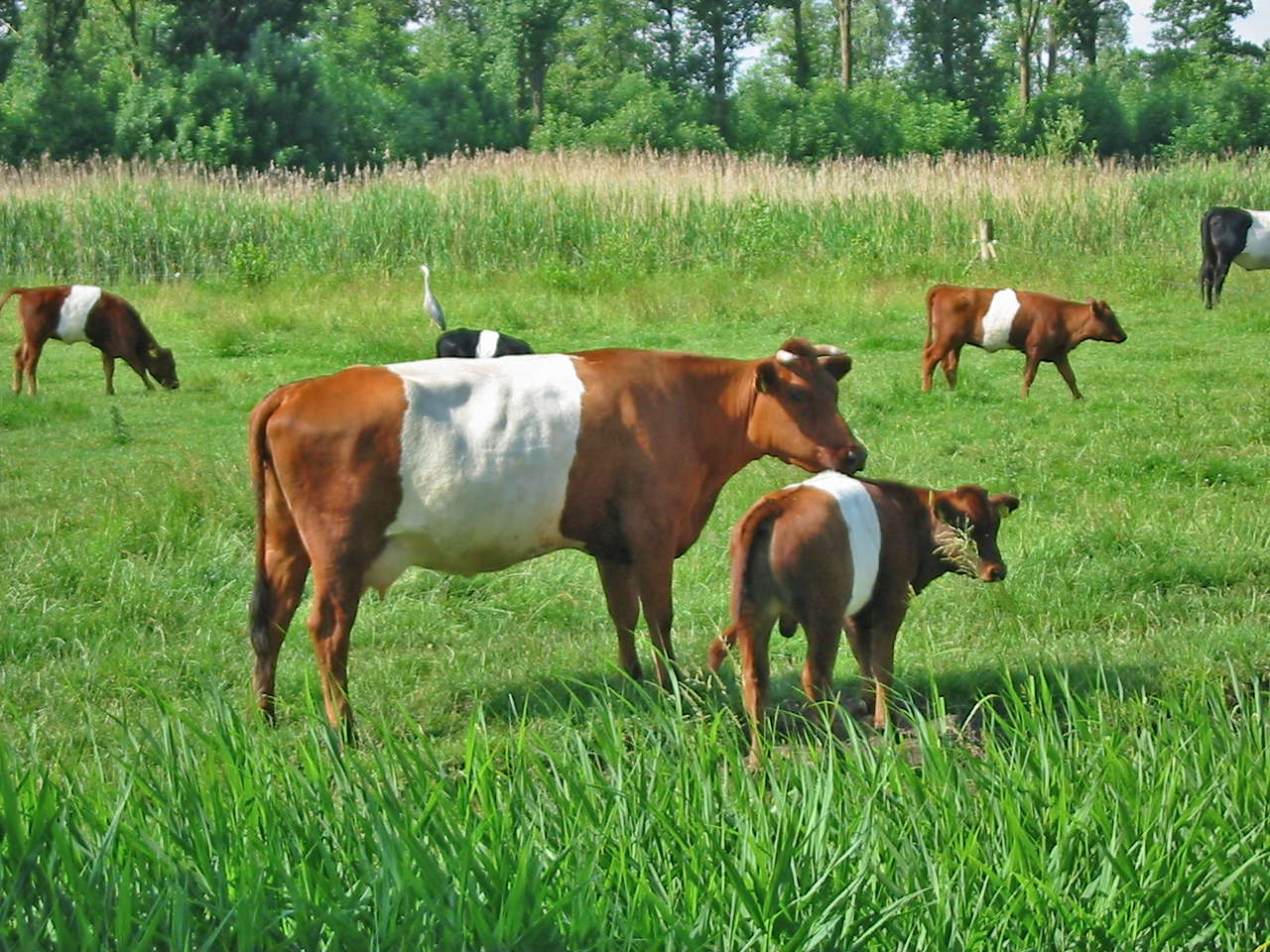
The Belted Galloway (left) is a heritage beef breed of cattle originating from Galloway in the west side of southern Scotland, adapted to living on the poor upland pastures and windswept moorlands of the region. The exact origin of the breed is unclear although it is often surmised that the white belt that distinguishes these cattle from the native black Galloway cattle may be as a result of cross breeding with Dutch Lakenvelder belted cattle (right).
Photo (left): Amanda Slater from Coventry, England
Permission: licensed under the Creative Commons Attribution-Share Alike 2.0 Generic license
Photo (right): Lex vB
Permission: Public Domain
Text: Wikipedia
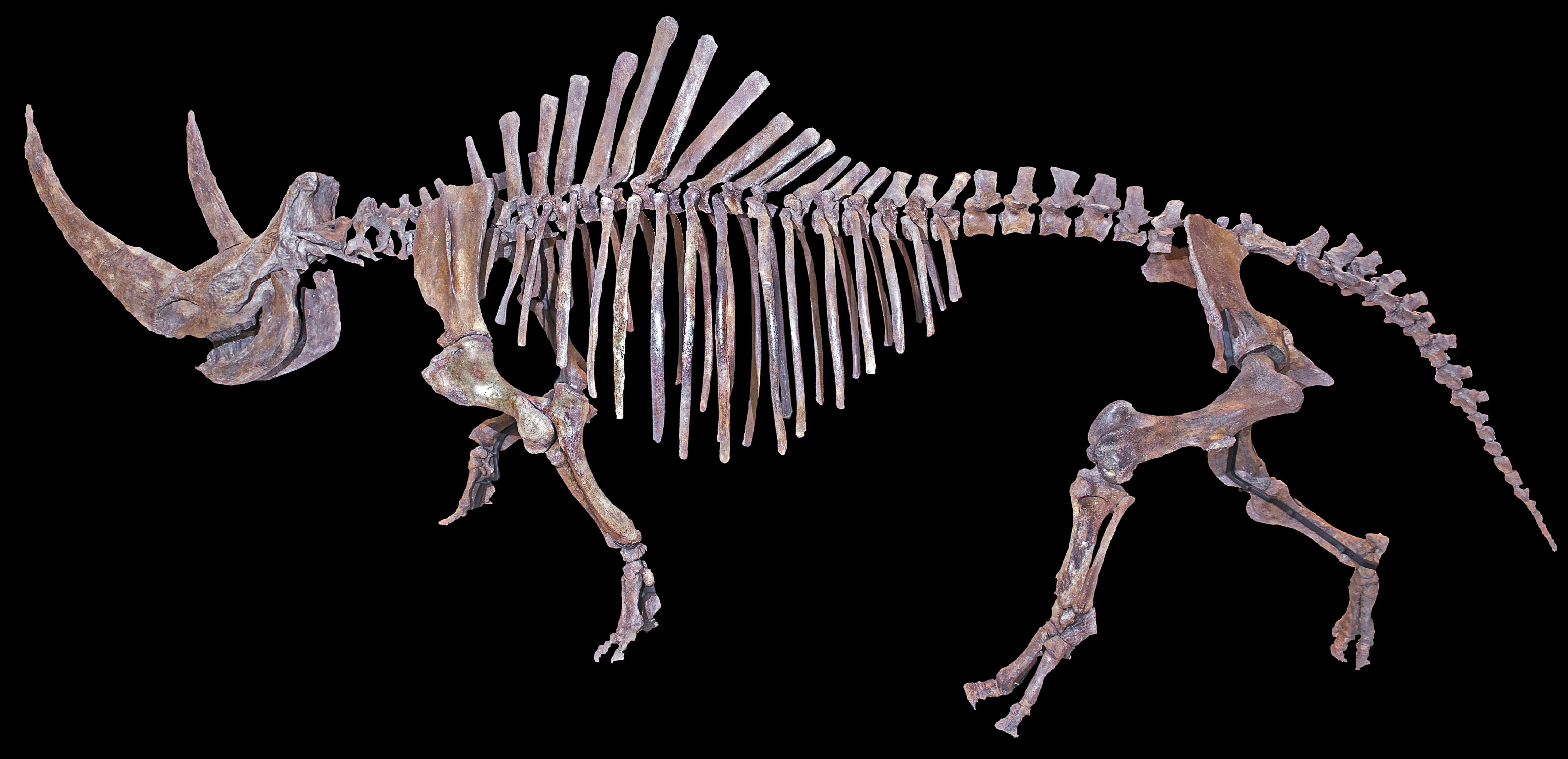
Coelodonta antiquitatis from the Yamalo-Nenetsky region, Siberia, Russia, 400 x 175 cm.
A superb Wooly Rhinoceros skeleton, superbly photographed as always by Didier Descouens.
Photo: Didier Descouens
Source: Museum of Toulouse
Permission: licensed under the Creative Commons Attribution-Share Alike 3.0 Unported license
The End Chamber - Salle du Fond
The End Chamber is possibly the most impressive of all, notable especially for the cave lions and rhinos.
Photo: http://www.ancient-wisdom.co.uk/francechauvet.htm
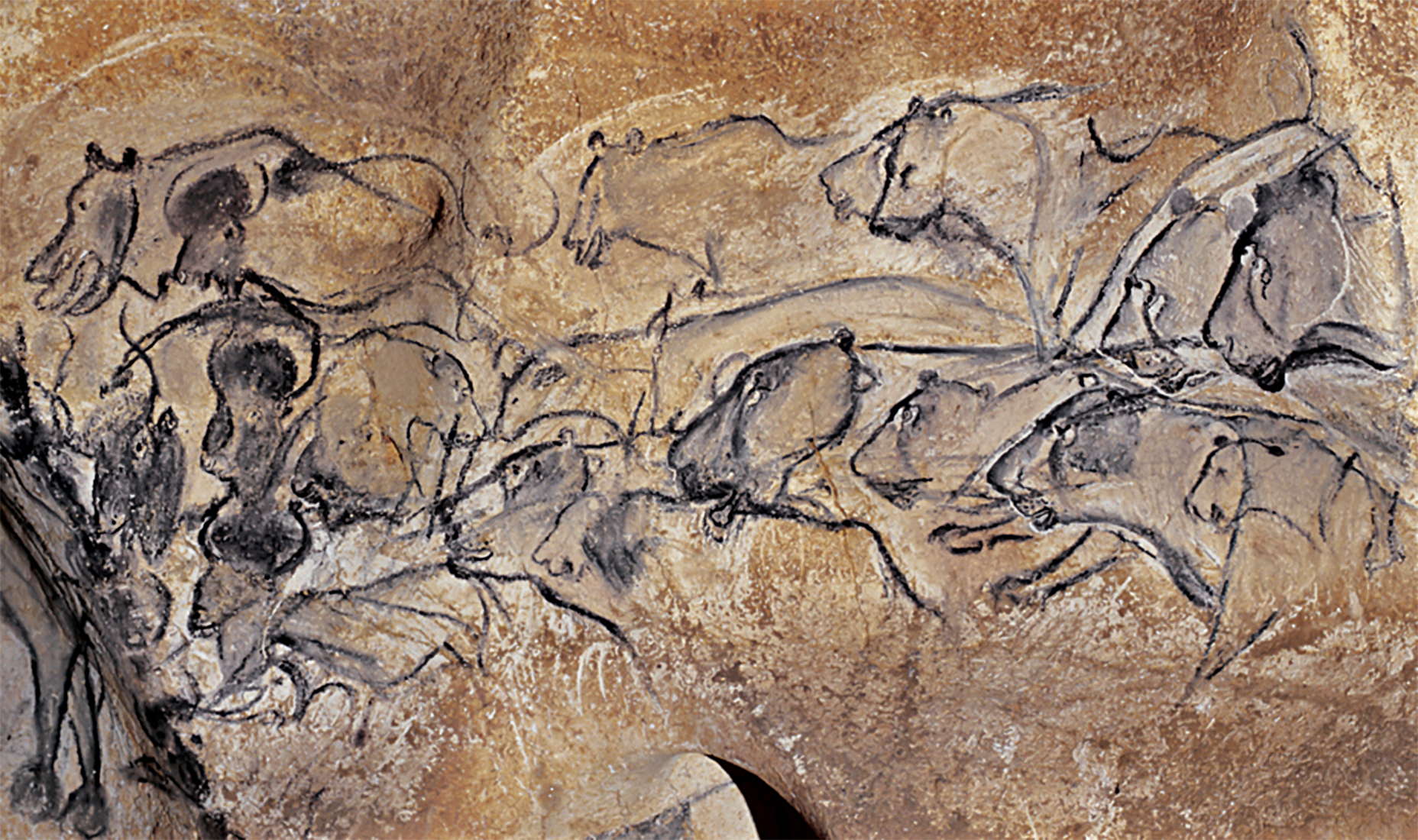
This is one of the most well known images from Chauvet Cave. It is known as the Panel of the Big Lions, and is remarkable for the superb draughtsmanship and artistry of the depiction of the cave lions. The lions appear to be stretching out, hunting the bison on the left of the panel. This is a masterpiece.
Photo: http://uk.phaidon.com/agenda/art/picture-galleries/2011/march/10/inside-the-cave-of-forgotten-dreams/
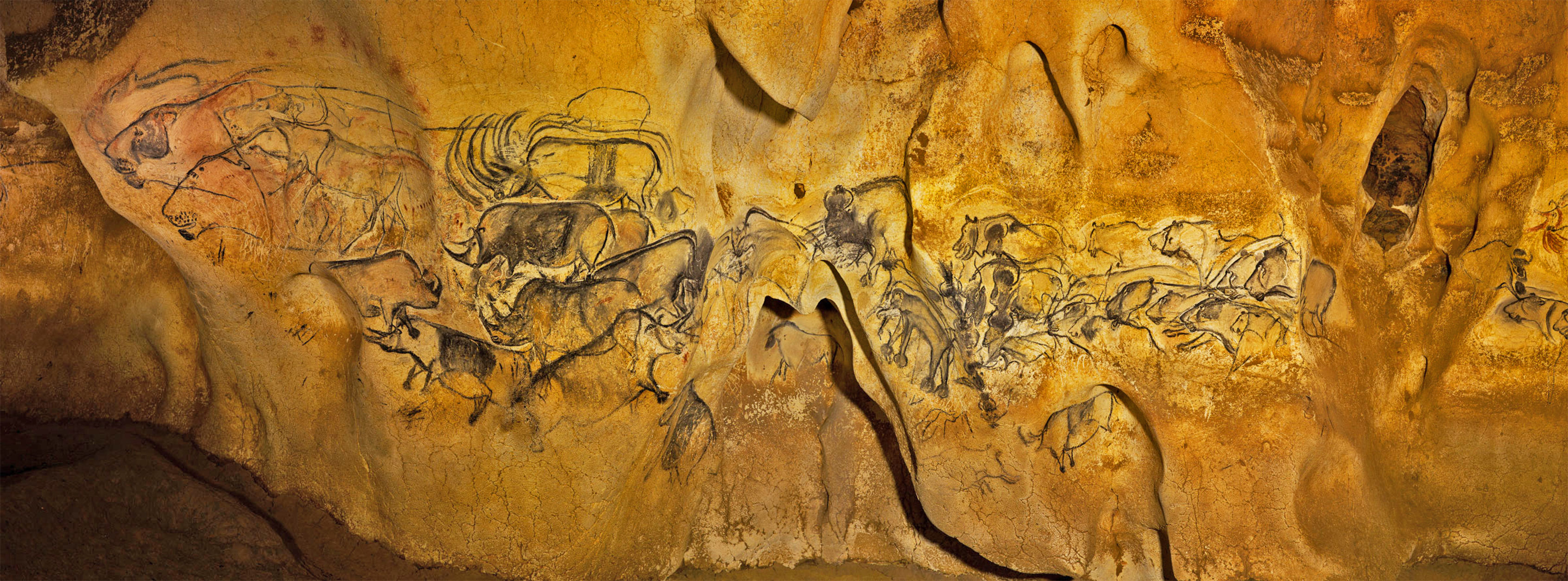
Another view of the panel of art in the End Chamber.
Photo: Stephen Alvarez © National Geographic
Source: http://proof.nationalgeographic.com/2015/01/05/shooting-chauvet-photographing-the-worlds-oldest-cave-art/
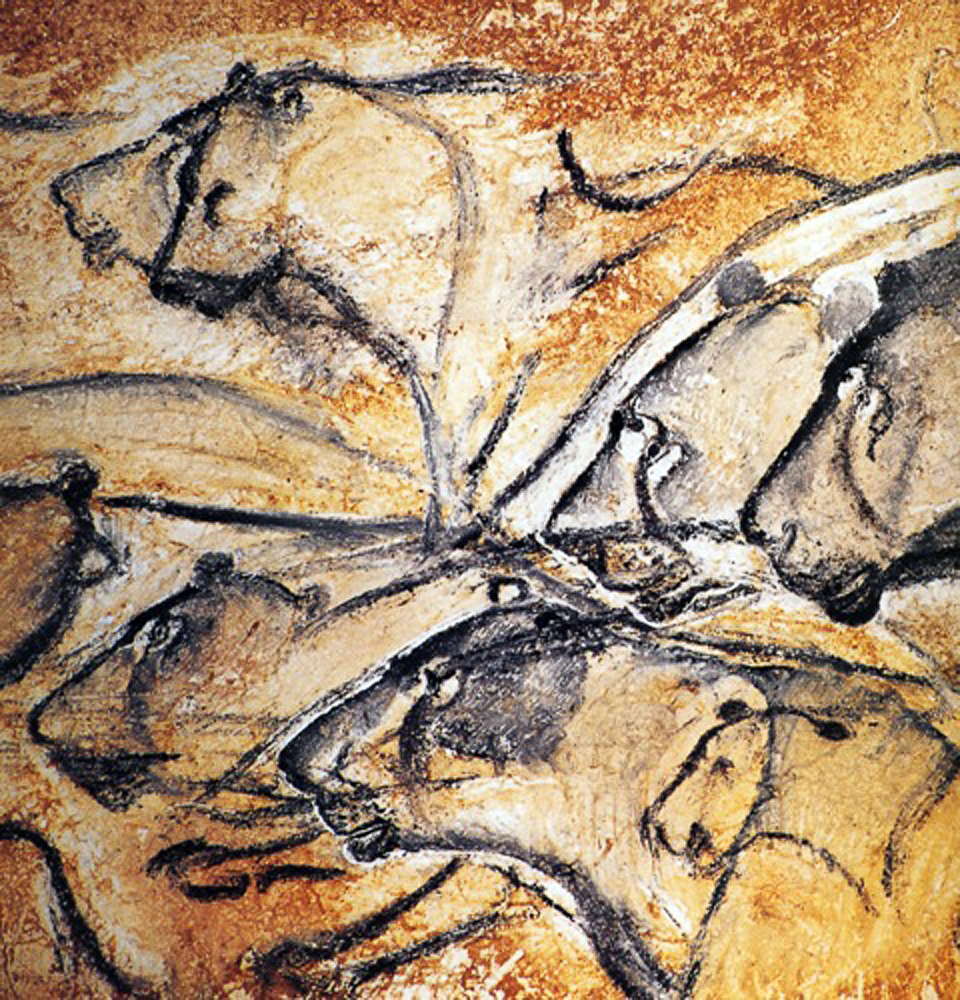

Cave lions on the right of the large panel.
Photo (left): http://www.istmira.com/foto-i-video-pervobytnoe-obschestvo/3924-iskusstvo-predystorii-pervobytnost-2.html
Photo (right): HTO, Public Domain
Source (right): Facsimile, Brno Museum Anthropos

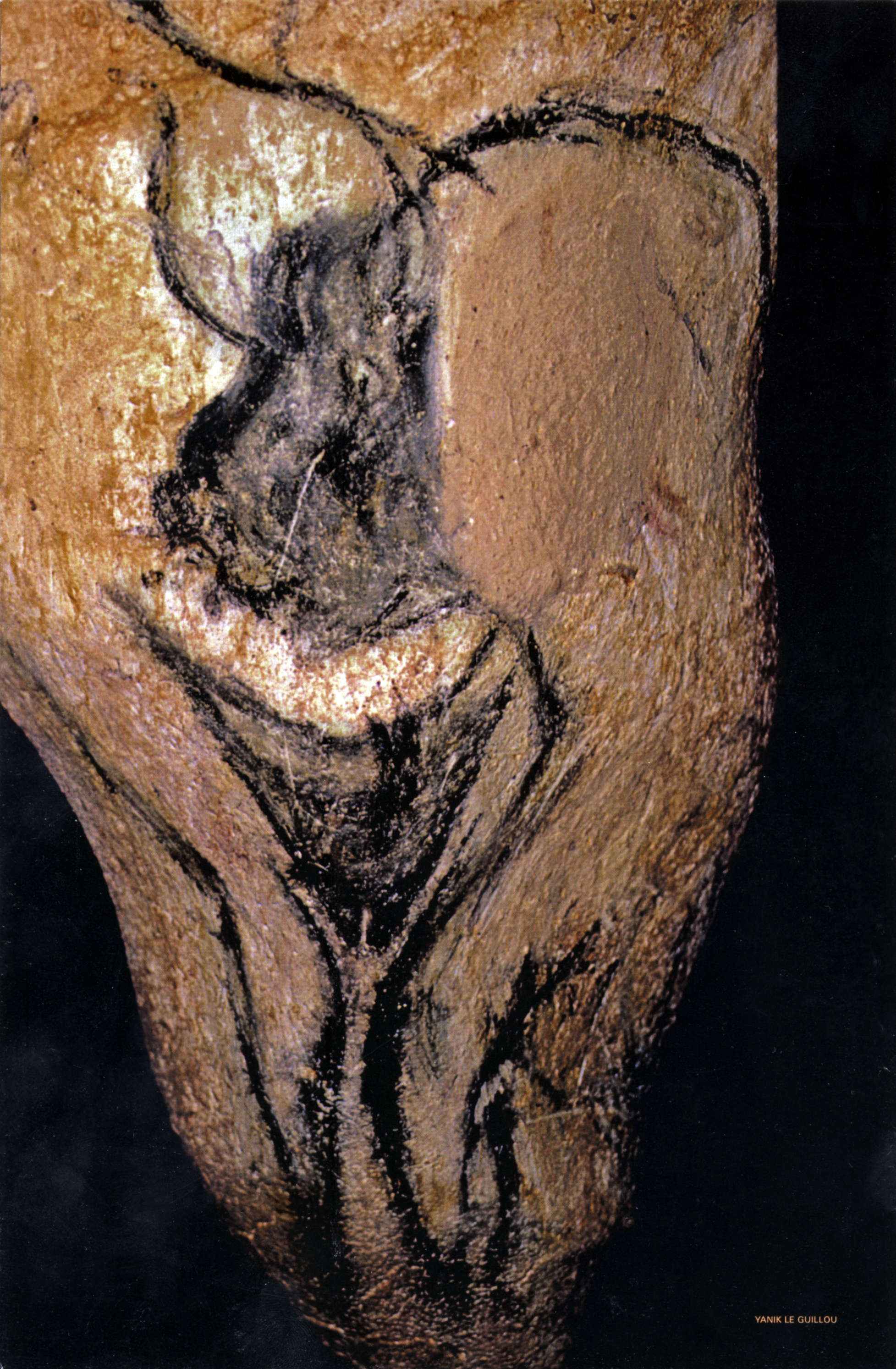
This is a conical pendant from the roof of the cave, and consists of a bison and an exaggerated depiction of a pubic triangle and a vulva, with rudimentary legs ending in points rather than feet. The rock pendant is seen by some as penis like. It is also the only representation of a human in the cave, apart from some depictions of pubic triangles and vulvas.
The whole ensemble is sometimes known as the sorcerer. Although not visible here, the bison is reported to include a human hand on its lower body.
The level of CO2 is toxic in this area, in which the group of lions is also situated. The CO2 comes from the roots of plants growing down from outside, and scientists can not spend much time here because of the levels of CO2.
The narrow alloy path stops here, and it is not possible to go further, since there are too many fragile things on the ground, including tracks by bears and humans. Though not visible from the path, it has been discovered that there is a musk ox on the other side of the pendant using other equipment, a camera on a long pole.
From the Bulletin (an Australian weekly magazine) May 25 1999 Insert from Newsweek. pp100-102
By Sharon Begley
Standing before the hanging rock deep inside the damp cave, archeologist Yanik Le Guillou had a brainstorm: he would mount the digital camera on a 10-foot-long pole, manoeuvre it around and past the rock, turn the whole contraption just so, and ... snap! capture on film whatever was hidden on the wall behind. On the first try, the scientists cut off the head of what looked like a painting of a bison. On the second try they cut off its feet. Finally they captured the whole animal-it was now looking more like a musk ox or a rhinoceros without horns -and the next day bagged even bigger quarry: painted next to the beast were a lion and a mammoth, powerful animals that are almost as rare in Palaeolithic cave art as they are on the streets of Paris.
There are only two or three boxes of artefacts left by humans, such as pieces of flint, that have been found in the cave.
Photos: © Yanik Le Guillou
Photo: (Left) Chauvet Cave by Jean Clottes, translated by Paul G. Bahn. This book should be on every art lover's bookshelf. The photographs are sumptuous, and the text very informative.
Photo: (Right) National Geographic, August 2001
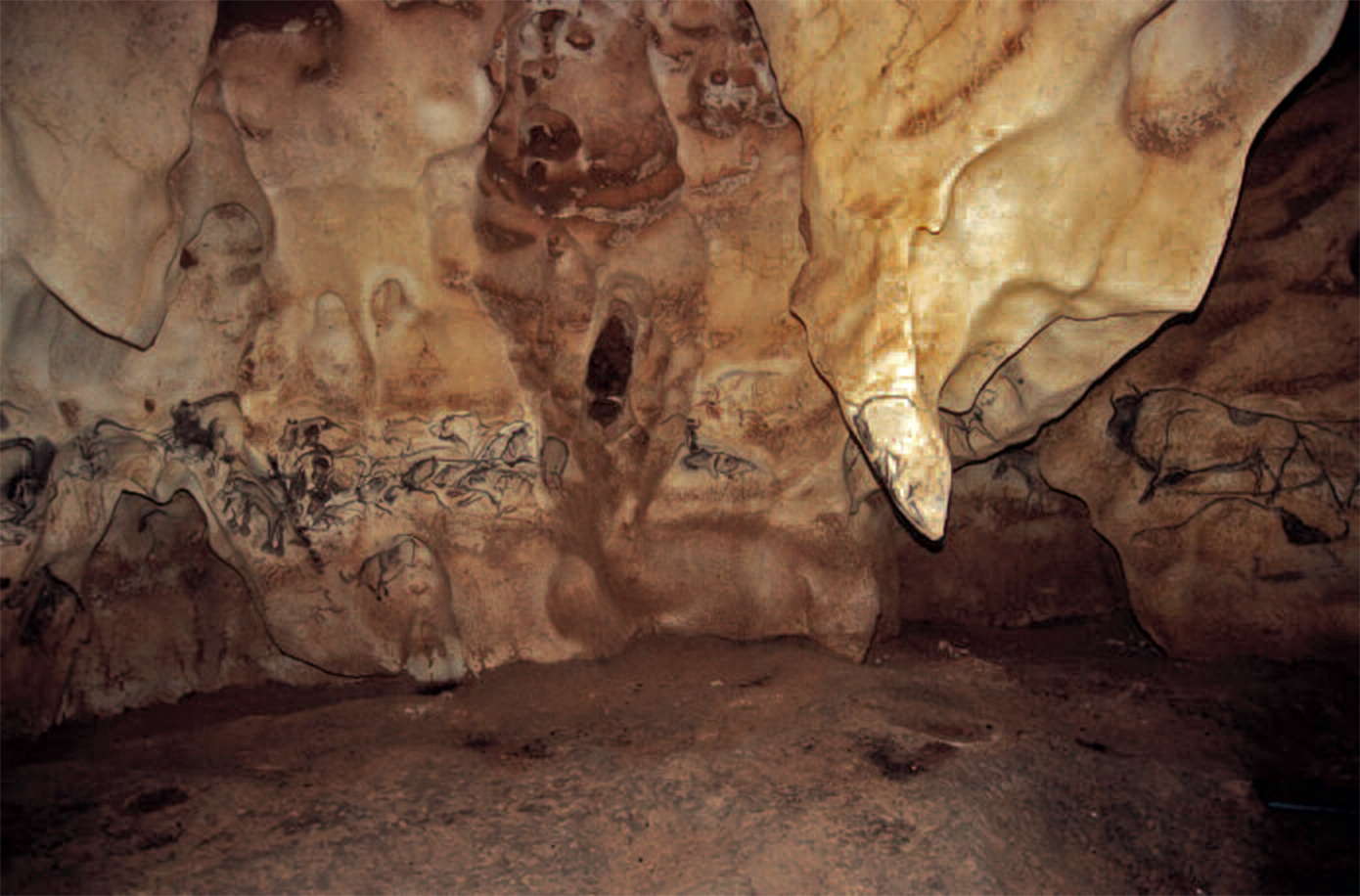
View of the pendant and the decorated wall in the End Chamber.
Photo: © Yanik Le Guillou
Source: Le Guillou (2008)
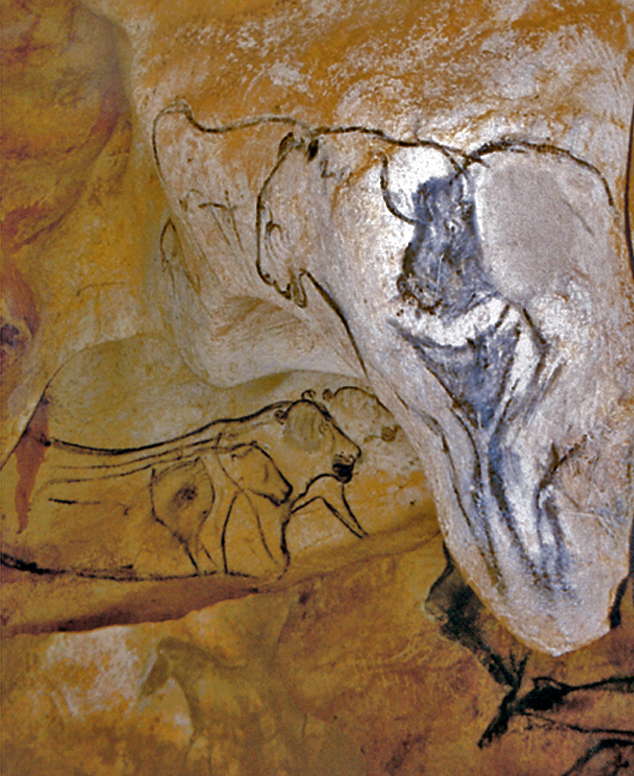
This is a very useful image of the Sorcerer Pendant, since it shows the lion and the mammoth on the pendant which are ordinarily hidden, as well as the lions on the wall behind, with the large aurochs of the End Chamber just visible to the right of the lions.
Photo: http://uk.phaidon.com/agenda/art/picture-galleries/2011/march/10/inside-the-cave-of-forgotten-dreams/
The Mammoths on the pendant
Le Guillou (2008)
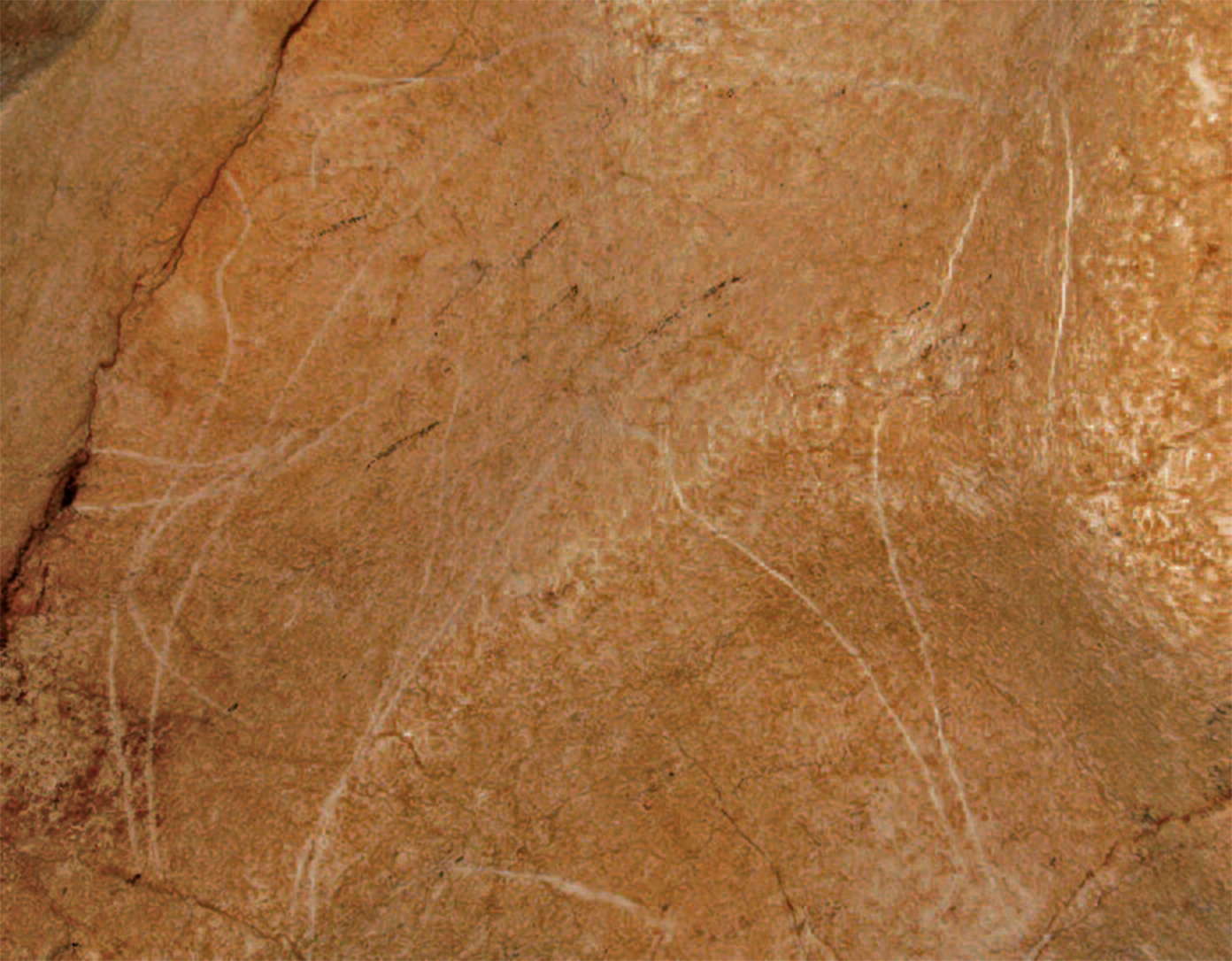
The mammoth(s) engraved at the top of the north face of the pendant. Note the black lines. This face of the pendant is opposite to the direction of entry to the gallery. There are probably two mammoths depicted.
On the upper surface of a dihedral angle whose edge is horizontal, Gély et Azéma (2005b) have identified two mammoths delineated by a single cervico-dorsal line.
They give this description:
Mammoth 73: The engraving is 230 cm above the floor, in left profile, head down, in order to fit onto the space available. It is limited to the cervico dorsal line, about 70 cm x 20 cm, head conical, withers and neck hardly shown. This engraving is similar to the next.
Mammoth 74: This mammoth, which overlaps the previous one, is 210 cm above the floor. Finely engraved, it is difficult to see this left profile, about 00 cm x 00 cm, tilted forward, exploiting the defects of a cracked concavity, one edge of which evokes the head.
The rounded neck and lower back are in depressions. The withers (the bony ridge between the shoulder blades) on a protruberance is higher than the head which hangs down. The chignon, or bun on top of the head typical of wooly mammoths, is shown by a line. The orbit, the bony protuberance above the eye is exaggerated. The lip is hanging down, and the cheek is pronounced.
The tusks are short and twisted, on both sides of the trunk. The trunk is curved, hangs down, and is not closed, but left open. It reaches as far as a crack, as do the tusks. The tail is long and drooping.
The short ventral line is straight. The hind limb, indicating the fold of the stifle or knee is made on the back of a depression, which gives it a certain dynamism. At the buttocks, a distinct inflection marks the scrotum.
The elevation above the floor to the bottom of these drawings, over two metres, makes them difficult to decipher. It was not possible to identify the directions in which the lines were engraved. The groove is close to the form of a U or a V. The lines are uniform, and the width and depth of the incisions are regular, approximately 3 mm wide and 2 mm deep, which is unusually deep in the Chauvet Cave.
The tool used was hard. The rock was engraved below the superficial and soft surface film. The drawing was done at a distance from the surface, perhaps with the aid of a tool fitted onto a stick. Wood is too soft to have made these marks, and would not have such a uniform width and depth. This regularity is maintained despite changes in orientation and breaks in the continuity of the lines. The end of the tool could be cylindrical, slightly pointed. Flint points do not create this type of line. The tool used could be shaped bone, ivory or antler, such as a spear point.
For the artist, drawing the most complete mammoth was not easy. The options for drawing chosen were complex. For example, a single line includes the lower tusk, the mouth, the arch of the neck and the front of the foreleg. The line is often jerky. Probably because of the height and distance, it was difficult to guarantee any consistency or firmness of pressure of the tool. At the top of the head, he had hit a crack and could no longer exercise, for about a dozen centimetres, sufficient pressure to mark the wall.
Probably because of the height and distance, it was difficult to guarantee the consistency and firmness of the pressure of the tool. At the top of the head, he had hit a crack and no longer exercise, about ten inches long, enough depression to mark the wall.
The line, traced from top to bottom, indicating the back of the hind leg was overlaid on the lower part, by another line permitting the encapsulation of the shape of the foot. The line seeming to trace the top of the head a second time may be a retracing.
Regardless, I was not convinced that it was just a second line, and read it instead as being the cervical-dorsal line of a second mammoth. Despite a topographical situation that tended to integrate these figures on the pendant, two characteristics separate them.
In the first place, They are the only traces inscribed in the upper area, truly dissociated from all the other figures. Furthermore, these two graphical entities have been created by a fine and deep incision which was not utilised on any of the other lines present on the pendant. Nevertheless, these engravings, in their style, theme, and situation, should be linked with at least two other mammoths engraved in the End Chamber.
Black lines on the mammoths
At the height of the body of the mammoth, or about that, a dozen short black lines have been drawn. They are all similar, mostly horizontal, drawn from right to left by the end of a long burnt stick. The lines are not confined to the inside of the animal, so that they cannot be a simplified representation of the coat. Their repetitive characteristic and their location only at this place means that they cannot be accidental.
Photo: © F. Maksud
Text and source: Le Guillou (2008)
Translation: Don Hitchcock
The Horse on the Pendant
Le Guillou (2008)
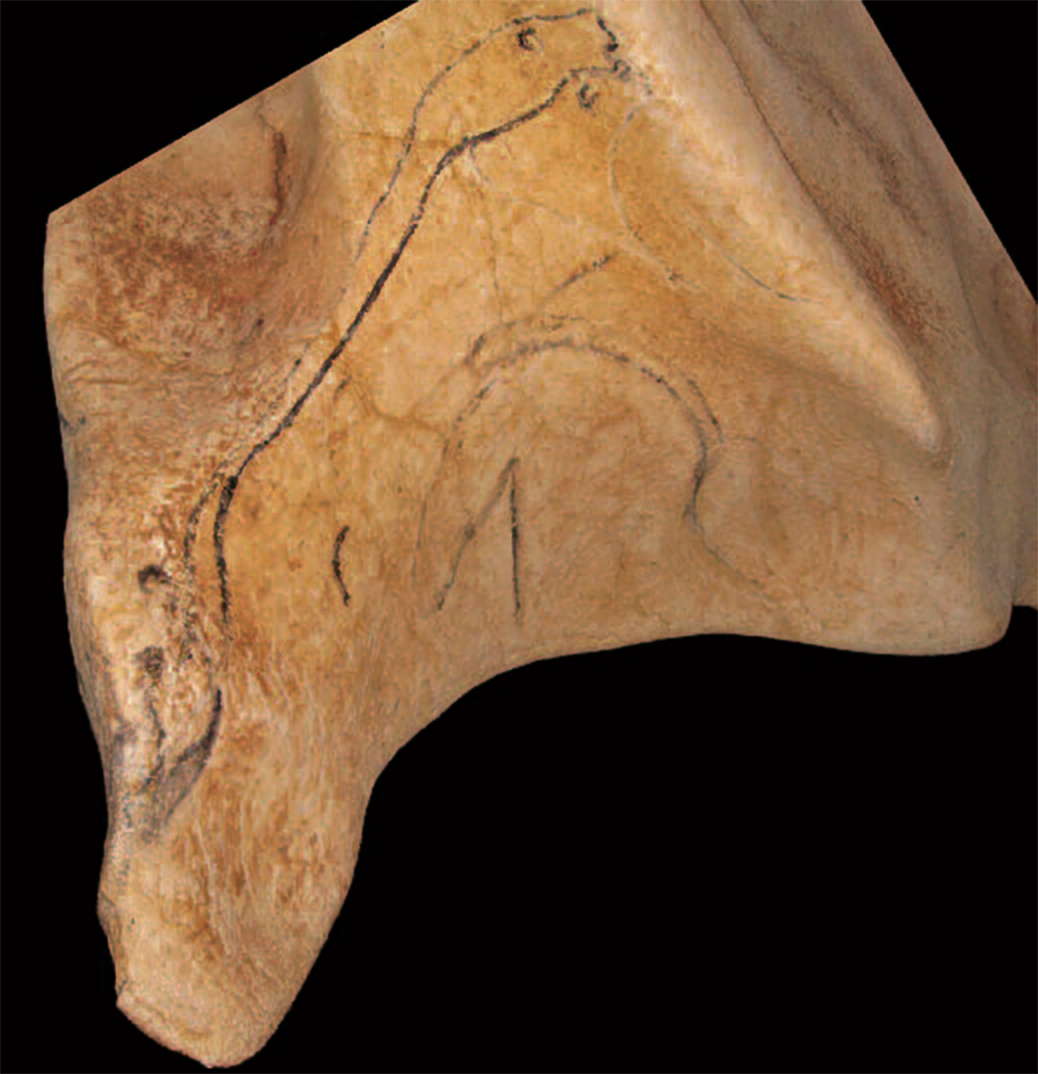

Two feline profiles and a horse located in the concavities of the north face of the Pendant.
The first truly graphic representation on the Pendant is a naturalistic horse traced in black, restricted to the head and neck. The left profile is shown. The eye is indicated by a simple short black line. The head, quite finely drawn, is of elongated shape and is in like proportion to most of the horses in the cave. As with the other horses in the cave, the mane is well marked, thick, and carried forward over the forehead. The thickness of the mane is indicated by a double line.
The main line, which extends from the neck to the start of the line of the back, is drawn from left to right. It starts on the top of the head, with at first a zigzag pattern. The line forming the head shows the shape of the nose, the mouth, and the cheek, and is enhanced by embellishments and perhaps some light redrawing of the shape.
In several places on the drawing, purposeful rubbing has affected the line. These seem to have been made by the finger. They are precise, almost neat. I do not know if these actions are intended to lessen the intensity of the black pigment, to thicken the line, or to create some sort of a gradient from black to grey. This technique is used especially on the zigzag section of the mane, where each projection is thus treated.
Inside the head and body of the animal, several traces of rubbing fingers can be seen. There are at least four groups. They are made from top to bottom, each time in a single step, by the passage of one hand, the right hand probably. The horse is situated in a depression and follows its contours. The end of the lines terminate on the lower edge of the pendant. The design is about 60 cm wide and a little more high. This is the largest horse head in Chauvet Cave.
Photo: © F. Maksud
Drawing: © Y. Le Guillou
Text and source: Le Guillou (2008)
Translation: Don Hitchcock
Two Felines
Le Guillou (2008)
Two feline profiles and a horse located in the concavities of the north face of the Pendant.
Clottes et Azéma (2005) compiled an inventory which included two cats in contact with the horse detailed above:
Feline #64: On the side of the pendant, facing the large black bison, that is to say opposite the 'Sorcerer', at 10 cm below the foreleg of a mammoth, engraved at about 140 cm from the floor, a black feline turned to the right was summarily sketched obliquely over another feline, similarly oriented. All that is shown is the head, with an open mouth, the muzzle and a round eye, and the line of the back which follows the curve of the rock, length 110 cm.
Feline # 65: The other cat has a dorsal line identical and parallel to the previous one, except that the relief of the scapula is marked.
It has therefore an oblique position, head turned upwards. It has a tail terminated by a brush. It has more detail than # 64: the forequarters are shown with a curved ear and undulating shoulder line, extended to form the inside of the front leg, the other side is embodied by an extension of the chest.
Made with the end of a torch, this animal thus is engraved, especially at the front, with black marks.The line of the belly is eroded. It is placed 110 cm from the floor, length 120 cm, height 40 cm.
Photo: © F. Maksud
Text and source: Le Guillou (2008), Clottes et Azéma (2005)
Translation: Don Hitchcock
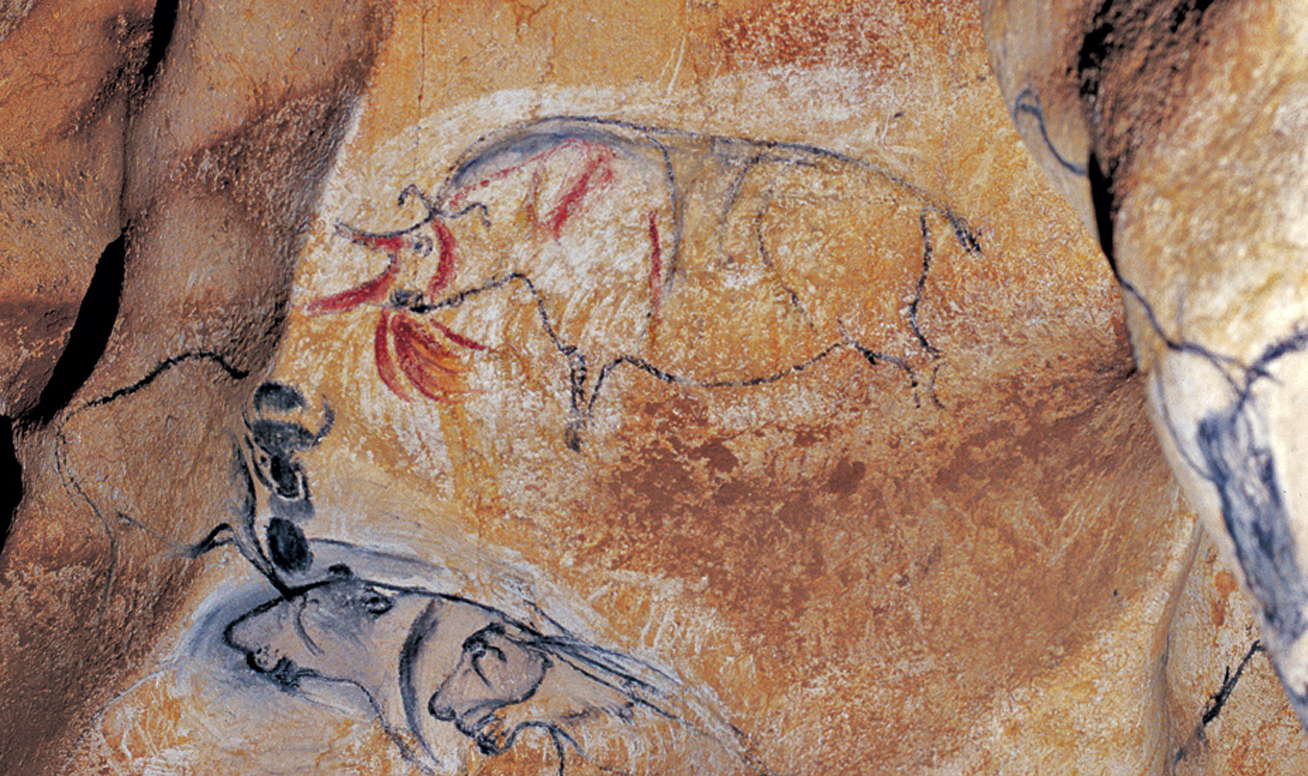
A rhinoceros, apparently bleeding after being hunted, to the left of the conical pendant, and above a painting of two cave lions.
The photo was taken from a viewpoint to the right of the image above.
Photo: http://uk.phaidon.com/agenda/art/picture-galleries/2011/march/10/inside-the-cave-of-forgotten-dreams/
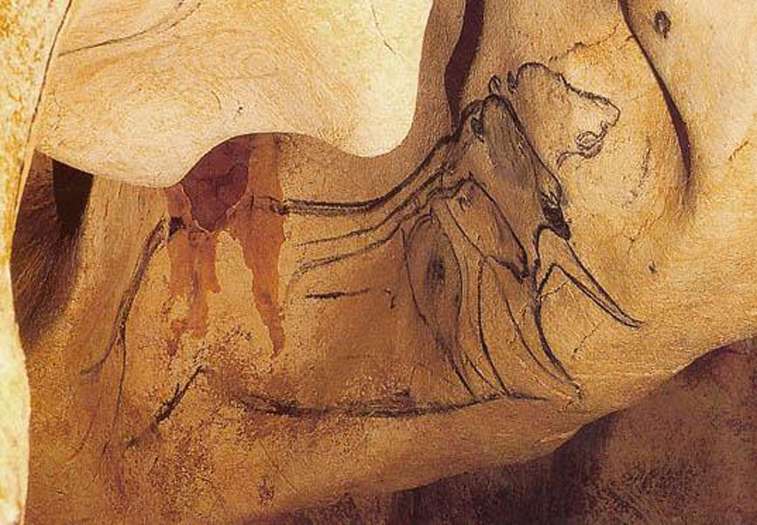
This group of strange lions is in the end chamber.
Prehistoric painters had been thought to mostly paint non threatening animals, not predators like these cave lions.
It was like peering into the inner sanctum of an art gallery where the dealer kept the best works for his best customers. And although the Grotte Chauvet, in southeast France, was no gathering spot for Stone Agers drinking white wine and nibbling canapes, it came close: for thousands of years, archeologists now think, people returned to the grotto again and again on what seems to have been a spiritual pilgrimage.
Photo and text: Time Magazine 13th Feb 1995
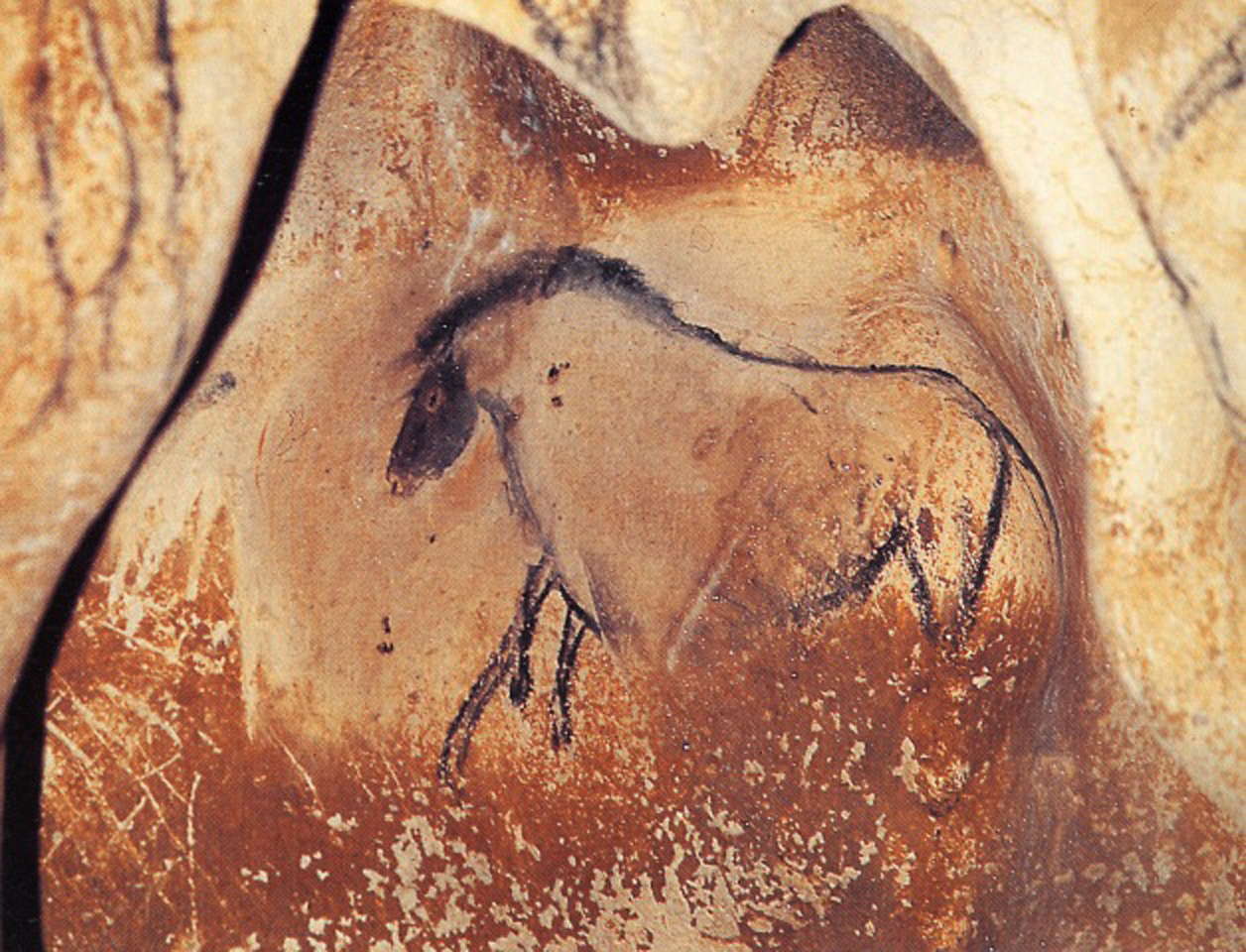
This is an exquisitely realised horse, at the centre of the Big Panel of the End Chamber, at the back of a niche.
The smudging, whether by accident or design, of the head and mane towards the front of the horse lends an ethereal quality to the image.
Note also that in this portrait, the artist has consciously decided to give the horse a dark head. Obviously there were differences even at that time in the markings of individual horses.
Photo: http://www.istmira.com/foto-i-video-pervobytnoe-obschestvo/3924-iskusstvo-predystorii-pervobytnost-2.html
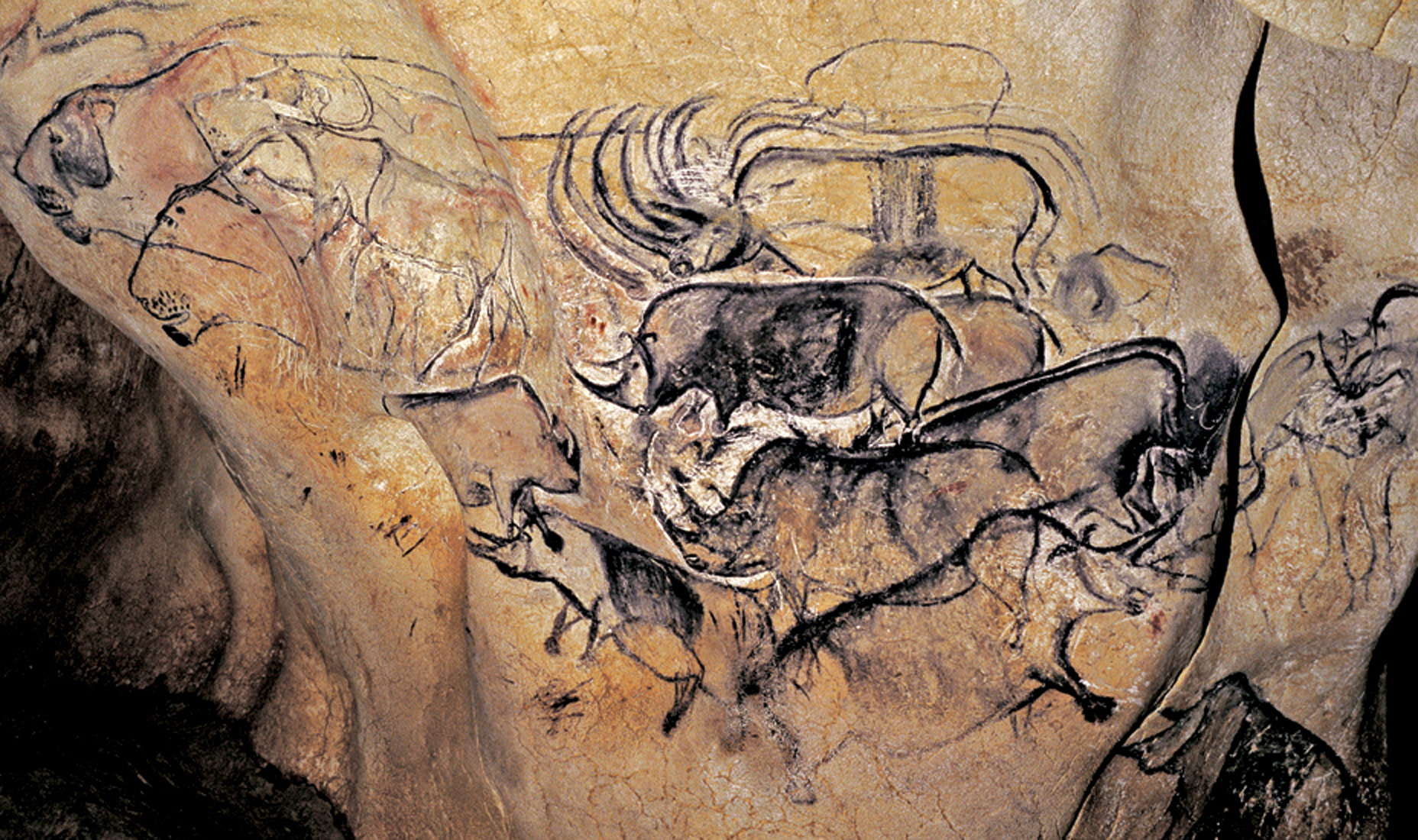
Rhinos in the end chamber. These are to the left of the large footed baby mammoth and the large Bison, and the Panel of the Big Lions.
Photo: http://uk.phaidon.com/agenda/art/picture-galleries/2011/march/10/inside-the-cave-of-forgotten-dreams/
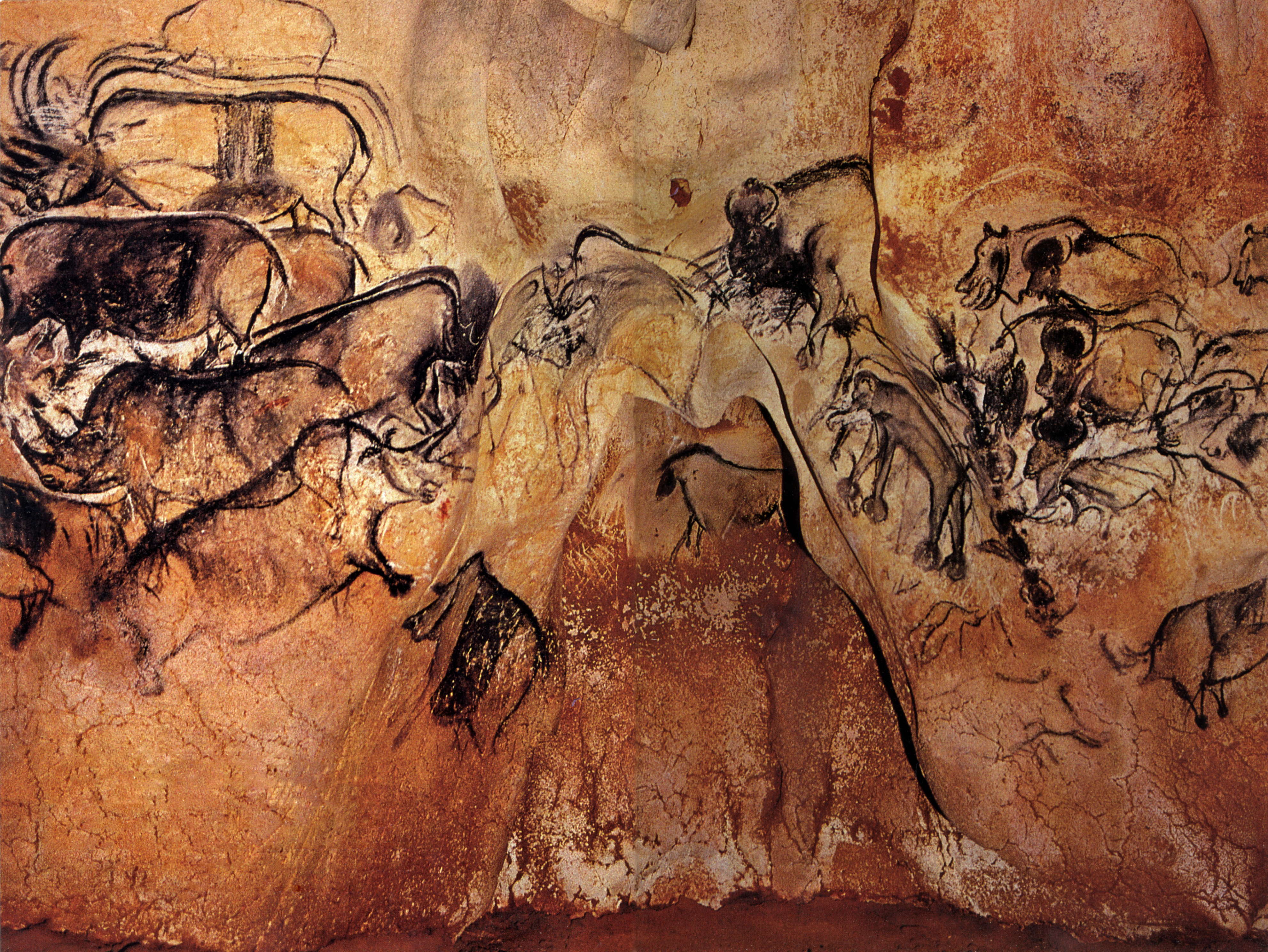
A stampede in charcoal undulates across the End Chamber's Panel of Lions and Rhinos. In the middle, the wall of a low recess was scraped smooth for painting and a black-faced horse was drawn off centre, as if walking out of the rock itself. In dim torchlight, such creatures would have materialised suddenly from the darkness - underworld spirits magically answering the artist's call.
Photo and text: © Jean Clottes, National Geographic August 2001
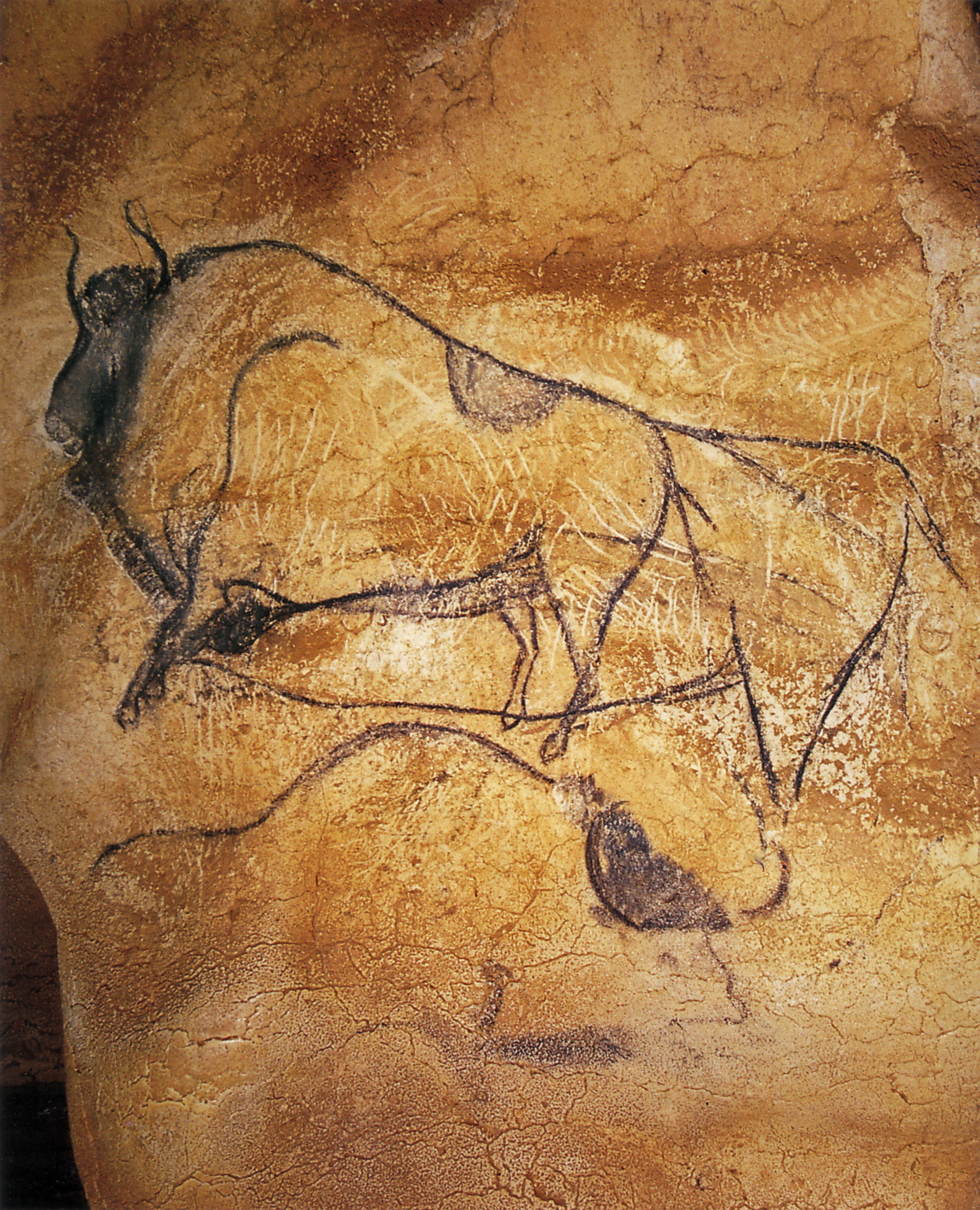
Large Bison in the End Chamber.
Photo: Clottes (2003)
In one of the areas where access is not permitted, there is the footprint of an eight year old boy next to the pawprint of a wolf. It is not known if they were made at the same time, or separated by thousands of years.
(information above from the video, Cave of Forgotten Dreams)
The Sacristy and Access Corridor
The Sacristy is at the very end of Chauvet Cave, reached via the Access Corridor from the End Chamber.
The Access Corridor or passage is actually a gallery that runs parallel to the End Chamber, separated from it by a large rocky overhang sealed to the floor by clay infilling. Four metres further along, it opens onto the Sacristy - the floor continues level, and it is possible to walk upright the whole way. The floors of the two galleries are clay and, with the exception of an axial channel that acted as a drain, one can see prints of bears, ibexes and wolves. Charcoal and bones litter the ground. The activity of bears seems to have been intense, judging by the traces left on the walls and the displaced bones. Humans have also left their imprint on the walls with torch marks and traces of fingers, which are either marks of support or perhaps complements to the decoration.
Text above: Le Guillou (2001)
(Yanik Le Guillou is curator of cave paintings in the Midi-Pyrenees region which includes the caves of Niaux, Gargas and Pech Merle, and has done much work on the photography of Chauvet Cave, which presents several difficulties of access, restrictions put in place to preserve the paintings and the floor from damage - Don )
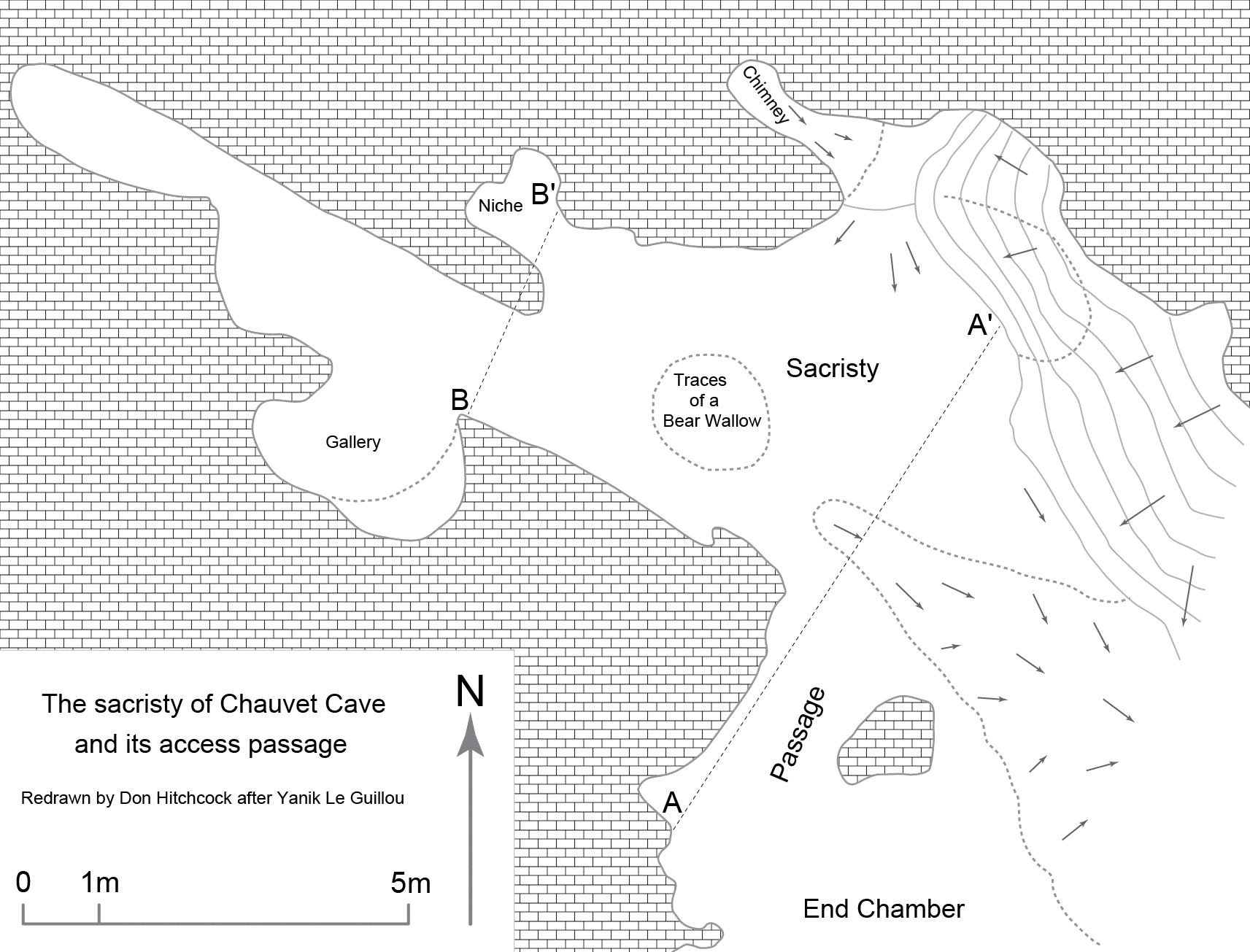
The Sacristy of Chauvet Cave and its access passage.
Note the position of the coupes (cross sections) along AA' and BB' in this image, displayed in the images below.
Photo: Redrawn by Don Hitchcock after Le Guillou (2001)
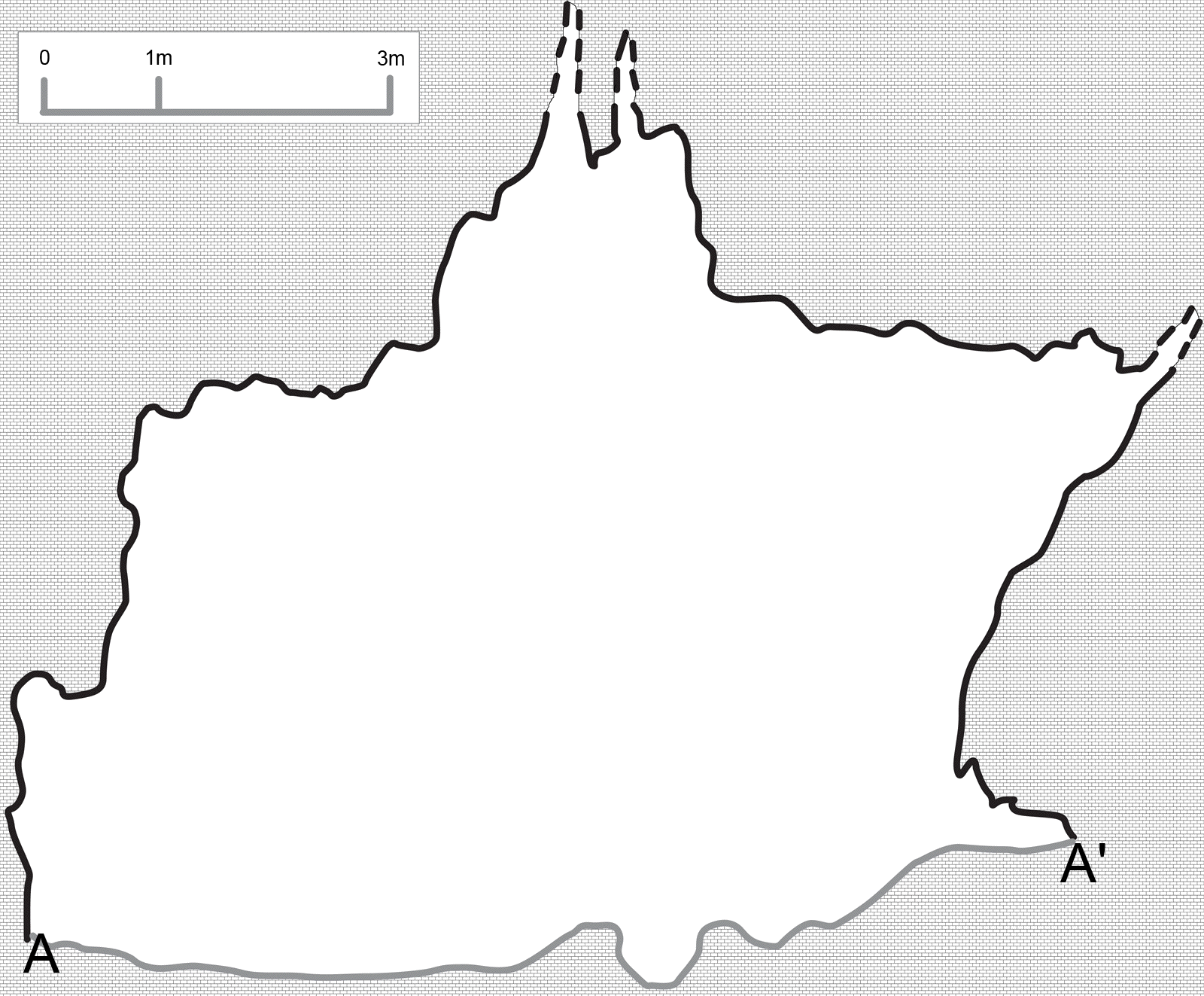
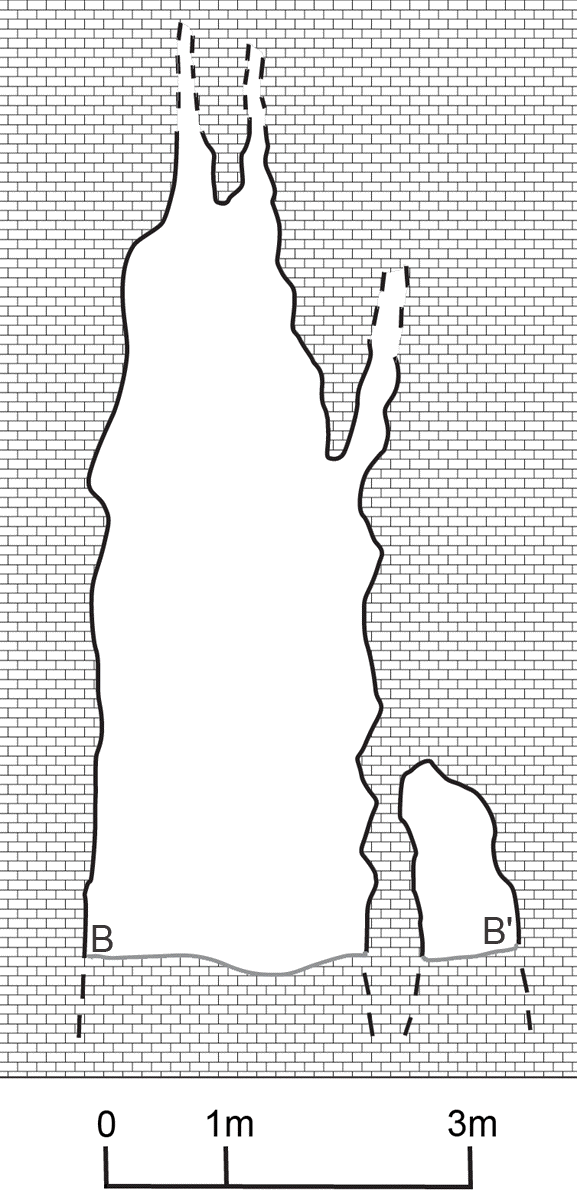
Cross Sections (Coupes) of the Sacristy of Chauvet Cave
along AA' (left) and BB' (right).
Photo: Redrawn by Don Hitchcock after Le Guillou (2001)

On the left wall of the passage or access corridor is this mammoth with four tusks, one pair in black, and one pair engraved later. It is a charcoal outline with added engraving only, length 80 cm.
(Note that this image does not display the artistic talent so evident in much of the rest of Chauvet cave - Don )
Le Guillou (2001) states that the access corridor is decorated with three figures: a handsome black horse on the left wall facing the End Chamber. This is most carefully drawn figure, very close to those in the Panel of Horses. On the left wall a rhinoceros and a mammoth can be seen. The figure of the rhinoceros is just a sketch, limited to the horn, forehead, ears and withers. One metre further along there is a painted and engraved mammoth, facing left and slightly under 80cm long. The drawing was originally done in charcoal, but the tusks are enhanced by engraving, making them bigger, longer and more visible. These two figures were done after the bear claw marks which underlie them.
Photo: http://uk.phaidon.com/agenda/art/picture-galleries/2011/march/10/inside-the-cave-of-forgotten-dreams/
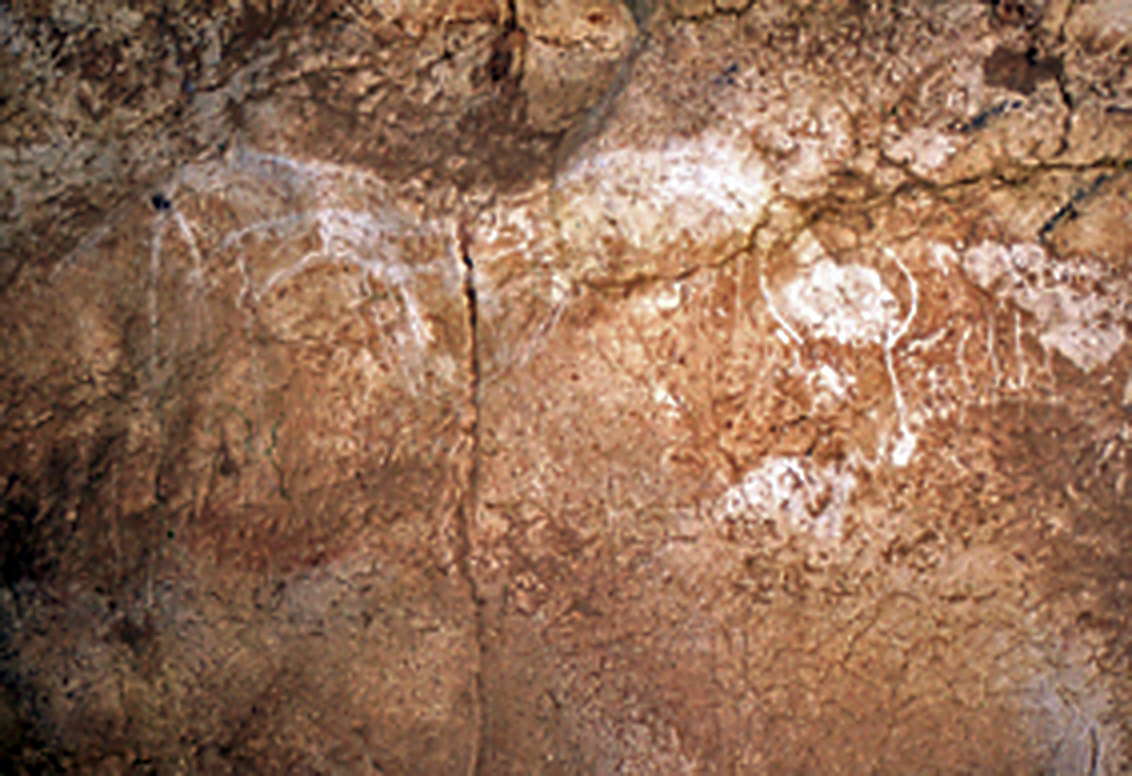 On the left wall of the Sacristy, the first drawing is the forepart of a horse facing left; it is not very visible and has been redone by tracing a finger covered in ochre colored clay. The main animal in the panel is another, smaller cat, also done in charcoal but facing the other direction. Just above is the forepart of a Megaloceros. Somewhat to the right, the last drawing is also the most detailed: a large bison, more than 170 cm long, done in both incisions and scrapings. Only the head and the line of the back are visible.
Photo and text above: Le Guillou (2001)
(Note that I have flipped this image horizontally to agree with Yanik Le Guillou's text. Given its age (2001 or earlier) it was probably recorded on photographic film, and the image has been reversed during the publication process, something which often used to happen. I would appreciate a better quality image if any reader has access to one. The only animal I can see clearly is the well executed head and hump of a bison - Don )
According to Lawson (2012), the left panel is not well preserved, but its largest figure is the partial outline of a large lion, 260 cm long, while a horse is drawn beneath it. The horse head was subsequently reworked with ochre. A small feline figure was placed on the flank of the larger lion, and a megaloceros above it. To the right is a carefully engraved and scraped bison.
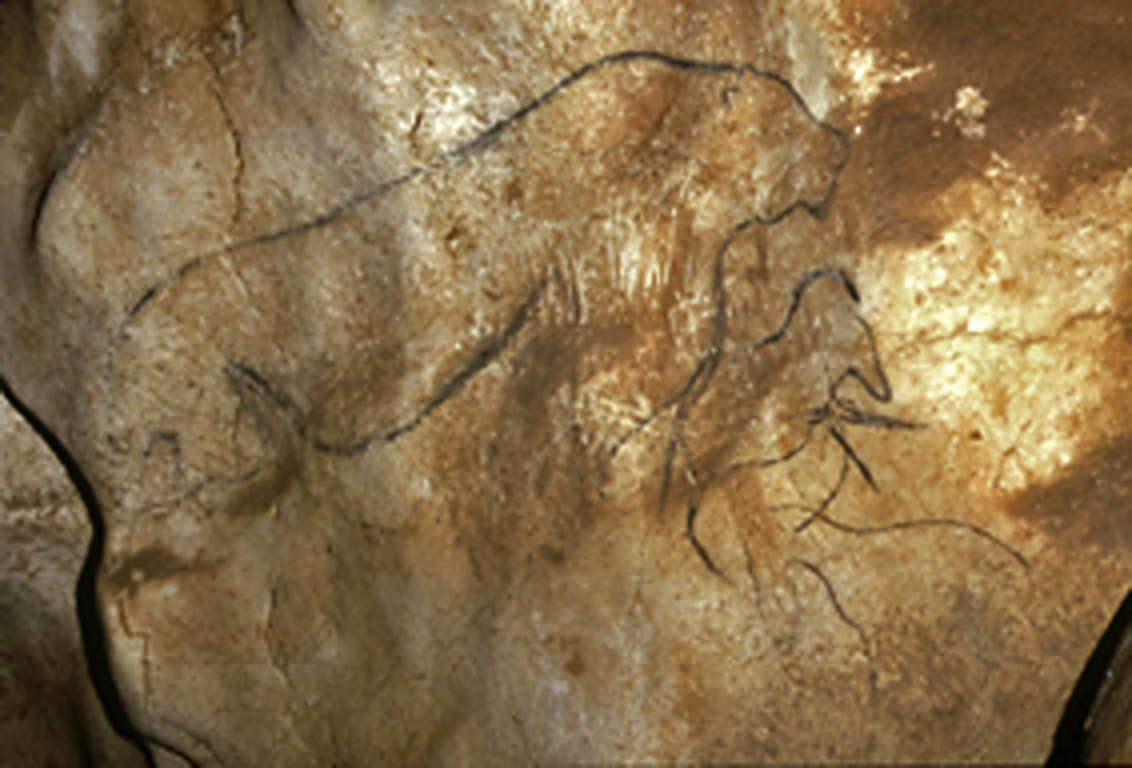
On the right wall of the Sacristy, the first part of the wall is covered by a flow of calcite. After this there is a black horse facing left. Above and to the left another horse is depicted in a very dynamic position. The central figure in this panel is a large cat nearly 180 cm long. Its very freely drawn line could be interpreted as the representation of a bear.
Photo and text above: Le Guillou (2001)
According to Lawson (2012), the right panel, 280 cm long, has a large lion facing the exterior, and two smaller horses below it.
Flint Tools found at Chauvet
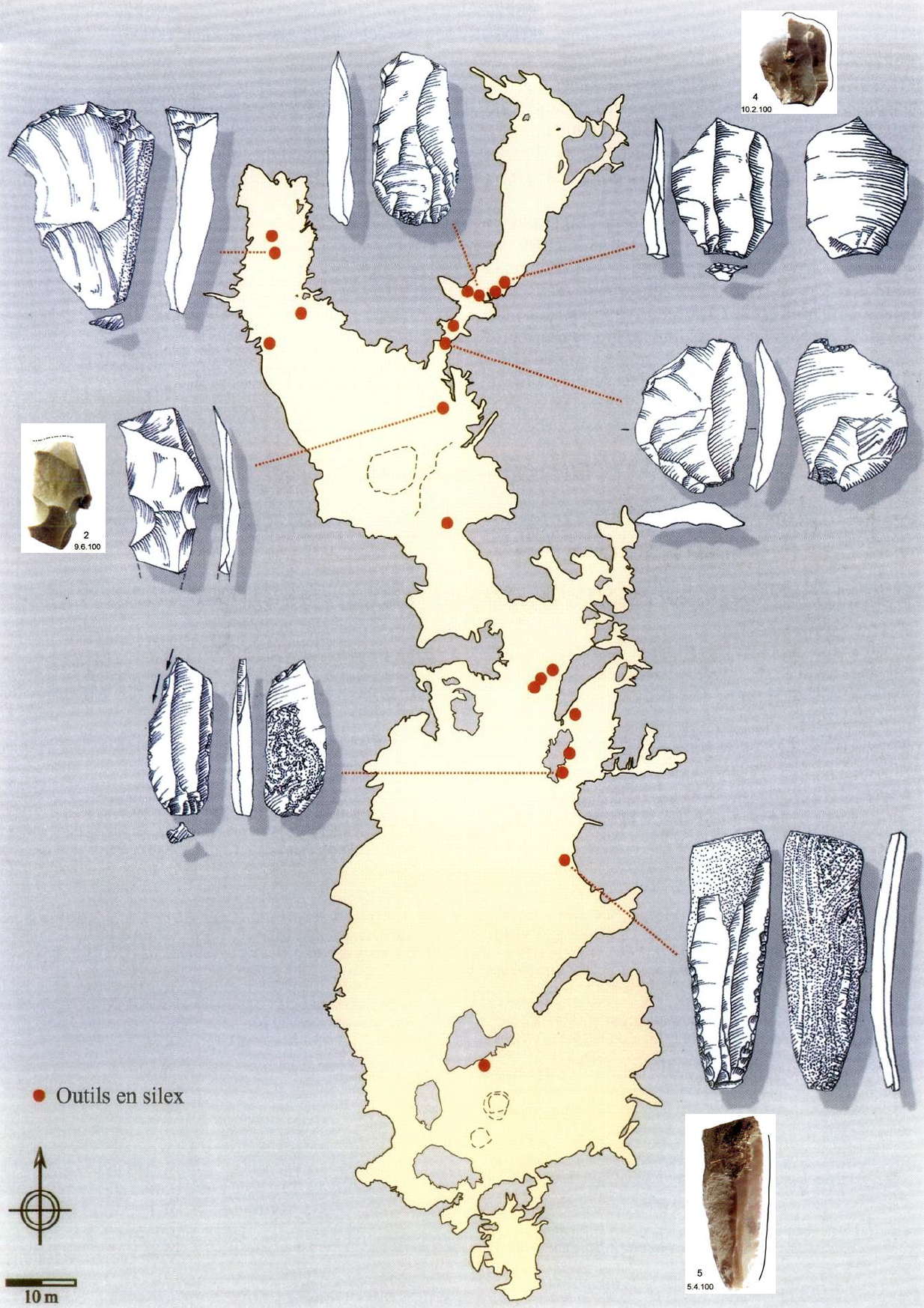
Plan of the position of the lithic material found at Chauvet.
(note that the extra coloured photos which I have added to this image illustrating the monochrome drawings come from Plisson (2005) below - Don )
Photo and text: Geneste (2005)
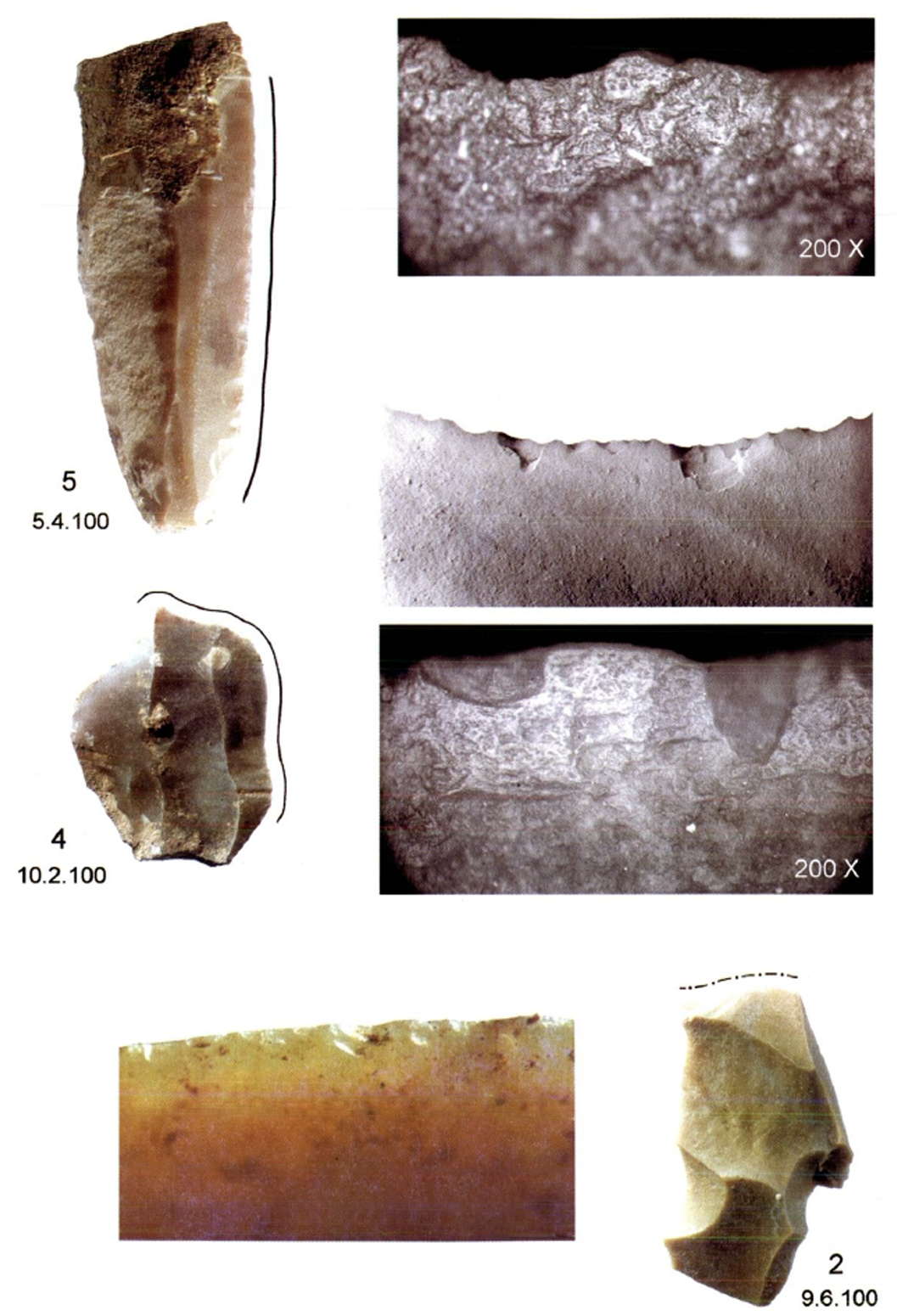
The functional analysis of eight flint artefacts collected in the Chauvet-Pont- d'Arc cave shows traces of use on four. Only one can be linked to the work on the walls, whereas two were used to cut skin or meat, including one flake found among bear's bones. These observations, like those noted in some other decorated caves, suggest that in these places activities were not restricted to artistic works alone.
The retouched blade labelled 5.4.100 / 5 is very well preserved. Little wear was detected. It was found by experiment that it works well in cutting meat.
The flake 10.2.100 / 4 of semi-circular contour has a slightly hazy patina, but its wear is distinct despite the start of chemical weathering. Two-thirds of its edge are marked with chips from contact with a hard material and the edge has been blunted (Plate 1/4), which suggests a combination of defleshing and use on relatively resistant meat materials (skin, fibrous membranes surrounding muscles, tendon or dried meat).
The flake 9.6.100 / 2 appears little altered. Hardly distinguishable to the eye at its distal end are very discrete chips. The scale of this shows it was used on soft materials. Experimentally, superficial scraping, with little pressure on a thick cortex of flint chalk produces comparable wear.
Photo and text: Plisson (2005)
Human Footprints and other tracks in Chauvet
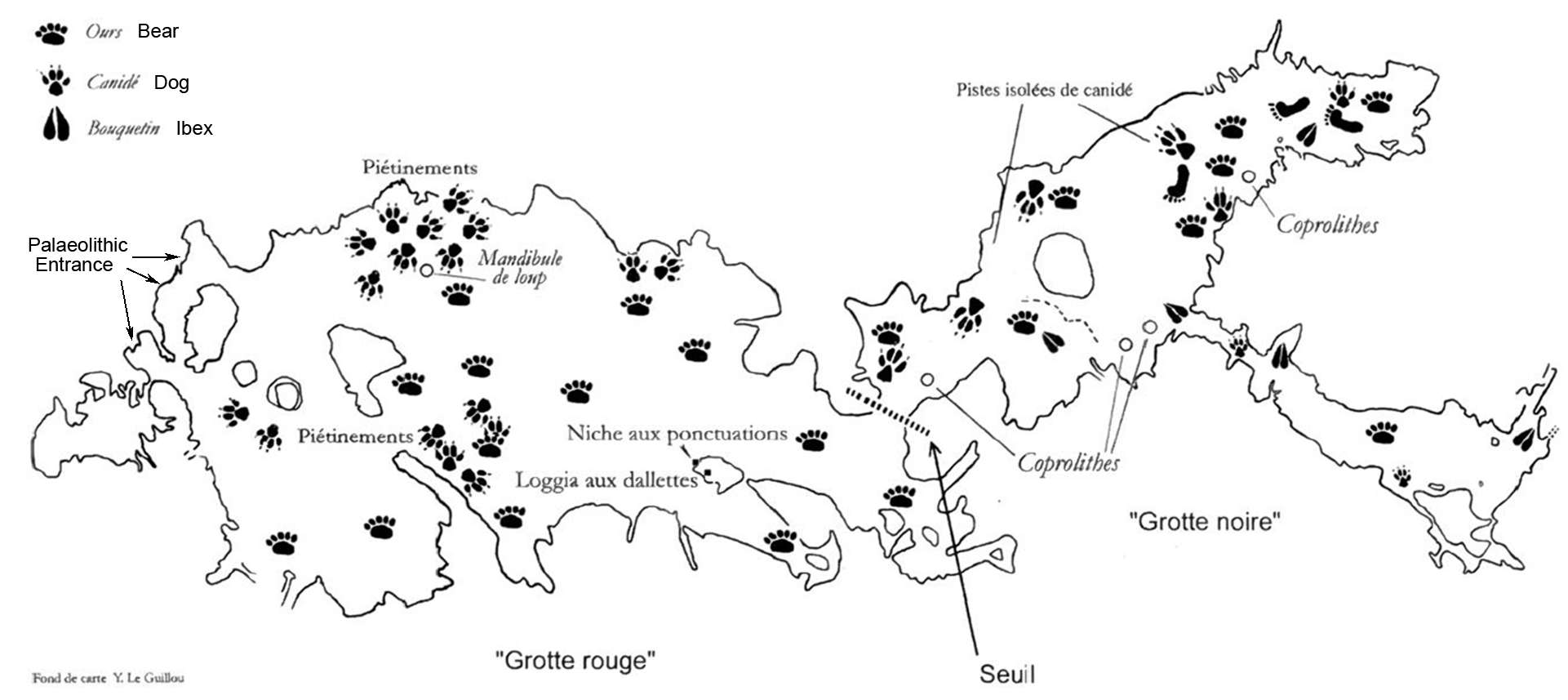
Location of the main tracks and footprints in the cave.
(Topography Y. Le Guillou, F. Maksud in honor of F. Rouzaud, drawn footprints by M.-A. Garcia).
Photo: Garcia (2005)
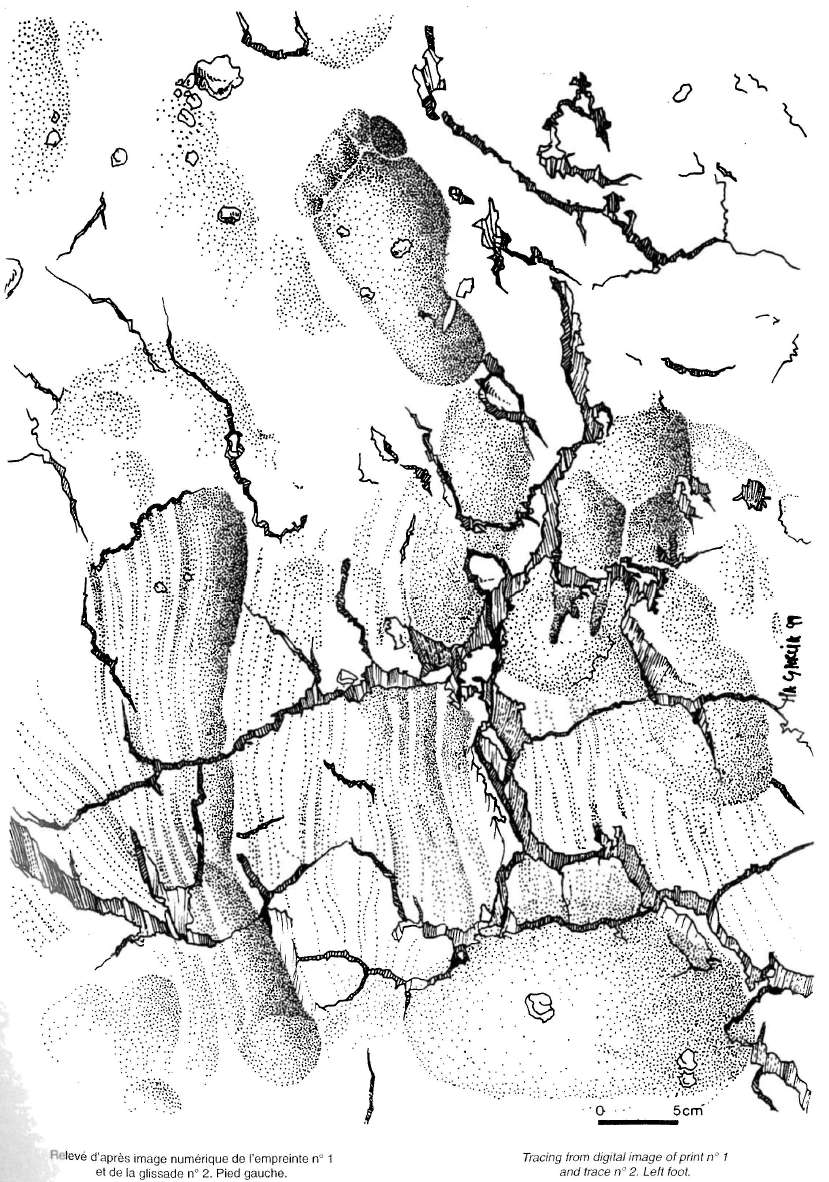
The clear imprint of the left foot of a child, and a dynamic trace of it, has been found in the Galerie des Croisillons, or Gallery of Crosshatchings. They form the start of a track leading to the end of the gallery where it opens into the Skull Chamber. The track is of the central section, with the two extremities missing because of the nature of the calcite floor. Further, there are bear prints and the track of a wolf, which also left prints in the Hillaire Chamber.
Photo: Garcia (1999b)
The Child's Track
The track is in one direction, Each pace is clearly individual, suggesting a calm and careful continuous progress. The pressure points are firmly placed giving for the most part a complete view of the prints. They therefore enable reliable measures, which confirm their repetitivity with several examples of right and left feet. The middle part of the track could not be examined as it is too far removed from the walkway. However, we can confirm that the tracks belong to one individual The imprints at the start and end of the track are completely superimposable.
The feet have an arch and a morphology comparable to those of present day Europeans and we have compared their measurements to the series obtained from Europeans from the nineteen sixties. This method might be considered a little arbitrary but it is the basis that was devised by Dr Léon Pales and that he always applied himself. In addition, if one refers to the stature of Cromagnon man, whose skeletal remains are known, one notes that it is close to modern stature.
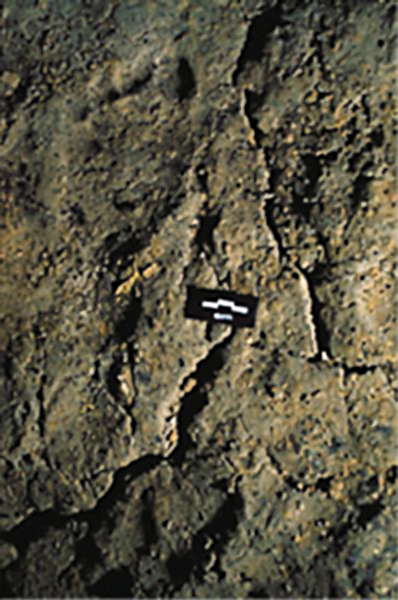
The Chauvet imprints correspond to those of an approximately eight year old child, possibly 130 cm tall. The relationship between the length 214 mm and width 92 mm suggests probably a male. It can certainly be said that the Chauvet imprints are comparable to those which we know from Magdalenian decorated caves, and in those caves from more recent prehistoric times.
An date was obtained from a torch mark 26 000 ± 4OO BP. We have been able to note this year that other torch marks stain the lower ceiling of the gallery. Most of them coincide with the child's track. It is therefore not too daring to consider them as contemporaneous.
It is still too early to produce a hypothesis explaining the presence of a child in this sector. What we can say is that from what we know elsewhere the tracks of children have more chance to come down to us, very simply because youths take atypical paths where their traces have less chance of being obliterated by multiple passages.
The human prints are sometimes superimposed on the imprints of Ursus Spelaeus. We have not yet found the reverse but given the surface of the floors yet to investigate we have not yet given up hope.
Photo: http://www.gflashcards.com/collections/33317-art-history-survey-1/cards
Text: Garcia (1999b)
Text below from: Garcia (2005)
The most striking result of the study of imprints encountered on the floor of the cave was undoubtedly the authentication of human footprints in la galerie des Croisillons.
There were twenty imprints of human feet at the beginning and end of a track about seventy metres long, leading from the galerie des Croisillons to the Skull Chamber, with a hardened section of the floor in the middle where no imprints have been found. However a large part of this possible track is unknowable because of its distance from the path which has been protected by alloy walkways.
The footprints are absolutely congruent, and are the marks left by a single individual. In the far end of the track in the galerie des Croisillons, the permanent activity of water percolation causes intense stalagmitic deposition, which prohibits any relevant comments about the track, and at the end of the track in the Skull Chamber, the footprints stop at the steep edge of the slope surrounding the clay in the centre of the Skull Chamber.
One has the impression that the teenager was suddenly faced with an obstacle, perhaps the Skull chamber was filled with water. For the moment, it is impossible to access the area to the right, where the footprints may be, and the footprints are not detectable using binoculars.
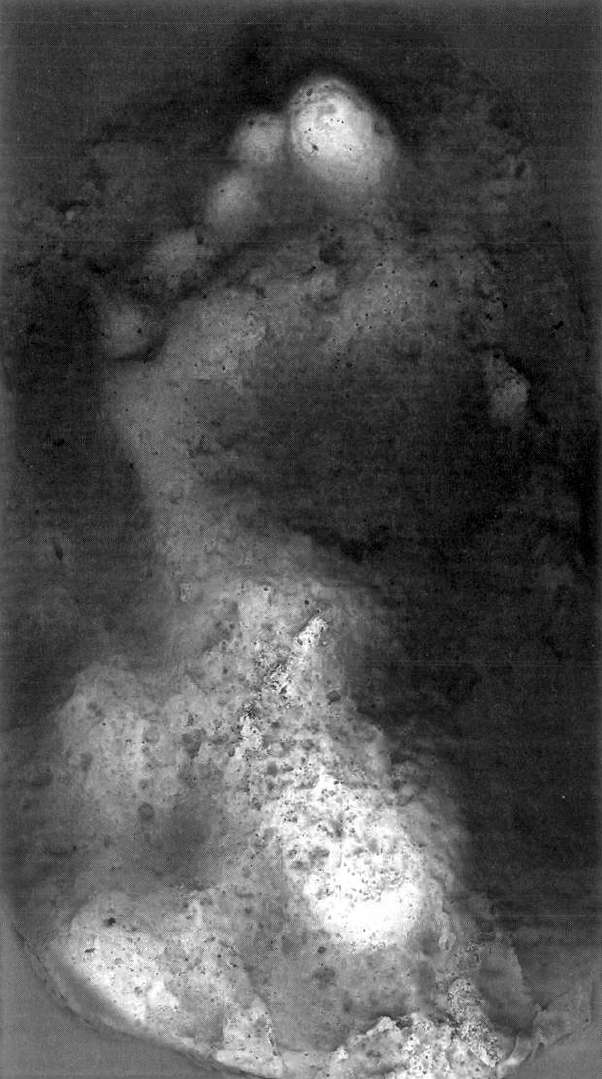
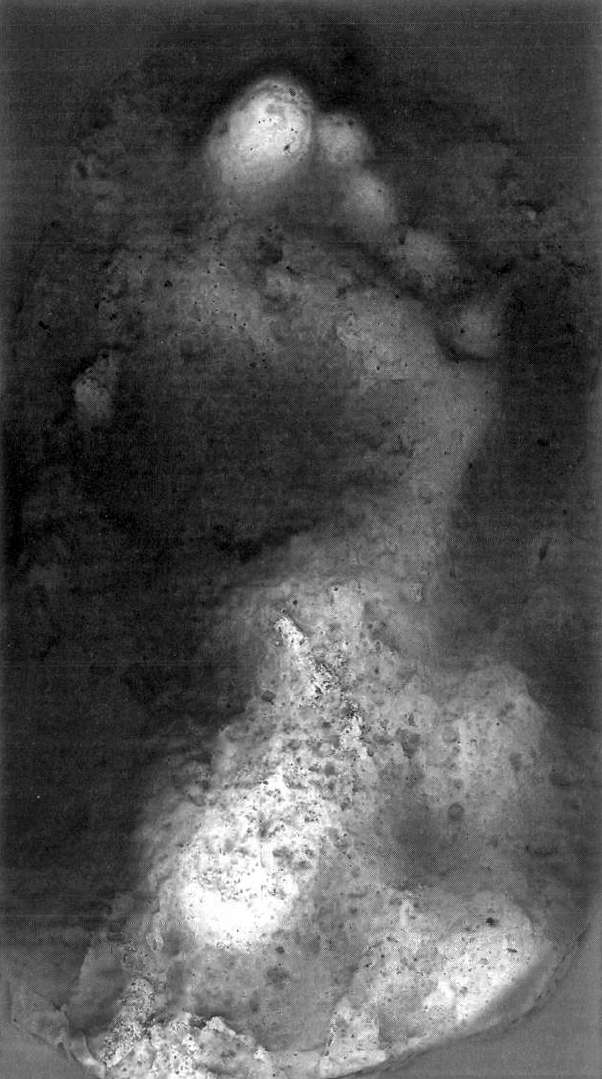
Mould of the imprint of a left foot from the Gallery of Crosshatching, la galerie des Croisillons.
The image on the right has been reversed, that is, it shows you what the foot would look like if you were beneath it, looking up from beneath the floor.
Photo: Garcia (2005)
The age of the child
The arched foot, with the length of the first two toes, has the classic look of the 'European' foot, and the footprints are readily identified as those of prehistoric feet in the caves of Europe.
Arbitrarily, we refer to a series of anatomical measurements of the foot of modern Europeans known to be substantially equivalent to those of Cro-Magnon. If we accept this supposition, the footprints were those of a preteen with a height of about 130 cm. The rather low length / width ratio of the footprint bespeaks a young male. (individual variations in this area are far from being exceptional, our hypothesis is purely speculative and may be revised in favour of any new data).
The age of the footprints
Only arguments and/or extrinsic factors can help locate the footprints in time. The trail of human footprints follows a passage where the roof is significantly higher, the child regularly wipes his torch on the wall above his track to keep it burning brightly.
These carbonaceous marks have been dated to 26 000 BP, they are generally placed backwards from the direction of movement, in the manner of a marking for a return journey.
Identical indices are found, in part, along the left wall of the Hillaire Chamber, including the Panel of Horses and the entrance to the Megaloceros Gallery and, secondly, in the Candle Gallery. It therefore seems possible to reconstruct the path of the child through these correlated observations. In addition to this, we may add the presence of two presses of a clay stained right hand of corresponding size on the lower right panel of the scraped Mammoths section.
Text above and below: Garcia (2005)
Fissipedia (dogs, cats, bears) Pawprints
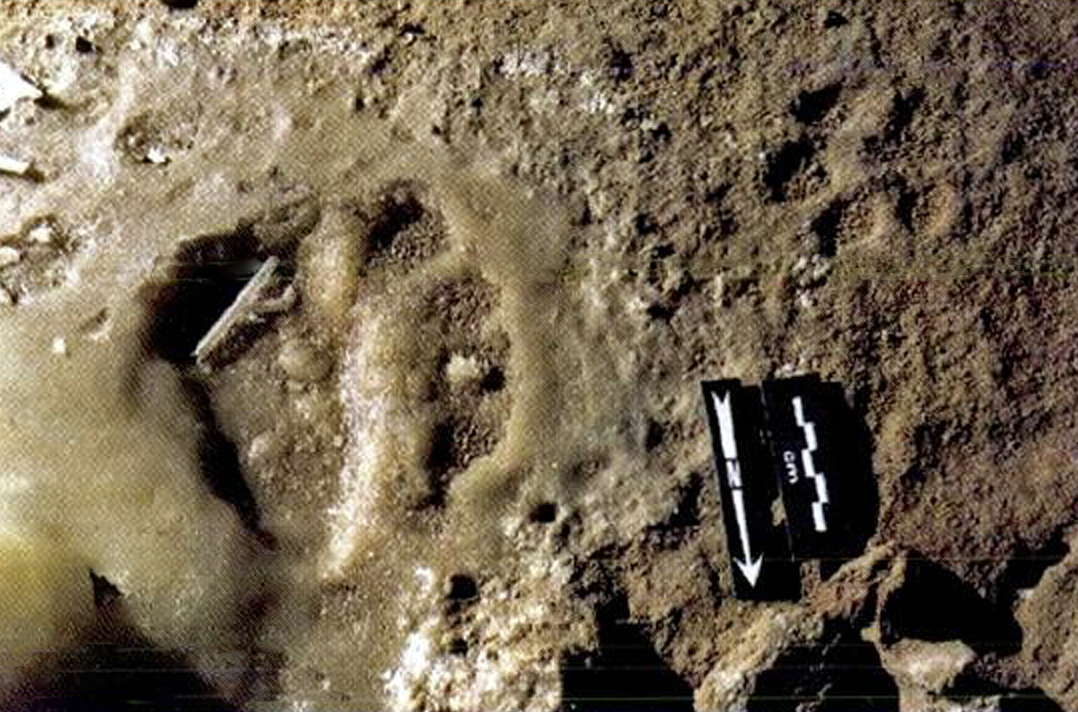
Prints of a bear's hand (left) and the paw print of a dog (right) in the Brunel Chamber.
Photo and text: Garcia (2005)
The Canine
Our initial observations gave the impression that all traces of carnivores other than the cave bear, were those of a single wolf which circulated around the Skull Chamber, the starting point is located in the galerie des Croisillons close to the start of the track of the child.
Because of its ease of access, the margin located along the wall of the Great Scraped Mammoths seemed most conducive to the study of animal traces identified in the early work, the paw prints are sharp and well separated. It is that of a fissipedia. (Fig. 5). A wide footprint is due to the depression of a young bear palmar pad.
Other prints that are superimposed belong to a large canine. As we hoped, our analysis has been carried out on clearly identifiable and measurable samples impressed in clays of varying plasticity.
One thing is clear: the morphology of the autopodes (feet) differ from most wolves by the reduction of the relative length of the middle finger, which is reflected on the geometry of the image on the recessed or raised impression of the print, and the digital pads of the second and third fingers are clearly joined at the sides, which is the rule for larger dogs.
For now, all the footprints found in the most remote part of the "black cave" can be attributed to a single large canid (which does not exclude completely the presence of one or two others).
Does this mean that because the tracks of the child and those of the animal coincide, that they were formed at the same time, and the dog was domesticated? The study of the tracks can not say because at the moment we could not highlight any overlapping layers in the tracks. However, there are troubling aspects of the canine prints, giving the impression of an animal who was afraid of the complete darkness in the deepest part of the cavity.
In the first part of 'red cave' the canine prints are however those of the wolf.
There are no longer any tracks, but vast but a very large carpet of the marks of many individuals of various sizes. These traces are found in the parts spared by general erosion in the Brunel and Bear Wallow Chambers, along the walls near the scree of the entrance and on islands of residual soil towards the ends of the chambers.
Without exception, the traces of dogs are obliterated by those of bears. No coprolites were found in these rooms, though four examples are visible in the Hillaire Chamber and the Candle Gallery, It is strongly probable that before the entrance was closed, there were footprints of wolves in the areas reached by daylight.

Cast of the paw prints of a dog, in the Skull Chamber.
Photo: Garcia (2005)
Bear prints
In the Brunel and Bear Wallows Chambers, the footprints of bears are often in tracks that can be followed in their entirety. The ground is level, often covered with clay. The animals walked calmly, clearly impressing their feet on the clay, with some harder stalagmitic layers not materially harming the interpretation of the tracks. These tracks are certainly among the longest known in any cave, they belong to a small number of individuals when compared to the huge amount of skeletal remains scattered throughout the cavity. The interpretation of the tracks of a section that has been the subject of a detailed examination shows that these bears, the creators of these last tracks, avoided obstacles consisting of some large bone segments.
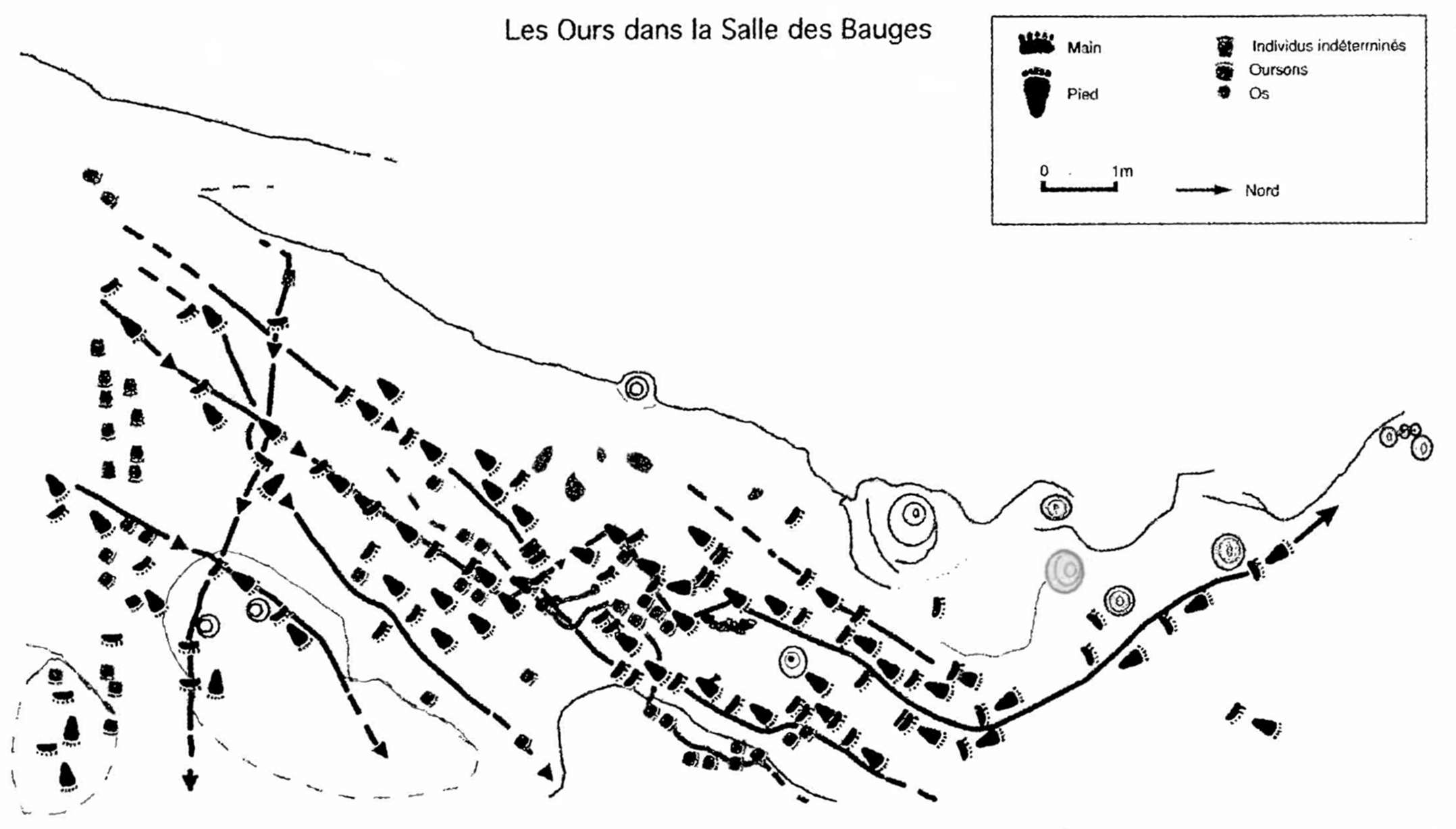
Imprints of two adult bears and cub in the Salle des Bauges à Ours (Chauvet Cave).
Photo and text: Garcia (1999a)
In the Hillaire Chamber, the Skull Chamber, the Croisillons and the Candle Gallery, we can not, however, speak of 'tracks' as the tracks are intertwined, especially in the mud of the lake bottom in the Skull Chamber. On the solid heaps of silty clay in the Hillaire Chamber, where the most beautiful wallows or lairs of the cave can be observed, legible paw prints are located at the edges of zones where the multiplicity of tracks makes it impossible to decipher anything. This is also the case on the flat clay regions.
The footprints show a wide variety of sizes and therefore of ages of the ursine populations in this area. It is the same for the scratches on the walls. While there is no doubt that the pawprints of the Skull Chamber belong to Ursus spelaeus, those of the bench in the Hillaire chamber, like the Chamber of Bear Wallows, are compatible in size and morphology with Ursus arctos.
The ibex
The footprints of ibex in caves are exceptional, but we know of at least some other cases: Fontanet, Niaux, and Latrone.
At Chauvet, a goat jumped from the lower level of the clay slope forming the floor of the 'Sacristy', then slipped, ploughing deep grooves with its hooves, finishing up in the bottom of the diverticulum, hooves far apart, reflecting the fear of the animal.
The prints of the four hooves are very sharp, and we can determine from them that it was a large adult, probably a male. We find these tracks as slides and static footprints in the middle and at the entrance to the Megaloceros Gallery as well as the access slope to the Salle des Croisillons. Clearly, the presence of this caprid is a problem. How could it get so deep into the cave without leaving any trace of its passage through the rest of the cave?
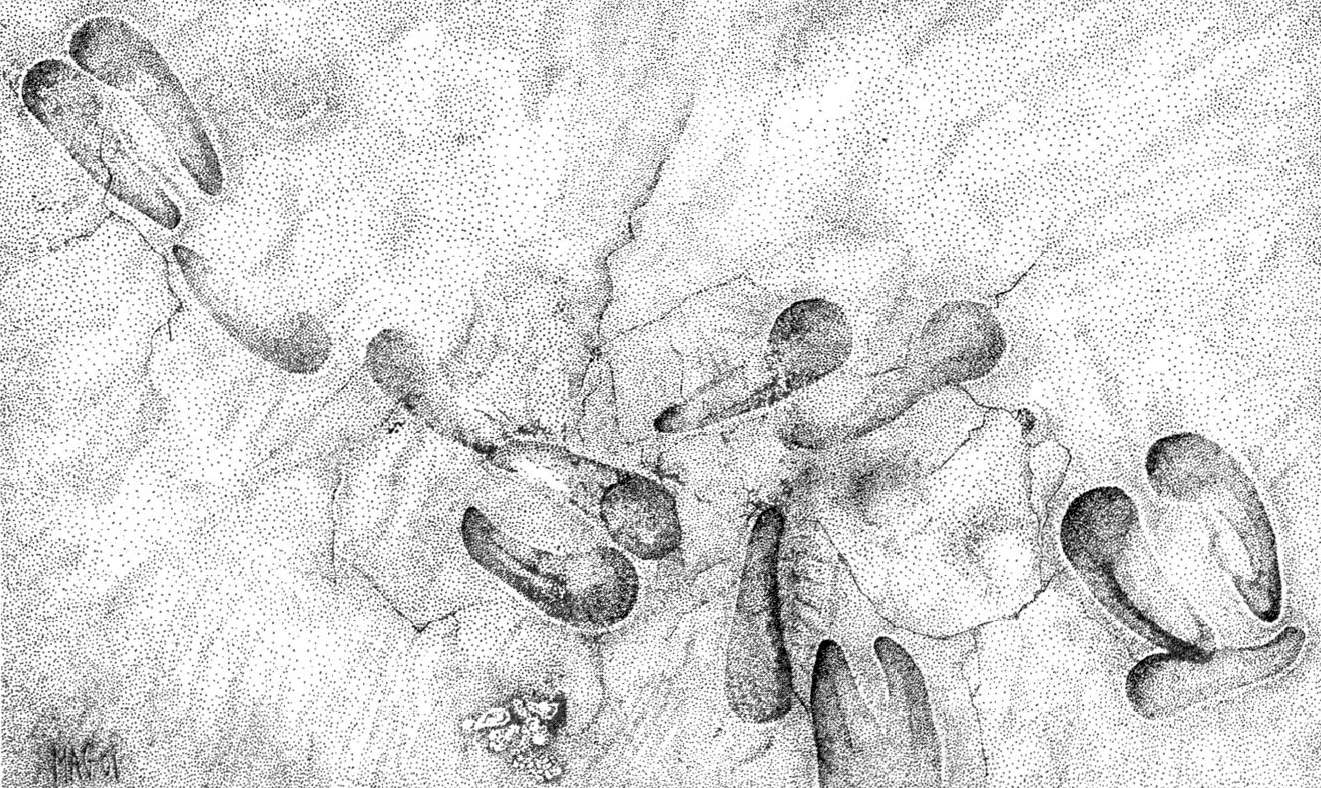
Drawing of the hoof prints of an Ibex in the Megaloceros Gallery.
Photo: Garcia (2005)
The Wolf Track
In 1997 the discoverers showed us in the Salle Hillaire the tracks of fissipeds that we identified as those of a medium-sized adult wolf.
In 1998, Éliette Brunel drew our attention to a clay area that the animal had trampled and in doing this had left remarkable images of paws. We were able to make a first record as it was perfectly accessible.
The segment of the track discovered this year also belonged to the same animal whose wanderings in this end part of the cave we can now follow.
In the Galerie des Croisillons the passages of the animal and the child are topographically linked, but for the moment nothing permits the establishment of a relative chronology.
Michel-Alain GARCIA - C.N.R.S. EP 1730 Nanterre Equipe de Recherche de la Grotte Chauvet.
The Pleistocene Fauna found within Chauvet Cave
Horse ( Equus caballus )
Roe deer ( Capreolus capreolus )
Ibex ( Capra ibex )
Panther ( Panthera pardus )
The wild cat ( Felis silvestris )
The fossil Spotted Hyena ( Crocuta crocuta spelaea )
The red fox ( Vulpes vulpes )
Wolf ( Canis lupus )
The brown bear ( Ursus arctos )
The Golden Eagle ( Aquila chrysaetos )
The Alpine Chough ( Pyrrhocorax graculus )
Cave Bear ( Ursus spelaeus )
The fauna identified (Philippe et Fosse (2003), Tab. 1) can be related to at least nine species of carnivores ( Ursus spelaeus , Ursus arctos , Panthera pardus , Felis silvestris , Canis lupus , Vulpes vulpes , Martes martes , Martes foina , Crocuta spelaea crocuta ), five of ungulates ( Bos or Bison, Capra ibex , Capreolus capreolus , Cervus elaphus , Equus caballus ), three rodents ( Apodemus silvaticus , Eliomys quercinus , Microtus nivalis ), a bat ( Myotis myotis and some bones of an unknown bat), five bird species ( Aquila chrysaetos , Pyrrhocorax graculus , Cinclus cinclus , Turdidae sp. and an indeterminate passerine) and a reptile (snake?).
This wealth is apparent only from the taxonomic point of view and seems to correspond to the long period of usage of the cave, during the Pleistocene and the Holocene, and may be differentiated into volunteers (carnivores) and involuntary remains (ungulates as prey, and birds) within the cavity by the different taxa. Faunal diversity is higher in areas near the entrance, including the scree at the top of the Chamber of the Bear Wallows, than in the areas deeper within the cave.
In these sectors, the distribution is almost monospecifically cave bear. From the paleoecological point of view, the Cave Bear is 99.9% of the fauna, in accordance with what might be expected in a cave. No 'cold' species is present in the paleontological record, unlike the paintings and engravings on the wall, which include representations of twelve Rangifer tarandus , two Ovibos moschatus sixty five Coelodonta Antiquitatis , sixty sixMammuthus primigenius , as well as other species such as Panthera spelaea , Megaloceros giganteus, which are relatively abundant in the parietal bestiary, but are lacking so far as actual specimens within the cave.
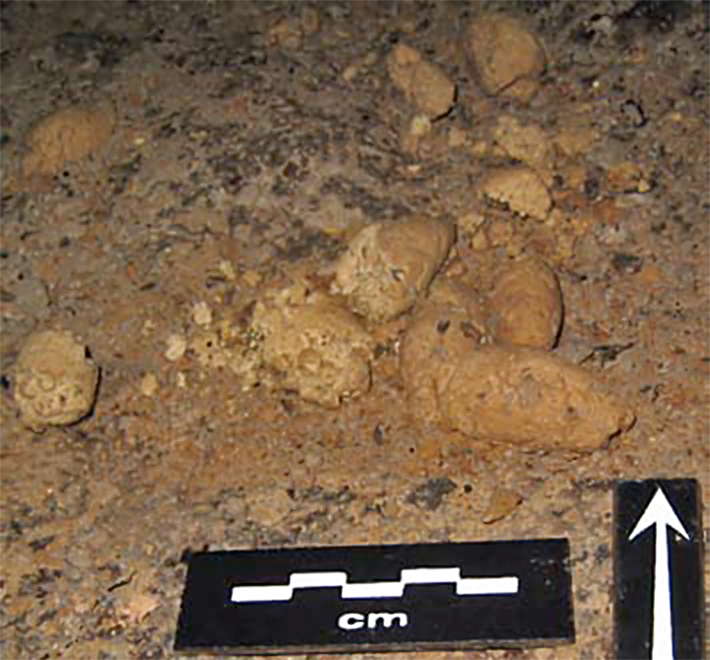
Coproliths (faeces) of a wolf in Chauvet Cave.
Photo: © MCC, CNP Périgueux
Source: Bon (2011b)
The number of bones of mammalian species identified in the different accessible areas inside Chauvet Cave
| Sector | Bear | Wolf | Fox | Hyena | Panthers | Wildcats | Marten | Ibex | Roe Deer | Deer | Large Bovid | Horse |
|---|---|---|---|---|---|---|---|---|---|---|---|---|
| Morel Chamber | 20 | 108 | 10 | 11 | ||||||||
| Chamber of the Bear Hollows, scree | 1044 | 12 | 1 | 1 | 1 | 75 | 37 | 3 | 1 | 1 | 1 | |
| Chamber of the Bear Hollows | 304 | 2 | 1 | |||||||||
| Brunel Chamber | 69 | 2 | 1 | 18 | 1? | |||||||
| Cactus Gallery | 72 | |||||||||||
| Bretelle Gallery | 48 | |||||||||||
| Red panels Gallery | 321 | 3 | ||||||||||
| Candle Gallery, Threshold | 47 | |||||||||||
| Candle Gallery | 103 | |||||||||||
| Hillaire Chamber, before the Large Collapse | 484 | |||||||||||
| Hillaire Chamber, after the Large Collapse | 157 | |||||||||||
| Skull Chamber | 432 | |||||||||||
| Gallery of the Cross Hatching | 129 | |||||||||||
| Megaloceros Gallery | 232 | 30 | ||||||||||
| End Chamber | 221 | |||||||||||
| Belvedere Gallery | 20 | 1 | 1 (+1?) | 10 | ||||||||
| Totals | 3703 | 18 | 32 | 1 | 1 | 1 | 193 | 67 | 14 | 1 | 2 | 2 |
The number of cave bear skulls identified in the different accessible areas
| Sector | Skulls Condition (complete/ fragmentary) |
|---|---|
| Morel Chamber | - / 1 |
| Chamber of the Bear Hollows, scree | 10 / 05 |
| Chamber of the Bear Hollows | 04/03 |
| Brunel Chamber | 02 / 04 |
| Cactus Gallery | 02 / 02 |
| Bretelle Gallery | |
| Red Panels Gallery | 09 / 03 |
| Rouzaud Chamber | 3 / - |
| Candle Gallery, Threshold | 03 / 01 |
| Candle Gallery | 17 / 01 |
| Hillaire Chamber, before the Large Collapse | 35 / - |
| Hillaire Chamber, after the Large Collapse | 9 / - |
| Skull Chamber | 53 / - |
| Gallery of the Cross Hatching | 7 / - |
| Megaloceros Gallery | 2 / - |
| End Chamber | 13 / - |
| Belvedere Gallery | 1 / - |
| Total | 190 |
The Fauna of Chauvet Cave
| Species | Common Name | Number of Remains | Minimum Number of Individuals |
|---|---|---|---|
| Pleistocene | |||
| Ursus spelaeus | Cave Bear | 3703 | 190 |
| Ursus arctos | Brown Bear | 1 | 1 |
| Panthera pardus | Leopard | 1 | 1 |
| Felis silvestris | Wildcat | 1 | 1 |
| Canis lupus | Grey Wolf | 18 | 6 |
| Vulpes vulpes | Red Fox | 32 | 2 |
| Crocuta crocuta spelaea | Cave Hyena | 2 | 1 |
| Capra ibex | Alpine ibex | 67 | 8 |
| Capreolus capreolus | Roe Deer | 14 | 3 |
| Cervus elaphus | Red Deer | 1 | 1 |
| Bos/Bison | Bovine | 2 | 1 |
| Equus caballus | Horse | 2 | 1 |
| Totals | 3844 | 216 | |
| Holocene | |||
| Apodemus sylvaticus | Wood Mouse | 4 | |
| Eliomys quercinus | Garden Dormouse | 3 | |
| Microtus nivalis | Snow Vole | 1 | |
| Myotis myotis | Mouse-eared bat | 1 | |
| Reptilia | Reptile | 3 | |
| Total | 12 | ||
| Pleistocene or Holocene | |||
| Martes martes + M. foina | Pine and Beech Marten | 193 | 8 |
| Aquila chrysaetos | Golden Eagle | 1 | |
| Pyrrhocorax graculus | Alpine Chough | 7 | 2 |
| Cinclus cinclus | White-throated Dipper | 2 | |
| Turdidae sp. | Thrush | 1 | |
| Total | 14 | ||
The animals who entered the cave after the painters had left
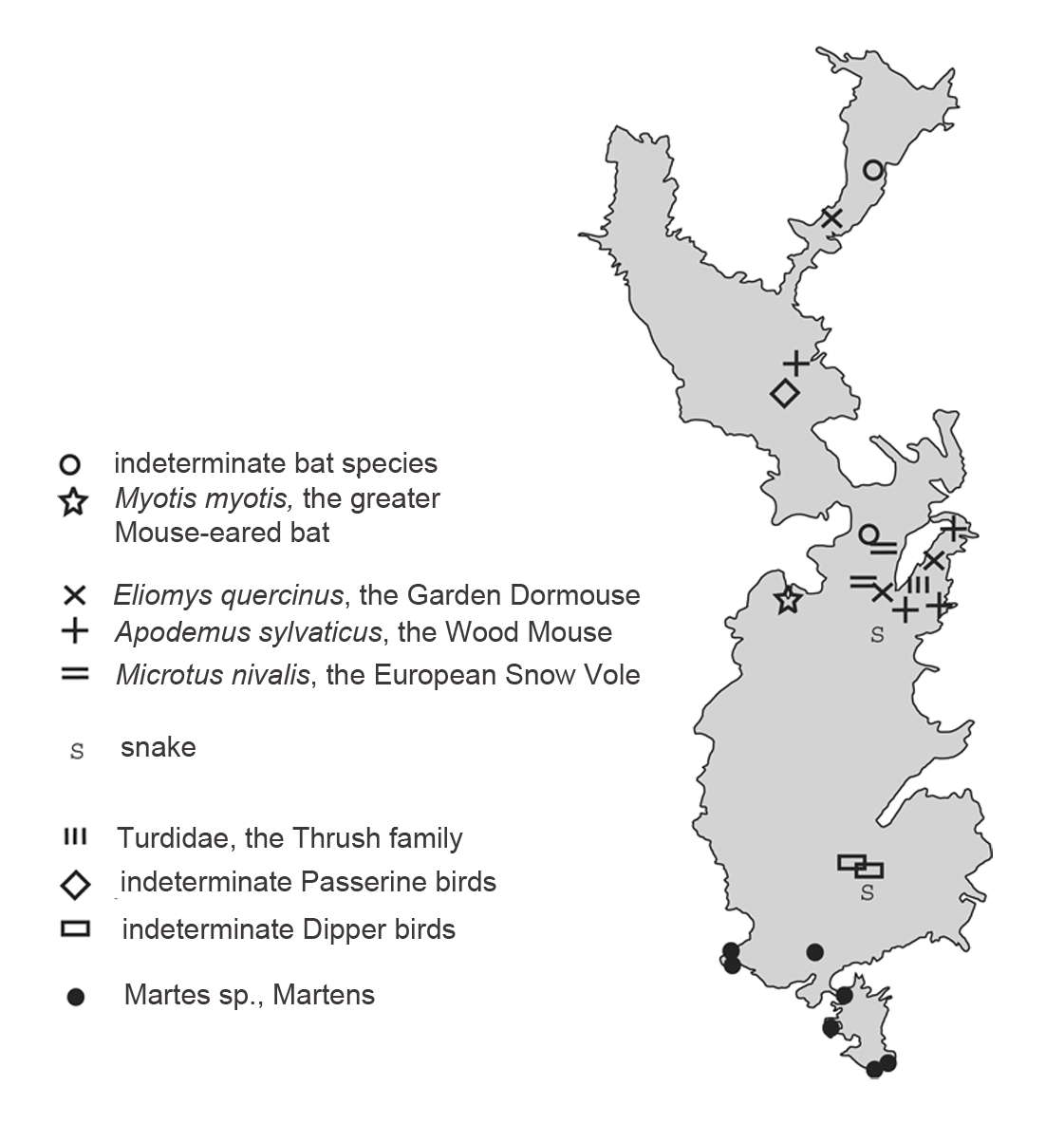
The Holocene is a geological epoch which began at the end of the Pleistocene (around 12 000 to 11 500C years ago) and continues to the present.
This plan shows the spatial distribution of the Holocene fauna found in Chauvet Cave, that is the fauna that entered the cave after the time that the paintings were made, presumably through small openings such as that which led to the discovery of the cave in modern times.
Photo: Philippe et Fosse (2003)
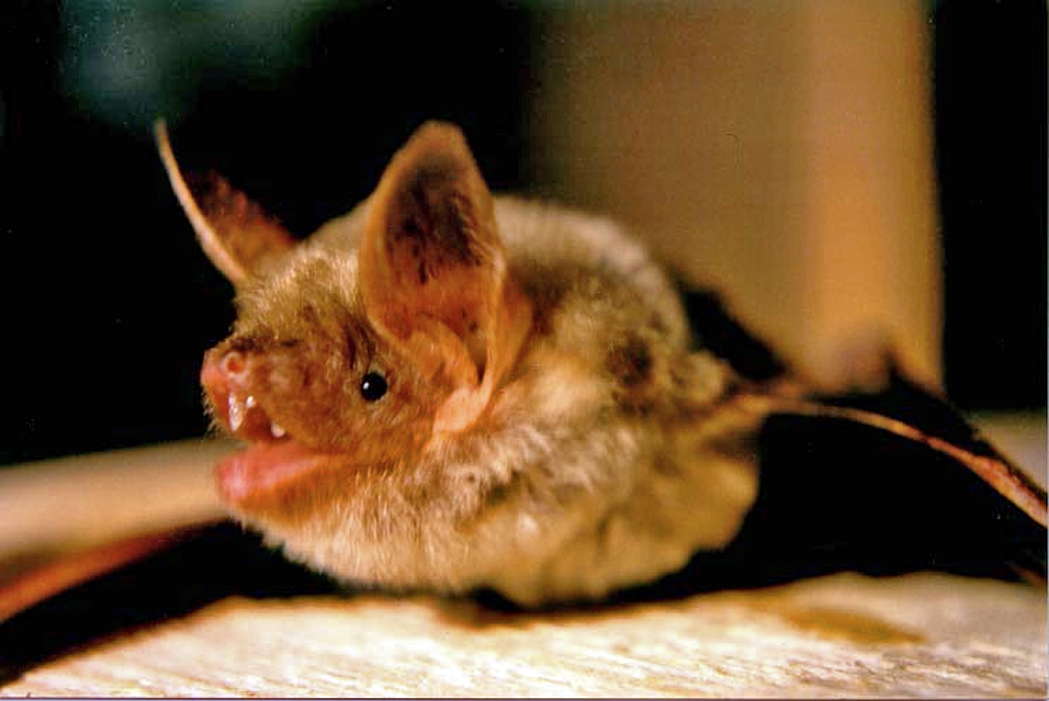 The greater mouse-eared bat, Myotis myotis, is a European species of bat in the Vespertilionidae family, and formed a significant part of the fauna in Chauvet Cave before they were excluded when the ancient entrance was closed by a rockfall some 20 000 years ago.
It is relatively large for a member of the Myotis genus, weighing up to 45 grams (1.6 oz) (a little larger than a house mouse, Mus musculus), making it one of the largest European bats. Like its relatives it eats various arthropods; however, unlike many bats it does not capture prey by echolocation in flight but instead gleans it from the ground, locating the prey passively – listening for the noises produced by creatures such as carabid beetles, centipedes and spiders. Thus, it uses echolocation only for spatial orientation, even if it emits ultrasound calls when approaching prey.
In summer, nursery roosts in northern Europe are located almost exclusively in large attics of buildings (e.g. churches), while in southern Europe they are located in caves. Also solitary males can roost there, although in some countries (Germany, western Poland) there are regular cases of roosting in bird and bat boxes. Greater mouse-eared bats spend winter exclusively in underground roosts, like caves, mines, forts, tunnels and large cellars.
Photo: Manuel Werner
Permission: GNU Free Documentation License, Version 1.2
Text: WIkipedia
Garden dormice, Eliomys quercinus, are typically 10 to 15 cm (3.9 to 5.9 in) in length, with the tail adding an additional 8 to 14.5 cm (3.1 to 5.7 in). They weigh 60 to 140 g (2.1 to 4.9 oz). The coat is gray or brown, with a white underside. The garden dormouse can be recognised by black eye markings, relatively large ears, short hair, and a white tassel at the end of the tail.
In spite of its name, the garden dormouse's main habitat is the forest, though it can also be found in fruit-growing regions. It is particularly common in southern Europe, but its range extends into the north. Garden dormice are often found in the Alps, the Bavarian Forest, and the Ore Mountains.
Garden dormice are primarily nocturnal, sleeping in spherical nests in trees during the day. At night, they look for food, mainly eating larger insects, such as grasshoppers and beetles, and snails, eggs, young nestlings, small mice, and spiders, as well as berries, fruit, and nuts, such as acorns and beechnuts. While omnivorous, the diet of dormice contains slightly more animal protein than vegetation.
The mating period lasts from April to June. During this time, the female indicates her readiness to mate by squeaking loudly. The young are usually born in litters of three to seven, after a gestation period of 23 days. Blind and naked at birth, they open their eyes after about 18 days, and are nursed until they are one month old. They become independent at two months of age, but do not reach sexual maturity until the next year. They have a life expectancy of about five years.
Photo: Arno Laurent
Permission: GNU Free Documentation License, Version 1.2
Text: Wikipedia

The Wood Mouse, Apodemus sylvaticus, is a common rodent from Europe and northwestern Africa. It is around 90 mm (3.54 in.) in length. It is found across most of Europe and is a very common and widespread species, is commensal with people and is sometimes considered a pest. Other common names are long-tailed field mouse, field mouse, common field mouse, and European wood mouse.
Wood mice inhabit forests, grasslands, and cultivated fields. Almost entirely nocturnal and terrestrial, wood mice burrow extensively, build nests of plants and live in buildings during harsh seasons. In Europe it ranges north to Scandinavia and east to Ukraine.
Wood mice are primarily seed eaters, particularly seeds of trees such as oak, beech, ash, lime, hawthorn and sycamore. If there is a plentiful amount of seeds on the ground, they carry them back to their nests/burrows for storage. They may eat small invertebrates such as snails and insects, particularly in late spring and early summer when seeds are least available. They also consume berries, fruits and roots. During the colder months wood mice do not hibernate; however, during severe winter seasons they fall into a sort of torpor, a decrease in physiological activity. While foraging, wood mice pick up and distribute visually conspicuous objects, such as leaves and twigs, which they then use as landmarks during exploration.
Photo: Rasbak
Permission: GNU Free Documentation License, Version 1.2
Text: Wikipedia
The Pine Marten, Martes martes, is a carnivore native to Northern Europe belonging to the mustelid family, which also includes mink, otter, badger, wolverine and weasel. It is about the size of a domestic cat. Its body is up to 53 cm in length (21 inches), and its bushy tail can be 25 cm (10 inches). Males are slightly larger than females; on average a marten weighs around 1.5 kg (3.5 lb). Their fur is usually light to dark brown and grows longer and silkier during the winter months. They have a cream to yellow coloured 'bib' marking on their throats.
Their habitats are usually well-wooded areas. European pine martens usually make their own dens in hollow trees or scrub-covered fields. They are mainly active at night and dusk. They have small rounded, highly sensitive ears and sharp teeth for eating small mammals, birds, insects, frogs, and carrion. European pine martens are territorial animals that mark their range by depositing faeces (called 'scats') in prominent locations.
Photo: Dani Kropivnik
Permission: GNU Free Documentation License, Version 1.2
Text: Wikipedia
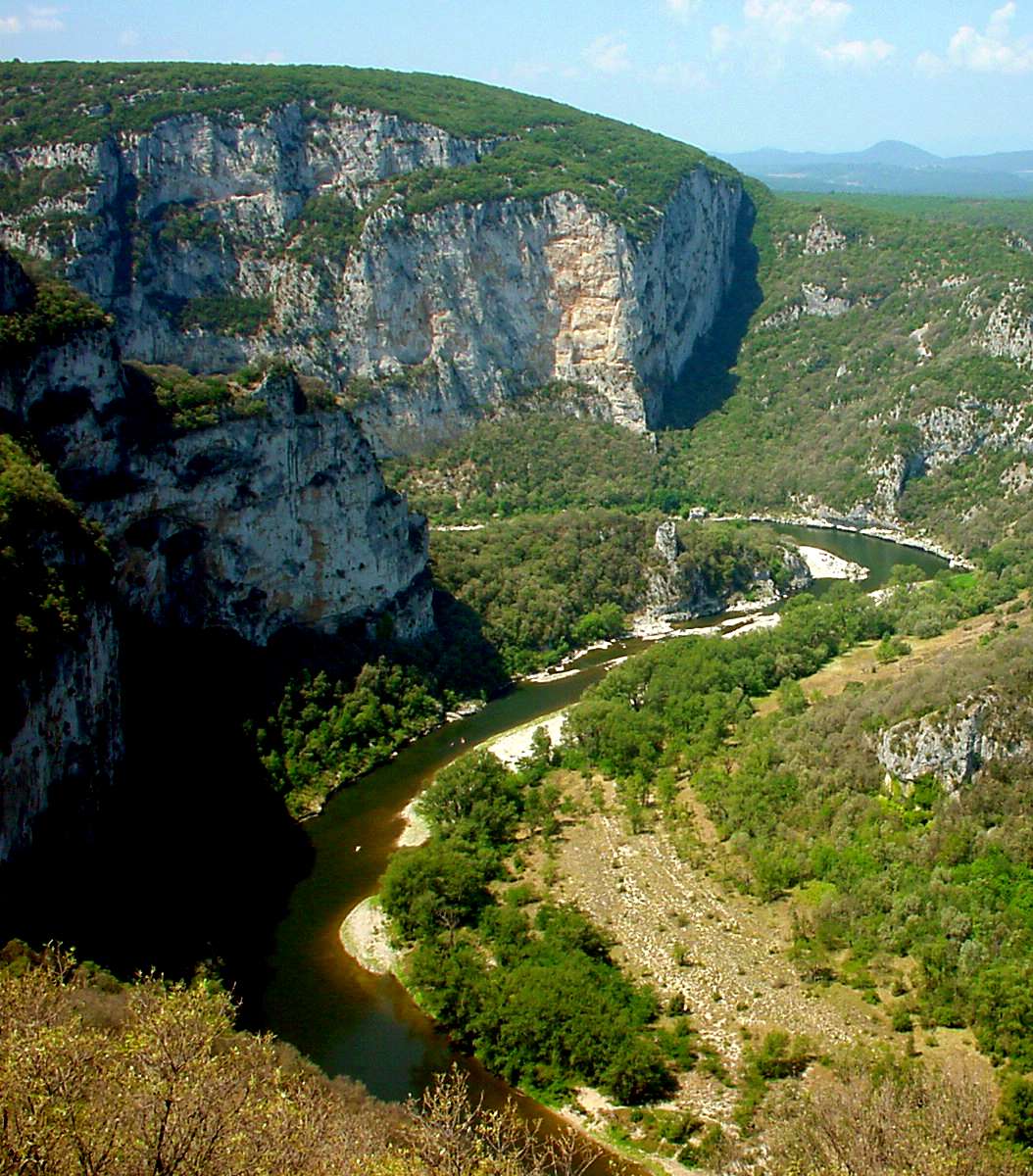
The Grotte Chauvet is one of hundreds of natural caverns cut into the pale limestone cliffs that form the Ardeche Gorge.
The Ardèche (Occitan: Ardecha) is a 125 km long river in south-central France, a right-bank tributary of the Rhône River. Its source is in the Massif Central, near the village of Astet. It flows into the Rhône near Pont-Saint-Esprit, north-west of Orange. The river gives its name to the French department of Ardèche.
The valley of the Ardèche is very scenic, in particular a 30km section known as the Ardèche Gorges. The walls of the river here are limestone cliffs up to 300m high. A kayak and camping trip down the gorge is not technically difficult and hugely popular in the summer, so much so that controlling the number of paddlers is becoming a headache for park authorities. The most famous feature is a natural 60m stone arch spanning the river simply known as the Pont d'Arc (arch bridge).
Photo: Tjarko Evenboer, Panoramio photo from Google Earth.
Text: Wikipedia
But it is unique. Its stone etchings and 416 paintings - a dozen more were discovered in the 15-day expedition that began last week-are, at 32 000 years, the oldest cave art known to science. The find consists of mural after mural of bold lions, leaping horses, pensive owls and charging rhinoceroses that together make up a veritable Louvre of Paleolithic art. Text above from the Bulletin magazine, May 25 1999.
Dating Chauvet Cave
Chauvet Cave art has been securely dated by carbon dating, but the problem for many workers in the field is that it does not fit the accepted paradigm that painting evolved from simple hand prints to other signs to representative art. It is simultaneously the oldest and the best cave art.Many scientists would like to prove that Chauvet is much younger than the dating to this point suggests.
The Uranium/Thorium dating technique has recently been applied to several art sites in Europe, specifically in France and Spain, and notably at El Castillo. It would quieten some skeptics, and force a rethink of the evolution of human abilities, if it could be shown by a completely different method that Chauvet is as old as the Carbon dating values.
Uranium-thorium dating, also called thorium-230 dating, uranium-series disequilibrium dating or uranium-series dating, is a radiometric dating technique commonly used to determine the age of calcium carbonate materials such as speleothem (concretions in limestone caves such as stalactites, stalagmites, flowstone and so on - Don ) or coral. Unlike other commonly used radiometric dating techniques such as rubidium-strontium or uranium-lead dating, the uranium-thorium technique does not measure accumulation of a stable end-member decay product. Instead, the uranium-thorium technique calculates an age from the degree to which secular equilibrium has been restored between the radioactive isotope thorium-230 and its radioactive parent uranium-234 within a sample.Text above from Wikipedia.
Thorium is not soluble in natural waters under conditions found at or near the surface of the earth, so materials grown in or from these waters do not usually contain thorium. In contrast, uranium is soluble to some extent in all natural waters, so any material that precipitates or is grown from such waters also contains trace uranium, typically at levels of between a few parts per billion and few parts per million by weight. As time passes after the formation of such a material, uranium-234 in the sample decays to thorium-230, with a half-life of 245 000 years. Thorium-230 is itself radioactive with a half-life of 75 000 years, so instead of accumulating indefinitely (as for instance is the case for the uranium-lead system), thorium-230 instead approaches secular equilibrium with its radioactive parent uranium-234. At secular equilibrium, the number of thorium-230 decays per year within a sample is equal to the number of thorium-230 produced, which also equals the number of uranium-234 decays per year in the same sample.
Uranium-thorium dating has an upper age limit of somewhat over 500 000 years, defined by the half-life of thorium-230, the precision with which we can measure the thorium-230/uranium-234 ratio in a sample, and the accuracy to which we know the half-lives of thorium-230 and uranium-234. Note that to calculate an age using this technique the ratio of uranium-234 to its parent isotope uranium-238 must also be measured.
Unfortunately, if there is any calcite over the paintings at Chauvet, it must be a thin layer. Frustratingly, there are a number of objects on the floor covered with calcite.
However one obvious candidate for having a layer of calcite is the bisonwoman/shaman/sorcerer figure:
The Venus figure of Chauvet Cave
This is a conical pendant from the roof of the cave, and consists of a bison and an exaggerated depiction of a pubic triangle and a vulva, with rudimentary legs ending in points rather than feet. The rock pendant is seen by some as penis like.
The whole ensemble is sometimes known as the sorcerer. Although not visible here, the bison is reported to include a human hand on its lower body.
From: Chauvet Cave by Jean Clottes, translated by Paul G. Bahn.
However, there is one technique which has been used to give at least a minimum date for the paintings, Cosmic Ray Exposure dating.
The cliff overhanging the Chauvet cave has collapsed several times since 29 000 BP until the sealing of the cavity entrance prohibited access to the cave at least 21 000 years ago. At the time of a rockfall, fresh rock is exposed to cosmic rays, and we can measure how long it has been exposed, and thus when the rockfall happened, by measuring data on the 'fresh' scar on the cliff.
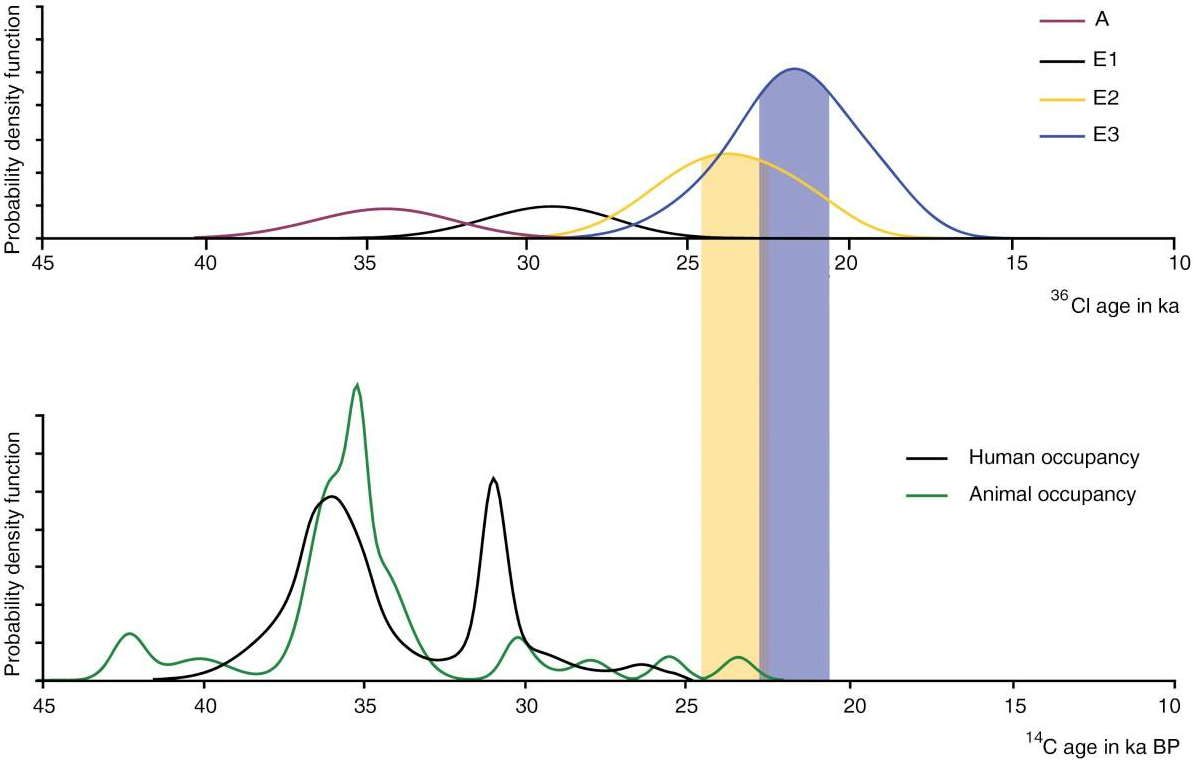
The diagram shows human occupation in black, animal occupation in green, using radiocarbon dating.
The vertical coloured bars represent the times of two successive major series of rockfalls, the second certainly sealing the cave, though it would appear that human occupation had ceased before the first major fall. These falls have been dated using Cosmic Ray Exposure dating.
Text below from: http://darwiniana.org/datingmethods.htm#CRE
Cosmic-ray Exposure Dating : This dating method relies on measuring certain isotopes produced by cosmic ray impacts on exposed rock surfaces. Because cosmic rays constantly bombard meteorites flying through space, this method has long been used to date the "flight time" of meteorites--that is the time from when they were chipped off a larger body (like an asteroid) to the time they land on Earth.
Photo: Sadier et al. (2012)
Note that the authors say that U/Th dating is unable to be used from 25 000 BP to 15 000 BP during the last glacial maximum, because (my interpretation) apparently everything was so frozen that no significant calcite formation was happening. I wonder if this applies to other areas besides Chauvet? Presumably it would.
This quote from Sadier et al. (2012) is important:
The distribution of ages obtained on charcoal from both the walls and floor, some of which being produced in the framework of a cross-comparative project between several independent laboratories confirming the validity of radiocarbon dating (8), indicate two successive phases of human occupancy: the first one from 37.5 to 33.5 cal 14C ka BP, and the second one from 32 to 27 cal 14C ka BP.and here is the abstract from Sadier et al. (2012), which comes down unequivocally on the side of an ancient origin for the artworks in Chauvet:
None of the charcoal dates is younger than 27 cal 14C ka BP.
Since its discovery, the Chauvet cave elaborate artwork called into question our understanding of Palaeolithic art evolution and challenged traditional chronological benchmarks [Valladas H et al. (2001) Nature 413:419–479]. Chronological approaches revealing human presences in the cavity during the Aurignacian and the Gravettian are indeed still debated on the basis of stylistic criteria [Pettitt P (2008) J Hum Evol 55:908–917]. The presented 36Cl Cosmic Ray Exposure ages demonstrate that the cliff overhanging the Chauvet cave has collapsed several times since 29 ka until the sealing of the cavity entrance prohibited access to the cave at least 21 ka ago. Remarkably agreeing with the radiocarbon dates of the human and animal occupancy, this study confirms that the Chauvet cave paintings are the oldest and the most elaborate ever discovered, challenging our current knowledge of human cognitive evolution.
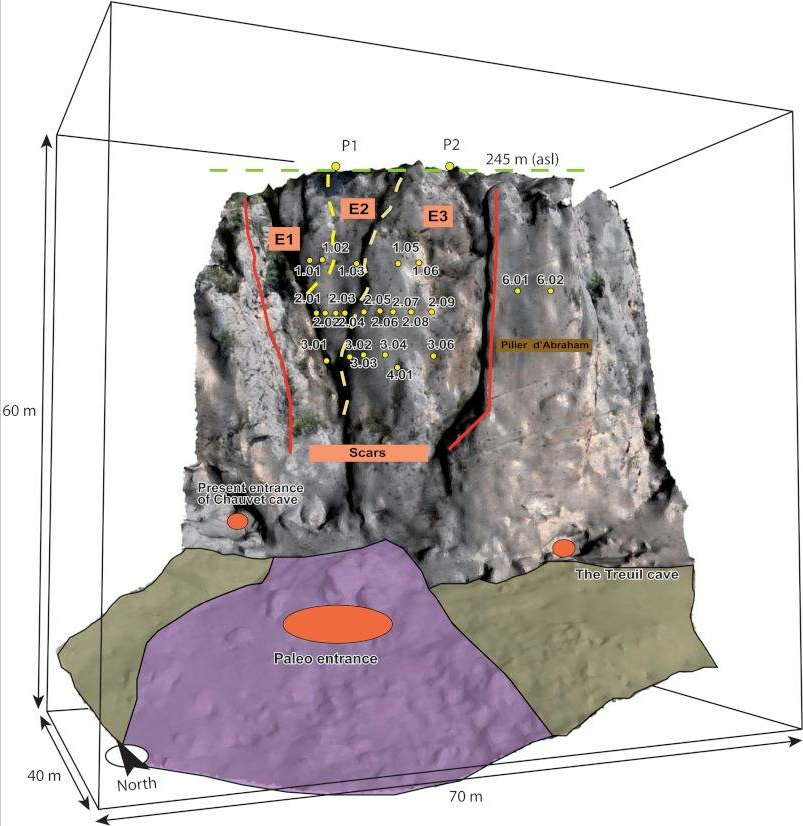
3D LiDAR view of the modern Chauvet cave area showing the sample positions on the rockfall scars and the Pilier d’Abraham.
Purple and brown surfaces correspond to rockfall deposit and bedrock, respectively. Continuous red lines mark the limit of the two prominent arêtes.
Dashed lines (yellow and white) delineate the contour of the three scar surfaces, E1, E2, and E3.
Dashed green line marks the top surface.
Samples (on the scars on the cliff from which the rockfalls originated - Don ) are located with a yellow dot.
Photo: Sadier et al. (2012)

A very good closeup photo of the position of the modern and paleo entrances, hidden by trees. The large, smooth area of rock is called the Pilier d’Abraham. The area between this and the other, rougher pillar on the left loosened and came crashing down more than 20 000 years ago, sealing forever the original entrance to Chauvet.
Photo: © dmb01
Source: Panoramio
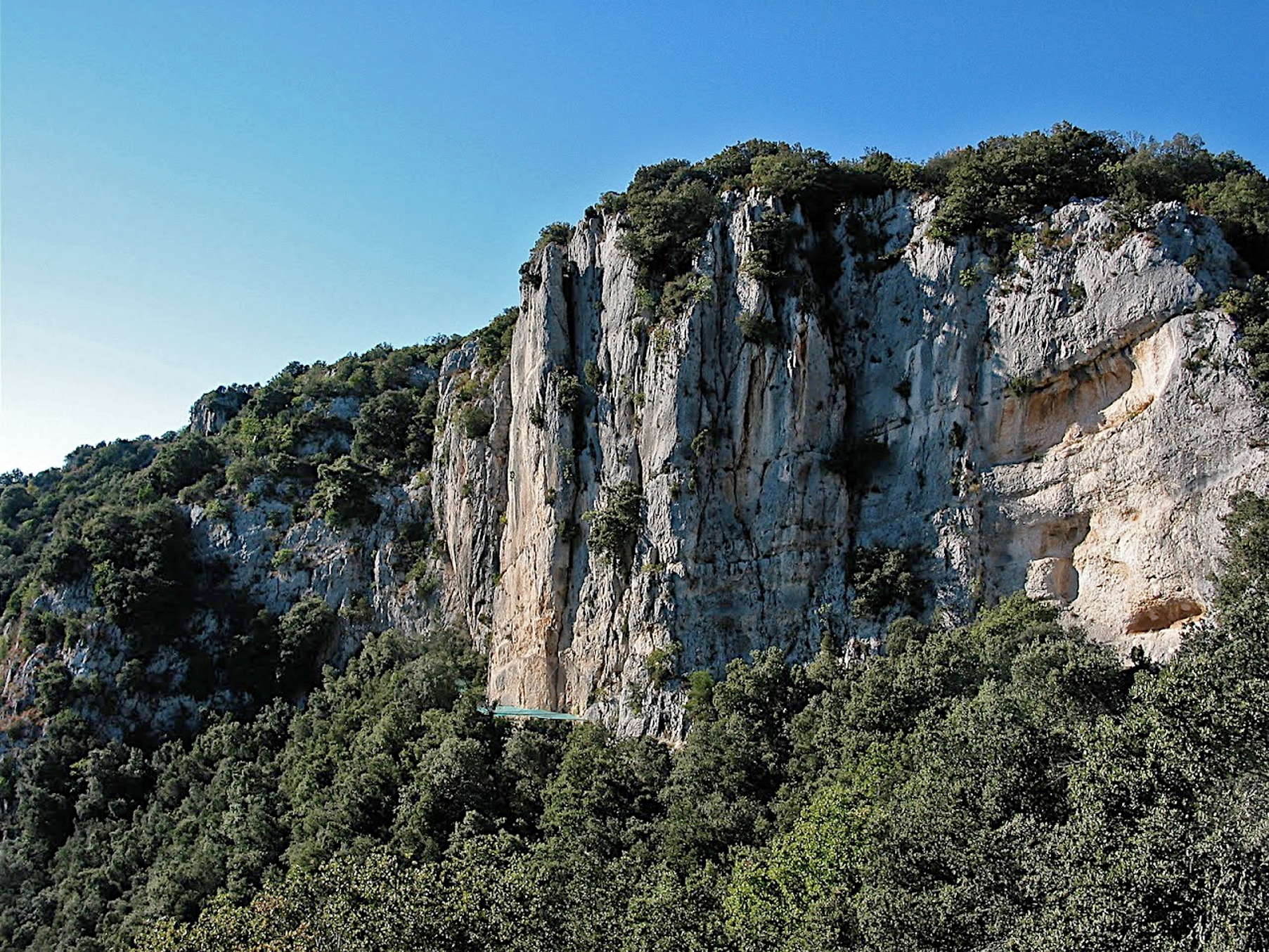
This is a valuable photo showing the Grotte du Treuil, at the foot of the Pilier d'Abraham, with a blue tarp over the entrance. The entrance to Grotte Chauvet is hidden to the left under vegetation.
Photo: © Herve
Source: https://picasaweb.google.com
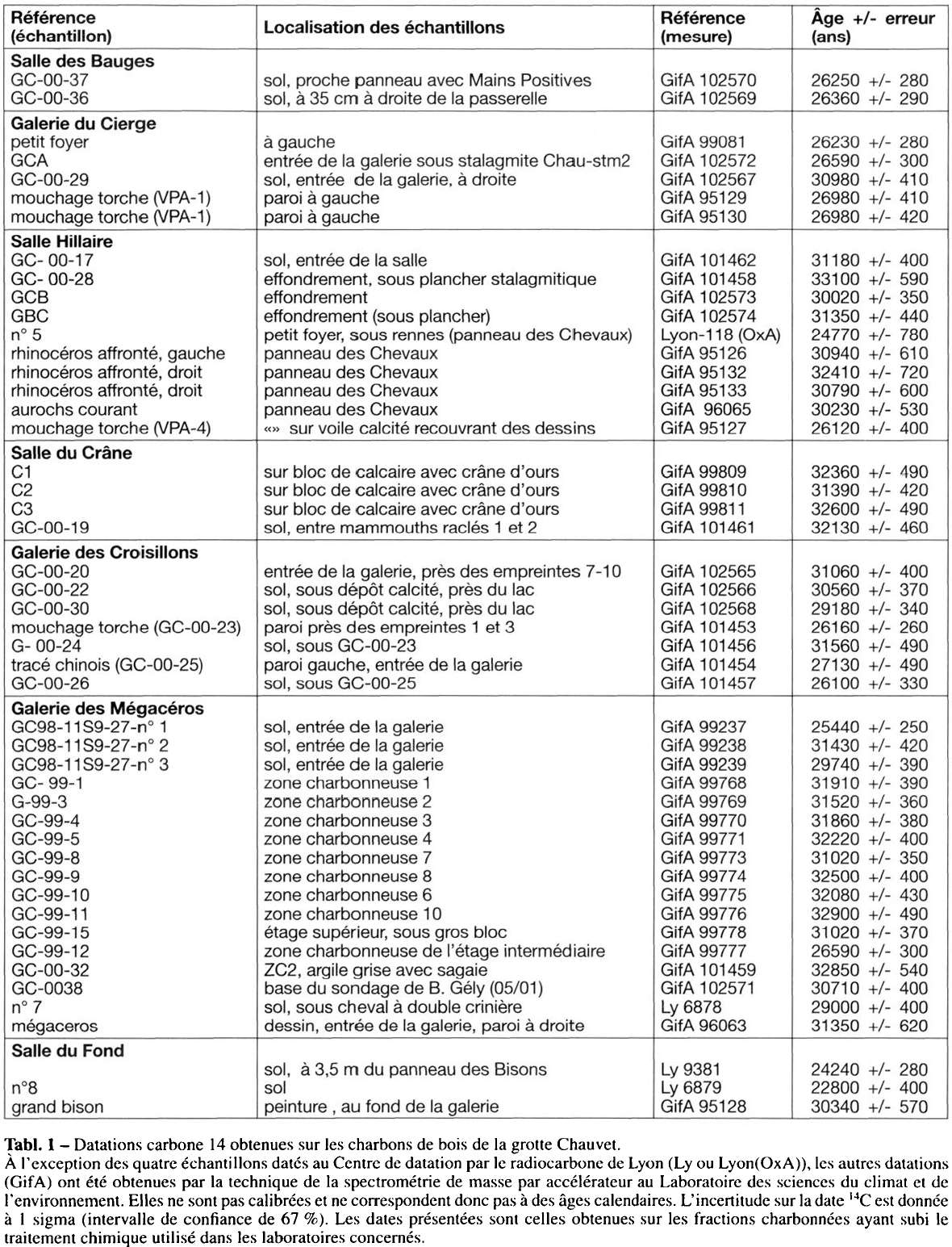
Typical values for dating at Chauvet Cave.
The paper of which this table is a part discusses the results of the 14C dates obtained from charcoal specimens collected on the walls (drawings and torch-wipes) and on the ground of the Chauvet Cave. The dates, which are coherent, can be divided into two periods a few millennia apart: between 33 000 and 29 000 14C years BP (33 samples including the five parietal representations) and between 27 000 and 24 500 14C years BP (13 samples including the four torch-wipes).
Table and text: Valladas et al. (2005)
Chauvet II
There is a replica of Chauvet being built, which it is planned to open in 2014.
I have translated this article from http://www.sudouest.fr/2013/04/02/chauvet-fabriquee-en-perigord-1012496-726.php
Chauvet Cave being made in Montignac
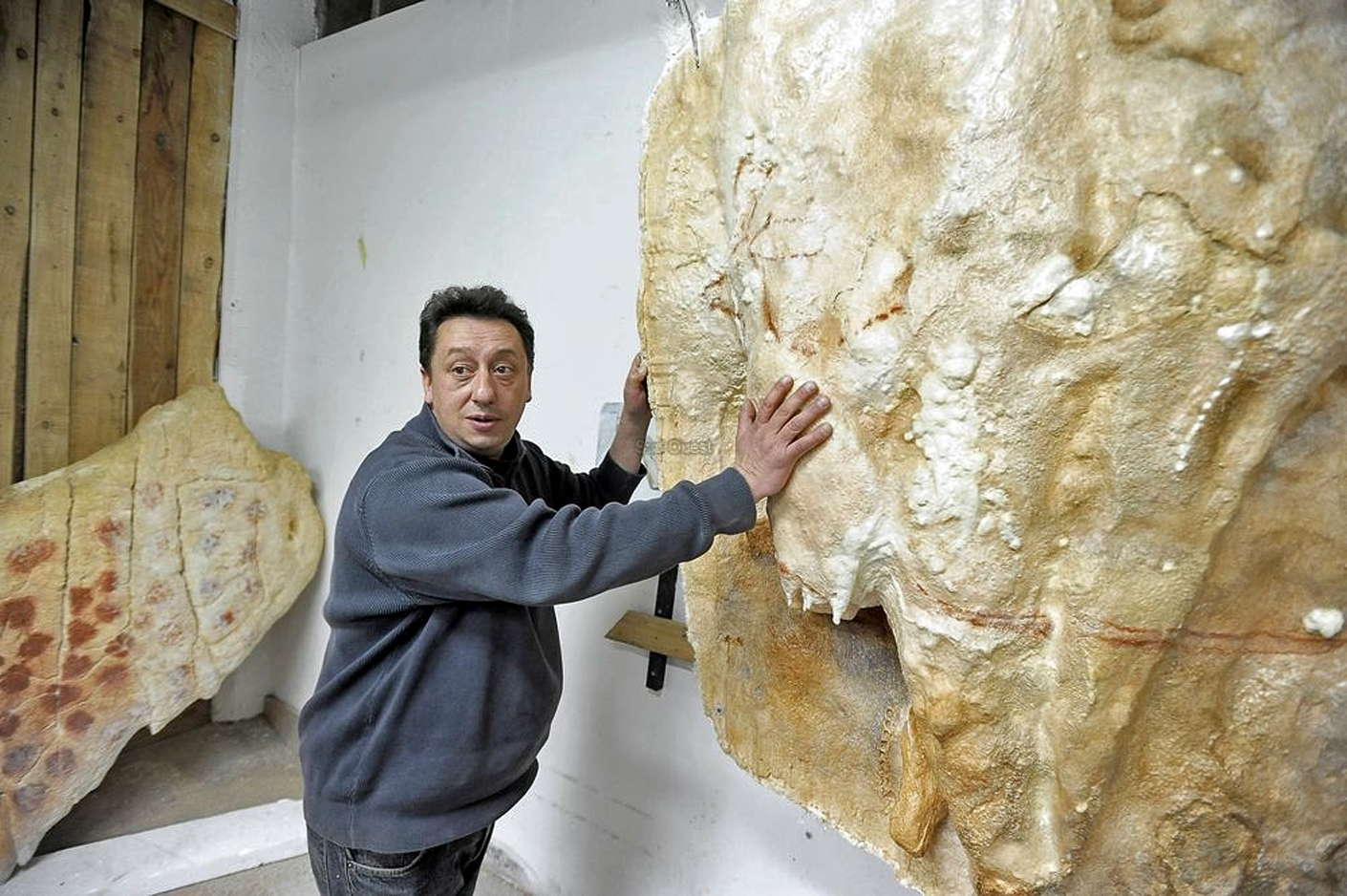
Alain Dalis with the first panels of Chauvet which he made in his workshop in Montignac.
Photo: © Arnaud Loth
Source: http://www.sudouest.fr/2013/04/02/chauvet-fabriquee-en-perigord-1012496-726.php
In a large, almost empty hangar, young people in white overalls were busy around indistinct forms. In recent days, the new team recruited by Alain Dalis to make Chauvet II was hard at work in the premises of the Montignac Business Centre opposite the facsimile workshops of Périgord (created by Renaud Sanson before its acquisition by the Semitour) that made reproductions of Lascaux.
Although he worked for a time in the company opposite, Alain Dalis is now their competitor. The Semitour workshop got nothing out of the Chauvet contract.
The Panel of the Hands, ready for display, and a closeup.
Photo: © Stéphane Compoint, http://stephanecompoint.com/
This will be the largest facsimile in the world. In late 2014 or early 2015, at Ardèche, a few kilometres from the original paintings dating from 36 000 years BP, the facsimile of the Chauvet cave will open to the public.
At Ardèche, building construction has already begun while in Dordogne, Lascaux 3 (or 4, the nomenclature varies) is still at the design stage. The costing is assessed for each construction at around 50 million euros.
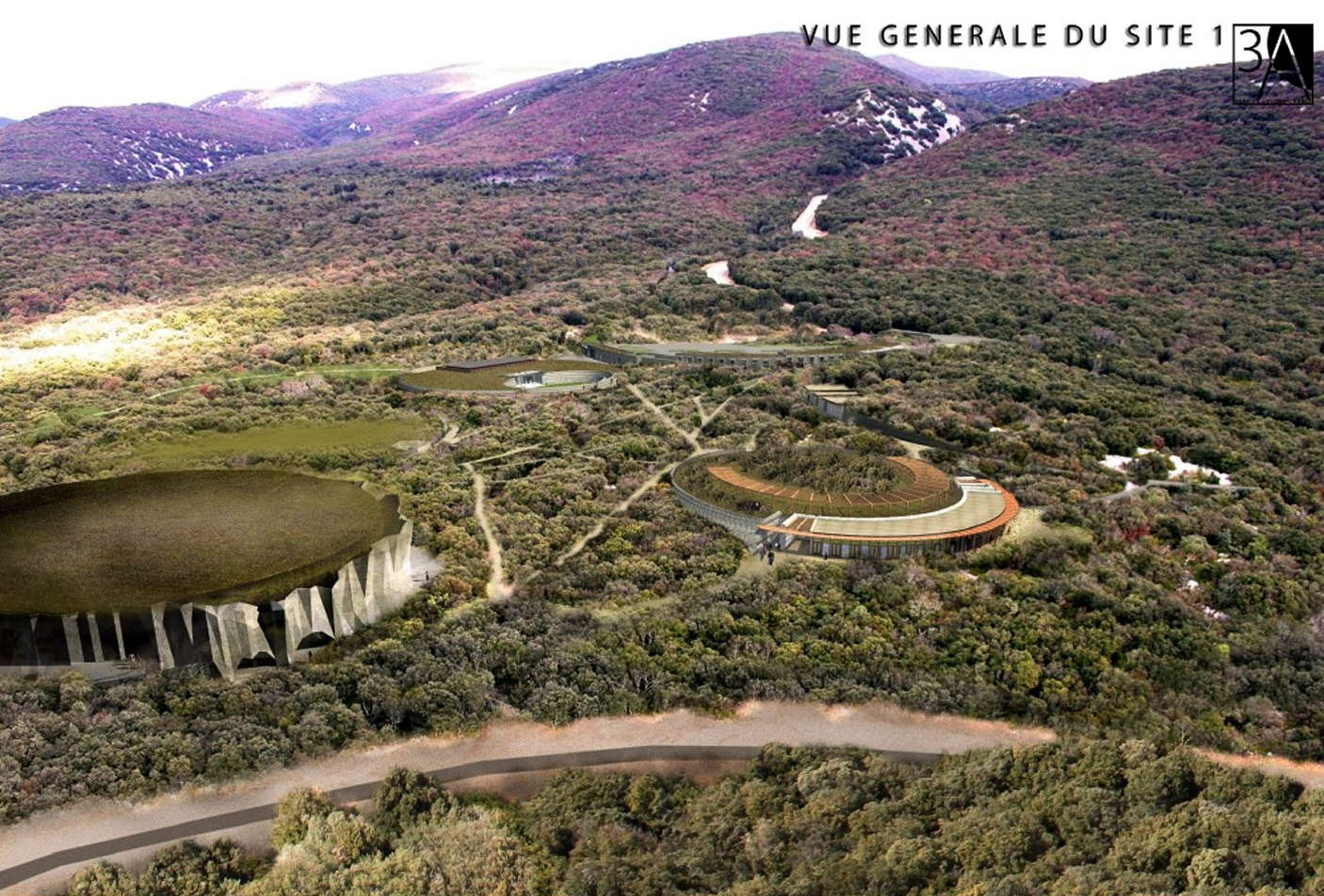
An artist's impression of the new site.
Photo: http://entreprendre.ardeche.fr/2012/01/grotte-chauvet-le-label-unesco-peut-etre-pour-bientot/
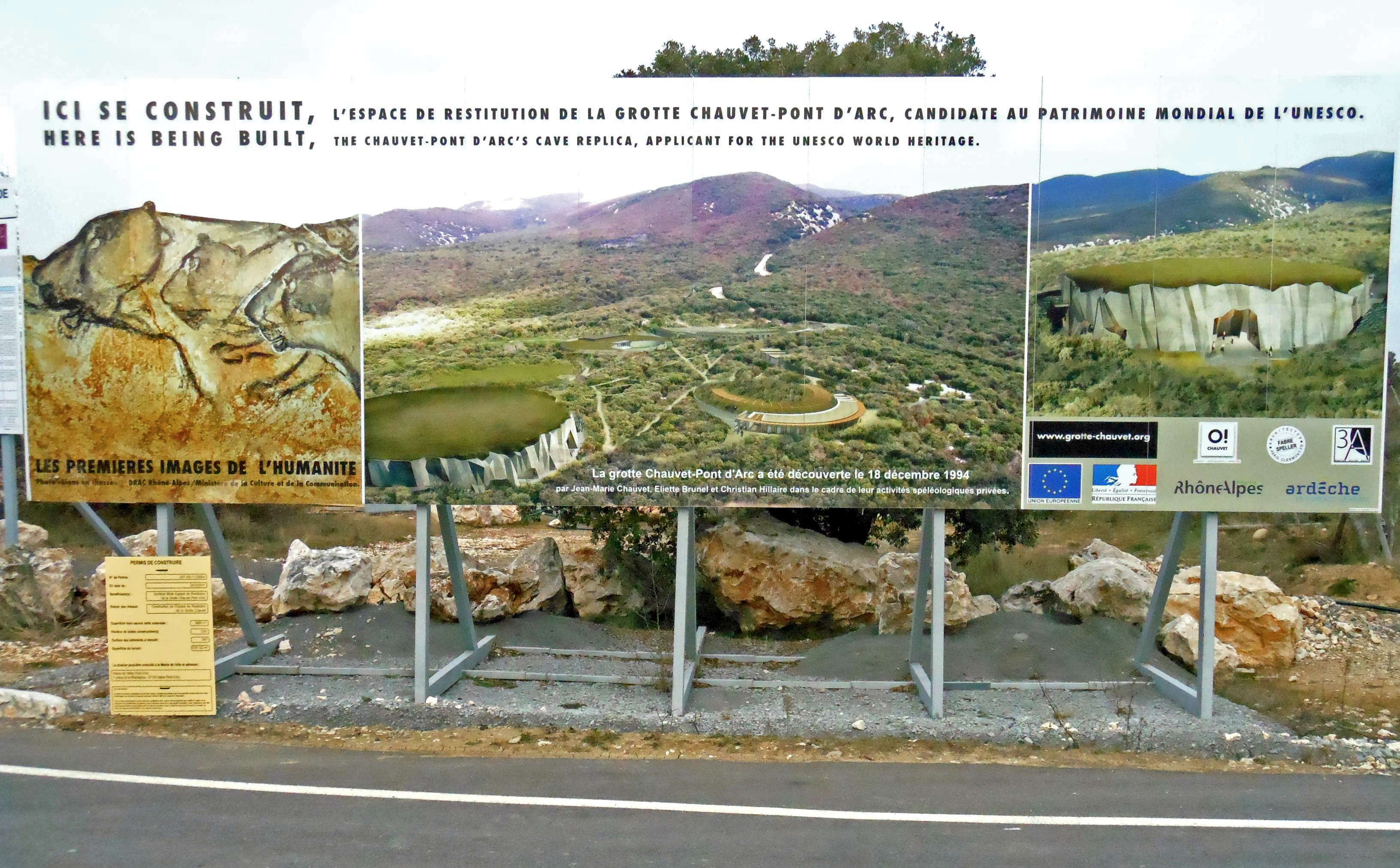
This is the sign beside the road near the proposed site for Chauvet II, above Vallon d'Arc.
Photo: http://www.location-maisonbleue.com/la-grotte-chauvet-en-ardeche/grotte-chauvet/
Chauvet II will, with its 3000 m2, be the largest facsimile of the prehistoric world. In reality, Chauvet (8000 m2) is a huge cavity compared to Lascaux (1500 m2) while the Lascaux facsimile will be 500 m2.
In both cases, there are expected to be 400 000 visitors a year and the develpment of tourism will be very strong.
Chauvet II will be managed by a private Périgord company , the Kléber Rossillon (Castle Castelnaud-la-Chapelle and Gardens Marqueyssac Vezac). Lascaux 4 will also be assigned a delegation to a company, which will be chosen after a call for tenders. But there is a very good chance that this will be Semitour, together with the General Council.
The negative hand panel. It is located some distance from the alloy walkway, from which no one is allowed to stray, and telephoto lenses are required to obtain any image of it.
Photo: © Stéphane Compoint, http://stephanecompoint.com/
Alain Dalis must create the supports for 250 square metres of decorated walls that will be embedded in the reproduction of 3000 m2 of displays in the cave ( the original is 8000 m2).
He remains discreet about the actual composition of the products used. There are resins and natural materials used, then, paintings and prints are handmade from the projections of photos. "But half the paintings will be created in Toulouse by Gilles Tosello" said Alain Dalis, "Including the famous frieze of lions and horses."
The Périgord artist has already completed three panels in his former workshop at Montignac. Everything must be delivered, in several instalments, by September 2014.
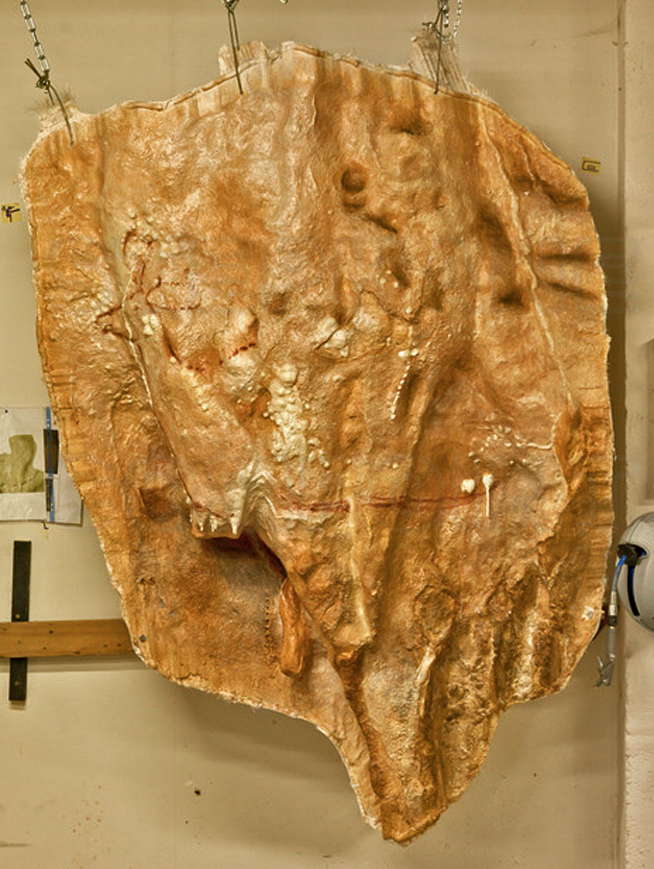
The completed Red Deer Panel.
Photo: © Stéphane Compoint, http://stephanecompoint.com/
The team hired for the task includes Didier Lasserre, who has long worked with Alain Dalis, David Sartre, designer of exhibitions, Romy Nicolas and Julie Gaulon, who have already made similar works of art, Yoann Bonhoure with Fine Arts experience, as well as Marie Hamelin, Catherine Daneyrol, and Lilas Roumanie.
Alain Dalis, native of Montignac and former student of Fine Arts in Bordeaux, made his debut as a guide at Lascaux 2, then worked with Renaud Sanson and Monique Peytral on restoration projects.
Alain Dalis has already had several visits to Chauvet to soak up the original cave art of Chauvet. It is supervised by the Chief Scientist of the cave, Jean-Michel Geneste, who is also the director of the National Centre of Prehistory in Périgueux. The prehistorian Jean Clottes is also one of the experts in charge of the cave.
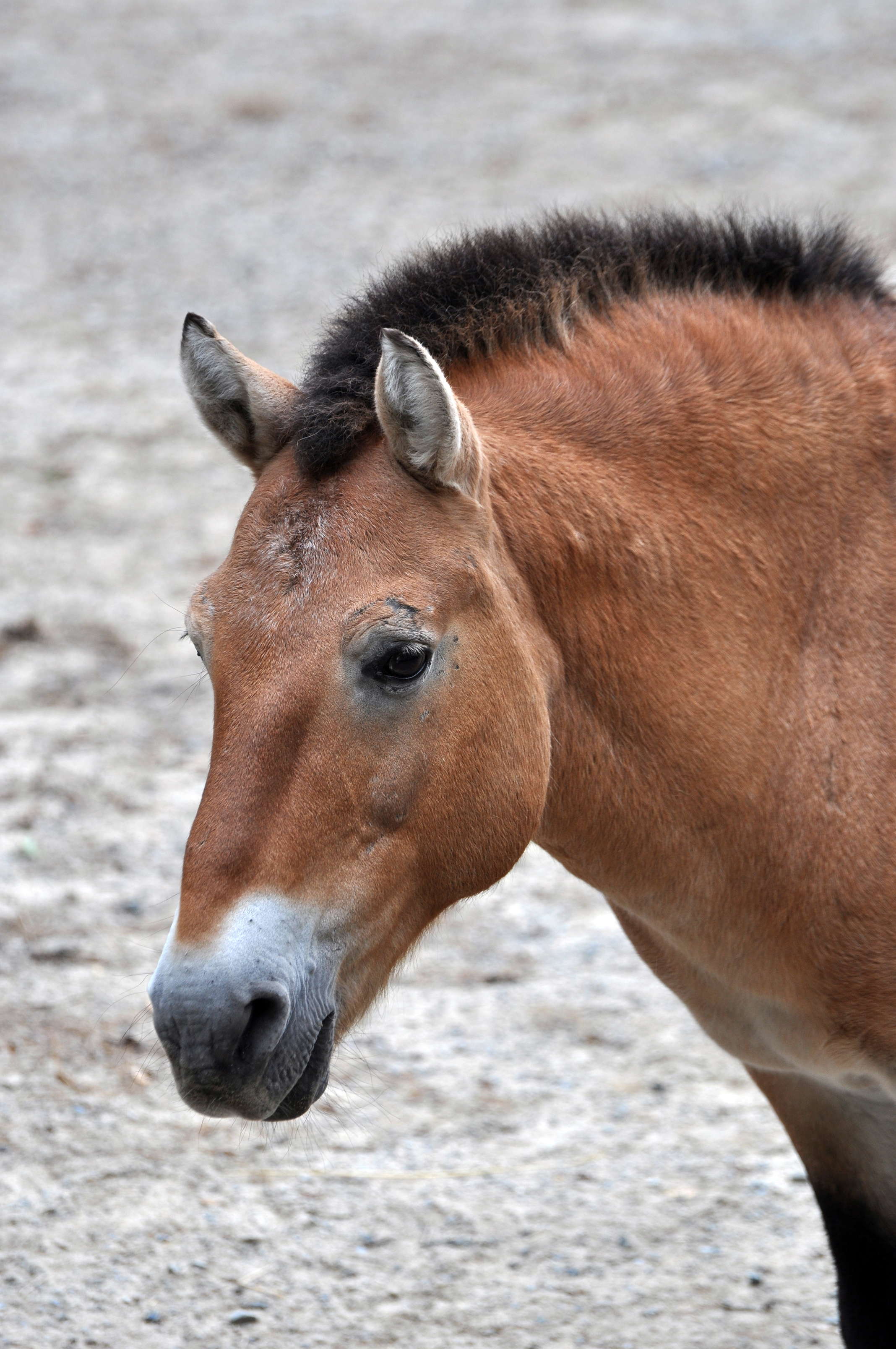
A superb portrait of a Przewalski horse, considered the descendant of the wild horses of the ice age. Note the erect mane so well shown in ice age paintings.
The photo was taken at the Smithsonian National Zoological Park in Washington, D.C., USA.
Date: 17 September 2011
Photo: Joe Ravi
Permission: (Reusing this file) Creative Commons Share-Alike License, CC-BY-SA 3.0
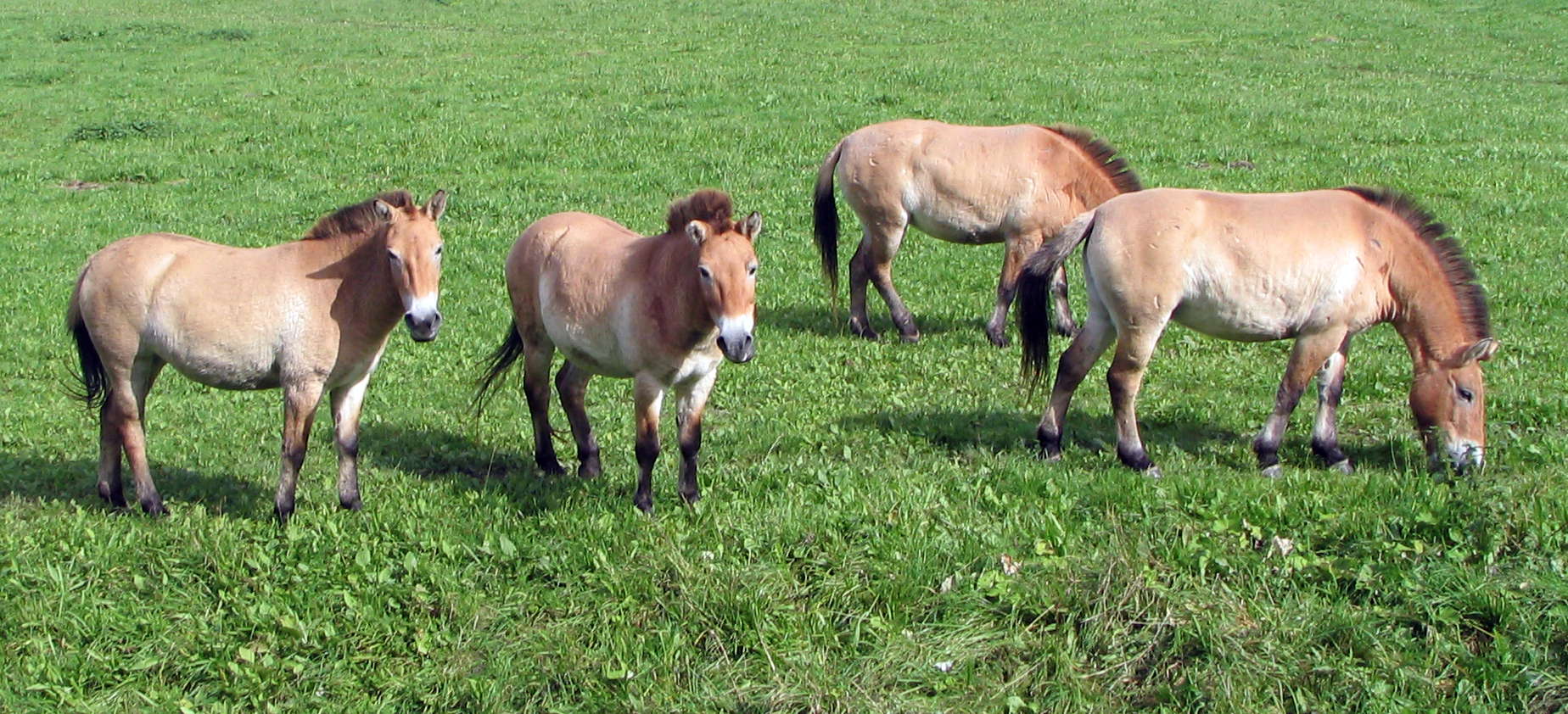
Przewalski horses grazing. The characteristic dorsal stripe can be seen in two of the horses.
Photo: GerardM
Date: 24 August 2005
Permission: GNU Free Documentation License, Version 1.2, licensed under the Creative Commons Attribution-Share Alike 3.0 Unported license.
Although Jean-Marie Chauvet and friends stumbled upon the cave in 1994, for years exploration had been blocked by lawsuits over who owned the rights to the grotto. Finally, archeologist Jean Clottes, a science adviser to France's Ministry of Culture, won permission to lead a team into the cave in 1998. Last week he and a dozen colleagues returned, seeking clues to the social structure, mind-sets and spiritual beliefs of the ancient artists.
Text above: National Geographic, August 2001
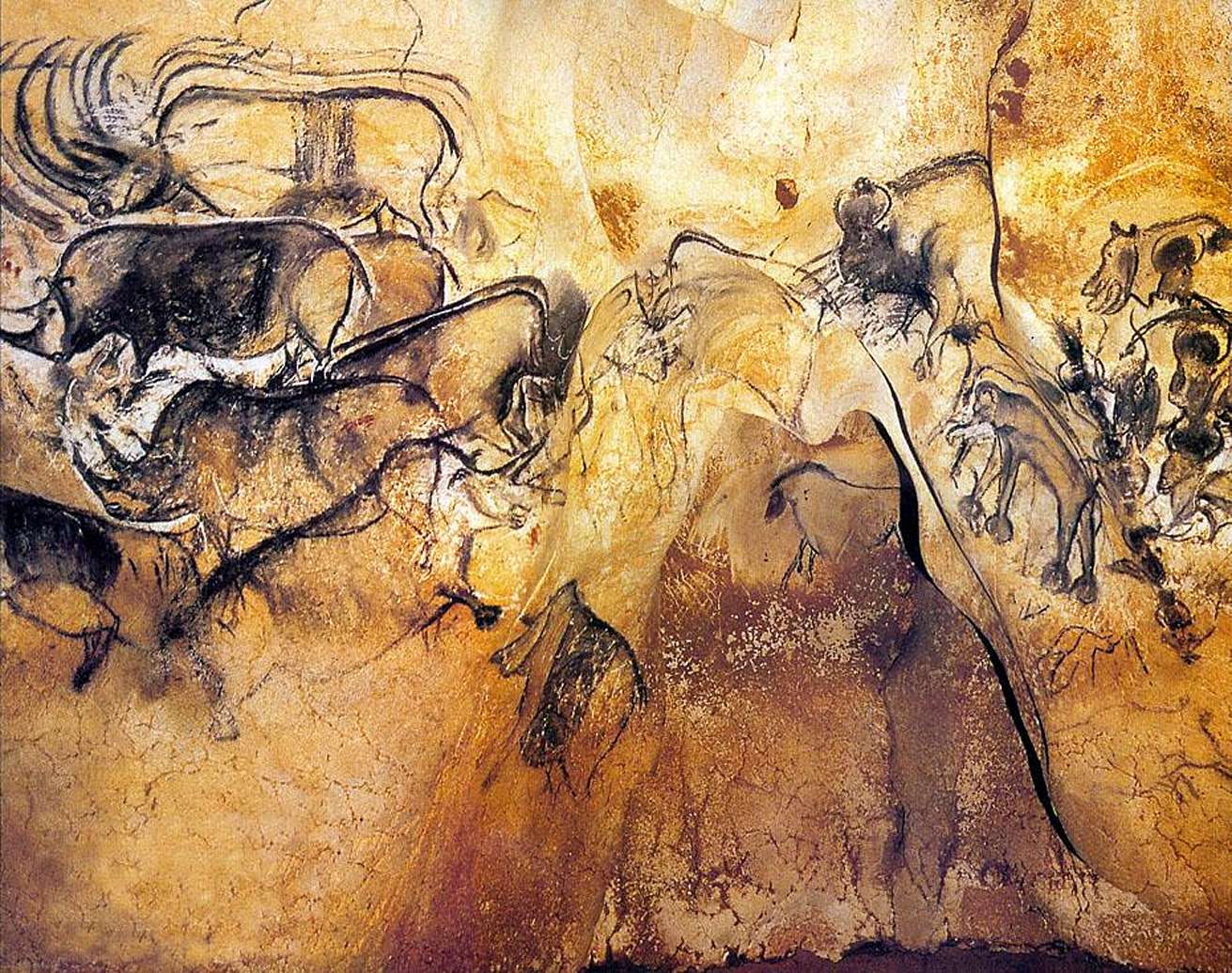
They certainly left behind enough clues. A string of three chambers, 1,700 feet long, as well as one connecting gallery and three vestibules, are all covered with masterworks breathtaking in their use of perspective (as in overlapping mammoths) and shading, techniques that were supposedly not invented until millenniums later. And eons before Seurat got the idea Stone Age artists had invented pointillism: one animal, probably a bison, is composed of nothing but red dots. Most striking, however, is that the artists had a thing for rhinos, lions, cave bears and mammoths.
In contrast, most cave art depicts hunted animals. "Out of these people's whole bestiary, the artists chose predatory, dangerous animals," says archeologist Margaret Conkey of the University of California, Berkeley. By painting species that virtually never wound up on the Paleolithic menu but which "symbolised danger, strength and power," says Clottes, the artists may have been attempting 'to capture the essence of' the animals.
Photo: Time Magazine 13th Feb 1995
Text: National Geographic, August 2001
Like bemused gallery goers, Clottes's team spends long hours staring at a painting and asking, what - does it mean? One clue comes from how the images are integrated into the walls. In the "Goldilocks" chamber, the missing hindquarters of a cave bear drawn in red ochre seem to lie within rather than on the rock. "The bear seems to come out of the wall," says Clottes.
And last week Clottes's team discovered two painted ibexes in the same chamber. The horns of one are actually cracks in the wall which the artist scraped and enlarged. "To these people's way of thinking, those animal spirits were in the walls," says Clottes. Painting them, the artists may have believed, allowed the power within to seep into the real world.
Text: National Geographic, August 2001
Doing cave archeology still means roughing it. Base camp is a 25-foot-deep cave strewn with clothes, equipment and baguettes. But since the discovery of the Lascaux painted caves in 1940, the work has gone high-tech. Clottes's team is photographing the paintings and etchings with a regular 35-mm, a digital camera and an infrared camera, which picks up the red-ochre paint better than standard optical devices. Back at the research base in the valley, the team scans or downloads the photos into computers, which can brighten the colours, pump up the contrast or manipulate the image. That technique has helped explain two arrays of red dots that seem unique to Chauvet. Using a scanner, the archeologists fed images of the dots into a computer. A program superimposed arrays of hands onto the dots. The best fit to an array of 48 dots is a sequence of handprints made by an adolescent or a short woman. A panel of 92 dots was probably the handiwork of a tall man. The presence of people of different ages and sexes suggests either a communal experience or masters passing their secrets on to apprentices. Even 32 00 years ago, art was created for more than art's sake.
Text: National Geographic, August 2001, with Dana Thomas at the Grotte Chauvet
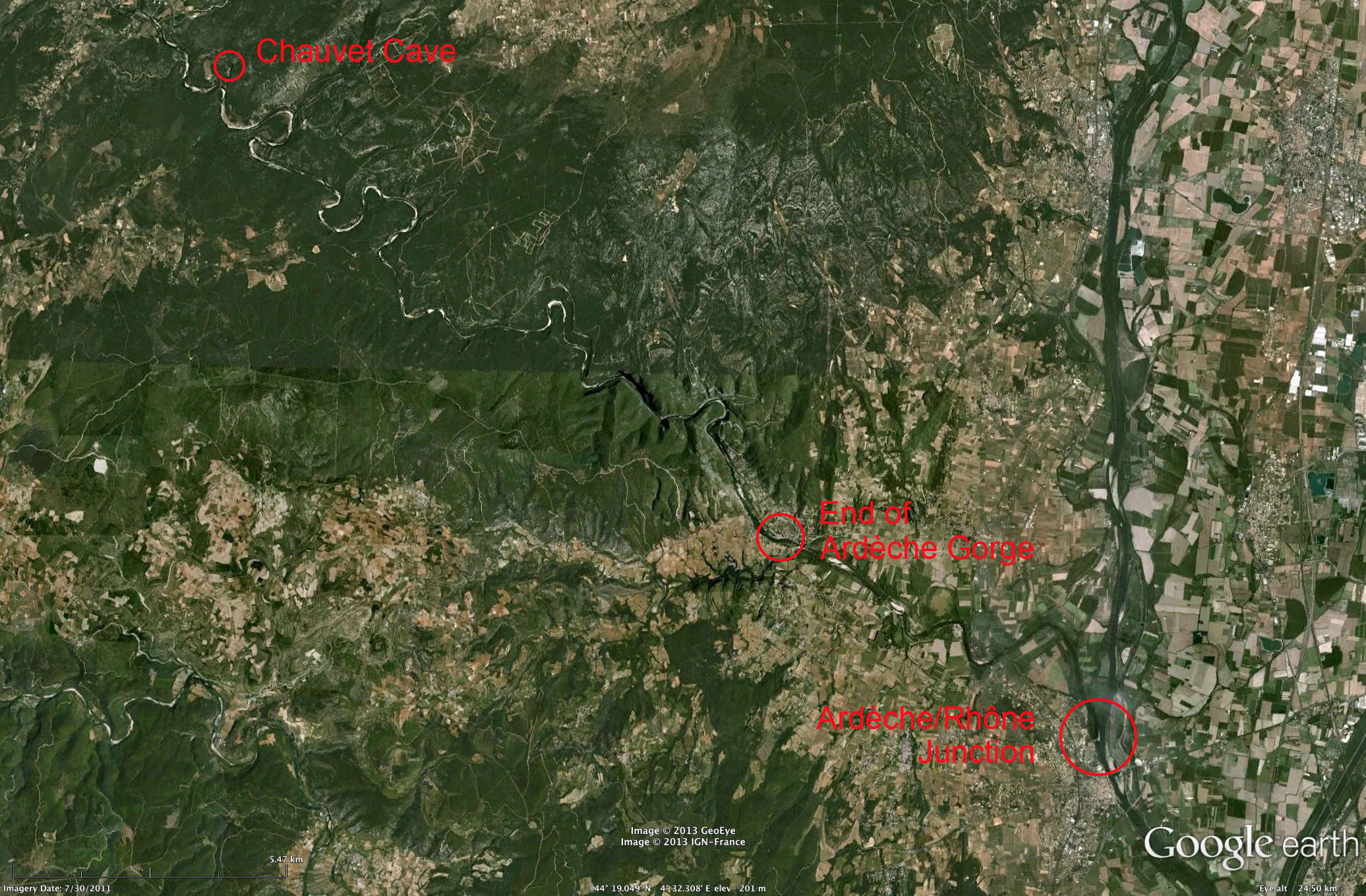
Chauvet Cave is on the Ardèche River, at the upper end of the Ardèche Gorge. The Ardèche leaves the gorge and meanders across farm land then into the Rhône River, which flows from north to south.
Photo: Google Earth
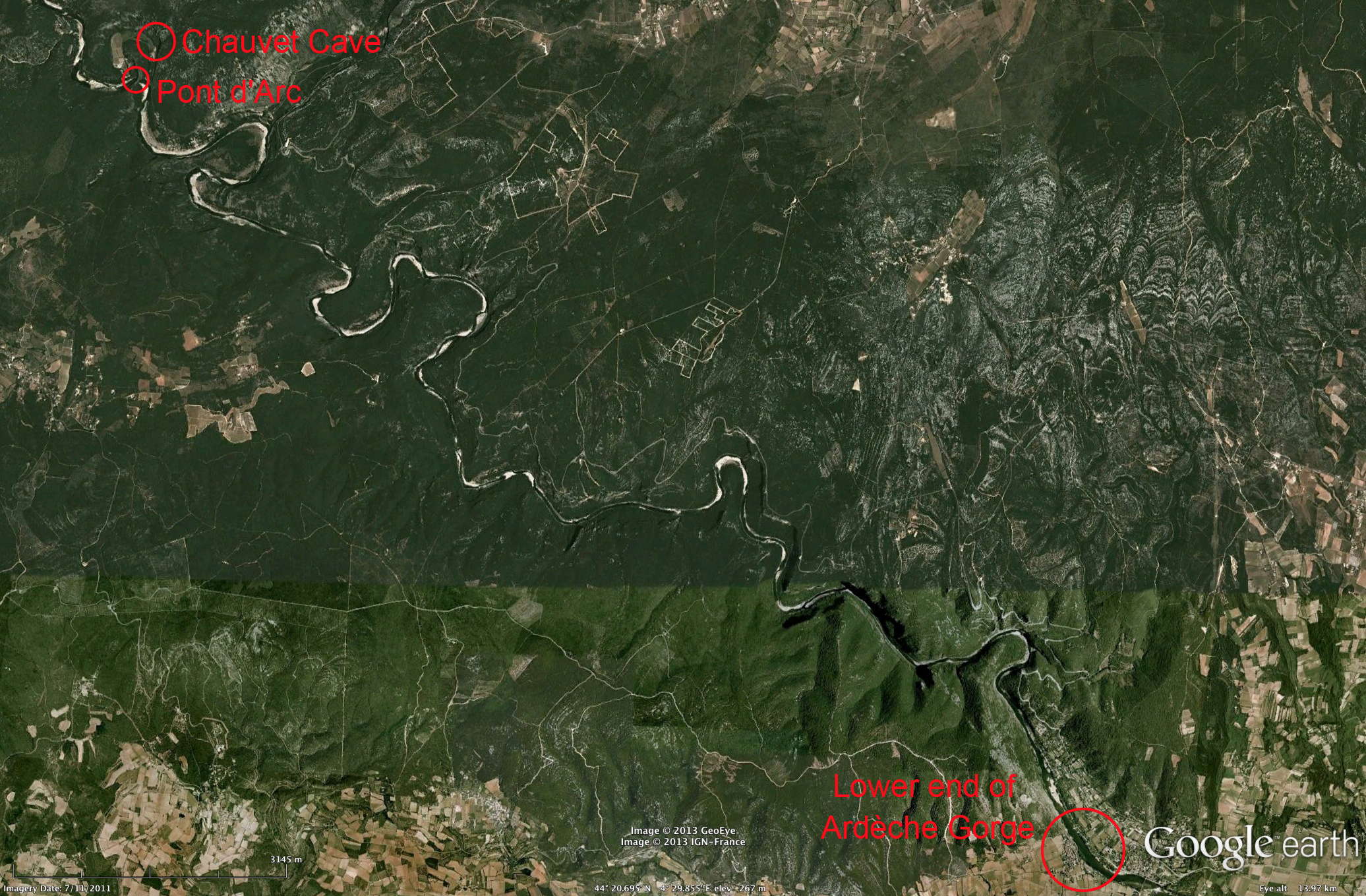
The Ardèche is a favourite holiday destination, offering good camping and the opportunity to kayak down the river, from the Pont d'Arc to the end of the gorge, a distance of 24 kilometres or 15 miles, which takes a full day. The river is often choked with kayaks in the summer.
Photo: Google Earth
Preservation
View of the entrance to the Grotte Chauvet near Vallon-Pont-d'Arc, Rhône-Alpes (France).
After initial proceedings begun in the very first days, the cave was officially designated as an Historic Monument on October 13, 1995. Also in 1995, the state began taking measures to expropriate the cave from its three recognised owners. The state became owner of the cave on February 14, 1997.
The first measure of protection consisted of 24-hour surveillance of the entry by local police. Soon after, a solid door and simple alarm system were installed while awaiting the intervention of Commander Cadias, who is responsible for the security of Historic Monuments with the Ministry of Culture. A large-scale operation was subsequently undertaken to equip the cave with a reliable protection system. Today the cave is under permanent audio and video surveillance, and a complex protocol is followed before each entry. The authorised persons are obliged to follow a strict set of procedures requiring them to wear a special suit and shoes that have not been in contact with the exterior. In this way, all biological exchanges with the cavity are avoided as much as possible.
Inside the cave, a system of climatological and biochemical surveillance has been installed by the Laboratoire Souterrain du CNRS de Moulis and the Laboratoire de Recherche des Monuments Historiques. This system continually regulates the hygrometry and temperature within the cave, as well as the bacteriology and growth of concretions.
Finally, a program of adapting the area around the cave, and the paths of access inside, is currently in progress.
Text: http://www.culture.gouv.fr/culture/arcnat/chauvet/en/index.html
Photo: "dmb01" via http://www.panoramio.com/
Bear DNA is clue to age of Chauvet cave art
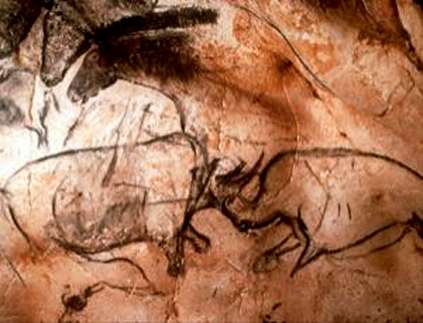
Fighting Rhinos at Chauvet Cave. Some prehistoric art experts believe that the art is too sophisticated to be ~30 000 years old. However, charcoal taken from the two fighting rhinos pigments produced radiocarbon dates of around 31 000 - 32 000 BP.
Photo: Raphael Gaillarde/Gamma-Rapho/Getty
Exploring a gorge in south-east France in 1994 for prehistoric artefacts, Jean-Marie Chauvet hit the jackpot. After squeezing through a narrow passage, he found himself in a hidden cavern, the walls of which were covered with paintings of animals.
But dating the beautiful images - which featured in Werner Herzog's recent documentary film Cave of Forgotten Dreams - has led to an ugly spat between archaeologists. Could the bones of cave bears settle the debate?
Within a year of Chauvet's discovery, radiocarbon dating suggested the images were between 30 000 and 32 000 years old, making them almost twice the age of the famous Lascaux cave art in south-west France (see map). The result "polarised the archaeological world", says Andrew Lawson, a freelance archaeologist based in Salisbury, UK.
Lawson accepts the radiocarbon findings. "Nowhere else in western Europe do we know of sophisticated art this early," he says. But Paul Pettitt of the University of Sheffield, UK, is adamant that the paintings cannot be that old. The dating study doesn't stand up, he claims, insisting that the paintings' advanced style is enough to mark them as recent. To suggest otherwise, he says, would be like claiming to have found "a Renaissance painting in a Roman villa".
Despite a comprehensive radiocarbon study published in 2001 that seemed to confirm that the paintings were indeed 30 000 years old (Nature, DOI: 10.1038/35097160), Pettitt and his colleagues were unconvinced. Two years later they argued that the cave walls were still chemically active, so the radiocarbon dating could have been thrown out by changes over the millennia to the pigments used to create the paintings (Antiquity, vol 77, p 134).
To try to settle the controversy, Jean-Marc Elalouf of the Institute of Biology and Technology in Saclay, France, and his team have turned to the remains of cave bears. Along with mammoths and other huge mammals, cave bears (Ursus spelaeus) dominated the European landscape until the end of the last ice age.
The Chauvet cave contains several depictions of cave bears, and Elalouf argues that these must have been painted while the bears still thrived in the area. To pin down when the bears disappeared, his team collected 38 samples of cave bear remains in the Chauvet cave and analysed their mitochondrial DNA.
They found that almost all the samples were genetically similar, suggesting the cave bear population was small, isolated and therefore vulnerable. Radiocarbon dating showed the samples were all between 37 000 and 29 000 years old, hinting that by the end of that period they were extinct, at least locally. Samples from a nearby cave, Deux-Ouvertures, gave similar results (Journal of Archaeological Science, DOI: 10.1016/j.jas.2011.03.033).
Given the age of the cave bear remains, "it is clear that the paintings are very ancient", says Elalouf. Michael Knapp of the University of Otago in Dunedin, New Zealand, who also studies cave bears, says he has no doubts about the DNA analysis.
While we do not know exactly when cave bears became extinct, all reliably dated remains in Europe are at least 24 000 years old, says Martina Pacher of the Commission of Quaternary Research in Vienna, Austria. "So the results at Chauvet are not surprising, and I agree with their conclusions," she says.
"We now have an independent line of evidence that the bears [in Chauvet] date to before 29 000 years ago," Lawson says. "That bolsters the case for an early date."
Pettitt remains unconvinced, calling the new research "sloppy". He says that the team is trying to extrapolate the regional spread of the bears over time by relying on evidence from just two caves.
Pettitt also questions whether the paintings show cave bears at all: brown bears lived in the area long after the cave bears were gone. But Elalouf says the two species can be distinguished by skull shape, and that the paintings definitely show cave bears.
(When the dating started to come in for the art in Chauvet, there was a huge amount of resistance from highly qualified and respected archaeologists and anthropologists, who could not believe that such superb art could be so old.
However, despite the objections raised, the evidence is now in, and Chauvet is now accepted by most as the earliest and the best art that humans ever produced in the Palaeolithic. This is an article from the period when questions were still being raised about the authenticity of the ages which had been published for the site - Don )
From The New Scientist, 15 April 2003:
Doubt cast on age of oldest human art
If the rock art in the Chauvet cave is 30 00 years old, it is the most ancient example of human art in existence and the implications for the evolution of culture are immense. This date is accepted and celebrated by archaeologists. But could it be wrong?
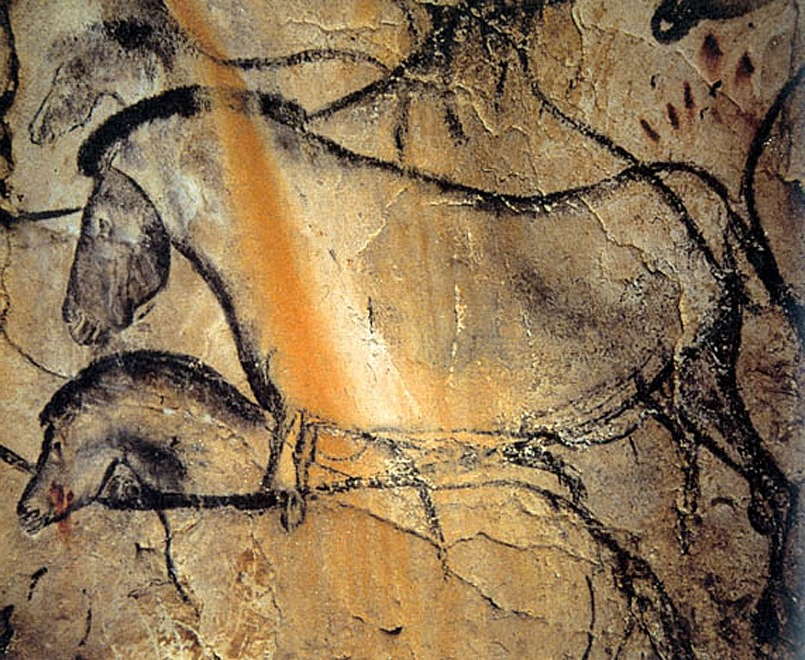
Horses from Chauvet Cave.
Grotte Chauvet (Ardèche), panneau des chevaux. Triple figuration de cheval dont les têtes sont réhaussées à l'estompe. Observer le rendu des crinières et le voile de calcite coloré d'oxyde de fer qui, venant sceller le dessin, en atteste l'ancienneté.
Source: Agenda de la Préhistoire 2002 - 2003, a superb diary with excellent illustrations sent to me by Anya. My thanks as always.
"I would be astounded if this date proves to be correct," leading archaeologist Paul Bahn says now. "It flies in the face of all we know about ice-age art." He has reignited the debate about the age of the paintings at Chauvet by questioning the science that says they are so old. The controversy is currently dividing the archaeology community.
The Chauvet cave was discovered in a valley in southern France in 1994. Its walls are a spectacular gallery of prehistoric art and the depictions of wild animals - rhino, lions and bison among others - are so sophisticated that specialists in ice-age art first assumed they must be relatively recent. Certain features, such as animals shown face on, also suggested that the cave paintings were about 15 00 years old.
But a few months later, tiny samples of black charcoal were scraped from some of the pictures and sent away for radiocarbon dating. The date that came back from the Laboratory of Climate and Environmental Science (LSCE) in Gif-sur-Yvette, France, shocked everyone. It suggested that the paintings dated to the very beginning of the Upper Paleolithic era, around 30 000 years ago (New Scientist print edition, 13 July 1996).
Picasso or Michelangelo?
People are generally wary of stylistic dating, explains Paul Pettitt, an archaeologist at the University of Oxford. So once the more "scientific" radiocarbon results were available, most researchers dismissed the more recent date suggested by the paintings themselves.
Instead the carbon data was used to support the revolutionary theory that sophisticated art developed extremely rapidly once modern humans arrived in Europe, and archaeologists who thought culture evolved over millennia were sidelined.
There is good reason to doubt chronologies based purely on style, admits Chris Witcombe, an art historian at Sweet Briar College in Virginia. He explains the difficulty with an analogy: "Imagine you are living in the distant future and only two objects survive from a lost and forgotten past: a painting by Picasso and a painting by Michelangelo. Which is the earlier work and which the later?"
But archaeologists must also be wary of radiocarbon dates, argue Pettitt and Bahn in a paper that appeared in Antiquity last month. Bahn's suspicions were aroused when he translated the latest coffee-table book on the Chauvet cave into English. Around 30 radiocarbon ages are presented in this book, but the measurements were all made at the same French laboratory. Using results from only one team, however skilled, just is not scientific, says Bahn.
Worse, the same laboratory is currently embroiled in an argument over the age of the artwork in another cave, Candamo in Spain. They dated black dots on its walls to 30 000 years ago, but Geochron Laboratories in Cambridge, Massachusetts, estimated the age of a second sample to be just half that.
The point is that carbon dating rock art is difficult. Because the samples tend to be incredibly tiny, it is difficult to measure the number of carbon-14 atoms relative to other carbon isotopes - the key ratio for pinning down the age.
"Everybody agrees there are problems," says Marvin Rowe, who heads a radiocarbon-dating lab at Texas A&M University in College Station. Contamination from groundwater or rock scrapings may further confuse the results.
Jean Clottes, the archaeologist at the French Ministry of Culture who led the team exploring the cave, stands by his Chauvet results. But he has agreed to send Rowe a sample of charcoal from the cave floor, so that they can compare their results. This is crucial, says Pettitt. "We are not saying the dates are necessarily incorrect, but they need to be checked."
Jenny Hogan
From:
http://www.smh.com.au/news/0110/06/world/world19.html
in The Sydney Morning Herald, 6th October 2001
Ancient paintings challenge old wisdom on the history of art
Europe's oldest cave paintings - a menagerie of lions, rhinos, bears and panthers drawn at least 30 000 years ago - are so sophisticated that they may force scientists to think again about the origins of art.New radiocarbon datings of the Chauvet cavern paintings in Ardeche, France, have confirmed that their Stone Age creators were as skilled as painters 15 000 years later.
The hundreds of animal paintings and engravings discovered in 1996 near Vallon Pont d'Arc are among the most spectacular in the world.
They include the only known cave paintings of a prehistoric panther and owl, alongside images of hyenas, mountain goats, buffaloes, lions, mammoths, deer, bears and a woolly rhino.
The painters were probably the Aurignacians, an early group of modern European Homo sapiens skilled at carving.
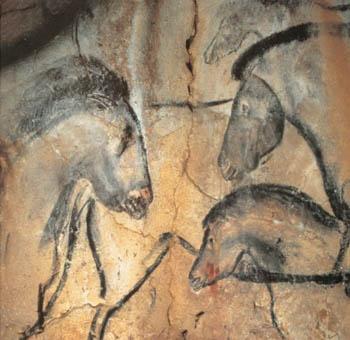
Chauvet Cave horses
Photo: www.amazon.com
A team of researchers led by Dr Helene Valladas of the Climate and Environmental Sciences Laboratory at the National Centre for Scientific Research in Gif sur Yvette used carbon dating to confirm the age of the paintings at between 29 000 and 32 000 years. The team believes that the art, which incorporates features in the rock walls, is as sophisticated as that in the more famous caves of Lascaux, painted during the Magdalenian period, 15 000 years ago.
'We have derived new radiocarbon dates for the drawings that decorate the Chauvet cave which confirm that even 30 000 years ago Aurignacian artists, already known as accomplished carvers, could create masterpieces comparable to the best Magdalenian art,' they report in Nature.
'Prehistorians, who have traditionally interpreted the evolution of prehistoric art as a steady progression from simple to more complex representations, may have to reconsider existing theories of the origins of art.'
The caves have challenged the conventional theory of the evolution of art, which states that it had crude beginnings in the Aurignacian period followed by gradual progress over thousands of years. The age of cave paintings used to be worked out by their subject matter, but dating based on the charcoal or pigment has become more precise in recent years. Scientists can also date the smudges of soot from torches used by the prehistoric artists.
The Telegraph, London
From:
http://www.museum-security.org/reports/04398.html
Archaeologist at Last Wins Battle With France
Government Worker Eligible for Rights, Royalties in His 1994 Discovery of Prehistoric Drawings
By Dana Thomas Special to The Washington Post Saturday, July 25, 1998; Page A15
LYON, France-Jean-Marie Chauvet, the French government archaeological official who discovered the oldest known prehistoric cave paintings, has been vindicated after more than three years of legal wrangling. An investigating magistrate here concluded this week that government papers stating that Chauvet was on official assignment when he stumbled upon the caves in December 1994 were backdated, as Chauvet has long claimed. Three senior Ministry of Culture officials have been charged with falsifying the documents. Chauvet, who was an employee of the regional Ministry of Culture, has insisted that he was on Christmas vacation in the mountainous Ardeche region of southeast France when he discovered a half-mile labyrinth of caves containing paintings and etchings of rhinos, horses, woolly mammoths and wild cats.
The accomplished depictions date to the Upper Paleolithic period more than 30 000 years ago, studies later revealed. Chauvet took photographs and made a videotape, which the Ministry of Culture used at a news conference to announce the find. The ministry also distributed the images via a photo agency and on the Internet, maintaining that Chauvet was officially working when he found the prehistoric treasure and therefore not entitled to any royalties or reprint rights. Government officials offered the 'temporary authorisation for archaeological prospecting,' dated Dec. 14, 1994, as proof. Chauvet challenged the government's assertion. And this week, investigating magistrate Gilbert Emery concluded the document had been forged. He indicted Patrice Beghain, the regional director of cultural affairs in the southeast Rhone-Alpes region at the time of the discovery, and Jean-Pierre Daugas, the regional archaeological curator, on charges of forging documents. Maryvonne de Saint-Pulgent, a former head of the Ministry of Culture's heritage department, was charged with complicity.
They will be tried later this year, and if found guilty, could be sentenced from six months to three years in prison. 'They flip-flopped,' said Jean-Robert N'Guyen Phung, Chauvet's attorney, of the three government officials. 'First, they insisted the paper was authentic. Then they admitted that it was false but said that they forged it for good reason: so Mr. Chauvet could be reimbursed for the expenses he incurred while exploring the cave. This was a grotesque argument. Mr. Chauvet only had $800 in expenses.'
The government earned thousands of dollars in royalties on Chauvet's images, N'Guyen Phung said. N'Guyen Phung does not expect the three government officials will serve jail time. 'And that's not why Mr. Chauvet filed charges,' he said, adding 'There's a moral question. We want these political appointees who live privileged lives to stop treating the little people as peasants.' Once the criminal trial has concluded, N'Guyen Phung expects to press civil charges. 'It is inconceivable that [Chauvet] can't benefit financially from the books that he helped write, the images he made that have been distributed all over the world, and the archaeological park that will be built on the site,' the lawyer said. The government plans to appoint a mediator in the next few months to settle monetary compensation from past sales of Chauvet's images.
References
- Bocherens H., Drucker D., Billiou D., Geneste J., Kervazo B., 2008: Grotte Chauvet (Ardèche, France): A 'natural experiment' for bone diagenesis in karstic context Palaeogeography, Palaeoclimatology, Palaeoecology, 266 (2008) 220–226
- Bon C., Berthonaud V., Fosse P., Gély B., Maksud F., Vitalis R., Philippe M., van der Plicht J., Elalouf J., 2011: Low regional diversity of late cave bears mitochondrial DNA at the time of Chauvet Aurignacian paintings Journal of Archaeological Science, 38 (2011) 1886 -1895
- Bon C., 2011b: Contribution de la Paléogénétique et de la Paléogénomique à l’étude des sites archéologiques. Unpublished doctoral dissertation, University of Paris-Sud 11, soutenue le 23/09/2011
- Chauvet J., Deschamps E., Hillaire C., 1996: Chauvet Cave, The Discovery of the World's Oldest Paintings Thames and Hudson, London.
- Clottes J., 2003: Chauvet Cave The Art of Earliest Times, University of Utah Press, Salt Lake City, 2003
- Clottes J., Azéma M., 2005: Les images de félins de la grotte Chauvet, Bulletin de la Société préhistorique française, 2005, tome 102, N. 1. pp. 173-182.
- Cuzange M., Delqué-Količ E., Goslar T., Grootes P., Higham T., Kaltnecker E., Nadeau M., Oberlin C., Paterne M., van der Plicht J., Ramsey C., Valladas H., Clottes J., Geneste J., 2007: Radiocarbon Intercomparison Program for Chauvet Cave, Radiocarbon, Vol 49, Nr 2, 2007, p 339–347
- Feruglio V., Baffier D., 2005: Les dessins noirs des salles Hillaire et du Crâne, grotte Chauvet-Pont-d'Arc : chronologie relative, Bulletin de la Société préhistorique française, 2005, tome 102, N. 1. pp. 149-158.
- Fosse, P., Philippe, M., 2005: La faune de la grotte Chauvet : paléobiologie et anthropozoologie, Bulletin de la Société préhistorique française 2005, tome 102, N. 1. pp. 89-102.
- Fritz C., Tosello G., 2007: La Secteur de la Salle Hillaire et de la Salle du Crâne: Diversité, Styles et Datation de l'Art Paléolithique dans la Grotte Chauvet, http://www.creap.fr/pdfs/CFGT-Aurignac2007.pdf
- Fritz C., Tosello G., 2007b: The Hidden Meaning of Forms: Methods of Recording Paleolithic Parietal Art Journal of Archaeological Method and Theory, Vol. 14, No. 1, March 2007
- Garcia M., 1999a: Grotte Chauvet: éléments nouveaux du contexte archéologique, INORA (International Newsletter On Rock Art), 23, p. 25-29.
- Garcia M., 1999b: La piste de pas humains de la grotte Chauvet à Vallon-Pont-d'Arc, INORA (International Newsletter On Rock Art), 24, p. 1-4.
- Garcia M., 2005: Ichnologie générale de la grotte Chauvet, Bulletin de la Société préhistorique française, 2005, tome 102, N. 1. pp. 103-108.
- Gély B., Azéma M., 2005a: Approche des représentations de mammouths de la grotte Chauvet, Bulletin de la Société préhistorique française, 2005, tome 102, N. 1. pp. 183-188
- Gély B., Azéma M., 2005b: Les mammouths de la grotte Chauvet, éditions du Seuil, 2005.
- Gély B., 2005: La grotte Chauvet à Vallon-Pont-d'Arc (Ardèche). Le contexte régional paléolithique, Bulletin de la Société préhistorique française 2005, tome 102, N. 1. pp. 17-33.
- Geneste J., 2005: L'archéologie des vestiges matériels dans la grotte Chauvet-Pont-d'Arc, Bulletin de la Société préhistorique française 2005, tome 102, N. 1. pp. 135-144.
- Herzog W., 2011: Cave of Forgotten Dreams, (Blu-ray 3D/Blu-ray Combo) (2011) Werner Herzog (Actor), Dominique Baffier (Actor), Werner Herzog (Director) | Rated: G | Format: Blu-ray
- Jaubert, J., 2008: L'art pariétal gravettien en France : éléments pour un bilan chronologique », Paléo, 20 | 2008, 439-474.
- Lawson A., 2012: Painted Caves - Palaeolithic Rock Art in Western Europe, 480 pp., Oxford University Press 24th May 2012
- Le Guillou Y., 2001: The sacristy of the Chauvet Cave and its access corridor, Bulletin de la Société Préhistorique Française Ariège-Pyrénées, Volume LVI, 2001.
- Le Guillou Y., 2008: Autour de la première dame de l'art préhistorique, Bulletin de la Société Préhistorique Française Ariège-Pyrénées, Ardèche Archéologie no. 25 - 2008
- Liden, A., Angerbjörn A., 1985: Dietary change and stable isotopes: a model of growth and dormancy in cave bears Proc. R. Soc. Lond. B 7 September 1999 vol. 266 no. 1430
- Philippe, M., Fosse, P., 2001: Les ossements des animaux sur le sol de la grotte. in: Clottes, J., La Grotte Chauvet : L'art des originesParis, Seuil éditions : 51-56.
- Philippe, M., Fosse, P., 2003: La faune de la grotte Chauvet (Vallon-Pont-d’Arc, Ardèche) : présentation préliminaire paléontologique et taphonomique, Paleo 15/2003 pp. 123-140
- Plisson H., 2005: Examen tracéologique de quelques silex collectés sur le sol de la grotte Chauvet, Bulletin de la Société préhistorique française 2005, tome 102, N. 1. pp. 145-148
- Sadier B., Delannoy J., Benedetti L., Bourlès D., Jaillet S., Geneste J., Lebatard A., Arnold M. , 2012: Further constraints on the Chauvet cave artwork elaboration, Proc Natl Acad Sci U S A., 2012 May 22; 109(21): 8002-8006.
- Valladas et al., 2005: Bilan des datations carbone 14 effectuées sur des charbons de bois de la grotte Chauvet, Bulletin de la Société préhistorique française 2005, tome 102, N. 1. pp. 109-113.
Back to the Cave paintings, engravings and sculptures index page