Back to Don's Maps
Tools from the stone age
Hand Axes
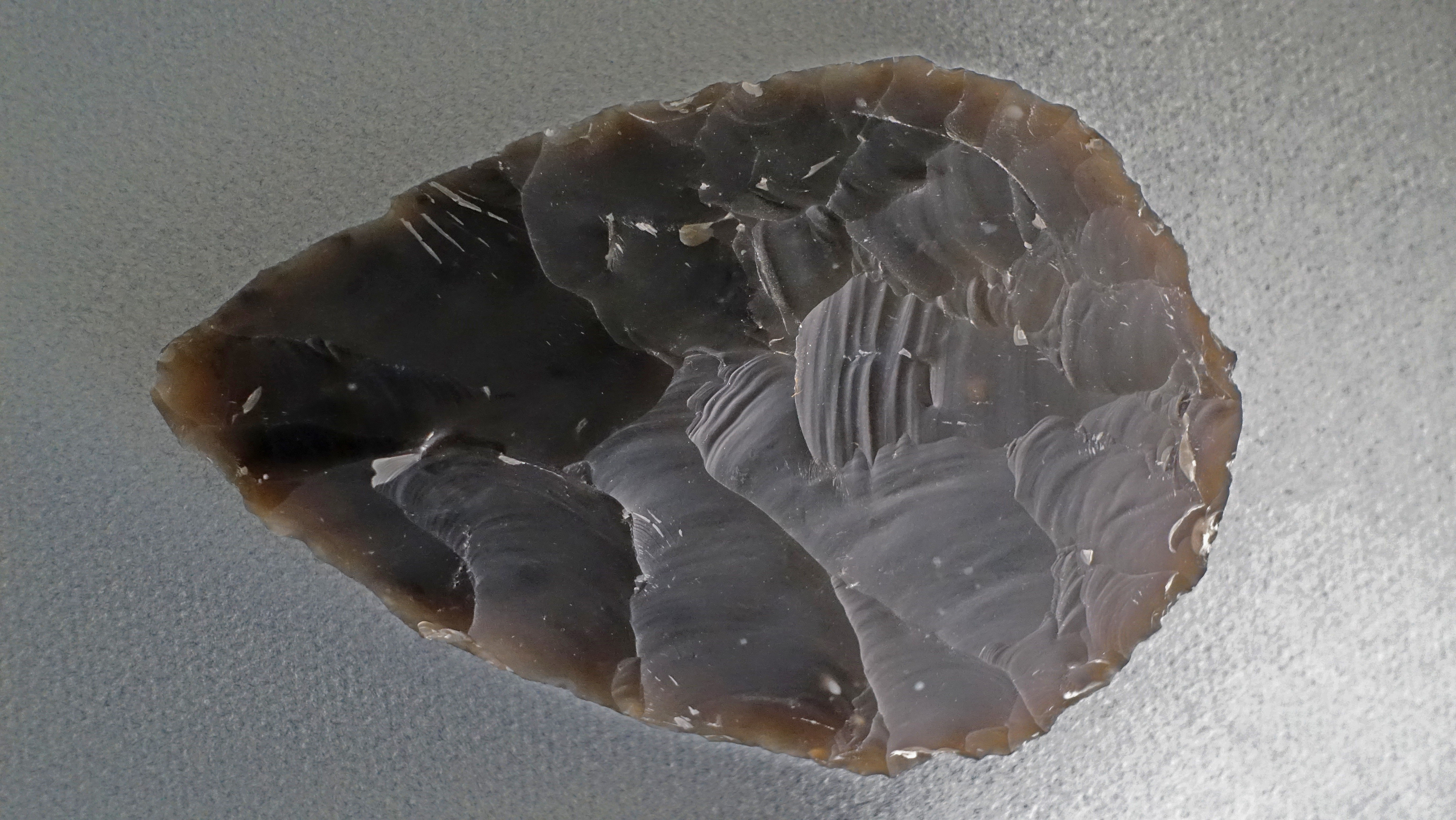
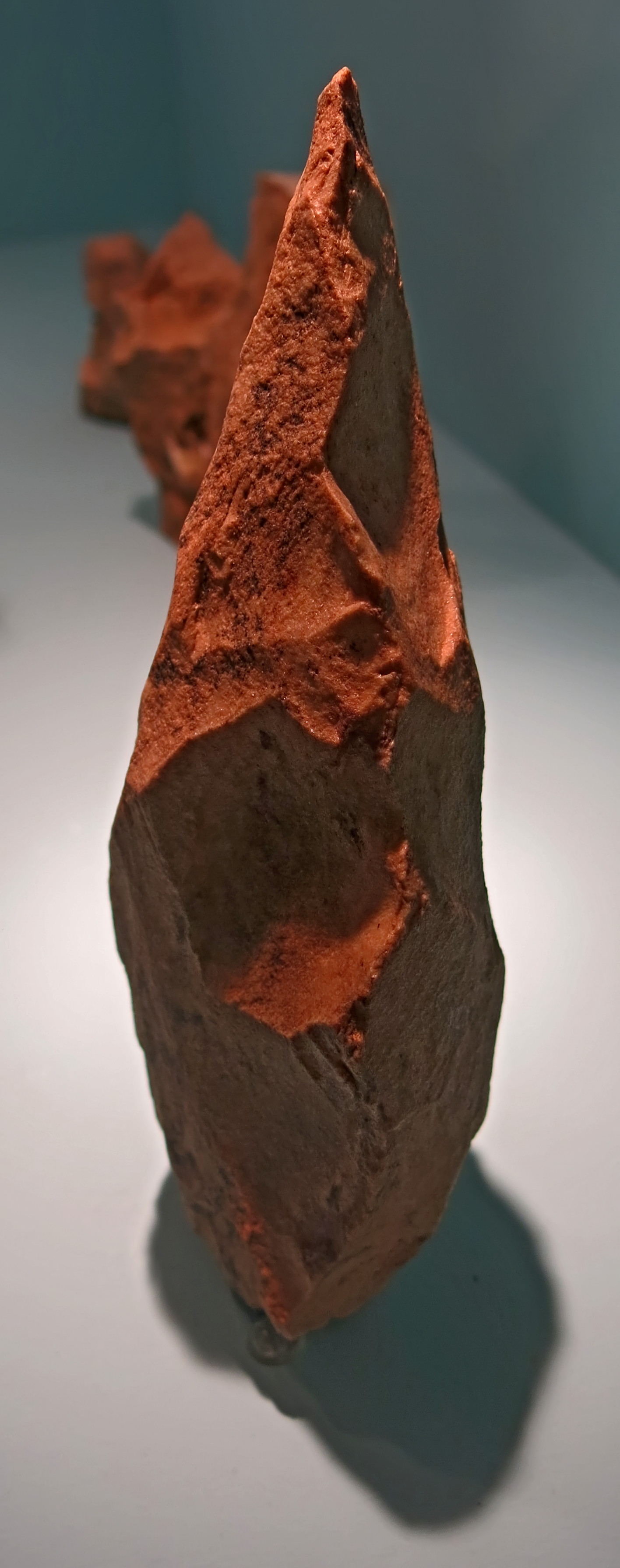
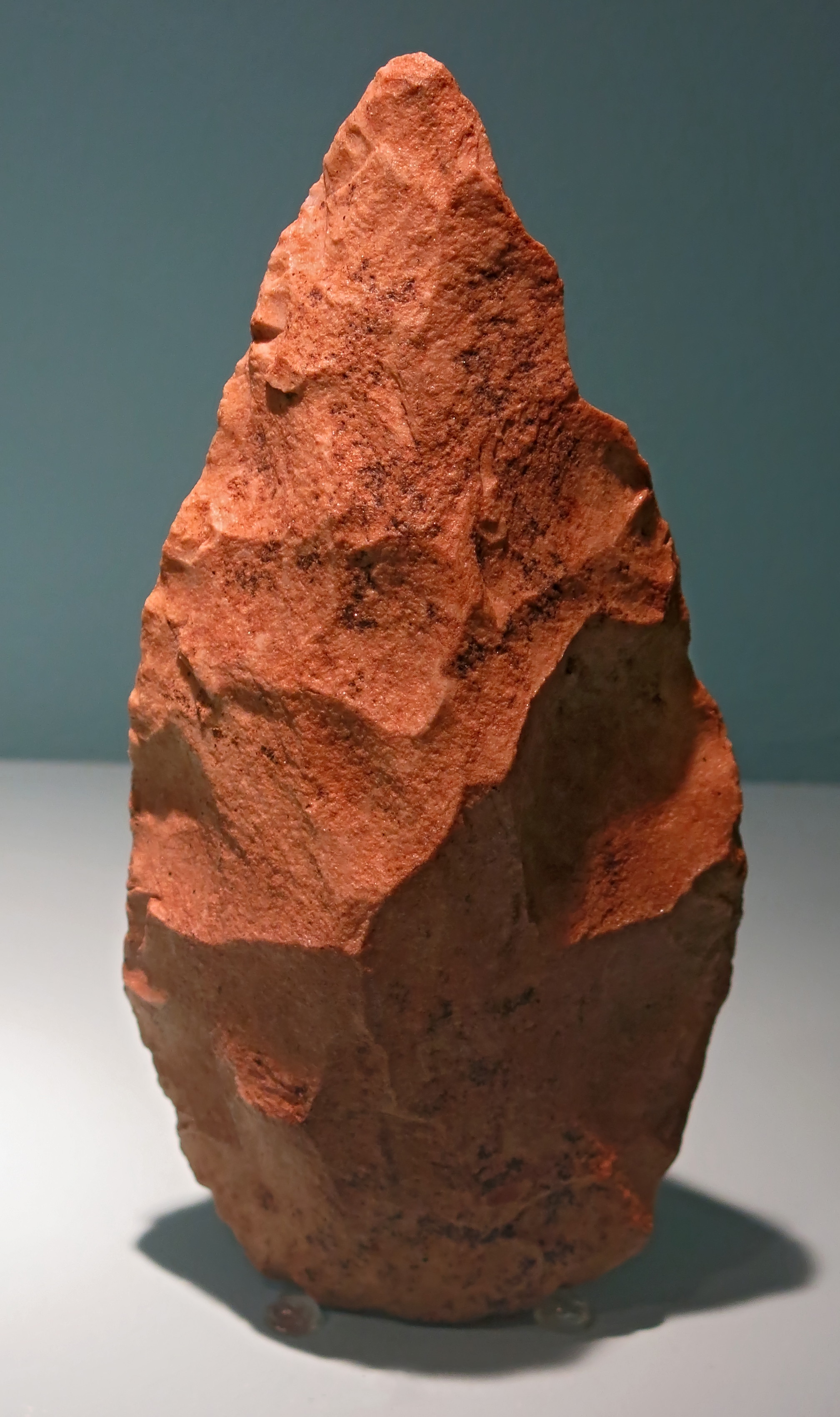
A modern reproduction hand axe beautifully crafted by Harm Paulsen, master flint knapper from Schleswig.
Photo: Don Hitchcock 2018
Source: Museum für Archäologie Schloss Gottorf
A hand axe can be a thing of beauty. It is surprisingly difficult to make, and requires a great deal of forward planning, knowledge of how stone can be shaped, and knowledge of how to create a relatively thin object, but with a sharp cutting edge.
Forming it into roughly the desired shape is relatively easy, but getting it thin, symmetrical, and with sharp edges all round is a highly skilled operation, and is a process which takes a long time to master.
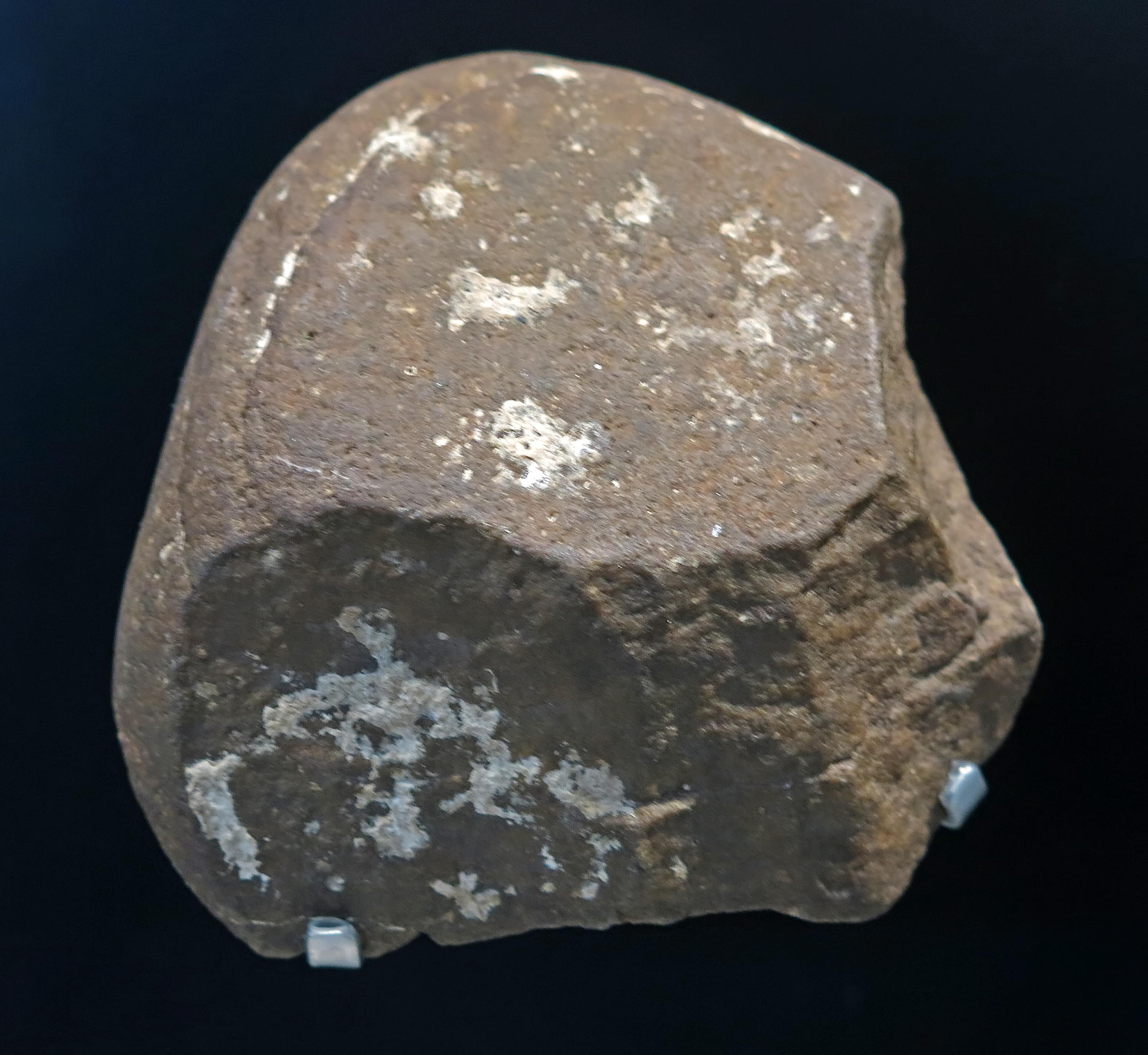
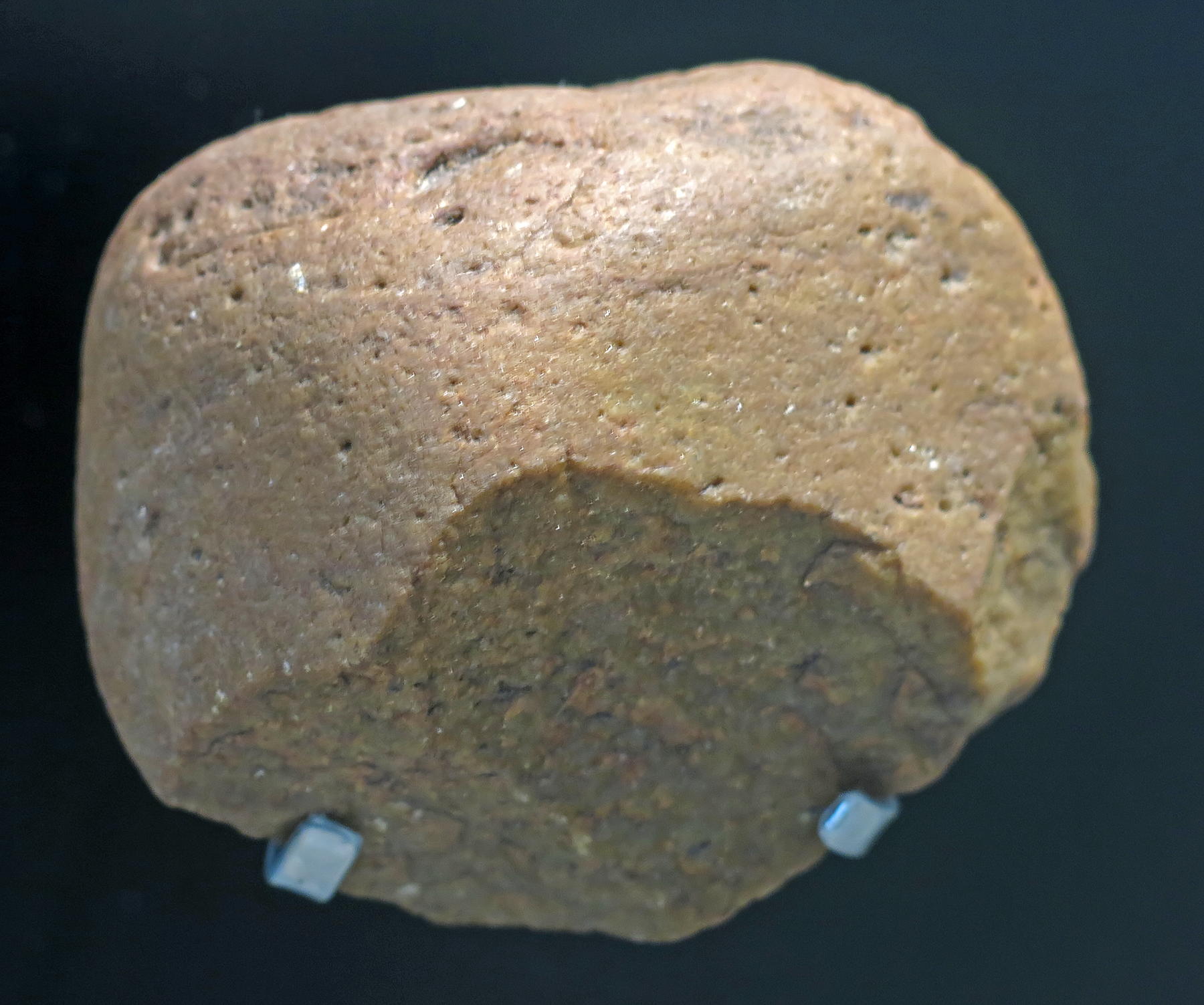
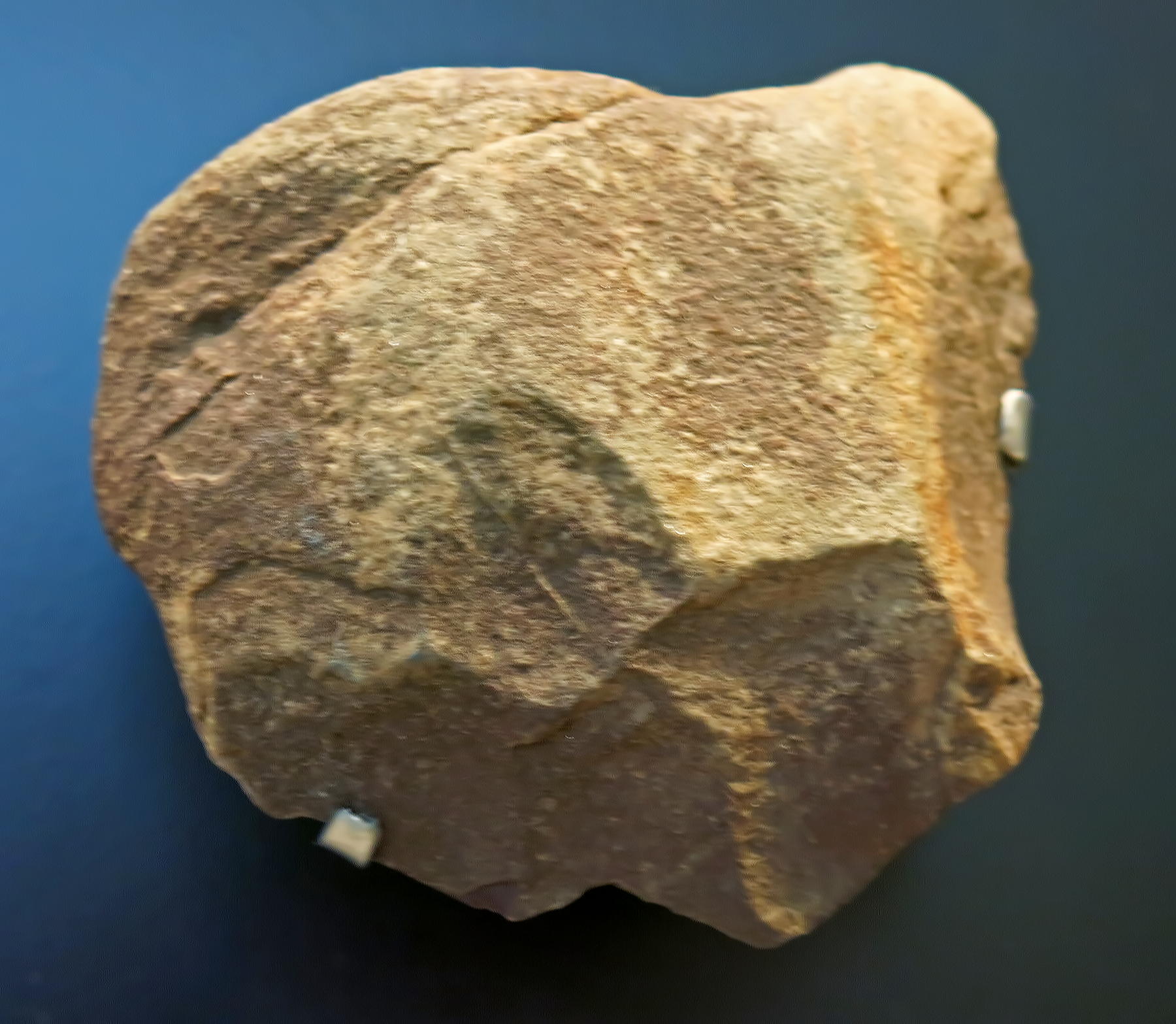
'Choppers', the oldest worked stone implements.
Gabarones, Botswana, 2.5 million - 1 million BP.
Photo: Don Hitchcock 2014
Source and text: Original, Københavns (Copenhagen) Museum, National Museum of Denmark
'Choppers', made from millions of years ago, are relatively easy to make. Select a suitable stone from a river bed, strike it several times against a larger rock to split off flakes, and in a few minutes you can have a serviceable tool for cutting up an animal carcase, helping with the skinning process, and breaking bones to get at the marrow.
But they are heavy, not necessarily easy to hold in the hand, and usually not very sharp, since their working edges are short, and not often equipped with sharp angles.
For that you need a Hand Axe.
Acheulean Hand Axes / Bifaces
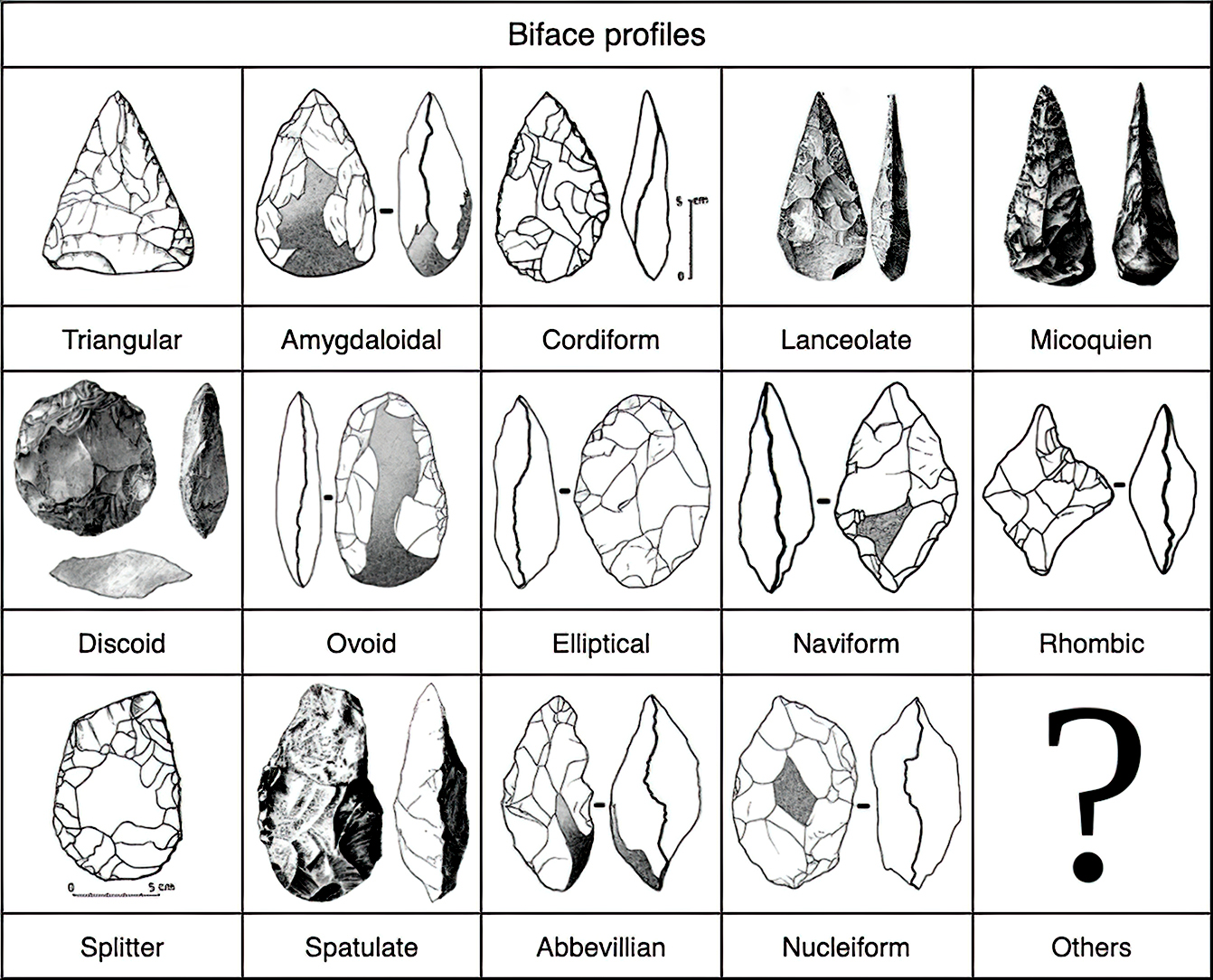
This is a very useful diagram showing various types of Biface (Acheulian) handaxes.
Note that there is very little difference between the Lanceolate and Micoquien profiles, and individual handaxes may be very difficult to assign to one or the other of these two profiles.
Photo: Wikipedia
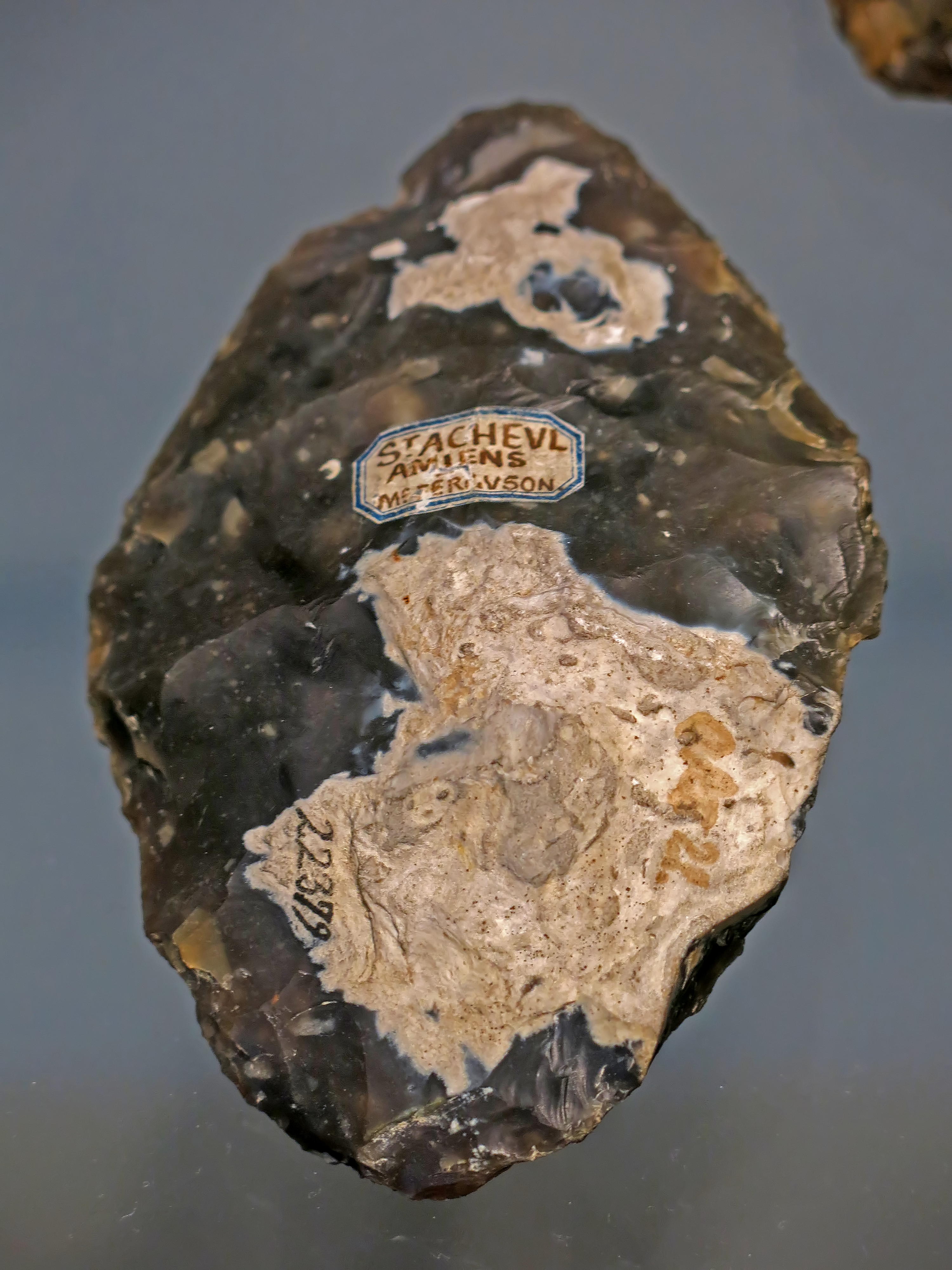
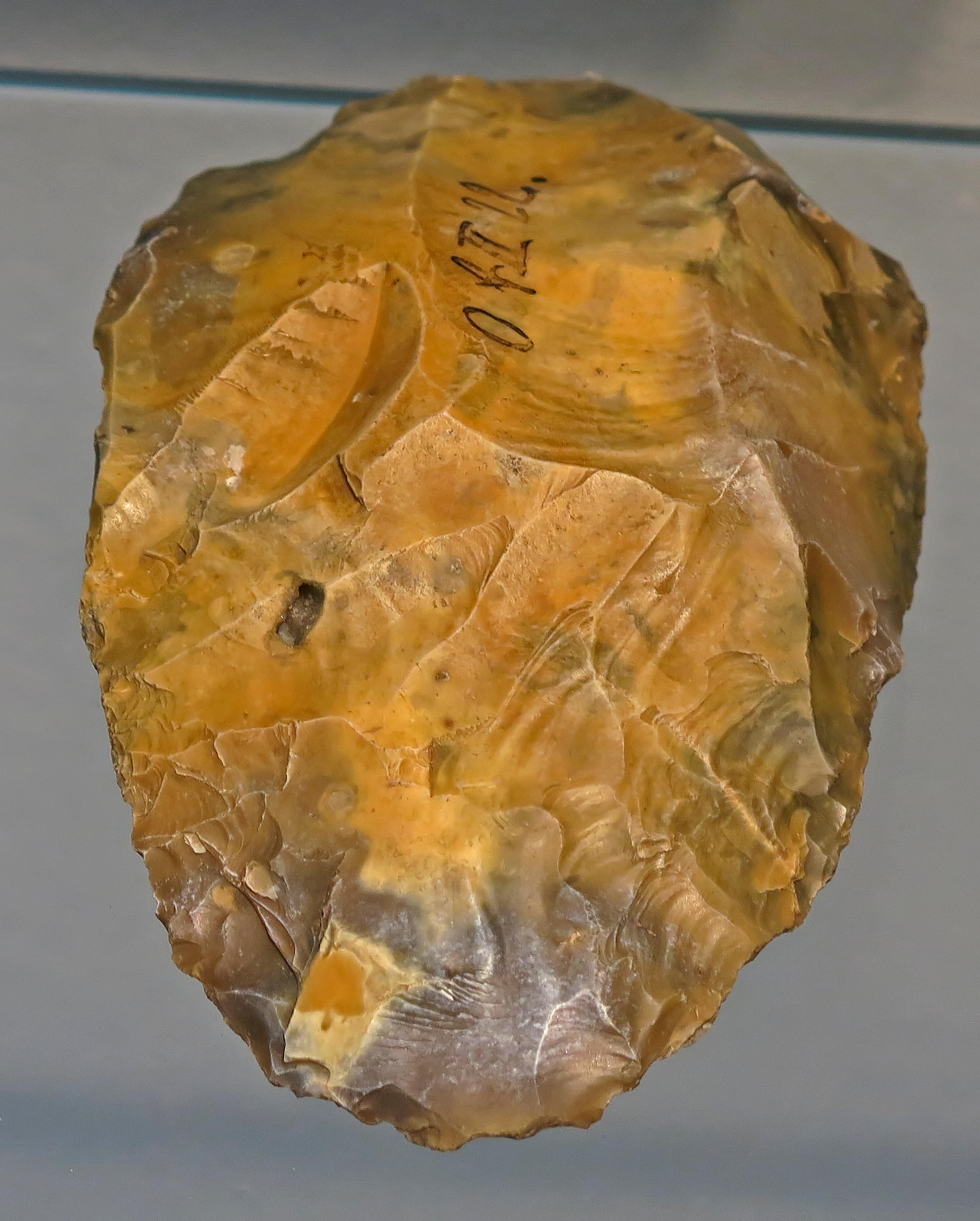
Acheulean Hand Axes
Elliptical Profiles.
The first hand axes (also known as bifaces) are usually called Acheulean / Acheulian, named after the site of gravel quarries in the suburb of Saint-Acheul in Amiens, France.
Acheulean stone tools are the products of Homo erectus, ancestor to modern humans. Not only are the Acheulean tools found over the largest area, but it is also the longest-running industry, lasting for over a million years until relatively recent times.
These hand axes are from St Acheul, 1 500 000 BP - 200 000 BP.
Photo: Don Hitchcock 2014
Source and text: Original, Københavns (Copenhagen) Museum, National Museum of Denmark
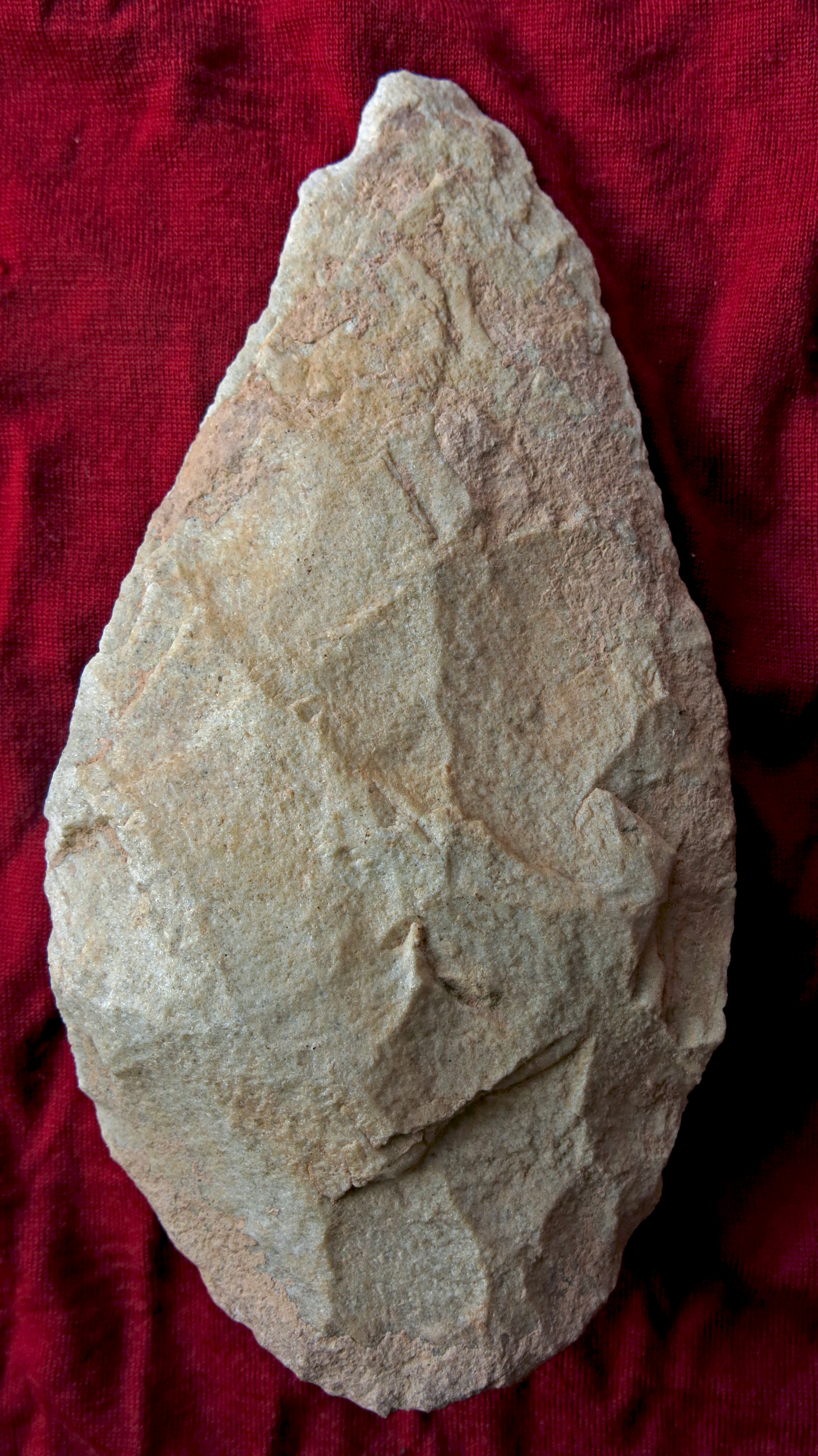
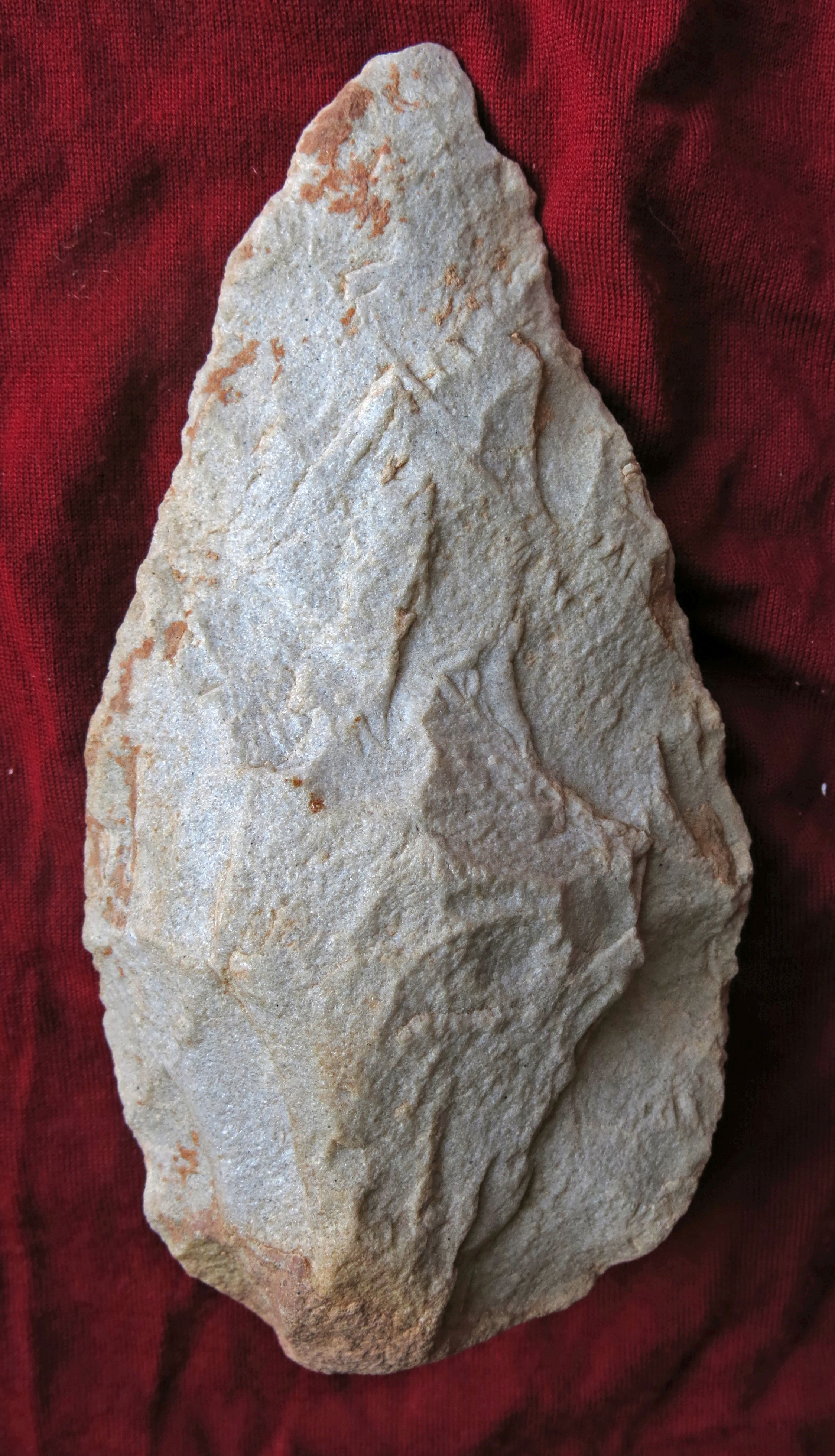
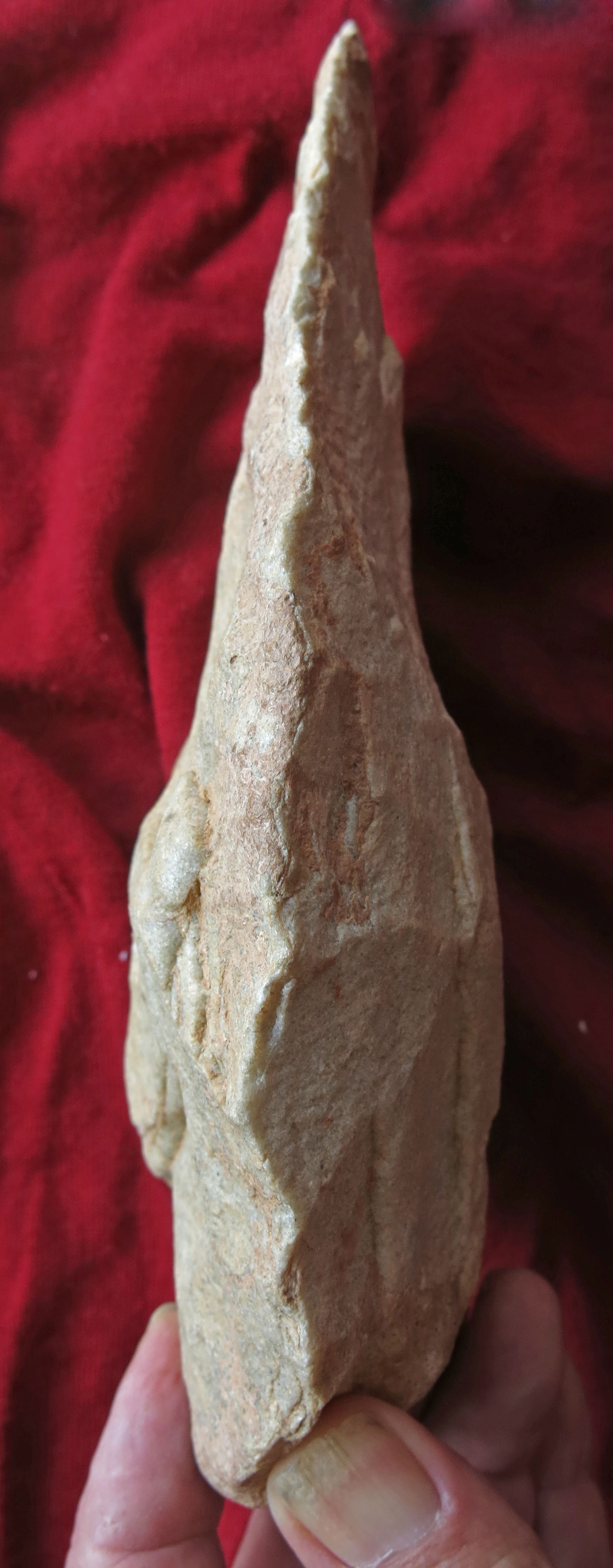
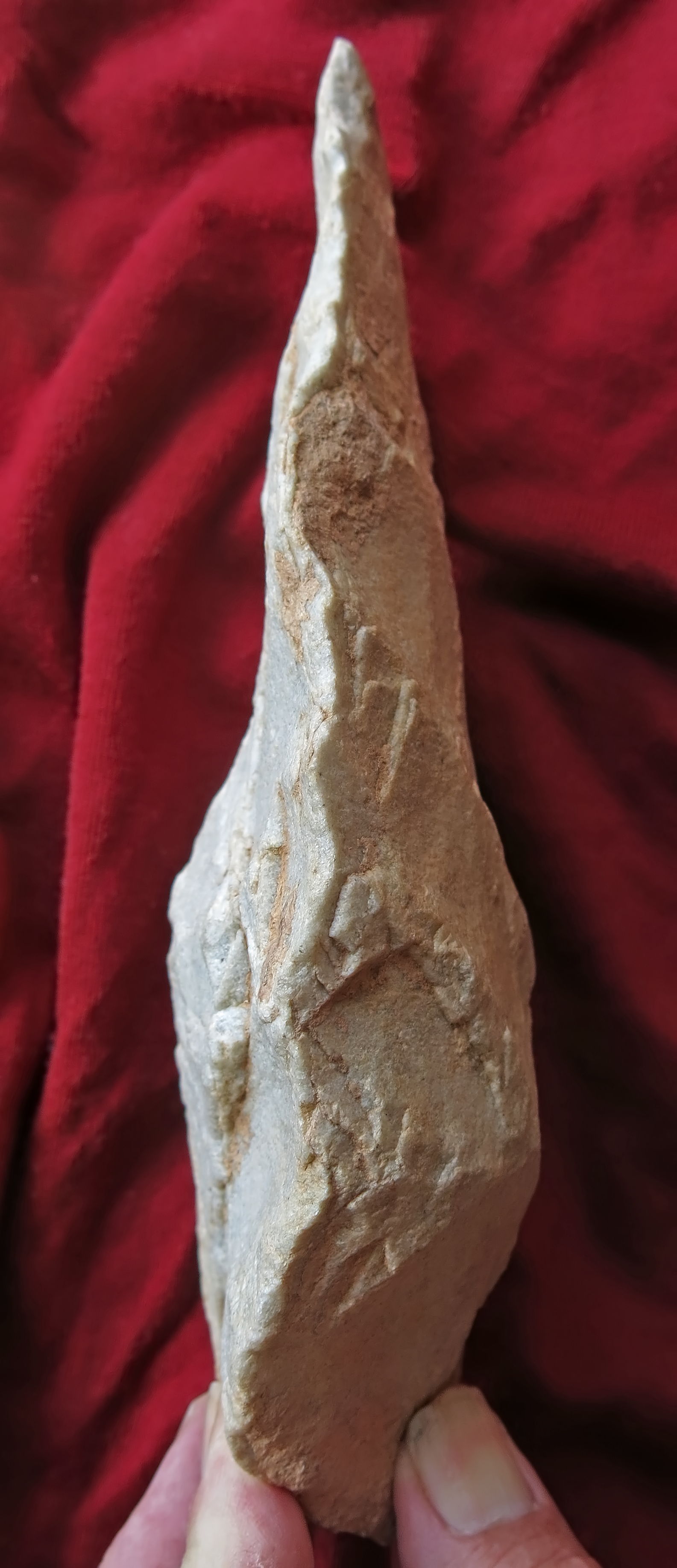
Acheulean Hand Axe
Cordiform (heart shaped) Profile.
Palaeolithic, circa 500 000 BP
This is a classic quartzite Acheulean handaxe from North Africa, found in a dry watercourse, a small tributary of the Draa river, near Tan Tan,
at N 28.23233, W 10.59947.
Dimensions 220 mm x 115 mm x 60 mm.
Photo: Don Hitchcock 2016
Source: Private collection

Acheulean Hand Axe
Narrow Lanceolate Profile.
1.4 - 1.2 million years old
Found in Olduvai Gorge, Tanzania.
Handaxe made of a hard green volcanic lava (phonolite) with a compact texture. Elongated tear drop form with slight ancient damage at tip. Regular edge all round, both faces slightly convex.
Catalog: 1934, 1214.49
Photo: Don Hitchcock 2017
Text: Card, http://www.britishmuseum.org/, © Trustees of the British Museum
Source: Exhibition by the British Museum at the National Museum of Australia, Canberra
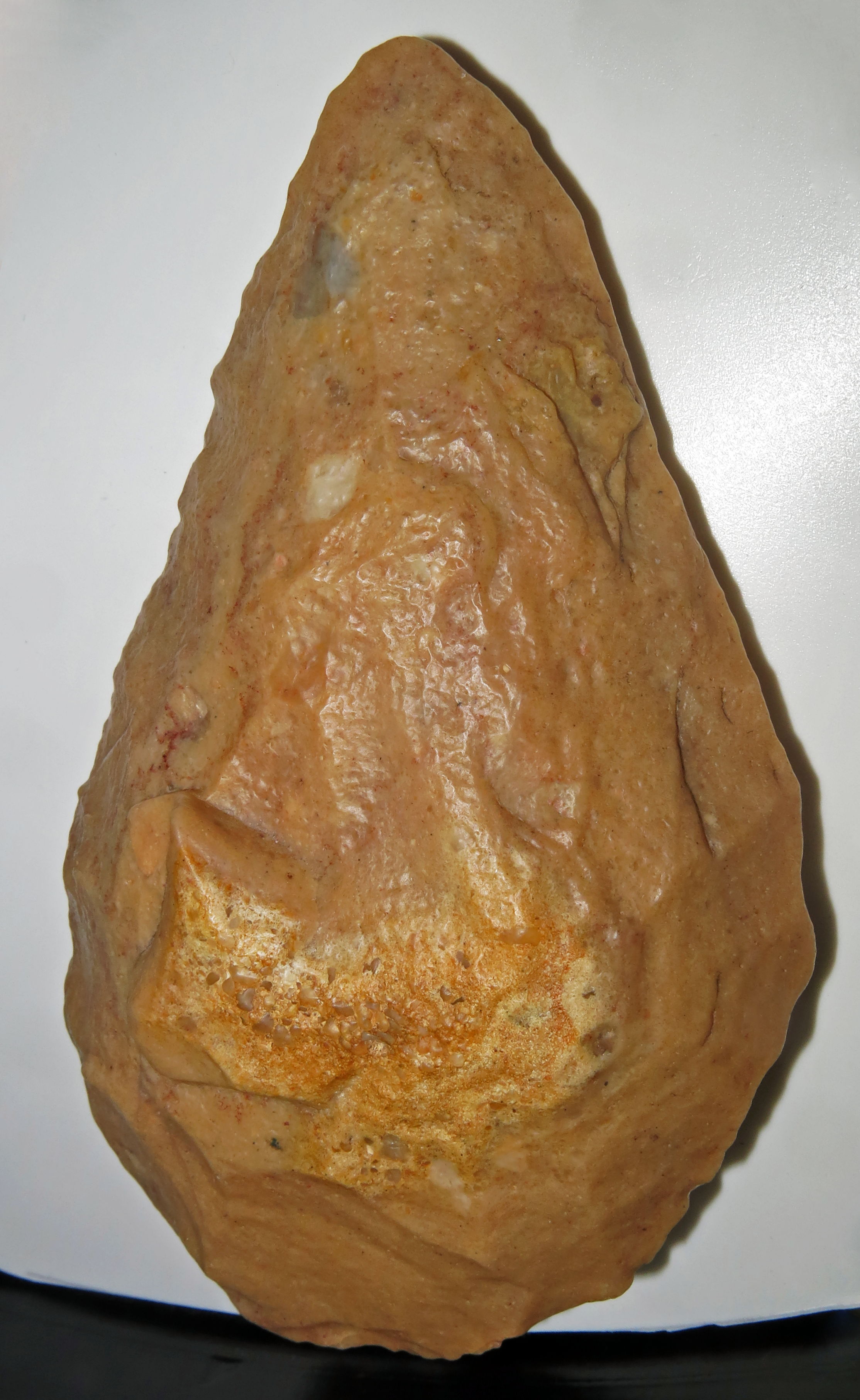
Acheulean Hand Axe
Cordiform (Heart shaped) Profile.
Circa 1 500 000 BP - 300 000 BP, from S'baikia, Algeria.
Photo: Don Hitchcock 2015
Source and text: Original, Monrepos Archäologisches Forschungszentrum und Museum, Neuwied, Germany
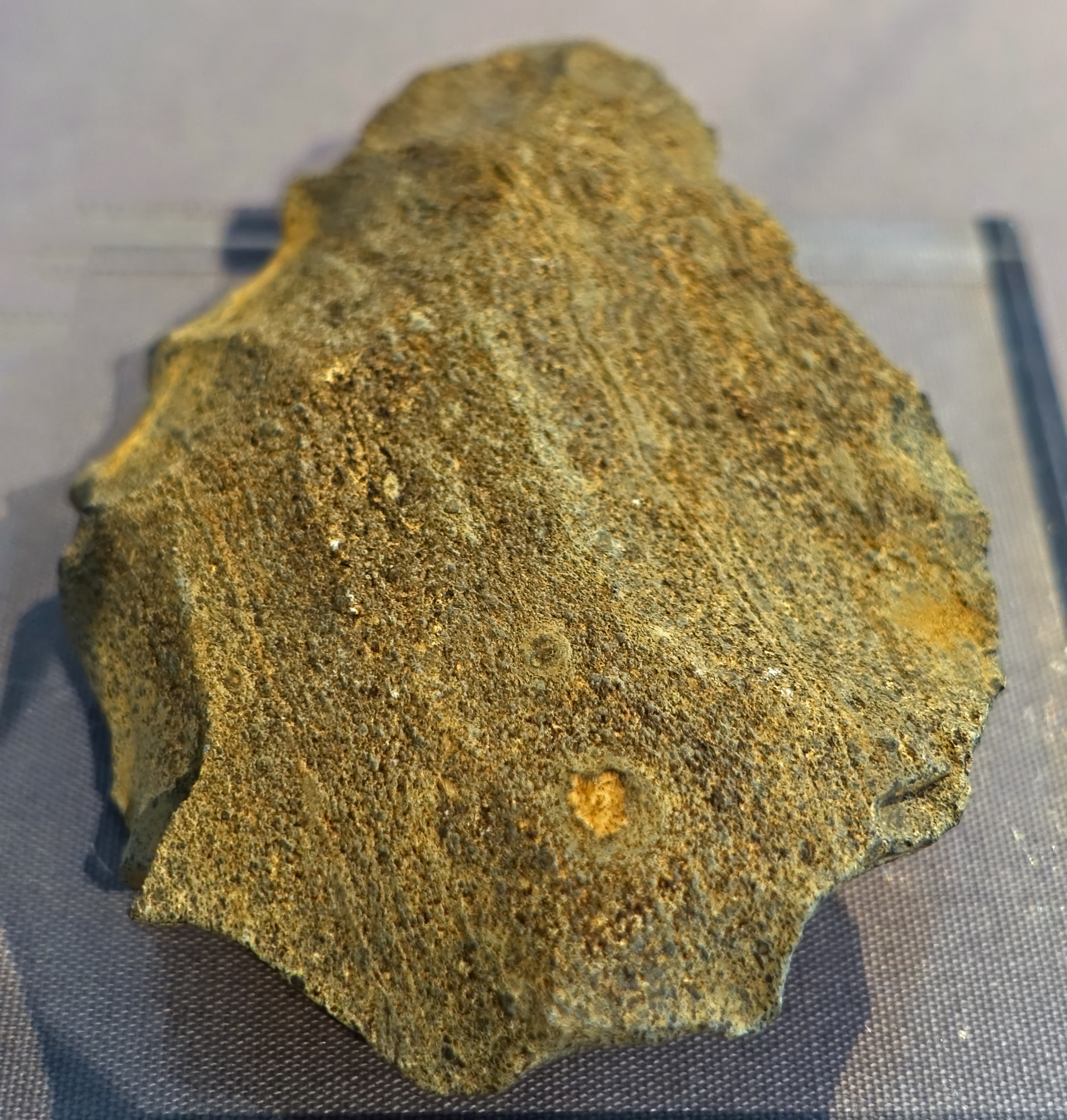
1 400 000 BC - 200 000 BC
Faustkeil, Handaxe
This hand axe is of Acheulian culture, and is the oldest piece in the August Kestner Museum in Hannover.
( It appears to be of a material similar to silcrete, and is a coarse grained example with bedding lines and inclusions, only suitable for crudely made large tools such as this handaxe or chopping tool. - Don )
Catalog: Eastern Sahara / Bayuda desert in present day Sudan
Photo: Don Hitchcock 2018
Source and text: Original, Museum August Kestner, Hannover
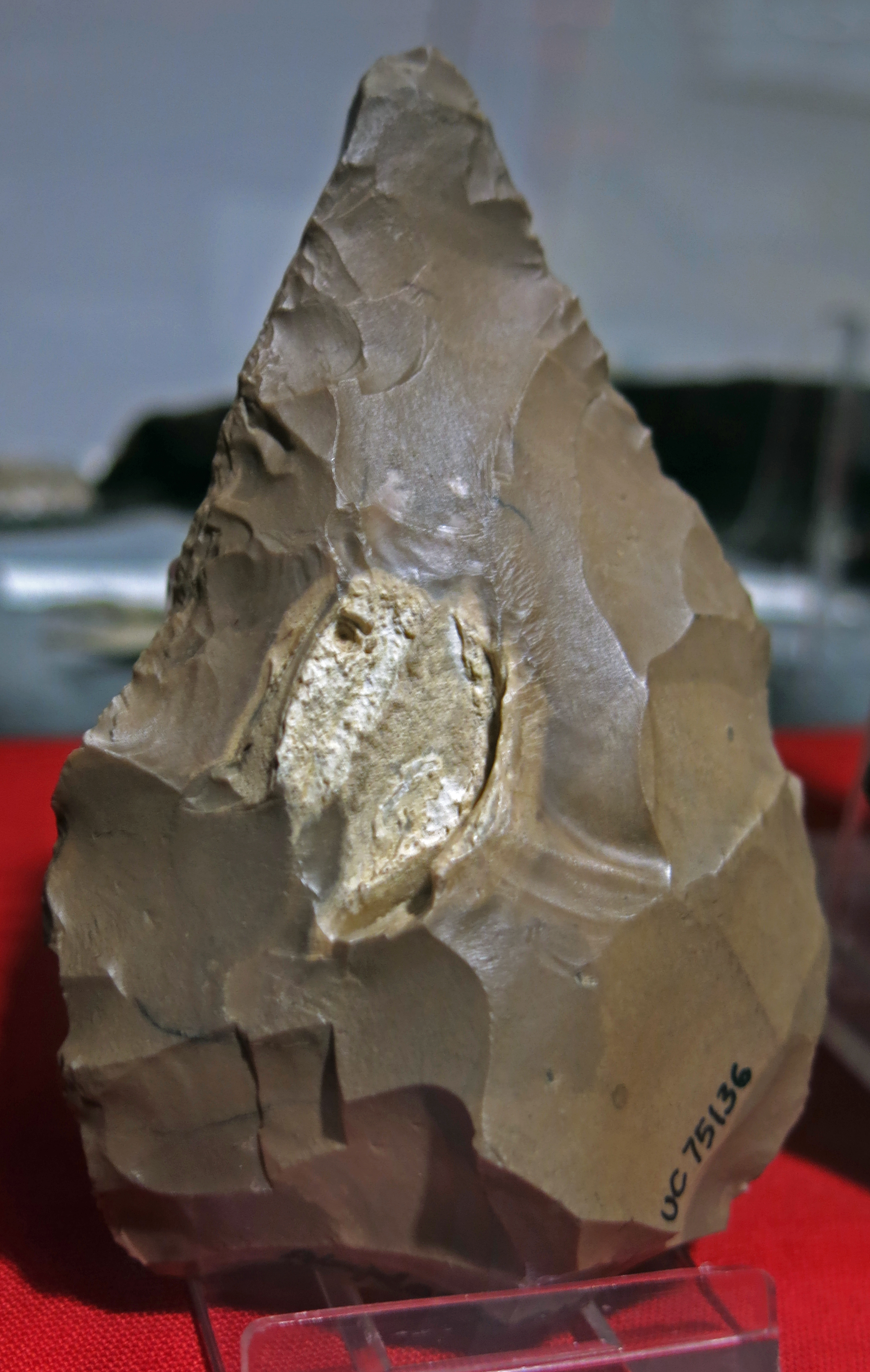
Retouched flint flake, handaxe?, Abydos
Age 400 000 BP - 350 000 BP.
Length 98 mm, width 63 mm.
Accession Number LDUCE-UC75136
Photo: Don Hitchcock 2015
Source and text: Petrie Museum
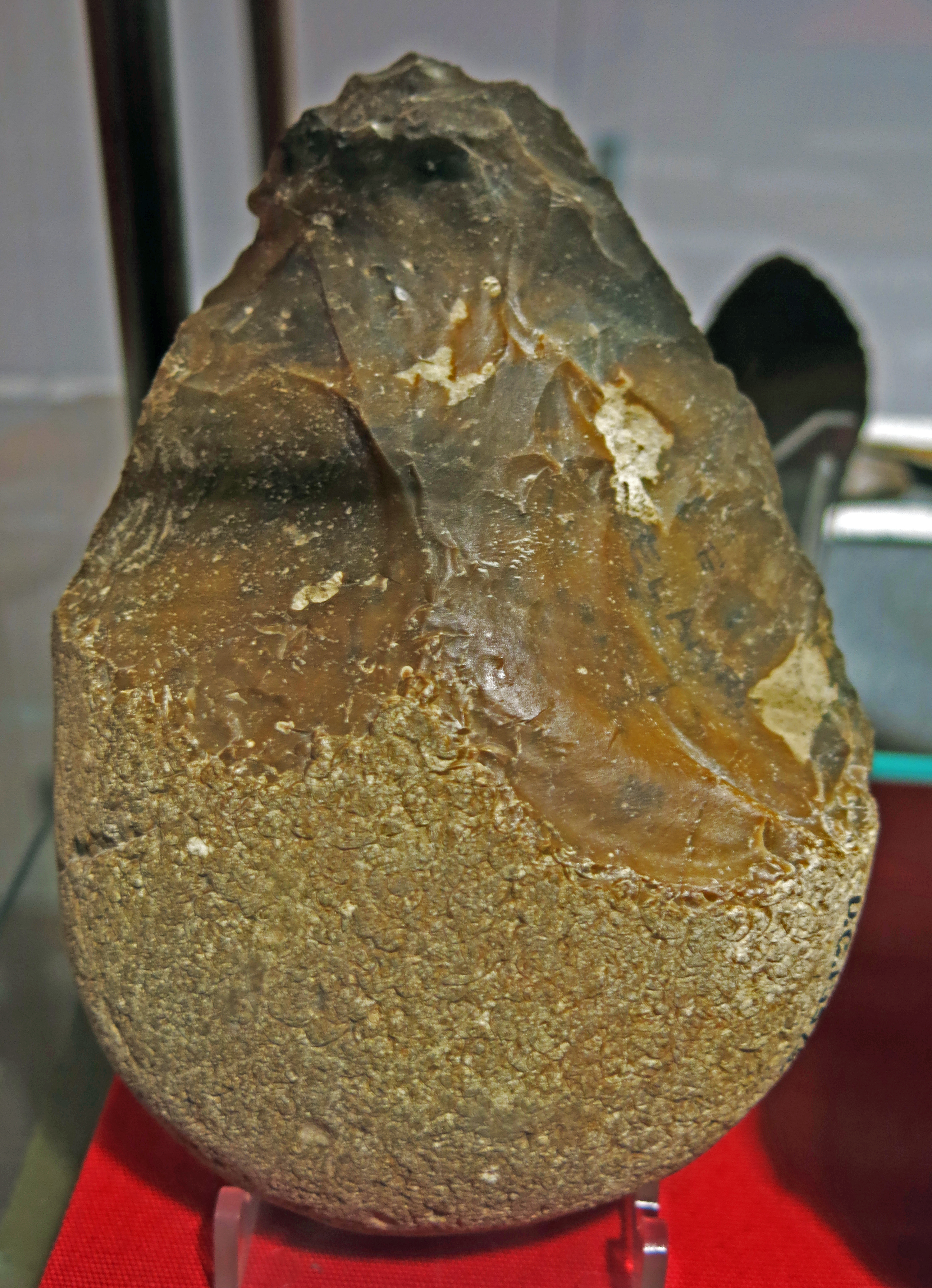
Flint handaxe, Acheulean; with cortex butt. From El Amrah, Nile level.
Age 400 000 BP - 350 000 BP.
Length: 135 mm
Accession Number LDUCE-UC13575
Photo: Don Hitchcock 2015
Source and text: Petrie Museum
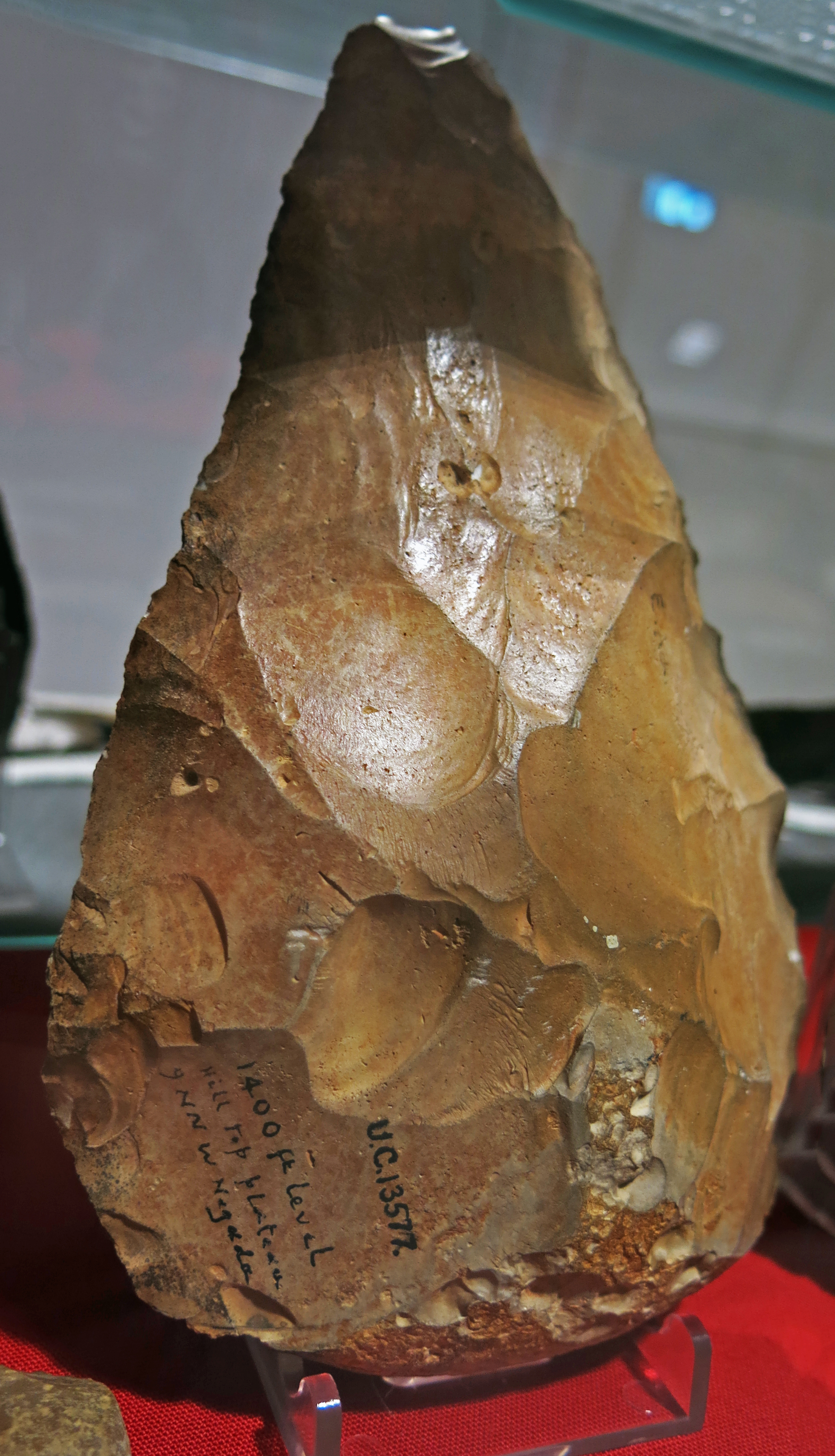
Acheulian Handaxe
(Acheulian - Old Palaeolithic : about 1800 000 BC - 200 000 BC; typical are large bifacially flaked handaxes, picks and cleavers; people lived as gatherers of wild plants and scavengers/hunters of animals)
Age of this specimen 400 000 BP - 350 000 BP.
Flint handaxe, developed Acheulean, with cortex butt. Found 9 miles NNW of Naqada at 1400 ft above sea-level, on a hill-top plateau.
Lanceolate bifaces like this one are the most aesthetically pleasing and became the typical image of developed Acheulean bifaces. Their name is due to their similar shape to the blade of a lance. Bordes defined a lanceolate biface as elongated (l/m > 1.6 , i.e. maximum length / maximum width > 1.6) with rectilinear or slightly convex edges, acute apex and rounded base, 2.75 < l/a < 3.75. L/a is maximum length / distance from point of maximum width to base and expresses the position of maximum width in relation to the length.
They are often globular to the extent that it is not a flat surface, at least in its basal zone, with m/e < 2.35 , m/e meaning the ratio of maximum width / maximum thickness and expresses the thickness relative to width, or 'refinement' of the axe.
They are usually balanced and well finished, with straightened edges. They are highly characteristic of the latter stages of the Acheulean – or the Micoquian, as it is known – and of the Mousterian in the Acheulean Tradition (closely related to the Micoquian bifaces).
Length 174 mm
Accession Number LDUCE-UC13577
Photo: Don Hitchcock 2015
Source and text: Petrie Museum
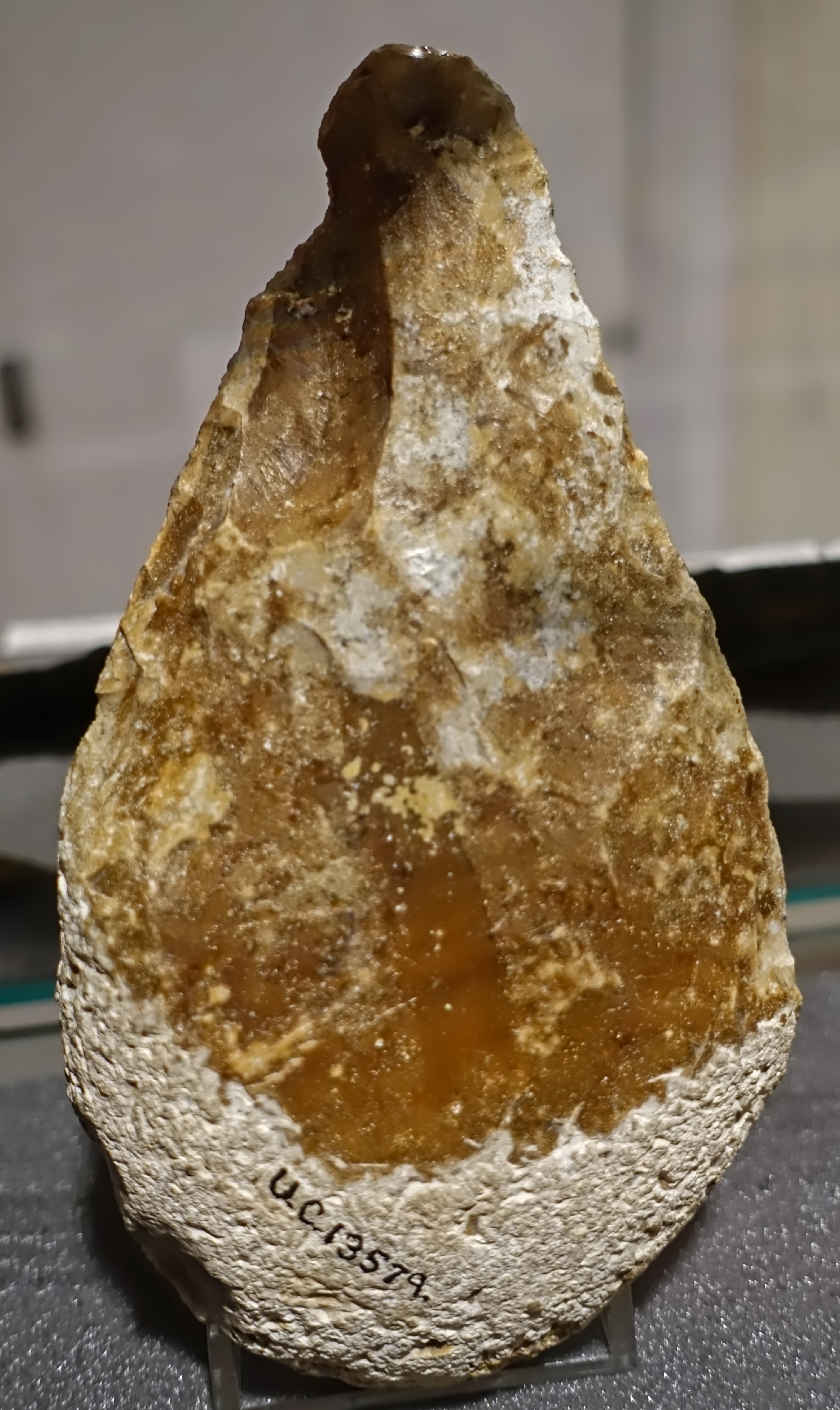
Flint handaxe, developed Acheulean, with cortex butt one side.
Lanceolate bifaces like this one are the most aesthetically pleasing and became the typical image of developed Acheulean bifaces. Their name is due to their similar shape to the blade of a lance. Bordes defined a lanceolate biface as elongated (l/m > 1.6 , i.e. maximum length / maximum width > 1.6) with rectilinear or slightly convex edges, acute apex and rounded base, 2.75 < l/a < 3.75. L/a is maximum length / distance from point of maximum width to base and expresses the position of maximum width in relation to the length.
They are often globular to the extent that it is not a flat surface, at least in its basal zone, with m/e < 2.35 , m/e meaning the ratio of maximum width / maximum thickness and expresses the thickness relative to width, or 'refinement' of the axe.
They are usually balanced and well finished, with straightened edges. They are highly characteristic of the latter stages of the Acheulean – or the Micoquian, as it is known – and of the Mousterian in the Acheulean Tradition (closely related to the Micoquian bifaces).
Found by Seton-Karr at a low level at al-Ga'ara SE of Dendera.
Length 151 mm, Accession Number LDUCE-UC13579.
Photo: Don Hitchcock 2018
Source and text: Petrie Museum
Additional text: Wikipedia, ikarusbooks.co.uk/resources/Lsarc.pdf
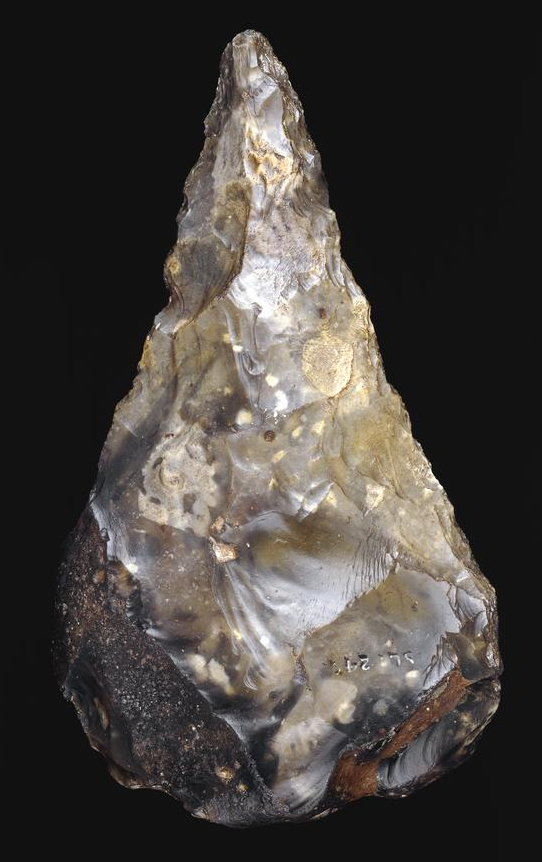
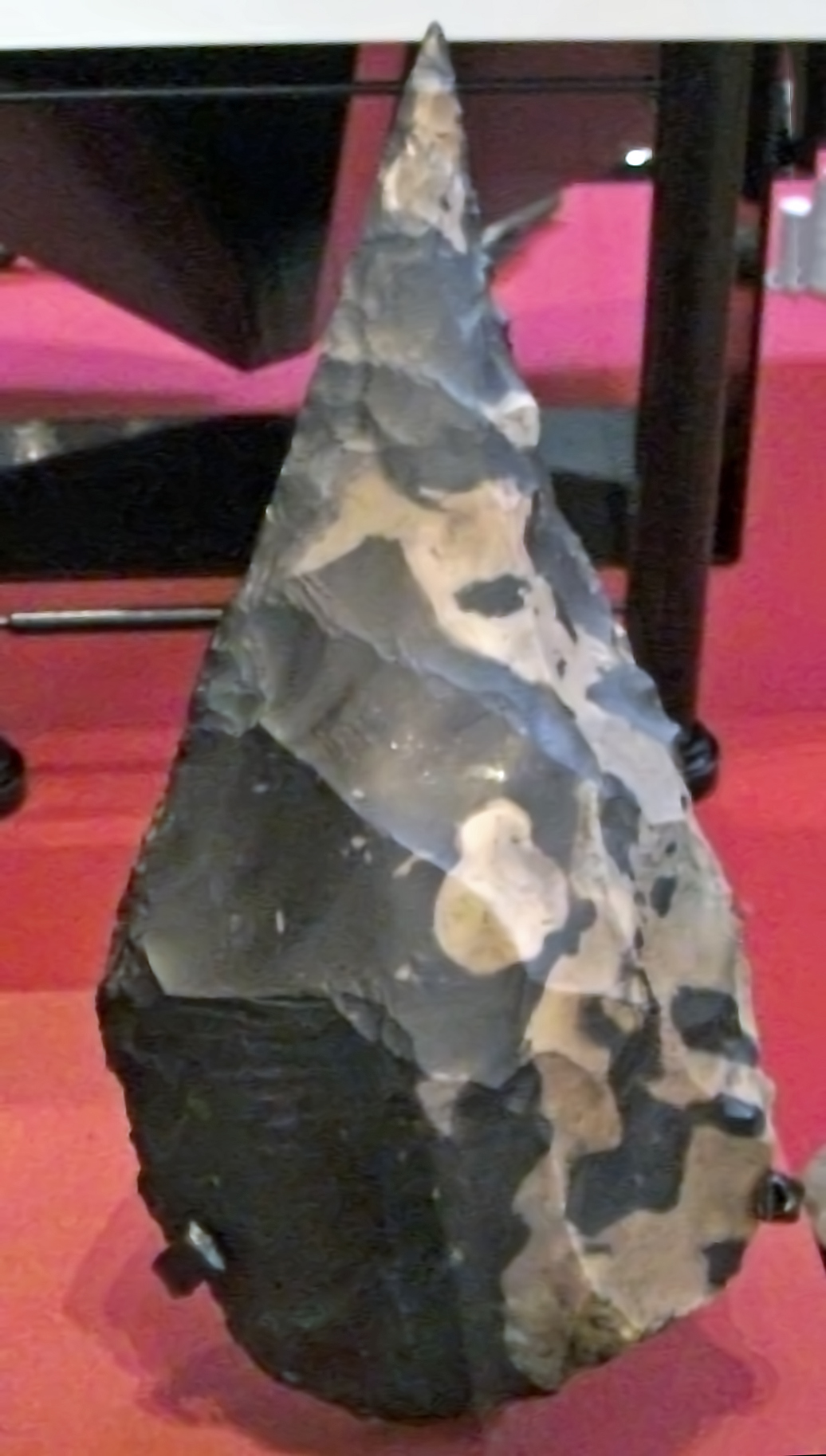
Acheulean Hand Axes
Lanceolate Profiles.
Left:
The Gray's Inn Lane Hand Axe is a pointed flint hand axe, found buried in gravel under Gray's Inn Lane, London, England, by pioneering archaeologist John Conyers in 1679. The hand axe is a fine example from about 350 000 years ago, from the Lower Palaeolithic, and probably made by Homo erectus, who made most of these sorts of hand axe.
Photo: © Trustees of the British Museum, CC BY-NC-SA 4.0
Source: https://www.britishmuseum.org/collection/image/10134001, © Trustees of the British Museum, CC BY-NC-SA 4.0
Right:
Another Acheulean hand axe was discovered by John Frere in the 1700s, when he investigated a four metre deep pit (dug by brickworkers) at Hoxne, in England.
Photo: Johnbod
Permission: Creative Commons Attribution-Share Alike 3.0 Unported license.

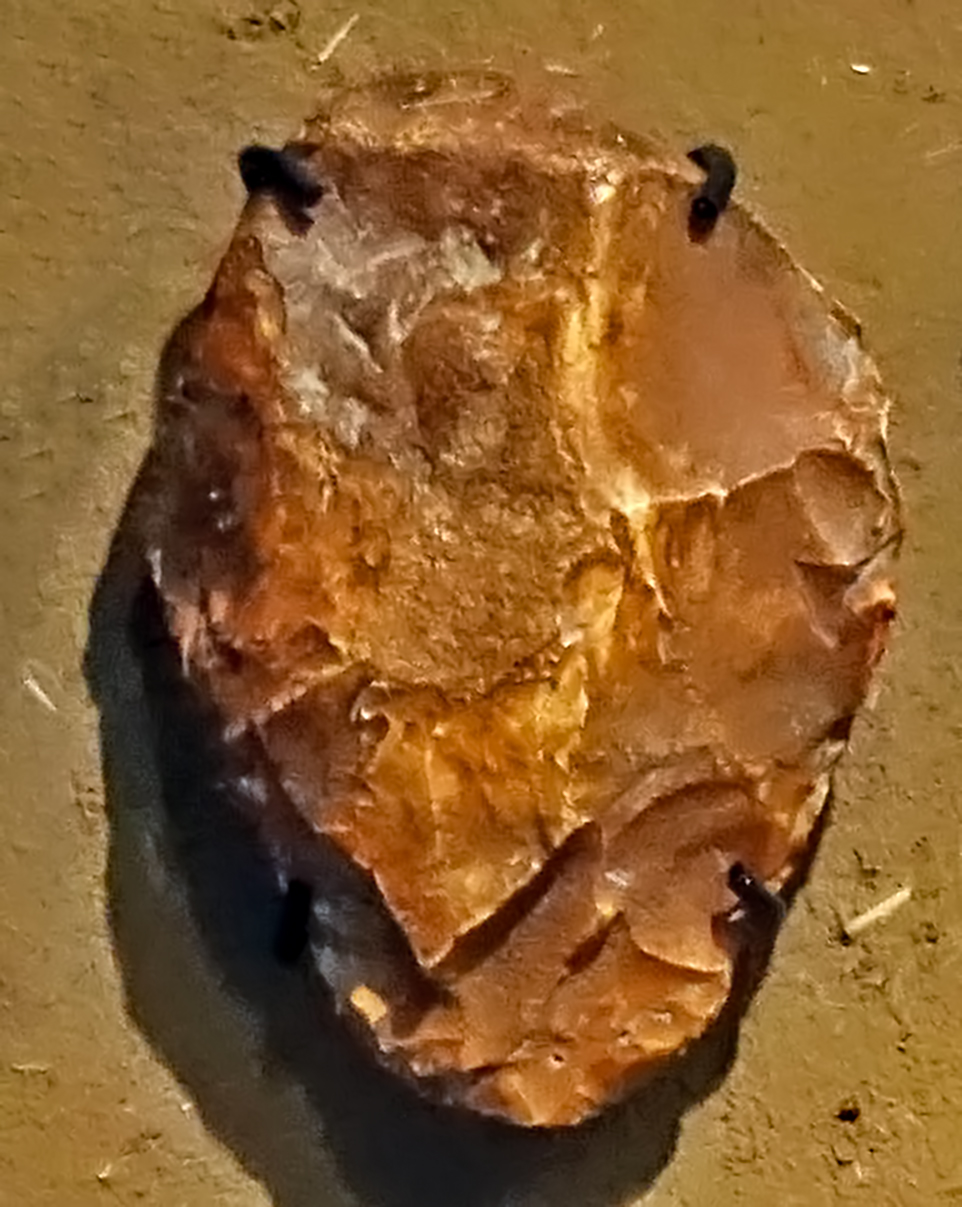
Acheulean Hand Axe
Lanceolate Profile.
Palaeolithic, 300 000 - 30 000 years ago
Hand axe, Maastricht.
Photo: Don Hitchcock 2014
Source: Rijksmuseum van Oudheden, National Museum of Antiquities, Leiden.
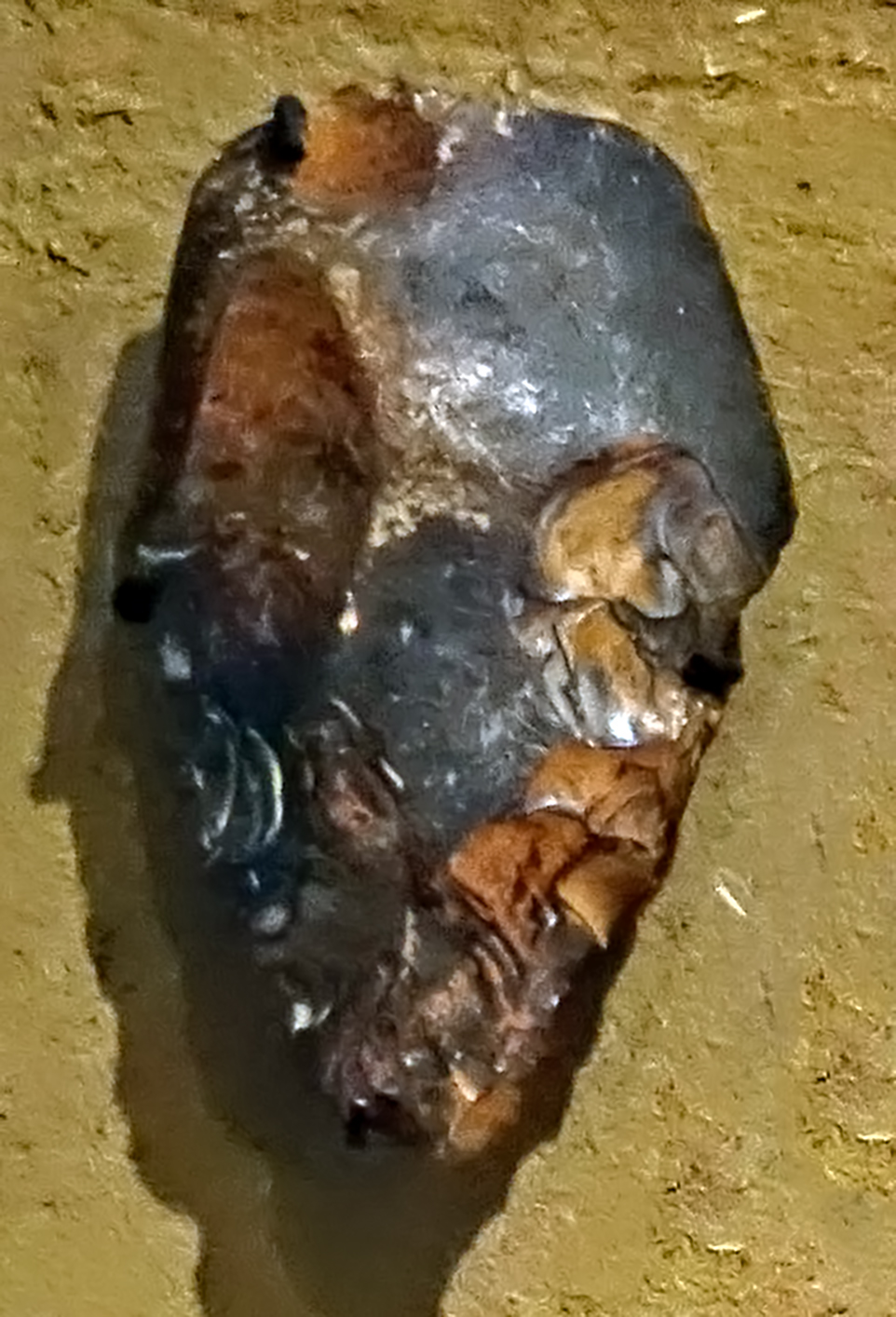
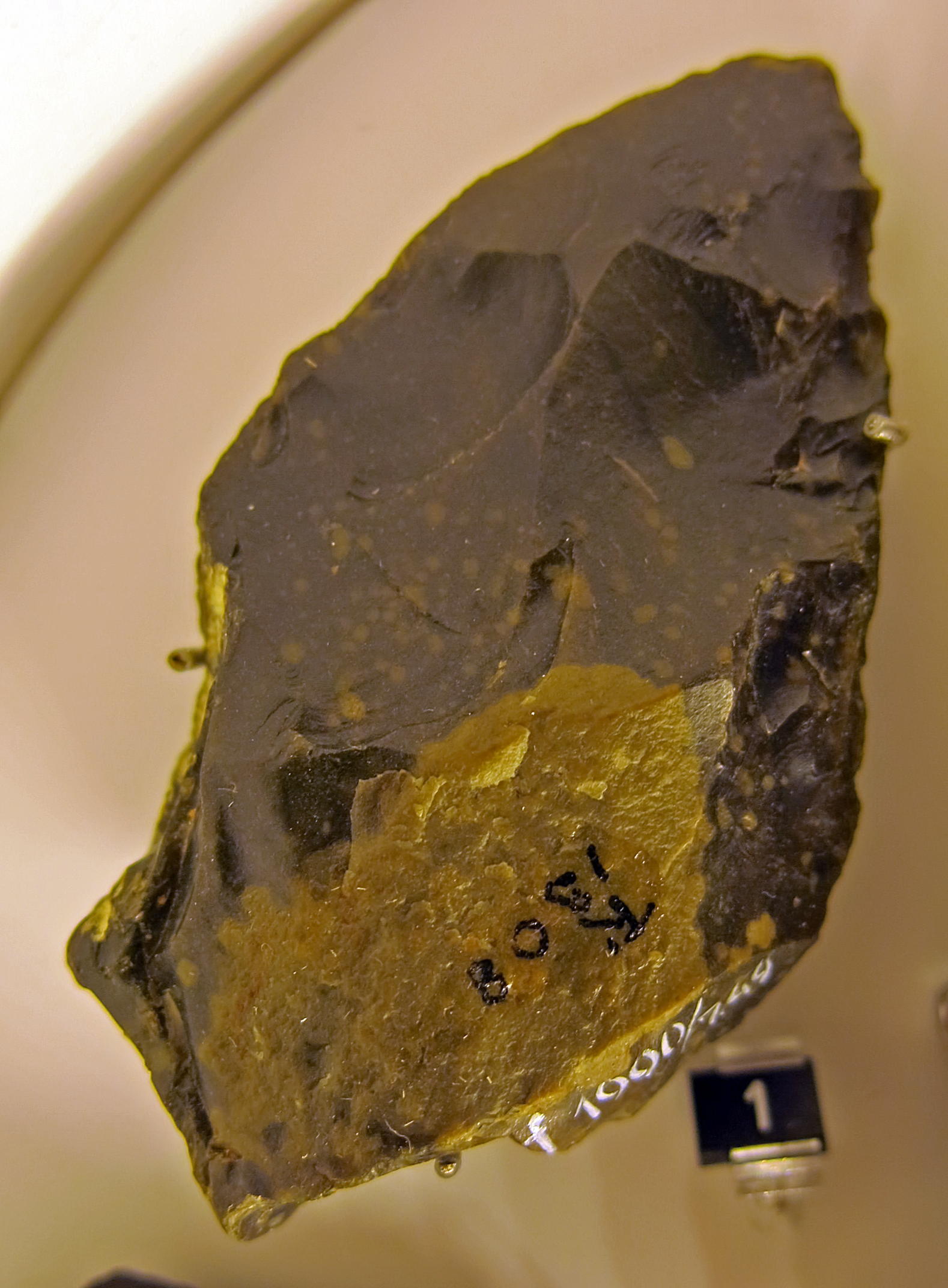
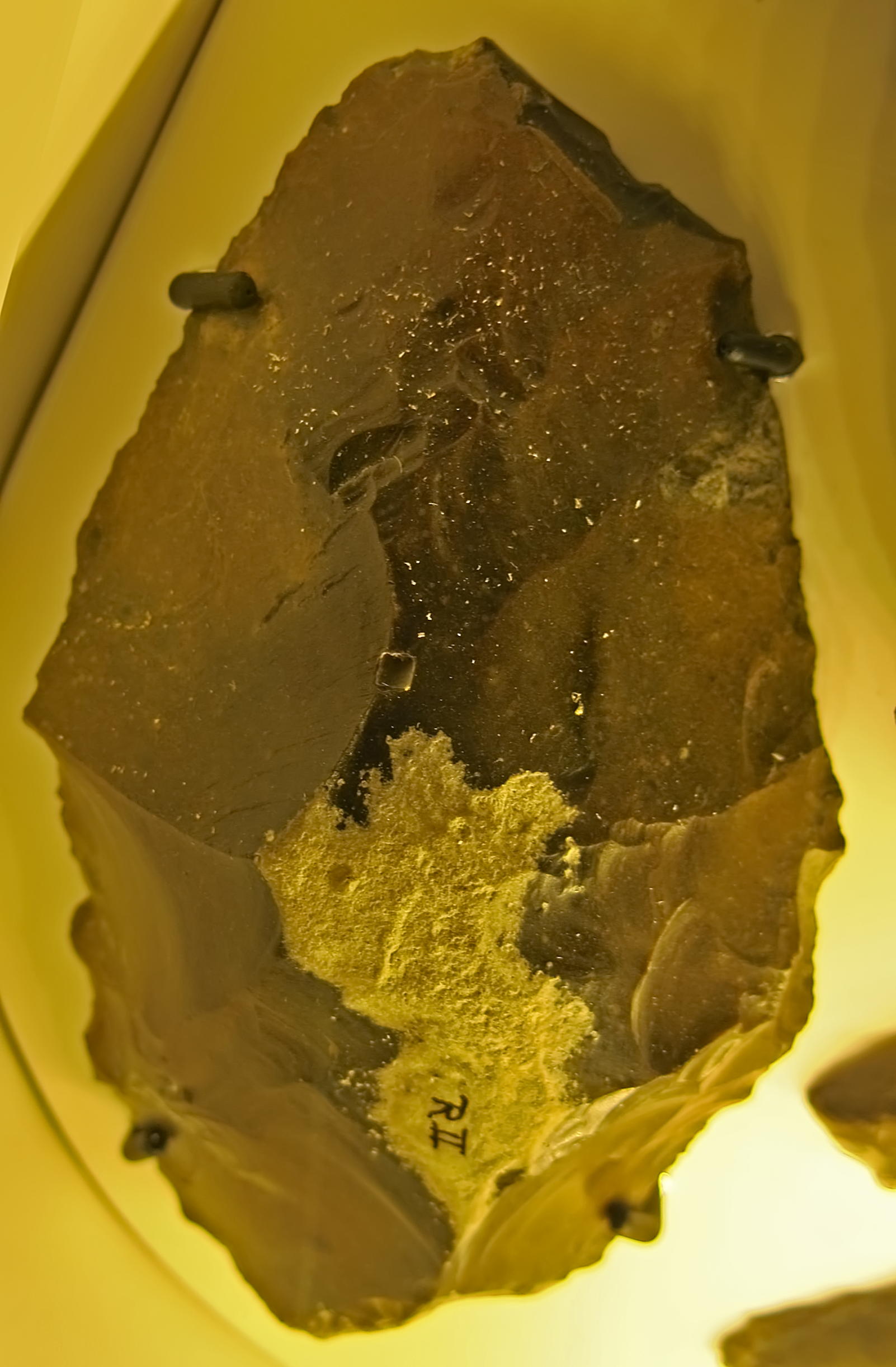
70 000 BC - 7 000 BC
Faustkeile, Handaxes
Left: from the Bissing collection.
Catalog: Flint, Thebes, ÄS 1211, ÄS 1489
Photo: Don Hitchcock 2018
Source: Original, Ägyptischen Museum München
Text: Museum card, © Ägyptischen Museum München
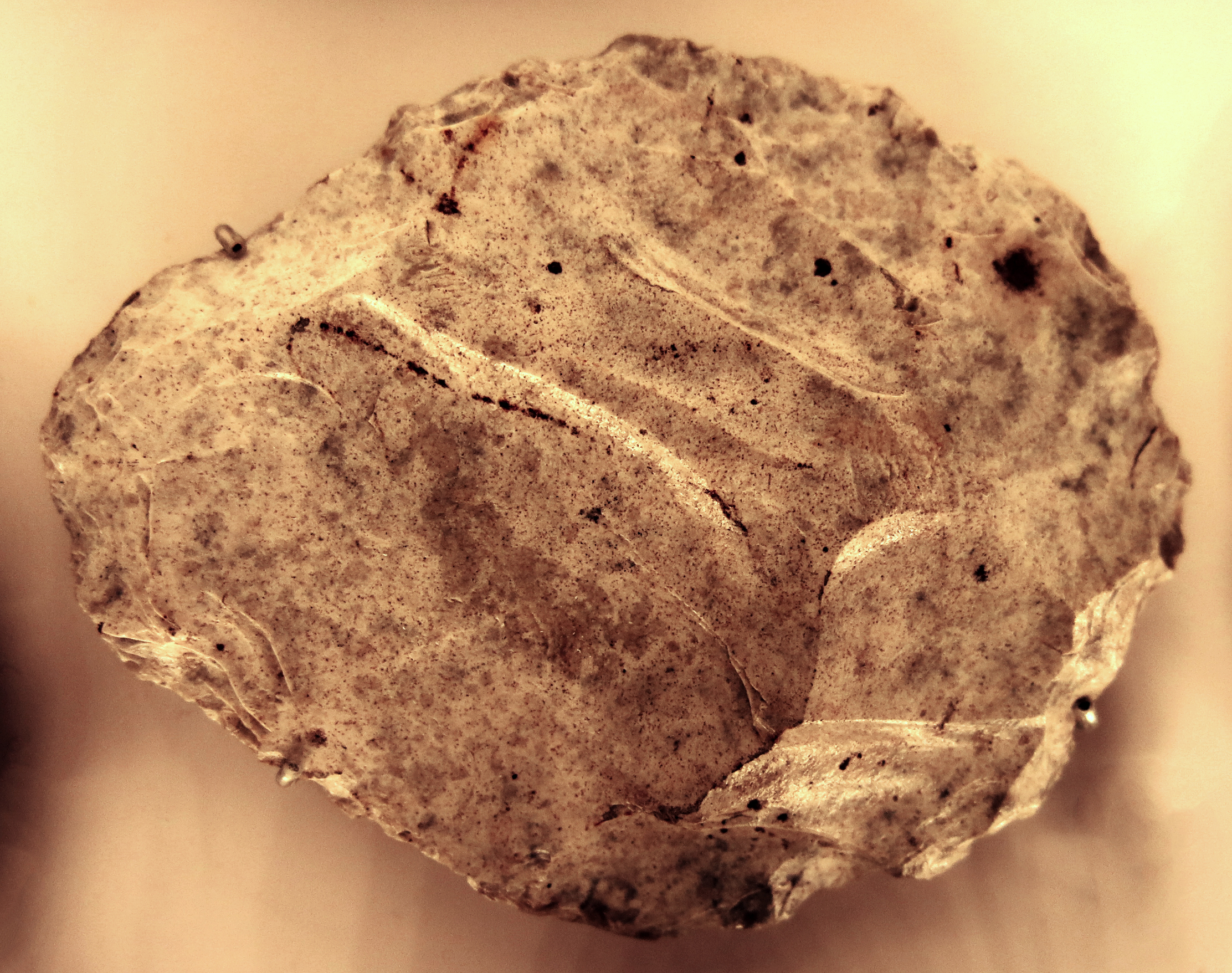
Acheulean Hand Axes
Nucleic (resembling a knapped core) Profile.
Palaeolithic, 300 000 - 30 000 years ago
From Rhenen.
Photo: Don Hitchcock 2014
Source: Rijksmuseum van Oudheden, National Museum of Antiquities, Leiden.
Acheulean Hand Axe
Elliptical Profile.
Palaeolithic, 300 000 - 30 000 years ago
Hand-axe, Moerslag.
Photo: Don Hitchcock 2014
Source: Rijksmuseum van Oudheden, National Museum of Antiquities, Leiden.
Neanderthals and the Moustérien de tradition acheuléenne (MTA) handaxes / bifaces
Neanderthals also made handaxes indistinguishable from the Acheulean handaxes. Since we also use the word Mousterian for the Neanderthal culture, after the classic Neanderthal archaeological site of Le Moustier near Les Eyzies in France, the classic Acheulean handaxes made by Neanderthals are given the name Moustérien de tradition acheuléenne (MTA).
This superb Neanderthal handaxe below is in this tradition.
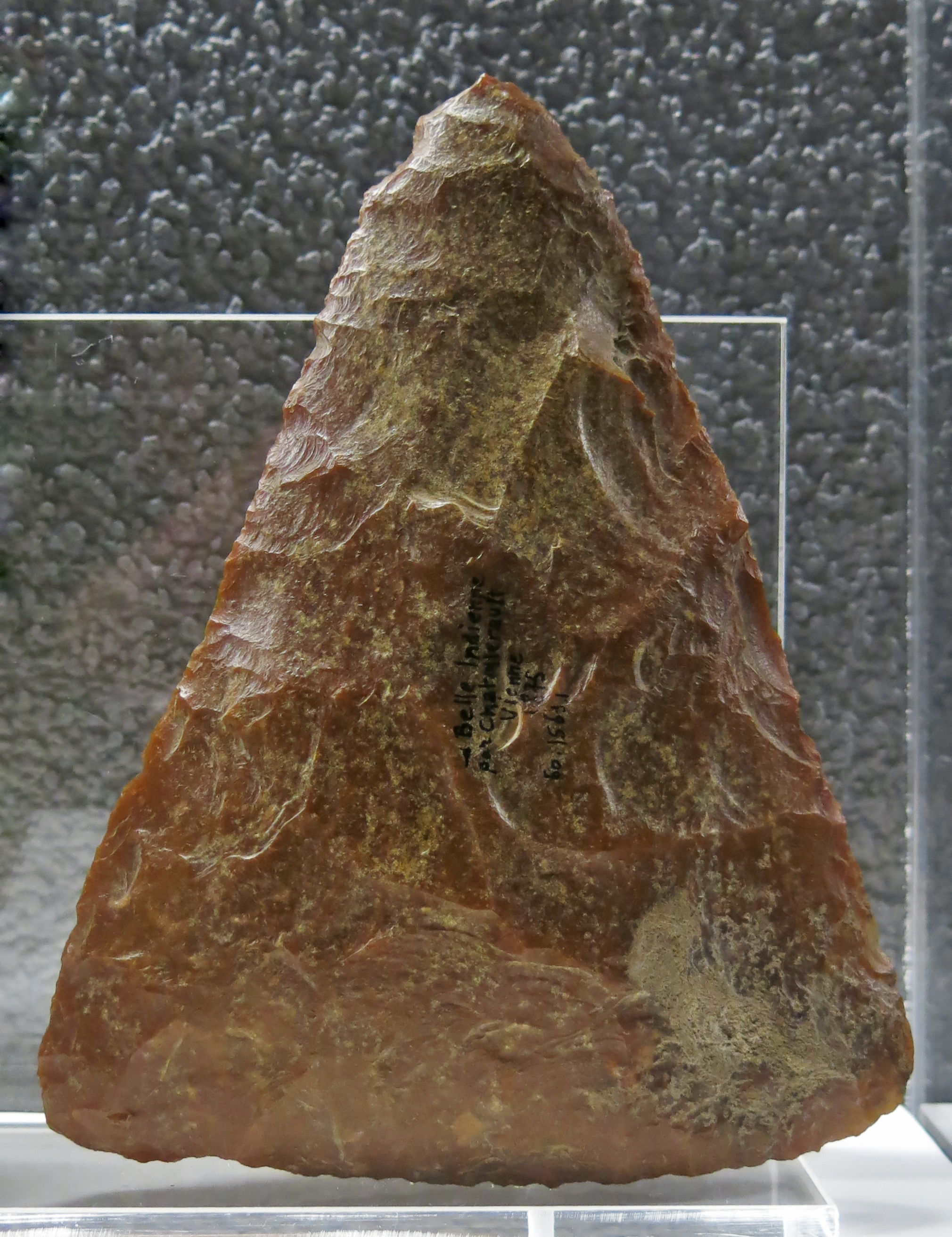
Mousterian MTA biface hand axe, made of flint. This is an important piece from the Départment Vienne near Châtellerault (La Belle Indienne), as may be seen from the inscription on the axe.
Triangular profile.
Length 172 mm, width 126 mm, thickness 27 mm.
This handaxe is seen by many collectors as the non-plus-ultra for the Moustérien de tradition acheuléenne (MTA) bifaces.
Photo: Don Hitchcock 2015
Catalog: 60.1563.1
Source: Original, Musée d'Aquitaine à Bordeaux
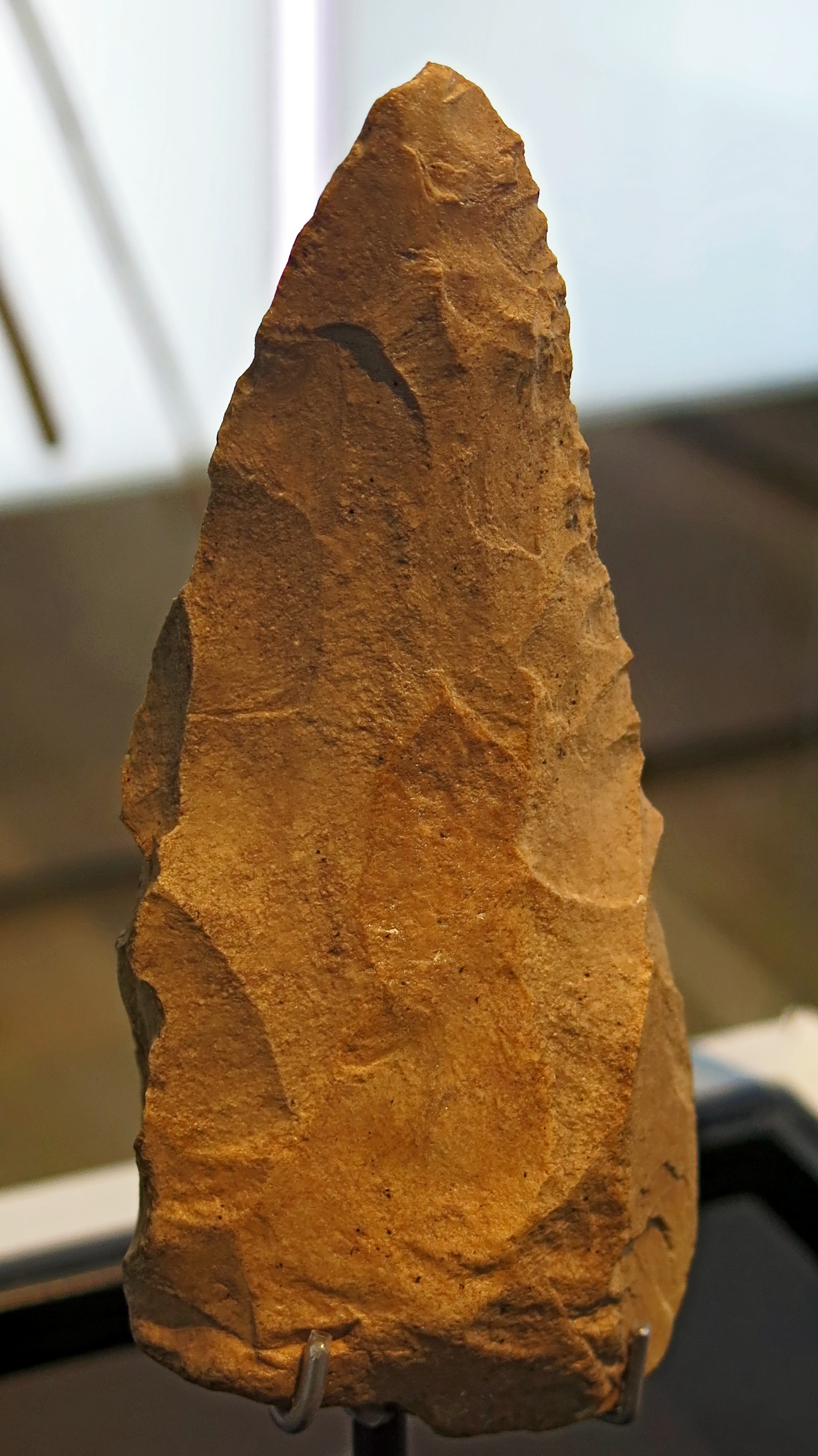
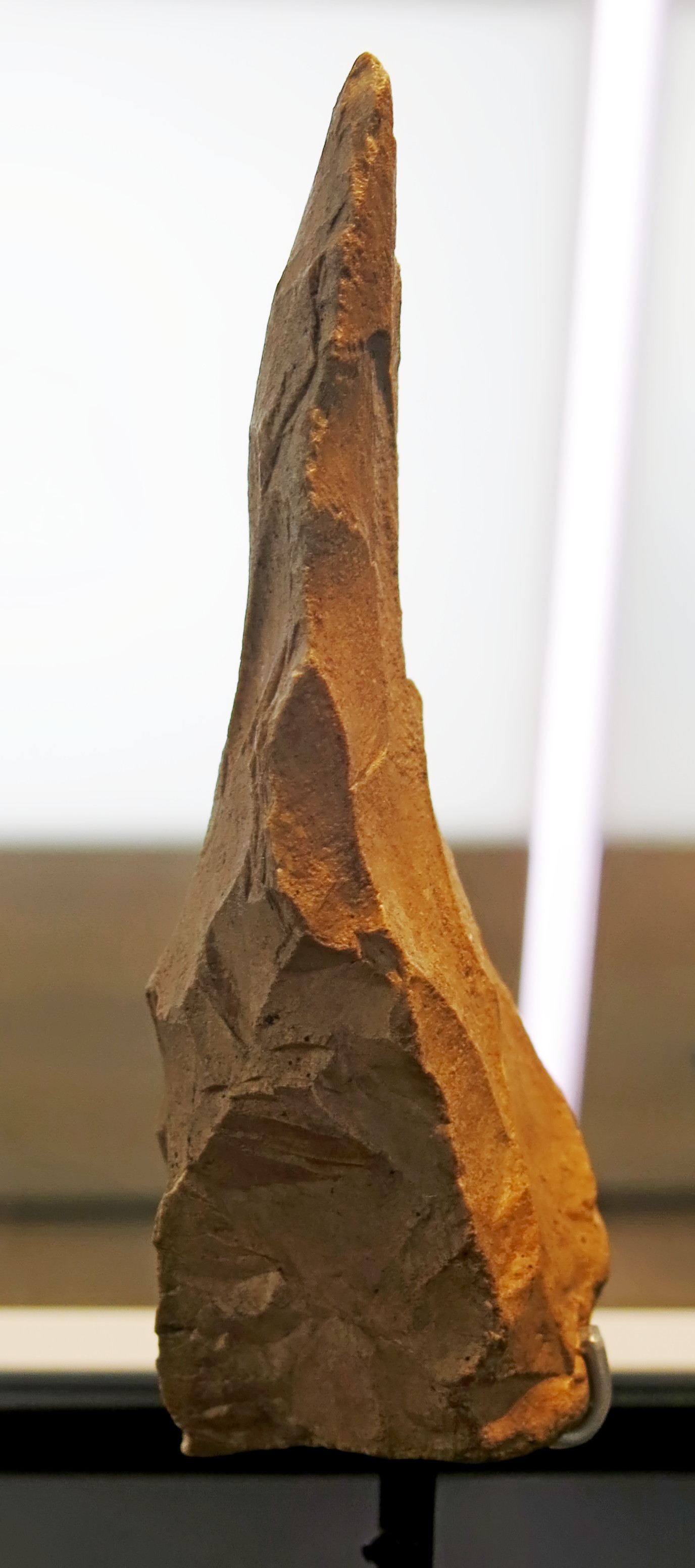
Mousterian MTA biface hand axe.
Lanceolate Profile. Note however that this handaxe has been ascribed to the Micoquien, probably because of its asymmetry.
Circa 70 000 BP - 50 000 BP
Neanderthals were master stone knappers. They possessed a sense of aesthetics and an intuition for the right material, as may be seen from their handaxes.
In Heidenschmiede, Heidenheim, district Heidenheim. there were numerous stone tools made from fresh water quartzite. This is a material very similar to flint, and outcrops only a few kilometres from the site.
Length 148 mm, width 71 mm.
Photo: Don Hitchcock 2015
Source and text: Landesmuseum Württemberg, Stuttgart
Neanderthal hand axe in the Acheulean tradition, but made from a flake.
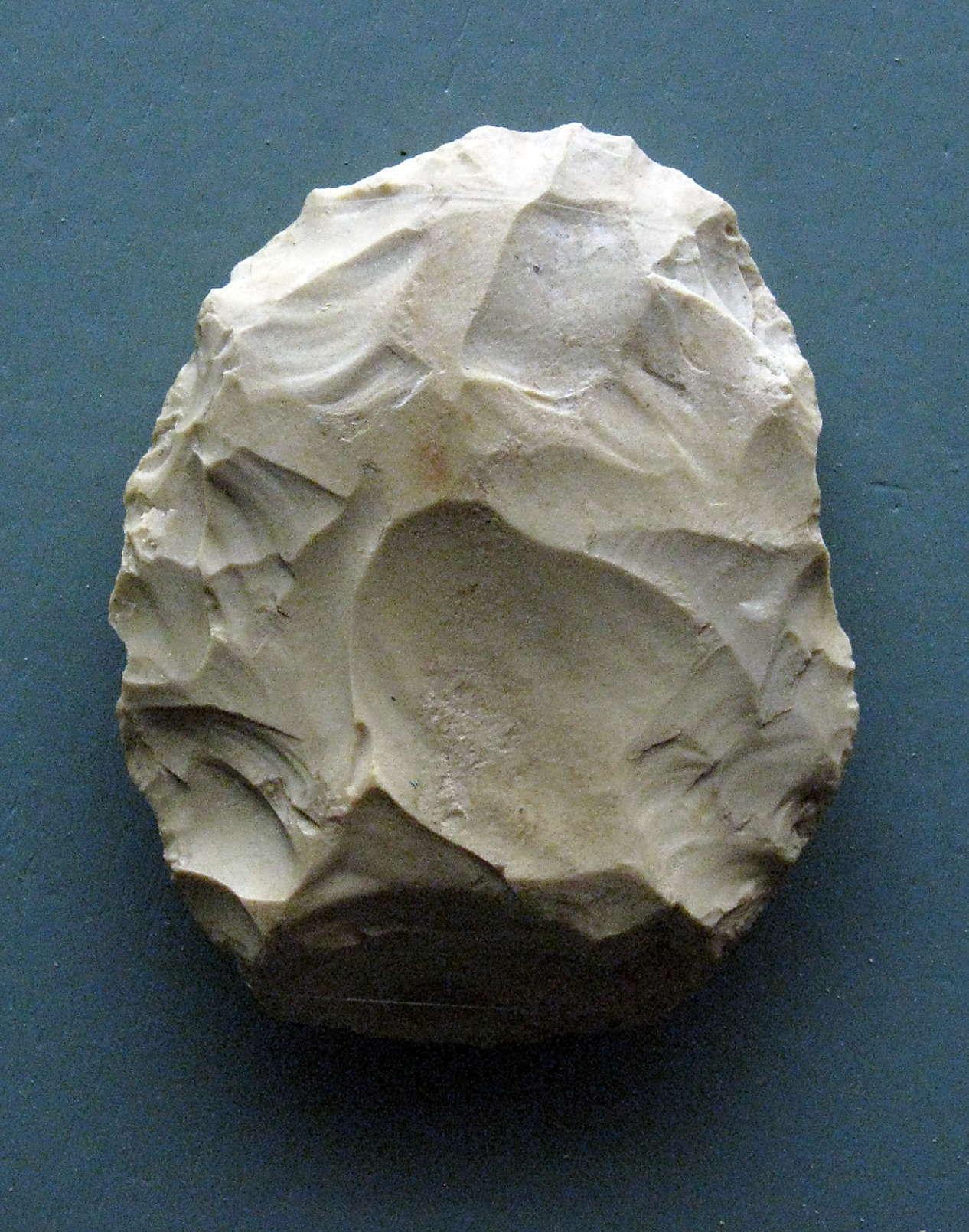
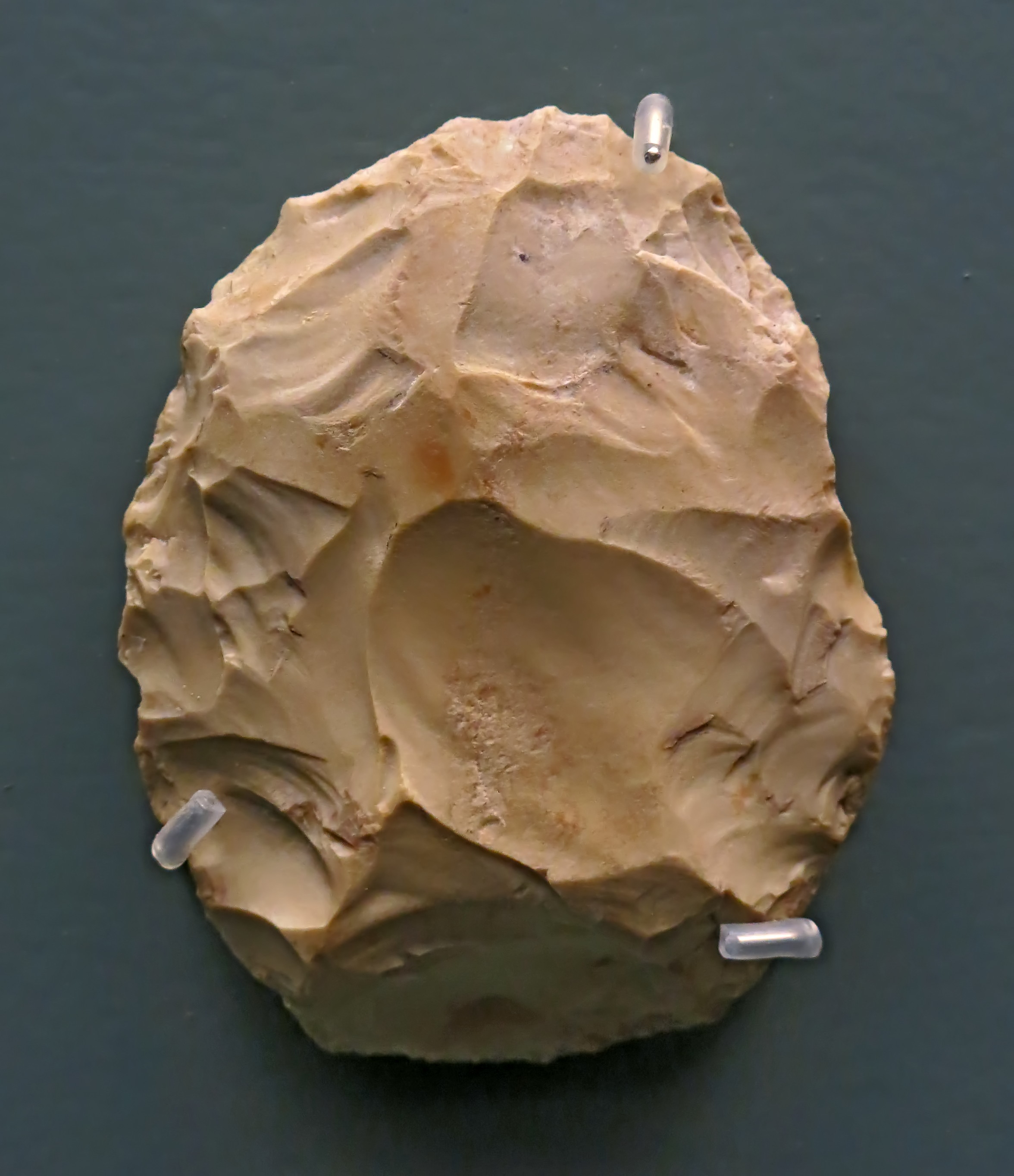
Flint (jasper) tool from Frieburg. Mousterian culture, circa 80 000 BP.
Elliptical profile.
Small Mousterian ovate hand axe / scraper.
Note the large flake taken out for a thumb grip. There are many neanderthal tools (and even some upper palaeolithic tools) with this feature.
The blank was struck from a flint (jasper) core and bifacially worked in the handaxe tradition.
Worked on both sides, this piece still stands in the long tradition of early handaxes, but is characterised by careful restoration of a flat surface. It may have been used as both a scraper and a handaxe.
In the case of fairly small tools such as this, it is often difficult to determine if it is primarily a Breitschaber / Blattschaber (wide / blade scraper) or Faustkeil (hand axe).
It may have been used as a handaxe in the morning, and a scraper that afternoon. Not for nothing is the classic handaxe known as the 'Swiss Army Knife' of Palaeolithic tools. Many millions were made, and used for many purposes - cutting, scraping, smashing bones to obtain the marrow, or choppers for cutting up carcasses or cutting down small trees.
Similar tools are also known from other European sites and are referred to as the Mousterian culture after the French site of 'Le Moustier' (Dordogne / France). This culture was of Neanderthal origin.
Photo: Don Hitchcock 2008, 2015
Source: Badisches Landesmuseum Karlsruhe Germany
An overview of the development of stone tools, from Acheulean Hand Axes to late Neolithic arrow heads

This case shows the full sweep of stone tools, from the very old to some of the youngest.
Photo: Don Hitchcock 2014
Source: Rijksmuseum van Oudheden, National Museum of Antiquities, Leiden.
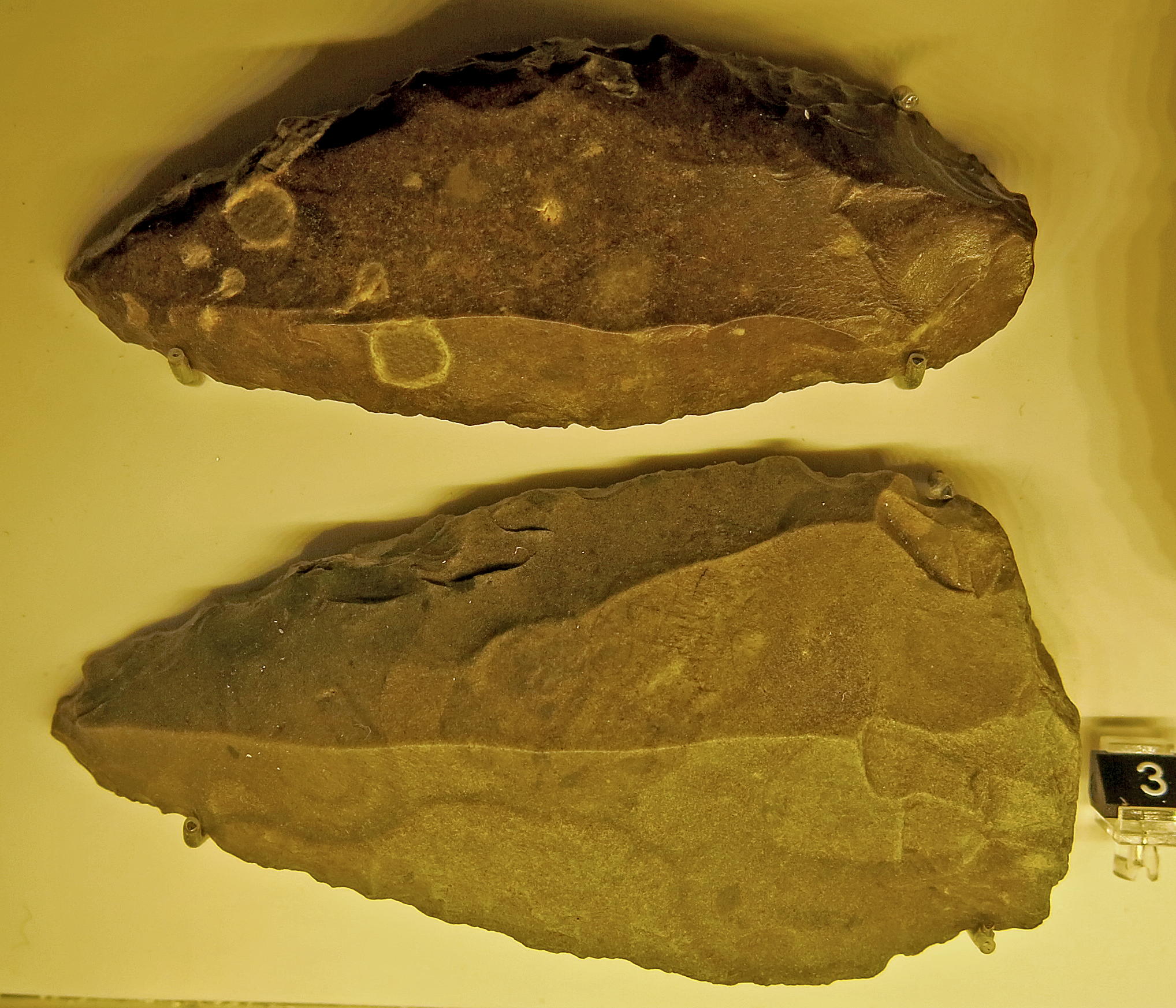
Palaeolithic, 300 000 - 30 000 years ago
(3) Points, Rhenen.
Photo: Don Hitchcock 2014
Source: Rijksmuseum van Oudheden, National Museum of Antiquities, Leiden.
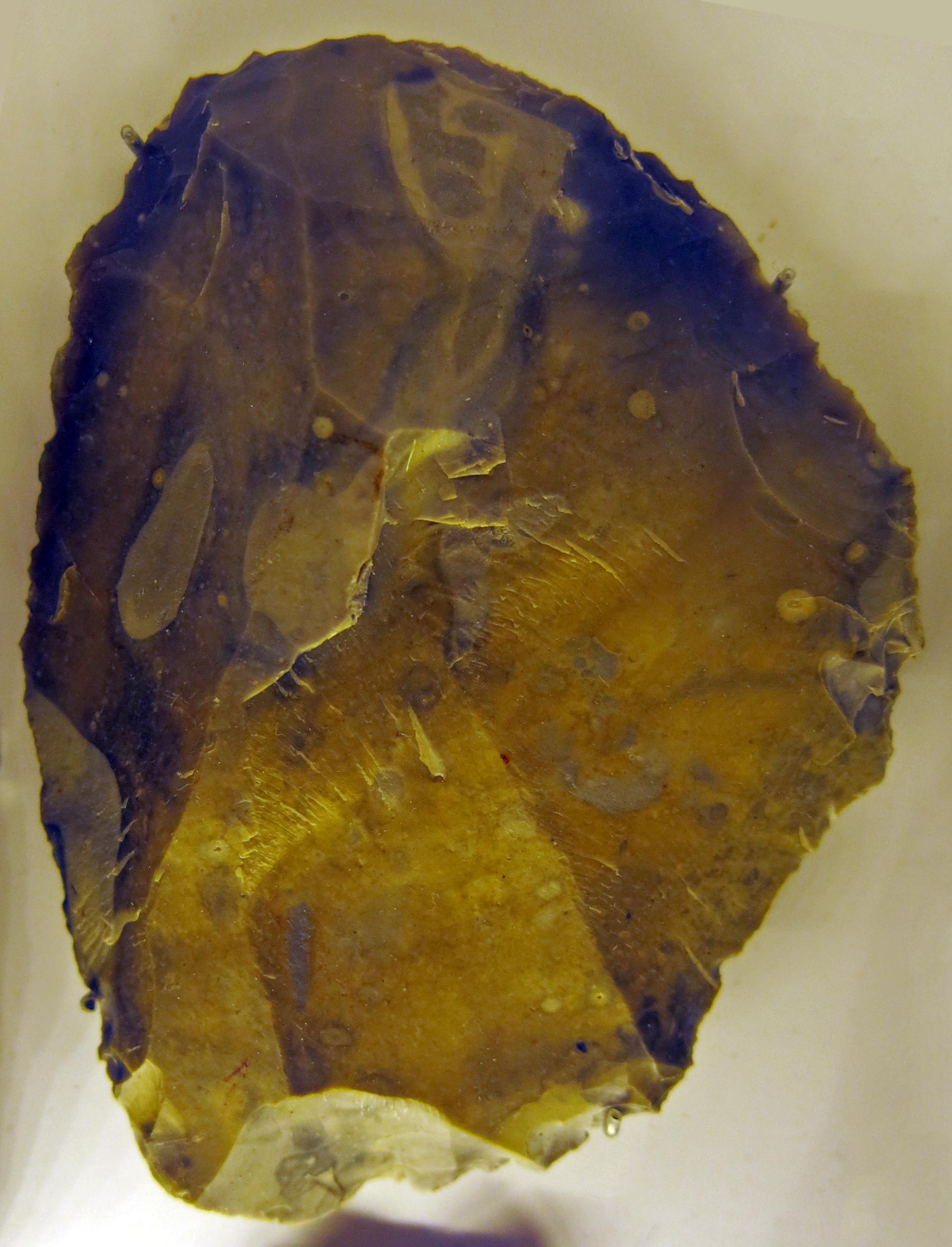
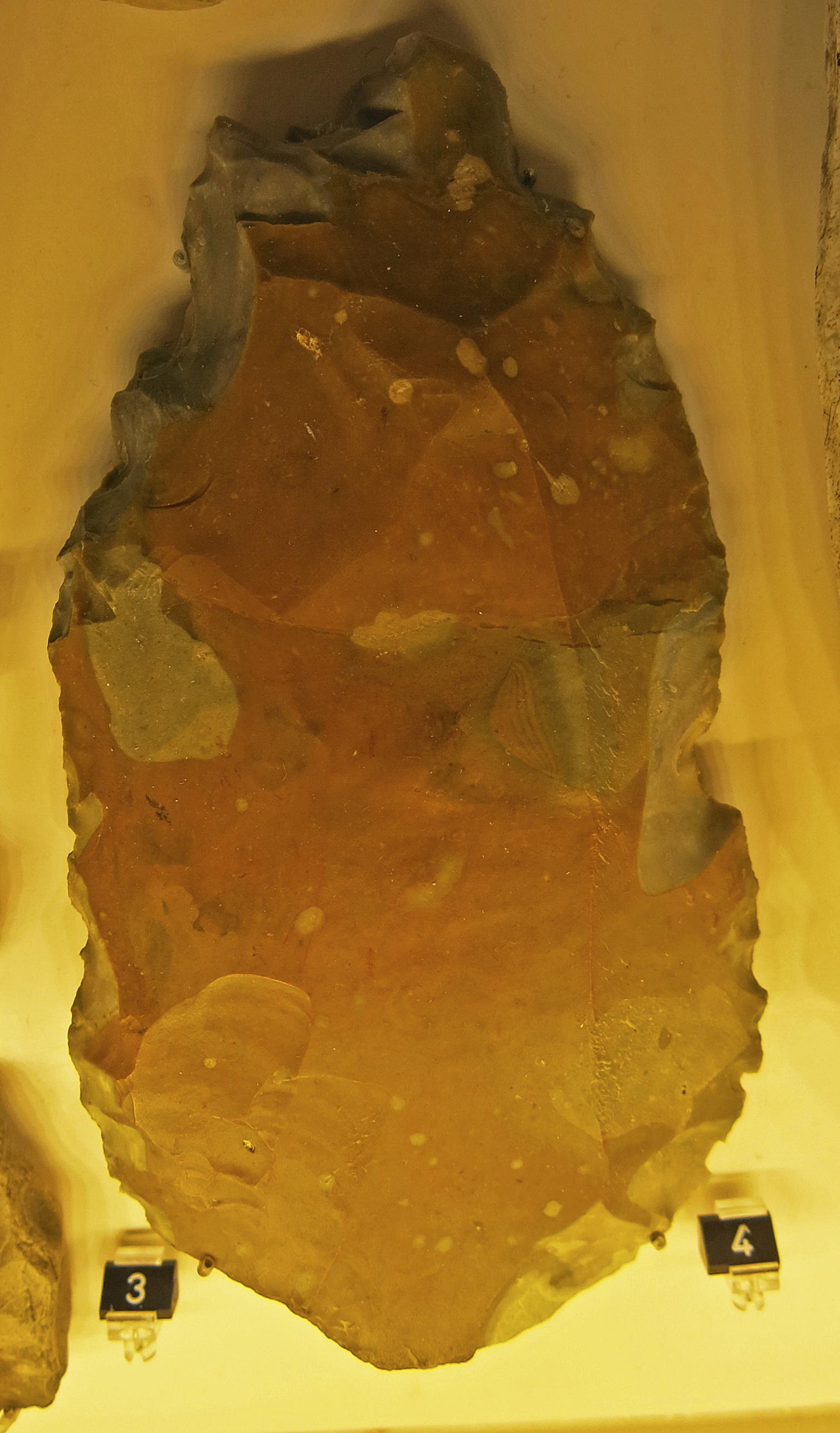
Palaeolithic, 300 000 - 30 000 years ago
(4) Scraper and Levallois-flake, North Sea.
Photo: Don Hitchcock 2014
Source: Rijksmuseum van Oudheden, National Museum of Antiquities, Leiden.
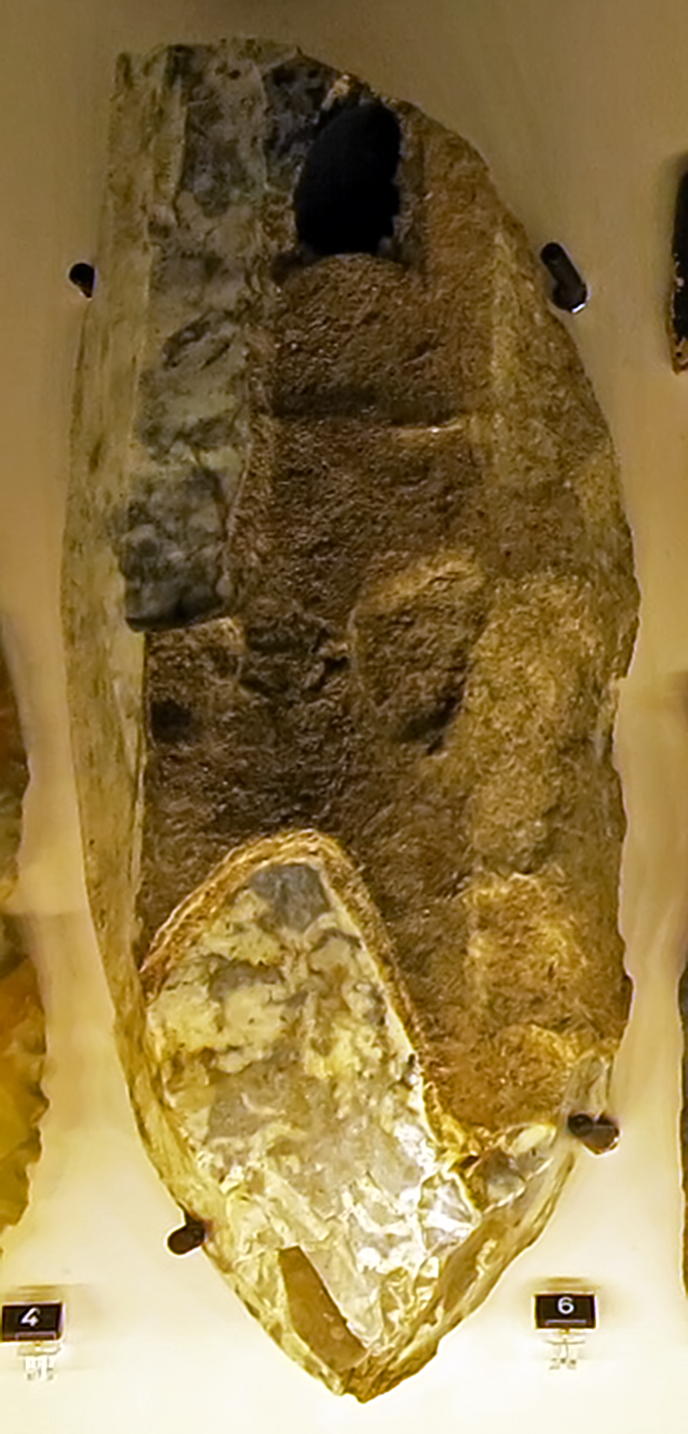
Late Palaeolithic, 13 000 - 9 600 years ago
(6) Blade core, Magdalenian, St.-Geertruid.
Photo: Don Hitchcock 2014
Source: Rijksmuseum van Oudheden, National Museum of Antiquities, Leiden.
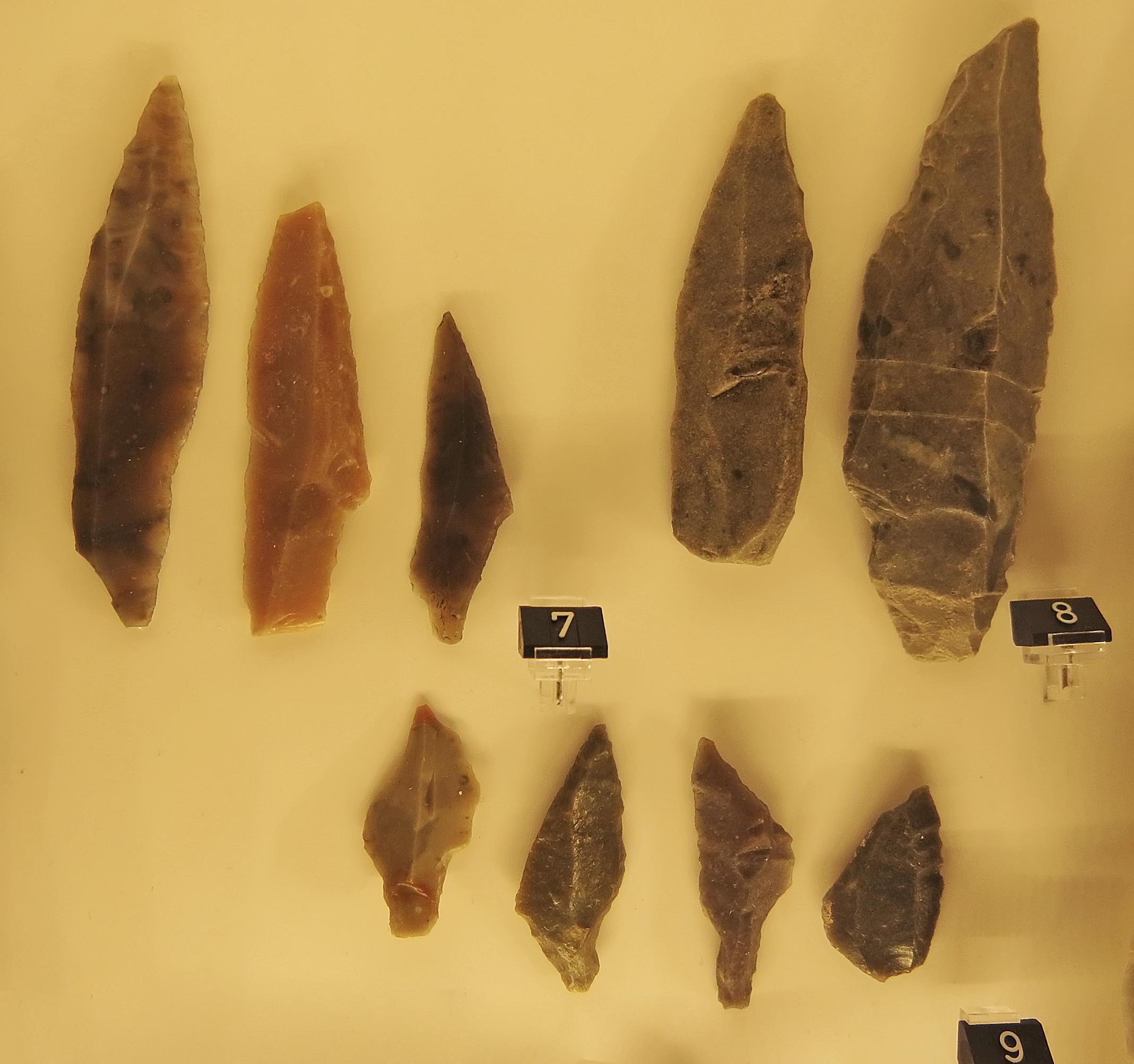
Late Palaeolithic, 13 000 - 9 600 years ago
(7) Points, Hamburgian
(8) Federmesser group, Drunen
(9) Points, Ahrensburgian
Photo: Don Hitchcock 2014
Source: Rijksmuseum van Oudheden, National Museum of Antiquities, Leiden.


Late Palaeolithic, 13 000 - 9 600 years ago
(10) Tools, Magdalenian, Eyserheide.
Photo: Don Hitchcock 2014
Source: Rijksmuseum van Oudheden, National Museum of Antiquities, Leiden.

Mesolithic, 10 800 - 7 000 years ago
(11) Bone harpoon, replica.
Photo: Don Hitchcock 2014
Source: Rijksmuseum van Oudheden, National Museum of Antiquities, Leiden.
The above is a fine example of the use of microliths. Their use was not because of a lack of good flint, but because they were far more effective at dropping prey, because of the shock they provided from the wound they made. The wound was large and lacerated, and the blood loss and associated organ damage disabled even large prey.
A weapon such as this would take a long time to make, from the number of flints knapped, to the crafting of the bone with a pair of suitable grooves, to making the birch glue, (a mixture of resin, beeswax and ochre was also used as a glue) and to fitting everything together into a beautifully made killing machine. Although this is labelled as a harpoon, points of similar construction were used fixed to spear/dart shafts. See in particular Pétillon et al. (2011) and also Wilkins et al. (2014)
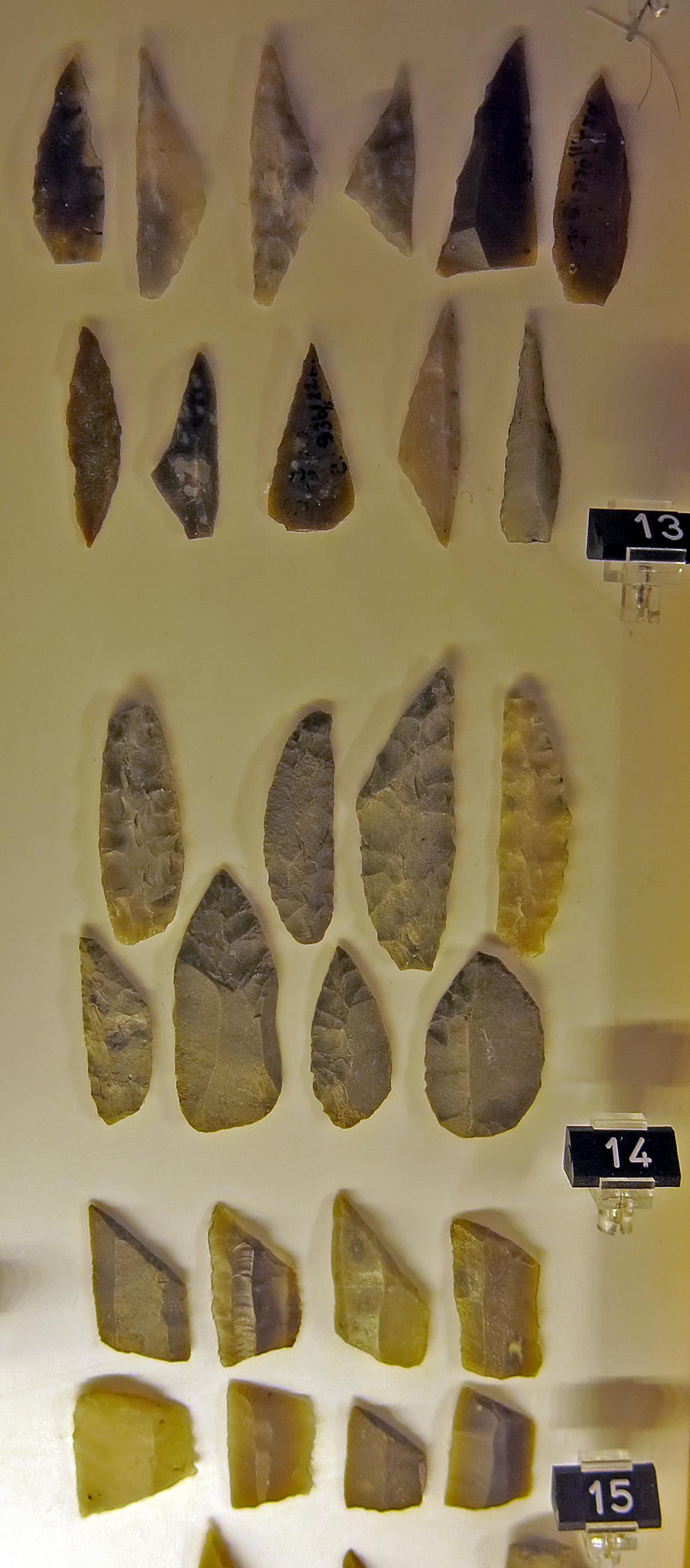
Mesolithic, 10 800 - 7 000 years ago
(13) Points, early Mesolithic
(14) Points, middle Mesolithic
(15) Points, Late Mesolithic
Photo: Don Hitchcock 2014
Source: Rijksmuseum van Oudheden, National Museum of Antiquities, Leiden.
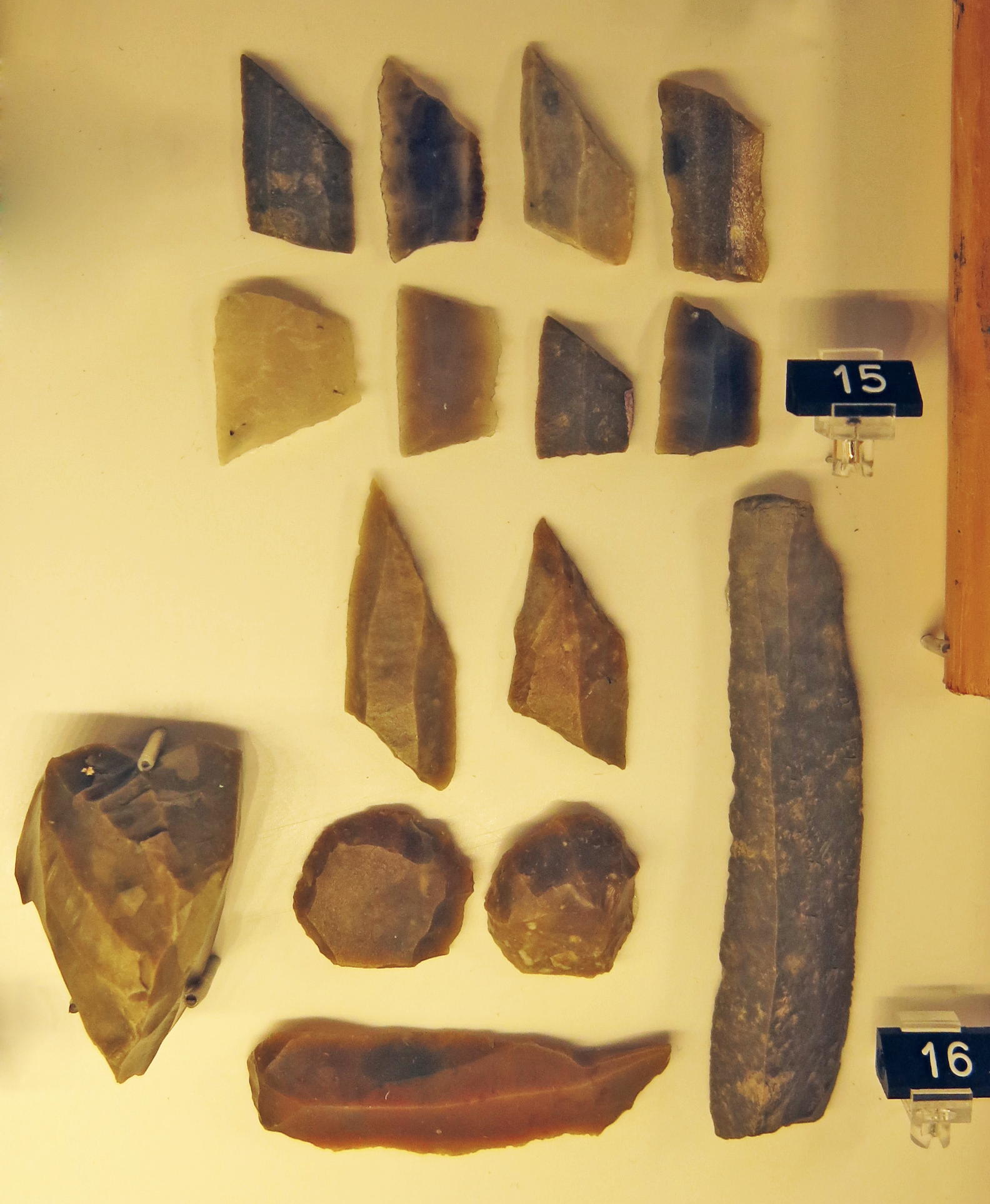
Mesolithic, 10 800 - 7 000 years ago
(15) Points, Late Mesolithic
(16) Inventory of hunting camp, Budel
Photo: Don Hitchcock 2014
Source: Rijksmuseum van Oudheden, National Museum of Antiquities, Leiden.
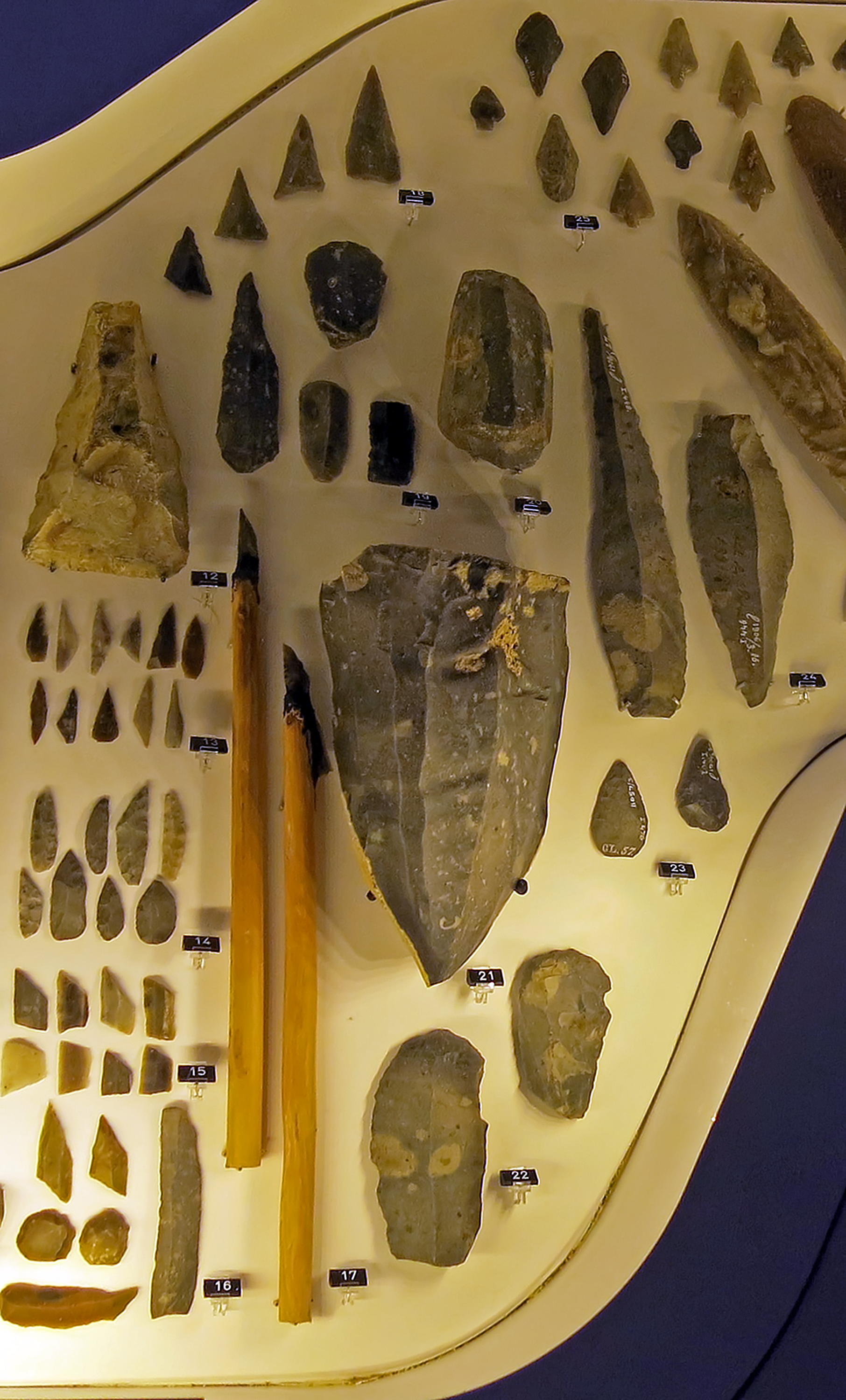
Mesolithic, 10 800 - 7 000 years ago
(12) Tranchet axe, Oldemarkt
(13) Points, Early Mesolithic
(14) Points, Middle Mesolithic
(15) Points, Late Mesolithic
(16) Inventory of hunting camp, Budel
(17) Hafted points, replicas
Early Neolithic, 7 300 - 6 900 years ago
(18) Bandkeramik arrowheads, Elsloo
(19) Bandkeramik tools, Elsloo
(20) Bandkeramik blade core, Elsloo
Middle Neolithic, 6 200 - 5 400 years ago
(21) Blade core, St. -Geertruid
(22) Scrapers, Rijckholt
(23) Arrowheads, Michelsberg culture
(24) Pointed blades, Michelsberg culture
Late Neolithic, 4 900 - 4 000 years ago
(25) Arrowheads, tanged, Veluwe
Photo: Don Hitchcock 2014
Source: Rijksmuseum van Oudheden, National Museum of Antiquities, Leiden.
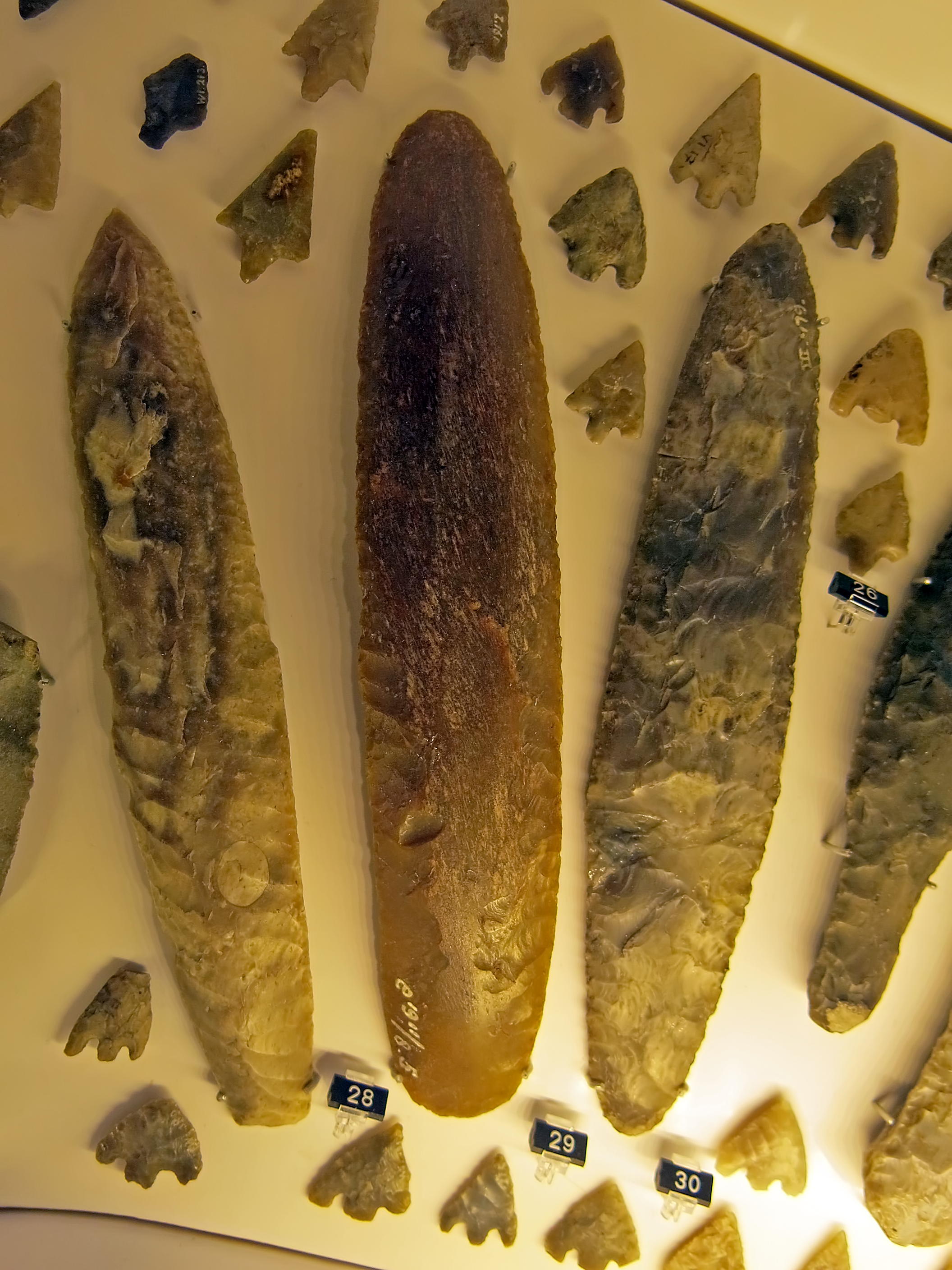
Late Neolithic, 4 900 - 4 000 years ago
(26) Arrowheads, barbed, Veluwe
(28) Dagger, Rhomigny-Lhért flint
(29) Dagger, Grand-Pressigny flint
(30) Dagger, Scandinavian type
Photo: Don Hitchcock 2014
Source: Rijksmuseum van Oudheden, National Museum of Antiquities, Leiden.
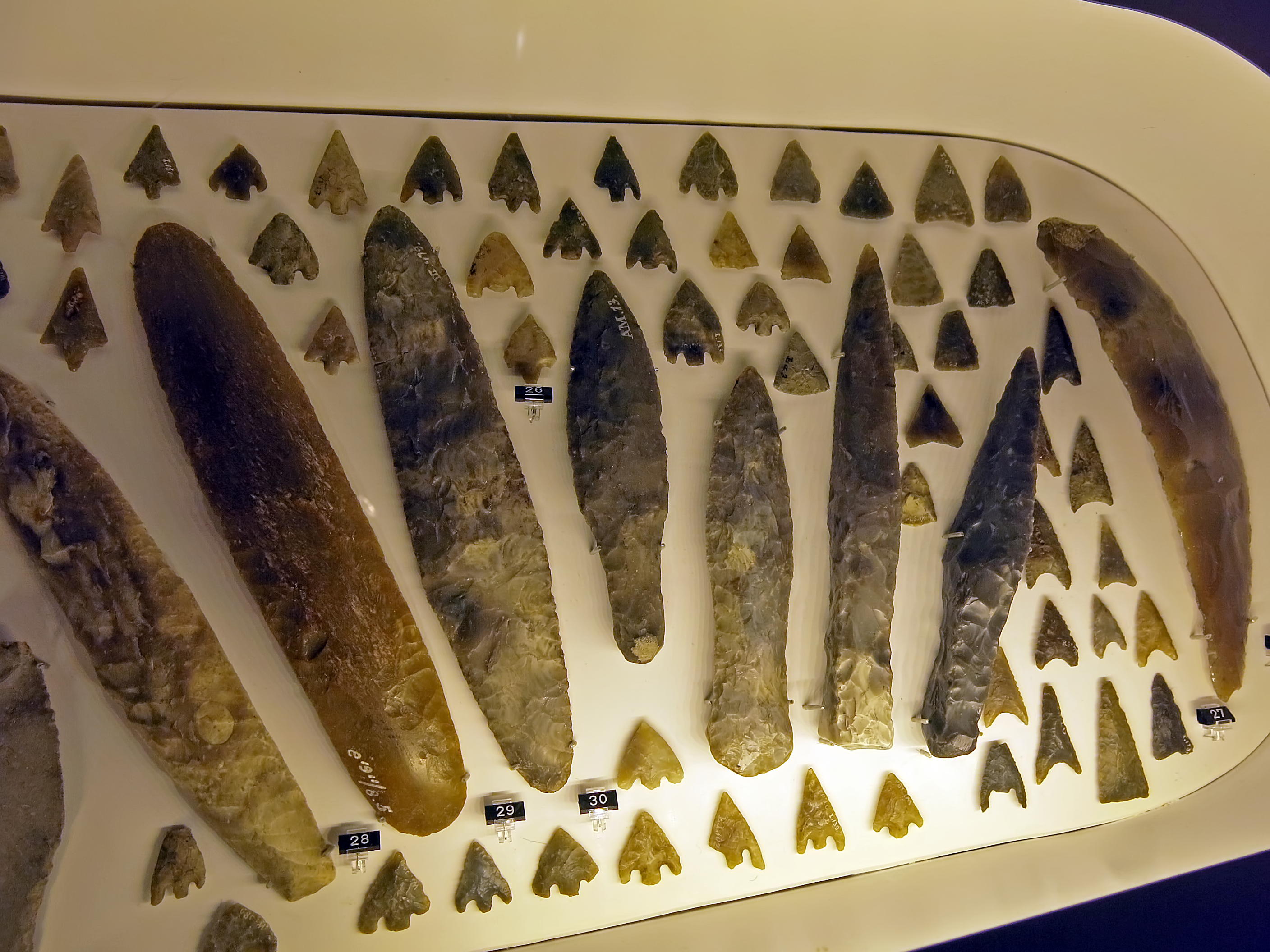
Late Neolithic, 4 900 - 4 000 years ago
(26) Arrowheads, barbed, Veluwe
(27) Arrowheads, triangle and hollow base
(28) Dagger, Rhomigny-Lhért flint
(29) Dagger, Grand-Pressigny flint
(30) Dagger, Scandinavian type
Bronze Age-Early Iron Age, 4 000 - 2 600 years ago
(31) (far right) Sickle
Photo: Don Hitchcock 2014
Source: Rijksmuseum van Oudheden, National Museum of Antiquities, Leiden.
From the oldest to the youngest tools
Currently the first stone tools are dated somewhat earlier than the first evidence for the genus Homo. The oldest tools are 2.6 million years old and come from Kada Gona in Ethiopia. They are attributed to Australopithecus garhi. For the 2 milllion year old tools from Kanjera in Kenya, transport routes of more than 12 km have been ascertained. Like the 1.8 million year old stone tools from Koobi Fora, also in Kenya, they belong to the Oldowan culture, which in eastern Africa comprised only simple choppers and chopping tools.
Text above: Vienna Natural History Museum, Naturhistorisches Museum Wien
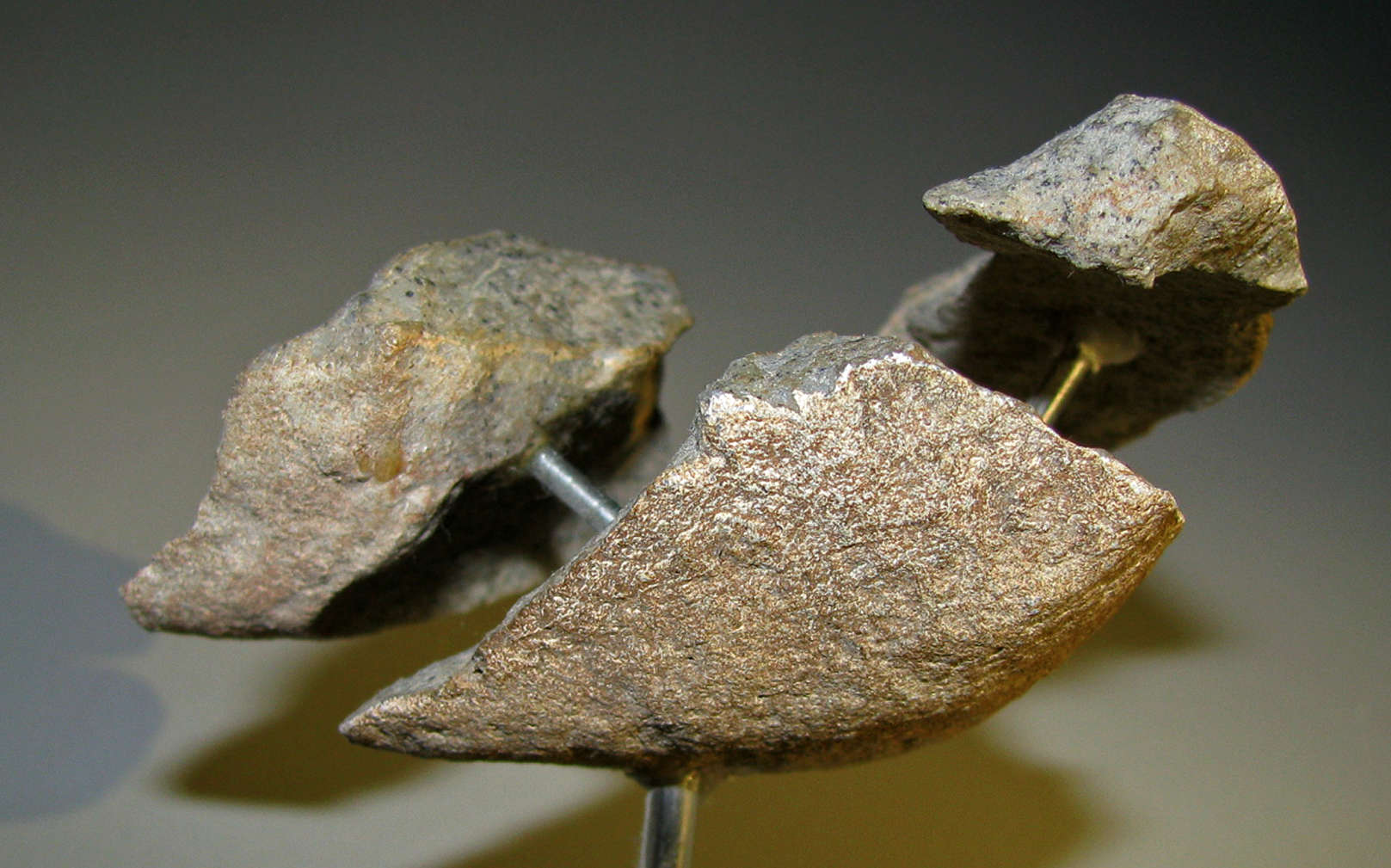
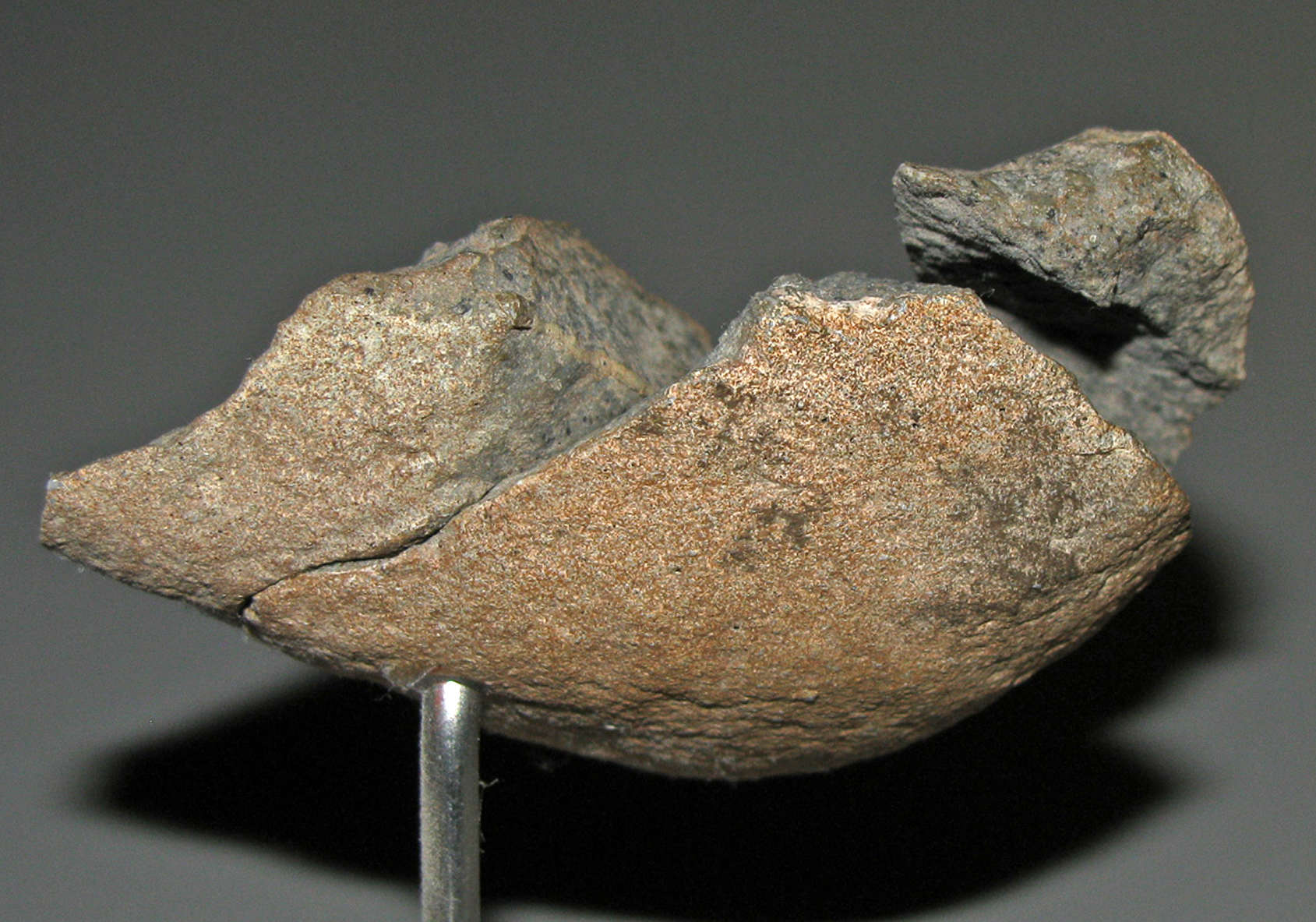

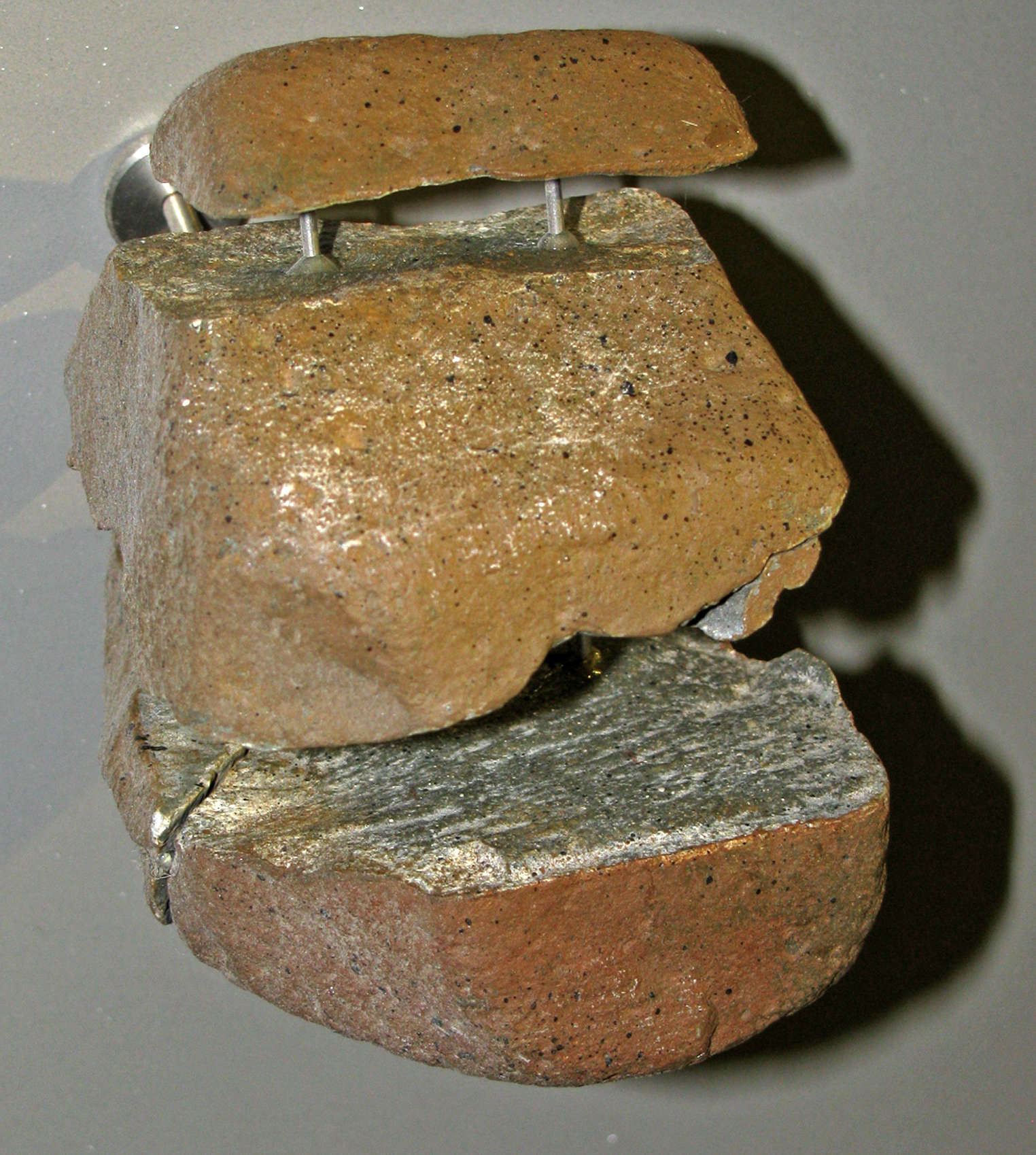
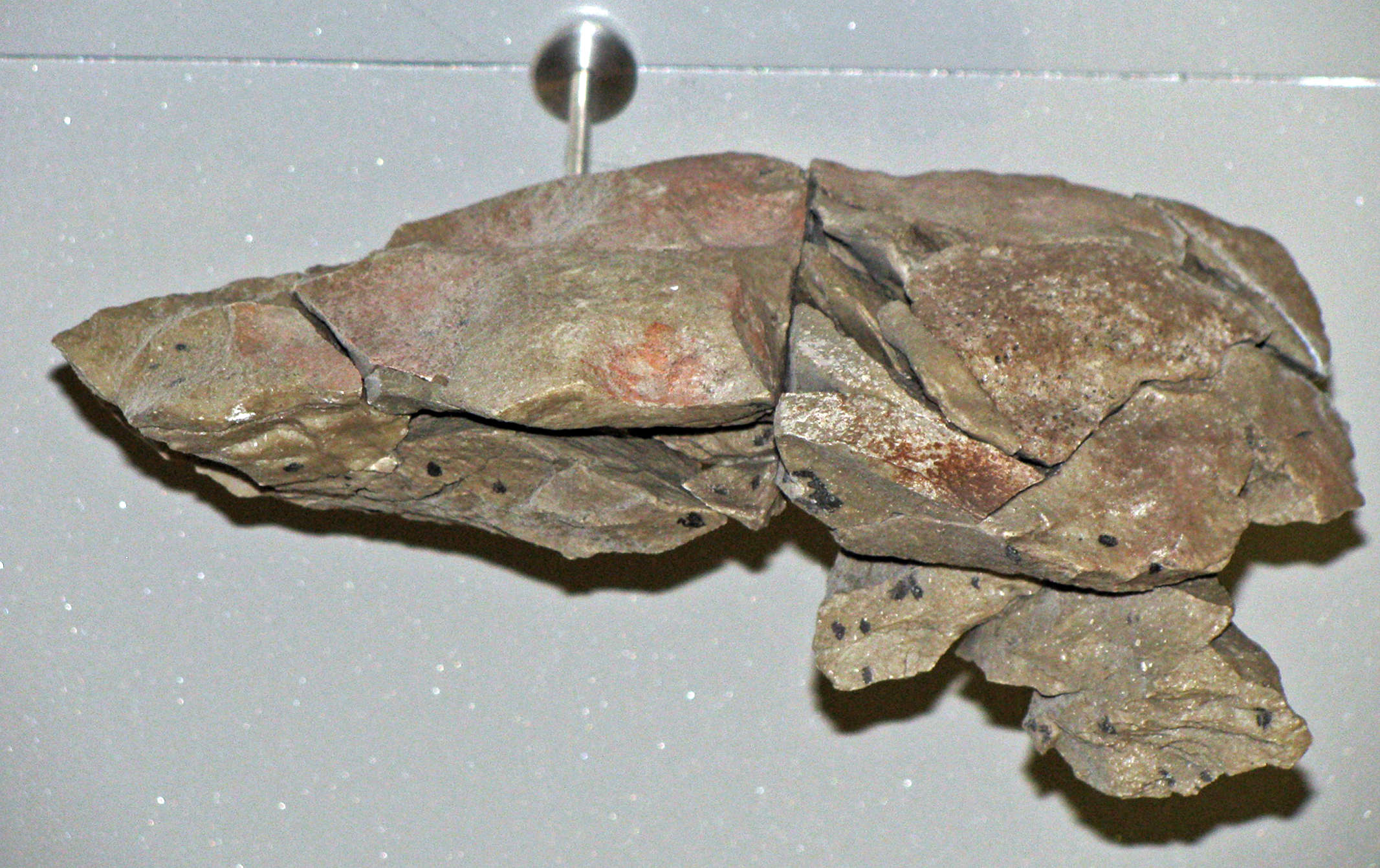
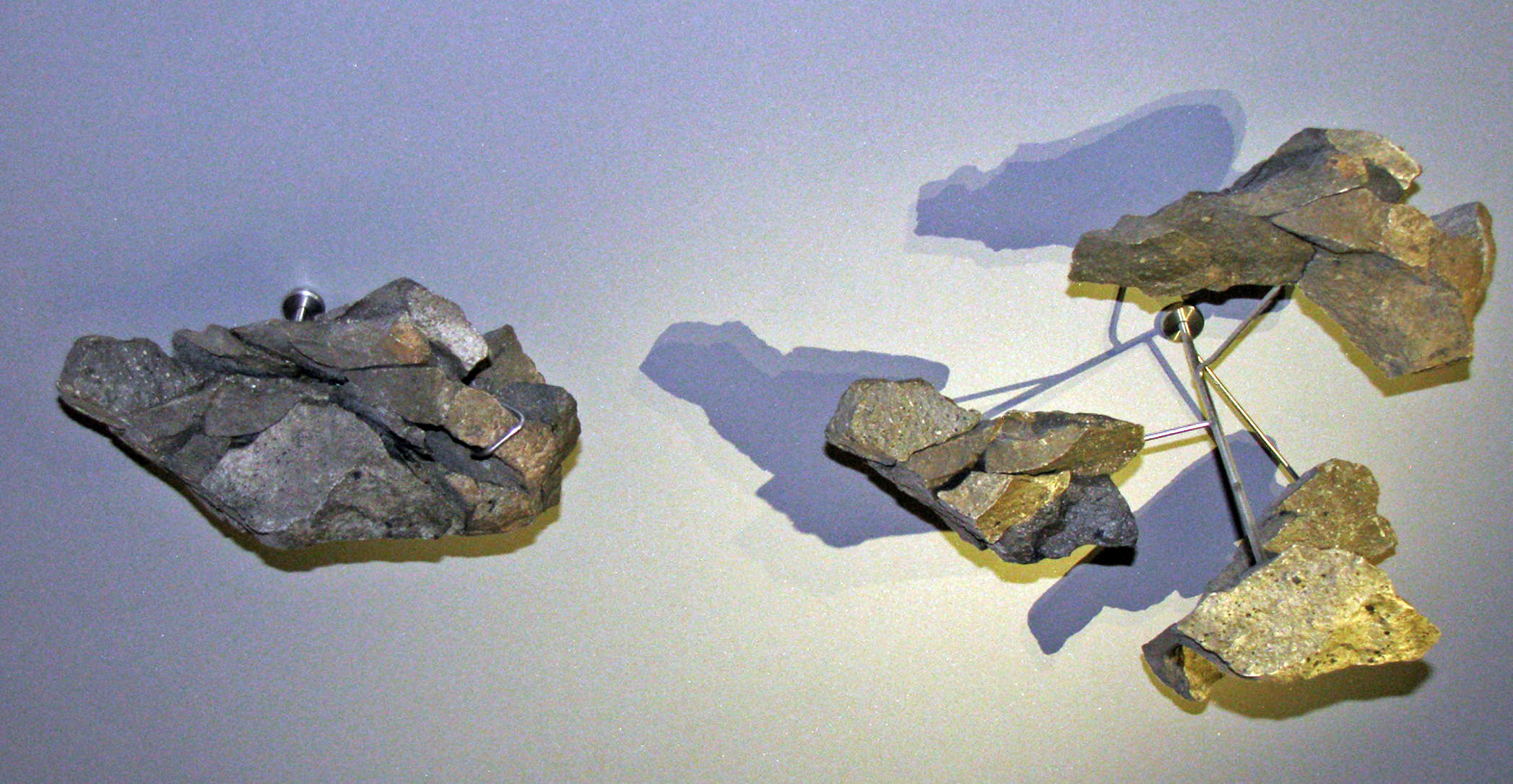
Tools from Kenya, 2.5 million years old.
Facsimiles
Photo: Don Hitchcock 2008
Source: Display at Musée National de Préhistoire, Les Eyzies
'Choppers', the oldest worked stone implements.
Gabarones, Botswana, 2.5 million - 1 million BP.
Photo: Don Hitchcock 2014
Source and text: Original, Københavns (Copenhagen) Museum, National Museum of Denmark
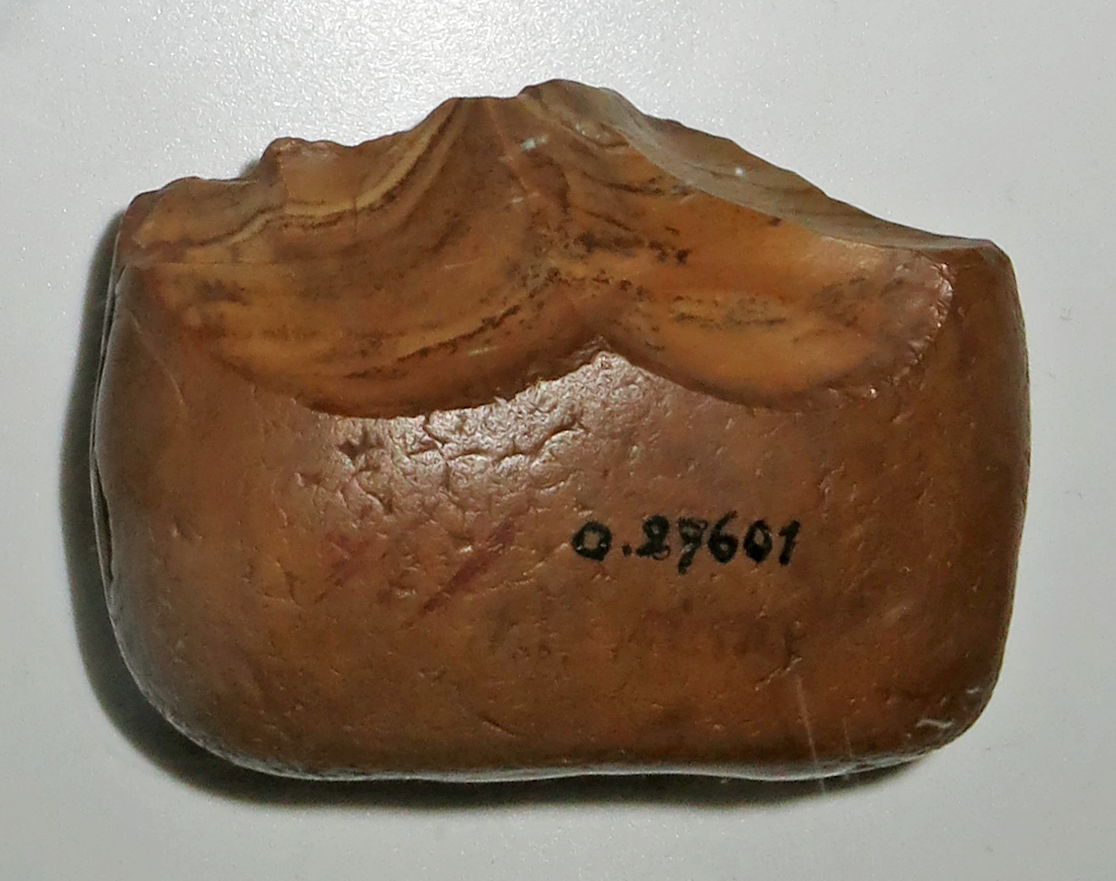
Chopper, 1 000 000 BP - 2 600 000 BP.
From Merimde-Benisalame, Egypt.
Photo: Don Hitchcock 2015
Source and text: Original, Monrepos Archäologisches Forschungszentrum und Museum, Neuwied, Germany
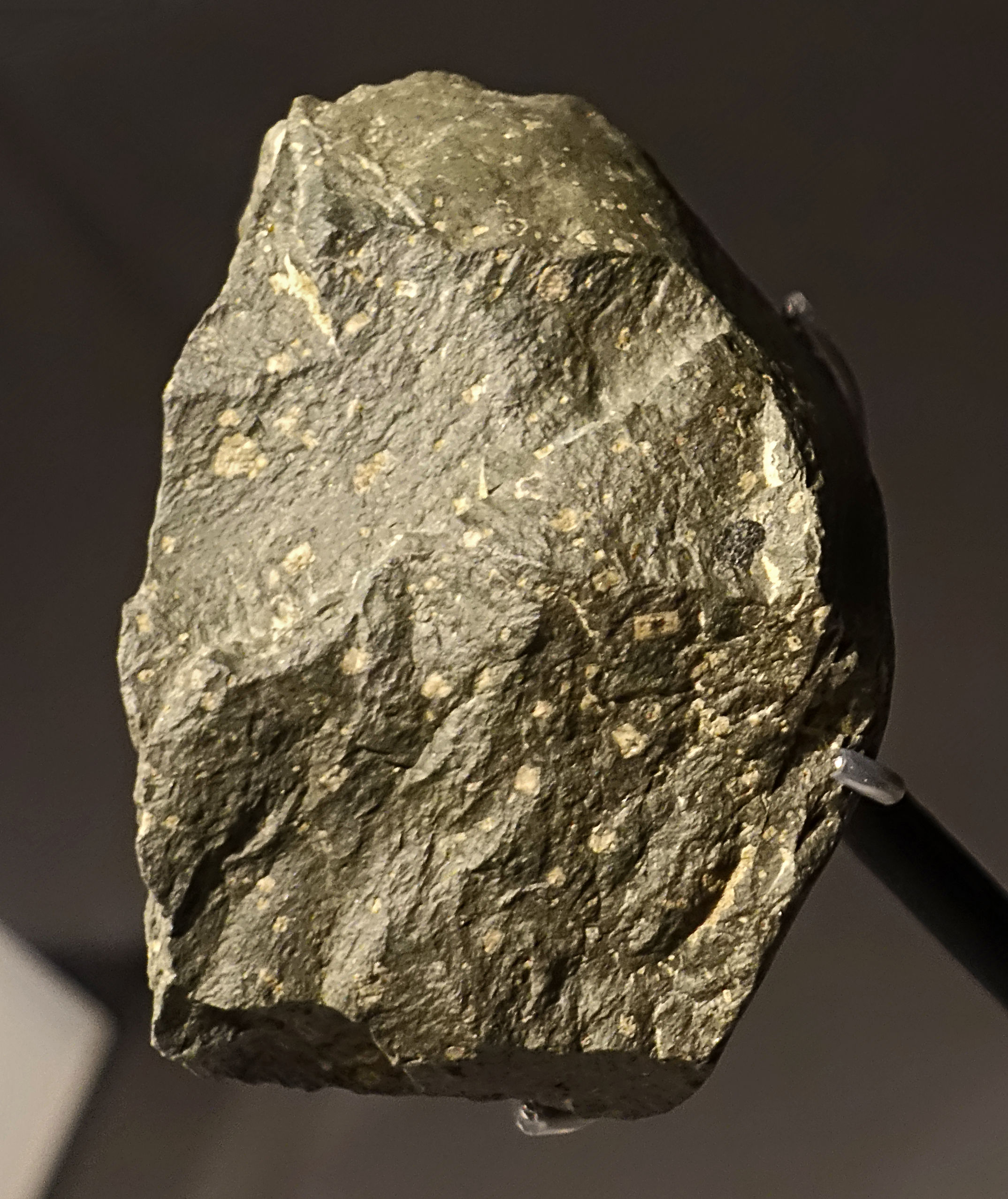
Olduvai stone chopping tool
2.0 - 1.8 million years old
Found in Olduvai Gorge, Tanzania.
This stone chopping tool is the oldest object in the British Museum and one of the oldest known tools made by our earliest human ancestors. Its discovery in northern Tanzania with fossil remains of an extinct human species proved that both human life and technology began in Africa. Tools like this were particularly useful in breaking open bones to obtain the marrow fat inside. High in calories, marrow was an important component in the development of the human brain.
Chopping tool of basalt from Oldowan, Olduvai Gorge. The removal of a large flake from the top of the cobble provide a striking platform for the removal of three flakes which form a well defined regular edge. A second less satisfactory edge has been formed by removals along the opposite side of the first striking platform. The rest of the cobble retains its natural surface.
Length 93 mm, depth: 72 mm, thickness 88 mm.
The cobble may have been used as a source of flakes for use in light duty tasks or as a chopping tool or both.
Findspot: Olduvai Gorge, CK III
Exhibited: 2016-2017 08 Sep-29 Jan, National Museum of Australia, Canberra, 'A History of the World in 100 Objects'
Collected by: Dr Louis Seymour Bazett Leakey
Catalog: 1934, 1214.1
Photo: Don Hitchcock 2017
Text: Card, http://www.britishmuseum.org/, © Trustees of the British Museum
Source: Exhibition by the British Museum at the National Museum of Australia, Canberra
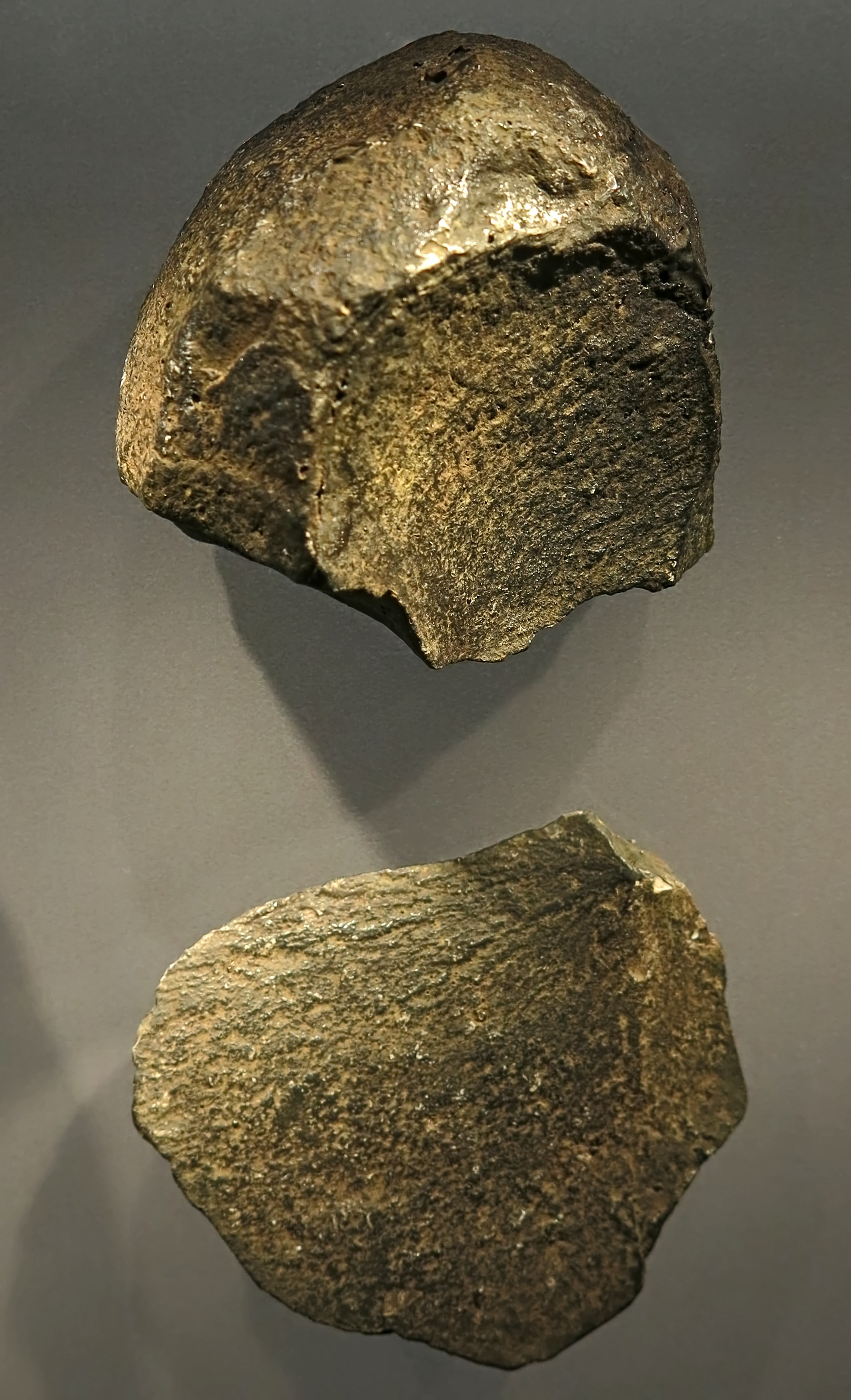
Chopper and flake.
Koobi Fora, Kenya.
Circa 1 900 000 BP - 1 600 000 BP.
Photo: Don Hitchcock 2015
Source and text: Facsimile, Vienna Natural History Museum, Naturhistorisches Museum Wien
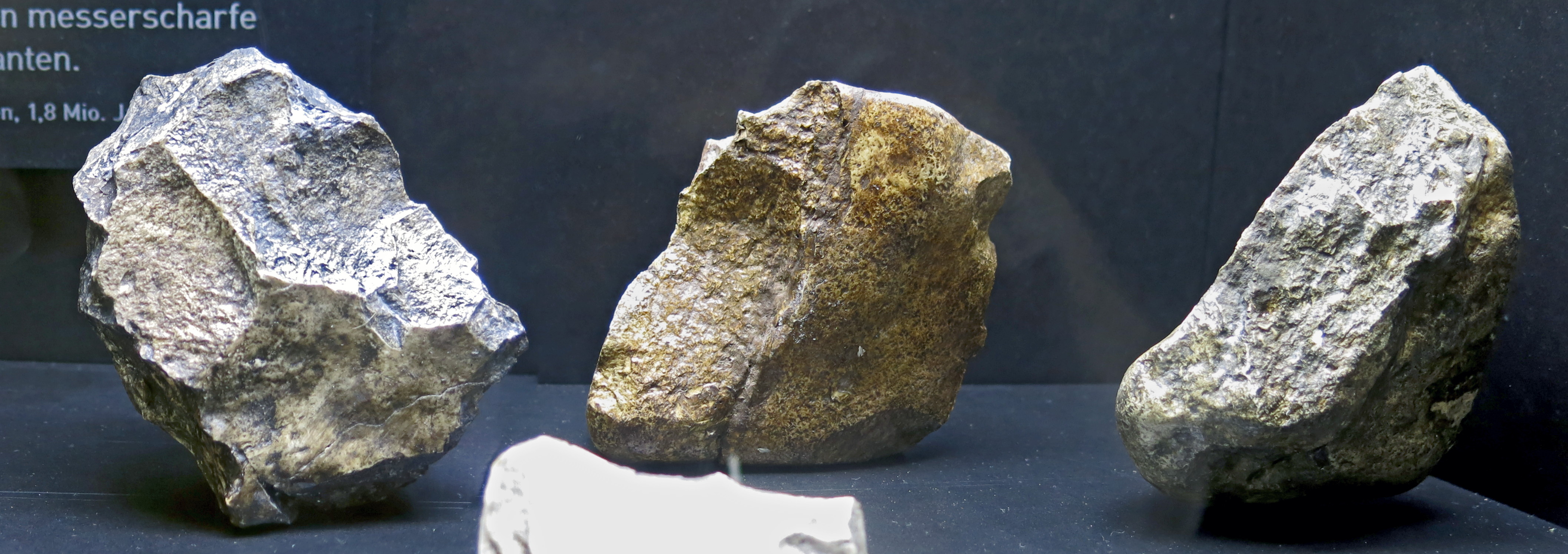
These flakes from volcanic rocks, struck from nuclei, have sharp edges.
Dmanisi, Georgia, 1.8 million BP.
Photo: Don Hitchcock 2015
Source and text: Monrepos Archäologisches Forschungszentrum und Museum, Neuwied, Germany
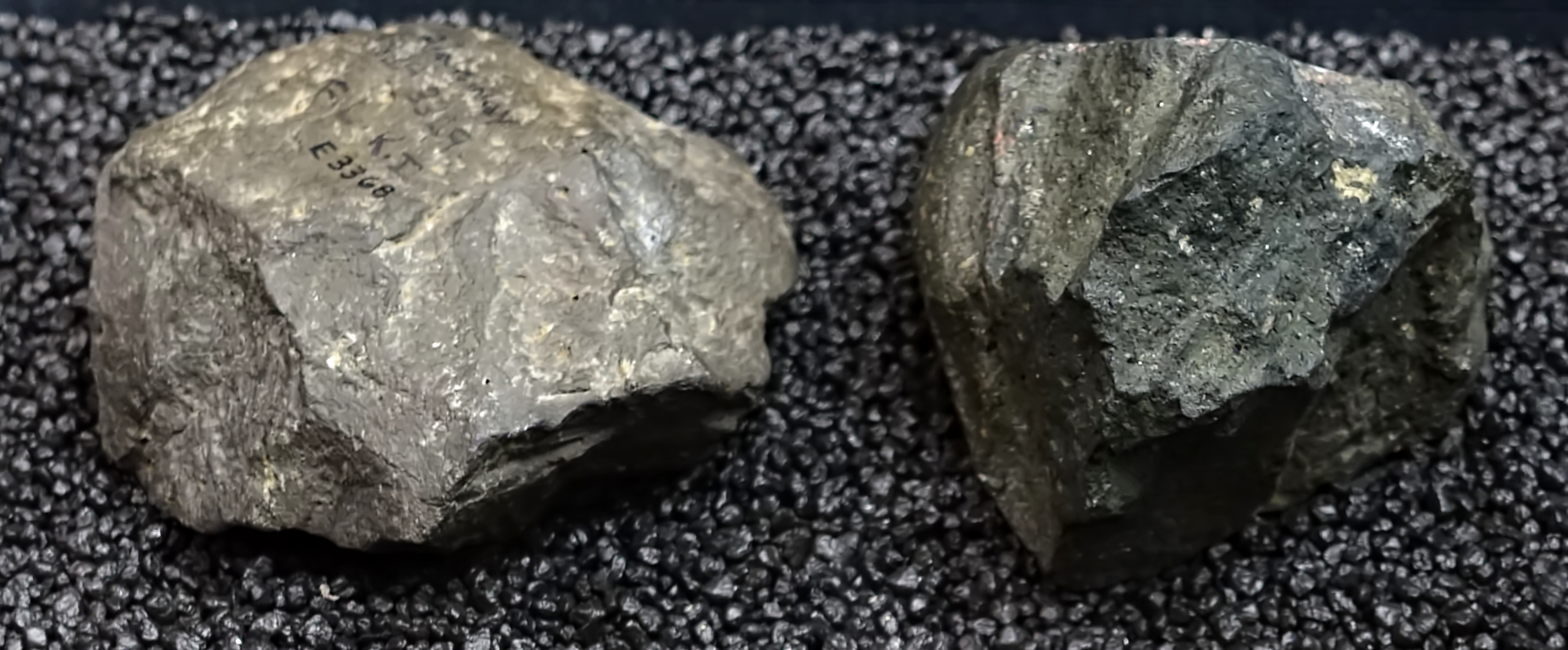
Pebble tools possibly made and used by Homo habilis, Homo rudolfensis, or early Homo erectus.
From Olduvai Gorge, Tanzania, around 1 800 000 BP.
Catalog: E3368, E1153
Photo: Don Hitchcock 2018
Source and text: The Natural History Museum, Cromwell Road, London SW7 5BD
Chopper
Olduvai, Tanzania.
Circa 1 800 000 BP - 1 500 000 BP.
Photo: Don Hitchcock 2015
Source and text: Facsimile, Vienna Natural History Museum, Naturhistorisches Museum Wien
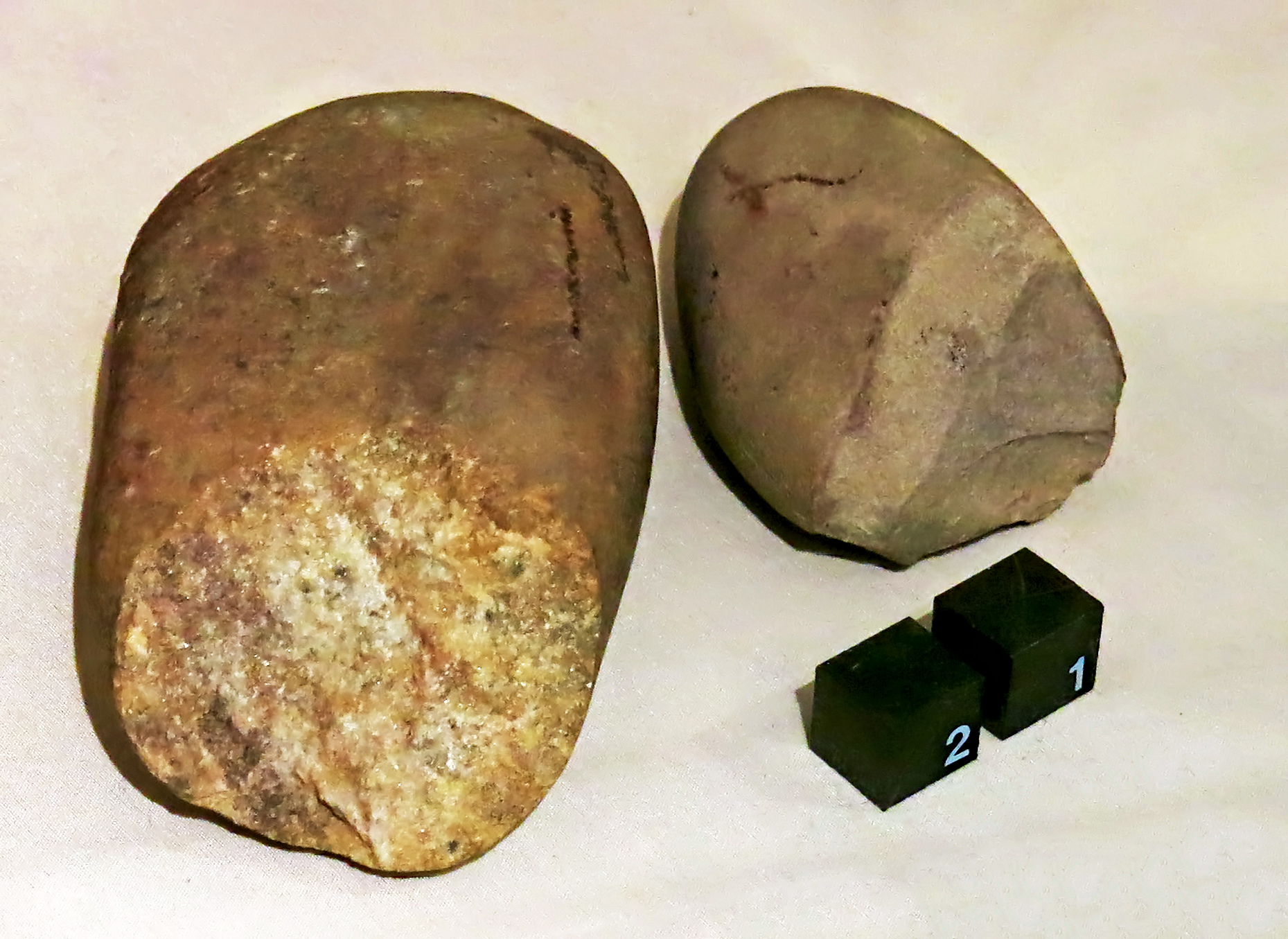
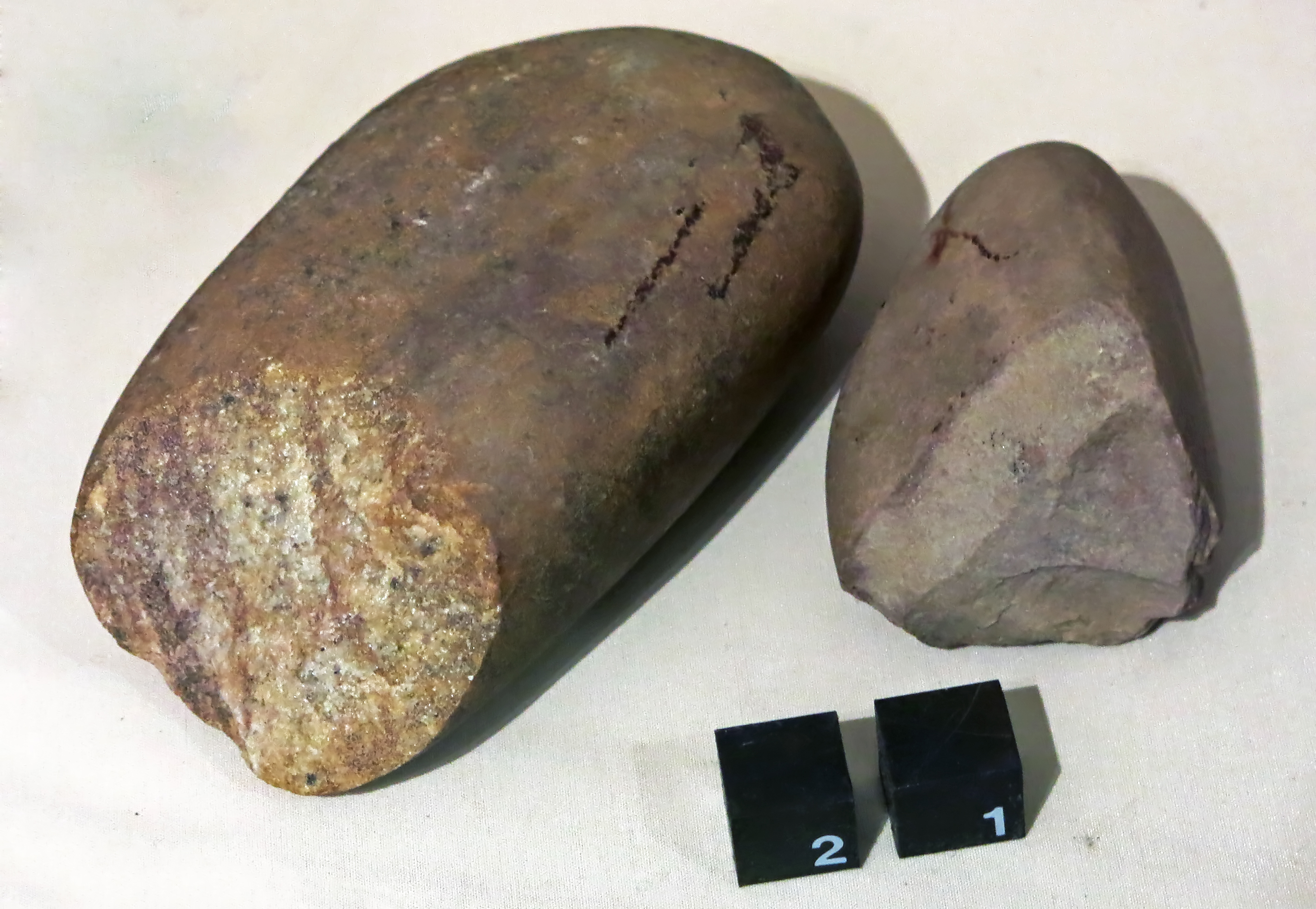
1.
Chopper from Waltenheim-sur-Zorn, Bas-Rhin, period of Homo erectus, donated by M. Ehretsmann.
Found in 1989.
( Readers should note that this artefact was found at or near the surface, not in situ. It had apparently been brought to the surface by ploughing - Don )
Quartzite, height 74 mm, width 52 mm, thickness 43 mm.
Its distal part has three successive groups
of removal:
A. Two primary removals (No. 1 and 2) created a free edge inclined at approximately 55°.
B. Two secondary removals (no. 3 and 4) resulting either from the shaping of the piece or from its use.
the present inclination of the cutting edge, i.e. close to 90° in relation to the edge of the pebble.
C. The keels (no. 5) are located on the side of the main edge of the tool, and are used to create a sharp edge.
This tool corresponds to the unidirectional cutter of Biberson's classification (1961) (type 12
of Ramendo (1963) ).
2.
Chopper from Achenheim with single removal in quartzite or quartzite sandstone. Found in: Rhine grey sands.
Photo: Don Hitchcock 2015
Source: Original, Musée Archéologique Strasbourg
Text: Ehretsmann (1991)
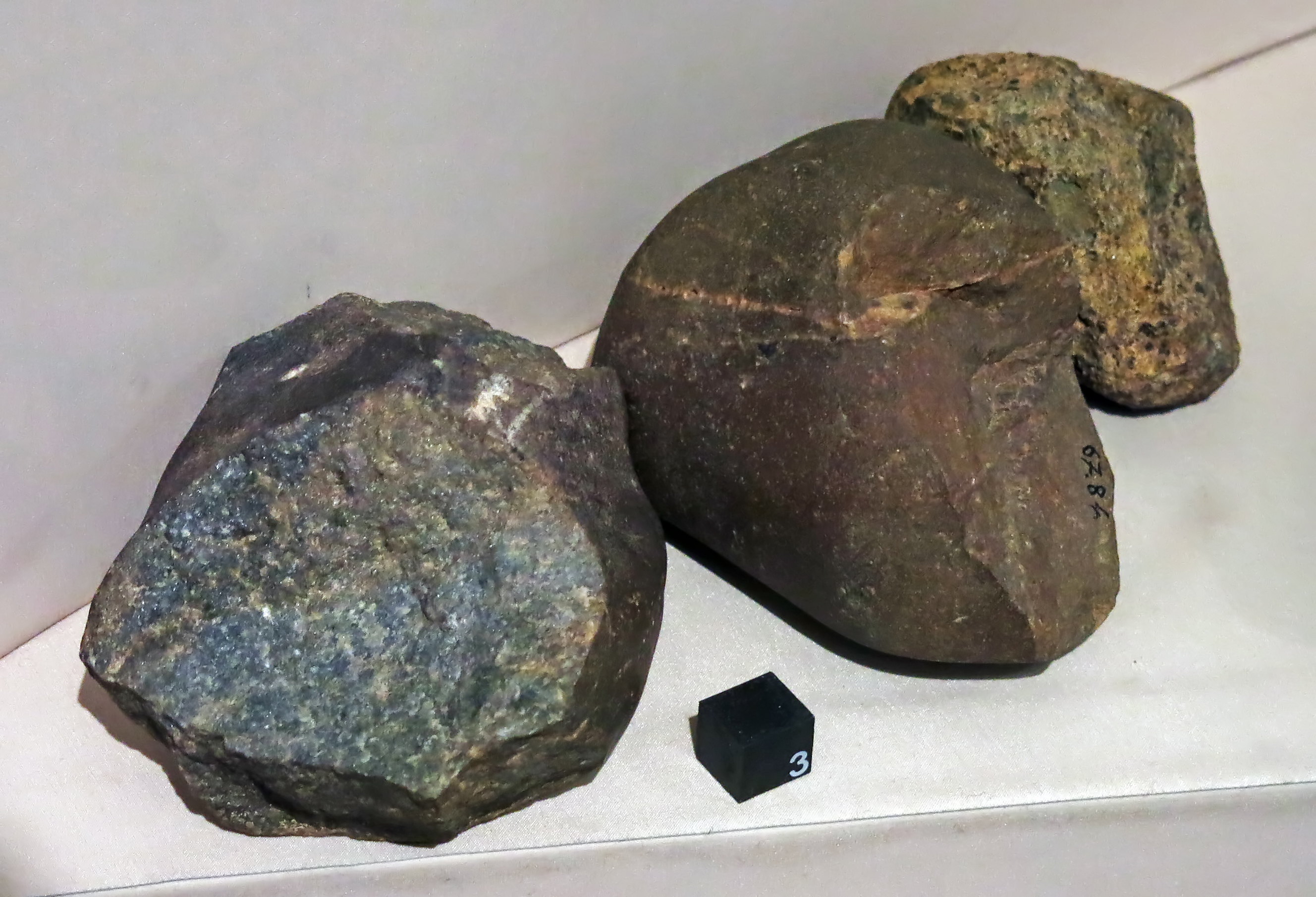
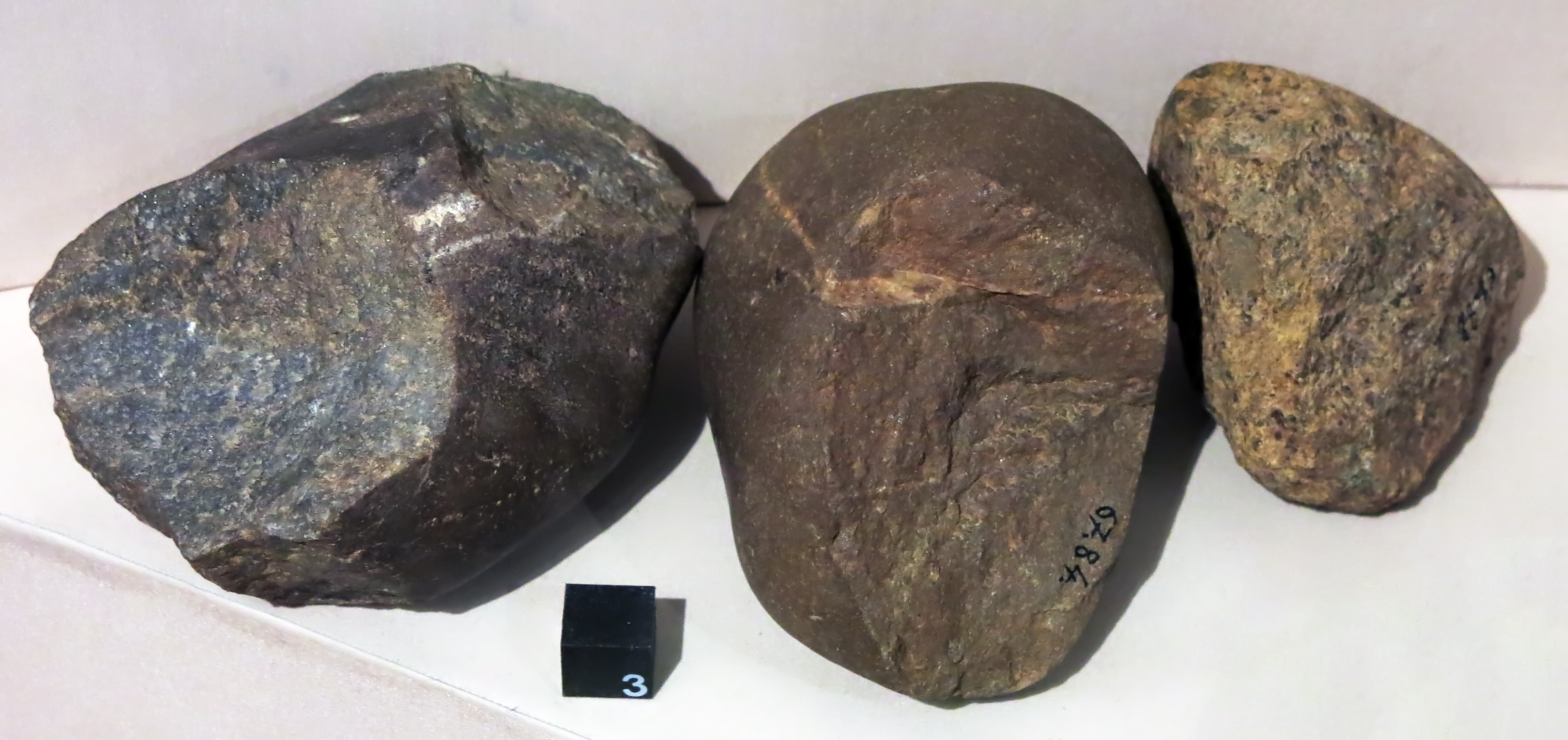
Choppers and a chopping tool from Achenheim, loessière Hurst ( a loess hill? - Don )
At the site of Achenheim (Bas-Rhin, Alsace, France) near Strasbourg, thick loess deposits are found fossilising a former terrace of the Rhine and Bruche rivers which have been affected by neotectonics (recent earth movements).
The four loess deposits comprise a continual sedimentary sequence which spans the Late Pleistocene and a part of the Middle Pleistocene. Achenheim has a typical profile which can be correlated with the loess stratigraphy of Western and Central Europe.
Italicised text above: Heim (1982)
Photo: Don Hitchcock 2015
Source and text: Original, Musée Archéologique Strasbourg

Termites are a protein-rich and easily accessible feed source. These bones were used for 'termite fishing'.
Pushing them into the termite mounds has left longitudinal striations on the surfaces of the bones. By using a little spit on the bones, the termites stuck to the tools.
Acid from the termites has etched the ends of the bones.
Swartkrans and Sterkfontein, South Africa, 1.8 to 1.0 million years old.
Photo: Don Hitchcock 2015
Source and text: Monrepos Archäologisches Forschungszentrum und Museum, Neuwied, Germany
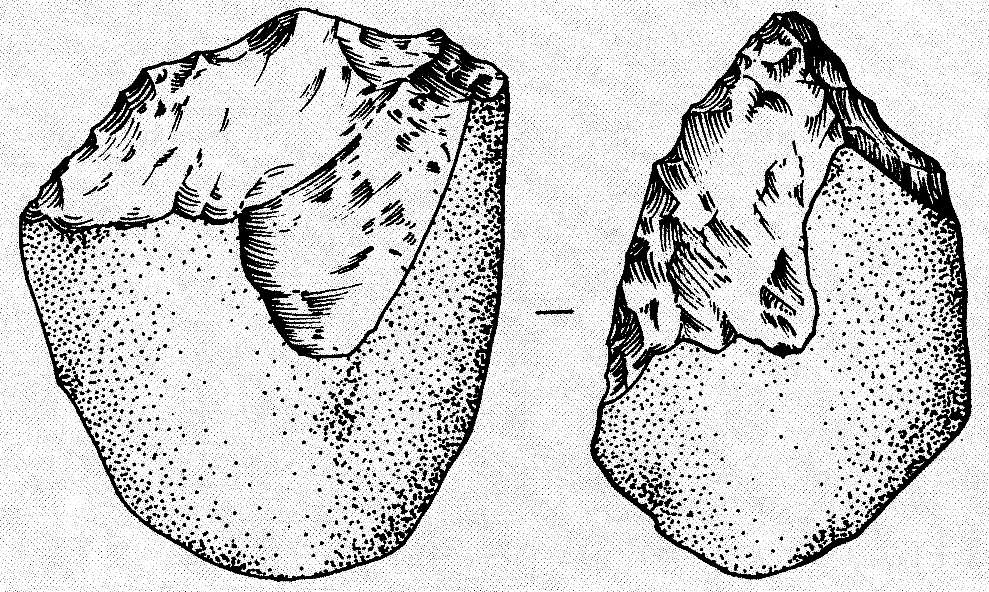
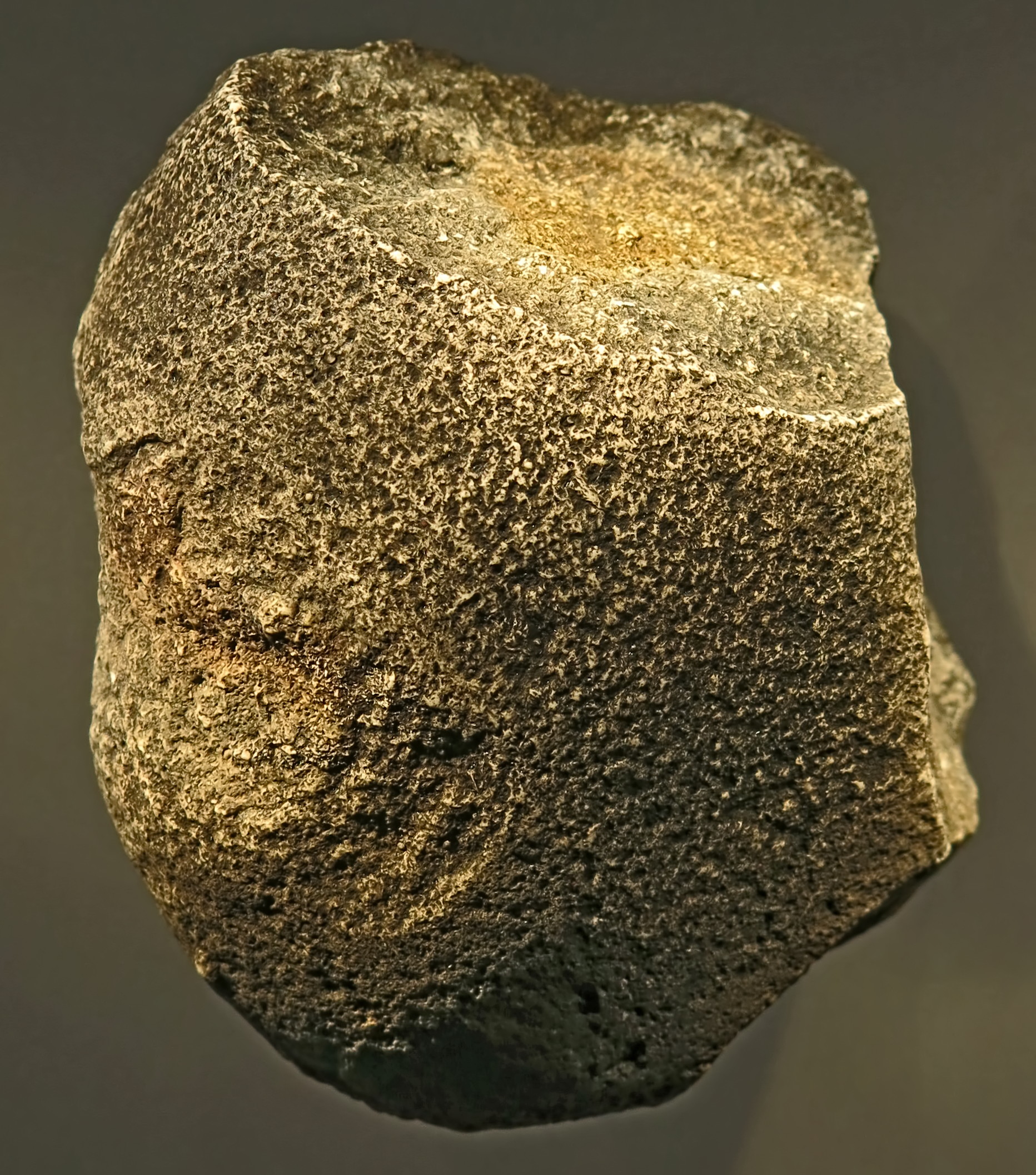
One of the oldest known products of the human hand is this simple tool of pounded lava . It was found in the lowest stratum of the famous Olduvai site in East Africa. Front and side view.
Photo: Sklenar (1988)

This chopper, made from a small stone, comes from the limestone cave Shandalya or Shandalia I, in the former northern Yugoslavia, the oldest archeological site in Europe. The tools are equivalent to those from Dmanisi, and the deposits of mammalian fauna are similar. (Gabunia, 2000)
Photo:
Sklenar (1988)
Olduvai handaxe
1.4 - 1.2 million years old
Found in Olduvai Gorge, Tanzania.
A new form of tool known as a handaxe first appears in the archaeological record about 1.6 million years ago. Although made from stone, handaxes are often so well made that they look nothing like the natural lumps of rock from which they are produced. Using a stone hammer, the maker has carefully struck flakes alternately from both faces around the entire edge, making it thinner at the tip and thicker and heavier at the bottom. This may seem simple but requires a skilful use of force. The edges are sharp and regular, suitable for use as cutting tools.
Out of Africa
The ability to engage with and transform the environment enabled early human ancestors to adapt to new and different places. Around a million years ago handaxes were widespread — except in the Americas and Australasia — reflecting the first gradual migration of early human populations out of Africa.
Handaxe made of a hard green volcanic lava (phonolite) with a compact texture. Elongated tear drop form with slight ancient damage at tip. Regular edge all round, both faces slightly convex.
Findspot: Olduvai Gorge, CK III (Africa, Tanzania, Arusha (region), Olduvai Gorge)
Exhibited: 2016-2017 08 Sep-29 Jan, National Museum of Australia, Canberra, 'A History of the World in 100 Objects'
Collected by: Dr Louis Seymour Bazett Leakey
Catalog: 1934, 1214.49
Photo: Don Hitchcock 2017
Text: Card, http://www.britishmuseum.org/, © Trustees of the British Museum
Source: Exhibition by the British Museum at the National Museum of Australia, Canberra
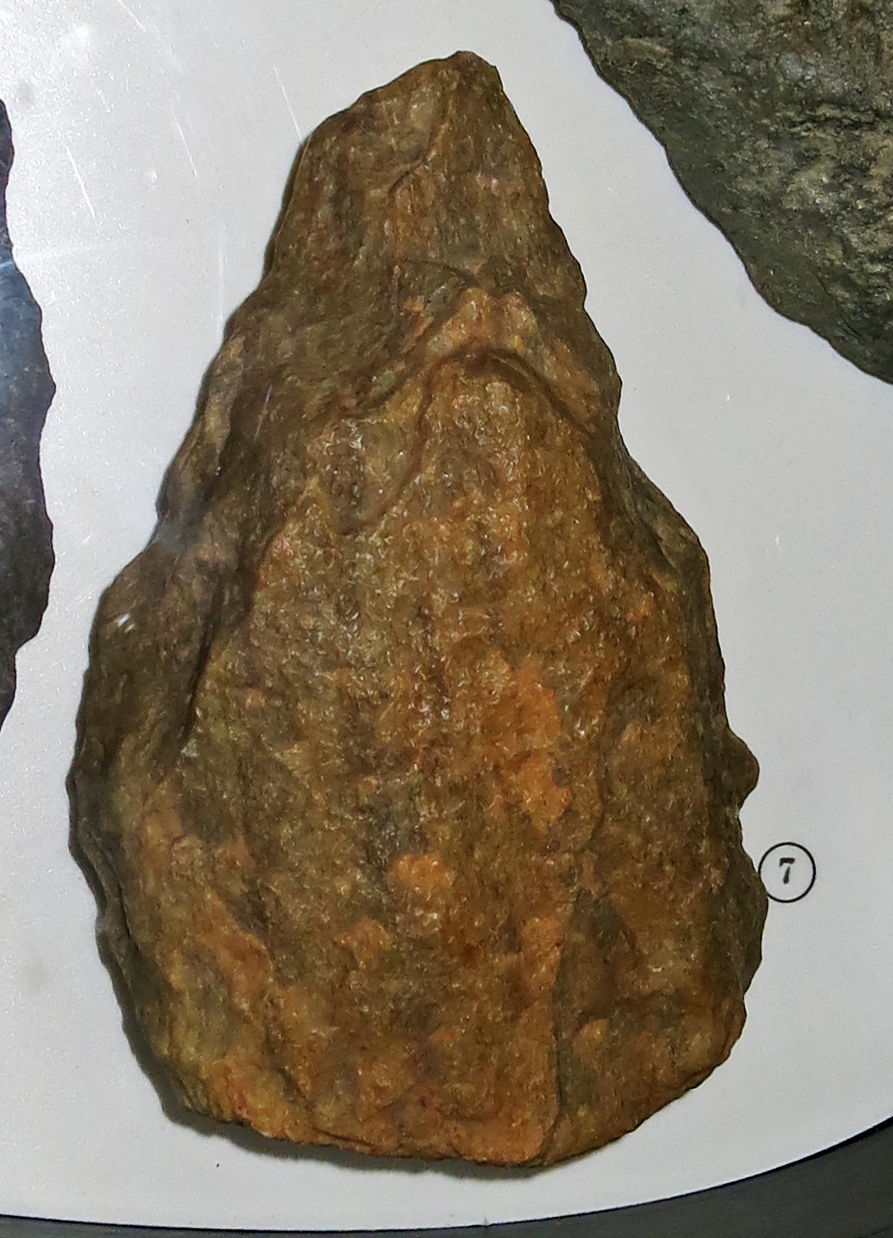
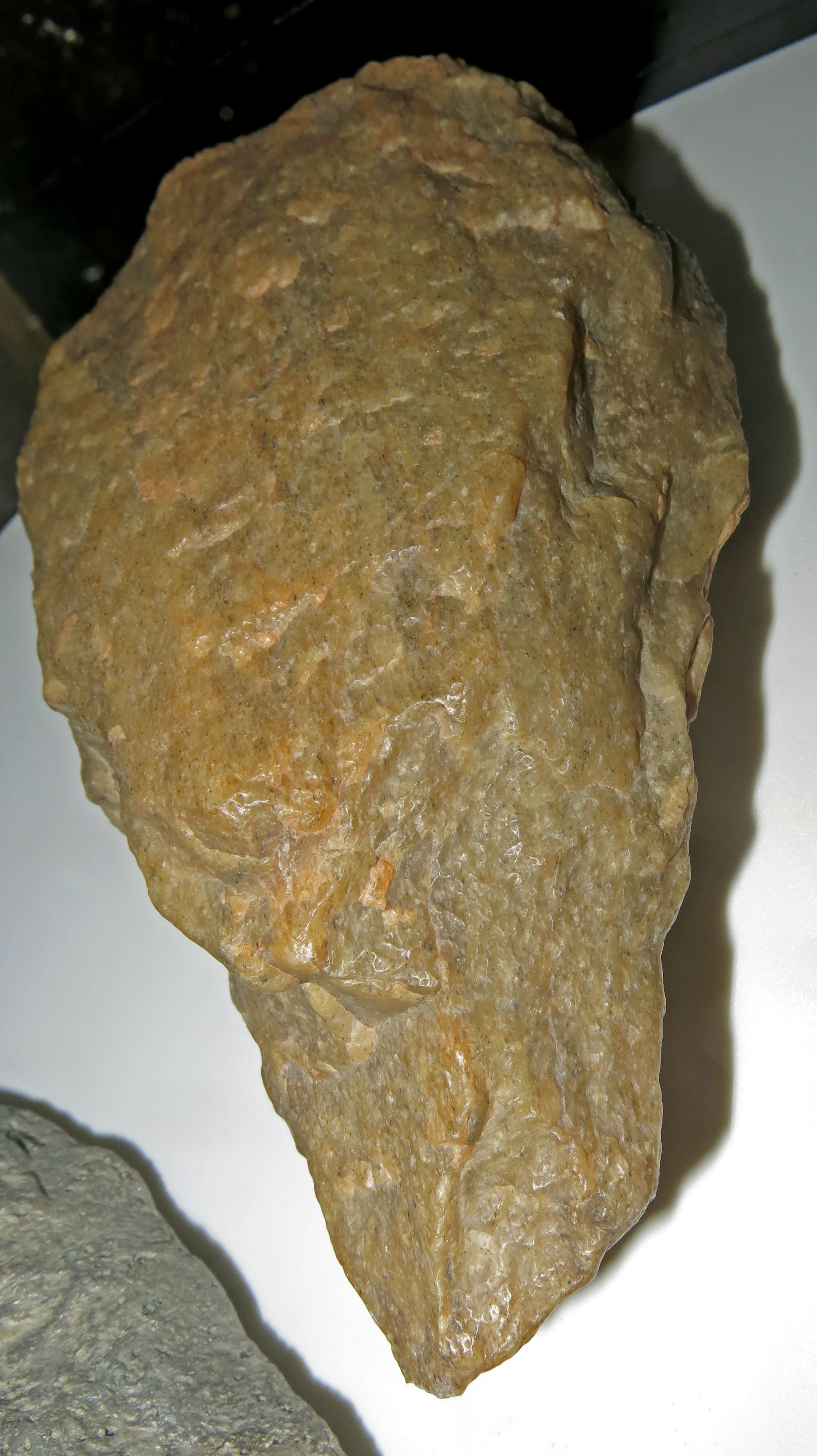
Hand axe, 1 500 000 - 300 000 BP.
From the Algerian Sahara.
Photo: Don Hitchcock 2015
Source and text: Original, Monrepos Archäologisches Forschungszentrum und Museum, Neuwied, Germany
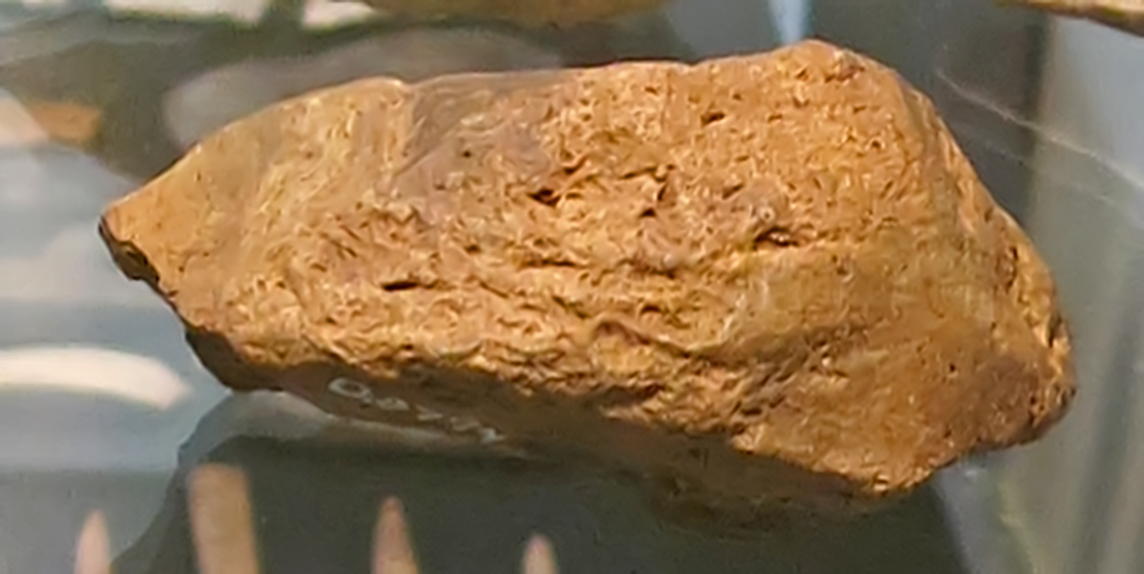
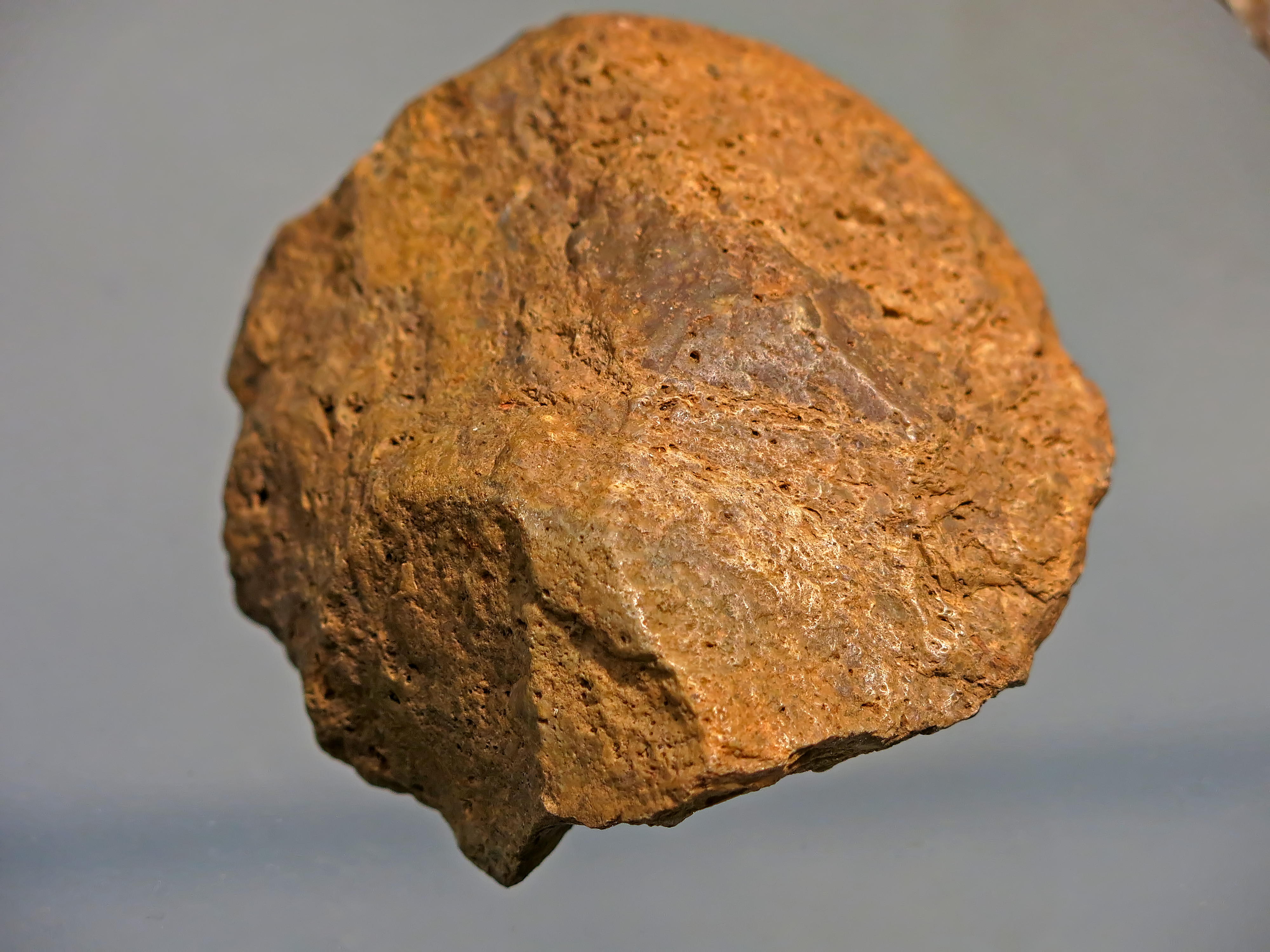
Hand axes typified the material culture of Homo erectus, which is called the Acheulian culture after the site St Acheul in France.
This hand axe (two different views) is from Pajitan, in Java, 1 500 000 BP - 200 000 BP.
Photo: Don Hitchcock 2014
Source and text: Original, Københavns (Copenhagen) Museum, National Museum of Denmark
These hand axes are from St Acheul, 1 500 000 BP - 200 000 BP.
Photo: Don Hitchcock 2014
Source and text: Original, Københavns (Copenhagen) Museum, National Museum of Denmark
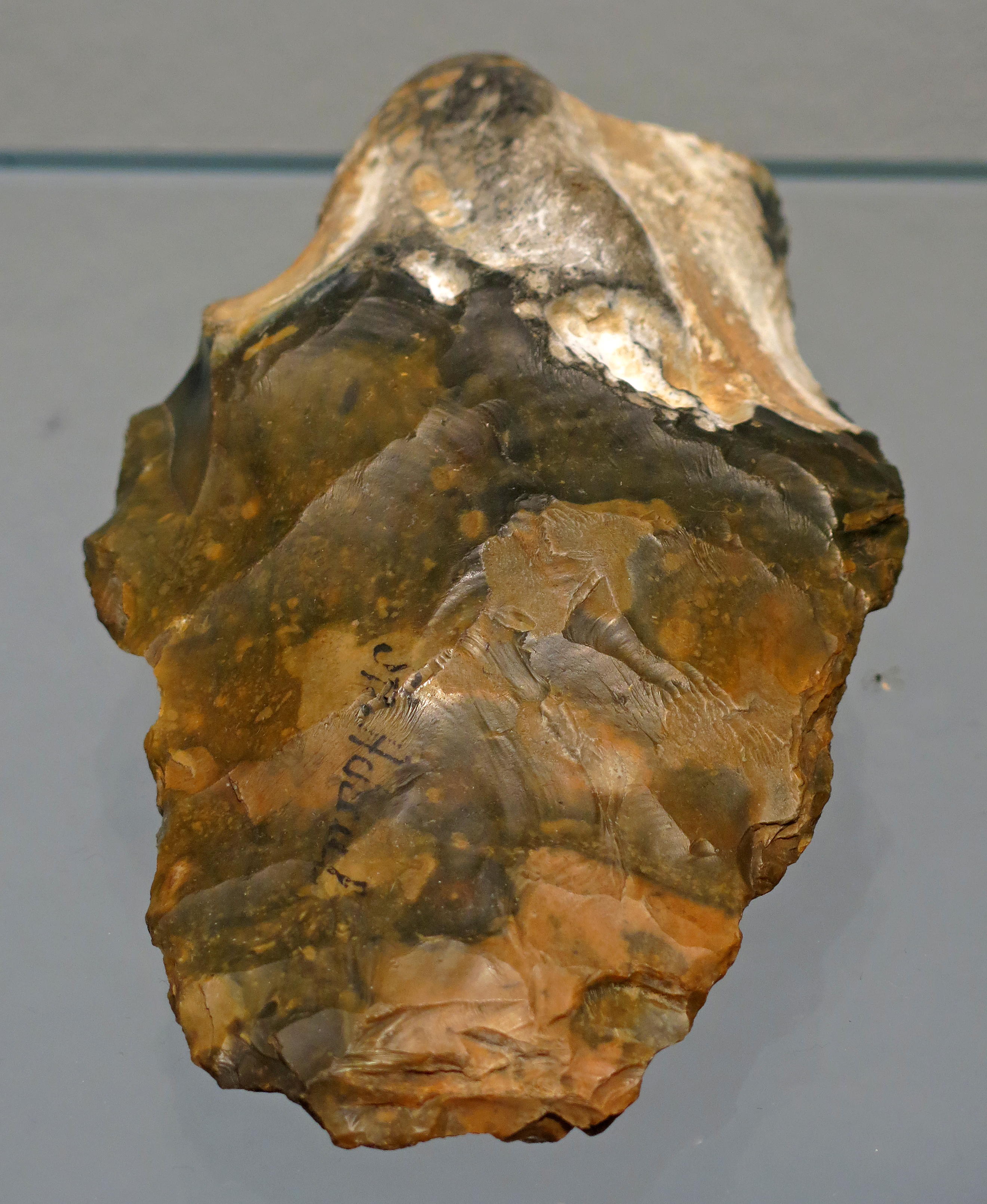
Hand axe from St Acheul, 1 500 000 BP - 200 000 BP.
Photo: Don Hitchcock 2014
Source and text: Original, Københavns (Copenhagen) Museum, National Museum of Denmark
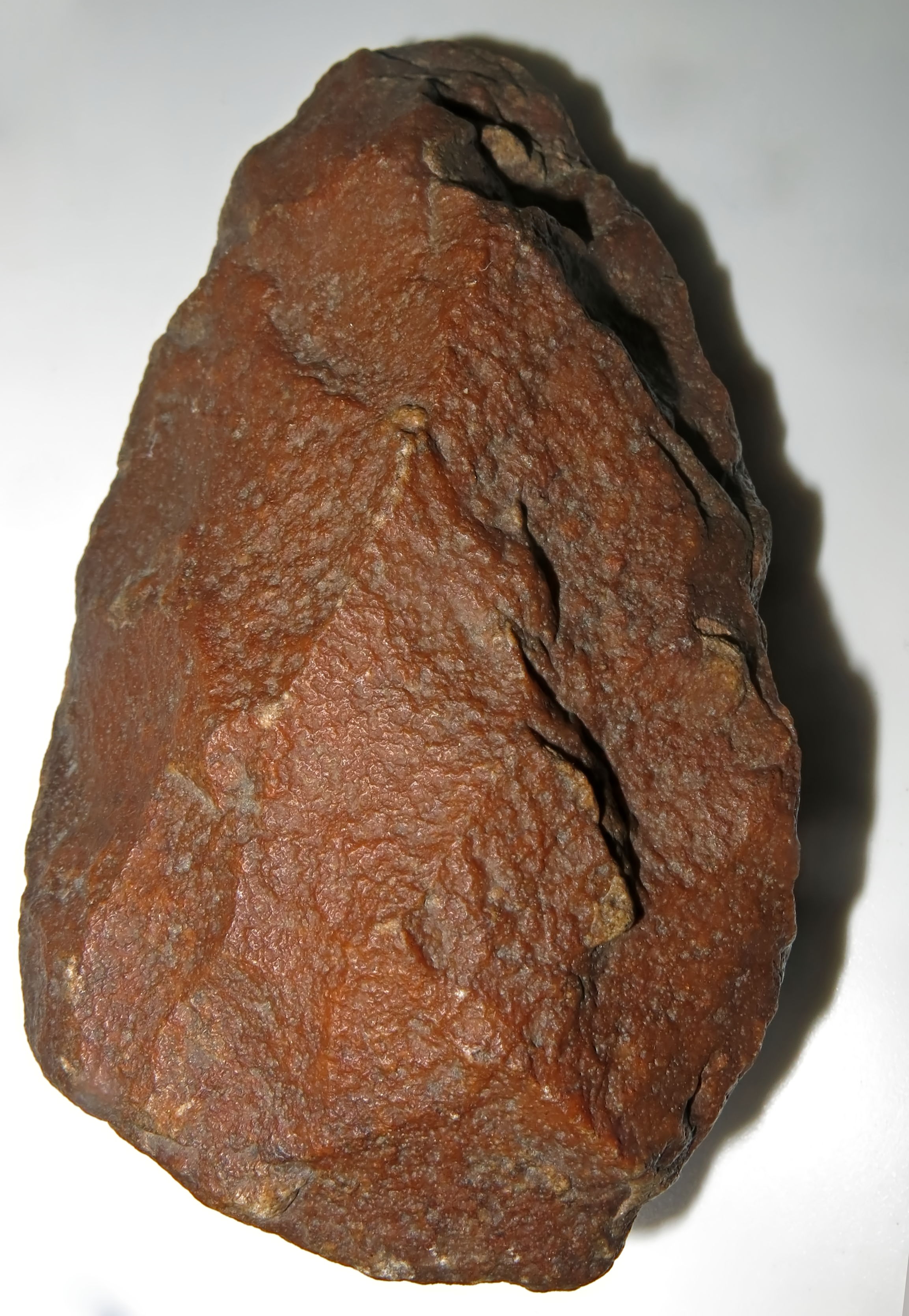
Acheulian hand axe, 1 500 000 BP - 300 000 BP, from Fort Zouérat, Mauritania.
Photo: Don Hitchcock 2015
Source and text: Original, Monrepos Archäologisches Forschungszentrum und Museum, Neuwied, Germany
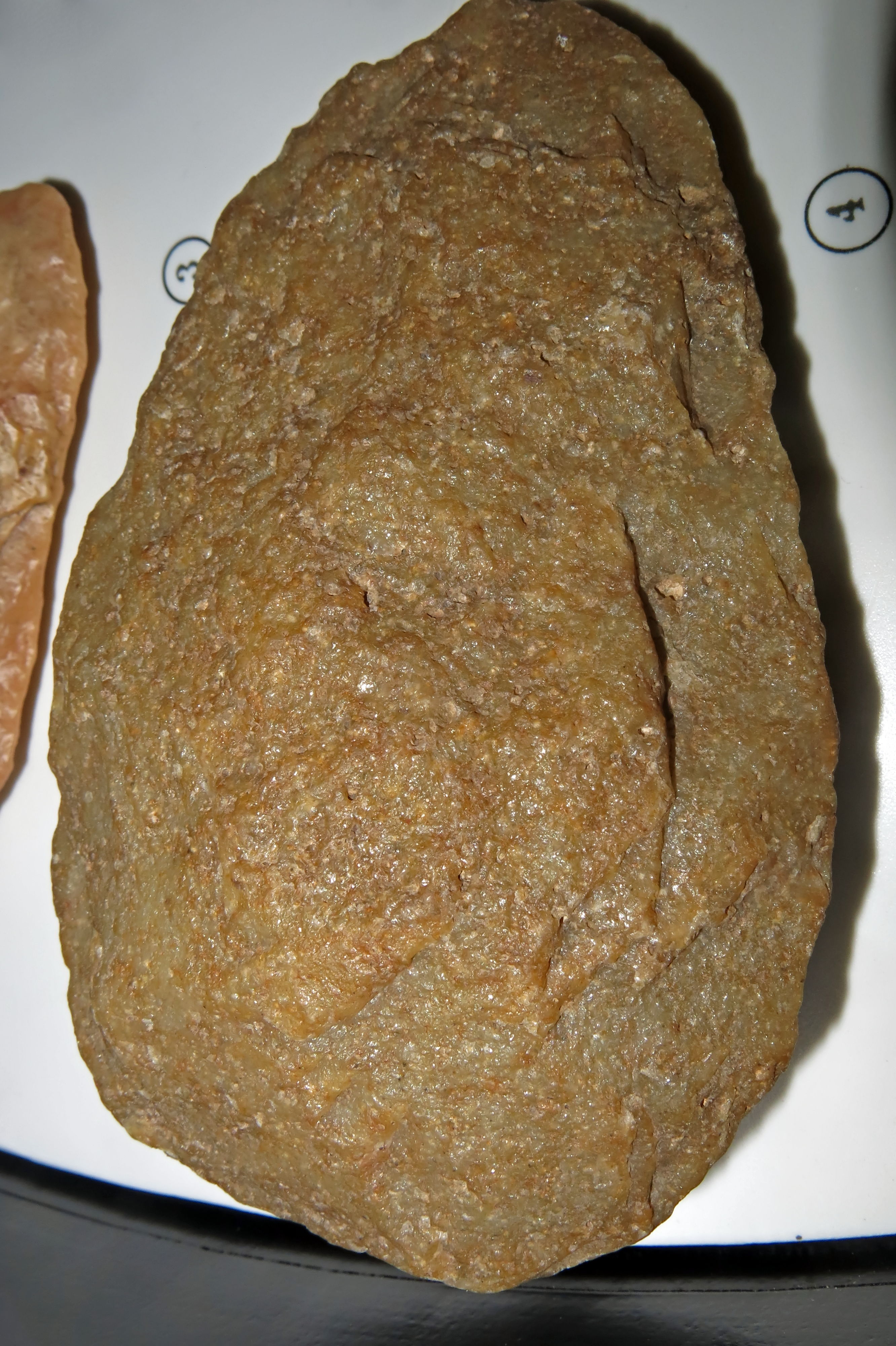

Acheulian hand axes, 1 500 000 BP - 300 000 BP, from Khyad, India.
Photo: Don Hitchcock 2015
Source and text: Original, Monrepos Archäologisches Forschungszentrum und Museum, Neuwied, Germany
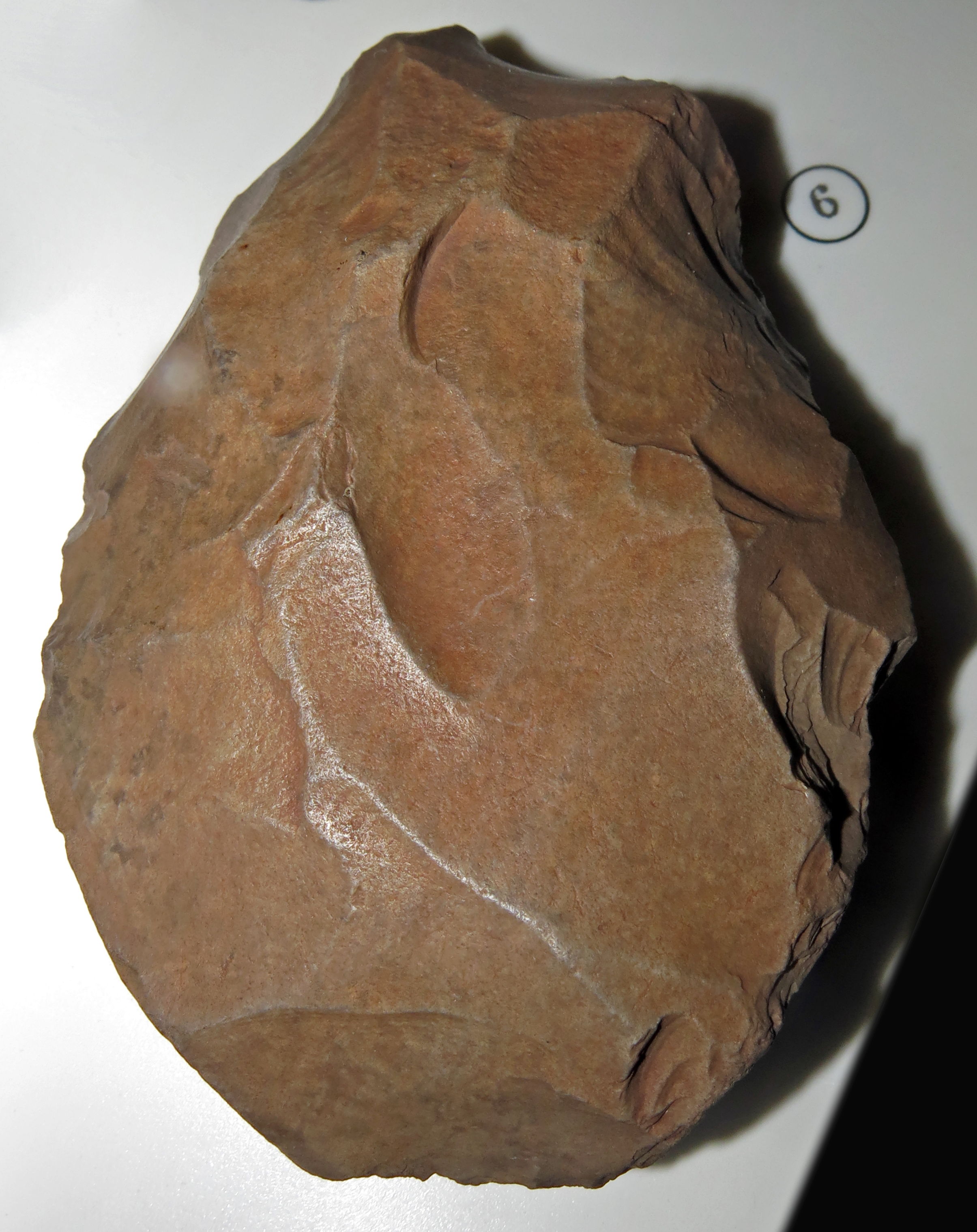
Acheulian hand axe, 1 500 000 BP - 300 000 BP, from the Algerian Sahara.
Photo: Don Hitchcock 2015
Source and text: Original, Monrepos Archäologisches Forschungszentrum und Museum, Neuwied, Germany
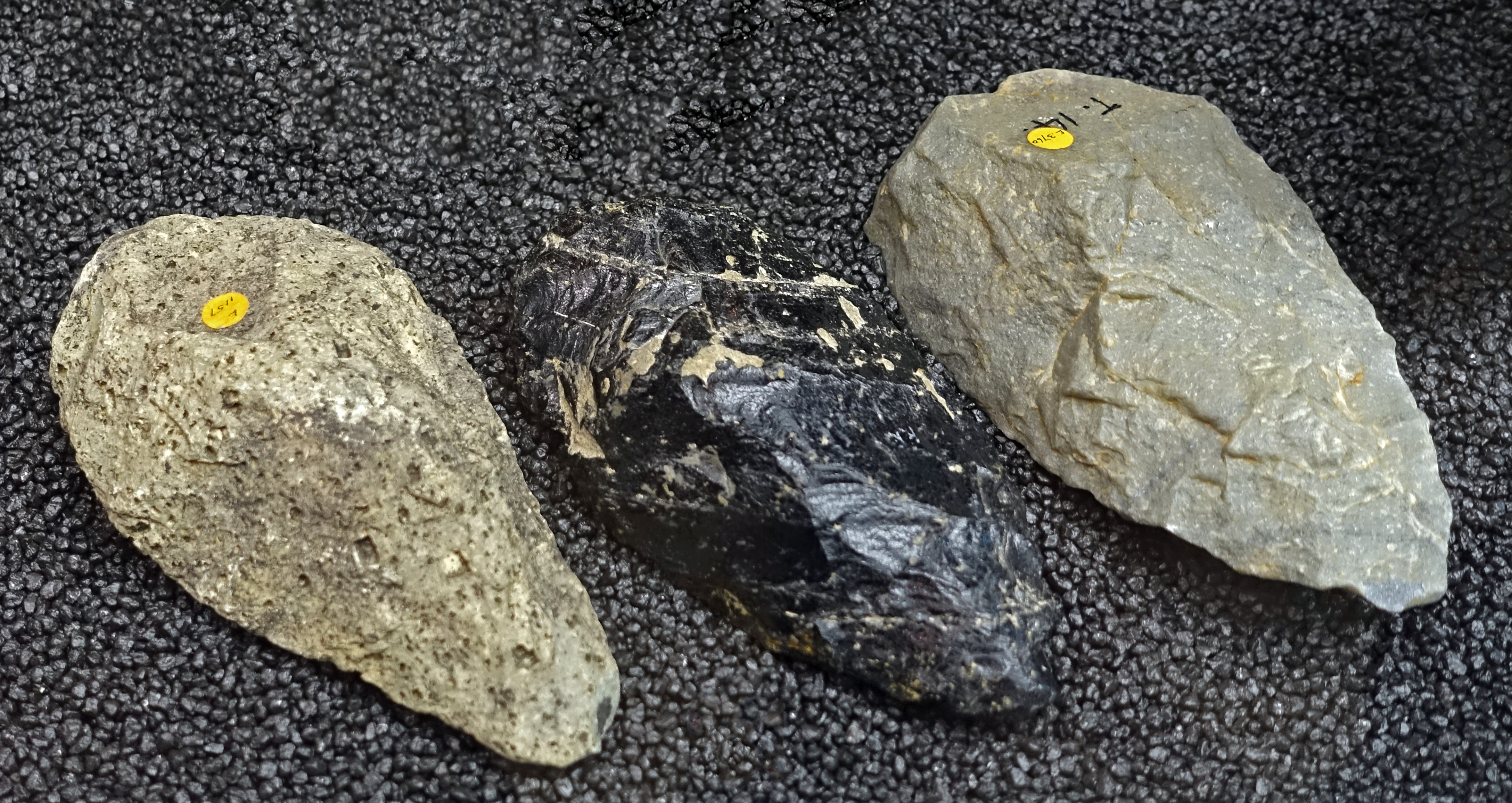
Acheulian handaxes probably used by Homo erectus.
From Olduvai Gorge, Tanzania, near Nsongezi in Uganda and Kariandusi in Kenya, around 1 400 000 BP - 700 000 BP.
Catalog: E1157, E3760, PAE_1147
Photo: Don Hitchcock 2018
Source and text: The Natural History Museum, Cromwell Road, London SW7 5BD
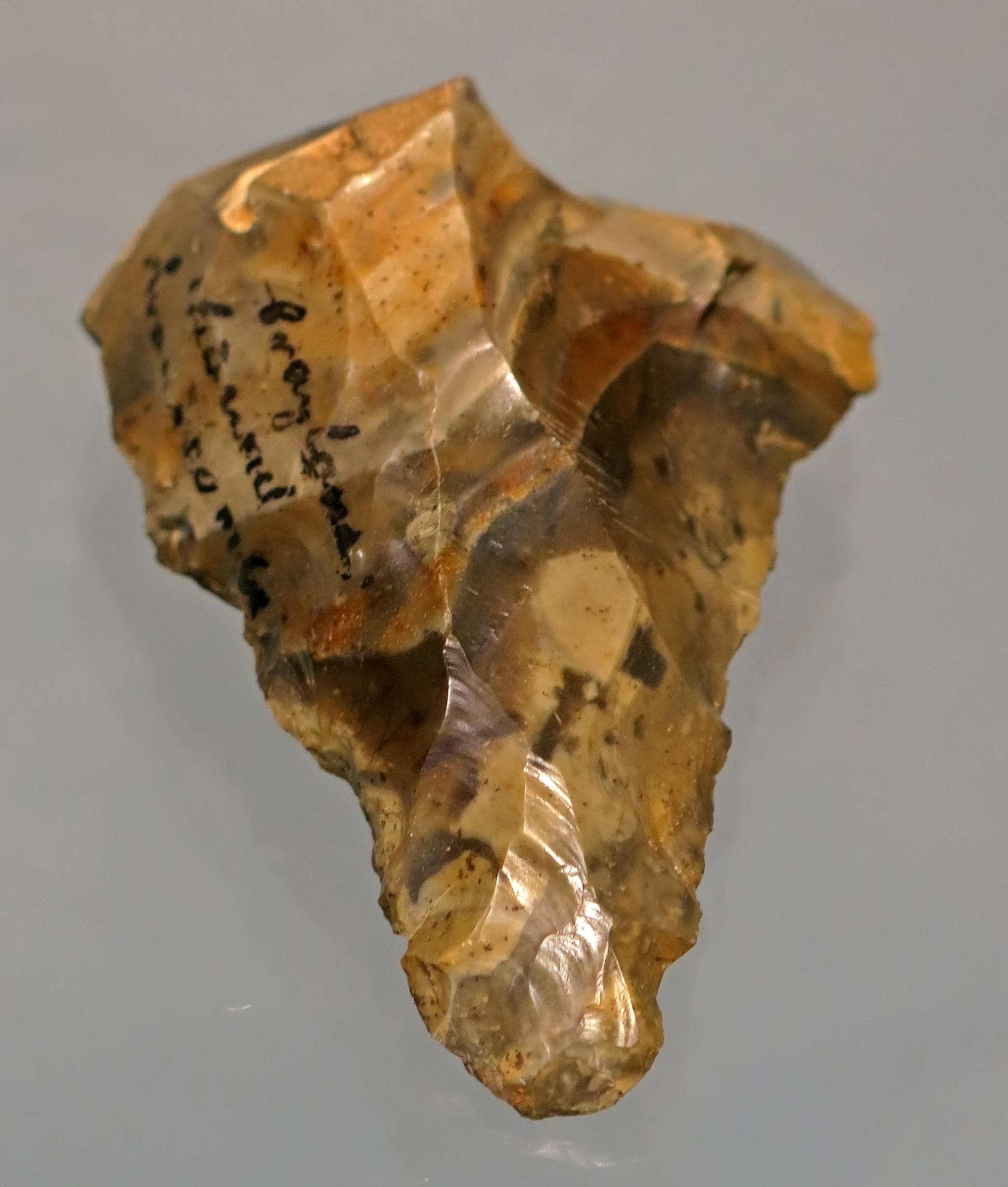
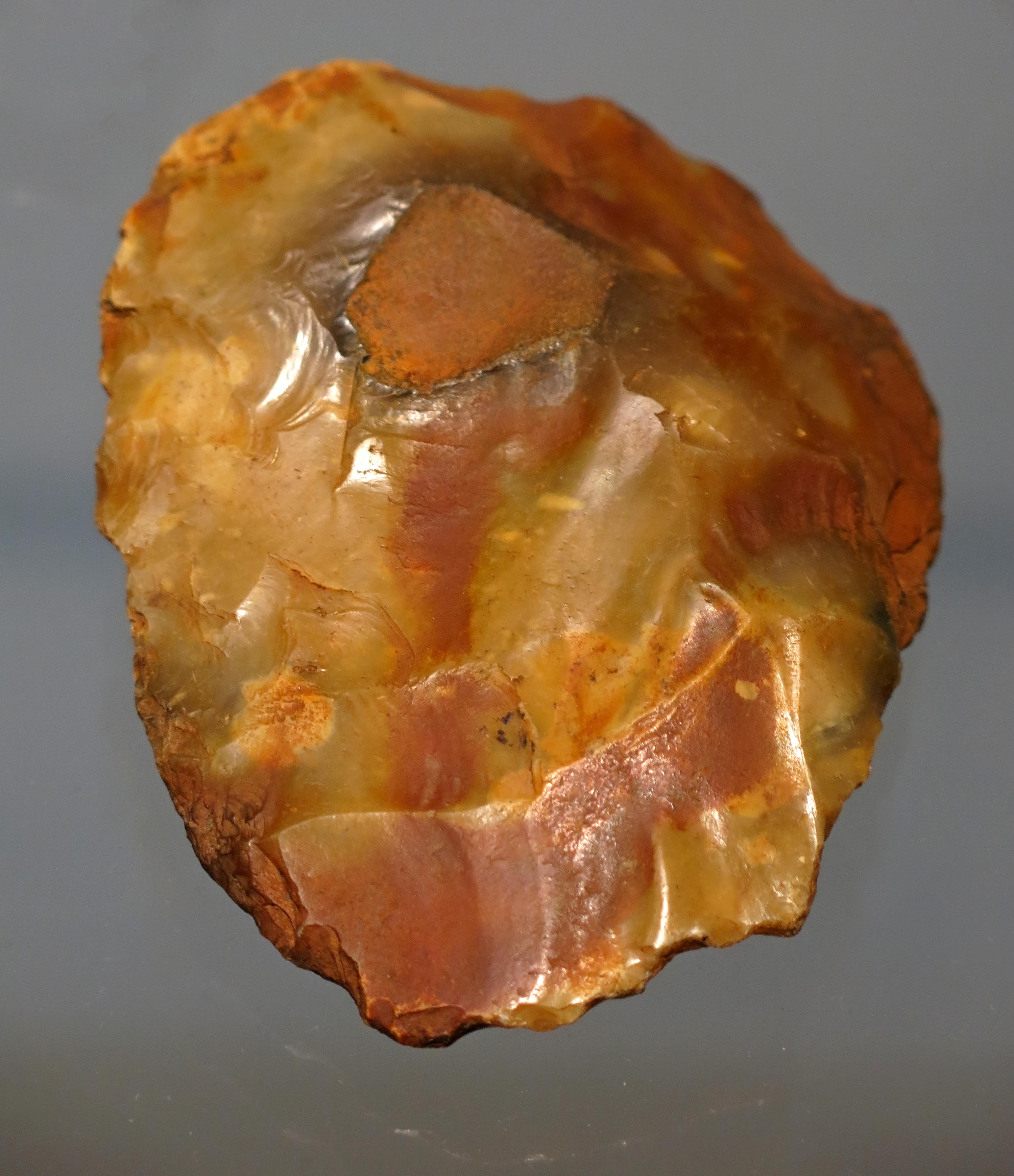
Hand axes from Swanscombe, Thames valley, England, 1 500 000 BP - 200 000 BP.
Photo: Don Hitchcock 2014
Source and text: Original, Københavns (Copenhagen) Museum, National Museum of Denmark
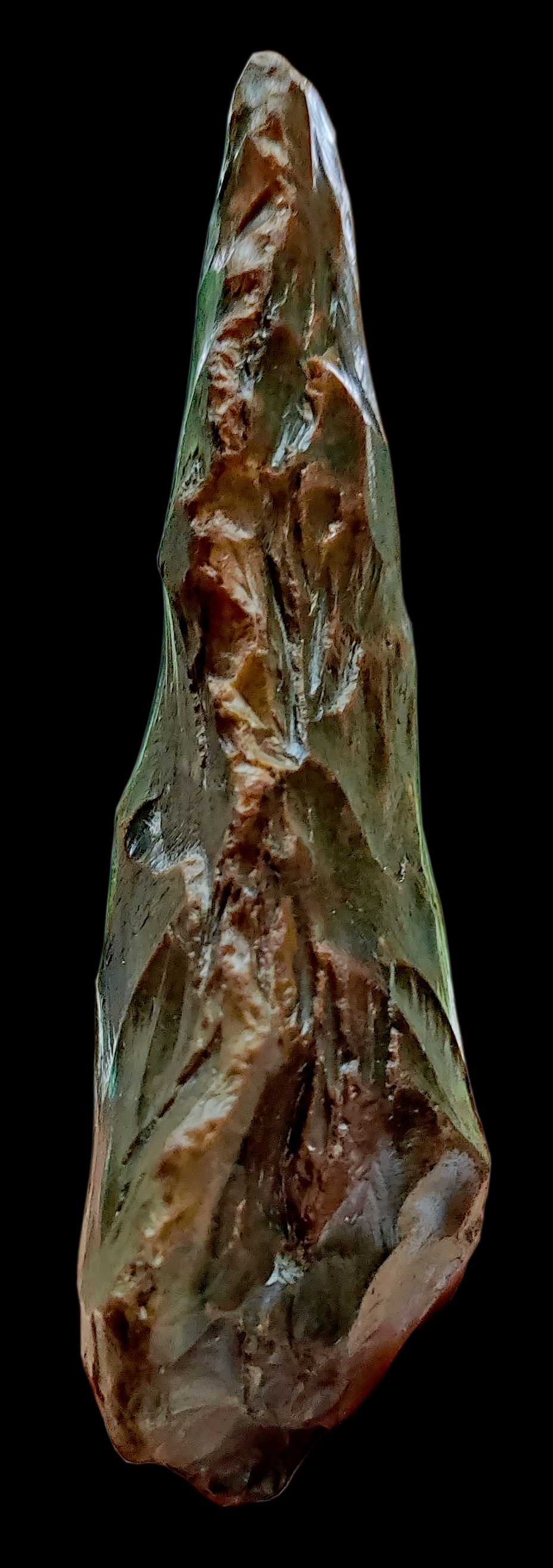
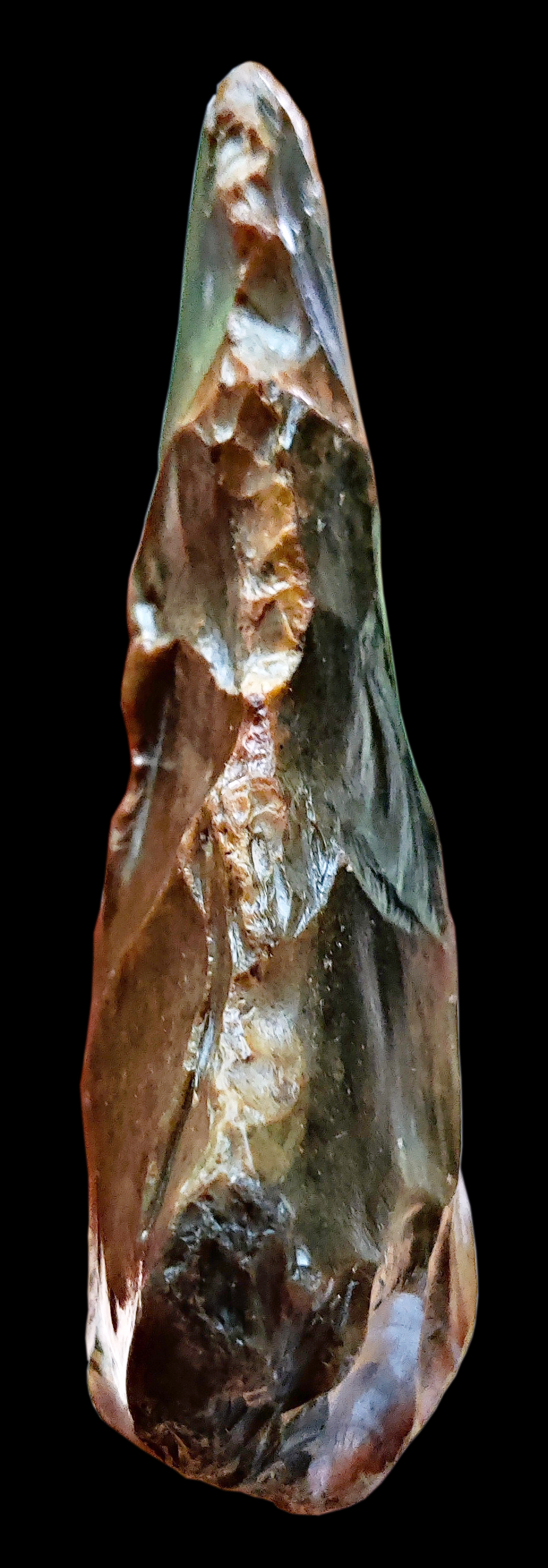
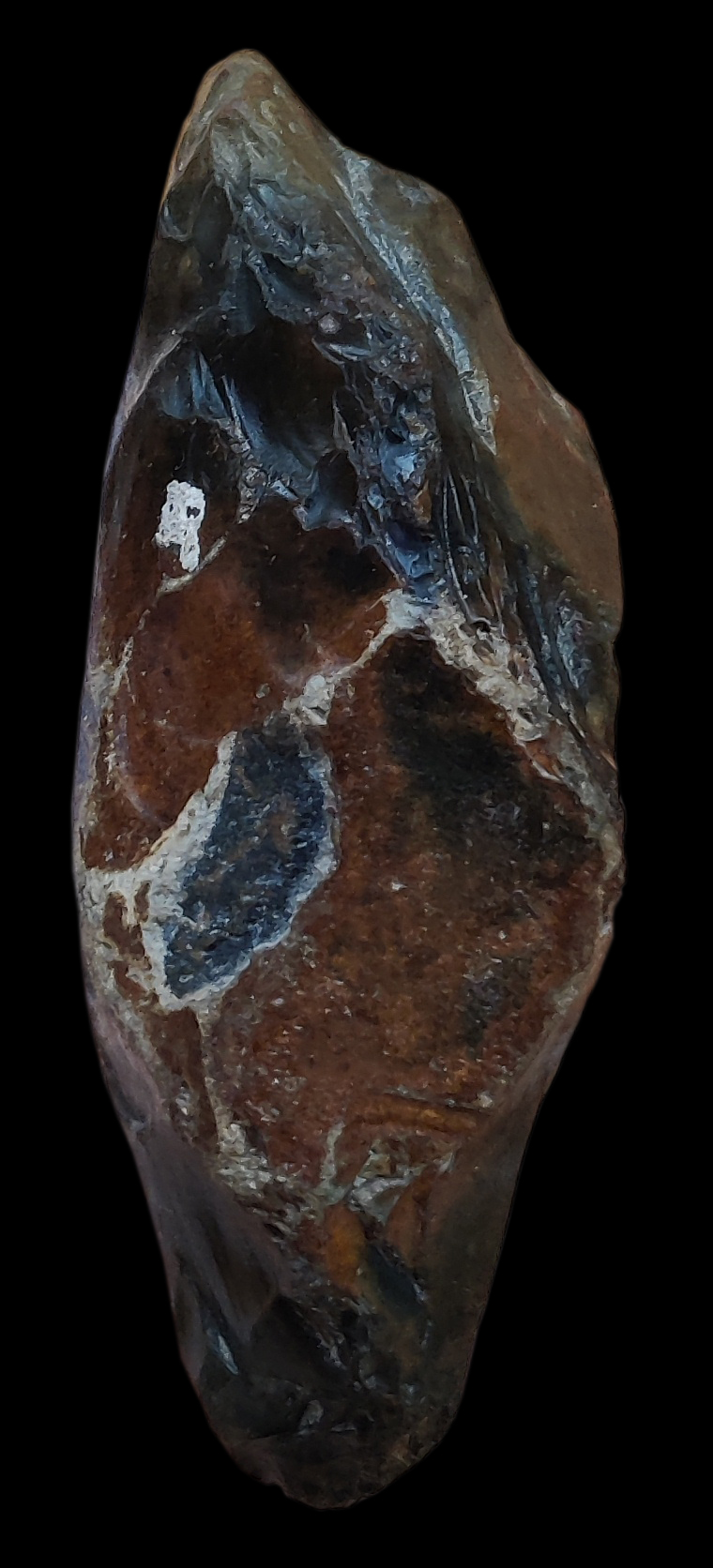
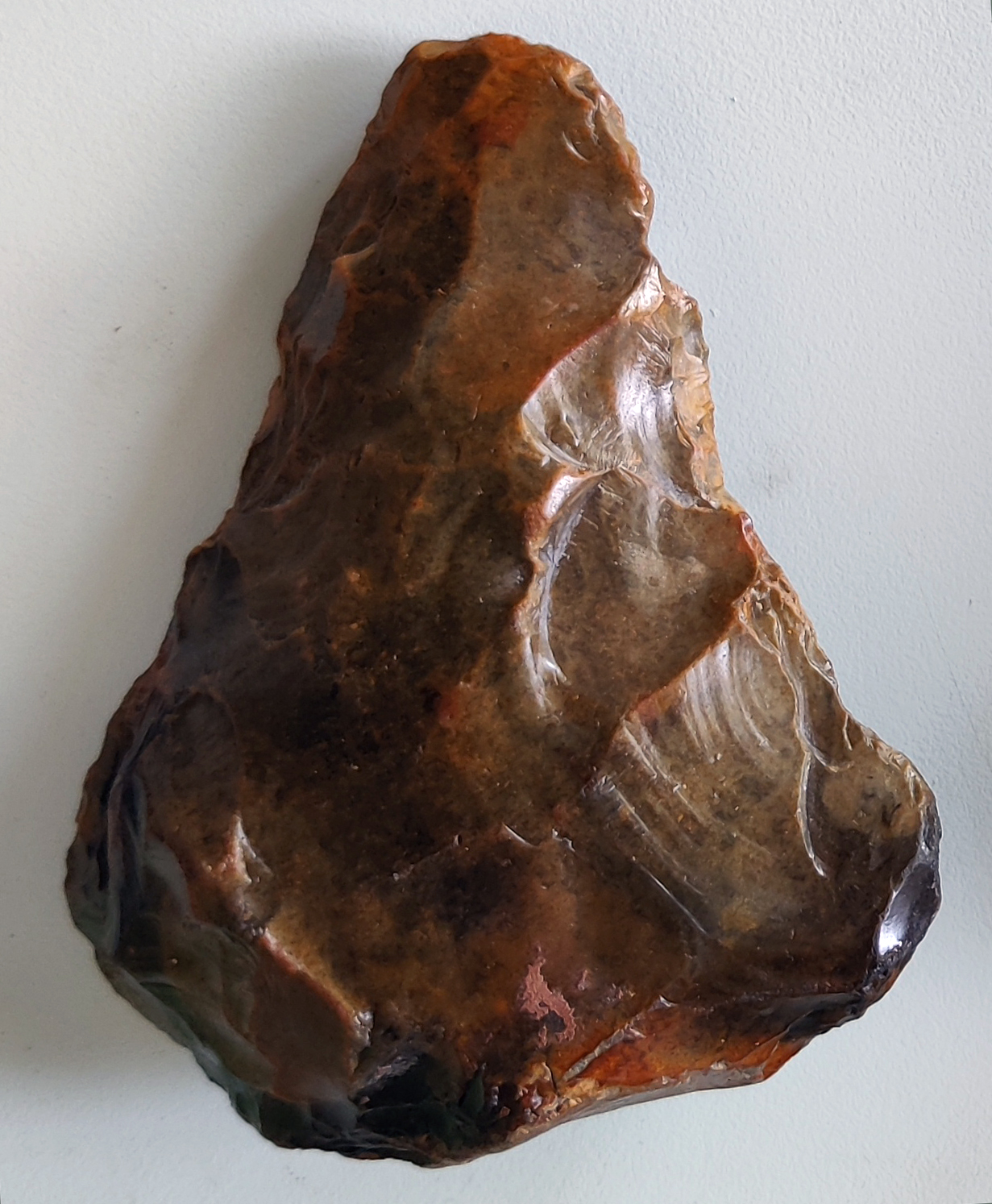
Acheulian hand axe, 1 500 000 BP - 200 000 BP.
Found on the foreshore of the River Thames, UK.
Dimensions 120 mm x 95 mm.
Above, views of the two sides and the base.
This interesting small handaxe appears to be of jasper. It has been very well made, shaped by taking out relatively large flakes.
The shape bears some resemblance to a Micoquien hand axe, but it is quite symmetrical front to back.
It is very similar to the Swanscombe handaxe on the left, above, in shape, knapping method, and quality of flint/jasper.
The estimated age is based on general considerations and this marked similarity to the Swanscombe handaxe.
Photo: Courtesy Ben Mankowitz 2021
Source: Ben Mankowitz
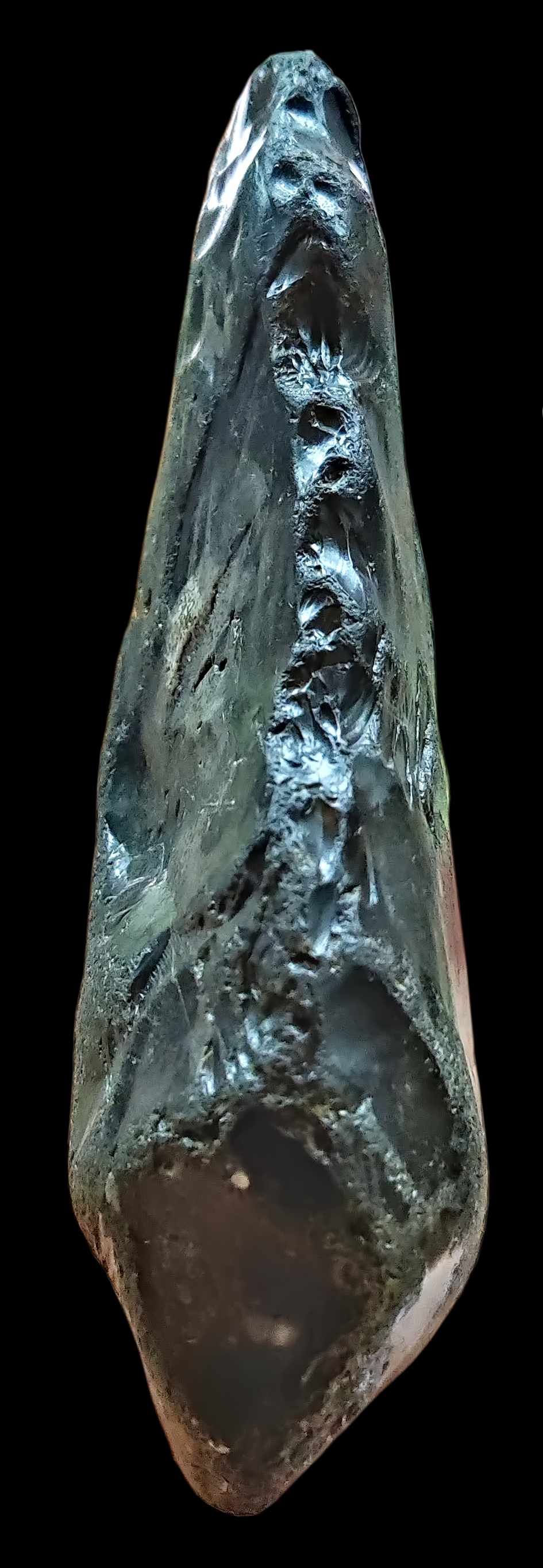
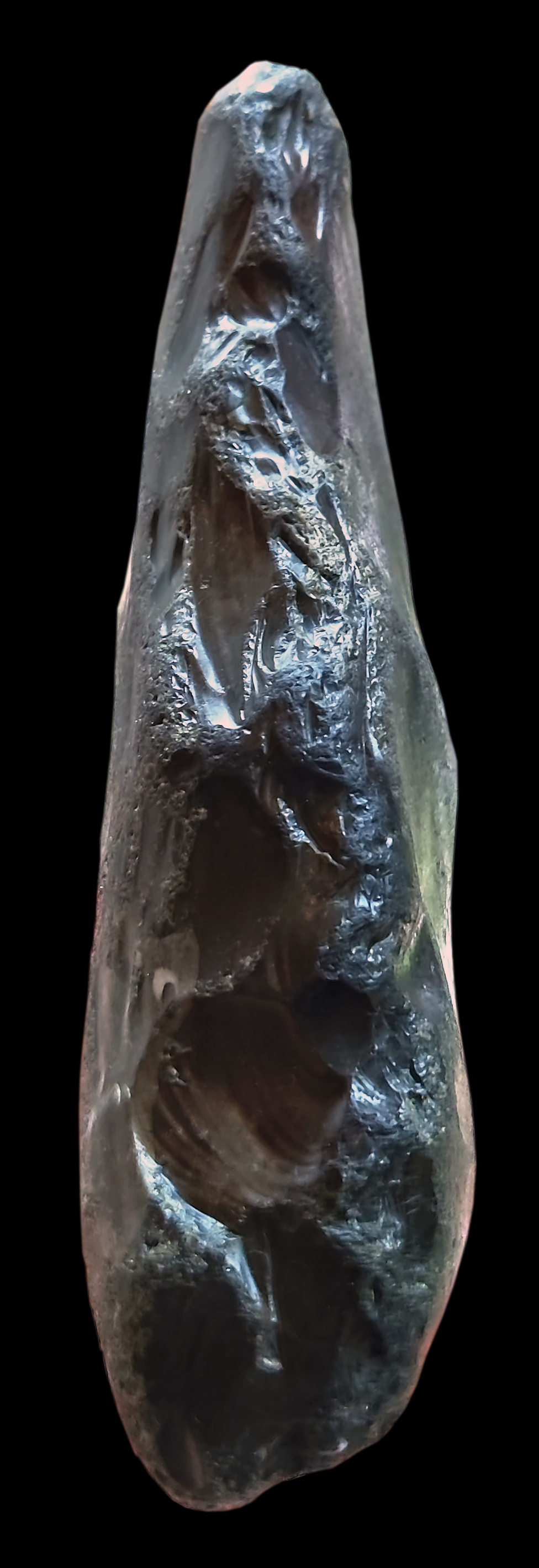
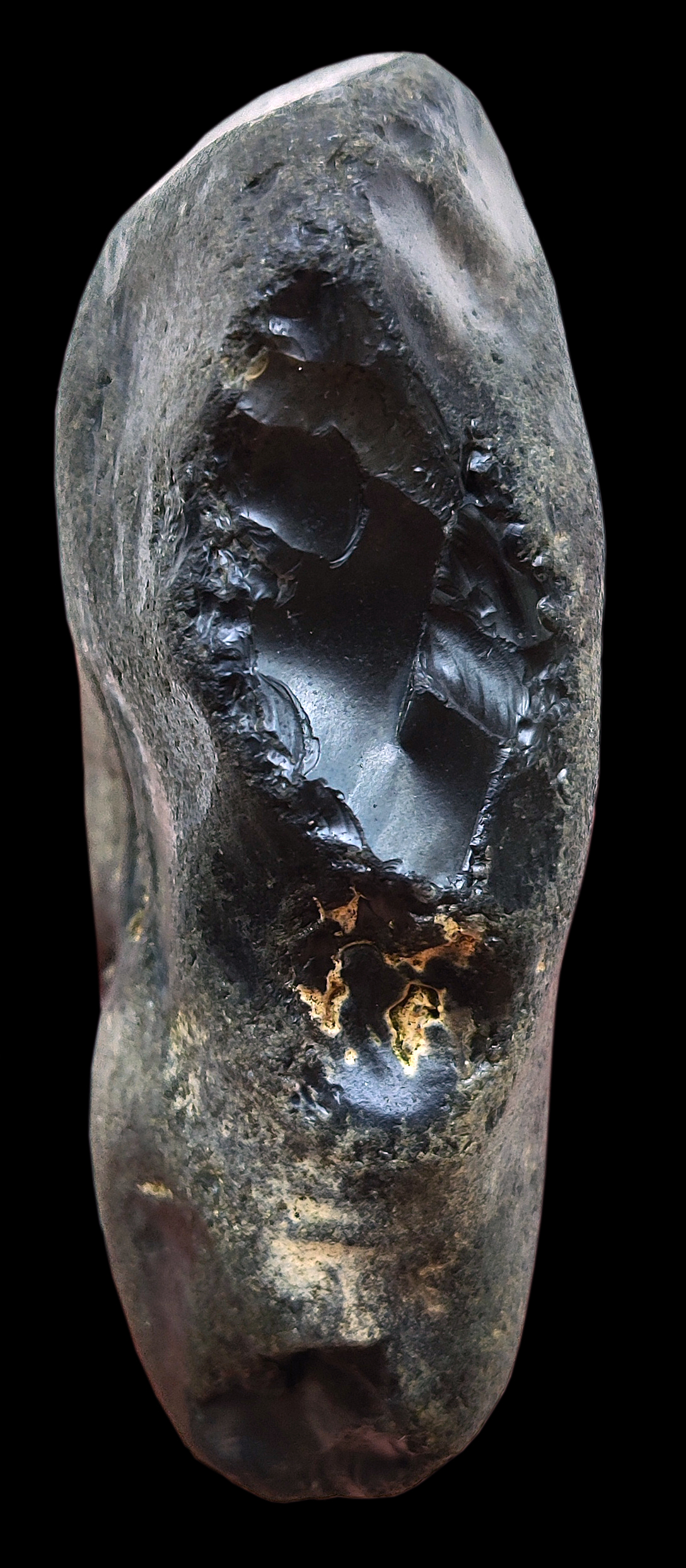
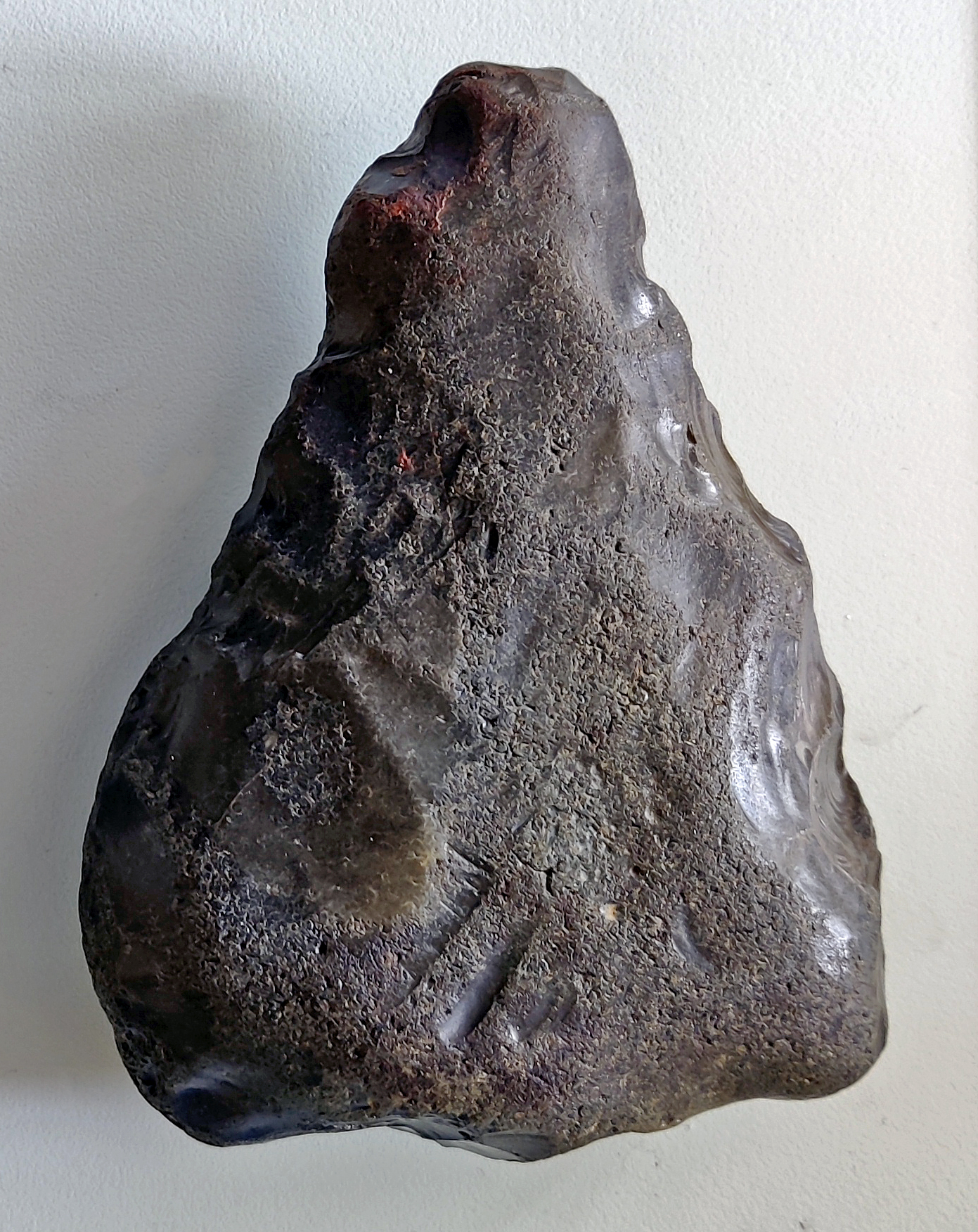
Acheulian hand axe, 1 500 000 BP - 200 000 BP.
Found on the foreshore of the River Thames, UK.
Dimensions 133 mm x 102 mm.
This (rolled) handaxe is very similar to the one above from the same findspot.
It appears to be of flint, and like the one above has also been very well made, and shaped by taking out relatively large flakes.
The estimated age is based on general considerations and its marked similarity to the Swanscombe handaxe above.
Photo: Courtesy Ben Mankowitz 2021
Source: Ben Mankowitz
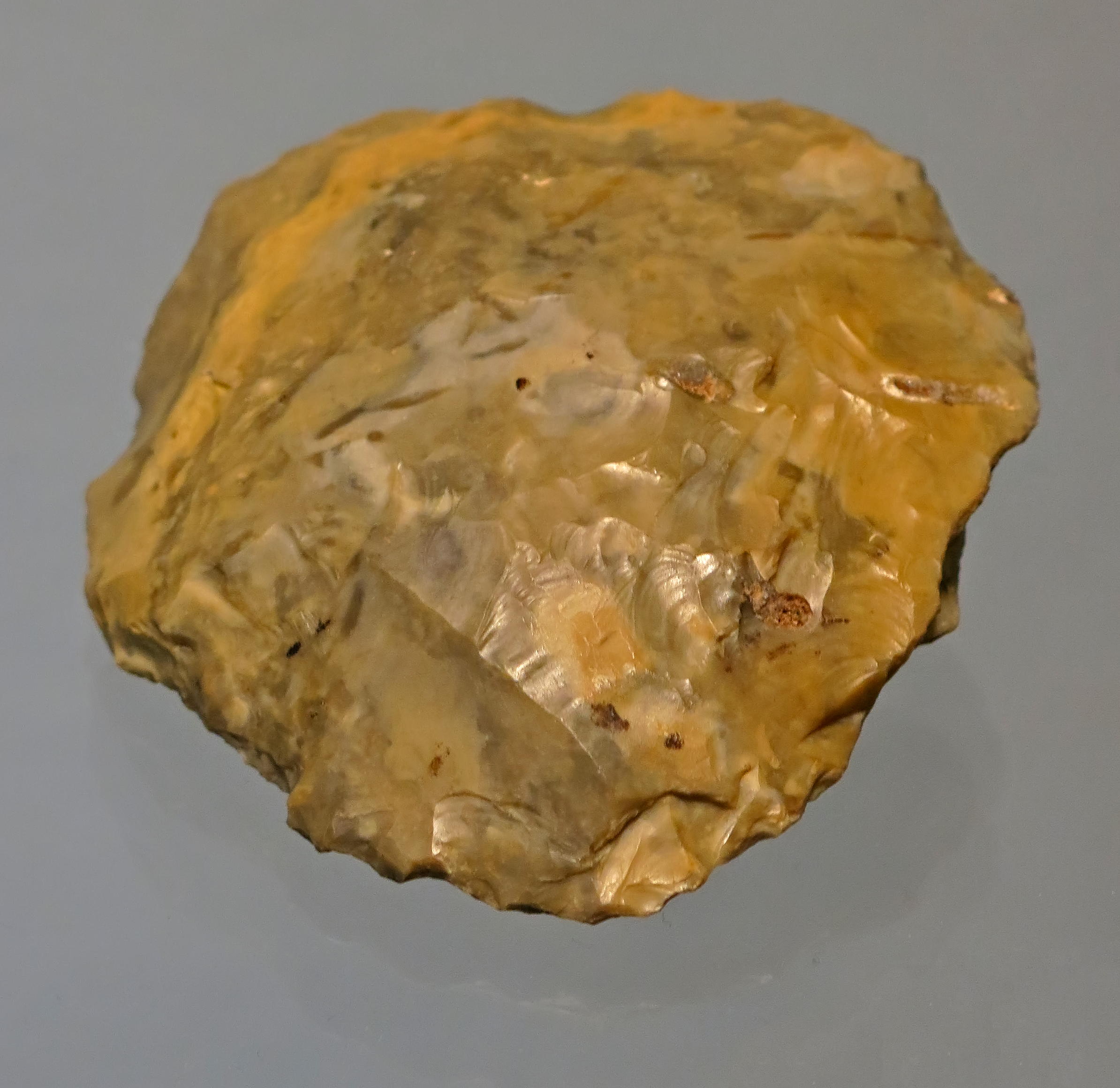
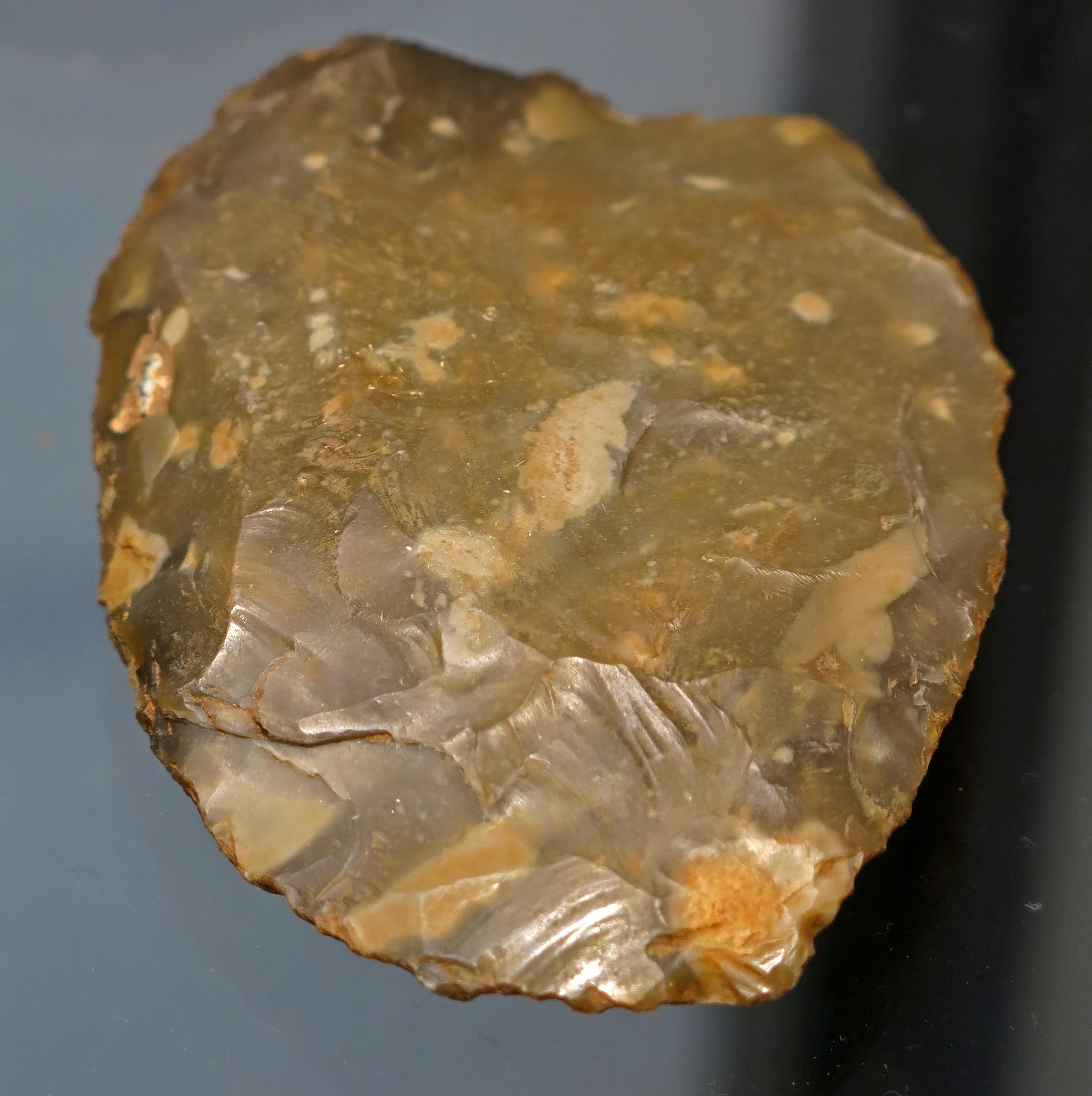
Hand axes from Swanscombe, England, 1 500 000 BP - 200 000 BP.
Photo: Don Hitchcock 2014
Source and text: Original, Københavns (Copenhagen) Museum, National Museum of Denmark
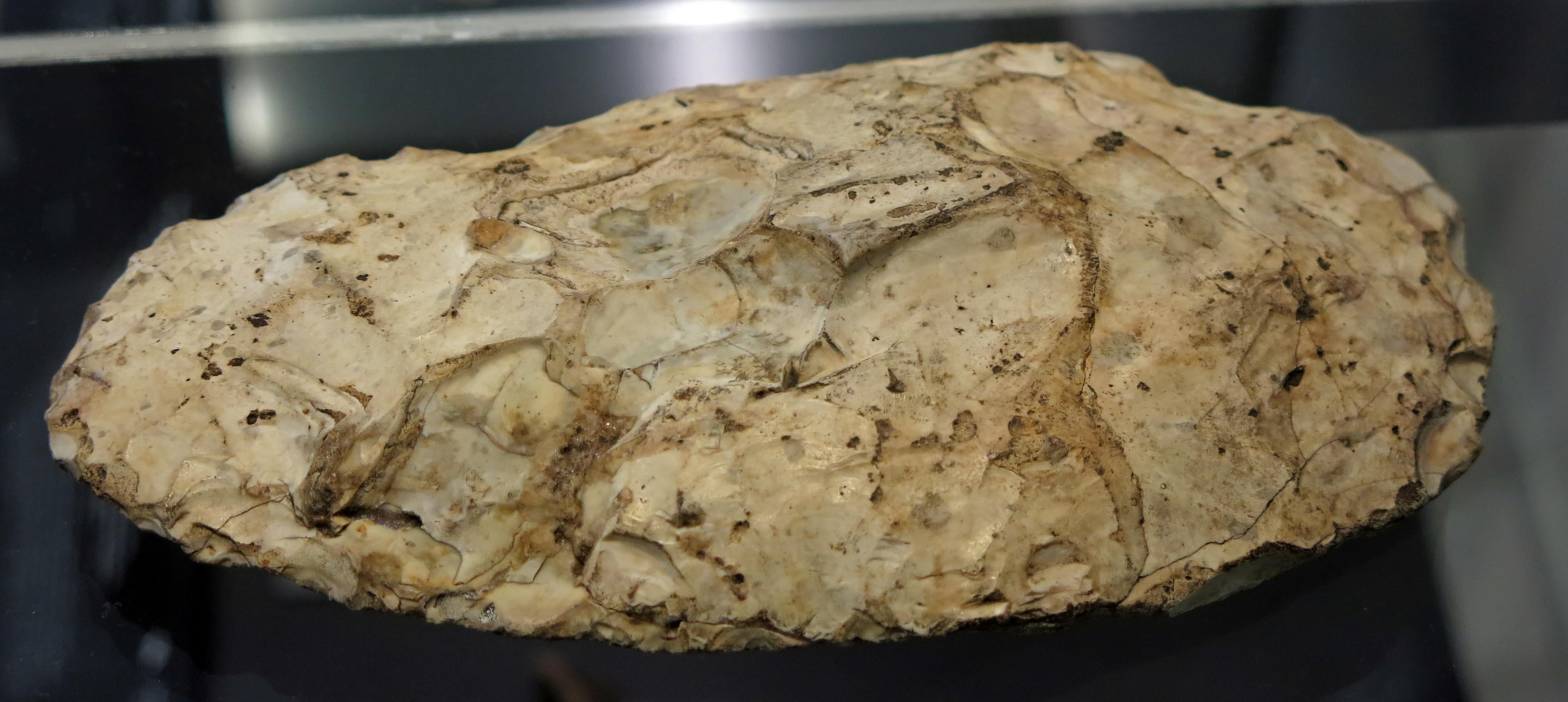
Hand axe from Nanterre, France, 1 500 000 BP - 200 000 BP.
Photo: Don Hitchcock 2014
Source and text: Original, Københavns (Copenhagen) Museum, National Museum of Denmark

Another view of the hand axe above from Nanterre, France, 1 500 000 BP - 200 000 BP.
Photo: Don Hitchcock 2014
Source and text: Original, Københavns (Copenhagen) Museum, National Museum of Denmark

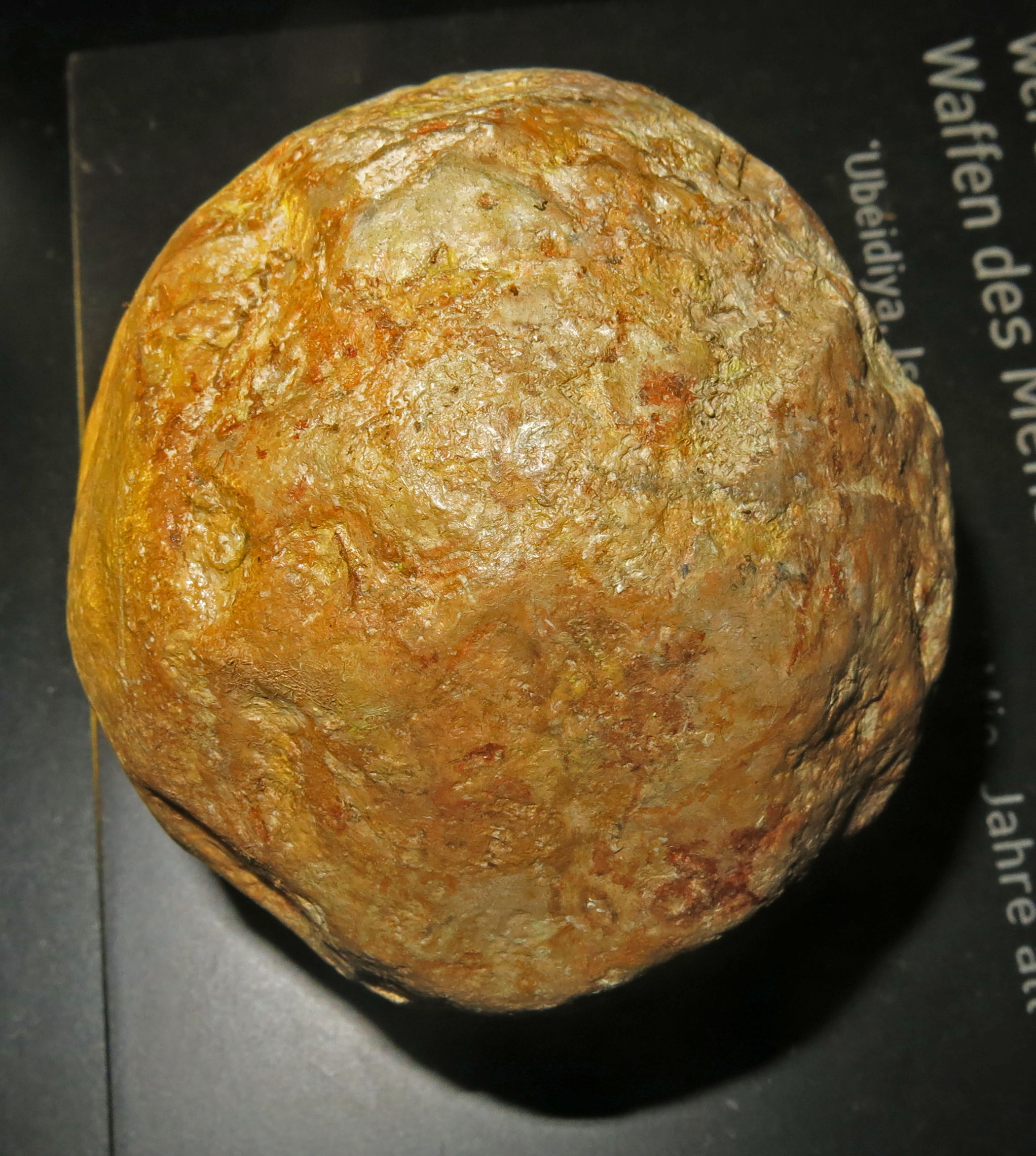
Bola, circa 1 400 000 BP.
Bolas are often used in threes, connected by leather thongs to a central point, and are thrown to entrap the legs of game animals, bringing them down to be killed by hunters.
Photos of two facsimiles of the same object from 'Ubeidiya, Israel.
Photo: Don Hitchcock 2015
Source: Facsimile, Monrepos Archäologisches Forschungszentrum und Museum, Neuwied, Germany
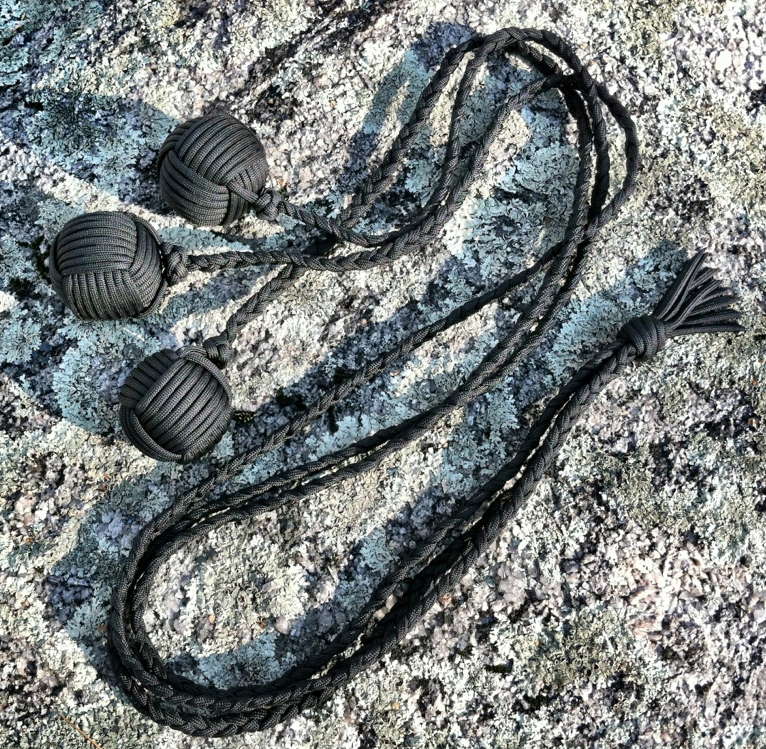
This is a superbly made modern bola. It is a work of art.
Photo: Paracordist
Source: http://www.bushcraftuk.com/forum/showthread.php?t=83896
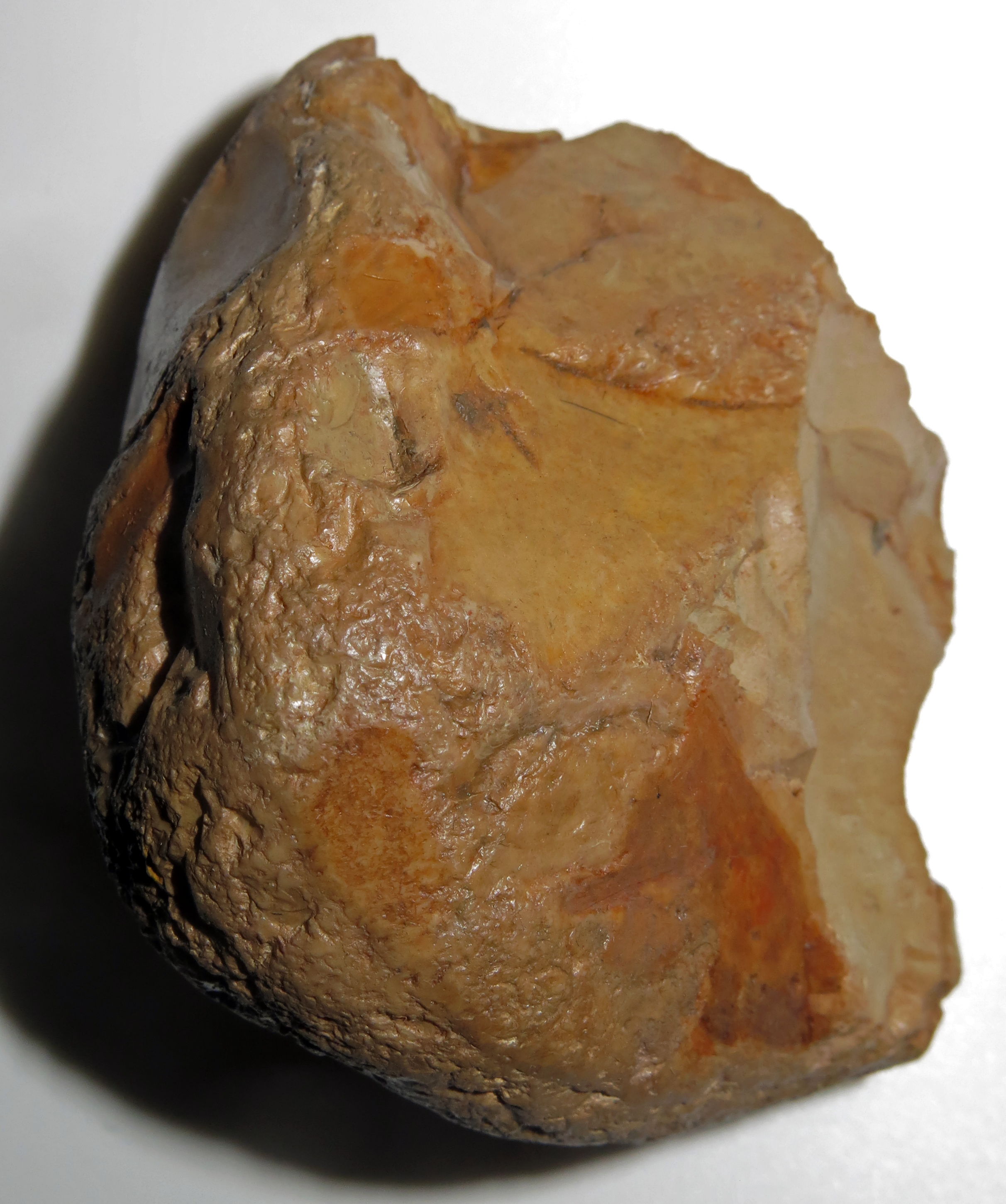
Chopper, a tool made quickly and easily from a river pebble by striking off a few flakes to make a useable edge, circa 1 400 000 BP.
From 'Ubeidiya, Israel.
Photo: Don Hitchcock 2015
Source: Facimile, Monrepos Archäologisches Forschungszentrum und Museum, Neuwied, Germany
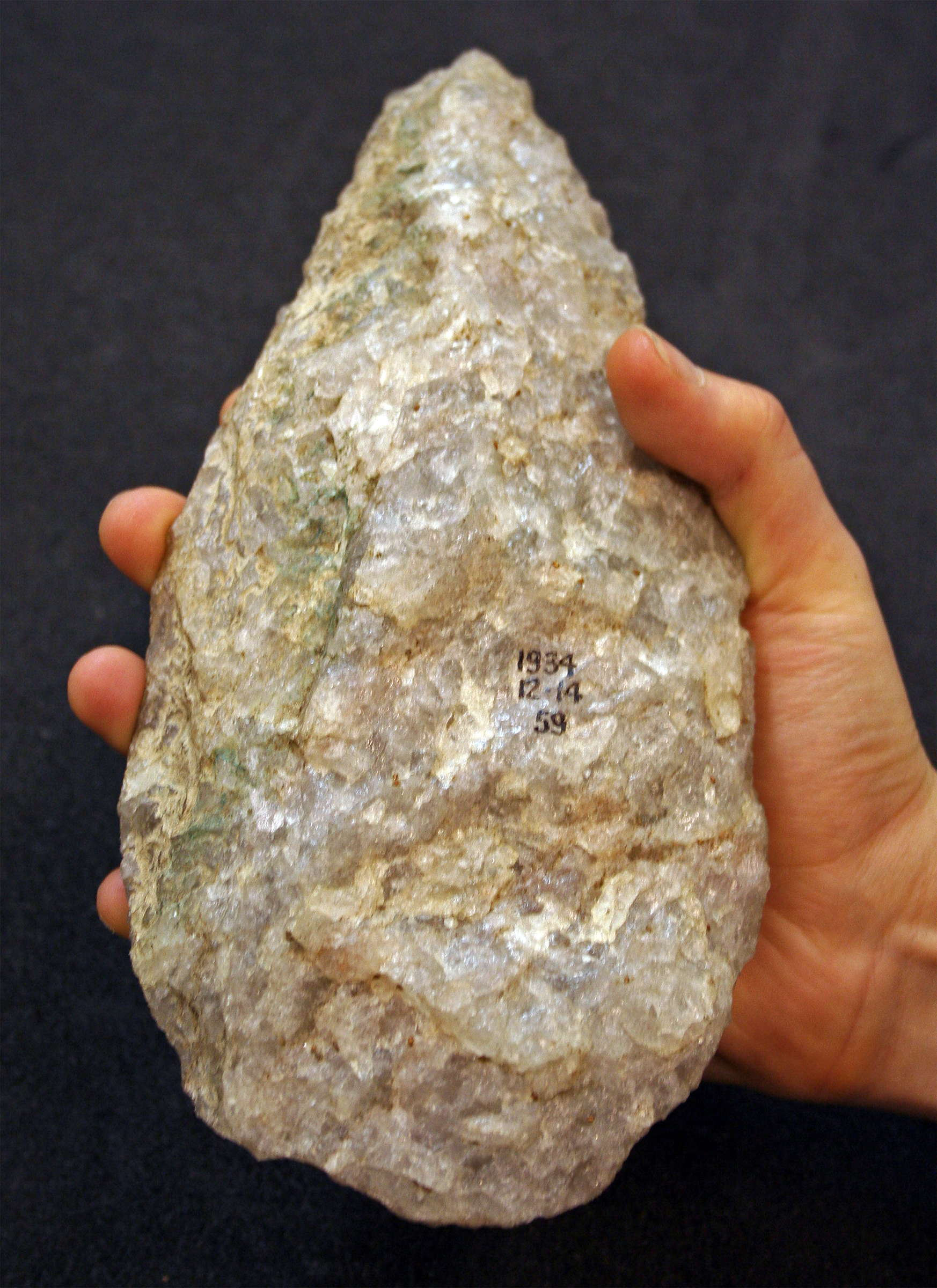
A hand axe from Olduvai Gorge, over 1 million years old.
British Museum 1934,1214.59
Taken at the GLAM event on 13th October 2011 at the British Museum.
Photo: Discott
Permission: licensed under the Creative Commons Attribution-Share Alike 3.0 Unported license.
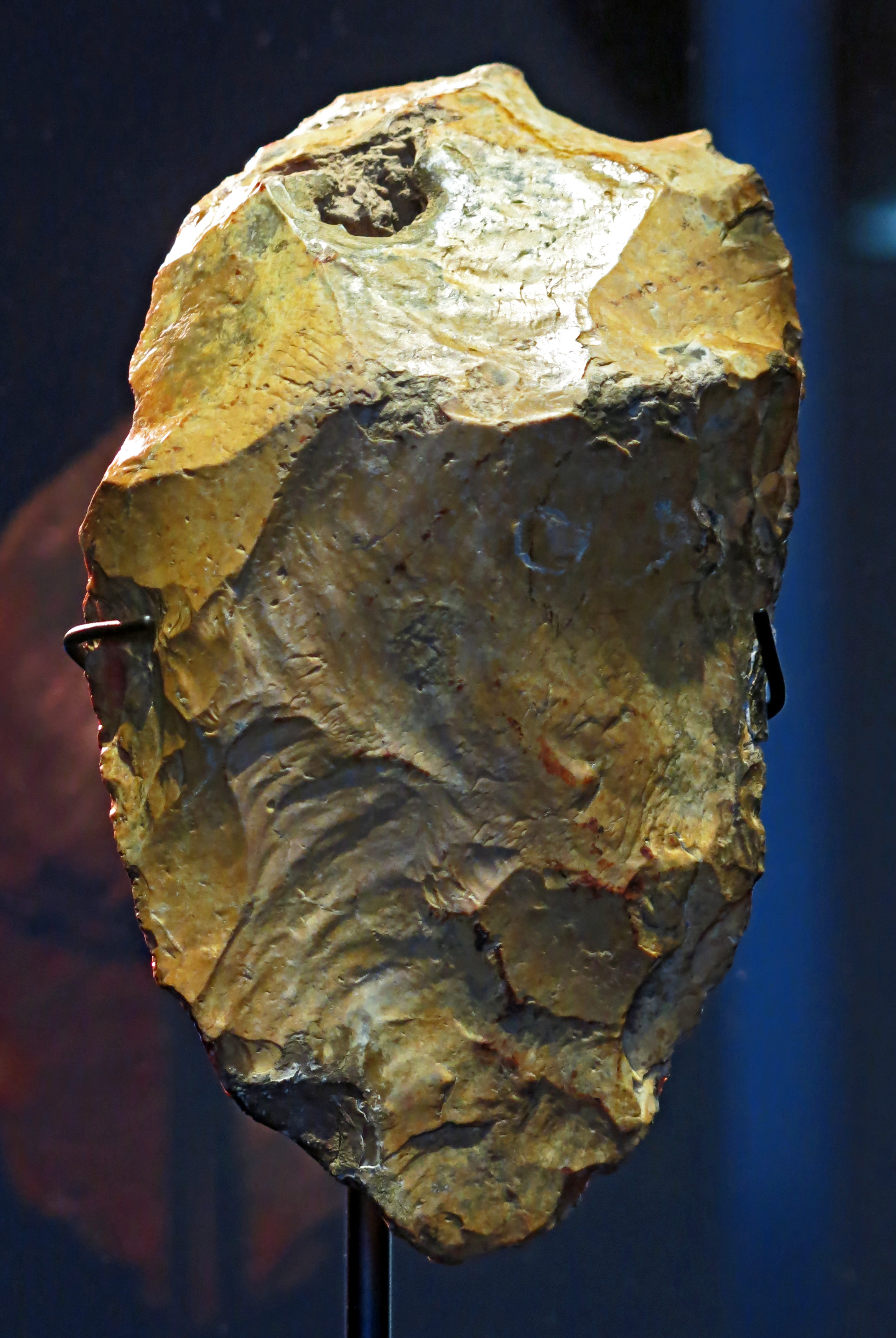
Hand axe from Abbeville, St Acheul, 800 000 BP - 300 000 BP.
Photo: Don Hitchcock 2015
Source: Original, Staatliche Museen zu Berlin, Neues Museum, Germany
Text: © Card at the Staatliche Museen zu Berlin (CC BY-NC-SA 3.0 DE)
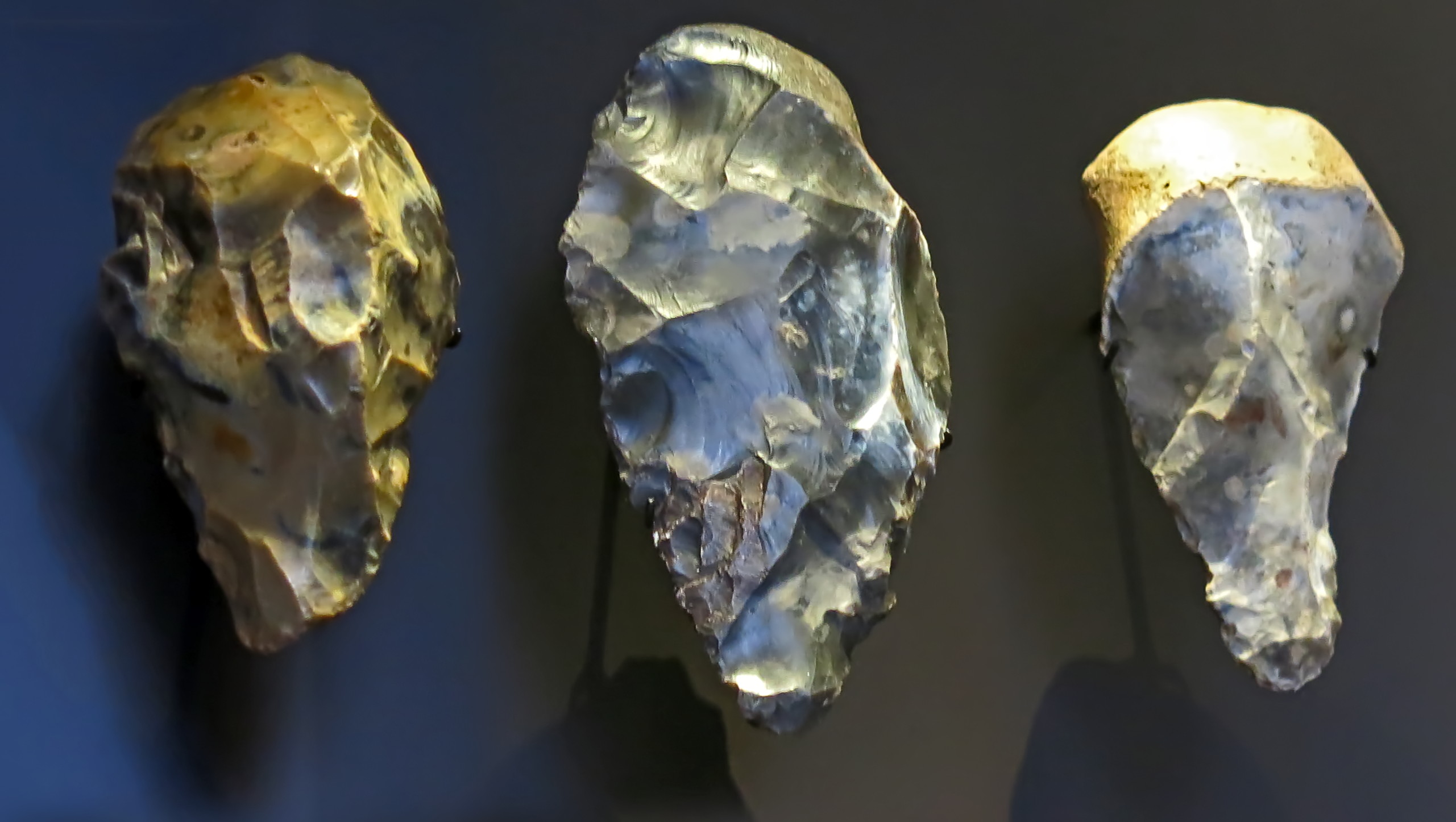
Hand axes from Abbeville, St Acheul, 800 000 BP - 300 000 BP.
Photo: Don Hitchcock 2015
Source: Original, Staatliche Museen zu Berlin, Neues Museum, Germany
Text: © Card at the Staatliche Museen zu Berlin (CC BY-NC-SA 3.0 DE)
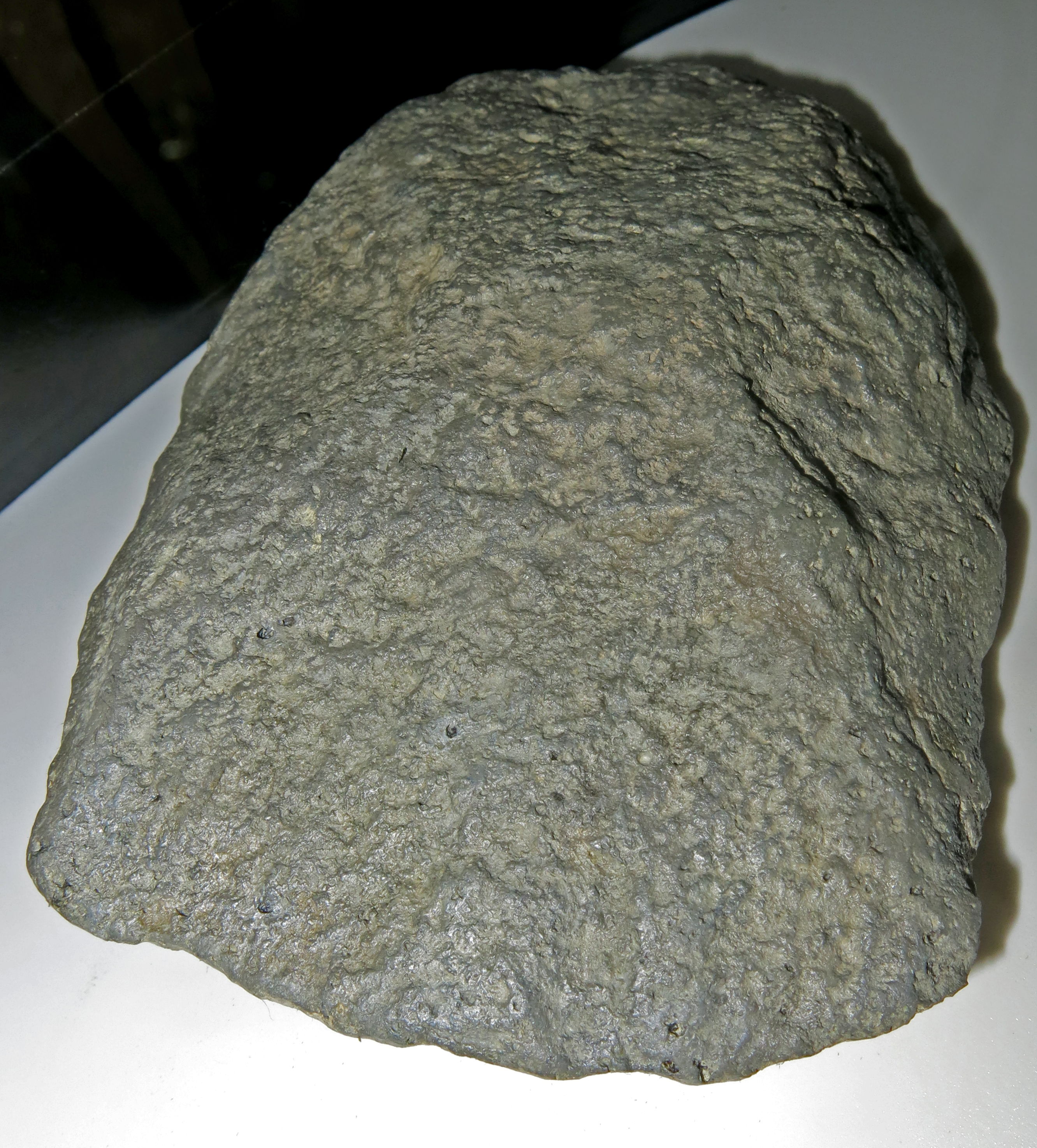
Splitting wedge, 800 000 BP.
From Gesher Benot Ya'aquov , Egypt.
Photo: Don Hitchcock 2015
Source and text: Facsimile, Monrepos Archäologisches Forschungszentrum und Museum, Neuwied, Germany
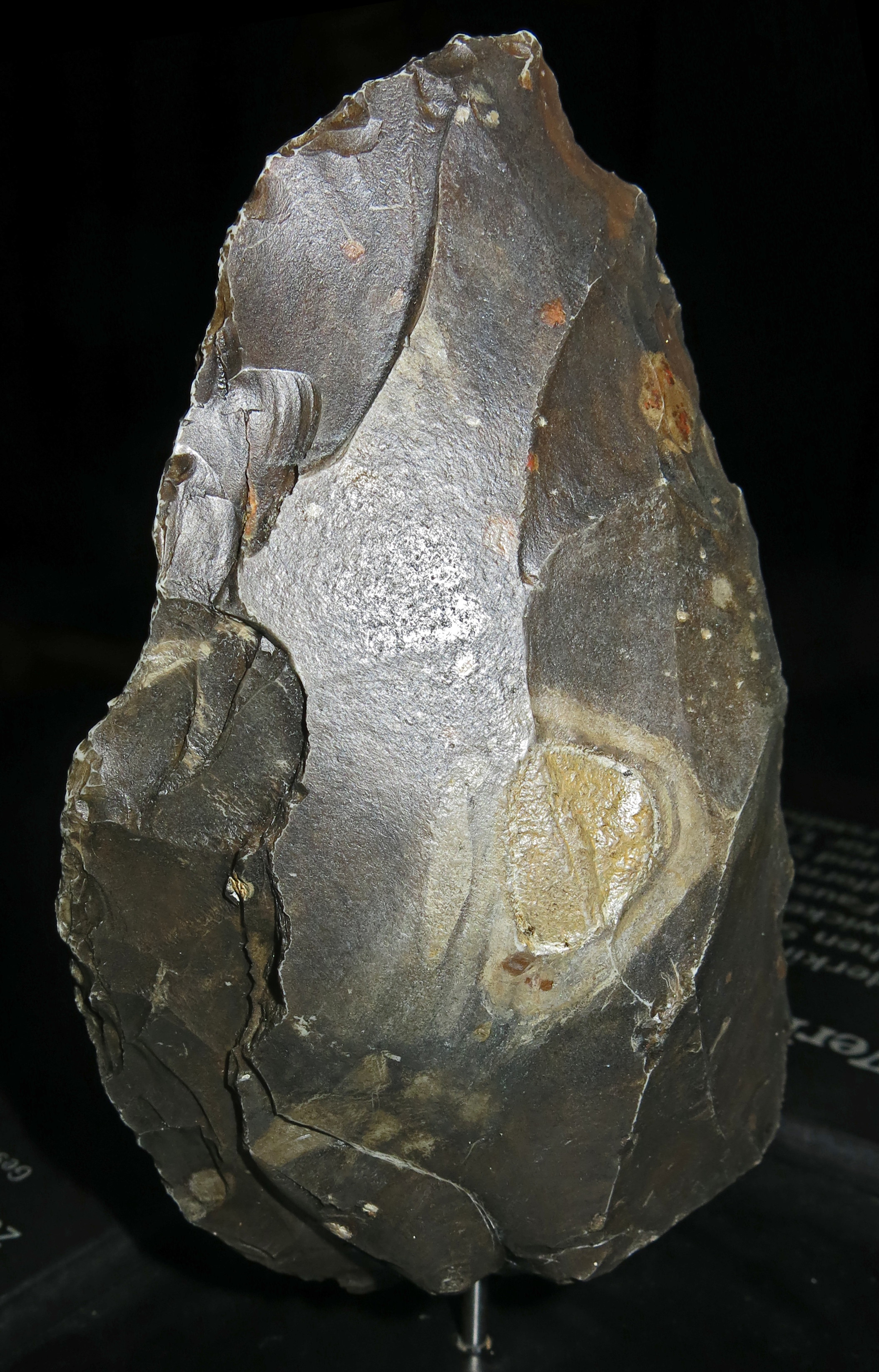
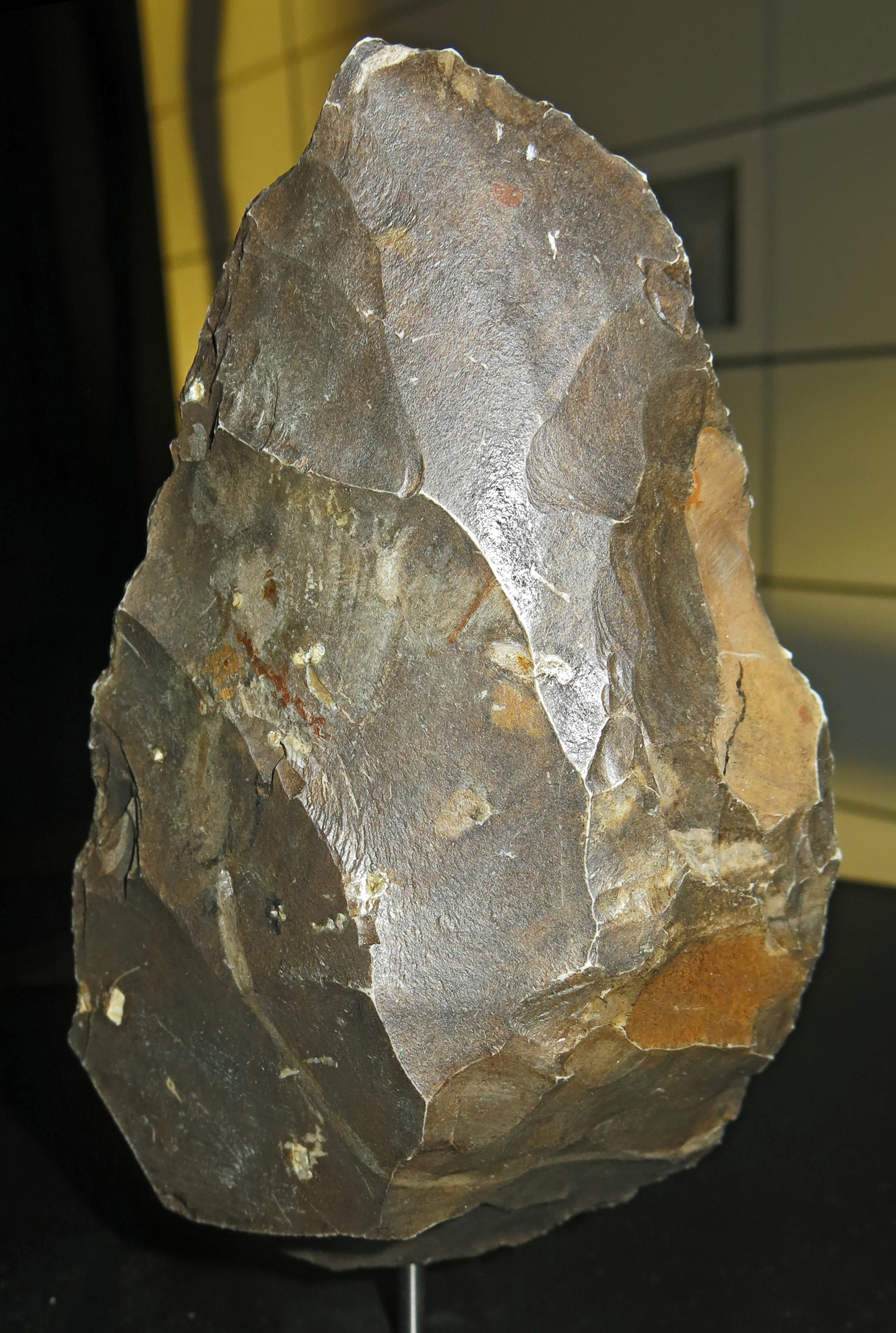
The handaxe is the absolute symbol for the Stone Age, and no wonder - they were made from 1 000 000 BP to 50 000 BP, and billions were manufactured.
They were not easy to make well. In numerous individual steps, the handaxe was carefully and precisely shaped to the right form, and with sharp edges.
Both sides shown, from: Gesher Benot Ya'aqov, Israel, 800 000 BP, apparently original.
Photo: Don Hitchcock 2015
Source and text: Monrepos Archäologisches Forschungszentrum und Museum, Neuwied, Germany
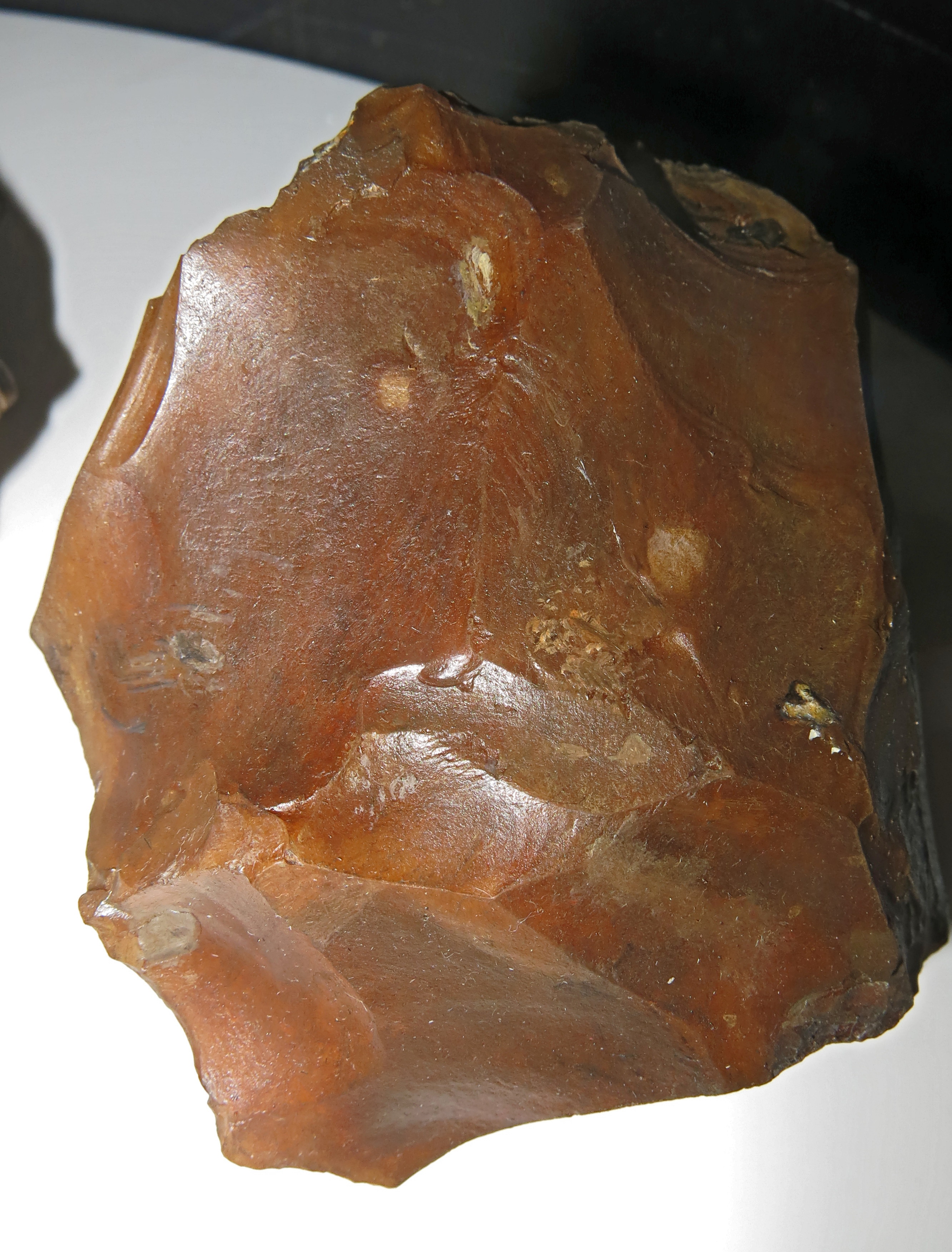
Nucleus or core, 800 000 BP.
From Gesher Benot Ya'aqov, Israel.
Photo: Don Hitchcock 2015
Source: Monrepos Archäologisches Forschungszentrum und Museum, Neuwied, Germany
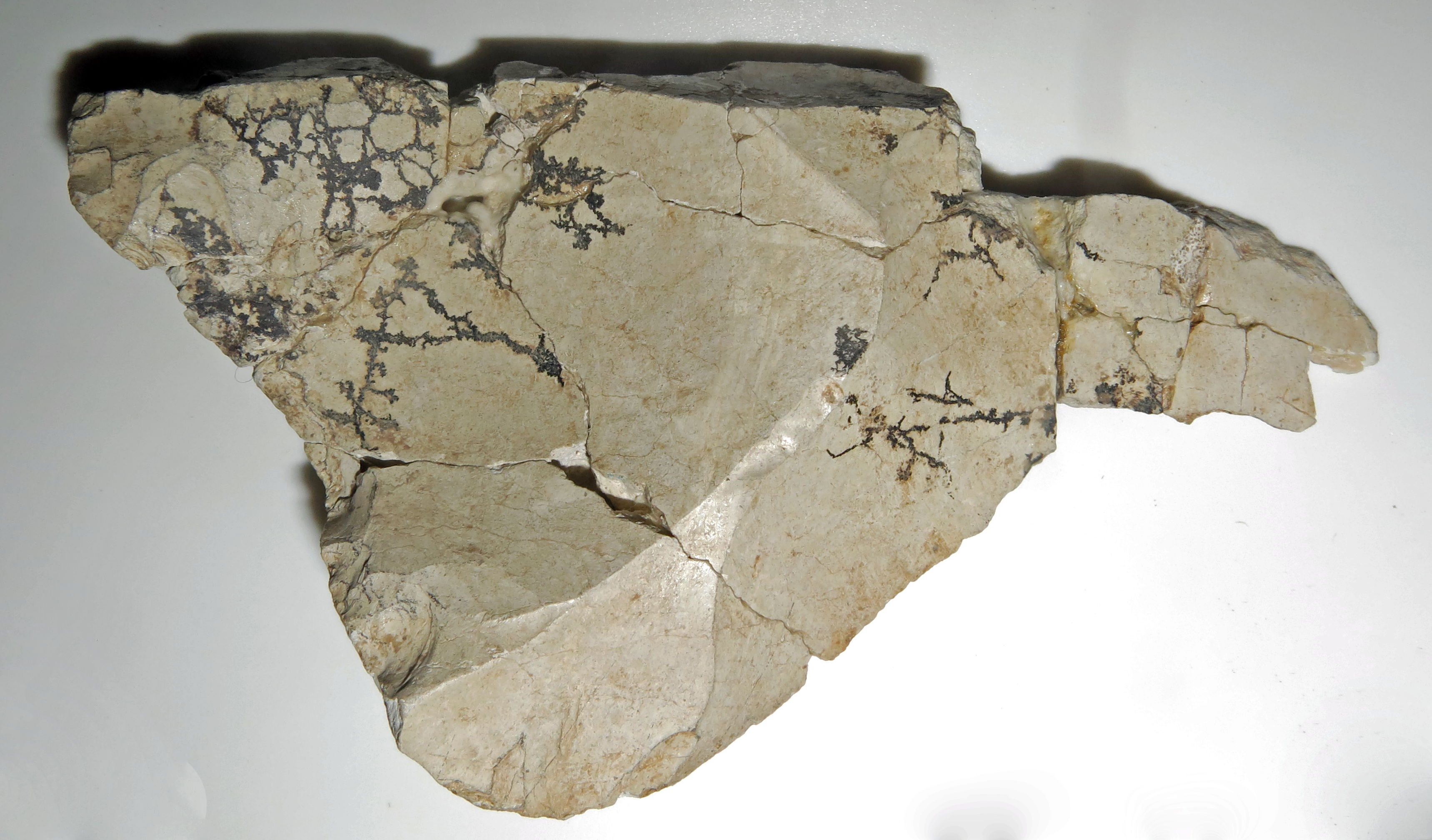
Abschlag, or flake ca 500 000 BP.
(This piece might be possibly better labelled as debitage, useless material struck from a core on the way to making a well made tool, although as Ralph Frenken (pers. comm.) has pointed out, museum staff have put considerable effort into piecing it together, which argues for classification as a useful tool - Don )
From Meisenheim, Rheinland-Pfalz, Germany
Photo: Don Hitchcock 2015
Source: Original, Monrepos Archäologisches Forschungszentrum und Museum, Neuwied, Germany
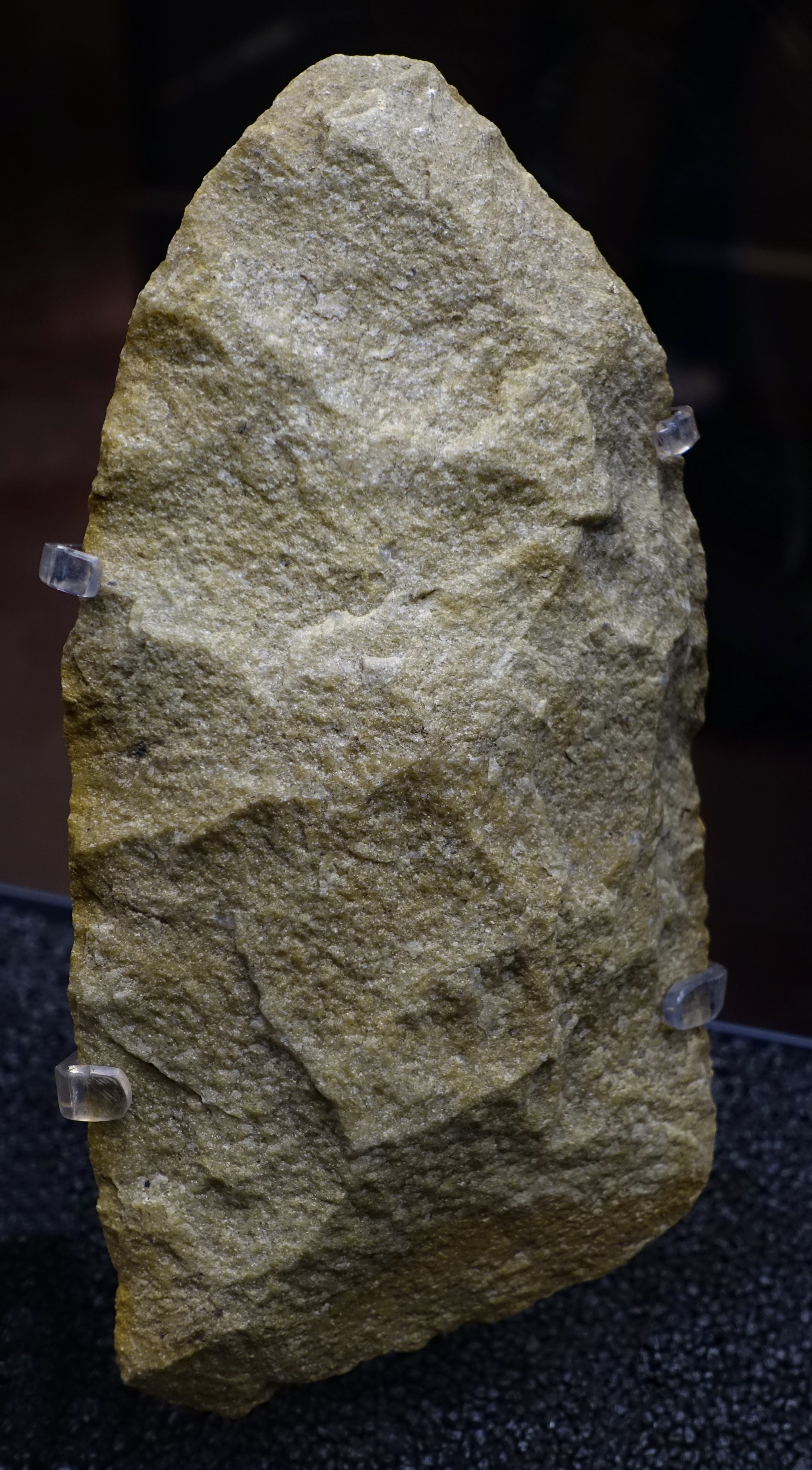
Quartzite handaxe, circa 500 000 BP.
Hochdahl, Stadt Erkrath, Kreis Mettmann
Photo: Don Hitchcock 2015
Source: LVR-Landesmuseum Bonn, Germany
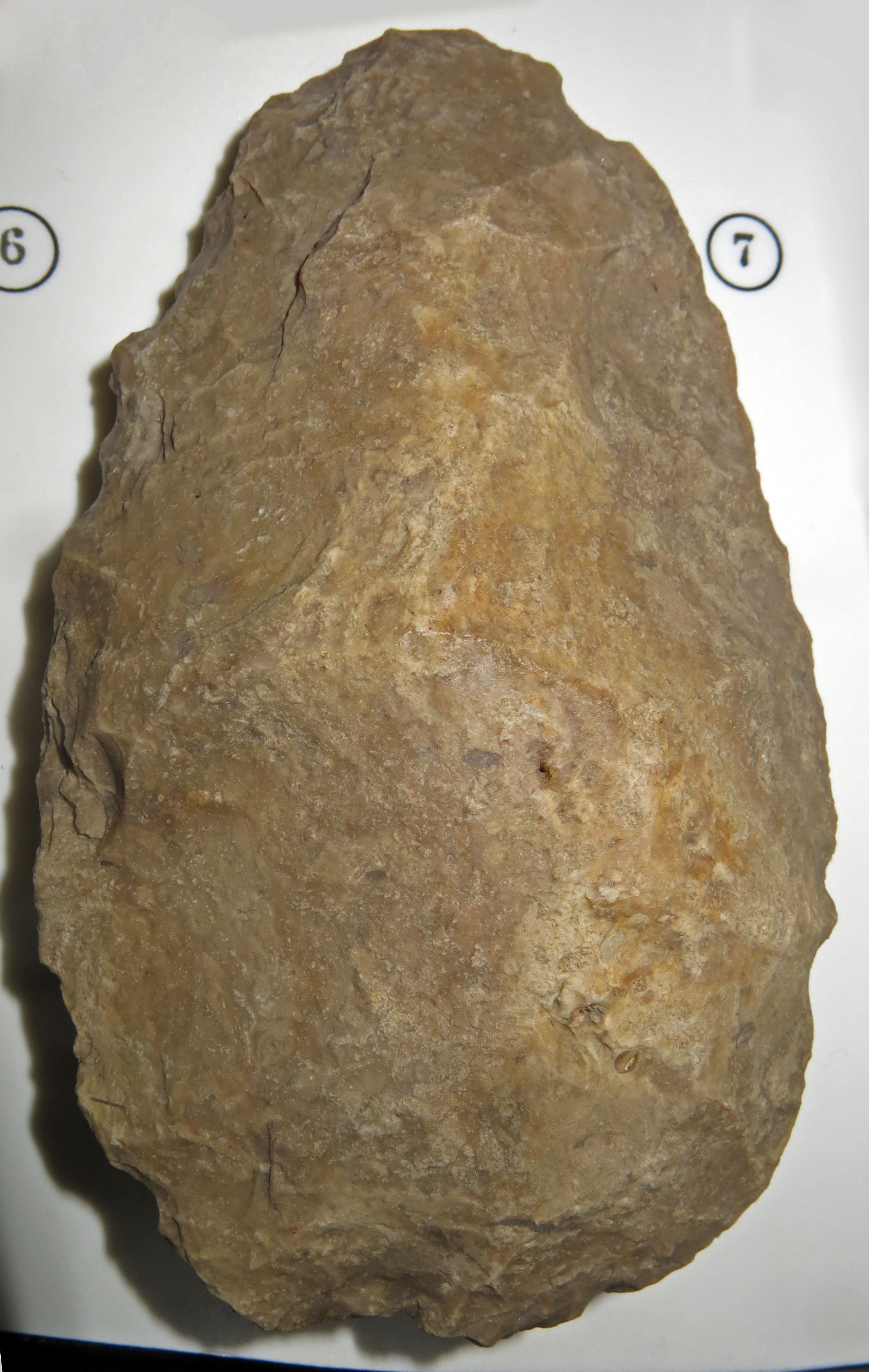
Quartzite cleaver probably used by Homo heidelbergensis.
( Cleavers were used much as a butcher would use a meat cleaver today, to quickly chop through a joint or a bone, or to cut a large slab of meat from a leg or shoulder - Don )
From Kalambo Falls, Tanzania/Zambia border, around 500 000 BP to 300 000 BP.
Catalog: E3652
Photo: Don Hitchcock 2018
Source and text: The Natural History Museum, Cromwell Road, London SW7 5BD
Acheulian hand axe, 500 000 to 400 000 BP, from Chelles, France.
Photo: Don Hitchcock 2015
Source and text: Original, Monrepos Archäologisches Forschungszentrum und Museum, Neuwied, Germany
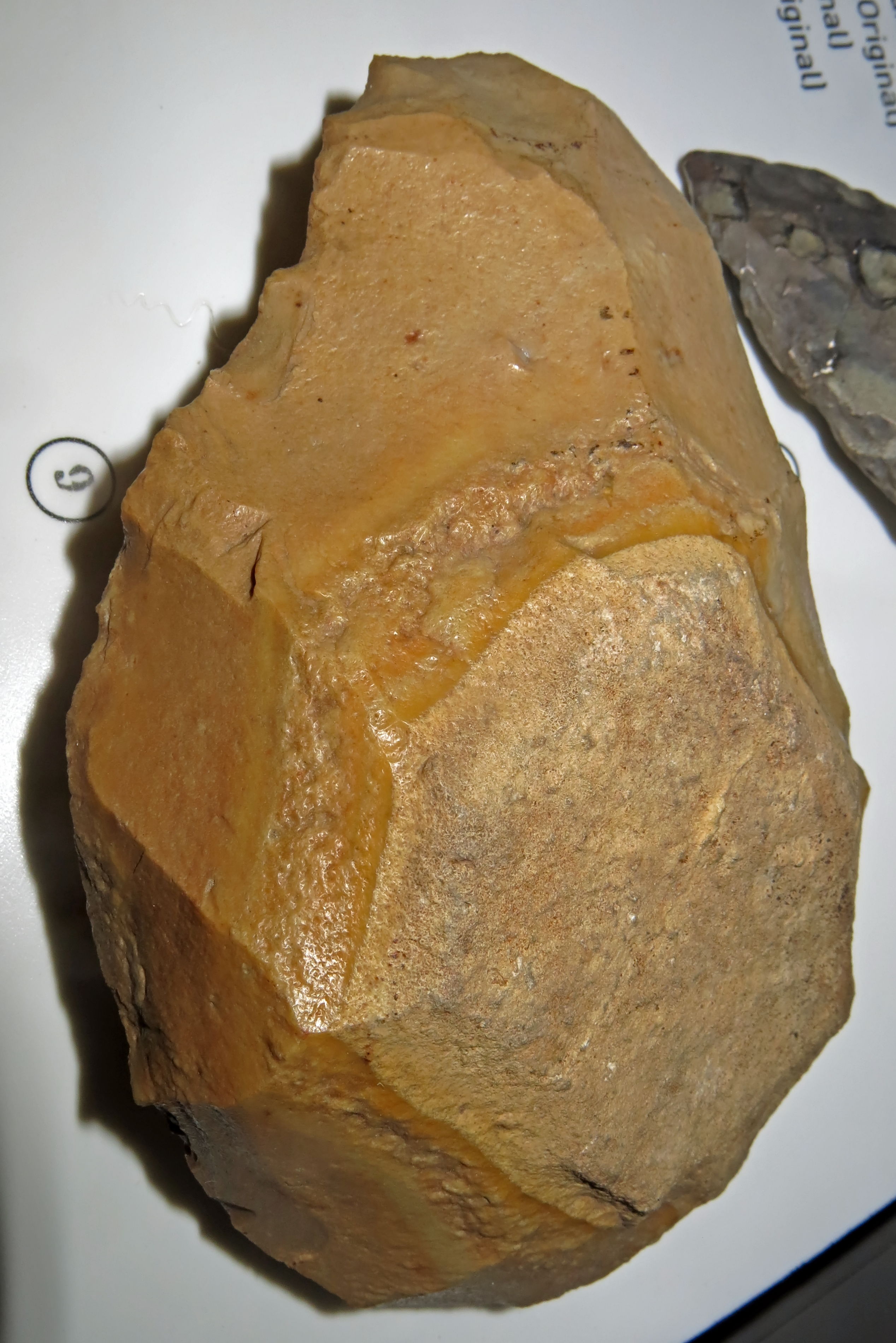
Acheulian hand axe, 500 000 BP - 300 000 BP from Saubrigny, France.
Photo: Don Hitchcock 2015
Source and text: Original, Monrepos Archäologisches Forschungszentrum und Museum, Neuwied, Germany
Scraper, 500 000 BP - 300 000 BP.
Scrapers were used primarily for preparing hides stripped from game, but may also have been used as knives.
From Ried, Bavaria, Germany.
Photo: Don Hitchcock 2015
Source: Facsimile, Monrepos Archäologisches Forschungszentrum und Museum, Neuwied, Germany

Wooden digging stick probably used by Homo heidelbergensis.
From Kalambo Falls, Tanzania/Zambia border, around 500 000 BP to 300 000 BP.
Cast. Original in the Natural History Museum, England.
( presumably in a controlled atmosphere vault in storage at the same museum this cast is displayed for public viewing - Don )
Catalog: E4547
Photo: Don Hitchcock 2018
Source and text: The Natural History Museum, Cromwell Road, London SW7 5BD
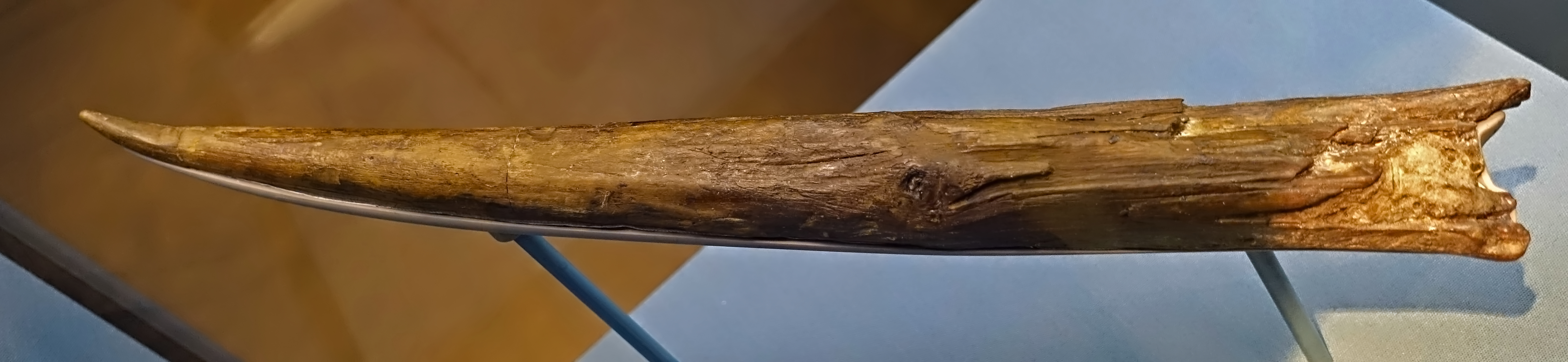
Made of yew, this spear point is the oldest preserved wooden spear in the world. Its owner would probably have used this as a lethal weapon, stabbing prey at close range to generate enough force to pierce the animal's skin.
Taxus sp., Clacton, Essex, England, around 420 000 BP.
Catalog: E1183
Photo: Don Hitchcock 2018
Source and text: The Natural History Museum, Cromwell Road, London SW7 5BD
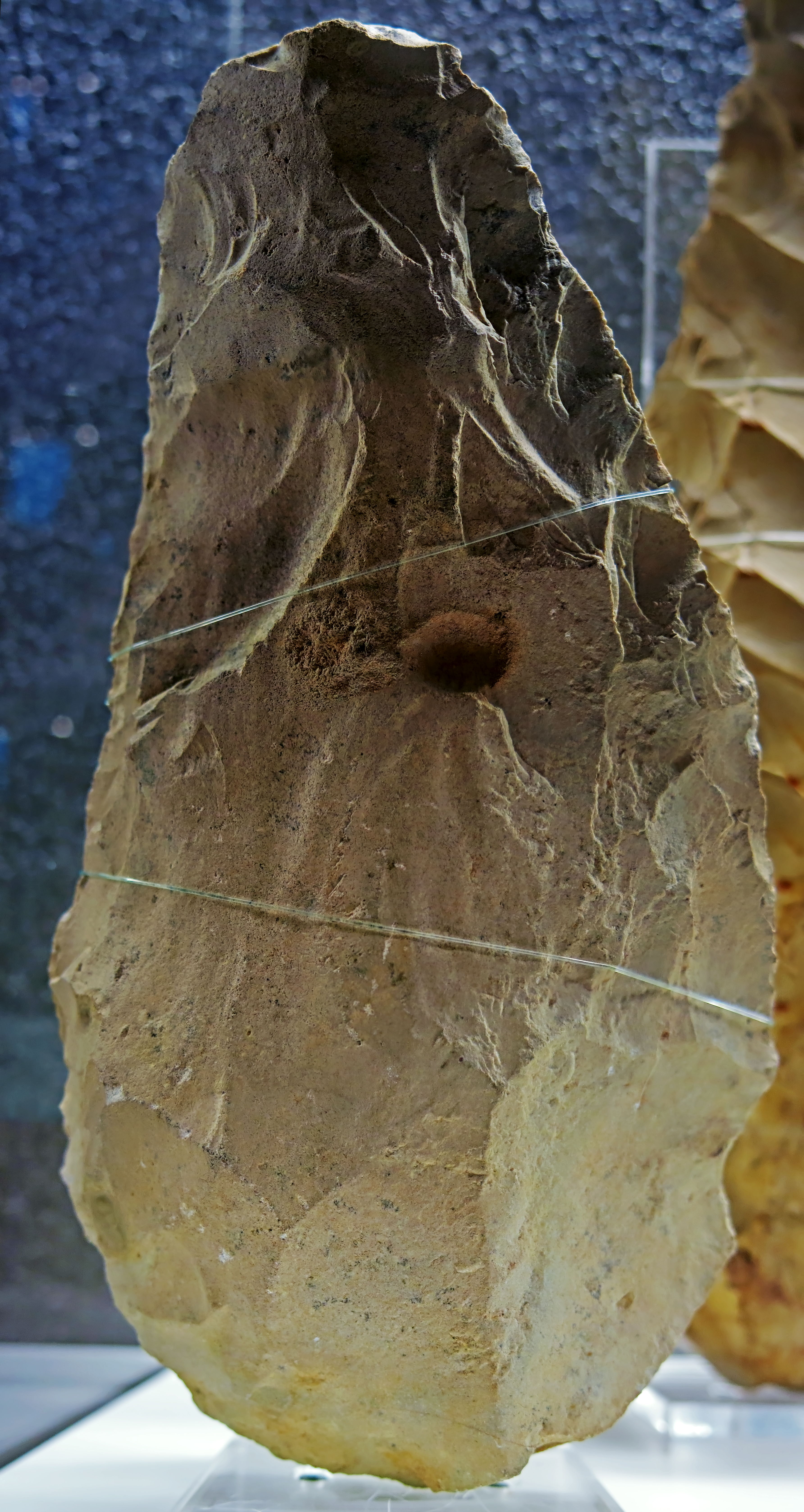
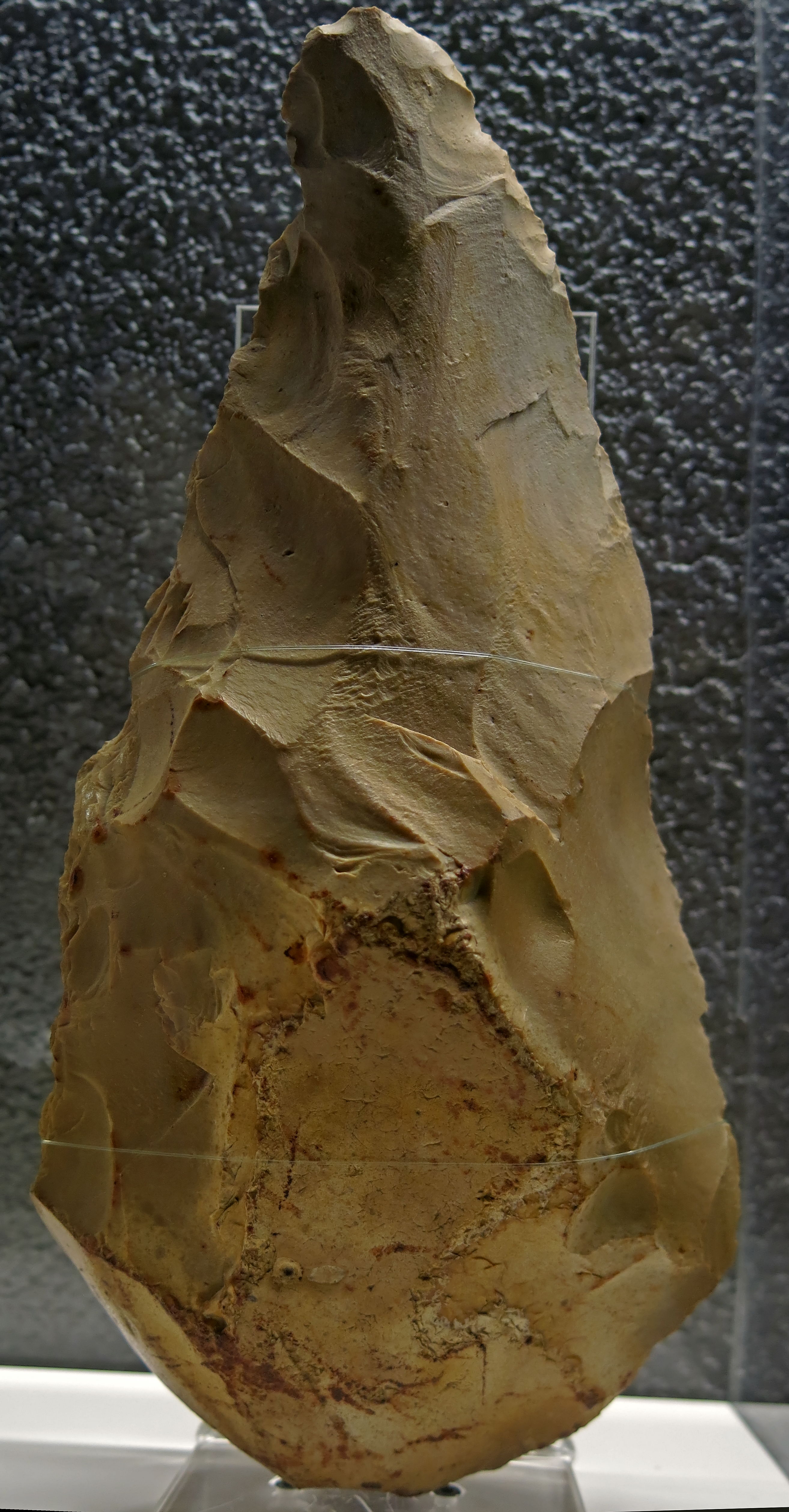
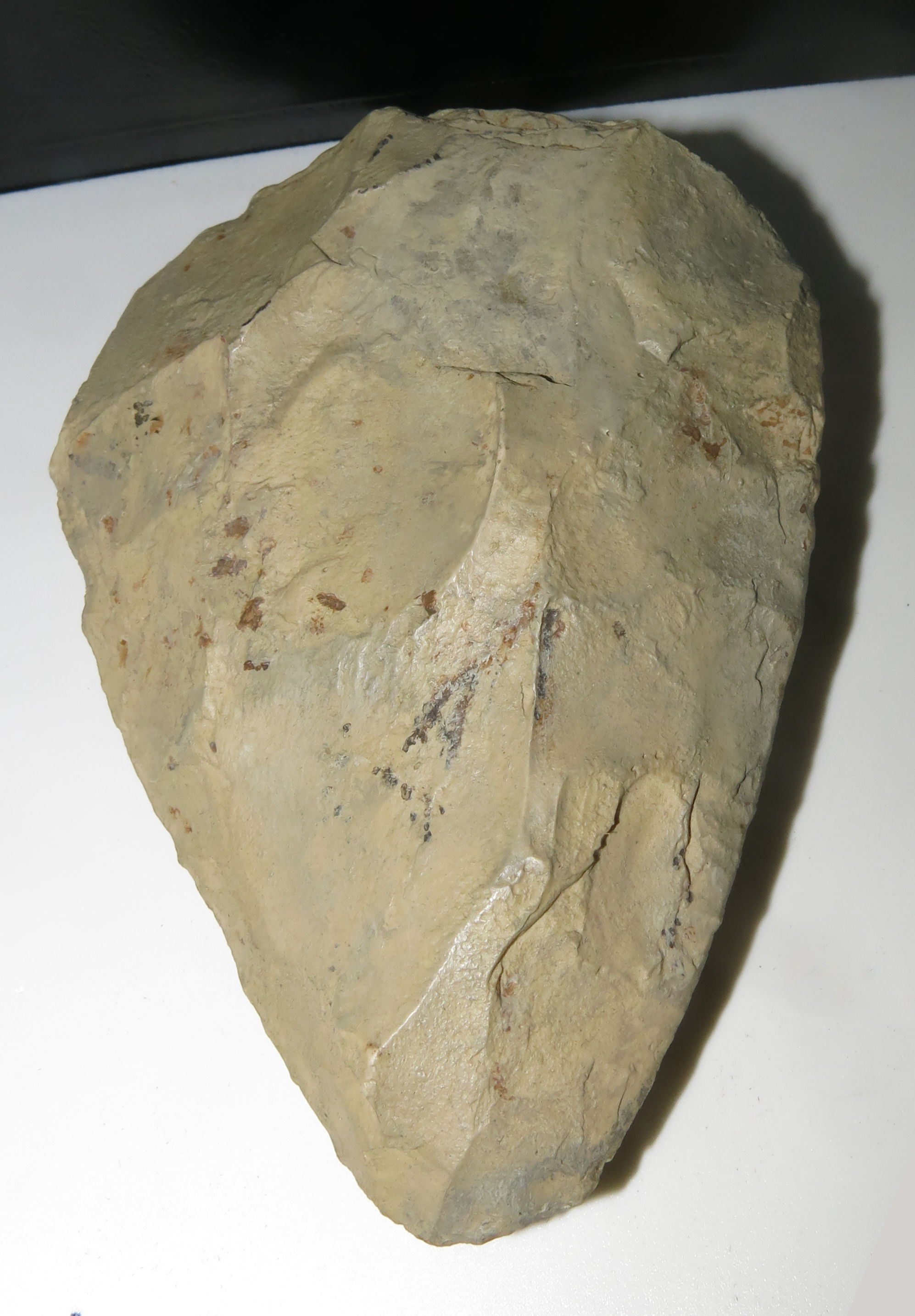
(left) Almond shaped flint biface hand axe from the Lower Palaeolithic, collected at Bertranoux: Commune Creysse, Aquitane, Dordogne.
Length: 227 mm, width 124 mm, thickness 52 mm.
(right) Lanceolate shaped flint biface hand axe from the Lower Palaeolithic, collected at Saint-Sulpice-d'Eymet, Commune Saint-Sulpice-d'Eymet, Aquitane, Dordogne.
Length: 285 mm, width 132 mm, thickness 70 mm.
Photo: Don Hitchcock 2015
Source and text: Original, Musée d'Aquitaine à Bordeaux
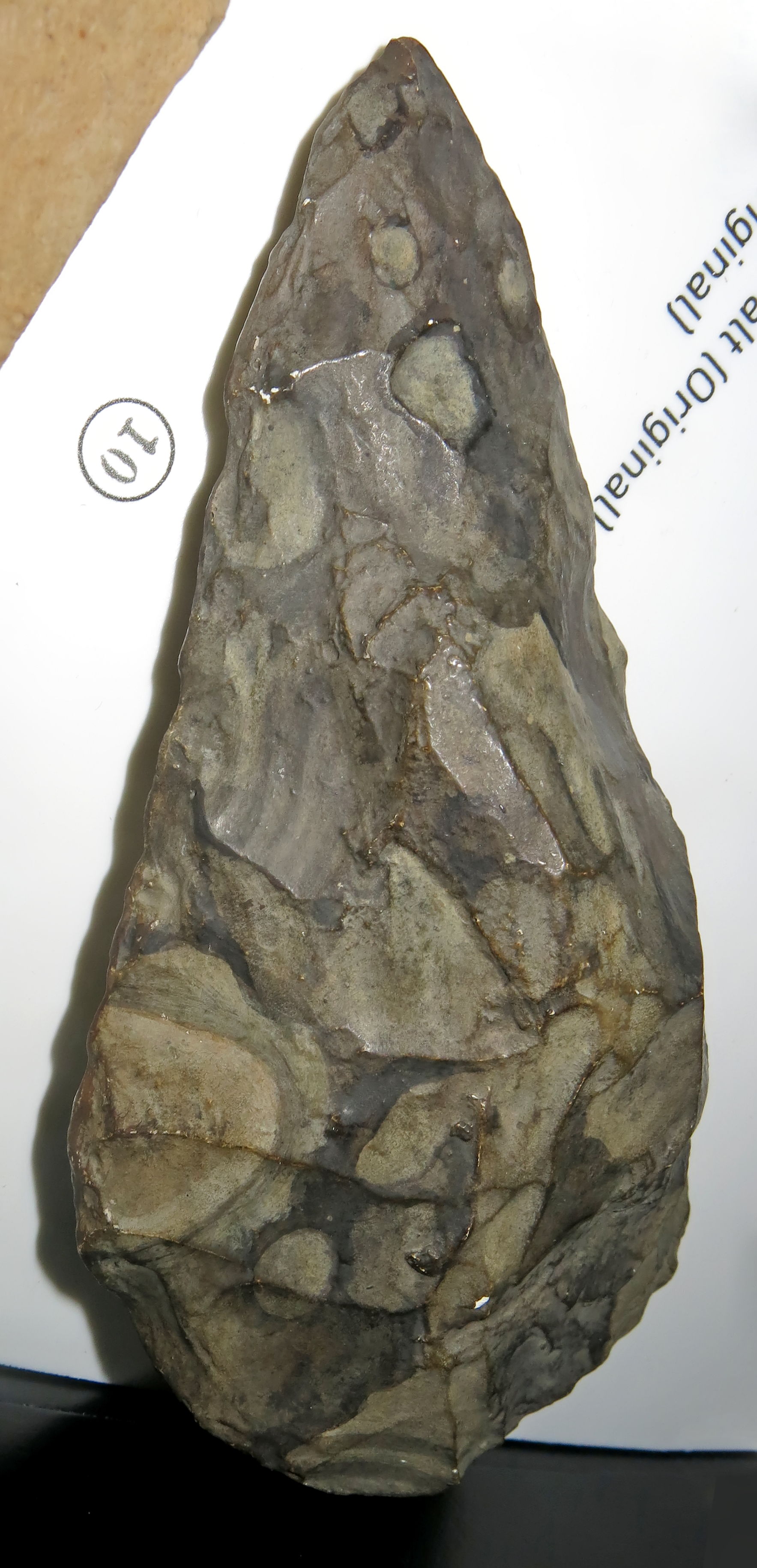
Acheulian hand axe, ca 400 000 BP, from Hoxne, England
Photo: Don Hitchcock 2015
Source and text: Facsimile, Monrepos Archäologisches Forschungszentrum und Museum, Neuwied, Germany
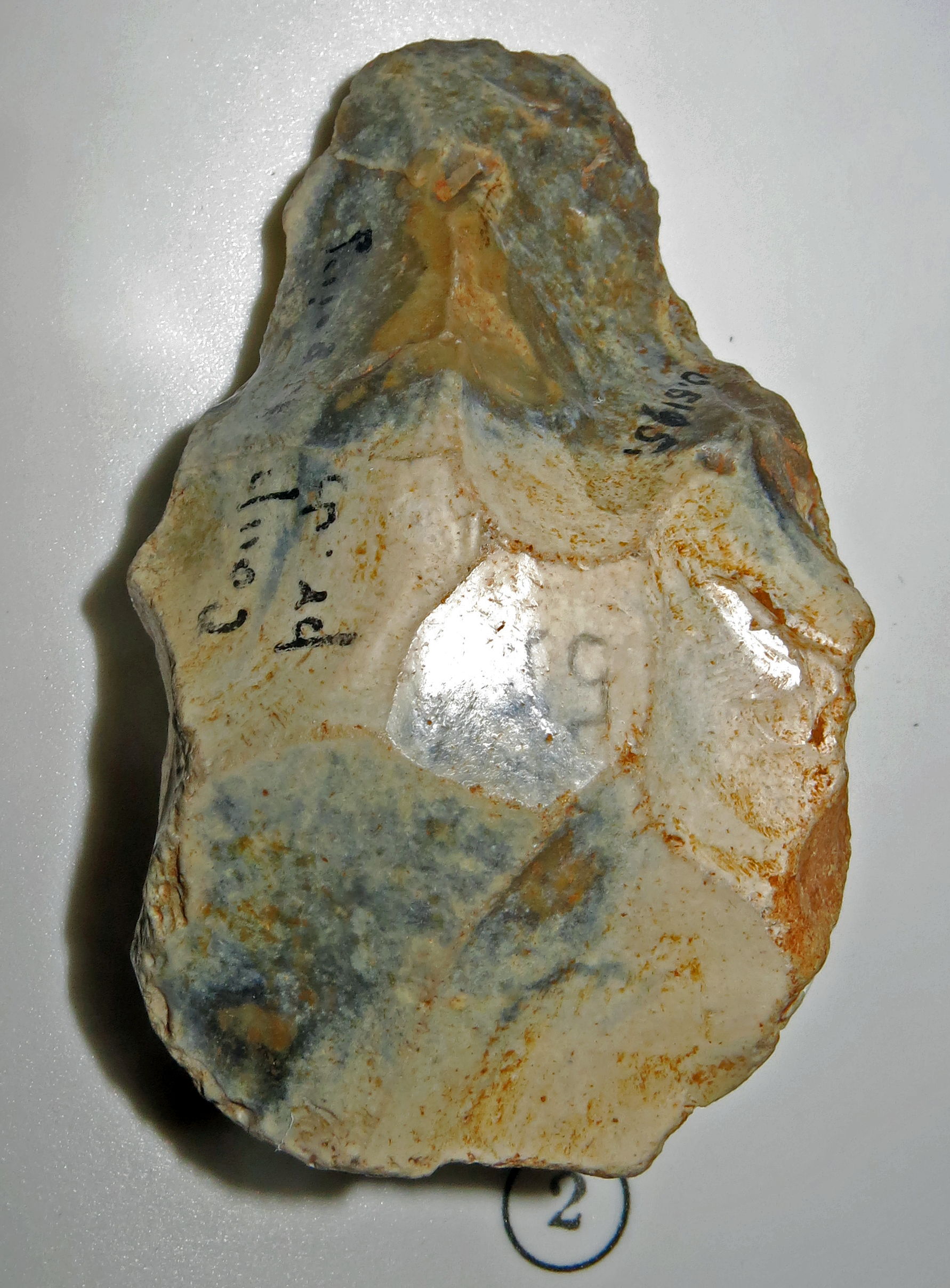
Acheulian hand axe, ca 400 000 BP, from Amiens, France.
Photo: Don Hitchcock 2015
Source and text: Original, Monrepos Archäologisches Forschungszentrum und Museum, Neuwied, Germany
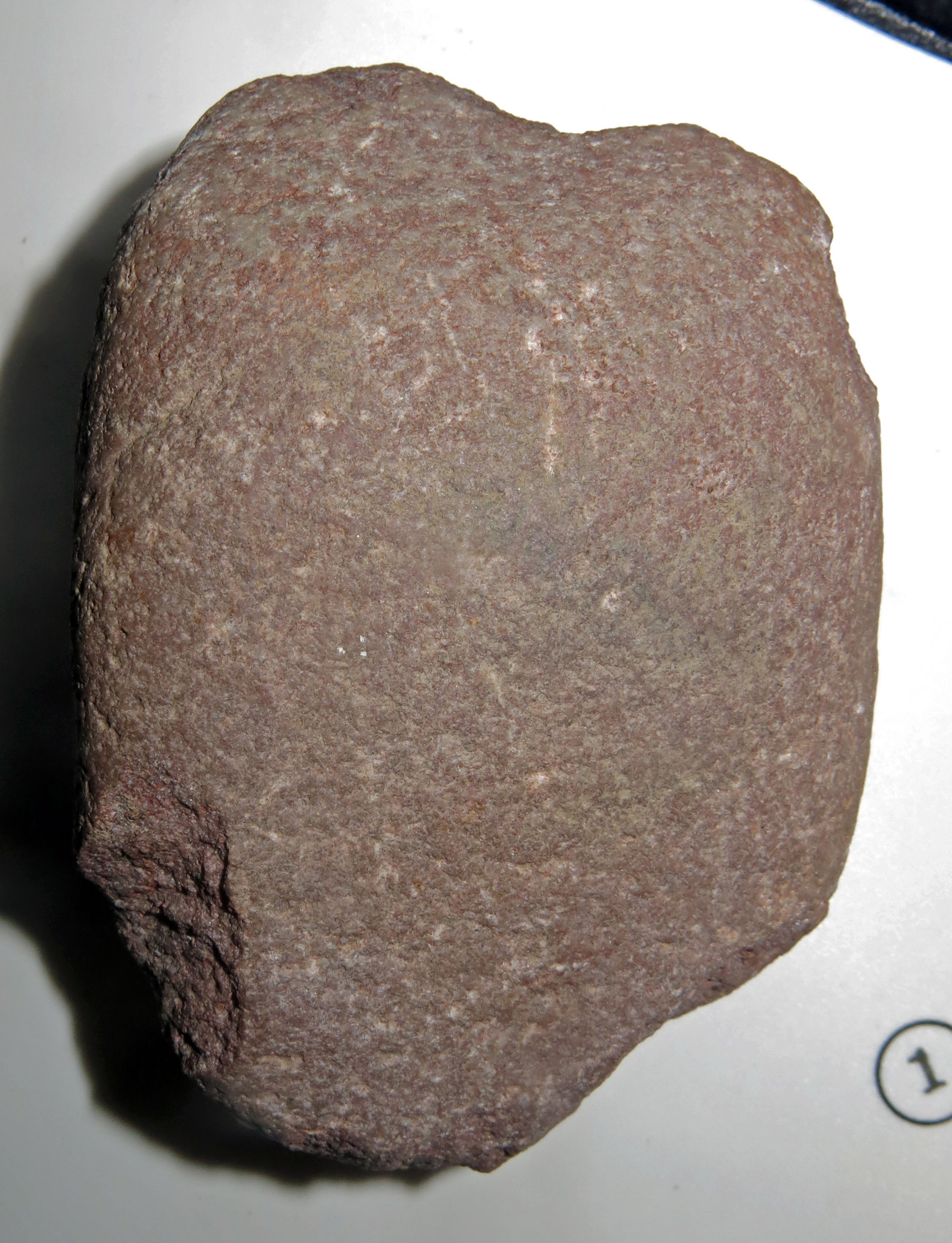
Hammerstone, used for knapping flint, ca 400 000 BP.
From Mühlheim-Kärlich, Rheinland-Pfalz, Germany.
Photo: Don Hitchcock 2015
Source: Original, Monrepos Archäologisches Forschungszentrum und Museum, Neuwied, Germany
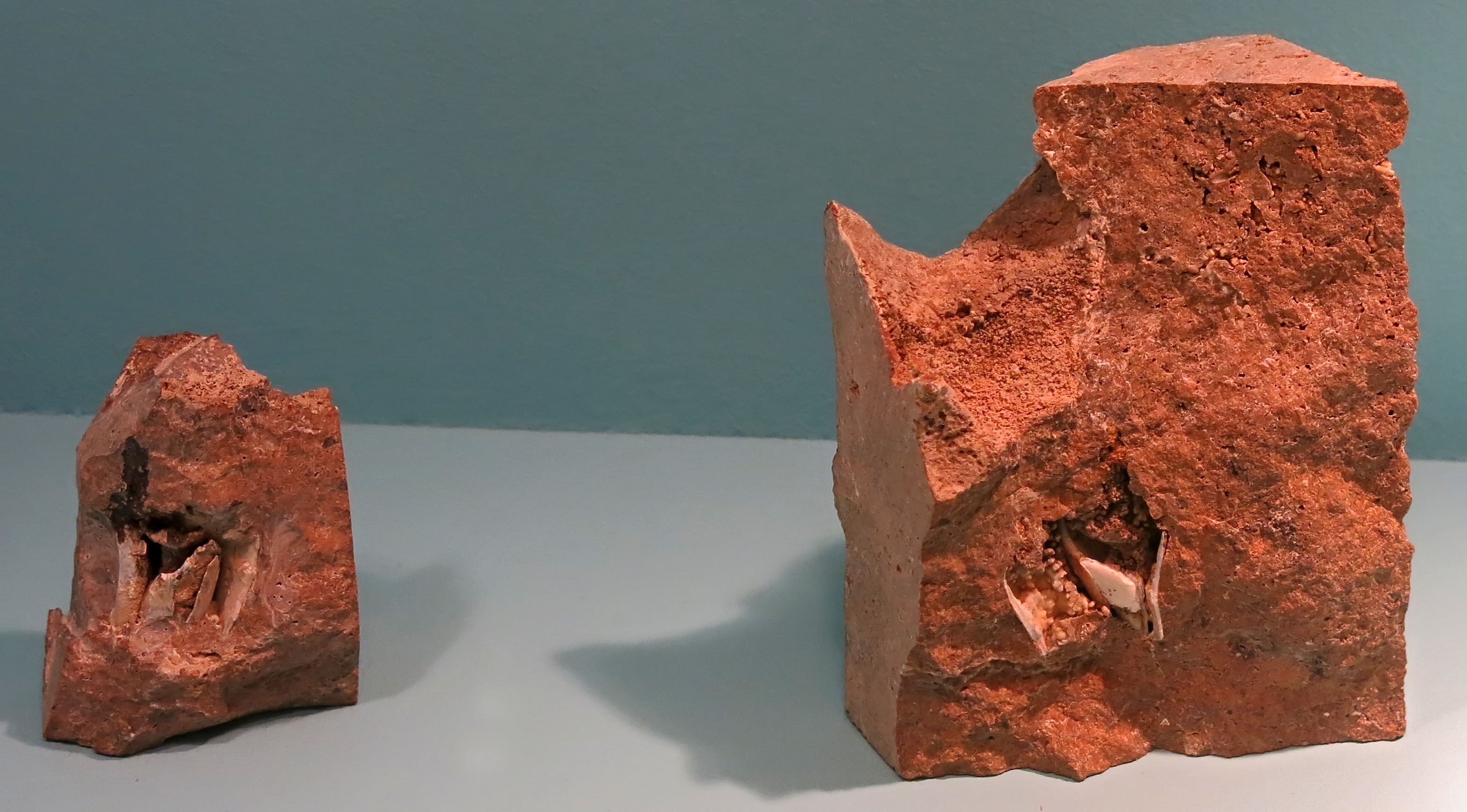
Quartz and quartzite tools in Travertine limestone, circa 330 000 BP - 310 000 BP.
The travertine was formed as the result of the solution and redeposition of existing limestone in a karst environment, and at least 25 well-identified stone tools have been found in the travertine, dating from the time of its formation 330 000 years ago, during a warm period of the middle Pleistocene.
Kartstein, Stadt Mechernich, Kreis Euskrichen
Photo: Don Hitchcock 2015
Source and text: LVR-Landesmuseum Bonn, Germany
Additional text: http://www.georallye.uni-bonn.de/kartstein_bei_satzvey
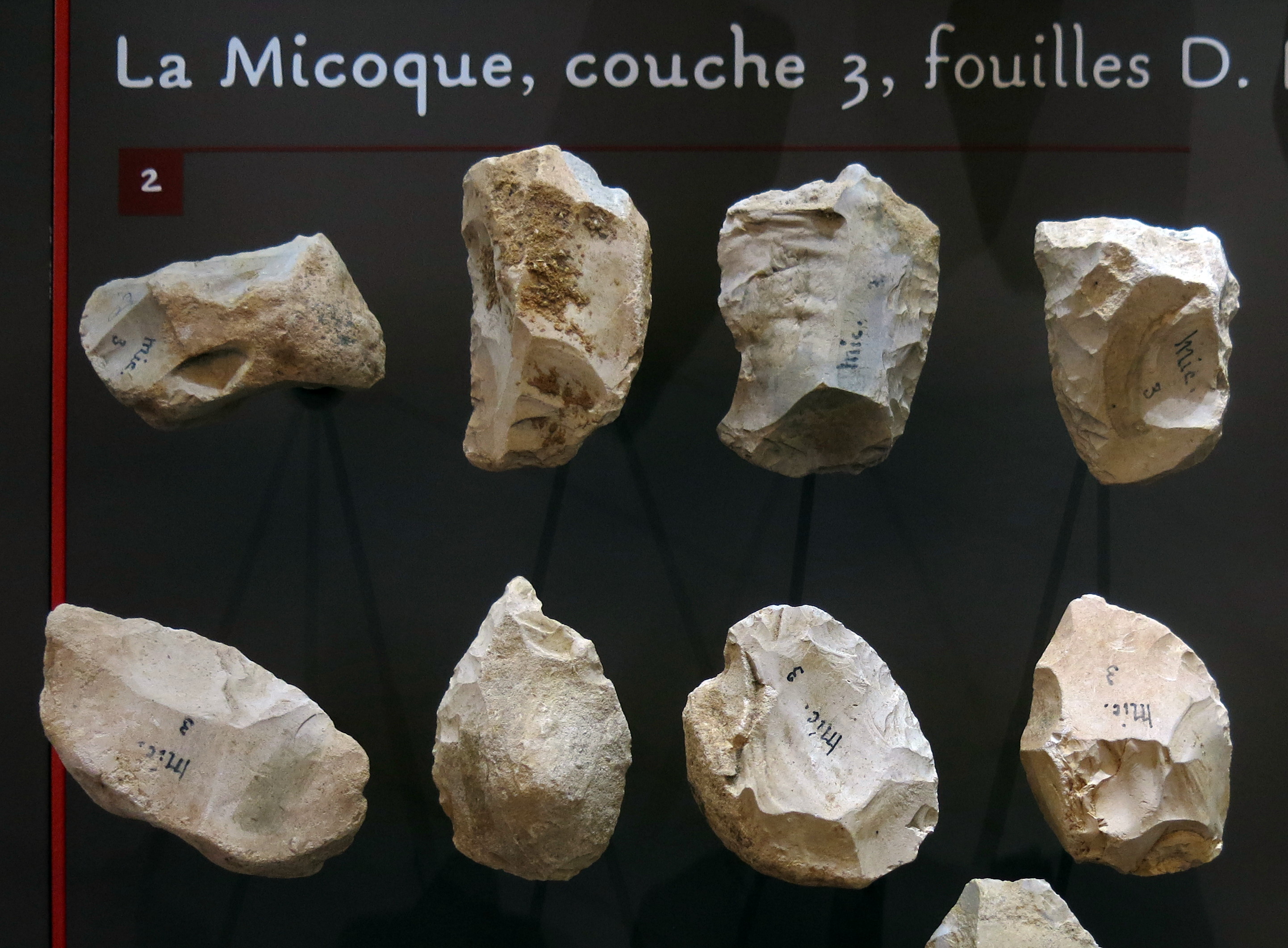
Racloirs, scrapers, circa 320 000 BP, from la Micoque, France.
Photo: Don Hitchcock 2014
Source: Originals, Le Musée National de Préhistoire, Les Eyzies-de-Tayac
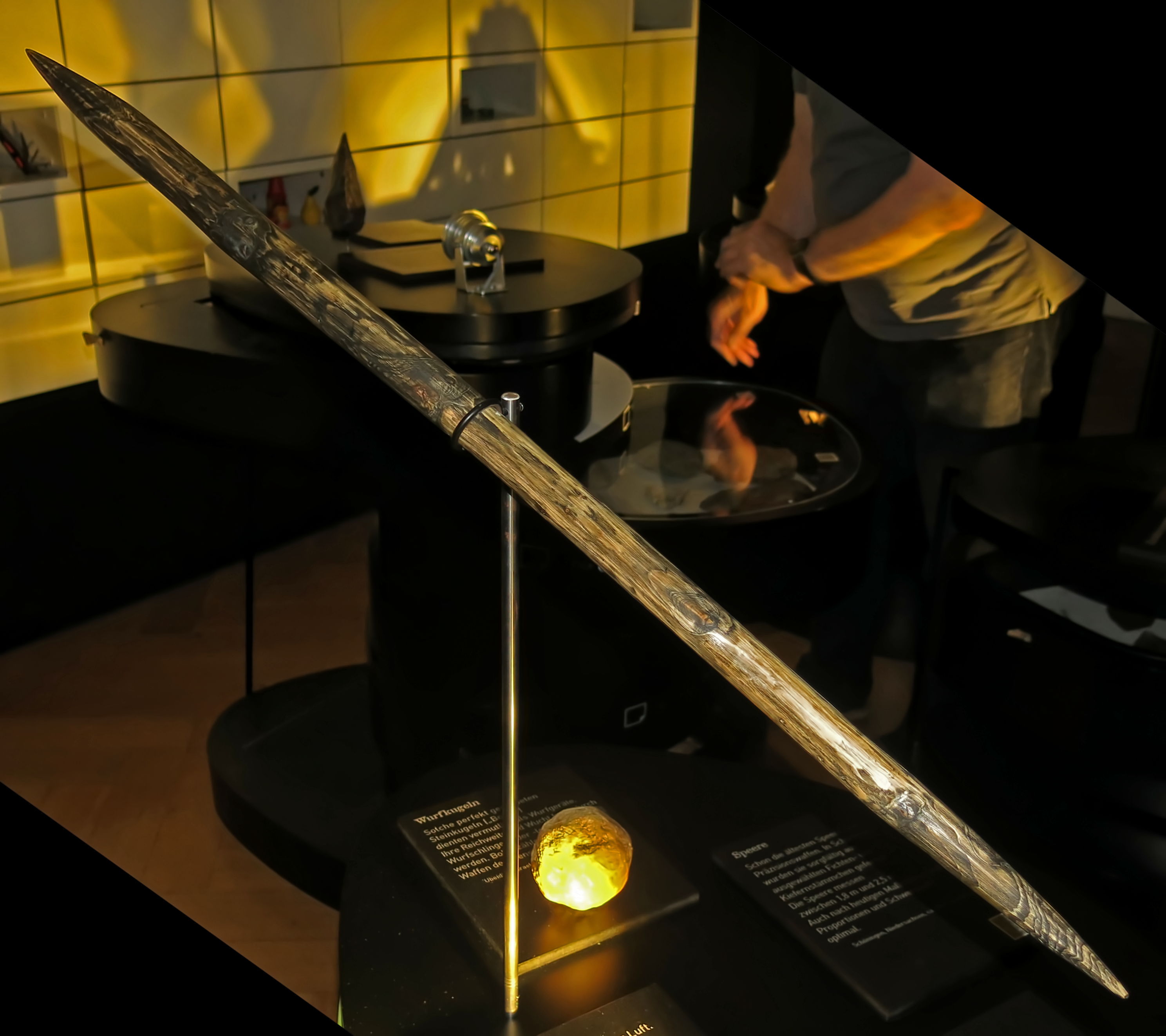
Throwing stick. These are designed to rotate in the air when thrown, and are used to bring down small animals.
Schöningen, Niedersachsen, Germany, ca 300 000 BP.
Schöningen is famous for the Schöningen Spears, four ancient wooden spears found in an opencast lignite (brown coal) mine near the town. This environment helped preserve the wooden spears, which otherwise would have long ago rotted away. The spears are about 400 000 years old, making them the world's oldest human-made wooden artefacts, as well as the oldest weapons, ever found.
Three of them were probably manufactured as projectile weapons, because the weight and tapered point is at the front of the spear making it fly straight in flight, similar to the design of a modern javelin. The fourth spear is shorter, with points at both ends and is thought to be a thrusting spear or a throwing stick. They were found in combination with the remains of about 20 wild horses, whose bones contain numerous butchery marks, including one pelvis that still had a spear sticking out of it. This is considered proof that early humans were active hunters with specialised tool kits.
Photo: Don Hitchcock 2015
Source and text: Facsimile, Monrepos Archäologisches Forschungszentrum und Museum, Neuwied, Germany
Additional text: Wikipedia
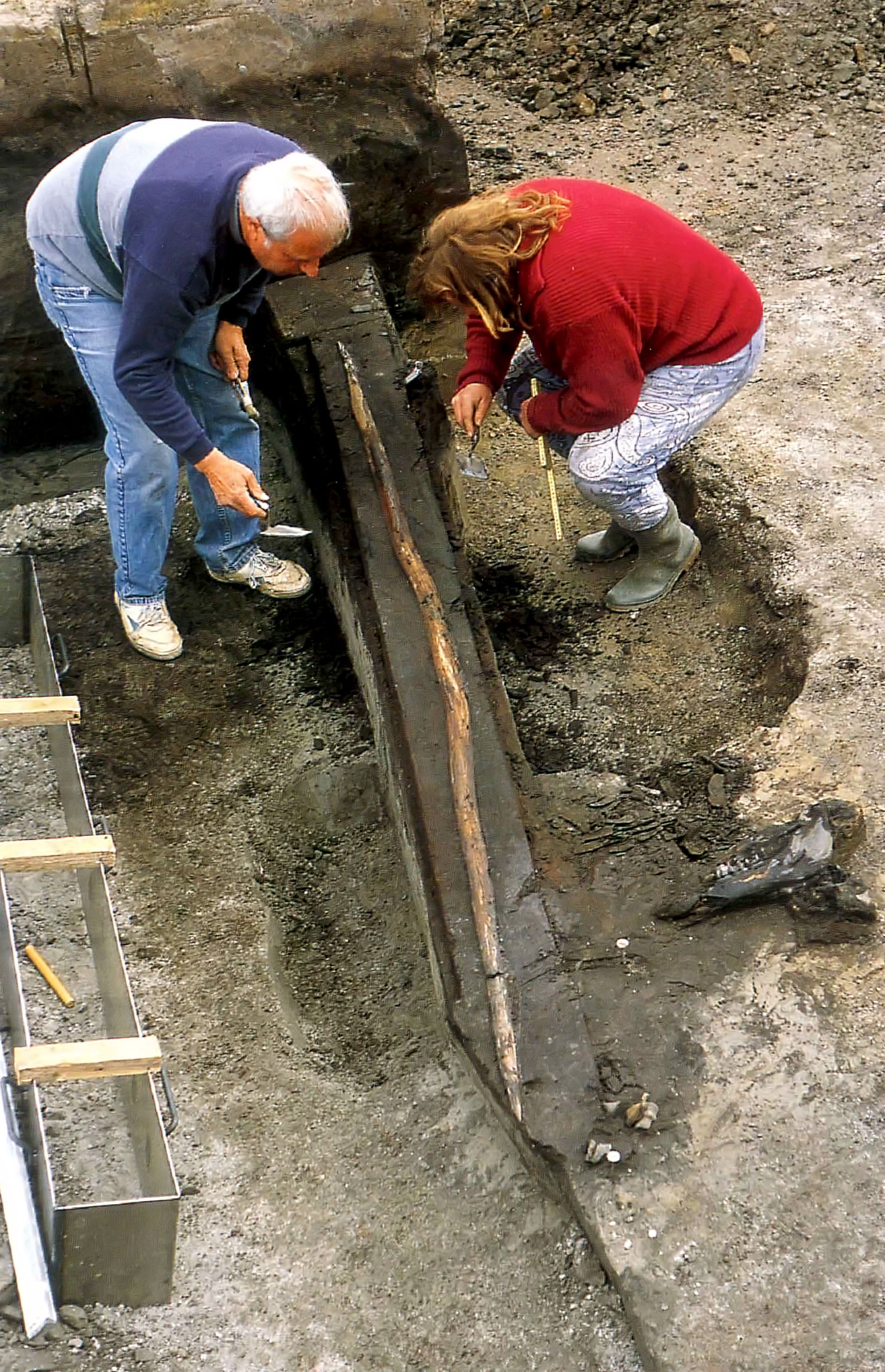
Photograph of one of the Schöningen spears when first found during the 1990s. It was initially proposed that these spears represented the earliest known simple projectile weapons found, since they were dated to 300 000 BP. This proposition places the timing of their emergence with the existence of Homo heidelbergensis.
(Note that the wooden spear has been deformed somewhat by the weight of sediments above it over hundreds of thousands of years. It would, presumably, have initially been straight, with any kinks in the original shaft being taken out by bending while passing it over a fire - Don )
Recently, however, a number of studies have shown that these spears were most probably not used as projectile weapons. In one such study, the size of the tip of the spear was found to be too large to be thrown. The study found that if they had been projected, they could not have been thrown far enough to offer a significant hunting advantage.
(I find this difficult to believe. The pilum was a javelin used by the Roman army. It was generally about 2 metres, well over six feet in length overall, about the same as the spear shown here, and weighed anywhere from 2 to 5 kilograms, 4½ to 11 pounds. The spear shown here would have been lighter than the Roman pilum, which had a heavy iron tip and shank attached to a wooden shaft, and which had a maximum range of approximately 33 metres (100 ft), although the effective accurate range was more like 15–20 m (50–70 ft). This is certainly a good enough range for hunting animals, just as it was for bringing down opposing soldiers for the Roman army - Don )
Photo and text: https://dansimcha.wordpress.com/2012/11/06/initial-schoningen-spear-theory-questioned/
Additional text: Wikipedia
Additional reference: Conard et al. (2015)
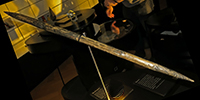
A more detailed page on the Schöningen Spears.
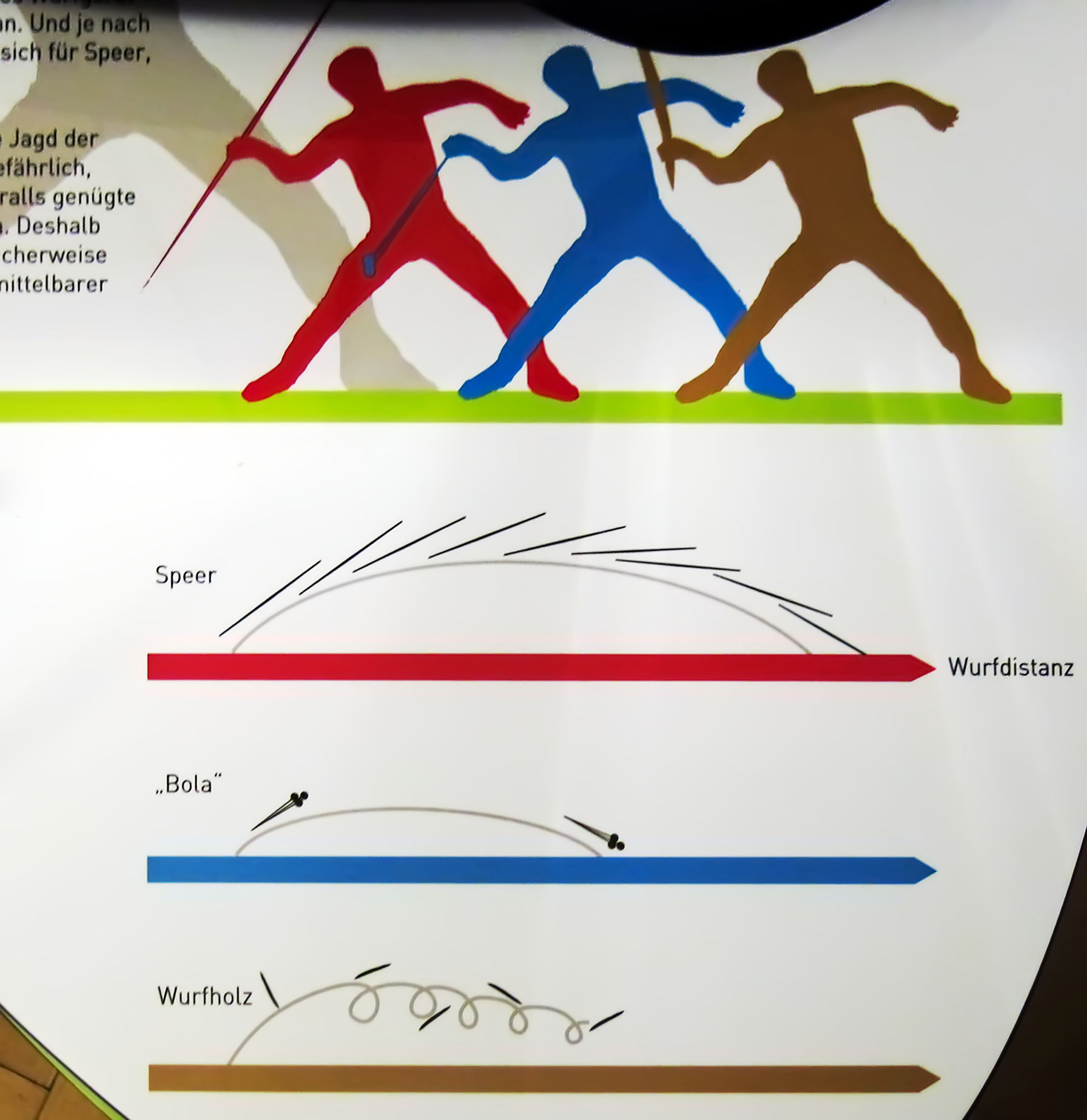
This diagram shows clearly the flight paths, and relative distances attained when thrown, for the spear, bola, and throwing stick.
Photo of Display: Don Hitchcock 2015
Source and text: Monrepos Archäologisches Forschungszentrum und Museum, Neuwied, Germany
Acheulean Hand Axe
Cordiform (heart shaped) Profile.
Palaeolithic, circa 500 000 BP
This is a classic quartzite Acheulean handaxe from North Africa, found in a dry watercourse, a small tributary of the Draa river, near Tan Tan,
at N 28.23233, W 10.59947.
Dimensions 220 mm x 115 mm x 60 mm.
Photo: Don Hitchcock 2016
Source: Private collection
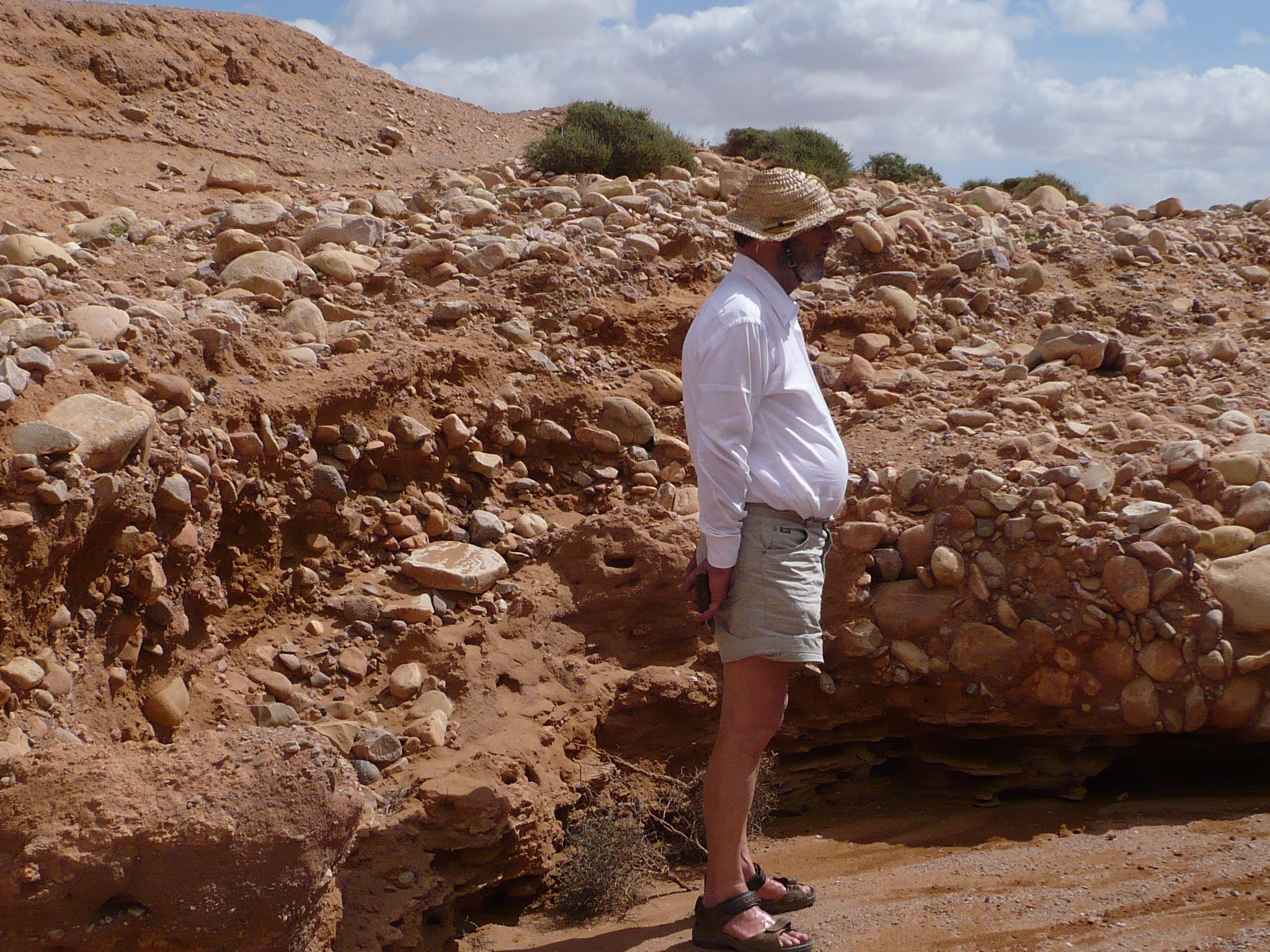
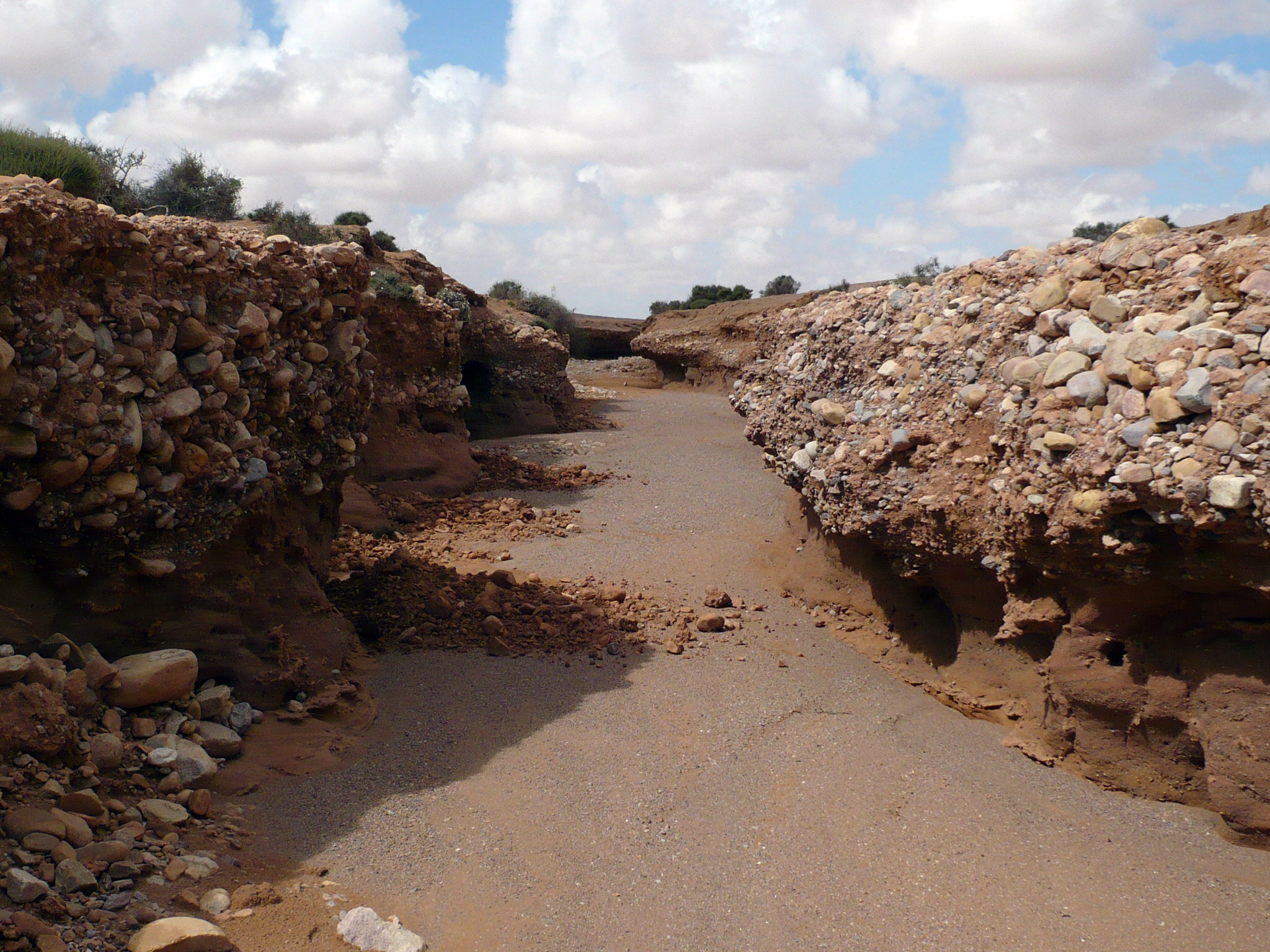
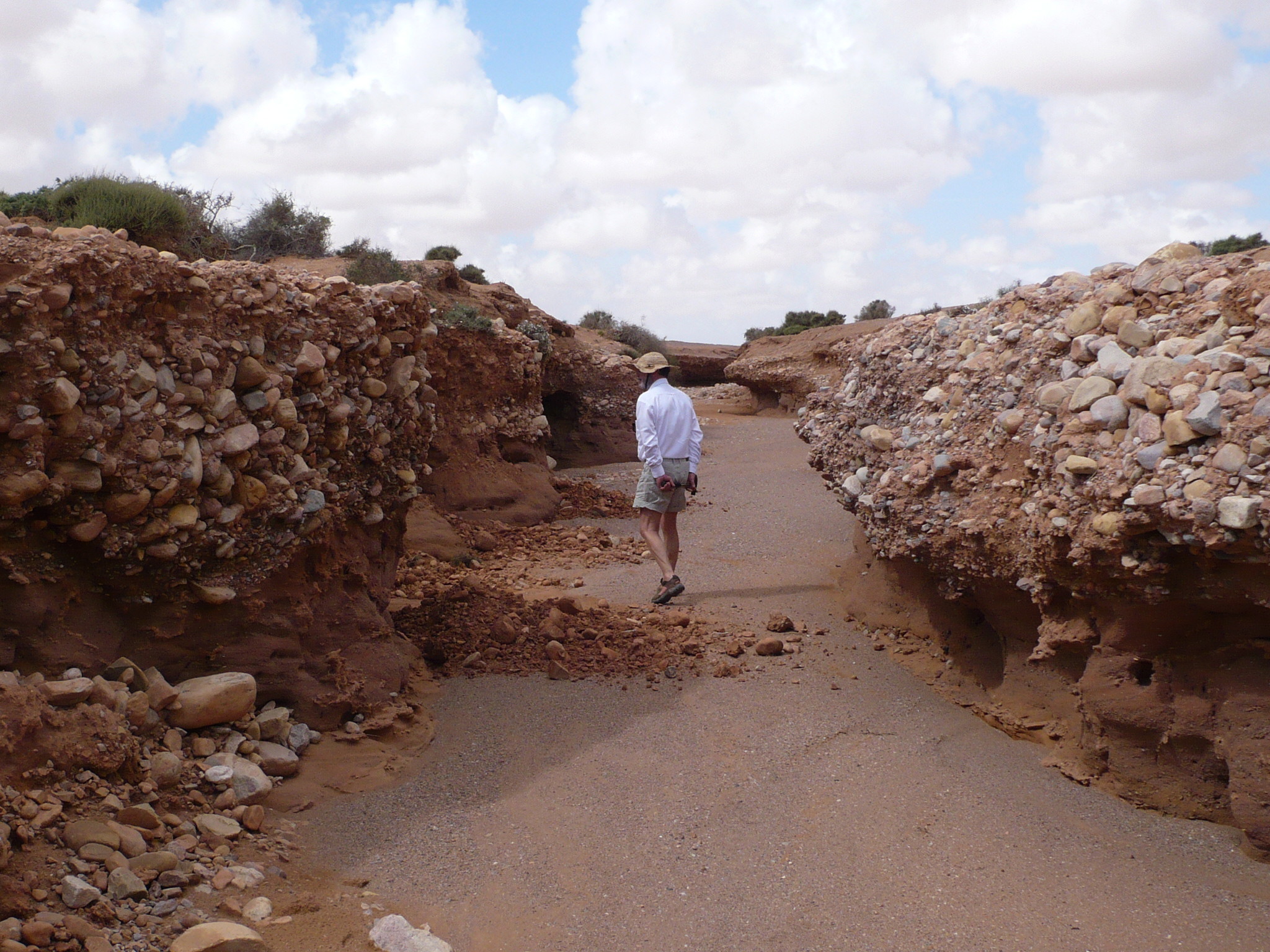
Dry wadi from which the handaxe above was retrieved.
It is a small tributary of the Draa river, near Tan Tan,
at N 28.23233, W 10.59947.
It is thought that an exceptional flood deposited all these stones here at once.
Photos: © Corry Zuurdeeg
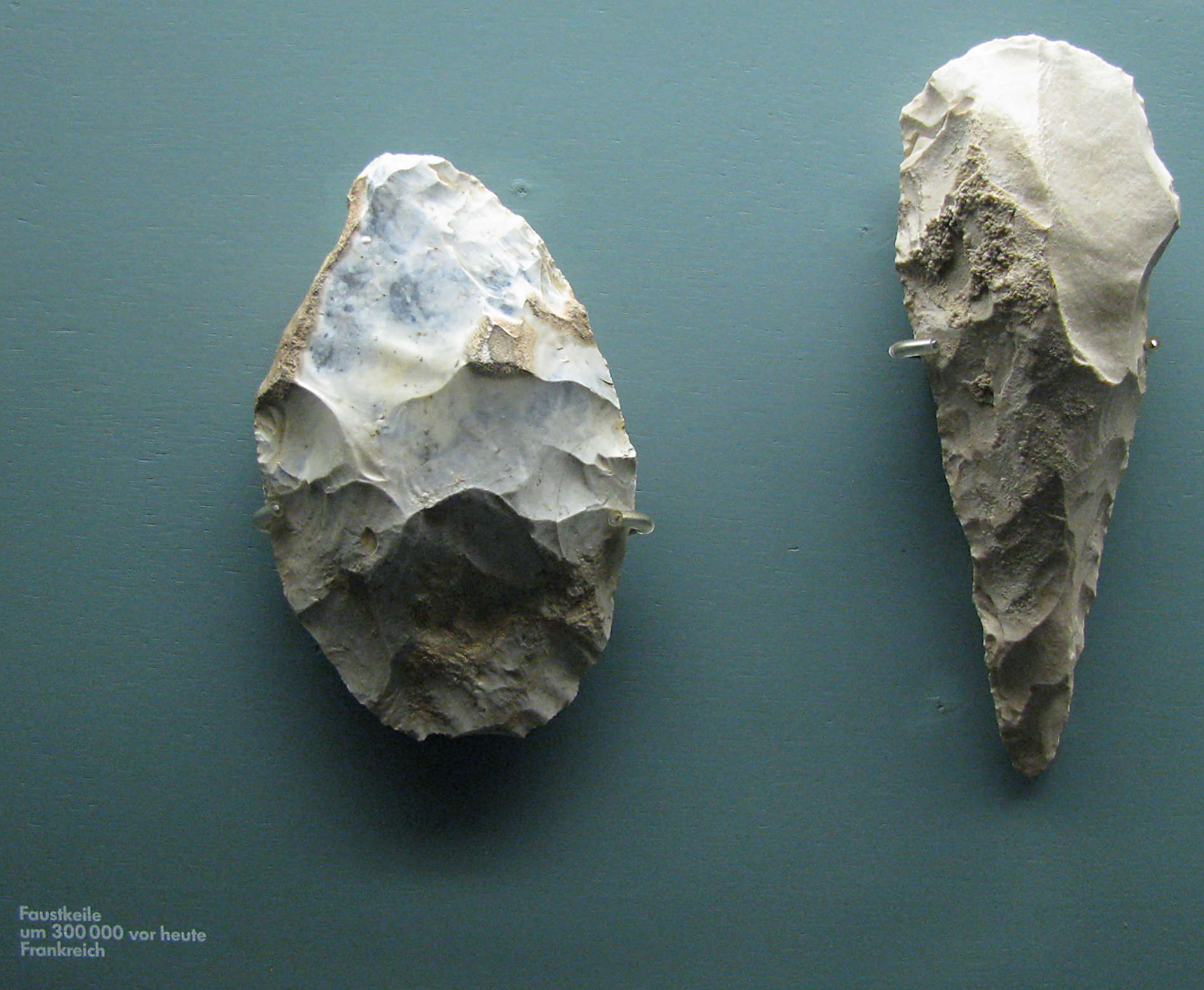
Bifacial flint hand axes, 300 000 BP.
From France.
Photo: Don Hitchcock 2008
Source: Badisches Landesmuseum Karlsruhe Germany


Bifacial flint hand axes, 300 000 BP, from France. These are the same specimens as the two in the photo above.
Although developed more than one million years ago in Africa, the hand axe spread throughout Europe over time. The early handaxe industry of Western Europe is named after the site of Saint Acheul near Amiens, as Acheulian.
Photo: Don Hitchcock 2015
Source: Badisches Landesmuseum Karlsruhe Germany
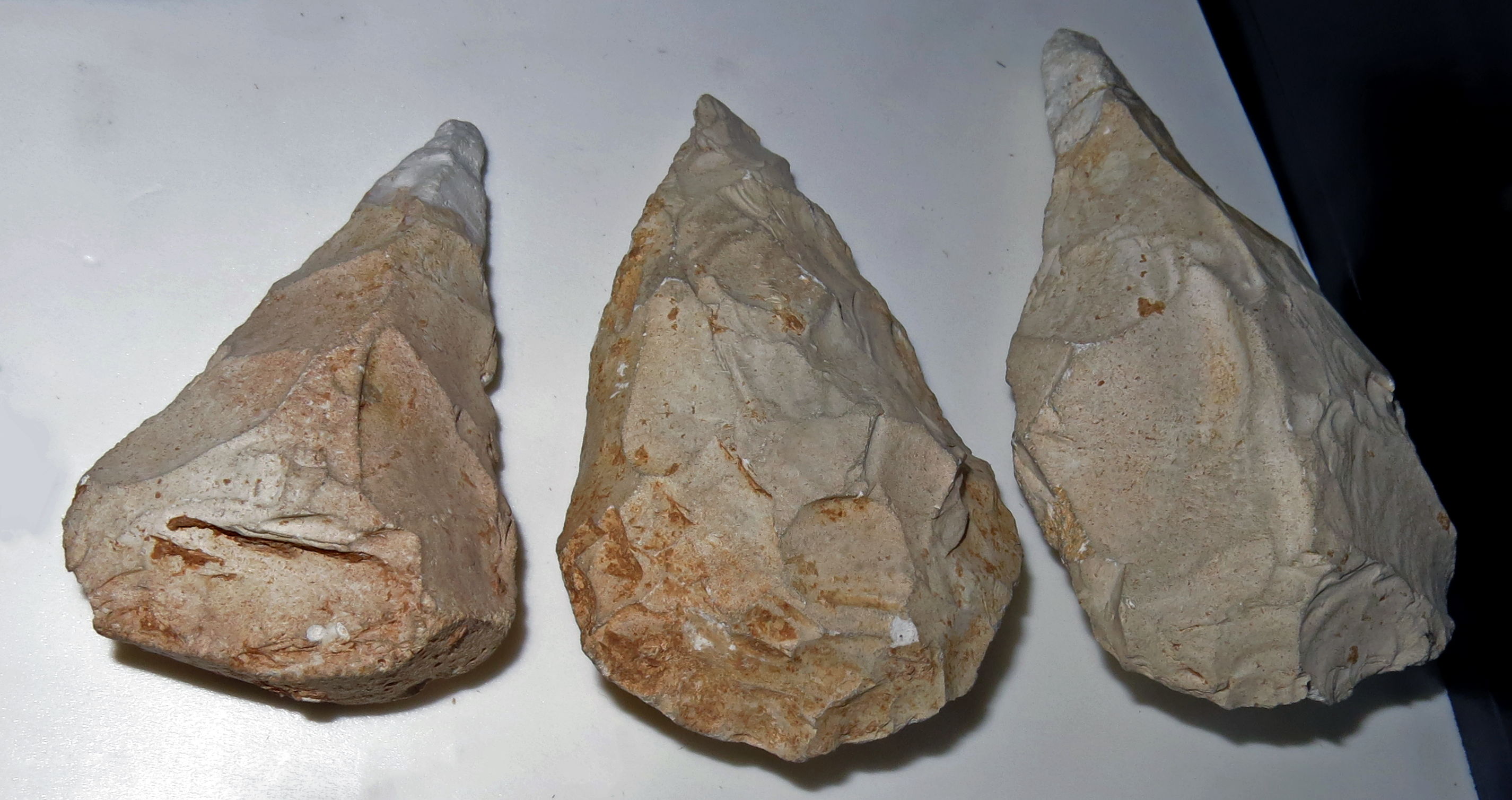
Acheulian hand axes, 300 000 BP, from la Micoque, France.
Photo: Don Hitchcock 2015
Source and text: Original, Monrepos Archäologisches Forschungszentrum und Museum, Neuwied, Germany
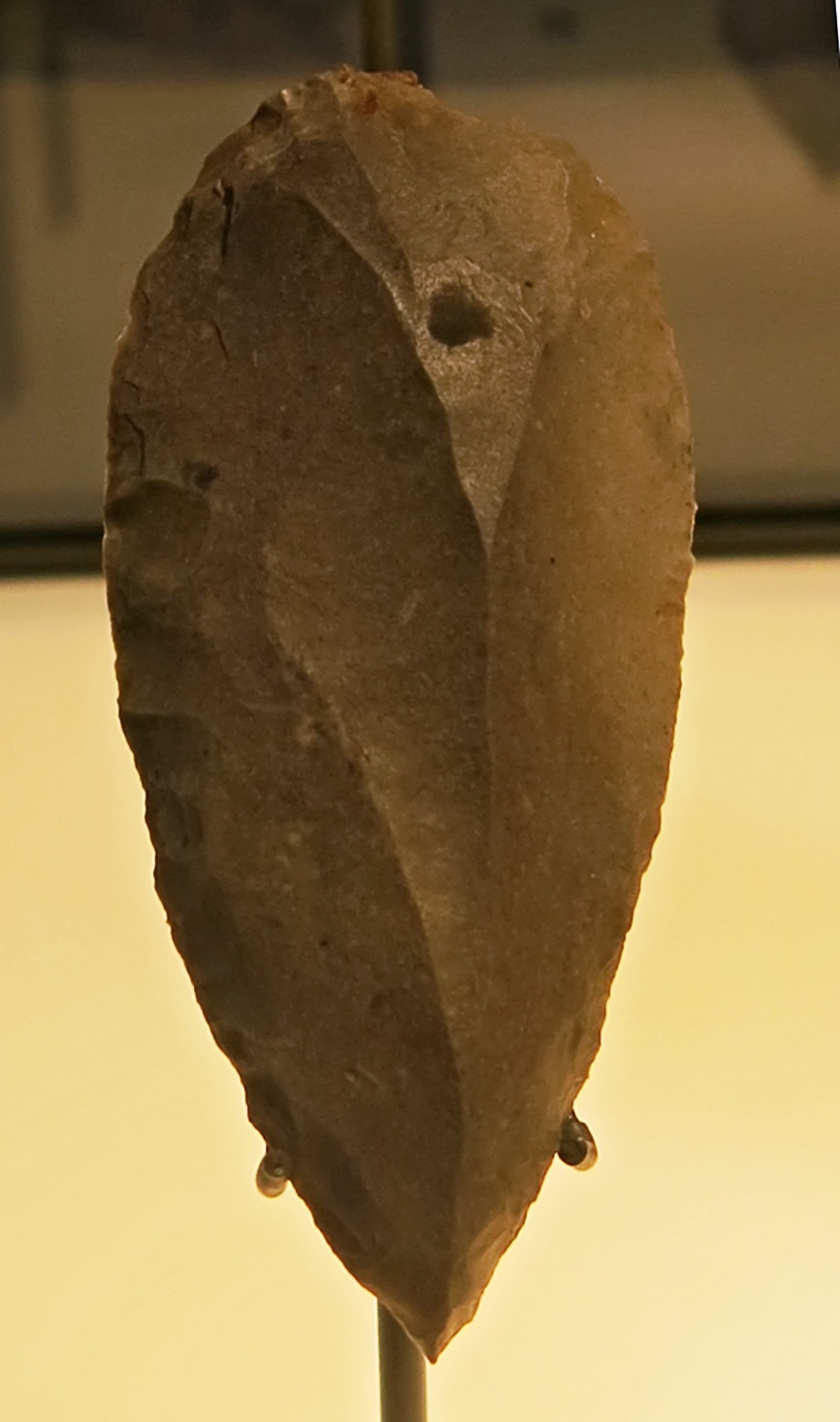
Spear point, 300 000 BP - 250 000 BP, from the Belvédère loess and gravel quarry, near Maastricht, Netherlands.
In 1980 archaeologists discovered a Neanderthal site in the Belvédère loess and gravel quarry, near Maastricht. Twelve concentrations of flint and bone material were excavated. Some of the 'encampments', situated on the banks of the Meuse (Maas) River at that time, date from a warm period before the last ice age, over 250 000 years ago.
The densely wooded region overlooked a sluggish, widely meandering river. Deciduous forests surrounded the old river channels. Higher up, the land was more open. The sites were covered with sediment when the Meuse flooded its banks, preserving everything more or less intact. By refitting pieces of flint debris and tools, we can learn more about the activities of Neanderthals. We find that they often visited the banks briefly, to make or repair tools and search for flint. Some tools were taken elsewhere, while others were used in the direct vicinity.
The wooded, watery region of the Meuse (Maas) valley abounds in foods such as fruits, nuts and fish. As keen meat eaters, the Neanderthals hunted game. Animals like rhinoceros, forest elephant, bison, roe deer, and giant deer liked to graze and drink on the banks of the Meuse, making this an ideal hunting ground.
Photo: Don Hitchcock 2014
Source and text: Original, Rijksmuseum van Oudheden, National Museum of Antiquities, Leiden.
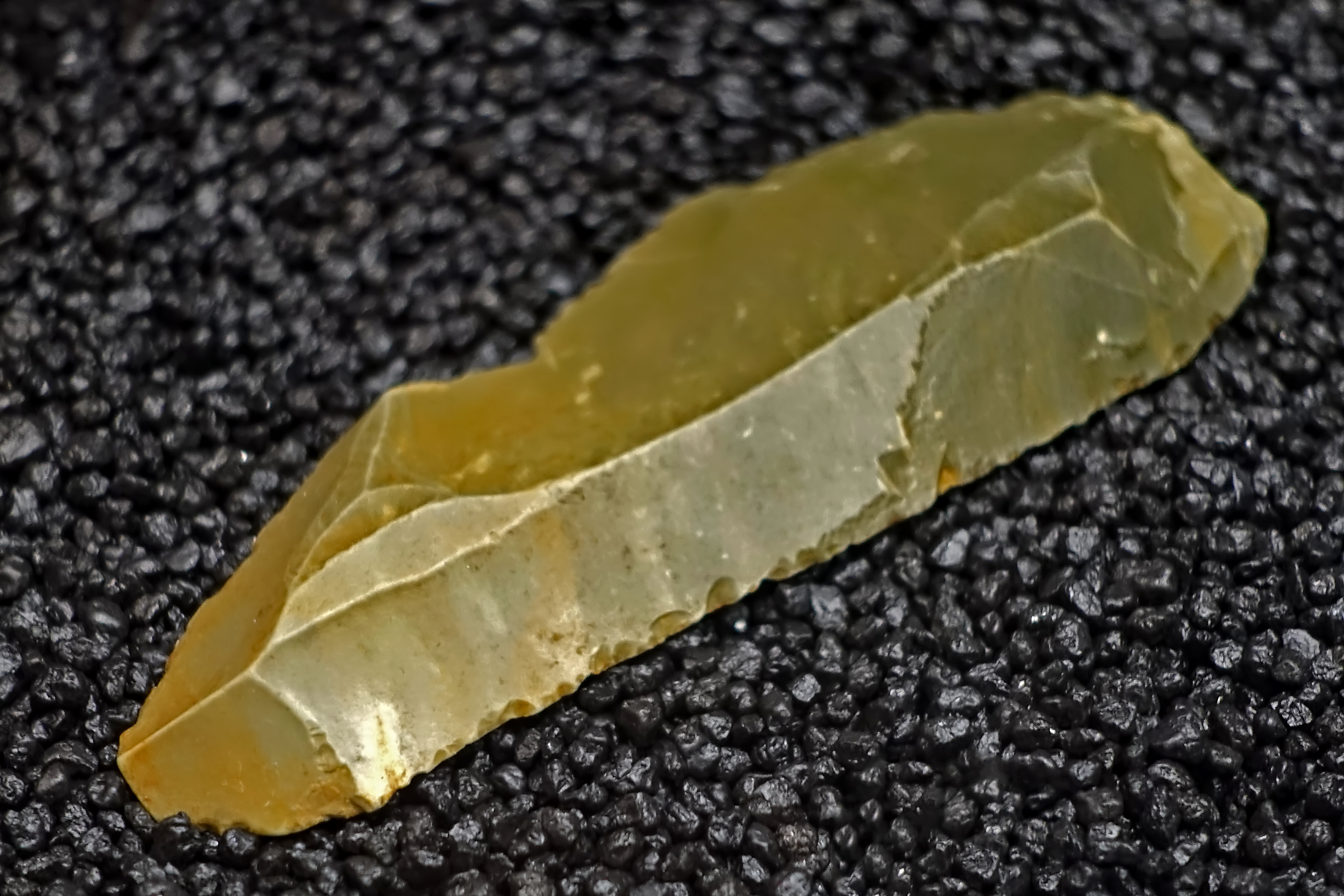
Lupemban-style flake used as a scraping tool by Homo heidelbergensis or early Homo sapiens.
From Kalambo Falls, Tanzania/Zambia border, around 300 000 BP to 200 000 BP.
Catalog: E3647
Photo: Don Hitchcock 2018
Source and text: The Natural History Museum, Cromwell Road, London SW7 5BD
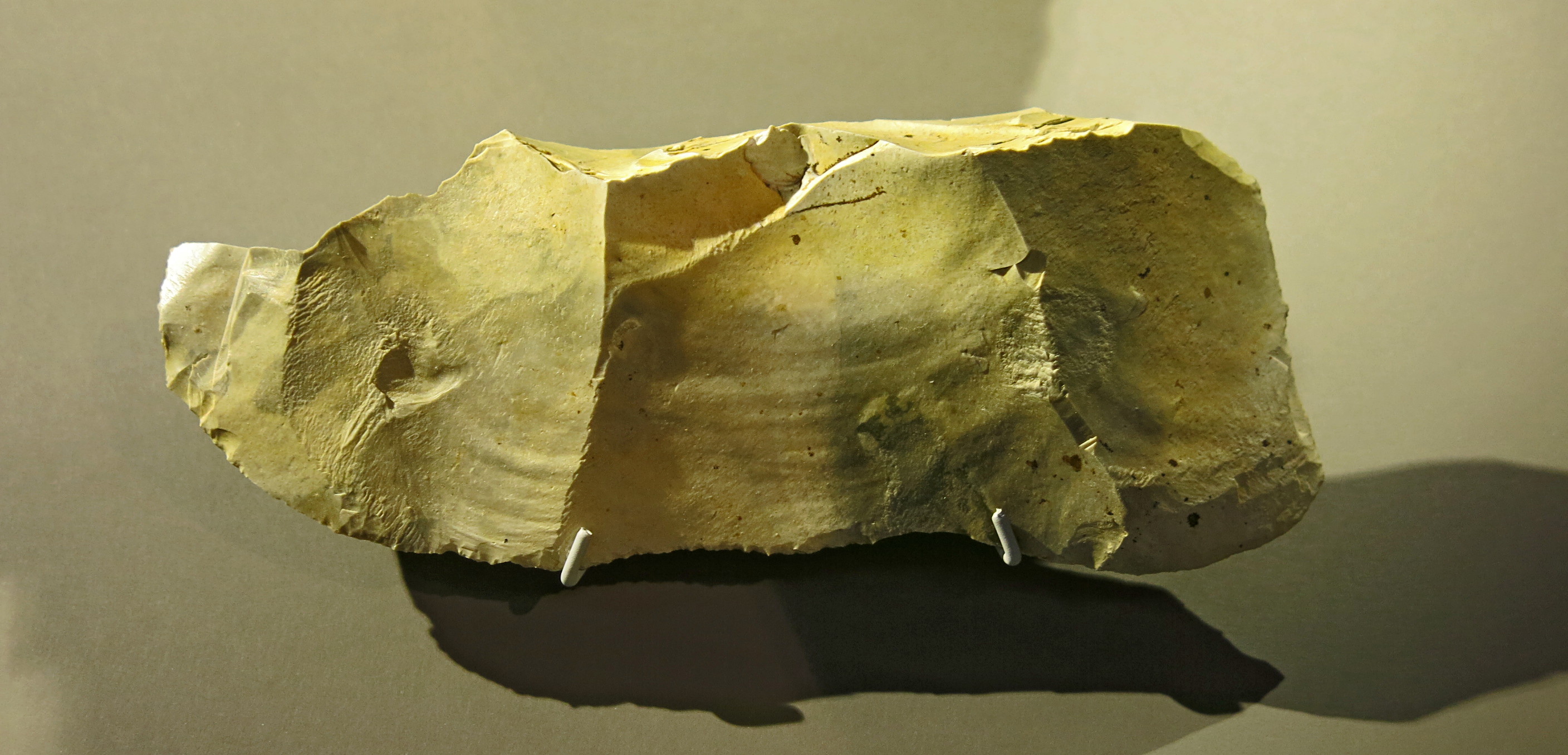
Backed knife, flint, site G, 300 000 BP - 250 000 BP, from the Belvédère loess and gravel quarry, near Maastricht, Netherlands.
Neanderthals were excellent hunters. Their weapons and technical prowess, and above all their communication, planning and intelligence put them at the top of the food chain. But how can flint provide the proof for this? Much can be learned by microscopically examining the traces of wear on flint and reproducing these in experiments.
Traces found on one knife resemble those made when slaughtering a thick-skinned animal or pachyderm. The knife in question was found among the remains of two young rhinoceroses.
Photo: Don Hitchcock 2014
Source and text: Original, Rijksmuseum van Oudheden, National Museum of Antiquities, Leiden.
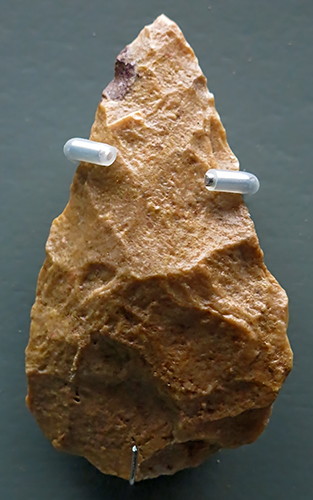
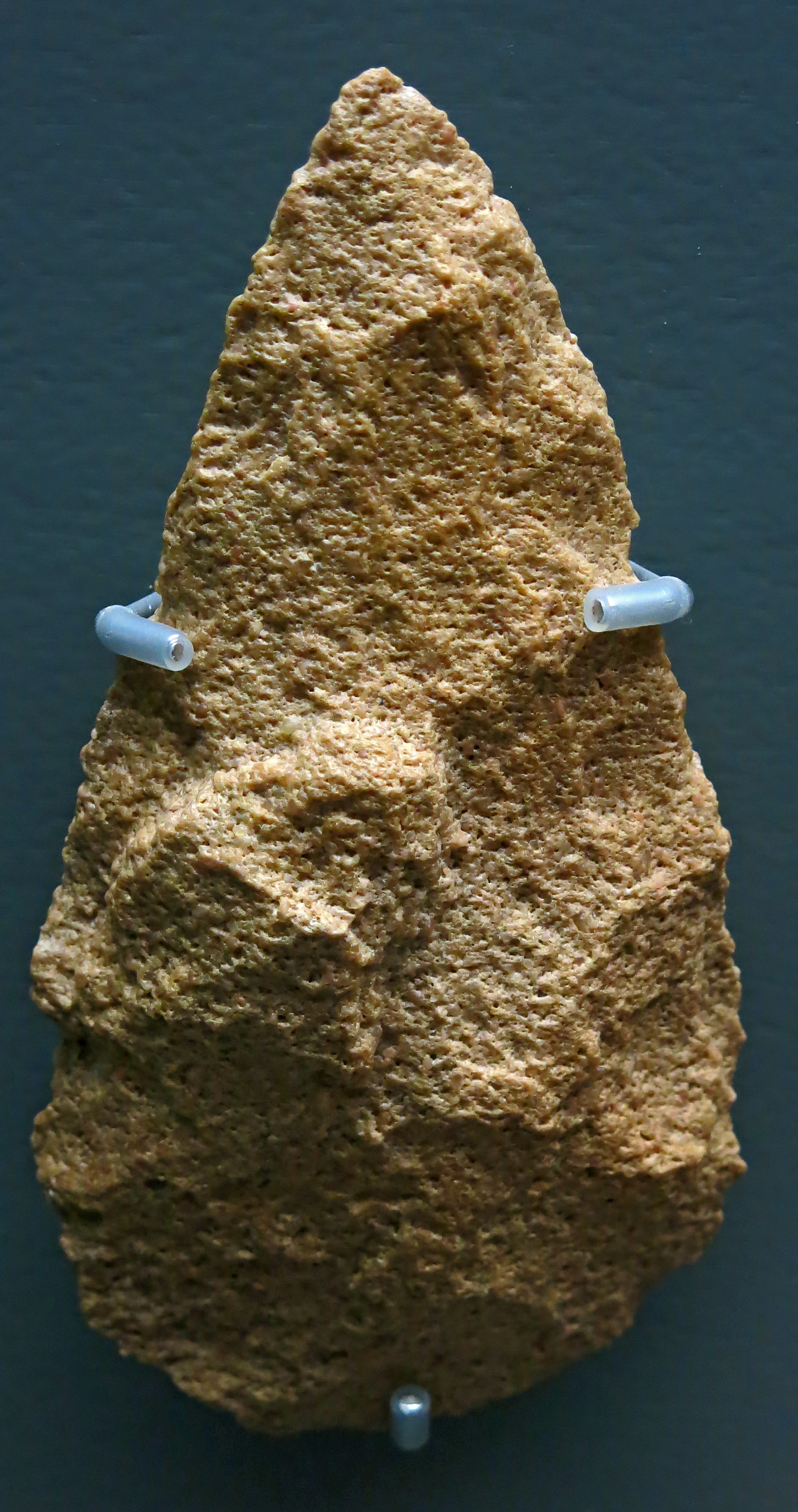
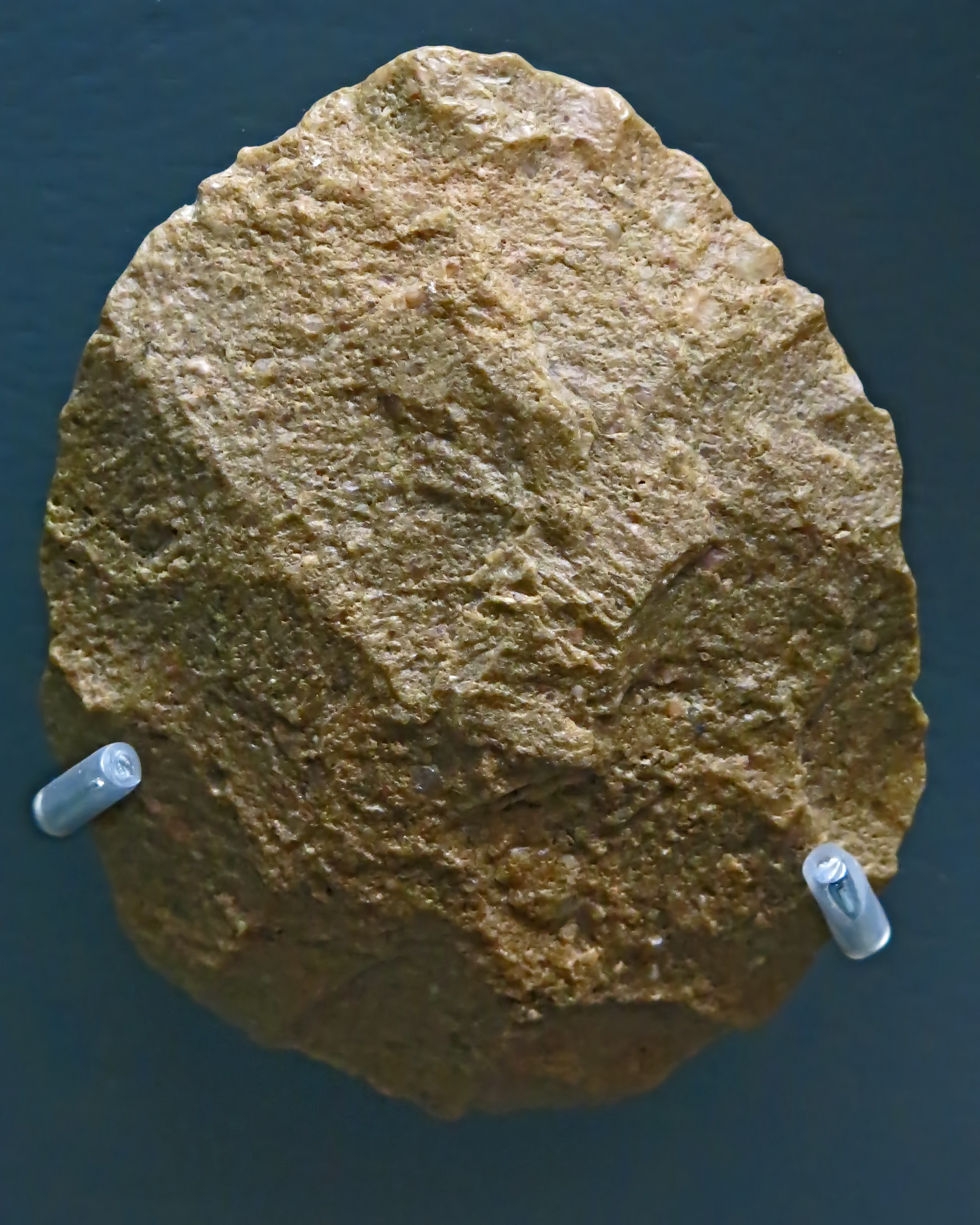
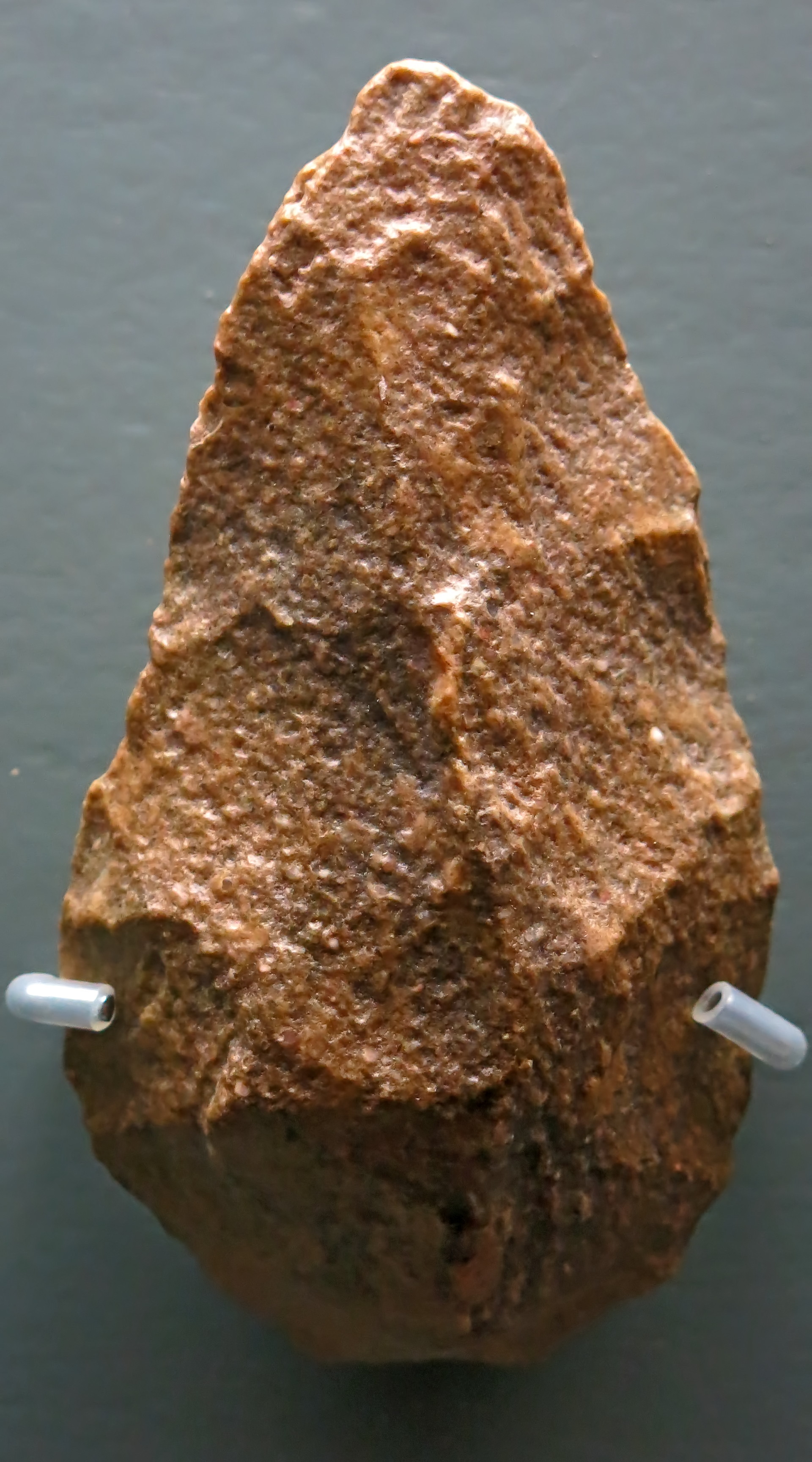
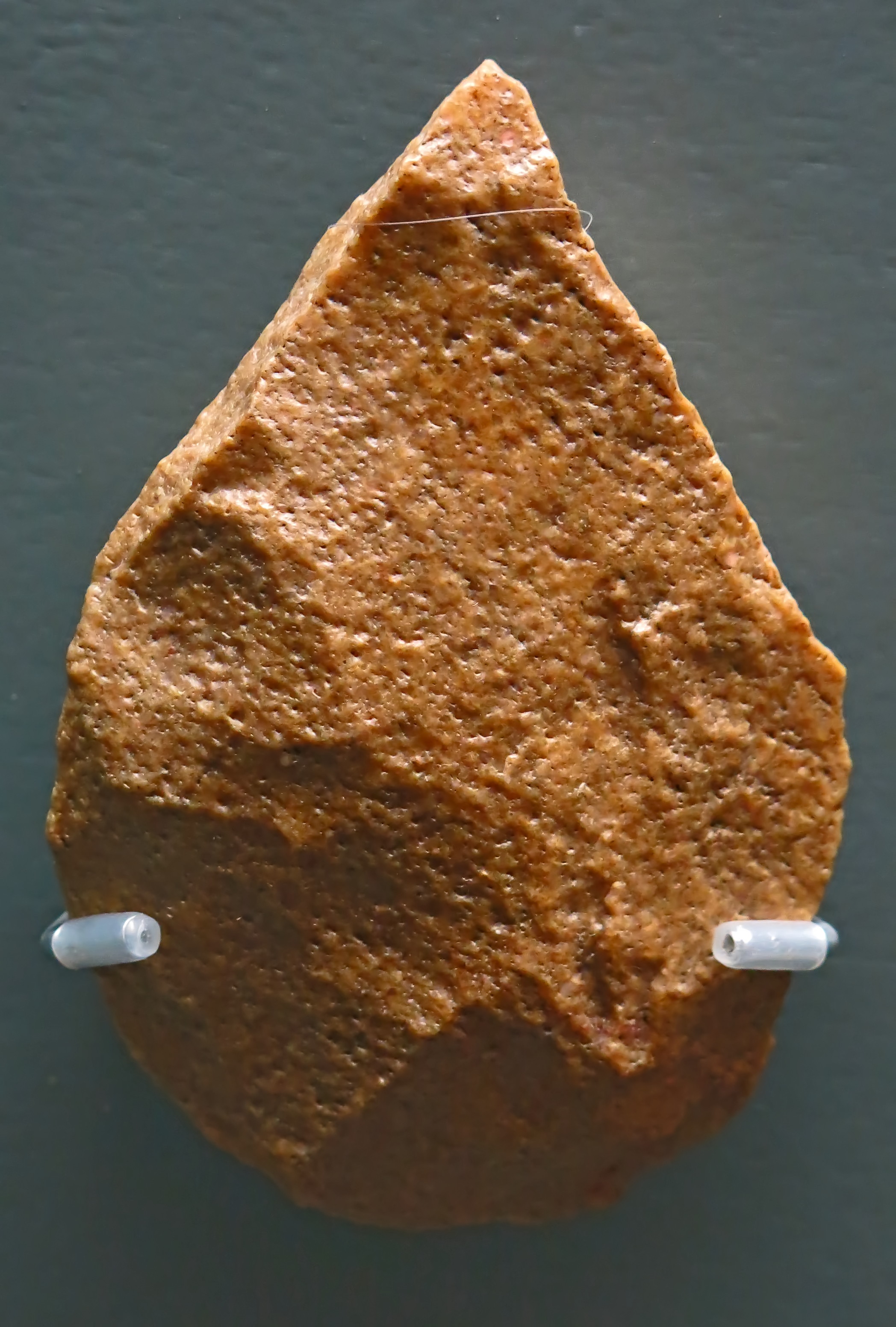
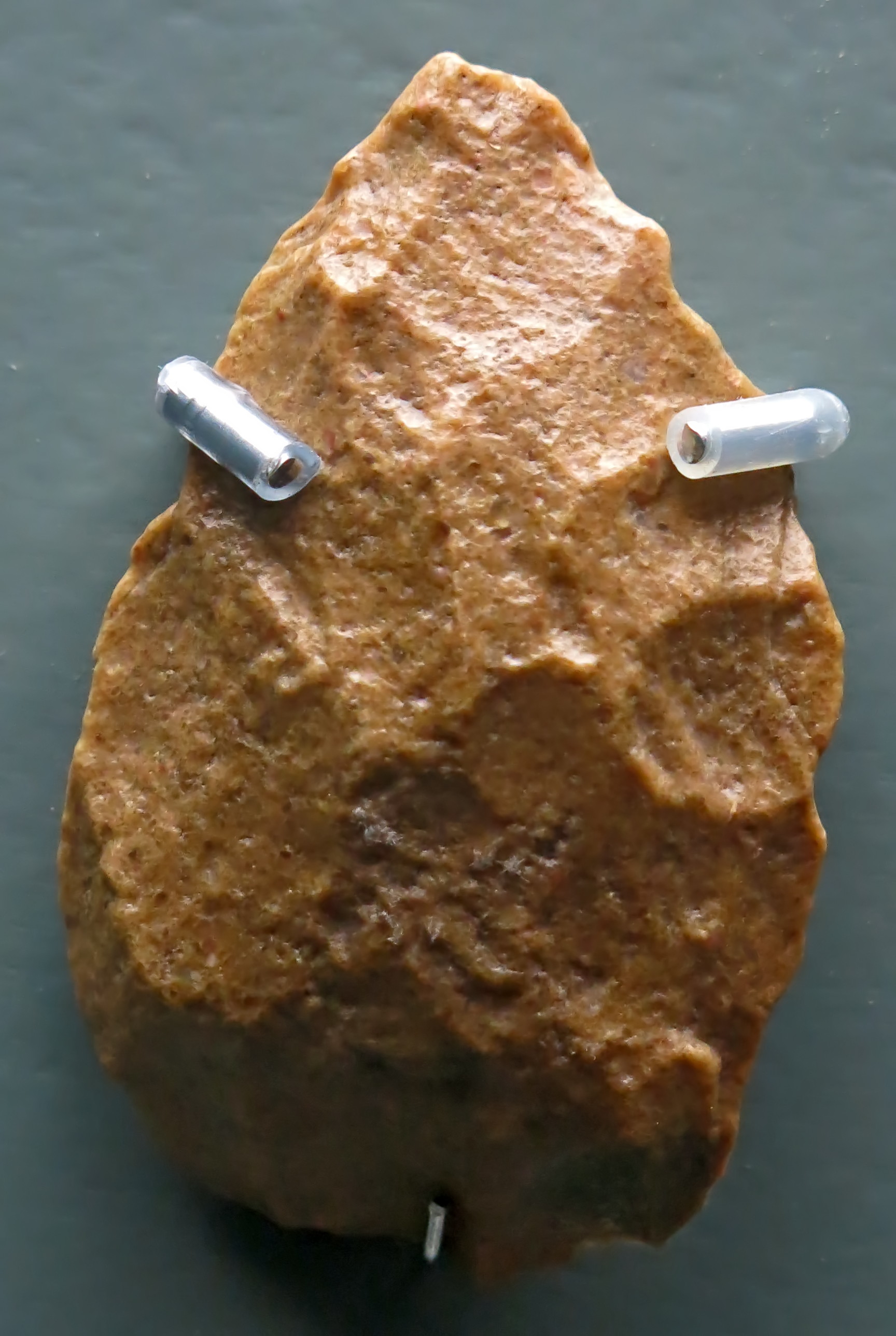
Six quartzite handaxes from the Sahara, circa 200 000 BP.
Handaxes are a characteristic tool of the ancient palaeolithic. Typical are the round base and the opposite point. Handaxes were made without a handle, and were held and used in the fist.
On their surface, the pieces typically show the so-called 'desert lacquer', a patina which is formed by their time on the surface of the desert.
Catalog: Inv. No. 2008 / 835-840
Photo: Don Hitchcock 2015
Source: Badisches Landesmuseum Karlsruhe Germany
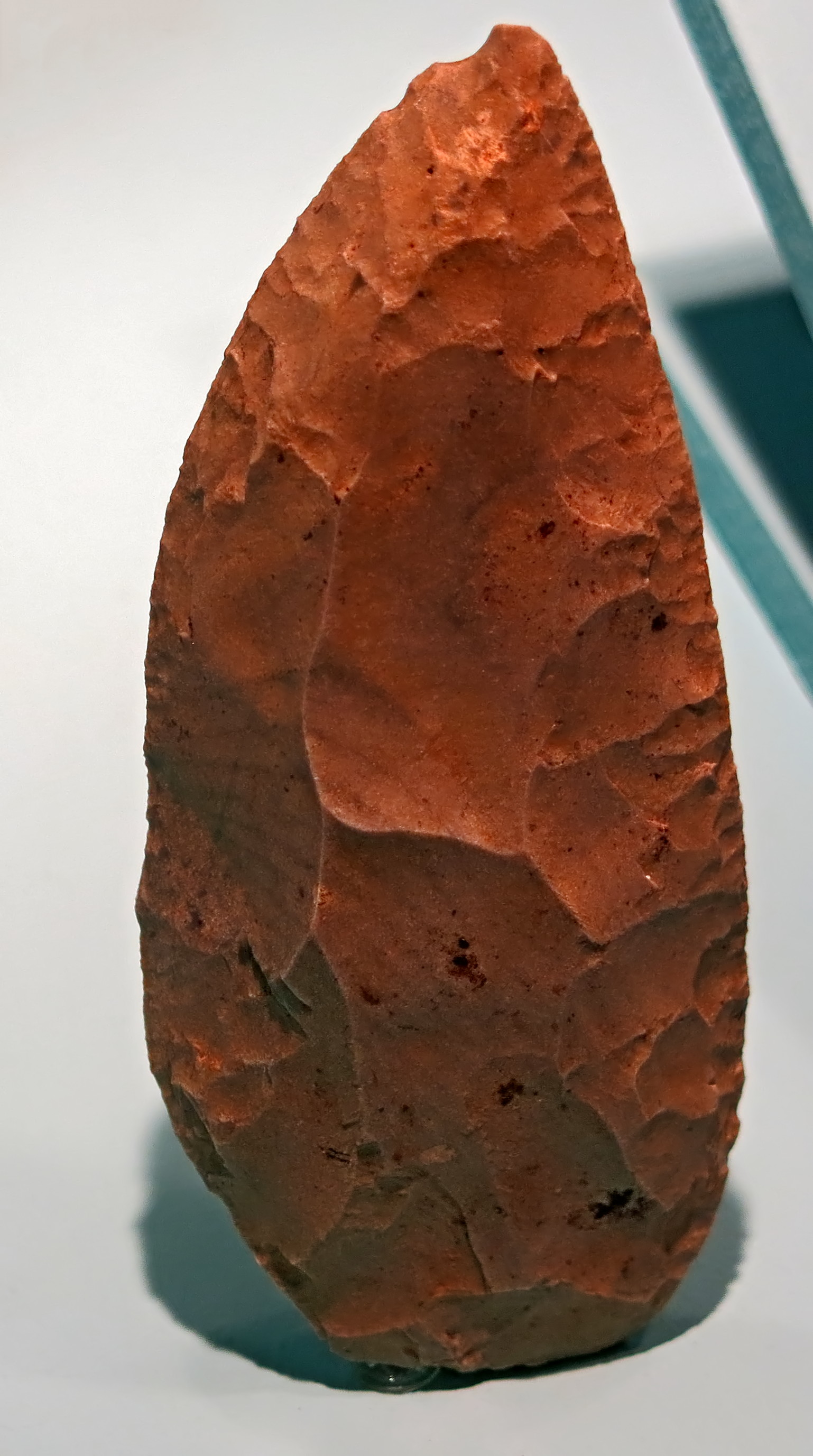
Flint handaxe, 200 000 BP - 150 000 BP.
( This is a quite sophisticated tool for the time. Certainly it is fairly thick, but it is much longer than it is wide, unusual for a handaxe, and it has been beautifully finished with careful and skilled retouching on the faces and edges, in the style of a much later era. - Don )
Rheindahlen, Stadt Mönchengladbach
Photo: Don Hitchcock 2015
Source and text: LVR-Landesmuseum Bonn, Germany
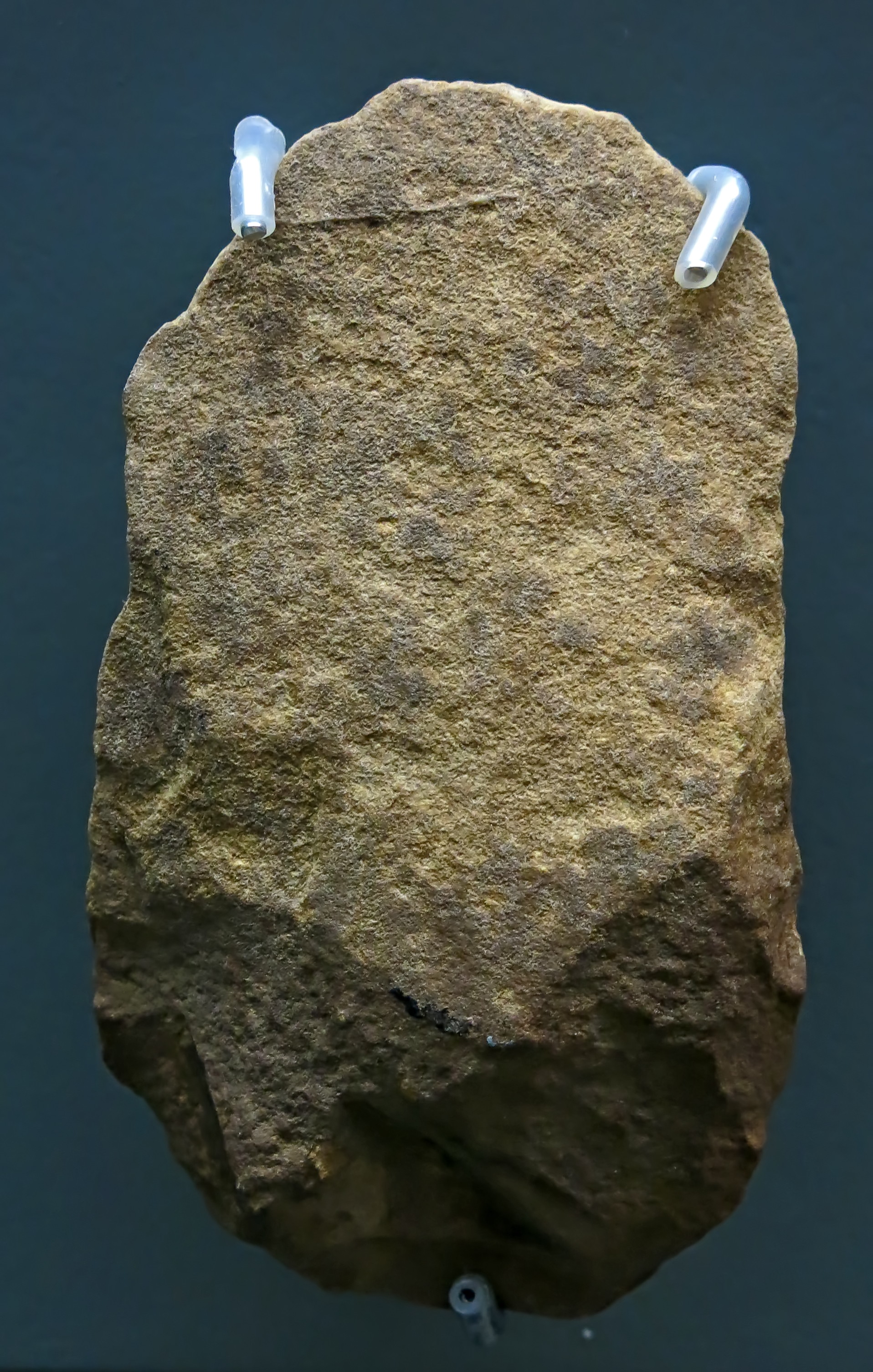
Broad quartzite handaxe, location unknown.
Old Palaeolithic
The piece is distinguished by its oval shape, compared with the more normal pointed shape. No doubt the piece has been extensively reworked after much use.
Its desert lacquer patination came from spending some time on the surface of the ground.
Catalog: Inv. No. C 735
Photo: Don Hitchcock 2015
Source: Badisches Landesmuseum Karlsruhe Germany
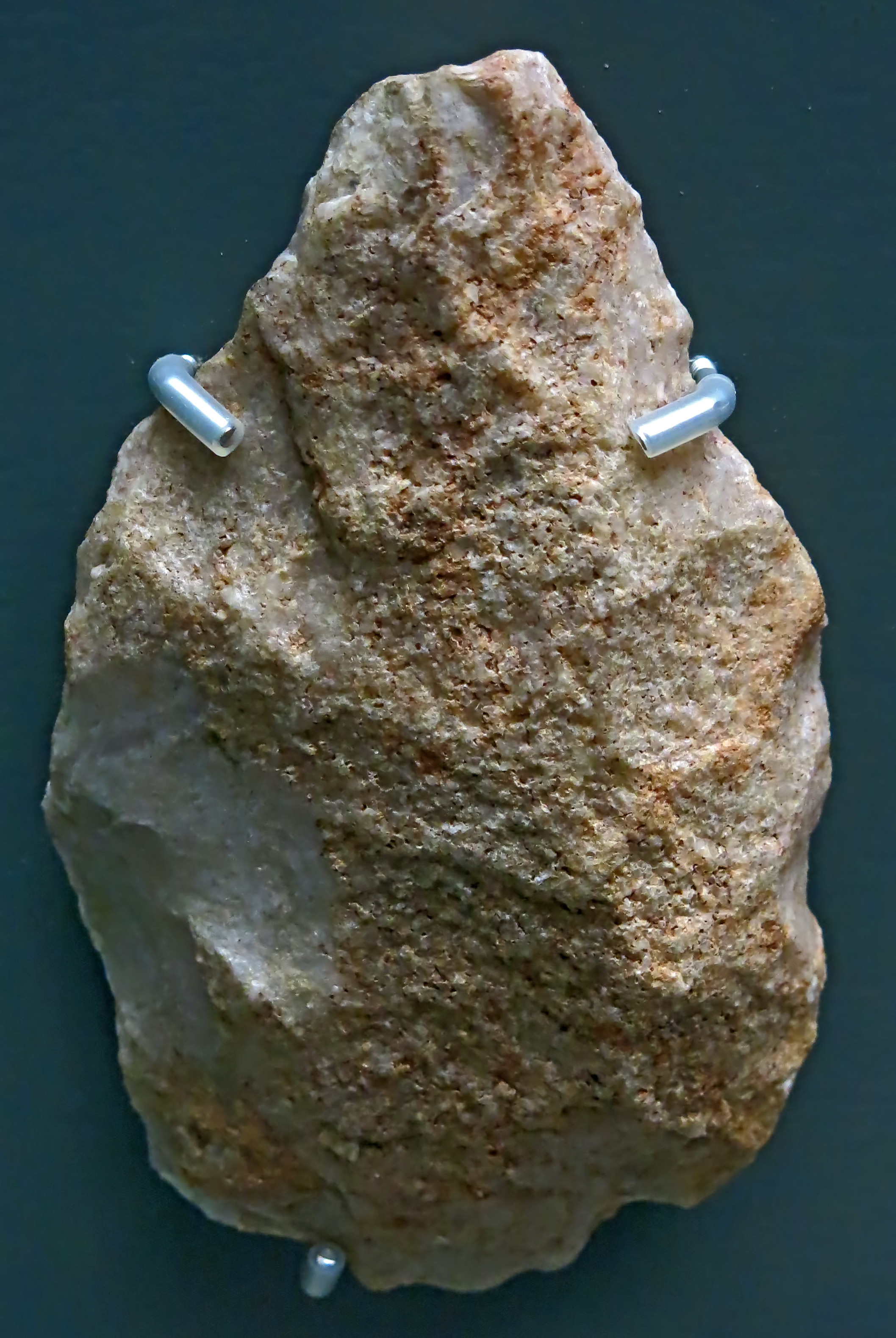
Quartzite handaxe from the old Palaeolithic of East Africa.
These were used for cutting, stabbing, drilling, scraping and striking. They were thus an optimal tool for cutting up animals after hunting. Because of the wide range of uses, the handaxe is also known as the 'Swiss Pocket Knife of Prehistory'.
Photo: Don Hitchcock 2015
Source: Badisches Landesmuseum Karlsruhe Germany
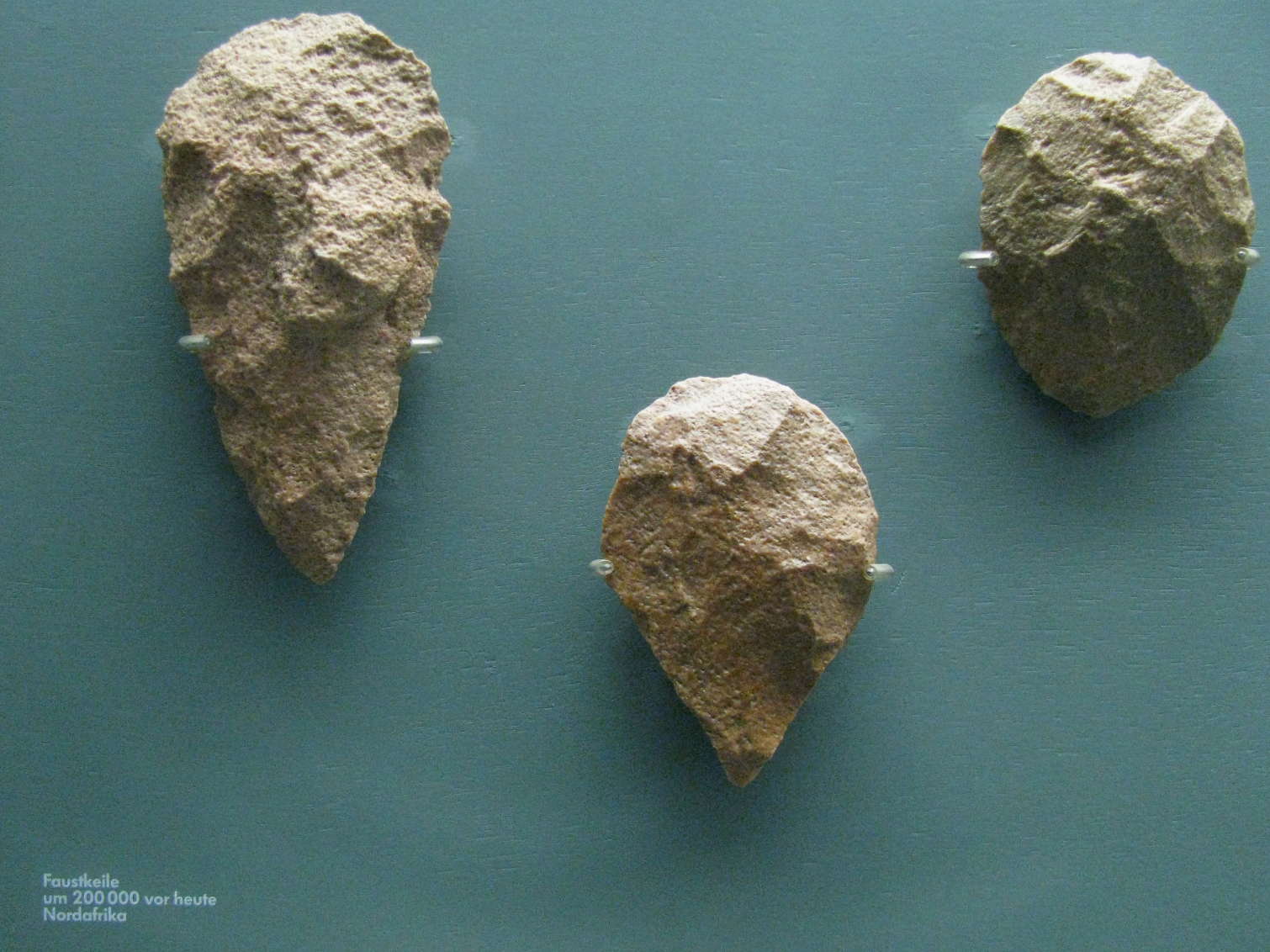
Hand axes from North Africa.
200 000 BP.
These are of a coarse grained material, possibly quartzite.
Photo: Don Hitchcock 2008
Source: Badisches Landesmuseum Karlsruhe Germany
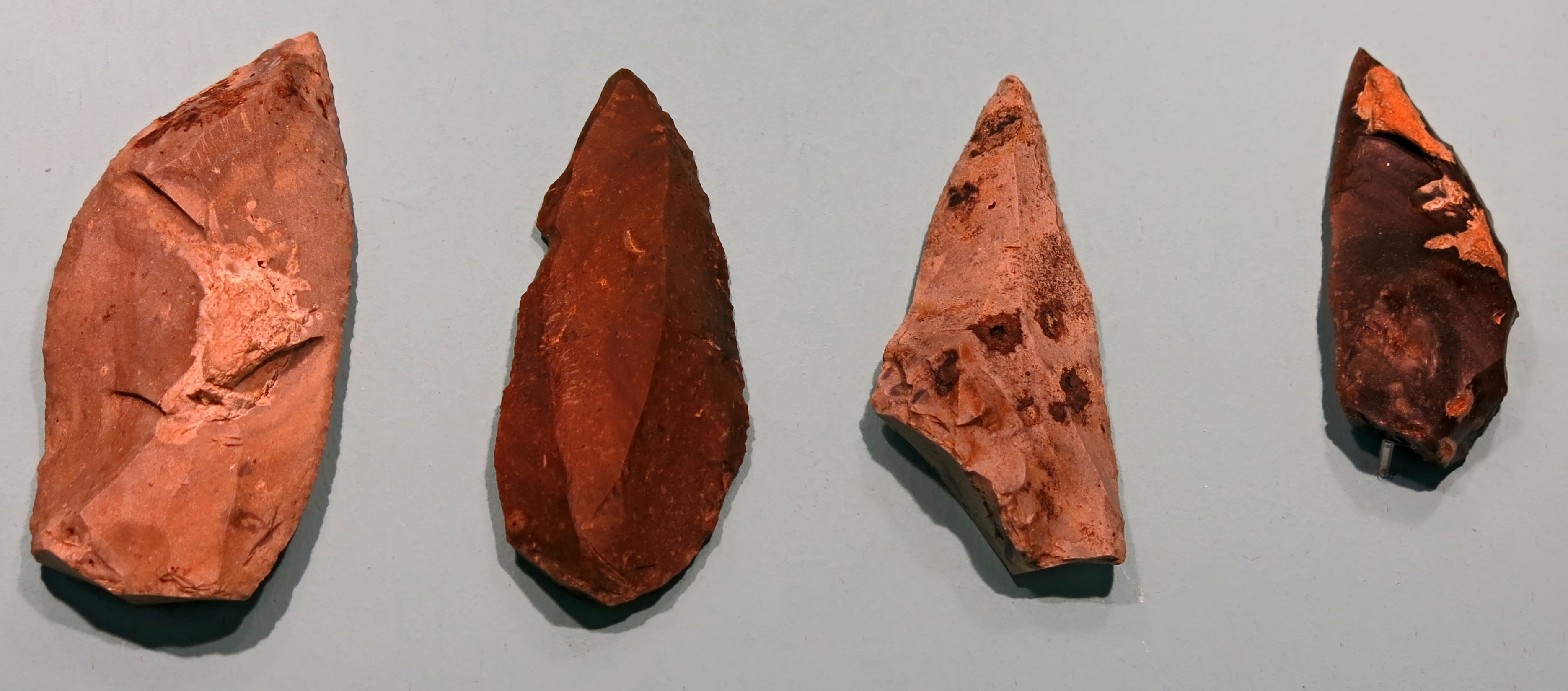
Flint spear tips, circa 200 000 BP - 150 000 BP.
Rheindahlen, Stadt Mönchengladbach.
Photo: Don Hitchcock 2015
Source and text: LVR-Landesmuseum Bonn, Germany
Additional text: http://www.georallye.uni-bonn.de/kartstein_bei_satzvey

Acheulian hand axe.
Photo: Don Hitchcock 2015
Source: Original, Musée d'Aquitaine à Bordeaux
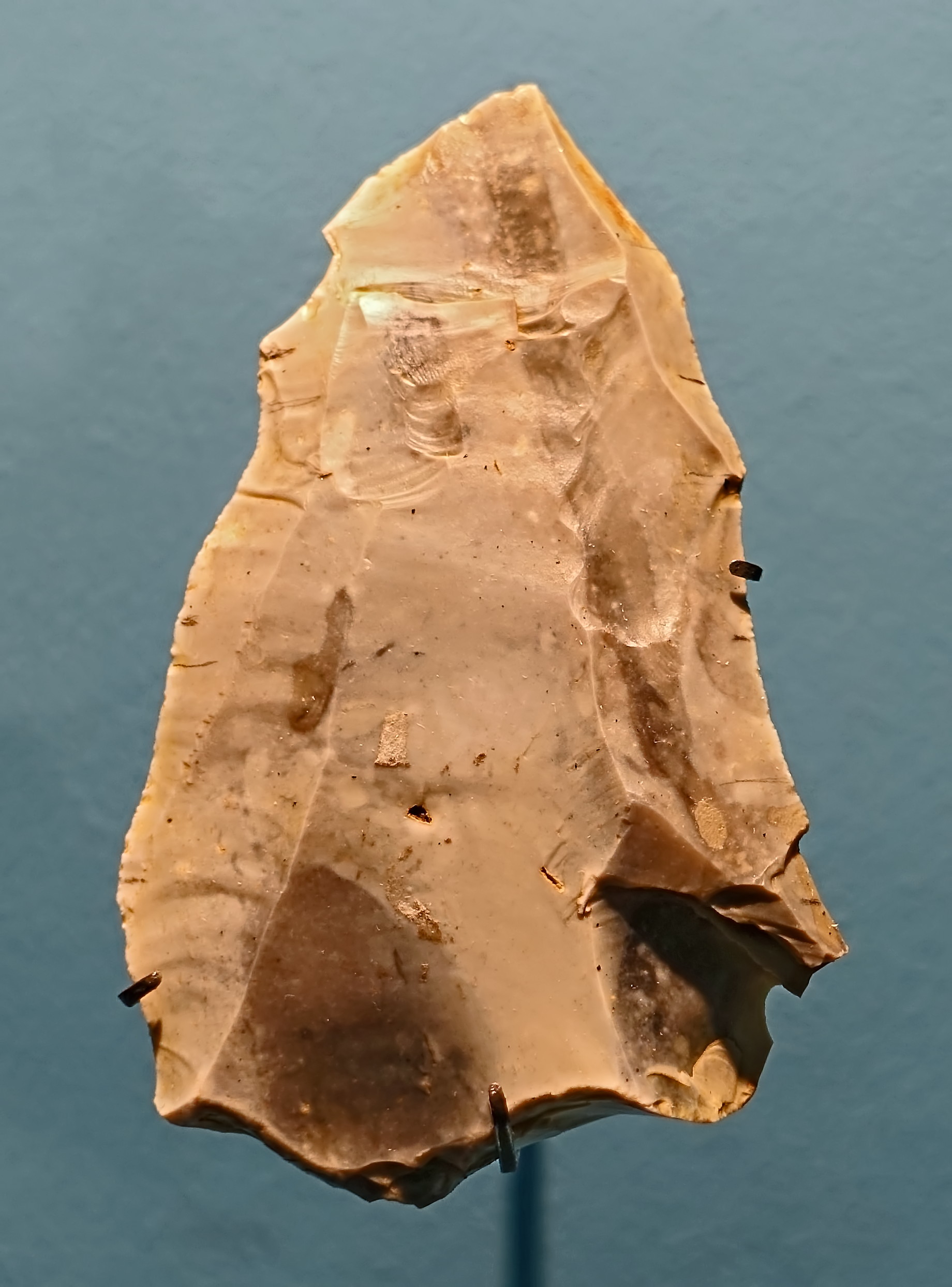
Levallois Point, in flint.
From Therdonne, France
Circa 178 000 BP
Photo: Don Hitchcock 2018
Source and text: Musée de l'Homme, Paris
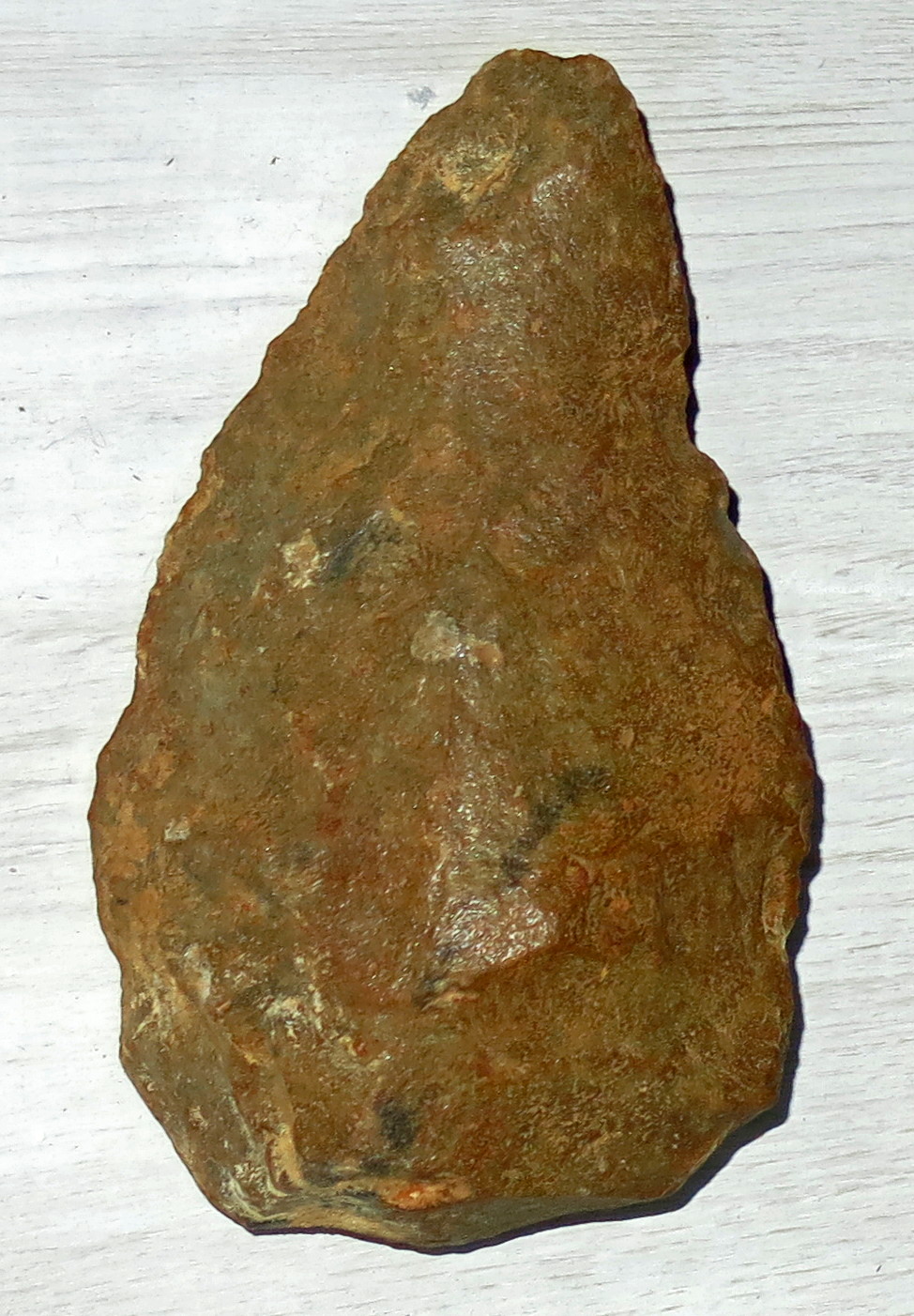
Handaxe, Soissons, France.
Circa 120 000 BP - 40 000 BP.
Photo: Don Hitchcock 2015
Source and text: Neanderthal Museum, Mettmann, near Düsseldorf, Germany
On loan from the Löbbecke Museum, Düsseldorf.
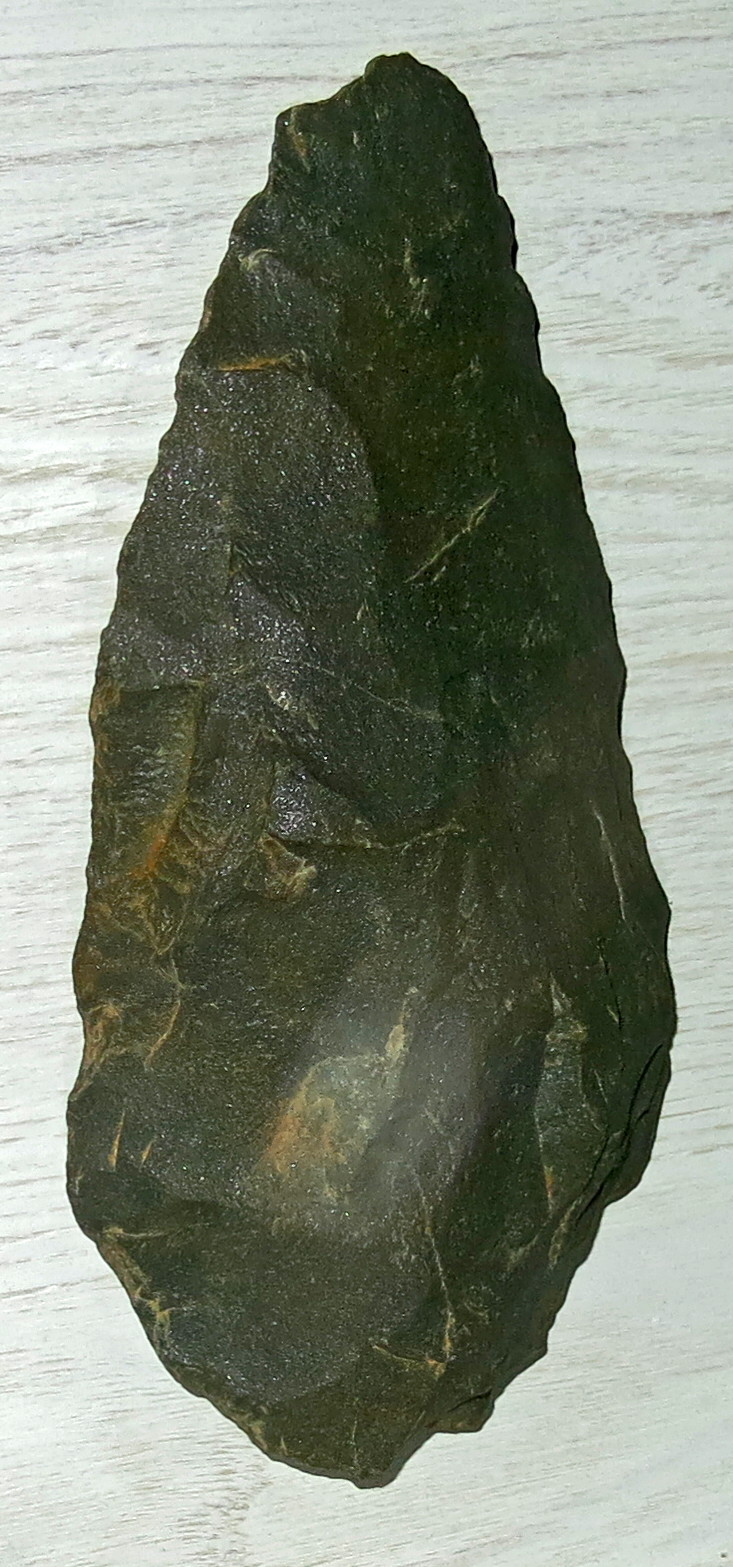
Handaxe, France.
Circa 120 000 BP - 40 000 BP.
Photo: Don Hitchcock 2015
Source and text: Neanderthal Museum, Mettmann, near Düsseldorf, Germany
On loan from the Löbbecke Museum, Düsseldorf.
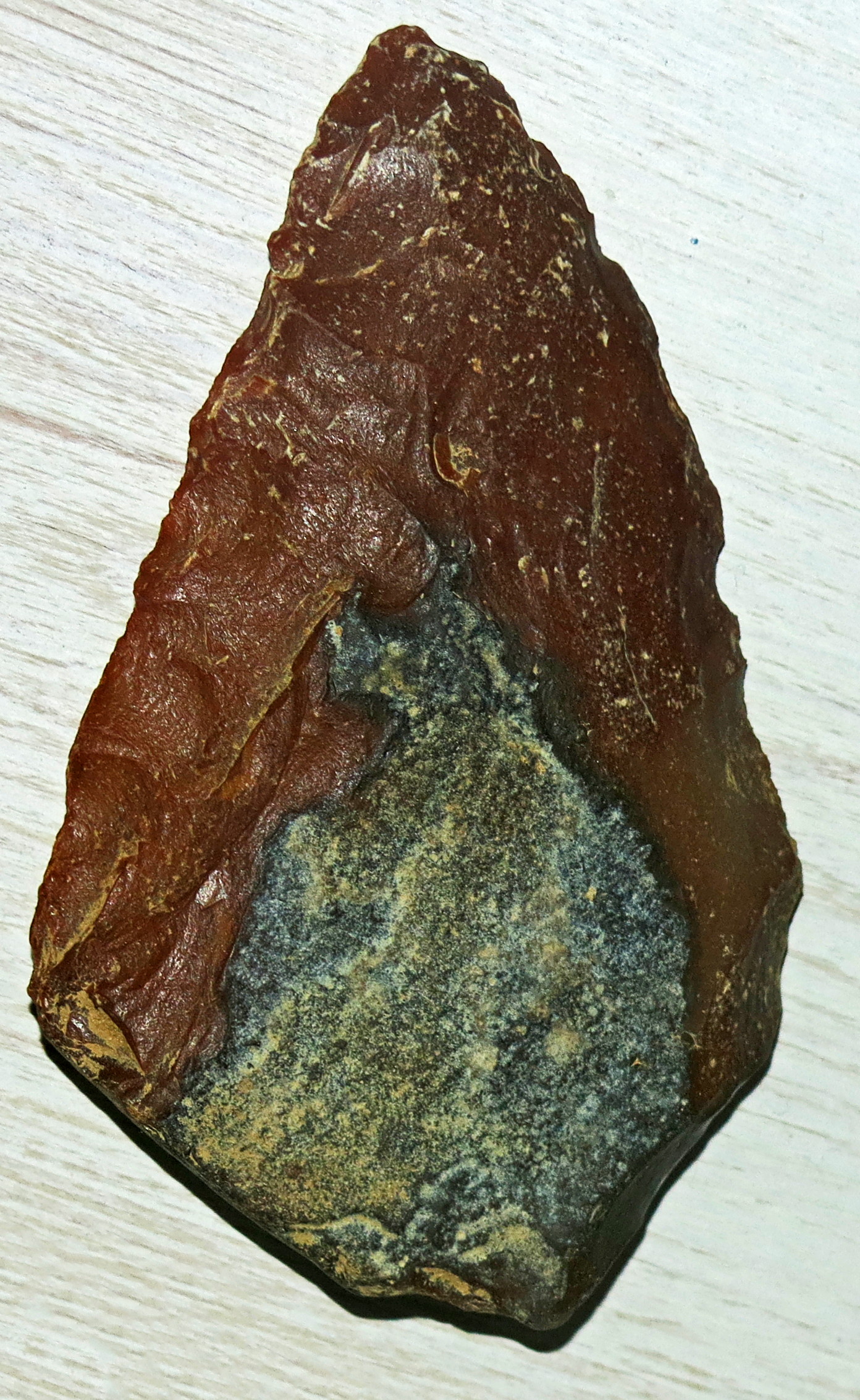
Handaxe, France.
Circa 120 000 BP - 40 000 BP.
Photo: Don Hitchcock 2015
Source and text: Neanderthal Museum, Mettmann, near Düsseldorf, Germany
On loan from the Löbbecke Museum, Düsseldorf.
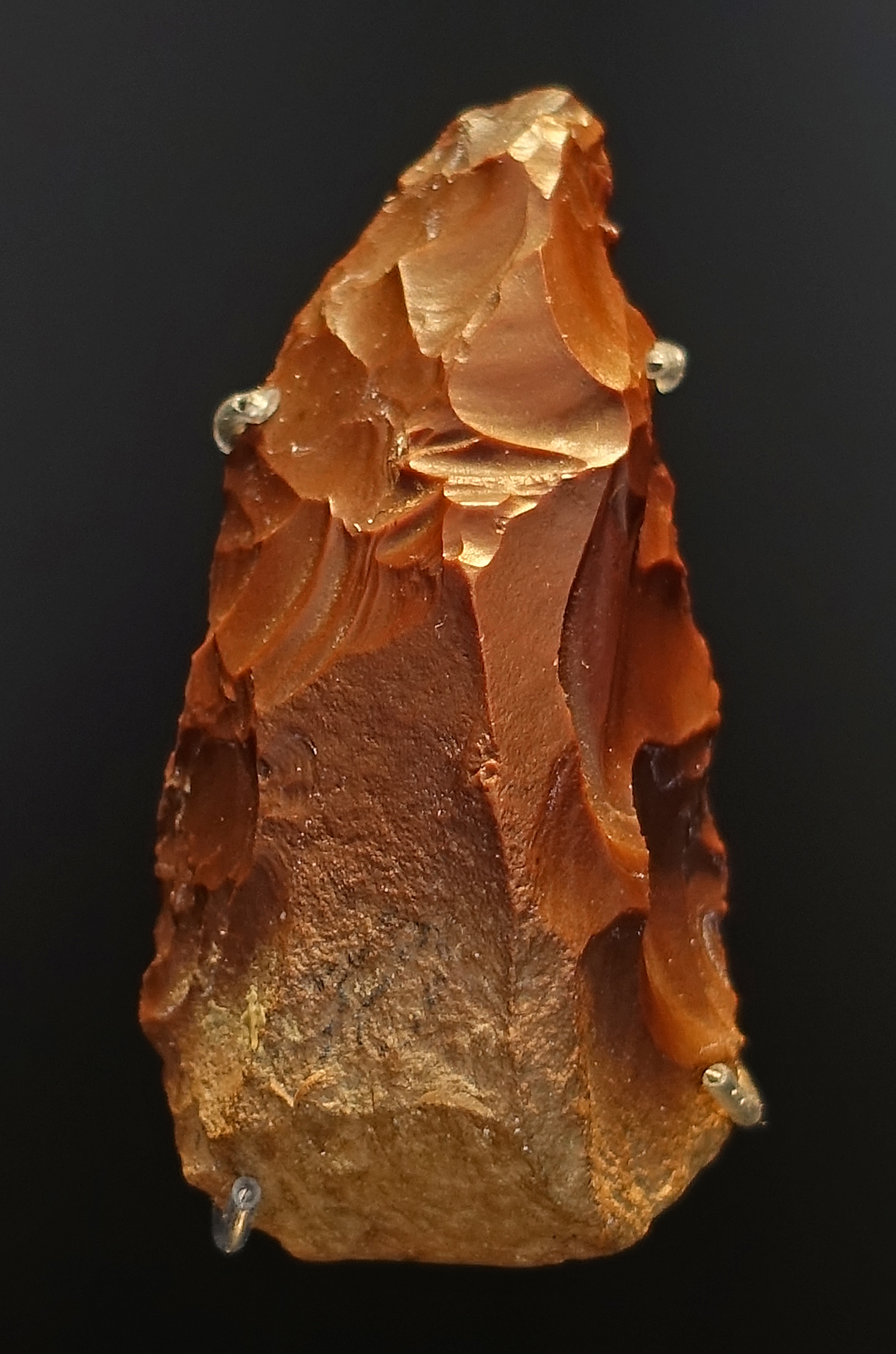
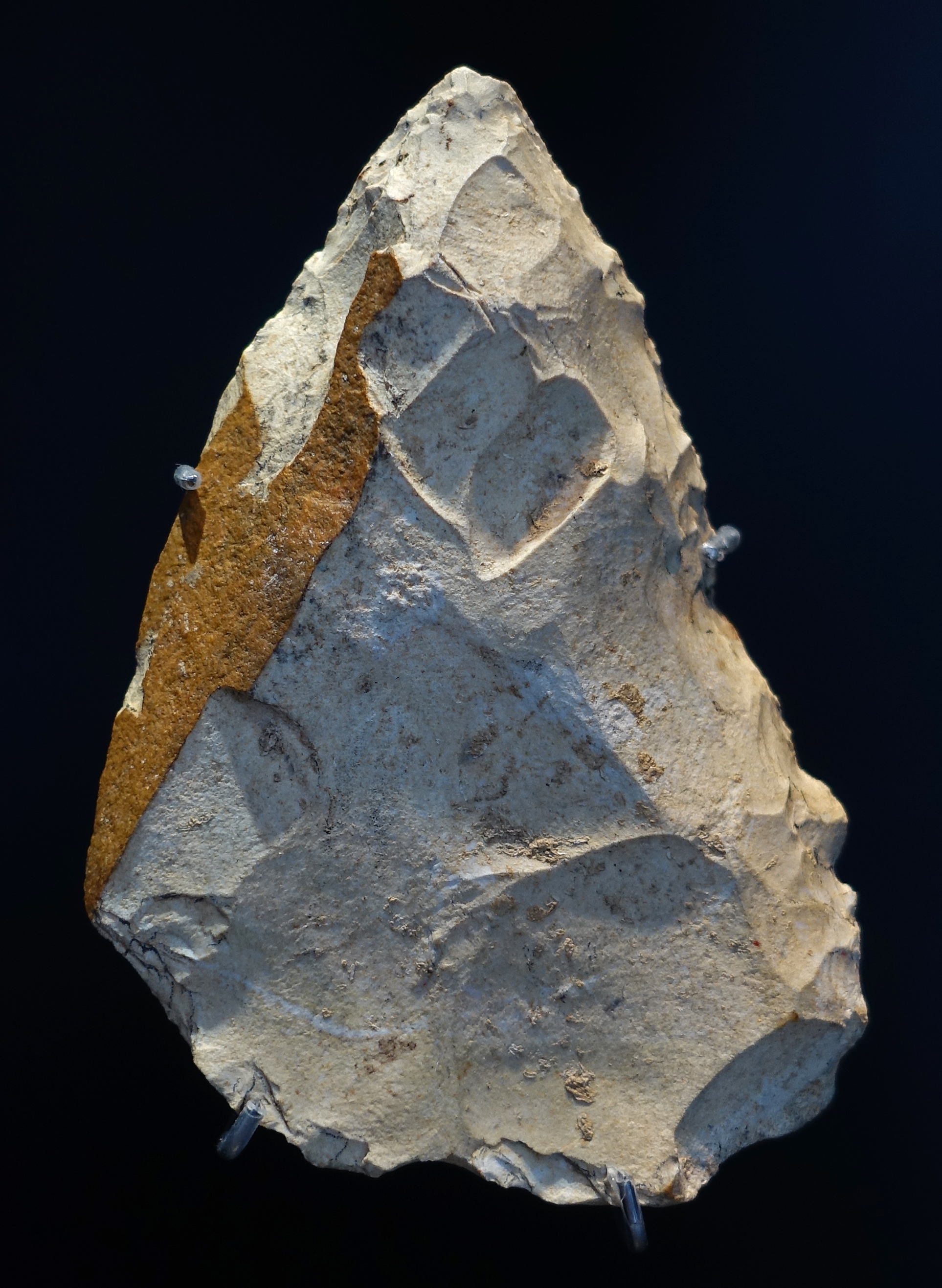
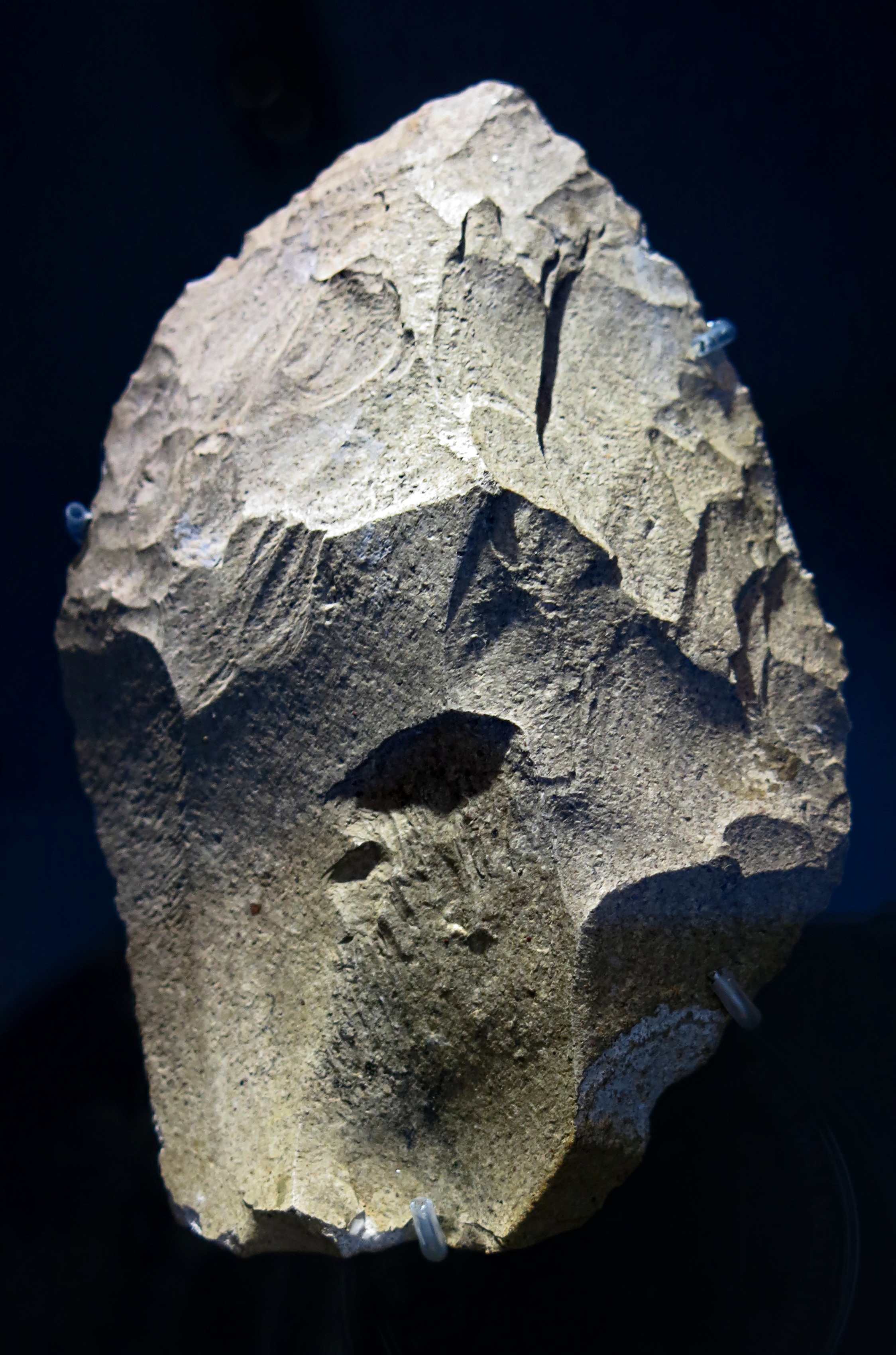
Legacies of the Neanderthals
These handaxes and flake tools are made to a large extent from chert coming from deposits in the area near Stuttgart.
Various stone tools from Heidenschmiede, Heidenheim, district Heidenheim, circa 120 000 BP - 50 000 BP.
(left) Point, radiolarite
(centre) Hand axe, Jurahornstein, Jurassic chert.
(right) Faustkeilblatt, flat or leaf hand axe, chert.
Circa 120 000 BP - 50 000 BP
Along the southwestern bulwark of the castle in Heidenheim, the rock face 35 metres above the valley floor forms a small overhang just large enough to create an 8 square metre abri, or rock shelter. Together with the open space in front of it, the cave has a usable area of some 30 square metres.
In spite of its small size, this so-called Heidenschmiede, or heathen's forge, rock shelter was a place our ancestors went to time and again. This may have been because of the splendid view across the wide, open valley of the Brenz River, which provided an excellent hunting ground.
Heidenheim is about 100 km to the east of Stuttgart.
Photo: Don Hitchcock 2015, 2018
Source and text: Landesmuseum Württemberg, Stuttgart
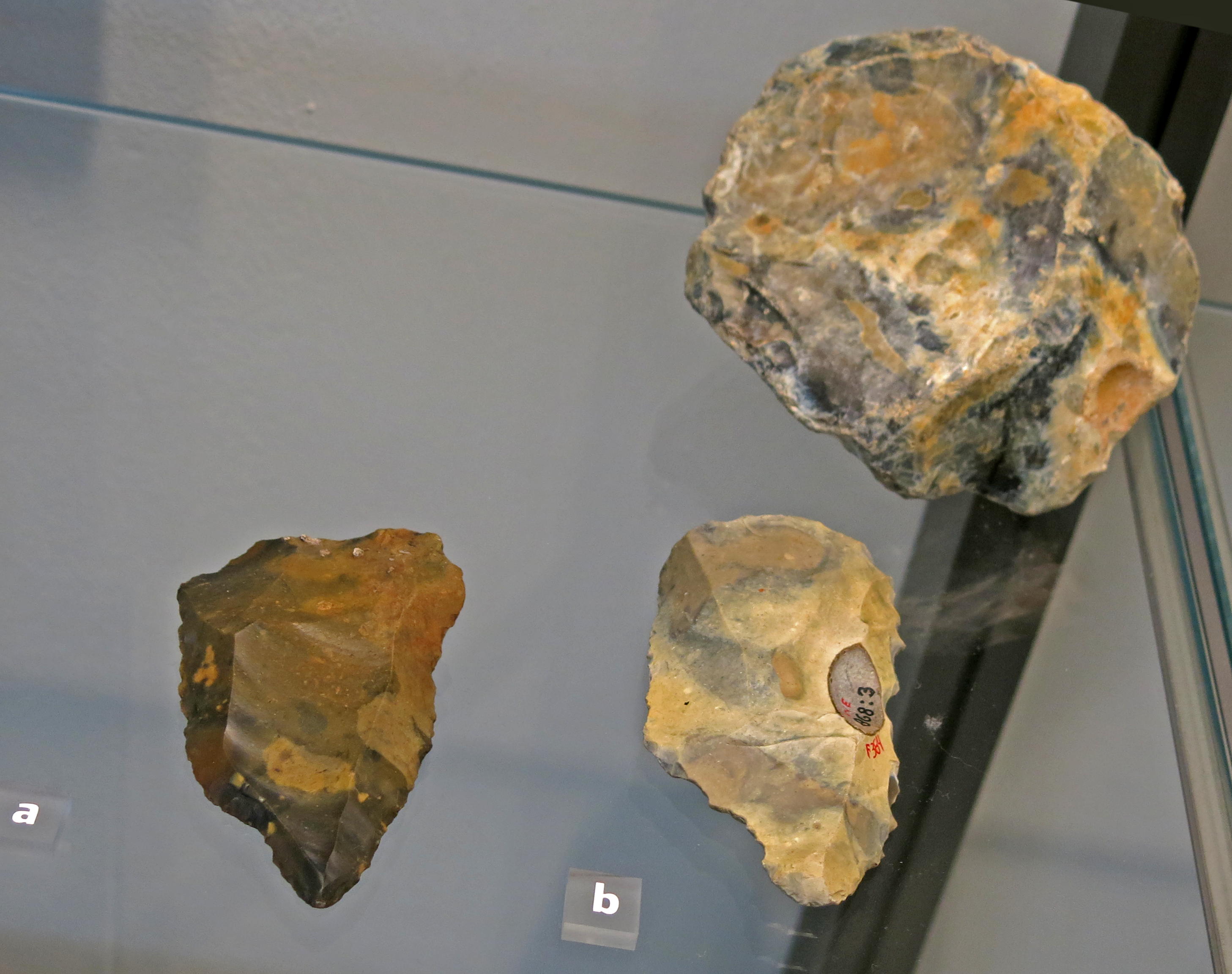
The later flint tools of the Neanderthals were made of flakes struck from specially prepared cores. This Levallois technique takes its name from a site at Levallois in western France.
(left) Levallois flake from Vailly-sur-Aisne, western France, 100 000 BP - 40 000 BP.
(right) Levallois core and flake from Montières, western France.
Photo: Don Hitchcock 2014
Source and text: Original, Københavns (Copenhagen) Museum, National Museum of Denmark
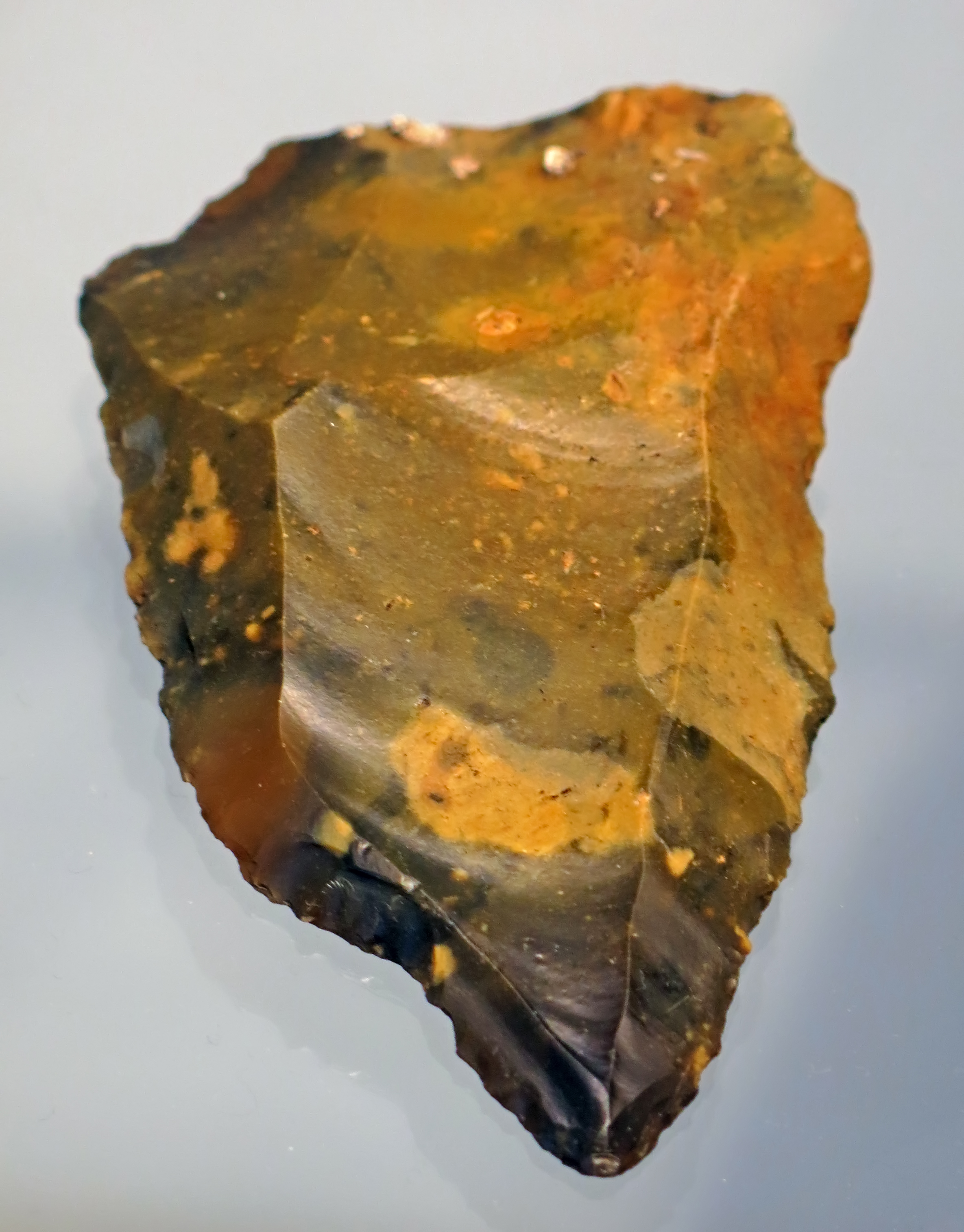
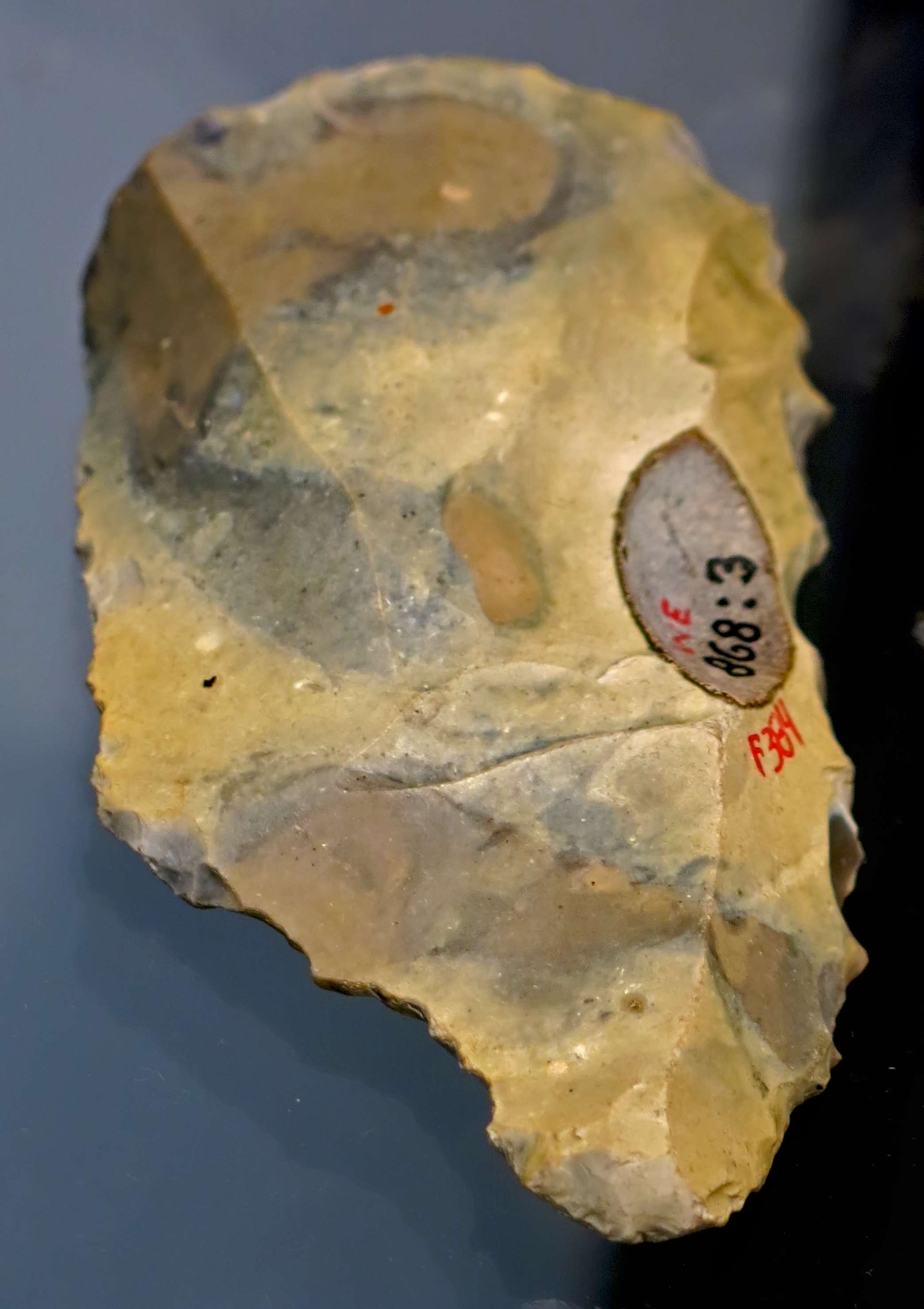
Closeups of the tools above:
(left) Levallois flake from Vailly-sur-Aisne, western France, 100 000 BP - 40 000 BP.
(right) Levallois flake from Montières, western France.
Photo: Don Hitchcock 2014
Source and text: Original, Københavns (Copenhagen) Museum, National Museum of Denmark
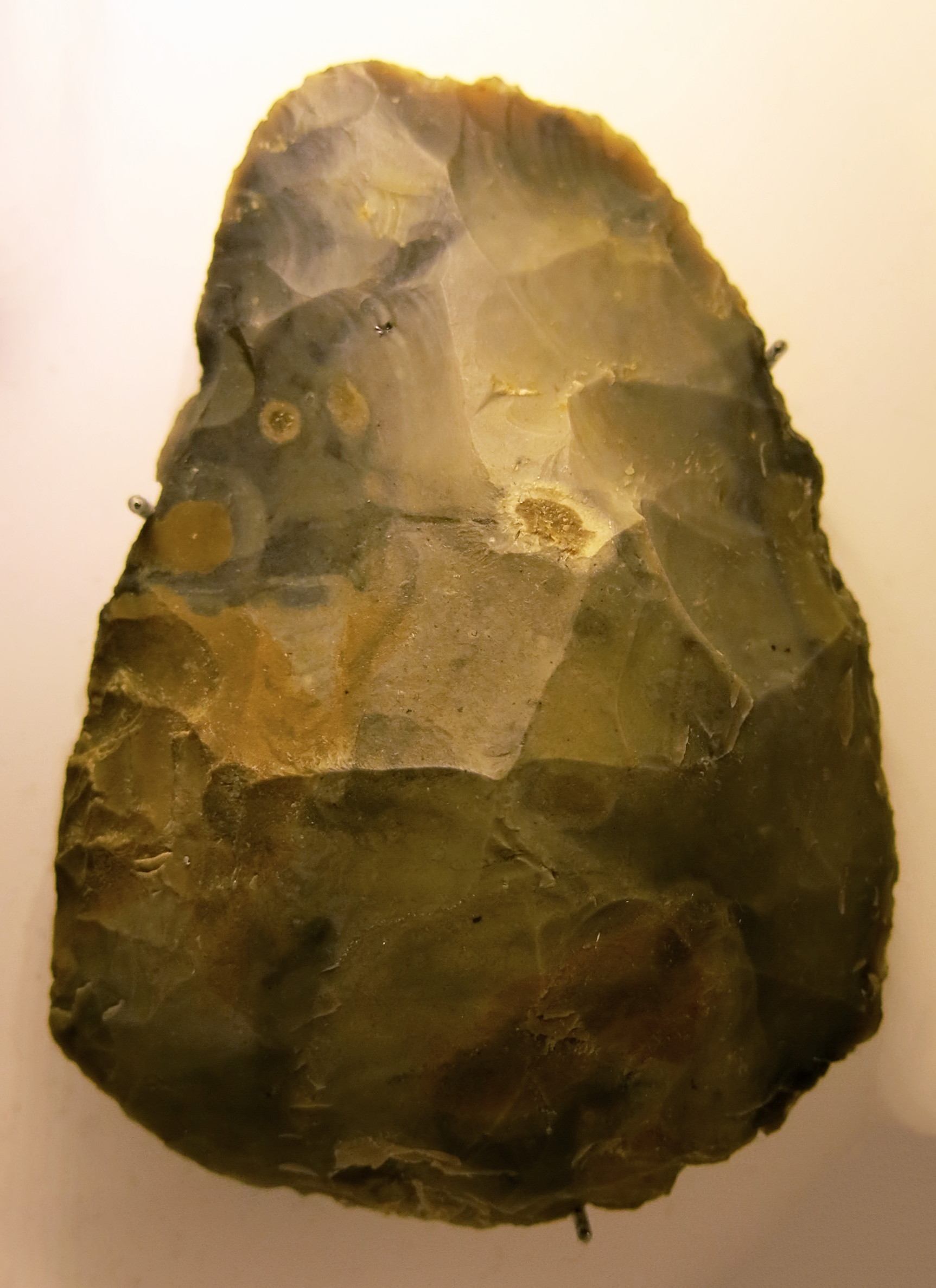
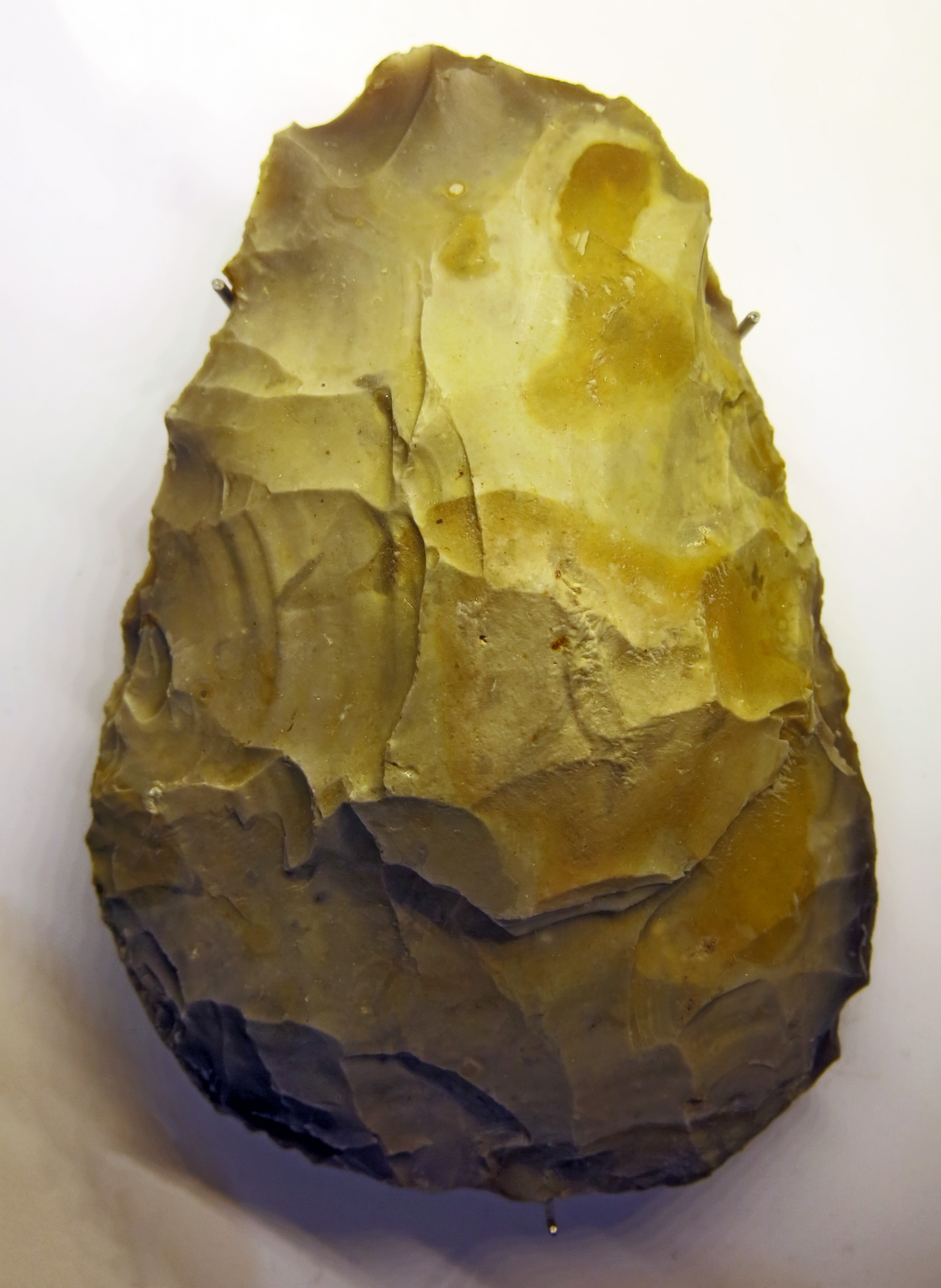
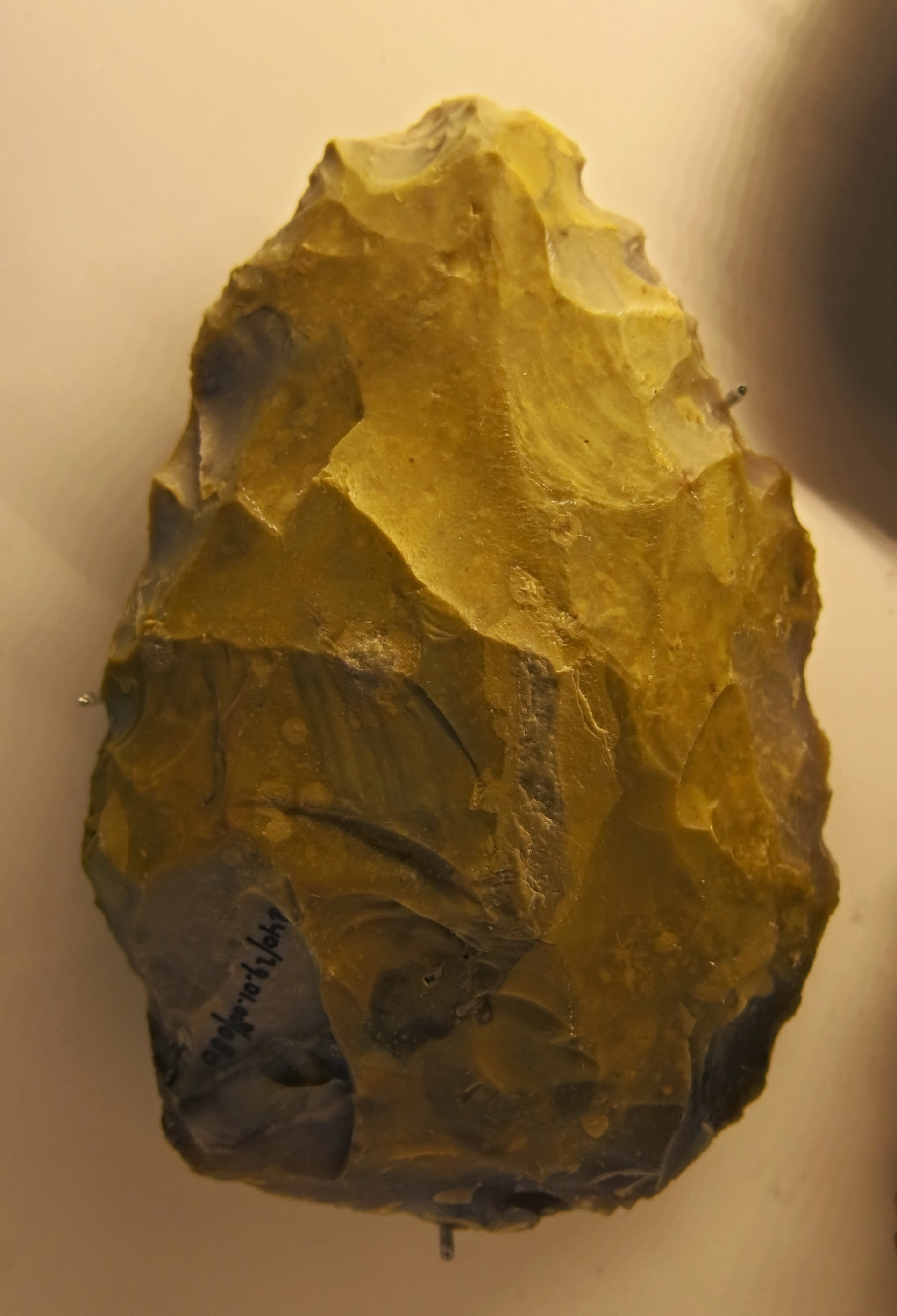
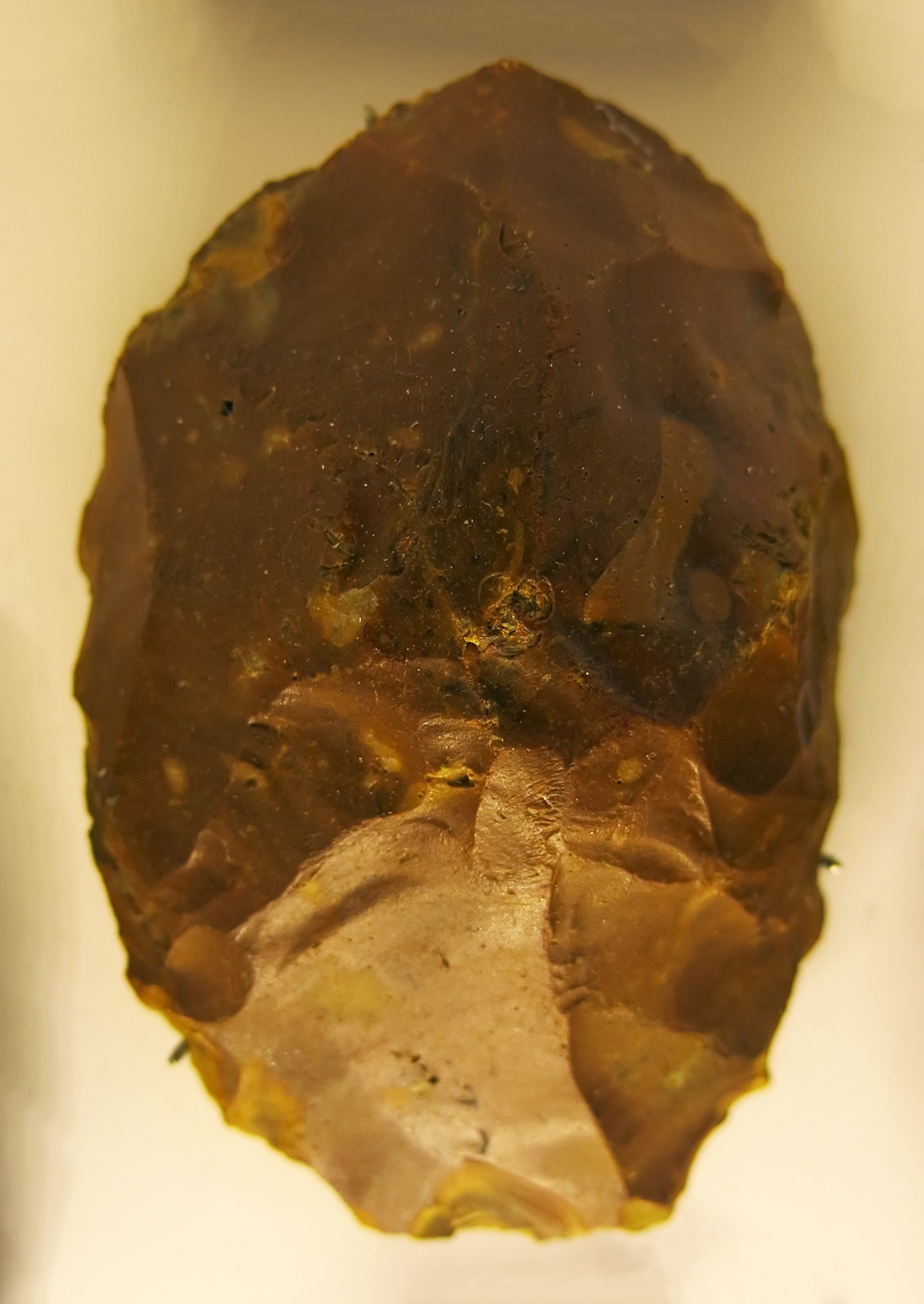
Four Neanderthal handaxes, recovered from the bed of the North Sea offshore from Yarmouth by dredging.
An amazing haul of 28 flint hand-axes, dated by archaeologists as around 100 000 years old, have been recovered off the coast of Norfolk.
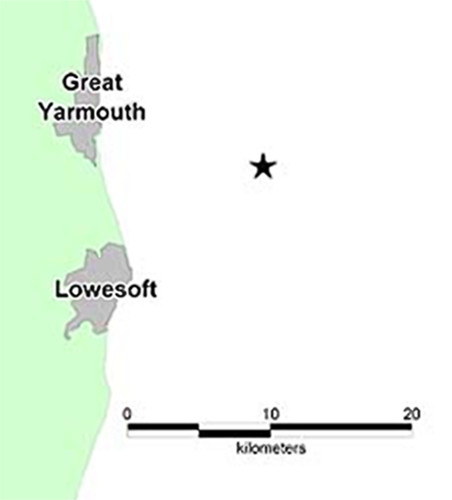
The remarkable find was made by a Dutch amateur archaeologist, Jan Meulmeester, who sifted through gravel unearthed from a licensed marine aggregate dredging area 13km off Great Yarmouth and delivered to a wharf in southern Holland.
Reckoned to be the finest hand-axes that experts are certain come from English waters, the rare finds show that deep in the Ice Age, mammoth hunters roamed across land that is now submerged beneath the sea.
'These finds are massively important', said Ice Age expert Phil Harding of Wessex Archaeology and Channel 4’s Time Team. 'In the Ice Age the cold conditions meant that water was locked up in the ice caps. The sea level was lower then, so in some places what is now the seabed was dry land.'
Photo: Don Hitchcock 2014
Source: Original, Rijksmuseum van Oudheden, National Museum of Antiquities, Leiden, on loan from the Meulmeester Collection
Text: http://www.culture24.org.uk/history-and-heritage/archaeology/art55043
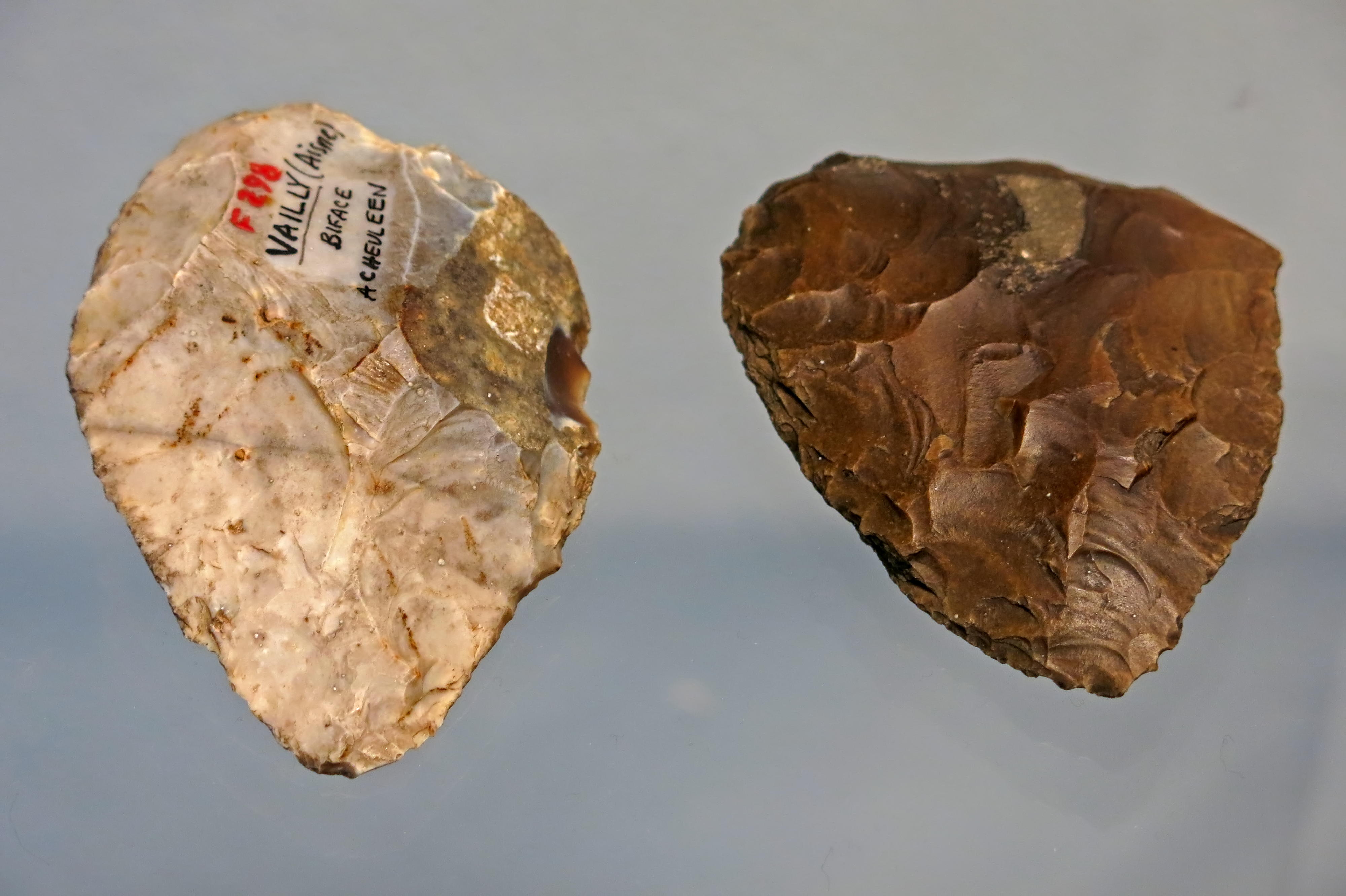
Flint handaxes from Vailly-sur-Aisne, western France, 100 000 BP - 40 000 BP.
Photo: Don Hitchcock 2014
Source and text: Original, Københavns (Copenhagen) Museum, National Museum of Denmark
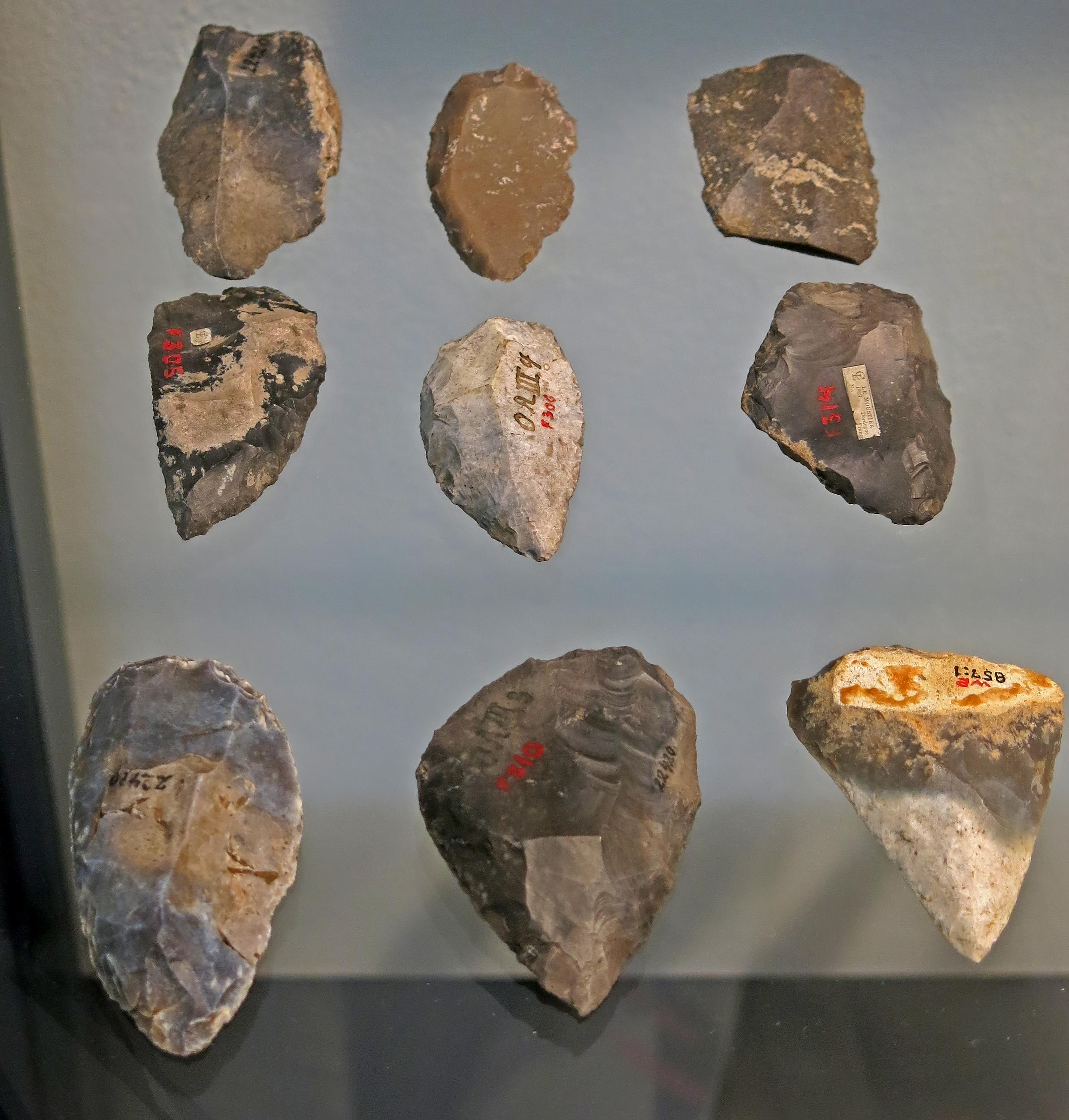
Eight flint points, the back and middle rows and the two left in the front row, perhaps for spears, Le Moustier. 100 000 BP - 40 000 BP.
Front row right: Flint point, perhaps for a spear, Pech de l'Azé.
Photo: Don Hitchcock 2014
Source and text: Original, Københavns (Copenhagen) Museum, National Museum of Denmark
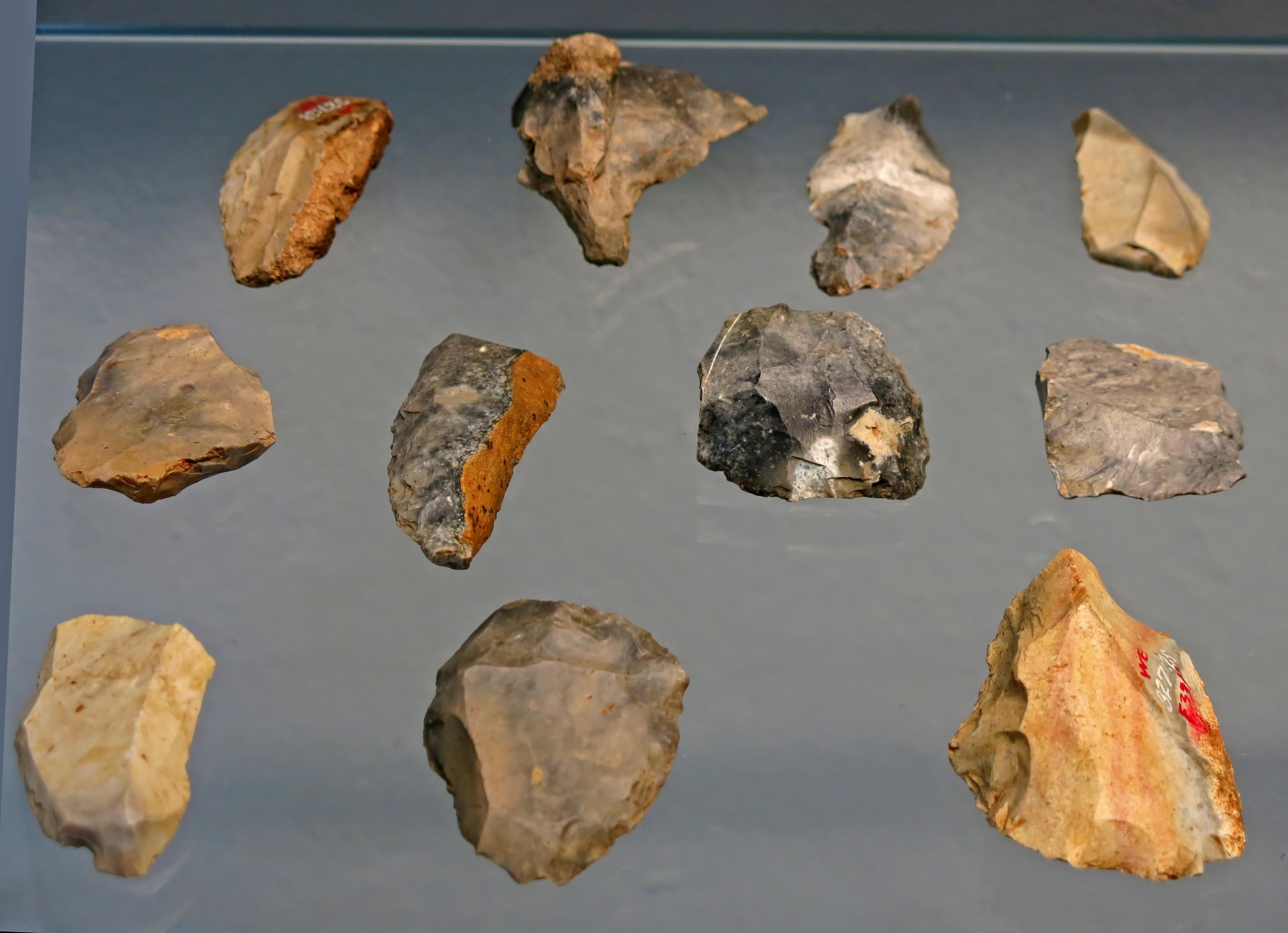
Retouched flakes and scrapers, La Ferrassie, 100 000 BP - 40 000 BP.
Photo: Don Hitchcock 2014
Source and text: Original, Københavns (Copenhagen) Museum, National Museum of Denmark

Hand axes from France.
90 000 - 36 000 BP.
Photo: Don Hitchcock 2008
Source: Badisches Landesmuseum Karlsruhe Germany
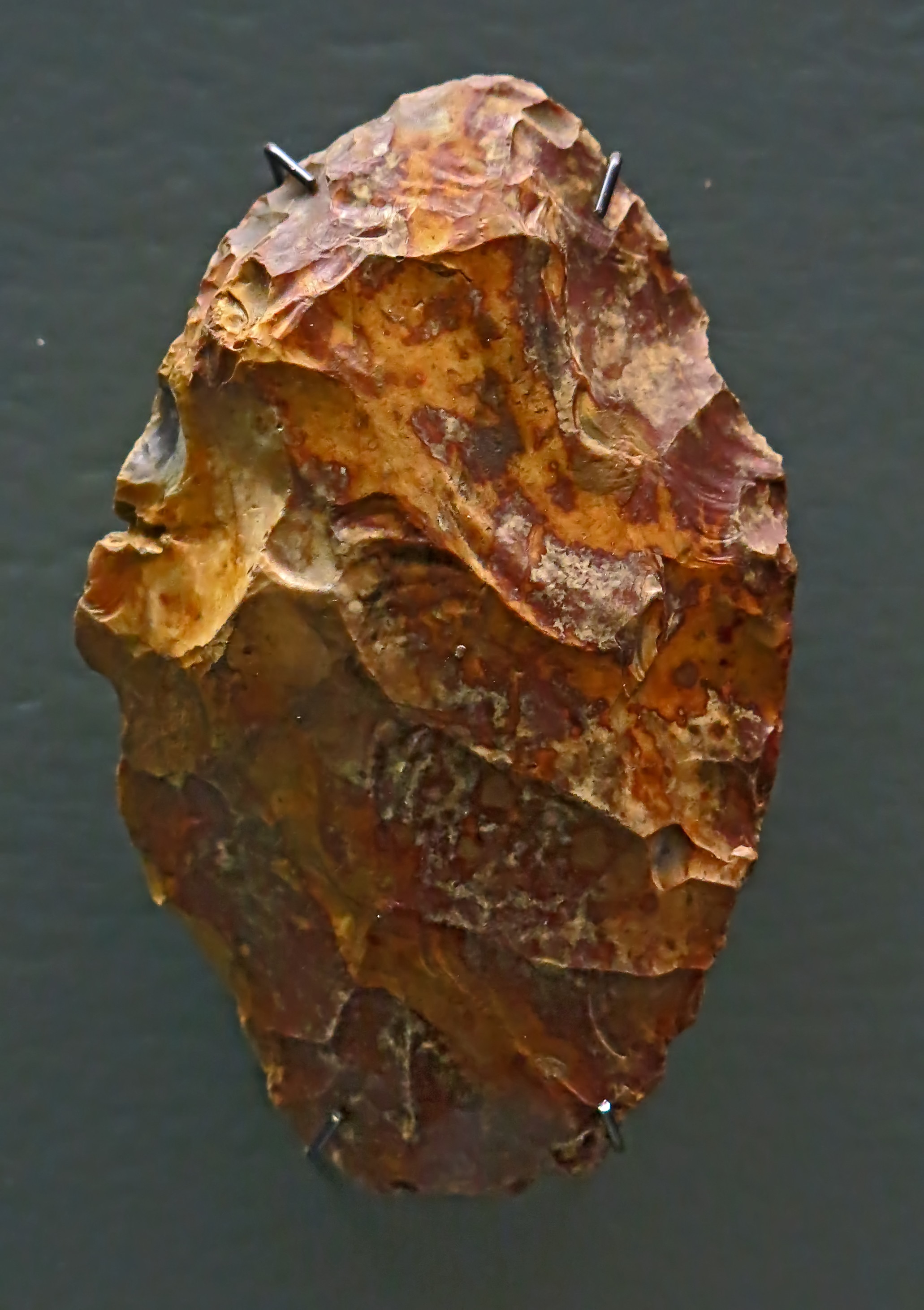
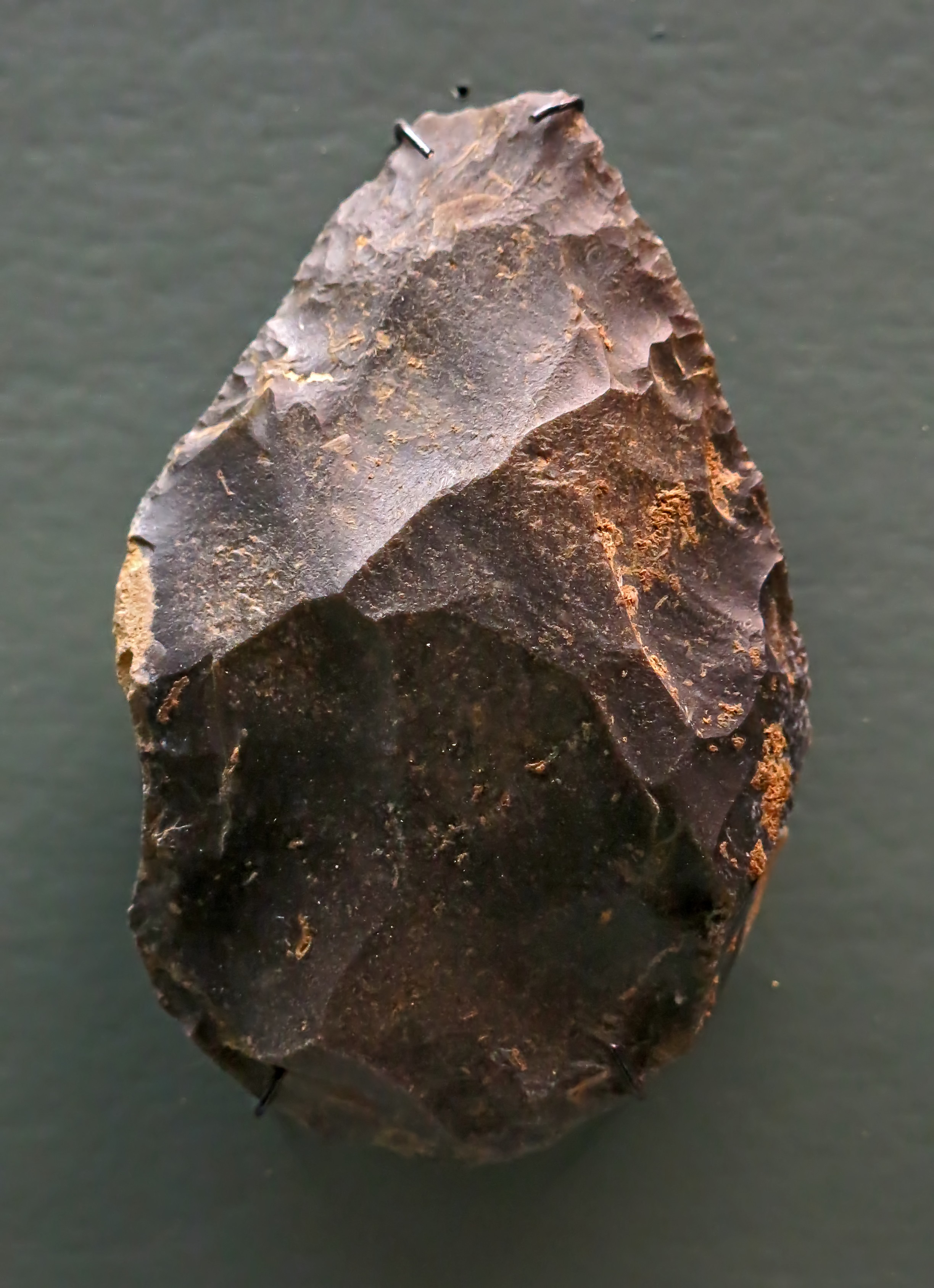
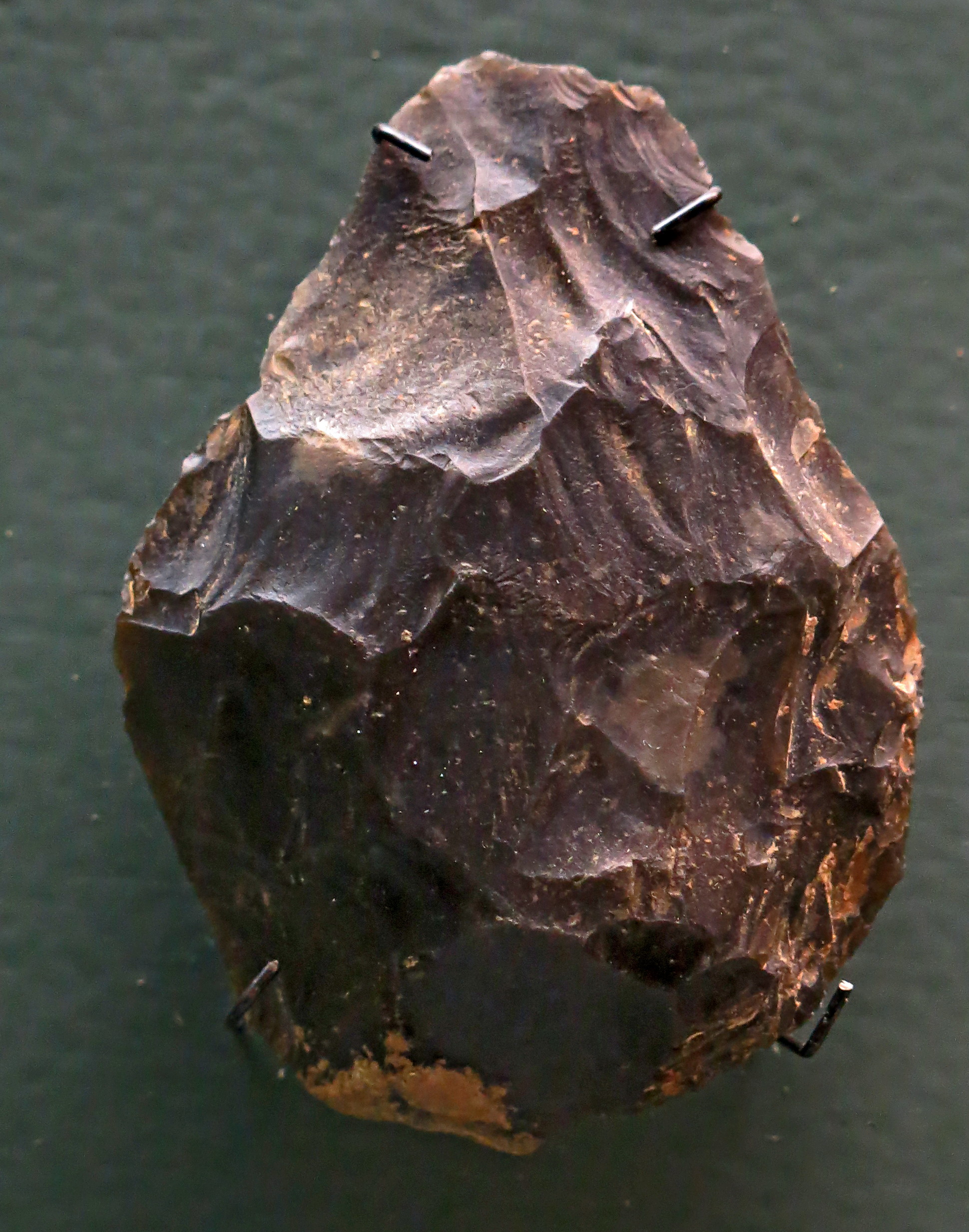
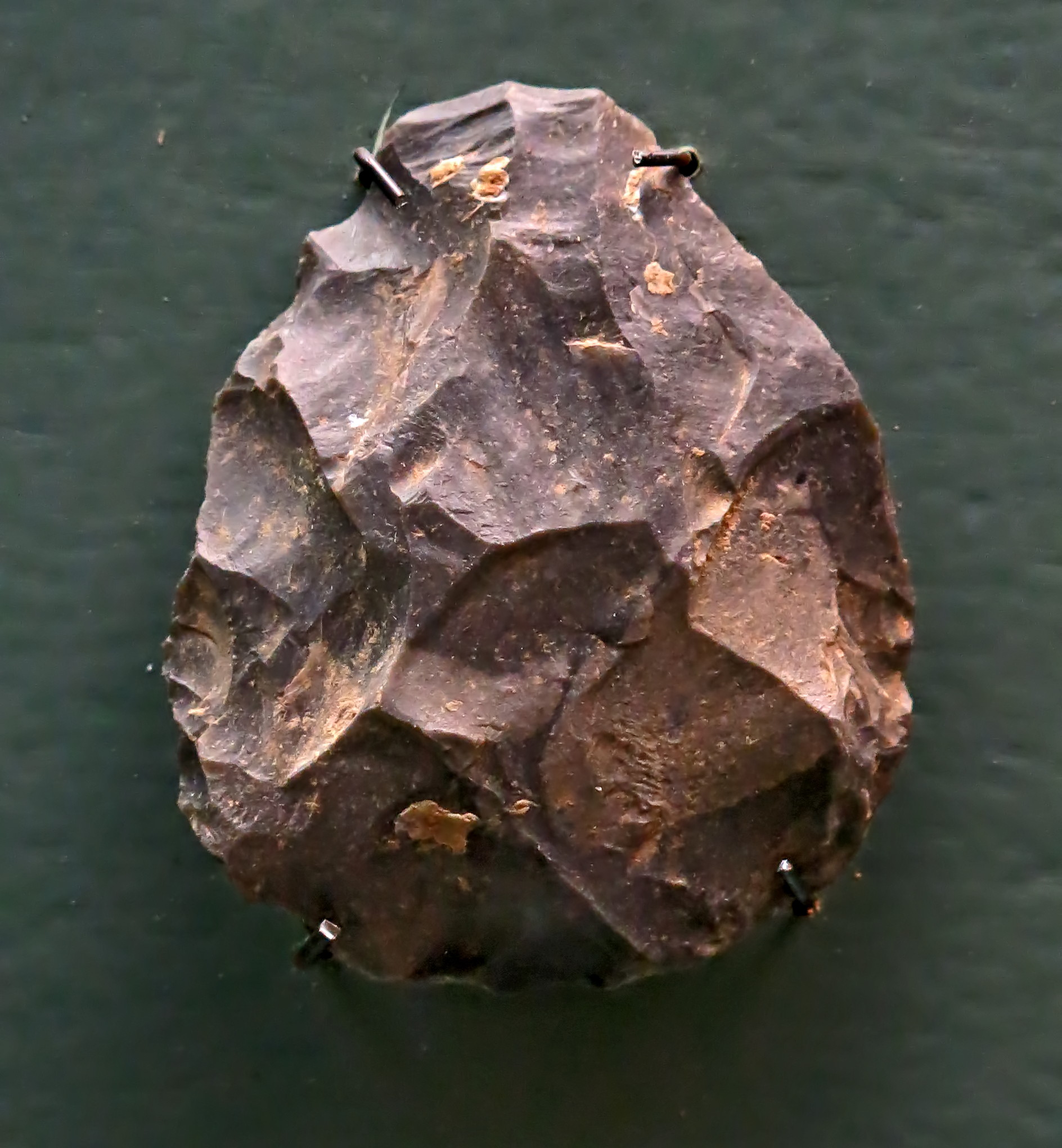
Bifacial flint hand axes, Middle Palaeolithic, circa 90 000 BP.
Le Moustier and Moulin-Truignon/Somme
(the first three of these are the same as in the handaxes immediately above, rotated 180°)
In the course of development handaxes became smaller and smaller.
In the Middle Palaeolithic - the time of the Neanderthals - flakes began to displace the old Paleolithic nuclear tools. The tools became more specific and versatile.
Photo: Don Hitchcock 2015
Source: Badisches Landesmuseum Karlsruhe Germany
Flint (jasper) tool from Freiburg. Mousterian culture, circa 80 000 BP.
Small Mousterian ovate hand axe / scraper.
Note the large flake taken out for a thumb grip. There are many neanderthal tools (and even some upper palaeolithic tools) with this feature.
The blank was struck from a flint (jasper) core and bifacially worked in the handaxe tradition.
Worked on both sides, this piece still stands in the long tradition of early handaxes, but is characterised by careful restoration of a flat surface. It may have been used as both a scraper and a handaxe.
In the case of fairly small tools such as this, it is often difficult to determine if it is primarily a Breitschaber / Blattschaber (wide / blade scraper) or Faustkeil (hand axe).
It may have been used as a handaxe in the morning, and a scraper that afternoon. Not for nothing is the classic handaxe known as the 'Swiss Army Knife' of Palaeolithic tools. Many millions were made, and used for many purposes - cutting, scraping, smashing bones to obtain the marrow, or choppers for cutting up carcasses or cutting down small trees.
Similar tools are also known from other European sites and are referred to as the Mousterian culture after the French site of 'Le Moustier' (Dordogne / France). This culture was of Neanderthal origin.
Photo: Don Hitchcock 2008, 2015
Source: Badisches Landesmuseum Karlsruhe Germany
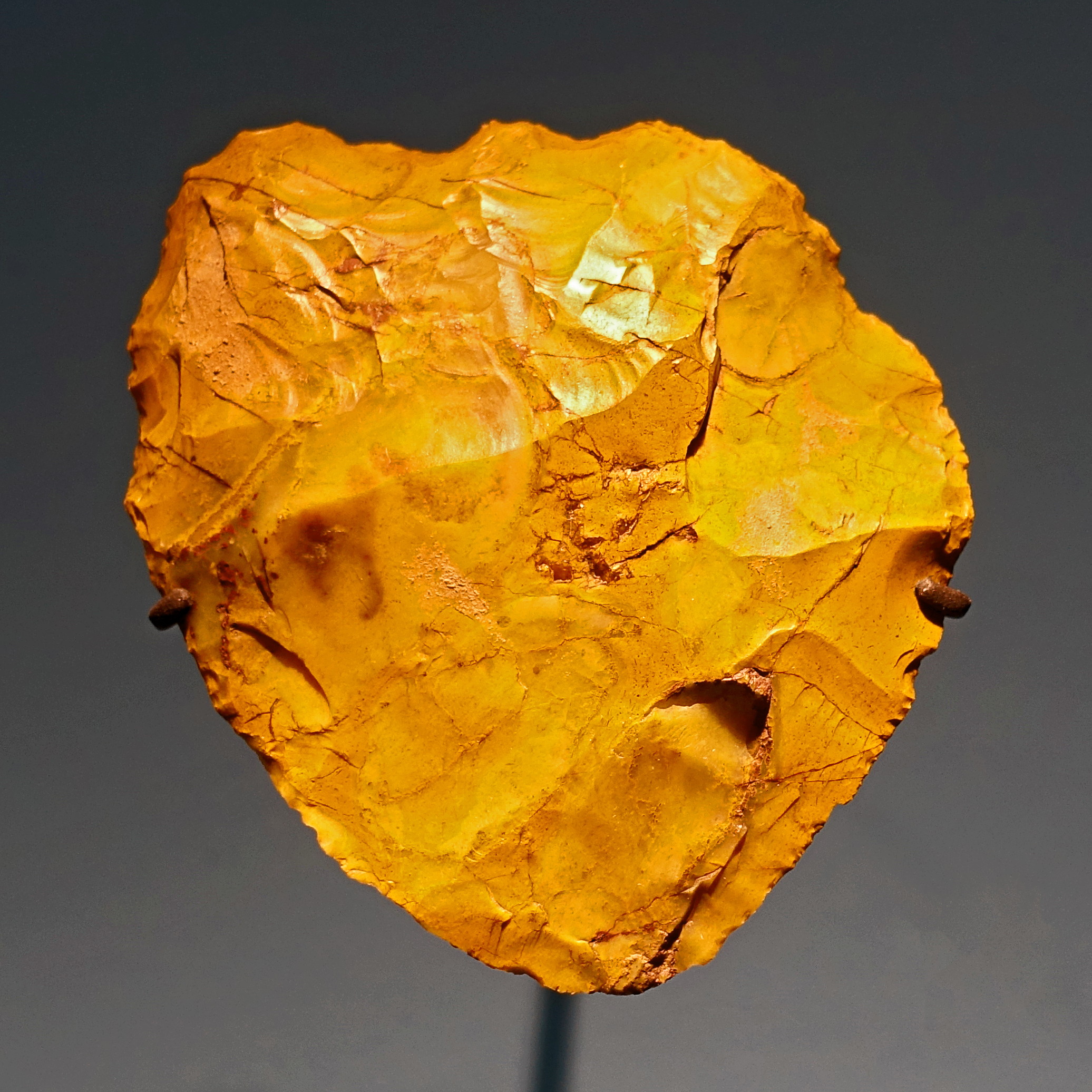
Racloir, in jasper, from Fontmaure (Vellèches), France
Middle Palaeolithic.
Photo: Don Hitchcock 2018
Musée d'Archéologie nationale - Domaine national de Saint-Germain-en-Laye
Source and text: Musée de l'Homme, Paris
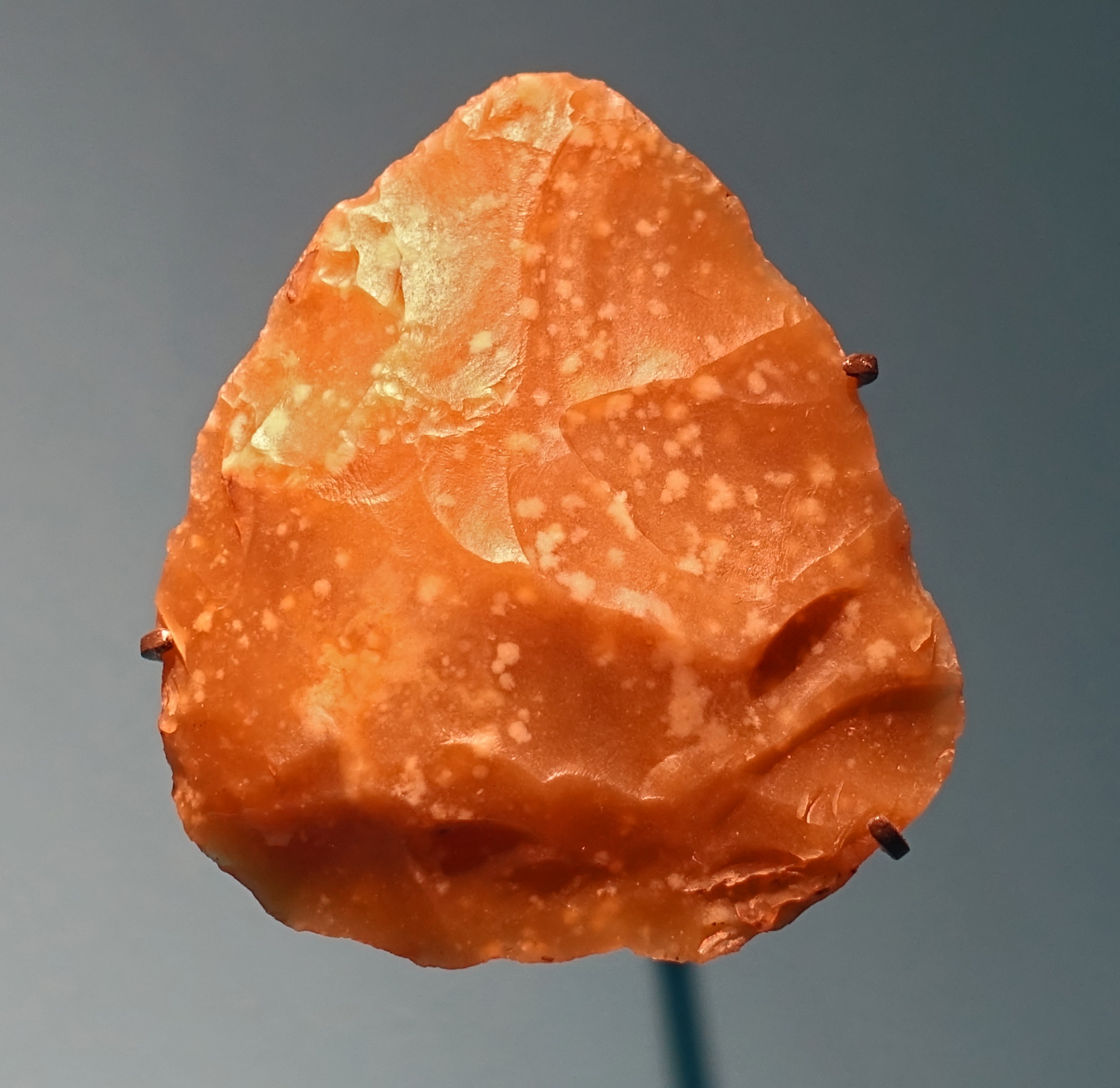
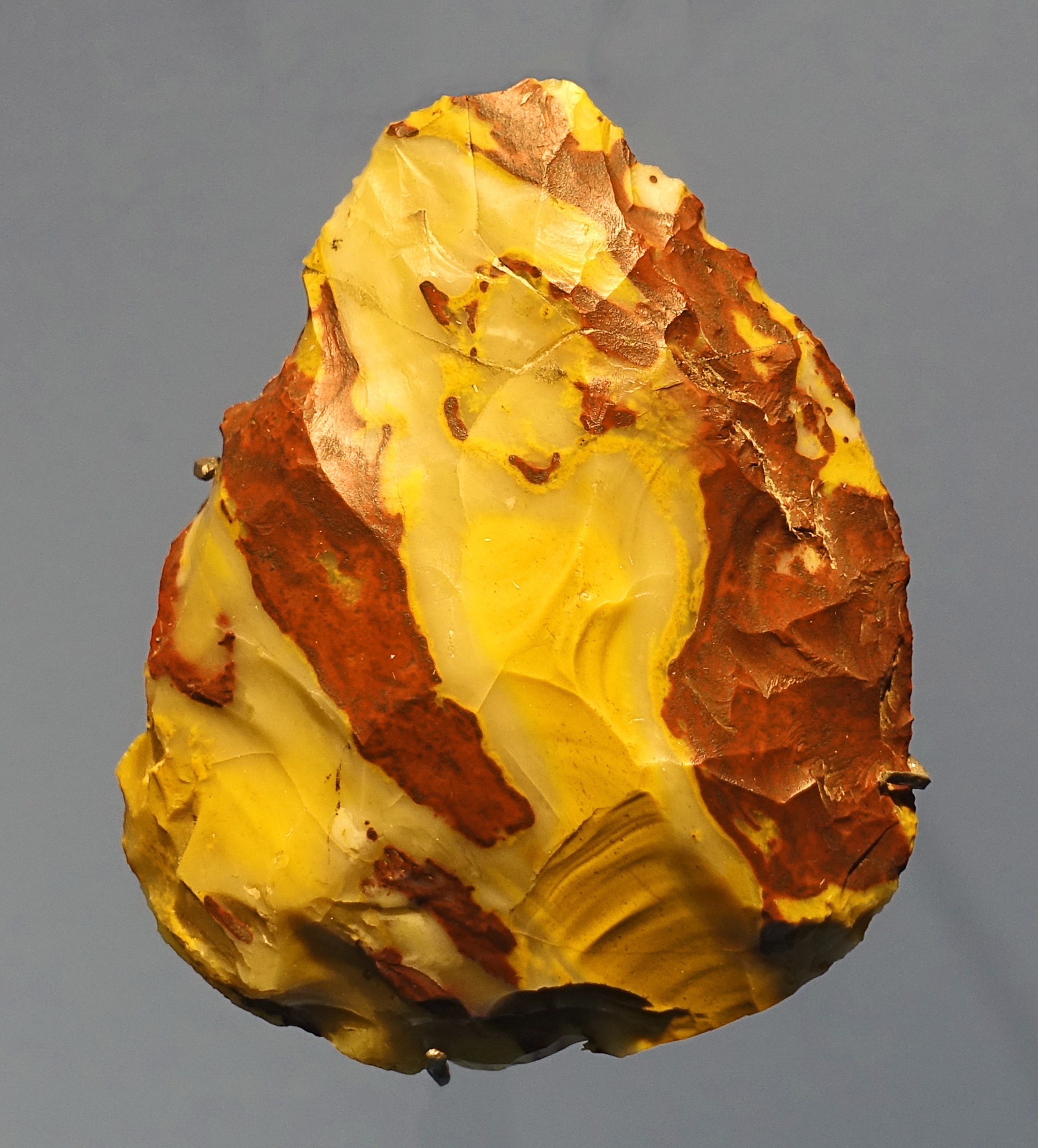
Two small bifaces from Fontmaure (Vellèches), France
(left): Flint
(right): Jasper
Middle Palaeolithic.
Photo: Don Hitchcock 2018
Musée d'Archéologie mationale - Domaine national de Saint-Germain-en-Laye
Source and text: Musée de l'Homme, Paris
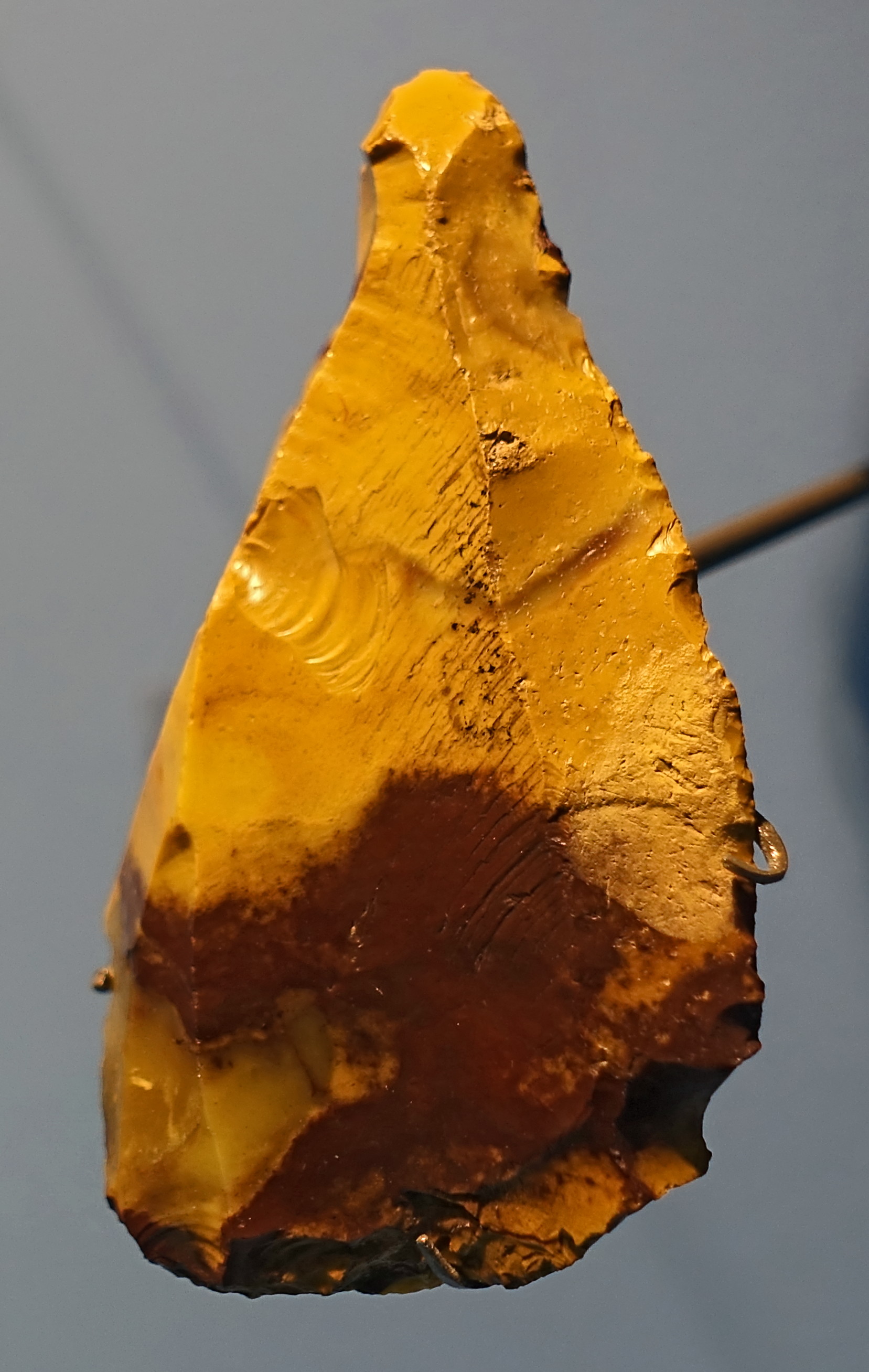
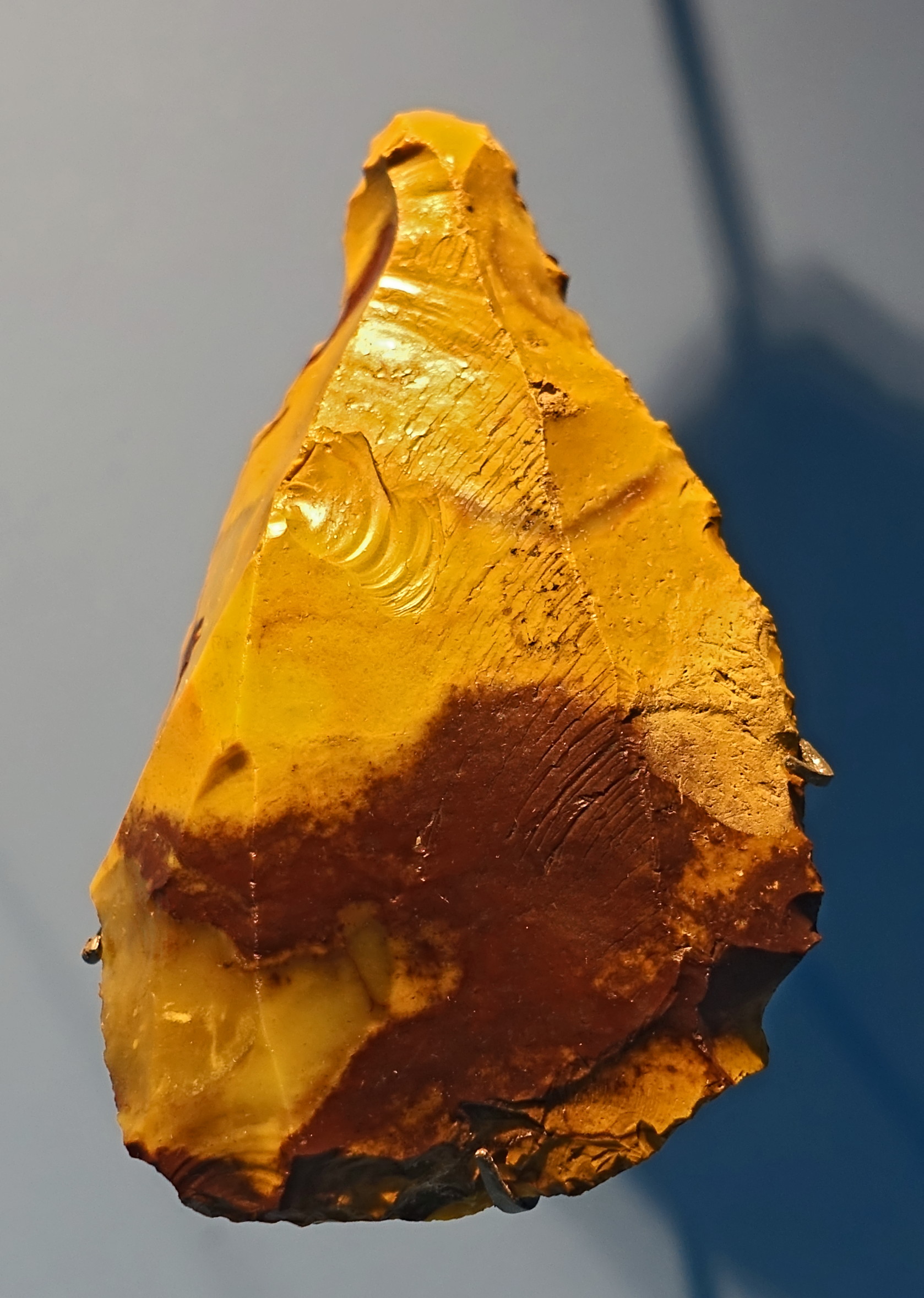
Mousterian point from Fontmaure (Vellèches), France
Jasper.
Middle Palaeolithic.
Photo: Don Hitchcock 2018
Collections du Muséum national d'Histoire naturelle, Paris
Source and text: Musée de l'Homme, Paris
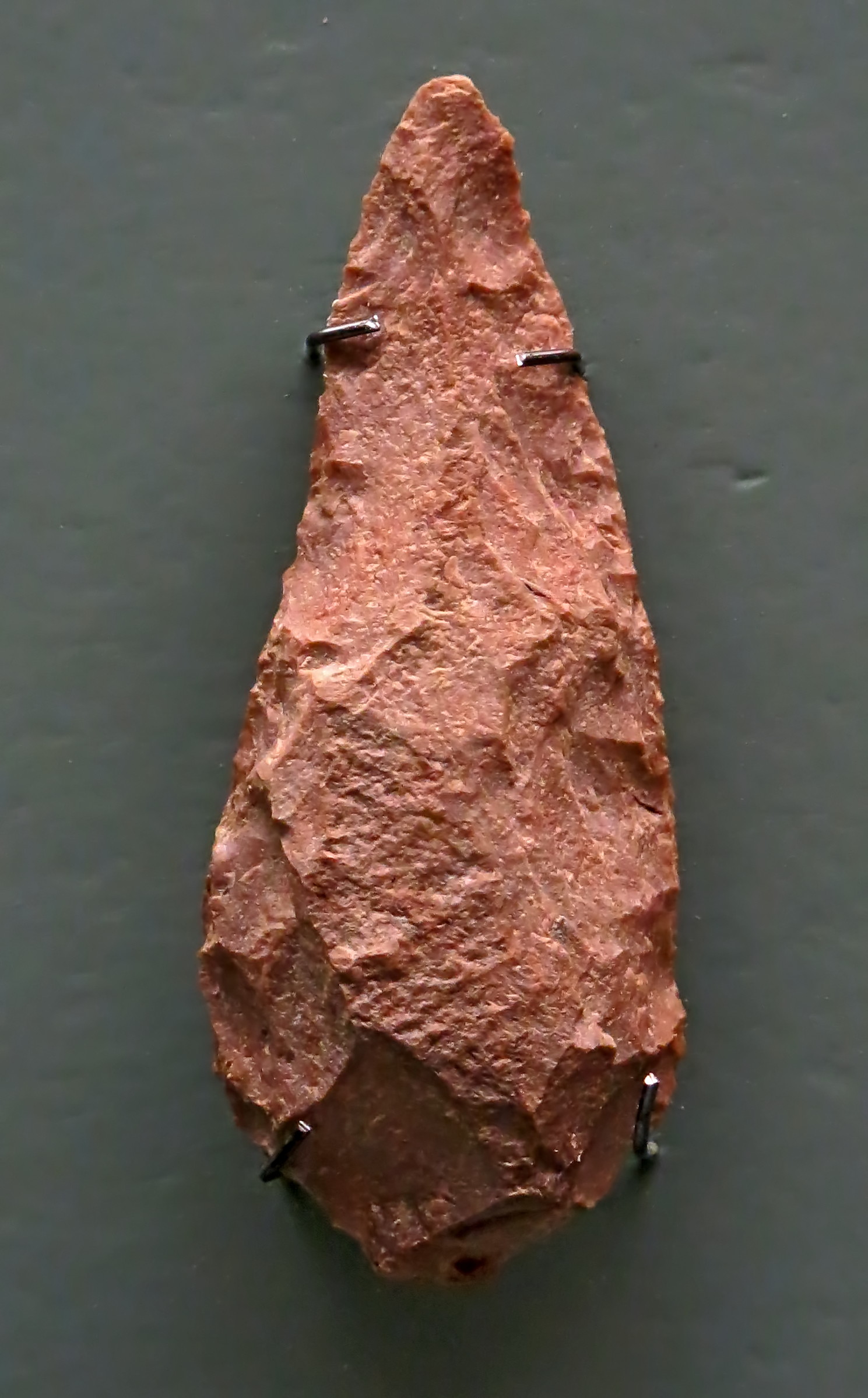
Micoquien quartzite hand axe from Bruchsal, district Karlsruhe, Middle Palaeolithic, circa 80 000 BP.
Despite its relatively young age, the tool belongs to the development series of the Palaeolithic hand axes. It belongs to the Neandertal stone industry described as the 'Micoquien' according to the reference to the site of La Micoque in France. Contrary to the often crude representation of the Neanderthals, their tools testify to enormous skill.
( note that the shape of this handaxe is not of the type generally ascribed to the Micoquien. I can only assume that it has been ascribed to the Micoquien industry because of its possible asymmetry between front and back faces, another characteristic of the (as originally described) Micoquien industry. It may also be placed in this industry because of being part of the wider culture known as Micoquian/Keilmessergruppen - Don )
Photo: Don Hitchcock 2015
Catalog: lnv.-Nr. 2008/628
Source and text: Badisches Landesmuseum Karlsruhe Germany
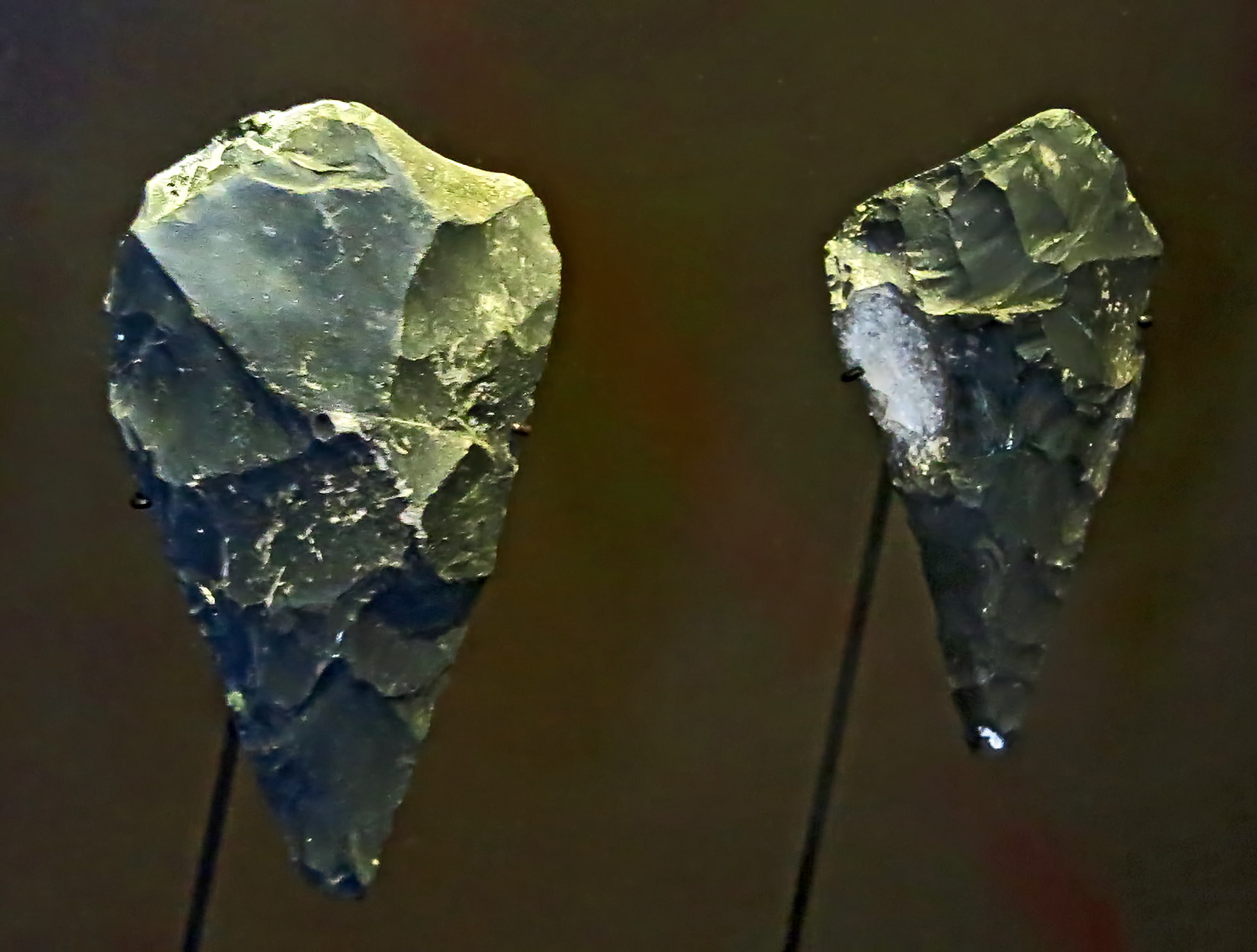
Scrapers and a point from La Micoque, 80 000 BP - 50 000 BP.
Photo: Don Hitchcock 2015
Source: Original, Staatliche Museen zu Berlin, Neues Museum, Germany
Text: © Card at the Staatliche Museen zu Berlin (CC BY-NC-SA 3.0 DE)
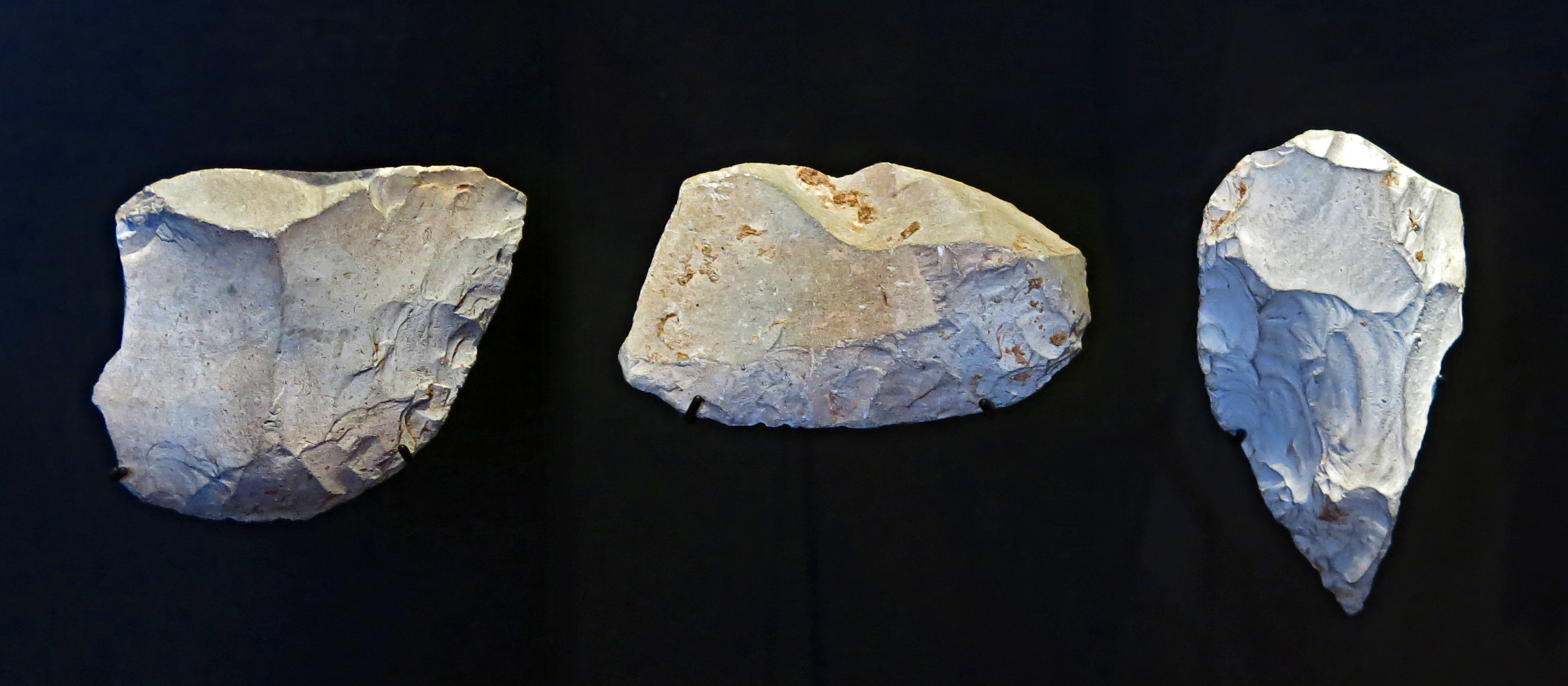
Small hand axes or points from La Micoque, 80 000 BP - 50 000 BP.
Photo: Don Hitchcock 2015
Source: Original, Staatliche Museen zu Berlin, Neues Museum, Germany
Text: © Card at the Staatliche Museen zu Berlin (CC BY-NC-SA 3.0 DE)
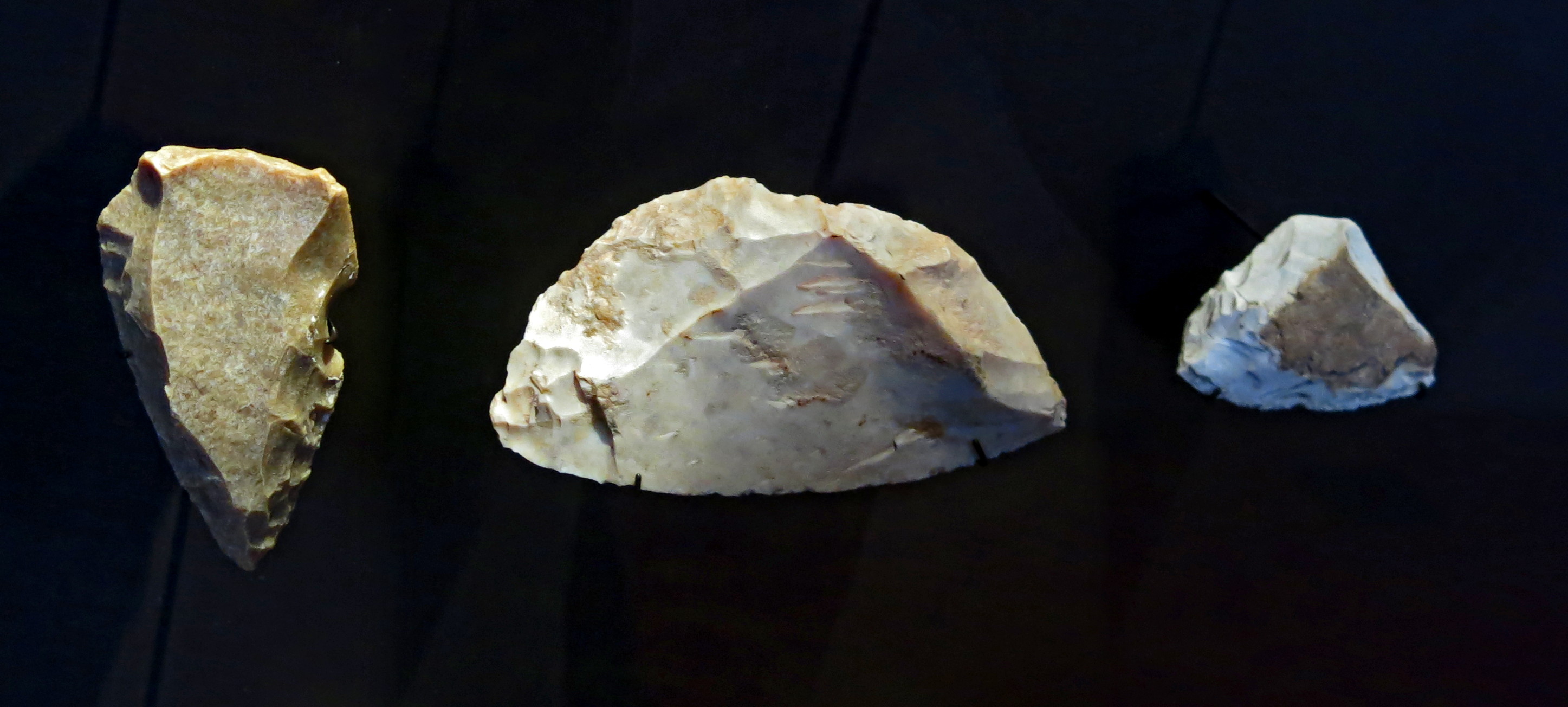
Levallois point and scrapers from La Micoque, 80 000 BP - 50 000 BP.
Photo: Don Hitchcock 2015
Source: Original, Staatliche Museen zu Berlin, Neues Museum, Germany
Text: © Card at the Staatliche Museen zu Berlin (CC BY-NC-SA 3.0 DE)
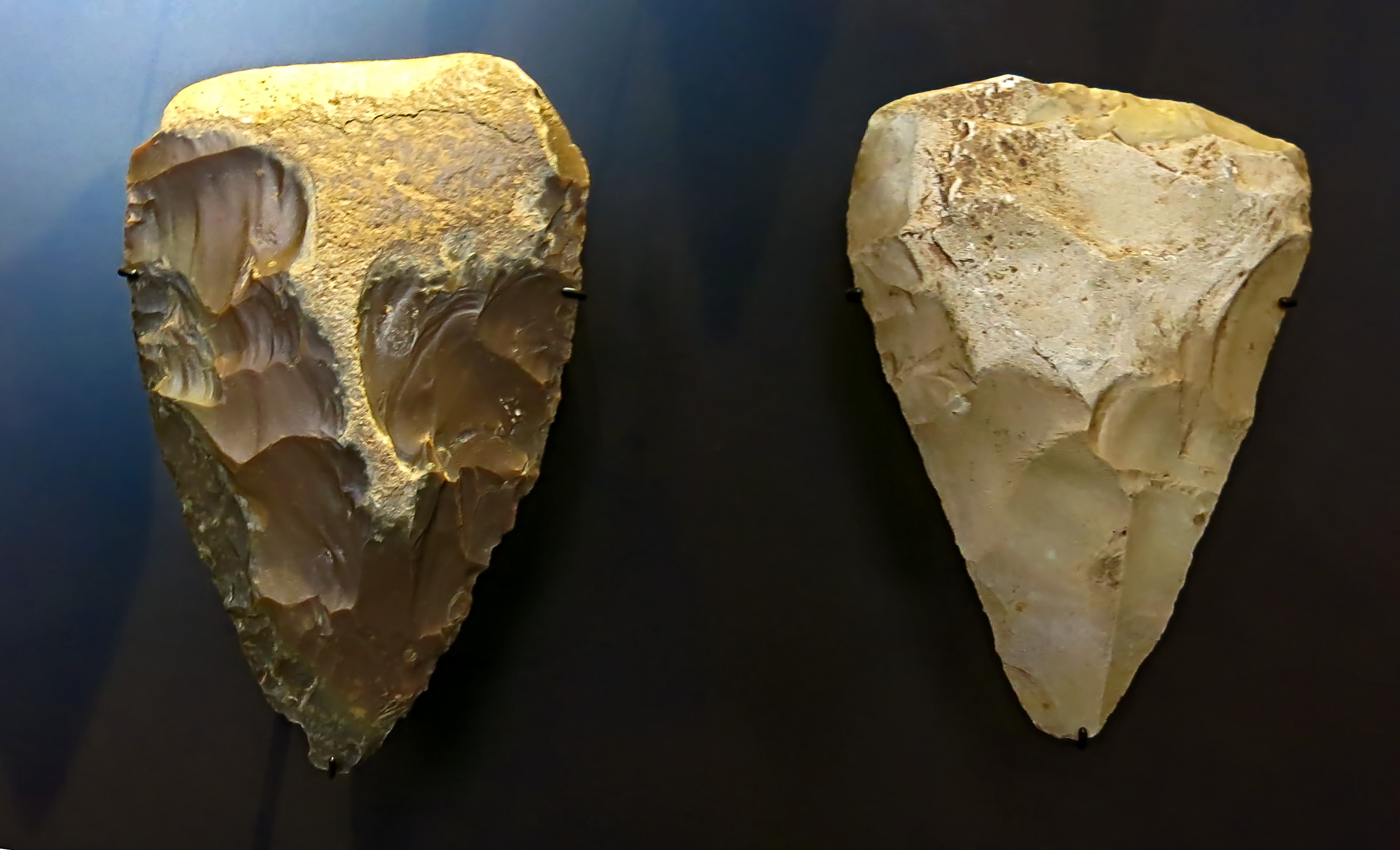
Hand axes from La Micoque, 80 000 BP - 50 000 BP.
( note that in both these examples, the whole face has not been worked, and there are parts of the original cortex remaining - Don )
Photo: Don Hitchcock 2015
Source: Original, Staatliche Museen zu Berlin, Neues Museum, Germany
Text: © Card at the Staatliche Museen zu Berlin (CC BY-NC-SA 3.0 DE)
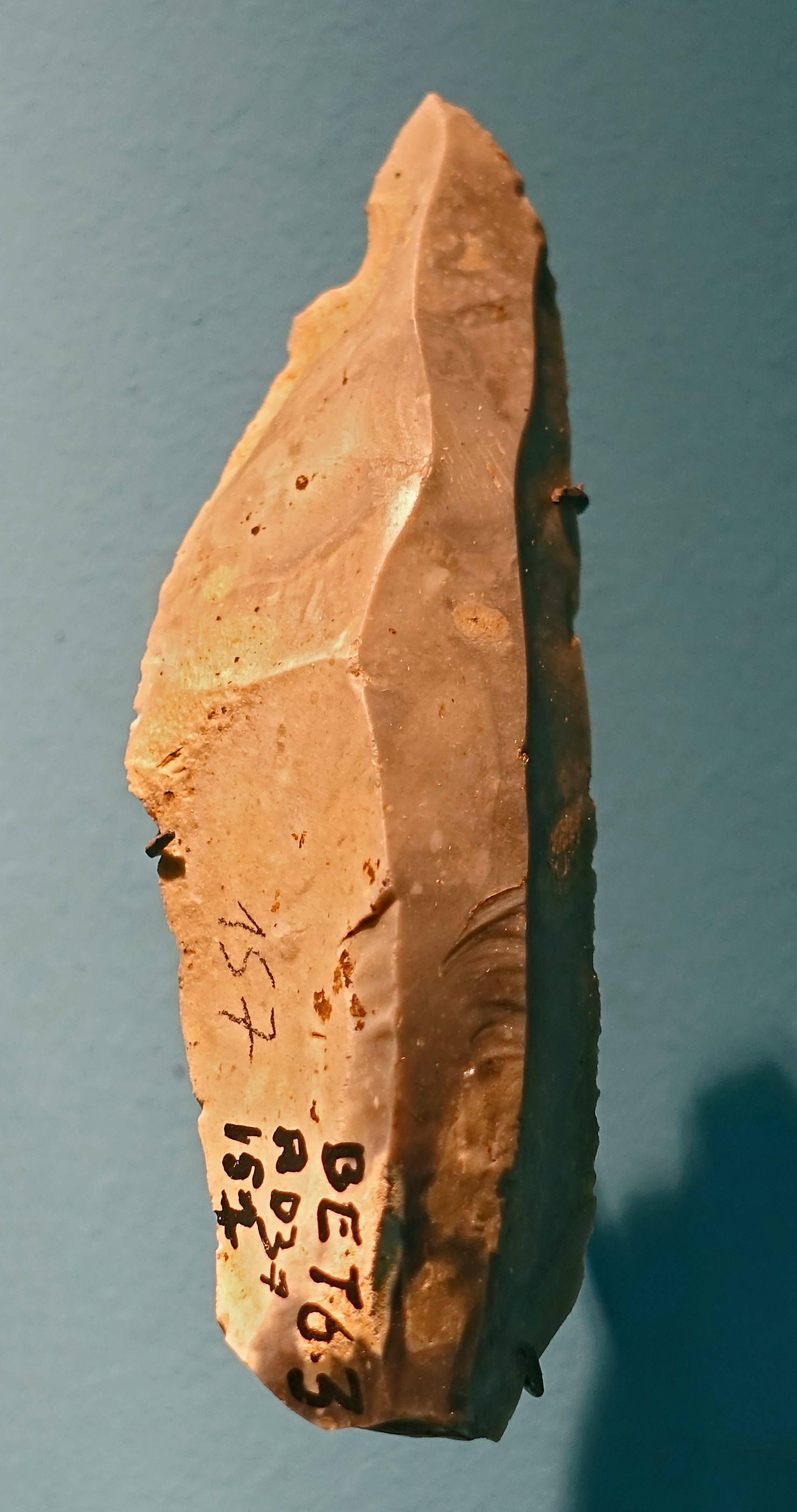
Blade, in flint.
From Bettencourt-Saint-Eaux, France
Circa 75 000 BP
Photo: Don Hitchcock 2018
Collections du Musée national de Préhistoire, Les Eyzies-de-Tayac
Source and text: Musée de l'Homme, Paris
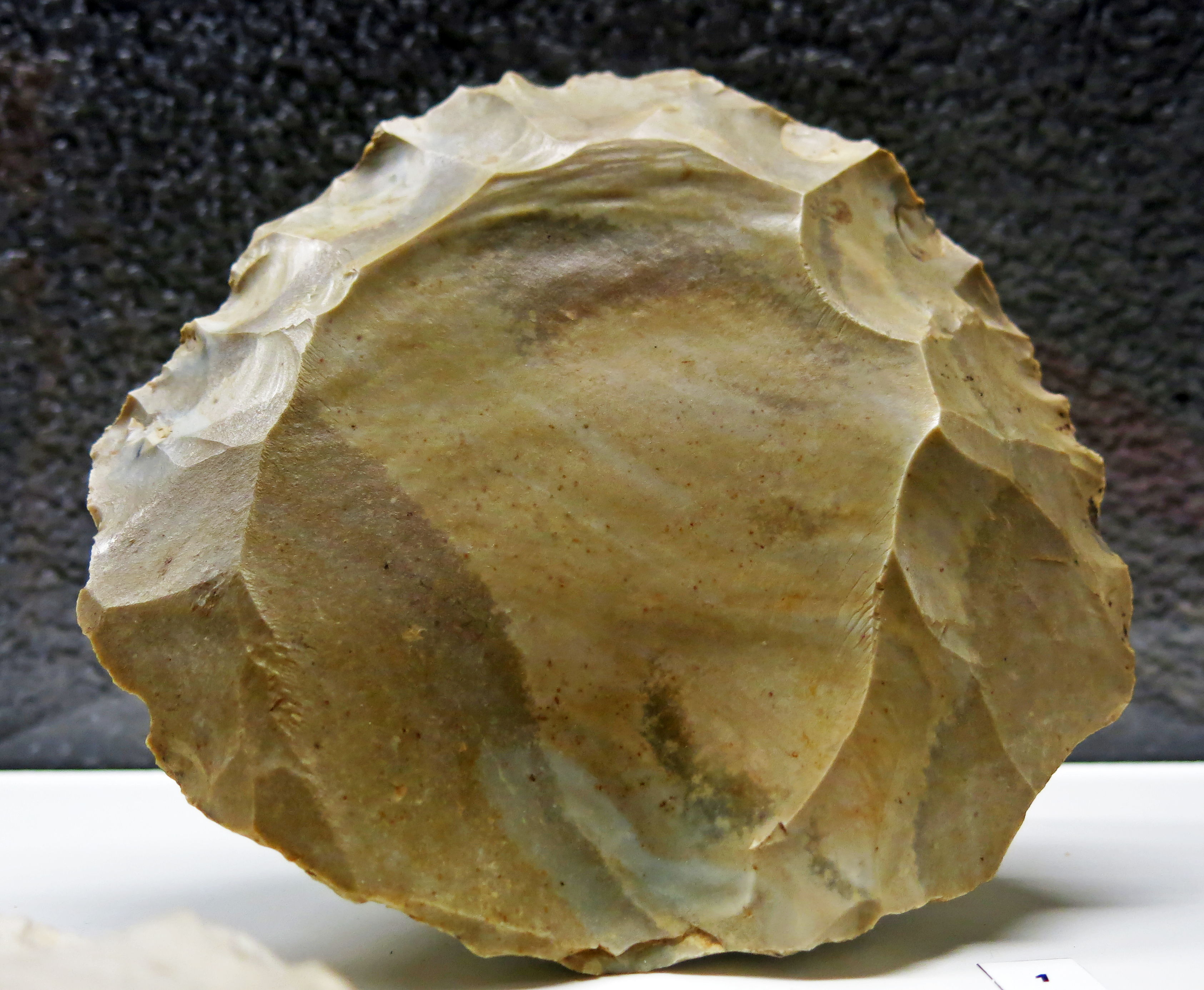
Levallois nucleus/core from the region of Bergerac.
This is superb quality flint, worked by a master craftsman.
Photo: Don Hitchcock 2015
Catalog: 2006.17.16.1
Source: Original, Musée d'Aquitaine à Bordeaux
Mousterian biface hand axe, made of flint. This is an important piece from the Department Vienne near Châtellerault (La Belle Indienne), as may be seen from the inscription on the axe.
Length 172 mm, width 126 mm, thickness 27 mm.
This handaxe is seen by many collectors as the non-plus-ultra for the Moustérien de tradition acheuléenne (MTA) bifaces.
Note that at the time of writing the catalog of the museum is in error regarding its origin, ascribing it to Fontmaure (Vienne). My thanks to Katzman of http://www.aggsbach.de/ for the heads up about this important discrepancy. See http://www.aggsbach.de/2016/10/the-ordinary-and-the-special-triangular-handaxes-bifaces/
Katzman writes (p.c.) that about 2006 an American collector bought a similar piece at a French auction house for $14 000 USD.
Photo: Don Hitchcock 2015
Additional text and access to Bordes (1979): Katzman of http://www.aggsbach.de/
Catalog: 60.1563.1
Source: Original, Musée d'Aquitaine à Bordeaux

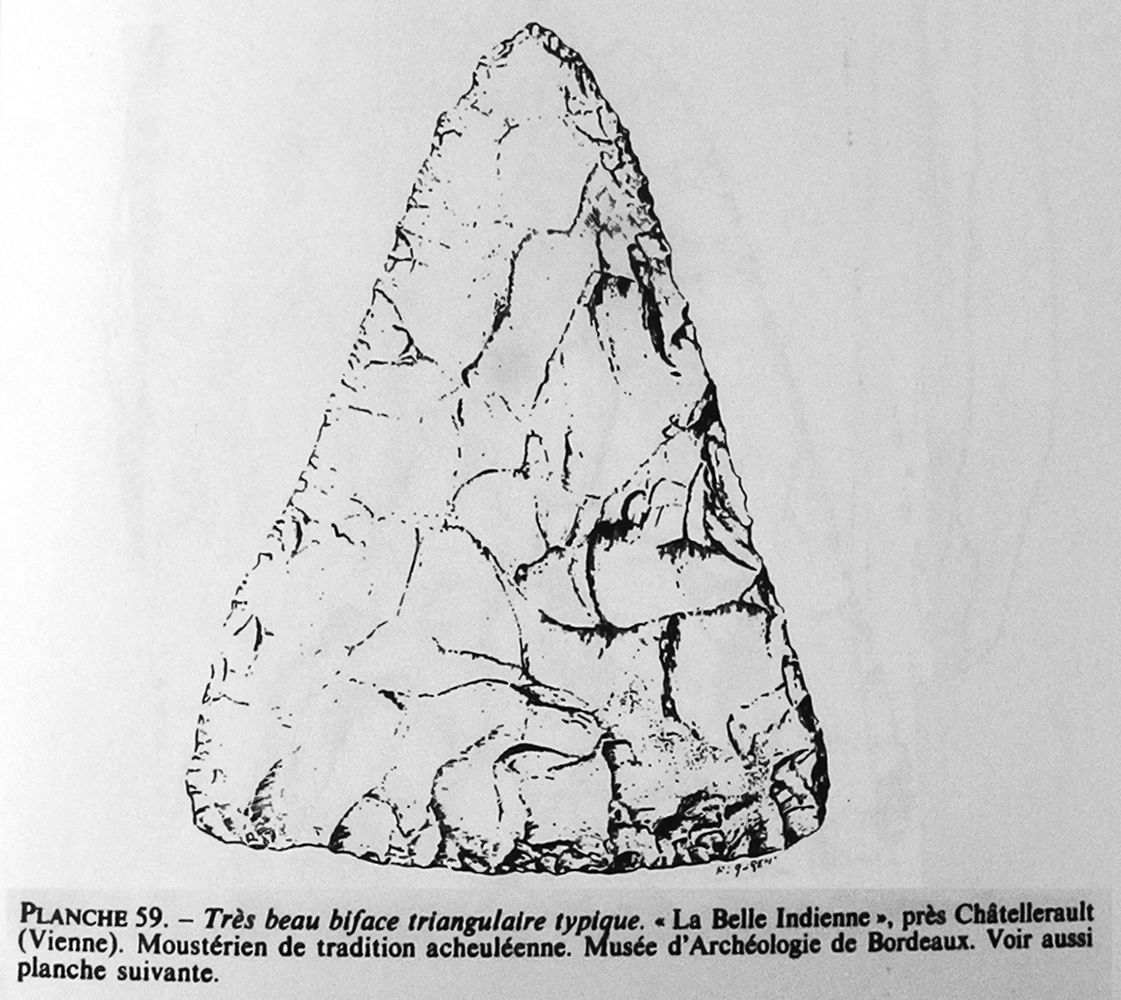
These are the drawings of the piece above by Bordes from his text Typologie du Paleolithique ancien et moyen, 1979.
Photo: Bordes (1979)
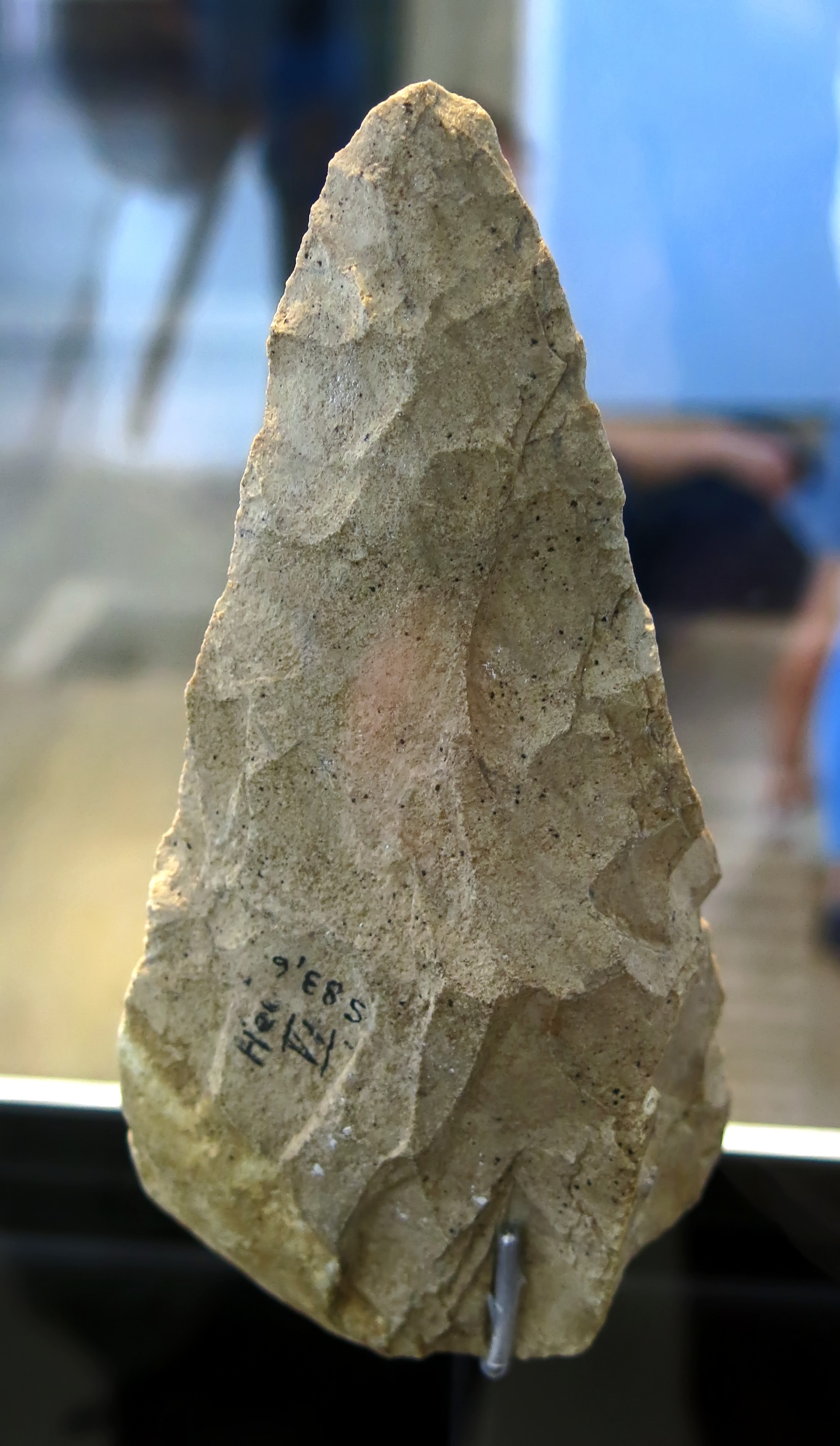
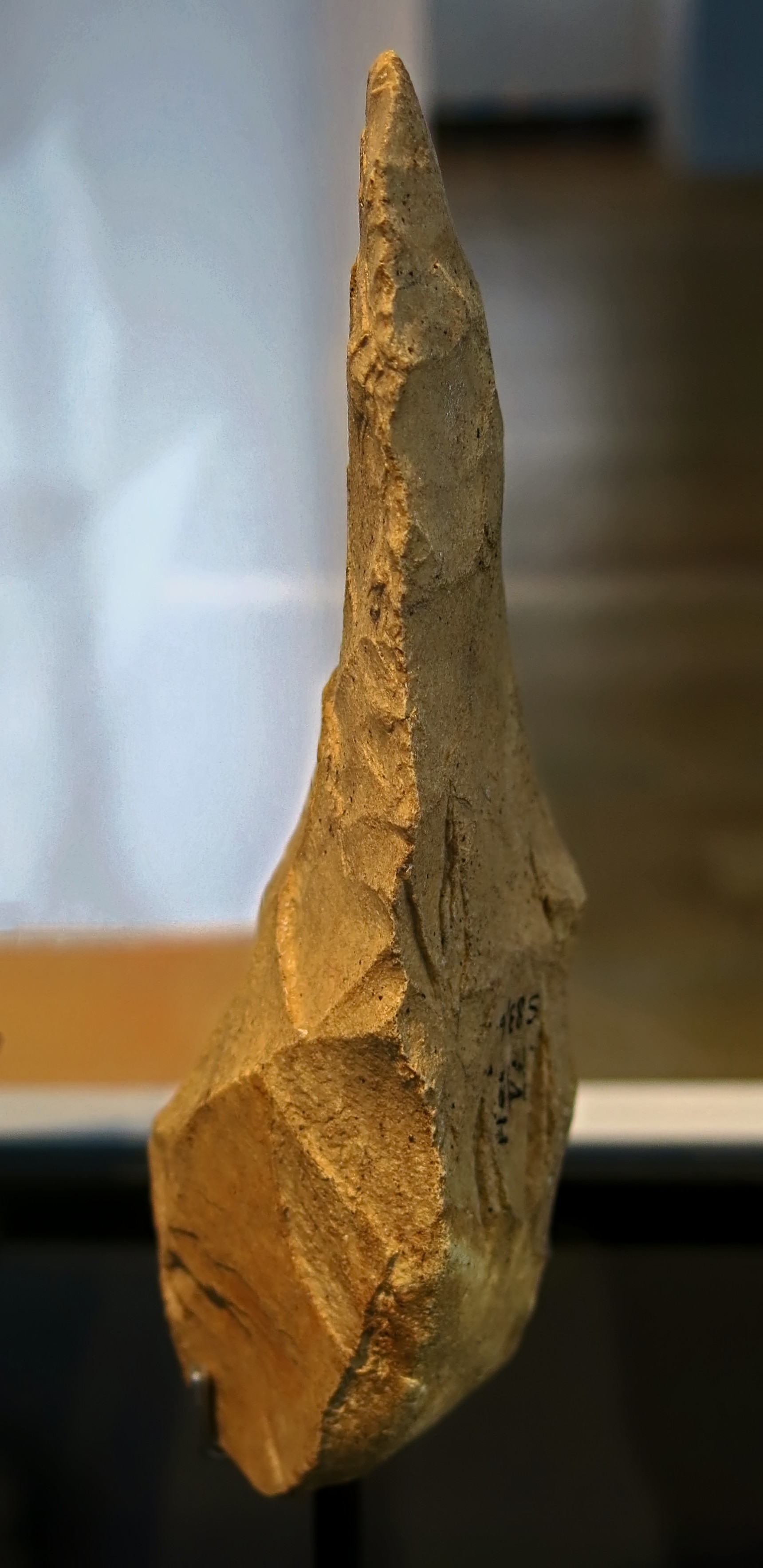
Neanderthals were master stone knappers. They possessed a sense of aesthetics and an intuition for the right material, as may be seen from their handaxes.
In Heidenschmiede there were numerous stone tools made from fresh water quartzite. This is a material very similar to flint, and outcrops only a few kilometres from the site.
Four views of a handaxe, freshwater quartzite, Heidenschmiede, Heidenheim, district Heidenheim.
Because of its asymmetry, this handaxe might well be ascribed to the Micoquien culture.
Circa 70 000 BP - 50 000 BP
Length 148 mm, width 71 mm.
Photo: Don Hitchcock 2015
Source and text: Landesmuseum Württemberg, Stuttgart
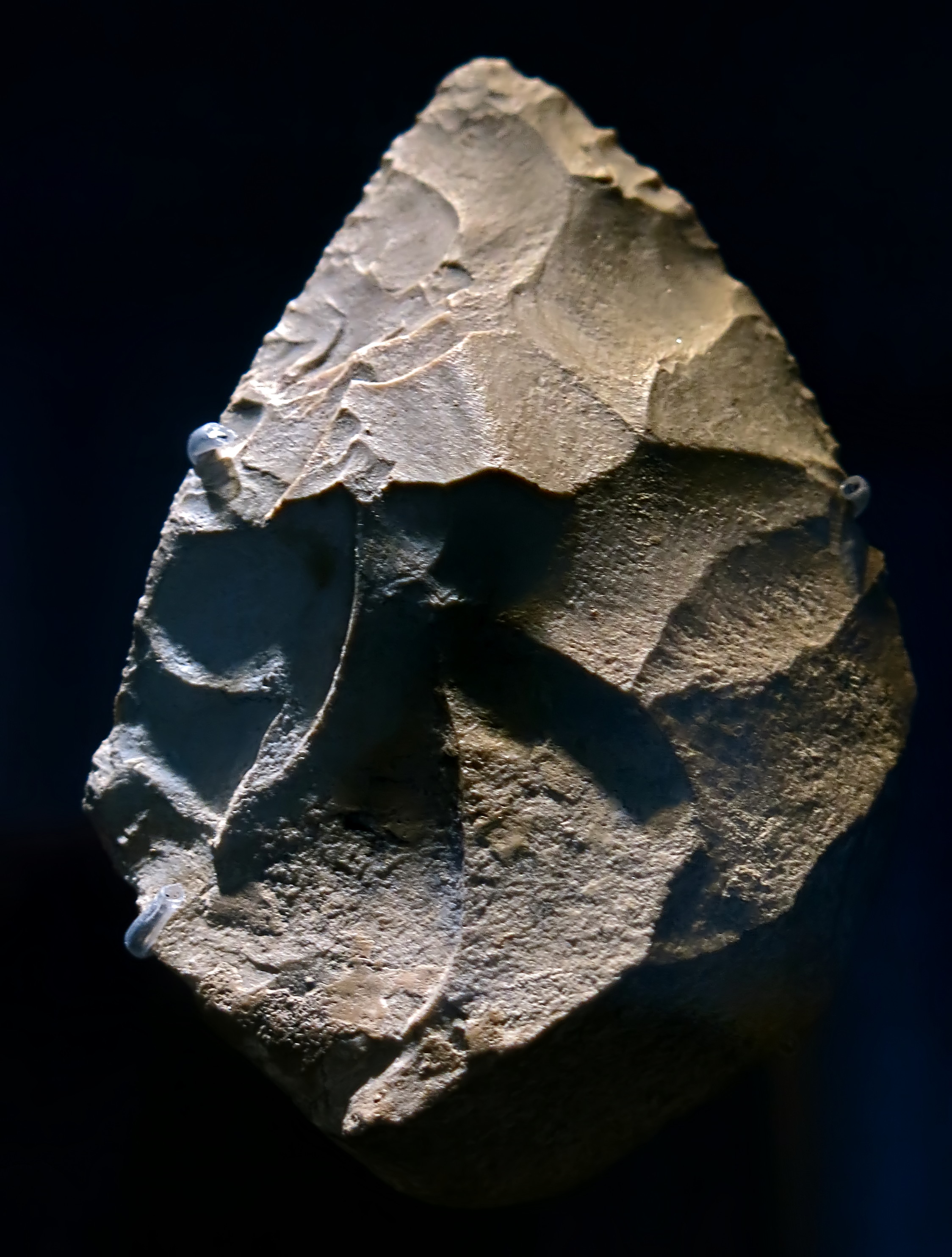
Small handaxe, circa 70 000 BP - 50 000 BP.
Jurahornstein, Jurassic chert.
Heidenschmiede, Heidenheim, Kreis Heidenheim.
Photo: Don Hitchcock 2015
Source and text: Landesmuseum Württemberg, Stuttgart
Rich Booty
Around 1600 artefacts from Neanderthals have been recovered in Wittlingen so far. It is the only large open-air station in the Swabian Alb from this era. Tools were mainly made of flakes. All that remained at the site was production waste, which could not be used any further.
From previous observations at other locations, and from the study of original flint deposits nearby, there is evidence that completed tools were carried to the site, which were then used here in Wittlingen until they became useless. The original deposits of the material used for these artefacts lie 50 to 100 km from Wittlingen.
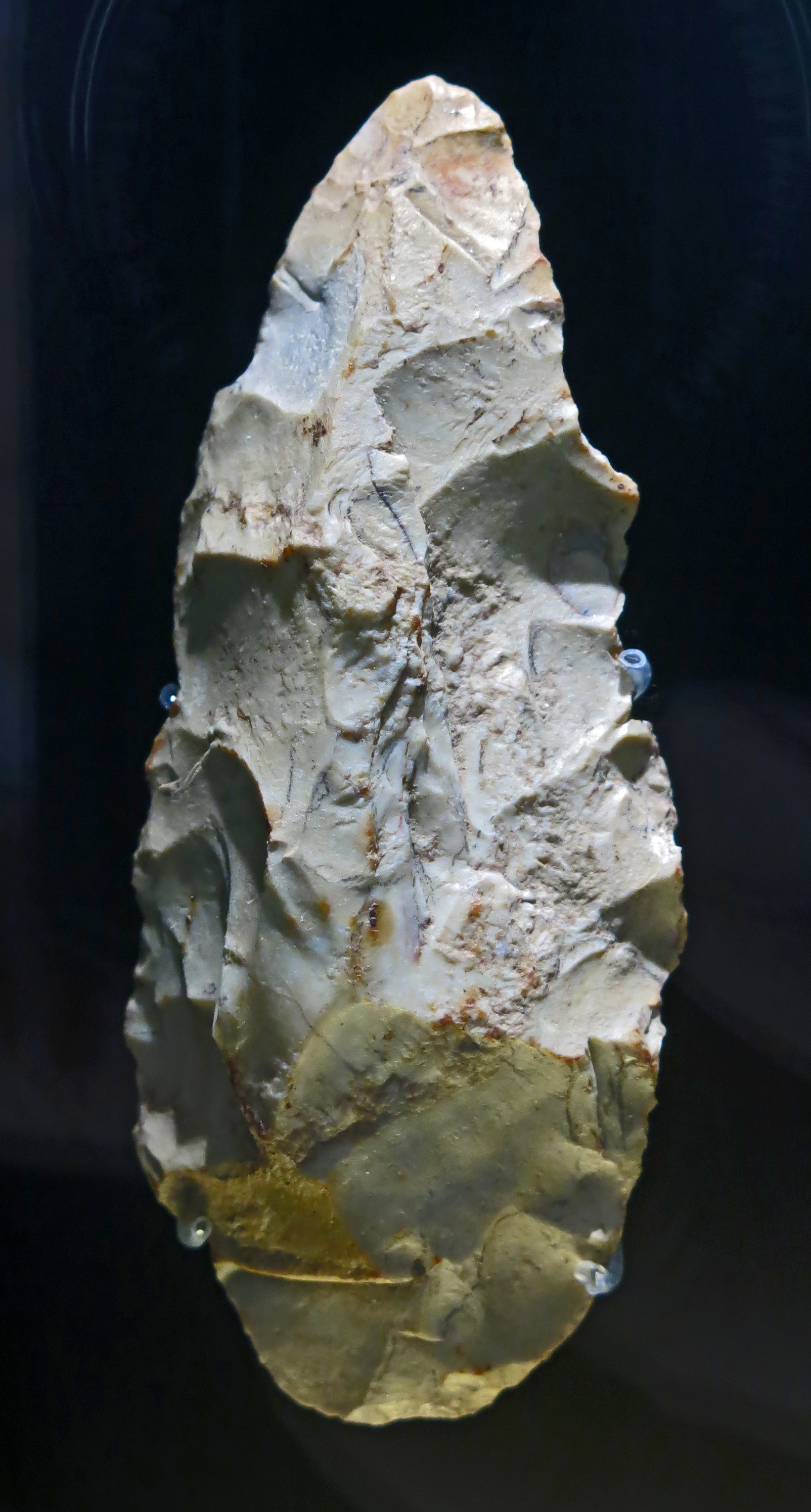
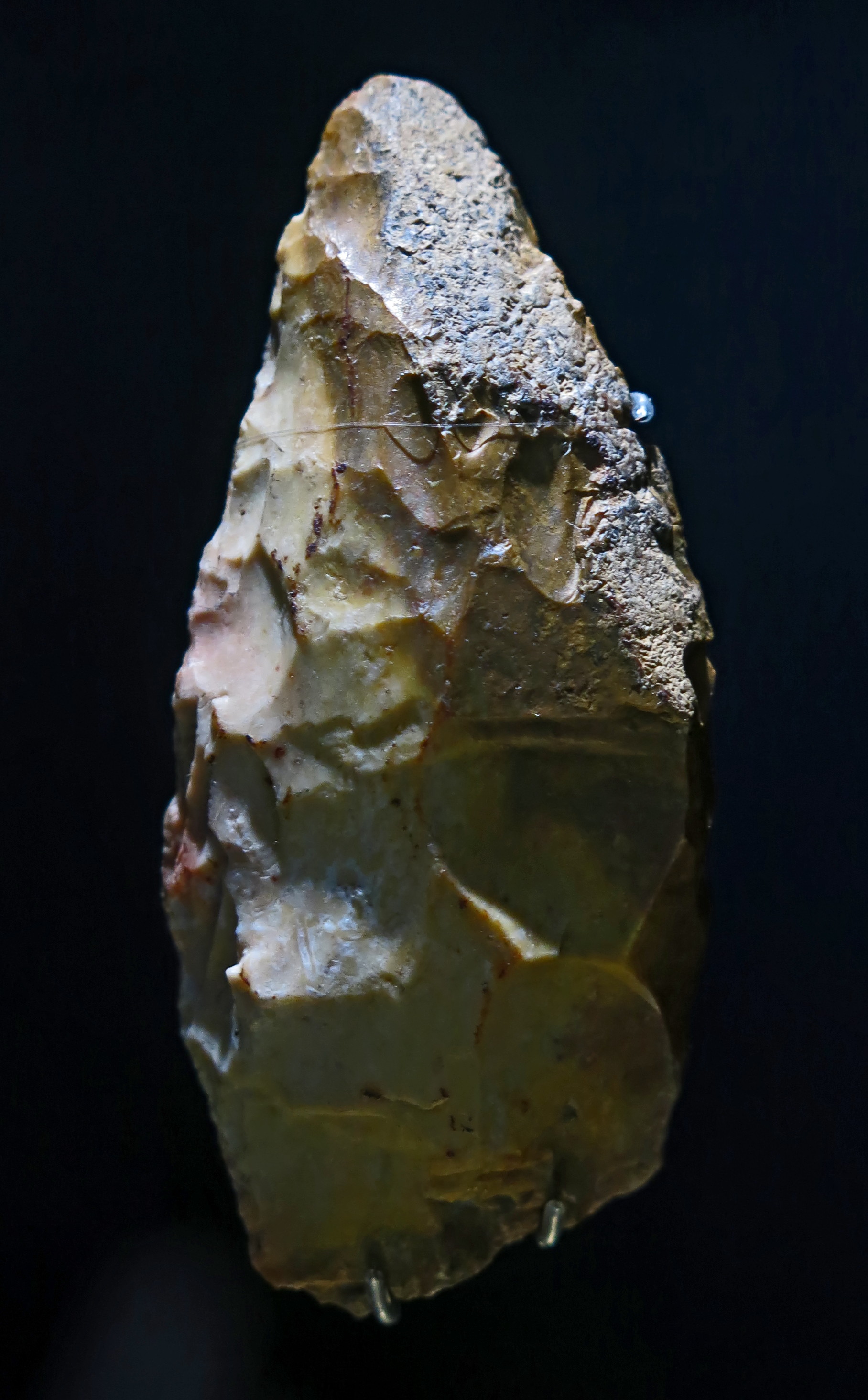
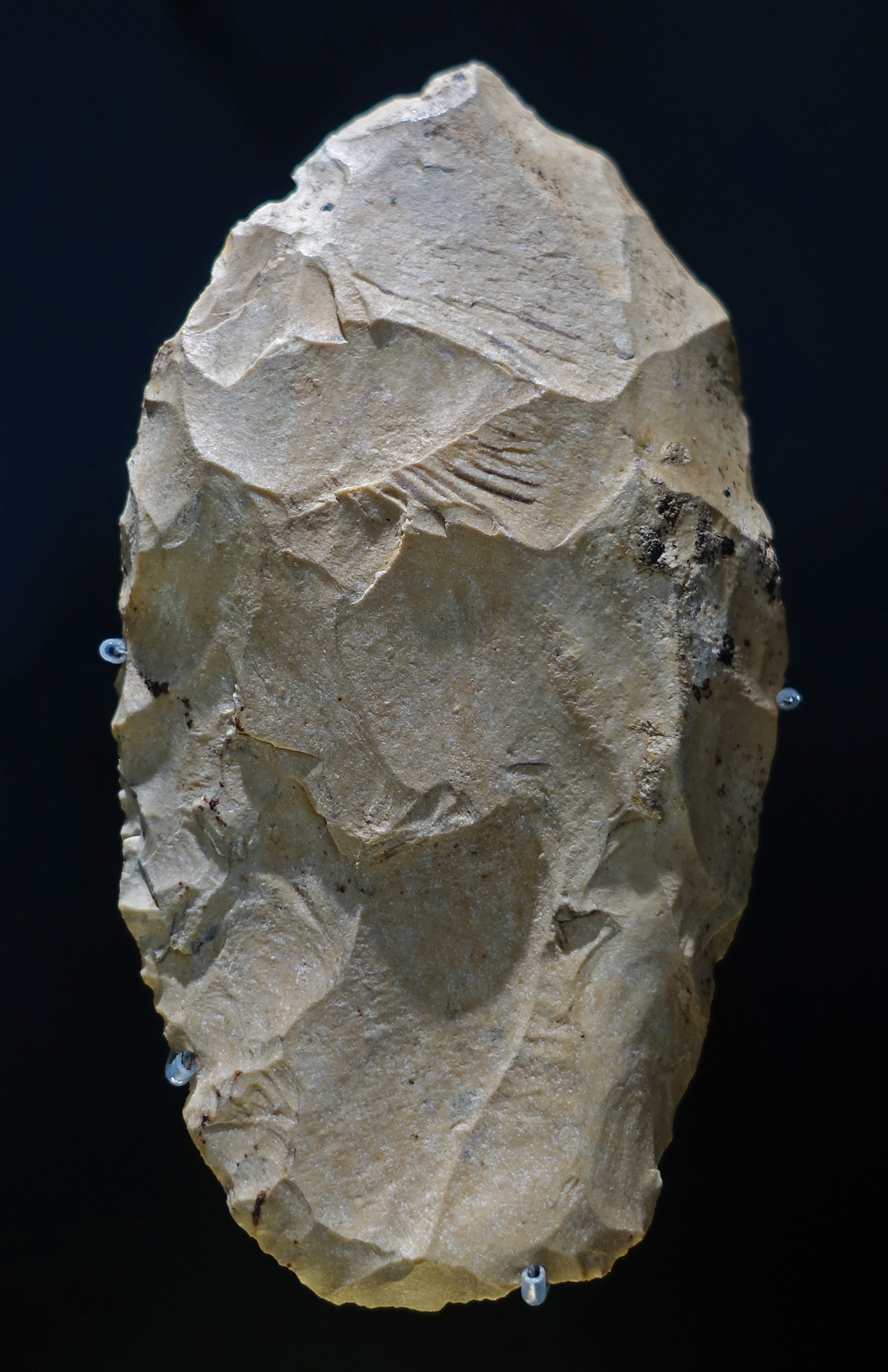
Two leaf points and a blade, circa 70 000 BP - 50 000 BP.
Artefacts struck from Wittlinger chert, Bad Urach, Wittlingen, Kreis Reutlingen, about 30 km south east of Stuttgart.
Photo: Don Hitchcock 2015, 2018
Source and text: Landesmuseum Württemberg, Stuttgart
On loan from the Archäologischen Landesmuseum Baden-Württemberg
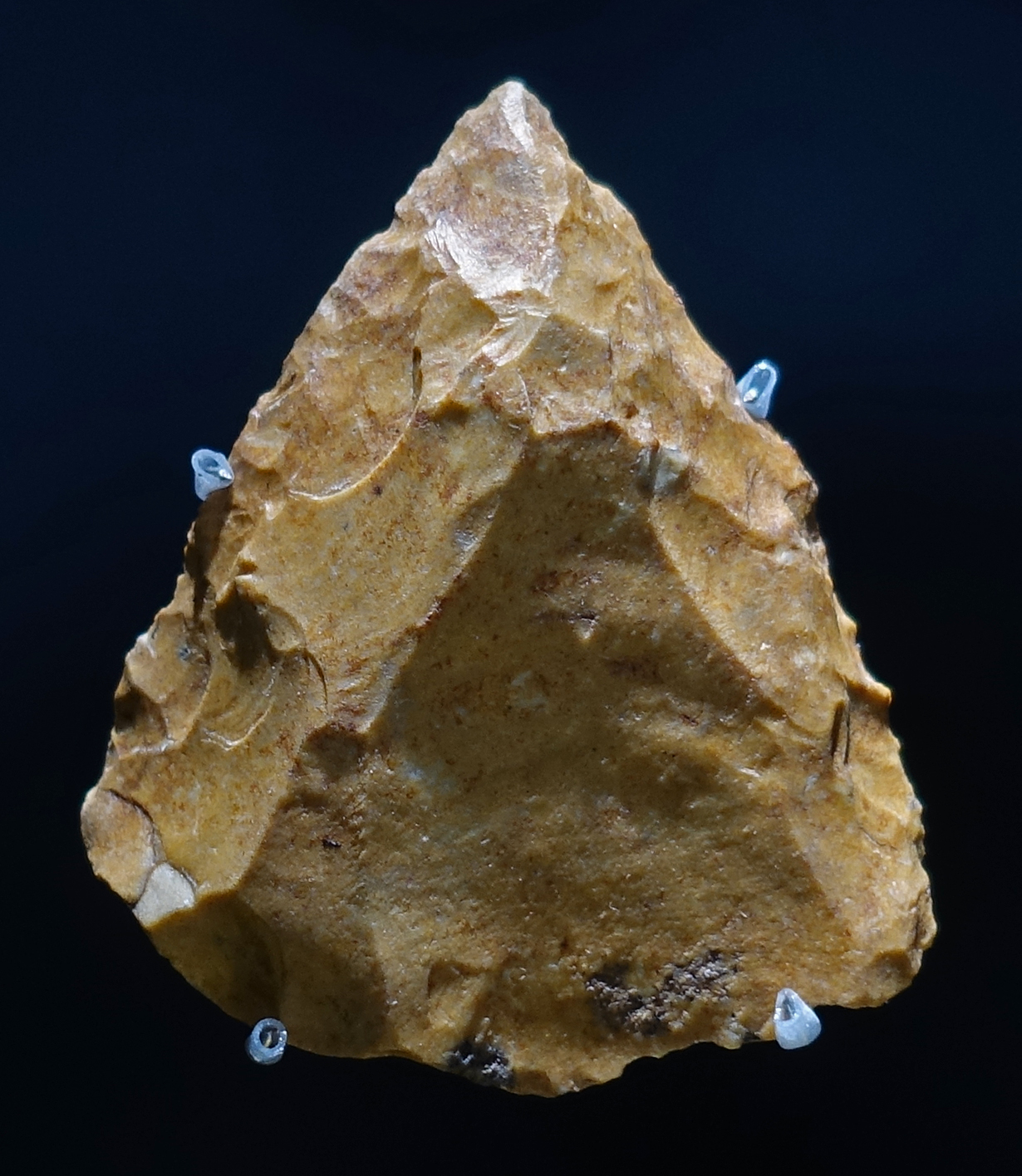
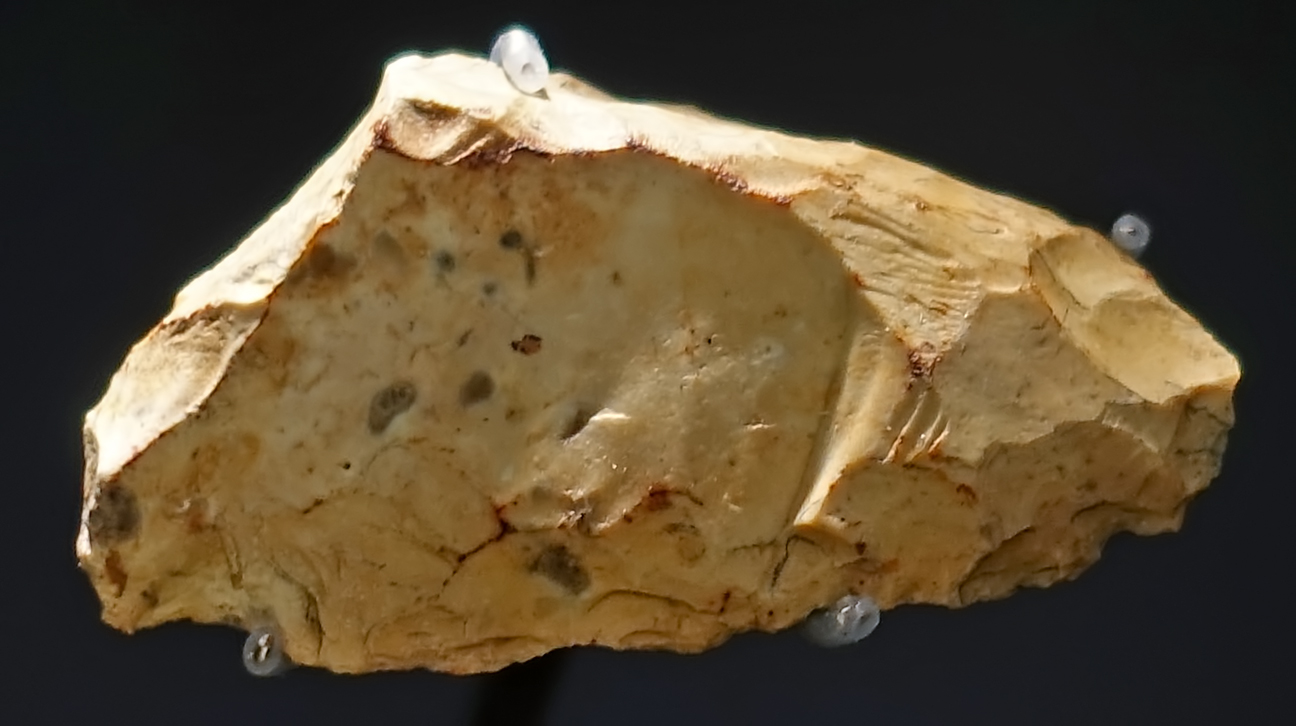
Points, circa 70 000 BP - 50 000 BP.
Artefacts struck from Wittlinger chert, Bad Urach, Wittlingen, Kreis Reutlingen, about 30 km south east of Stuttgart.
Photo: Don Hitchcock 2018
Source and text: Landesmuseum Württemberg, Stuttgart
On loan from the Archäologischen Landesmuseum Baden-Württemberg
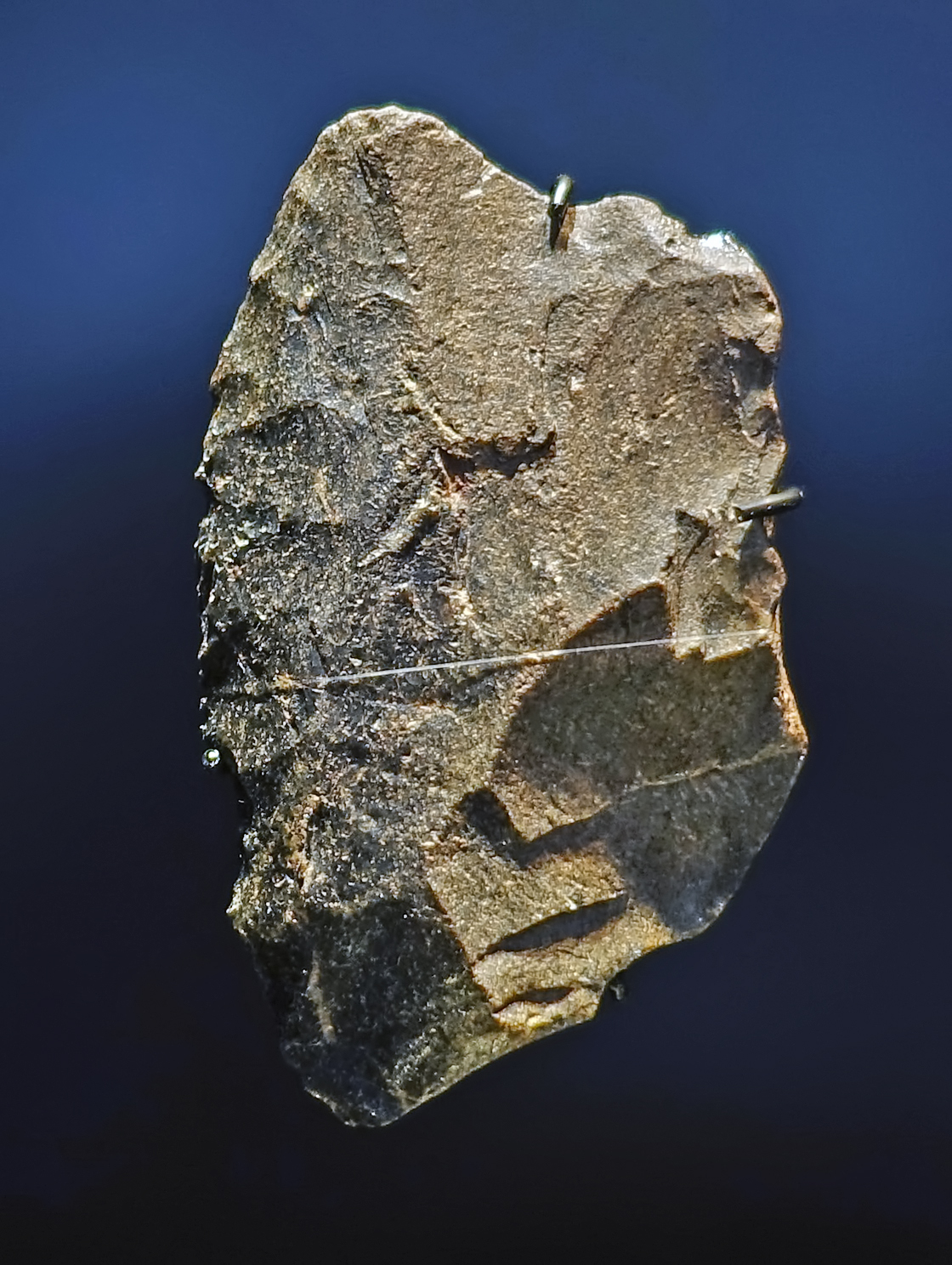
Wide scraper in siliceous slate, from Bad Urach, Wittlingen, Kreis Reutlingen.
Circa 70 000 BP - 50 000 BP
Photo: Don Hitchcock 2018
Source and text: Landesmuseum Württemberg, Stuttgart
On loan from the Archäologischen Landesmuseum Baden-Württemberg
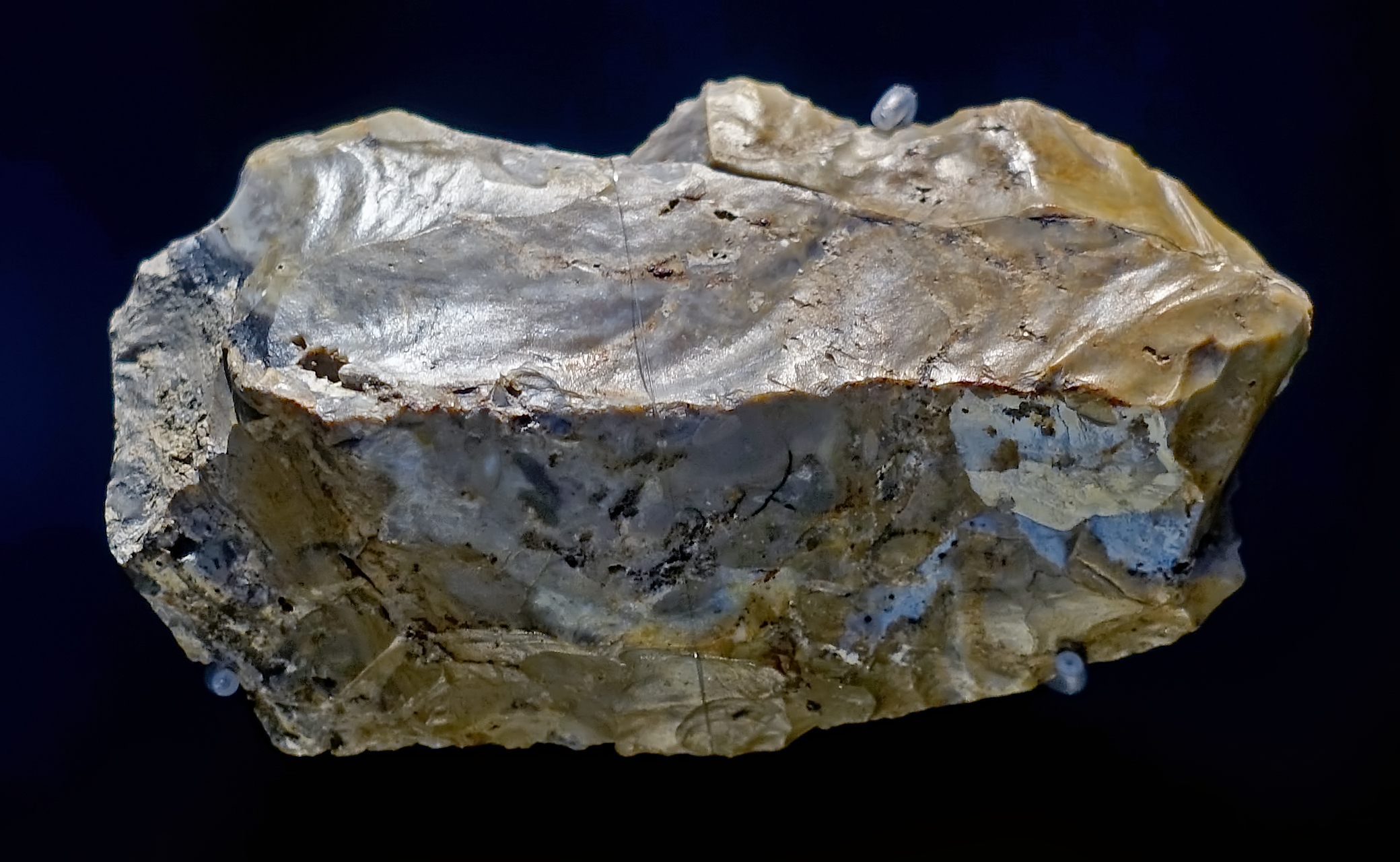
Scraper, Muschelkalkhornstein, Middle Triassic chert, from Bad Urach, Wittlingen, Kreis Reutlingen.
Circa 70 000 BP - 50 000 BP
Photo: Don Hitchcock 2018
Source and text: Landesmuseum Württemberg, Stuttgart
On loan from the Archäologischen Landesmuseum Baden-Württemberg
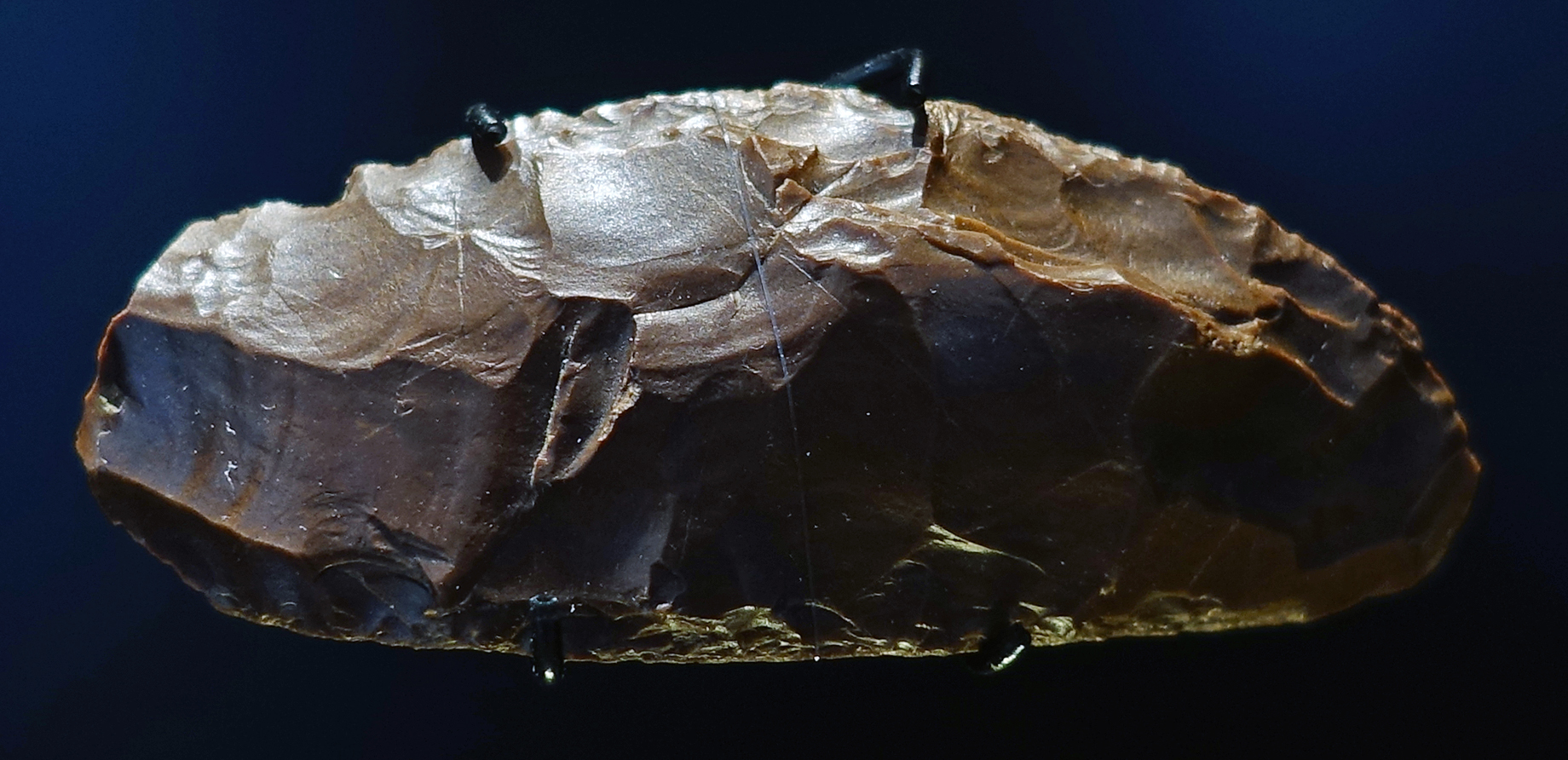
Scraper, red radiolarian chert, from Bad Urach, Wittlingen, Kreis Reutlingen.
Circa 70 000 BP - 50 000 BP
Photo: Don Hitchcock 2018
Source and text: Landesmuseum Württemberg, Stuttgart
On loan from the Archäologischen Landesmuseum Baden-Württemberg
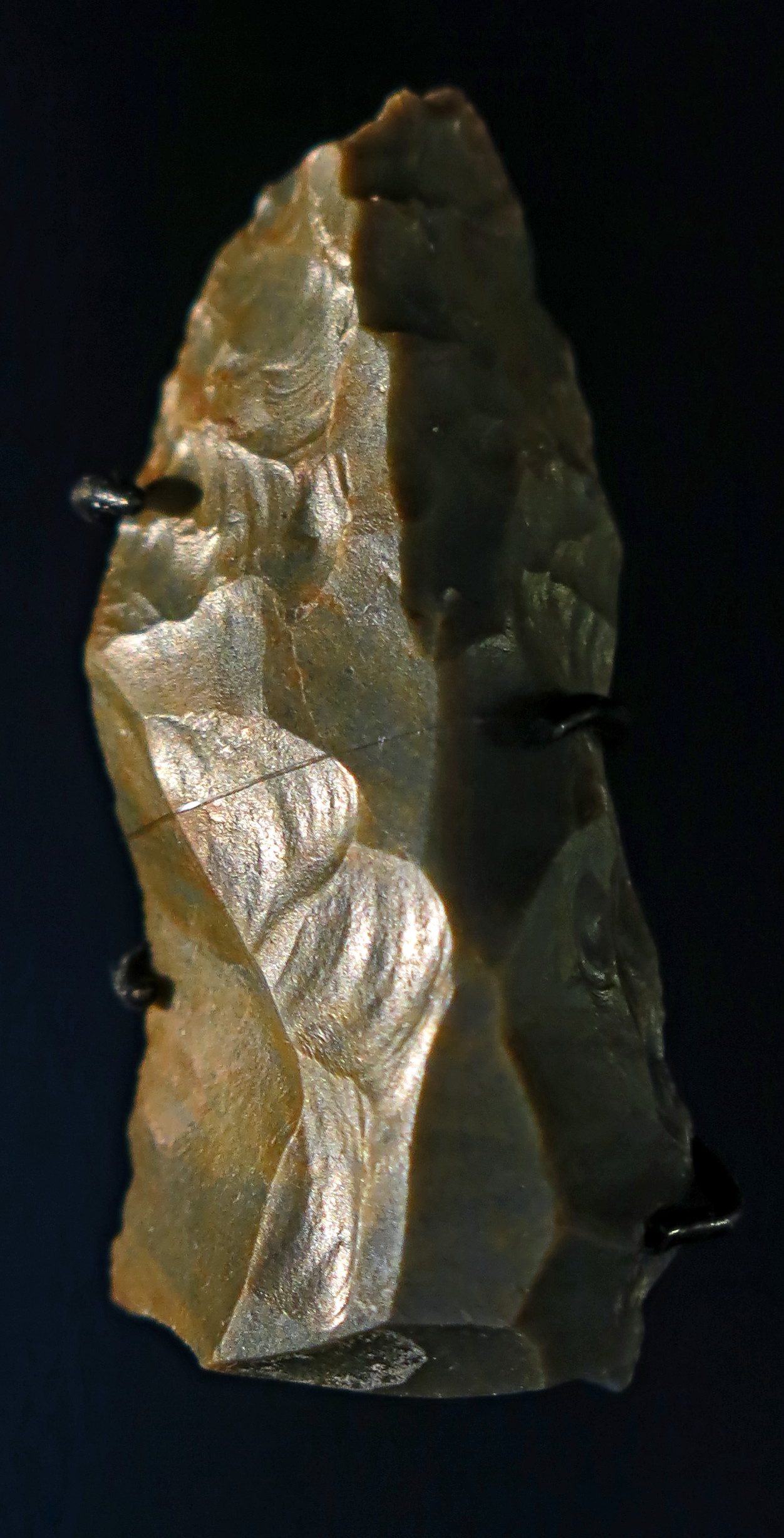
Scraper, green radiolarian chert, from Bad Urach, Wittlingen, Kreis Reutlingen.
Circa 70 000 BP - 50 000 BP
Photo: Don Hitchcock 2015
Source and text: Landesmuseum Württemberg, Stuttgart
On loan from the Archäologischen Landesmuseum Baden-Württemberg
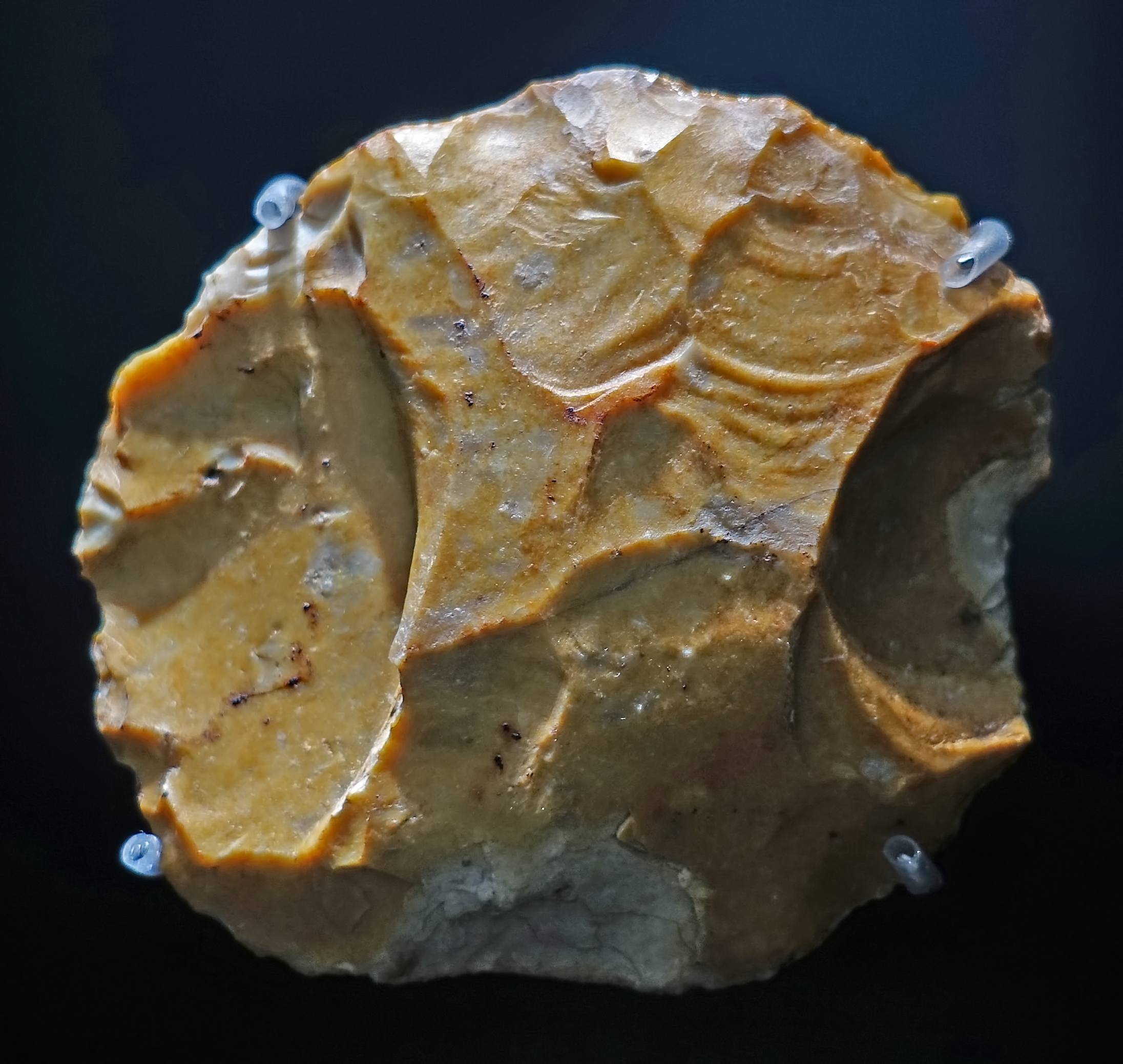
Residual core of Wittlinger Jurassic chert, Bad Urach, Wittlingen, circa 70 000 BP - 50 000 BP
Photo: Don Hitchcock 2018
Source and text: Landesmuseum Württemberg, Stuttgart
On loan from the Archäologischen Landesmuseum Baden-Württemberg
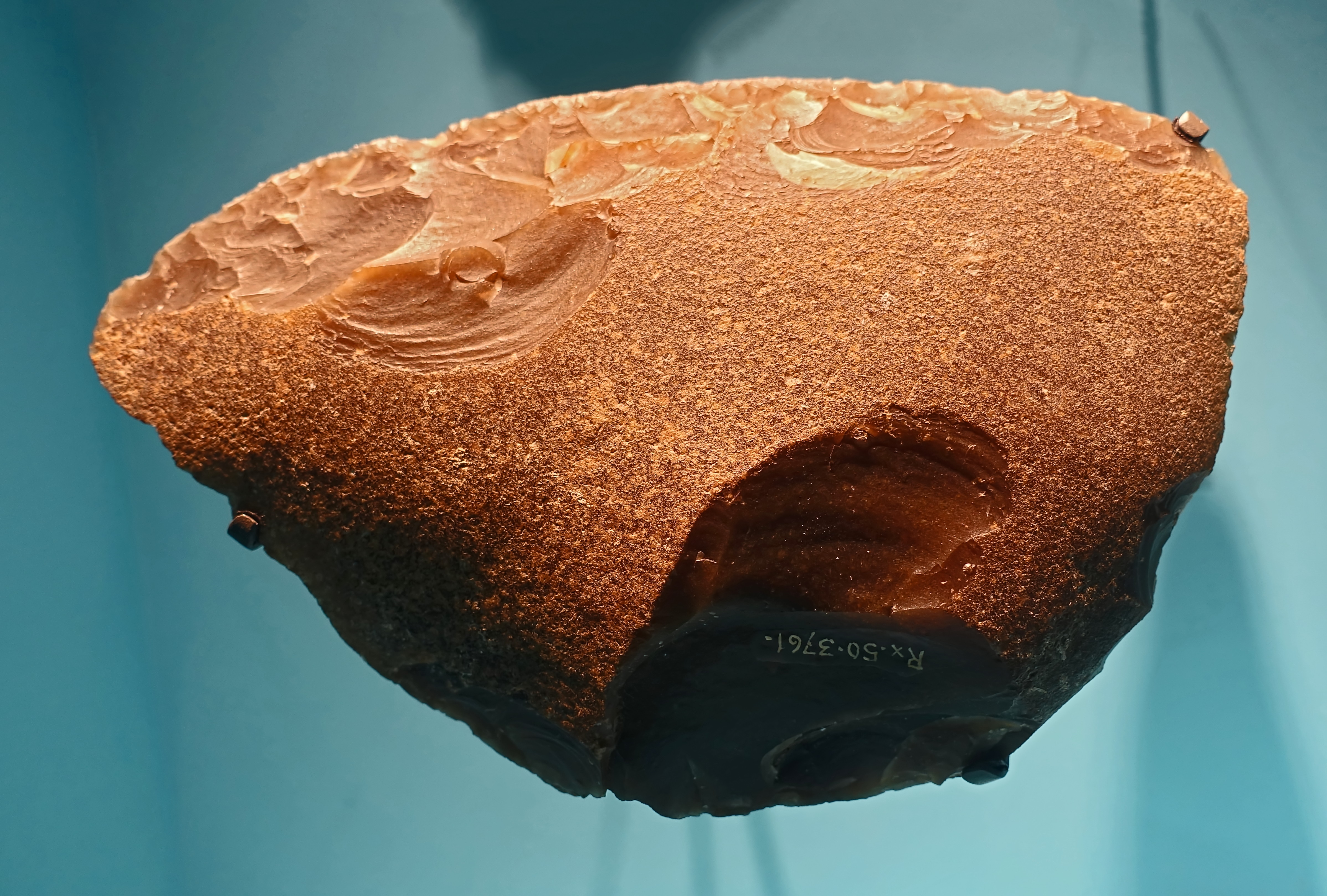
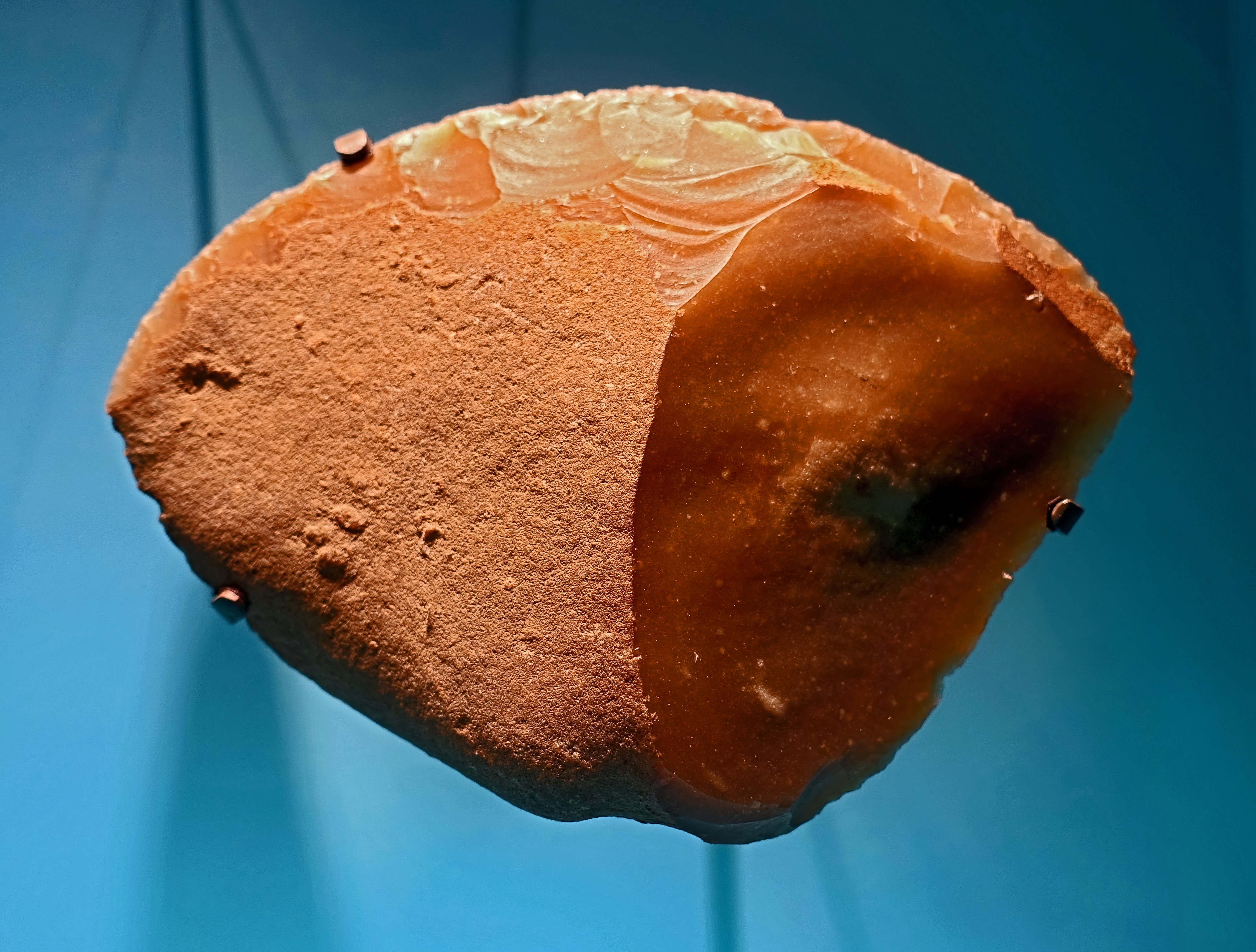
Flint racloirs, or side scrapers, from Abri Reignoux (Abilly), France.
Original, circa 70 000 BP - 50 000 BP.
( note that both these scrapers have had a flake taken out on the right, presumably for the thumb to more easily grasp the tool. This feature is not uncommon in Neanderthal tools designed to be held in the hand - Don )
Photo: Don Hitchcock 2018
Collections des Amis du musée de Grand-Pressigny, Musée de la Préhistoire du Grand-Pressigny
Source and text: Musée de l'Homme, Paris
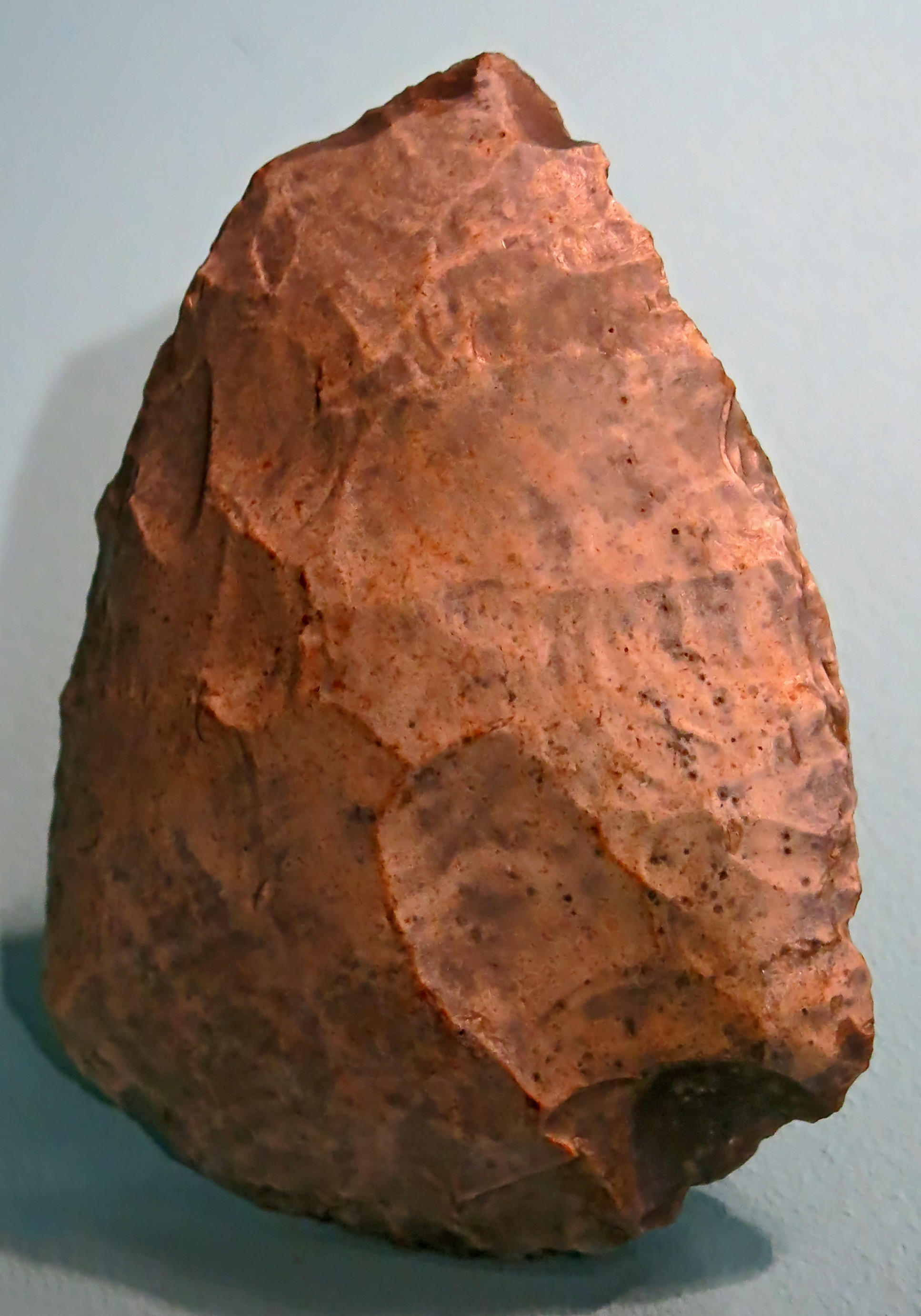
Flint handaxe, circa 50 000 BP.
Dülken-Hausen, Kreis Viersen.
Photo: Don Hitchcock 2015
Source and text: LVR-Landesmuseum Bonn, Germany
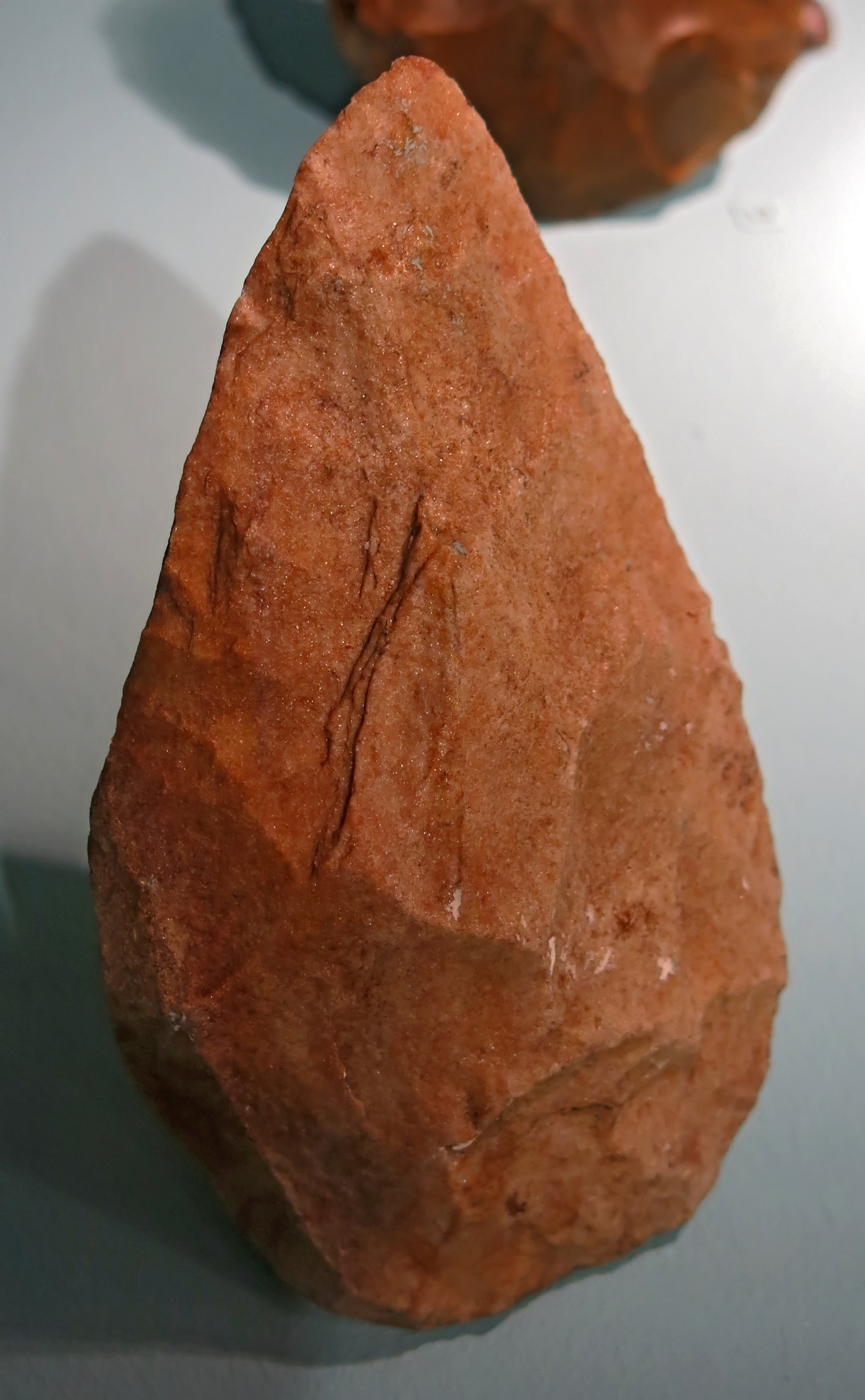
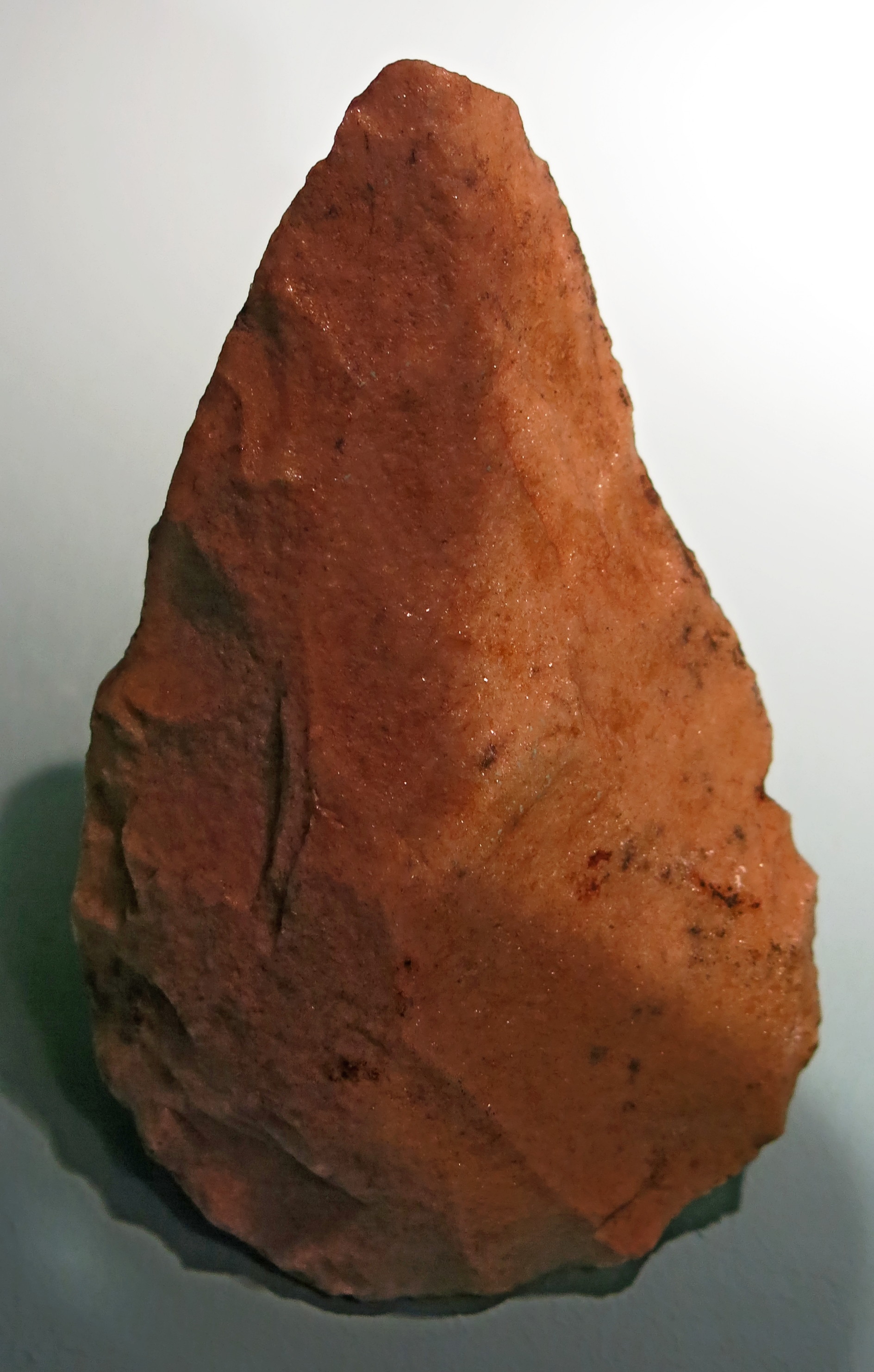
Flint handaxes, circa 50 000 BP.
Erkrath, Kreis Mettman.
Photo: Don Hitchcock 2015
Source and text: LVR-Landesmuseum Bonn, Germany
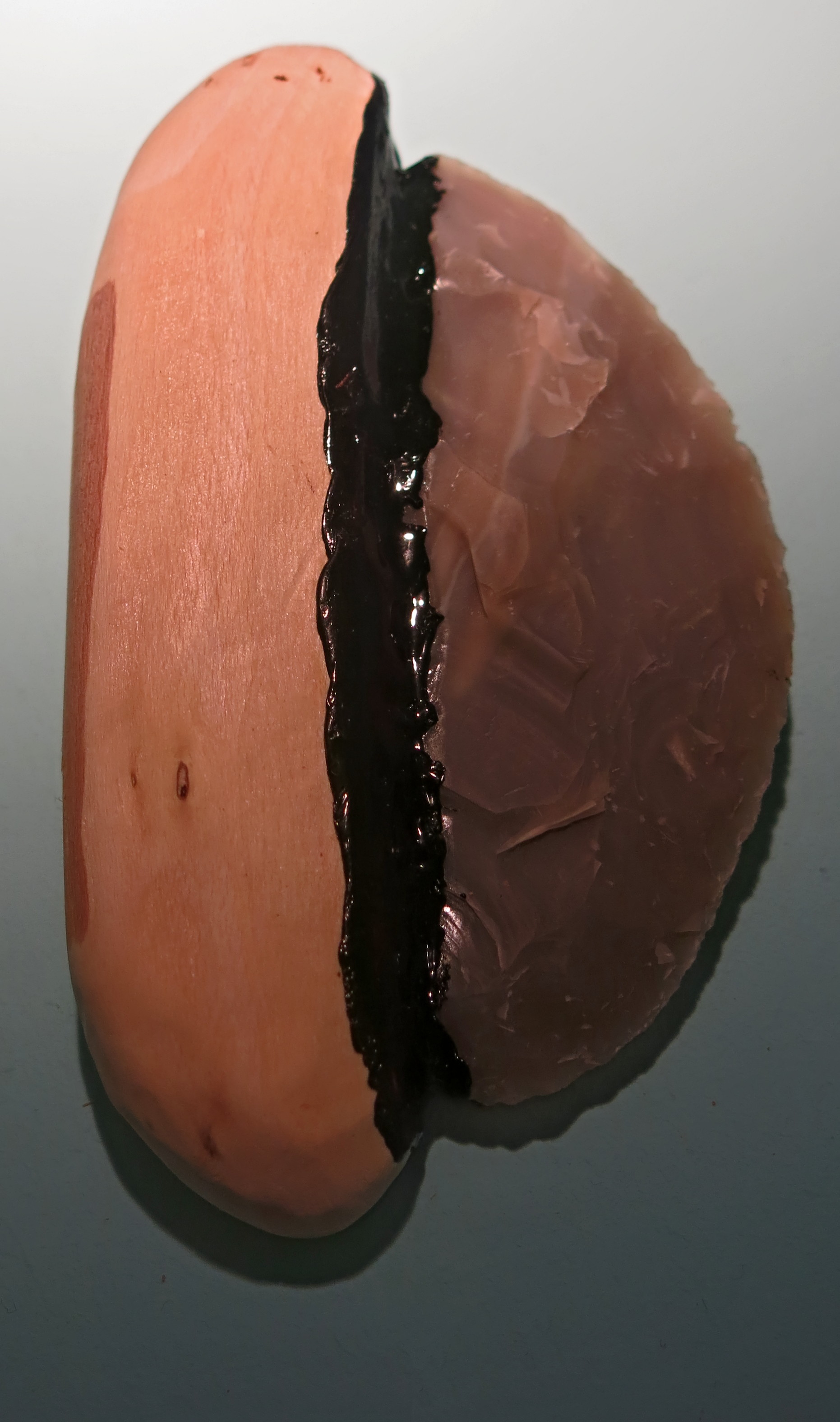
Modern reconstruction of a leaf-shaped scraper attached with birch pitch to a wooden handle.
As used in the late Middle Palaeolithic, i.e. circa 50 000 BP.
Photo: Don Hitchcock 2015
Source and text: LVR-Landesmuseum Bonn, Germany
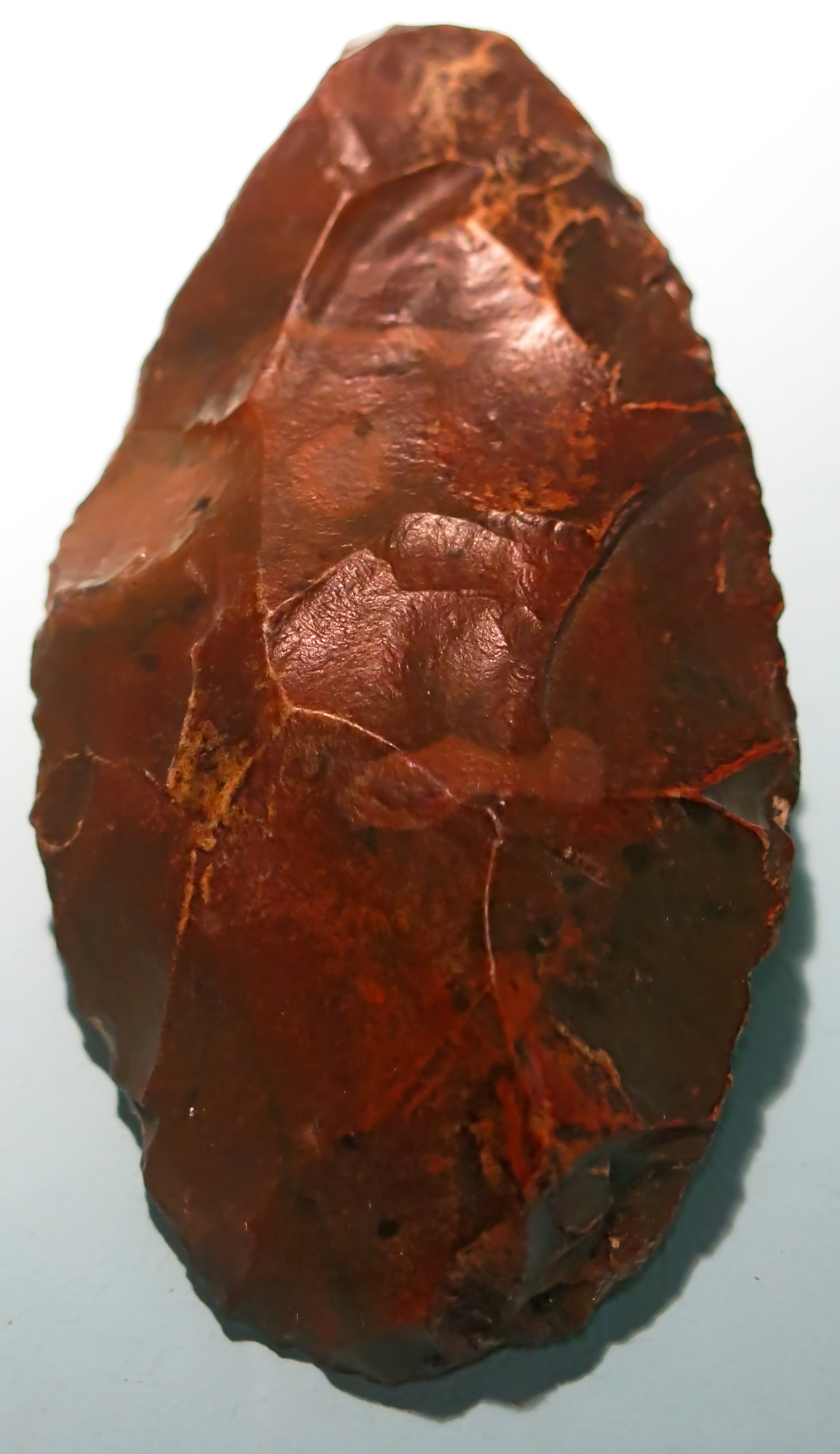
Leaf shaped scraper.
Flint, circa 50 000 BP.
Weeze, Kreis Kleve.
Photo: Don Hitchcock 2015
Source and text: LVR-Landesmuseum Bonn, Germany
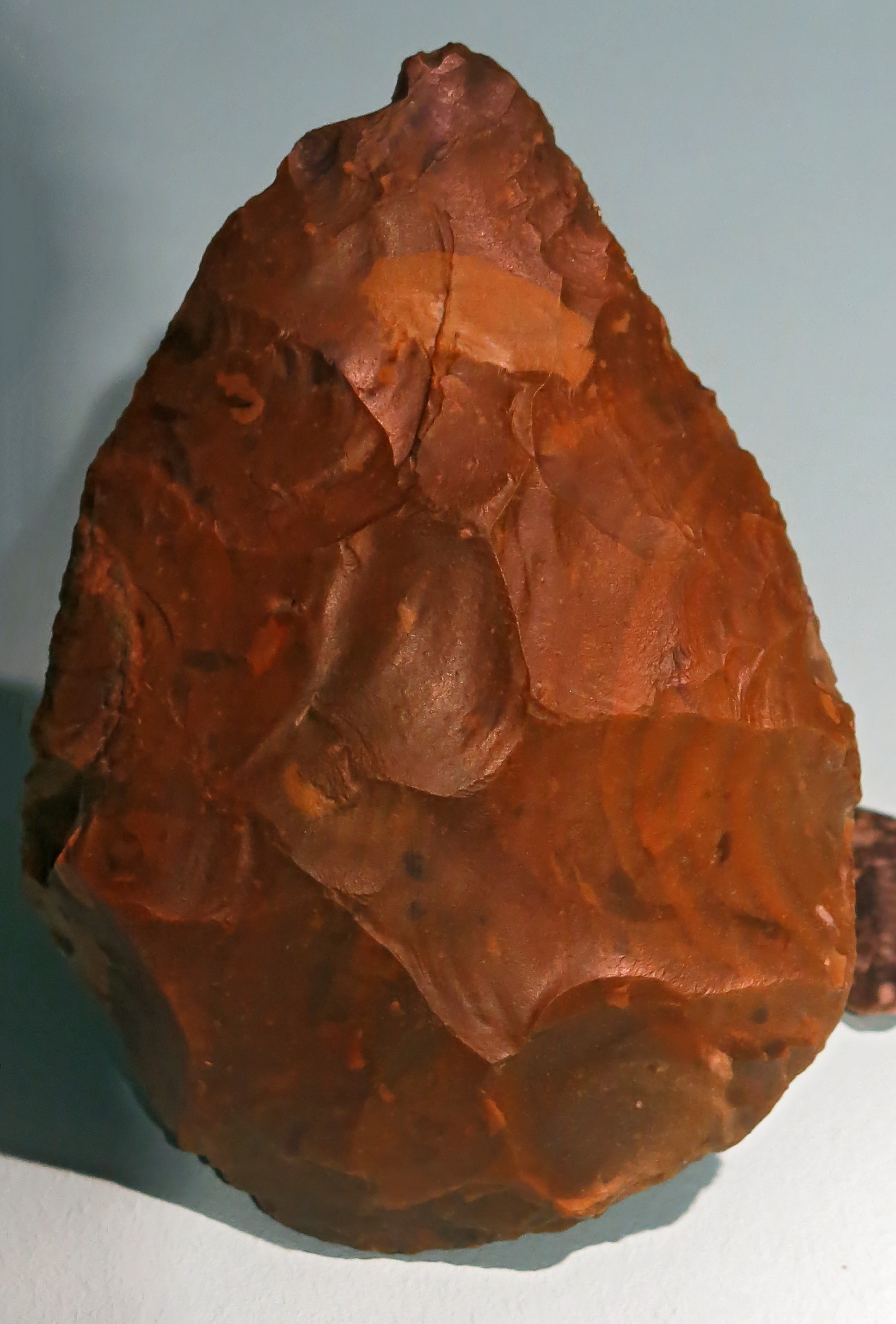
Flint handaxe, circa 50 000 BP.
Elmpt, Gemeinde Niederkrüchten, Kreis Viersen.
Photo: Don Hitchcock 2015
Source and text: LVR-Landesmuseum Bonn, Germany
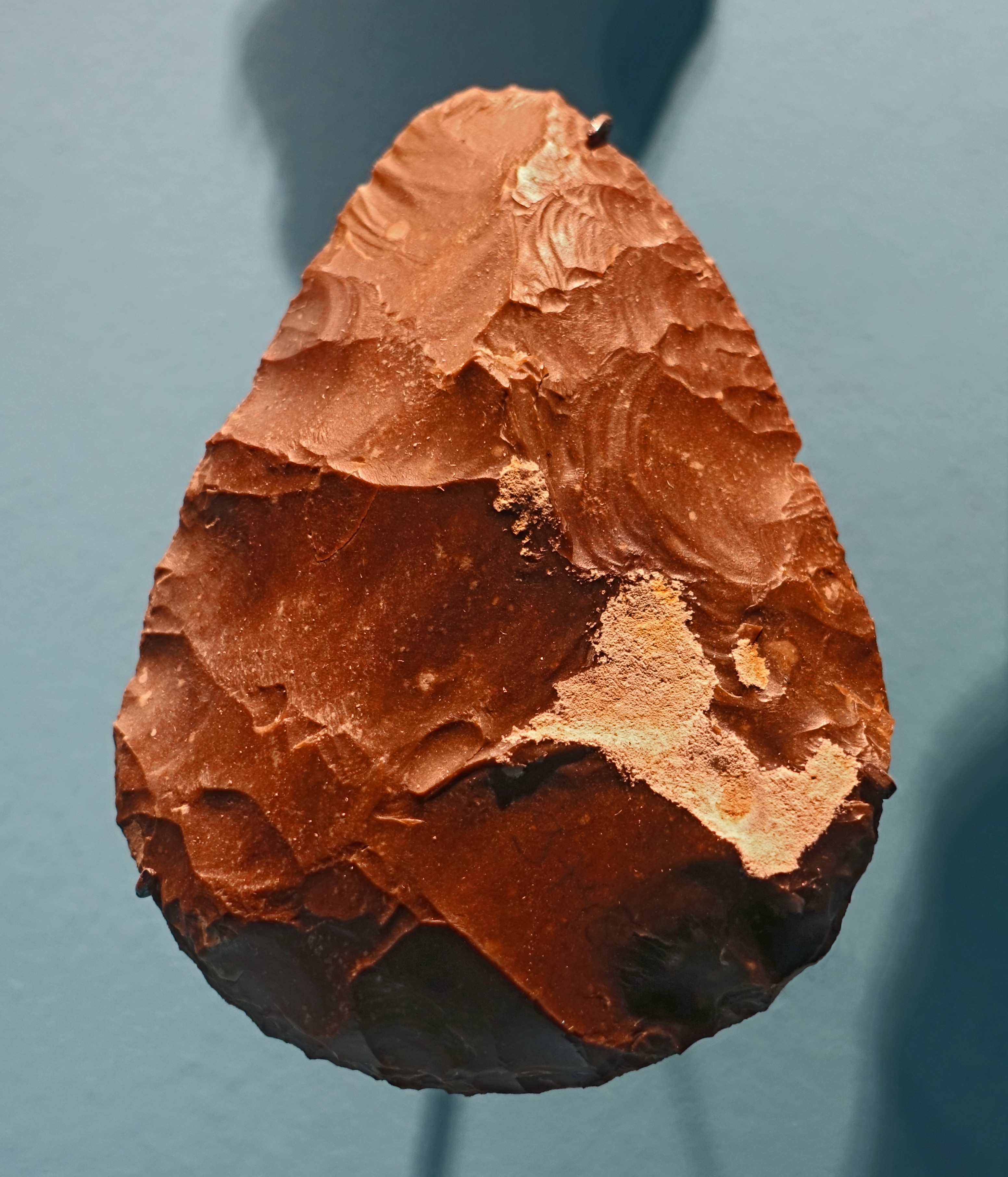
Biface, in flint, from Saint-Amand-les-Eaux, France, circa 49 200 BP.
( This is a superb piece of work, worthy of pride of place in any art gallery in the world, yet such masterpieces were produced in their millions. Sometimes when I am putting up these photographs, I am struck by the love of symmetry and beauty in all humans.
We make things better and more perfect than they need to be, just because of the way we are. We take far more time and effort and skill to create useful things than they logically require. We take pride in our work, and make things as well as we are capable of, whether the object requires such accuracy and care or not.
A simple chopper, made in a minute or two from a pebble in a stream bed, would have performed most of the tasks demanded of this beautiful tool.
The creator of this handaxe died nearly fifty thousand years ago, but this artefact they left behind gives us a small though imperfect window through which to see the things that were important to them in their daily lives, and their pride in good workmanship for its own sake - Don )
Photo: Don Hitchcock 2018
Source and text: Musée de l'Homme, Paris
The invention of the bow and arrow
Michelle Langley, Senior Research Fellow, Griffith University, Oshan Wedage Researcher, Max Planck Institute for the Science of Human History, and Patrick Roberts, Research Group Leader, Max Planck Institute for the Science of Human History have published evidence for the use of bow and arrow technology from 48 000 BP in the forests of Sri Lanka.
Reference: Langley et. al. (2020)
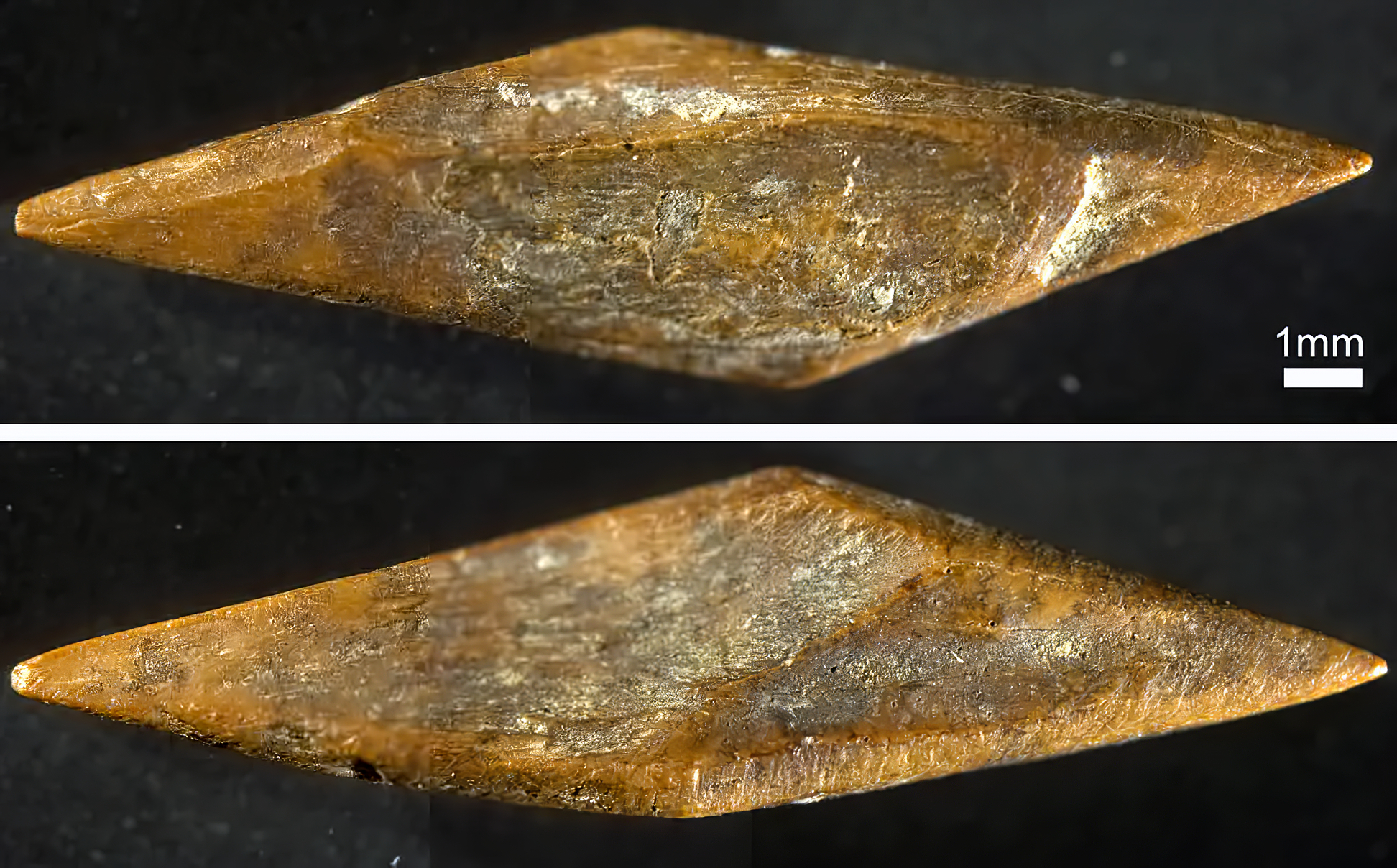
One of the small bone points discovered at Fa-Hien Lena, in Sri Lanka, circa 48 000 BP
Photo: © M. C. Langley
Source and text: https://theconversation.com/48-000-year-old-arrowheads-reveal-early-human-innovation-in-the-sri-lankan-rainforest-139989
( It would seem to me that the bow and arrow is a hunting technique dependent on the existence of forests. It was apparently not invented in Europe until conditions became warm enough for extensive forests, and the earliest evidence we have from there is circa 18 000 BP.
Before that time, the spear thrower, or atlatl, was an invention which greatly increased the distance that a spear could be thrown, but it performs best in open country, where the hunter has room to throw the spear. It is far less useful in forests, which is where the bow and arrow comes into its own. The hunter can more easily get closer to the prey without being seen, and the bow and arrow is very accurate at those shorter distances.
However evidence has now been found for the use of the bow and arrow in Sri Lankan rainforests about 48 000 years ago. - Don )
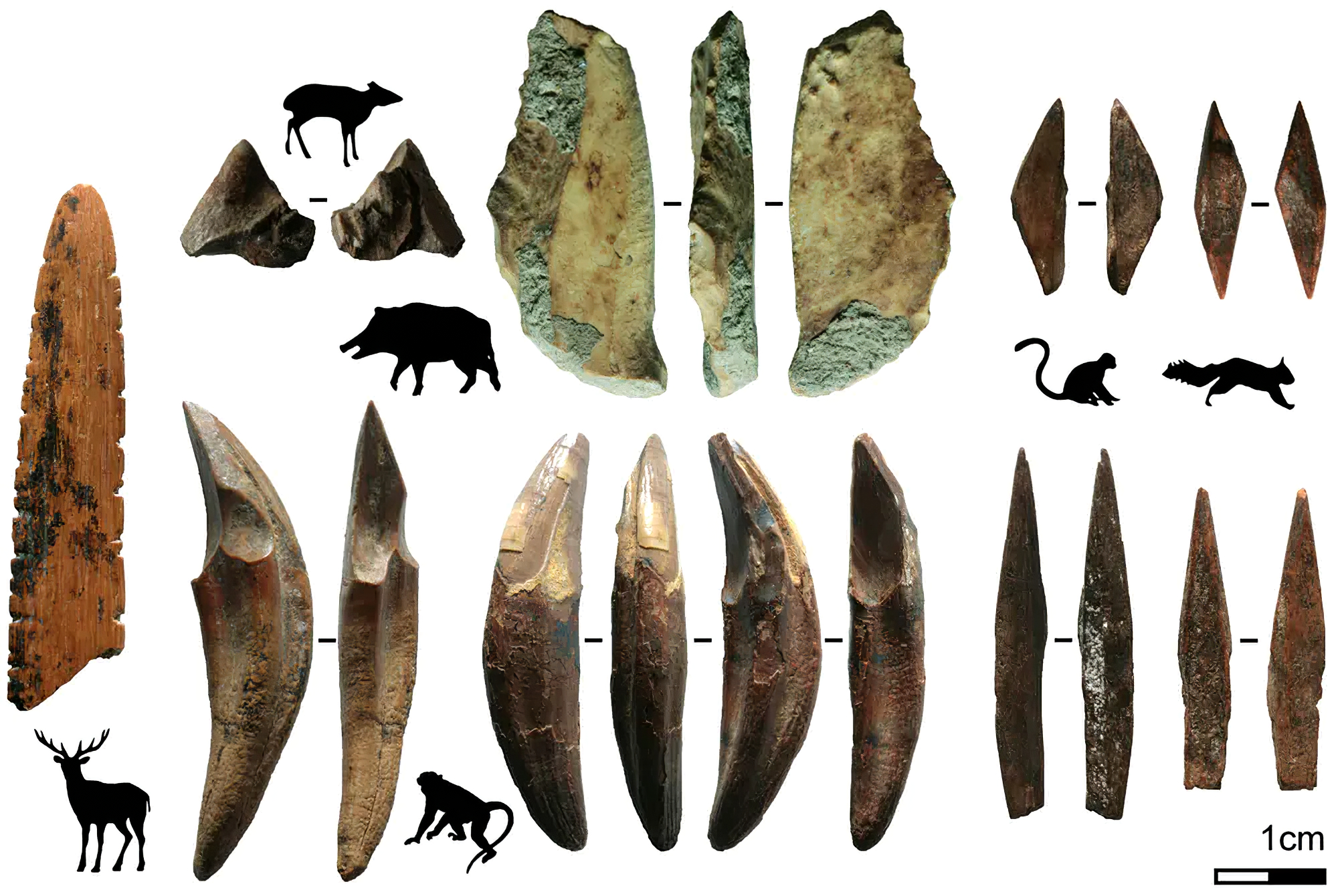
Bone technology of Fa-Hien Lena. Tools made from bone and teeth of monkeys and smaller mammals recovered from Fa-Hien Lena, Sri Lanka. This technology included small bone arrow points (bottom right), and skin or plant-working tools.
Photo: © M. C. Langley
Source and text: https://theconversation.com/48-000-year-old-arrowheads-reveal-early-human-innovation-in-the-sri-lankan-rainforest-139989
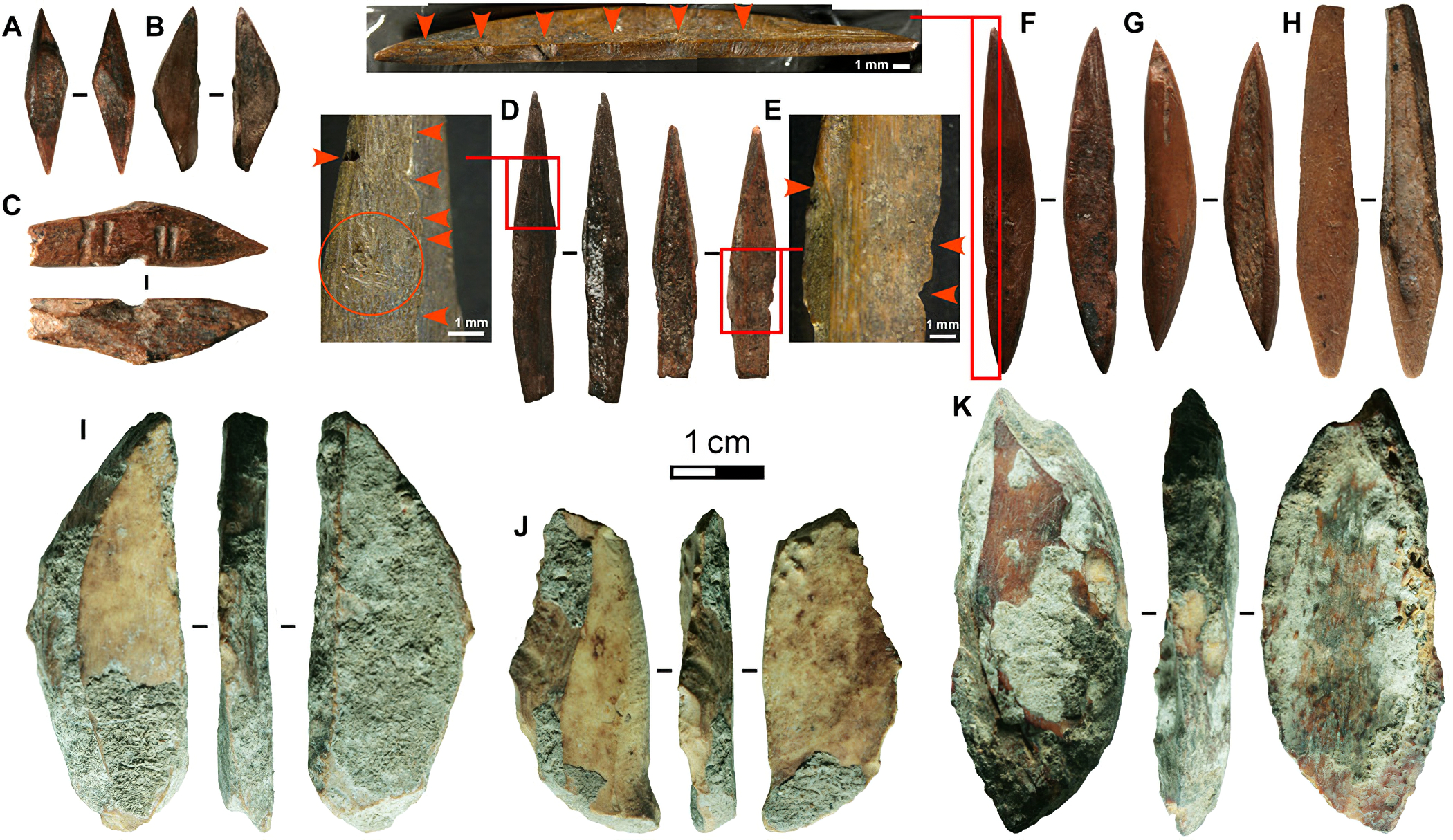
Pointed bone technologies of Fa-Hien Lena.
Bone projectile points (A to H) and scrapers (I to K) from Fa-Hien Lena. (A and B) Geometric bipoints, with (B) coming from phase D context 146; (C and F) hilted bipoint, red arrows indicate cut notches; (D and E) hilted unipoints, red arrows and red circle indicate wear indicating fixed hafting; (G and H) symmetrical bipoints.
Photo: © M. C. Langley
Source and text: Langley et. al. (2020)
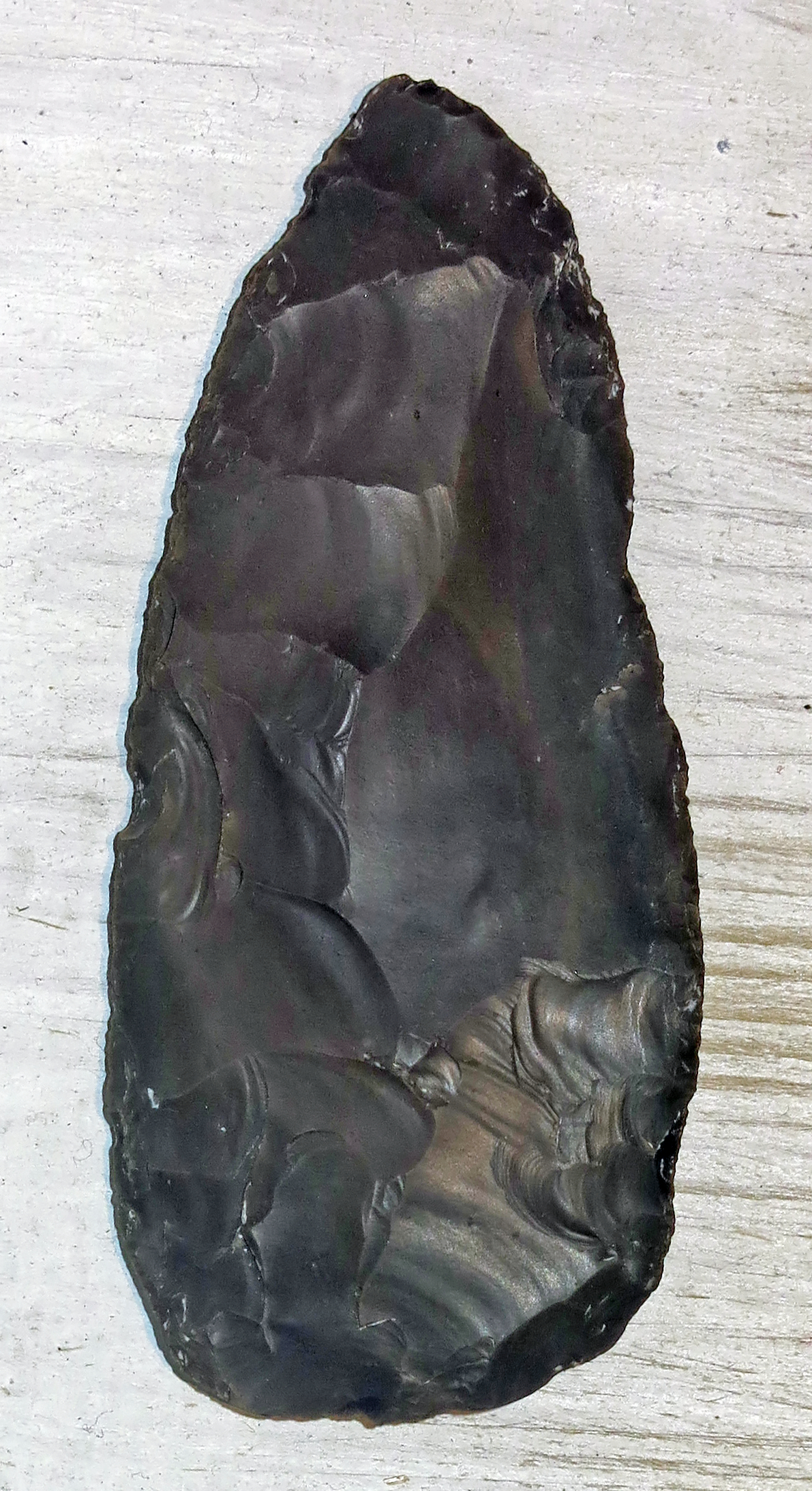
Blattspitz, Leaf Point, France.
38 000 BP.
Photo: Don Hitchcock 2015
Source and text: Neanderthal Museum, Mettmann, near Düsseldorf, Germany
On loan from the Löbbecke Museum, Düsseldorf.
Screw Thread Corks
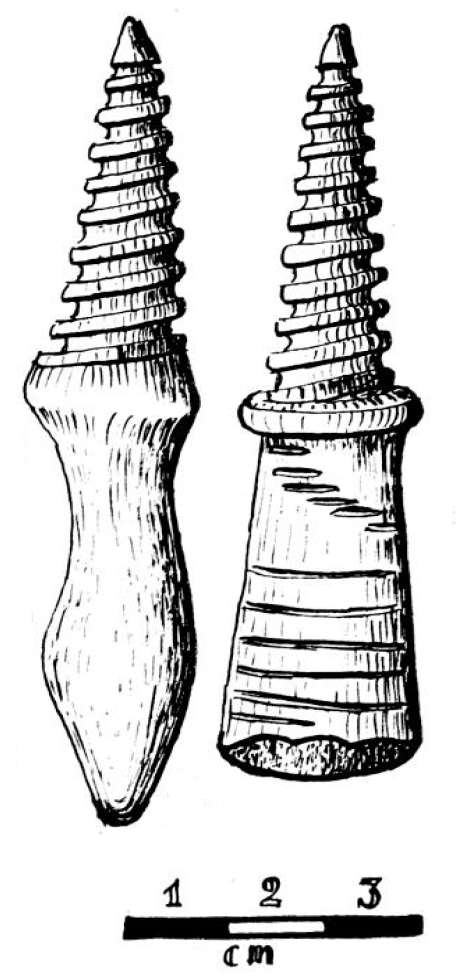
These are the most delightful tools I have ever seen. They are from the Perigordian IV, which is 30 000 BP to 28 000 BP.
They are called 'goat skin corks' which have a hand cut screw thread!
I was staggered when I saw them, I was looking for something else, and came across them by chance. You don't expect to find a screw thread in the Palaeolithic!
It would be a great way to get a watertight seal for a wineskin or waterskin. One should never underestimate the ingenuity of the human race. It was a palaeolithic Einstein who came up with that one - and a tour de force for the artisan who actually made it! Think of the special tool that would have been made in order to get it perfect….. It looks like a teamwork job to me, somebody to think of it, a group of people to create the tools necessary, and decide on the materials - wood? bone? ivory? and a long process in order to make it, ironing out the inevitable problems as they occurred.
It also indicates a large measure of affluence. People who live hand to mouth don't come up with a whimsical invention like this, and don't have the time, resources or energy to see the project through.
They are from two different sites, but the same time period. My bet is that both were made at one site, and traded to another. No two people come up with an intellectual leap like that independently, at the same time. It had to have been made by the same artisan or group of artisans, for sure. What is interesting, however, is that this was invented, but never became popular except in one general area at one time, about 30 000 years ago. I am reminded of the invention of ceramics at Dolni Vestonice, which flourished for a short time, then disappeared for tens of thousands of years.
The one on the left is from Roc de Combe-Capelle, and on the right from Fourneau du Diable. They are both in the Dordogne area, about 90 kilometres apart.
Notice that they are both right hand threads, showing that right handedness in humans has been around for a long time - though we knew that anyway because of the differences in arms on the right and the left of skeletons. Mungo Man had a wonky right elbow, either from using a spear thrower or a spear. It is given as evidence of a spear thrower 40 000 years ago, but it could just as well have been from throwing a spear.
The material of both is ivory. Hard to work, but it would be very durable. You are subjecting that thing to a lot of stress. Brass would have been better still……
Note that what follows is my version of how to use the stopper, not something that I know works, I've never actually made or used the complete set of equipment needed. But this thought experiment would be a good start, I reckon.
If I were going to make the whole shebang, I'd start with the complete hide of an animal such as an ibex. Pigs are good, I've drunk wine in spain (very ordinary wine I might add) that was stored in a complete pig's hide. I don't know how they did that, I assume they decided what they were going to do with the hide before they started, and made the smallest incisions possible to get out the squishy bits. The one I saw had only stumps of skin at the legs and neck, tied down firmly as you would expect. The advantage of a larger animal is that, of course, you can store a lot more liquid all at once.
OK, so imagine we've got a skin that is waterproof, an ibex skin say, with an outlet, let's say the front right leg of an ibex. This is a relatively large orifice, but it has a lot of loose skin flapping around. The other openings are folded over and tied down. One of these can be the filling hole, when ready for use as a water container you could untie it, fill the skin, then retie it.
You then take the femur (thighbone) of an aurochs or ibex, or rabbit, whatever you like, they are hollow because they are the repository of marrow, and are close to cylindrical.
Or a human thighbone if you aren't squeamish. Maybe that of your favourite aunt or your worst enemy.
Wood could be used, but it would probably split open very quickly, or immediately, probably, because of the stresses. That stopper is a wedge which would only be resisted by something very tough, like a femur. There are firewood splitters that actually work on the conical thread principle.
If available, I'd use an ibex femur, they average about 18 mm (female) to 22 mm (male) in diameter (Fernandez et al., 2006) at the smallest section of the diaphysis, the shaft of the femur. The lower, thickest part of those two screw threads is about 10 mm, so an ibex femur would be ideal.
All you'd do is circumscribe the bone at two convenient places near the middle where you are going to snap the rest of the bone off, either end.
Then circumscribe a few shallow (at least two) grooves in between the two deeper grooves. This provides a good method for securing the bone in the next step. Snap off the two ends at the two deeper grooves.
Wrap the loose skin of the wineskin at the orifice left unsealed around the bone cylinder, and make the junction waterproof by tying tightly with cords at the two (or more) grooves. This will form the pouring spout of the wineskin.
From a smaller animal, carefully remove the skin of a suitable part of the femur, but in a cylindrical state, not cut. Though I suspect you'd get away with just a rectangular piece of hide. I don't think it is critical that you have a cylindrical unbroken piece of hide, so long as what you had was soft.
Now you can start.
You have selected the cylindrical bit of skin so that it is about the same diameter, maybe a bit more, as the hole left by the marrow, which you have scooped out. Put this skin inside the thighbone.
Fill the 'wineskin' with water, (as above, you could instead use one of the other larger orifices in the hide, which you then fold over and tie down) and screw in the stopper.
The skin inside, between the stopper and the bone, forms a gasket so that water doesn't escape down the thread. The inside of the bone is compressible to a certain extent, and will soon conform to the thread of your stopper.
You need the screw thread to be conical because it allows you to use the same ivory stopper in a number of different sized femurs, and in any case, the conical shape means you can get the stopper really tight. The further in you screw the stopper, the tighter it presses against the inside of the femur. As the inside of the femur compresses with time ( it will! ) you just screw the stopper a little bit tighter. You might notice that the stopper goes a little further in every month or so for a while until the inside of the femur, and the leather cylinder 'washer' is compressed as far as it is going to go.
The threaded parts of the stoppers are about 35 - 40 mm (1.5 inches) long, the handle on the right is 40 mm (1.5 inches) long, the one on the left is 50 mm (2 inches) long. They are only small, about 90 mm (3.5 inches) long all up.
Photo: Lwoff (1962) after Peyrony
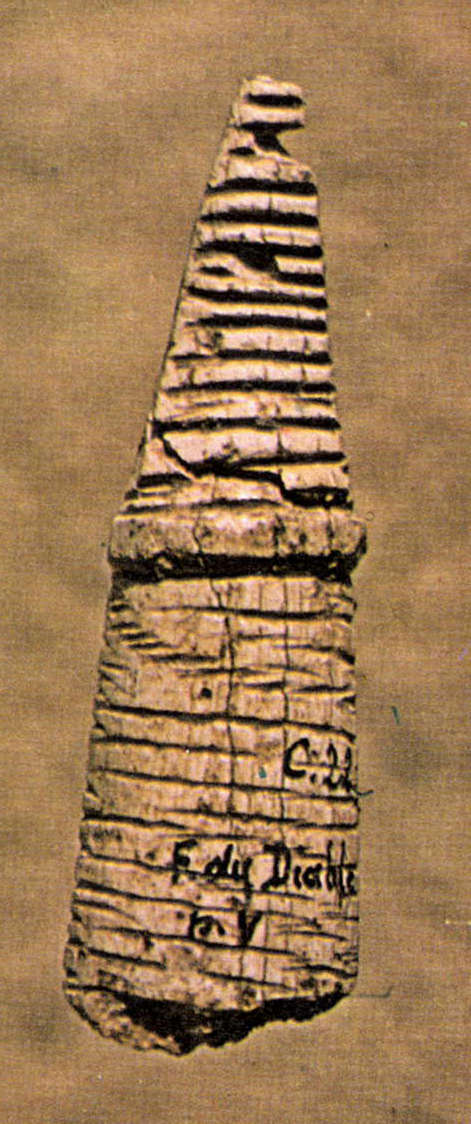
Ivory stopper for a leather water bottle, from Fourneau du Diable.
This is the original of the stopper on the right above. If you compare the drawing and the photo, it would appear that Peyrony (it is his original drawing, but was redrawn by Lwoff (1962)) has 'gilded the lily' more than a little with regard to the perfection of the screw thread. The thread is not nearly so deep, nor as perfectly helical, as he would have us believe. That's not like Peyrony. I regard him as the most important figure, apart from Breuil, of early French archaeology. I'd love to get a better photo from several angles of the original stopper.
Photo: Delluc & Delluc (1982)


Ivory stopper for a leather water bottle, from Laugerie Haute Est
This version has a rounded helix.
(left) Photo and origin: Bordes (1959), Bordes (1978)
(right) Photo: Don Hitchcock 2014
Source: Original, Le Musée National de Préhistoire, Les Eyzies-de-Tayac

This is an ivory waterbag stopper from Brassempouy.
(this appears to be a museum quality facsimile - Don )
Photo: http://paleobox.forumactif.com/t2049p40-sortie-paleobox-le-29-septembre-au-man
Source: Display at Musée d'Archéologie nationale, Saint-Germain-en-Laye
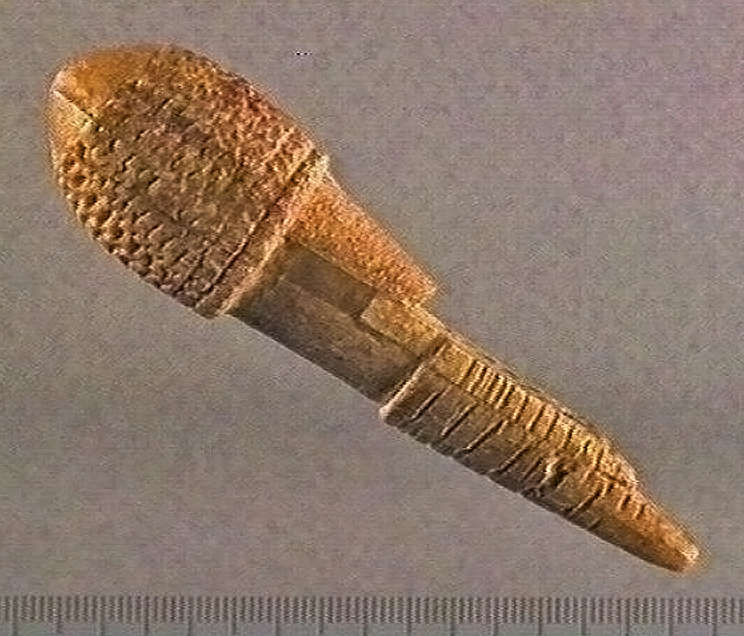
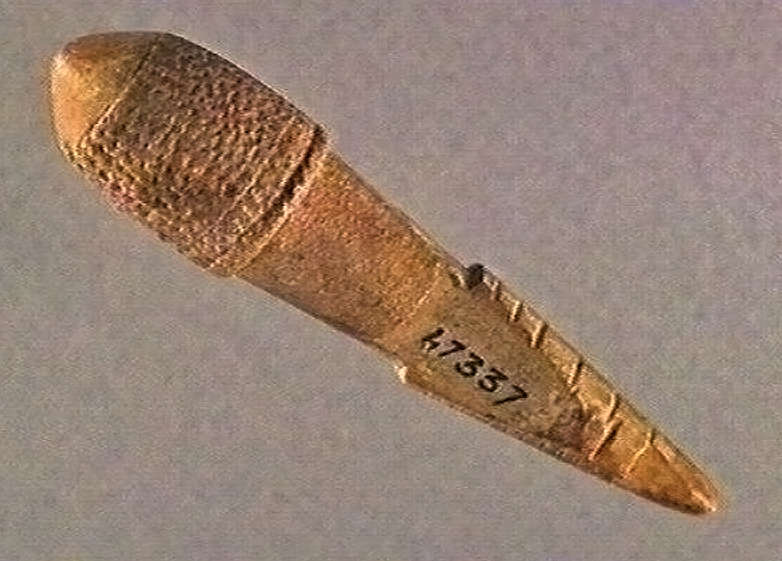
This is the ivory waterbag stopper from Brassempouy.
(this appears to be the original - Don )
Photo: © Saint-Germain-en-Laye, musée des antiquités nationales, © Direction des musées de France, 2002
Source: http://www.culture.gouv.fr/
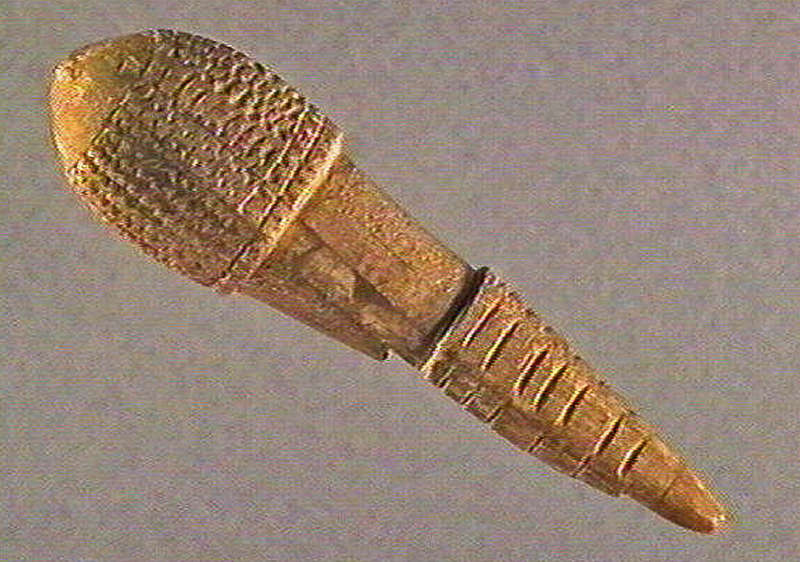
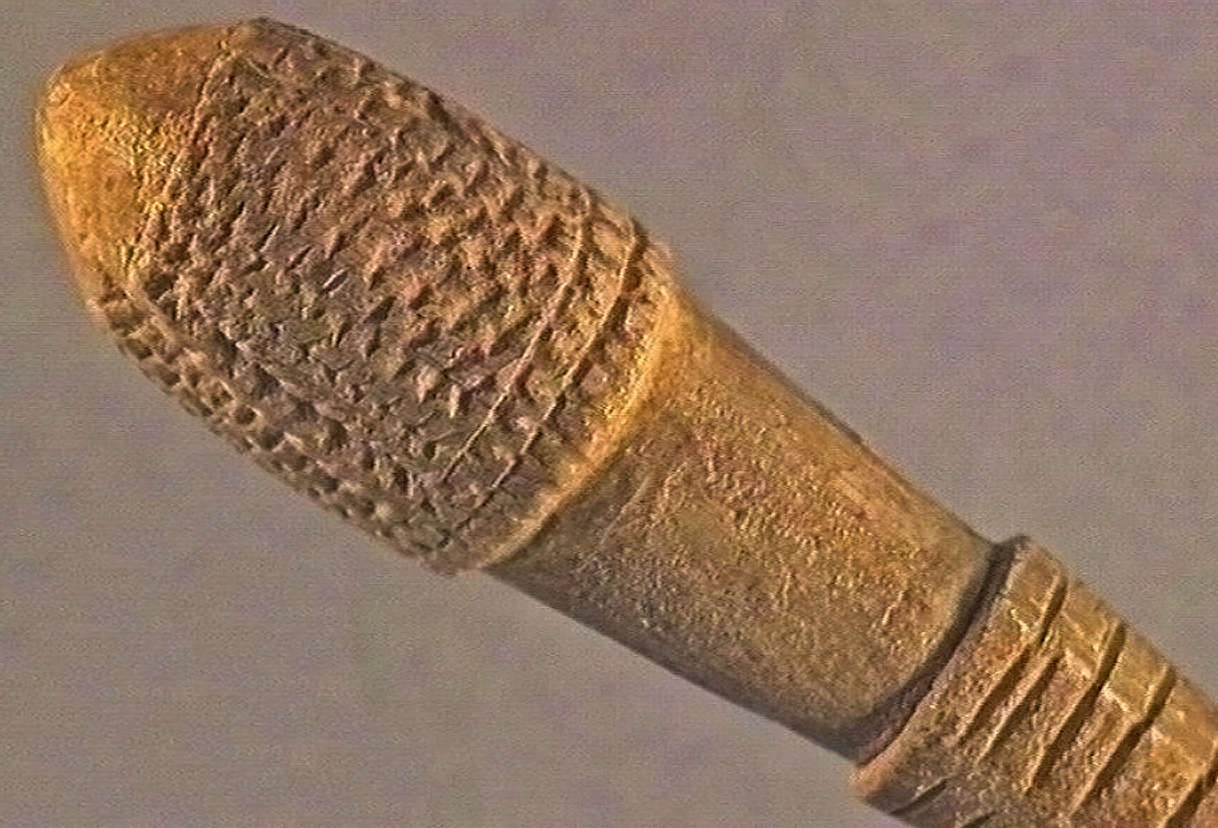
Aurignacian, deeply carved. The upper part of the object is smooth and rounded. It is followed by a cylindrical band fully decorated with rows of serpentine patterns.
The centre of the object is a wide band forming a constriction. The lower tapering part is decorated several rows of transverse incisions.
Photo: © Saint-Germain-en-Laye, musée des antiquités nationales, © Direction des musées de France, 2002
Source: http://www.culture.gouv.fr/
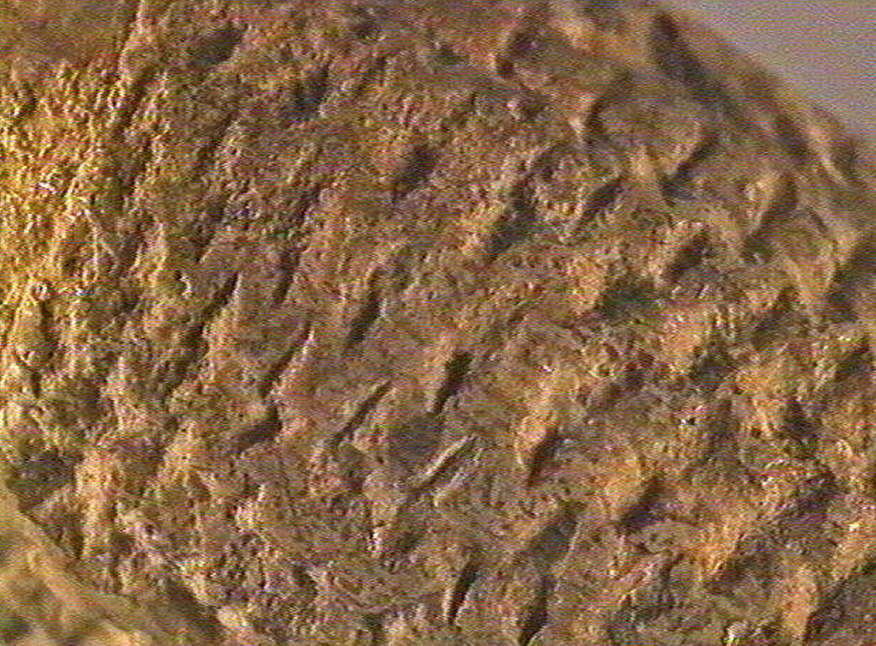
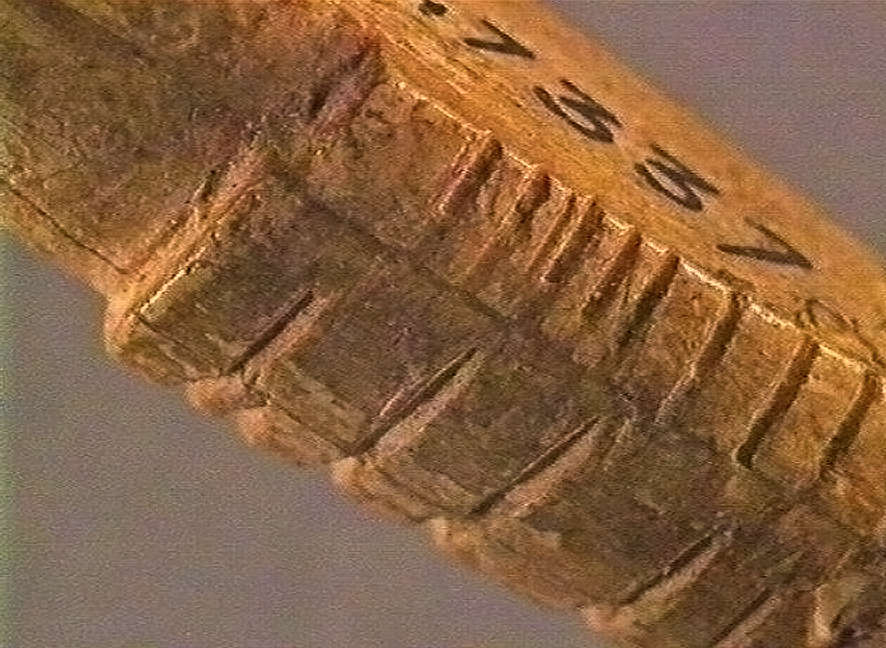
Length 91 mm, maximum diameter 25 mm
Photo: © Saint-Germain-en-Laye, musée des antiquités nationales, © Direction des musées de France, 2002
Source: http://www.culture.gouv.fr/

The concept of the helix, used in some of the water skin stoppers, was familiar to the stone age inhabitants through sea shells.
These non-pierced interior casts of fossil Turritella, L. max.: 2.60 cm Ø max. 1.05 cm, a total of 180 pieces, were found at Grottes de Goyet, Belgium, in Magdalenien layers, ca 12 000 BP.
They are believed to have been sewn onto a bib of leather to be hung on the chest.
Photo and text adapted from: Cattelain et al. (2012)

Tools from le Ruth, Aurignacian, 30 000 BP.
Photo: Don Hitchcock 2014
Source and text: Original, Københavns (Copenhagen) Museum, National Museum of Denmark
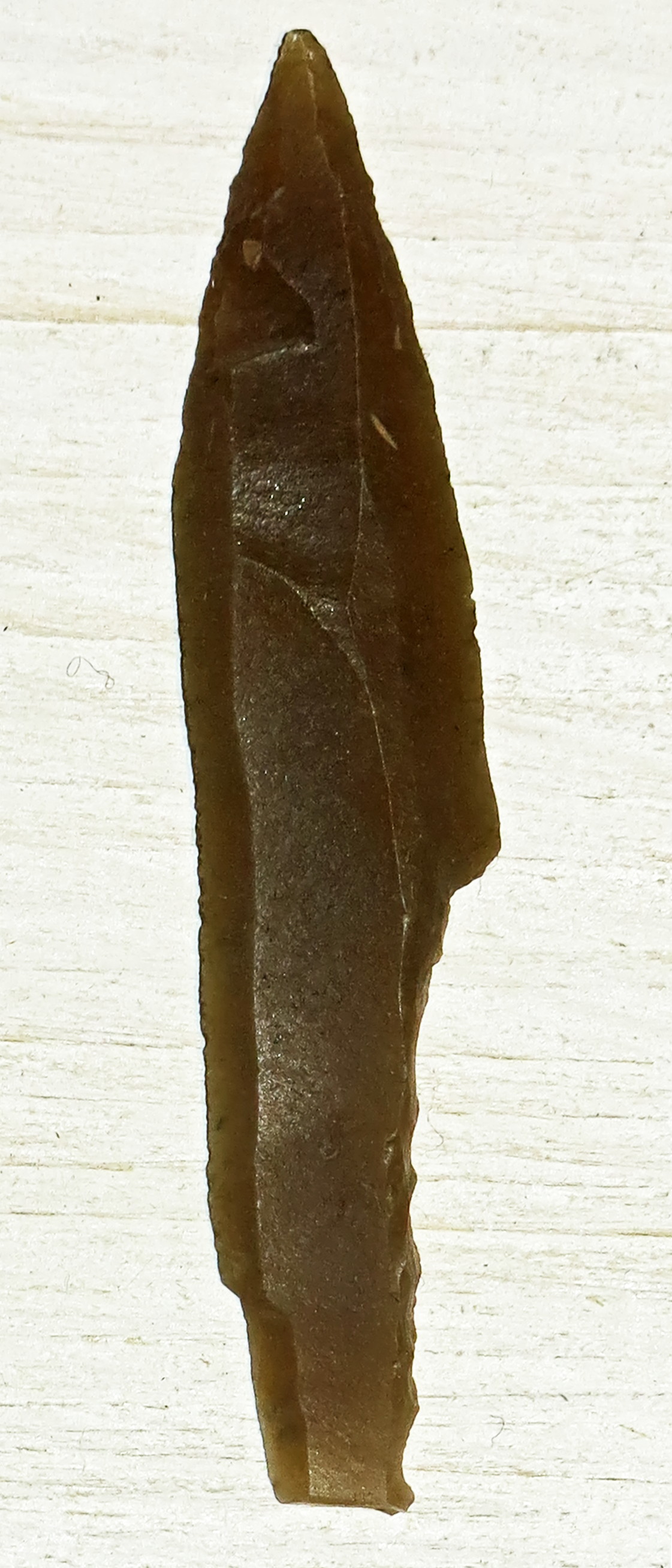
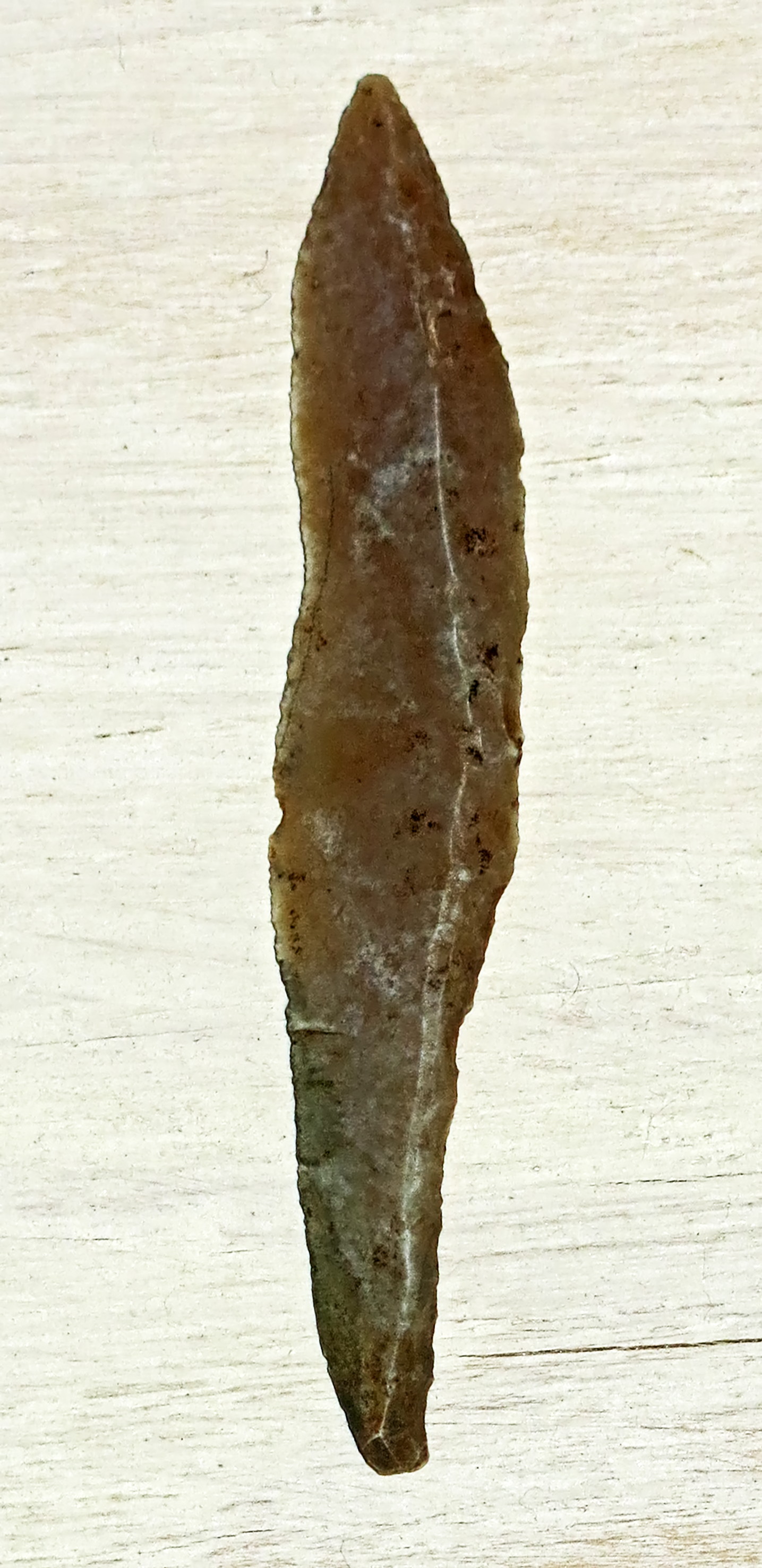
(left) Stielspitze, Shouldered Point, Laugerie-Haute, France.
(right) Stielspitze, Shouldered Point, Vézère valley, France.
22 000 BP - 18 000 BP.
Photo: Don Hitchcock 2015
Source and text: Neanderthal Museum, Mettmann, near Düsseldorf, Germany
(left) On loan from the Institut für Ur- und Frühgeschichte Universität Tübingen
(right) On loan from the Löbbecke Museum, Düsseldorf.
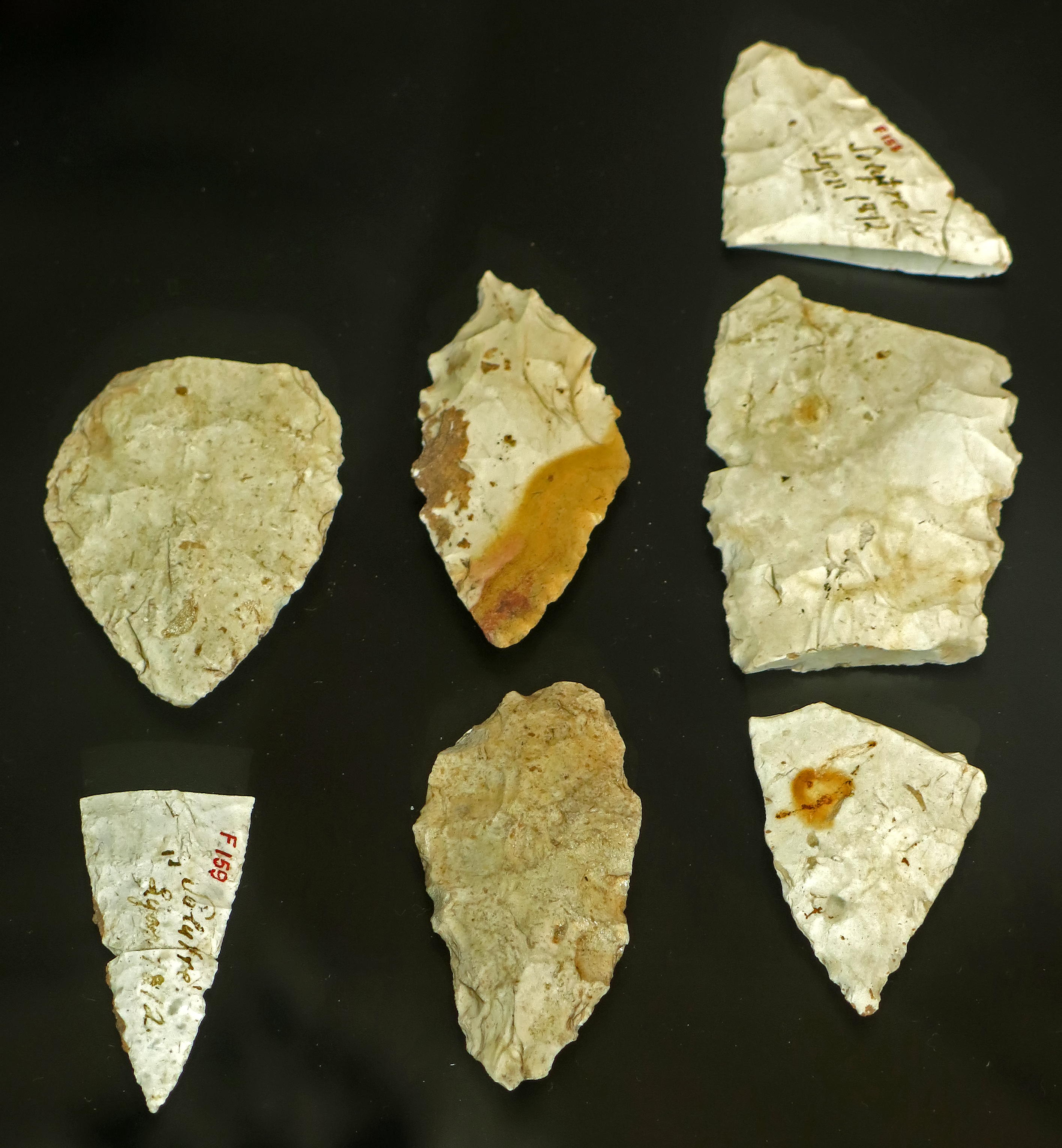
Tools from Solutré, Solutrean, 18 000 BP.
Photo: Don Hitchcock 2014
Source and text: Original, Københavns (Copenhagen) Museum, National Museum of Denmark

Limestone cliffs near Solutré, at the foot of which is the celebrated site of Cro-du-Charnier
Photo: Yelkrokoyade (2009)
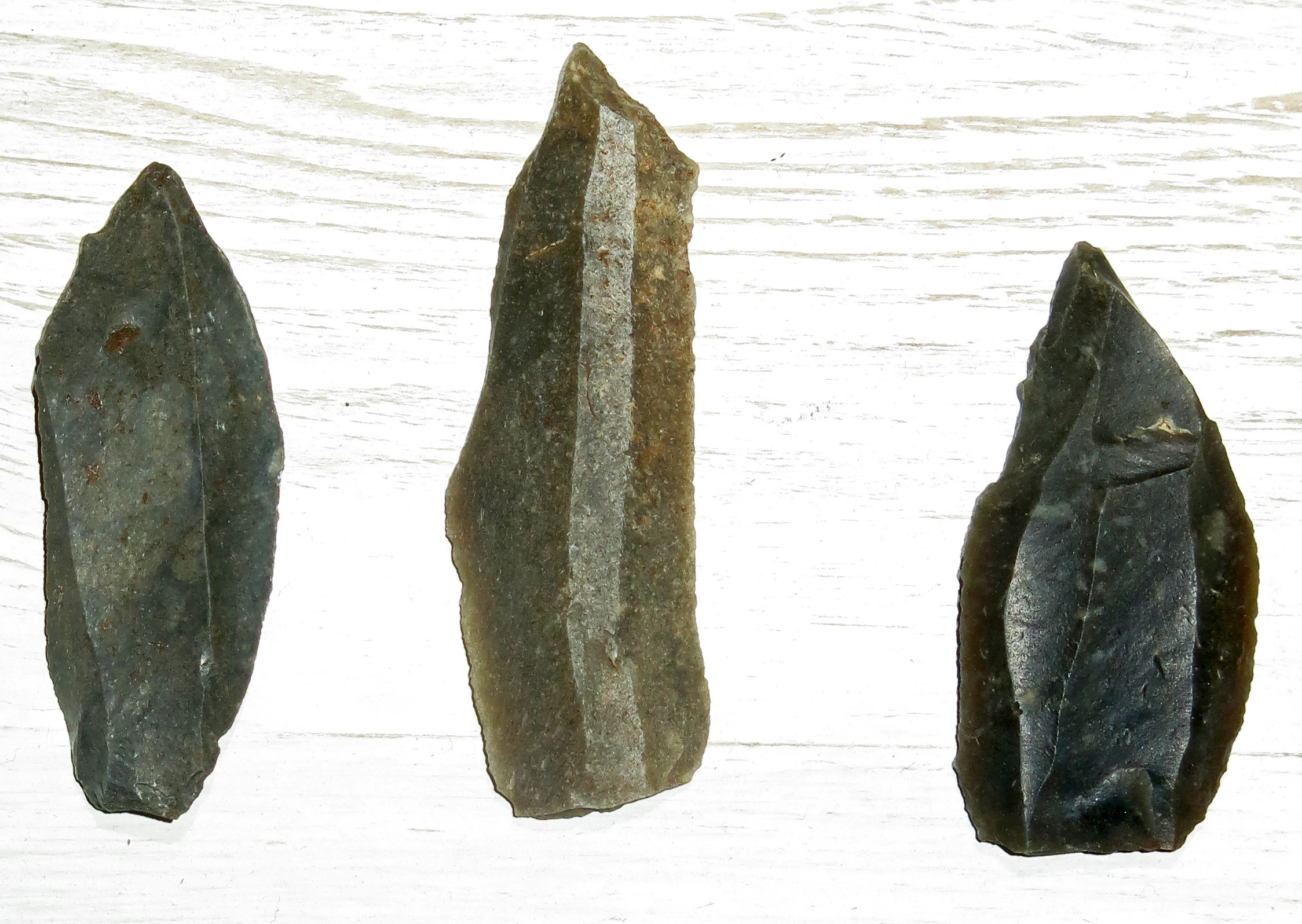
Burins, Les Eyzies, France.
18 000 BP - 12 000 BP.
Photo: Don Hitchcock 2015
Source and text: Neanderthal Museum, Mettmann, near Düsseldorf, Germany
On loan from the Institut für Ur- und Frühgeschichte Universität Tübingen
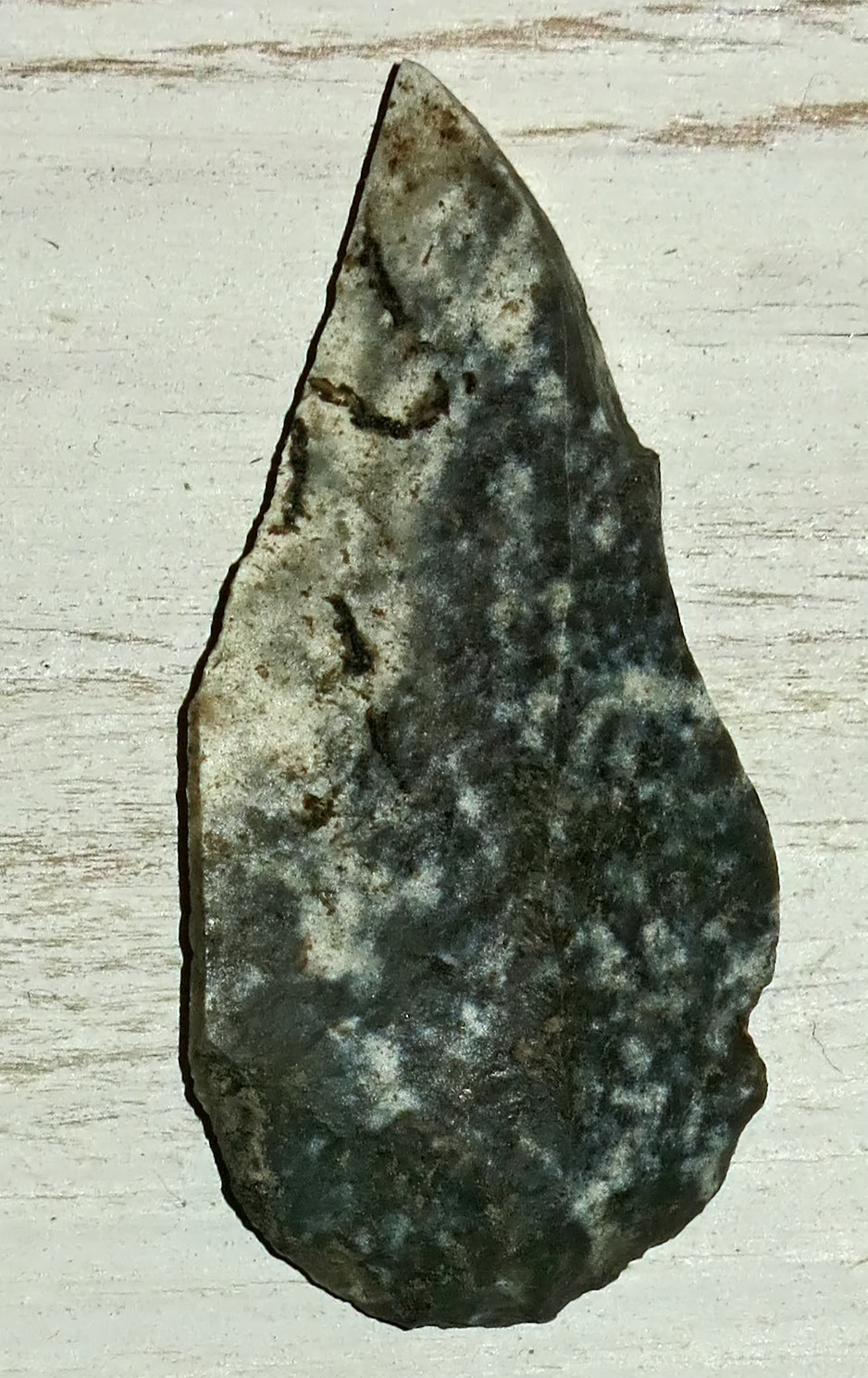
Scraper - burin, St.-Léon-sur-Vézère, France.
18 000 BP - 12 000 BP.
Photo: Don Hitchcock 2015
Source and text: Neanderthal Museum, Mettmann, near Düsseldorf, Germany
On loan from the Löbbecke Museum, Düsseldorf.

Projectile points of reindeer antler, originals.
( note that the bevels have had grooves cut in them in order to enhance adhesion when the points are glued with birch-bark glue to the spears - Don )
18 000 BP - 12 000 BP.
Photo: Don Hitchcock 2015
Source and text: Neanderthal Museum, Mettmann, near Düsseldorf, Germany
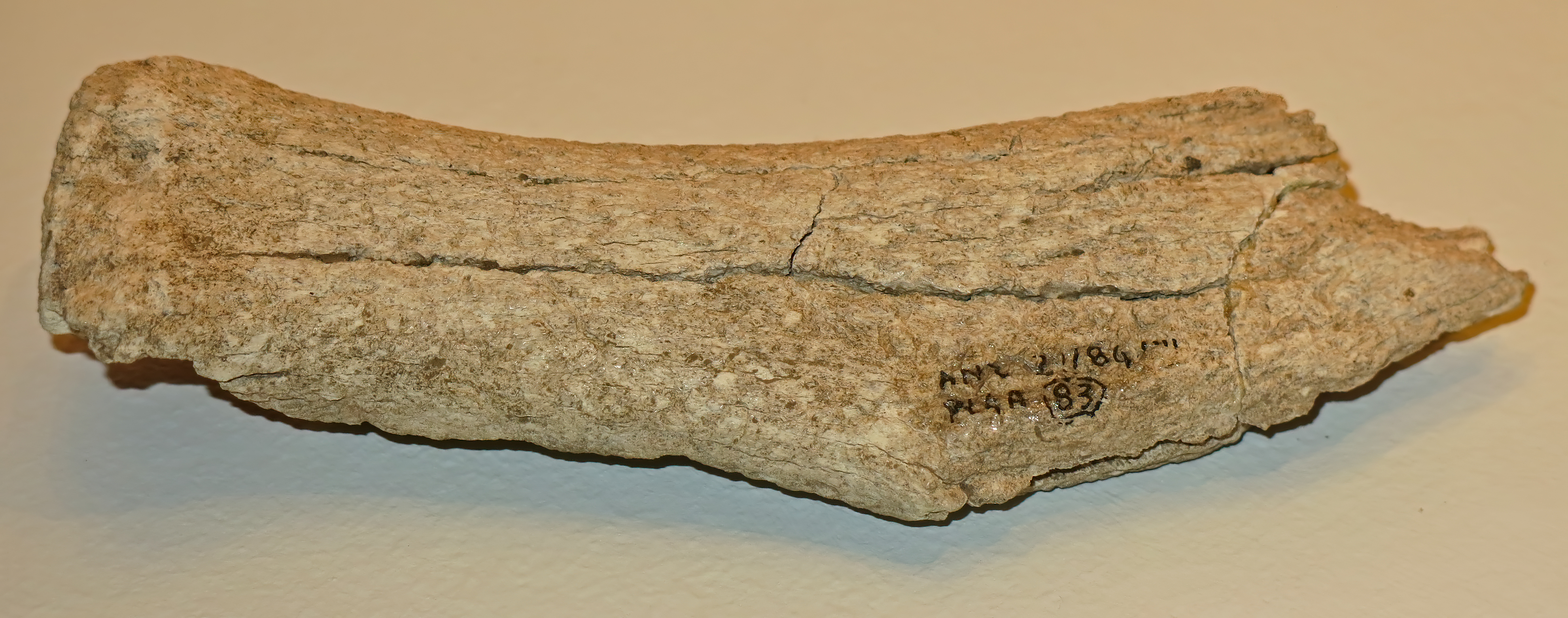
Mallet made of reindeer antler, 15 800 BP
Andernach-Martinsberg, district of Mayen, Koblenz, from the excavations of Hermann Schaaffhausen 1883.
Photo: Don Hitchcock 2015
Source: LVR-Landesmuseum Bonn, Germany
Lender: Directorate General for Cultural Heritage Rhineland-Palatinate, Generaldirektion Kulturelles Erbe Rheinland-Pfalz
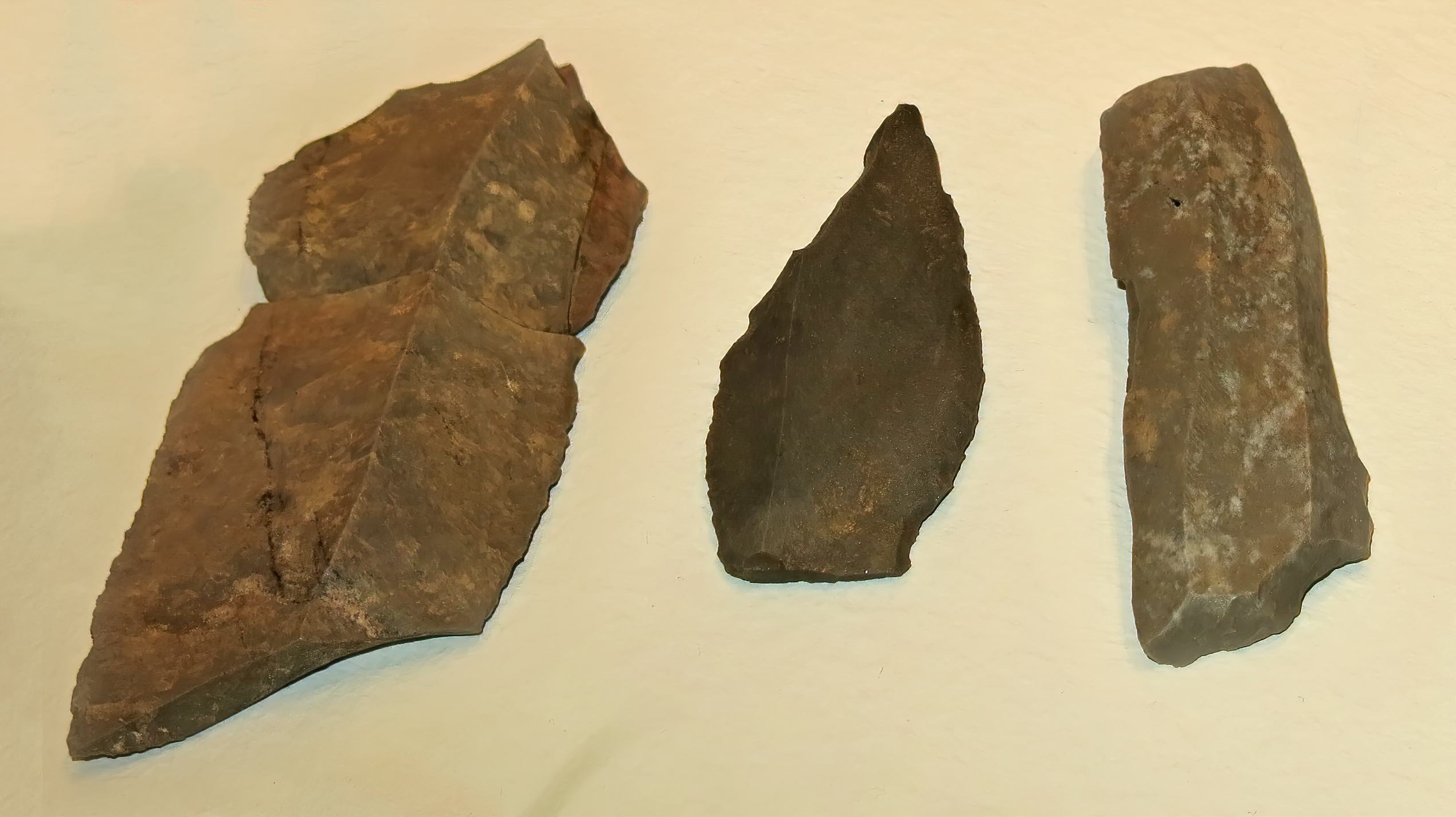
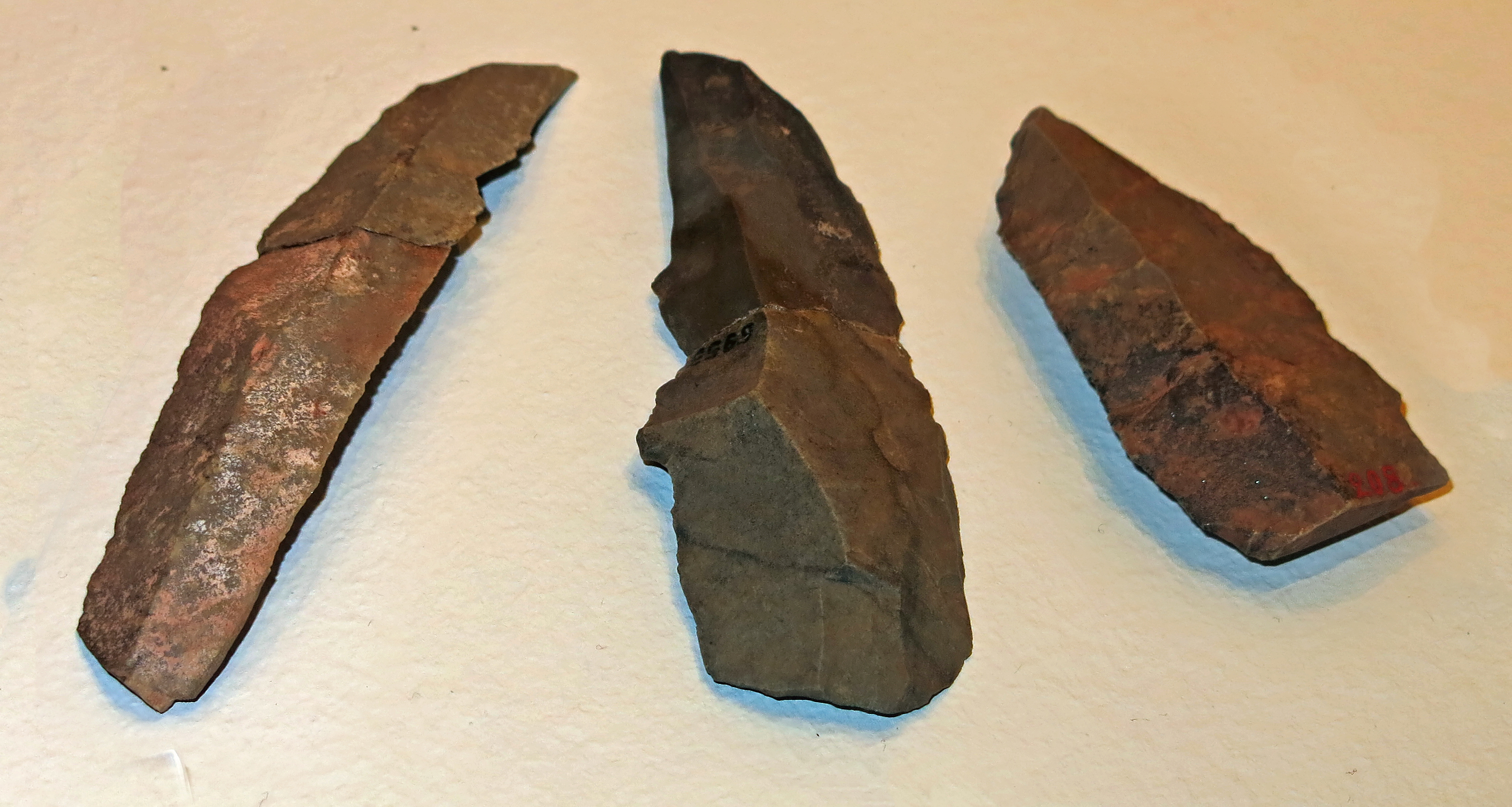
Quartzite burins, 15 800 BP
Andernach-Martinsberg, district of Mayen-Koblenz, from the excavations of Hermann Schaaffhausen 1883.
Photo: Don Hitchcock 2015
Source: LVR-Landesmuseum Bonn, Germany
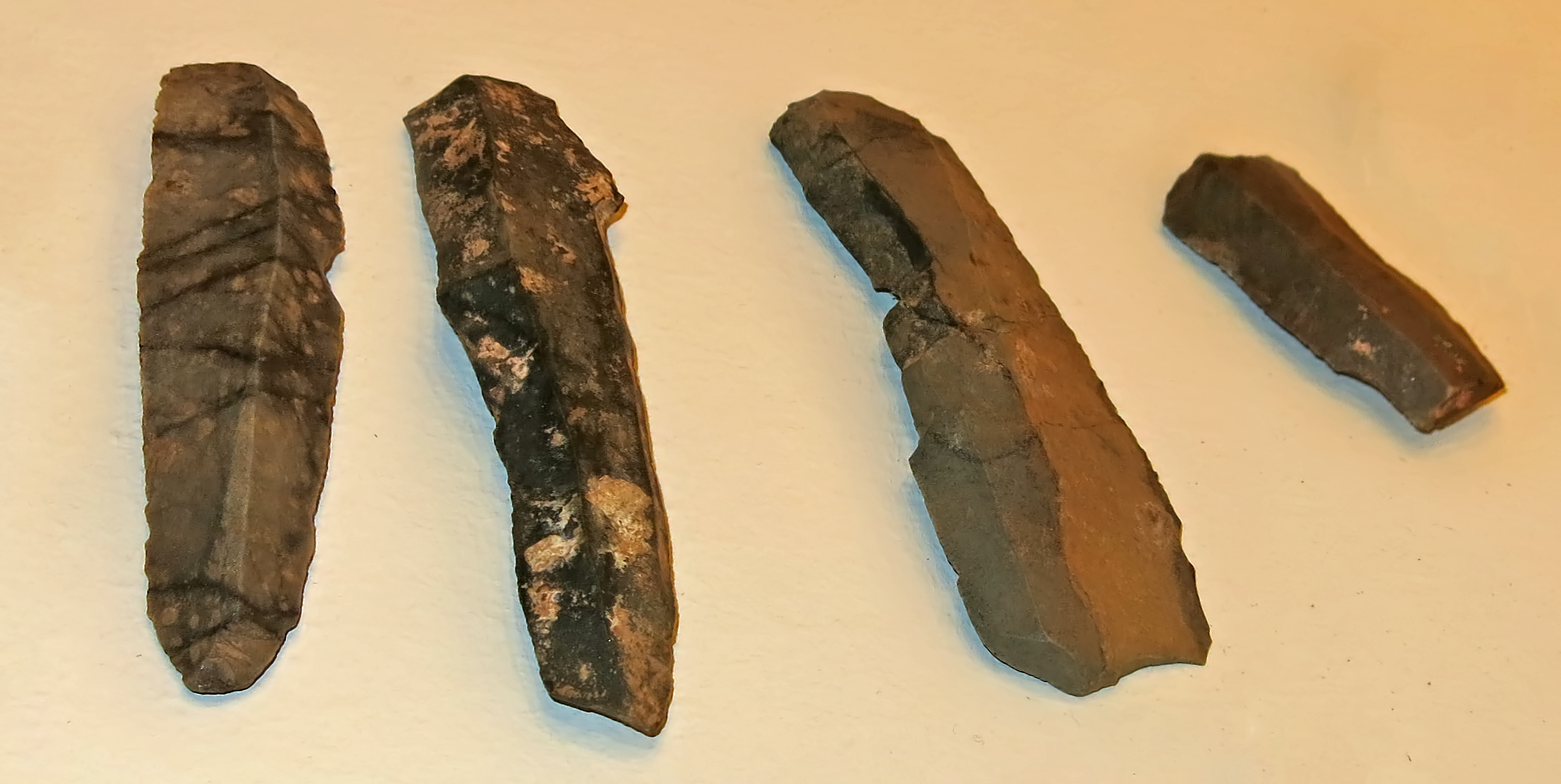
Quartzite scrapers, 15 800 BP
Andernach-Martinsberg, district of Mayen-Koblenz, from the excavations of Hermann Schaaffhausen 1883.
Photo: Don Hitchcock 2015
Source: LVR-Landesmuseum Bonn, Germany
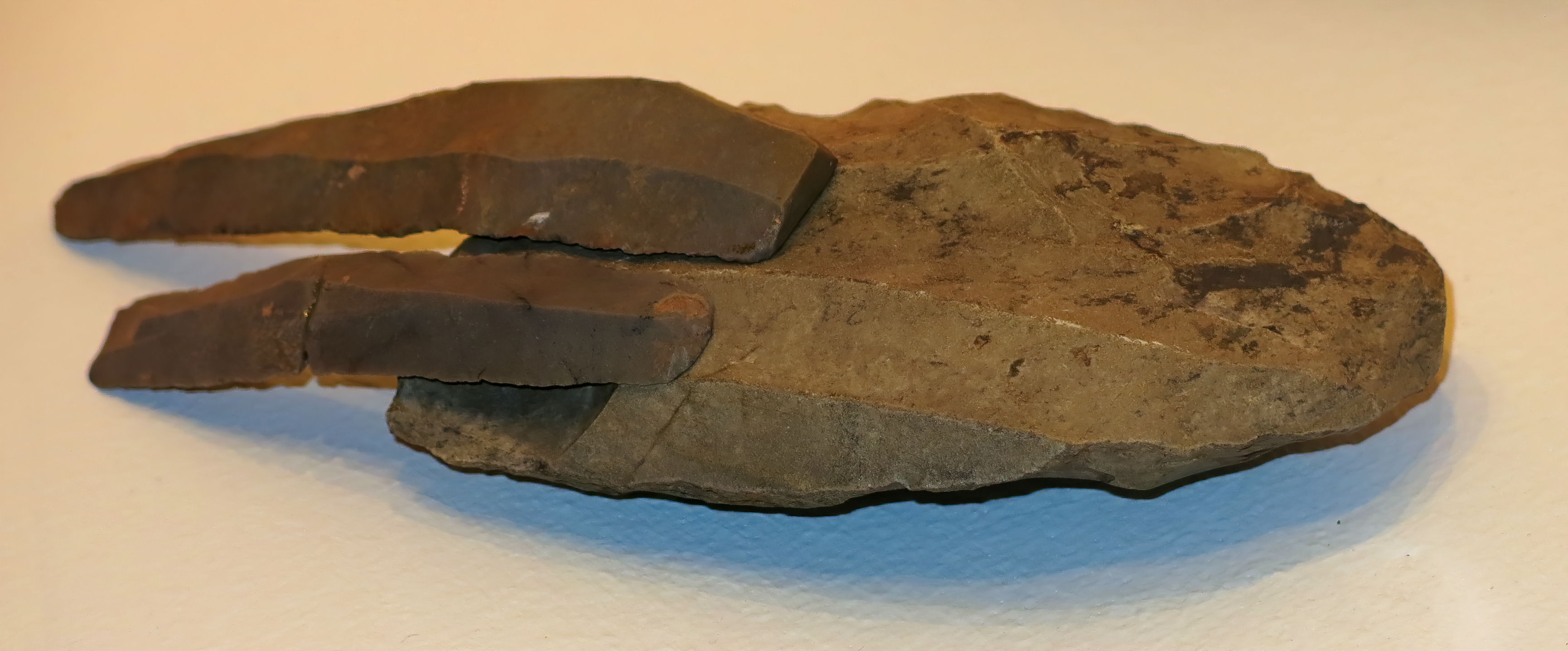
Core and blades made of quartzite, 15 800 BP
Andernach-Martinsberg, district of Mayen-Koblenz, from the excavations of Hermann Schaaffhausen 1883.
Photo: Don Hitchcock 2015
Source: LVR-Landesmuseum Bonn, Germany
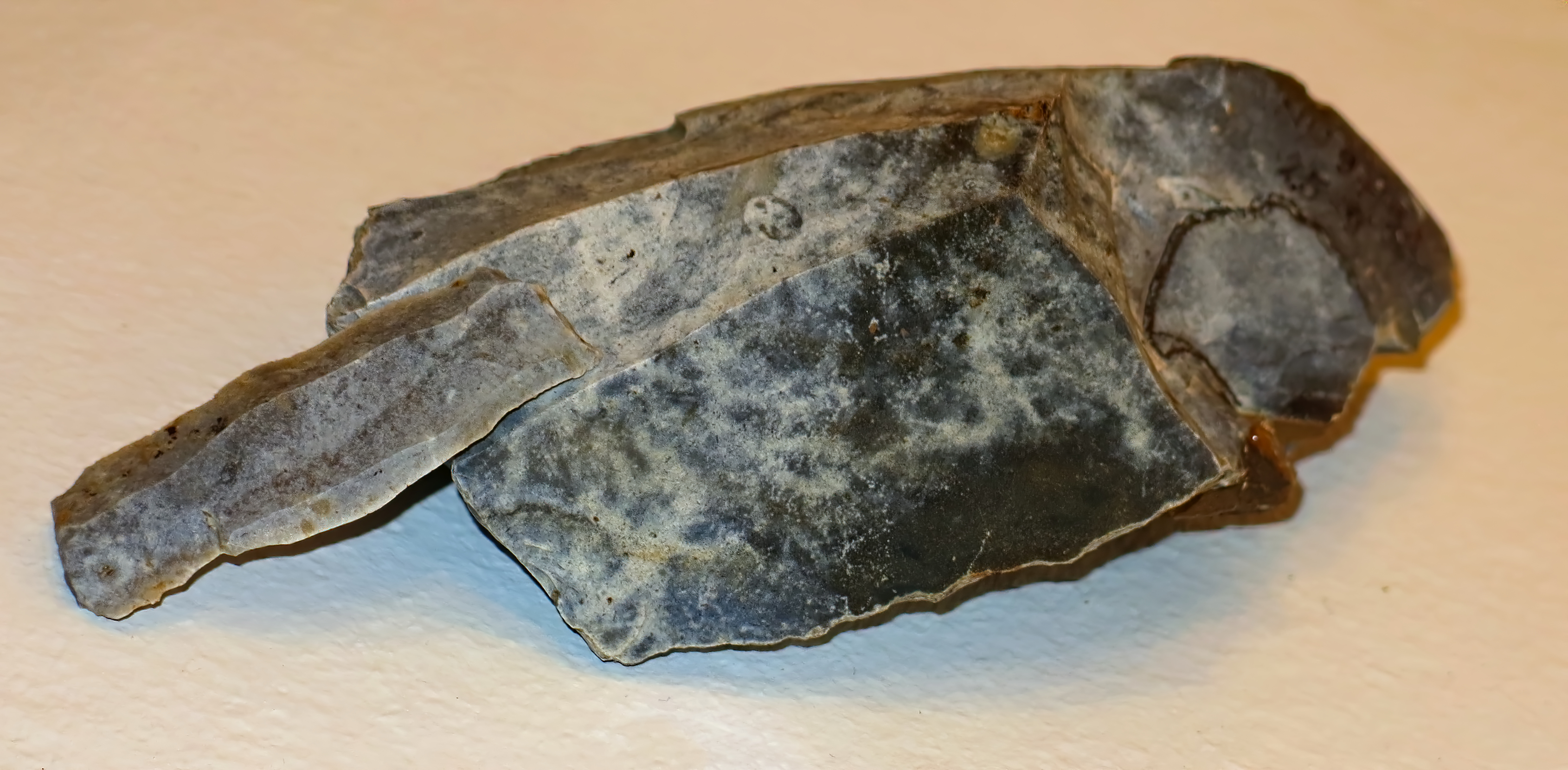
Core and blade made of flint, 15 800 BP
Beeck, Stadt Geilenkirchen, Kreis Heinsberg
Photo: Don Hitchcock 2015
Source: LVR-Landesmuseum Bonn, Germany

Petersfels, Germany, ca 15 000 BP
Rock crystal (quartz) tools from the Upper Palaeolithic.
Rock crystal requires specialised techniques to knap, and the bipolar technique is often used. This involves an impactor striking the top of the core which rests on an anvil, with flakes being initiated from both ends of the core. Rock crystal is sometimes used for large pieces and for microliths, but it often does not break in the consistent way that good flint does. While many of the flakes made from rock crystal are usable, they are difficult to retouch. It is classified as macrocrystalline, as opposed to microcrystalline for materials such as flint and chalcedony.
Photo: Don Hitchcock 2008
Source: Badisches Landesmuseum Karlsruhe Germany
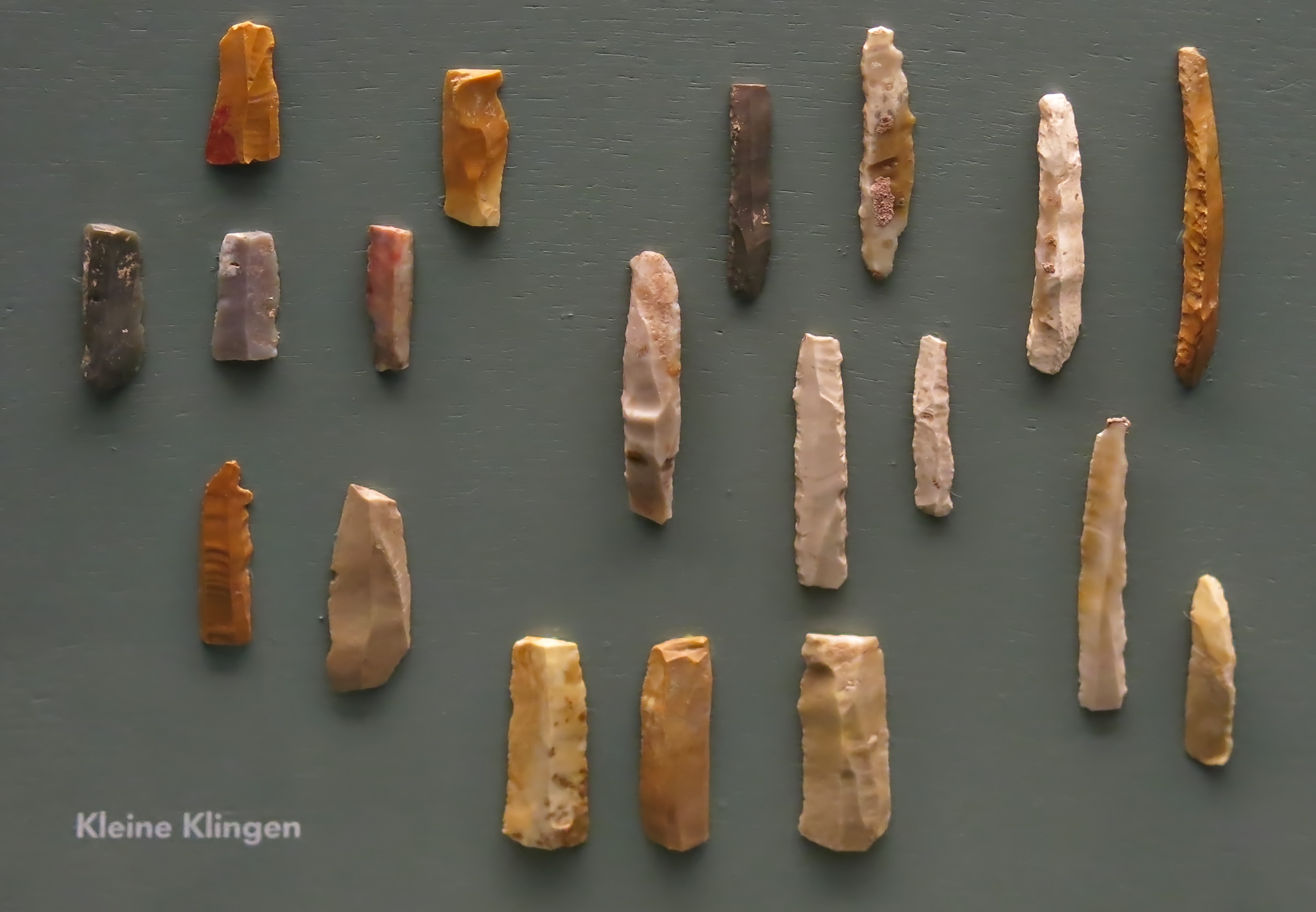
Petersfels, Germany, ca 15 000 BP
Small blades from the Upper Palaeolithic.
Long blades (rather than flakes) appeared during the Aurignacian, or Upper Palaeolithic.
Photo: Don Hitchcock 2015
Source: Badisches Landesmuseum Karlsruhe Germany
Text: Adapted from Wikipedia
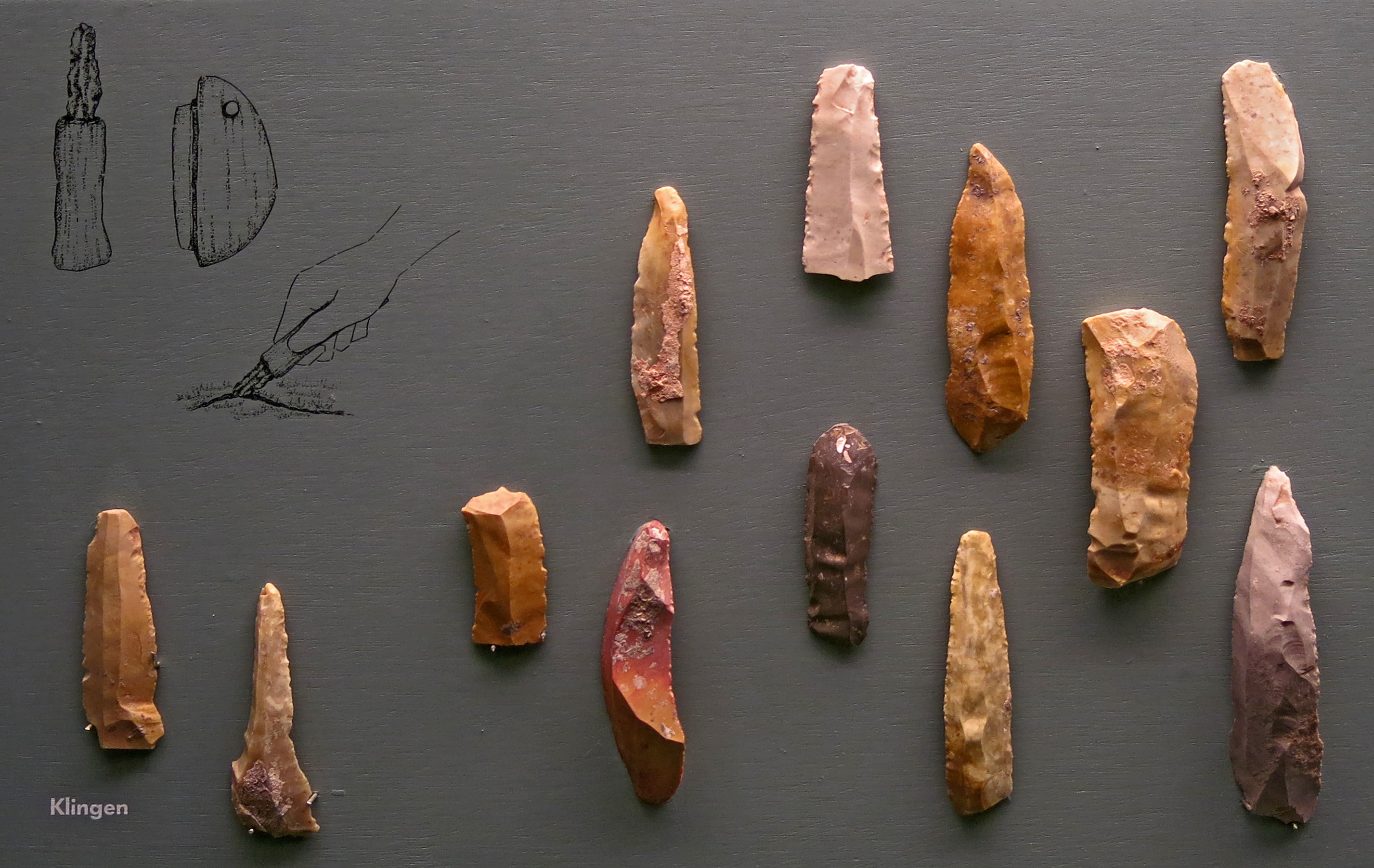
Petersfels, Germany, ca 15 000 BP
Larger blades from the Upper Palaeolithic.
Blades were used as knives, and were easier to use if they were hafted, or put on a handle.
They were also the starting point for a wide range of other tools.
Photo: Don Hitchcock 2015
Source: Badisches Landesmuseum Karlsruhe Germany
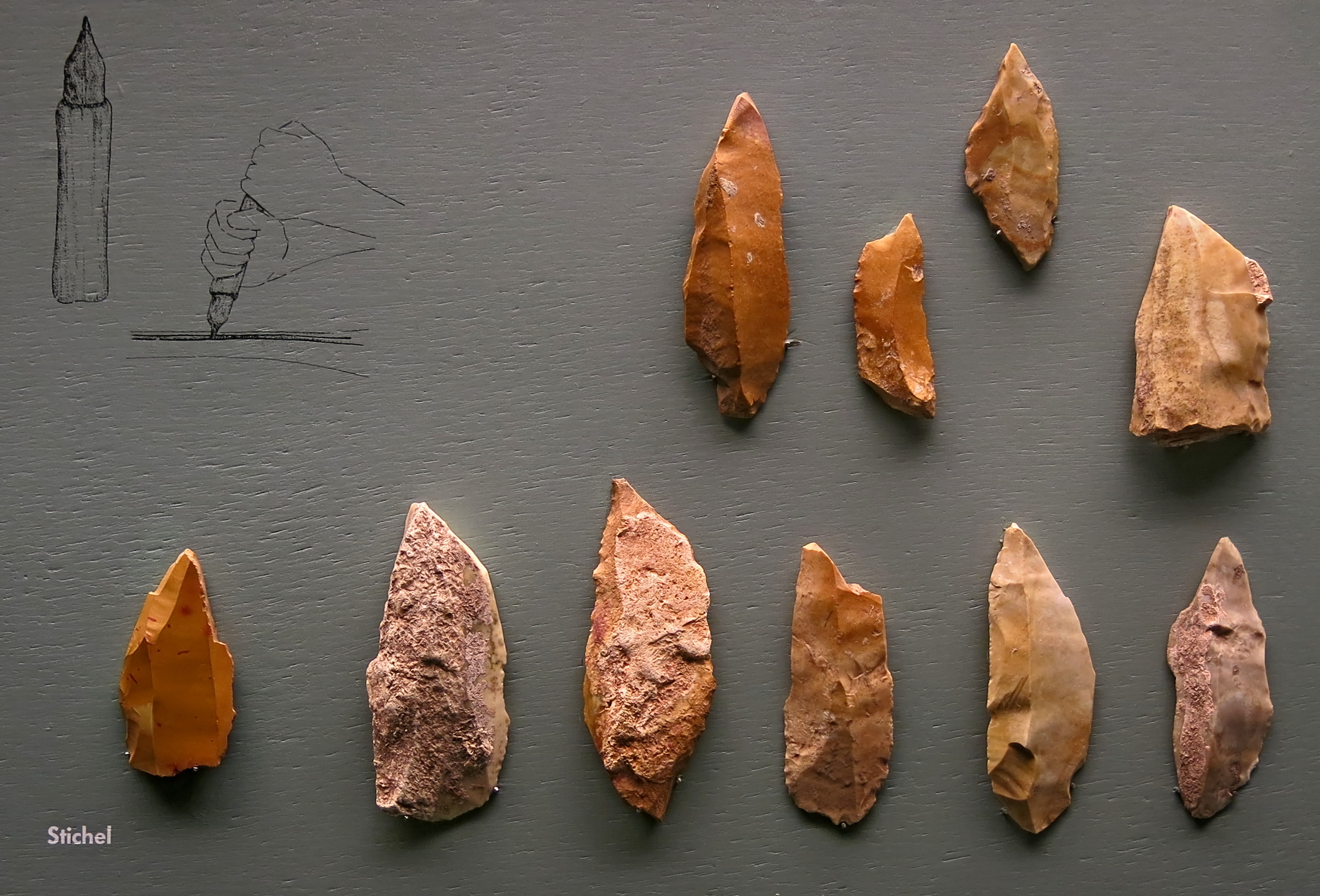
Petersfels, Germany, ca 15 000 BP
Burins from the Upper Palaeolithic.
A burin is a flint tool with a chisel-like edge which was used for engraving, or for carving wood or bone.
They were also used for repeatedly scoring bone until a tool could be separated from the substrate in the desired shape.
Photo: Don Hitchcock 2015
Source: Badisches Landesmuseum Karlsruhe Germany
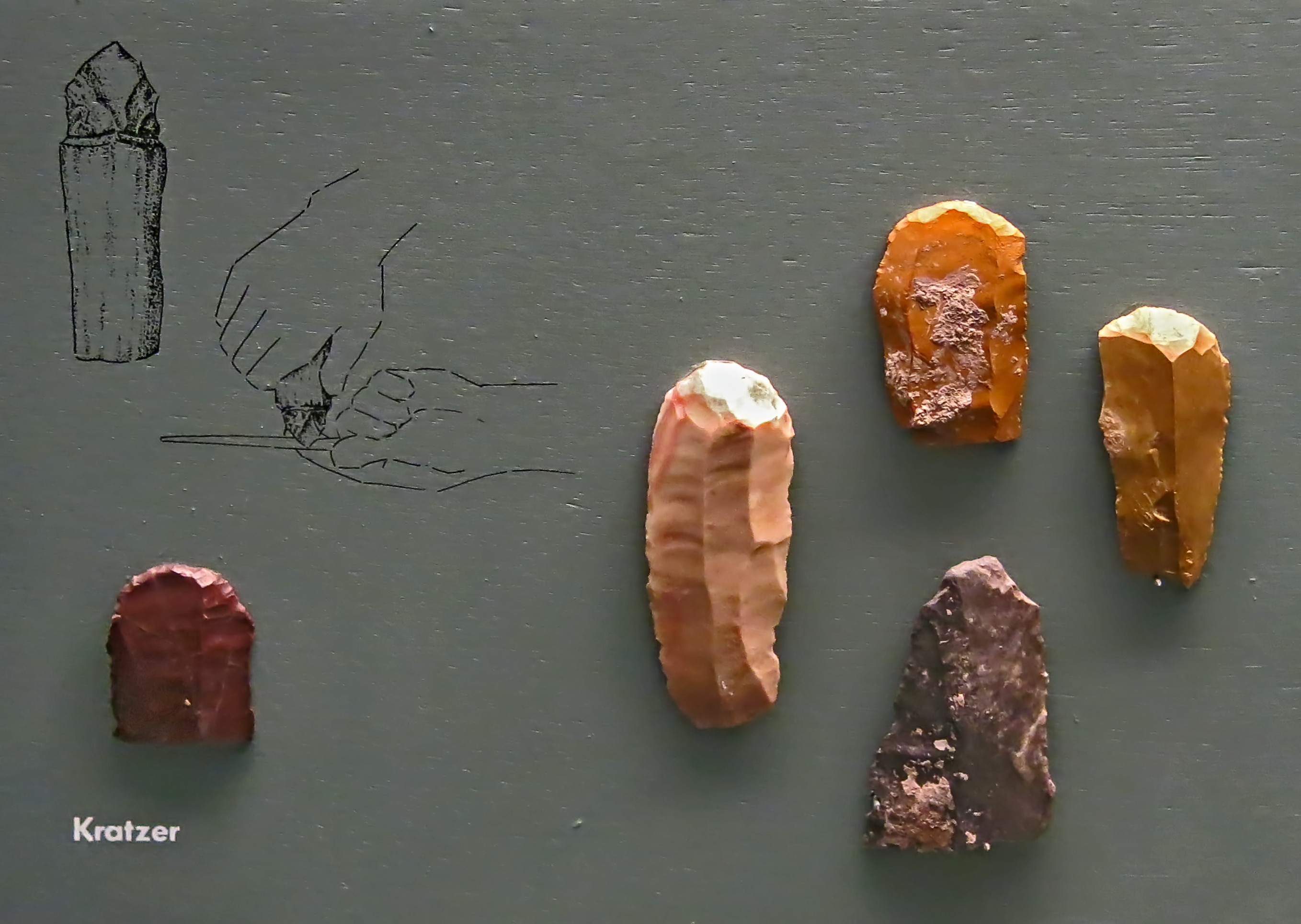
Petersfels, Germany, ca 15 000 BP
Scrapers from the Upper Palaeolithic.
Scrapers were used for cleaning the meat off hides and bones, and smoothing and shaping wooden tools.
Photo: Don Hitchcock 2015
Source: Badisches Landesmuseum Karlsruhe Germany
Text: Adapted from Wikipedia
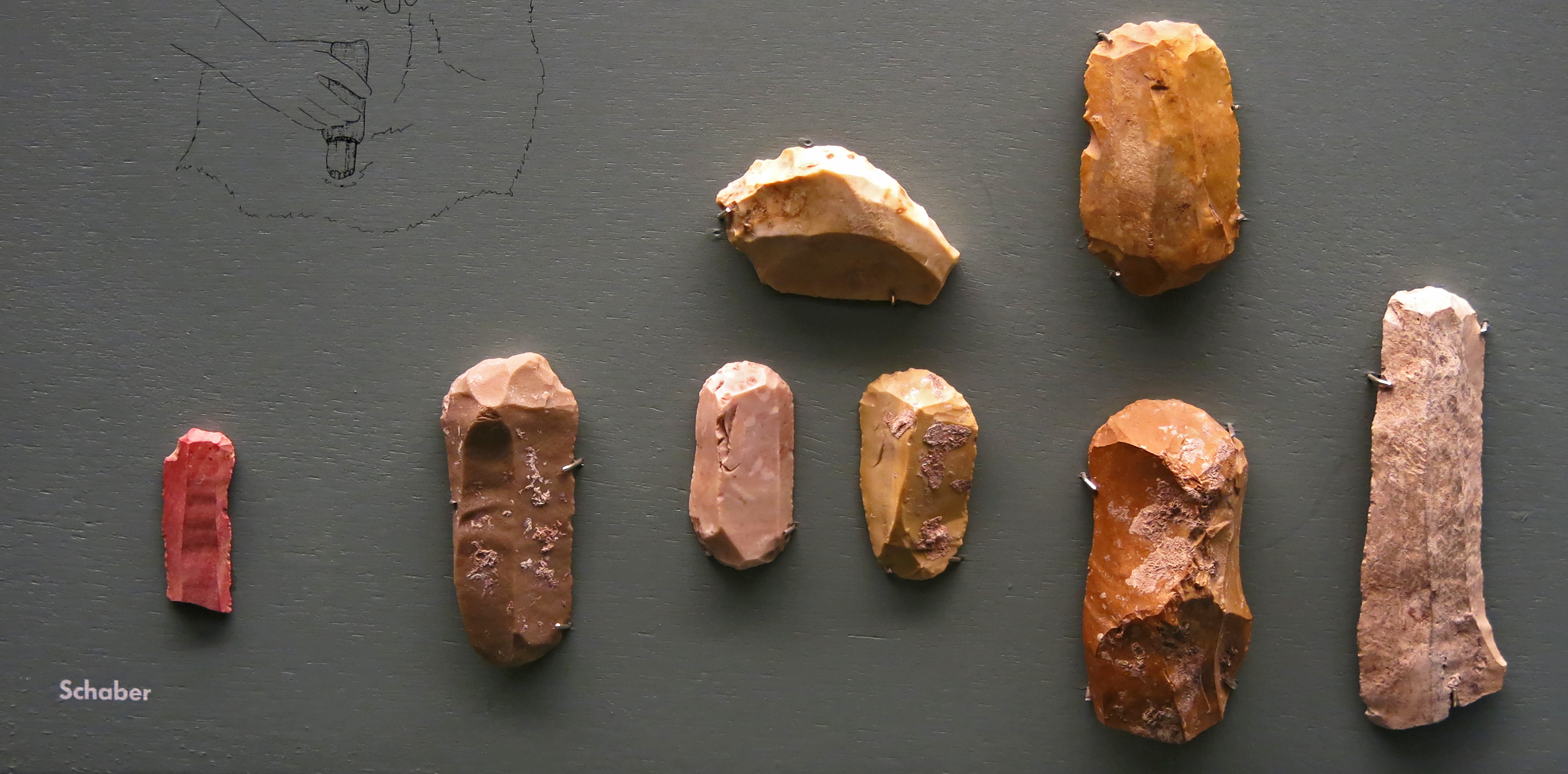
Petersfels, Germany, ca 15 000 BP
Scrapers from the Upper Palaeolithic.
Photo: Don Hitchcock 2015
Source: Badisches Landesmuseum Karlsruhe Germany
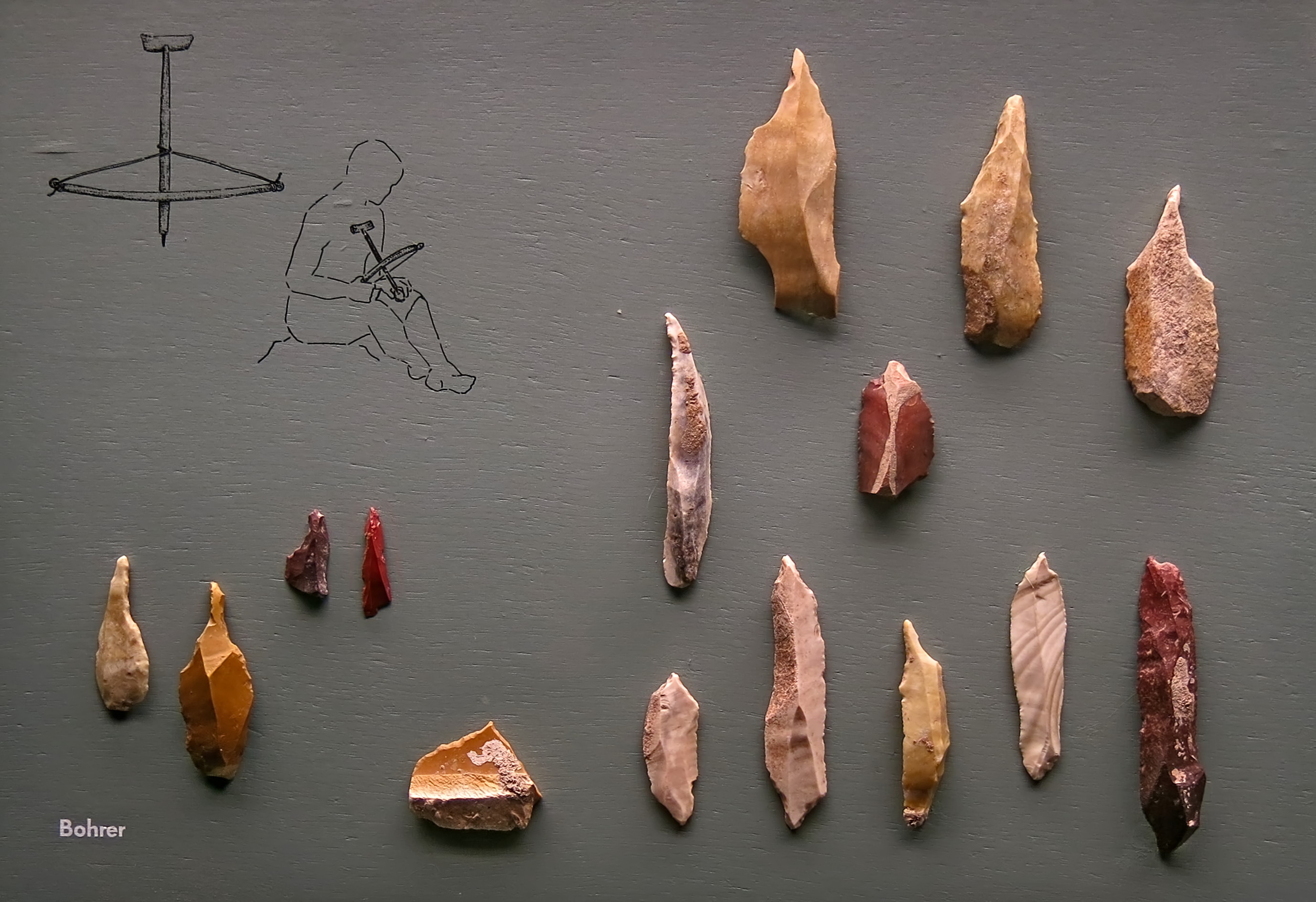
Petersfels, Germany, ca 15 000 BP
Drill bits from the Upper Palaeolithic.
These were hafted on a cylindrical stick, and a bow was used to rotate the tool for drilling holes. Very fine drill bits were needed to drill holes for the eye of a needle.
It cannot have been easy to attach the drill bit so that the point was exactly in the right place, spinning true in the centre of rotation.
Photo: Don Hitchcock 2015
Source: Badisches Landesmuseum Karlsruhe Germany

Petersfels, Germany, ca 15 000 BP
Flint cores from the Upper Palaeolithic, from which tools were struck.
Photo: Don Hitchcock 2015
Source: Badisches Landesmuseum Karlsruhe Germany

Petersfels, Germany, ca 15 000 BP
Bone tools from the Upper Palaeolithic.
These have been fashioned into bone wedges, points, needles with eyes, and polishers for working leather.
Photo: Don Hitchcock 2015
Source: Badisches Landesmuseum Karlsruhe Germany
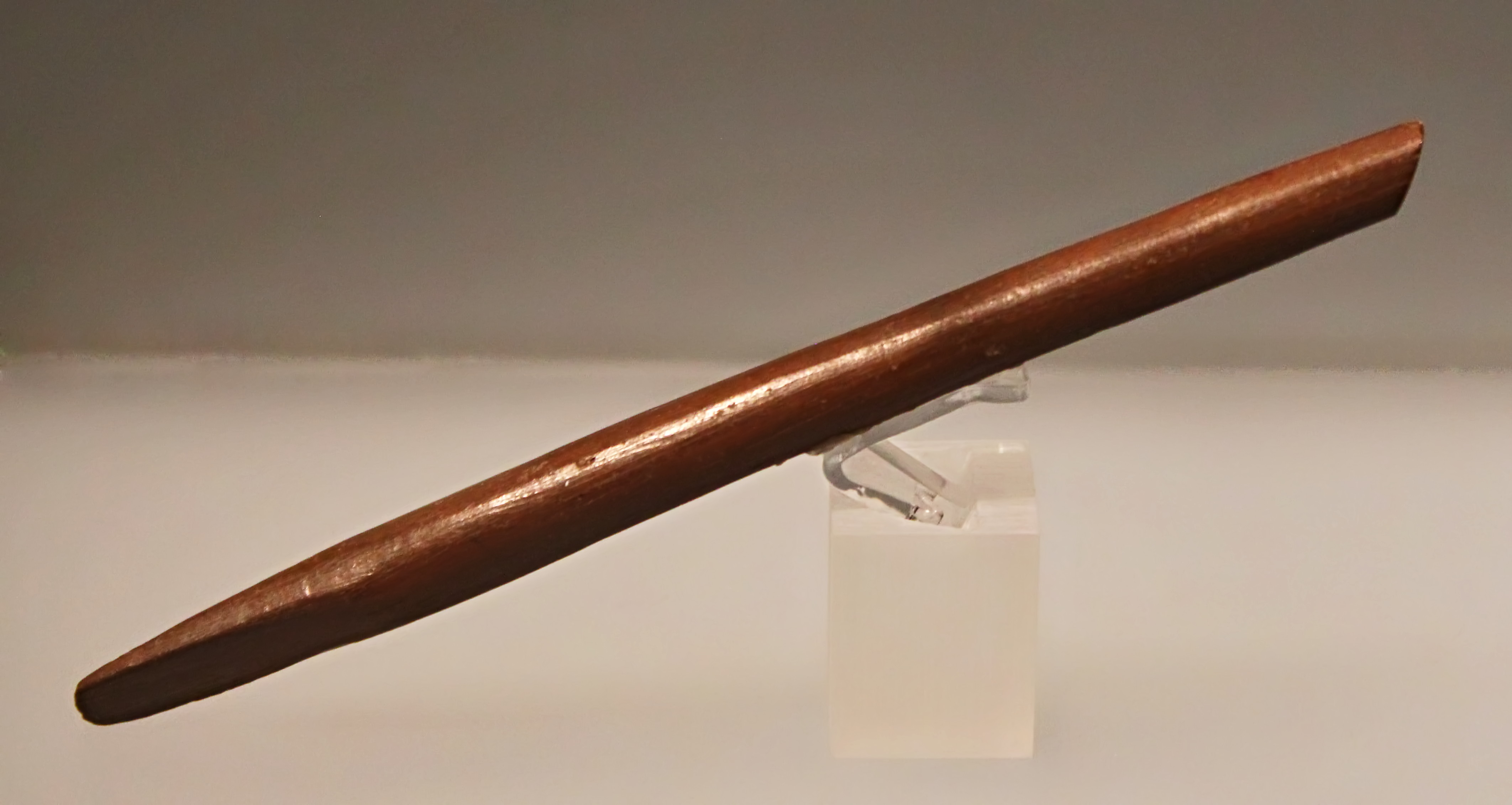
Bone point, from Hamburg-Billwerder, circa 15 000 BP
In 1991, collector Günter Rumer discovered a projectile head, which he donated to the museum, at a gravel mining operation in Billwerder. It was made from a bone chip of a larger mammal, probably a horse or elk. The hunters of the Ice Age Hamburg Culture used such bone points as spearheads to hunt reindeer. The point from Billwerder is, so far, the most ancient piece of evidence of a long-range weapon from Northern Germany. Possibly the missing tip was broken off during a hunt.
Photo: Ralph Frenken
Source: Original, exhibited at the Archeological Museum Hamburg (Ice Age - The Art of the Mammoth Hunters from 18 October 2016 to 14 May 2017)
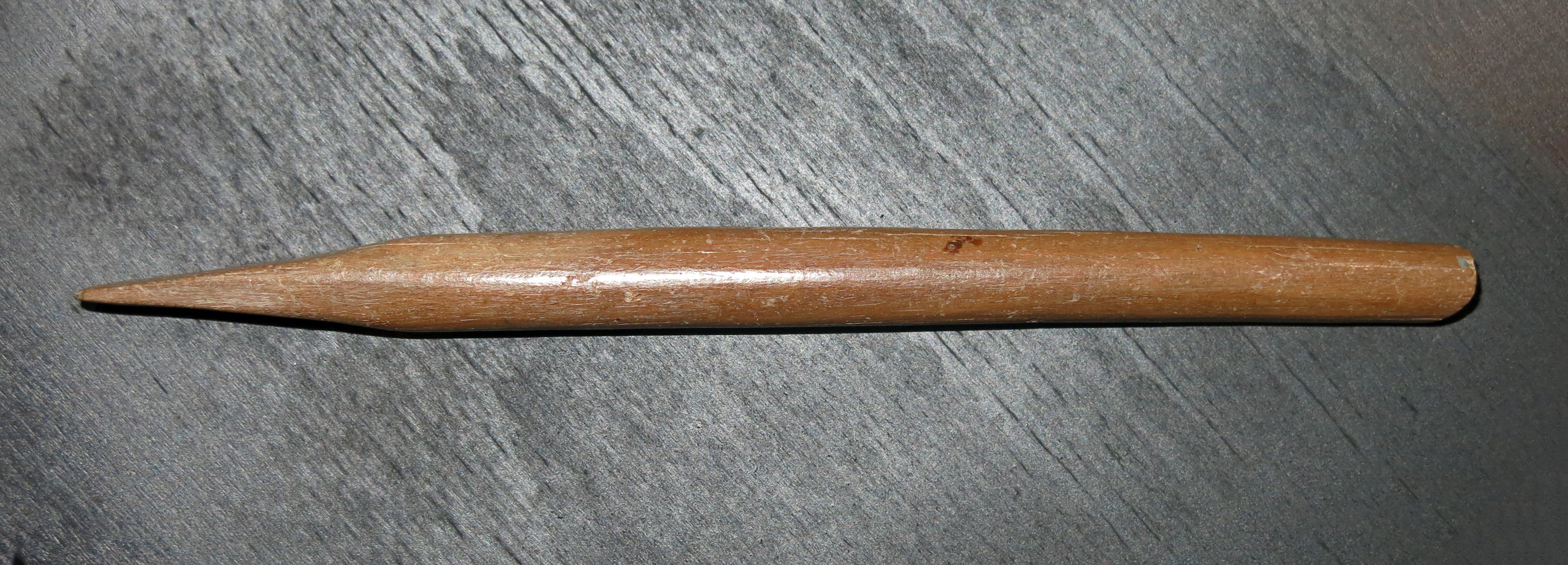
Bone point, from Hamburg-Billwerder, circa 15 000 BP, as above.
The bevel on the left in this image was used to attach the point to the shaft of the dart.
Photo: Don Hitchcock 2015
Source: Originals, Archäologisches Museum Hamburg, Germany
Text: © information booklet at the Museum.
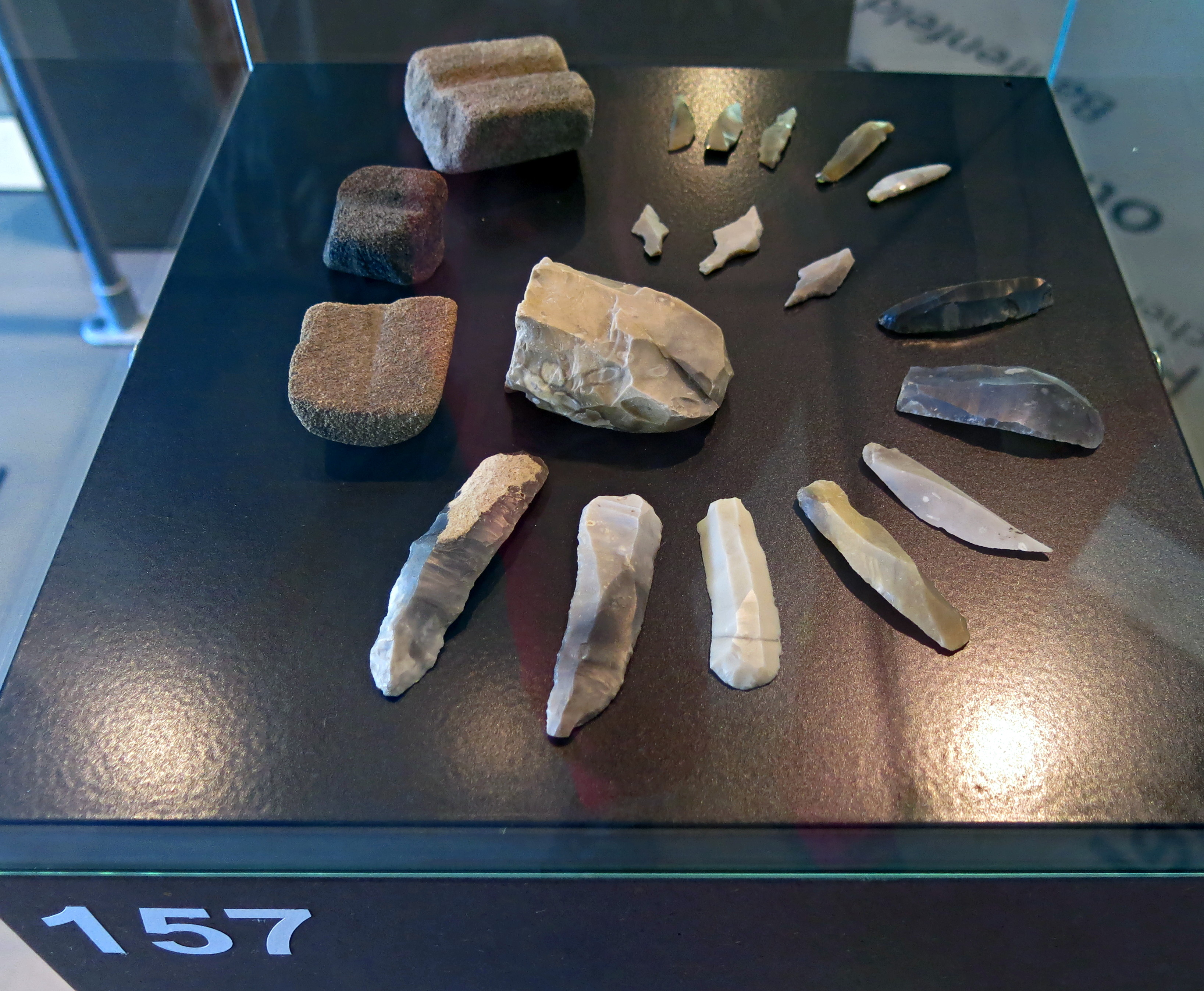
Display of tools from Hamburg - Rissen, circa 14 000 BP
About 14 000 years ago, the Ice Age hunters found ideal conditions for the reindeer hunt on this high-lying Geest Ridge, with a view of the Elbe valley. Where those people had pitched camp, refuse and flint tools remained.
Amongst the latter are scrapers, as well as arrowheads. They constitute the oldest evidence of hunting with bows and arrows found in this area.
Photo: Don Hitchcock 2015
Source: Originals, Archäologisches Museum Hamburg, Germany
Text: © Card at the Museum.
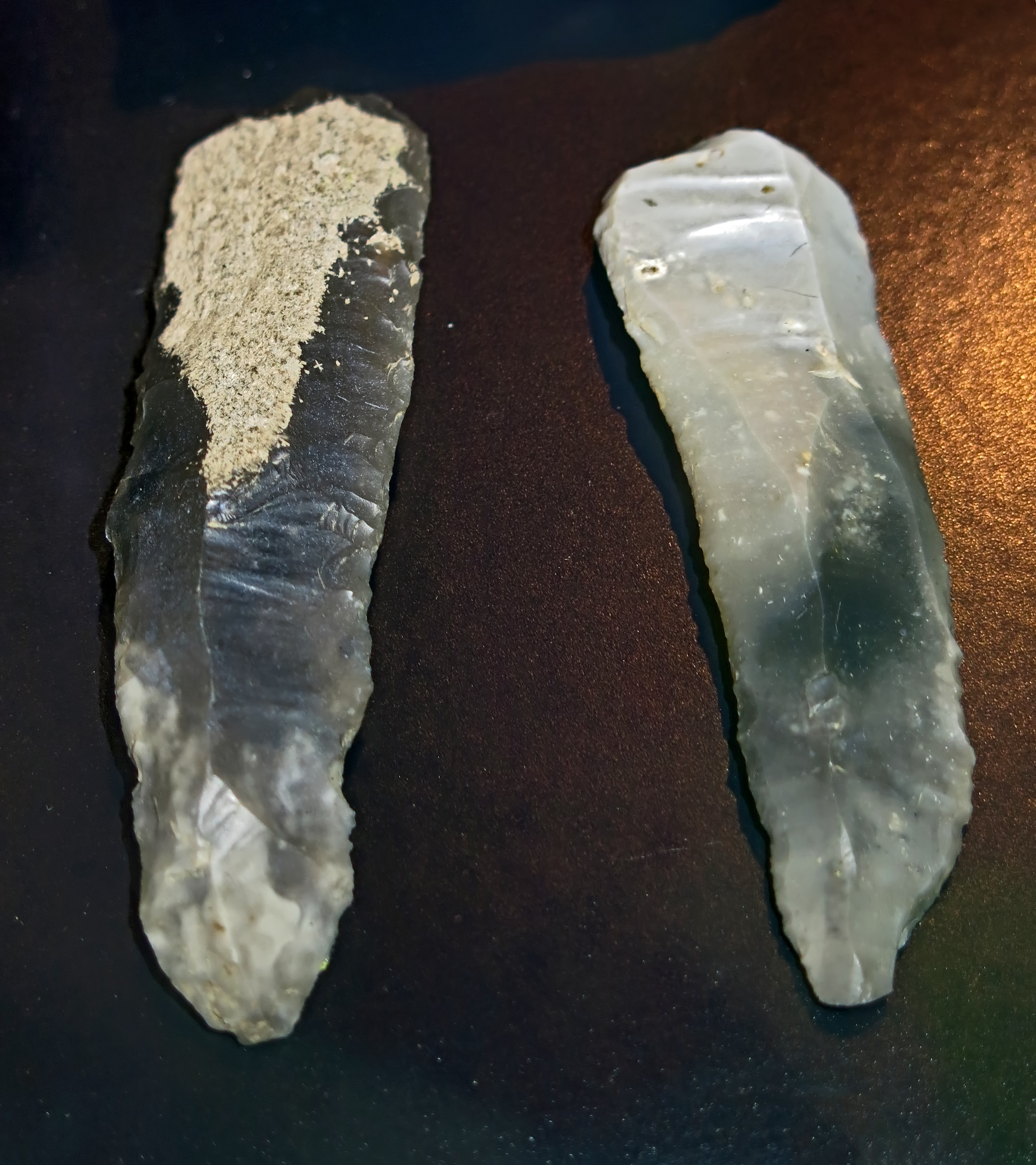
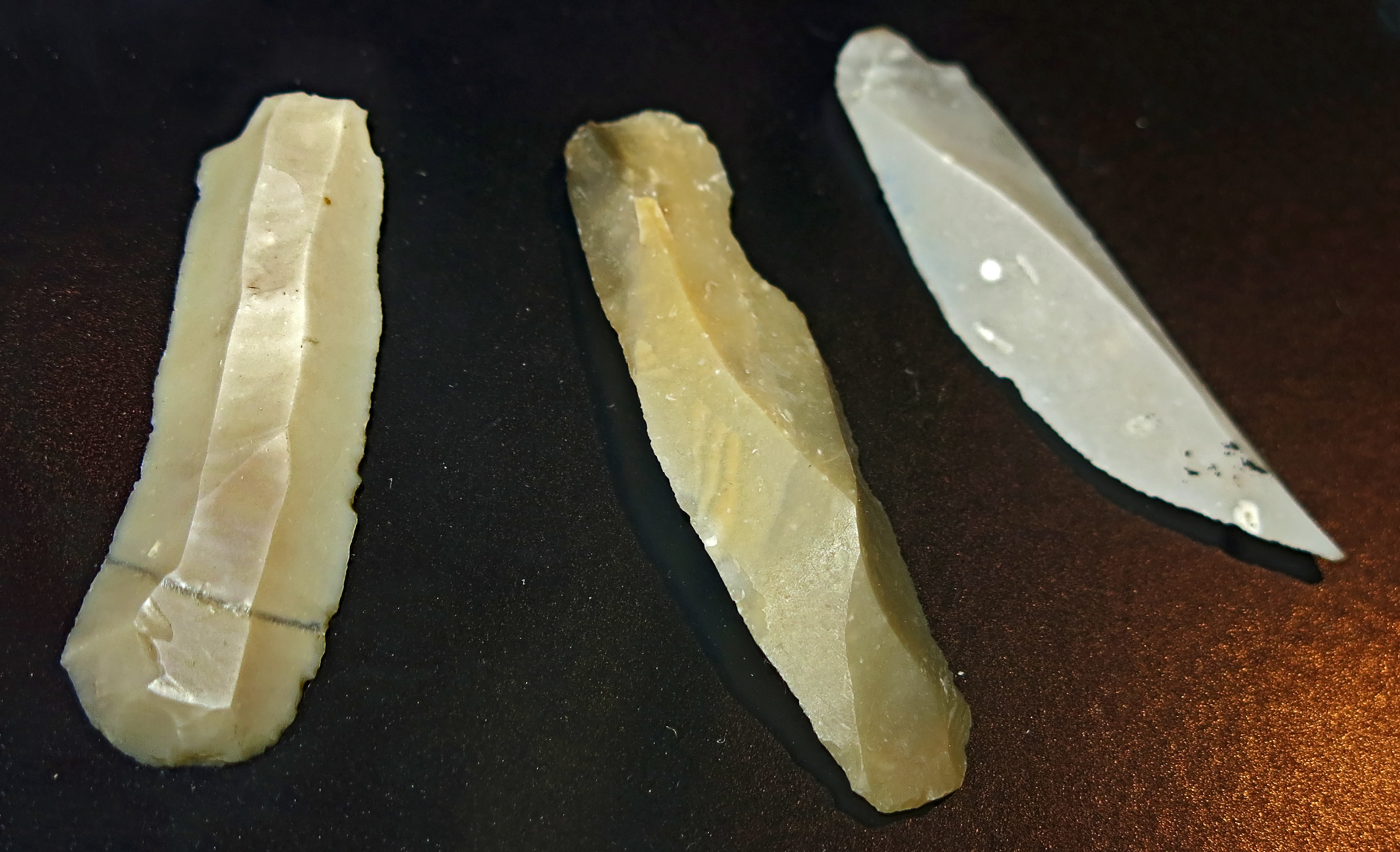
Display of tools from Hamburg - Rissen, circa 14 000 BP
Blades, as in the general photograph, made into grattoirs (scrapers) and a grattoir/point on the right.
Photo: Don Hitchcock 2015
Source: Originals, Archäologisches Museum Hamburg, Germany
Text: © Card at the Museum.
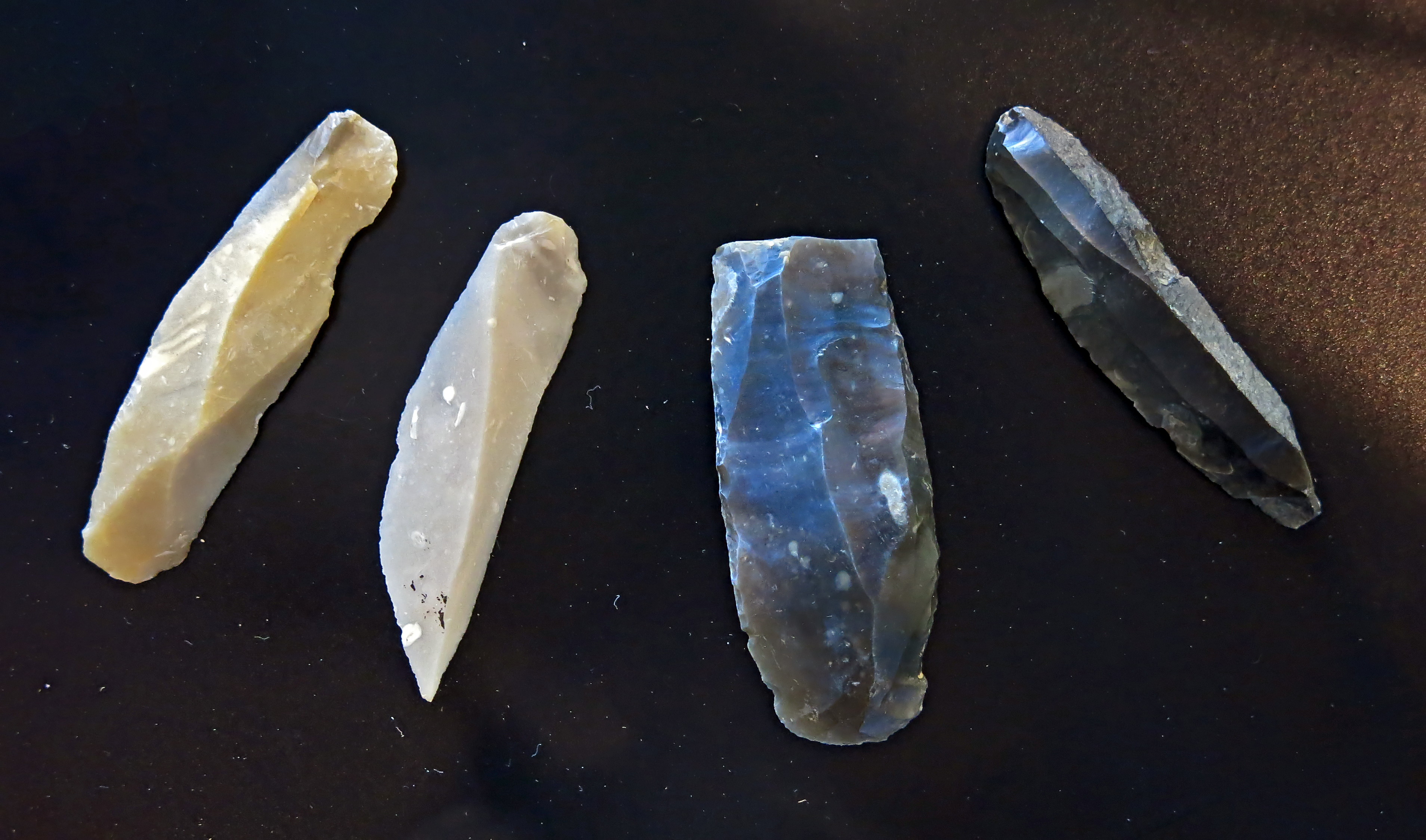
Display of tools from Hamburg - Rissen, circa 14 000 BP
Blades, as in the general photograph, made into grattoirs (scrapers).
Photo: Don Hitchcock 2015
Source: Originals, Archäologisches Museum Hamburg, Germany
Text: © Card at the Museum.
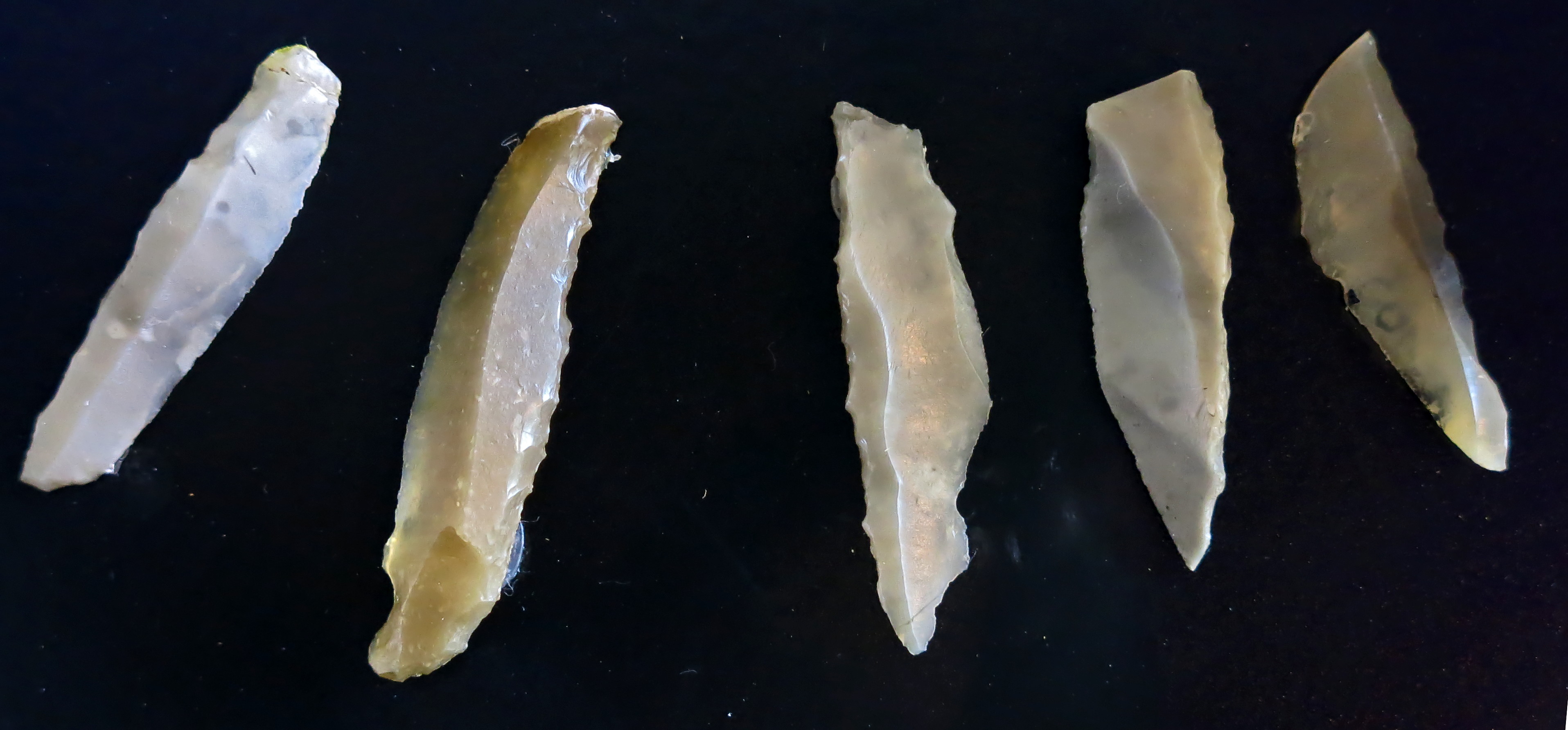
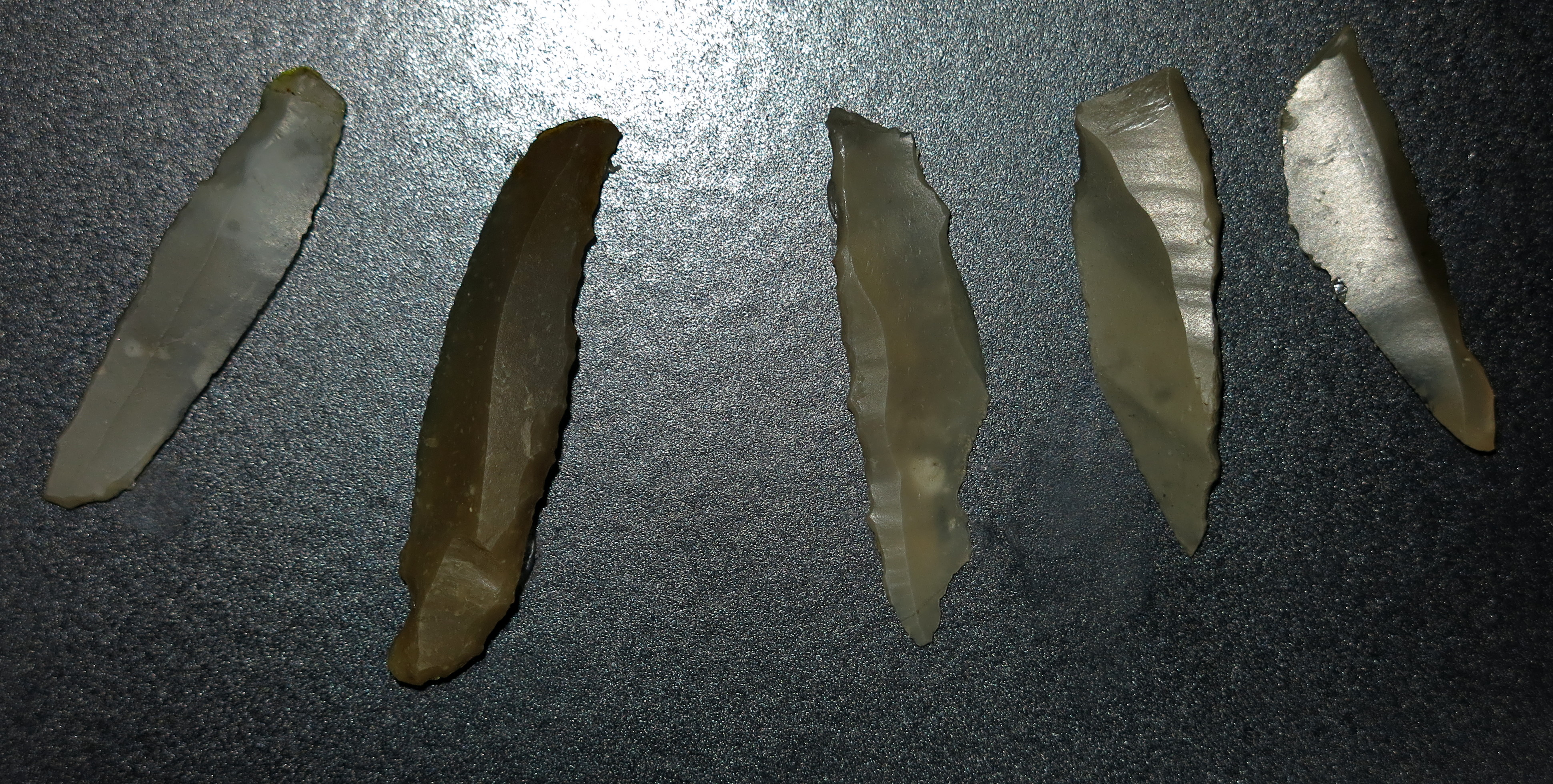
Display of tools from Hamburg - Rissen, circa 14 000 BP
Blades, as in the general photograph.
( The two on the right may be points for darts/spears, the leftmost blade may be a grattoir, and the two middle blades appear to have been backed for use in the hand, as in the 'Federmesser' culture. The second from the left has a notch which indicates that the tool may have been used for the initial shaving of arrow shafts. - Don )
Photo: Don Hitchcock 2015
Source: Originals, Archäologisches Museum Hamburg, Germany
Text: © Card at the Museum.
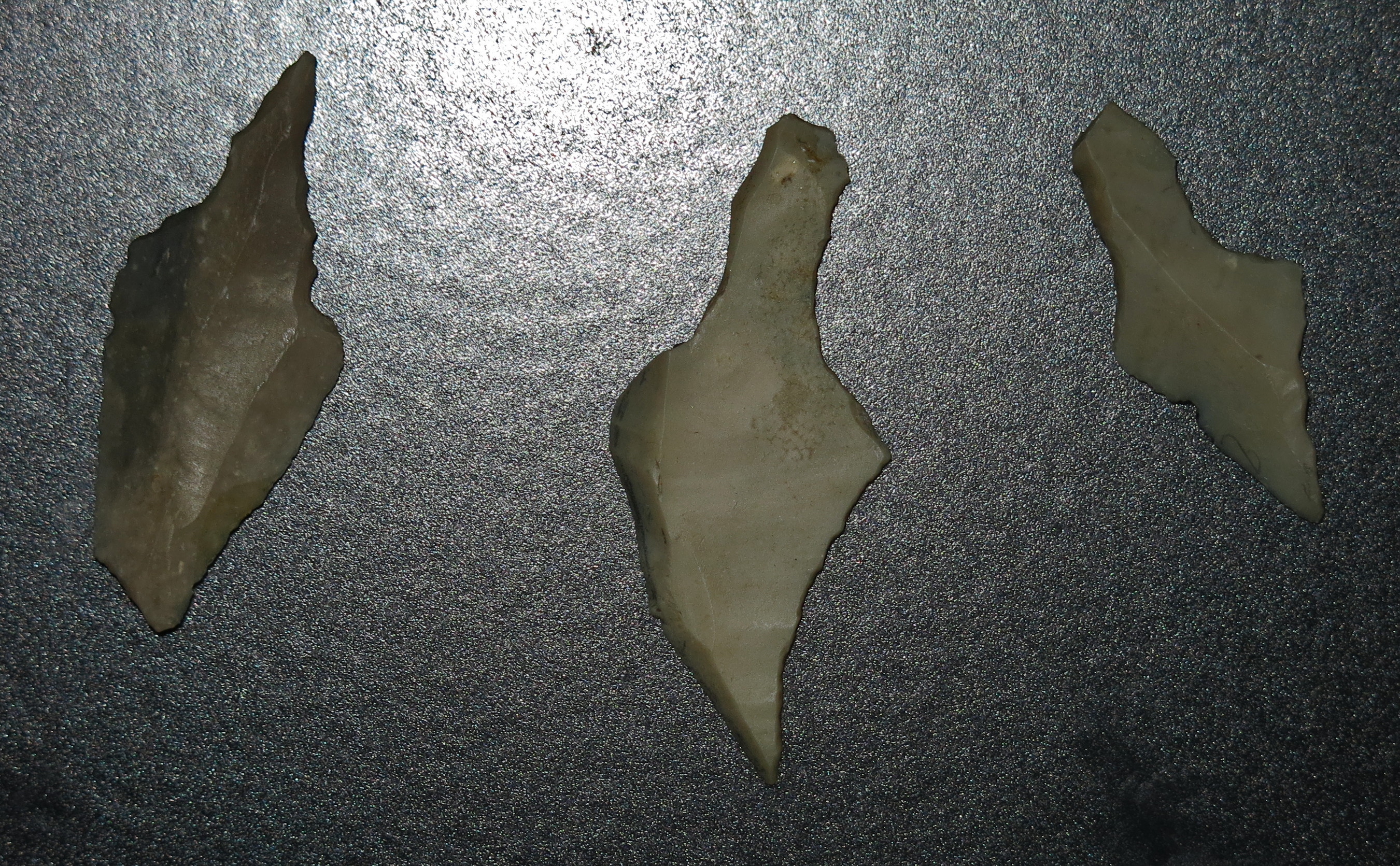
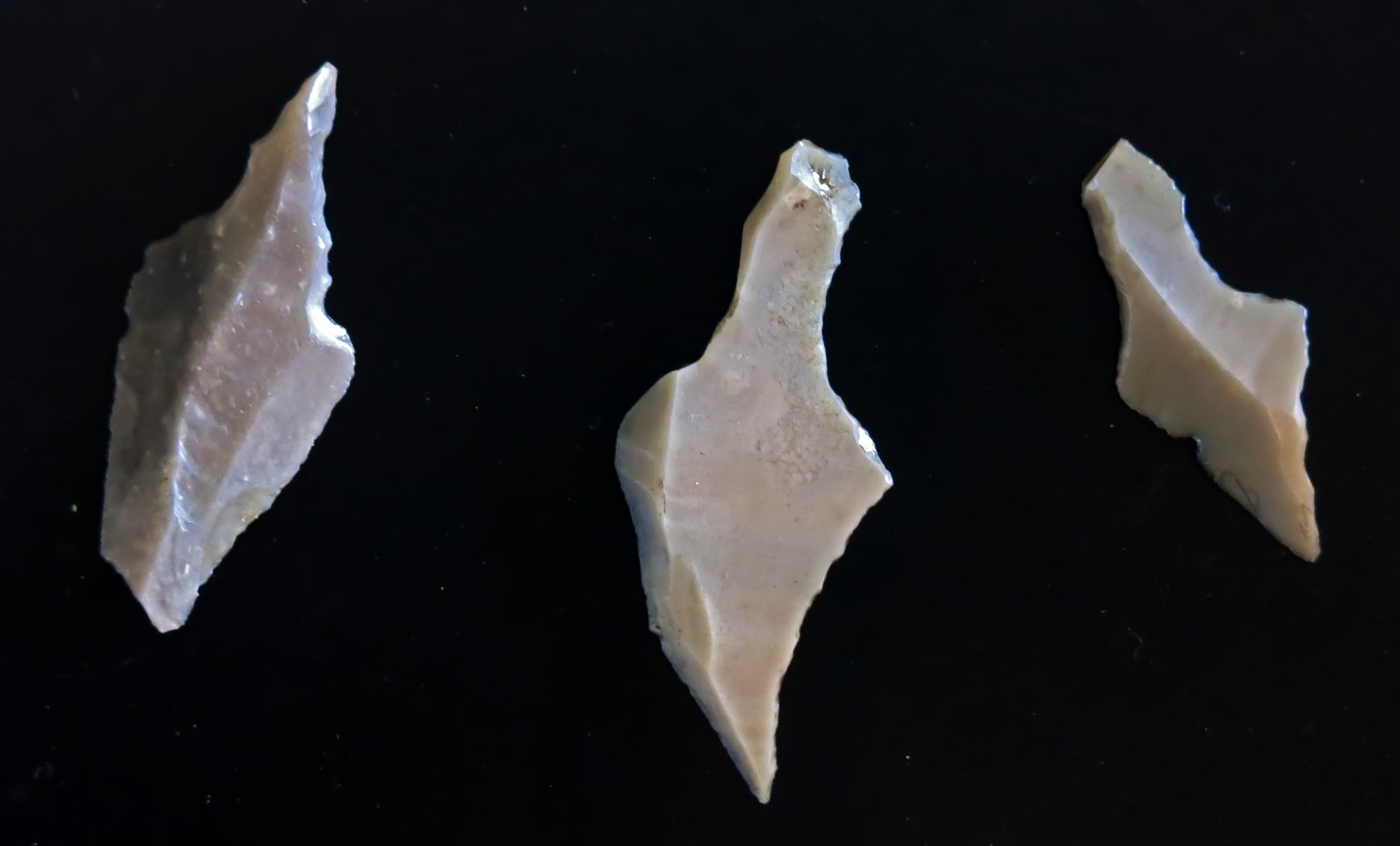
Display of tools from Hamburg - Rissen, circa 14 000 BP
Arrrowheads, the oldest evidence of the use of bows and arrows in this area, as in the general photograph.
Photo: Don Hitchcock 2015
Source: Originals, Archäologisches Museum Hamburg, Germany
Text: © Card at the Museum.
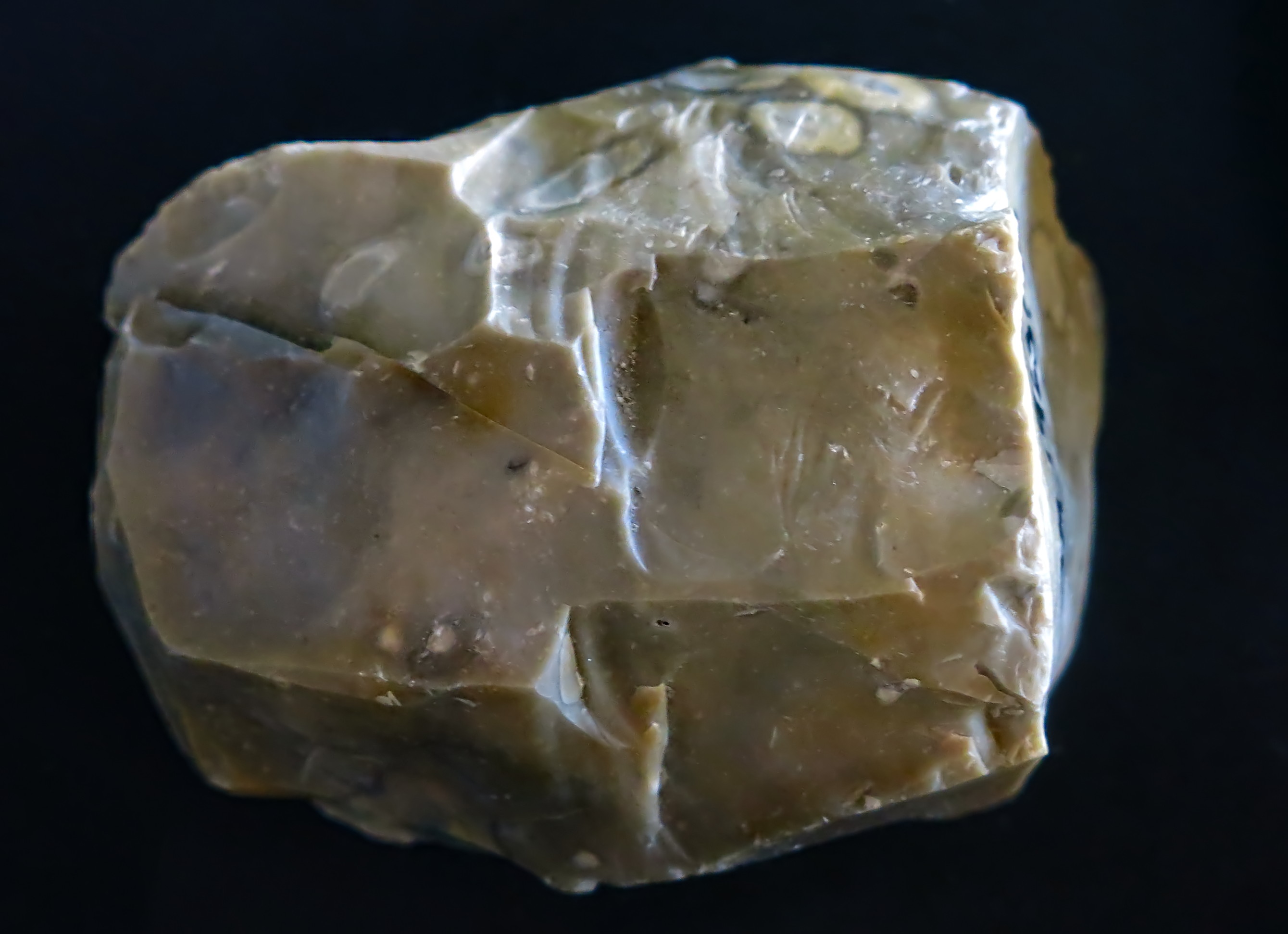
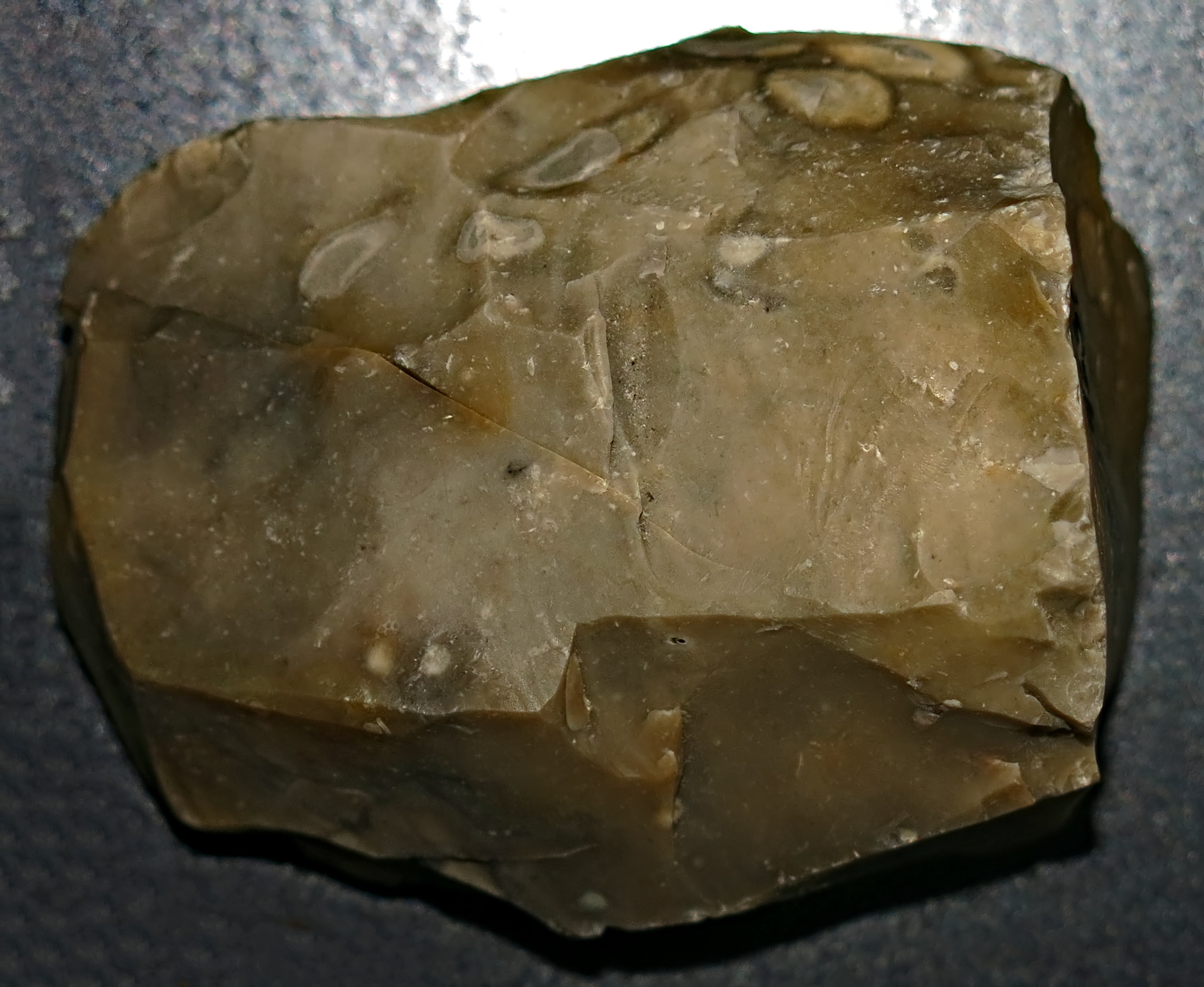
Display of tools from Hamburg - Rissen, circa 14 000 BP
Flint core or nucleus.
Photo: Don Hitchcock 2015
Source: Originals, Archäologisches Museum Hamburg, Germany
Text: © Card at the Museum.
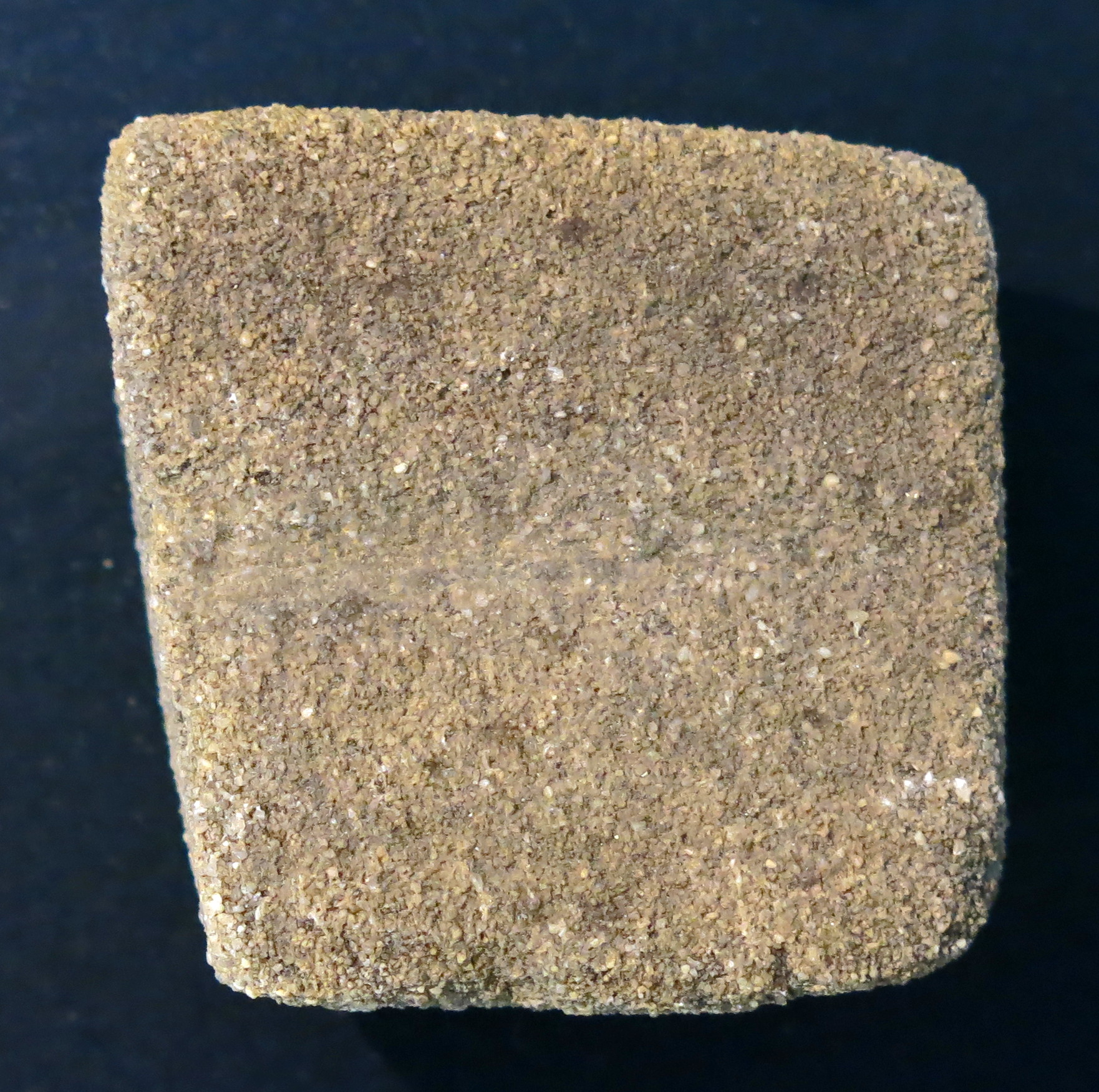
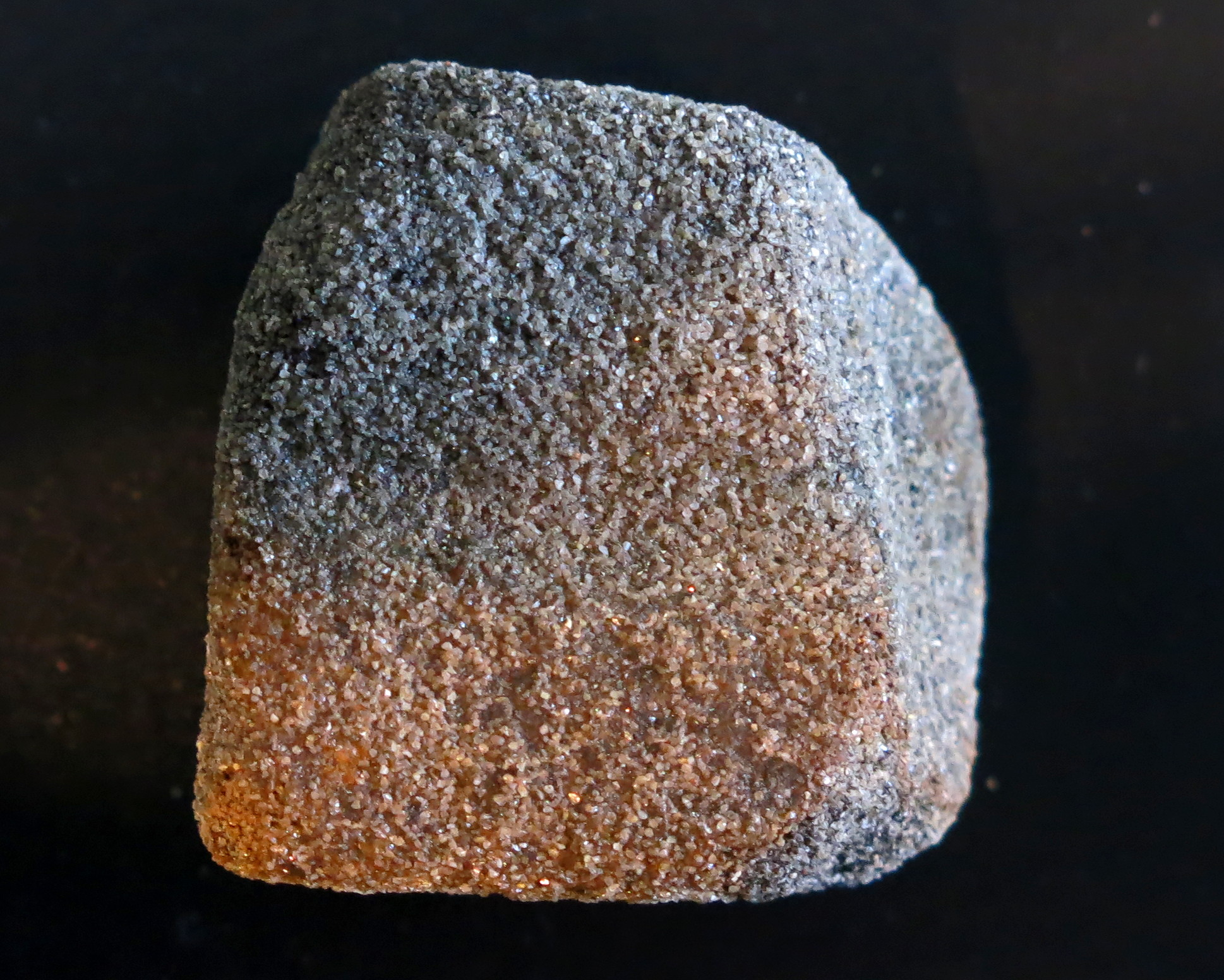

Display of tools from Hamburg - Rissen, circa 14 000 BP
Arrow shaft smoothers.
Photo: Don Hitchcock 2015
Source: Originals, Archäologisches Museum Hamburg, Germany
Text: © Card at the Museum.
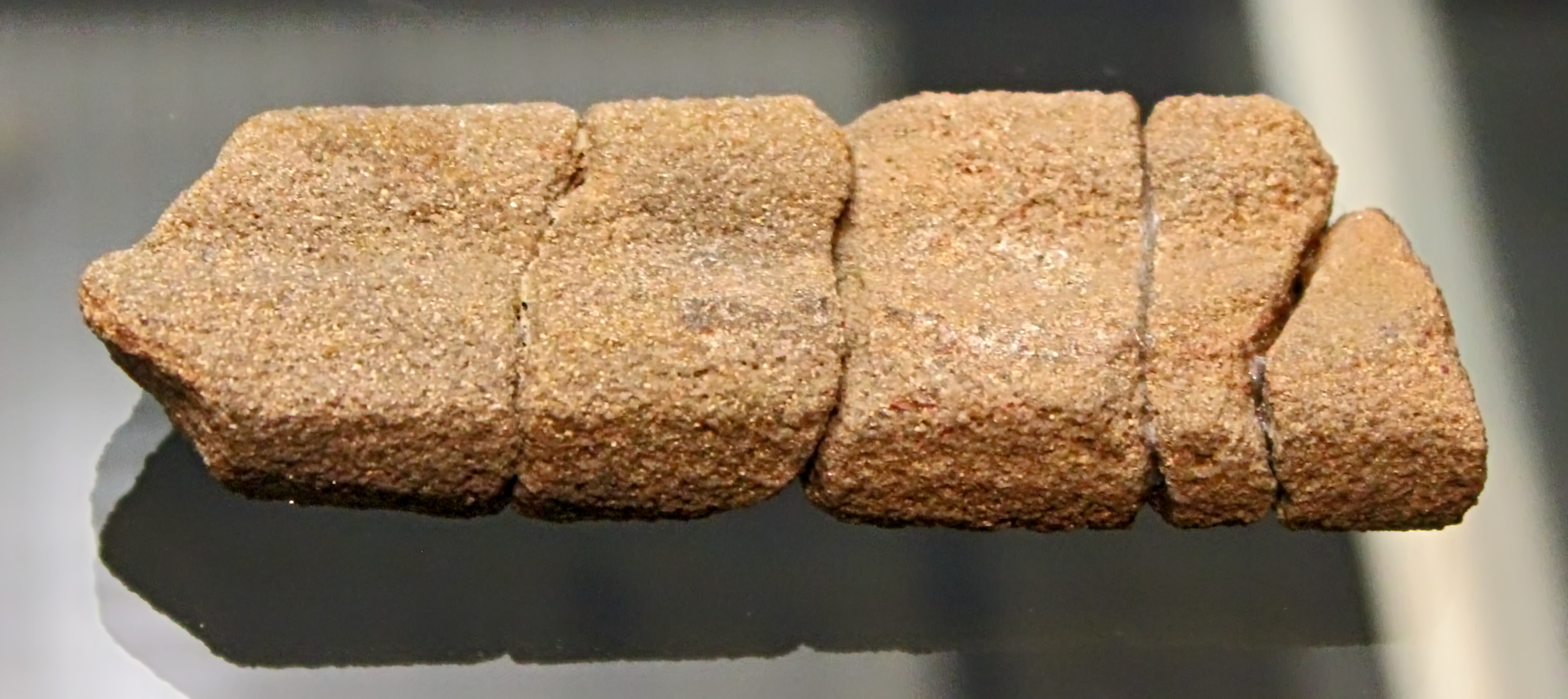
Arrow shaft smoother, Hamburg-Rissen, 13 000 BP.
Around 13 000 BP, Central and Northern Europe was inhabited by the so-called 'Federmesser' culture, a tool making tradition which often used small backed flint blades, like pen knives, from which the name derives.
Photo: Ralph Frenken
Source: Original, exhibited at the Archeological Museum Hamburg (Ice Age - The Art of the Mammoth Hunters from 18 October 2016 to 14 May 2017)
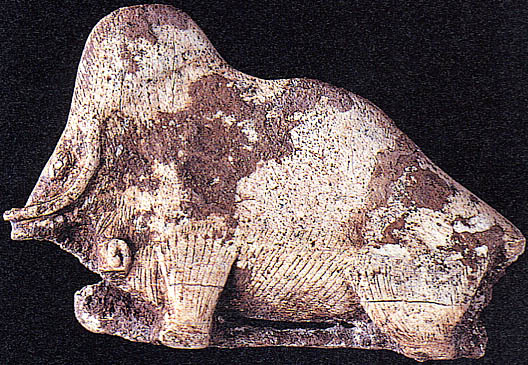 Canecaude (Aude) - middle Magdalenien, 14 230 ± 160 BP. Hook of atlatl (or spear thrower) in the shape of a mammoth, length 87 mm. The mammoth is seldom represented on this type of object, but is recognised easily by its general silhouette - the domed head, arched and plunging back, with its tusk, of which not all remains, with its massive legs and its broad feet, its encircled globulous eyes. It should be mentioned that this cave of the southernmost slope of the Black Mountain did not have any remains of mammoths and that reindeer formed 90 % of the hunted species.
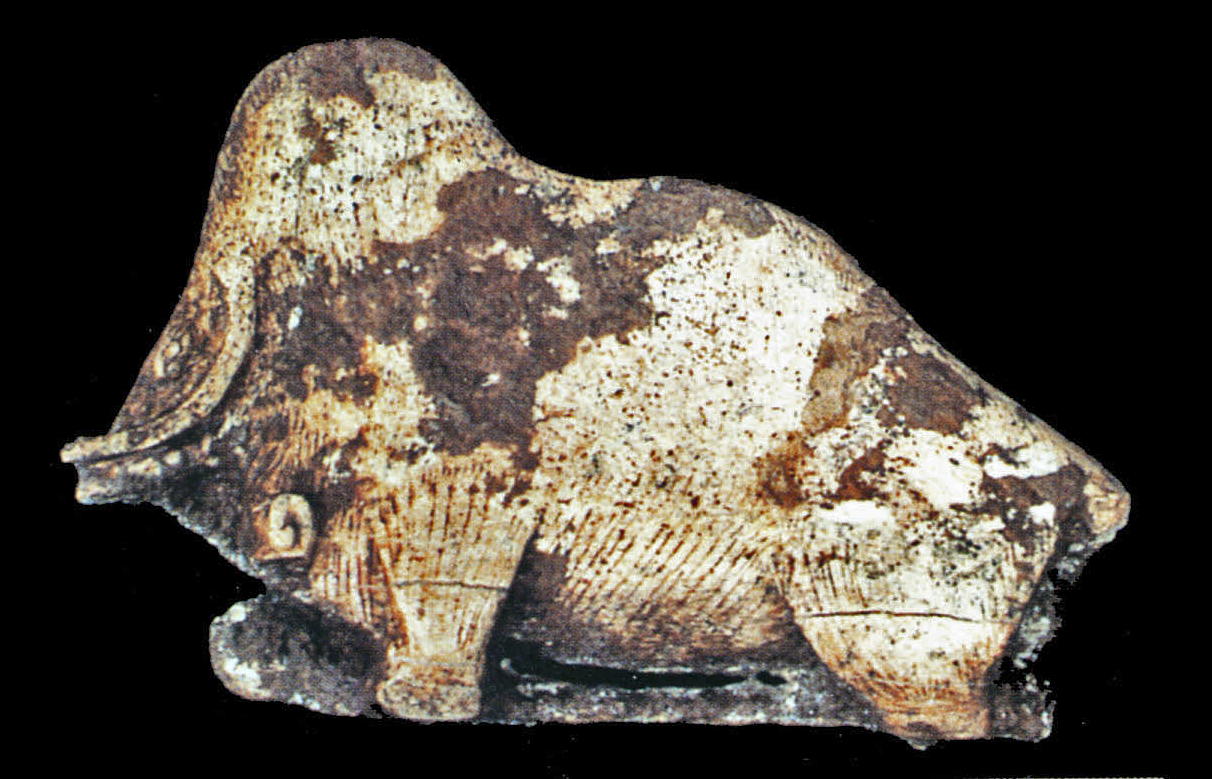
Another version of the propulseur above.
Photo: http://www.arretetonchar.fr/
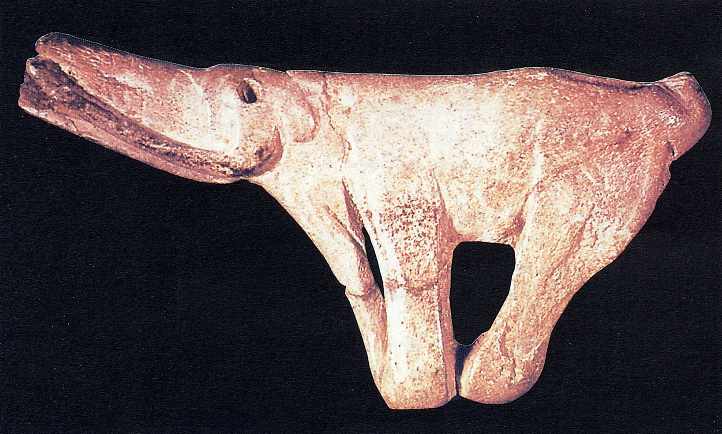 Sculpture de mammouth sur un fragment de propulseur en bois de renne du
Magdalénien de Bruniquel (Tarn-et-Garonne). Photo H. Delporte.
Sculpture de mammouth sur un fragment de propulseur en bois de renne du
Magdalénien de Bruniquel (Tarn-et-Garonne). Photo H. Delporte.
Sculpture of a mammoth on part of a spear thrower, made out of reindeer antler, of Magdalenian age, from Bruniquel (Tarn-et-Garonne). Photo H. Delporte.
This appears to be the other side of a specimen in the British Museum described below, although the photo here does not show the hook inserted into the back as described for the British Museum specimen. It is worth having a look at the image on the British Museum site.
Text below adapted from
http://www.thebritishmuseum.ac.uk/compass/ixbin/goto?id=OBJ1369
From the rockshelter of Montastruc, Tarn-et-Garonne, France
Carved from a reindeer antler
Spear throwers came into use about 18 000 years ago in western Europe. They consist of a straight handle with a hook at one end. The bottom of the spear fits against the hook and the spear shaft and spear thrower handle are held together with the hook end by the shoulder. Launching the spear in this way sends it with more force and speed and across a longer distance than if it was simply thrown by hand.
The hook ends of spear throwers are frequently decorated with an animal. This example from Montastruc shows a mammoth. It is the only known example which has a hole for an eye (which probably held an insert of bone or stone). The hook is also unusual because it is an ancient repair. The original hook carved from the antler broke off and was mended by cutting a slot on the back and inserting a bone or antler replacement. The mammoth's tusks appear on each side of the handle, most of which was broken off in ancient times.
Length: 12.4 cm

Tools from la Madeleine and Limeuil, Magdalenian, 13 000 BP.
Photo: Don Hitchcock 2014
Source and text: Original, Københavns (Copenhagen) Museum, National Museum of Denmark
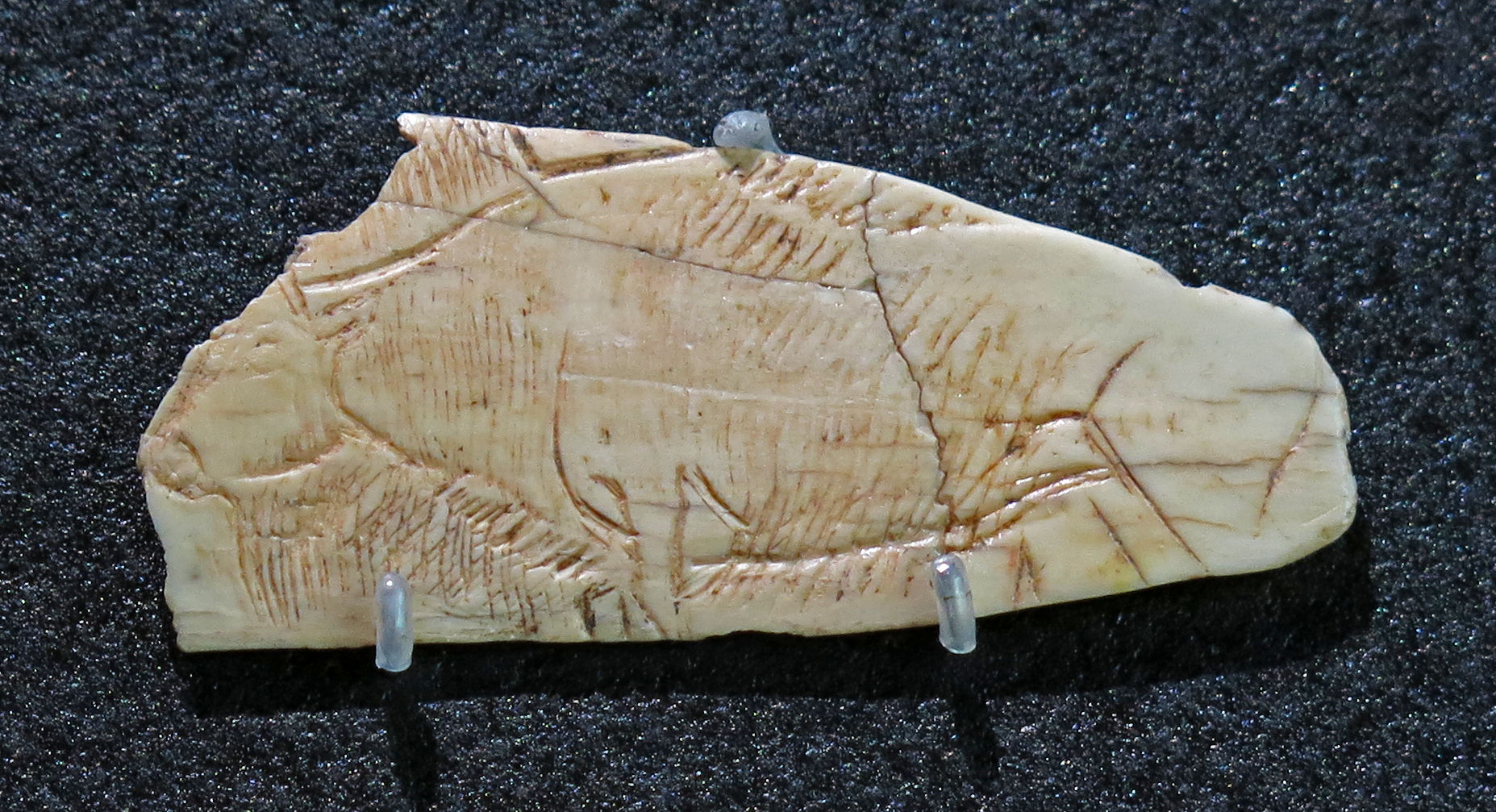
Lissoir from Arancou, Magdalenian.
Photo: Don Hitchcock 2014
Source: Original, Musée National de Préhistoire, Les Eyzies
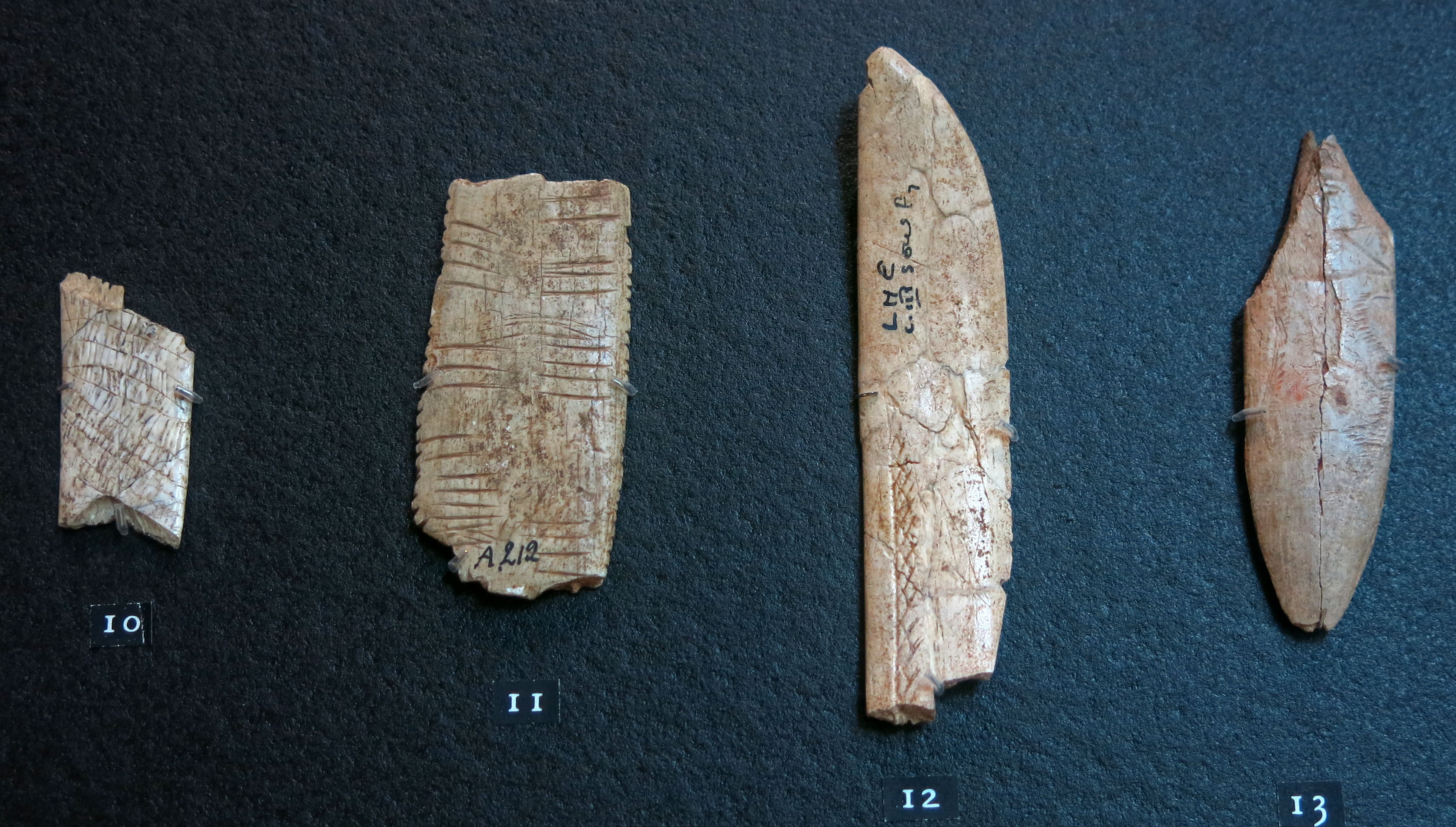
Geometric motifs on fragments of bone tools.
10: Arancou, Magdalenian.
11: Origin unknown.
12: Fragment of a lissoir from Laugerie Haute Est, labelled as Les Marseilles on the display, Magdalenian.
13: Laugerie Basse, Upper Magdalenian.
Photo: Don Hitchcock 2014
Source: Original, Musée National de Préhistoire, Les Eyzies
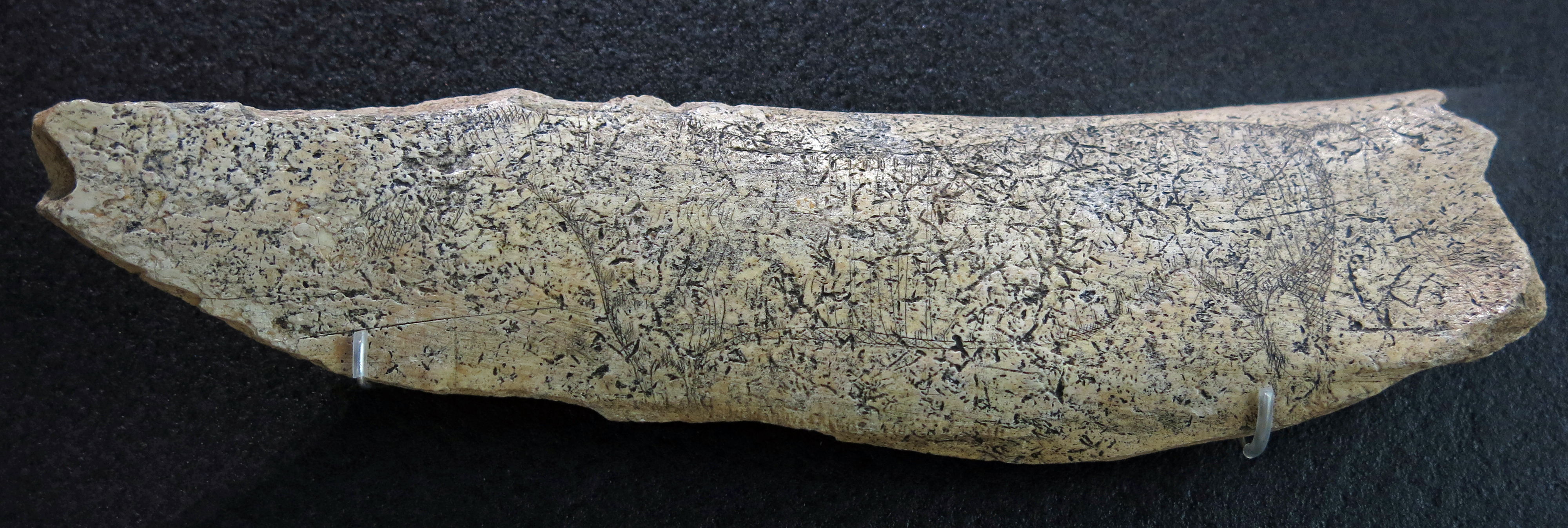
Bone fragment from Pont d'Ambon, Azilian.
Decorated with an exaggeratedly long horse.
Photo: Don Hitchcock 2014
Source: Original, Musée National de Préhistoire, Les Eyzies

Tools from la Madeleine and Limeuil, Magdalenian, 13 000 BP.
Photo: Don Hitchcock 2014
Source and text: Original, Københavns (Copenhagen) Museum, National Museum of Denmark
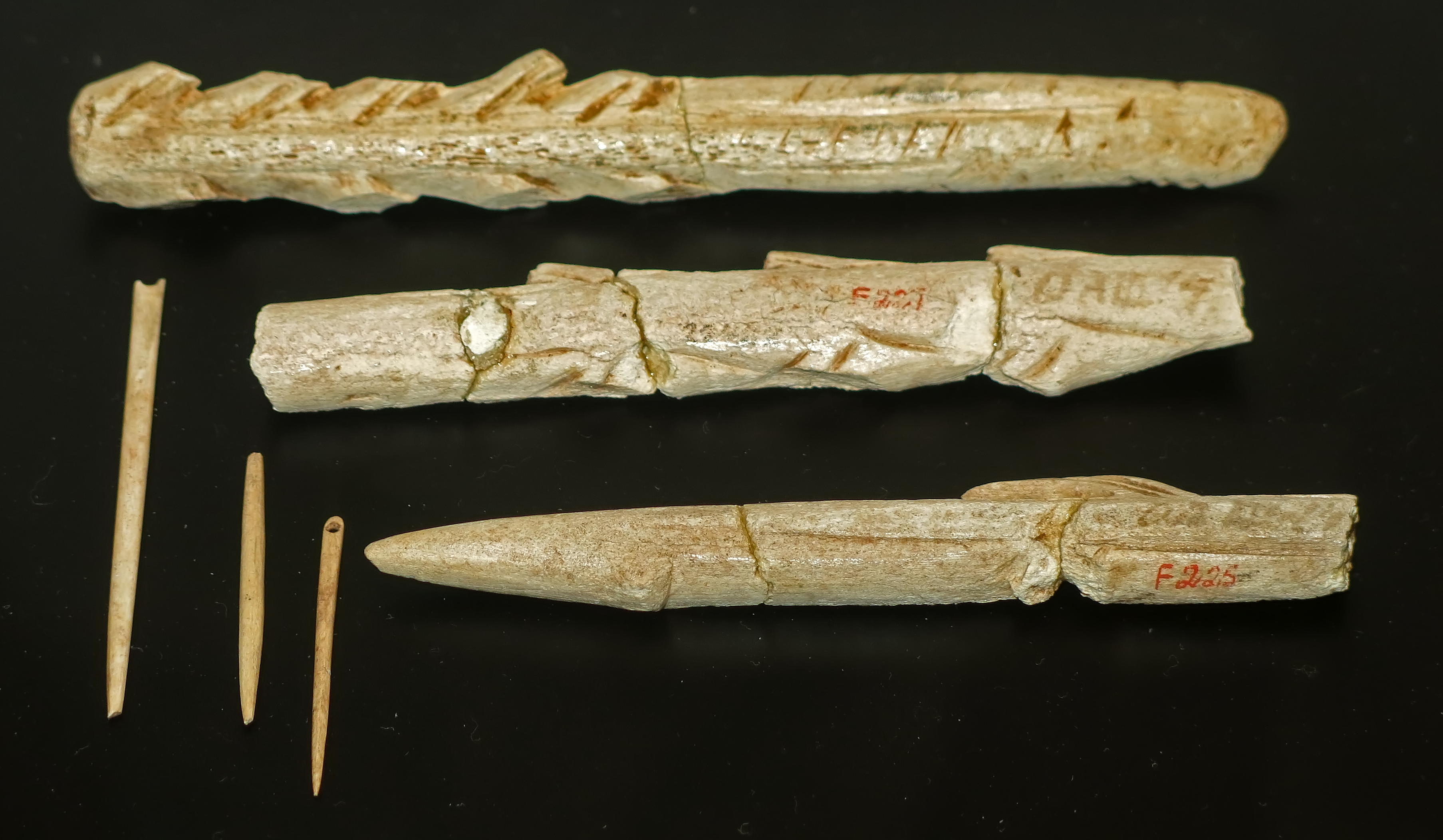
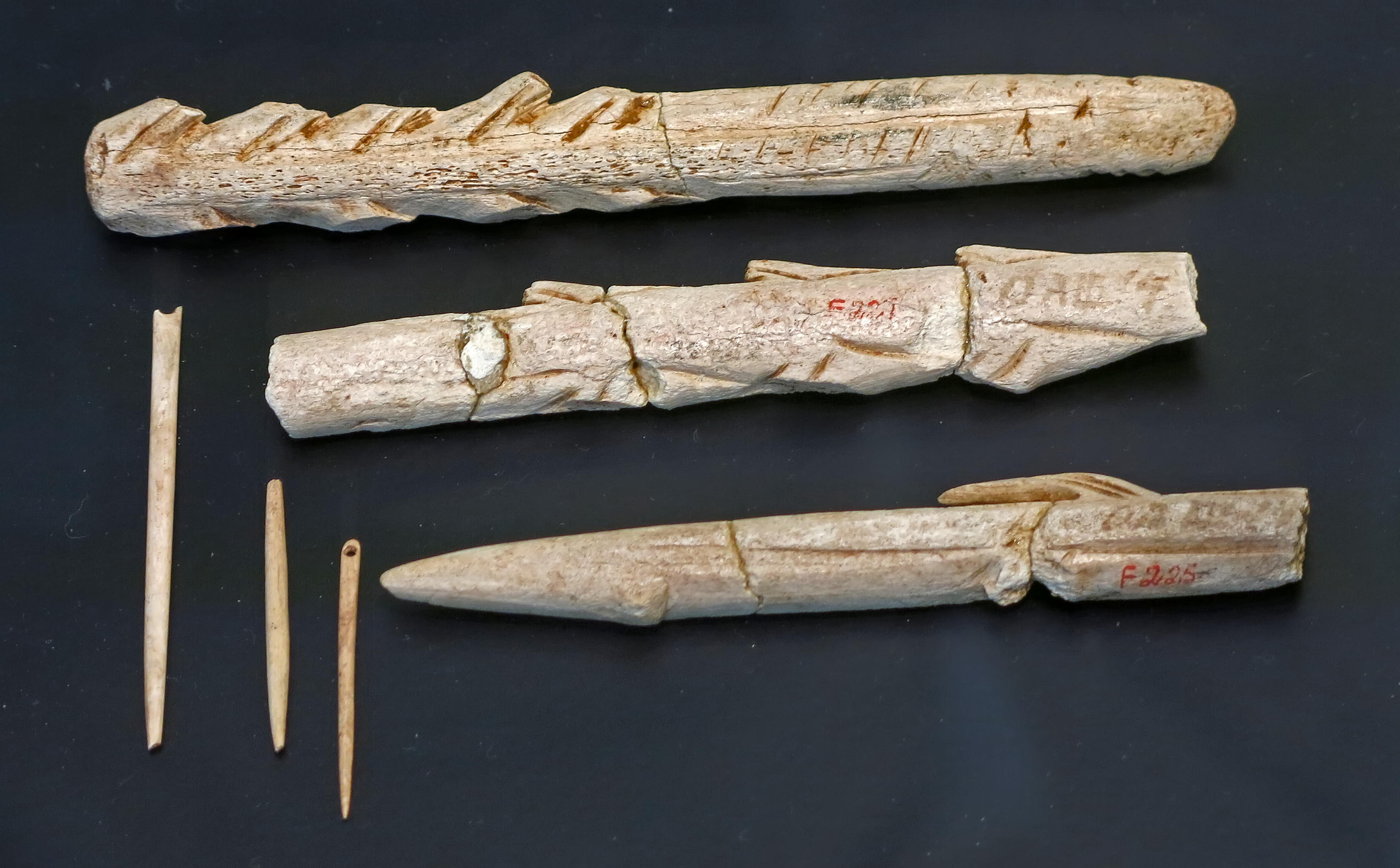
Tools from la Madeleine and Limeuil, Magdalenian, 13 000 BP.
Photo: Don Hitchcock 2014
Source and text: Original, Københavns (Copenhagen) Museum, National Museum of Denmark

Display of arrow heads from Ahrensburg, circa 13 000 BP - 11 500 BP
To the east of Ahrensburg, the meltwater of the last receding glaciers formed a glacial groove in the ground beneath the ice, a so-called tunnel valley. After the ice melted, reindeer herds migrated through the valley. They were hunted by groups of people who had pitched their temporary campsites there. Their tools, made of flint, were so distinctive that the complete Northern German culture of this late Palaeolithic Period, 13 000 years ago, was designated the Ahrensburg Culture.
Photo: Don Hitchcock 2015
Source: Originals, Archäologisches Museum Hamburg, Germany
Text: © information booklet at the Museum.
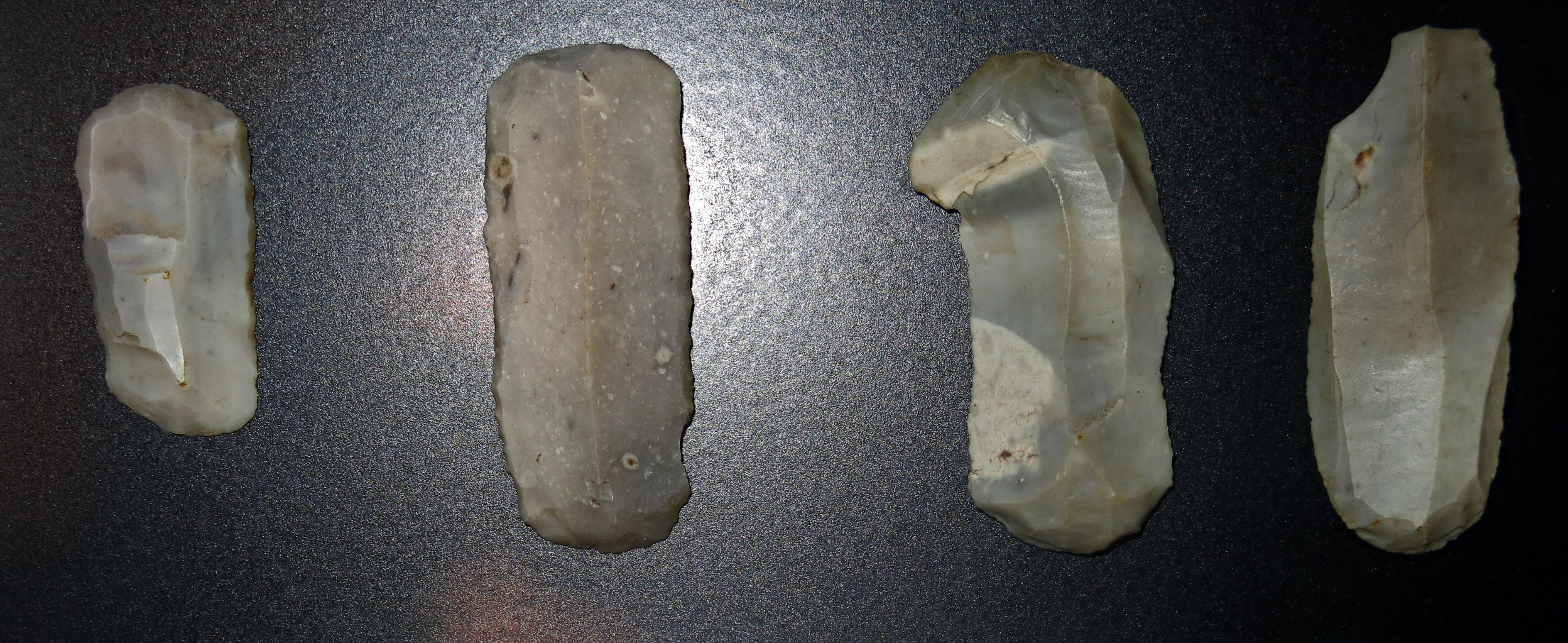
Display of grattoirs (scrapers) on blades, from Ahrensburg, circa 13 000 BP - 11 500 BP
Photo: Don Hitchcock 2015
Source: Originals, Archäologisches Museum Hamburg, Germany
Text: © information booklet at the Museum.
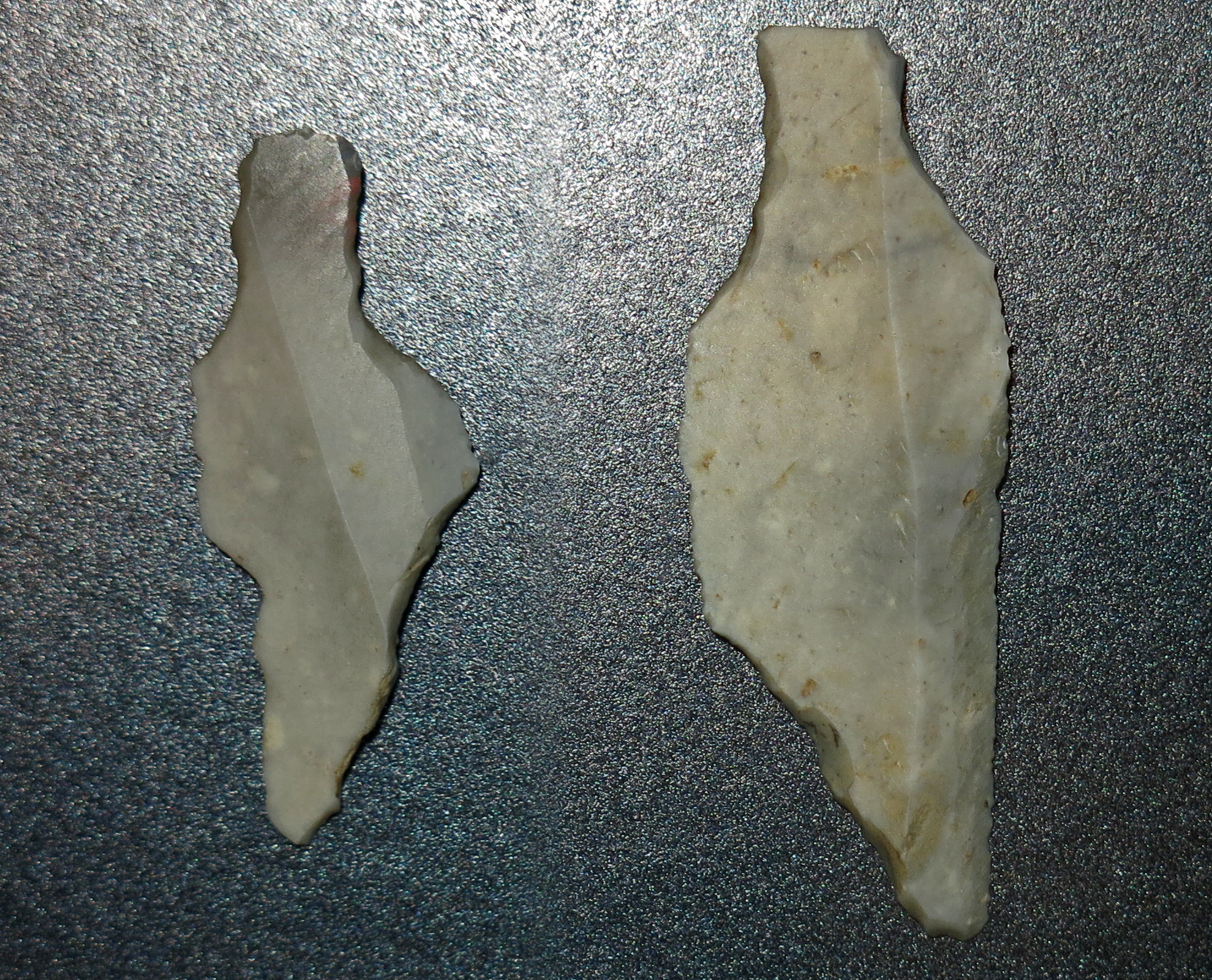
Display of arrowheads, from Ahrensburg, circa 13 000 BP - 11 500 BP
Photo: Don Hitchcock 2015
Source: Originals, Archäologisches Museum Hamburg, Germany
Text: © information booklet at the Museum.

A fine example of an arrowhead, beautifully crafted, from Ahrensburg, circa 13 000 BP - 11 500 BP
Photo: Don Hitchcock 2015
Source: Originals, Archäologisches Museum Hamburg, Germany
Text: © information booklet at the Museum.
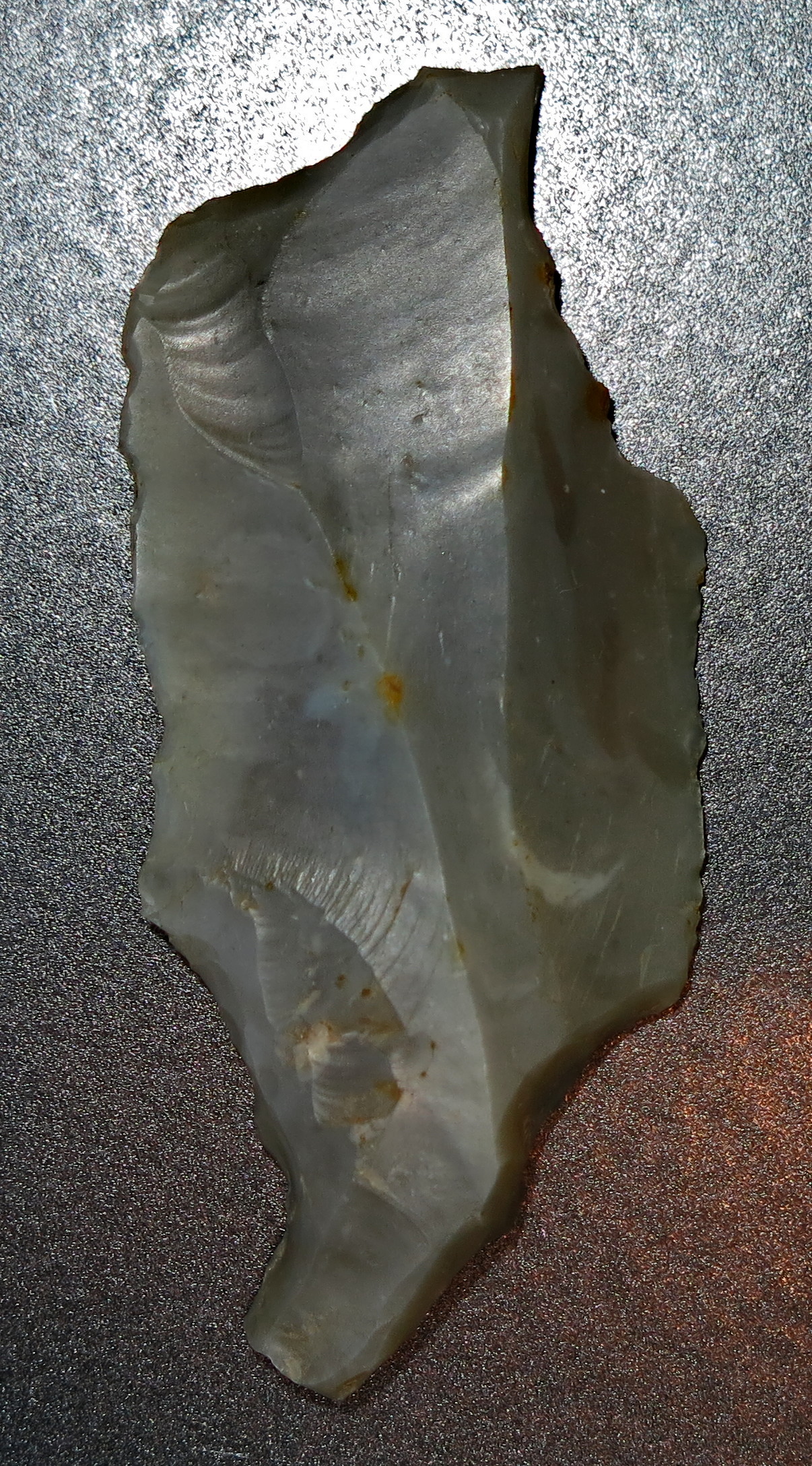
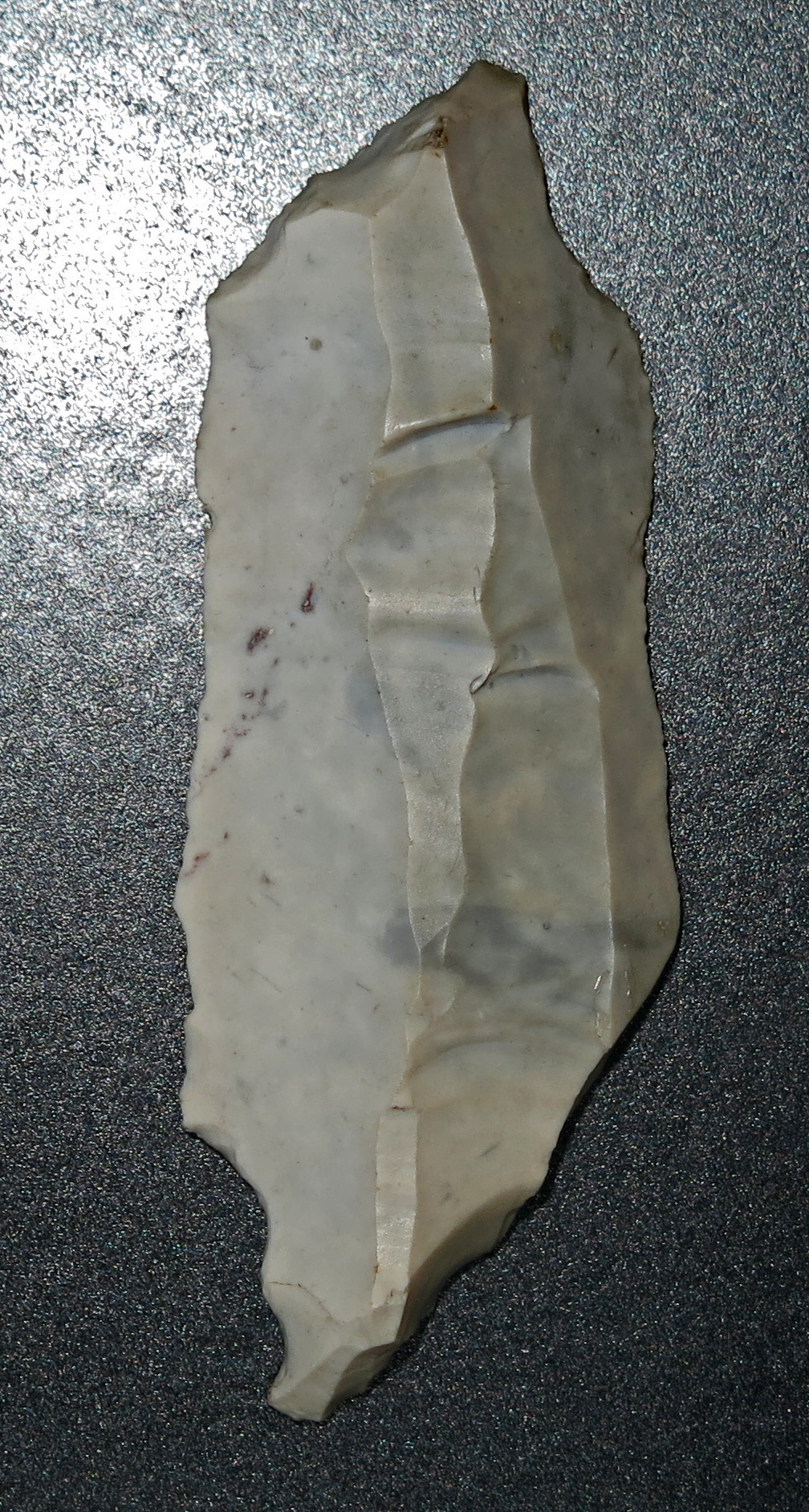
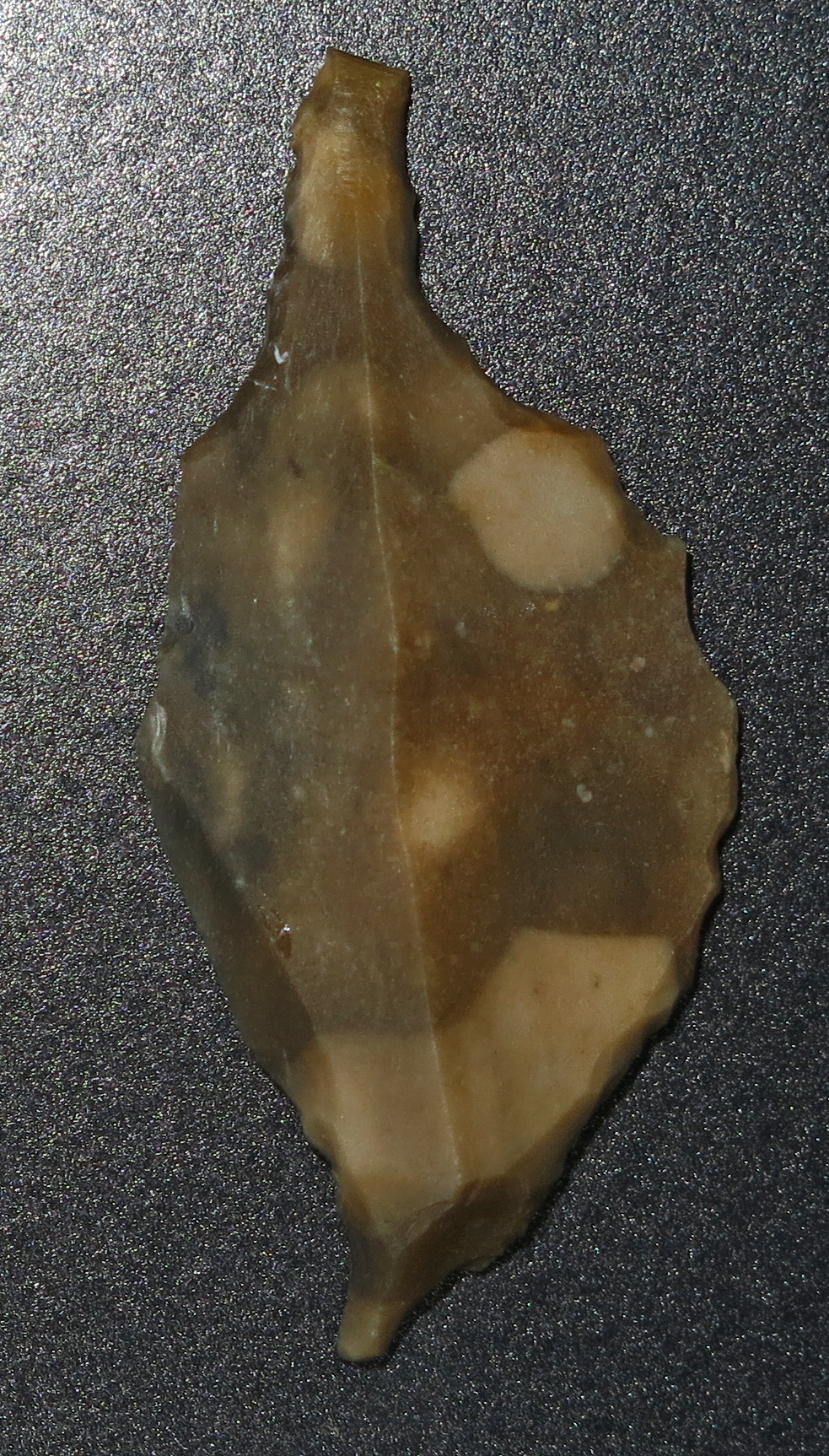
Three burins, from Ahrensburg, circa 13 000 BP - 11 500 BP
Photo: Don Hitchcock 2015
Source: Originals, Archäologisches Museum Hamburg, Germany
Text: © information booklet at the Museum.
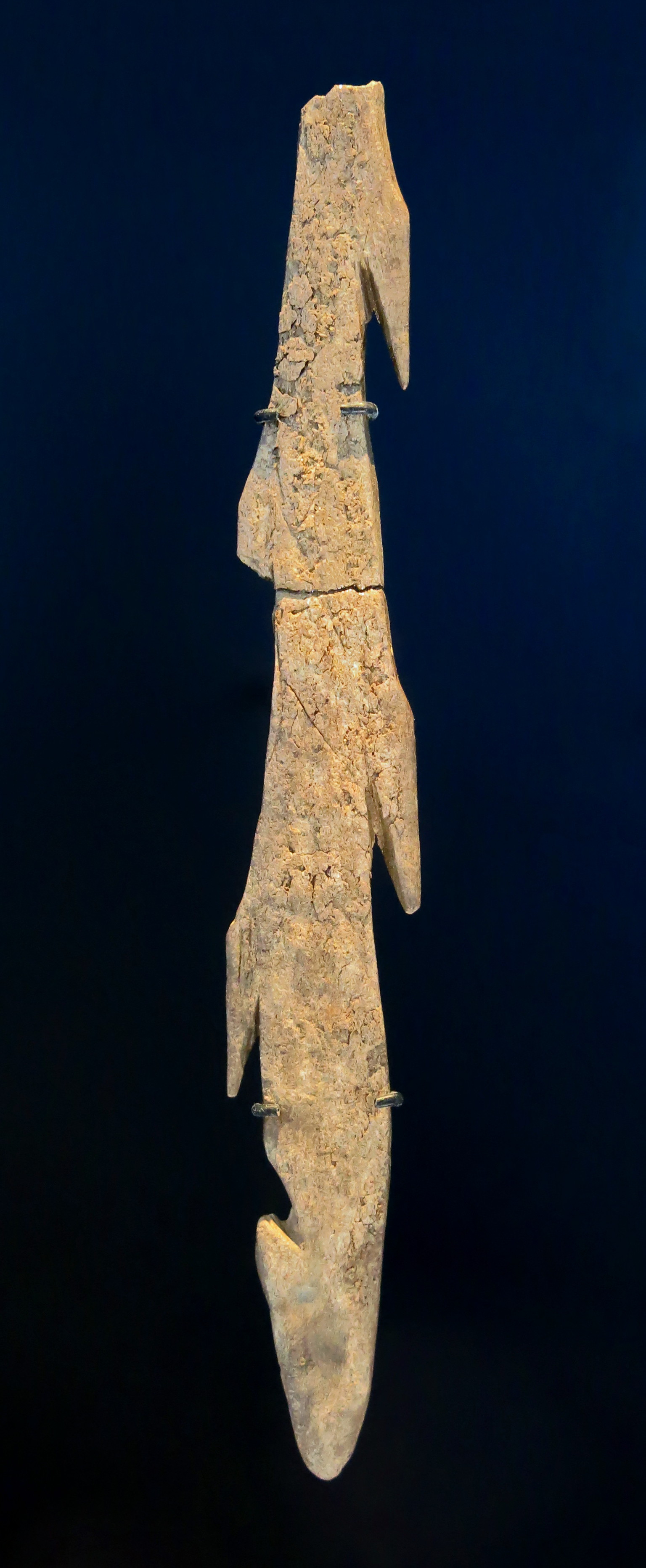

Harpoon and bow
Towards the end of the Palaeolithic period, harpoons were mainly made of long rods cut from deer antler. In addition, the range of hunting methods was supplemented by bows and arrows, which were ideal for the hunting of stag in the now denser forests. Slender arrow tips are the first indications that point to the invention of this new hunting method.
( Hunting stag in forests is easy in the rut, when the stags are roaring and announce their presence to the hunter, who can then use the forest as cover to get very close to the stag for the killing shot. Note, however, that modern hunters prefer female deer for the table. In any case, a long dart with a spear thrower is cumbersome and difficult to use in such an environment - Don )
Harpoon head. Deer antler, Bad Buchau, Kappel, Kreis Biberach.
Magdalenian, circa 12 000 BP.
Two arrow heads. Jurahornstein, Jurassic chert Bad Buchau.
Henauhof, district of Biberach, Magdalenian, circa 12 000 BP.
Photo: Don Hitchcock 2015
Source and text: Landesmuseum Württemberg, Stuttgart
On loan from the Archäologischen Landesmuseums Baden-Württemberg

Blades from the Upper Palaeolithic.
About 12 000 BP, almost at the end of the last ice age.
Southern Germany.
Note that the blade on the far left has been formed into a perçoir, or awl.
Photo: Don Hitchcock 2015
Source: Badisches Landesmuseum Karlsruhe Germany
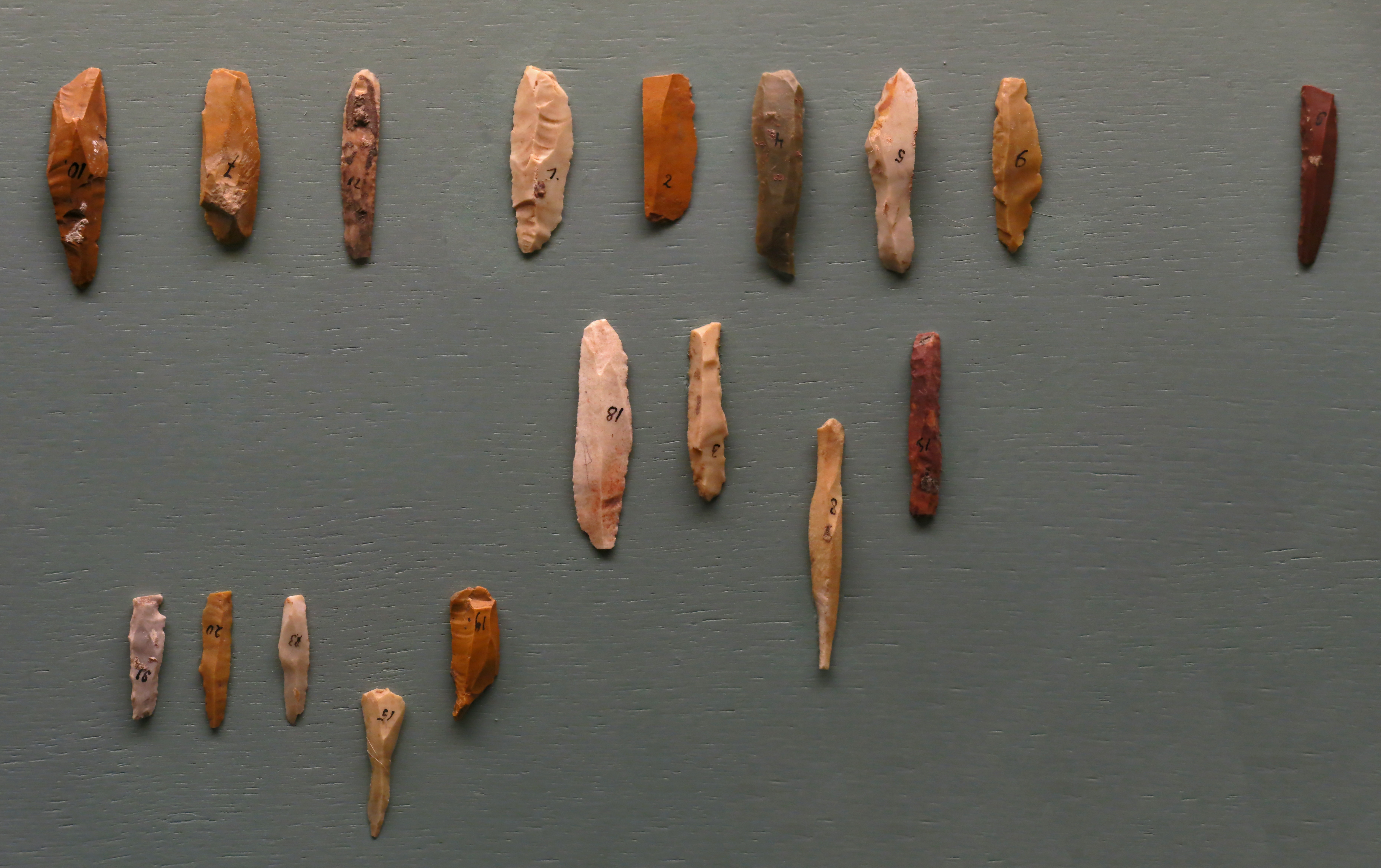
Small blades from the Upper Palaeolithic.
About 12 000 BP, almost at the end of the last ice age.
These tools are from Switzerland.
Photo: Don Hitchcock 2015
Source: Badisches Landesmuseum Karlsruhe Germany
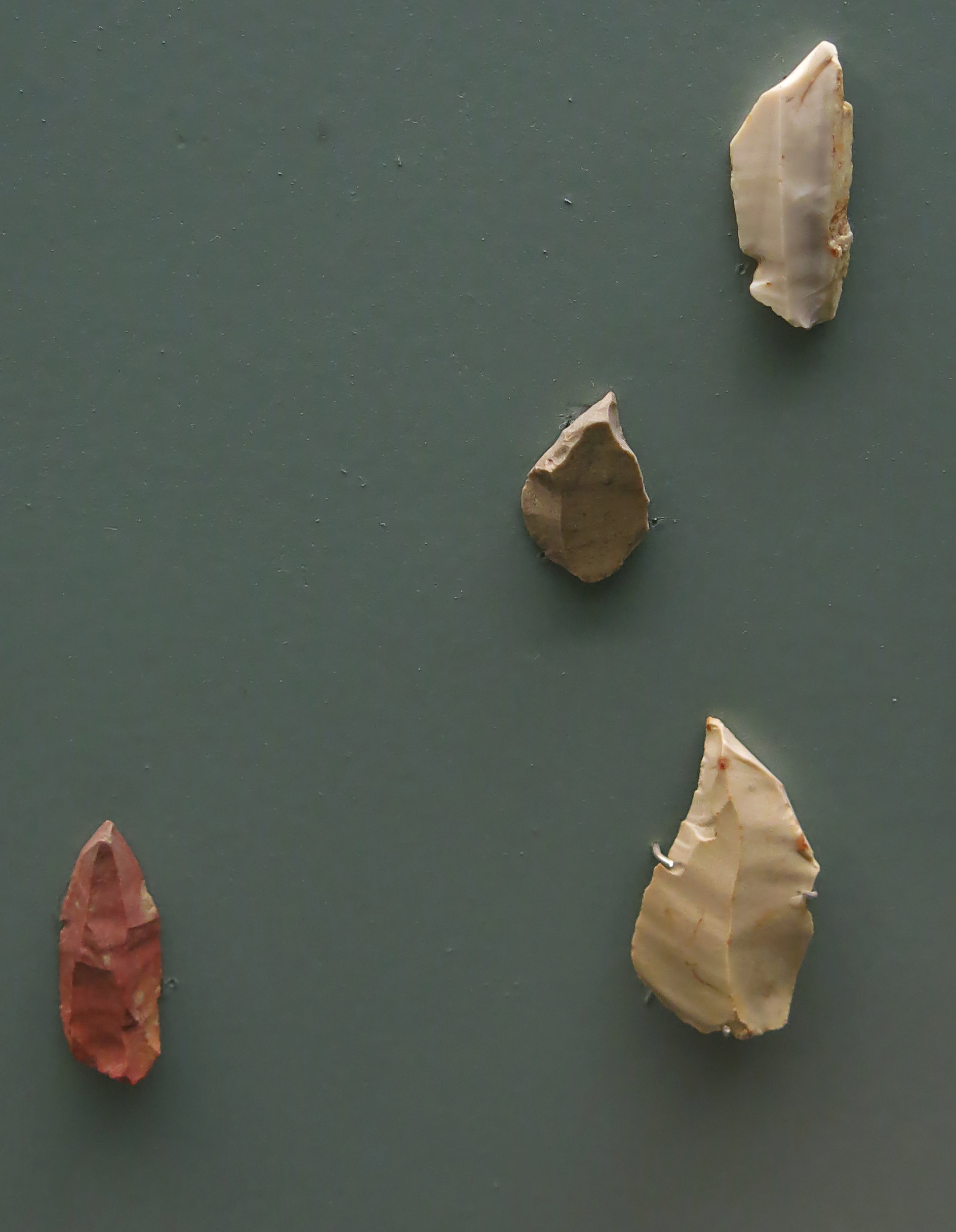
Burins from the Upper Palaeolithic.
Photo: Don Hitchcock 2015
Source: Badisches Landesmuseum Karlsruhe Germany
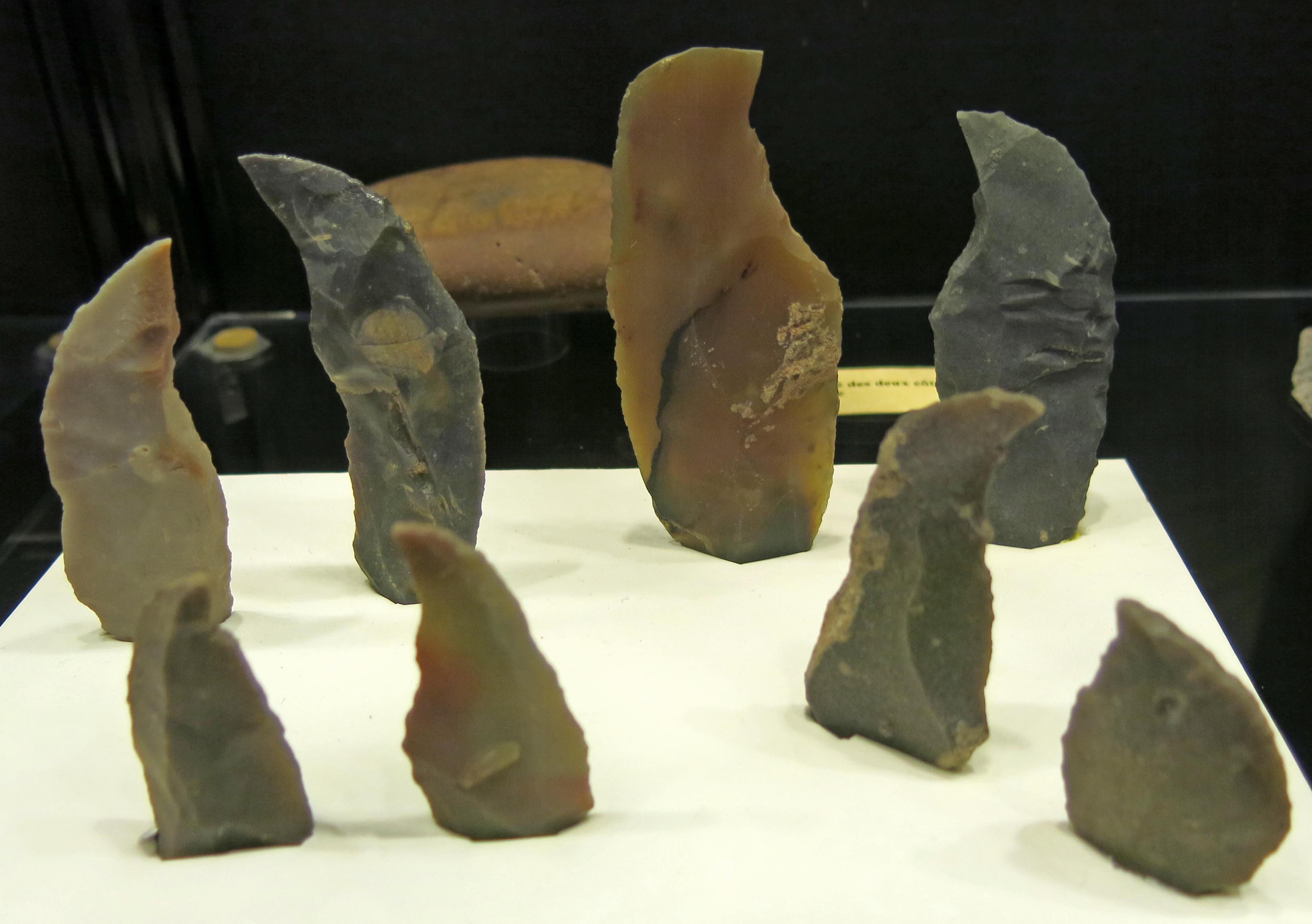
These are a beautiful matched set of parrot beak burins from Le Souci, Lalinde.
Photo: Don Hitchcock 2014
Source: Musée d’art et d’archéologie du Périgord, Périgueux
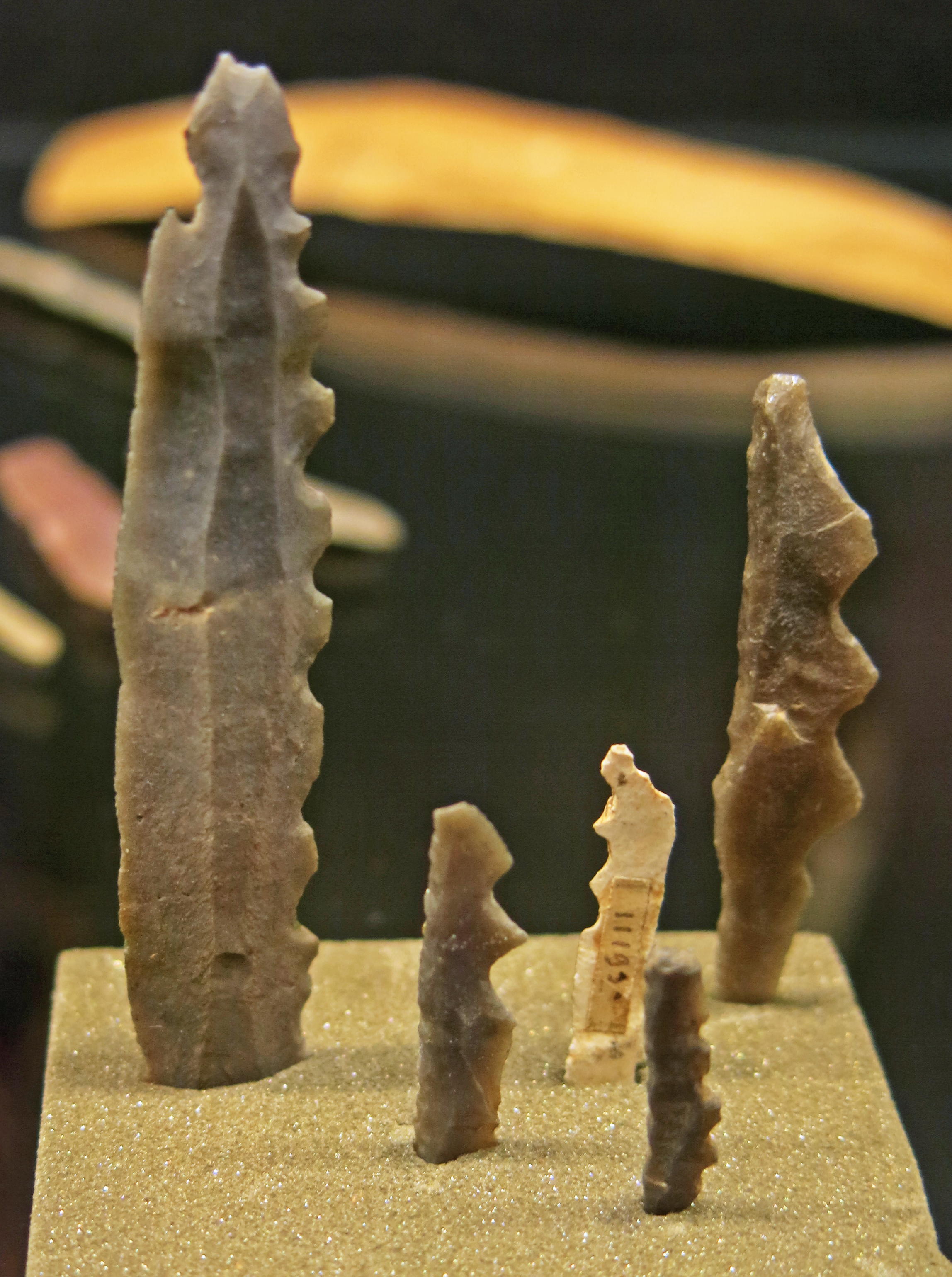
Denticulate tools from le Souci, probably used for meat processing like small saws.
Photo: Don Hitchcock 2014
Source: Musée d’art et d’archéologie du Périgord, Périgueux
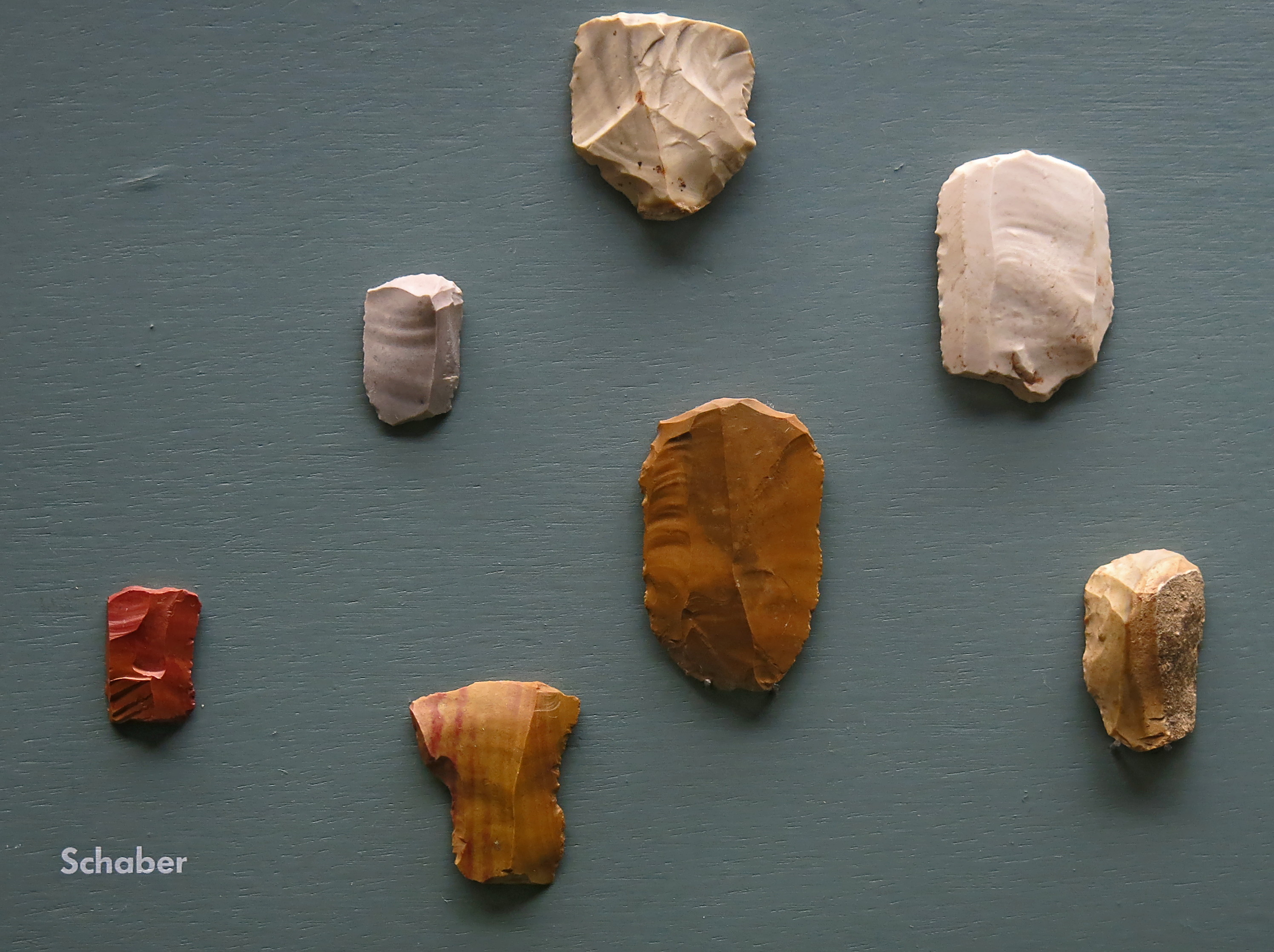
Scrapers from the Upper Palaeolithic.
Photo: Don Hitchcock 2015
Source: Badisches Landesmuseum Karlsruhe Germany

Points from the Upper Palaeolithic.
These points were fixed to the end of darts thrown with spear throwers.
Photo: Don Hitchcock 2015
Source: Badisches Landesmuseum Karlsruhe Germany
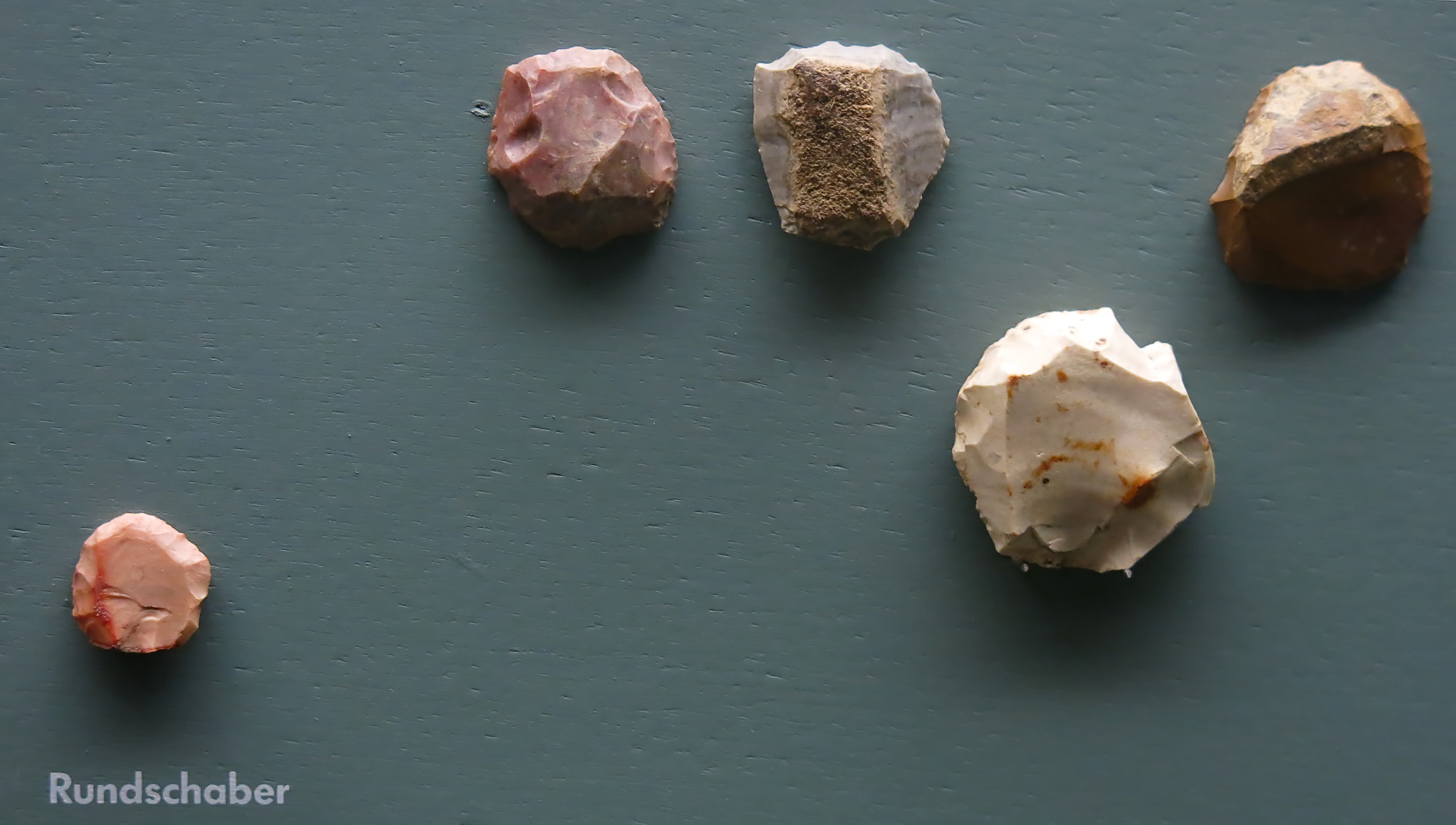
Round scrapers from the Upper Palaeolithic.
These are very small, it is difficult to work out exactly how they were used.
Photo: Don Hitchcock 2015
Source: Badisches Landesmuseum Karlsruhe Germany
These 'Bâtons de Commandement' from the late Palaeolithic have been a source of debate for a long time amongst scientists, and are widely distributed. They were made, as a rule, from reindeer antler, and have had an aperture bored into it. They received their name when they were first discovered in the caves of southern France, and were thought to be staffs of authority of the 'chiefs of primitive tribes'. They are often richly decorated with abstract designs and images of animals.
The name was kept, even though it is now recognised that they were in fact (perhaps) spear straighteners, and are widely distributed amongst many nationalities, including Northern Siberia. Eskimos have frequently decorated them with carved lines and sculptural images.
They were used to straighten arrows and spears, either wood or antler and ivory, or darts thrown using an atlatl. They were used, for example, by the fishing and hunting population of the lower Ob River in Western Siberia in the 19th Century. Some staffs have traces of other uses for retouching flint tools.
A multitude of other uses for these ubiquitous tools have been proposed, including as an aid to the spinning of yarn, and their use as spear throwers, and tighteners for tent ropes.
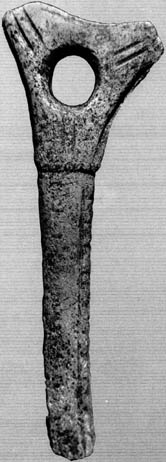
This is a bâton de commandement/spear straightener/spear thrower/horse bridle found in the Dordogne region, see also my photo showing the other side below.
The two main contenders for the use of this tool are as a spear straightener and as a spear thrower. To be used as a spear thrower, the spear has a leather thong attached which then goes through the hole in the baton, the baton is laid along the spear, with the thong held by the hand, and the thong is released as the spear gains momentum.
Photo: T. Prideaux, 'Cro-Magnon Man'
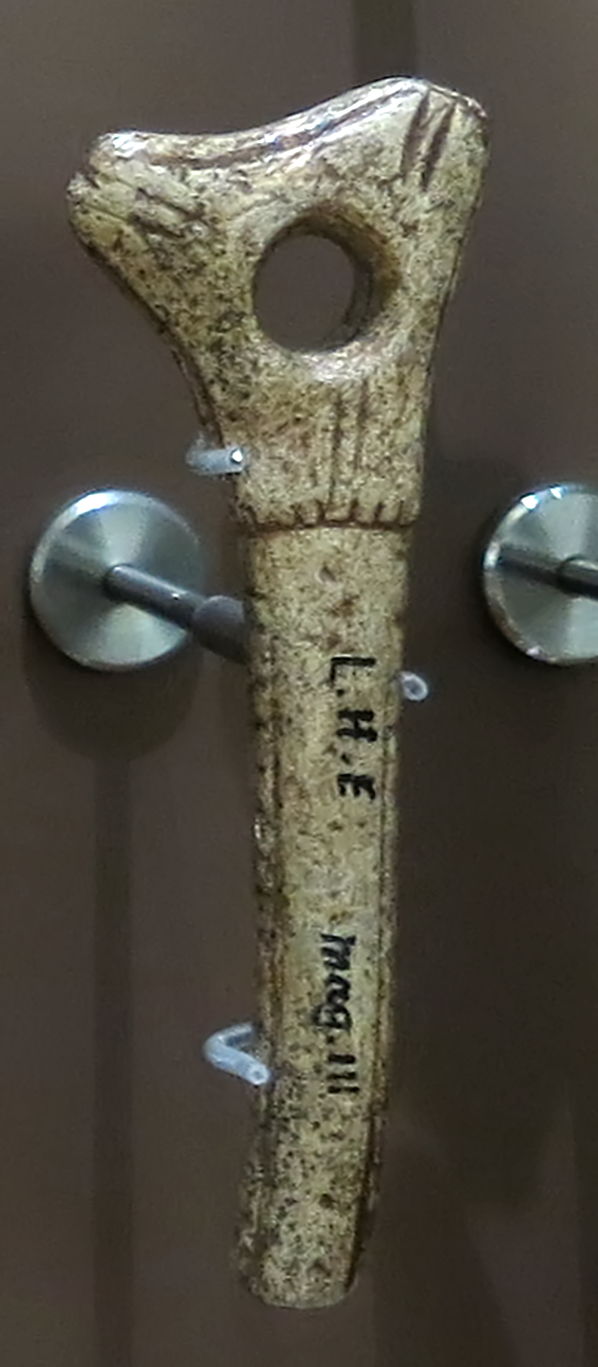
Pierced baton, Laugerie Haute East, Layer I''', excavations of D. Peyrony.
Photo: Don Hitchcock 2014
Source: Original, Le Musée National de Préhistoire, Les Eyzies-de-Tayac
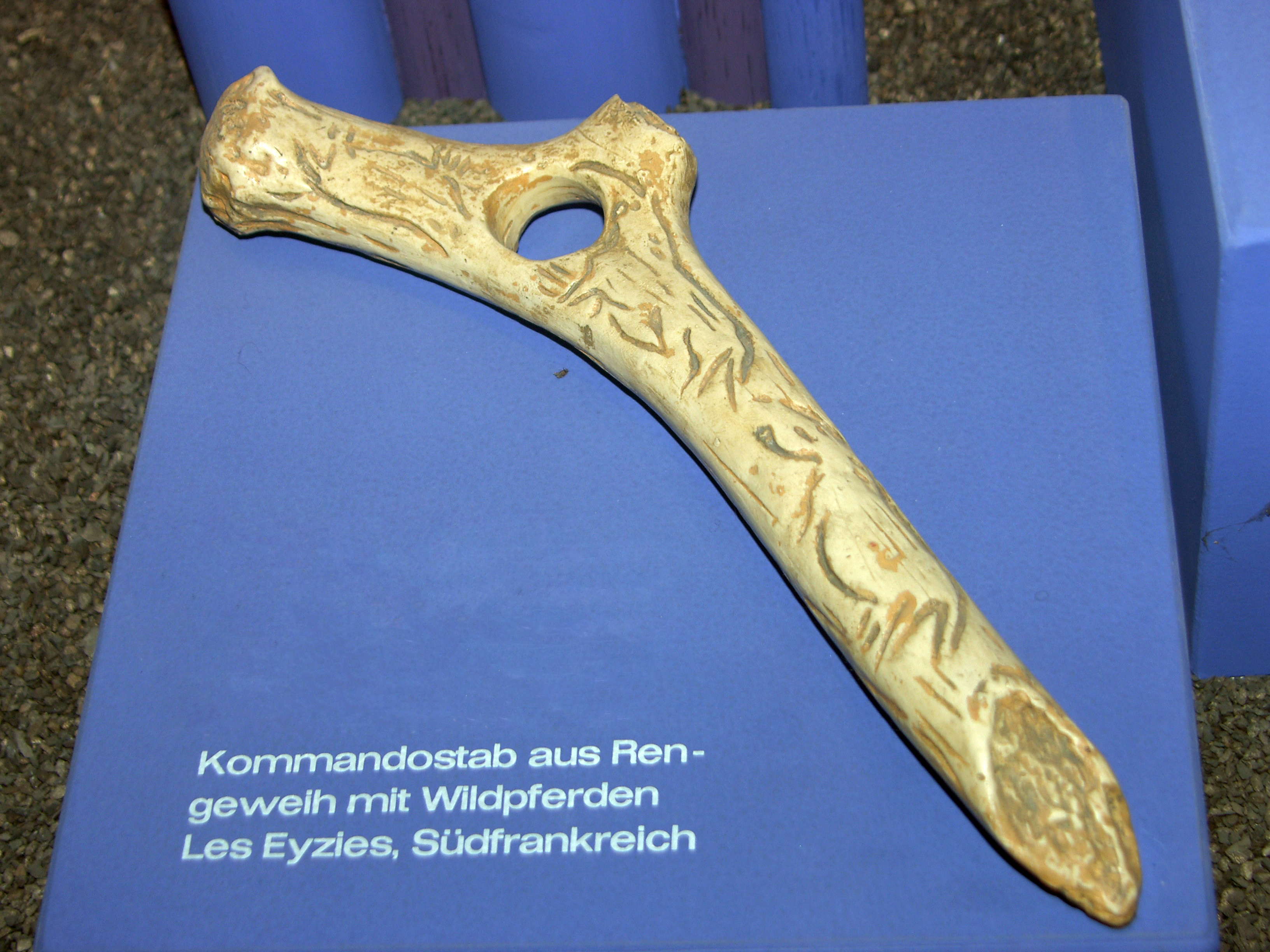
Spear straightener from Les Eyzies (facsimile).
Made from reindeer antler, this tool has horses carved into it, either as decoration or possibly as hunting magic.
Photo: Michael Hess
Source: Senckenberg Museum in Frankfurt (Main)
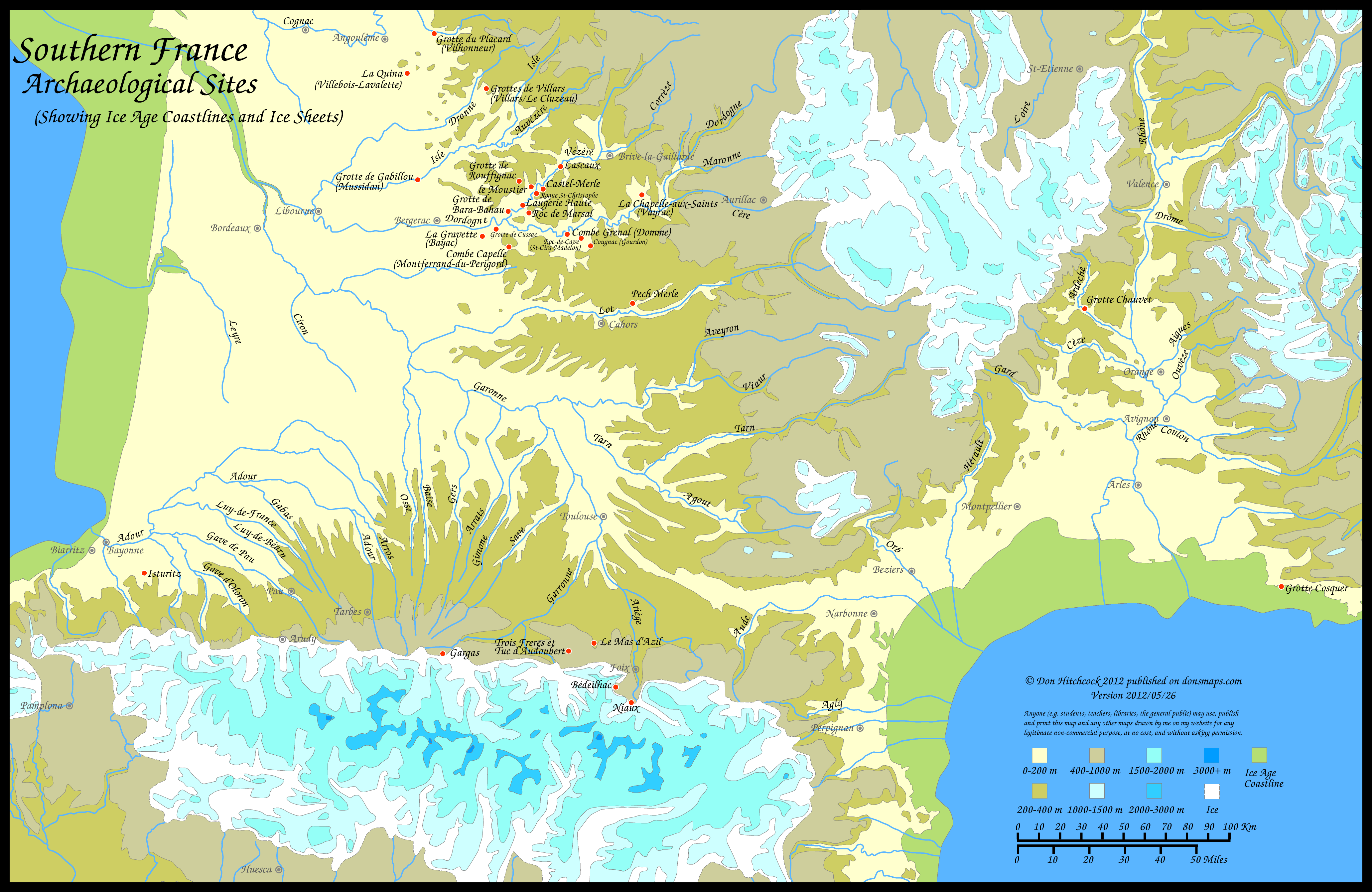
Note - Use this pdf file if you wish to print this map on a single sheet of paper.
Photo: Don Hitchcock version 2012/05/26
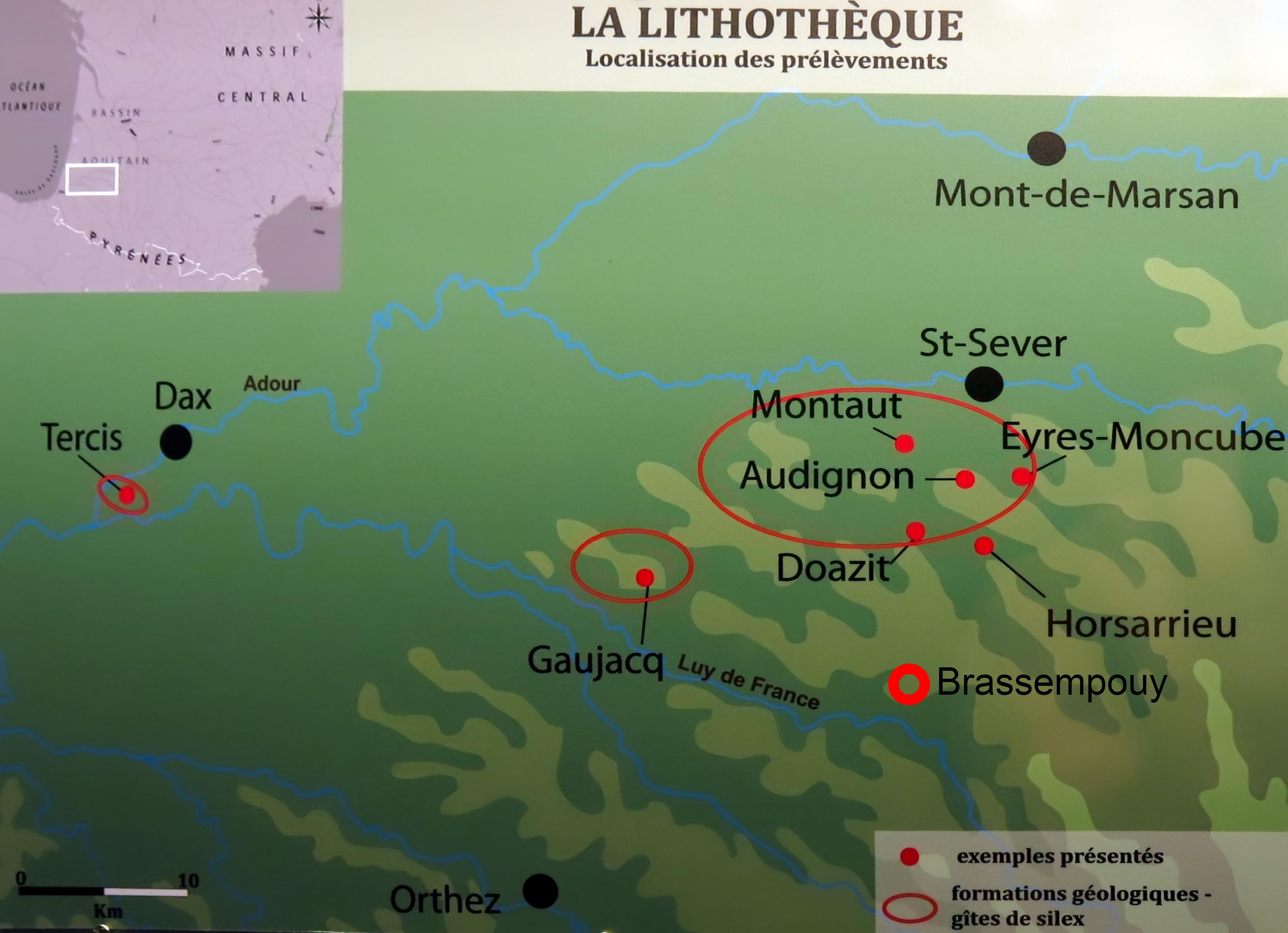
The area from which the flint below was sourced. Red dots indicate the examples shown, and the ellipses identify the sources from which the flint was obtained.
Photo: Don Hitchcock 2014
Source and text: La Maison de la Dame, Brassempouy Museum
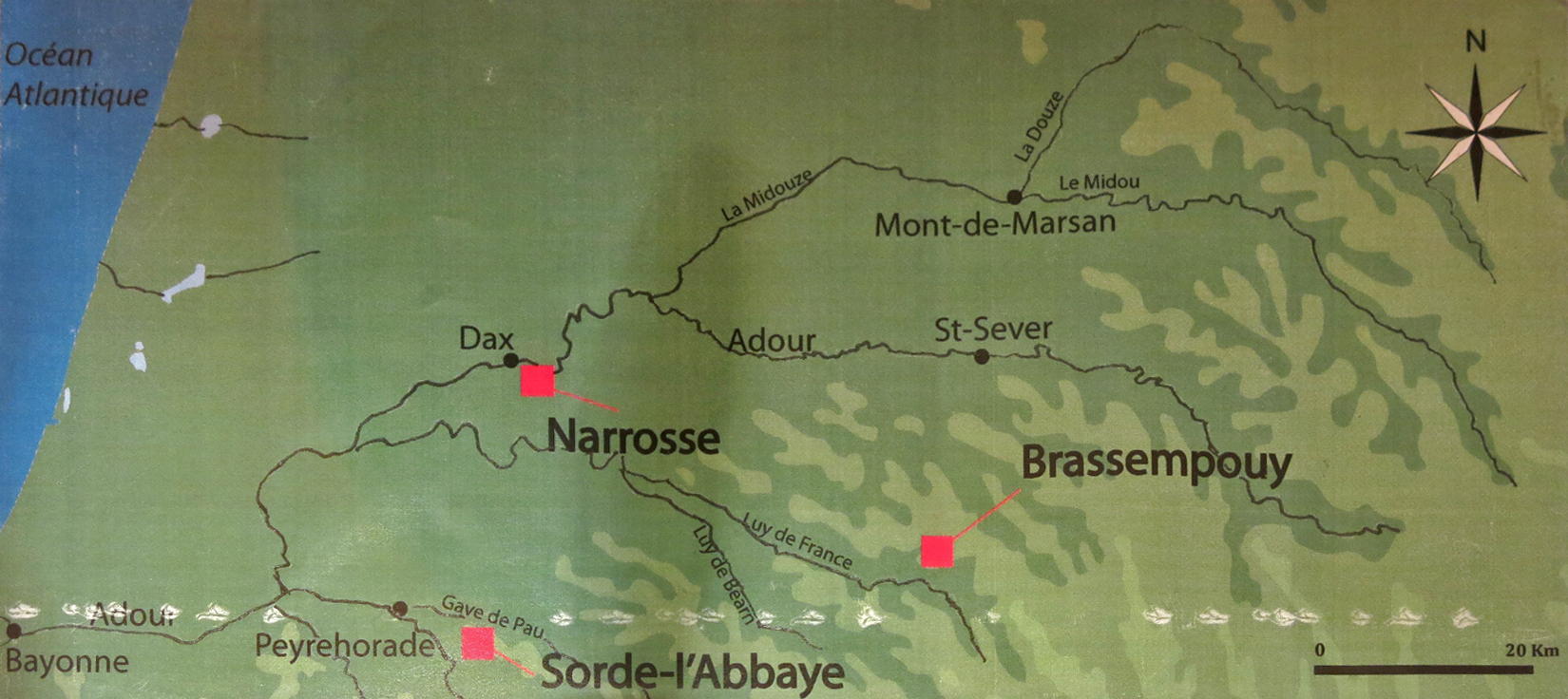
Map of the region.
Photo: Don Hitchcock 2014
Source and text: La Maison de la Dame, Brassempouy Museum
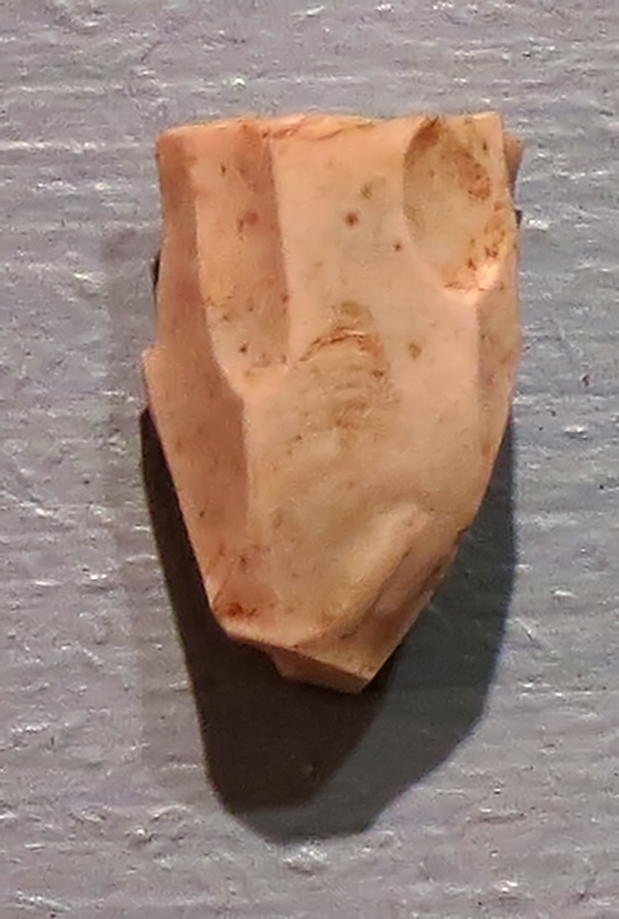
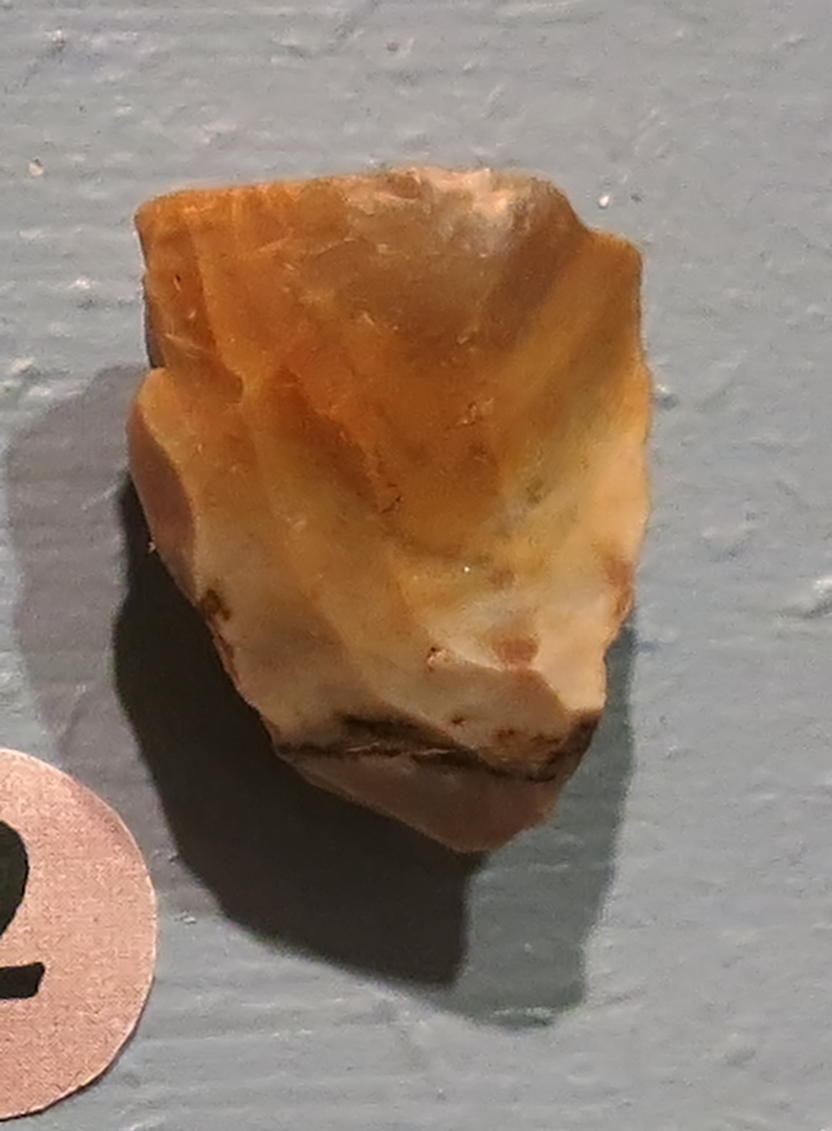
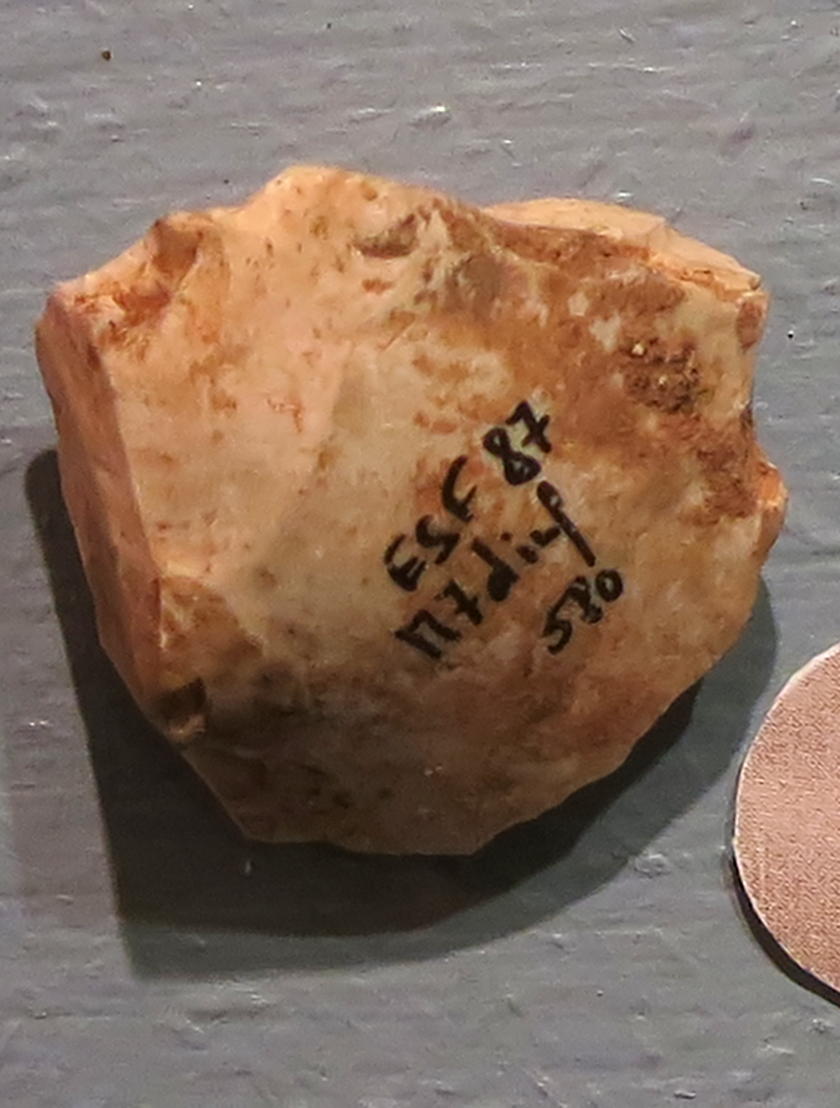
Nuclei, from which blades have been struck.
Grotte d'Enlène, (Ariège), Salle du Fond, Magdalénien
Excavations of Sébastien Lacombe, from the collection owned by l'Association Louis Bégouën.
Photo: Don Hitchcock 2014
Source and text: La Maison de la Dame, Brassempouy Museum
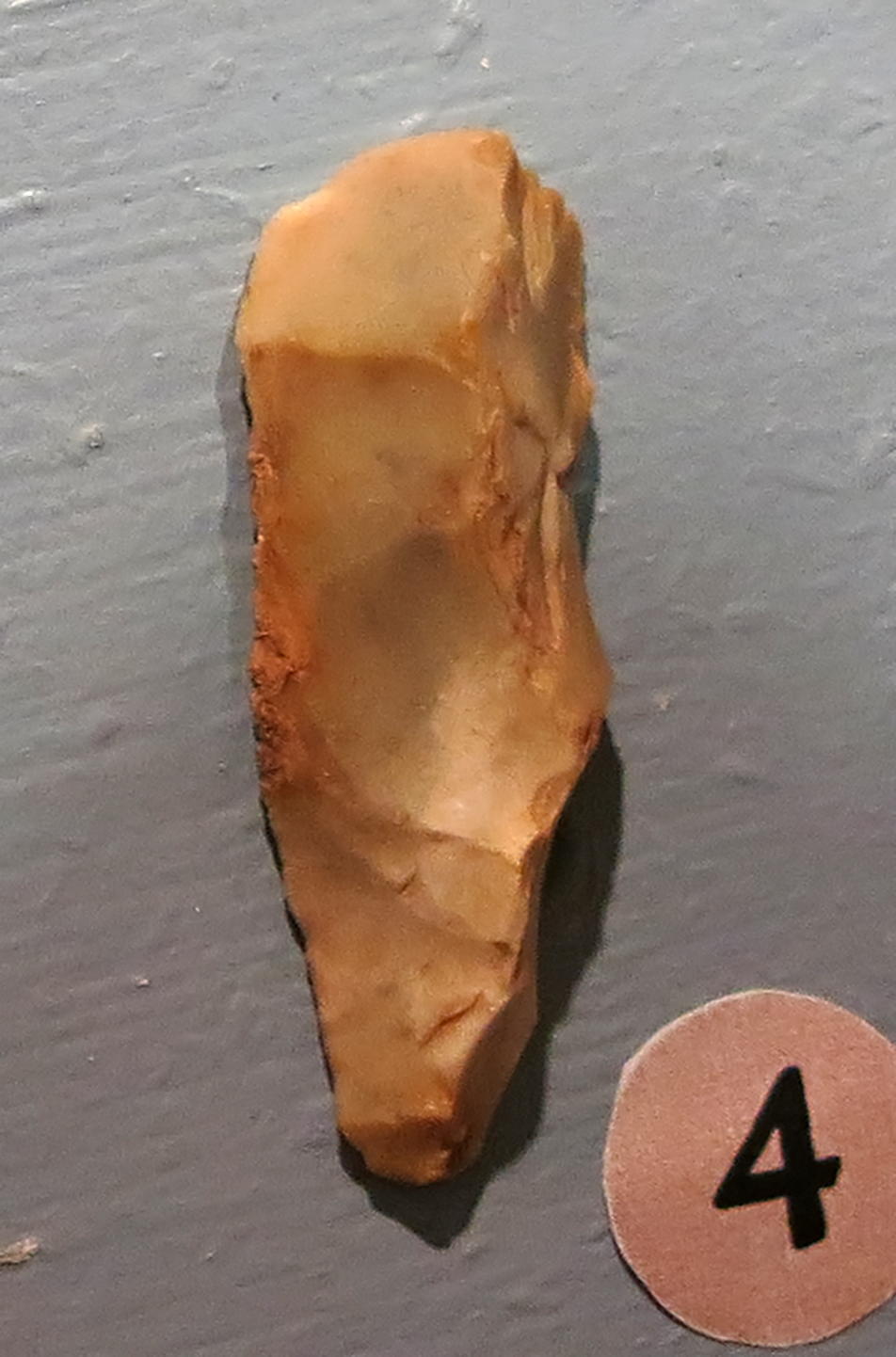
Lame à crête (proximal fragment)
These are made by first forming a crested ridge on a core, and then removing it as a crested blade, after which serial flaking of blade blanks can begin.
Flint from the anticline of Audignon.
Grotte d'Enlène, (Ariège), Salle du Fond, Magdalénien
Excavations of Sébastien Lacombe, from the collection owned by l'Association Louis Bégouën.
Photo: Don Hitchcock 2014
Source and text: La Maison de la Dame, Brassempouy Museum
Additional text: Demidenko and Usik (1993)
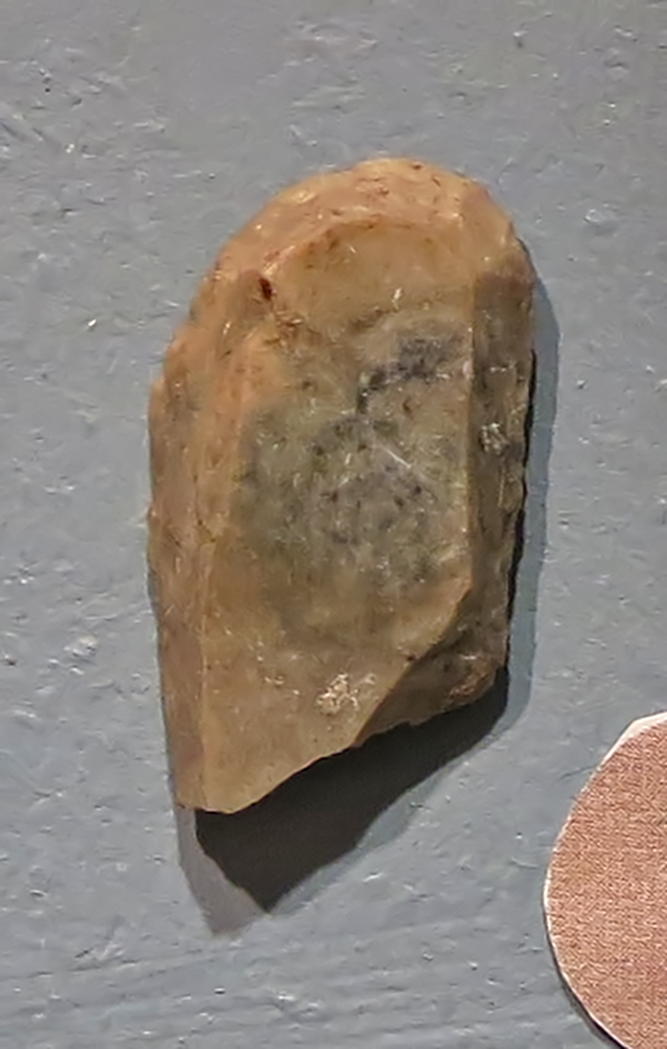
Grattoir sur lame, a scraper on a blade, with what appears to be a dihedral burin on the other end of the blade.
(note that this was labelled on the display as simply a dihedral burin - Don )
Flint from the anticline of Audignon.
Grotte d'Enlène, (Ariège), Salle du Fond, Magdalénien
Excavations of Sébastien Lacombe, from the collection owned by l'Association Louis Bégouën.
Photo: Don Hitchcock 2014
Source and text: La Maison de la Dame, Brassempouy Museum
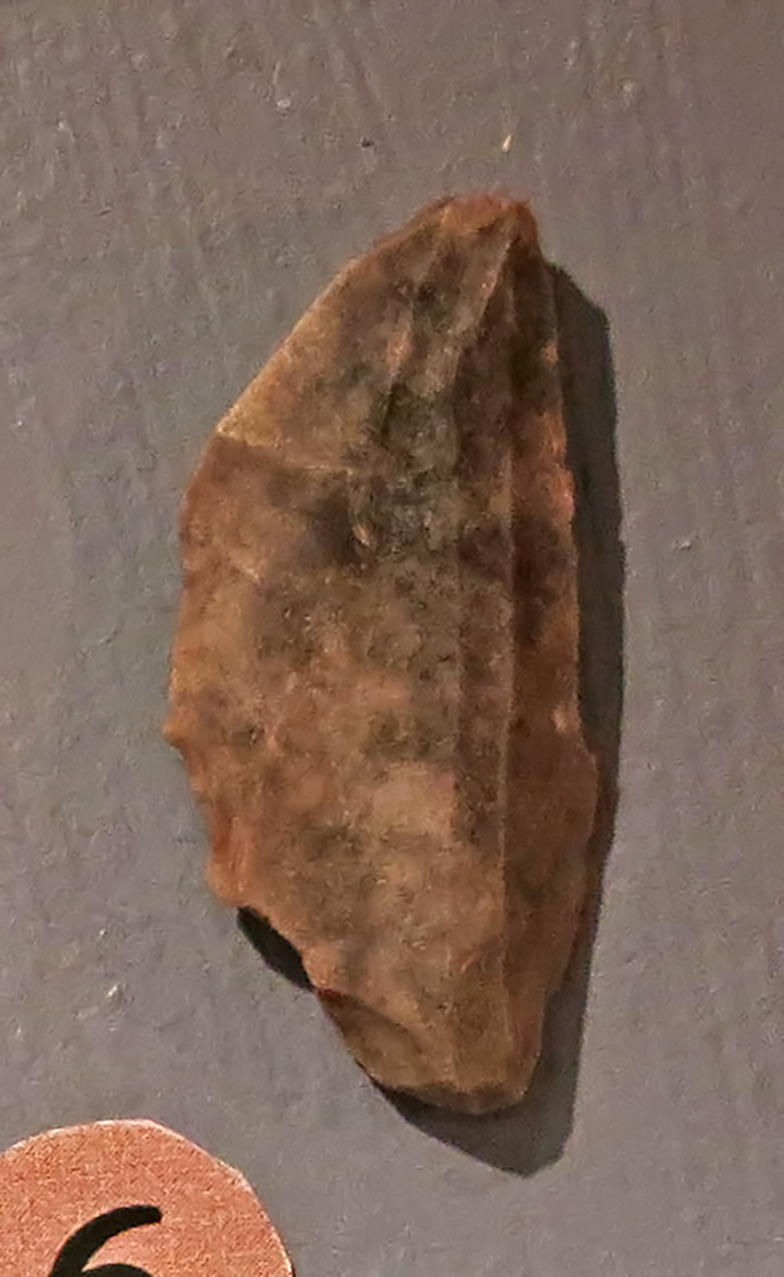
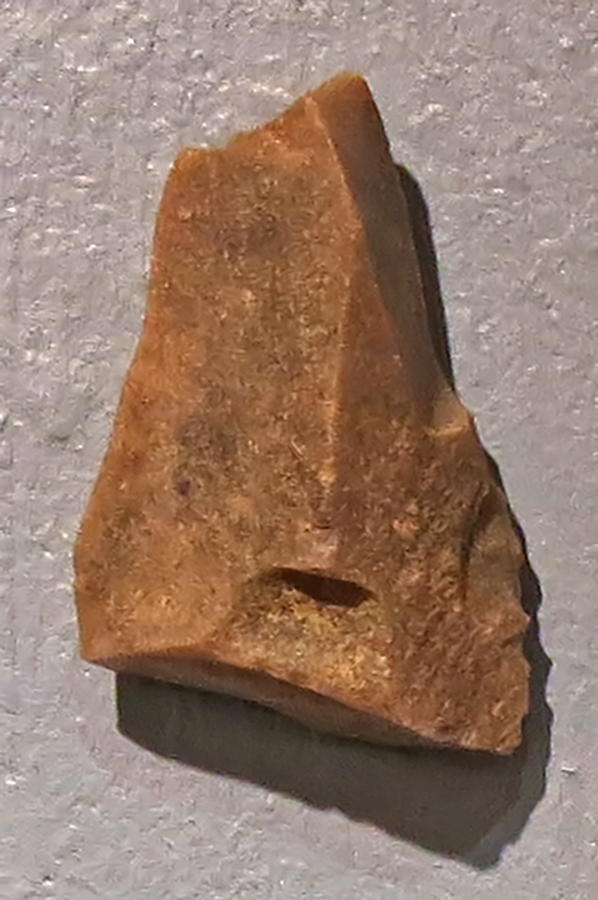
Dihedral burins on blades.
(note that the burin on the right was mislabelled on the display as a grattoir - Don )
Flint from the anticline of Audignon.
Grotte d'Enlène, (Ariège), Salle du Fond, Magdalénien
Excavations of Sébastien Lacombe, from the collection owned by l'Association Louis Bégouën.
Photo: Don Hitchcock 2014
Source and text: La Maison de la Dame, Brassempouy Museum
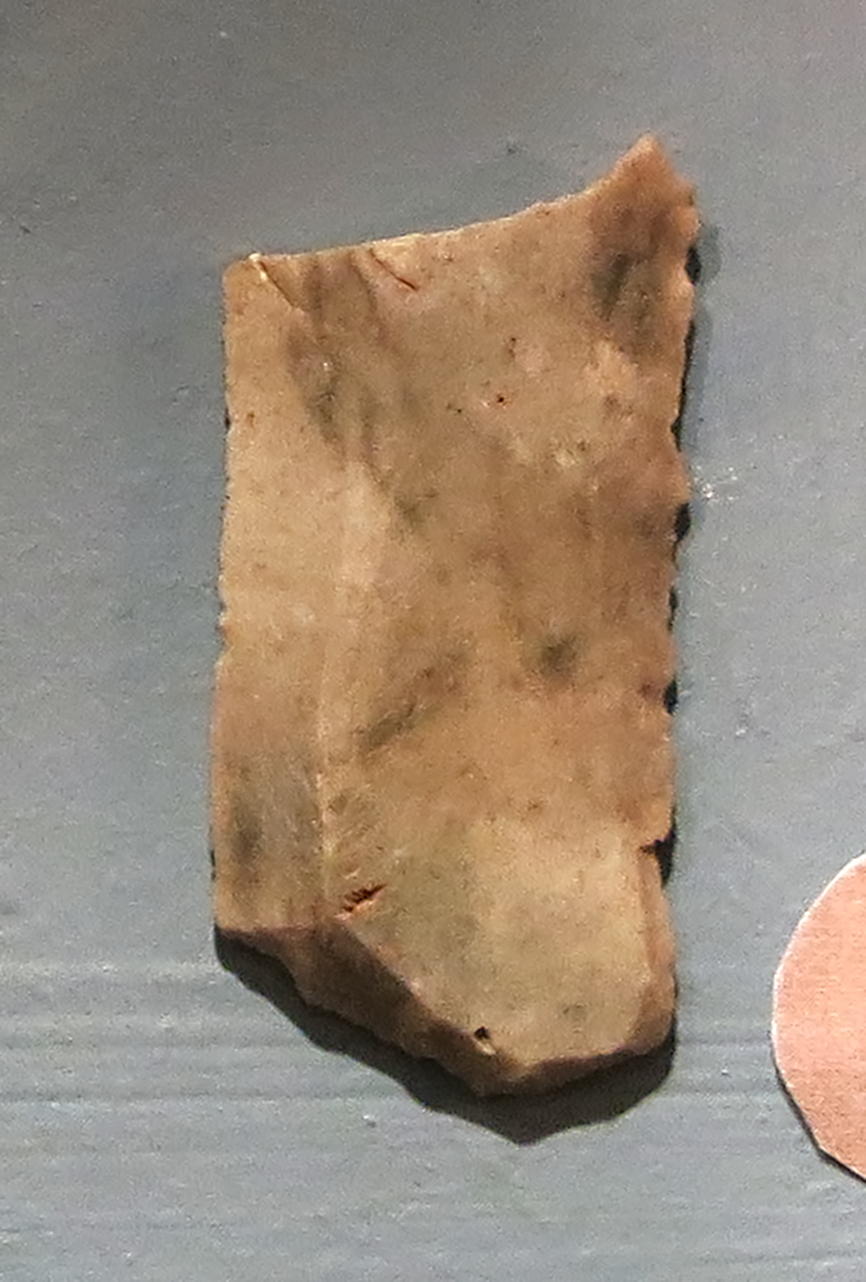
Truncated blade.
(possibly used as a burin - Don )
Flint from the anticline of Audignon.
Grotte d'Enlène, (Ariège), Salle du Fond, Magdalénien
Excavations of Sébastien Lacombe, from the collection owned by l'Association Louis Bégouën.
Photo: Don Hitchcock 2014
Source and text: La Maison de la Dame, Brassempouy Museum

Pie chart showing the origin of the 8695 flint tools from the Magdalénien recovered at the Enlène site.
Grotte d'Enlène, (Ariège), Salle du Fond, lower bed.
Origin of the flint in tools from the Magdalénien:
Flint from the local region: 15.5% (from the foothills of the Pyrenees)
Flint from distant regions: 63.5% (from Dordogne, Périgord, Massif Central, Charentes)
Flint from Chalosse: 0.4% (from Chalosse, a wine-growing area in Gascony, in south-west France. It lies in the department of Landes and is centred on the town of Dax).
Flint which has been altered or heated: 20.6% (flint was often heated in the Upper Palaeolithic to improve its knapping qualities)
Photo: Don Hitchcock 2014
Source and text: La Maison de la Dame, Brassempouy Museum
Additional text: Wikipedia
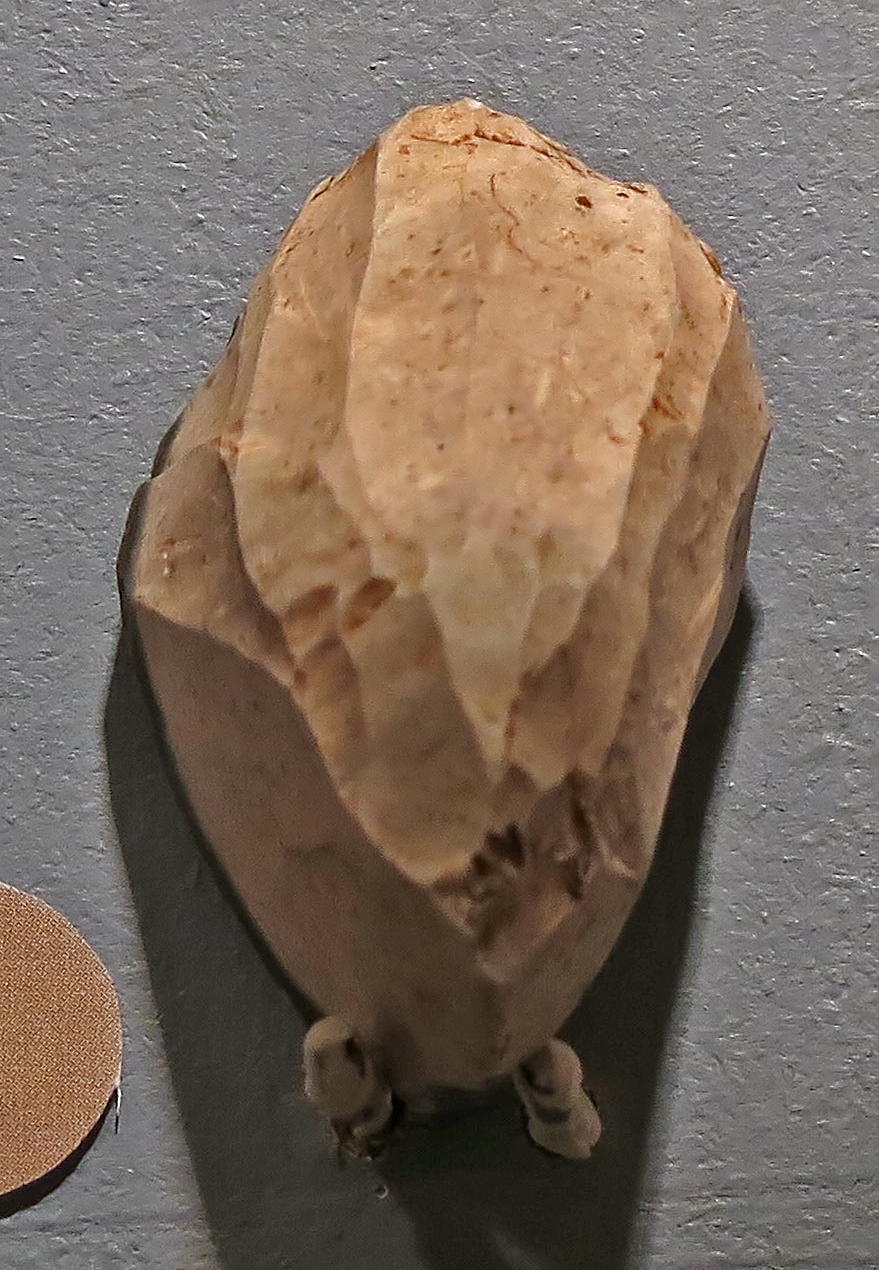
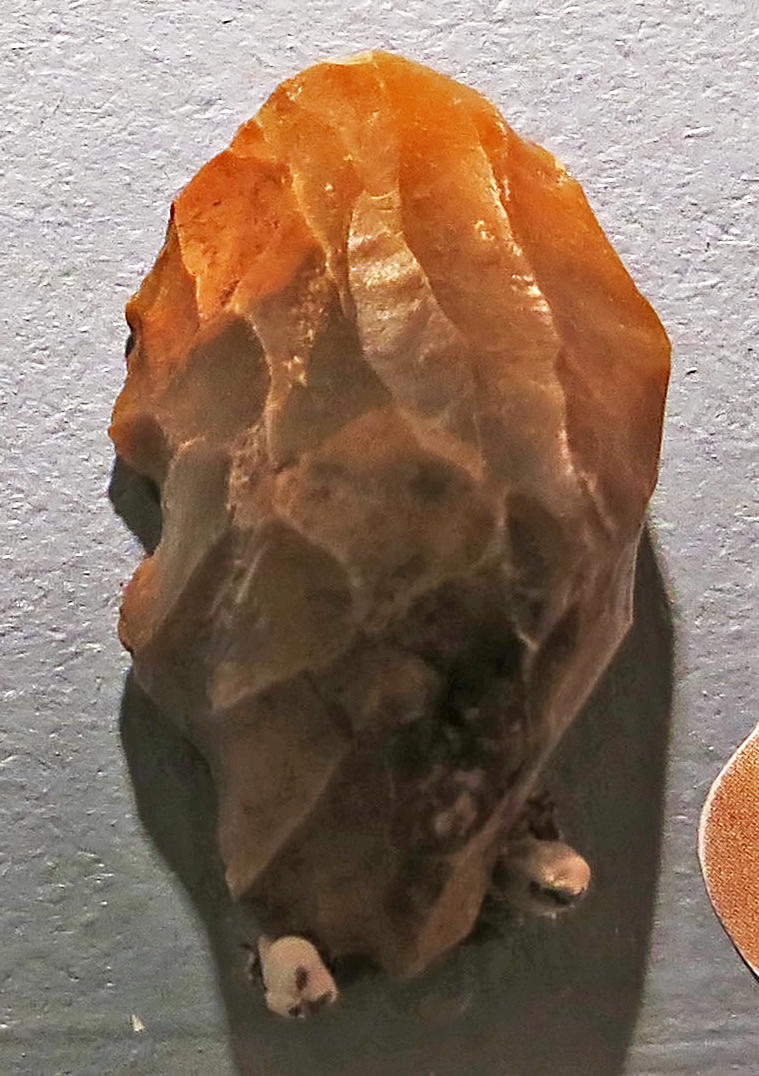
Cores from which blades have been struck, from Duruthy.
Magdalénien, flint from the anticline of Audignon.
Photo: Don Hitchcock 2014
Provenance: Abri Duruthy, Sorde-l'Abbaye (Landes) Magdalénien
Collection: R. Arambourou, Centre départemental du Patrimoine, Abbaye d'Arthous, Hastingues
Source and text: La Maison de la Dame, Brassempouy Museum
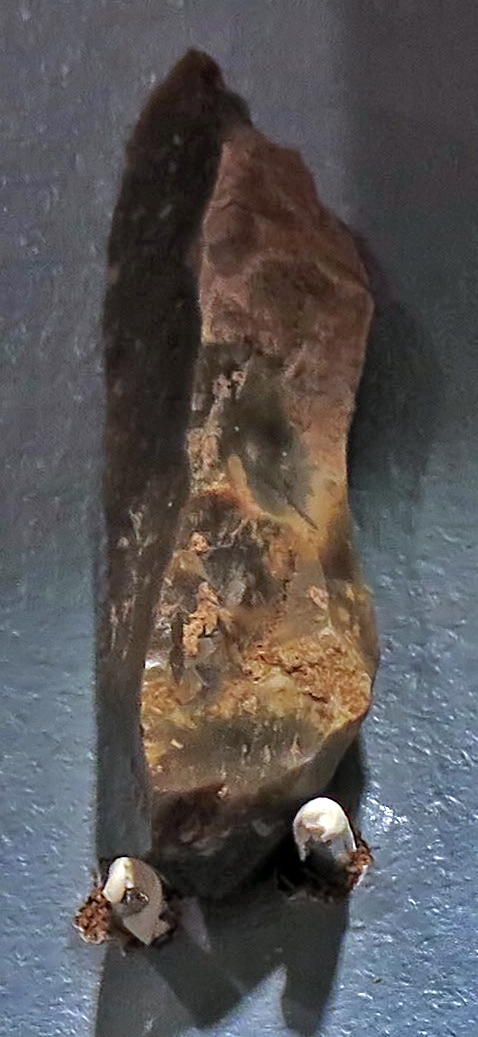
Perçoir-burin, awl-burin from Duruthy
Magdalénien, flint from the anticline of Audignon.
Photo: Don Hitchcock 2014
Provenance: Abri Duruthy, Sorde-l'Abbaye (Landes) Magdalénien
Collection: R. Arambourou, Centre départemental du Patrimoine, Abbaye d'Arthous, Hastingues
Source and text: La Maison de la Dame, Brassempouy Museum
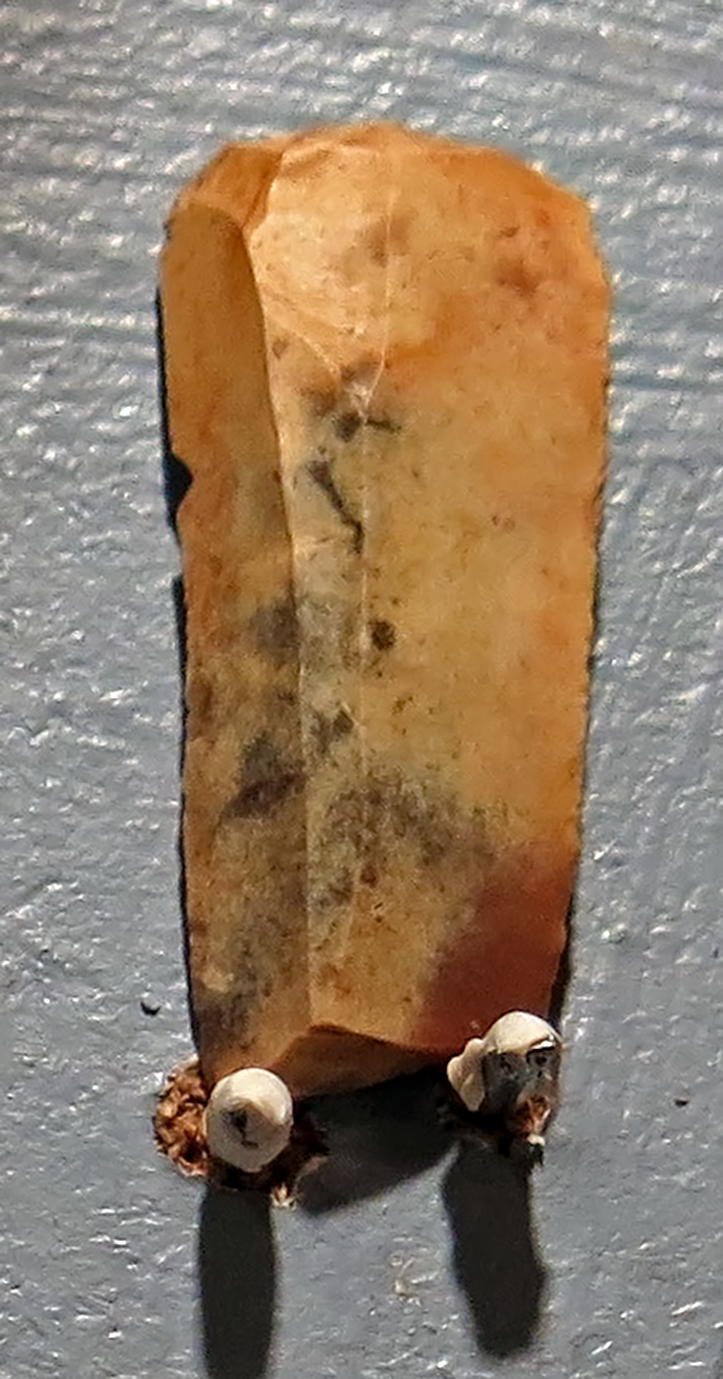
Grattoir (scraper) on a blade.
Magdalénien, flint from the anticline of Audignon.
Photo: Don Hitchcock 2014
Provenance: Abri Duruthy, Sorde-l'Abbaye (Landes) Magdalénien
Collection: R. Arambourou, Centre départemental du Patrimoine, Abbaye d'Arthous, Hastingues
Source and text: La Maison de la Dame, Brassempouy Museum
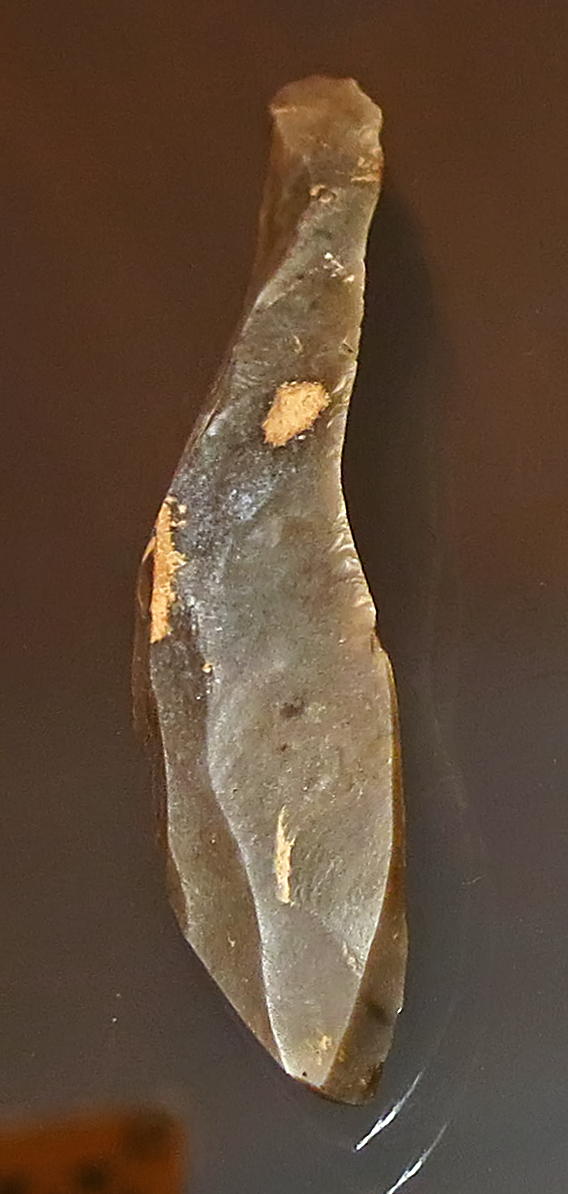
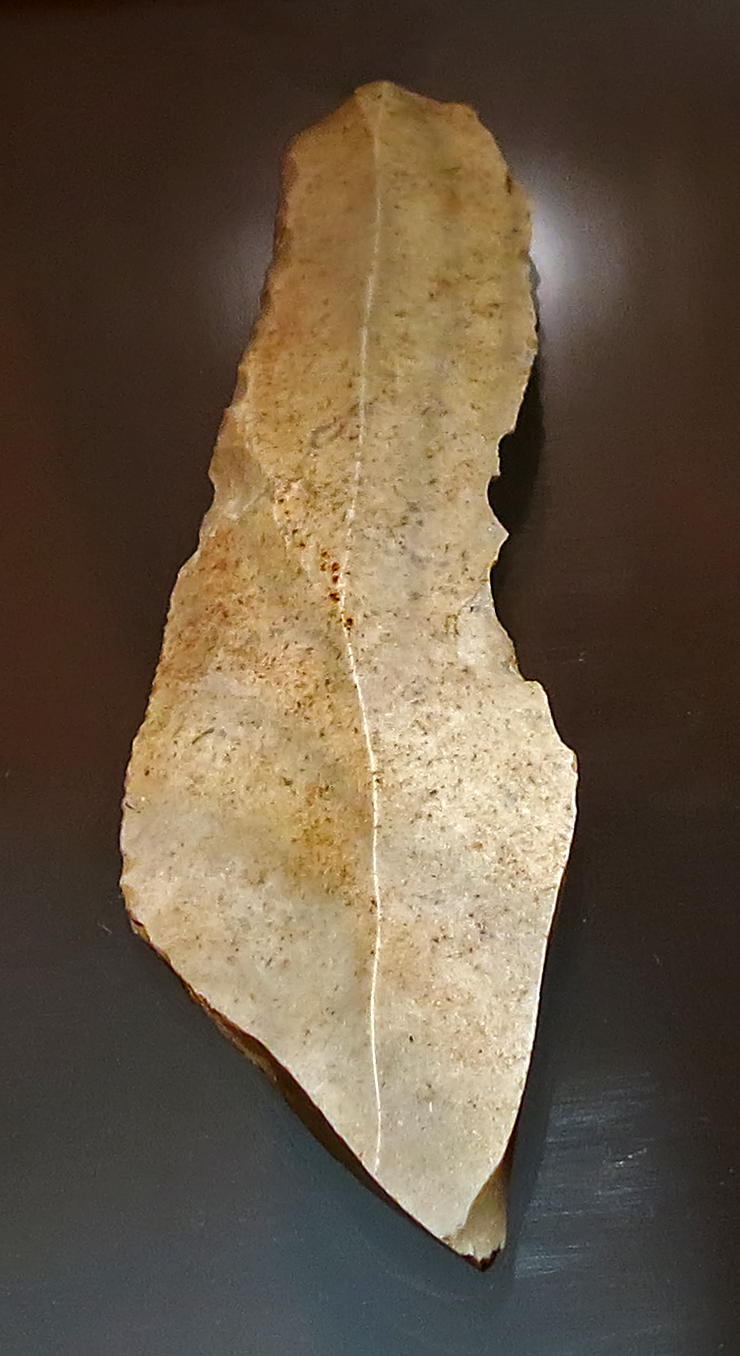
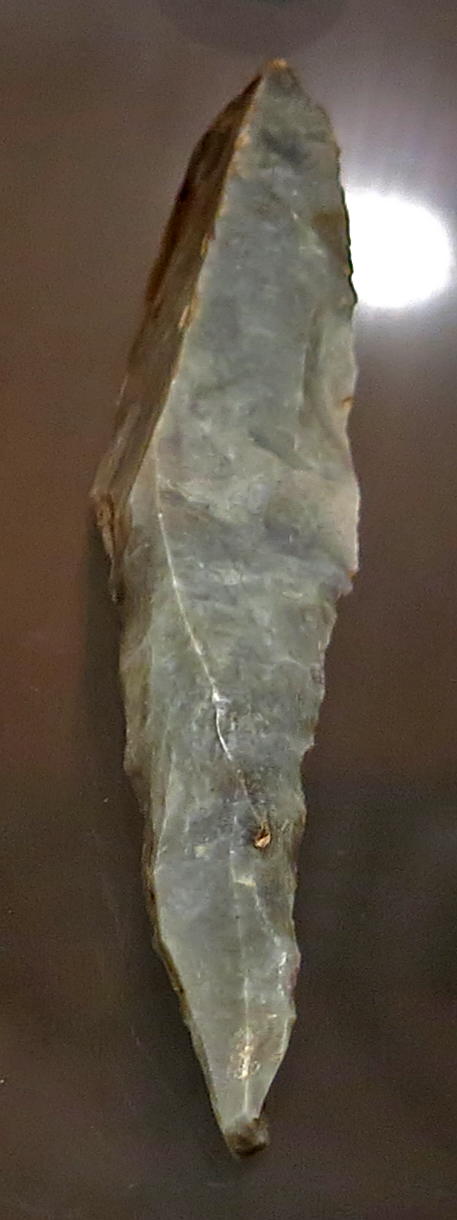
Dihedral burins on blades, from the archaeological site of Tizon.
(left) Flint from the anticline of Tercis.
(centre and right) Flint from the anticline of Audignon.
Photo: Don Hitchcock 2014
Provenance: Gisement de Tizon, Narosse (Landes), Magdalénien
Collection: Centre de Conservation et d'Étude de Mont-de-Marsan
Source and text: La Maison de la Dame, Brassempouy Museum
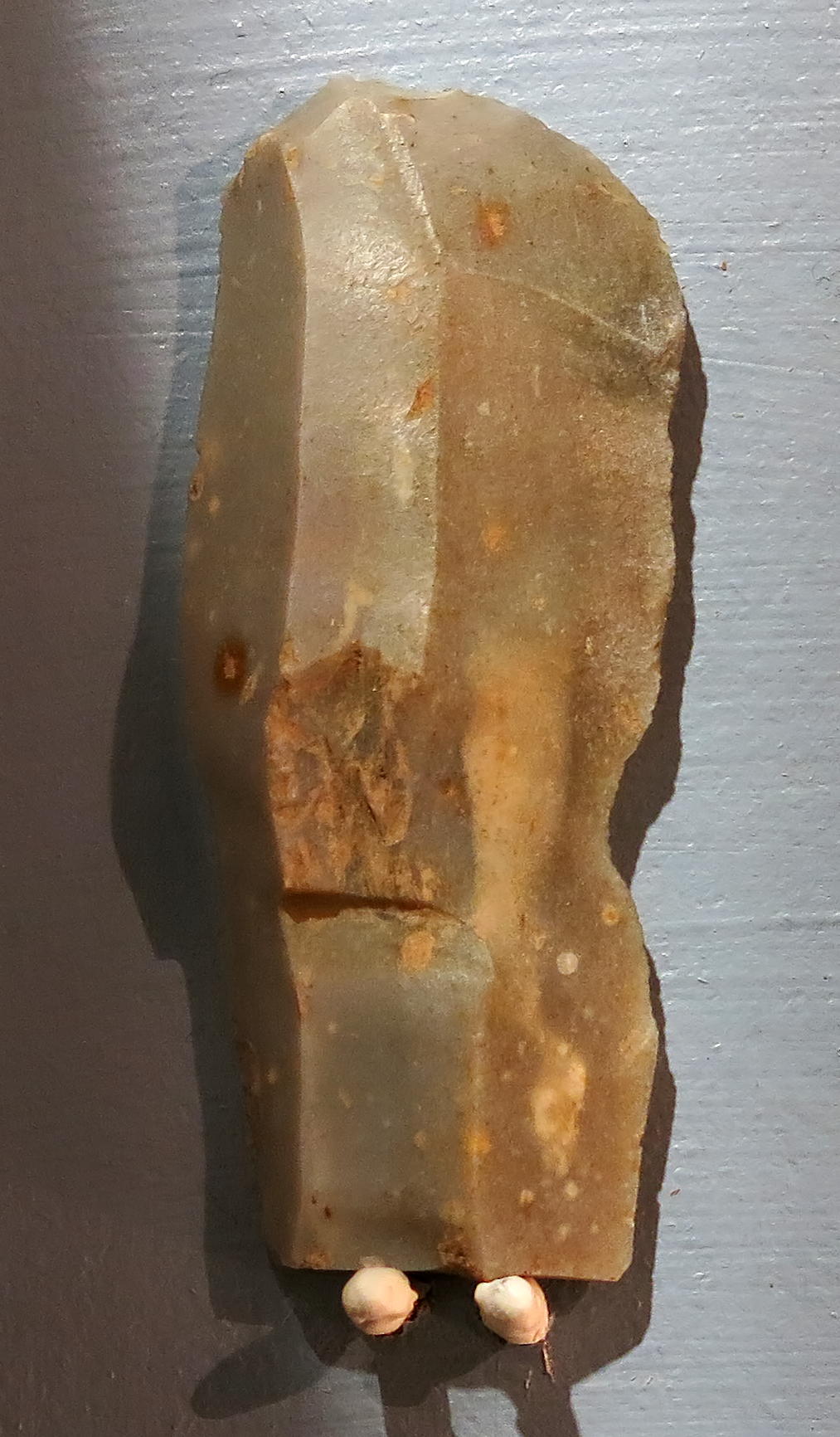
Grattoir (scraper) on a blade, from the archaeological site of Tizon.
Flint from the anticline of Tercis.
Photo: Don Hitchcock 2014
Provenance: Gisement de Tizon, Narosse (Landes), Magdalénien
Collection: Centre de Conservation et d'Étude de Mont-de-Marsan
Source and text: La Maison de la Dame, Brassempouy Museum
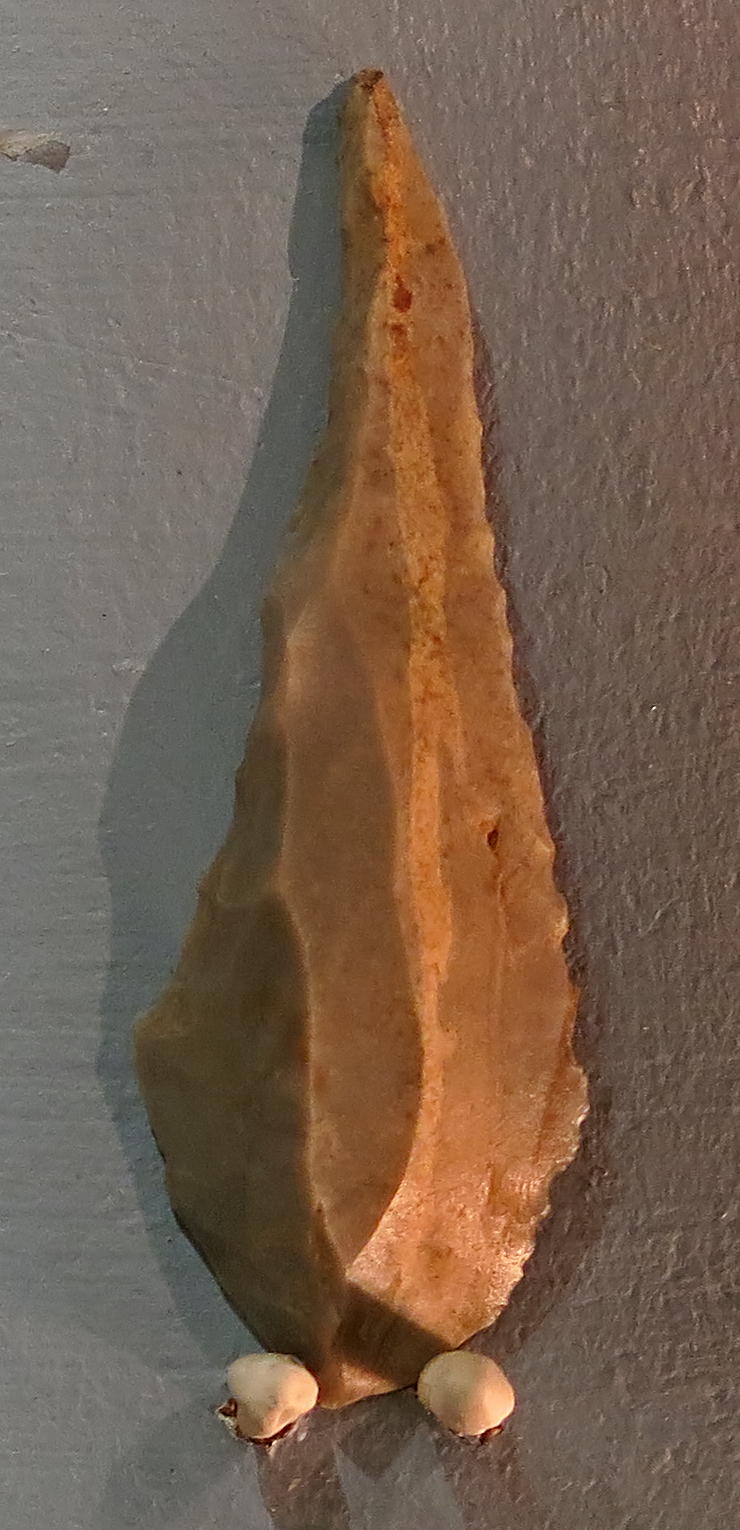
Burin on a truncation, (a very small truncation at the end of a very long point! - Don ) from the archaeological site of Tizon.
Flint from the anticline of Audignon.
Photo: Don Hitchcock 2014
Provenance: Gisement de Tizon, Narosse (Landes), Magdalénien
Collection: Centre de Conservation et d'Étude de Mont-de-Marsan
Source and text: La Maison de la Dame, Brassempouy Museum
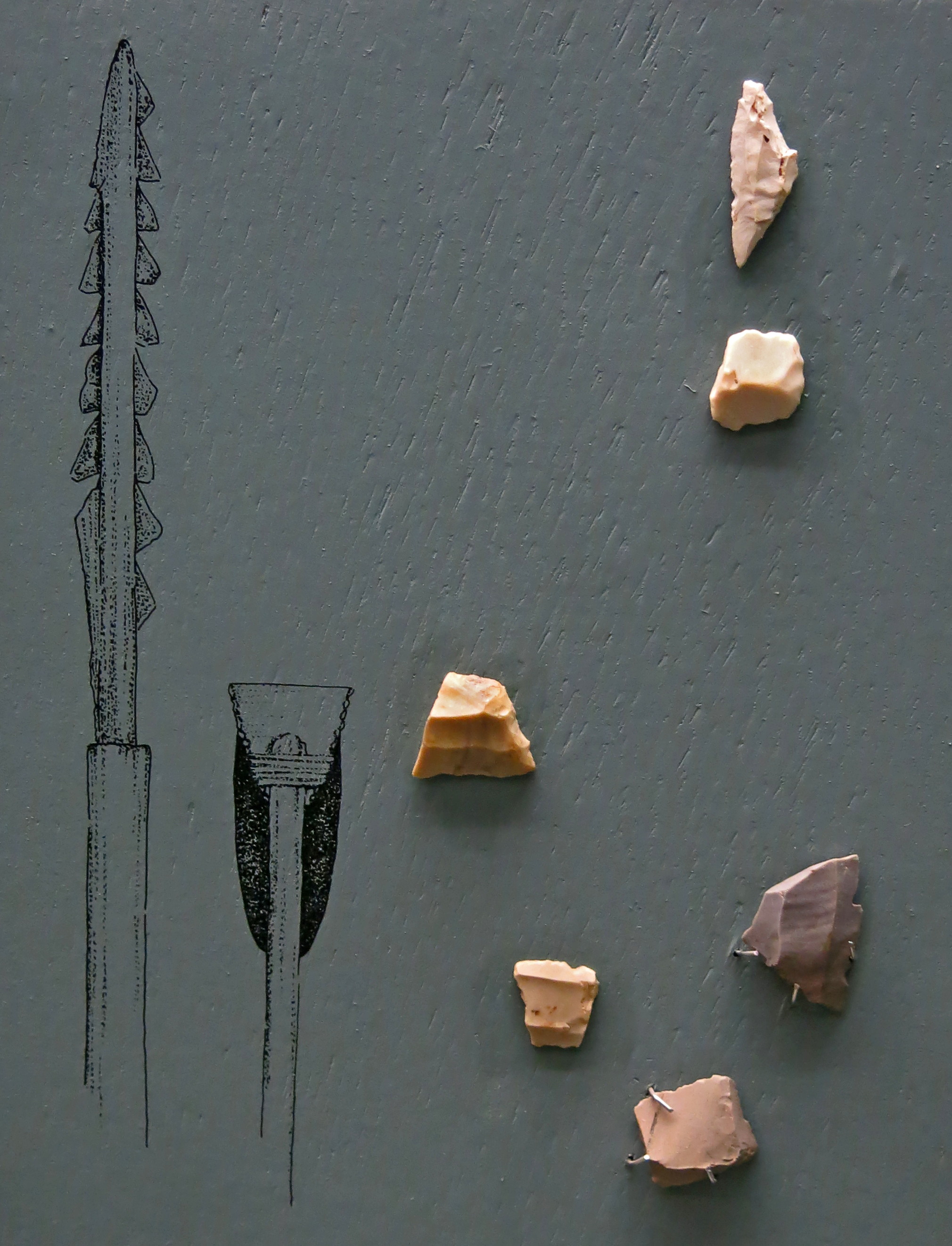
Geometric microliths.
A microlith is a small stone tool usually made of flint or chert and typically a centimetre or so in length and half a centimetre wide. It is produced from either a small blade (microblade) or a larger blade-like piece of flint by abrupt or truncated retouching, which leaves a very typical piece of waste, called a microburin. The microliths themselves are sufficiently worked so as to be distinguishable from workshop waste or accidents.
Two families of microliths are usually defined: laminar and geometric. An assemblage of microliths can be used to date an archeological site.
Laminar microliths are associated with the end of the Upper Paleolithic and the beginning of the Epipaleolithic era.
Geometric microliths are characteristic of the Mesolithic and the Neolithic. Geometric microliths may be triangular, trapezoid or lunate. Microlith production generally declined following the introduction of agriculture (8000 BCE) but continued later in cultures with a deeply-rooted hunting tradition.
Regardless of type, microliths were used to form the points of hunting weapons such as spears and (in later periods) arrows and other artefacts and are found throughout Africa, Asia and Europe. They were utilised with wood, bone, resin and fibre to form a composite tool or weapon and traces of wood to which microliths were attached have been found in Sweden, Denmark and England. An average of between six and eighteen microliths may often have been used in one spear or harpoon, but only one or two in an arrow.
Photo: Don Hitchcock 2015
Source: Badisches Landesmuseum Karlsruhe Germany
Text: Adapted from Wikipedia.
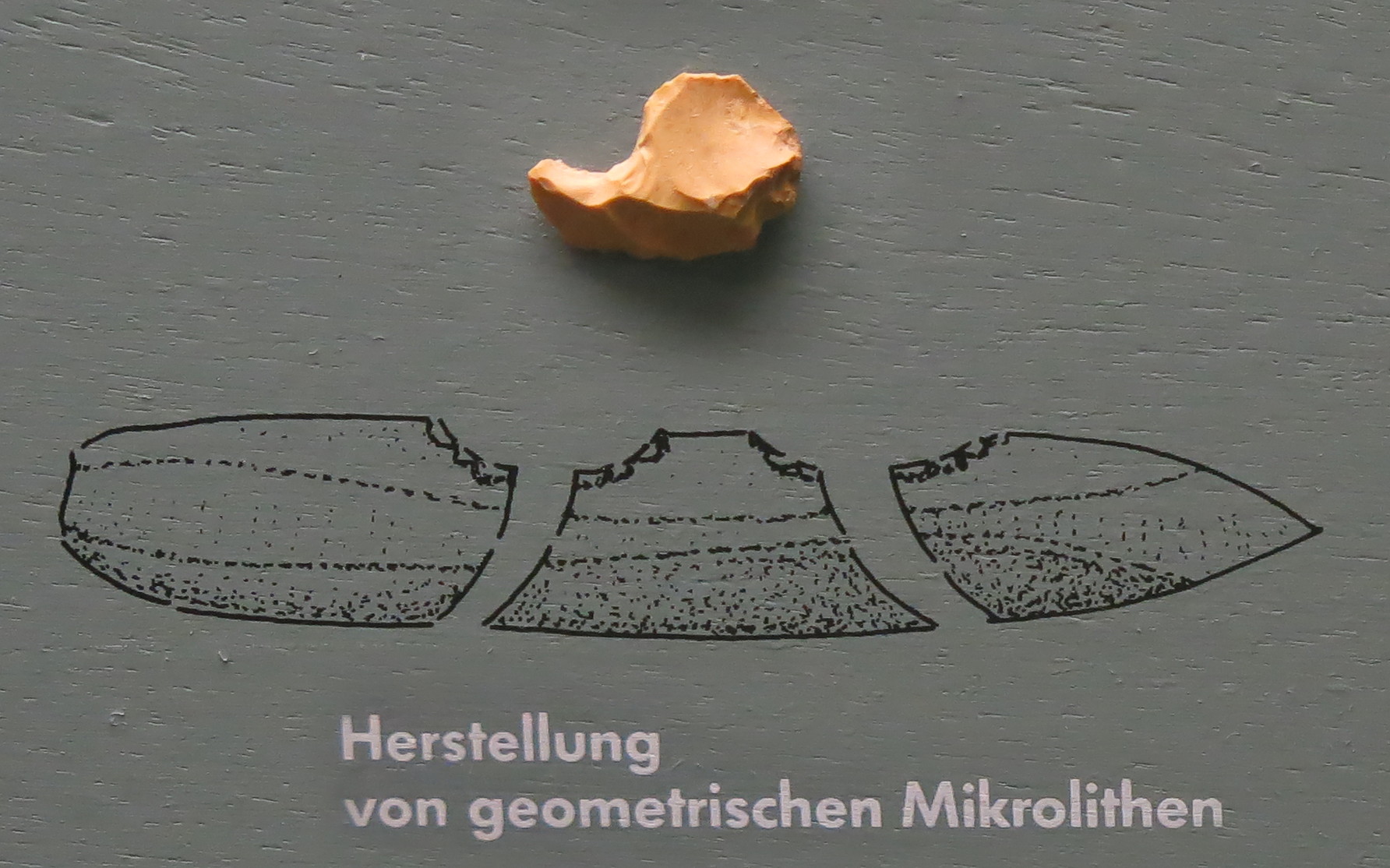
Method of the production of geometric microliths.
The original long blade was prepared by knapping suitably shaped sharp edges, then broken to form the microliths.
Photo: Don Hitchcock 2015
Source: Badisches Landesmuseum Karlsruhe Germany
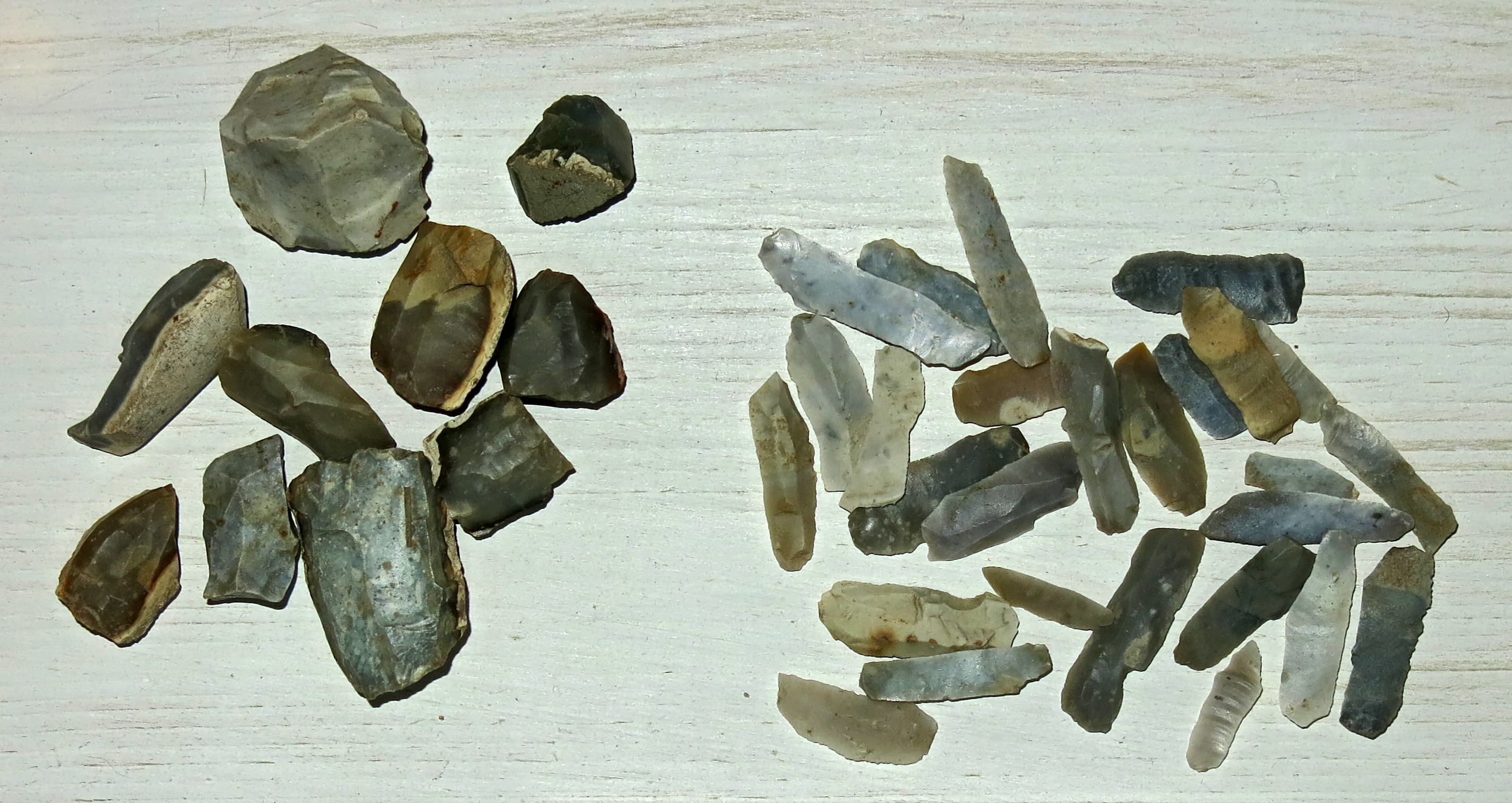
Microblades and microblade cores
H. Banniza, Haan, Germany.
11 000 BP - 8 000 BP.
Photo: Don Hitchcock 2015
Source and text: Neanderthal Museum, Mettmann, near Düsseldorf, Germany
Probably from the excavations of Hermann Banniza, Banniza (1986)

Short end scrapers
H. Banniza, Haan, Germany.
( note that these appear to be what others have called round scrapers. The method of use of such small, difficult to hold tools is opaque to me - Don )
11 000 BP - 8 000 BP.
Photo: Don Hitchcock 2015
Source and text: Neanderthal Museum, Mettmann, near Düsseldorf, Germany
Probably from the excavations of Hermann Banniza, Banniza (1986)

Arrow shaft polisher.
H. Banniza, Haan, Germany.
11 000 BP - 8 000 BP.
Photo: Don Hitchcock 2015
Source and text: Neanderthal Museum, Mettmann, near Düsseldorf, Germany
Probably from the excavations of Hermann Banniza, Banniza (1986)

Birchbark box
Reconstruction of a box found at Friesack, Germany.
10 000 BP - 7 000 BP.
Photo: Don Hitchcock 2015
Source and text: Facsimile, Neanderthal Museum, Mettmann, near Düsseldorf, Germany
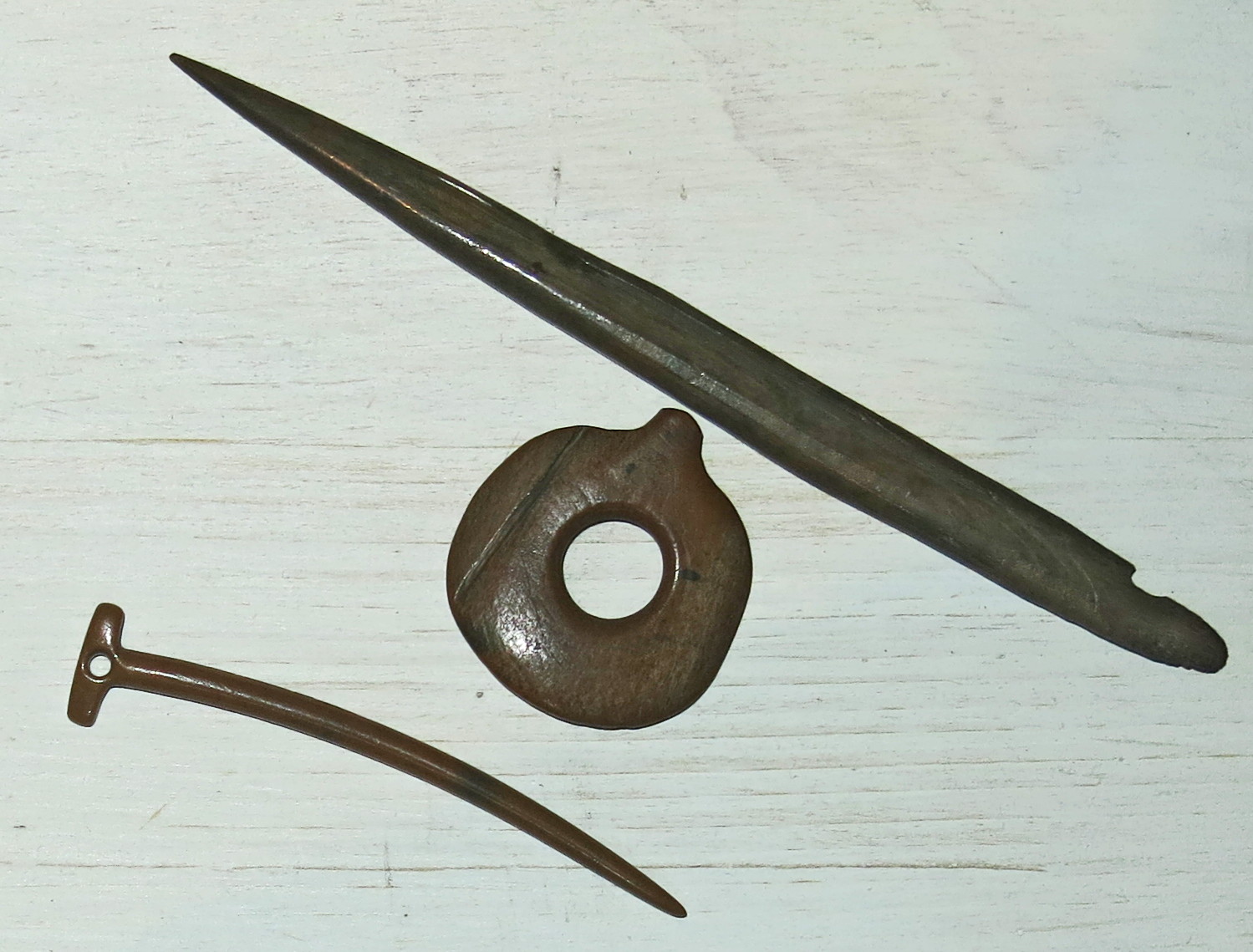
Awl, needle, and pendant, in bone and antler.
Wustermark, Germany.
( note that the small awl is particularly well made, a work of art, with a small hole in the beautiful handle to attach a thong, so that it is not misplaced. It may have been for making holes in leather during the making of clothes - Don )
10 000 BP - 7 000 BP.
Photo: Don Hitchcock 2015
Source and text: Neanderthal Museum, Mettmann, near Düsseldorf, Germany
On loan from the Staatliche Museen zu Berlin, Museum für Vor- und Frühgeschichte.
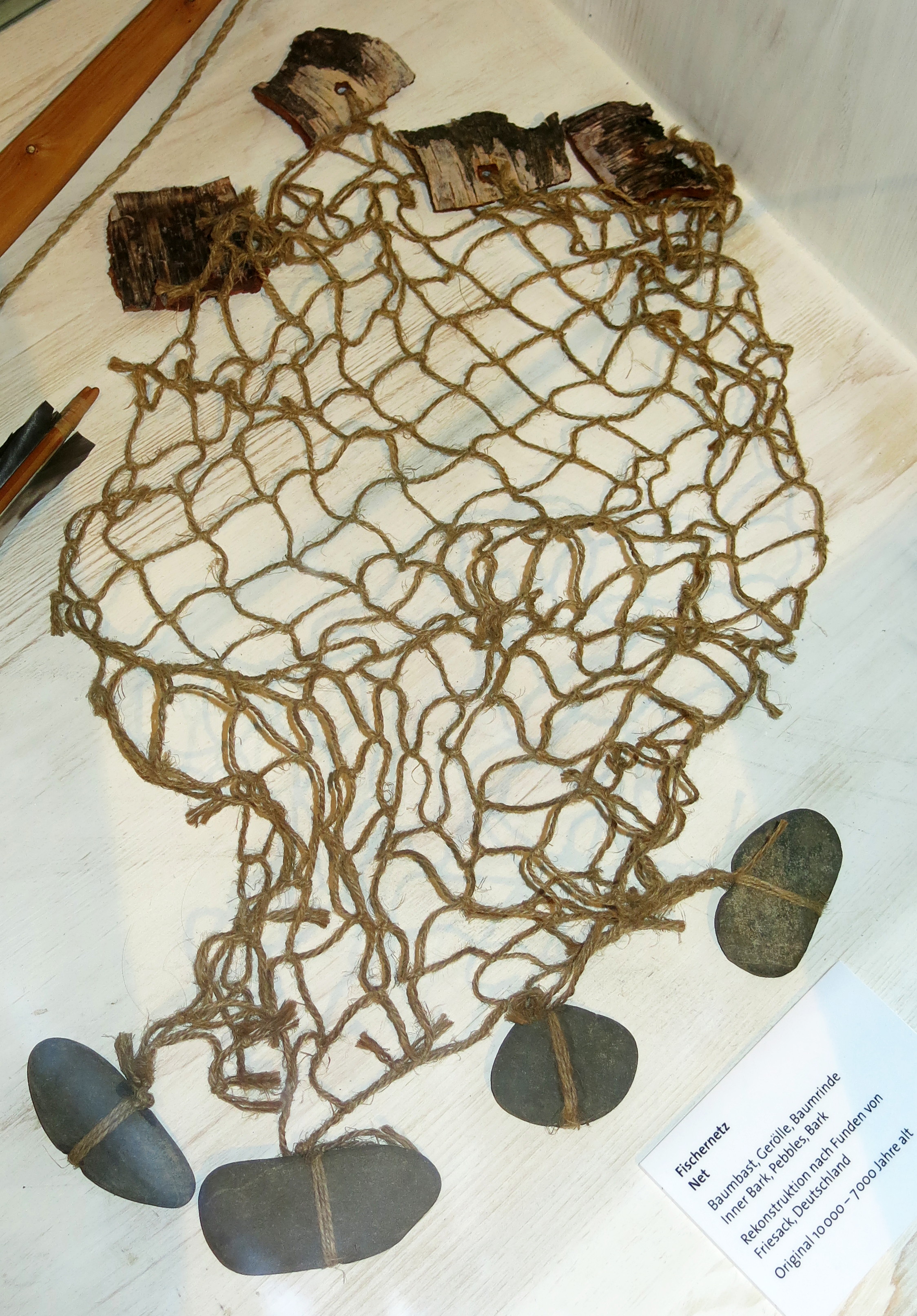
Fishing net.
Reconstruction from a find in Friesack, Germany.
Materials: bast (inner bark fibre), outer bark, pebbles.
( note that the technician has used bark as floats for the net. Other woods might have been more suitable, or perhaps blown up deer or reindeer bladders - Don )
10 000 BP - 7 000 BP.
Photo: Don Hitchcock 2015
Source and text: Facsimile, Neanderthal Museum, Mettmann, near Düsseldorf, Germany
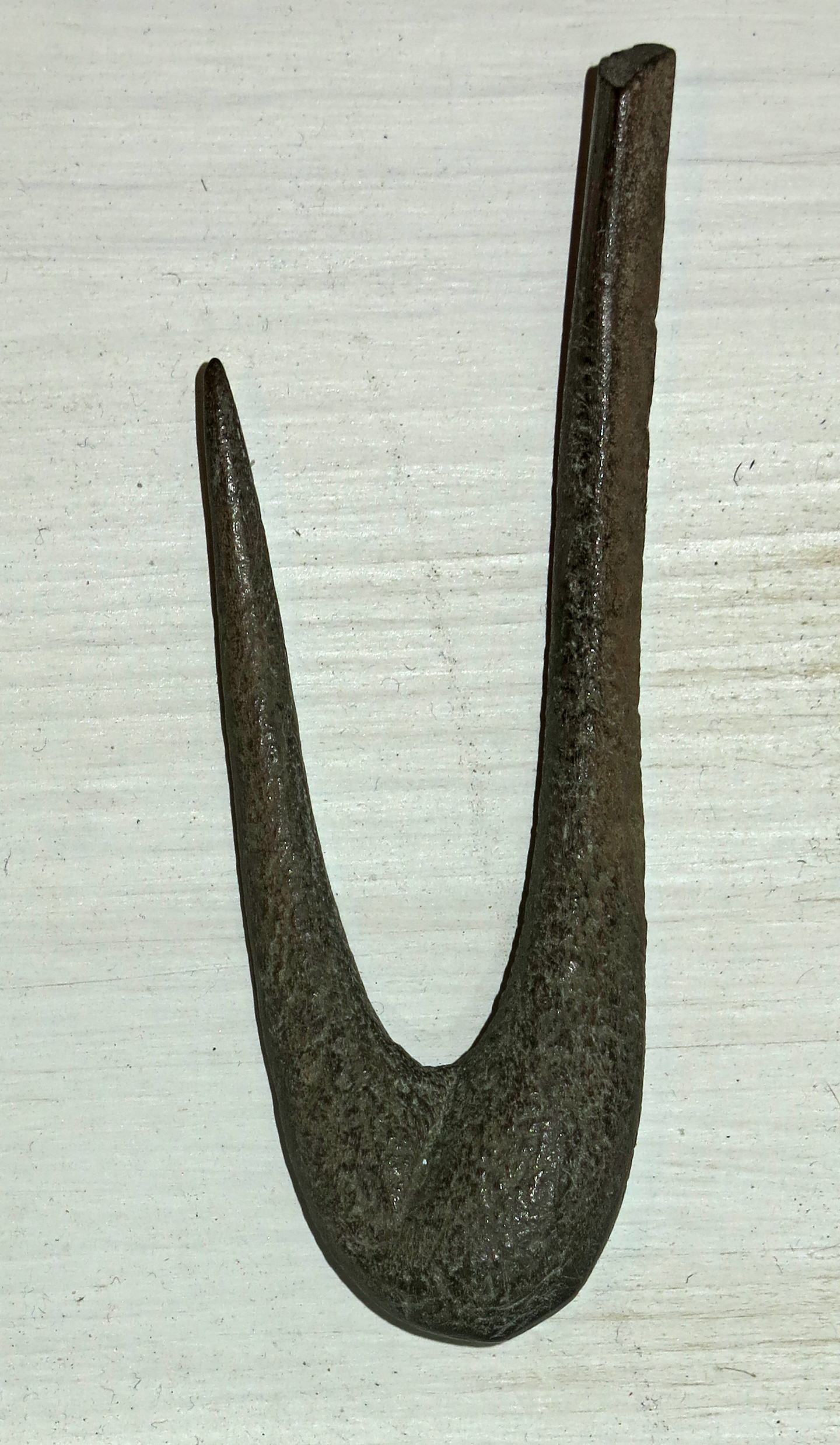
Fish hook.
Ferchesar, Germany.
10 000 BP - 7 000 BP.
Photo: Don Hitchcock 2015
Source and text: Facsimile (?), Neanderthal Museum, Mettmann, near Düsseldorf, Germany
On loan from the Staatliche Museen zu Berlin, Museum für Vor- und Frühgeschichte.
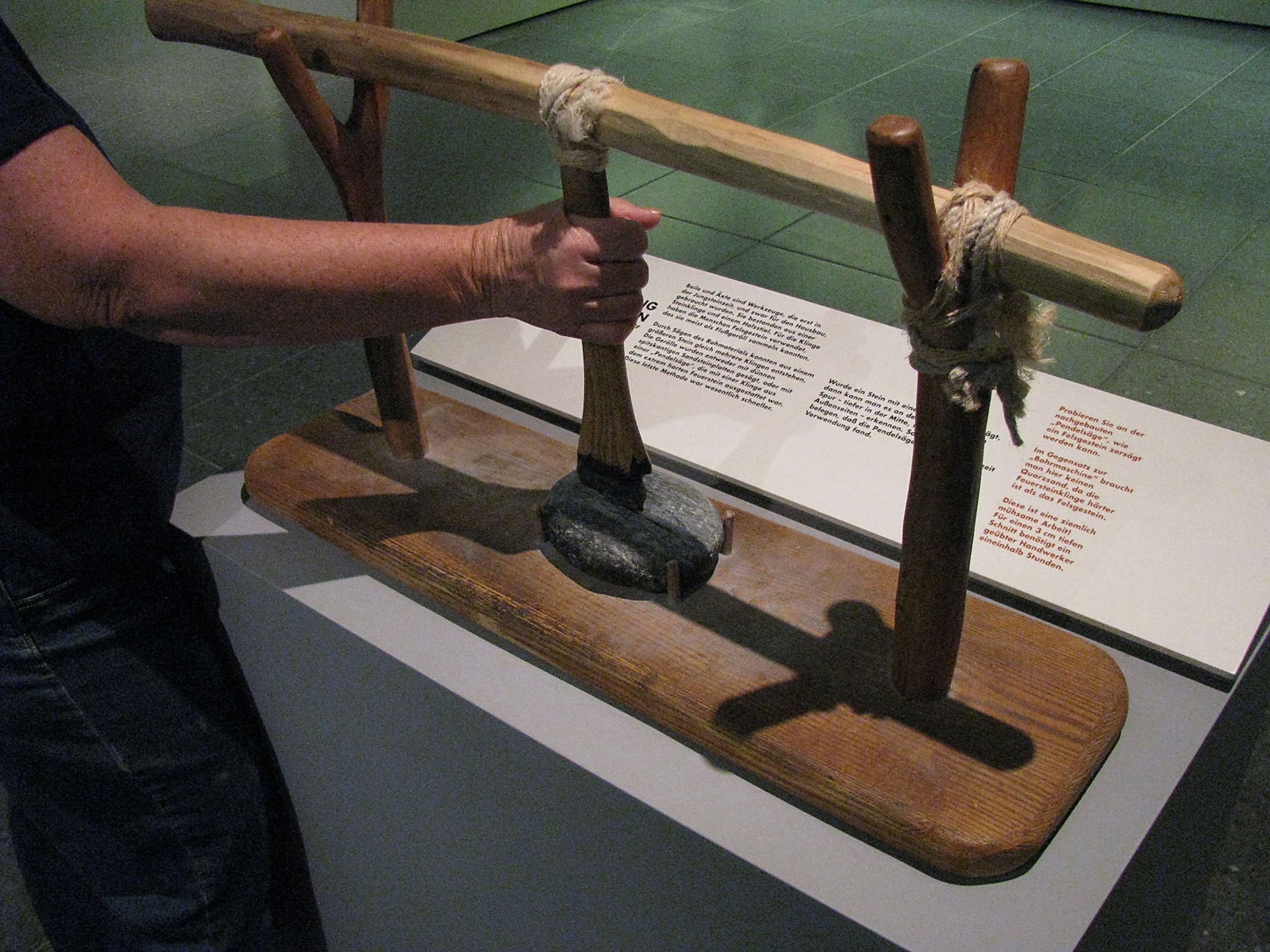
Pendulum saw, Neolithic.
Hatchets and axes are tools that were used in the Neolithic period for home construction. They consisted of a stone blade and a wooden handle. For the stone blade they usually used river cobblestones.
By cutting up the raw material they could get multiple blades from a single large good quality stone. The cobbles were either cut with sharp-edged thin sandstone slabs, or with a 'swing saw', which was equipped with a blade made of extremely hard flint. This last method was much faster.
Stones cut with a pendulum saw are easily recognised, and indicate that this saw was used in the Neolithic.
In contrast to the 'drill' (shown below) no sand is needed, as the flint blade is harder than the rock.
But it is a lot of work. It takes an hour and a half to cut a 3 cm deep groove in the rock.
Photo: Don Hitchcock 2008
Source: Badisches Landesmuseum Karlsruhe Germany
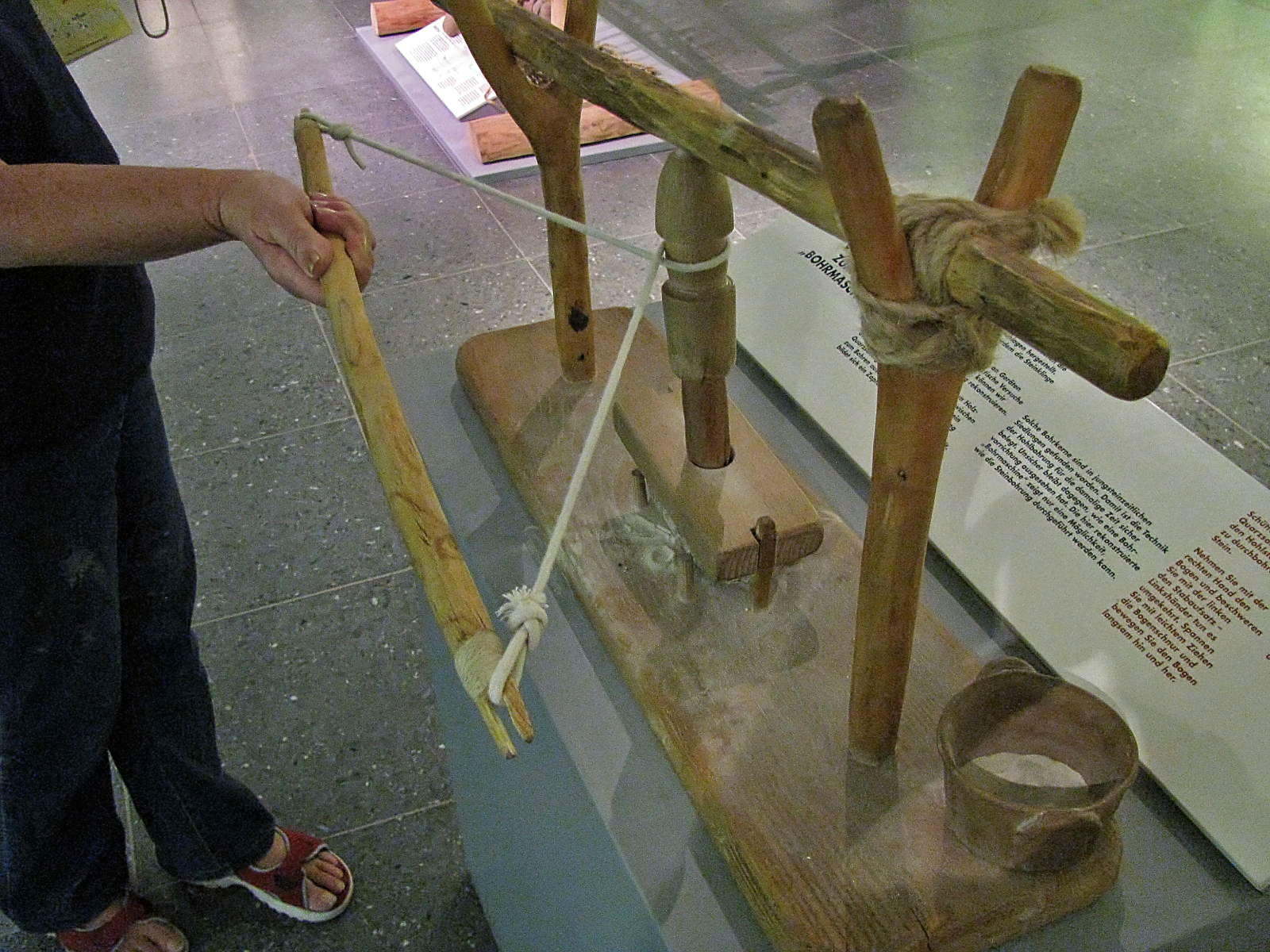
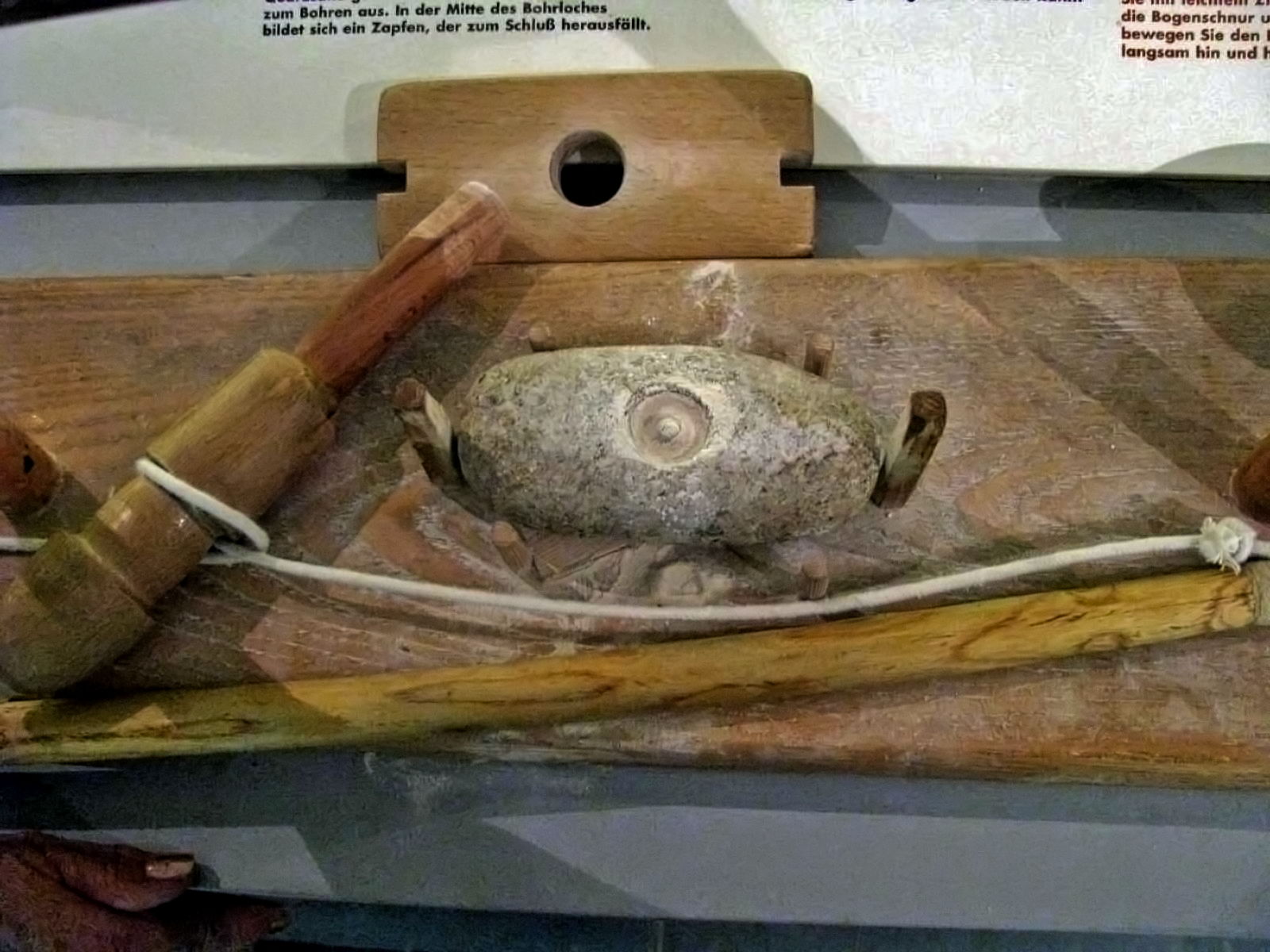
Hole boring machine, Neolithic.
This machine requires a hollow wooden tube, which is supplied by the Elder or Elderberry (Sambucus nigra ), which is a small tree which grows only a few metres tall and tends to grow in poor quality soil. The branches of the elder are hollow, filled with pith which is easily removed.
To make an axe, people either ground it to shape, or knapped the stone. But to attach the handle, although other methods were available, ideally they preferred to drill a hole. Thanks to the surviving traces of work on equipment and intermediate goods and by practical tests of experimental archeology, we can now reconstruct the technology of the stone drill.
A hollow elder wand was rotated by pulling a bow back and forth. When sand is added between the soft wooden tube and the stone, it adds friction to the drilling. In the middle of the drill hole a small cylinder forms, which falls out at the end when the hole is bored completely through the stone. Such cores have been found in Neolithic settlements. Thus, the technique of drilling with a hollow wand has been established. It remains uncertain, however, exactly what the drilling device looked like. The drill reconstructed here, shows only one way in which the drilling of the stone could have been performed.
The wooden beam which is located by the fork shown, has a stone on the far end out of frame which provides weight to bear on the rotating rod. Put some sand between the hollow rod and the rock to be drilled. Take the the bow in one hand and pull lightly on it to tighten the cord, then move the bow back and forth slowly.
The elder wand rotates and rubs the sand against the stone surface.
It takes between 10 and 20 hours, depending on the hardness of the stone, to drill the hole through the axe head.
Photo: Don Hitchcock 2008
Source and text: Badisches Landesmuseum Karlsruhe Germany
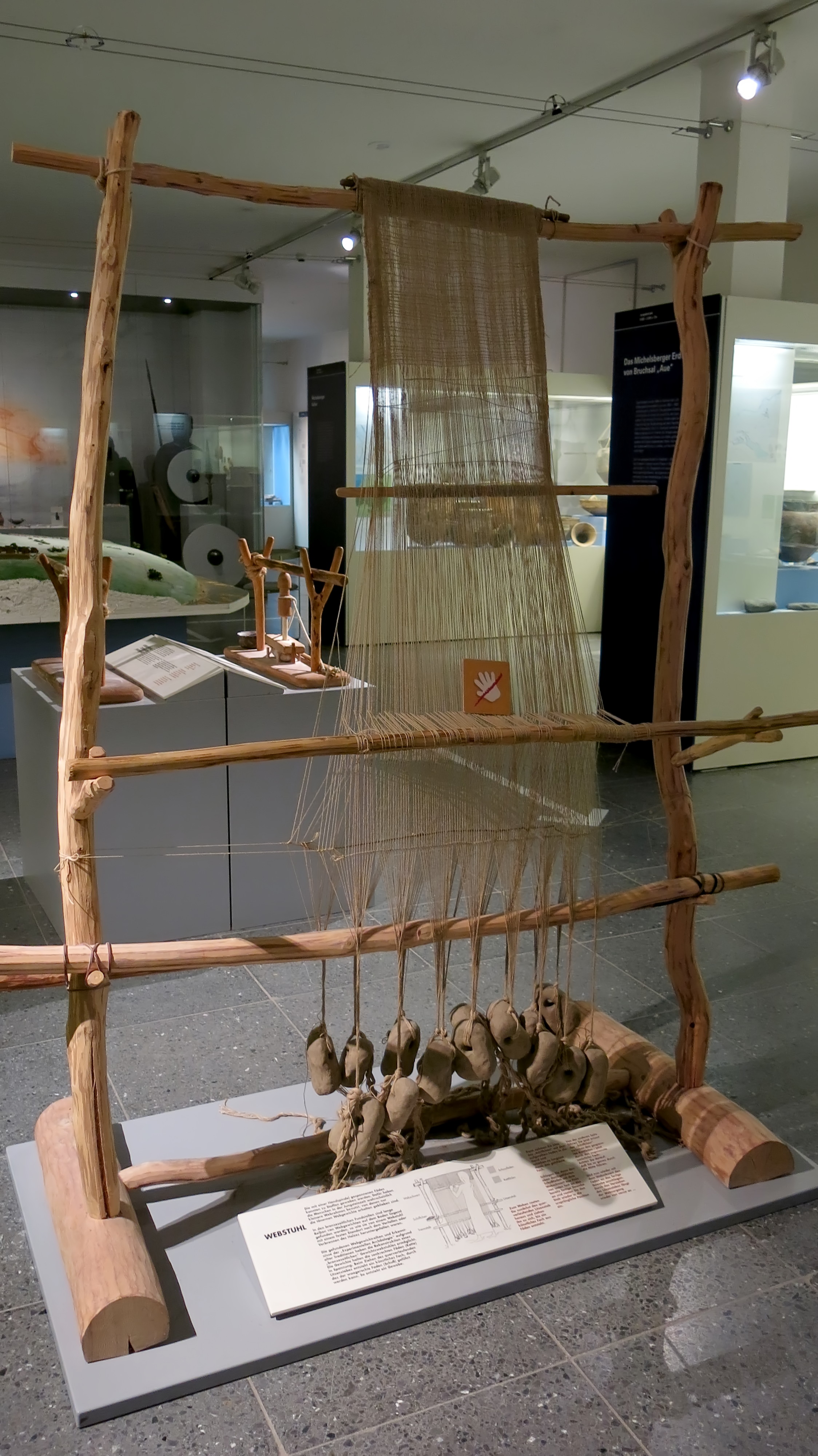
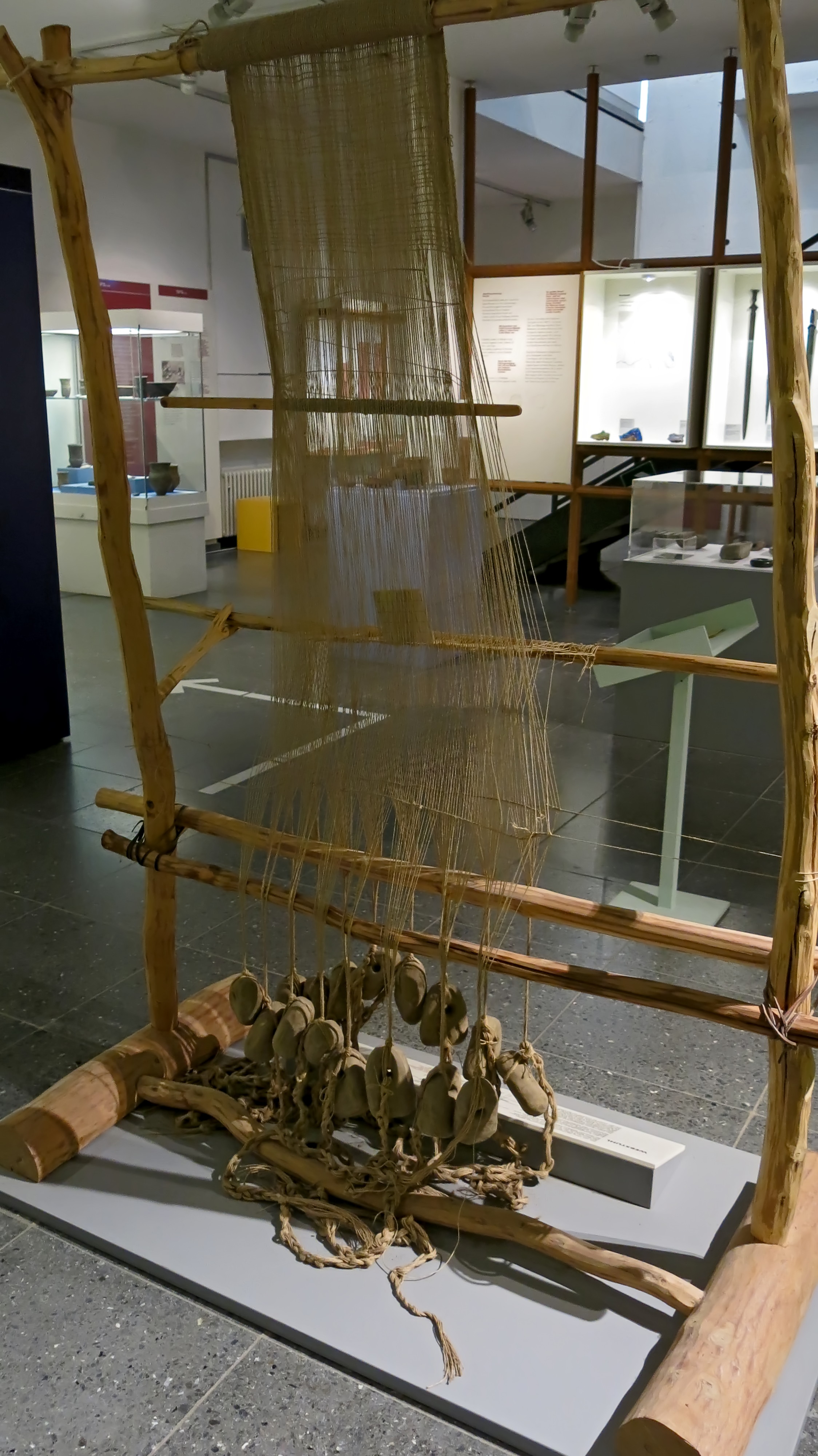
In Bronze Age sites long rows of weaving weights have been found lying on the ground as they had fallen from a loom with a fixed location after the decay or burning of the wood.
The web weight series which have been found, and the findings of 'experimental archeology' along with old traditions have allowed the reconstruction of this 'bronze age' weight loom. The weights hold the vertical thread (warp) in tension. When the rod attached to every second warp is pulled, a temporary gap is created, through which the horizontal thread (weft) can be guided. This creates a woven fabric.
Photo: Don Hitchcock 2015
Source and text: Badisches Landesmuseum Karlsruhe Germany
|
The oldest known firestone. This crystal of iron pyrite was found in a Belgian cave, and has been dated at 10 000 years ago. The deep groove is from being repeatedly struck by a piece of flint to produce sparks to light a fire in tinder. No other easily obtainable combination will produce sparks hot enough to start a fire - two flints struck together will not produce a usable spark, for instance.
|
 |
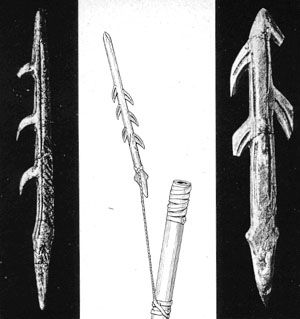
A very characteristic artefact from the late Magdalenian culture is the barbed harpoon head, with both single and double rows of barbs. These are from Le Souci, Dordogne.
Photo: G. Clark, 'The Stone Age Hunters'
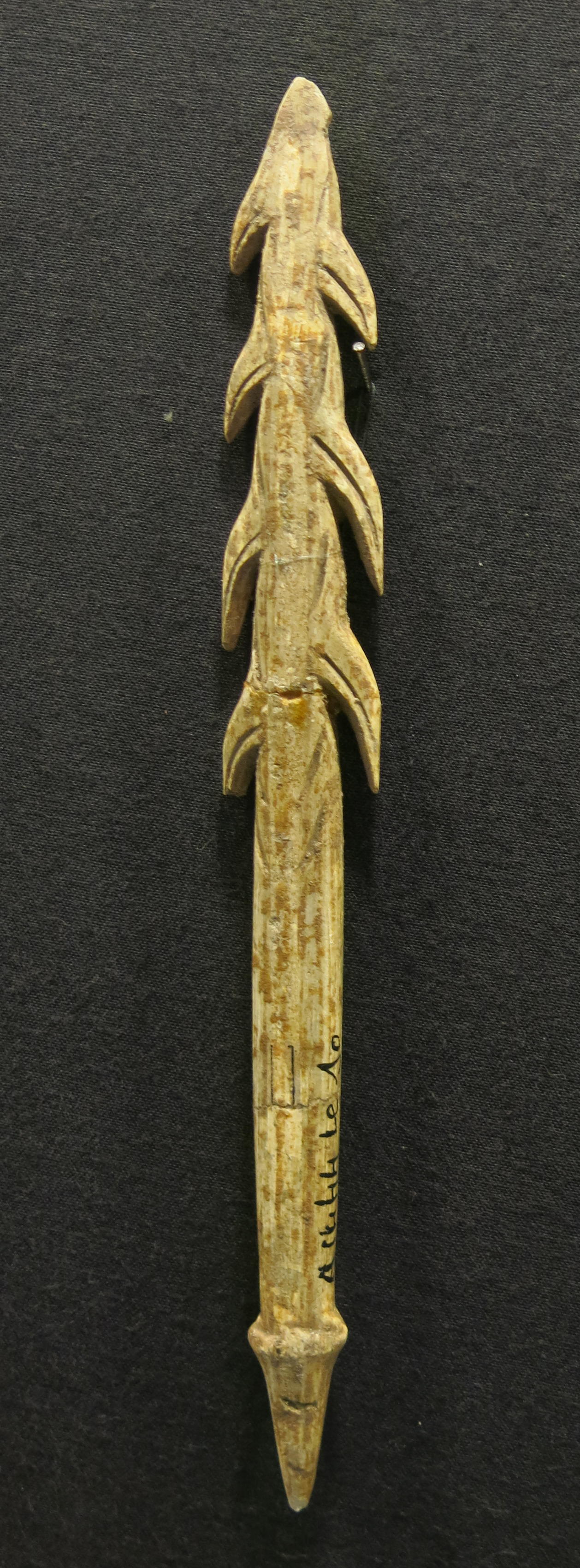
A double sided harpoon from Le Souci, Lalinde, Dordogne.
Photo: Don Hitchcock 2014
Source: Musée d’art et d’archéologie du Périgord, Périgueux
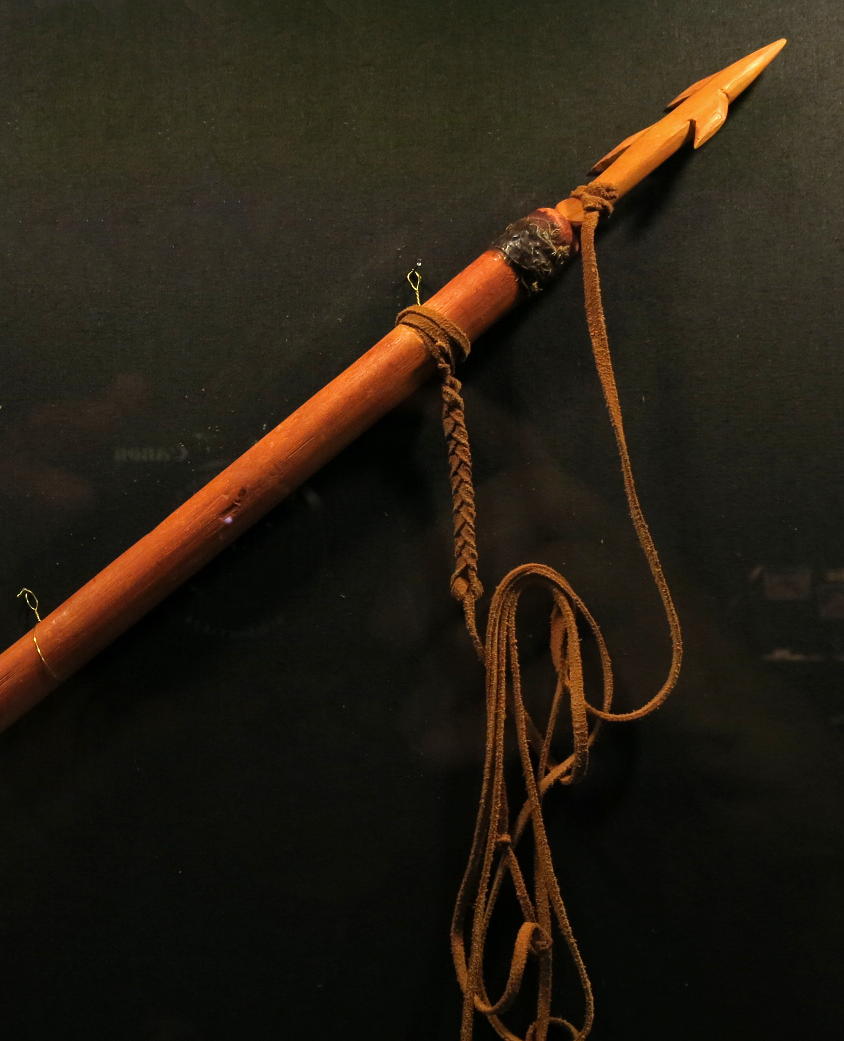
This is a modern recreation of what a complete detachable harpoon setup would have looked like.
The harpoon appeared at the start of the upper Magdalenian, and is a hunting weapon suitable for both 'the chase' (targeting land based game), and for fish.
It consists of a shaft and a detachable point which is provided with barbs or hooks. The barbs are there to prevent the spear from pulling out of the prey once it has been struck. A line of leather, sinew, or intestines connects the point to the shaft.
Photo: Don Hitchcock 2014
Facsimile: Guy Marchesseau
Source and text: Musée d’art et d’archéologie du Périgord, Périgueux
I thought that maybe single sided harpoons were made first before they decided to make doubles, but that wasn't logical, it would have been obvious to make a double barbed harpoon head, and in any case the two types were made at the same time at the one site, so maybe it was to make the strongest possible harpoon for very big fish, or for hunting large animals for that matter. Certainly a single sided harpoon could have bigger, heavier barbs for a given size of raw material such as antler or bone, and thus be stronger, and there are examples like that.
But it didn't seem to be the only reason. Sometimes the single sided harpoons were relatively small, and they could have been made much thicker, with stronger barbs, using the full width of the available raw material.

When a single sided harpoon hits flesh, it is going to be flexed away from the barbs as it forces its way through the body of the quarry. If you've only got the one, you probably wouldn't notice the effect, but the point would travel a somewhat arced path through the flesh because of its asymmetry.
But as shown here, put two of them, barbs towards barbs, on the end of a relatively thick, heavy spear, and you've got a killing machine.
Photo and text: Don Hitchcock 2014
Facsimile made by: Guy Marchessau
Source: Musée d’art et d’archéologie du Périgord, Périgueux
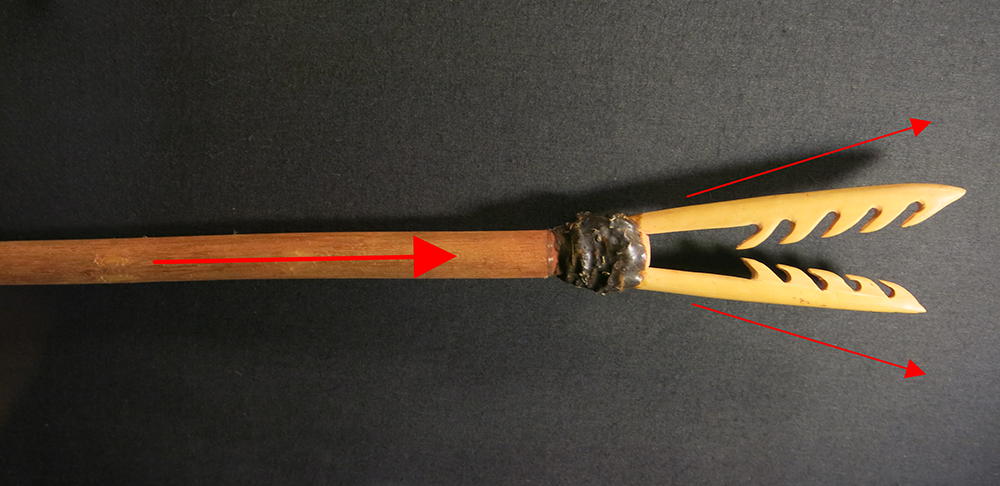
Each of those barbed harpoon heads is now going to flex away from the other as it hits, creating a larger wound in the process. That in itself is a powerful reason for putting two harpoon heads on the one implement. This spreading is increased if the single sided harpoons are angled as shown in this example. The larger the shock to the animal, the quicker it goes down, or stops struggling in the case of a fish.
This is one of the reasons for microblades glued in a groove down each side of a bone or antler spear point, they make a bigger wound, and bring the animal down faster through shock. The same happens with hollow point bullets in guns.
Photo and text: Don Hitchcock 2014
Source: Musée d’art et d’archéologie du Périgord, Périgueux
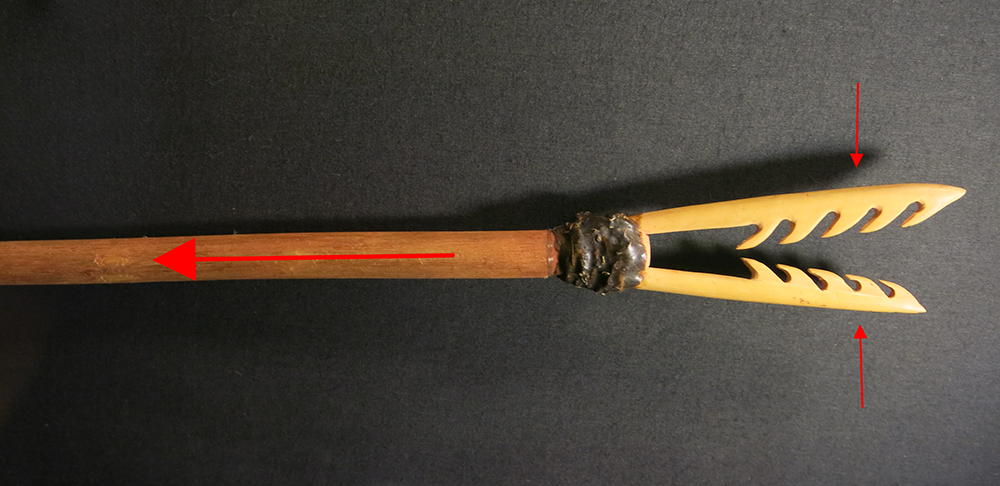
Having been halted by forcing its way through flesh, the harpoon head is now either pulled by the hunter at the other end of the spear shaft, or, in some designs, pulled via a cord or leather thong attached to a detachable harpoon assembly.
Now the tension pulls the two sets of barbs together, clamping on to the flesh of the fish tightly, making it easy to retrieve the fish without it falling off the barbs, which probably happened sometimes with the double sided harpoon heads.
Photo and text: Don Hitchcock 2014
Source: Musée d’art et d’archéologie du Périgord, Périgueux
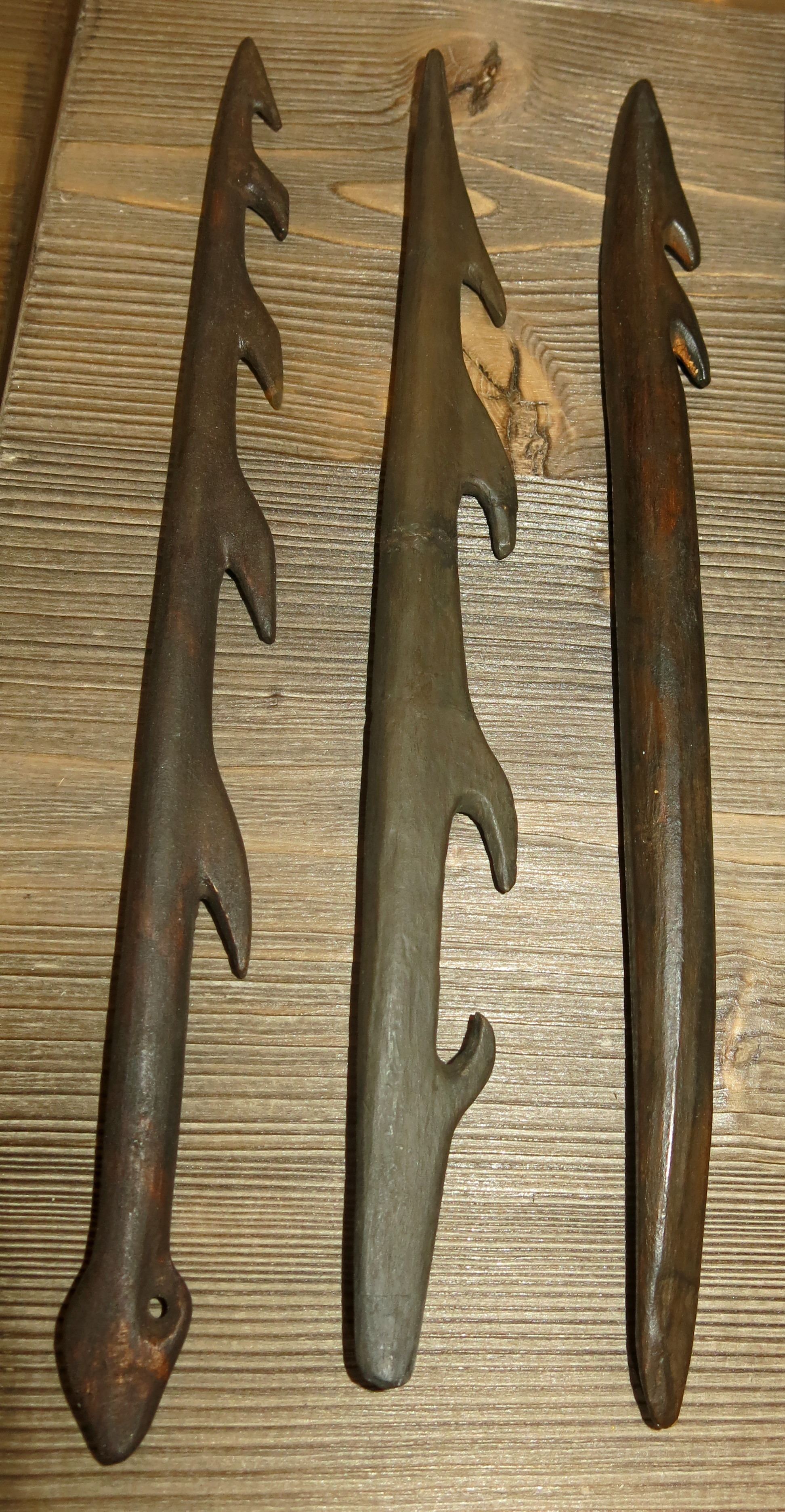
Bone single-row harpoons, different types.
(left) Nowe Duchy, Poland, 14 500 BP - 11 000 BP
(centre) Hästefjorden, Sweden, 14 500 BP - 11 000 BP
(right) Fernewerder, Brandenburg, 11 500 BP - 7 000 BP
Photo: Don Hitchcock 2015
Source and text: Monrepos Archäologisches Forschungszentrum und Museum, Neuwied, Germany

Bone single-row harpoons, different types.
(far left) Fernewerder, Brandenburg, 11 500 BP - 7 000 BP
(centre left) Döberitz, Brandenburg, 11 500 BP - 8 000 BP
(centre right) Amrum, Schleswig-Holstein, 14 500 BP - 8 000 BP
Double-row harpoon
(far right) Ornsköldsvik, Sweden, 14 500 BP - 11 000 BP
Photo: Don Hitchcock 2015
Source and text: Monrepos Archäologisches Forschungszentrum und Museum, Neuwied, Germany

Double-row harpoons
(left) Perkallen, Russia, 14 500 BP - 11 000 BP
(right) Mas d'Azil, France, 15 000 BP - 13 000 BP (Original)
Photo: Don Hitchcock 2015
Source and text: Monrepos Archäologisches Forschungszentrum und Museum, Neuwied, Germany
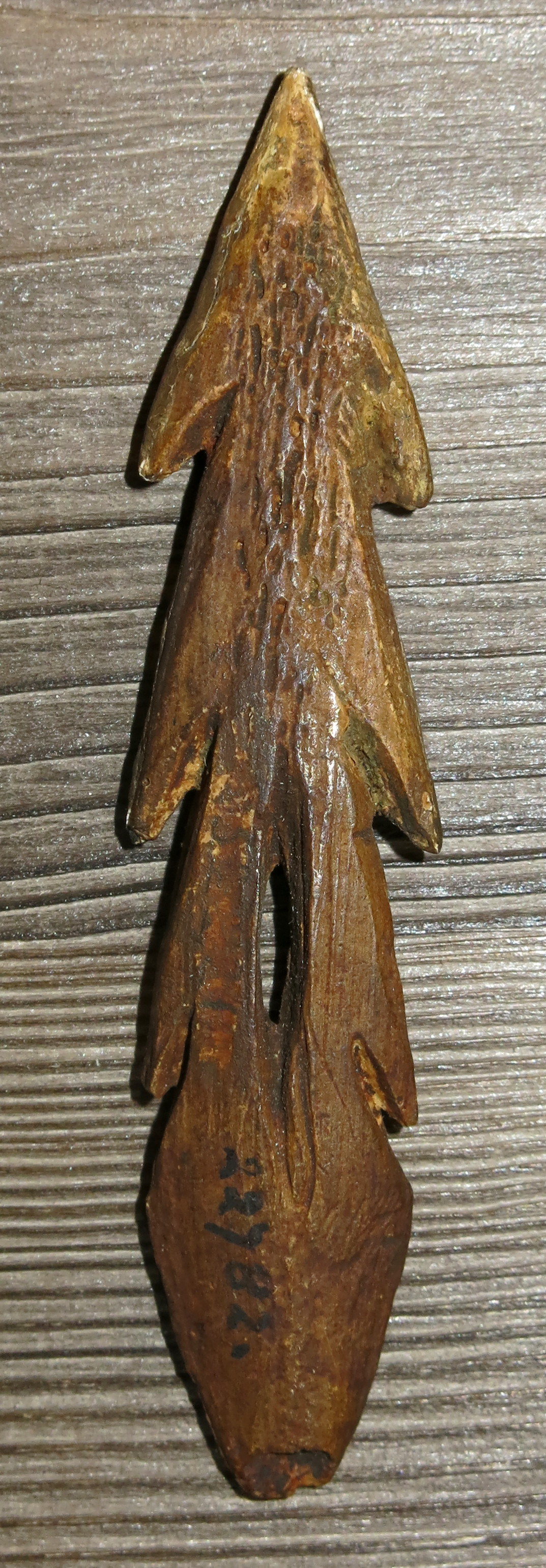
The instantly recognisable shape of a harpoon head from Mas d'Azil, France, 15 000 BP - 13 000 BP (Original)
Photo: Don Hitchcock 2015
Source: Monrepos Archäologisches Forschungszentrum und Museum, Neuwied, Germany

Bone harpoon. Found near the skeleton of an elk. Taaderup, Falster, circa 8 700 BP.
Photo: Don Hitchcock 2014
Source and text: Original, Københavns (Copenhagen) Museum, National Museum of Denmark
On loan from Lolland-Falsters Stiftsmuseum.
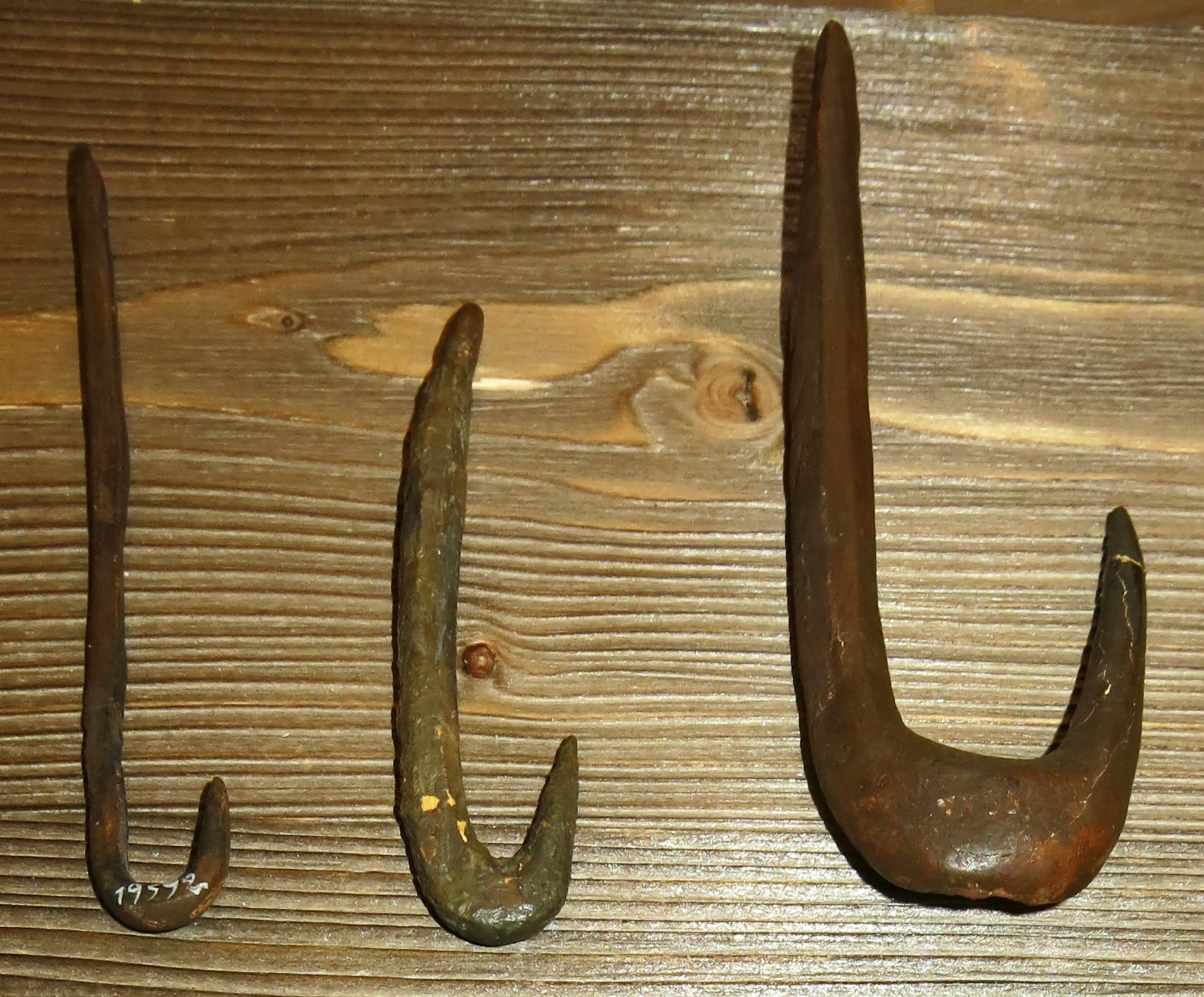
Fish Hooks
(left and centre) Ferchesar, Brandenburg, 11 000 BP - 8 000 BP
(right) Fernewerder, Brandenburg, 11 500 BP - 7 000 BP
Photo: Don Hitchcock 2015
Source and text: Monrepos Archäologisches Forschungszentrum und Museum, Neuwied, Germany
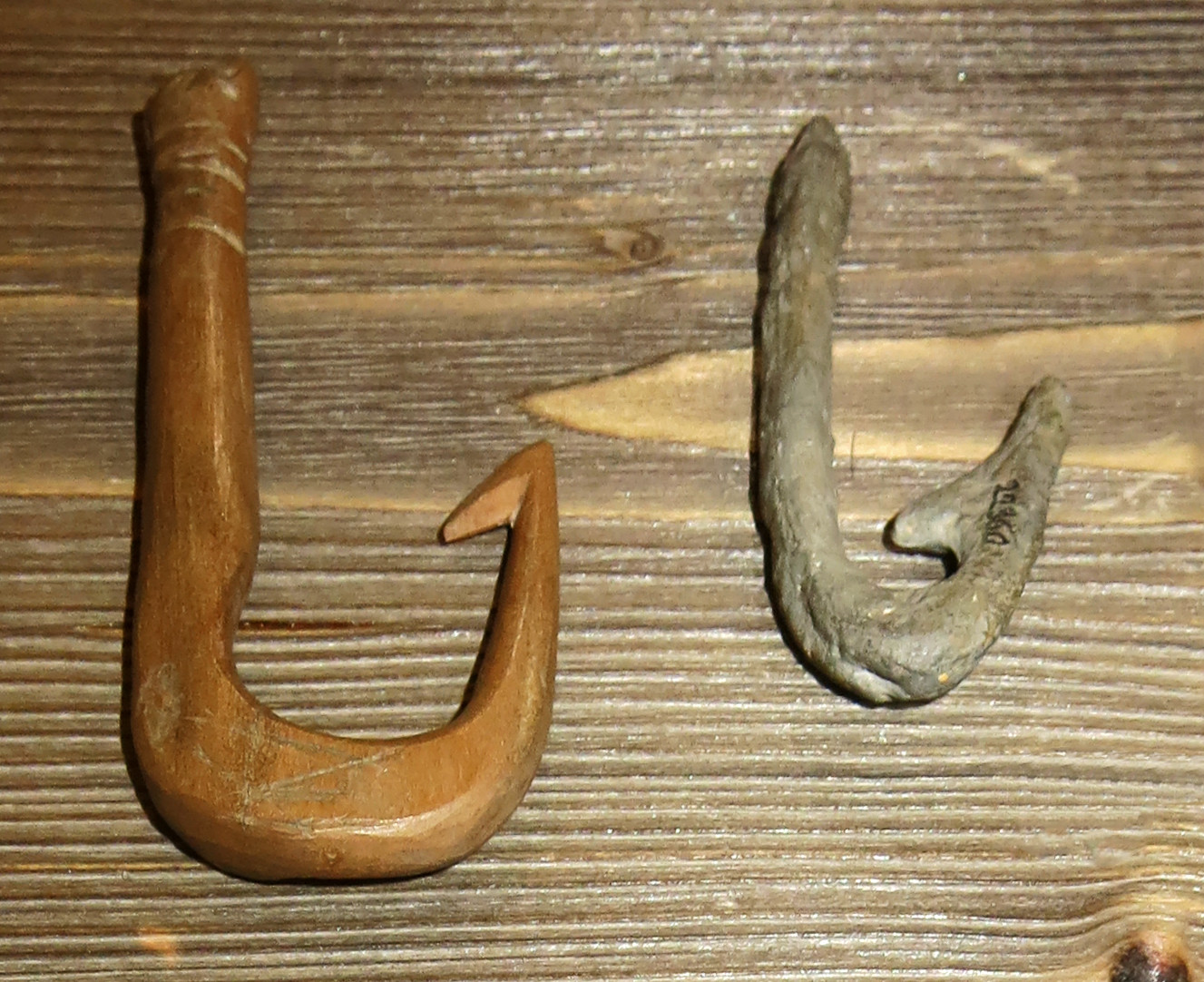
Fish Hooks
(left) Seedorf, Schleswig-Holstein, 11 500 BP - 7 500 BP
(left) Seedorf, Schleswig-Holstein, 11 500 BP - 7 500 BP
(right) Billeberga, Schweden, 11 500 BP - 7 500 BP
Photo: Don Hitchcock 2015
Source and text: Monrepos Archäologisches Forschungszentrum und Museum, Neuwied, Germany

Net weaver, decorated.
Wismar, Mecklenburg-Vorpommern, 11 500 BP - 7 000 BP (original)
Photo: Don Hitchcock 2015
Source and text: Monrepos Archäologisches Forschungszentrum und Museum, Neuwied, Germany
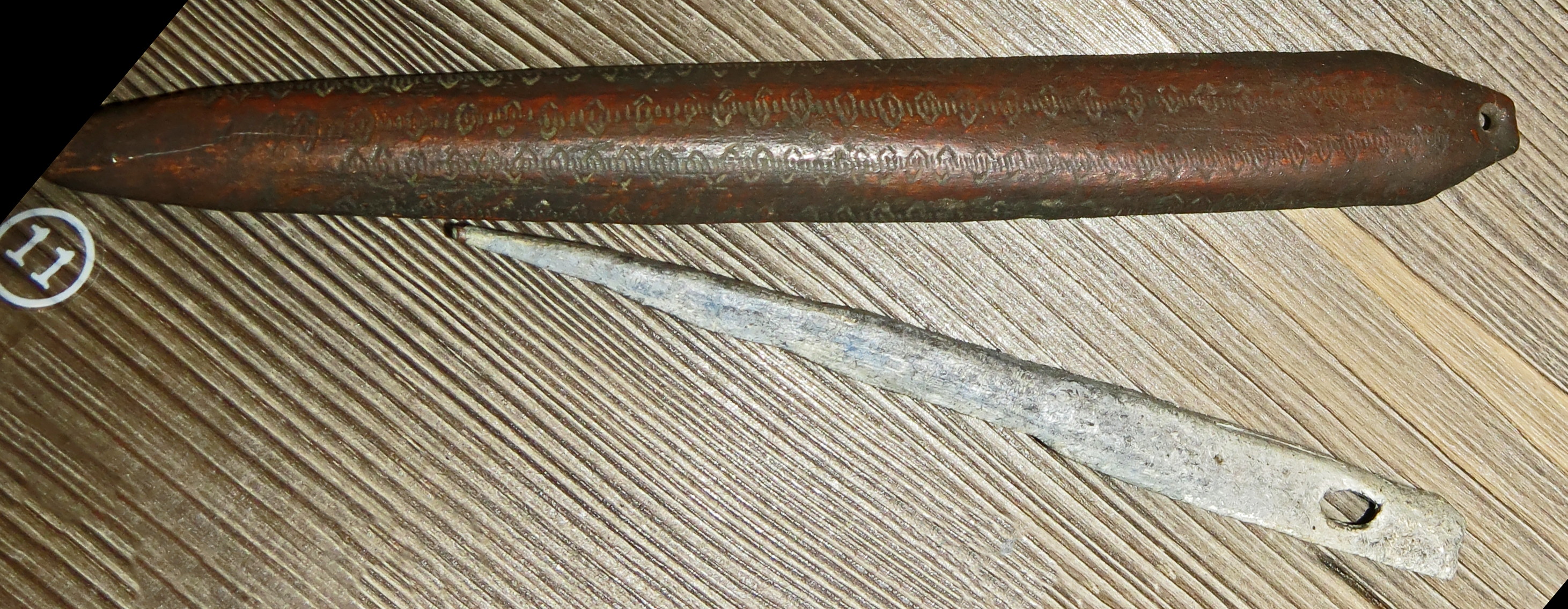
(above) Net weaver, decorated.
Fernewerder, Brandenburg, 11 500 BP - 7 000 BP
(below) Blunt needle used for threading, made of antler.
Duns Kjökk, Schleswig-Holstein, 7 000 BP - 11 500 BP (original)
Photo: Don Hitchcock 2015
Source and text: Monrepos Archäologisches Forschungszentrum und Museum, Neuwied, Germany

Barbed point made of antler
( note that this would almost certainly have been straight when originally used. It has either been bent by its travails under the ground, or, having been straightened originally, it has since reverted to its curved original form. Antler can be straightened by first soaking in cold water for two days, then in boiling water for 20 minutes, removed, and clamped immediately into its required shape (by binding tightly with sinew or leather onto a straight, strong piece of wood for example). Once it cools and then dries, it will retain whatever shape was imposed on it - Don )
For information on antler straightening see: http://goneoutdoors.com/straighten-deer-antler-knife-handle-5561158.html
Photo: Don Hitchcock 2015
Source and text: Monrepos Archäologisches Forschungszentrum und Museum, Neuwied, Germany
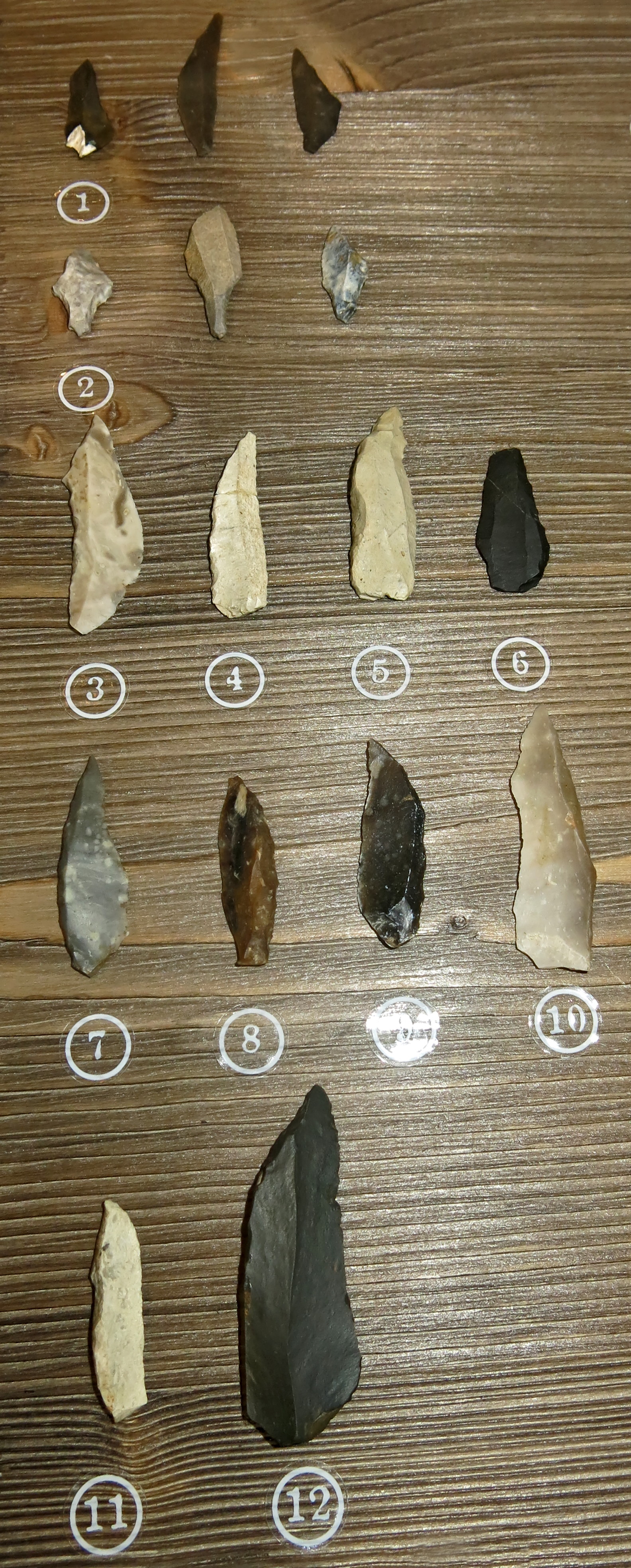
Hunting deer with bow and arrow.
The choice of their arrows was dictated by their prey and the hunting situation.
The bows were individually matched to the body size and strength of the archer, but typically the bow was as long as the hunter was tall. The oldest preserved bow is about 9 000 BP and comes from the Holmegaard Moor in Denmark.
1-12:
Arrow points and inserts
1: microliths, Bedburg-Königshoven, Nordrhein-Westfalen, circa 11 000 BP (original)
2: pointed tips (shouldered points)
3-11: 'Federmesser' or penknife points
12: larger point
Photo: Don Hitchcock 2015
Source and text: Monrepos Archäologisches Forschungszentrum und Museum, Neuwied, Germany
 I am indebted to Michael Hess for this fine account of the recreation of two types of Mesolithic bows, the Holmegaard and Møllegabet. Some of the oldest findings of (almost) complete bows suited for hunting are three items from bogs in Zealand (Southern Denmark): Two Holmegaard-style bows and one Møllegabet style bow from ~ 8 500 BP and 7 400 BP, respectively. However, archery appears to be a much older technique as concluded from the findings of stone artefacts, which suggest that they were used as arrow heads and which are at least 20 000 years old.
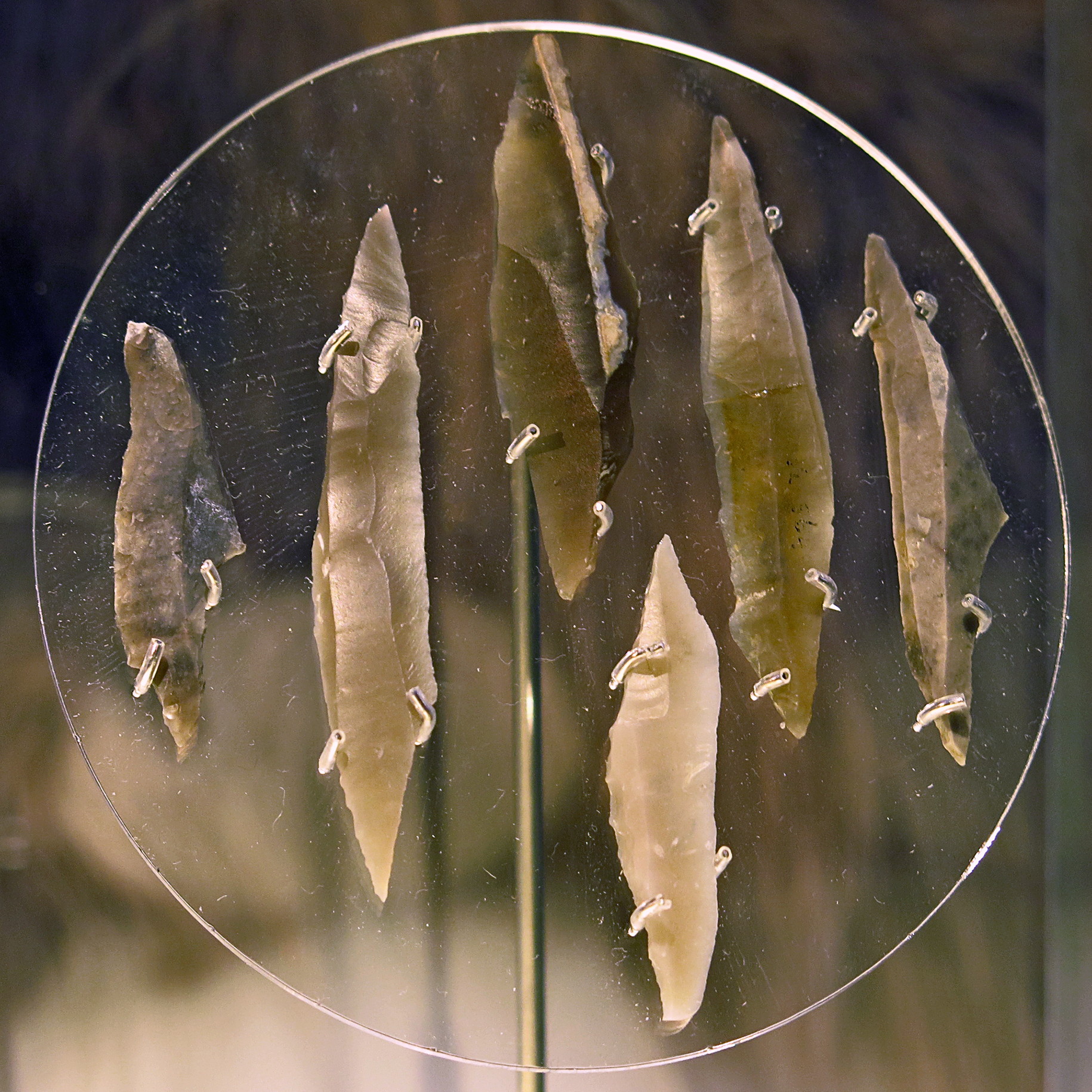
Arrow heads from Oldeholtwolde, 11 650 BP. Oldeholtwolde is a village in Weststellingwerf in the province of Friesland, Netherlands.
Flint was crucial for survival in the vast, inhospitable plains of this region. It was knapped into arrowheads, and tools like scrapers, borers, burins and knives. These were used to work hides for clothes, bone and antler for needles and harpoons, or wood for arrows.
Wear traces reveal that numerous hides were worked in Oldeholtwolde. Some tools were brought in from elsewhere, but fresh flint could be gathered near the camp. In this period, the Upper Palaeolithic at the end of the last ice age, it was common practice to strike narrow pieces of flint from a core stone. These 'blades' were then made into tools for specific purposes.
The distribution of the flint and the expert way in which it was shaped, leads researchers to believe that three flint workers sat around the fire, one experienced and the others less so: a man teaching his sons, perhaps?
Photo: Don Hitchcock 2014
Source and text: Rijksmuseum van Oudheden, National Museum of Antiquities, Leiden.
Additional text: Wikipedia
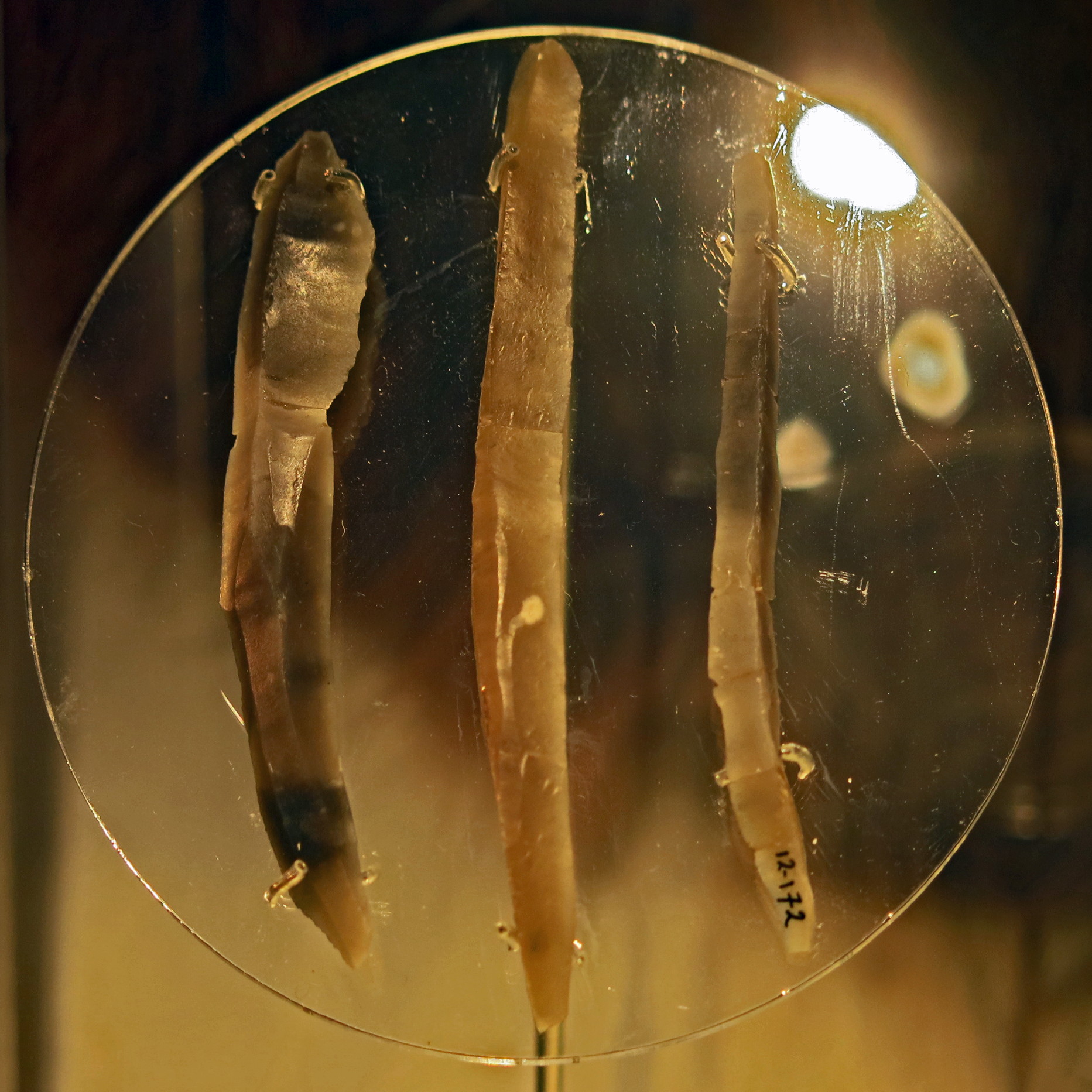
Blades from Oldeholtwolde, 11 650 BP.
These blades are remarkable for their large length/width ratio, a tribute to the skill of the knapper.
Photo: Don Hitchcock 2014
Source and text: Rijksmuseum van Oudheden, National Museum of Antiquities, Leiden.
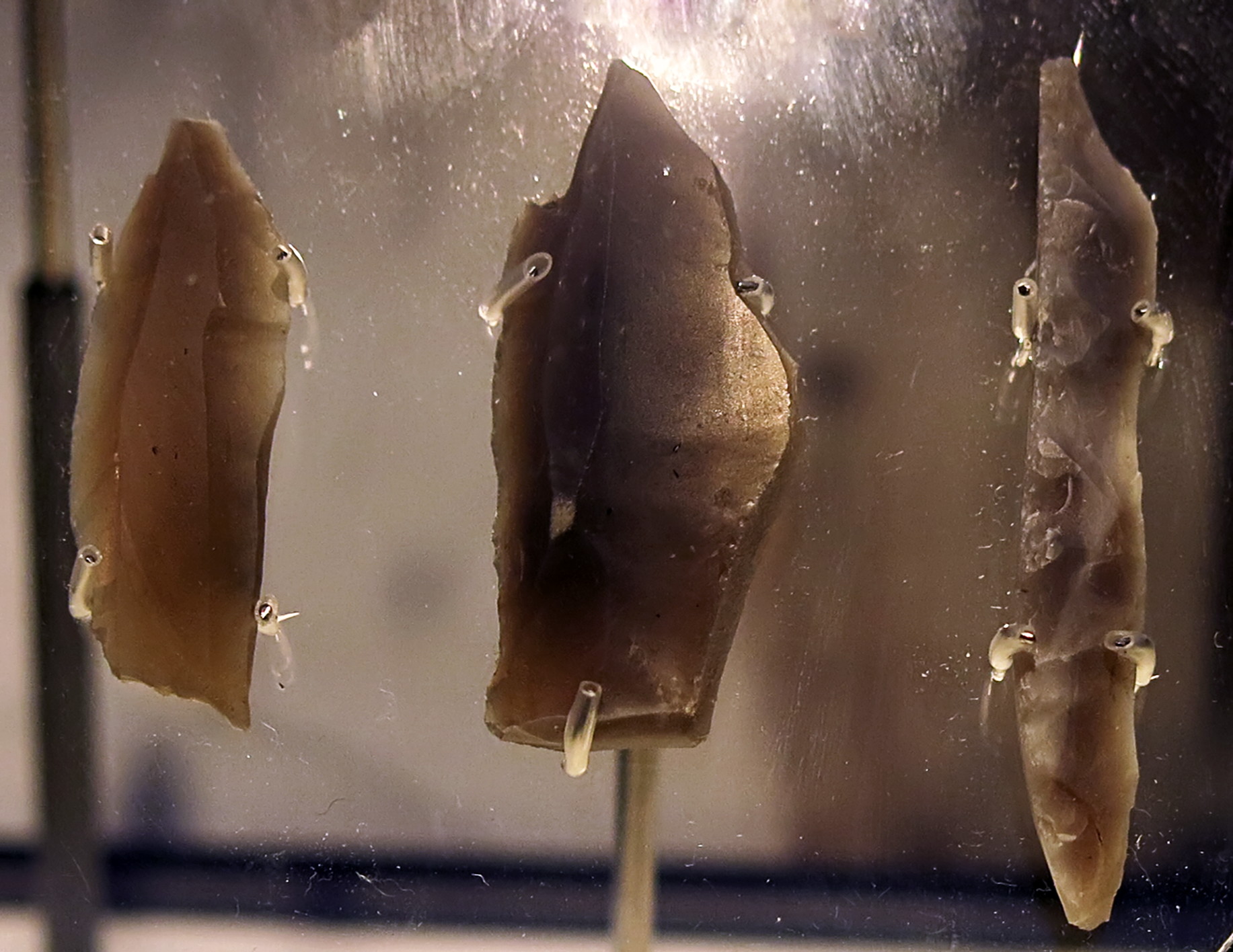
Burins from Oldeholtwolde, 11 650 BP.
The middle burin exhibits the classic 'burin facet' technique, in which a burin spall is struck from a striking platform, a method which can be repeated many times on the same tool when the edge becomes blunted with wear. The resultant tiny spalls can themselves be used as micro-blade piercing tools.
Photo: Don Hitchcock 2014
Source and text: Rijksmuseum van Oudheden, National Museum of Antiquities, Leiden.
Additional text: Wikipedia


Bow of elm from Holmegaard, southern Zealand, circa 9 000 BP.
The original Holmegaard bow, from the Maglemose culture.
The bow and arrow were the technological innovations that made hunting very efficient. In the forest throwing spears was difficult, but with weapons like the bow from Holmegaard the game could be shot even in thick vegetation - in fact, with care, this allowed the hunters to get very close to their prey, making the shot much easier to make accurately.
Photo (above) of the original bow: Don Hitchcock 2014
Photo (below) of a facsimile: rephotographed from a poster at the Københavns Museum
Source and text: Original, Københavns (Copenhagen) Museum, National Museum of Denmark
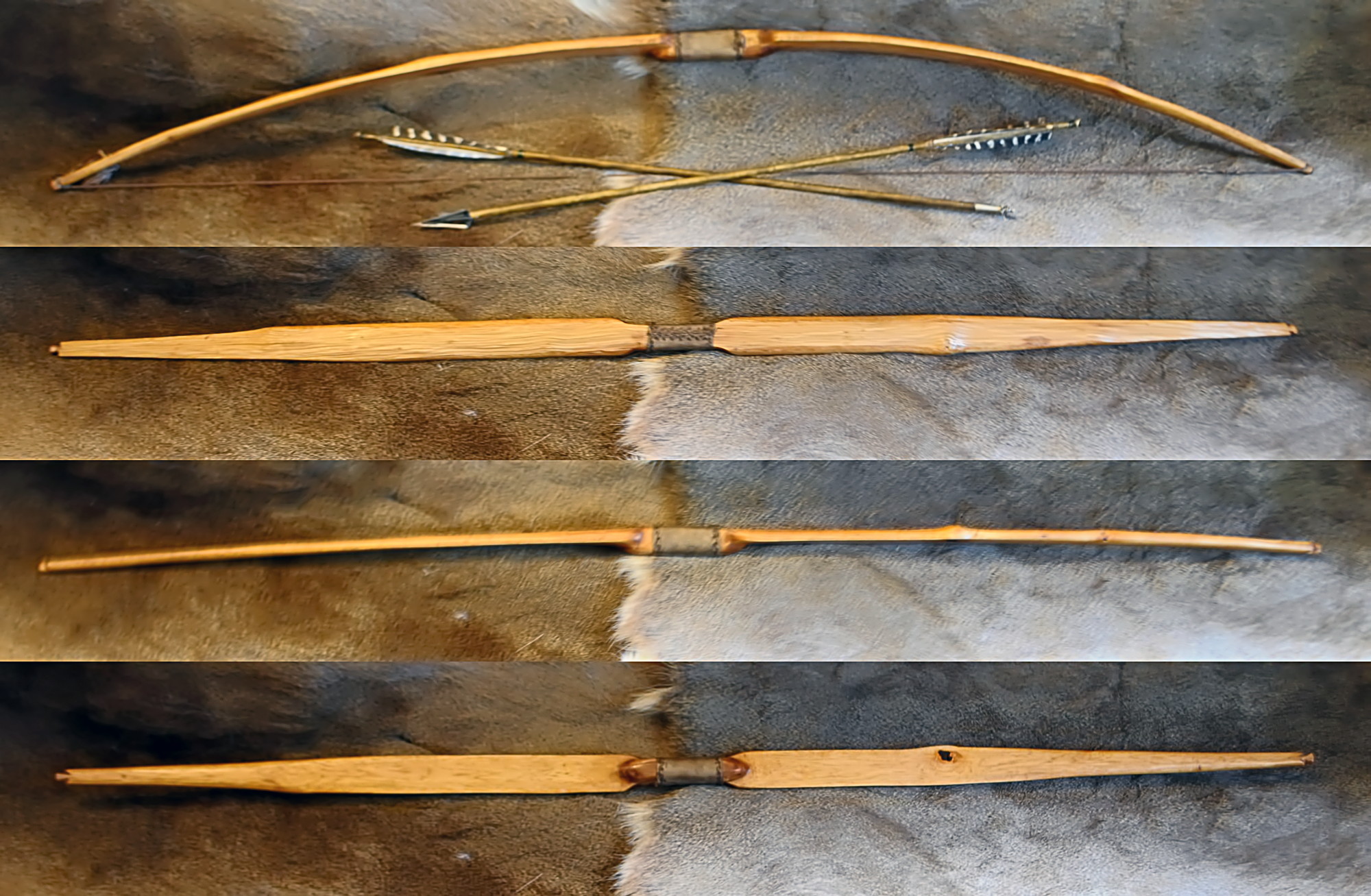
This is a replica of the oldest preserved bow , from the Holmegaard Moor in Denmark.
It is made by Greg Anderson, an avid lover of the outdoors and also a primitive skills and wilderness survival expert. It is from these passions that he came to study the ancient art of bow making. He founded North Wood Traditional Archery LLC in 2010.
The original Holmegaard bow is 1540 mm long, made from the trunk of an elm tree, that had been split down the middle. The weapon has a 26 mm wide grip, which possibly didn't bend. Its limbs have a maximum width of 45 mm.
Photo and text: http://www.northwoodtraditionalarchery.com/archery_hunting_bow_hunting.html
Additional text: Bálint (2014)
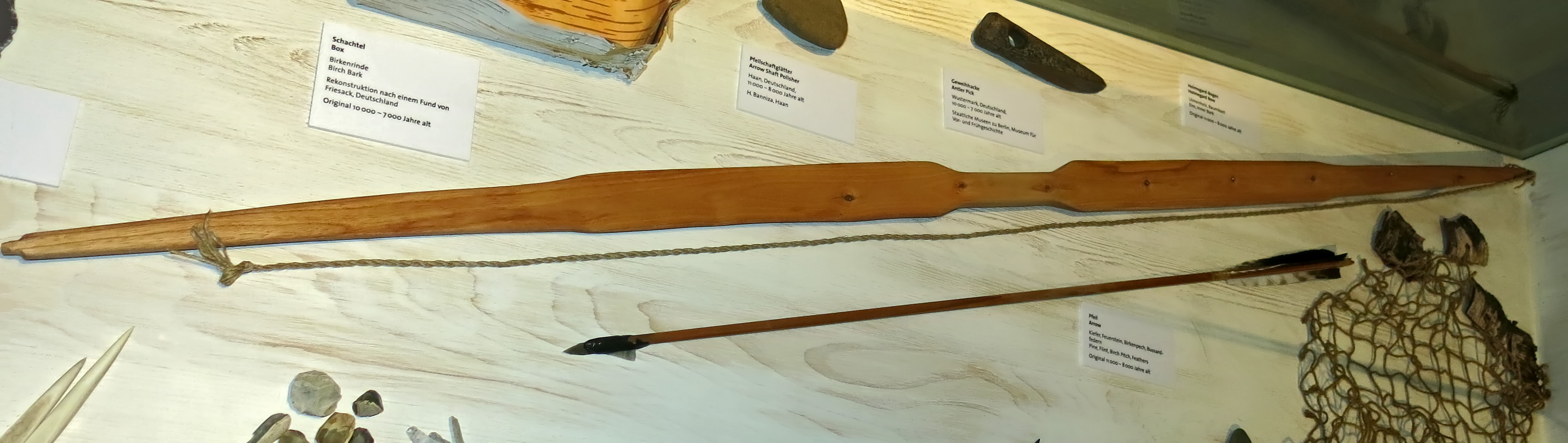
Holmegaard Bow
Another reproduction of the bow, as well as an arrow that may have been of the type used, on display in the Neanderthal Museum, Mettmann, Germany.
Circa 9 000 BP.
Photo: Don Hitchcock 2015
Source and text: Neanderthal Museum, Mettmann, near Düsseldorf, Germany
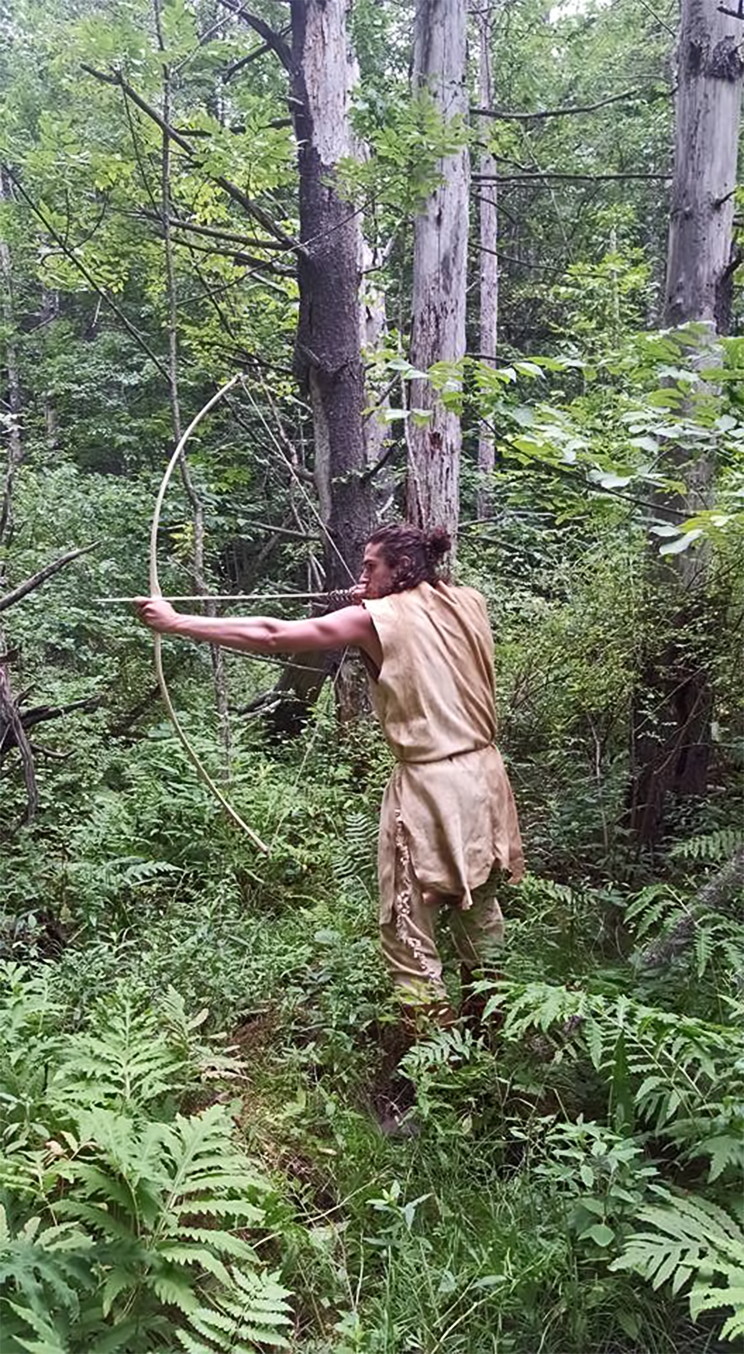
This is an excellent photo of the Holmegaard bow in action, with the archer in period costume. Note the environment - the bow and arrow have many advantages over spearthrowers and darts, even on the steppes, but it is in a forested setting that they become clearly superior.
This particular reconstruction is 62 inches long. It pulls 55 pounds at 27 inches of draw (1575 mm, 25 kg, 686 mm). The bowstring is twisted deer rawhide. The nocks are built up with twisted cordage, pine pitch, and sinew, the original artefacts having no carved nocks. The handle is wrapped in twisted elm bark cordage.
For the original, the belly of the bow has a flattened shape. On the back of the object there are some marks that are interpreted as the evidence of strengthening the bowstring made of sinews, by fixing it firmly to the edge of the bow. The limbs of the bow taper gradually toward the end. This hunting tool was carved out from the tree so that its back was the flexible sapwood while the belly was the harder heartwood. This wasn’t the only bow that was discovered in Holmegaard Moor, four other very similar objects were also found, all of them are made from elm.
One of the other bows was larger, originally around 1620 mm long. The grip is 21 mm wide, the maximum width of the limbs of this bow is 60 mm. These bows are considered as wide-limbed bows. This broad-limb feature is for reinforcing, useful to reduce strain from the bow, keeps the string more durable and altogether increases the efficiency of the weapon. The narrow grip makes the bow easier to handle while being used. The trees that the bows were made of were chosen from those that grew in the shade, so that they did not have any branches or knots. These hunting weapons are dated to around 9 000 BP.
Photo and text: Airborne890, http://www.primitivearcher.com/smf/index.php?topic=57844.0
Additional text: Bálint (2014)

Forearm protection plate for an archer, as protection against chafing from the bowstring.
Wismar, Mecklenburg-Vorpommern, 11 000 BP - 8 000 BP
Photo: Don Hitchcock 2015
Source and text: Monrepos Archäologisches Forschungszentrum und Museum, Neuwied, Germany

Arrow shaft smoothers, the one on the left is decorated.
(left and centre) Andernach, obere Fundschiet, 14 000 BP - 13 000 BP - Original.
(right) Niederbiege, Rheinland-Pfalz, 13 500 BP - 13 000 BP.
Photo: Don Hitchcock 2015
Source and text: Monrepos Archäologisches Forschungszentrum und Museum, Neuwied, Germany
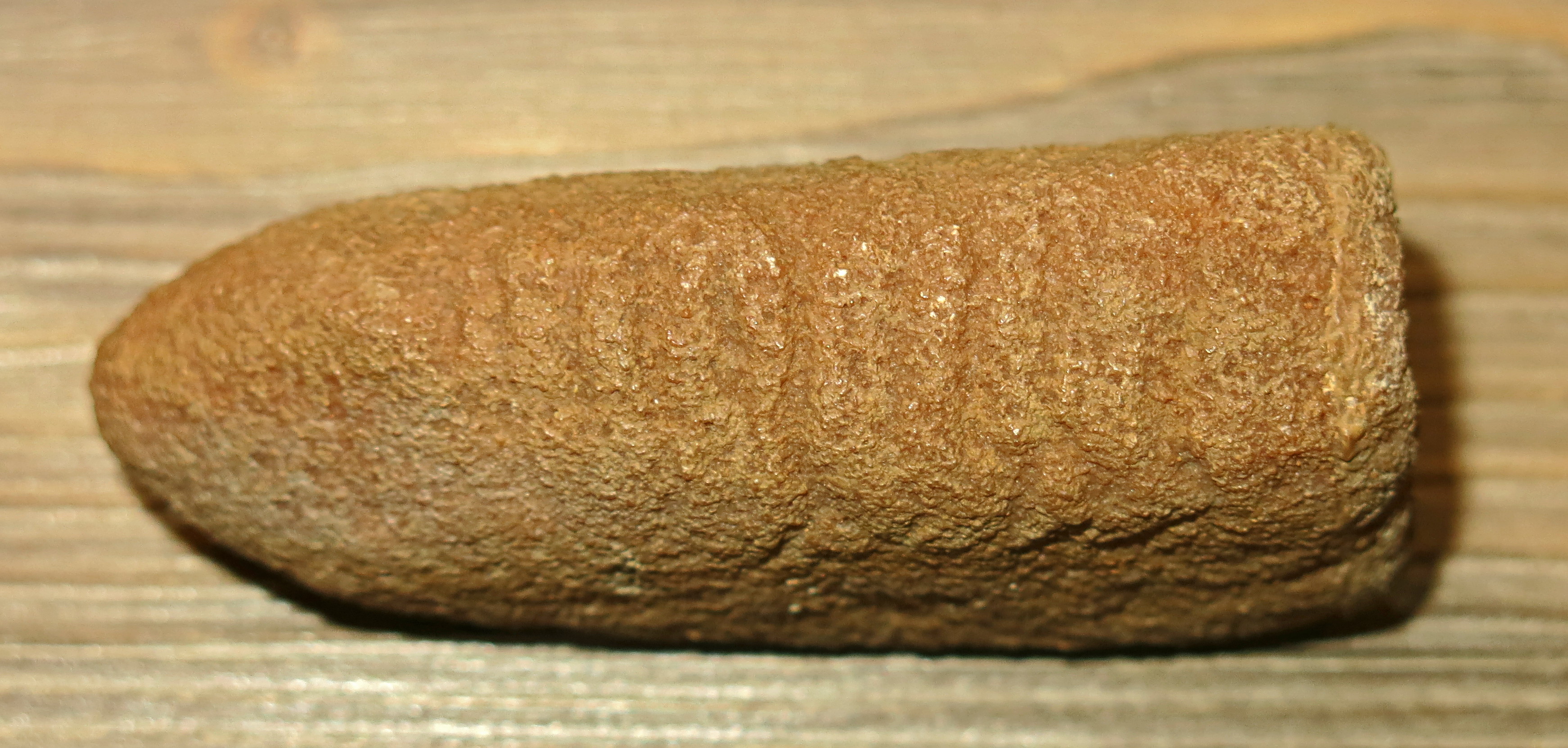
Close up of the decorated arrow shaft smoother.
Andernach, obere Fundschiet, 14 000 BP - 13 000 BP - Original.
Photo: Don Hitchcock 2015
Source and text: Monrepos Archäologisches Forschungszentrum und Museum, Neuwied, Germany

Arrow shaft smoothers.
(left ) Andernach, obere Fundschiet, 14 000 BP - 13 000 BP - Original.
(right) Niederbiege, Rheinland-Pfalz, 13 500 BP - 13 000 BP.
Photo: Don Hitchcock 2015
Source and text: Monrepos Archäologisches Forschungszentrum und Museum, Neuwied, Germany
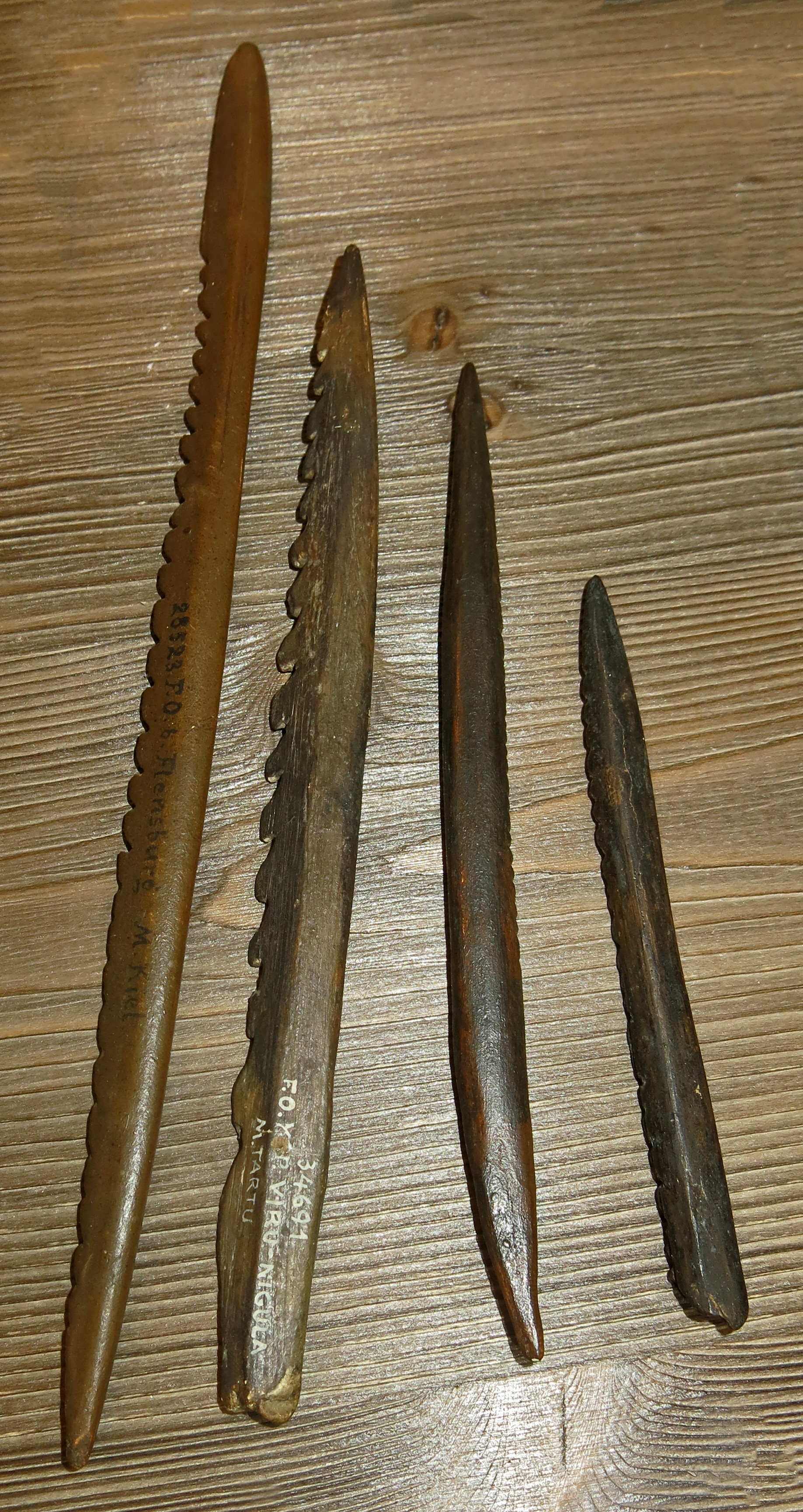
Antler and bone tips with barbs
(left) Flensburg, Schleswig-Holstein, 11 000 BP - 8 000 BP
(centre left) Viru-Nigula, Estonia, 11 000 BP - 6 000 BP
(centre right and far right) Ferchesar, Brandenburg, 11 000 BP - 8 000 BP
Photo: Don Hitchcock 2015
Source and text: Monrepos Archäologisches Forschungszentrum und Museum, Neuwied, Germany
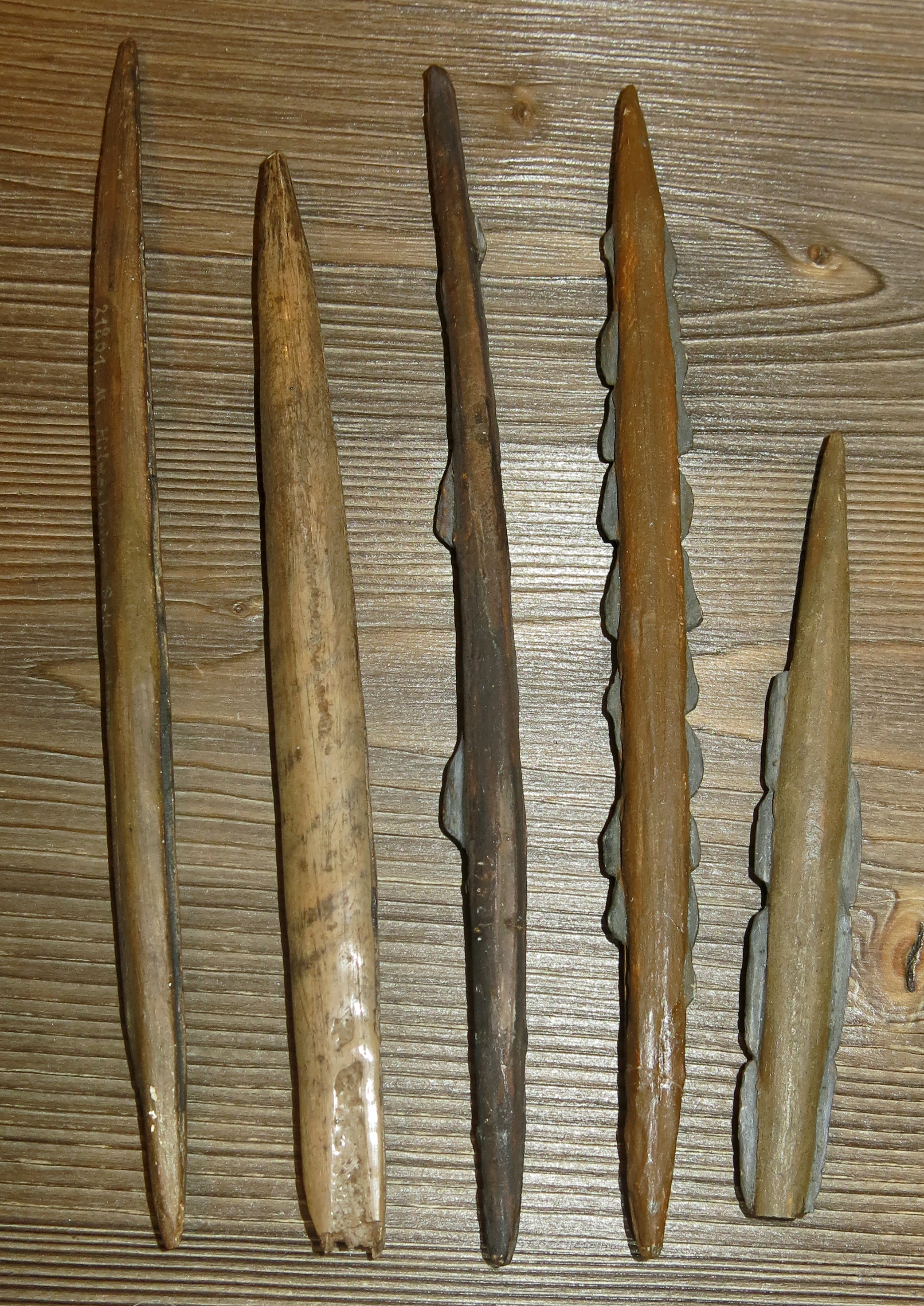
22-26 Antler and bone spear tips with micro blades inserted in grooves on the sides.
( These made the weapons more effective, since they created greater trauma to the prey, and brought it down quickly from shock due to blood loss. - Don )
(far left) Site unknown, Sweden, 9 000 BP - 7 000 BP
(centre left) Elblag, Poland, 9 000 BP - 7 000 BP (Original)
(centre) Hölterup, Sweden, 9 000 BP - 7 000 BP
(centre right) Amossen, Sweden, 9 000 BP - 7 000 BP
(far right) Tjörn, Sweden, 9 000 BP - 7 000 BP
Photo: Don Hitchcock 2015
Source and text: Monrepos Archäologisches Forschungszentrum und Museum, Neuwied, Germany
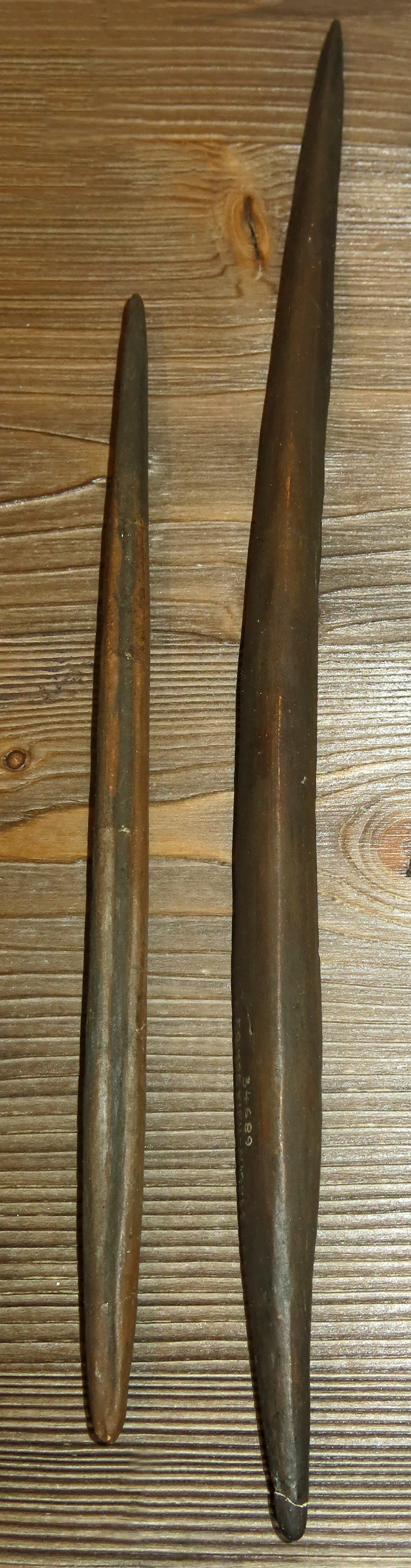

(far left) Bone tip, Bohuslän, Sweden, 9 000 BP - 7 000 BP
(centre left) Bone tip, Viru-Nigula, Estonia, 11 000 BP - 17 000 BP
(centre right) Chisel-like device (Red Deer), Bedburg-Königshoven, Nordrhein-Westfalen, circa 11 000 BP, (Original)
(far right) Spatula-like device (Red Deer), Bedburg-Königshoven, Nordrhein-Westfalen, circa 11 000 BP, (Original)
Photo: Don Hitchcock 2015
Source and text: Monrepos Archäologisches Forschungszentrum und Museum, Neuwied, Germany
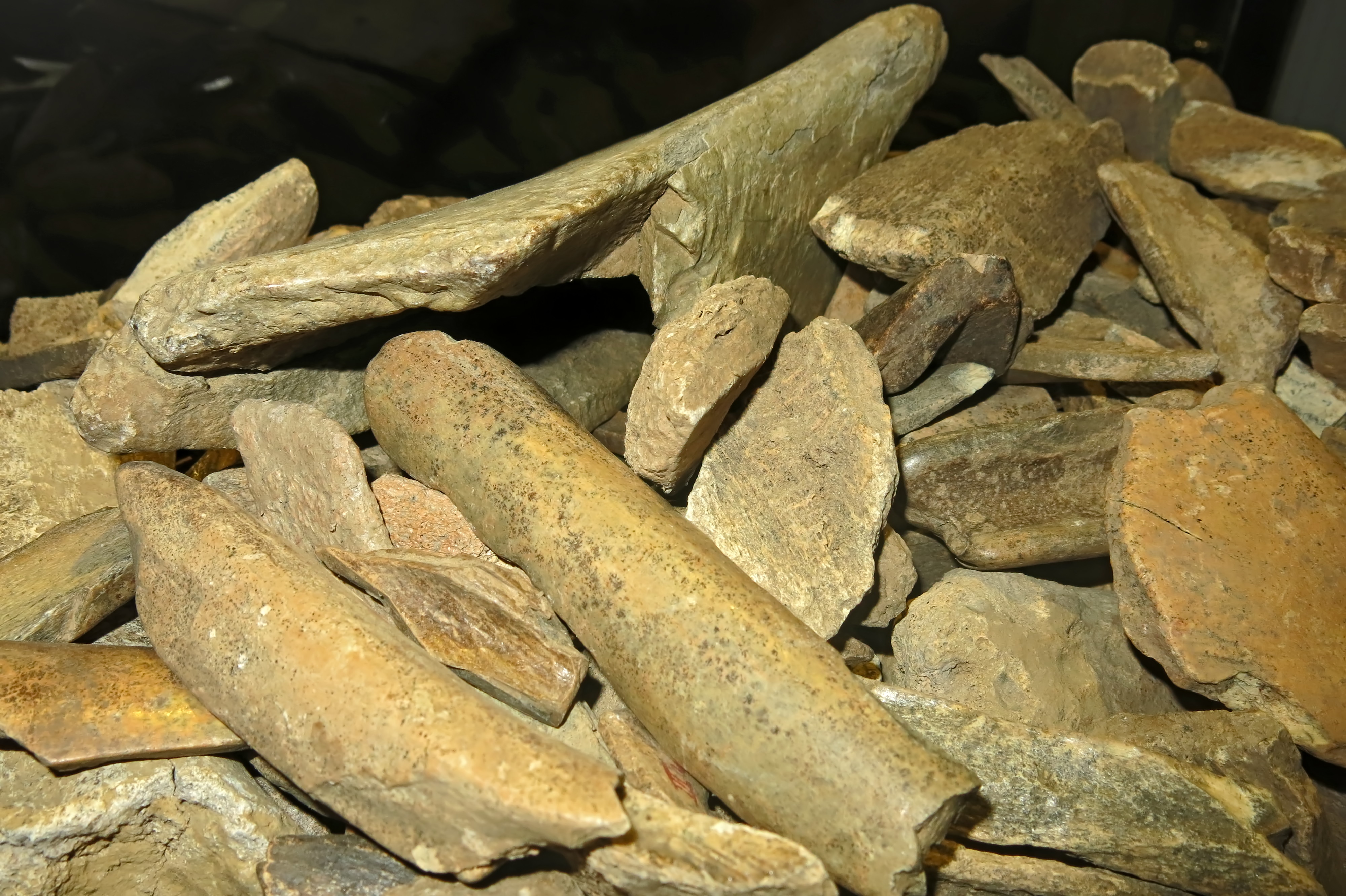
Hunting the vast herds on the plains of the ice ages.
In their collective hunts for the great animal herds, the huntsmen obtained huge quantities of meat and furs. The results of this slaughter can be found at some archaeological sites in the form of considerable deposits of bone, testimony to successful communal hunting, as shown here.
Together, the hunting parties were invincible. The hunters were able to bring down huge herds of beasts.
This was only possible with strong, well schooled teams, who were able to rely on each other unconditionally. The hunts were also a place for mutual contests of stamina and ability. This strengthened their courage and their appreciation of each other, as well as aiding the success of their hunt.
Photo: Don Hitchcock 2015
Source and text: Monrepos Archäologisches Forschungszentrum und Museum, Neuwied, Germany
References
- Bálint C., 2014: The bow from Holmegaard settlement and some remarks on the Mesolithic bows, University of Copenhagen, (VSB271) Periodekursus 2 (Forhistorisk Arkæologi) University of Copenhagen 2013-2014-2, https://www.academia.edu/7343714/The_bow_from_Holmegaard_settlement_and_some_remarks_on_the_Mesolithic_bows
- Banniza H., 1986: Urgeschichtliche Fundplätze in Haan (Rheinland): ein Beitrag zur Siedlungsgeschichte des Bergischen Landes mit Einführung in die Stein-, Bronze- und Eisenzeit, Paperback – 1986, 227 pp.
- Bordes F., 1959: Bordeaux, Gallia préhistoire, Tome 2, 1959. pp. 156-167.
- Bordes F., 1978: Le Protomagdalénien de Laugerie-Haute-Est (fouilles F. Bordes), Bulletin de la Société préhistorique française, tome 75, N. 11-12. pp. 501-521.
- Bordes F., 1979: Typologie du Paleolithique ancien et moyen, Paris: Editions du Centre national de la recherche scientifique.
- Cattelain P., Bozet N., Di Stazio G., 2012: La parure de Cro-Magnon à Clovis, Éditions du Cedarc - 2012
- Conard, N., et al., 2015: Excavations at Schöningen and paradigm shifts in human evolutionJournal of Human Evolution, (2015), http://dx.doi.org/10.1016/j.jhevol.2015.10.003
- Delluc B., Delluc G., 1982: Prehistoric Hunters, Hart Davis
- Demidenko Y., Usik V. P., 1993: On the lame à crête technique in the palaeolithic Préhistoire Européenne, Volume 4, pp 33-48
- Ehretsmann M., 1991: Un chopper à Waltenheim-sur-Zorn (Bas-Rhin), Cahiers alsaciens d'archéologie, d'art et d'histoire, ) 01 janvier 1991
- Fernandez H., Monchot H., 2006: Sexual Dimorphism in Limb Bones of Ibex (Capra ibex L.): Mixture Analysis Applied to Modern and Fossil Data, Int. J. Osteoarchaeol 17: 479–491 (2007).
- Gabunia L., et. al., 2000: Current Research on the Hominid Site of Dmanisi, Eraul 92, 2000, p. 13 to 27.
- Heim J., et. al., 1982: Achenheim: une séquence-type des loess du Pléistocène moyen et supérieur, Quaternaire Année 1982 19-2-3 pp. 147-159
- Langley M., et. al., 2020: Bows and arrows and complex symbolic displays 48 000 years ago in the South Asian tropics, Science Advances 12 Jun 2020: Vol. 6, no. 24, eaba3831 DOI: 10.1126/sciadv.aba3831
- Lwoff S., 1962: Les Fadets, Commune de Lussac-les-Châteaux (Vienne), Bulletin de la Société préhistorique de France 1962, tome 59, N. 5-6. pp. 407-426.
- Pétillon J. et al., 2011: Hard core and cutting edge: experimental manufacture and use of Magdalenian composite projectile tips, Journal of Archaeological Science 38 (2011) 1266e1283
- Ramendo L., 1963: Les galets aménagés de Reggan (Sahara), JLibyca11: 42–73.
- Sklenar K., 1988: Hunters of the Stone Age, illustrated by Pavel Dvorsky and Eliska Sklenarova, Heinemann Publishers Australia, 1988
- Wilkins J., Schoville B., Brown K., 2014: An Experimental Investigation of the Functional Hypothesis and Evolutionary Advantage of Stone-Tipped SpearsPLoS ONE , i9(8): e104514. doi:10.1371/journal.pone.0104514