Back to Don's Maps
Back to Dolni Vestonice main page
Dolni Vestonice and Pavlov sites

This is an excellent view by the highly talented artist Giovanni Caselli of what life must have been like at Dolni Vestonice during the winter. It was very close to the ice sheet which extended from the poles to just a few kilometres from Dolni Vestonice, creating a cold tundra-like vegetation, but one which was ideal for grazing animals such as mammoths and reindeer, who migrated to the area in summer, and then headed south for the winter. By preserving the food hunted in summer and autumn, the inhabitants could live a good life in the one area, aided by its local geography making it the focus point for travel in the area by grazing animals.
Painting: Giovanni Caselli

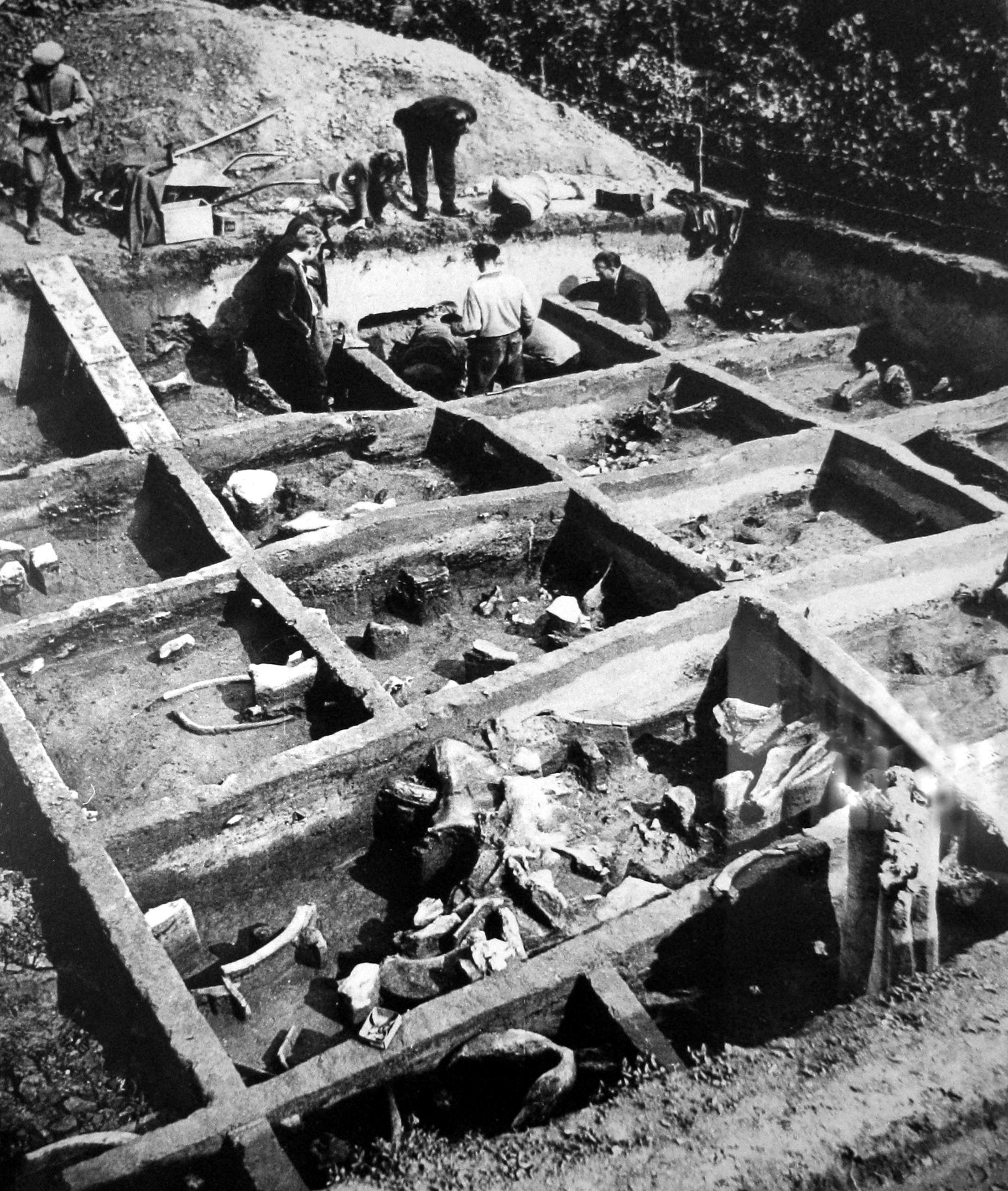
Detailed plan of Upper Paleolithic settlements in the Dolní Věstonice - Pavlov microregion.
Excavated Mammoth Bone Deposits, at Dolní Věstonice I and II, are indicated by oblong areas.
Photo: Svoboda (2001)
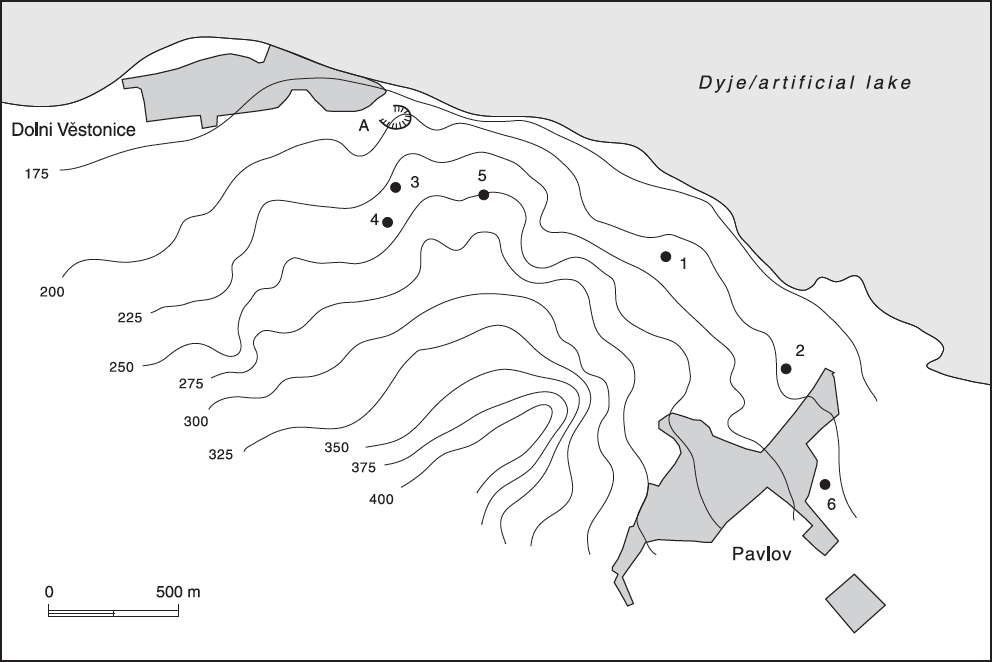
Map of the important sites from Dolni Vestonice to Pavlov. This map shows the position of Dolni Vestonice IIa at the site marked 4.
1. Dolní Věstonice I;
2. Pavlov I;
3. Dolní Věstonice II;
4. Dolní Věstonice II-A;
5. Dolní Věstonice III;
6. Pavlov II
A. Dolní Věstonice brickyard.
Photo: Verpoorte (2000)
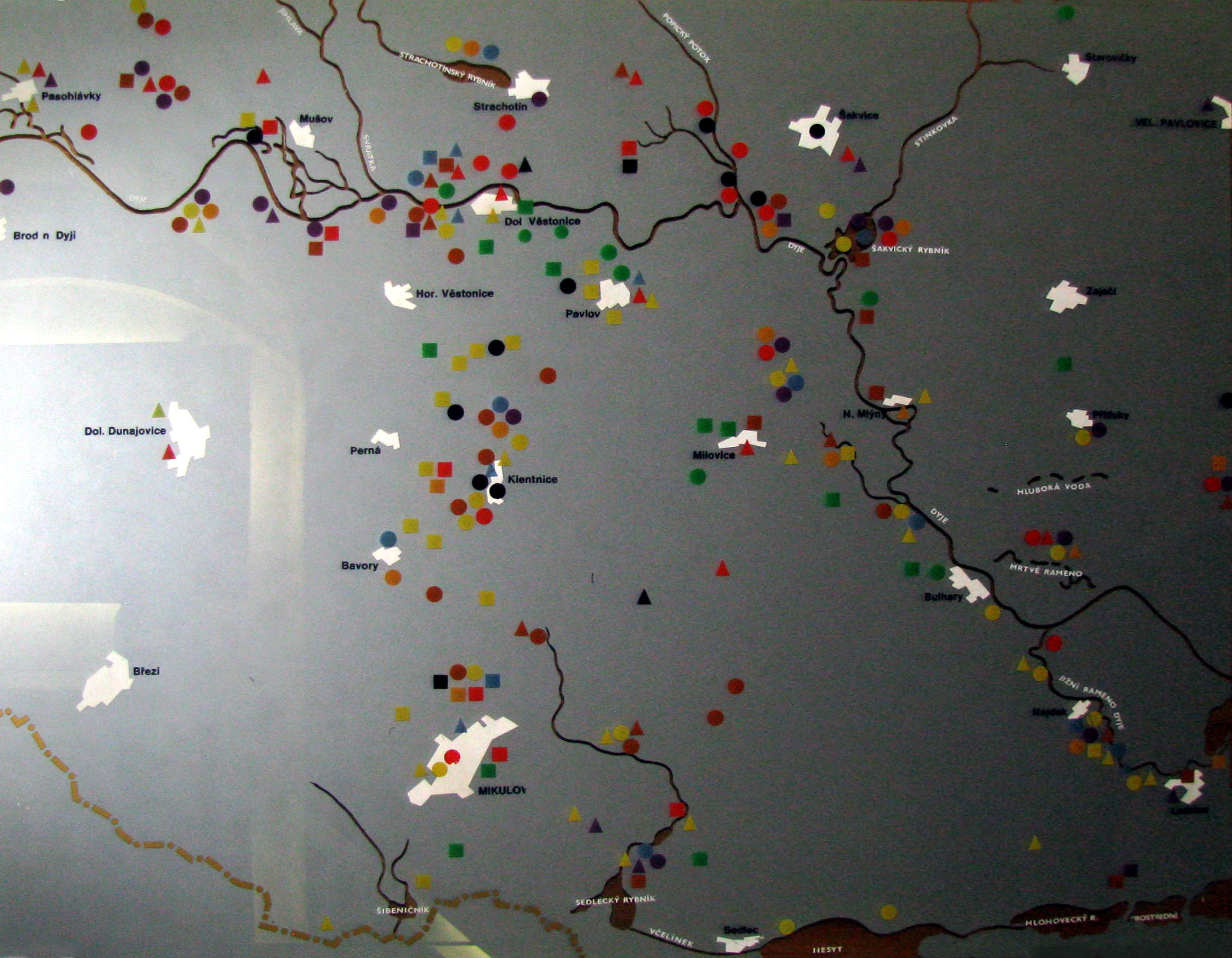
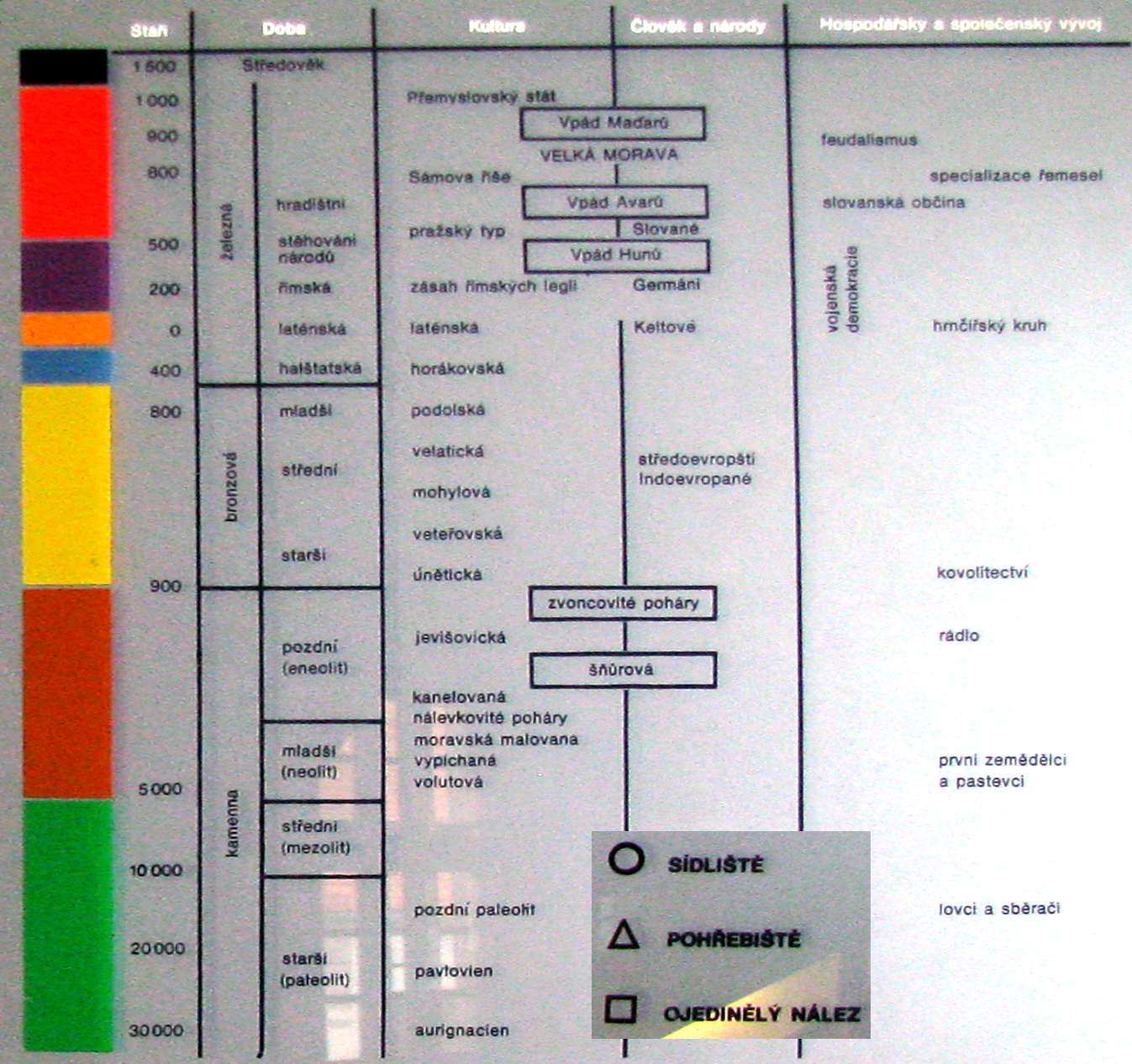
A map showing the distribution of sites in the Dolní Věstonice - Pavlov area. If you click on the map you will see a larger photo with the surrounding area included, which also has a large number of sites. The Dolní Věstonice - Pavlov cultural areas are shown in green.
This area is similar in many ways to the Kostenki - Borshevo region beside the Don River in Russia. It was not just one site, it was many, spread over a fairly wide area, and was an open air site. Most open air sites do not give the wealth of data that these sites, both here at Dolní Věstonice and at Kostenki, have yielded, and both are from similar times. Both have Venus figures, both depended heavily on mammoths for their culture, and both used mammoth bones in the creation of shelters.
Photo: Display, Dolní Věstonice Museum
Reasons for the large number of discoveries at Dolní Věstonice
The formation of terraces for vineyards, in particular after the Second World War, exposed long sections of loess, and provided opportunities for research, but also disturbed or destroyed large areas. Other sections are and were exposed during several episodes of loess exploitation in the old brickyard of Dolní Věstonice and the quarry of Pavlov. In 1985 and subsequent years, the loess cover above the old brickyard of Dolní Věstonice was quarried to provide material for the dams and dykes of three reservoirs in the Dyje river, leading to the drowning of the former marshy forest.
These activities necessitated intensive archaeological research including the excavation of the Pavlovian site of Dolní Věstonice II. The almost continuous archaeological explorations since the 1920s, related to interventions in the landscape, contributed substantially to the archaeological visibility of Pavlovian settlement in the Pavlov Hills.
Text above: Verpoorte (2000)
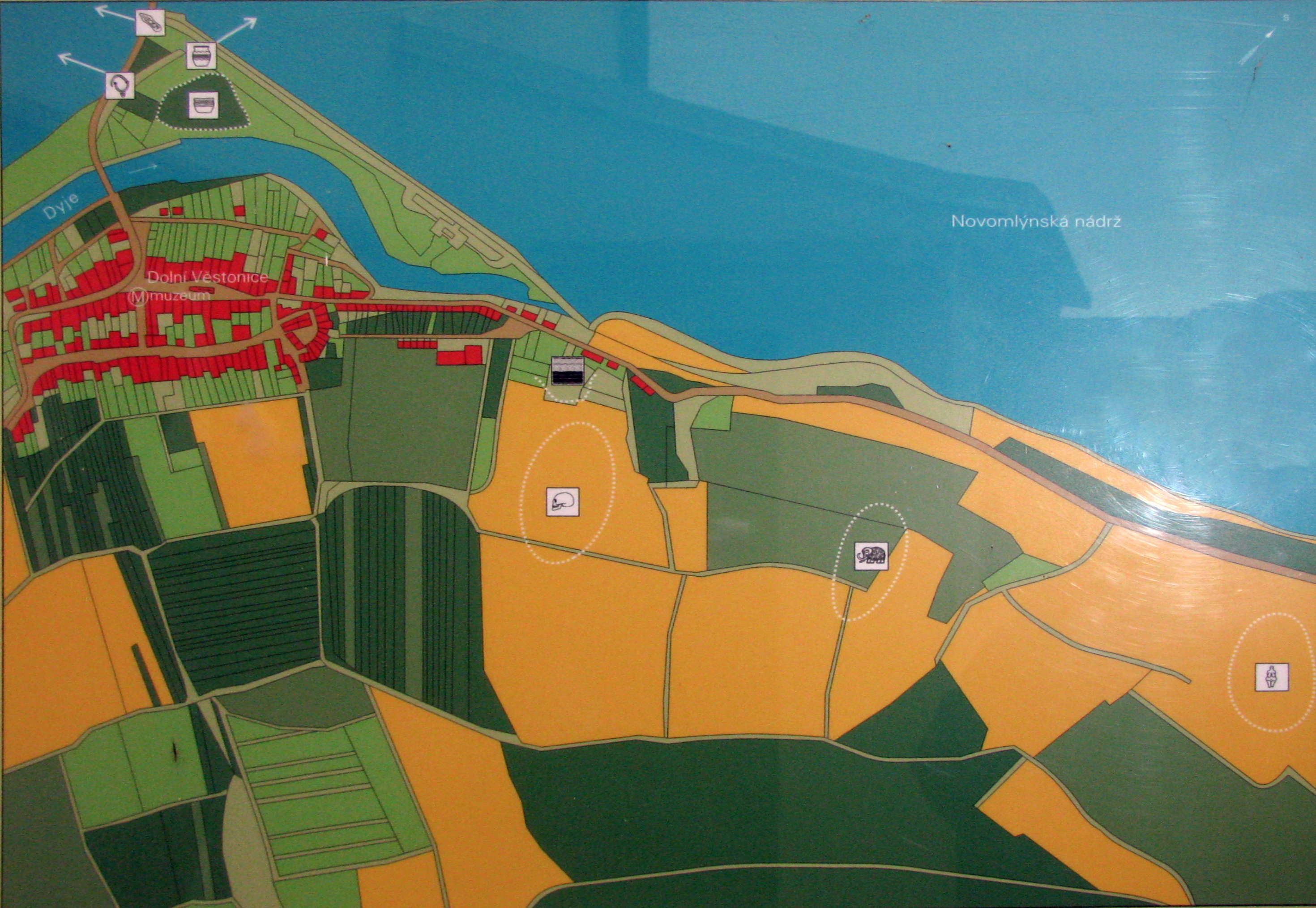
Dolni Vestonice map.
Note the icons on the map, which are explained below.
Photo: Don Hitchcock 2008
Source: Display, Dolni Vestonice Museum

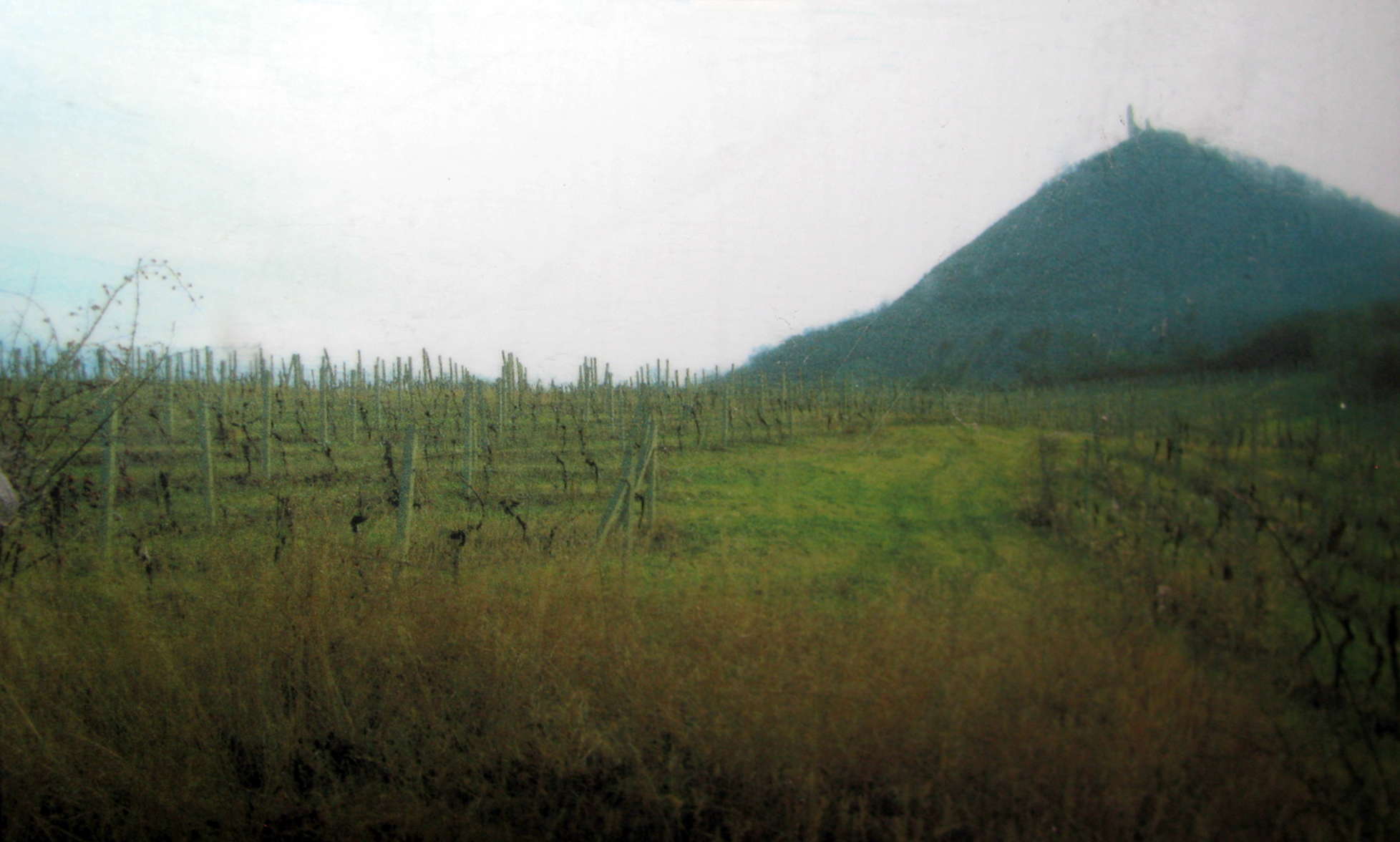
(Icon at left shows position of this photo on the large map above)
The Dolni Vestonice I Settlement site, returned to grape vines.
The most famous palaeolithic settlement in the whole area is the classic locality, Dolni Vestonice I, which was found in 1924 by Karel Absolon's systematic excavations, with that research continued by Bohuslav Klima. The site is the world's most exceptional concentration of a hunting population, with a wealth of artistic and ornamental artefacts (eg the Věstonice Venus), ritual graves, and the oldest evidence of new technologies (ceramics and textiles). The peak of settlement here was from 27 000 to 25 000 years BP.
Photo: Don Hitchcock 2008
Source: Display, Dolni Vestonice Museum
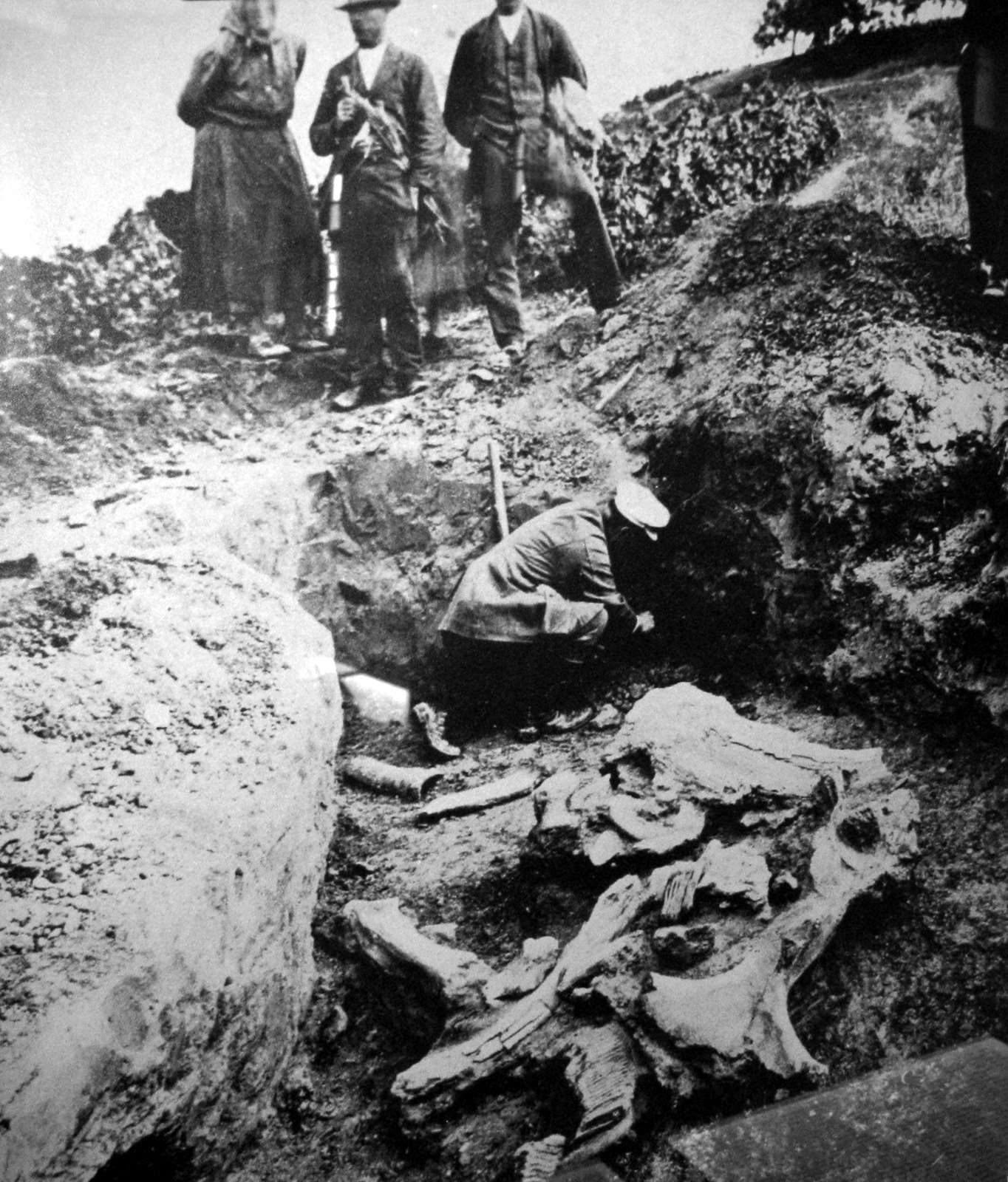
The first excavation in 1924.
Source: Display, Dolní Věstonice Museum
Text: Translated from the display.
From the excellent book 'Cro-Magnon Man' by T. Prideaux:
One of the best-known sites is Dolni Vestonice, in south central Czechoslovakia, and from the buried remains of this ancient community an intriguing picture of man's domestic life in Europe 27,000 years ago can be reconstructed:
On a grass-covered slope dotted with a few isolated trees, a settlement of five huts was partially surrounded by a simple wall of mammoth tusks and bones stuck into the ground and piled about with brush and turf. One hut was set 90 yards apart from the others. The four close together were supported by wooden posts leaning slightly towards the middle, like tent poles, and planted in the earth with rocks piled around their bases for support. The walls were animal skins, presumably dressed and sewn together, then drawn over the posts and anchored to the ground with stones and heavy bones.
A small stream meandered down the slope close by the houses, and the ground all around had been hard-packed by the feet of the generations of people who lived here. In an open place among the huts there was a large fire; very likely a fire-tender kept it going by throwing on chunks of bone. Apparently it burned all the time to keep prowling animals away.
Inside the largest hut, about 50 feet long by 20 feet wide, were five shallow hearths dug in the floor. One was equipped with two long mammoth bones stuck in the ground to support a roasting spit. In these relatively comfortable surroundings it is easy to imagine a man sitting on a boulder making tools-working with the purposeful, deceptively slow movements -of a master craftsman, using a bone hammer to strike delicate blades from a cylindrical chunk of flint, the core. Meanwhile, from a far end of the hut might have come a clear, high-pitched sound like a bird's call. Its source would have been a woman blowing into the end of a piece of hollow bone that had two or three holes pierced in its length-what humans some 25,000 years later would call a penny whistle has been found at Dolni Vestonice.
But the most startling discovery at this Czech site is the remains of the small hut up the slope that was set apart from the others. The hut had been cut into the hill, which formed its back wall; its sides consisted partly of a low wall of stones and clay, and the entrance faced downhill.
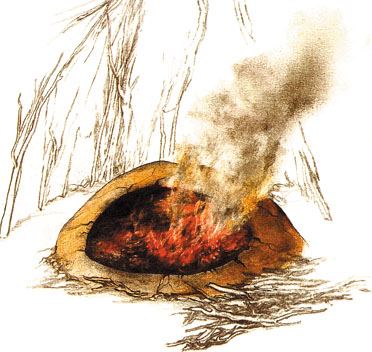
Inside a visitor would have seen a hearth quite different from those apparent in the other huts; this one had an earthen dome on top of fiercely glowing coals. It was an oven for baking clay, a kiln-one of the very first ever built. Even at this early date the raw material that was baked in the kiln was a specially prepared substance. No simple mud from a stream bank, it was earth mixed with powdered bone to make the heat spread evenly as the oven baked, or fired, the clay into a new, rock-hard material. This is the first example in technological history of what was to become a ubiquitous process-the combination and treatment of two or more dissimilar substances to make a useful product unlike either starting substance-eventually leading to glass, bronze, steel, nylon and most of the other materials of everyday life. It would be another 15,000 years or so before other men, living in what is now Japan, learned to turn clay into pots; yet, as the evidence from Dolni Vestonice attests, ceramics had already been invented.
When the kiln hut was first investigated in 1951, its sooty floor was littered with fragments of ceramic figurines. There were animal heads-bears, foxes, lions. In one particularly beautiful lion head there is a hole simulating a wound, perhaps intended to help some hunter inflict a similar wound on a real lion. The floor was also cluttered with hundreds of clay pellets bearing the fingerprints of the prehistoric artisan; he probably pinched them off his lump of unbaked clay when he first began to knead and shape it to his desire. And there were limbs broken from little animal and human figures. They may have cracked off in the baking, or when the ancient ceramist tossed aside a work that failed to please him.
But more intriguing than any waste fragments or even clay animal figures on the hut floor are the human statuettes found there-particularly the female figures. Unlike the animals, they are not naturalistic but almost surreal. They have bulging breasts and buttocks, ~distorted arms and legs that taper to points. Experts today still wonder about these so-called Venuses (pages 92, 98-100). Were they household goddesses whose pointed legs were stuck in the ground to hold them upright as they watched over hearth and home? Were they fertility symbols whose ample figures were supposed to enhance fecundity? Certainly they are beautiful objects in spite of their grotesque proportions. They have a grace and dignity, a stylized plasticity, that make them comparable to some modern sculpture.
Text below from:
The Prehistory of Europe by Patricia Phillips 1980
One of the most famous Moravian sites is Dolni Vestonice, situated on the hill of Pollau, commanding good views, and with nearby springs. It was excavated in the 1920s, when the famous 'Venus' figurine was found, and again in 1947-52 (Klima, B. 1963. Dolni Vestonice. Erforschung eine Lagenplatzes der Mammutjager an der Jahren 1947-52 (Monum. Archaeol., XI.)) There was a total of six levels of occupation.
A fairly cold climate is suggested by the molluscs, the charcoal and the pollen from the site. Spruce and pine were used to make fires, suggesting a forest tundra environment. Two possible structures (see Fig. 22) are described by Klima, the first roughly oval in shape, 15 m long x 9 m wide. This very large structure contained five hearths, most of them with large blocks of limestone nearby.
The hearths seemed to have been the focus for most activity, judging by the number of finds made near them. The excavators wonder if small ash-filled pits near the hearths represent storage places. More than 35 000 pieces of flint were found in the habitation area, and it appeared that flint working was carried out in the centre and north of the structure.
Chipped-stone tools were made on local chalk flint and hornstone and on Carpathian radiolarite. Mammothbone artifacts, shells and ochre were also found in the structure, particularly near the southern two hearths. The walls of the structure are presumed to have been of limestone blocks, perhaps surmounted in some way by shoulder-blades and pelves of mammoths; the excavators feel this may have been a summer structure, open to the sky.
Klima's plan of the hut excavation and surrounding trenches reveals that a relatively clear space existed to the south-east of the hut, followed by enormous piles of mammoth bones. These were excavated in 1952 and revealed the remains of approximately one hundred, mostly young, individuals, with rarer bones of horse, reindeer, hare, wolf and fox. A series of hearths lay below the bone accumulations. No projectile points were found, and the excavators suggest that the mammoths could have been hunted by using ivory projectile points or wooden lances (Klima, B. 1963. Dolni Vestonice. Erforschung eine Lagenplatzes der Mammutjager an der Jahren 1947-52 (Monum. Archaeol., XI.)).
The second hut was about 6 m in diameter, with a central hearth and five of the original post-holes remaining. The most important artifacts were some 2000 lumps of burnt clay found near the central hearth, some of them bearing fingerprints, others modelled in the shape of animal heads (bear, wolf and fox). The excavators wondered if this 'special activity' hut belonged to a shaman. A child buried at Dolni Vestonice III had a necklace of twenty-seven pierced fox teeth; the skull area was covered with red ochre, and the whole burial lay beneath mammoth shoulder blades. The elaborate treatment suggests that the child had some importance in the community.
Klima believes that Dolni Vestonice was occupied specifically for mammoth hunting, and that with as many as twenty to twenty-five people per hut, and a postulated five or six huts being occupied at a time on the site, the occupants may have been 100-120 strong. The length of stay each season, and the possible length of use of the site, have not been estimated.
Banesz has recently reviewed the evidence for habitation structures in central Europe, and remarked on the fact that one third of those known lie in Czechoslovakia. Extensive sites are known from Pavlov. Here eleven 'habitation units' are known, and the site is still being excavated. The structures are circular, oval and 'pinched in at the centre', all contain hearths, and there is evidence for the re-use of post-holes. This led the excavators to suggest long occupation at the site (Klima B. 1976. Le Pavlovien IXe Congr. UISPP, Nice, Coll. XV, pp. 128-41. Paris CNRS.).
Klima regards the Pavlovian as a specialized mammothhunting industrial complex, on the cold loess country of central and eastern Europe. Other authors have suggested that the mammoth bones could have been scavenged rather than hunted. The more remarkable aspects of the assemblage at Pavlovian sites are the mammoth-bone and ivory industries which include possible earth-working tools - shovels, hoes, pickaxes and spearpoints.
Klima has suggested that the mammothhunters of Pavlov had complex and specialized hunting methods, including verbal signalling on bone pipes (found in the assemblage), and collective large-group organization. Emphasis on mammoth is overwhelming, but other animal remains are found on the sites. For instance, at Predmost, apart from a large quantity of mammoth, remains of reindeer, horse, wolf, fox, glutton and hare were identified.
The potter who created the world's first ceramics, including the Venus of Dolni Vestonice, known as S'Armuna from Jean Auel's 'The Earth's Children' Series of books about Paleolithic life
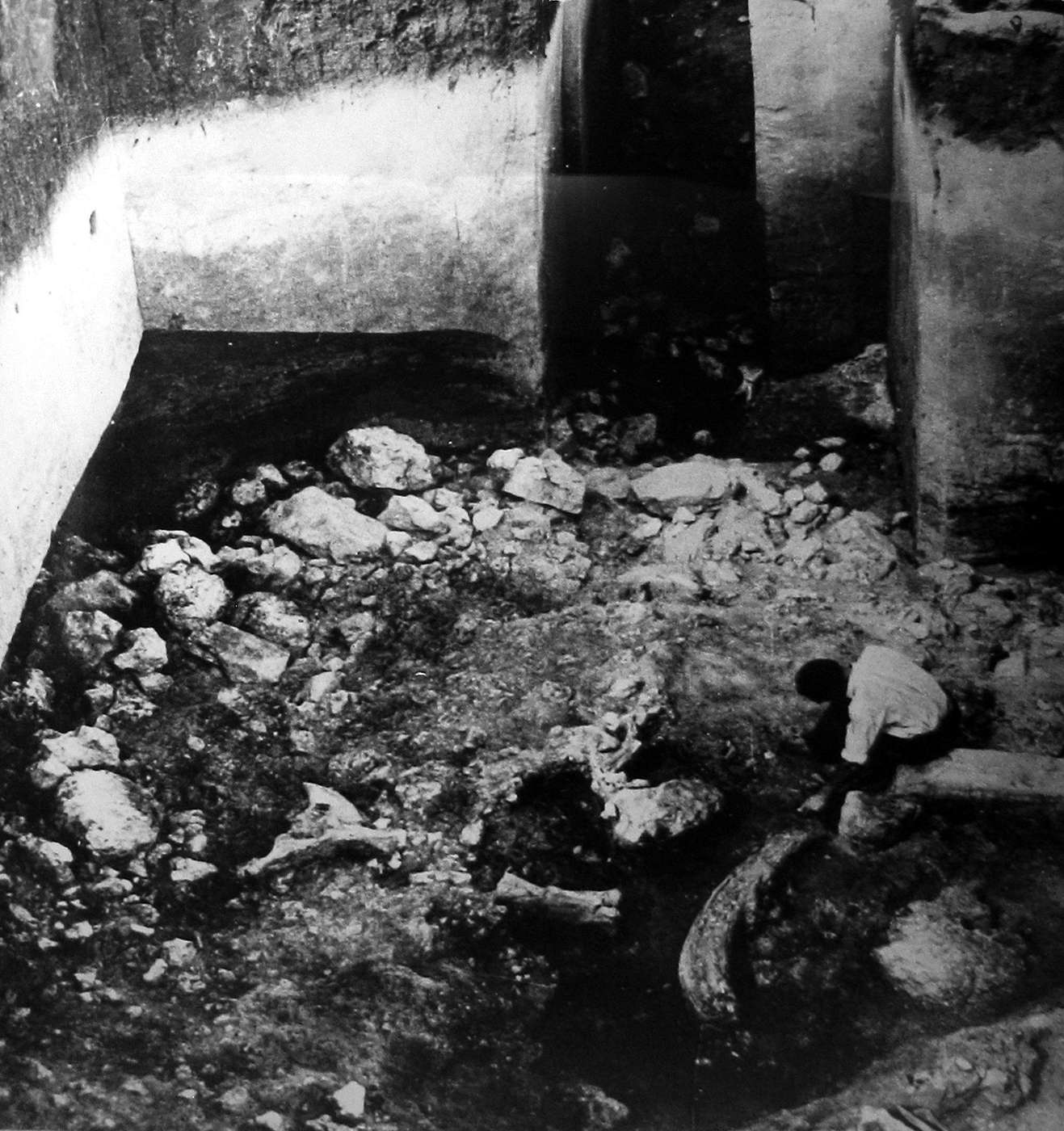
A research dig at Dolni Vestonice, which exposed a fireplace used to create ceramic objects, the first ever made.
Note the perfectly smooth and vertical walls, possible only because of the loess which covered the deposits. Loess is wind blown rock flour from glacial action.
This is the hut of the world's first potter (called S'Armuna in the Earth's Children series of books on ice age life ). Note the curved retaining wall of limestone blocks. There were a number of post holes suggesting a sloping roof. In the centre there was a well constructed hearth which was flanked by mammoth tusks. In and around the hearth were more than 2300 fragments of fired clay, the earliest 'pottery' in the world.
Text: Don Hitchcock
Photo: Display, Dolní Věstonice Museum
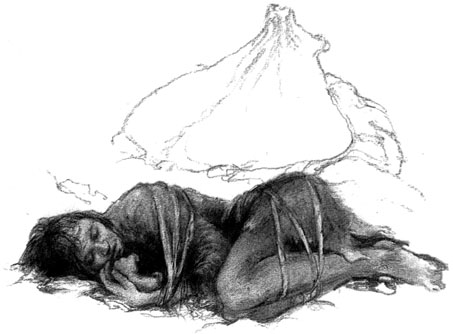
Dolni Vestonice is the most important Palaeolithic site in the Czech Republic. It was first excavated in 1949. While uncovering a large hut, they dug a little below the original floor level. Here they found a body which had been laid in a shallow dish shaped pit, and covered with two mammoth shoulder bones, one of which had been engraved on its lower side. The body rested on its right side with its knees drawn up to the chin. The body had been sprinkled with red ochre before being covered. It belonged to a woman who had been about 40 years old when she died, and had been small and slim, standing about 160 cm, or 4 feet 10 inches at most. Lying in the grave were several flint flakes. Beside the body's left hand were the bones of an arctic fox, while the right hand grasped ten canine teeth from an arctic fox. The complete grave can still be seen in the Moravian Museum at Brno.
One of the burials revealed a human female skeleton, ritualistically placed beneath a pair of mammoth scapulae, one leaning against the other. The bones and the earth surrounding it contained traces of red ochre, a flint spearhead had been placed near the skull and one hand held the body of a fox. This evidence indicates that this was the burial site of a shaman. This is the oldest site not only of ceramic figurines and artistic portraiture, but also of evidence of female shamans.
Text above: Wikipedia
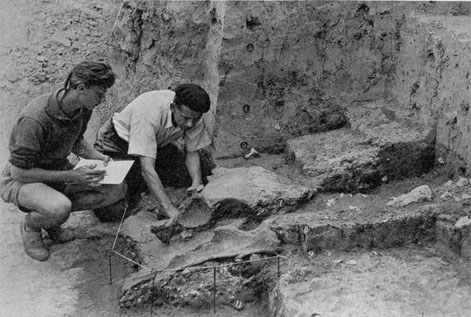
Excavation of the woman buried beneath a mammoth shoulder blade, above which there was part of a mammoth pelvic bone. The skull is visible on the side below the shoulder blade, near the numbered disk '11'. Radiocarbon dates on the human remains give an approximate date of 27 000 years BP.
The place and the moment of discovery of the grave.
Photo: Don Hitchcock 2008
Source: Display, Dolní Věstonice Museum
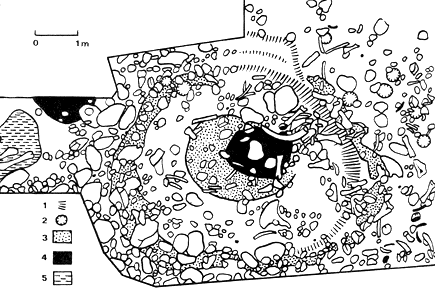
Plan of round hut number II discovered by B. Klima in 1951 at Dolni Vestonice. 1 Depression in the ground: 2 Post holes; 3 Remains of the circular wall around the dwelling and the fireplace; 4 fireplace; 5 spring
This is the plan of S'Armuna's hut which stood at Dolni Vestonice 25 000 years ago. Its edge was strengthened with a wall of earth and stones, in which the posts supporting the roof were placed. The pole holes are marked on the plan by black holes. In the centre of the floor was found the remains of a kiln. Scattered around the kiln and the hut were fired lumps of clay, some in the shape of animals.
The hut was on slightly sloping ground and also near a spring, now underground at the time of discovery. A single, oval-shaped fireplace was found in the middle of the almost circular dwelling which was 6 metres in diameter. The fireplace had a blackened clay step around two thirds of it. Several rough pieces of clay were found in the ashes, and also parts of clay animals and human figurines. The living room and fireplace had been levelled by extending one side into the slope for about 0.8 metres, and building up the other with stones.
At the edge and within the surface area two types of post holes have been discovered. Four larger holes were vertical, lined with stones and placed in the remains of the stone wall. They were 200 mm deep, 100 to 150 mm wide, and carried the main posts of construction. (8 inches deep by 4 to 6 inches wide). No holes were found on the other side. The roof of the dwelling must have had a distinct slope. One side of the roof rested on the poles, the other on the ground. The post holes of the second type were at an angle, about 100 mm deep and 50 to 70 mm wide. These three holes were located in the inner part of the dwelling and obviously supported extra props for the roof.
It was not only a living room but also a work room. The hut stood apart from the others and could have housed a high ranking person such as a shaman or medicine man.
-J Jelinek, 'The Evolution of Man'
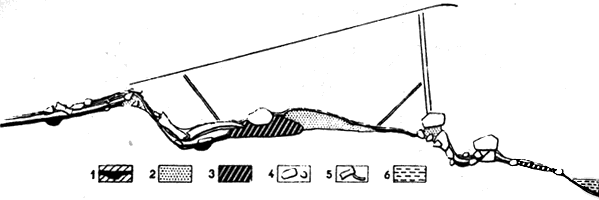
S'Armuna's hut
Cross section of the hut above showing the sloping roof. I had always thought that there was the outline of a skeleton lying on its back with legs up on the slope and head in the fireplace, but this is an illusion. There are mammoth bones at the back of the hut, and a stone in the fireplace where the head would be. Note also that the plan of the hut is round, although in this cross section it might appear to be a long narrow structure.
S. Mason has also found tap root material from the compositae family, which includes daisies and dandelions, at Dolni Vestonice. These roots are often quite edible. See http://www.ucl.ac.uk/archaeology/research/profiles/smason/smdolnv.htm
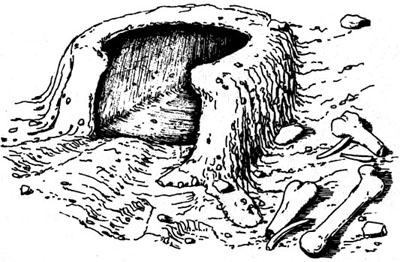
Photo: K. Sklenar, 'Hunters of the Stone Age'
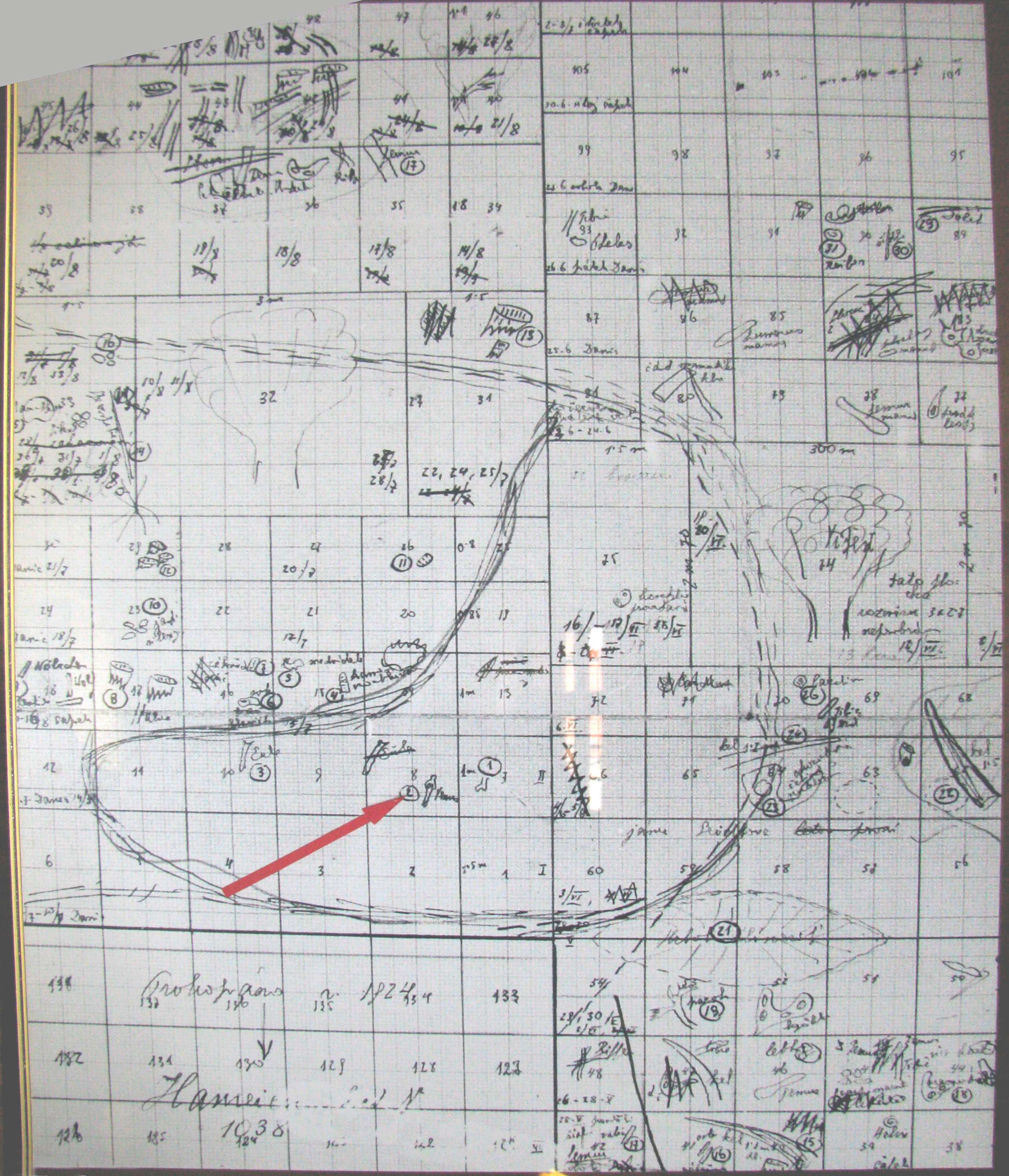
(Annotated map of one of the sites at Dolní Věstonice, with the red arrow showing the place where the Dolní Věstonice Venus was found by Dr Karel Absolon in 1925.
This is an historic document, and displays the way that archeology was becoming a far more scientific and well recorded science by this time. Previously, field notes and careful measurements of sites were very rarely done in such detail, and this carefully drawn grid is a tribute to the professional scientific work done by Dr Absolon - Don.)
Source: Display, Dolní Věstonice Museum
Rephotography: Don Hitchcock 2008
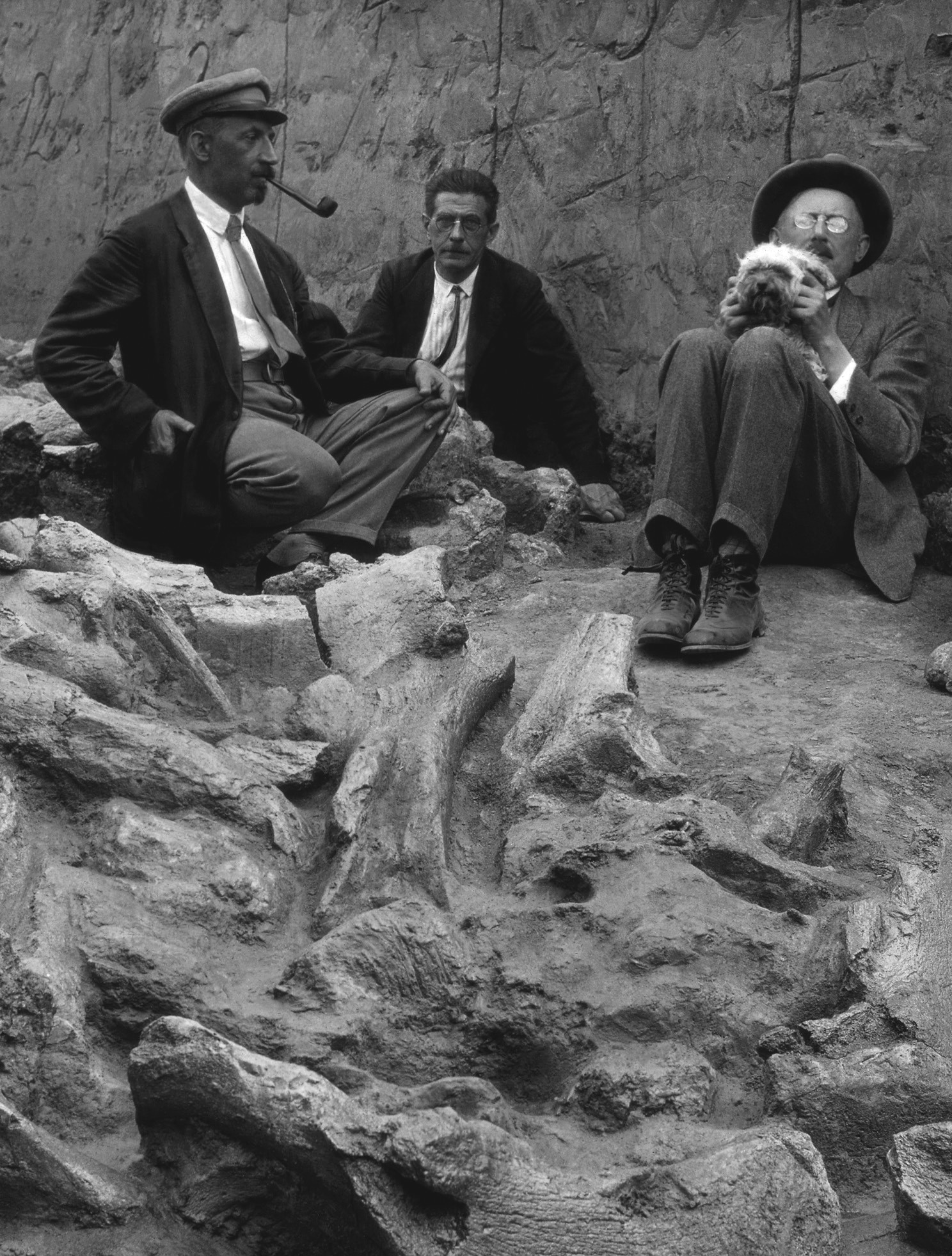
Dolní Věstonice and an uncovered Kjökkenmödding or kitchen midden, consisting mainly of mammoth bones, in 1928.
From right: K. Absolon with his dog Šňupárius, R. Czižek (entrusted with the direction of excavations in the Pekárna Cave) and the editor Stejskal.
Photo: Archives of the Anthropos Institute, Moravian Museum.
Source: Kostrhuna (2009)
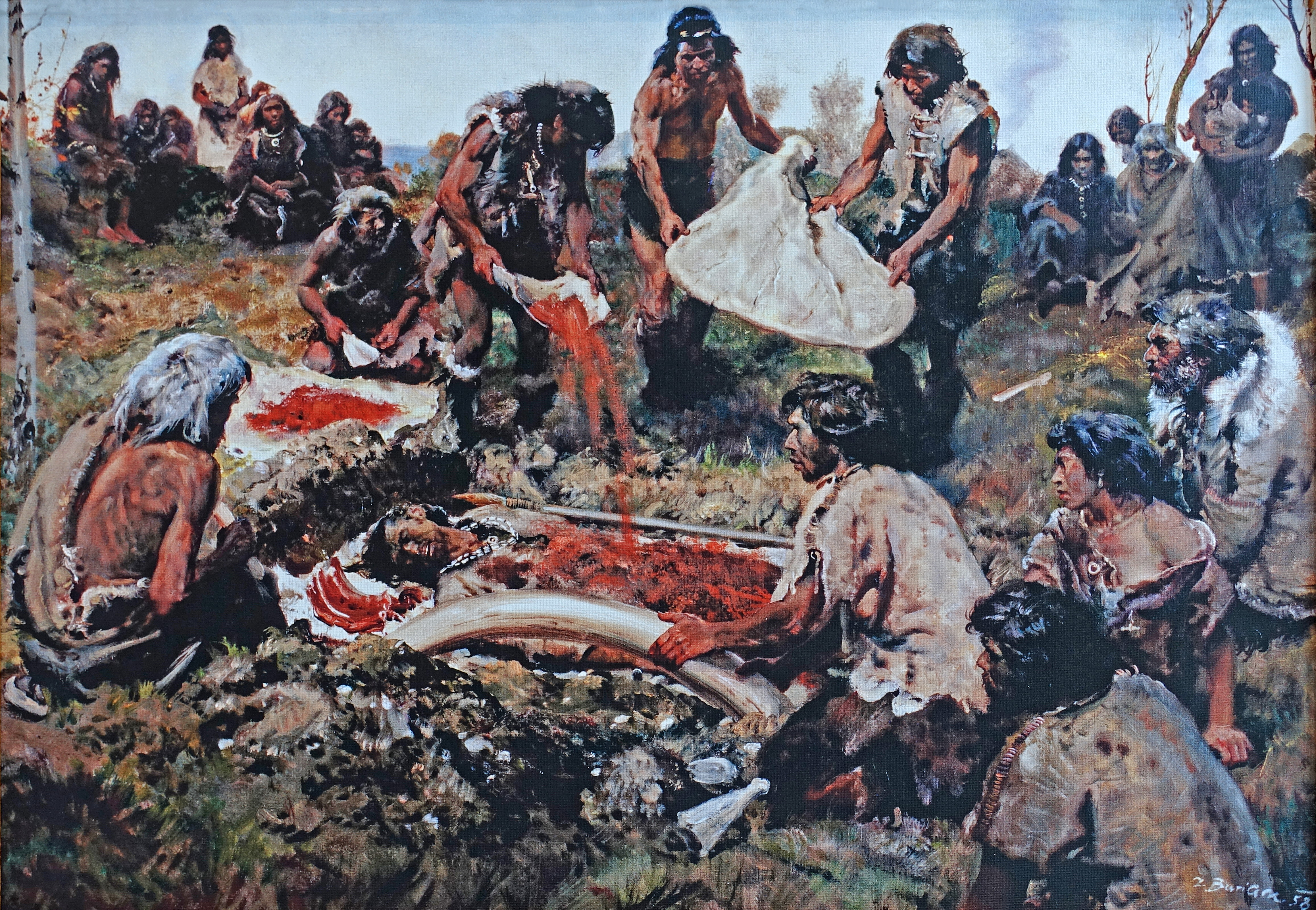
Funeral of a mammoth hunter at Dolní Věstonice.
Painting: Zdeněk Burian, 1905 - 1981
Rephotography: Don Hitchcock 2018
Source and text: Anthropos Pavilion/Moravian Museum, Brno, Czech Republic
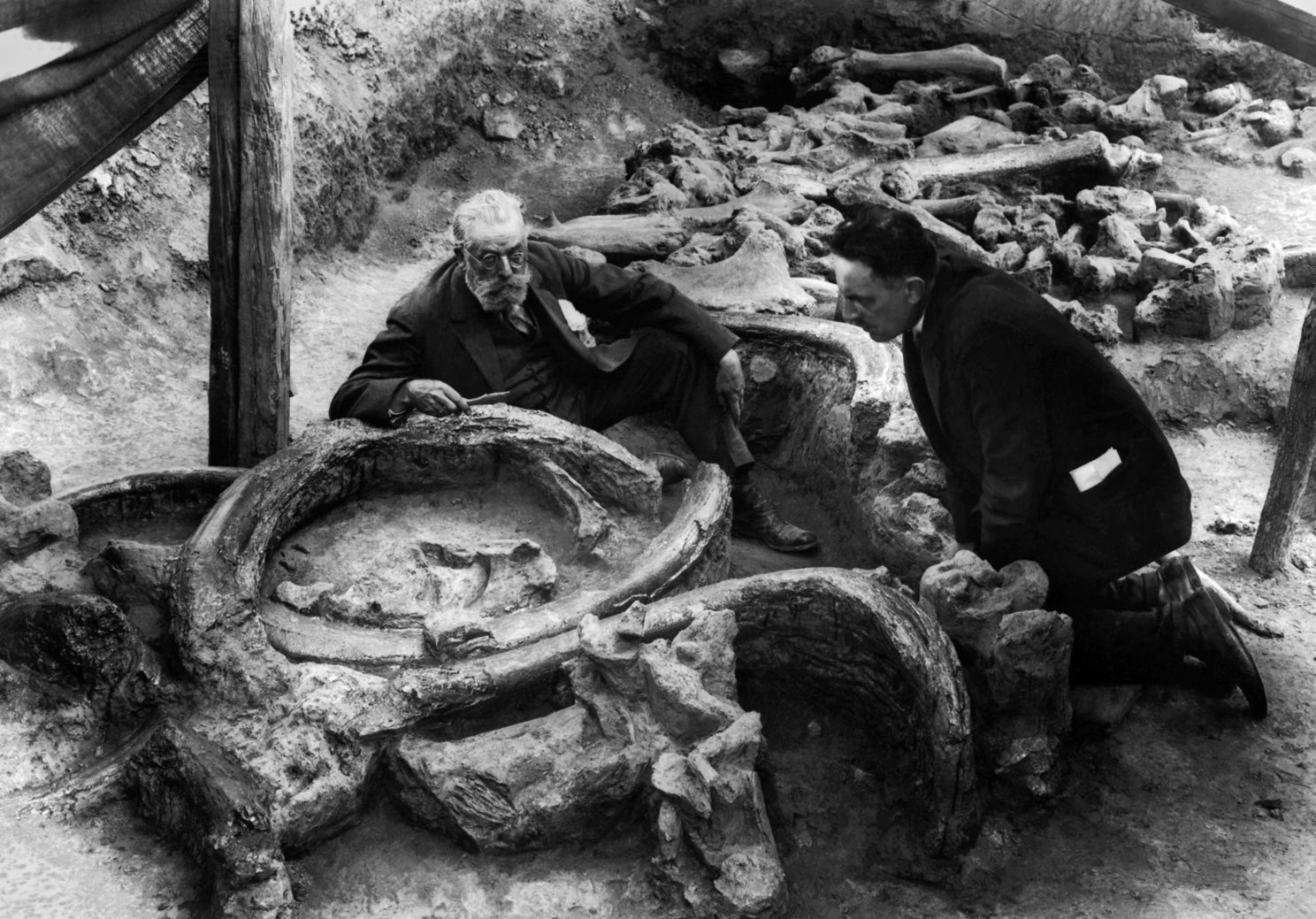
Karel Absolon (right) and Henri Bégouën in Dolní Věstonice cleaning a Kjökkenmödding or kitchen midden, consisting mainly of mammoth bones, in 1926.
Photo published in 'Le Matin' on September 25th, 1926.
Photo: Archives of the Anthropos Institute, Moravian Museum.
Source: Kostrhuna (2009)
The Clay and the Figurine Making Process
Text below from: https://openaccess.leidenuniv.nl/bitstream/handle/1887/13512/ASLU08_05.pdf
Raw Material
Silt loams of local origin provide the raw material for the ‘ceramics’. Vandiver et al. (1990) offer four arguments in favour of this identification. They compared ‘ceramic’ fragments from Dolní Vestonice I with 'loess' samples from the same locality. Their analyses demonstrated a large degree of similarity in:
1. bulk chemical composition (a.o. Si02 and Al20 3),
2. microstructures,
3. minerals present (a.o. quartz, muscovite mica and illitic clay) and
4. grain size distribution.
These results were confirmed by the analysis of the Pavlov I ‘ceramics’ (Soffer and Vandiver 1997). The local origin of the raw material could also be demonstrated for the Krems-Wachtberg objects. Diatoms of a local, Badenian age, marine sediment could be determined in a general ‘loess’ body (Einwögerer 2000). On the basis of the lowered porosity of the 'ceramics' compared with the silt loams, Vandiver et al. (1990, 41) argue that the local silt loams were mixed with water.
Moulding
The mixture of silt loam and water was shaped by kneading the material into a particular shape. Klíma (1963a) even identified some fragments with fingerprints. Sometimes material was added and rolled and pressed together (Soffer and Vandiver 1997, 388). The figurines were not sculpted from a larger block of raw material, but ‘built’ by joining parts together. The figurines are all modelled as three-dimensional forms for which an additive process was followed. There is little evidence of smoothing the surface.
In a few instances, decorations and other incisions were observed. Only the most telling details, in particular on the animal heads, are indicated. In general however there is only minimal detailing. There is no evidence for post-firing modification of the surface by the application of pigments or burnishing.
The Firing Process
The 'ceramics' range in colours from tan to grey and black or, less frequently, to orange and red. Judging from the grey and black colours, the majority of the 'ceramics' were fired in a reducing environment. A minority was fired in an oxidizing environment. Vandiver et al. (1990, 54) also suggest that 'most Dolní Vestonice ceramics were cooled in a reducing environment, for instance in ash, rather than oxidized in a flow of incoming air'. The presence of siliceous ash on the outside of the figurines indicates that 'either they were set in the fuel which then burned to ash or that they were surrounded in a protective ash layer during the firing' (Vandiver et al. 1990, 62).
Some objects were so wet while fired that they gave way and lost their shape (Vandiver et al. 1990, 69), for example two anthropomorphic figurines from the middle part of Dolní Vestonice I (numbers 5 and 7). The range of temperatures at which the 'ceramics' were fired varied between 500 and 800°C. However, Vandiver et al. (1990, 54) add that 'samples fired to 400°C or below would not have survived the 26 000 years of freeze-thaw cycles'.
Most fragments were probably fired in the higher temperature range of 700-800°C. It must be added that the higher the temperature, the harder the 'ceramics' and therefore the better their chances of 'survival'. The firing time is estimated at no more than a few hours (Vandiver et al. 1990, 54).
Breakage
The fragmentation of the 'ceramic' anthropomorphic figurines was already noted above. In view of the total collection of 'ceramics' it is even more striking. I estimate that 99% of all 'ceramics' consists of fragments. Breaks occur most frequently where two parts were joined. There are only very few more or less complete figurines: the 'Venus' and some animal figurines from Dolní Vestonice I and the wolverine of Predmostí.
Vandiver et al. (1990, 64) differentiate between smooth, nonbranching fractures and rough, branching and stepped fractures. The fracture types are not equally present in all concentrations of 'ceramics'. The smooth, non-branching fractures dominate for example in the middle part of Dolní Vestonice I, i.e. concentration I of anthropomorphic and zoomorphic figurines. This kind of fracturing is attributed to mechanical forces for example due to trampling or the landslide processes in this area. The other fractures make up more than half of the fractures in Klíma's 'second settlement object' in the uppermost part of the site.
These fractures are attributed to thermal shock, i.e. high energy fracturing due to firing while the object is still wet. Soffer and Vandiver (1994, 1997) also mention this kind of fracturing for several Pavlov I objects (e.g. the seated female figurine). Other factors in the frequent breakage of the 'ceramics' are the insufficient joining of parts, the heterogeneity in the particle composition of loess (Vandiver et al. 1990, 44), variability in the water content and scaly fracturing due to intensive freeze - thaw cycles.
Text above from: https://openaccess.leidenuniv.nl/bitstream/handle/1887/13512/ASLU08_05.pdf
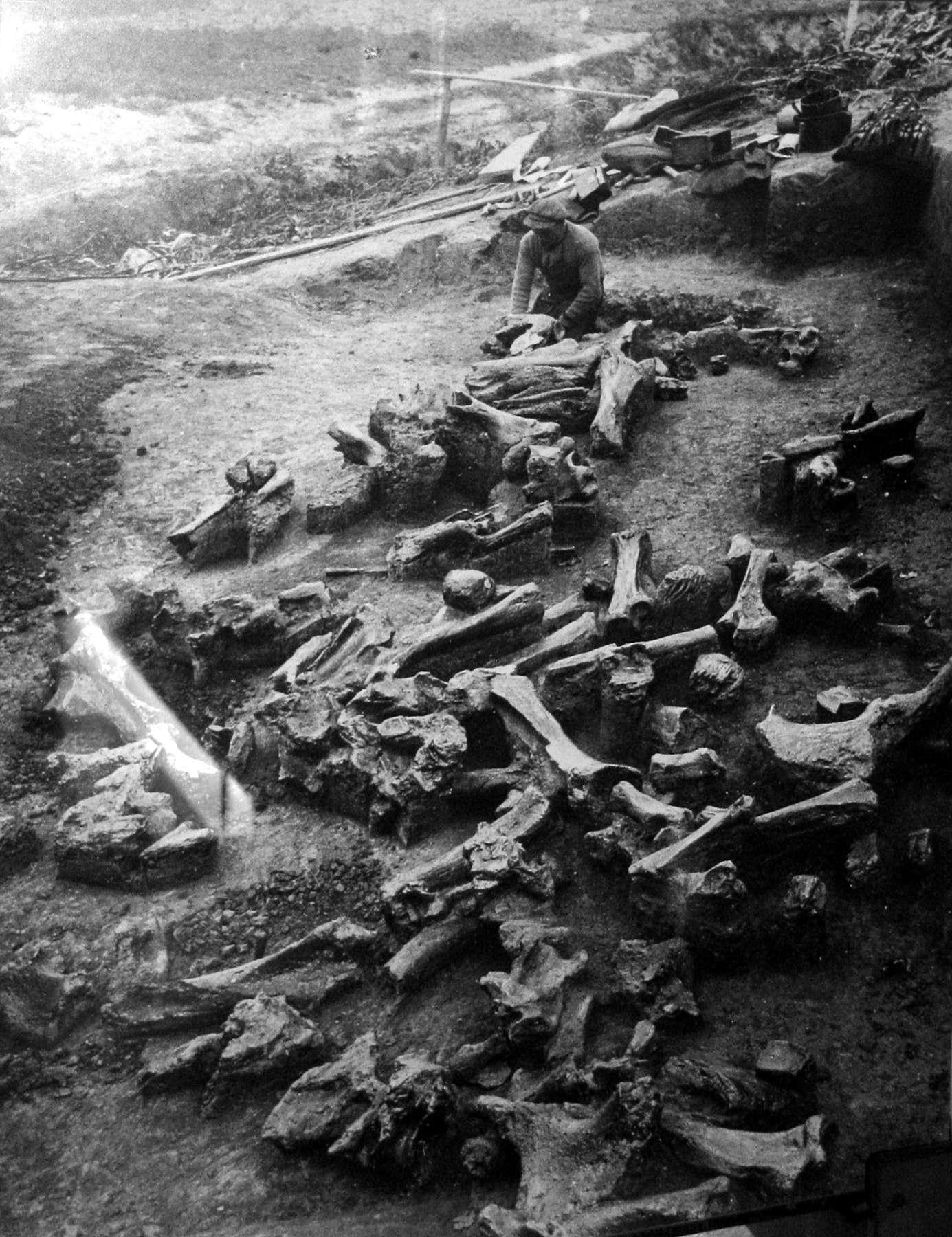
Excavated area in 1925 with many well preserved mammoth bones.
Source: Display, Dolní Věstonice Museum
Text: Translated and adapted from the display.

This sieve allowed the finest artefacts to be found in the sediments, all of which were put through to make sure all information possible was garnered.
Note the grape vines nearby - the site was in a vineyard.
Source: Display, Dolní Věstonice Museum
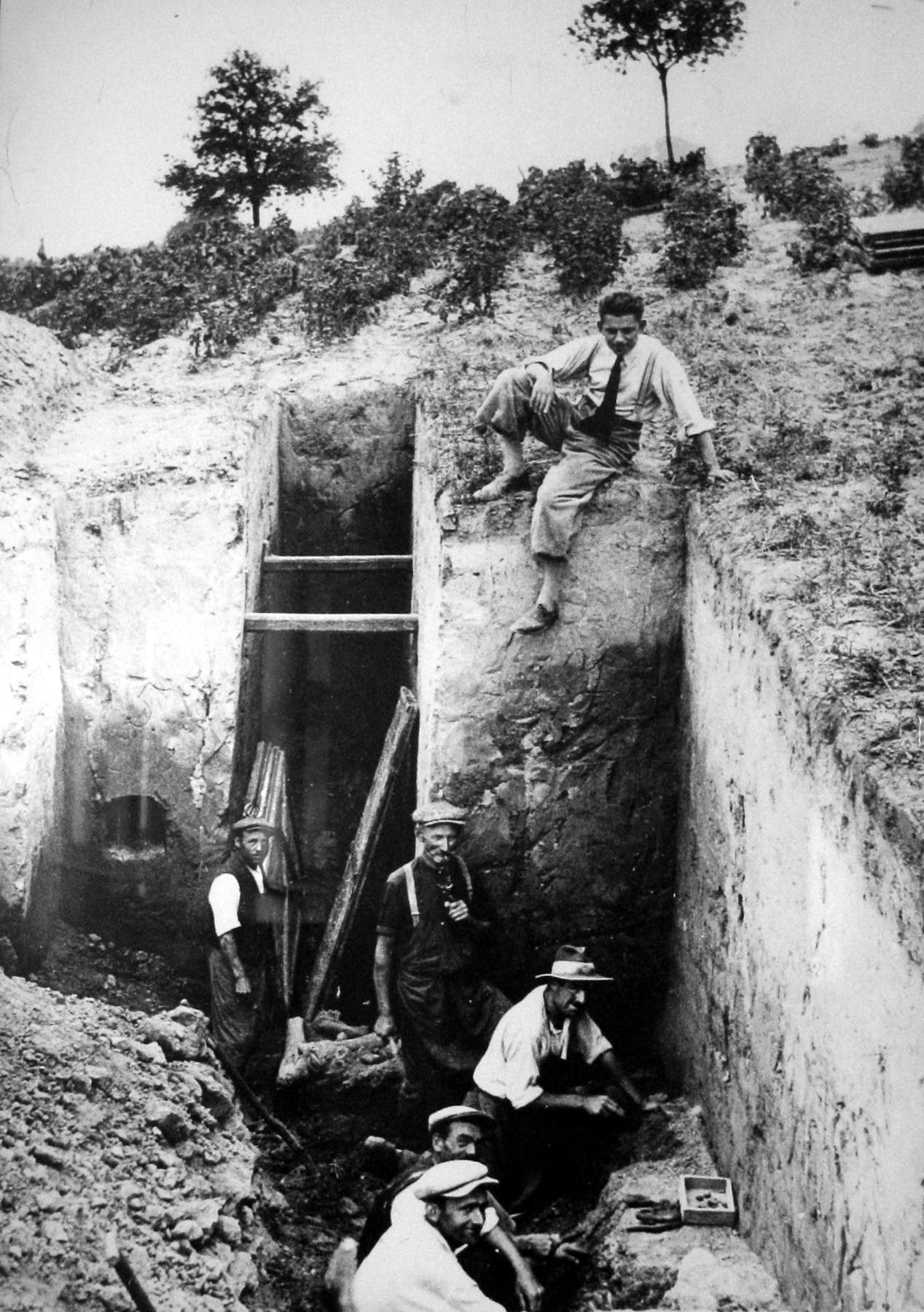
(Loess had covered the finds with several metres of fine grained sediments. Loess is rock flour created by the vast ice sheets and glaciers of the last ice age, ground from the basal rock, and picked up by strong winds during dry periods. There would have been very little visibility at such times.
The edge of the vast northern ice cap was close to Dolní Věstonice, and the periglacial conditions were ideal for the creation of tundra and steppe vegetation on which huge numbers of grazing animals such as horses and mammoths could thrive.
Dolní Věstonice was ideally placed for the passage and hunting of such game - Don)
Source: Display, Dolní Věstonice Museum
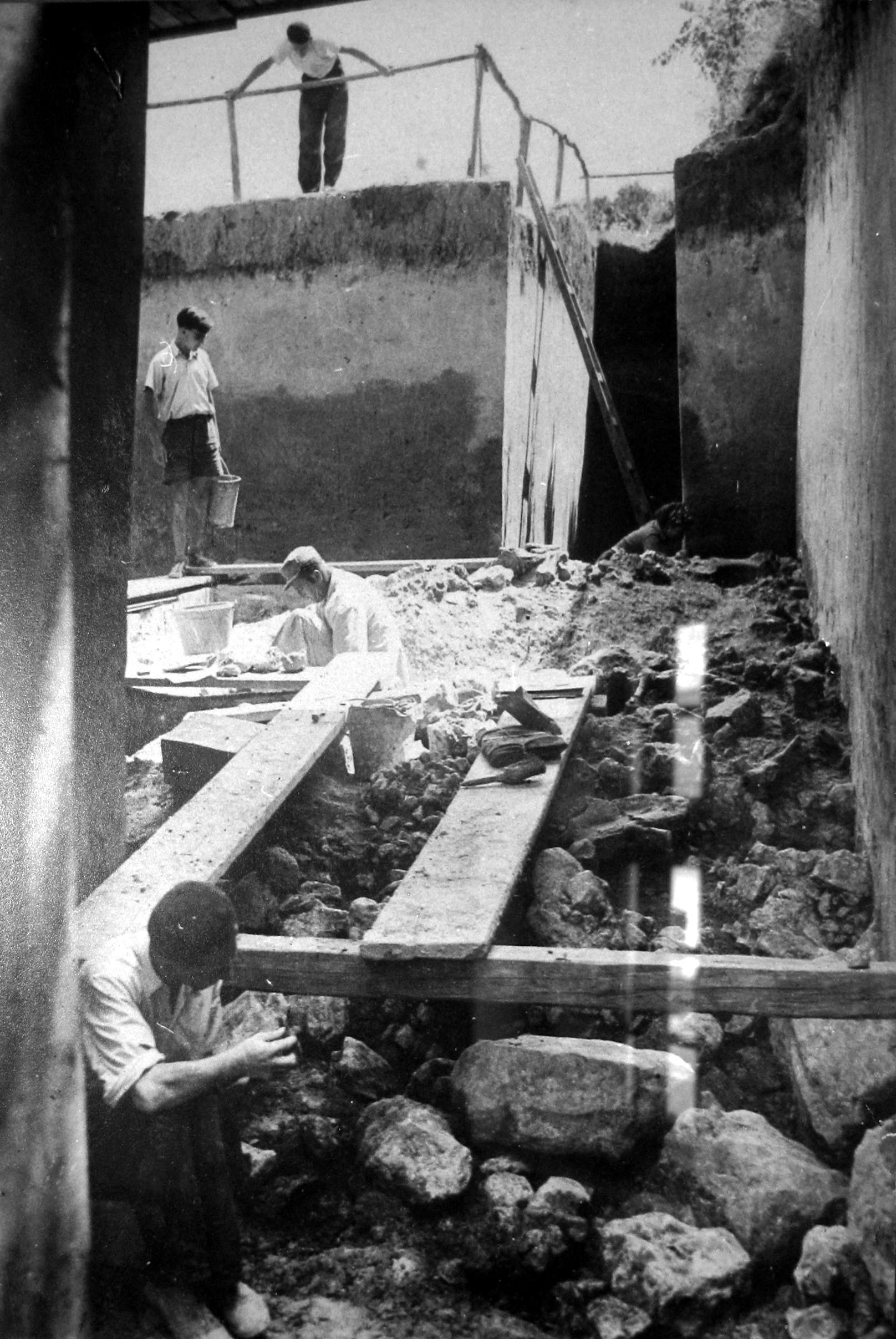
A dig in Dolní Věstonice in 1951
Source: Display, Dolní Věstonice Museum
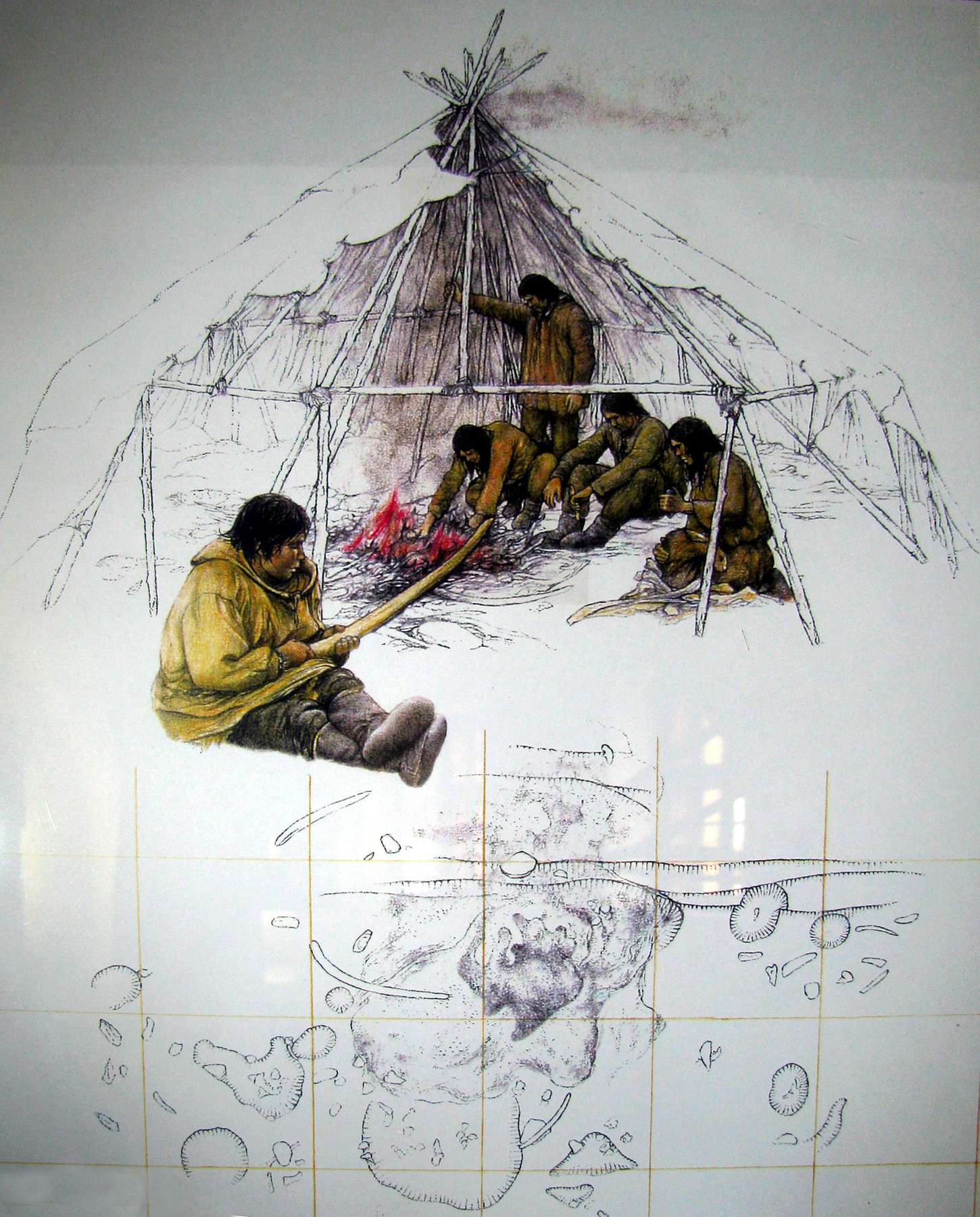
Cutaway drawing of a hut at Dolní Věstonice.
Individual dwellings with a centrally located hearth were the norm for this area. Each hut could hold 8 to 15 people, and if there were several of them at once, it is entirely possible that there could have been up to one hundred people living in the Dolni Vestonice area at once.
Photo and text: Display, Dolní Věstonice Museum
Artist: Unknown
Protective footwear started nearly 30,000 years ago, research finds
By Neil Schoenherr
Text and images below from:
http://news-info.wustl.edu/news/page/normal/5584.html
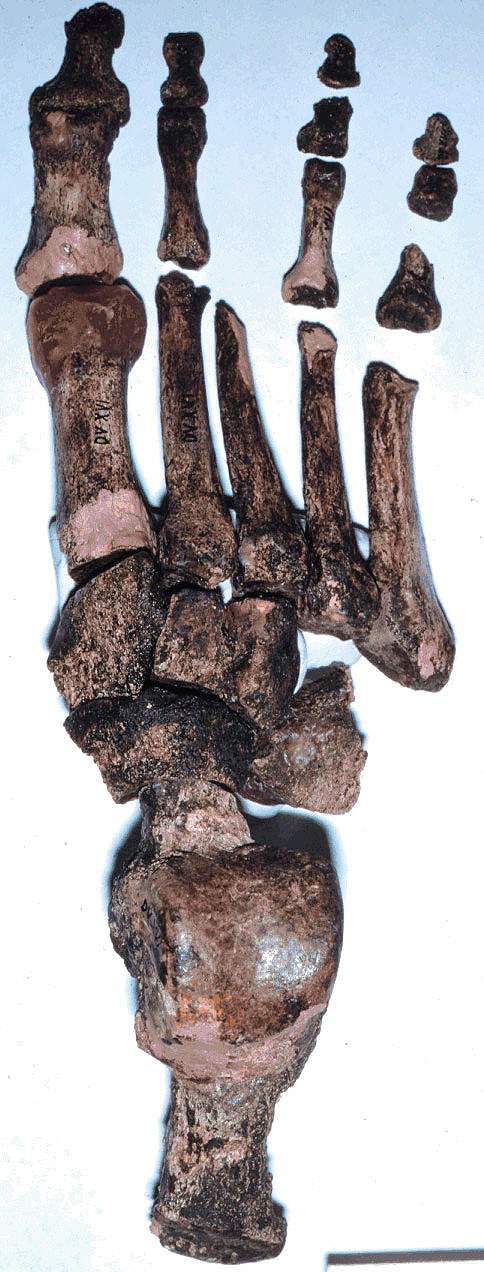
Image by Erik Trinkaus / Czech Academy of Sciences
A 26,000 year-old early modern human, DolniVestonice 16 from the Czech Republic, showing the reduced strength of the bones of the lesser toes. It is one of three partial foot skeletons from Dolni Vestonice that shows the reduced lesser toe strength, all dating to about 26,000 years ago.
Aug. 17, 2005
Those high-tech, air-filled, light-as-a-feather sneakers on your feet are a far cry from the leather slabs our ancestors wore for protection and support.
But believe it or not, our modern day Nikes and Reeboks are direct descendents of the first supportive footwear that new research suggests came into use in western Eurasia between 26,000 and 30,000 years ago.
Erik Trinkaus, Ph.D., the Mary Tileston Hemenway Professor of Physical Anthropology, derived those dates by analyzing anatomical evidence of early modern humans, which suggests a reduction in the strength of the smaller toes in Upper Paleolithic humans while there was little change in leg strength.
His research was published in the July issue of the Journal of Archaeological Science .
Trinkaus argues that early humans living in far northern climates began to put insulation on their feet around 500,000 years ago. While archaeological evidence suggests that protective footwear was in use by at least the middle Upper Paleolithic in portions of Europe, the frequency of use and the actual mechanical protection provided by that footwear was unclear.
Use of protective footwear has been difficult to document because in most cases the footwear does not survive the test of time.
Lacking such physical evidence, Trinkaus analyzed the foot bones of western Eurasian Middle Paleolithic and middle Upper Paleolithic humans. In doing so, he found the anatomy of their feet began to change starting around 26,000 years ago.
"I discovered that the bones of the little toes of humans from that time frame were much less strongly built than those of their ancestors while their leg bones remained large and strong," Trinkaus said. "The most logical cause would be the introduction of supportive footwear."
During barefoot walking, the smaller toes flex for traction, keeping the toe bones strong. Supportive footwear lessens the roll of the little toes, thus weakening them.
Trinkaus' research paper is available from:
Journal of Archaeological Science
Volume 32, Issue 10, October 2005, Pages 1515-15
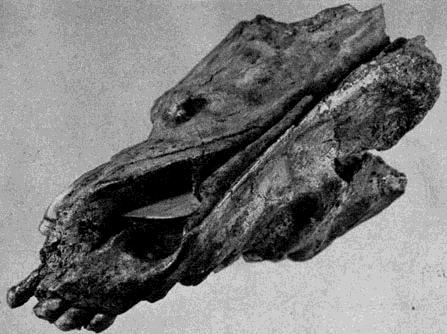
This wolf skull was lying among many other animal bones, obviously the remains of some of the food of the Paleolithic hunters. A flint flake was stuck in the nose of the animal. The wound did not seem to have healed, and the X-ray showed that the flake used was broad, flat and atypically shaped. Tools could sometimes be used for purposes for which they are not obviously suitable.

Akademik J. Poulik, doc. B. Klima a akademik J. Bohm u hrobu zeny v Dolnich Věstonicich.
Academicians J. Poulik, doc. B. Klima and J. Bohm at the grave of a woman in Dolní Vestonice.
These men were very important in the development of Czech Archaeology, and I have included some information about them below.
Source: Display, Dolní Věstonice Museum
Josef Poulík

Josef Poulík was a leading light of Czech archaeology. His career started as a laboratory technician at the Moravian State Museum participating in many research projects which later he would write about in the local press. As the Head of the State Archaeological Institute in Brno from 1962, he conducted an extensive archaeological dig in Moravia and led the biggest Czechoslovak research project in Mikulčice. The primary focus of his scientific interest lay in the Slavic period. Since 1947 he also led the Prague Archaeological Institute, which later joined with the institute in Brno in ARU ČSAV. In addition, he also worked as a professor at the university in Brno as an academic and Vice Chairman of ČSAV, and was also a laureate for the State Award.
Source: http://www.praha.eu/jnp/en/extra/archaelogy_/archaeologists/index.html
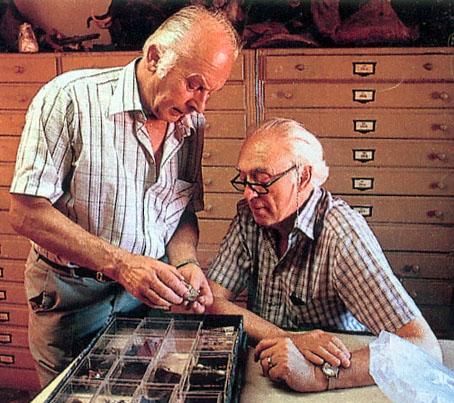
Photo by Alexander Marshack, reproduced in the National Geographic Magazine, October 1988
Text below from:
http://www.obitcentral.com/obitsearch/obits/misc/anthro16.htm
Bohuslav Klima, 74, the leading figure in Czech archaeology and one of the pre-eminent archaeologists of his generation died in Brno, Czech Republic, on February 6, 2000. A prolific scholar and an indefatigable field investigator, Klima was part of a distinguished intellectual tradition of outstanding Moravian researchers. His scholarly interests ranged widely and resulted in more than 380 publications in Czech, English, French, German and Russian on a wide variety of topics from the Lower Paleolithic to the Neolithic.
He was best known to American and European specialists for his seminal work on the Pavlov culture, a Central European variant of the Gravettian technocomplex, which he, together with H. Delporte defined in 1959. His extensive field work at such world reknowned sites such as Dolni Vestonice I and II and Pavlov I and II, as well as Petrkovice and Predmosti, not only revealed the existence of highly sophisticated and novel technologies in the Upper Paleolithic, but also focused well-deserved attention on these premier sites of universal importance in the human cultural patrimony of our planet.
Although contributing heavily to the cultural history of Central Europe, Klima’s research attention was always also focused on understanding the lifeways of the producers and users of the complex material culture inventories excavated. This involved early application of multidisciplinary approaches to studying the past, including combining geological, paleontologic, palynological and pedological data to reconstruct Pleisto cene landscapes. He devoted equal attention to the social, symbolic and ritual frameworks that lay behind Upper Paleolithic adaptations and published on prehistoric art, ritual and belief systems.
Klima lived a rich life and one filled with recognition and accolades from the world community of archaeologists. He began his scholarly career at the Moravian Museum and subsequently was in charge of Paleolithic research in the Prehistoric Department at the Institute of Archaeology, Academy of Sciences of the Czech Republic, Brno. At the time of his death he was clearly one of Europe’s leading Paleolithic specialists and the premier expert on Central and Eastern Europe. This eminence, however, was borne with gentlemanly grace and quiet confidence. In addition to being a world-class scholar, Klima was an unparalleled colleague and mentor. His gracious office and home at Dolni Vestonice were always open to Czech and foreign researchers who benefited from his erudition, wisdom and oneological prize-winning expertise. We can attest to his scholarly and intellectual magnanimity and openness to new ideas and interpretations, and our palates and those of countless other archaeologists can also vouch for the superiority of his "Mammoth Blood."
His well-deserved expertise was not exclusionary, but always open to new ideas and interpretations. Klima likely knew more than anyone about the Upper Paleolithic of Central Europe, but was always open to learning more.
Although Klima’s death marks the passing of an intellectual giant—indeed a classic European scholar—the trajectory of scholarship which he forged will flourish at Dukla in the work of the younger generation of Moravian experts trained or influenced by him. (Olga Soffer and James M Adovasio)
Text below from: http://www.praha.eu/jnp/en/extra/archaelogy_/archaeologists/index.html
Jaroslav Böhm (1901–1962)
Jaroslav Böhm was a Czech archaeologist specialising in prehistoric archaeology. After a short period working in the Department of Prehistory in the National Museum he took a post at the Prague Archaeological Institute, where in 1939, he became the director. For his doctoral thesis in Charles University he wrote "The Foundations of the Hallstatt’s Period in the Czech Lands".
He was in charge of excavations: in Třebechovice, in Staré Hradisko near Prostějov, in the cave Domica and in the Slovanian fortification Libušín. He believed in large scale excavations that developed contemporary research methods. In 1952 he was one of the founders of the Czechoslovakian Academy of Science. Ten years later in Rome he was appointed the President of International Union of Prehistoric and Protohistoric Science.
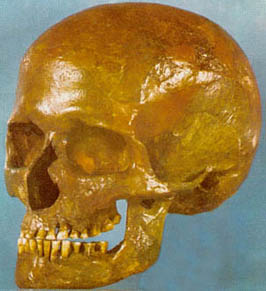
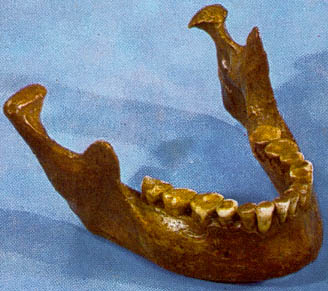
Left: Woman's skull stained with red ochre from a Pavlovian burial near Dolni Vestonice.
Right: Lower jaw from a Pavlovian burial near Dolni Vestonice. The bone on the left of the jaw has been deformed due to arthritis.
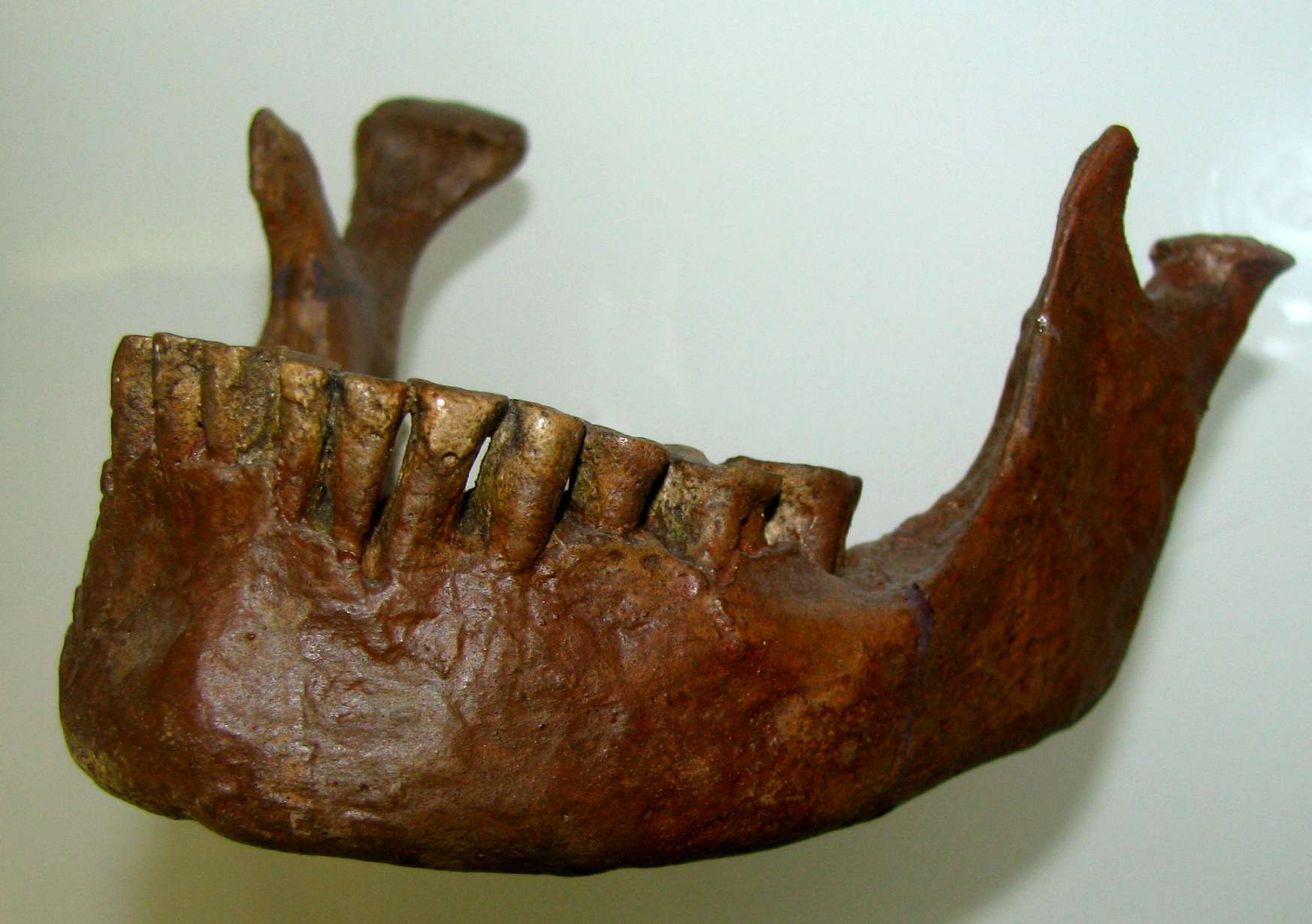
Jaw of a woman, stained with red ochre, from a Pavlovian burial
Photo: Don Hitchcock 2008
Source: Facsimile, display, Dolní Věstonice Museum
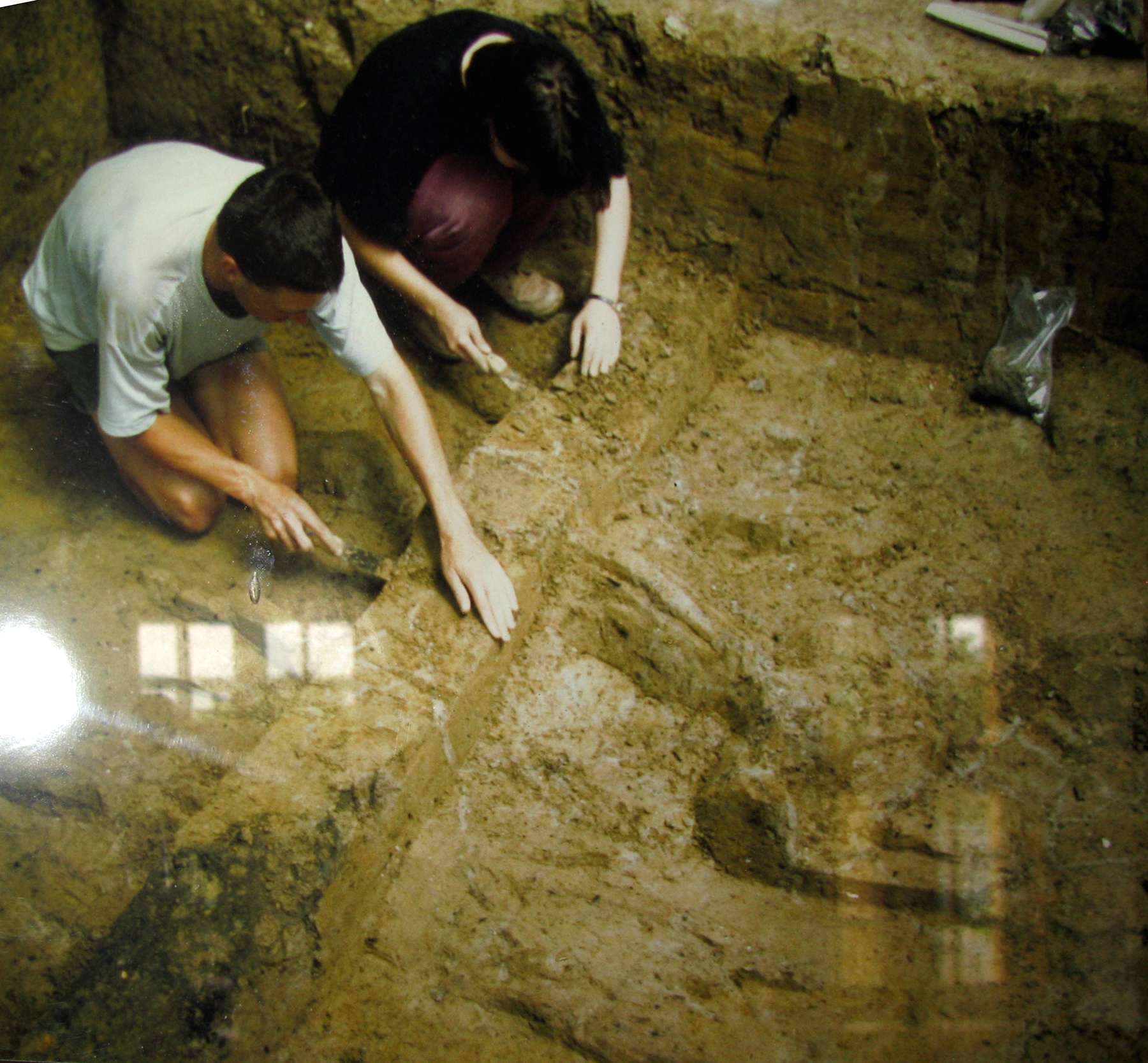
Archaeologists investigating an area covered with red ochre, Petřkovice near Ostrava in Moravia, the same site where the Ostrava Venus was discovered, see the section on the Moravain Venuses.
At Petřkovicích an area was found which was completely covered with powdered red dye in the middle part of the site. It is a type of iron ore. Pollen of aquatic plants, as found in the dye samples, show that the ochre was mixed with water, but almost certainly other binders would have been used.
Source: Display, Dolní Věstonice Museum
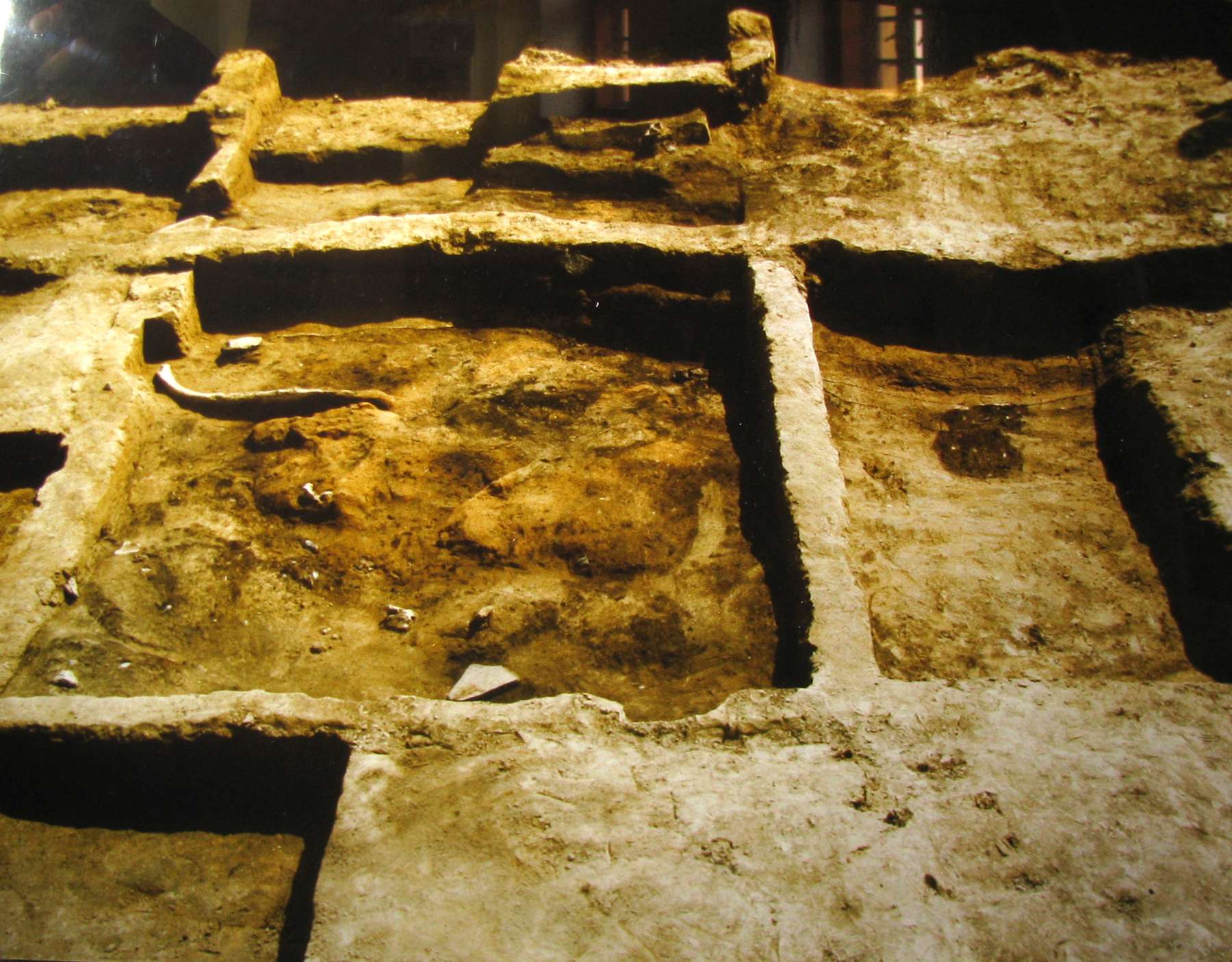
Large fireplace, the centre of one of the homes in Dolní Věstonice.
Source: Display, Dolní Věstonice Museum
Text: Translated from the display.
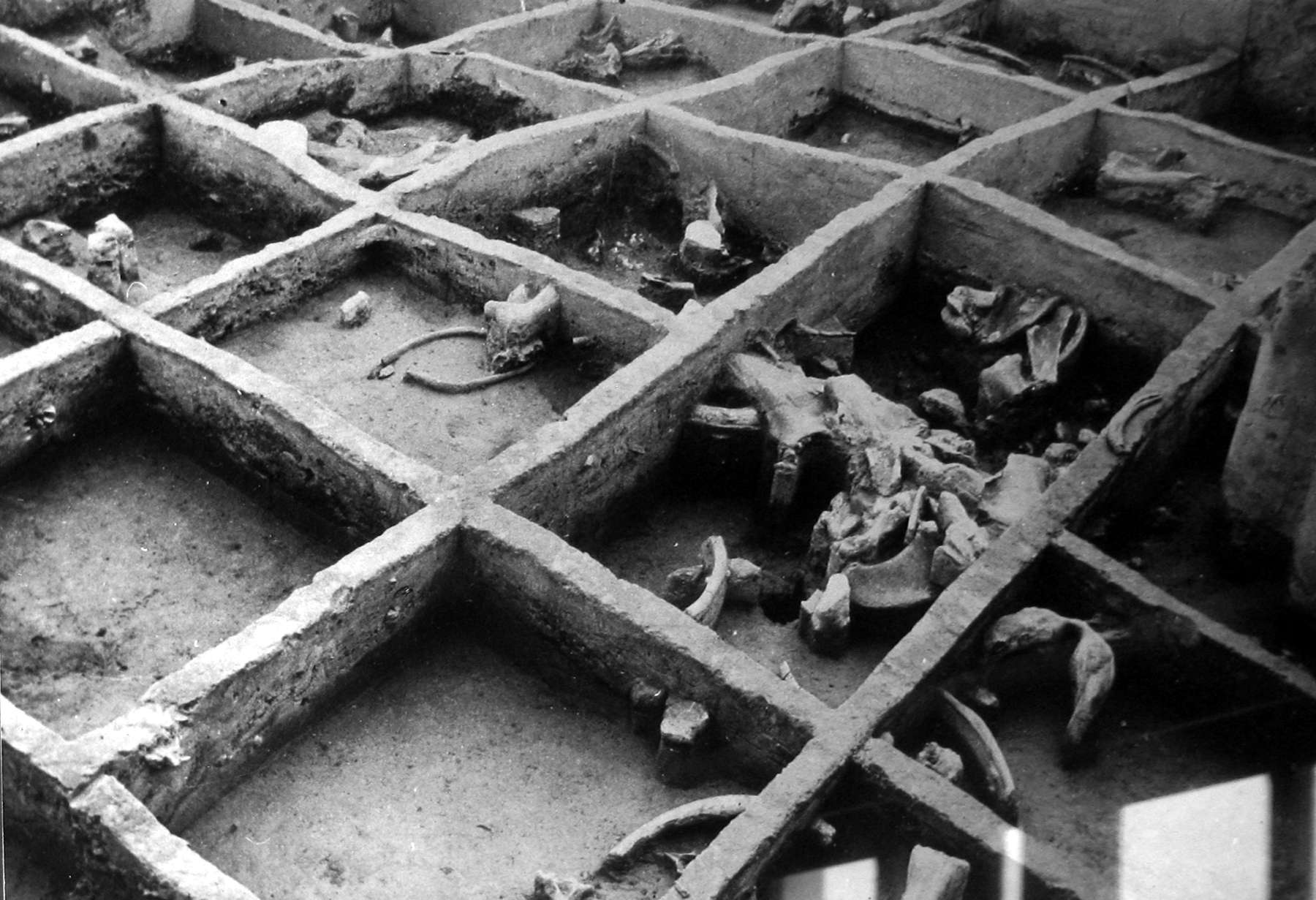
Painstaking research, Pavlova, in 1957.
Note the way that the dig has been divided up into squares, a method which ensures that accurate maps can be drawn of the dig and the finds made, and the walls between may be used for later research when, for example, better dating techniques are developed.
Source: Display, Dolní Věstonice Museum
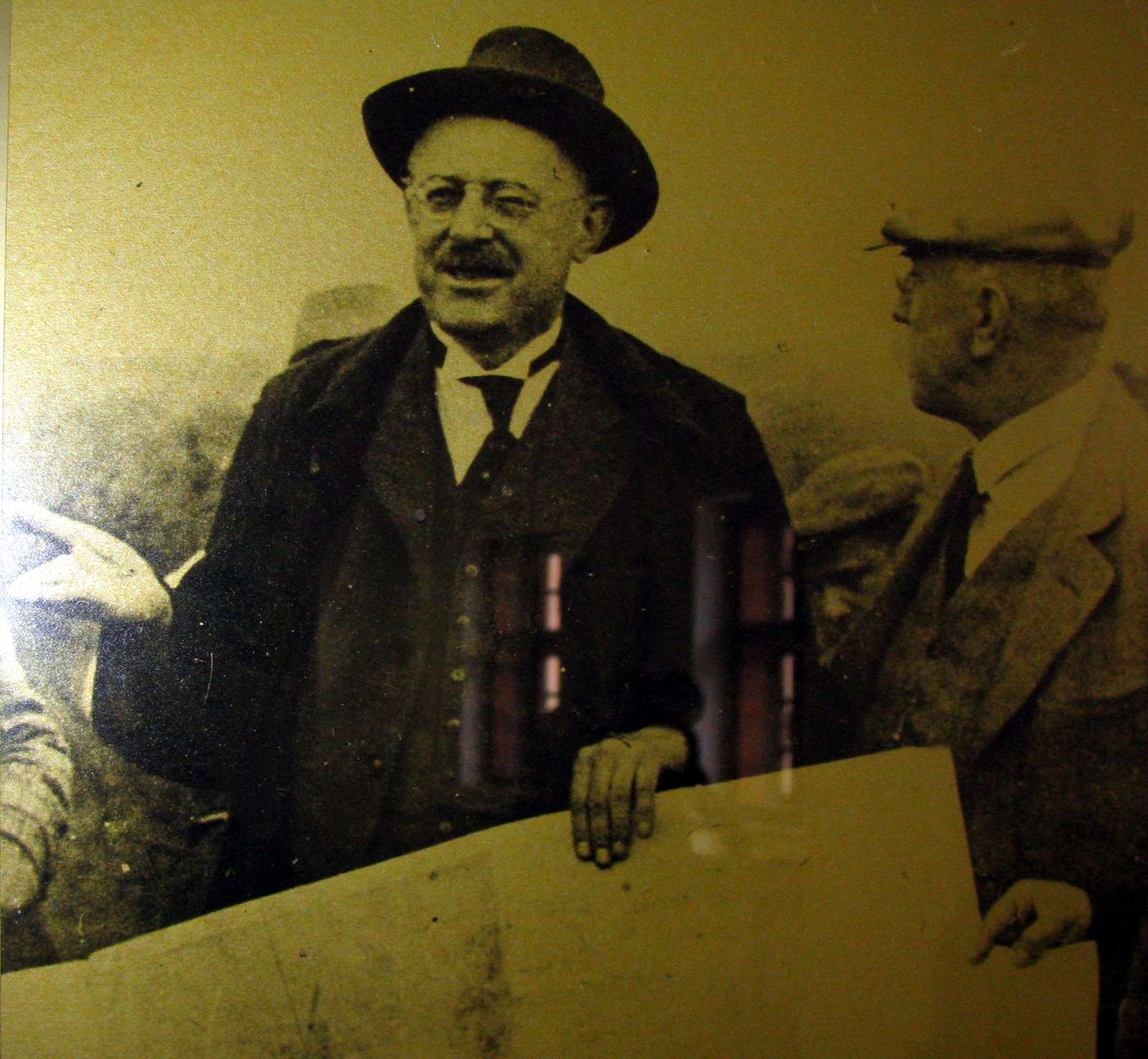
Professor Karel Absolon (1877-1960)
From 1924 to 1938 he conducted research at Dolní Věstonice. In 1925 he discovered the Dolní Věstonice Venus.
Source: Photo on display, Dolní Věstonice Museum
Biographical details: http://www.mzm.cz/mzm/osobnosti/karel_absolon.html
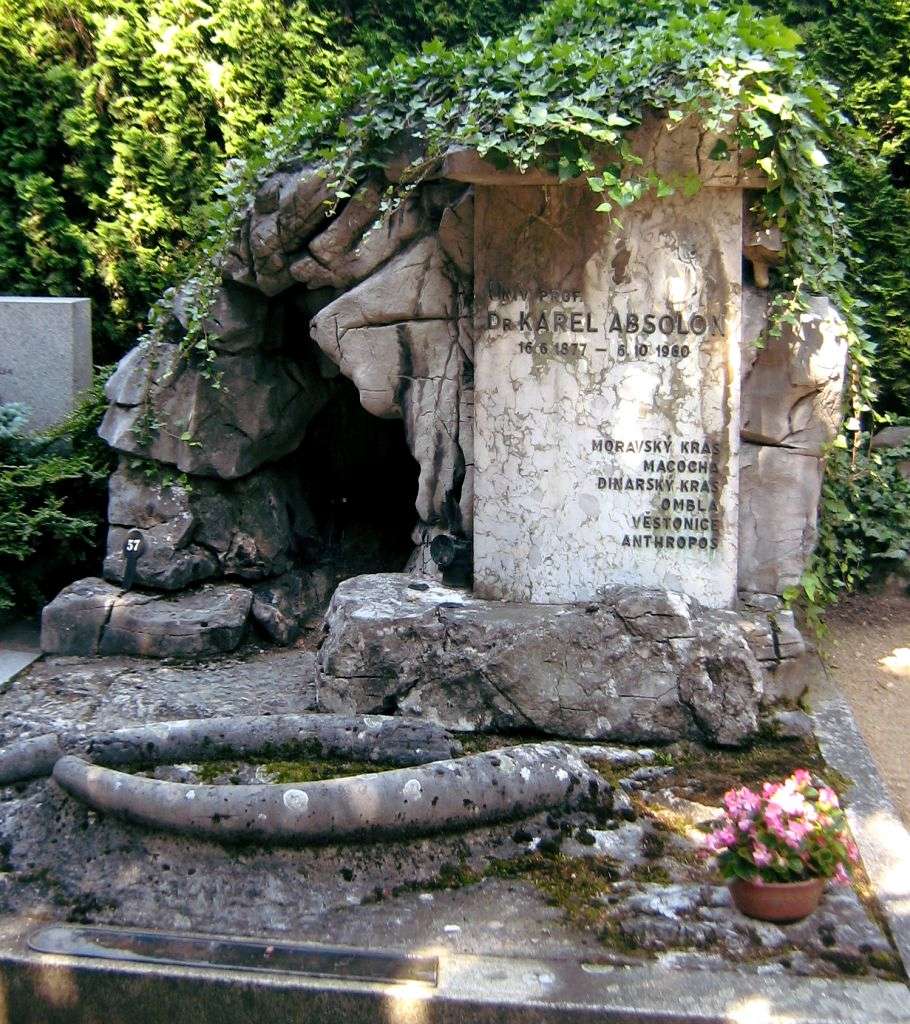
Tomb of Dr. Karel Absolon, city of Brno, 2008
This is a wonderful tomb for such a man, symbolising his great work on the animals of caves, as well as his work on the mammoth hunters of Dolní Věstonice, by the use of the mammoth tusks in front of the tomb.
Source: http://cs.wikipedia.org/wiki/Karel_Absolon
Datum Date: 2008
Source: Own work
Author: NPE
Permission: Public domain - I, the author of this work, by releasing it as public domain, and the world.
Fireplace in Dolní Věstonice, using rocks for storage of heat.
Source: Display, Dolní Věstonice Museum
Text: Translated and adapted from the display.

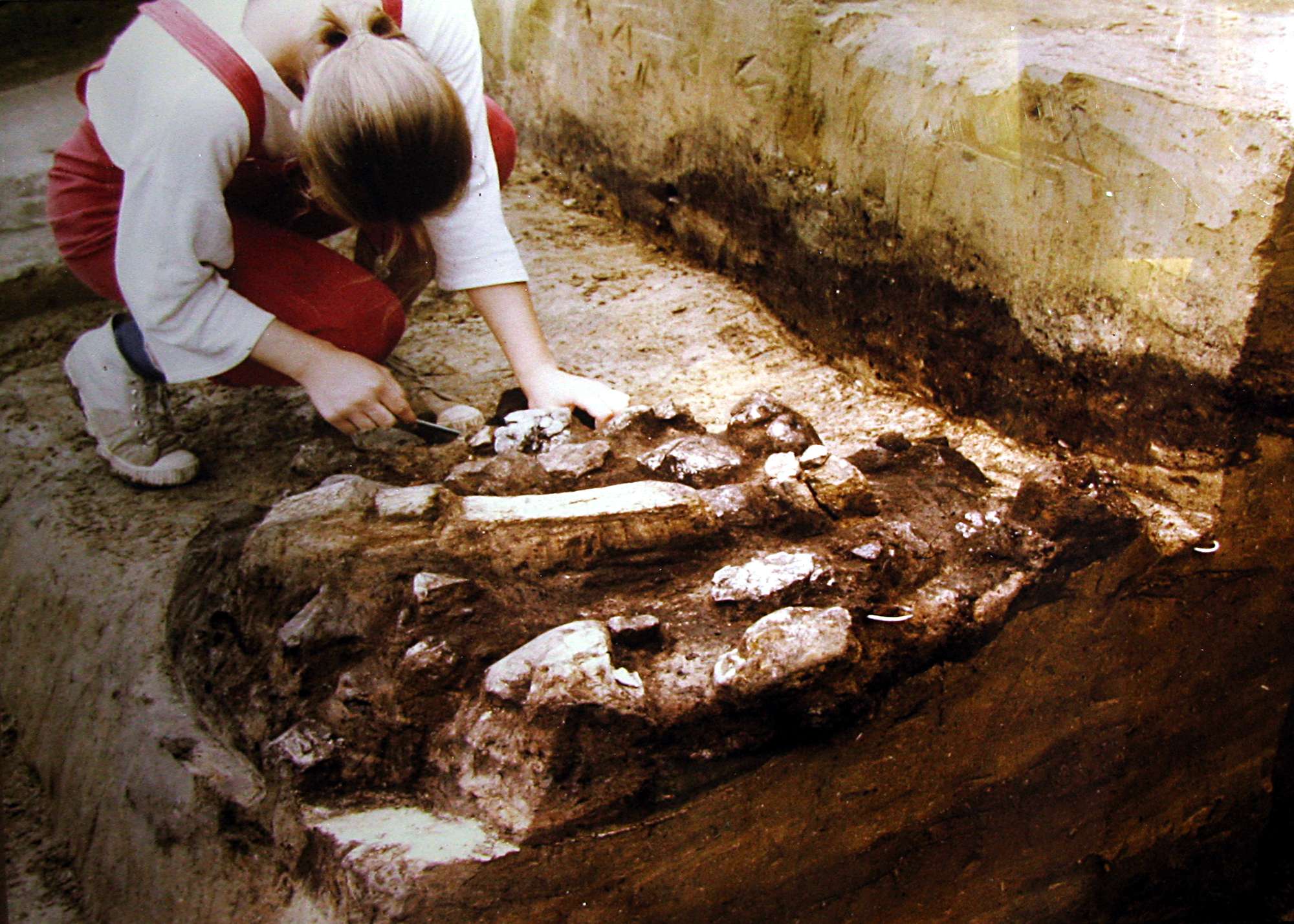
It is not always realised that when a site is uncovered, the artefacts found may appear to be arranged in a very confused manner.
It is the job of the researcher to create order out of chaos, and make a good analysis of what the site originally looked like, its age and its purpose.
zaprstni kost mamuta - mammoth metatarsus bone
sobi paroh - reindeer antlers
stehenni kost mamuta - mammoth femur
mamuti lopatka - mammoths shoulder blade
Source: Facsimiles, display, Dolní Věstonice Museum
Text: Translated and adapted from the display.
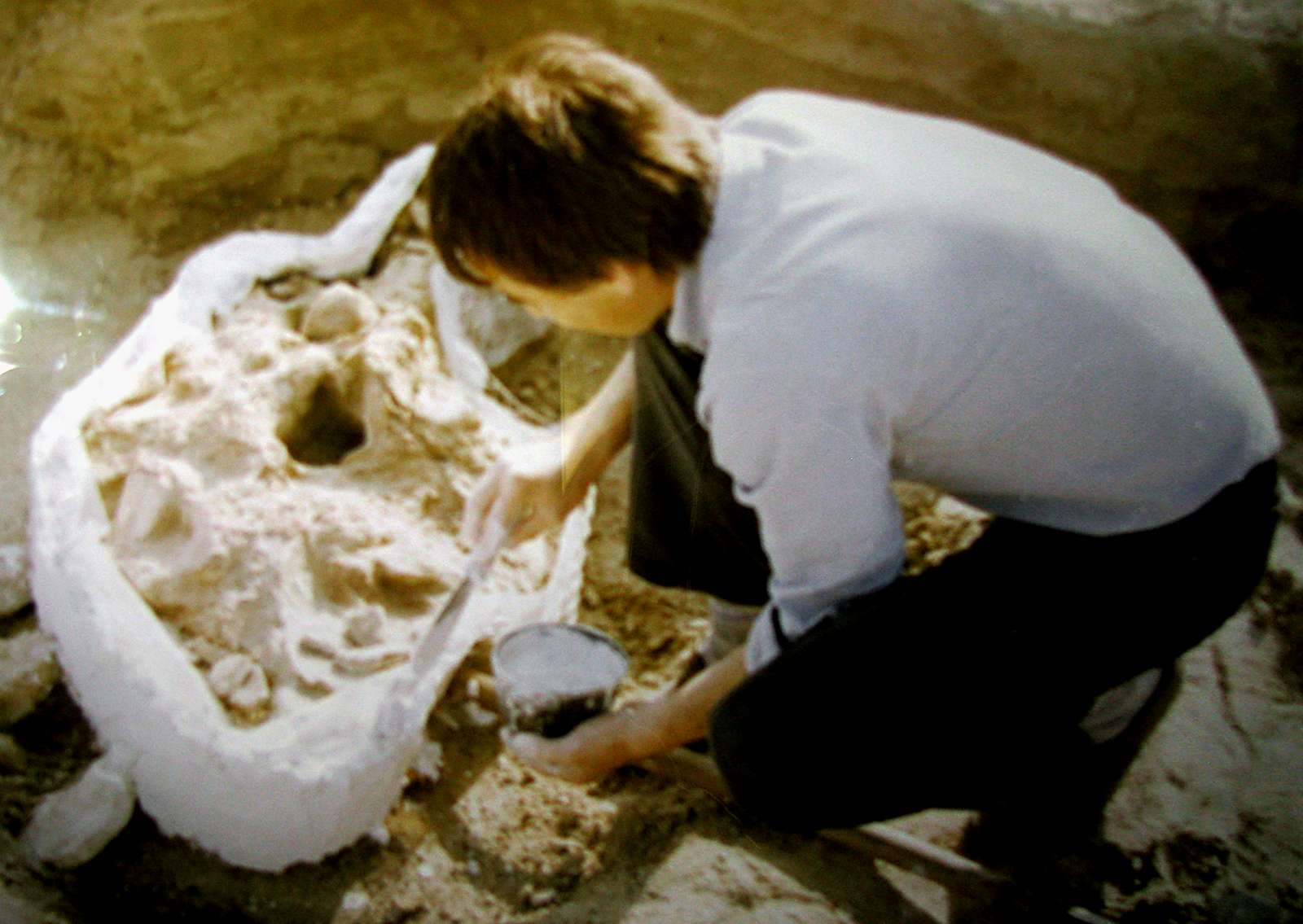
The preservation of a mammoth skull, which are often quite fragile when found. The researcher is using a plaster cast to stabilise the skull before removal.
Source: Display, Dolní Věstonice Museum
Text: Translated and adapted from the Display, Dolní Věstonice Museum
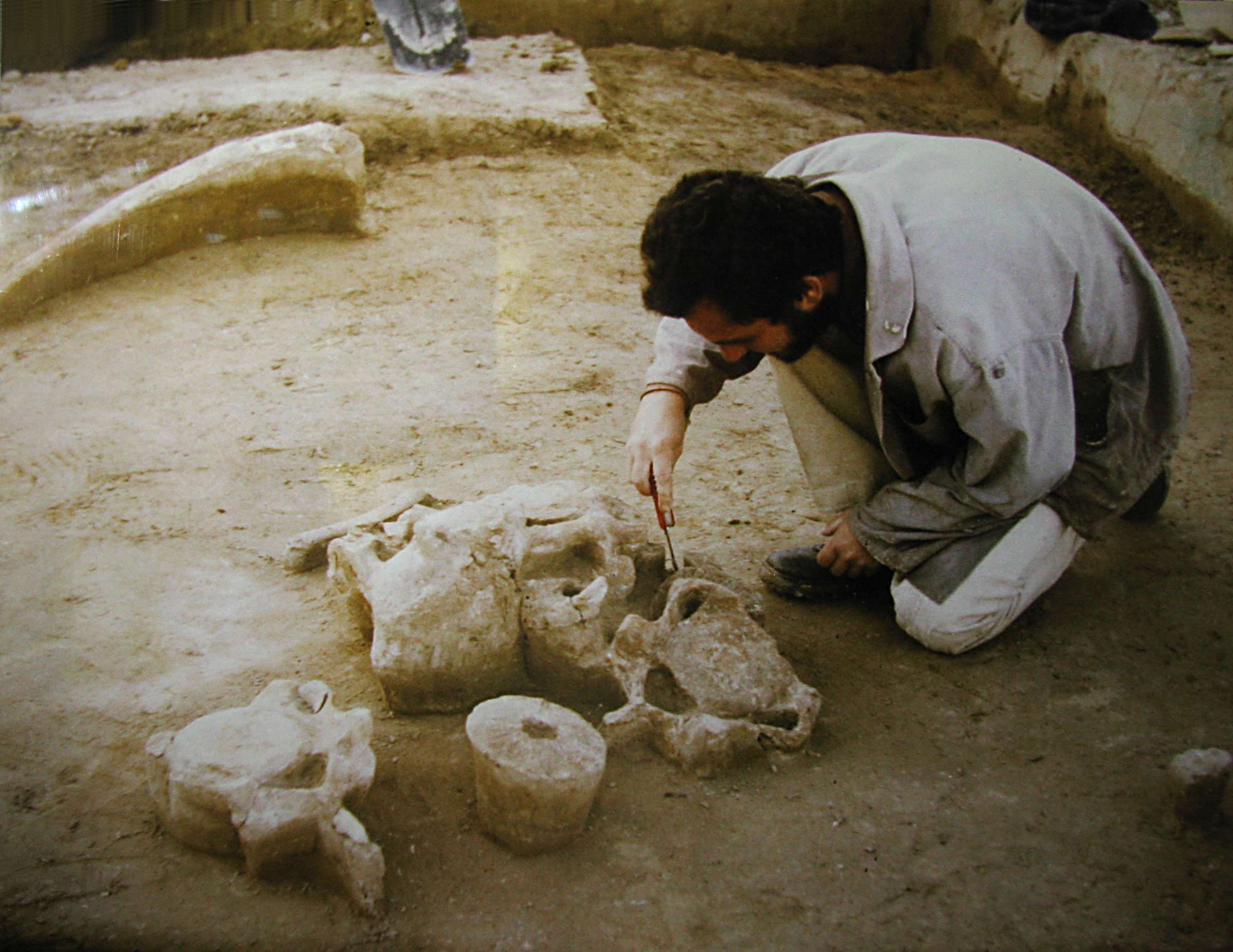
Group of mammoth vertebrae, Dolní Věstonice.
It is presumed that the hunters used the rugged terrain at the foot of the Pavlov Hills, which are shaped like a naturally occurring trap. The mammoth was separated from the herd and driven against a steep and slippery slope, where the hunters charged the exhausted animal and speared it.
Source: Display, Dolní Věstonice Museum
Text: Translated and adapted from the display, Dolní Věstonice Museum

When foundations are dug for houses at Dolní Věstonice, numerous remains of animals are uncovered. This is the skull of a wolf.
Source: Display, Dolní Věstonice Museum
Text: Translated and adapted from the display, Dolní Věstonice Museum
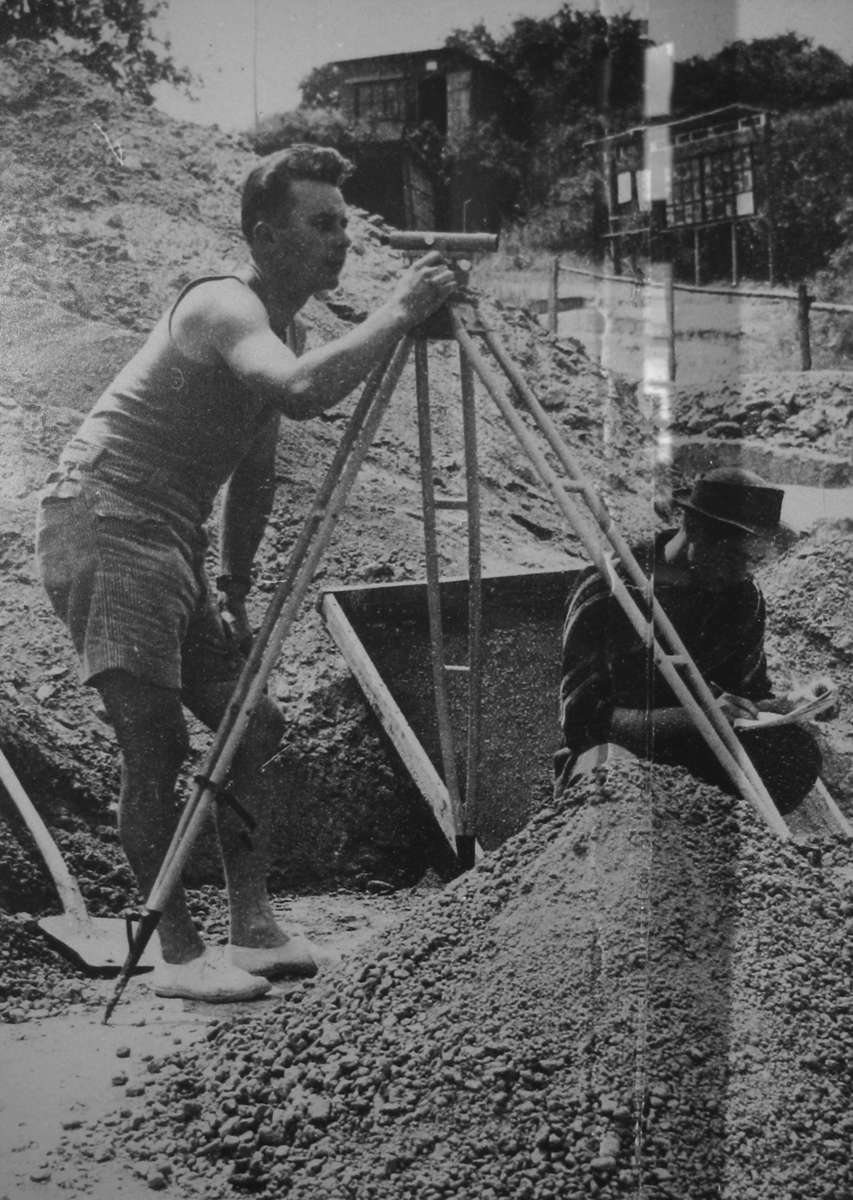
Accurate surveys allow the research to have the most value. This dig was near a village, as may be seen from the houses in the background. Many important sites have been found when a householder digs a cellar, and comes upon ancient artefacts or bones.
Source: Display, Dolní Věstonice Museum
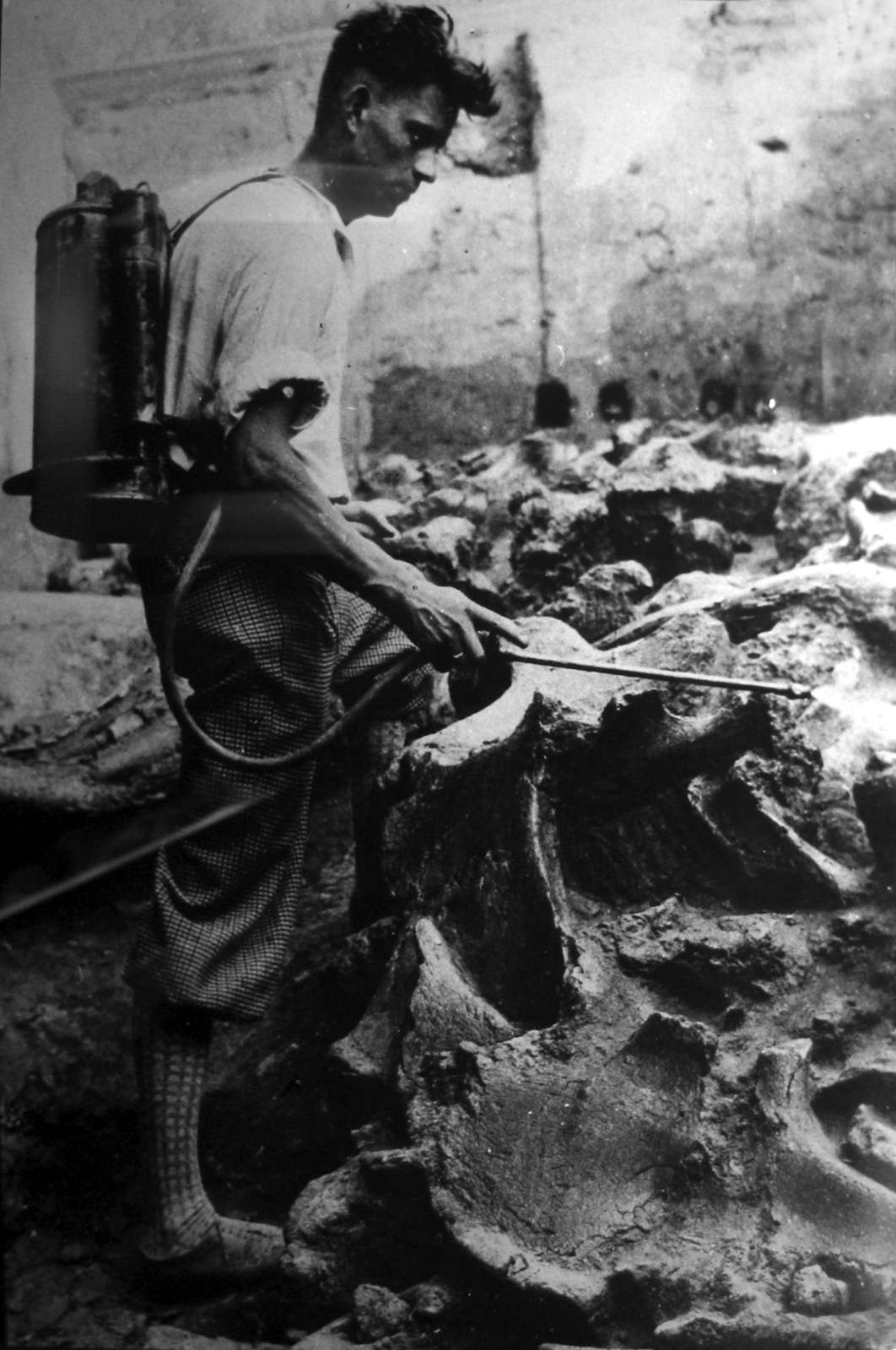
At some sites, the bones exposed are so fragile that they must first be hardened before they are able to be moved to the laboratory in order to identify, catalogue and conserve them in a more permanent manner. Here a hardening preservative is being sprayed on the mammoth bones before removal. For very precious material such as ancient human remains, the whole skeleton with associated soil is first carefully prepared, then removed as a large rectangular block, and crated for transport to the laboratory. This is a highly specialised and difficult procedure.
Source: Display, Dolní Věstonice Museum
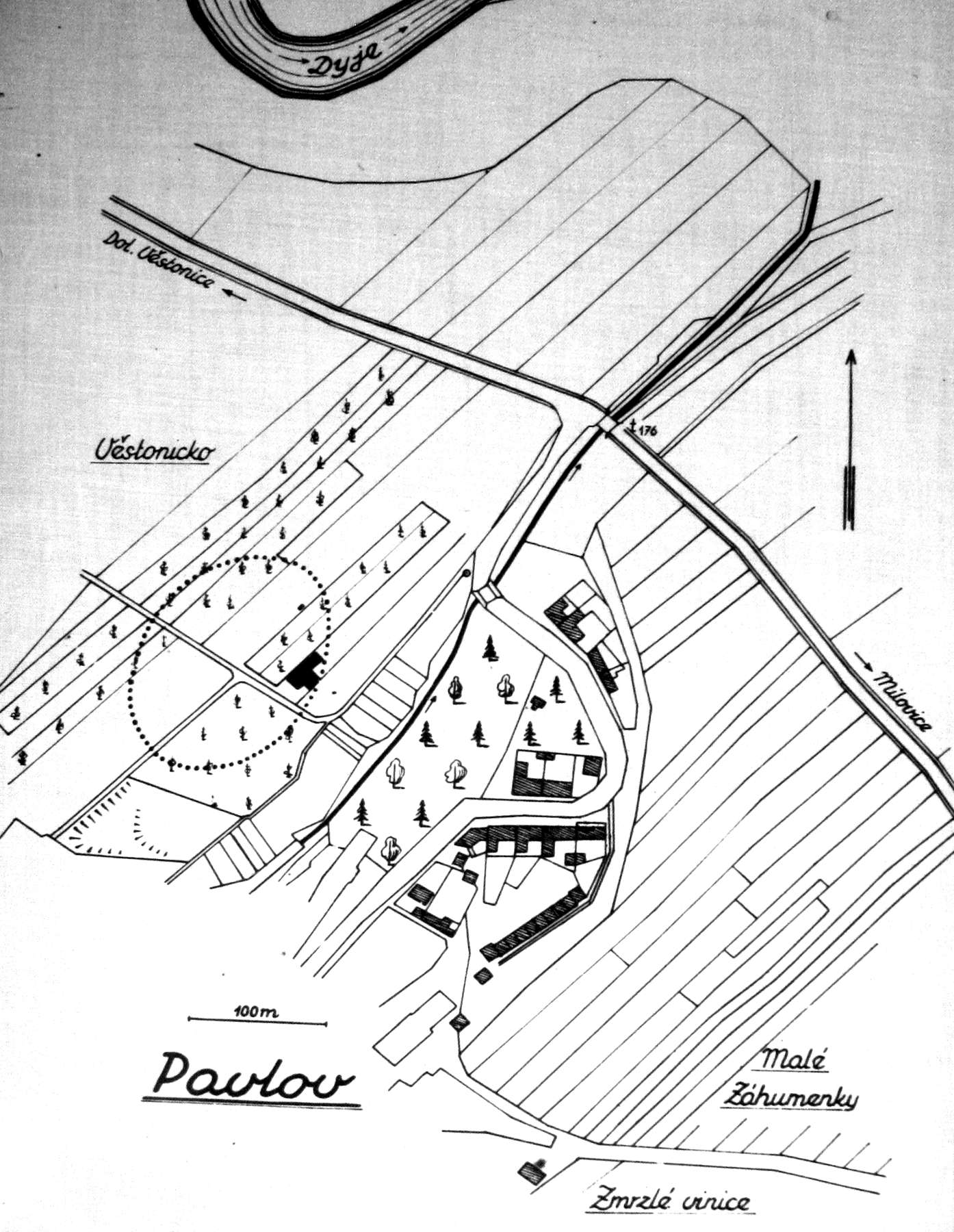
Map of Pavlov. This is possibly taken from the book "Dolní Věstonice" by A. Knor, V. Lozek, J. Pelisek and K. Zebera which was in a nearby display case.
Source: Display, Dolní Věstonice Museum

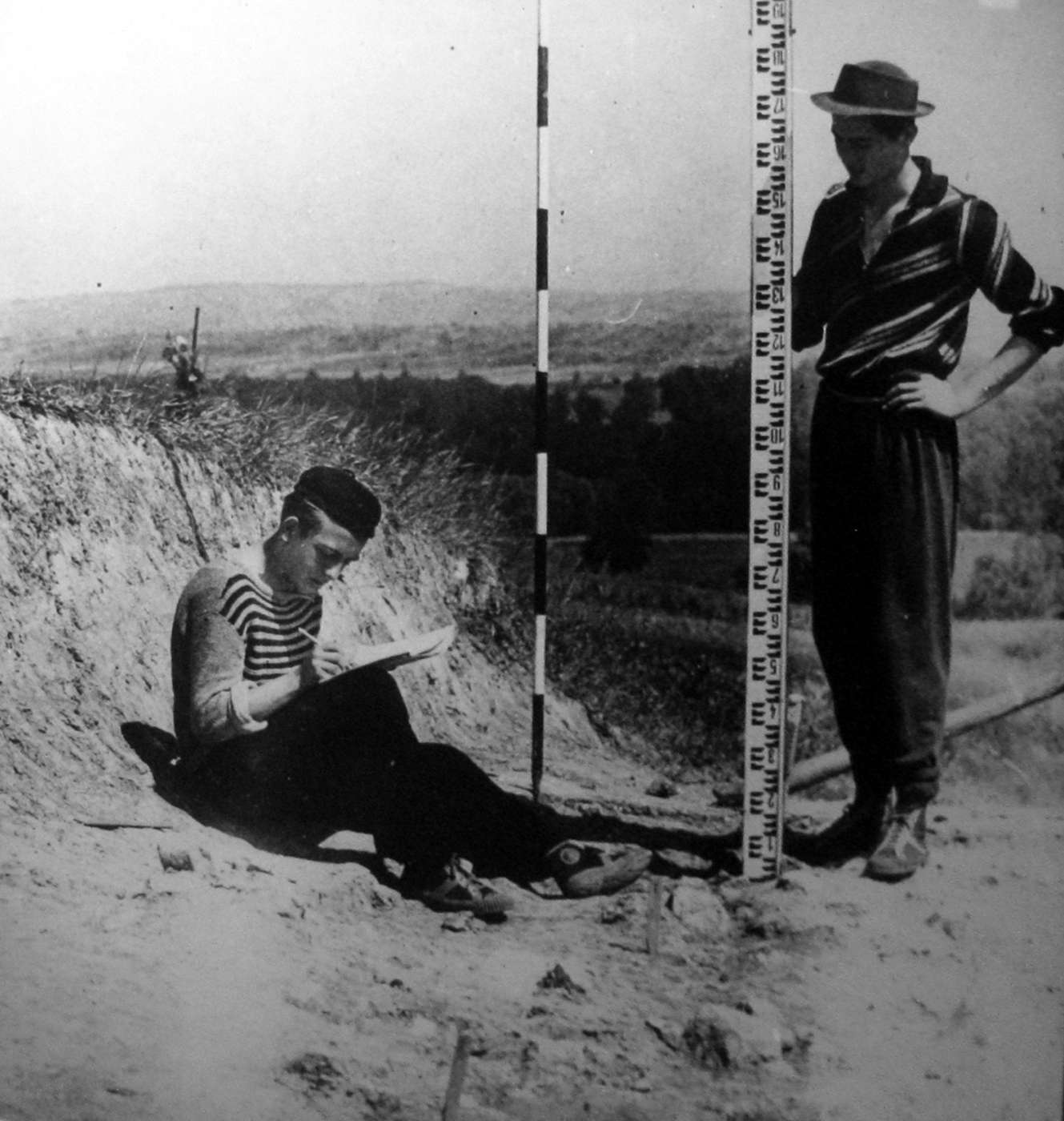
After World War II there was continued archaeological research by the Academy of Sciences, first in Dolní Vestonice and later there were large-scale excavations in neighboring Pavlov.
In 1985-1989 loess was excavated for the construction of reservoirs to service a new housing development at Dolni Vestonice. This fortuitously led to some important and famous discoveries of human skeletons.
The main task of current research is now the complete processing of the material already collected from the perspective of various disciplines (archeology, anthropology, geology, paleontology, and others) and its publication. In order to complete this task, in 1995 the Archaeological Institute AS CR in Brno set up separate Paleolithic and paleoethnology research teams in Dolni Vestonice.
Photo and text: Translated and adapted from the display, Dolní Věstonice Museum
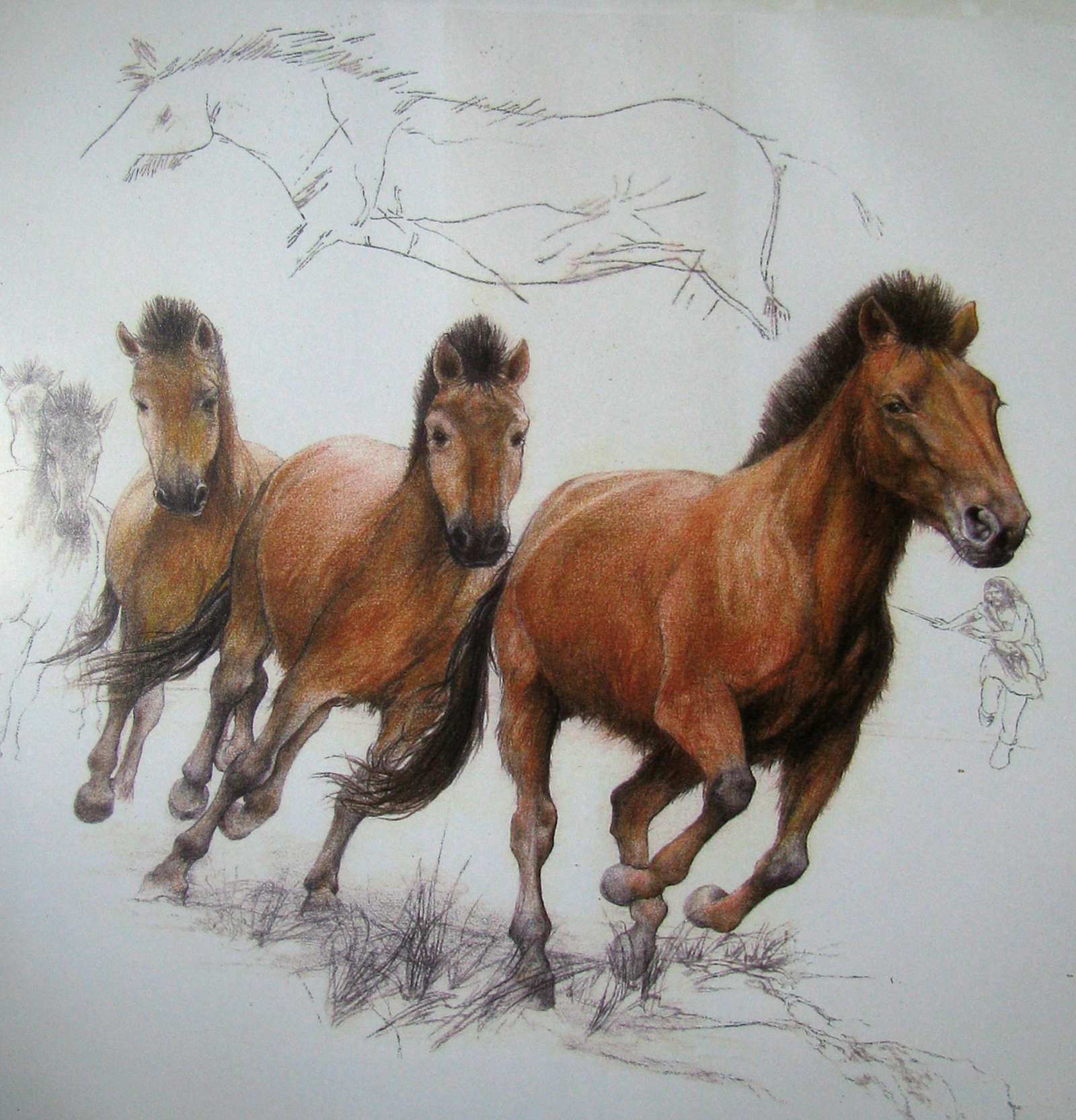
When hunting horses before 18 000 years ago, hunters used the steep north walls and the gradual slope on the other side of Stransky rocks, Stránská skála, near Brno, to drive the horses over the cliff. By that time Dolní Věstonice was no longer inhabited.
Source: Display, Dolní Věstonice Museum
Artist: Unknown
Text: Translated and adapted from the display.

Stránská skála is an isolated limestone hill, situated about 5 km north and east of the centre of Brno. It is 1.5 km long, almost 400 m wide, and lies 310 m above sea level. While the southeastern slope is quite moderate, and passes gradually into a plain, the northwestern boundary is steep, the limestone walls falling vertically into the valley.
Text accompanying the photo above is adapted from Musil (1968)
Photo: Description English: Stránská rock in Brno, Czech Republic.
Datum Date: 2005-10-09 (original upload date)
Source: Originally from cs.wikipedia
Author: Original uploader was Onovy at cs.wikipedia
Permission: Dual-licensed under the GFDL and cc-by-sa-2.5.
Source: Wikipedia, http://cs.wikipedia.org/wiki/Stránská_skála

Horse bones uncovered below Stránská skála.
Source: Display, Dolní Věstonice Museum
Text: Translated and adapted from the display.

Detail of horse bones, Stránská skála.
Source: Display, Dolní Věstonice Museum
Text: Translated and adapted from the display.
Stránská Skála in Brno-Slatina is the only station with a conserved living floor of humans from the Lower Palaeolithic found in Moravia. Simply worked tools of irregular shapes are based on fragments, flakes, and chips of local chert. The most marked representative of the extinct animal community was a feline carnivore, the sabre-toothed tiger (Homotherium moravicum) which lived there together with forest elephants, rhinoceroses, horses, cervids and bovids as well as hyenas, bears and canids. Numerous birds inhabited the environment of the younger section of the Cromer interglacial at the beginning of the Middle Pleistocene; the age of the settlement can be estimated at 600 thousand years.
At the beginning of the 20th century, a small cave was discovered in the Jurassic limestones of Stranska skala during quarrying, from which Jan Woldfich rescued a number of bones of Paleo-pleistocene animals. From the end of the 1920s, J. Knies, V. Capek, K. Schirmeisen and K. Absolon were engaged in the extraction of further osteological material in the slope sediments in its vicinity.
From Jan Knies' publication, it can be concluded that, in the area of today's artificially created rock step, in 1915 there was another cave, completely excavated by quarrying, from which came the skeletal material obtained from the secondary deposit by K. Schirmeisen. In the years 1957-1972, the Anthropos MZM (Mdravske Zemske Muzeum) continued its research under the leadership of R. Musil, who explored not only the slope sediments down to the rock bottom at a depth of about 13 m, but also the remaining part of the Woldfich Cave and the adjacent 'Vodni' Cave. At all three sites, he found, along with numerous skeletal remains of large vertebrates, countless specimens of small rodents and insects, which constitute important indicators of climatic and developmental changes during the Pleistocene. A surprising discovery was the processed fragments of local Jurassic chert, proving that humans also lived on Stranska Rock at the same time as the ancient, long-extinct animals. Based on this finding, archaeologically focused research was conducted by K. Valoch in 1996-1998.

Stránská Skála
Many animal bones are broken into striking shapes and were probably used for various activities.
However these are not real, deliberately modified bone tools yet.
Photo: Don Hitchcock 2018
Source and text: Anthropos Pavilion/Moravian Museum, Brno, Czech Republic

Stránská Skála
The most prominent representative of the extinct animal community was the sabre toothed tiger, Homotherium moravicum, which lived here together with the forest elephant, rhinoceros, horses, deer and antelope herbivores as well as hyenas, bears and canines. This community is characteristic of the Cromerian period from the beginning of the Middle Pleistocene, the age of the settlement can be estimated at approximately 600 thousand years.
( Note that the top image may be a tooth or other bone from the sabre toothed tiger, but the two middle teeth look more like cave bear canines. I can not identify the bottom image - Don )
Photo: Don Hitchcock 2018
Source and text: Anthropos Pavilion/Moravian Museum, Brno, Czech Republic

Stránská Skála
Remains of small vertebrates, mainly rodents (microfauna). Using the numbers and representation of various species of mice and voles, climate changes can be reconstructed.
Photo: Don Hitchcock 2018
Source and text: Anthropos Pavilion/Moravian Museum, Brno, Czech Republic

Stránská Skála
Numerous birds also lived in the environment of the nearby watercourse.
Photo: Don Hitchcock 2018
Source and text: Anthropos Pavilion/Moravian Museum, Brno, Czech Republic
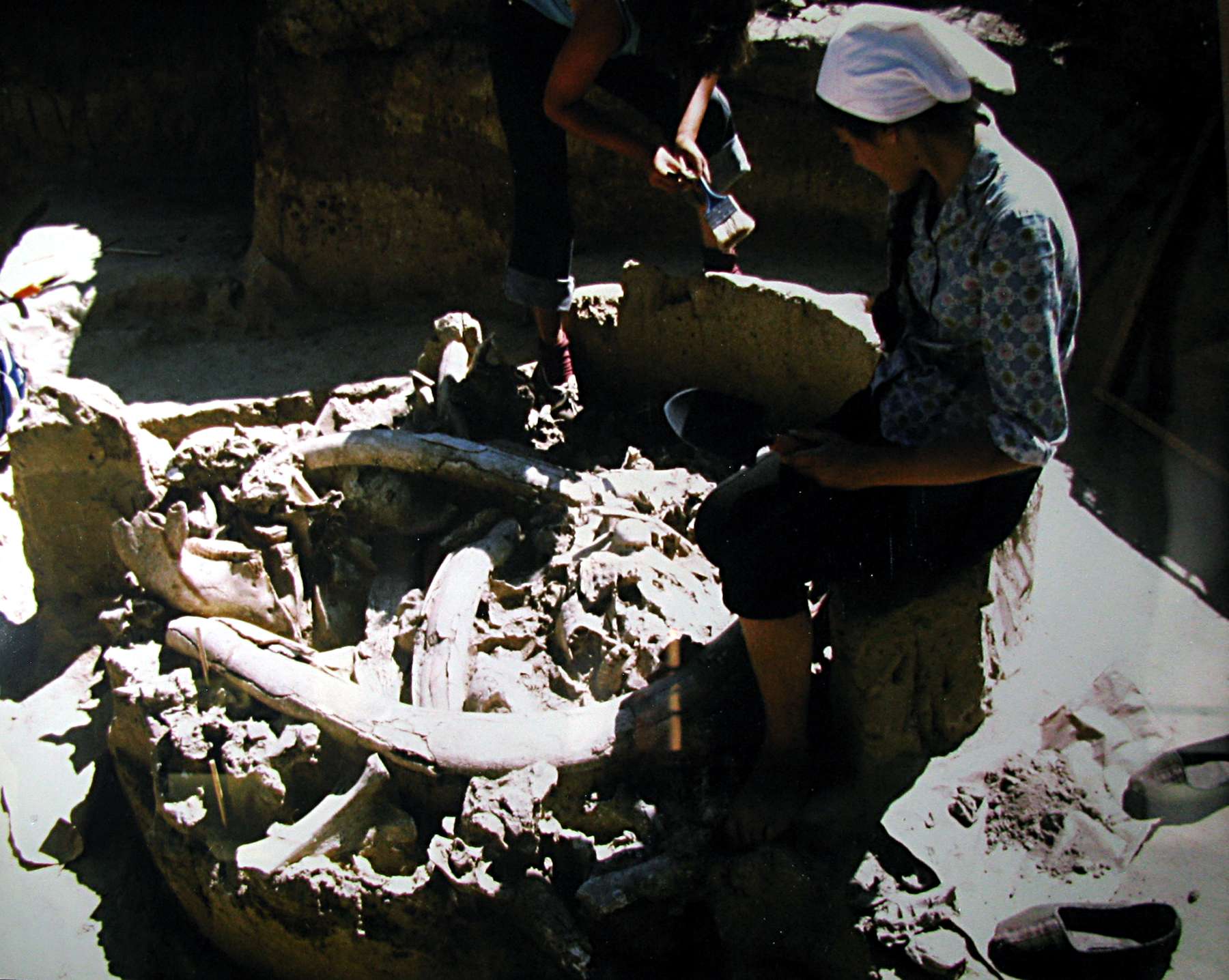
Researchers excavating storage pits filled with animal bones, particularly common deposits of Eastern Europe, Gontsy, Russia.
Source: Display, Dolní Věstonice Museum
Text: Translated and adapted from the display.
Dolni Vestonice map.
Note the icons on the map, which are explained below.
Photo: Don Hitchcock 2008
Source: Display, Dolni Vestonice Museum
(Icon at left shows position of this photo on the large map above)
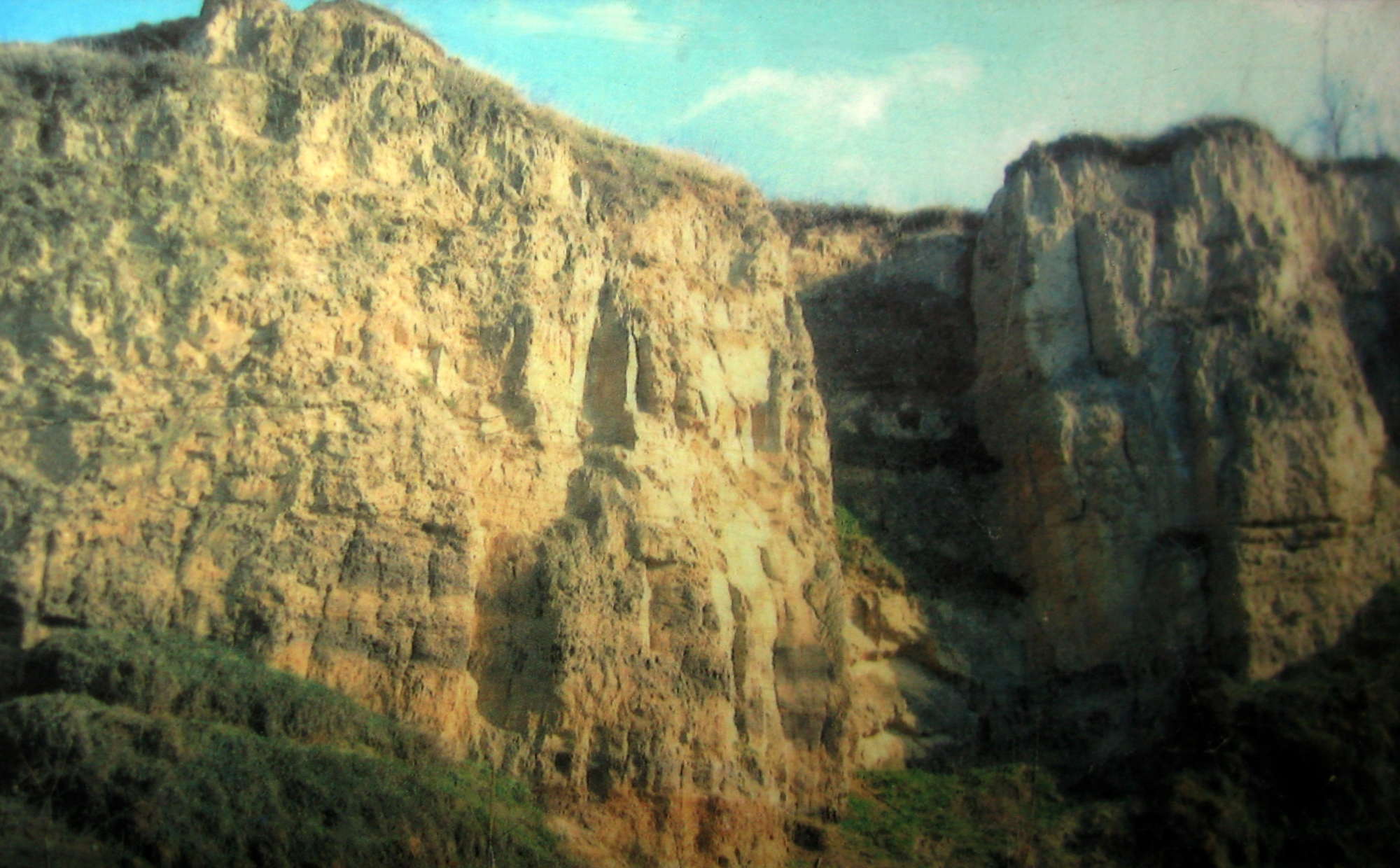
This area is known as the 'Brickyard', where the loess was quarried for making bricks.
It has been assigned to the Dolní Věstonice II group of sites.
The sequence of geological strata in the Věstonice profile illustrates the evolution of climate from the beginning of the last ice age to the present, for more than 100 000 years.
At the bottom is a burnt orange soil (representing a hot and humid interglacial period), then three black chernozems (from the last Ice Age) with a substantial part consisting of light coloured loess (the top phase of the Ice Age), interrupted by light brown soil horizons of the palaeolithic settlement layer (Gravettian, from 29 000 to 24 000 BP).
(The niche in the cliff is the same archaeological site as below, some years later - Don )
Photo: Don Hitchcock 2008
Source: Display, Dolni Vestonice Museum
The site of Dolní Věstonice II is stretched out on the western edge of a continuous range of Gravettian localities beneath the Pavlov Hills. Individual dwelling structures and concentrations are situated on the west slope of a hillock leaning into an elongated lateral ravine. This ravine in fact composes the western edge of a continuous loess cover and also Palaeolithic occupation.
A deposit of mammoth bones was excavated in the remains of sandy deposits in the bottom of this ravine. A rich abundance of water mollusca typical for stagnant water was confirmed by Dr. Kovanda.
The western part of this ravine is filled by younger deposits, terminated by Holocene deposits. The northern part of the DVII locality consists of the old brickyard, known as 'Kalendář věků/Calendar of epochs' which is a natural monument under governmental protection. The localities named are situated above the old brickyard and were opened during rescue excavations during dam construction in 1985-1987 (Svoboda, 2001).
The southern part of the DVII site lies closer to the slopes of the Pavlov Hills and is composed of two sites, 'Pod Lesem' and 'U kapličky' (marked as DV-IIb) (Svoboda, 2001).
('Pod Lesem' and 'U kapličky' translate as 'under the forest' and 'near the chapel' - Don
The old brickyard is a natural monument under government protection, situated on the edge of the Dolní Věstonice village. This locality is stratigraphically very important, but not many archaeological findings were documented here during the excavations of Klíma in 1959-1960 (Klíma, 1962). The artefact collections found during excavations are poor and typologically indistinguishable, but because of the situation and availability of radiogenic dates are very important.
The biggest collection (20 stone artefacts), dated to the Early Pavlovian (29 000 ± 200 non-calibrated BP) was found in the eastern wall. Fireplaces situated in the eastern (? Western? - Don ) wall have a different character (much younger in date - 25 740 ± 210 non-calibrated BP) and they are probably connected with the edge of a mammoth bone depot (Klíma et al., 1962; Svoboda, 2001).
The lower part of the Dolní Věstonice II site (eastern wall of old brickyard, lower northern slope) belongs to the Upper Pavlovian (30-27 000 BP). Dating is based on charcoal and only rarely connected with artefacts. Three dwelling sites marked as 1985 A-C were distinguished in the lower northern slope. A similar situation was described also at the DV I site (Svoboda, 2001).
Text above: puvodni.mzm.cz/neruda/cz/Biblio_soubory/OIS3guide.pdf
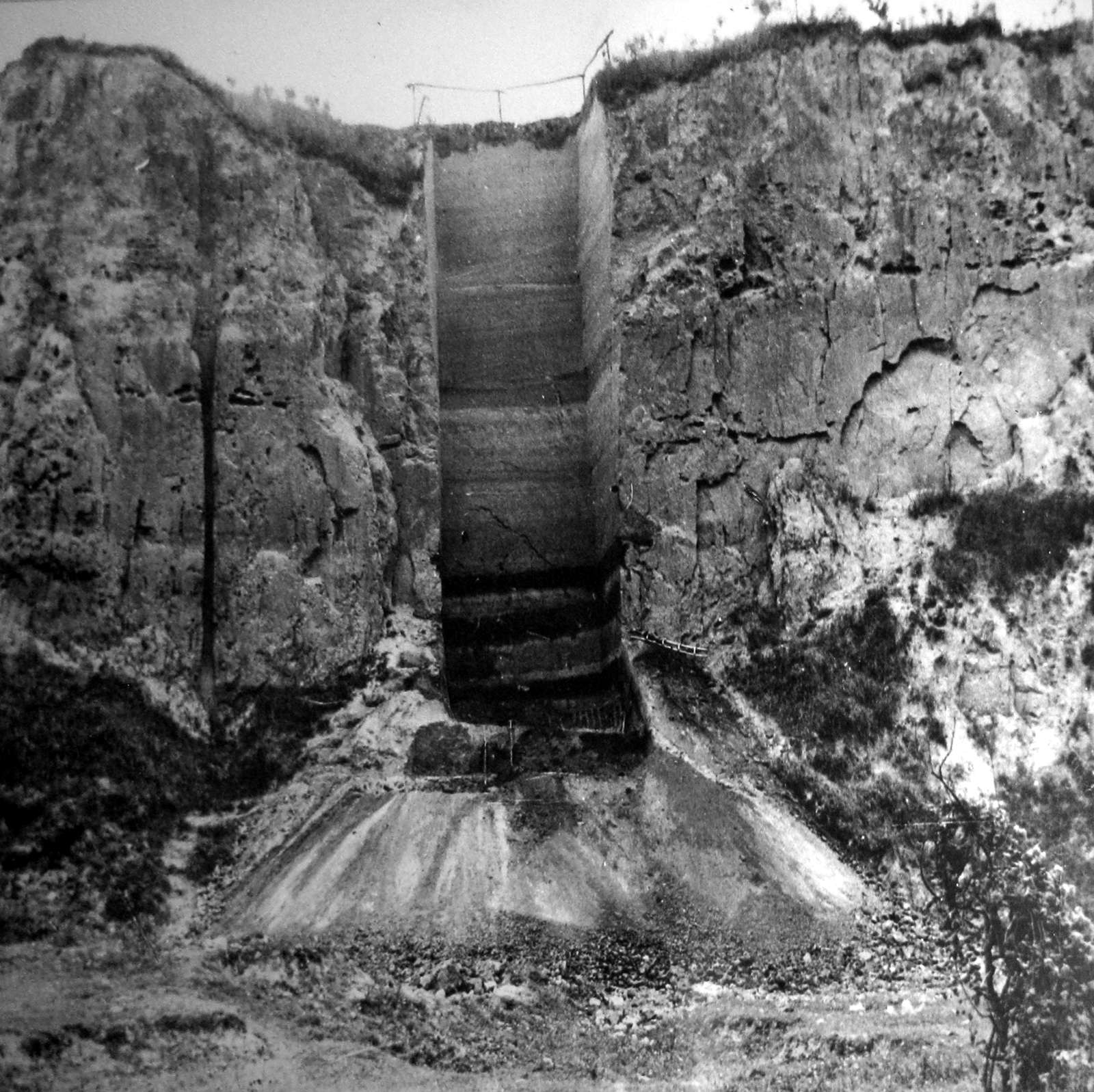
The remains of a hunting settlement from the period 28 000 to 24 000 years BP, were found under a thick layer of loess. The loess, rock ground to fine powder by glaciers and subsequently picked up by the strong winds of the time, was mostly deposited during a subsequent period, the Last Glacial Maximum, (LGM) around 20 000 years BP, when the Scandinavian ice sheet reached as far south as today's Poland, and had an adverse impact on the climate in this region, which became cooler and drier.
(This particular site on a cliff line allowed the researchers to quickly, and relatively safely and cheaply, excavate a very large depth of sediment. It is very rare to have this sort of ideal digging site. To dig down to this depth from a level planar surface, simply a very large hole in the ground, would be a huge and difficult and costly operation - Don )
Text translated and adapted from the display, Dolní Věstonice Museum
Photo: Display, Dolní Věstonice Museum
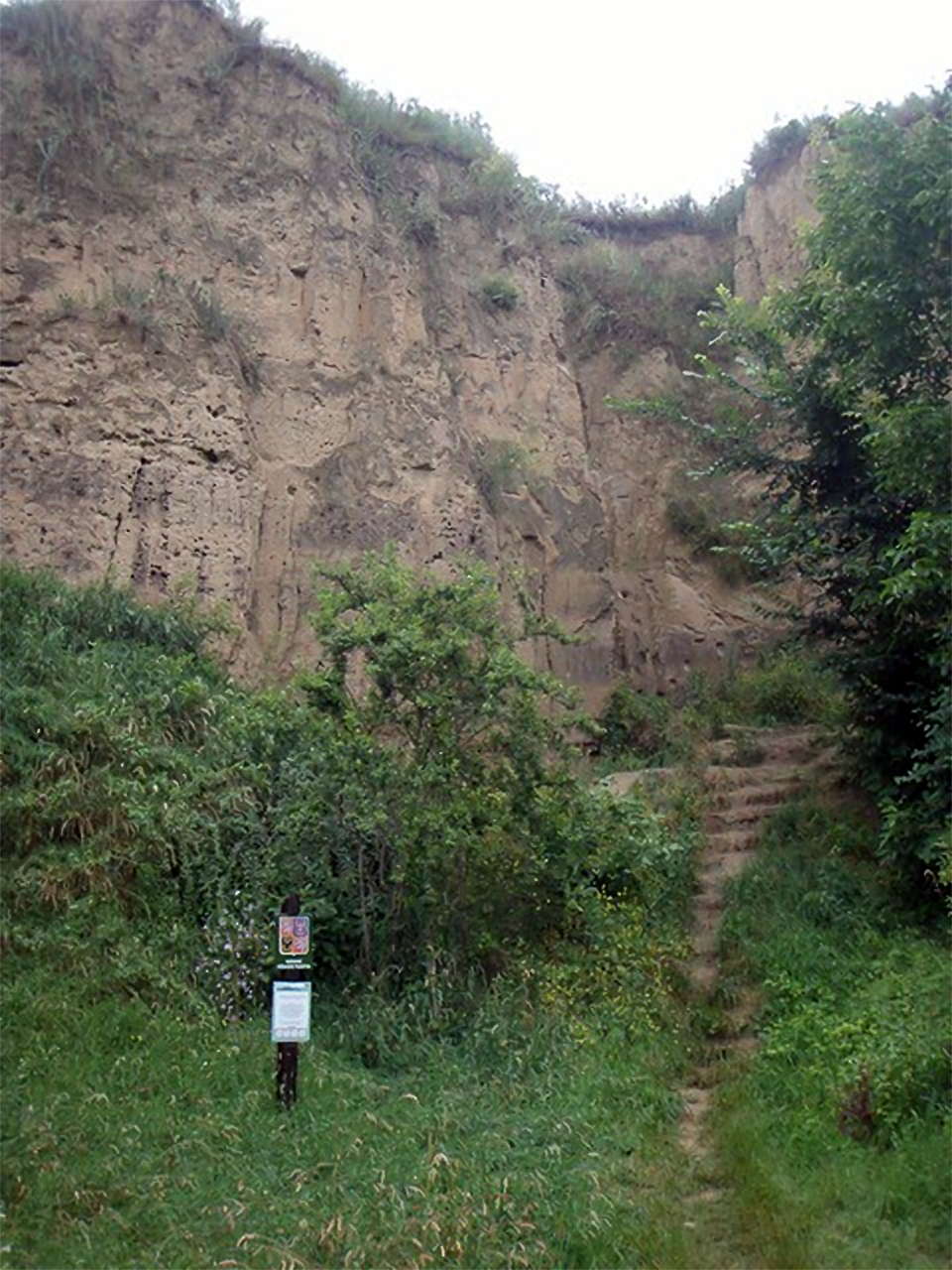

This is the archaeological site today, a conservation area.
It is known as the Kalendář věků, the Calendar of Ages, since it acts as a calendar showing much about past times at Dolni Vestonice.
Note that this is the eastern wall of the Brickyard.
Photo: (left) akinomka, via Panoramio
Photo: (right) Kuchan via Panoramio
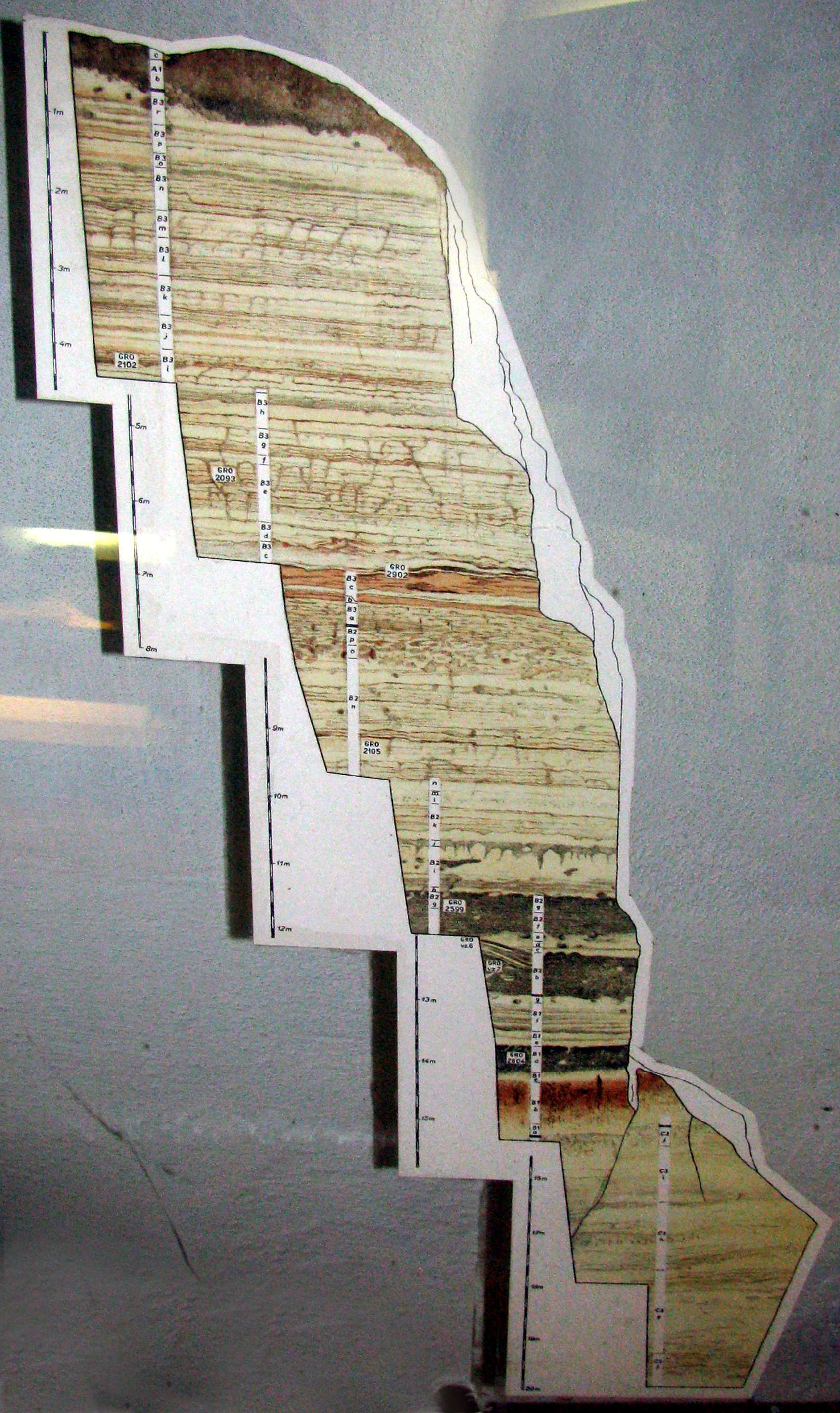
This is a wonderful display showing the layers found for the photo above, and the way the cut into the cliff was stepped in order to maximise safety for the workers, for a total depth of twenty metres.
I think that the cultural layers are at B2o, B2p, B3a, B3b, B3c, judging from the diagram below.
Photo: Display, Dolní Věstonice Museum

Dolni Vestonice 'Brickyard' profile
This is the profile on the eastern wall of the former brickworks at Dolni Vestonice.
R consists of loess from an earlier glaciation, followed by the last interglacial soil, PK III, three layers in the overburden of loess from the last glacial (1-3) separated by fossil soils at PK II and PK I.
Horizon PK I is a cultural layer with Gravettian industry.
Photo: http://is.muni.cz/th/150353/prif_b/Prilohy.pdf
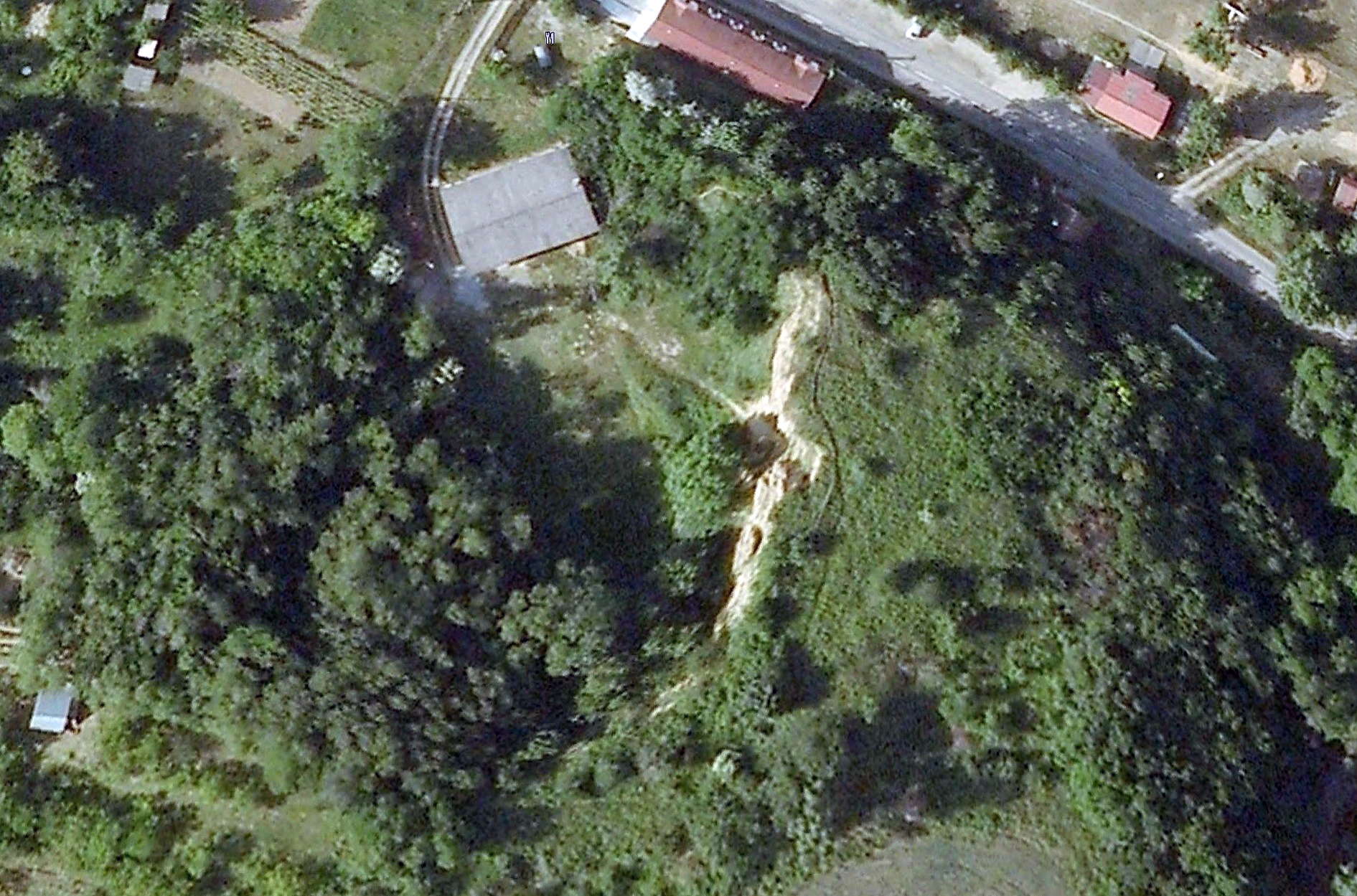
Dolni Vestonice 'Brickyard'
We can see here the niche cut out of the eastern wall, the foot track to it and the small shadow cast by the sign which denotes it as a conservation area.
Photo: Google Earth
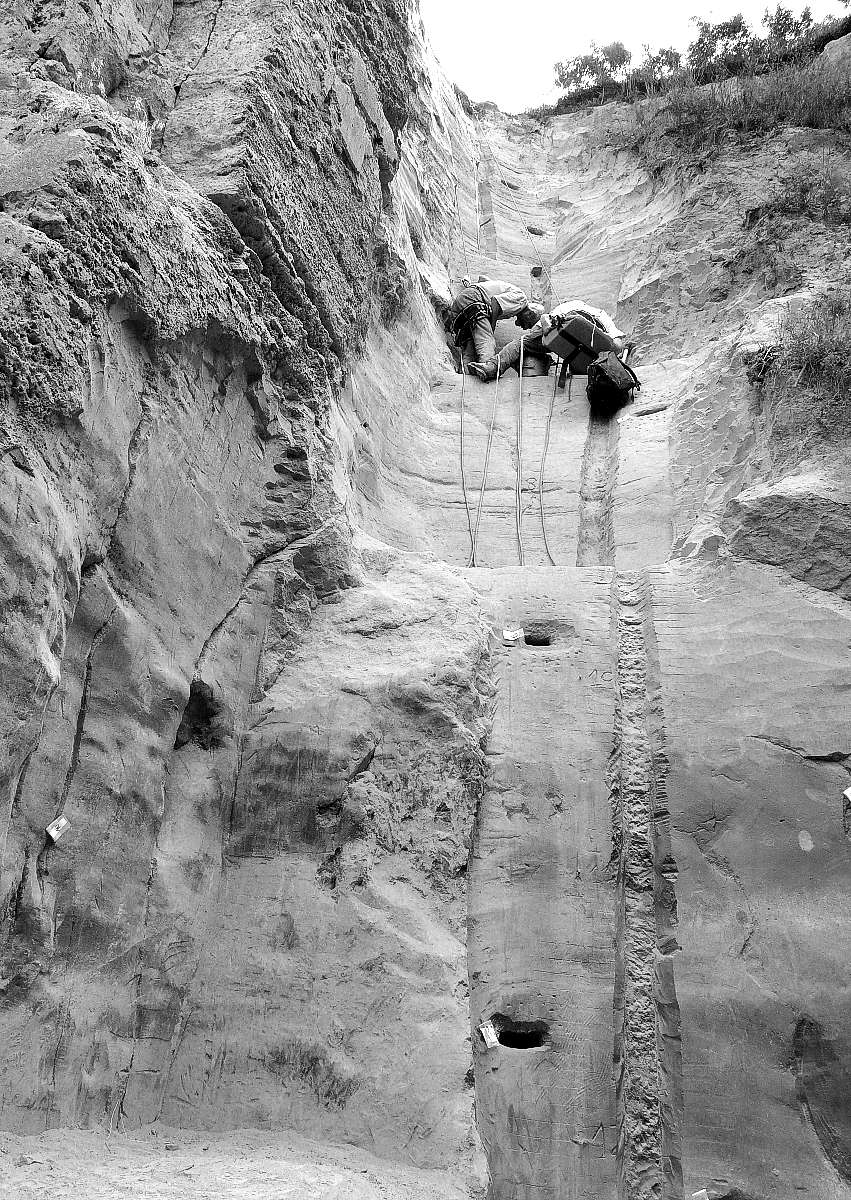
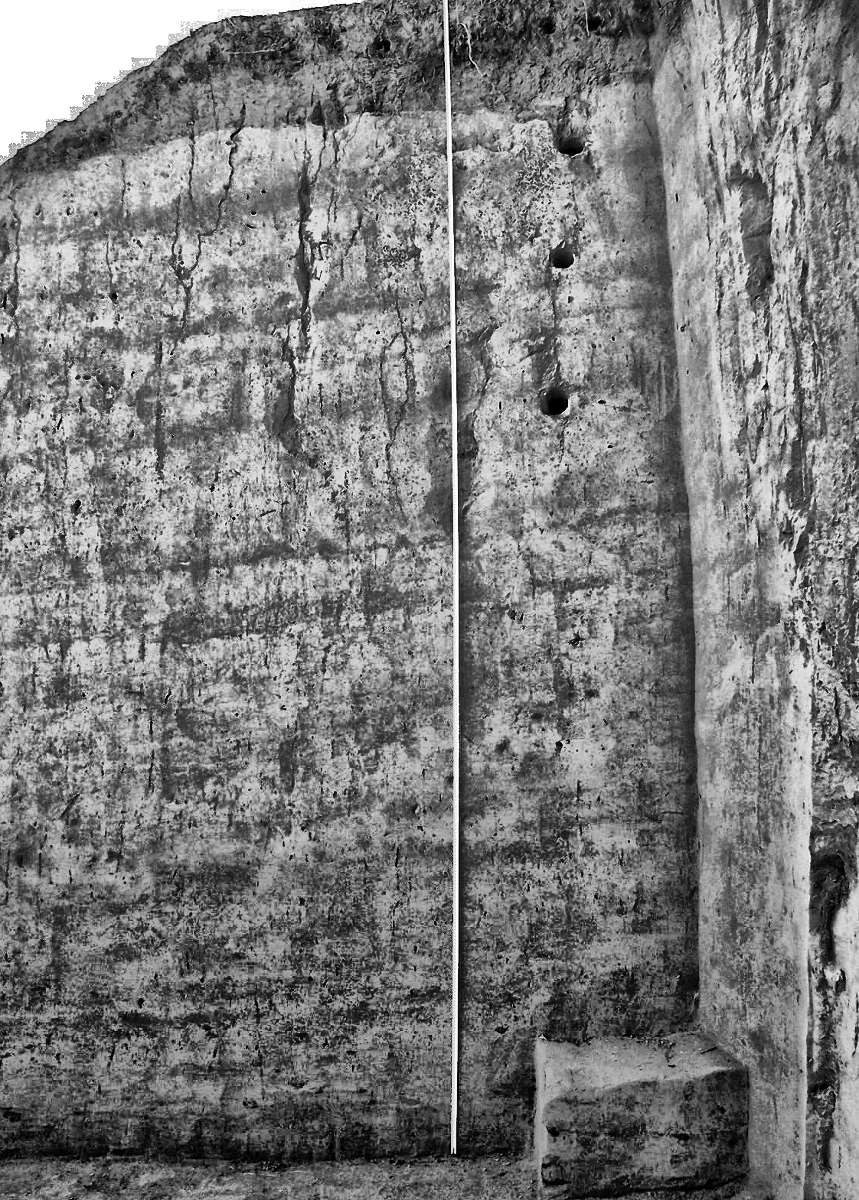
Dolni Vestonice 'Brickyard'
Old brickyard section during Denis-Didier Rousseau excavations in 2009 (left) and new section from M.K.Jones and J.A.Svoboda excavations in 2005 (right) (photo L. Lisa)
(On the left we can see that the researchers have first cleaned up the previous dig, giving a smooth unweathered surface to work from, then have dug a narrow trench down the resulting work platform, presumably to get dates and to recover artefacts. Cleaning the surface allowed the researchers to mark heights into the loess to aid the work, I fancy I can see the 10, 11 and 12 metre marks on the almost polished surface of the loess. They are using ropes and harness for safety. One of the researchers hangs over the cliff with his rope taut. The original researchers would have left an earthen barrier for safety at all times as they excavated, lowering the 'balcony railing' as necessary as they dug further down - Don )
Photo: puvodni.mzm.cz/neruda/cz/Biblio_soubory/OIS3guide.pdf
Dolni Vestonice II
Dolni Vestonice map.
Note the icons on the map, which are explained below.
Photo: Don Hitchcock 2008
Source: Display, Dolni Vestonice Museum
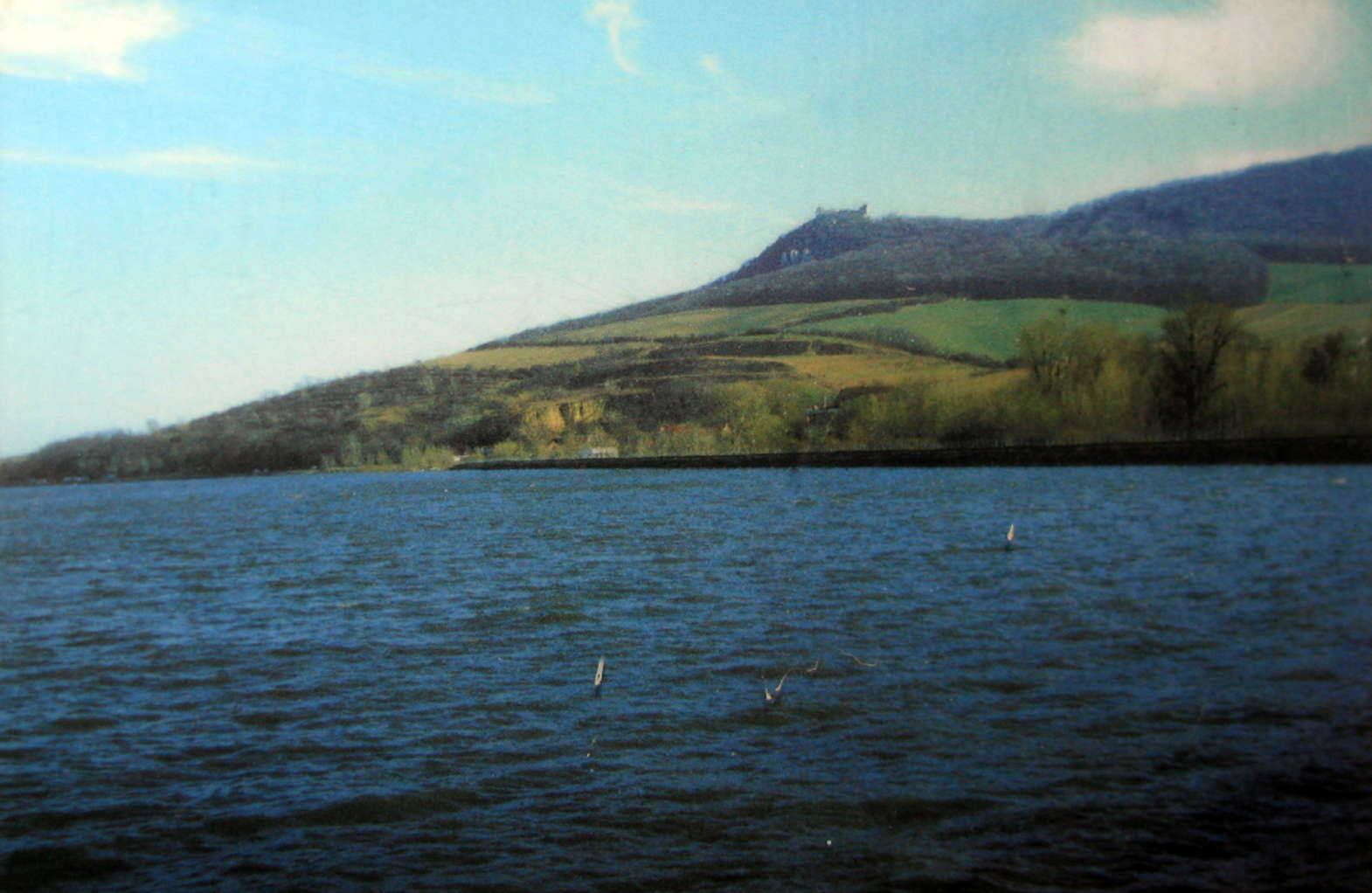
(Icon at left shows position of this photo on the large map above)
The Dolni Vestonice II Settlement, seen across the water. Previously there was a swampy river here, which has been dammed to form this lake.
Note also the loess cliff near the shore in this photo, the same loess cliff as pictured in the photos above.
Archaeological research by the Archaeological Institute during the years 1985 to 1991 has extensively explored the hunting settlements of the area. It is assumed that this was a less intensely populated area in the period from 29 000 to 23 000 years ago.
Unique finding of a ritual grave with three young people in it is especially important.
Pavlov and Dolni Vestonice provide one of the largest sets of skeletons of early anatomically modern humans worldwide. In the ravine below the settlement, in an area now flooded, a huge area of mammoth bones was deposited.
Photo: Don Hitchcock 2008
Source: Display, Dolni Vestonice Museum
More systematic settlement of the whole area of the DV II locality is dated to the terminal Pavlovian (27 – 25 000 BP). Two burial features (the triple burial, and the burial of an individual DV16) found in the DV II locality belong to this stratigraphical position. Intentional burial rites with analogues to modern Siberian nations were proved in the case of the burial of hunter DV16) (Nývltová Fišáková and Sázelová, 2008). The phraseology analyses, together with analyses of tooth cement microstructures and analyses of hunted fauna, confirmed that the settlement (Šajnerová, 2001, West, 2001, Nývltová Fišáková, 2001, 2007), together with the mammoth bone depot was active around the year at this stage (Svoboda, 2001).
Settlement of the DV II locality and also of the whole settlement complex of Dolní Věstonice - Pavlov faded away in the so called late Pavlovian, Willendorf-Kostěnkian phase (25-21 000 BP). A part of the western wall of the old brickyard and also the Dolní Věstonice III locality, cluster 1, belongs to this stage (Svoboda, 2001).
Text above: puvodni.mzm.cz/neruda/cz/Biblio_soubory/OIS3guide.pdf

Dolni Vestonice II was the site of the famous triple burial.
A separate burial at Dolni Vestonice of a single, older male
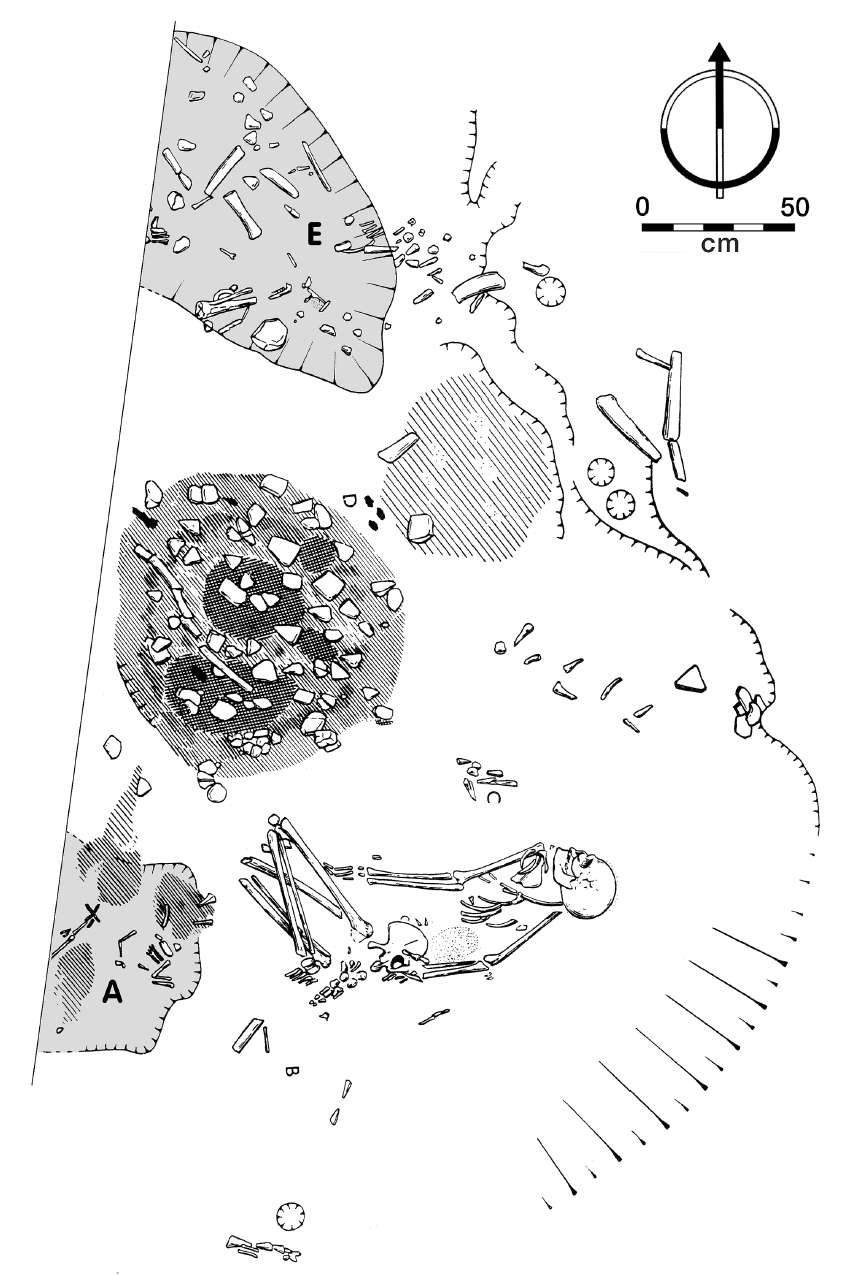
Plan of Dolni Vestonice II – western slope, first settlement unit (after Svoboda 1991a). The depressions A and E are indicated in grey.
This is a male burial.
Svoboda (1991a) describes seven 'ceramic' fragments from what is designated as the first 'settlement unit' on the western slope of Dolní Vestonice II. The fragments were found in two depressions in the vicinity of a large hearth and a male burial.
Photo and text: https://openaccess.leidenuniv.nl/bitstream/handle/1887/13512/ASLU08_05.pdf
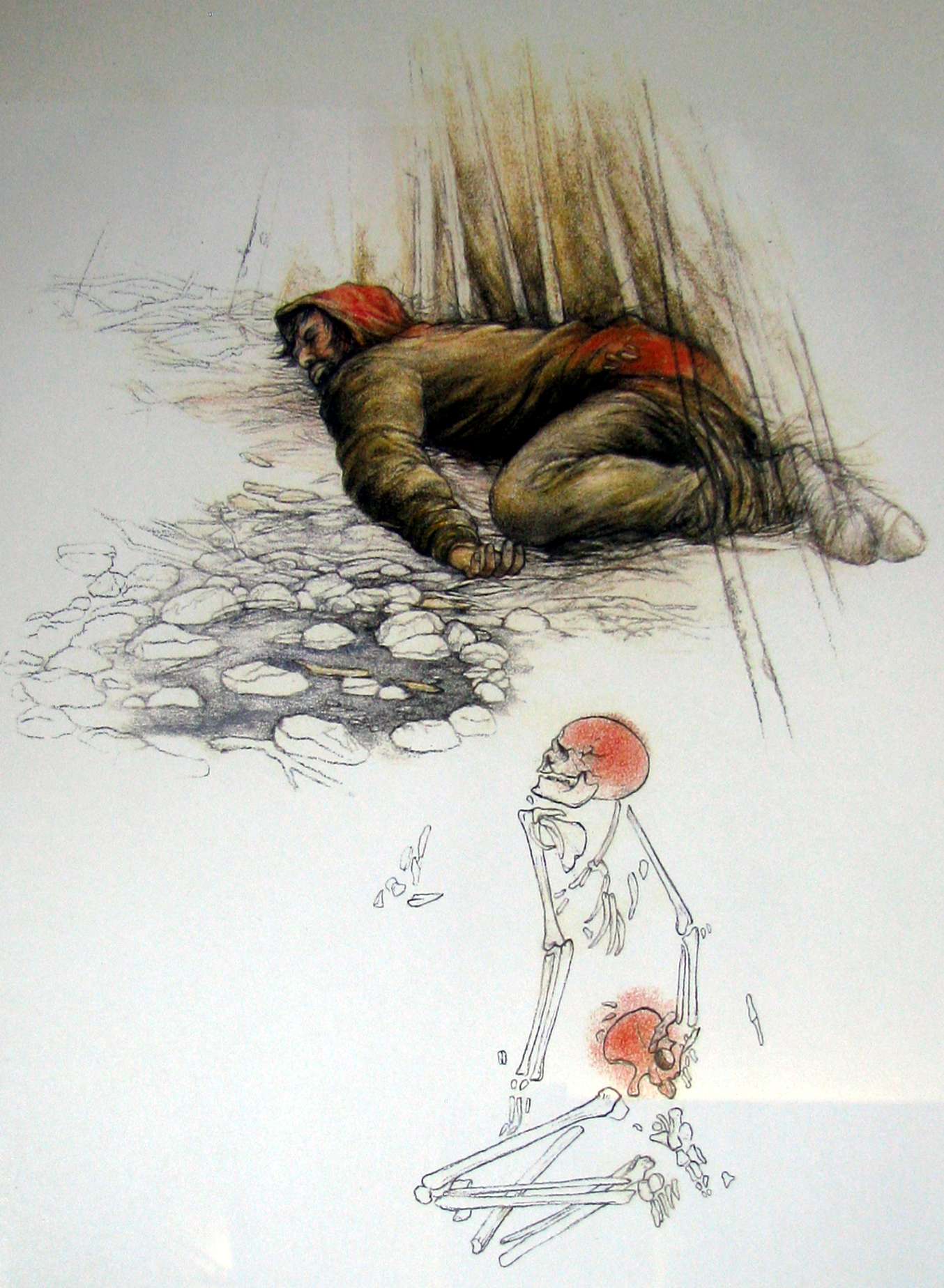
Older lone man from Dolní Věstonice, probably buried inside a hut. The age of this burial is 25 570 ± 280 years. Traces of red ochre were found on his skull and pelvis.
Photo source: Display, Dolní Věstonice Museum
Artist: Unknown
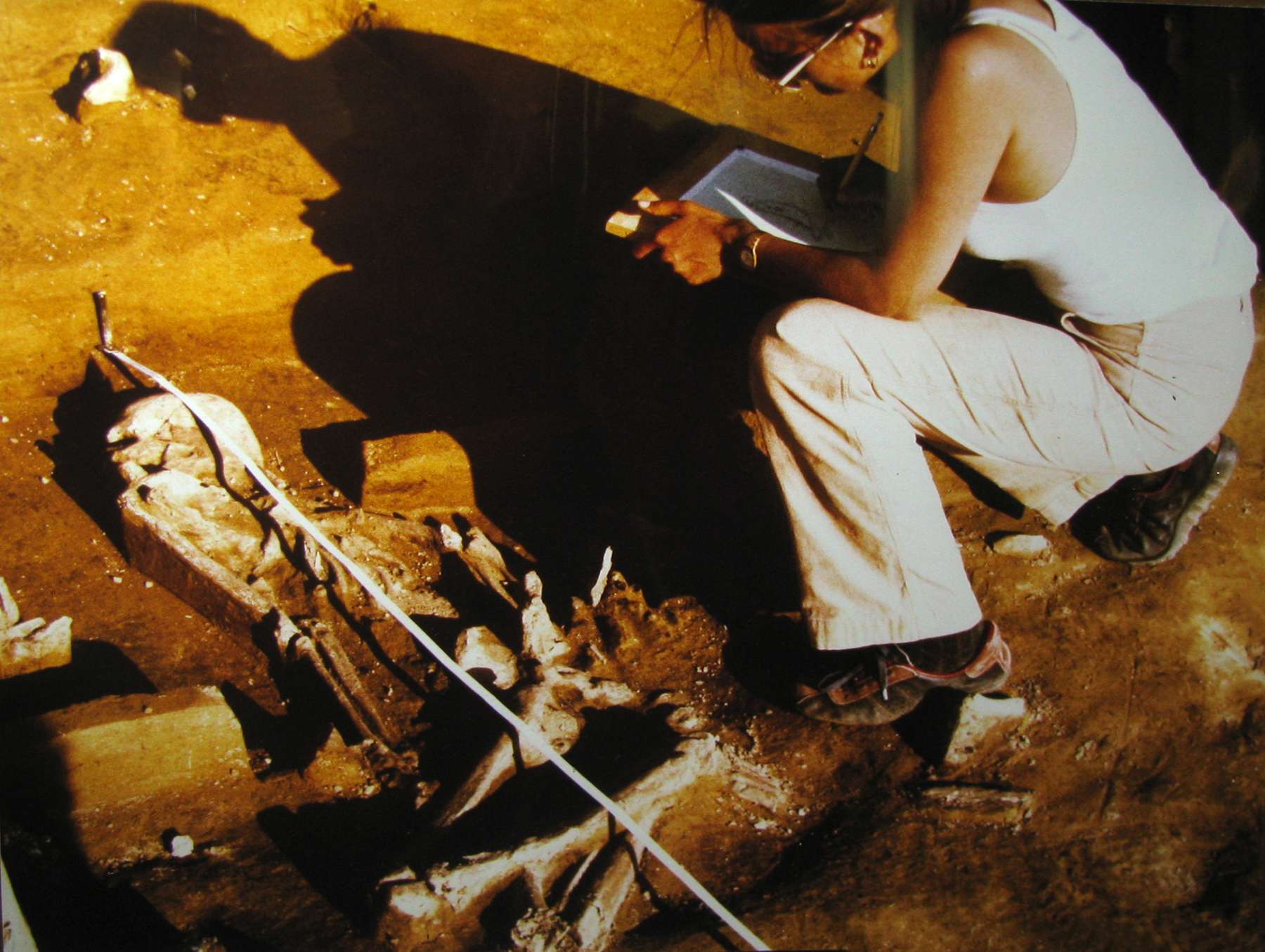
Recording the position of the male skeleton.
Photo source: Display, Dolní Věstonice Museum
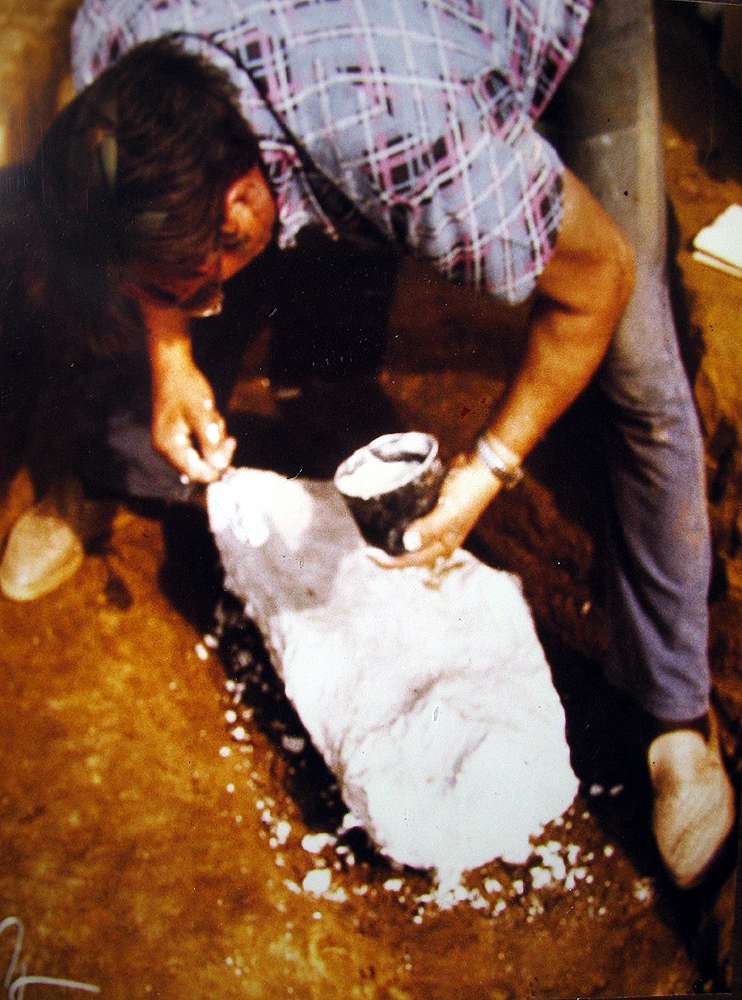
Before the skeleton could be moved, it was necessary to stabilise it with plaster.
Photo source: Display, Dolní Věstonice Museum
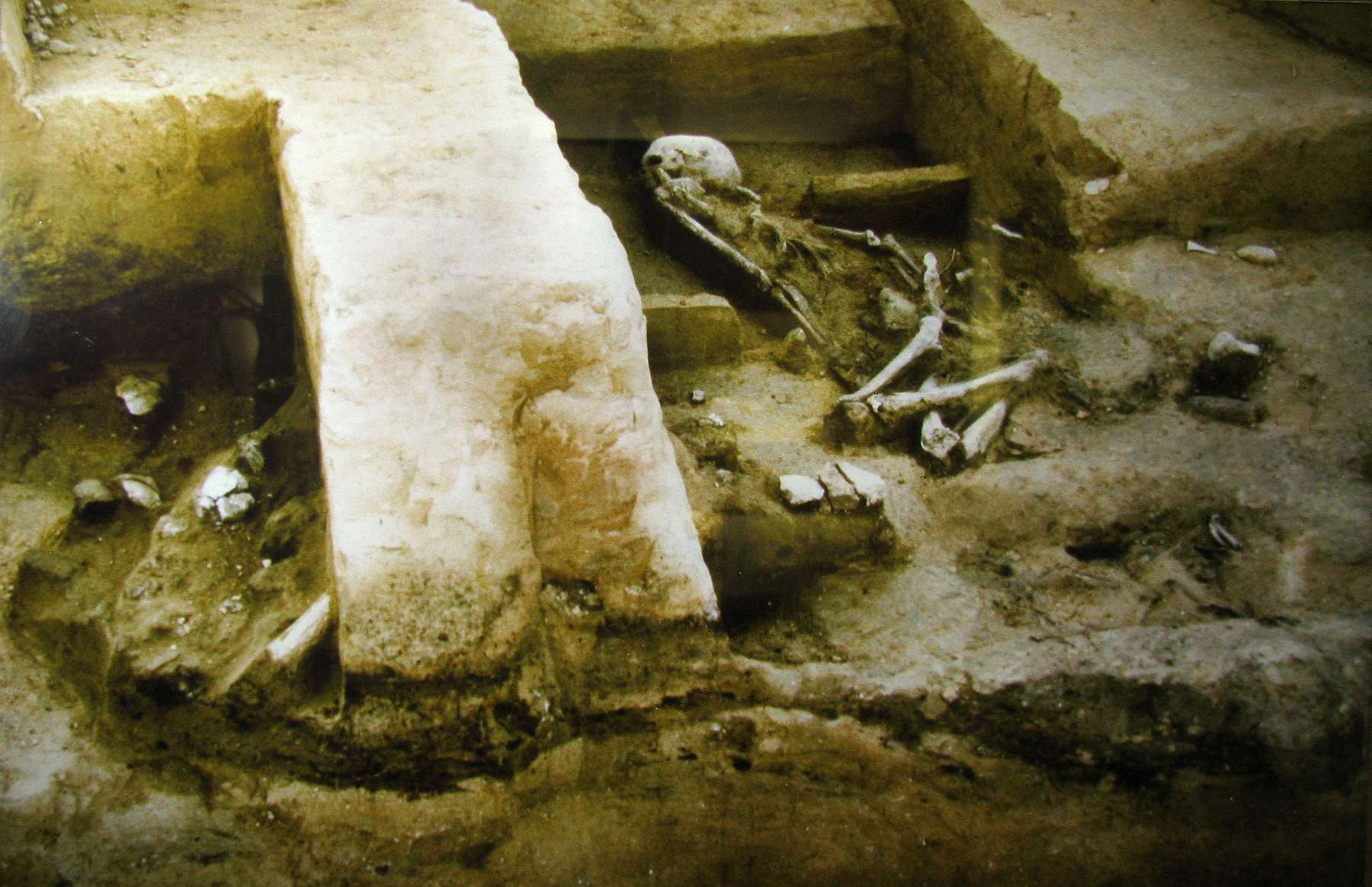
The grave during the course of the research. Near the knee of the skeleton a hearth was uncovered.
Photo source: Display, Dolní Věstonice Museum

Fauna, Dolni Vestonice II (SZS, Lower Western Slope)
Photo: http://is.muni.cz/th/150353/prif_b/Prilohy.pdf
Fauna, Dolni Vestonice II (MNI = Minimum Number of Individuals)
Data: http://is.muni.cz/th/150353/prif_b/Prilohy.pdf
| Scientific Name | Common Name | % of finds (MNI) | Inferred MNI |
| Mammuthus primigenius | Woolly Mammoth | 21.73% | 5 |
| Lepus timidus | Arctic Hare | 13.04% | 3 |
| Rangifer tarandus | Reindeer | 8.69% | 2 |
| Canis lupus | Grey Wolf | 13.04% | 3 |
| Alopex lagopus | Arctic Fox | 8.69% | 2 |
| Vulpes vulpes | Red Fox | 13.04% | 3 |
| Felis silvestris | European Wildcat | 4.34% | 1 |
| Equus caballus germanicus | Forest Horse | 8.69% | 2 |
| Ursus sp. | Bear | 4.34% | 1 |
| Panthera spelaea | Cave Lion | 4.34% | 1 |
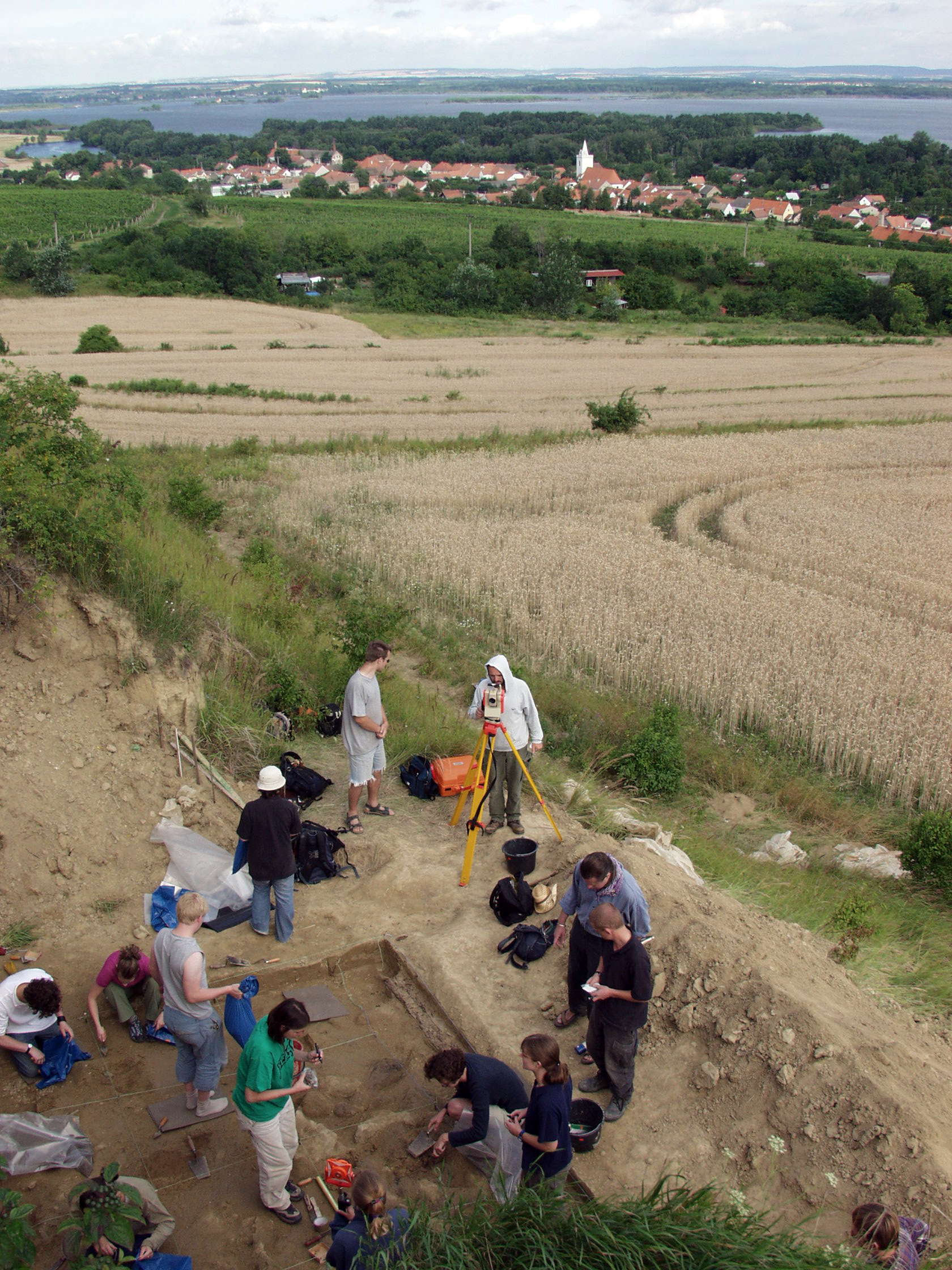
A dig from 2005 close to the Dolni Vestonice II site.
The excavation in the photograph was a collaborative venture led in summer 2005 by Jiri Svoboda and Martin Jones, with the primary objective of improving the plant record for these Gravettian layers. For the first time the researchers undertook the kind of flotation approaches that have become routine for farming sites, but are still rarely undertaken for the palaeolithic, hence the continued paucity of plant evidence.
Some of the participants in the photo, mostly Cambridge students and researchers:
David Beresford-Jones - standing outside trench in light blue shirt, in conversation with: Alexander (Sandy) Pullen - in black top, Clea Paine - in trench, in green top, and Katherine Johnson - in the trench with pony tail and dark blue top.
The site is 290 metres from the Brickyard, and 820 metres from the church spire.
Readers may be interested in the following publications that arose from this dig:
Beresford-Jones et al. (2010), Beresford-Jones et al (2011), Pryor et al. (2013)
Photo: http://www.arub.cz/vyzkumna-strediska/stredisko-pro-vyzkum-paleolitu-a-paleoetnologie.html
Text: by kind permission of Martin Jones, co-author of the three references listed above

This photo from Google Earth shows the position of the 2005 dig, as well as several other important sites.
Photo: Google Earth
Dolní Věstonice IIa
A Rescue Dig

In 1999 it became necessary to undertake rescue research at a site which became known as Dolni Vestonice IIa, because of damage to the cultural layer by agricultural activities. Several sondages were dug.
This is Sondage B for Dolni Vestonice IIa. The cultural layer here was 30 cm below the surface, and was immediately threatened by ploughing.
The investigated areas were divided into square metres, which were then recorded as the dig progressed. Results were published in a series of papers.
Photo: Miriam Nývltová Fišáková, http://www.iabrno.cz/~nyvltova/DVII99.htm
Map of the important sites from Dolni Vestonice to Pavlov. This map shows the position of Dolni Vestonice IIa at the site marked 4.
1. Dolní Věstonice I;
2. Pavlov I;
3. Dolní Věstonice II;
4. Dolní Věstonice II-A;
5. Dolní Věstonice III;
6. Pavlov II
A. Dolní Věstonice brickyard.
Photo: Verpoorte (2000)

Sondage A. At this site, the cultural layer was protected by one metre of sterile loess. The site is not threatened by ploughing, and only a small exploratory pit was dug.
The photograph shows the pelvis of a Mammuthus primigenius (Woolly Mammoth) overlapping a shin bone (tibia).
The species identified are shown in the graph and table below.
Most of the bones lay in the fireplace, and some were charred from the fire. Stones affected by heat lay above a reindeer skull, indicating heat treatment of food in a hot pit. Preservation of the bones was poor, and most of the bones disintegrated soon after removal. A low proportion of fur animals may indicate that the camp was inhabited from late winter until summer. This would also explain the finding of a juvenile lion skull, which from analogous present large cats, would have been born in this period, from March to August.
Photo: Miriam Nývltová Fišáková, http://www.iabrno.cz/~nyvltova/DVII99.htm
Dating:
Uncalibrated data (Svoboda et al., 2002):
GRN 15134 - 25870 +370-360 (IIa, Sondage A, the bottom carbon position)
GRN 15147 - 25890 +370-360 (IIa, Sondage A, top carbon position)
GRN 15132 - 26190 +390-370 (IIa, Sondage D)
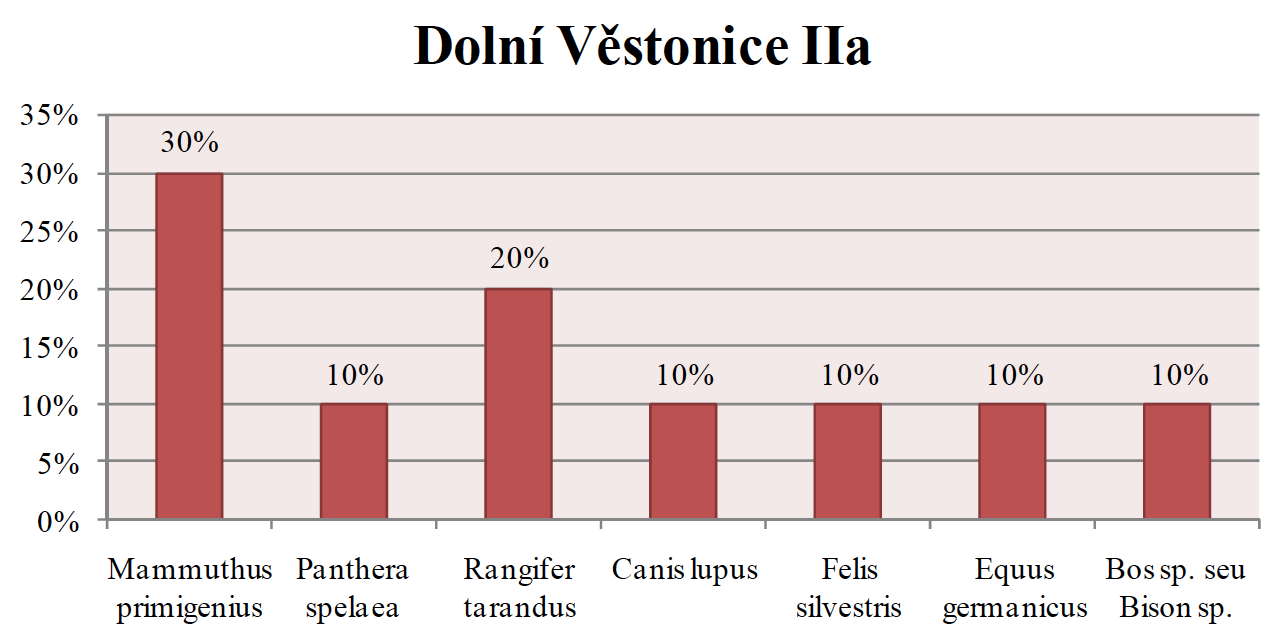
Fauna, Dolni Vestonice IIa
Photo: http://is.muni.cz/th/150353/prif_b/Prilohy.pdf
Fauna, Dolni Vestonice IIa (MNI = Minimum Number of Individuals)
Data: http://is.muni.cz/th/150353/prif_b/Prilohy.pdf
| Scientific Name | Common Name | % of finds (MNI) | Inferred MNI |
| Mammuthus primigenius | Woolly Mammoth | 30% | 3 |
| Panthera spelaea | Cave Lion | 10% | 1 |
| Rangifer tarandus | Reindeer | 20% | 2 |
| Canis lupus | Grey Wolf | 10% | 1 |
| Felis silvestris | European Wildcat | 10% | 1 |
| Equus caballus germanicus | Forest Horse | 10% | 1 |
| Bos sp. or Bison sp. | Aurochs or Bison | 10% | 1 |

Dolni Věstonice IIa (1999). Spatial distribution of individual bones in the area.
(Redrawn from the original plans after J. Svoboda).
Photo: Miriam Nývltová Fišáková, http://www.iabrno.cz/~nyvltova/DVII99.htm

Much of the information on Dolni Vestonice IIa here, photos and text, comes from Dr Miriam Nývltová Fišáková, who has done a lot of work on this particular archaeological site.
Dr Miriam Nývltová Fišáková is an osteologist at the Department of the Palaeolithic and Palaeoethnology, Archaeological Institute, Czech Academy of Sciences, Dolní Věstonice.
She has a PhD in Osteometrics from Charles University in Prague. Since 2000 she has worked at the Institute of Archaeology in Brno in osteology. She lectures on osteology for archaeologists at the Masaryk University in Brno and at the Silesian University in Opava. At Charles University in Prague she teaches Geoarchaeology, Quaternary paleoecology and evolution, including human evolution.
She has published many papers on a wide range of topics connected with archaeology.
Photo: http://iabrno.academia.edu/MiriamN%C3%BDvltov%C3%A1Fi%C5%A1%C3%A1kov%C3%A1
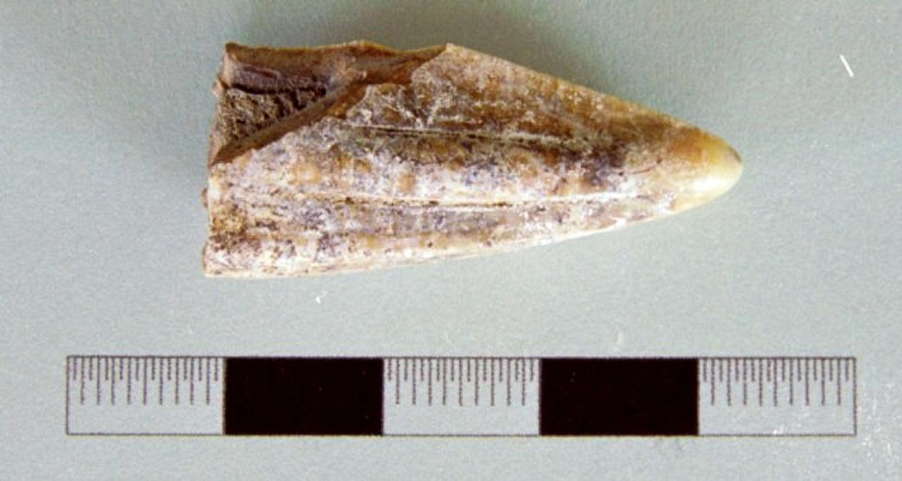
Young Cave Lion canine.
Photo: Miriam Nývltová Fišáková, http://www.iabrno.cz/~nyvltova/DVII99.htm
The largest representation here is mammoth, then reindeer, gray wolf, bison or aurochs, forest horse , a lion and wildcat. The composition of the fauna at this location corresponds to that at the locations of Dolni Věstonice III and at Pavlov from 1957 and 1958. From this site there were mammoth tusk fragments, teeth, pelvis, tibia, and bone fragments. Also preserved were bovid teeth and fragments of vertebrae. The lower jaw, ribs and fragments of long bones of a wolf were found. Reindeer remains were more or less complete. The horse is here represented only by a skull, vertebrae, ribs and scapula. Bones of a wild cat were found as well as one tooth and a lion skull without the lower jaw. The largest concentration of bone was in the Sondage A, because it was protected by a thick cover of loess. Skeletal remains were scattered evenly across the surface.There was a remarkable concentrationof only a few skulls (two reindeer skull, the skulls of a young horse and a lion) in the Sondage A. One of the reindeer skulls has traces of red dye staining. In addition to these skulls the tibia of a mammoth were covered with the mammoth pelvis.
Text above: Miriam Nývltová Fišáková, http://www.iabrno.cz/~nyvltova/DVII99.htm

Fragment of the upper jaw of a horse.
Photo: Miriam Nývltová Fišáková, http://www.iabrno.cz/~nyvltova/DVII99.htm

Wolf Metapodia
Photo: Miriam Nývltová Fišáková, http://www.iabrno.cz/~nyvltova/DVII99.htm
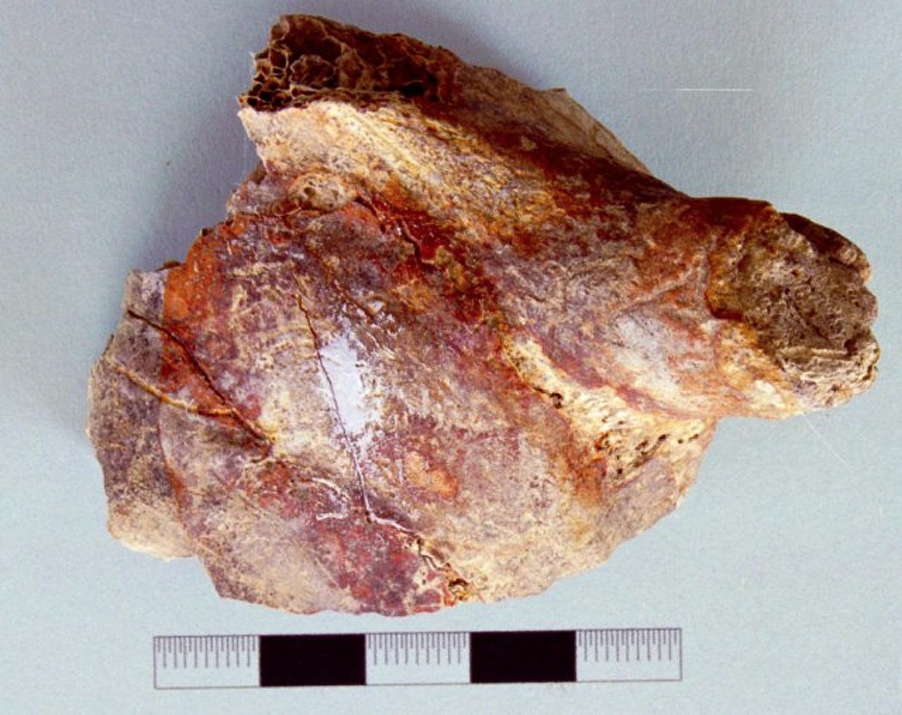
Reindeer skull fragment with the remnants of red ochre.
Photo: Miriam Nývltová Fišáková, http://www.iabrno.cz/~nyvltova/DVII99.htm
Dolni Vestonice III (Rajny)
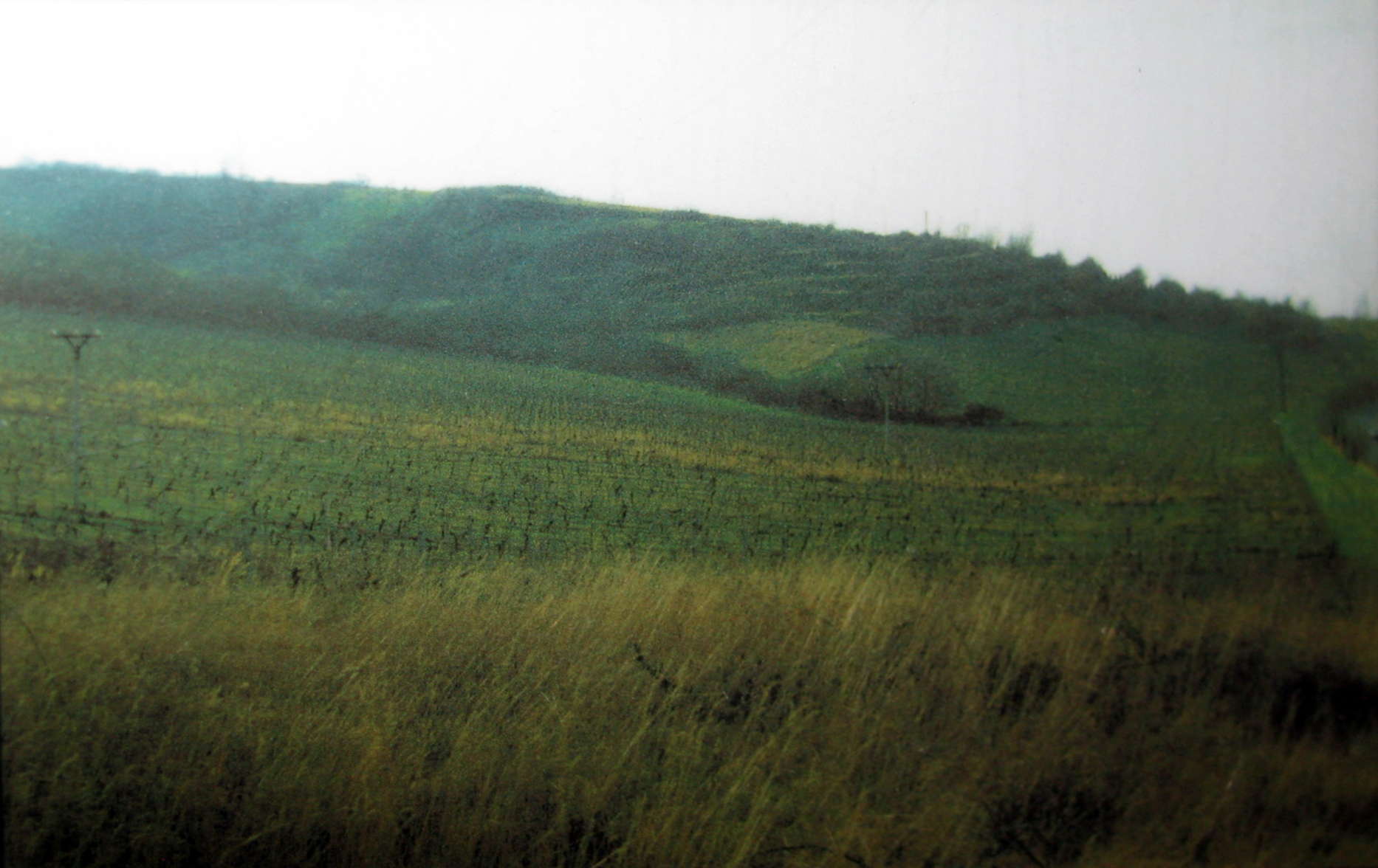
(Icon at left shows position of this photo on the large map above)
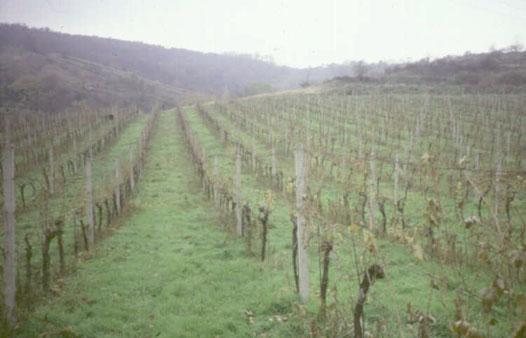
The Dolni Vestonice III (Rajny) settlement, the dig now returned to grape vines.
Virtually every hill in the area of Dolni Vestonice - Pavlov gave traces of hunting settlements (hearths, tools, bones). Artefacts found at Rajnách/Rajny show the oldest traces of settlement in the region (Aurignacian, more than 30 000 BP). The site was re-occupied from 26 000 to 24 000 years ago, in the Gravettian.
Photo: Don Hitchcock 2008
Source: Display, Dolni Vestonice Museum
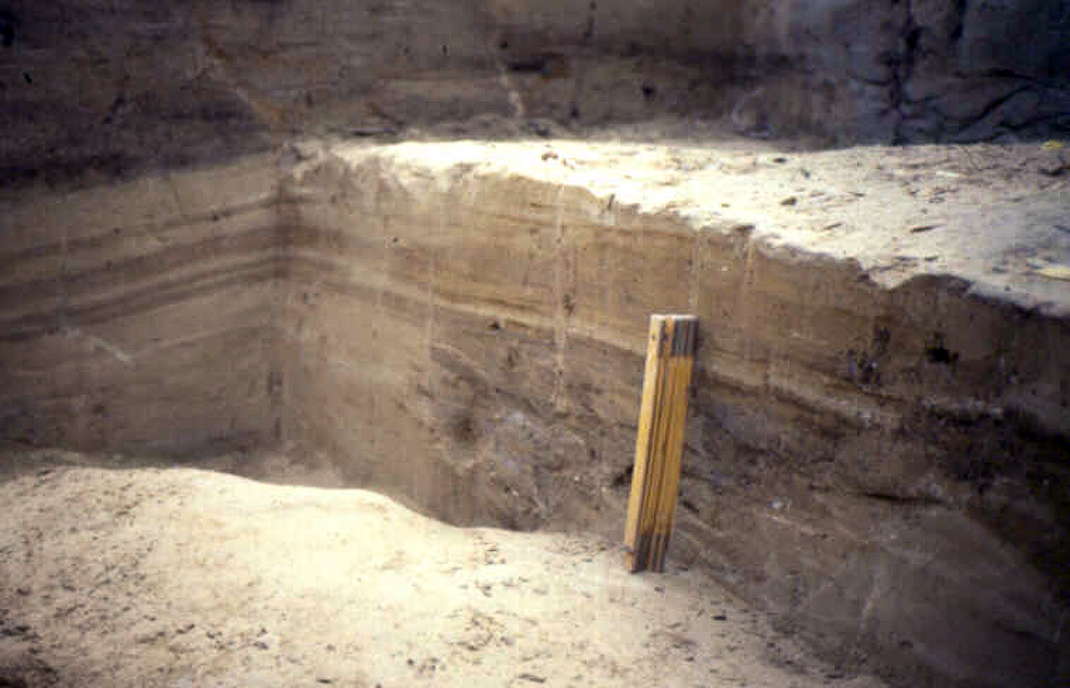
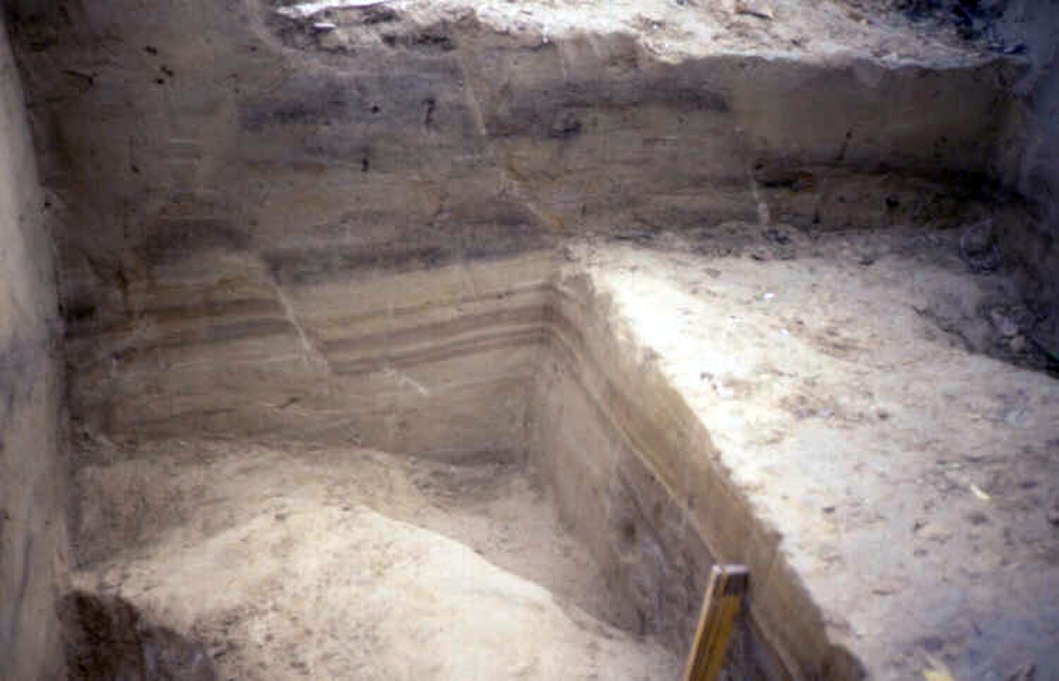
This is Dolni Vestonice III, Unit 2, 1995 excavation.
The photos were taken during Petr Skrdla's 1993-1996 field work at Dolni Vestonice:
Dolní Vestonice III, a systematic field survey followed by excavation of Gravettian (Evolved Pavlovian stage) open-air site on the foot of Pavlov Hills (that is, Dolni Vestonice III - Don )
Petr Skrdla's Home Page: http://www.iabrno.cz/~skrdla/SKRDLA/psexcav.htm
Photo: http://www.iabrno.cz/~skrdla/dv3rajny.htm
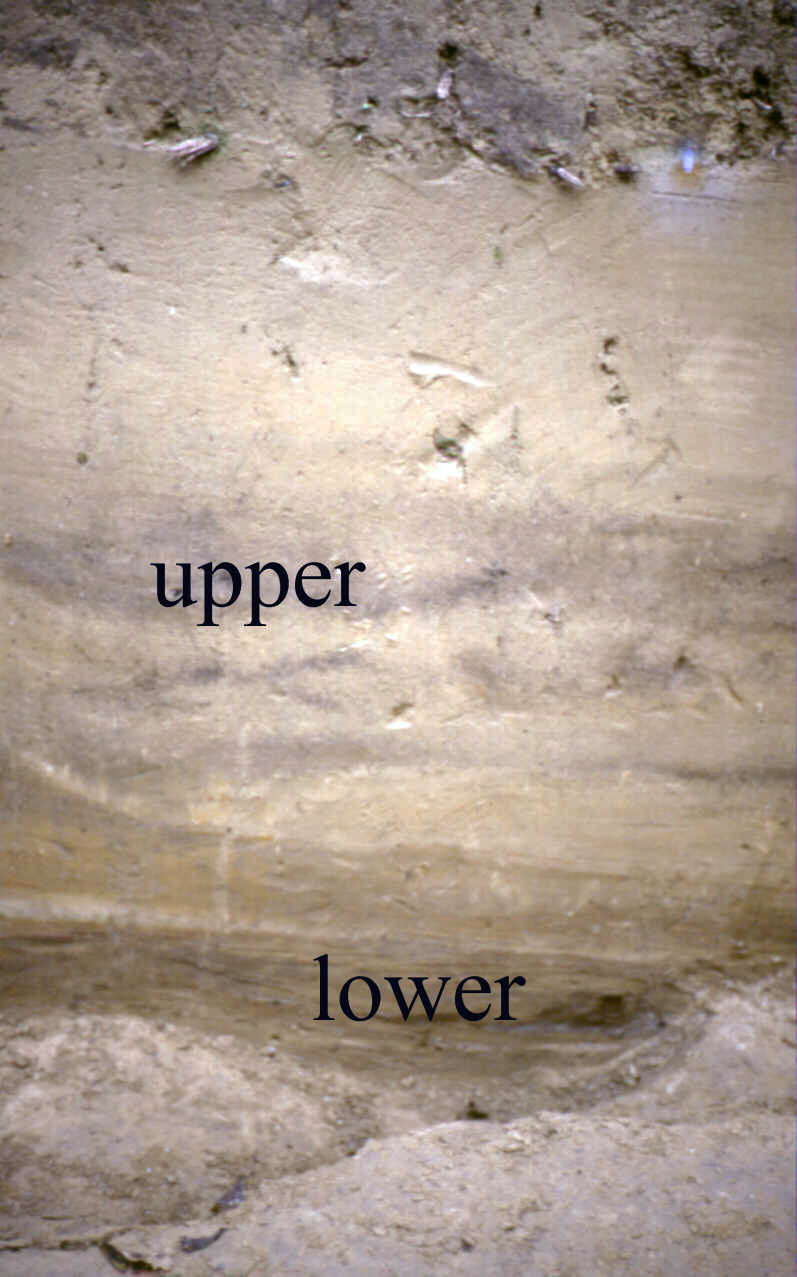
Here we can see two distinct layers containing Paleolithic artifacts, which is a first for the Dolni Vestonice - Pavlov area.
Photo: http://www.iabrno.cz/~skrdla/dv3rajny.htm
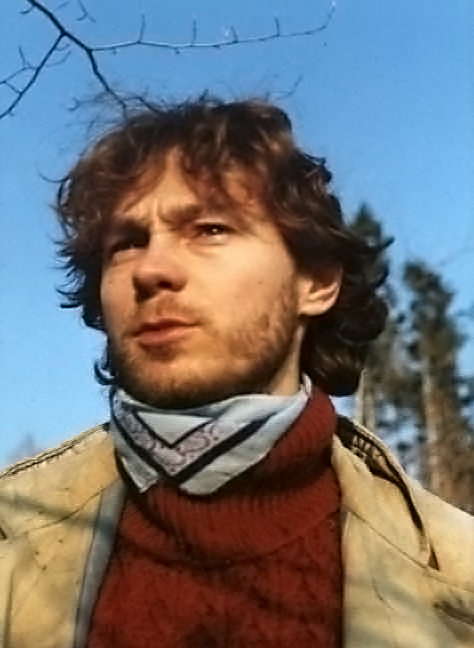
Dr Petr Škrdla has done some fine work in archaeology, and has done much field work in the Moravian area.
He has been participating in archaeological digs since he was 14 years old, and has published more than 200 papers.
Photo: http://www.iabrno.cz/~skrdla/SKRDLA/
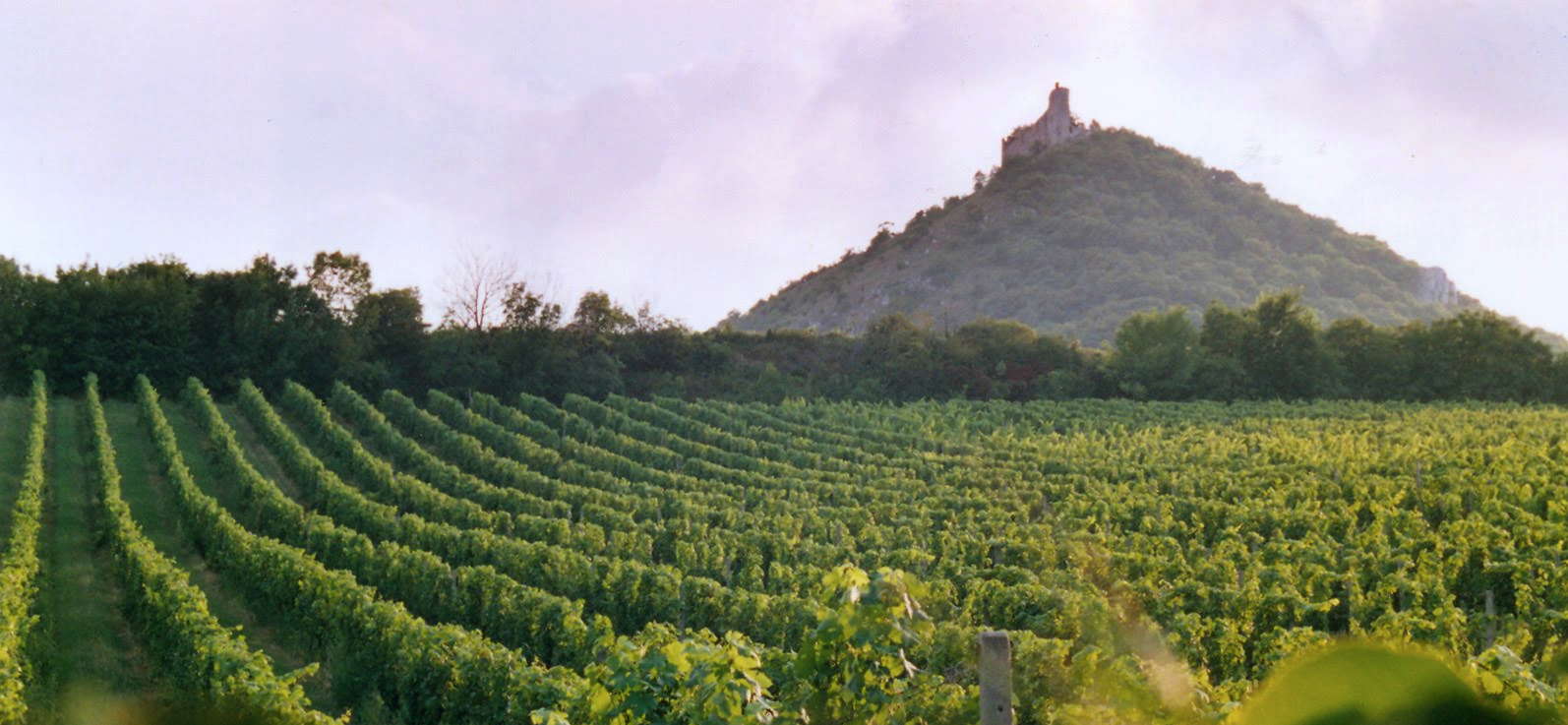
(Icon at left shows position of this photo on the large map above)
Vineyard and Děvičky Castle whose ruins surmount a steep hill in the Pálava Protected Landscape Area.
The Dolni Vestonice III (Rajny) settlement was found in this vineyard, and is now once more covered by grape vines.
Photo: pmotloch, via Panoramio
Dolni Vestonice III
The Dolni Vestonice III Gravettian site lies on the eastern slope of the short blind valley between the sites I and II. The site was first observed by B.Klima at the end of 1960s and has been under excavation since the summer of 1993 by Petr Skrdla. Excavations yielded a collection of more then 500 pieces of stone artifacts (majority of which are made of silica from glacigene sediments), bone fragments, and decorative objects. The site consists of two different units (unit 1 and 2). Unit 2 is composed of two layers. Excavations will be continued.
For more information see: Skrdla, P., Cilek, V., Prichystal, A 1996: Dolni Vestonice III, excavations 1993-1995. Spisy Au AV CR v Brne, vol. 5, 173-190.
From: http://www.iabrno.cz/dv3.htm
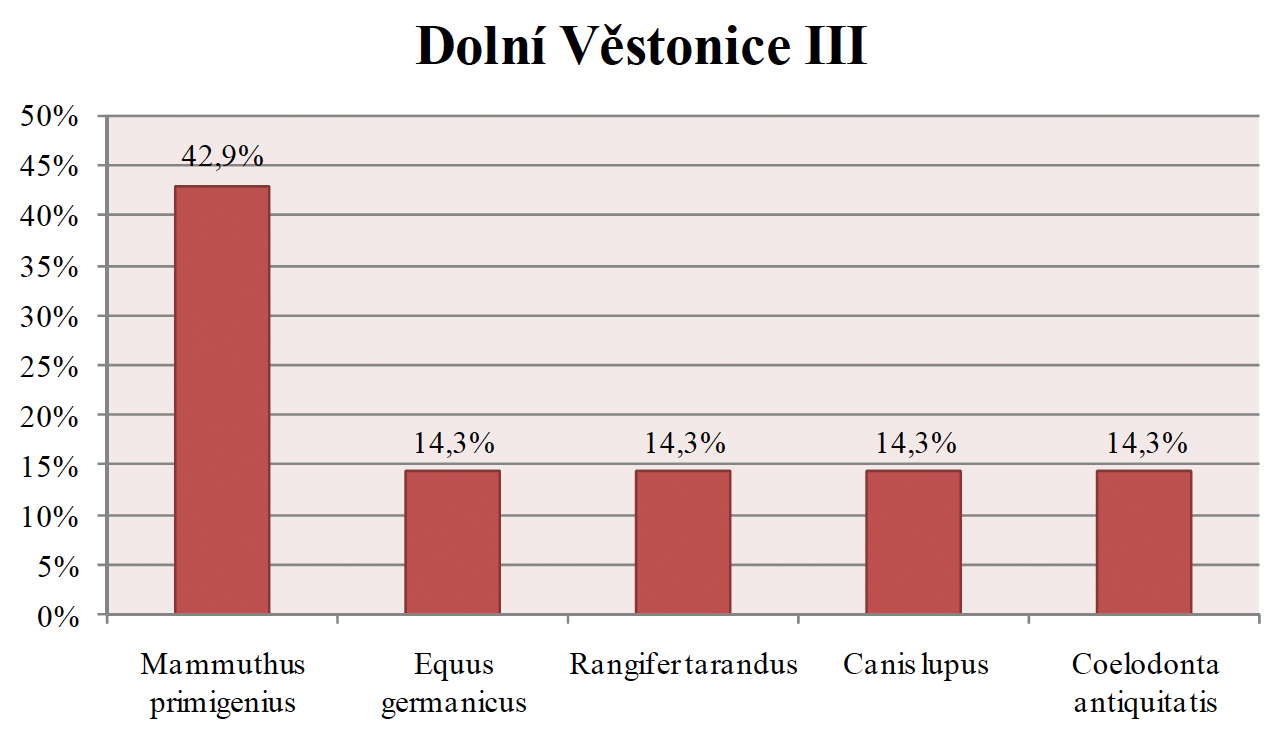
Fauna, Dolni Vestonice III
Photo: http://is.muni.cz/th/150353/prif_b/Prilohy.pdf
Fauna, Dolni Vestonice III (MNI = Minimum Number of Individuals)
Data: http://is.muni.cz/th/150353/prif_b/Prilohy.pdf
| Scientific Name | Common Name | % of finds (MNI) | Inferred MNI |
| Mammuthus primigenius | Woolly Mammoth | 42.9% | 3 |
| Equus caballus germanicus | Forest Horse | 14.3% | 1 |
| Rangifer tarandus | Reindeer | 14.3% | 1 |
| Canis lupus | Grey Wolf | 14.3% | 1 |
| Coelodonta antiquitatis | Woolly Rhinoceros | 14.3% | 1 |

Profile of the cultural layer of loess at the Pavlov site.
Source: Display, Dolní Věstonice Museum
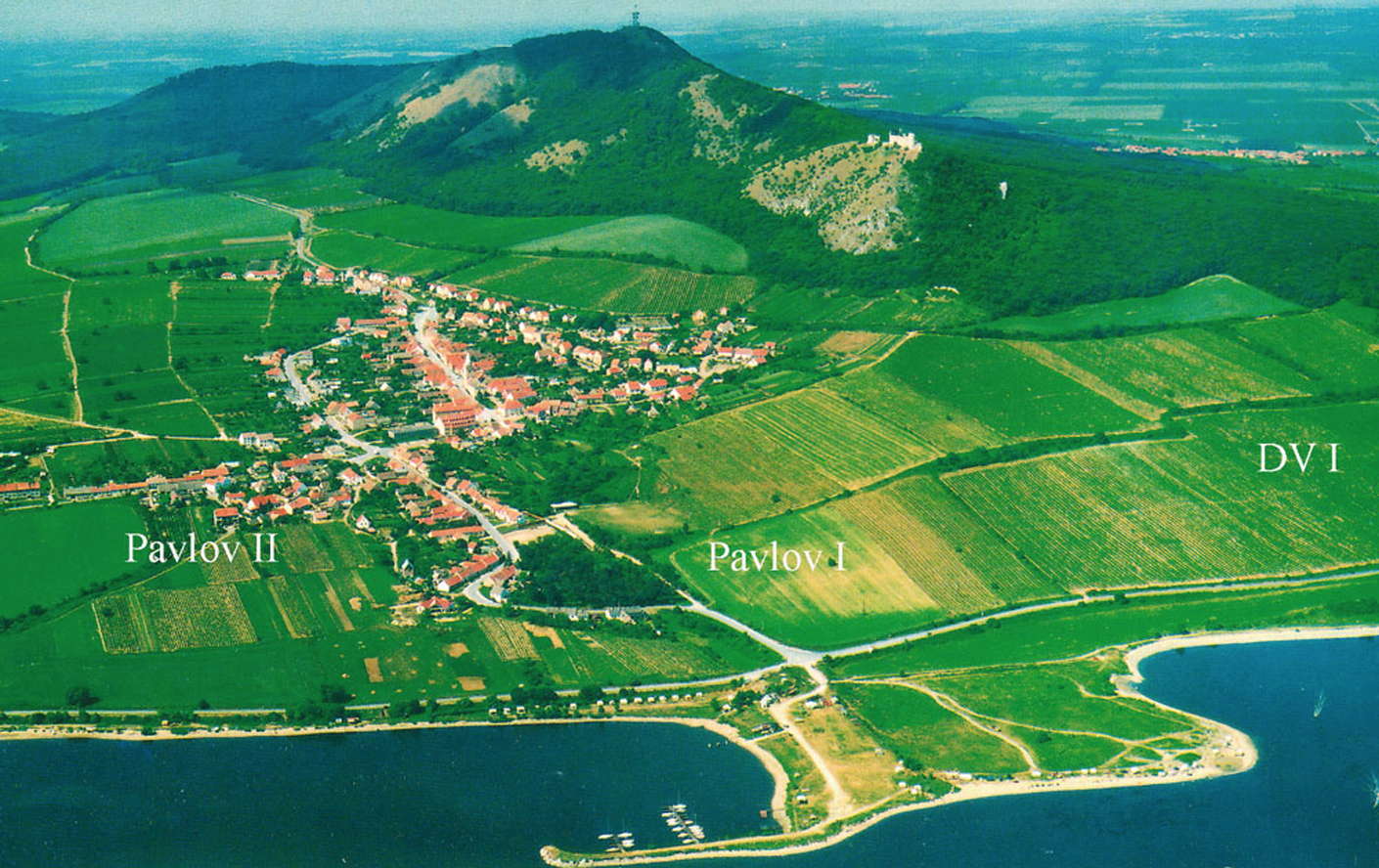
Aerial photo of the Pavlov sites and Dolní Věstonice I.
Photo: Svoboda (2007)
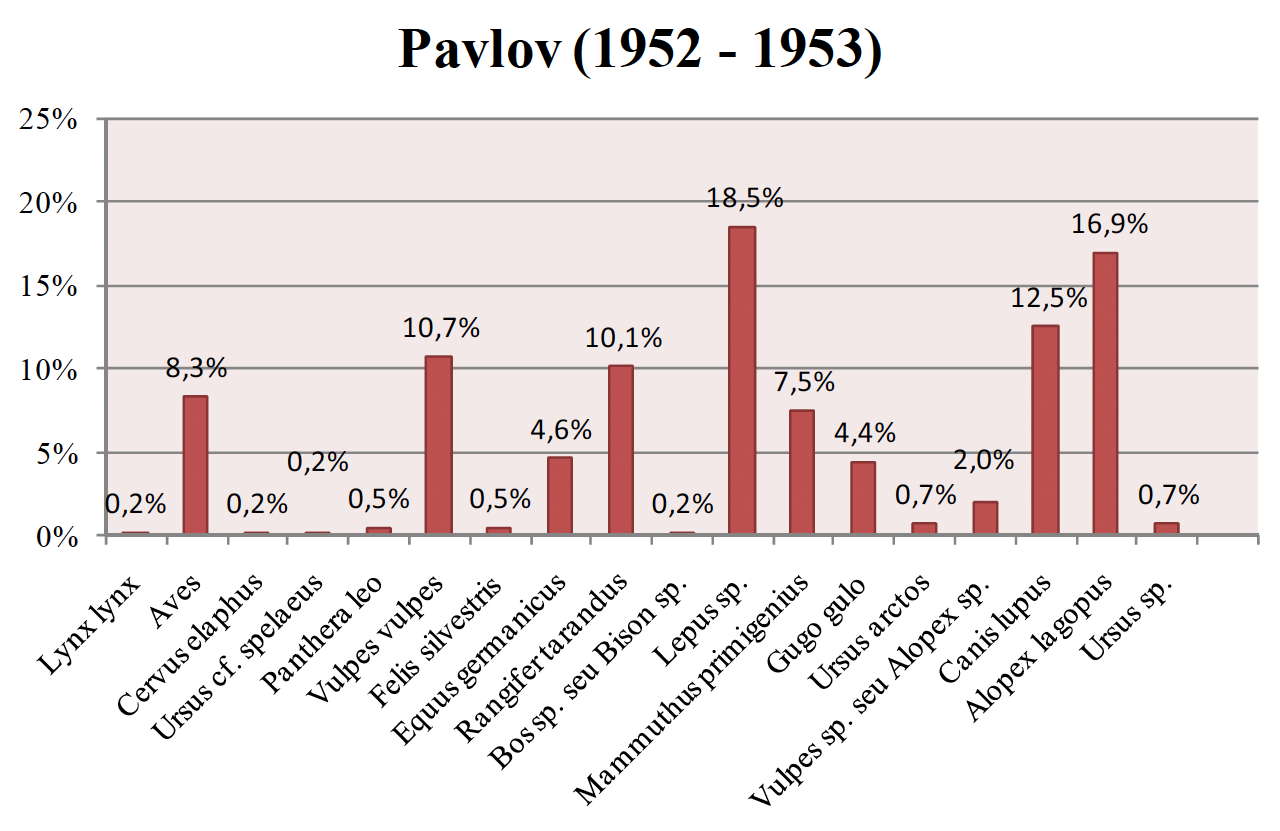
Fauna, Pavlov 1952 - 1953
Photo: http://is.muni.cz/th/150353/prif_b/Prilohy.pdf
Fauna, Pavlov 1952 - 1953 (MNI = Minimum Number of Individuals)
Data: http://is.muni.cz/th/150353/prif_b/Prilohy.pdf
| Scientific Name | Common Name | % of finds (MNI) |
| Lynx lynx | Lynx | 0.2% |
| Aves | Birds | 8.3% |
| Cervus elaphus | Red Deer | 0.2% |
| Ursus cf. spelaeus | Bear (Cave Bear?) | 0.2% |
| Panthera leo | Cave Lion | 0.5% |
| Vulpes vulpes | Red Fox | 10.7% |
| Felis silvestris | European Wildcat | 0.5% |
| Equus caballus germanicus | Forest Horse | 4.6% |
| Rangifer tarandus | Reindeer | 10.1% |
| Bos sp. or Bison sp. | Aurochs or Bison | 0.2% |
| Lepus sp. | Hare | 18.5% |
| Mammuthus primigenius | Woolly Mammoth | 7.5% |
| Gulo gulo | Wolverine | 4.4% |
| Ursus arctos | Brown bear | 0.7% |
| Vulpes sp. or Alopex sp. | Fox sp. | 2.0% |
| Canis lupus | Grey Wolf | 12.5% |
| Alopex lagopus | Arctic Fox | 16.9% |
| Ursus sp. | Bear sp. | 0.7% |
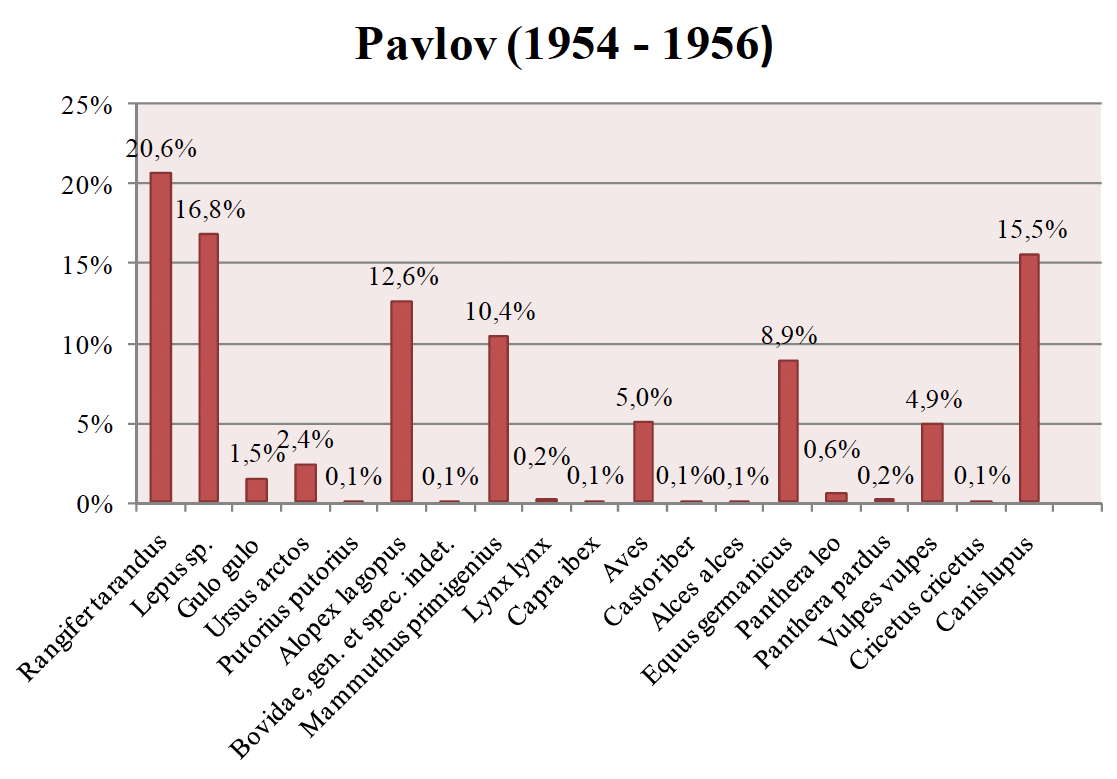
Fauna, Pavlov 1954 - 1956
Photo: http://is.muni.cz/th/150353/prif_b/Prilohy.pdf
Fauna, Pavlov 1954 - 1956 (MNI = Minimum Number of Individuals)
Data: http://is.muni.cz/th/150353/prif_b/Prilohy.pdf
| Scientific Name | Common Name | % of finds (MNI) |
| Rangifer tarandus | Reindeer | 20.6% |
| Lepus sp. | Hare | 16.8% |
| Gulo gulo | Wolverine | 1.5% |
| Ursus arctos | Brown bear | 2.4% |
| Putorius putorius | European Polecat | 0.1% |
| Alopex lagopus | Arctic Fox | 12.6% |
| Bovidae | Cloven Hoofed Ruminants | 0.1% |
| Mammuthus primigenius | Woolly Mammoth | 10.4% |
| Lynx lynx | Lynx | 0.2% |
| Capra ibex | Alpine Ibex | 0.1% |
| Aves | Birds | 5.0% |
| Castor fiber | Eurasian Beaver | 0.1% |
| Alces alces | Moose, Eurasian Elk | 0.1% |
| Equus caballus germanicus | Forest Horse | 8.9% |
| Panthera leo | Cave Lion | 0.6% |
| Panthera pardus | Leopard | 0.2% |
| Vulpes vulpes | Red Fox | 4.9% |
| Cricetus cricetus | European Hamster | 0.1% |
| Canis lupus | Grey Wolf | 15.5% |
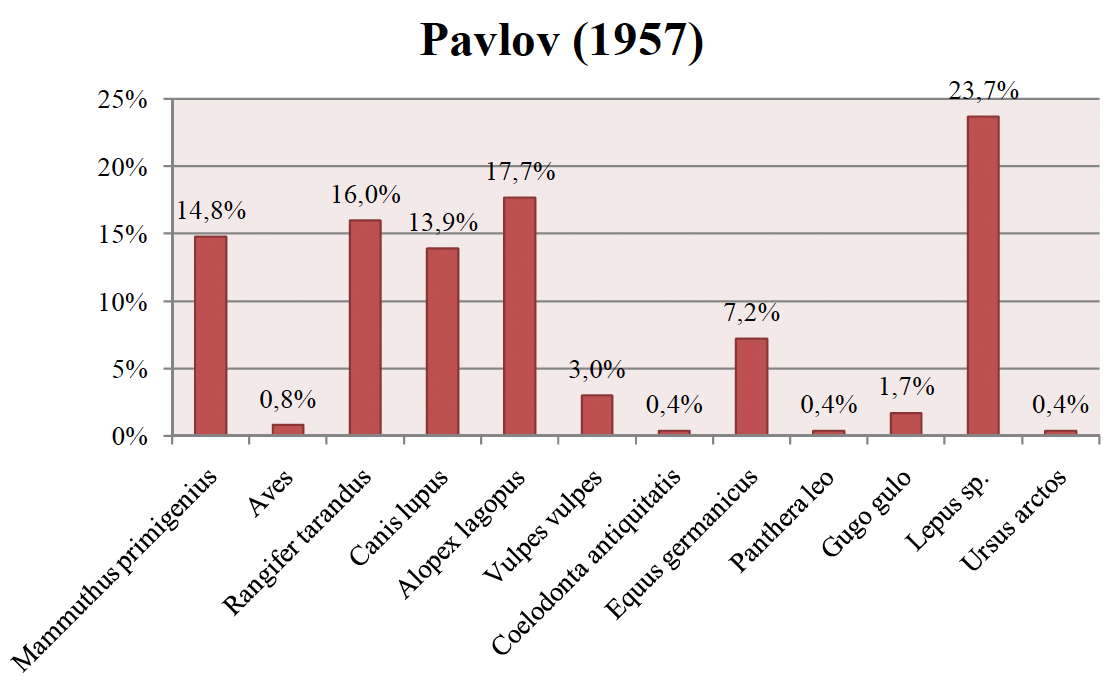
Fauna, Pavlov 1957
Photo: http://is.muni.cz/th/150353/prif_b/Prilohy.pdf
Fauna, Pavlov 1957 (MNI = Minimum Number of Individuals)
Data: http://is.muni.cz/th/150353/prif_b/Prilohy.pdf
| Scientific Name | Common Name | % of finds (MNI) |
| Mammuthus primigenius | Woolly Mammoth | 14.8% |
| Aves | Birds | 0.8% |
| Rangifer tarandus | Reindeer | 16.0% |
| Canis lupus | Grey Wolf | 13.9% |
| Alopex lagopus | Arctic Fox | 17.7% |
| Vulpes vulpes | Red Fox | 3.0% |
| Coelodonta antiquitatis | Woolly Rhinoceros | 0.4% |
| Equus caballus germanicus | Forest Horse | 7.2% |
| Panthera leo | Cave Lion | 0.4% |
| Gulo gulo | Wolverine | 1.7% |
| Lepus sp. | Hare | 23.7% |
| Ursus arctos | Brown bear | 0.4% |
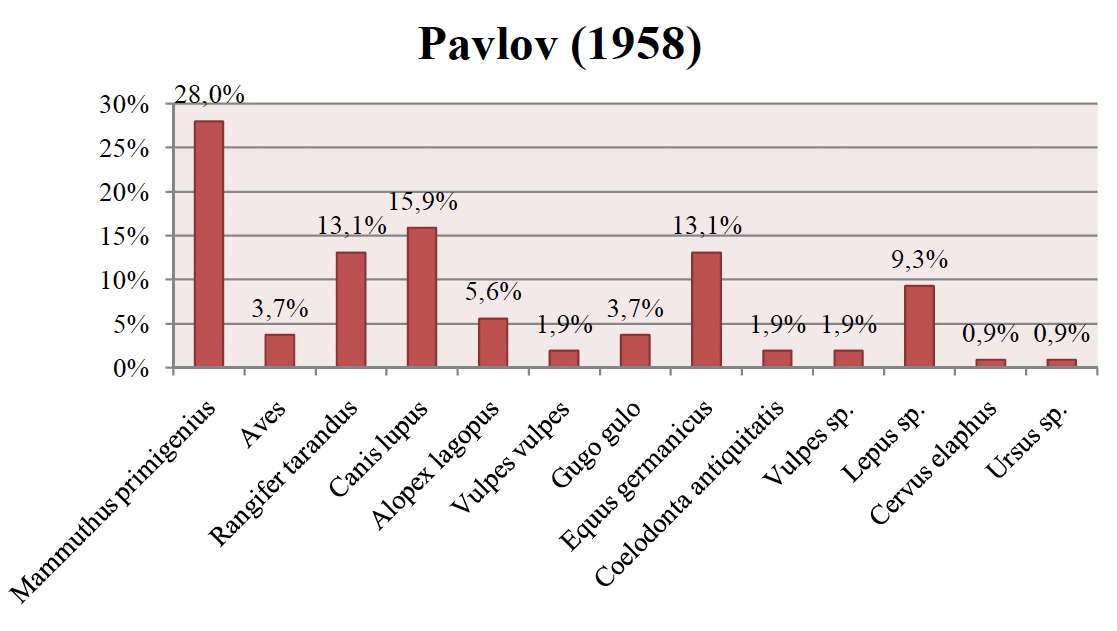
Fauna, Pavlov 1958
Photo: http://is.muni.cz/th/150353/prif_b/Prilohy.pdf
Fauna, Pavlov 1958 (MNI = Minimum Number of Individuals)
Data: http://is.muni.cz/th/150353/prif_b/Prilohy.pdf
| Scientific Name | Common Name | % of finds (MNI) |
| Mammuthus primigenius | Woolly Mammoth | 28.0% |
| Aves | Birds | 3.7% |
| Rangifer tarandus | Reindeer | 13.1% |
| Canis lupus | Grey Wolf | 15.9% |
| Alopex lagopus | Arctic Fox | 5.6% |
| Vulpes vulpes | Red Fox | 1.9% |
| Gulo gulo | Wolverine | 3.7% |
| Equus caballus germanicus | Forest Horse | 13.1% |
| Coelodonta antiquitatis | Woolly Rhinoceros | 1.9% |
| Vulpes sp. | Fox sp. | 1.9% |
| Lepus sp. | Hare | 9.3% |
| Cervus elaphus | Red Deer | 0.9% |
| Ursus sp. | Bear sp. | 0.9% |

Dates for the Dolni Vestonice area.
Photo: Jöris et al. (2004)
Pavlov VI
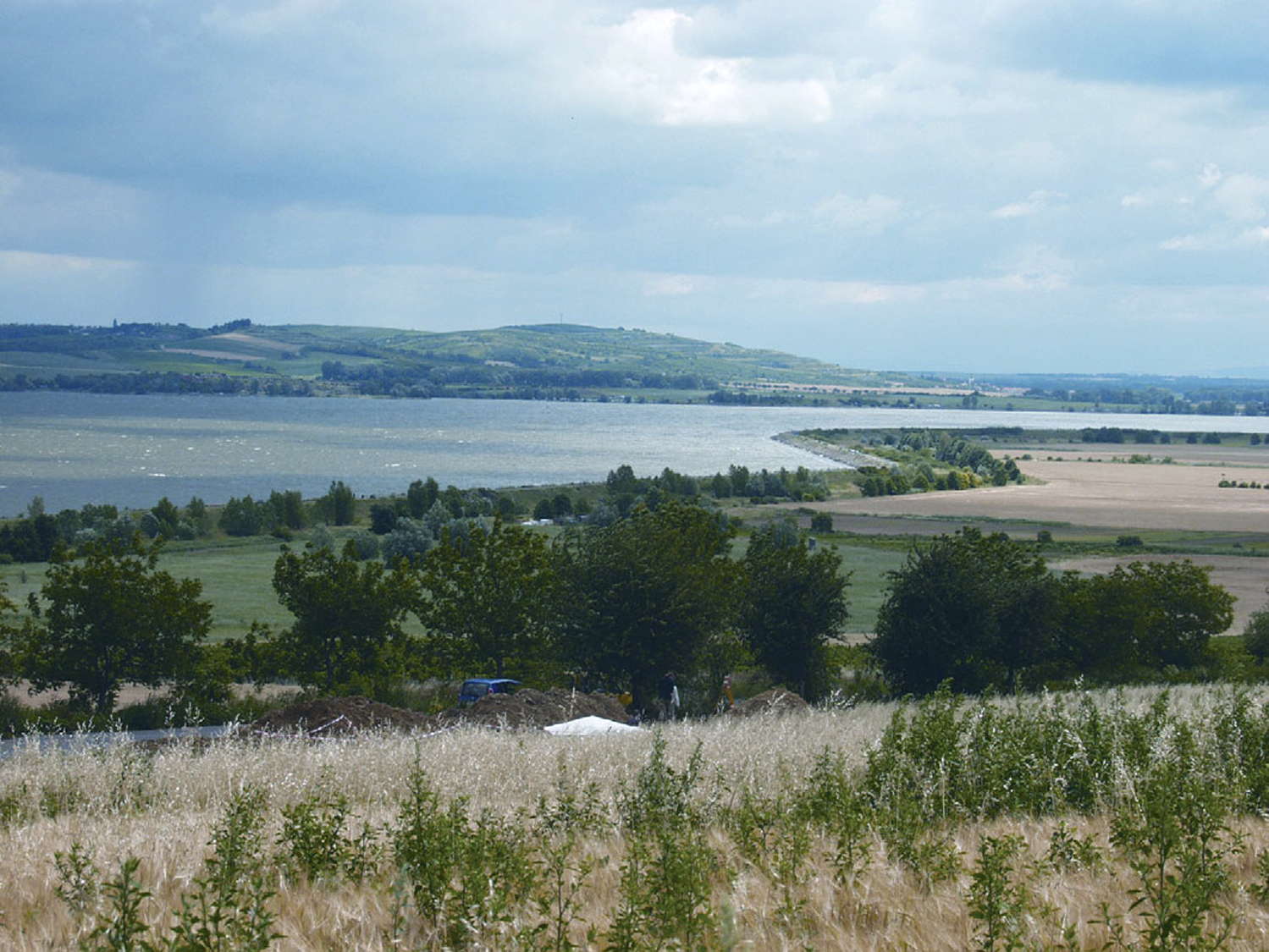
Pavlov VI
This newly discovered and excavated site defines an Upper Palaeolithic activity unit consisting of a roasting pit at the centre of an area 5 metres across. Although the main task was the processing of two mammoths, there were numerous other wild animals in the assemblage. The occupants used flint knives, made bone tools and modelled in baked clay – on which they left their fingerprints, along with imprints of reindeer hair and textiles. Pavlov VI offers an exemplary picture of the basic living unit that made up the settlement clusters of the Gravettian people in Central Europe.
Pavlov VI has clear stratigraphy, radiocarbon dates, several pits, faunal and floral remains, transported rocks and tertiary shells, stone and bone artefacts, decorative items and ochre. It has also produced 12 pieces of ceramics, including some with zoomorphic forms and some with the impressions of human epidermal ridges, animal hair and textile structures.
Pavlov VI was discovered on 27 June 2007, when a canal ditch being dug between the villages of Milovice and Pavlov cut a dark lens of humic sediments 4–5m long at an altitude of 205m asl (a typical location for all Pavlovian sites in the area).The cultural layer was deposited below 0.8m of arable soil and 0.6-0.7m of light calcareous loess (with microlayers of loess loams redeposited by gelifluction). It took the form of a lens with a maximum thickness of 0.35m made of humic calcareous silt, with limonitic bands containing charcoal and artefacts. It lay on silty subsoil 0.5m deep which was calcareous and contained charcoal but no anthropogenic material. Below this lay the gravels of the Dyje River.
Photo and text: Svoboda et al. (2009)
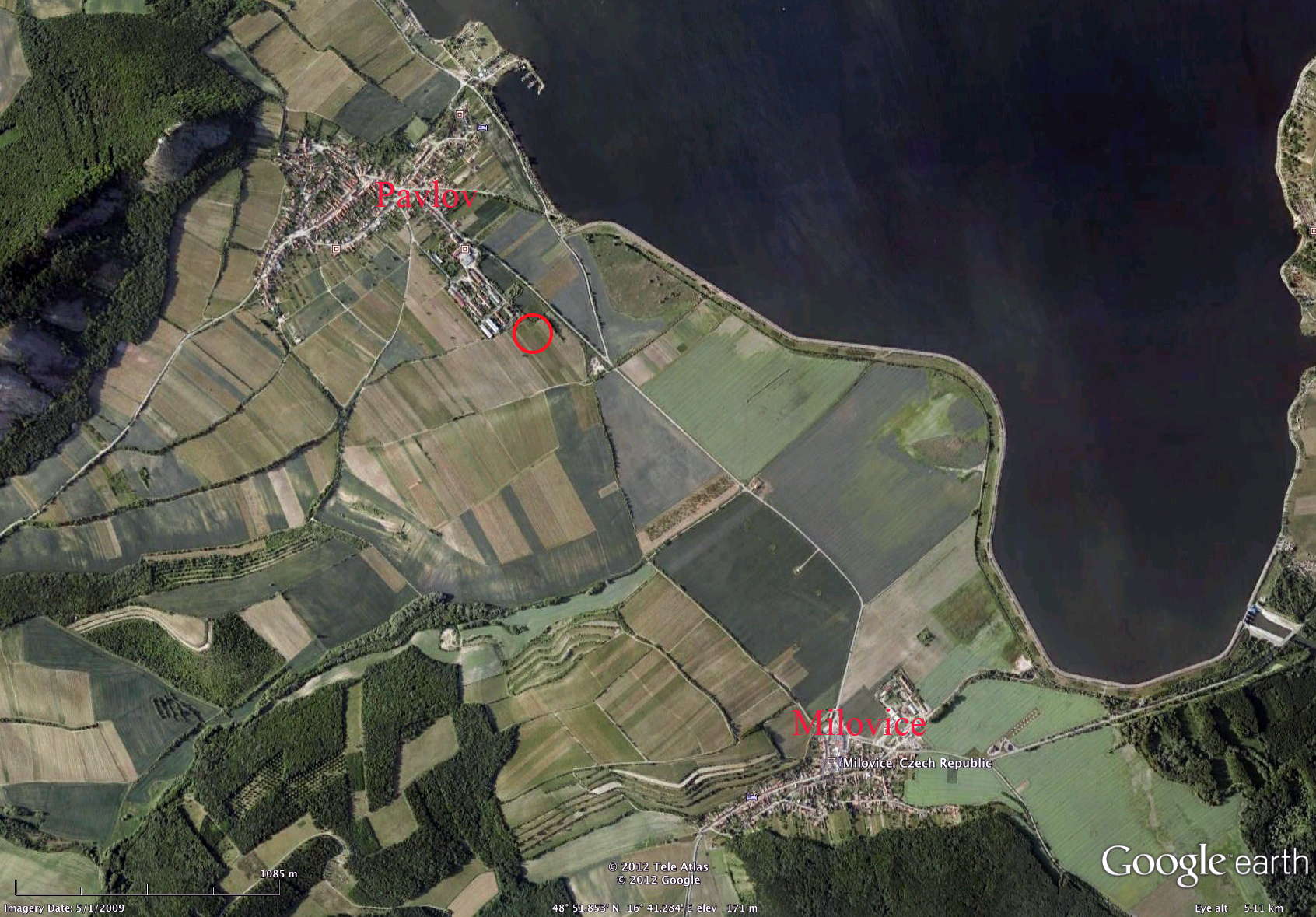
Google Earth image of the region between Pavlov and Milovice, with the approximate position of Pavlov VI marked by a circle, based on the photo above.
Photo: Google Earth
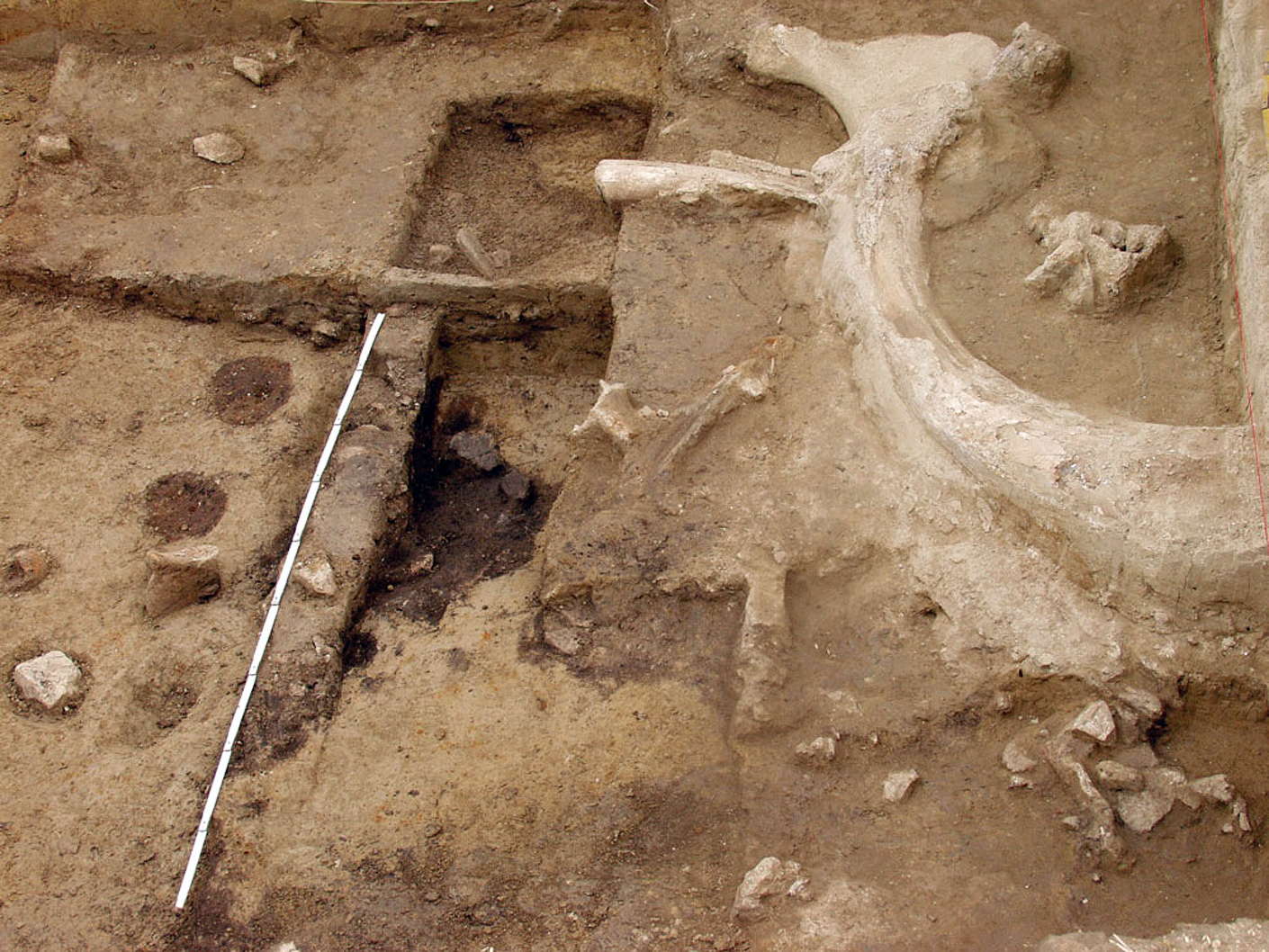
This is a view of the excavation at Pavlov VI, with a central hearth encircled by small boiling pits, and accumulation of mammoth bones (two individuals) at one side.
Photo and text: Svoboda (2007)
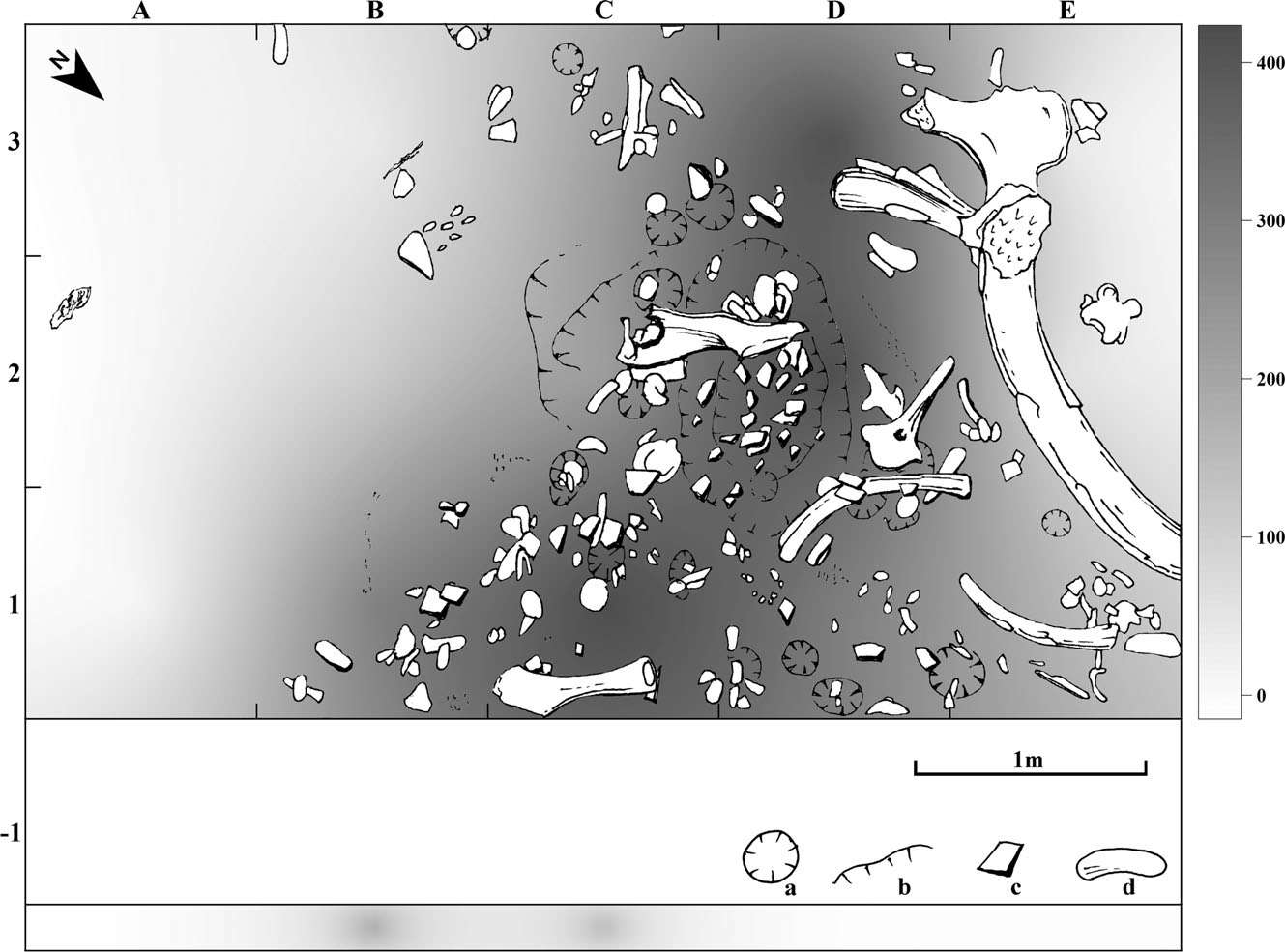
Pavlov VI - plan of the excavated area showing the distribution of larger bones ( d ), stones ( c ), depression features ( a-b ) and spatial distribution of three-dimensionally recorded artefacts. Pits filled with charcoal and burnt stones lies in the centre.
To the left and in front are boiling pits, to the right mammoth tusks and bones.
Photo and text: Svoboda et al. (2009)

Pavlov VI - The living floor. Cattail roots were ground to produce flour at this site, as evidenced from starch left on mortar and pestle stones.
Photo and text: Revedin et al. (2010)
Flora and fauna of Pavlov VI:
Charcoal fragments were frequent over the entire area of the site and concentrated in the fillings of pits.
All the analysed samples were dominated by spruce (Picea abies), followed by larch (Larix decidua). Pine is represented by only three fragments (Pinus sylvestris, square C2) and oak by a single fragment (Quercus sp., square D2).
The dominance of conifers and the presence of only a few deciduous species is in accordance with the previous palaeobotanical analyses from the Dolni Vestonice - Pavlov area (Opravil 1994)
Shell fragments of Quaternary terrestrial gastropods Succinea oblonga, Cepaea sp., and Euomphalia strigella complete the reconstruction of local environment.
Text above: Svoboda et al. (2009)

Picea abies, the dominant tree at the time of Pavlov VI.
Spruces are large trees, from 20–60 metres (66–200 ft) tall when mature, and can be distinguished by their whorled branches and conical form. The needles, or leaves, of spruce trees are attached singly to the branches in a spiral fashion, each needle on a small peg-like structure called a pulvinus. The needles are shed when 4–10 years old, leaving the branches rough with the retained pulvinus (an easy means of distinguishing them from other similar genera, where the branches are fairly smooth).
Photo: MPF
Permission: Released under the GNU Free Documentation License.
Text: Adapted from Wikipedia
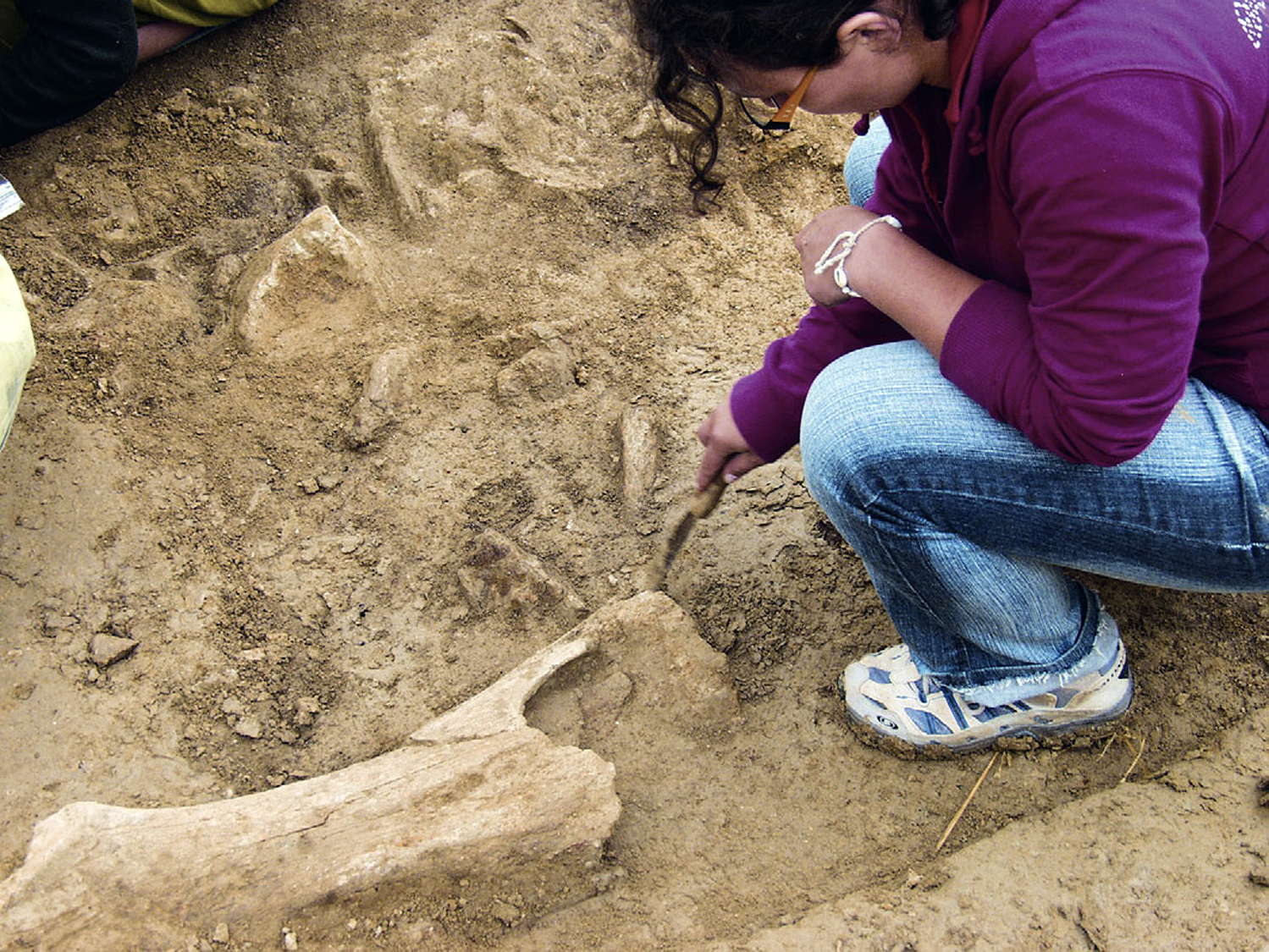
Pavlov VI - mammoth bone with a chipped-off perforation.
Photo and text: Svoboda et al. (2009)

Pavlov VI - Ceramic fragment showing the head and neck of a carnivore (lion?); the other face was completely destroyed.
Photo and text: Svoboda et al. (2009)

Pavlov VI - an imprint of crossed linear structures on the side of a ceramic object.
Photo and text: Svoboda et al. (2009)
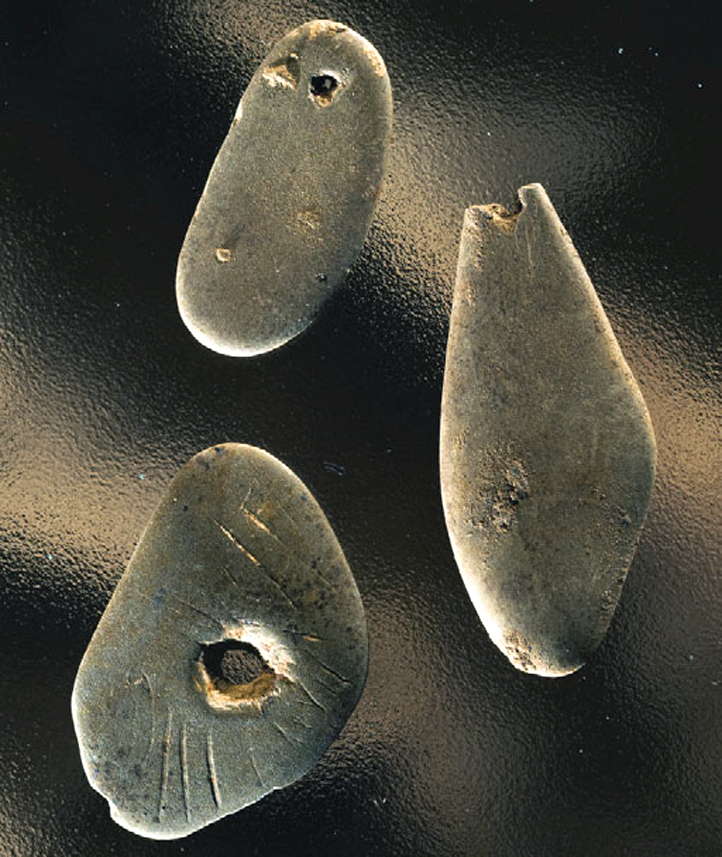
Pavlov VI - Perforated pebbles, one with linear decoration.
Photo and text: Svoboda et al. (2009)
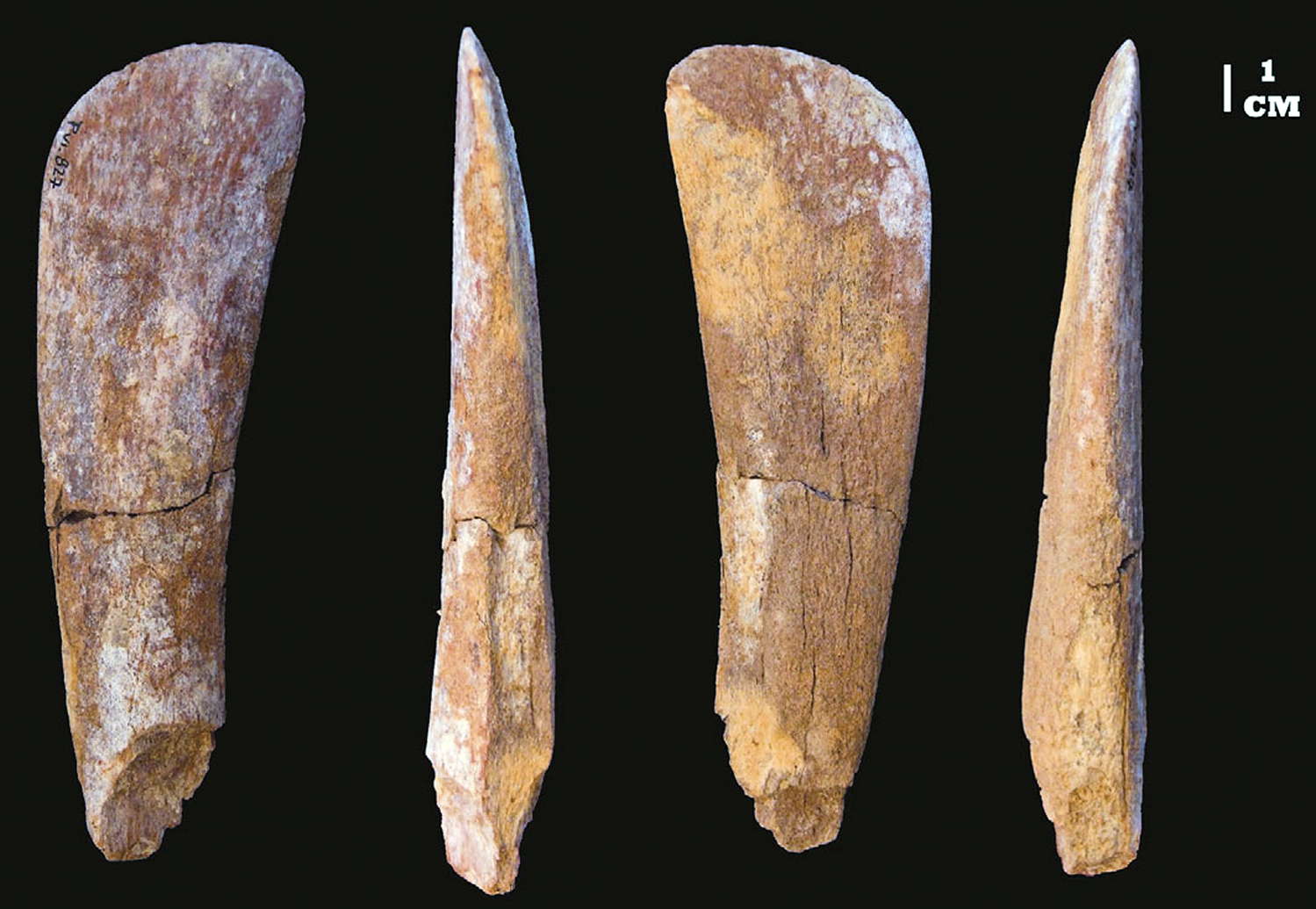
Pavlov VI - Bone spatula.
Photo and text: Svoboda et al. (2009)
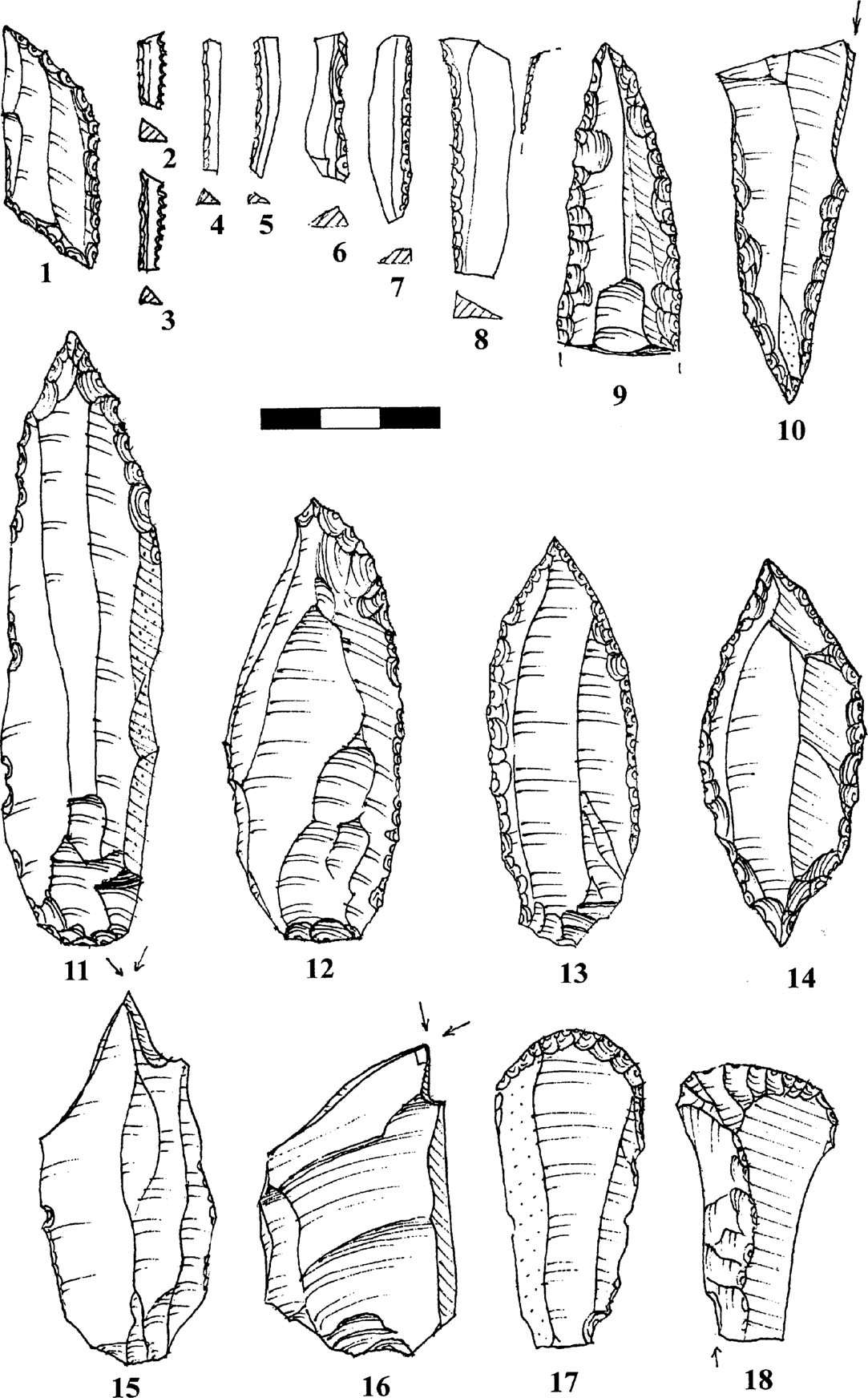
Pavlov VI - A selection of the lithic industry.
Photo and text: Svoboda et al. (2009)
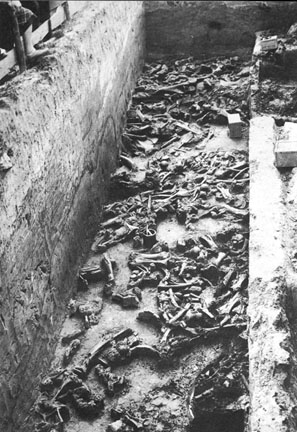
These were found on the far side of the marsh.
Photo: G. Clark, 'The Stone Age Hunters'
Mammoth Bone Deposits in Moravia
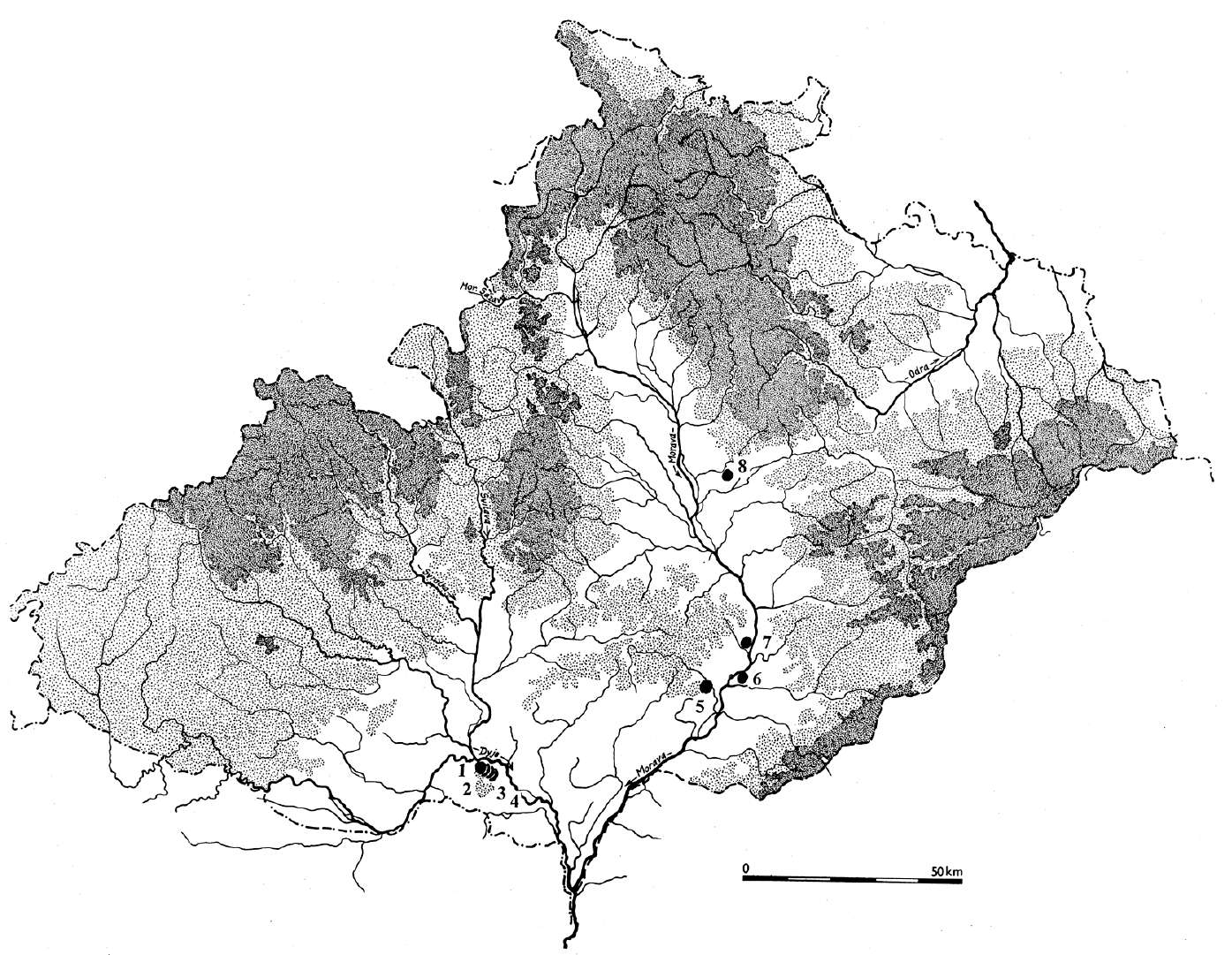
Fig.1 - Location of the Mammoth Bone Deposits sites in Moravia.
1-2: Dolní Věstonice I-II
3: Pavlov I
4: Milovice I
5: Boršice
6: Jarošov
7: Spytihněv
8: Předmostí I
Moravia is a historical region in central Europe in the east of the Czech Republic, one of the former Czech lands. It takes its name from the Morava River which rises in the northwest of the region. It occupies most of the eastern third of the Czech Republic. (Text: Wikipedia)
Photo: Svoboda (2001)
Dolní Věstonice
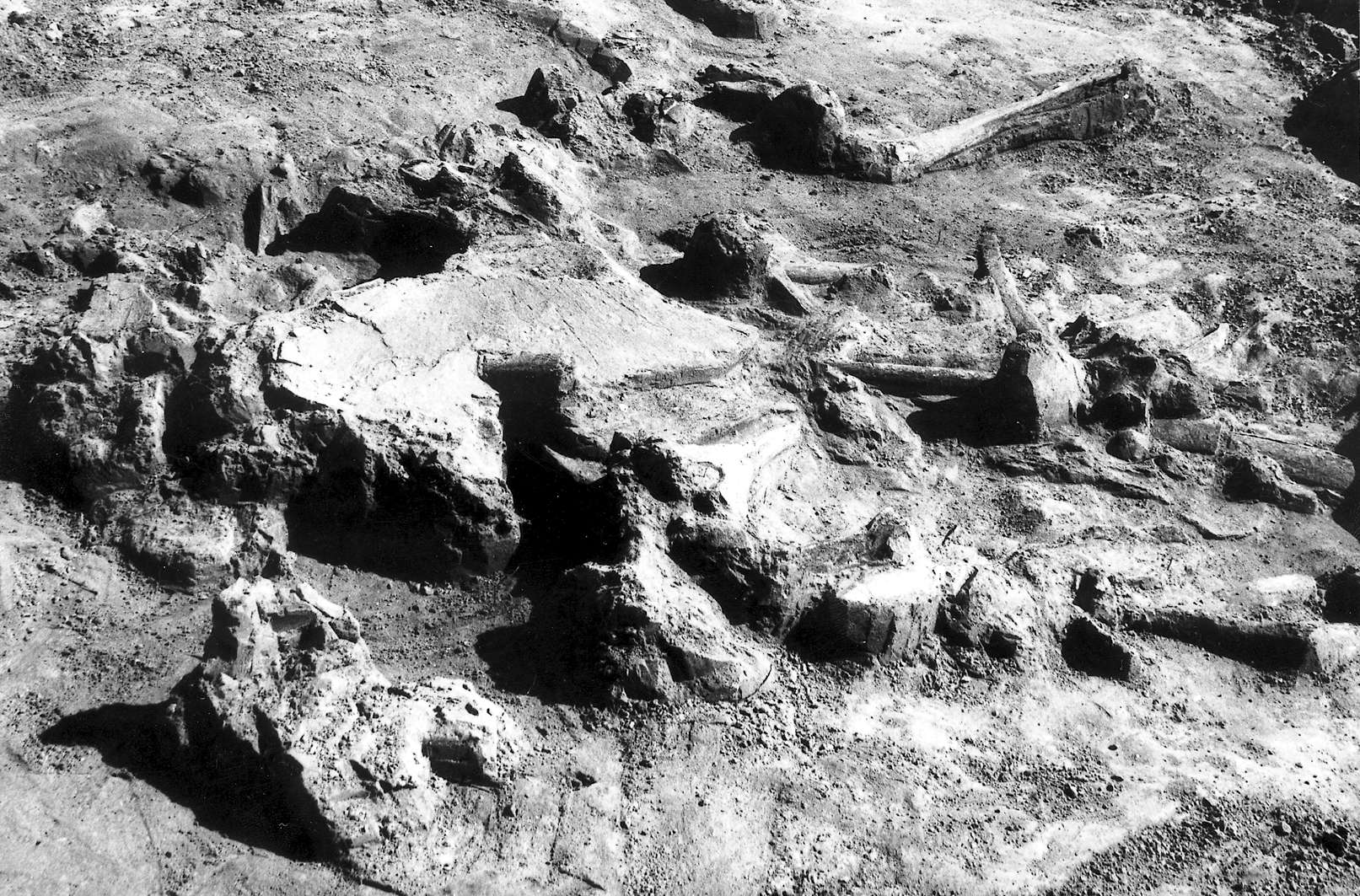
Example of a Mammoth bone deposit.
Several Mammoth bone deposits
were discovered by K. Absolon, especially in
upper part of this large and complex settlement.
One of them, because of its circular shape, was
later interpreted by B. Klíma as the basement of a
dwelling structure. However the largest Mammoth bone deposit
was excavated by B. Klíma next to the upper
part of the settlement in a shallow, partly
watered depression, located longitudinally
along the slope, about 45 m long and 12 m wide.
Besides mammoths, this bone deposit also contained a
few remains of horse, wolf, reindeer and
hare.
Photo and text: Svoboda (2001)
Dolní Věstonice II
This is a large, spatially and chronologically structured settlement, following longitudinally the eastern margin of a side valley, about 500 m long. Part of a Mammoth bone deposit, measuring 10 x 10 m and located in fluviatile sands (with water snails), was excavated by J. Svoboda in the upper part of the gorge. Additional mammoth bones were scattered in lower parts of the gorge as well.
Pavlov I
This large and complex settlement, excavated by B.Klíma, provided only smaller and spatially restricted mammoth bone accumulations inside the settled area, but a Mammoth bone deposit was absent.

Pavlov.
This is a Gravettian site. In the hollowed pit, four hearths. On the rims, stones. Animal bones concentrated mainly in the pit and its vicinity.
Photo: Neustupný (1960)
Pavlov II
This station is located approximately 300 m to the SE (Klíma 1961b, 1976). The cultural layer was deposited in colluvium, sometimes covered by Wőrmian loess, sometimes exposed on the surface. Artefacts and bones were concentrated according to a line composed by five fireplaces. Two of those fireplaces were surrounded by bigger stones and bones (Svoboda et al., 2002). Fauna was characterised by mammoth and horse, less so by bones of wolf, reindeer and just rarely hare, lion, wolverine and fox (Klíma 1961b, 1976). Text above: puvodni.mzm.cz/neruda/cz/Biblio_soubory/OIS3guide.pdf
Pavlov IV
A lens of humic deposits was found in 2007 during construction works in the area between Pavlov and Milovice. This locality was marked as Pavlov IV (Svoboda et al., 2008, 2009) and was dated by C14 to 28-29 000 BC (cal.).
A big fireplace surrounded by small holes was found approximately at the centre of the excavated area. Nevertheless the excavated area was quite small; a huge number of artefacts, art, bone tools and faunal remains were found.
The following woody species were described (Svoboda et al., 2008): Picea abies, Larix decidua, 3 fragments of Pinus silvestris and one piece of Quercus sp.. Faunal remains were described by M. Nývltová Fišáková (Svoboda et al., 2008, 2009). Most of the bones belongs to mammoth and are followed in abundance by wolf, with less horse and reindeer. Rarely represented are bones of fox, wolverine, bear and hare. A unique impression of reindeer hairs was found in a fired piece of loess (Králík et al., 2008; Svoboda et al. 2009).
Text above: puvodni.mzm.cz/neruda/cz/Biblio_soubory/OIS3guide.pdf
Milovice
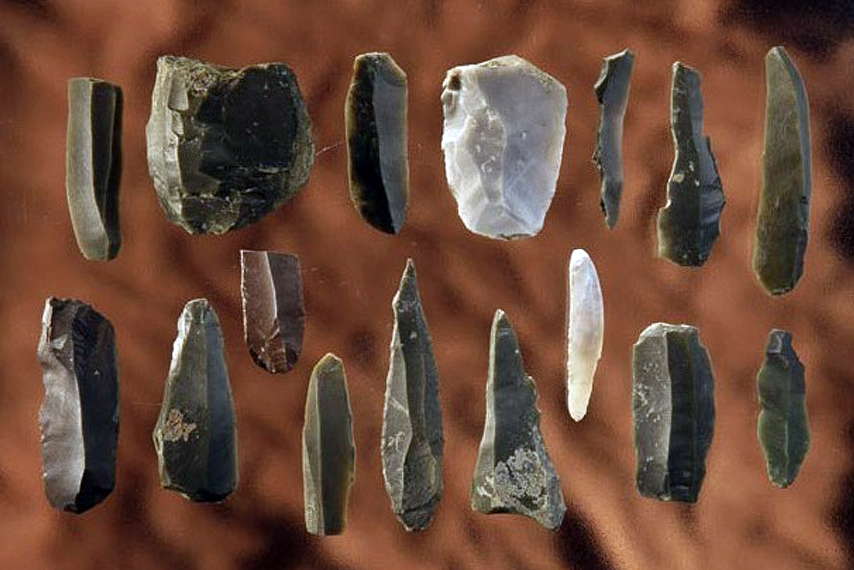
Tools from Milovice, the next village to the east from Pavlov.
Photo: http://www.arub.cz/vyzkumna-strediska/stredisko-pro-vyzkum-paleolitu-a-paleoetnologie.html
Milovice I
This site is located in the terminal part of a large side valley, about 2000 m long. Two Mammoth bone deposits (larger than the adjacent settled areas above them) were located on a slope, about 1500 m from the valley mouth. Besides mammoths, there is an admixture of horse, reindeer and wolf.
Inside the settled area above, a circular mammoth bone accumulation was found by M. Oliva, and interpreted as a dwelling (Oliva 1988).
Text above: Svoboda (2001)
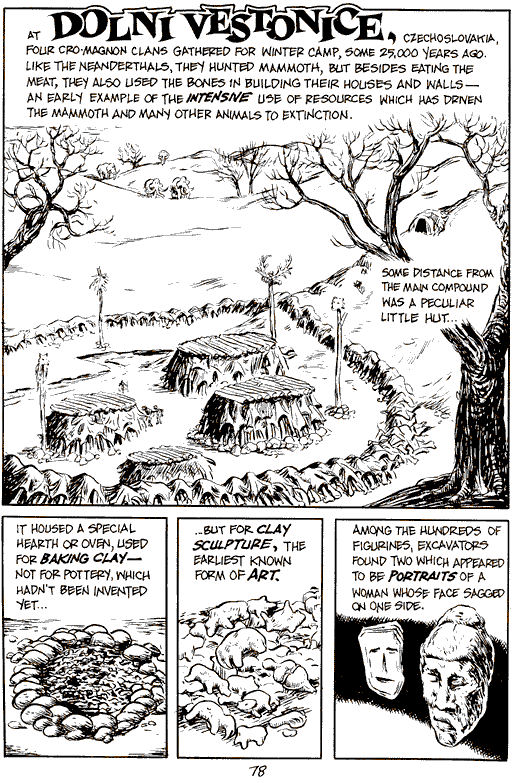
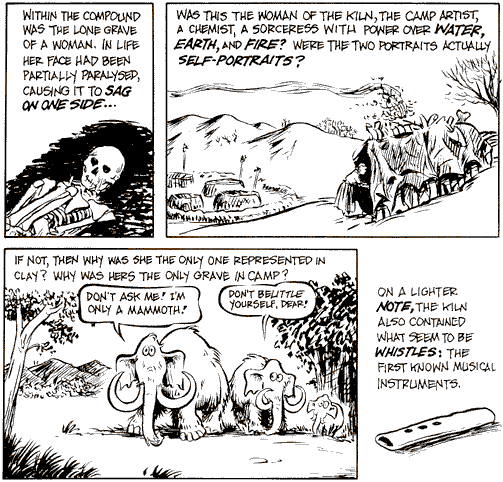
Highly recommended for all bookshelves.
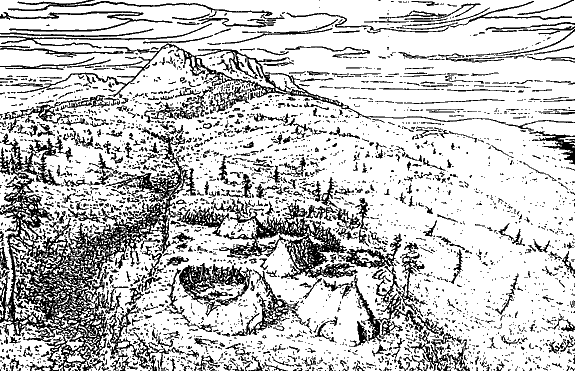
Dolni Vestonice artist's impression. This Paleolithic site was inhabited from ca. 27 000 to 23 000 B.C. To give some sense of scale, the rounded structure in the lower center, which perhaps was a wind screen, measured 27 by 45 feet. The settlement had perhaps 100 people who inhabited the site the year round. In this period, Europe was in the midst of the Ice Age so the average daily temperature was usually cool even in summer, and freezing in winter. The trees were mostly conifers, spruce and larch. The site was on the edge of a swamp, and was at a point where mammoths and other herd animals would be funnelled in to make hunting them more easy.
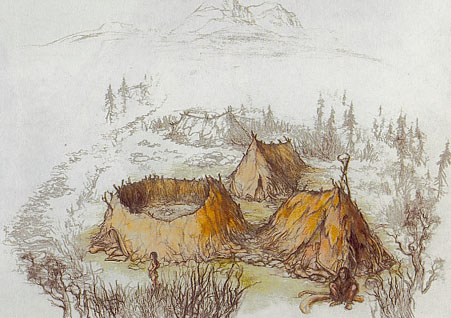
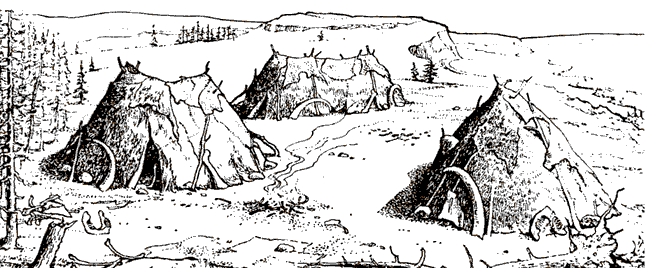
This is a delightful first person account of someone who went to Dolni Vestonice.
From:
http://www.spiritproject.com/oracle/magic/travel/dolni.htm
It is not easy to find - too small for most maps, and only the larger neighbor village Horni Vestonice has a sign from the main road. There are no signs for tourists, no fast-foods offering "Venus burgers" - and this makes it so very special. In Dolni Vestonice, the traveler interested in archeomythology does not get it all ready to eat, you have to find it yourself and talk with the people who live there today. Dolni Vestonice is situated in the South of the Czech Republic close to the city of Mikulov. Dolni is a small village with approximately 500 inhabitants - the most important thing seems to be the main road with some restaurants and little stores and shops. It is Indian Summer, fishers are on their way to the near artificial lake and colorfully clothed bikers relax in the shade in front of a road inn. There are no signs that say "museum" or "archeological exhibition".
After driving through the village from all sides some time I finally found the museum of Dolni Vestonice, plain gray with a simple sign saying "Archeologicke Exposize". The cashier lady only speaks Czech, but she does not only offer entrance tickets, but also information leaflets in German and English and rough-made plastic casts of the Venus of Vestonice. I get myself a leaflet and enter the exhibition. There are lots of text in and around the showcases, but all in Czech language, and although some words look familiar, I soon give up. The leaflet explains that I find only remakes of the originals from Dolni Vestonice and the neighboring village Pavlov. The archeologist Karel Absolon made excavations from 1924 to 1938 and found, among many other interesting tools and items, the statuette of a woman made from burnt clay (today plastic...) - she became famous as the "Venus of Vestonice". Like her "sisters" from other archeological excavations worldwide, the "Willendorf Venus" from Austria, the "Venus of Laussel" and the "Venus of Lespugue" in France she is depicted as a voluptuous woman with heavy breasts and broad hips standing in an upright position. But unlike all the others who don't have face features, she has eyes - slit carvings that make her look like squinting in the sun.
They are all very old, those ladies - the village Pavlov gave its name to a complete time period, the Pavlovien as the older phase of the Gravettien, 30.000 - 25.000 years before our time. Along with the venus, zoomorphic statuettes have been found, made of clay, stone and bone, carved or modelled. And there is another Venus figurine who did not become as famous as her darker colored sister - she is very special, because her face is carved very carefully, and her body is nearly complete. Both Venuses are shown in the same showcase next to each other. The museum offers a lot of interesting and very special details of our ancestors - hints on how colors were made and used and the reconstruction of a burial site of three young people, a woman and two men - the woman was found with shamanic headbands made from teeth, claws and shells. Strange and rare circumstances gave us even the fingerprints of one of our forebears on a lump of clay.
So much for the historical details of the museum. I was interested to find out more about the experiences which the famous archeologist Marija Gimbutas called "archeomythology".I leave the exhibition, and in the souvenir shop on the other roadside I find a book in English on the archeological findings in the area, and I also get a plastic pendant of the black Venus. Then I take off to Pavlov. Nobody can tell me where the excavation site really was. After asking several people in the village I give up and go on according to one of the black-and-white photos I had seen in the exhibition - showing the successful professors on the excavation site of Pavlov right under the ruins of Pavlov castle.
The ruins still look the same today. I park my car and climb uphill past grapevine fields and orchards. Below I see the green shimmer of the large artificial lake, and I keep asking myself how many wonderful treasures it may hide from us forever. Rotting trees reach like hands out of the lake, on their silvery gray branches cormorants dry their feathers in the sunshine. I keep on climbing, still watching the angle from which the castle looks down on me. Now this looks like the right place. A farmer comes my way, pulling a little cart loaded with grapes. I smile at her, pointing at my Venus pendant. "Archeologicke Exposize?" I ask. She nods and smiles at me, pointing downhill towards the village behind us - Dolni Vestonice. "Yes, Dolni Vestonice, Muzeum!" I make the signs of digging in the ground. She laughs, shakes her head and offers me some grapes. I have to laugh, too, thank her and walk on.
Now here must be the place. In front of me a vast empty potato field stretches all the way downhill. Next to it is a little place with hard grass and some small bushes. I walk towards the bushes and sink in to my knees - Bingo! This is historical ground, here they have been digging, the professors. Mammoth bones lay around here, as big as my collie, wolf skulls have been found with the spear heads still sticking in their jaw bones. Here our ancestors fought against their enemies. And the venus and other goddess figurines, here they have been waiting in the lap of mother Earth. I sit down on the dry earth and try to imagine what this area looked like before the artificial lake covered the lower parts.
I compare the picture of the venus in the archeology book with the pendant I'm wearing. Thinking about what I learned from Dr. Felicitas Goodman about shamanic body postures and trance (she tried the postures of the old statues with her students and found out stunning experiences in and about trance), I get up and stand like the Venus of Vestonice. I take a deep breath, roots grow from my feet.
A deep calmness, security, trust spreads within me. Time is not important, 25.000 years more or less... time does not have to be cut and measured anymore. I feel the wind on my skin, the warm sun on my face, the stability of the earth who carries me, yesterday, today, tomorrow. Peace and harmony well up within me and a trust that has not been there before. Yes, I can imagine it - the maker of the figurine who wanted to give this feeling to others - the image of an earth mother spreading the feeling by touching her: I am here, I have always been with you, and I give you the power, calmness and stability you need in this very moment.
Walking back down to Pavlov I find the hidden hints to Venus still being here - as a pictograph she is looking at me from the windshield of a city bus, and the small inn next to my parking place is named "U Venuse", the Venus. Maybe people held these small, voluptuous goddesses in their hands when they faced critical situations - women giving birth, men hunting mammoth and aurochs, or simply when they wanted some calm moments after a hard day. I am here, I have always been here, and here shall I ever be - that's what they say to me and others, the Venus of Vestonice and her colleagues, yesterday and tomorrow, for all of us to feel and see.
Predmost
Předmostí, mammoth sculpture in ivory, length 116 mm.
Source and text: Steguweit (2008)
References
- Beresford-Jones, D. et al., 2010: Burning wood or burning bone? A reconsideration of flotation evidence from Upper Palaeolithic (Gravettian) sites in the Moravian Corridor, Journal of Archaeological Science, 37 (2010) 2799e2811
- Beresford-Jones, D. et al., 2011: Rapid climate change in the Upper Palaeolithic: the record of charcoal conifer rings from the Gravettian site of Dolní Vĕstonice, Czech Republic, Quaternary Science Reviews, 30 (2011) 1948e1964
- Buňatová, M., 1999: Textilní produkce v mladém paleolitu, experiment pro dokumentární film "Úsvit géniů", in: AR LI, Praha, 104 - 111.
- Havlíček P., Kovanda J. , 1985: Nové výzkumy kvarteeru v okoli Pavlovských vrchú (New Quaternary research in the vicinity of the Pavlov Hills), Antropozoikum 16, 21 - 59, Praha
- Jelinek, J., 1975: The Pictorial Encyclopedia of the Evolution of Man, Hamlyn (1975), 552p
- Jöris, O., Weninger B., 2004: Coping with the cold: On the climatic context of the Moravian Mid Upper Palaeolithic, The Gravettian Along the Danube. Proceedings of the Mikulov Conference, J. Svoboda / L. Sedlácková (eds.), 20 - 21 November 2002. Dolní Vestonice Studies 11, 57-70.
- Kostrhuna, P., 2009: Karel Absolon (1877–1960) and the research of significant Palaeolithic sites in Moravia, Archaeologia Polona, vol. 47 : 2009, 91 – 139 PL ISSN 0066 - 5924
- Mazák, V., 1980: Zvířata celého světa. 7 - Velké kočky a gepardi. 192 s. Státní zemědělské nakladatelství, Praha.
- Musil, R., 1968: Stranska Skala: Its Meaning for Pleistocene Studies, Current Anthropology, Vol. 9, No. 5, Part 2 (Dec., 1968), pp. 534-539
- Musil, R., 1997: Hunting game analysis, in Svoboda, J. (1997): Pavlov I - Northwest. The upper Paleolithic burial and its settlement context, Dolní Věstonice Studies 4, 443-468, Archeologický ústav AV ČR, Brno.
- Neustupný, E. and Neustupný, J., 1960: Czechoslovakia before the Slavs. In: Ancient Peoples and Places. Thames and Hudson, London.
- Opravil, E., 1994: The vegetation, in J. Svoboda (ed.) Pavlov I, excavations 1952-1953 (ERAUL 66/Dolni Vestonice Studies 2): 175-80. Liege: Université de Liege.
- Pryor, J. et al., 2013: Plant foods in the Upper Palaeolithic at Dolní Vĕstonice? Parenchyma redux, Antiquity, 87 (2013), pp 971–984
- Revedin et al., 2010: Supporting Information http://www.pnas.org/content/suppl/2010/10/09/1006993107.DCSupplemental/pnas.201006993SI.pdf
- Soffer, O., Adovasio, J., Hyland, D, 2000: Reply, Current Anthropology; Aug-Oct2000, Vol. 41 Issue 4, p531-537, 7p
- Sosna D., 2000: Počátky textilnictví. PhD. Dissertation, Department of Anthropology, Masaryk University, Brno.
- Steguweit L., 2008: Menschen Der eiszeitJäger, Accompanying volume to the exhibition of the Institute for Prehistory and Early History of the Friedrich-Alexander University Erlangen-Nuremberg from 17.02. - 20.04.2008 in cooperation with the Stadtmuseum Erlange, https://www.researchgate.net/publication/293632094_Menschen_der_Eiszeit_Jager_-_Handwerker_-_Kunstler
-
Svoboda J., 2001. Gravettian mammoth bone deposits in Moravia The World of Elephants - International Congress, Rome 2001
http://en.sovraintendenzaroma.it/content/download/4819/62548/file/359_362.pdf - Svoboda, J. et al., 2002: Paleolit Moravy a Slezska, Dolnověstonické studie 8, 303 s., Archeologický ústav AV ČR, Brno.
- Svoboda J., 2007: The Gravettian on the Middle Danube, Paleo, 19, 2007, pp 203-220
- Svoboda J., Králík M., Čulíková V., Hladilová Š., Novák M., Nývltová Fišáková M., Nývlt D., Zelinková M., 2009: Pavlov VI: an Upper Palaeolithic living unit, Antiquity 83 (2009) 282 - 295.
- Urbanová, K., ca 1999: Textilnictví v prehistorii, http://uprav.ff.cuni.cz/pages/semi/3.prednaska.pdf
- Verpoorte, A., 2000: Camps, boundaries and art, https://openaccess.leidenuniv.nl/bitstream/handle/1887/13512/ASLU08_09.pdf