Back to Don's Maps
Back to Venus figures from the Stone Age
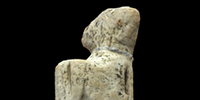 Der Kleiner Löwenmensch, the small lion man
Der Löwenmensch - The Lion Man/Lady
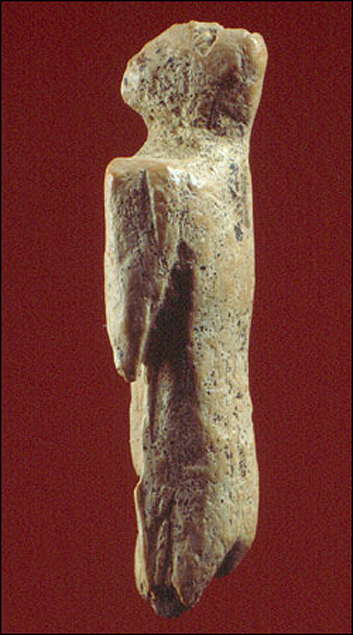
Loewenmensch, Löwenmensch, formerly often called Lowenfrau, the Lion Lady Venus - carved from mammoth ivory, it is 30 cm high and 6 cm in diameter. It was found in the cave of Hohlenstein-Stadel in the Valley of Lone, Baden-Wurttemberg (Germany), in 1939, dated as Aurignacian, in a level recently dated to 40 000 BP, making it the oldest sculpture known. Although this is known in some places as the lion lady, it is now known to be male. The arms bear striations carved into the ivory. Years after the initial discovery the museum officials were presented with an ivory lion muzzle found in the cave. It was a perfect fit. Today it is pieced together from more than 1000 tiny pieces. This male 'venus' may be an attempt to capture the power of the lion.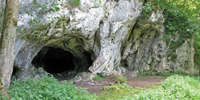 This page focuses on all the Lonetal Sites, rather than just the Löwenmensch sculpture which was found there. The Lonetal sites, including Neanderthal and Middle Paleolithic sites in the Swabian Alb near the city of Ulm, were important areas of ice age art. The sites occur in the Schwaebische Alb (Swabian Alb), in the valleys of the Ach and Blau river near Blaubeuren, where the famous lion/human figure was found in the Hohlenstein-Stadel cave.
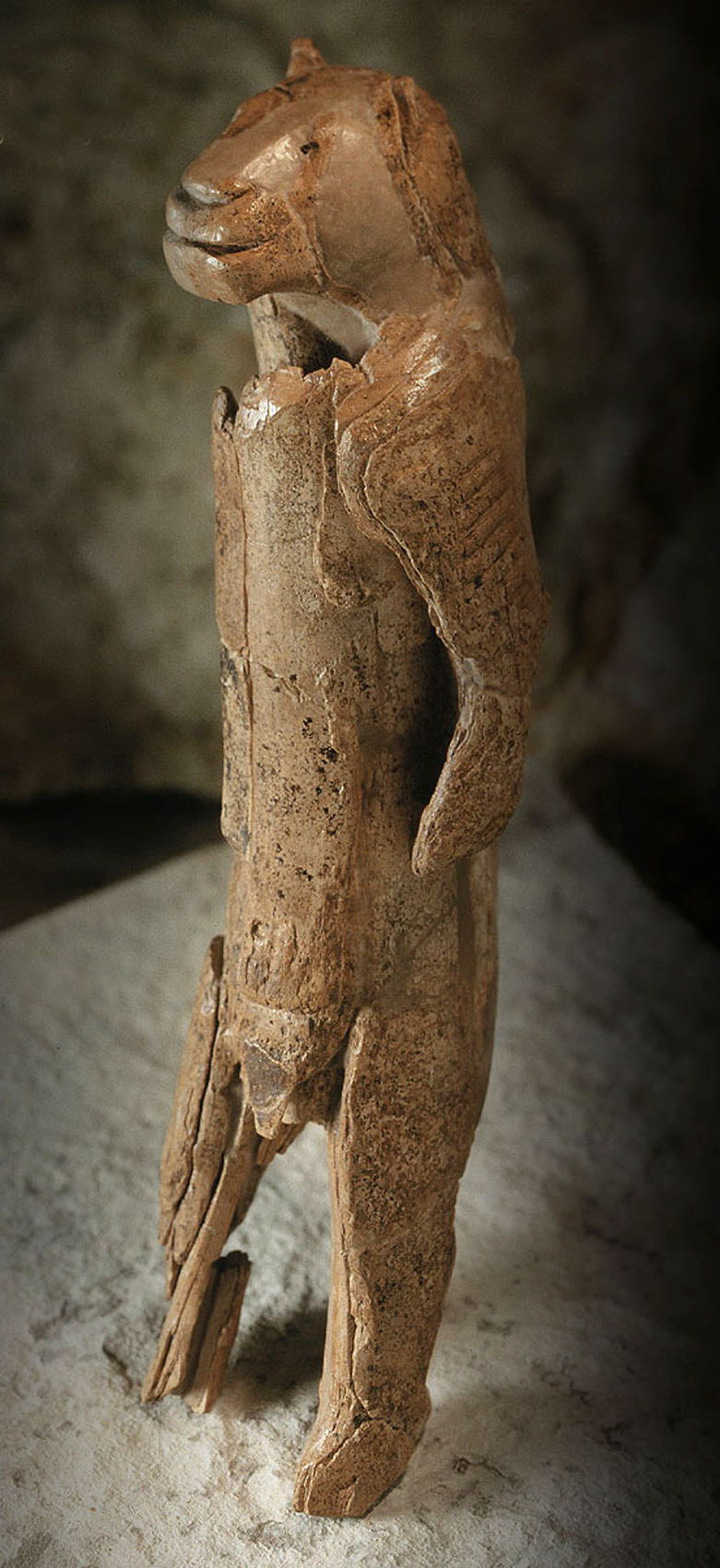
The Löwenmensch from Hohlenstein-Stadel. Height 30 cm, about 6 cm diameter. Made of mammoth ivory. Found in the cave of Hohlenstein-Stadel in the Valley of Lone, Baden-Wurttemberg (Germany), in 1939. Dated as Aurignacian, in a level now dated at 40 000 years old.
Note that a separate, smaller anthropomorphic lion figurine was discovered in the nearby Hohle Fels Cave in 1931 during an excavation by Gustav Riek.
See: Small lion man
Note also that a lion sculpture as well as an anthropomorphic statuette was found at Vogelherd Cave. Vogelherd Cave discoveries
Although this is known in some places as the lion lady, it is now known to be male. It is known as both Die Lowenfrau and Der Lowenmensch.
The arms bear striations carved into the ivory. Years after the initial discovery the museum officials were presented with an ivory lion muzzle found in the cave. It was a perfect fit. Today it is pieced together from more than 1000 tiny pieces. This 'venus' may be an attempt to capture the power of the lion.
Dimensions: height 281 mm, width 63 mm, thickness 59 mm.
This is the best quality photo of the Löwenmensch before the recent discoveries of extra pieces and the subsequent restoration in 2012/2013.
Photo: http://www.loewenmensch.de/lion_man.html
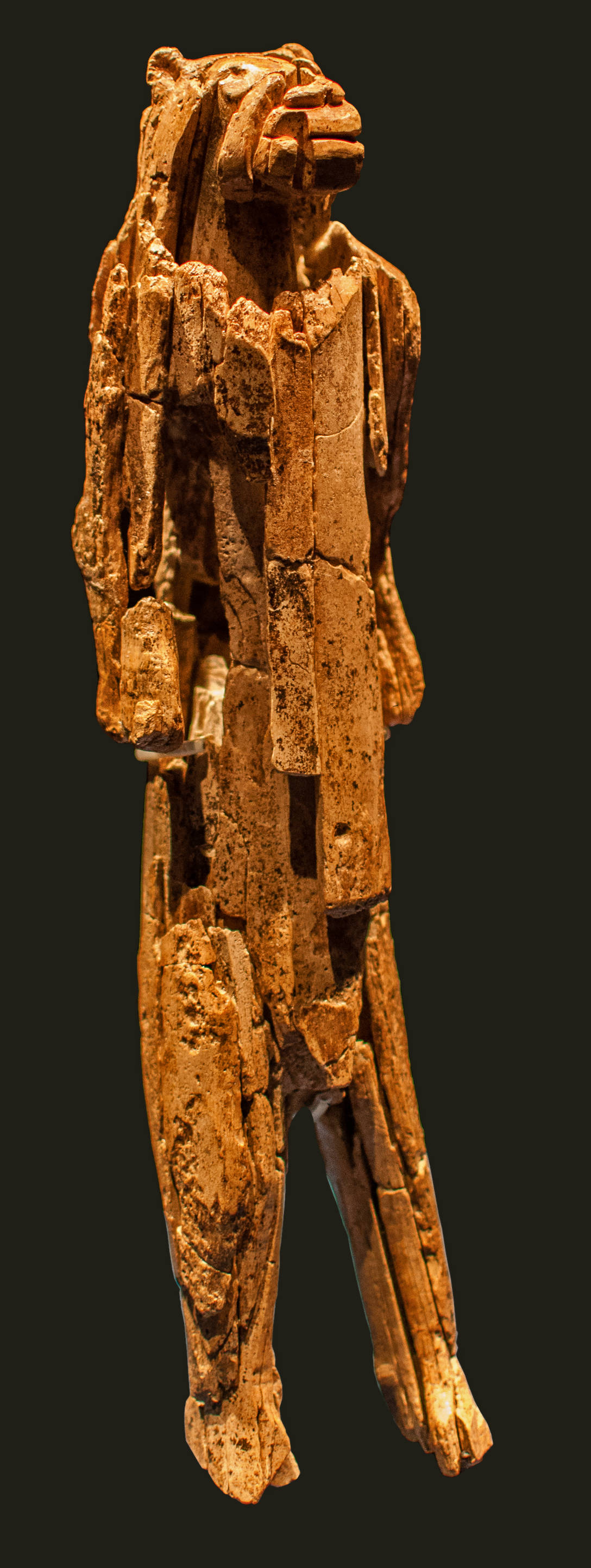
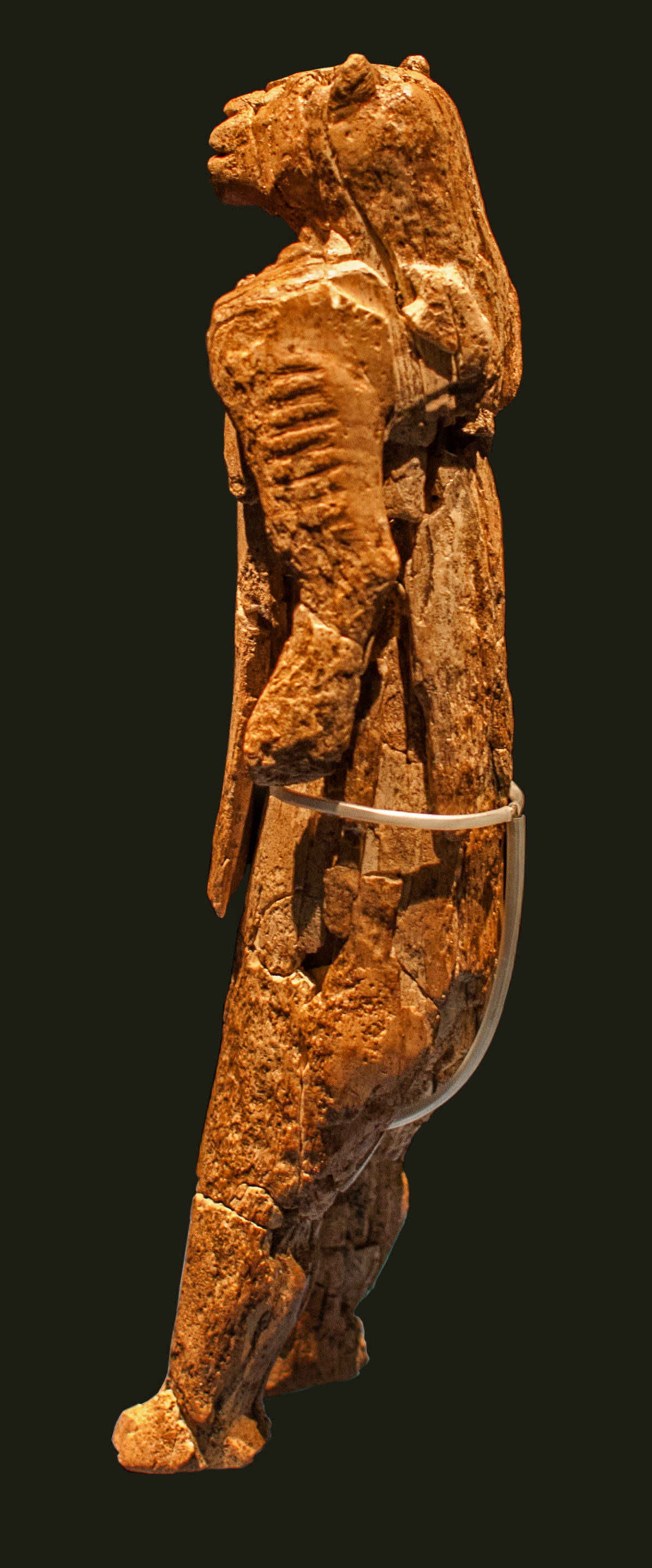
The Löwenmensch after restoration during 2012/2013, showing especially the extra pieces found of the face, and the missing right arm restored.
This is the version displayed at Ulm in November 2013.
Photo: (left) Silosarg
Permission: CC-BY-SA-3.0
Photo: (right) Dada629
Permission: CC-BY-SA-3.0
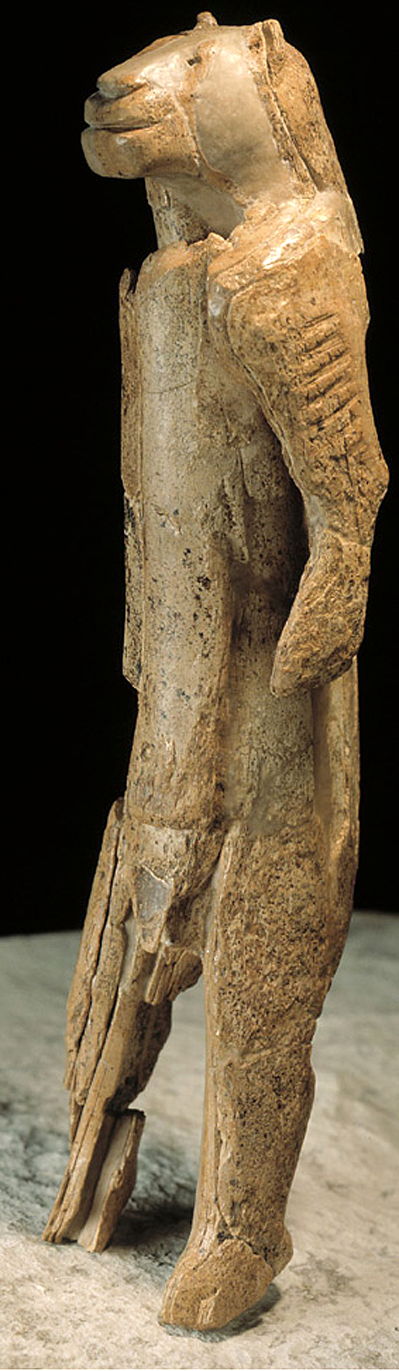
Its pieces were found in 1939 in a cave named Stadel-Höhle im Hohlenstein (Stadel cave in Hohlenstein Mountain) in the Lonetal (Lone valley) in the Swabian Alps, Germany. Due to the beginning of the Second World War, it was forgotten and only rediscovered thirty years later. The first reconstruction revealed a humanoid figurine without head. Between 1997 and 1998 additional pieces of the sculpture were discovered and the head was reassembled and restored.
The sculpture is 296 mm high, 56 mm wide and 59 mm thick. It was carved out of mammoth ivory using a flint stone knife. There are seven parallel, transverse, carved gouges on the left arm.
Originally, the figure was classified as male by Joachim Hahn. From examination of some additional parts of the sculpture found later, Elisabeth Schmid decided that the figure was a woman with the head of a "Höhlenlöwin" (female Cave Lion). Both interpretations lack scientific evidence. European cave lions, male and female, lacked the distinctive manes of the African male lion, and so its absence here cannot lead to an interpretation as a 'lioness'.
Recently the ancient figurine has more often been called a lion headed figurine, rather than a 'lion man'. The name currently used in German, Löwenmensch - meaning 'lion-human' - similarly, is neutral.
Interpretation is very difficult. The sculpture shares certain similarities with French cave wall paintings, which also show hybrid creatures. The French paintings, however, are several thousand years younger than the German sculpture.
After this artefact was identified, a similar, but smaller, lion-headed sculpture was found, along with other animal figures and several flutes, in another cave in the same region of Germany.This leads to the possibility that the lion-figure played an important role in the mythology of humans of the early Upper Palaeolithic. The sculpture can be seen in the Ulmer Museum in Ulm, Germany.
Photo and text adapted from: http://www.historyofinformation.com/index.php?category=Archaeology and Wikipedia.

The original lion lady/man is now in the Ulm Museum (City Museum of Ulm), but many museums all over the world own a copy.
Photo: Gaura, 2007, via Wikimedia Commons. This image is in the public domain.
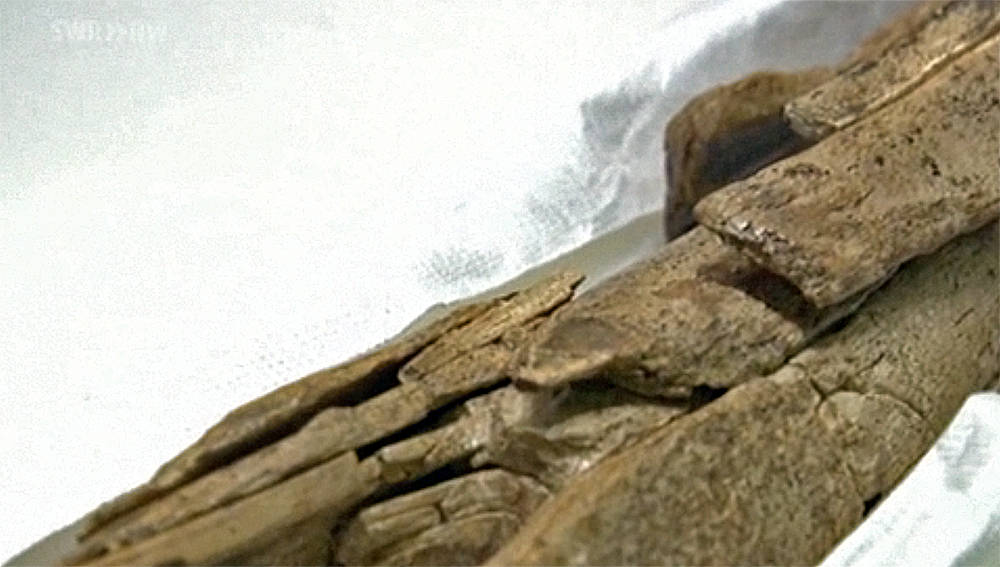
After painstaking resieving of sediments and a complete reconstruction, displayed to the public in November 2013, it is now established that the Löwenmensch is male.
Photo: http://www.swr.de/landesschau-aktuell/bw/loewenmensch-restauriert-ulm/-/id=1622/nid=1622/did=12378616/11qvskd/

At last the missing right arm has been found and attached.
Photo: http://www.br.de/nachrichten/schwaben/loewen-mensch-ulm-artikel-100.html
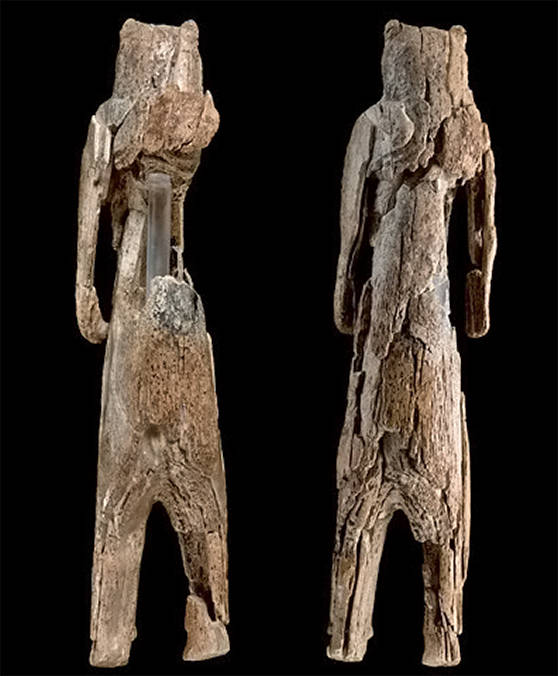
Here we can see the progress made from the previous reconstruction. The photo on the right shows the pieces that have been added, including much of the back and the right arm.
The glass or plastic rod used to stiffen the statue is now hidden by the pieces found and attached.
Photo: http://www.br.de/nachrichten/schwaben/loewen-mensch-ulm-artikel-100.html
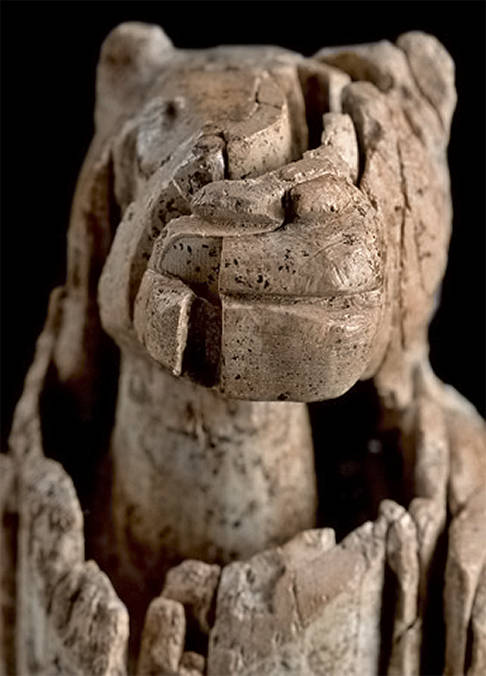
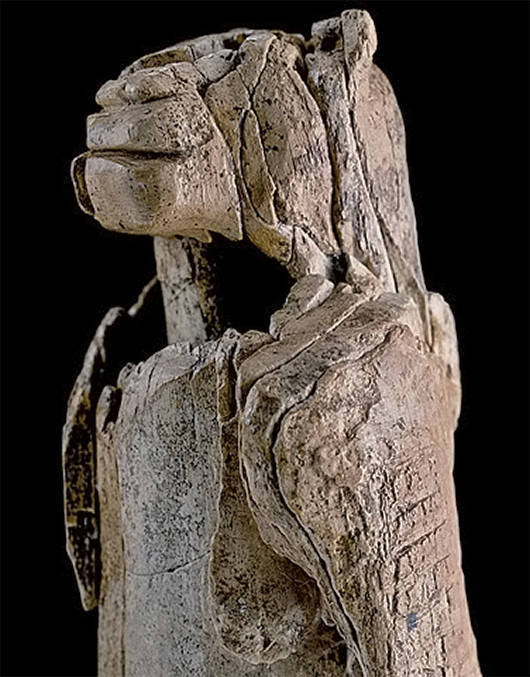
Parts of the head and muzzle have been found and placed in position in this latest reconstruction in November 2013.
The head and shoulders now need less fill to complete the figurine.
Photo: http://www.br.de/nachrichten/schwaben/loewen-mensch-ulm-artikel-100.html
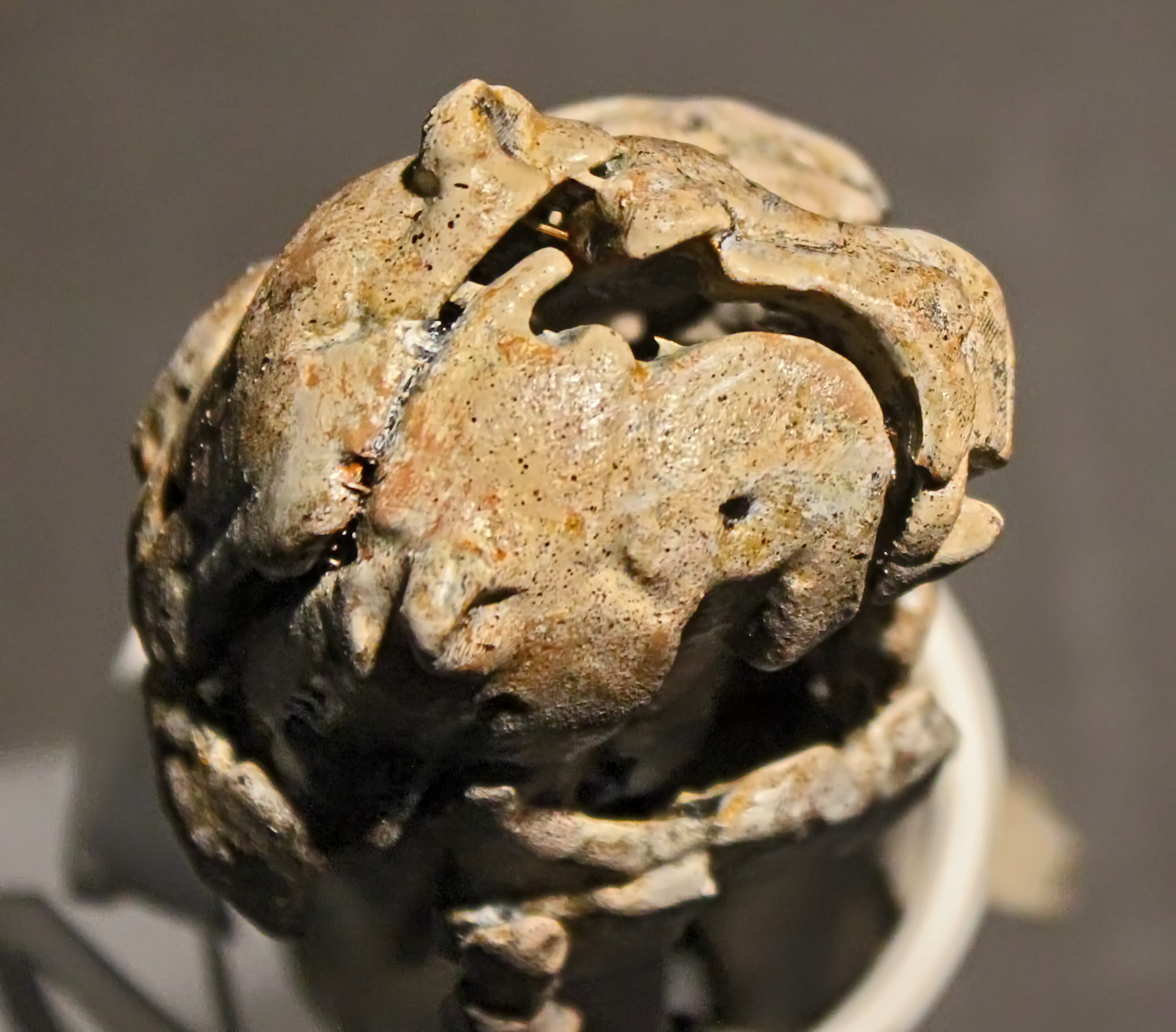
Head of the lion man from above.
Photo: Ralph Frenken
Source: Facsimile, Exhibited at the Archeological Museum Hamburg (Ice Age - The Art of the Mammoth Hunters from 18 October 2016 to 14 May 2017)
On loan from the Hermitage Museum, Saint Petersburg, Russia.
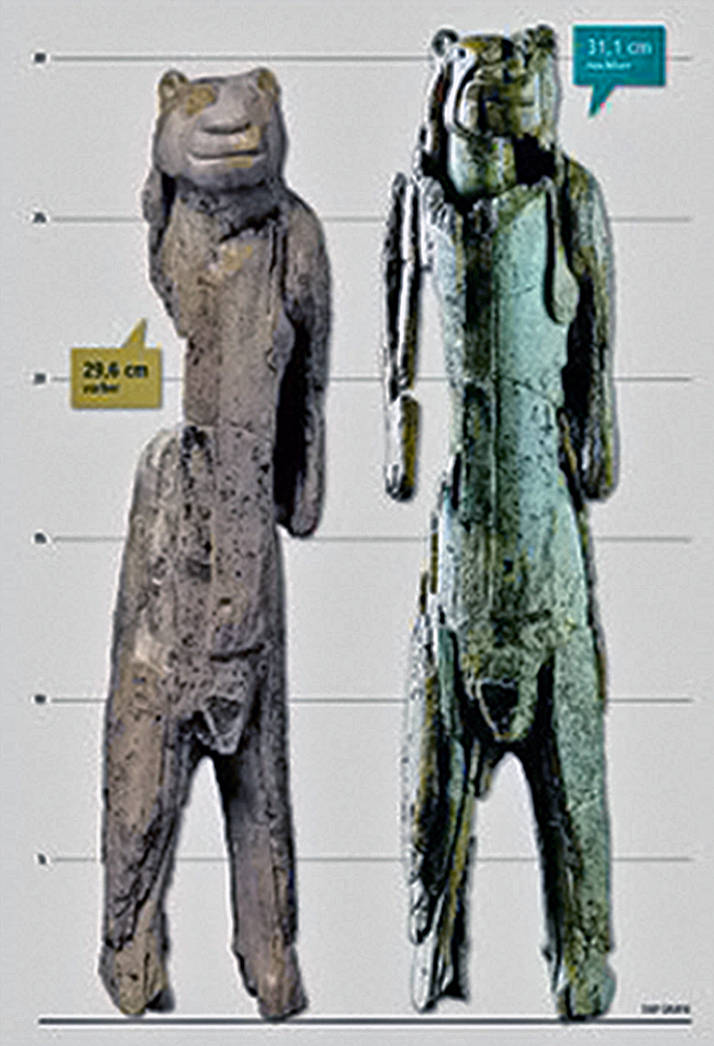
The extra 800 parts recently found, some extremely small, have helped the restorers to obtain a clearer picture of what the original dimensions were. Here we can see that the reconstruction has 'grown' from 296 mm to 311 mm high. Only the larger pieces found were used to rebuild the figurine, but it was still a huge task, requiring masterly skills and dedication. The original glues and fillers were removed, and the figurine was reassembled from scratch.
Photo: http://www.swp.de/ulm/lokales/ulm_neu_ulm/Loewenmensch-ist-gewachsen;art4329,2283486
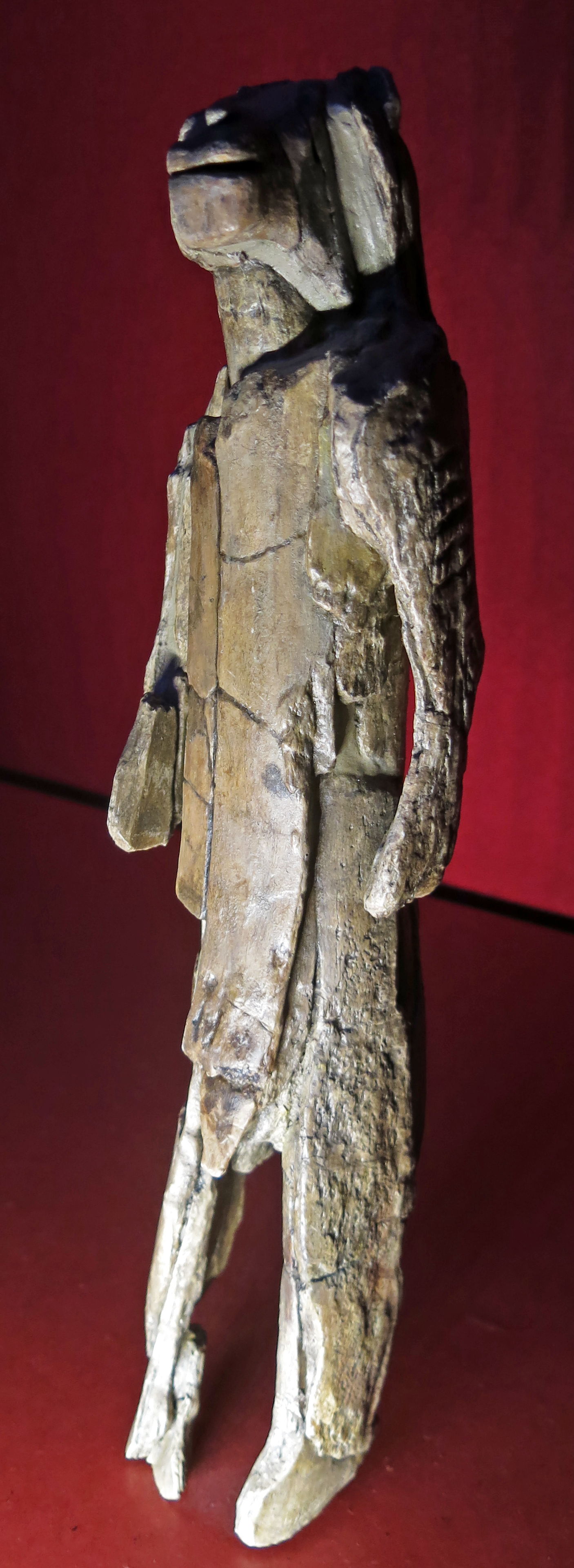

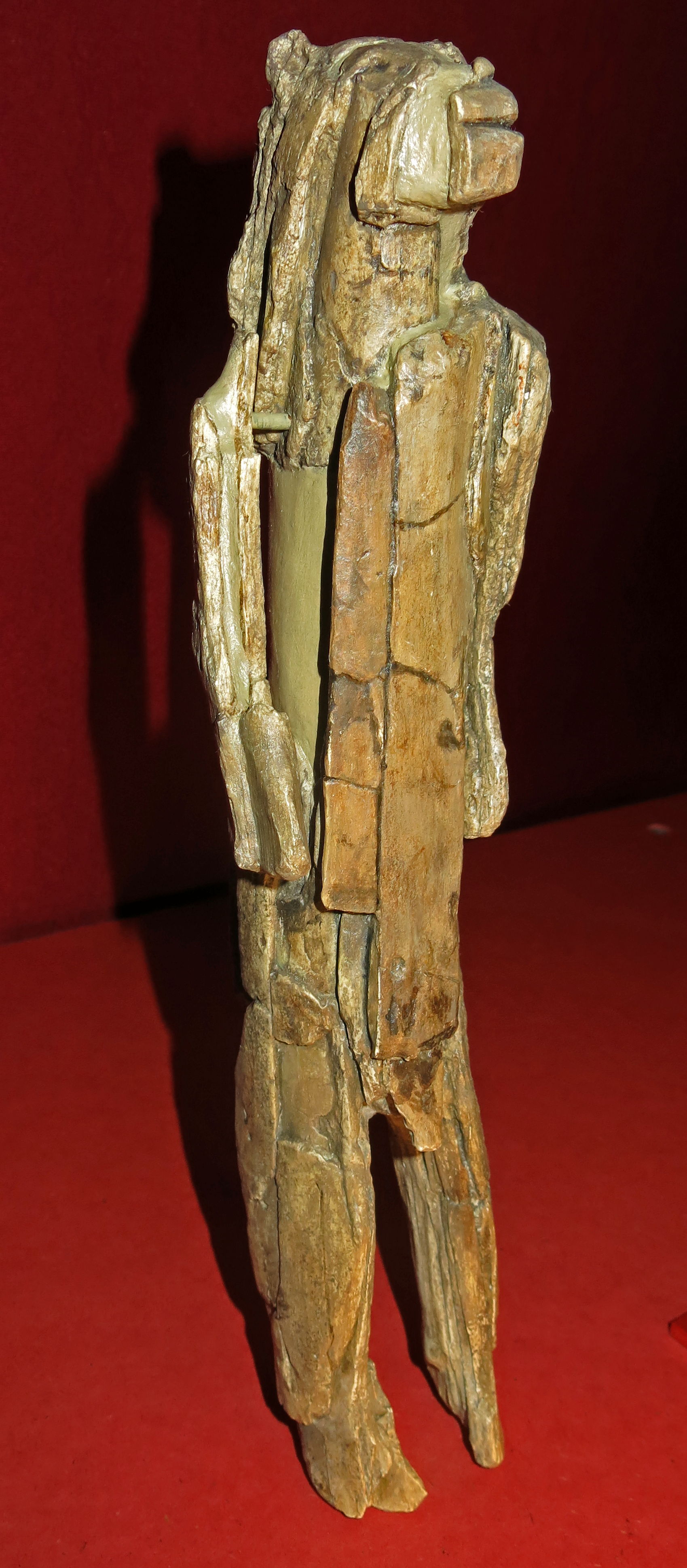
The Lion Man.
Photo: Don Hitchcock 2015
Source: Facsimile, Monrepos Archäologisches Forschungszentrum und Museum, Neuwied, Germany
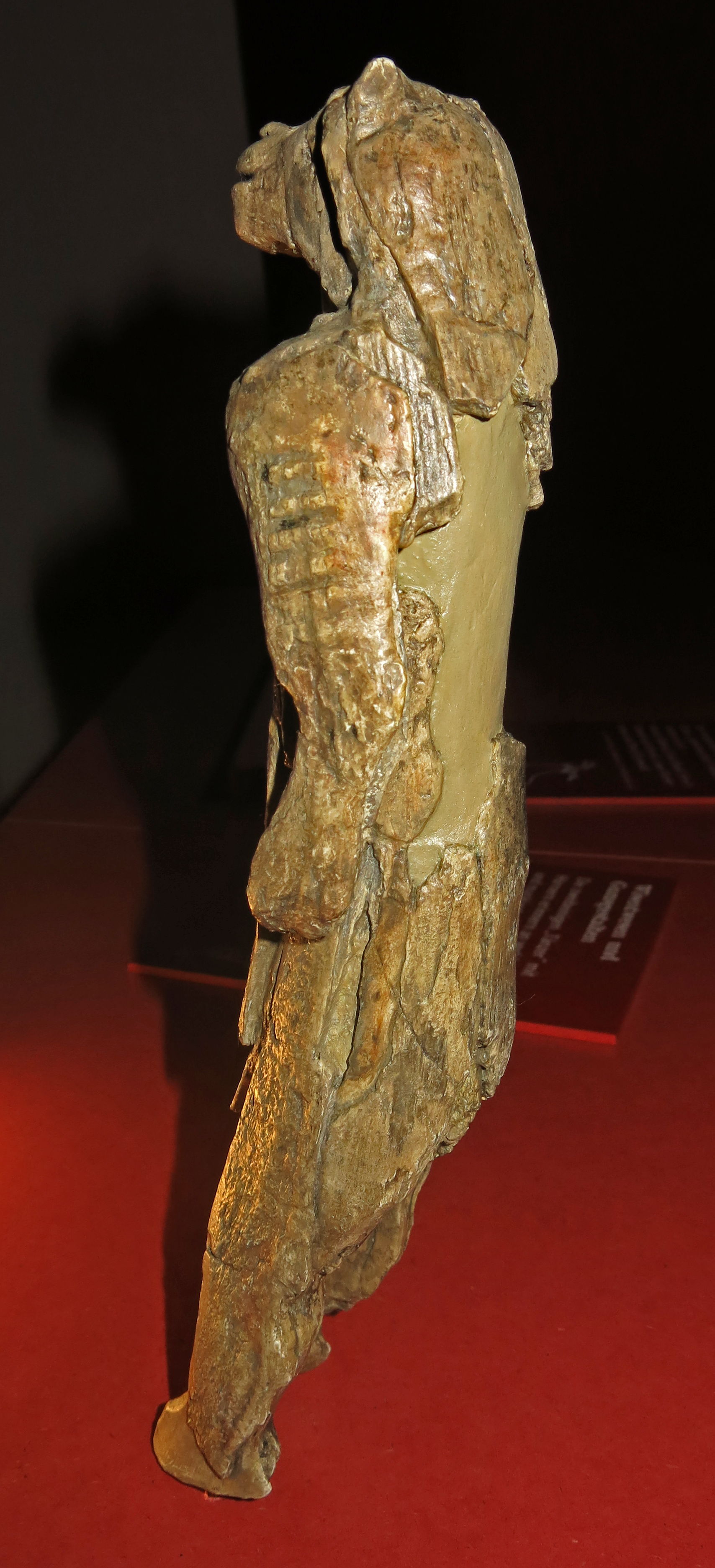
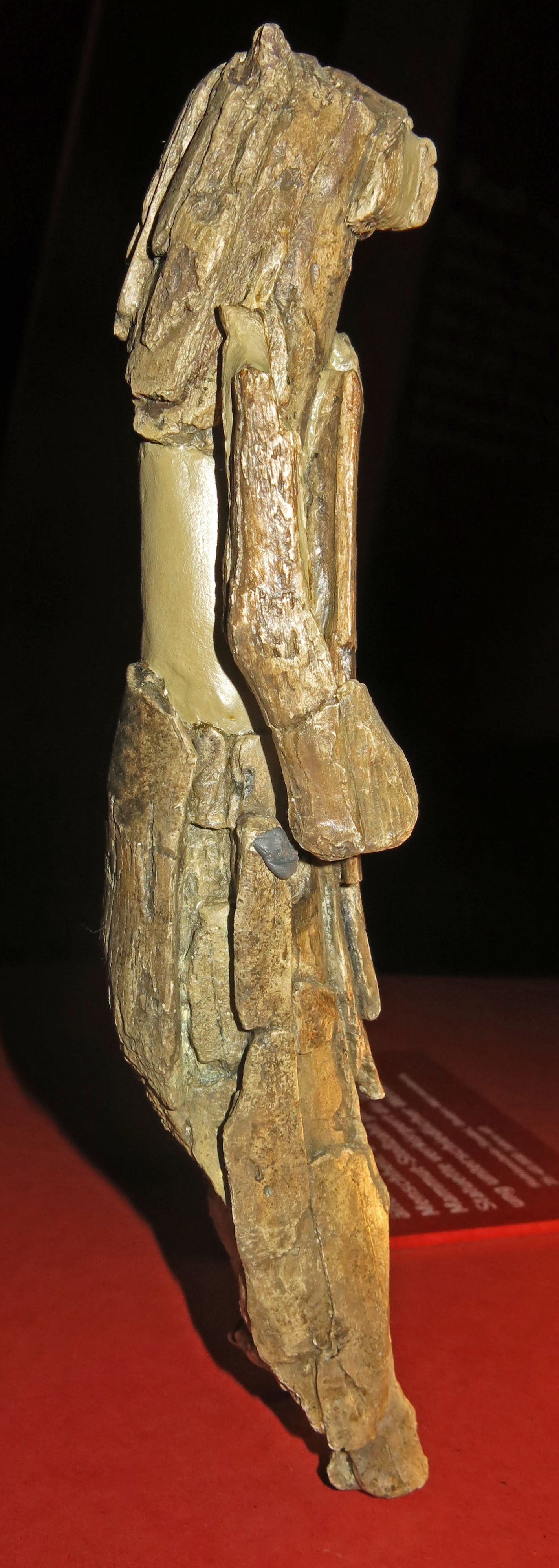
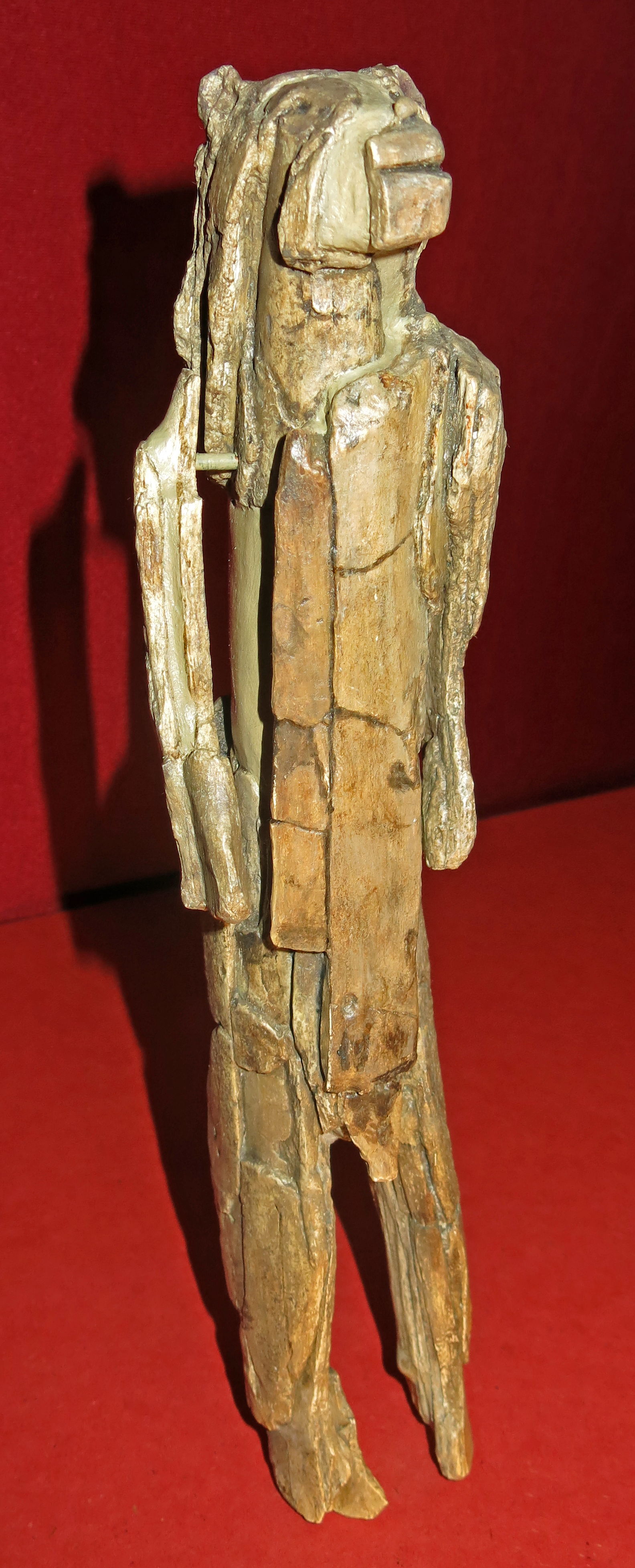
The Lion Man.
Photo: Don Hitchcock 2015
Source: Facsimile, Monrepos Archäologisches Forschungszentrum und Museum, Neuwied, Germany
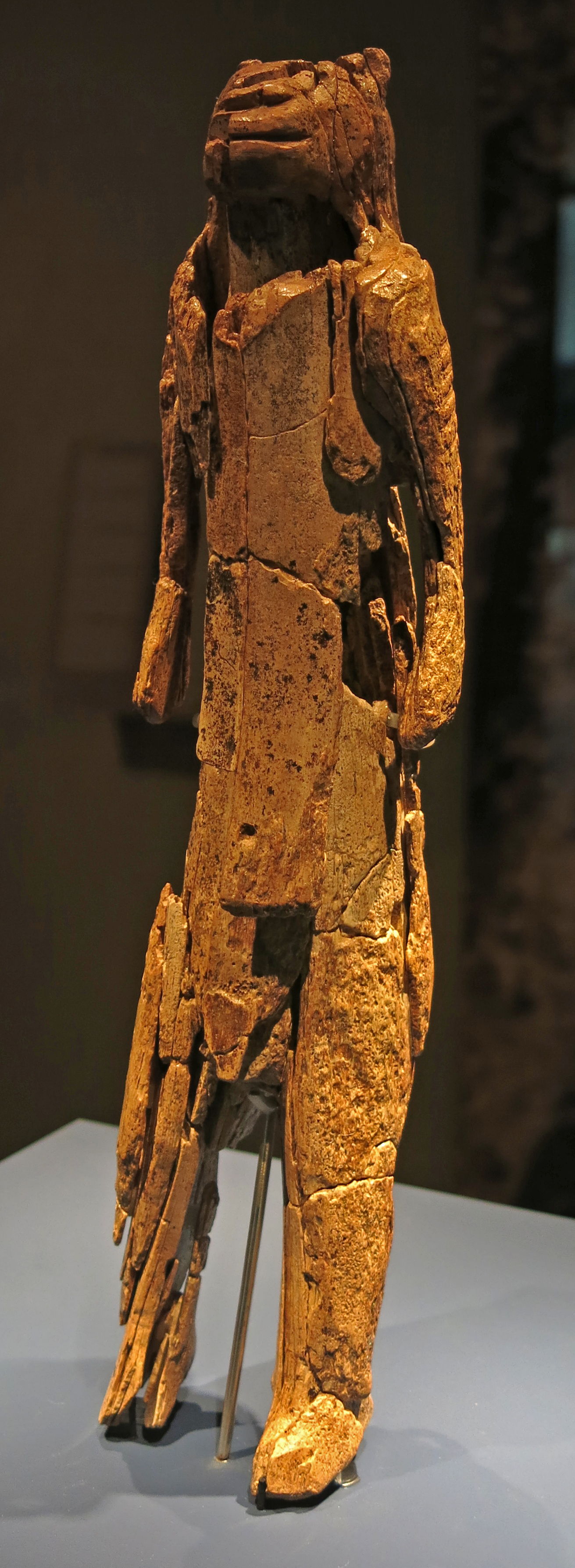
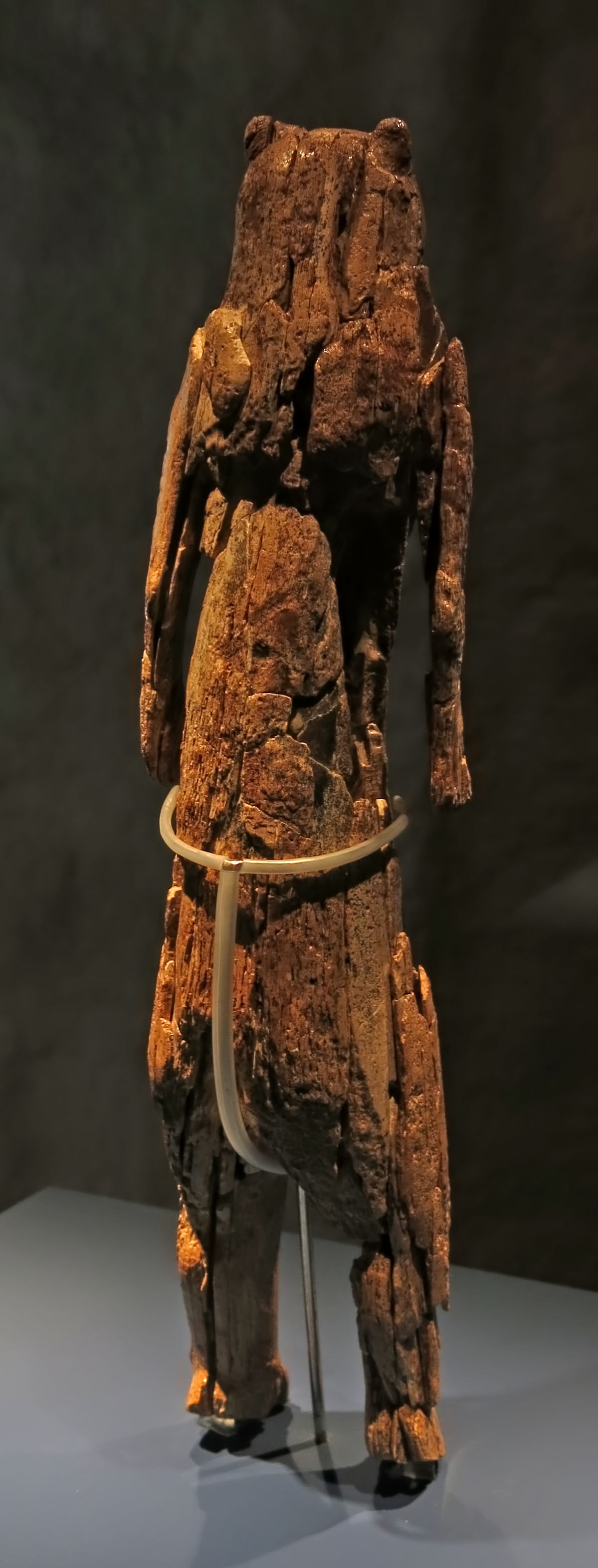
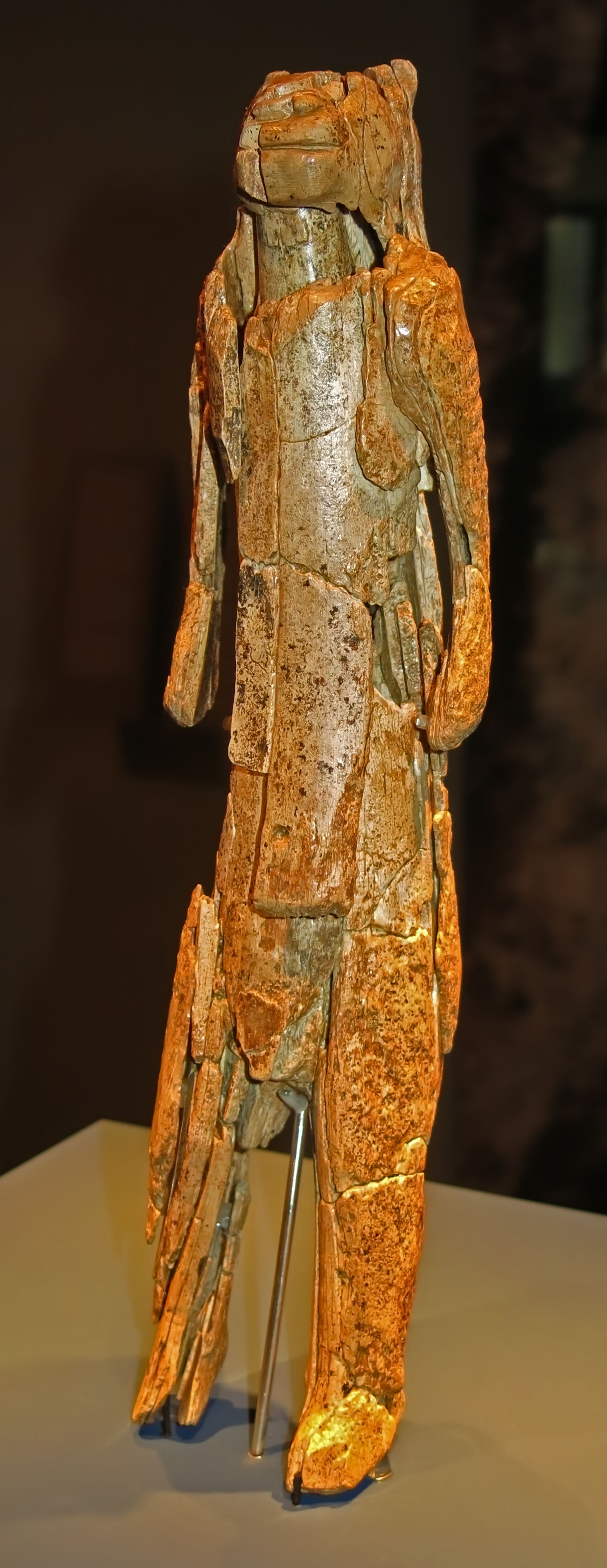
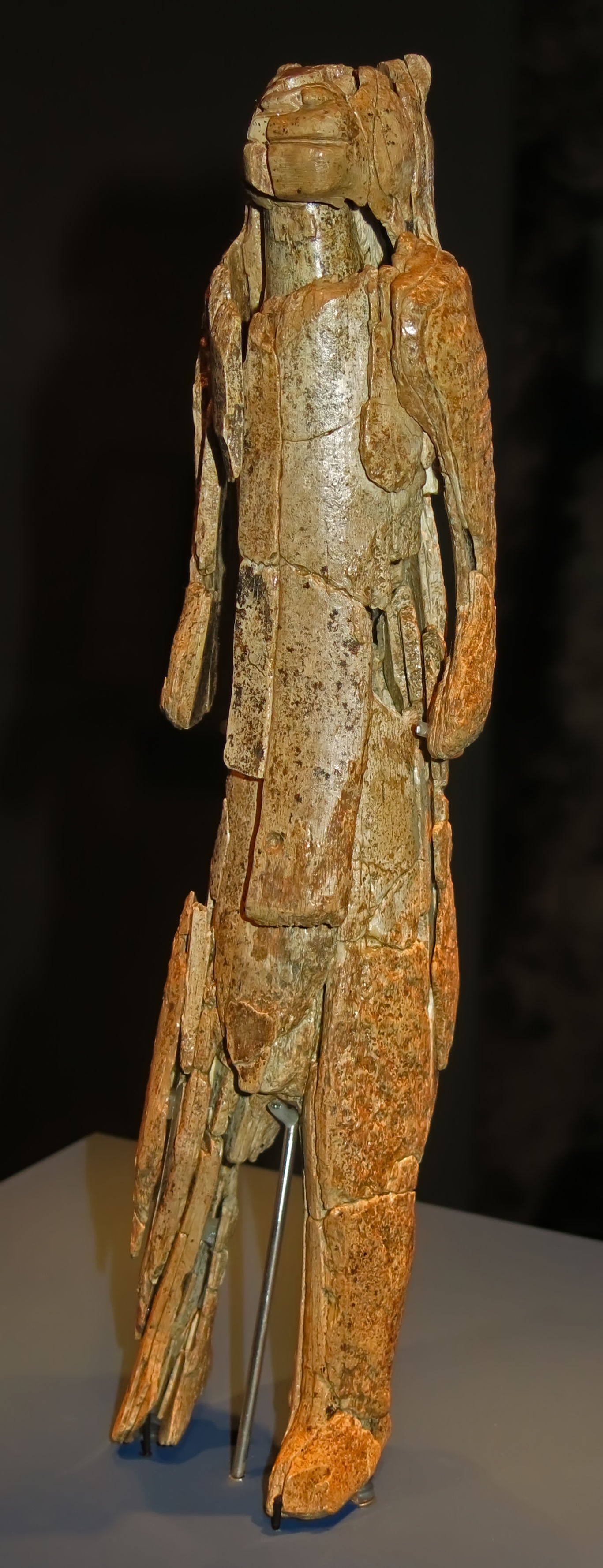
The Lion Man.
Photo: Don Hitchcock 2015
Source: Original, Ulmer Museum, Germany
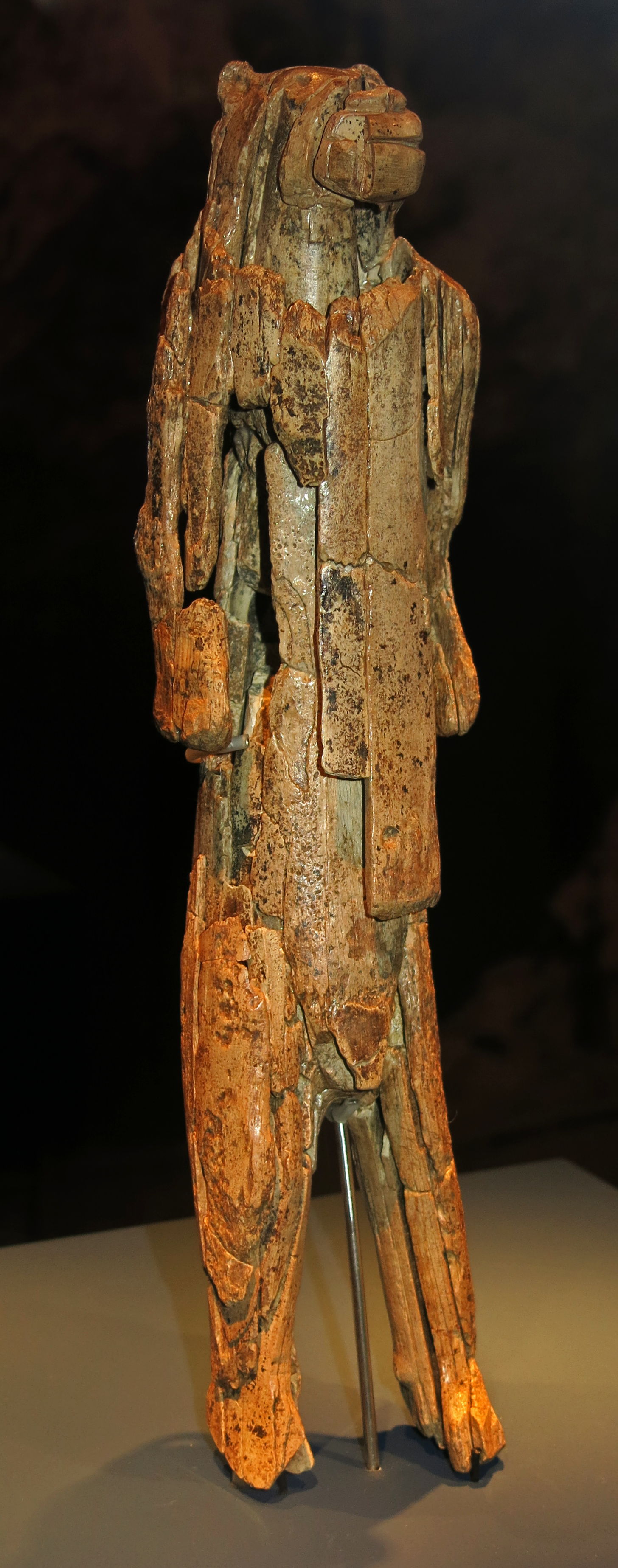
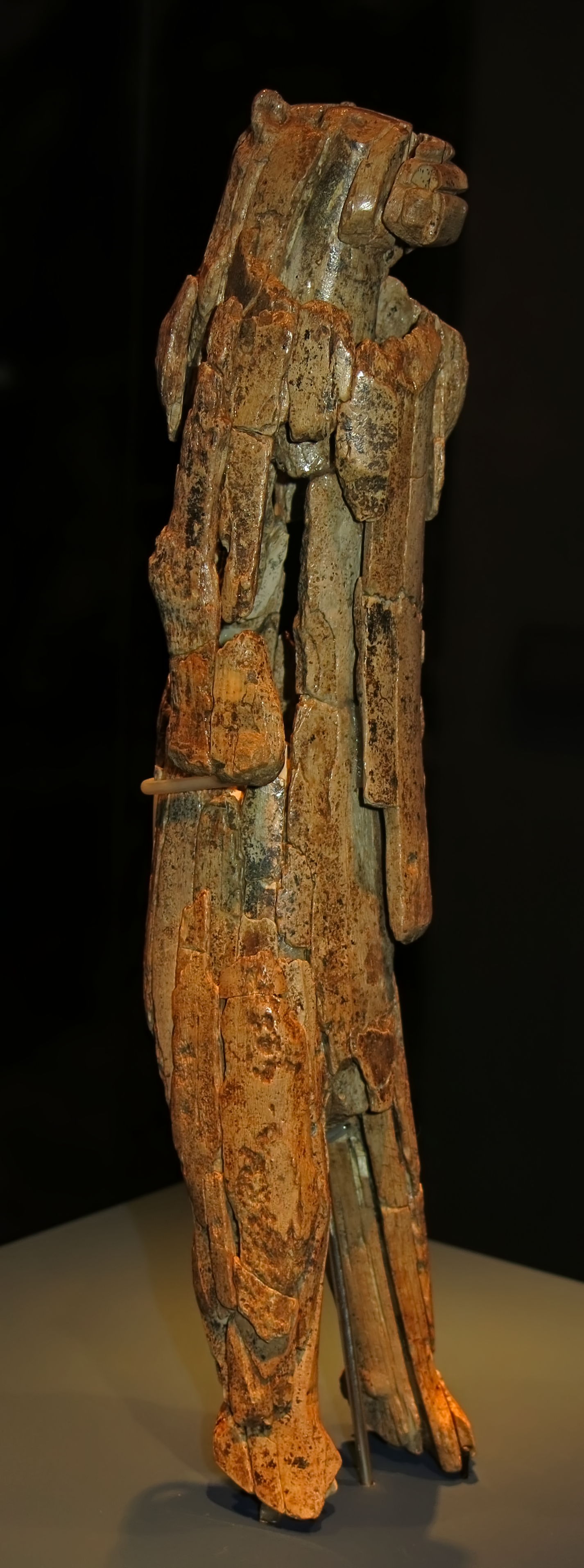
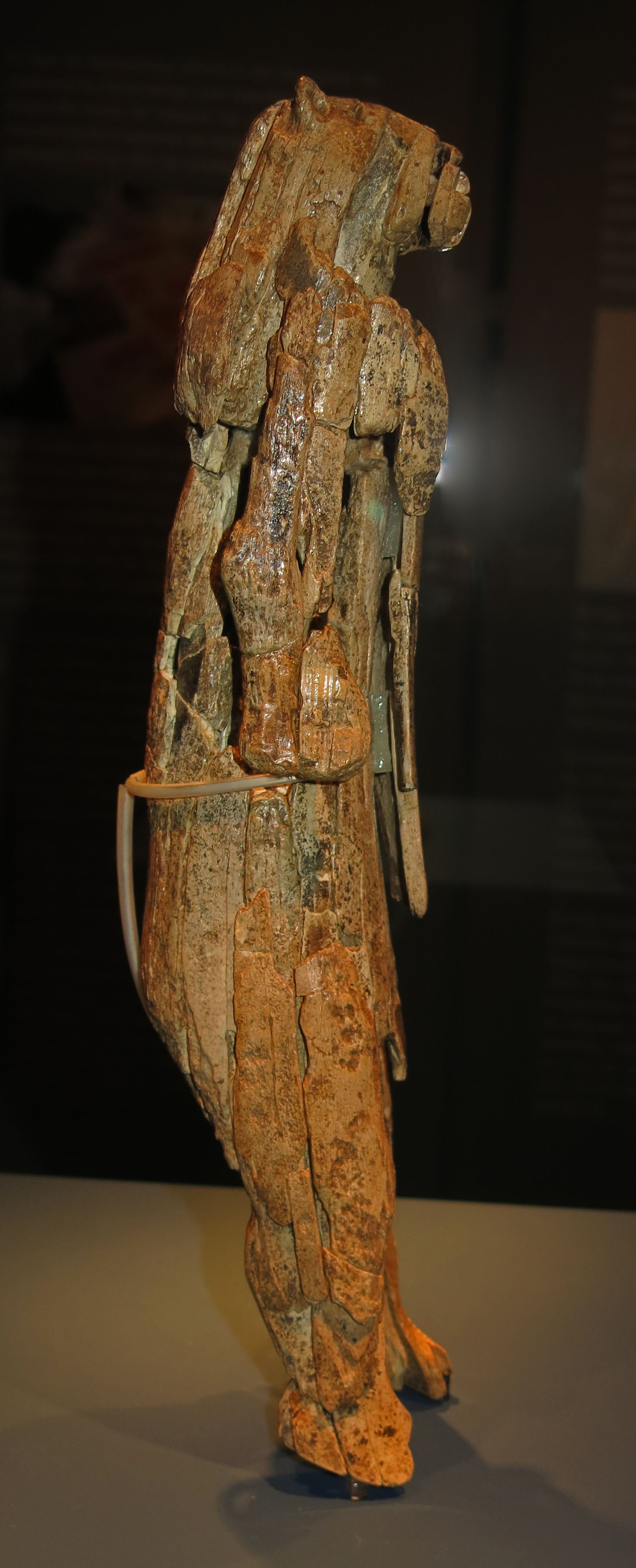
The Lion Man.
Photo: Don Hitchcock 2015
Source: Original, Ulmer Museum, Germany

Close up of the genital area of the lion man statue.
( note the layering on this facsimile. This method, using 3D printing, is transforming the ability of museums and scientific institutions to have access to very good facsimiles of important archaeological finds - Don )
Photo: Ralph Frenken
Source: Facsimile, exhibited at the Archeological Museum Hamburg (Ice Age - The Art of the Mammoth Hunters from 18 October 2016 to 14 May 2017)
History of the discovery
Der Spiegel 49/2011, http://www.spiegel.de/spiegel/print/d-82612721.html
Archaeologists have found and put together fragments of the 'lion man'. However this 35 000 BP statue may be a female shaman, with plump breasts.
With a hand trowel, the geologist Otto Völzing dug on 25 August 1939 in dim light through the cultural layers deep inside the Stadelhöhle (Schwäbische Alb). He met with flint and other detritus from prehistoric man. Suddenly he hit something hard - a fragmented statuette. Hastily, the debris was packed in a box and his work, funded by the SS, had to be completed that day. Everything had to go fast. Völzing had received his call-up. The Second World War was imminent. For 30 years the pieces he found went unnoticed. Then they were found and pieced together to form one of the most impressive of the Palaeolithic sculptures.
The 'Lion Man', made from the tusk of a mammoth is about 30 cm high. Its creator carved and polished the piece. An experiment revealed that the carving took about 320 hours. The original is badly damaged but no one knows its exact appearance. The reason is that because of the hurried completion of the pre-war excavations, many splinters from the piece were overlooked. The present form was completed in 1988, and consists of 220 parts. About 30 percent of the body is missing. The surface has splintered off a large part of the statue.
The enigma is that it is uncertain whether a mythical half-lion half-human is depicted, or perhaps a magician under a cloak. The six stripes on the upper left arm can be interpreted as bulbous ornamental marks, but it is unknown what was on the missing right arm.
Even the sex is unrecognisable. The prehistorian Joachim Hahn suggested that the plate on the abdomen might be a flaccid penis. The palaeontologist Elisabeth Schmid classified this feature as a pubic triangle. The statue had been touted as an 'icon of the feminist movement', complained Kurt Wehrberger of the Ulmer Museum, which holds the treasure. For some women it is clear: prehistory was a matriarchy and Eve was an Amazon. Instead of cooking and looking after children, women would have hunted mammoths and also been part of magic rituals. The debate is still not decided, but that could change. New fragments of the 'lion man' have been discovered.
(note that it is now believed, on the basis of further pieces that have been found and fitted to the sculpture, that the lion figurine is male - Don )
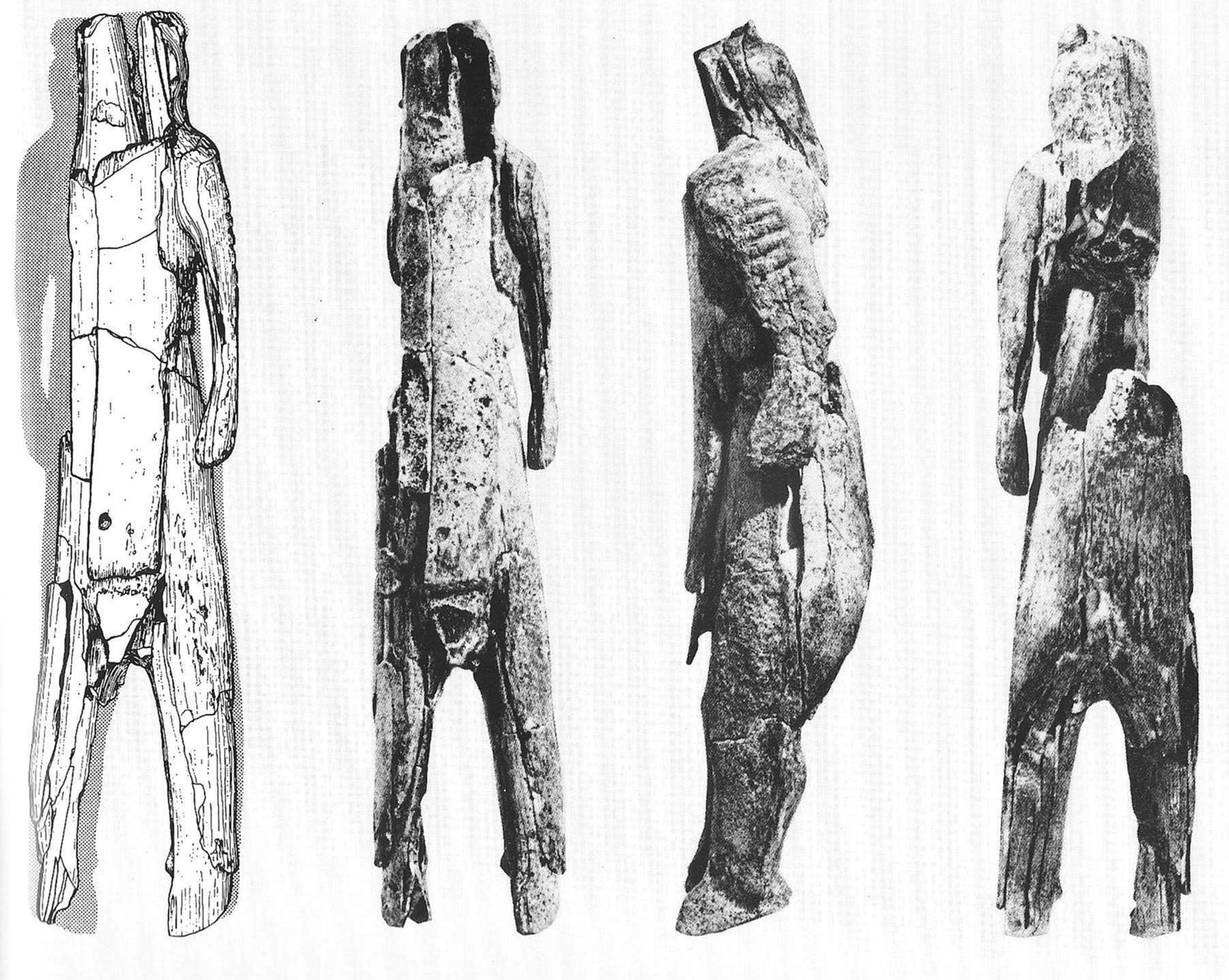
Preliminary reconstruction of the figurine from 1980. This is a valuable historical photo which demonstrates very clearly, when a comparison is made to later versions, the progress which has been made, with painstaking and careful searching and restoration.
Photo: Adam et al. (1980)
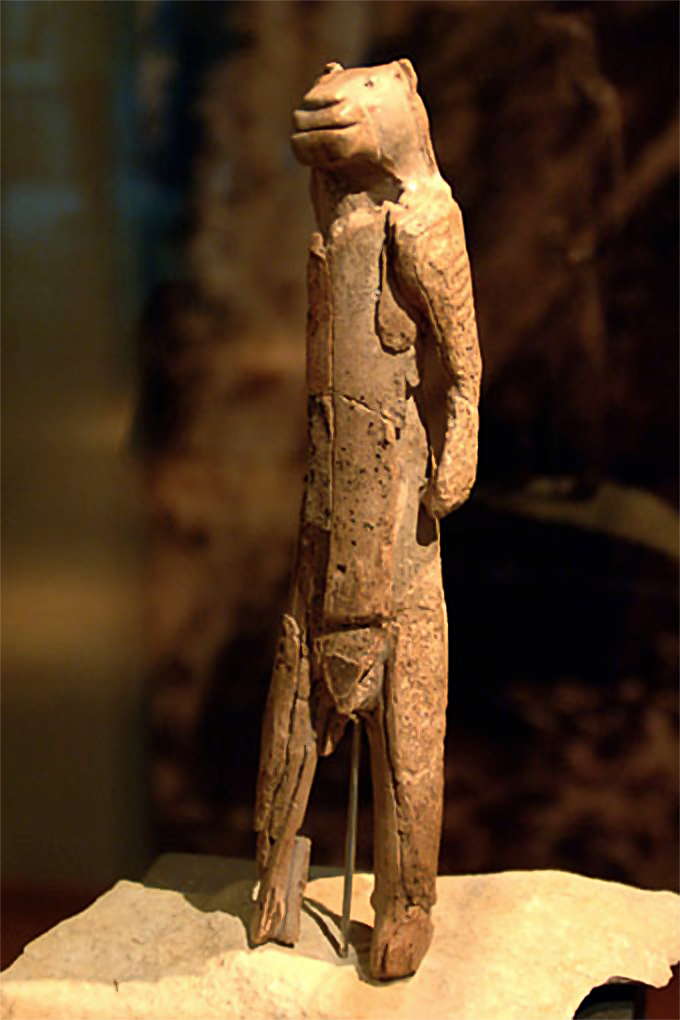
Later reconstruction of the figurine, showing important parts of the head and mouth which have been added.
Photo: http://www.fgk.org/?m=200905
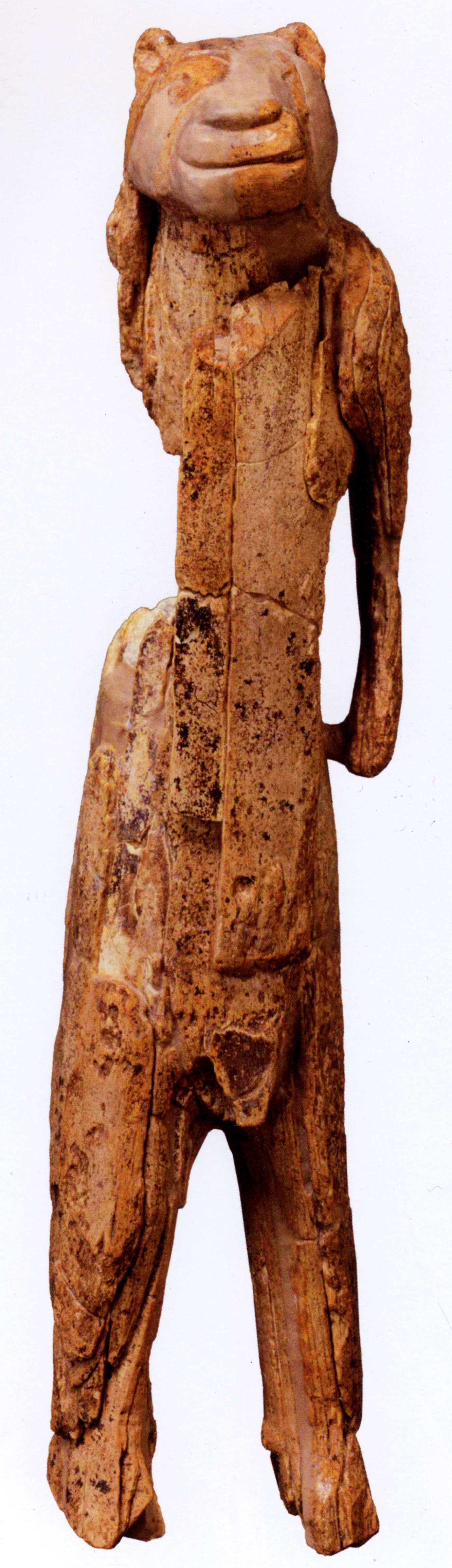
In this unusual, large format and valuable view (most are from one side, to hide the lack of the right arm, a significant part of which has now been discovered, November 2013) we can see clearly how much has been done, and how much remains to be filled in.
This view is also very valuable from the fact that we can see how much of the head has had to have been reconstructed. Fortunately complementary pieces from each side of the head have allowed the mirror image on the other side to be sculpted.
Restorations of this kind are the art of the possible, and the finest minds in the field have worked very hard to show us the best possible recreation of the masterpiece, on show at the British Museum in 2013.
It is unfortunate that the genital area was not complete. Much could have been deduced earlier concerning the purpose of the piece if this had been intact. The good news is that as of the reconstruction displayed in November 2013 in Ulm, the gender of the sculpture has been determined to be male. This will have very important ramifications in terms of interpreting the purpose of the figurine. It is the largest such 'venus' figure in existence, as well as being the oldest. Most other 'venus' figurines are female.
Photo: Karl-Heinz Augustin © Ulmer Museum, Cook (2013)
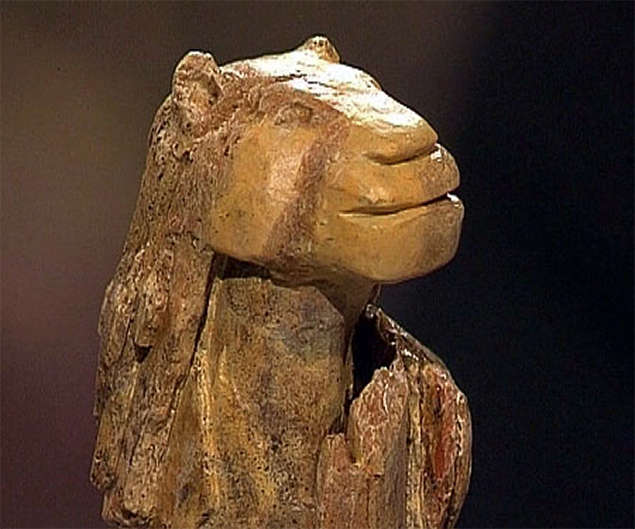
Closeup of the head, showing some of the extensive remodelling of missing parts.
Photo: http://www.planet-wissen.de/laender_leute/mittelgebirge/schwaebische_alb/kunstwerke_aus_der_eiszeit.jsp
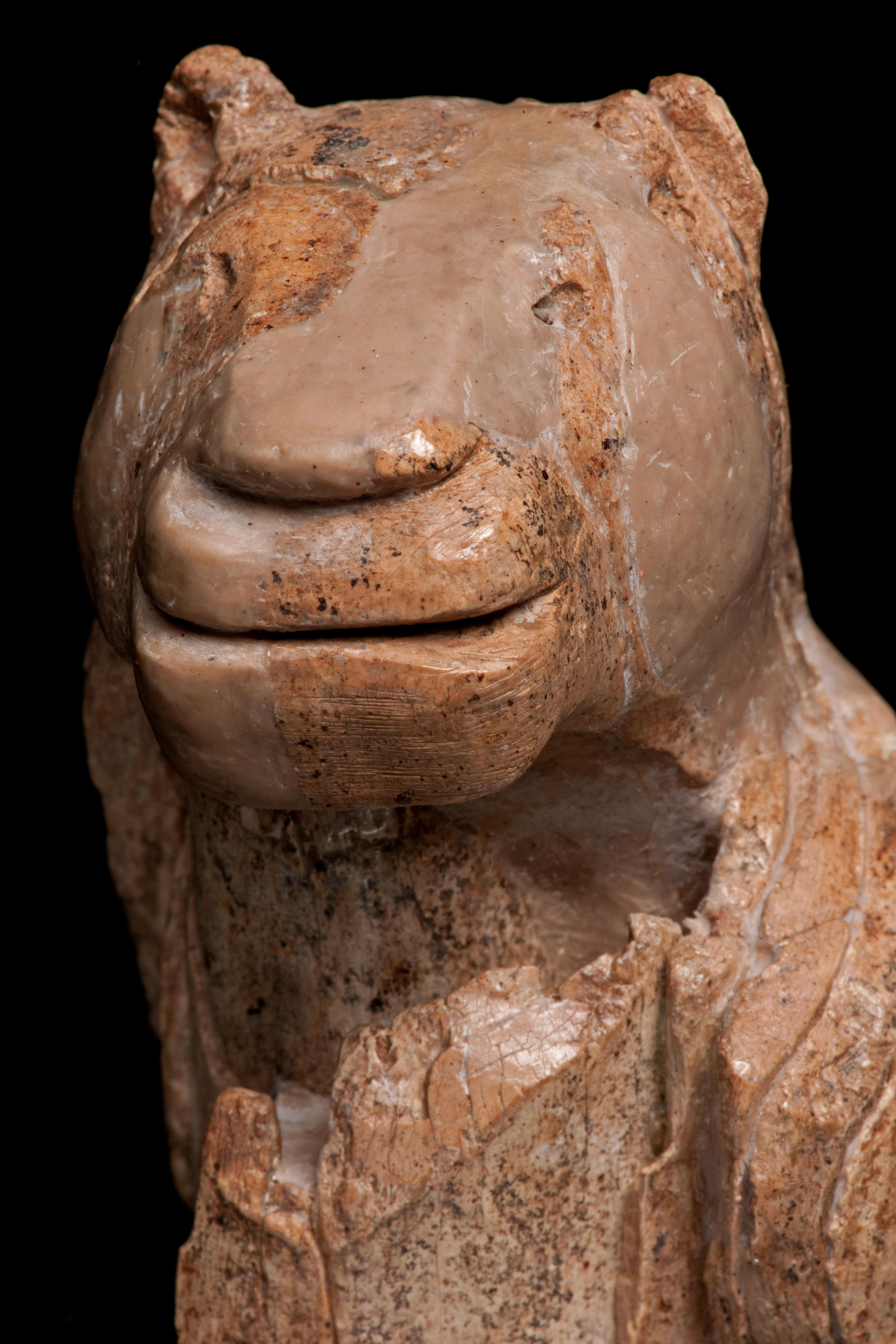
Another good closeup of the head.
Photo: http://www.denkmalpflege-bw.de/
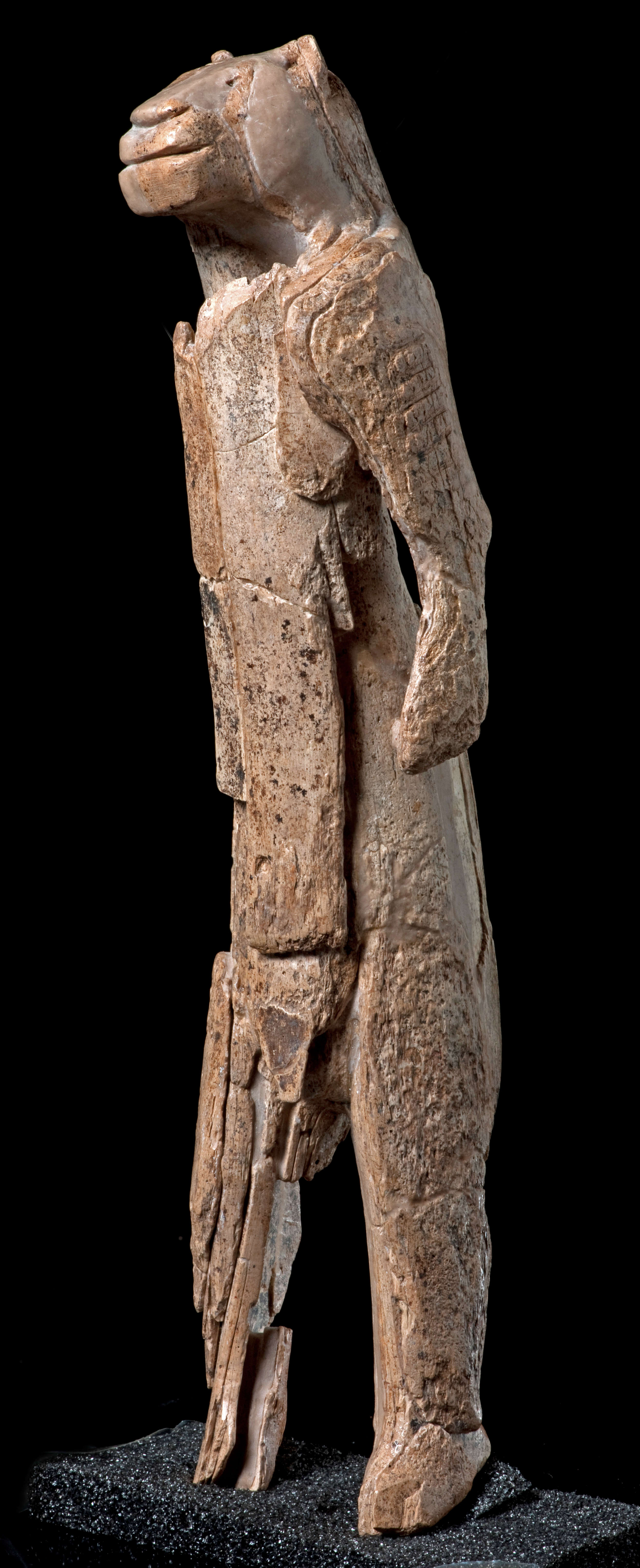
This is a large format photo of the entire piece.
It is normal practice to use a filler for missing parts, as here, which is noticeably different to the original in colour and lustre. It is also important that what has been done can be undone, should another piece be found which can be slotted in to a missing section.
Much effort has gone into finding and using materials which fill these criteria.
Photo: http://www.denkmalpflege-bw.de/
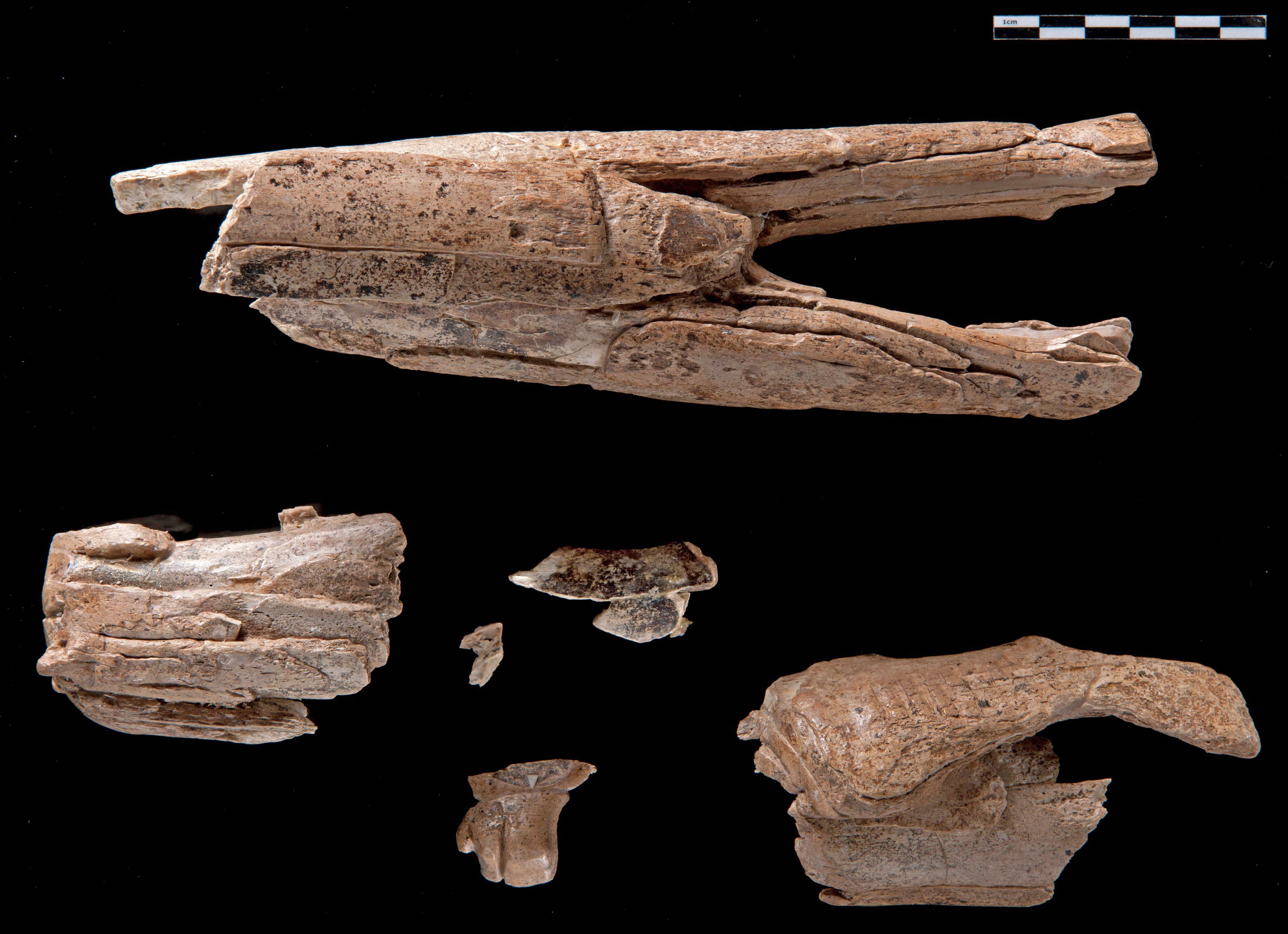
The main parts of the Löwenmensch, disassembled.
Photo: http://www.denkmalpflege-bw.de/
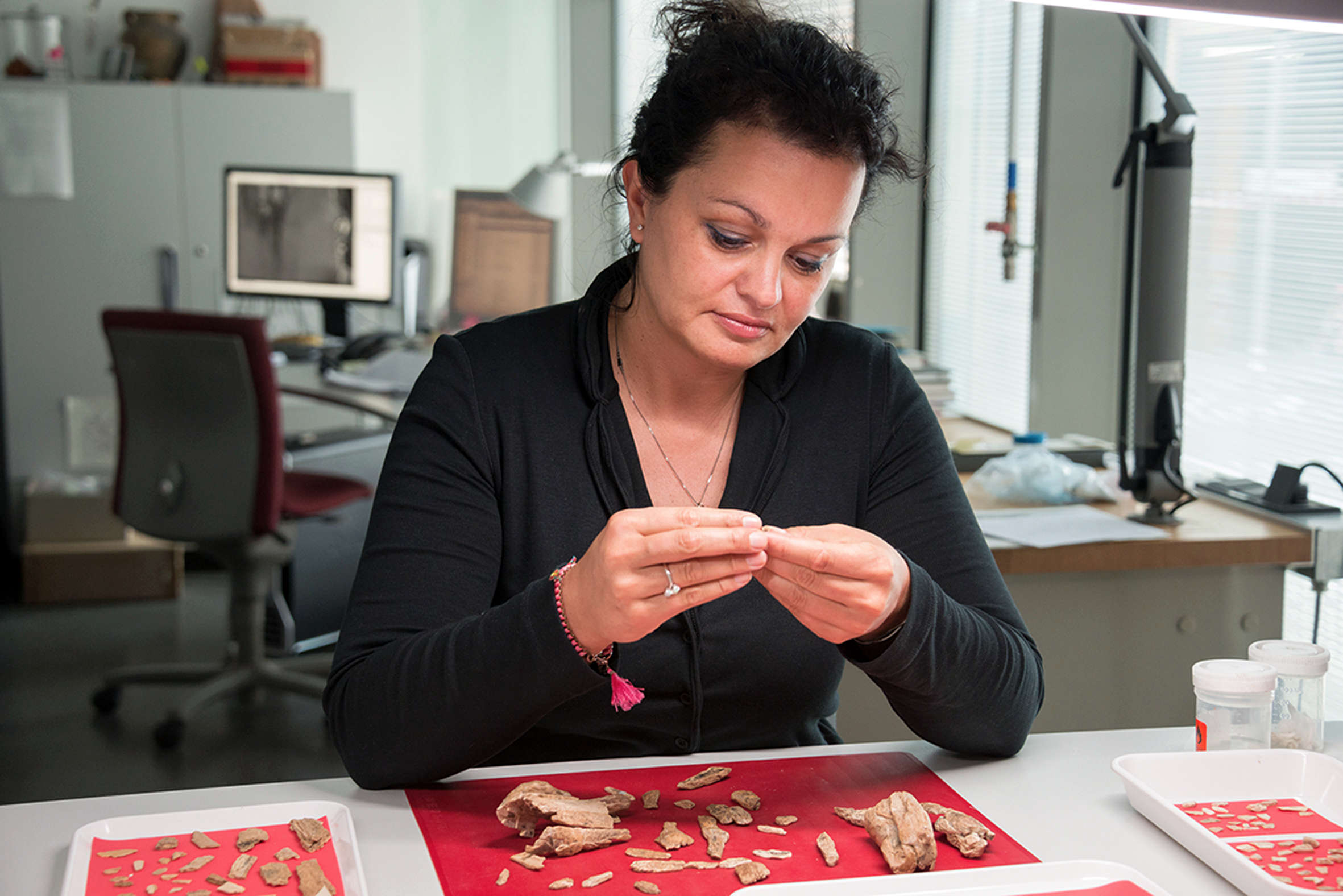
Master restorer Nicole Ebinger-Rist puts together fragments of the lion-man figure.
Photo and text: http://www.denkmalpflege-bw.de/
The overburden in the cave was re-examined. The entire backfill of 1939 was sieved, says the excavator Claus-Joachim Kind. He made a sensational announcement: 'We have about a thousand items which may be of the statue'.
There are some pieces only a few square millimetres in size, and some which are as long as a finger. The piece was put together as all such important fragmented finds are, with beeswax and chalk, which is a glue which is strong enough to be stable, but weak enough to be removed easily if required.
In the next few weeks, the piece was brought to Esslingen and completely dissected. The old glue was loosened and removed, providing a record of the original reconstruction. Then the much anticipated putting together of the jigsaw began. Child hopes: 'The mysterious art of Baden-Württemberg will soon confront us in its original appearance.'
It is already clear that the figure will grow a few centimetres - the new finds include parts of the neck, the hole can be plugged on the back, the right arm is available in its entirety. It is also certain the the figure has more strange marks on its surface.
The ancestors of the artist who created the statue about 35 000 years ago had recently migrated to Europe - until then a territory of the Neanderthals. The statue stood beside traces of a fire in a niche 27 metres away from the cave entrance. Nearby were decorated deer tooth and arctic fox incisors as well as ivory beads. It may be the remains of jewellery for a garment. Perhaps the niche was the dressing room of a shaman.
Text above: http://www.denkmalpflege-bw.de/
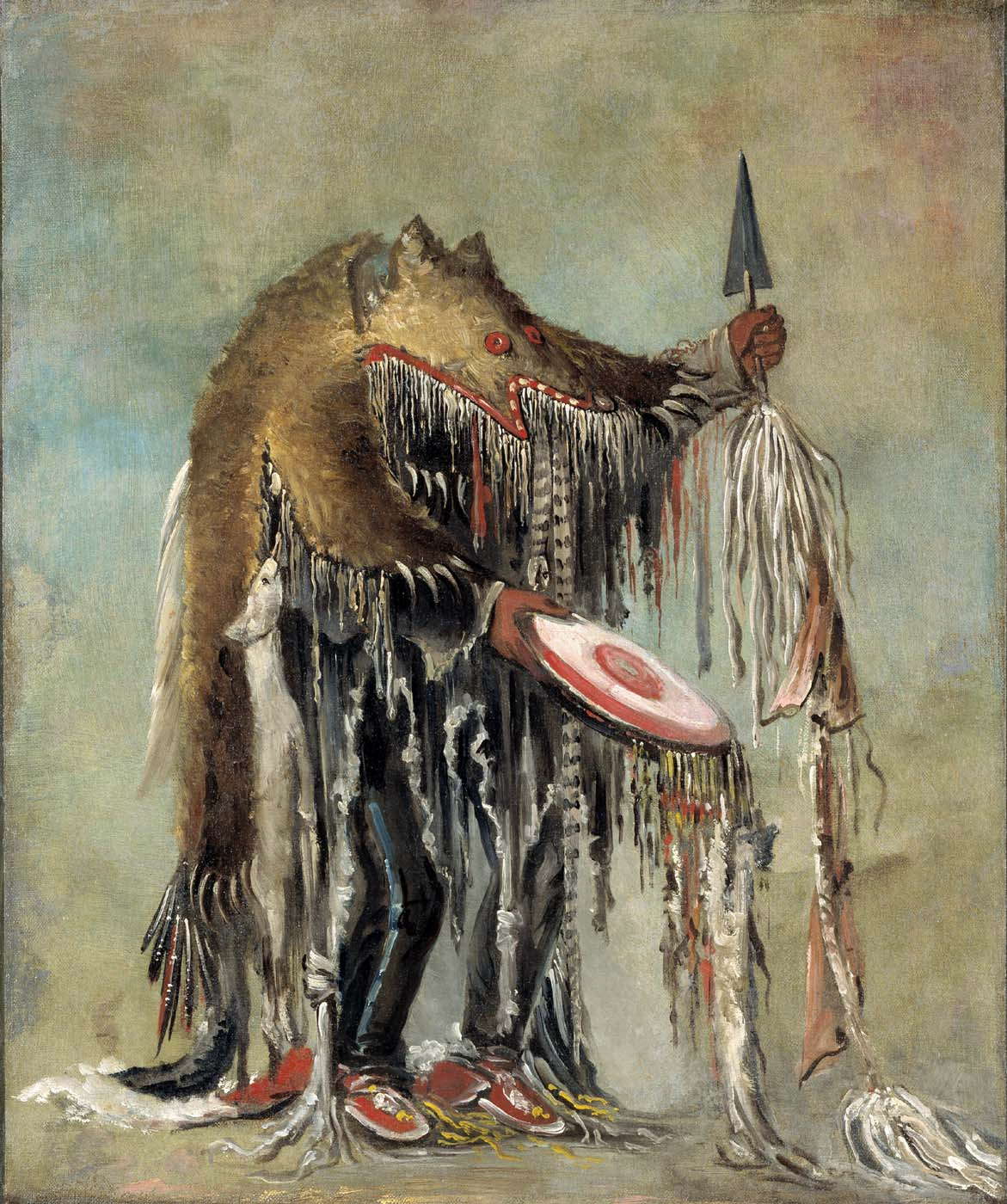
Medicine Man performing His Mysteries Over a Dying Man, 1832
Blackfoot/Siksika
oil
29 x 24 in.
Smithsonian American Art Museum, Gift of Mrs. Joseph Harrison, Jr.
This painting of an historical medicine man from North America demonstrates that shamans or medicine men often dressed in animal skins, with false heads of animals, to gain the power inherent in the natural world.
Man/animal hybrids are known from cave paintings in France.
It is thus entirely possible that the Löwenmensch could be a representation of a shaman.
Photo: George Catlin (artist, 1832), http://americanart.si.edu/exhibitions/online/catlinclassroom/catlin_browsec.cfm?ID=160
The fact that in ancient times magicians dressed in skins, to celebrate rites with fire , is considered likely. Hybrids of animals and humans are also known from rock paintings in France. The magician apparently slipped under the skins of dangerous Ice Age fauna. Cave lions weighed over 250 kg.
In a cave at the foot of the Pyrenees is depicted a man with a kind of musical instrument. He has the hide of a bison thrown over him. Even this 800 kg behemoth was not to be trifled with. Maybe the hunters wanted to acquire the strength of the animals and take possession of its soul through masquerade and dance. Such motives may be gleaned from old reports of Siberian indigenous peoples. Their shamans up to modern times wore antlers on the head. The same is told by study of the Blackfoot Indians. The healers danced around intoxicated by the sound of drums, wearing bear skins.
The 'lion man' is standing on tiptoe. He also seems to dance. Just who is under the cloak? Lions are considered symbols of courage and strength - men's virtues. In the Amazon, or in Australia, there are still shamans. Most of them are men.
On the other hand, the statue has features which make one wonder. The navel is a symbol of birth and the navel can be seen clearly. Over the abdomen runs a transverse abdominal crease, a typical female trait.
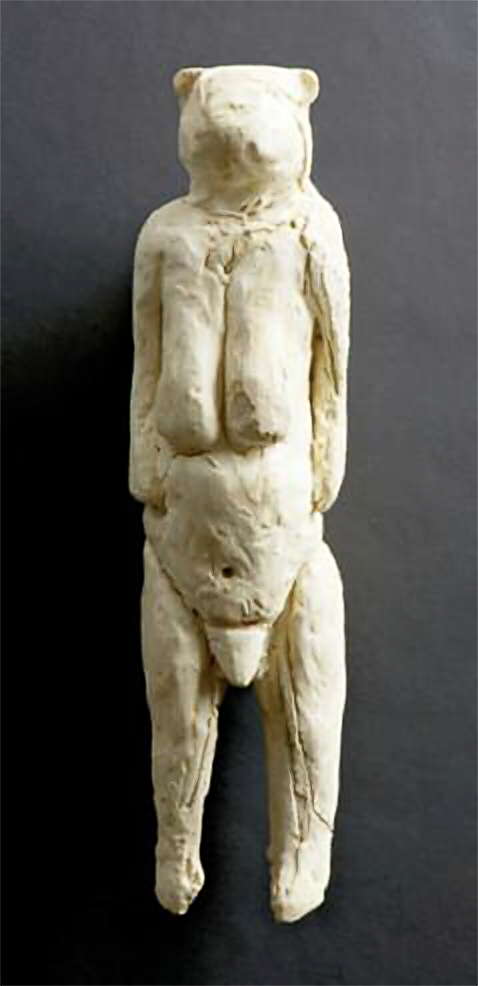
The prehistorian Elizabeth Schmid assumed that the figure once had breasts and notes that the transition from the thighs to the buttocks indicate a woman's body. Without using the fragments, they constructed a model out of plasticine, which is now in a safe in Ulm. It shows the 'lion man' with full breasts.
Although many scholars rejected this as absurd, there is at least one thing in its favour. In the Spanish cave of Las Caldas a portrait of a 14 000 years old animal was revealed as one who is clearly female. Above it looks like a mountain goat, below it has a vulva.
Was the religion of our ancestors in the hands of women? The new findings may finally solve the problem. Hundreds of fragments of ivory remain to be put together.
There are many fragments apparently from the genital area, which prompted the excavator to pronounce 'We will find out the sex of the figurine'.
Photo: Elizabeth Schmid
Text above: Der Spiegel 49/2011, http://www.spiegel.de/spiegel/print/d-82612721.html
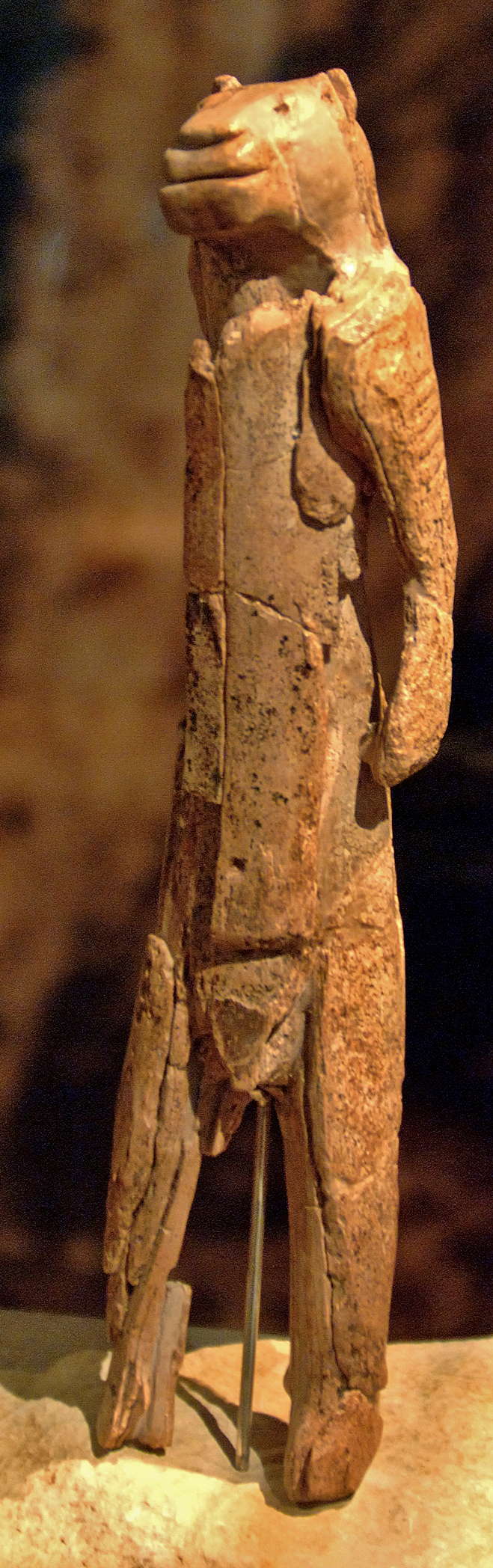
Another version of the lion sculpture, with a little more detail.
Photo: Holger Uwe Schmitt via Panoramio
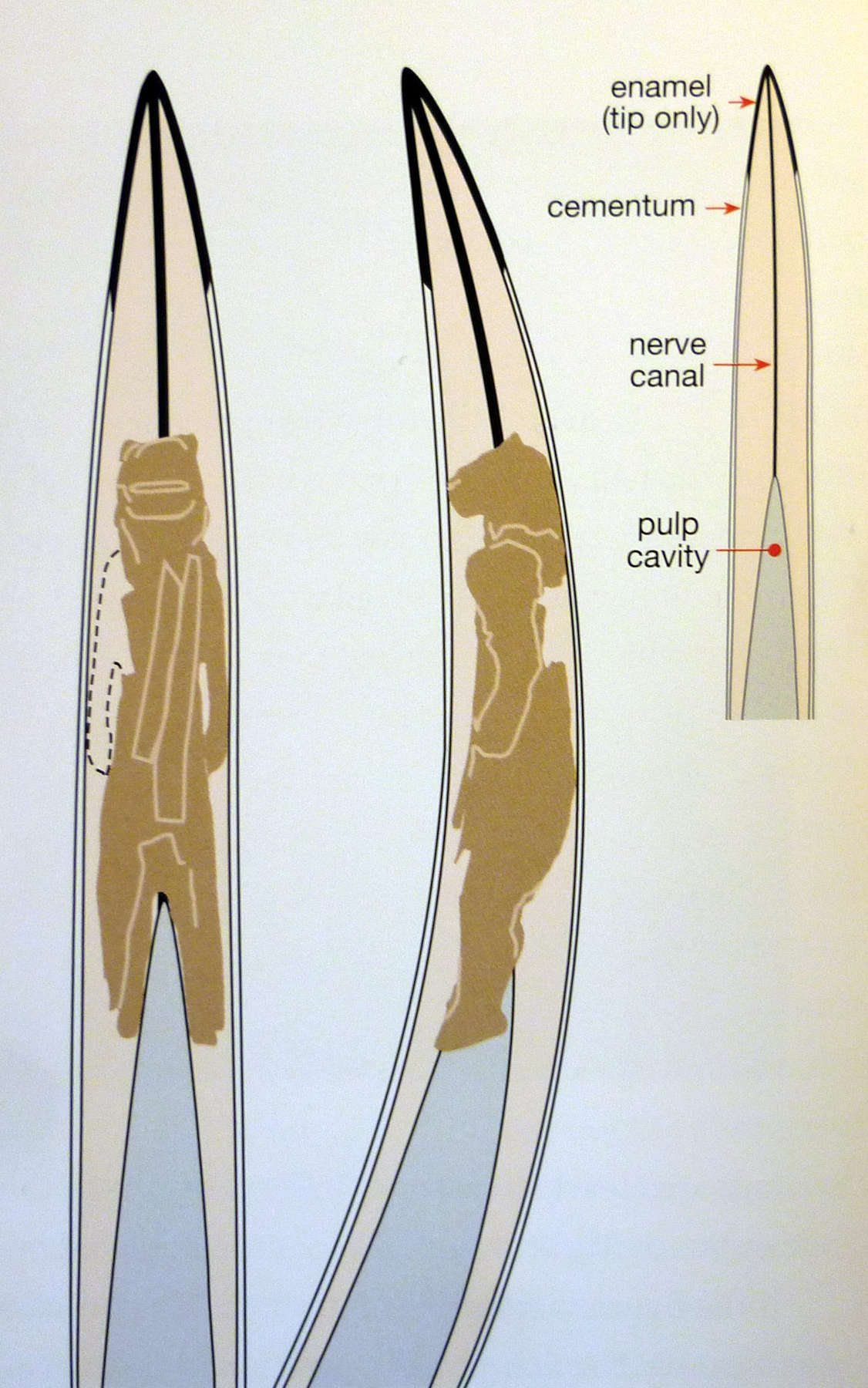
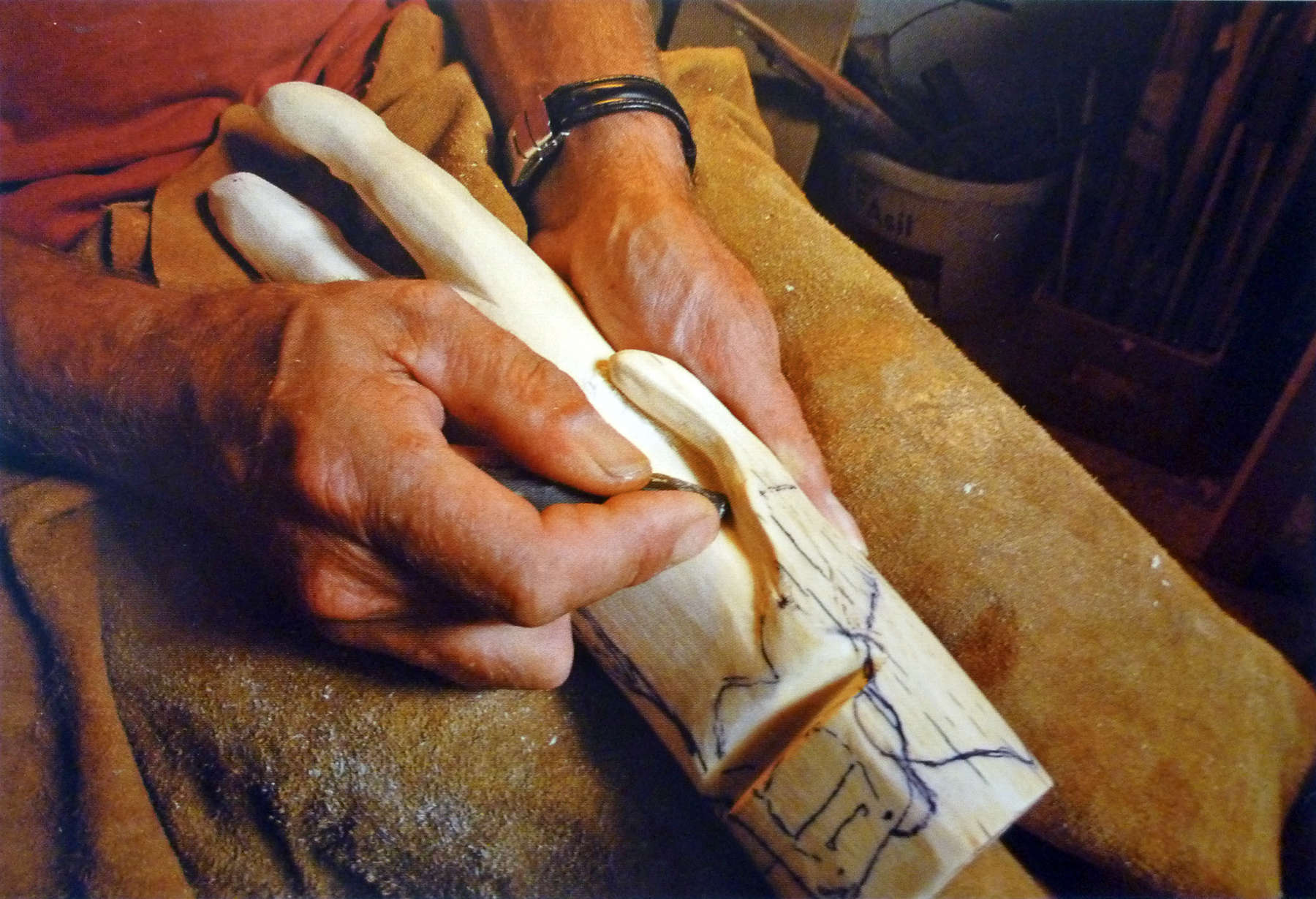
The following description of how a modern replica was made from ivory, with flint tools, indicates the way that the sculpture was fitted to the available material, and the huge amount of work involved.
Schmid noticed that the space between the legs of the Lion Man coincided with the apex of the bulb cavity and the long axis of the figure follows the nerve canal with the head at the narrowing end. This expert positioning suggests that the make deliberately selected a portion of the tusk suitable for a preconceived work. A tusk of similar proportions found in Stadel Cave in 1960 shows that the removal and reduction of a segment to the required size was not easy. Marks indicate that the skin and thin bone around the tooth cavity of the upper jaw were cut through to the surface of the tooth, which was then exposed for detachment with a hammer.
The tip was harder and had to be removed by wedging and splitting. In an experiment using the types of stone tool available to the original maker, Wulf Hein and Kurt Wehrberger found it took ten hours to remove the base of a tusk already separated from the jaw by incising a broad groove around then sawing and chopping into the groove with a large blade to take off the unwanted length. To form the legs a deep n-shaped groove was scraped out around the back margin from foot to hip, reducing the connected ivory to the point at which a chunk could be tapped out exposing the hollow of the pulp cavity. The body was created by scraping with a steep-fronted scraper, which was easier if constantly wetted with water. This also prevented the tools from blunting and extended the time for which they were effective. Nevertheless, the burins had to be regularly resharpened.
To detach the torso from the inside edges of the arms it was necessary to tunnel into the ivory from both sides with a burin and a pointed blade. On breaking through, little bladelets were used to saw and rasp away the ivory. Forming the shoulders and head was difficult because it involved working at right angles across the concentric structure of the ivory, which often required the use of both hands on the tool. In all, the basic shaping took some 200 hours. In addition, the details of the eyes, nose, mouth and ears had to be added; the grooves on the arms were replicated using a hammer or a blade as a chisel. The experiment took 320 hours of skilled, laborious work but did not include any polishing.
Photo and text: Cook (2013), pp 31-34.
This photo gives an excellent idea of the relatively huge size of this sculpture compared with most others from the Palaeolithic.
Although much of the original surface of the ancient sculpture is in poor condition, Schmid identified areas of smoothing and polishing achieved using a sandstone rubber or ash applied with water and a soft leather cloth. With this, as well as the effort of removing the tusk from the jaw, the time required to create the original might be nearer 400 hours, or seven weeks at eight hours a day with no days off. As all of this probably needed to be in daylight rather than firelight to achieve the accuracy and detail in work that was often hard and monotonous, two months is a perhaps a reasonable estimate of the time required. This also suggests that, unless the sculpture was created slowly at odd moments over several months, someone as skilled as an artist may have been excused from other subsistence tasks to work specially on this piece. The experiment emphasises how valuable this sculpture must have been and, although little is known about its meaning or significance, it is clear that it was produced by a mind that could imagine and manufacture an artwork of symbolic importance.
Photo and text: Cook (2013), pp 31-34.
 |
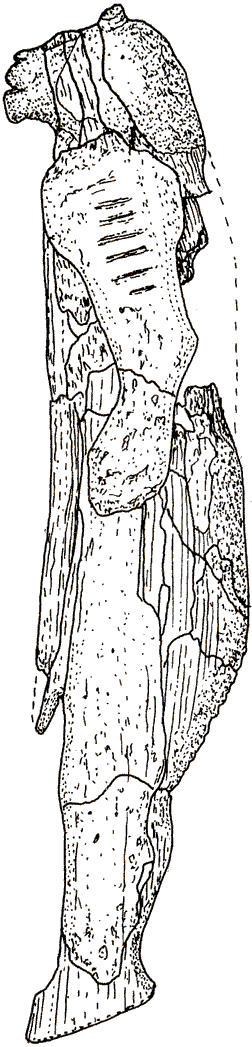 |
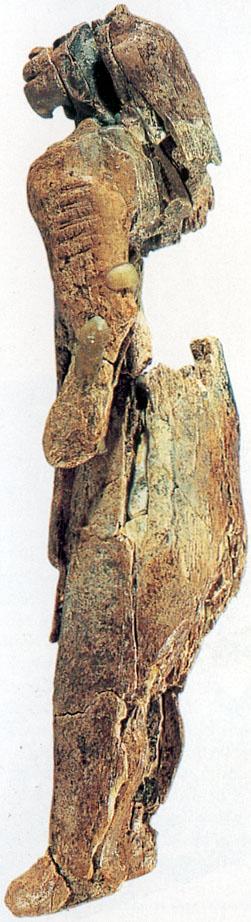
Another version of the Lion Lady/Man. Click on the image for a larger version. Colour photo from: National Geographic October 1988, photo by Alexander Marshack Drawing from: Agenda de la Préhistoire 2002 - 2003, a superb diary with excellent illustrations sent to me by Anya. My thanks as always.
Dans l'abri du Höhlenstein-Stadel, dans le Jura souabe (Allemagne), a été découverte cette statuette en ivoire d'un hornme à tête de lion, dans une couche aurignacienne, c'est-à-dire plus on moins contemporaine de la grotte Chauvet. |
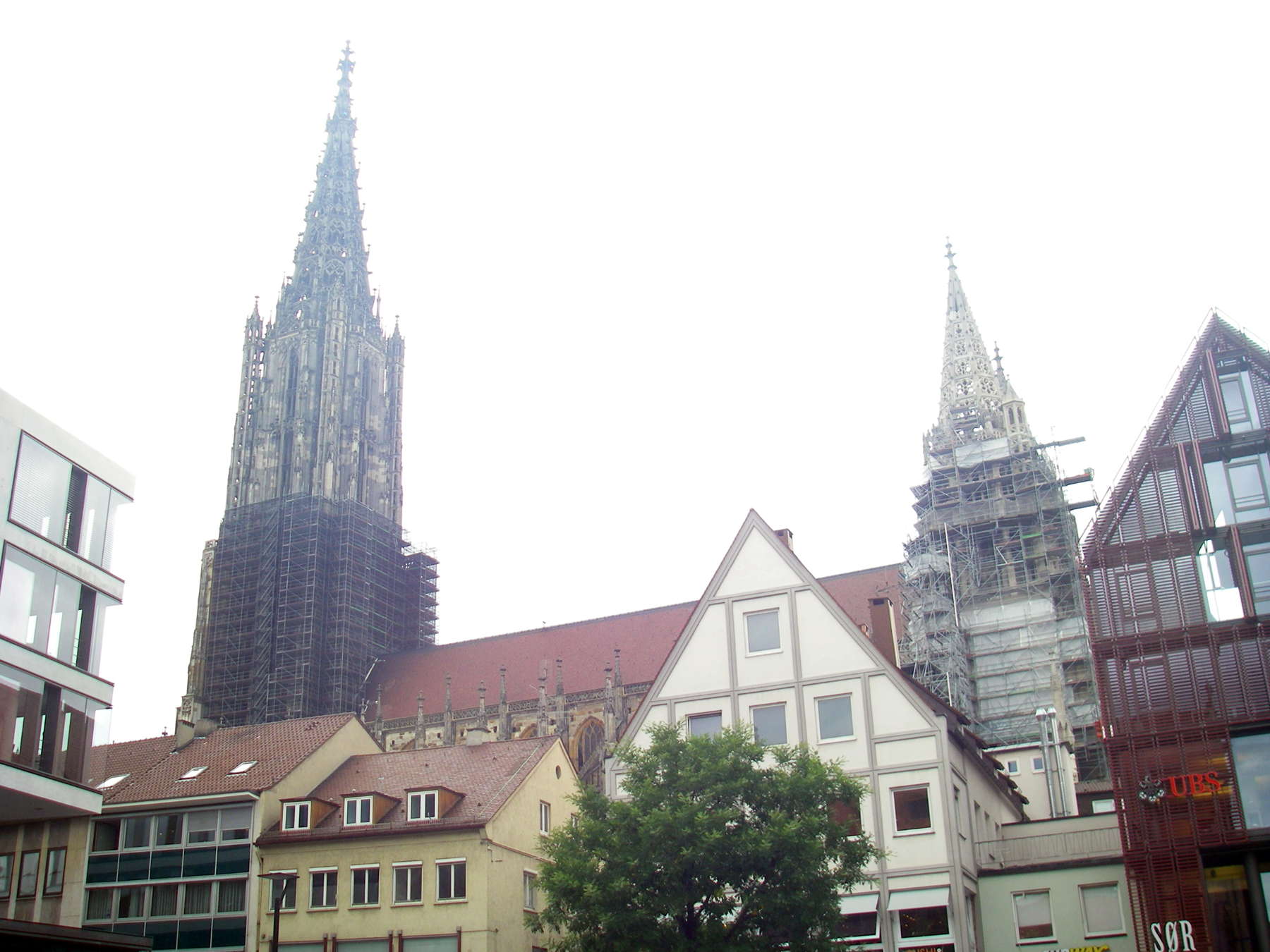
On a 1500 km bicycle ride down the Danube from Donaueschingen to Budapest, my wife and I called in to the beautiful old city of Ulm, set on a ridge behind a wall beside the river.
I felt like some coffee and cake, preferably with ice cream, and we pushed our bicycles through the old gate, and up the steep cobbled street to the city square, with the steeples of the Ulm Cathedral dominating the skyline.
It is in the museum here that the Löwenmensch resides, although I had forgotten that at the time.
Photo: Don Hitchcock 2008
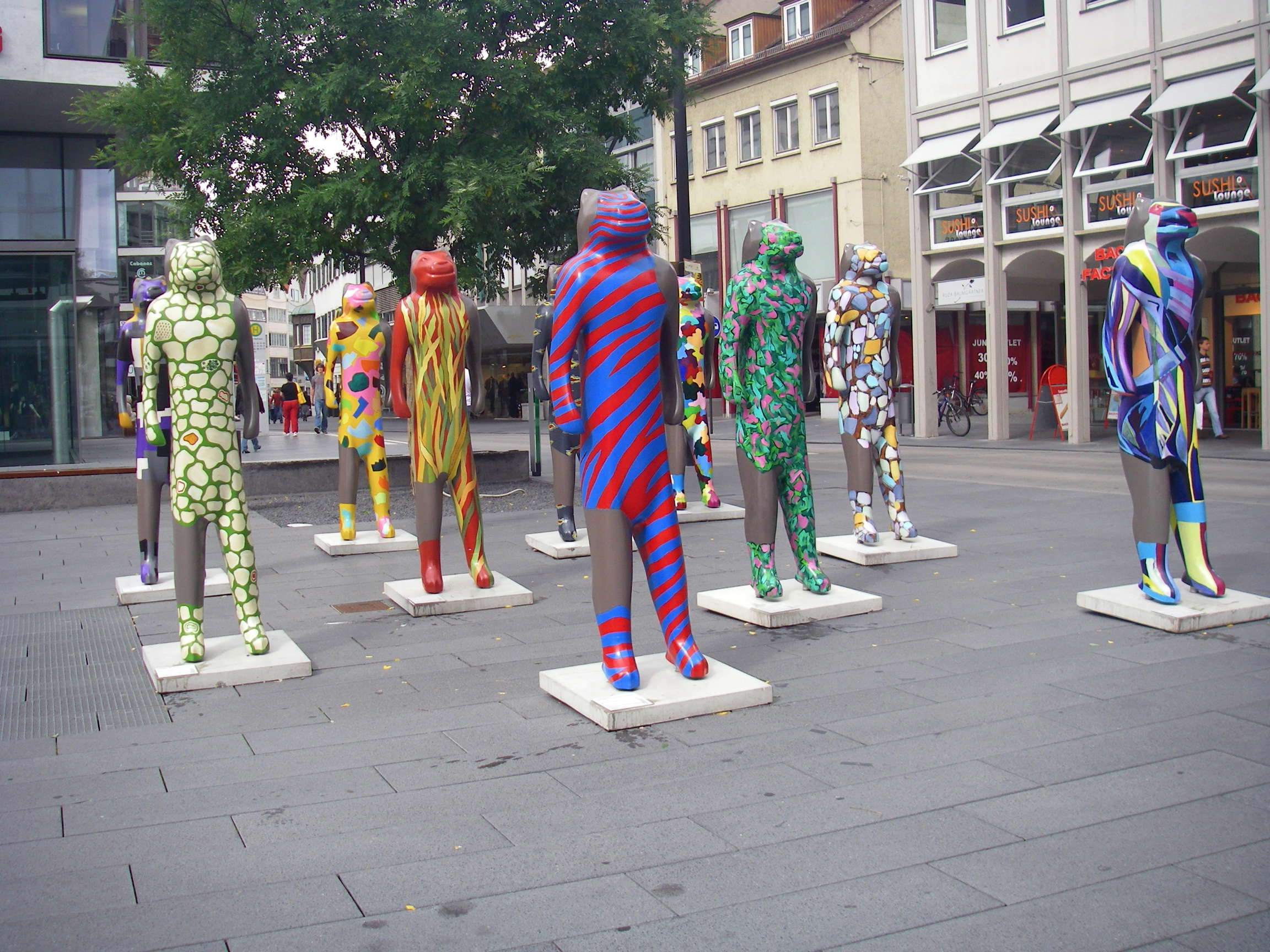
As we entered the main town square, I laughed out loud - there was a sea of Löwenmenschen in the square, painted in colours like that of a technicolor dream - or nightmare!
The surprise of seeing in multiple, large versions something I had thought of as a little known artefact of the Ice Age had me grinning and shaking my head in disbelief as I looked over them from the cafe window (on the right in this photo) as I had my coffee and cake (no ice cream was available!).
It made my day, though every day of that trip was enjoyable and memorable.
Photo: Don Hitchcock 2008
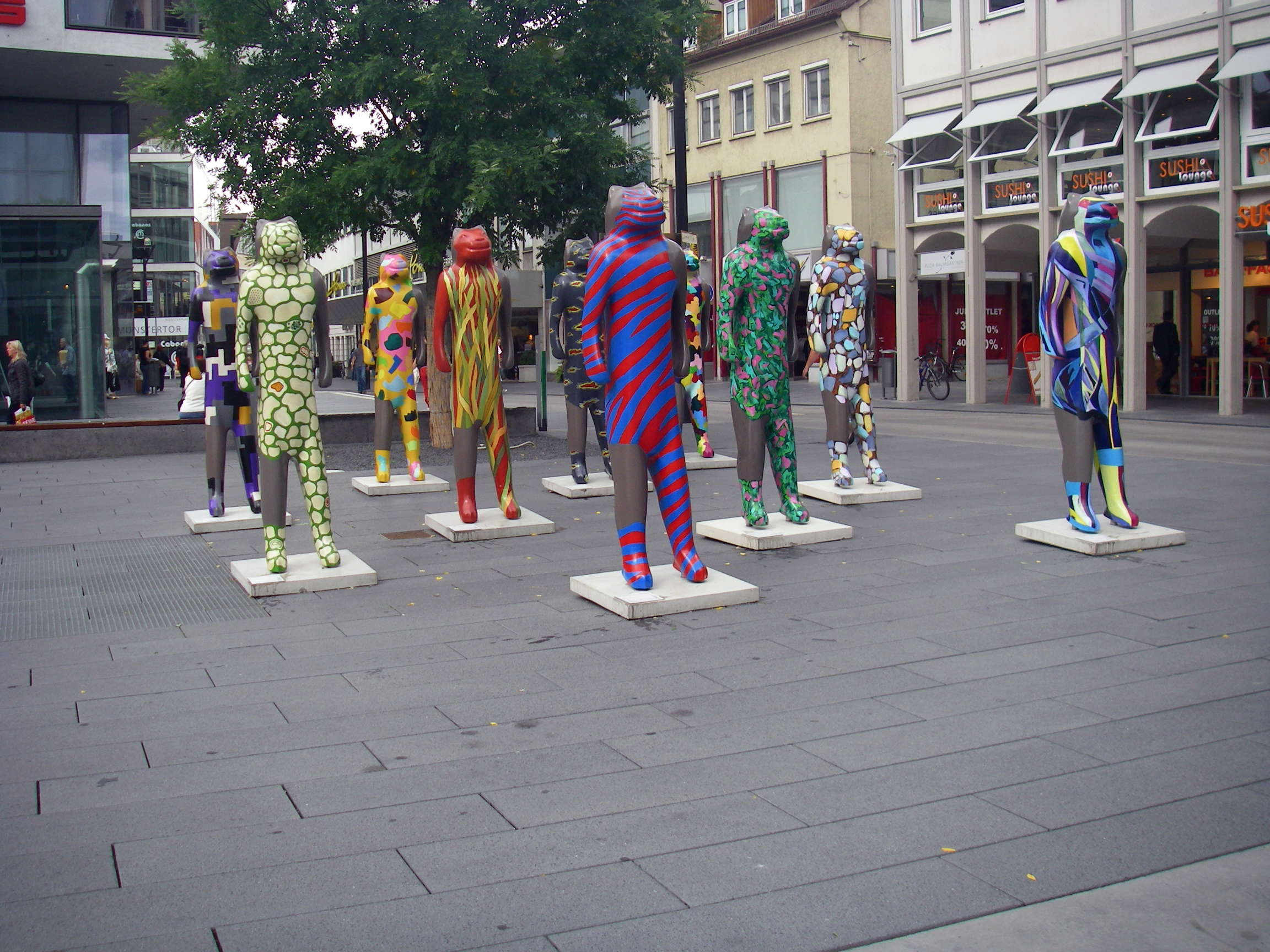
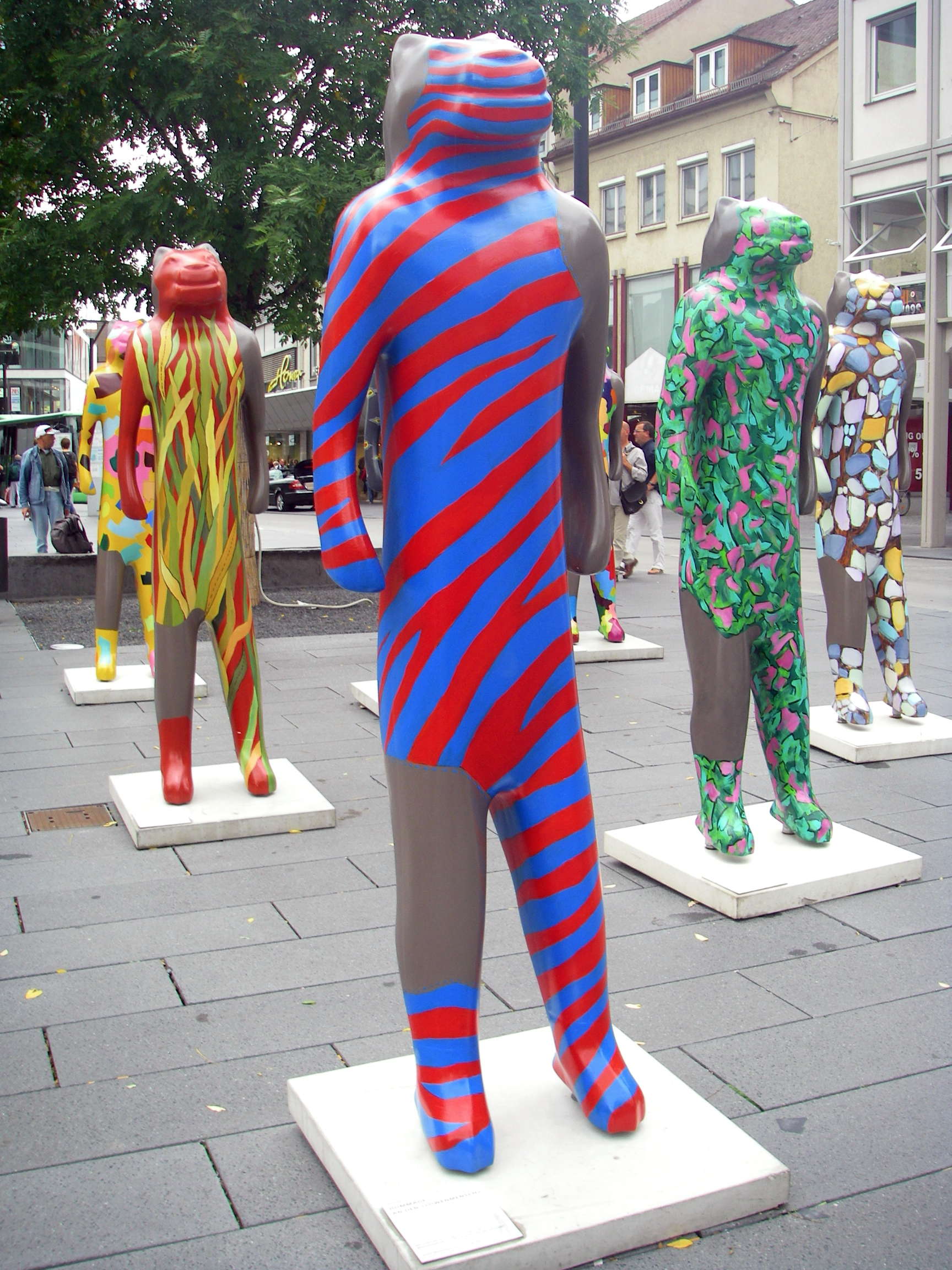
The force of the installation lay in the fact that there were so many, so similar yet so different, each expressing the imagination of the particular artist.
Photo: Don Hitchcock 2008
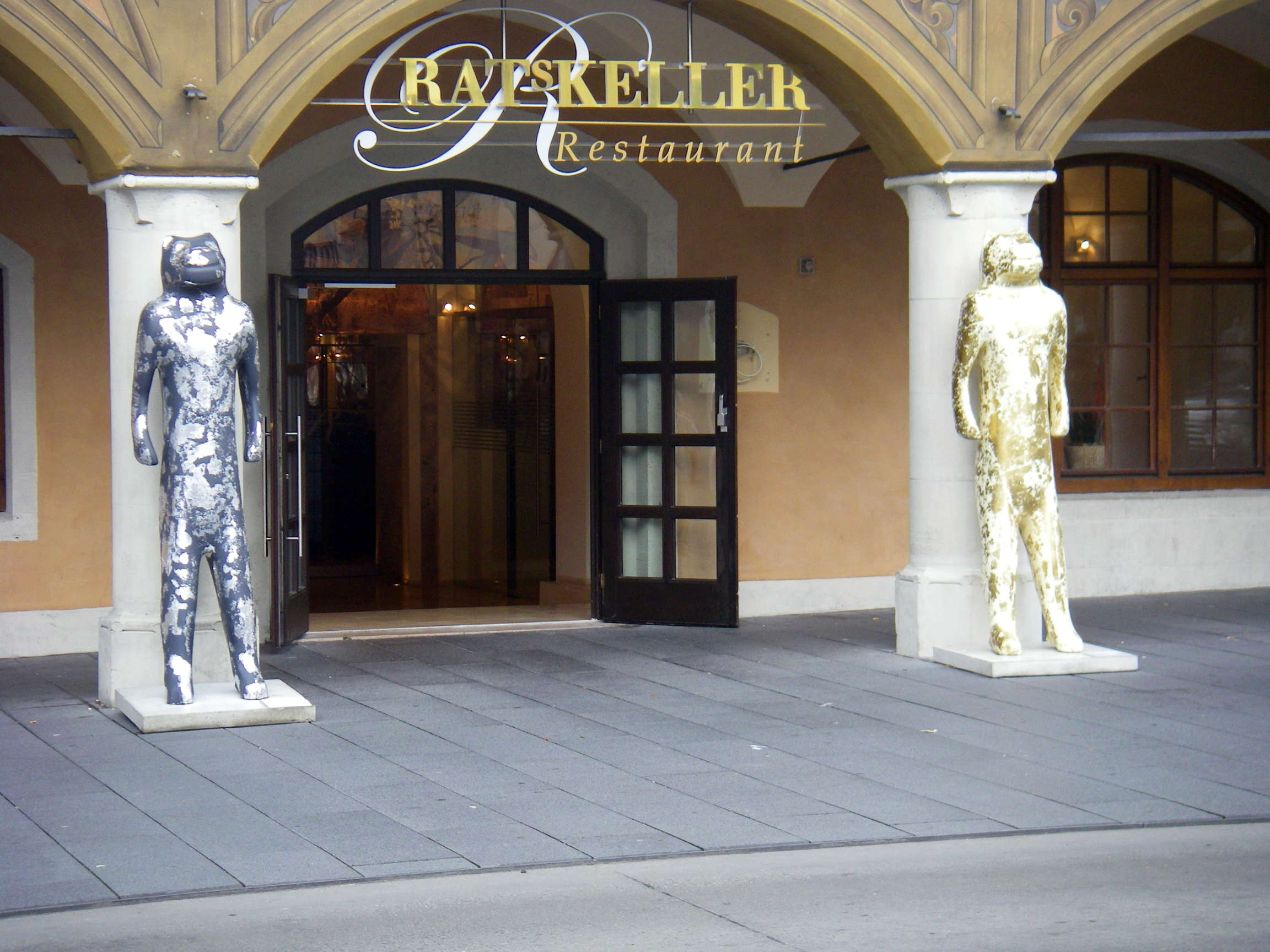
These two had obviously been carefully chosen to be suitable for the entrance to an upmarket restaurant.
Photo: Don Hitchcock 2008
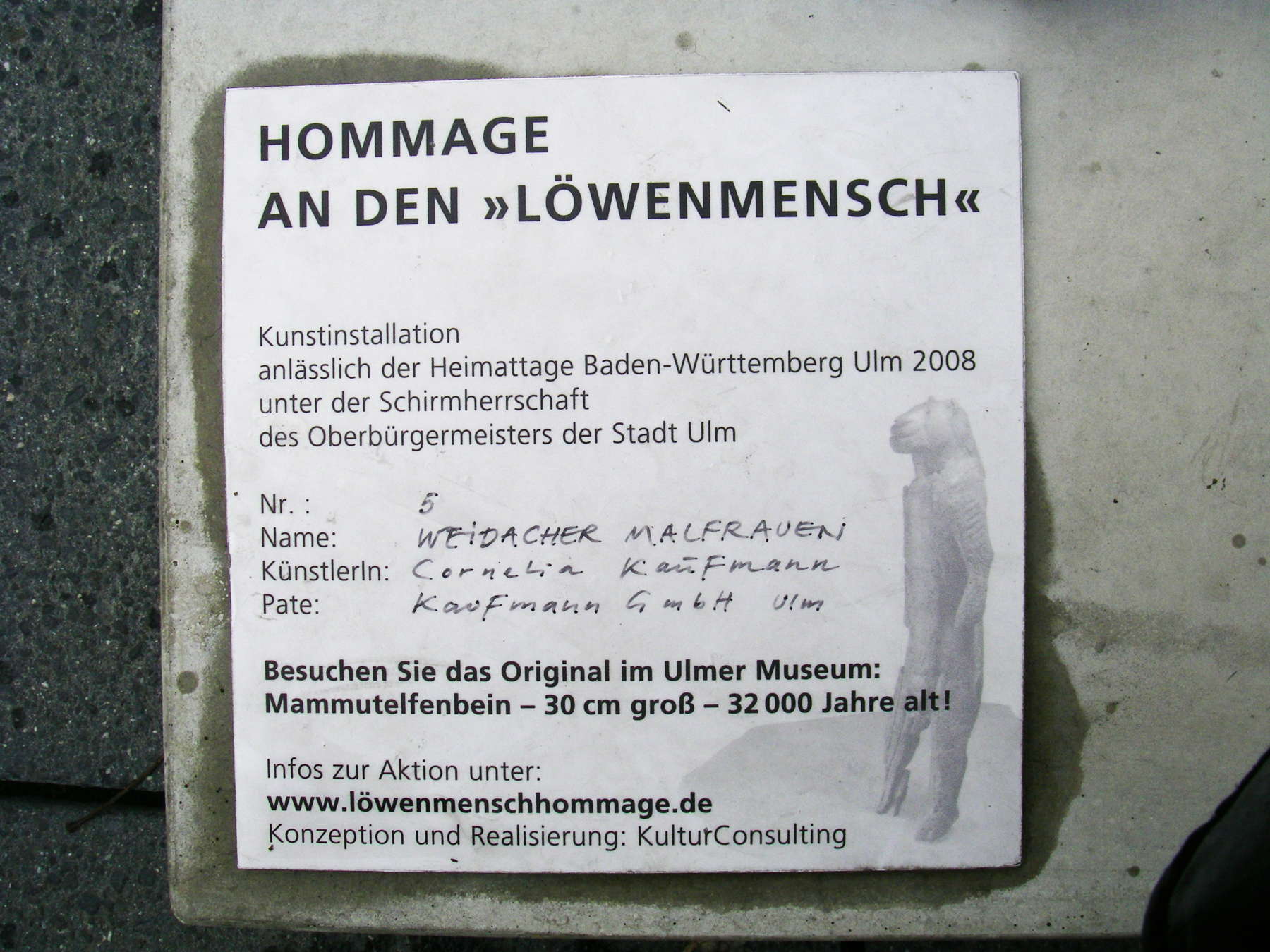
Each of the fibreglass or plastic figures had been decorated by a different artist, and there was an identifying tag on each of them, which said in part:
Homage to the Lion Man
Art installation
On the occasion of the Festival of Ulm, Baden-Württemburg 2008
under the auspices of the Lord Mayor of the city of Ulm.
Photo: Don Hitchcock 2008
Ice age Art - A new find completes one more part of the jigsaw puzzle of the Löwenmensch
2011.04.14
For the archaeologists of the National Monument Office, it's like a stroke of luck in the lottery: In excavations in the Stadelhöhle am Hohenstein, a rocky cliff in the Lonetal valley above Asselfingen, they have found in hundreds of fragments of mammoth ivory more matching pieces of the famous lion-man, which they have presented to the public on Tuesday. The 35 000 - 40 000 year-old lion-man, a nearly 30-centimetre statutette with a lion's head and a human torso was carved during the last glacial period of Stone Age people from a mammoth tusk and is therefore regarded as the one of the oldest examples of figurative art of mankind.
In August 1939, Würzburg anatomist Robert Wetzel in his excavations in the Stadelhöhle, discovered the mysterious hybrid of human and cave lion, but did not recognise its true significance. The war abruptly interrupted the excavations, and the findings were sent to Tübingen and from there back to the Ulm Museum. Only in 1988 was the Ice Age figurine been reconstructed from hundreds of fragments in Ulmer Museum. The lion man was missing, however, large parts of the right side and back. With the new finds, the 30 centimetre figure made of mammoth ivory is likely to be reconstructed completely.
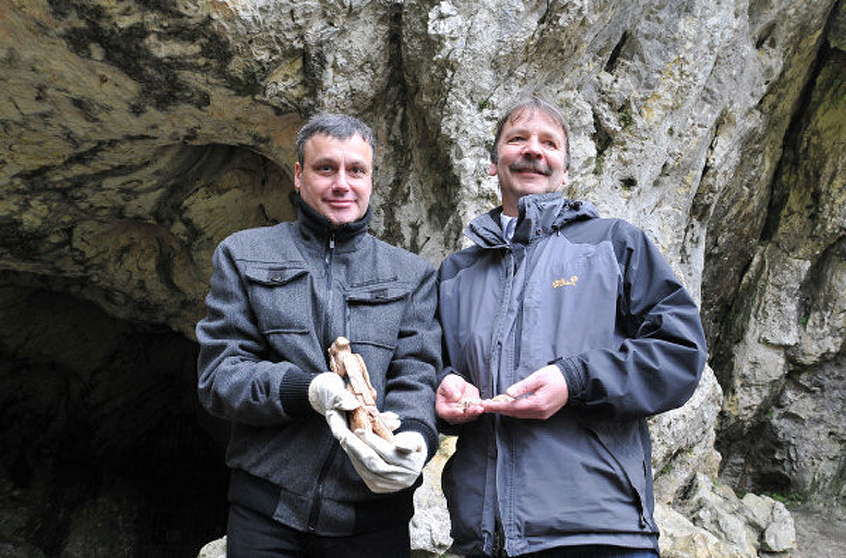
Kurt Wehrberger, Head of the Department of Antiquities at the Museum in Ulm (left) with the Löwenmensch and excavation director Claus-Joachim Kind at the entrance of the cave at the Stadelhöhle am Hohlenstein cave - where the figure was carved 35 000 years ago.
Photo: Martina Dach
Source: http://www.schwaebische.de/region/biberach-ulm/ulm/stadtnachrichten-ulm_artikel,-Eiszeitkunst-Funde-machen-Loewenmensch-komplett-_arid,5060899.html
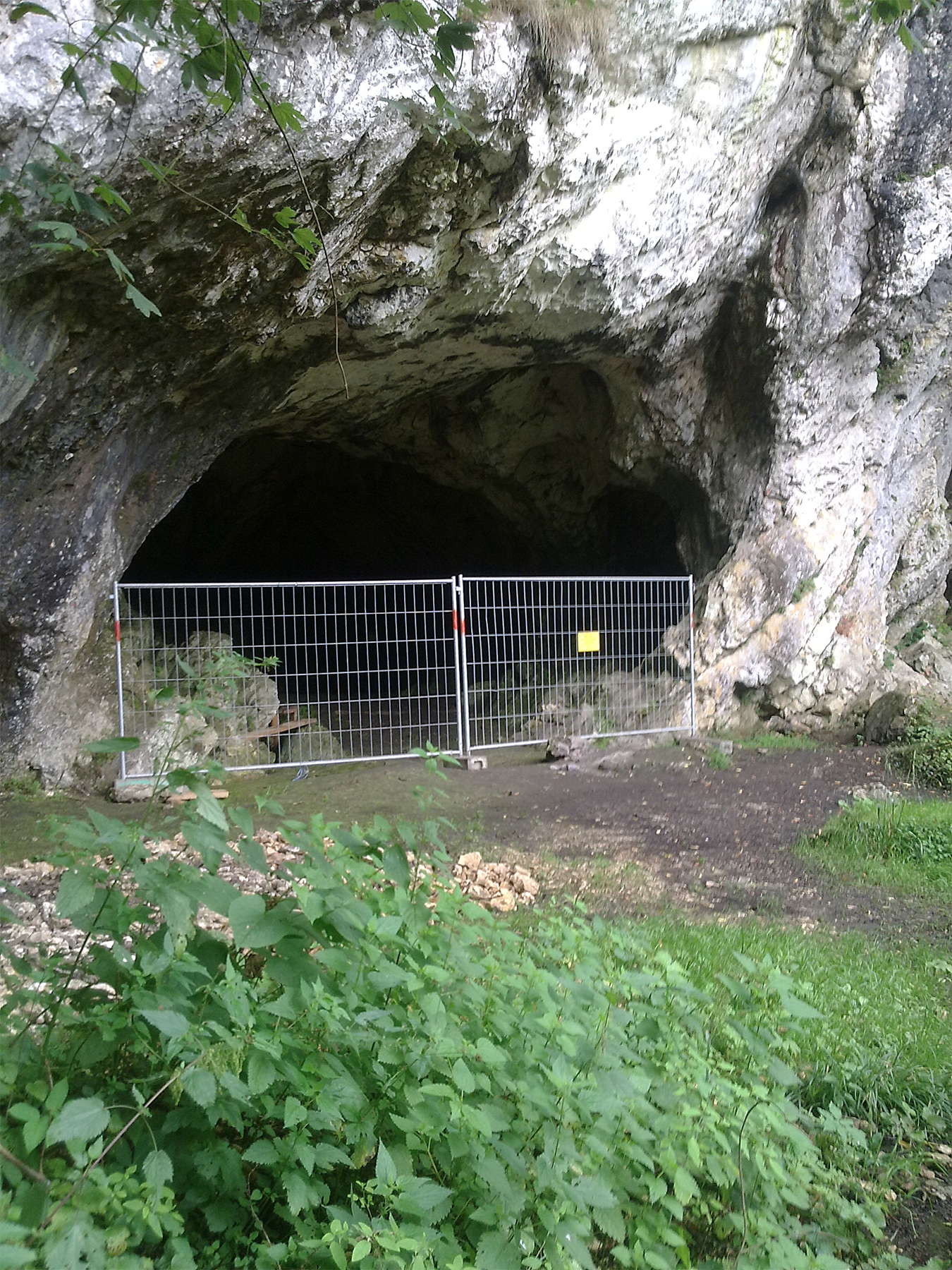
Höhle "Stadel" am Hohlenstein am Südhang des Lonetals.
Date: 2010.08.15
Photo: Wikiman85
Permission: public domain
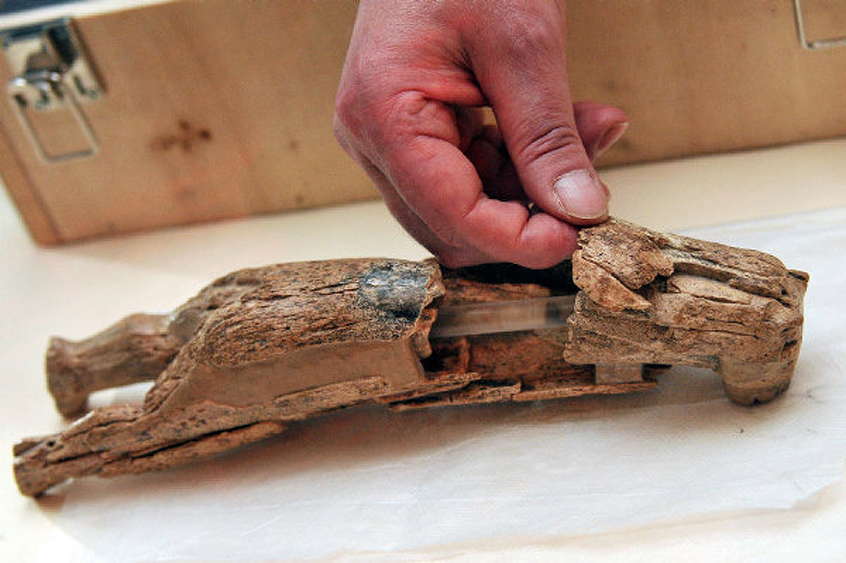
Here we can see how the newly found pieces fit into place.
Photo: http://www.schwaebische.de/region/biberach-ulm/ulm/stadtnachrichten-ulm_artikel,-Eiszeitkunst-Funde-machen-Loewenmensch-komplett-_arid,5060899.html
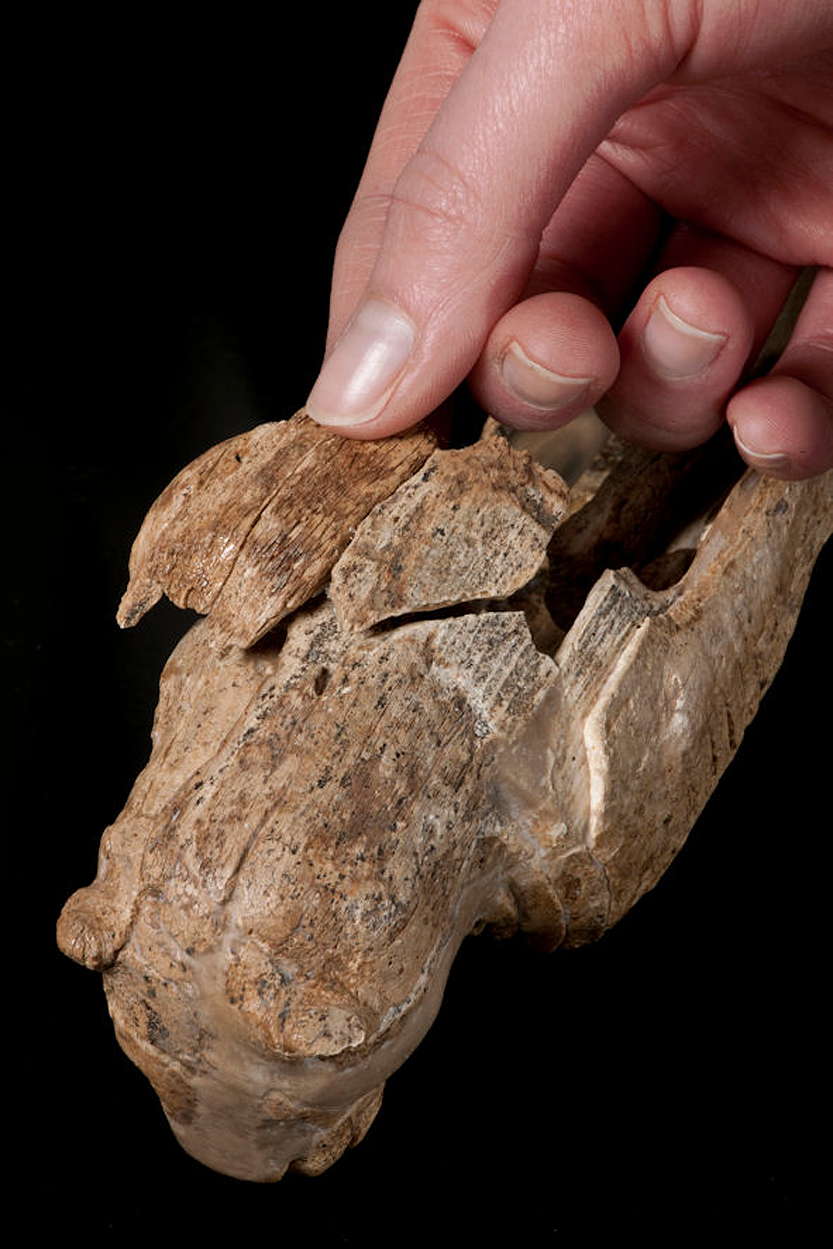
Another view of how the pieces of the back fit together.
Photo: Kurt Wehrberger, head of the Department of Antiquities at the Museum in Ulm
Source: http://www.archaeoforum.de/viewtopic.php?f=7&t=4149
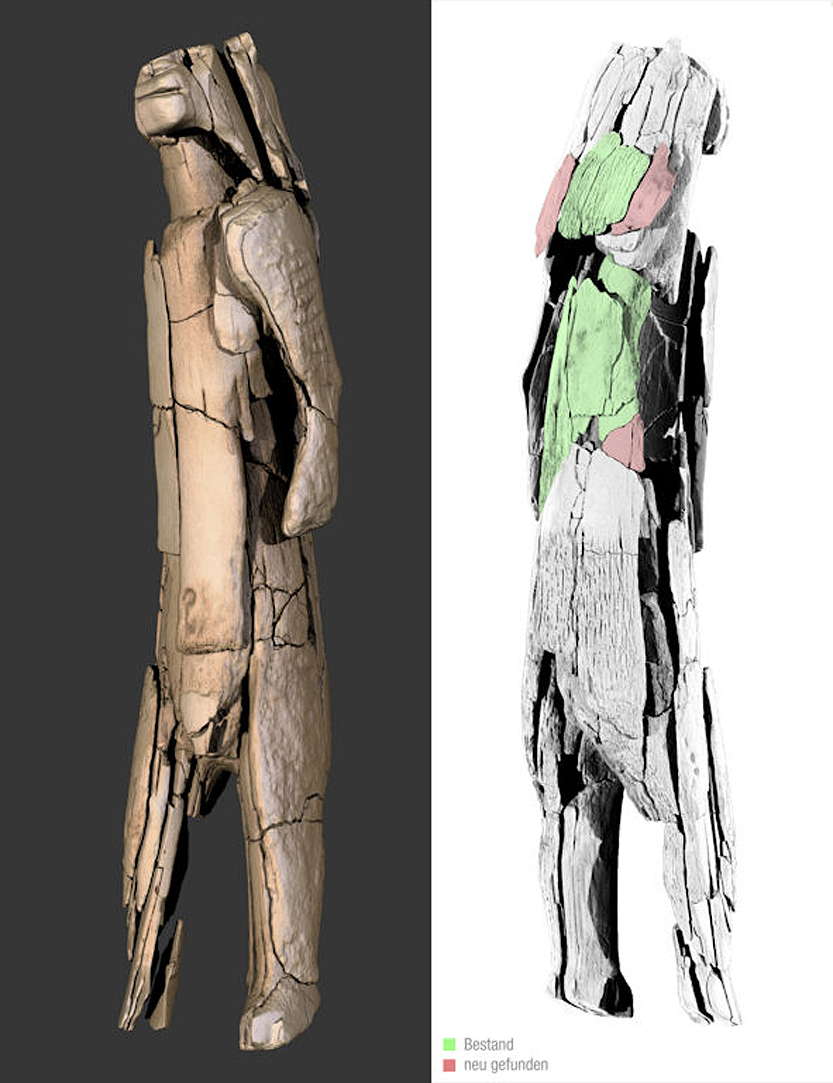
In this computer reconstruction, the new pieces of the puzzle are shown in pink.
Photo: Kurt Wehrberger, Head of the Department of Antiquities at the Museum in Ulm
Source: http://www.archaeoforum.de/viewtopic.php?f=7&t=4149
Identification of Mammoth, Mastodon and Elephant Ivory
Text below: http://www.fossil-treasures-of-florida.com/FossilTreasuresofFloridaNewsletter-newsletter0007.htmland http://2ndlook.wordpress.com/2011/06/04/lowenmensch-puzzle-am-i-missing-something/
The Löwenmensch figurine is made of ivory – a word which is usually used in context of elephant tusks. In this case it has been proposed that this was made from mammoth or a mastodon tusk – the ancestors of modern elephants. The Ulm Museum where this figure is housed says this was carved by ‘stone tools out of mammoth ivory’.
( it should be noted here that there is no possibility that it could have been made from a mastodon tusk. Mastodons were confined to the Americas, and are not very closely related to mammoths or elephants. In addition, neither mammoths nor mastodons were ancestors of modern elephants. They are related, and come from similar proboscid antecedents, but neither mammoths nor mastodons are ancestors of either the African or Asian elephants, although mammoths and elephants are 'cousins'. See https://en.wikipedia.org/wiki/Proboscidea for the family tree. My thanks to AnnDee for clarifying this - Don )
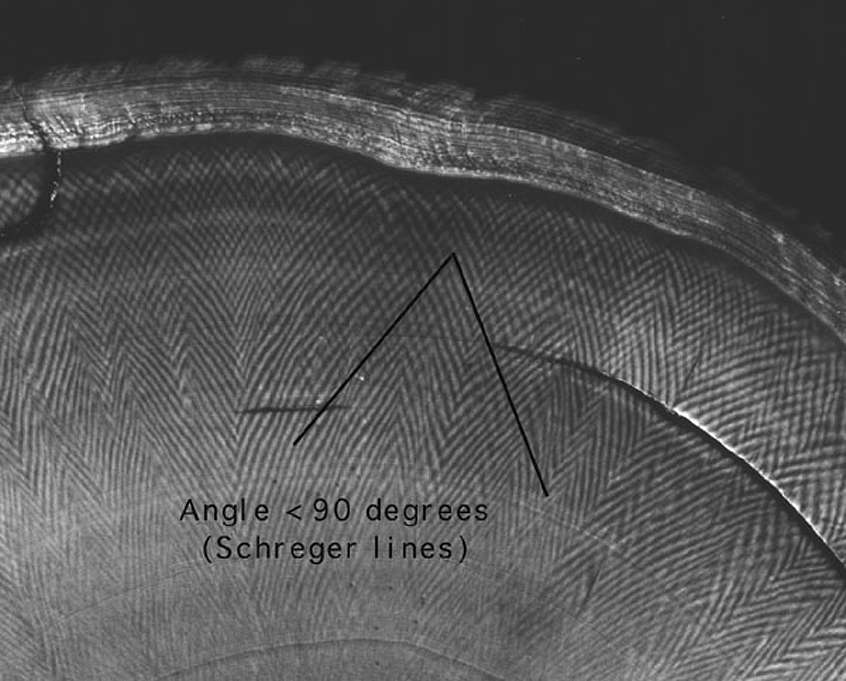

It is unclear on what basis the ivory type of the Löwenmensch was decided. Was it fossil ivory, of the mammoth type, or the modern African or Asian elephant tusk. The US Customs Department uses the Schreger Pattern to decide between elephant or mammoth ivory.
(left) Schreger lines for mammoth ivory.
(right) Schreger lines in elephant ivory.
Photo : http://www.lab.fws.gov/ivory_natural.php
Permission: These images are a work of the U.S. Fish and Wildlife Service, taken or made as part of that person's official duties. As a work of the U.S. federal government, the image is in the public domain.
If the angle of the cross-hatch pattern is less than 90 degrees, the ivory is fossil mammoth (mammoth forms angles of 87 degrees on average). If the cross-hatch angle is more than 90 degrees, the ivory could be modern elephant (modern elephant ivory forms angles greater than 115 degrees.) On the other hand, Mastodons cross-hatch angle is 125 degrees on average.
Text: http://www.fossil-treasures-of-florida.com/FossilTreasuresofFloridaNewsletter-newsletter0007.html
and http://2ndlook.wordpress.com/2011/06/04/lowenmensch-puzzle-am-i-missing-something/
( readers who would like to know more about the identification of various ivories might like to visit this web page: http://www.uniclectica.com/conserva/ivory1.html - Don )
References
- Adam, K., Kurz, R., 1980: Eiszeitkunst im süddeutschen Raum, Theiss.
- Cook, J., 2013: Ice Age art: arrival of the modern mind, The British Museum, 18 Feb 2013, ISBN-10: 0714123331, ISBN-13: 978-0714123332
- Rau, S., Naumann D., Barth M., Mühleis Y., Bleckmann C., 2009: Eiszeit: Kunst und Kultur, Thorbecke, 2009, 396p. ISBN: 978-3-7995-0833-9