Back to Don's Maps
 Back to Archaeological Sites
Back to Venus figures from the Stone Age
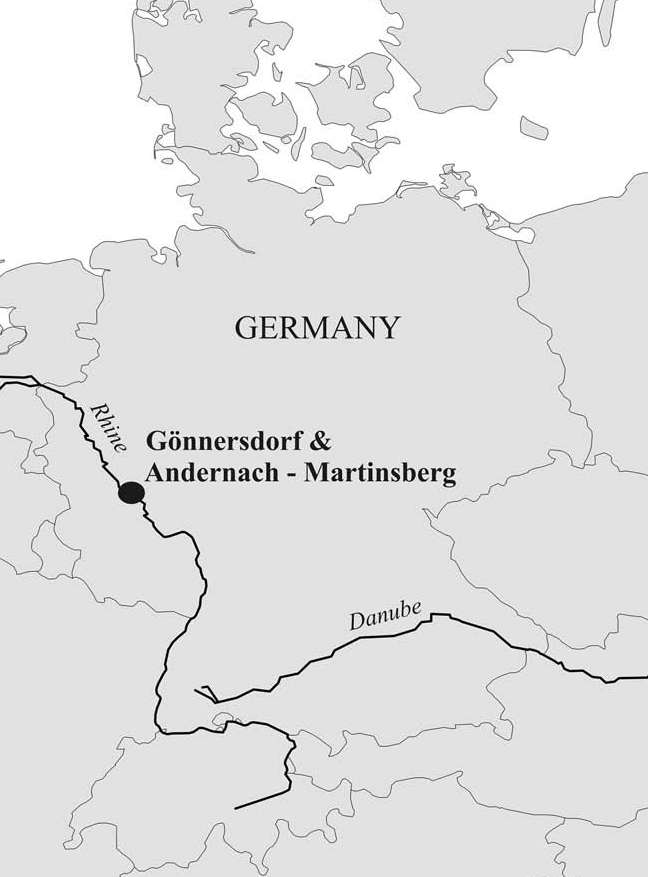
Gönnersdorf and Andernach - Martinsberg
The open-air site of Gönnersdorf was discovered and partly destroyed in 1968, during the construction of a cellar for a private house in Feldkirchen-Gönnersdorf.
After digging through the pumice, bones and slabs of stones appeared and it became clear that what one was dealing with was a location of the Late Glacial. A few days after the discovery, Dr. Gerhard Bosinski from the University of Cologne was put in charge of further investigations of the site. Two excavation campaigns were conducted the same year, excavating the part called Concentration I (CI).
During these two campaigns what we today know from Gönnersdorf as the typical inventory was unearthed: the pulverised red hematite, a fireplace, features from habitation constructions, lithics, statuettes of ivory and antler, engraved slate plaquettes, jet beads, perforated animal teeth and a well preserved faunal record. Based on these finds it was early evident that Gönnersdorf was a site of inter-regional importance.
Bosinski (1979)
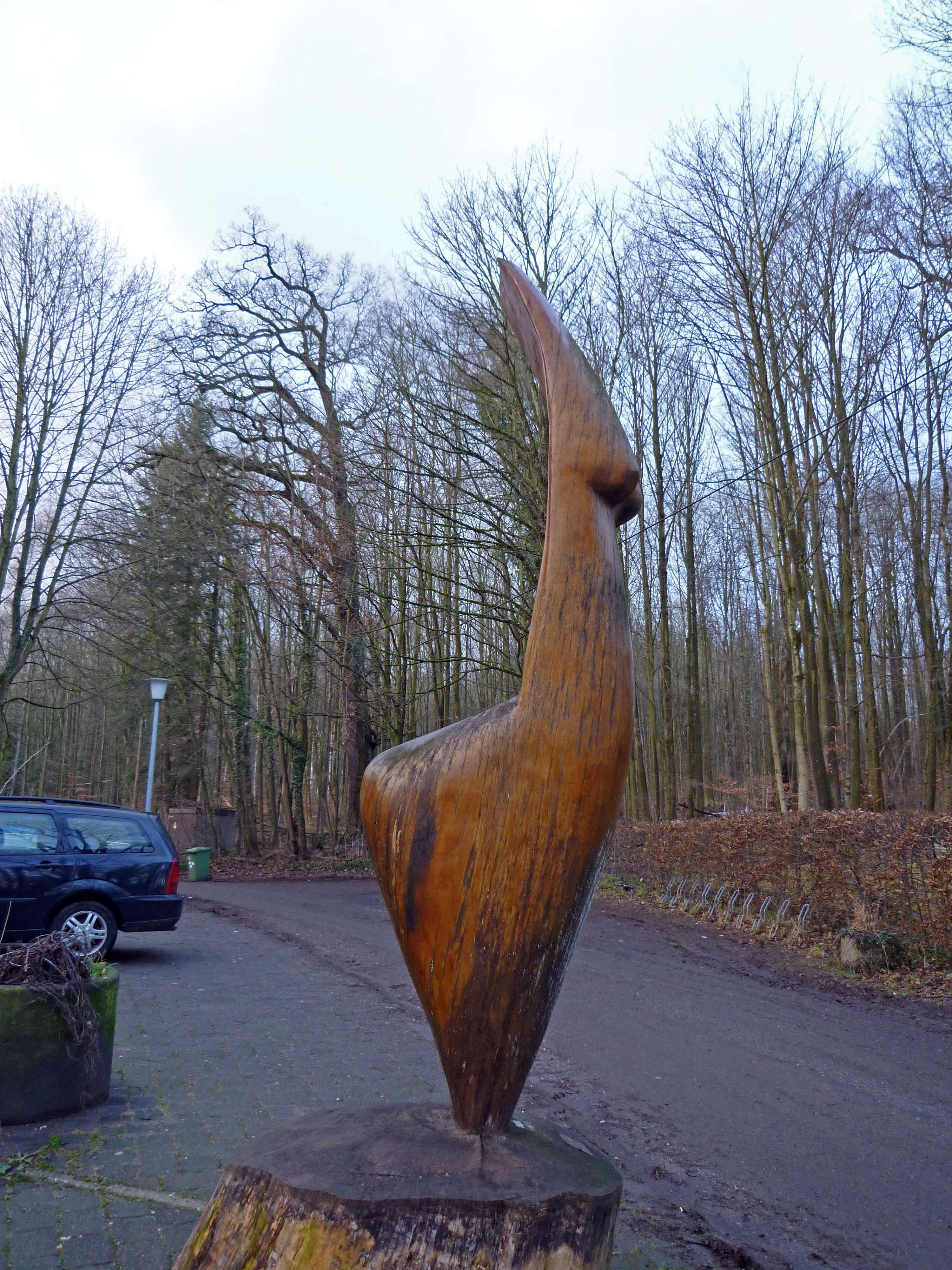
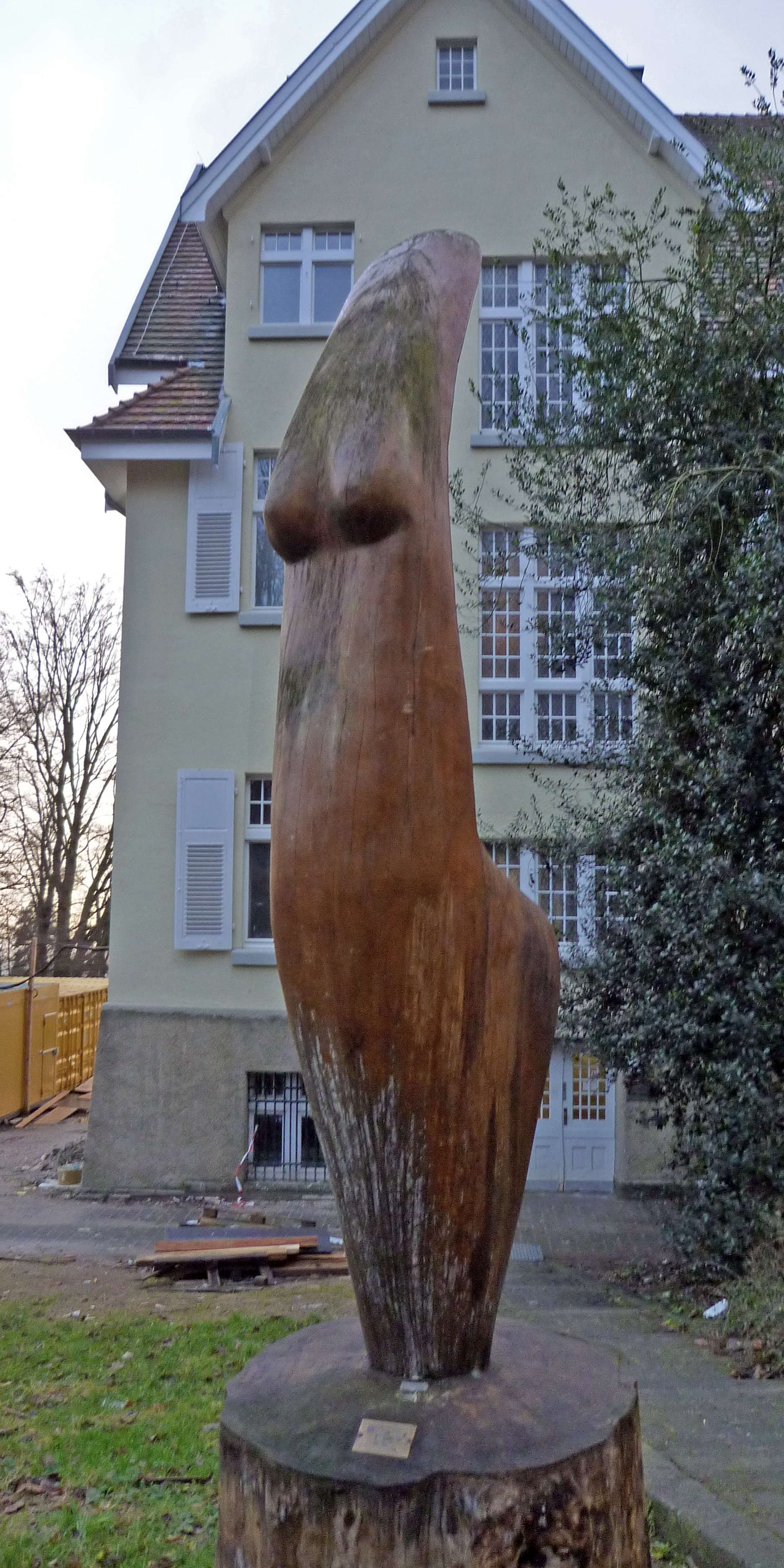
This is a beautifully done wooden sculpture of one of the most famous of the Gönnersdorf venus figures.
It is rare to see such a well done modern recreation of an ancient sculpture.
The figure is outside the Museum of Monrepos, Monrepos Archäologisches Forschungszentrum und Museum für menschliche Verhaltensevolution, at Neuwied, a town on the right bank of the Rhine, 12 km northwest of Koblenz.
The museum was closed at the time of the photograph, but it is now reopened.
Photo: Ralph Frenken 2012
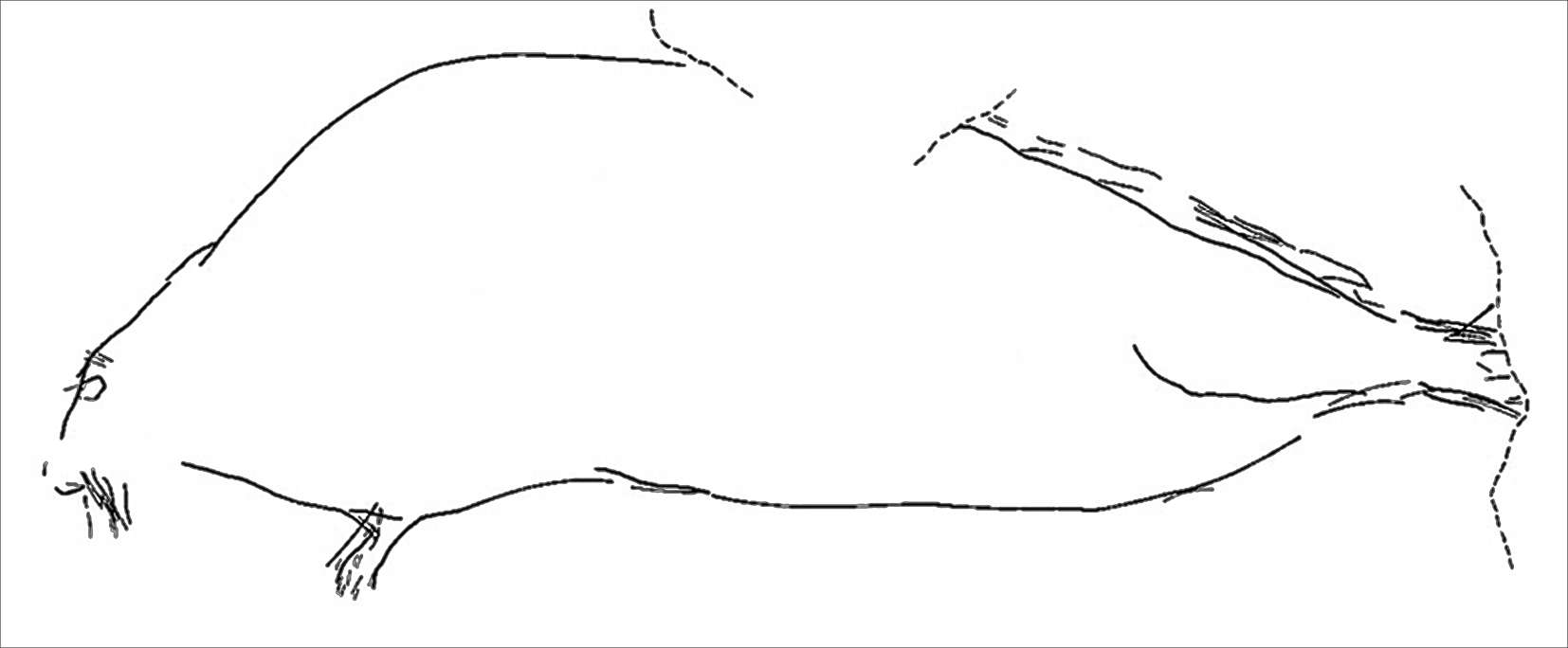
Drawing of a seal, found within a pit inside a house structure. Size of the plaquette: 22 x 15 cm.
Photo (left) and text (above) : Hansen (2006)
Drawing: Petra Schiller, Forschungsbereich Altsteinzeit- RGZM)
That at least some members of the Gönnersdorf Magdalenian group(s) travelled over very long distances during their lifetimes is suggested by well-observed engraved depictions of seals. Although it has sometimes been suggested that the former species could have migrated up the Rhine as far as the Central Rhineland - at that time located much further away from the Late Glacial coastline - no bones of this animal are present at any site and it is more probable that the animals were observed by the artists at the coast on other occasions.
Text above: Jöris (2011)
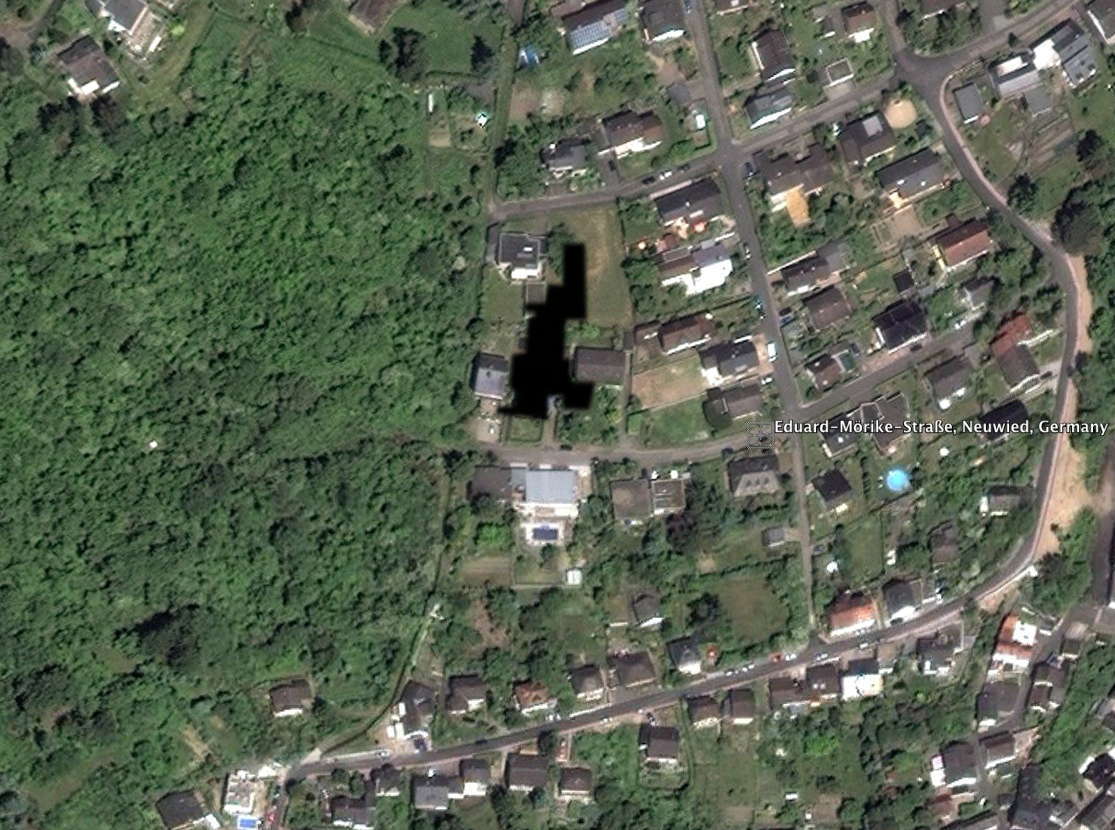
Eduard-Mörike-Straße, Neuwied, Germany.
Neuwied is part of Gönnersdorf, and a new pit in Eduard-Mörike-Straße in that area has shown the existence of a permanent settlement of 30 to 60 nomadic hunters, fifty metres above the Rhine river near a small brook in a hollow, with a favourable microclimate, having a south facing slope on the northern edge of the Neuwied basin. It has been shown to be from 12 500 BP, a thousand years before the last eruption of the Laacher See volcanic eruption.
This eruption sealed the area under a layer of volcanic ash, which protected it from most damage.
(Note - the approximate extent of the dig is shown in black on this photo - Don )
Photo: Google Earth
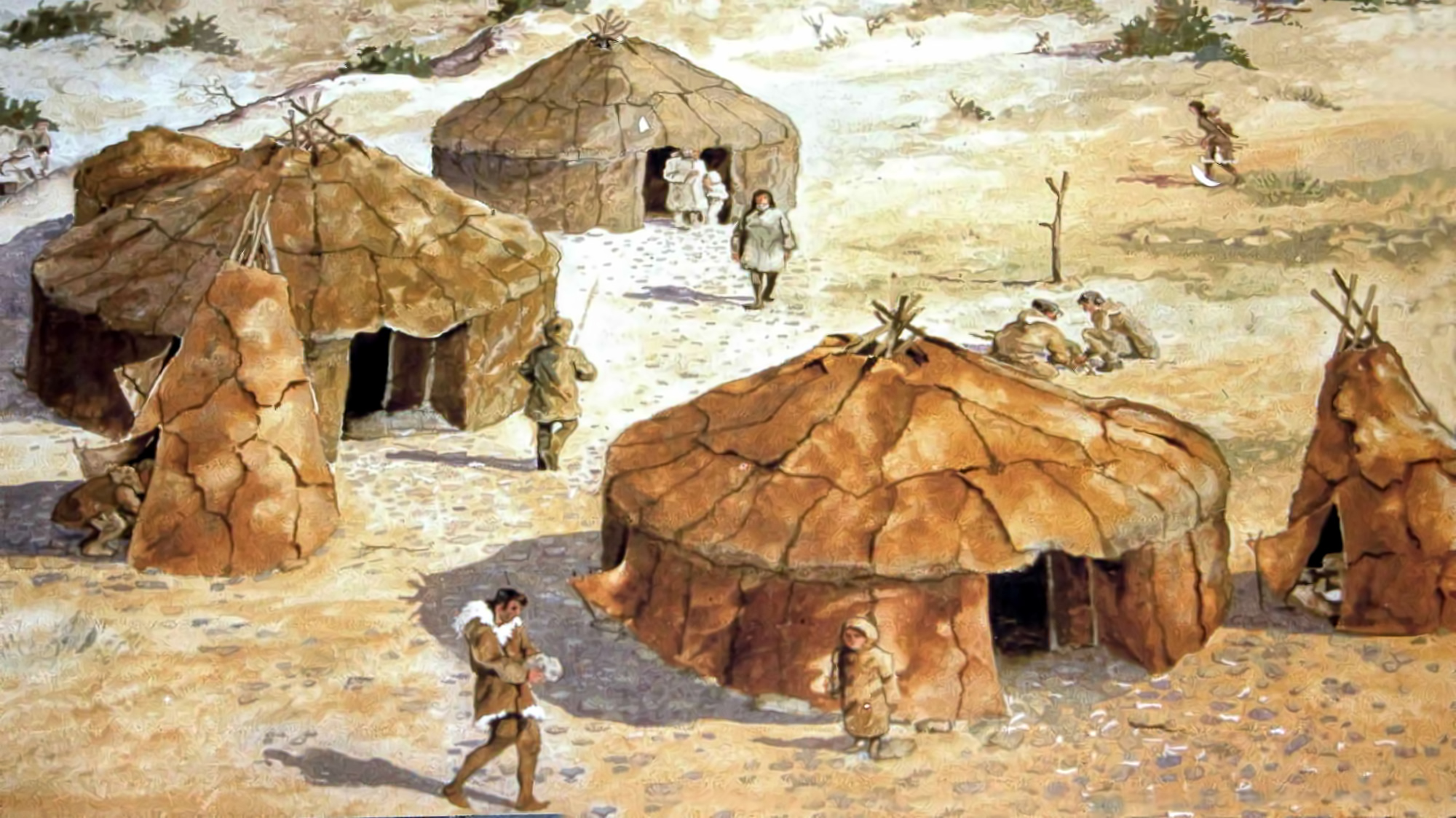
Image of the Magdalenian settlement in Gönnersdorf, 12 500 BP, RGZM special exhibition in Mainz 1975.
Traces of two small round tents, and three large, fur-covered dwellings, with a broad oval shape, similar to a yurt, were revealed with a diameter of 6 to 10 metres. They were coloured red on the inside and outside, and the floors were paved with slate.
The settlement was systematically excavated over an area of 650 square metres, and bones were found of mammoth, horse, bison, aurochs, reindeer, deer and arctic fox, as well as birds.
Photo: http://www.landschaftsmuseum.de/Bilder/Rekonstr_Rundzelt-2.jpg
Text: http://www.landschaftsmuseum.de/Seiten/Lexikon/Kunst-Goenn.htm
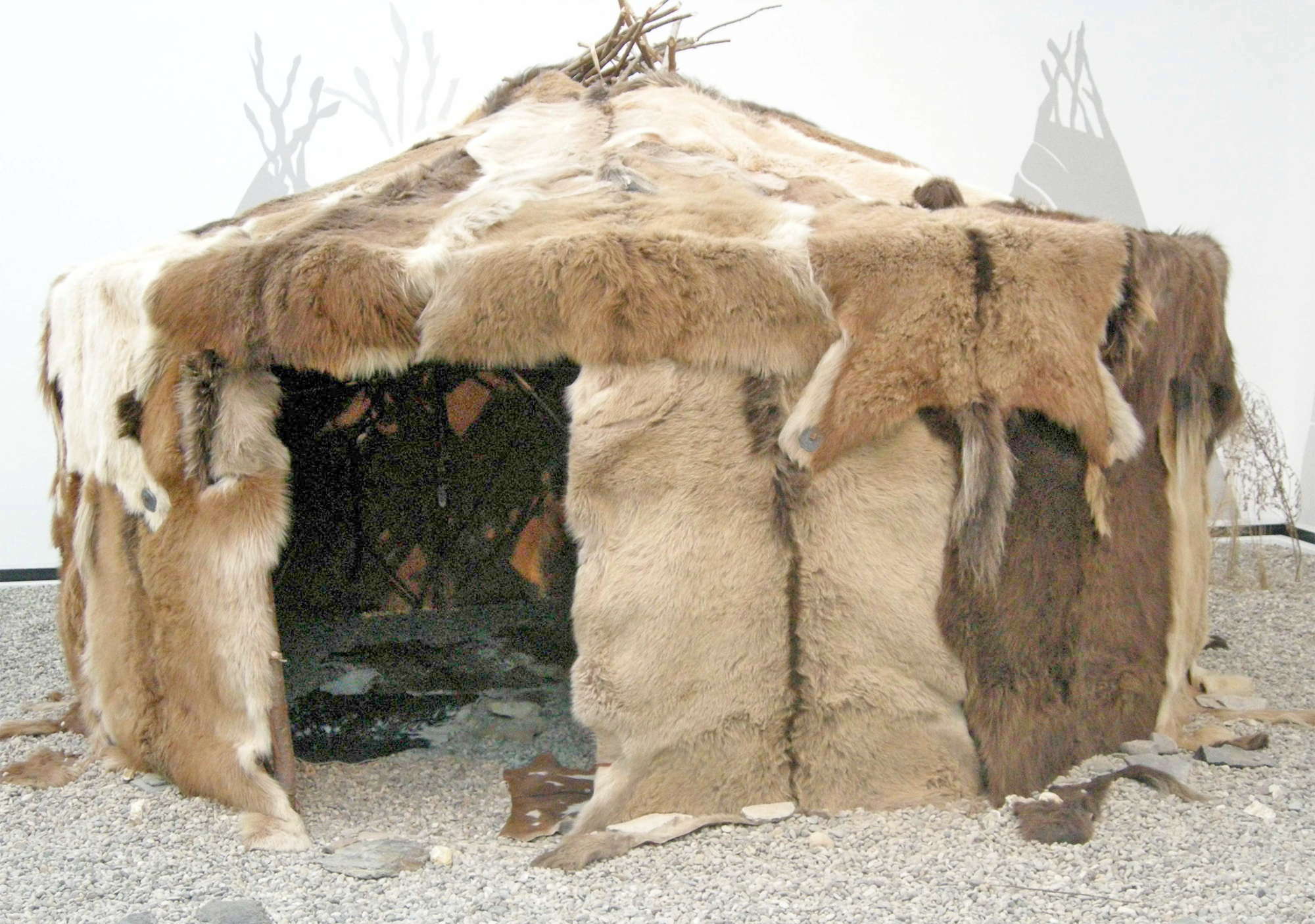
A reconstruction of a typical fur covered hut of the time. Notice the lattice work of the sticks used to give strength to the support of the walls of the structure, visible in the larger photo if you click on this one.
Photo: http://www.landschaftsmuseum.de/Bilder/Goennersd_Lager-2.jpg

Another version of the Gönnersdorf hut, recreated at the Museum of Malgré-Tout in Treignes, Belgium.
Photo: Matt Gatton and Leah Carreon, Pleistocene coalition news, Vol. 4, issue 4, July - August 2012
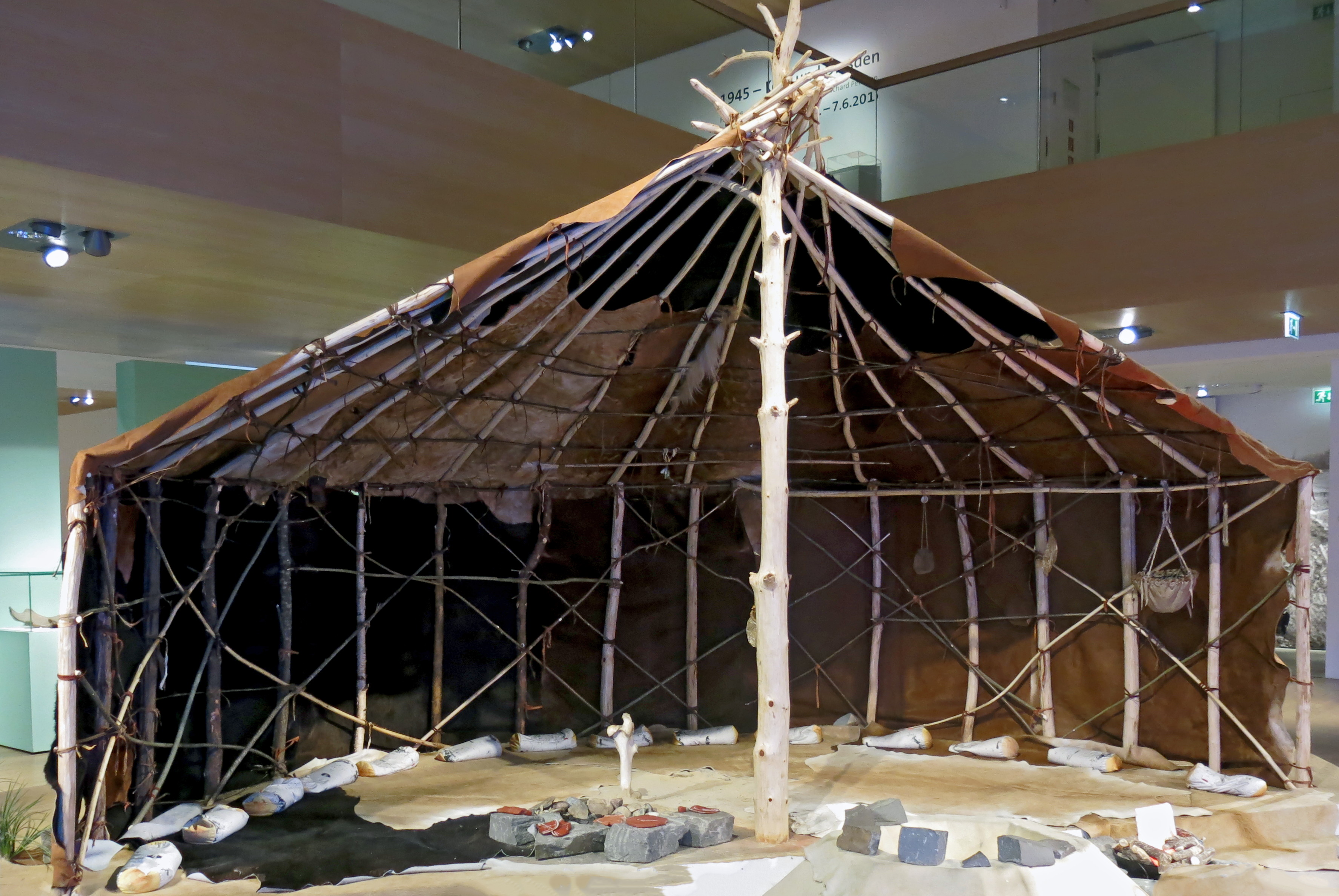
The menu of the ice hunters was diverse. Besides small and medium-sized animals, they also ate plants. The Ice Age hunters used many foods that we would not now eat.
The climate of the last ice age was subject to strong fluctuations. Besides times when it was very cold, there were also phases when it was almost as warm as today. The people of Oberkassel lived in such a warm time. The people of Gönnersdorf lived during a cold phase, and built tents like this one in order to live comfortably in the glacial conditions.
Photo: Don Hitchcock 2015
Source: LVR-Landesmuseum Bonn, Germany

The design of the Gönnersdorf tent meant that it was a comfortable place to live. The fireplace was set up just to one side of the strong central pole which allowed smoke to escape easily through the small central opening at the top of the tent, stones were heated in it for overnight warmth while the inhabitants were sleeping, there was a large open and covered space for communal living, secure from snow and ice and wind, and the construction allowed many household items to be hung from the roof beams, out of the way, but available at a moment's notice.
Photo: Don Hitchcock 2015
Source: LVR-Landesmuseum Bonn, Germany
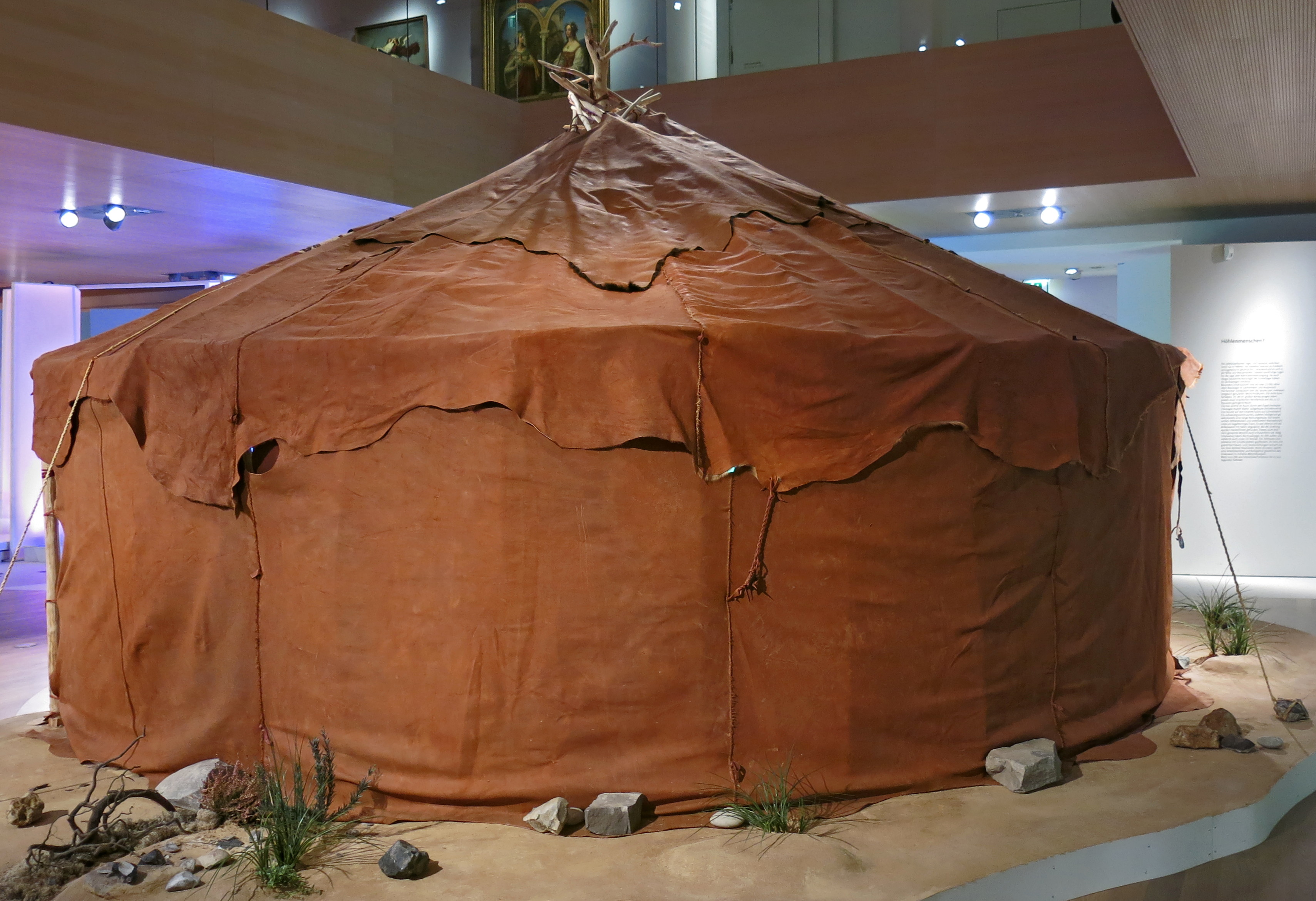
The Gönnersdorf tent from another perspective.
Photo: Don Hitchcock 2015
Source: LVR-Landesmuseum Bonn, Germany
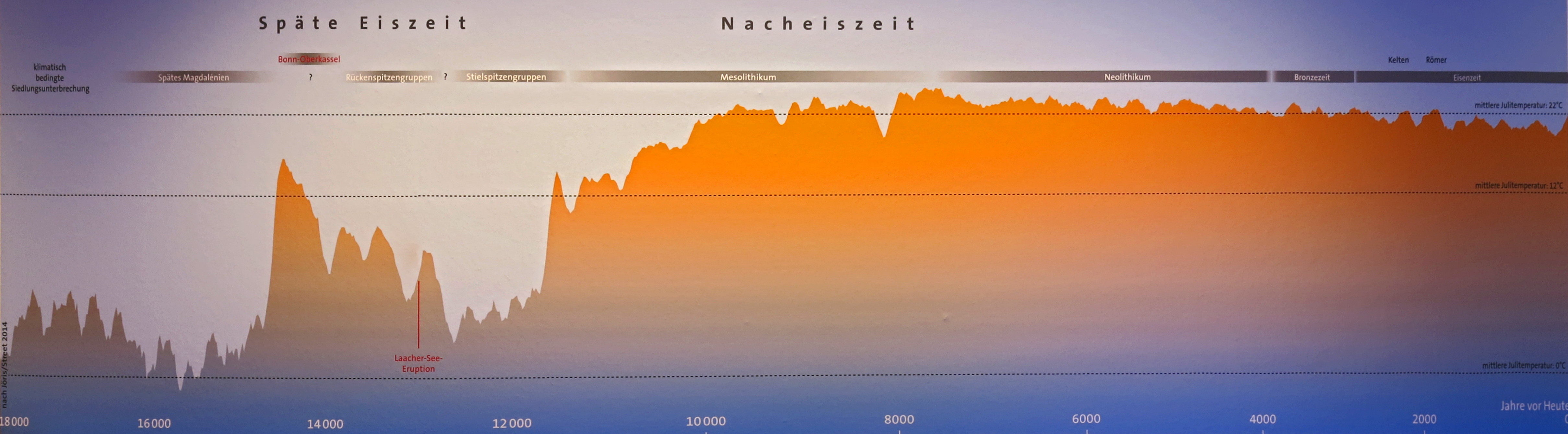
It is important to realise the changes in climate towards the end of the last ice age.
The history of the development of modern man falls into the most recent geological age, the Quaternary. It began 2.6 million years ago. From a climatic point of view, the quaternary can be divided into cold and warm periods. In contrast to climatically stable warm periods, the climate of the cold periods was characterised by changes from warmer to extremely cold phases. The current warm period, the so-called Holocene, began about 11 570 years ago. The last warm period, the Eem before 126 000 to 115 000 BP, was warmer than at present. This is confirmed by the remains of hippos from deposits near the Thames.
Between the Eem and the Holocene lies the last cold period, which is here referred to as the Vistula. It reached its peak some 24 500 years ago. Between the glaciated areas, which extended from Schleswig-Holstein in the north, to the south to the foothills of the Alps, a life threatening dry and cold frost regime expanded. About 19 000 years ago a climatically milder period began, which ultimately led to resettlement of the area by humans. From 14 650 years BP, the climate changed drastically, the temperatures gradually increased to almost the present level. At first it was still drier in Central Europe, with wide, open grasslands, but soon the rainfall was enough to support a closed forest.
Rephotography of a poster in the LVR-Landesmuseum Bonn: Don Hitchcock 2015
Source and text: LVR-Landesmuseum Bonn, Germany
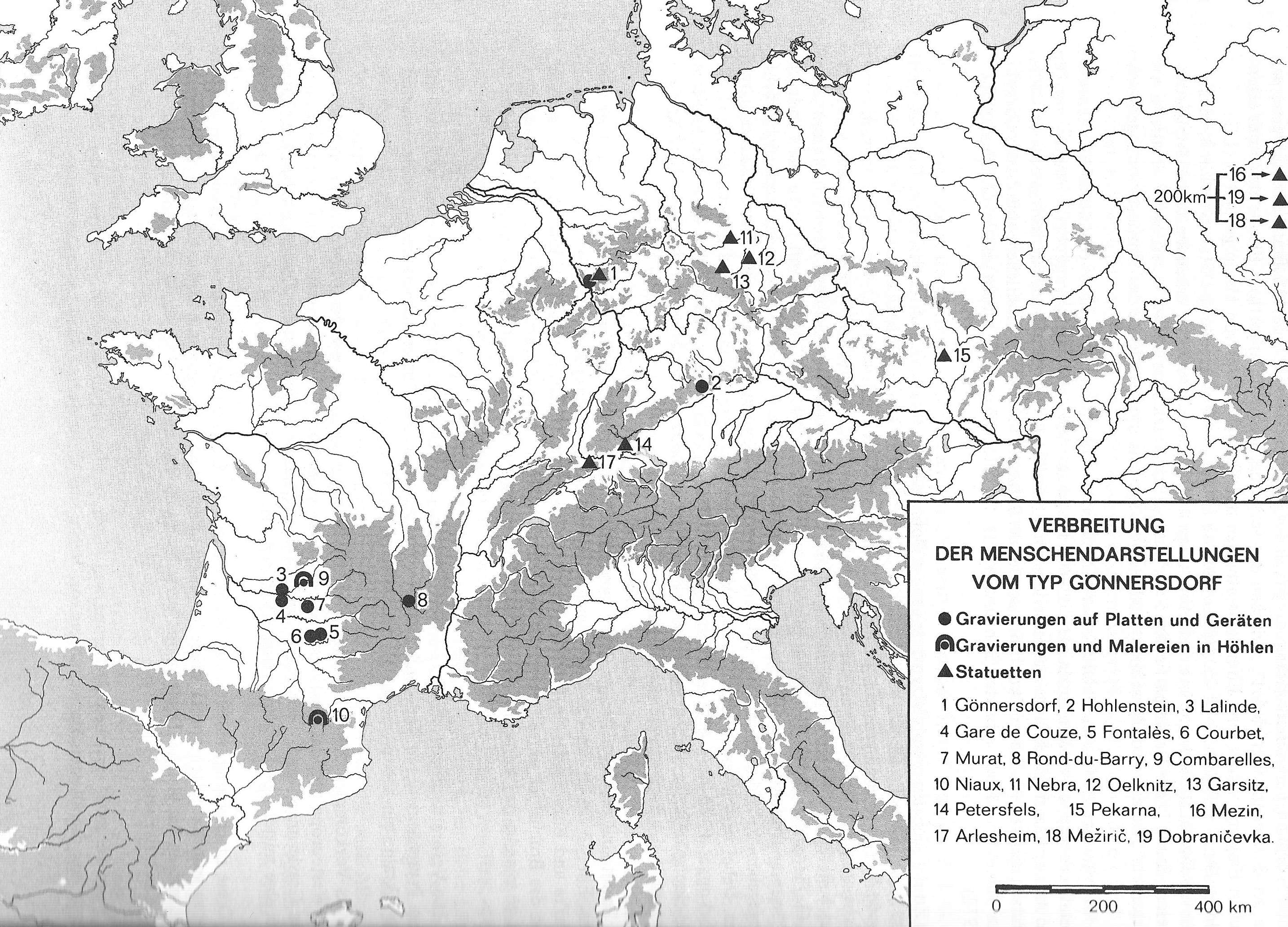
Map of Europe showing the areas where Gönnersdorf/Lalinde figures have been found.

Engravings on slabs and other materials

Engravings and paintings in caves

Statues
1 Gönnersdorf, 2 Hohlenstein, 3 Lalinde, 4 Gare de Couze, 5 Fontalès, 6 Courbet, 7 Murat, 8 Rond-du-Barry, 9 Combarelles, 10 Niaux, 11 Nebra, 12 Oelknitz, 13 Garsitz, 14 Petersfels, 15 Pekarna, 16 Mezin, 17 Arlesheim, 18 Mezhirich, 19 Dobranicevka.
Photo and text: Bosinski et al. (1974)
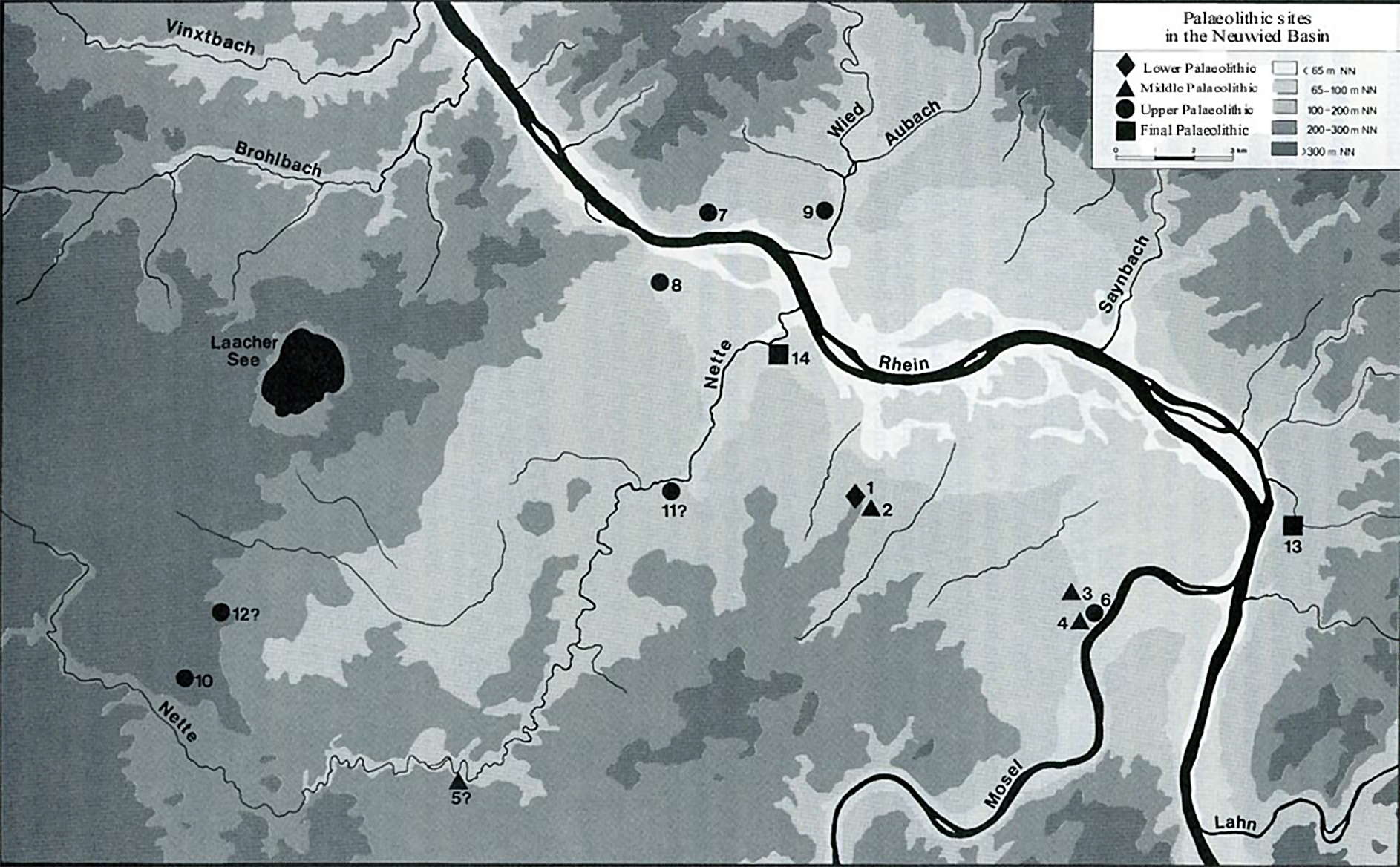
The Neuwied Basin with the Laacher See and markings of important Palaeolithic sites.
1) Kärlich horizon H
2) Kärlich horizons Ja and Jb
3) Metternich (Grube Wefglau-
Bassisschicht)
5) Polch
6) Metternich (Grube Weglau)
7) Gönnersdorf
8) Andernach -
Martinsberg
9) Irlich
10) Mayen
11) Rauschermühle
12) Kottenheim
13) Urbar
14)
Weissenthurm.
Photo and text: Bosinski (1979)
The Magdalenian horizon at Gönnersdorf is located between two volcanic layers, the Eltville Tuff horizon that was deposited during the Würmian Pleniglacial, about 20 000 years BP, and the Laacher See Tuff that was deposited during the middle of the Allerød interstadial, about 10 900 cal BC17. Above the Eltville Tuff horizon, the loess deposition was interrupted by the formation of a weakly developed soil (Soil III of the Würmian loess complex) of para-rendzia type, and below the Laacher See Tuff was another soil of a para-rendzia type that was formed during the early Allerød times.
The settlement horizon lies between these soils. Thus, stratigraphically the settlement horizon must be younger than the Eltville Tuff Horizon (20 000 years BP) and Soil III of the Würmian loess complex and older than the Early Allerød soil, and certainly older than 12 000 BP age of the Laacher See Tuff. (Brunnacker 1978)
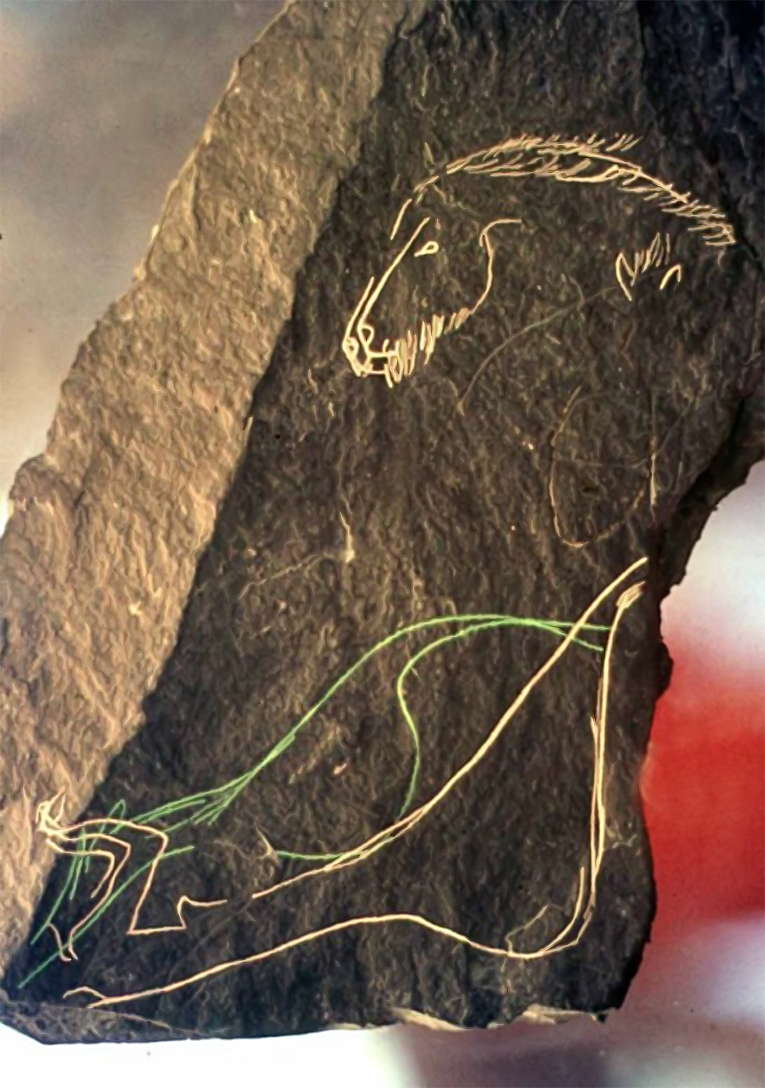
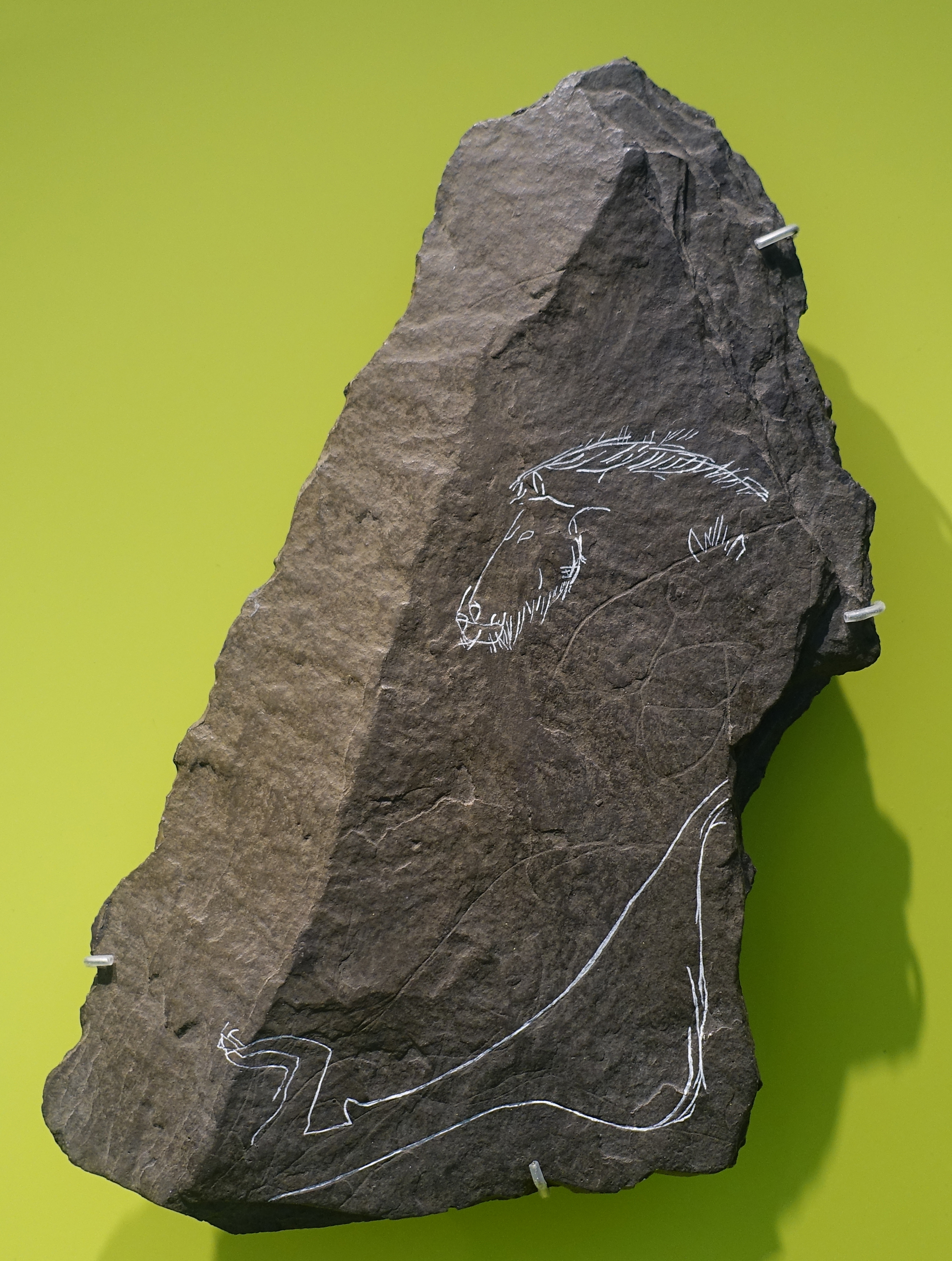
This slate shows an engraving of a horse, as well as two typical engraved Gönnersdorf venus figures.
Date: 14800 BP
Height: 66 mm
Tools such as knives, drills, scrapers, and burins were found, as well as ivory and bone needles and arrowheads, jewellery such as necklaces and trimmings for clothing such as deer canine teeth, often used as hunting trophies, snail shells, beads made of petrified wood or jet, and small female figures made of antler and ivory.
Engraved slate, the largest contribution of knowledge about late ice age art, has given us more than a thousand slate tiles so far discovered with incised drawings. The engravings show, in the main, either game animals or female figures in profile, some perhaps even dancing.
Photo: (left) http://www.landschaftsmuseum.de/Bilder/Goennersdorf_Wildpferd-2.jpg
Photo: (right) Don Hitchcock 2018, Source: Museumslandschaft Hessen Kassel
Text: http://www.landschaftsmuseum.de/Seiten/Lexikon/Kunst-Goenn.htm
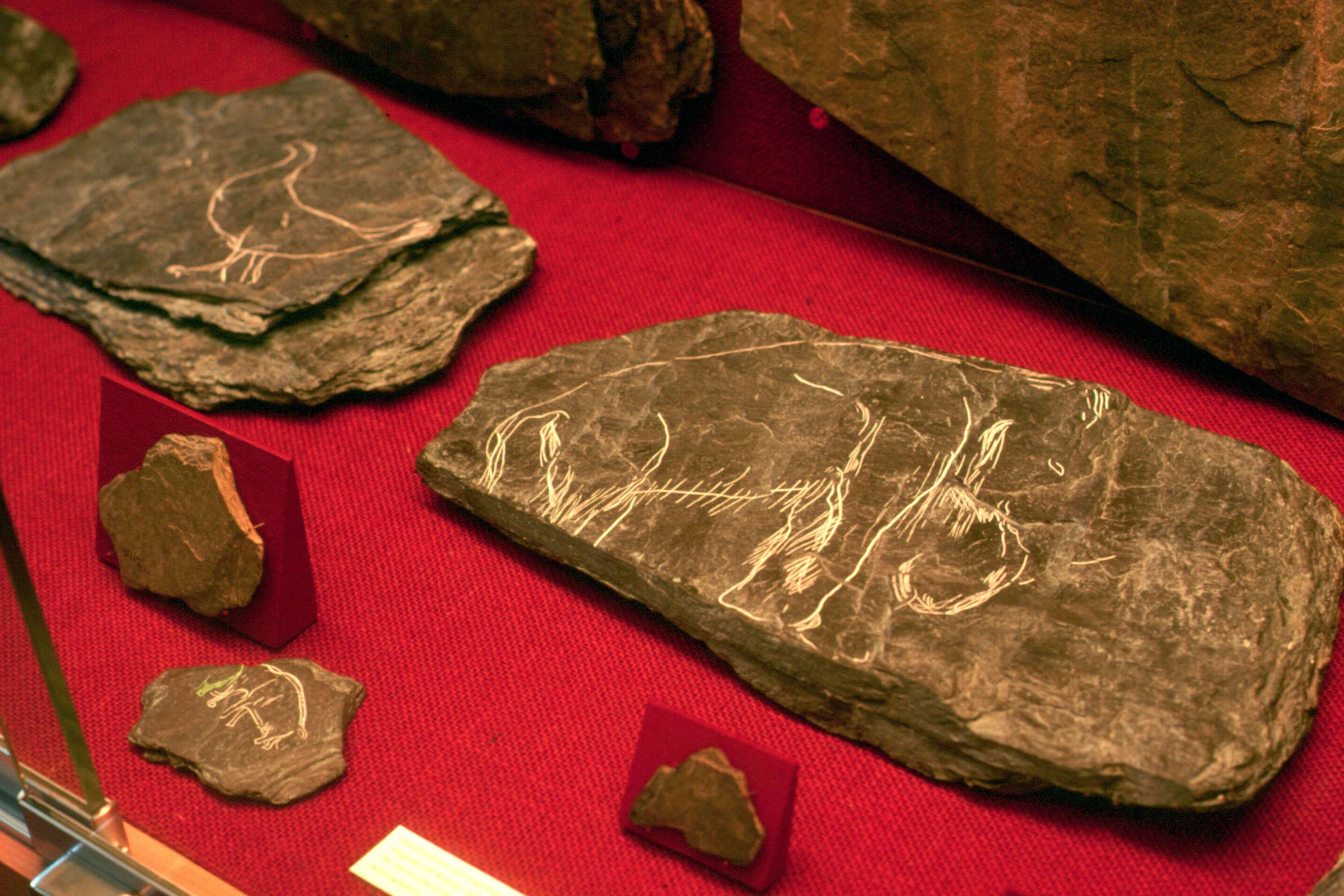
Slates with an engravings of mammoths and a bird from the Magdalenian settlement in the Neuwied Basin of Gönnersdorf.
12 500 BP, RGZM special exhibition in Mainz 1975.
(Note that the display is either of facsimiles, or the originals have been highlighted to show the engravings clearly - Don )
Photo: http://www.landschaftsmuseum.de/Bilder/Mammut_Goennersdorf-2.jpg
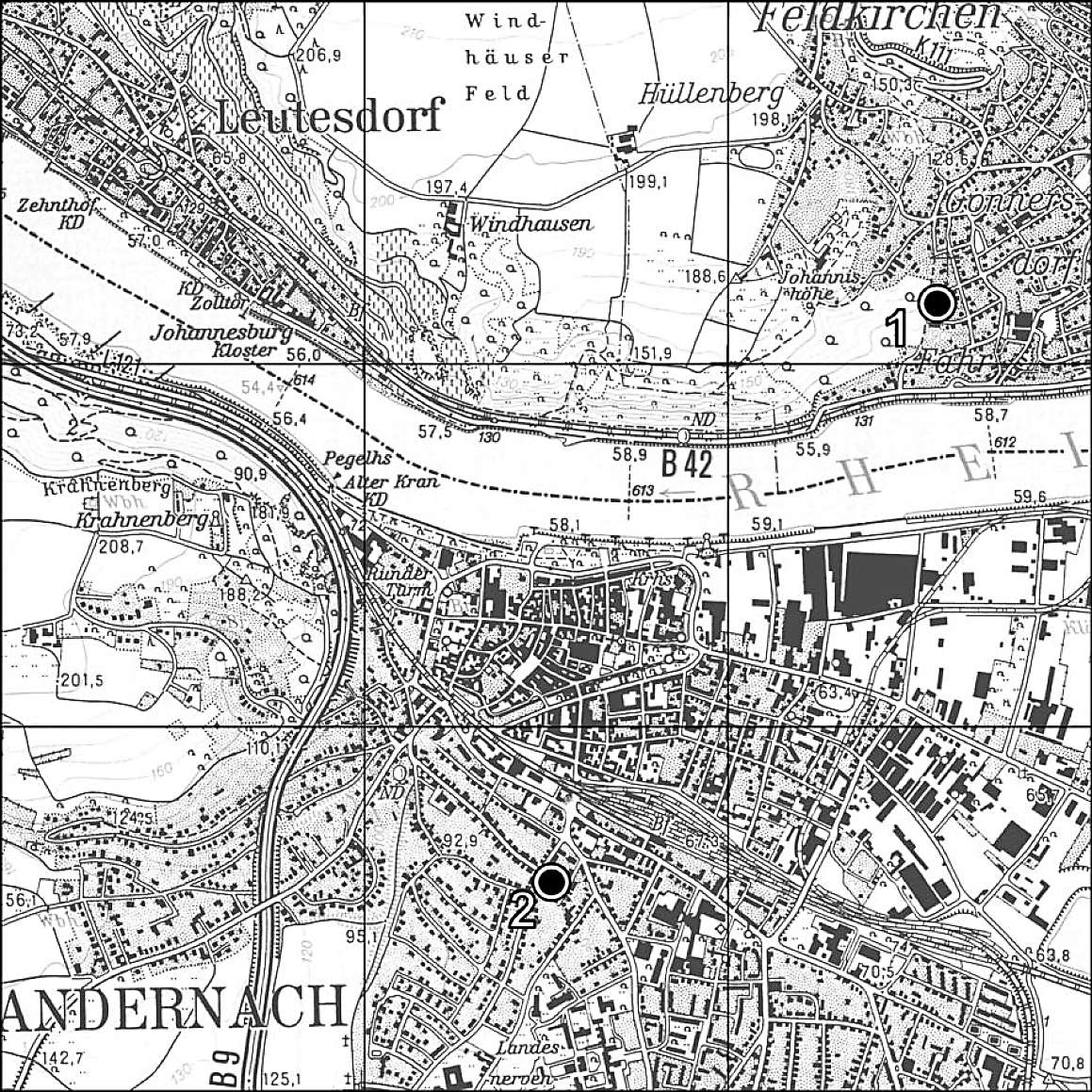
Location of the two major Magdalenian settlement sites Gönnersdorf (1) and Andernach-Martinsberg (2) on opposite banks of the River Rhine at the northern end of the Neuwied Basin
Photo and text: Jöris (2011)
The site of Gönnersdorf is situated at the right bank of the Rhine, at the north-western exit of the Neuwied Basin, about 15 km northwest of the city of Koblenz and immediately east of the Andernacher Pforte (Andernach Gate).
The site was found on a spur, of a triangular piece of land, which is 3 km long and 1 km wide. Directly west of the settlement, was a small stream running through a narrow, steep valley and draining into the Rhine. The valley both protected the people from the worst of the weather, and supplied them with the slate that was used for pavement in the settlement area. Towards the northwest, the site was protected by the slope of the high terrace, and was easily accessible only from the east.
The settlement is strategically placed, oriented towards south and is exposed to the full trajectory of the sun and has an excellent view over the Neuwied Basin. The settlement structures were buried by pumice after the last large eruption from the Laacher See Volcano, located 11 km west of Gönnersdorf, at the middle of the Allerød interstadial, about 10 900 cal BC 16.
Due to this thick cover of pumice, the remains at the site are well preserved. Although the settlement remains were protected by the cover of pumice, the material has still been affected by different processes such as freezing and thawing action and movement caused by burrowing animals. These processes have caused some of the artefacts to be moved vertically, and may also be the cause of the breakage of many of the slate plaquettes. Because the site is placed on a middle terrace, with both down slope movements and sliding through solifluctuations from the high terrace we must also assume that material has both been moved away from the site, as well as been added to it. We should also keep in mind the time length existing between the times the site was settled until it was sealed by the pumice.
Roveland (1990) in Hansen (2006)

Topography of the Neuwied Basin. The site Gönnersdorf is marked by circle. In the upper right corner, the remains of the Andernach Gate, the Andernacher Pforte.
The gate of Andernach is, or was, a bottleneck in the Rhine valley below Andernach.
Photo and text: Bosinski (1979)
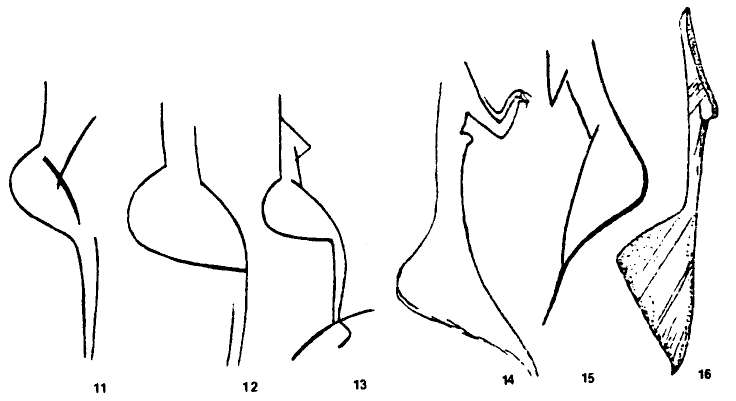
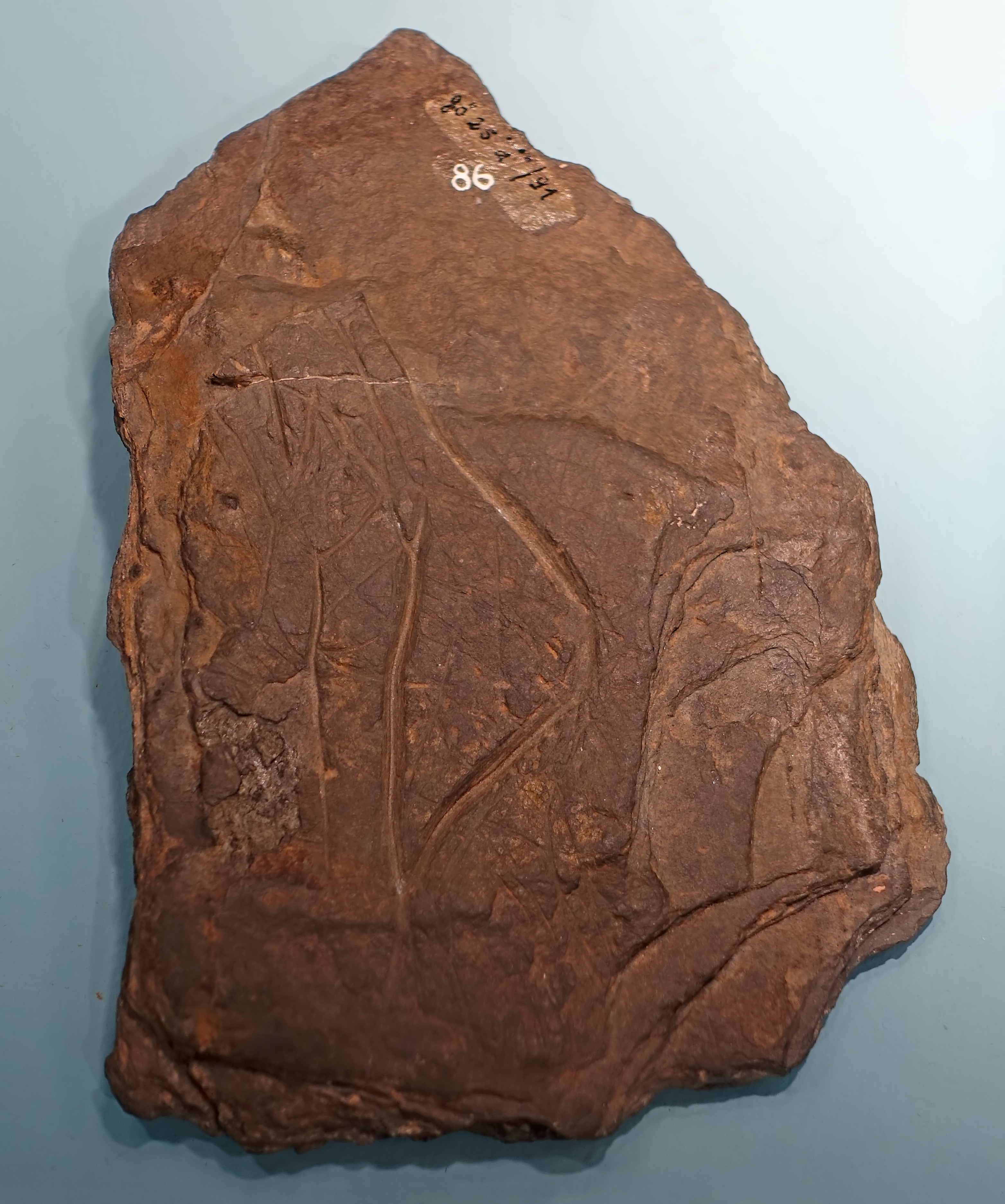
11-13 , Hohlenstein; 14-16 Gönnersdorf (engraving No. 59-1 and 86-1 and figurine No. 1)
Photo: www.ucmo.edu/Documents/dissertationillus.pdf
The late glacial open-air sites of Gönnersdorf and Andernach-Martinsberg in the German Central Rhineland are well known for their Magdalenian occupation and activities. The latter site also produced evidence for a younger, Final Palaeolithic occupation of the locality by people of the Federmessergruppen.
Both sites are particularly well preserved, largely due to their burial beneath volcanic deposits of the late glacial Laacher See eruption.
The Andernach-Martinsberg site and excavations were rediscovered in the early 1980s.
Photo and text: Stevens et al. (2009)

Probability distribution of calibrated radiocarbon dates from Gönnersdorf plotted against the oxygen isotope record from the GISP2 Greenland ice core.
Methodologically acceptable dates only.
* denotes AMS dates conducted for this study.
Photo and text: Stevens et al. (2009)
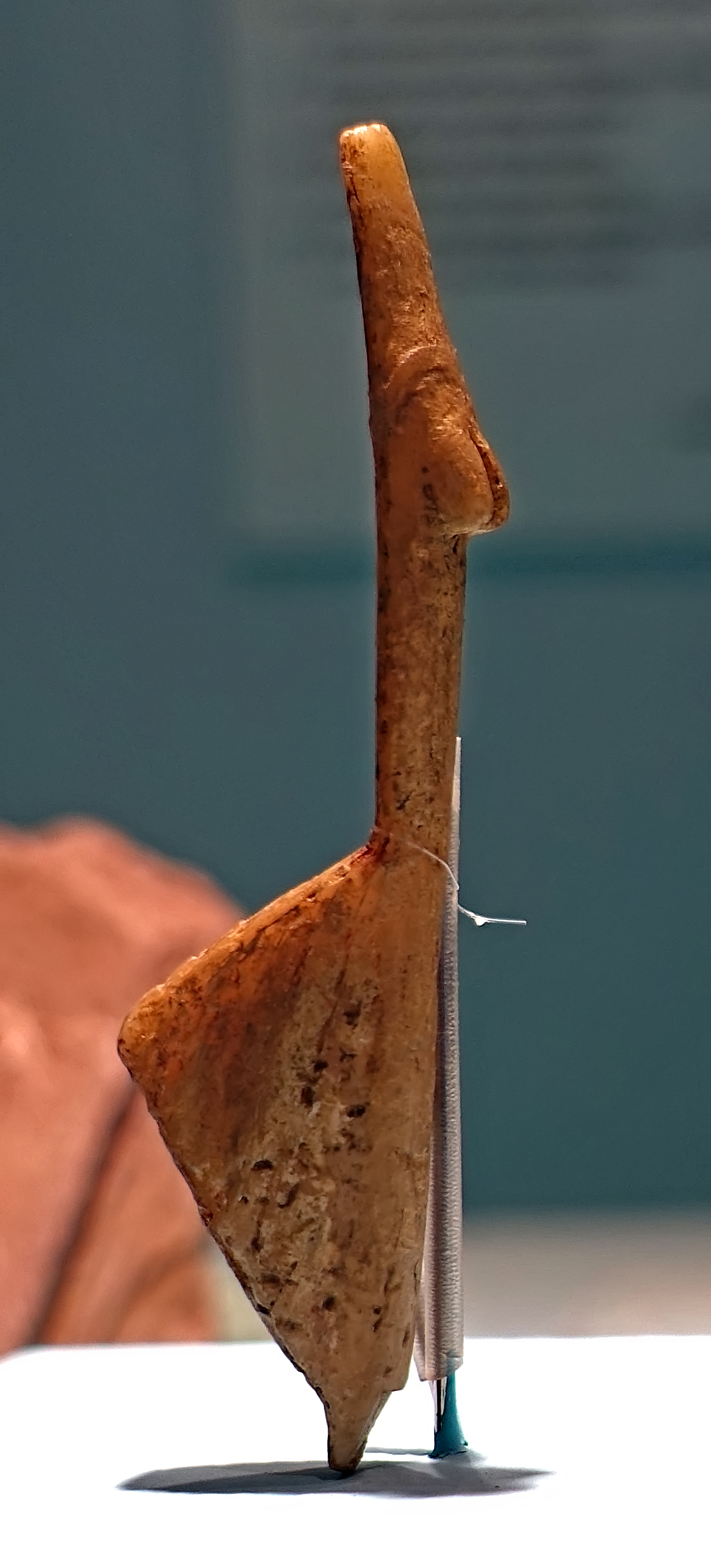
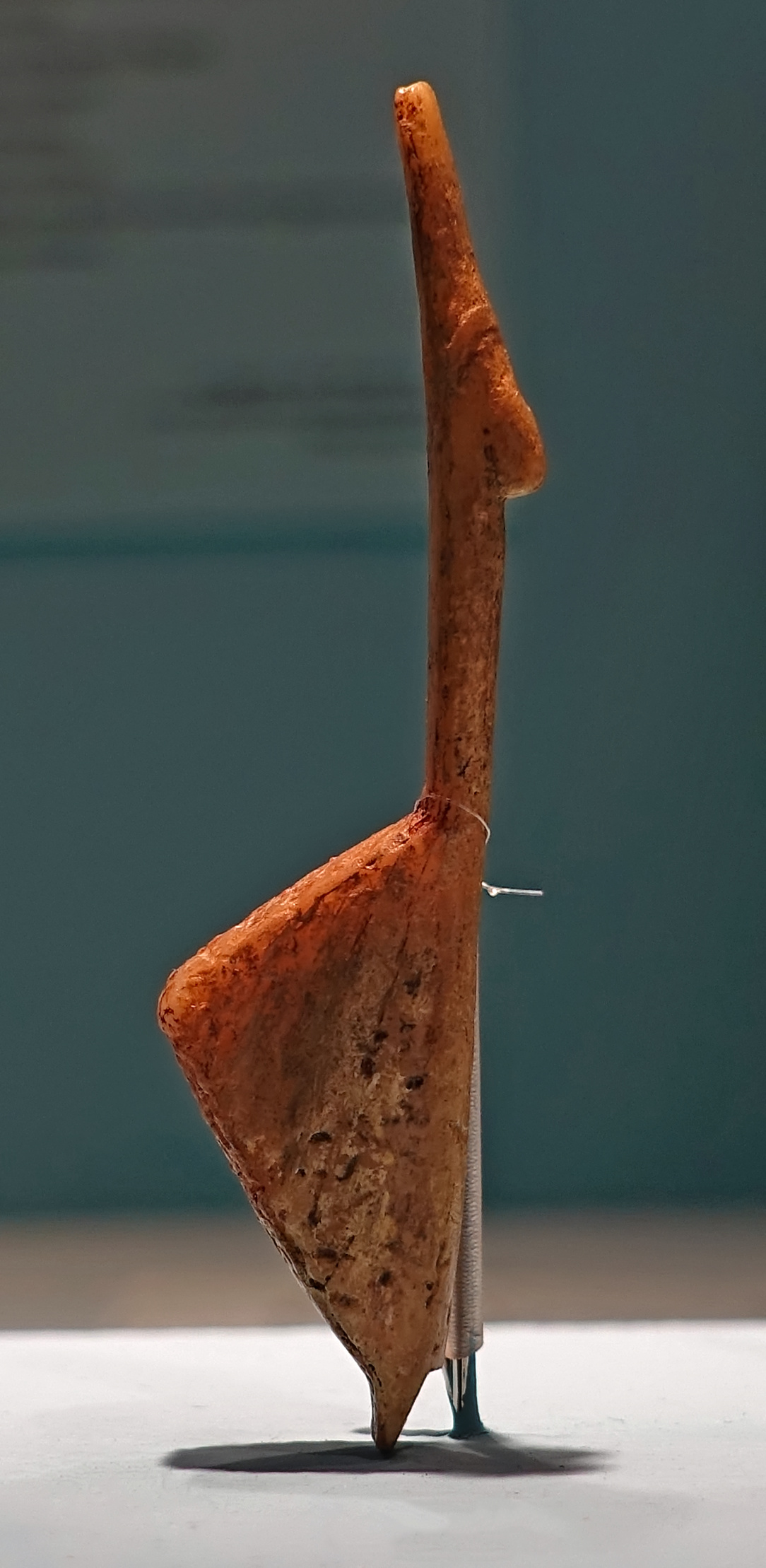
Venus figurine in bone from Gönnersdorf.
Photo: Don Hitchcock 2018
Source and text: Facsimile, display at LVR-LandesMuseum Bonn
Lender: Directorate General for Cultural Heritage Rhineland-Palatinate, Generaldirektion Kulturelles Erbe Rheinland-Pfalz
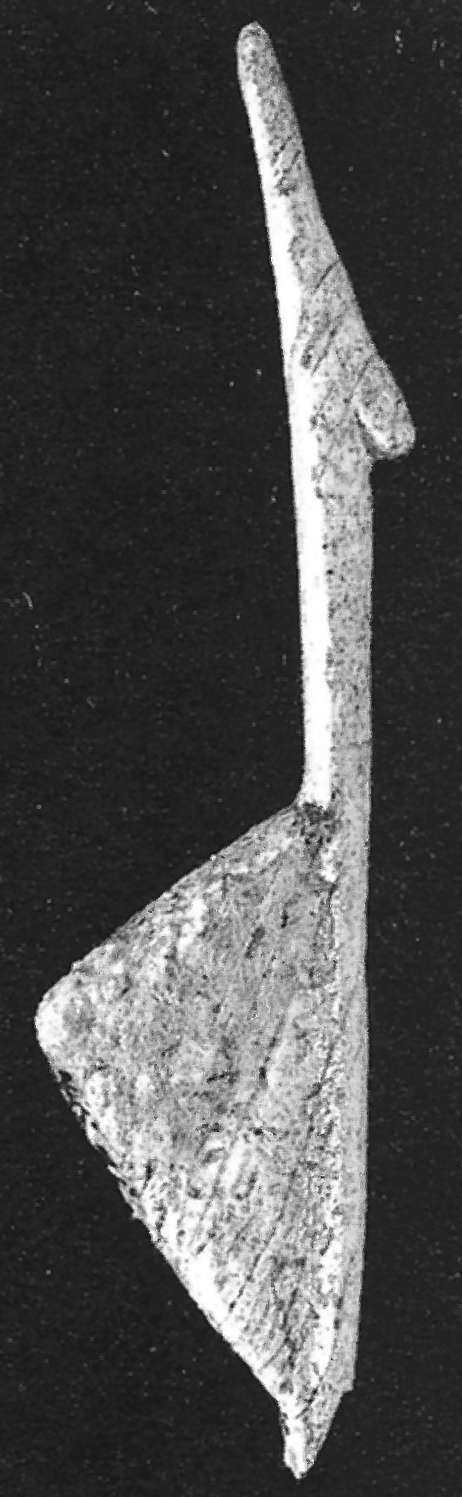
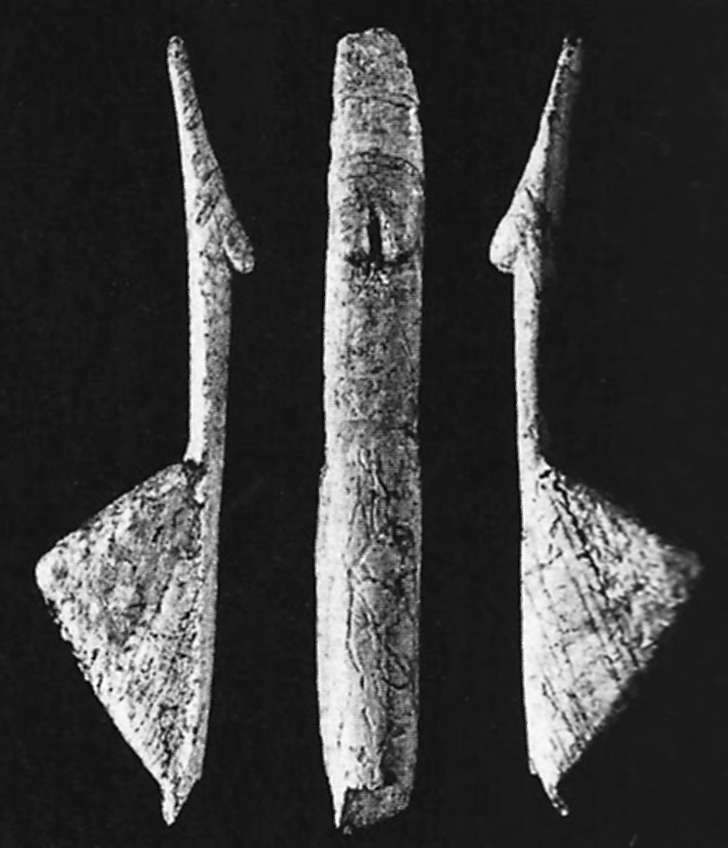
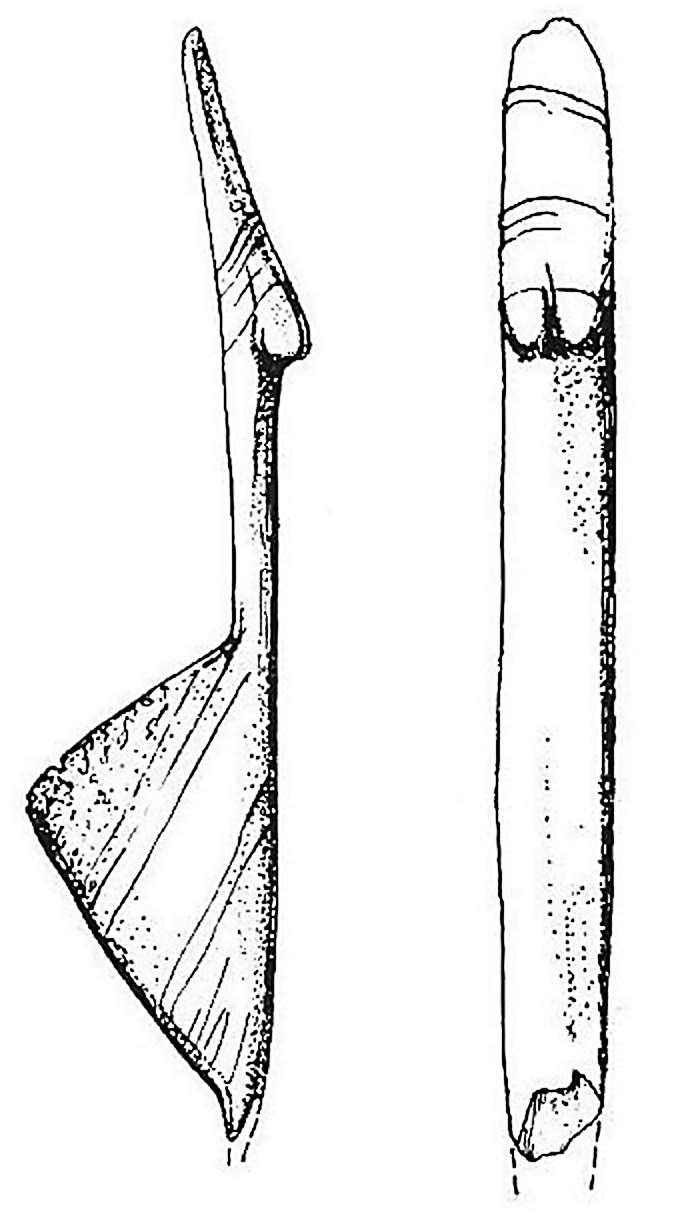
From Gönnersdorf, 1968 excavations.
Statuette shown in the colour photograph above.
On the rod-shaped upper body are two breasts.
Height 71 mm, breadth 160mm.
Photo (left) and text: Müller-Beck et al. (1987)
Photo (centre and right): Bosinski et al. (1974)
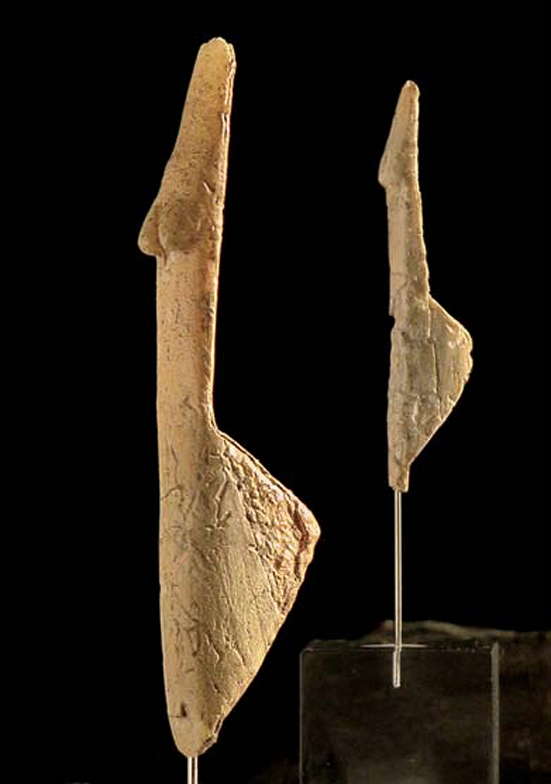
Venus from Gönnersdorf.
Photo: Gaudzinski-Windheuser and Jöris (2006)
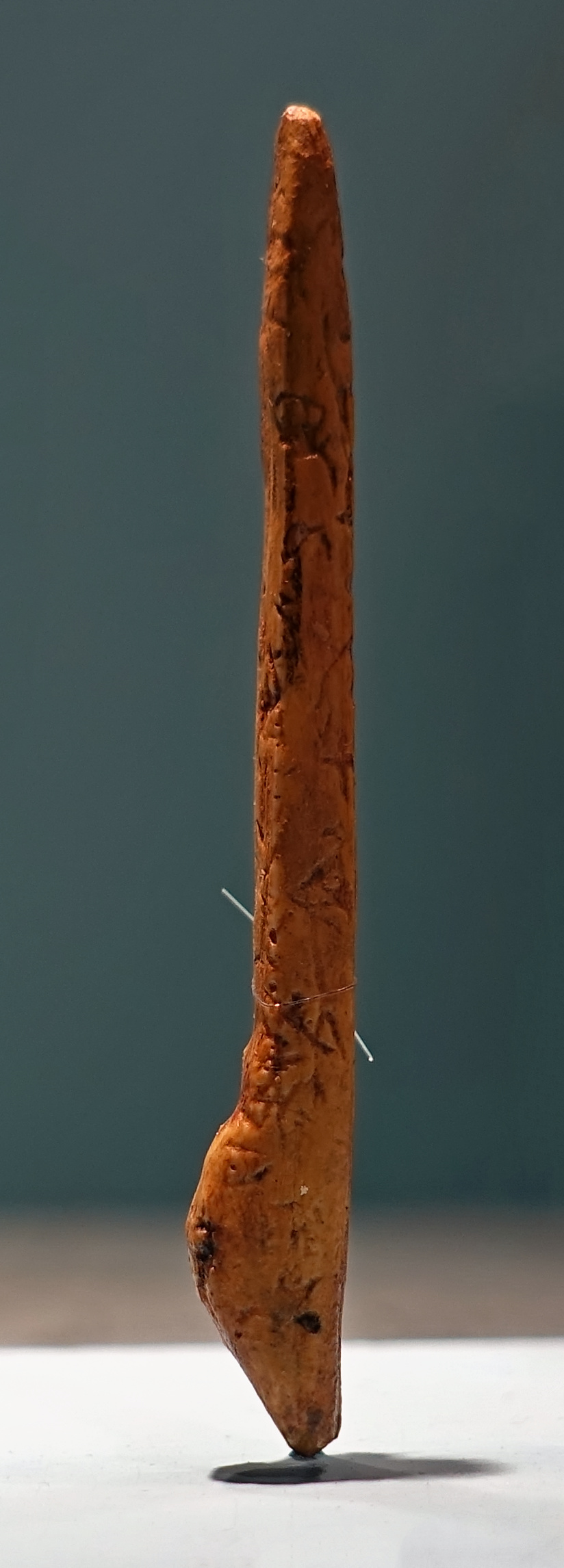
Venus figurine in antler from Gönnersdorf.
Photo: Don Hitchcock 2018
Source and text: Facsimile, display at LVR-LandesMuseum Bonn
Lender: Directorate General for Cultural Heritage Rhineland-Palatinate, Generaldirektion Kulturelles Erbe Rheinland-Pfalz.

From Gönnersdorf, 1968 excavations.
Statuette displayed in the colour photograph above.
Photo: Bosinski et al. (1974)
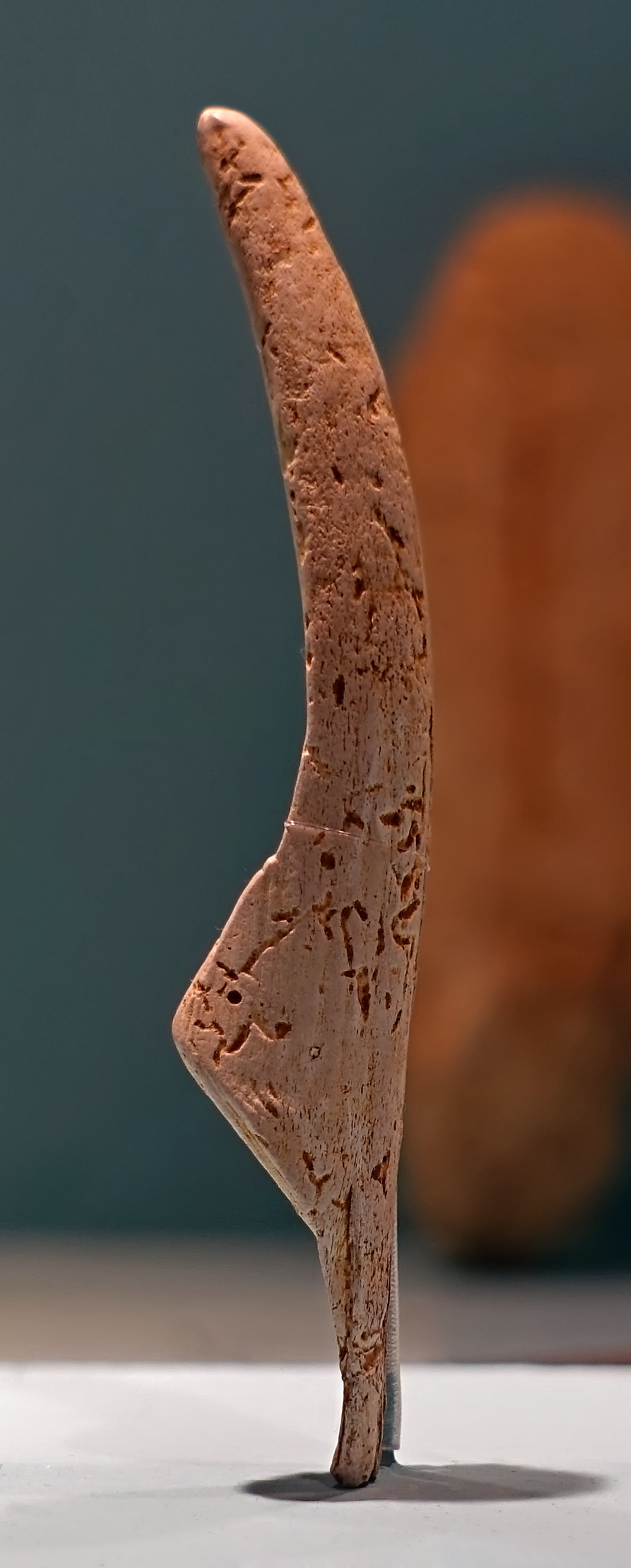
Venus figurine made from the tip of an antler, from Gönnersdorf.
Photo: Don Hitchcock 2018
Source and text: Facsimile, display at LVR-LandesMuseum Bonn
Lender: Directorate General for Cultural Heritage Rhineland-Palatinate, Generaldirektion Kulturelles Erbe Rheinland-Pfalz.

From Gönnersdorf, 1968 excavations.
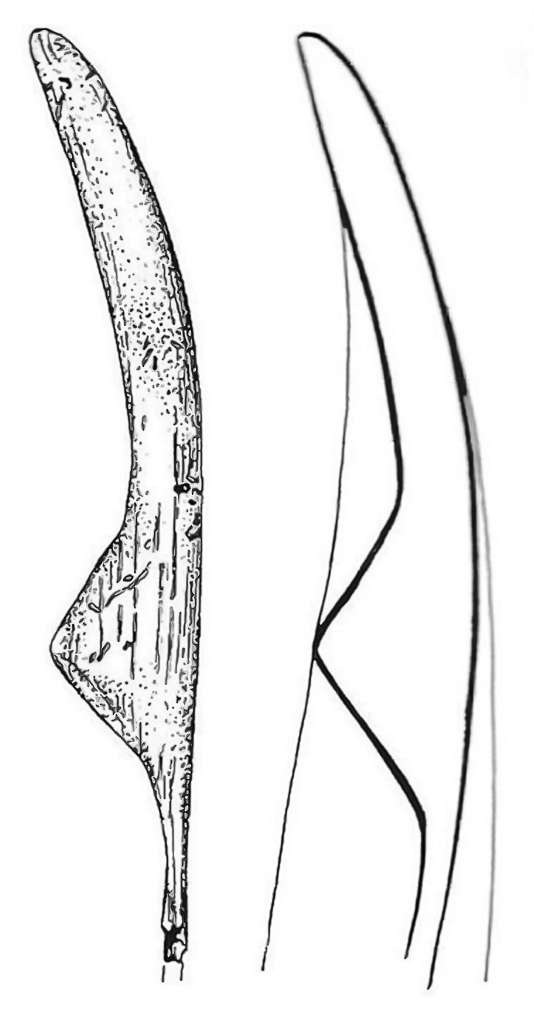
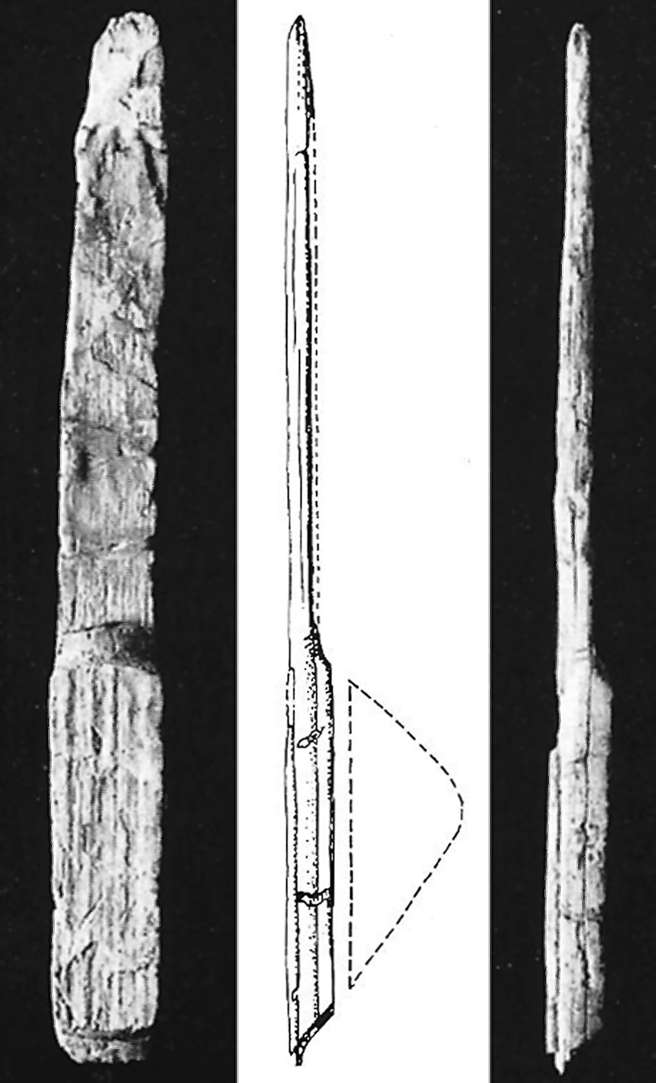
Statuette produced from the tip of an antler, shown in the colour photograph above. The antler is almost untouched in the upper part.
Height 87 mm, width 15 mm.
The diagram from Bosinski et al. (1974) shows the outline of the original antler from which the venus figure was carved, and the outline of the resulting figurine.
Photo (left) and text: Müller-Beck et al. (1987)
Photo (right): Bosinski et al. (1974)
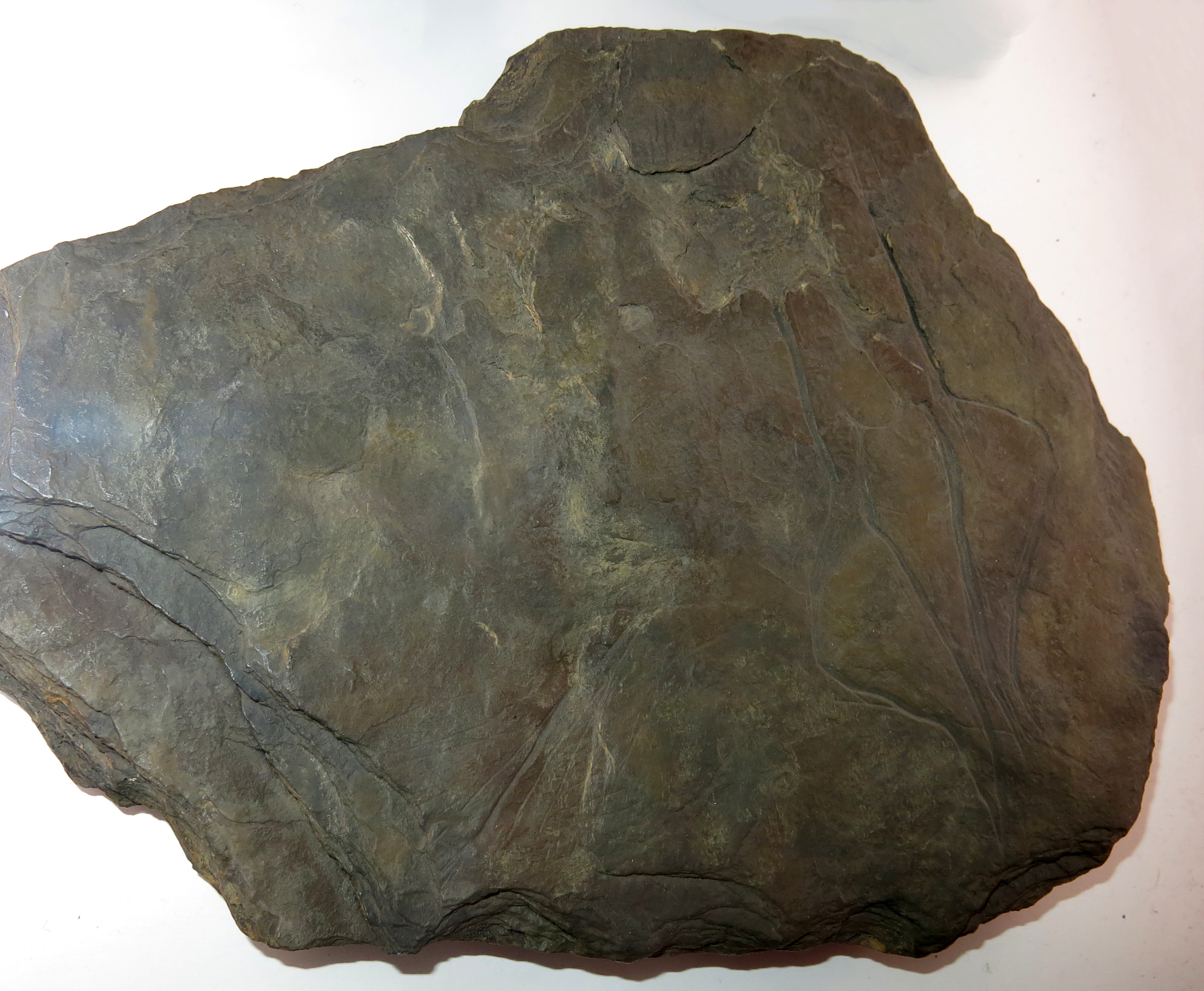
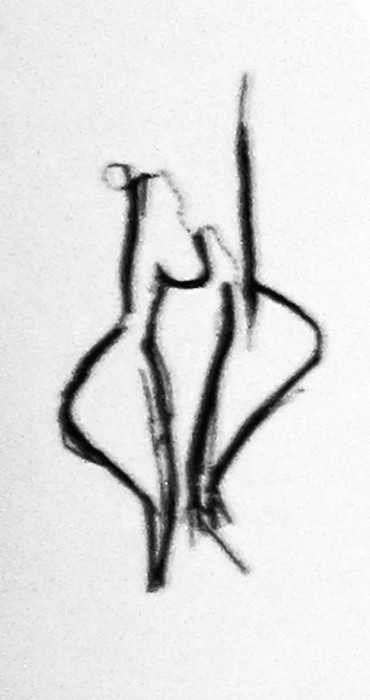
Lalinde figures, described as dancing women by the catalog, from Neuwied-Gönnersdorf, Rheinland-Pfalz, 15 800 BP.
Photo: Don Hitchcock 2015, and drawing from catalog
Source: Monrepos Archäologisches Forschungszentrum und Museum, Neuwied, Germany
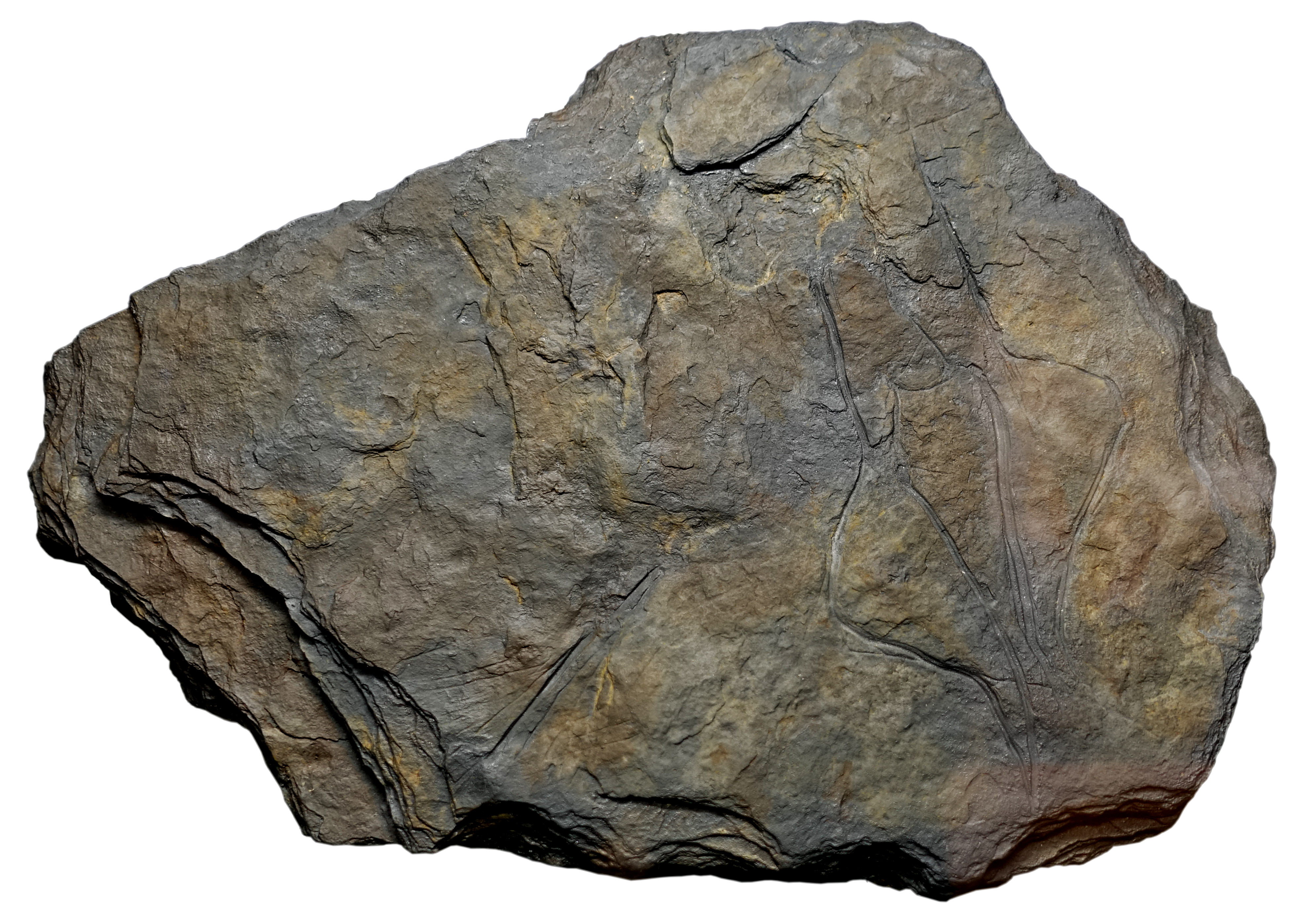
Lalinde figures, as above. The standard of some museum facsimiles, as here, is breathtaking.
Photo: Don Hitchcock 2018
Source: LWL-Museum für Archäologie Herne

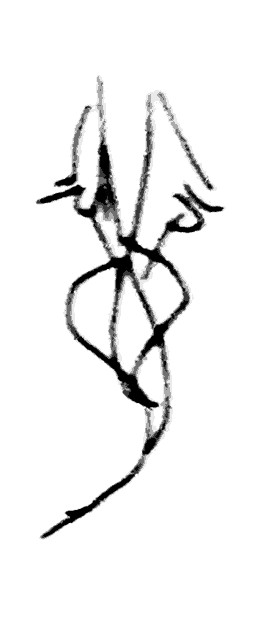
Lalinde figures from Neuwied-Gönnersdorf, Rheinland-Pfalz, 15 800 BP.
Photo: Don Hitchcock 2015, and drawing from catalog
Source: Monrepos Archäologisches Forschungszentrum und Museum, Neuwied, Germany
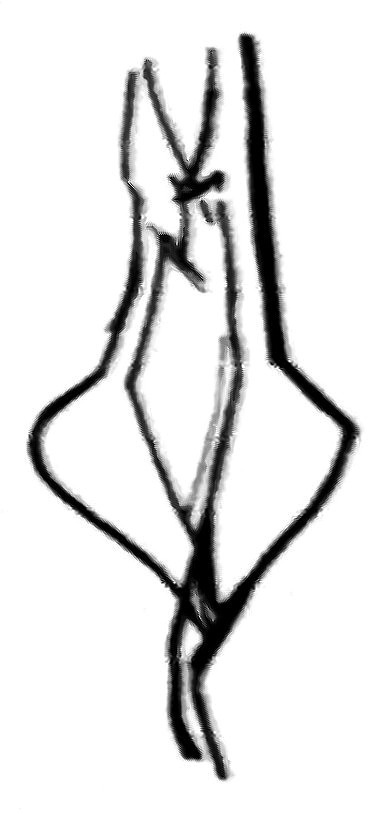
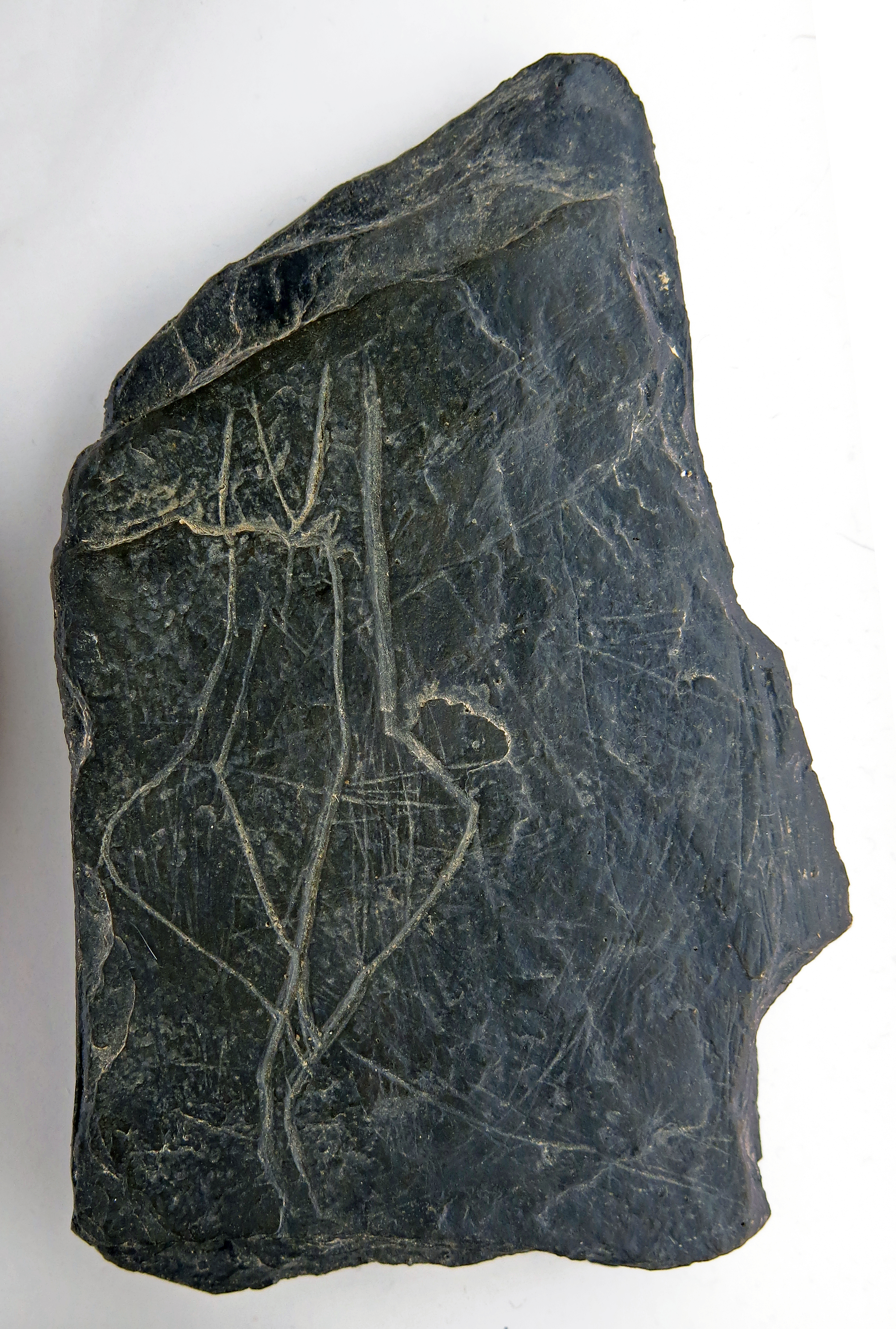
Lalinde figures from Neuwied-Gönnersdorf, Rheinland-Pfalz, 15 800 BP.
Photo: Don Hitchcock 2015, and drawing from catalog
Source: Monrepos Archäologisches Forschungszentrum und Museum, Neuwied, Germany

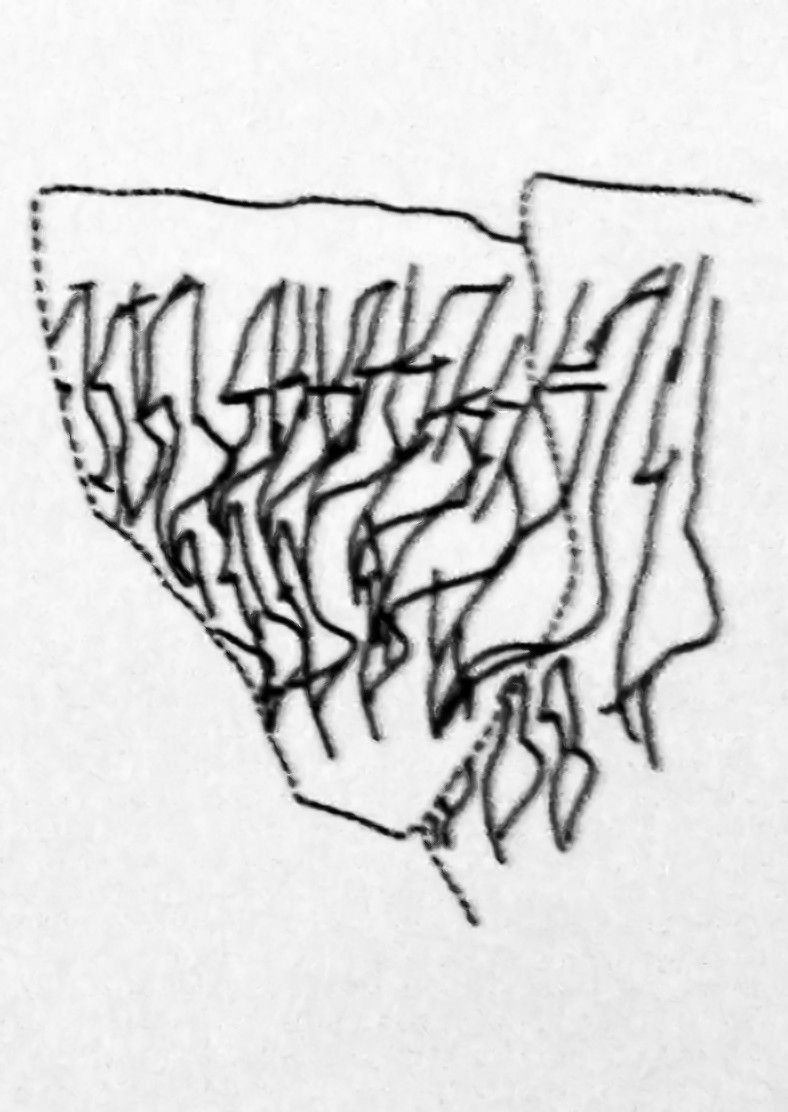

Lalinde figures from Neuwied-Gönnersdorf, Rheinland-Pfalz, 15 800 BP.
Photo: Don Hitchcock 2015, and drawing from catalog
Source: Monrepos Archäologisches Forschungszentrum und Museum, Neuwied, Germany

Lalinde figures from Gönnersdorf.
Photo: Don Hitchcock 2015
Source: Facsimile, LVR-Landesmuseum Bonn, Germany

Venus figures in the Gönnersdorf style, the left two are from Andernach, Rheinland-Pfalz, 15 800 BP.
The next three are from Neuwied-Gönnersdorf, Rheinland-Pfalz, 15 800 BP, the one on the right is from Petersfels, Baden Württemburg, circa 15 500 BP, the left most two are originals, the others are facsimiles.
The three on the left are in ivory, the next two are of reindeer antler, and the black venus on the right is of jet.
Photo: Don Hitchcock 2015
Source: Monrepos Archäologisches Forschungszentrum und Museum, Neuwied, Germany
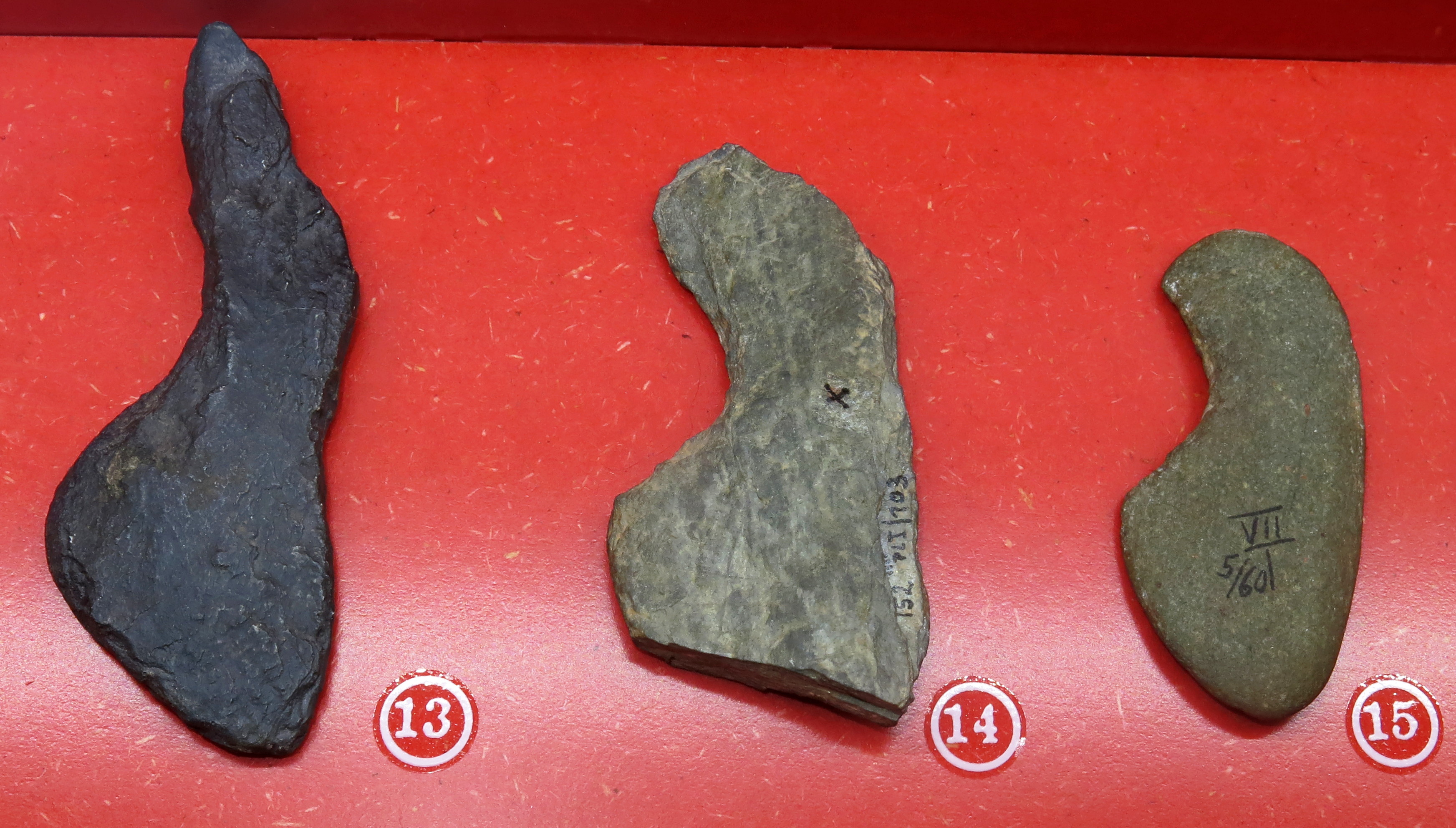
Venus figures in the Gönnersdorf style.
13 and 14 are in slate, 15 is in stone, designated river pebble on the museum card.
13 and 14 are from Neuwied-Gönnersdorf, Rheinland-Pfalz, 15 800 BP, 13 is a facsimile and 14 is an original. 15 is from Ölknitz, Thüringen, 15 500 BP and is an original.
Photo: Don Hitchcock 2015
Source: Monrepos Archäologisches Forschungszentrum und Museum, Neuwied, Germany
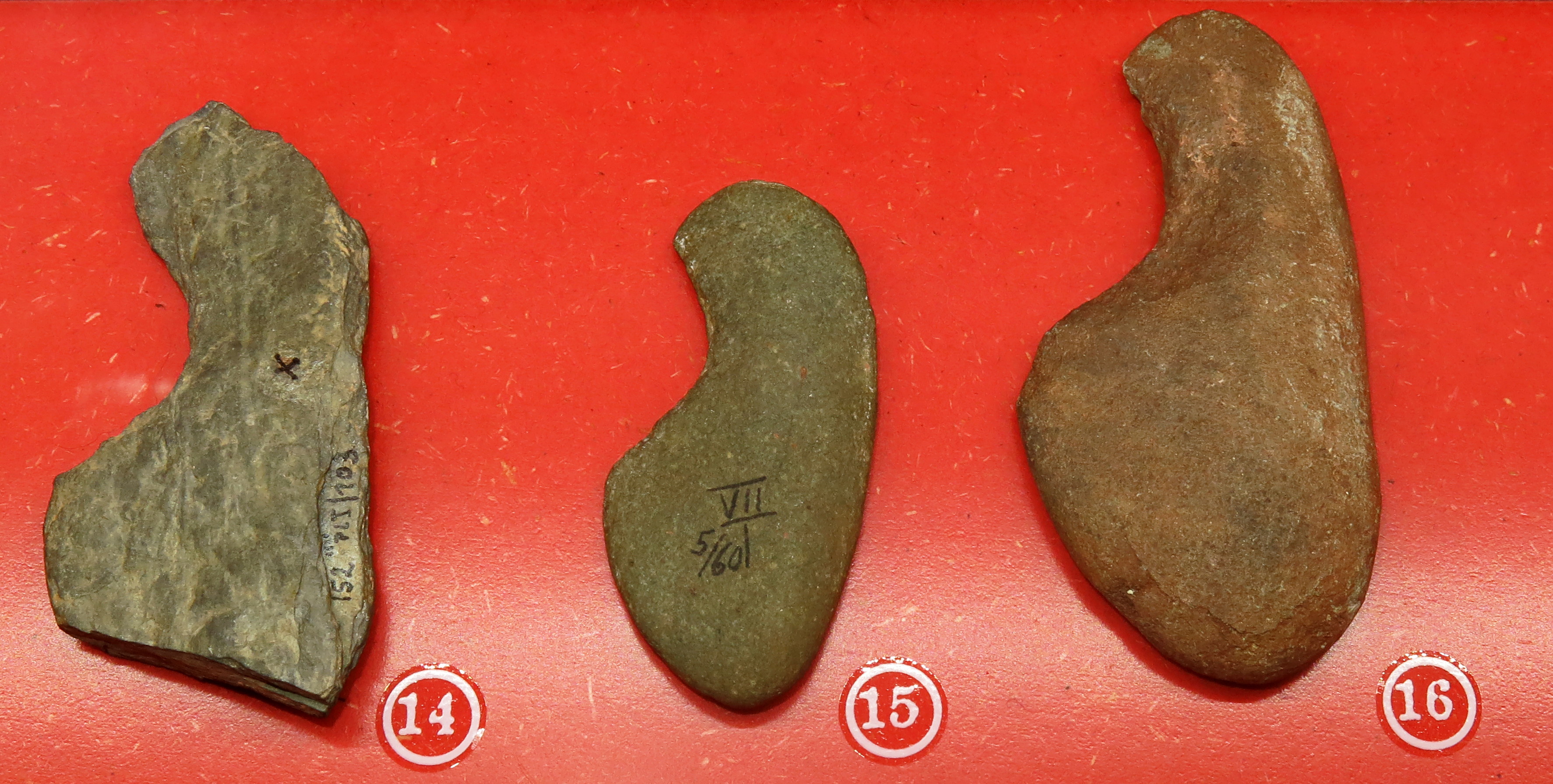
Venus figures in the Gönnersdorf style.
14 is in slate, 15 and 16 are in stone, designated river pebble on the museum card.
14 is an original from Neuwied-Gönnersdorf, Rheinland-Pfalz, 15 800 BP, 15 and 16 are from Ölknitz, Thüringen, 15 500 BP and are also originals.
Photo: Don Hitchcock 2015
Source: Monrepos Archäologisches Forschungszentrum und Museum, Neuwied, Germany
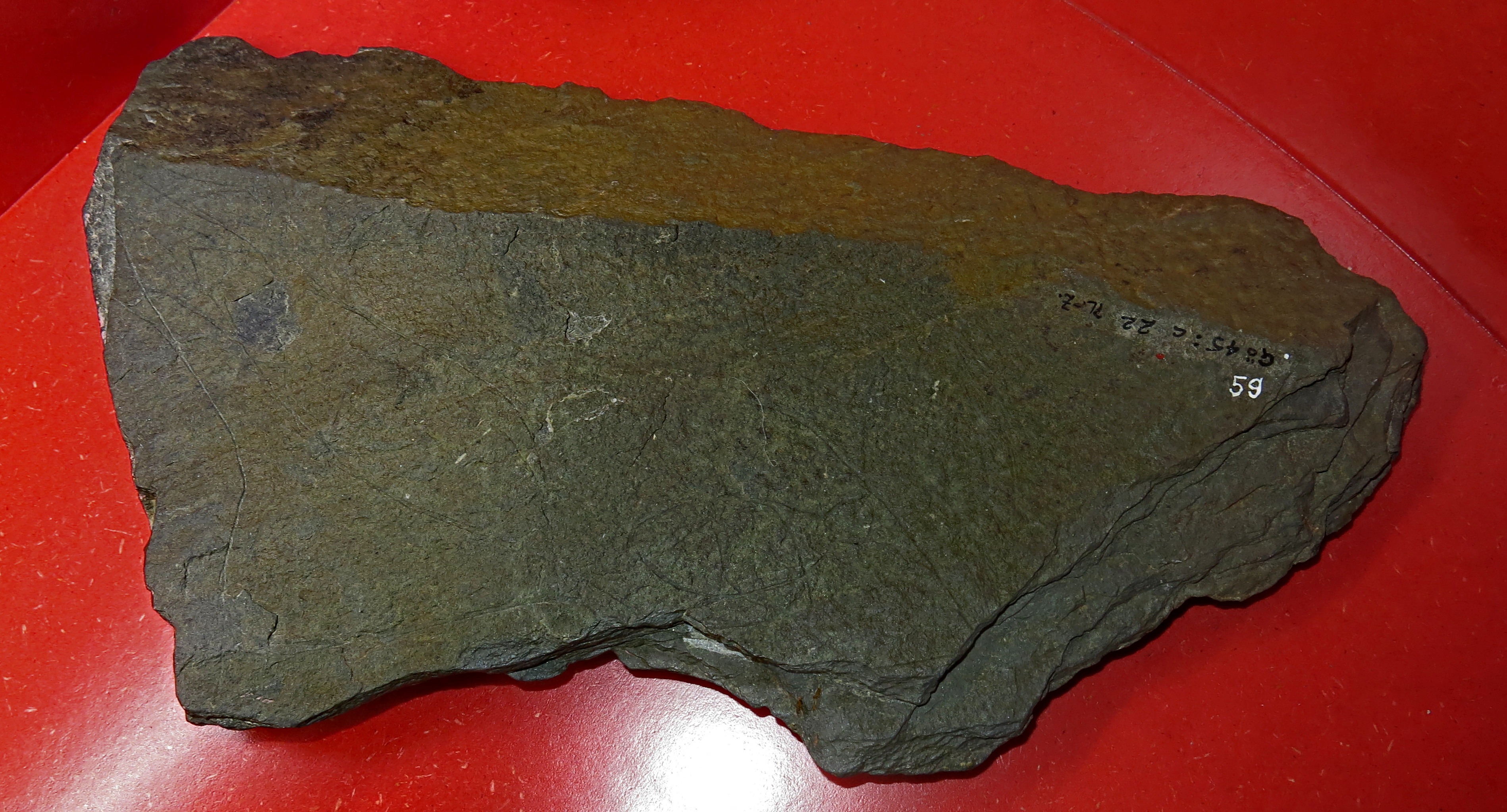
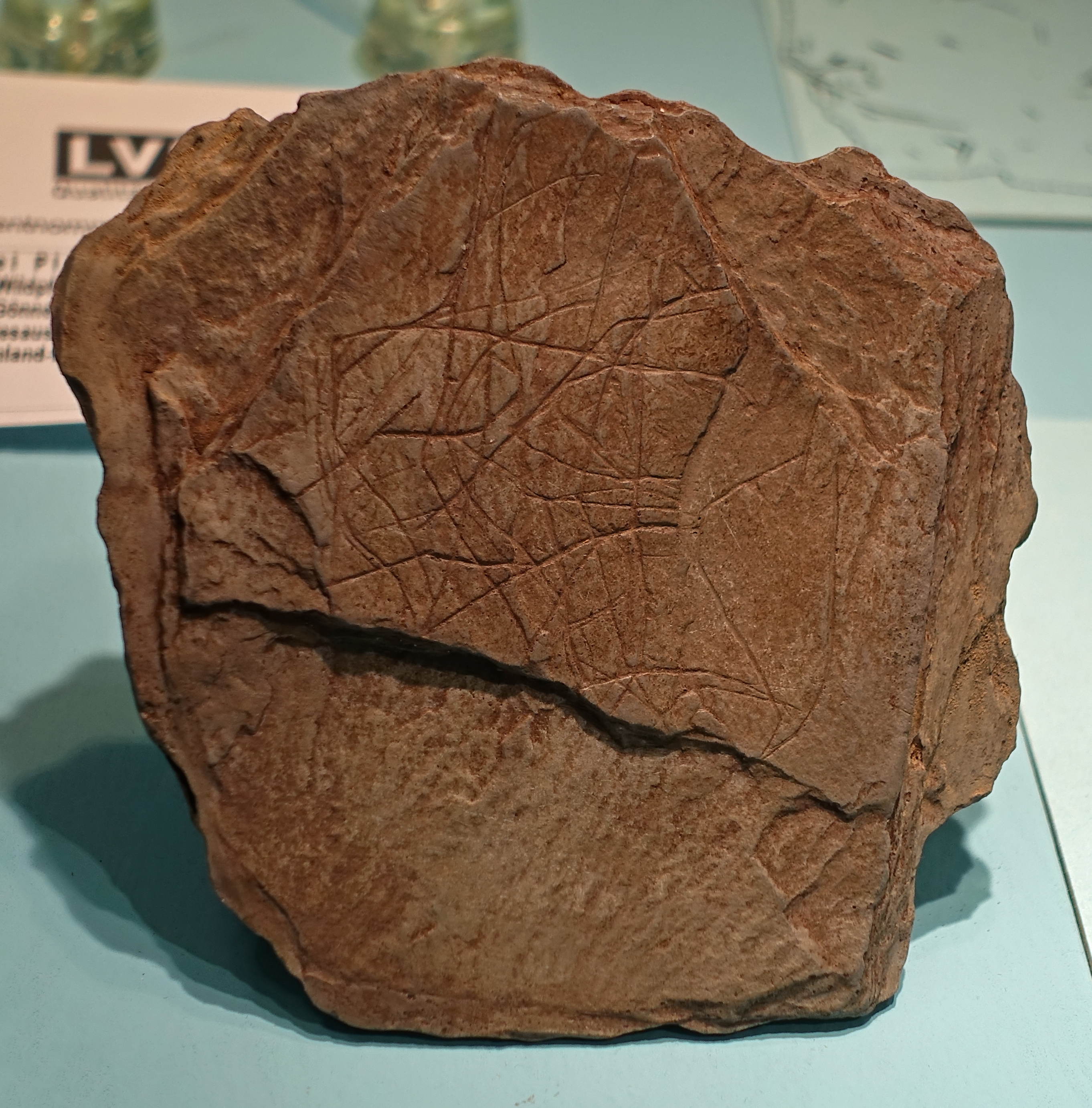
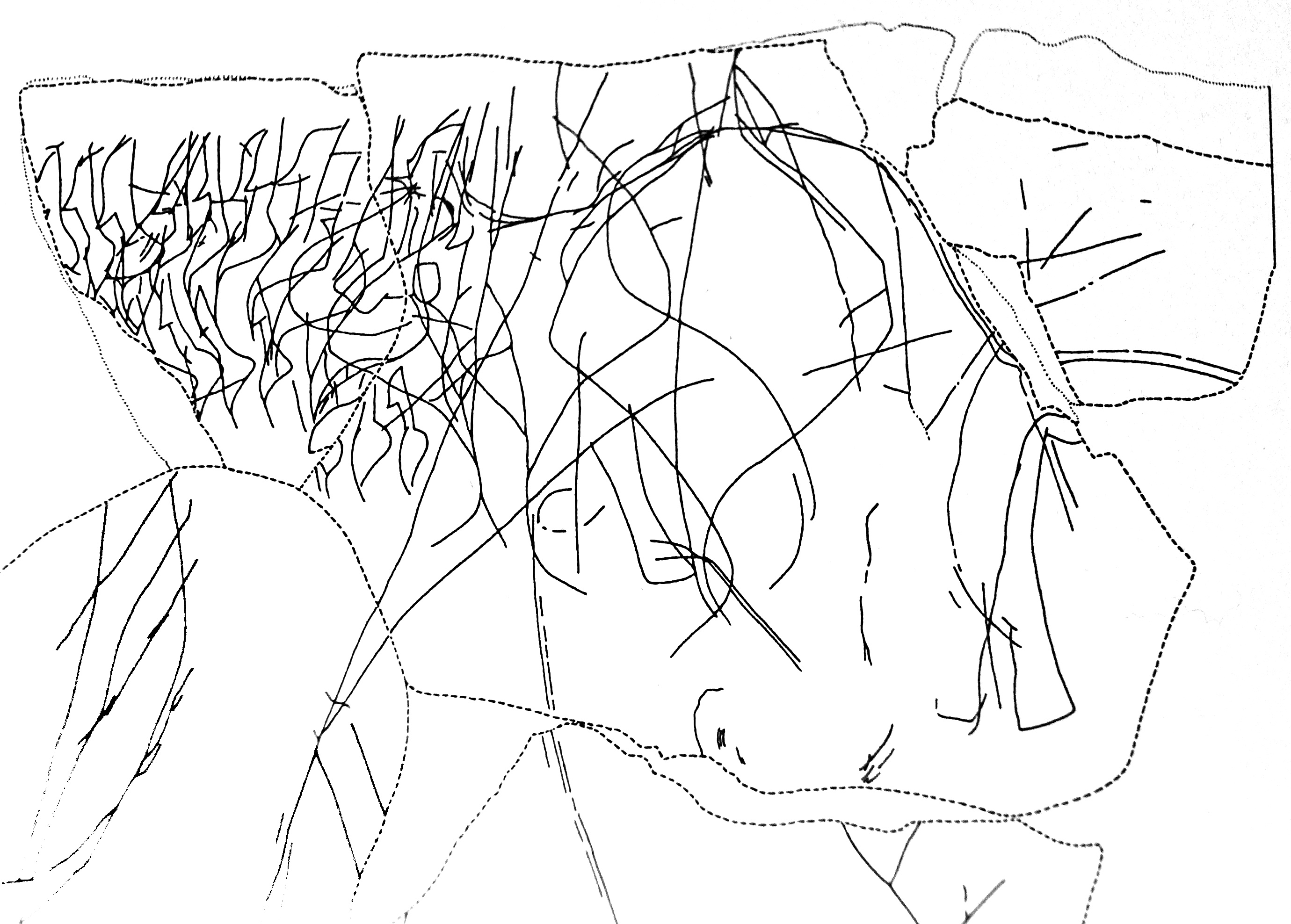
Venus figure engraved on slate, but in a more full breasted style than most.
This is an original from Neuwied-Gönnersdorf, Rheinland-Pfalz, 15 800 BP
Click on the image to see the complete block of stone.
Photo: Don Hitchcock 2015
Source: Monrepos Archäologisches Forschungszentrum und Museum, Neuwied, Germany

Venus figure engraved on slate.
This is an original from Andernach, Rheinland-Pfalz, 15 800 BP.
Photo: Don Hitchcock 2015
Source: Monrepos Archäologisches Forschungszentrum und Museum, Neuwied, Germany
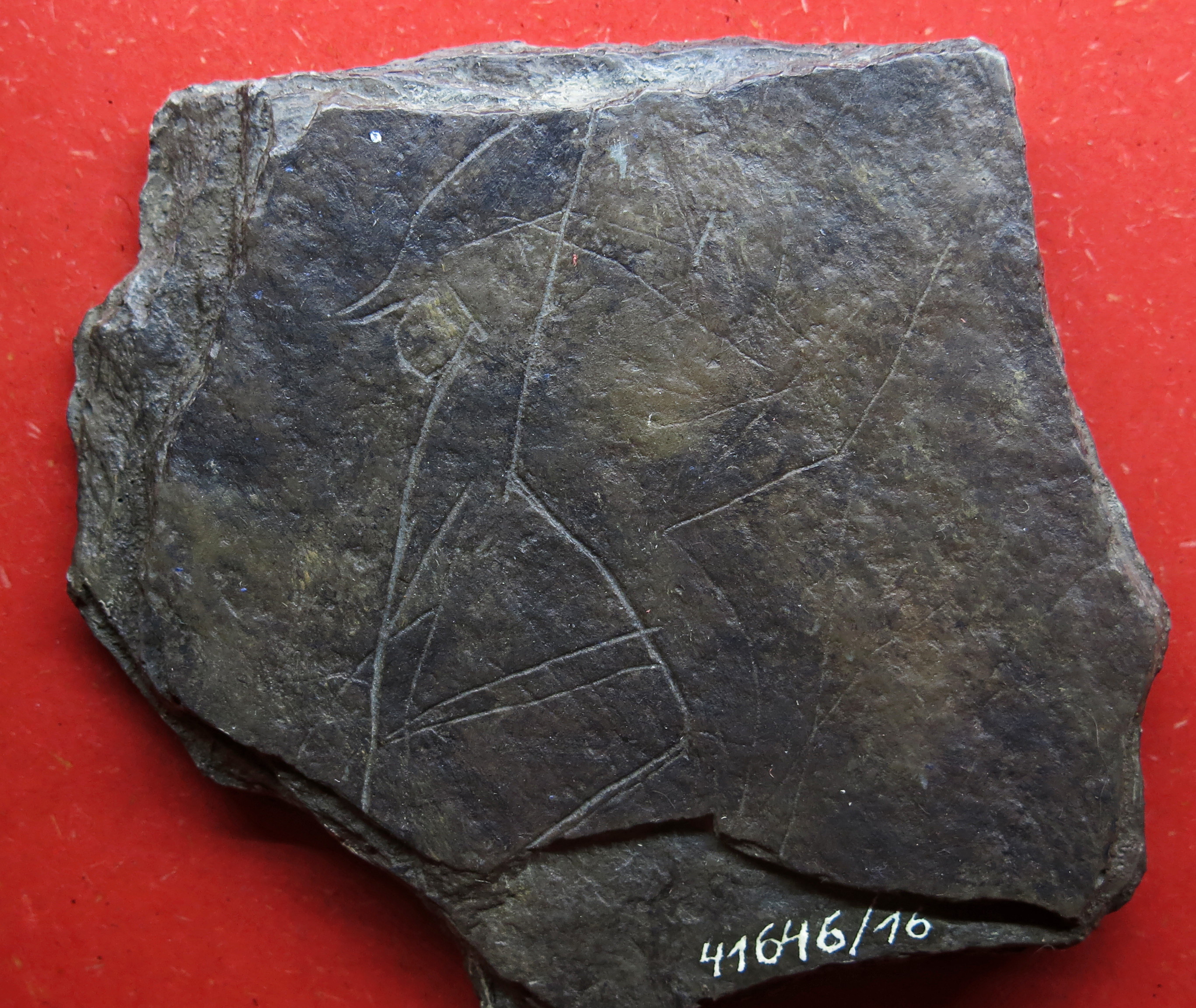

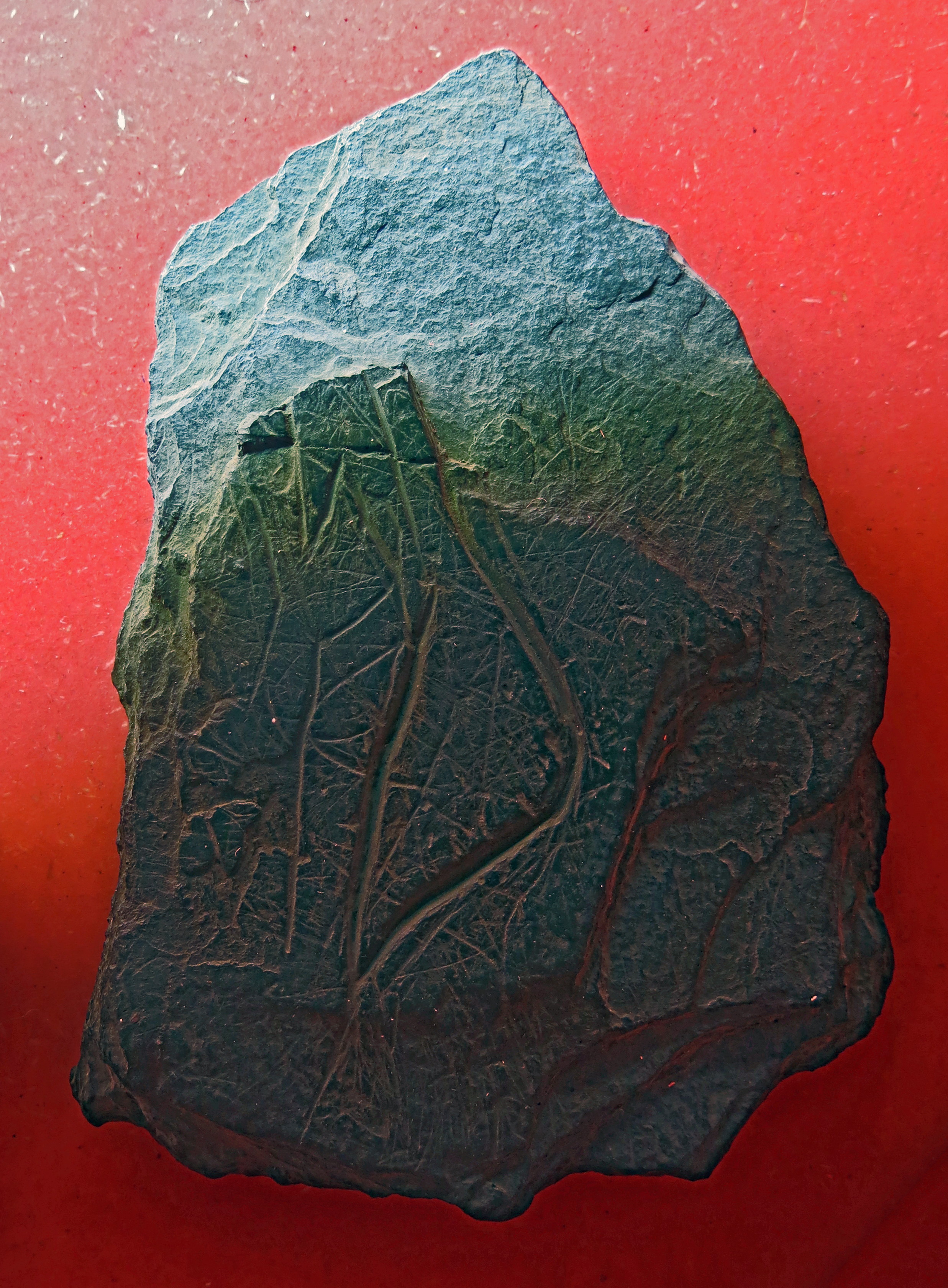
Venus figure engraved on slate.
This is a facsimile from Neuwied-Gönnersdorf, Rheinland-Pfalz, 15 800 BP.
( note that all the facsimiles in the Monrepos museum are of superb quality, and are extremely difficult to tell from the original pieces. A lot of money, expertise and artistic ability went into the creation of these superb works. The care, time, money, and effort were well worth it - Don )
Photo: Don Hitchcock 2015
Source: Monrepos Archäologisches Forschungszentrum und Museum, Neuwied, Germany
Venus figure engraved on slate.
This is an original from Andernach, Rheinland-Pfalz, 15 800 BP.
Photo: Don Hitchcock 2015
Source: Monrepos Archäologisches Forschungszentrum und Museum, Neuwied, Germany
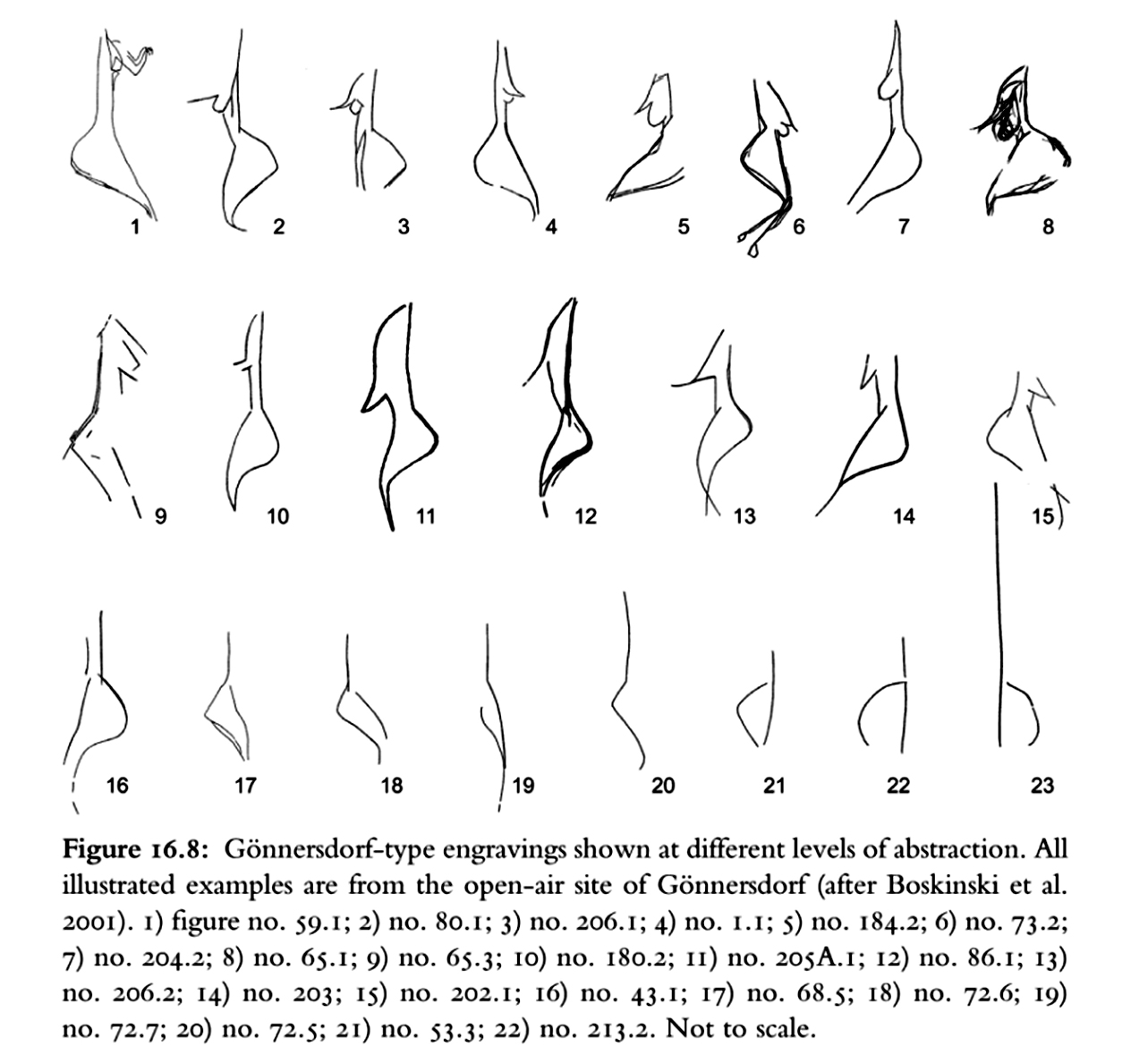
Gönnersdorf/Lalinde-type engravings shown in increasing levels of abstraction. All are from Gönnersdorf.
( Note that there is no evidence that this abstraction was related to elapsed time, so we do not know if, as time passed, the artists used an increasing level of abstraction - Don )
Photo: After Bosinski et al. (2011)
Proximal source: Mussi (2015), p 299
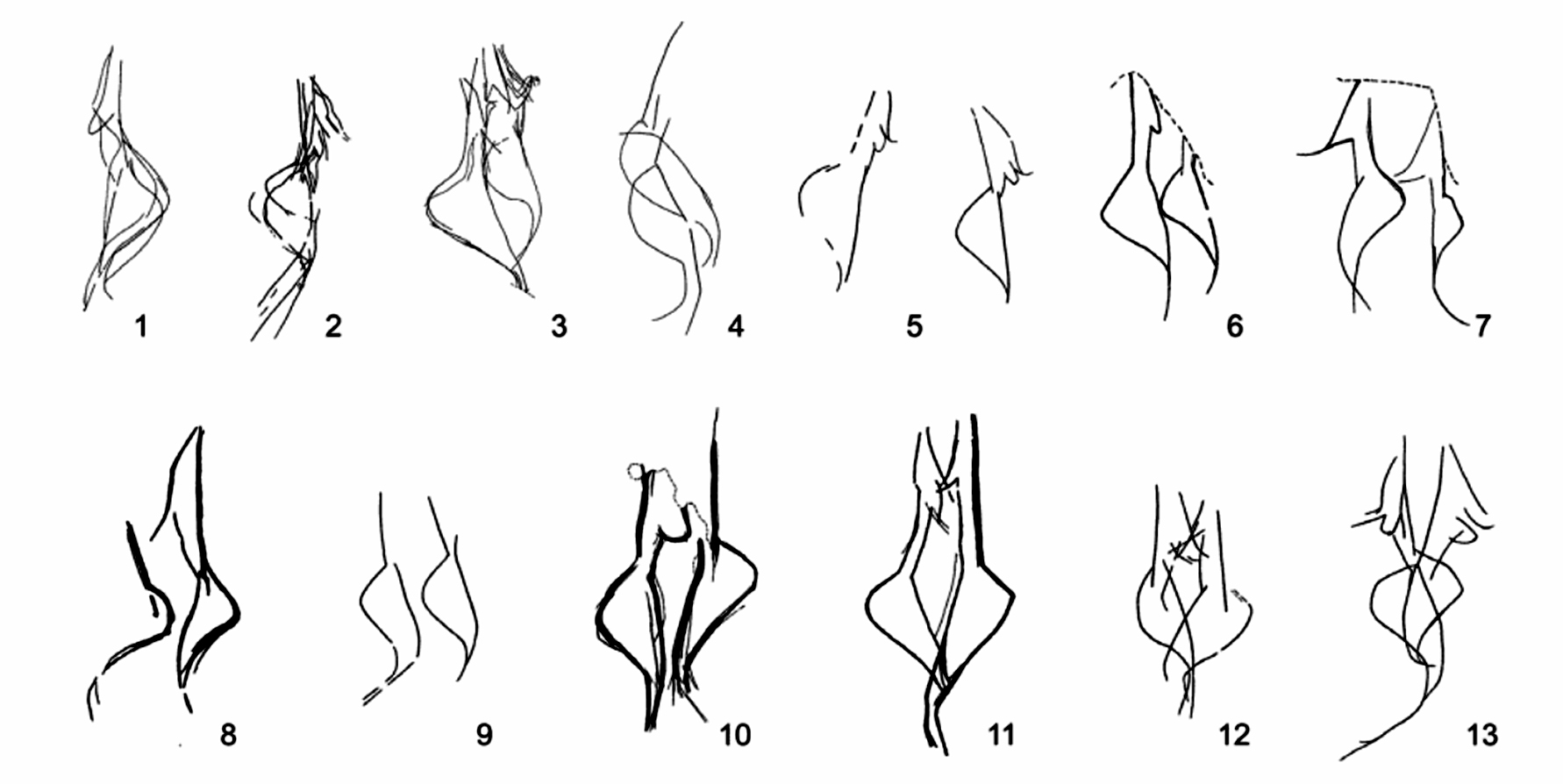
Figure 16.9: Gönnersdorf-type engravings of repeatedly-engraved figures (1-2) or couples of figures in tandem (3-9), opposed to each other (10-12) or back to back (13).
All shown examples are from the open-air site of Gonnersdorf.
1) figure no. 198; 2) no. 75; 3) no. 59; 4) no. 141; 5) no. 67; 6) no. 219; 7) 205A; 8) no. 180; 9) no. 85; 10) no. 176; 11) no. 78; 12) no. 79; 13) no. 8o. Not to scale.
Photo and text: After Bosinski et al. (2011)
Proximal source: Mussi (2015), p 300
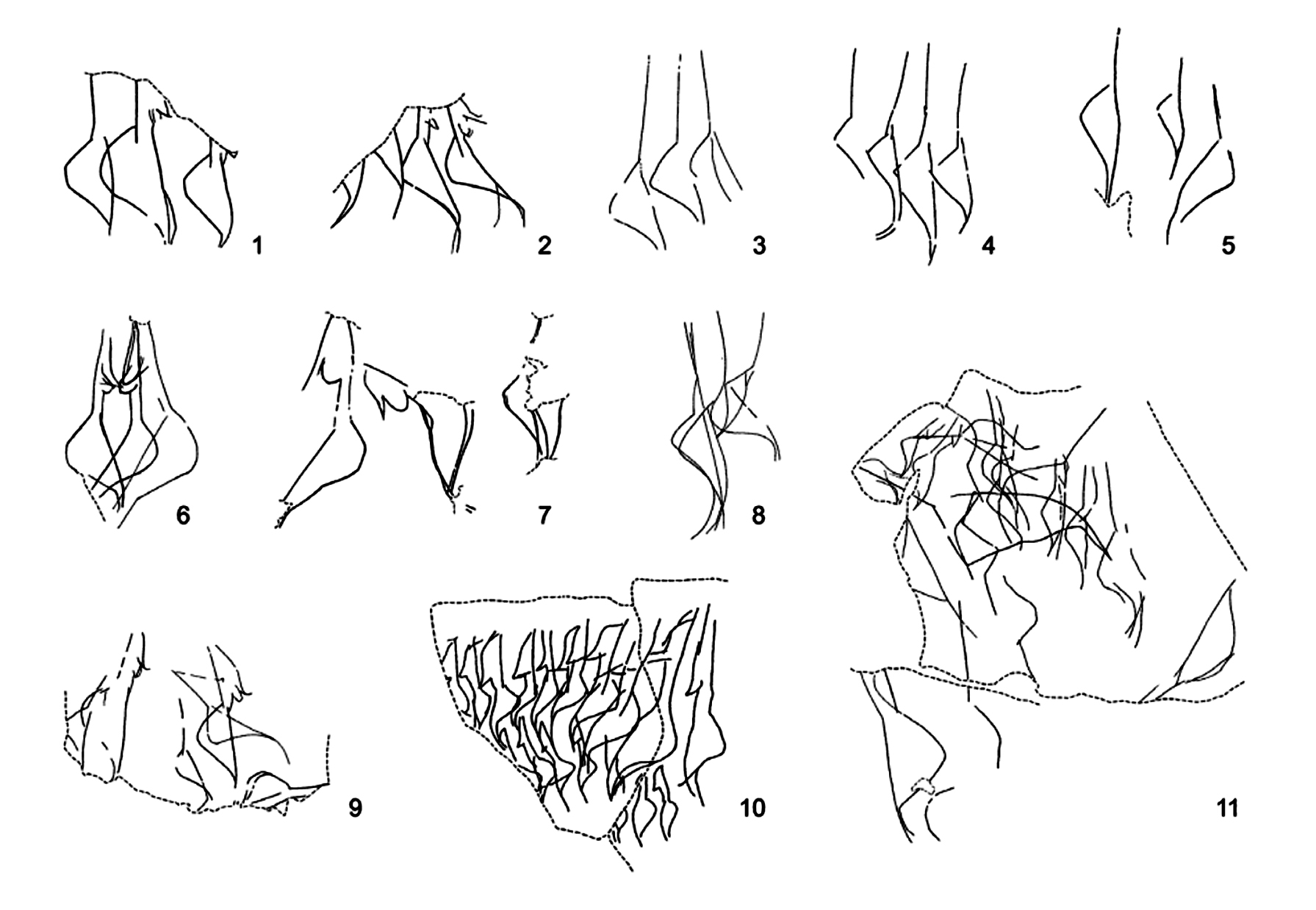
Figure 16.10: Gönnersdorf-type engravings of multiple associated figures ('groups').
1) figure no. 66.1-3; 2) no. 66.4-7; 3) no. 88.8-10; 4) no. 139.2-5; 5) no. 178.4-6; 6) no. 206.1-3; 7) no. 184.1-2.4-5; 8) no. 69.1-4; 9) no. 68b; 10) no. 67b;
11-11a) no. 65. Not to scale.
All shown examples are from the open-air site of Gonnersdorf.
Photo and text: After Bosinski et al. (2011)
Proximal source: Mussi (2015), p 300
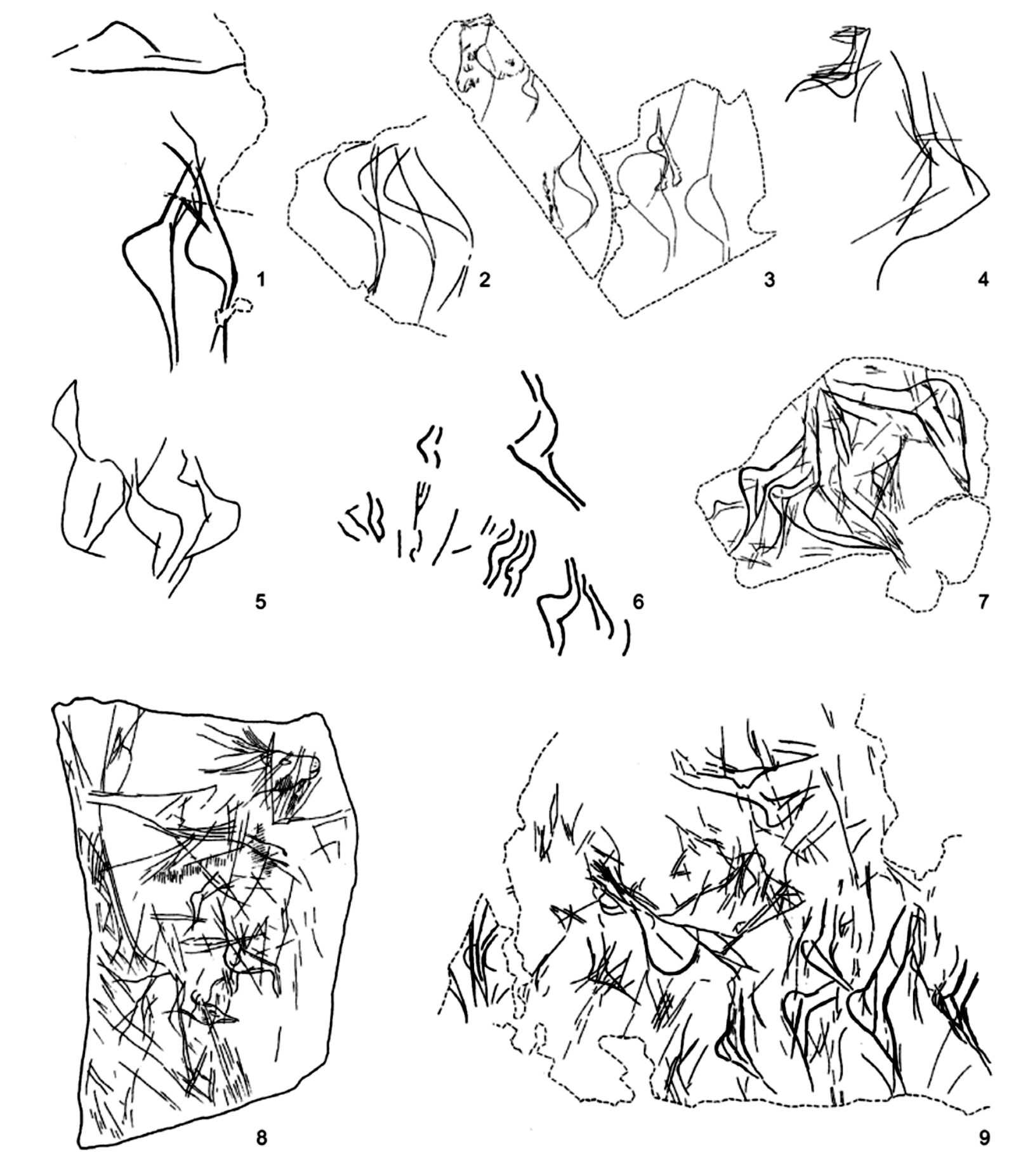
Figure 16.13: Gönnersdorf-type engravings and paintings of groups of figures.
I) Andernach, figure no. I ; 2) Andernach, figure no. 4; 3) Hohlenstein, Ederheim (engraved plaquette); 4) Fontalès (engraved plaquette);
5) Grotte Carriot (parietal engraving); 6) Combarelles (parietal engraving:
Panneau 67); 7) Grotte de Fronsac (parietal engraving); 8-9) Lalinde (engraved plaquettes:
8 Chicago; 9 Les Eyziies). Not to scale.
Photo and text: After Bosinski et al. (2011)
Proximal source: Mussi (2015), p 302
Personal Opinion
I have thought for a long time that the Gönnersdorf/Lalinde tradition was spread as the result of a proto-religious cult or at least cultural meme, in many ways similar to the much later Christian symbols of the cross and the alpha or fish symbol.
The Gönnersdorf/Lalinde tradition then evolved into the widespread claviform (club shaped) symbol. It was usually reoriented so that what had been the buttocks of the female form became the breasts:
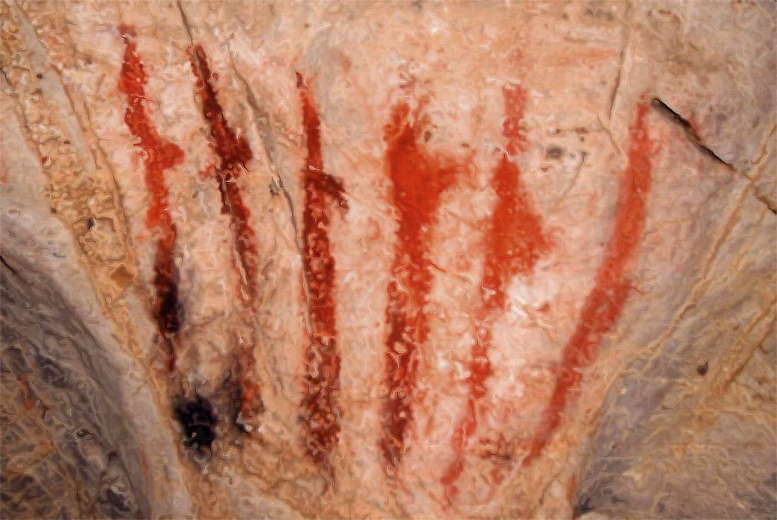
Claviform (club or key shaped) signs in Cueva del Pindal.
Cueva del Pindal is situated near the town of Pimiango near the border of Cantabria.
These signs occur in many painted caves in France and Spain.
Photo: http://www.asturnatura.com/turismo/cueva-del-pindal/1156.html
That it then lost its original meaning of the human female form is attested by the randomness of its orientation, and the codification into a couple of easily made strokes, is typified in this image:

This horse from La Grotte des Trois-Frères is engraved with a number of claviform (club) symbols.
Photo and text: Sieveking et al. (1962)
The quick and widespread use of the symbols was almost certainly aided by territorial disputes and wars. Such interactions are very normal in the hunter gatherer societies of modern times, certainly including Australian First Nations peoples. The borders of your territory are only what you say they are, and are willing and able to defend. Inter tribal warfare was very common.
When anthropologists investigated the fishing territories in the Gulf of Carpentaria, they found that the well understood boundaries (defined by lining up points on the land) followed underwater flooded stream beds, high points, and ridges, the boundaries twelve thousand years ago, when the Sahel shelf between Australia and New Guinea was dry land because of the lower sea levels of the last ice age.
Another mechanism is cultural trading - again this is evidenced from the spread of such things in Australian First Nations people of large and beautifully crafted 'Kimberley' spear points which are often too big and have had too much time spent on their making to be used in daily life, or indeed to form any real utilitarian purpose, as status objects. In addition dances were traded between neighbouring tribes, and it took only a couple of years for one such corroboree dance to spread from northern Australia to the south, a distance of more than 3000 km.
Another example of 'trading' is what has become known as 'ochre wars', see Moren (2024) below:
Every July and August, for possibly thousands of years, 70 or 80 of the strongest men from the Diyari tribe walked several hundred kilometers, 30km per day from their native home in the Lake Eyre region to Parachilna north of Flinders Ranges [more than 320 km total [Mulvaney]. The men were heavily armed on their journey to collect the highly valued and sacred red-gold pigment. The Diyari were the exclusive owners of the secret location and the techniques to extract some of the best ochre on the continent. It’s said the pigment had a shimmery and creamy texture, even iridescent, and was savored for the most sacred rituals. The men ground the red rock into a powder, and then used water or urine as a binder for cakes, and wrapped it in grass and human hair. Each man carried the 20-35 kilos worth of bricks back to Lake Eyre where the entire tribe survived on trading the ochre for the rest of the year.
- Don
The late glacial open-air sites of Gönnersdorf and Andernach-Martinsberg in the German Central Rhineland are well known for their Magdalenian occupation and activities. The latter site also produced evidence for a younger, Final Palaeolithic occupation of the locality by people of the Federmessergruppen.
Both sites are particularly well preserved, largely due to their burial beneath volcanic deposits of the late glacial Laacher See eruption.
The Andernach-Martinsberg site and excavations were rediscovered in the early 1980s.
Photo and text: Stevens et al. (2009)
Probability distribution of calibrated radiocarbon dates from Gönnersdorf plotted against the oxygen isotope record from the GISP2 Greenland ice core.
Methodologically acceptable dates only.
* denotes AMS dates conducted for this study.
Photo and text: Stevens et al. (2009)

Ivory Lalinde - Gönnersdorf figure from Andernach, Germany.
Length 200 mm, breadth 94 mm.
Photo and text: Müller-Beck et al. (1987)
Source: Landesamt für Denkmalpflege, Koblenz
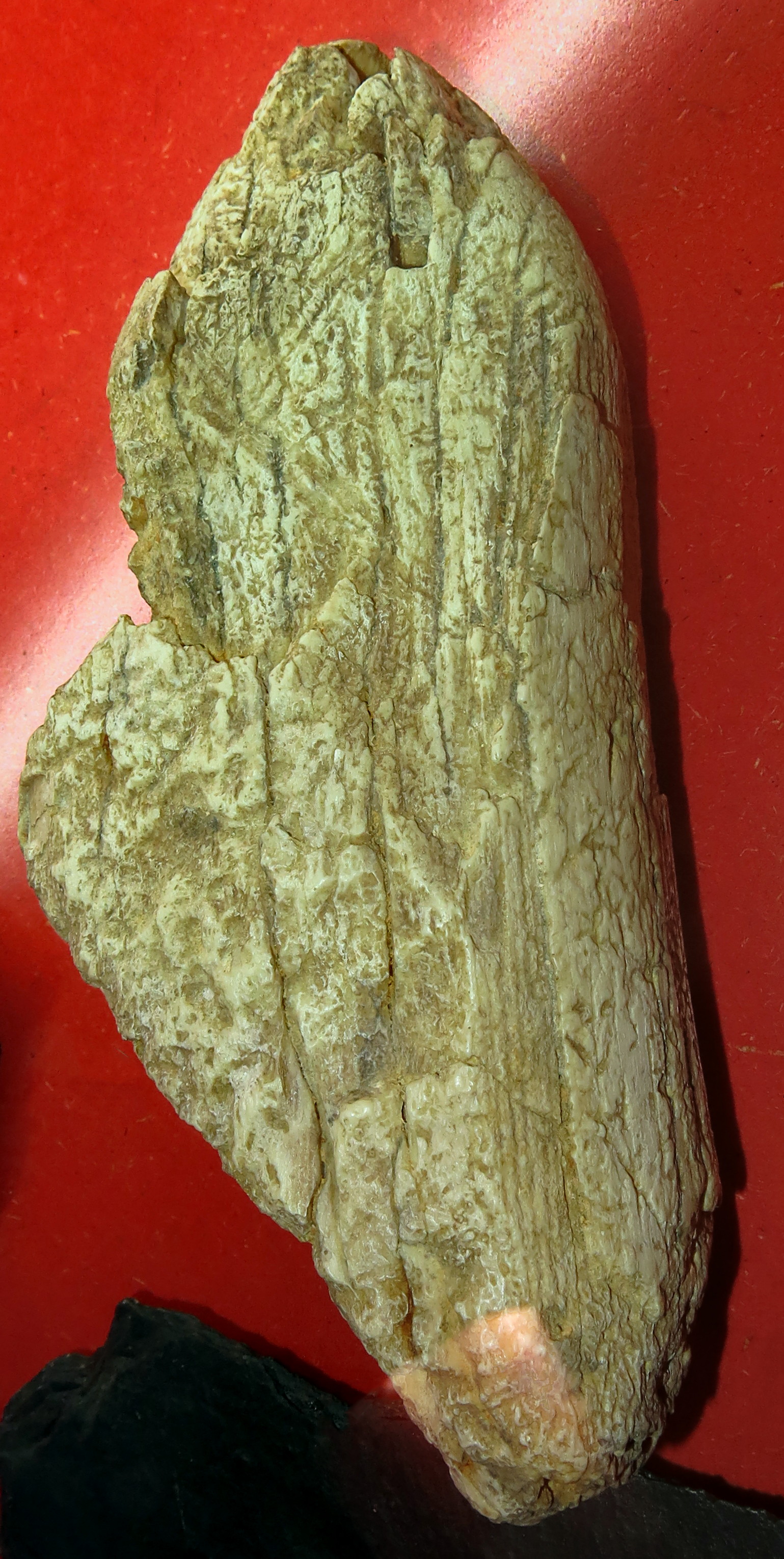
Venus Figurine.
Facsimile, originally in ivory, from Andernach, Rheinland-Pfalz, 15 800 BP.
Photo: Don Hitchcock 2015
Source: Monrepos Archäologisches Forschungszentrum und Museum, Neuwied, Germany
The following are from a display in LVR-LandesMuseum Bonn.
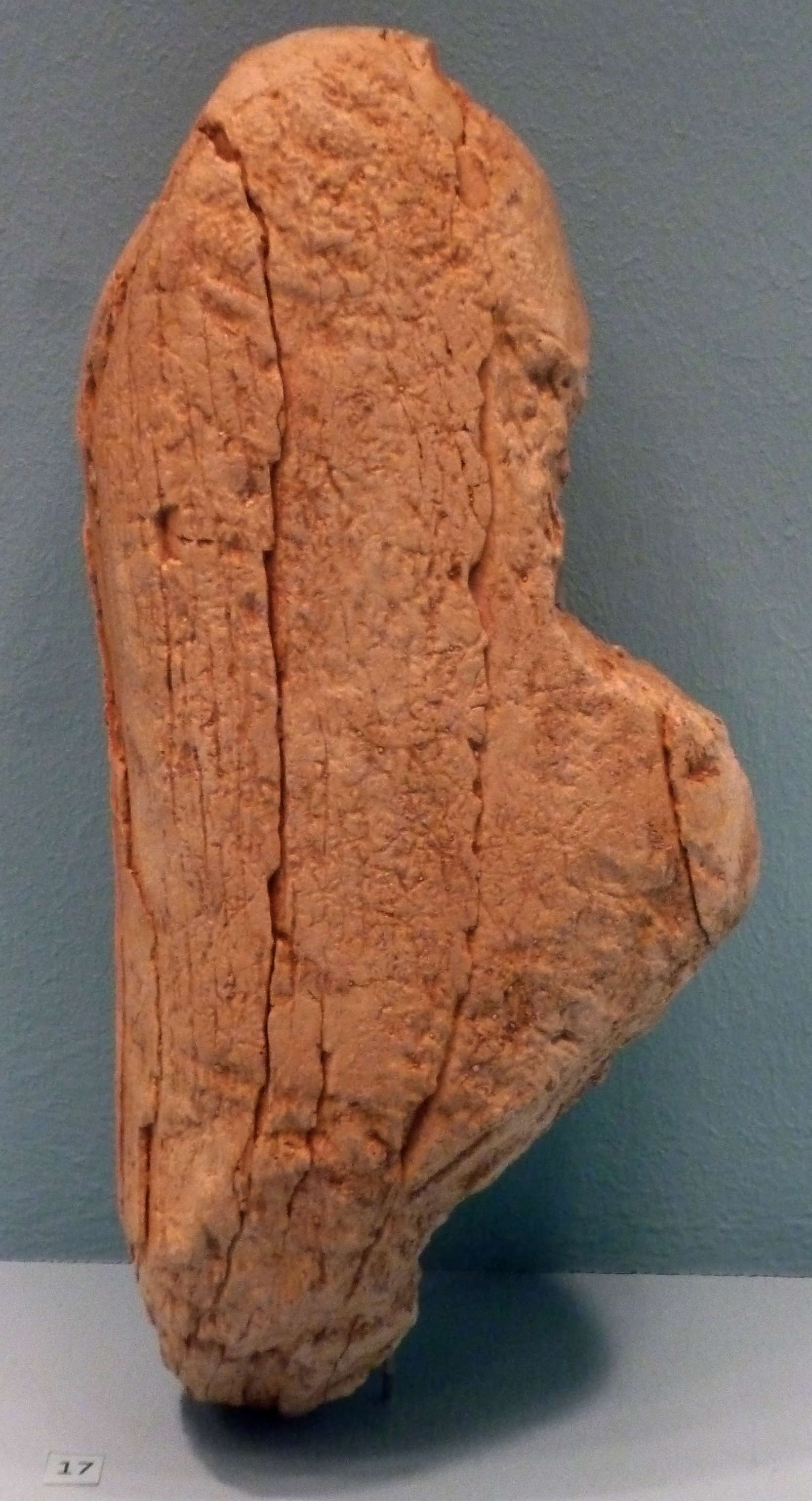
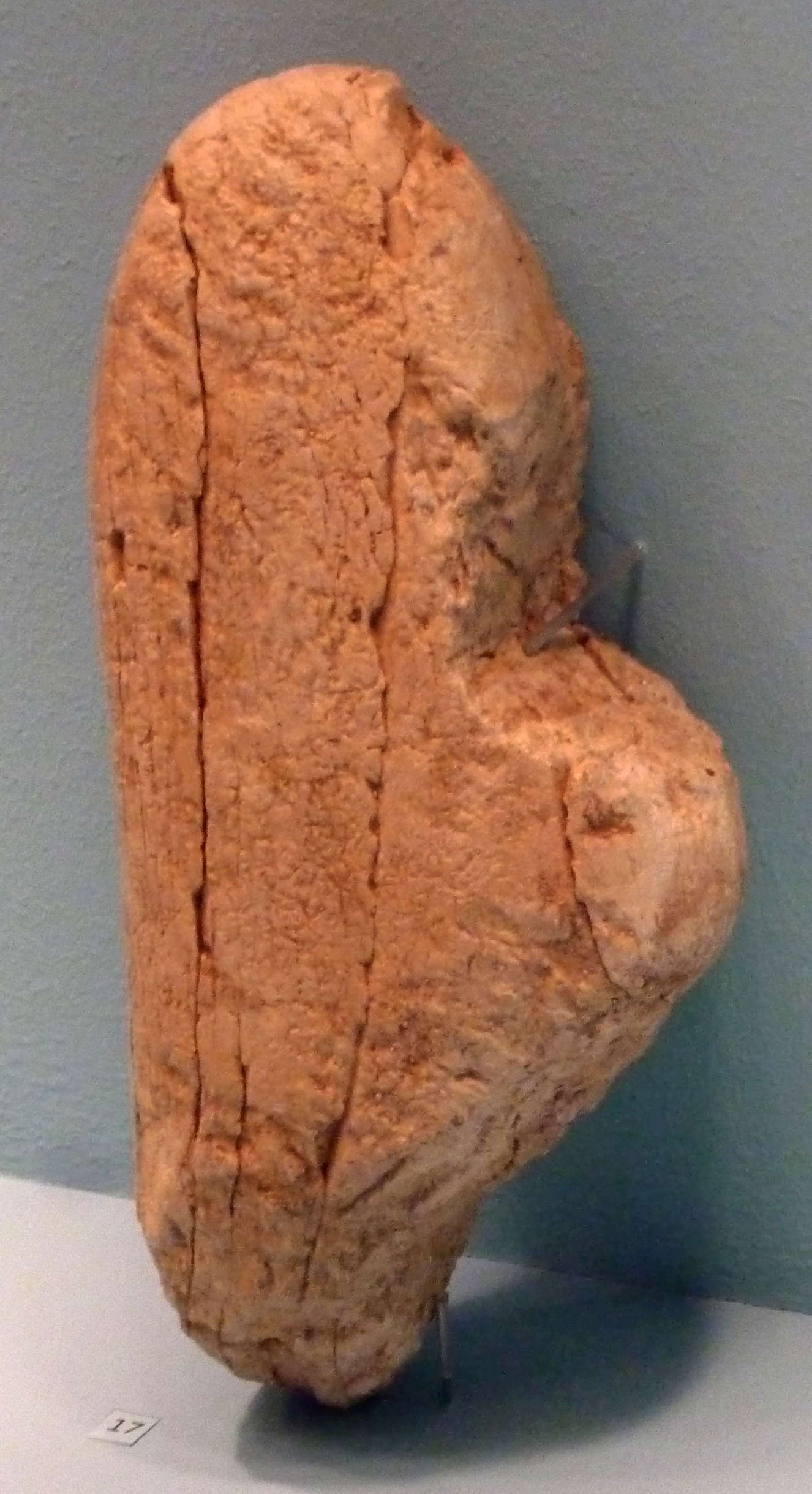
17 Female figure in ivory, Andernach, Kreis Mayen-Koblenz, copy.
This venus is from the Magdalenian, 15 000 BP, and shows a female figure in a very stylised form.
( this appears to be either the obverse view of the ivory piece in the photograph above on this page, or one very similar - Don )
Source: Display at LVR-LandesMuseum Bonn
Lender of the piece: Directorate General for Cultural Heritage Rhineland-Palatinate, Generaldirektion Kulturelles Erbe Rheinland-Pfalz.

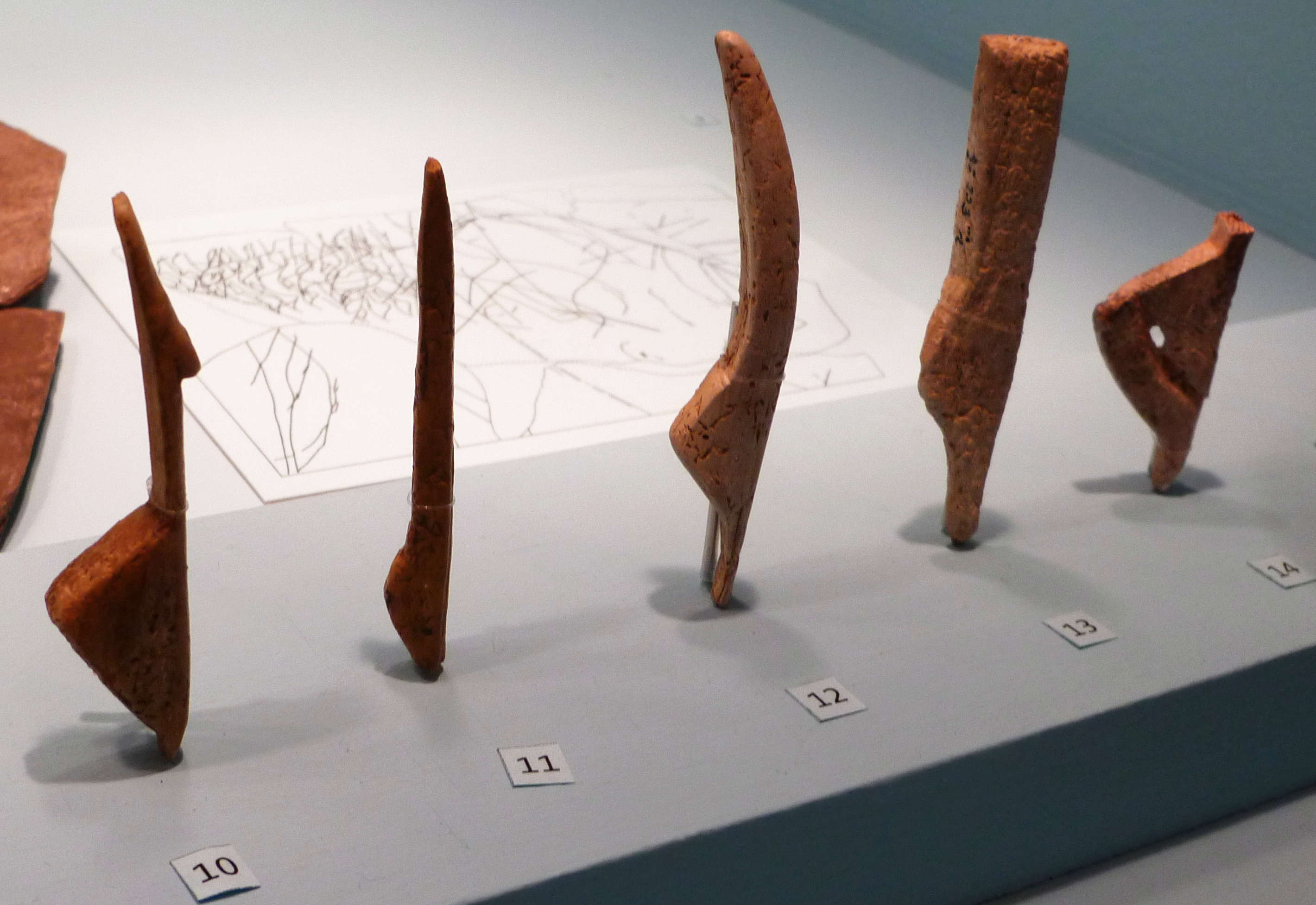
10 Female figure in bone, Gönnersdorf, Stadt Neuwied, copy.
11 Female figure in antler, Gönnersdorf, Stadt Neuwied, copy.
12 Female figure in ivory, Gönnersdorf, Stadt Neuwied, copy.
13 Female figure, incomplete, in bone/antler, Gönnersdorf, Stadt Neuwied.
14 Female figure, incomplete, in bone/antler, Andernach, Kreis Mayen-Koblenz.
From the Magdalenian, 15 000 BP, female figures in a very stylised form.
Source: Display at LVR-LandesMuseum Bonn
Lender of the piece: Directorate General for Cultural Heritage Rhineland-Palatinate, Generaldirektion Kulturelles Erbe Rheinland-Pfalz.
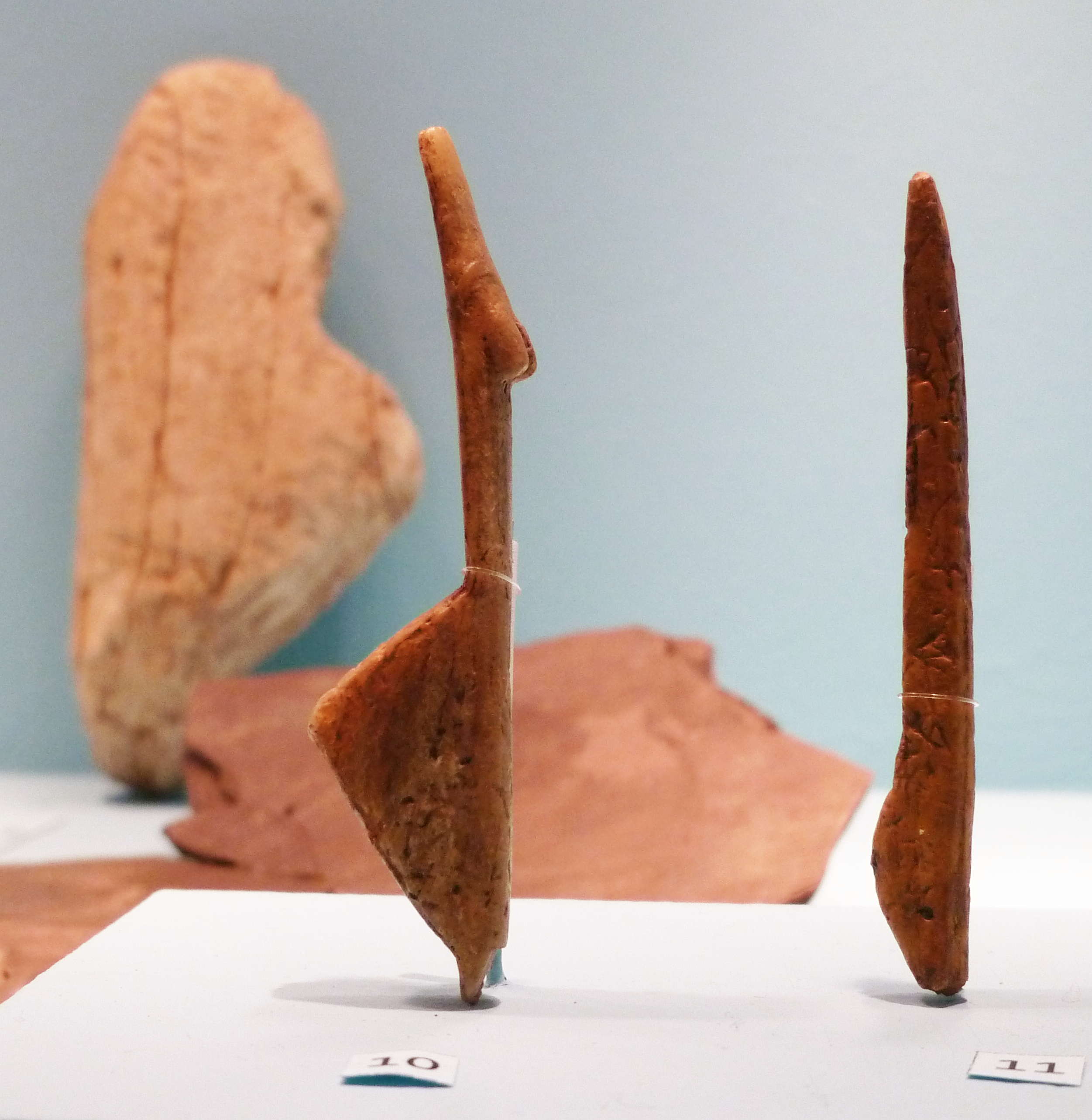
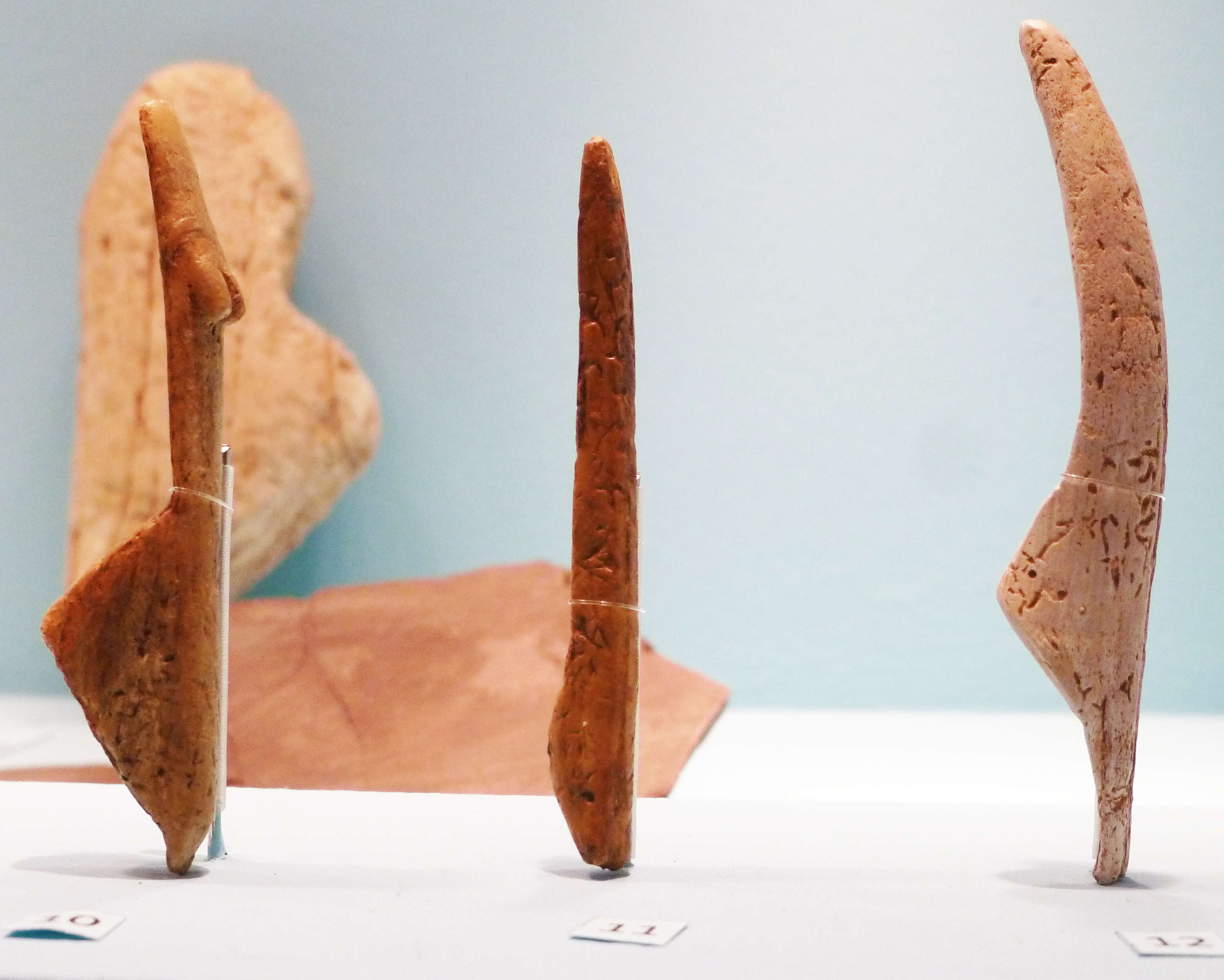
10 Female figure in bone, Gönnersdorf, Stadt Neuwied, copy.
11 Female figure in antler, Gönnersdorf, Stadt Neuwied, copy.
12 Female figure in ivory, Gönnersdorf, Stadt Neuwied, copy.
From the Magdalenian, 15 000 BP, female figures in a very stylised form.
Source: Display at LVR-LandesMuseum Bonn
Lender of the piece: Directorate General for Cultural Heritage Rhineland-Palatinate, Generaldirektion Kulturelles Erbe Rheinland-Pfalz.
From Gönnersdorf.
Ivory statuette.
On the rod-shaped upper body are two breasts.
Height 71 mm, breadth 160mm.
Photo and text: Müller-Beck et al. (1987)
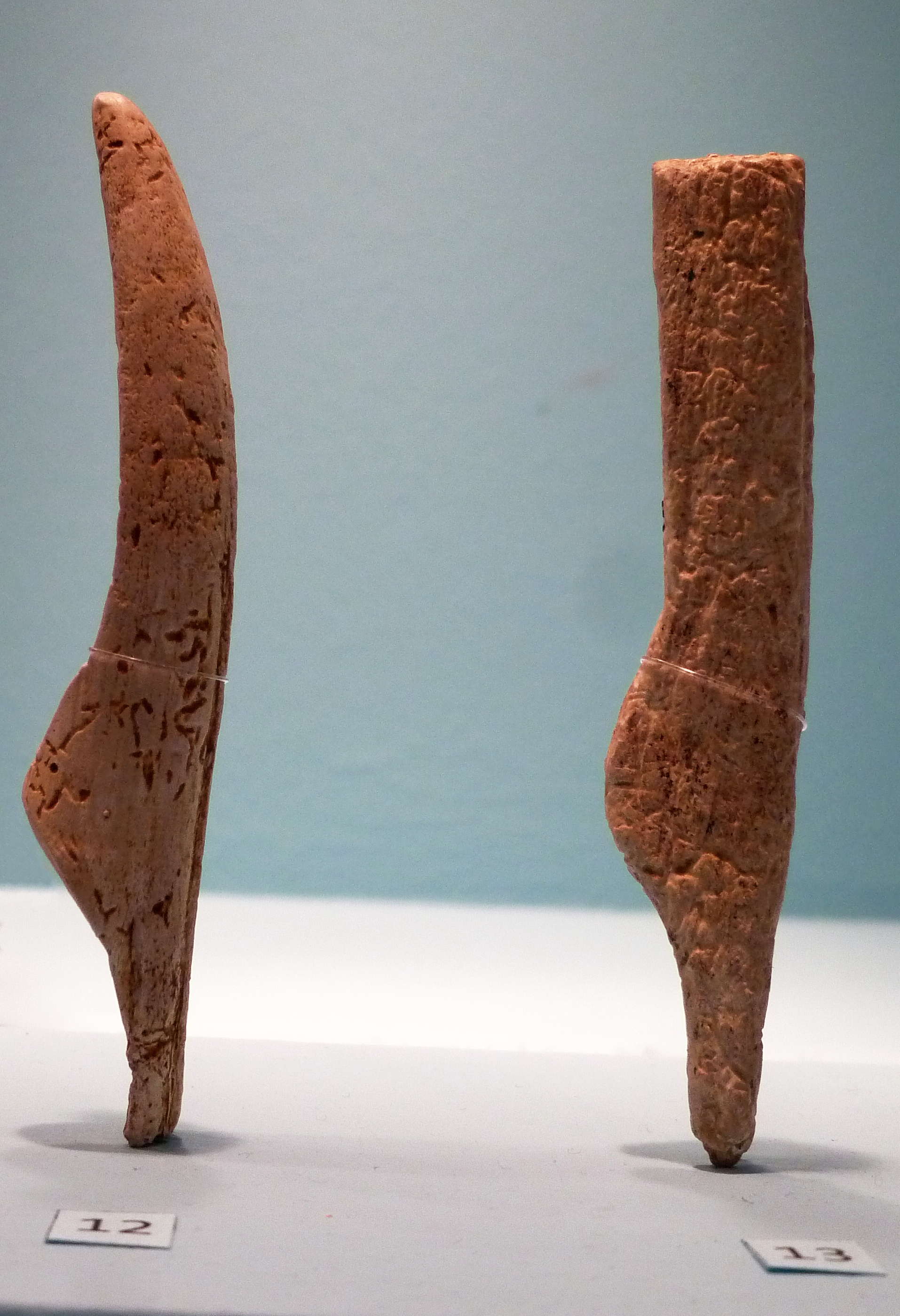
12 Female figure in ivory, Gönnersdorf, Stadt Neuwied, copy.
13 Female figure, incomplete, in bone/antler, Gönnersdorf, Stadt Neuwied.
From the Magdalenian, 15 000 BP, female figures in a very stylised form.
Source: Display at LVR-LandesMuseum Bonn
Lender of the piece: Directorate General for Cultural Heritage Rhineland-Palatinate, Generaldirektion Kulturelles Erbe Rheinland-Pfalz.
From Gönnersdorf.
Statuette produced from the tip of an antler. The antler is almost untouched in the upper part.
Height 87 mm, width 15 mm.
Photo and text: Müller-Beck et al. (1987)
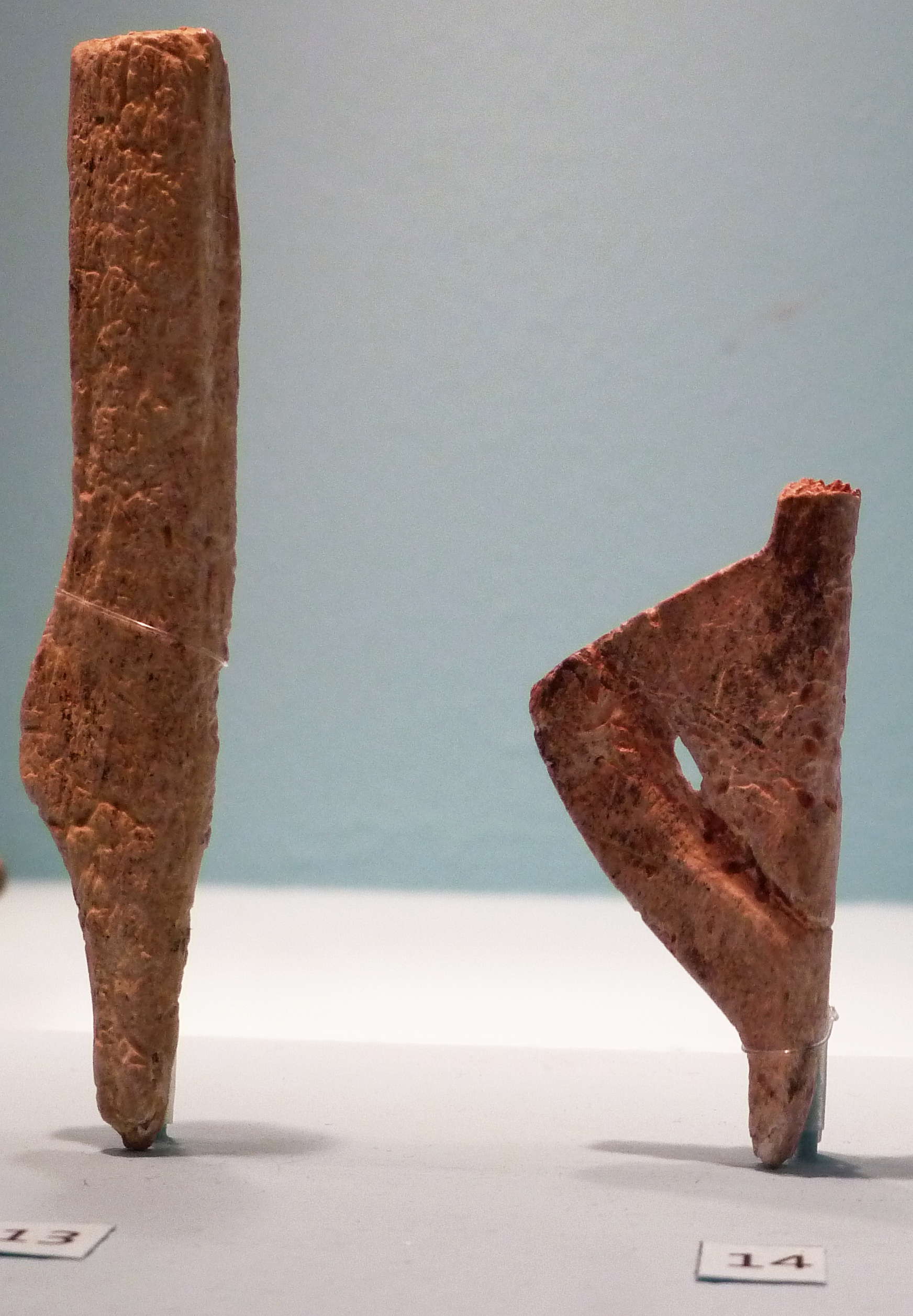
13 Female figure, incomplete, in bone/antler, Gönnersdorf, Stadt Neuwied.
14 Female figure, incomplete, in bone/antler, Andernach, Kreis Mayen-Koblenz.
From the Magdalenian, 15 000 BP, female figures in a very stylised form.
Source: Display at LVR-LandesMuseum Bonn
Lender of the piece: Directorate General for Cultural Heritage Rhineland-Palatinate, Generaldirektion Kulturelles Erbe Rheinland-Pfalz.
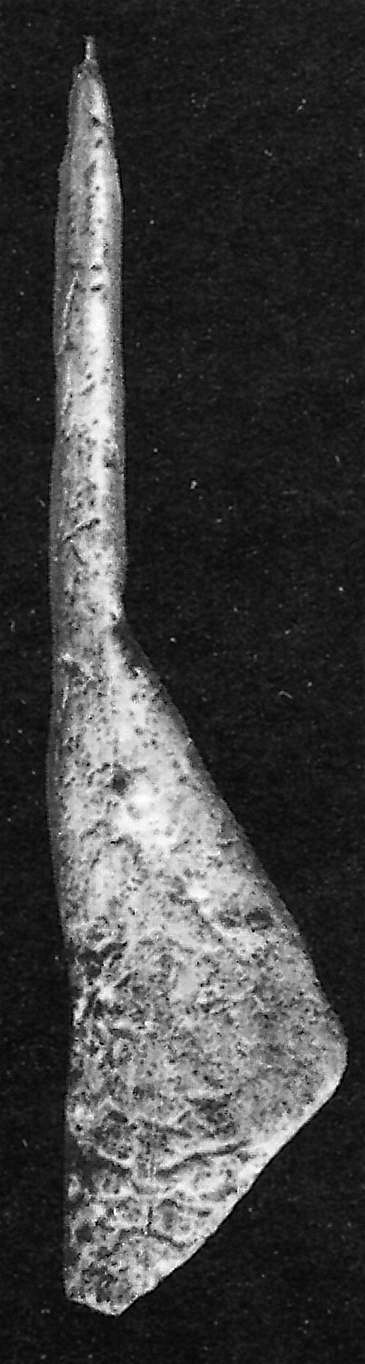
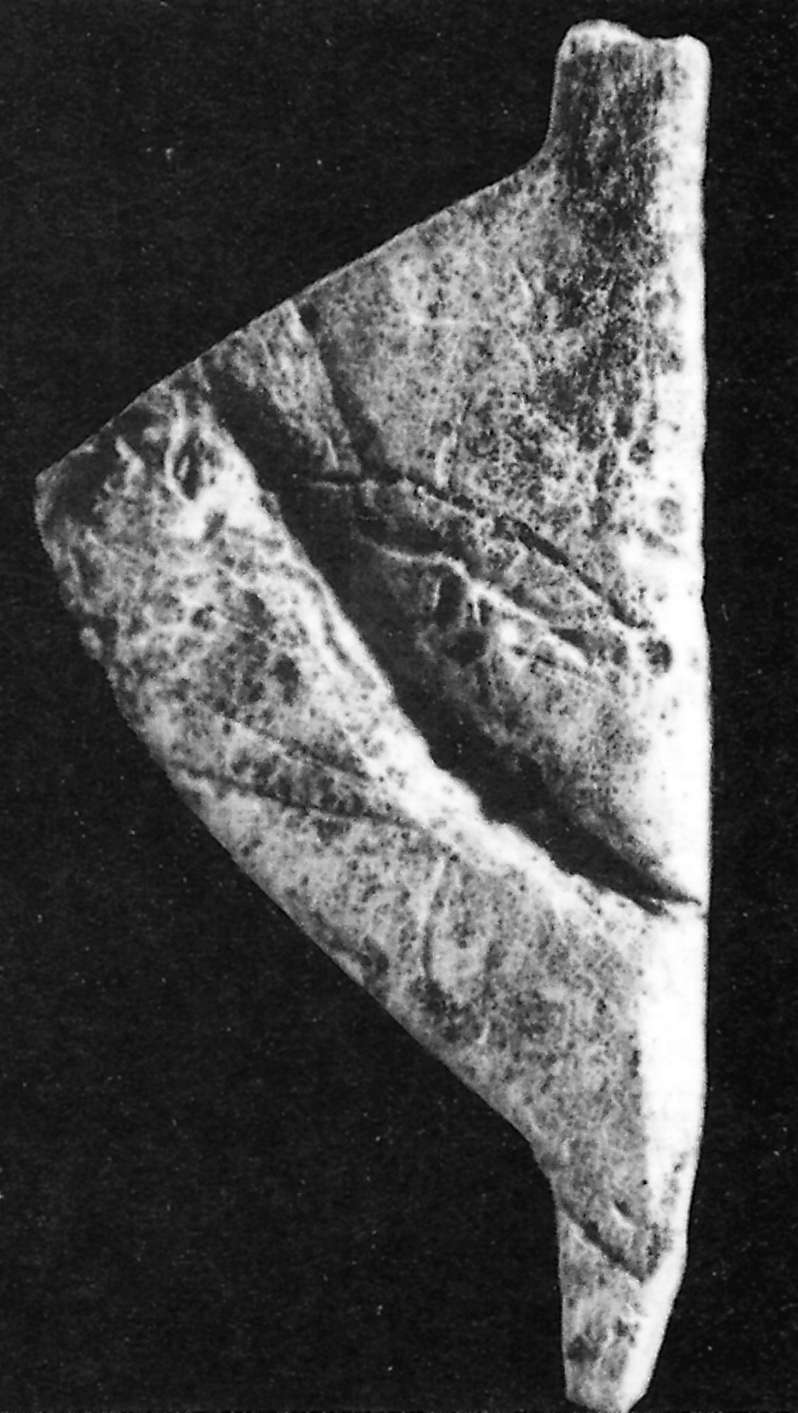
Ivory Lalinde - Gönnersdorf figures from Andernach, Germany.
Left: length 44 mm, breadth 10 mm.
Right: length 47 mm, breadth 24 mm.
Photo and text: Müller-Beck et al. (1987)
Source: Landesamt für Denkmalpflege, Koblenz
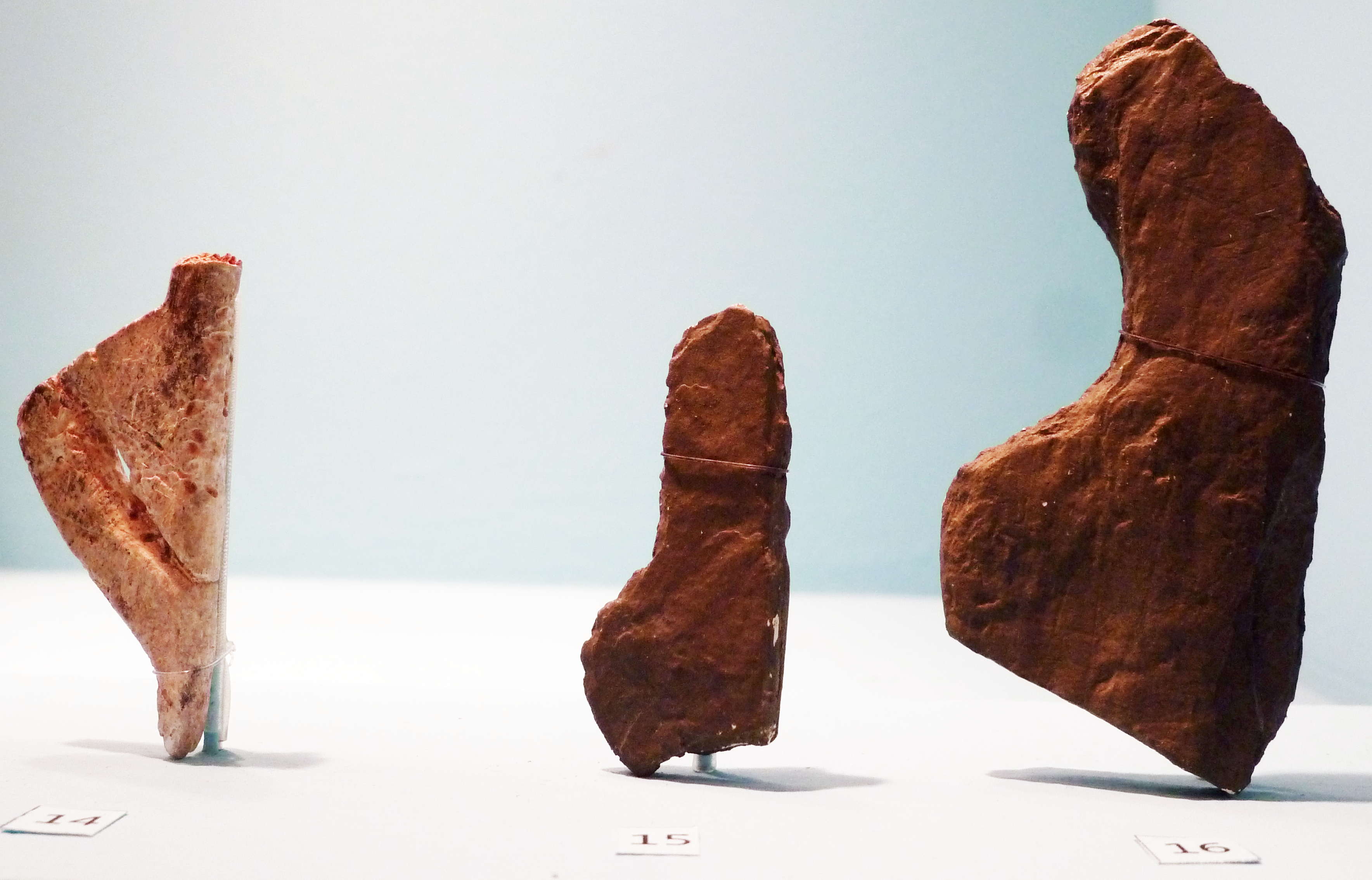
14 Female figure, incomplete, in bone/antler, Andernach, Kreis Mayen-Koblenz.
15 and 16 Female figures, in slate, Gönnersdorf, Stadt Neuwied, copies.
From the Magdalenian, 15 000 BP, female figures in a very stylised form.
Source: Display at LVR-LandesMuseum Bonn
Lender of the piece: Directorate General for Cultural Heritage Rhineland-Palatinate, Generaldirektion Kulturelles Erbe Rheinland-Pfalz.
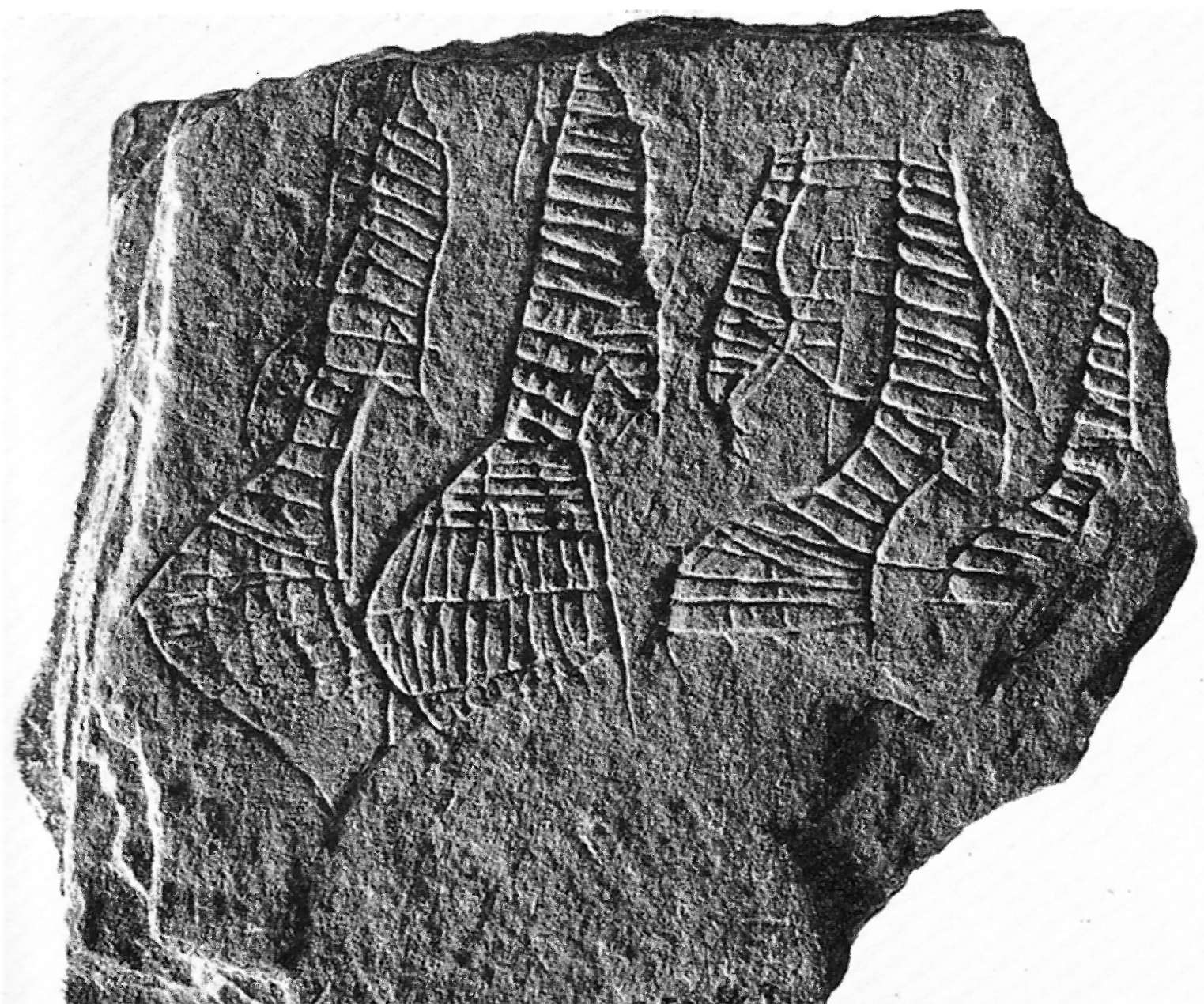
From Gönnersdorf.
Engraved Gönnersdorf figures
This piece shows an alignment of four female figures in a row. Behind the second figure from the right is a small figure sitting in a kind of holder.
The posture of the second female figure from the right also has the stance associated with carrying a load. This presentation is without parallel, apparently a mother and child.
Engraving on slate. Height of the figure on the right 28 mm.
Photo: Müller-Beck et al. (1987)
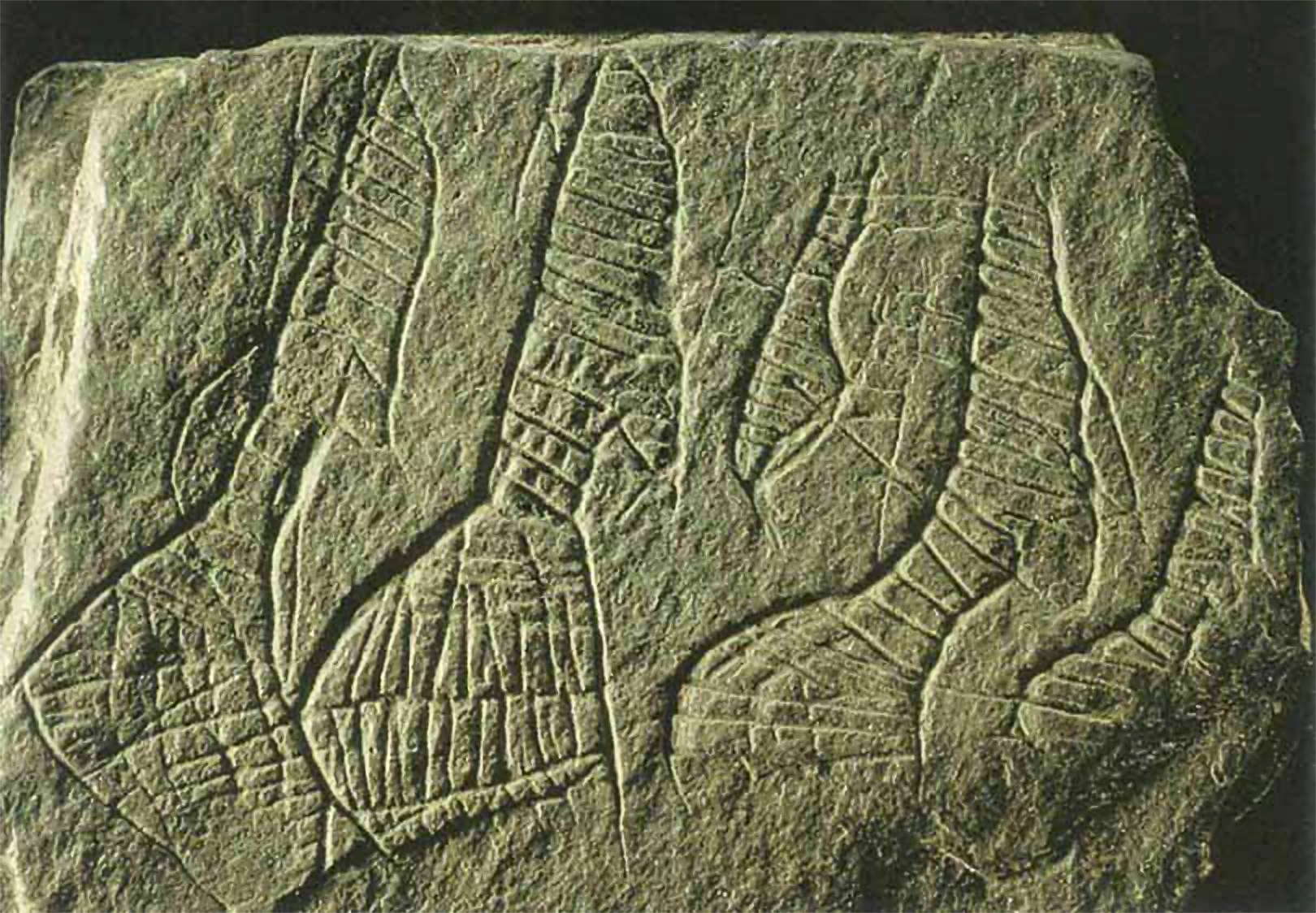
Engraved Gönnersdorf figures
Another version of the image above including a woman carrying a baby. Note that the baby is facing backwards in the cradle on the woman's back.
Photo: http://www.landschaftsmuseum.de/Seiten/Lexikon/Kunst-Goenn.htm

From Gönnersdorf.
Representation of a hairy man. Engraving on shale. Plate fragment.
Length 94 mm, breadth 47 mm.
Photo and text: Müller-Beck et al. (1987)
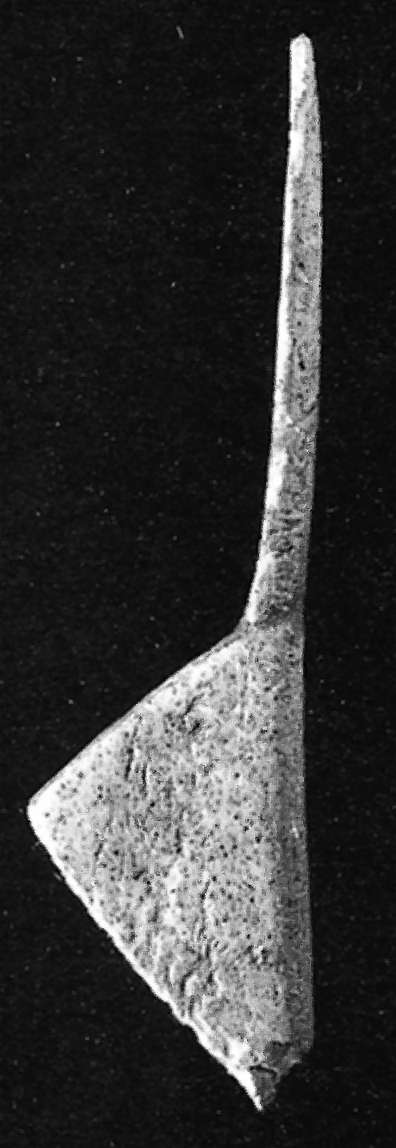
From Gönnersdorf.
Ivory statuette with rod-shaped upper body.
Height 54 mm, width 14 mm.
Photo and text: Müller-Beck et al. (1987)
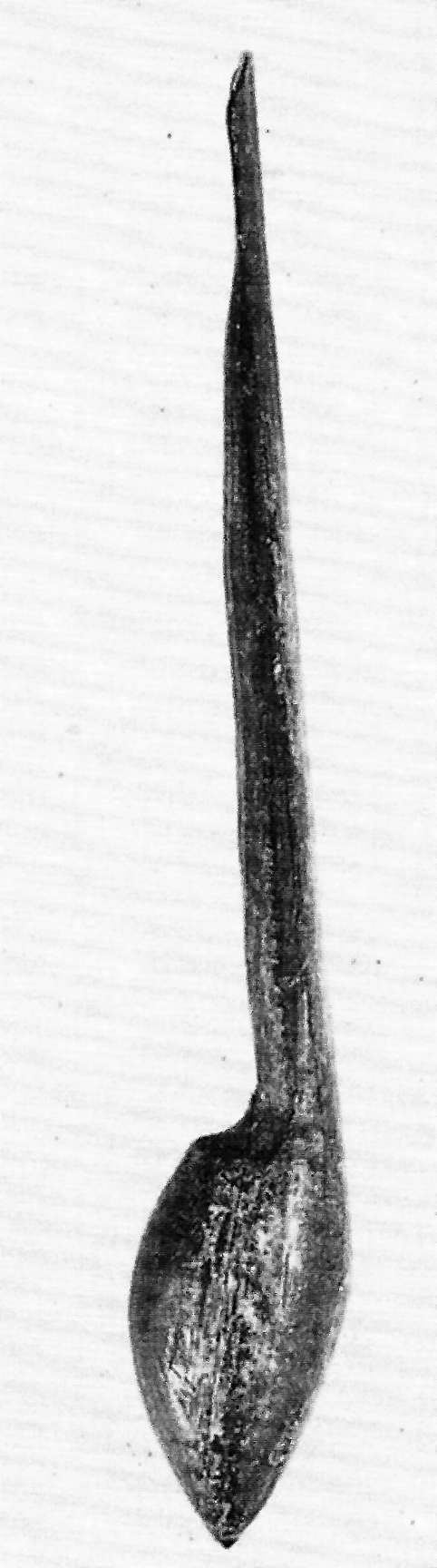
Gönnersberg / Lalinde type venus from Garsitz, former German Democratic Republic.
From the deposit known as the Caave 'Bärenkeller', or bear cellar.
Height: 75 mm
Photo: Müller-Beck et al. (1987)
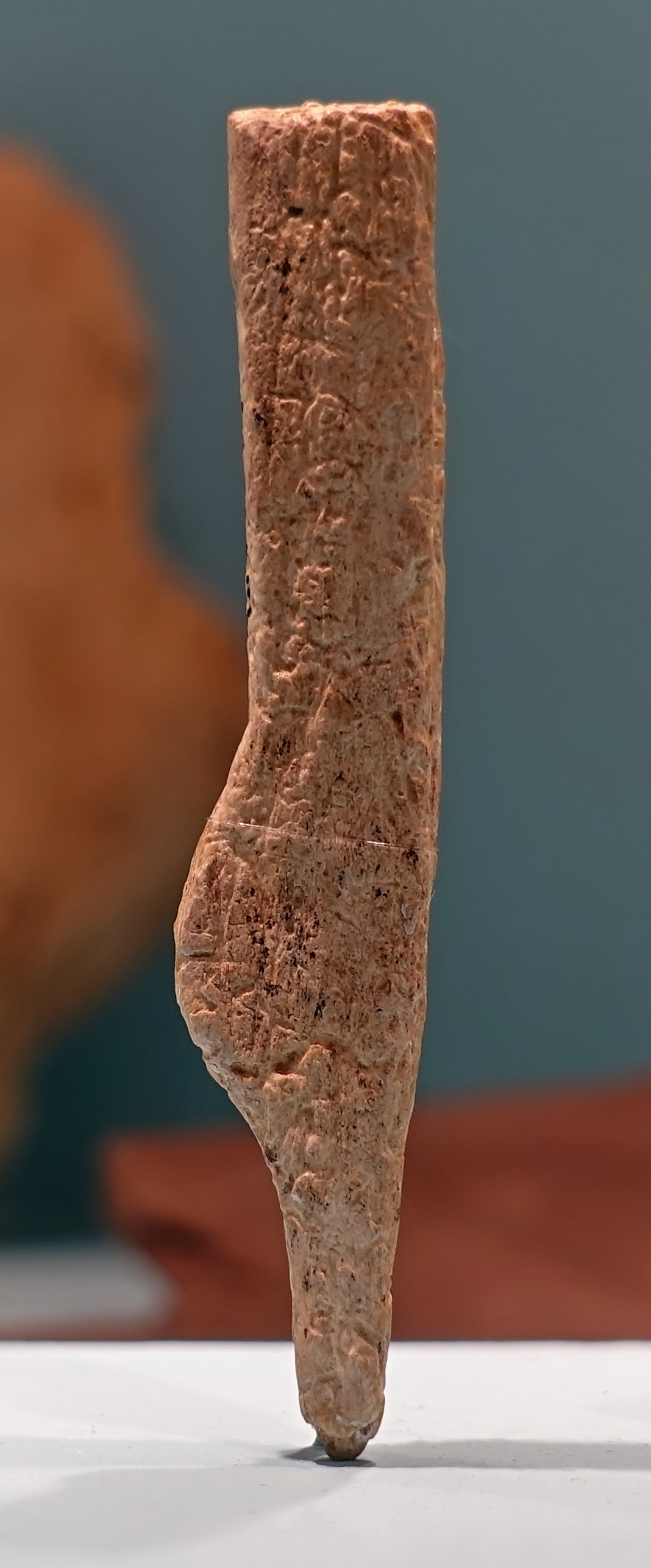
Venus figurine, incomplete, in bone/antler, Gönnersdorf, Stadt Neuwied.
Photo: Don Hitchcock 2018
Source and text: Original, display at LVR-LandesMuseum Bonn
Lender: Directorate General for Cultural Heritage Rhineland-Palatinate, Generaldirektion Kulturelles Erbe Rheinland-Pfalz.
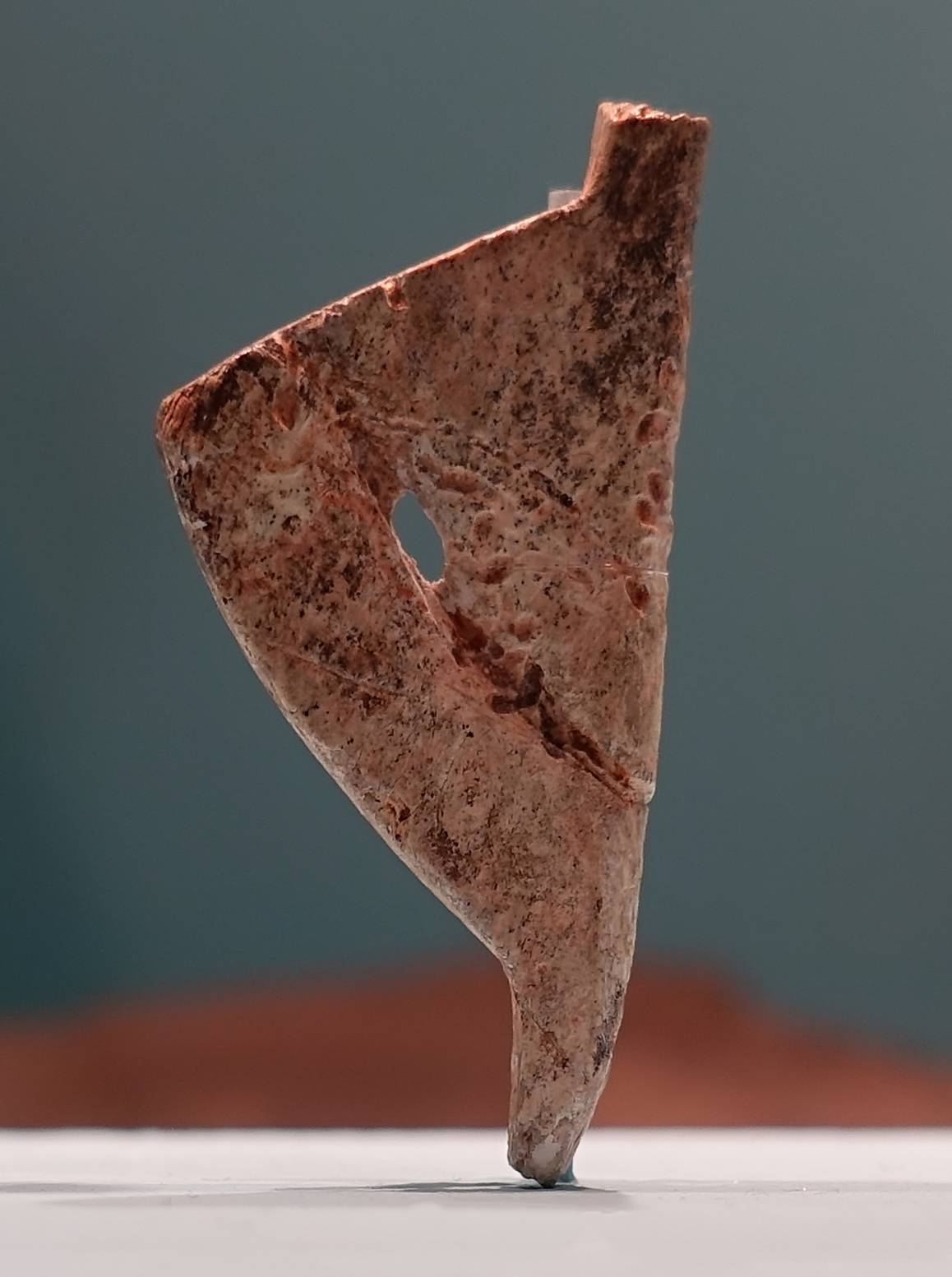
Venus figurine, incomplete, in bone/antler, Andernach, Kreis Mayen-Koblenz
Length 47 mm, breadth 24 mm.
Photo: Don Hitchcock 2018
Source and text: Original, display at LVR-LandesMuseum Bonn
Lender: Directorate General for Cultural Heritage Rhineland-Palatinate, Generaldirektion Kulturelles Erbe Rheinland-Pfalz.
Additional text: Wikipedia
Ivory Lalinde - Gönnersdorf figures from Andernach, Germany.
Left: length 44 mm, breadth 10 mm.
Right: length 47 mm, breadth 24 mm. Shown in the colour photograph above.
Photo and text: Müller-Beck et al. (1987)
Source: Landesamt für Denkmalpflege, Koblenz
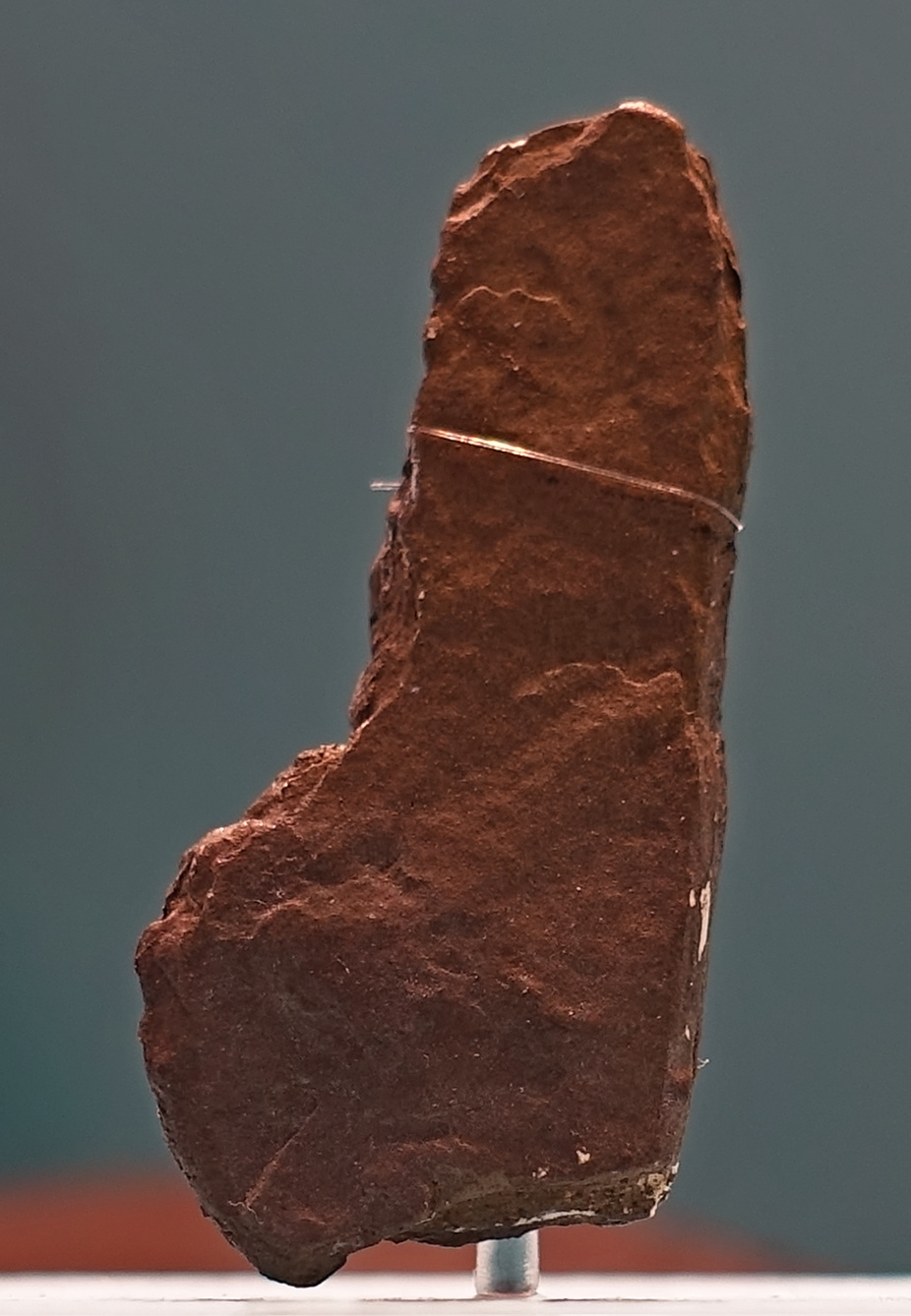
Venus figurine, in slate, Gönnersdorf, Stadt Neuwied.
Photo: Don Hitchcock 2018
Source: Facsimile, display at LVR-LandesMuseum Bonn
Lender: Directorate General for Cultural Heritage Rhineland-Palatinate, Generaldirektion Kulturelles Erbe Rheinland-Pfalz.
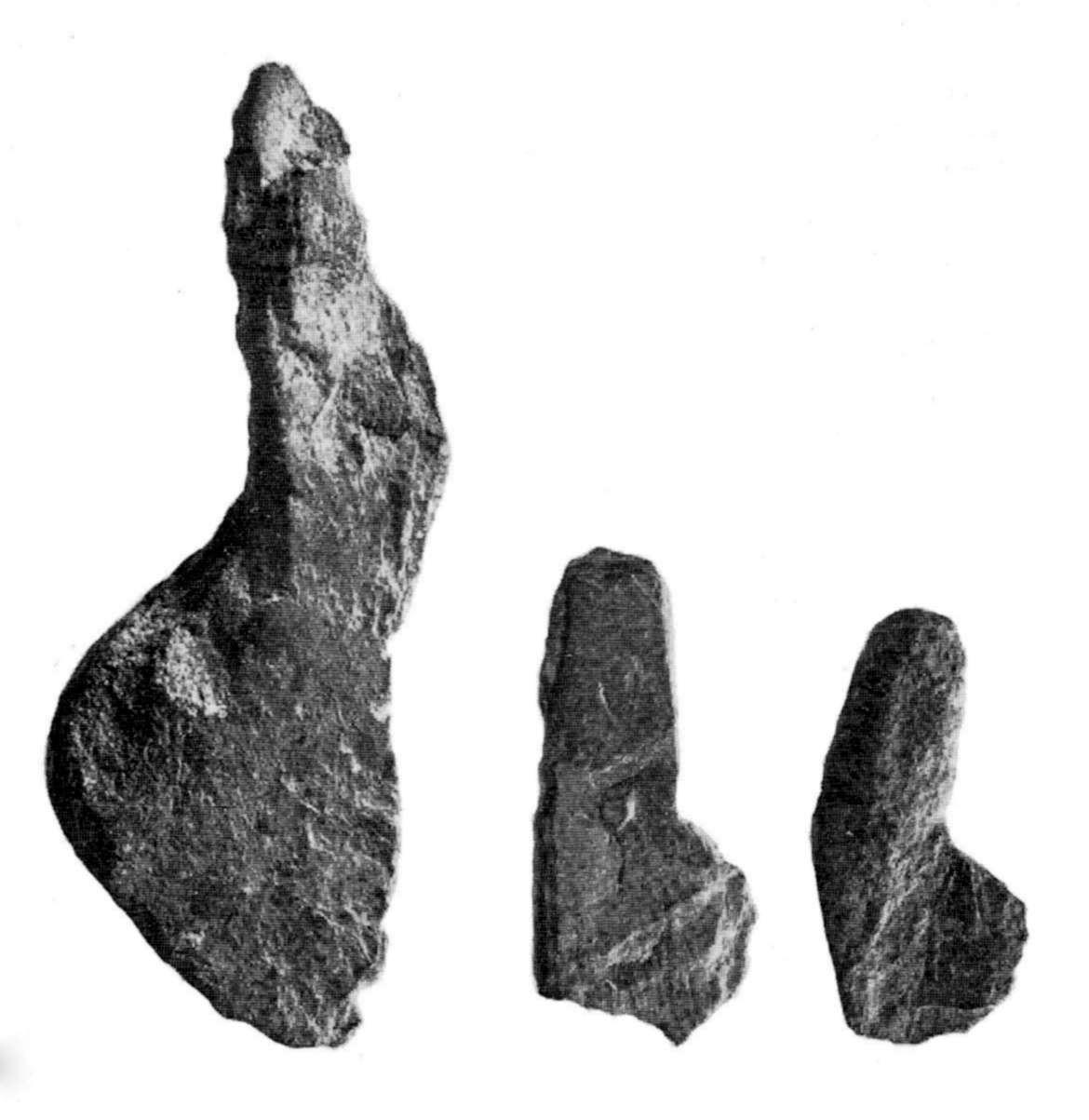
From Gönnersdorf.
Venus figures shaped from the local stone, the centre figure is the same as the figure in the photo above, rotated through 180°.
Photo: Bosinski (1981)
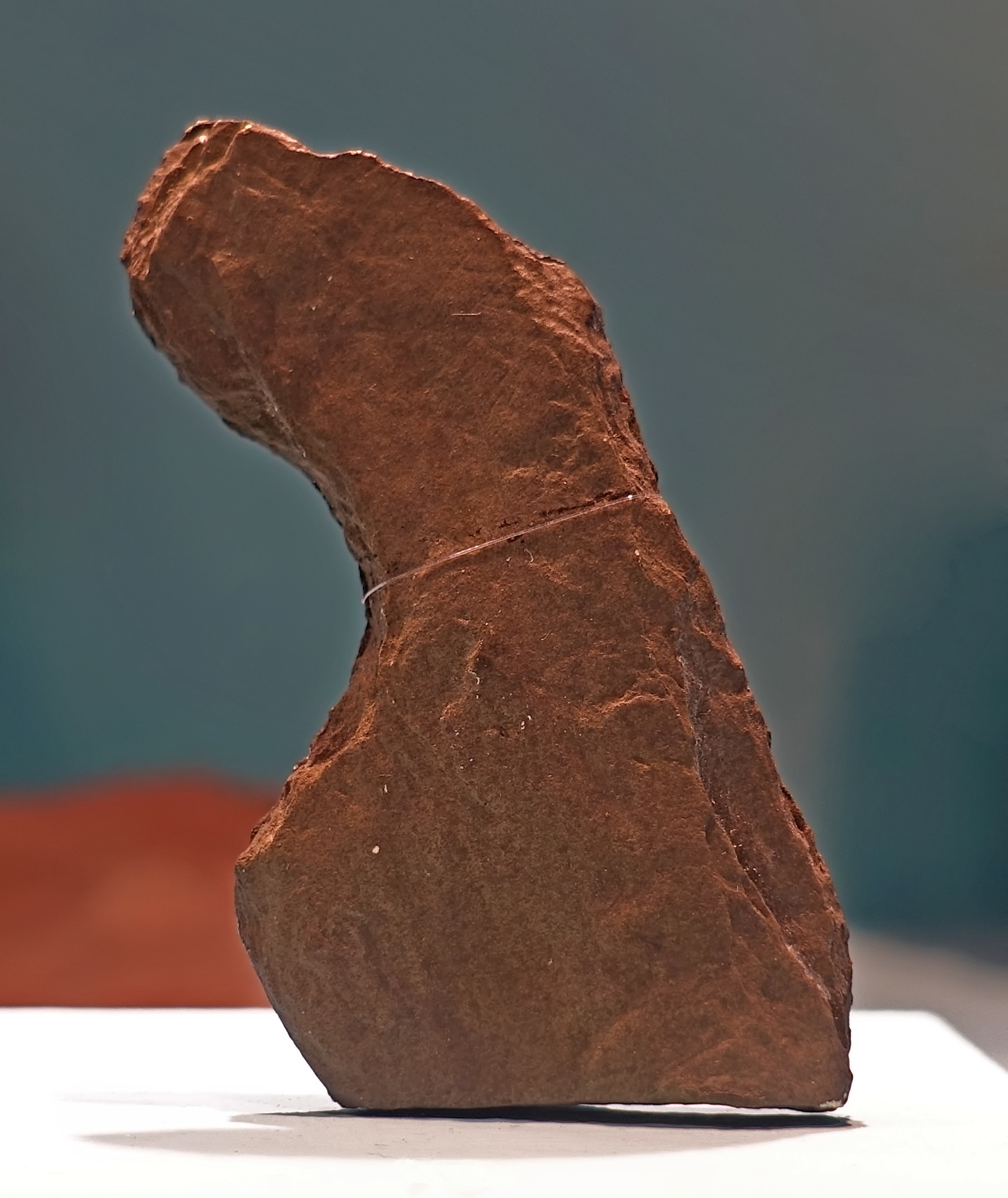
Venus figurine, in slate, Gönnersdorf, Stadt Neuwied.
Photo: Don Hitchcock 2018
Source: Facsimile, display at LVR-LandesMuseum Bonn
Lender: Directorate General for Cultural Heritage Rhineland-Palatinate, Generaldirektion Kulturelles Erbe Rheinland-Pfalz.
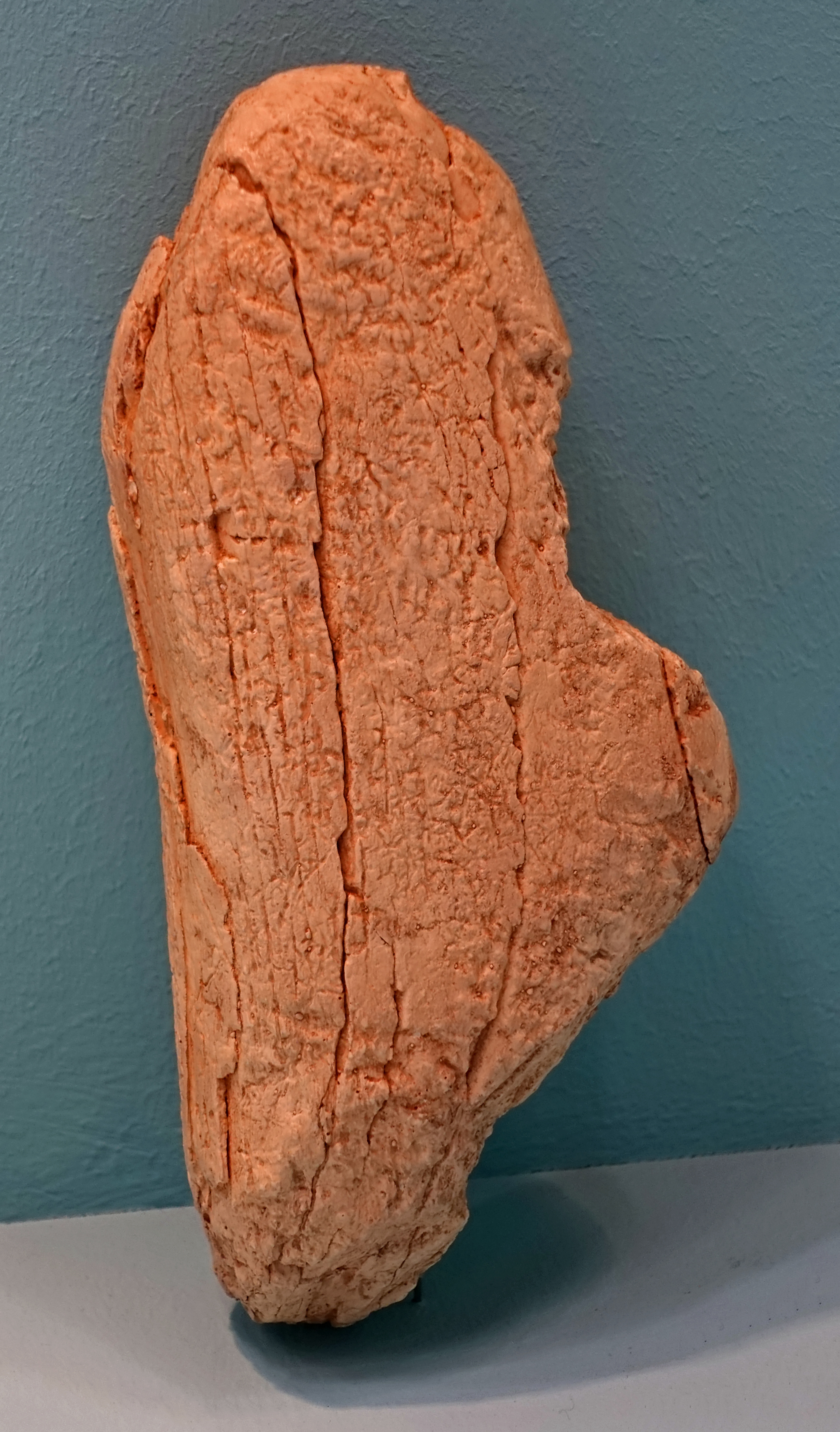
Venus figurine, Gönnersdorf, Stadt Neuwied.
Female figure in ivory, Andernach, Kreis Mayen-Koblenz.
This venus is from the Magdalenian, 15 000 BP, and shows a female figure in a very stylised form.
Photo: Don Hitchcock 2018
Source: Facsimile, display at LVR-LandesMuseum Bonn
Lender: Directorate General for Cultural Heritage Rhineland-Palatinate, Generaldirektion Kulturelles Erbe Rheinland-Pfalz.
Ivory Lalinde - Gönnersdorf figure from Andernach, Germany.
Length 200 mm, breadth 94 mm.
This is the obverse face of the venus figurine above.
Photo and text: Müller-Beck et al. (1987)
Source: Landesamt für Denkmalpflege, Koblenz
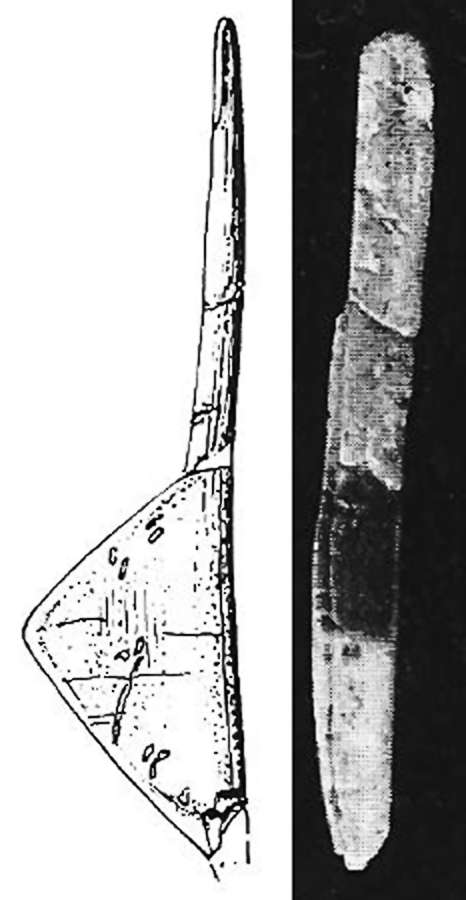
From Gönnersdorf, 1968 excavations.
Ivory statuette with rod-shaped upper body.
Height 54 mm, width 14 mm.
Photo (left) and text: Müller-Beck et al. (1987)
Photo (right): Bosinski et al. (1974)
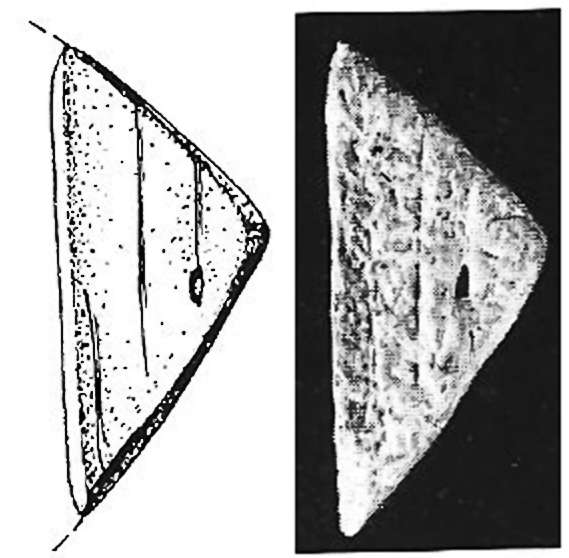
From Gönnersdorf, 1968 excavations.
Fragment of an ivory statuette.
Photo: Bosinski et al. (1974)
From Gönnersdorf, 1968 excavations.
Ivory statuette with the the rod alone left.
Photo: Bosinski et al. (1974)
Engraving of lalinde venus figure, Gönnersdorf, Stadt Neuwied.
Photo: Don Hitchcock 2018
Source and text: Original, display at LVR-LandesMuseum Bonn
Lender: Directorate General for Cultural Heritage Rhineland-Palatinate, Generaldirektion Kulturelles Erbe Rheinland-Pfalz.
Engravings of lalinde venus figures, Gönnersdorf, Stadt Neuwied.
Photo: Don Hitchcock 2018
Source and text: Original, display at LVR-LandesMuseum Bonn
Lender: Directorate General for Cultural Heritage Rhineland-Palatinate, Generaldirektion Kulturelles Erbe Rheinland-Pfalz.
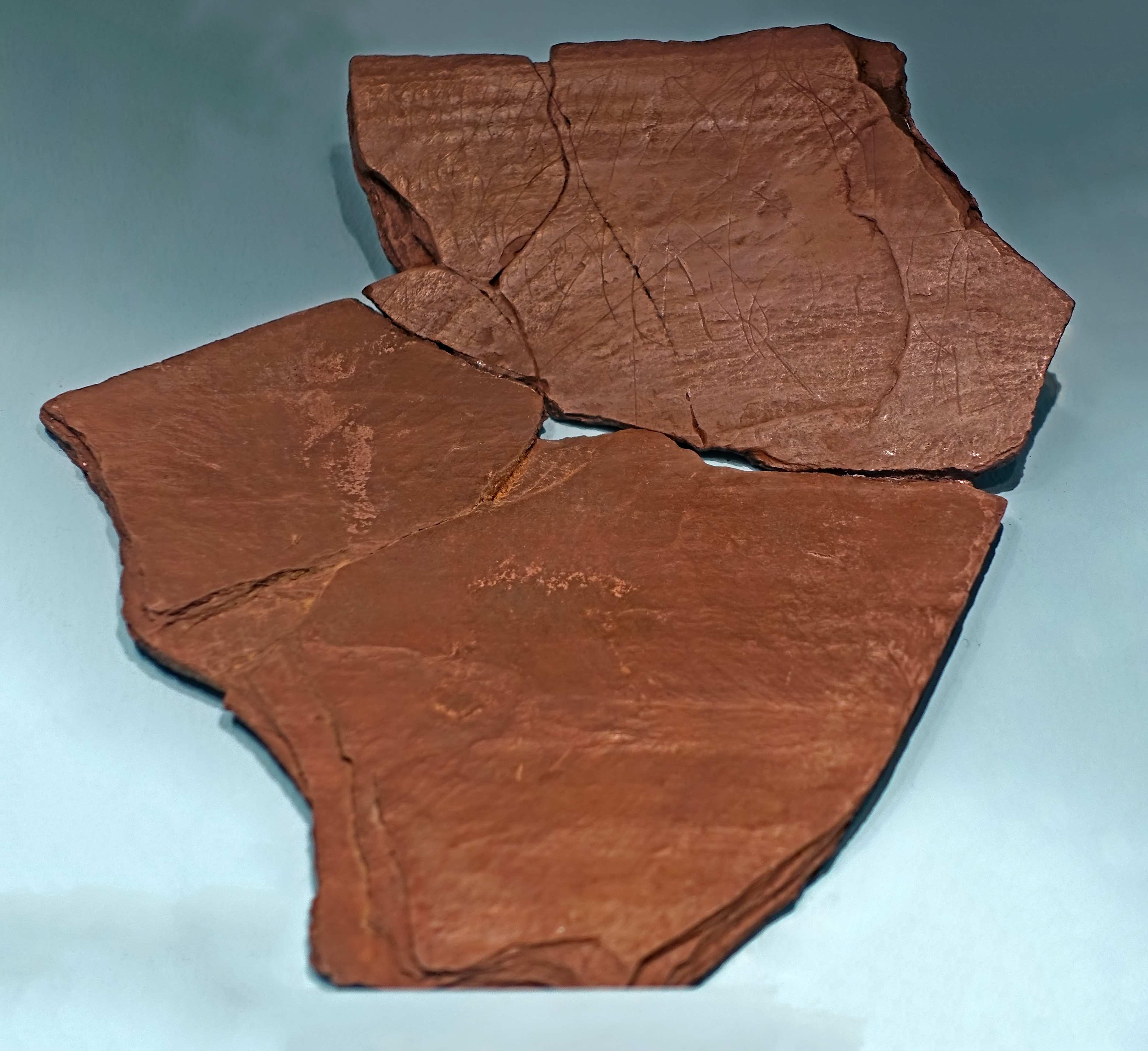
Engravings of lalinde venus figures, possibly dancing, Gönnersdorf, Stadt Neuwied.
Rephotography (left) Don Hitchcock 2018
Photo (right): Don Hitchcock 2018
Source and text: Original, display at LVR-LandesMuseum Bonn
Lender: Directorate General for Cultural Heritage Rhineland-Palatinate, Generaldirektion Kulturelles Erbe Rheinland-Pfalz.
Engravings of lalinde venus figures, Gönnersdorf, Stadt Neuwied.
Photo: Don Hitchcock 2018
Source and text: Facsimile, display at LVR-LandesMuseum Bonn
Lender: Directorate General for Cultural Heritage Rhineland-Palatinate, Generaldirektion Kulturelles Erbe Rheinland-Pfalz.
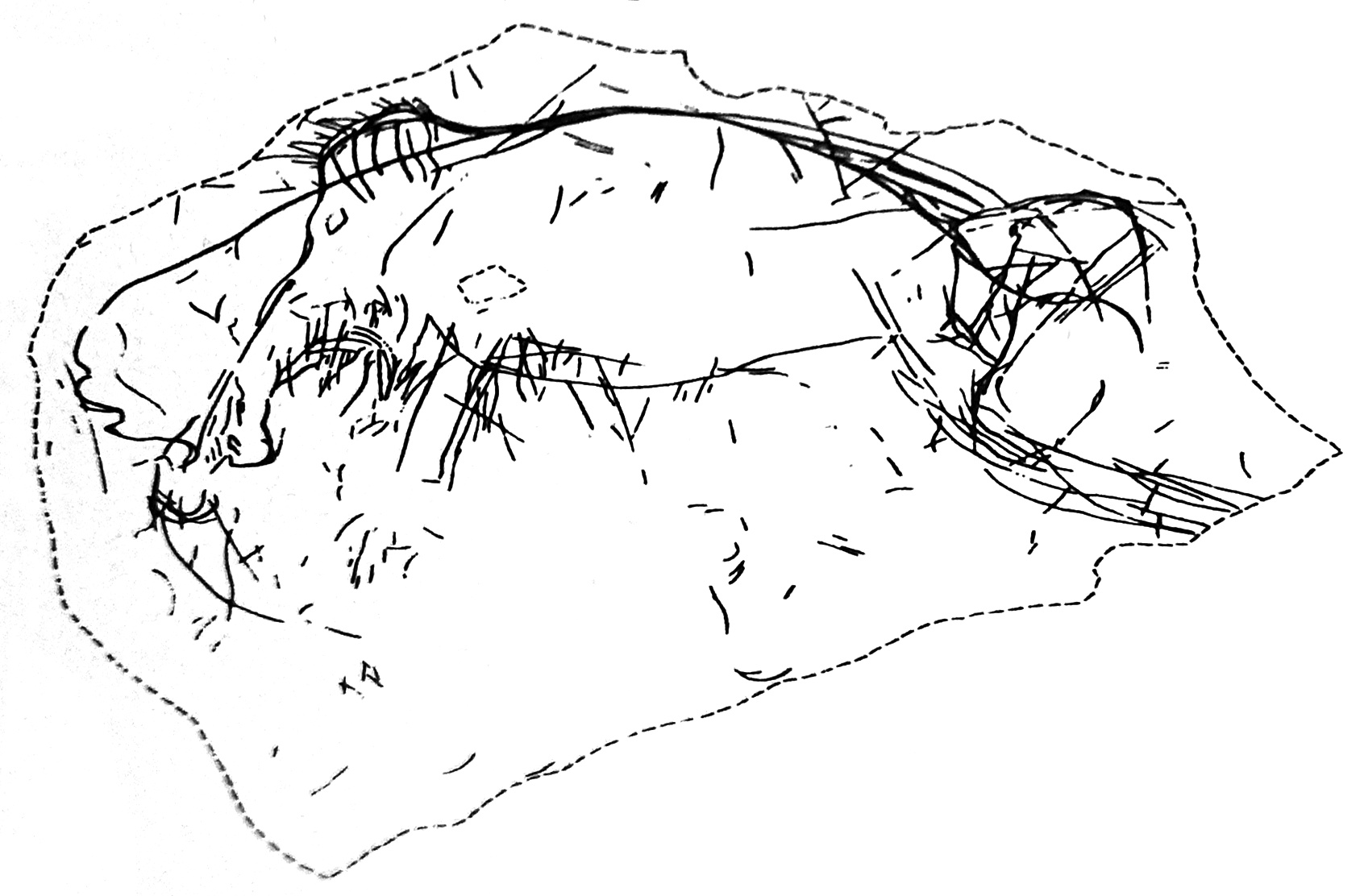
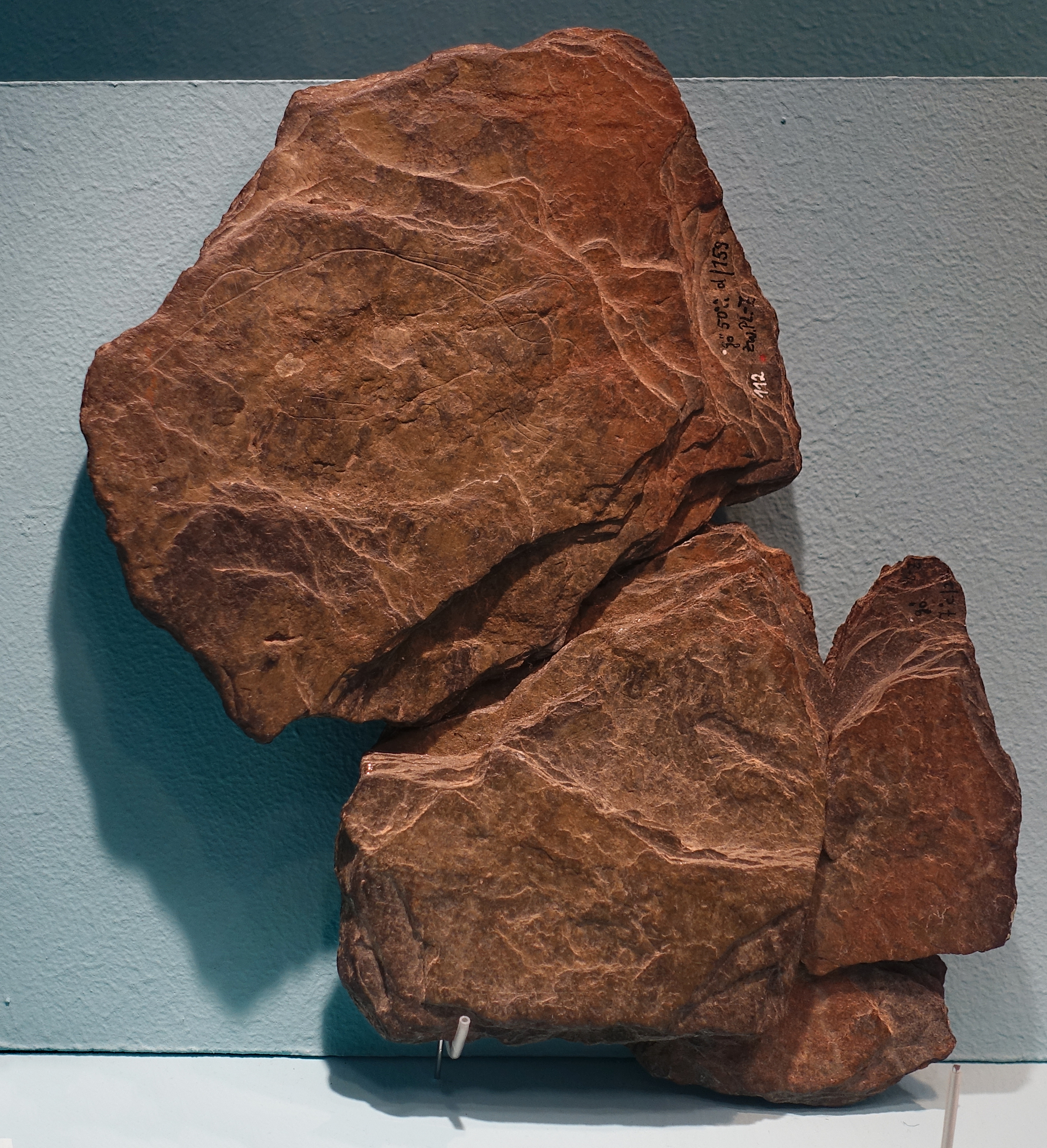
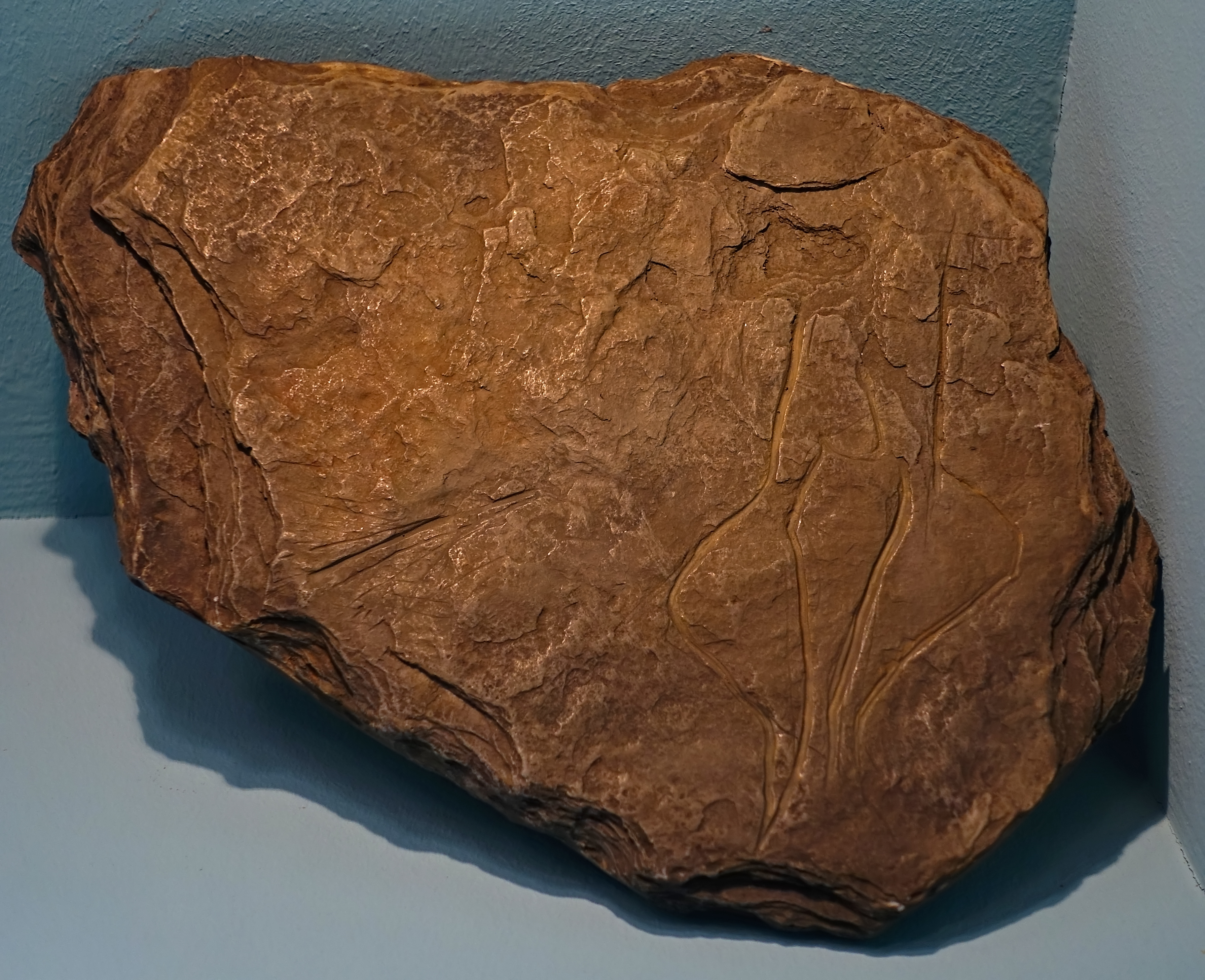
Engraving of a mammoth, Gönnersdorf, Stadt Neuwied.
While these animal images from 15 000 BP are often very detailed, the female portrayals are quite stylised.
Photo: Don Hitchcock 2018
Source and text: Original, display at LVR-LandesMuseum Bonn
Lender: Directorate General for Cultural Heritage Rhineland-Palatinate, Generaldirektion Kulturelles Erbe Rheinland-Pfalz.

Plan of the Gönnersdorf excavation area (grey) showing the position of the Magdalenian settlement structures (K-I, K-IIa, K-IIb, K-III, K-IV and SW) in relation to modern buildings (black).
Photo and text: Jöris (2011)
AMS radiocarbon dates for Gönnersdorf
Sano (2012)
| Lab code | Material | Common Name | Context | 14 C date (BP) | Reference |
| OxA-5728 | Equus sp. | Horse | Concentration I | 12 730 ± 130 | Housley et al., 1997 |
| OxA-5729 | Equus sp. | Horse | Concentration I | 12 790 ± 120 | Housley et al., 1997 |
| OxA-5730 | Equus sp. | Horse | Concentration I | 12 790 ± 120 | Housley et al., 1997 |
| OxA-2223-39 | Equus sp. | Horse | Concentration I | 13 270 ± 55 | Stevens et al., 2009 |
| OxA-2223-42 | Rangifer tarandus | Reindeer | Concentration I | 12 990 ± 55 | Stevens et al., 2009 |
| OxA-10199 | Mammuthus primigenius | Woolly Mammoth | Concentration II | 14 570 ± 90 | Street and Terberger, 2004 |
| OxA-10200 | Coelodonta antiquitatis | Woolly Rhinoceros | Concentration II | 13 810 ± 90 | Street and Terberger, 2004 |
| OxA-10201 | Coelodonta antiquitatis | Woolly Rhinoceros | Concentration II | 13 610 ± 100 | Street and Terberger, 2004 |
| OxA-2223-31 | Rangifer tarandus | Reindeer | Concentration II | 13 010 ± 55 | Stevens et al., 2009 |
| OxA-2223-40 | Equus sp. | Horse | Concentration II | 13 165 ± 55 | Stevens et al., 2009 |
| OxA-2223-41 | Bos/Bison | Aurochs/Bison | Concentration II | 13 095 ± 55 | Stevens et al., 2009 |
| OxA-15295 | Rangifer tarandus marrow-fractured | Reindeer | Concentration III | 13 060 ± 60 | Higham et al., 2007 |
| OxA-2223-43 | Rangifer tarandus | Reindeer | Concentration III | 13 075 ± 55 | Stevens et al., 2009 |
| OxA-15296 | Alces alces | Moose/Eurasian elk | South western area | 12 385 ± 65 | Higham et al., 2007 |
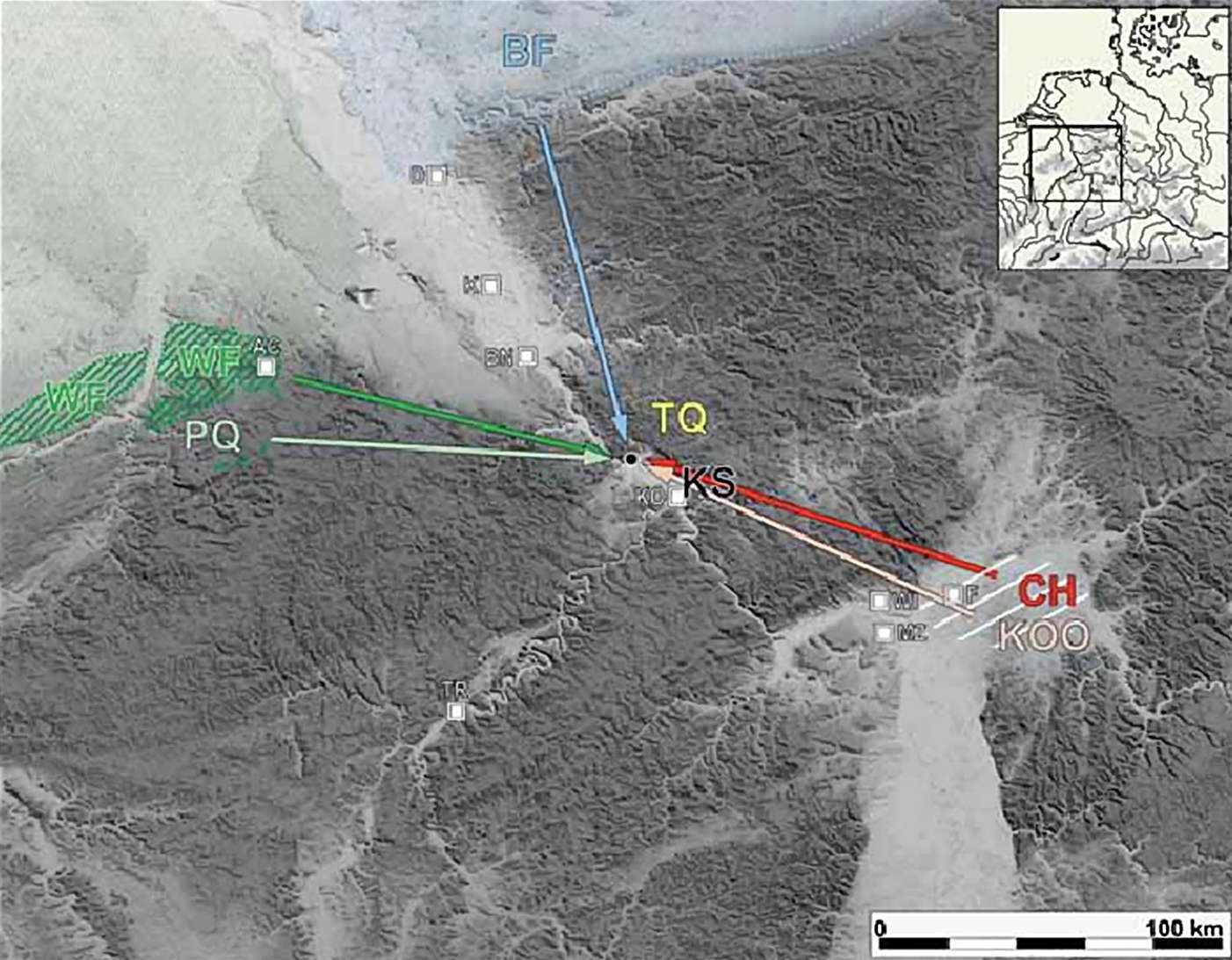
Sources of the lithic raw materials used for artefact production at Gönnersdorf:
BF: Cretaceous 'Baltic' flint from moraine deposits (pale blue stippling); KS: indurated slate; TQ: Tertiary quartzite; CH: chalcedony and KOO: indurated oolite (white hatching); PQ: 'Palaeozoic' quartzite; WF: Cretaceous flint from primary chalk formations (white areas) and river terrace gravels (pale green stippling).
Locations of major towns:
AC: Aachen; D: Düsseldorf; K: Cologne; BN: Bonn; TR: Trier; KO: Koblenz;WI: Wiesbaden; MZ: Mainz; F: Frankfurt am Main.
Photo and text: Jöris (2011)

From Gönnersdorf.
Engraved Gönnersdorf figures
This piece shows an alignment of four female figures in a row. Behind the second figure from the right is a small figure sitting in a kind of holder.
The posture of the second female figure from the right also has the stance associated with carrying a load. This presentation is without parallel, apparently a mother and child.
Engraving on slate. Height of the figure on the right 28 mm.
Photo (left): Müller-Beck et al. (1987)
Photo (right) Gaudzinski-Windheuser and Jöris (2006)
Engraved Gönnersdorf figures
Another version of the image above including a woman carrying a baby. Note that the baby is facing backwards in the cradle on the woman's back.
Photo: http://www.landschaftsmuseum.de/Seiten/Lexikon/Kunst-Goenn.htm

From Gönnersdorf.
Another version of the woman carrying a baby.
Photo: Gaudzinski-Windheuser and Jöris (2012)
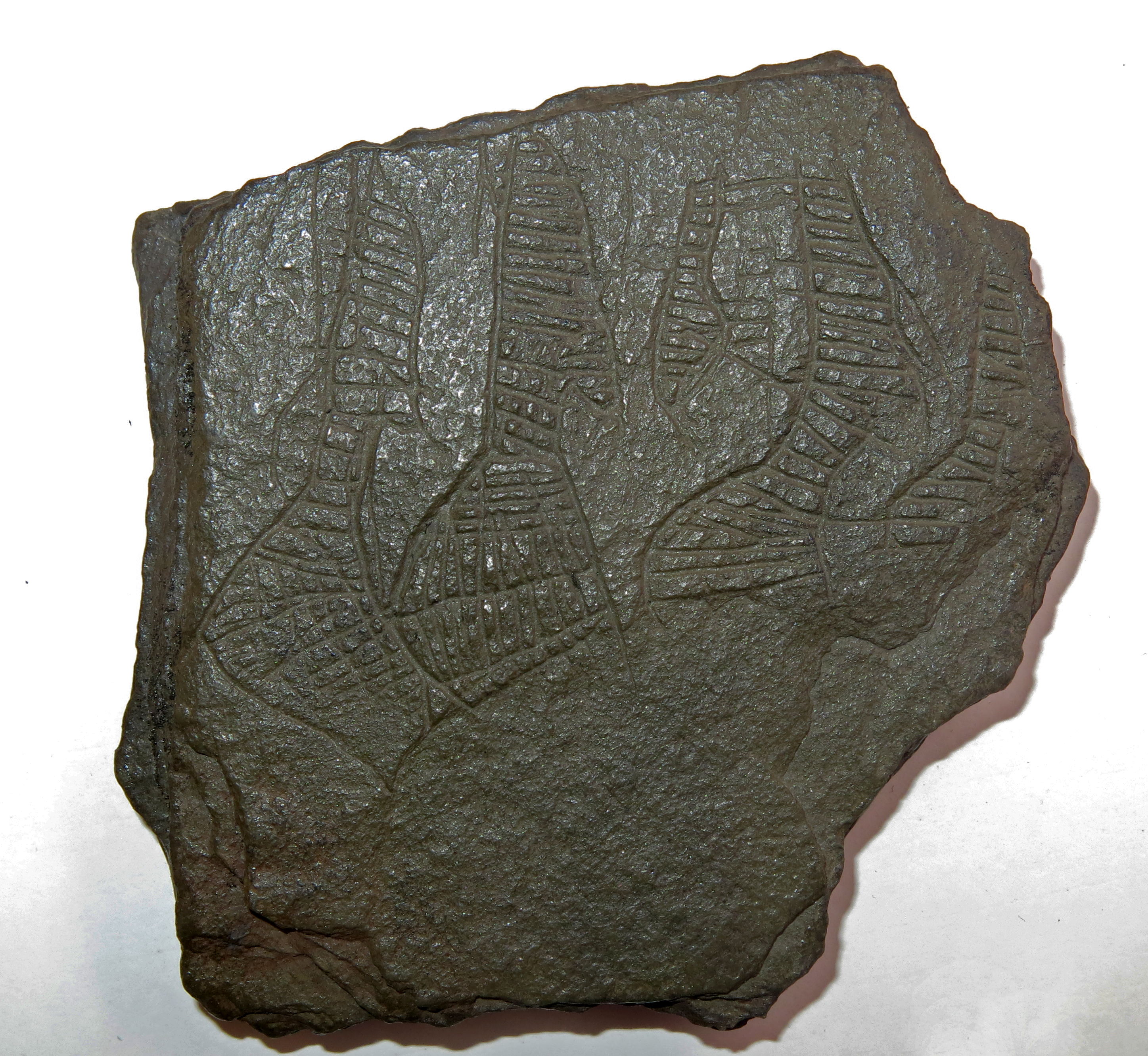
From Gönnersdorf.
Another version of the woman carrying a baby.
Photo: Don Hitchcock 2015
Source: Facsimile, Monrepos Archäologisches Forschungszentrum und Museum, Neuwied, Germany

From Gönnersdorf.
Another version of the woman carrying a baby.
Photo: Don Hitchcock 2015
Source: Facsimile, Monrepos Archäologisches Forschungszentrum und Museum, Neuwied, Germany
From Gönnersdorf.
Representation of a hairy man. Engraving on shale. Plate fragment.
Length 94 mm, breadth 47 mm.
Photo and text: Müller-Beck et al. (1987)
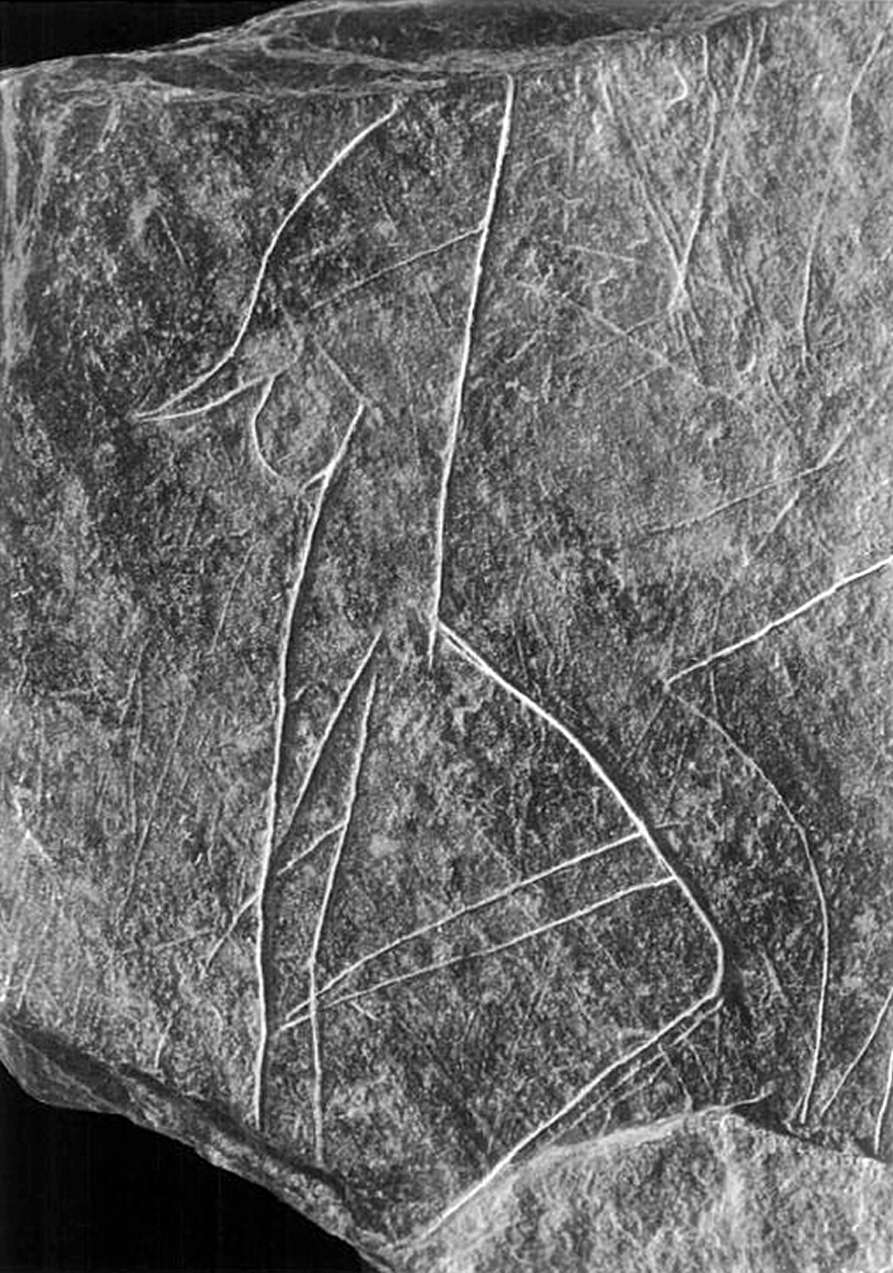
From Gönnersdorf.
Heavily incised female figure.
Photo: Bosinski et al. (2001)
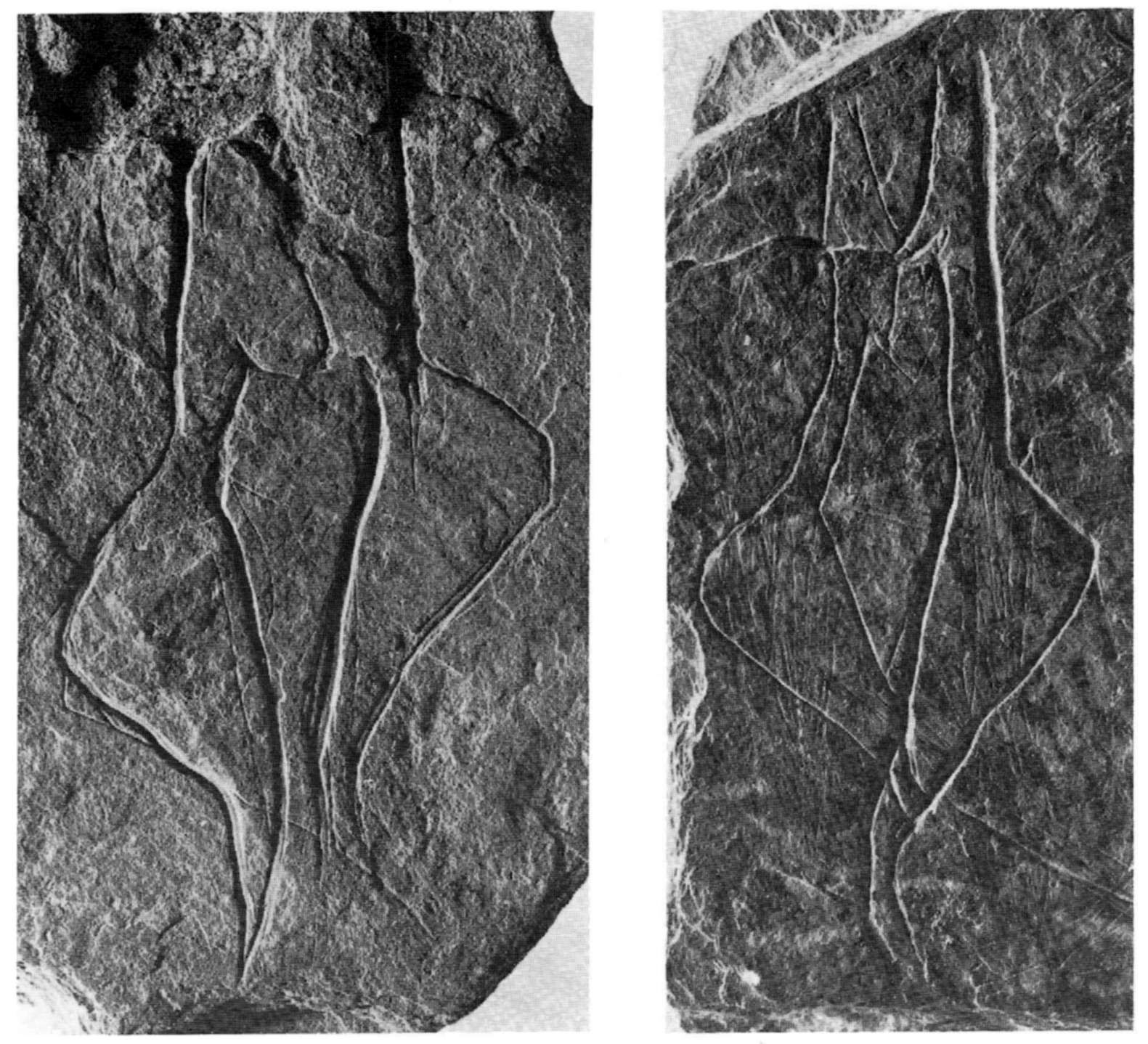
From Gönnersdorf
Photo: Bosinski (1981)
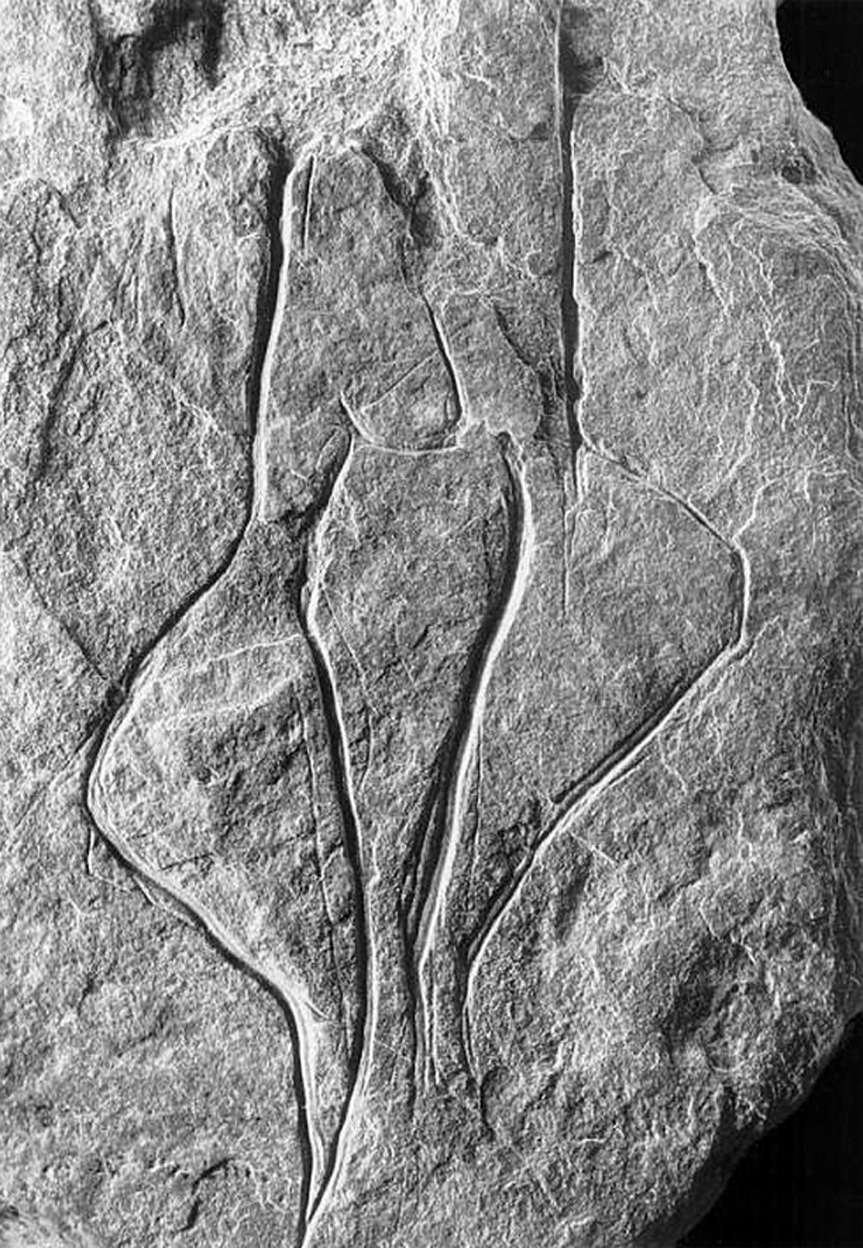
From Gönnersdorf.
Two female figures, another version of the image on the left above.
(Note the heavy breasts of the figure on the left of the pair - Don )
Photo: Bosinski et al. (2001)
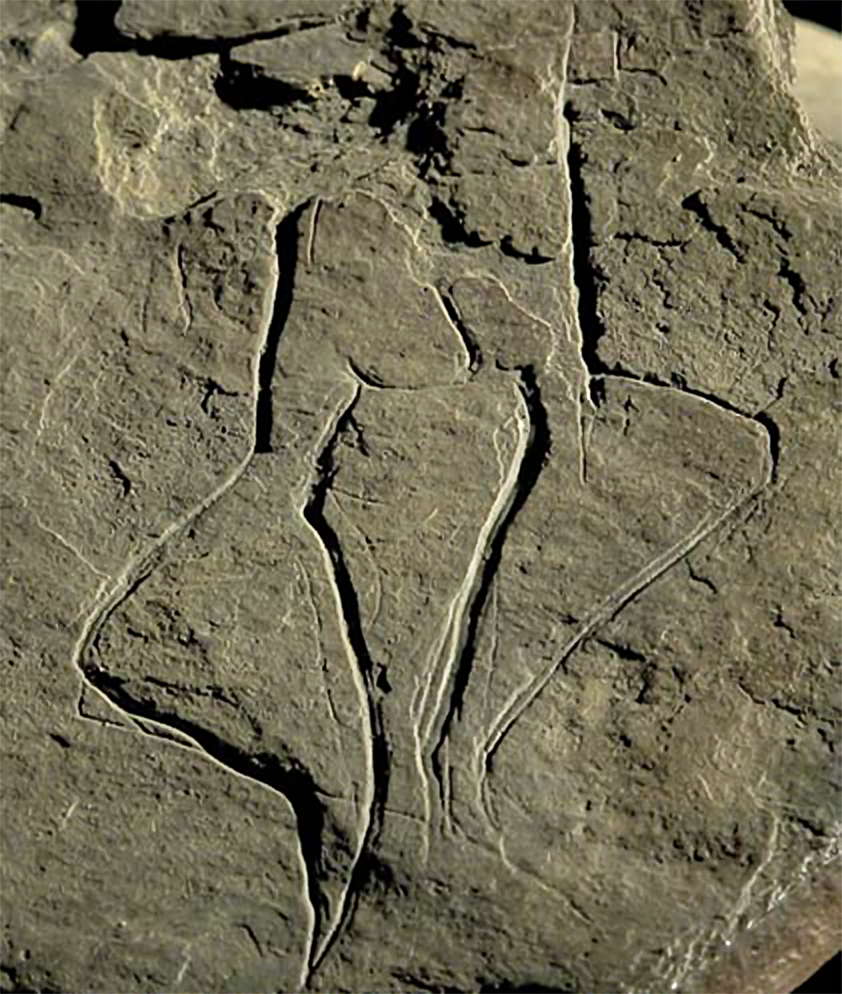
The two female figures from Gönnersdorf, in colour, foreshortened because of the angle at which the photo was taken.
Photo: Gaudzinski-Windheuser and Jöris (2006)
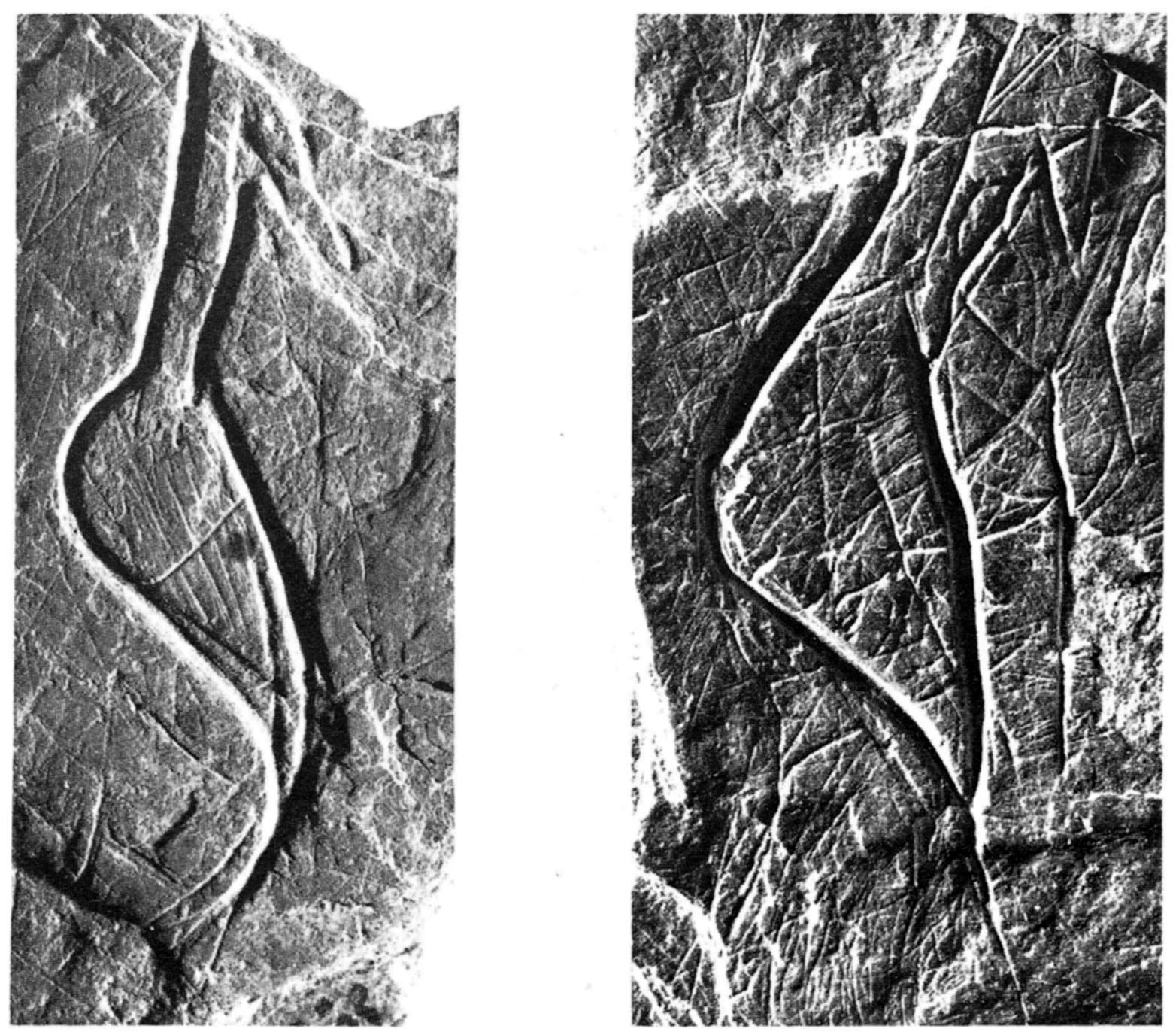
From Gönnersdorf.
Photo: Bosinski (1981)
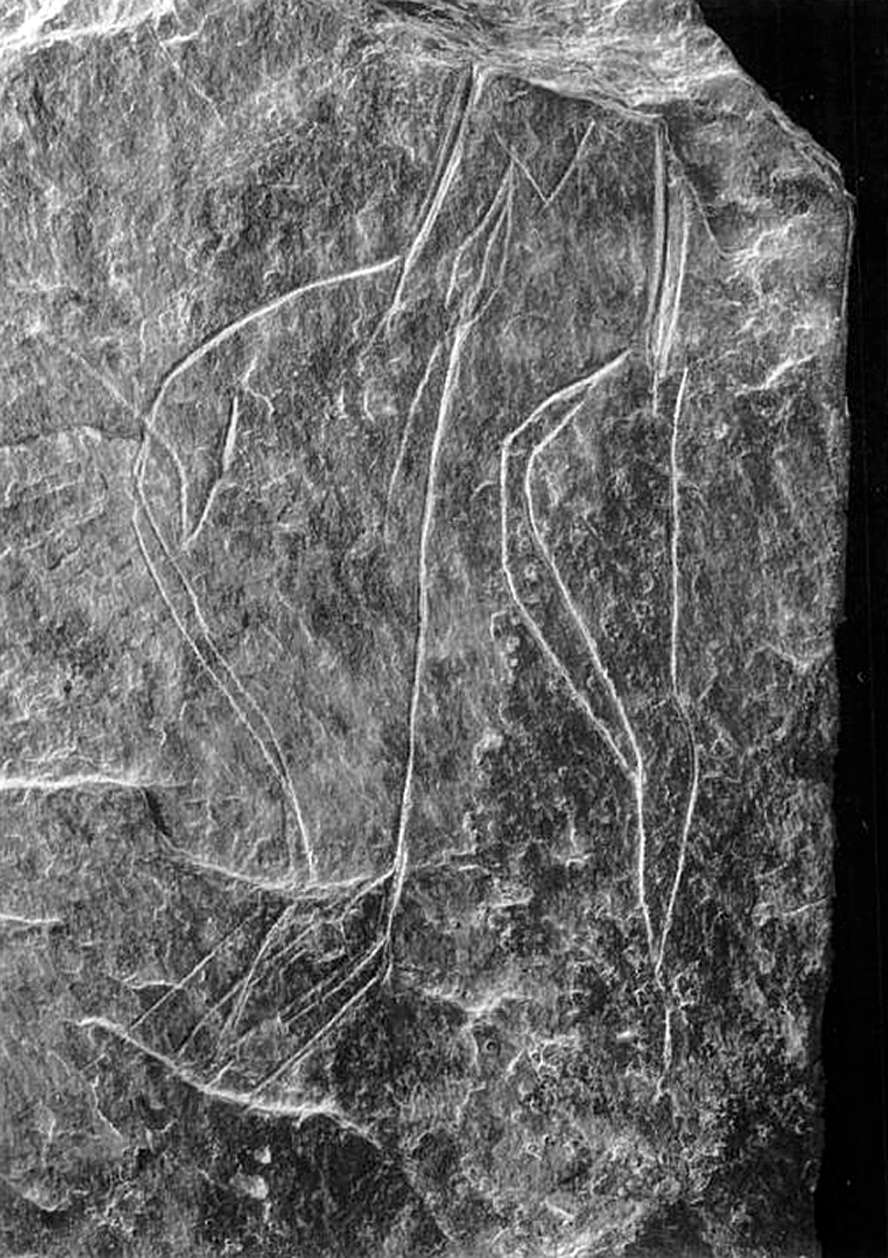
From Gönnersdorf.
Two female figures.
(Note that an attempt seems to have been made at perspective on these engravings, with the second leg shown on each, including the lower leg for the venus figure on the left - Don )
Photo: Bosinski et al. (2001)

From Gönnersdorf.
Photo: Bosinski (1981)

This is an unusual engraving of a classic Gönnersdorf venus, since an attempt has been made to portray the feet of the figure.
Photo: Bosinski (2007)
Source: http://archaeolet.de/themen/palaolithikum/spatmagdalenienzeitliche-siedlungsplatz-gonnersdorf/
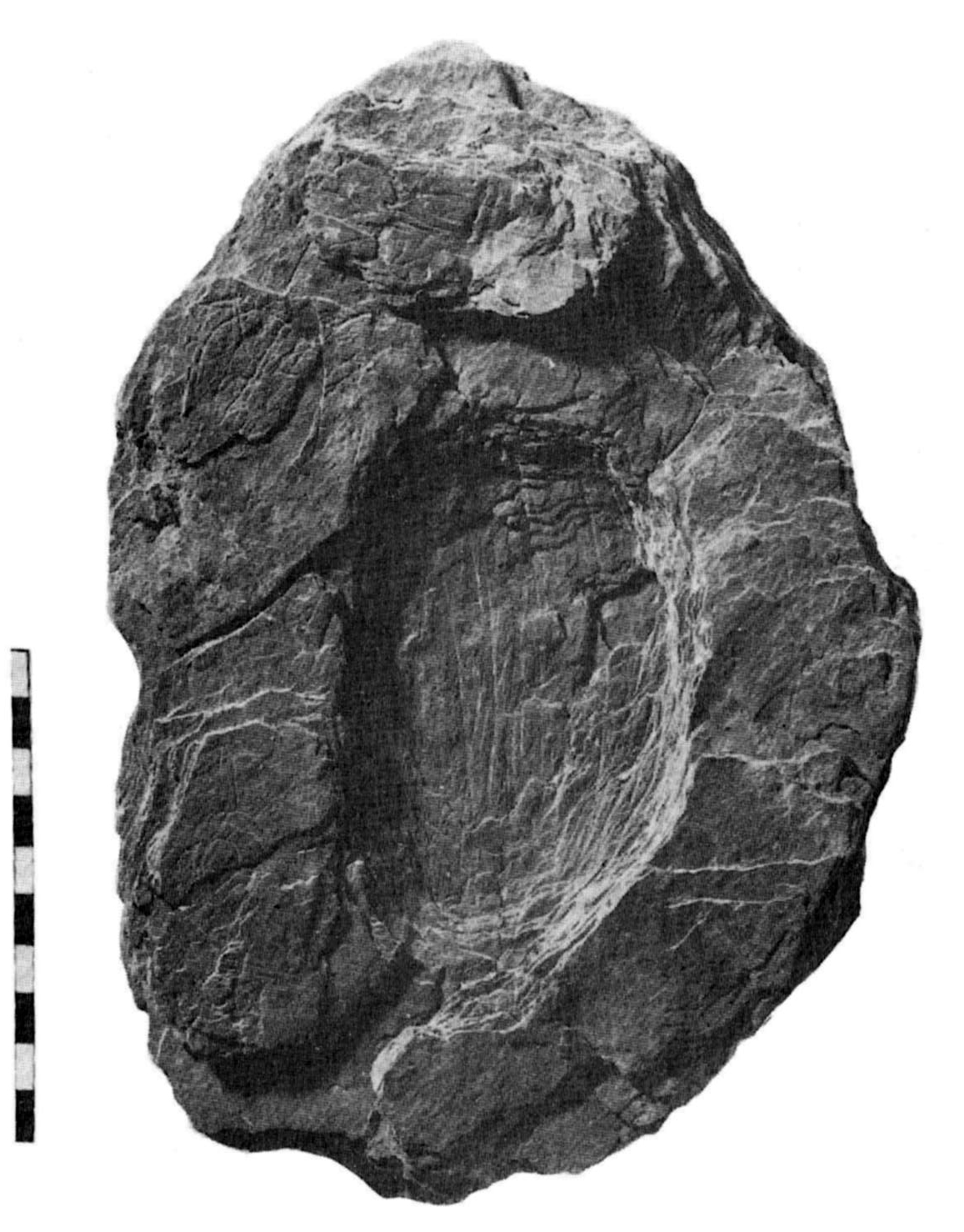
From Gönnersdorf.
Several lamps were found. The stones have been hollowed out, sometimes to depth of 1 cm, and tallow or fat was used as fuel, with a wick of plant fibres. Experiments have shown that such lamps can give the light of two or three candles, and burn steadily, without soot.
Photo and text: Bosinski (1981)

From Gönnersdorf.
A horse with flying tail engraved in stone.
Photo: Bosinski (1981)

From Gönnersdorf.
Other engravings of horses.
Photo: Bosinski (1981)
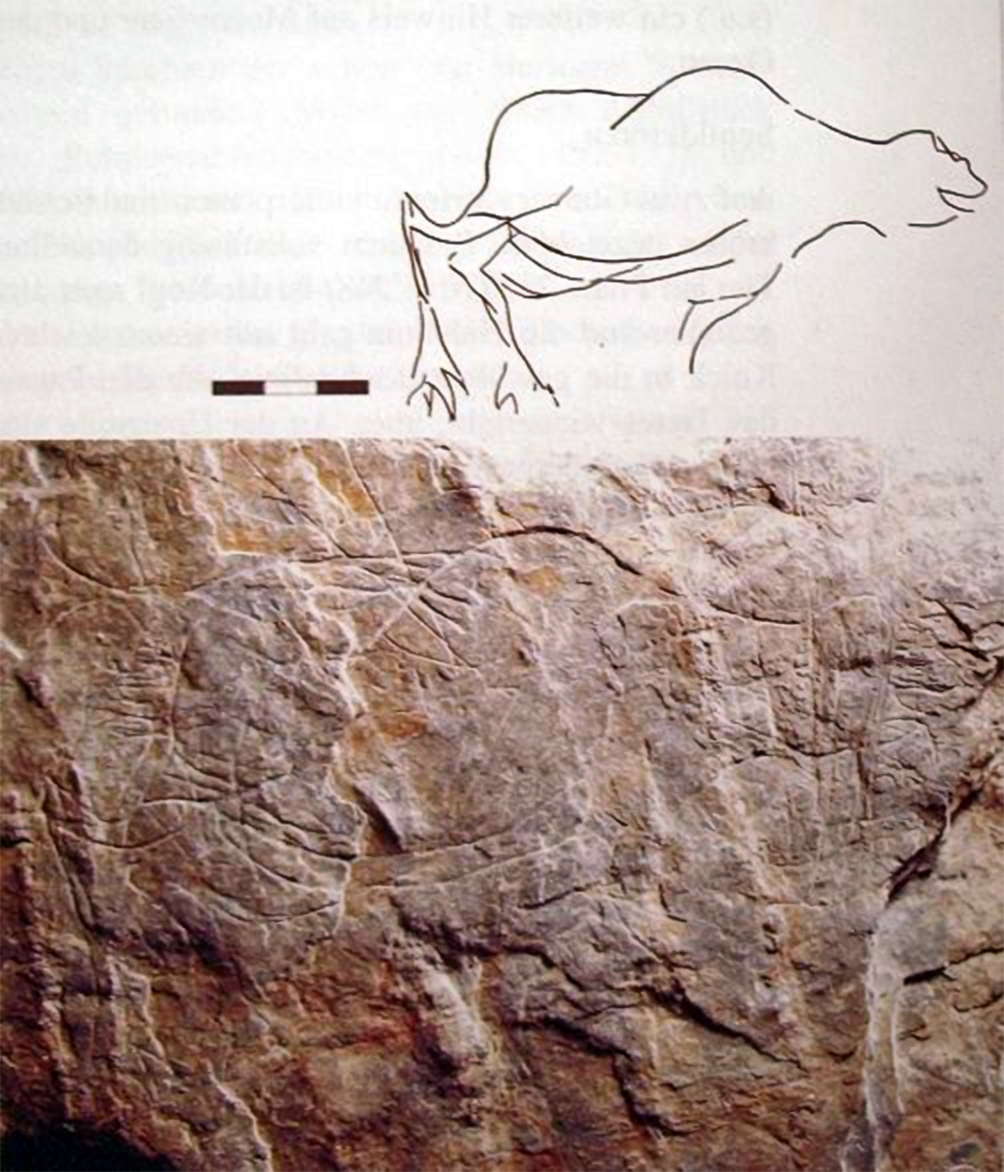
Engraving of a frog from Gönnersdorf.
Photo: Bosinski (2007)
Source: http://archaeolet.de/themen/palaolithikum/spatmagdalenienzeitliche-siedlungsplatz-gonnersdorf/
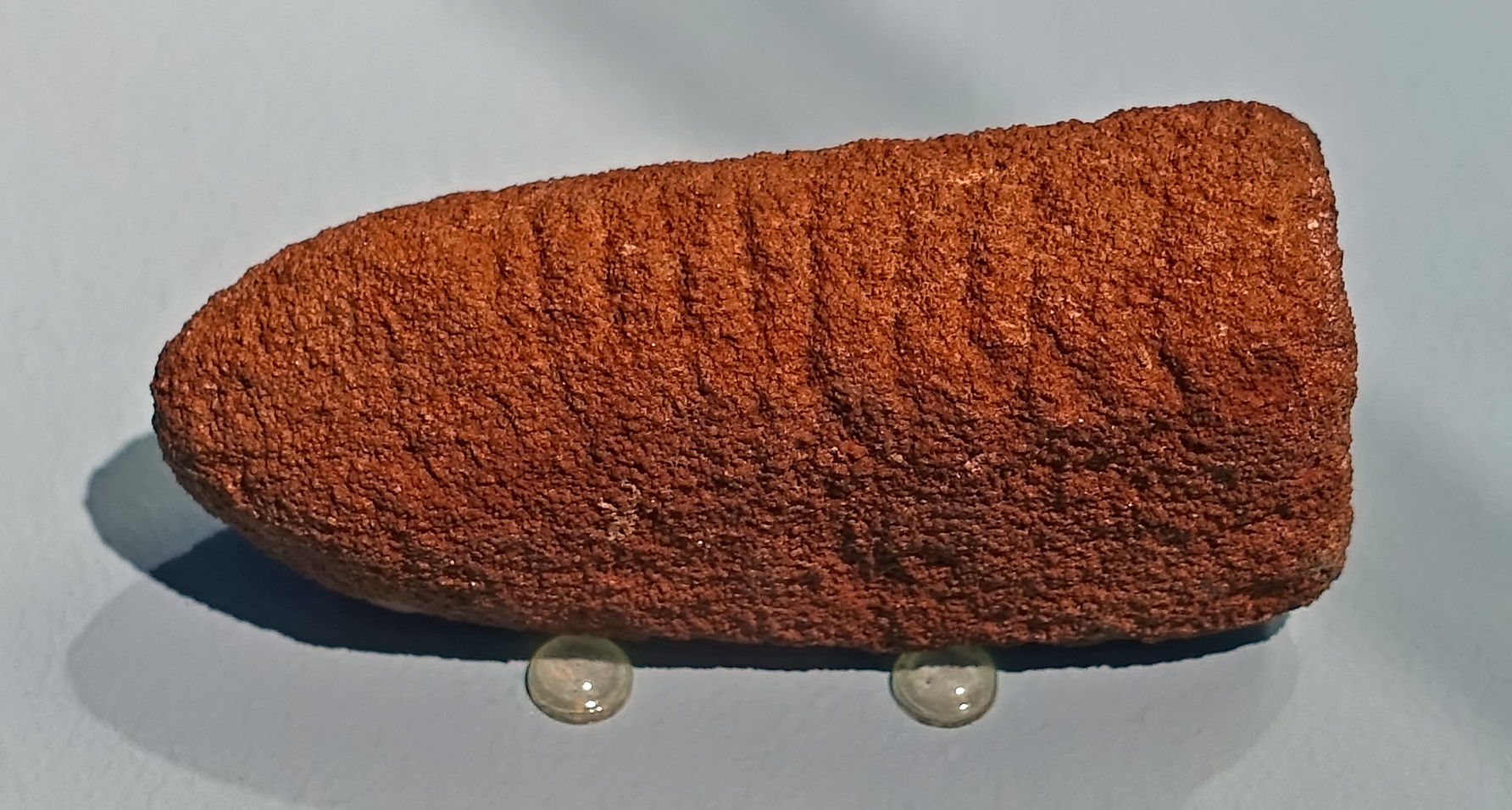
This is an interesting piece, with a series of Gönnersdorf figures engraved into a semi-cylindrical/conical piece of sandstone, from From 13 000 BP. It is a sandstone shaft smoother. They were used in pairs, where the shaft of the spear was between the two pieces of sandstone. The women are dancing, in the Gönnersdorf and Andernach tradition.
In the artistic manifestations of the late Palaeolithic, in contrast to the previous art of the Magdalenian, the art is often displayed on moose antler. This is no accident, but rather represents the typical prey of the hunters in the dense forest of this time.
Photo: Don Hitchcock 2018
Source and text: Display at LVR-LandesMuseum Bonn
Lender of the piece: Directorate General for Cultural Heritage Rhineland-Palatinate, Generaldirektion Kulturelles Erbe Rheinland-Pfalz.
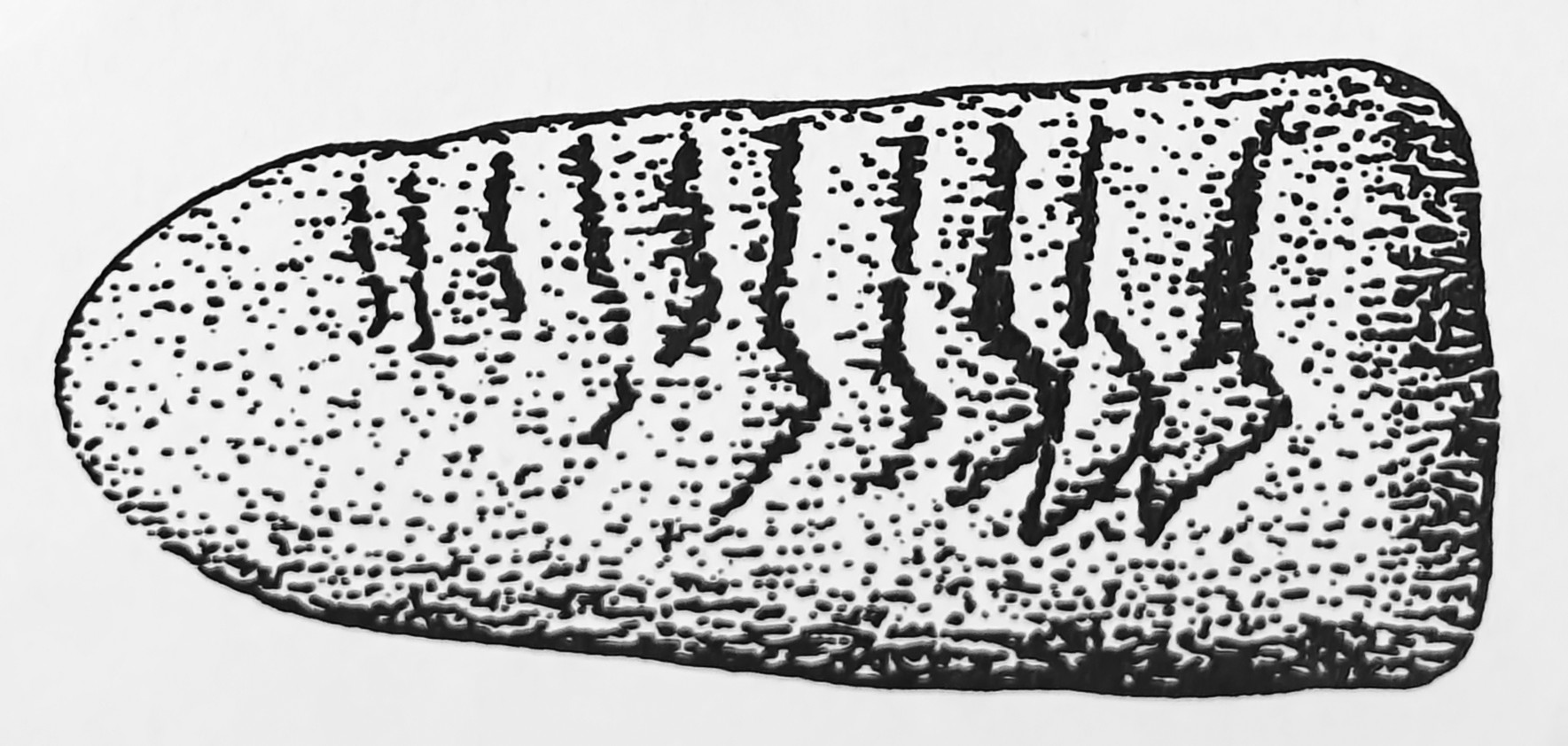
The figures above can only be made out clearly in the drawing which accompanies the piece.
Rephotography: Don Hitchcock 2018
Source and text: Display at LVR-LandesMuseum Bonn
Lender of the piece: Directorate General for Cultural Heritage Rhineland-Palatinate, Generaldirektion Kulturelles Erbe Rheinland-Pfalz.
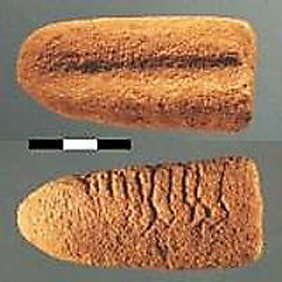
This image shows the other side of the arrow shaft smoother shown above. The object, made of red sandstone, was discovered at the Palaeolithic archaeological site Niederbieber in the Neuwied Basin during excavation of area II 1981. The 71 x 34 x 22 mm piece has both engravings on the back engravings and is also a functionally outstanding reference object forNiederbieber.
They were used in pairs were used for grinding wooden arrow shafts and are in addition to the characteristic stone tool types (penknife) of the late Palaeolithic an indirect indication of the beginning of the time when bows and arrows were used as hunting weapons. In Niederbieber this arrow shaft shaper delivers an additional proof of the new production or repair (hafting and retooling) of hunting weapons. The unusual decoration of shaft smoother with stylised female figures of the Gönnersdorf type is one of the rare instances of the artistic work of this time. It provides a unique reference to the survival of the tradition of Gönnersburg/Lalinde female representation.
Source: http://www.museum.de/
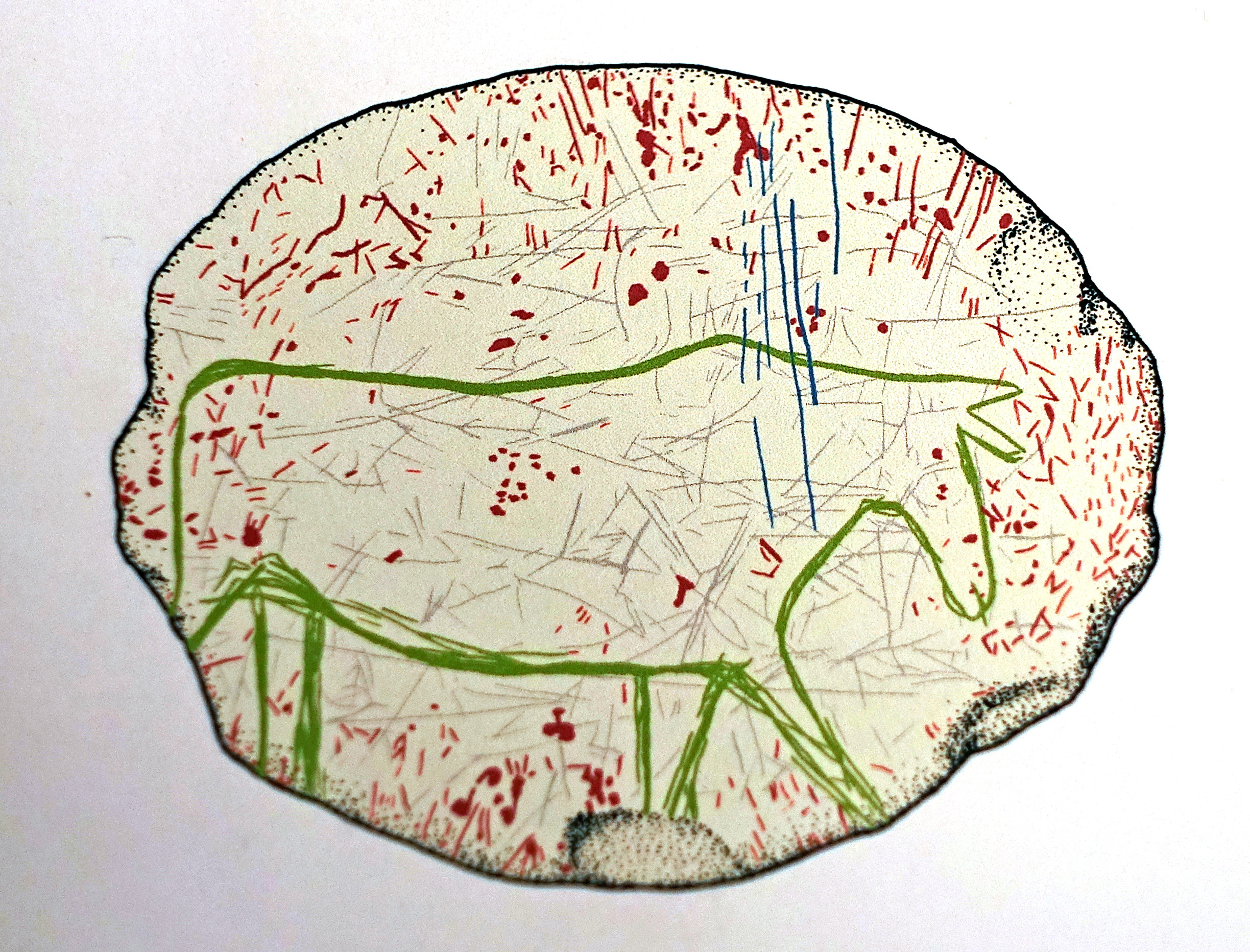
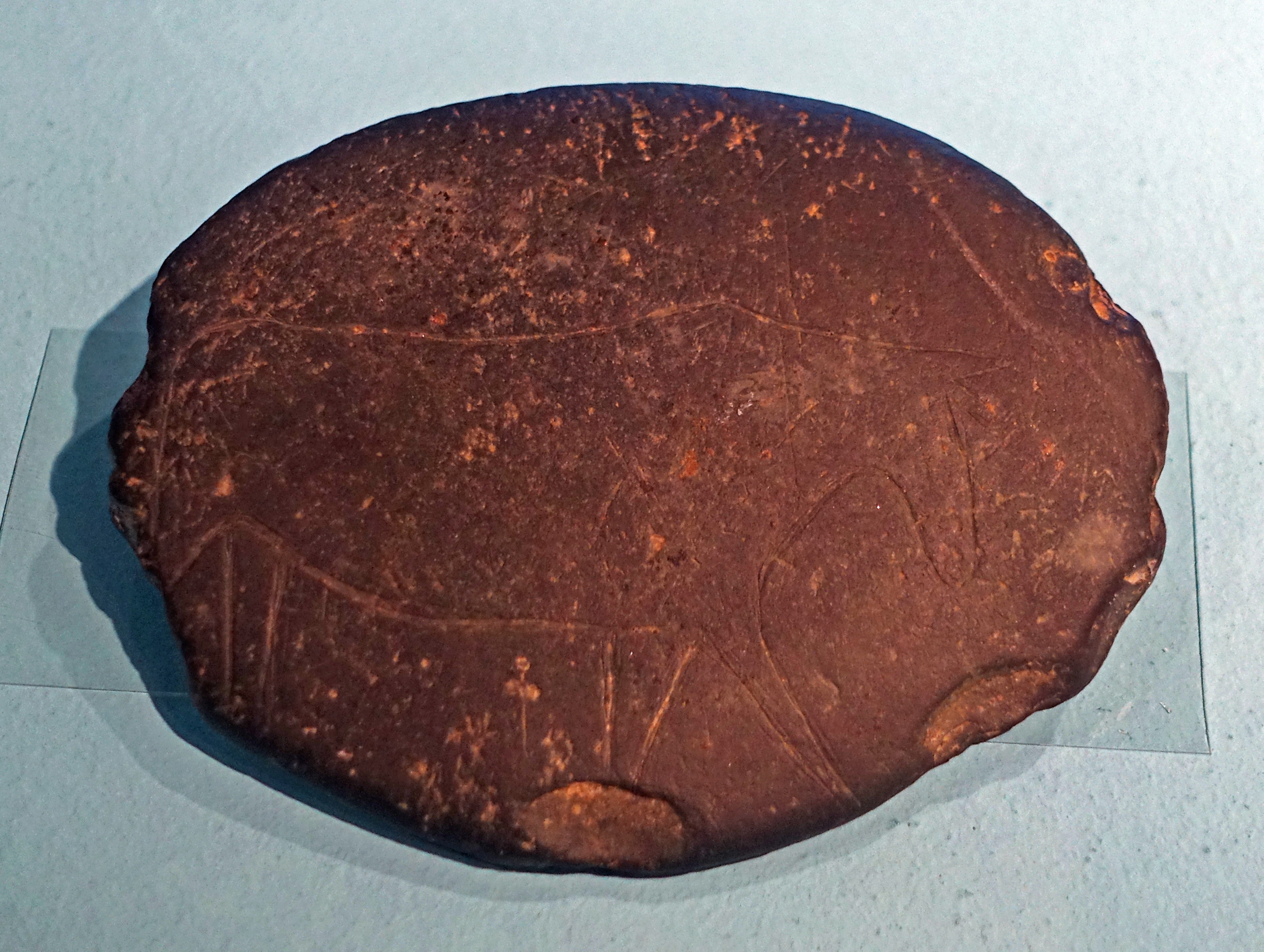
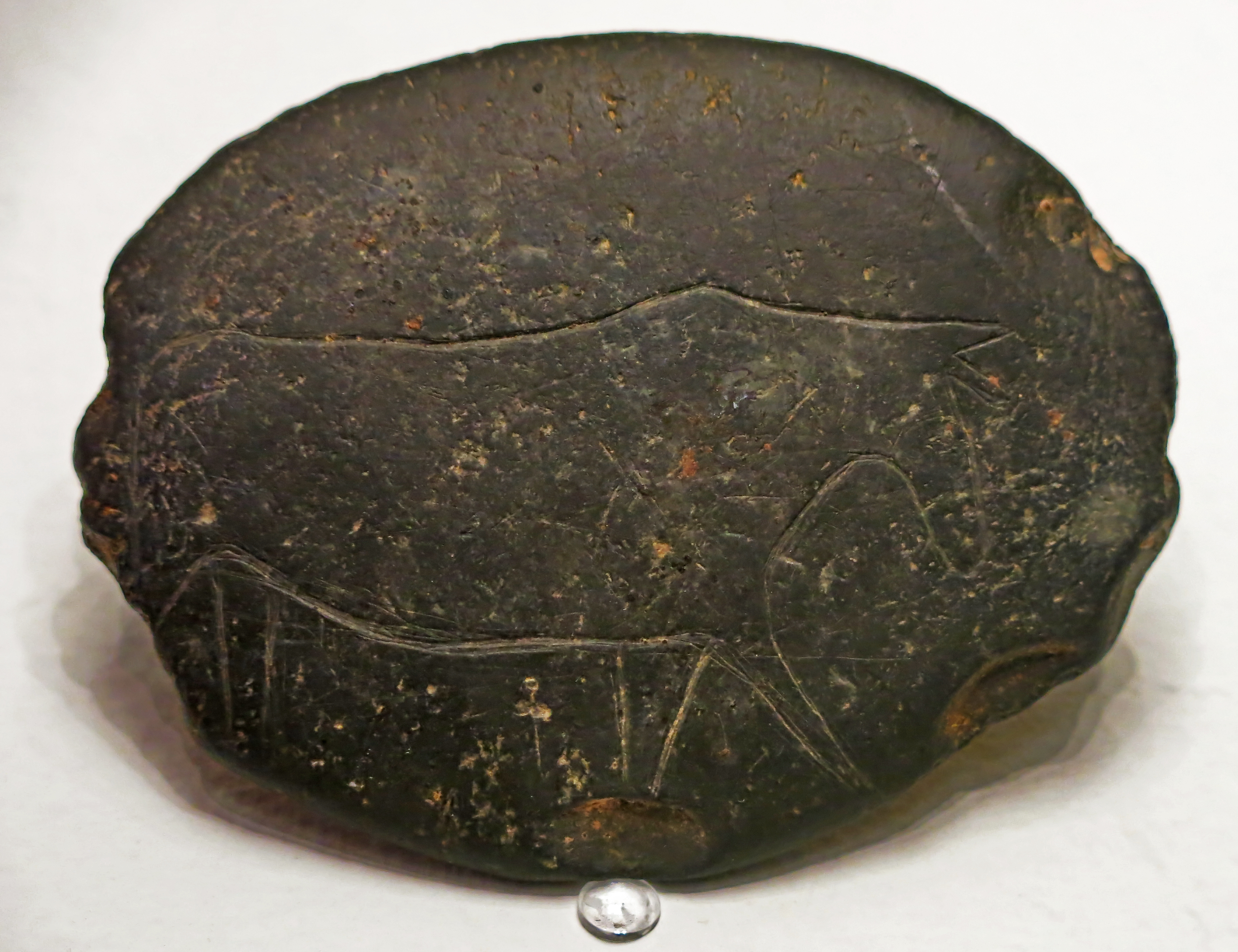
Engraving of what was identified by the museum card as a horse, but the lack of a mane and the lack of a significant tail means that it is much more likely to be in the deer family, perhaps an adult female red deer.
My thanks to AnnDee for pointing this out.
Drawing: Unknown
Photo and rephotography (above): Don Hitchcock 2018
Photo (left): Don Hitchcock 2015
Source and text: Display at LVR-LandesMuseum Bonn
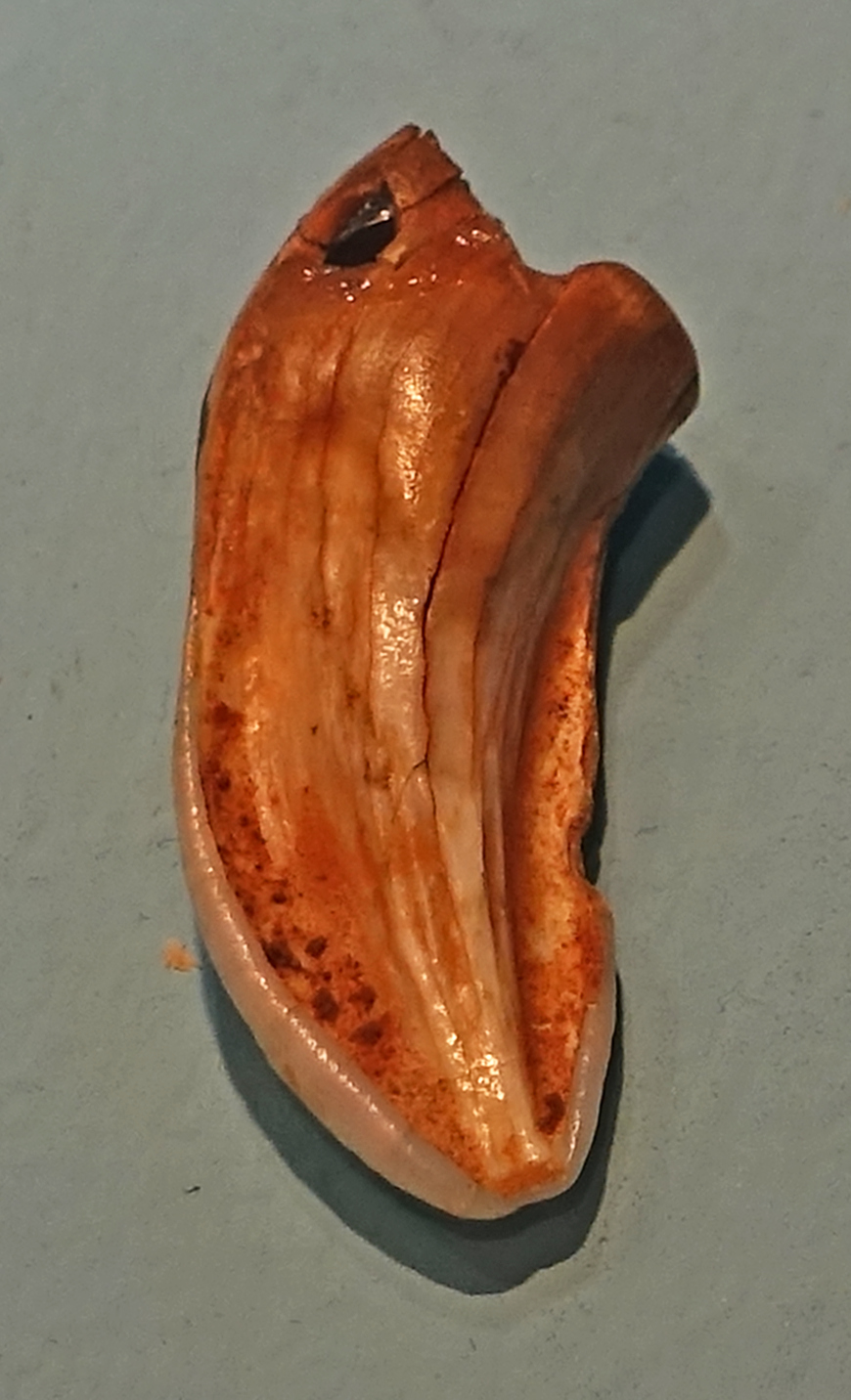
Pierced horse tooth, Gönnersdorf, Stadt Neuwied.
From the same levels as the Gönnersdorf venus figures.
Photo: Don Hitchcock 2018
Source and text: Original, display at LVR-LandesMuseum Bonn
Dauerleihgabe des Vereins von Altertumsfreunden, On permanent loan from the Friends of the Antiquity Association.
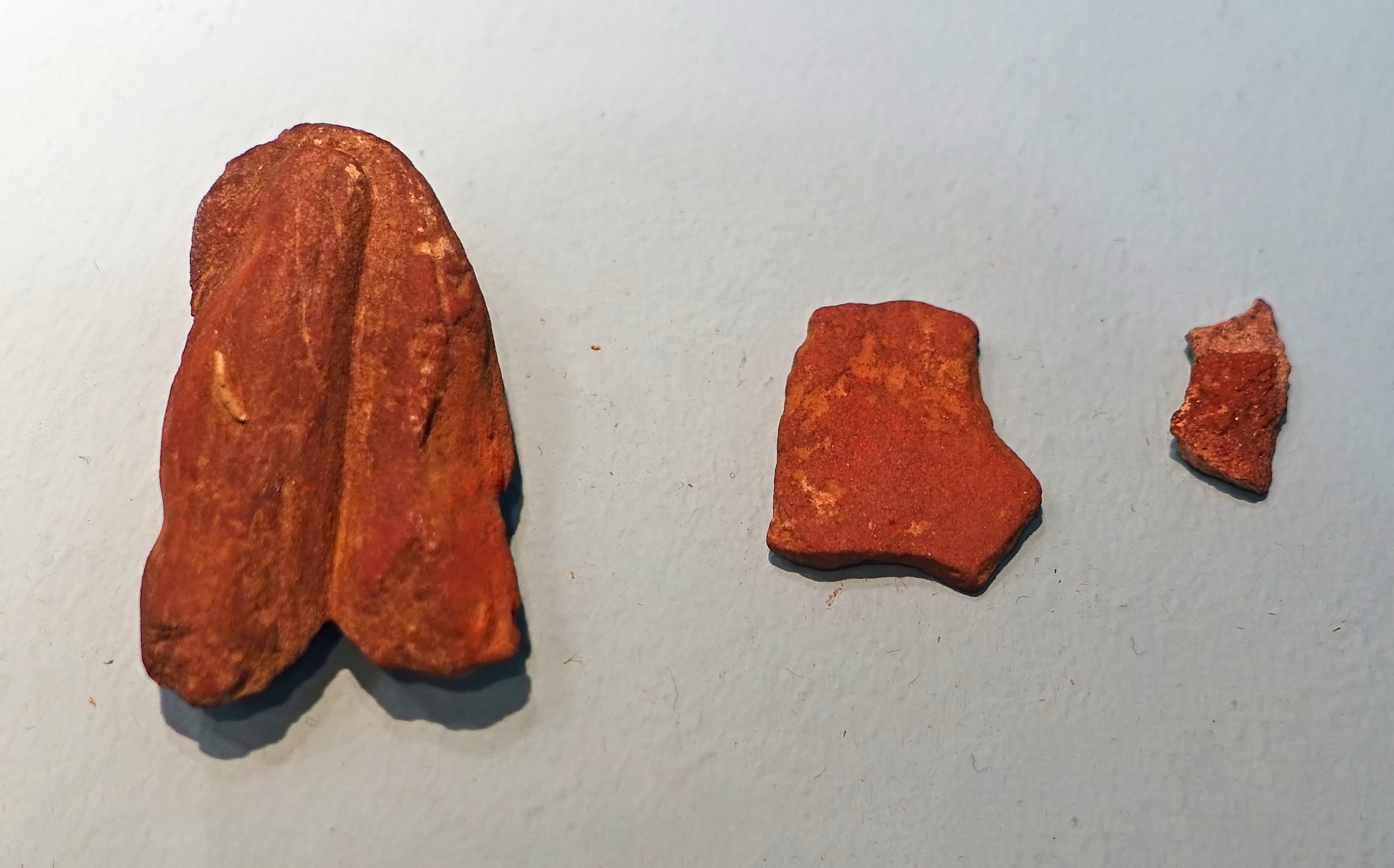
Haematite, one piece with a groove from the grinding of red ochre powder, Gönnersdorf, Stadt Neuwied.
From the same levels as the Gönnersdorf venus figures.
Photo: Don Hitchcock 2018
Source and text: Original, display at LVR-LandesMuseum Bonn
Dauerleihgabe des Vereins von Altertumsfreunden, on permanent loan from the Friends of the Antiquity Association.
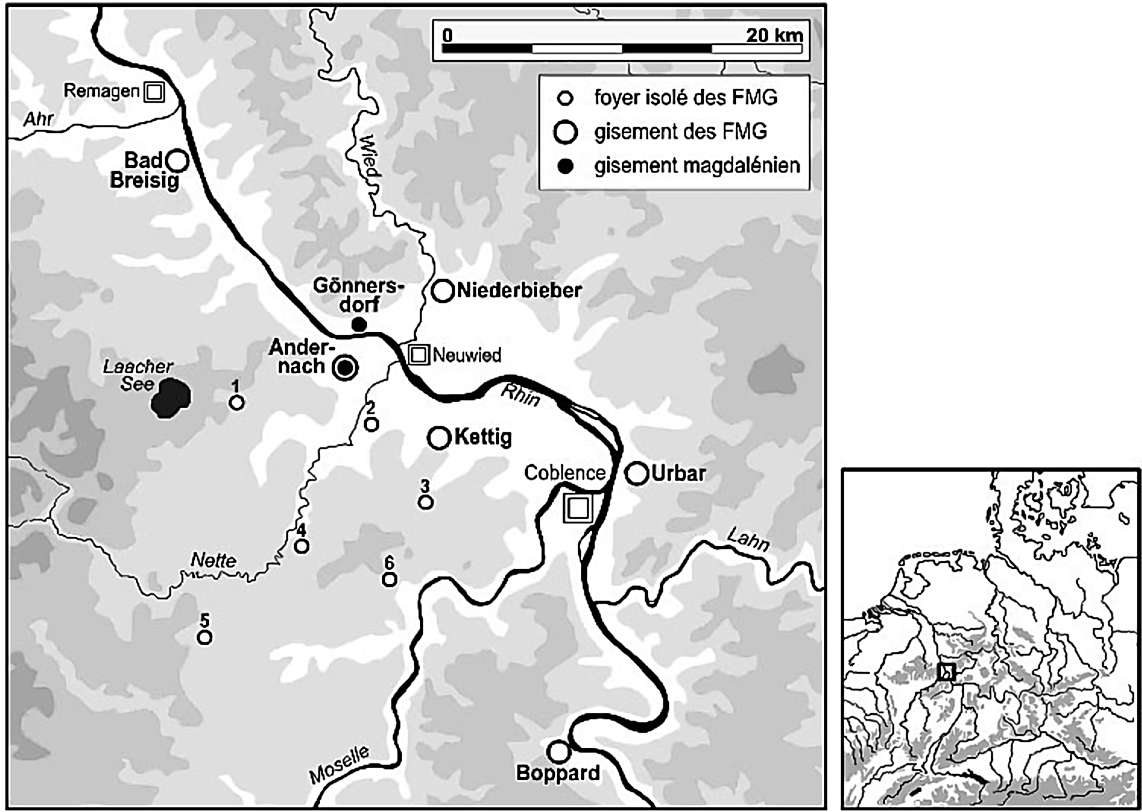
This map shows the close spatial relationship between the sites of Gönnersburg, Andernach, and Niederbieber.
Photo: Street (2006)

Necklace of tusk shells from Neuwied-Gönnersdorf, Rheinland-Pfalz, 15 000 BP.
The tusk shells or tooth shells, often referred to by the more-technical term scaphopods, are members of a class of shelled marine mollusc with worldwide distribution, and are the only class of exclusively infaunal marine molluscs. Shells of species within this class range from about 0.5 to 15 cm in length. Members of the order Dentaliida tend to be significantly larger than those of the order Gadilida.
(Infauna are organisms that live within the bottom substratum of a body of water, especially within the bottom-most oceanic sediments, rather than on its surface.)
These molluscs live in soft substrates offshore (usually not intertidally). Because of this subtidal habitat and the small size of most species, many beachcombers are unfamiliar with them. Their shells are not as common or as easily visible in the beach drift as the shells of sea snails and clams.
Photo: Don Hitchcock 2015
Source and text: Original, Monrepos Archäologisches Forschungszentrum und Museum, Neuwied, Germany
Additional text: Wikipedia

Necklace of shells from Andernach, Rheinland-Pfalz, 15 800 BP.
These are pierced snail shells from the Mediterranean Sea, Cyclope neritea, synonym of Tritia neritea, otherwise known as Nassa mud snails or dog whelks.
Photo: Don Hitchcock 2015
Source and text: Original, Monrepos Archäologisches Forschungszentrum und Museum, Neuwied, Germany
Additional text: Wikipedia
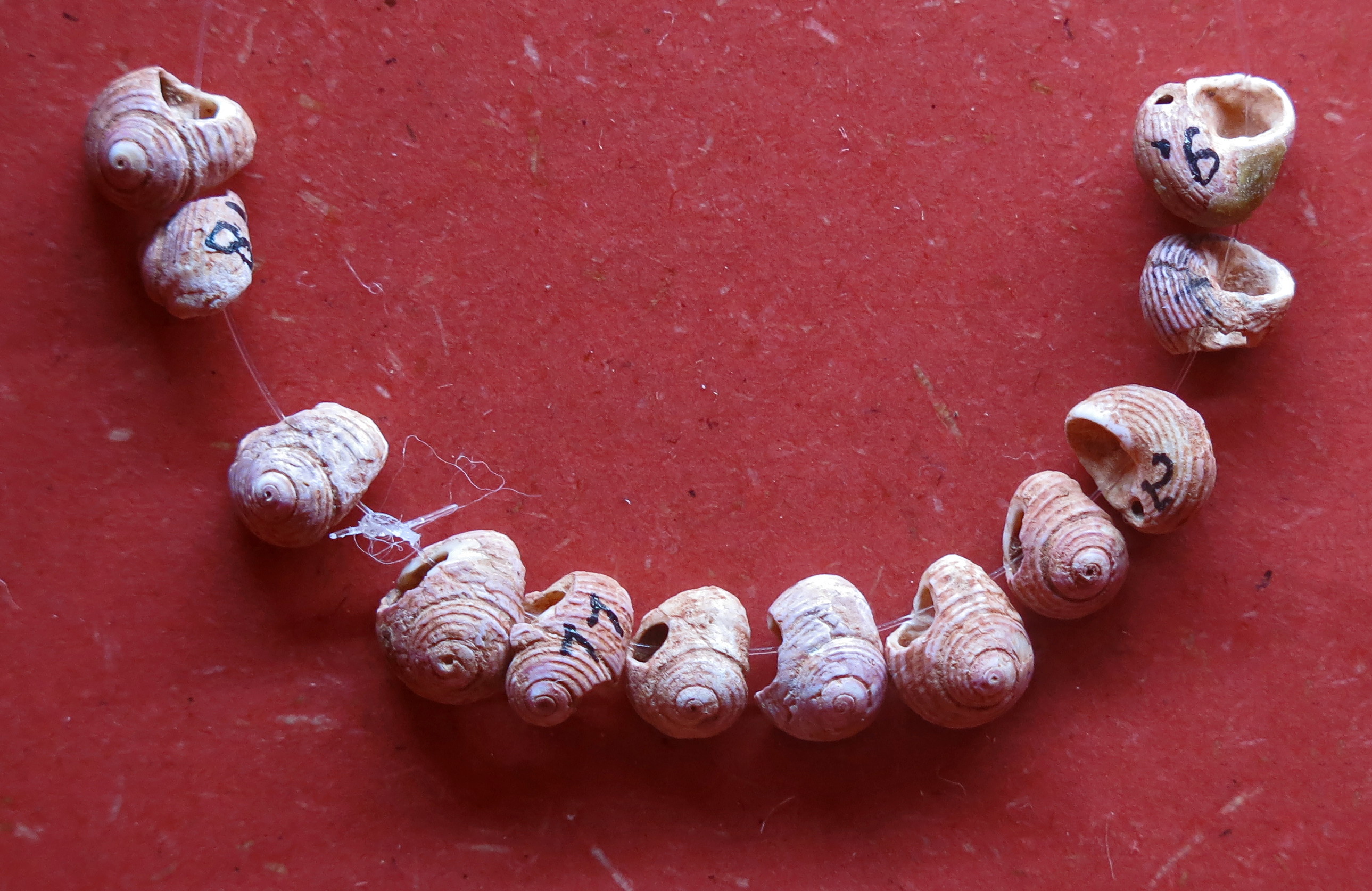
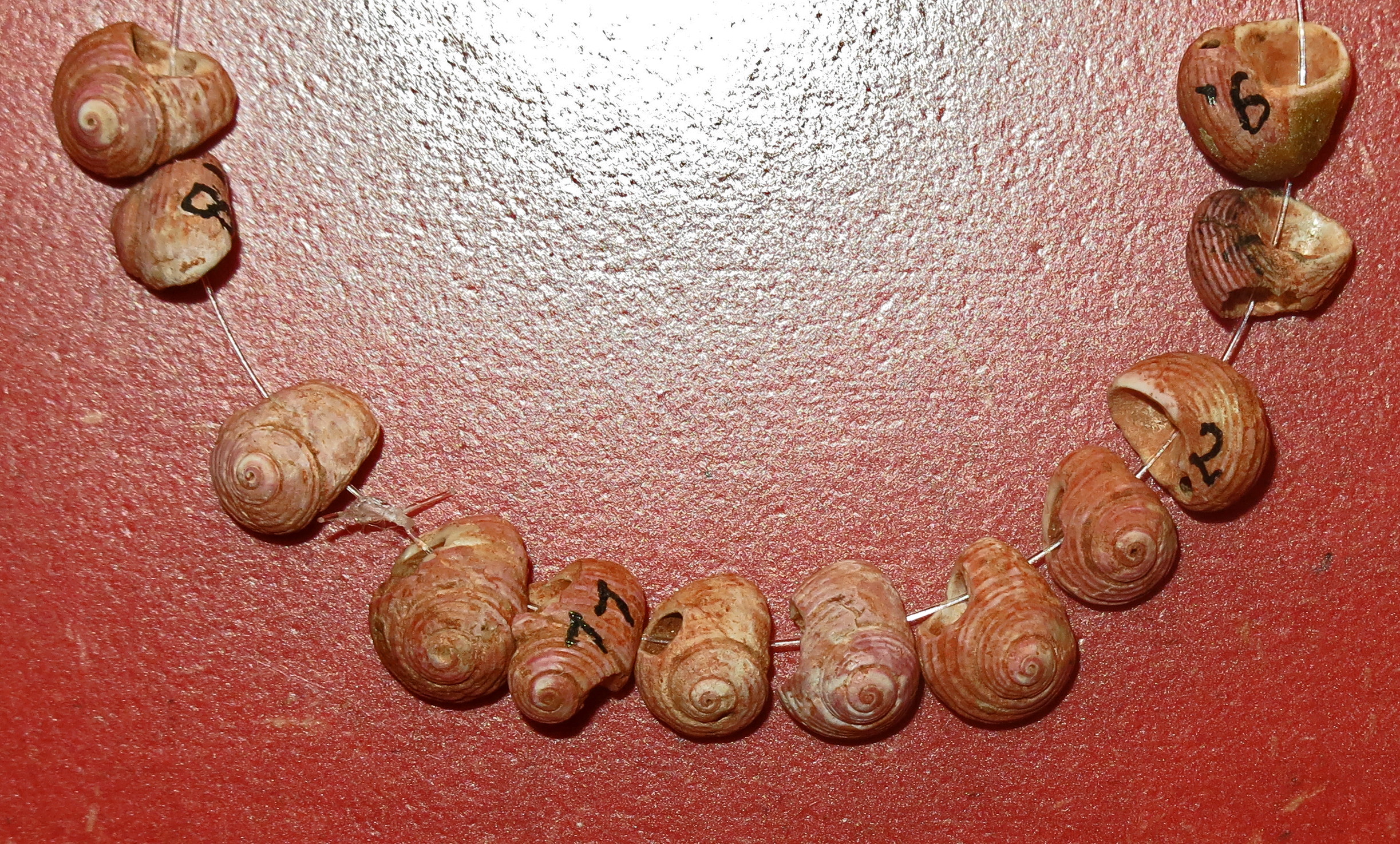
Jewellery - perforated snail shells from the Mediterranean Sea.
Andernach, Rheinland-Pfalz, 15 800 BP.
Photo: Don Hitchcock 2015
Source and text: Original, Monrepos Archäologisches Forschungszentrum und Museum, Neuwied, Germany
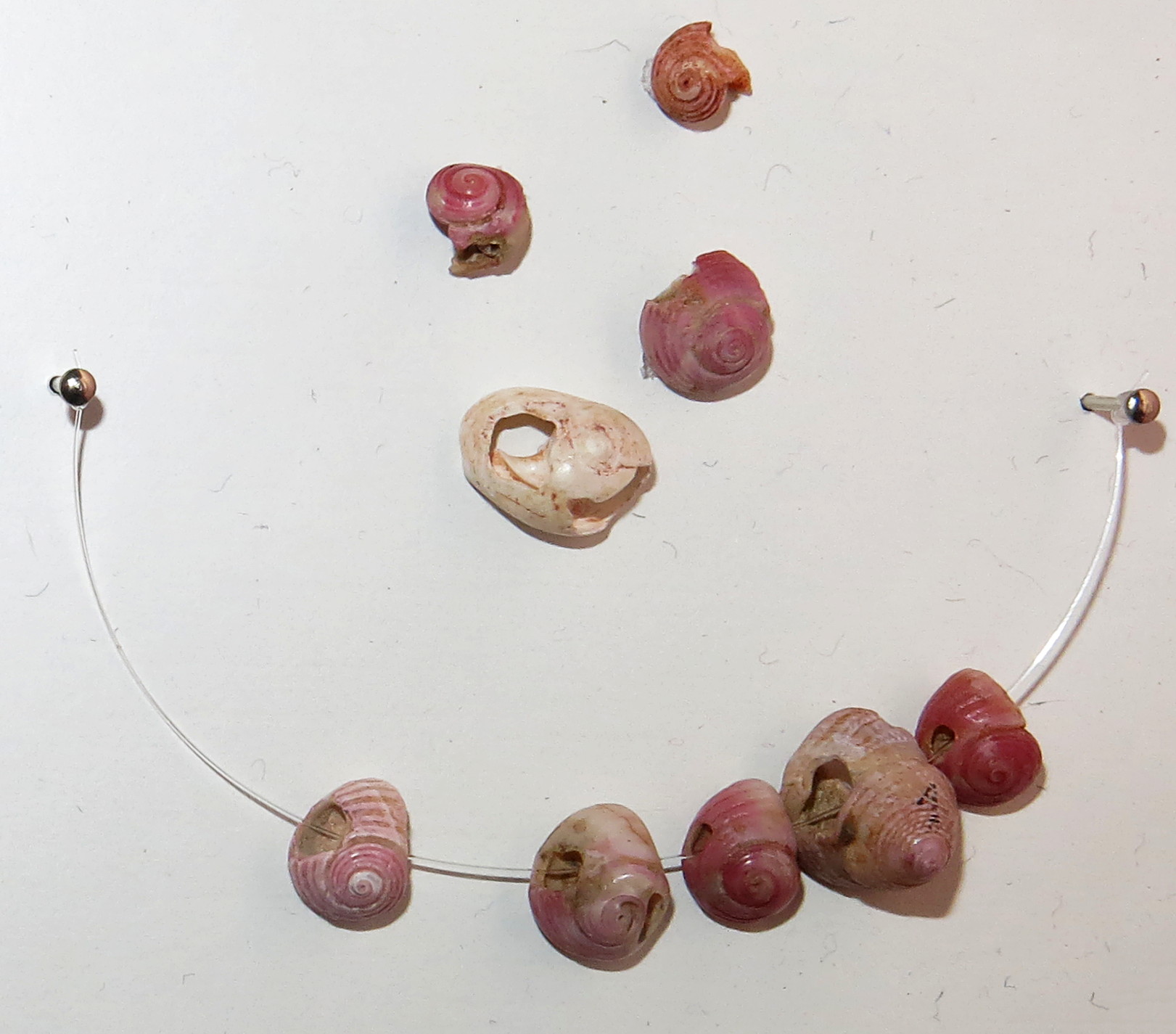
Necklace of shells from Sprendlingen, Rheinland-Pfalz, 27 000 BP - 31 000 BP.
These are pierced snail shells, Homalopoma sanguineum, which is a pink or reddish herbivorous snail which lives on rocks and other surfaces in the Mediterranean Sea, feeding on algae.
Photo: Don Hitchcock 2015
Source and text: Original, Monrepos Archäologisches Forschungszentrum und Museum, Neuwied, Germany
Additional text: Wikipedia
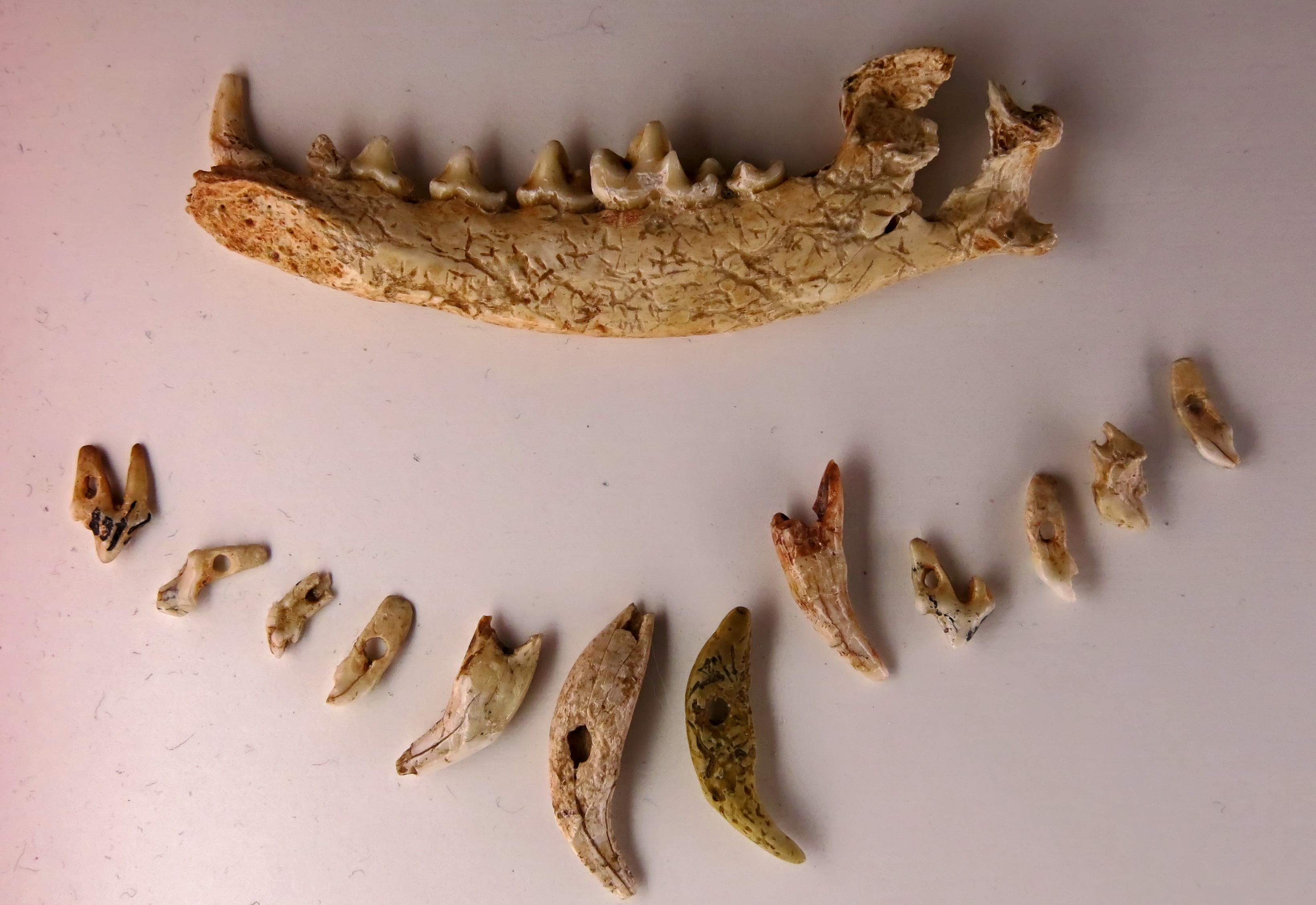
Perforated teeth and lower jaw of the arctic fox, Vulpes lagopus.
From Neuwied-Gönnersdorf, Rheinland-Pfalz, 15 800 BP.
Photo: Don Hitchcock 2015
Source and text: Original, Monrepos Archäologisches Forschungszentrum und Museum, Neuwied, Germany
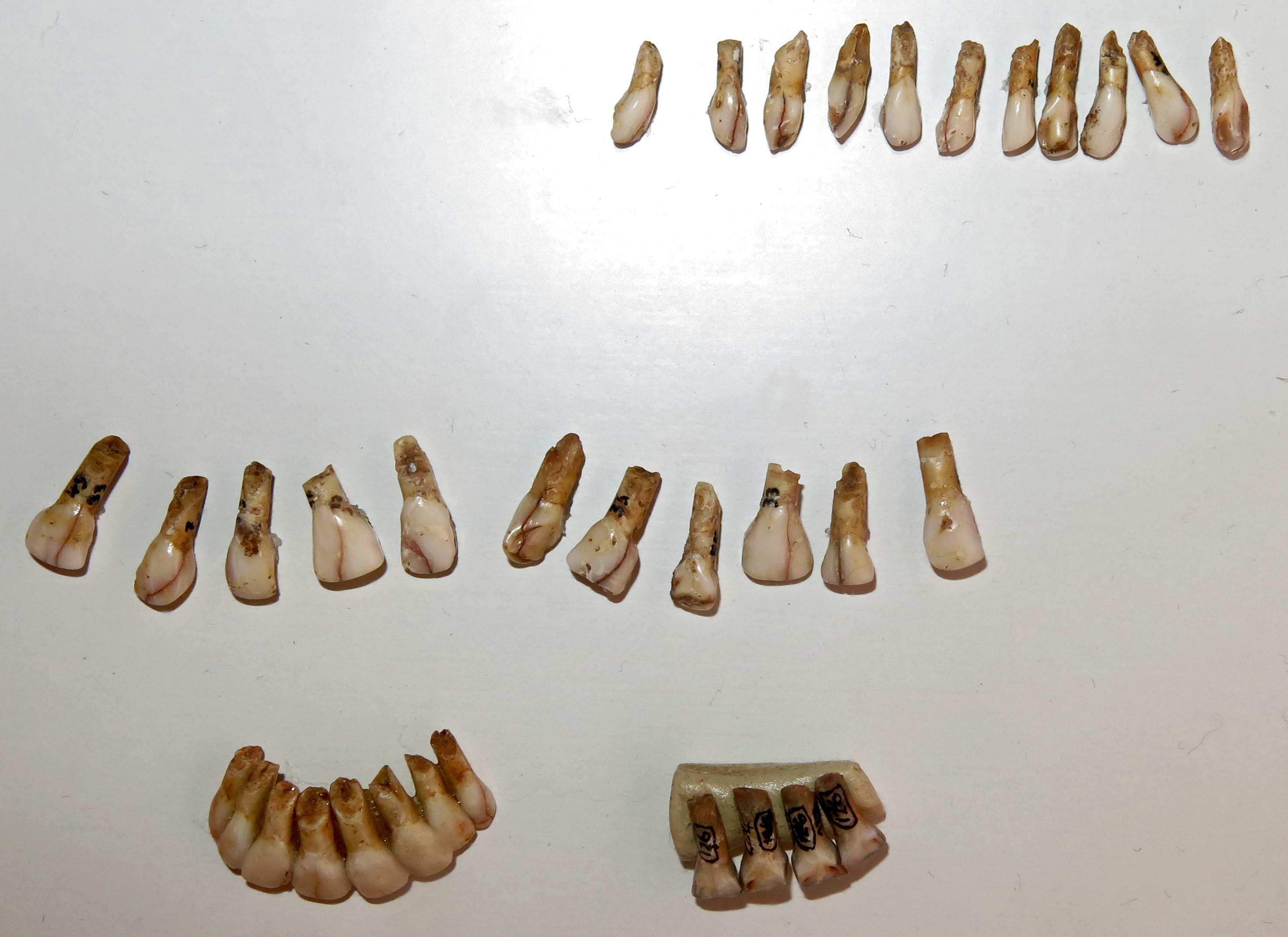
Reindeer teeth necklace, from Andernach, Rheinland-Pfalz, 15 800 BP.
Photo: Don Hitchcock 2015
Source and text: Original, Monrepos Archäologisches Forschungszentrum und Museum, Neuwied, Germany

Pierced Red Deer canines, or Hirschgrandeln, from Neuwied-Gönnersdorf, Rheinland-Pfalz, 15 800 BP.
Photo: Don Hitchcock 2015
Source and text: Original, Monrepos Archäologisches Forschungszentrum und Museum, Neuwied, Germany

Aurochs cutting incisors from Neuwied-Gönnersdorf, Rheinland-Pfalz, 15 800 BP.
Photo: Don Hitchcock 2015
Source and text: Original, Monrepos Archäologisches Forschungszentrum und Museum, Neuwied, Germany
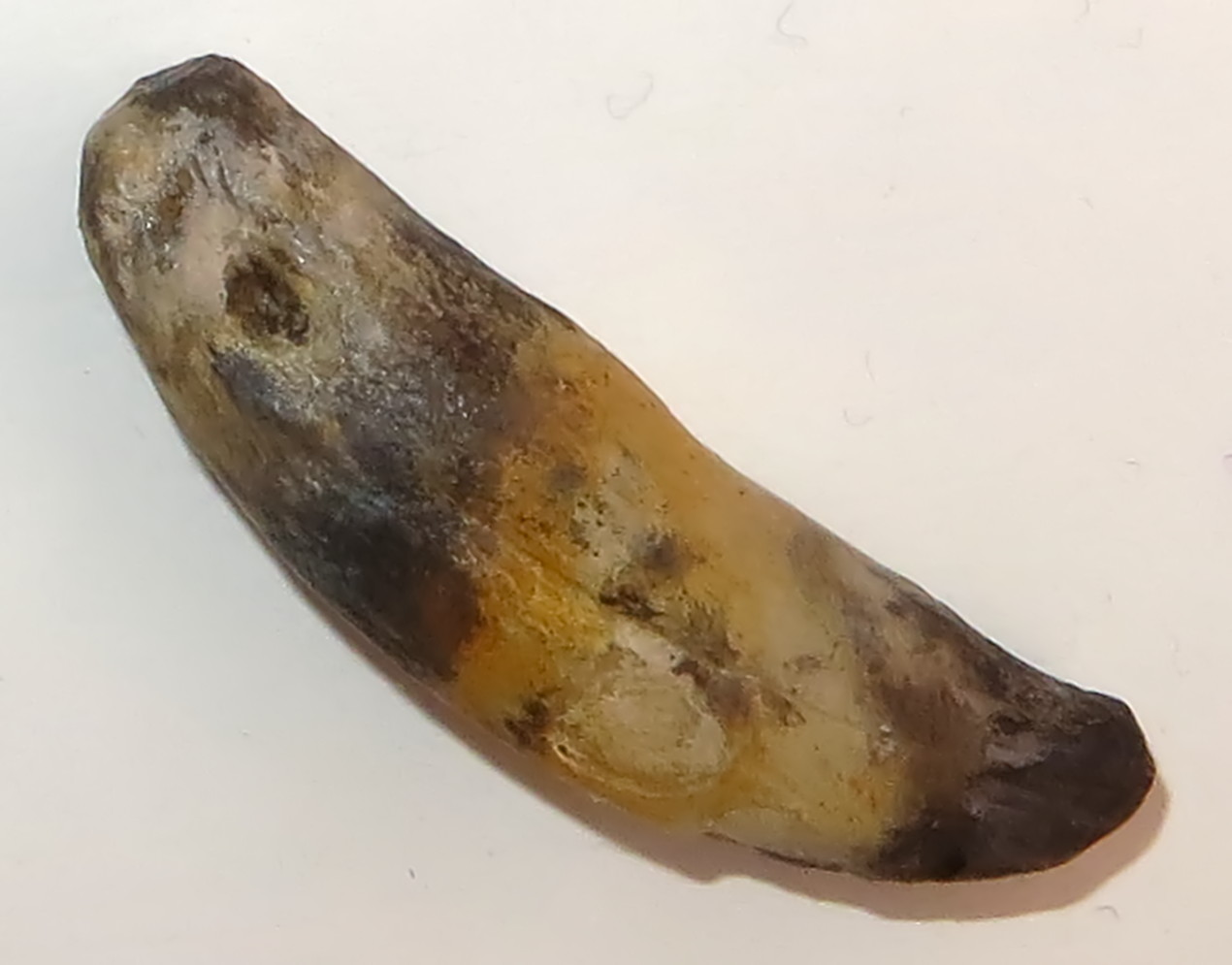
Wolf tooth with the beginnings of a piercing from Wildscheuer, Hessen, 34 800 BP - 40 000 BP.
The Wildscheuer cave was destroyed by limestone mining, and was about 50 km from Neuwied.
Photo: Don Hitchcock 2015
Source and text: Original, Monrepos Archäologisches Forschungszentrum und Museum, Neuwied, Germany
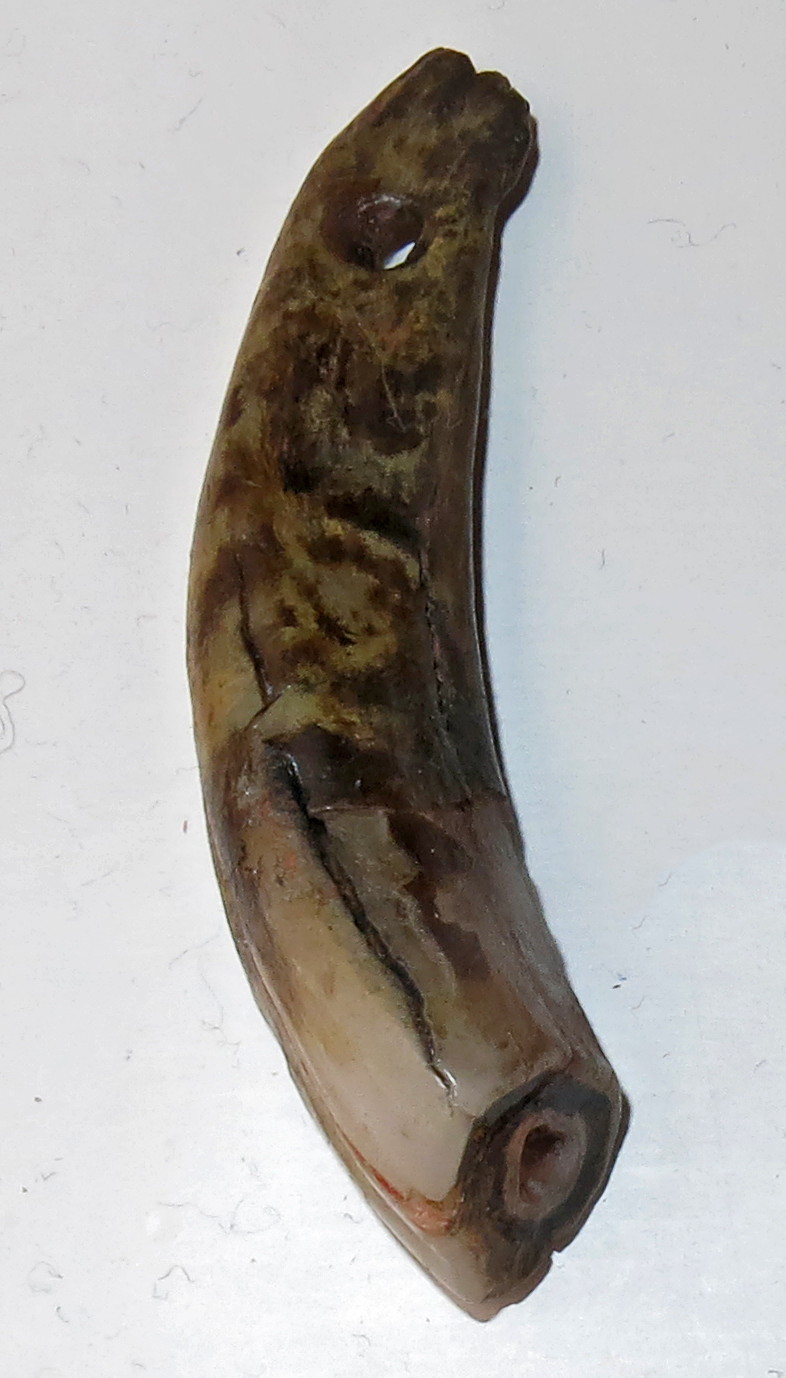
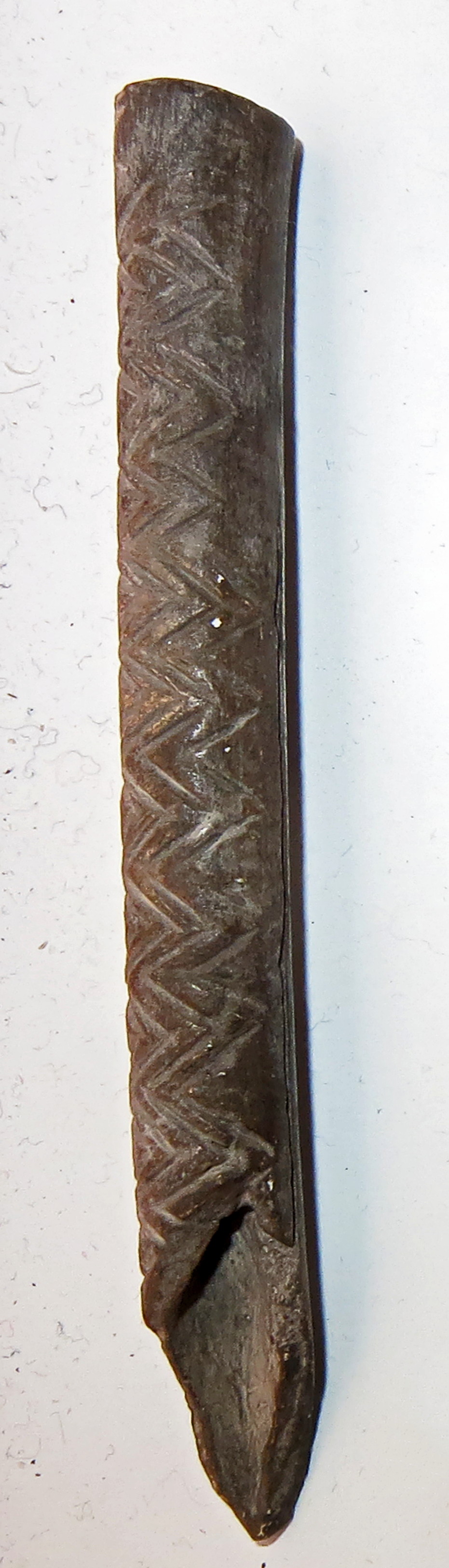
(left) Pendant made from a horse's tooth, from Wildscheuer, Hessen, 34 000 BP - 40 000 BP.
(right) Zigzag design on bone, from Wildscheuer, Hessen, 34 000 BP - 40 000 BP.
The Wildscheuer cave was destroyed by limestone mining, and was about 50 km from Neuwied.
Photo: Don Hitchcock 2015
Source and text: Original, Monrepos Archäologisches Forschungszentrum und Museum, Neuwied, Germany

Stone pendant and beads from Wildscheuer, Hessen, 35 000 BP.
The Wildscheuer cave was destroyed by limestone mining, and was about 50 km from Neuwied.
Photo: Don Hitchcock 2015
Source and text: Original, Monrepos Archäologisches Forschungszentrum und Museum, Neuwied, Germany
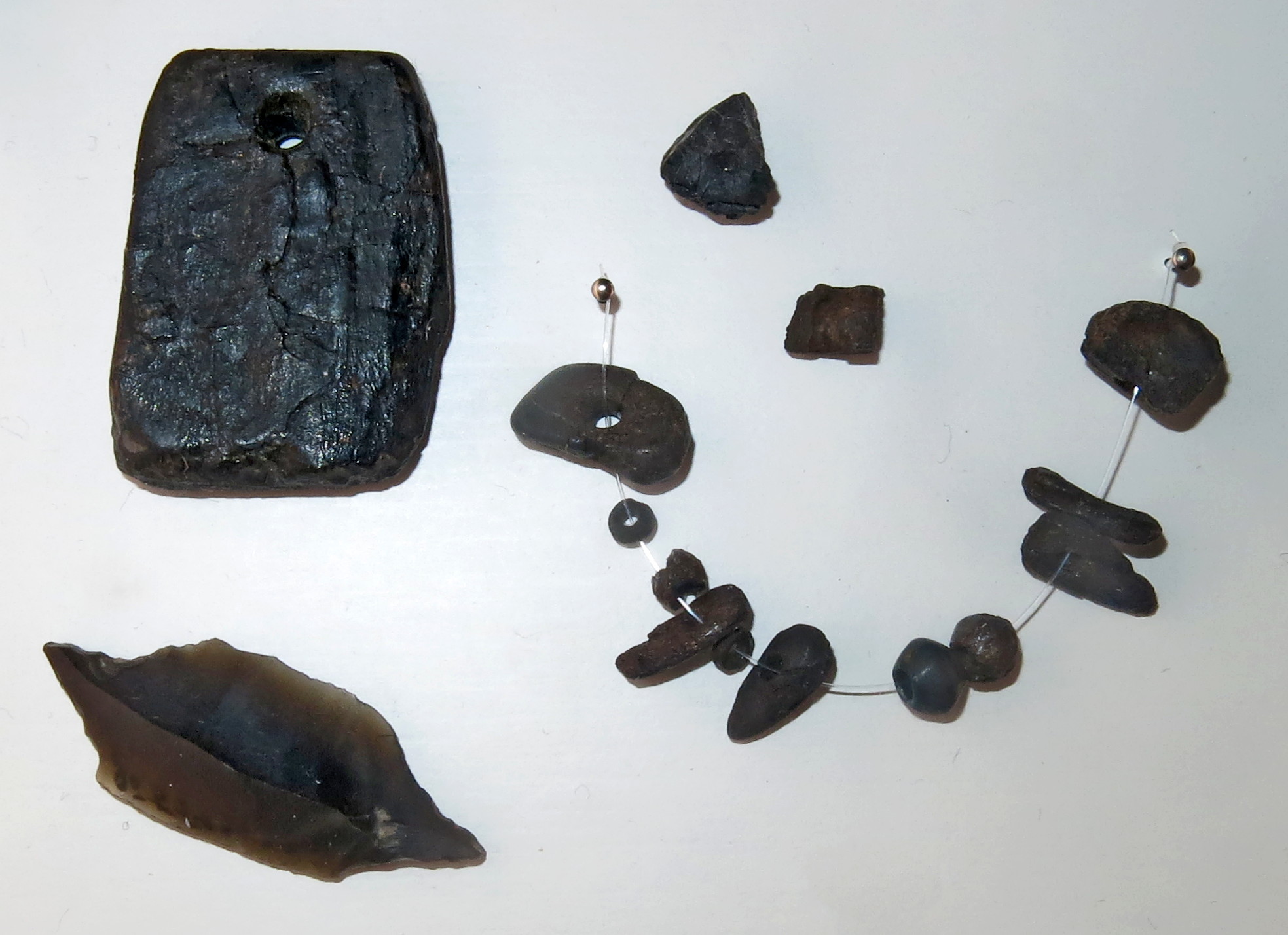
Pendant made from jet, from Neuwied-Gönnersdorf, Rheinland-Pfalz, 15 800 BP.
Beads made from jet, from Ölknitz, Thuringen, 15 500 BP.
Included in the display is a double ended perçoir, of the type which would have been used to pierce the pieces shown.
Photo: Don Hitchcock 2015
Source and text: Original, Monrepos Archäologisches Forschungszentrum und Museum, Neuwied, Germany

(upper left) Pendant of mammoth ivory, from Neuwied-Gönnersdorf, Rheinland-Pfalz, 15 800 BP.
(right) Mammoth ivory rings, Magdalenahöhle, Rheinland-Pfalz, 20 000 BP - 35 000 BP.
Magdalenahöhle is especially known for its unique ivory jewelery, and for the fact that although it is in central Europe, it demonstrates the presence of people there during the last glacial maximum during the Solutrean.
Photo: Don Hitchcock 2015
Source and text: Original, Monrepos Archäologisches Forschungszentrum und Museum, Neuwied, Germany
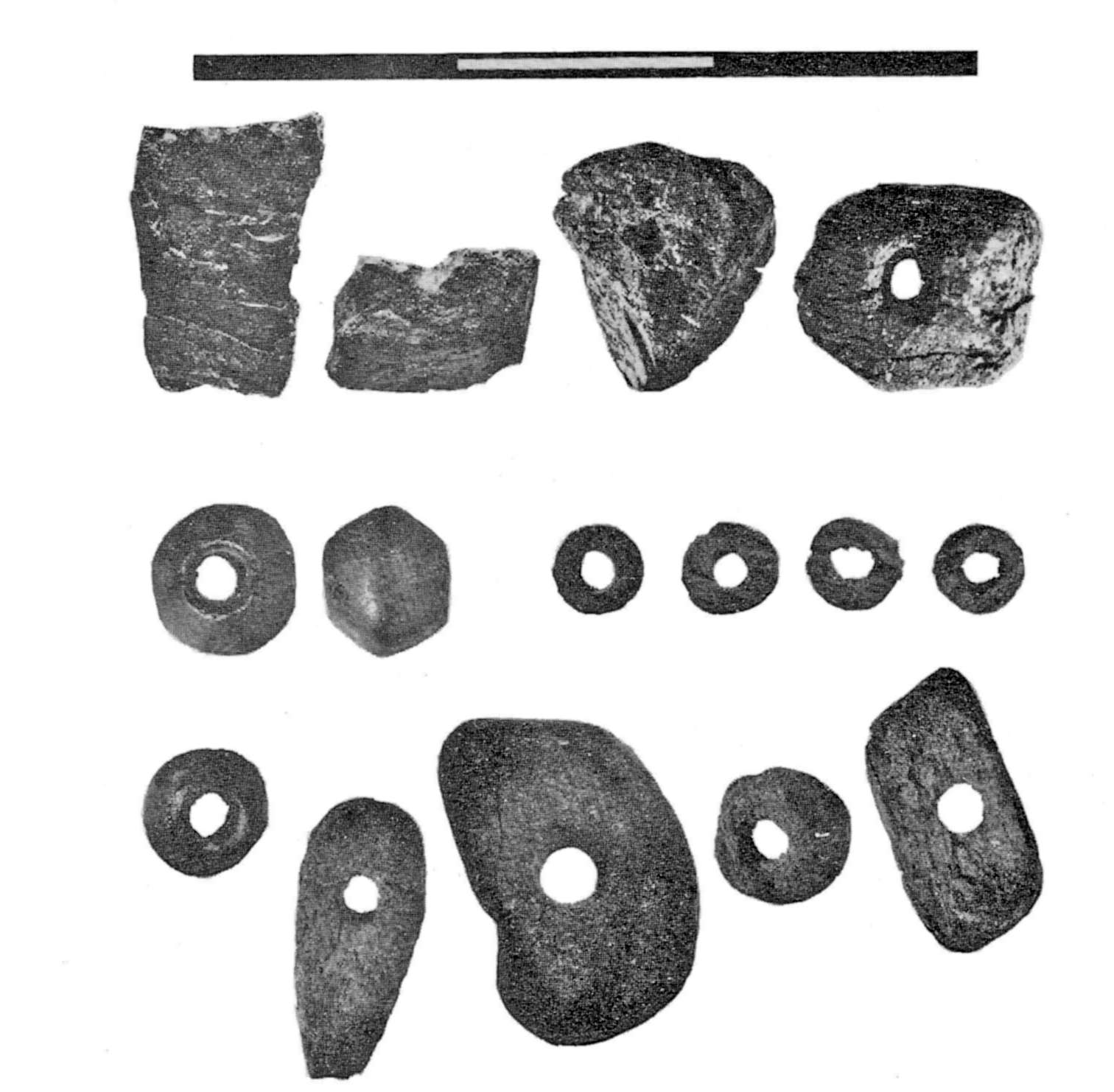
From Gönnersdorf.
Jewellery from Gönnersdorf.
Photo: Bosinski (1981)
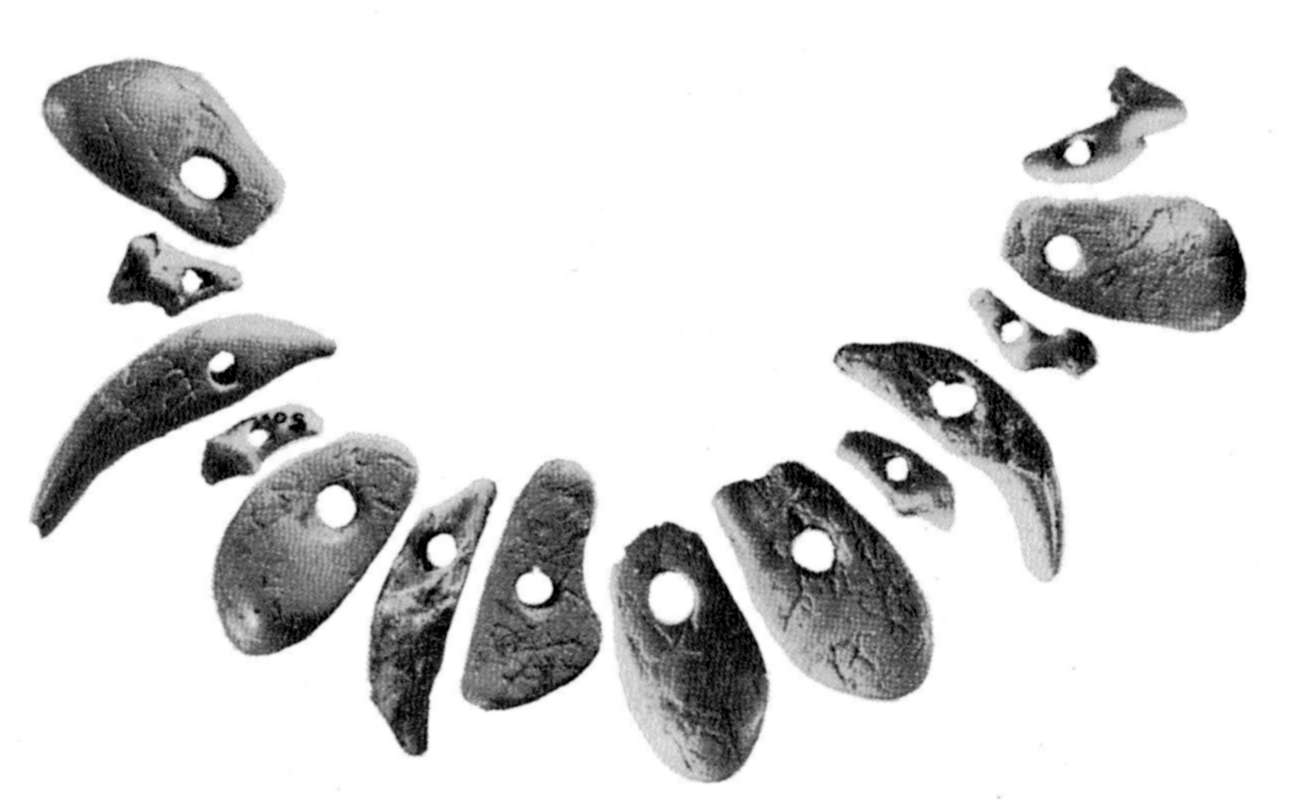
From Gönnersdorf.
Animal teeth pierced for use as a necklace or as pendants.
Photo: Bosinski (1981)
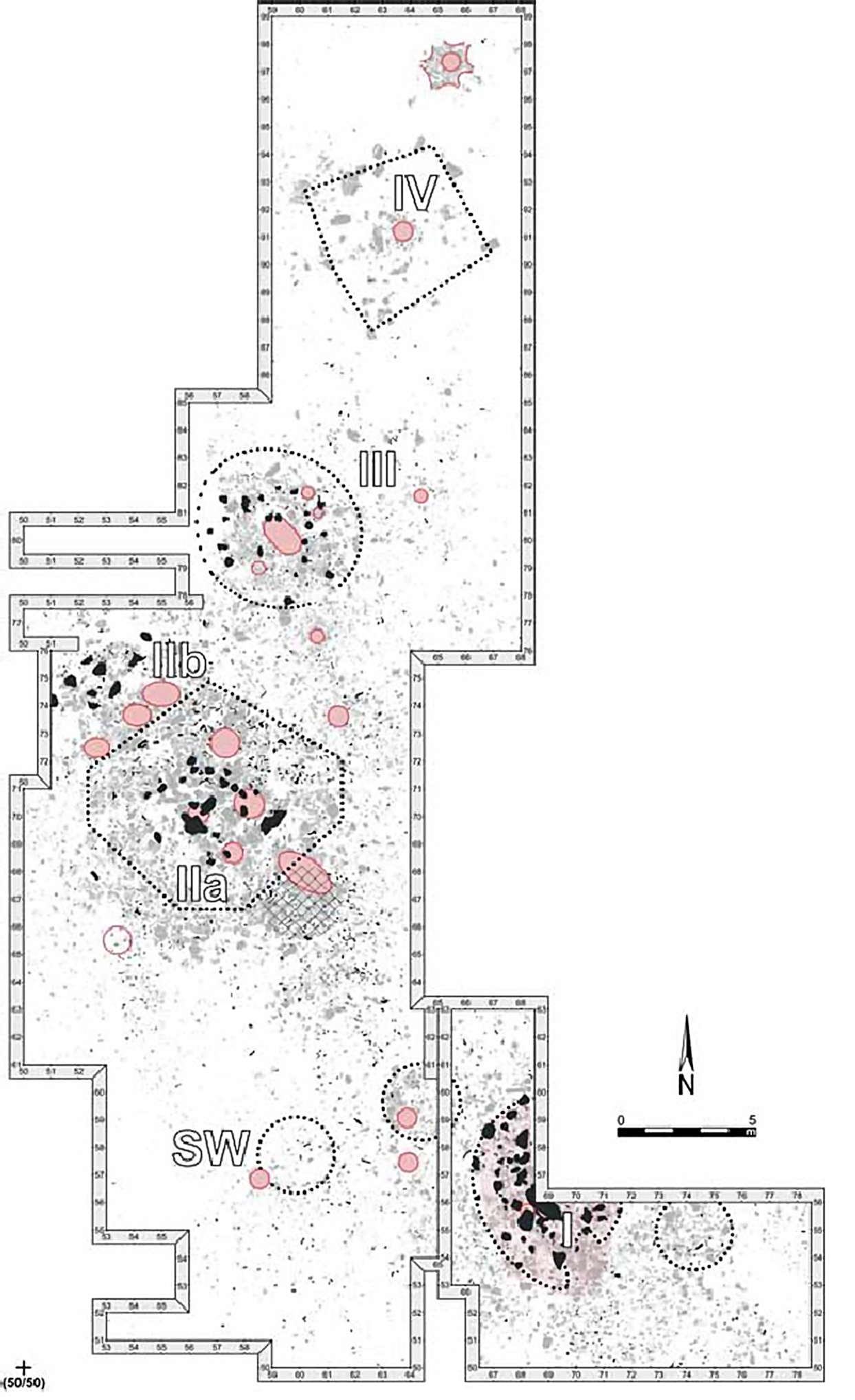
Plan of the Gönnersdorf 'Planum I' excavation surface showing slabs and blocks (pale grey) and artificial pits (black) and the location of evident and latent settlement features.
Black dotted lines: boundaries of dwelling structures reconstructed by architectural features, find distribution patterns and refitting;
Red circles and ellipses: hearths suggested by distribution patterns of burnt materials (unfilled circles represent less certain hearth features);
Star-shaped feature north-east of K-IV: reconstructed extent of hearth (Moseler 2008);
Red stippling shows the extent of intense ochre-staining in K-I;
Hatching plots an area of intense find deposition (working area / dump?) adjacent to K-IIa.
Photo and text: Jöris (2011)
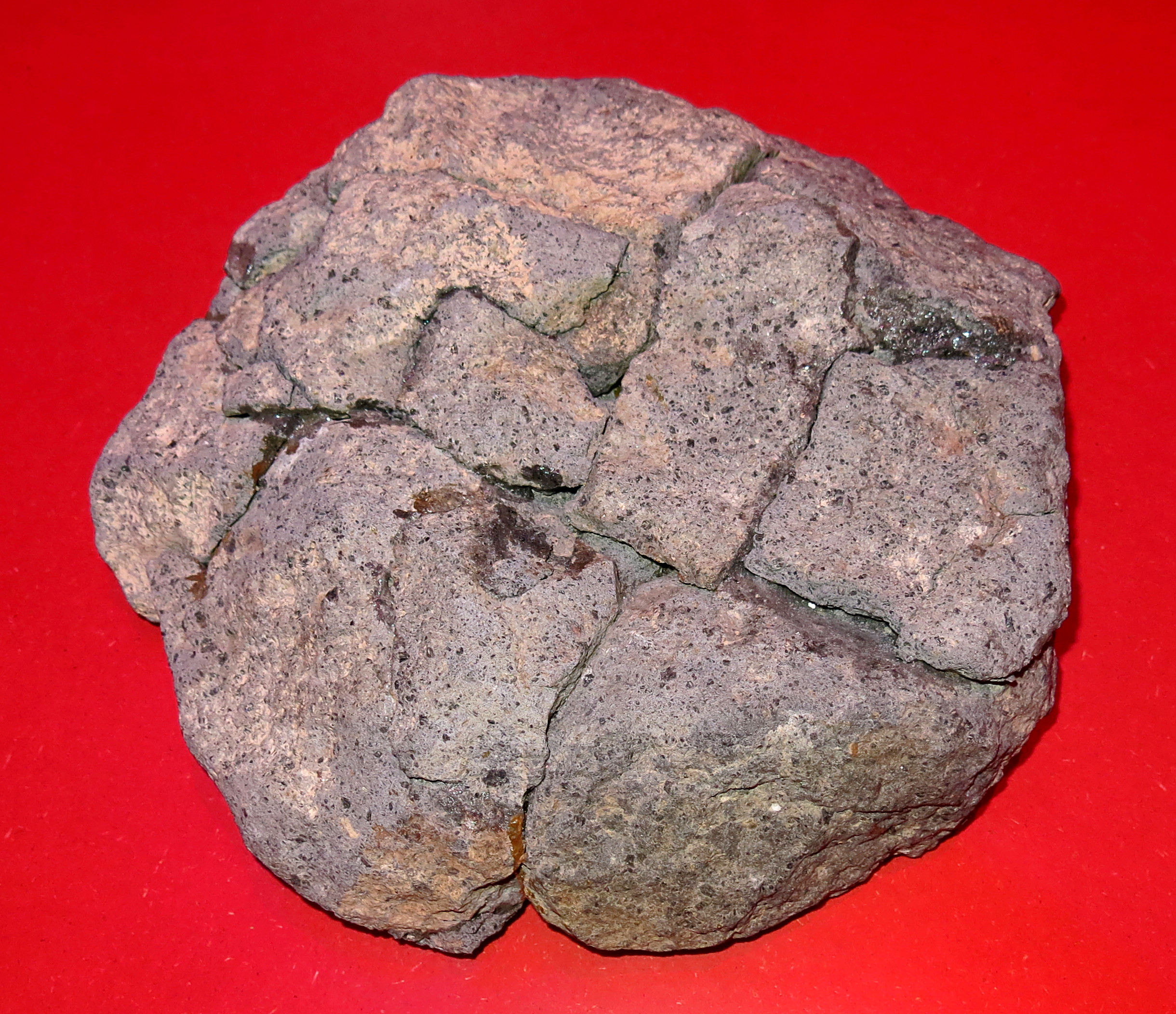

Heat source
Every evening, this large basalt block was heated in the fire under the coals, and finally carried into the tent.
The stone gave off its stored energy overnight and thereby provided pleasant warmth for the sleepers.
Photo: Don Hitchcock 2015, poster at the museum
Source and text: Original, Monrepos Archäologisches Forschungszentrum und Museum, Neuwied, Germany

From Gönnersdorf.
This is a superb sketch of a mammoth. It is both anatomically correct and shows artistic merit.
Photo: Gaudzinski-Windheuser and Jöris (2006)
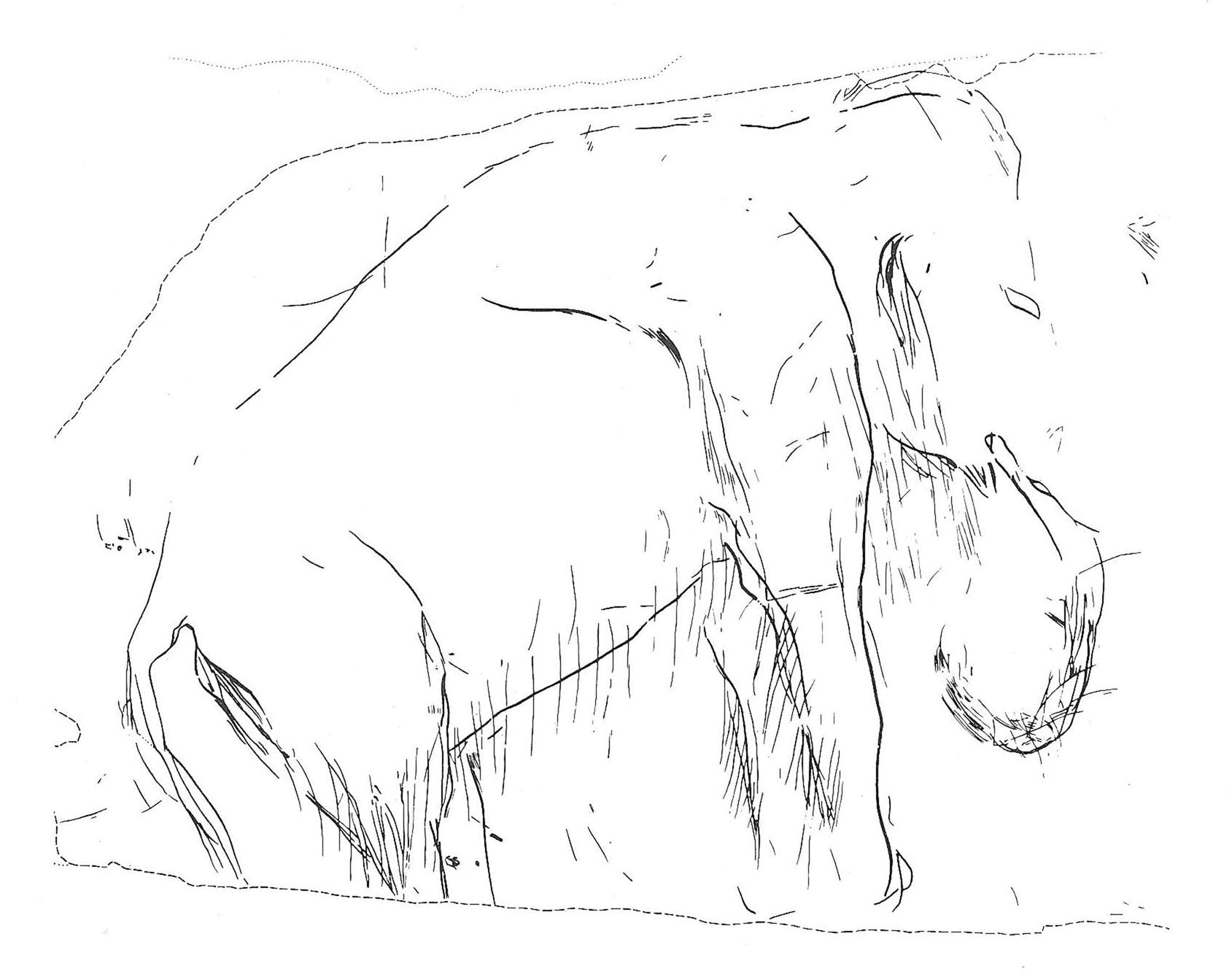
This is a good drawing of the engraving above.
Photo: Bosinski (1981)

This is a freer sketch of a mammoth, also from Gönnersdorf.
Photo: Gaudzinski-Windheuser and Jöris (2006)
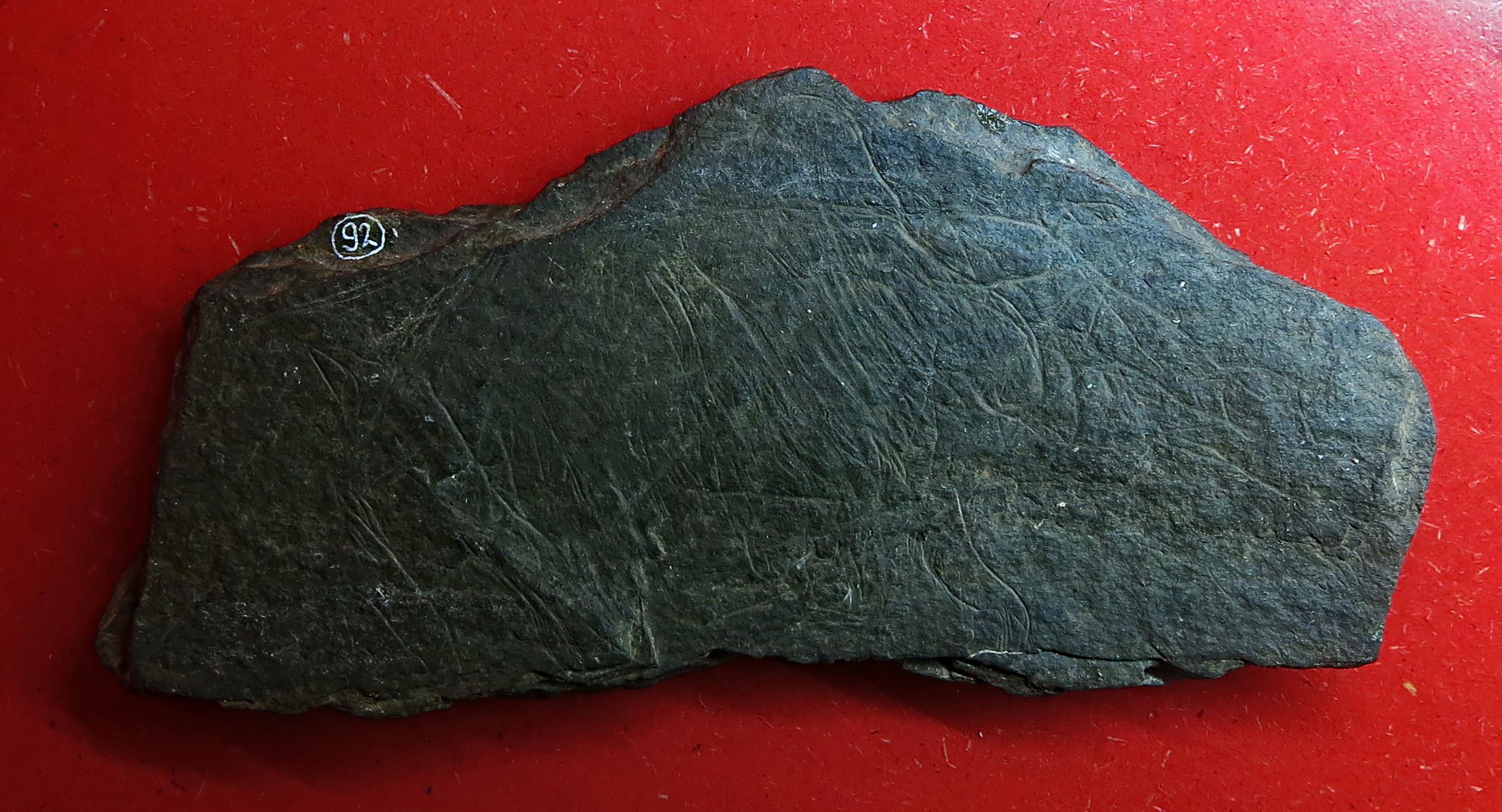
Mammoth, original, engraving in slate from Neuwied-Gönnersdorf, Rheinland-Pfalz, 15 800 BP.
Photo: Don Hitchcock 2015
Source: Monrepos Archäologisches Forschungszentrum und Museum, Neuwied, Germany
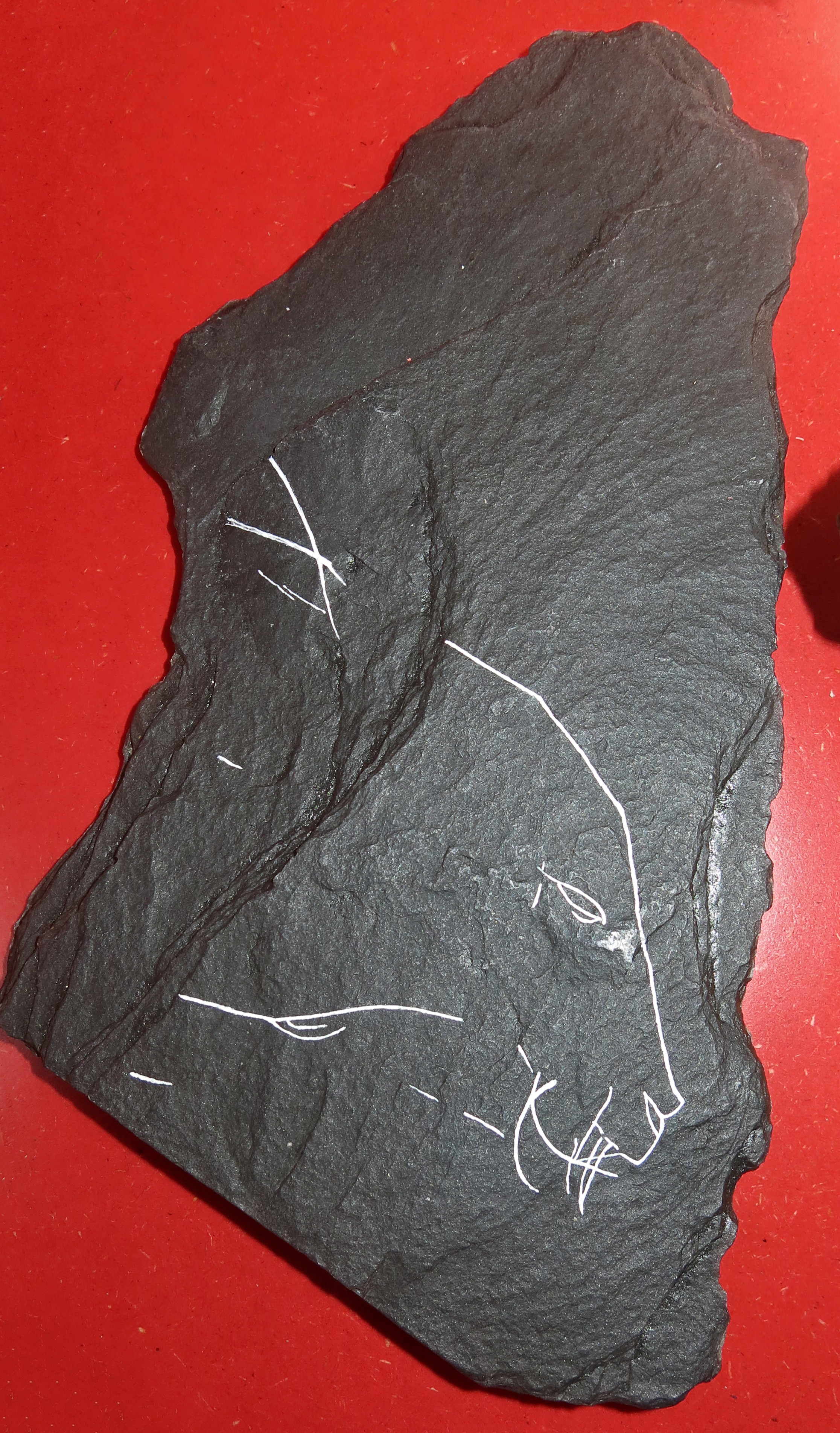
Seal, facsimile, engraving in slate from Neuwied-Gönnersdorf, Rheinland-Pfalz, 15 800 BP.
( note that this implies that travellers from the area had been on the long journey to the sea, at that time even further away than it is now, since no seal bones have ever been found in the area - Don )
Photo: Don Hitchcock 2015
Source: Monrepos Archäologisches Forschungszentrum und Museum, Neuwied, Germany
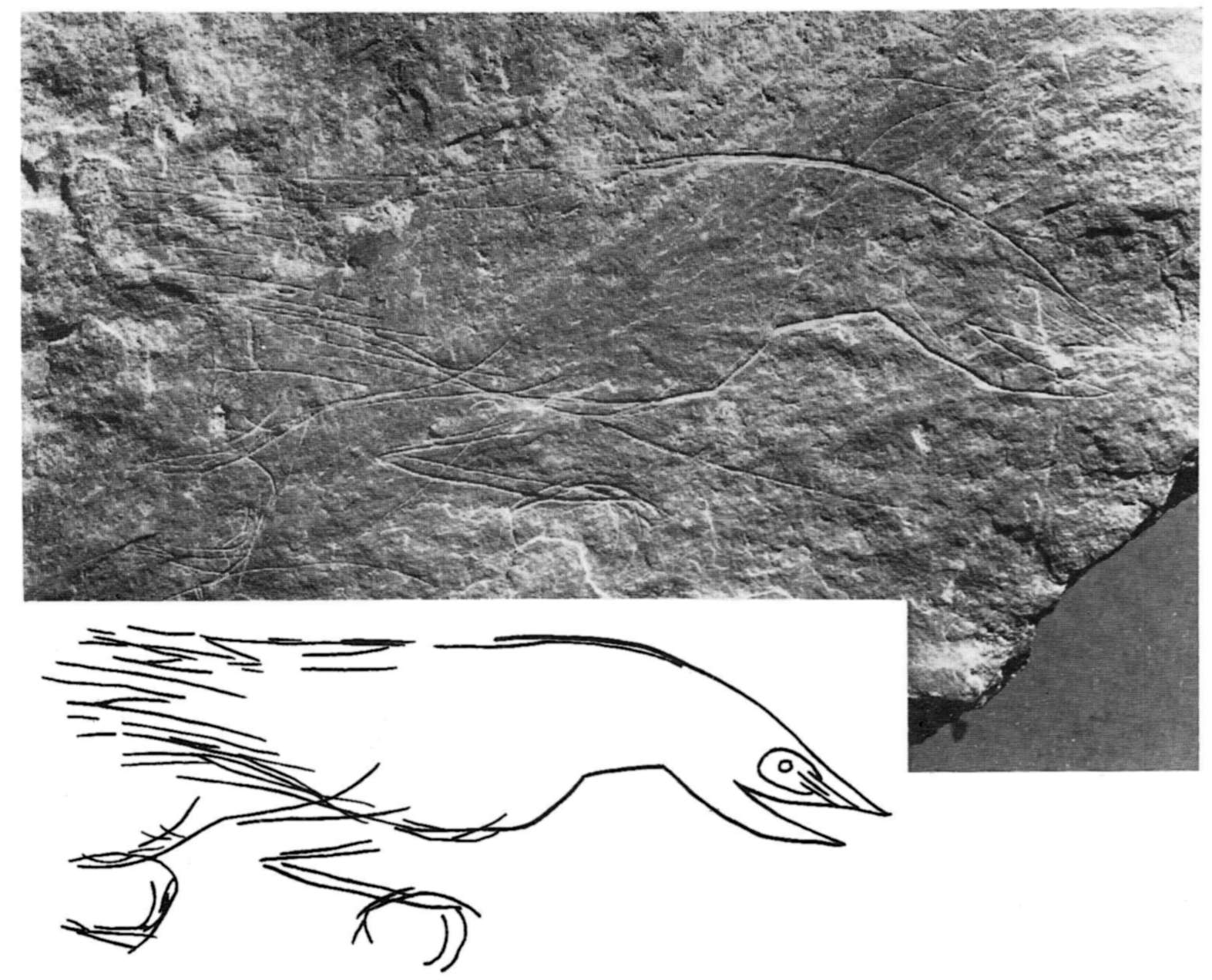
From Gönnersdorf.
In marked contrast to the naturalistic portrait of a seal, above, this engraving of a bird looks more like a modern cartoon of the Road Runner!
Photo: Bosinski (1981)
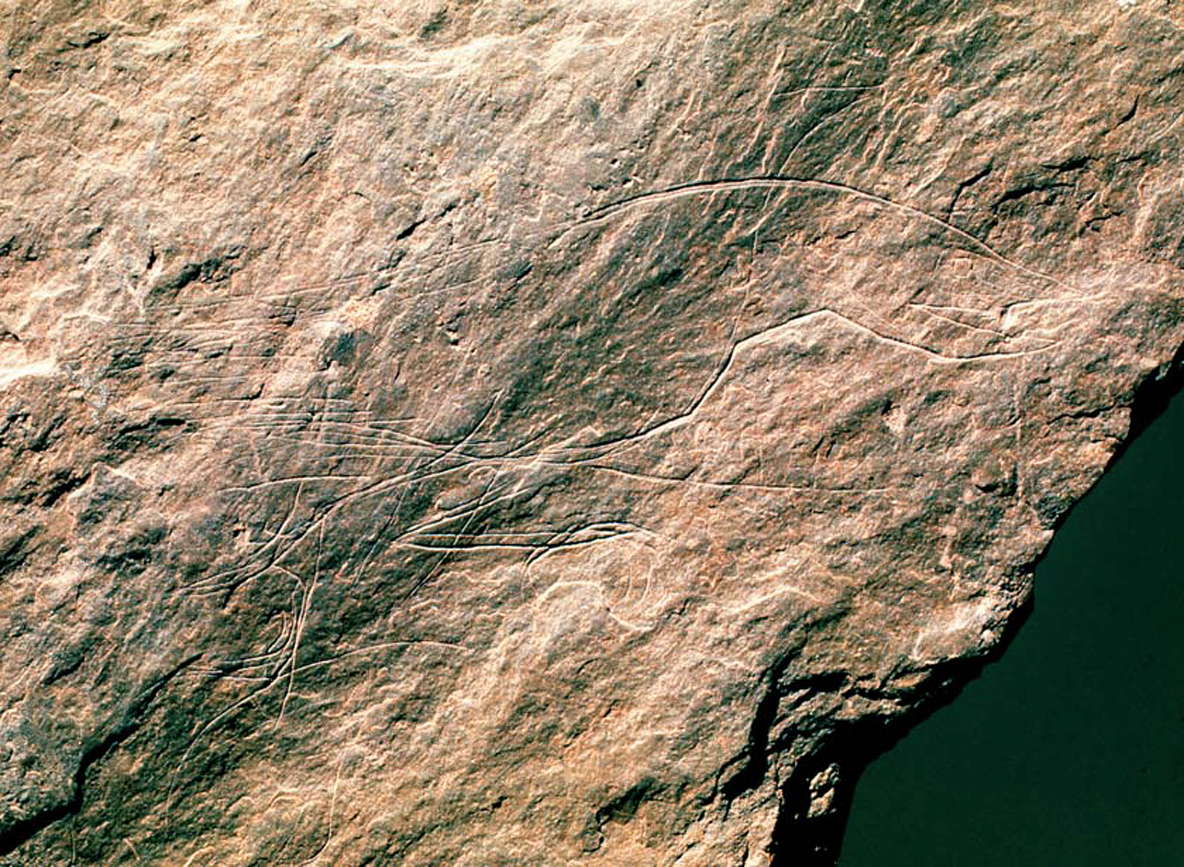
A colour image of the bird shown above.
Photo: Gaudzinski-Windheuser and Jöris (2006)
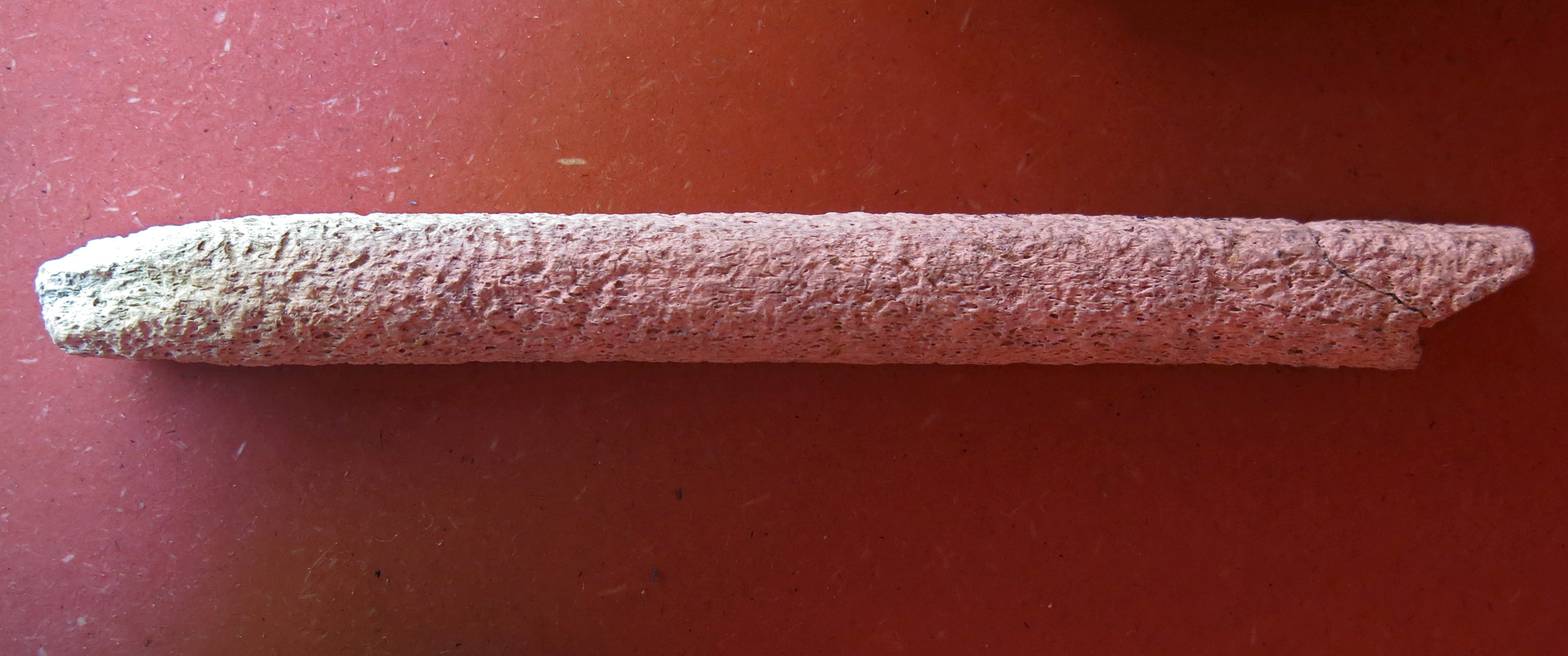
Whale bone spear tip, original, from Andernach, Rheinland-Pfalz, 15 800 BP.
( it would seem that there was a lot of trade along the Rhine River to the sea for this item to turn up in the middle of Germany. The whale bone would have been scavenged from a stranded whale on the coast. Whale bone is a strong and versatile material - Don )
Photo: Don Hitchcock 2015
Source: Monrepos Archäologisches Forschungszentrum und Museum, Neuwied, Germany
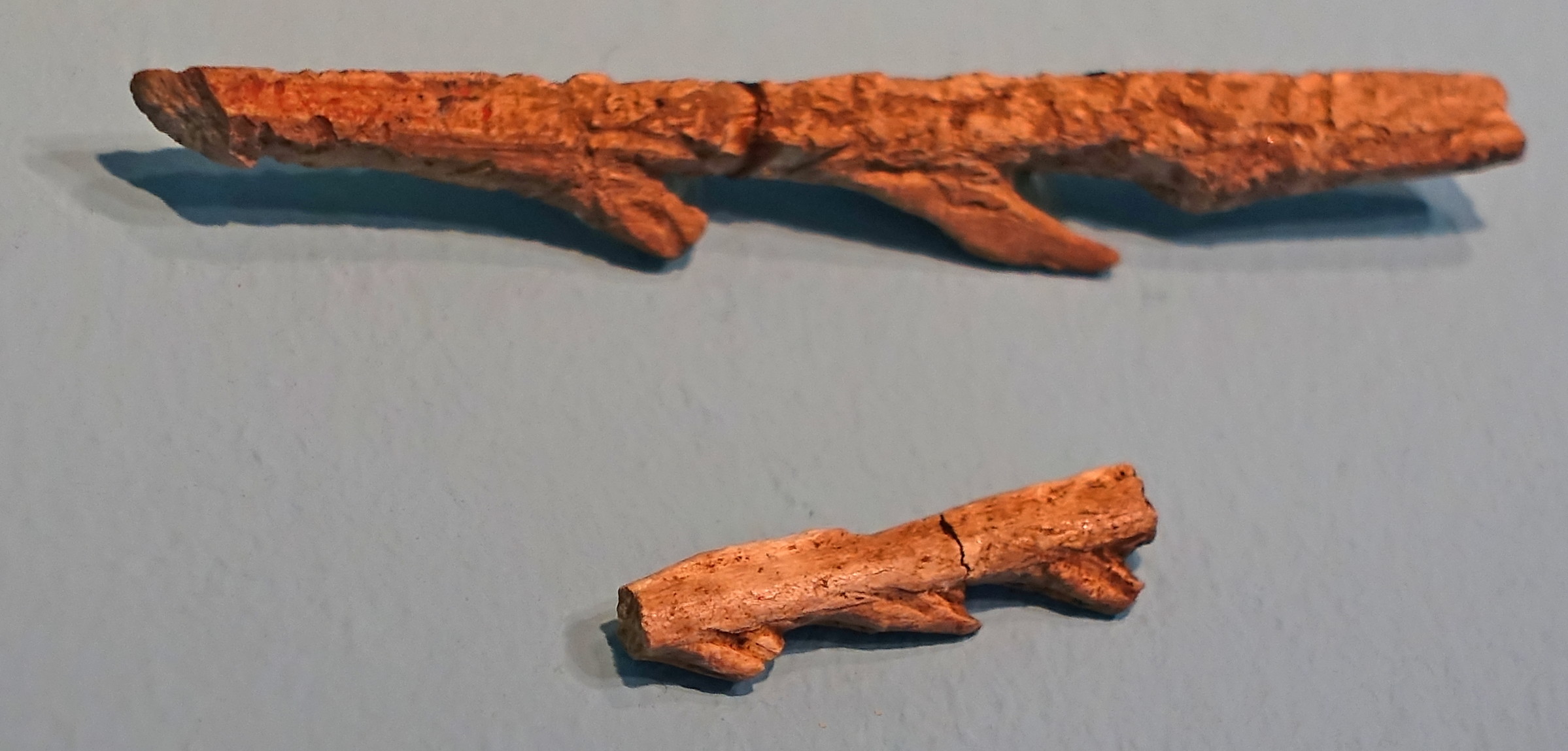
Fragments of harpoons, in antler, from Andernach, Kreis Mayen-Koblenz.
Photo: Don Hitchcock 2018
Source and text: Display at LVR-LandesMuseum Bonn
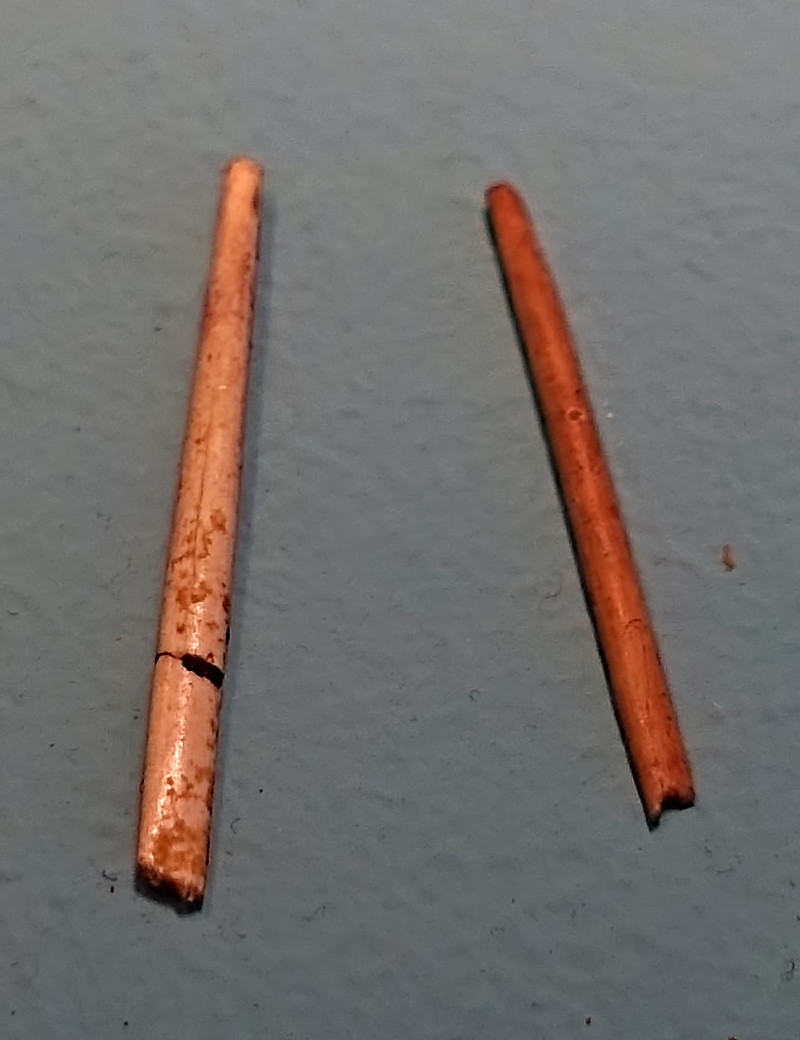
Bone needles, from Andernach, Kreis Mayen-Koblenz.
Photo: Don Hitchcock 2018
Source and text: Display at LVR-LandesMuseum Bonn
On loan from : Directorate General for Cultural Heritage Rhineland-Palatinate, Generaldirektion Kulturelles Erbe Rheinland-Pfalz.
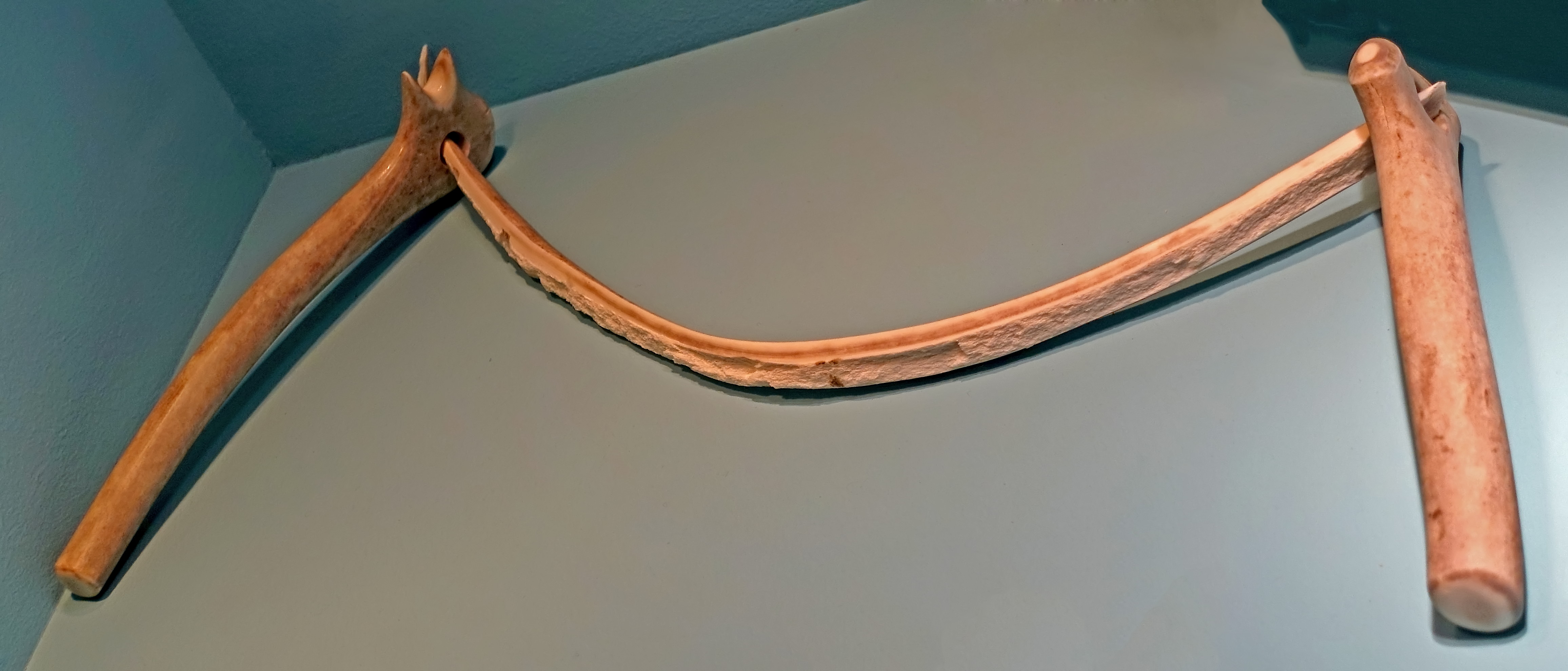
This illustrates just one of the many possible uses suggested for bâtons percés or perforated batons. Made of antler themselves, dozens of uses have been proposed for these tools.
In this case it is proposed that two perforated batons were used to straighten a long, curved strip of antler. This seems an unlikely situation, since antlers of both reindeer and red deer were in plentiful supply at various (different) times, and it would have been possible to choose a very much straighter strip of antler to use for, say, a harpoon, though perforated batons could have been used to straighten any residual curvature.
However it is far easier to soak the antler in water for a week or two before attempting to straighten it. Then the strip of antler should be bound tightly along its whole length to a strong straight piece of thick strong wood, and left to dry. Perforated batons are simply not necessary or desirable in this instance.
In modern times, antler is boiled in water for an hour or so, after which treatment it is easily bent and clamped to the desired shape, and left to dry overnight, after which it retains the new shape, straight or curved.
Reconstruction: Dr J. Tinnes, Cologne. Köln.
Photo and text: Don Hitchcock 2018
Source: Display at LVR-LandesMuseum Bonn
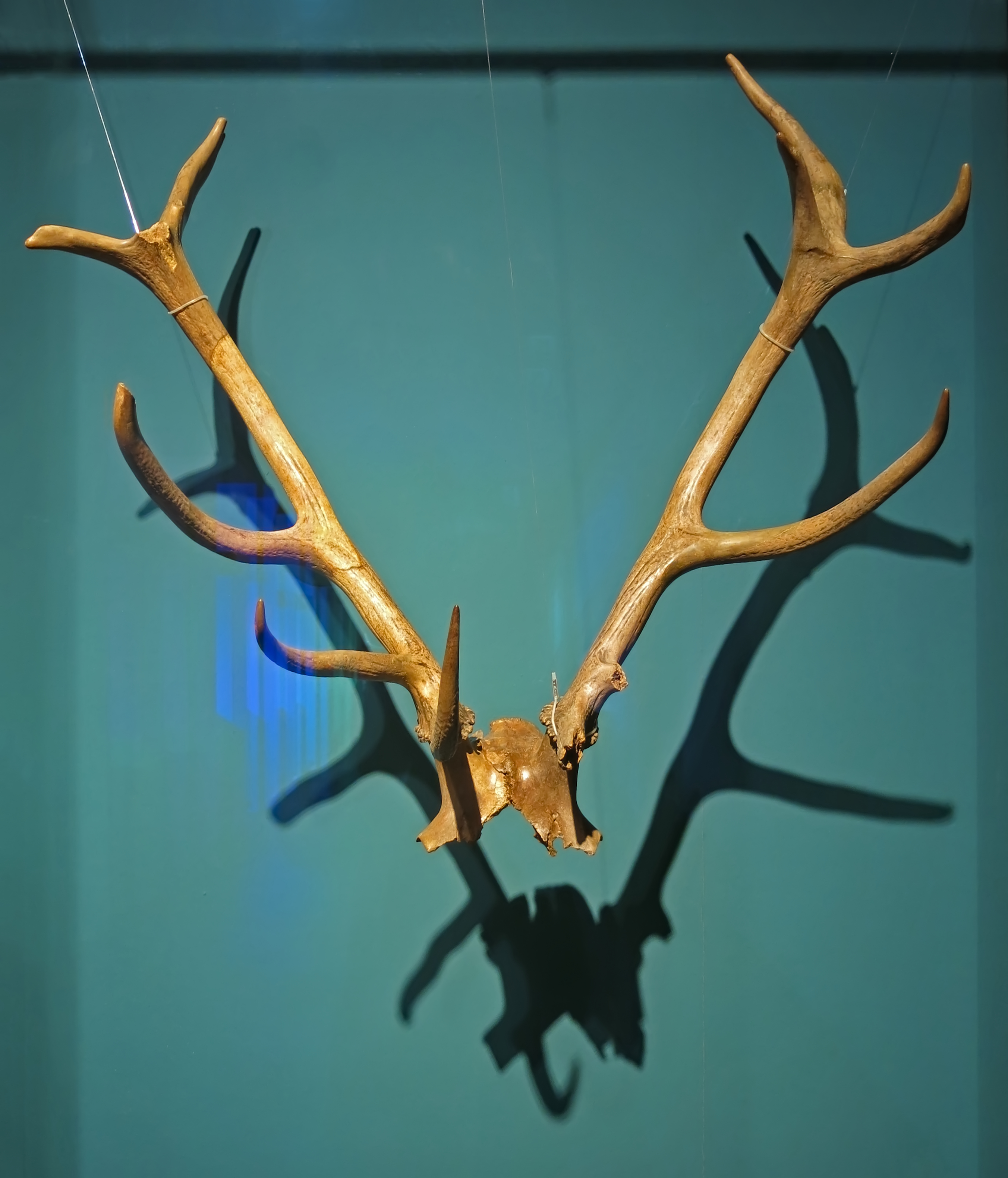
Red deer antlers, used as part of a shaman's mask.
The cult of the deer has a very great significance in the ideology of primeval peoples of the Eurasian forest zone. This cult includes myths and rituals connected with the worship of the deer or man-deer, the ancestor of people and deer, and a cultural hero, the teacher of deer hunting. The most important evidence supporting the cult of the deer in traditional societies are totemistic mysteries connected with the reproduction of deers, and magic hunting rituals. The most important participant in these rituals is the shaman.
Photo: Don Hitchcock 2015
Source and text: Display at LVR-LandesMuseum Bonn
Additional text: Mikhailova (2006)
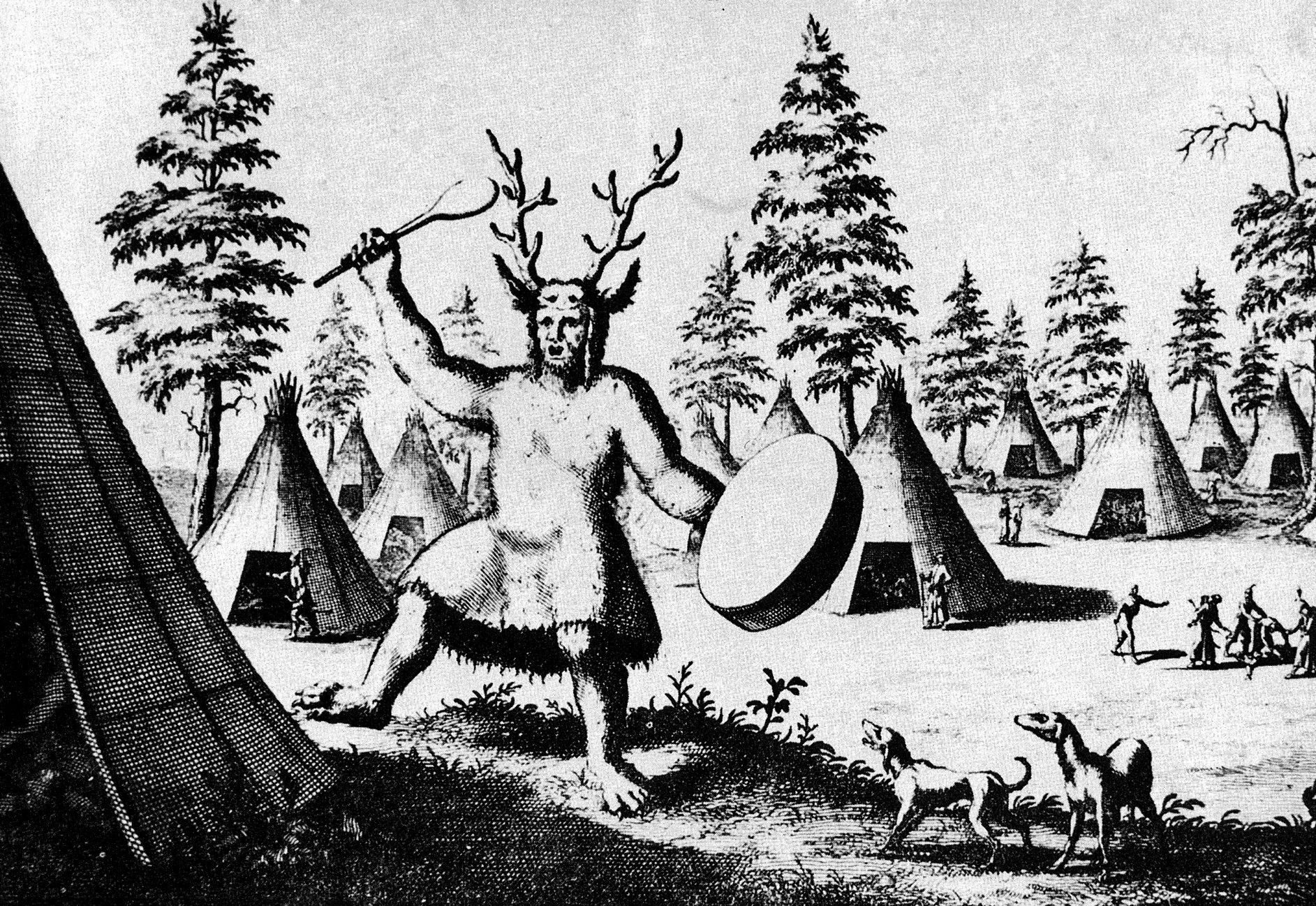
Siberian Shaman.
Tungus shaman of the 18th century, wearing a head dress including antlers.
Photo: Clark (1954)
Proximal source: Mikhailova (2006)
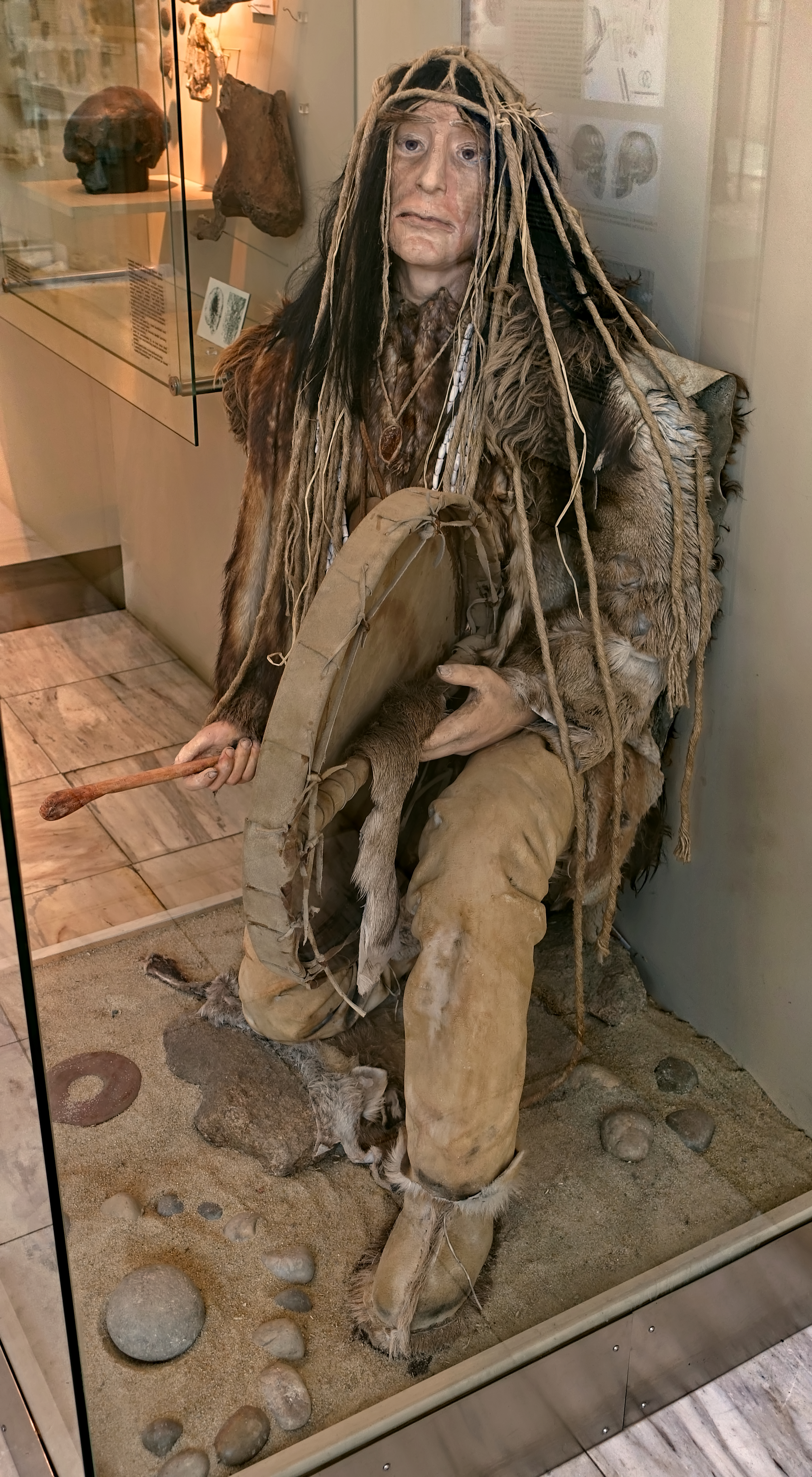
Gravettian Shaman from the Pavlov/Milovice area.
Photo: Don Hitchcock 2018
Source: Anthropos Pavilion/Moravian Museum, Brno, Czech Republic
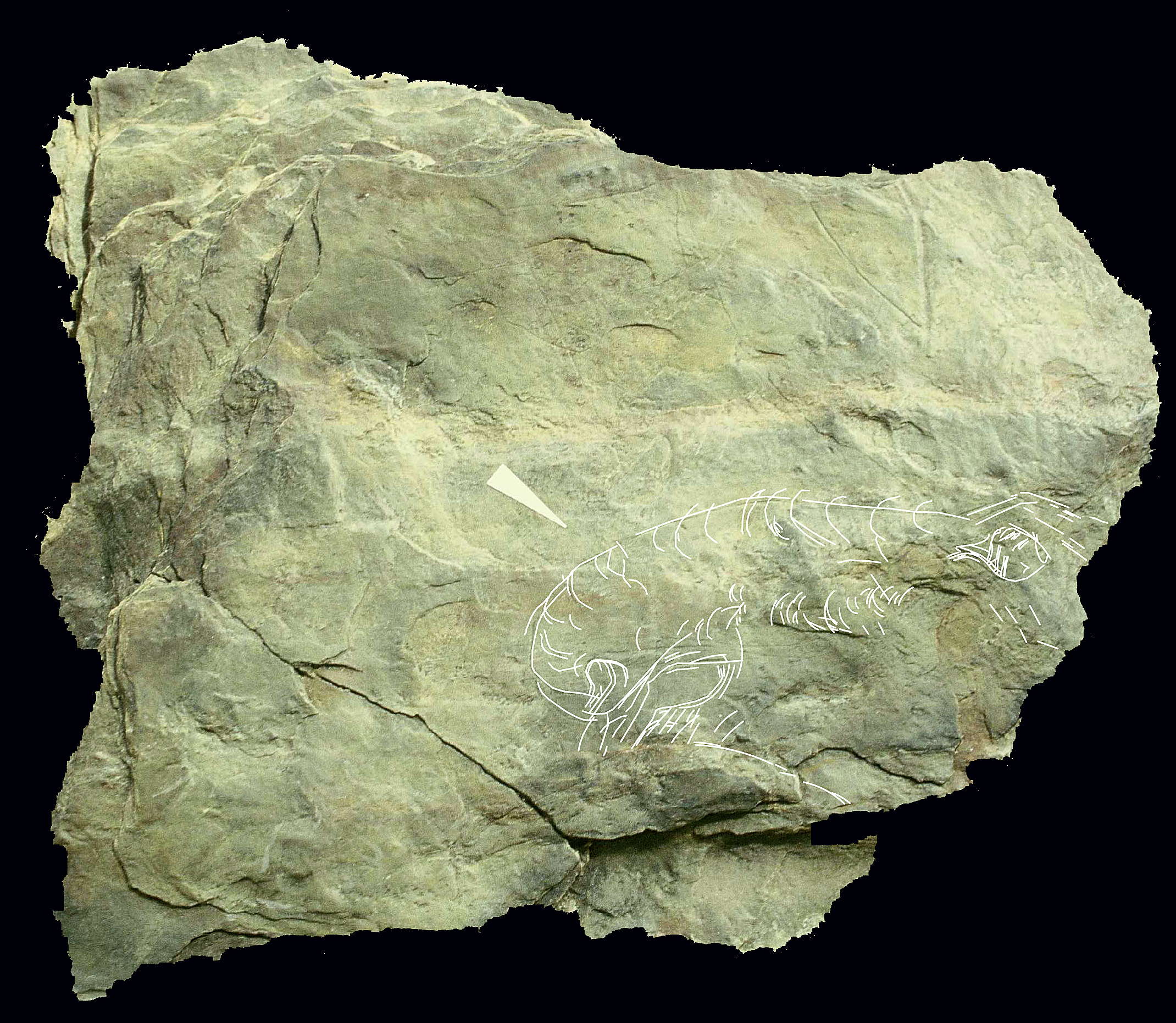
Saiga Antelope, Gönnersdorf. The engraving shows just the head of the animal, with its characteristic snout.
The image has been outlined in order to make the form clearer.
Photo: Hannibal21, 8th June 2012
Permission: Creative Commons Attribution 3.0 Unported license., CC BY 3.0
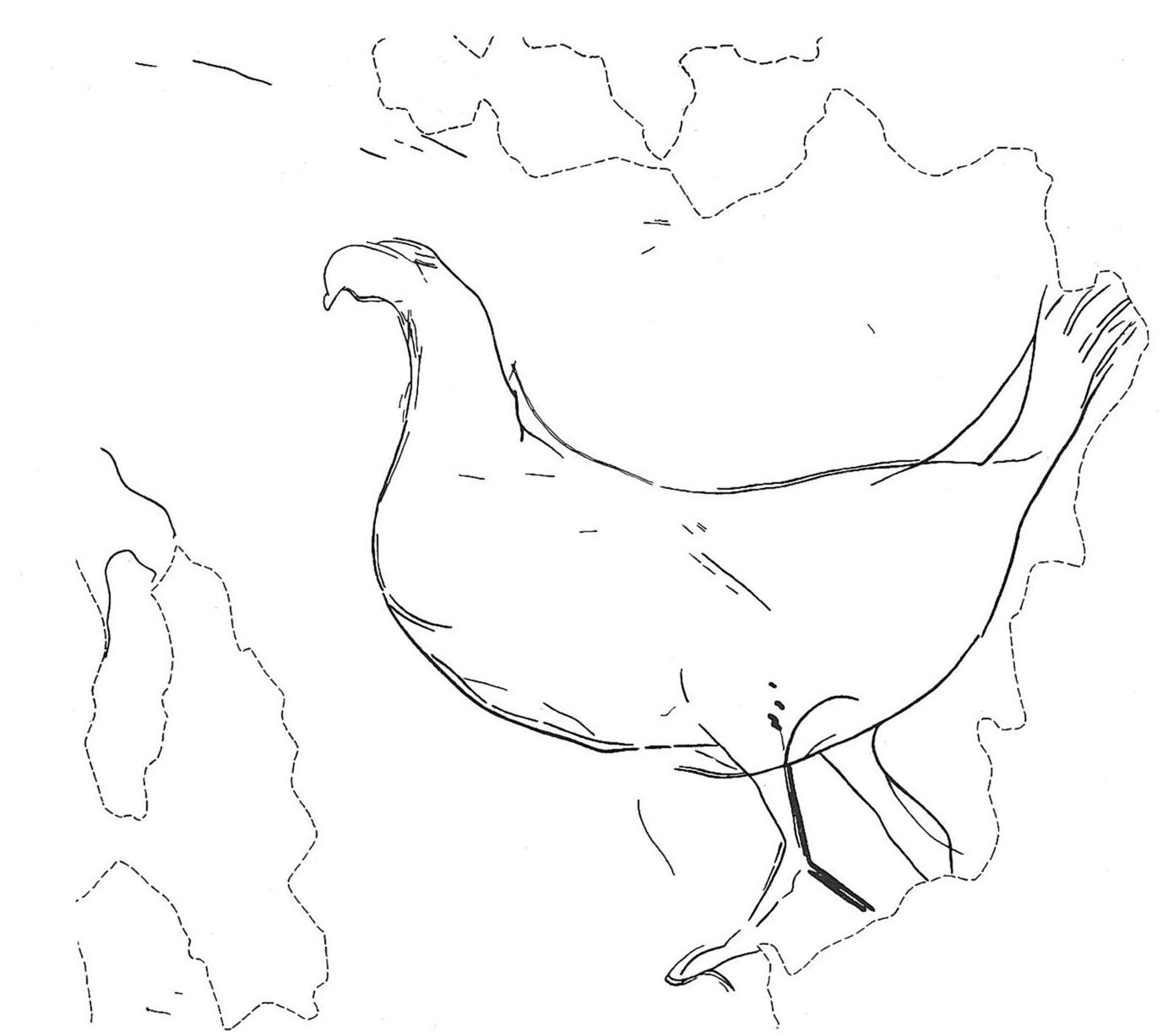
From Gönnersdorf.
Known simply as Ptarmigan in Europe and colloquially as Snow Chicken or Partridge in North America, Lagopus muta is a medium-sized gamebird in the grouse family.
Photo: Bosinski (1981)
Text: Adapted from Wikipedia

From Gönnersdorf.
The original of the drawing above.
Photo: Gaudzinski-Windheuser and Jöris (2006)
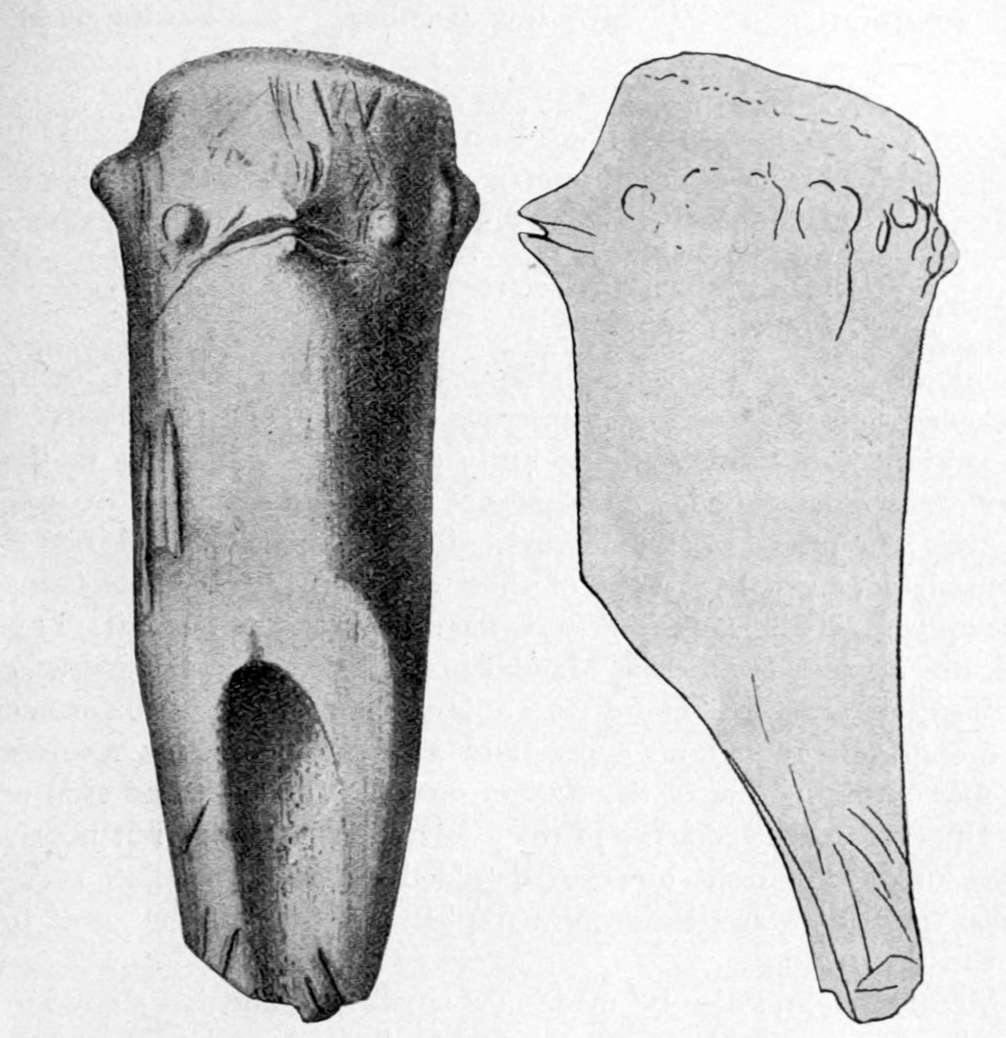
Figure of a bird made in reindeer antler by emphasising a natural resemblance with some carving. Found at Andernach.
Source: Macalister (1921) (Public Domain)
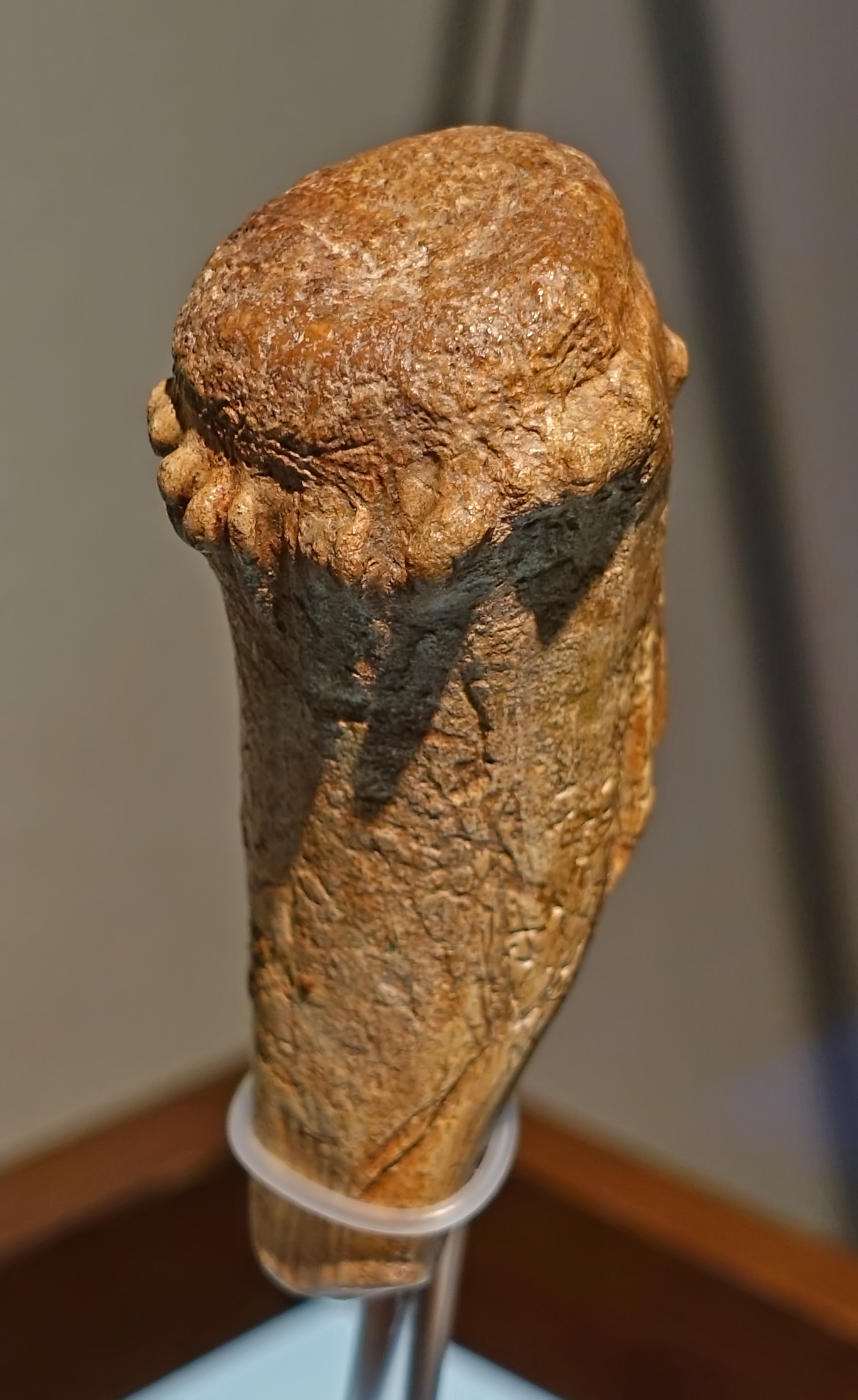
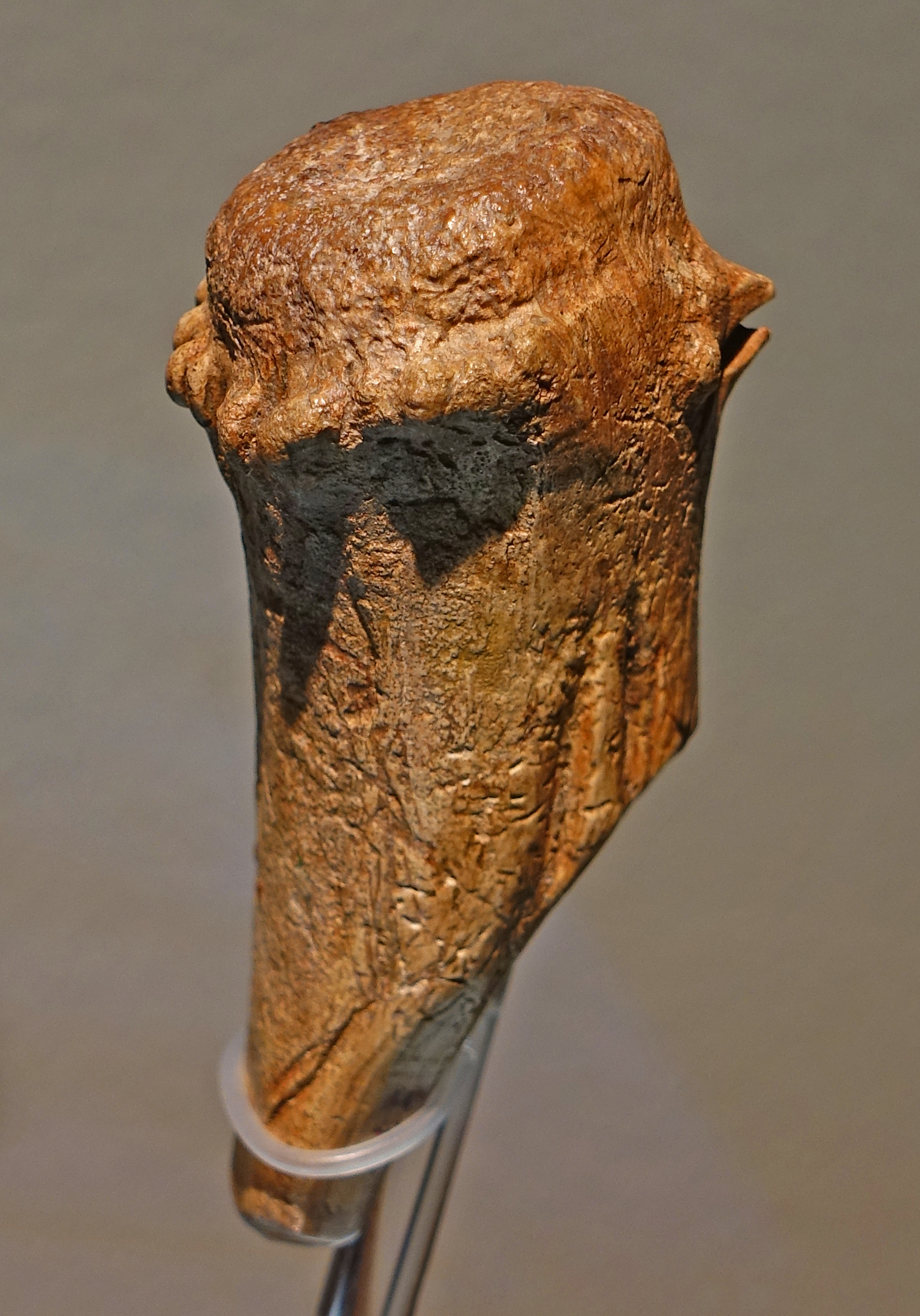
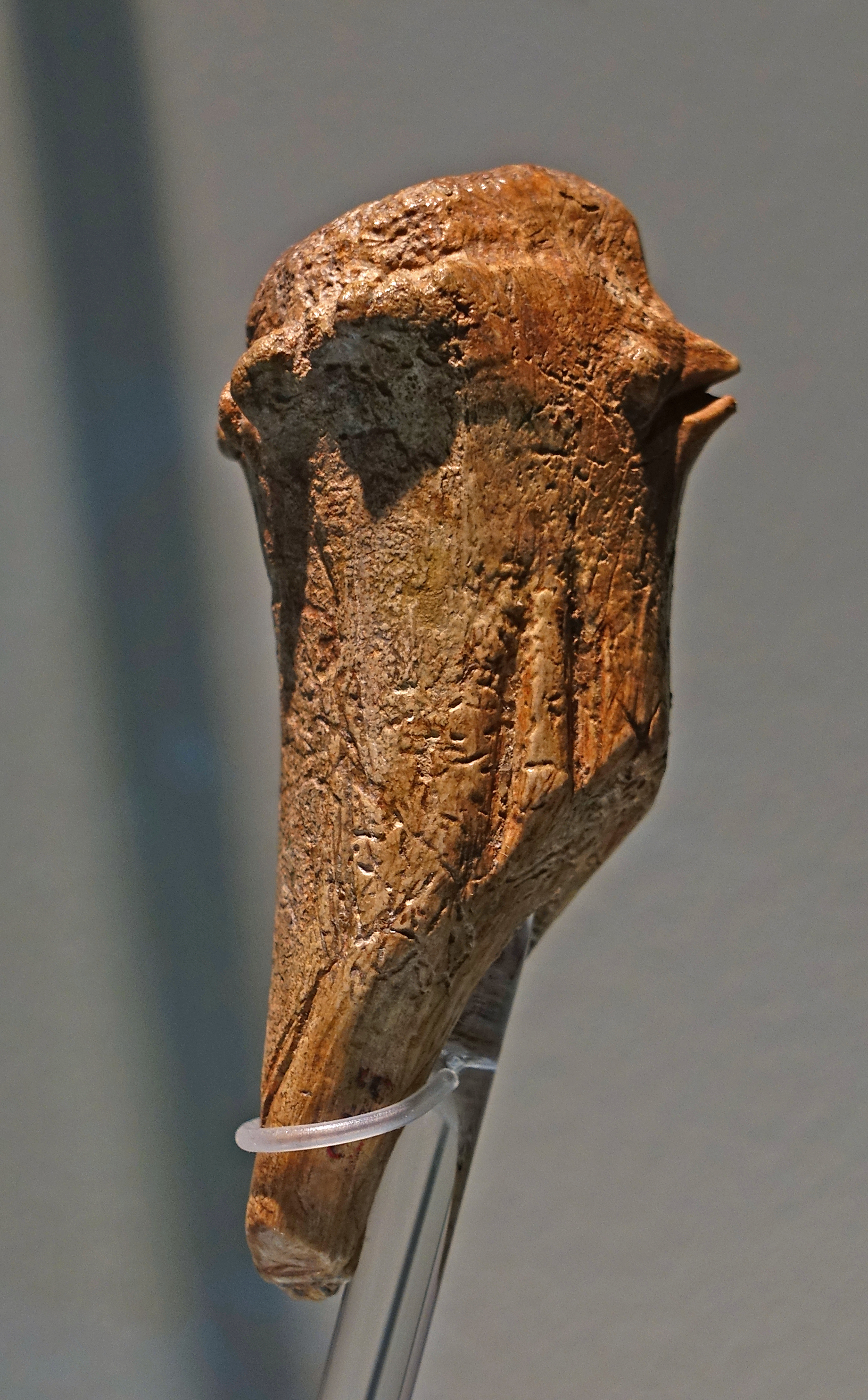
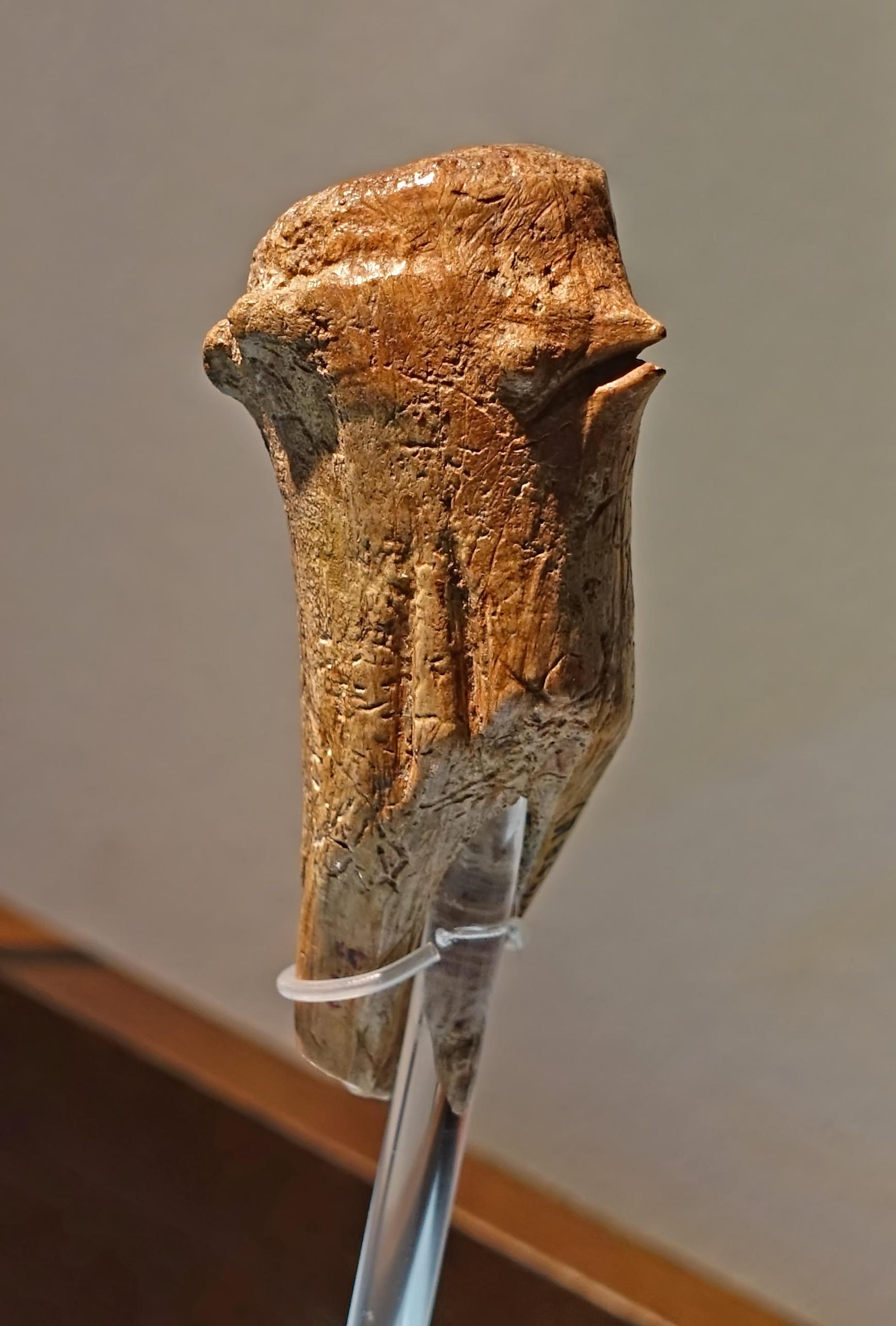
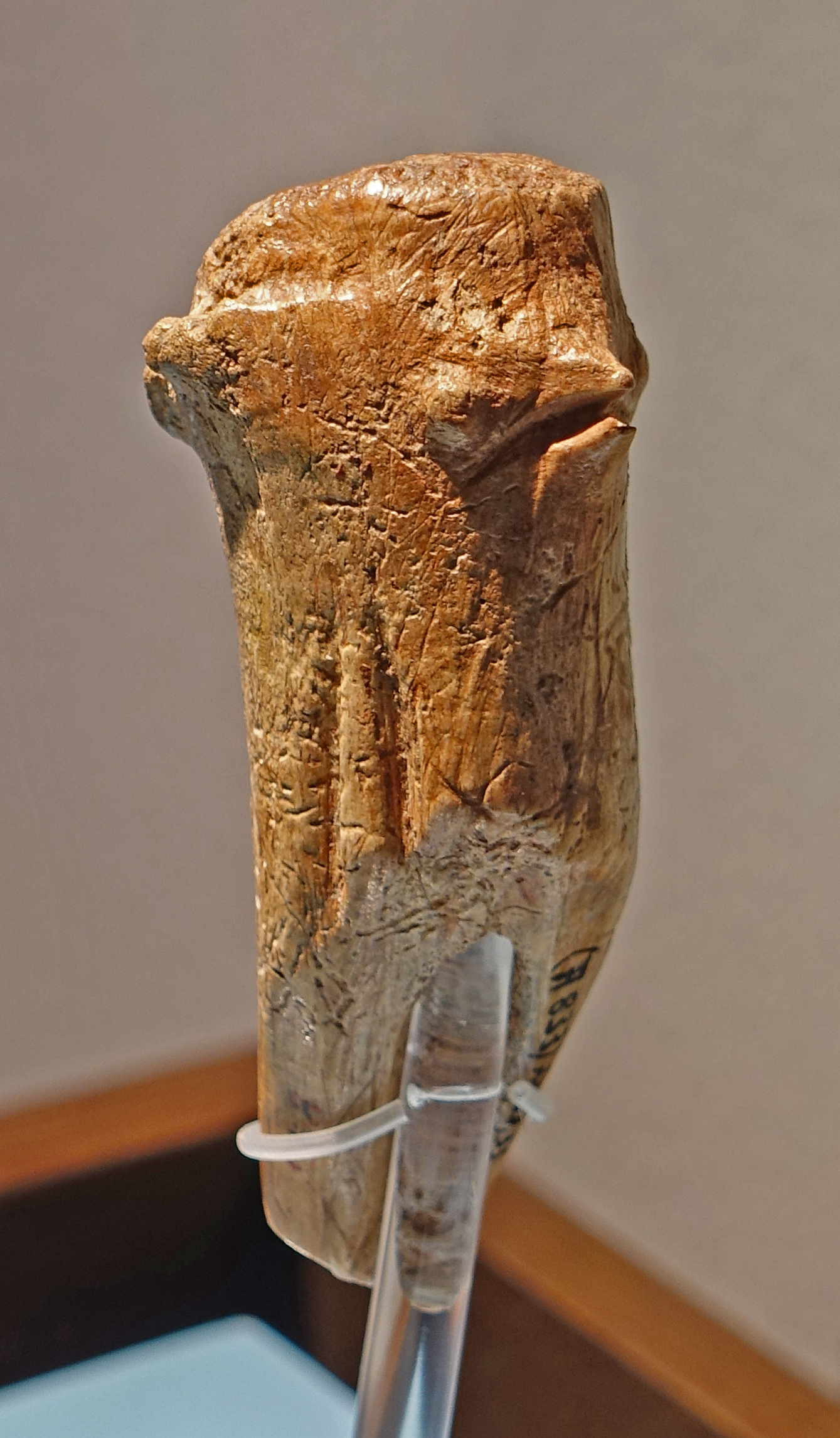
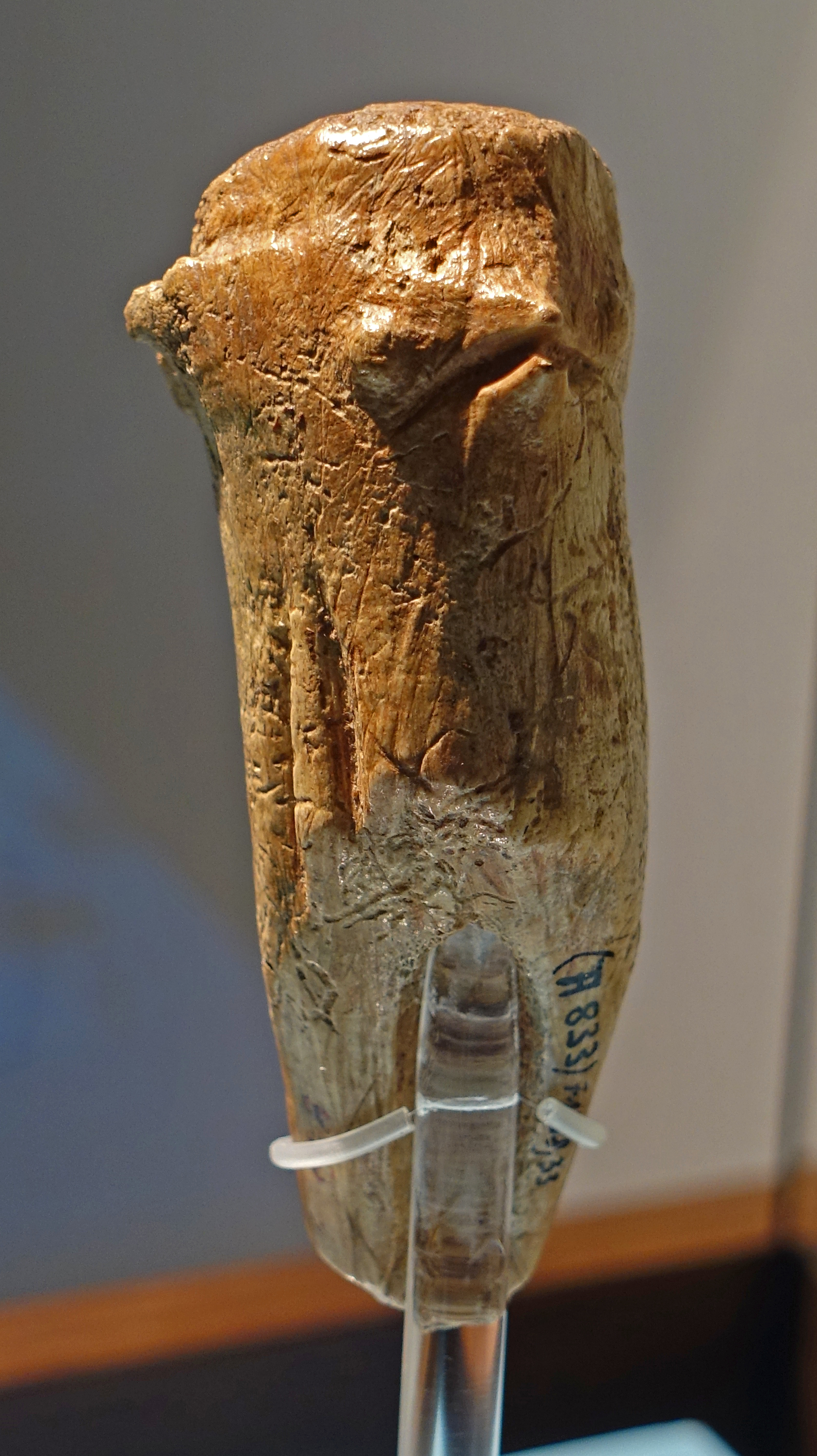
Carved Bird Head
15 000 years BP
This uniquely shaped representation of a bird was discovered in 1883 by H. Schaaffhausen at an excavation in Andernach-Martinsberg. It was carved with just a few strokes from the remains of a reindeer antler obtained as a waste product when making a tool of some kind. The inner spongy part of the antler has been eroded.
Perhaps the piece was originally put on top of a wooden rod, as can be seen for the famous bird on a pole at the Shaft in Lascaux.
( This is apparently the original - Don )
Photo: Don Hitchcock 2018
Source and text: Display at LVR-LandesMuseum Bonn

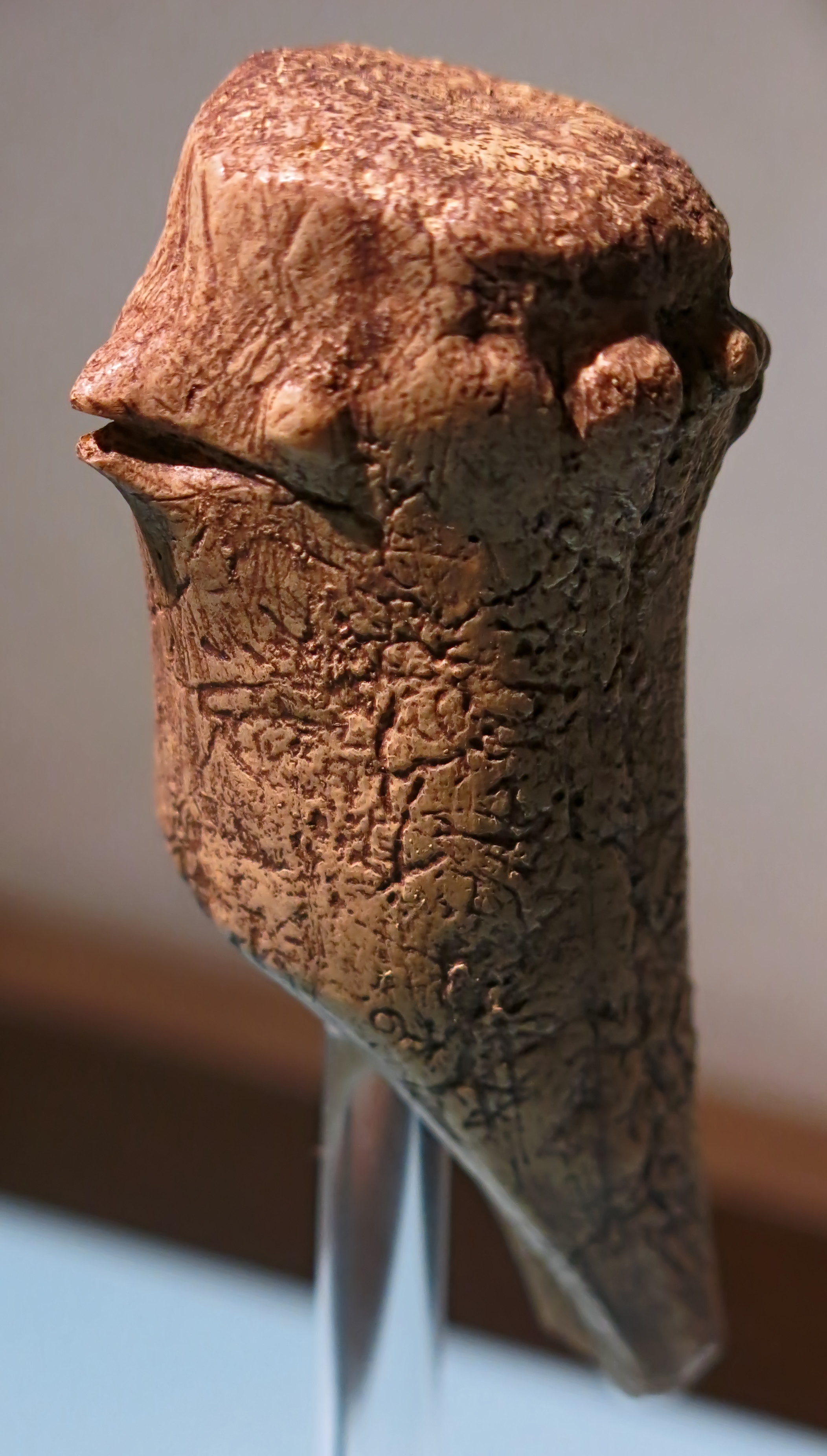
Carved Bird Head
15 000 years BP
These two images complete a 360° circuit of the artefact.
( This is a museum quality facsimile - Don )
Photo: Don Hitchcock 2015
Source and text: Display at LVR-LandesMuseum Bonn
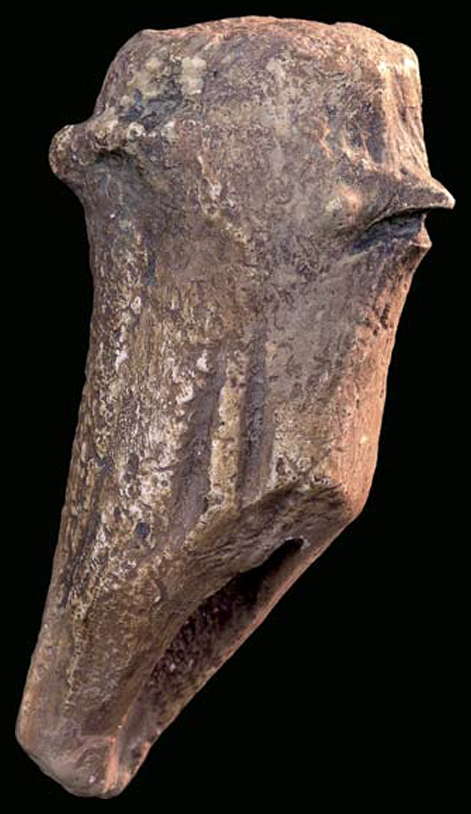
Carved Bird Head as shown above, another version.
15 000 years BP
Photo: Gaudzinski-Windheuser and Jöris (2006)
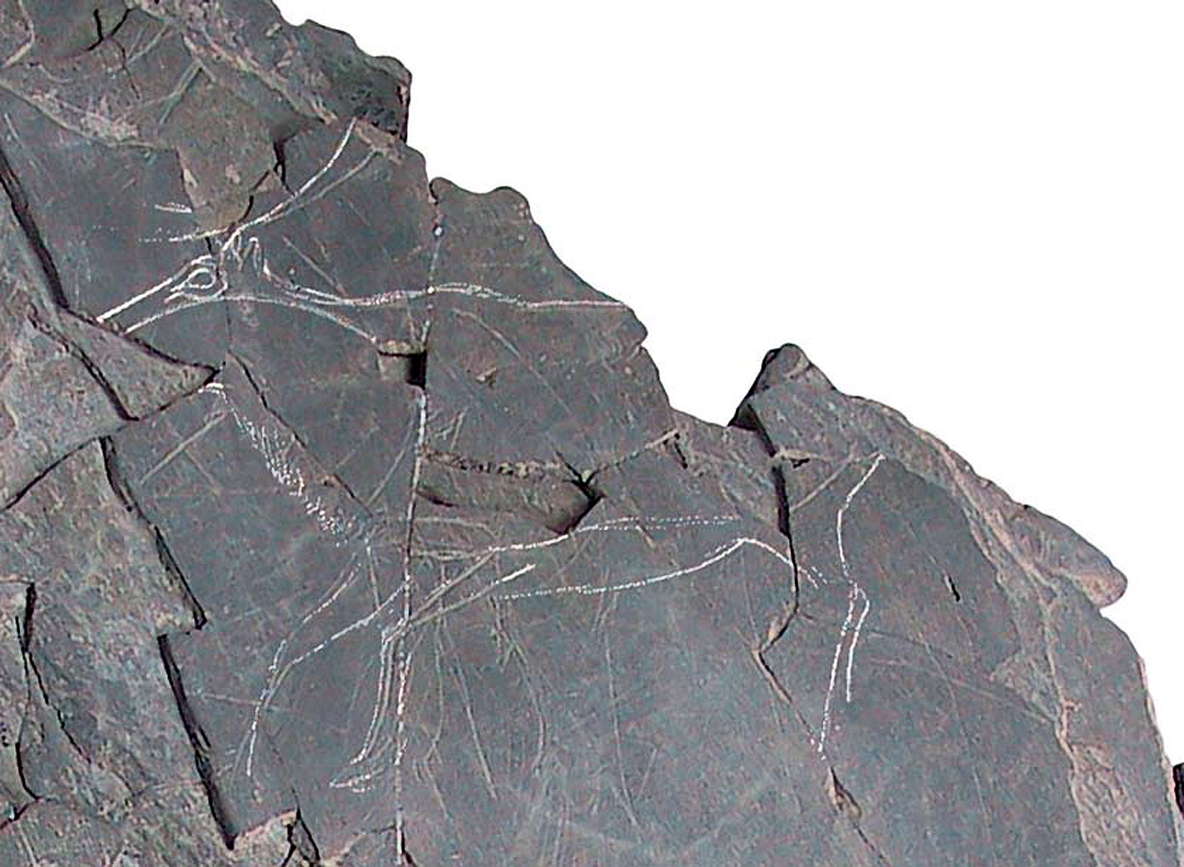
Reindeer, chalked to better show the engraving, from Andernach.
Photo: Gaudzinski-Windheuser and Jöris (2006)
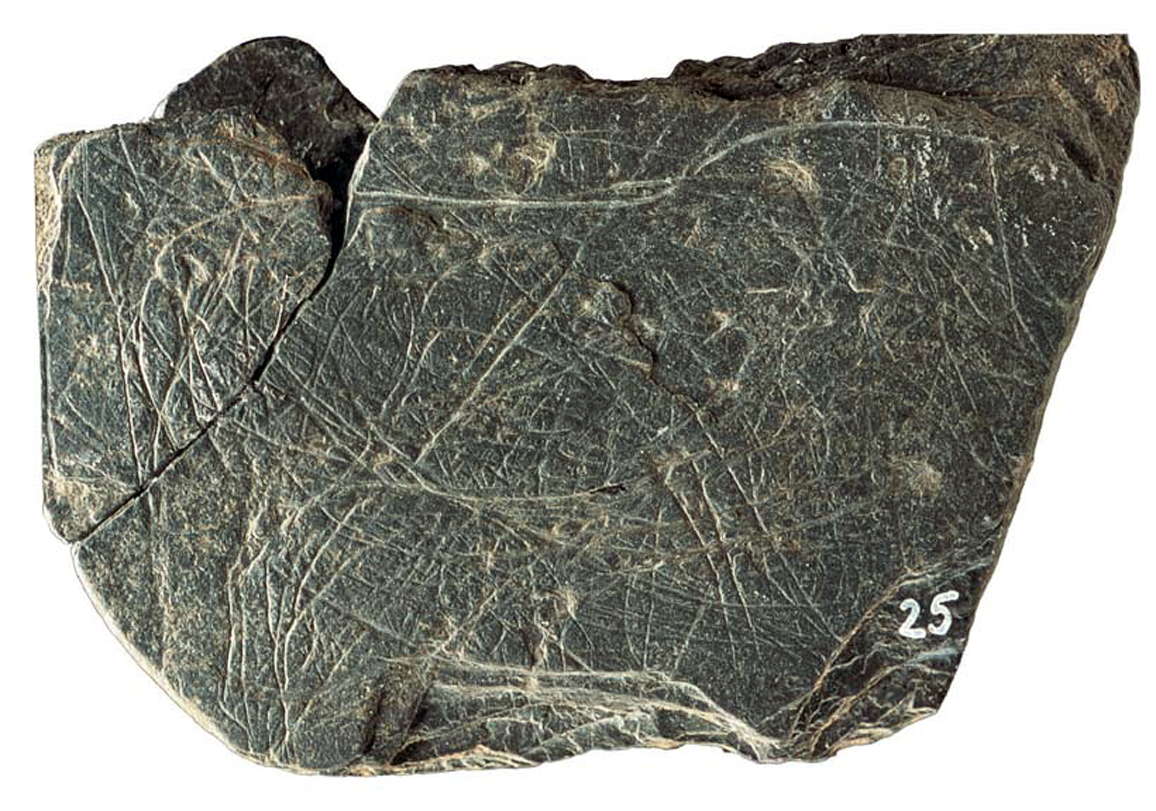
Engraving of a horse, in three dimensions, on green slate.
Photo: Gaudzinski-Windheuser and Jöris (2006)
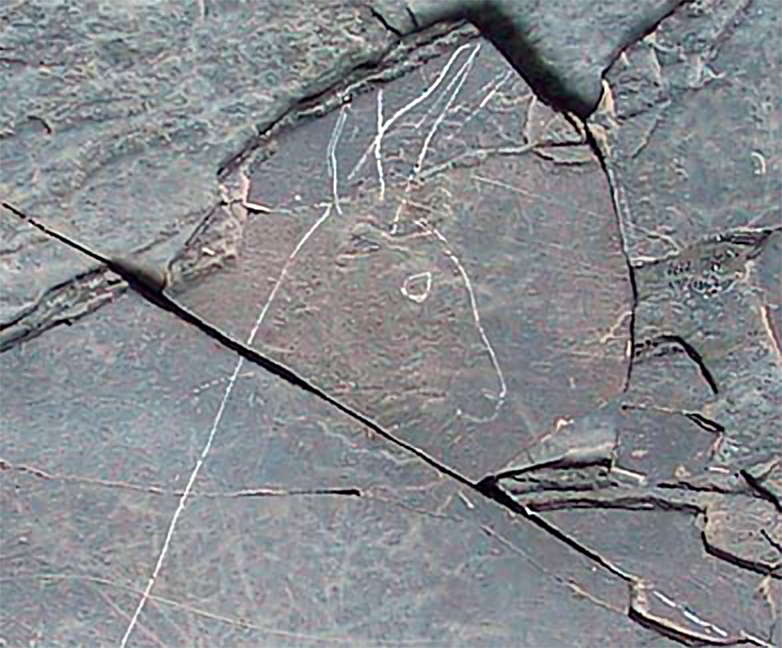
A simple drawing of what is possibly a hare. Chalked to better show the outline.
Photo: Gaudzinski-Windheuser and Jöris (2006)
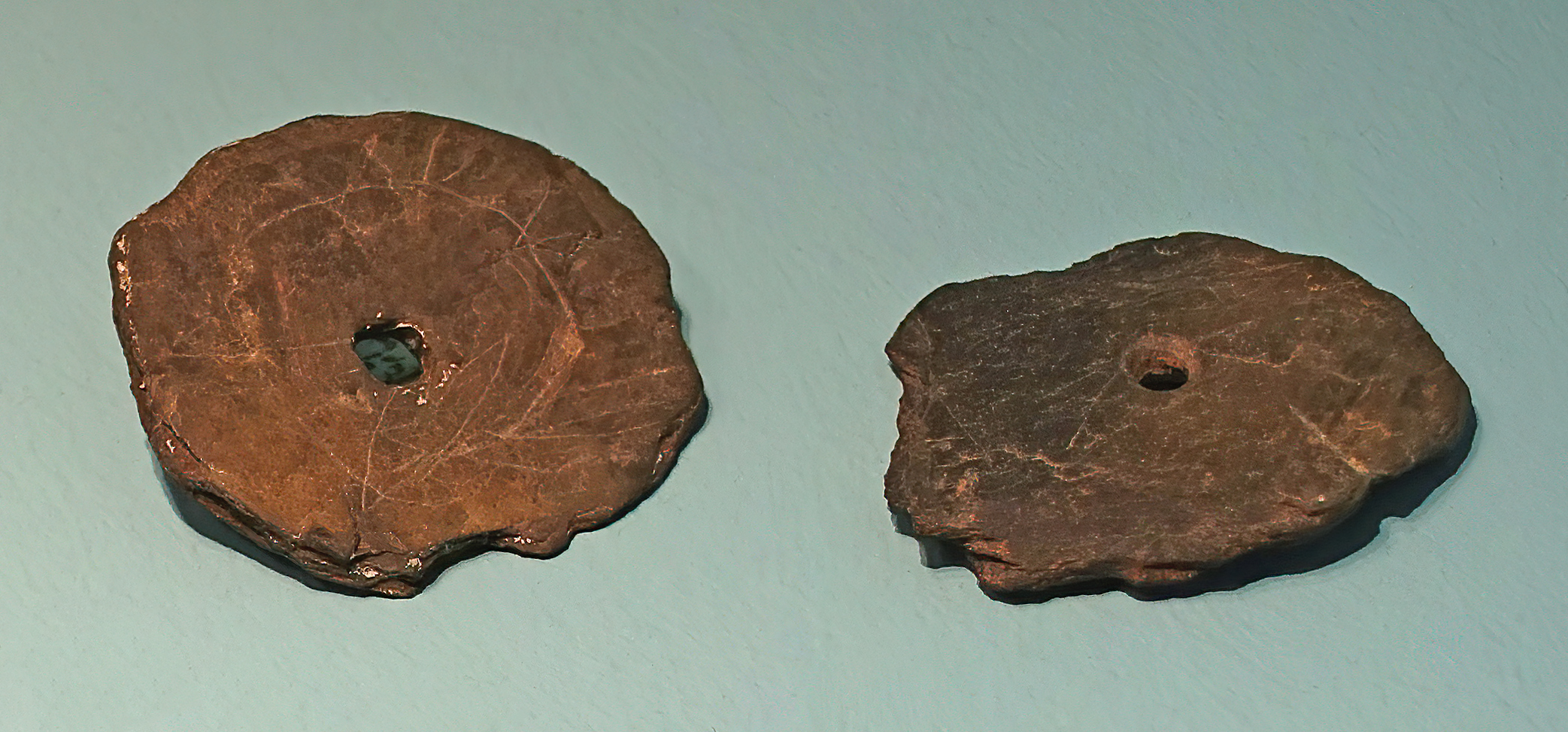
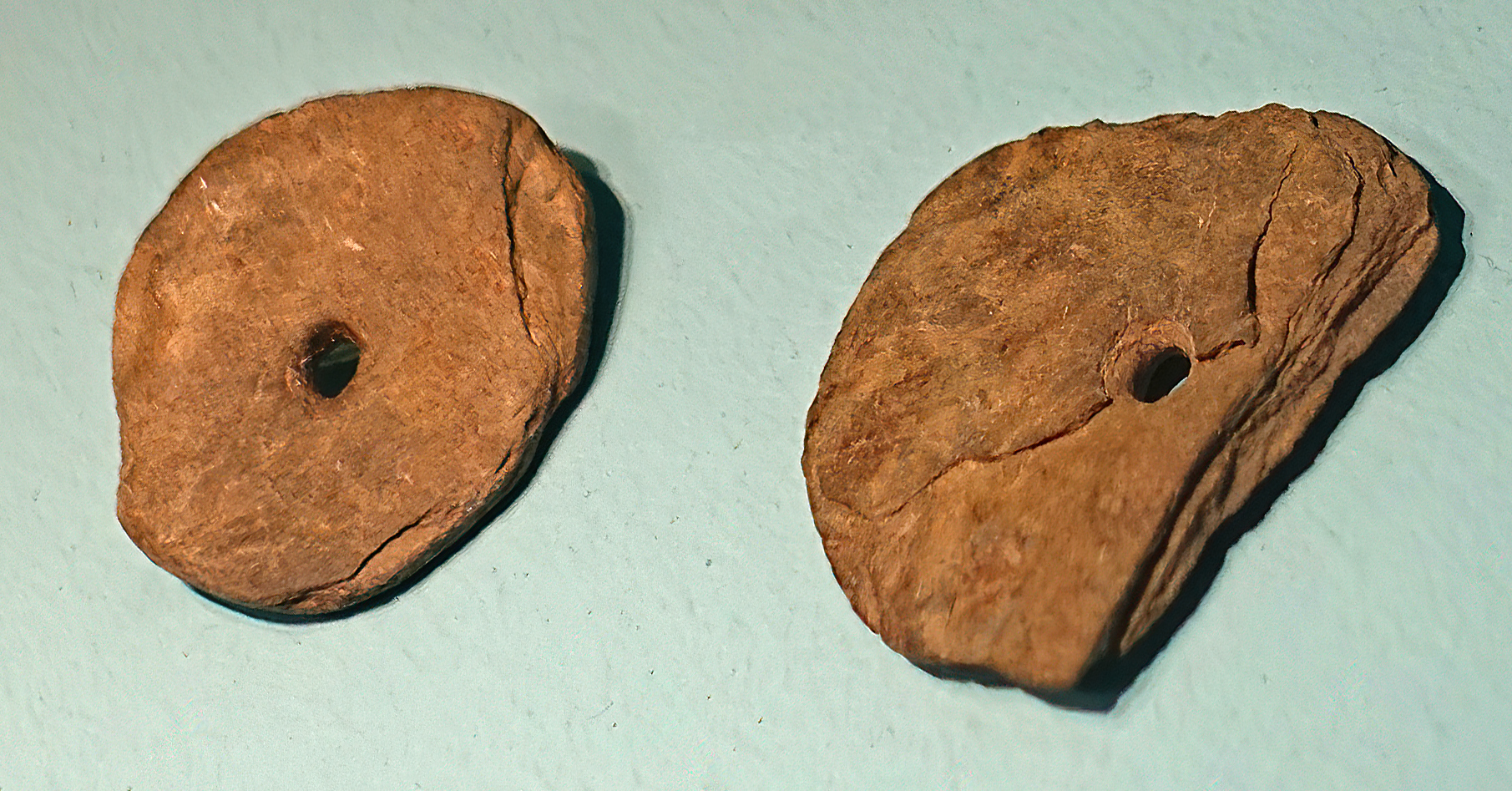
Rondelles made of slate, from Gönnersdorf, City of Neuwied.
( The museum card suggests that these may have been fasteners for tent covers. I believe it is much more likely that they were spindle whorls for spinning thread. See
Rondelles - Don )
Photo: Don Hitchcock 2018
Source and text: Display at LVR-LandesMuseum Bonn
On loan from : Directorate General for Cultural Heritage Rhineland-Palatinate, Generaldirektion Kulturelles Erbe Rheinland-Pfalz.
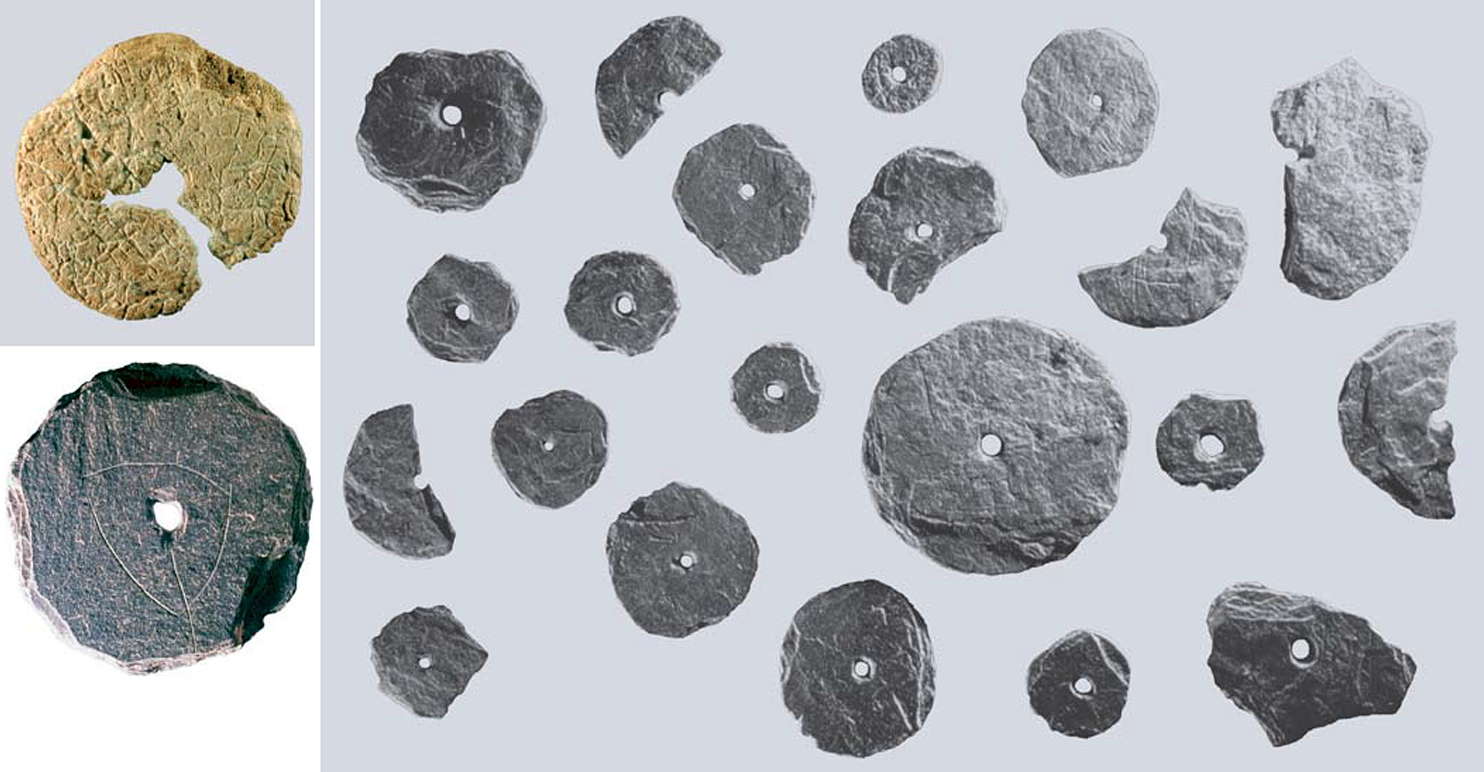
In the Gönnersdorf and Andernach area, near the dwellings were found numerous rondelles. These are round, pierced in the middle, mainly slices of shale, but some were made of ivory and reindeer antler. In Gönnersdorf alone 400 such rondels were found.
About one fifth were decorated, some with symbols. The function of these rondelles is not known. Some sources say that they may be jewellery, or may have served as buttons to connect sections of the tents, or clothing.
( I believe that they were the weights of spindles used to spin yarn. See the link below - Don )
Photo and text: Gaudzinski-Windheuser and Jöris (2006)
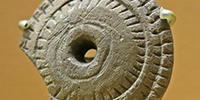 There are many examples of discs or rondelles with central holes from various (mostly Magdalenian) sites in Europe. Various theories have been put forward as to their use, including clothing decoration and large buttons. As my colleague AnnDee first pointed out, their most likely use is as the weight (normally called a whorl) for a drop spindle, in the spinning of fibres into yarn. This is borne out by the fact that the overwhelming majority have a central hole, all of similar dimensions, 2 to 4 mm, and by the fact that many are not decorated in any meaningful or artistic way, and are also made of other materials (sandstone, slate) as well as bone.
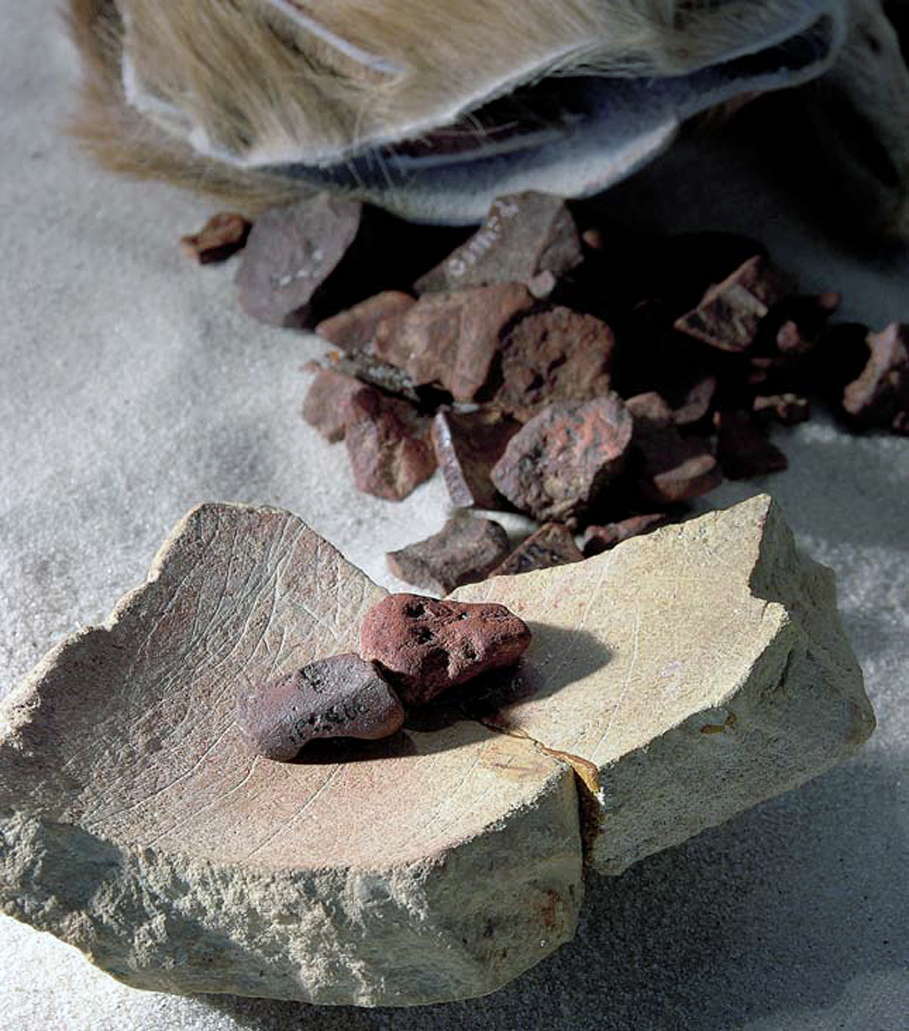
In the Gönnersdorf area, colouring agents were used, such as the haematite shown here, as well as ochres and charcoal.
Photo and text: Gaudzinski-Windheuser and Jöris (2006)
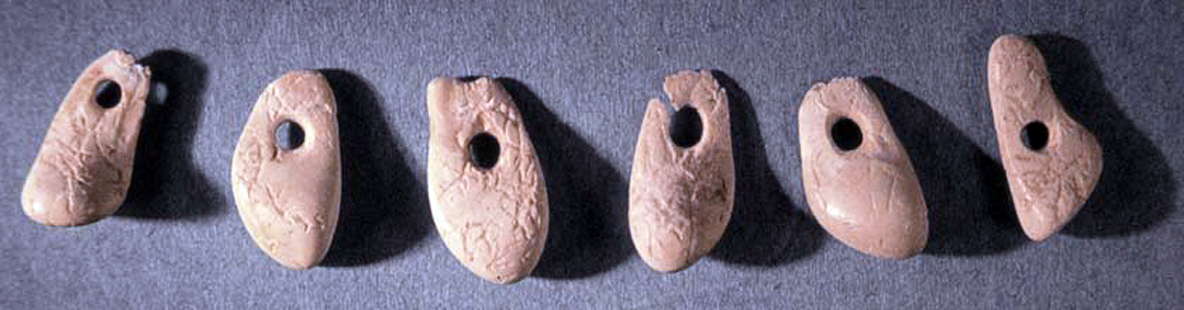
The urge to decorate oneself is as old as man himself. Only the forms and materials of the jewellery changes. Numerous trinkets and waste from their manufacture were found in both Gönnersdorf and Andernach. The spectrum of materials ranged from the bones and teeth of the available animals to fossils to snails and shells.
Shiny black jet was used in Gönnersdorf and Andernach for jewellery, as well as these these pierced deer teeth from Gönnersdorf, Hirsch Grandeln, sometimes called hunting trophies, which were used as pendants or as ornaments for clothing.
Photo and text: Gaudzinski-Windheuser and Jöris (2006)
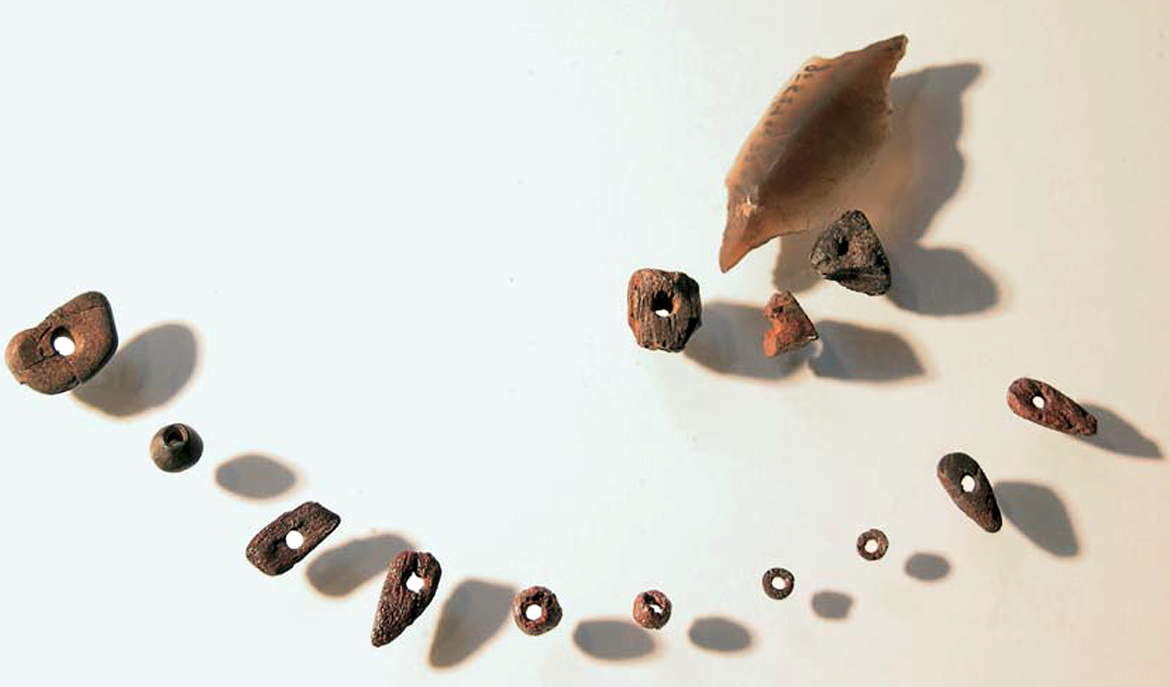
Drill made of flint and jewellery from fossil wood (Gönnersdorf).
Photo and text: Gaudzinski-Windheuser and Jöris (2006)
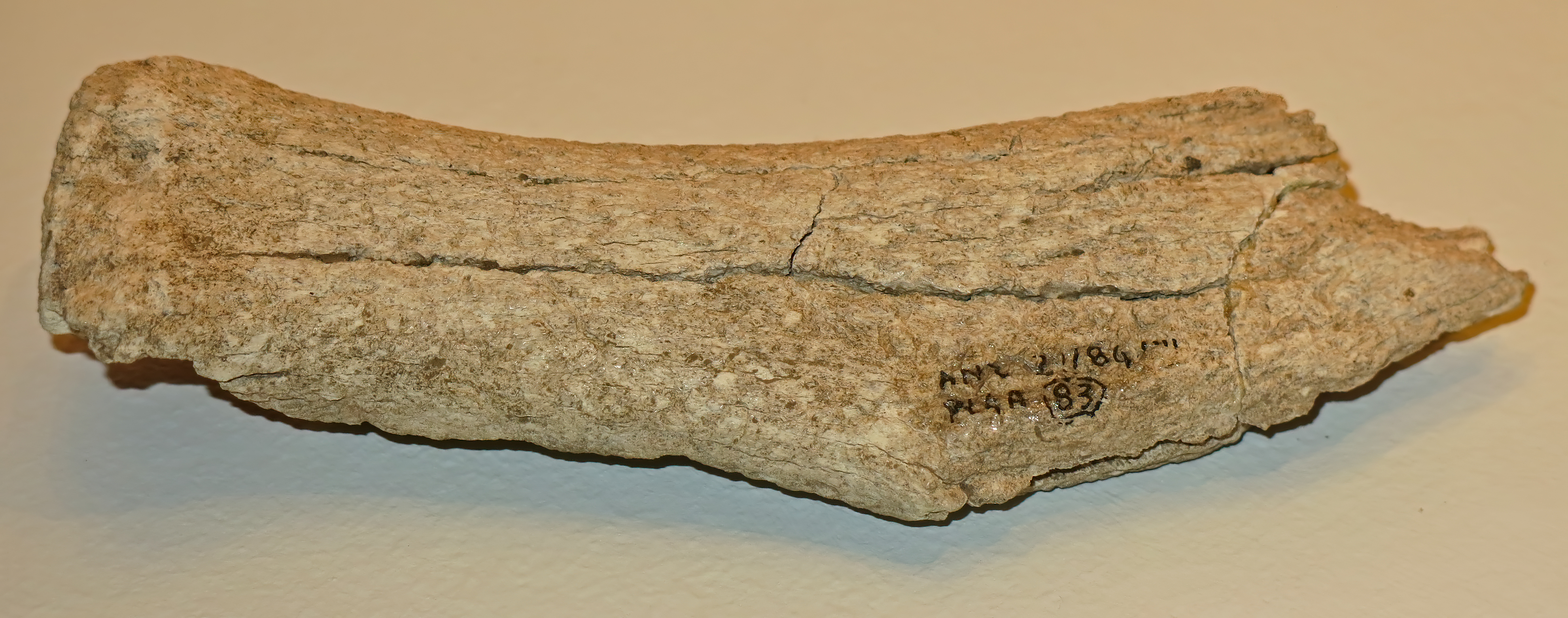
Mallet made of reindeer antler, 15 800 BP
Andernach-Martinsberg, district of Mayen, Koblenz, from the excavations of Hermann Schaaffhausen 1883.
Photo: Don Hitchcock 2015
Source: LVR-Landesmuseum Bonn, Germany
Lender: Directorate General for Cultural Heritage Rhineland-Palatinate, Generaldirektion Kulturelles Erbe Rheinland-Pfalz
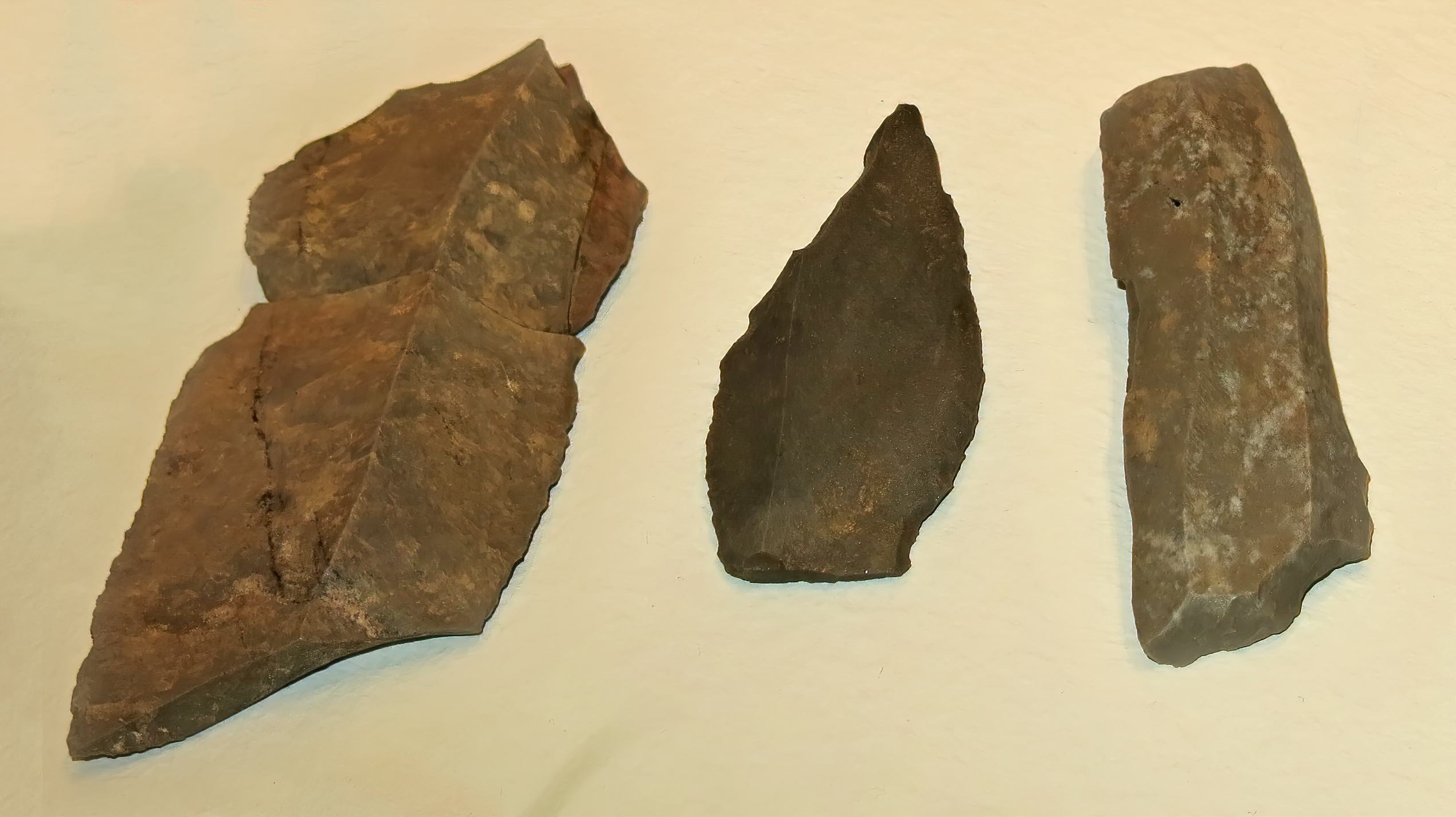
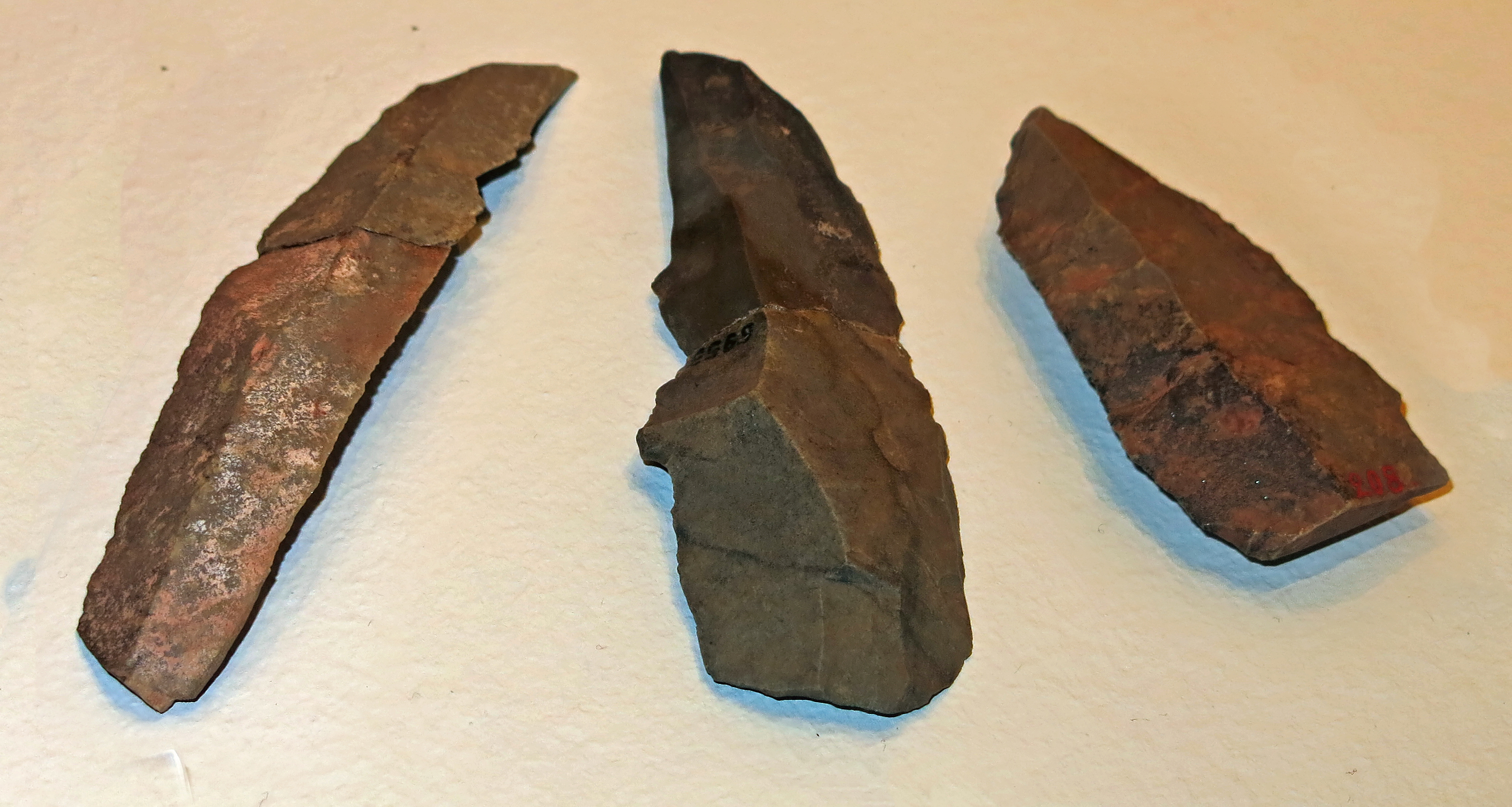
Quartzite burins, 15 800 BP
Andernach-Martinsberg, district of Mayen-Koblenz, from the excavations of Hermann Schaaffhausen 1883.
Photo: Don Hitchcock 2015
Source: LVR-Landesmuseum Bonn, Germany
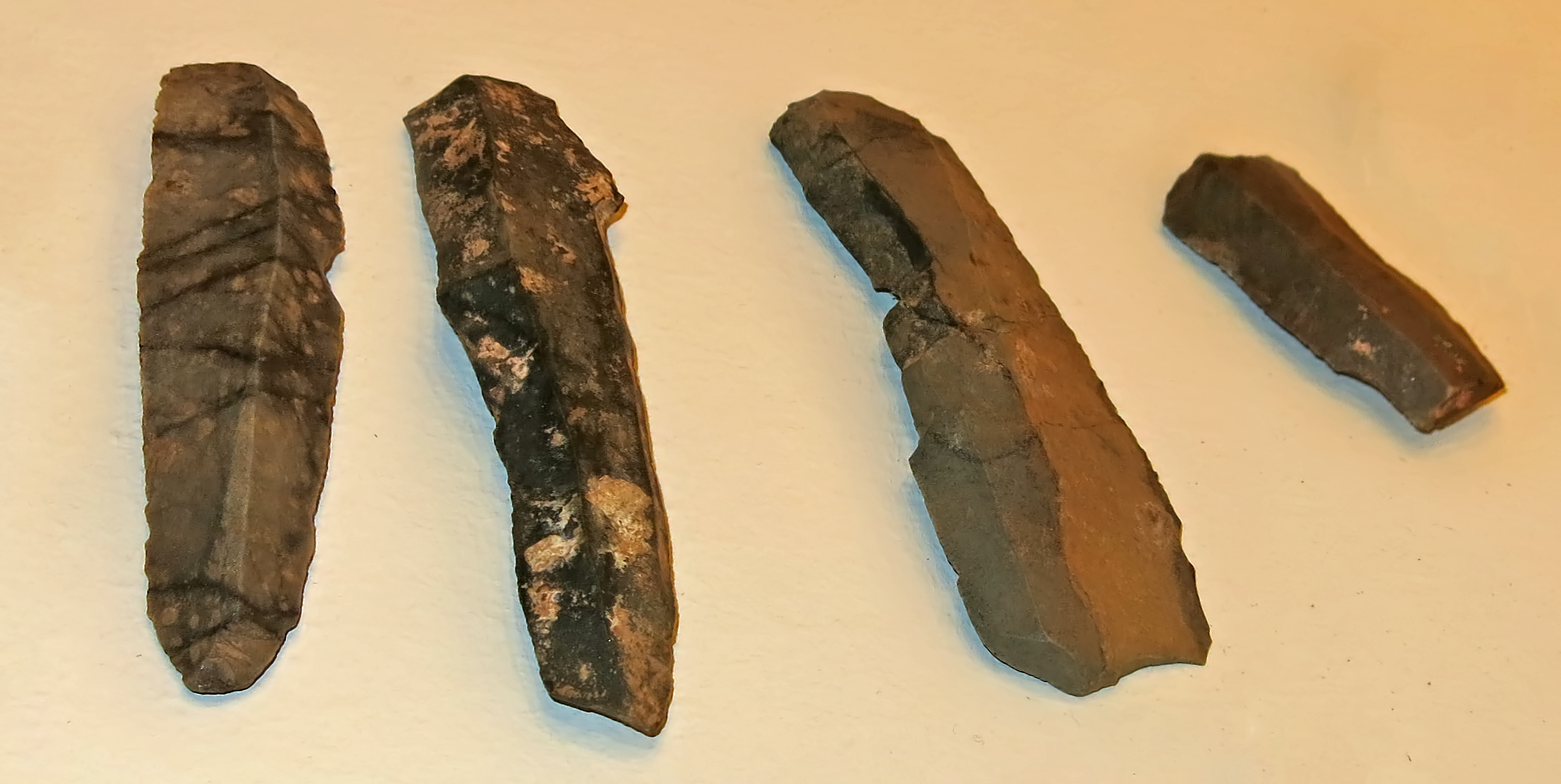
Quartzite scrapers, 15 800 BP
Andernach-Martinsberg, district of Mayen-Koblenz, from the excavations of Hermann Schaaffhausen 1883.
Photo: Don Hitchcock 2015
Source: LVR-Landesmuseum Bonn, Germany
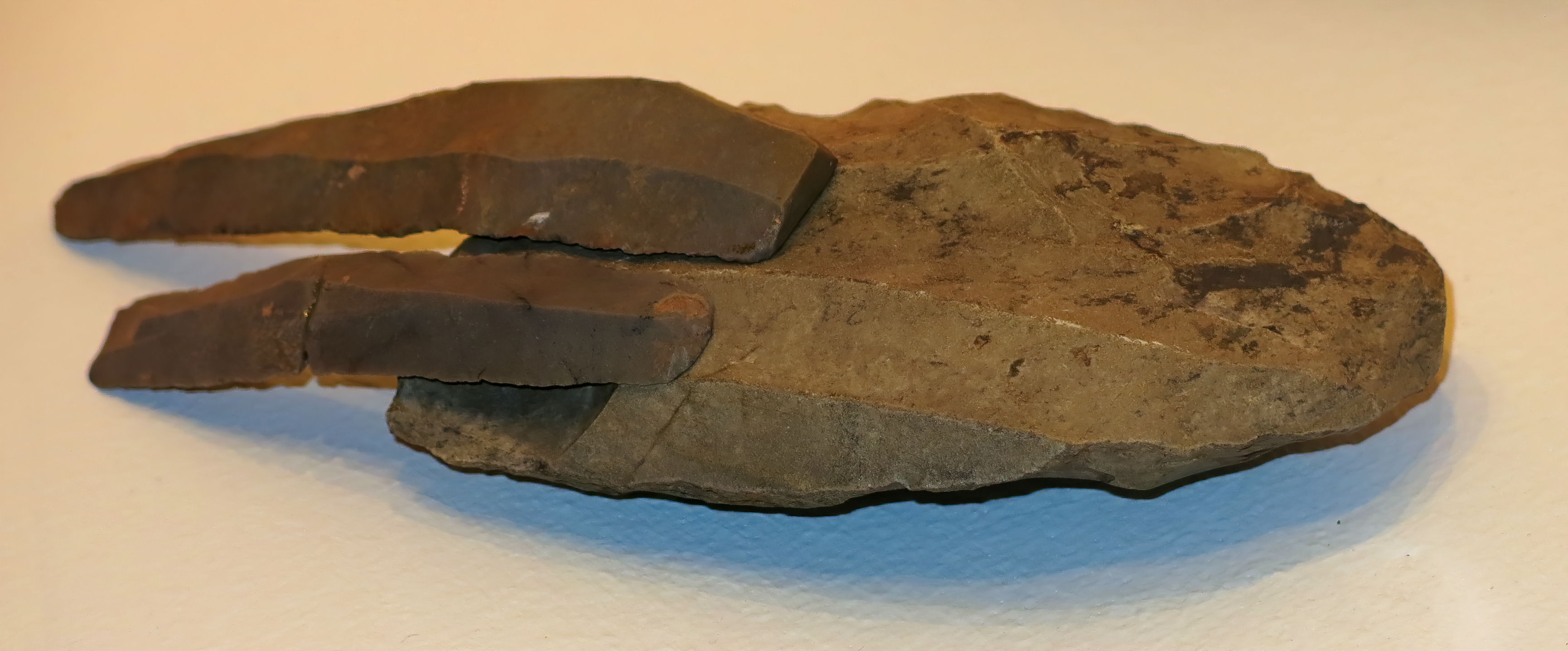
Core and blades made of quartzite, 15 800 BP
Andernach-Martinsberg, district of Mayen-Koblenz, from the excavations of Hermann Schaaffhausen 1883.
Photo: Don Hitchcock 2015
Source: LVR-Landesmuseum Bonn, Germany
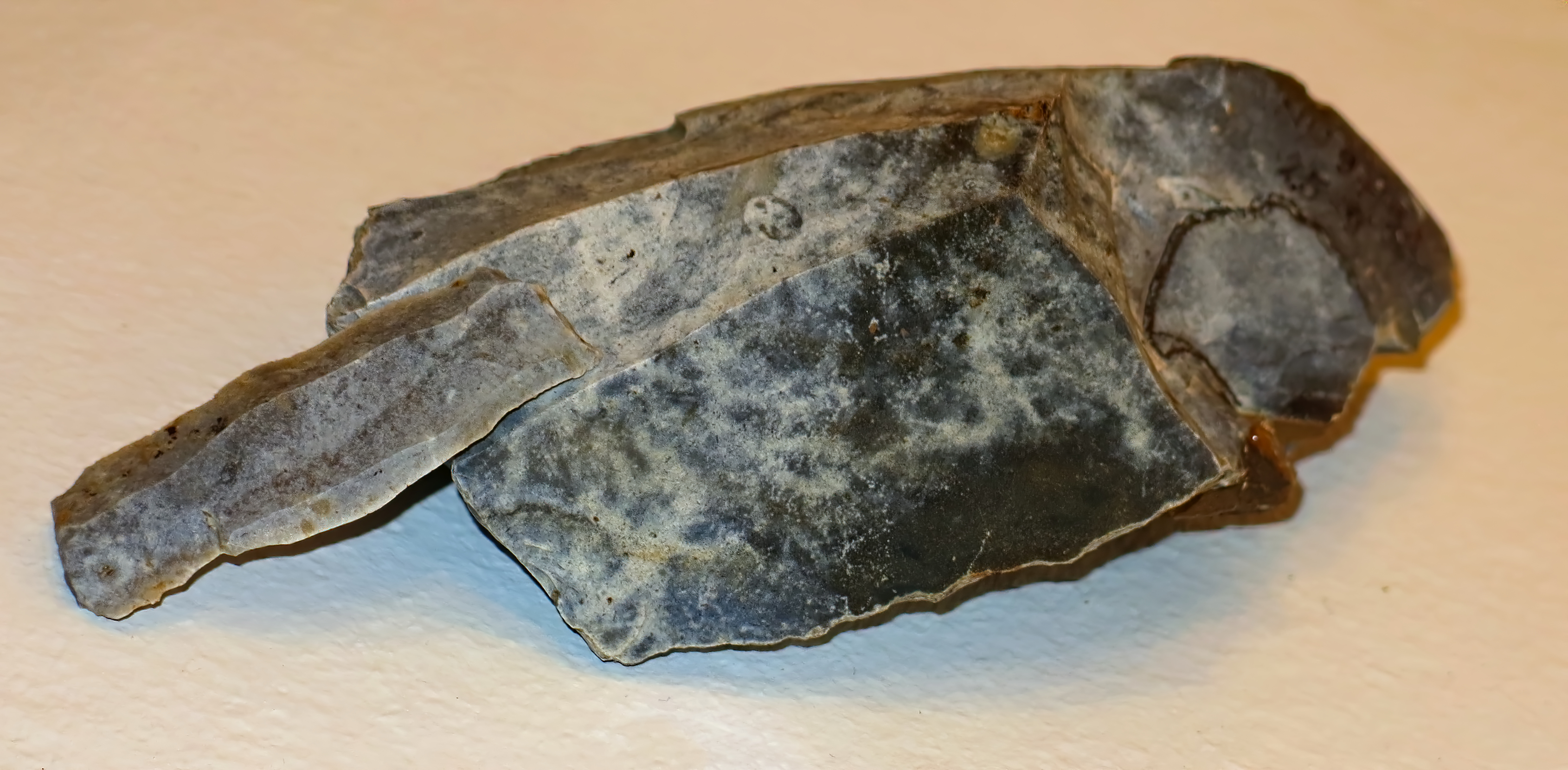
Core and blade made of flint, 15 800 BP
Beeck, Stadt Geilenkirchen, Kreis Heinsberg
Photo: Don Hitchcock 2015
Source: LVR-Landesmuseum Bonn, Germany
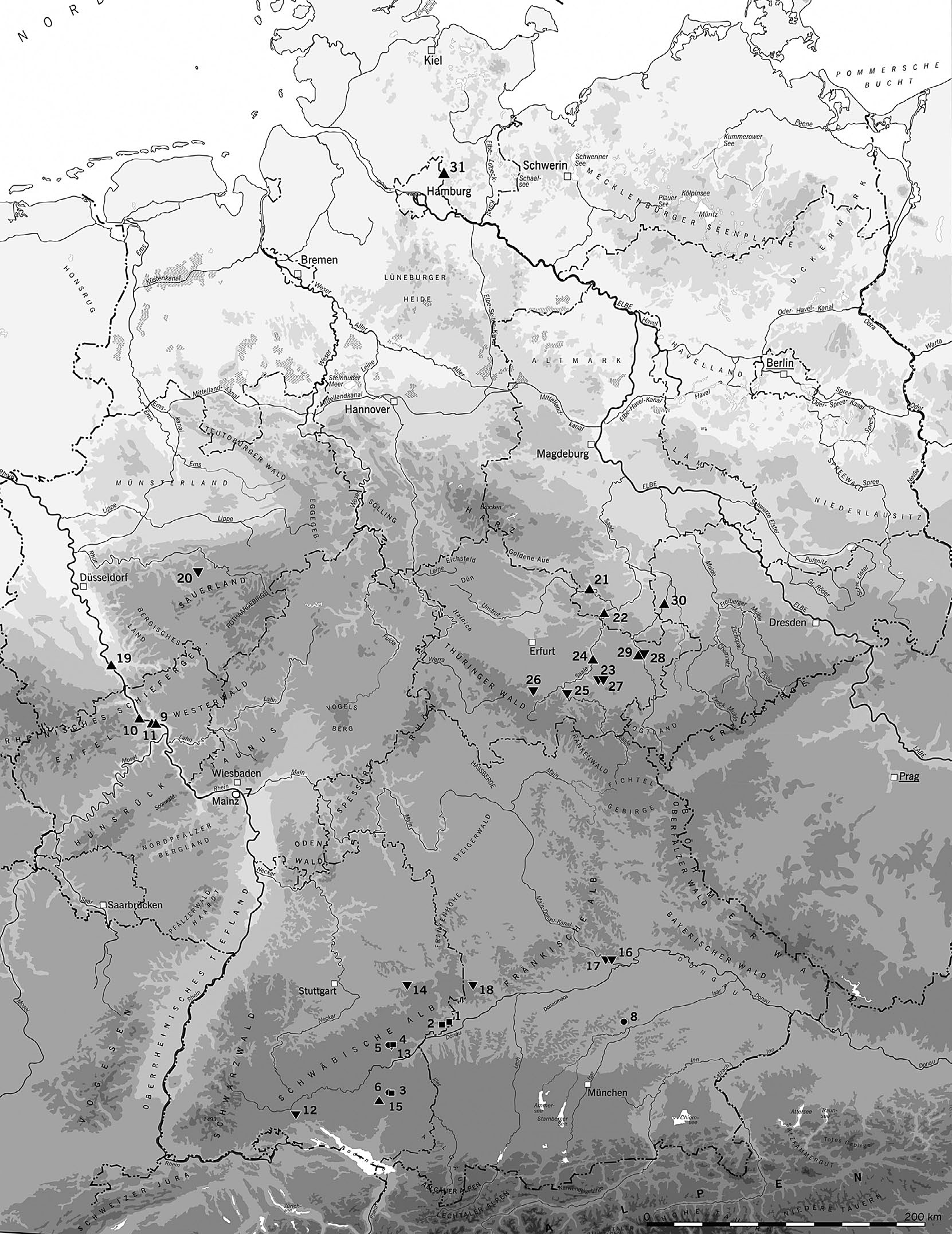
Distribution of the known Upper Palaeolithic sites in Germany with portable art.
■ = Aurignacian (cave site) ○ = Gravettian (open air site) ● = Gravettian (cave site) ▲ = Magdalenian (open air site) ▼ = Magdalenian (cave site)
1 Vogelherd, 2 Hohlenstein-Stadel, 3 Geissenklösterle, 4 Hohle Fels, 5 Hohle Fels, 6 Brillenhöhle, 7 Mainz-Linsenberg, 8 Weinberghöhlen, 9 Gönnersdorf, 10 Andernach- Martinsberg, 11 Niederbieber, 12 Petersfels, 13 Hohler Fels, 14 Kleine Scheuer, 15 Schussenquelle, 16 Obere Klause, 17 Mittlere Klause, 18 Hohlenstein, 19 Bonn-Oberkassel, 20 Balver Höhle, 21 Nebra, 22 Saaleck, 23 Kniegrotte, 24 Oelknitz, 25 Teufelsbrücke, 26 Bärenkeller, 27 Urdhöhle, 28 Lindenthaler Hyäenenhöhle, 29 Gera (different sites), 30 Groitzsch, 31 Poggenwisch.
Source: Kartengrundlage: D 1000, Bundesamt für Kartographie und Geodäsie, Nr. 01/2002. © Mapping N. Seeländer, © Landesamt für Denkmalpflege und Archäologie Sachsen-Anhalt.
Proximate source: Braun (2018)
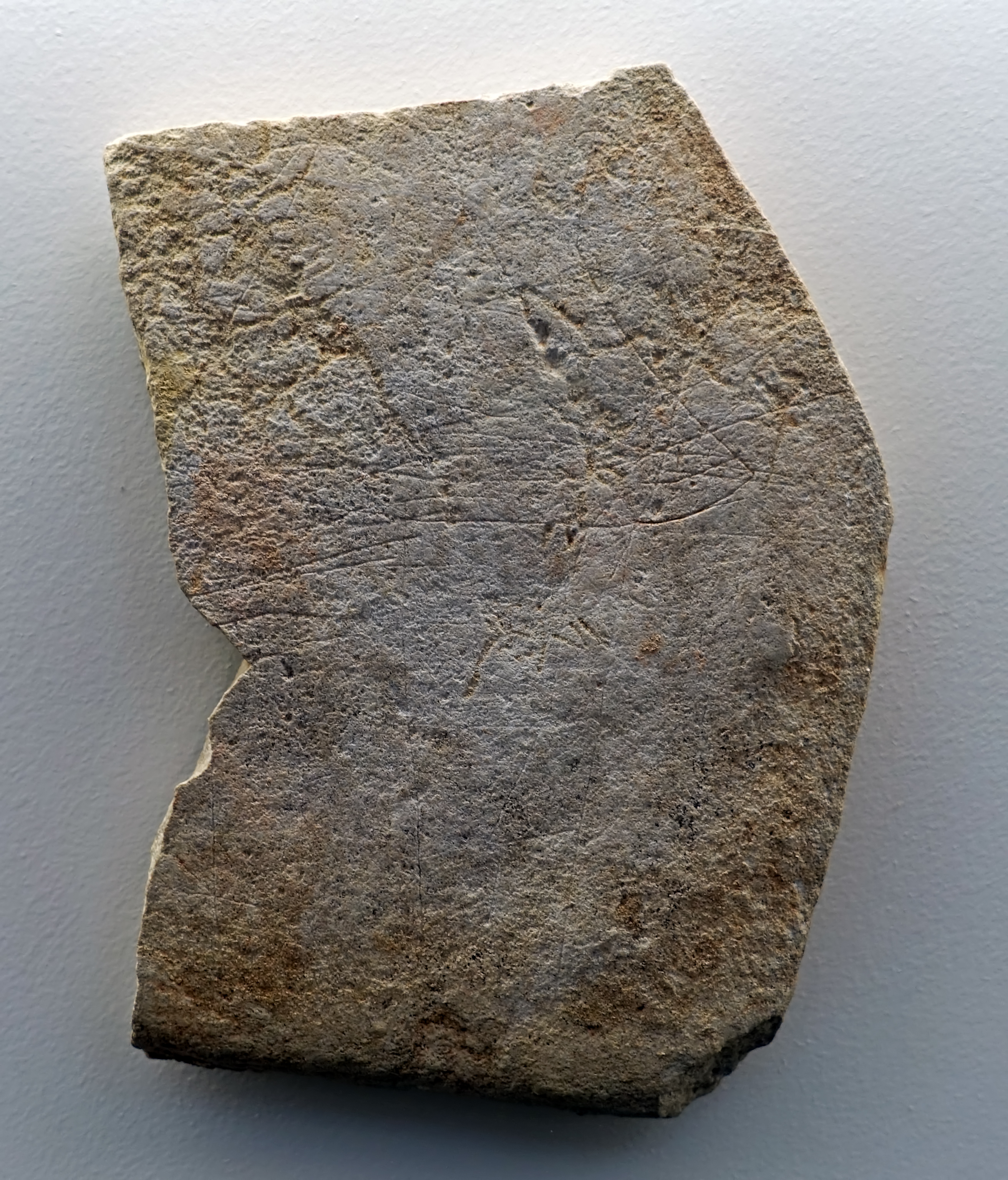
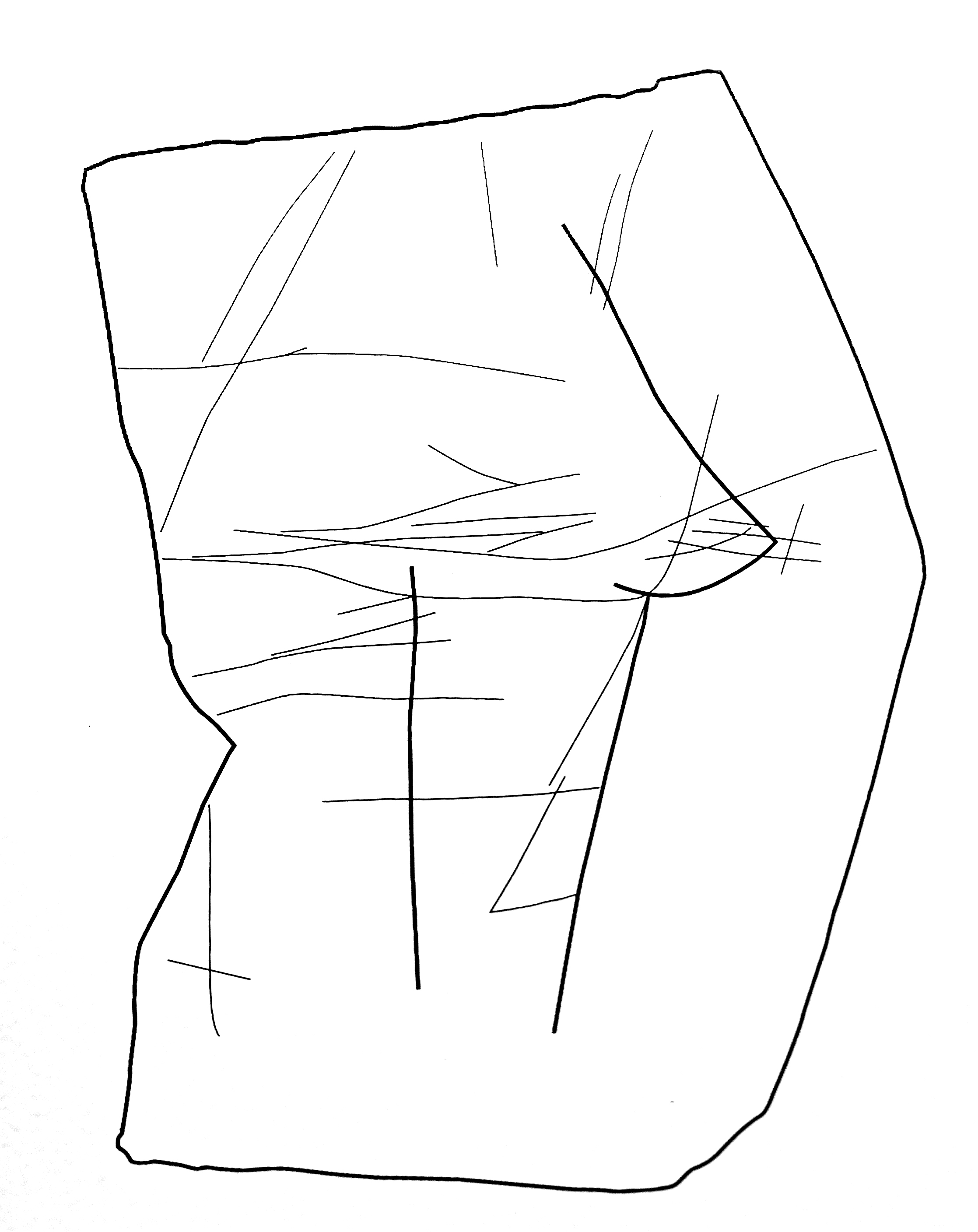
Sandsteinplatte mit skizzierter Frauenarstellung
Sandstone slab with an engraving of the outline of a woman.
Bad Kösen-Lengefeld, Burgenlandkreis
The Magdalenian site of Bad Kösen-Lengefeld is located near the Saaleck site (#22 on the map above), however above the Saale river. The similarities between the stone tools suggest that these two sites existed simultaneously even though there are no direct datations yet of the site of Bad Kösen-Lengegfeld.
Besides stone tools there are two engraved stone plaquettes. One of them, a probable female figure of Lalinde-Gönnersdorf type, was very finely engraved and is barely visible. The second plaquette shows numerous engraved lines, some of them in parallel order.
Artist: Unrecorded, Halle Landesmuseum für Vorgeschichte, https://st.museum-digital.de/, CC-BY-NC-SA @ State Museum of Prehistory Halle
Photo: Don Hitchcock 2018
Source and text: Halle Landesmuseum für Vorgeschichte, https://st.museum-digital.de/, CC-BY-NC-SA @ State Museum of Prehistory Halle
Additional text: Braun (2018)
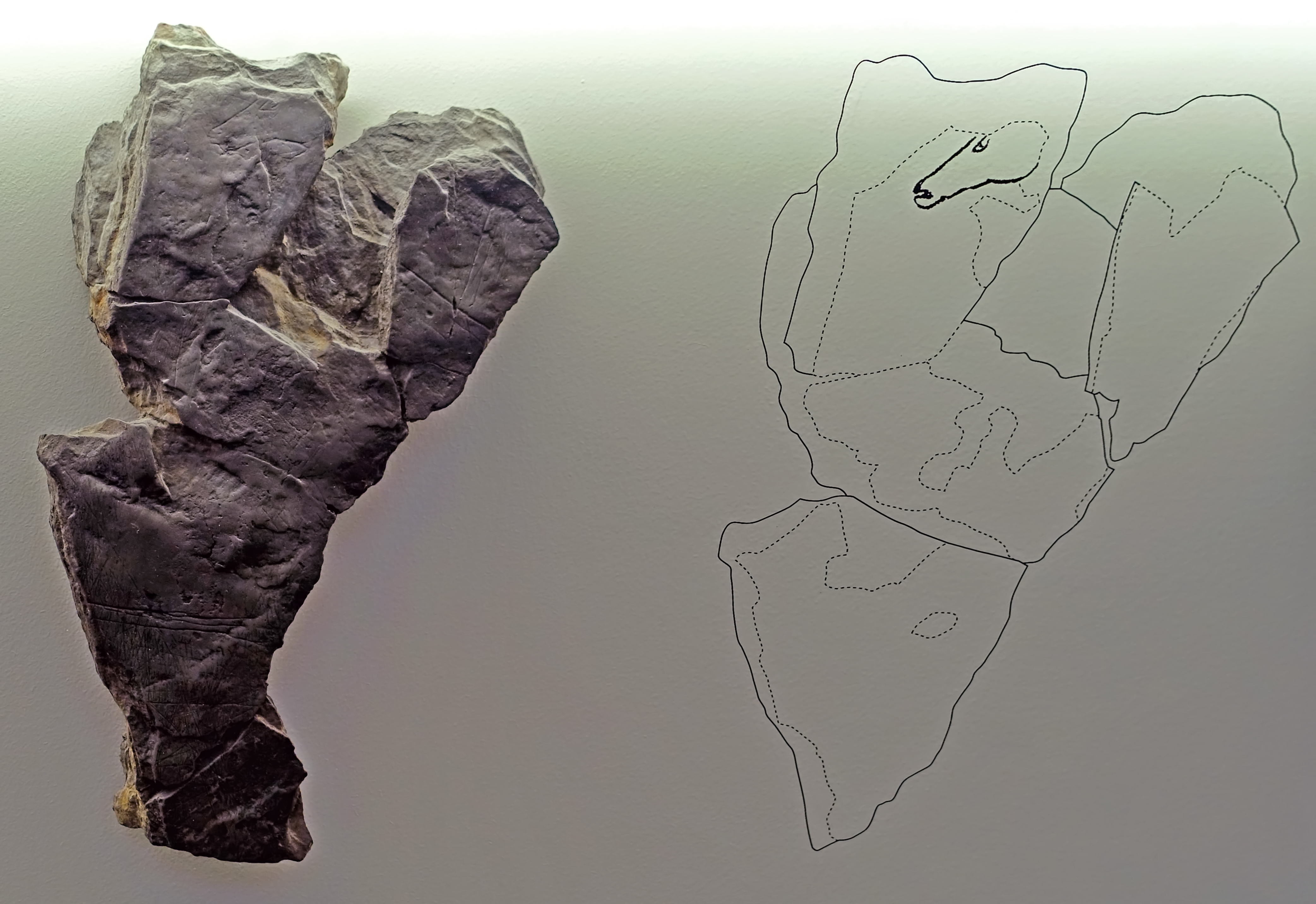
Schieferplatte mit graviertem Pferdekopf.
Slate plaquette with engraved horse head.
Saaleck, Burgenlandkreis.
Photo: Don Hitchcock 2018
Source and text: Halle Landesmuseum für Vorgeschichte, https://st.museum-digital.de/, CC-BY-NC-SA @ State Museum of Prehistory Halle
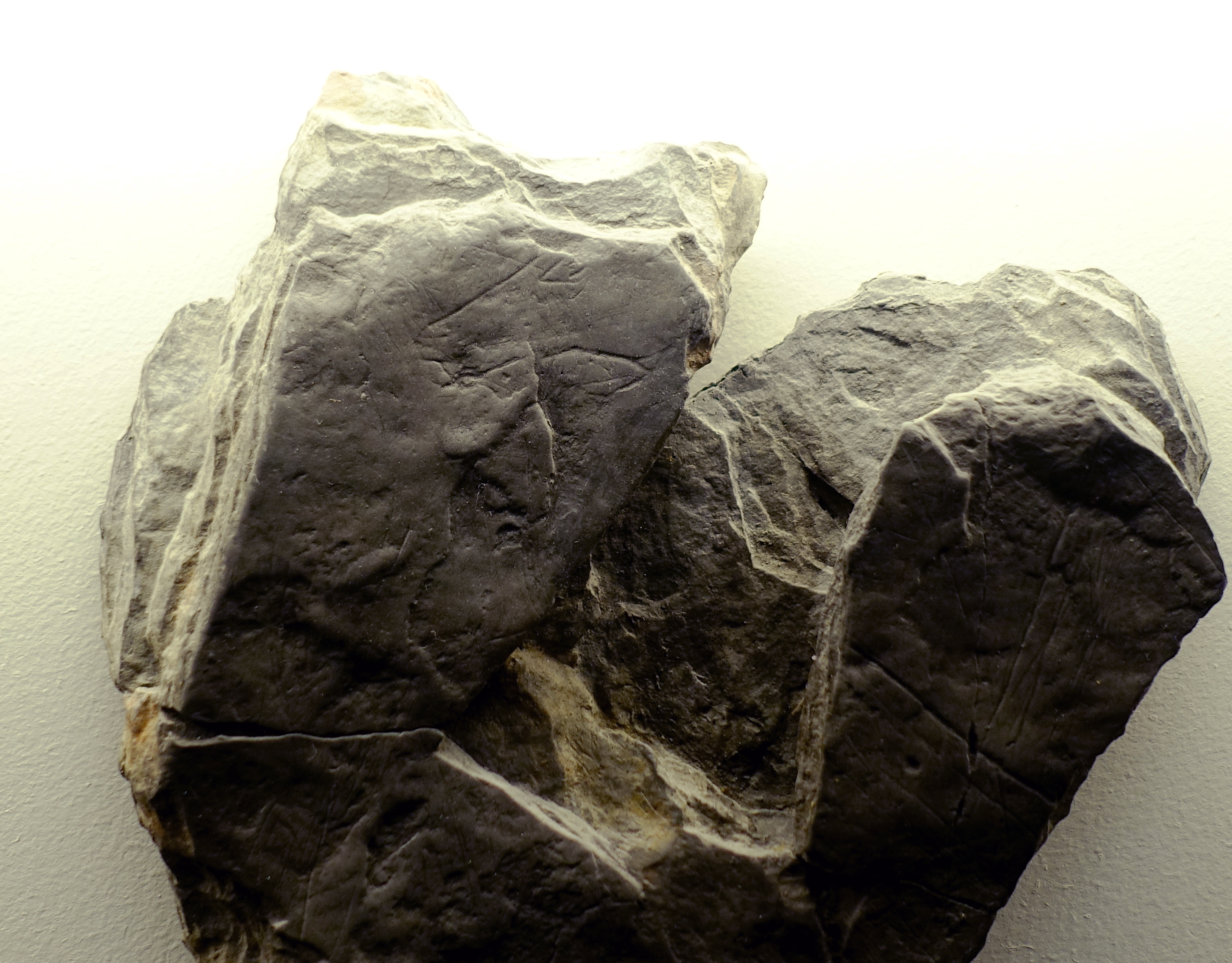
Schieferplatte mit graviertem Pferdekopf.
Slate plaquette with engraved horse head, close up.
Saaleck, Burgenlandkreis.
Photo: Don Hitchcock 2018
Source and text: Halle Landesmuseum für Vorgeschichte, https://st.museum-digital.de/, CC-BY-NC-SA @ State Museum of Prehistory Halle
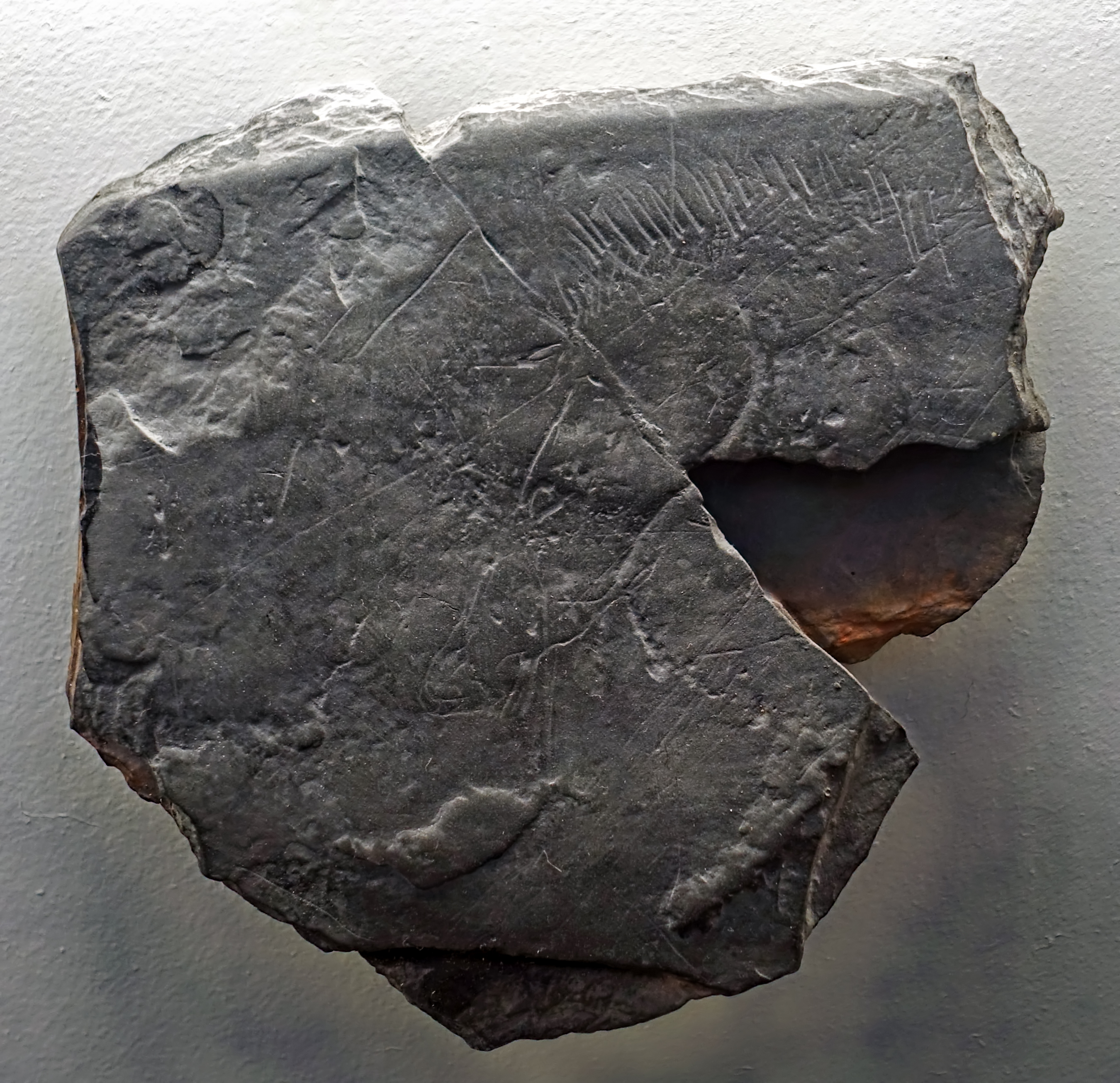
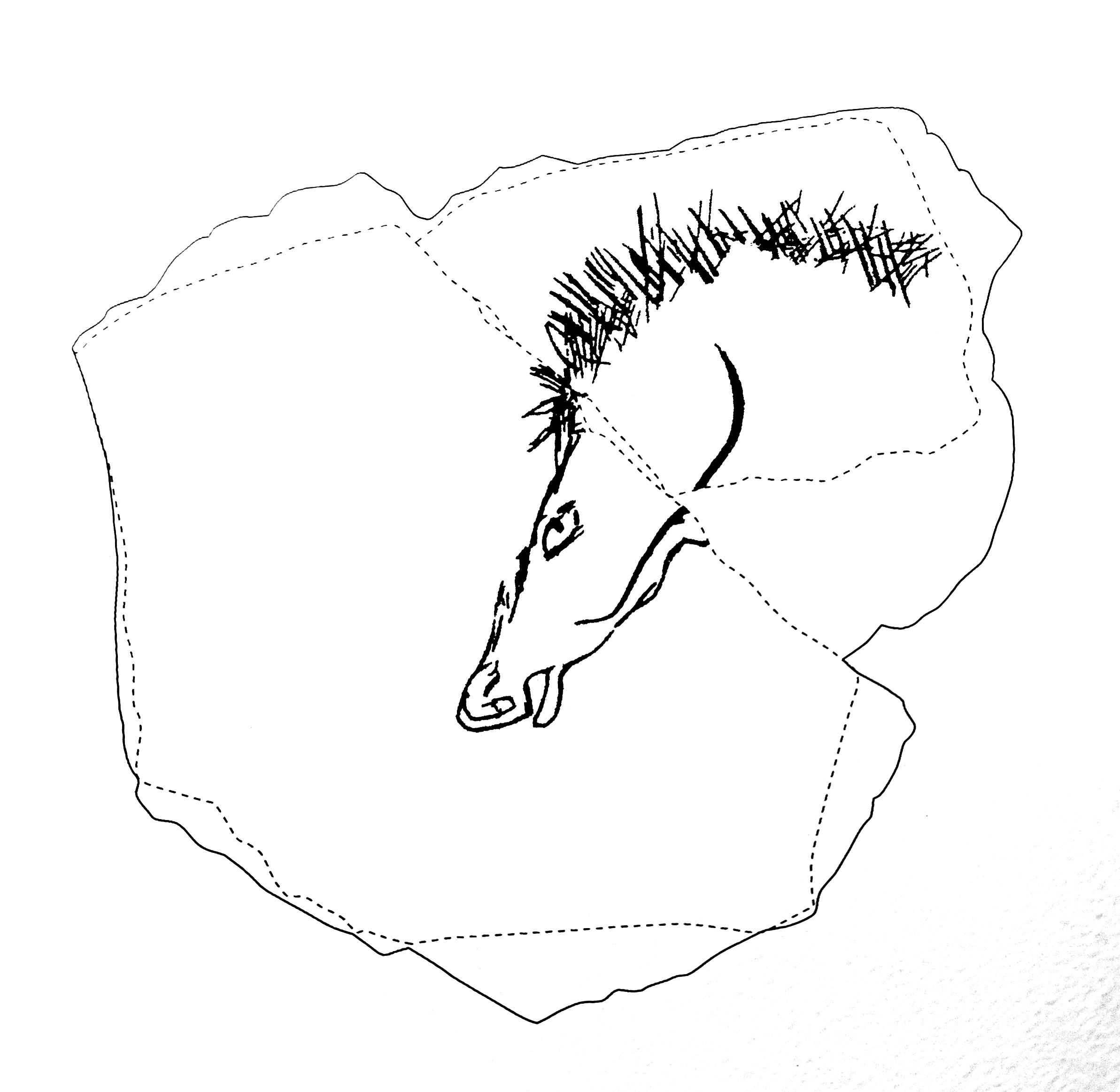
Schieferplatte mit graviertem Pferdekopf.
Slate plaquette with engraved horse head.
Saaleck, Burgenlandkreis.
Photo: Don Hitchcock 2018
Source and text: Halle Landesmuseum für Vorgeschichte, https://st.museum-digital.de/, CC-BY-NC-SA @ State Museum of Prehistory Halle

Dr Gerhard Bosinski in 1963 became Assistant Professor at the Institute of Prehistory and Early History of the University of Cologne, becoming professor there in 1972. As a visiting professor he taught at the Universities of Berlin, Bordeaux , Göttingen and the University of the Saarland in Saarbrücken. In 2003 he became professor emeritus .
From 1985 he was head of the research division of the Paleolithic Roman-Germanic Central Museum, and from 1988 to 2003 head of the Museum of Archaeology of the Ice Age in Monrepos . He directed the excavations in Gönnersdorf and participated in excavations in France, Georgia and Russia. He lives in southern France near Montauban .
Photo: http://www.creap.fr/participants-gerhard-bosinski.htm
Text: Wikipedia

Sabine Gaudzinski-Windheuser is the professor of Palaeolithic Archaeology at the Johannes Gutenberg-University, Mainz, Germany. In addition she is head of the Department of Palaeolithic Studies at the Römisch-Germanisches Zentralmuseum. Her major research interest is the evolution of hominin behaviour and she has conducted research and excavations in all phases of the Palaeolithic. She is a 'specialized generalist' in Palaeolithic Archaeology with particular expertise in Archaeozoology, Taphonomy and Neanderthal subsistence strategies.
Photo: http://www.123people.at/s/sabine+gaudzinski
Text: http://rgzm.academia.edu/SabineGaudzinskiWindheuser

Olaf Jöris is a senior scientist at the Department of Palaeolithic Studies (Forschungsbereich Altsteinzeit) at the Römisch-Germanisches Zentralmuseum Mainz, Germany, and lecturer in Prehistory at the Institut für Vor- und Frühgeschichte of the Johannes Gutenberg-Universität, Mainz, Germany. He has been involved in numerous international research projects and has conducted field work at sites from different Palaeolithic periods, including, for example, excavations at the Lower Palaeolithic site of Dmanisi in Georgia. He is a specialist in the analysis of lithic remains, analysis on intra-site spatial organisation of Palaeolithic sites, radiocarbon dating and calibration and population dynamics of Palaeolithic societies in changing environments.
Photo: http://rgzm.academia.edu/OlafJ%C3%B6ris/Papers
Text: http://rgzm.academia.edu/OlafJ%C3%B6ris/About
References
- Bosinski, G., Fischer G., 1974: Die Menschendarstellungen von Gönnersdorf der Ausgrabung von 1968 Steiner Franz Verlag (1974)
- Bosinski, G., 1979: Die Ausgrabungen in Gönnersdorf 1968-1976 und die Siedlungsbefunde der Grabung 1968. Der Magdalénian-Fundplatz Gönnersdorf Band 3. Wiesbaden.
- Bosinski, G., 1981: Gönnersdorf. Eiszeitjäger am Mittel rhein. Schriftenreihe der Bezirksregierung Koblenz 2 Koblenz : Rhenania-Verlag, 1981.
- Bosinski, G., 2007: Gönnersdorf und Andernach-Martinsberg. Späteiszeitliche Siedlungsplätze am Mittelrhein Koblenz 2007
- Bosinski G., 2001: Die Gravierten Frauendarstellungen Von Gonnersdorf, Publisher: Franz Steiner Verlag Wiesbaden GmbH, pp 364, ISBN-10: 3515077995, ISBN-13: 978-3515077996
- Braun I., 2018: Upper Palaeolithic portable art objects in Central Germany and supra-regional parallels, PALEO, Revue d'archéologie préhistorique, 29 | 2018, URL: http://journals.openedition.org/paleo/3756 DOI: 10.4000/paleo.3756 ISSN: 2101-0420, Publisher SAMRA
- Brunnacker, K., 1978: Geowissenschaftliche Untersuchungen in Gönnersdorf. Der Magdalénien –Fundplatz Gönnersdorf 4 (Wiesbaden)
- Clark, J., 1954: Excavations at Star Carr, Cambridge
- Gaudzinski-Windheuser, S., Jöris, O., 2012: Centextualising the Female Image – Symbols for Common Ideas and Communal Identity in Upper Palaeolithic Societies in: F. Wenban-Smith / F. Coward / R. Hosfield / M. Pope (Eds.), Settlement, Society, and Cognition in Human Evolution. Matt Pope. Cambridge University Press.
- Hansen, M., 2006: Beyond seals - The Representation of Seals on Engraved Slate Plaquettes from the Magdalenian Site Gönnersdorf (Central Rhineland, Germany), Thesis in Archaeology, Candidate thesis for the title Cand. Philol. University of Tromsø, Autumn 2006
- Jöris, O., Street M., Turner E., 2011: Spatial Analysis at the Magdalenian Site of Gönnersdorf (Central Rhineland, Germany) – an Introduction RGZM-Tagungen.
- Jöris, O., Gaudzinski-Windheuser, S., 2006: 600 000 years of human history in the middle of Europe Book accompanying the exhibition at the Museum of Archaeology of the Pleistocene, Monrepos (Mainz).
- Macalister, R., 1921: A text-book of European archaeology Cambridge, Univ. Press
- Mikhailova, N., 2006: The Cult of the Deer and Shamans in Deer Hunting Society, Archaeologia Baltica (Vilnius), 7 (2006), 187-198 : Abb.
- Moren, L., 2024: Ochre Wars, www.lisamoren.com/dieri
- Moseler, F., 2008: Die Konzentration IV von Gönnersdorf. Eineräumliche Analyse der Steinartefakte. In: Sensburg/Moseler 2008, 55-168.
- Müller-Beck, H. and Albrecht, G. (Ed.), 1987: Die Anfänge der Kunst vor 30000 Jahren Theiss: Stuttgart.
- Mussi, M., 2015: Encoding and decoding the message: The case of the mid upper Palaeolithic female imagery, ch 15, in: Eds: Coward et al.,Settlement, Society and Cognition in Human Evolution: Landscapes in Mind , Cambridge University Press, pp 414, ISBN:9781107026889, 1107026881.
- Roveland, B., 1990: Ritual as action: The production and use of art at the Magdalenian site, Goennersdorf, Unpublished M.A. thesis, University of Massachusetts.
- Sano, K., 2012: Functional variability in the Magdalenian of north-western Europe: A lithic microwear analysis of the Gönnersdorf K-II assemblageQuaternary International , 272-273: 264-274.
- Sensburg, M., Moseler F., 2008: Die Konzen-trationen IIb und IV des Magdalénien-Fundplatzes Gönners-dorf (Mittelrhein) Monogr. RGZM 73 ( Mainz 2008).
- Sieveking, A., 1979: The Cave Artists, Thames and Hudson
- Stevens, R., O'Connell T., Hedges R., Street M., 2009: Radiocarbon and stable isotope investigations at the Central Rhineland sites of Gönnersdorf and Andernach-Martinsberg, Germany, Journal of Human Evolution 57 (2009) 131–148
- Street M., Gelhausen F., Grimm S., Moseler F., Niven L., Sensburg M., Turner E., Wenzel S., Jöris O., 2006: L’occupation du bassin de Neuwied (Rhénanie centrale, Allemagne) par les Magdaléniens et les groupes à Federmesser (aziliens) Bulletin de la Société préhistorique française 2006, tome 103, no 4, p. 753-780