Back to Don's Maps
 Mousterian (Neanderthal) Sites
 Back to the review of hominins
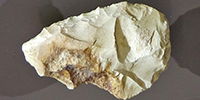 Le Moustier tools
Le Moustier - a Neanderthal site in the Dordogne, France
Neanderthal man lived in these rock shelters overlooking the small town of Le Moustier in the Dordogne, and gave its name to a characteristic Neanderthal tool set and culture, the Mousterian. Le Moustier is on the right bank of the Vézère, at its confluence with the Vimont valley, through which passes the Rau du Vimont, also known as the Rau du Moustier. Village houses rise in tiers on the rocky steps of the limestone outcrops at the angle formed by the two valleys.
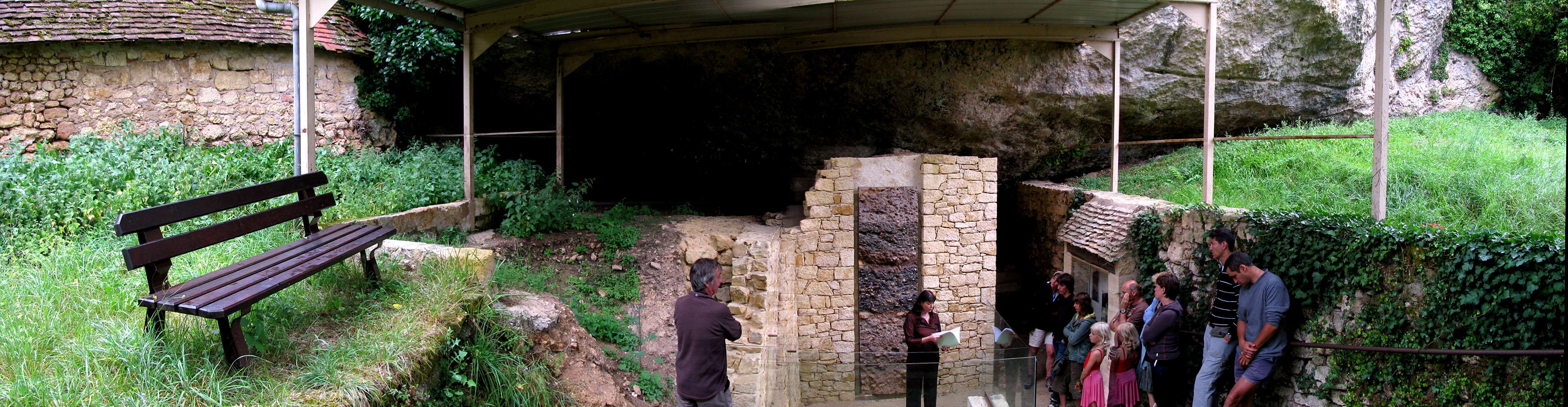

The lower shelter at Le Moustier.
Photo: Panoramas of several photos stitched together, Don Hitchcock 2008
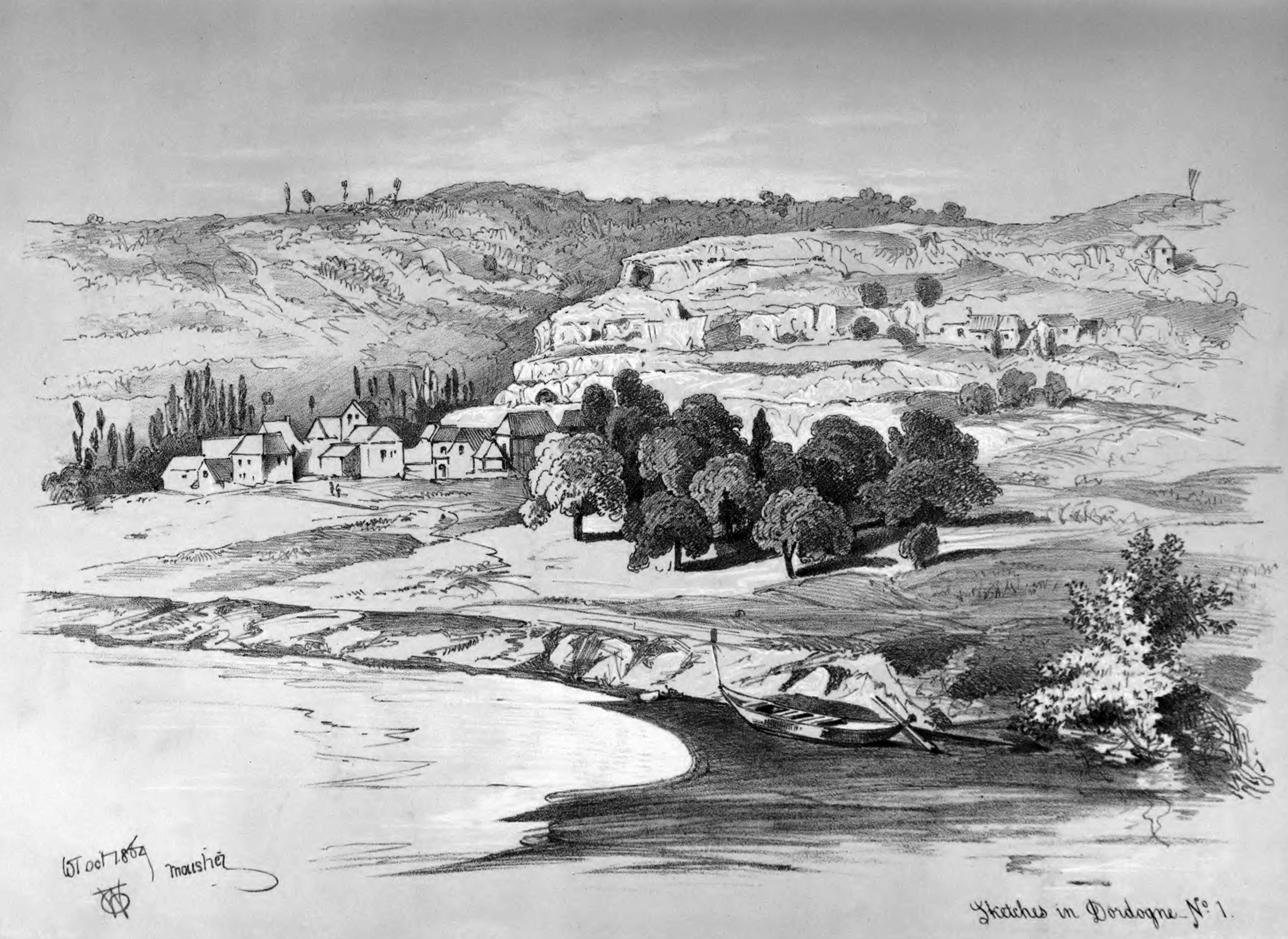
Caption:
View of Le Moustier on the Vézère, and the hill with its Caverns. Taken from the River, by W. Tipping Esq., F.S.A., October 1864.
The Cavern examined by Messrs. H. Christy and E. Lartet is the Lower Cave, seen just over the housetops.
Sketch: W. Tipping Esq., F.S.A.
Source: Lartet and Christy (1875)
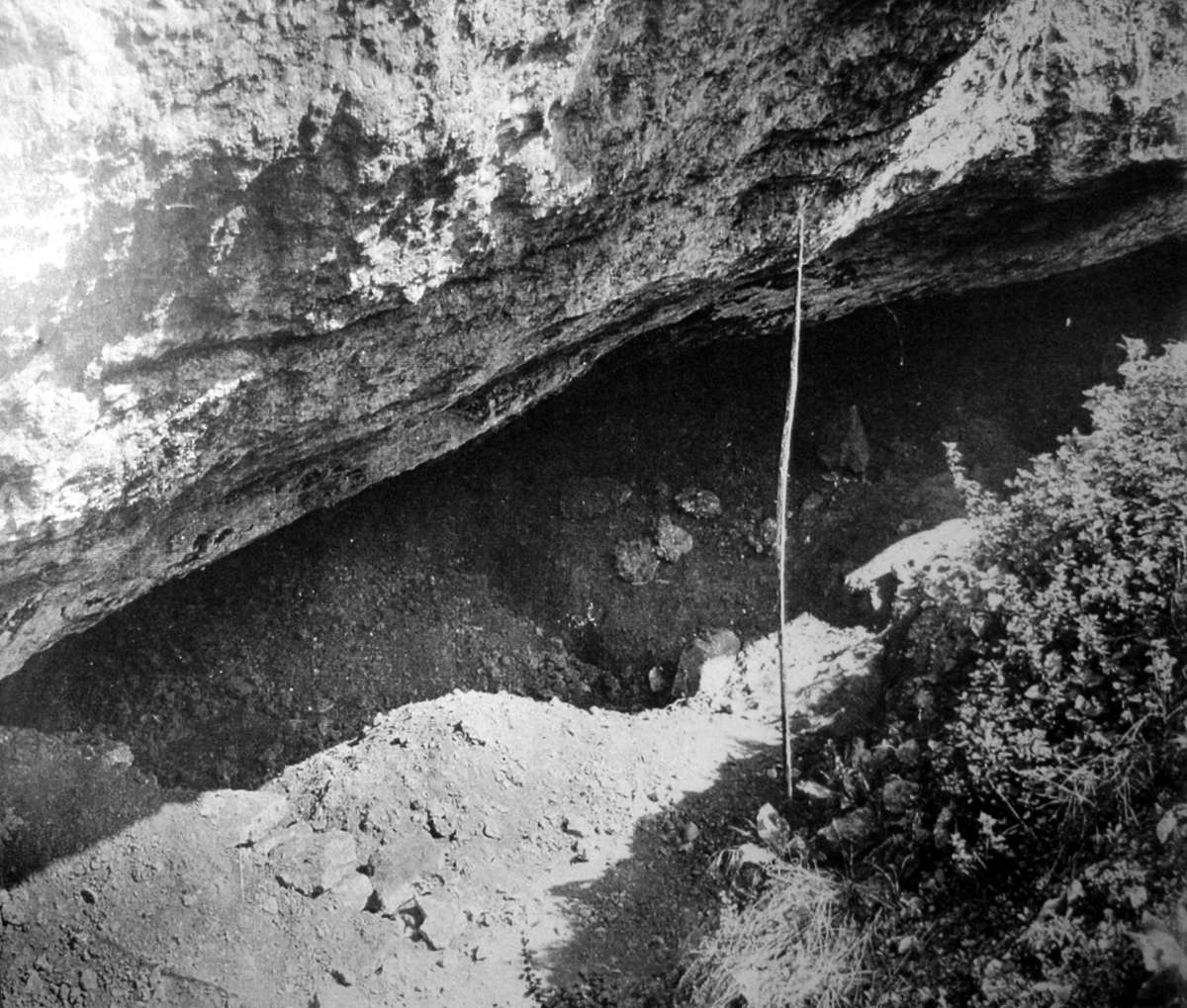
Les fouilles O. Hauser au Moustier. Le baton indique le lieu de découverte du squelette du Moustier 1.
Excavations by O. Hauser at Le Moustier. The stick indicates the place where the skeleton of Le Moustier 1 was discovered.
Photo: O. Hauser, display at Musée National de Préhistoire, Les Eyzies
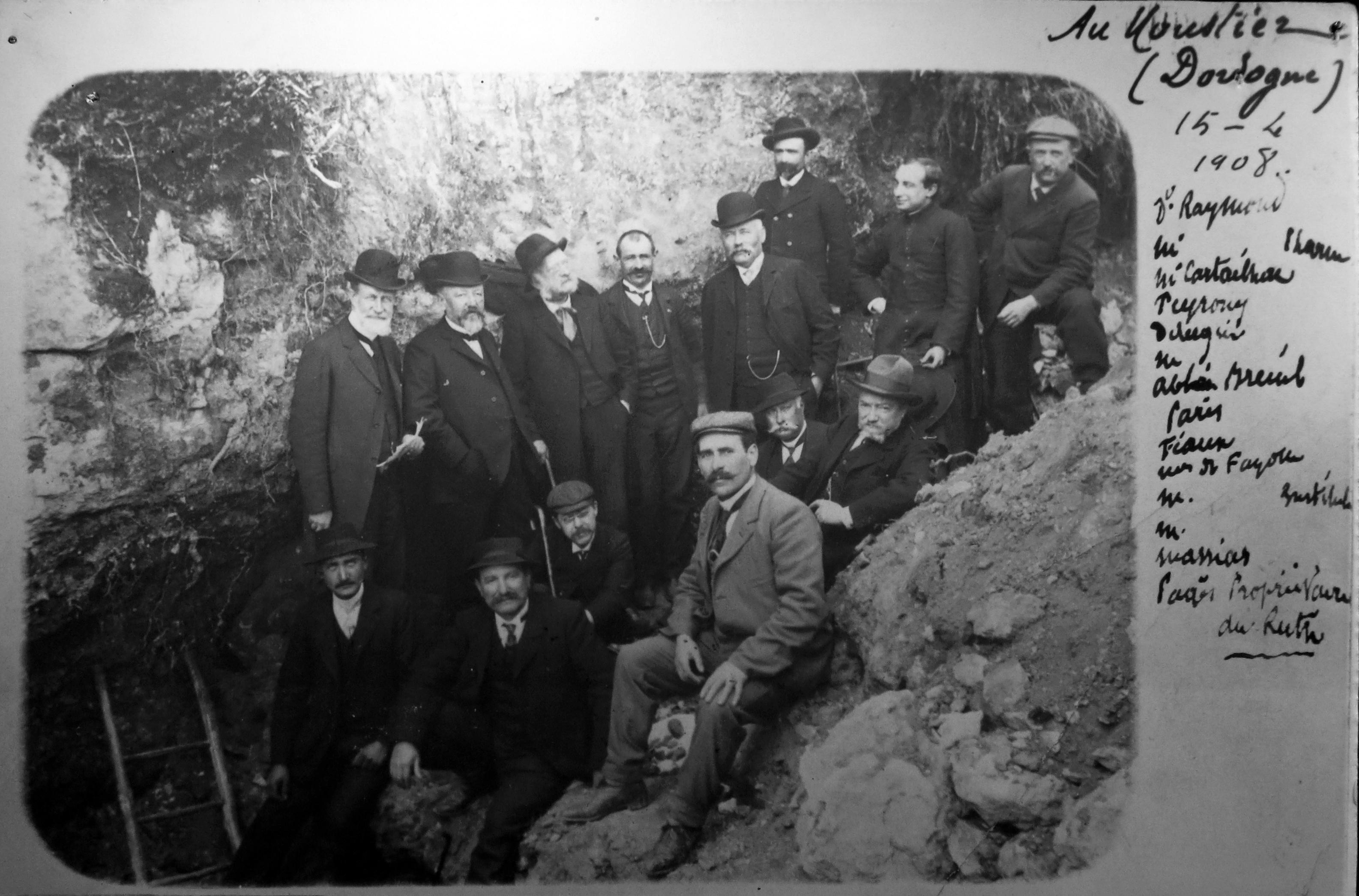
An eminent group of archaeologists, including Abbé Breuil and Denis Peyrony, at le Moustier.
Photo: Don Hitchcock 2014
Source: Musée d’art et d’archéologie du Périgord, Périgueux

Vue de site du Moustier au début des fouilles.
(Cliché MNP, fond D.Peyrony)
View of the Le Moustier site at the start of the excavations by D. Peyrony.
Photo: MNP, display at Musée National de Préhistoire, Les Eyzies
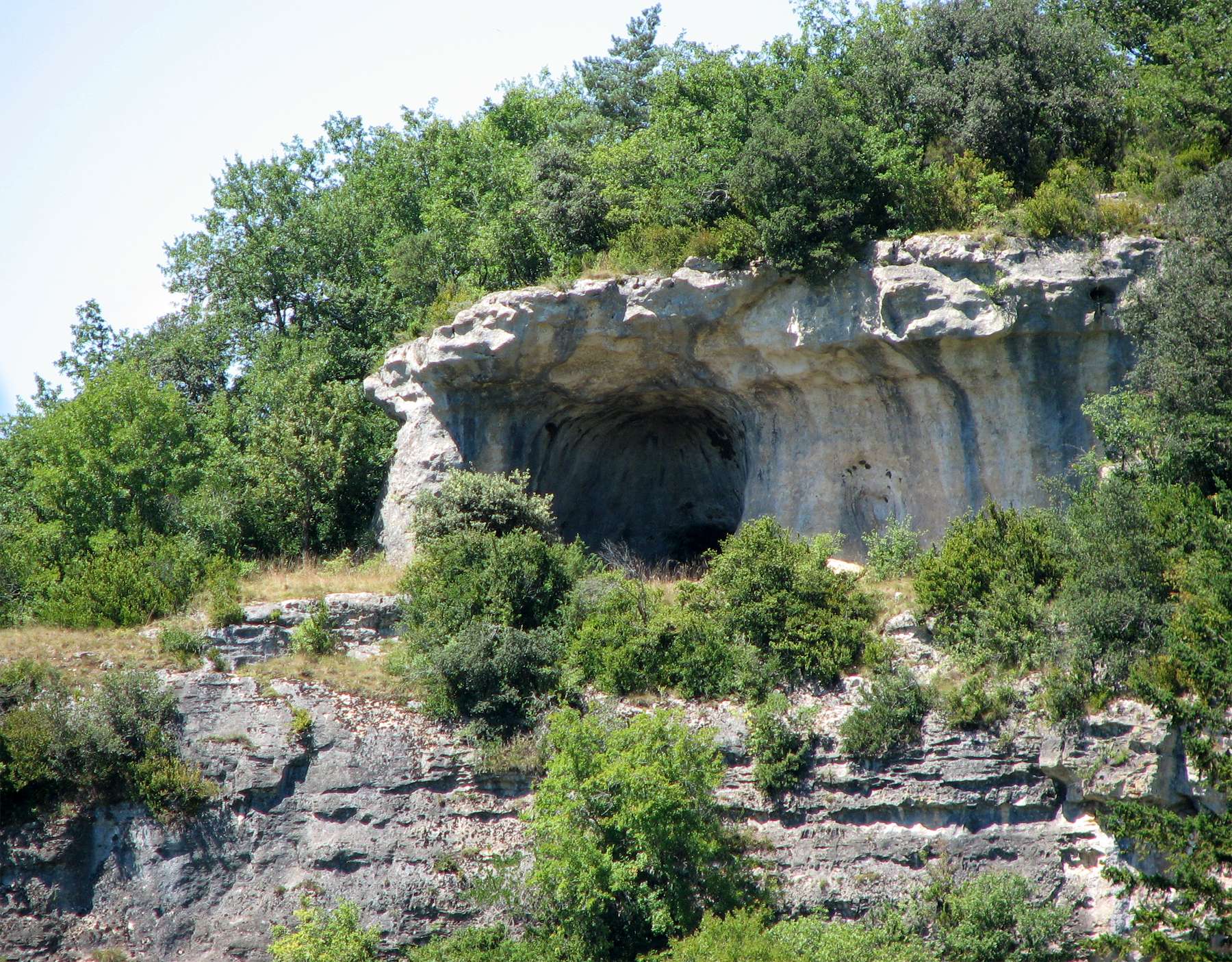
This cave near the top of the le Moustier hill is the one I always associate with the site, but so far as I can find out, it is sterile. The two caves in which the mousterian deposits were found are at the bottom of the hill, and the bedrock of the lower cave is actually below the water level of the Vezere River which flows nearby.
Something which is very noticeable is the difference in vegetation shown between old photos of the hill of le Moustier and modern photographs.
Photos taken in recent times have a good covering of vegetation over the hill and the surrounding plain. I suspect that a hundred years ago goats were much more prevalent than today, and that with the removal of goats, the landscape has recovered.
Photo: Eric Desrentes, Panoramio via Google Earth.

The upper cave of le Moustier.
Photo: Heinrich Wendel (© The Wendel Collection, Neanderthal Museum)


Excavations.
This was identified as 'cave interior' but not whether it was that of the upper or lower cave.
The upper cave was sterile. I would have expected the lower cave, containing many artefacts, to have been completely excavated, which means that this is probably the exploratory digs in the upper cave.
Photo: Heinrich Wendel (© The Wendel Collection, Neanderthal Museum)


These photos are certainly of the upper cave.
Photo: Heinrich Wendel (© The Wendel Collection, Neanderthal Museum)

Another view of the le Moustier hill and the cave nearly at the top.
Notice the now good covering of trees and shrubs, which I put down to the decline in the use of goats in the area.
Photo: Guido Musch, Panoramio via Google Earth.

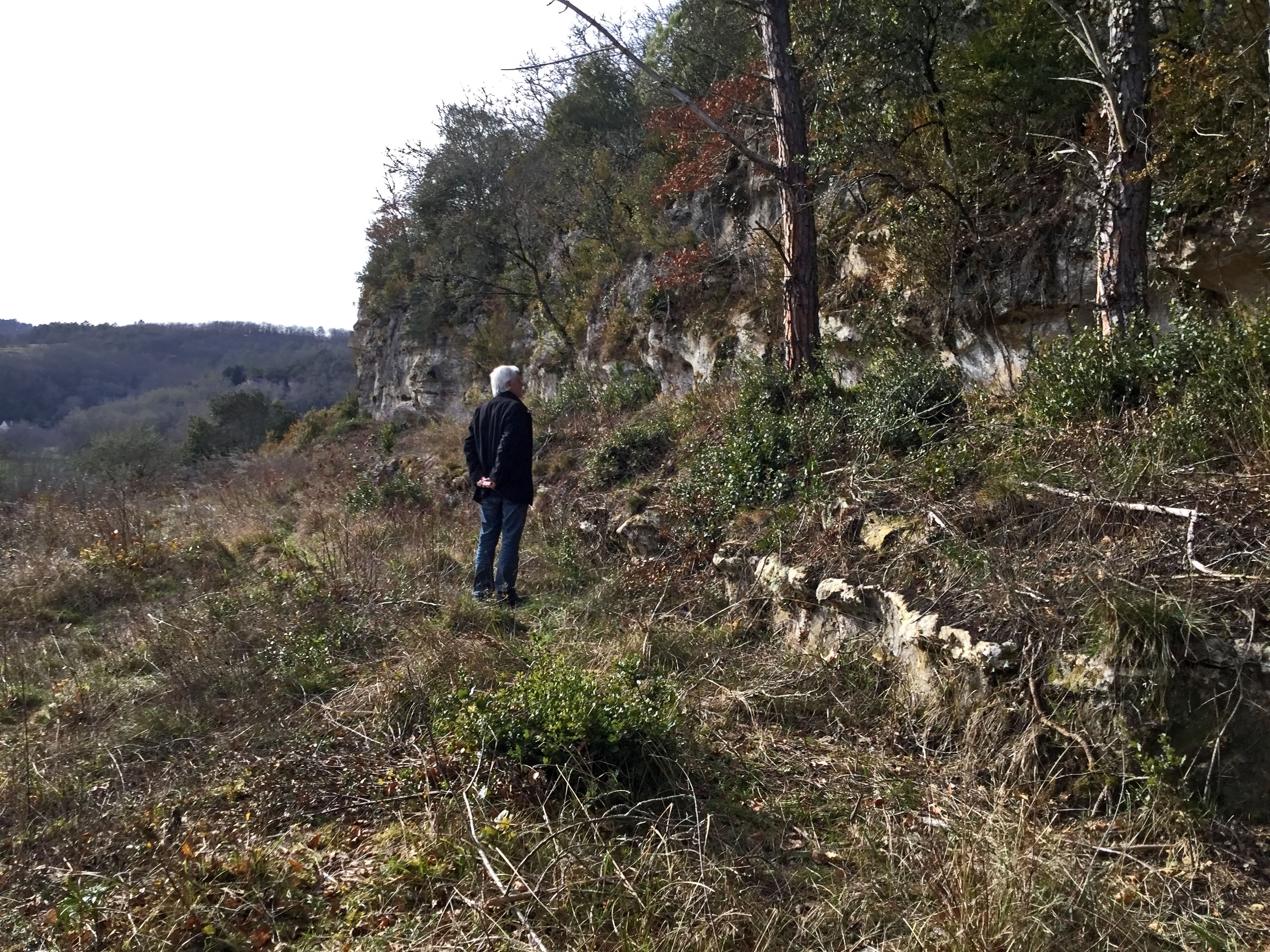
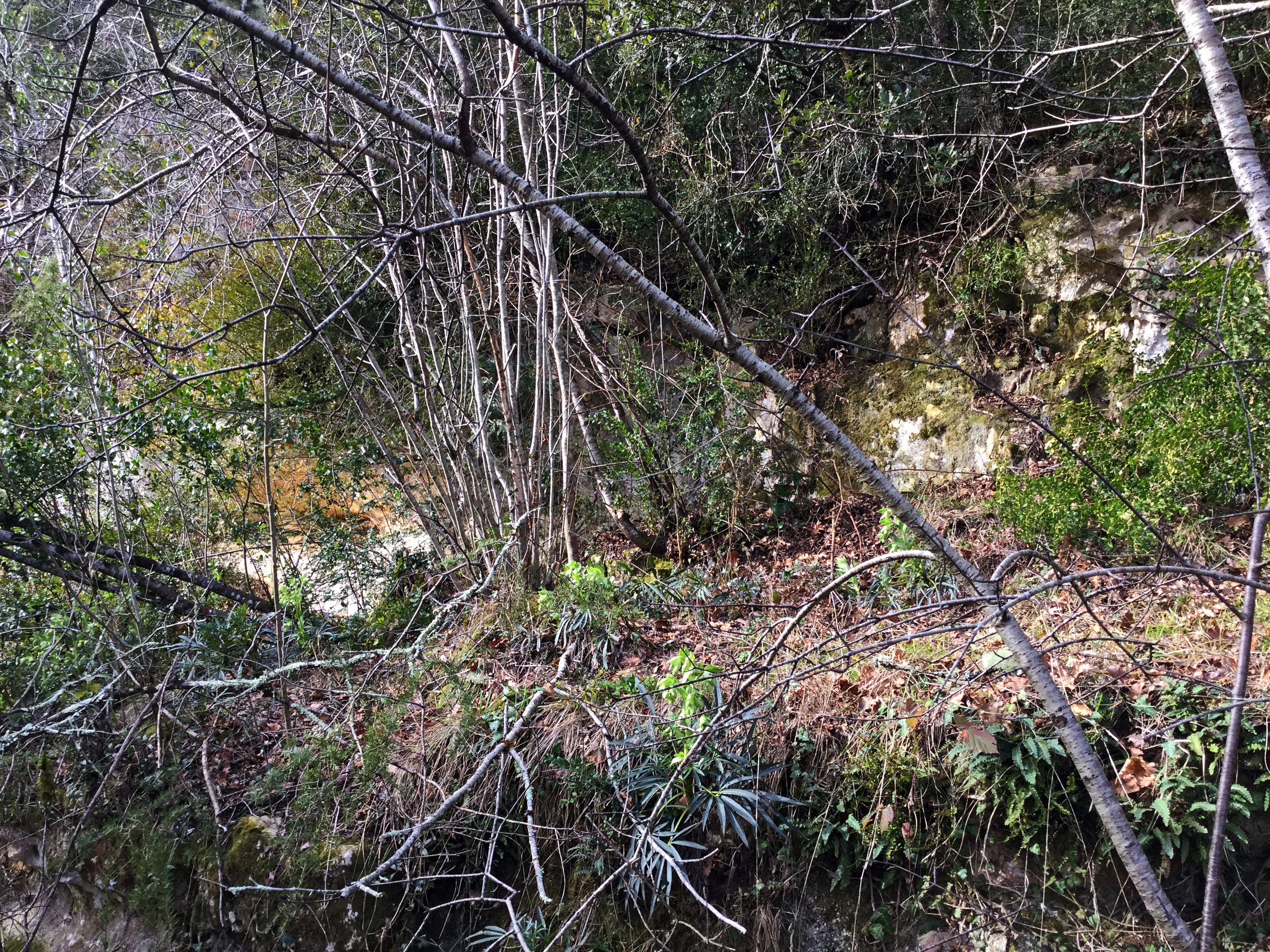
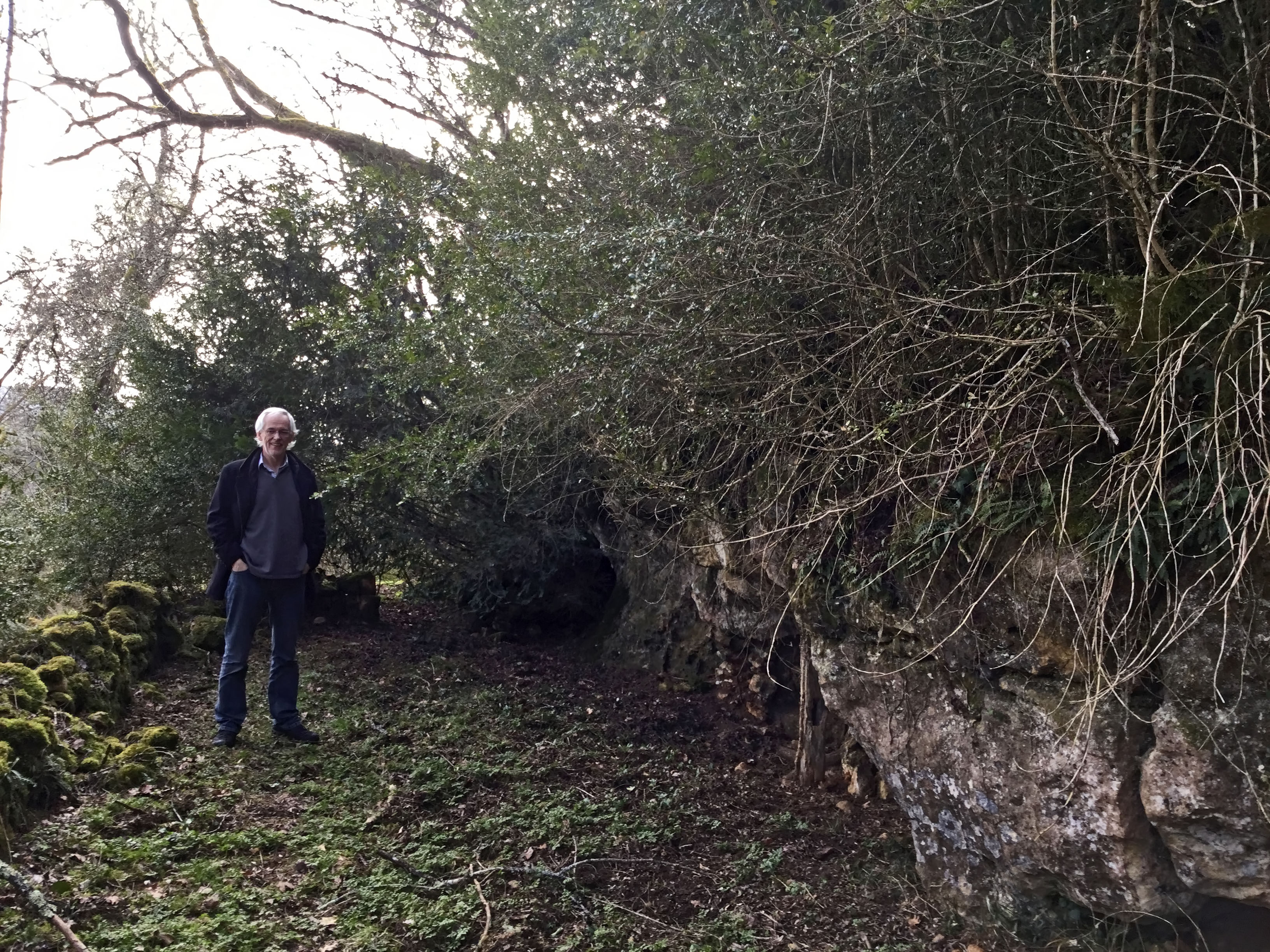
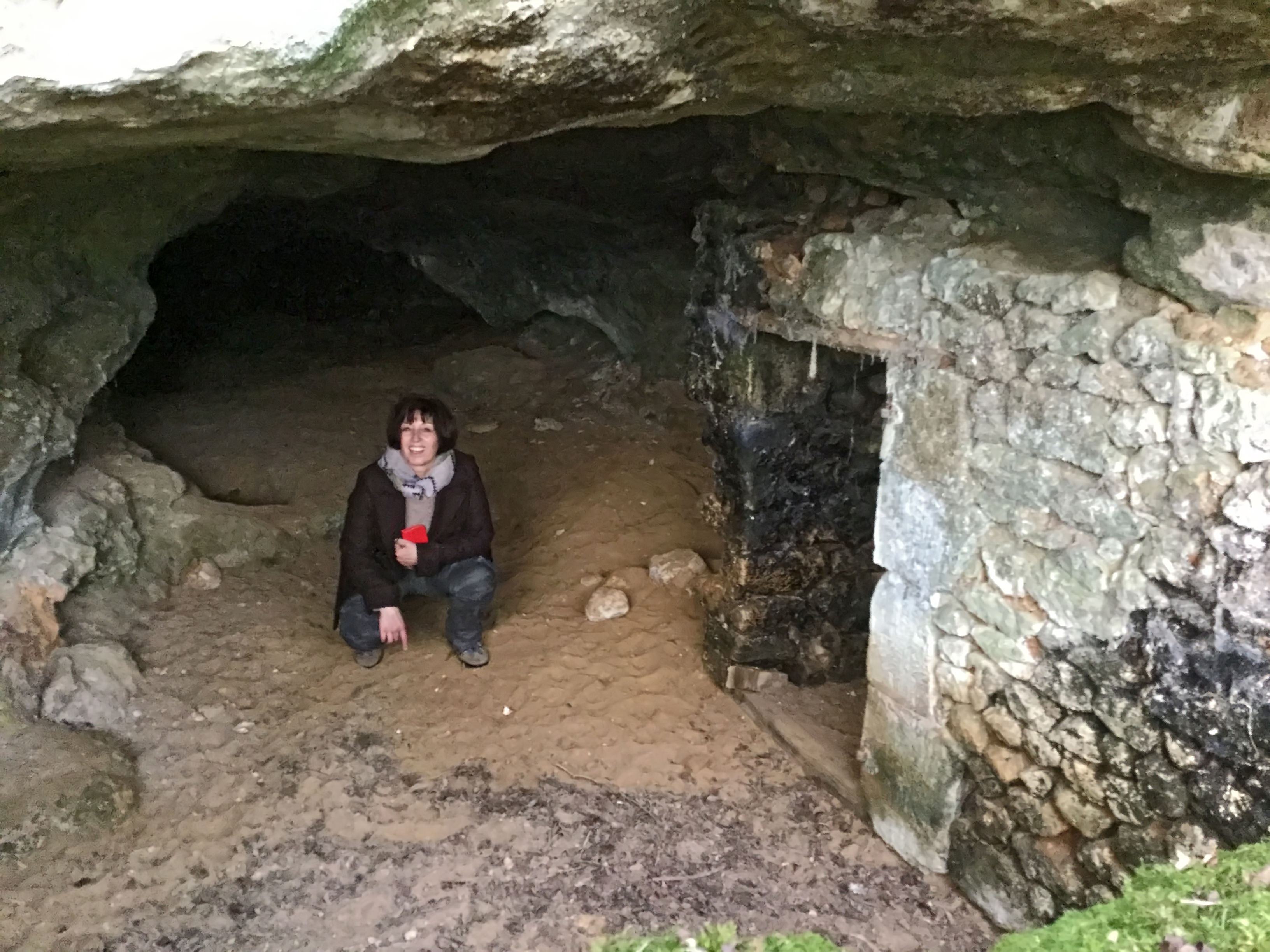
Views of various sites on le Moustier hill.
Photo: Anna Delprato
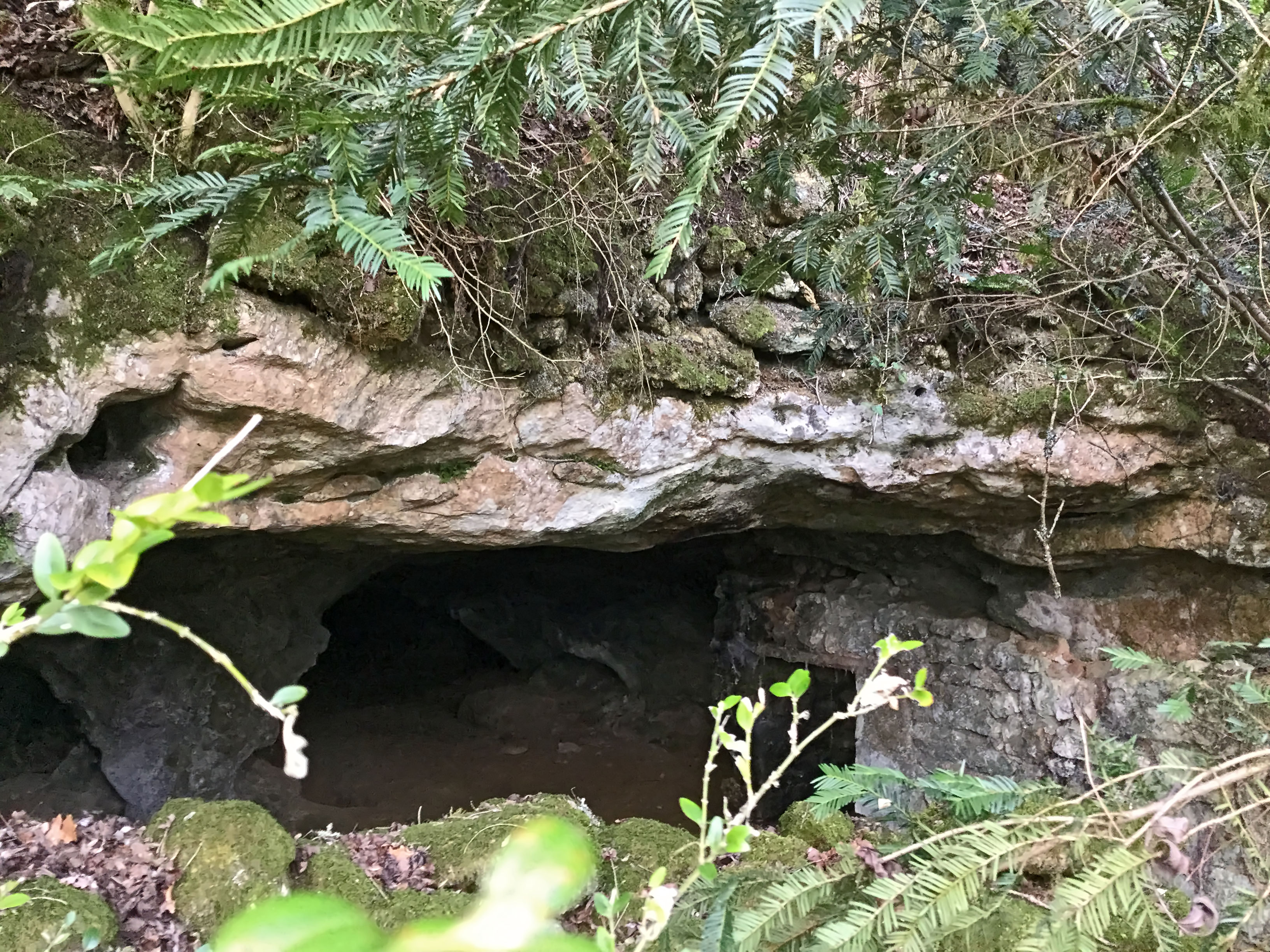
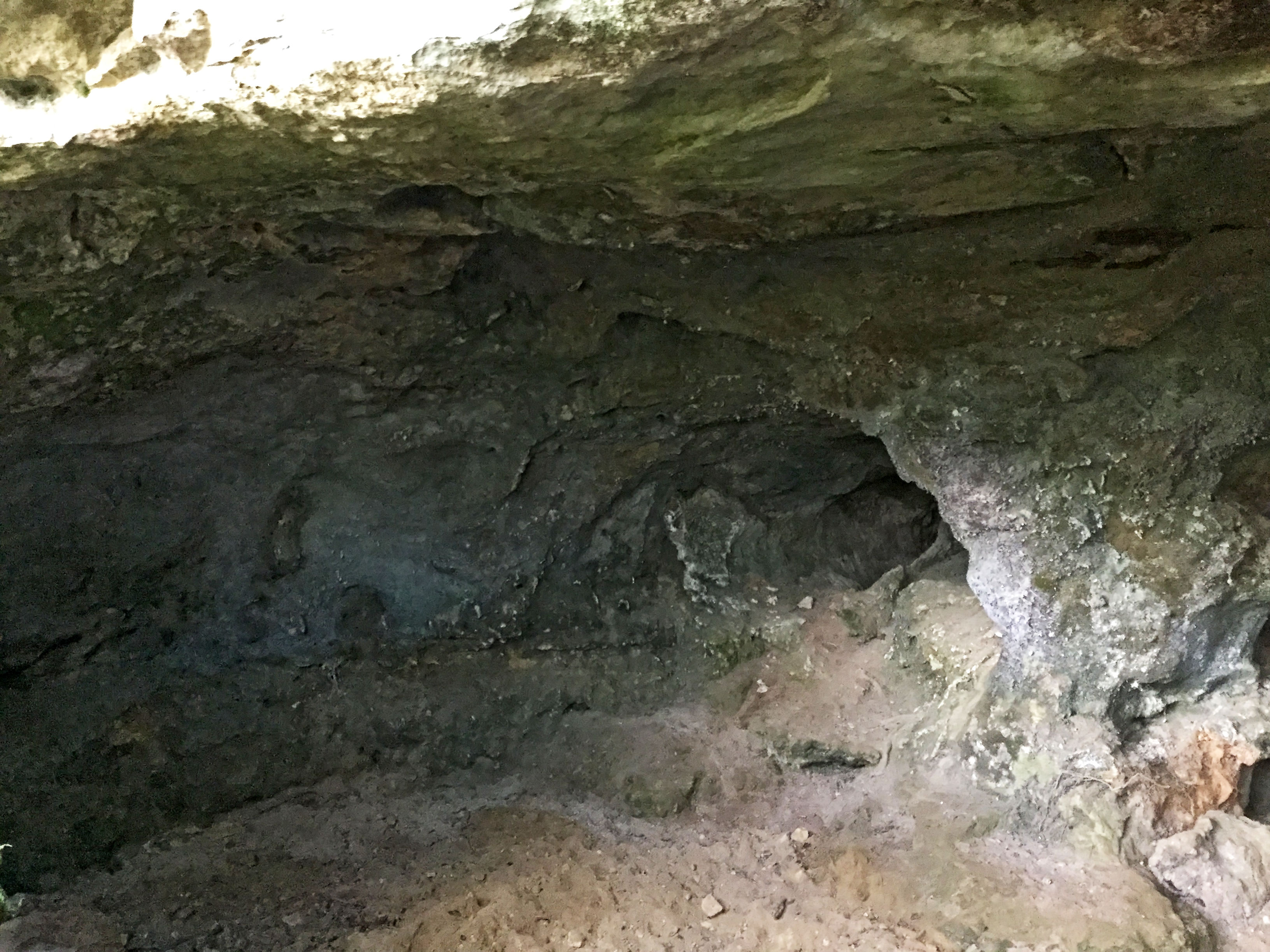
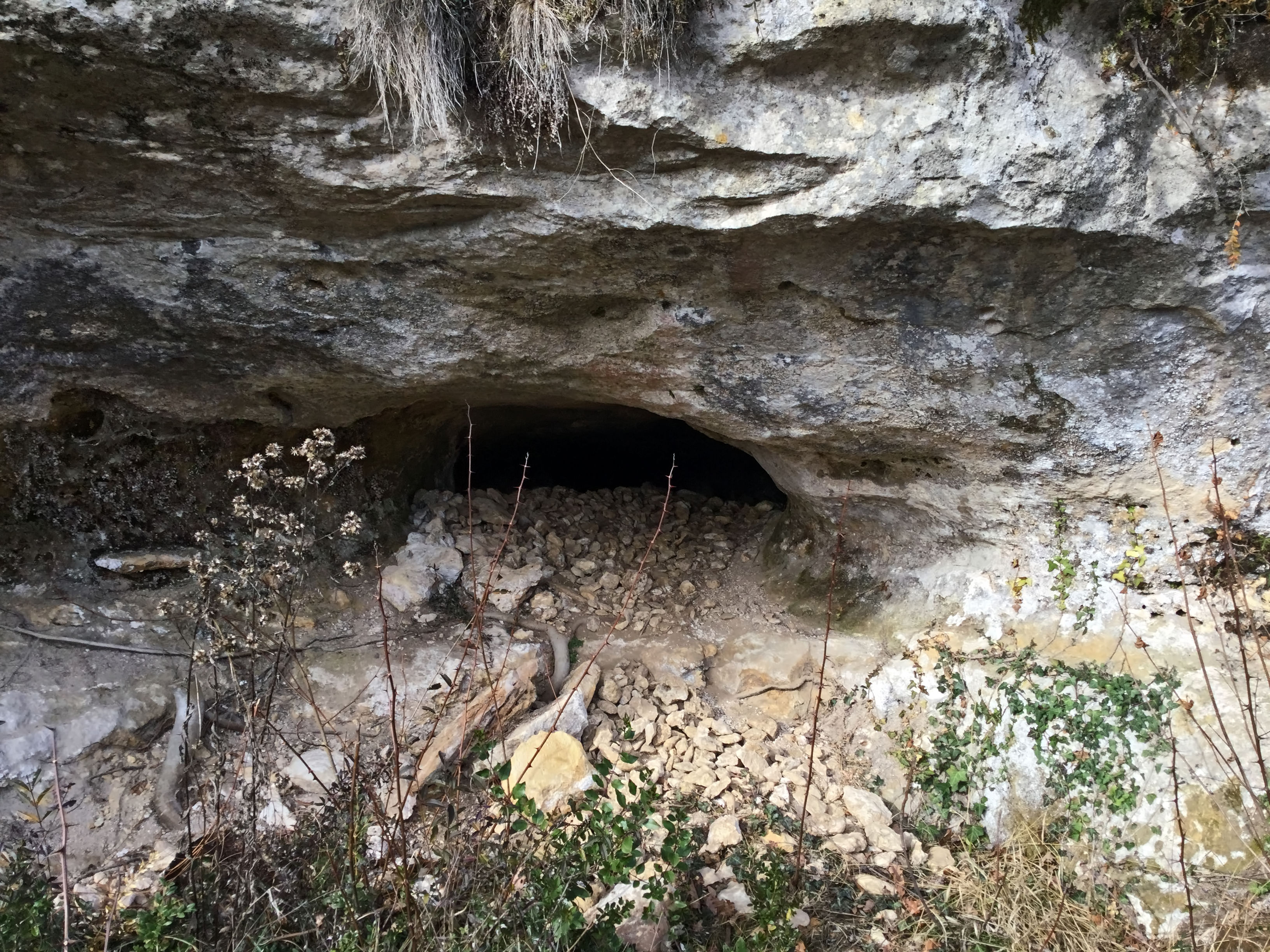
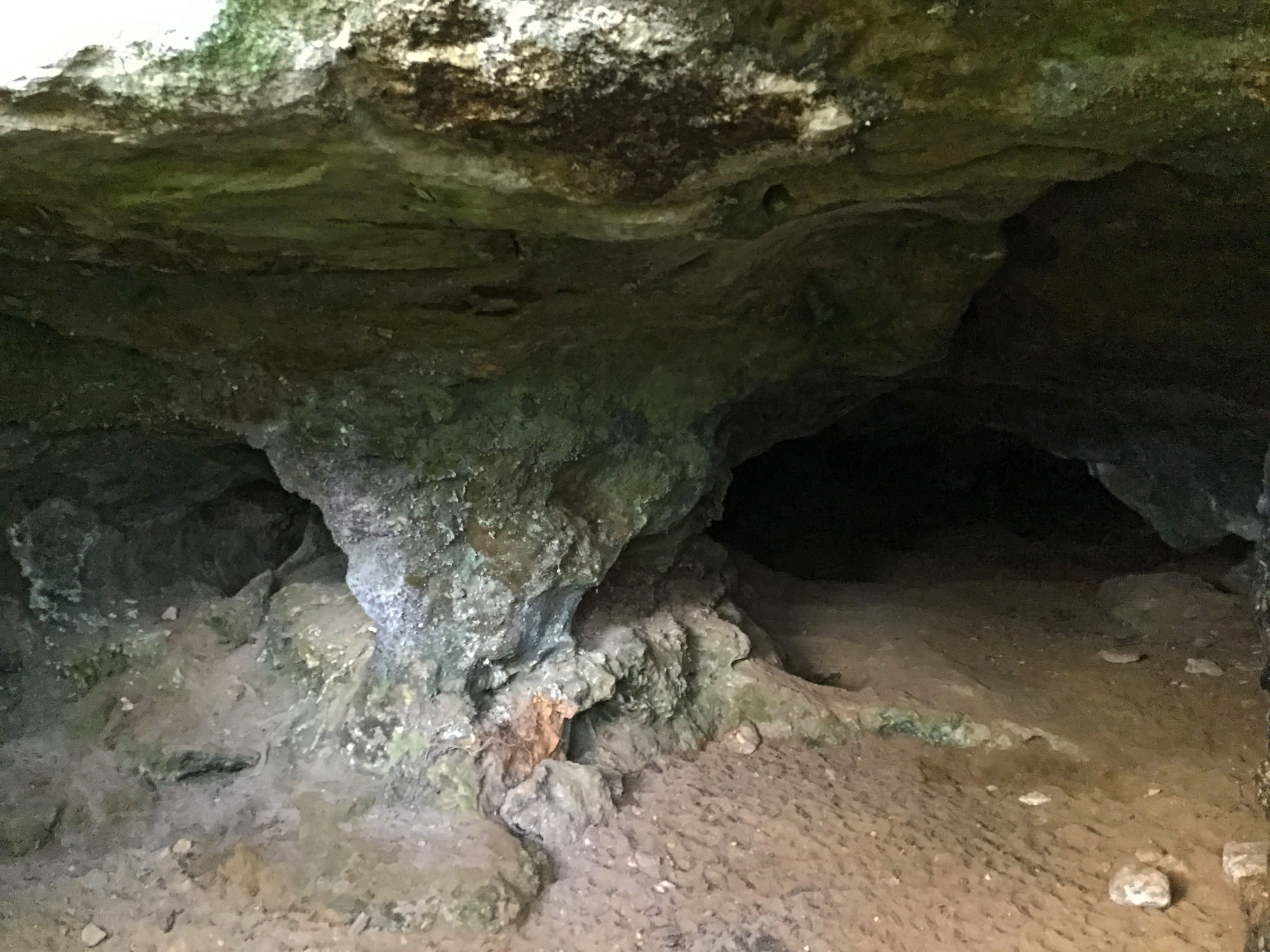
These caves seem to have been completely excavated.
Some have been used for storage, possibly as root cellars, for some time by local farmers.
Photo: Anna Delprato
The Mousterian culture was named after the type site, shown here, of Le Moustier. Similar flintwork has been found all over unglaciated Europe and also the Near East and North Africa. Handaxes, racloirs, and points constitute the industry; sometimes a Levallois technique or another prepared-core technique was employed in making the flint flakes.
The European Mousterian is the product of Neanderthals. It existed roughly from 160 000 BP to 40 000 BP. Some assemblages include exceptionally small points prepared using the Levallois technique among other prepared core types, causing some researchers to suggest that these flakes take advantage of greater grip strength possessed by Neanderthals.
In North Africa and the Near East, Mousterian tools were produced by anatomically modern humans. In the Eastern Mediterranean, for example, assemblages produced by Neanderthals are indistinguishable from those made by Qafzeh type modern humans. The Mousterian industry in North Africa is estimated to be 315 000 years old.
Text above: adapted from Wikipedia.
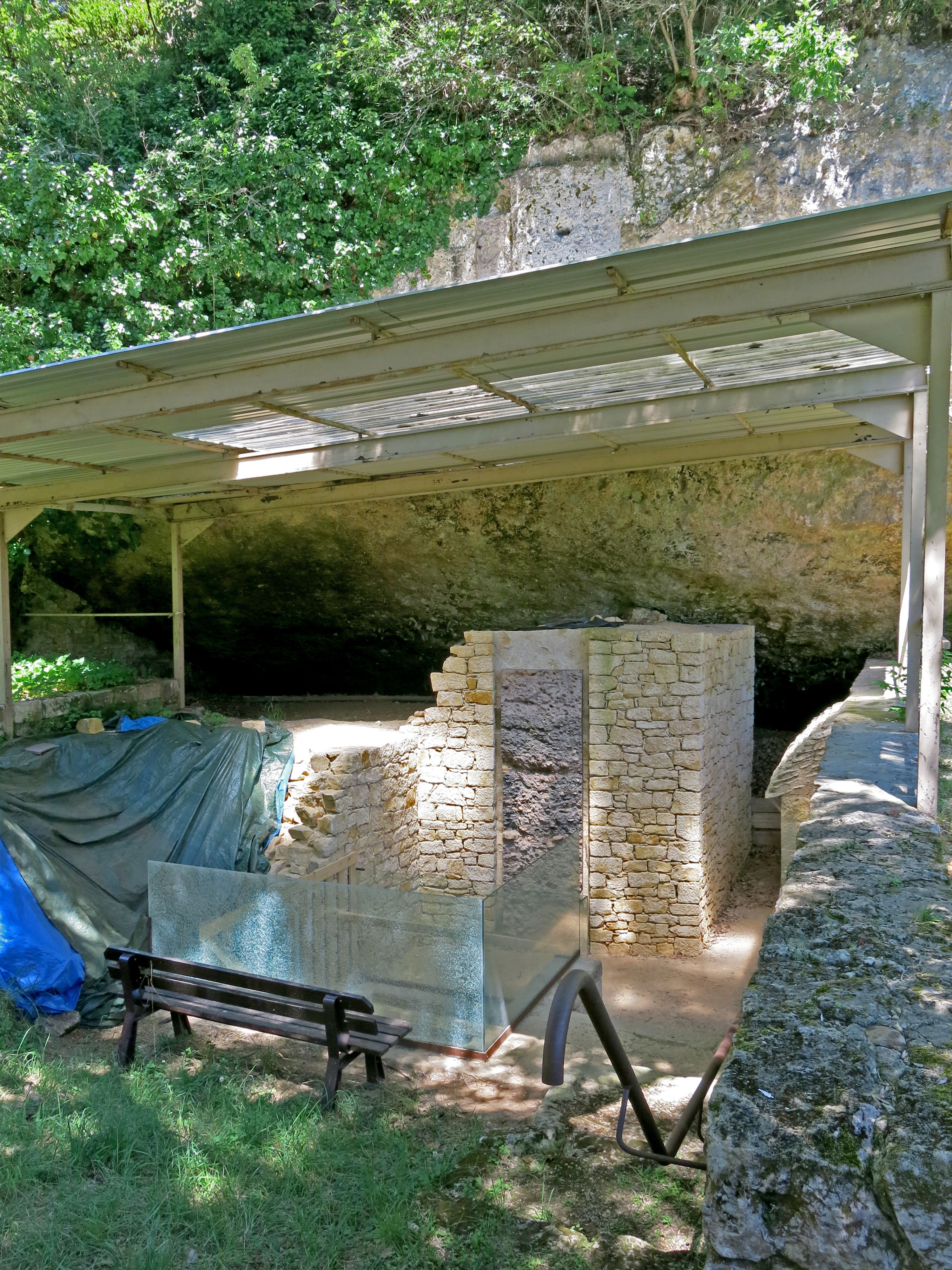
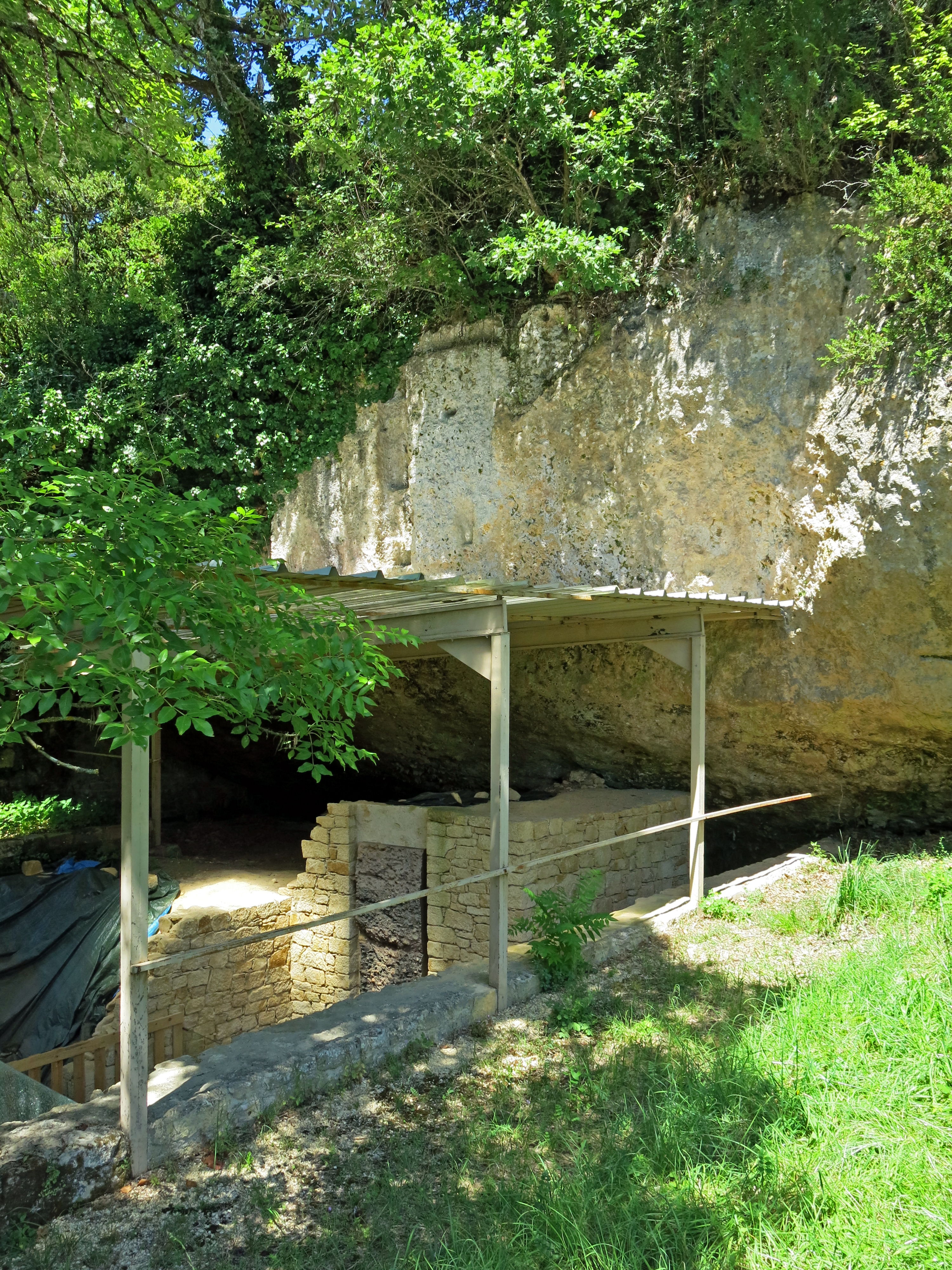
Le Moustier, lower level.
Photo: Don Hitchcock 2014
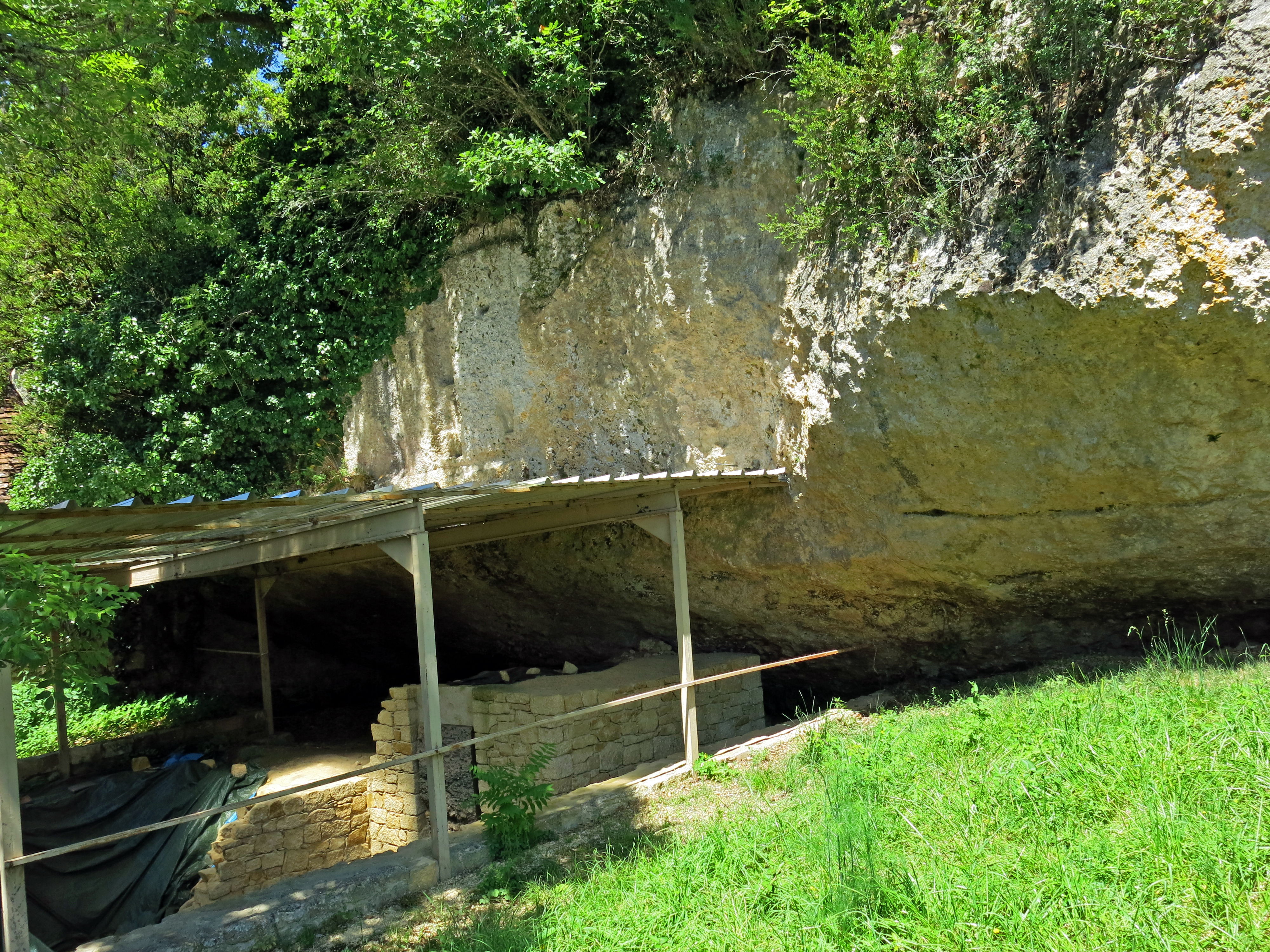
Le Moustier, lower level.
Photo: Don Hitchcock 2014
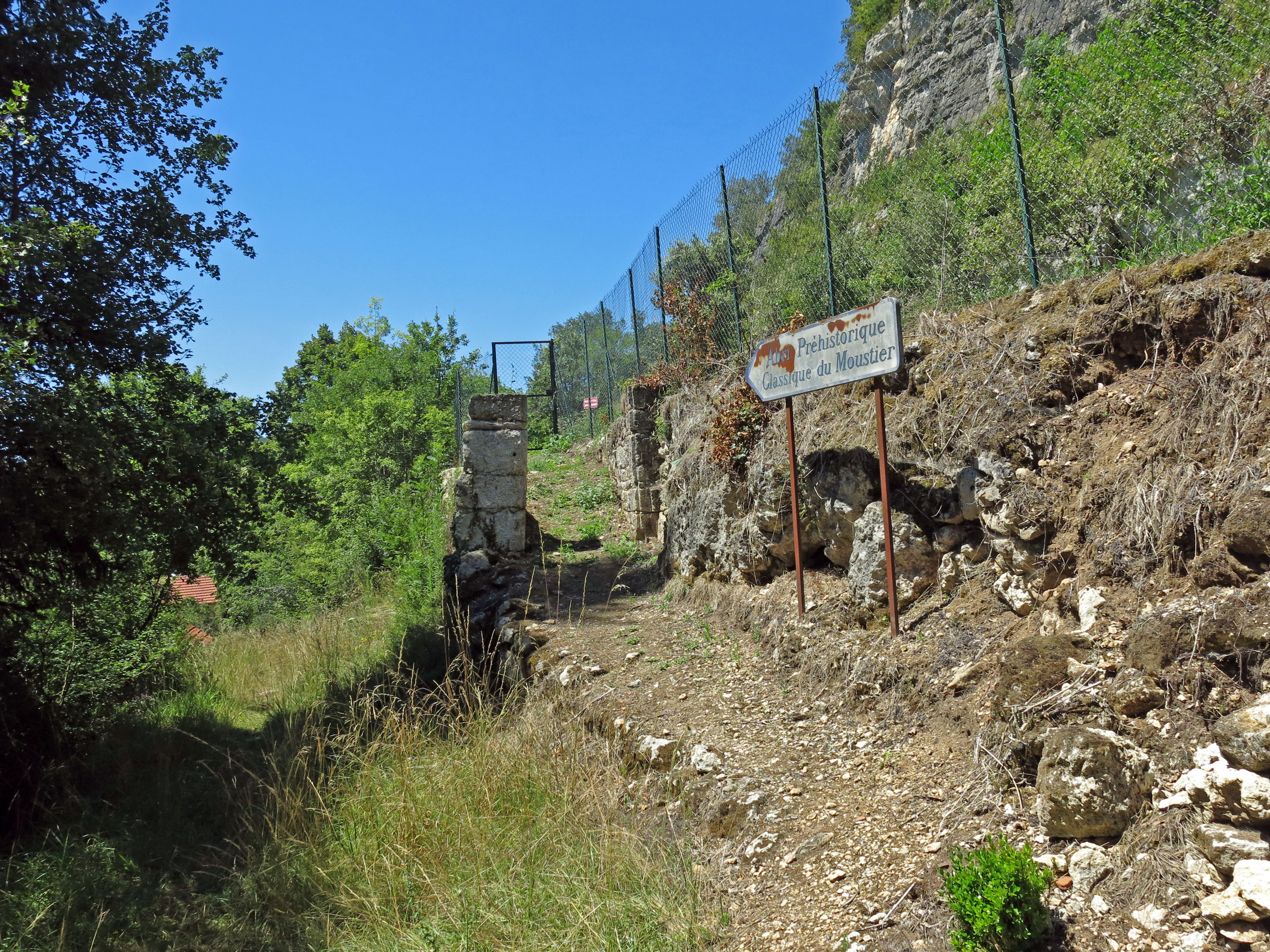
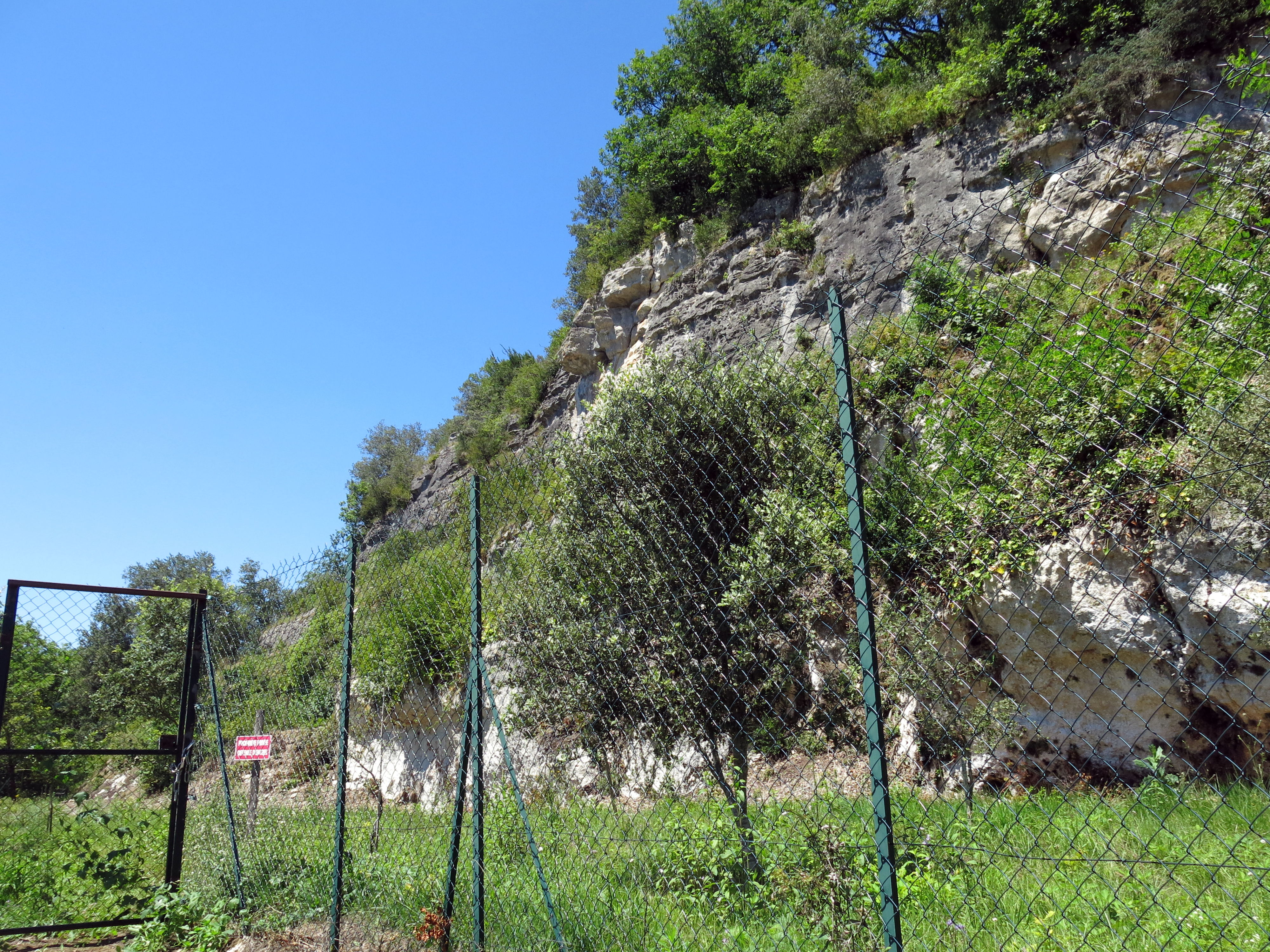
Le Moustier, on the way up to the upper level, 'classic' cave. The area is fenced off, and no visitors are allowed.
Photo: Don Hitchcock 2014

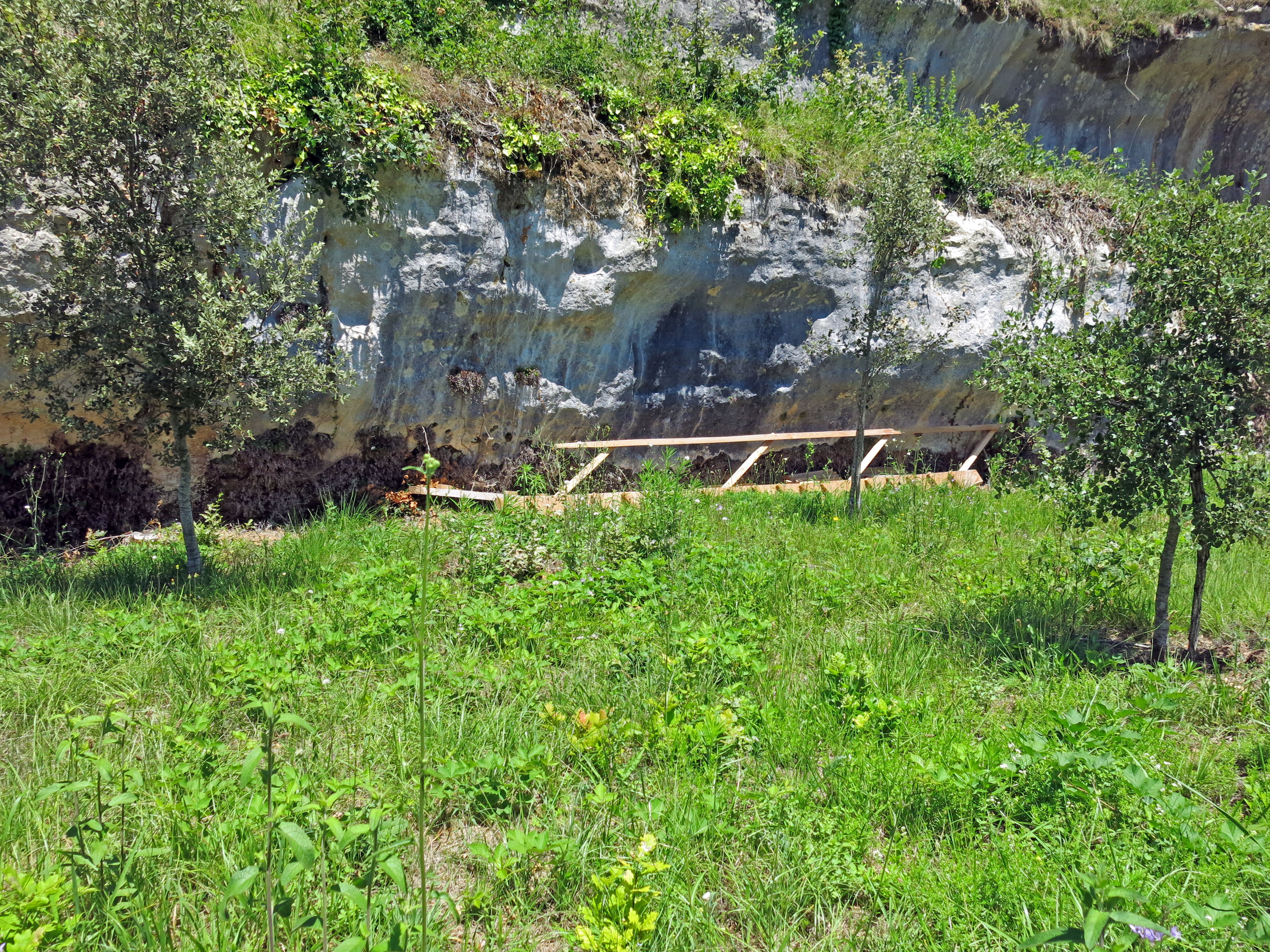
This may be part of the 'classic' shelter, but there was no signage.
Photo: Don Hitchcock 2014
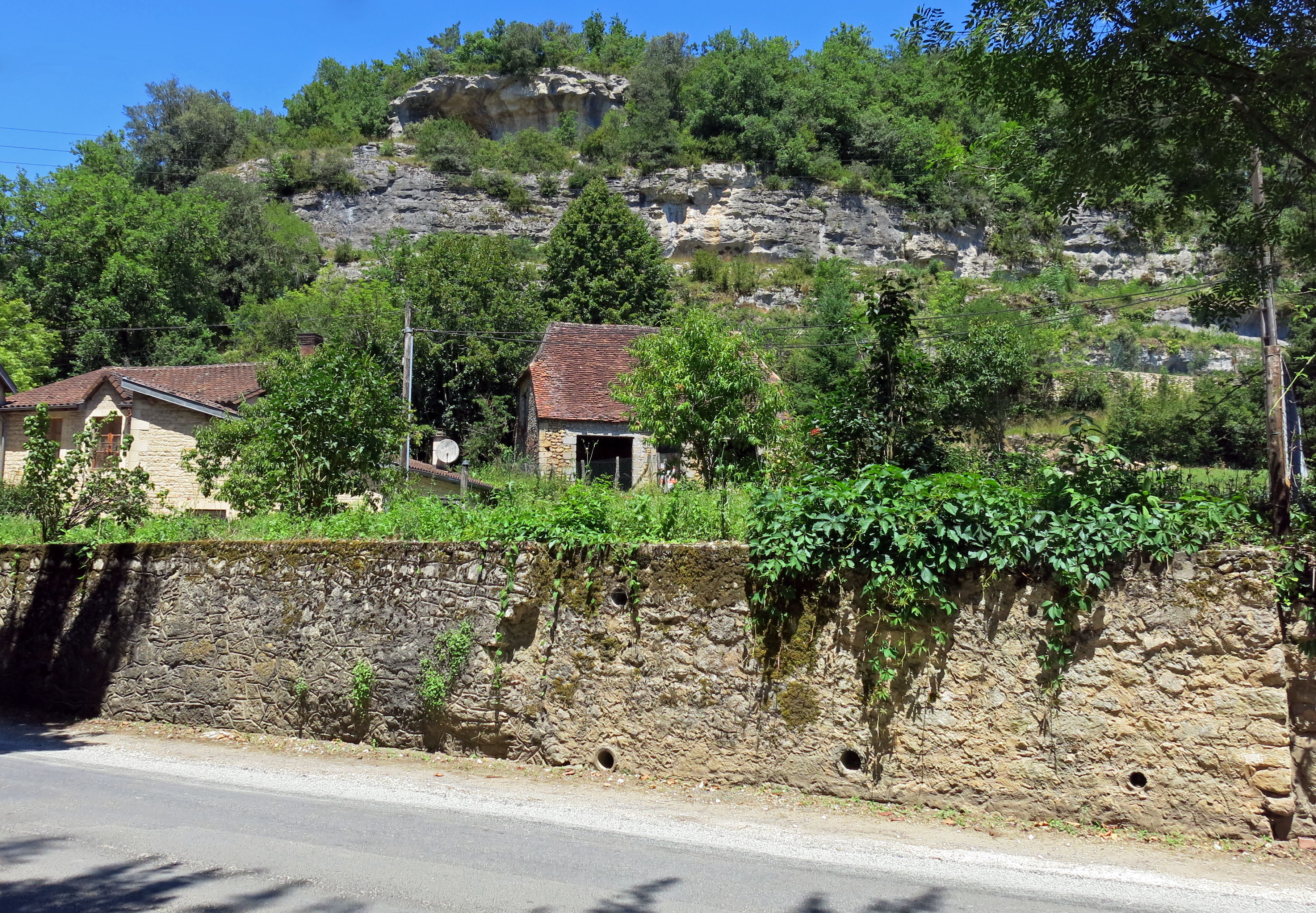
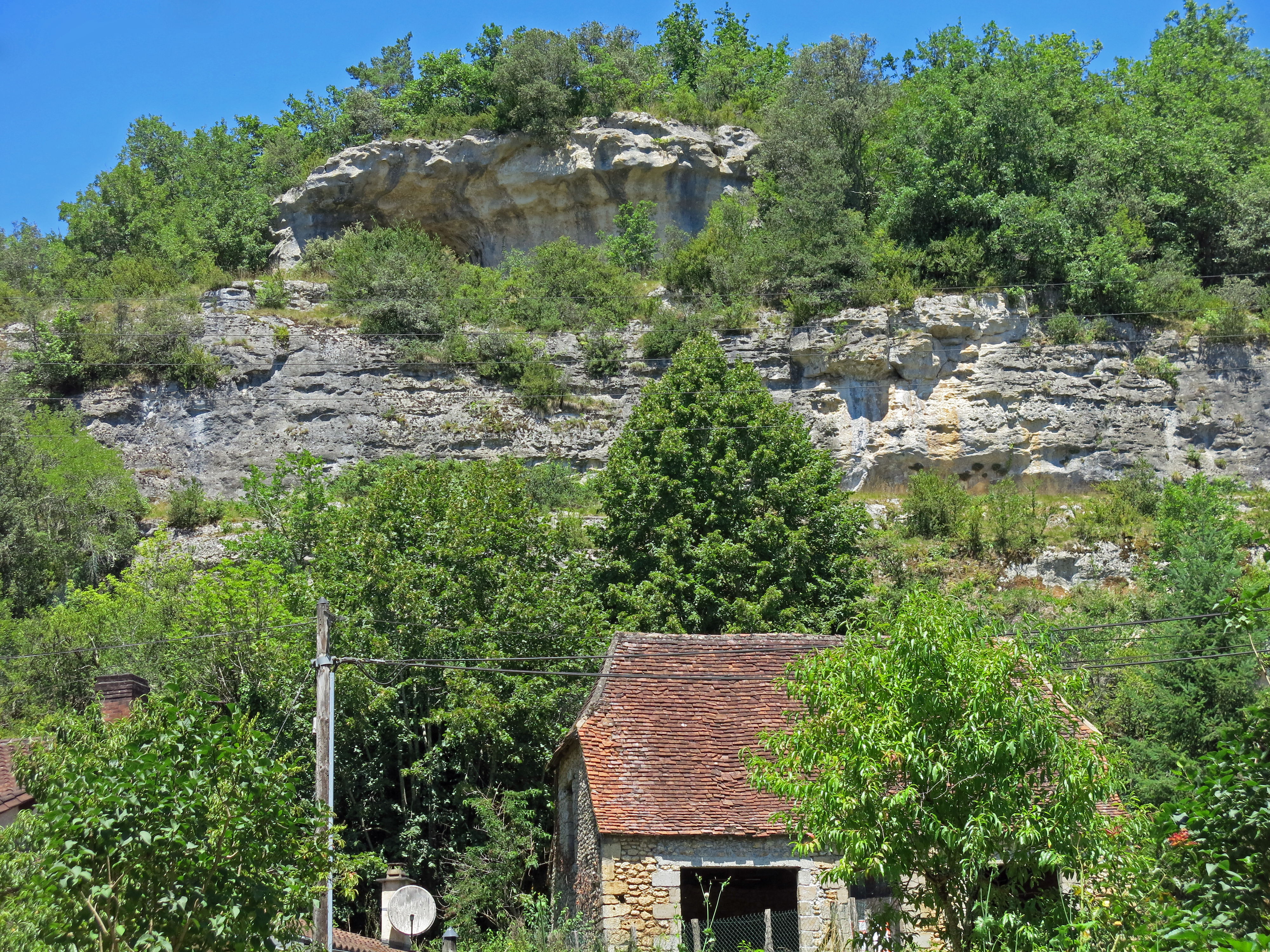
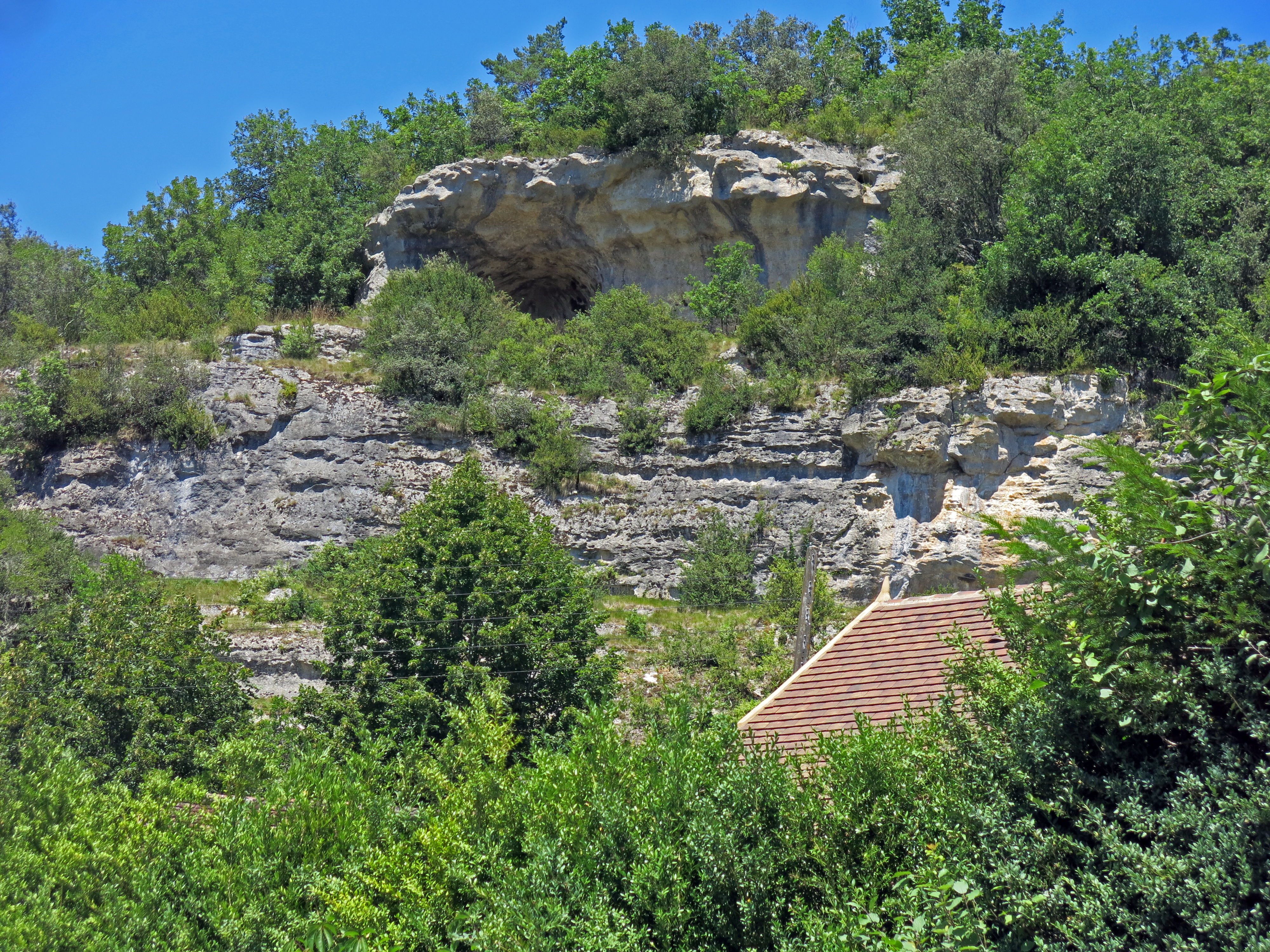
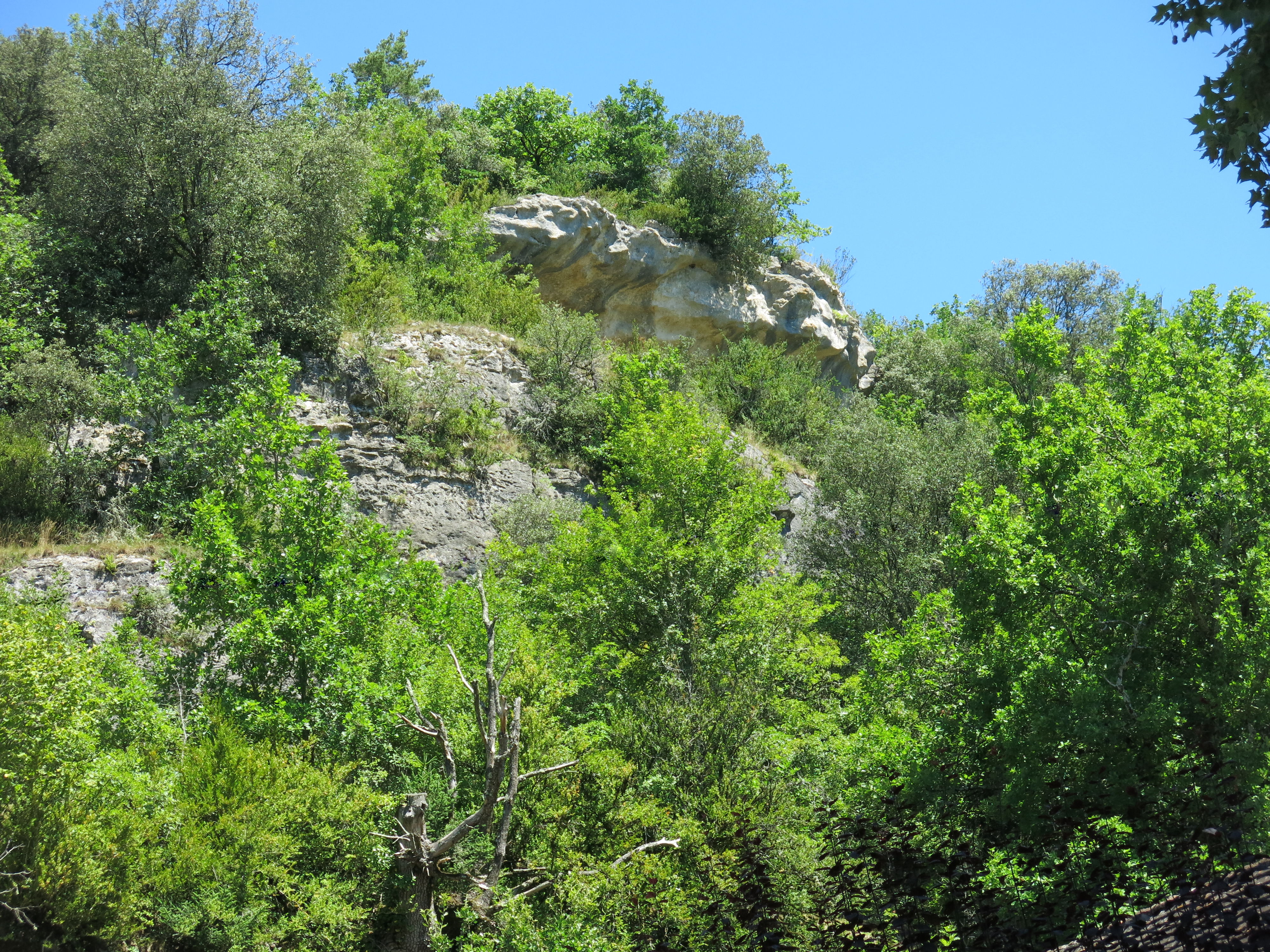
Various views of the iconic le Moustier cliff face.
Photo: Don Hitchcock 2014
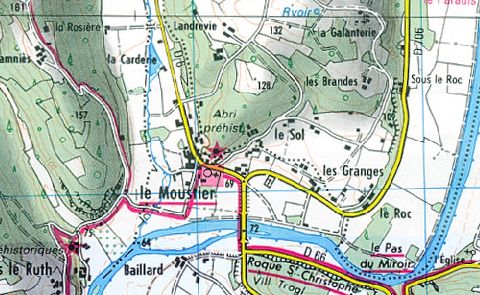
As can be seen on this map, the archeological site is at the base of the hill.
Photo: IGN
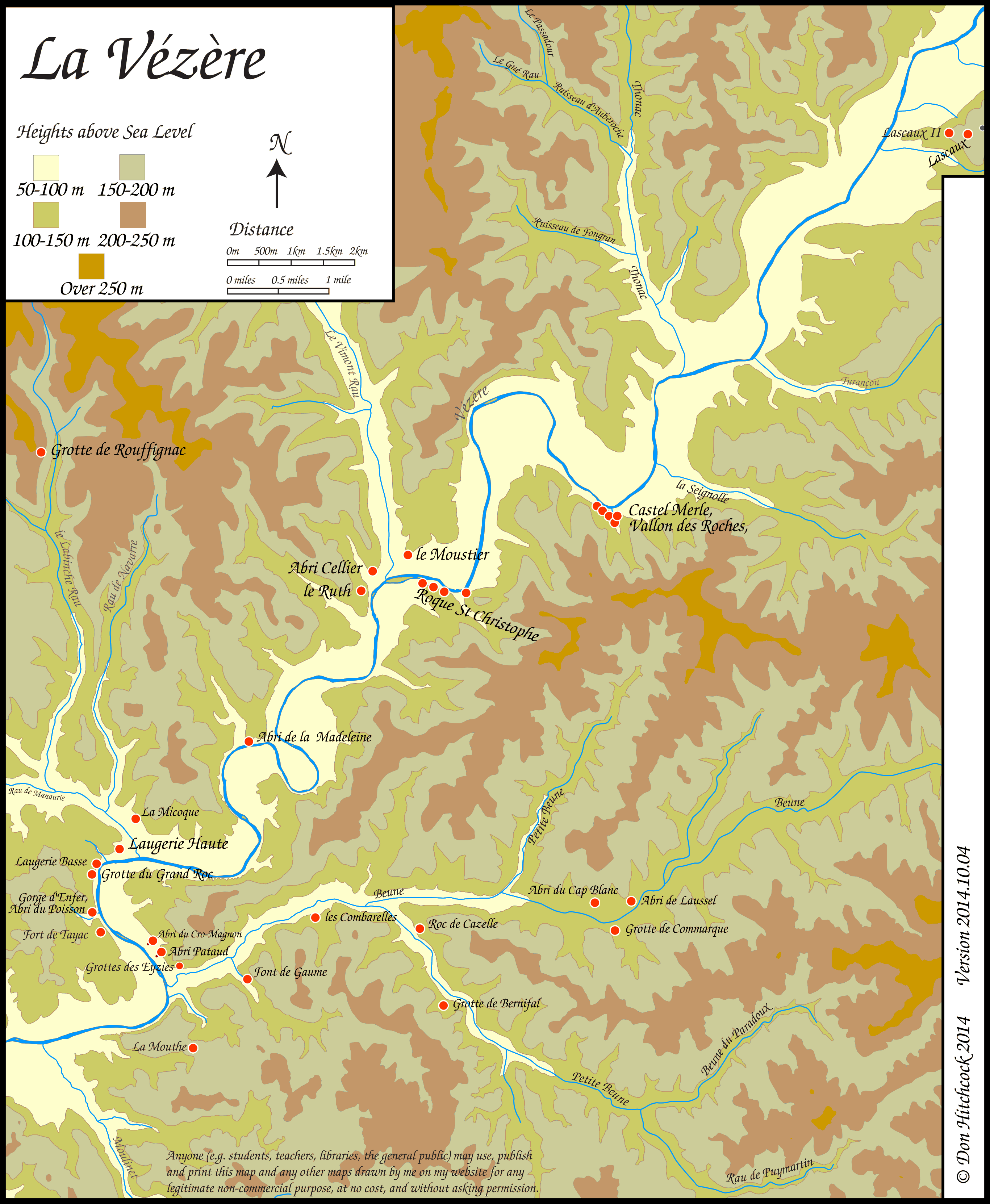
Map of sites in the Vézère Valley of France, including Le Moustier.
If you click on the map you will see a larger map with the ability to click on the marked sites and get further information.
Photo: Don Hitchcock
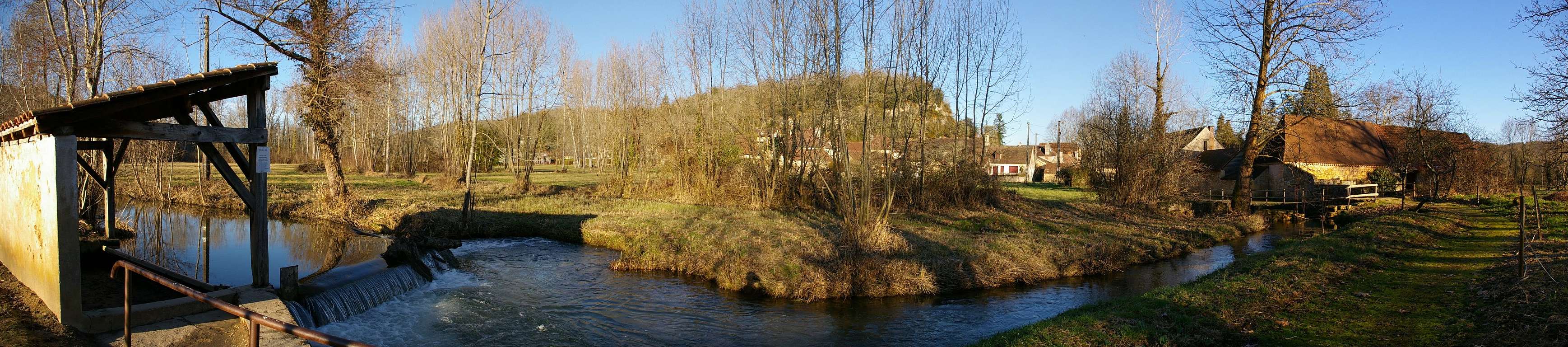
Panoramic view between the wash house (the Lavoir) and the mill.
The Vimont Rau, also known as the Rau du Moustier, is the little stream which flows past Le Moustier and into the Vezere. In this photo can be seen the Lavoir on the left, the Vimont or Moustier flowing from left to right, and behind the Vimont is the hill of le Moustier between the bare branches of the trees, with the village of le Moustier on the right.
A Lavoir is a public place in France set aside for the washing of clothes. They are commonly sited on a spring or beside or set over a river. Many Lavoirs are provided with roofs for shelter, as is the case here. With the coming of piped water supplies and modern drainage, lavoirs have been steadily falling into disuse, although a number of communes have restored ancient lavoirs some of which date back to the 10th Century. In this photo we can see the roofed Lavoir in well maintained condition on the left, and which has had a small weir constructed just downstream to give a good depth of still water for the washing of clothes.
Photo: michel chanaud, Panoramio via Google Earth
Text adapted from Wikipedia.
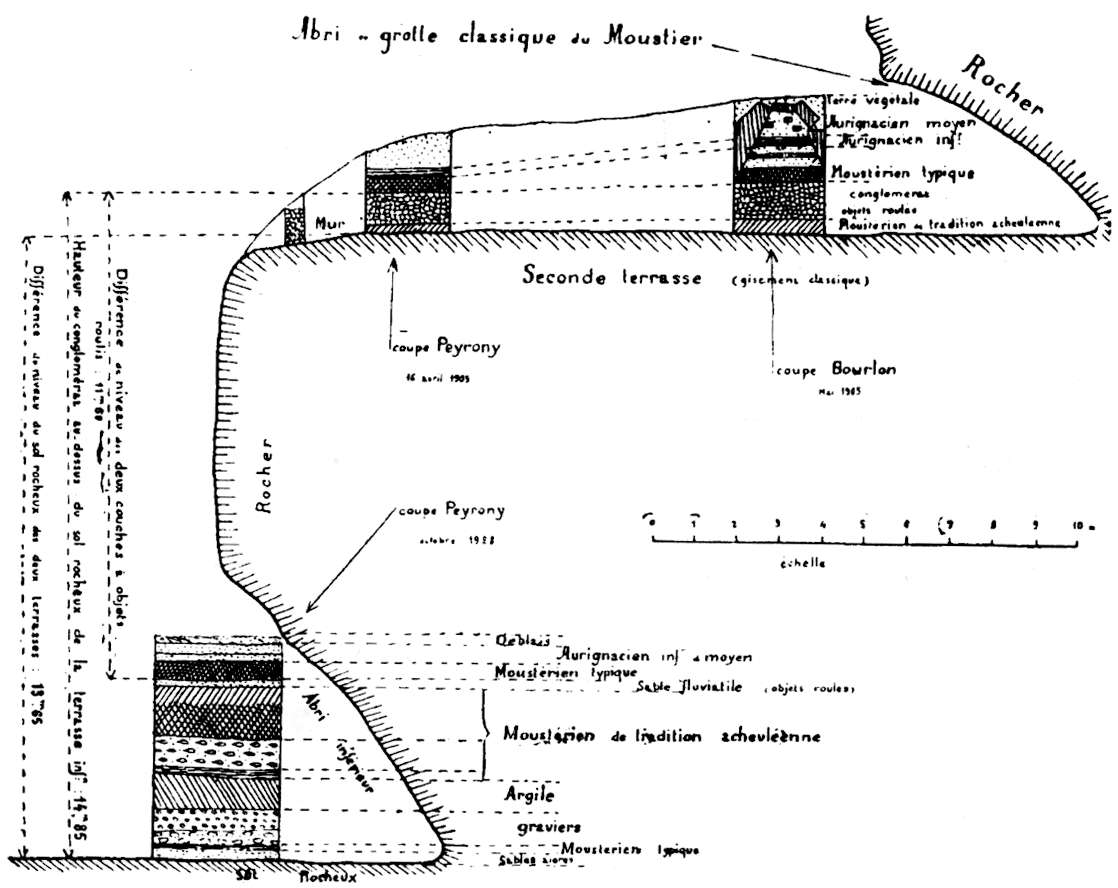
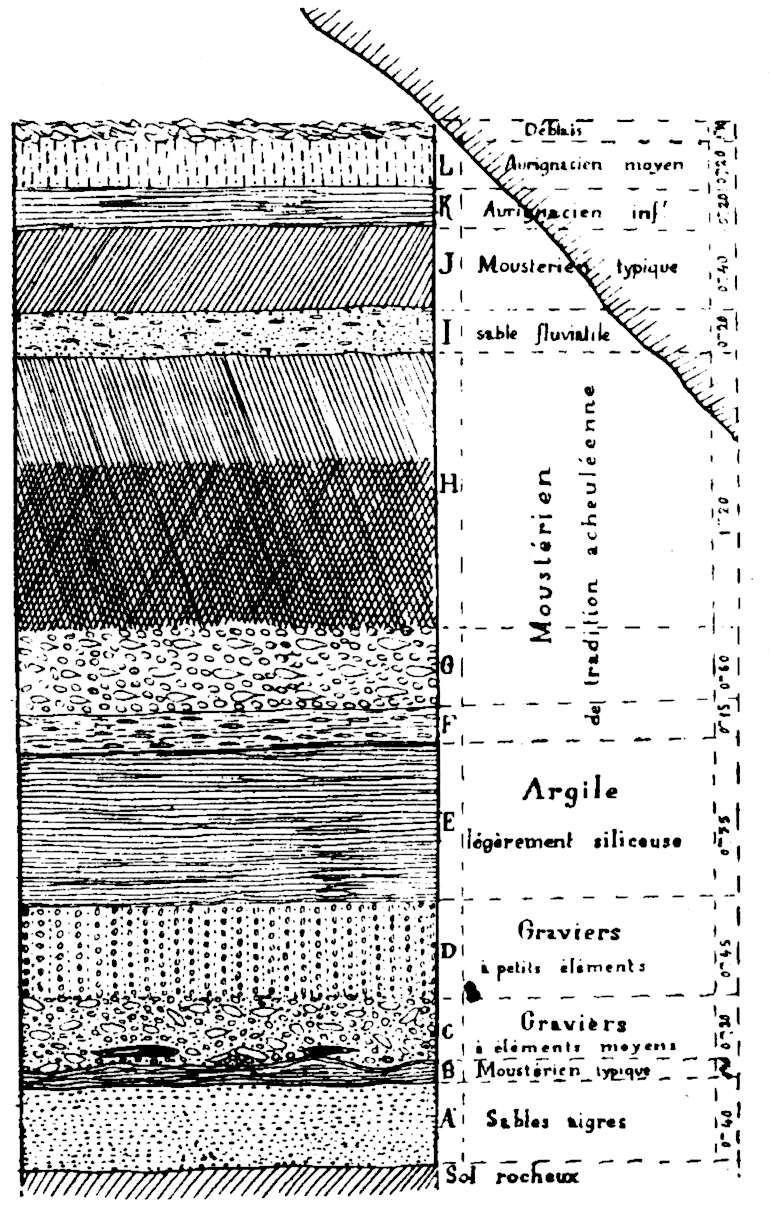
(left) Cross section of the two gisements of le Moustier.
(right) Cross section of the lower terrace of le Moustier.
Photo: Peyrony (1930), in Groenen (1994)
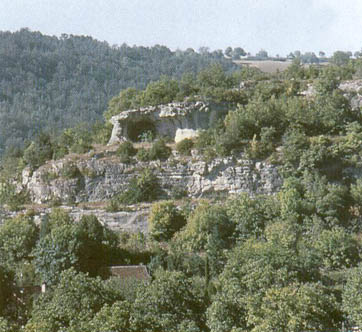
Le Moustier in the Dordogne. Neanderthal man lived in these rock shelters overlooking the small town of Le Moustier, and gave its name to a characteristic Neanderthal tool set and culture, the Mousterian.
Le Moustier is on the right bank of the Vezere at its confluence with the Vimont valley. Village houses rise in tiers on the rocky steps of the limestone outcrops at the angle formed by the two valleys.
Photo: Delluc et al (1992)
My thanks to Sharon Rogers/walkhound for alerting me to this excellent book.
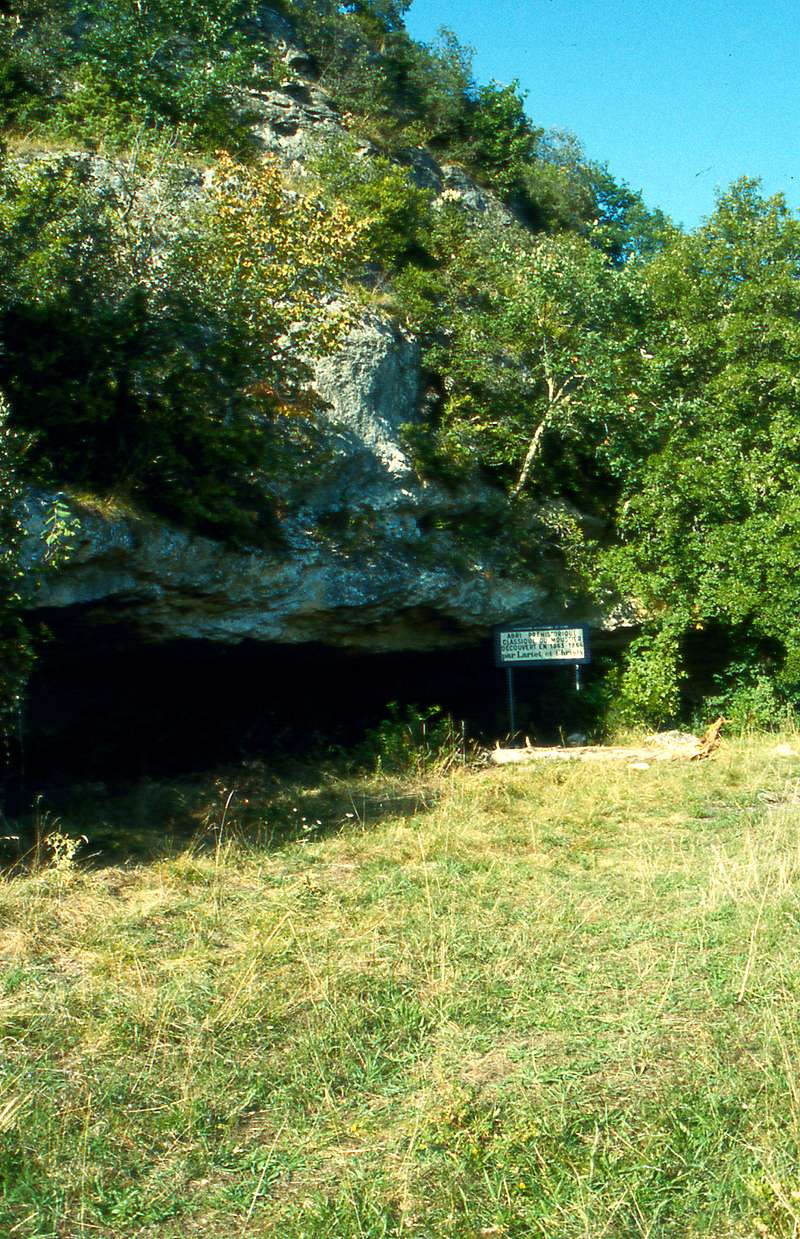
The following is from H.Laville et al, 'Rock Shelters of the Perigord':
Le Moustier is the name of a village 10 km upstream from Les Eyzies, under the spur of a cliff formed by the intersection of the Vezere and Plazac valleys. The upper shelter has been studied since 1863, and is now completely excavated, so that no further study is possible.
The lower shelter is 14 metres below the upper, and occupies the base of the cliff in the village itself, the bedrock being lower than the modern riverbank. It was first excavated in 1907. Most recently, Laville and Rigaud conducted well organised excavations there in 1969. The bulk of the deposit has been removed, but a control section for later work remains.
Photo of the upper shelter: V. Mourre
Permission: Creative Commons Attribution-Share Alike 3.0 Unported license.

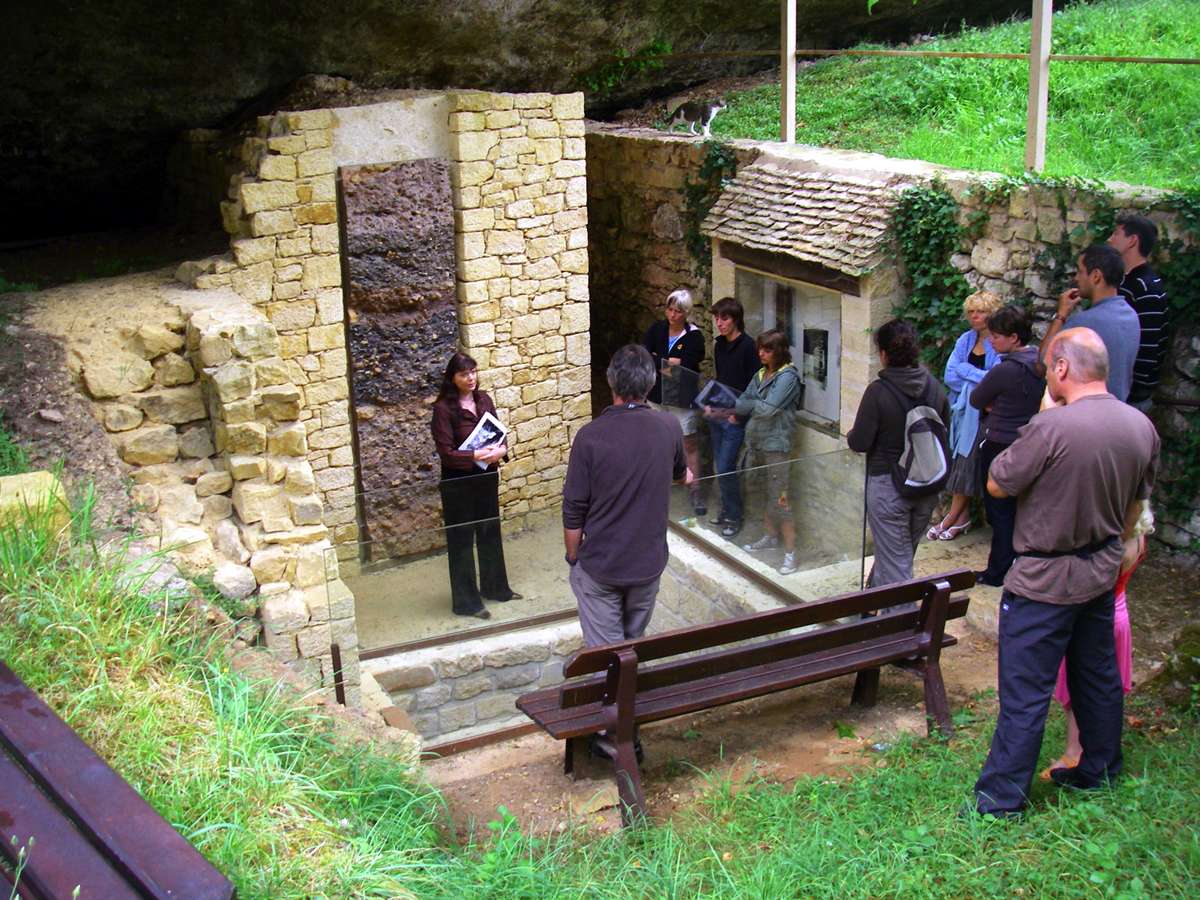
The Lower Shelter at Le Moustier has been well set up to accommodate tour groups. We were very fortunate to have an erudite researcher from the Musée National de Préhistoire, Les Eyzies as our guide.
At the same time, it gave me a lot of practice in trying to follow fast, fluent and specialised French!
Anyone who does any part of my month long trip to the caves and abris of southern France must expect most explanations to be exclusively in French. At least a working knowledge of French is essential if you are not part of a tour group. Few people you meet on the road have any knowledge of English.
It takes about two weeks to adequately cover just the area within an hour's drive around Les Eyzies, and another week or two to see a good fraction of the sites in the Pyrennees.
Photo: Don Hitchcock 2008
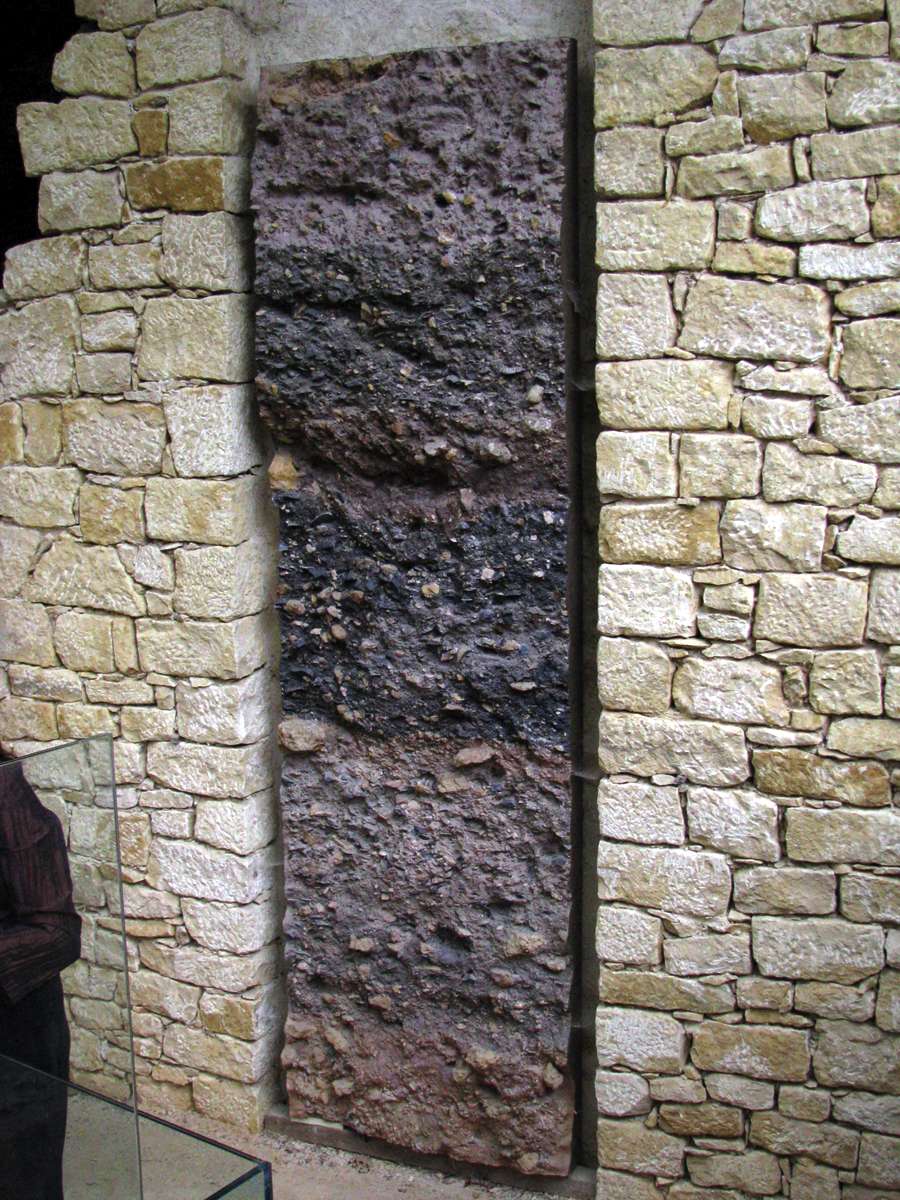

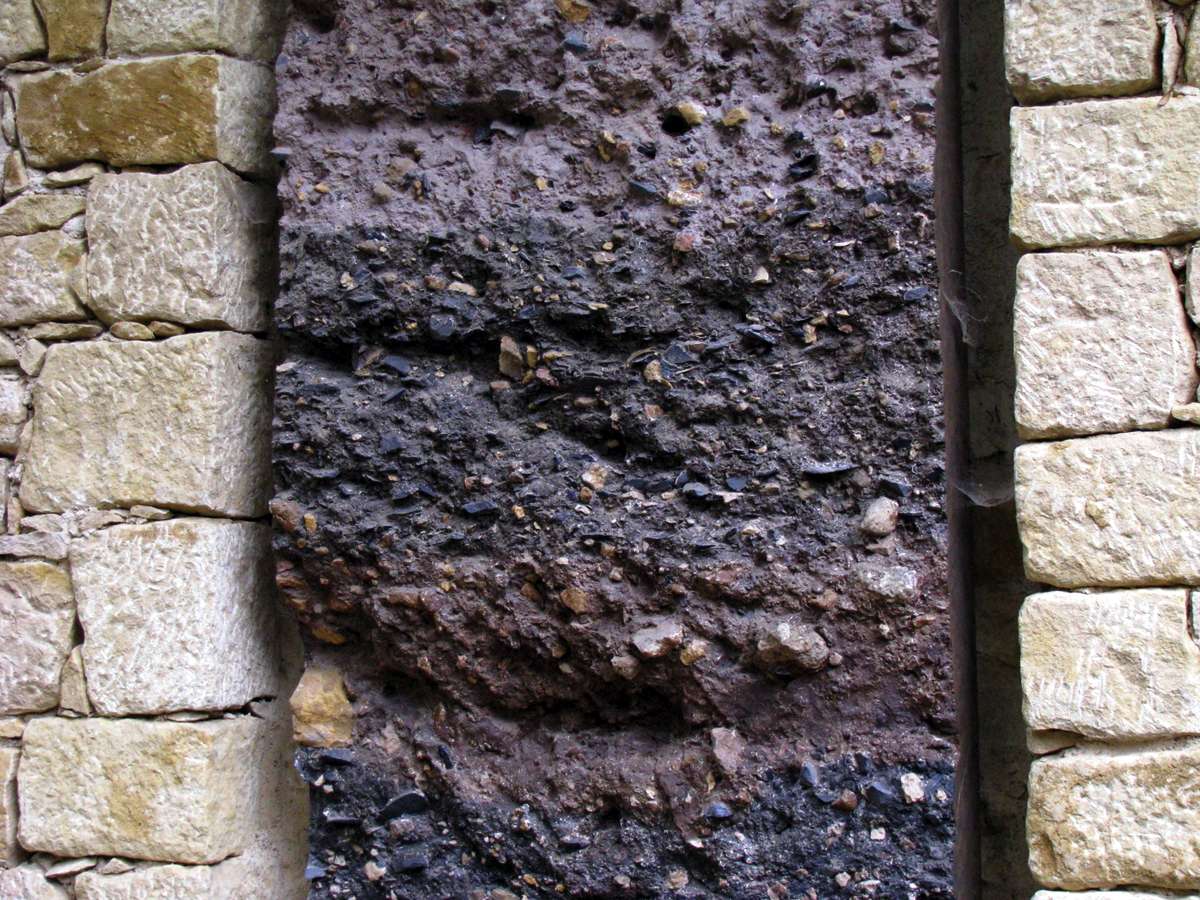
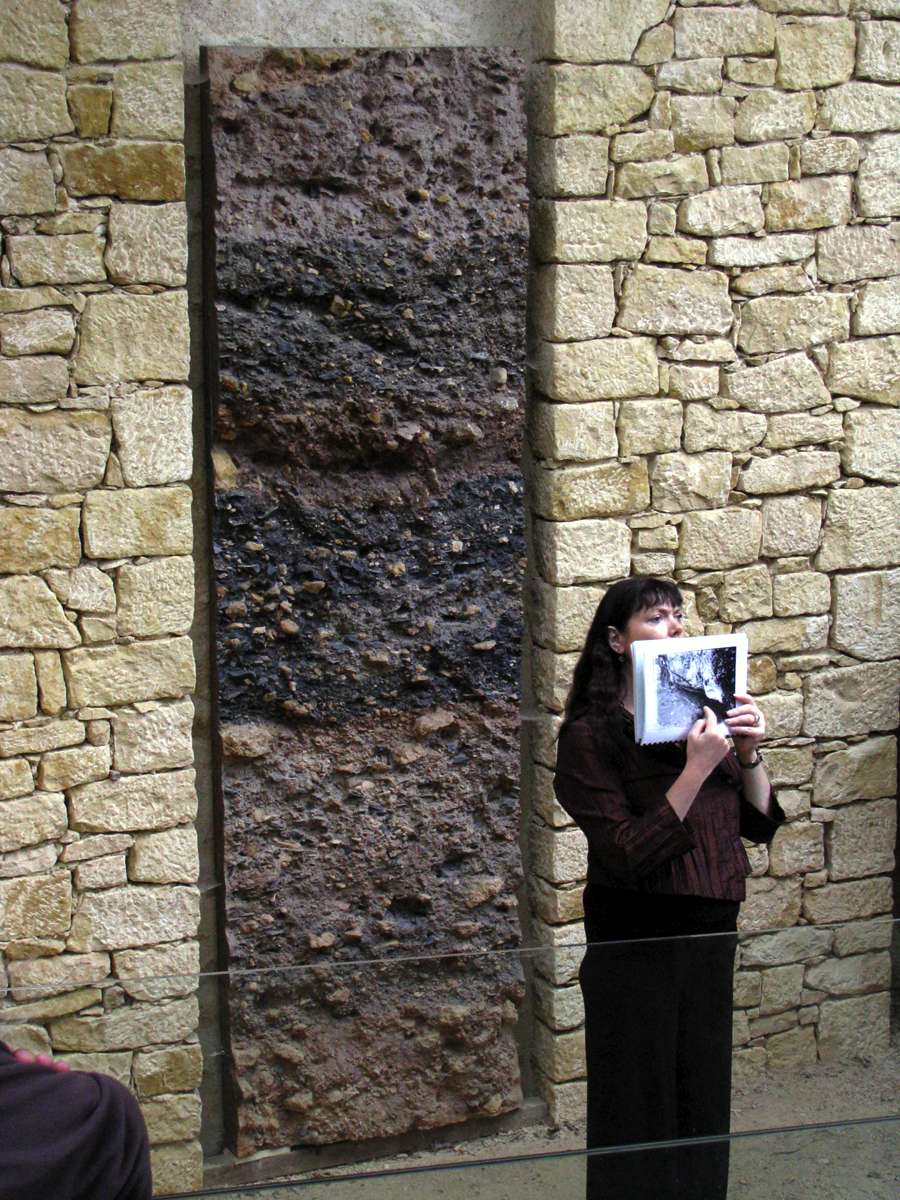
There has been a revolution in the veracity of casts, at least in France. The quality is superb, to the point where you are often not at all sure whether what you are looking at is an original or a facsimile.
The casts are done with a very fine material, which gives an excellent reproduction, and then the monocolour cast is hand coloured to match the original.
This is a cast of the soil profile at Le Moustier, and every "stone" is individually coloured. Casts of this quality mean that researchers around the world can be sure that what they are studying is hardly affected by the fact that they are looking at and measuring a reproduction, not the original, and it means that museums around the world can have a superb exhibition which is indistinguishable from that in the host museum.
Photo: Don Hitchcock 2008
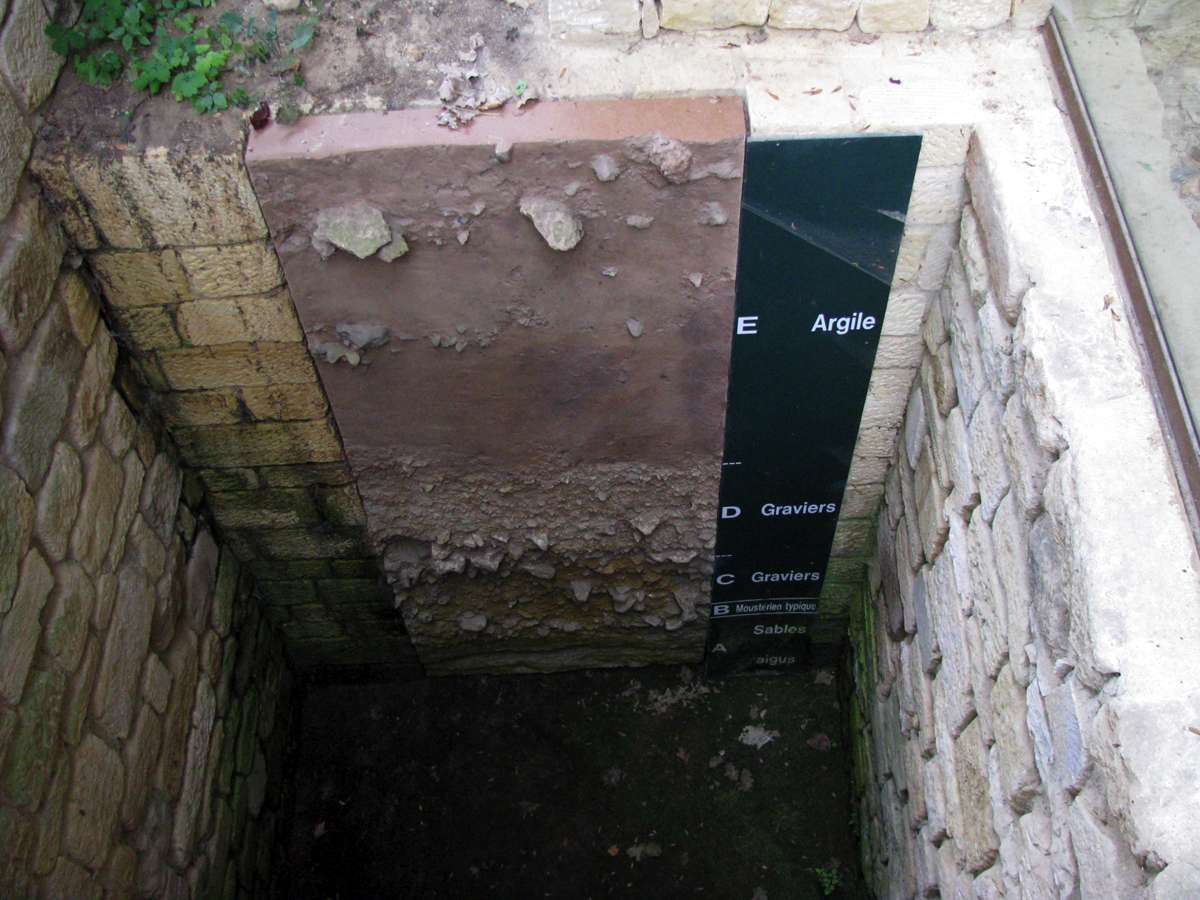
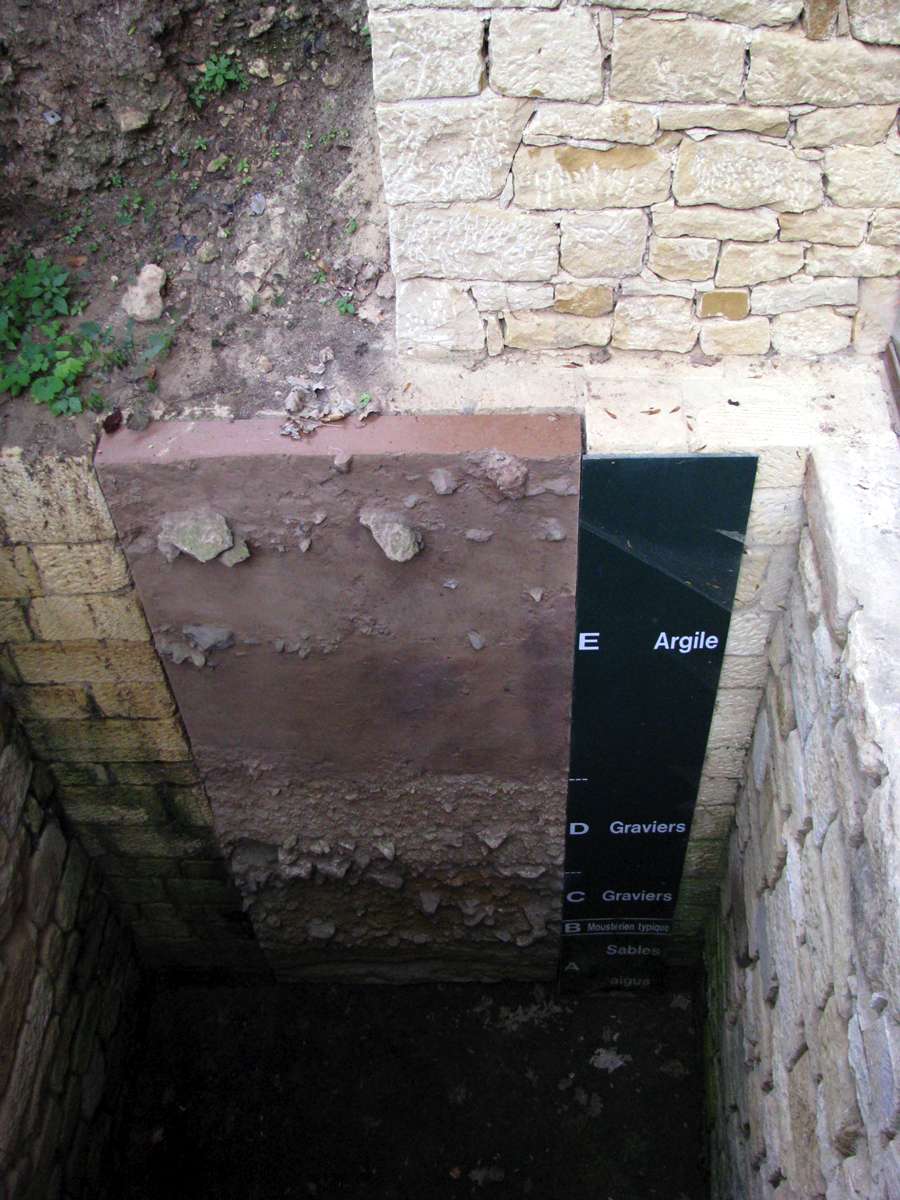
This shaft is lined with a cast of the profile below the viewer's feet. Note that level B, almost at the bottom of the shaft, is labelled "Mousterien typique".
Photo: Don Hitchcock 2008
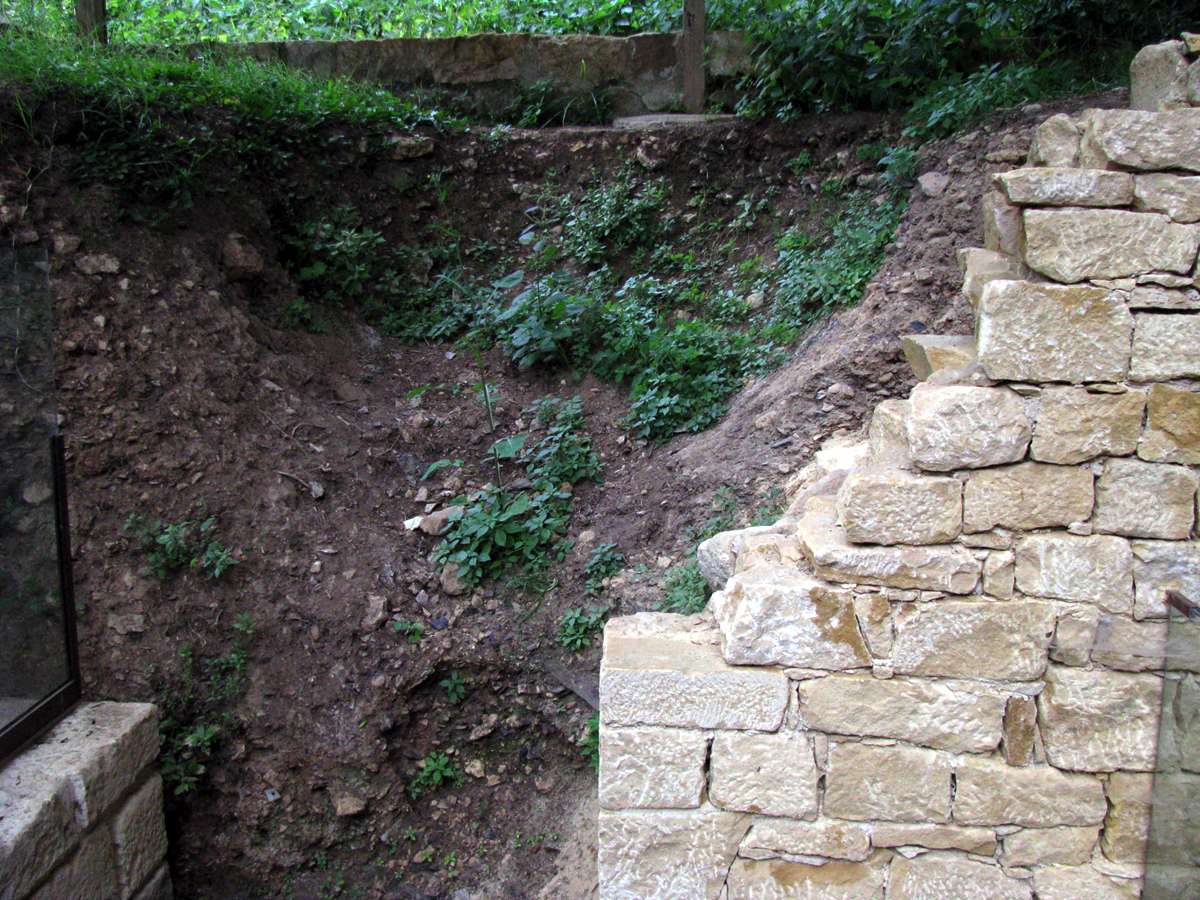
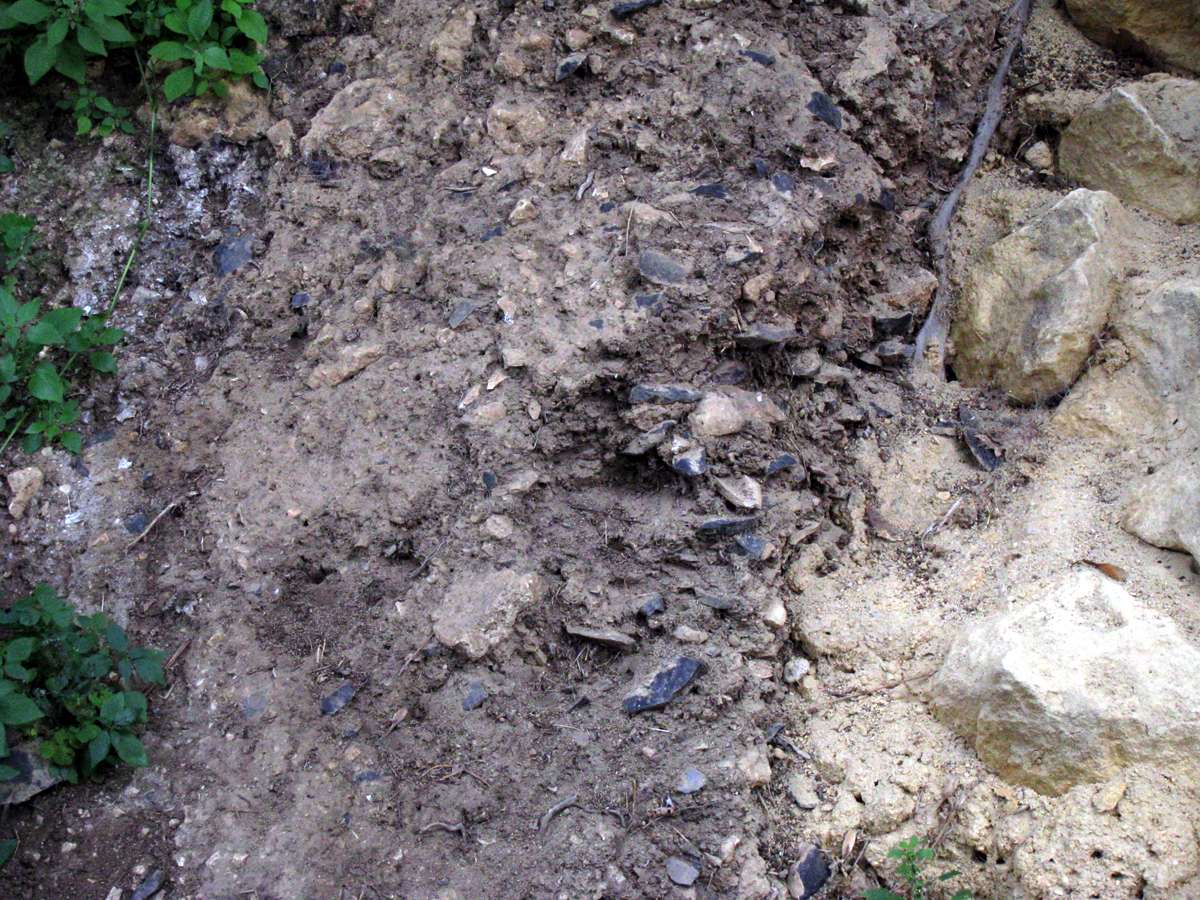
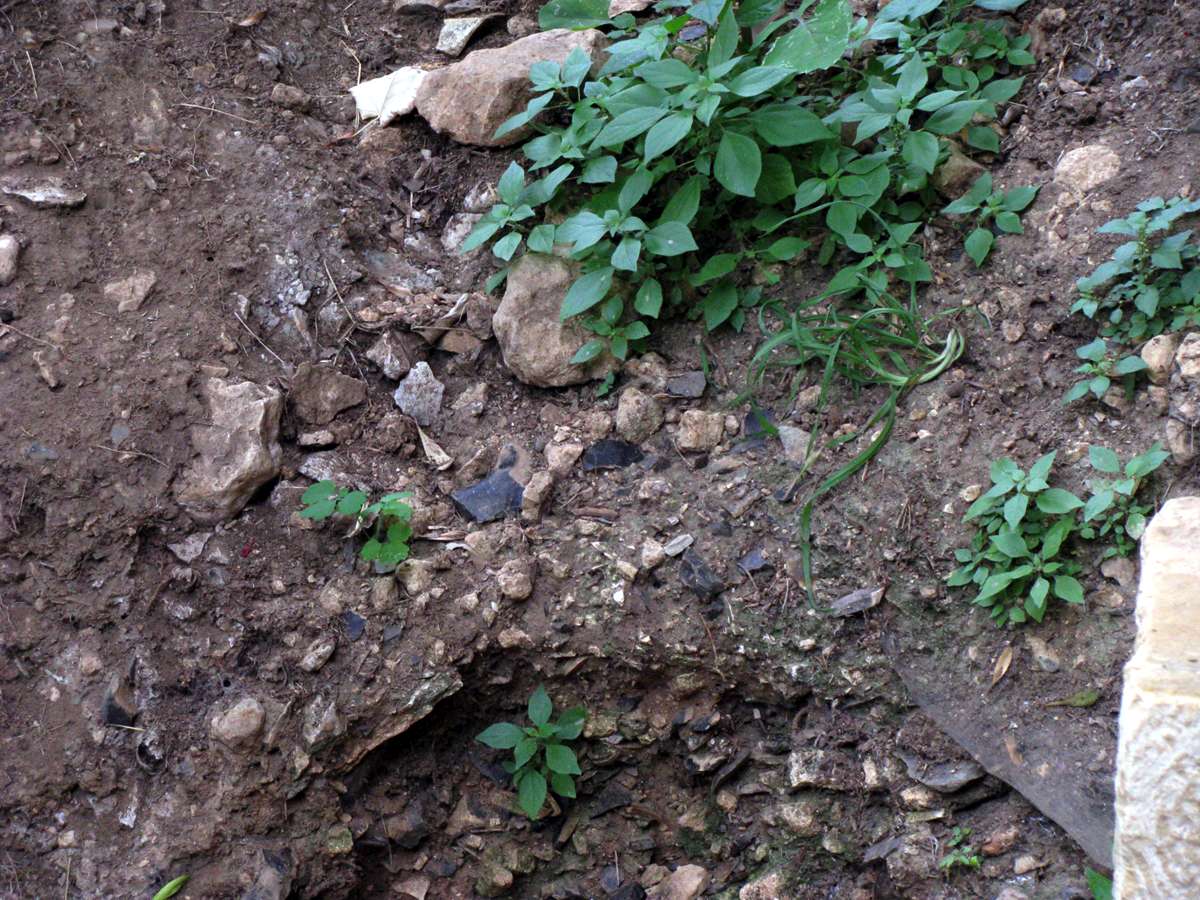
Although the (first discovered) upper shelter has been completely excavated, and no further work may be completed there, this lower shelter has been more carefully excavated with an eye to future developments in the practice of Archaeology.
A section of the site has been purposely not touched, to allow future researchers to do further study. These photos show worked flints eroding from one of these profiles, just above the shaft pictured above.
Photo: Don Hitchcock 2008
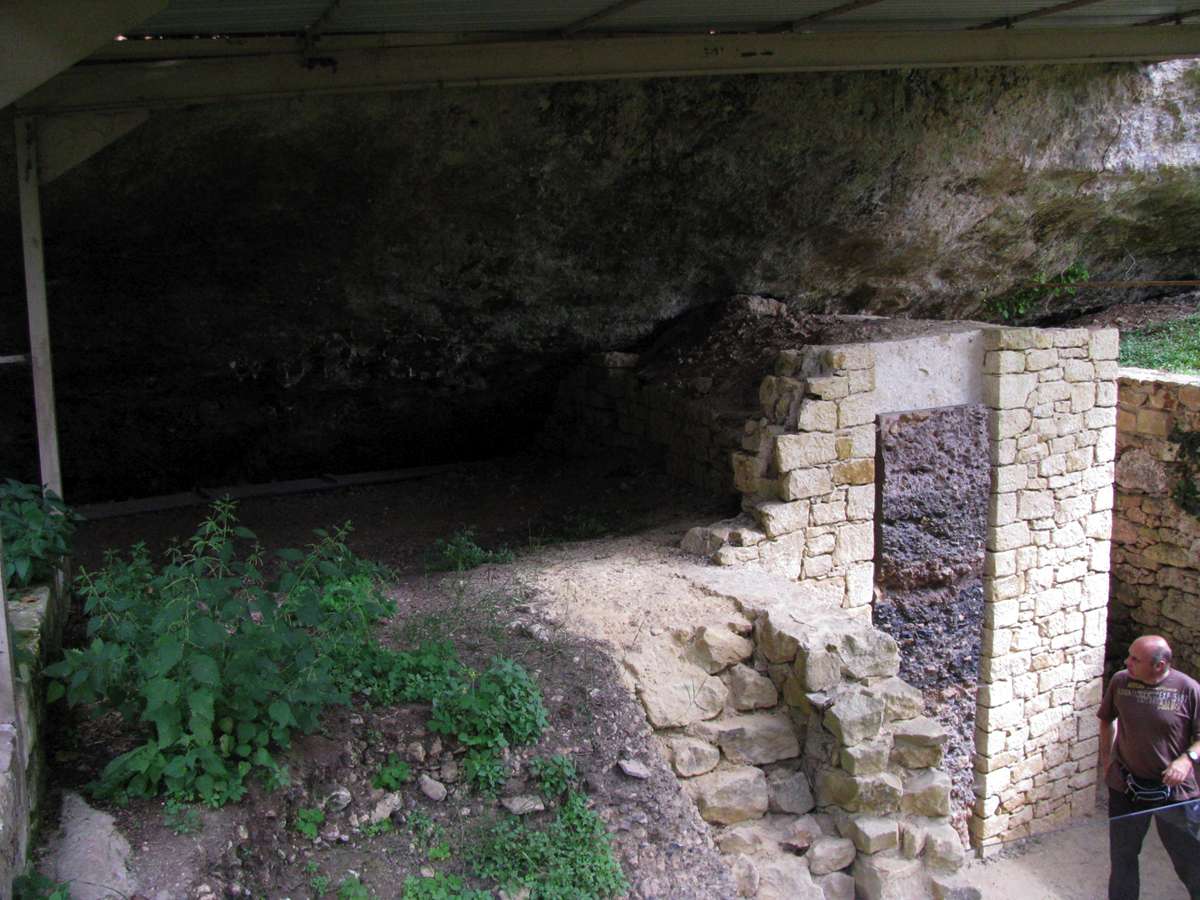
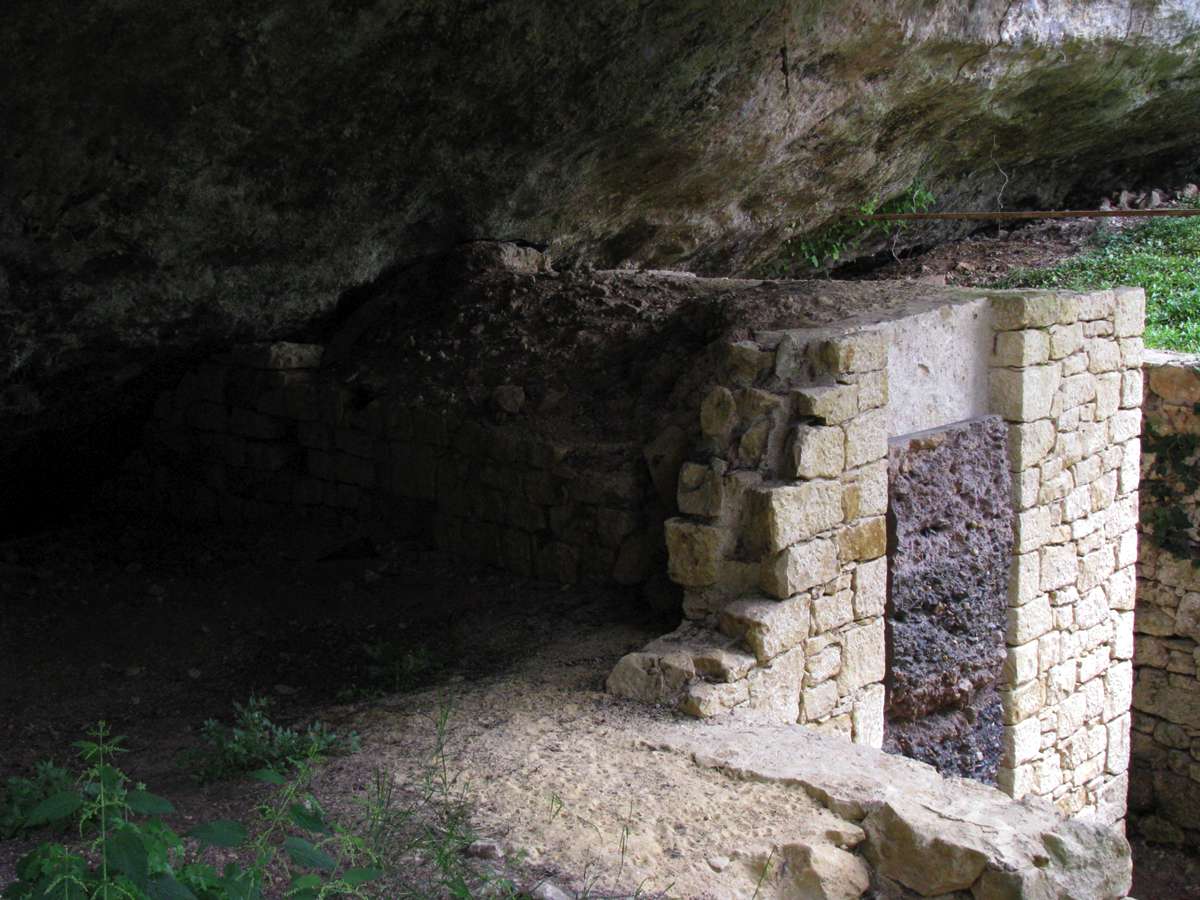
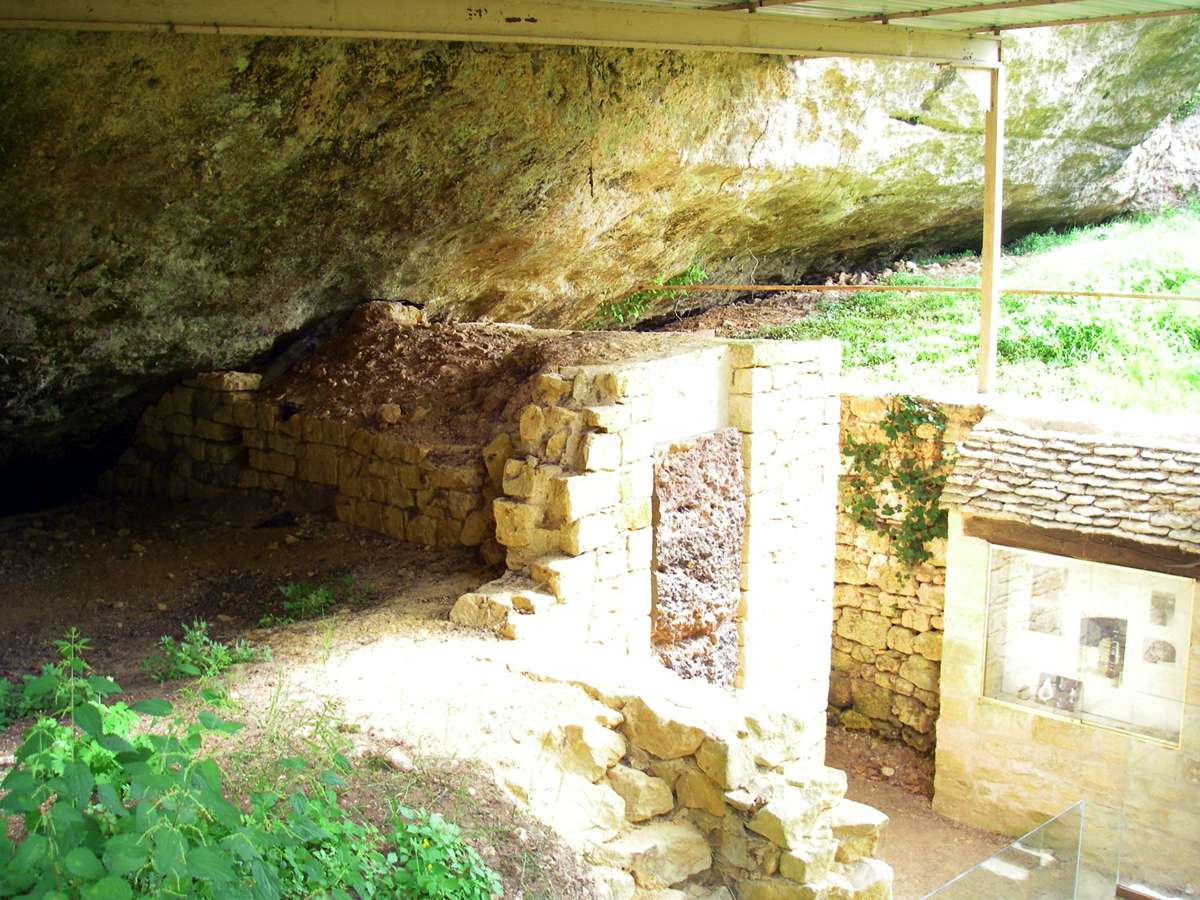
This area behind and to one side of the display area has been left to allow researchers to make further investigations.
Photo: Don Hitchcock 2008
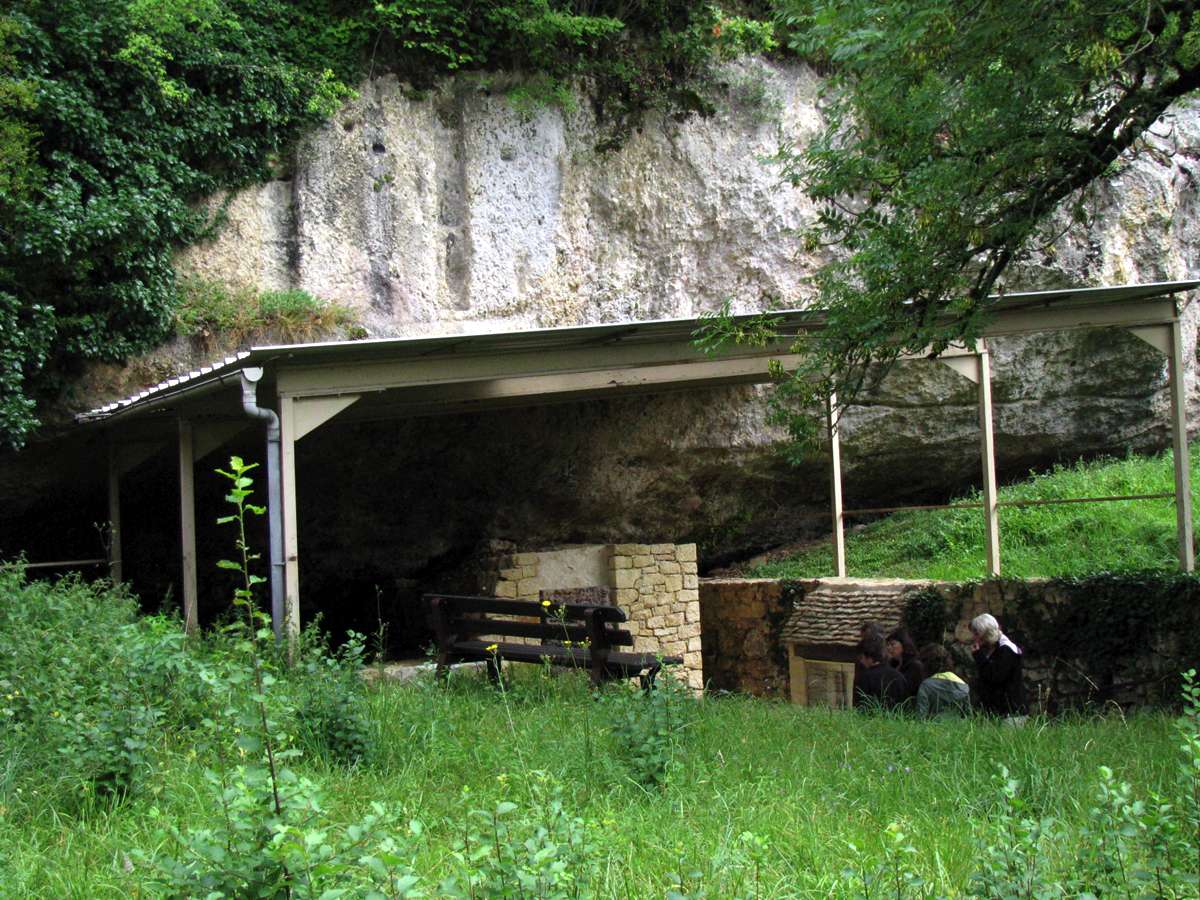
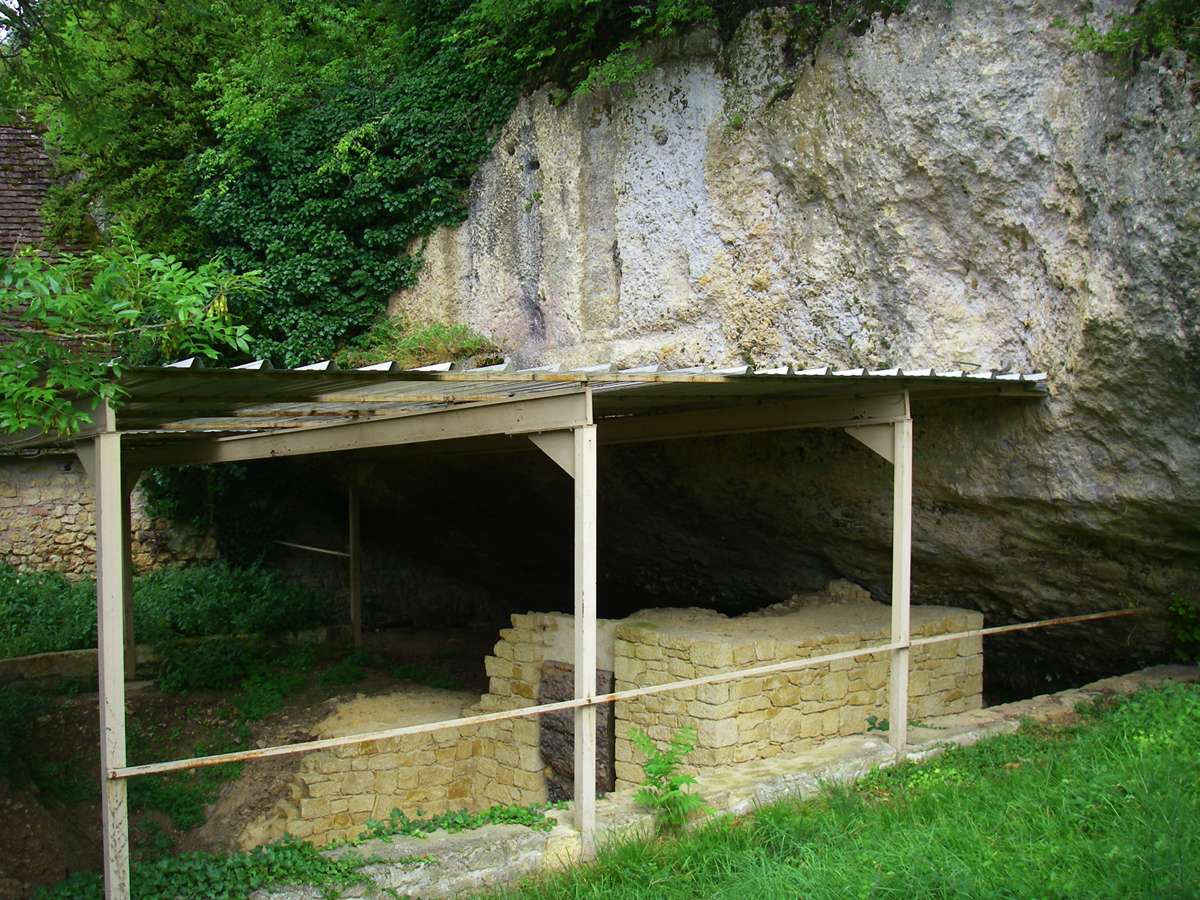

These photographs show the general area of the site, and allow the viewer to see the general layout of the shelter, allowing for the fact that originally the shelter would have had a lot more room under the overhang, now filled by sediments.
Photo: Don Hitchcock 2008
Le Moustier 1
In 1908, O. Hauser (1909), a Swiss antiquity dealer, discovered the nearly complete skeleton of an adolescent Neandertal (Le Moustier 1), a specimen that was sold to the Berlin museum of Ethnology and was damaged during World War II.
Text above: Maureille (2002b)
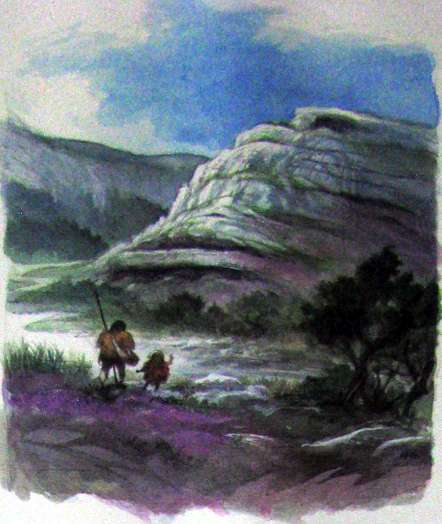
Découverte au printemps 1908, la Sépulture néandertalienne du Moustier 1, reconnue comme telle peu de temps après celle de la Chapelle-aux-Saints (Corrèze). apporte un nouvel argument à la communauté scientifique.
Les fouilles de l'époque, conduites par Hauser, ne sont malheureusement pas à la hauteur de l'enjeu.
Ce fossile fondamental connaît encore différents avatars pendant la deuxième guerre mondiale avant de pouvoir, enfin, être restauré et bien étudieé partir des années 1990.
Discovered in spring 1908, Moustier 1 was recognized as a neanderthal burial shortly after the discovery of the old man of la Chapelle-aux-Saints, a few hundred kilometres away. Excavations at the time, led by Hauser, were poorly done.
This fundamental fossil was not properly studied until it was restored in the 1990s.
Text: Adapted and translated from the display at Musée National de Préhistoire, Les Eyzies
Rephotography: Don Hitchcock 2008
Artist:© Emmanuel Roudier, 2008
Superb watercolours were done for this exhibition by the French artist, Emmanuel Roudier.
Blog: http://roudier-neandertal.blogspot.com/ Contact: emmanuelroudier@gmail.com
Source: Display at Musée National de Préhistoire, Les Eyzies
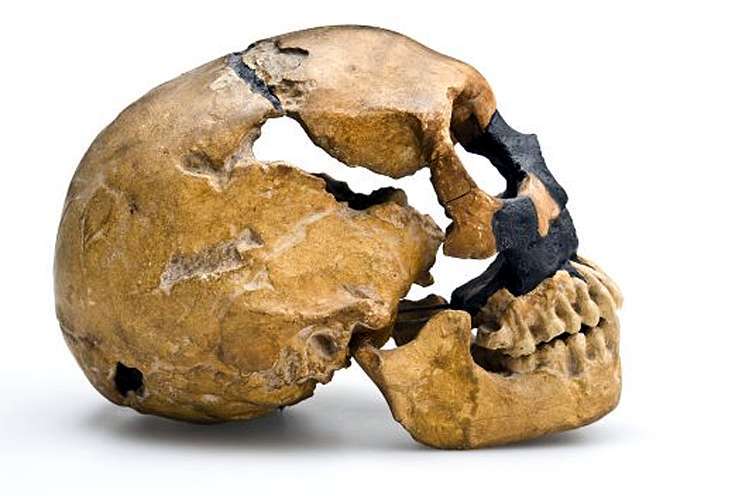
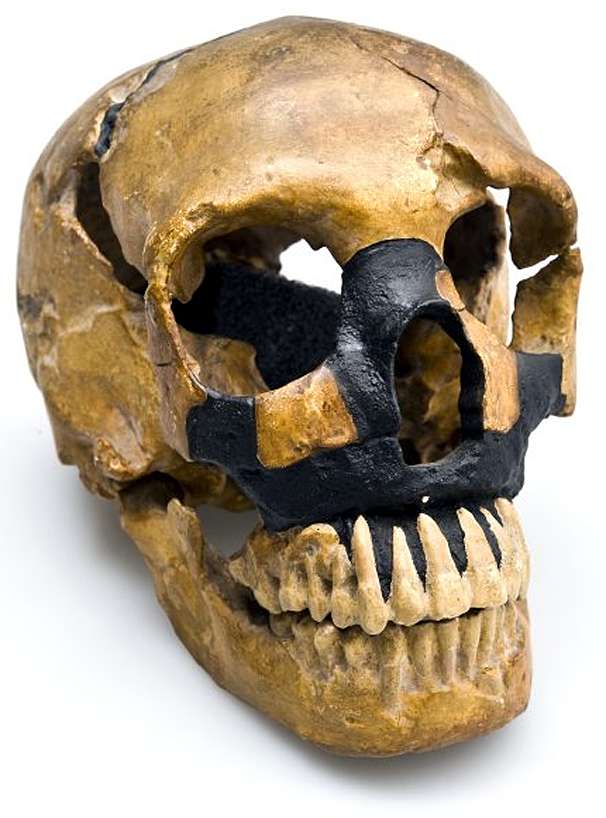
Le Moustier I skull. The skeleton was discovered in 1908.
Photo: Facsimile, Carl Bento © Australian Museum
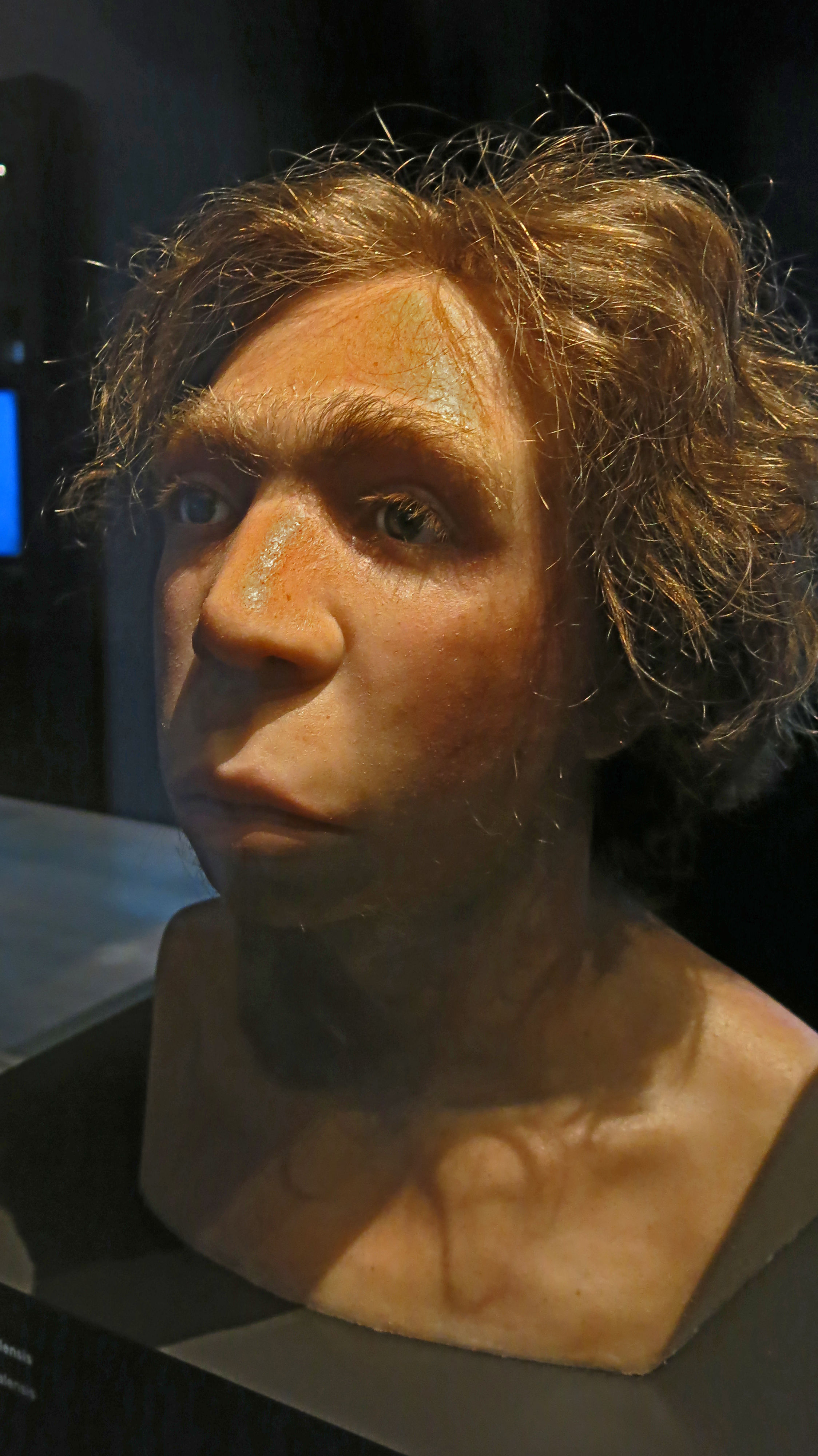
Reconstruction of the adolescent male le Moustier 1, circa 45 000 BP
Production: Manufaktur, München.
Photo: Don Hitchcock 2015
Source and text: Facsimile, Staatliche Museen zu Berlin, Neues Museum, Germany
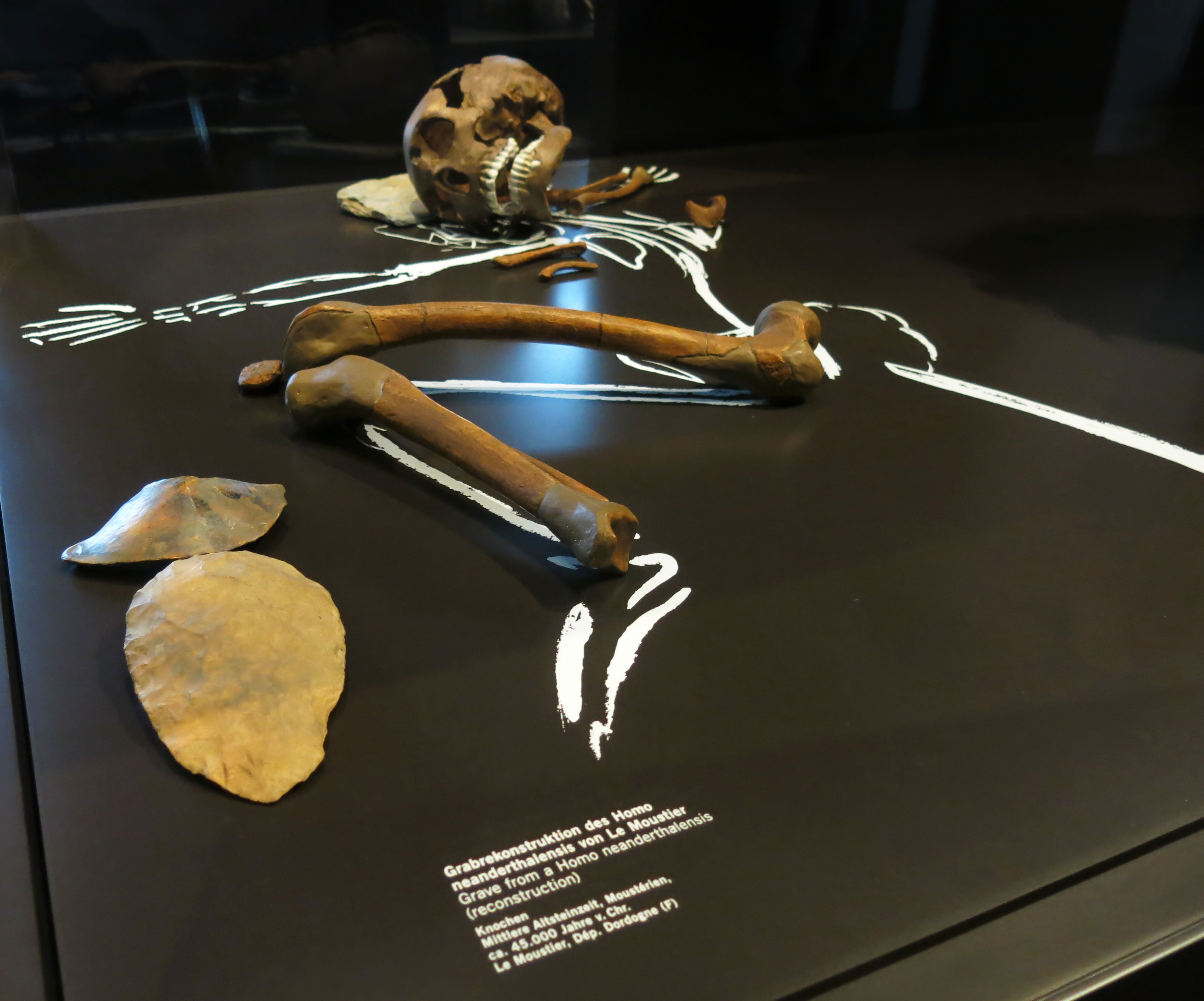
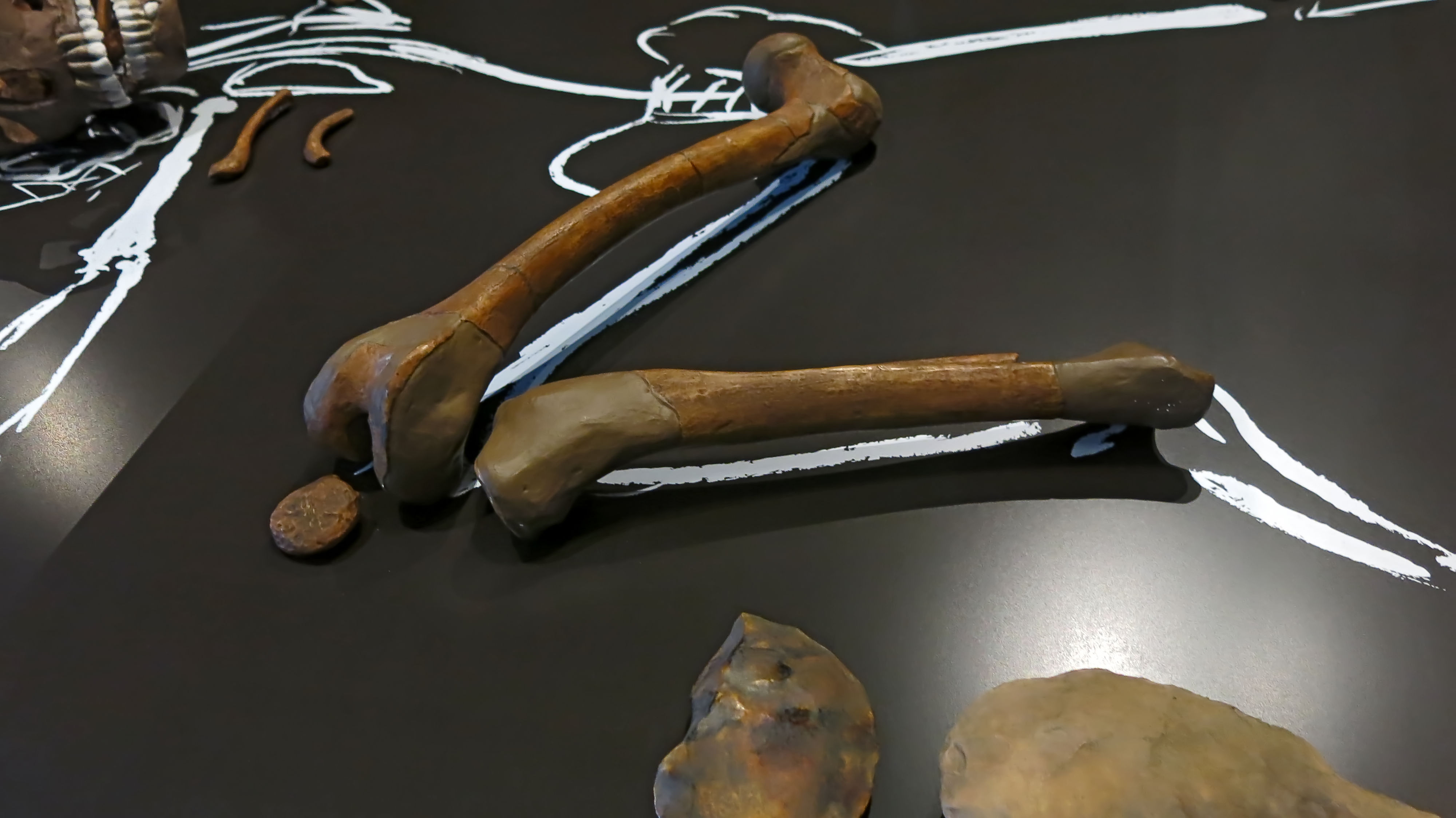
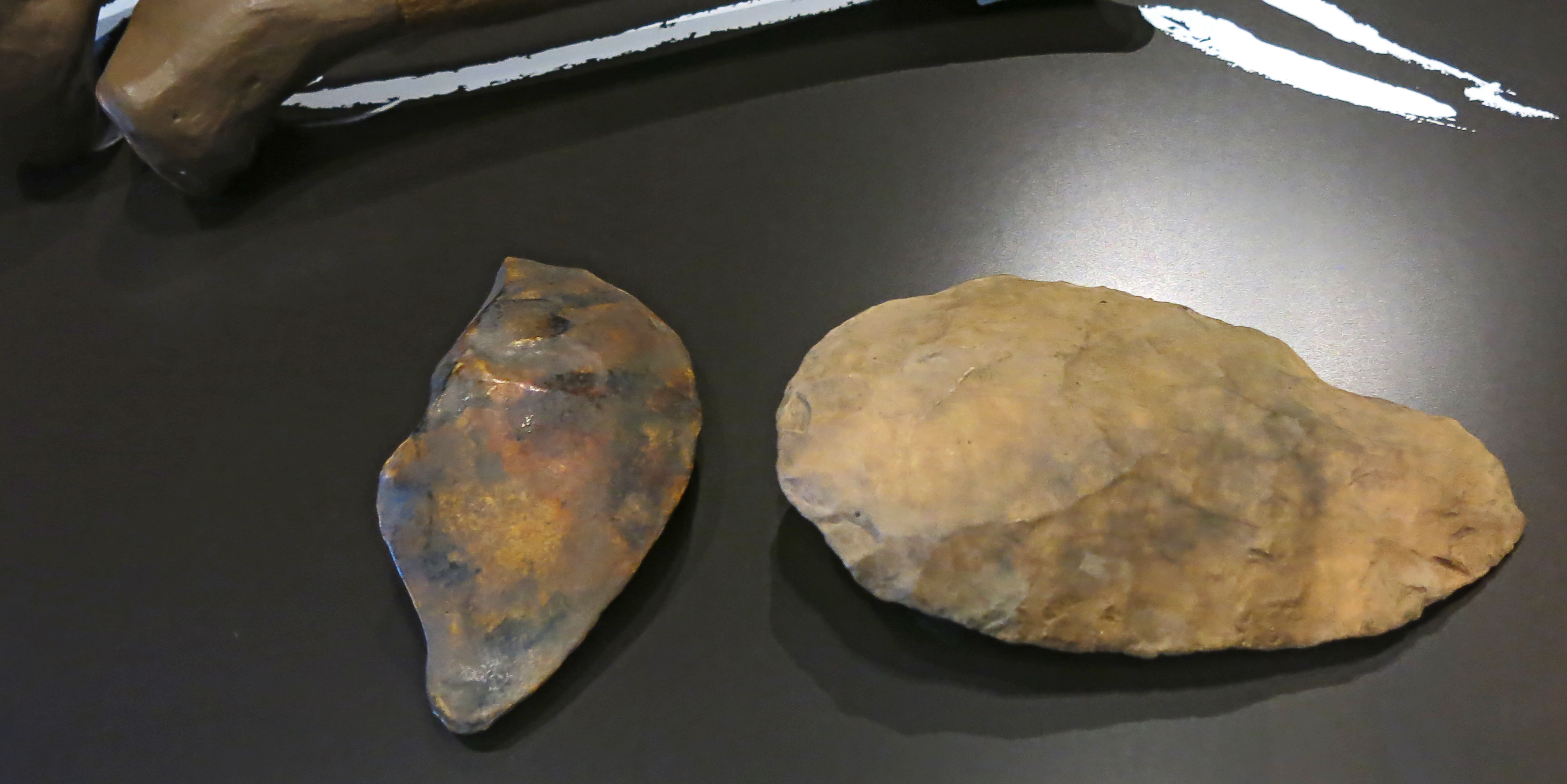
A facsimile of the skeleton has been well displayed at the Berlin Museum, along with tools found at the site.
Photo: Don Hitchcock 2015
Source: Facsimile, Staatliche Museen zu Berlin, Neues Museum, Germany
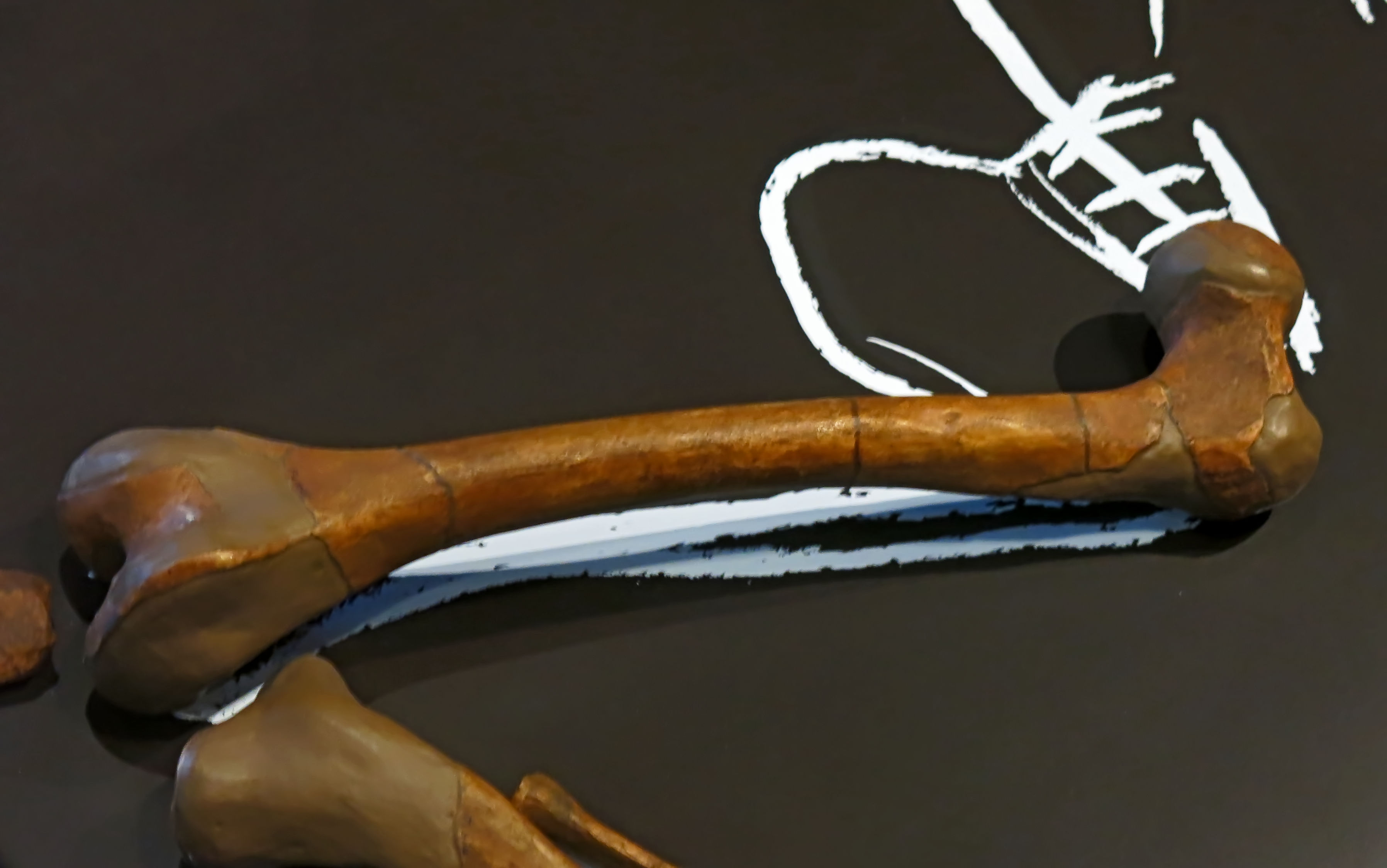
As is usual in professional restorations, the parts of the skeleton which were originally preserved are shown in a natural colour, with the reconstructions in a colour which makes it obvious that they are additions in order to form a better idea of the original piece. In this case the additions are in a grey colour.
Photo: Don Hitchcock 2015
Source: Facsimile, Staatliche Museen zu Berlin, Neues Museum, Germany
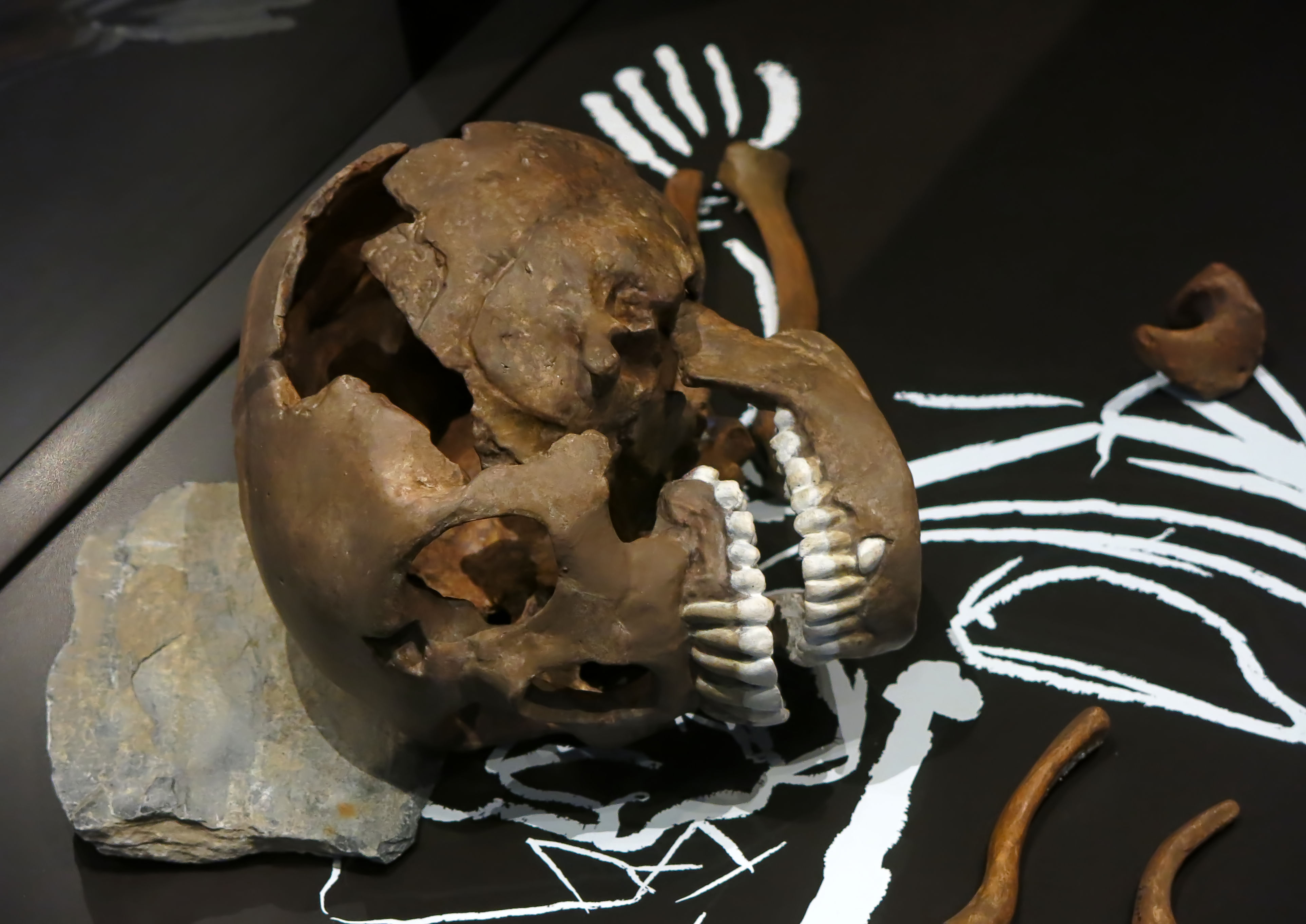
Importantly almost the complete skull was able to be reconstructed, and it was also possible to determine at the time of discovery of the skeleton that the arrangement of the bones made it clear for the first time that Neanderthals already buried their dead.
Photo: Don Hitchcock 2015
Source and text: Facsimile, Staatliche Museen zu Berlin, Neues Museum, Germany
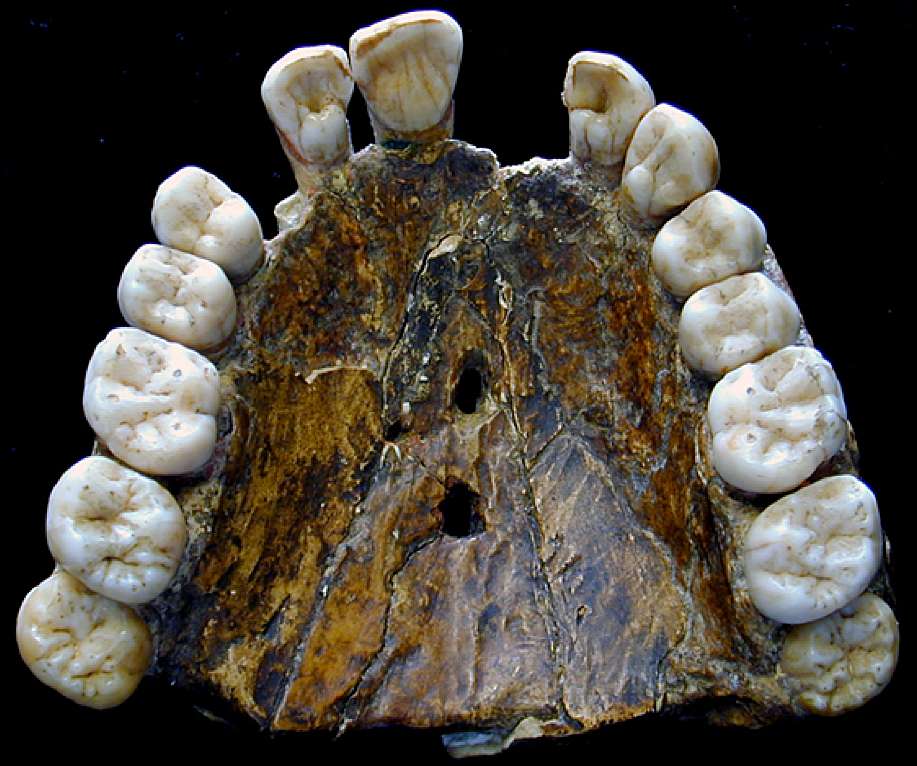
Le Moustier I dentition
Museum für Vor- und Frühgeschichte, Berlin, 2002
Photo: MiranC, http://www.flickriver.com/photos/soloriver/340287347/
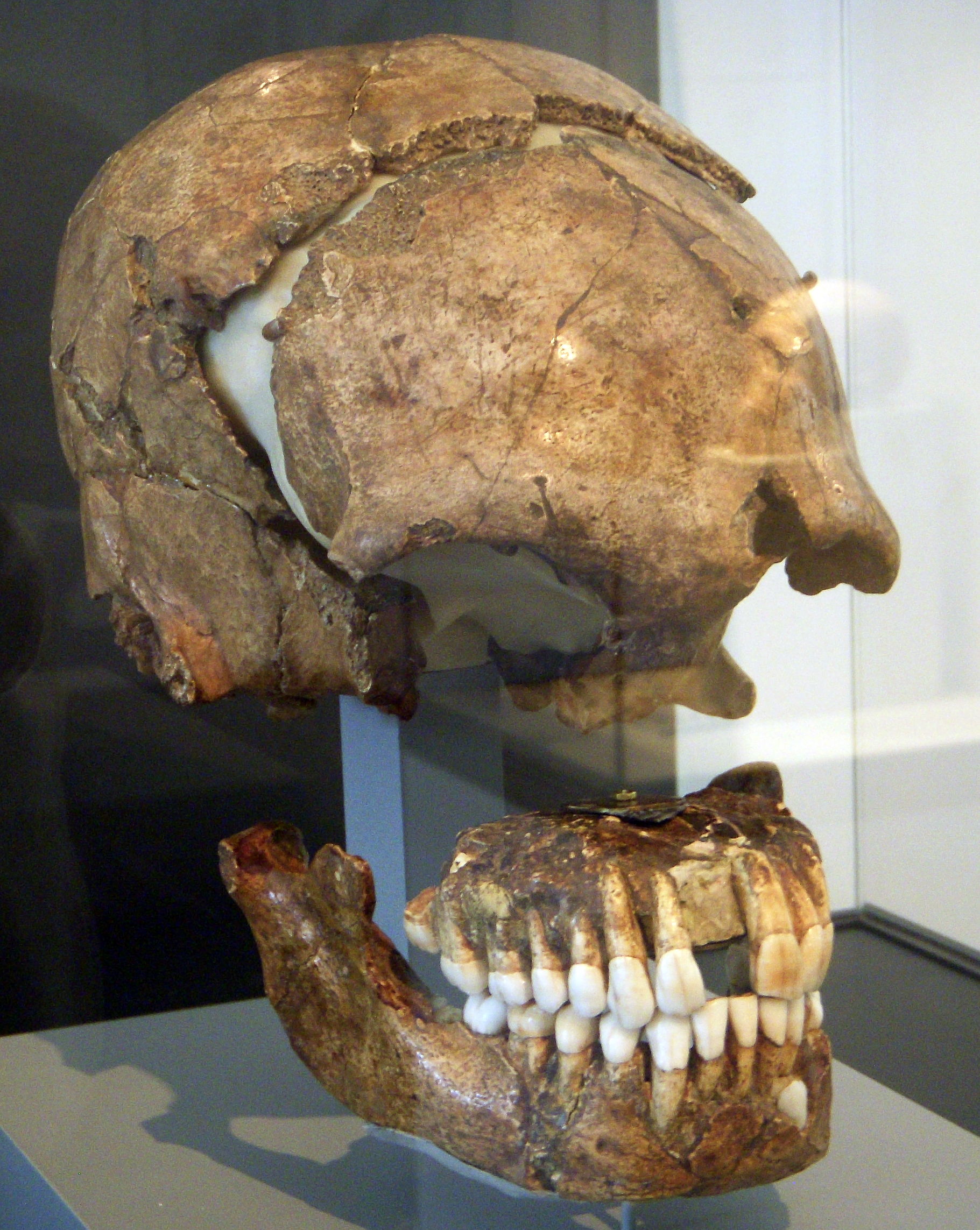
Le Moustier I original skull
Ca 45 000 BP, it is the skull of an adolescent Neanderthal, about 15.5 years old at the time of death, probably male, and with a cranial capacity in the range 1500 cm3 - 1565 cm3.
The rest of the bones of the nearly complete skeleton were largely destroyed during a bombing raid in the latter part of the second World War. The skull, thought to have been destroyed during World War II, was rediscovered in 1965. Unfortunately Weinert's reconstruction was somewhat damaged and several pieces of the face were missing but the existing pieces were reconstituted by H. Ullrich in 1965. From this time until the early 1990s the specimen was essentially unstudied.
Photo: Museum für Vor- und Frühgeschichte, Berlin
Text: adapted from http://web.tiscali.it/anthropage/time_for_one_of_the_last_neander.htm
(Note: this page
http://web.tiscali.it/anthropage/time_for_one_of_the_last_neander.htm
by Jennifer L. Thompson and Alan Bilsborough is well worth visiting for students of Neanderthal morphology - Don )
At the beginning of WWII the skulls from Le Moustier and Combe Capelle were packed away safely. At the end of the war, the skulls were taken to the Soviet Union and returned to the GDR in 1958 amongst many other objects. It was only in 2001 that both skulls were identified again.
Text above: http://www.wiaweg.de/knowledge/742-die-sch%C3%A4del-le-moustier-und-combe-capelle

Skull of the adolescent male le Moustier 1, circa 45 000 BP
Photo: Don Hitchcock 2015
Source: Original, Staatliche Museen zu Berlin, Neues Museum, Germany
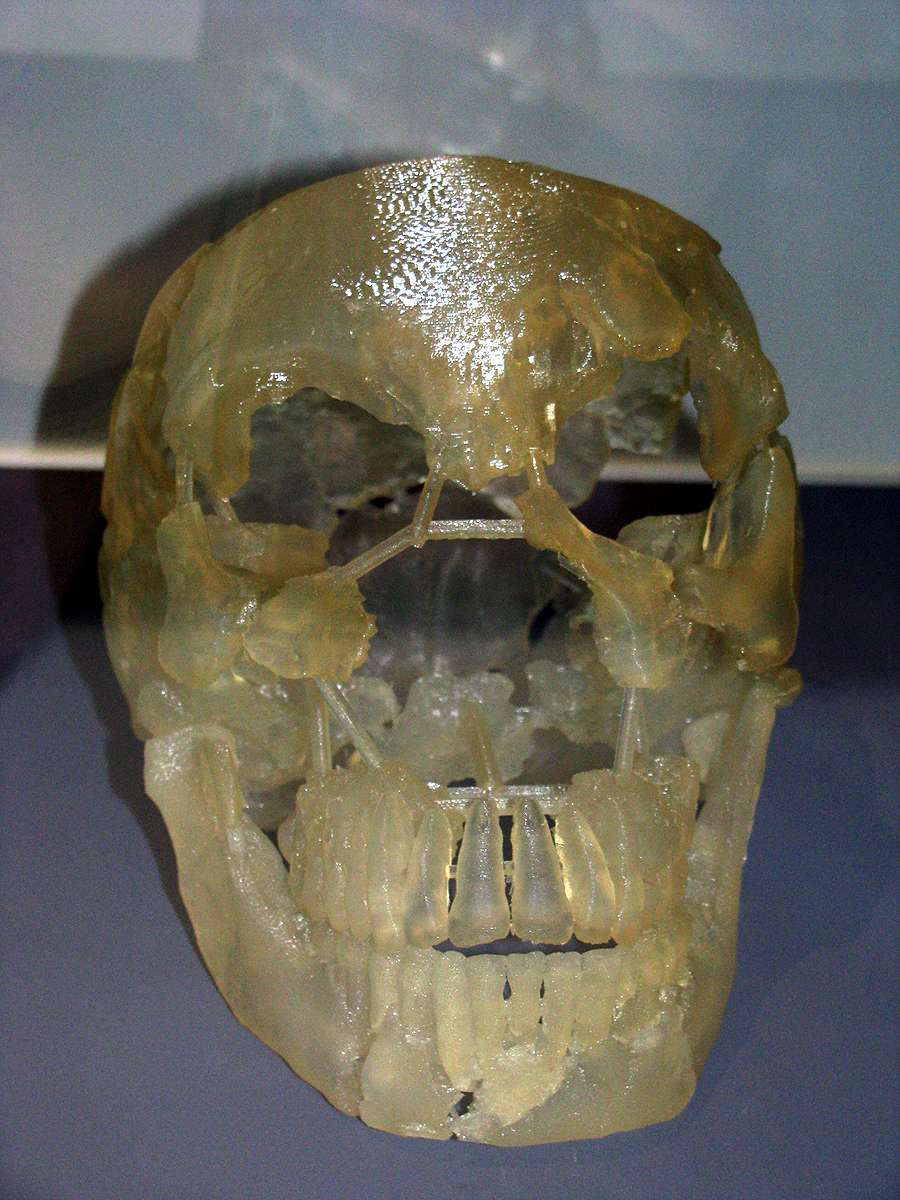
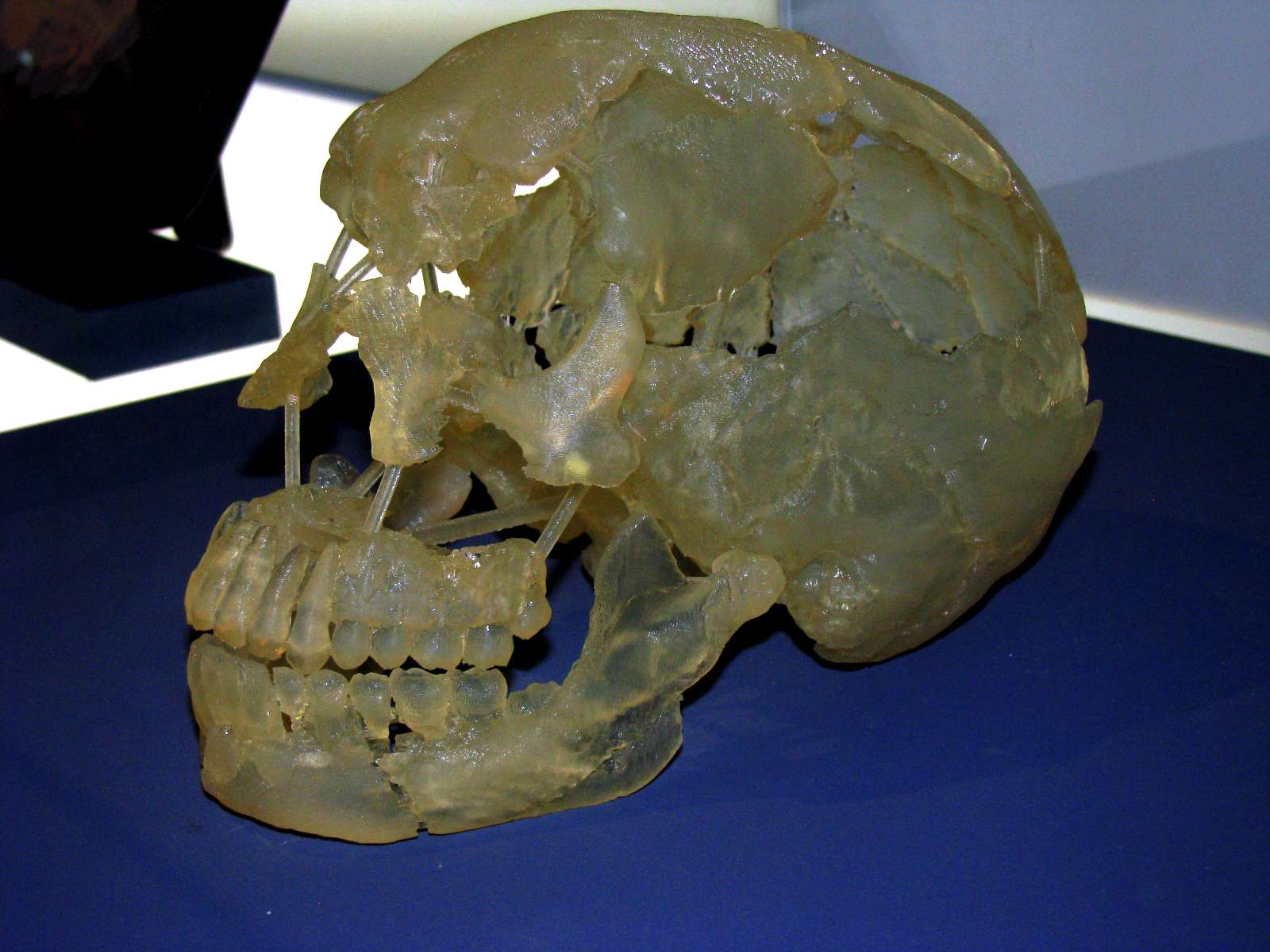
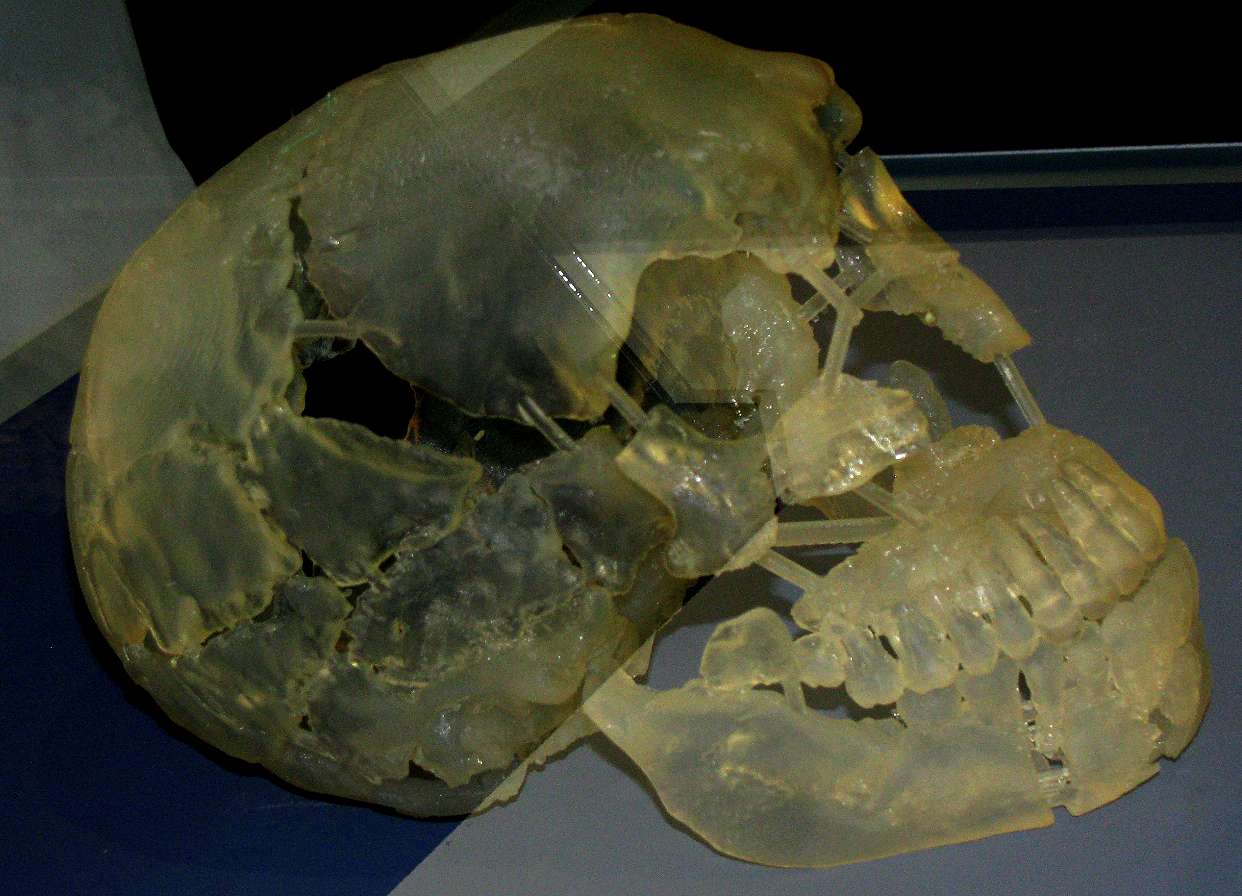
Skull of Le Moustier 1, created by the Stereolithography process. Normally the result would then be hand coloured to accurately reflect those of the original object, but the facsimile has been left in its raw state in this case, presumably to more dramatically show the process.
The object to be duplicated in resin is first scanned by a laser, building up a data file of hundreds or thousands of "slices" of the original object (the skull of Moustier 1 in this case), which is not harmed in the process.
Stereolithography is an additive fabrication process utilizing a vat of liquid UV-curable photopolymer "resin" and a UV laser to build parts a layer at a time. On each layer, the laser beam traces a part cross-section pattern on the surface of the liquid resin. Exposure to the UV laser light cures or solidifies the pattern traced on the resin and adheres it to the layer below.
After a pattern has been traced, the SLA's elevator platform descends by a single layer thickness, typically 0.05 mm to 0.15 mm (0.002" to 0.006"). Then, a resin-filled blade sweeps across the part cross section, re-coating it with fresh material. On this new liquid surface the subsequent layer pattern is traced, adhering to the previous layer. A complete 3-D part is formed by this process. After building, parts are cleaned of excess resin by immersion in a chemical bath and then cured in a UV oven.
Text: Adapted from Wikipedia.
Photo: Don Hitchcock 2008
Source:
Reconstitution par stéréolithographie du crâne du Moustier 1, fouilles O. Hauser, auteur C. P. E. Zollikofer. (Collection de l'institut d'Anthropologie de l'Université de Zurich, Suisse)
Facsimile, Musée National de Préhistoire, Les Eyzies
The Neanderthals - Cold Weather People
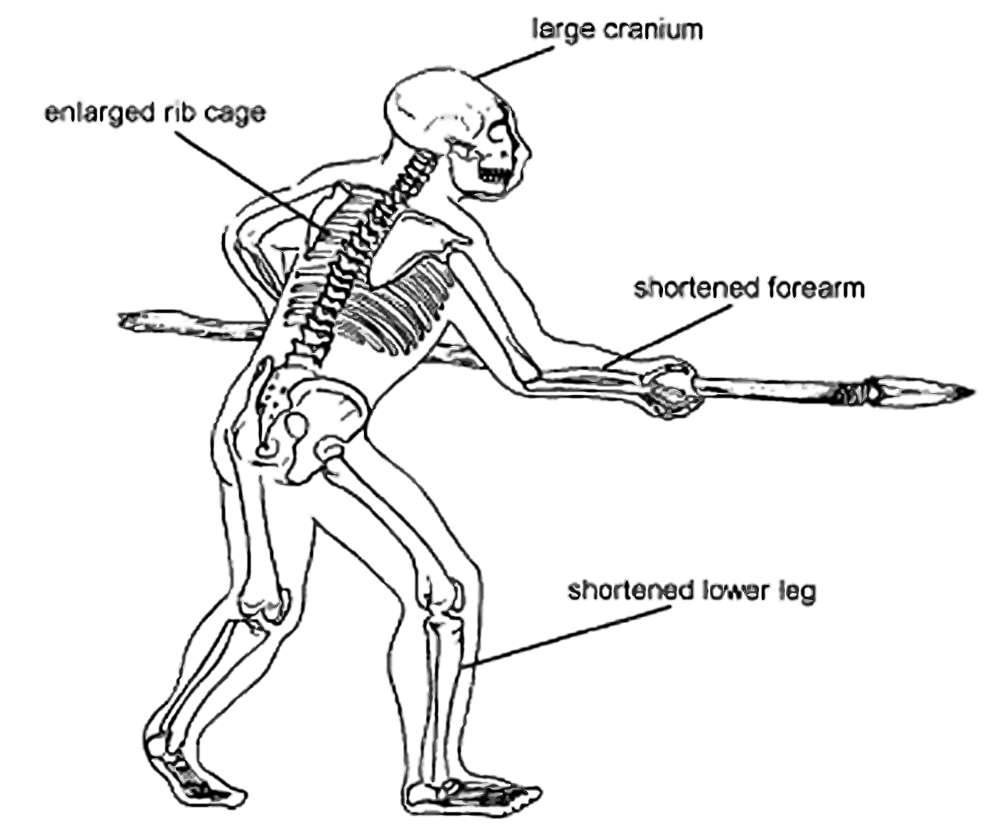
Neanderthal adaptation to cold.
Photo: Hoffecker (2005)
The Neanderthals were a northern form of human in the same way that the arctic hare is a northern form of the jackrabbit. They evolved the most extreme anatomical adaptations to cold climates ever found among hominids, and have been characterised as 'hyperpolar'. Both the size and shape of their bodies acted to minimise heat loss and the danger of cold injury. They were stocky and barrel-chested with large heads and short limbs. And like living peoples of the circumpolar zone, they almost certainly evolved some physiological mechanisms for warming the extremities and exposed surface areas.
It is possible to overstate the extent to which Neanderthal anatomy reflects cold adaptation. The large size of their heads has been mentioned as a possible example, but - as in the case of Homo heidelbergensis - an increase in brain size took place in both Africa and Europe at this time and again may have had little to do with climate.
As already noted, many Neanderthal traits seem to have been the result of isolation and random genetic drift. Other features, such as the large front teeth, may reflect an evolutionary response to aspects of their environment other than low temperature. Nevertheless, many features of Neanderthal anatomy - especially postcranial anatomy - are almost certainly part of an adaptation to cold.
The pattern was first noted by the American anthropologist Carleton Coon in a 1962 book entitled The Origin of Races. Coon compared many Neanderthal traits with the anatomy of living peoples at high latitudes. He observed that the size and shape of their bodies would have minimised the loss of heat and provided protection against cold injury. But by the time his book was published in late 1962, Coon had become embroiled in a bitter controversy concerning his views on race. As a result, his ideas about cold-climate adaptation among the Neanderthals were largely ignored or forgotten for many years.
Renewed study of the subject since 1980 has shown that most of his observations were valid. Neanderthal limbs were short relative to trunk length. Their lower limb bones (radius and tibia) were especially short in comparison with the upper limb bones (humerus and femur). Among living human populations, the ratios of lower- and upper-limb segments correlate strongly with temperature and latitude.
Significantly, the Neanderthals exhibit even lower ratios than those of the modern Inuit. Coon stressed the size and thickness of the foot bones as another means of conserving body heat and protecting against frostbite.
The large overall body mass of the muscular Neanderthals further reduced the ratio of exposed surface area to volume. The thickness of the chest is particularly striking, and is reflected in the shape of the ribs and the length of the collar bone (clavicle).
A thick coat of body hair would have enhanced heat conservation, but it is currently impossible to confirm its presence. Coon speculated that the Neanderthals also had evolved physiological means for warming their extremities and exposed surface areas. He drew attention specifically to the large size of the infraorbital foramina - openings on each side of the maxilla below the eye socket that allow blood flow to the cheeks - and noted a parallel with the Greenland Inuit. As among the latter and other modern Arctic peoples, elevated blood flow to extremities probably helped the Neanderthals avoid cold injury.
More controversial was Coon's suggestion that the large size of the nasal cavity was another cold-climate adaptation. Citing medical research on the vulnerability of the brain to very cold air, Coon proposed that the voluminous Neanderthal nose had functioned like a radiator to warm inhaled air. The 'radiator nose theory' was critiqued by some prominent anthropologists, but may retain some validity. The nose might also have functioned to expel warm air and reduce excess body heat generated by intense activity.
The unusual chewing complex of the Neanderthals has provoked comment as well. In addition to the forward position of the jaws and the large size of the front teeth, the latter betray extreme wear in all but the youngest individuals. Furthermore, the wear includes microscopic traces of nonfood items. The pattern suggests that the Neanderthals were using their teeth to grip - and perhaps to process - hide and other soft materials. Here again there is a parallel with the Inuit, whose teeth often exhibit similar wear from such use.
The powerful muscles of the Neanderthals, which are indicated by the deep muscle attachments on their bones, are widely thought to reflect a stressful life and a greater reliance on brawn rather than on technology. Further evidence of physical power and stress may be seen in the morphology of the shoulder blade (scapula), thick-walled limb bones, and other features. Though not cold-climate adaptations in themselves, Neanderthal strength and endurance were probably an indirect measure of their response to the glacial environments of Europe - especially in light of their limited technological achievements.
Le Moustier 2
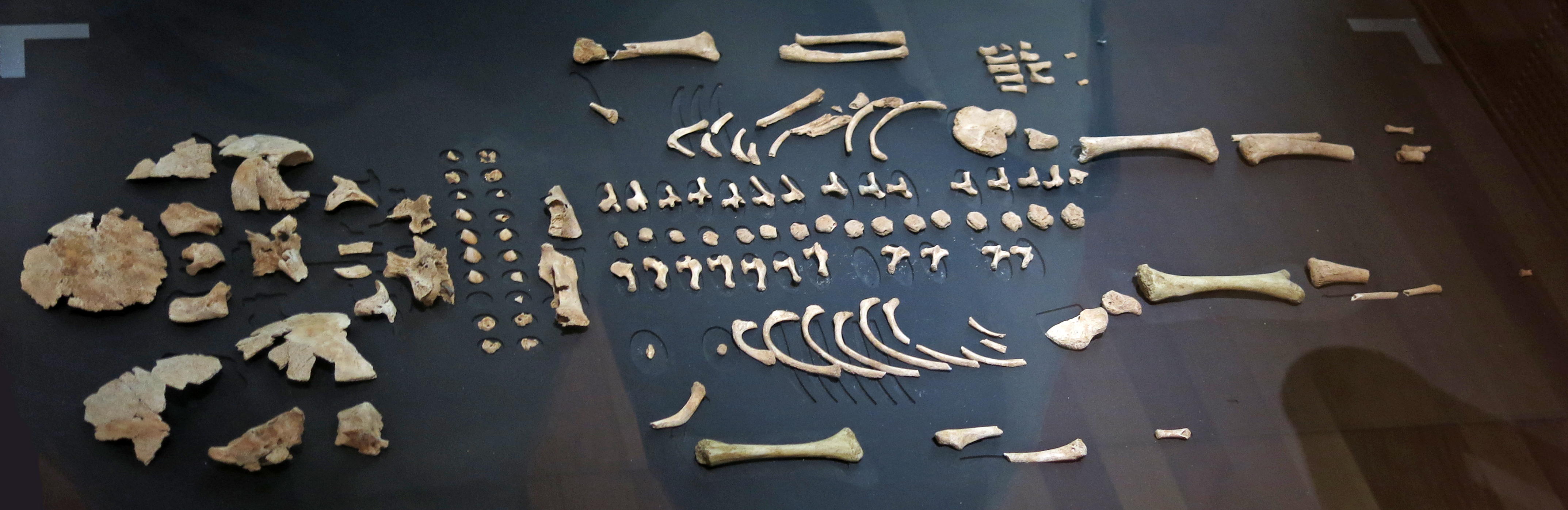
le Moustier 2
Photo: Don Hitchcock 2014
Source: Original, le Musée National de Préhistoire, Les Eyzies-de-Tayac


Exhumé par Peyrony dès 1914, mais scientifiquement fouillé en 1996, le squelette de nouveau-né du Moustier 2 est, pour sette classe d'âge, l'un des deux fossiles les mieux conservés au monde.
La fosse, ovulaire, longue de 50 cm et profonde de 40 cm, a été creusée à partir de la couche J jusqu'à la couche H (vers 40 000). Le bébé reposait coucheé sur le dos, la tête calée à gauche par un bloc calcaire.
Text: From the display at Musée National de Préhistoire, Les Eyzies
Photo: Don Hitchcock 2008
Artist:© Emmanuel Roudier, 2008
Superb watercolours were done for this exhibition by the French artist, Emmanuel Roudier.
Blog: http://roudier-neandertal.blogspot.com/ Contact: emmanuelroudier@gmail.com
Source: Display at Musée National de Préhistoire, Les Eyzies
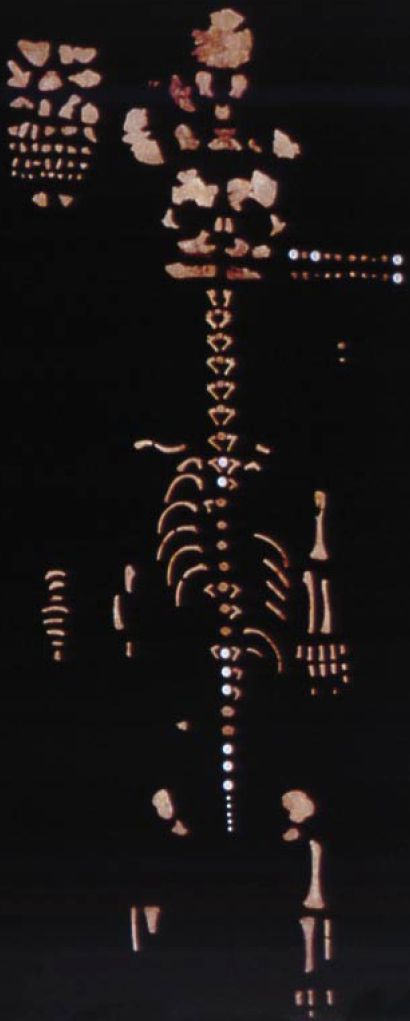
Caption with the photo at left:
The neonatal skeleton Le Moustier 2 is one of the most complete Neanderthal individuals ever discovered. The parietals and the posterior part of the hemifrontals are broken into small fragments. The left temporal, both scapulae and the pubis are missing. Most of the cranial base and face, deciduous tooth germs, cervical vertebrae and long bones are preserved.
The right humerus and femur, formerly misidentified as La Ferrassie 4, are not shown. Many Neanderthal derived traits can be seen in the lateral and basal portions of the occipital bones and the petrous portion of the temporal bone. Derived traits are also evident in the postcranial skeleton in the medio–lateral curvature of the radius, the relative proportion of the thumb phalanxes, the orientation of the ulna head and the curvature of the ribs. The thickness and mass of the bones are noteworthy.
Photo: P. Jugie / Musée National de Préhistoire
Source: Maureille (2002a)
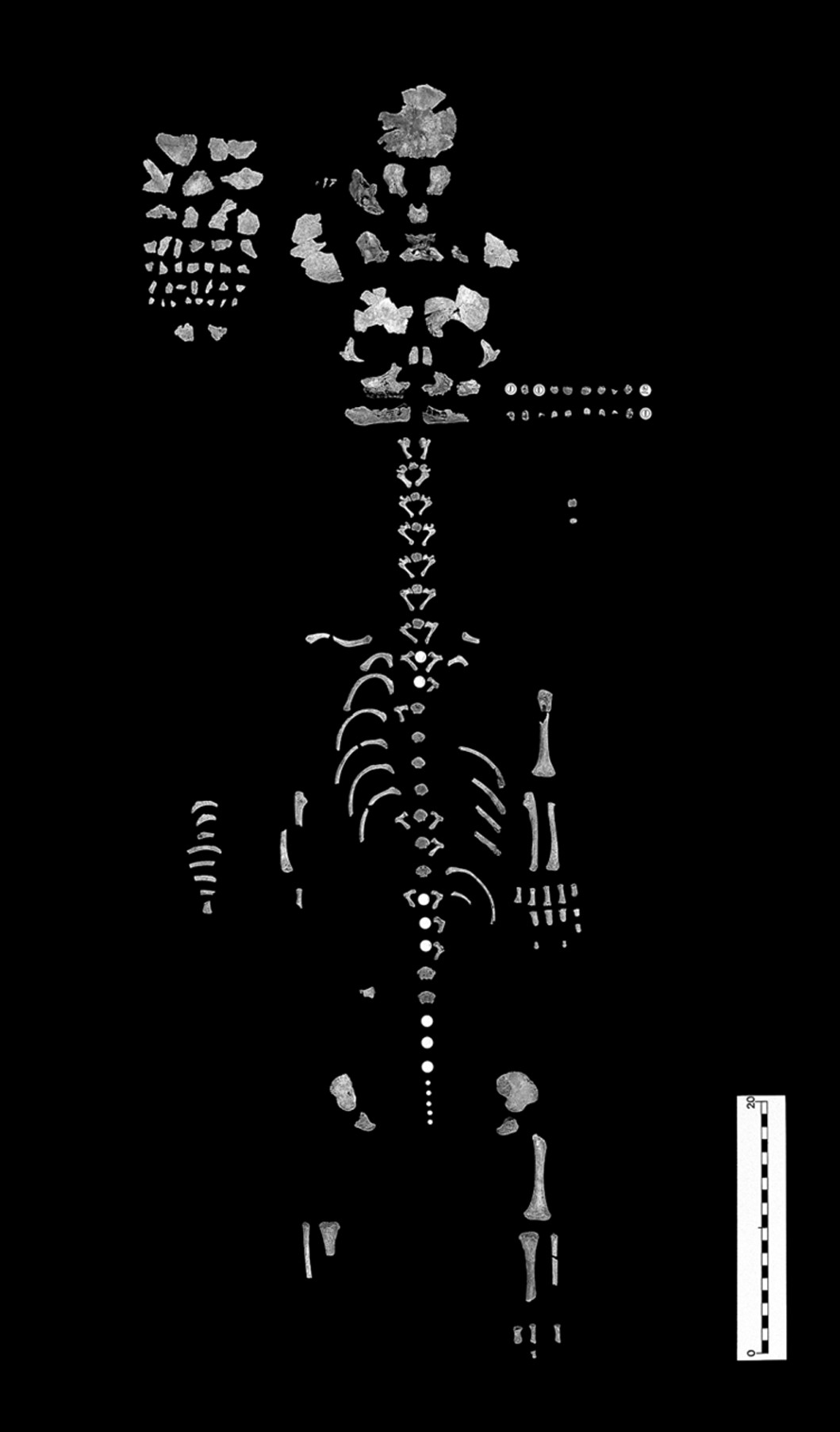
Another version of le Moustier 2, the Neanderthal neonate.
Although in black and white, the resolution is higher than the photo from Maureille (2002a) above.
Photo: http://tonguedepressors.tumblr.com/
A lost Neanderthal neonate found
A remarkable discovery in a French museum answers some long-standing questions.
Fossil remains of adult Neanderthals are well documented, but juvenile specimens are rare and information about them is scant. Here we identify a beautifully preserved skeleton that has been lost to science for almost 90 years as the Neanderthal neonate known as ‘Le Moustier 2’, which was originally found at Le Moustier in the Dordogne, southwest France. The burial pit originated in archaeological level J, a Mousterian cultural layer that has been dated to 40 300±600 years BP by thermoluminescence.
Although at the time the bones were thought to belong to a neonate, the specimen was not investigated further and the remains were thought to have been lost in Paris. During a survey in 1996 of collections in the Musée National de Préhistoire in Les Eyzies-de-Tayac-Sireuil, France, the remains of a neonatal skeleton were found among the lithic sample from Le Moustier. Some bones were isolated, but others were still embedded in blocks of sediment. The possibility that these might be the bones of Le Moustier 2 prompted a re-examination of Peyrony’s notes, which made no mention of the specimen ever having been sent to Paris.
Several crucial details emerged during the cleaning and restoration of the specimen that confirm that this skeleton is indeed the missing Le Moustier 2. The fossil was embedded in a sediment of sand containing green hornblendes, garnets and mica particles of muscovite type, a composition that has always been associated with the deposition of the Vézère river, which flows past the Le Moustier cliff. Preliminary sedimentological analysis revealed many similarities with layers I and J of Le Moustier. Furthermore, flint flakes and faunal remains (Rangifer tarandus, Cervus sp., Capra hircus ibex and a large Bovinae) in the sediment around the skeleton are identical to those found in the Mousterian levels at the Le Moustier inferior rock shelter. Estimations of stature based on the length of the long bones confirmed that the age at death was no more than four months. Although Le Moustier 2 is one of the most complete Neanderthal individuals to have been discovered, both scapulae and the pubis are missing. However, the right femur and right humerus, which were previously also missing, have now been found, having been wrongly attributed to the Neanderthal La Ferrassie 4 (LF4).
It had been assumed that the right femur and right humerus came from the burial pit of the La Ferrassie 4bis Neanderthal (LF4bis), even though their colour and fossilization differ markedly from those of LF4bis. Moreover, the sediment adhering to the LF4 bones contains muscovite, a mineral that is not present at La Ferrassie but which is prevalent at Le Moustier. Besides the matching fossilization and colour, the bones' morphology, variability, muscular insertions, discrete traits and measurements are identical to those of the left humerus and femur of the specimen from the Musée National de Préhistoire. It is likely that the two bones attributed to LF4 are in fact samples from Le Moustier 2 that were sent by Peyrony to Boule for an age diagnosis.
The attribution of the LF4 limb bones to Le Moustier 2 eliminates from the archaeological record the only double burial associated with Neanderthals.
Text above adapted from: Maureille (2002a)


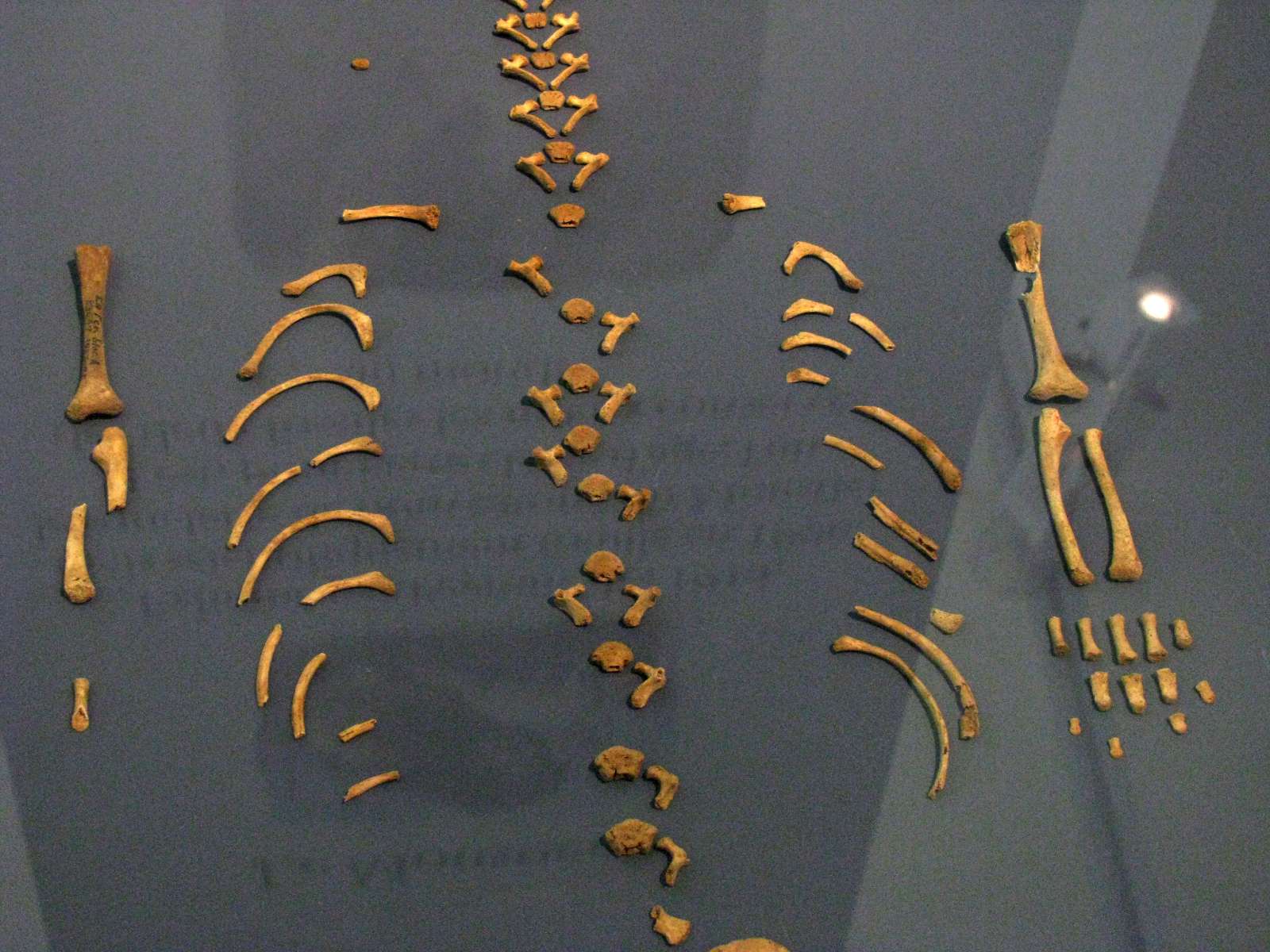

The skeleton was discovered in 1914 by archaeologist Denys Peyrony, on the site of the eponymous Moustier, in the Dordogne. It was "Lost" for 82 years in the collections of the National Museum of Prehistory, at Eyzies-de-Tayac, the block containing the small skeleton was fortunately rediscovered in 1996 and studied. This little skeleton is, for this age group, one of the best preserved fossils in the world.
The pit, ovular, 50 cm long and 40 cm deep, was dug from layer J to layer H (circa 40 000 BP). The baby was lying on his back, his head pushed to the left by a limestone block.
(Note that the right humerus and femur, formerly misidentified as La Ferrassie 4, are included in this reassembly. They are noticeably darker than the other bones, reflecting their different history after discovery - Don)
Text above: Adapted and translated from the display at Musée National de Préhistoire, Les Eyzies, and from http://www.rmn.fr/Pourquoi-s-interesser-aux
Photo: Don Hitchcock 2008
Source: Original skeleton on display at Musée National de Préhistoire, Les Eyzies
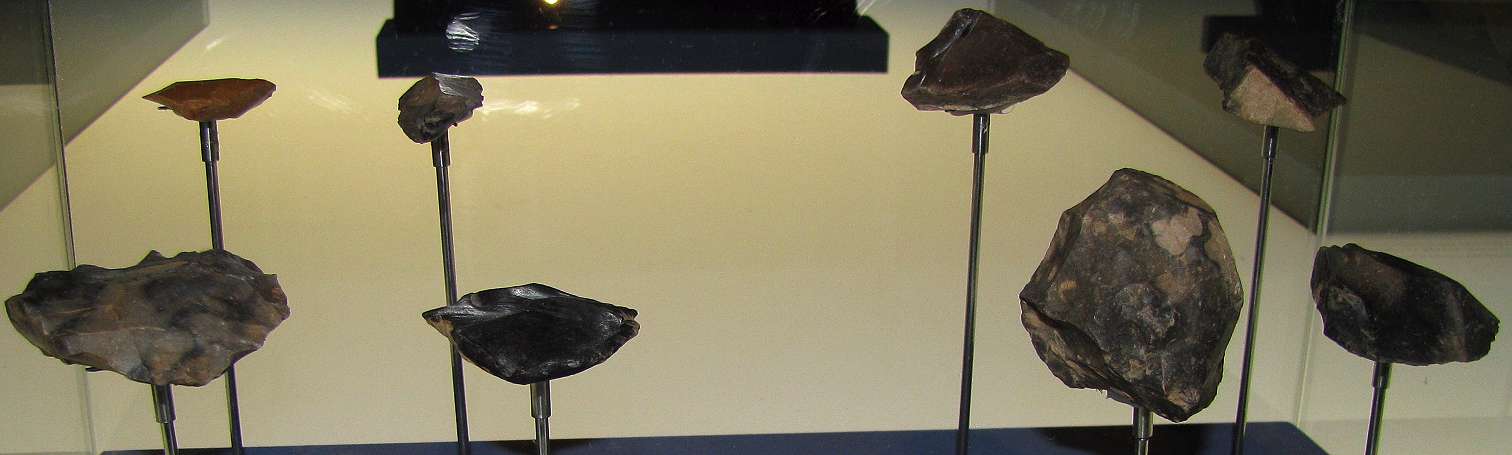
Tools associated with the Moustier 2 skeleton, found by D. Peyrony. (Collection of the Musée National de Préhistoire, Les Eyzies)
Text: Adapted and translated from the display at Musée National de Préhistoire, Les Eyzies
Photo: Don Hitchcock 2008
Source: Display at Musée National de Préhistoire, Les Eyzies
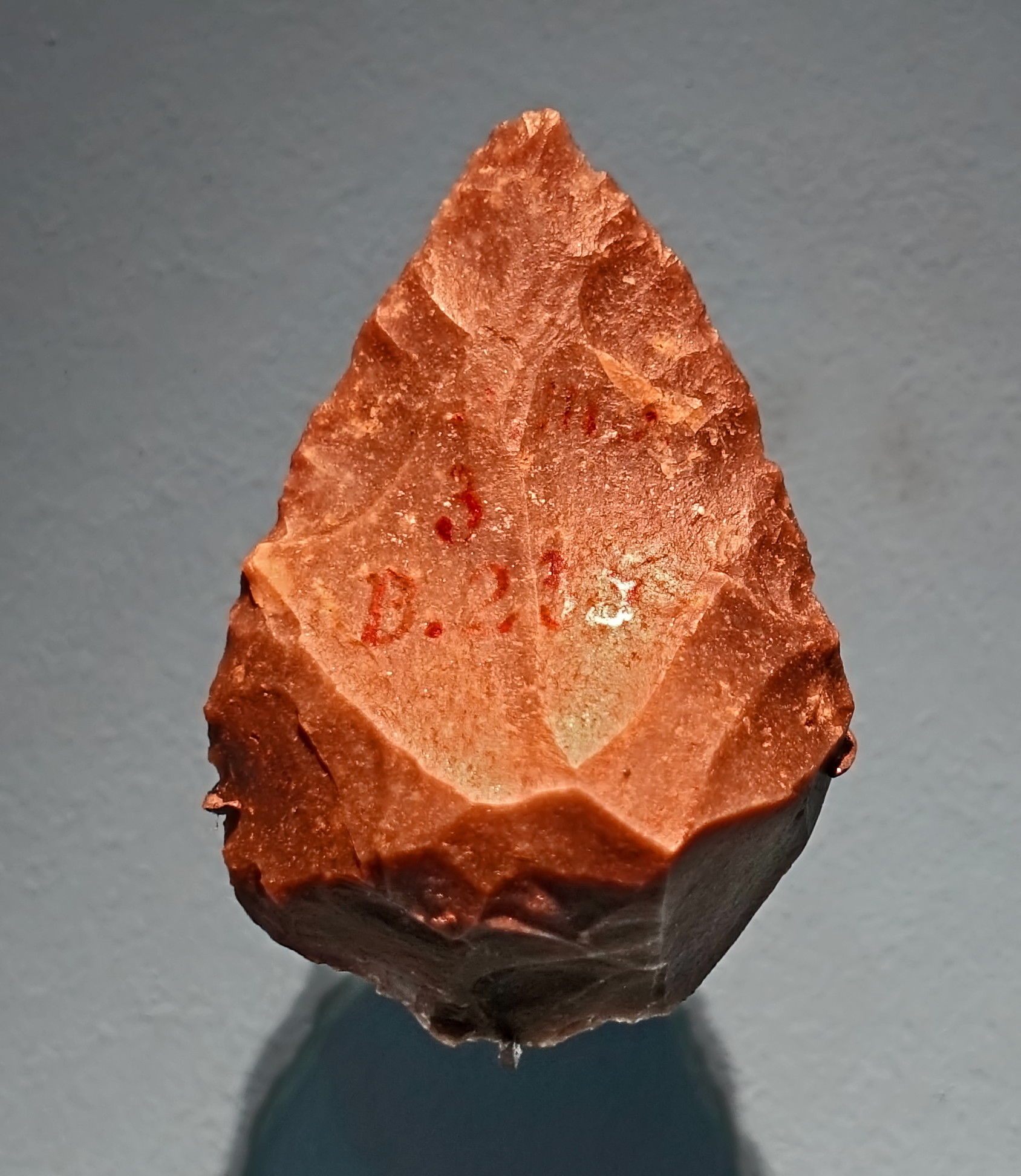
Biface in flint.
Circa 60 000 BP - 40 000 BP
Photo: Don Hitchcock 2018
Collections du Musée national de Préhistoire, Les Eyzies-de-Tayac
Source and text: Musée de l'Homme, Paris
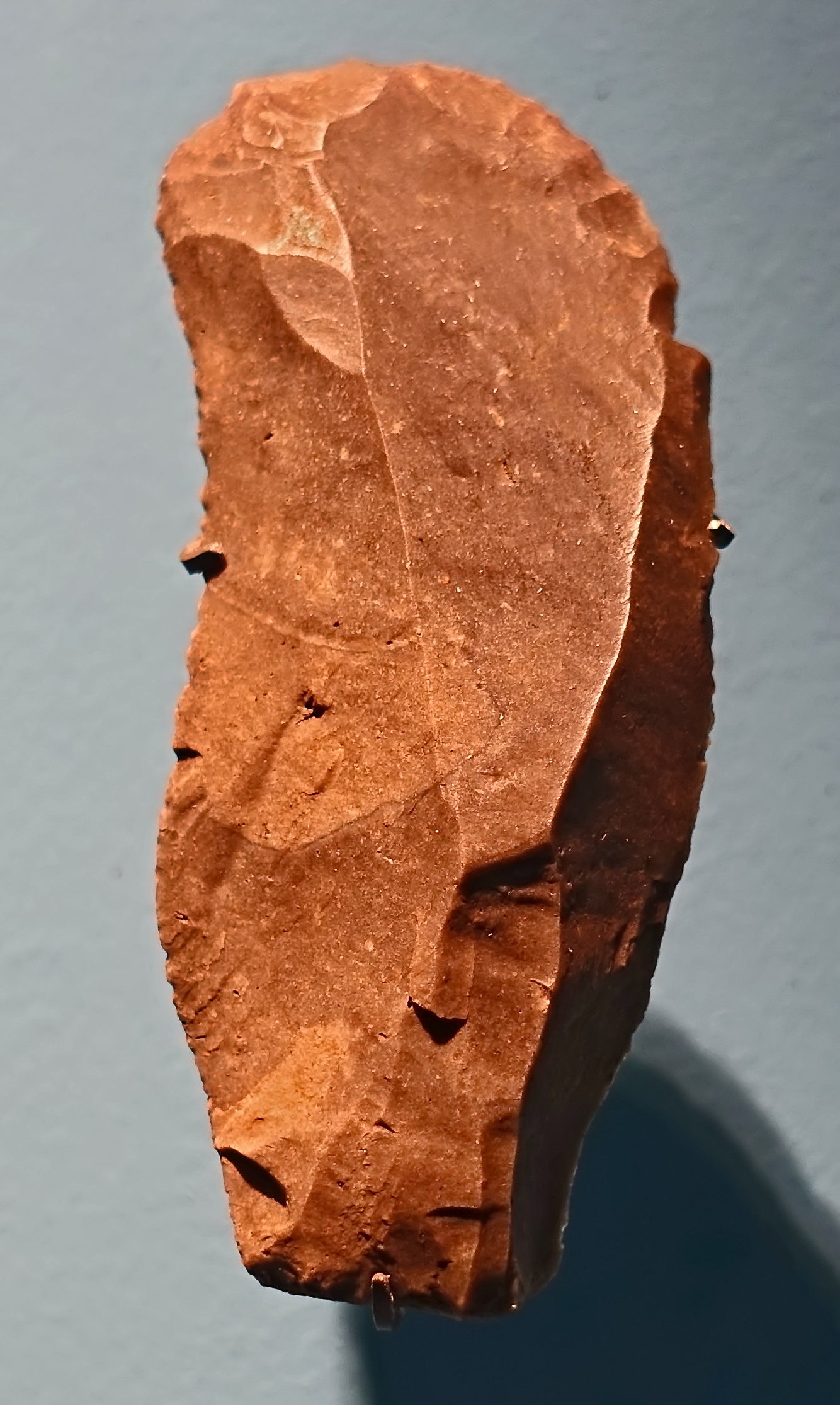
Grattoir, scraper, in flint.
Circa 60 000 BP - 40 000 BP
Photo: Don Hitchcock 2018
Collections du Musée national de Préhistoire, Les Eyzies-de-Tayac
Source and text: Musée de l'Homme, Paris
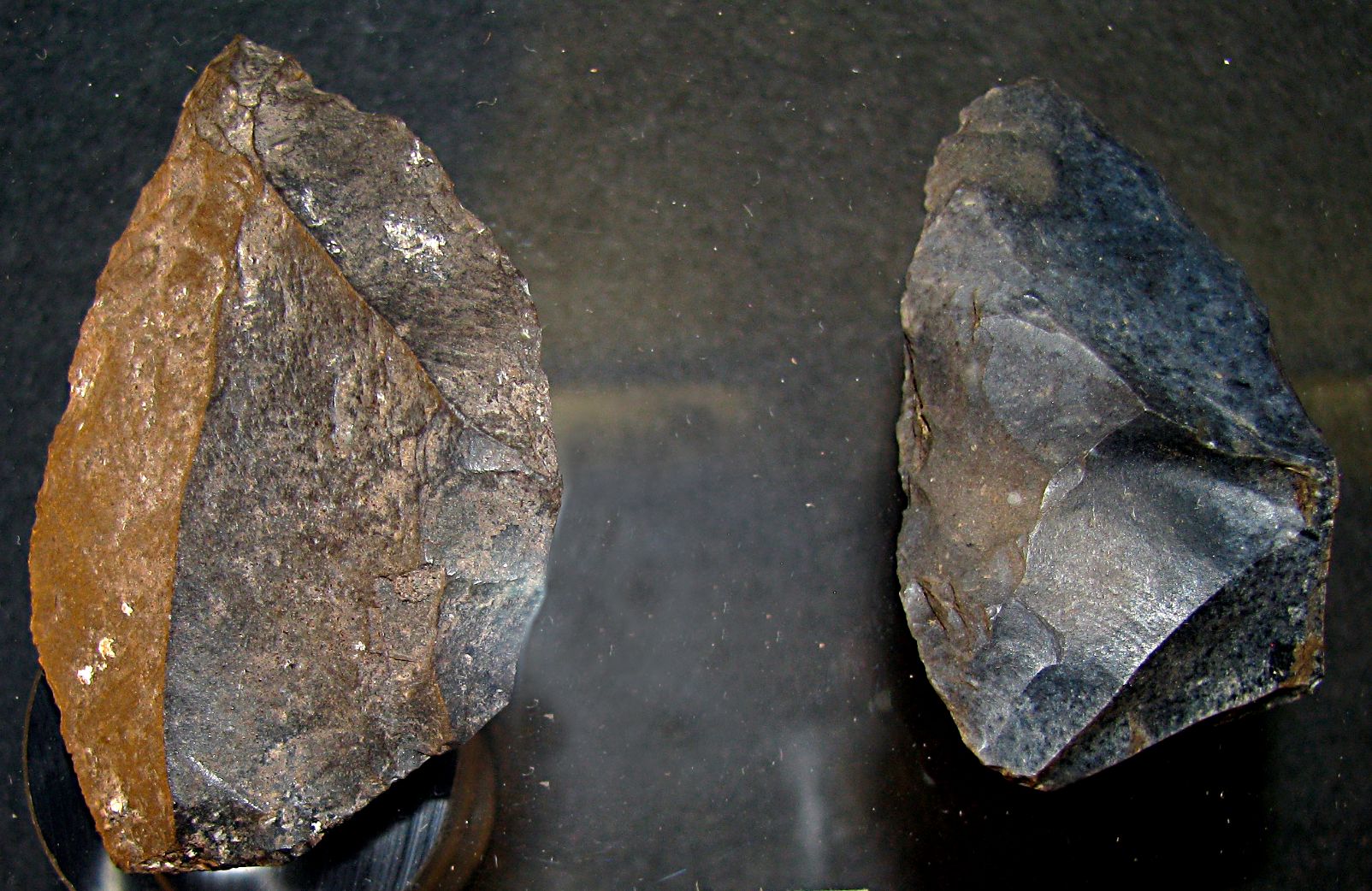
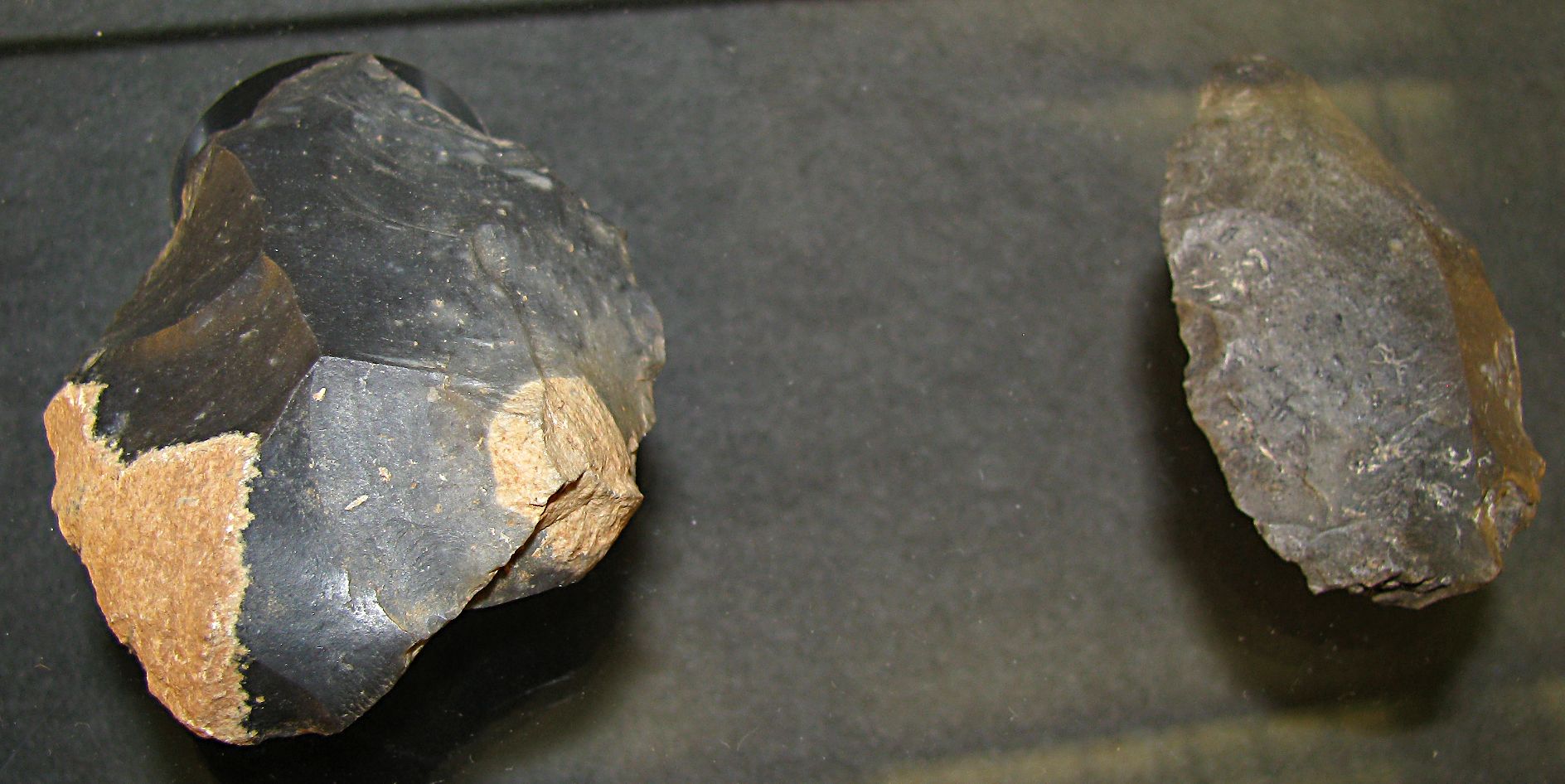
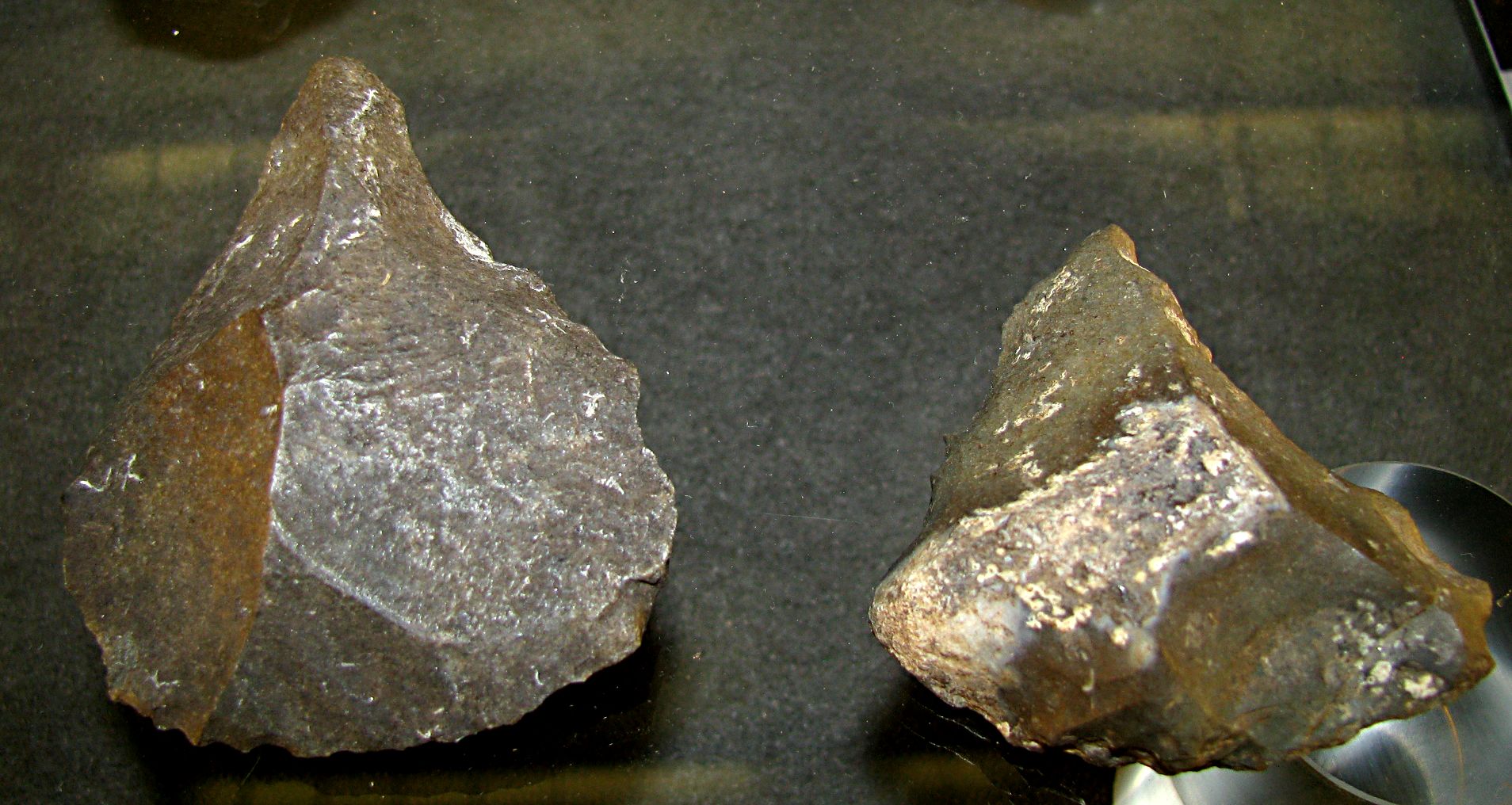
Stone tools from Le Moustier.
Photo: Don Hitchcock 2008
Source: Originals, display at the Vienna Natural History Museum, Naturhistorisches Museum Wien
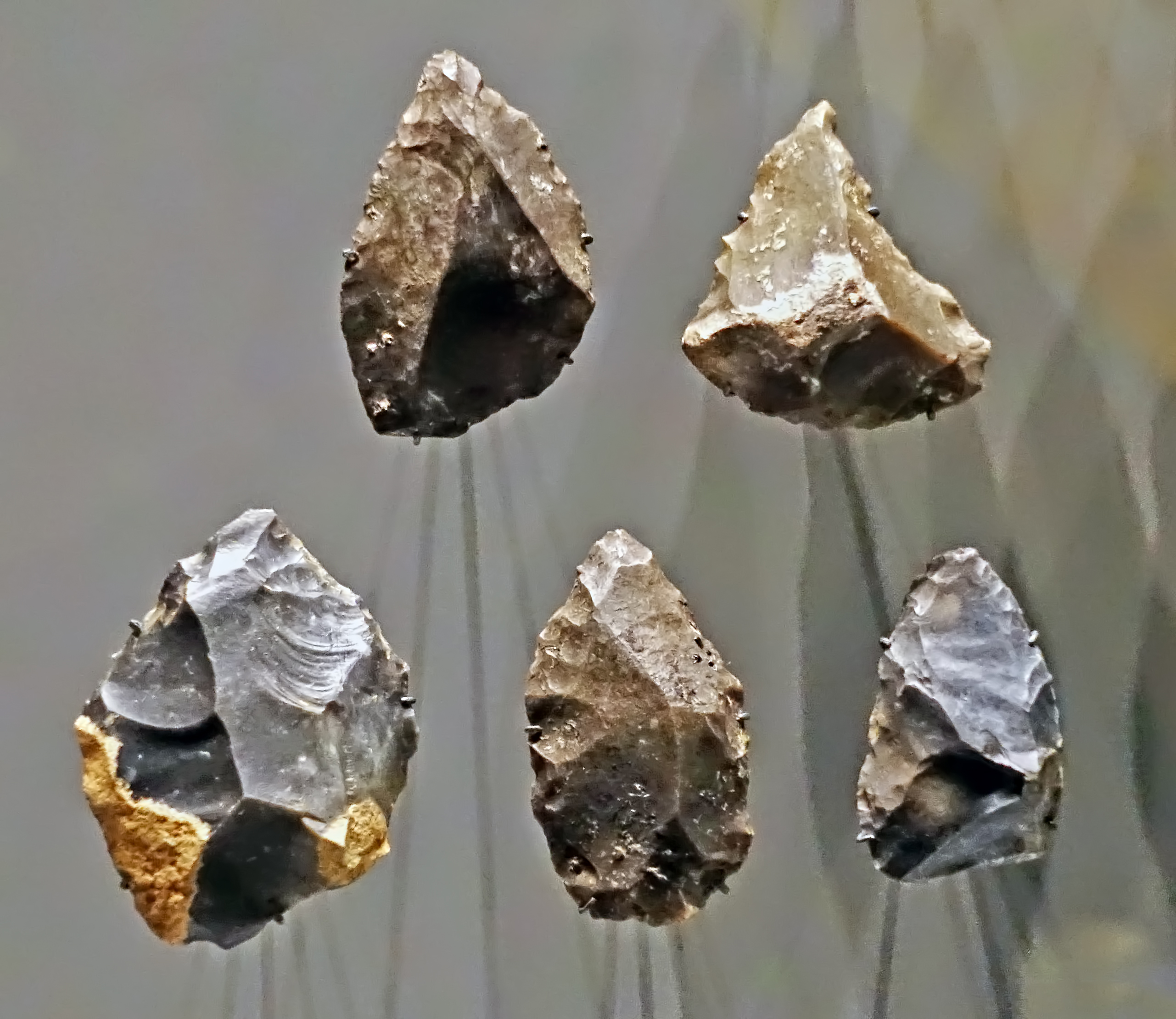
Le Moustier scrapers, Mousterian, 56 000 BP - 40 000 BP
Photo: Don Hitchcock 2018
Source: Museum of Natural History, Vienna
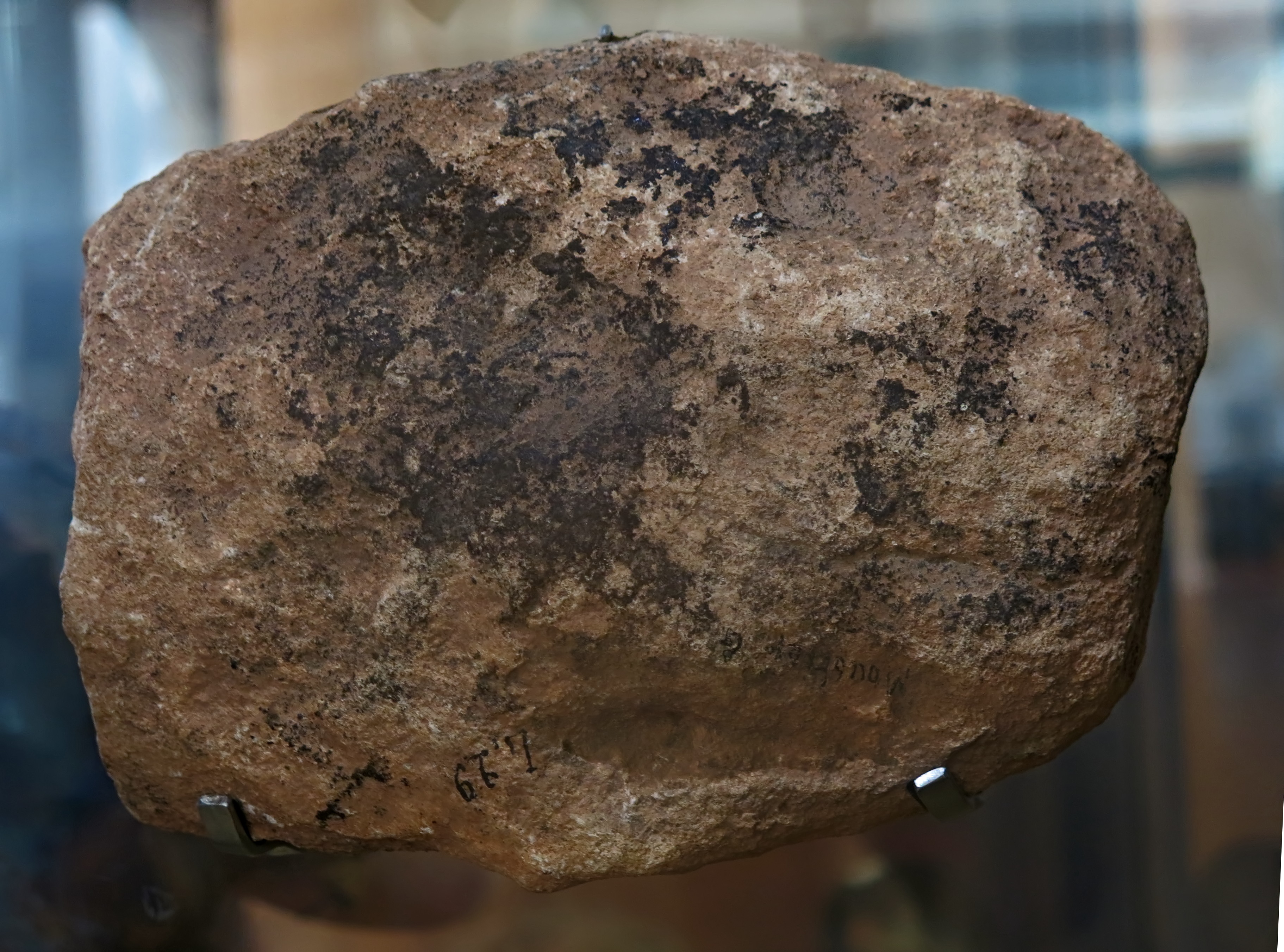
Block of limestone carrying traces of manganese, from Layer G of the excavations by Peyrony.
Manganese was useful as a catalyst to start fires.
Text: Adapted and translated from the display at Musée National de Préhistoire, Les Eyzies
Photo: Don Hitchcock 2008
Source: Display at Musée National de Préhistoire, Les Eyzies
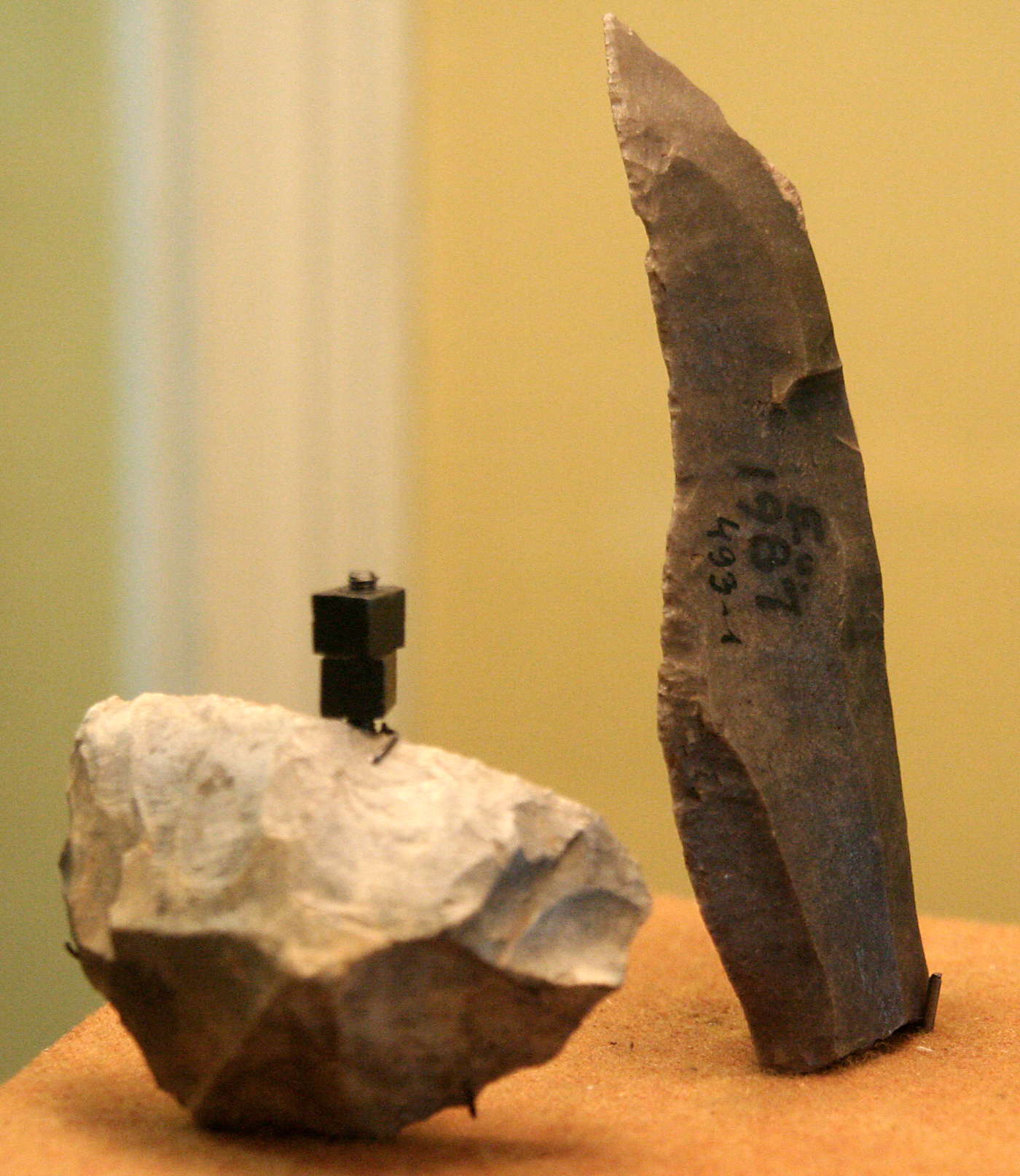
Identified only as Mousterian, these tools in the Hermitage Museum, Saint Petersburg, Russia, may be from Le Moustier.
(left) a flint scraper, (right) a flint point.
Photo: Vladimir Gorodnjanski 2007
Source: Originals, display at the Hermitage Museum, Saint Petersburg.
Background to the rediscovery of Le Moustier 2
On 19 May 1914, during excavations along the western edge of the earlier Hauser explorations, D. Peyrony (1921, 1930) discovered the remains of another human skeleton. This discovery is listed as Le Moustier 2 in the catalogue of European human fossils (Vandermeersch 1971). According to Peyrony (1930 ; see also Laville et al. 1980) the Le Moustier 2 burial pit originated in archaeological level J (a 40 cm brown layer containing a Typical Mousterian industry ; tab. 1) and was intrusive into levels I (a 20 cm sterile fluviatile level with Denticulate Mousterian tools heavily damaged by cryoturbation) and H (a 120-130 cm very rich brown layer, containing a Mousterian of Acheulian Tradition industry, type B). Archaeological levels J and H have been recently dated back (TL method), respectively, to 40,300 ± 2,600 and 42,500 ± 2,000BP (Valladas et al. 1986 ; tab. 2). The burial pit has the shape of a truncated cone of 40 cm depth with an upper oval diameter of 50 cm. The mixing of the sediments from layers J, I and H inside the pit as well as its limits were evident (Peyrony 1921, 1930). D. Peyrony recorded no data about the position of the skeleton in the pit nor any description of the state of conservation of the bones. It appears likely that immediately after the discovery, D. Peyrony «showed» some pieces of the skeleton to M. Boule, who was at the time examining fossils from earlier excavations of J.-L. Capitan and D. Peyrony at the La Ferrassie site. It is unclear, however, if M. Boule was given any information about the archaeological context of the infant skeleton and the Le Moustier site. Peyrony’s diary mentions that five days after the discovery of Le Moustier 2, M. Boule informed him that this was the skeleton of a neonate.Text above: Maureille (2002b)
Although D. Peyrony mentioned the Le Moustier 2 discovery in his publications about the site and discussions about Mousterian funeral practices, the specimen was not mentioned by M. Boule in his often highly critical appraisal of D. Peyrony’s interpretations of the site’s geological formation (Boule 1931). More important, it was also unlisted in the published listing of the human fossil finds from the Périgord «sent» to the Paleontological Department of the Musée National d’Histoire Naturel (MNHN) in Paris (Boule 1923) and was not mentioned in M. Boule synthetic books on human evolution (Boule 1921). In his 1936 catalogue of Paleolithic skulls, E. Hue noted that the Le Moustier 2 specimen was located at the Musée de Préhistoire des Eyzies (Hue 1937). But after the death of D. Peyrony (the 26th of November 1954), the existence of this fossil, or even its location, was no longer acknowledged. Some scholars suggested that it had been lost in Paris (Heim 1976, p. 6, note 1 and fig. 2a). Others believed that its whereabouts were unknown (Vandermeersch 1971).
In September 1996, in collaboration with members of the Musée National de Préhistoire (MNP) team, a comprehensive survey of the human remains in the archaeological collections of the Museum was undertaken. During this work, the remains of a human neonatal skeleton were found with the Le Moustier lithic collections. They were in a drawer containing Mousterian artifacts and some of the bones were isolated while others remained embedded in blocks of sediment. The bones were not marked nor was the container in which they were stored identified in any way. The possibility that this unidentified skeleton might be that of the missing Mousterian age infant mentioned by D. Peyrony led to an intensive examination of his unpublished notes and diaries concerning his work at the Le Moustier site (fig. 2a et 2b). These revealed no evidence that the remains of the Le Moustier 2 infant had at any time left the museum of Les Eyzies. Thus, the published suggestion that this skeleton had disappeared in Paris was mistaken.

George Collie (left) and Denis Peyrony in 1927 at Le Moustier.
Photo:
Straus (2001)
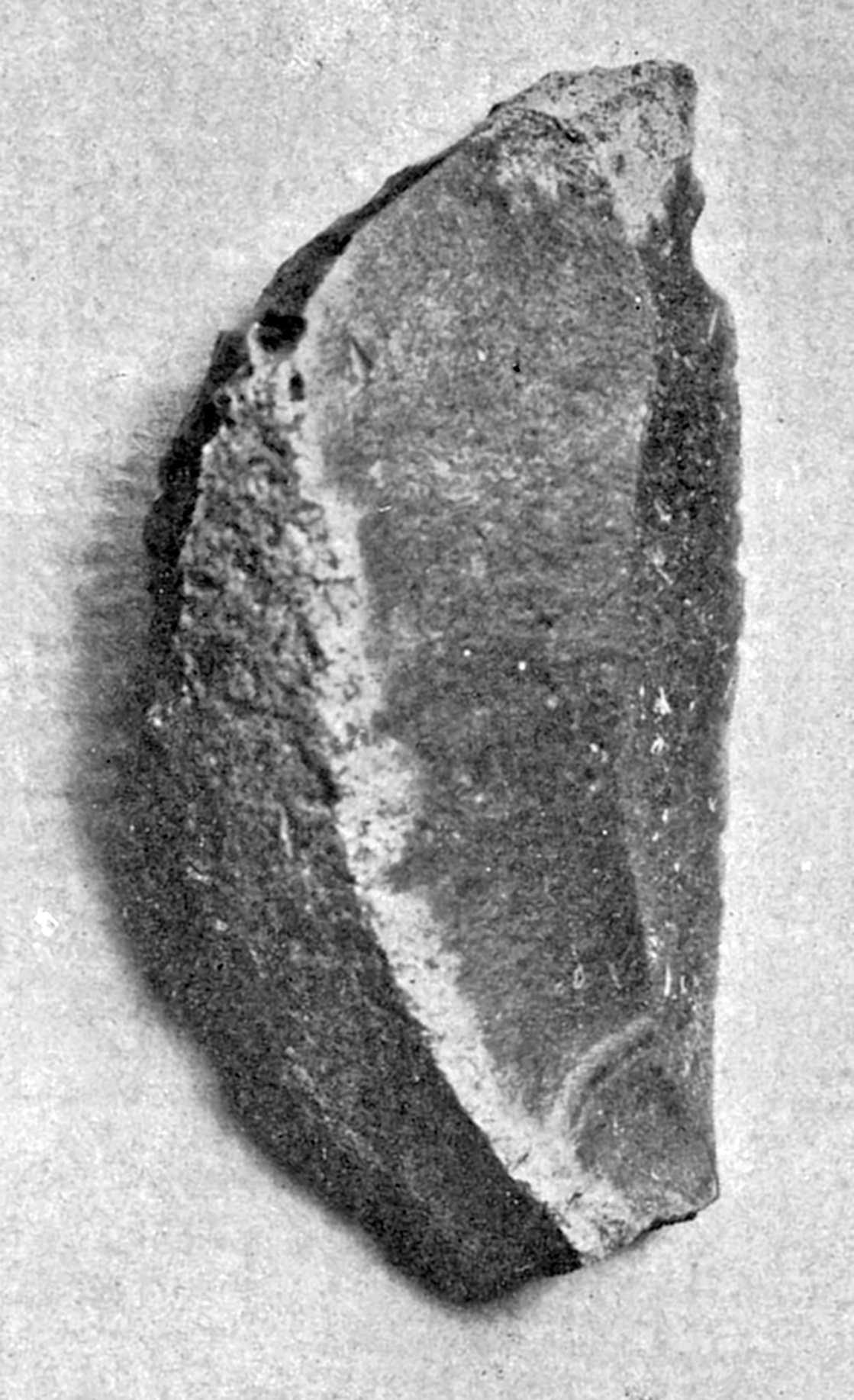
George Collie brought back some tools from Le Moustier, including this 'Audi Blade', i.e. a blade similar to those from Abri Audi, Les Eyzies.
It was found at the lower level of Le Moustier.
Photo: Collie (1928)
References
- Collie, G., 1928: The Aurignacians and their culture, Issued January 1928 as Beloit College Bulletin, Vol. XXVI. No 2, printed by the Daily News Publishing Company
- Delluc B. et G., Roussot A. et Roussot-Larroque J., 1992: Discovering Périgord Prehistory, Editions Sud Ouest, Bordeaux, 128 p., ill.
- Favraud, A.,1908/1909: La station Moustérienne du Petit-Puymoyen Alcan, F. (ed) Revue de L'École d'Anthropologie de Paris, 1908 -1909 (not in copyright)
- Hoffecker, J.,2005: A Prehistory of the North - Human Settlement of the Higher Latitudes, Rutgers University Press
- Lartet, E., Christy H.,1875: Reliquiae aquitanicae : being contributions to the archaeology and palaeontology of Pèrigord and the adjoining provinces of Southern France, London: Williams, 1875
- Maureille, Bruno, 2002a: A lost Neanderthal neonate found, Nature, 9/5/2002, Vol. 419 Issue 6902, p33, 2p, 1 color; (AN 7552704)
- Maureille, Bruno, 2002b: La Redécouverte du Nouveau-Né Néandertalien Le Moustier 2, PALEO – N° 14 – DÉCEMBRE 2002 – Pages 221 à 238 (pers. comm.)
- Peyrony, D., 1930: Le Moustier. Ses gisements, ses industries, ses couches géologiques Revue anthropologique, XL, 1930, p49 - 52
- Straus, L.G. (ed.), 2001:Actes du XIVème Congrès UISPP, Université de Liège, Belgique, 2-8 septembre 2001