Back to Don's Maps
Mezhyrich / Межиріч - Mammoth Camp
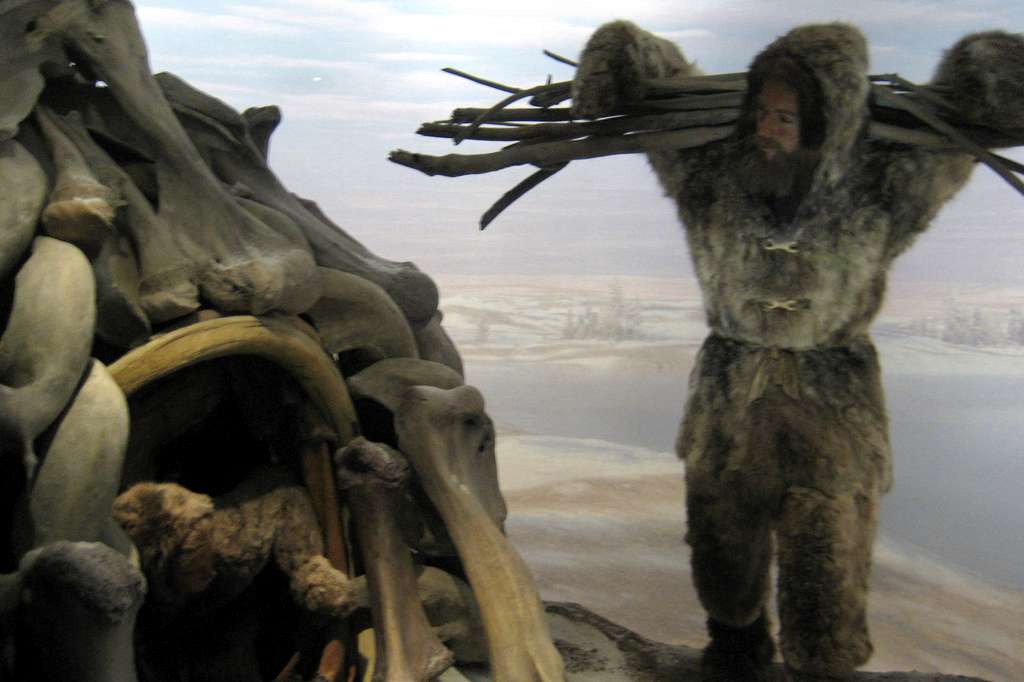
Diorama of a bone hut at Mezhyrich
Photo: Wally Gobetz, from a diorama display at the American Museum of Natural History, online at http://archaeology.about.com

Painting in red on the front of mammoth skull found at the entrance to one of the huts at the mammoth hunter's settlement at Mezhyrich. It is thought that the red design may represent the flames and sparks of a fire.
At Mezhyrich in 1965, a farmer dug up the lower jawbone of a mammoth while in the process of expanding his cellar. Further excavations revealed the presence of four huts, made up of a total of 149 mammoth bones. These dwellings, dating back some 15,000 years, were determined to have been some of the oldest shelters known to have been constructed by pre-historic man. Mezhyrich or Межиріч, is a village in central Ukraine near the point where the Rosava River flows into the Ros.
(text above adapted from Wikipedia)
The early prehistorians of the last century were understandably concerned with establishing the order and sequence of their materials, since no means of exact dating existed to help them. They often sank narrow pits down through the deposit with the sole object of establishing which tools came from which layer, thereby forming a picture of technical changes from one age to the next. These studies are still important but leave unanswered many questions about the kind of society to which the toolmakers belonged. Much broader information is obtained today, not just by digging downward, but by digging outward, or horizontally, at the same time. If the conditions of preservation are favorable, the archaeologist traces and follows the original floor on which the prehistoric inhabitants walked, hoping to expose the remains of hearths and wooden structures. Each layer is successively peeled off over as wide an area as possible. The patterns of flint and bone debris scattered across each floor can give important clues to the particular types of activities that were once carried on there.
The change from narrow pits to broad exposures was an innovation not of the French but of the Russians. In the early years of this century, Russian archaeologists first began encountering thick concentrations of animal bones on the terraces of such great Ukrainian rivers as the Dniester and the Don. Pits sunk here and there could make no sense of the dense bone heaps, but as soon as the remains were opened up horizontally over a broad area, the picture came clear. The bones once formed the foundations and frameworks.of houses built when wood was scarce and the shelter of caves unavailable. Since the late 1920s, such bone houses have been found in considerable numbers, often clustered together in little "villages" of four or five houses in the fertile valleys of Ukraine - The same method of construction has appeared as far west as Kracow, in Poland, where recent excavations in the city centre revealed three rings of mammoth bones exactly similar to those in Mezhyrich and Mizyn and dating to about 20 000 years ago.
Some of these bone buildings were remarkable structures in their time. One of the most intricate was discovered in 1965 at a place called Mezherich, near Kyiv in Ukraine. A farmer, digging his cellar, almost two meters below ground level, struck the massive lower jaw of a mammoth with his spade. The jawbone was upside down, and had been inserted into the bottom of another jaw like a child's building brick. In fact, as subsequent excavation showed, a complete ring of these inverted interlocking jaws formed the solid base of a roughly circular hut four or five meters across. About three dozen huge, curving mammoth tusks had been used as arching supports for the roof and for the porch, some of them still left in their sockets in the skulls. Separate lengths of tusks were even linked in laces by a hollow sleeve of ivory that fitted over the join. It has been estimated that the total of bones incorporated in the structure must have belonged to a minimum of ninety-five mammoths. This need ,not be a measure of some prodigious hunting feat, since gnawing marks of carnivores suggest that many of them were scavenged. However, the task of dragging the enormous skulls across country should not be underestimated since a-small one weighed about one hundred kilograms. It is likely that this extremely solid framework, when completed, was covered with hides just like the skin and whalebone huts built by Siberian coastal hunters during the nineteenth century.
Inside the Mezherich building, there were some remarkable finds: amber ornaments and fossil shells, transported an estimated 350 to 500 kilometres from their source, and the remains of one of the earliest percussion instruments ever found. The "drum" consisted of a mammoth skull set at the entrance porch and painted with a pattern of red ocher dots and lines. The top of this skull bears depressions where it seems to have been beaten by "drumsticks," the animal long bones that were found to bear corresponding damage on their ends. It is possible that the building may have served some ritual or communal function at which the mammoth bone rhythms were beaten out, although many Ukrainian huts of a similar size seem to have been ordinary living places.
In the far west, there was simply no need for such solid structures because shelter was provided by limestone overhangs and cave mouths. Nevertheless, the same principles of excavation pioneered in Russia have revealed traces of "interior design" at a number of cave sites, such as the remains of wooden partitions and lean-to structures that would have helped to exclude cold and damp. In addition, temporary open-air camps are being discovered in increasing numbers in western Europe. Several of these appear to be summertime halts occupied by small groups of hunters who may have joined up with larger groups to live in the shelter of caves during the winter. At the most thoroughly investigated of all these camps, situated at Pincevent in the Seine valley, a meticulous attention to detail allowed the excavator to reconstruct the outlines of three light skin tents occupied by a small summer band of reindeer hunters. Although no wooden or bone foundations had survived, the shape of the structures was revealed partly by the pattern of flint flakes struck off by toolmakers inside the tents. The paths traced by some of the flakes had clearly been interrupted by the hide walls.
Text above: 'Secrets of the Ice Age' by E. Hadingham
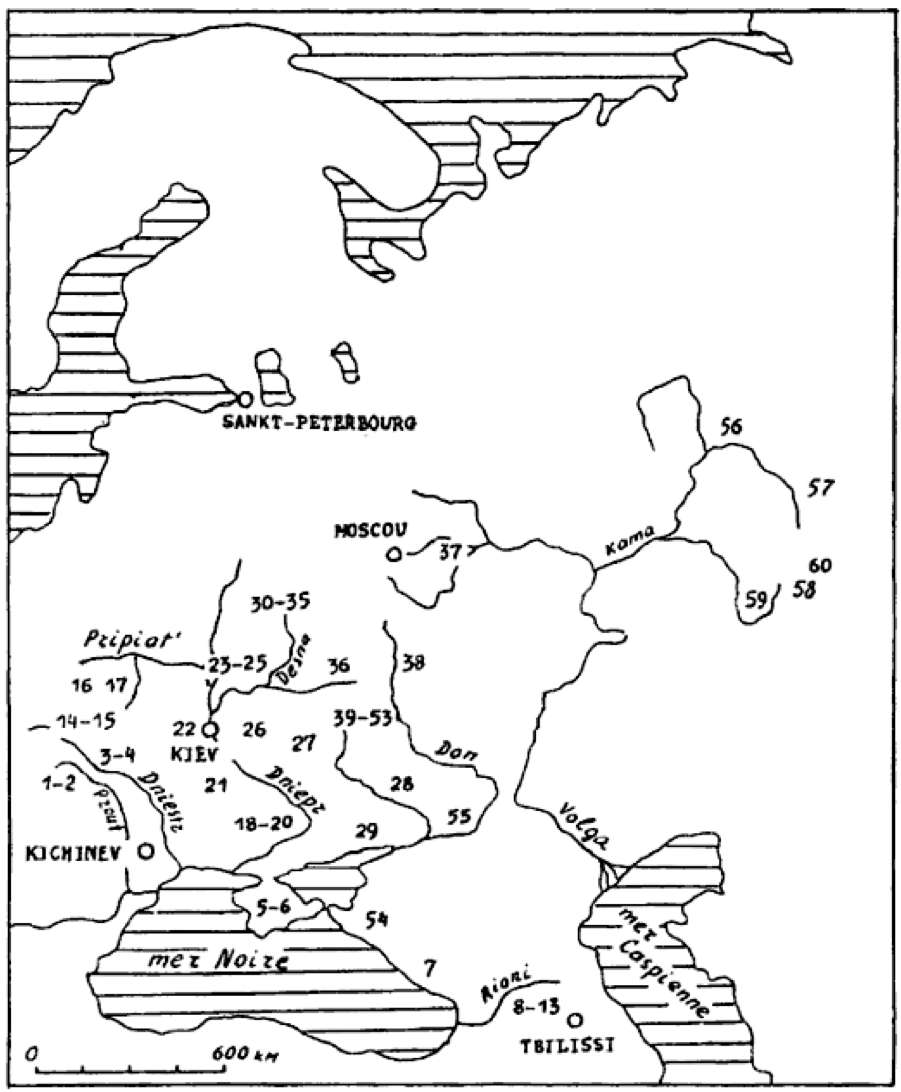
Distribution of mobile art in Eastern Europe.
1 Staryé Duruitory, 2 Brynzeny, 3 Kosseoutzy, 4 Klimaoutzy, 5 Suren' 1, 6 Chan-Koba, 7 Apiantcha, 8 grotte d'Uvarov, 9 Sakagia, 10 Sagvardgilé, 11 Gvardgilas-Kldé, 12 Devis-Khvreli, 13 Taro-Kldé, 14 Molodova V, 15 Lissitchniki, 16 Lipa VI, 17 Klinetz, 18 Ossokorovka, 19 Dubovaya Balka, 20 Kaïstrovaya Balka, 21 Mejiritch (Mezhyrich), 22 Kyivo-Kirillovskaya, 23 Mézine (Mizyn), 24 Novgorod Severskyi, 25 Puchkari I, 26 Dobranitchevka, 27 Gontzy, 28, Rogalik, 29 Amvrossievka, 30 Eliseevitchi I, 31 Eliseevitchi II, 32 Yudinovo, 33 Khoylevo II, 34 Timonovka, 35 Suponevo, 36 Avdeevo, 37 Sungir', 38 Gagarino, 39 Kostienki 19, 40 Kostienki 21, 41 Kostienki 13, 42 Kostienki 1, 43 Kostienki 14, 44 Kostienki 12, 45 Kostienki 17, 46 Kostienki 2, 47 Kostienki 11, 48 Kostienki 4, 49 Kostienki 15, 50 Kostienki 9, 51 Kostienki 8, 52 Borchtchevo 1, 53 Borchtchevo 2, 54 Ilskaya, 55 Murakovka, 56 Ostrovskaya, 57 Bez'imyannyi, 58 Smelobskaya, 59 Kapova, 60 Ignatievskaya.
Photo: Abramova (1995)
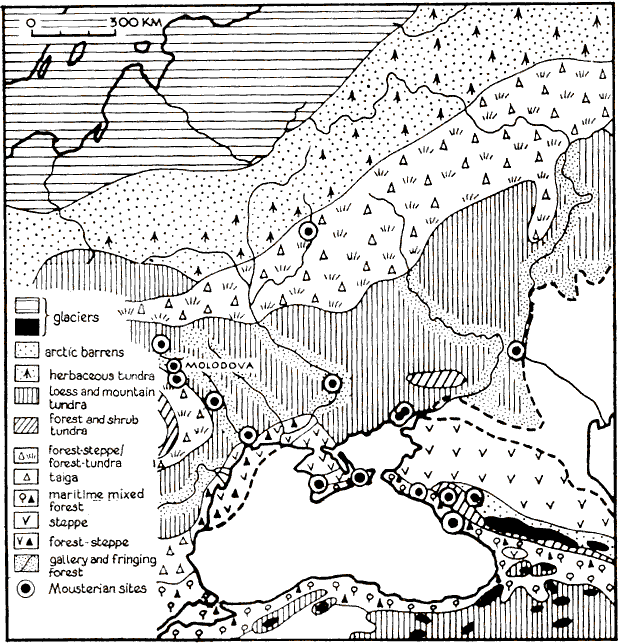
Vegetation Zones of Ukraine at the height of the last glacial
Photo: After Klein, R.G. Mousterian cultures in European Russia.
Science, 165, pp. 257-65

Mezhyrich location
View towards the site and the Ros and Rosava floodplain. Arrow indicates site location
Photo: O.Soffer, 'The Upper Paleolithic of the Central Russian Plain'
This site dates from about 15 000 bp.
Location: 49 deg 38' N, 31 deg 24'E
Located on a North facing promontory overlooking the valleys of the Ros and Rosava Rivers at their junction.
Discovered (1965) as with many other similar sites in Ukraine when a farmer began excavating a cellar a short distance from his front door. Excavated originally by I.G. Pidoplichko. Recent research (Sarah Mason at: http://www.ucl.ac.uk/archaeology/research/profiles/smason/smmezher.htm) indicates that there is a significant quantity of wood charcoal at the Mezhyrich site, which is surprising when you consider that most researchers have assumed that the area was essentially treeless. The wood charcoal could perhaps have come from small woody shrubs.
S. Mason has also found tap root material from the compositae family, which includes daisies and dandelions, at Dolni Vestonice. These roots are often quite edible. See http://www.ucl.ac.uk/archaeology/research/profiles/smason/smdolnv.htm
A useful book may be:
Pidoplichko, I., Upper Palaeolithic dwellings of mammoth bones in the Ukraine: Kiev-Kirillovskii, Gontsy, Dobranichevka, Mezin and Mezhyrich. Oxford: J. and E. Hedges, 1998. 276 p. University Museum Library GN414.3.B64 P53 1998

Mezhyrich reconstruction
This is a reconstruction of one of the mammoth bone structures (Dwelling 1) at Mezhyrich
Photo: A Gregorovich, http://209.82.14.226/history/inventions/

The original site of Mezhyrich, with a structure to preserve part of the discoveries from the weather.
Coordinates 49° 37'57" N 31° 25'36" E
Photo: Teesla, http://wikimapia.org/12781641/ru/
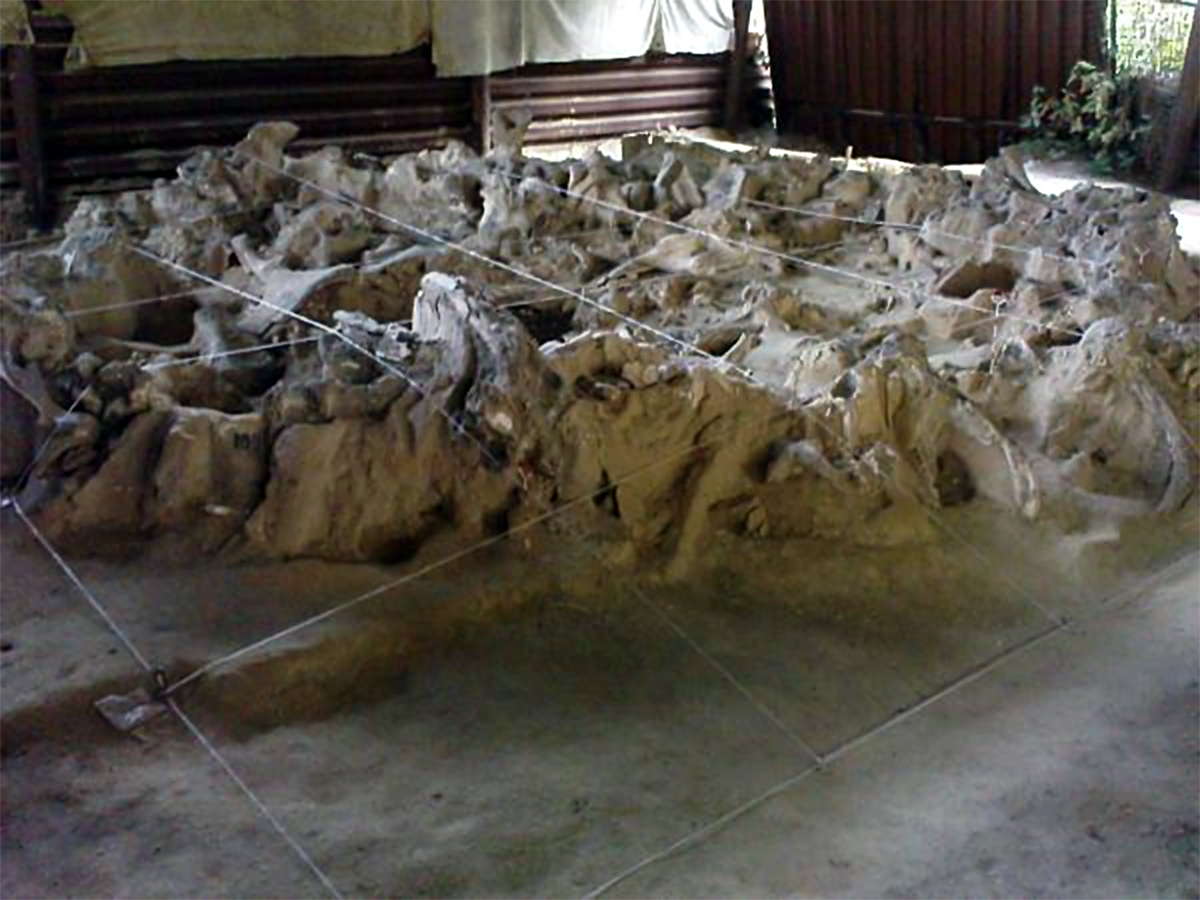
Inside the structure shown above, with part of the site still intact, with mammoth bones.
Photo: Teesla, http://wikimapia.org/12781641/ru/

It would appear that the structure used to protect the Mezhyrich deposits has been upgraded, from this photo. Note that the walls have been considerably improved.
Photo: © doroga.ua, http://www.doroga.ua/poi/Cherkasskaya/Mezhirich/Mezhirichskaya_stoyanka/1596
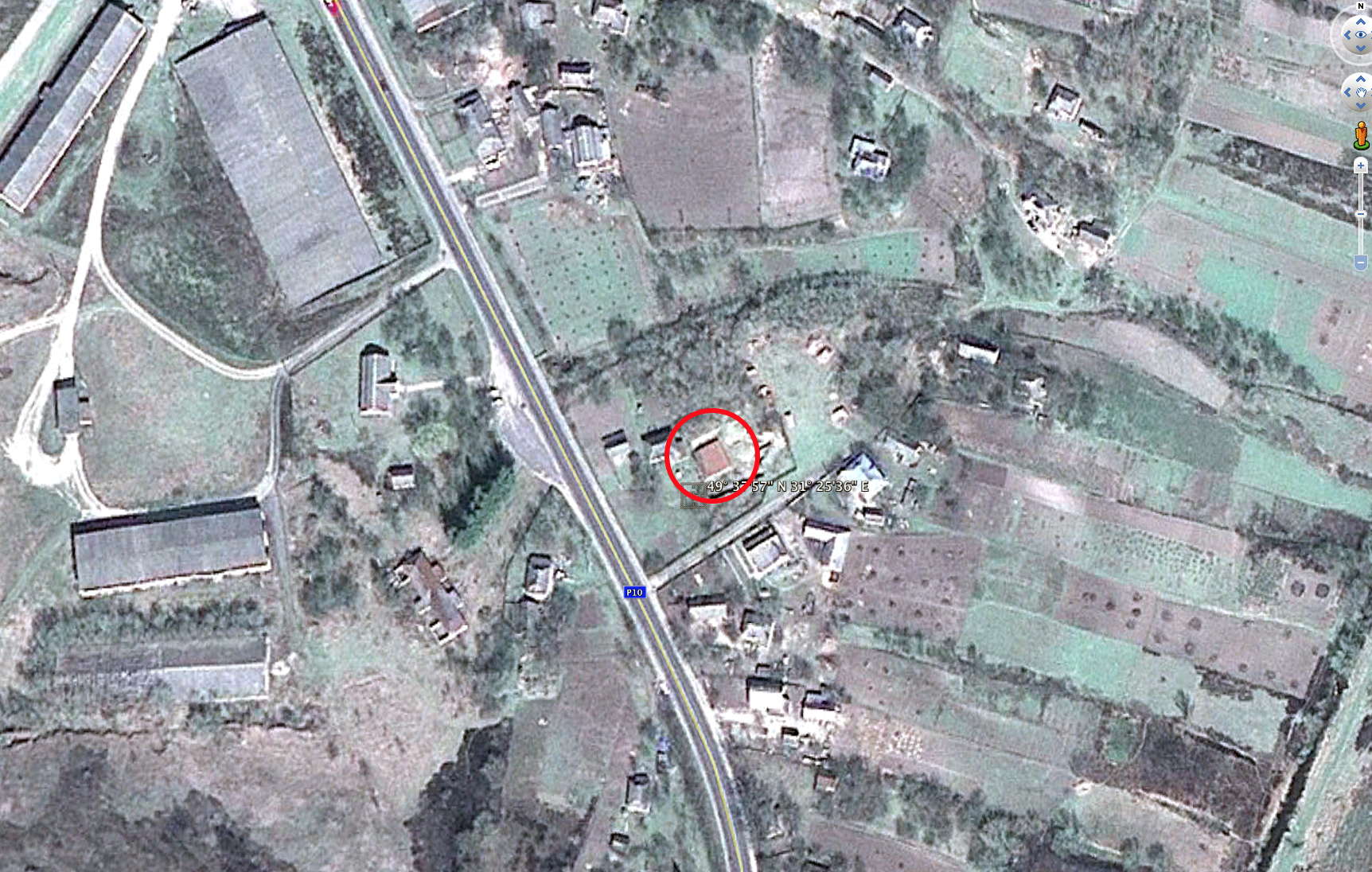
The structure above is circled on this satellite photo.
Photo: Google Earth
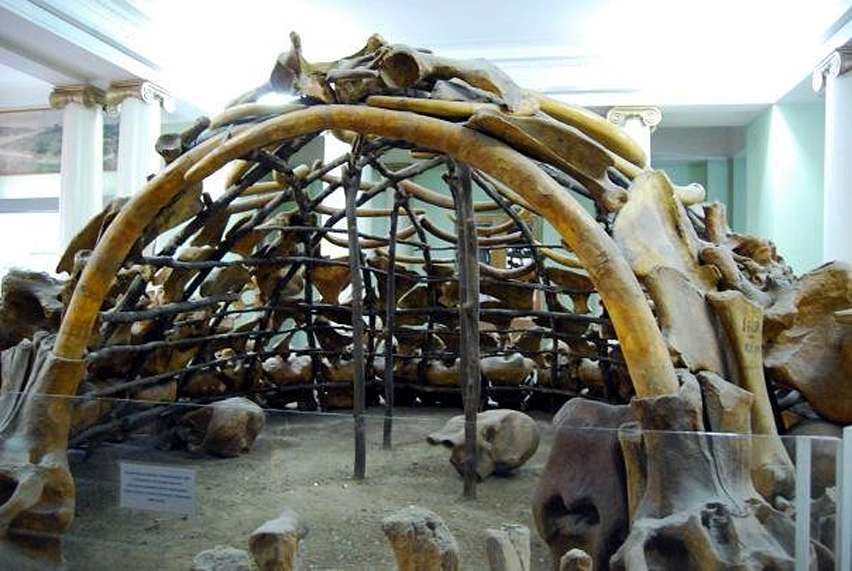
Mammoth bones used to recreate a building of the ice ages.
Photo: Sasha Desyaterik, http://archaeologyofmyth.com/expeditions/
Source: Display at the Natural History Museum of Kyiv.

Click on the image to see a panorama of the inside of the mammoth bone house, which you can explore by clicking and dragging your mouse across the image, up, down, left and right.
Photo/panorama: Natural History Museum of Kyiv, http://museumkiev.org/
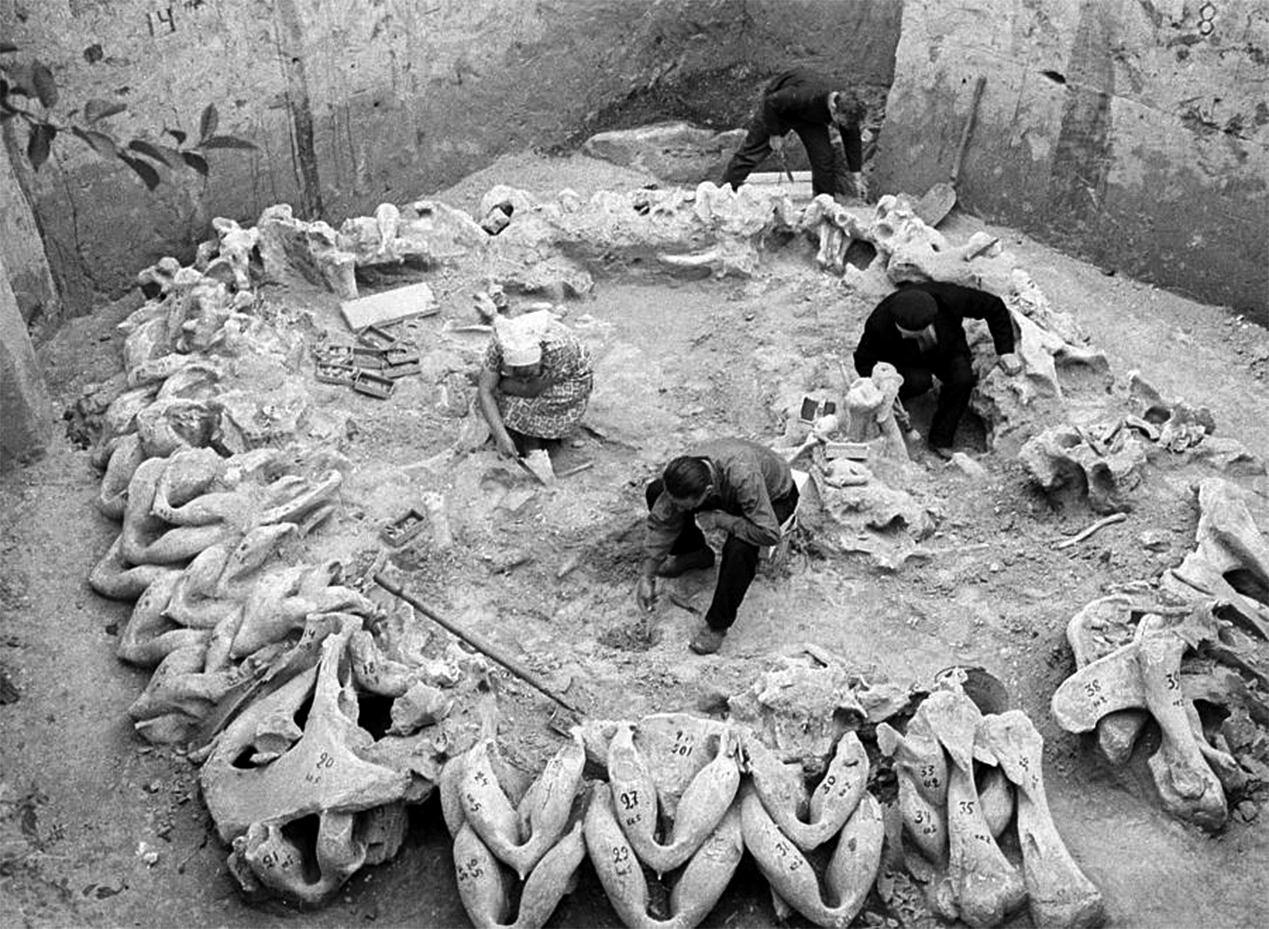
The Mezhyrich bone hut during the initial excavation.
Photo: http://images.fineartamerica.com/images-medium-large/mammoth-bone-hut-excavation-ukraine-ria-novosti.jpg

Bone needle with an ornamental head, probably used to fasten garments, found at the Mezhyrich site.
Photo: K. Sklenar, 'Hunters of the Stone Age'
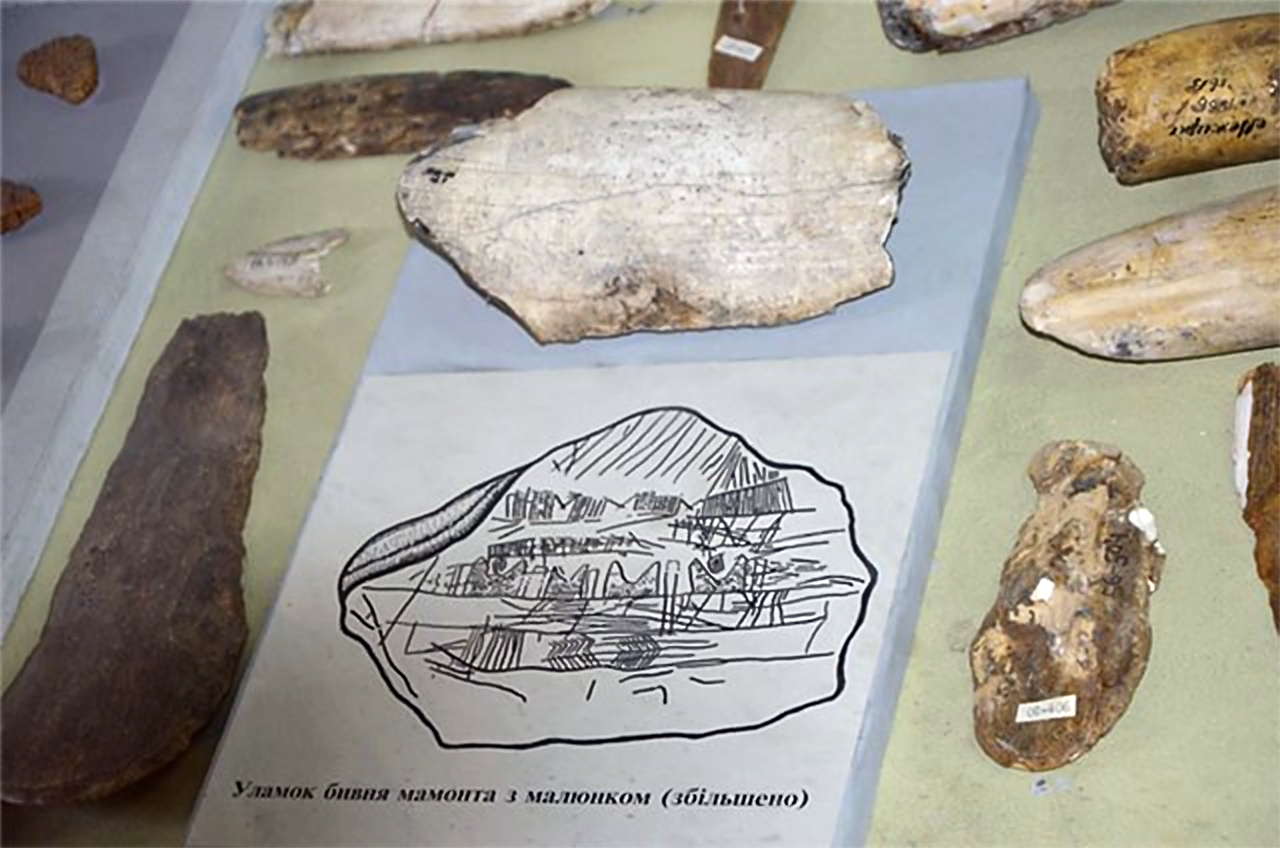
This shows what may be the original map on an ivory plaque from Mezhyrich, межиріч, on display in a Russian/Ukrainian museum.
It is the oldest known map in the world, dating from 14 000 BP.
I would be very glad to get a better image of this map, especially of the original ivory plaque.
Photo: http://ort.in.ua/phpbb3/viewtopic.php?f=42&t=808
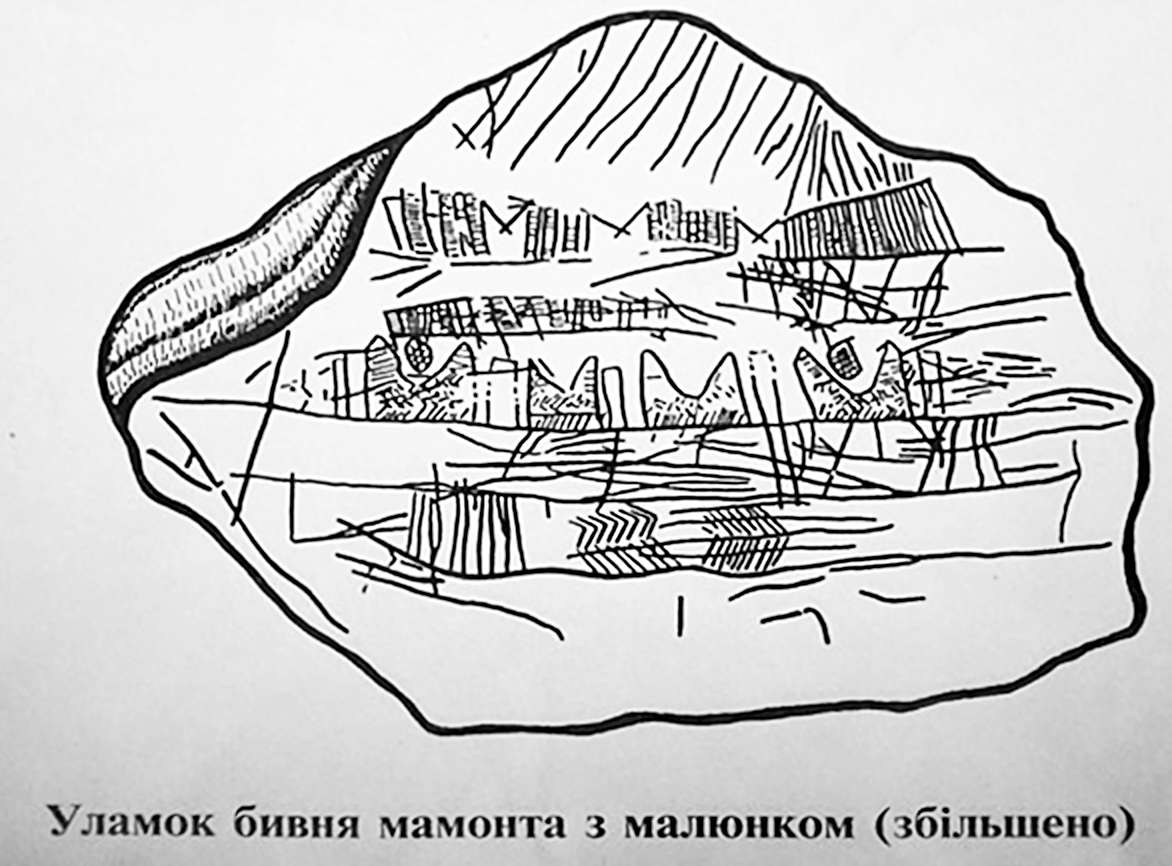
This is a close up of the drawing in the museum shown above.
Photo: http://ort.in.ua/phpbb3/viewtopic.php?f=42&t=808

This is a close up of the 'house' on the far left of the central horizontal line in the Mezhyrich map above.
Photo: http://ort.in.ua/phpbb3/viewtopic.php?f=42&t=808&start=10
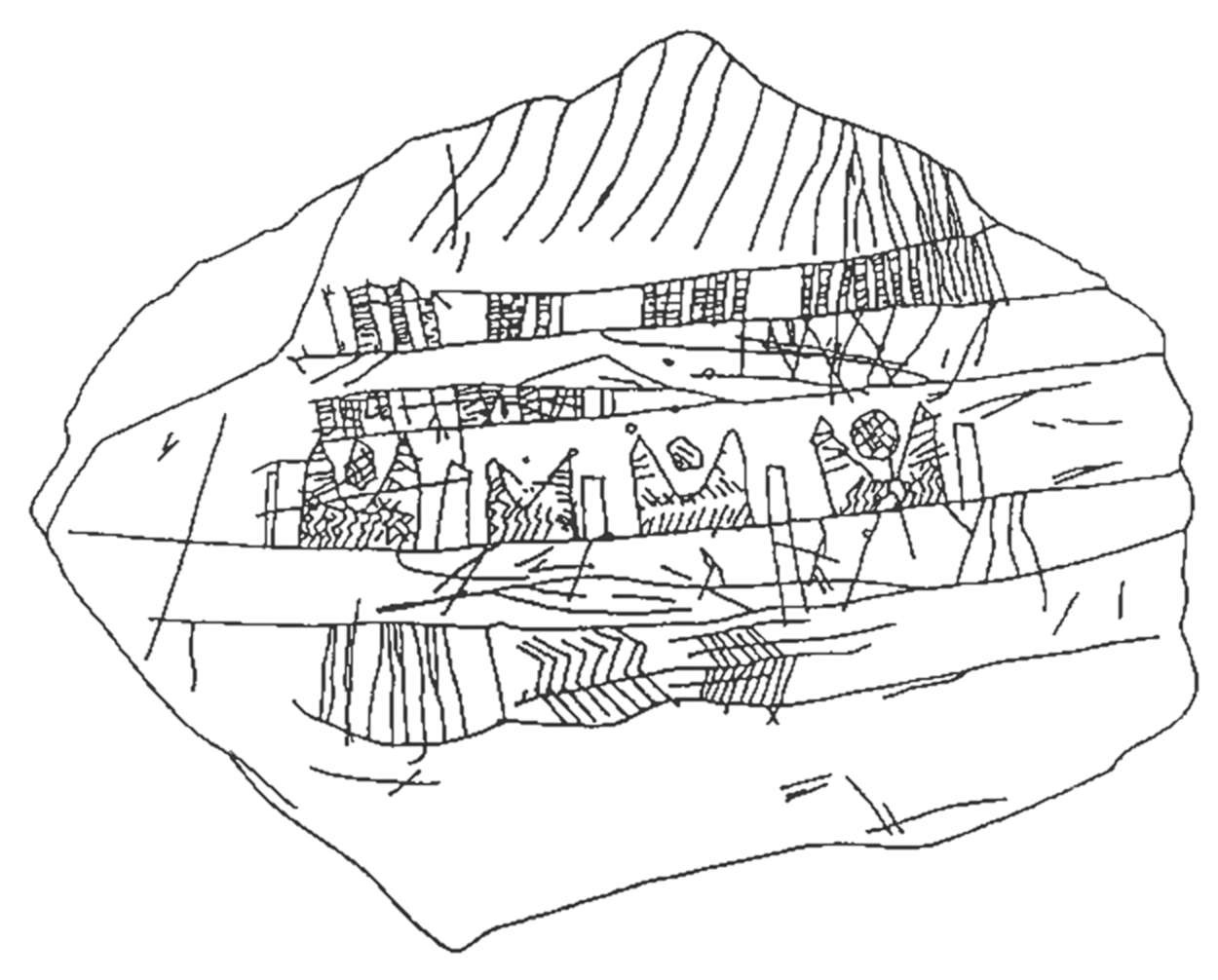
Another version of the map on an ivory plaque from Mezhyrich.
Photo: http://www.infoukes.com/history/inventions/
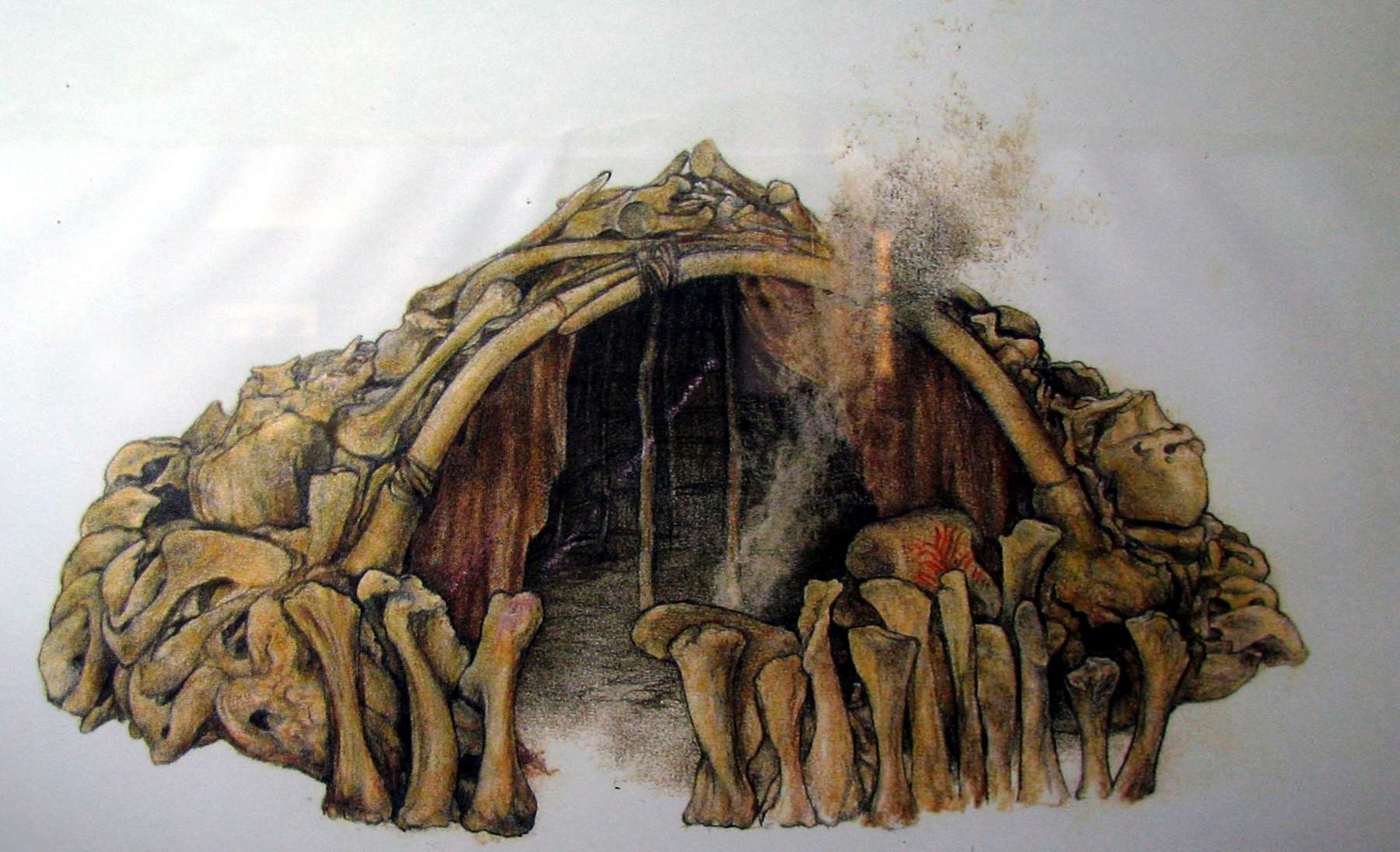
A dwelling in Mezhyrich is made of mammoth bones partially supported by a wooden frame. Hides lining the hut serve as insulation.
Source: Display, Dolní Věstonice Museum
Text: Translated and adapted from the display.
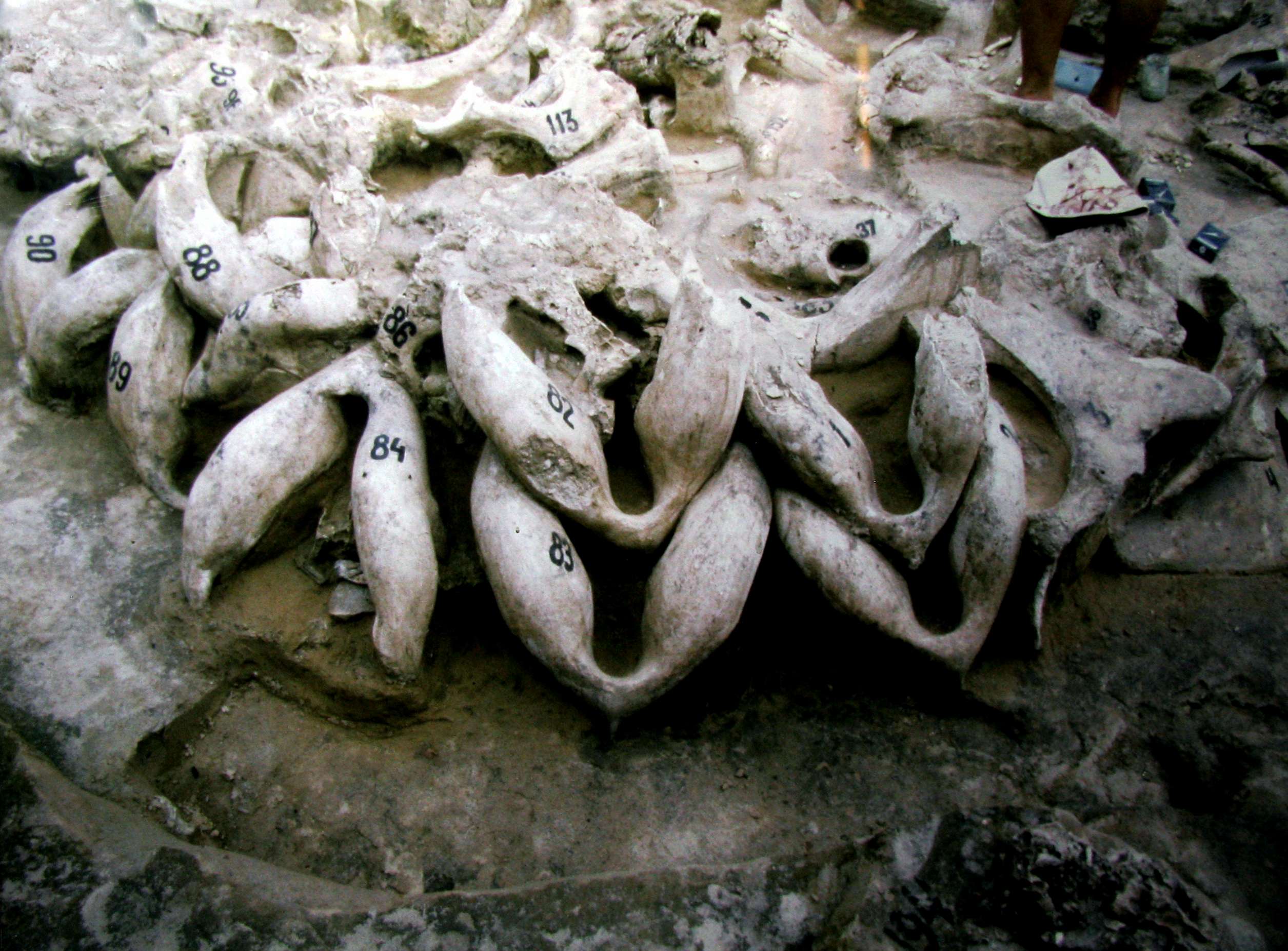
Mammoth bones used in the construction of an ancient dwelling, clearly numbered and photographed for later assembly, Mezhyrich in Ukraine.
Source: Photograph on display, Dolní Věstonice Museum, Czech Republic

Mezhyrich excavation of a hut
Photo: J. Jelinek, 'The Evolution of Man'

Mezhyrich reconstruction Dwelling 1 - front
This reconstruction is in the Kyiv Museum of Paleontology
Photo: O.Soffer, 'The Upper Paleolithic of the Central Russian Plain'


Mezhyrich reconstruction Dwelling 1 - back
This reconstruction is in the Kyiv Museum of Paleontology
Just the bones for each dwelling weighed about 20 tonnes, (around 20 000 kg or 45 000 pounds) and around 900 kg (almost one tonne, around 2 000 pounds) of Mammoth bone was used per square metre of floor space.
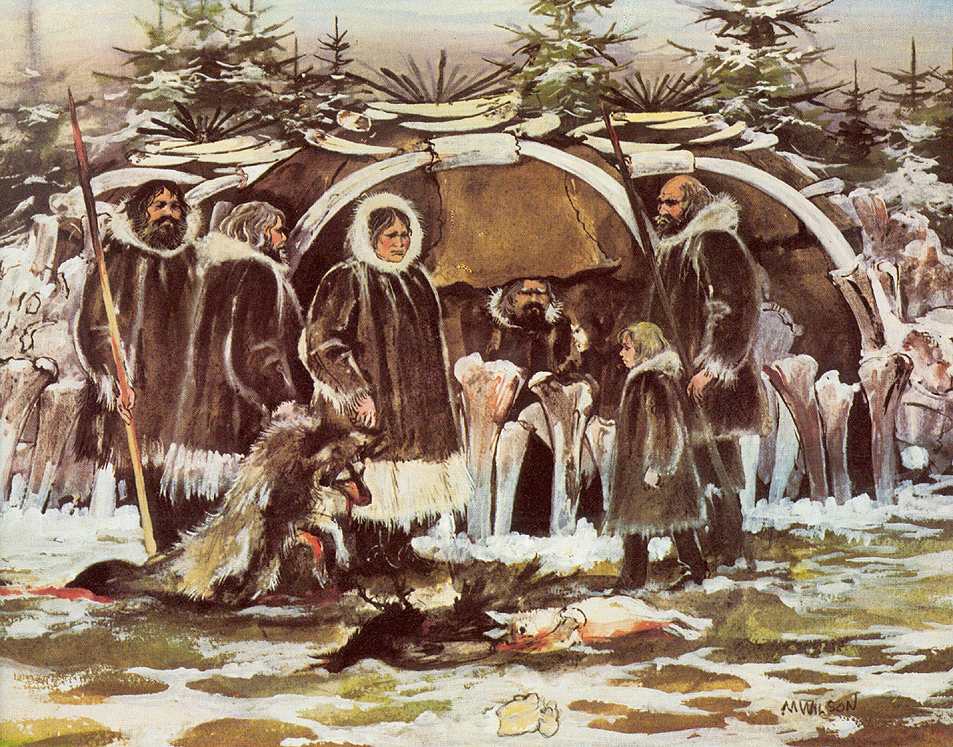
Reconstruction of a hut built of mammoth bones and hides in Ukraine near Kyiv. Painting by M. Wilson
Photo: Man before history by John Waechter
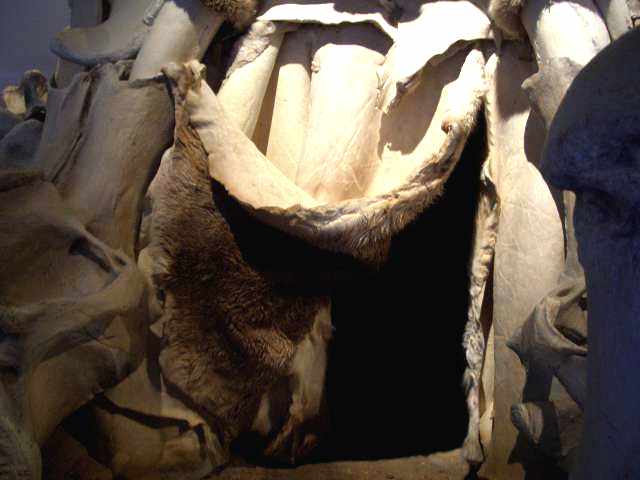
Door to a mammoth bone hut at the National Science Museum in Tokyo. This reconstruction appears based on the Mezhyrich discoveries.
Photo: Jerrers

Mammoth bone hut at the National Science Museum in Tokyo. This reconstruction appears based on the Mezhyrich discoveries.
Photo: Jerrers

Mezhyrich Excavation Plan
Figure 2.61 Mezhyrich excavation plan: 1, 1966 excavation-Dwelling 1; 2, 1969-1970 excavation-Dwelling 2; 3, 1972 excavation-Dwelling 3; 4, 1974 excavation- Dwelling 4; 5, 1976 excavation; 6, 1978-1983 excavation; 7, hearths; 8, dwellings; 9, storage pits.

Mezhyrich Dwelling 1
1, mammoth bones; 2, hearths and ash lenses; 3, bone charcoal; 4, worked bone; 5, marine shells; 6, reindeer antlers; excavation grid = 2 x 2 m
Photo: O.Soffer, 'The Upper Paleolithic of the Central Russian Plain'
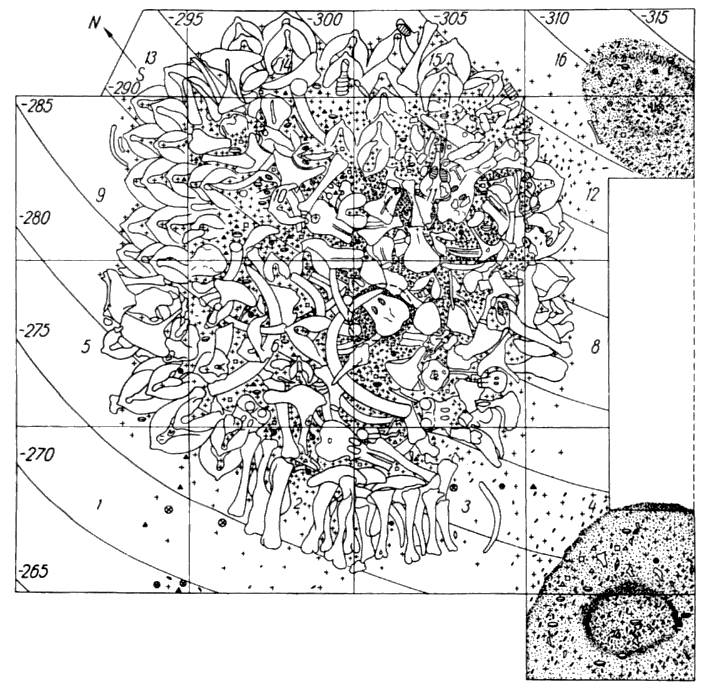
Another version of the diagram above.
Hoffecker (2002)

Mezhyrich Dwelling 2
1, bones; 2, bone charcoal; 3, hearths; 4, work areas near hearths; excavation grid = 2 x 2 m
Photo: O.Soffer, 'The Upper Paleolithic of the Central Russian Plain'

Mezhyrich Dwelling 3
1, mammoth bones; 2, bone charcoal; 3, hearths; 4, work areas near hearths and storage pit; excavation grid = 2 x 2 m
Photo: O.Soffer, 'The Upper Paleolithic of the Central Russian Plain'

Mezhyrich Dwelling 4
Photo: O.Soffer, 'The Upper Paleolithic of the Central Russian Plain'

Mezhyrich Dwelling 4 Excavation, 1979 season
Photo: O.Soffer, 'The Upper Paleolithic of the Central Russian Plain'

Mezhyrich Dwelling 4.
Photo: http://www.istmira.com/foto-i-video-pervobytnoe-obschestvo/3923-iskusstvo-predystorii-pervobytnost-1.html

Mezhyrich Cross Section
Right: Mezhyrich Cross Section: 1, soil; 2, loess, loess-like loam; 3, colluvium; 4, alluvium; 5, relic stratified alluvium; 6, Paleogene deposits; 7, Kharkov sand; 8, Poltava sand; 9, clay; 10, cultural remains; 11, isolated small granite boulders; 12, isolated pieces of silica pebble and siliceous chips; 13, shells, fresh water molluscs; 14, burrows
References
- Hoffecker J., 2002: Desolate landscapes: Ice-Age settlement in Eastern Europe, Rutgers University Press