Back to Don's Maps
Back to Venus figures from the Stone Age
Back to Dolni Vestonice main page
The Ceramic Venus of Dolni Vestonice
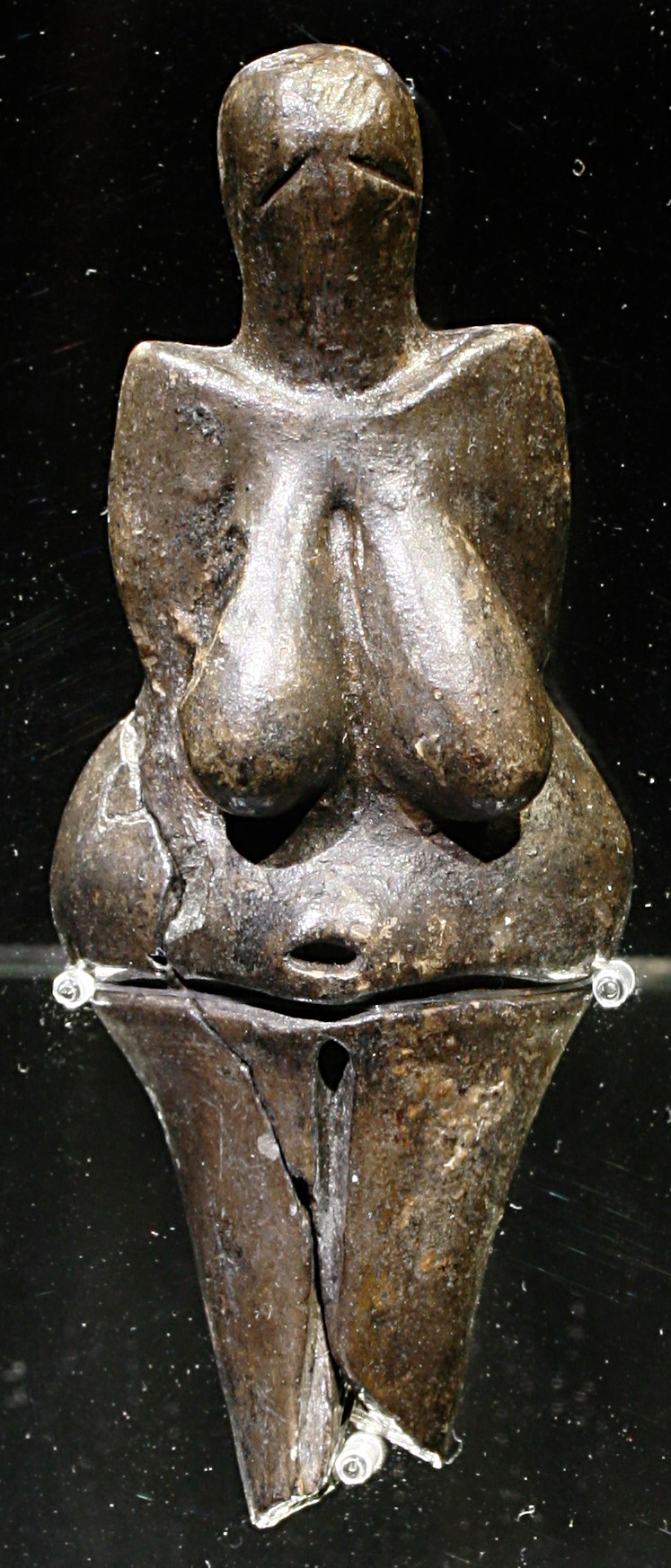
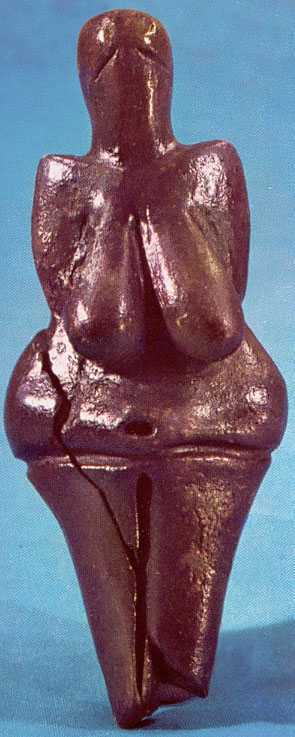
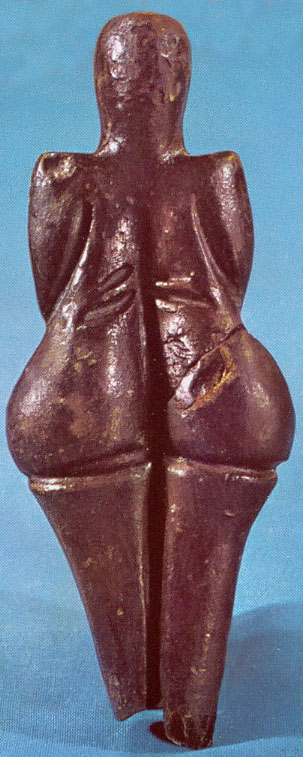
The Venus of Dolni Vestonice is a Venus figurine, a ceramic statuette of a nude female figure dated to 31 000 – 30 000 cal. BP (data from Professor Jiří Svoboda), which was found at a Palaeolithic site, of the Gravettian industry, in the Moravian basin south of Brno. This figurine, together with a few others from nearby locations, is the oldest known ceramic in the world, predating the use of fired clay to make pottery. It has a height of 111 millimetres (4.4 in), and a width of 43 millimetres (1.7 in) at its widest point and is made of a clay body fired at a relatively low temperature.
The palaeolithic settlement of Dolní Věstonice in Moravia, Czech Republic, has been under systematic archaeological research since 1924, initiated by Karel Absolon. In addition to the Venus figurine, figures of animals – bear, lion, mammoth, horse, fox, rhino and owl – and more than 2 000 balls of burnt clay have been found at Dolní Věstonice. The figurine was discovered on 13 July 1925 in a layer of ash, broken into two pieces. Once on display at the Moravian Museum in Brno, it is now only rarely accessible to the public. A tomograph scan in 2004 found a fingerprint of a child estimated at between 7 and 15 years of age, fired into the surface; the child who handled the figurine before it was fired is considered to be an unlikely candidate for its maker.
Photographer and permission: Petr Novák, Wikipedia
Text above adapted from Wikipedia.
When I took the photos below at the Vienna Natural History Museum, I felt that it was the original. At the time I was there I saw many facsimiles of important venus figurines, and they were usually immediately identifiable as copies, although modern museum quality facsimiles are staggeringly good. In particular the casts are hand coloured to exactly match the original, and the casting itself is absolutely superb. I would love to have those skills. The only thing that gives them away is the fairly uniform surface texture and patina, and the way they reflect light, as well as the lack of extremely fine detail such as hair line fractures and similar "flaws" inherent in an object tens of thousands of years old.
I found out when I looked at my photos months later and translated the text in a photo of the German language identification card with it that it was the original, on loan from the Anthroposmuseum in Brno, as part of the fantastic exhibition of venuses which providentially was on exhibition at the Vienna NHM while I was there in summer 2008 as part of the celebration of the Venus of Willendorf.
The sculpture was broken in two when found. The nylon monofilament used to hold the figurine together may be seen in these photos.
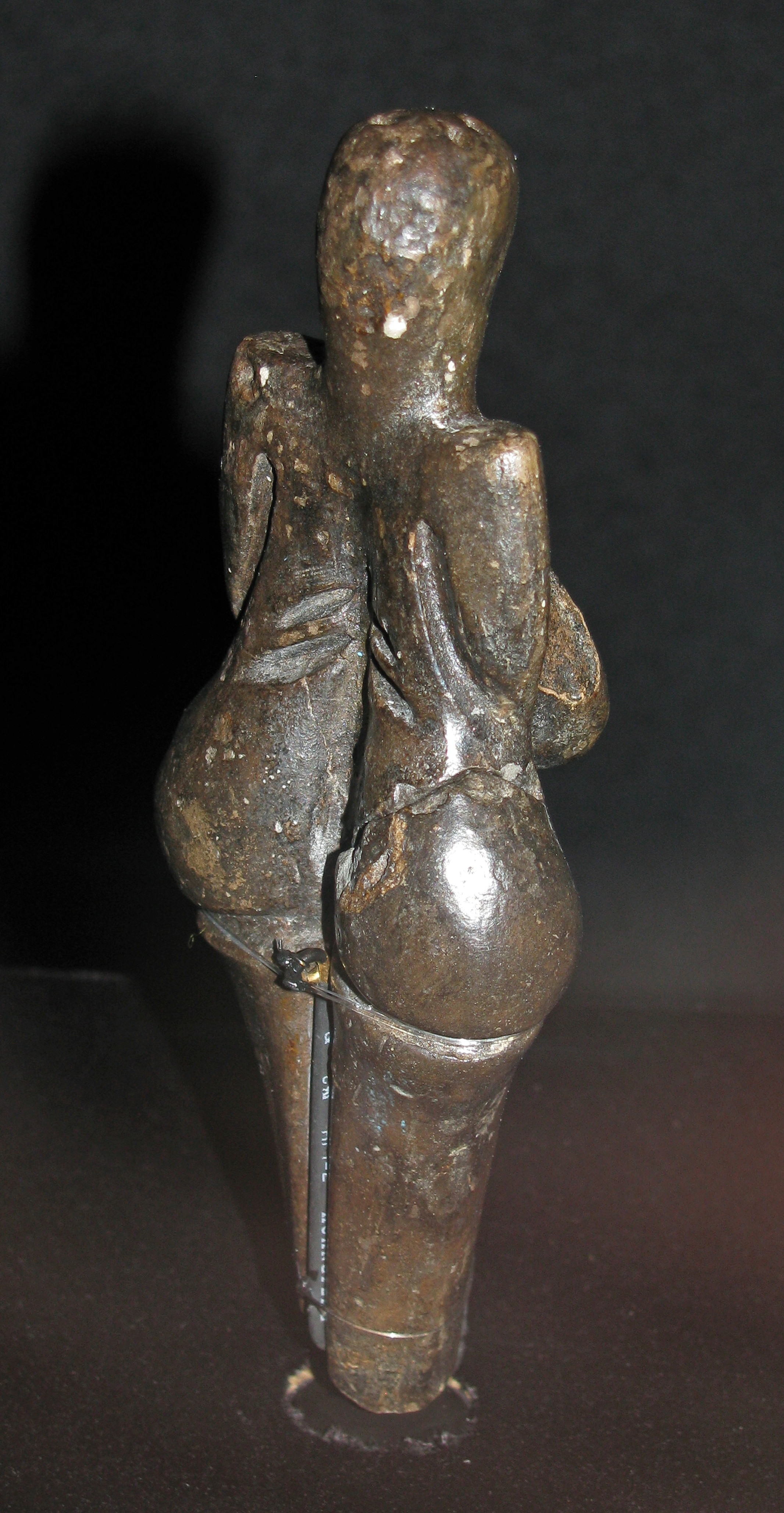

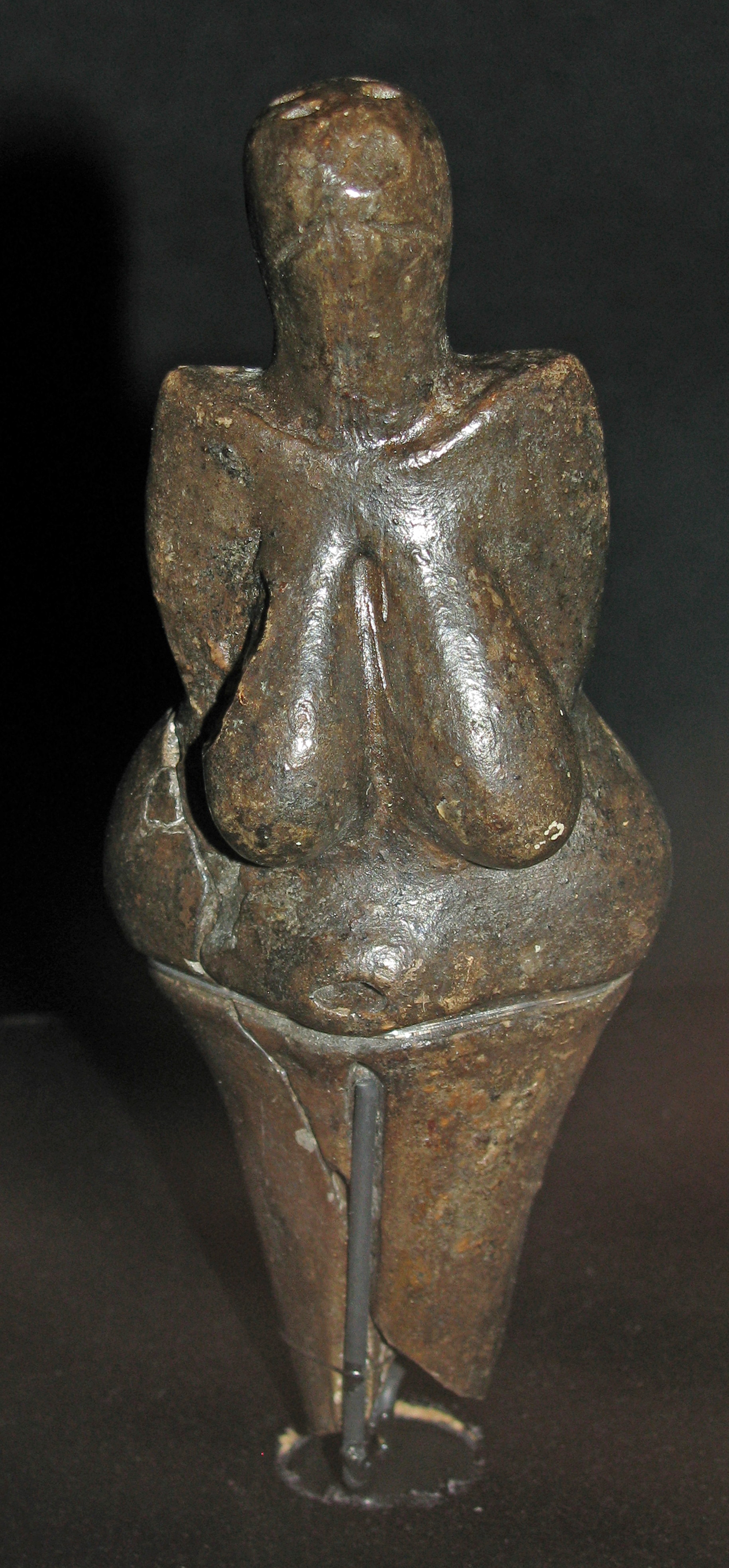
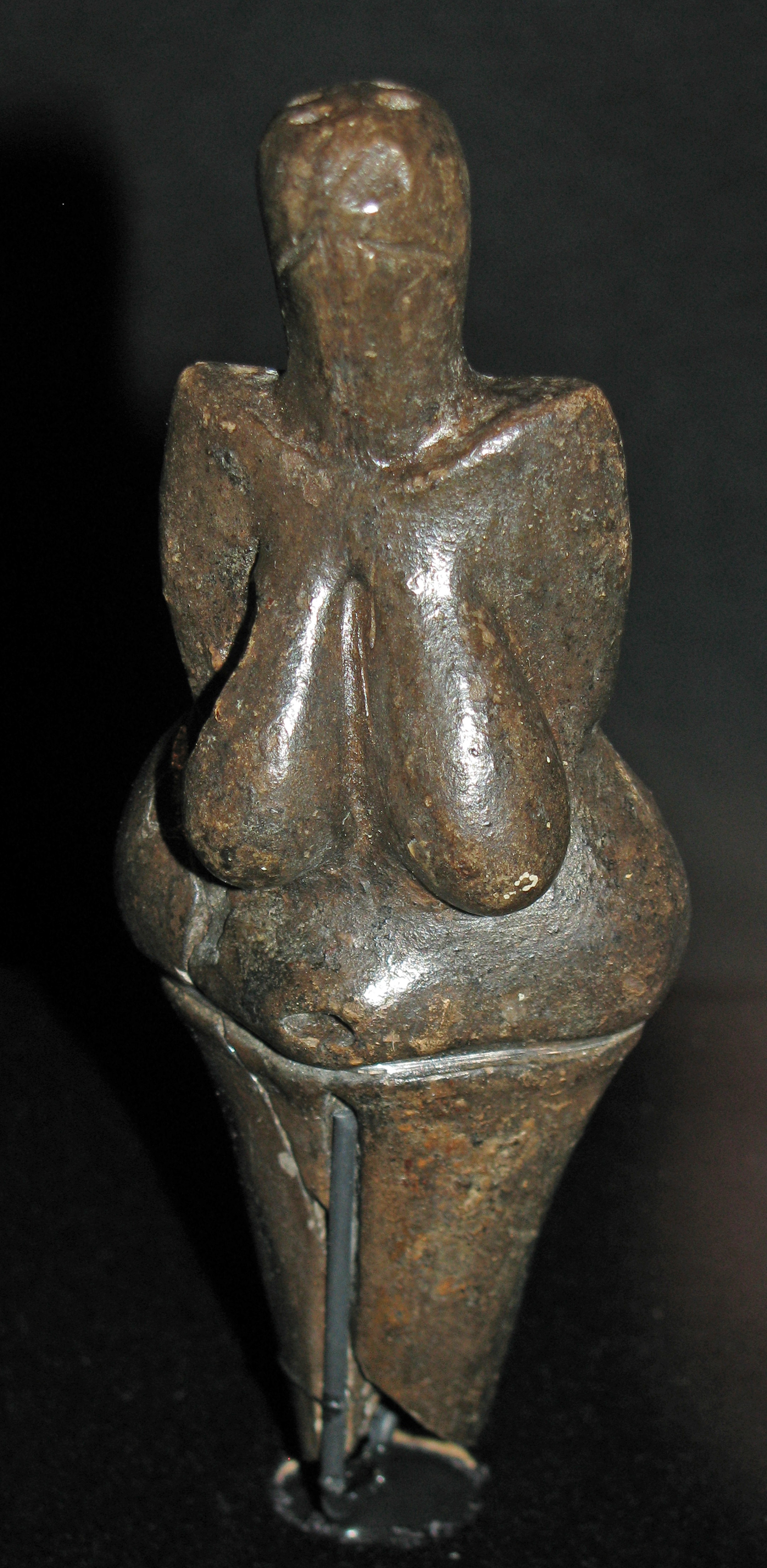
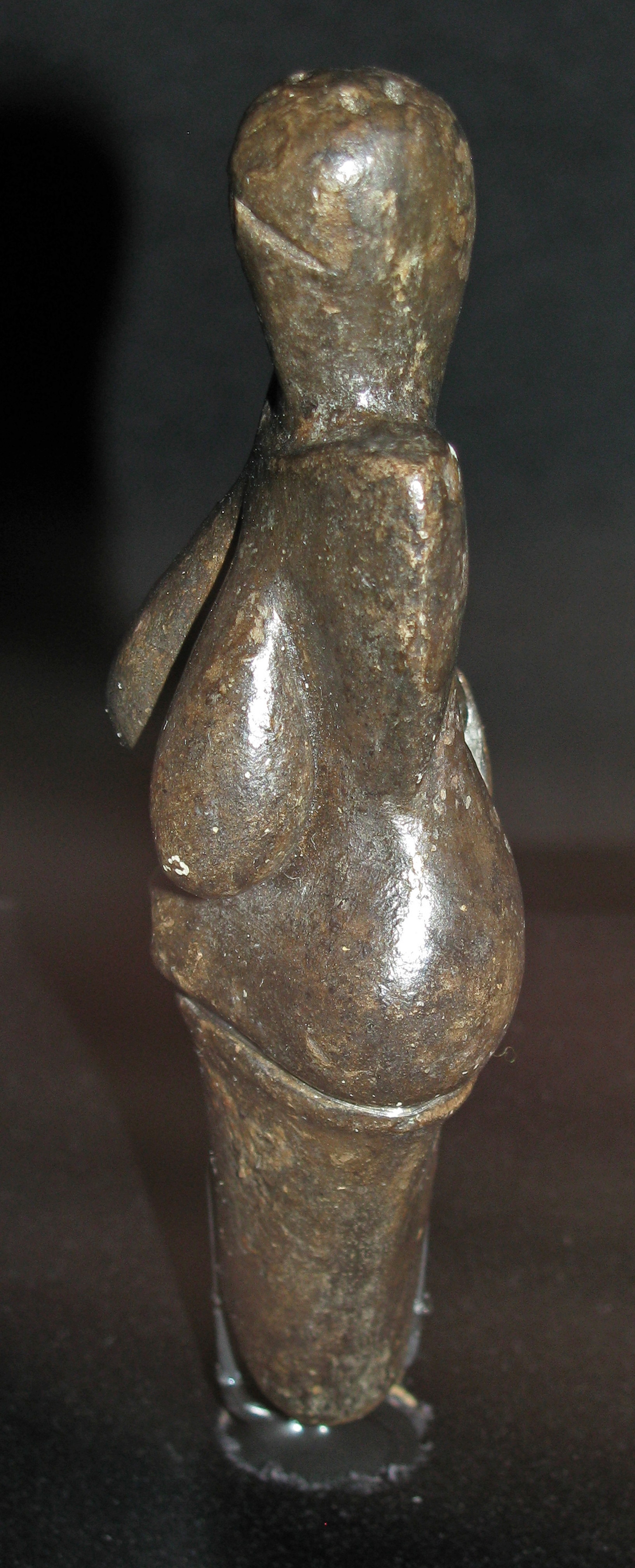
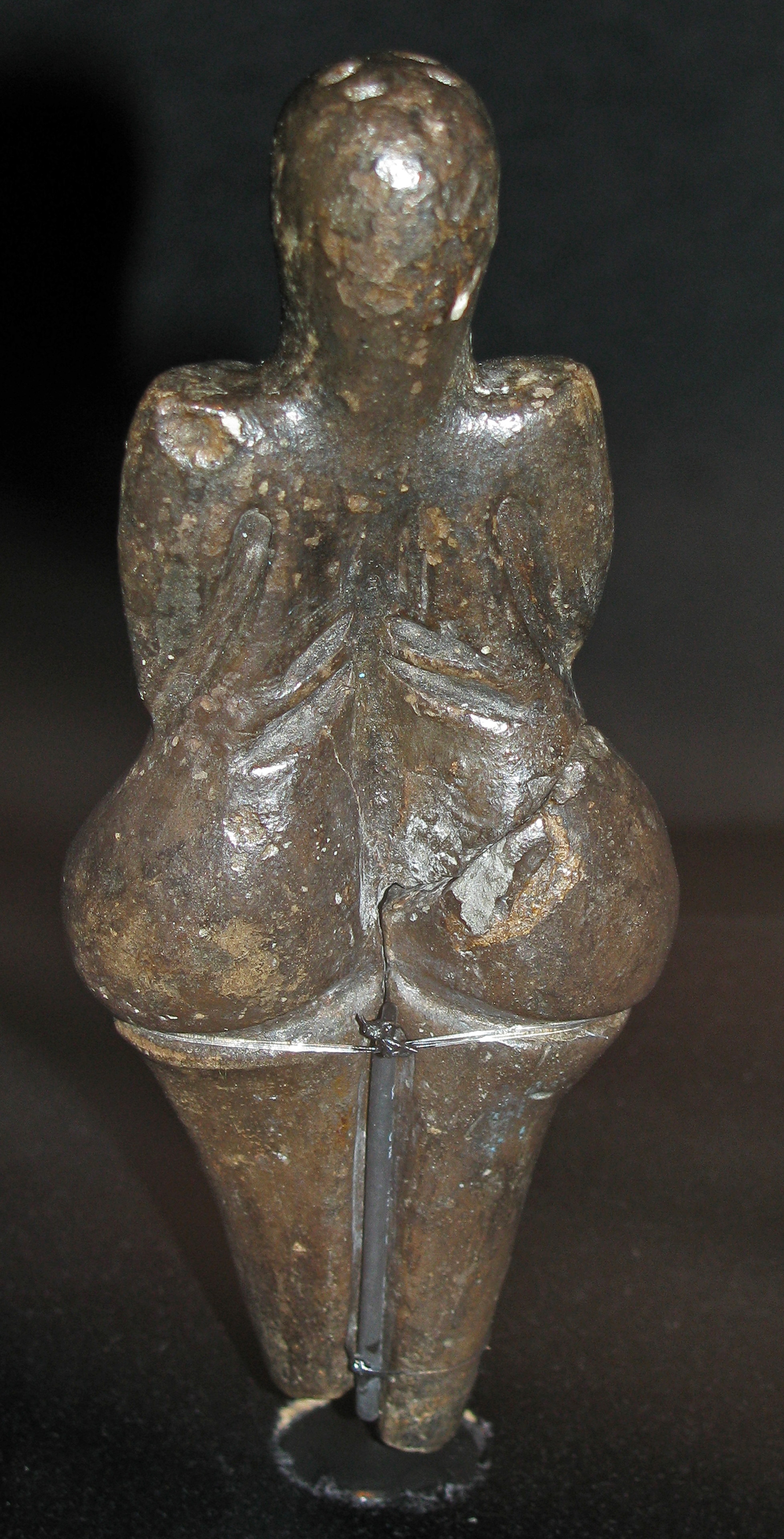
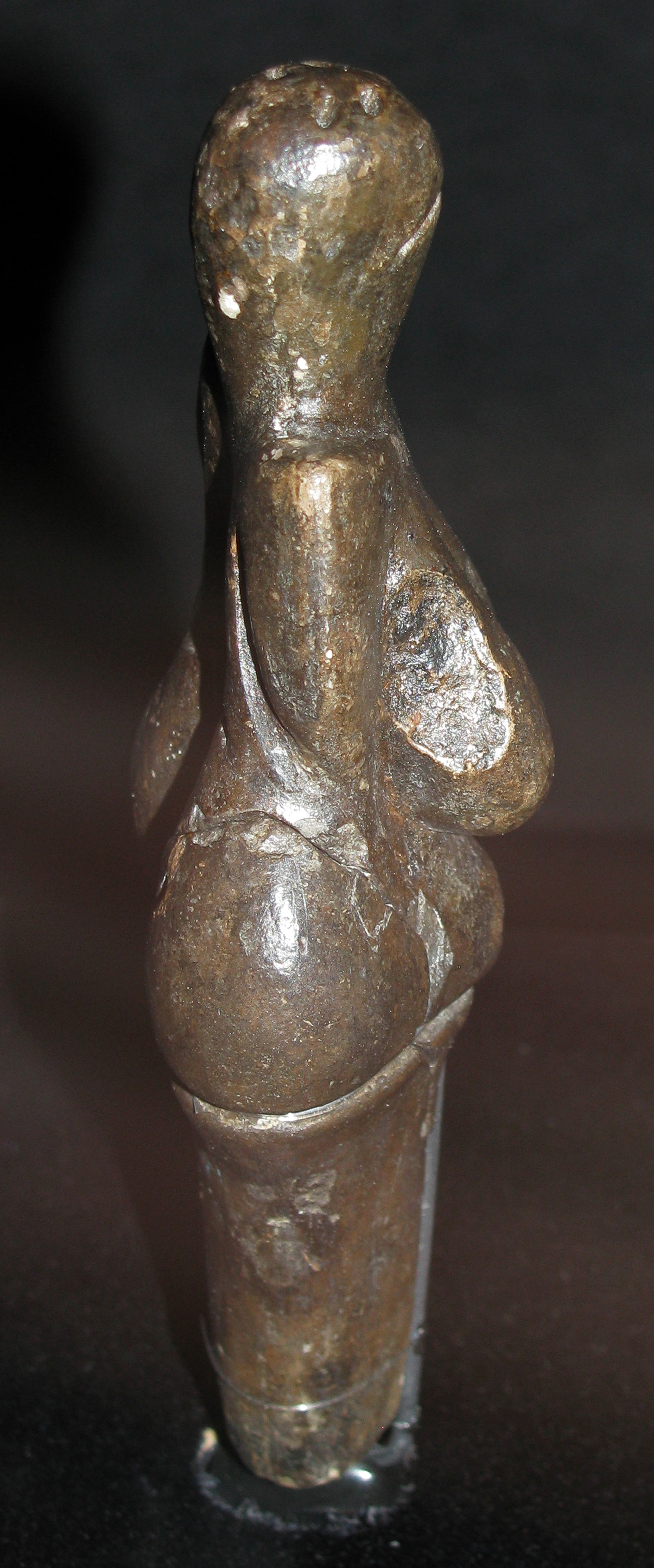
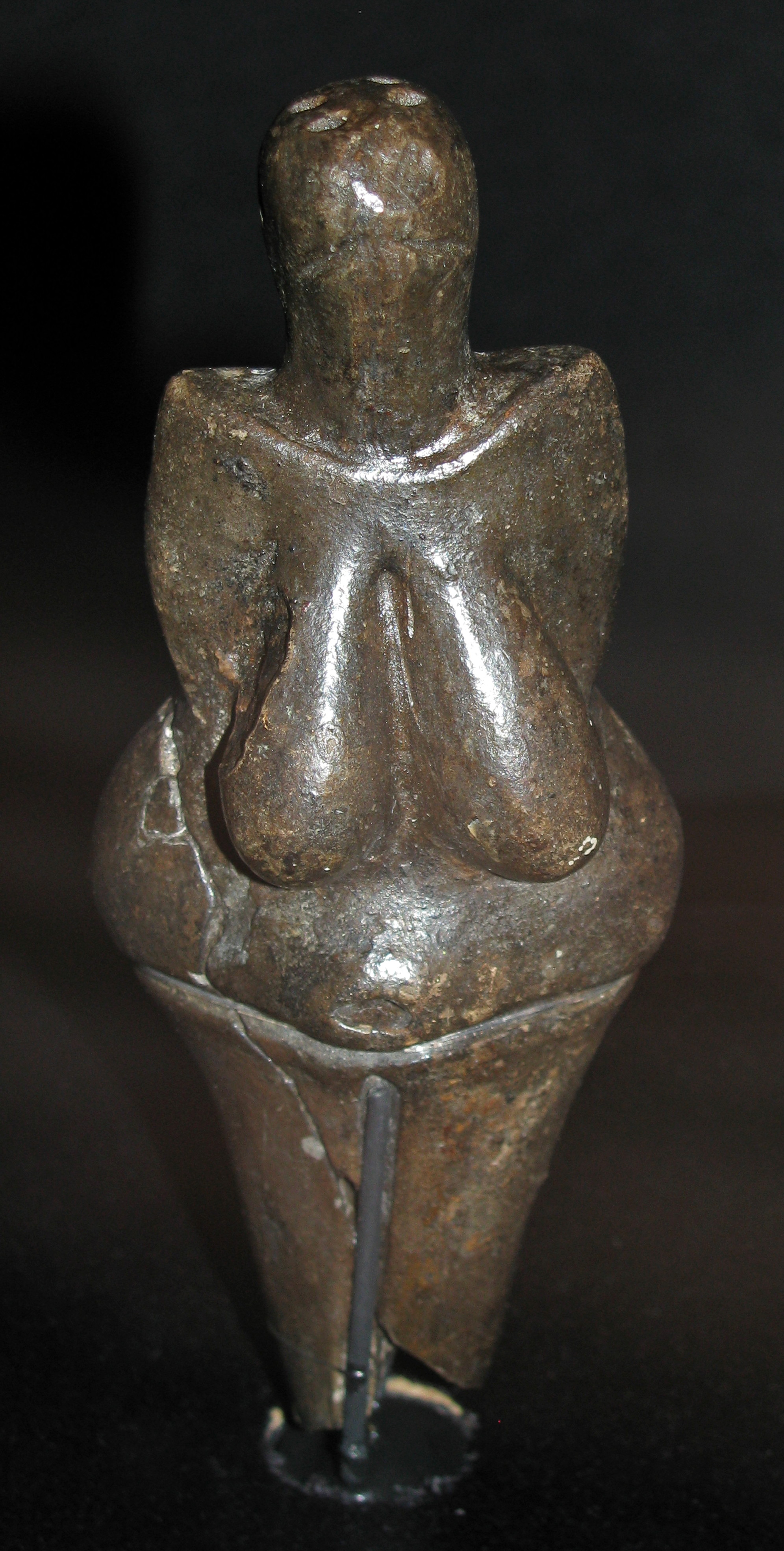
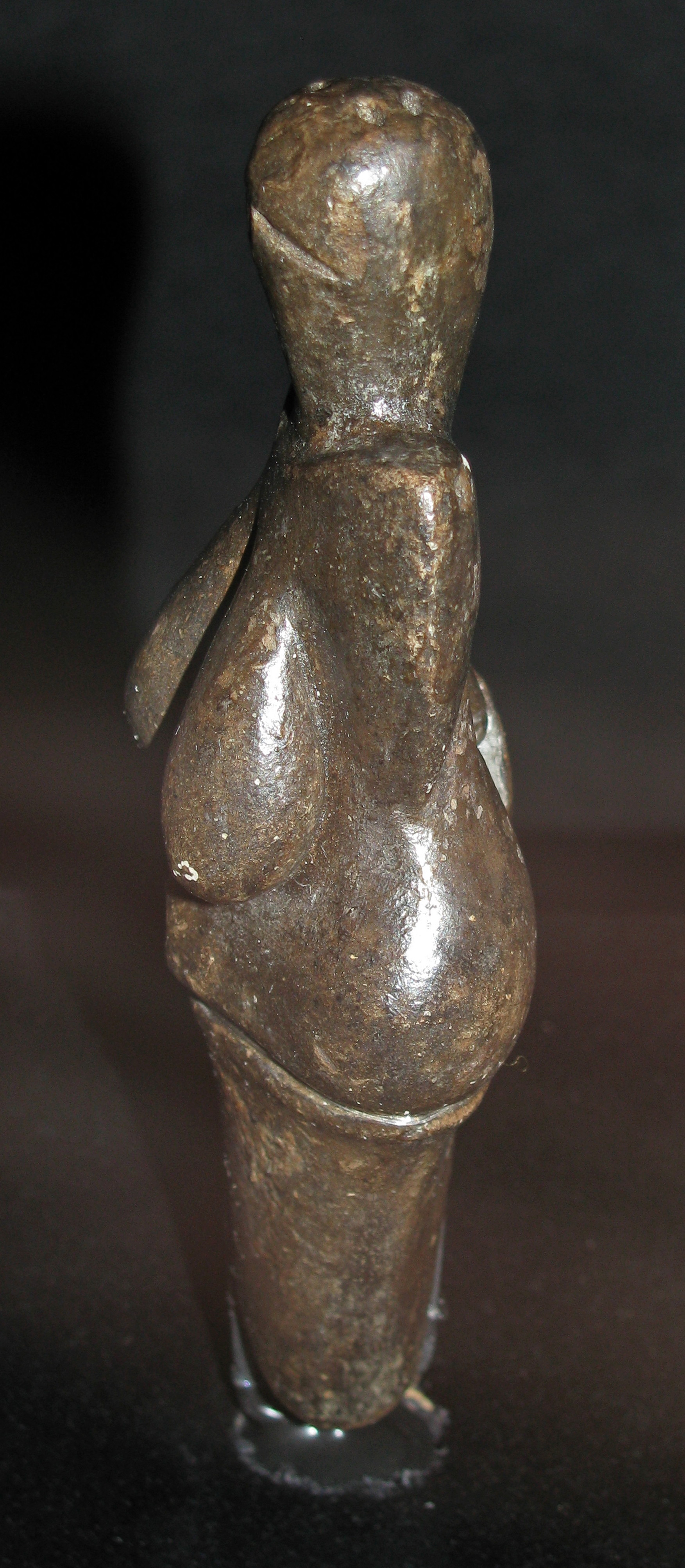
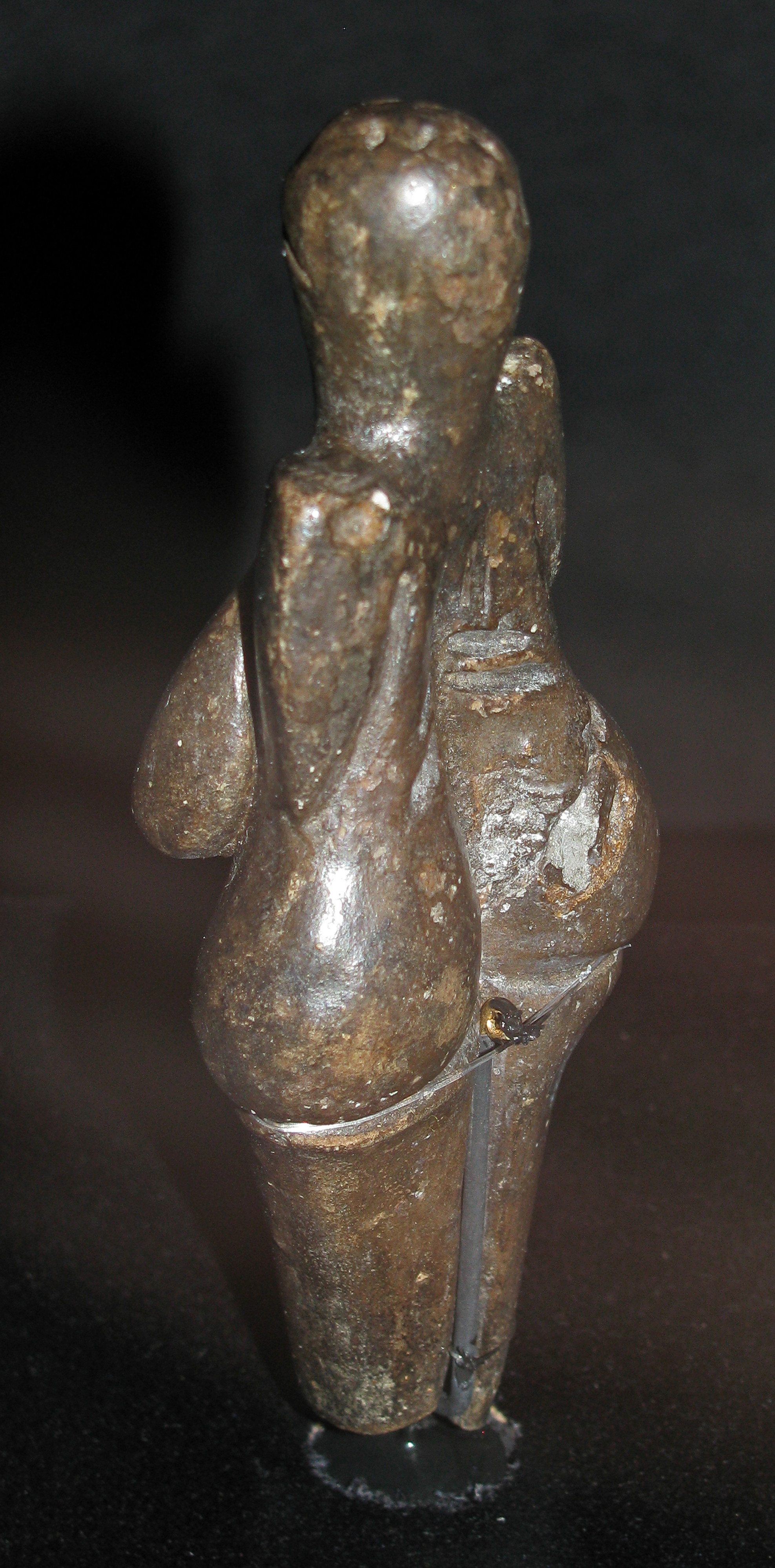

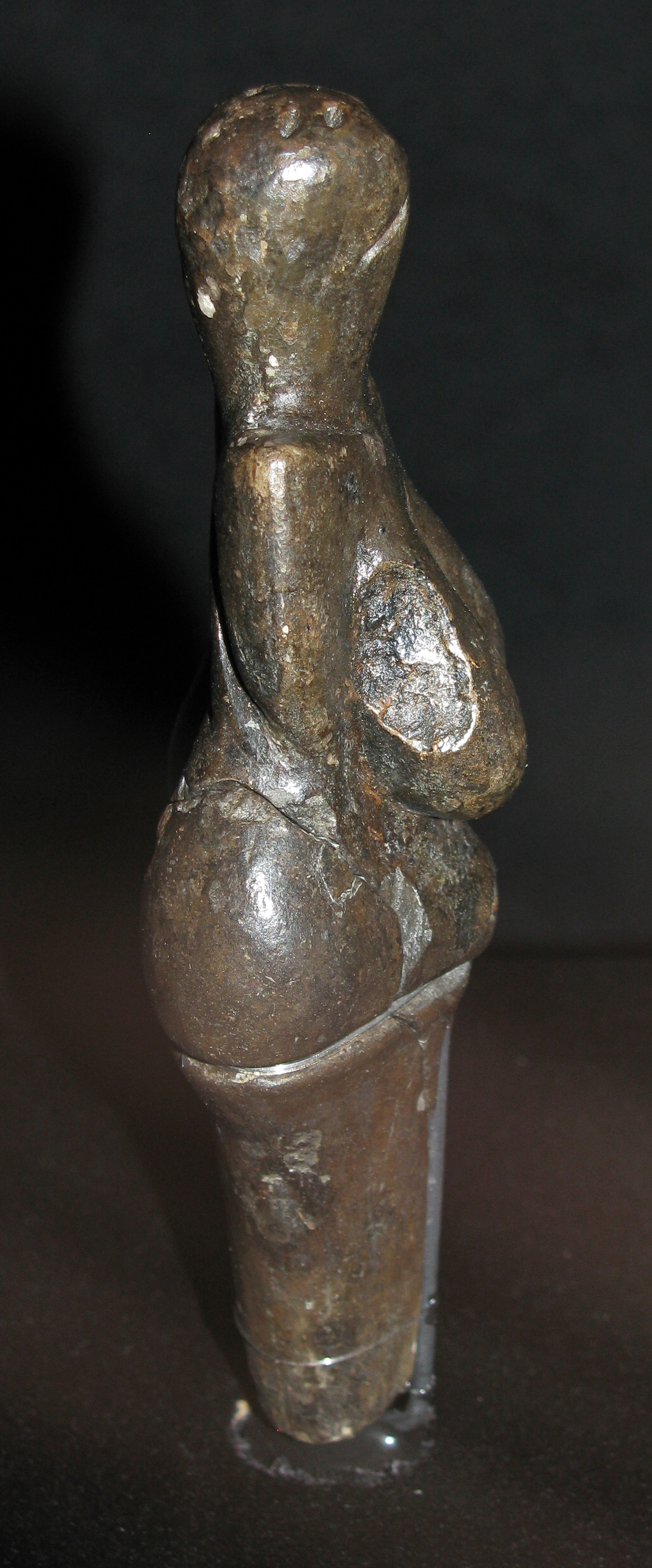
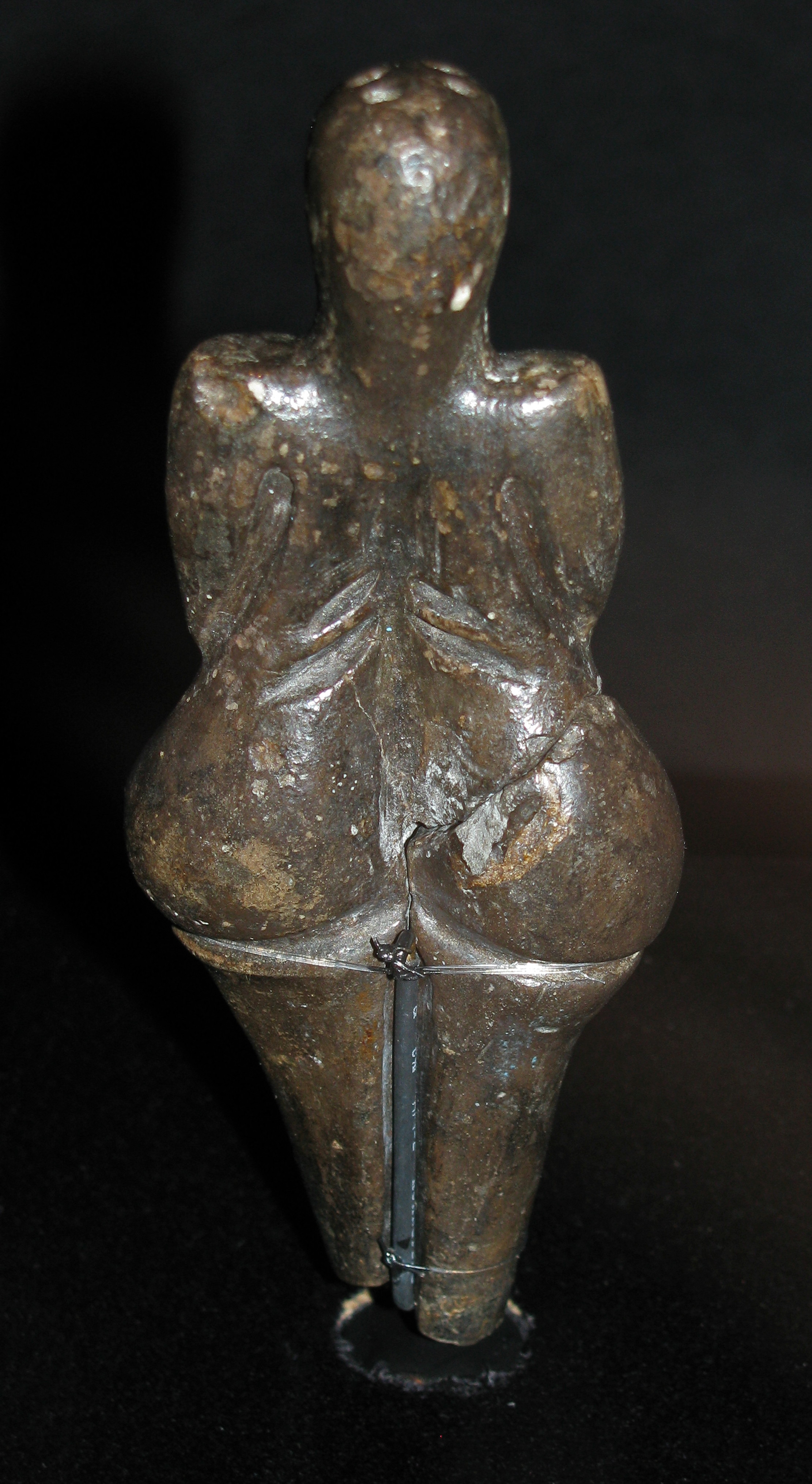
Venus von Dolní Věstonice
Venus of Dolní Věstonice, 31 000 – 30 000 cal. BP (dating from Professor Jiří Svoboda)
Ceramic, from Moravia, Czech Republic.
On loan from the Anthroposmuseum in Brno.
Photo: Don Hitchcock 2008
Source: Original artefact, on display at Vienna Natural History Museum
It should be noted that the figure has four holes in the top of the head. These were presumably to hold something, possibly herbs or flowers.
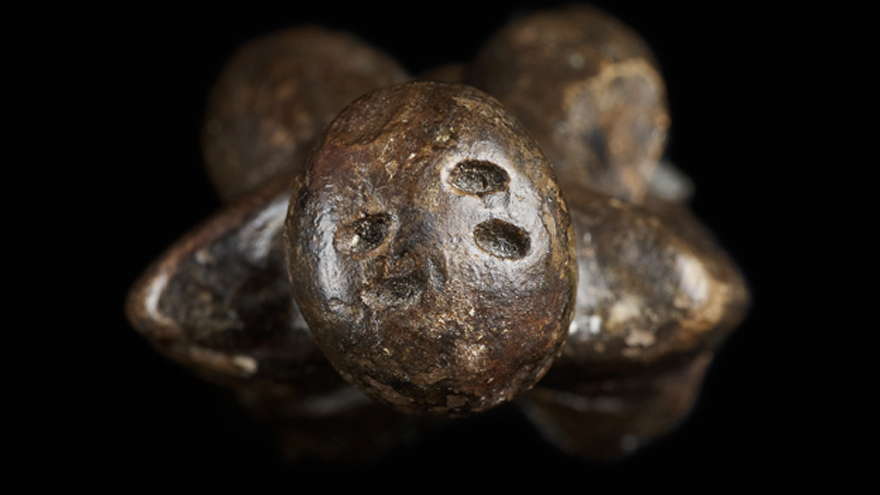
The top of the head of the Dolni Vestonice venus.
(The holes are relatively shallow, and were put in, obviously, at the time of manufacture, before firing in the kiln. They may have been meant to secure something like pitch or resin or birch bark glue, so that other objects could be stuck to the head of the figurine, such as herbs or flowers, or perhaps to keep an item of headwear in place, a hat or a wig - Don )
Photo: http://www.britishmuseum.org/images/v2/homepage-carousel/ice-age-art.jpg
(I have done a bit of pottery, and the quality of this piece amazes me. It is a masterwork, given the stage pottery had reached at the time, when even very ordinary pots and jugs had not yet been made. It appears glazed, but it is possibly a 'self glaze' where the material of which the figurine is made creates its own glaze during the firing. Powdered bone was added to the clay, which may have had an effect. When you also take into consideration the kiln, which cannot have come close to the temperature reached in a modern earthenware kiln ( I read somewhere that the pieces were fired to about 1300 F, or 700 C) it is even more astounding - Don)
Powers (1994) reports that the clay of which the piece is made was a clay-bone paste, used at several sites in Moravia. The specific composition was yellow clay mixed with burnt and powdered mammoth bone, apparently unfired. Mammoth bone was used as fuel by people in this peri-glacial environment, so there was plenty of bone ash available.
Velde and Druc (2012) state that bone material was used in archaeological ceramics to temper the clay. The bone fragments can be destroyed by heat, usually partially, and become a fusing agent. Bones have amounts of Calcium and Phosphorus, and as is the case with shells, the calcium becomes a fusing agent upon the thermal destruction of the bone. However, in some primitive pottery crushed bones were in such abundance that they were obviously used to temper the plasticity of the clay resource, not to become a fusing agent.
Photographs from the Mammoth Hunters Exhibition at the National Museum in Prague, 2007
Photographer: Petr Novák, Wikipedia
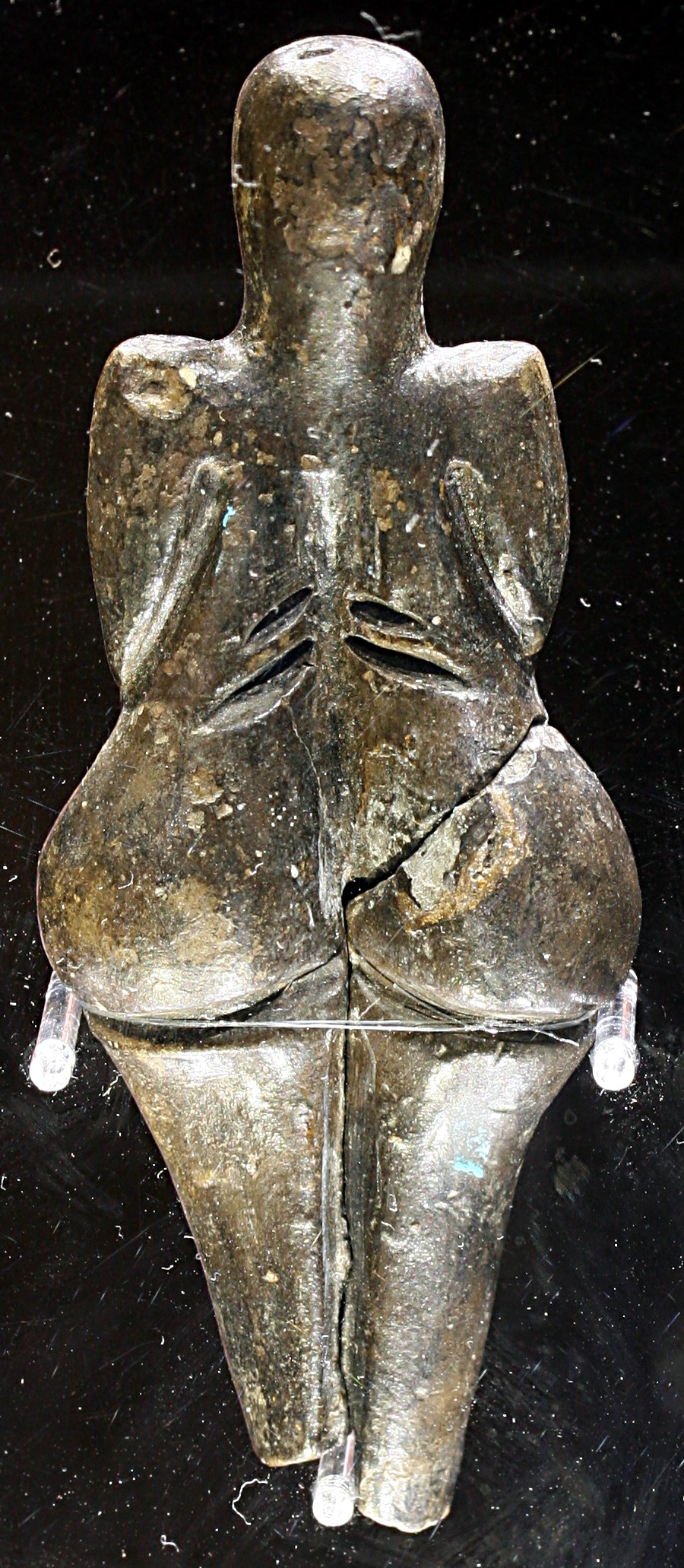
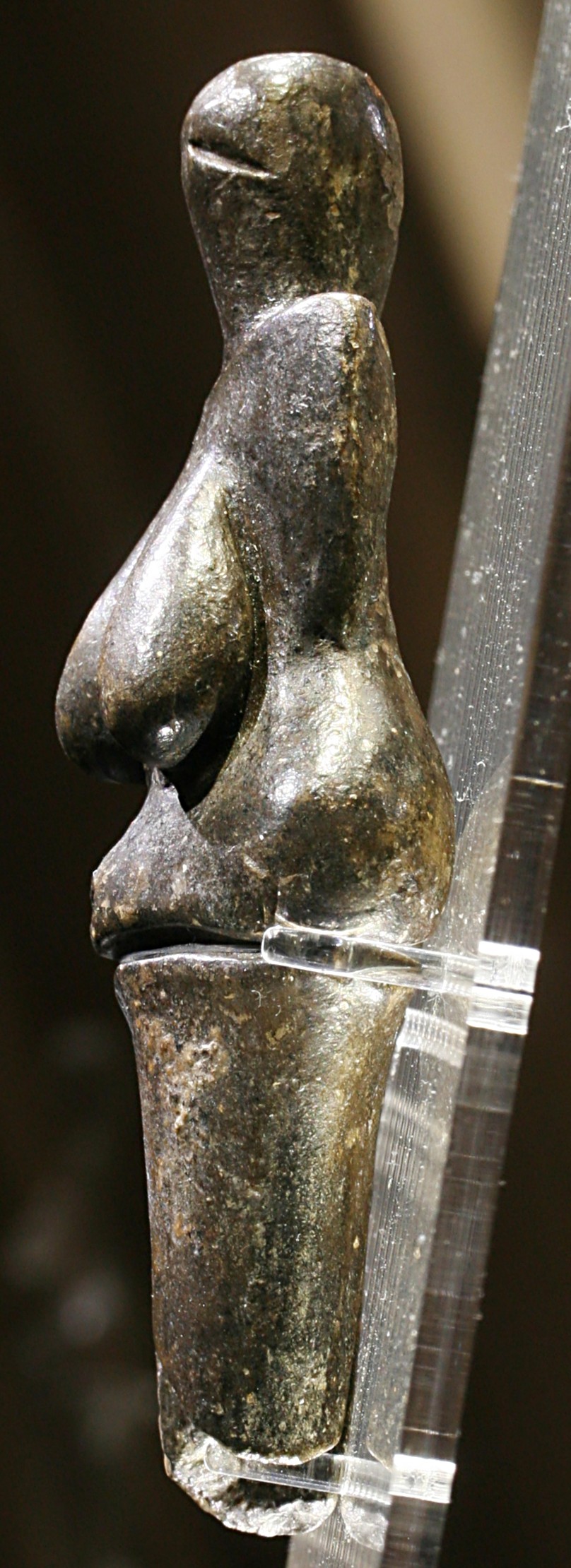
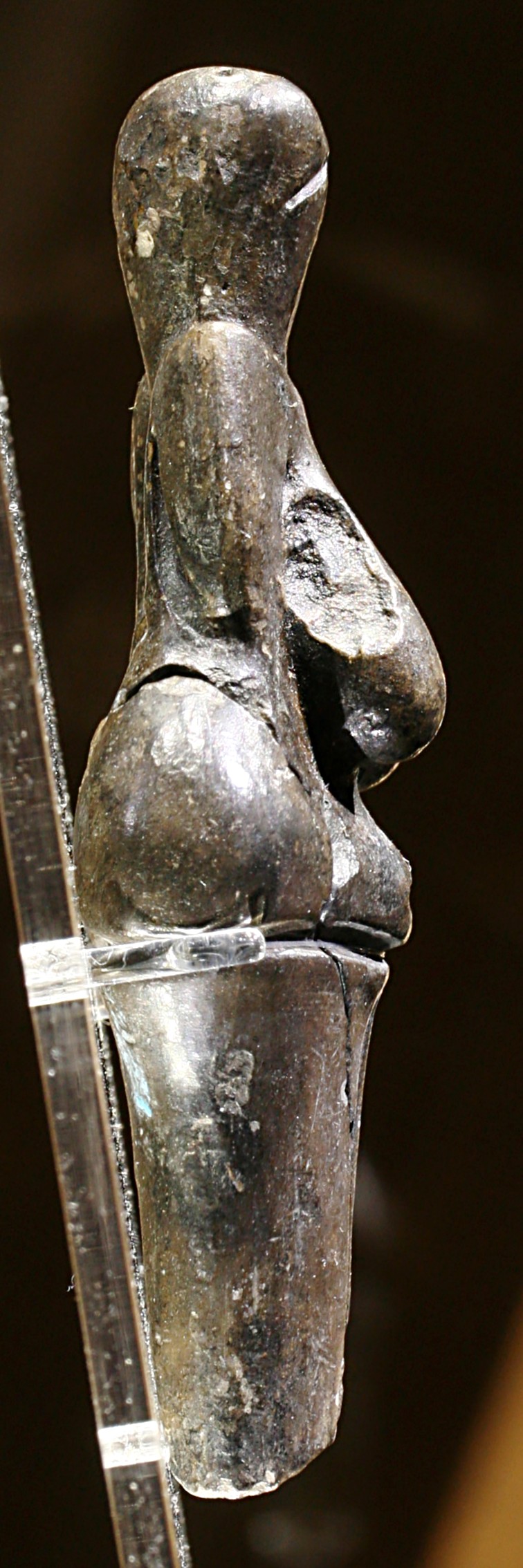
Věstonická Venus at Mammoth Hunters exhibition at the National Museum in Prague.
Photo: Petr Novák, Wikipedia
Guidance: Danny B.
Permission: As they reached the Summit, he said: "Thou shall take this Snapshot and use it according to the Code of License, and let your people flourish all around the world.' They brought the Snapshot to their homes and there was much rejoicing.
This file is licensed under the Creative Commons Attribution-Share Alike 2.5 Generic license.
The physiology of the statue suggests a mature woman whose figure reflects past childbearing and obesity rather than pregnancy or sexual attraction. Her representation shows elements of realism that have attracted the attention of eminent physical anthropologist Erik Trinkaus, who has also researched human remains from the site. For him the signs of obesity in this sculpture are a paradox because the human skeletal material from the site shows various types of pathology indicative of walking long distances, carrying heavy loads and occasional periods of food shortage.
This is corroborated by archaeological data showing raw materials for tool making imported from distant sources, as well as the exertion required to move heavy mammoth bones, carcass parts and skins when constructing and organising the settlement. Such activities would favour slim, fit bodies rather than the depicted obesity that Trinkaus feel is so realistic that it could not be the product of an artist's imagination but rather something familiar and observed. This suggestion finds some vindication in work by archaeologist Bohuslav Klima who spent many years excavating at Dolni Vestonice. He considered that the site may have been occupied for most of the year and over long periods of time, with periodical journeys being made to distant places to collect raw materials for tool making and to find new hunting grounds. Individuals less able to travel, or possibly privileged to stay, may have been spared these long walks. Left behind perhaps to keep the warming and protective fires burning, sedentism may have caused some to put on weight.
The possibility that the women of Dolni Vestonice and other sites of this period might have been privileged is echoed by research by Olga Soffer and her colleagues on baked and unfired clay fragments that have impressions on them made by woven vegetable fibre textiles and basketry.
Thread, string and rope made from animal sinews, hair and vegetable fibres were essential for many everyday tasks and their production would have been a base camp activity probably carried out by women. Extending this skill to producing small woven, perhaps luxury, items used for display, decoration or religious ceremonies may have been specific to women and given some of them special status, value or power.
Text above: Cook (2013)

When the Venus of Dolní Věstonice has to be moved, elaborate precautions are taken. This shows the venus arriving under armed escort at the Vienna Natural History Museum for the exhibition of stone age venuses at that wonderful museum in the summer of 2008. It is very rare for the venus to be on public display.
Photo: http://www.youtube.com/watch?v=zAtmX5m12Jc
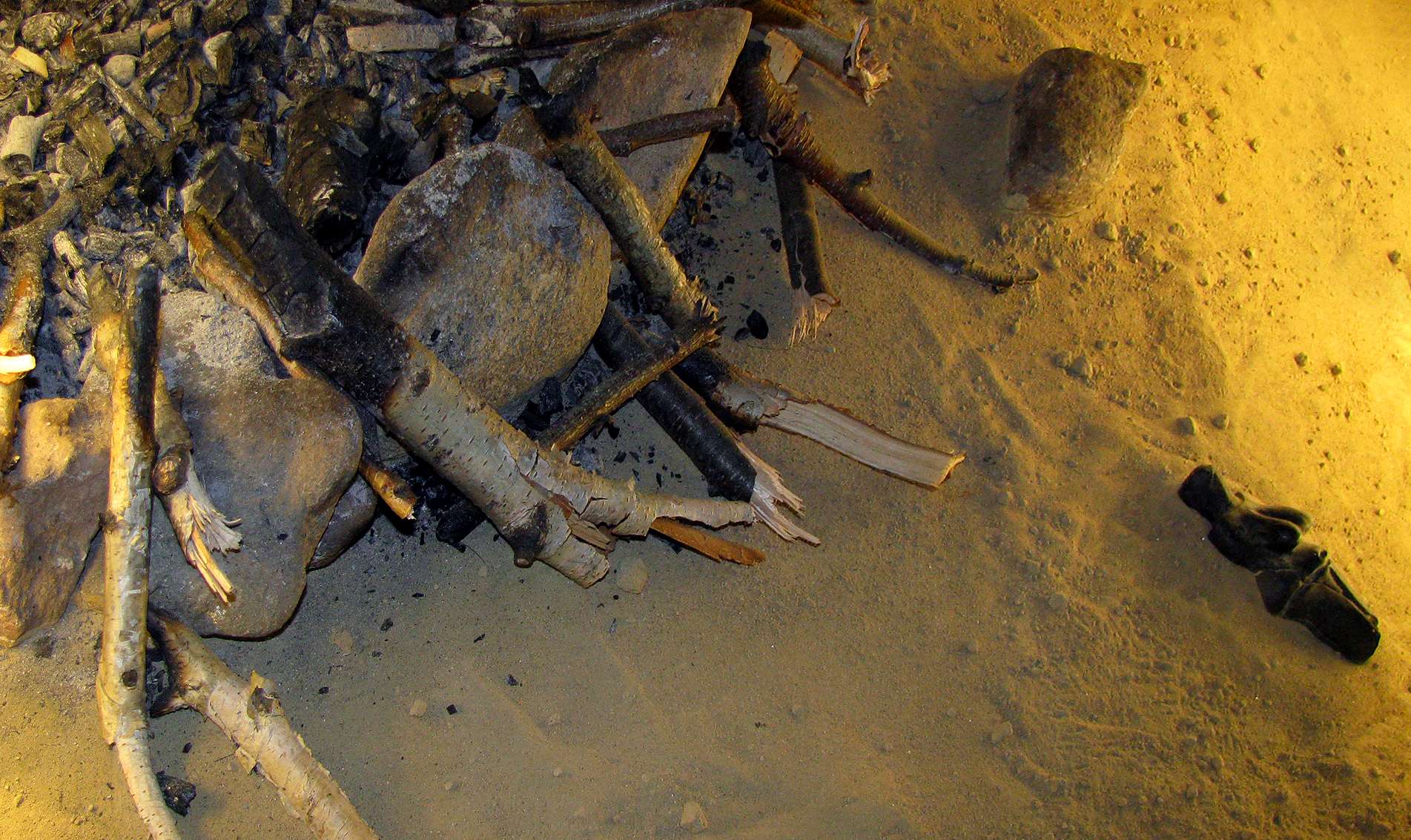
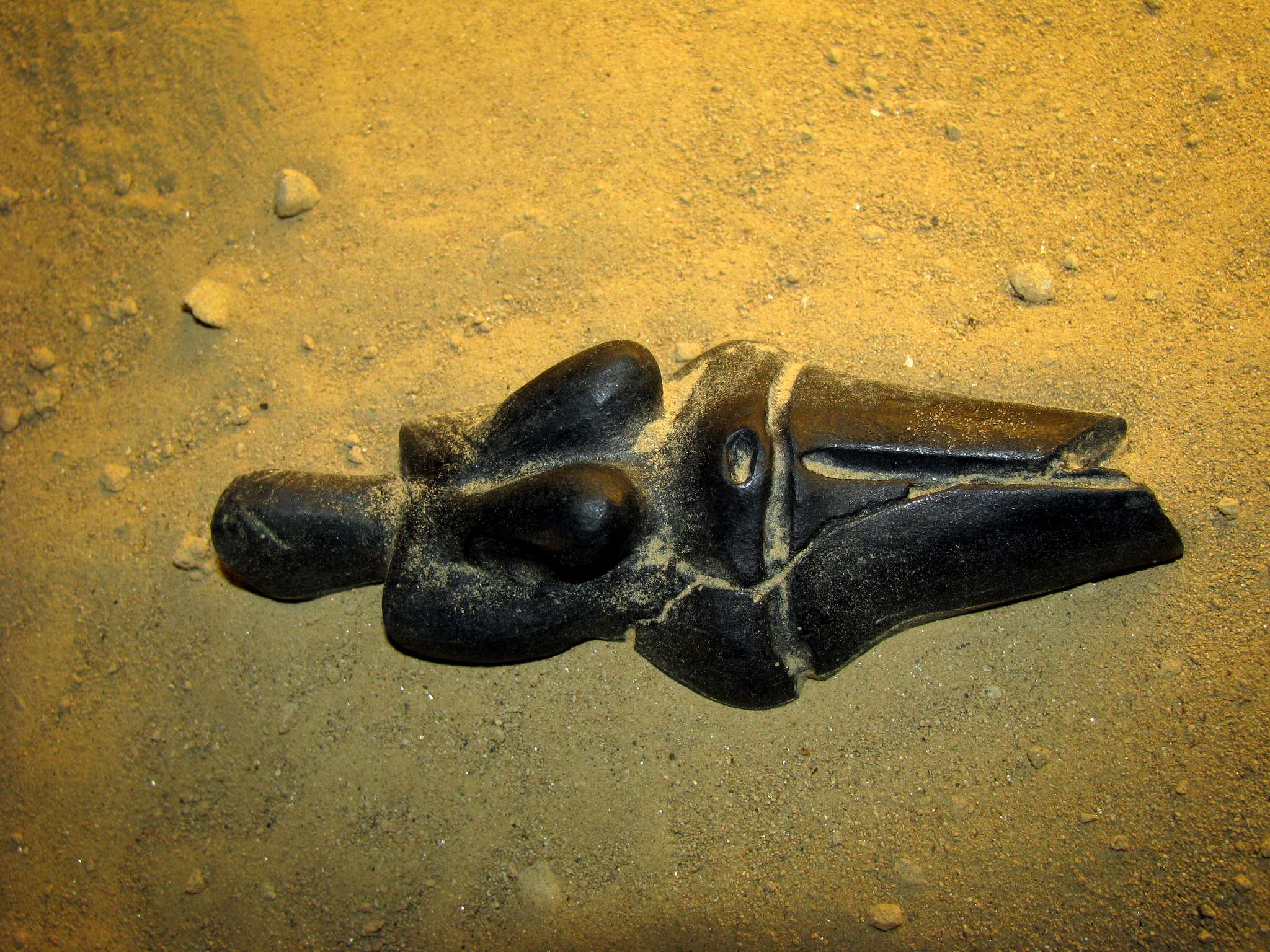
Display at the Vienna Natural History Museum, showing the probable layout of the area near a hearth when the Dolni Vestonice venus site was abandoned.
Photo: Don Hitchcock 2008
Source: Facsimile, Vienna Natural History Museum.

Beautiful scene of the creation of the Venus of Dolni Vestonice by the artist Zdeněk Burian, 1905 - 1981. A fingerprint on the back of the figure came from a child between seven and fifteen years old, or an adolescent or young woman, though this may not have been from the creator of the sculpture.
Note that he has used a male figure as the potter, when it is now believed to be a woman, see below. The grave of the woman believed to be the creator of the venus was discovered in 1949, and perhaps Burian painted this image of the potter before that date, since the venus was discovered in 1925.
Photo: http://neat-stuff-blog.blogspot.com/2011/06/prehistoric-man.html
Text: adapted from http://www.projektvenus.eu/index.php
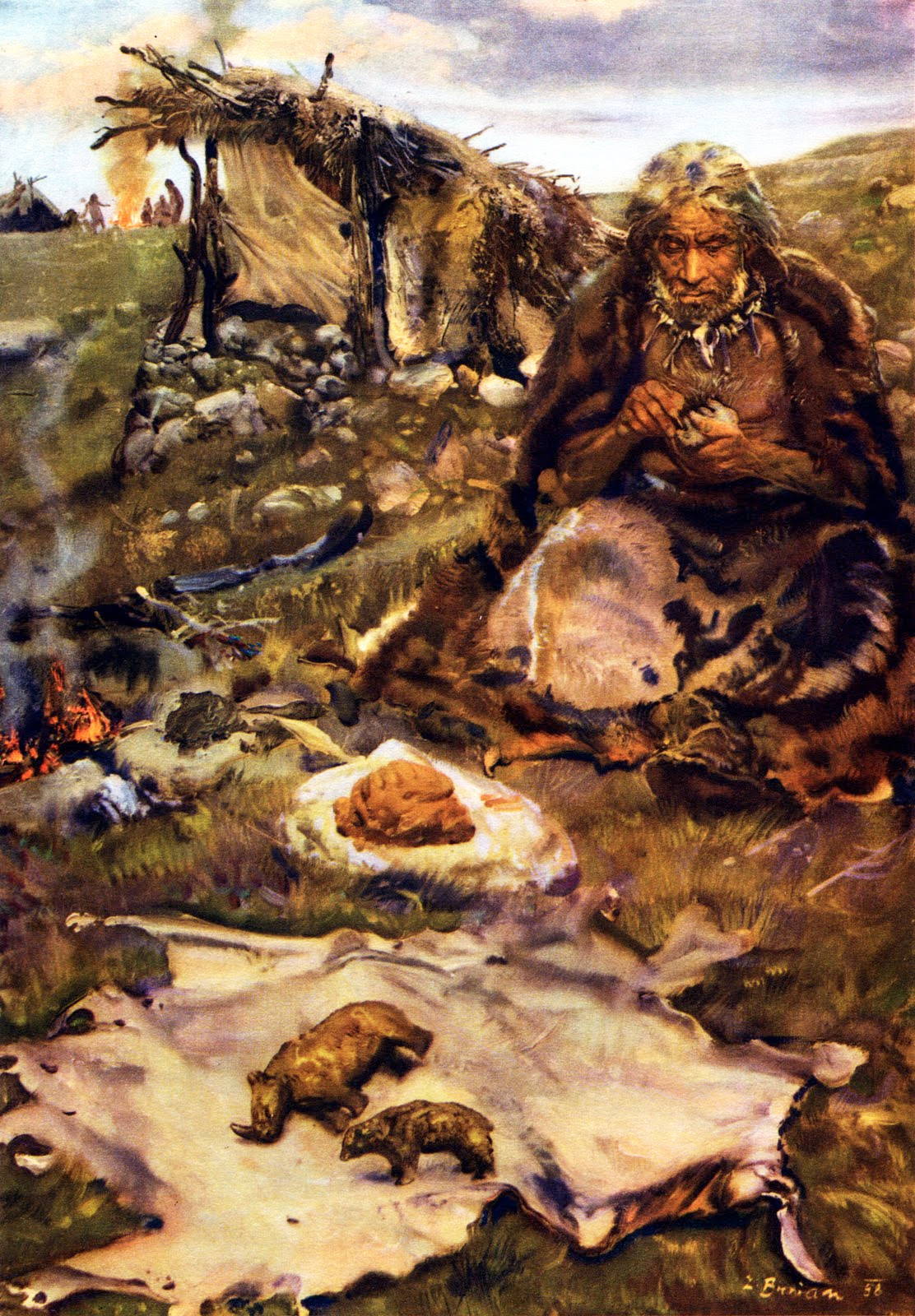
Another beautifully realised image by the artist Zdeněk Burian. The potter is making some of the zoomorphic figures also found at the site outside the small, simply constructed tent found near the ceramic figurines.
Close inspection of the painting shows that this image also depicts a male as the potter, whereas it is now believed that the woman who created the venus also created the figurines.
Photo: http://neat-stuff-blog.blogspot.com/2011/06/prehistoric-man.html
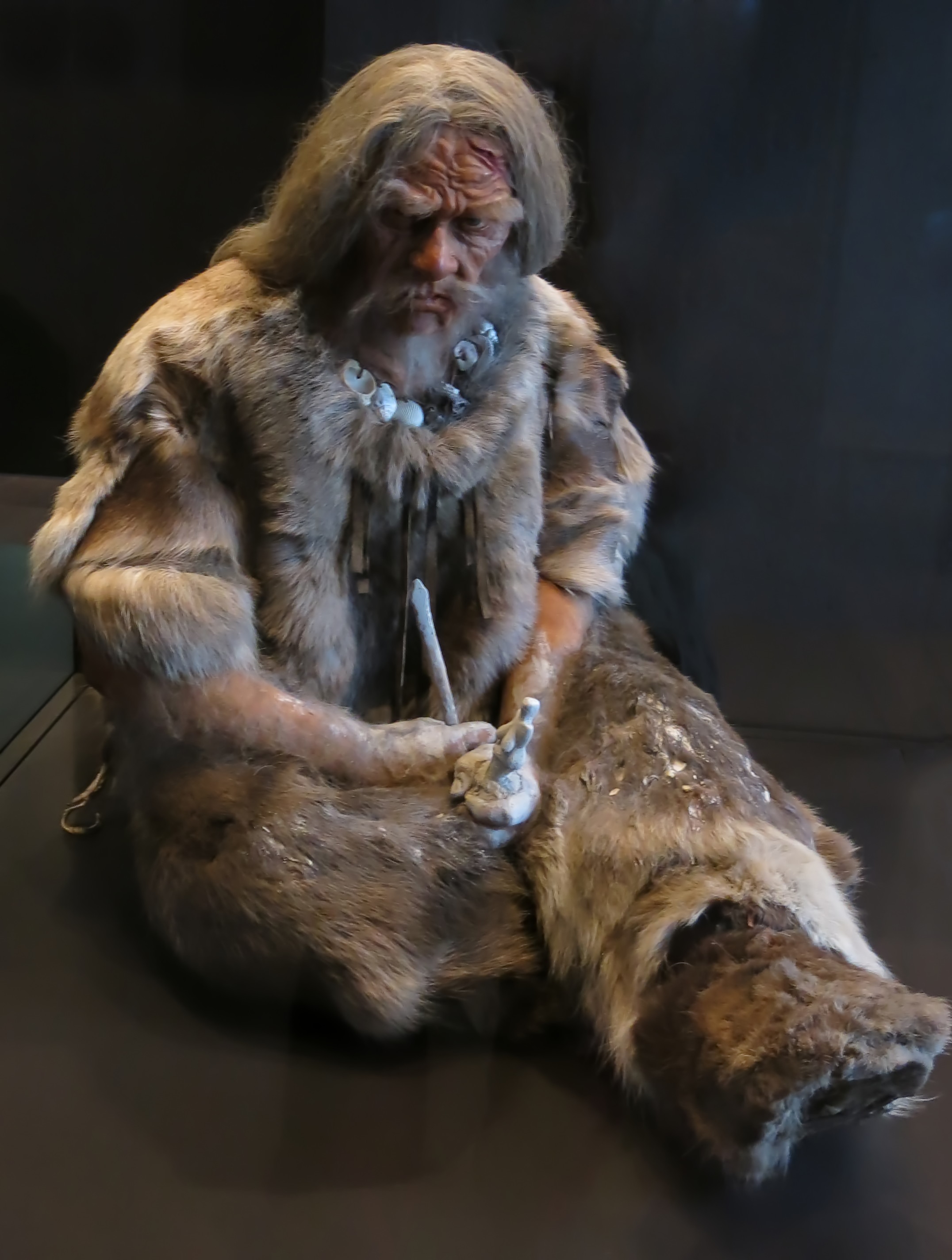
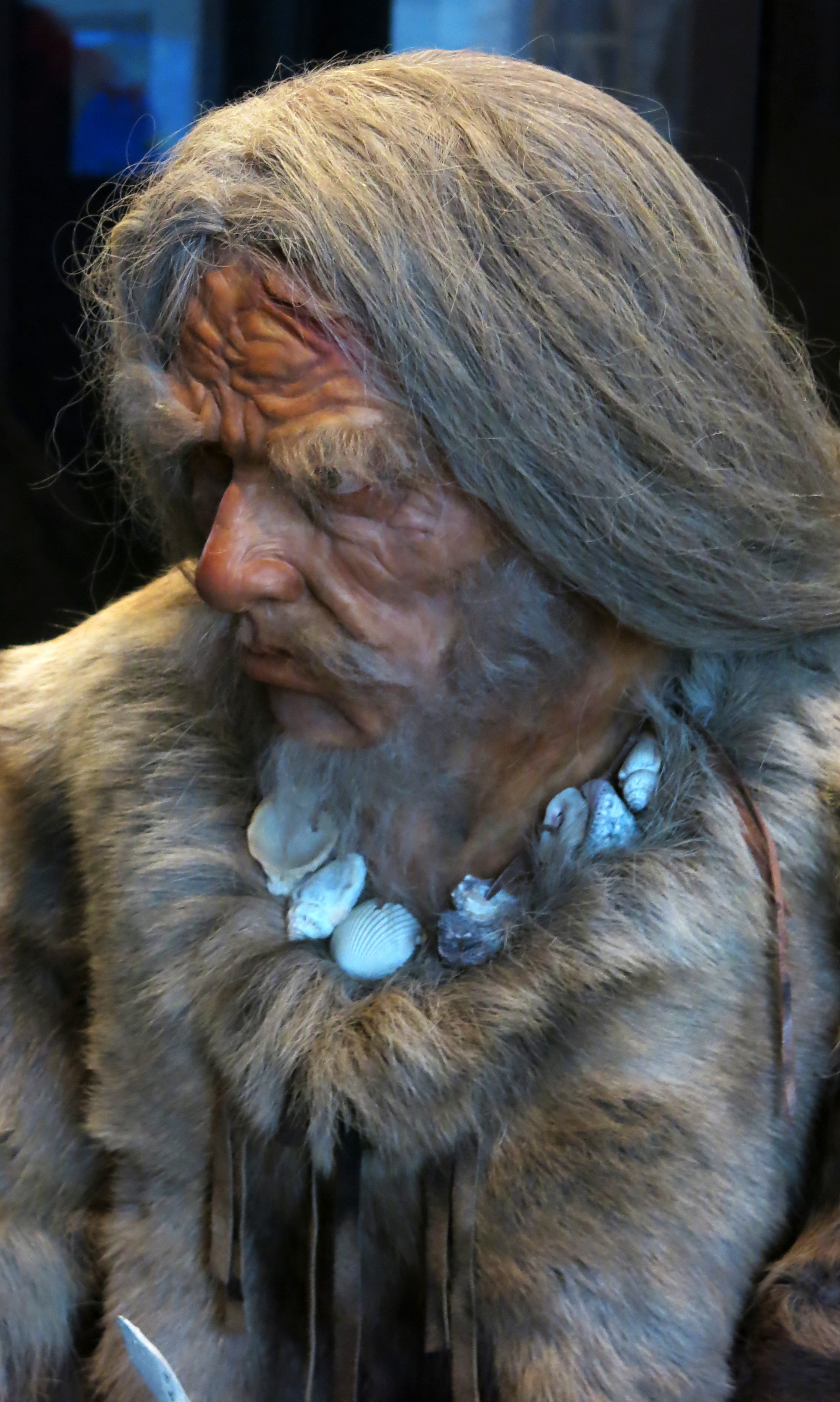
Sculptor of the Dolni Vestonice Venus, depicted here as a male.
Photo: Don Hitchcock 2015
Source: Sculpture at the Staatliche Museen zu Berlin, Neues Museum, Germany, on loan from the NHM, Wien
Text: © Card at the Staatliche Museen zu Berlin (CC BY-NC-SA 3.0 DE)
According to the Venus of Dolni Vestonice article in Wikipedia,
This figurine, together with a few others from nearby locations, is the oldest known ceramic in the world, predating the use of fired clay to make pottery. It has a height of 111 millimeters (4.4 inches), and a width of 43 millimeters (1.7 inches) at its widest point and is made of a clay body fired at a relatively low temperature.From:
The palaeolithic settlement of Dolní Věstonice in Moravia, then Czechoslovakia, now Czech Republic has been under systematic archaeological research since 1924, initiated by Karel Absolon. In addition to the Venus figurine, figures of animals - bear, lion, mammoth, horse, fox, rhino and owl - and more than 2 000 balls of burnt clay have been found at Dolní Věstonice.
The figurine was discovered on July 13, 1925 in a layer of ash, broken into two pieces. Once on display at the Moravian Museum in Brno, it is now protected and only rarely accessible to the public. Last time it was exhibited in the National Museum in Prague from 11 October, 2006 till 2 September, 2007 as a part of the exhibition Lovci mamutů (The Mammoth Hunters). Scientists periodically examine the statuette. A tomograph scan in 2004 found a fingerprint of a child estimated at between 7 and 15 years of age, fired into the surface; the child who handled the figurine before it was fired is considered by Králík, Novotný and Oliva (2002) to be an unlikely candidate for its maker.
http://www.calacademy.org/calwild/sum99/symbol.htm
Some 26,000 years ago, a resident of a seasonal, open-air encampment in what is now the southern Czech Republic kneaded moist clay mixed from local soil into an exaggerated portrait of a woman. The so-called Black Venus of Dolni Vestonice I has a featureless, possibly masked, face, squared shoulders, pendulous breasts, and a belt beneath her broad hips. Only four inches tall, she is one of the earliest known depictions of a female figure, but what inspired her creation is cloaked in mystery.
A jagged crack runs along her right hip, damage sustained when the clay figurine was fired in a kiln at temperatures up to 1,500 °F. More than 700 figurines-nearly all depicting Ice Age animals such as lions, rhinos, and mammoths-were fired in the oval earthen kilns of Dolni Vestonice. At nearby sites of similar age, thousands more terracotta figurines and clay pellets have been excavated. Almost all the Vestonice figurines exhibit breaks and cracks-the shattering shock of the flames that baked them. Were the world's first ceramic artists also the world's worst craftsmen, or were these figures props for a pyrotechnic ritual?
Elsewhere at Dolni Vestonice, a grave excavated in 1986 contained the skeletons of two young men and a woman. Inside the shallow burial pit lay bits of reindeer bones, and wolf and fox teeth. Red ocher powder had been sprinkled around each skull and between the legs of the female, who had a deformed spine and right leg. One male's hand had been placed atop the female's pelvis, while the other male's skull had been smashed at the time of burial.
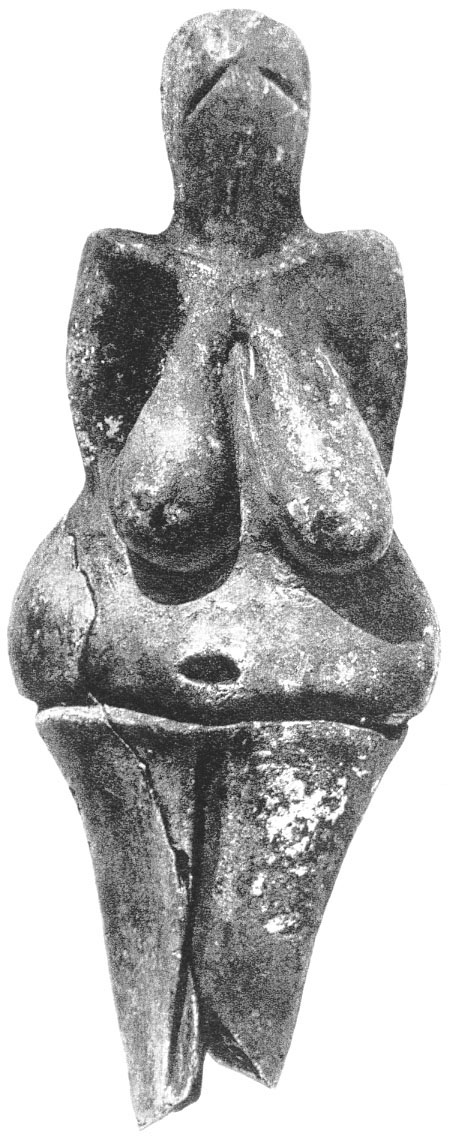 |
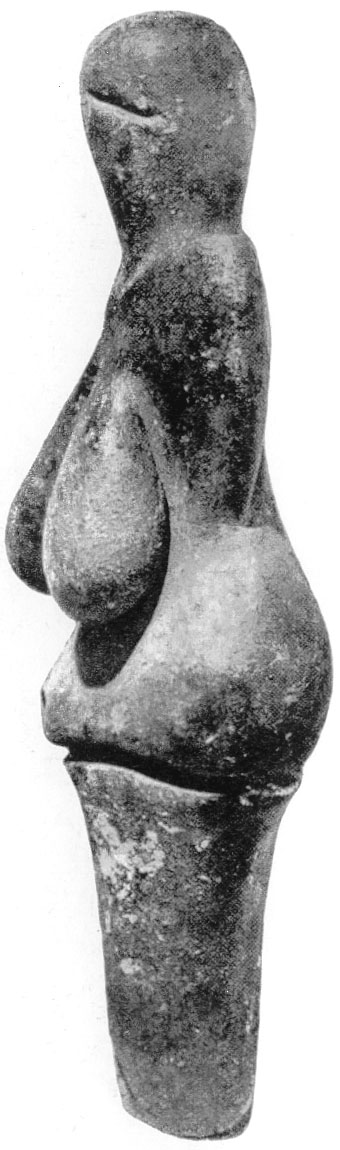 |
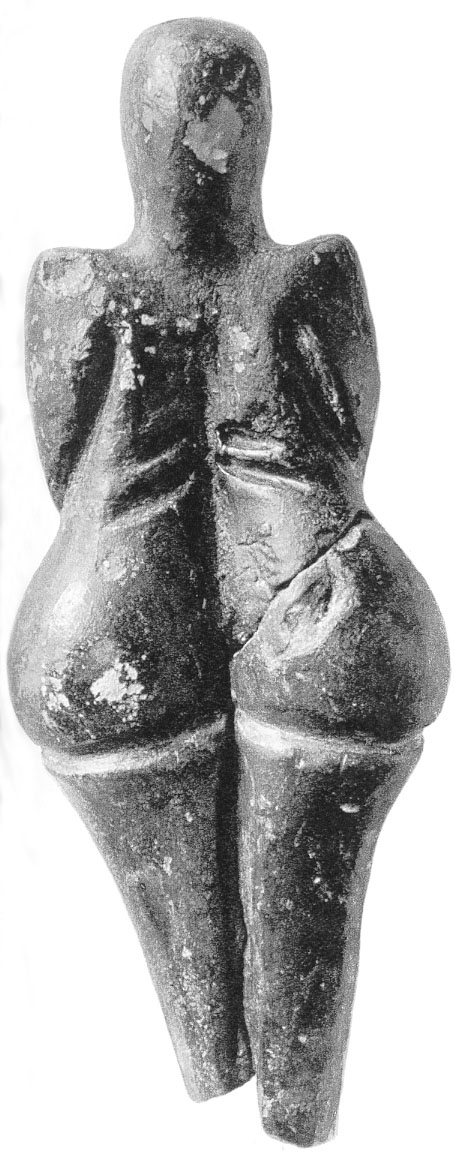 |
Photos: J Jelinek, 'The Evolution of Man'
 |
 |
Photos: J Jelinek, 'The Evolution of Man'
The S'Armunai Venus - for Jean Auel fans
From the book 'Plains of Passage' by Jean Auel, p510 ff:
S'Armuna reached inside her shirt and pulled out a small figure of a woman, perhaps four inches high. Both Ayla and Jondalar had seen many similar objects, usually carved out of ivory, bone, or wood. Jondalar had even seen a few that had been carefully and lovingly sculpted out of stone, using only stone tools.
......................
But this particular Mother figure was unique. S'Armuna gave the Munai to Jondalar. "Tell me what this is made of," she said.
Jondalar turned the small figure over in his hands, examining it carefully. It was endowed with pendulous breasts and wide hips, the arms were suggested only to the elbow, the legs tapered, and though a hairstyle was indicated, the face bore no markings. It was not much different in size or shape from many he had seen, but the material from which it was made was most unusual. The color was uniformly dark.
When he tried, he could make no indentation in it with his fingernail. It was not made of wood or bone or ivory or antler. It was as hard as stone, but smoothly formed, with no indication or marks of carving. It was not any stone he knew.
He looked up at S'Armuna with a puzzled expression. "I have never seen anything like this before," he said.
Jondalar gave the figure to Ayla, and a shiver went through her at the moment she touched it. I should have taken my fur parka when we went out, she said to herself, but she could not help feeling that it was more than the cold that had made her feel such a sharp chill.
"That munai began as the dust of the earth," the woman stated.
"Dust?" Ayla said. "But this is stone!"
"Yes, it is now. I turned it to stone."
"You turned it to stone? How can you turn dust to stone?" jondalar said, full of disbelief.
The woman smiled. "If I tell you, would it make you believe my power?"
"If you can convince me," the man retorted.
"I will tell you, but I won't try to convince you. You will have to convince yourself. I started with hard, dry clay from the river's edge and pounded it to dusty earth. Then I mixed in water." S'Armuna paused for a moment, wondering if she should say anything more about the mixture. She decided against it for now. "When it was the right consistency, it was shaped. Fire and hot air turned it to stone," the shaman stated, watching to see how the two young strangers would react, whether they would show disdain or be impressed, whether they would doubt or believe her.
The man closed his eyes trying to recall something. "I remember hearing ... from a Losadunai man, I think ... something about Mother figures made of mud."
S'Armuna smiled. "Yes, you could say we make munai out of mud. Animals, too, when we have need to call upon their spirits, many kinds of animals, bears, lions, mammoths, rhinos, horses, whatever we want. But they are mud only while they are being shaped. A figure made of the dust of the earth mixed with water, even after it has hardened, will melt in water back to the mud from which it was formed, then turn to dust, but after it is brought to life by Her sacred flame, it is forever changed. Passing through the Mother's searing heat makes the figures as hard as stone. The living spirit of the fire makes them endure."
Ayla saw the fire of excitement in the woman's eyes, and it reminded her of Jondalar's excitement when he was first developing the spearthrower. She realized that S'Armuna was reliving the thrill of discovery, and it convinced her.
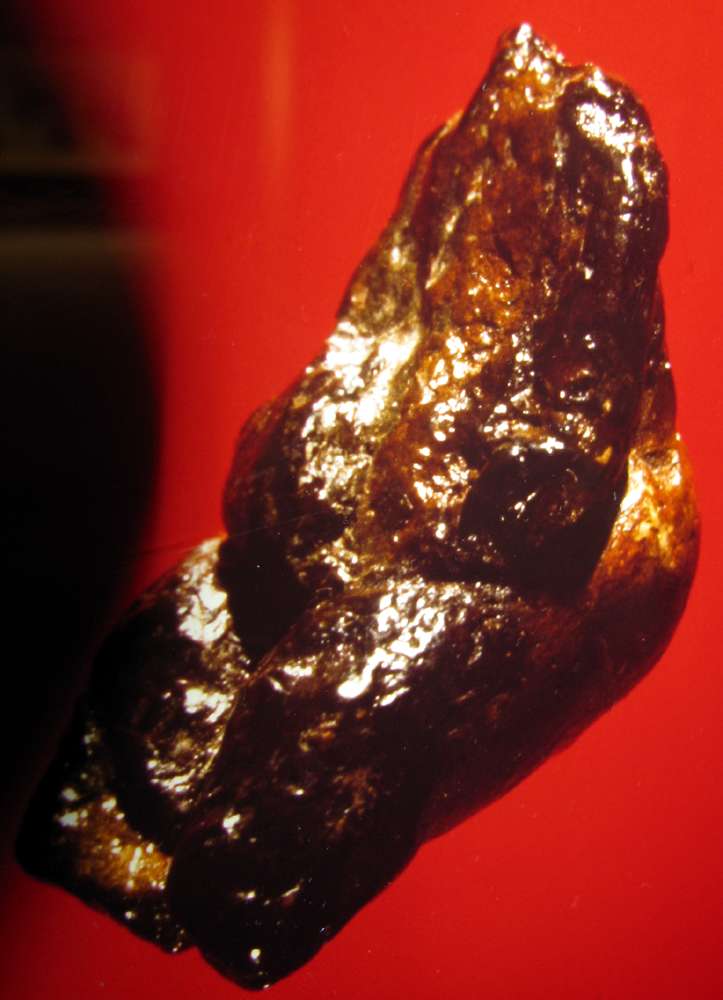
There was no text with this object on display as a poster at the Dolní Věstonice Museum, but it is the sitting Venus of Pavlov, shown below.
Photo: Don Hitchcock 2008
Source: Poster, display, Dolní Věstonice Museum

The Sitting Venus of Pavlov
A fired, ceramic venus. Height 34 mm, age 29 000 BP.
This is a copy on display in the Archaeological Museum in Dolni Vestonice. The original is in the Academy of Sciences of the Czech Republic, Brno.
I can find no other reference to this venus.
Source: http://www.lands-of-venuses.eu/v-b-pavlov/w-b-pavlov.html
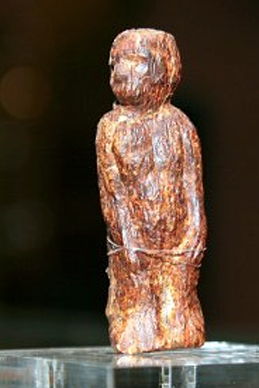
The text with this photo reads:
The third Venus of Dolní Věstonice, made of mammoth ivory (photo property of Moravian Museum).
The artefact was stored in 'Römisch-Germanisches Zentralmuseum Mainz' for almost 40 years, without anybody noticing its great historical value.
The third Venus of Dolní Věstonice will make good company with the original statue of 'Venus of Dolní Věstonice', found in 1925, and to the only copy of the lost 'second Venus of Dolní Věstonice'.
That made me sit up and take notice! I wondered What is the second Venus of Dolní Věstonice? It turns out that the Venus of Dolní Věstonice II is the fake one, shown on this page, so only having a copy is not such a great loss.
However, this one is genuine, and as another venus enthusiast, Ralph Frenken, says:
It is the only venus that turns her head to the side, apart perhaps from the Venus of Laussel, and the venus looks male. (pers. comm)
Photo: © Moravian Museum
Source: http://brnonow.com/2009/06/the-third-venus-of-vestonice-shown-in-anthropos-musem-pavillion/
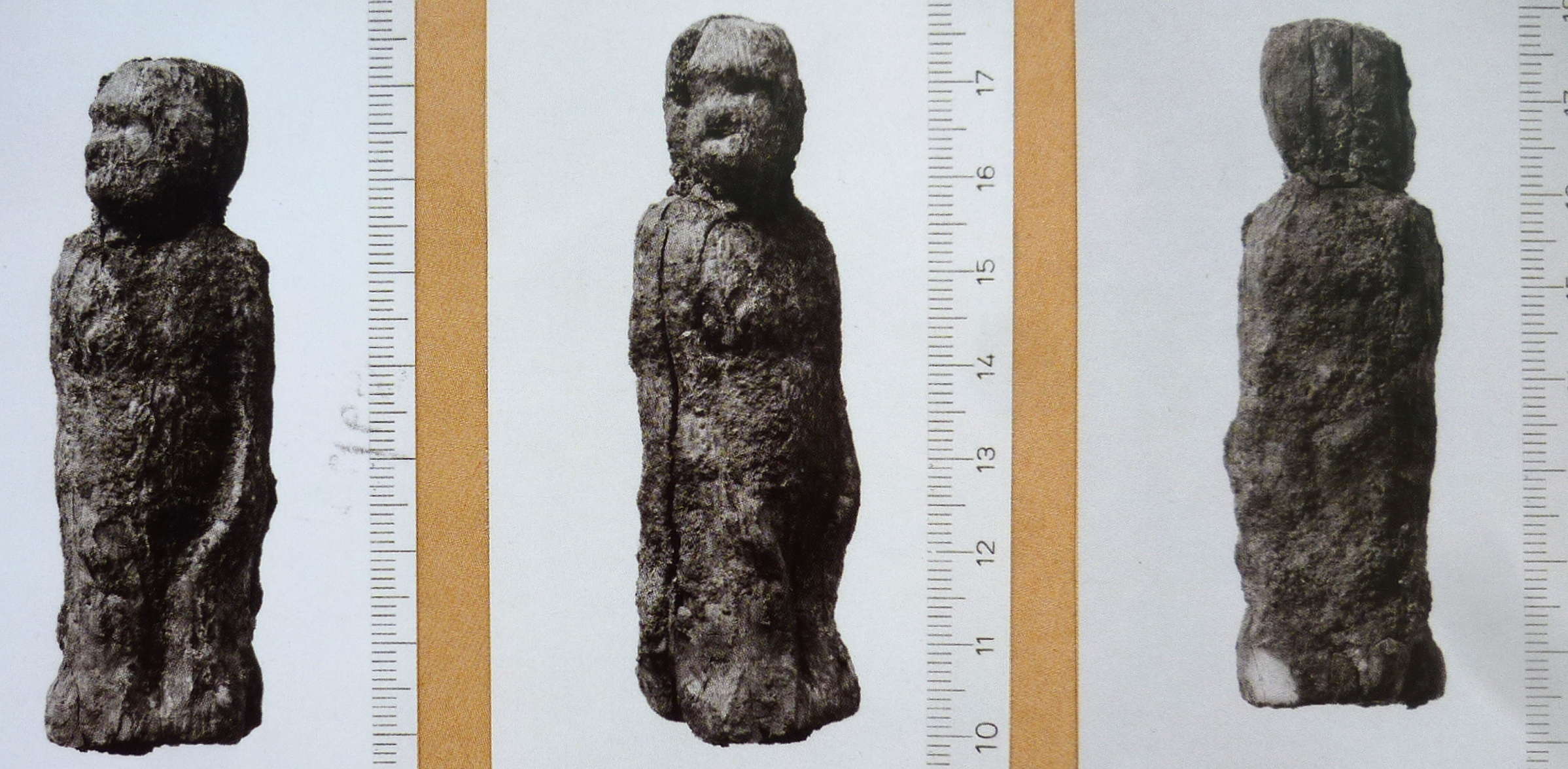
The Dolní Věstonice Venus III
Photo: Rau et al. 2009
Source: aus dem Archiv des Römisch-Germanischen Zentralmuseums Mainz
But where did the statue come from, and is it genuine? Initial investigations revealed that up to the point of entry in the archive and the archival photos of RGZM nothing was known. There it is listed under number O.38778, where "O" stands for original ('Ivory, allegedly from Dolni Vestonice, Moravia, privately owned at Neckargemünd by A. Dolleschahl').
There are no invoices or sales contracts or similar. The acquisition year is known from the numbers T 66/292-294 on the negatives of the archival photos, because 66 refers to the year 1966. From church records the former owner can be determined, Adolf Dolleschahl, but he died in 1974 without descendants at Neckargemünd.
The question of origin and age of the statue had to be pursued by other means.
Dolni Vestonice is considered an important archaeological site of 31 000 – 30 000 cal. BP. The many female figures in clay and ivory that were found there in addition to other animal figures and human representations are world famous.
A typical feature of the Gravettian are numerous female Venus figurines, which were found from southwestern France to Siberia. A stylistic comparison of this Venus with the bodies of these female figures showed that each feature had analogies in those of other female examples, and stylistically it did not constitute a special case. Only the base is unique. It is quite similar to these figures, and especially to those from Dolni Vestonice - a reference to its origin. Most of the Venus figures have similarities which can be put down to their geographical proximity.
Text above translated from: Rau et al. 2009
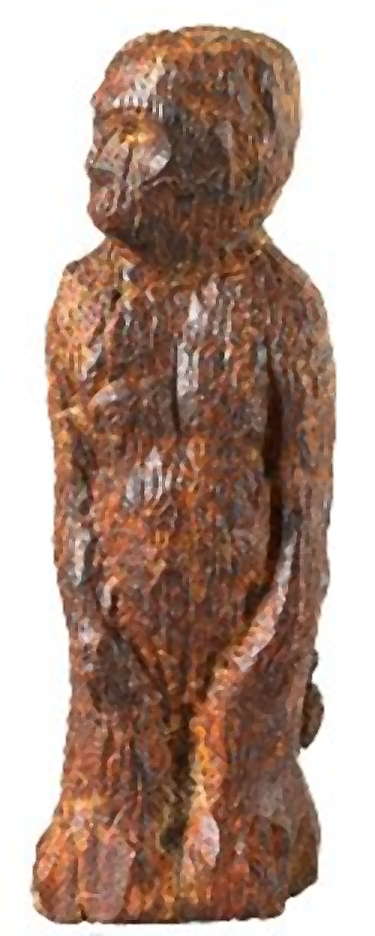
The third Venus of Dolní Věstonice, made of mammoth ivory. In this view, we can see clearly that, unusually, the venus is looking to the side. Almost all venuses have the face towards the front.
It comes from the Archiv des Römisch-Germanischen Zentralmuseums. For a long time this venus was thought to be a forgery. However, as part of a master's thesis at the University of Mainz, conducted by Sibylle Wolf, the authenticity of the 25 000 year old art object has been confirmed.
A variety of techniques were used, including 3D laser scans and infrared spectroscopy to establish the bona fides of the statue.
Photo: From an exhibition in Monrepos from 8th February to 30th April 2009, and from the website http://web.rgzm.de/724.html
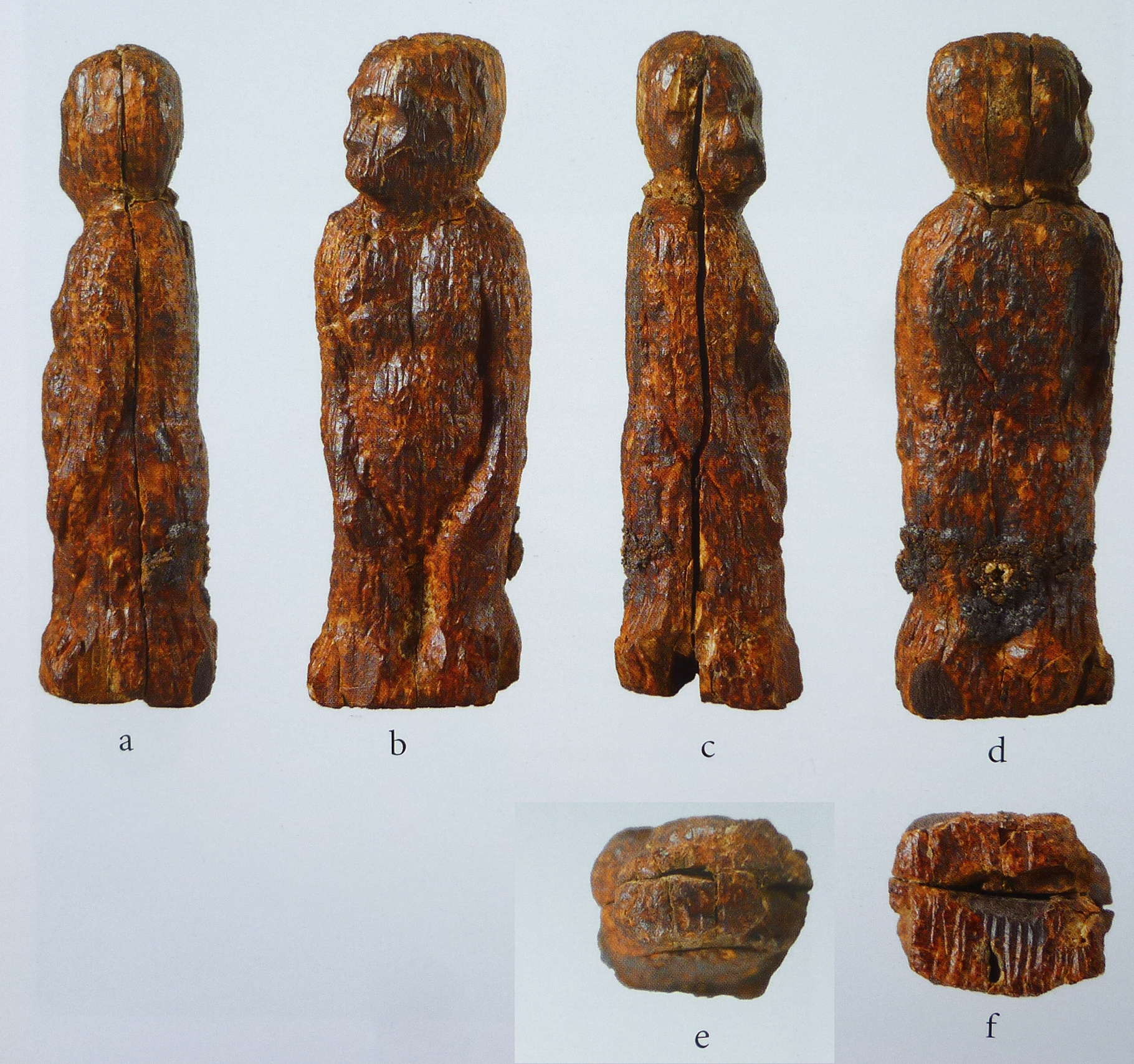
A much better photograph of the third Venus of Dolní Věstonice.
Photo: Rau et al. (2009)
A new Venus figurine from the Upper Paleolithic find site Dolní Vestonice (Moravia)
The topic of this paper is a small, female Venus sculpture in the round from the collections of the Römisch Germanisches Zentral museum in Mainz. Based on the find context, it is postulated to originate from the Upper Paleolithic find site Dolní Vestonice in Moravia. On the basis of its association with the find site, the statue was included into the sequence of female figurines from the site and was labeled Venus III.
It is remarkable due to her face, which is angled towards the right, and the pedestal foot. The central questions to be answered were whether the figurine is authentic and whether Venus III dates to the middle Upper Paleolithic or if it is a fake In order to respond to these questions, the entire spectrum of female statues from the Upper Paleolithic was evaluated in order to provide a large base of comparison with which to compare Venus III and to determine whether it fits into this period stylistically.
Infrared spectroscopy was applied to attempt to determine the material from which Venus III was fashioned. Due to contamination in the test sample it was not possible to identify the organic material from which the statue was carved. The brittle nature of the material allows for the conclusion that it is fossilized material. The vertical fracture in the figure is typical of ivory. It is most likely to be mammoth ivory, which occurs in abundance at the find site Dolní Vestonice.
The composition of sediments adhering to Venus III was tested using mineralogical phase analysis. It is made up of a ferrous crystalline mixture that corresponds to the ground composition of the Dolní Vestonice find site. The comparison of Venus III with the Venus figurines described in this paper made clear that Venus III can be classified stylistically with the »statue horizon« of the middle Upper Paleolithic because its characteristics are analogous to various statues from the middle Upper Paleolithic.
Venus III was scanned using a 3D scanner and digitally measured. The metric analysis proved that the construction, its proportions and size closely resemble other figurines and that it is not an exception. Careful study of the surface of Venus III showed that the notches and grooves on the surface were probably intentional. 14C-dating did not return any results because the sample size was too small for accurate results.
It is not possible to identify the meaning of Venus III for its makers from today’s perspective. However, several interpretations are under consideration: It could either represent a young woman with small breasts during pregnancy, the slightly-curved stomach implies a pregnancy in its 4th or 5th month. It could also represent an elderly woman whose body has lost its firmness. The unclear find context does not necessarily imply that the figurine is a fake, especially because Venus III most probably does originate from Dolni Vestonice. Based on the data, the analyses and the deduced conclusions presented in the paper, Venus III seems to be an authentic work of art from the Upper Paleolithic.
The Mammoth Ivory Female head from Dolni Vestonice
Known as the Dolni Vestonice Venus XV
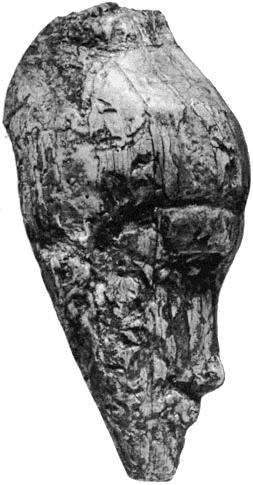
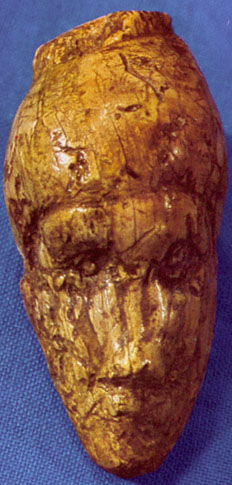
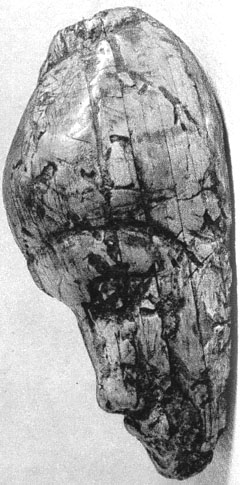
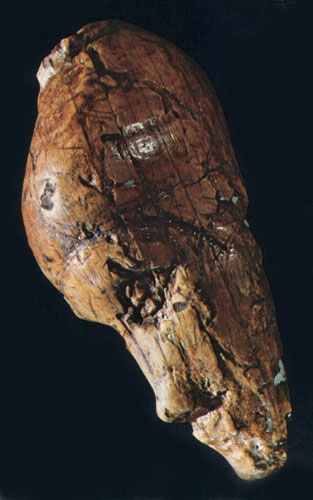
Head carved from mammoth ivory showing a person with an asymmetrical face. Dolni Vestonice
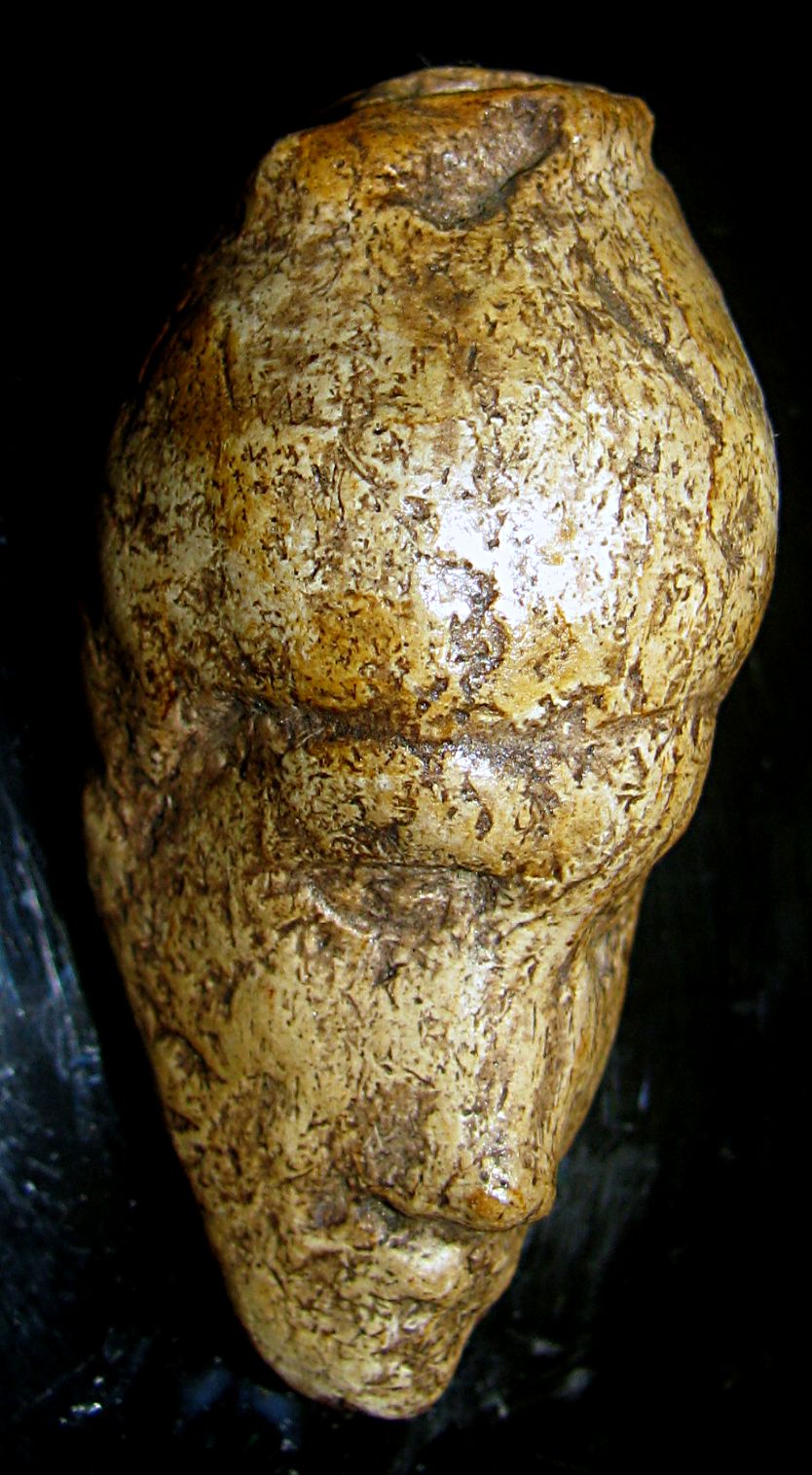
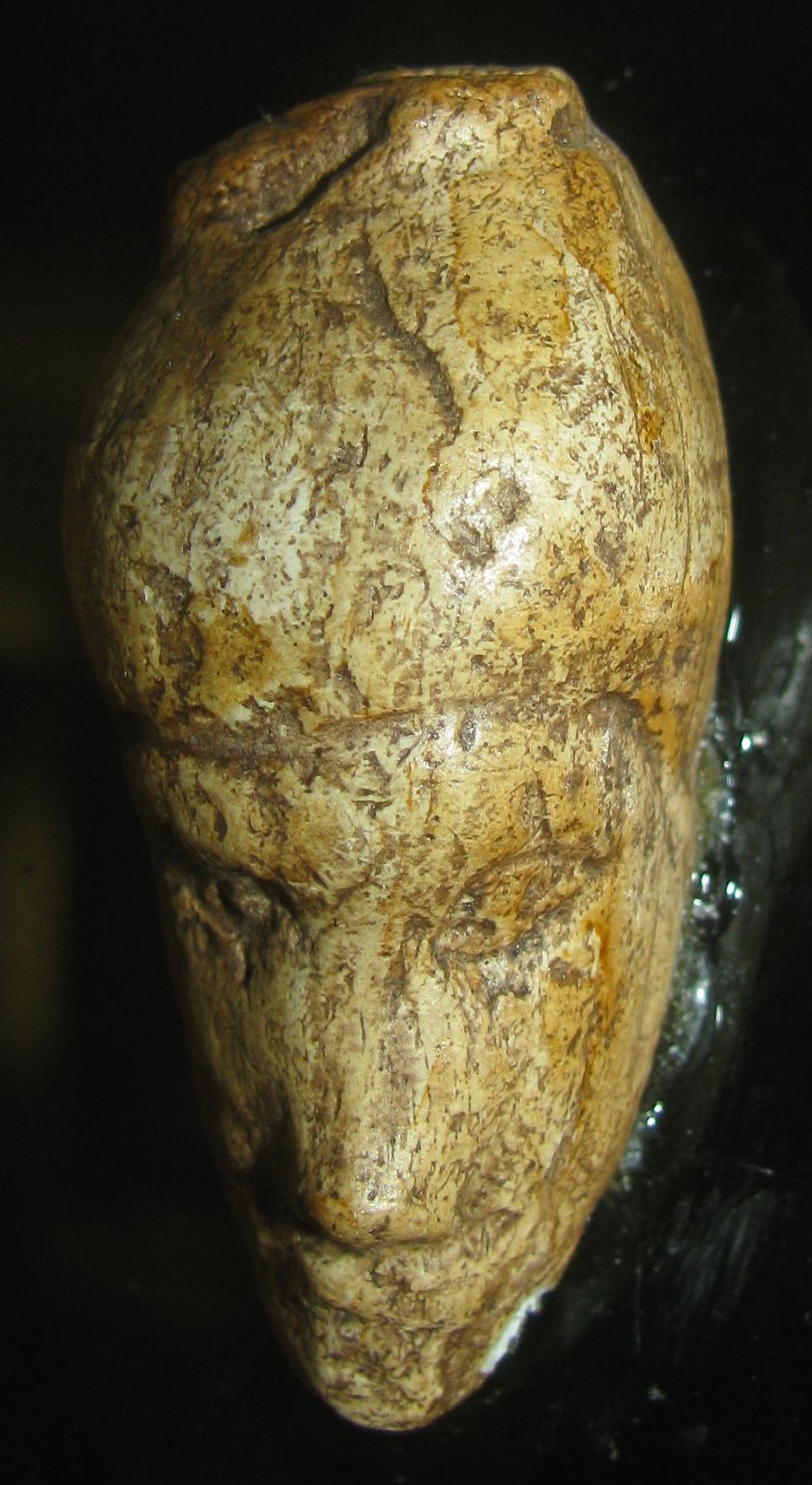
The Dolni Vestonice Venus XV
Carved Mammoth Ivory sculpture of the head of a woman from Dolní Věstonice, showing asymmetry.
This is thought to be of the woman who made all the ceramic figures from Dolní Věstonice.
It may be that she suffered a stroke at one time which made one side of her face fall because of lack of muscle tone.
She appears to wear her hair pulled up tightly to a bun on top of the head. Like the ceramic venus, this is a masterwork.
Photo: Don Hitchcock 2008
Source: Facsimile, display, Dolní Věstonice Museum
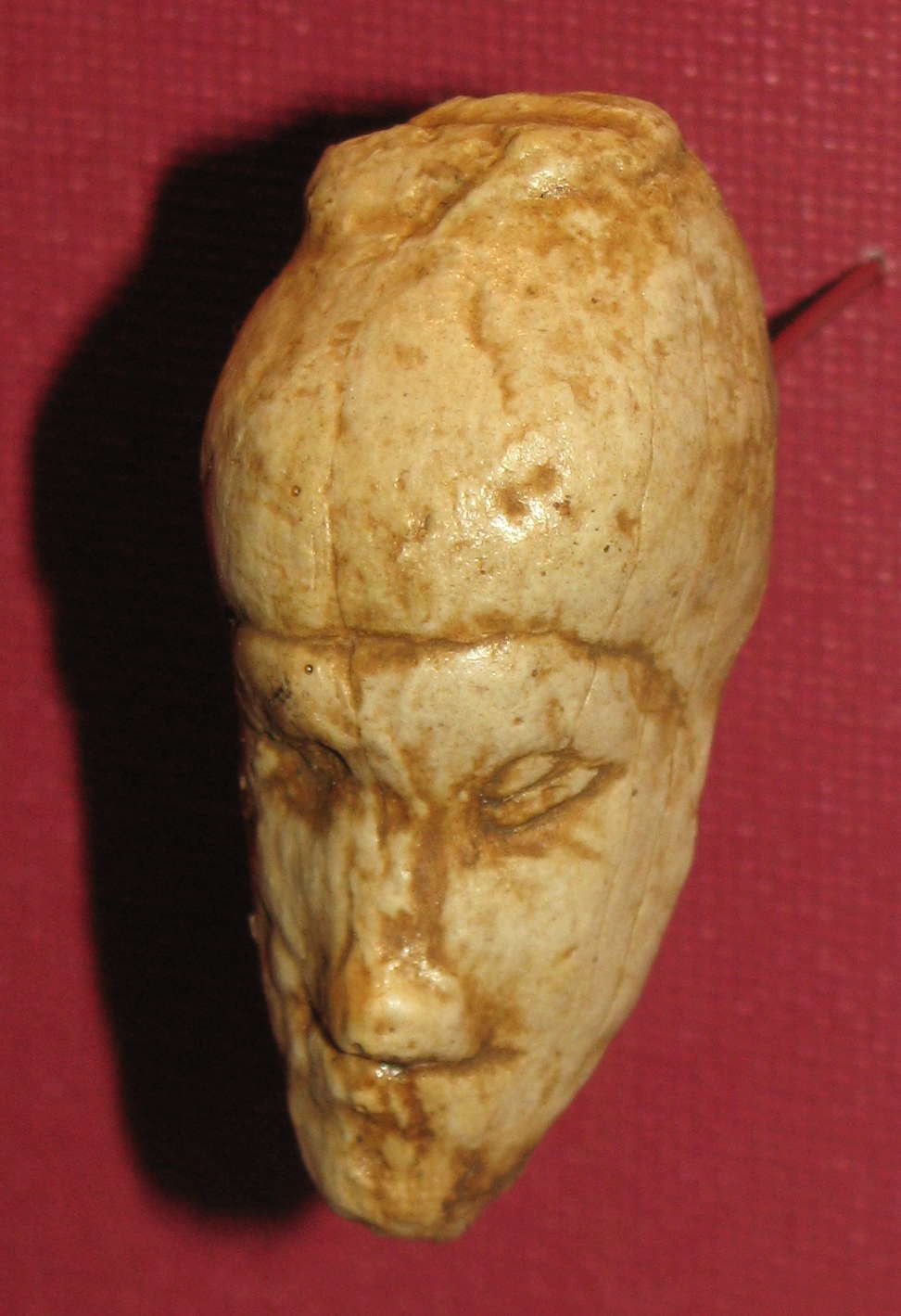
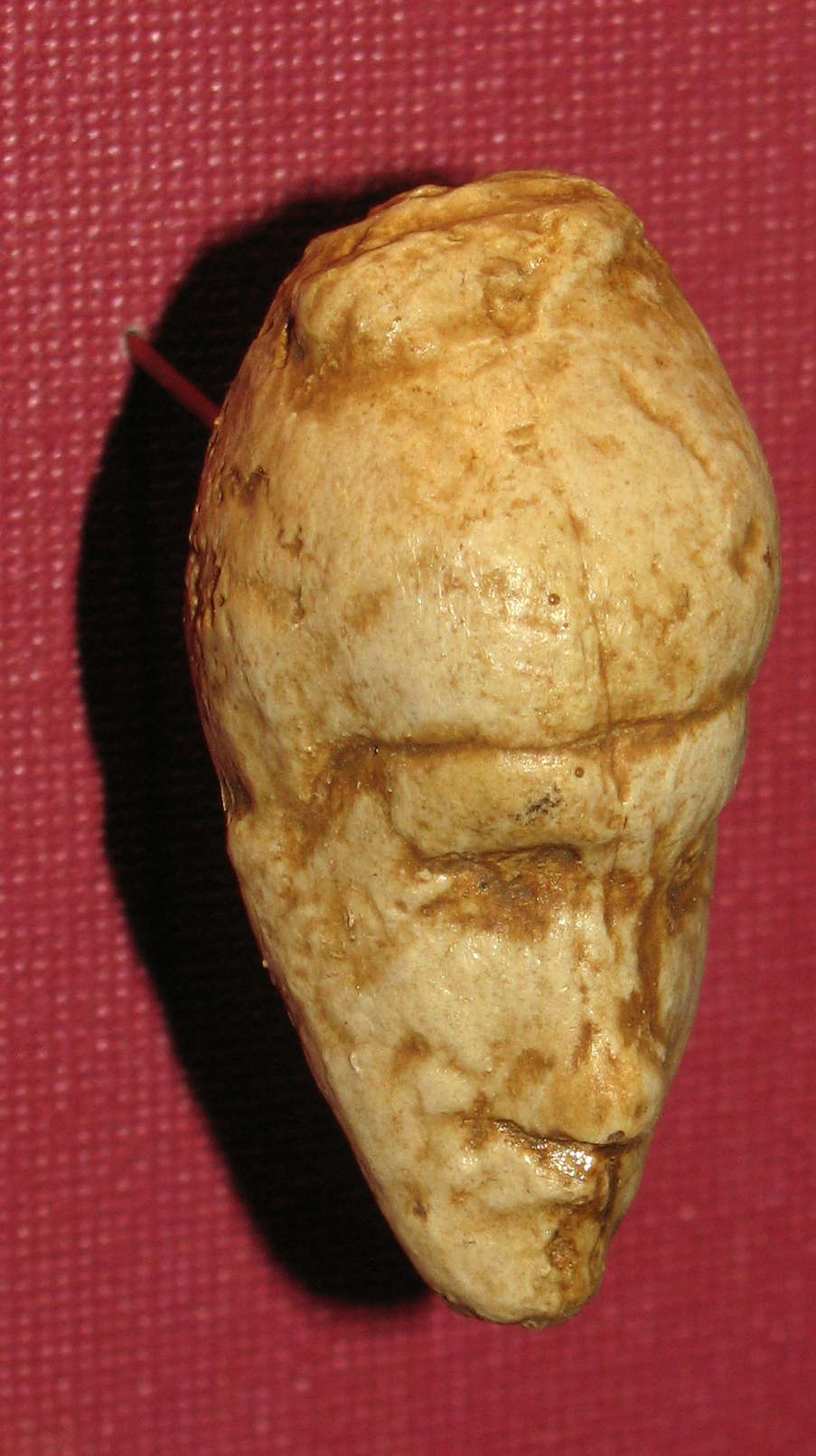
Another facsmile of the carved ivory face from Dolní Věstonice.
Photo: Don Hitchcock 2008
Source: Facsimile, Vienna Natural History Museum
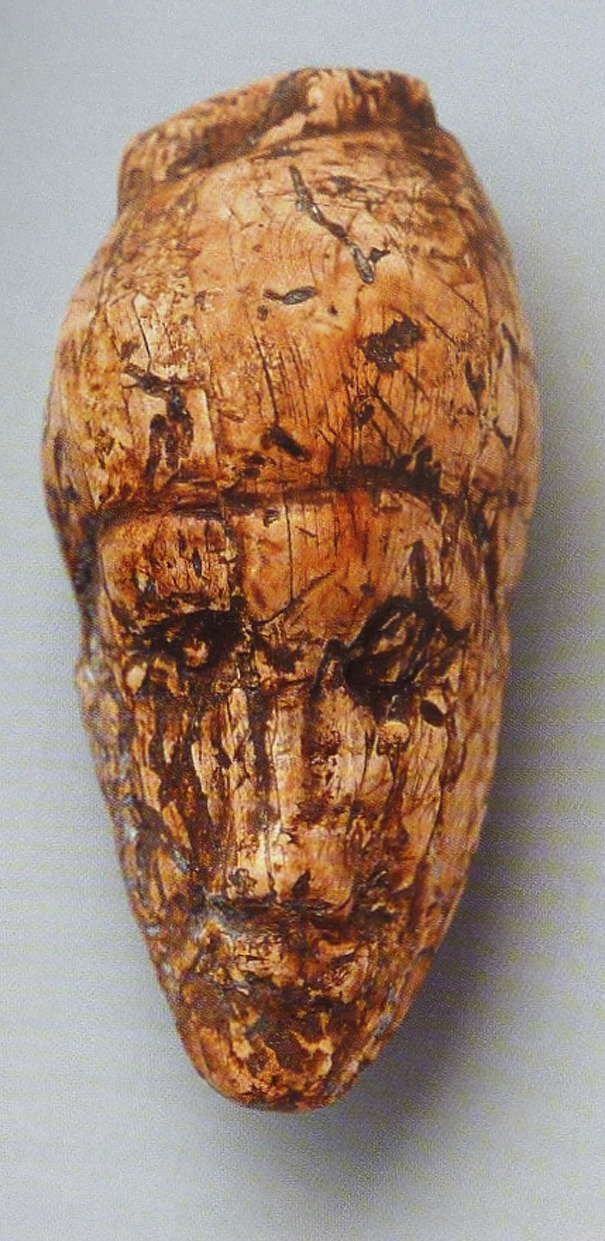

Dolní Věstonice Venus XV.
Two good photos of the original.
Photo: (left) Rau et al. (2009)
Photo: (right) © Moravian Museum, Anthropos Institute
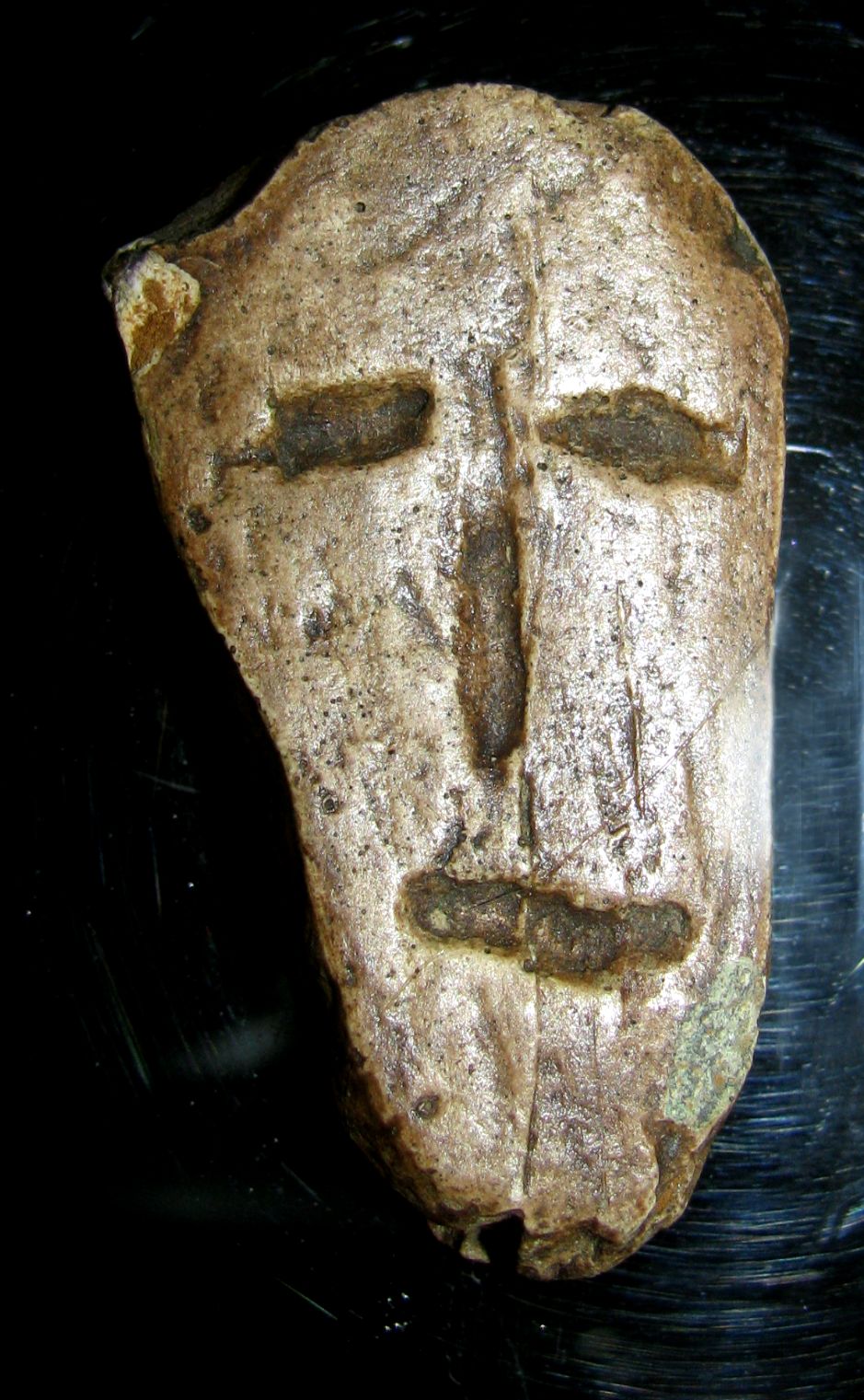
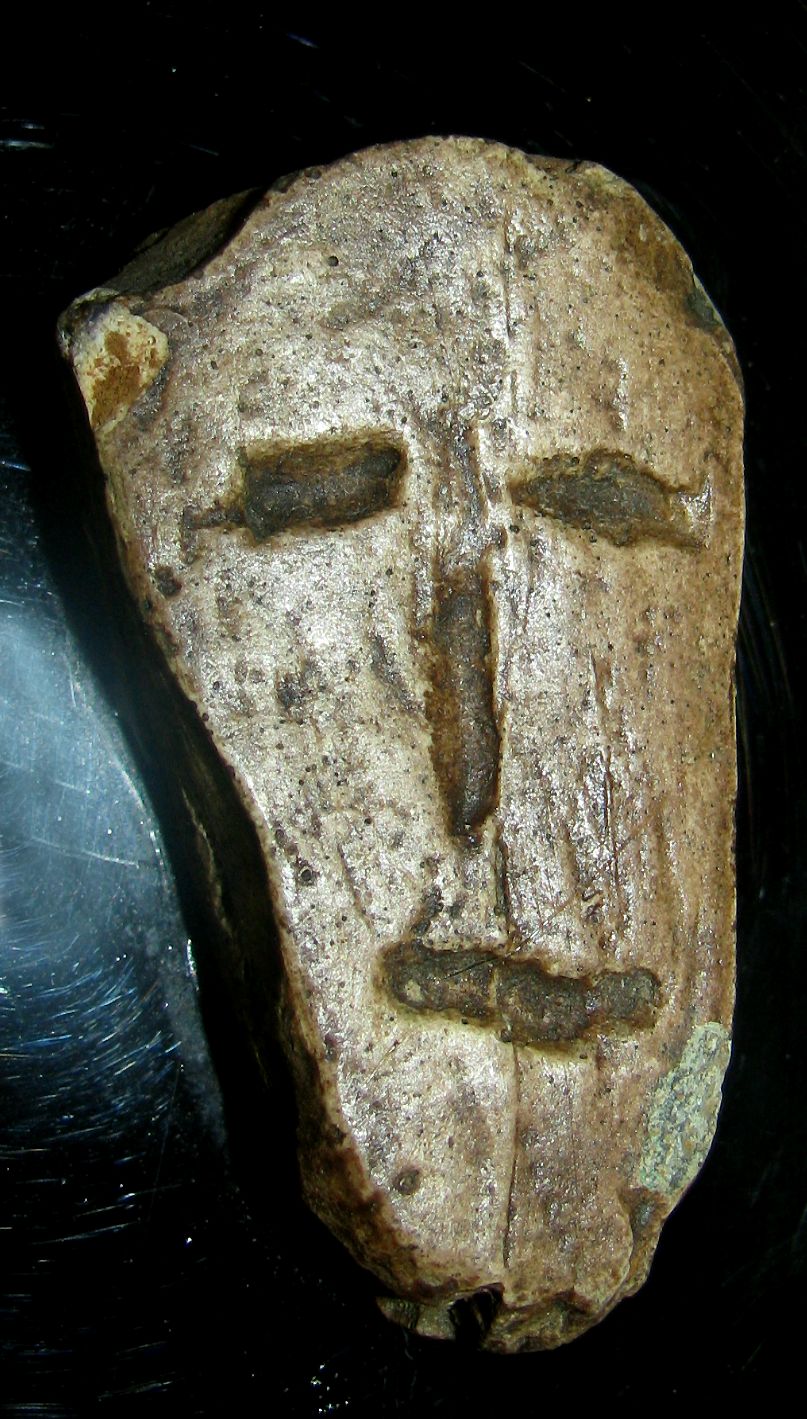
This is known as the Dolní Věstonice Mask.
Carved Mammoth Ivory face from Dolní Věstonice, showing asymmetry of the face.
This, and the ivory sculpture above, are thought to be of the woman who made all the ceramic figures from Dolní Věstonice.
(It is my belief that the ceramicist made the head above as a self-portrait, and a less talented student of hers made the flat carving shown here - Don)
Photo: Don Hitchcock 2008
Source: Facsimile, display, Dolní Věstonice Museum
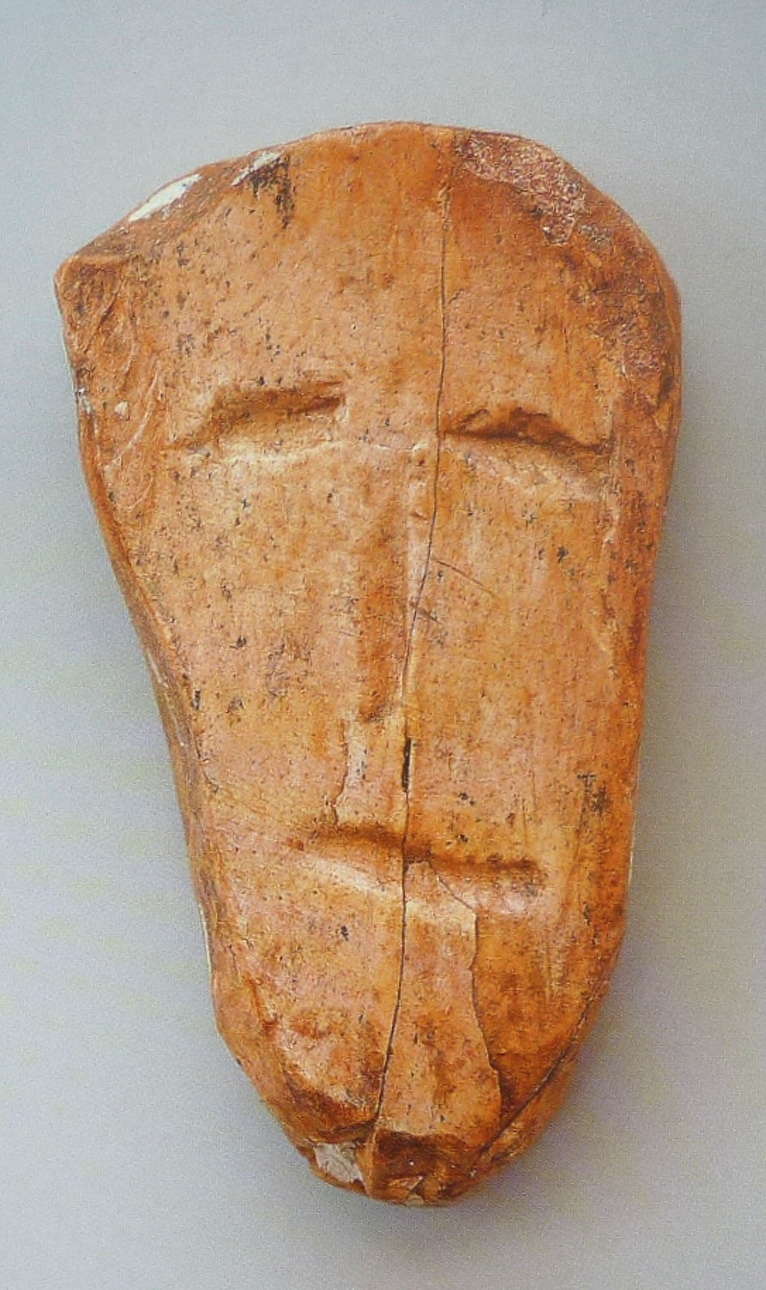
Dolní Věstonice Mask.
This is a good photo of the original.
Photo: Rau et al. (2009)
Another carved mammoth tusk
This is known as the Venus of Predmost
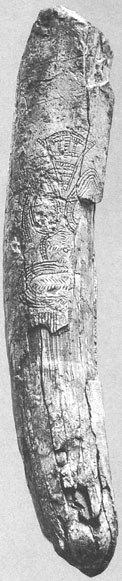 Photo: G. Clark, 'The Stone Age Hunters' |
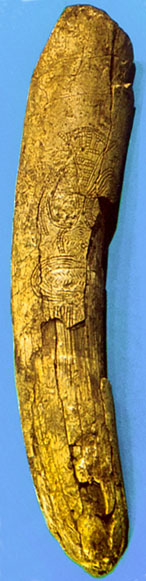 Photo: J Jelinek, 'The Evolution of Man' |
Stylised figure of a woman engraved on a mammoth tusk from Predmost, an area close to Dolní Věstonice. Height 15.5 cm
From the book 'Plains of Passage' by Jean Auel, p537:
Attaroa's speaking staff
The staff itself was quite unusual. It was not newly carved, that much was obvious. The color of the mammoth ivory had begun to turn creamy, and the area where it was usually held was gray and shiny, caused by the accumulated dirt and oils of the many hands that had held it. It had been used by many generations.
The design carved into the straightened tusk was a geometric abstraction of the Great Earth Mother, formed by concentric ovals to shape the pendulous breasts, rounded belly, and voluptuous thighs. The circle was the symbol for all, everything, the totality of the known and unknown worlds, and symbolized the Great Mother of All. The concentric circles, especially the way they were used to suggest the important motherly elements, reinforced the symbolism.
The head was an inverted triangle, with the point forming the chin, and the base, curved slightly into a domelike shape, at the top. The downward pointing triangle was the universal symbol for Woman; it was the outward shape of her generative organ and therefore also symbolized motherhood and the Great Mother of All. The area of the face contained a horizontal series of double parallel bars, joined by laterally incised lines going from the pointed chin up to the position of the eyes. The larger space between the top set of double horizontal lines and the rounded lines that paralleled the curved top was filled in with three sets of double lines that were perpendicular, joining where eyes would usually be.
But the geometric designs were not a face. Except that the inverted triangle was placed in the position of a head, the carved markings would not even have suggested a face. The awesome countenance of the Great Mother was too much for an ordinary human to behold. Her powers were so great that Her look alone could overwhelm. The abstract symbolism of the figure on Attaroa's Speaking Staff conveyed that sense of power with subtlety and elegance.
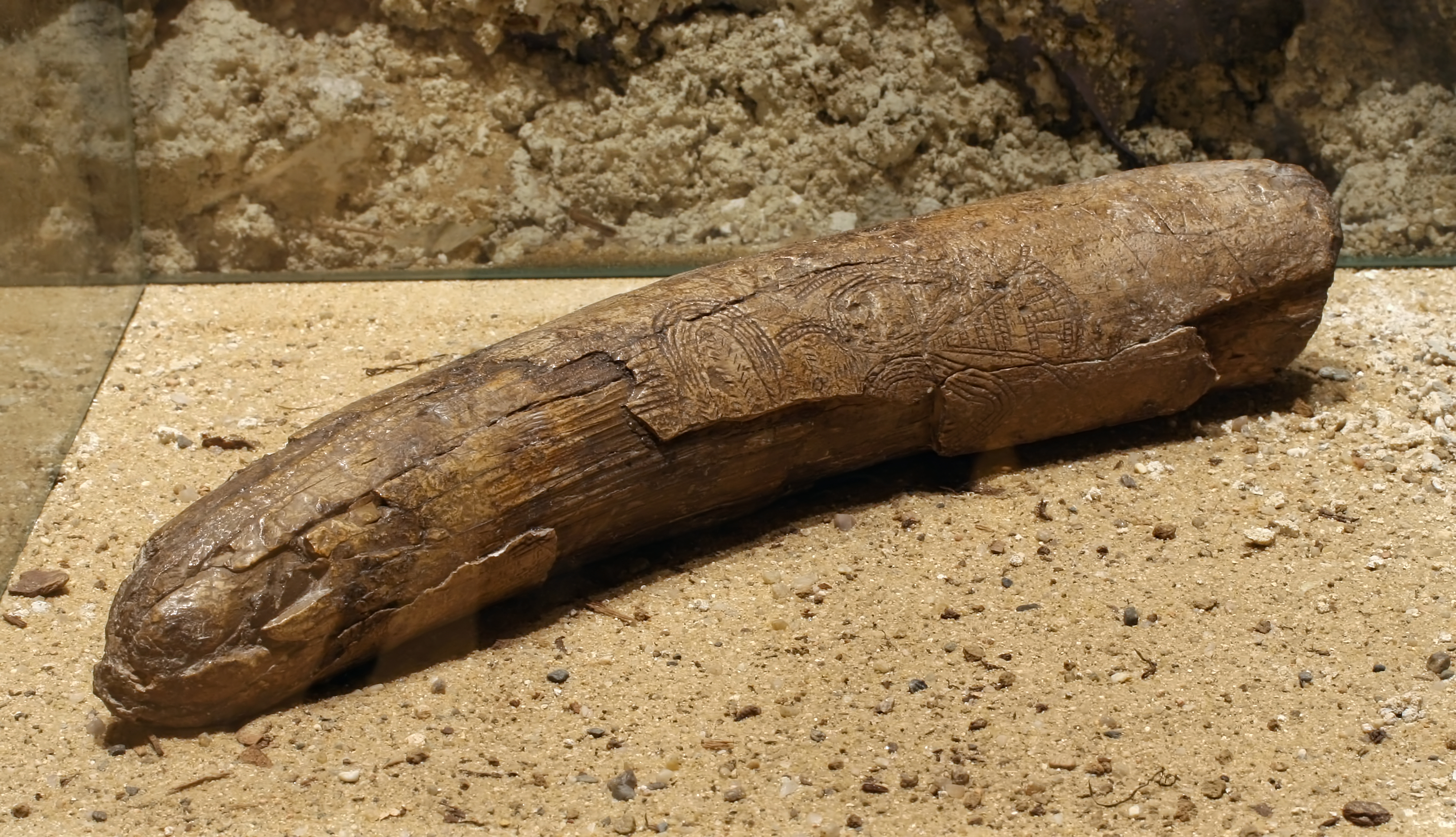
Mammoth tusk with engraving (vanus) at 'Lovci mamutů' exhibition in the National Museum in Prague, 2007.
Photo: Petr Novák, Wikipedia, guidance: Danny B.
Permission: Creative Commons Attribution-Share Alike 2.5 Generic license.
Source: Original
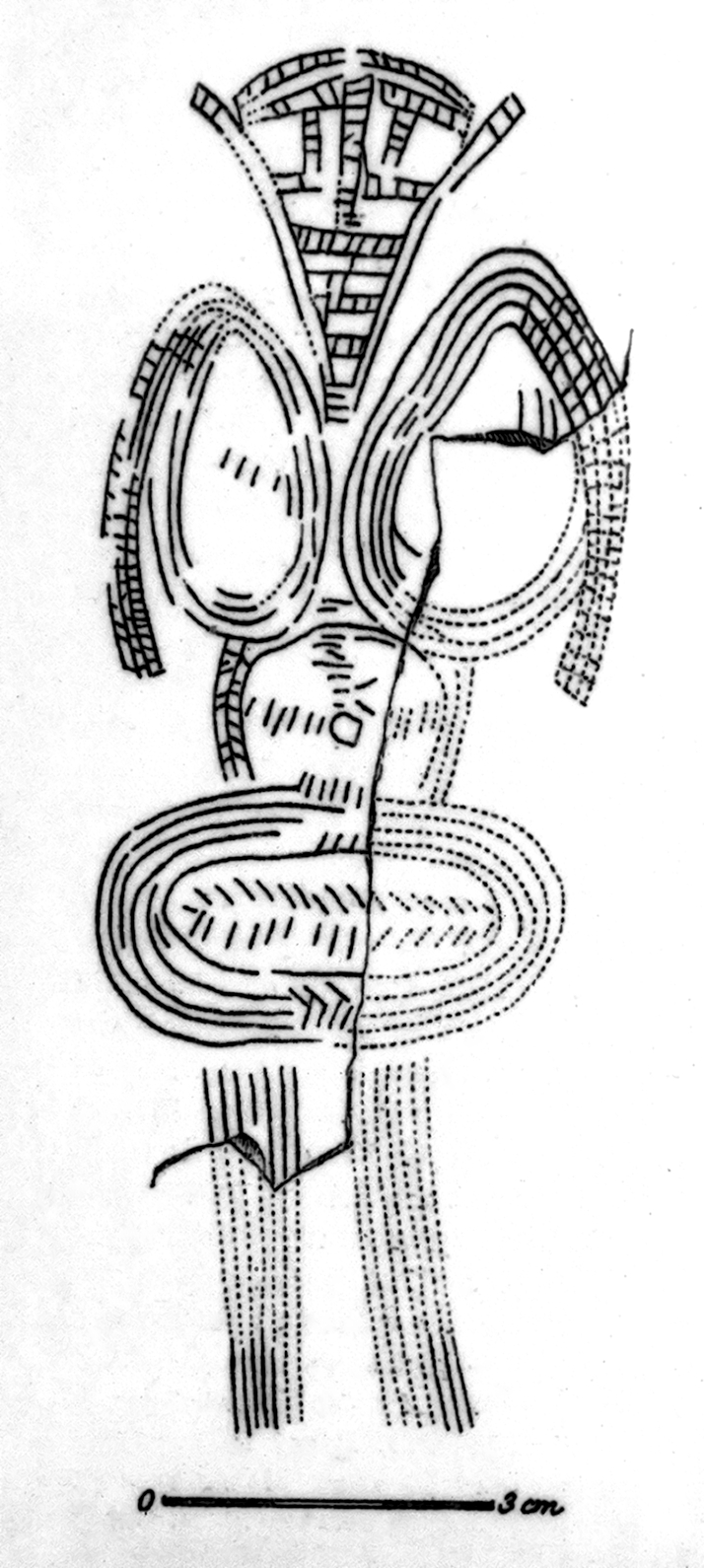
The Venus of Předmostí as depicted on an information board at the 'Lovci mamutů' exhibition in the National Museum in Prague, 2007.
Předmostí is a suburb of the town of Přerov, located 70 km north-east of Brno.
( note that the missing parts of the engraving have been recreated on this drawing, and shown in a dotted style - Don )
Artist: Unknown
Photo and text: © Vít Lang
Source: http://www.lands-of-venuses.eu/v-b-predmosti/w-b-predmosti.html
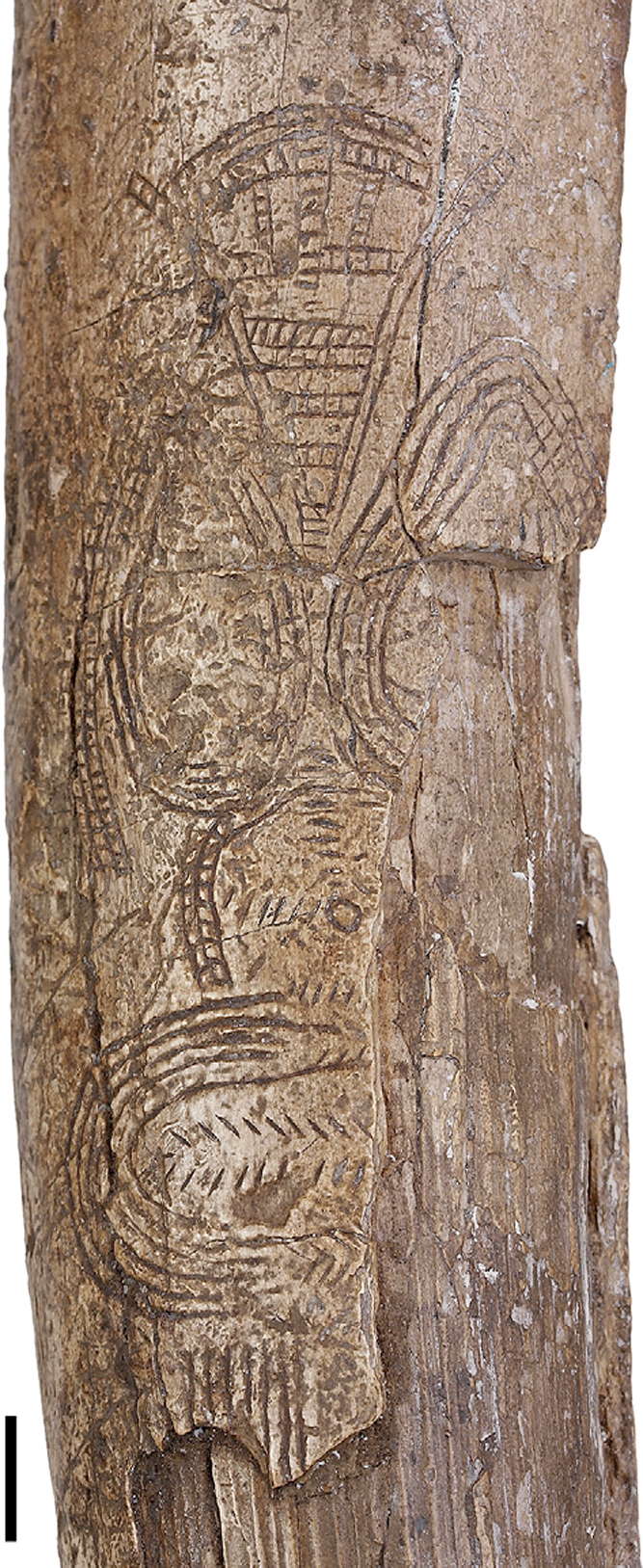
This appears to be a facsimile of the Predmost tusk, but it has been very well done, and is by far the clearest image of the carving I have seen.
Photo: d’Errico et al. (2010)

This is another artefact from Predmost, with a design almost identical to that carved on the tusk above.
From the abstract to d’Errico et al. (2010):
One Gravettian feminine representation - the schematic Venus of Predmostí - is so different from all the others that it has always been regarded as unique. The engraving, which was closely examined for the purpose of comparison in this study, represents a woman composed of geometric shapes, including a triangular head with interior lattice-work, concentric ellipses for the breasts, belly and pelvis, a double ladder for the remaining arm, hatch marks, and a thigh made up of parallel vertical lines.
This article presents the discovery and discusses the authenticity of a second, feminine anthropomorph engraved on a bone shaft fragment, which is labelled as coming from the same site and is highly similar to the one described at the end of the nineteenth century. The modern history of Predmostí reveals that the site was used as a quarry for the extraction of loess and limestone, and that tons of mammoth bones were extracted to produce spodium (burned bone usually used for medical purposes - Don ). Remarkable objects that were found both during early archaeological excavations and the site’s commercial exploitation went towards private collections. The history of the piece under study traces it back through a succession of owners to the collection of René de Poilloüe de Saint-Périer (b.1877 - d.1950) and Raymonde-Suzanne de Saint-Périer (b.1890 - d.1978).
The engraving is on the periosteal (outside) surface of a limb bone from a very large mammal, probably a proboscidian. Microscopic analysis of the bone surface and engravings identify the chronology of the grooves and their relations to the stages of the bone’s alteration and fracturing, starting with:
1) heavy weathering of the bone surface that produced longitudinal cracks, which probably led to its breakage,
2) engraving of the feminine representation,
3) intense mechanical and chemical attacks that smoothed all of the bone’s surfaces and wore down the engravings,
4) covering with a consolidation agent, and, most recently,
5) some abrasion, which resulted in the creation of a few straight lines.
Since no evidence is found to suggest that the highly worn appearance of the engravings composing the feminine representation resulted from modi!cations that were meant to arti!cially age the periosteal surface of the bone, we conclude that the engraving can be plausibly attributed to the Gravettian and that further analyses are warranted.
Photo and text: d’Errico et al. (2010)
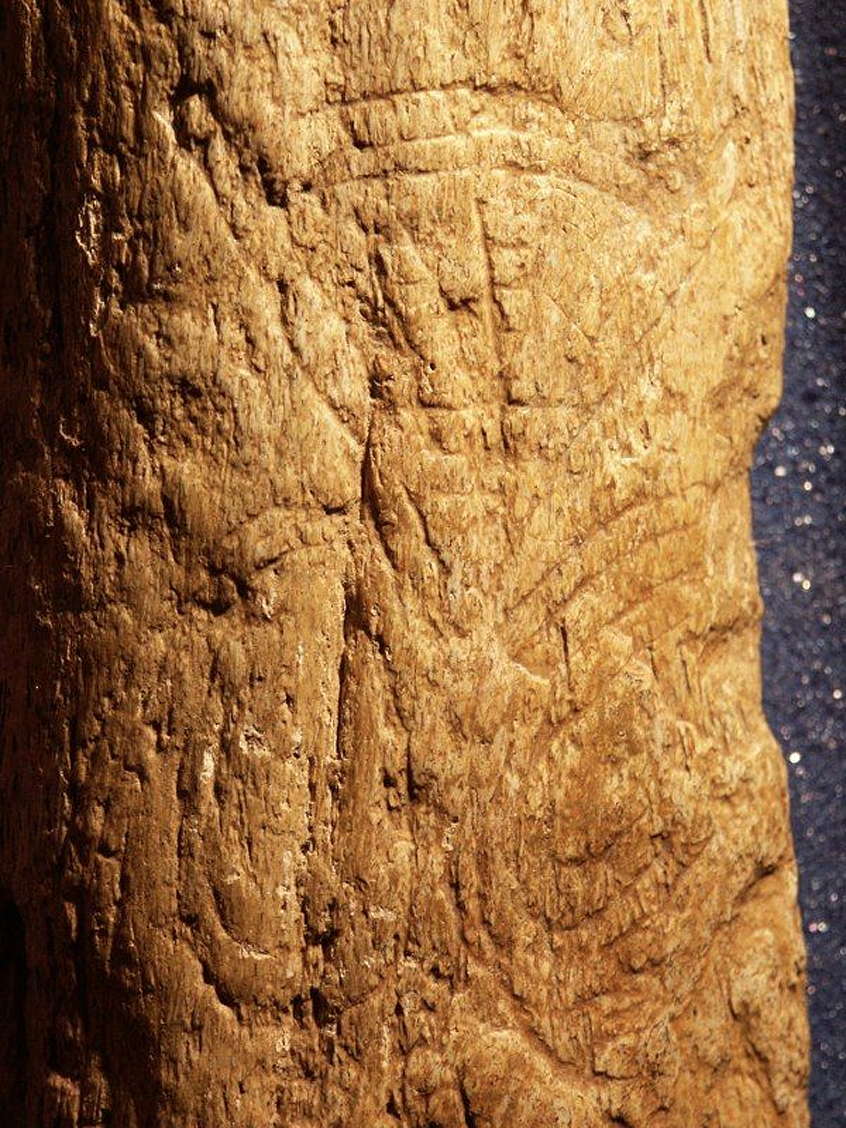
Close up of the bone above. This photo appears to be of the original.
The support on which the engraving was made is 174 mm long, 70 mm wide, and 30.7 mm deep. It is a fragment of a long bone from an extremely large, class 5 mammal. Because of the thickness of the compact bone (approx. 30 mm), its fibrous aspect, and remnants of spongy bone in a diaphyseal zone, we attribute the fragment to a proboscidian. The morphology and, in particular, the cross - section of the periosteal surface indicates that it is probably a femoral fragment. The compact texture of the bone on the periosteal face seems to indicate that it came from an adult animal.
Text adapted from d’Errico et al. (2010)
Photo: Themis
Source: picasaweb.google.com/byThemis/idolies

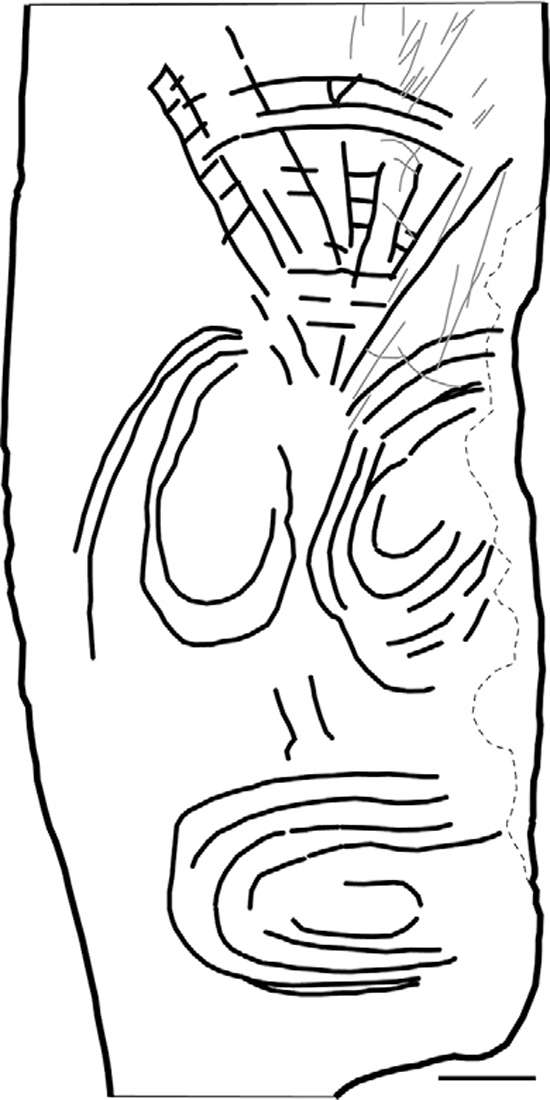
(left) Close up of the design on the bone.
(right) Tracing of the design on the bone. The two designs are so similar, they may well be by the same artist. The possible 'twin sister' of the 'Venus of Predmosti' is owned by U.S. art collector Duncan Caldwell.
Photo (left): Duncan Caldwell "Supernatural Pregnancies. Common Features and New Ideas concerning Upper Paleolithic Feminine Imagery" Barbier-Mueller Museums Geneva and Barcelona in Arts & Cultures (2010)
Photo (right): d’Errico et al. (2010)
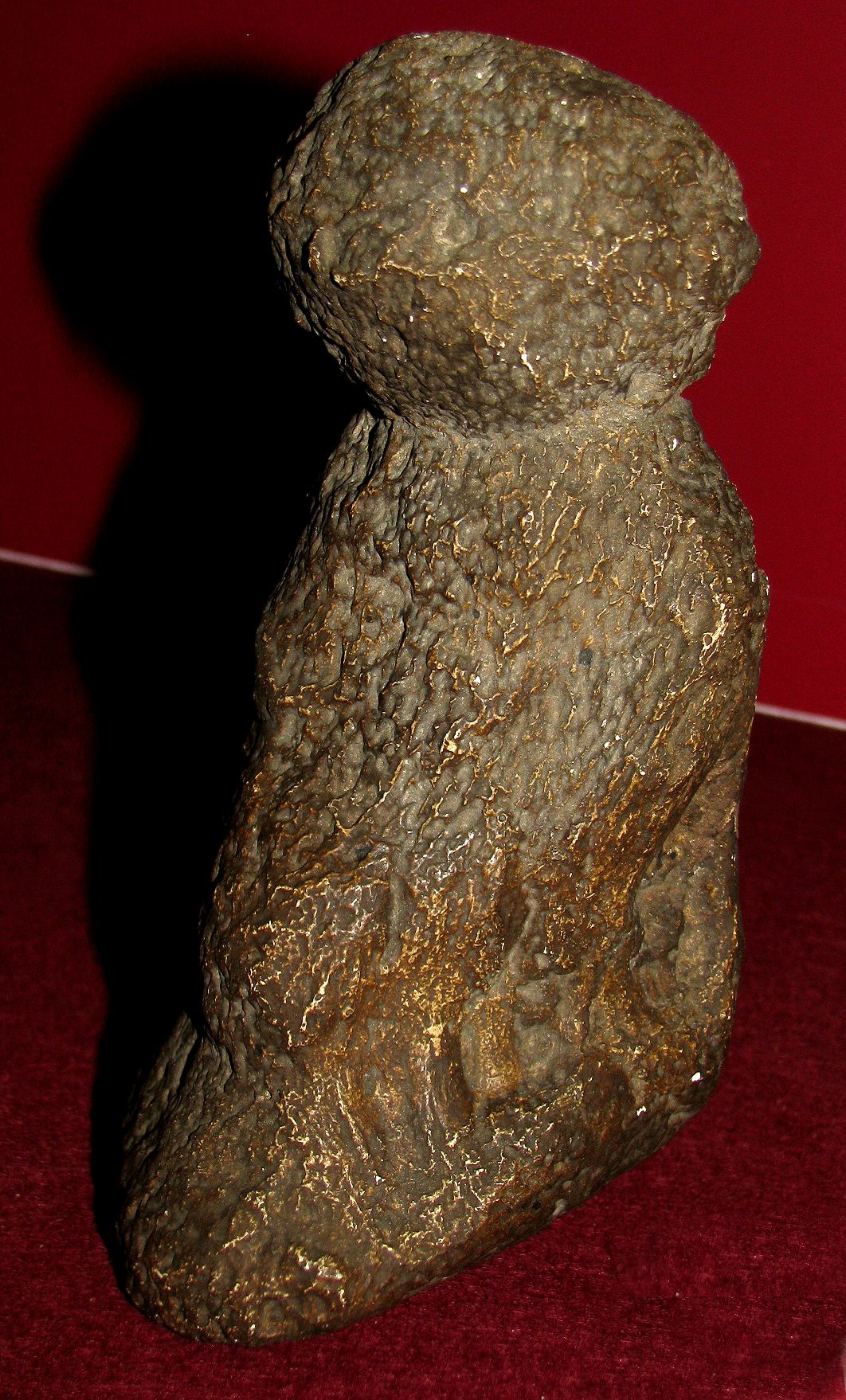

Weiblich figur aus der zehe eines mammuts
Predmost Mähren
Kopie
Venus figure carved from the toe of a Mammoth, from Predmost, Moravia.
Photo: Don Hitchcock 2008
Source: Facsimile, display, Vienna Natural History Museum

Venus figures carved from the toes of Mammoths, from Predmost, Moravia.
Seven figurines of this type were found at Predmost but only five survive.
Photo: Jelinek (1972)
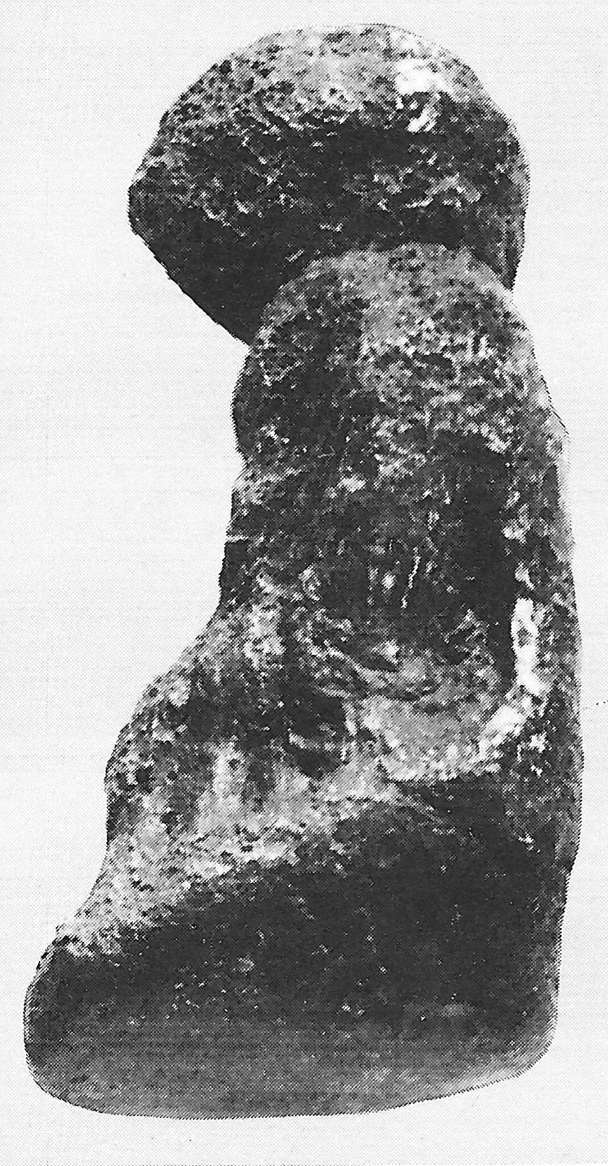
Venus figure carved from the toe of a Mammoth, from Predmost, Moravia.
Photo: Müller-Beck et al. (1987)
The Mammoth Ivory Male statuette from Brno
|
The head, torso and left arm are all that survives of this male ivory statuette found in an upper Palaeolithic (Pavlovian) burial at Brno near Dolni Vestonice. There is a correctly proportioned stump of a penis at the base of the torso. Around 26 000 years BP. |
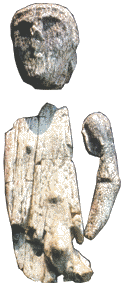 |
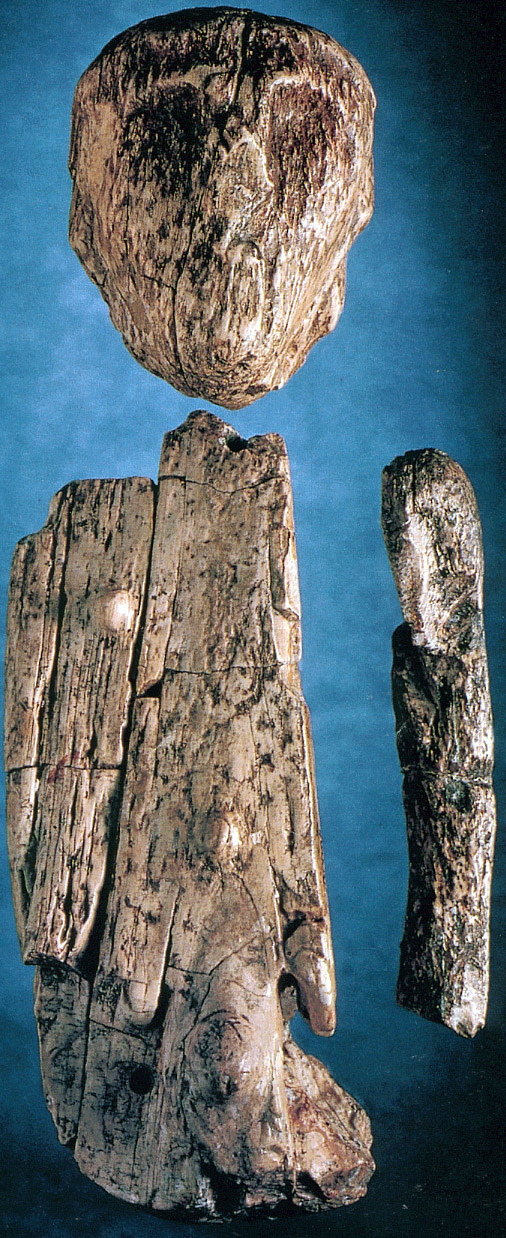 |
Click on the photo to see a larger version of this view of the Brno Male. This is another photo of the statuette above. Carved from mammoth ivory, and touched with red ochre, the statuette is in the form of a puppet or doll. (20 cm) Photo: photographed at the Anthropos Institute, Moravian Museum, Brno, Czechoslavakia, by Ira Block. In National Geographic, Vol 174, No 4, October 1988. |
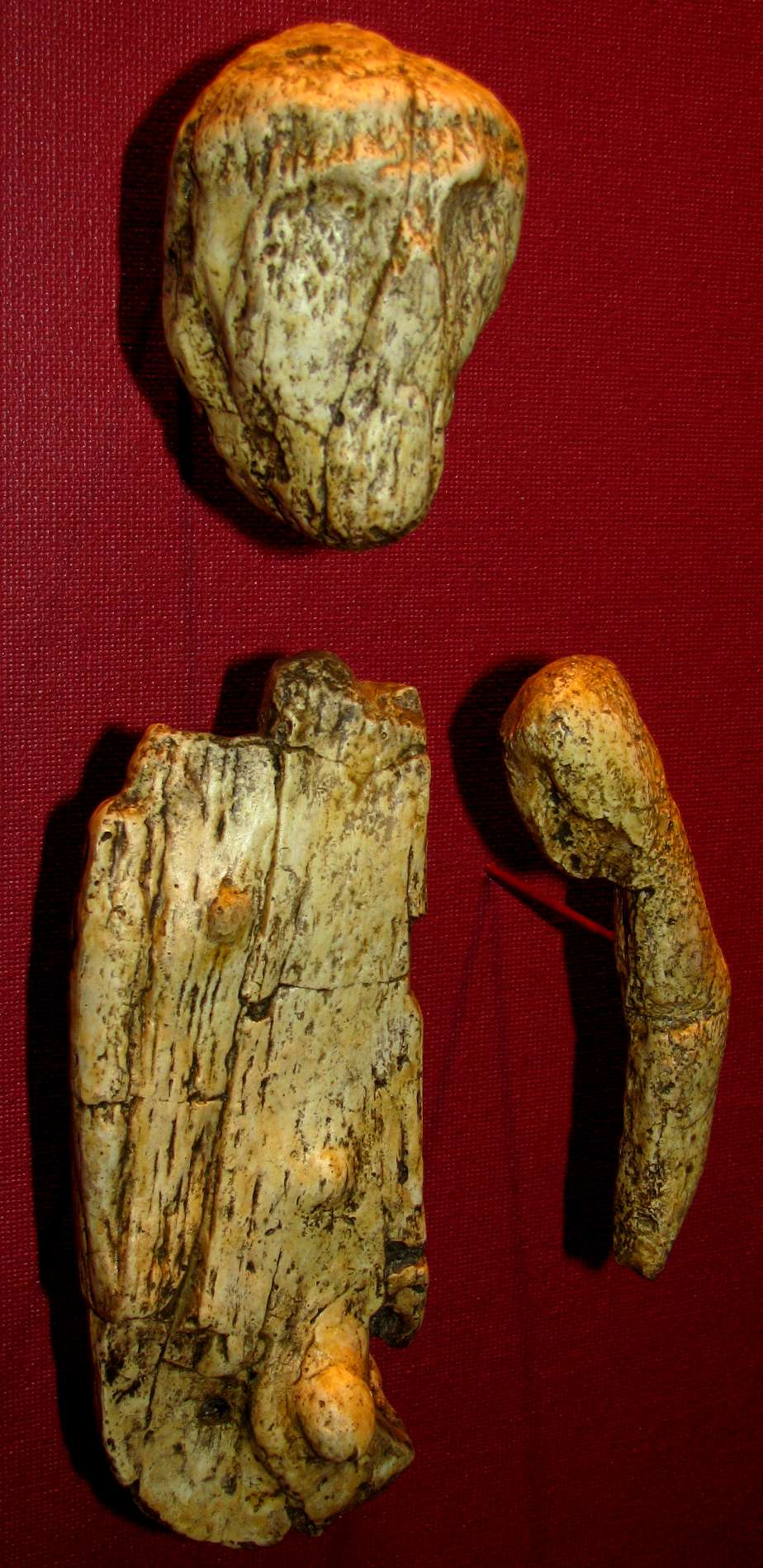

A facsimile of the Brno marionette.
Photo: Don Hitchock 2008
Source: Facsimile, Vienna Natural History Museum
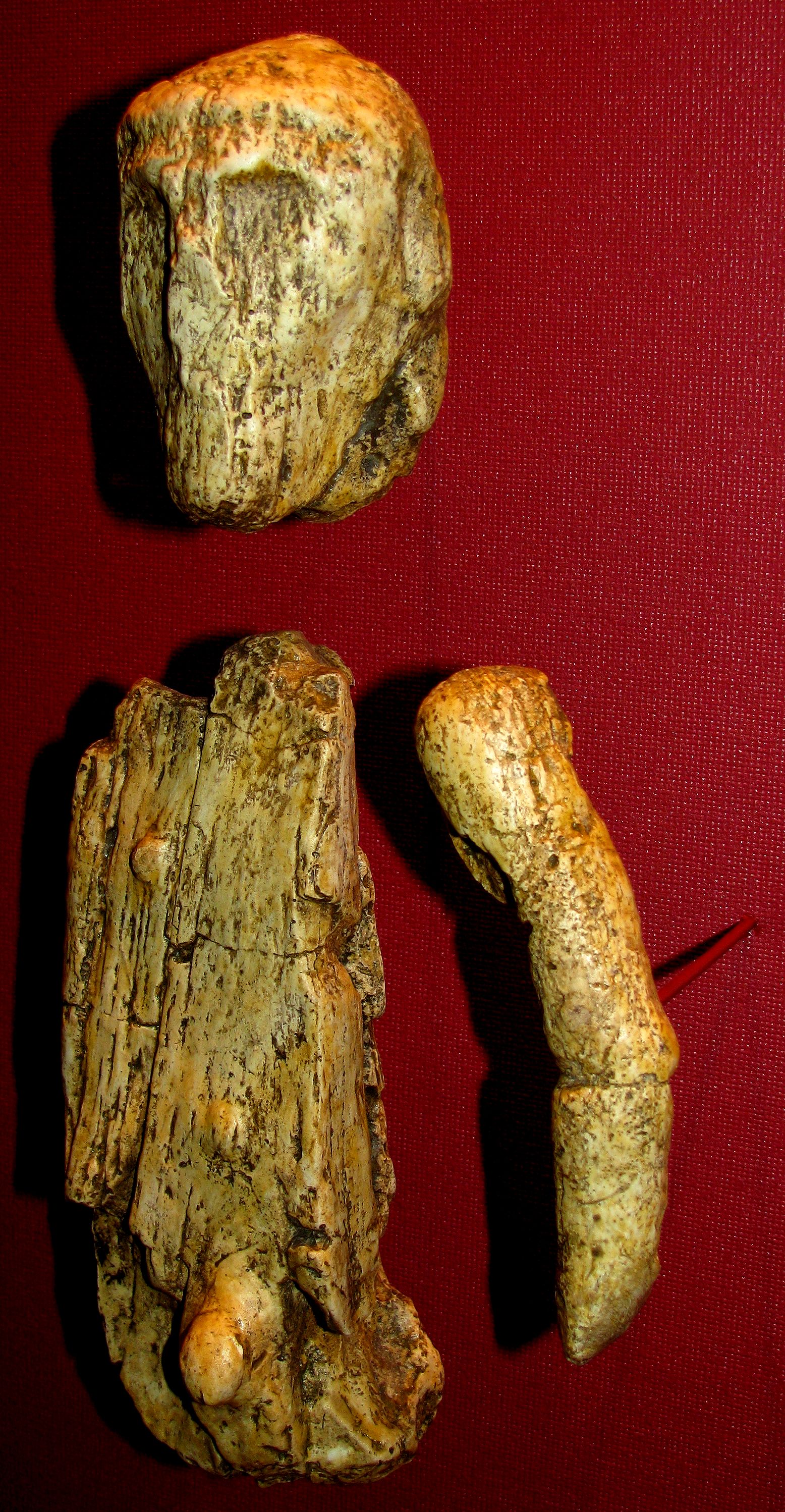
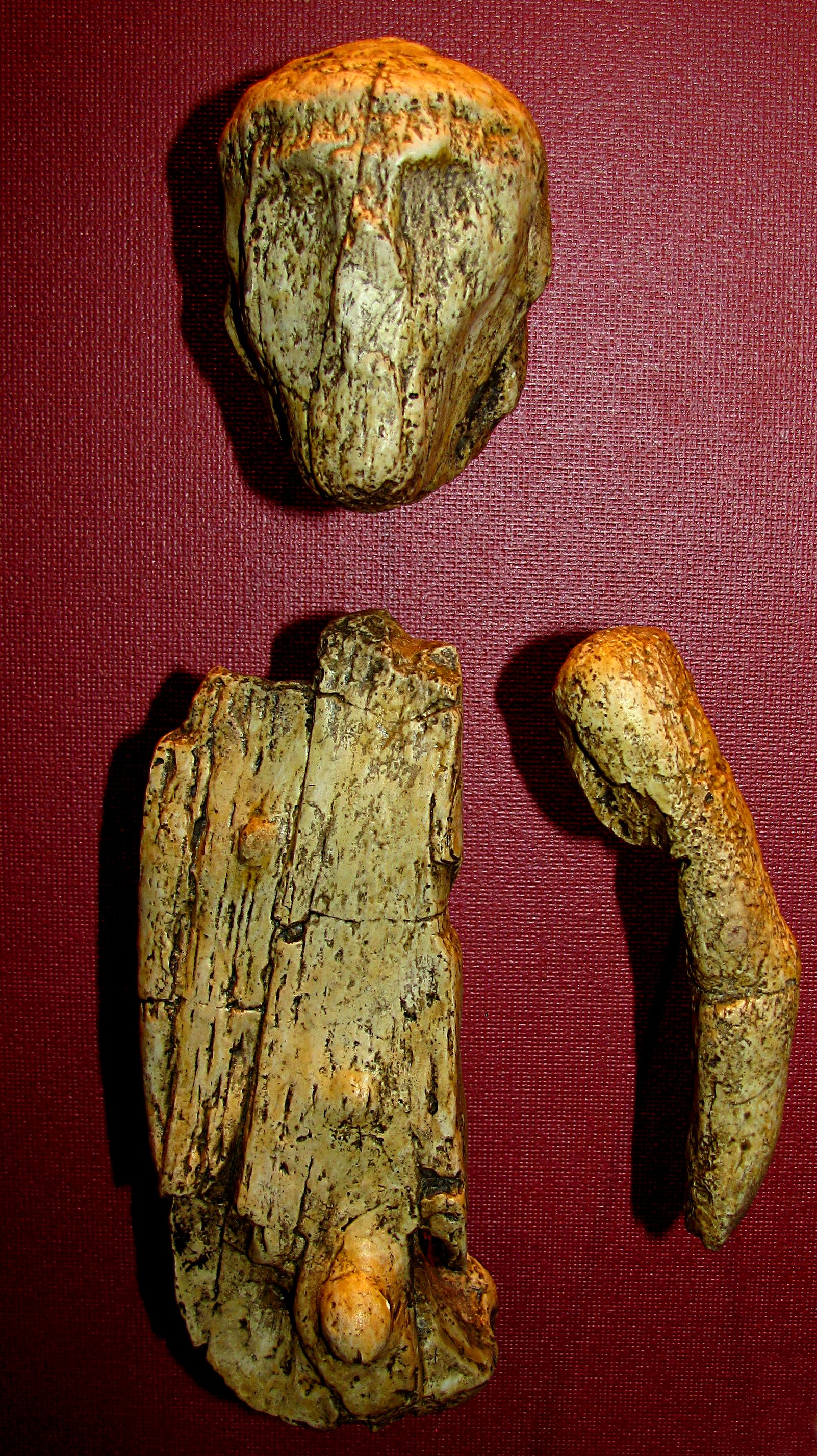
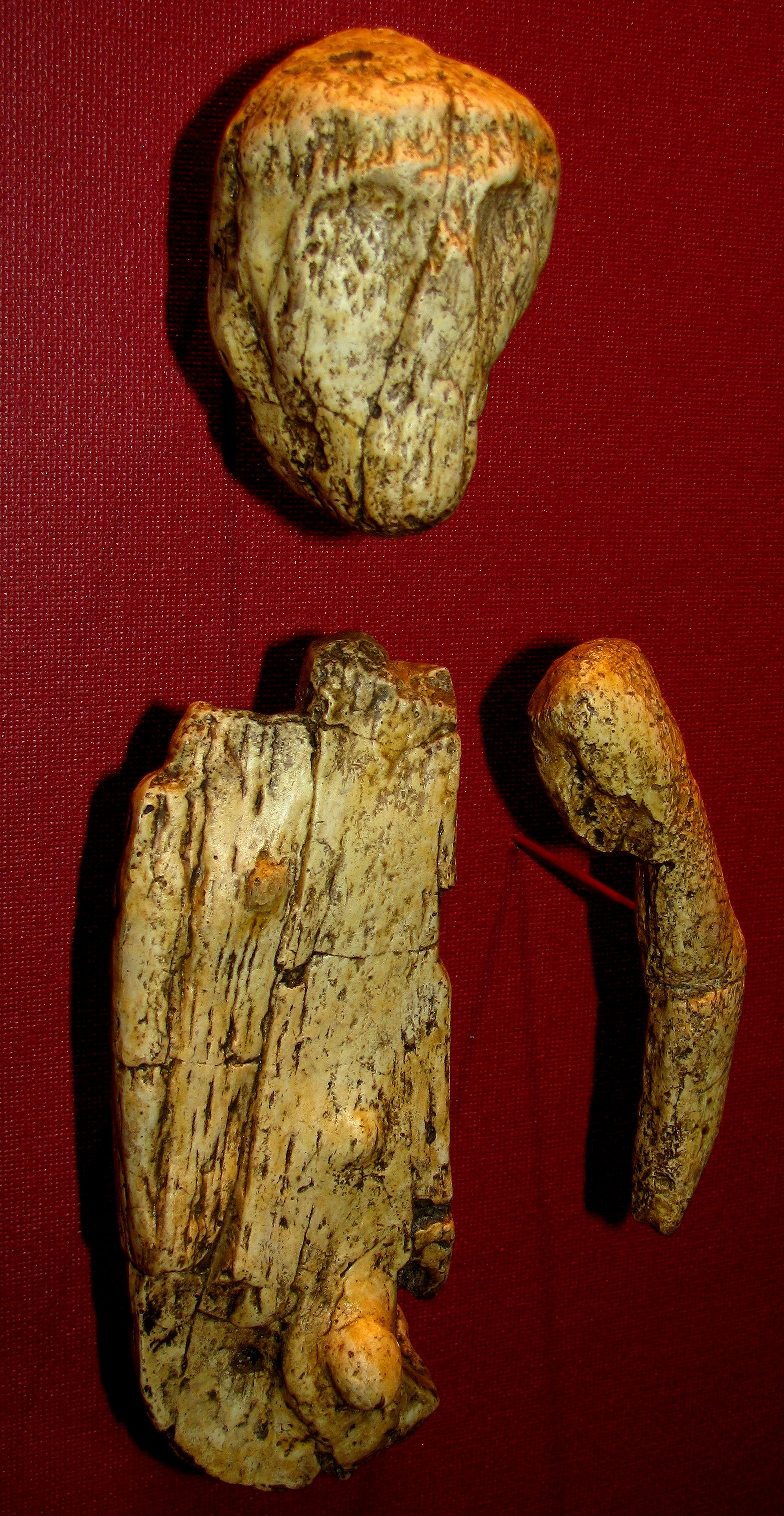
A facsimile of the Brno marionette.
Photo: Don Hitchock 2008
Source: Facsimile, Vienna Natural History Museum

A reconstruction of the Brno marionette.
This marionette was found in the grave of what has been interpreted as a shaman. 28 000 years ago (23 500 RCYBP) a 10-year-old boy began to suffer from an excruciating, even unbearable pain in his hands and legs. He suffered from periostitis, an inflammation of the periosteum, a dense membrane composed of fibrous connective tissue that closely wraps all bone, except the bone of articulating surfaces in joints which are covered by synovial membranes. So periostitis literally is inflammation around the bone.
Artist: Illustration © Libor Balák
Photo and text adapted from: http://www.iabrno.cz/agalerie/pavlova.htm
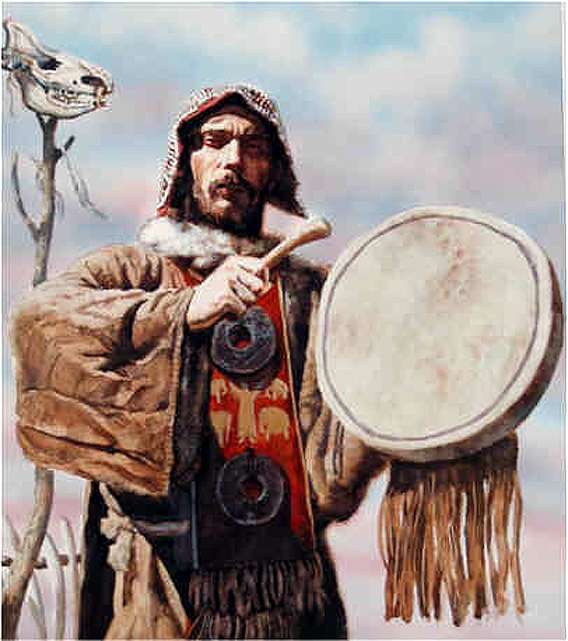
He learned how to defeat his pain, grew up into a strong man and become a shaman because of his abilities and qualities. He possessed a fascinating cap sewn with some 600 shells (of the Dentalium badense), a marionette, many discs made of various materials and several animal skulls. When he died, the survivors broke his drumstick, and one of its parts was placed in his grave together with the other things that he was using. It is possible that they placed the other part on the top of the grave together with the drum. This custom still exists in some Arctic communities.
Artist: Illustration © Libor Balák
Photo and text adapted from: http://www.iabrno.cz/agalerie/pavlova.htm
From:
Sandars (1992)
A man's head and body carved from mammoth ivory was found at Brno in Moravia. A portion of the neck is missing, and the legs are broken off. There once were arms and part of one survives, but whether the legs were ever complete is not known. If they were, and were long in proportion, then the figure would have stood some 17 inches (42 cm) tall. In spite of the ravaged condition of the face, enough survives to show that it was no caricature: the hair was cropped, the brow rather low but straight, the eyes deep-sunk. The body is too damaged to judge its degree of naturalism but it seems more schematic than the head. Both head and body are pierced lengthwise. The figure was found with the burial of a man who wore, in his prepared grave, a headdress or necklace made up of some 600 slivers of Dentalia shells, roundels cut from bone, and cut and polished beads of mammoth tooth, and finally a stone disc with a central hole, probably used in drilling and possibly connected with fire making.
According to a recent examination of the material and of the site, the man who had owned these personal treasures was of a rather primitive physical type: robust, with unusually heavy brow-ridges very slightly hollowed between the eyes, and approximating to the so-called Combe Capelle type, but with more of Neanderthal-like characteristics.

Dentalium badense fossil shells. Their modern descendants are still highly prized as jewellery, and are commonly used by Native North American artists. They are often referred to as tusk shells or tooth shells, and are used in indigenous jewellery and personal decoration in Western Canada and the United States.
Image: http://www.geocities.com/fossil_sharks_from_transylvania/Other_fossils_html/Dentalium_badense.htm
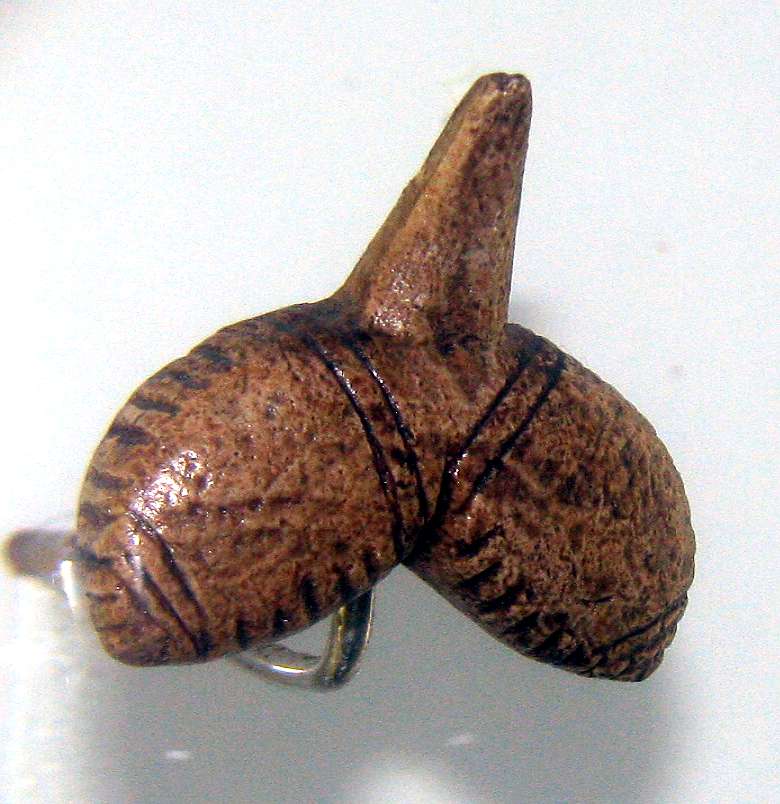
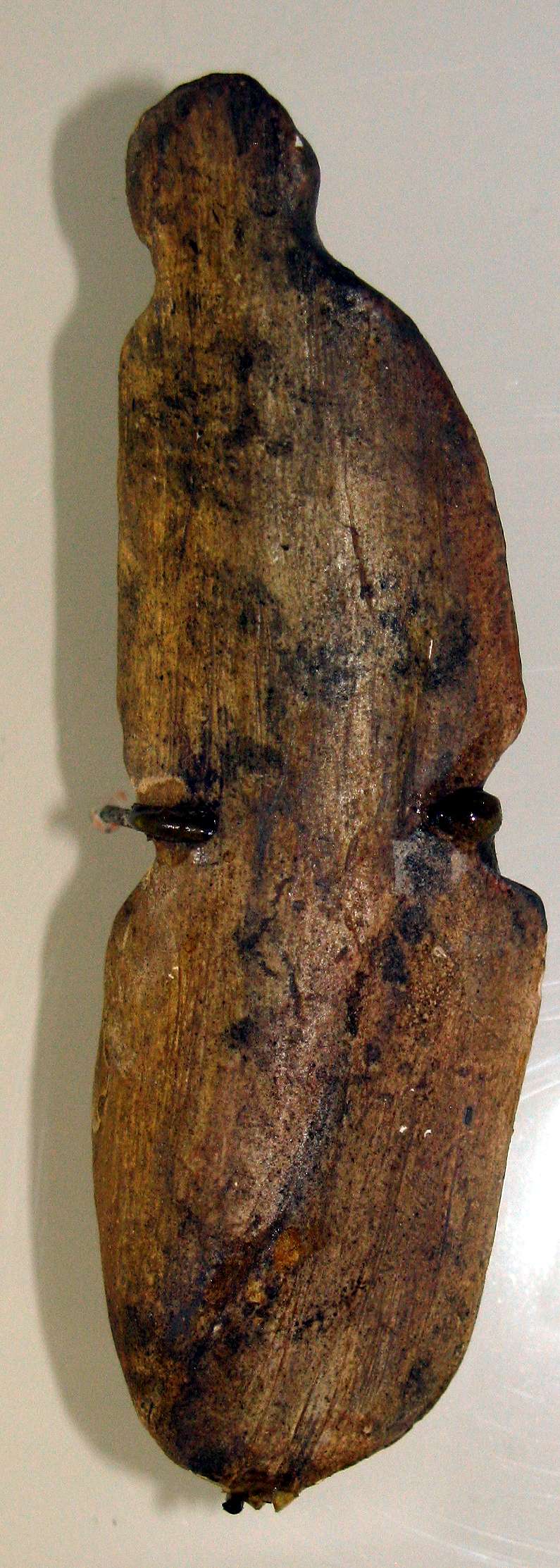
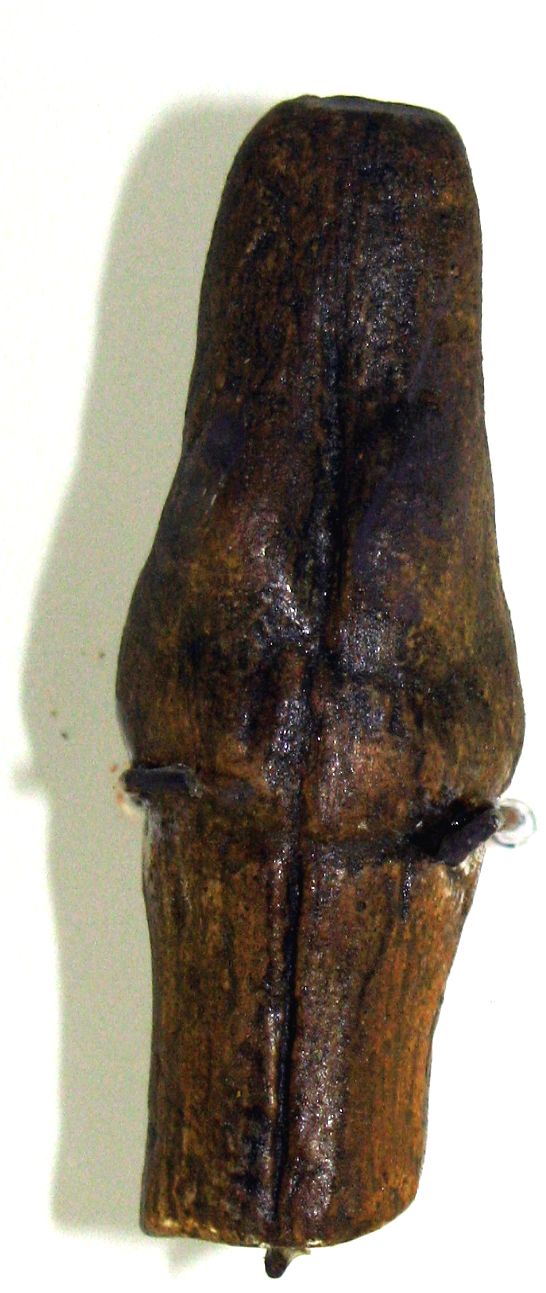
Stylised sculptures of women, perhaps as totemic ancestresses, or as symbols of the importance of women.
Photo: Don Hitchcock 2008
Source: Facsimiles, display, Dolní Věstonice Museum
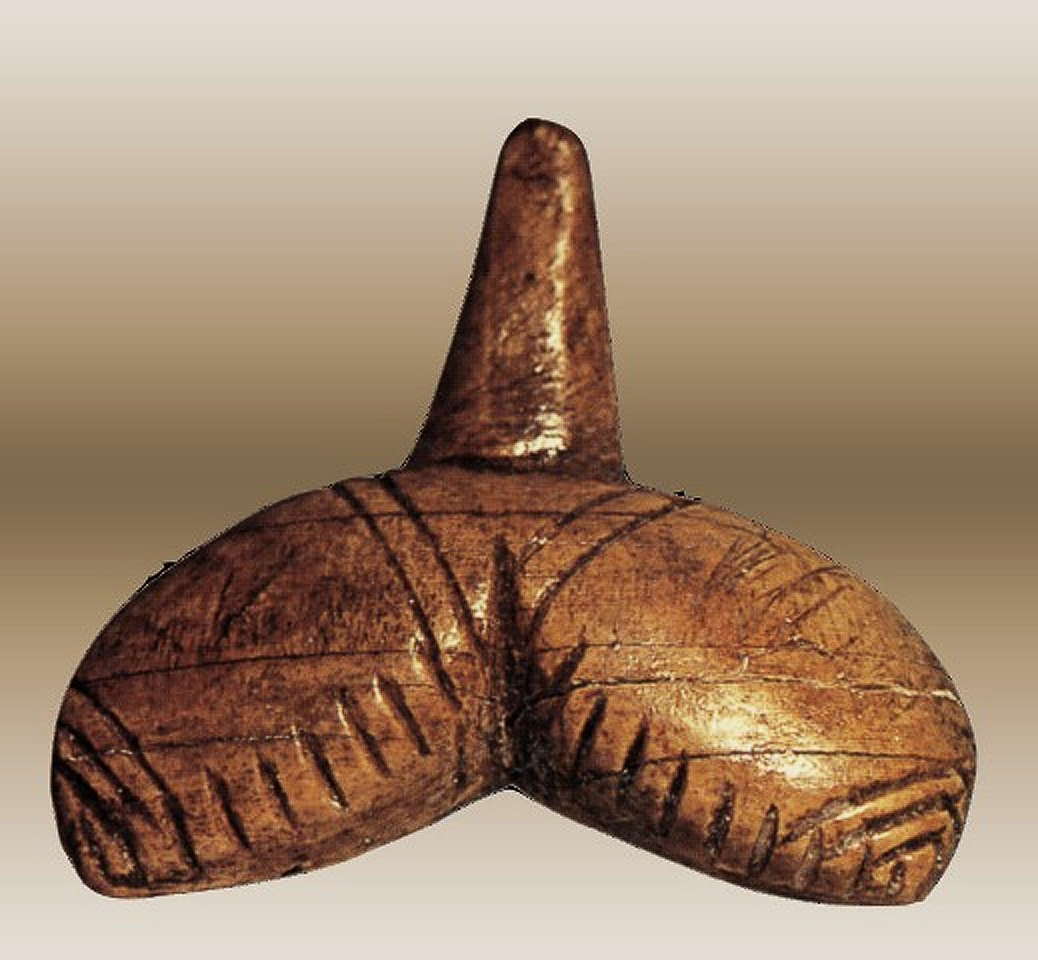
Stylised sculpture of a venus, made as a bead with the loop at the back.
Photo: http://www.istmira.com/foto-i-video-pervobytnoe-obschestvo/3924-iskusstvo-predystorii-pervobytnost-2.html
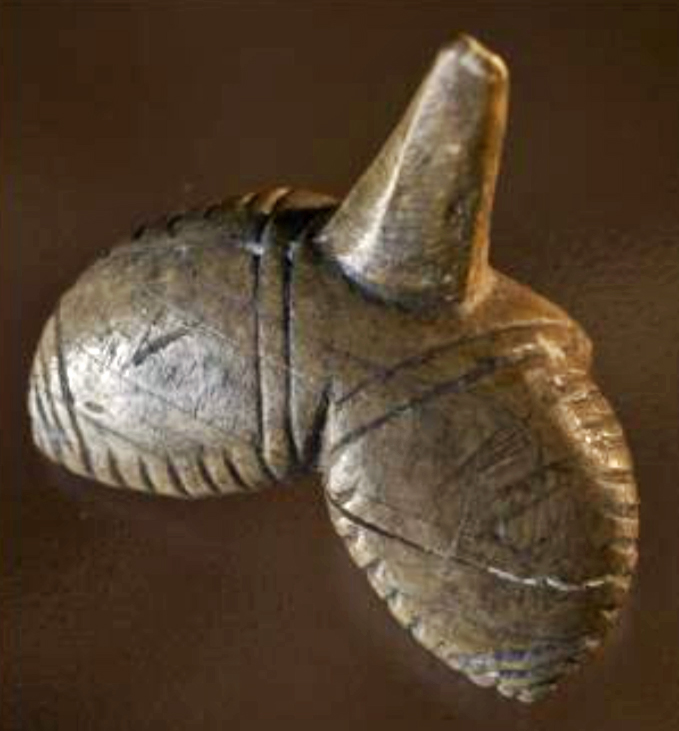
Breasts as a bead.
Photo: Martin Frouz
Source: MZM Brno
Proximate source and text: Svoboda (2017)
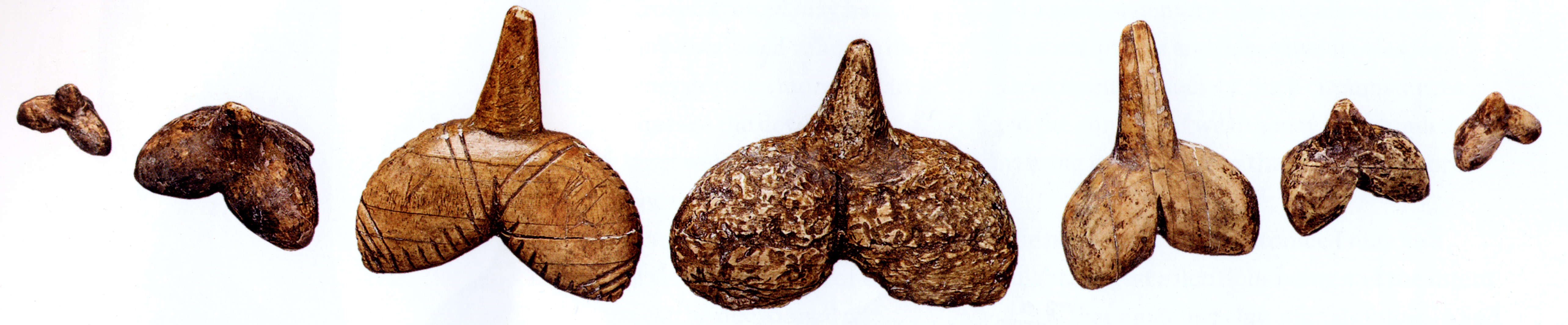
Breast shaped beads.
Skilfully made with the suspension loop at the back.
Mammoth ivory, height 9 - 32 mm.
Photo and text: Cook (2013)
Source: Moravaské Museum, Brno
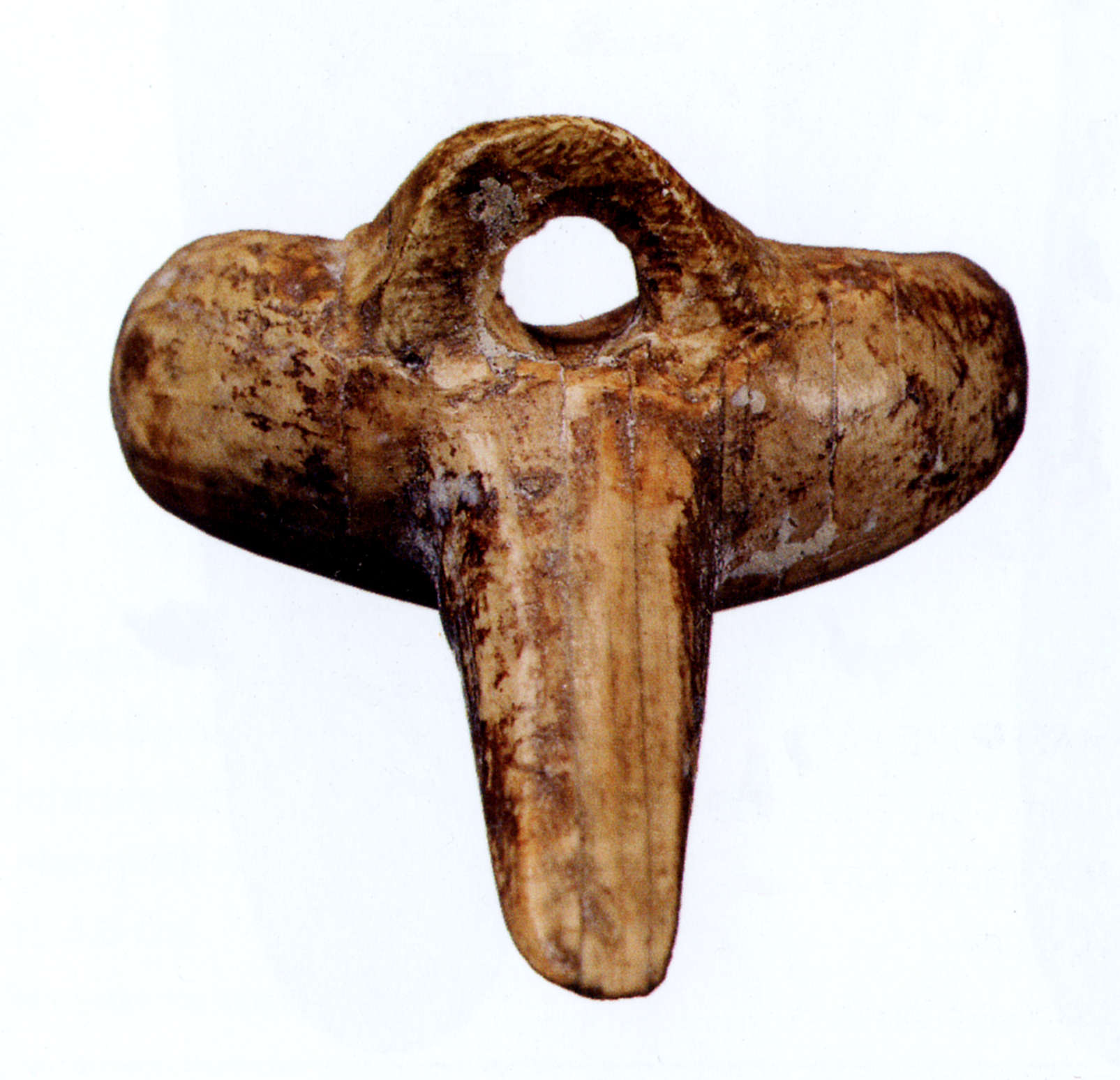
This very useful photo shows the way that the loop was fashioned on the beads above.
Mammoth ivory.
Photo: Cook (2013)
Source: Moravaské Museum, Brno
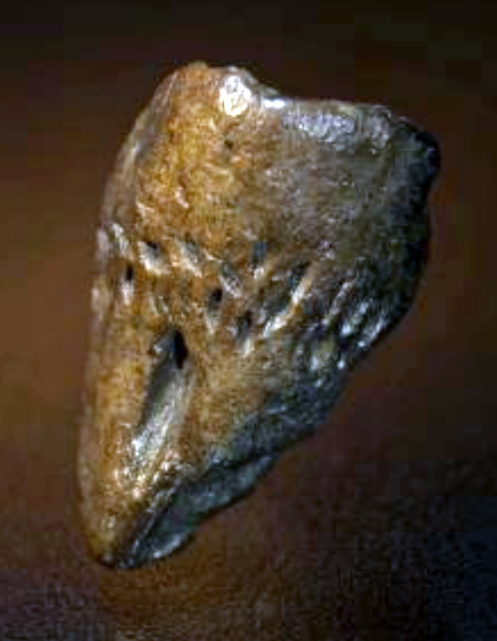
Vulva in burnt clay from Dolni Vestonice I.
Photo: Martin Frouz
Source: Coll. 1A Brno
Proximate source and text: Svoboda (2017)
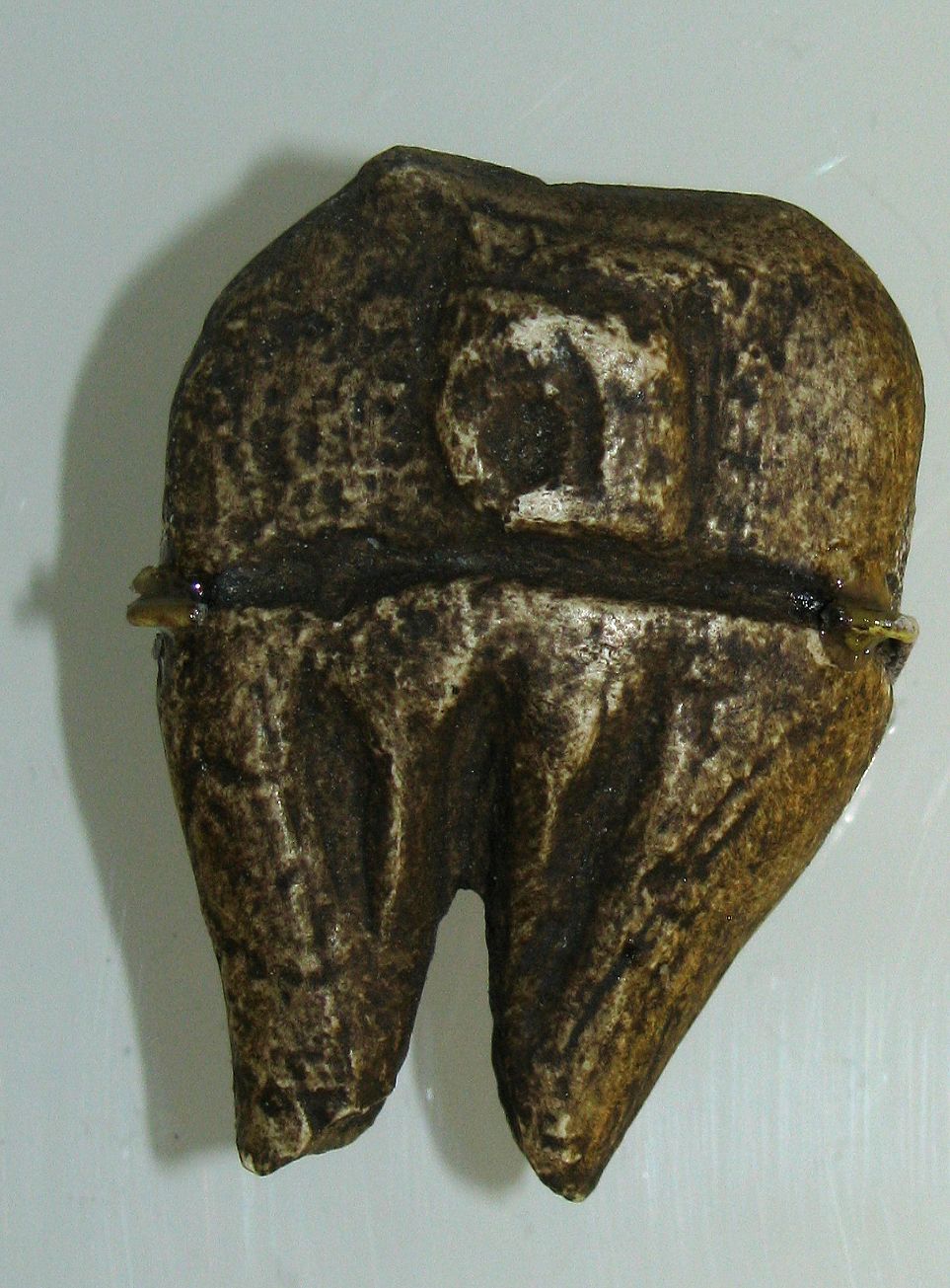
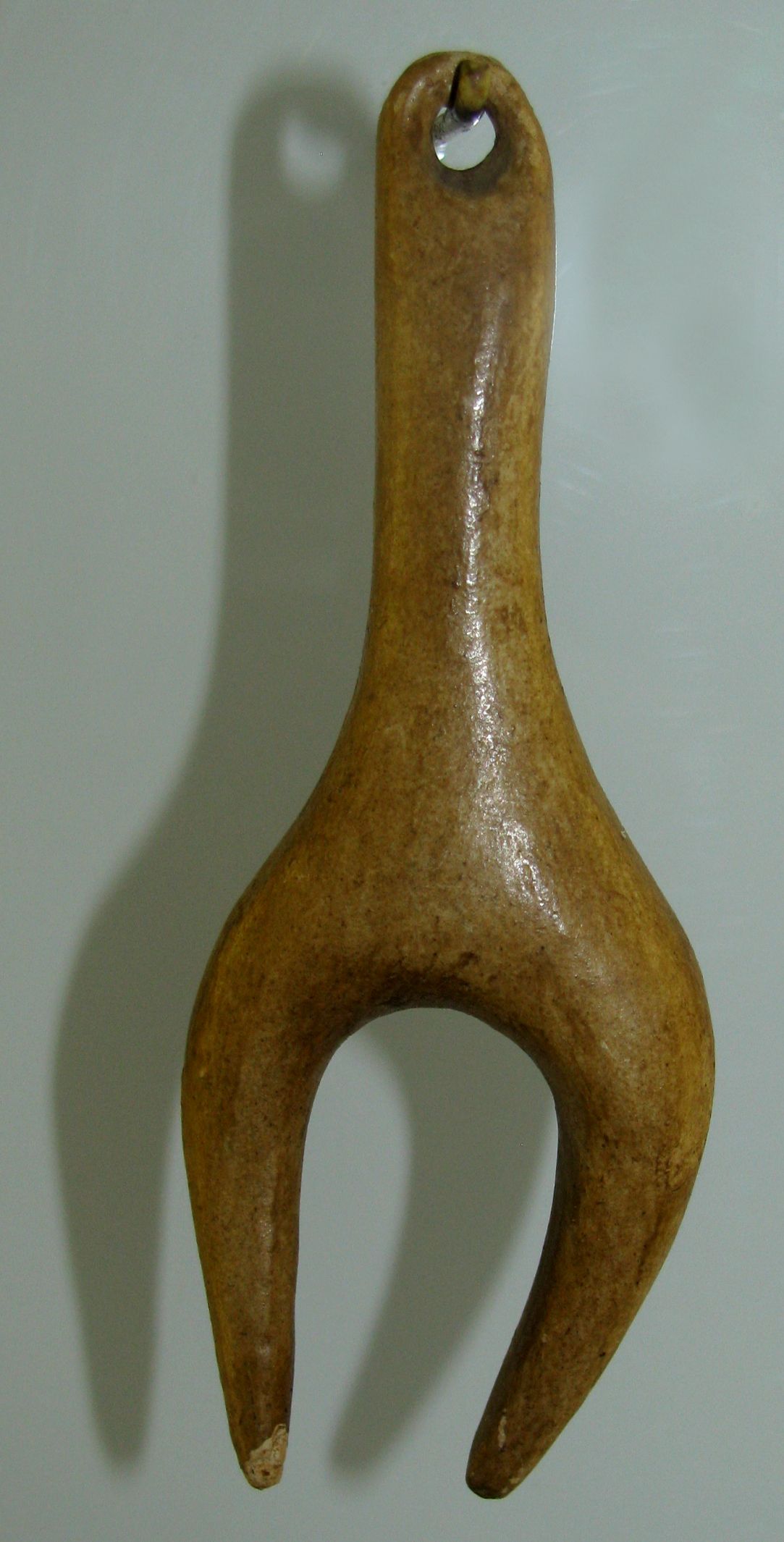
Stylised sculptures of women.
The sculpture on the right is known as the Dolni Vestonice Venus XIII.
Photo: Don Hitchcock 2008
Source: Facsimiles, display, Dolní Věstonice Museum

Dolni Vestonice Venus XIII, apparently the original.
Photo: http://www.istmira.com/foto-i-video-pervobytnoe-obschestvo/3924-iskusstvo-predystorii-pervobytnost-2.html

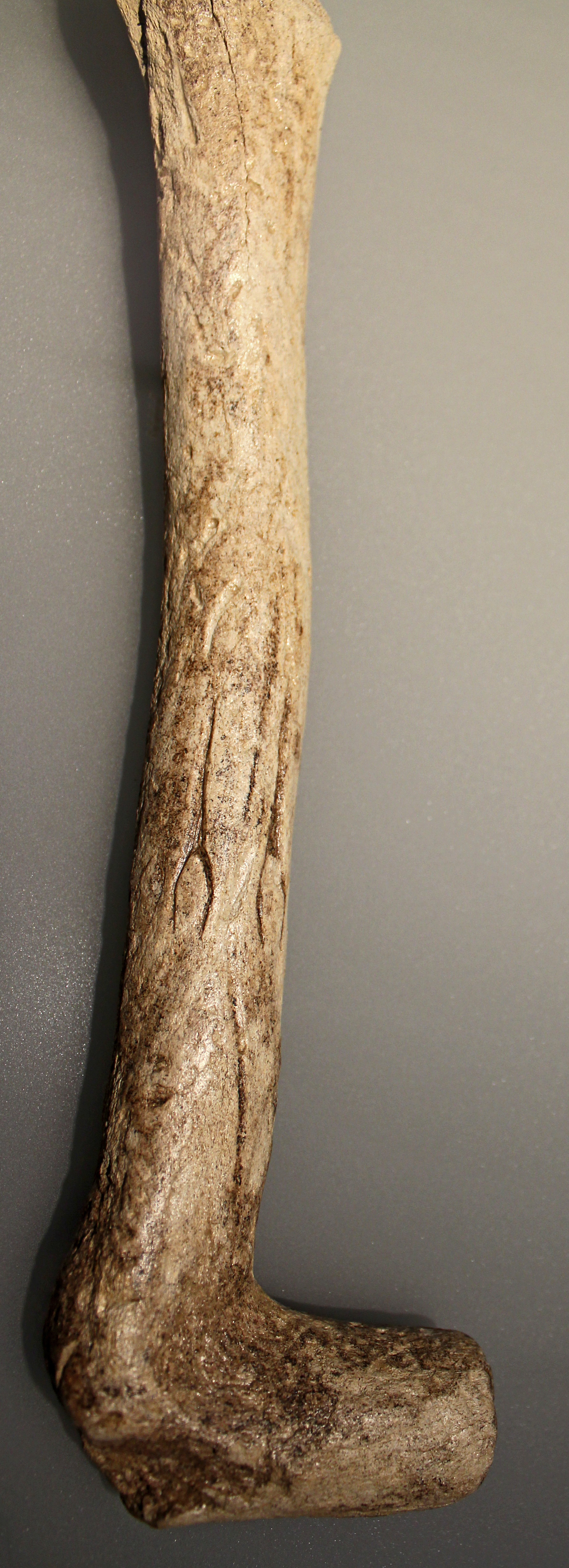
Venus engraving, Yudinovo, Russia, 15 000 BP.
This is thought to be the same form of the venus as is shown in the Dolni Vestonice Venus XIII above, and has been repeated around the bone.
Photo: Ralph Frenken
Source: Original, exhibited at the Archeological Museum Hamburg (Ice Age - The Art of the Mammoth Hunters from 18 October 2016 to 14 May 2017)
On loan from the Hermitage Museum, Saint Petersburg, Russia.
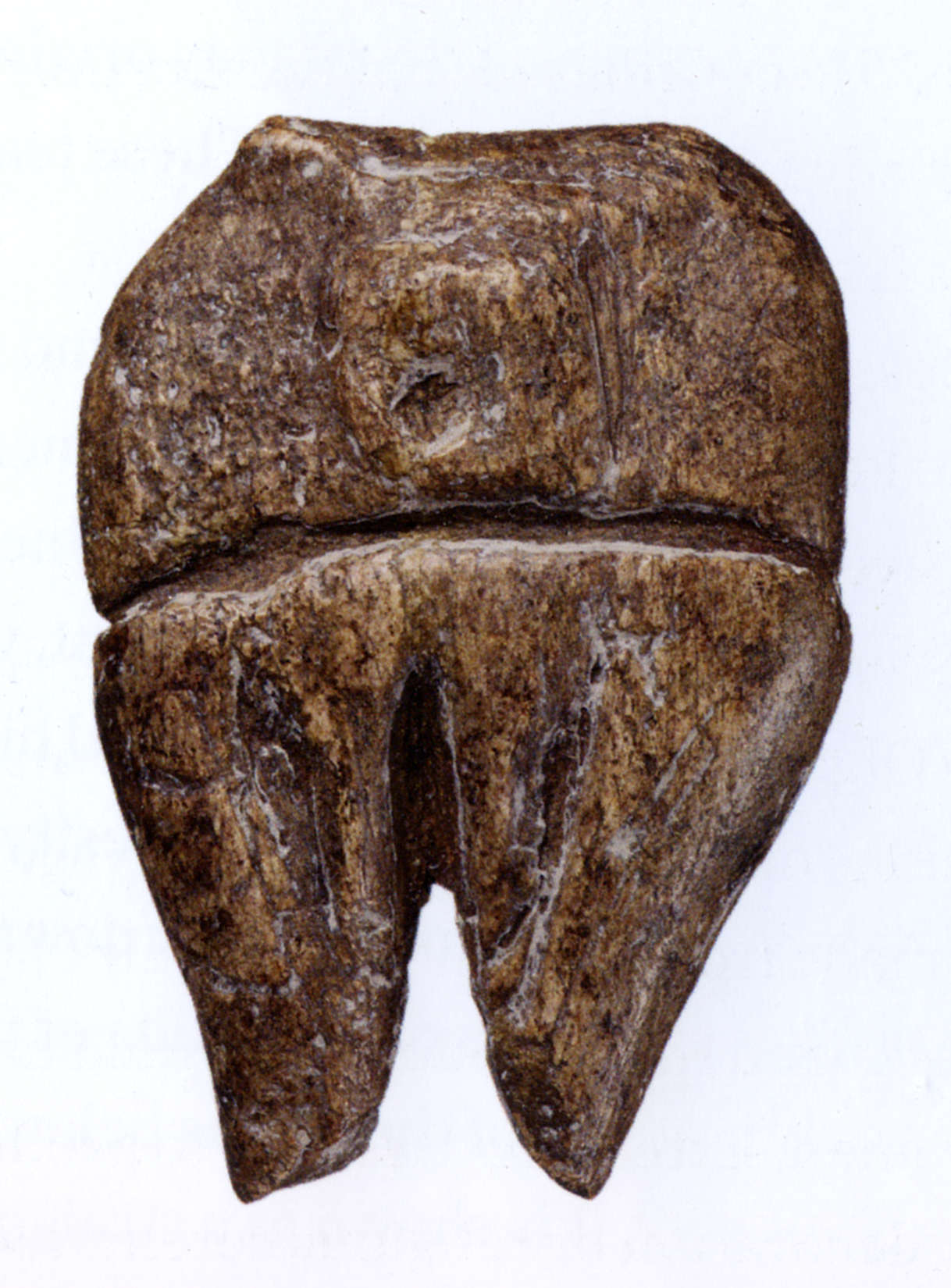
Lower torso and thighs of a woman. Found at Dolni Vestonice, numbered V.
Mammoth ivory, 4 cm high.
Photo and text: Cook (2013)
Source: Moravské Museum, Brno
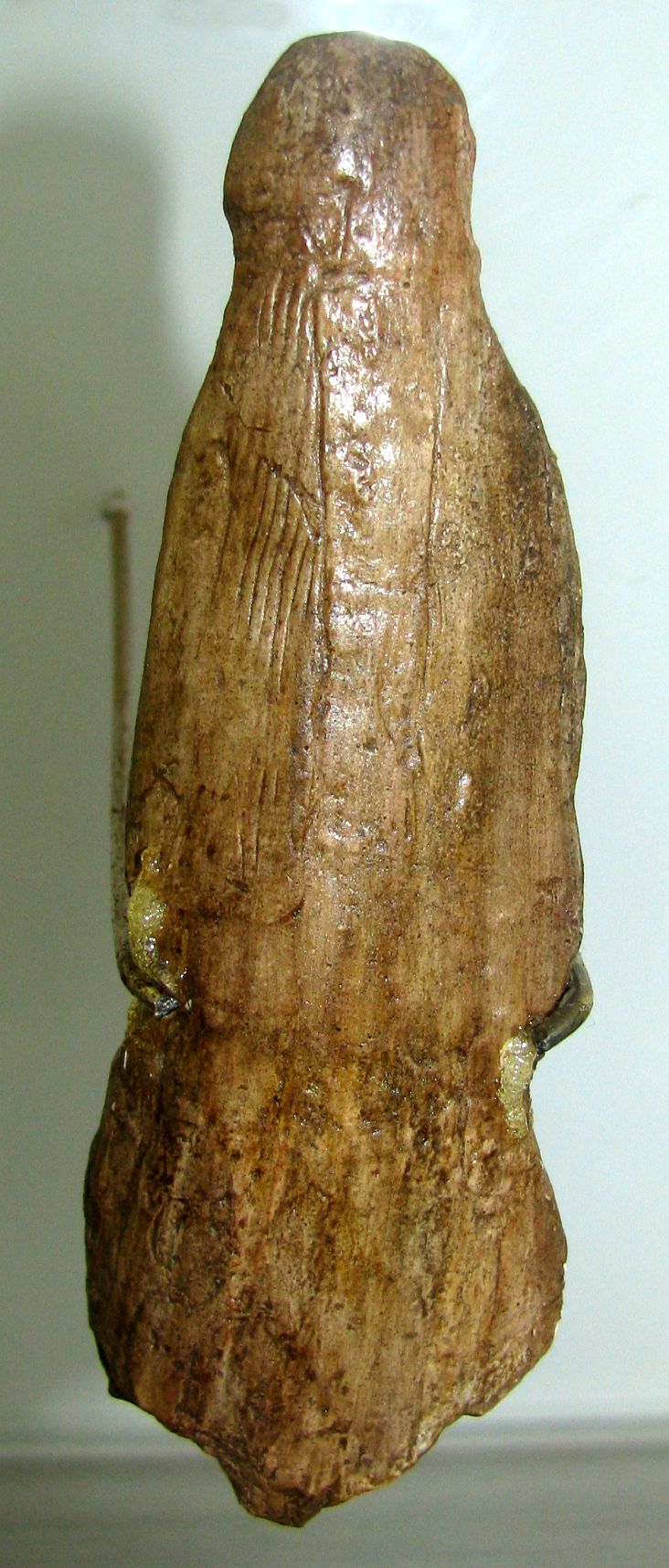
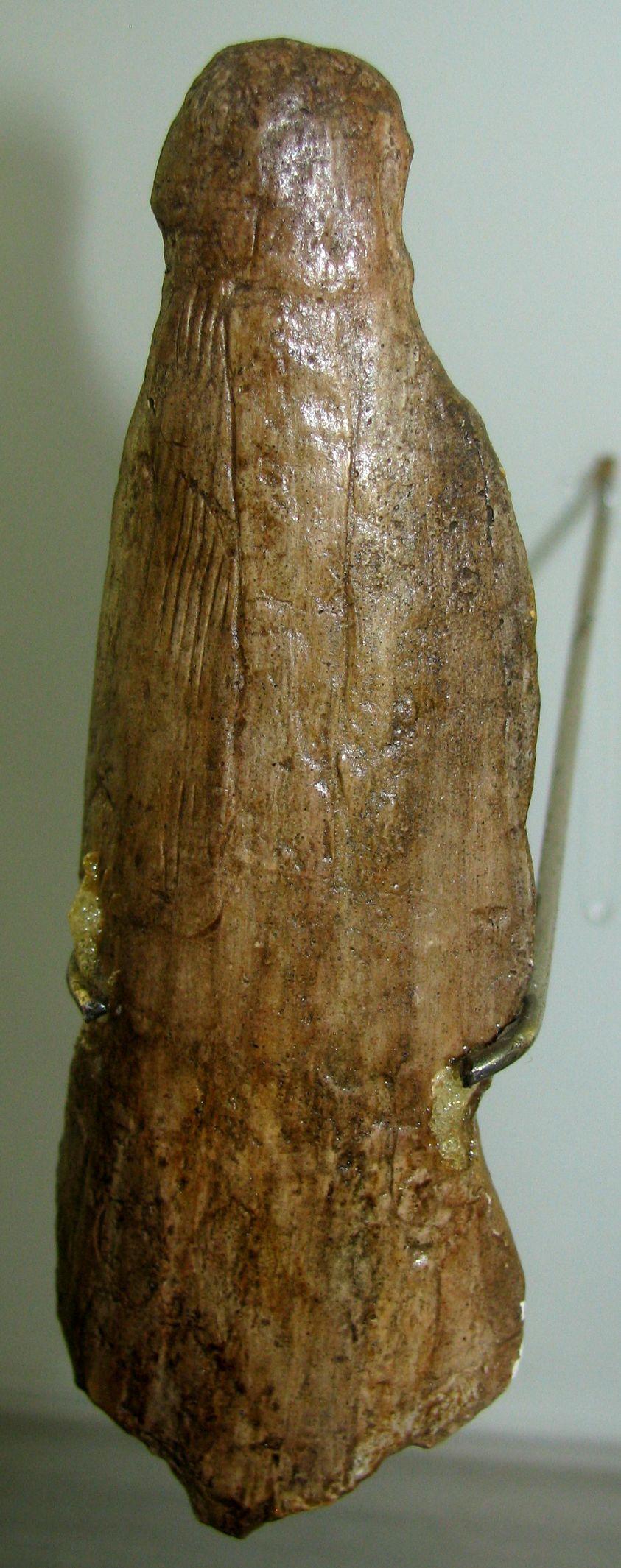
This comes closer to the normal definition of a venus figure.
Photo: Don Hitchcock 2008
Source: Facsimiles, display, Dolní Věstonice Museum
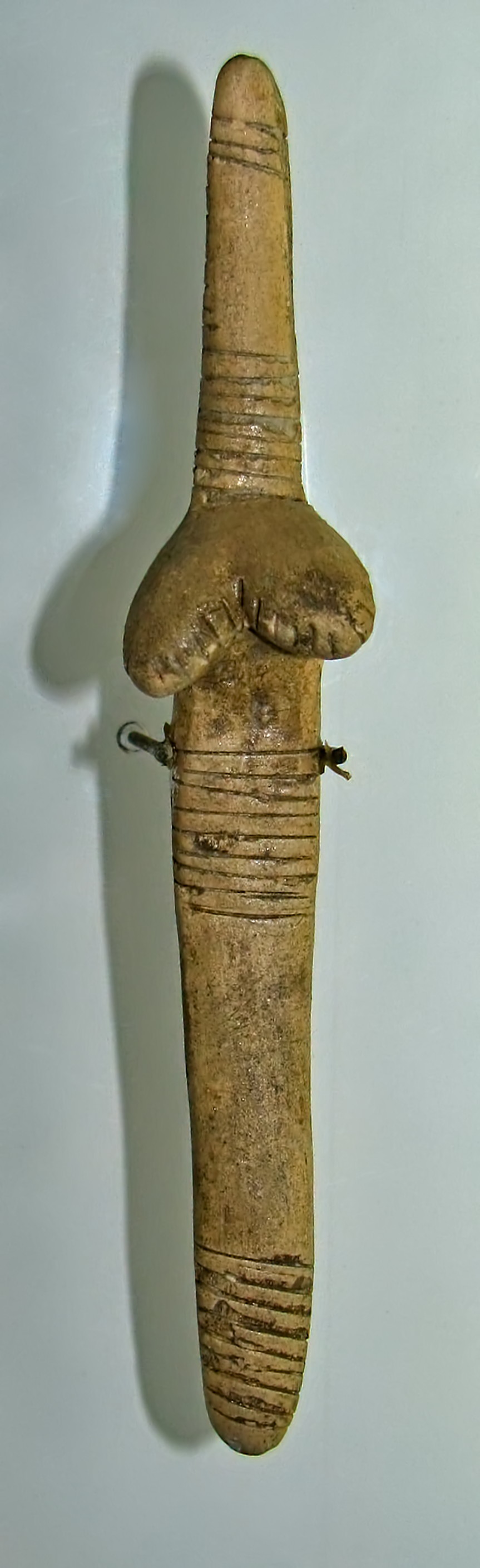
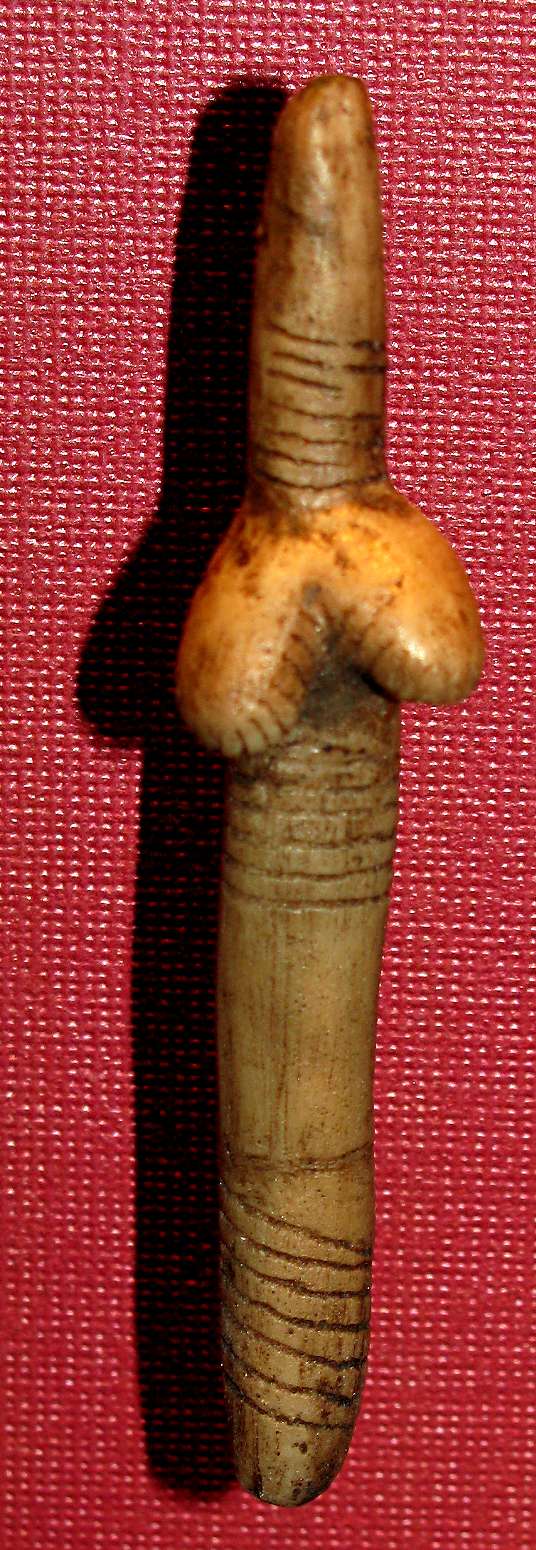
Stylised sculpture of a woman, again very close to an abstract venus figure.
Although both are facsimiles, and at first appear to be from the same original, they are subtly different in the number of score marks on the shaft of the sculpture, and may be from very similar but different originals. The photograph from the Vienna Natural History Museum is closer to the original shown below from the Encyclopaedia Brittanica.
Photo: Don Hitchcock 2008
Source: Facsimiles, (left) display, Dolní Věstonice Museum, (right) display, Vienna Natural History Museum,
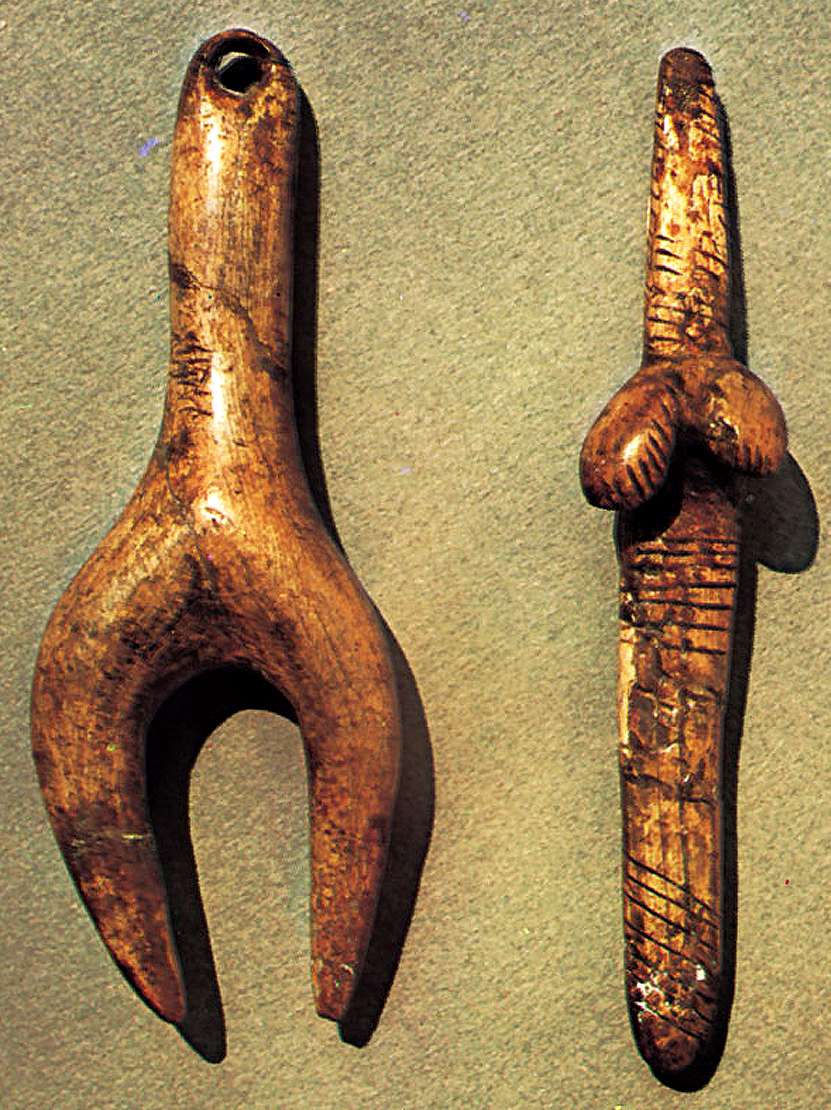
This photograph from the excellent site of the Encyclopaedia Brittanica appears to be of the originals.
Photo: http://www.britannica.com/EBchecked/topic-art/625743/3174/Stylized-Venus-figurines-carved-in-ivory-Aurignacian-Gravettian-from-Dolni
This seems to be of the original.
Photo: http://www.istmira.com/foto-i-video-pervobytnoe-obschestvo/3924-iskusstvo-predystorii-pervobytnost-2.html
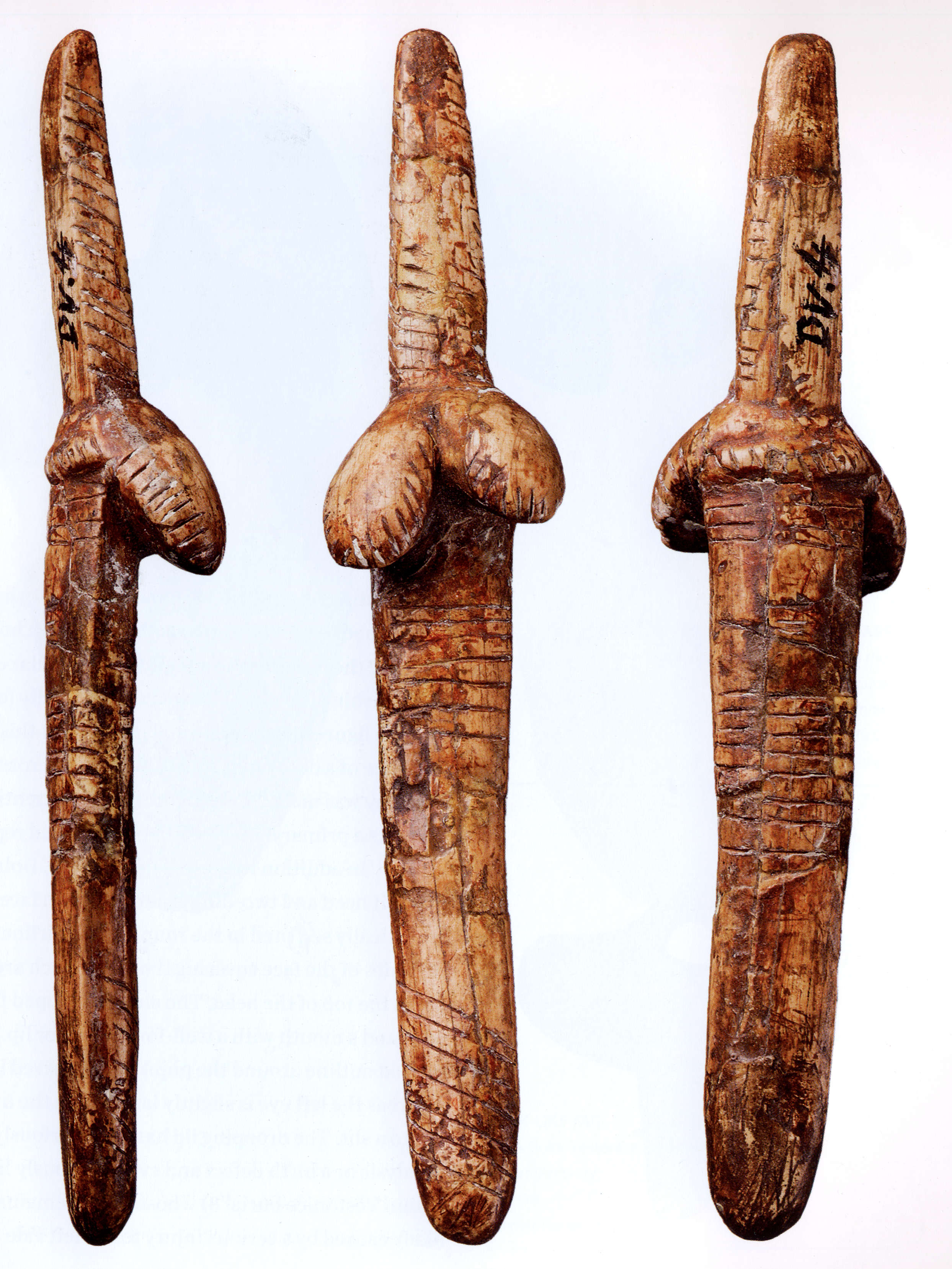
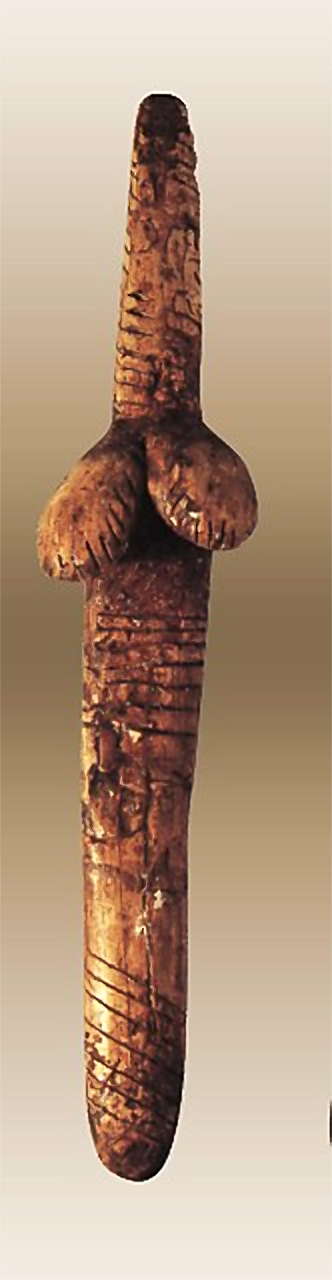
Breasts sculpted on a rod. This has been assigned Number XIV, although it appears to be marked 'DV4'.
Decorated with incised lines, sometimes also interpreted as male. Slightly damaged at the top where it may have been perforated as a pendant.
Mammoth ivory, height 87 mm.
Photo and text: Cook (2013)
Source: Moravaské Museum, Brno
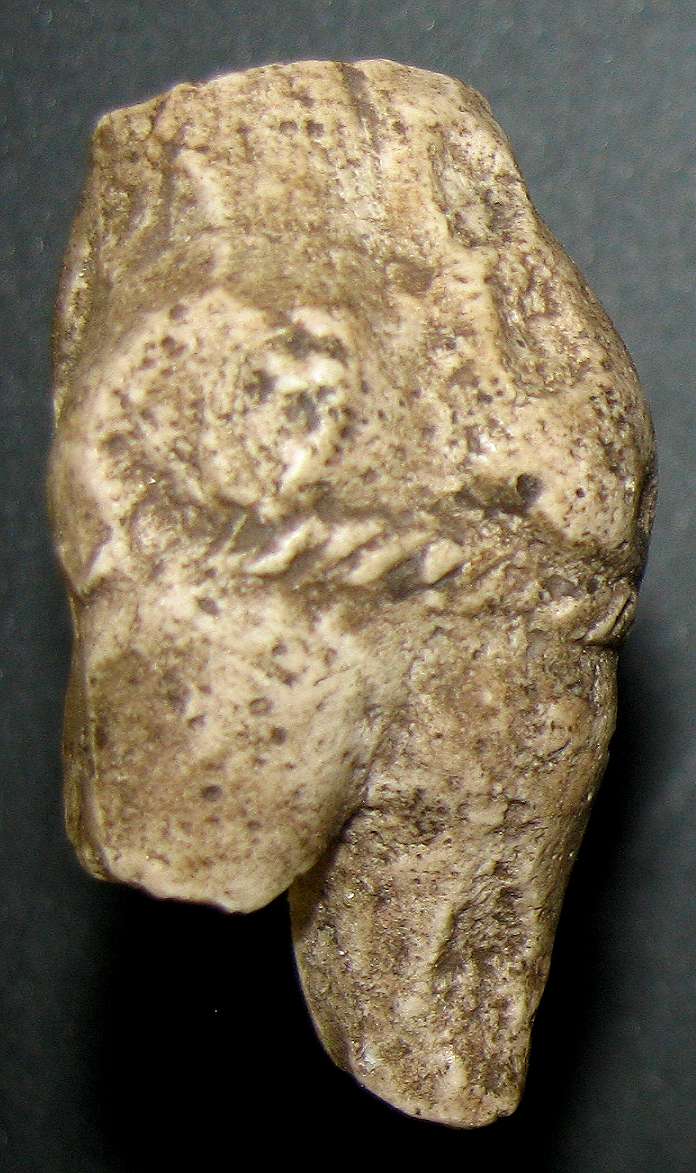
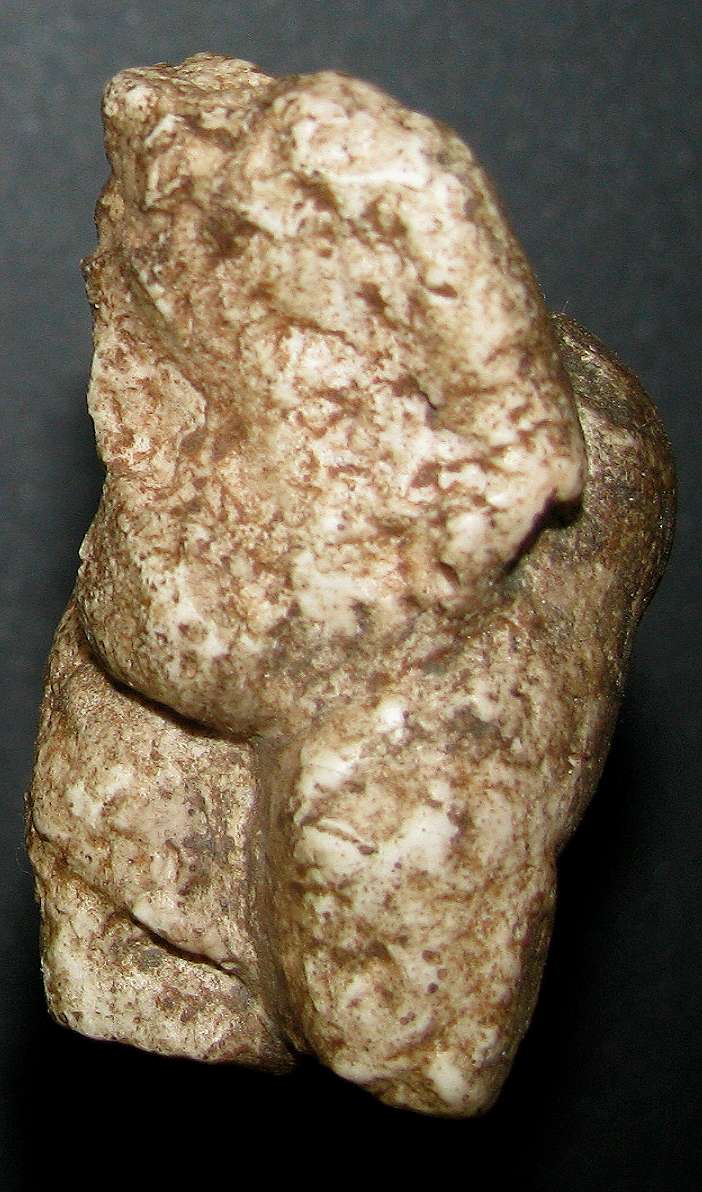
Anthropomorphic pottery figurines. The one on the left appears to have a twisted cord or cloth around the waist or buttocks.
Photo: Don Hitchcock 2008
Source: Display, Dolní Věstonice Museum
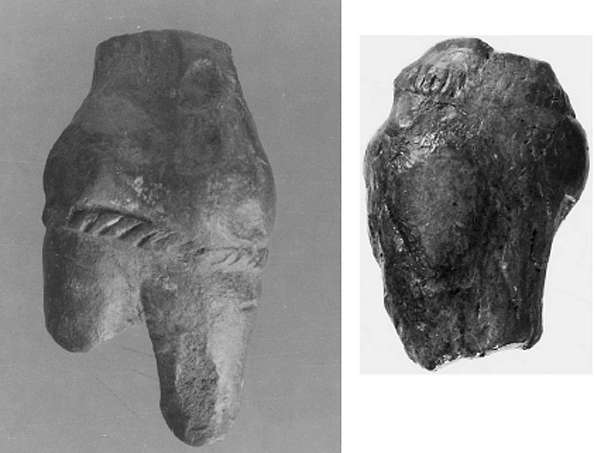
Human figurines of baked clay from Pavlov I with possible cordage belts. The image on the left seems to be of the same venus as the one on the left in the photo above.
Photo: Soffer et al. (2000b)
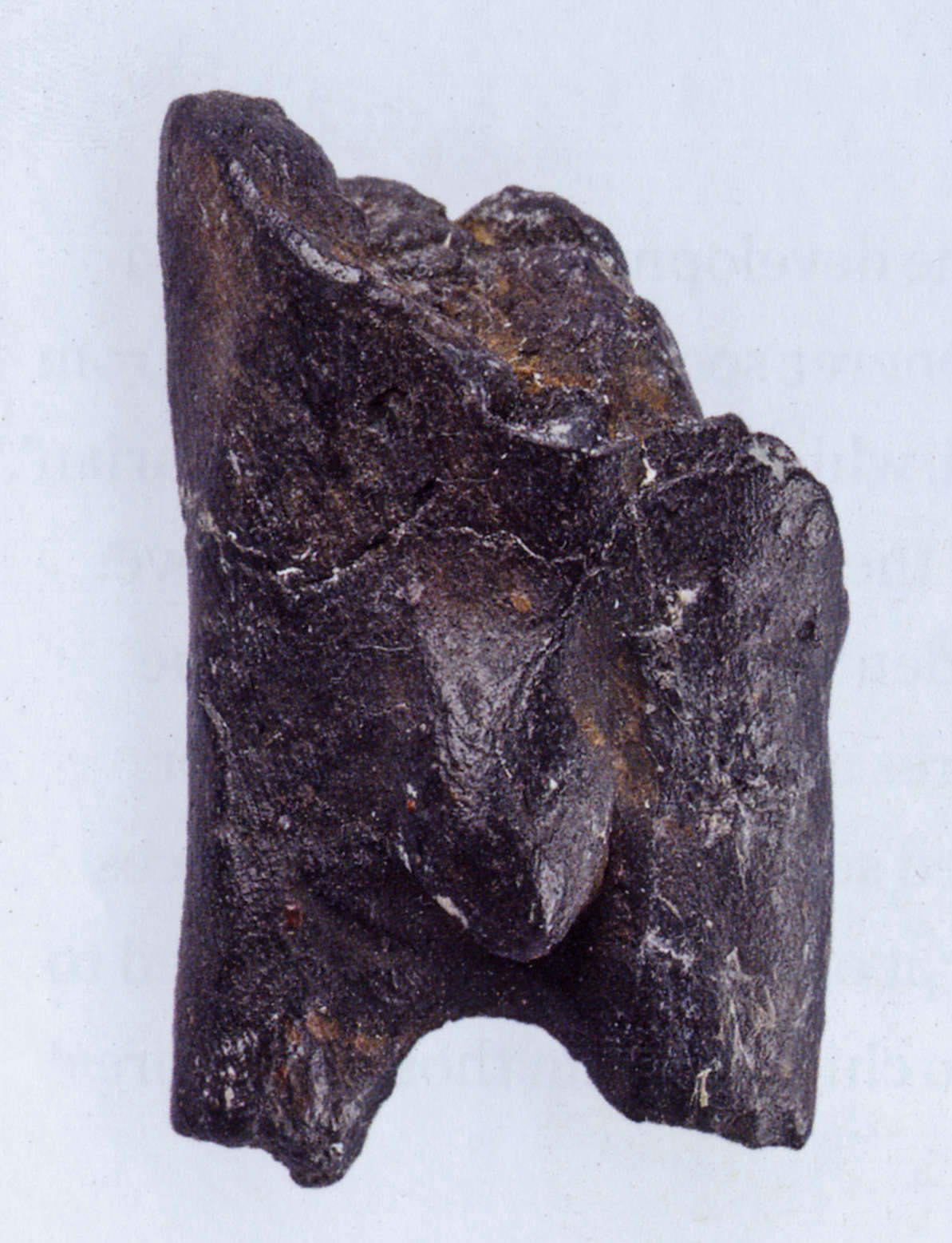
Lower torso of a male figure, Dolni Vestonice.
Ceramic, height 30 mm.
Photo and text: Cook (2013)
Source: Moravské Museum, Brno

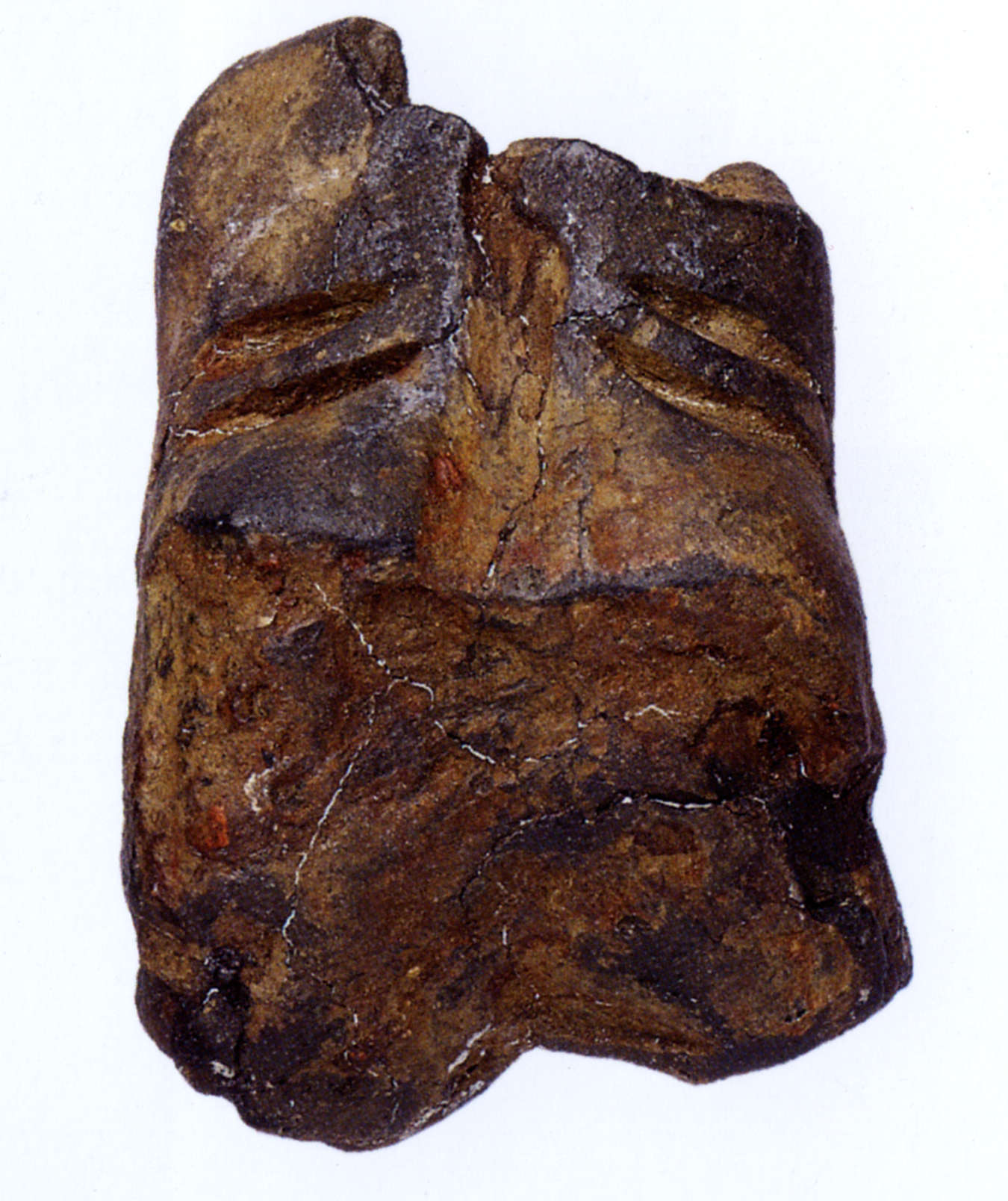
Female torso pieces showing incisions in the back, similar to those of the iconic Black Venus of Dolni Vestonice.
(I can't help but wonder if these are cicatrices similar to those used by Australian aborigines. They may have been marks of the attainment of adulthood, made by cuts in the skin filled with ash or clay to make the scars permanent - Don )
Ceramic, heights 25 - 35 mm.
Photo and text: Cook (2013)
Source: Moravské Museum, Brno

Pendulous breasts, and lower legs, of broken ceramic figurines.
Ceramic, heights 25 - 35 mm.
Photo and text: Cook (2013)
Source: Moravské Museum, Brno
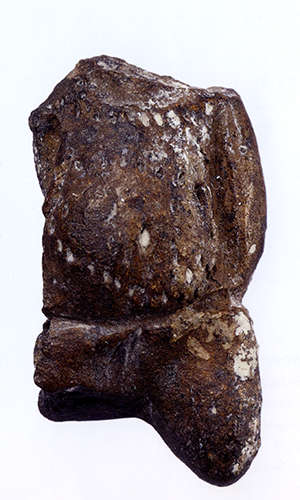
Torso and upper thighs of a pregnant woman, from Dolni Vestonice, numbered IX, decorated with incisions.
Ceramic, height 3 cm.
Photo and text: Cook (2013)
Source: Moravské Museum, Brno
The following has been adapted from a book review by Stephen Aldhouse-Green from the resource:
http://www.waspress.co.uk/journals/beforefarming/journal_20021/abstracts/papers/20021_05.pdf
Hunters of the Golden Age: the Mid Upper Palaeolithic of Eurasia 30 000 - 20 000 BP
Editors: W Roebroeks, M Mussi, J Svoboda and K Fennema
ISBN 9073368154
University of Leiden. July 2000
Golden Age or gilded age?
Life and belief on the mammoth steppe
Burial and Brno
As Mussi et al express it, 'the very fact of burying a dead person, sometimes with a rich assemblage of goods, is innovative enough not to occur by chance in otherwise chronologically, geographically and sometimes culturally related areas'.
Gravettian ceremonial burial - like art - is pan-European in its scale and practice. Of particular relevance here is the paper by Oliva (The Brno II Upper Palaeolithic burial) which deals with the Brno II burial in the Czech Republic.
This was salvaged in 1891, at the same time as excavations of the Balzi Rossi caves were taking place. The grave was an isolated find which has the merit of reducing uncertainty about the integrity of the association. The skeleton has now been directly dated to 23 680 ± 200 BP (OxA- 8283).
The range of grave goods is highly unusual and includes the only figurine ever to have been found in a sepulchral context. Finds include the ochre-strewn burial of an adult male suffering from periostitis; a mammoth scapula (covering the burial) and other megaherbivore remains of mammoth and woolly rhinoceros; a composite male figurine of ivory (the so-called 'marionette'); decorative items including 600 fossil shells interpreted as a ornaments for a head-covering, 2 large slate disks, and 14 roundels variously made of haematite, soft stone, bone, mammoth molar and ivory; finally, a reindeer antler with polished end interpreted as a drumstick.
Oliva sees three features as being of special significance. First, the periostitic condition of the burial would have resulted in chronic pain and possibly psychological trauma. Second, the situation of the burial away from any settlement. Third, the nature of the grave goods, including the large herbivore bones.
A shamanic interpretation is founded on these data: the deceased's state of health might have given him social recognition as a shaman; the nature and placement of the grave goods denotes specialness - among these, the figurine is remarkable - and the drumstick, if correctly identified, has an obvious significance as an instrument associated with the inducing of altered states of consciousness.
Looking beyond Brno, the burials can be seen to reflect differential and, probably in some cases, inherited status. This varying treatment is seen also in sites like the Grotta Paglicci or Dolní Vestonice where some bodies were represented by no more than scatters of human bone.
Oliva's argument that the state of health of the Brno burial may indicate a special status in life as a shaman may be extended. Thus, in later prehistoric Europe, people whose position was in some way liminal - and health is but one possibility - were often treated differentially in death or, even, were singled out for death. In a Gravettian context the Dolní Vestonice XIV burial, of uncertain gender and suffering both from curvature of the spine and a diseased femur, is striking in this regard. The complex symbolism of the Gravettian burials will ensure that they remain a key area for continuing study and analysis.
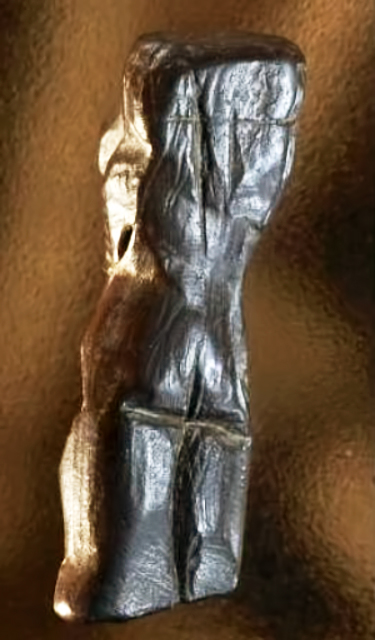
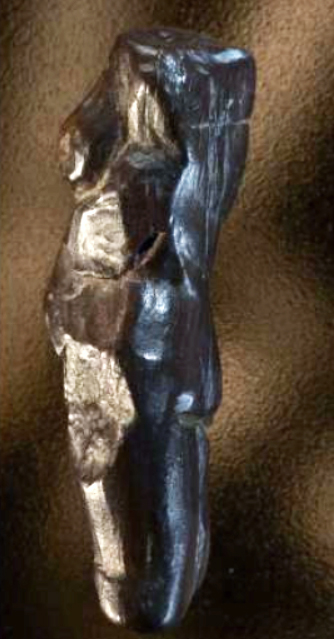
The Ostrava Venus - Petřkovice Venus
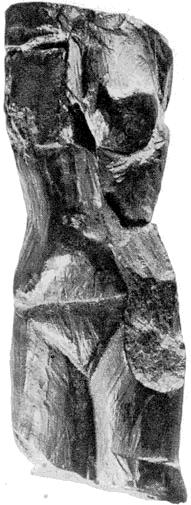 |
This miniature female torso, less than 5 cm in height, carved in haematite, comes from the Gravettian camp site of Ostrava-Petřkovice in Moravia, the Czech Republic. Age 27 000 years BP. It seems incredibly modern, almost cubist in style, and the pubic triangle looks like the bottom half of a modern bikini. I think of it as the South Bondi venus. The statue was discovered in 1953 by archaeologist Bohuslav Klima, under a mammoth tooth in a pit cutting through the floor of an oval house, this female figure was deliberately carved to represent just the body without head or limbs. The slim figure with hour glass shape has a slightly prominent stomach suggesting the early stages of pregnancy of a prima gravida (woman in her first pregnancy - Don). The breasts are small and firm and the incised sexual triangle disproportionately large. 46 mm high, 15 mm wide, 14 mm thick. It is kept in the safe of the Archaeological Institute of Brno, South Moravia. Text: partly sourced and adapted from: http://www.bradshawfoundation.com/sculpture/gallery.php |
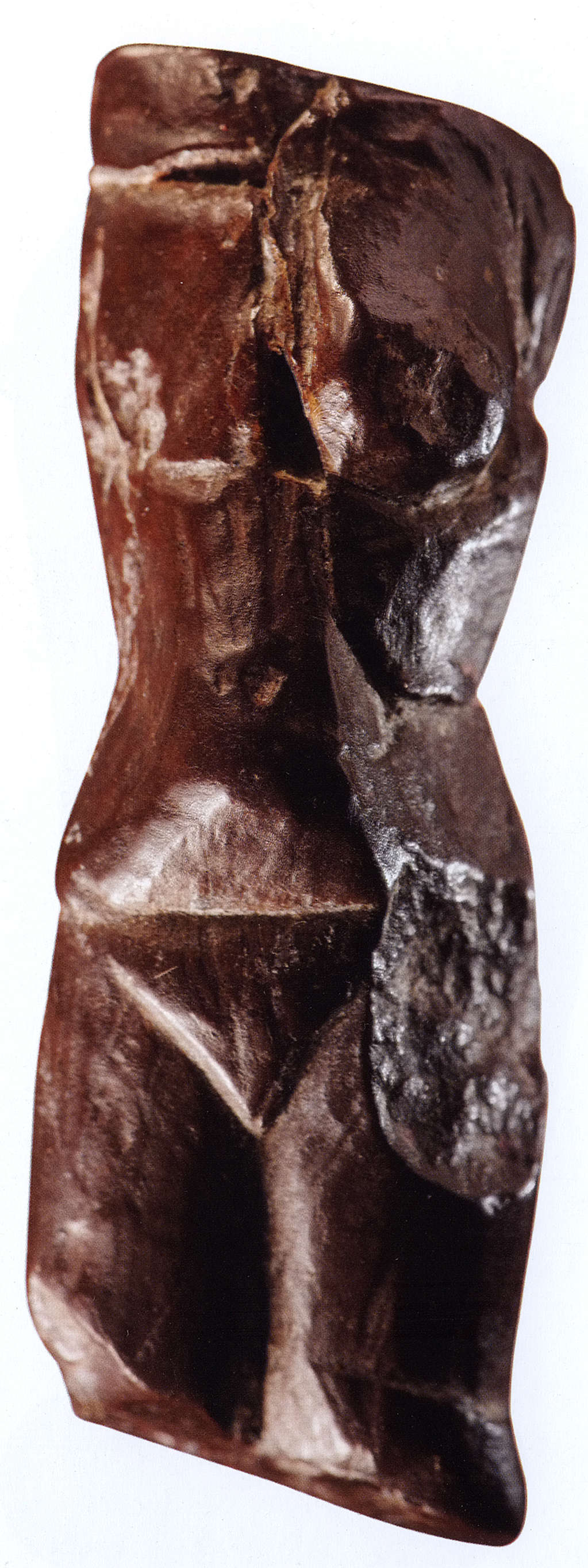
Torso of a young woman.
From Petřkovice.
Photo and text: Cook (2013)
Source: Moravaské Museum, Brno
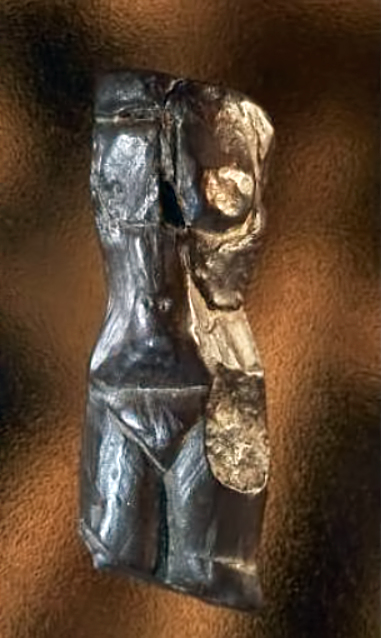
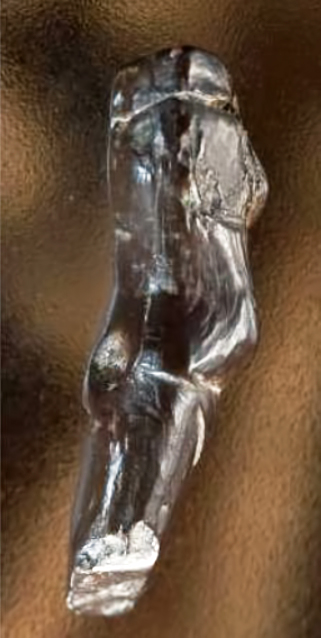
Torso of a young woman.
From Petřkovice.
Photo and text: Svoboda (2008)
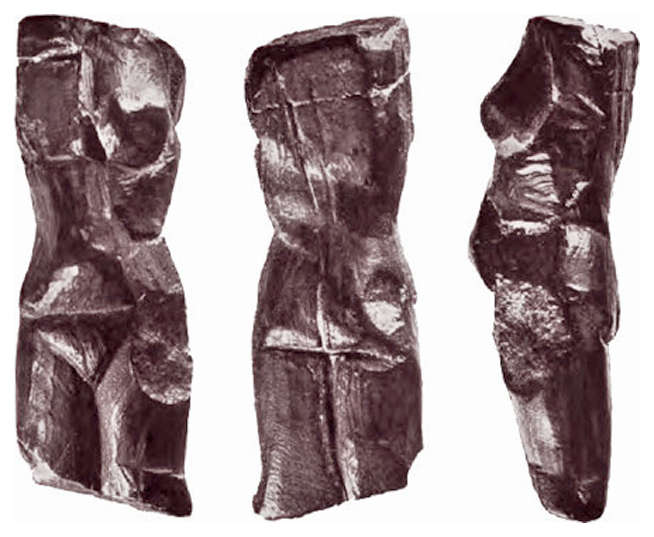
The Ostrava Venus, also known as the Petřkovice Venus.
Photo: http://www.steinzeitwissen.de/wp-content/uploads/venus-klima.jpg
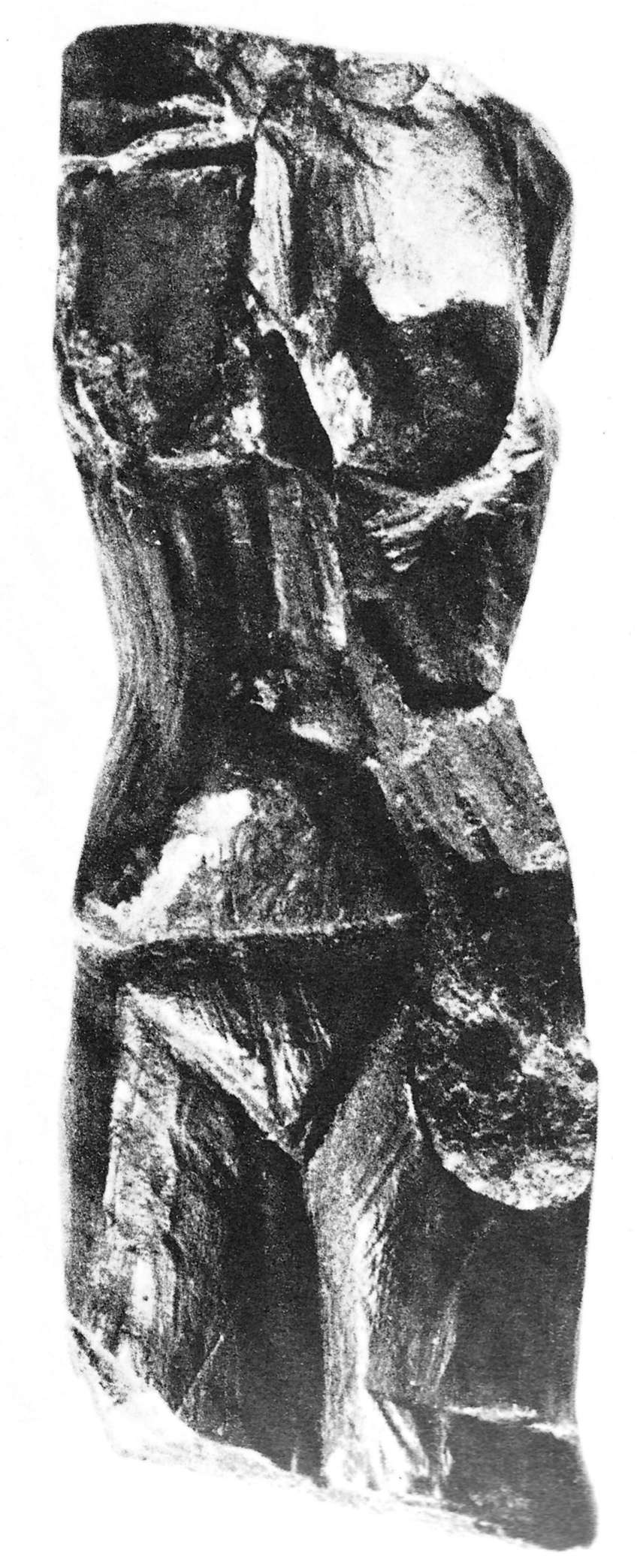
The Ostrava Venus, also known as the Petřkovice Venus
Ostrava-Petrkovice in Moravia
Height 45 mm
Breadth 15 mm
Thickness 14 mm
Material: hematite
Photo and text: Müller-Beck et al. (1987)
Source: Arch, Inst. Brno

Venus of Petřkovice, ca. 23 000 BP
This facsimile appears to have been made to show the original condition of the figurine.
Source: Prehistoric Times of Bohemia, Moravia and Slovakia, National Museum in Prague.
Date: 2009
Photo: Kozuch, crop by Ragimiri
Permission: licensed under the Creative Commons Attribution-Share Alike 3.0 Unported license.
The Fake Věstonice Venus II
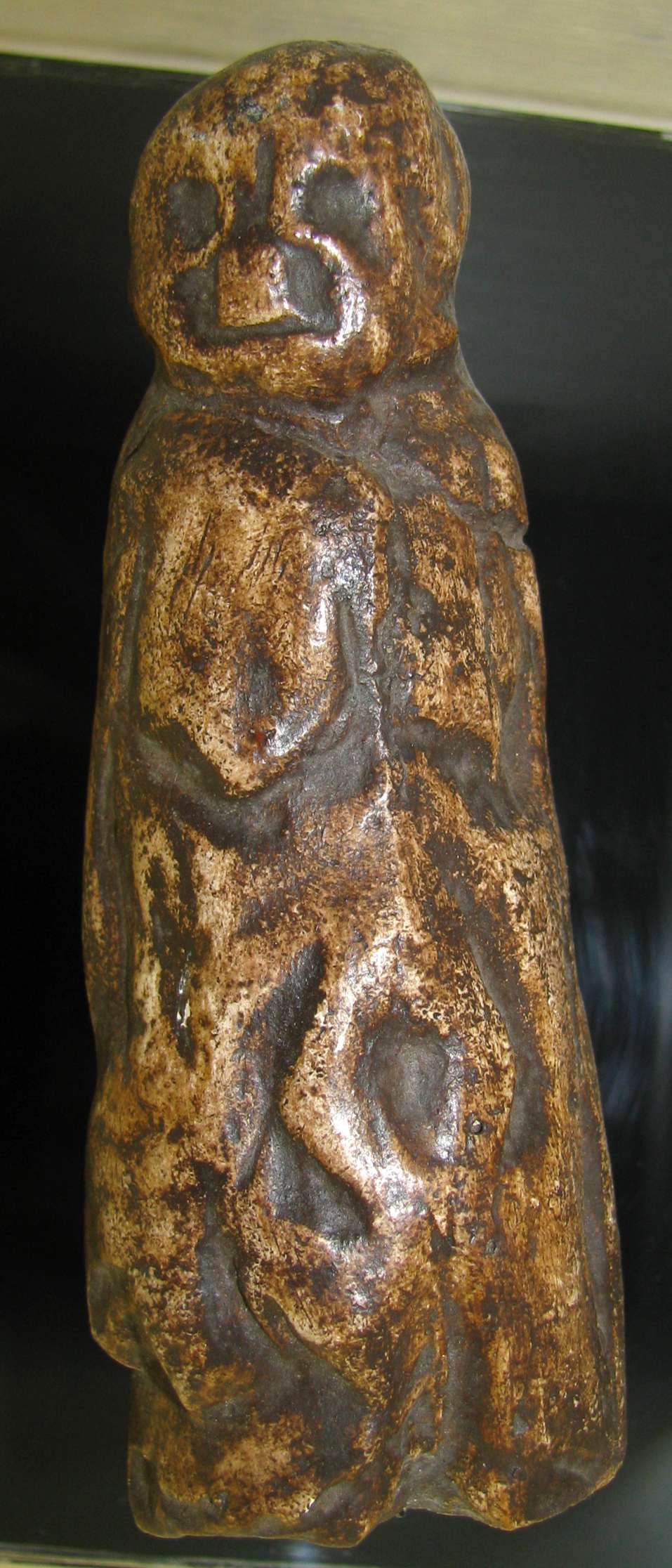
The fake Věstonice Venus II
Source: Facsimile on display, Dolní Věstonice Museum
Photo: Don Hitchcock 2008
The so-called counterfeit Vestonice Venus II
Dr. Jos. Skutil and dr. Al. Stehlik.
(translated and abridged from the Czech by Don Hitchcock)It is an event well remembered from earlier this year when there appeared the exceedingly strange circumstances surrounding the alleged Palaeolithic sculpture, allegedly originating from Dolní Věstonice, which very quickly gained the name 'Věstonice Venus II'.
When the statue was offered for sale overseas, at an enormously overpriced amount, police, at the request of the relevant authorities, charged with the protection of monuments and exports, seized the object from the then owner, F. Mullandrovi, and presented it for study to Prof. Dr K. Absolon, whose report was published on 23rd January 1930 by almost all daily newspapers. The report was damning with respect to its authenticity, identifying the statue as 'poor, made recently, an amateurish carved forgery' and that it should be referred for examination by a suitable criminological investigation.
Affirming this completely hostile verdict was State Conservator Dr Eng. I. L. Cervinka, as well as the Viennese Museum Director Dr Joseph Bayer of Vienna, who claim the sculpture is a 'modern, clumsy fake'.
It has been determined that the sculpture has no relationship to known Palaeolithic material, and displays a mental culture quite foreign to the period. However, because of the technical nature of the piece, by carving and scraping, there is no way to confirm or deny its Palaeolithic authenticity on this basis alone.
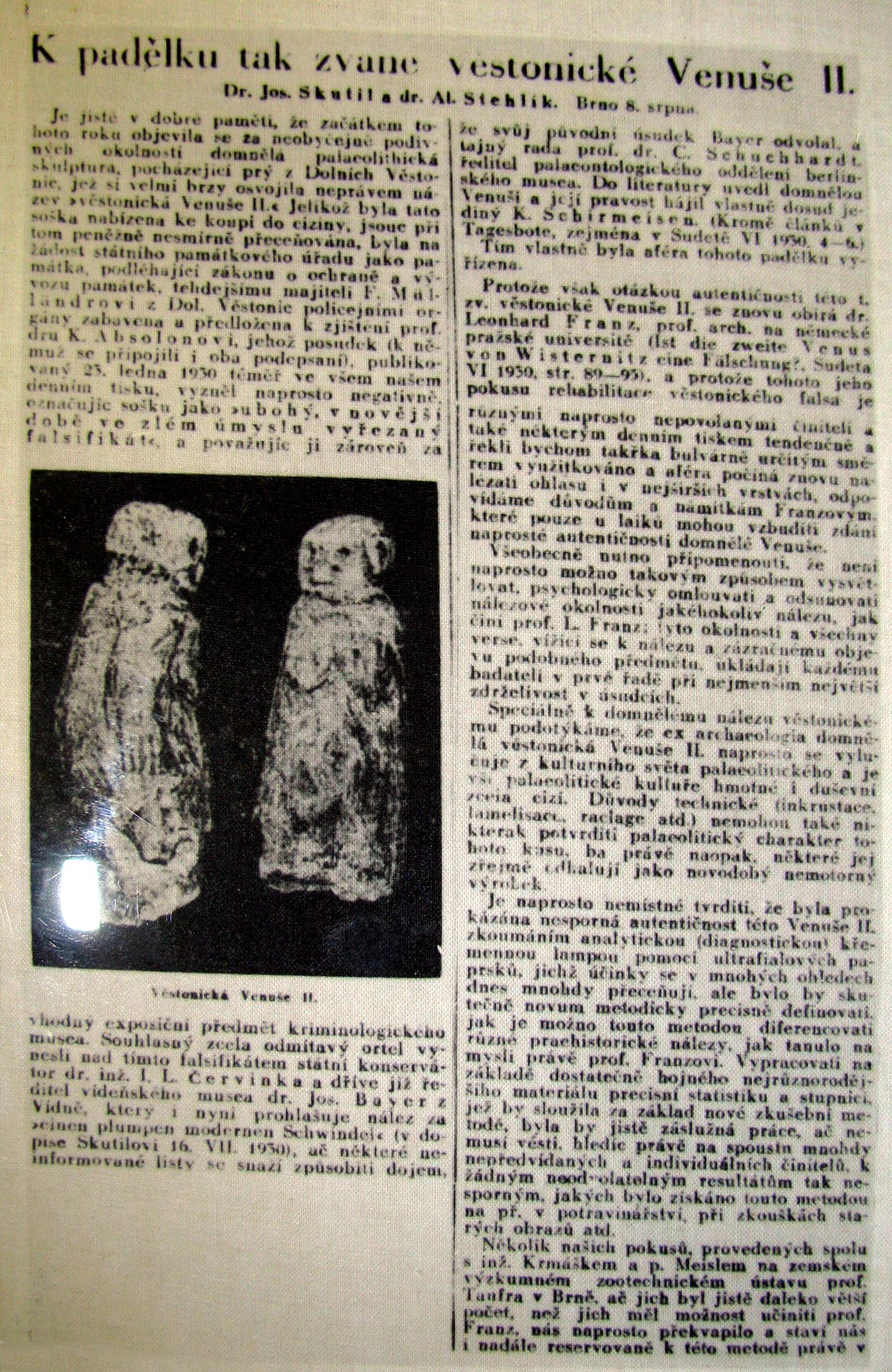
Report on the fake Věstonice Venus II
Source: Display, Dolní Věstonice Museum
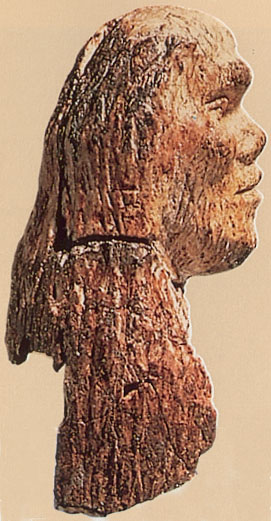
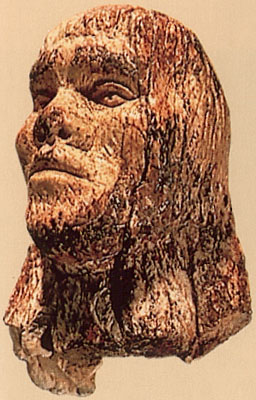
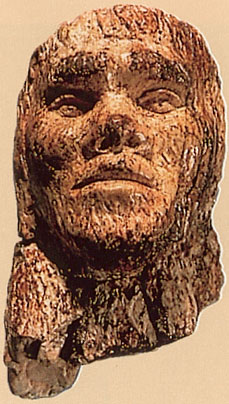
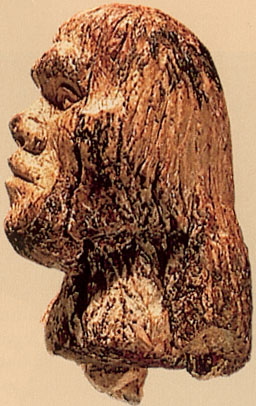
The Mammoth Ivory Male head from Dolni Vestonice
 |
 |
 |
 |
Click on each of the images to see a larger version
Brugar
This may be a portrait of the person with a protruding brow whose skull was found in Brno, Czechoslovakia, in 1891. Since these photographs were published in the National Geographic in October 1988, and Plains of Passage was published in 1990, Jean Auel could well have used it as the model for Brugar, the person of mixed spirits described in Plains of Passage as having lived at Dolni Vestonice.Eight centimetre high male head carved of mammoth ivory dated at 26 000 years BP.
Note that the figure has very heavy brow ridges. The figure has been stated to have a beard, but this feature is not obvious from the photographs.
Note also that Paul Bahn writing in 'Journey through the Ice Age', says that the head may be a fake. His main argument seems to be lack of provenance (meaning that it was not found by a recognised and trusted archeologist, or with reliable witnesses to the discovery) and that the style is too modern. He also says that the Lady of Brassempouy (the ivory carving of Ayla) may be a fake.
The following text is from The National Geographic October 1988, and is written by Alexander Marshack
Alexander Marshack is a professor of Paleolithic Archaeology at Harvard University's Peabody Museum. He is amongst many other things a fine photographer and science writer
The head was an extraordinarily powerful male head with staring eyes, pinpoint holes in the irises, heavy brows, a strong upturned nose and long deeply incised hair. The smaller piece was a lock of longer hair. This lock of hair appeared to have been carved to curve around a staff.
A Czech family living in Australia, who prefer anonymity, had brought the carving to New York for Alexander Marshack to study.
This bust was discovered in the 1890s in a field near Dolni Vestonice, a village in which archaeologists, beginning in the 1920s, had found Ice Age works of art. Excavation continues there today, directed by Dr. Bohuslav Klima
Dr Klima is a distinguished researcher in prehistory, and is at present an associate Professor in the Department of History at the University of Brno. He is a specialist in the Upper Palaeolithic in Central Europe, and is also the Director of the Archaeological Institute of the Czechoslovak Academy of Sciences in Brno.
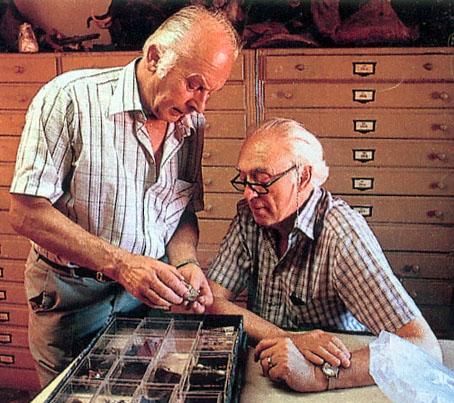
The only other human head from the Ice Age that had eye sockets, eyeballs, and lids was the realistically carved female with a bun excavated in a 26 000 year level at Dolni Vestonice. Pieces of the ivory lamellae, like layers of an onion, had flaked off, leaving an uneven surface and an unfinished look. Later when Alexander Marshack reexamined this head in Czechoslovakia, and cleaned it he found incised nostrils, a detail not noted before, that resembled the style of the male head. Were these accidental similarities or aspects of a regional Ice Age style?
His initial microscopic analysis indicated that the male head had been broken in several places, glued together, and covered with a protective coating. He was told by the owners that the piece had been dipped in horse glue, once a common method of preserving bone. The ivory had apparently been shaped with flint tools. Many grooves were striated and changed configuration as the line curved. A steel blade would not make these patterns. Some strokes were overlaid with encrustations of sand and minerals that had apparently accumulated over time. Natural cracks, also filled with minerals, crossed the engraved lines, suggesting that weathering had occurred after the piece was carved.
The bottom had been sawed horizontally at about the shoulder line. Marshack had seen fine-toothed blades from the Dolni Vestonice collection that might, when hafted, have been used to saw ivory in this way. The nostrils and eyes presented a special problem. They appeared to have been cleaned, and even recarved, and then covered with paraffin.
The protruding brow is similar to that on a skull found in Brno, Czechoslovakia, in 1891.
X-ray diffraction at the Peabody Museum revealed the presence of iron oxides, which give the artifact its reddish brown coloration, and fluorapatite, the result of an exchange between the ivory and minerals in the soil. Both suggest long burial in the ground.
The British Museum had seen the piece once before. In the late 1940s the museum had been asked to authenticate the piece but had to return it when the owners moved to Australia; the museum may have put the paraffin in the eyes as a preservative. Museum experts now told Marshack it would be difficult, if not impossible, to fake the complex changes that had occurred in the ivory.
Clearly the ivory needed to be dated, and, more important, the carving itself. Accelerator carbon-14 dating was not feasible because it would consume a portion of the statuette. Marshack contacted Dr. Edward Zeller, director of the Radiation Physics Lab at the University of Kansas Space Technology Center, who became intrigued with the problem. He suggested alpha-particle spectral analysis to locate radioactive elements useful in estimating age. Working with fragments at first, Ed found uranium in surprising quantities. Uranium would enter the tusk only after its burial in sediment or sand where groundwater containing traces of uranium was seeping. More startling were the high counts of radium and other radioactive products of uranium decay.
While Ed was testing, Marshack detoured to Czechoslovakia on his way to a conference in Italy. He wanted to learn about soil conditions in the area of Dolni Vestonice and confer with Dr. Klima. He learned that uranium, a valued resource after World War II, had been located in the highlands northwest of Brno. Rainwater draining these heights may have reached the lowlands where the head was reportedly found. Klima said, 'We have so many unique things from Dolni Vestonice and Brno -the 'marionette', the oldest fired clay figures, the 26 000 year old female head - it would not surprise me to find here the oldest male image.'
Back in Kansas, Ed Zeller and his associate Dr. Wakefield Dort, Jr., a Pleistocene geologist now had the carved hair piece to test. They placed it in the counting chamber of the alpha particle spectrometer for 72 hours. The final ratios of uranium to decay products suggested that the carved surface of the ivory may be about 26 000 years old.
The scientists envision this Ice Age scenario: Sometime after a mammoth died, someone carved a piece of its tusk. The carving became buried in sediment or sand, where it absorbed uranium, iron oxide, and fluoride from the groundwater. The calcium phosphate of the ivory absorbed the minerals, especially the uranium. At the same time, radioactive decay set in, leaving its by-products at levels that require thousands of years to build up to the present reading. If the head had been carved anytime in the past few centuries, the decay products on the surface would have been cut away. 'Even Madam Curie couldn't fake that effect.' Ed said. He and Dort have no doubt that the carving is ancient, but the precise age has yet to be confirmed.
In July 2008 I received this very interesting communication from Danylo Derkacz (a pseudonym):
I am a retired neuropathologist and part time forensic pathologist who has dissected and examined microscopically about 1 200 human heads and brains.
1) the ivory head is carved by someone with training and talent.
2) the head makes no sense physiologically, genetically, medically or culturally.
a) medically it represents the head of a microcephalic individual who even with today's medical and social care would not survive puberty.3) neither today nor then would any artist produce a labor intensive sculpture of a village idiot with microcephaly.
b) the supraorbital ridges are those of a Neandertal but the head lacks the prognathia and recessed mentum (chin) of a Neandertal and has it protruding like that of H. sapiens sapiens.
c) the upturned nose is typical of a modern Slovyan (Slav) who at the time of discovery were considered as stupid peasants.
4) the nose of the ivory figure is so exaggerated that is better interpreted as that of a tertiary syphilitic which was then common in the pre-penicillin era and pre sulfonamides era.
In summary:
I think it is a first half of the 20th century fake and caricature of the fashionable (at that time) concept of Neandertals admixed with westerners as an expression of disrespect for Slavs.
References
- Buňatová, M., 1999: Textilní produkce v mladém paleolitu, experiment pro dokumentární film "Úsvit géniů", in: AR LI, Praha, 104 - 111.
- Cook, J., 2013: Ice Age art: arrival of the modern mind, The British Museum, 18 Feb 2013, ISBN-10: 0714123331, ISBN-13: 978-0714123332
- Jelinek J., 1972: Das grosse Bilderlexikon des Menschen in der Vorzeit, Gütersloh. Bertelsmann-Lexikon-Verlag, P. 333
- Jelinek, J., 1975: The Pictorial Encyclopedia of the Evolution of Man, Hamlyn (1975), 552p
- Müller-Beck, H. and Albrecht, G. (Ed.), 1987: Die Anfänge der Kunst vor 30000 Jahren Theiss: Stuttgart.
- Musil, R., 1968: Stranska Skala: Its Meaning for Pleistocene Studies, Current Anthropology, Vol. 9, No. 5, Part 2 (Dec., 1968), pp. 534-539
- Neustupný, E. and Neustupný, J., 1960: Czechoslovakia before the Slavs. In: Ancient Peoples and Places, Thames and Hudson, London.
- Powers, R., 1994: The Human Form in Palaeolithic Art, CRC Press, 1994 - Science - 237 pages >
- Rau, S., Naumann D., Barth M., Mühleis Y., Bleckmann C., 2009: Eiszeit: Kunst und Kultur, Thorbecke, 2009, 396p. ISBN: 978-3-7995-0833-9
- Sandars, N., 1992: Prehistoric art in Europe. Yale University Press 1992
- Soffer, O., Adovasio, J., Hyland, D, 2000: Reply, Current Anthropology; Aug-Oct2000, Vol. 41 Issue 4, p531-537, 7p
- Soffer O., Adovasio J., Hyland D., 2000b: The 'Venus' Figurines - Textiles, Basketry, Gender, and Status in the Upper Paleolithic, Current Anthropology Volume 41, Number 4, August–October 2000
- Sosna, D., 2000: Počátky textilnictví. PhD. Dissertation, Department of Anthropology, Masaryk University, Brno.
-
Svoboda J., 2001. Gravettian mammoth bone deposits in Moravia The World of Elephants - International Congress, Rome 2001
http://en.sovraintendenzaroma.it/content/download/4819/62548/file/359_362.pdf - Svoboda J., 2017: Upper Paleolithic female figurines of Northern Eurasia, PETRKOVICE, The Dolní Věstonice Studies 15, Brno 2008, 193-223 December 2017, Project: origins of art
- Svoboda J., 2008: Upper Paleolithic female figurines of Northern Eurasia. In: J Svoboda, ed., PETRKOVICE. The Dolní Věstonice Studies 15, Brno 2008, 193-223.
- Velde, B., Druc I., 2012: Archaeological Ceramic Materials: Origin and Utilization, Springer Science & Business Media, 6Dec.,2012 - Social Science - 299 pages
- Urbanová , K., ca 1999: Textilnictví v prehistorii, http://uprav.ff.cuni.cz/pages/semi/3.prednaska.pdf