Back to Don's Maps
 Mousterian (Neanderthal) Sites
 Back to the review of hominins
Le Regourdou
Le Regourdou is one of the most important Neanderthal sites in France. Excavated by Georges Laplace and Eugene Bonifay, the bones of Le Regourdou 1 are the remains of a young Neanderthal adult, of undetermined sex, from the beginning of the last glaciation, about 90 000 years ago. The archeological site of Regourdou is located on the same hilltop as Lascaux, 800 metres from the famous caves.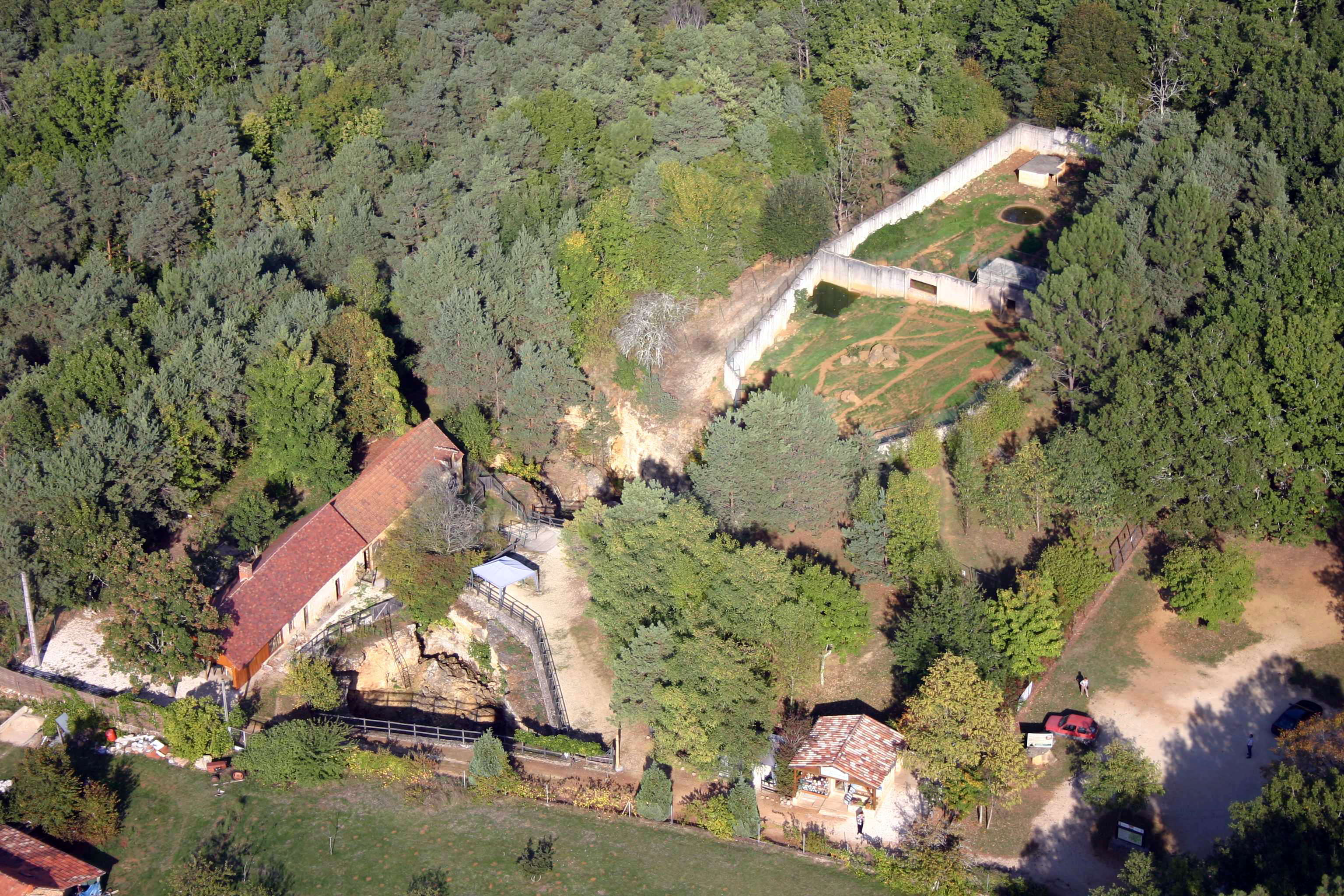
Aerial shot of Le Regourdou, with the present day museum on the left, a sub triangular pit beside it, and another pit behind the former house of the original owner. The bear enclosure is in the centre right background.
Photo: Le Regourdou
Permission: This file is available under the terms of the Creative Commons Attribution License - Share Alike 3.0 (unported)
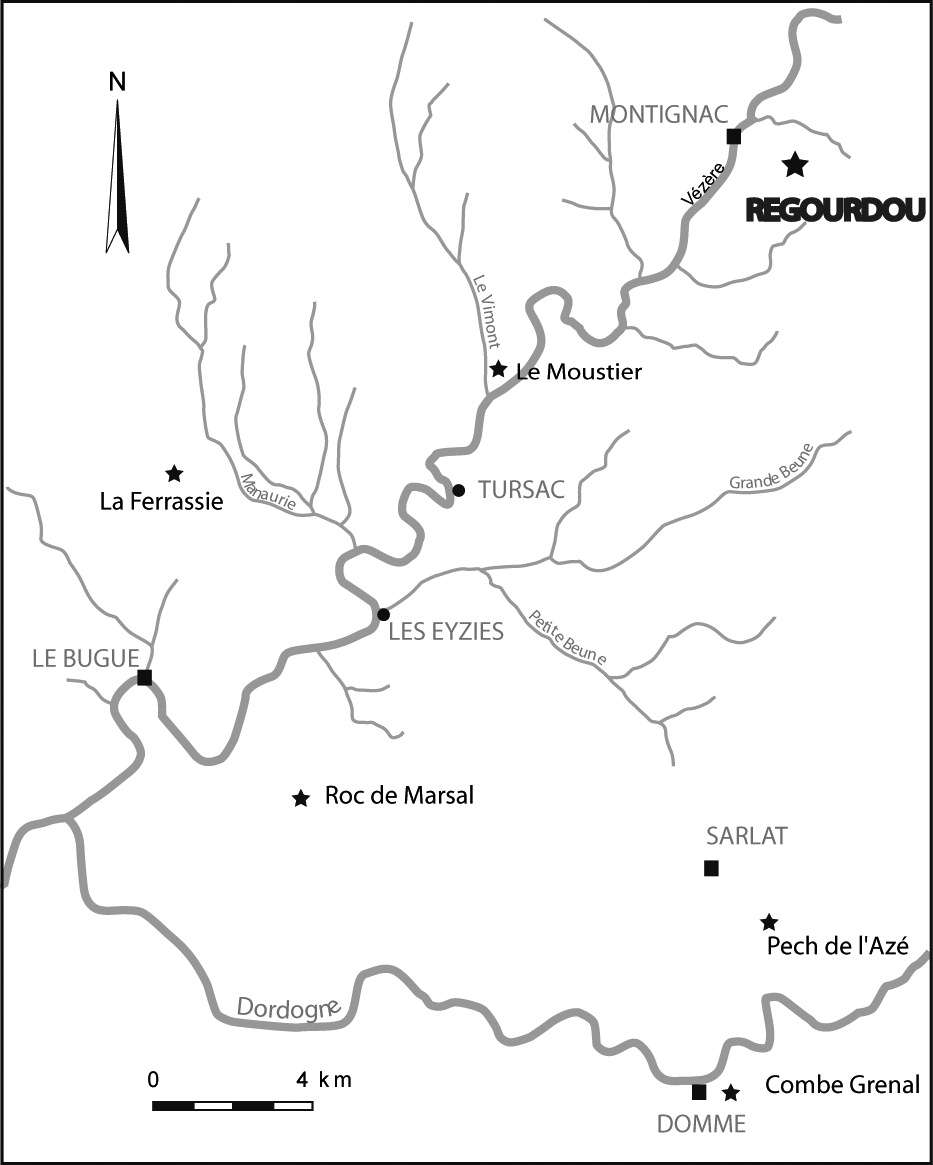
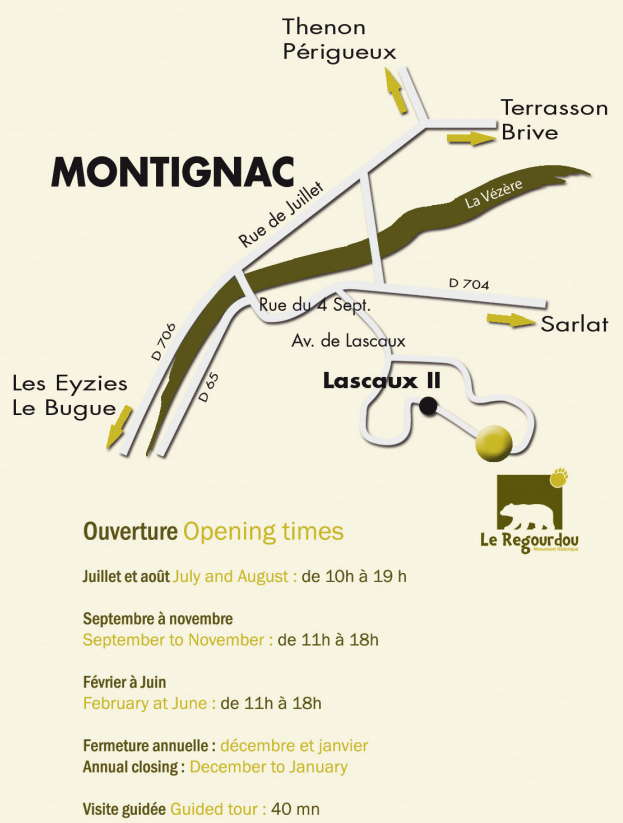
Location of the Regourdou site and other mousterian sites in the region with hominin remains, as well as a map of the local roads around Le Regourdou, and opening times.
Photo: (left) Madelaine et al. (2008)
Photo: (right) Le Regourdou Brochure
Background:
1954 - discovered by the local farmer Roger Constant.
22nd September 1957 - lower jaw of a Neanderthal discovered.
1961-1965 - excavated by Eugène Bonifay and B. Vandermeersch.
1993 - complete site protected as a Monument Historique.
Description
Le Régourdou cave is famous for the discovery of a Neanderthal burial. In French it is mostly called Gisement Régourdou, because there is actually no cave. It is a huge collapsed doline or sinkhole with some shafts, one of them excavated to a depth of 35m. The cave was named after the farm Régourdou where it is located, only 800m from the famous Lascaux Cave on the same hill. It was discovered in 1954 by the owner Roger Constant.
There was no cave entrance before the collapse in 1954. Such collapsed dolines are common in karst areas. When the ceiling becomes unstable, it collapses and the debris covers the floor. But this collapse happened in the backyard of Roger Constant.
He was convinced it was a yet unknown entry into Lascaux cave. He started to remove the debris from the collapse so he could enter the cave. On his private property this work went on almost unnoticed for years. But he discovered numerous stone tools and other artefacts. And while he was not able to work in an archaeologic manner, he still collected the findings.
After three years of work he discovered the lower jaw of a Neanderthal on 22nd Septermber 1957. After this find, he went to the city hall to obtain an official excavation permit, which was granted to him.
However, the permit was revoked when the importance of his discovery became known, and the archaeologists even brought police with them, to arrest him if he refused to stop his excavations. Obviously there were some misunderstandings and some quarrel about who was allowed to do what. They made an arrangement, the archaeologists were allowed to excavate the Neanderthal burial, while Mr Constant continued his work in another part of the doline.
In 1970 he began work on a deep shaft, which eventually reached a depth of 35 metres, where he discovered Mesozoic marine fossils and an ochre deposit, which was used by Monique Peytral to paint the reproductions at Lascaux II. When the whole site was declared a Monument Historique in 1993 his excavations finally ended. He never discovered the Lascaux connection.
The Neanderthal burial was covered by a huge rock, a funeral slab, which weighed 850 kg. The rock was removed, but it was unstable, so it was destroyed in the process. Under the slab there was the skeleton of a Neanderthal in a fetal position, surrounded by his weapons and hunting trophies. Among the trophies were numerous bones of a brown bear, probably sacrificed for the burial.
The burial was surrounded by about twenty stone boxes which contained the bones of bears. It was dated to be 70 000 years old. This burial is extraordinary, as it contained an almost complete skeleton of a Neanderthal. Just to give an impression: other Neanderthal sites revealed a few teeth and pieces of the skull and are considered important sites! The skeleton is now on display in the Musée d'Art et d'Archéologie du Périgord.
Today the house of Mr Constant has beeen transformed into a museum. It shows all the discoveries Roger Constant made in his doline. This includes a high quality replica of the jaw he discovered. He was impressed by the numerous remains of brown bears so he decided to add a small zoo with brown bears to the site.
Text above translated and adapted from http://www.showcaves.com/english/fr/showcaves/Regourdou.html
Une grotte devant la porte - A cave at the door

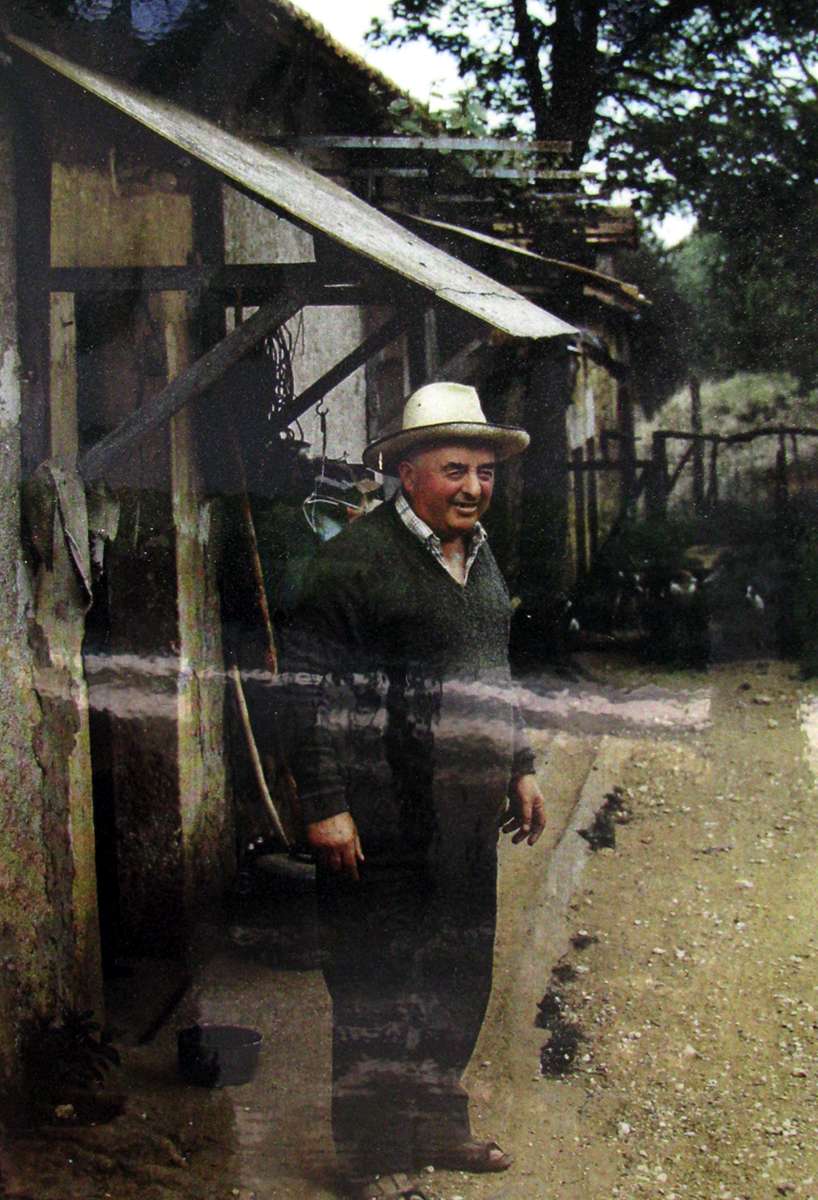
In 1954, Roger Constant discovered outside his home what appeared to be a collapsed cave. For several years, convinced that this was another entry to Lascaux, he dug a vertical access pit and a horizontal gallery, uncovering flint tools and animal bones.
En 1954, Roger Constant découvre devant sa maison ce que semble être une grotte effondrée. Pendant plusieurs années, persuadé qu'il existe une autre entrée de Lascaux, il creuse un puits et une galerie, récoltant outils en silex et ossements d'animaux.
Photo: (left) Press Pack, http://www.regourdou.fr/espace-pro.php, 2011
Photo: (right) Don Hitchcock 2008
Source: Display at Le Regourdou
La découverte - The discovery
On the evening of September 22 1957, a human burial was brought to light in strange circumstances. Roger Constant immediately alerted Francois Bordes, Director of Prehistoric Antiquities of Aquitaine.
(The distinguished archaeologist James R. Sackett has written an interesting short Biography of François Bordes which may be of interest to readers - Don )
Le soir du 22 septembre 1957, une sépulture humaine est mise au jour dans des circonstances mal connues. Roger Constant alerte aussitôt Francois Bordes, Directeur des Antiquités préhistoriques d'Aquitaine.

The remains of Regourdou 1 in place in 1957. The right mandible or jaw of the face appears just above a cervical (neck) vertebra and on the left a broken right humerus (upper arm bone) and the distal (far) end of the right ulna (one of the two lower arm bones).
Vestiges humains de Regourdou 1 en place en 1957. La mandibule apparaît par sa face droite avec en dessous une vertèbre cervicale et plus à gauche l'humérus droit cassé puis l'extrémité distale de l'ulna droit.
Photo: Don Hitchcock 2008
Source: Display at Le Regourdou
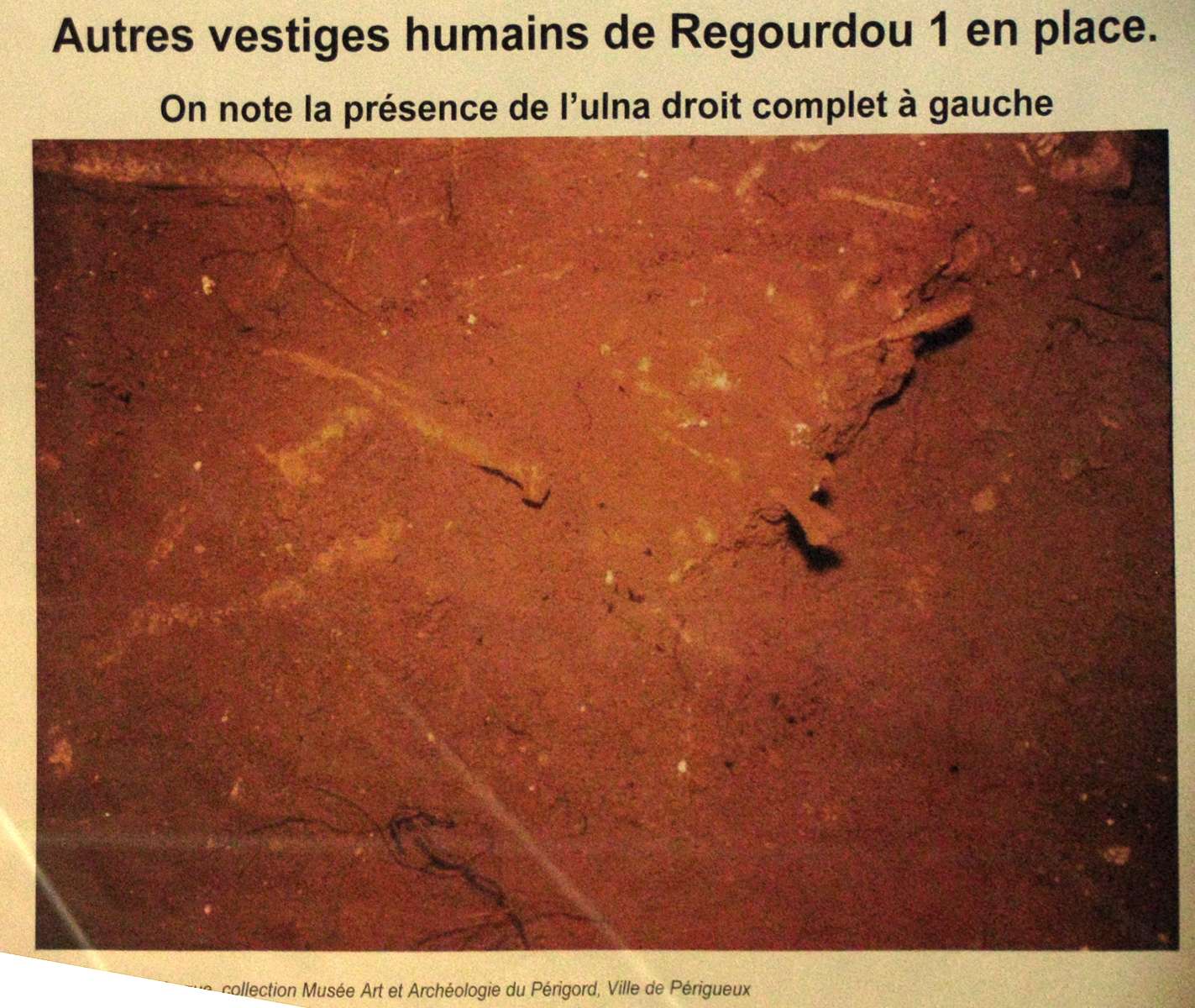
Regourdou 1. Note the presence of a complete right ulna on the left of the photo.
Autres vestiges humains de Regourdou 1 en place. On note la présence de l'ulna droit complet à gauche.
Photo: Don Hitchcock 2008
Source: Display at Le Regourdou
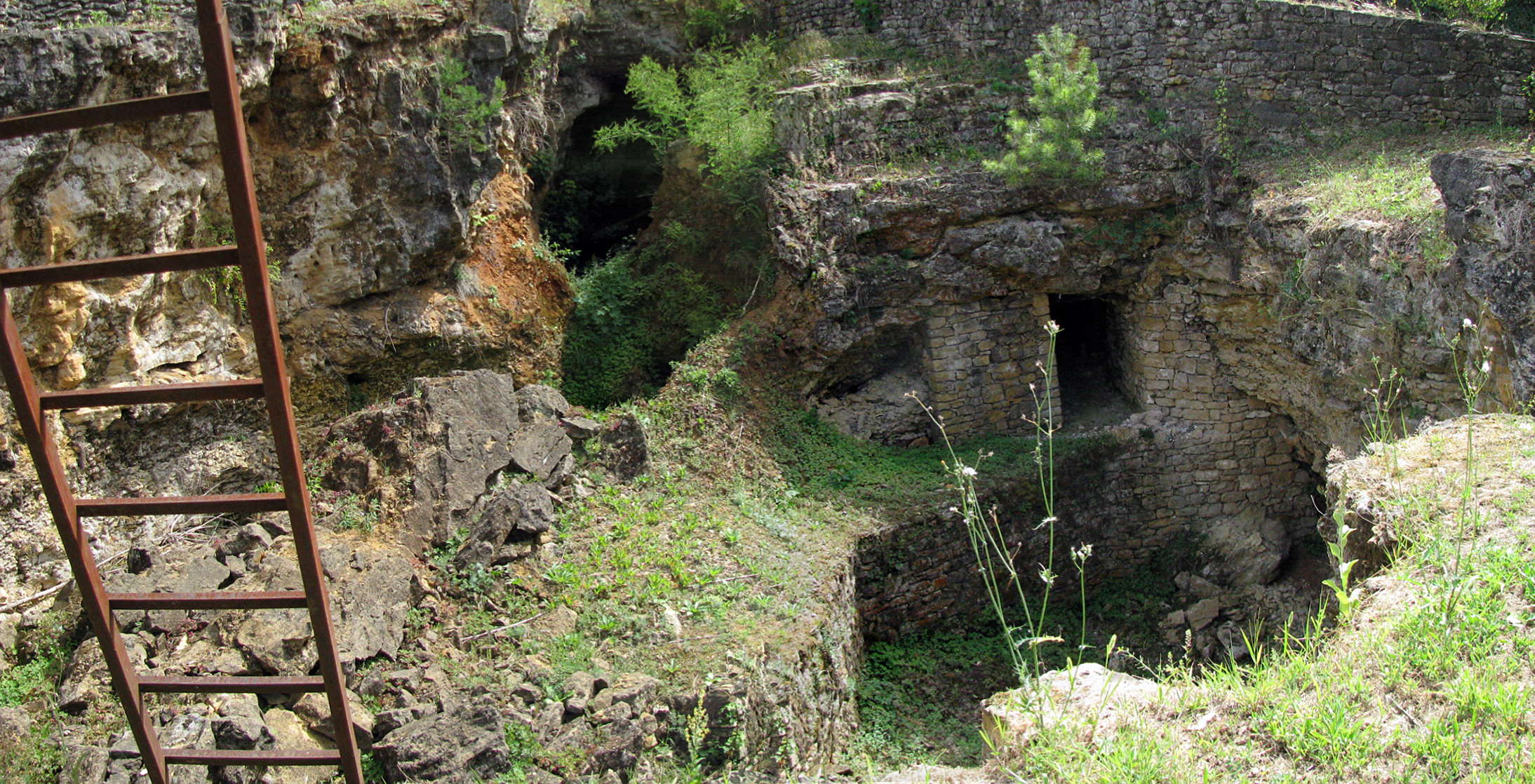
This panorama of two stitched photos shows the complete archeological site, or gisement.
Photo: Don Hitchcock 2008
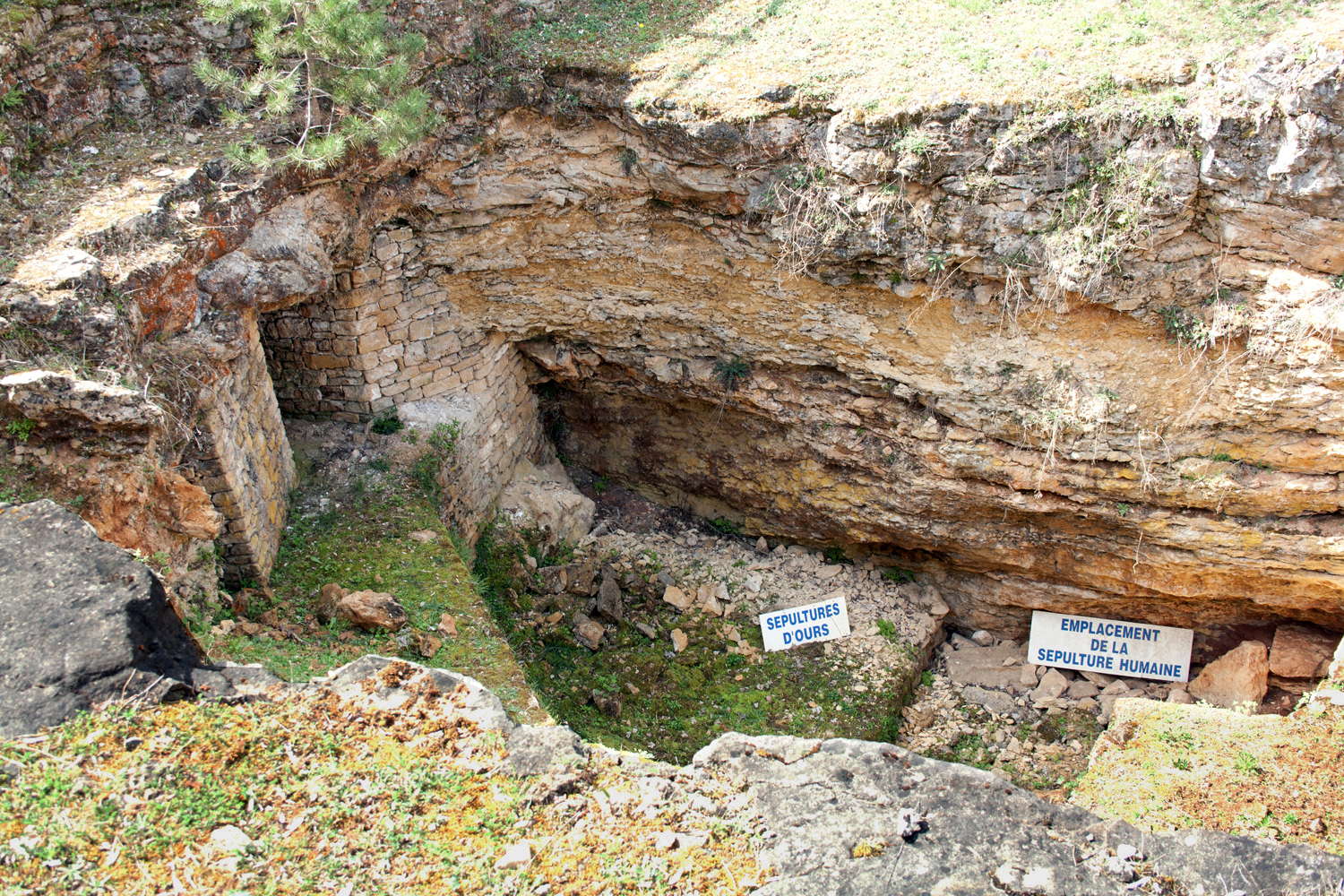
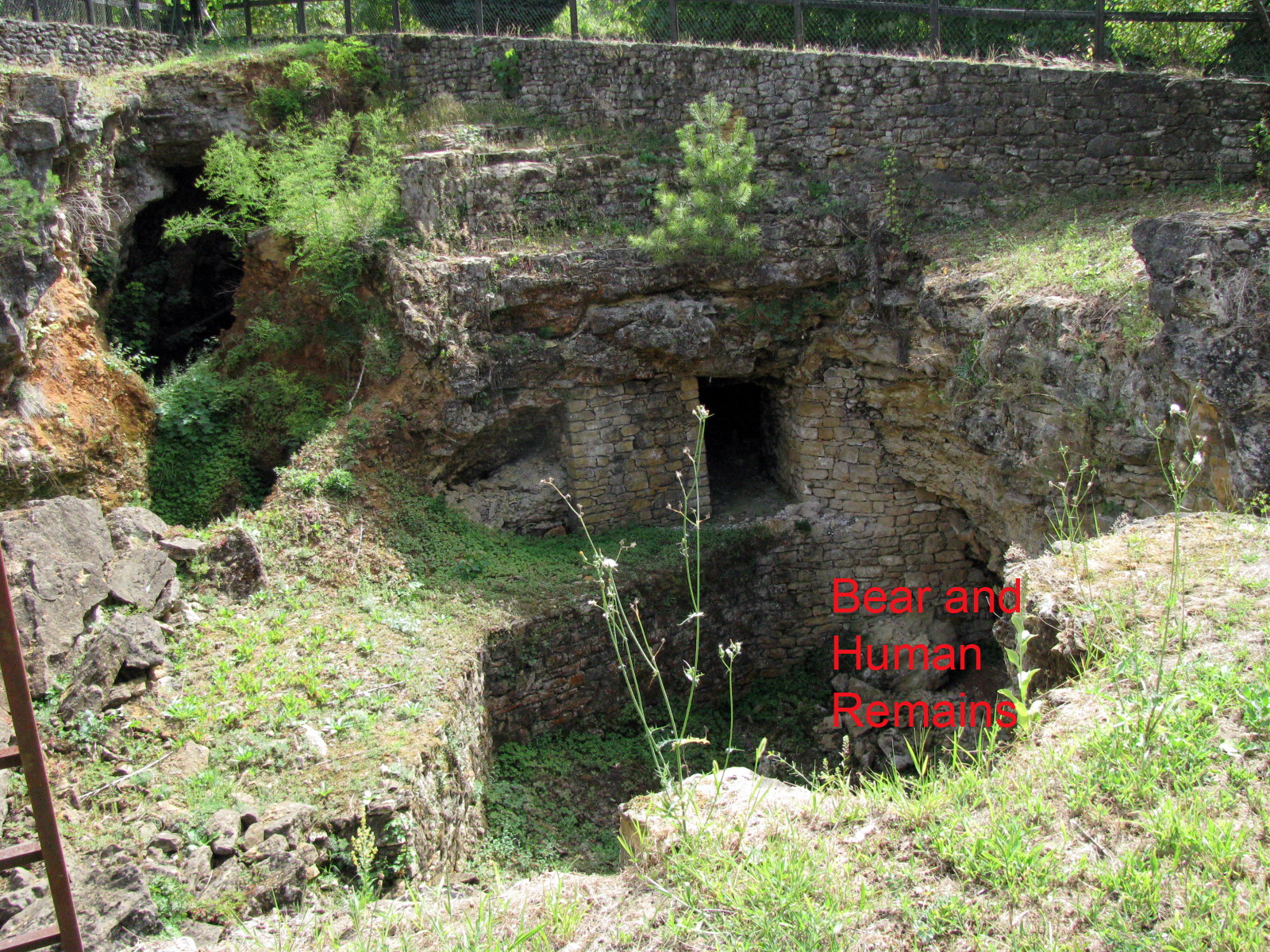
These photographs show the place of discovery of the bear and human remains.
Photo: (left) Press Pack, http://www.regourdou.fr/espace-pro.php, 2011
Photo: (right) Don Hitchcock, 2008
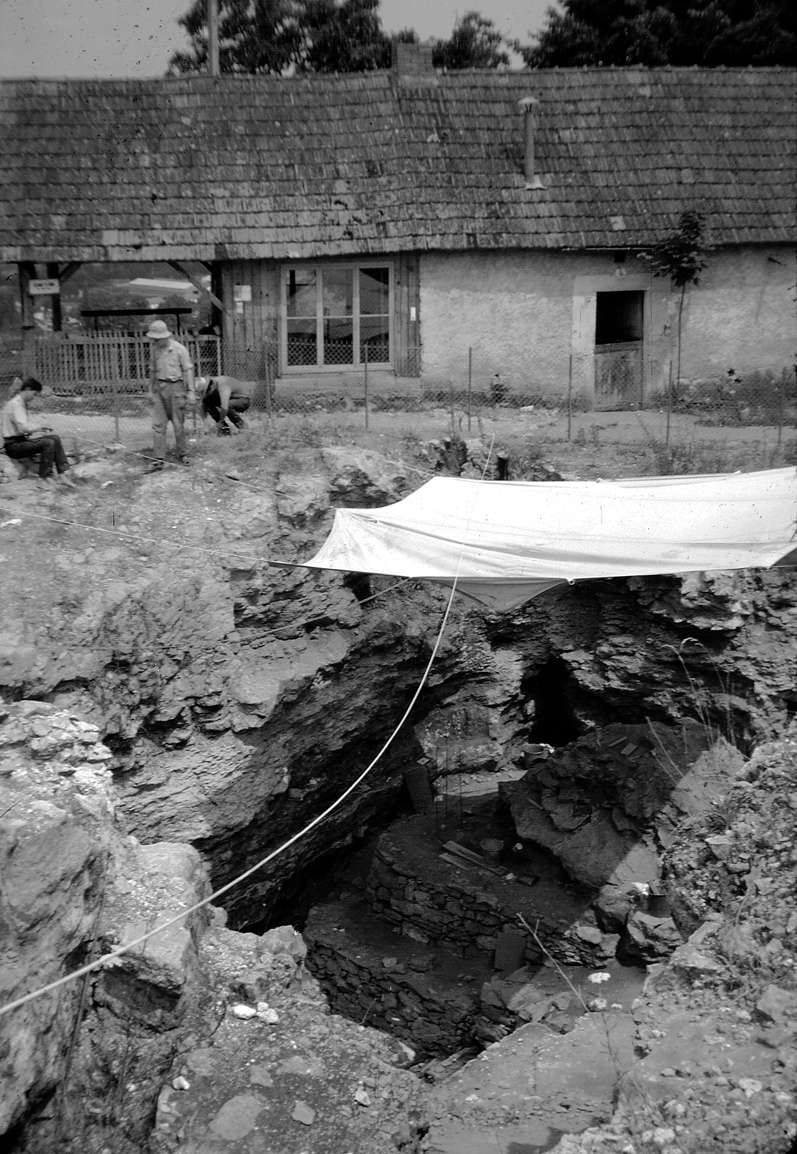
Le Regourdou excavation in 1964: General view of the site.
Photo: © B. Vandermeersch
Source: Maureille et al. (2001)
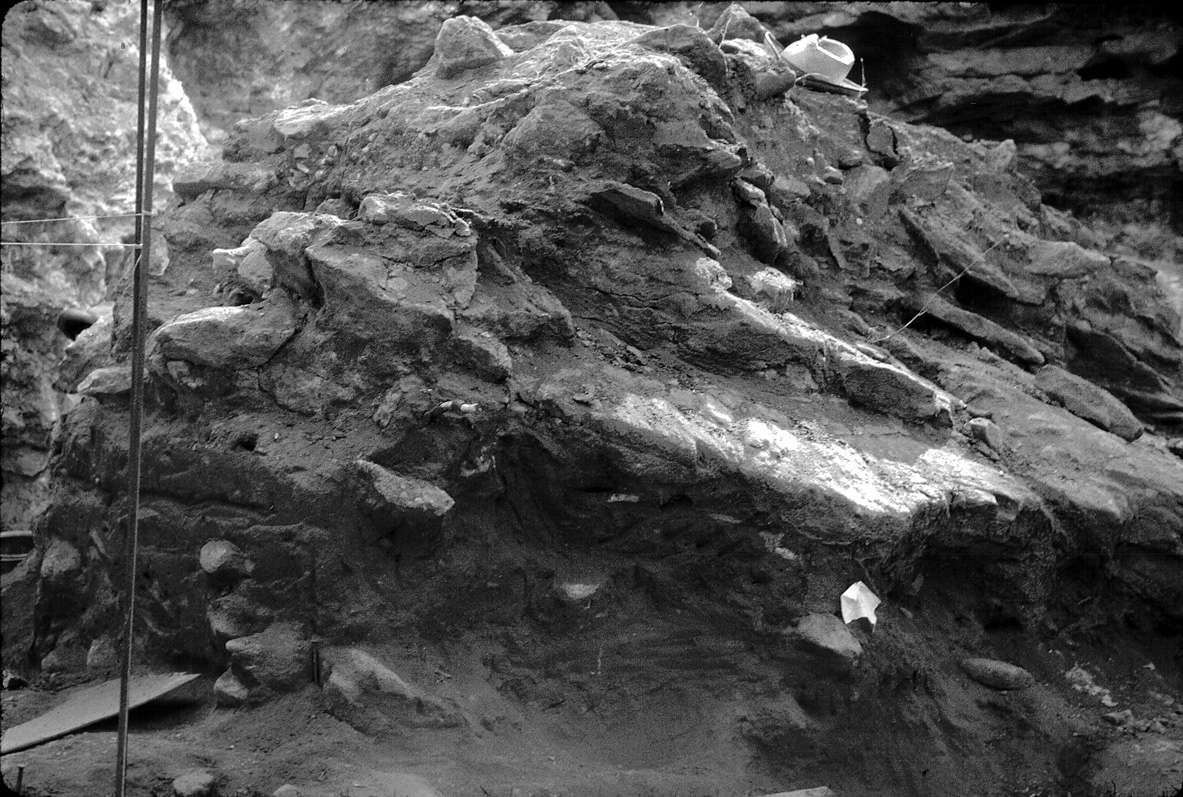
Le Regourdou excavations in 1964: note the upper levels on the top of the big collapsed blocks.
Photo: © B. Vandermeersch
Source: Maureille et al. (2001)
One of the best preserved adult Neanderthal skeletons - Un des squelettes d'adulte les mieux conservés
Excavated by Georges Laplace and Eugene Bonifay, the bones are the remains of a young Neanderthal adult, of undetermined sex, from the beginning of the last glaciation (- 90 000 years), and which was intentionally buried.
Prélevés par Georges Laplace et Eugène Bonifay, les ossements sont les restes d'un jeune adulte néandertalien, de sexe indéterminé, du début de la dernière glaciation (- 90 000 ans) intentionnelement inhumé.
The tomb consisted of a shallow pit dug in the sand of layer 5 near the rock wall, a stone wall separating the layer 4c which is chronologically earlier.
"The bottom was paved with a bed of flat stones on which the body was deposited approximately oriented East - West, feet to the East. The skeleton was lying on its left side, both hands down near the face. The lower limbs, which were not found, were probably strongly bent, knees on the chest as the heels were close to buttocks. The chest was in anatomical connection. Two bear tibias (shins) that had been placed there intentionally were found lengthwise below the body. The body was then covered with a slab of limestone. On the slab were then placed the humerus of a bear, a scraper, two flint chips and a flint core. Many stones, bear bones and a deer antler were then stacked together to form a small mound above the grave, then a fireplace covered the entire grave. "
After Bonfay E. (pers com in Defleur 1993)
La tombe est constituée par une fosse peu profonde creusée dans les sables de la couche 5 près de la paroi rocheuse, un mur de pierres la séparant du pierrier 4c qui lui est antérieur chronologiquement.
"Le fond était dallé d'un lit de pierres plates sur lequel le corps fut déposé approximativement orienté E-O, les pieds à l'Est. Le squelette reposait sur le côté gauche, les deux mains ramenées au voisinage de la face. Les membres inférieures, qui ne furent pas retrouvés étaient vraisemblablement fortement fléchis, les genoux au niveau de la poitrine puisque les talons se trouvaient qu voisinage des fesses. Les éléments du thorax étaient en connexion anatomique. Deux tibias d'ours qui avaient été placés intentionnellement furent découverts dans le prolongement du corps. Celui-ci ensuite recouvert d'une dalle calcaire sans dépôt préalable de sédiments. Sur la dalle furent alors déposés un humérus d'ours, un racloir, deux éclats et un nucléus de silex. De nombreuses pierres des ossements d'ours et un bois de cerf furent ensuite entassés de façon à former un petit tumulus au-dessus de la sépulture, puis un foyer recouvrit l'ensemble. "
D'apres Bonfay E. (com pers in Defleur 1993)

The bones found were in very good condition, especially the mandible, sternum and small bones of the extremities, which rarely survive. The skull, femurs and tibias are missing.
Les os retrouvés sont en très bon état, en particulier la mandibule, le sternum et les petits os des extrémités des membres, rarement conservés. Le crâne, les fémurs et les tibias manquent.
A card was placed near the mandible which read:
The Man from Le Regourdou
Jaw
Studied by Professor Piveteau
Member of the Institute
Perhaps Professor Piveteau assembled the pieces to form a complete jaw, but certainly he studied the Le Regourdou skeleton and described it in the literature, as for example in his papers on the Le Regourdou skeleton in Annales de Paléontologie for 1963, 1964 and 1966.
Professor Piveteau of the Sorbonne was one of the pillars of French palaeontology. He played a considerable role in transforming palaeontology into a real scientific discipline, and died on the 7th of March, 1991.
Photo: Don Hitchcock 2008
Source: Museum quality facsimile, display at Le Regourdou.
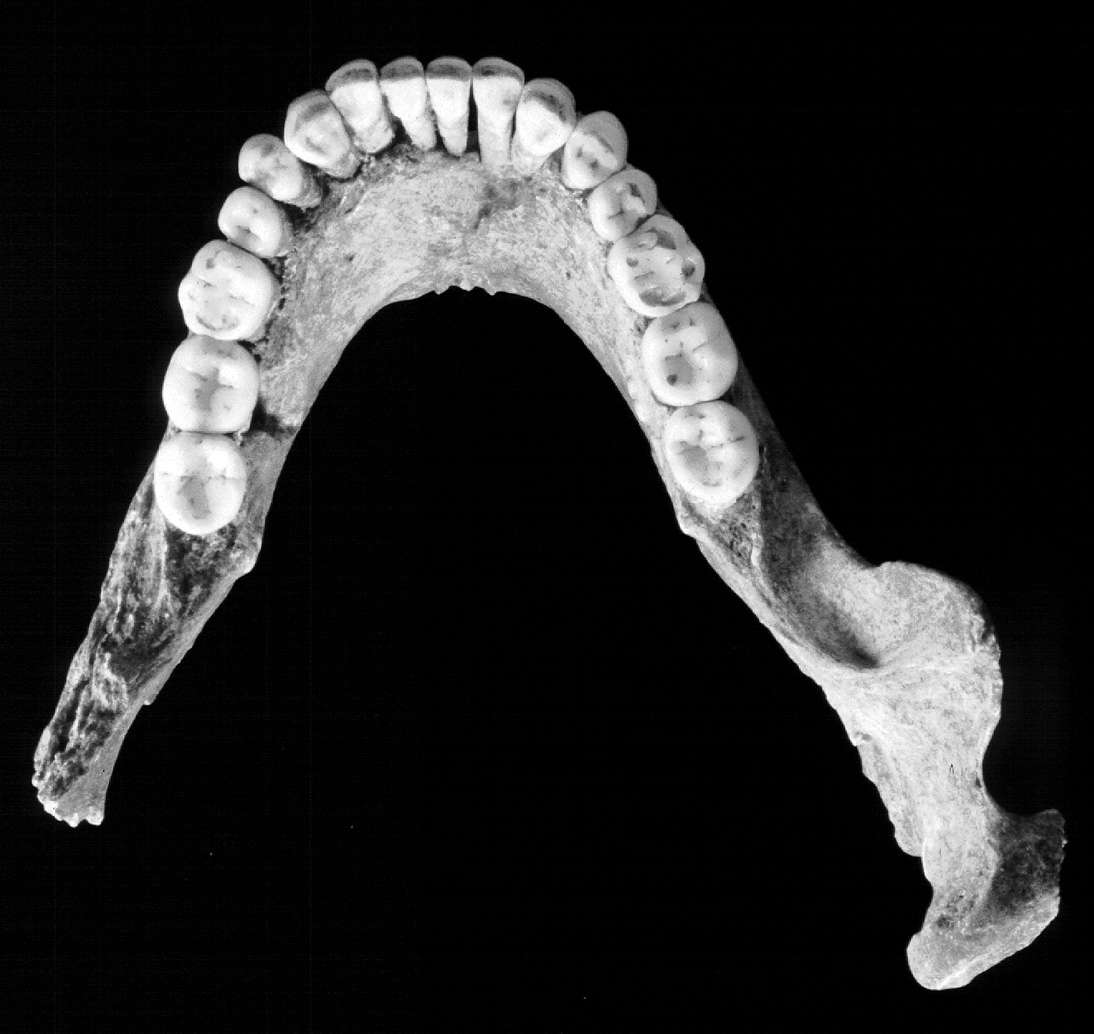
The mandible of Regourdou 1 from above. Collection Musée du Périgord.
Photo: © F. Houët.
Source: Maureille et al. (2001)
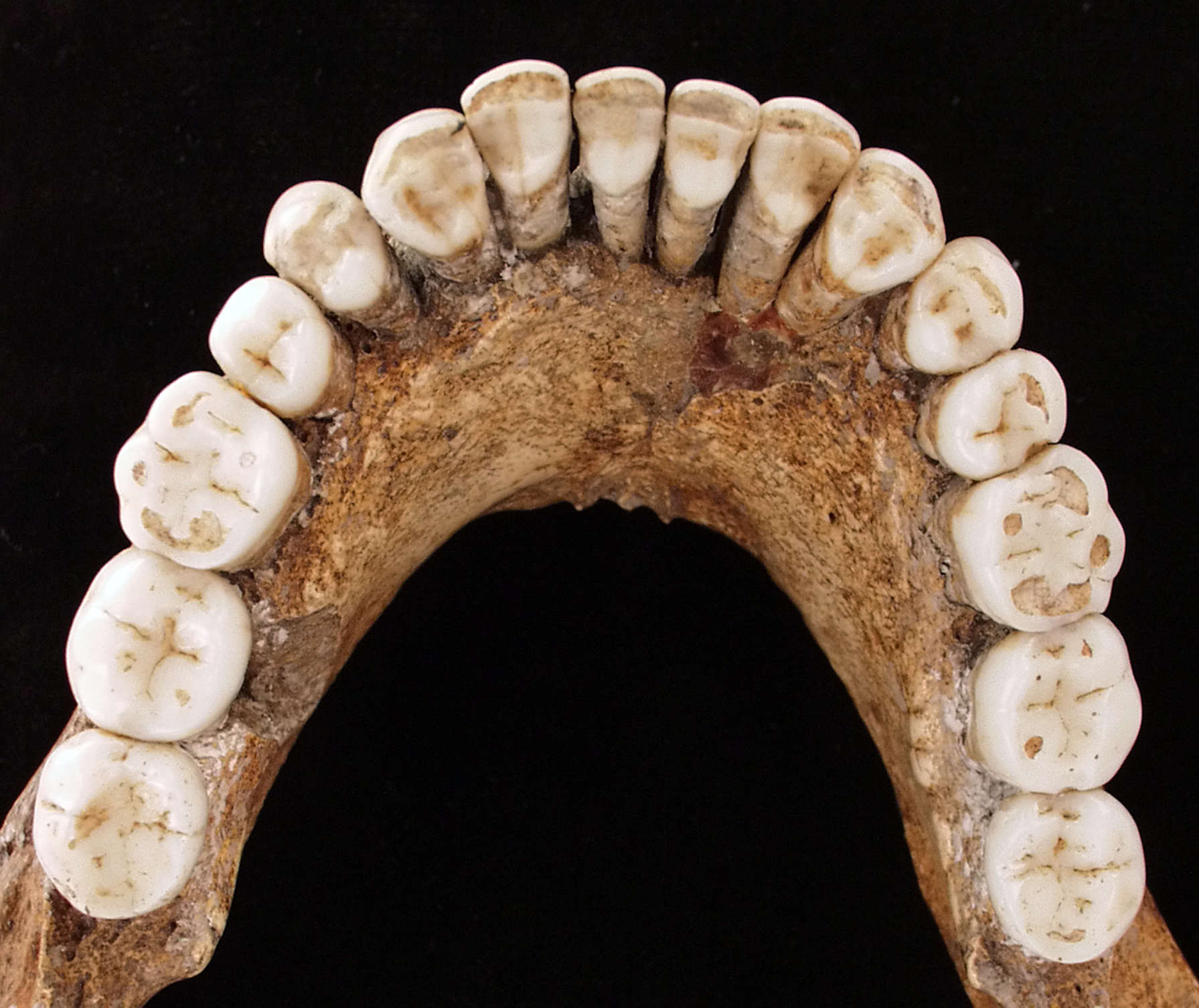
Occlusal view of Regourdou 1 mandible. The apparent malpositioning of the teeth is due to reconstruction.
Photo credit: P. Sémal, Royal Belgian Institute of Natural Sciences, Brussels.
doi:10.1371/journal.pone.0043949.g003.
Source and text: Volpato et al. (2012)
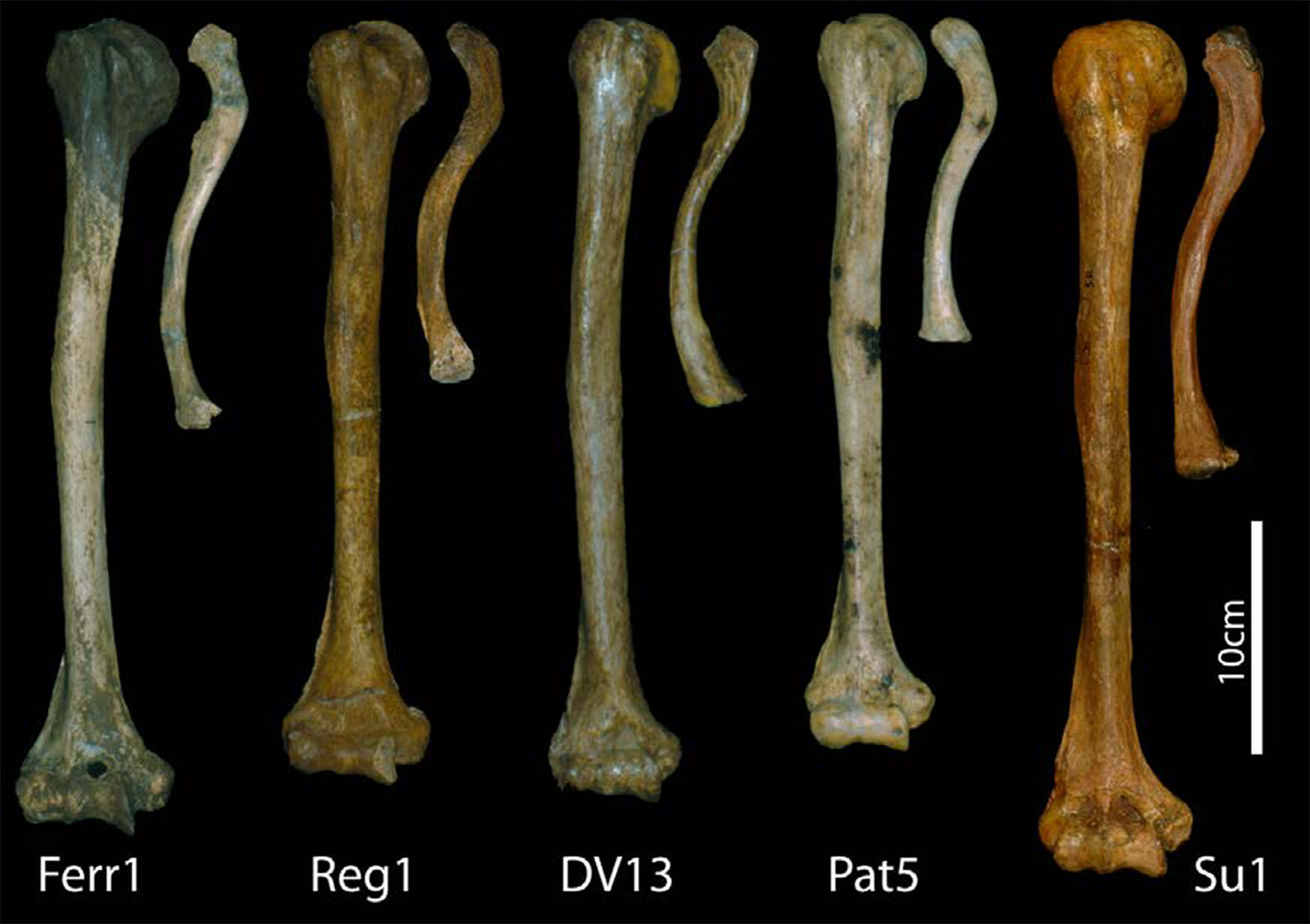
Paired right clavicles (cranial view) and humeri (anterior view) for Late Pleistocene humans.
Neandertals: La Ferrassie 1 (Ferr1) and Regourdou 1 (Reg1).
Upper Paleolithic modern humans: Dolní Věstonice 13 (DV13), Pataud 5 (Pat5), and Sunghir 1 (Su1).
Note that for all clavicle–humerus pairs except Regourdou 1, both bone images derive from the same original photograph, and hence there is no issue of scaling distortion.
Photo and text: Trinkaus et al. (2014)
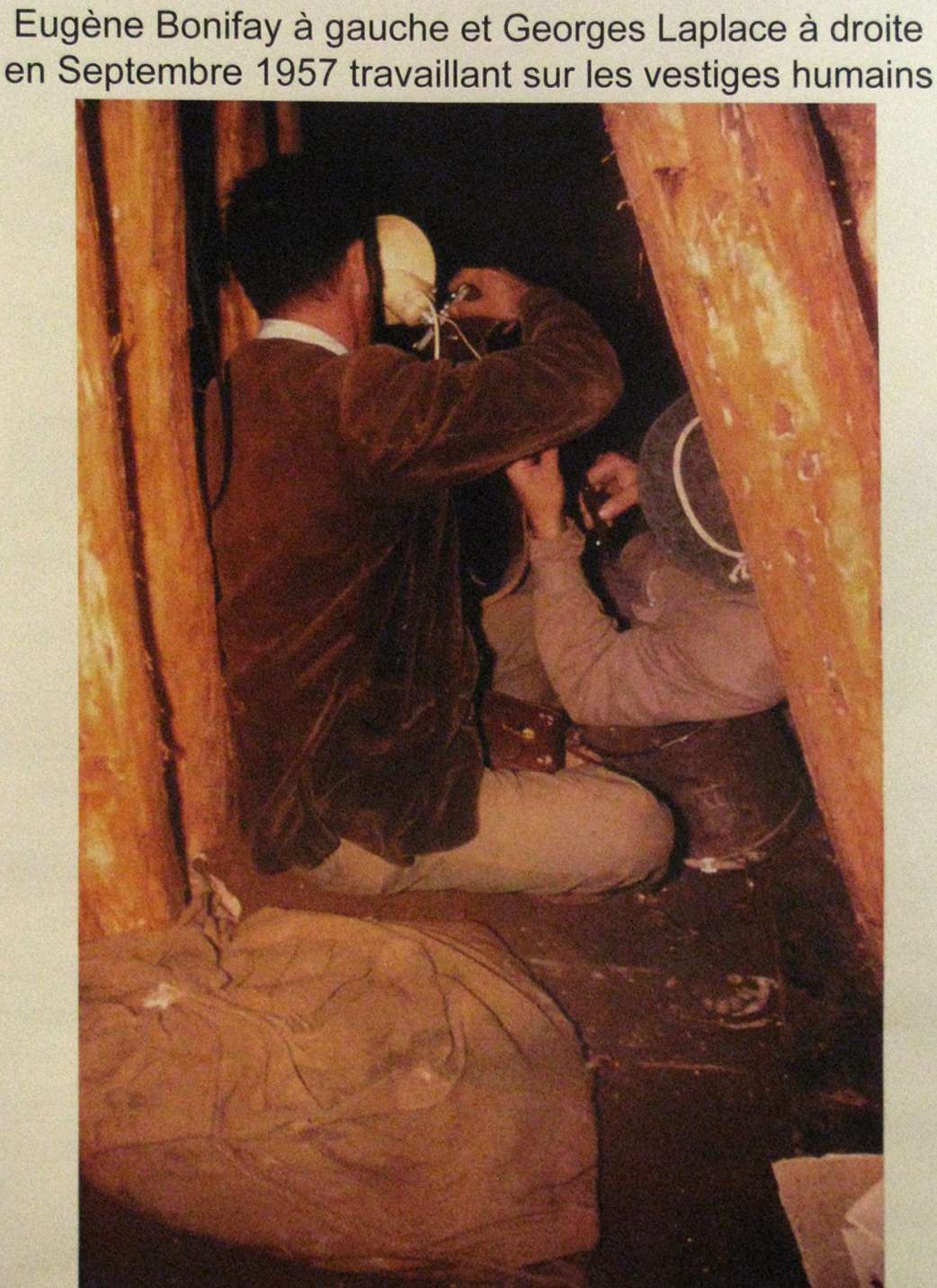
Eugène Bonifay on the left and Georges Laplace on the right in September 1957 working on the excavation of the human remains.
Eugène Bonifay à gauche et Georges Laplace à droite en Septembre 1957 travaillant sur les vestiges humains.
Photo: Don Hitchcock 2008
Source: Display at Le Regourdou
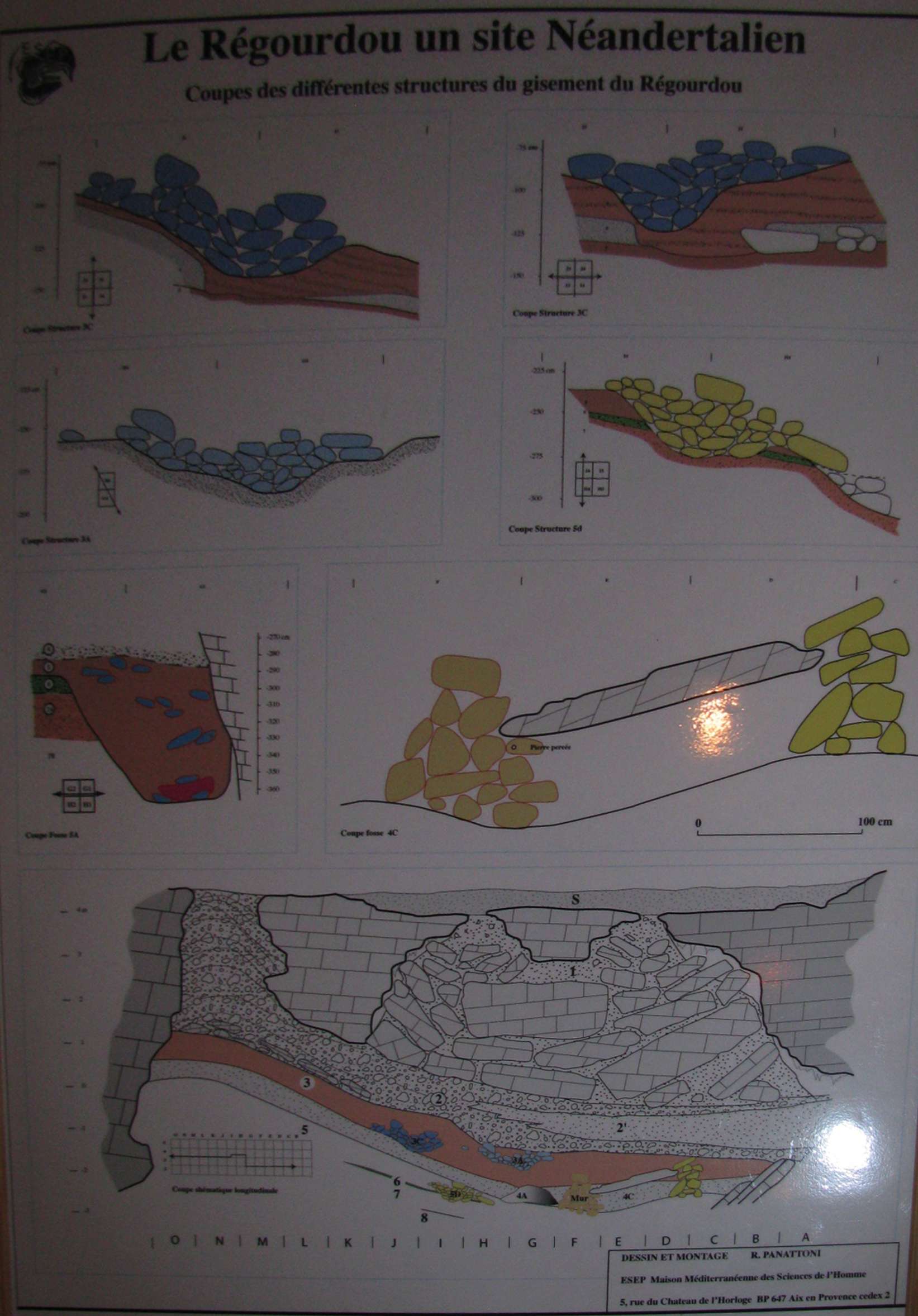
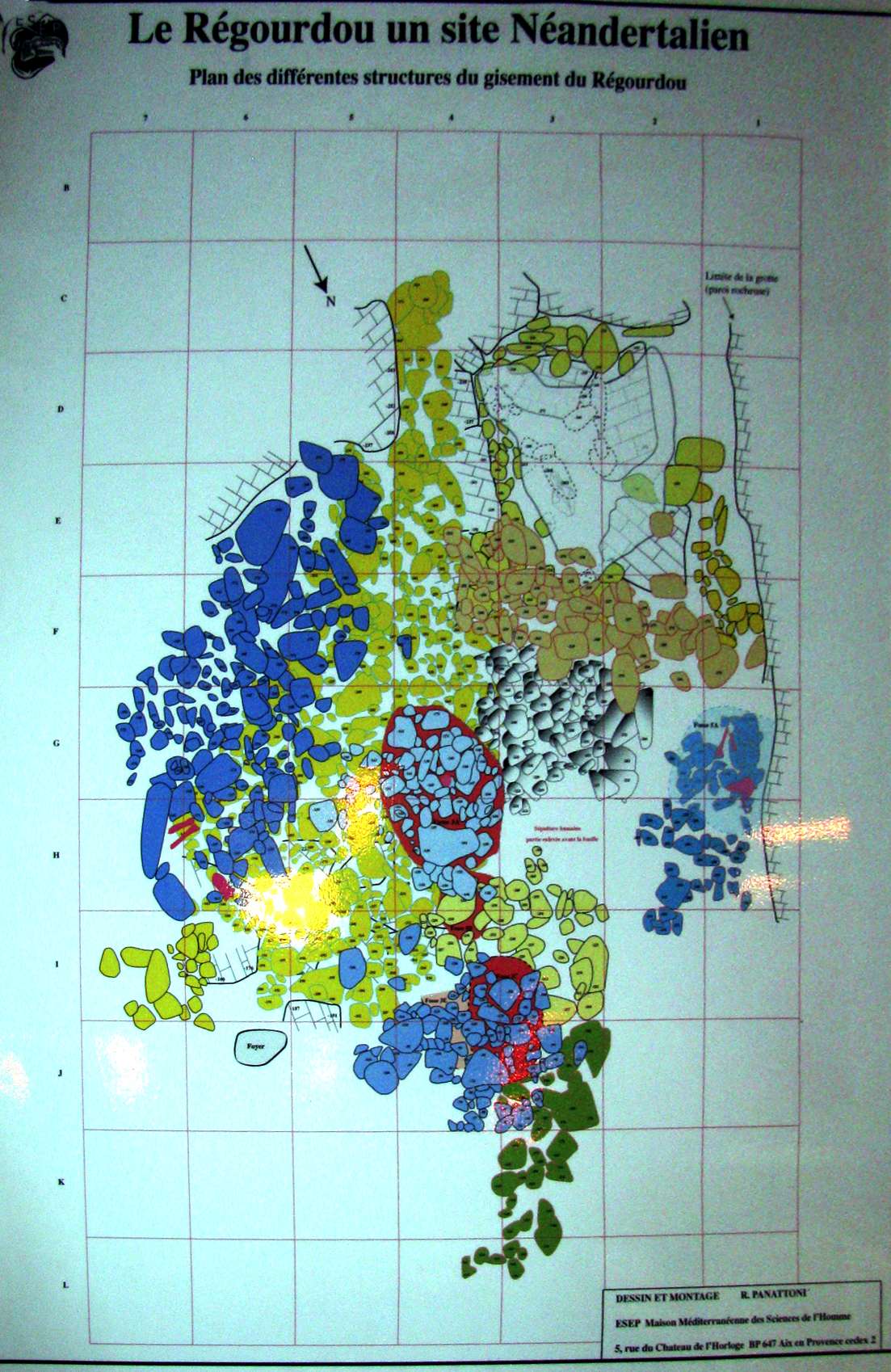
Various sections and a plan at the Le Regourdou site.
Photo: Don Hitchcock 2008
Source: Display at Le Regourdou

Stratigraphy of the cave Regourdou in a longitudinal section - Stratigraphie de la grotte de Regourdou, coupe longitudinale -
The entrance to the cave during prehistory was through the chimney (ch) in the upper left of the drawing. The numbers of the stratigraphic layers are given. The region where the human remains were found is denoted by the pale yellow circle. (After Bonifay E. 1965)
L'entrée de la cavité pendant la préhistoire se faissait par la cheminée (ch) en haut à gauche. Les numéros des couches stratigraphiques sont entourés Le pierrier livrant les vestiges humains est au niveau du rond jaune pâle.
(D'apres Bonifay e. 1965)
Photo: Don Hitchcock 2008
Source: Display at Le Regourdou

Stratigraphy of the cave Regourdou in a transverse section - Stratigraphie de la grotte de Regourdou, coupe transversale
The numbers of the stratigraphic layers are given. The region where the human remains were found is denoted by the pale yellow oval. (After Bonifay E. 1965)
Les numéros des couches stratigraphiques sont entourés. Le pierrier livrant les vestiges humains est au niveau du rond jaune pâle.
(D'apres Bonifay e. 1965)
Excavations - Les fouilles
Eugene Bonifay searched with Bernard Vandermeersch, from 1961 to 1964, a complex of 8 stratigraphic layers that have delivered a poor lithic industry. Layer 2, corresponding to a harsh climate, contained more tools than the others: actions due to freezing and the presence of the remains of animals adapted to cold have been reported. Layers 3, 5, 6, 7 and 8 have fauna characteristic of a more moderate climate. Layer 4, in which the burial was discovered, appears to be the only one to have left evidence of humans.
Eugène Bonifay a fouillé avec Bernard Vandermeersch, de 1961 à 1964, une stratigraphique complexe de 8 couches qui ont livré une industrie lithique pauvre. La couche 2, correspondant à un climat rigoureux, contenait plus de matériel que les autres: des actions dues au gel et des restes d'animaux adaptés au froid y ont été observés.
Les couches 3, 5, 6, 7 et 8 ont livré une faune caractéristique d'un environnement plus clément.
La couche 4, dans laquelle a été découverte la sépulture, semble être la seule à avoir connu une fréquentation humaine.
Photo: Don Hitchcock 2008
Source: Display at Le Regourdou
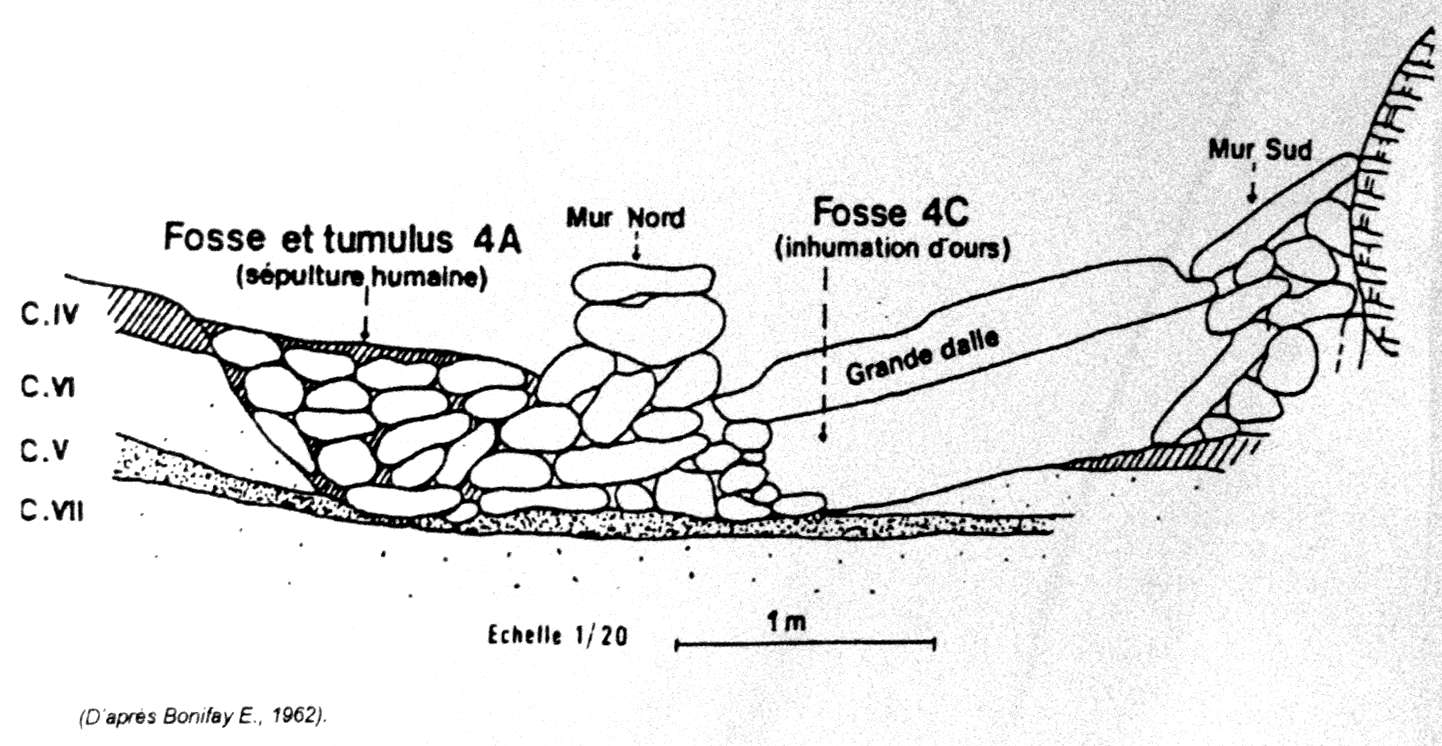
Rites or geological phenomena? - Rites ou phénomènes géologiques?
The work of Eugene Bonifay also revealed structures (pits, piles of stones) containing animal remains, especially bones of bears (brown bears only), which makes this animal a privileged actor of the times. At the time of the search, the brown bear bones were thought to be part of a Neanderthal ritual.
Today, such observations would be explained by natural causes. The bones of the brown bears may simply have been present, not brought in deliberately by the Neanderthals.
Les travaux d'Eugène Bonifay ont aussi révélé des structures (fosses, tas de pierres) contenant des restes d'animaux, en particulier des ossements d'ours (ours bruns uniquement), qui font de cet animal l'acteur privilégié de ce qui, à l'époque de la fouille, a pu faire penser à des rites.
Aujourd'hui, de telles observations pourraient être expliqués par des causes naturelles.
Photo: Don Hitchcock 2008
Source: Display at the Le Regourdou archaeological site.

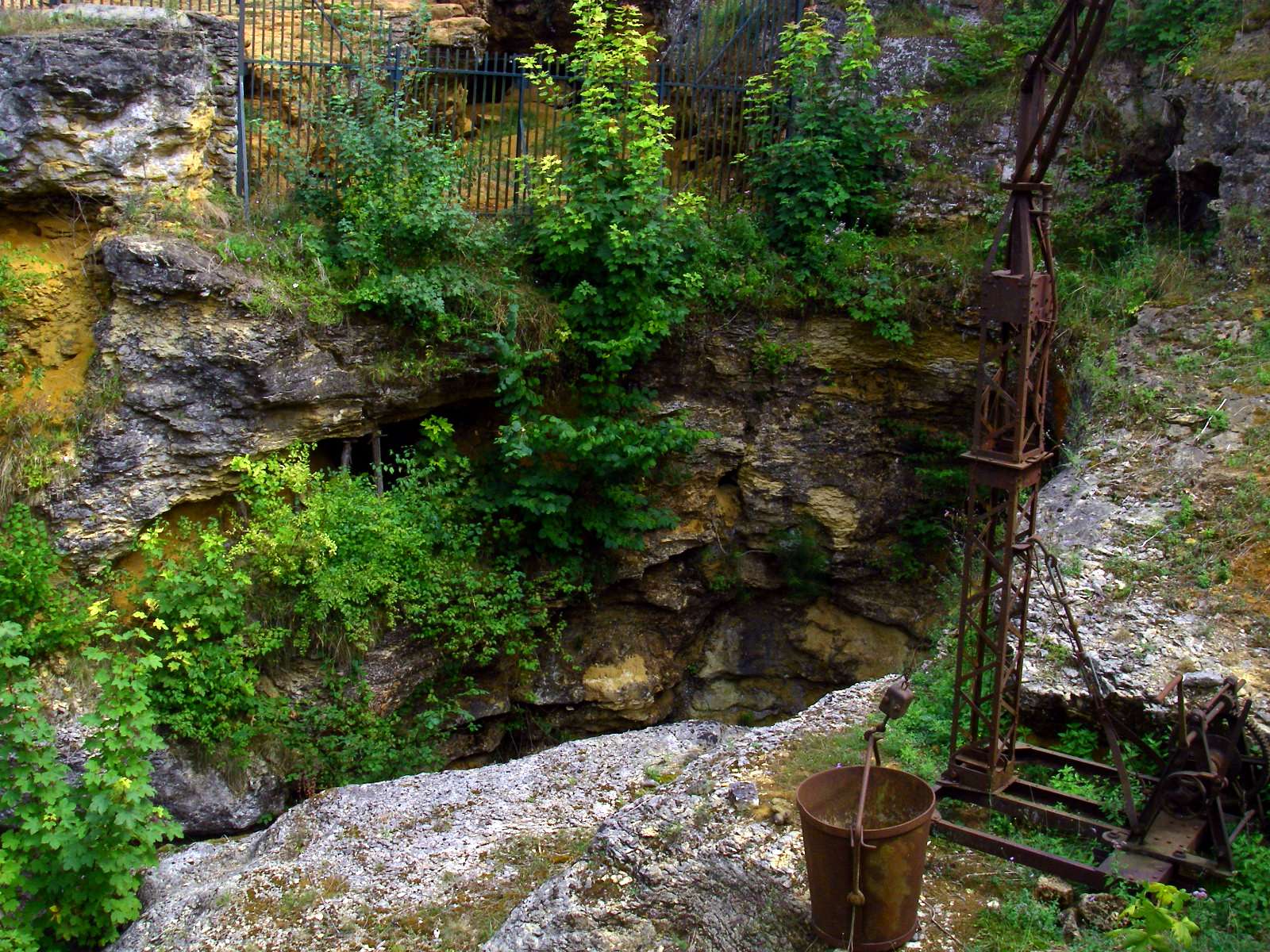
It is still possible to see the rusty steel crane and bucket used in the removal of spoil from the second pit, or gouffre, which M. Constant opened up after the archaeological site was excavated by scientists.
Photo: Don Hitchcock 2008
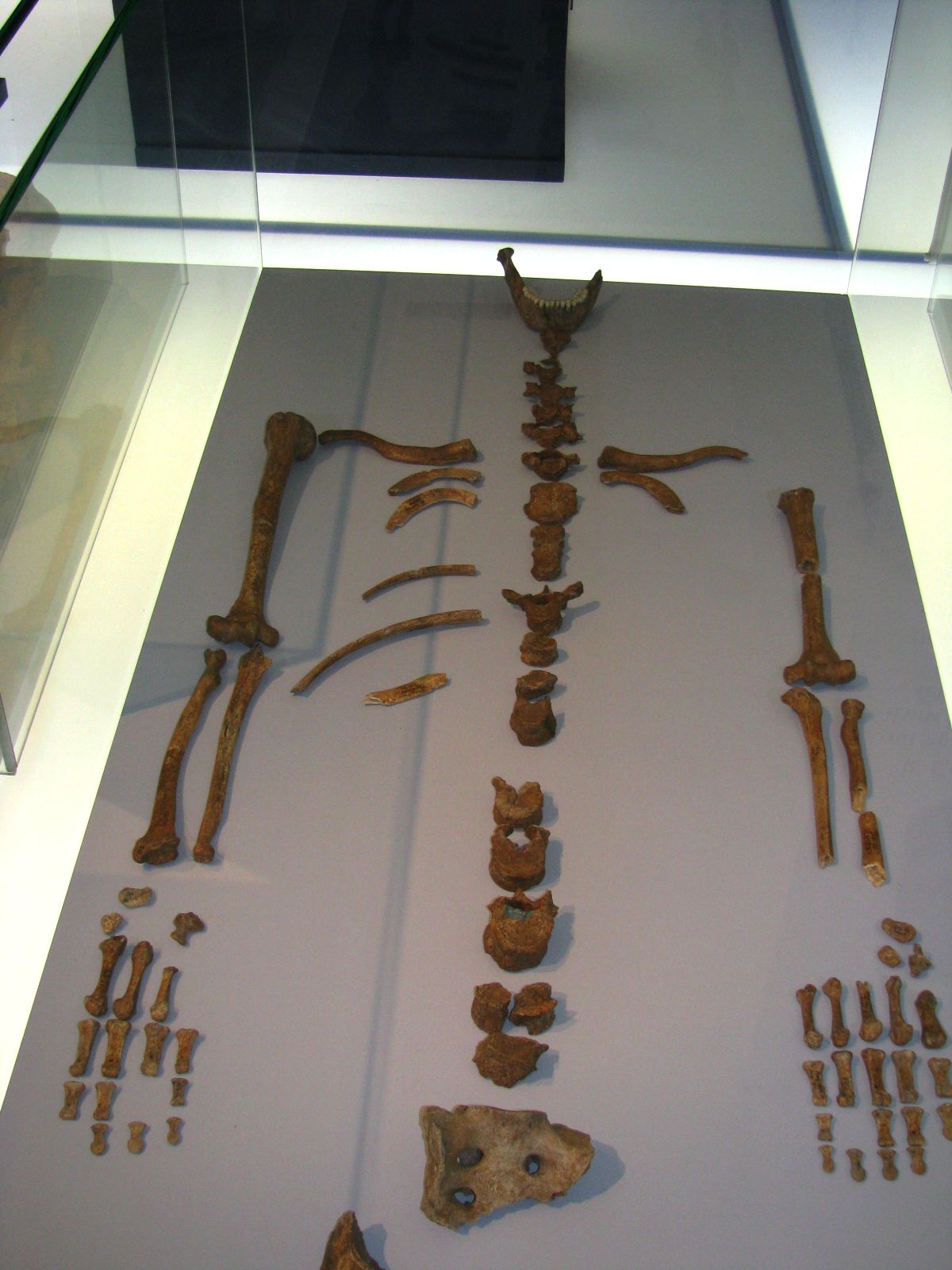
R. Constant discovered this Neanderthal skeleton in 1957 at the end of a long gallery. Excavations revealed that there was evidence of a funeral which included the development of complex structures (walls, mounds, formwork) which are difficult to interpret, as well as, according to E.Bonifay, the associated intentional deposition of the bones of bears and deer.
Although still incomplete (it is missing the skull and femurs) this otherwise perfectly preserved skeleton is the oldest discovered in western Europe.
R. Constant découvre en 1957 un squelette néandertalien au fond d'une longue galerie. Des fouilles qui s'ensuivent révèlent un ensemble funéraire élaboré comprenant des structures complexes (murettes, tumulus, coffrages) d'interprétation difficile, associées selon E. Bonifay à des dépôts intentionnels d'ossements d'ours et de cerf.
Bien qu'incomplet (crâne et fémurs manquent) ce squelette parfaitement conservé signe la plus ancienne sépulture découverte en Occident.
Photo: Don Hitchcock 2008
Source: Display at Musée National de Préhistoire, Les Eyzies
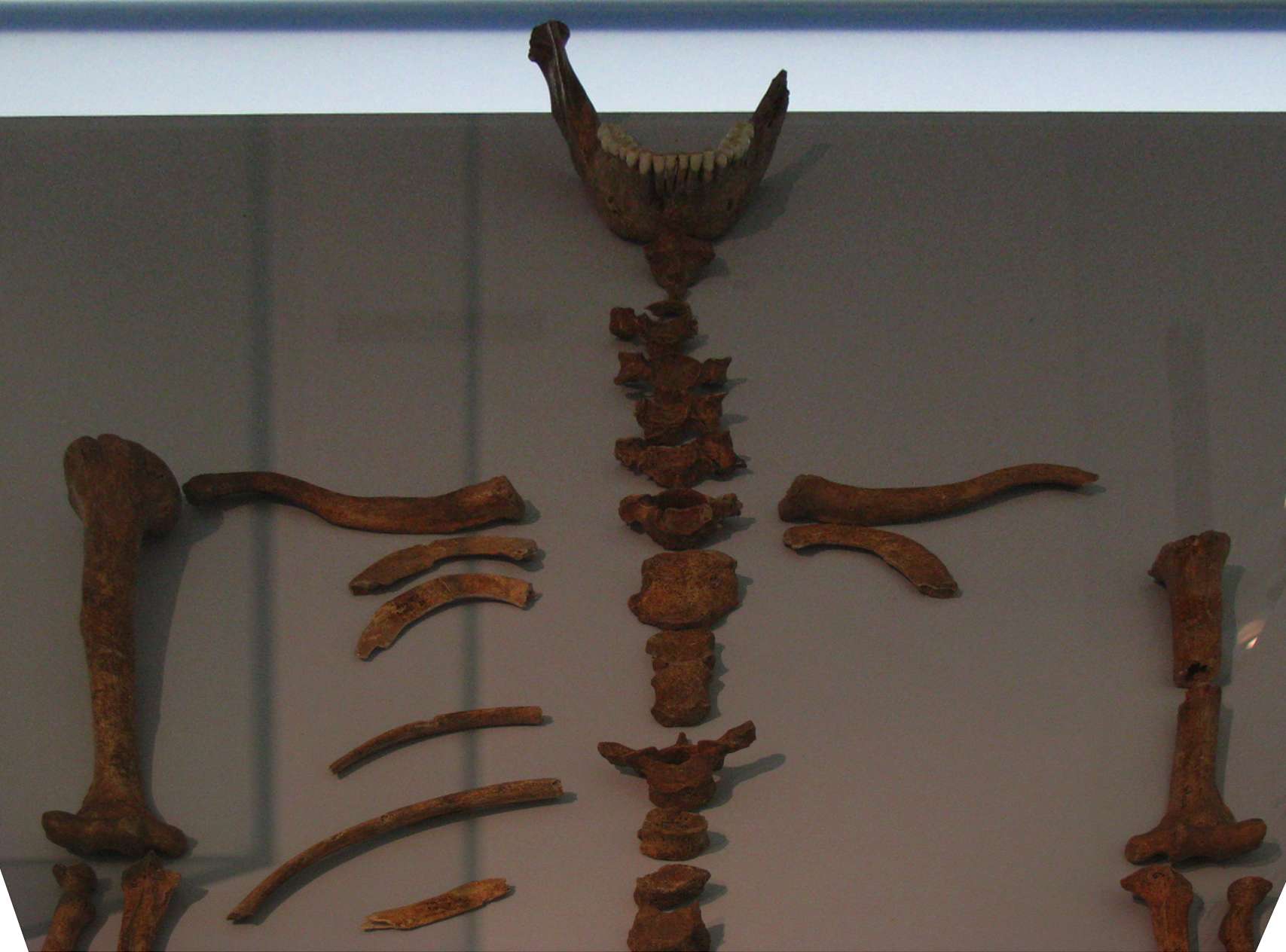
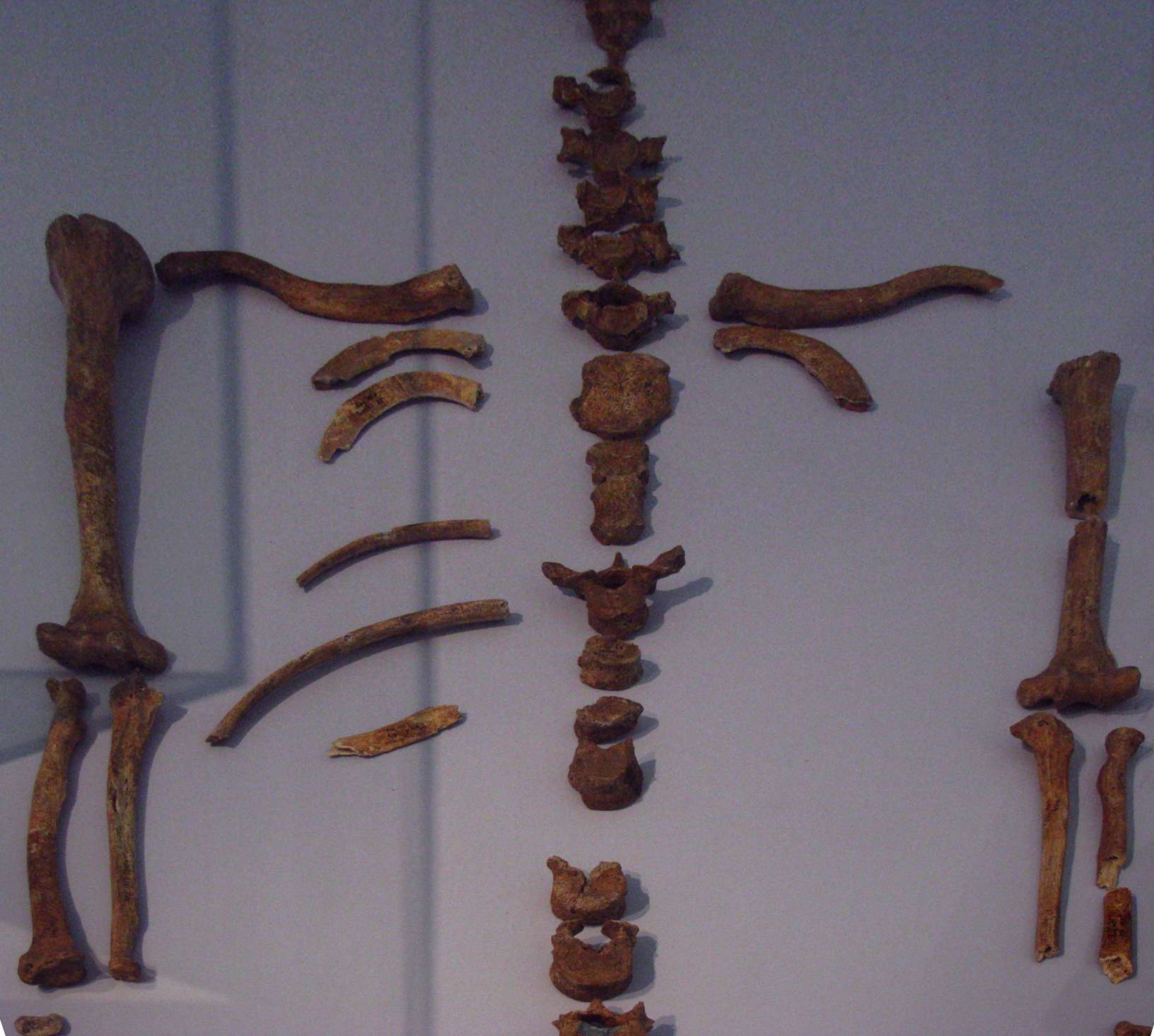
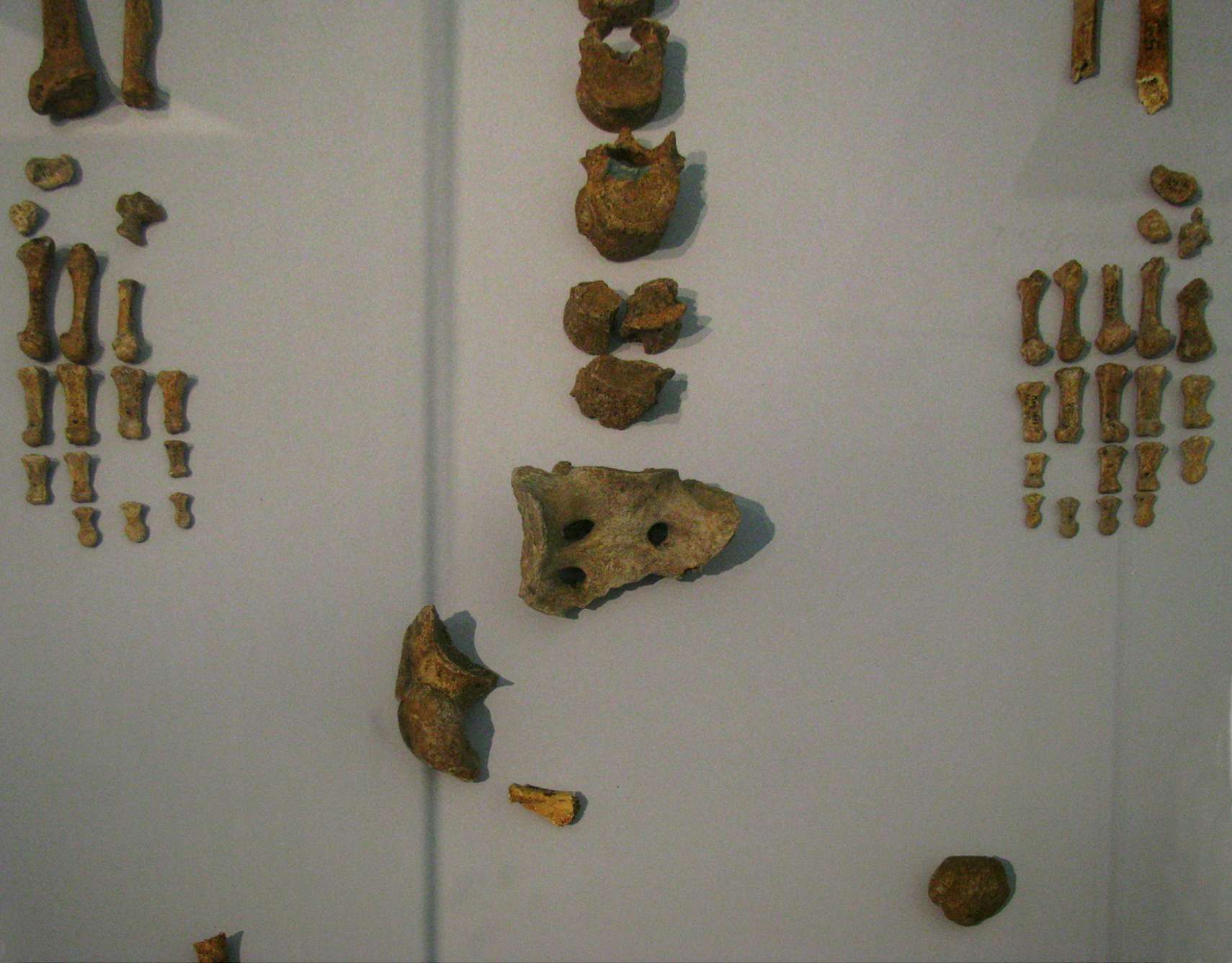
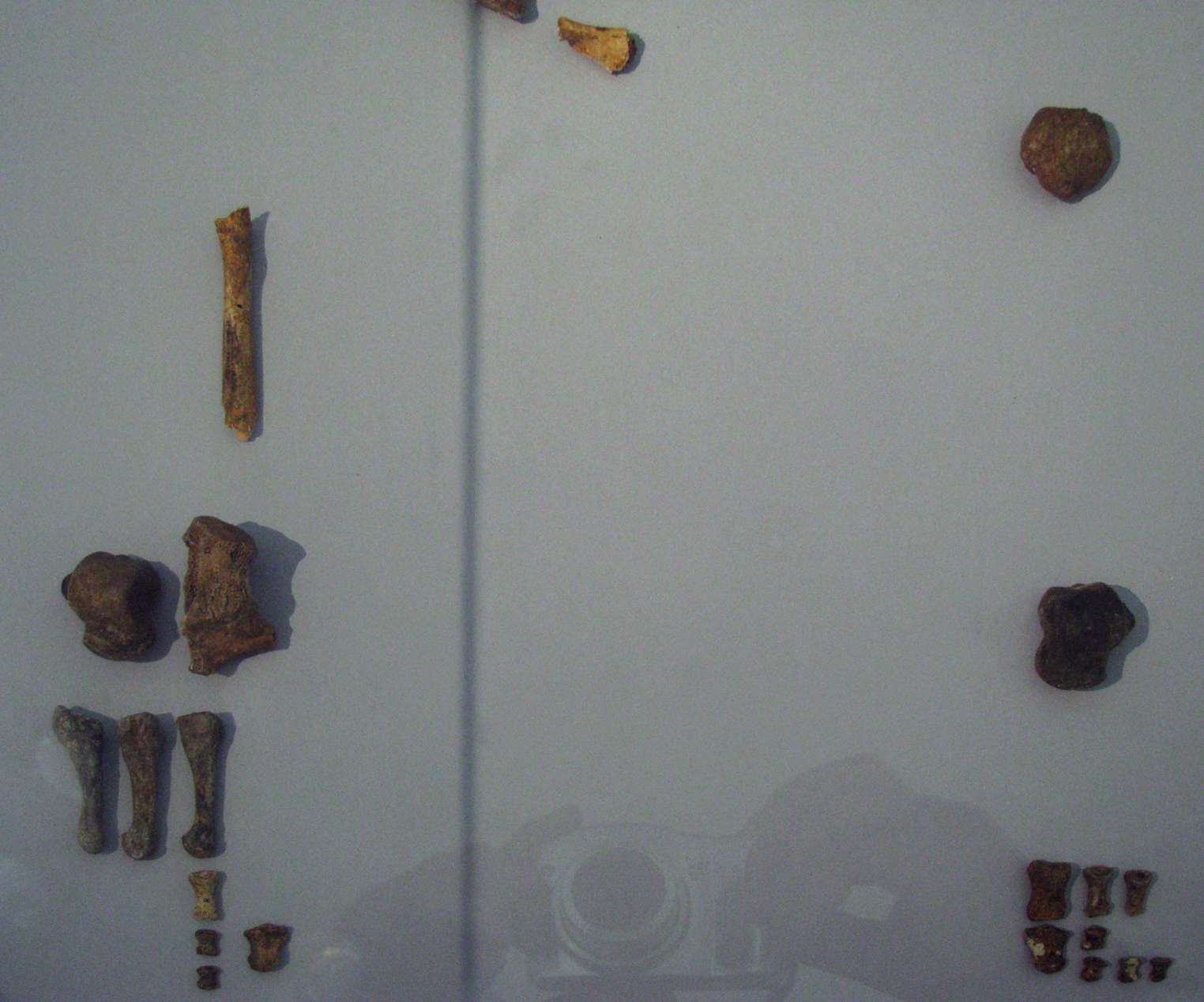
Le Regourdou Skeleton.
Photo: Don Hitchcock 2008
Source: Display at Musée National de Préhistoire, Les Eyzies
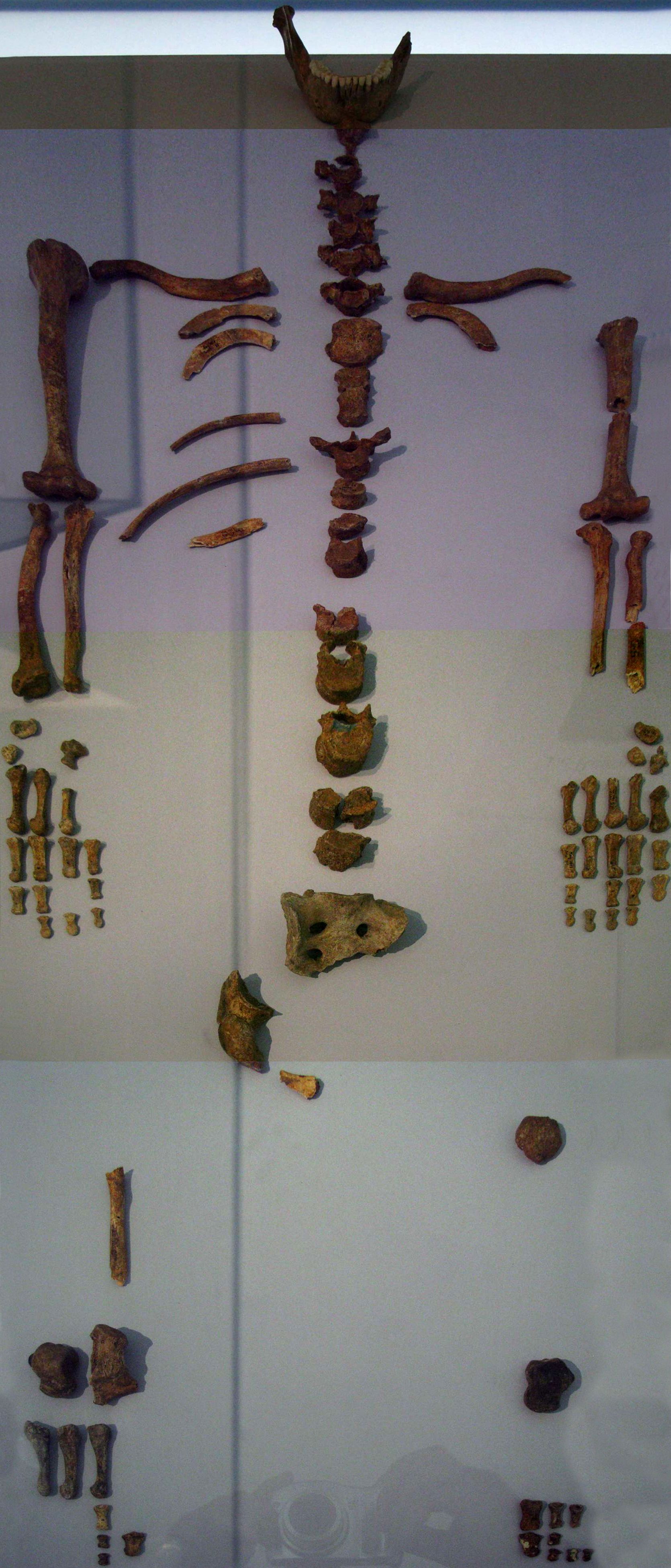
Le Regourdou Skeleton - composite of the above images.
Note that getting the proportions of length to width correct is difficult both when taking the original photograph and in the subsequent manipulation. This composite image may be foreshortened compared with a photo taken from an ideal position high above the skeleton and with the glass which covers the skeleton removed.
Photo: Don Hitchcock 2008
Source: Display at Musée National de Préhistoire, Les Eyzies

The Neanderthal skeleton of Le Regourdou 1.
Abstract:
We describe and analyze a Neandertal postcranial skeleton and dentition, which together show unambiguous signs of righthandedness.
Asymmetries between the left and right upper arm in Regourdou 1 were identified nearly 20 years ago, then
confirmed by more detailed analyses of the inner bone structure for the clavicle, humerus, radius and ulna. The total pattern
of all bones in the shoulder and arm reveals that Regourdou 1 was a right-hander. Confirmatory evidence comes from the
mandibular incisors, which display a distinct pattern of right oblique scratches, typical of right-handed manipulations
performed at the front of the mouth. Regourdou’s right handedness is consistent with the strong pattern of manual
lateralization in Neandertals and further confirms a modern pattern of left brain dominance, presumably signally linguistic
competence. These observations along with cultural, genetic and morphological evidence indicate language competence in
Neandertals and their European precursors.
(this is the best and most complete photograph of the skeleton I have yet come across - Don )
Photo credit: Collections Ville de Périgueux, Musée d'Art et d'Archéologie du Périgord: Inv. 85.3.
doi:10.1371/journal.pone.0043949.g001
Source and text: Volpato et al. (2012)
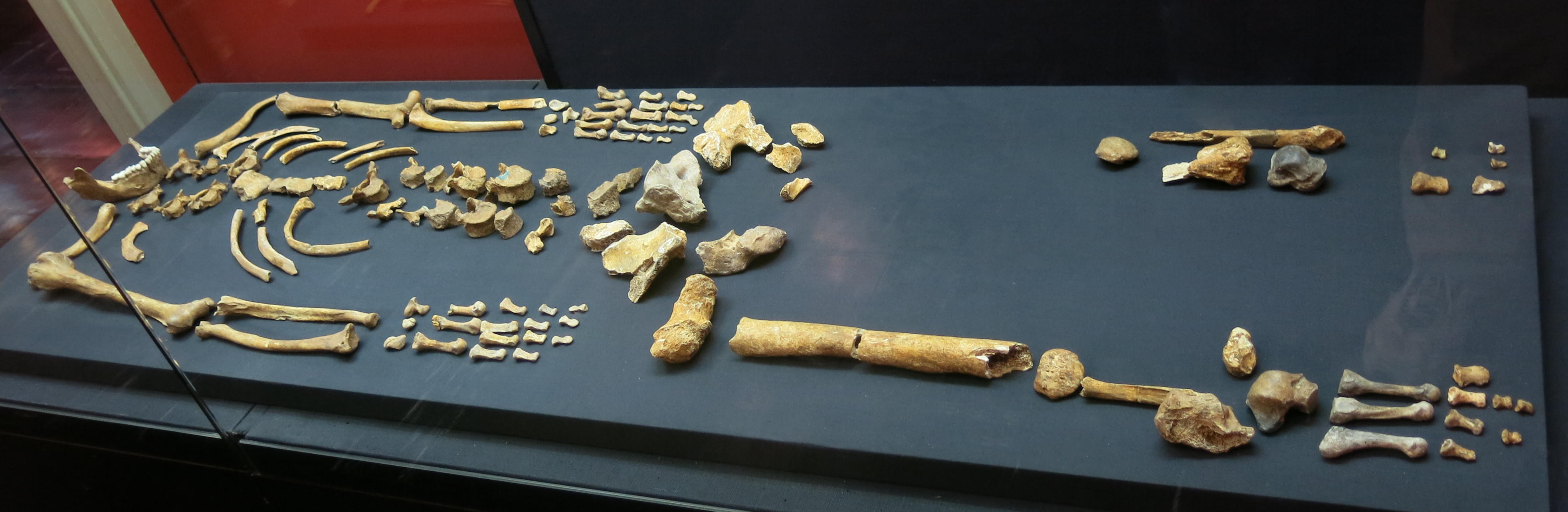
Another view of the Regourdou skeleton.
Photo: Don Hitchcock 2014
Source: Original, Musée d’art et d’archéologie du Périgord, Périgueux

Close up of some of the bones of the Regourdou skeleton.
Photo: Don Hitchcock 2014
Source: Original, Musée d’art et d’archéologie du Périgord, Périgueux
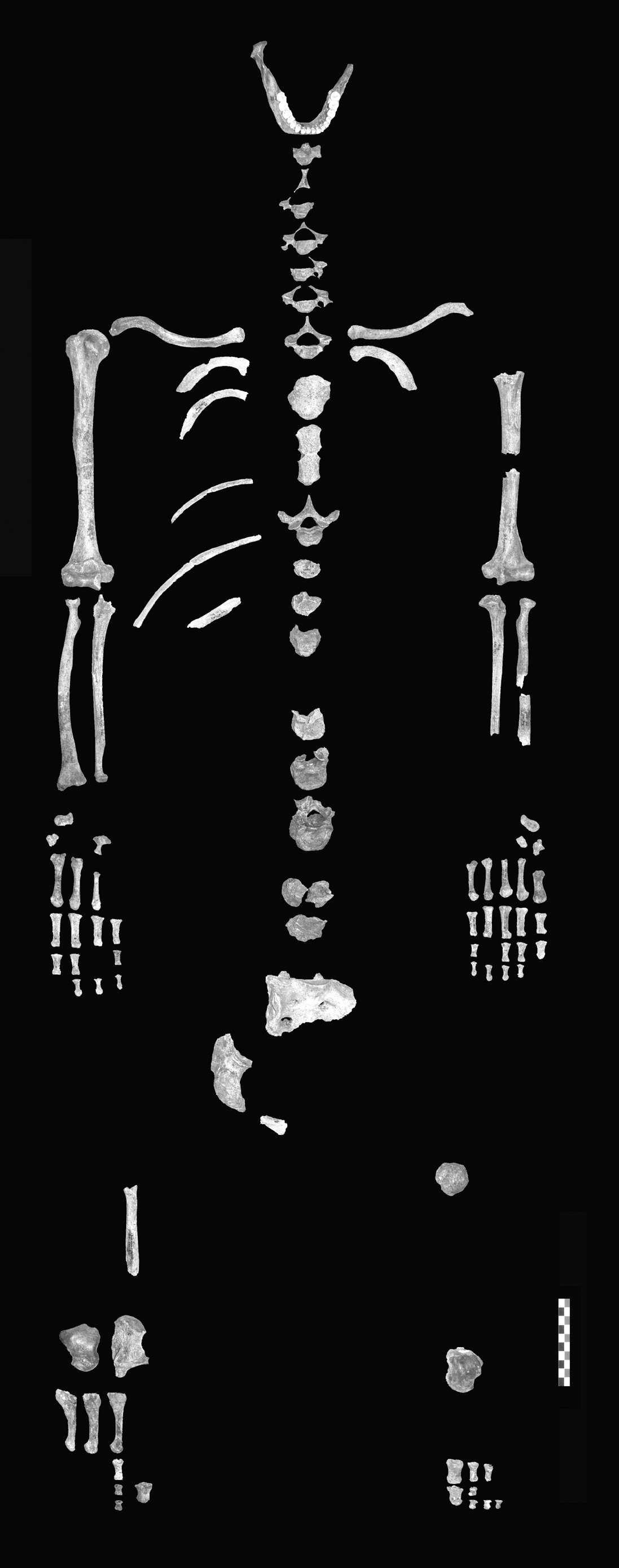
The Neanderthal skeleton of Le Regourdou 1. Extra bones of this skeleton were found in the collection of faunal remains from the site.
Photo: Bernard Dupuy, MAAP collections, © Ville
de Périgueux, as presented in Musée d’Art et d’Archéologie du Périgord
Source: Madelaine et al. (2008)
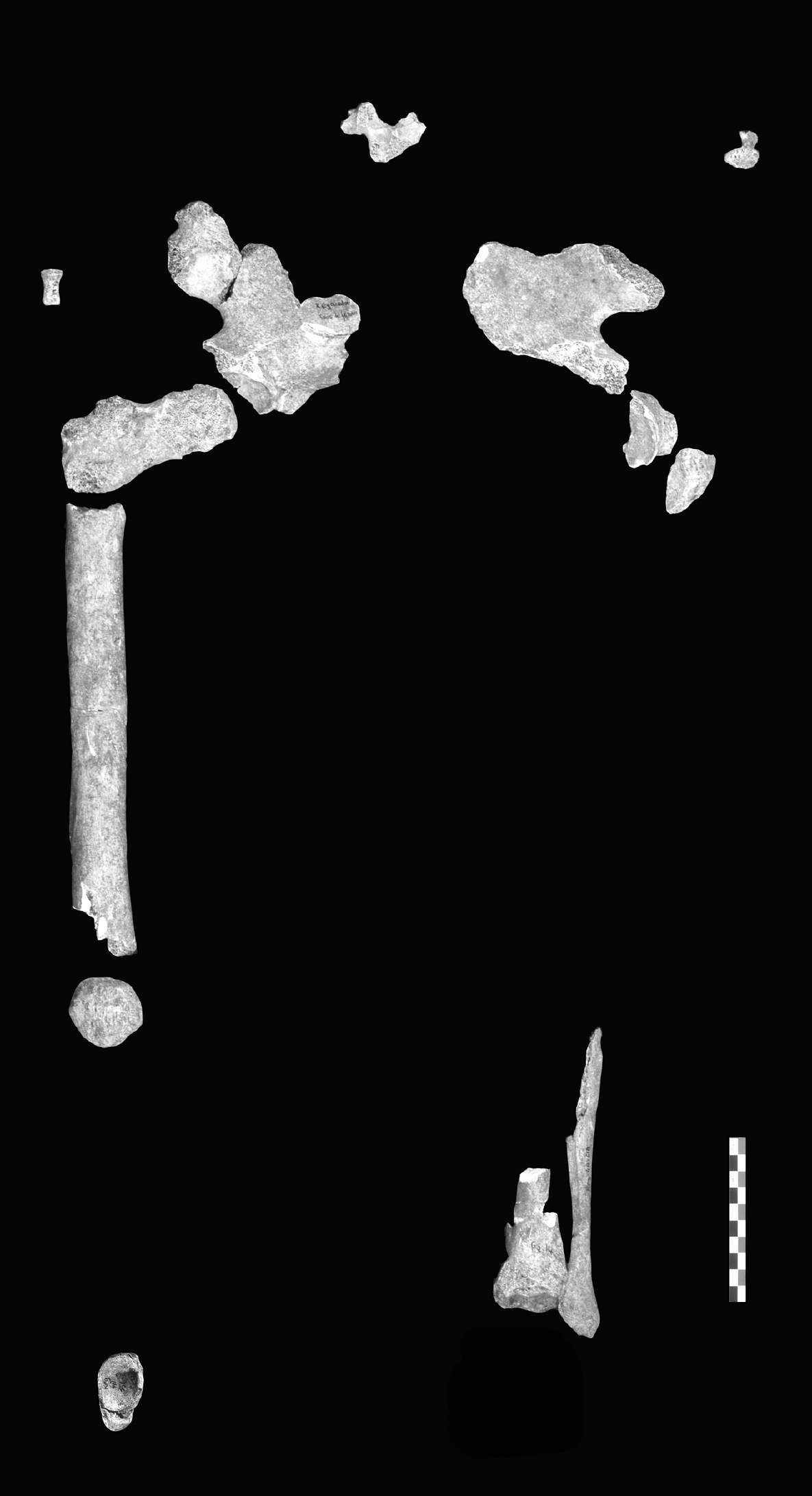
The new human remains discovered within the Regourdou faunal collections.
Madelaine et al. (2008) lists the following new bones found:
The whole, or parts of:
a) right coxal (hip) bone.
b) left coxal (hip) bone.
c) right femur
d) left tibia
e) right patella
f) left fibula
g) right navicular bone, one of the tarsal bones, found in the foot.
h) left hamate (a wedge shaped bone in the wrist) and a well preserved middle phalanx (finger) of the hand.
Photo: Picture and realisation Philippe Jugie, collections and © MNP.
Source: Madelaine et al. (2008)
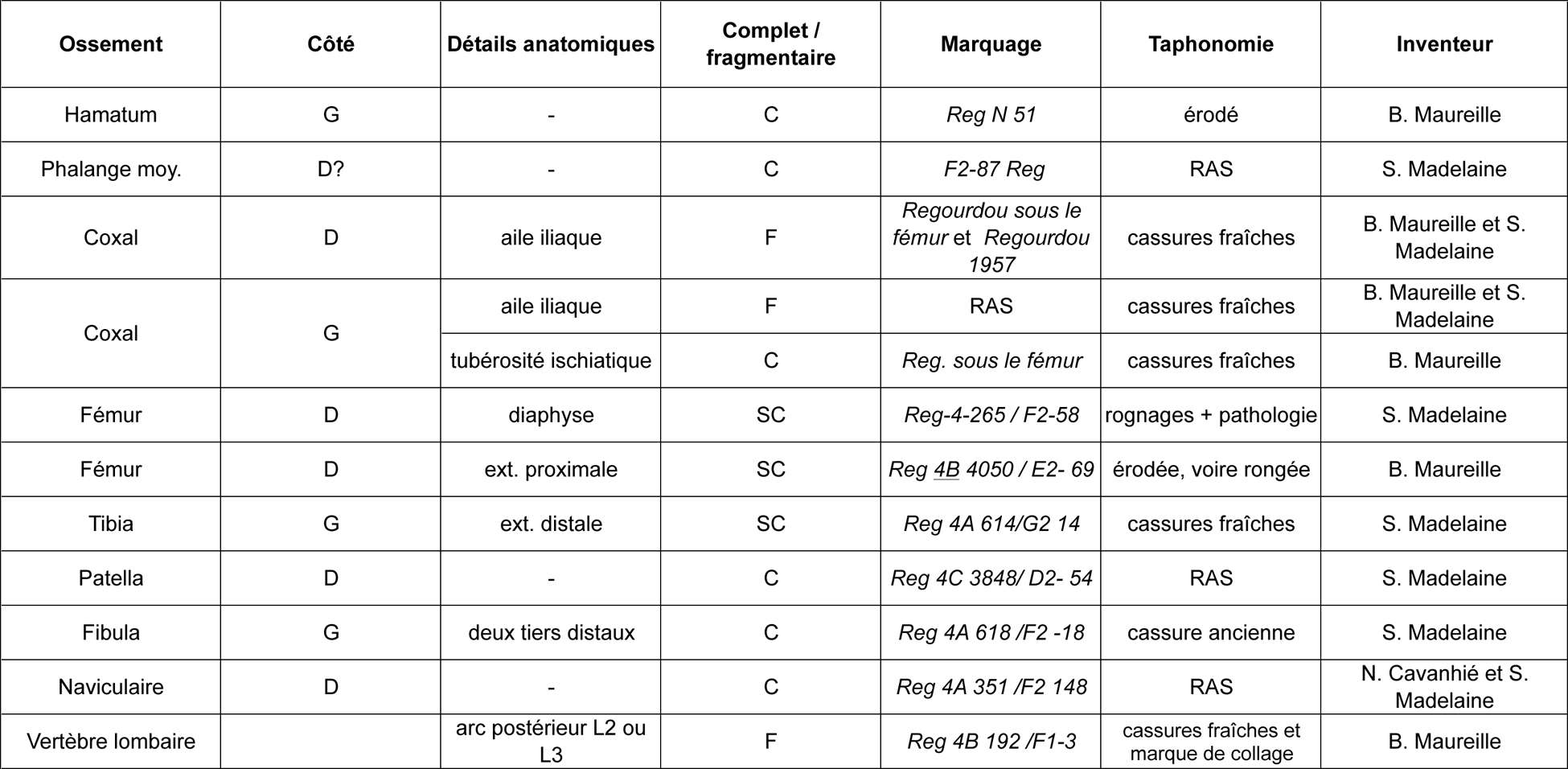
Inventory of the new human remains discovered within the Regourdou faunal remains during the inventory of the collections at the Musée national de Préhistoire.
C = complete, SC = sub-complete, F = fragmentary, D = right, G = left, RAS = nothing to point out.
Source: Madelaine et al. (2008)
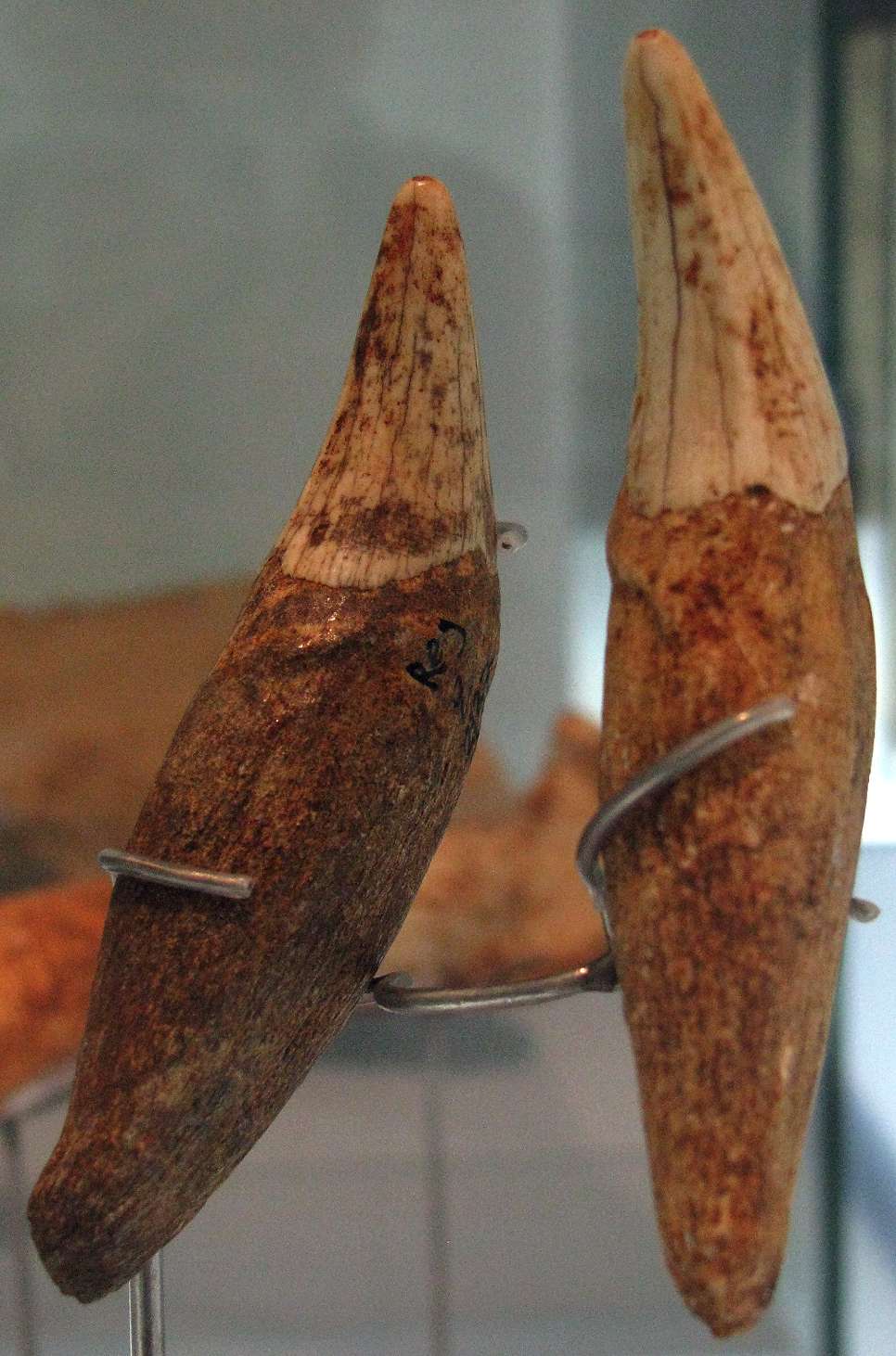
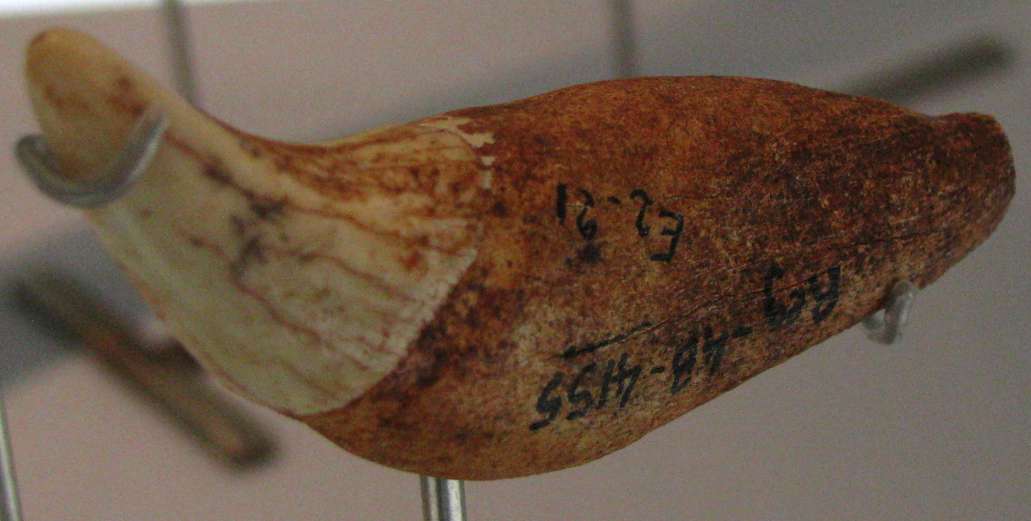
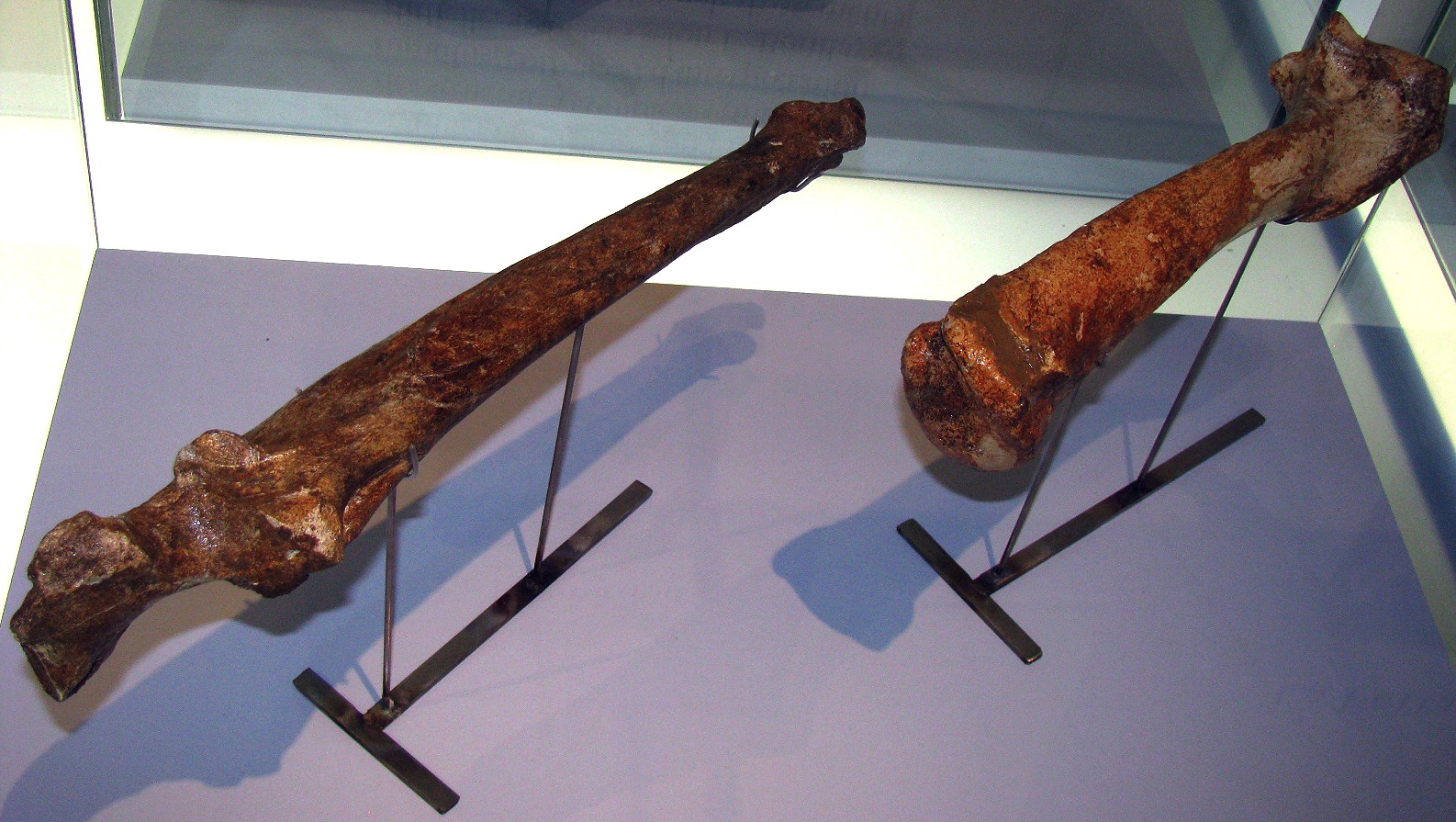
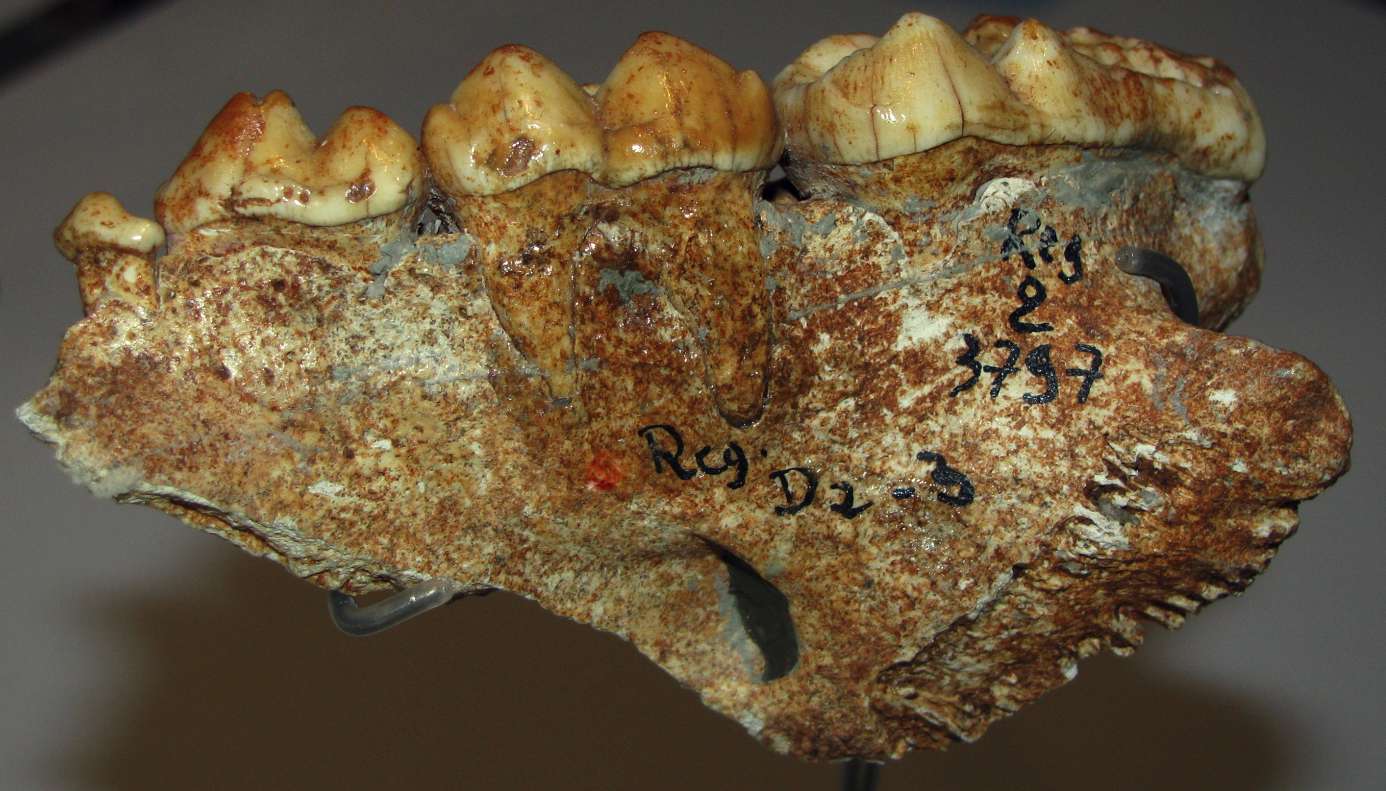
Bear remains found near the Regourdou skeleton.
Restes d'ours trouvés à proximité du squelette de Régourdou.
(Collection du Musée national de Préhistoire des Eyzies)
Photo: Don Hitchcock 2008
Source: Original at Musée National de Préhistoire, Les Eyzies

Naturally perforated stones found near the Regourdou skeleton.
From the excavation by E. Bonifay.
Pierres naturellement perforées à proximité du squelette de Régourdou.
fouille E. Bonifay
(Collection du Musée national de Préhistoire des Eyzies)
Photo: Don Hitchcock 2008
Source: Original at Musée National de Préhistoire, Les Eyzies
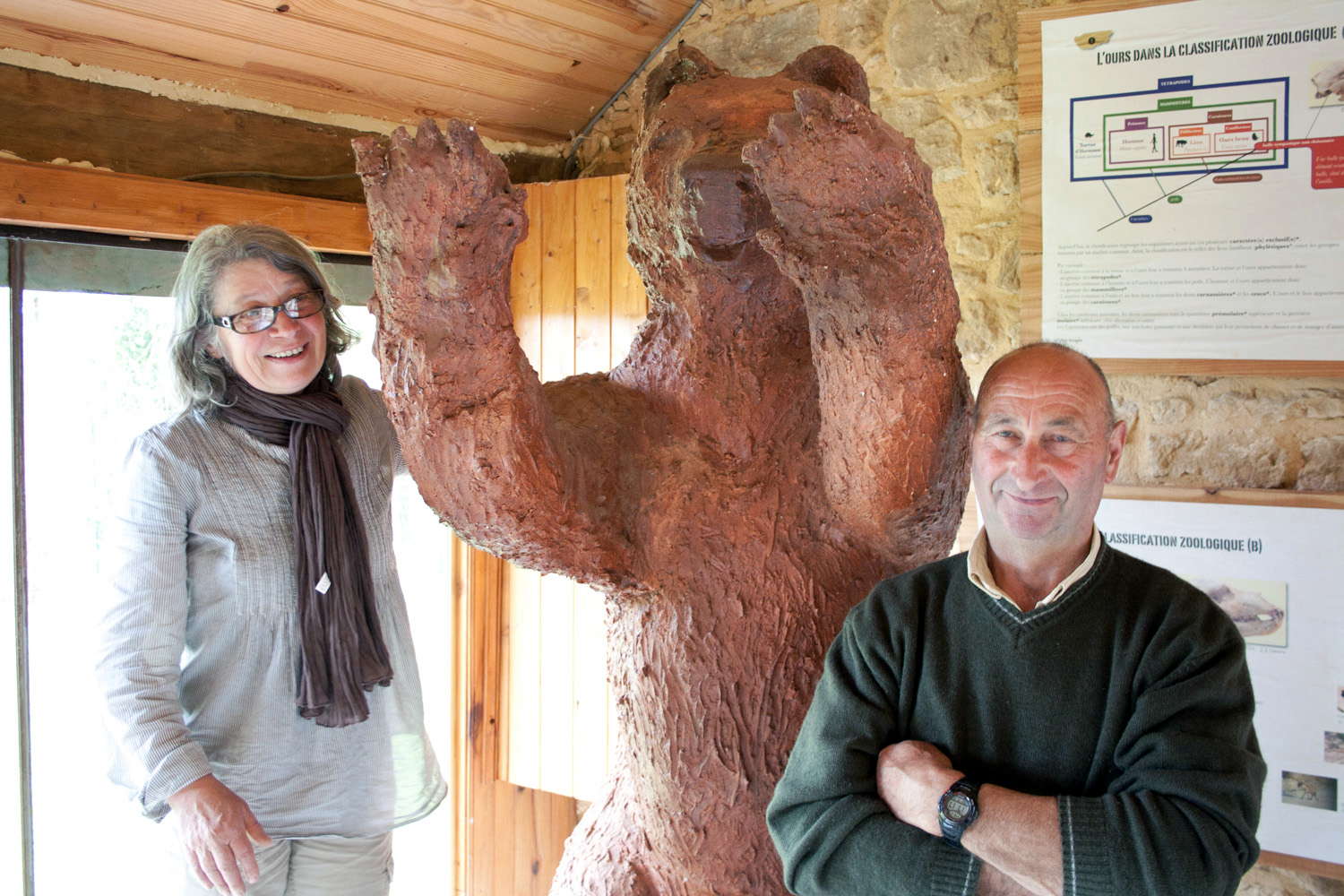
Michele and Jean-Claude Constant, current owners of the Regourdou site.
Photo: Press Pack, http://www.regourdou.fr/espace-pro.php, 2011

The gisement (archaeological site) at Le Regourdou.
When the excavation of this was taken over by archaeologists when M. Constant first found the neanderthal bones, he started another excavation nearby, which he called the gouffre, or chasm.
Photo: Press Pack, http://www.regourdou.fr/espace-pro.php, 2011
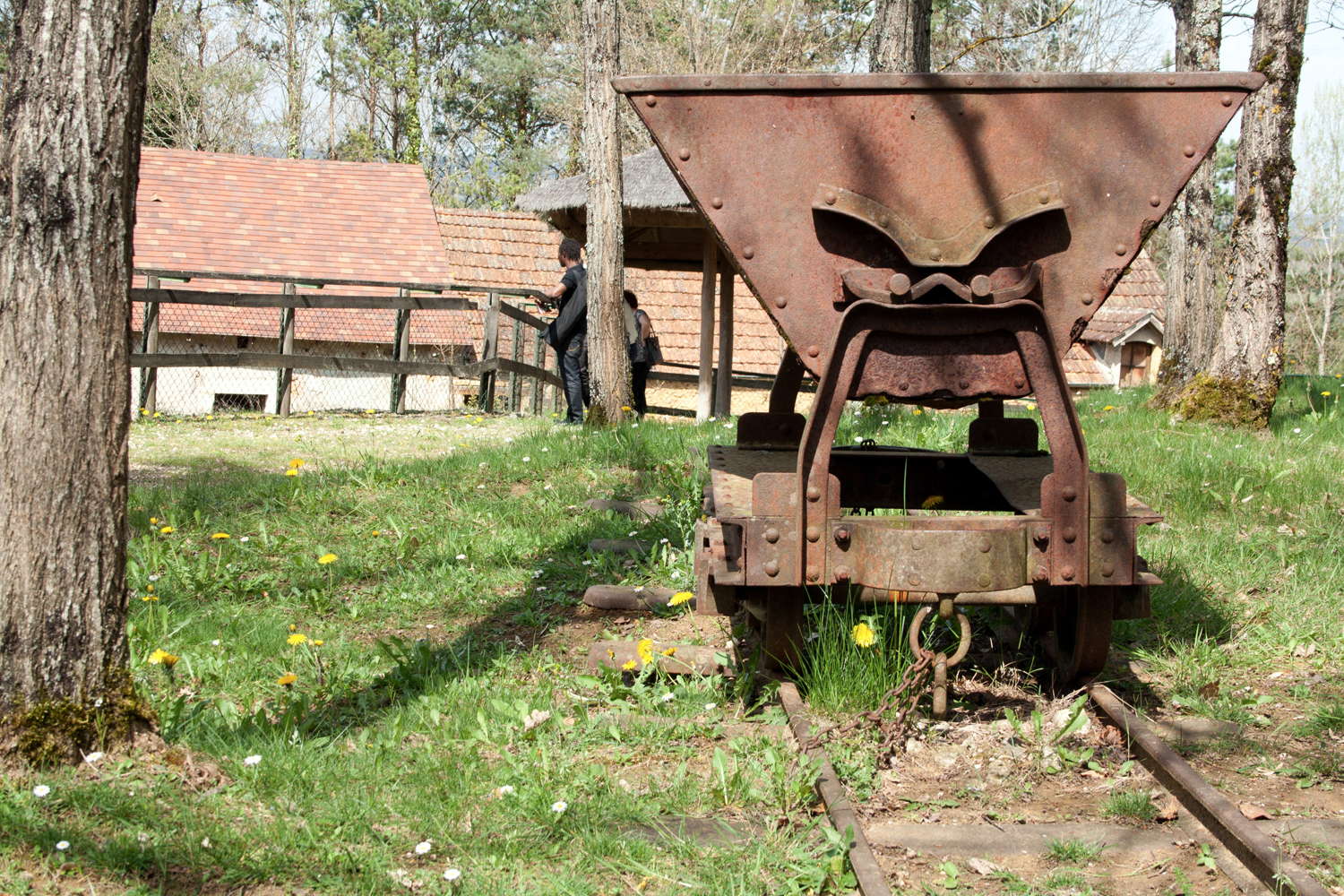
The wagon which Roger Constant used to carry spoil from the gouffre, or chasm.
Photo: Press Pack, http://www.regourdou.fr/espace-pro.php, 2011
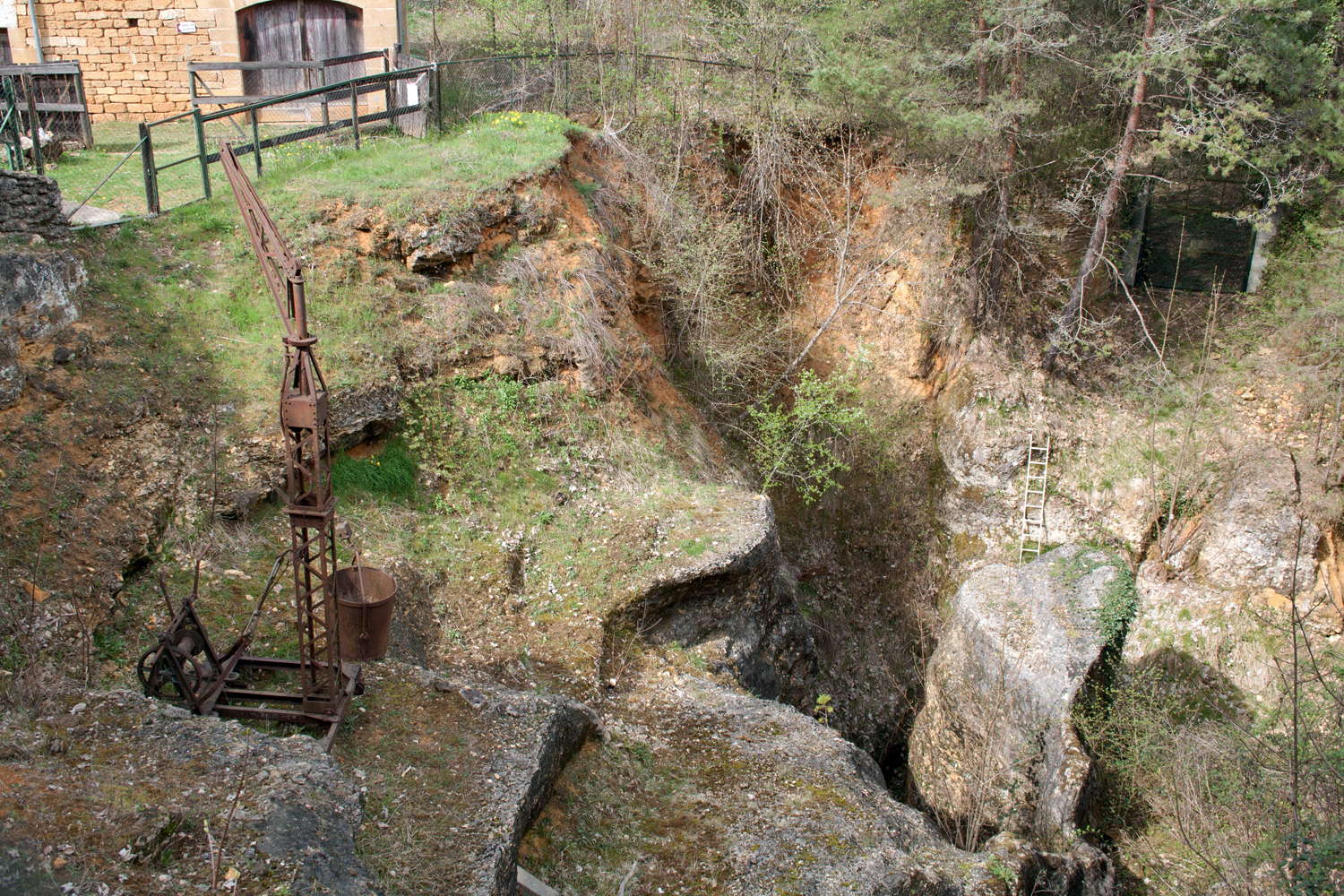
The chasm and the crane used to haul dirt out of the excavation, the gouffre or chasm.
The ochre found in this excavation of the gouffre was used as pigment for the painting of the recreation of the original Lascaux, at Lascaux II.
Photo: Press Pack, http://www.regourdou.fr/espace-pro.php, 2011
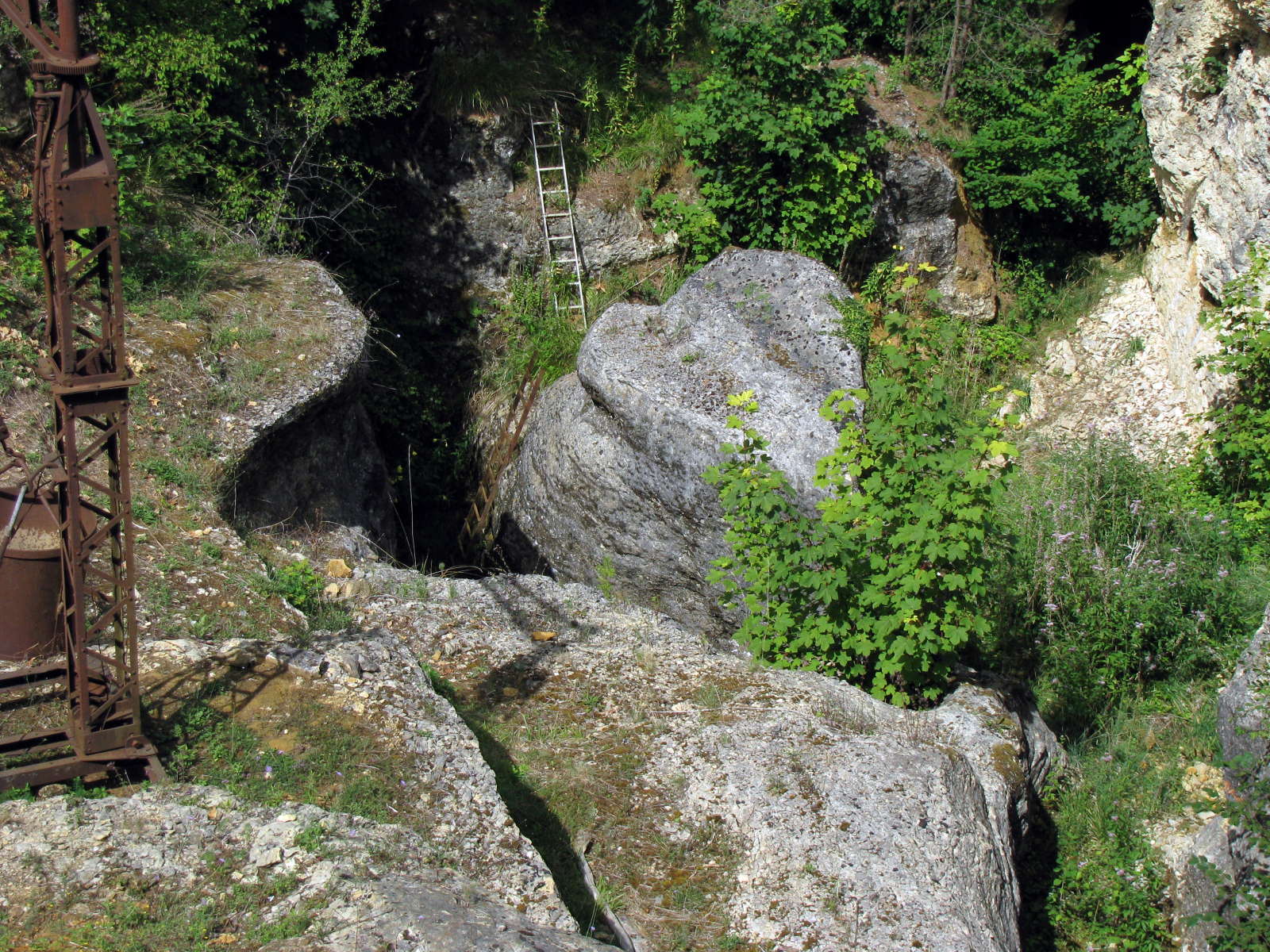
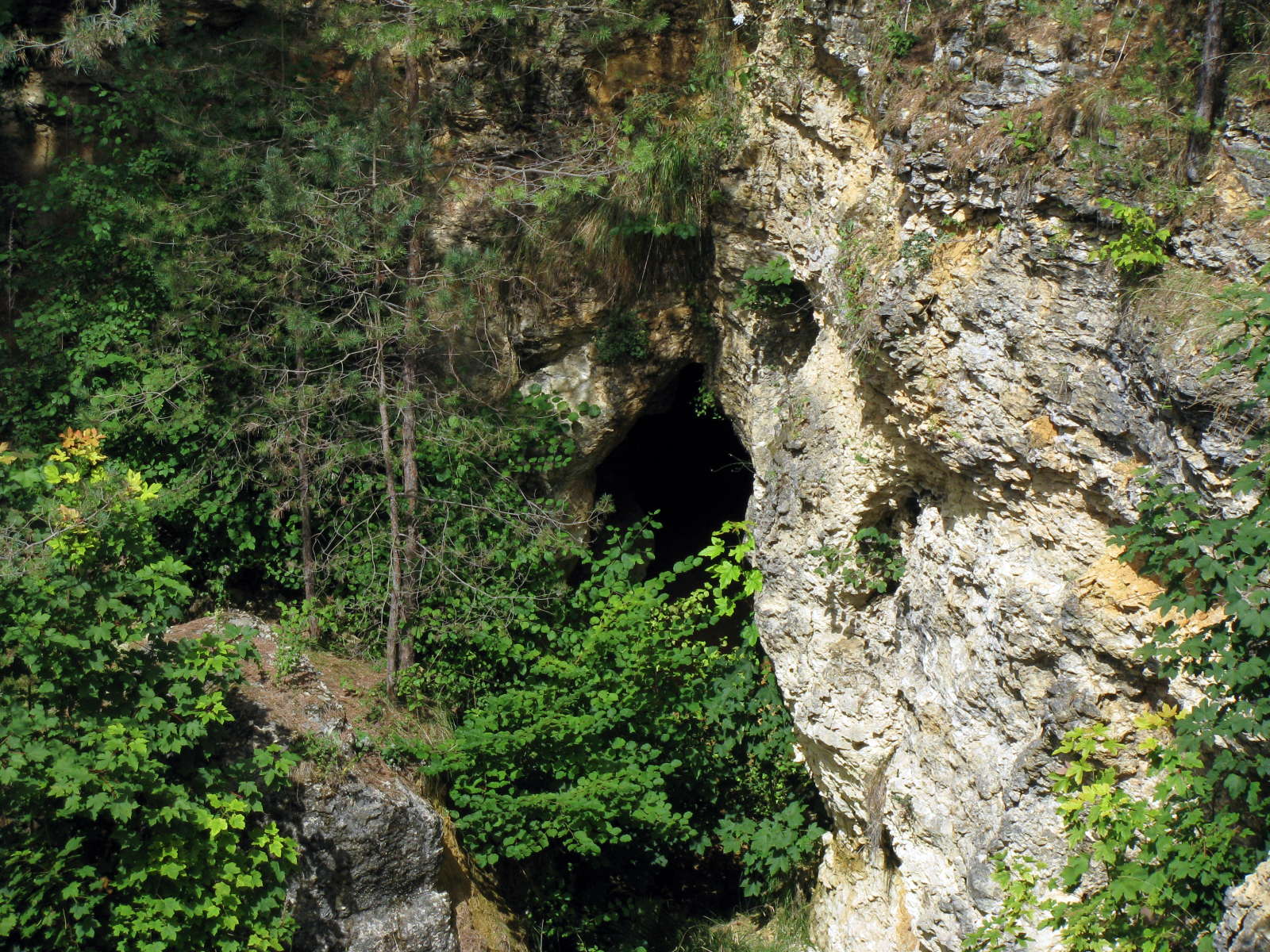
The gouffre or chasm.
Photo: Don Hitchcock 2008
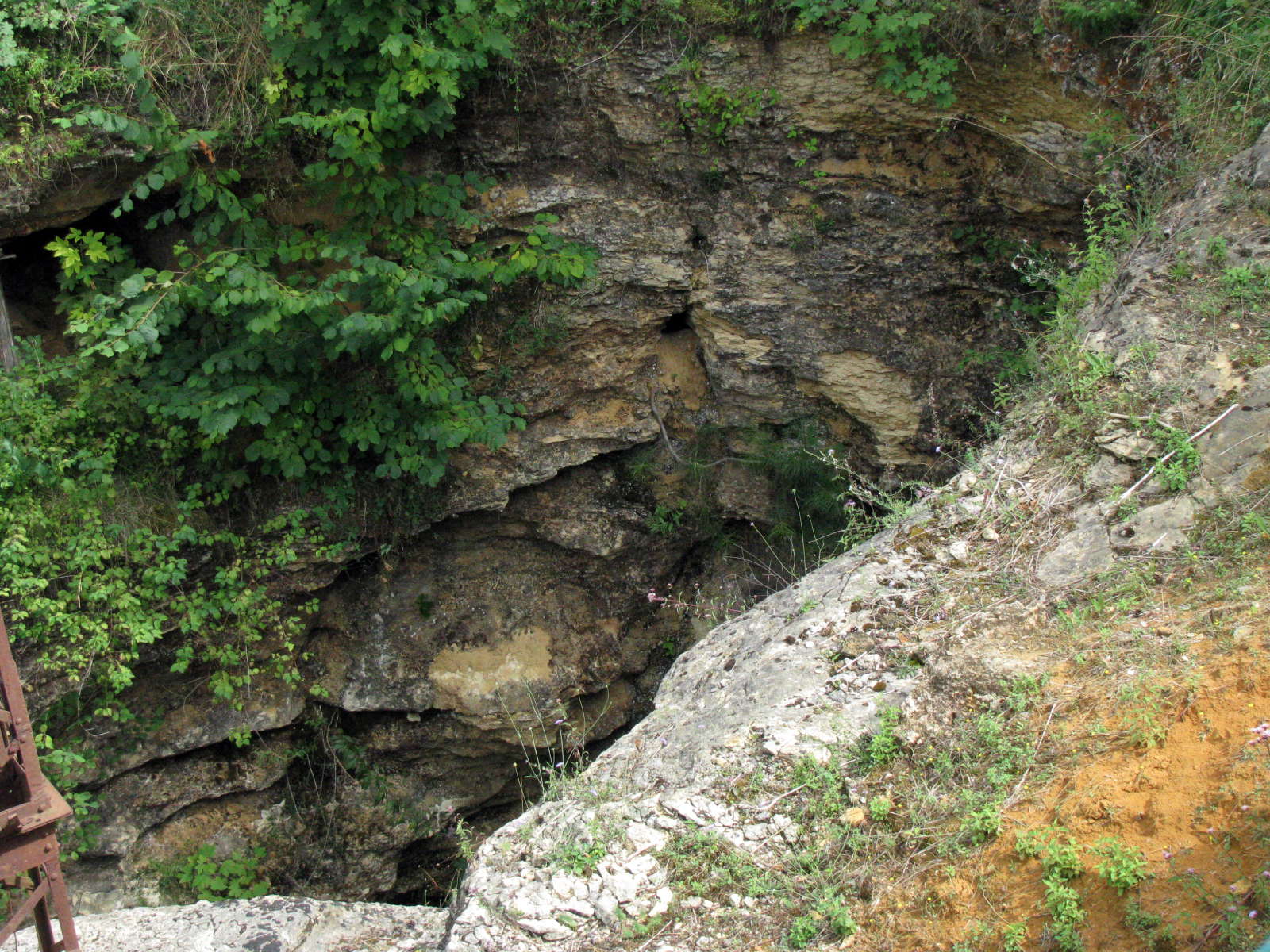
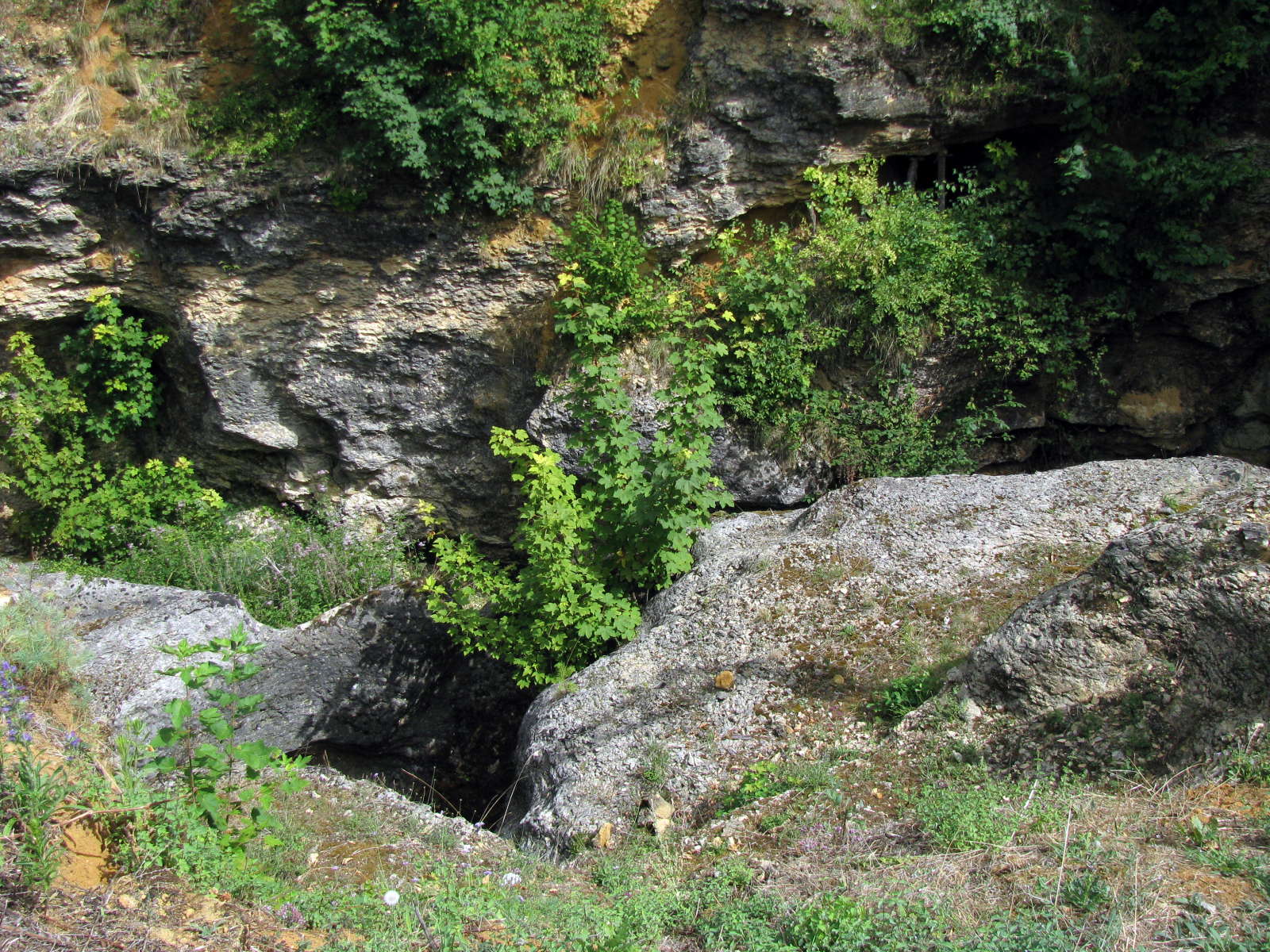
The gouffre or chasm. It seemed to me that M. Constant enlarged an existing collapse in the doline or sinkhole in the limestone.
Photo: Don Hitchcock 2008
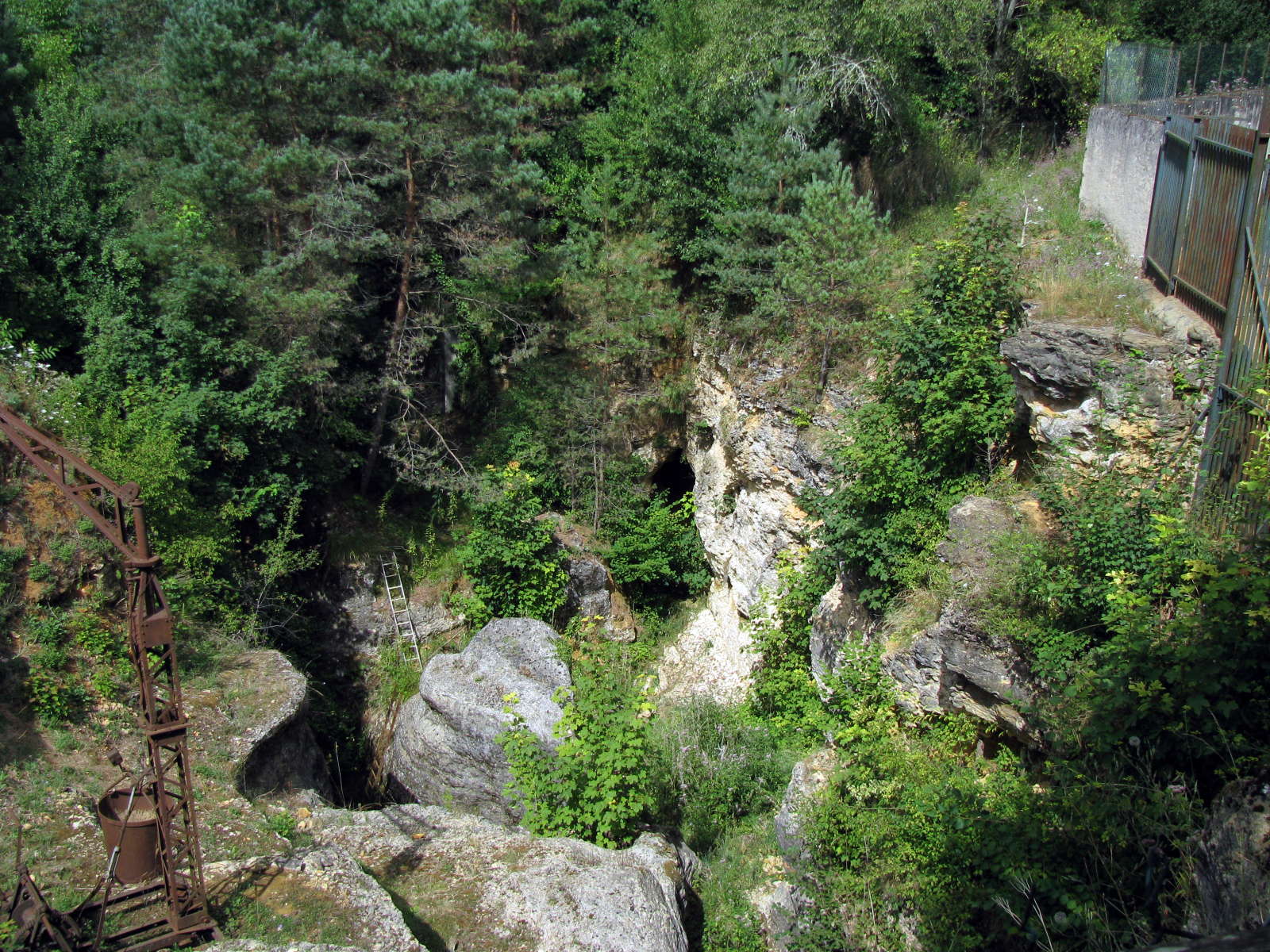
Here we can see the full depth of the gouffre, with the walls of the bear enclosure above, the crane used to haul up dirt from the excavation, and the ladders he used to get down to the bottom of the gouffre still in position.
Photo: Don Hitchcock 2008
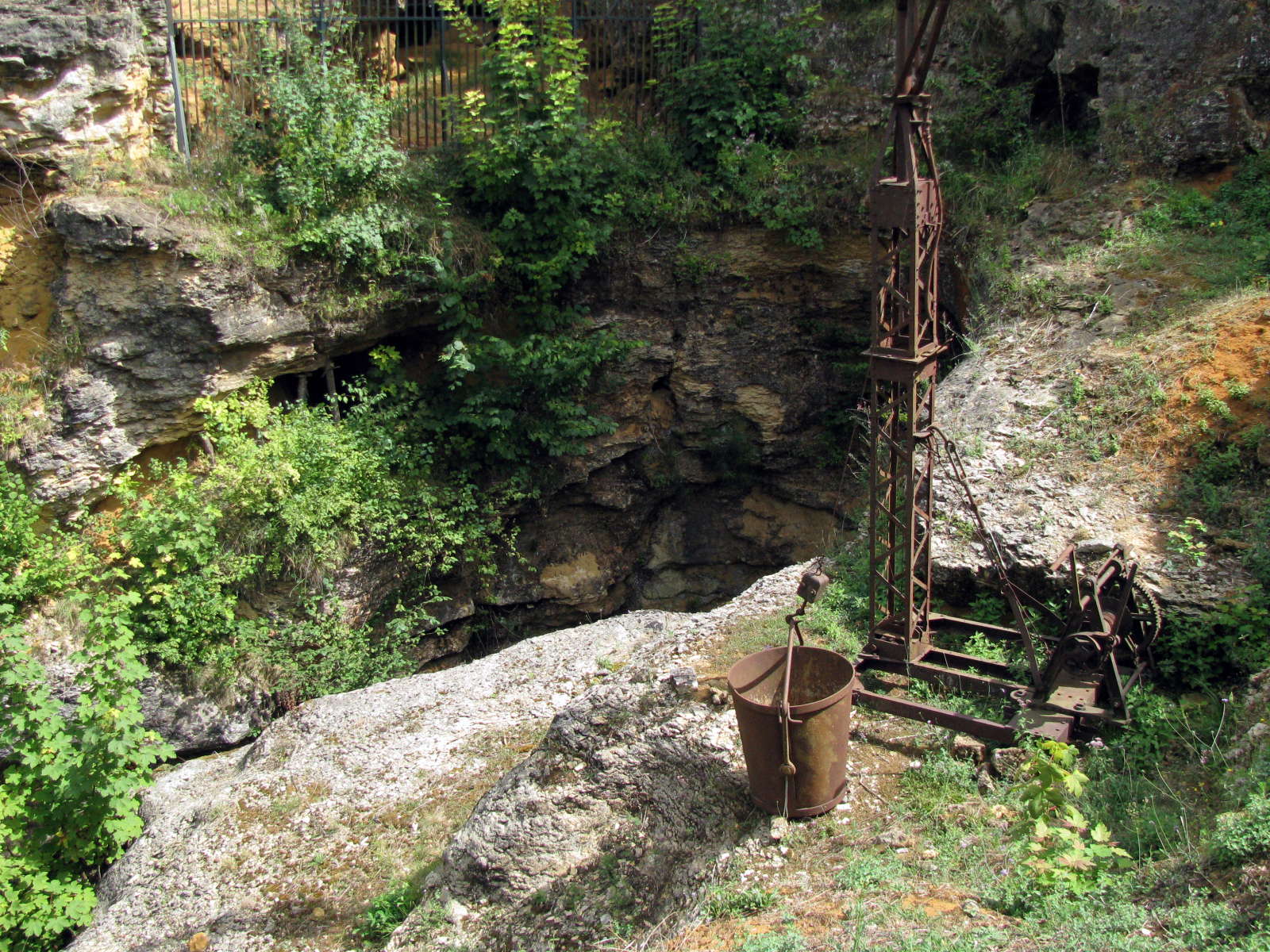
In this close up of the crane and steel bucket, it would seem that with minor repairs and some grease and oil, the machinery could be made to come to life again.
Photo: Don Hitchcock 2008

The original house of M. Constant has been turned into a museum.
Photo: Press Pack, http://www.regourdou.fr/espace-pro.php, 2011
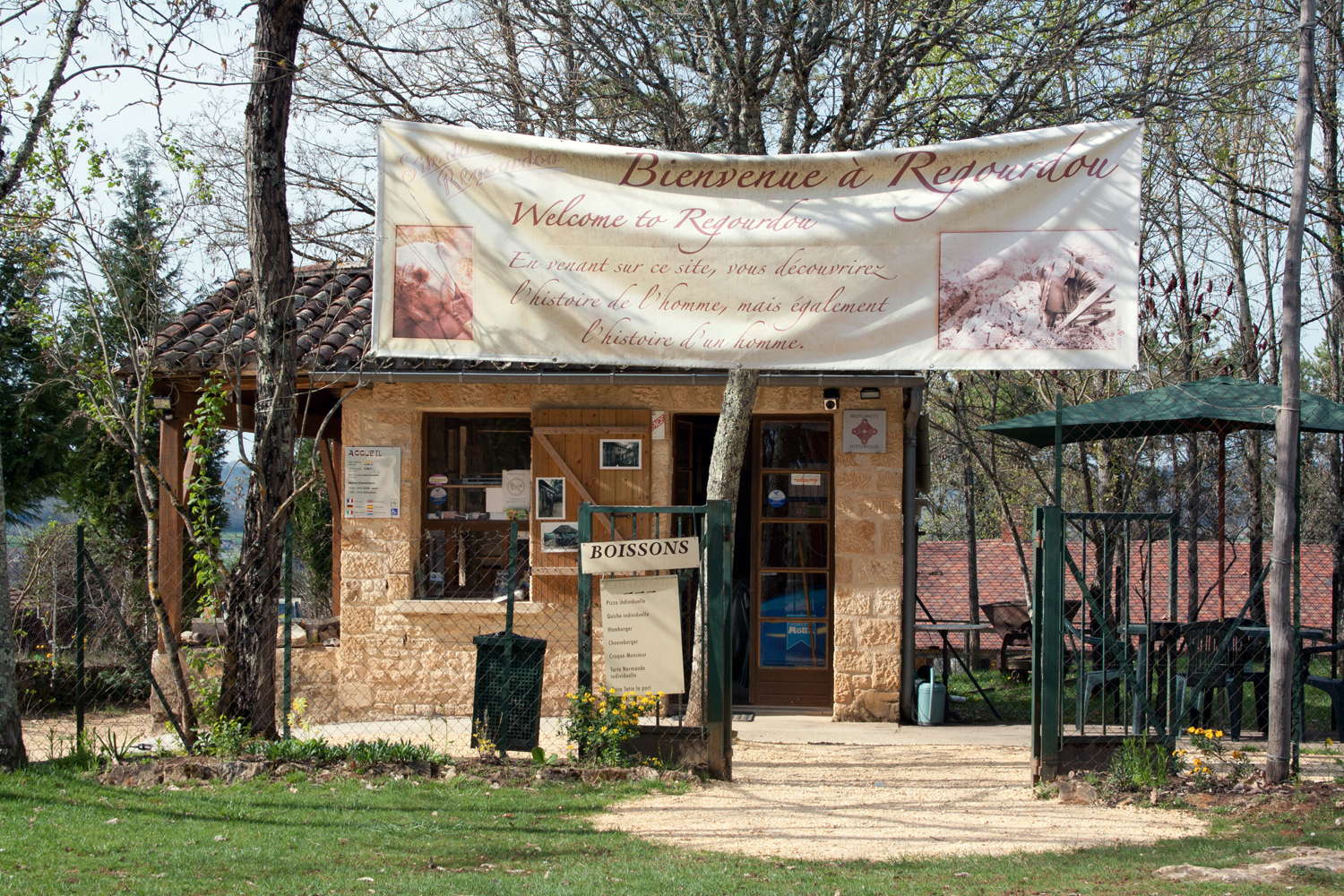
This is the welcome sign and the kiosk at the entry to the Le Regourdou site. It is beautifully presented, and great care has been taken in its design and construction.
Photo: Press Pack, http://www.regourdou.fr/espace-pro.php, 2011
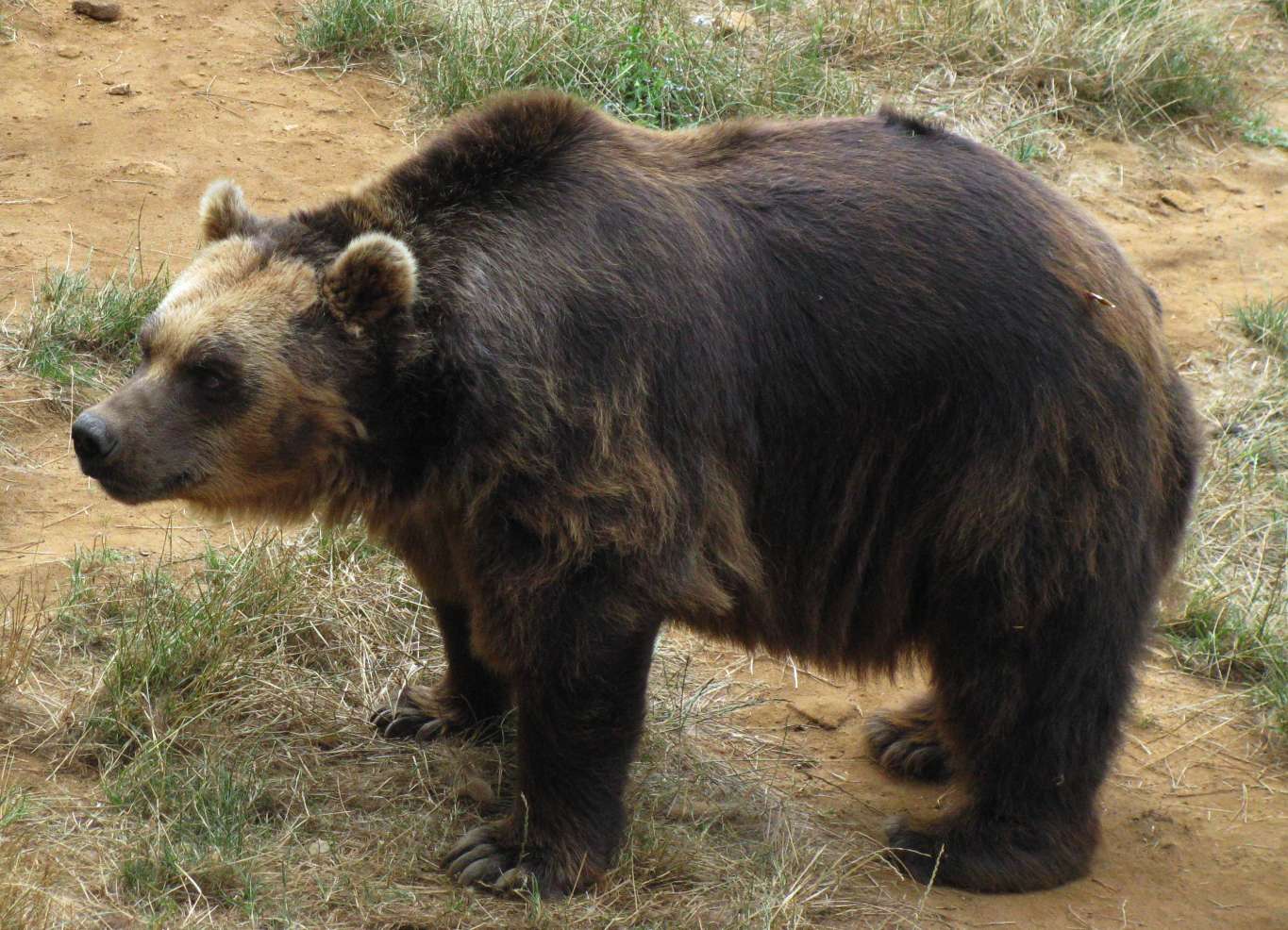
The site of Le Regourdou uses live brown bears, and the opportunity to feed them, as a tourist attraction. Archaeology has never been a sufficient drawcard for most visitors, unless there are extra attractions such as the paintings of Lascaux. The connection here is the presence of brown bear remains in the archaeological site.
Photo: Don Hitchcock 2008
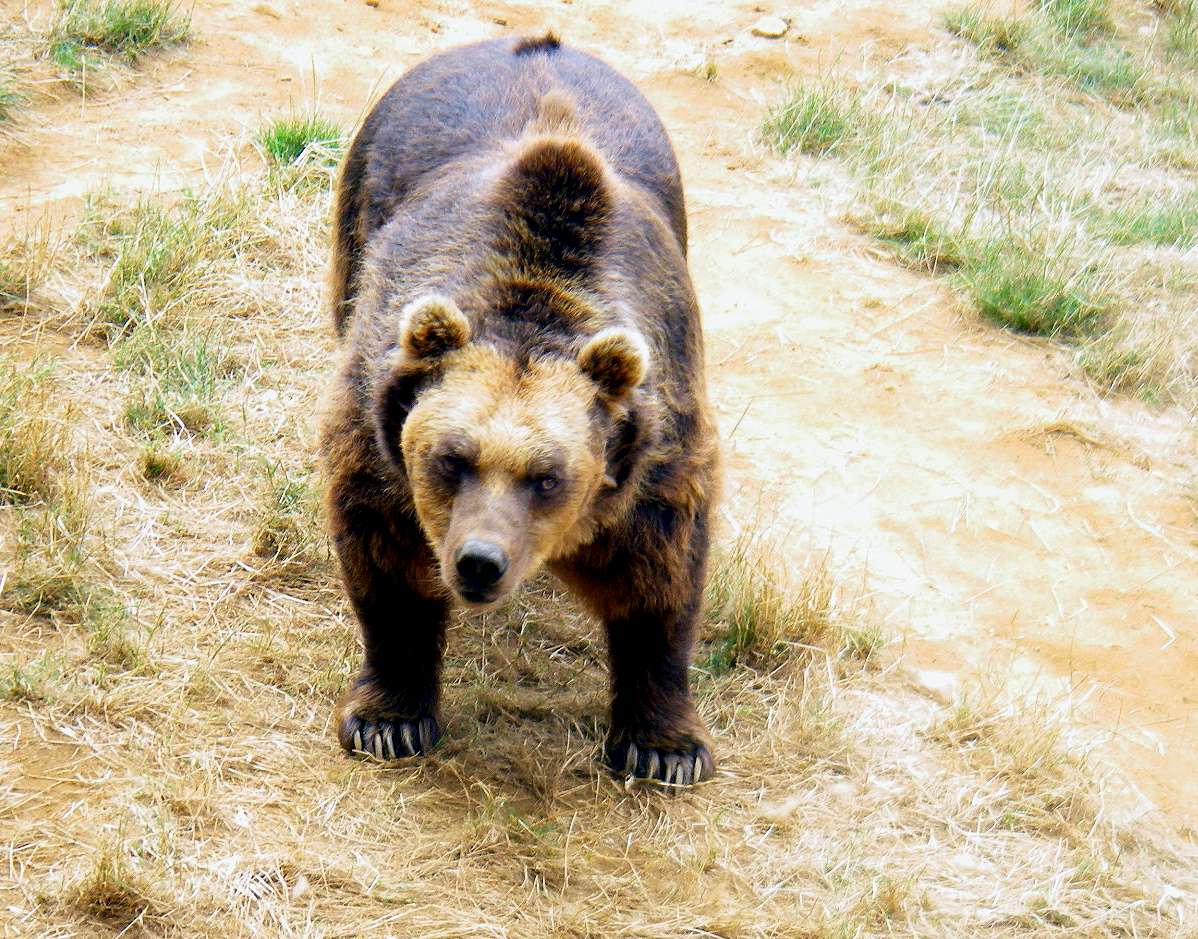
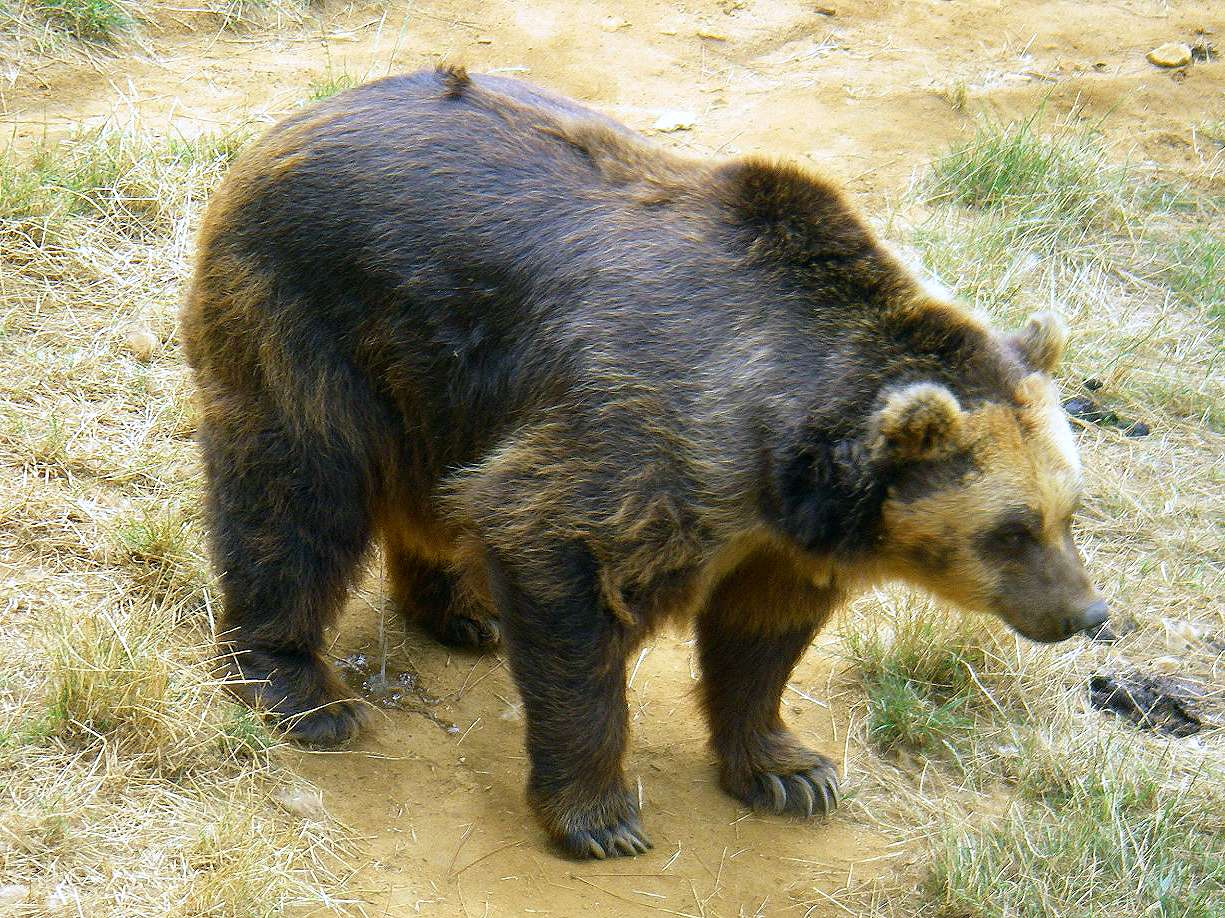
The bears are safely well below the visitors, and there is a wall to lean against. However there was an abiding sense of menace to the bears. I would not like to fall into the enclosure and be subject to their tender mercies.
Photo: Don Hitchcock 2008
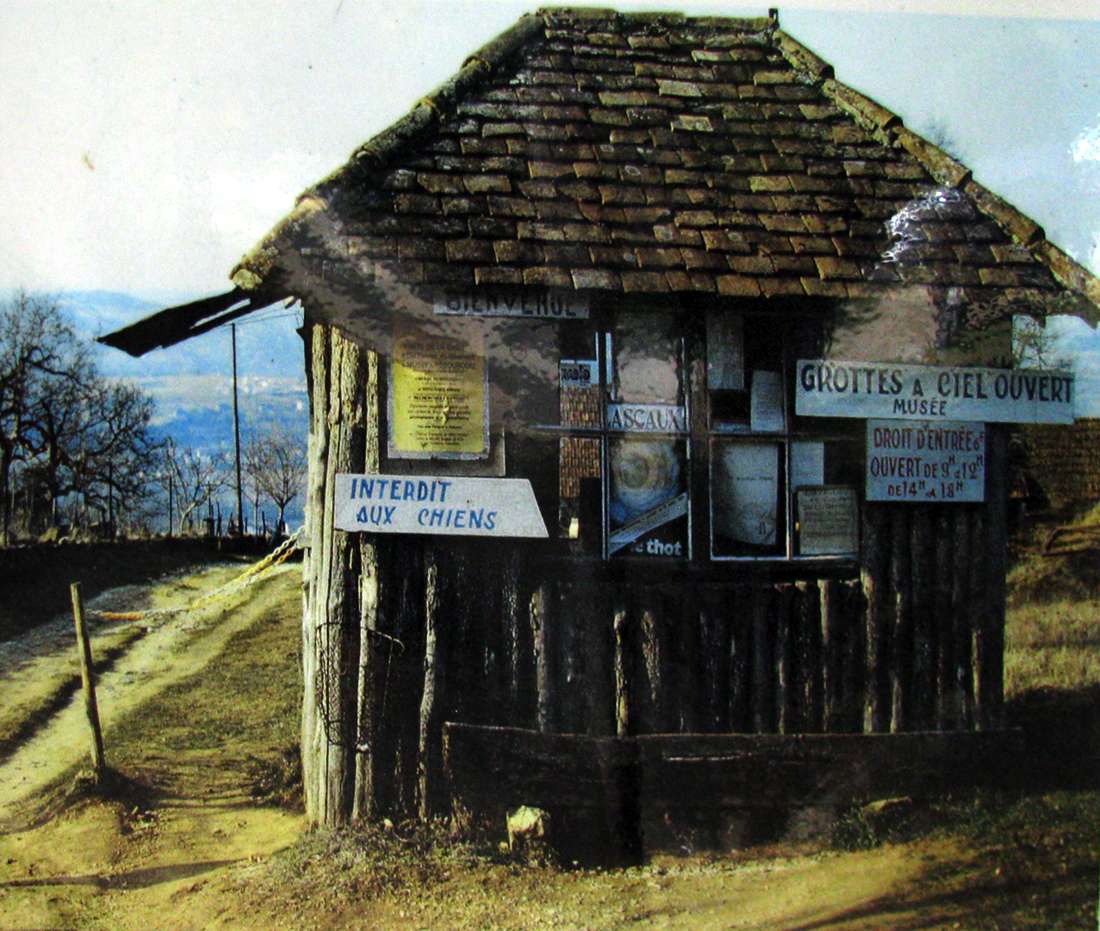
The Le Regourdou site has always been a private archaeological site, and this photo shows an earlier version of the Le Regourdou Kiosk.
Photo: Don Hitchcock 2008
Source: Display, Le Regourdou
References
- Maureille, B., Rougier H., Houet F., Vandermeersch B., 2001: Les dents inférieurs du Néandertalien Regourdou 1 (site de Regourdou, commune de Montignac, Dordogne): Analyses Métriques et ComparativesPaleo, No 13 - Décembre 2001 - Pages 183 à 200.
- Madelaine, S., Maureille, B., Cavanhié N., Couture-Veschambre C., Bonifay E., Armand D., Bonifay M., Duday H., Fosse P., Vandermeersch B., 2008: Nouveaux restes humains Moustériens rapportes au squelette Néandertalien de Regourdou 1 (Regourdou, commune de Montignac, Dordogne): Analyses Métriques et ComparativesPaleo, No 20 - Décembre 2008 - Pages 101 à 114.
- Trinkaus, E., Holliday T., Auerbach B., 2014: Neandertal clavicle length PNAS, 2014 ; published ahead of print March 10, 2014
- Volpato V, Macchiarelli R, Guatelli-Steinberg D, Fiore I, Bondioli L, et al. , 2012: Hand to Mouth in a Neandertal: Right-Handedness in Regourdou 1PLOS ONE, 7(8): e43949. doi: 10.1371/journal.pone.0043949