 Back to Archaeological sites
Australian Archaeological / Archeological sites, including Carnarvon Gorge, Naracoorte Caves, Lake Mungo and Mount Yarrowyck

Magnificent Gallery - Laura in north Queensland, on the Cape York Peninsula, has many sandstone walls protected by overhanging ledges, which are the site of complex and rich rock art by Australia's First Nations people. Magnificent Gallery is a superb site.
 Giant Wallaroo Gallery, near Magnificent Gallery.
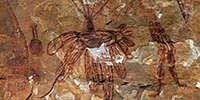
The rock art of Guardian Place, Yam Camp, Shepherd Creek Secret Place, and Easy Dreaming Galleries consists of paintings of Quinkan figures, spirit figures, humans, paintings based on yams, a wallaroo and fruit bats, as well as cupules and other engravings in the sandstone.
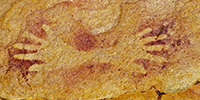
The rock art of Pine Tree Creek, Tied Up Wrist and Wallaroo Galleries consists of paintings of kangaroos and wallabies, eels, people dancing, and Quinkan figures, and hand stencils of two hands at each end of a wrist.
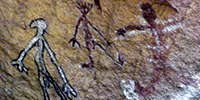
The rock art of Quinkan Corner, the Rock Wallaby Gallery, and Tent Shelter Gallery, consists of Quinkan figures, animal figures of many kinds, but including birds, kangaroos, platypus, and dingoes, as well as human and ancestor figures. It is of great importance in the study of the art of Northern Queensland.
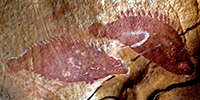
The rock art of the Sandy Creek rock shelter near Laura is part of the huge group of Australian Aboriginal Rock Art known as Quinkan. The pigments used include haematite, and various shades of ochre ranging from red to brown to yellow to white. Subjects include humans, animals, and members of the spirit world.
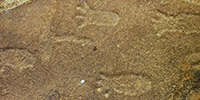
The rock art near Laura Bridge consists of engravings in the sandstone. Subjects include animal tracks, yams, and humanoid figures.
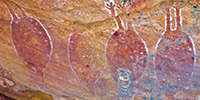
The rock art near Brady Creek consists of both paintings and an important engraving. A painting of a man and woman copulating is repeated in an engraving on a large smooth boulder in the bed of Brady Creek. In addition there are paintings of humans, yam figures, fruit bats roosting, a crocodile, a marsupial, negative hand prints, and spirit figures.
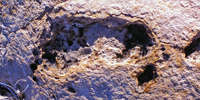
Fossilised Human Footprints in Australia - These appear to be fossilised human footprints on the foreshore of a beach, found by a fisherman. He came across many of them in the one spot, ranging from child to adult size, as well as some animal prints.
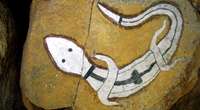
Aboriginal art site on the Northern Tablelands of NSW Australia, including a lizard, a snake, and hand stencils. It appears to be regularly maintained and cared for by local aboriginal people as part of a continuing tradition.
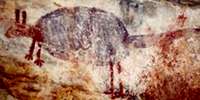
Aboriginal Art of the Kimberleys
This is a record of part of a bushwalking trip from the Berkeley River to the King George River and then to the Drysdale River in the Kimberley region of northern West Australia.
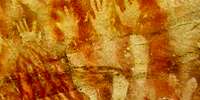
Carnarvon Gorge - an Aboriginal Rock Stencil Art site, with engravings of vulvas, emu and kangaroo tracks.
Carnarvon Gorge lies within the spectacular and rugged ranges of Queensland's central highlands. The fragile aboriginal art on the gorge's sandstone walls reflects a rich culture. Ochre stencils of tools, weapons, ornaments and ceremonial objects, as well as engravings and grooves where tools were sharpened provide an insight into the lives of the gorge's first people.
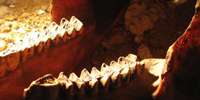
Naracoorte Caves
These caves are in an area of limestone in which ground water has dissolved some of the limestone, creating the caves. Holes in the roof opened up creating traps for the unwary. Mammals and other land creatures have fallen into the sink holes and have become fossilised.
Lake Mungo
Lake Mungo is a dry lake in south-western New South Wales, Australia. Many important archaeological findings have been made at the lake, most significantly the discovery of the remains of Mungo Man, the oldest human remains found in Australia, and Mungo Lady, the oldest human remains in the world to be ritually cremated.
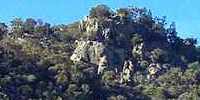 The Mount Yarrowyck Nature Reserve near the junction of the Armidale Road and Thunderbolts Way protects an Aboriginal cave painting site and much of the natural environment of Mount Yarrowyck. The paintings are probably several hundreds of years old. The tracks, circles, short lines and dots may remind you of birds' feet, people, lizards and even birds' eggs. However an Aboriginal elder, the late Victor Shepherd, was sure that the paintings were of a bird that fed on the ground. Ground birds were represented by their feet alone. He said the toes look too short and thick to be an emu. The paintings must be of the Plains Turkey, the Bustard.