Back to Don's Maps
 Back to Archaeological Sites
Grotte de Fontéchevade
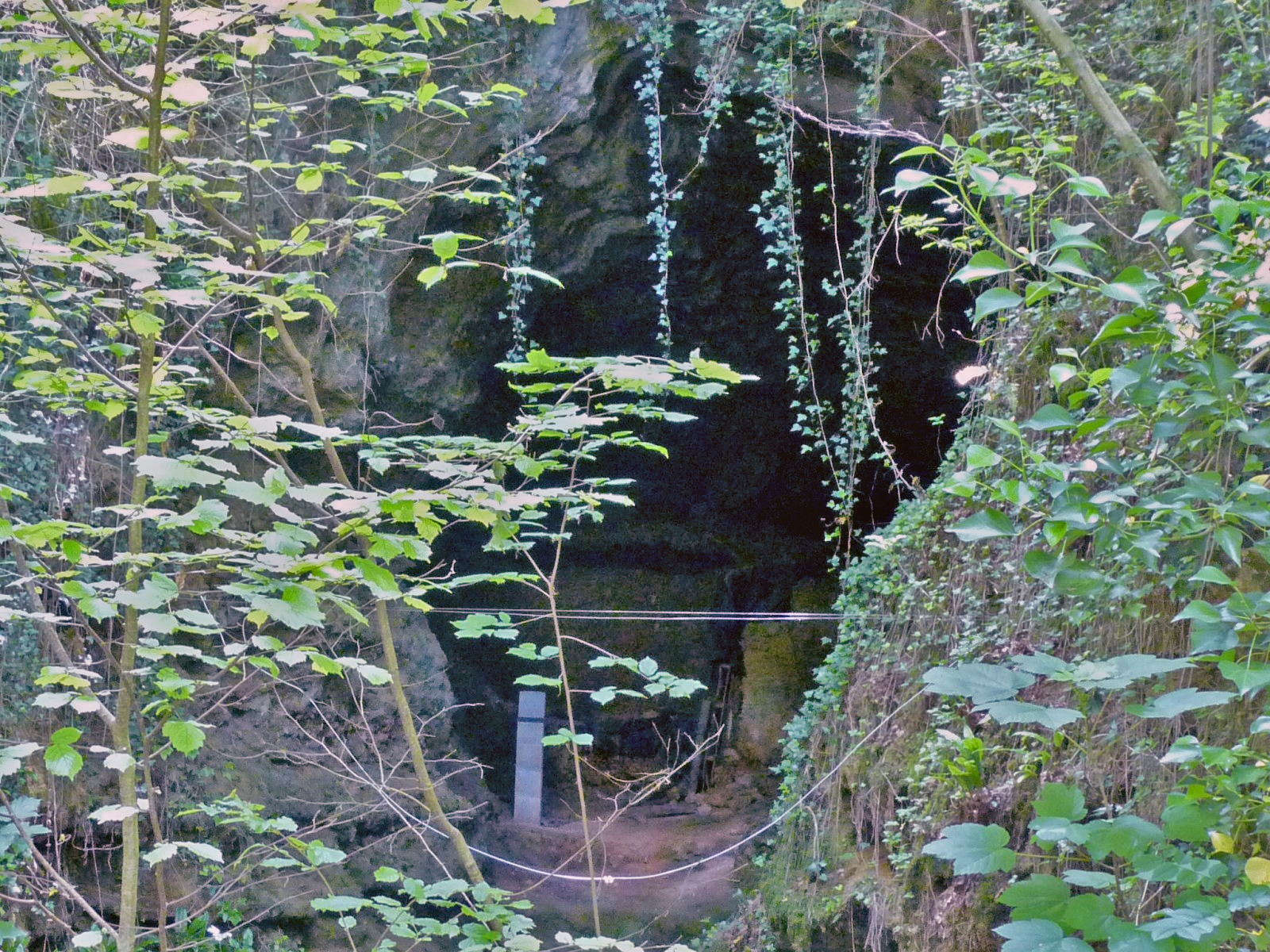
Entrance to Fontéchevade Cave
The Fontéchevade cave is a prehistoric cave located in the commune of Montbron, 27 km east of Angoulême in the Charente department, 5 km from the Dordogne and 11 km from the Haute-Vienne.
It was occupied during the Tayacian (Lower Palaeolithic), Mousterian (Middle Palaeolithic), and Aurignacian (Upper Palaeolithic) periods.
Photo: Jack ma
Permission: GNU Free Documentation License, Version 1.2 or any later version
Proximal source: Wikipedia
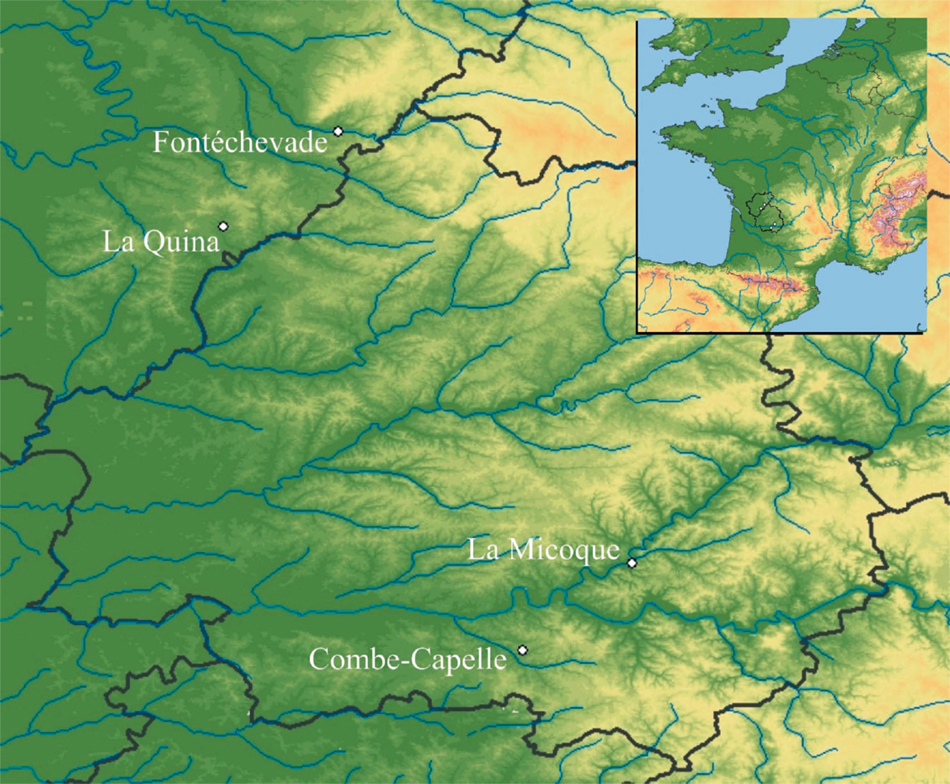
Location map Dibble et al. (1996)
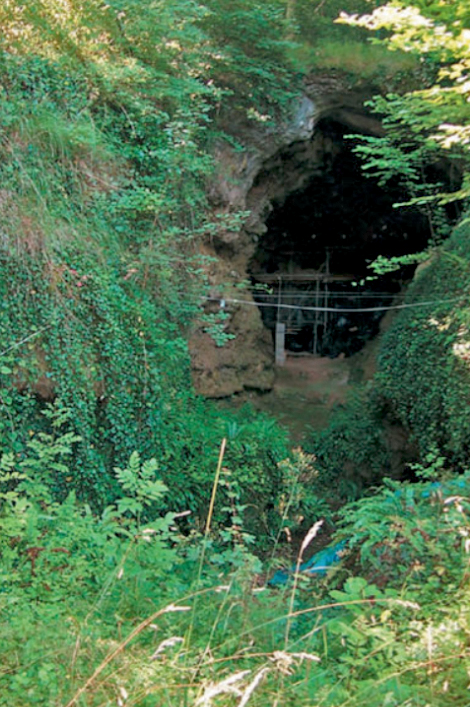
Entrance to Fontéchevade Cave.
The cave is located 2 km northwest of the town of Montbron, on the border of the commune of Orgedeuil, at the foot of the hamlet of Fontéchevade. It sits in a small southwest-facing valley containing the Fontéchevade stream, a right-bank tributary of the Tardoire.
It is situated near the Montgaudier cave (1.5 km to the southwest as the crow flies) and the Placard cave (4.8 km to the west). Excavations at the Fontéchevade cave began in 1870 with Paire and Fermond, followed by Durousseau-Dugontier (1902–1910), Vallade (1913–1914), Saint-Perrier (1921), and David, who conducted test pits in the Aurignacian layer in 1933. Germaine Henri-Martin resumed excavations from 1937 to 1955. In 1947, a human skullcap attributed to a pre-Neanderthal individual was unearthed. It is believed to be the oldest human bone found in Charente.
The Fontéchevade cave is a U-shaped tunnel, approximately 30 m long and 6 m wide.
In 1957, Germaine Henri-Martin identified six layers (labeled A through E, plus a clay layer on the cave floor), including an Aurignacian layer (B), a Mousterian layer (C), and a Tayacian layer (E). This Tayacian occupation has been dated to the Riss-Würm interglacial, approximately 150 000 years ago. Recent excavations have revealed a stratigraphy consisting of eight layers.
Photo and text: Dibble et al. (1996)
In 1947, Germaine Henri-Martin unearthed fragments of a frontal and parietal bone, as well as a portion of a skullcap (comprising the frontal bone and parts of the right and left parietal bones) belonging to an elderly individual—indicated by fused sutures—which were attributed to a pre-Neanderthal. At the time of the discovery, the only other fossils from this same cultural facies with a confirmed date in France came from the Grotte de l'Hyène at the Arcy-sur-Cure site in the Yonne department. Other human remains were discovered: a left fifth metatarsal in 1948, attributed to the Mousterian; and subsequently four teeth and a phalanx, dating to either the Aurignacian or a more recent period.
Remains of Homo sapiens were also found: a parietal bone from a young male (discovered by Durousseau-Dugontier), a portion of a child's mandible, and a radius fragment, all dating to the Aurignacian.
The faunal assemblage includes equids, large bovids (cattle and bison), cervids, rodents, wild boars, foxes, bears, and hyenas. The deep layer dated to the Tayacian yielded remains of a land tortoise, Merck's rhinoceros (Dicerorhinus mercki), and the Clacton fallow deer (Dama clactoniana). The microfauna includes the steppe lemming (Lagurus lagurus) . This presence supports a pre-Würmian dating for the Tayacian layer.
The cave served as a habitation site as early as the Middle Palaeolithic.
The Tayacian is contemporary with the Acheulean but lacking hand axes. The Tayacian assemblage at Fontéchévade includes side scrapers, denticulates, and choppers or massive scrapers.
The Mousterian is represented by a lithic industry featuring points and hand axes.
The Aurignacian is represented by scrapers, burins, and bladelets, as well as split-base bone points.
Numerous burins, Gravette points, and a fragment of a Font-Robert point attest to human presence during the Perigordian.
Text above: Dibble et al. (1996)
Fontéchevade: Hunting or Scavenging?
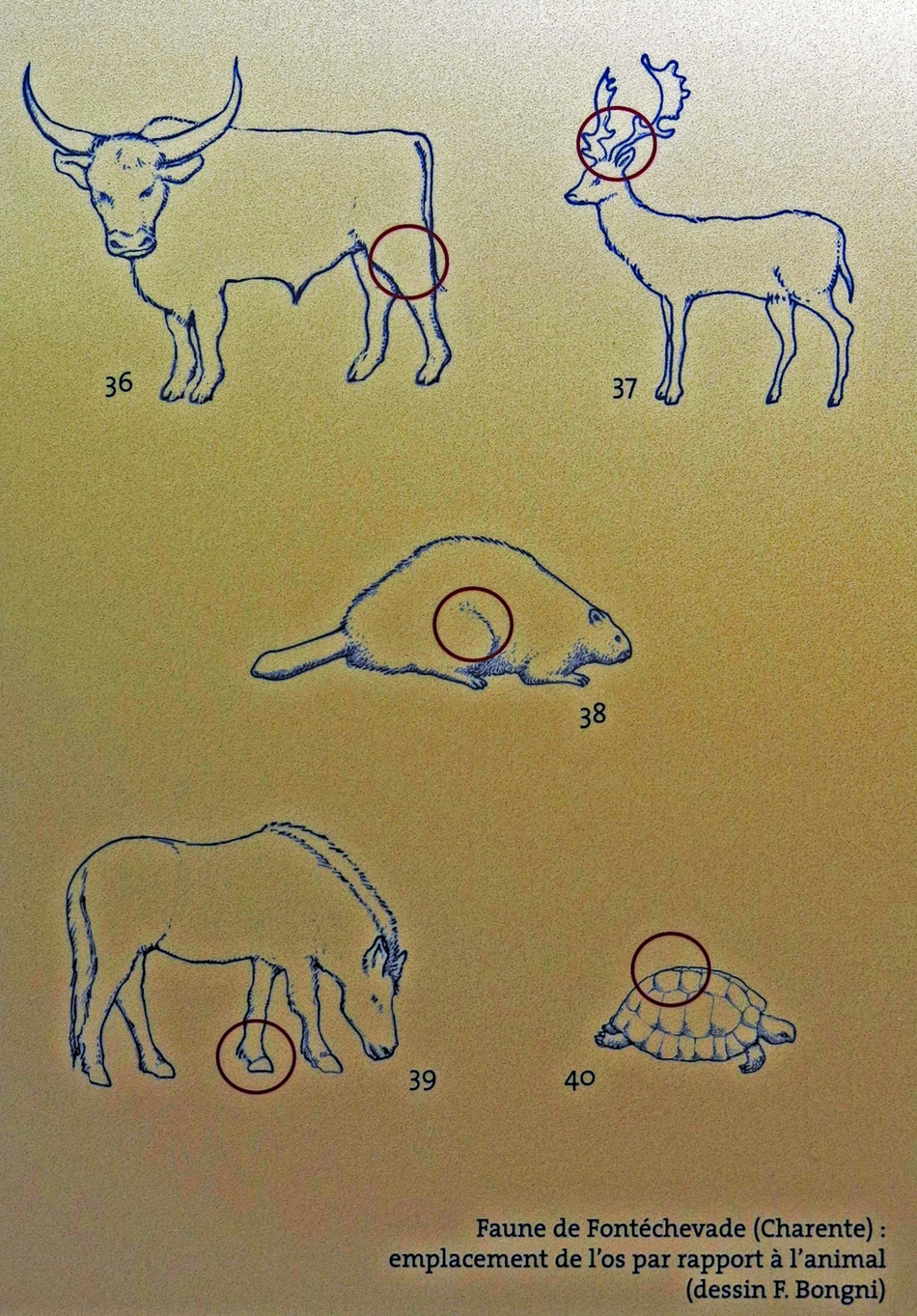
Fontéchevade (Charente) fauna: location of the bone relative to the animal (drawing by F. Bongni)
Photo and text: Dibble et al. (1996)
No traces of hunting activity are found prior to approximately 450 000 years ago. Like all predators, humans engaged in scavenging to varying degrees, recovering meat from the carcasses of mammals that had died naturally or had been killed and abandoned by carnivores. However, they soon began to hunt, though this did not preclude occasional scavenging. Hunting requires driving and trapping tactics; consequently, prehistoric humans developed a more collective approach. Nevertheless, gathering offered a better ratio of energy expended to food acquired than hunting, which carried greater risk.
Evidence of hunting weapons from the Lower Palaeolithic is scarce. A few fossilised wooden points have survived: one was discovered at Clacton-on-Sea (Great Britain) and two others at Schöningen (Germany). These were likely javelins; their centre of gravity, located near the tip, allowed them to be propelled over long distances. This made it possible to attack prey from afar without risking injury from horns or hooves.
Hunting is also evidenced in the Middle Palaeolithic, as shown by a fragment of a Levallois point embedded in the neck vertebra of a donkey discovered at Umm-el-Tlel in Syria. It was during this period that specialised kill sites — focused on exploiting a single species (such as bison at La Quina in Charente)—began to appear. From then on, prehistoric humans exploited a wider territory, adapting to the natural habitats of the animals they hunted.
Text above: Musée d'Archeologie Nationale et Domaine, St-Germain-en-Laye
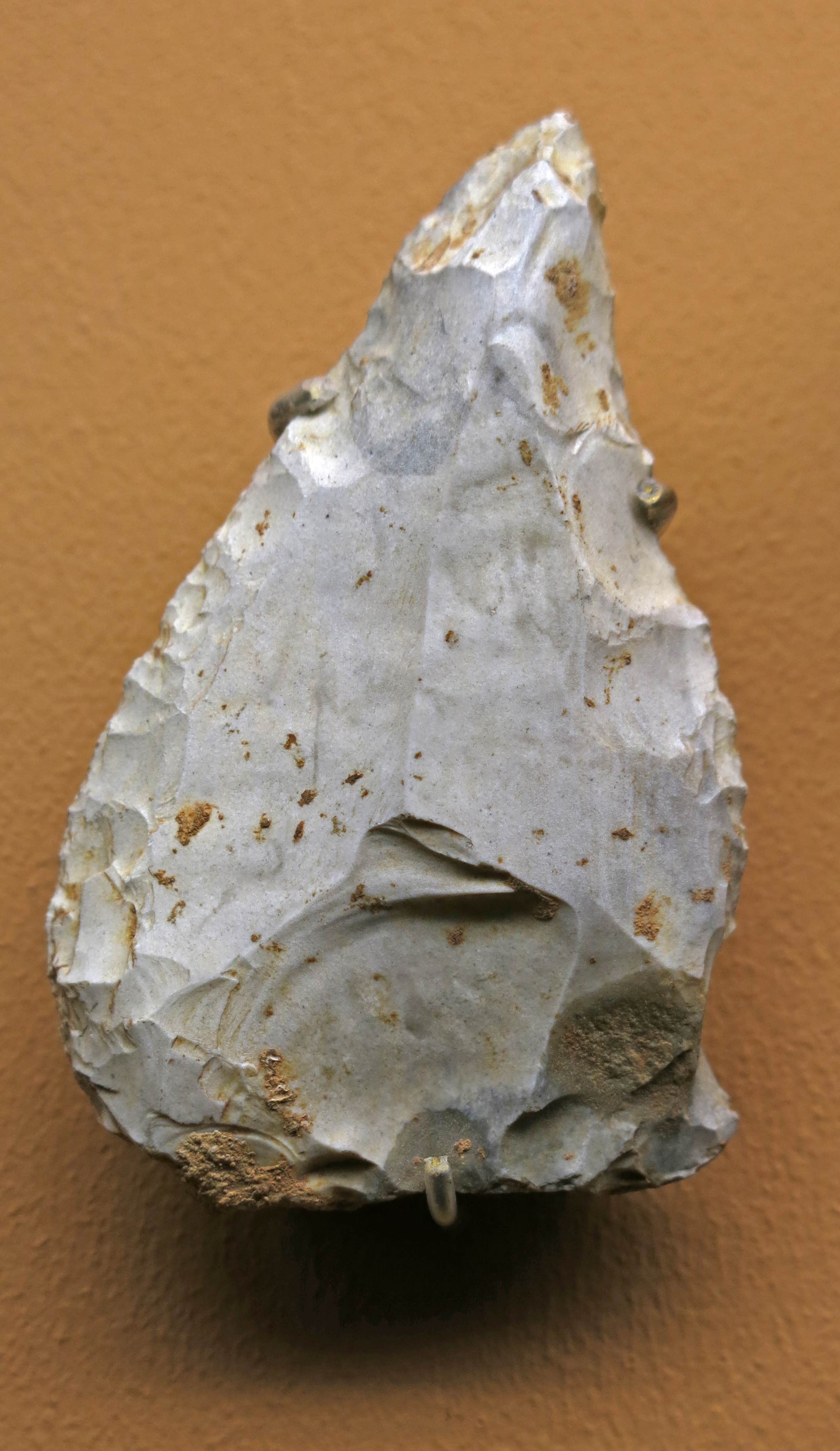
A retouched Levallois (Neanderthal) point from Fontéchevade.
Photo: Don Hitchcock 2015
Source and text: Original, Musée d'Archeologie Nationale et Domaine, St-Germain-en-Laye
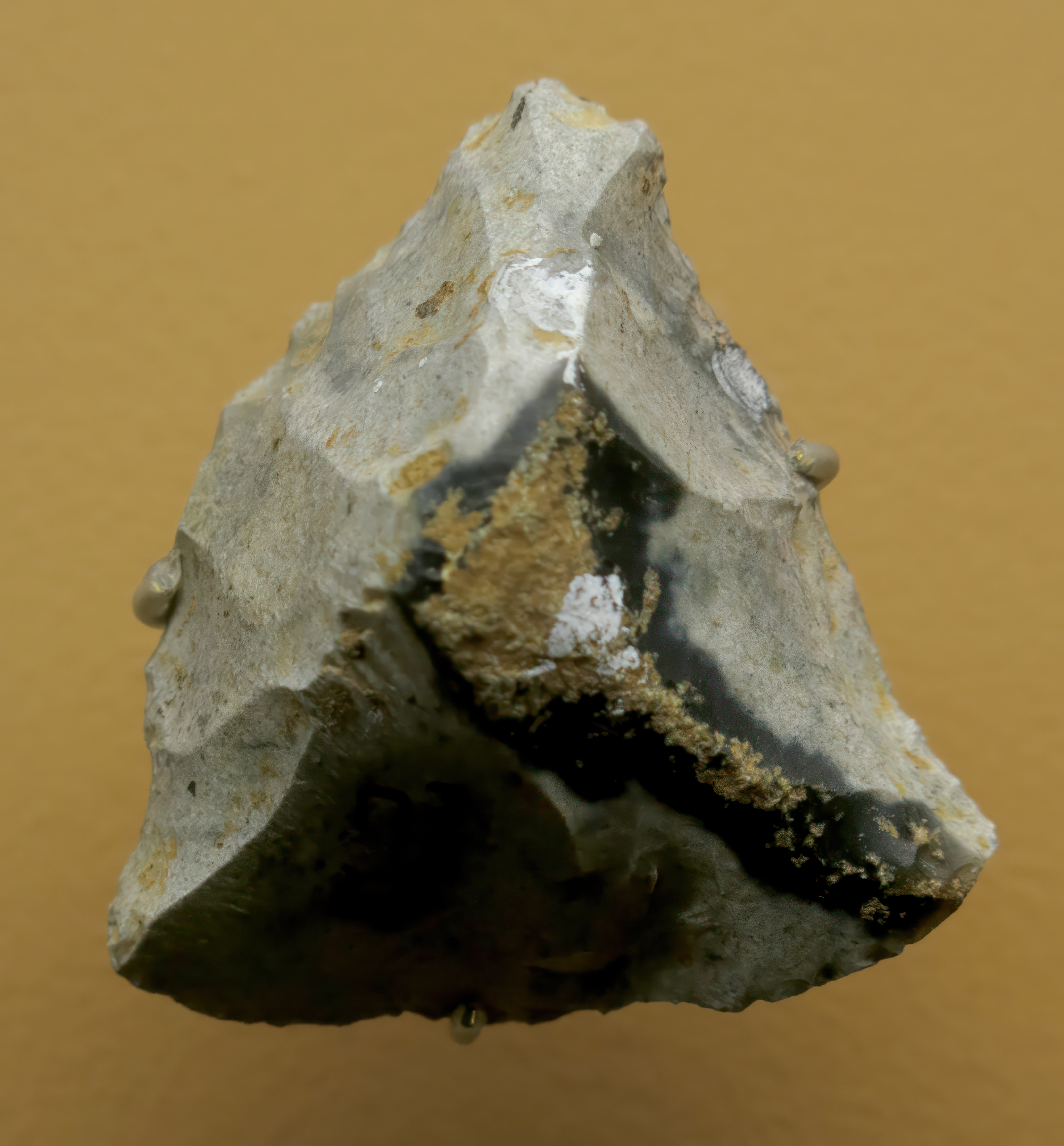
Scraper with scalariform retouch from Fontéchevade.
Scalariform is a term for a specific stone knapping technique where an artisan flakes the edge or surface of a stone tool to produce a stepped, overlapping finish that resembles the scales of a fish. The term derives from the Latin scalaris, resembling a ladder.
Photo: Don Hitchcock 2015
Source and text: Original, Musée d'Archeologie Nationale et Domaine, St-Germain-en-Laye
References
- Dibble et al. , 1996: Taphonomy and the concept of Palaeolithic cultures: The case of the Tayacian from Fontéchevade PaleoAnthropology 2006, 1−21. Copyright © 2006 Paleoanthropology Society. All rights reserved.
Back to Don's Maps
Back to Archaeological Sites
 Back to Egypt Index Page